Yesterday, behemoth retailer Amazon announced that its Amazon Fresh grocery stores are closing. All of them, about 70 locations, and closing soon, as in Sunday. I read about that this morning, and happened to mention the fact to Yuriko early this afternoon, so we decided to mosey over to the closest Amazon Fresh, about a 10-minute drive from our home here in the northwest suburbs.
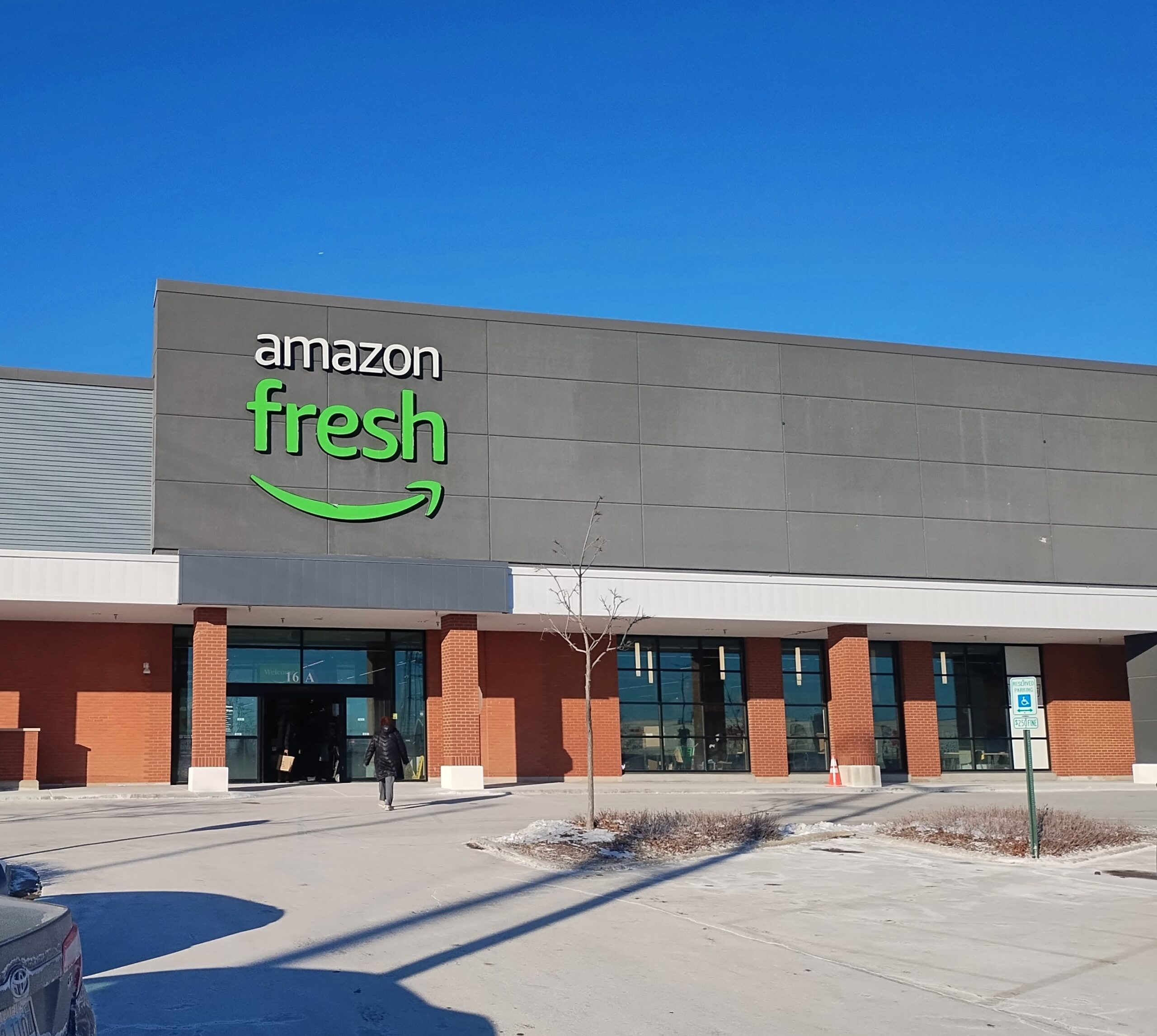
We’d been there. In the store’s early days especially, a few years ago, weekly fliers came in the mail offering coupons that could, if used right, mean 40 percent or even 50 percent discounts. That was worth some visits. After a few months, however, the coupons got progressively more miserly or disappeared all together.
That was no surprise. The coupons’ main function was to get you in the door, and acquainted with the store, and ideally form a good opinion that inspires return visits. A good marketing plan, even if it relies on something as analog as paper coupons, and it might have worked but for one thing: there was very little distinctive, to an ordinary shopper, about Amazon Fresh.
The store promised to be something of a discounter, and sometimes it was. Until recently, for example, it sold sizable and reasonably good pizzas for $9 a pie or less than $2 a slice – entirely competitive. Other items were sometimes discounted as well, but in that the store was no different from any other store in the area.
Even that might not been a discouragement, if the store had competed on selection. By current standards, the NW suburban Amazon Fresh is mid-sized, so isn’t going to be able to offer everything under the sun. But even smaller stores can pull off a remarkable selection, if they try. Such as Trader Joe’s. Or even Aldi, whose more recent iterations are about the same size as the Amazon experiment in grocery stores.
But no. The Amazon Fresh selection is good enough, and certainly would be a boon in a food desert, or even at the edge of one. But the NW suburbs are the opposite of a food desert: we have hyperstores, warehouse stores, standard supermarkets of considerable size, discount grocers, and plenty of ethnic specialty grocery stores of varying sizes, all within a fairly reasonable driving radius. There are even dollar and convenience stores thrown into the mix, and every variety of take-out food that you can imagine. These parts are a highly competitive retail grocery and food & beverage environment, is what I’m saying.
And what did Amazon Fresh bring to the table in such an environment? A lot of meh.
Then there was this business of “Dash Cart.” Amazon Fresh made a big deal about how technically advanced the stores were, because you could “Skip the checkout line. Scan, bag and pay – right from your cart.” Well, OK. Some of the carts had consoles for self-scanning.
Did Amazon actually want its customers to adopt Dash Cart, or was it just showing off? I ask because any hint of any instruction about how to use the thing was lacking. Call it an engineers fallacy: this tech is so cutting-edge, so impressive, so neat that people will be eager to learn it. People will not. Maybe had there been an employee whose job it was to school us old timers, we might have been interested, but of course that costs money, and just wait until customers don’t even have to deal with checkout clerks, how much that will cut labor costs!
Besides, you still have to do the work the store should be doing – scanning your items – for free. That is the essential irritation of any self-scanning scheme. Turns out self-scanning isn’t going to completely replace clerks anyway, for various reasons, and I’m glad.
How could Dash Cart and its ilk actually work? One: activate the cart with a debit or credit card. No messing around with some app, no inputting some code that comes to your phone, or any of that nonsense. Two: the cart itself automatically scans items as you put them in, and shows in a highly visible way how much you’re paying, so that the price jibes with the price on the shelf. Three: That’s it, you leave. You are charged a total – again, a highly visible total – as you leave, just as you would be otherwise.
Is all that technically possible? How should I know, but I’m leaning toward yes. Or it could be.
Never mind all that, we figured the store might be knocking off 10 or 20 percent in the face of its demise. The first indication that we were wrong was the store parking lot, which was as crowded with cars as I’d ever seen it. The second clue was the lack of shopping carts outside — at all, including in corrals in the parking lot or next to the entrance. No shopping carts inside the door, either.
Hand baskets were available, and Yuriko started with that, her initial goal being vegetables. I waited inside the door (since it was about 15 F outside) and after a few minutes, got a cart that was being returned. While I was waiting, a store employee announced at the front of the store that checking out, even self-check, would involve and hour or hour-and-a-half wait. It was a thing that makes you go hmmmm.
Shopping cart delivered to Yuriko, I set out to investigate. The first thing I found out: the place was crowded. An entire large cross-section of the population of the nearby Chicago suburbs was loose in the store, younger and older, families with little kids, single shoppers, people whose ancestors (sometimes pretty recently) had come from Central Europe, East Asia, the Indian subcontinent, Latin America and more. Put them all in the store and it was Supermarket Sweep time. I’ve never seen a grocery store so crowded or so many carts piled so high.
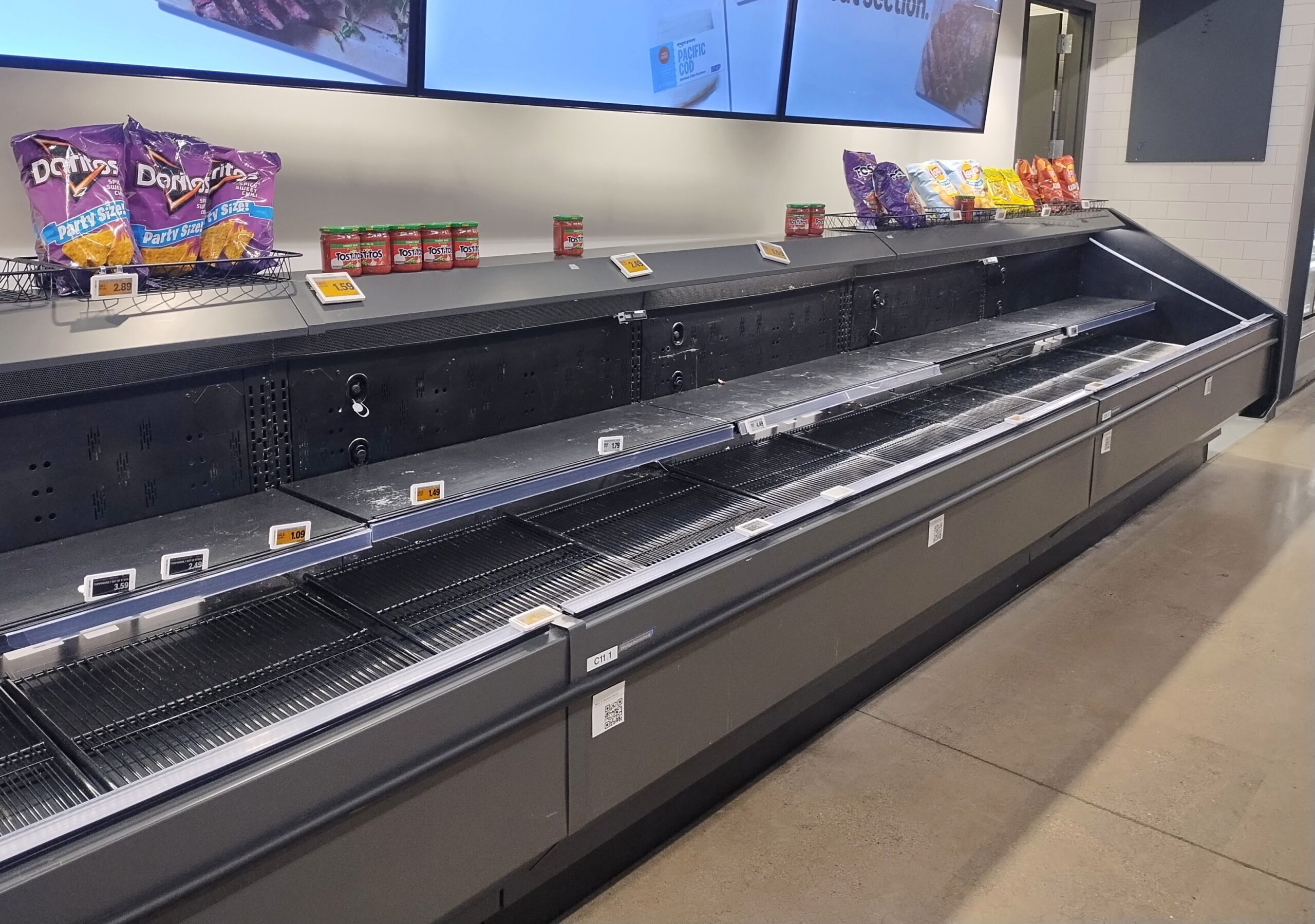
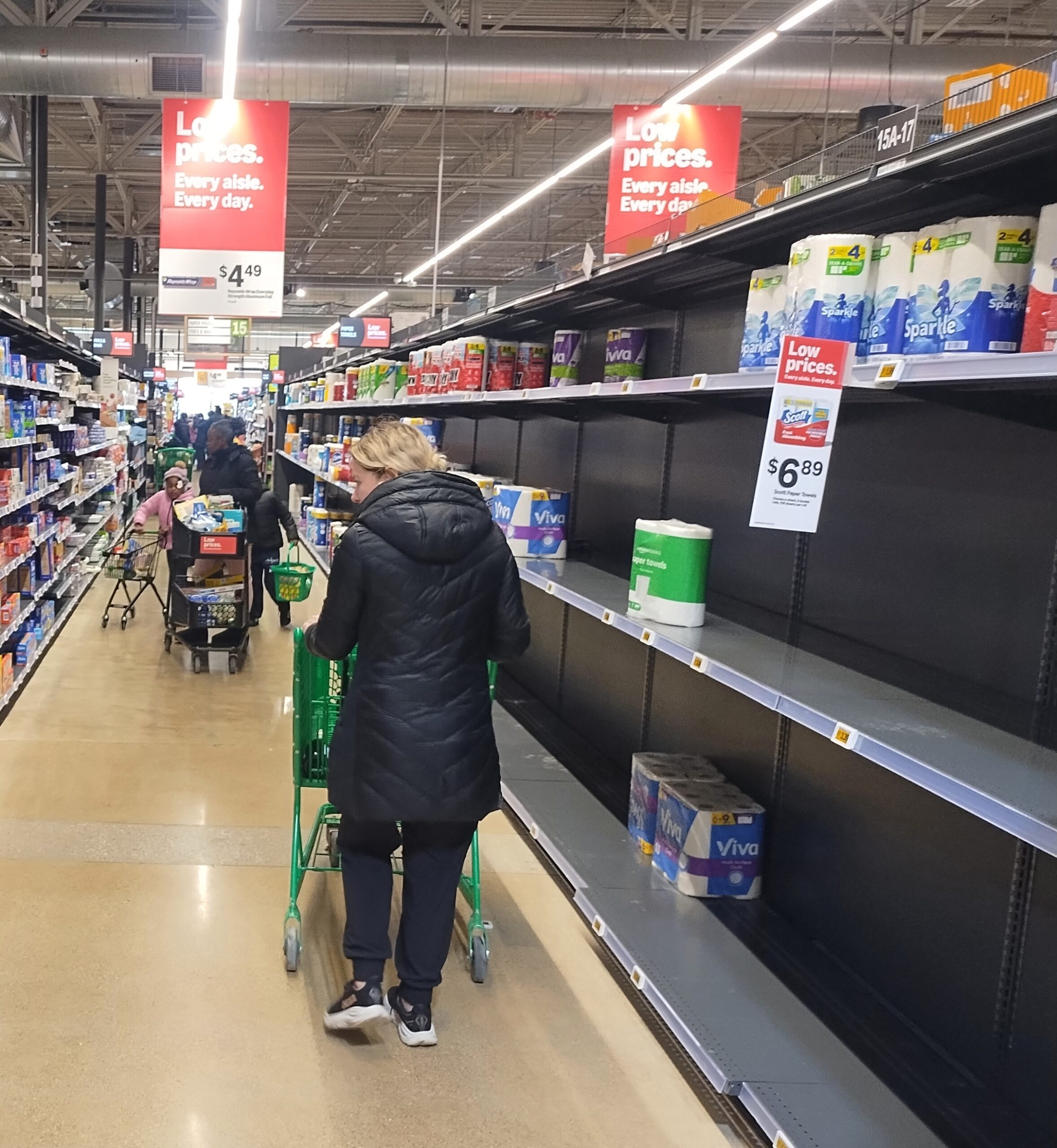
That resulted in some empty shelves, especially in the meat aisle and paper goods.
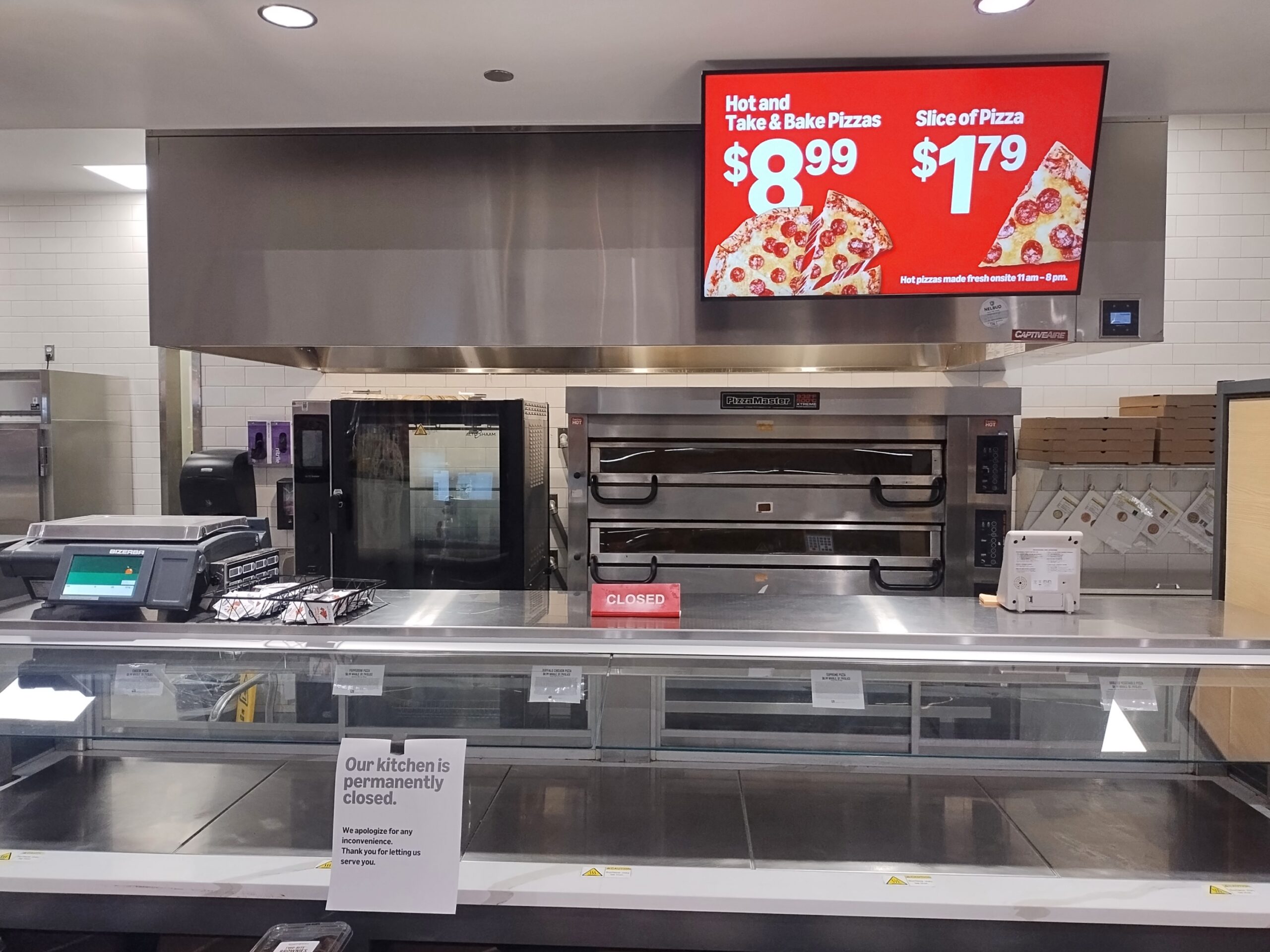
Sorry to say, the kitchen had already been closed permanently, its ovens cold and its workers presumably left to take their talents elsewhere, if possible. I’d wanted a slice of pizza at less than $2 just one more time, but no go.
But I’d misrepresent things if I left it at that. Many of the aisle and shelves still held the bounty of American agriculture and the never-ending efforts of food technologists.
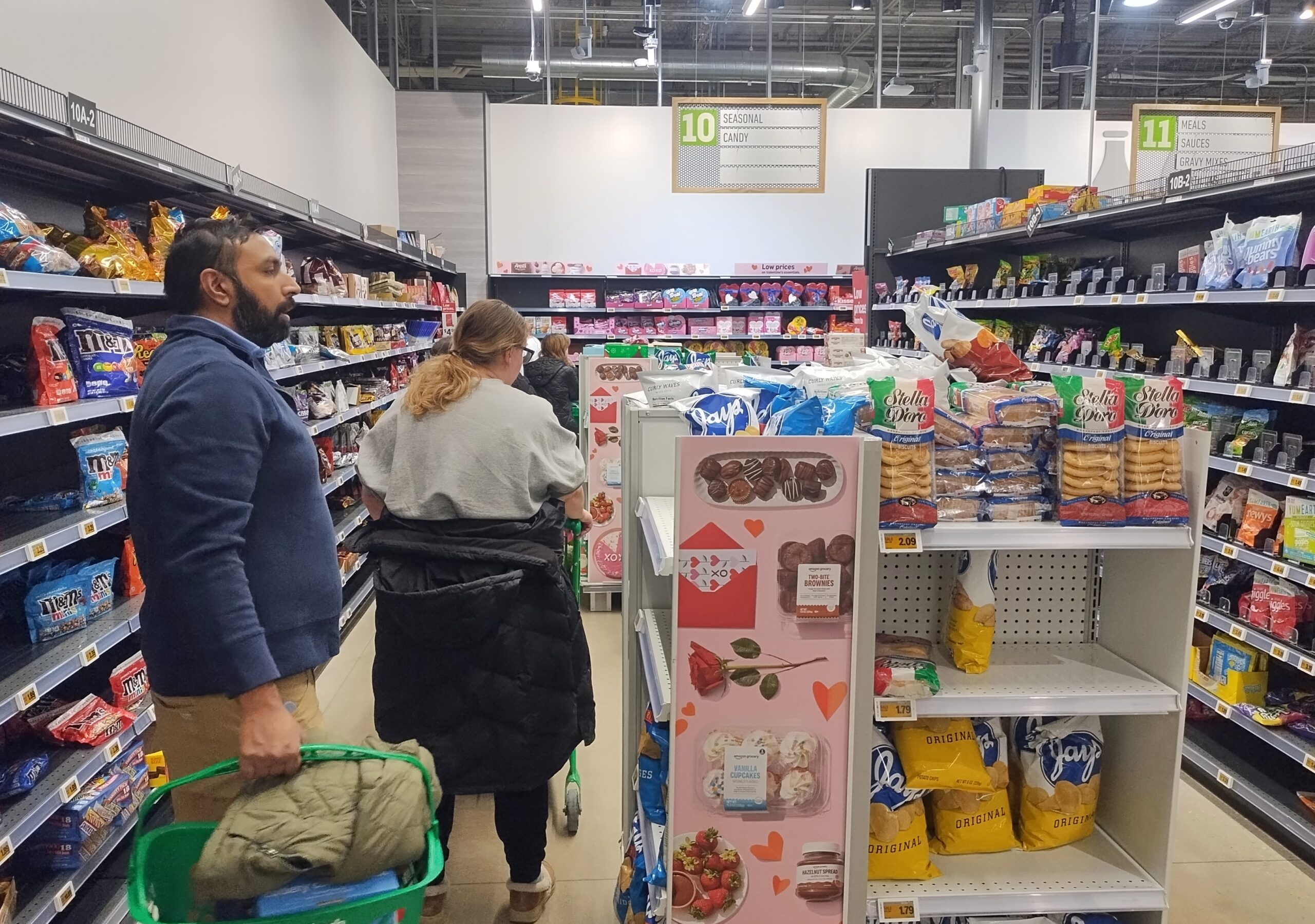
What brought the crowd? Deep discounts, of course. It didn’t take long to work that out. Later I did some back-of-the-envelope calculations and determined that nominal prices were back to late 1990s levels. Thirty years of inflation, slow and then fast, poof. That’ll pack ’em in. We joined the fun.
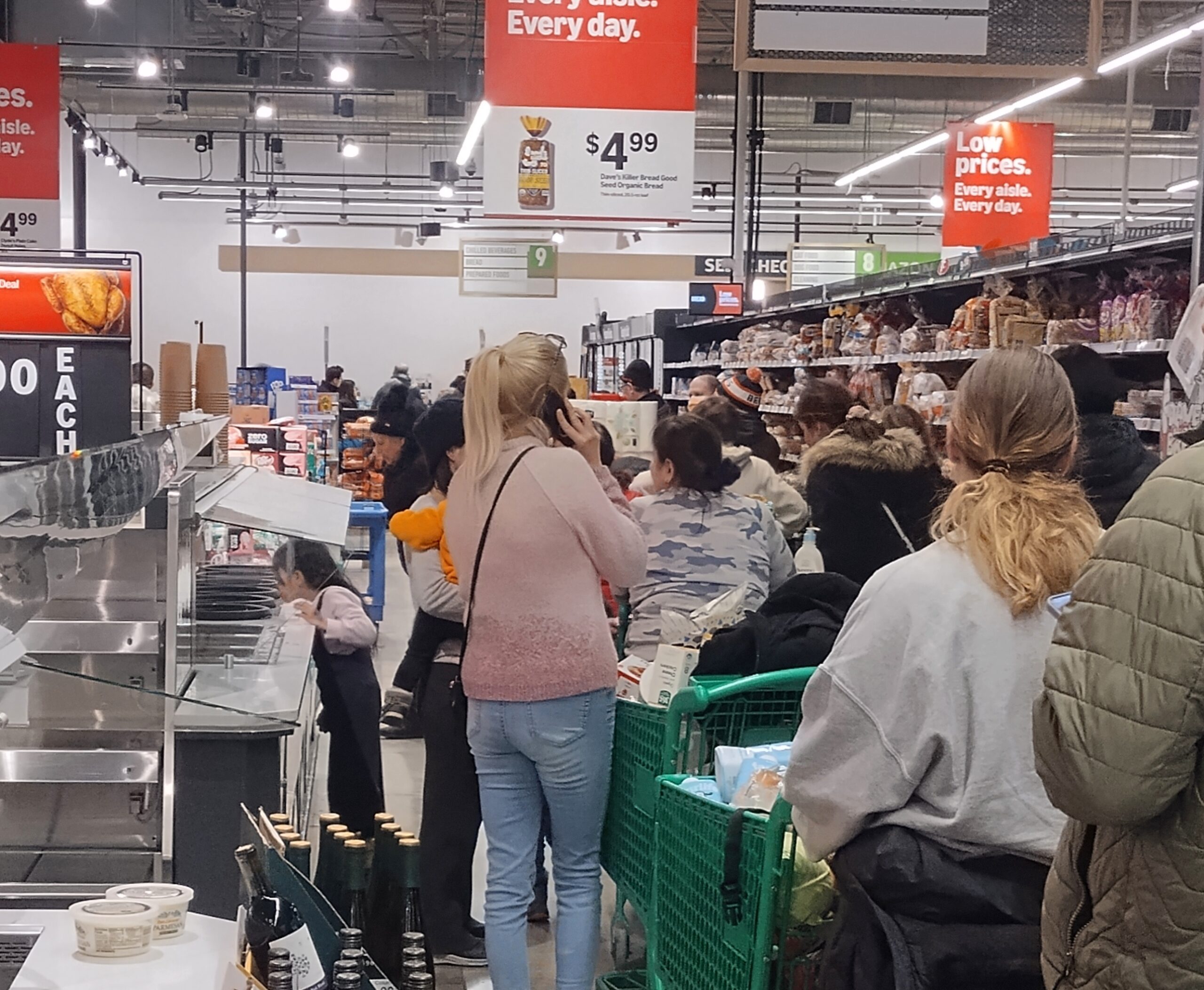
But the woman wasn’t kidding about the wait. The checkout line went back along the right-side aisle to the back of the store, turned a corner and went along the back aisle (dairy and such), and then turned a corner again at the left-side aisle, and ended about halfway back to the front of the store. Later, the line grew to go all the way around the store, back to the checkout area.
Before that happened, I got in line with the cart and Yuriko went out scouting for items, and later sometimes I did. This was a strategy employed by a number of couples in line. A view from the line:
I also went out to the car and re-arranged the items in the back, in anticipation of a large influx. Which happened, eventually, once we filled our cart – to the top – and got through checkout.
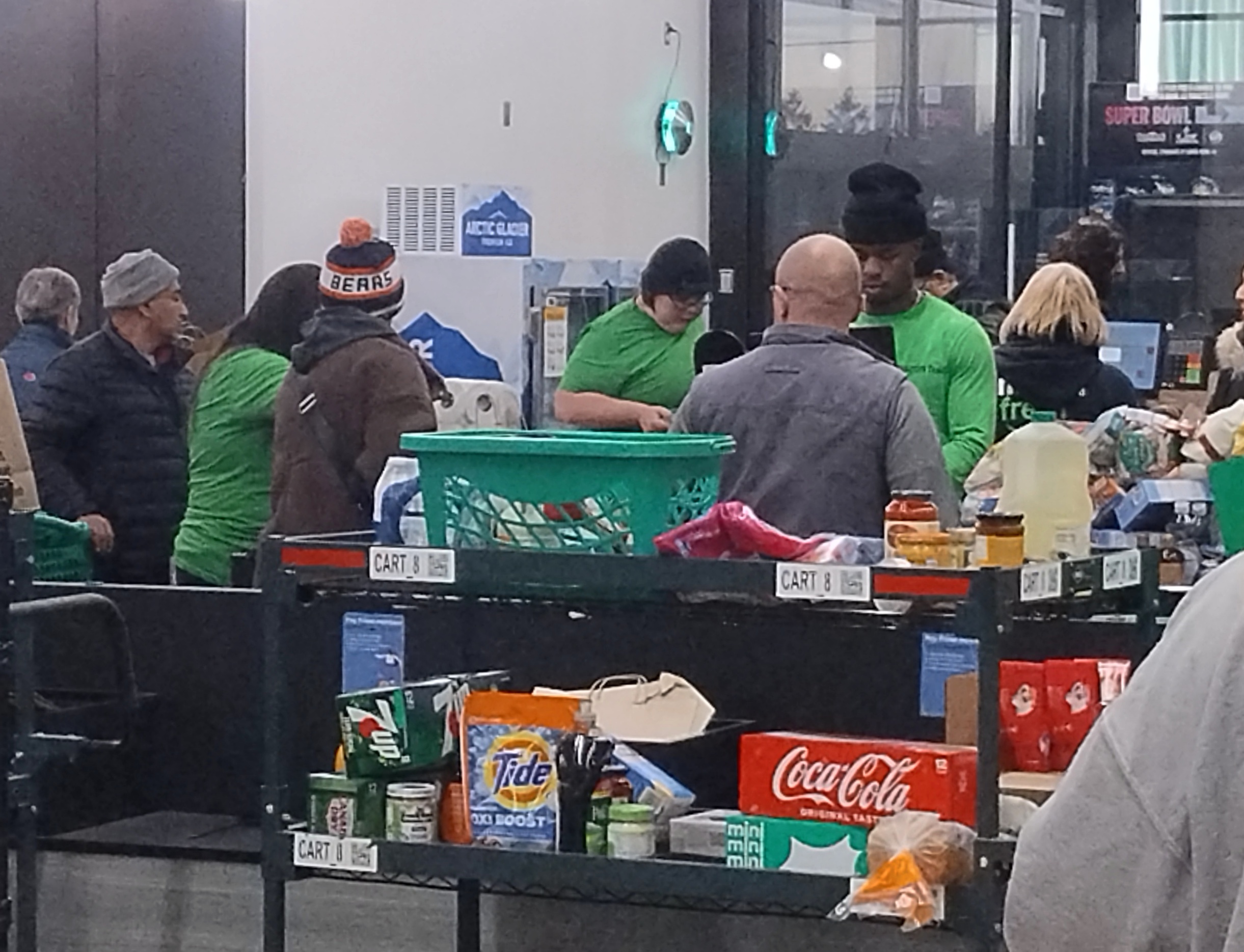
Checkout, which indeed had taken more than an hour to reach, was an anticlimax. It was just like any checkout, except more stuff than usual. Still, this is worth noting: We spent a shade over $250 on items that listed a few days ago for around $500. Definitely a deal, whatever you think of the behemoth retailer or its failed experiment in Amazon-branded supermarkets.