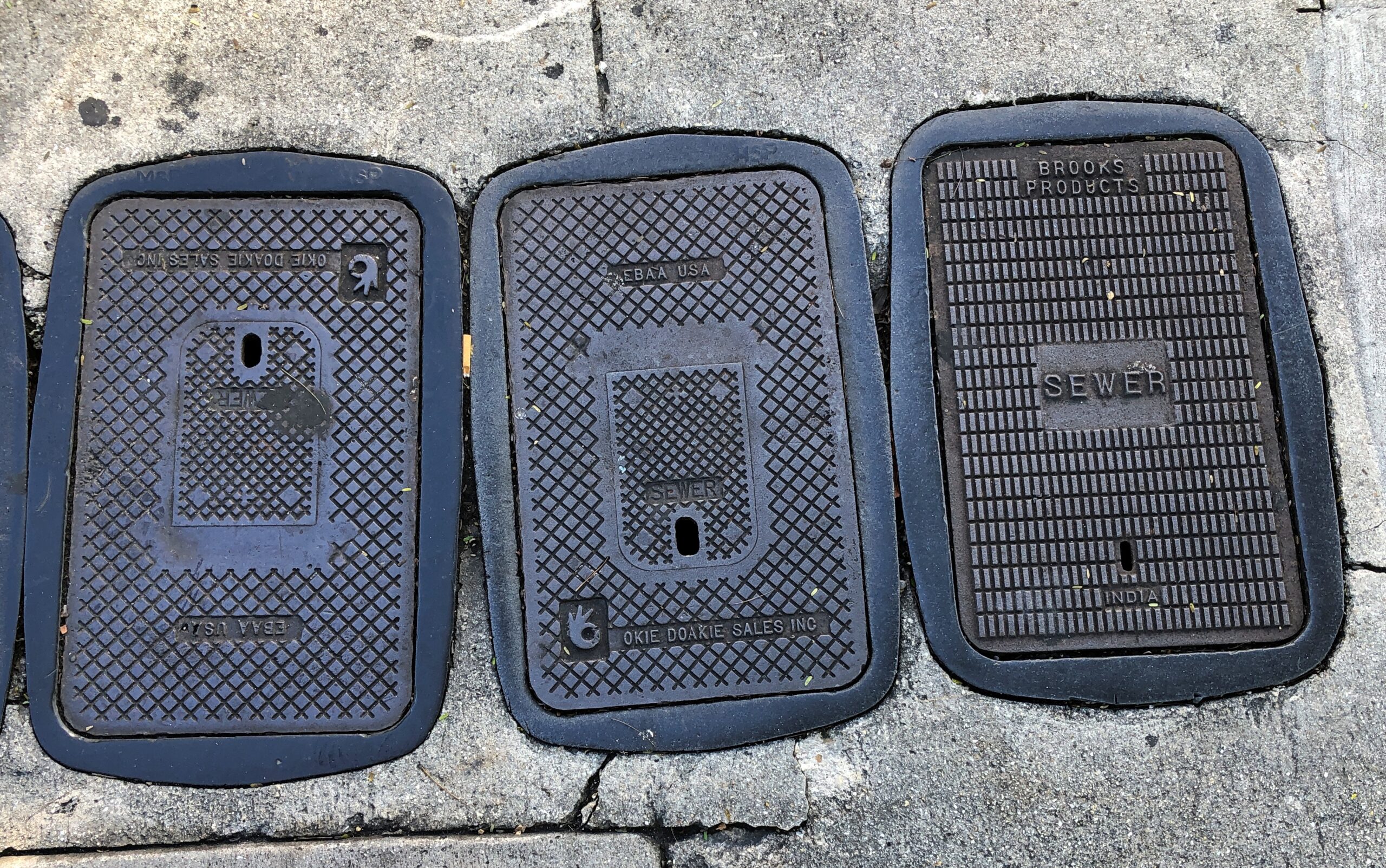
If you asked me, and no one has or will, Key West is missing something in having plain manhole and utility covers (though this isn’t bad).
I suspect custom covers cost more, and money is money, but distinctive places should have distinctive manhole covers. Aren’t details important in fostering – or in this case enhancing – a sense of place?
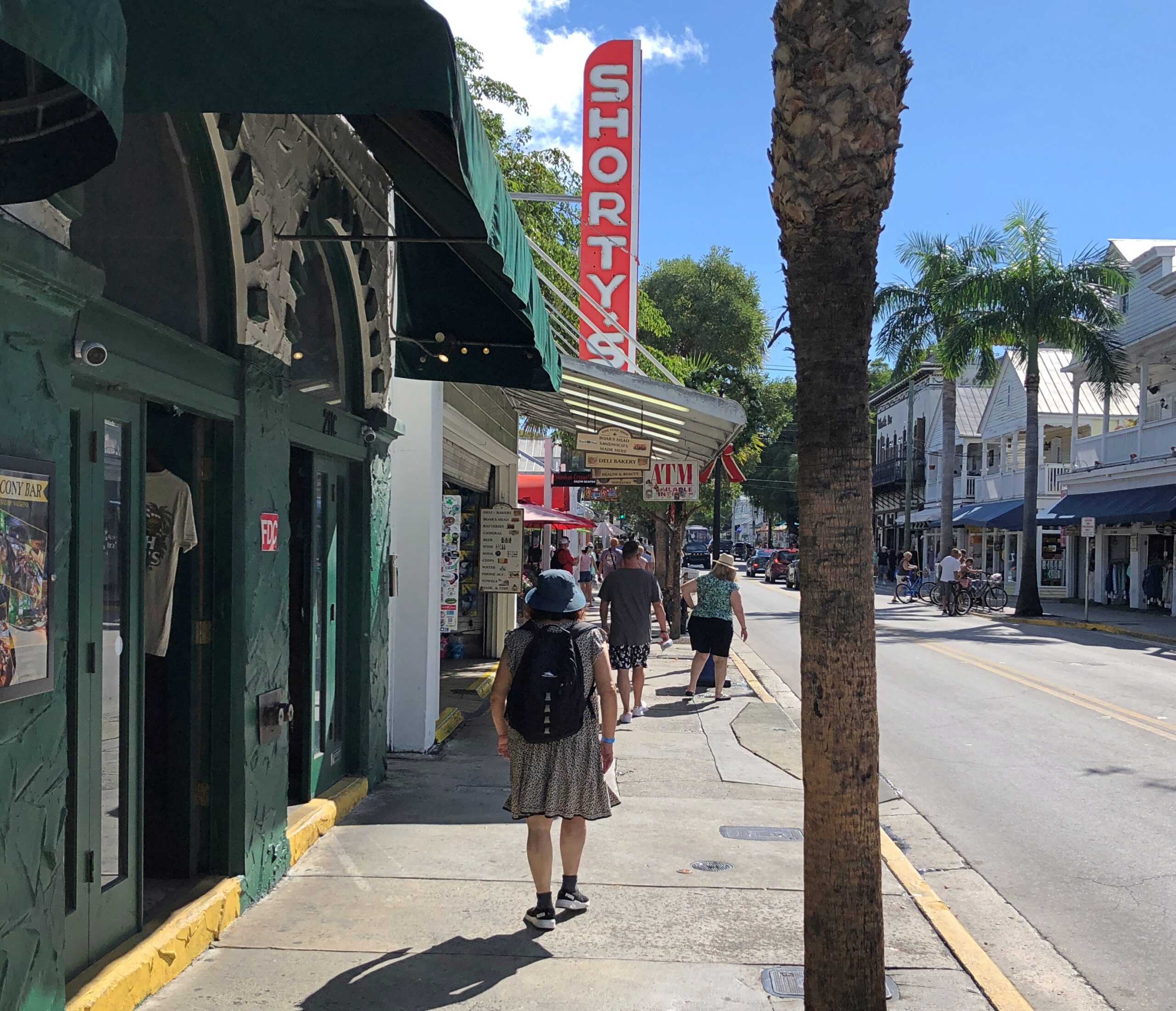
On the other hand, Key West has a sense of place without too many equals. That’s as good a reason as any to stroll down Duval Street, tourist hub of Key West, and take it all in. Or as much as you can. On a mild mid-December day, that wasn’t hard.
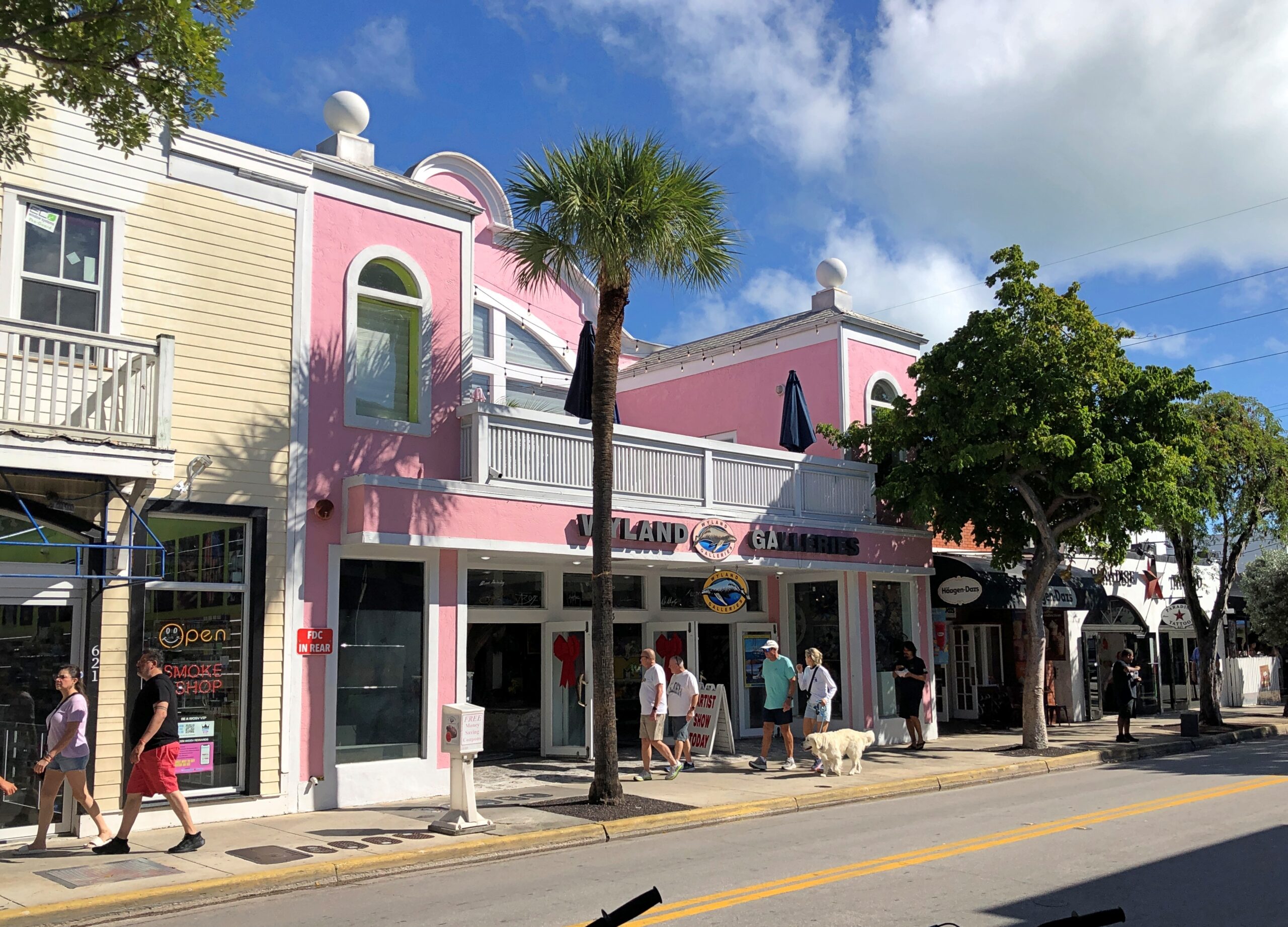
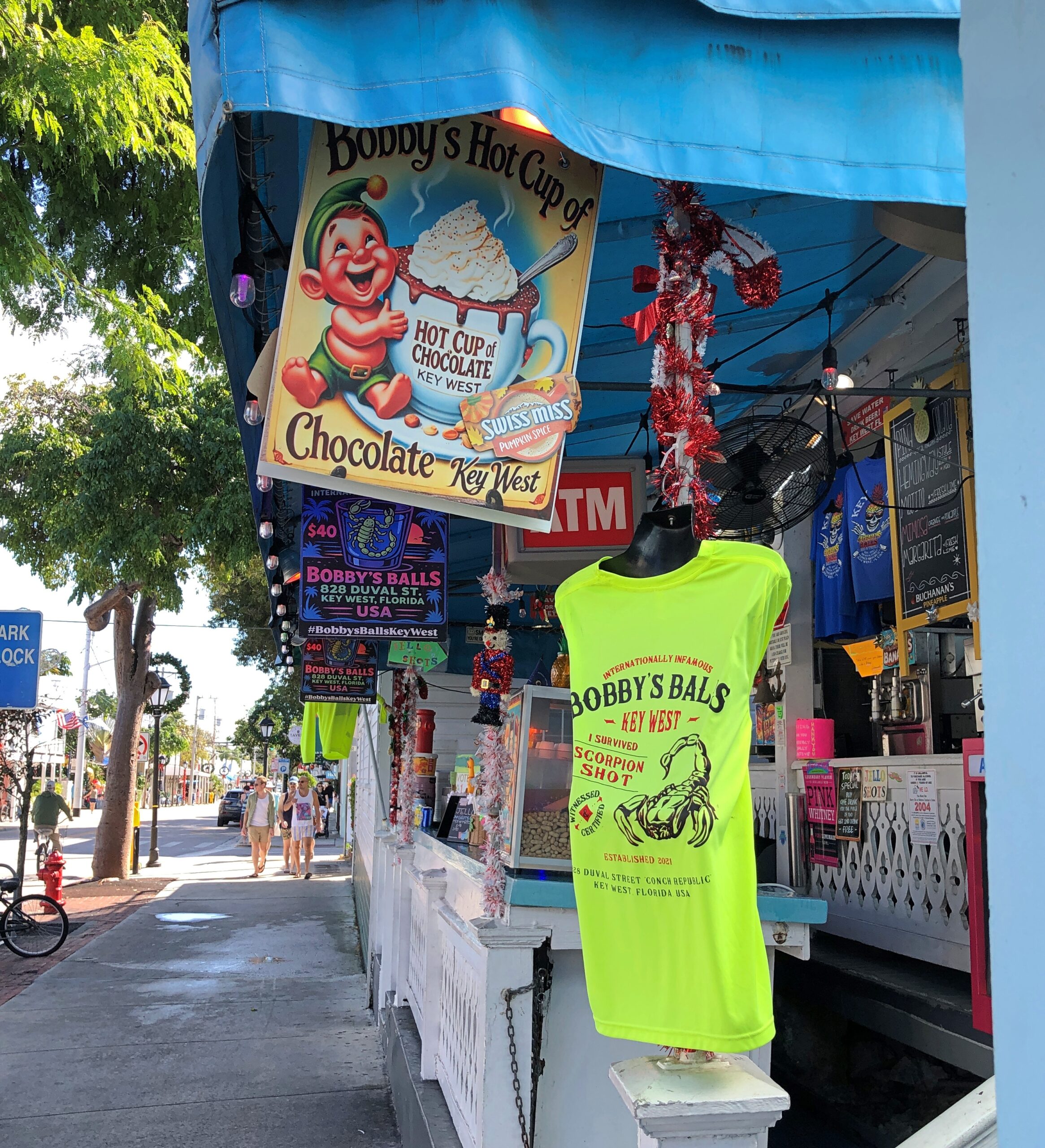
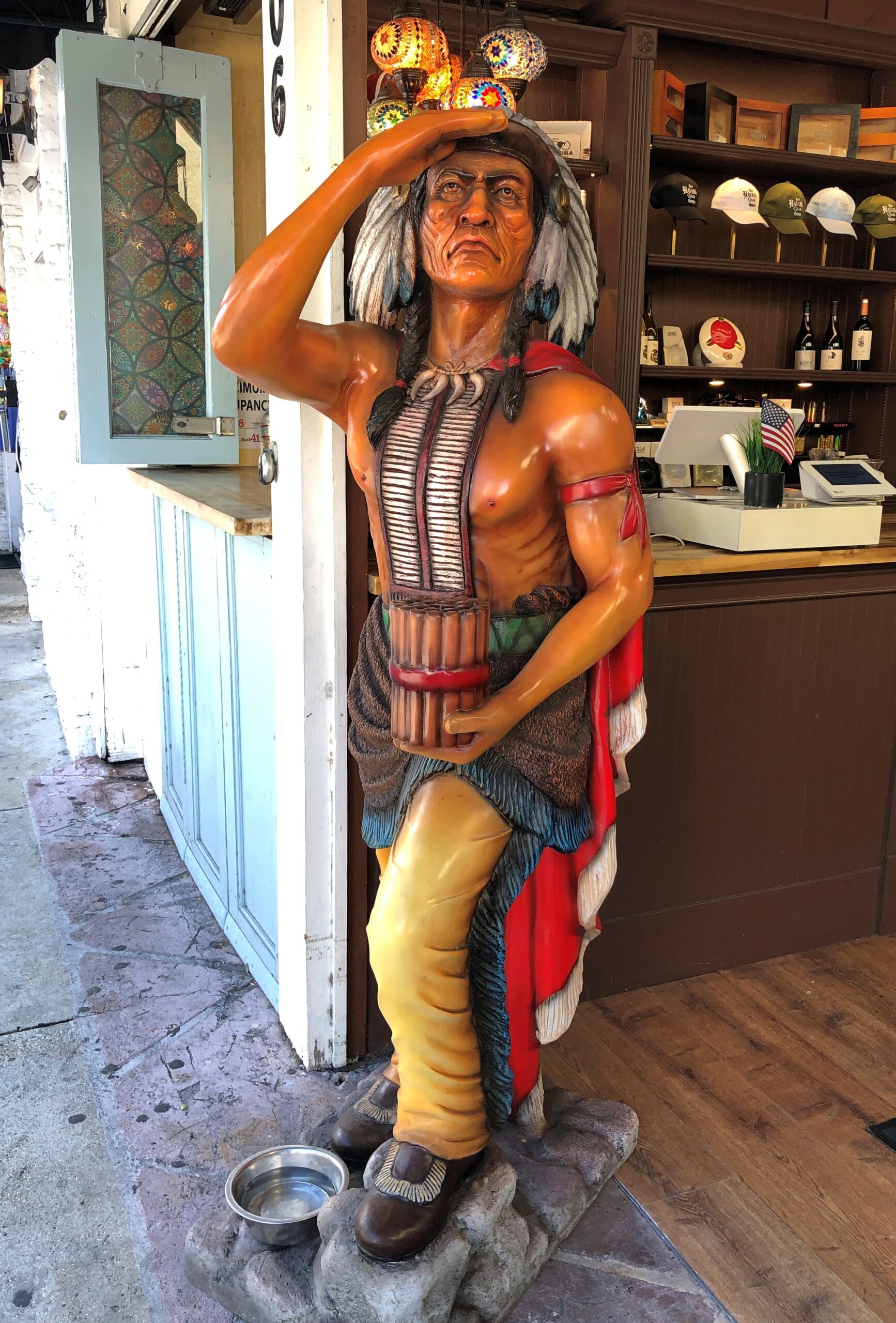
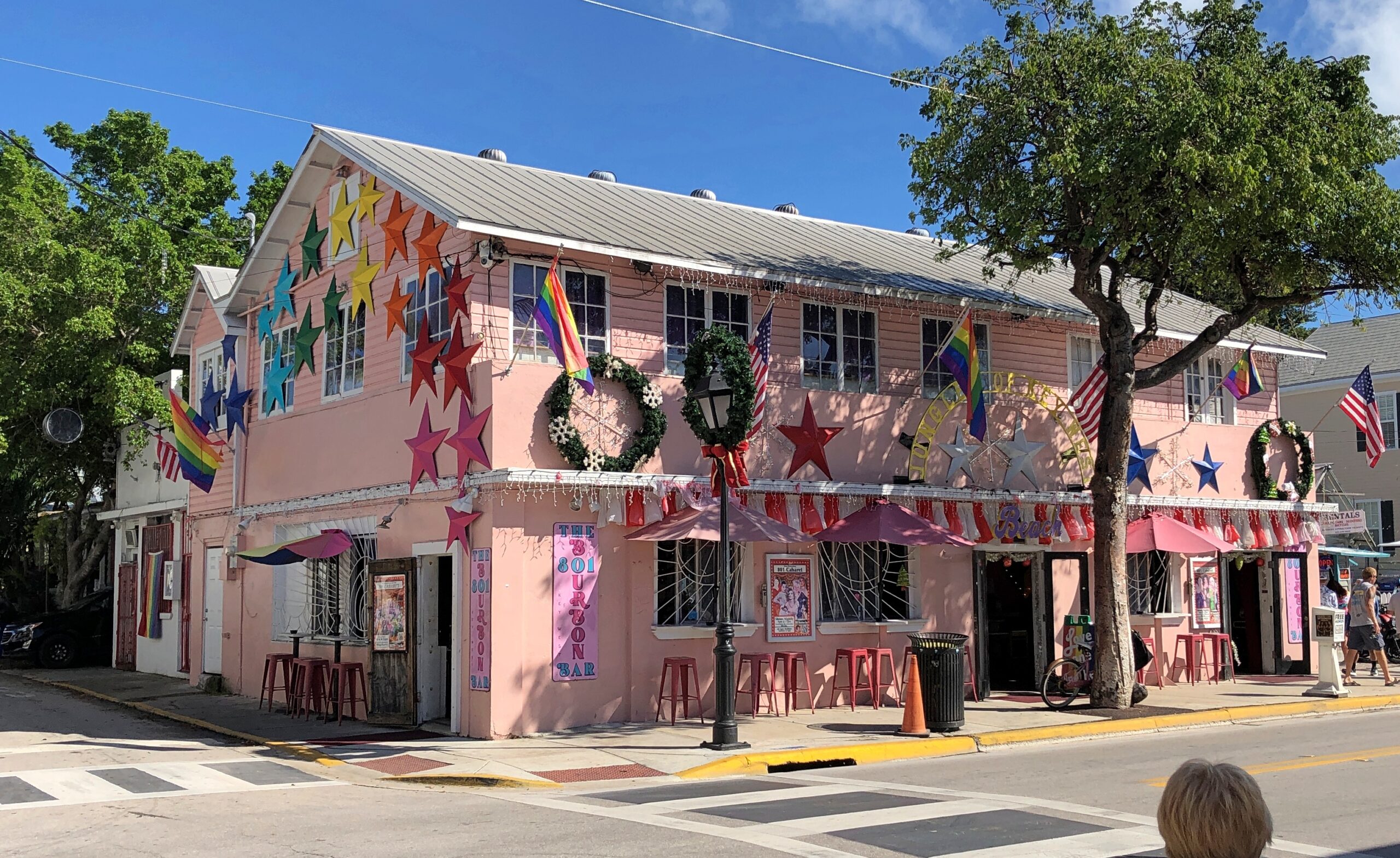
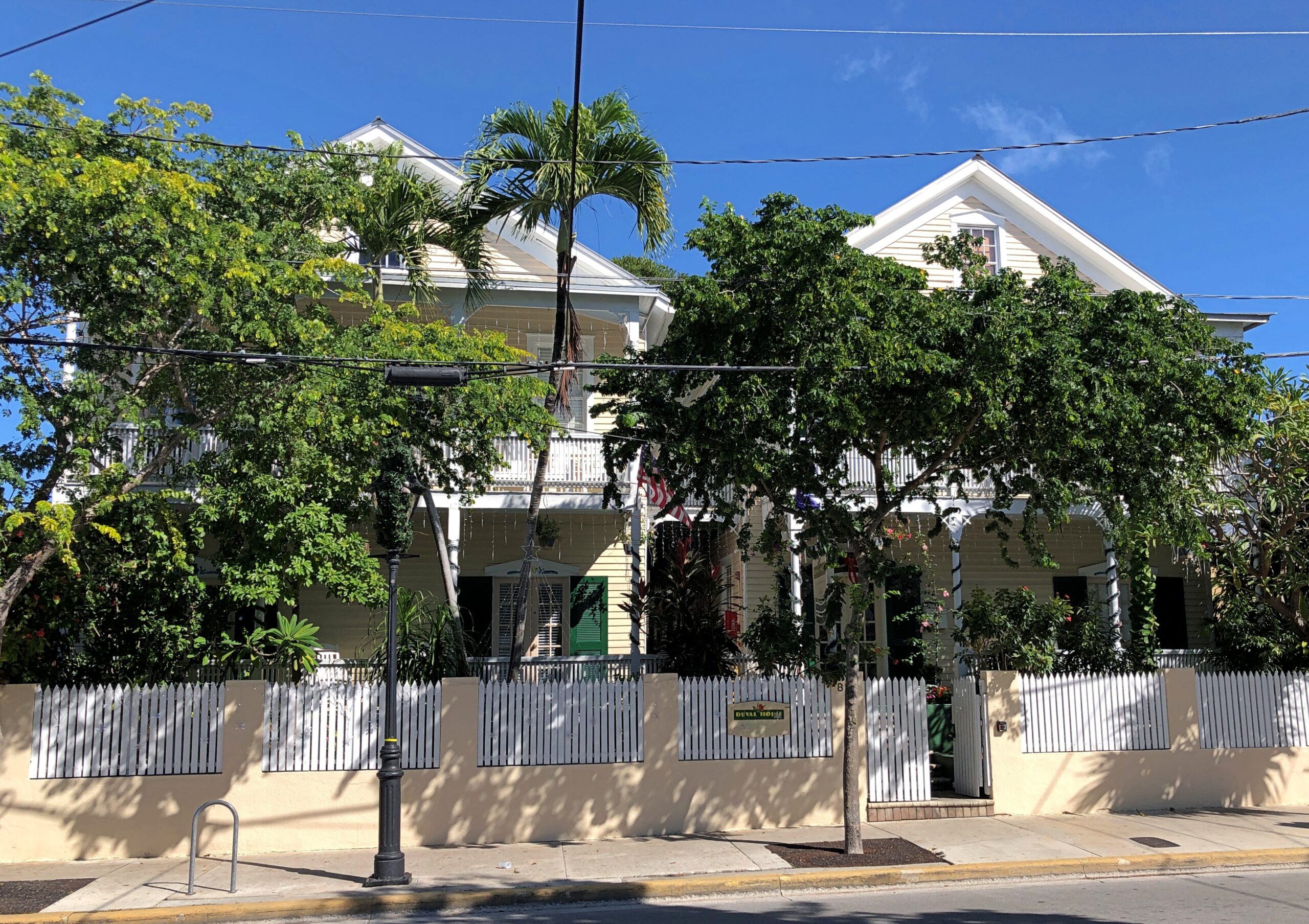
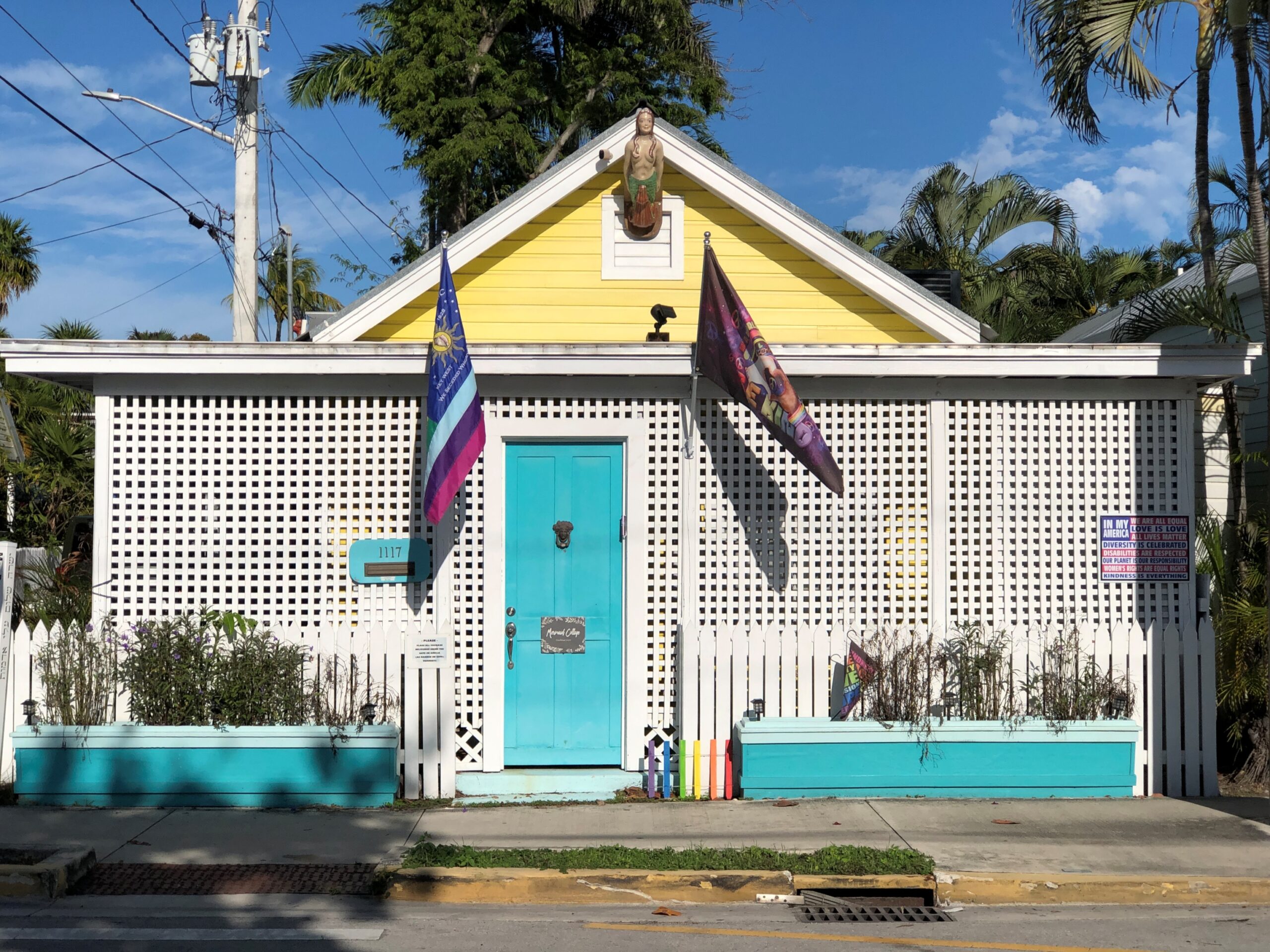
As a tourist street, a lot of retail detail.
Buildings that have somehow survived these last 100 years or so, despite the ocean’s habit of kicking up a hurricane-force fuss now and then.
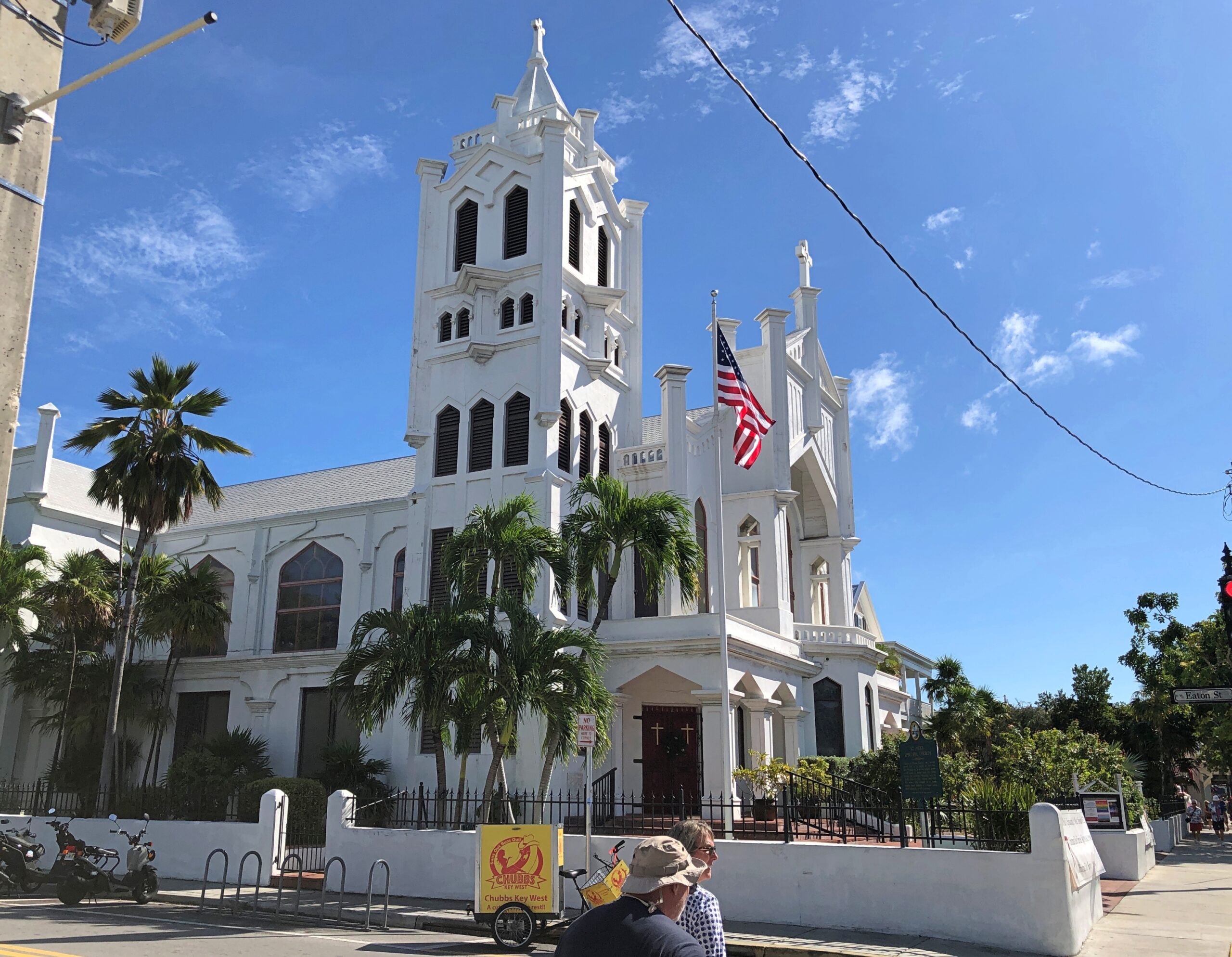
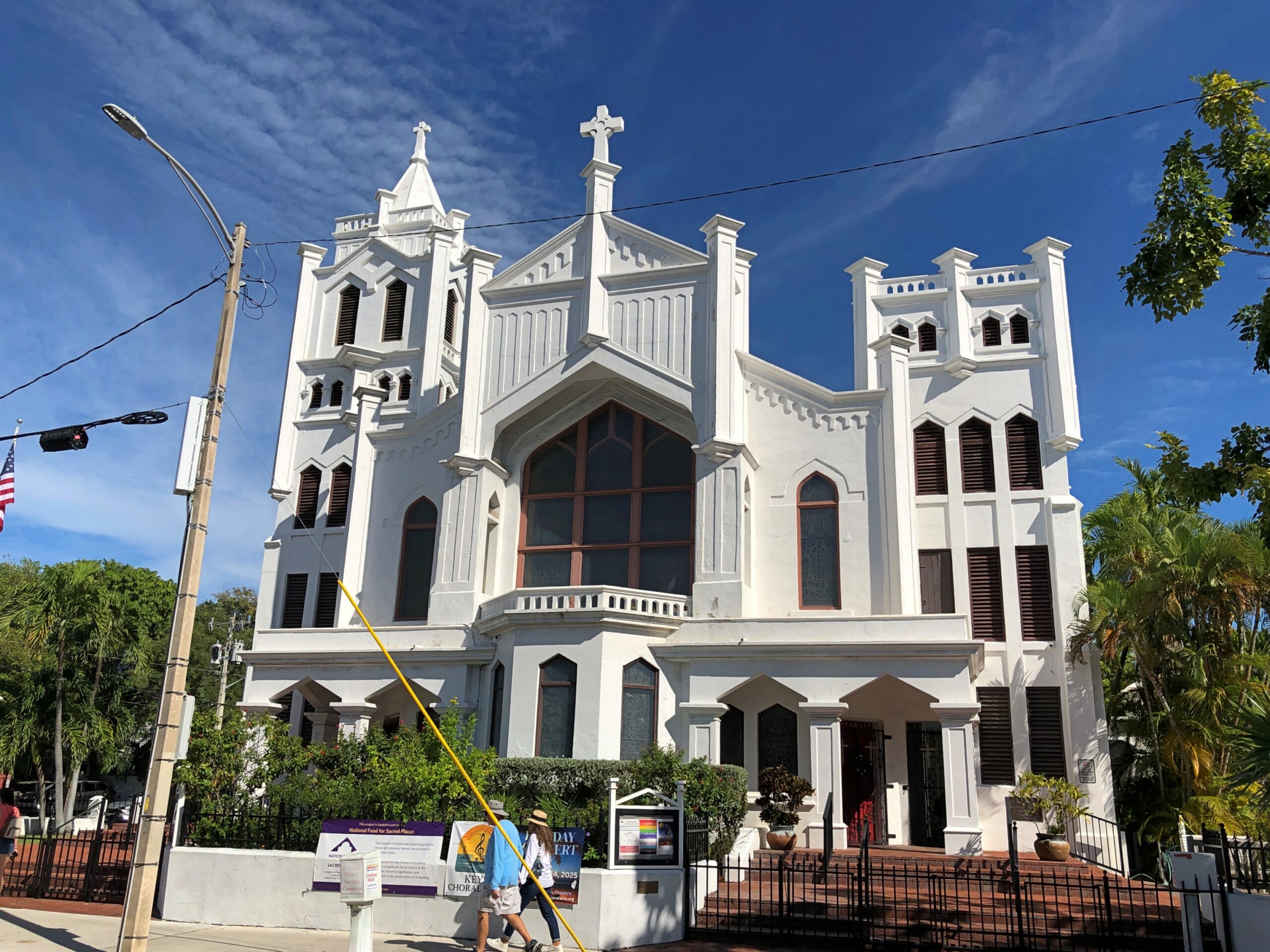
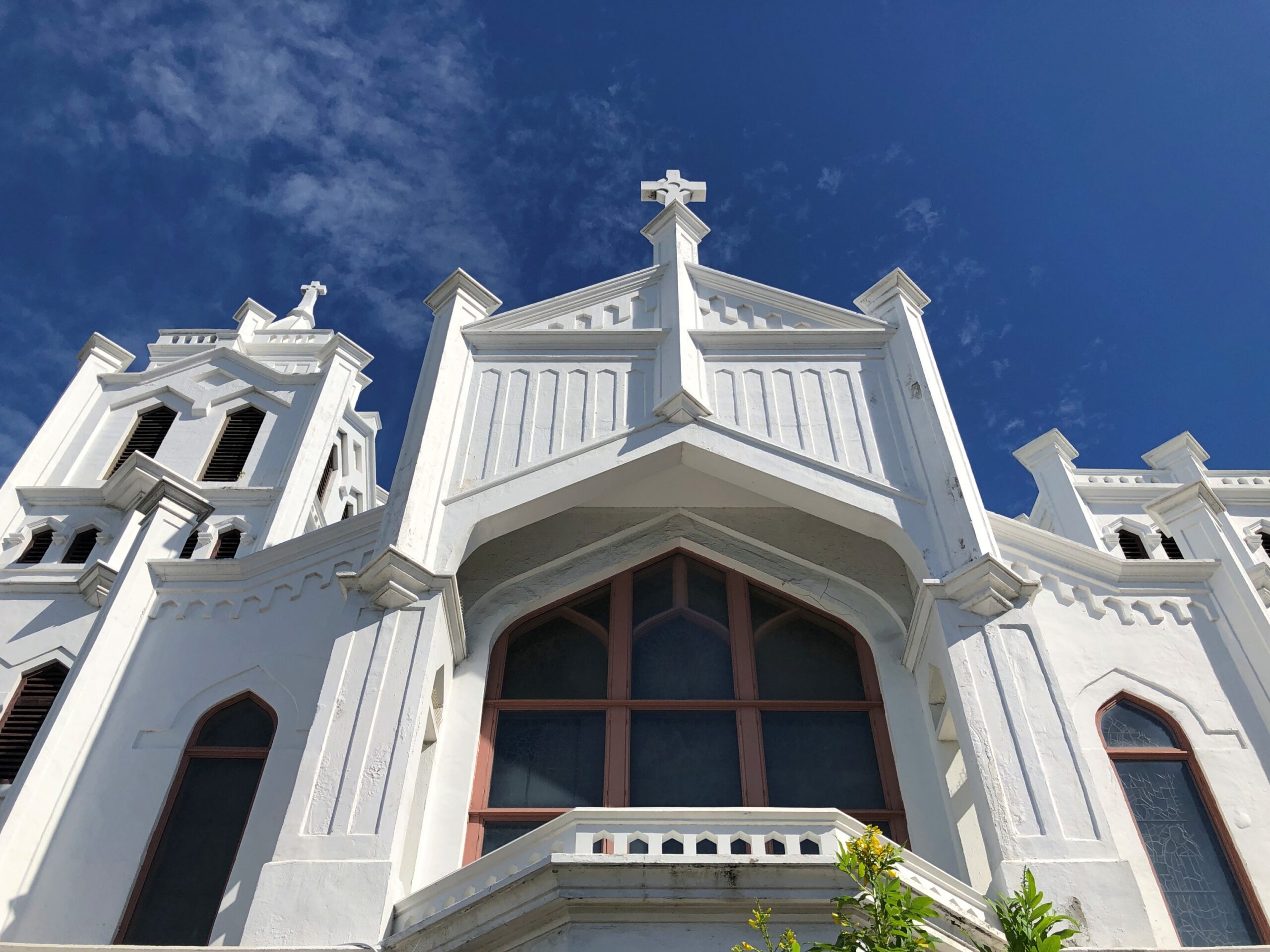
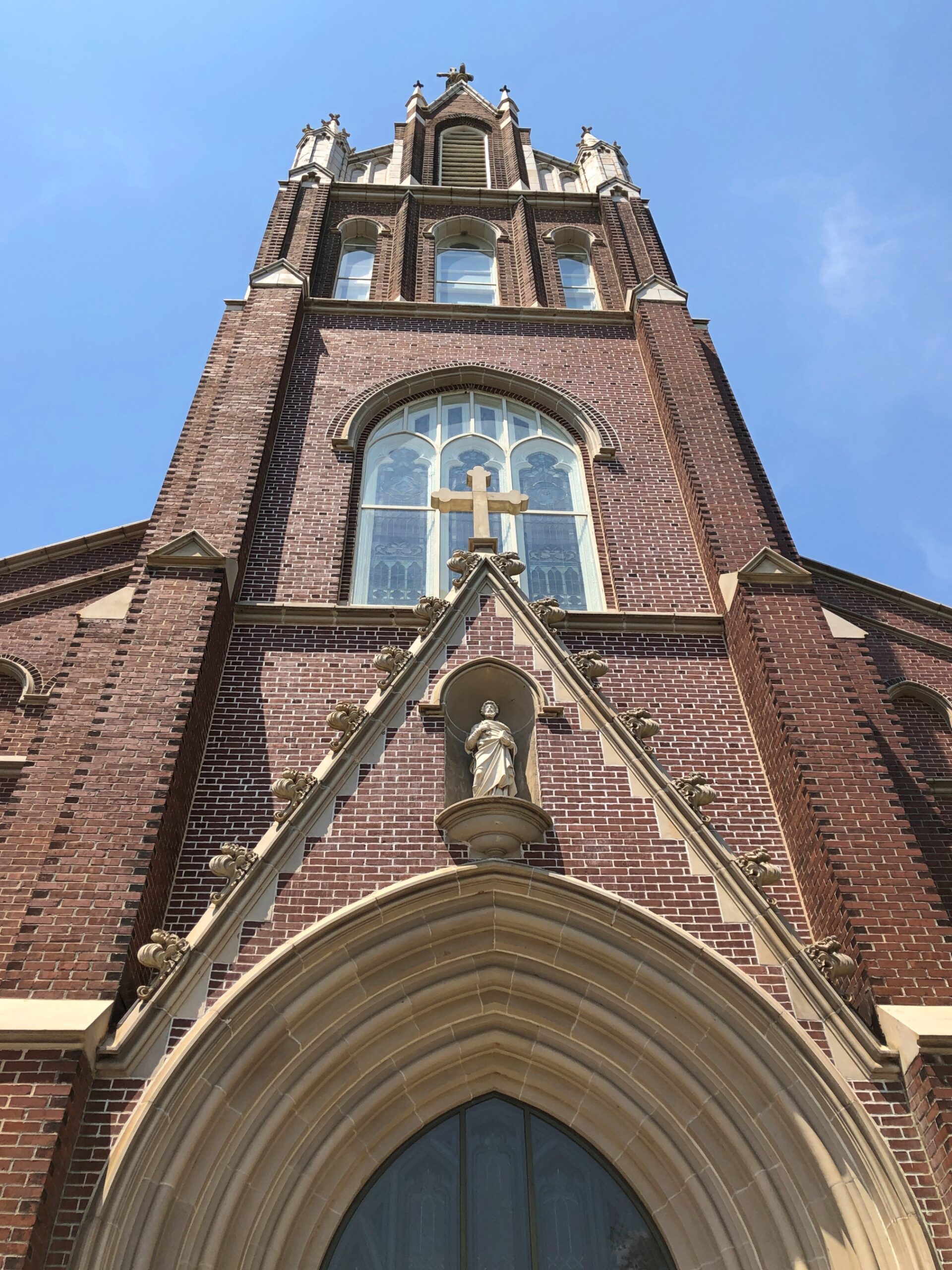
St. Paul’s Episcopal, 401 Duval.
In 2014, I ducked away from crowded Duval into the church, which seemed to be open because the organist was practicing. I sat, impressed by his vigorous noodling, and by the fact that no one else was in the church.
This time, closed.
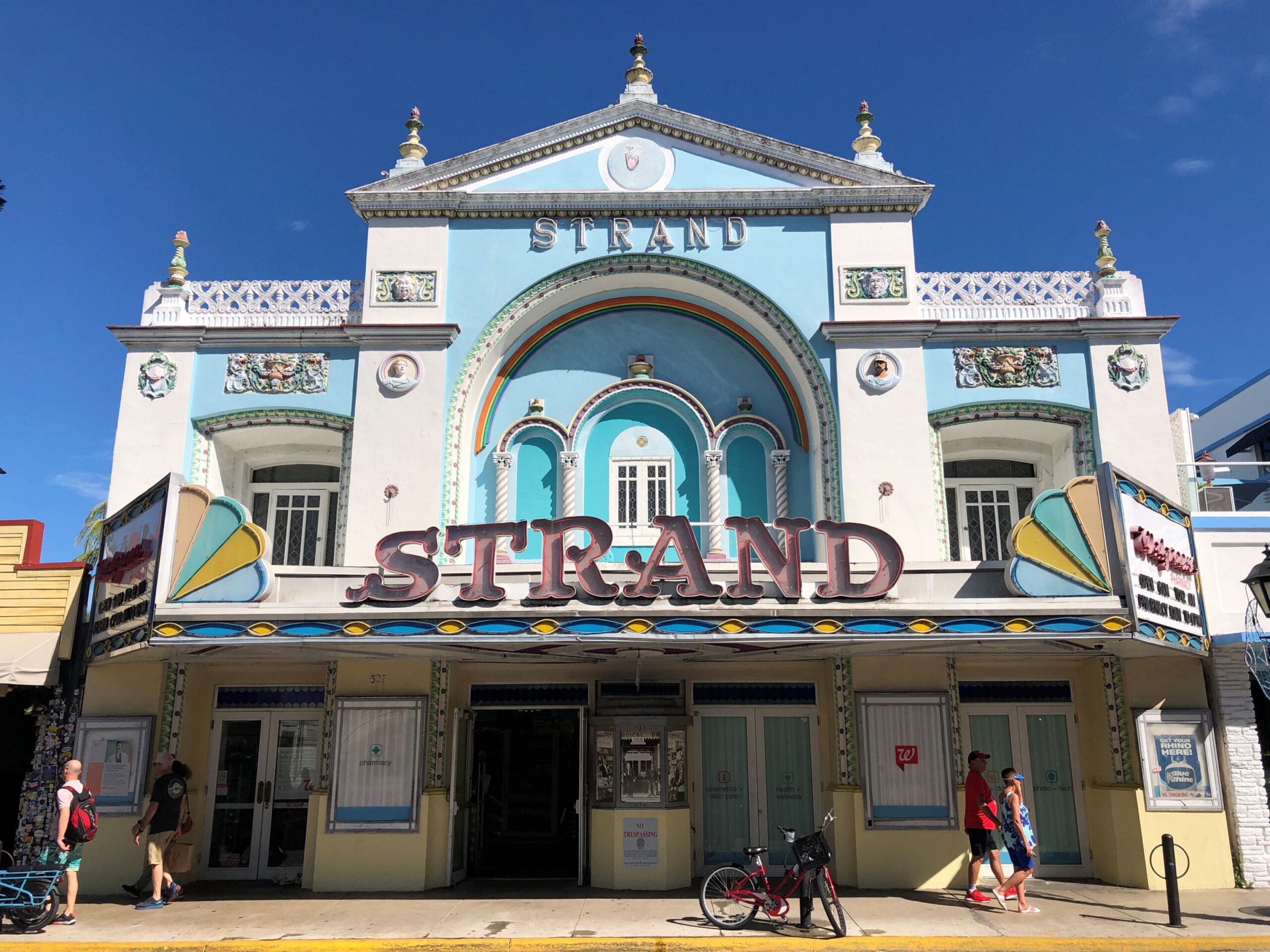
Looks like a movie theater. It was. Now a Walgreen’s.
More detail.
“Duval Street, the undisputed ‘Main Street’ of Key West, is the only place in the U.S. where one street allows you to walk from the Atlantic Ocean to the Gulf of Mexico,” says the American Planning Association, in picking Duval Street a Great Place in America.
“ A citywide commitment to preserving the National Register of Historic Places single-largest collection of wooden structures has allowed Duval Street and the rest of Key West to transition from an economy based on maritime industries and Cuban travel during its earlier years to one now supported by entertainment, art, and tourism.”
The Avalon Project, run by Yale Law School, has a remarkable trove of “documents in law, history and diplomacy,” as the site says. If you’re looking for a translation of the Code of Hammurabi or the Athenian Constitution, there are links. You can also find the annotated text of Magna Carta, the Mayflower Compact, and the many founding documents of the United States, just to mention some of the more famous ones.
Also within the Avalon Project is the text of the Ratification of the U.S. Constitution by the State of Delaware, December 7, 1787. To wit:
We the Deputies of the People of the Delaware State, in Convention met, having taken into our serious consideration the Federal Constitution proposed and agreed upon by the Deputies of the United States in a General Convention held at the City of Philadelphia on the seventeenth day of September in the year of our Lord one thousand seven hundred and eighty seven, Have approved, assented to, ratified, and confirmed, and by these Presents, Do, in virtue of the Power and Authority to us given for that purpose, for and in behalf of ourselves and our Constituents, fully, freely, and entirely approve of, assent to, ratify, and confirm the said Constitution.
Delaware ratified before any other state, and so claims “First State” as its nickname. I have my own private nickname for Delaware. At least I do now, since waking up on the morning of October 25 in my rented room in Dover: “Last State.” As in, the 50th state I’ve spent the night in. That isn’t an achievement of any kind, just a reflection of the fact that I’ve been fortunate enough to have the time and resources necessary to go that many places. Also, that I’m eccentric enough to keep track.
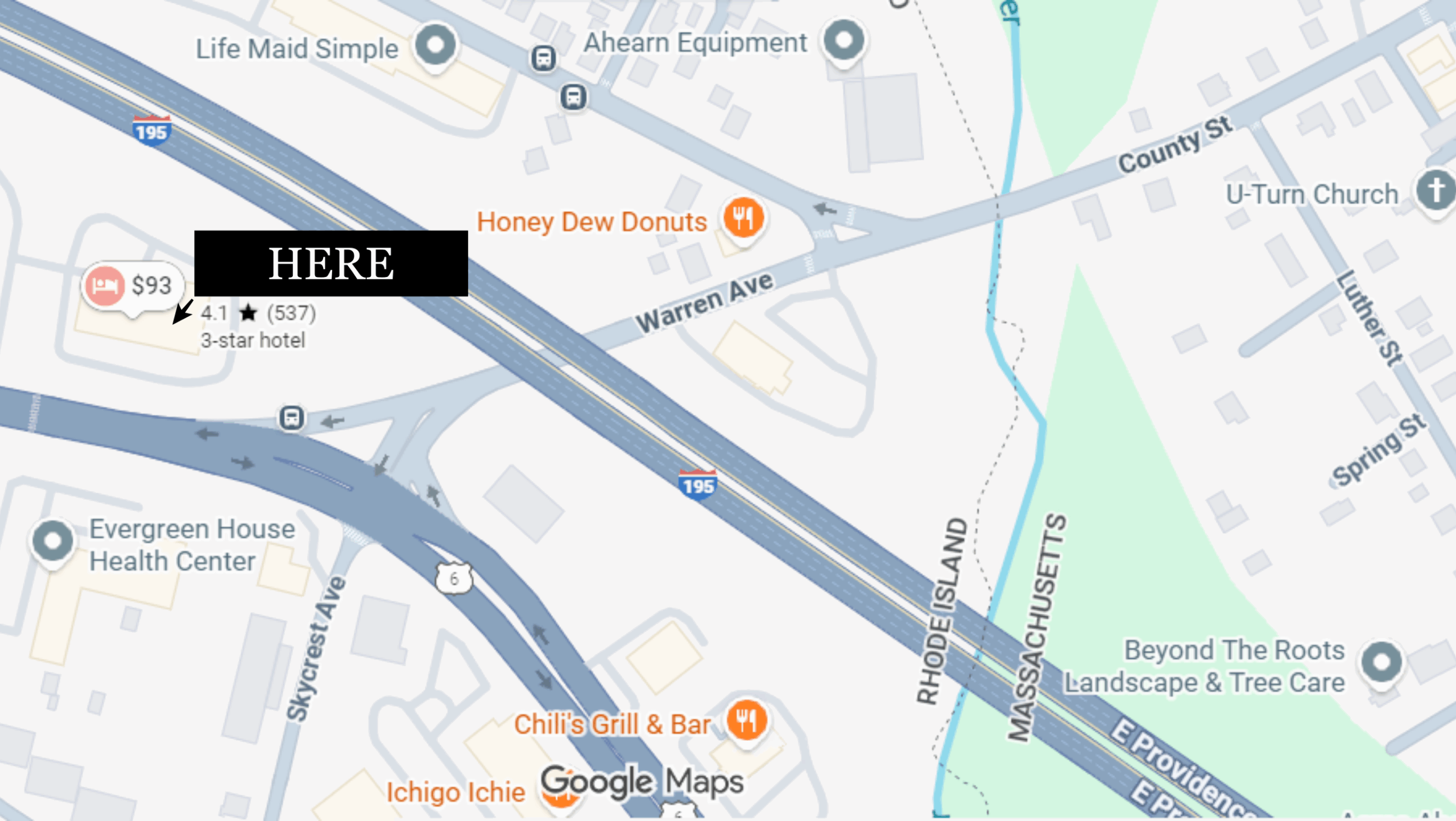
After dallying in Concord on the 23rd, and spending some time in Attleboro, Massachusetts, I arrived in East Providence, Rhode Island for the night. The point of that stop was entirely to spend the night in Rhode Island, since I’d never done that either. So RI was number 49. My hotel was just barely in that state.
I noticed the Honey Dew Donuts even closer to the border. I’d seen other locations driving in. The breakfast at my “3-star” hotel was meager, so I went to Honey Dew for a second breakfast. I wish I could say I’d discovered a great regional doughnut shop along the lines of Tim Horton’s, but it was only OK. Maybe I’ll give the brand another chance sometime.
Since I’d wanted to go from eastern Massachusetts to central Delaware, I should have broken that day’s journey somewhere in New Jersey. But that wouldn’t have involved stopping for the night in Rhode Island, which had been a short stop back in the summer of ’91 – a few hours to look around Providence, and especially the capitol – and the destination of a day trip in ’95, to Newport.
As for Delaware, my entire previous experience with the state was the Wilmington interstate bus station, a break in a bus ride from Washington DC to Boston, which was a leg of the Great Bus Loop of 1982. I’m not even sure I got off the bus, though I usually did when it stopped for long enough.
Getting to Delaware last month involved an aggravating day’s drive, mostly on I-95, spending a lot of time in traffic jams. Counting the cars on the New Jersey Turnpike, bah: more than grains of sand on a beach or stars in the sky.
Even so, there were a few worthwhile moments. I finally got to see (from the turnpike) the enormous American Dream mall, adjacent to the Meadowlands Sports Complex. Reportedly now second largest in the nation, after only the Mall of America. I’d been reading about American Dream for years, since “chronic delays” always figured in real estate reporting on the project, but now it’s more or less complete. (If the developers had asked me, they’d have kept the much cooler earlier name: Meadowlands Xanadu.)
At the Vince Lombardi Service Area on the NJ Turnpike, I parked in the very large parking lot and headed for the very large building and its very large men’s room. As I walked along, a small group of Hasidim went around me, not running but at a brisk pace, headed the same direction. By the time I got to the bathroom, they were almost done with their business, and off they went. Nothing unusual about seeing Hasidim, certainly not in New Jersey, but I have to note that October 24 was a Friday, and it was mid-afternoon. So they were racing the clock. Or, more accurately, the sun.
A digression: service areas on the New Jersey Turnpike and the Garden State Parkway are named for famed New Jerseyans. A list is here. I suppose it’s fine that musicians such as Frank Sinatra, Whitney Houston, Jon Bon Jovi and Celia Cruz are honored, but where’s Bruce Springsteen? It isn’t a matter of posthumous naming, since Bon Jovi is still alive – as is Bruce Willis, who also gets an area, and Connie Chung, who does as well, though she isn’t actually from New Jersey. The ways of the NJ Turnpike Authority are mysterious.
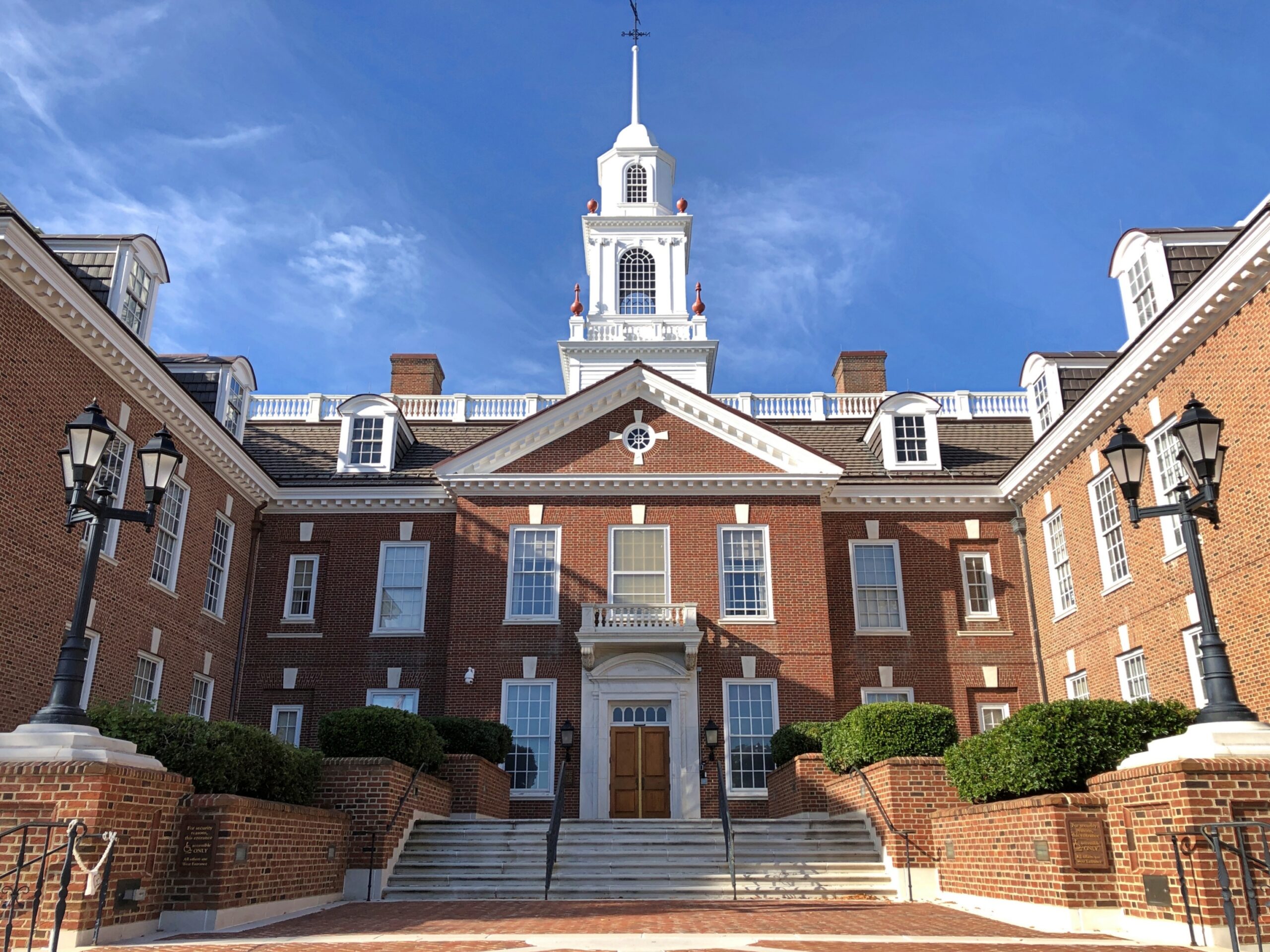
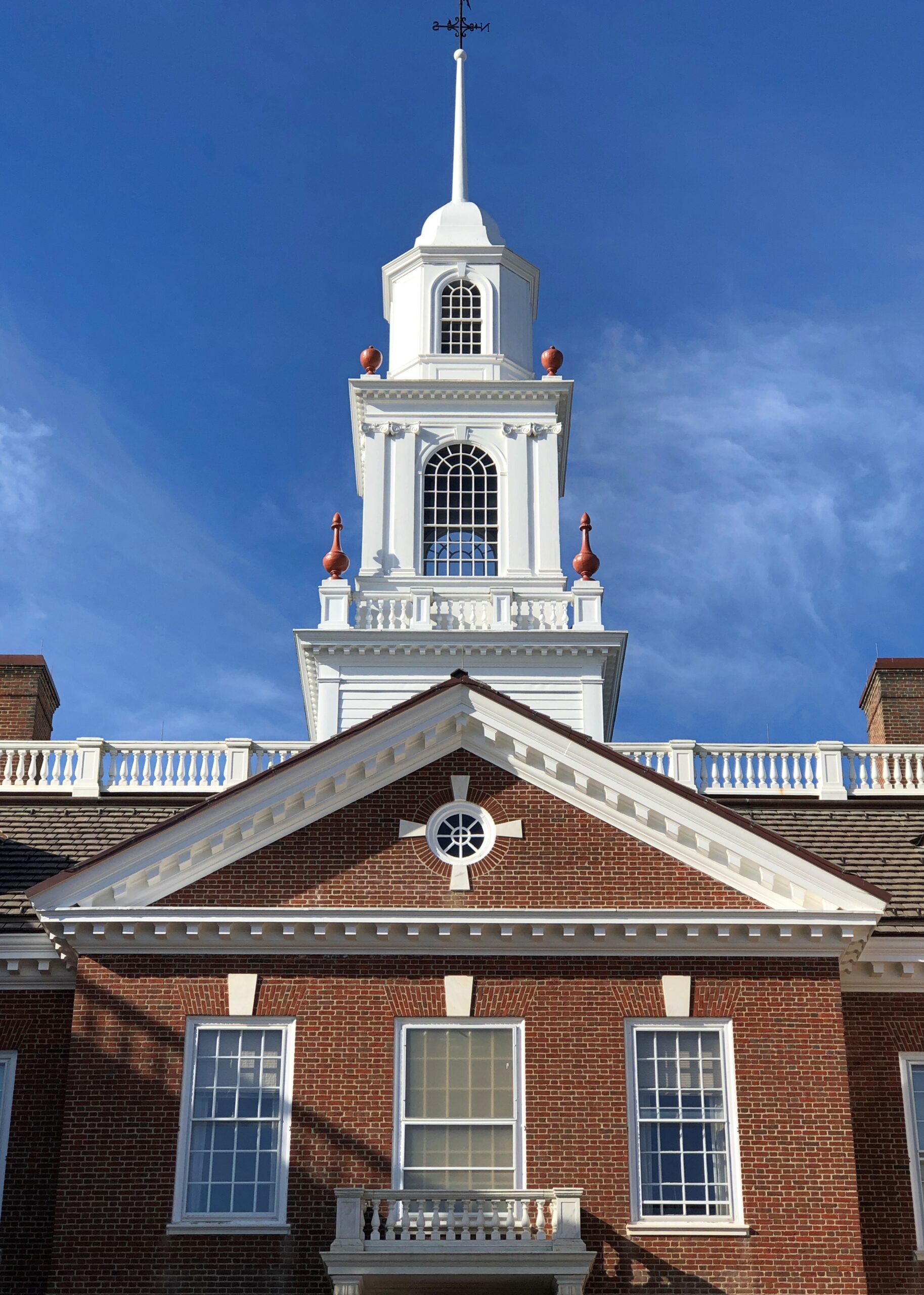
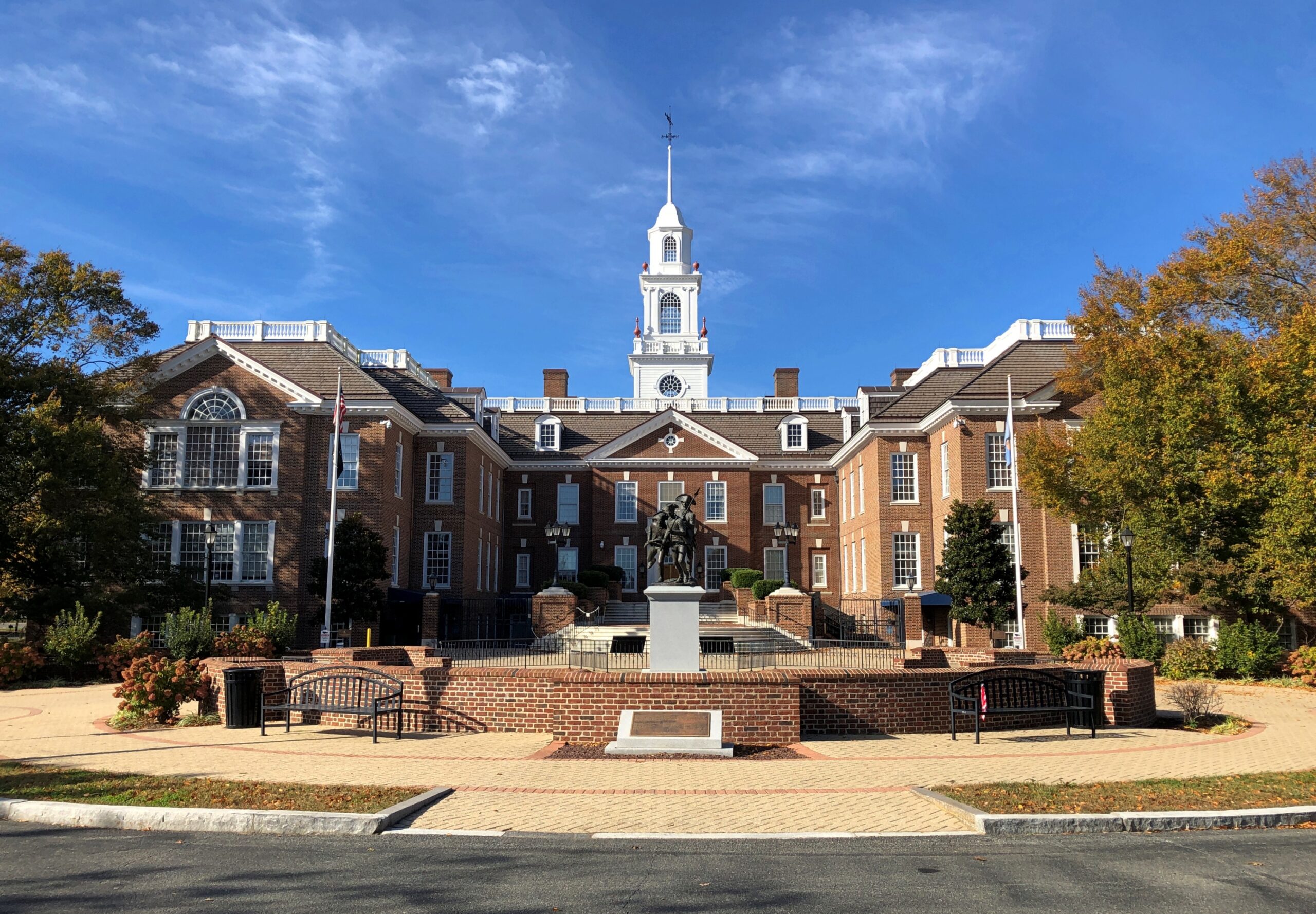
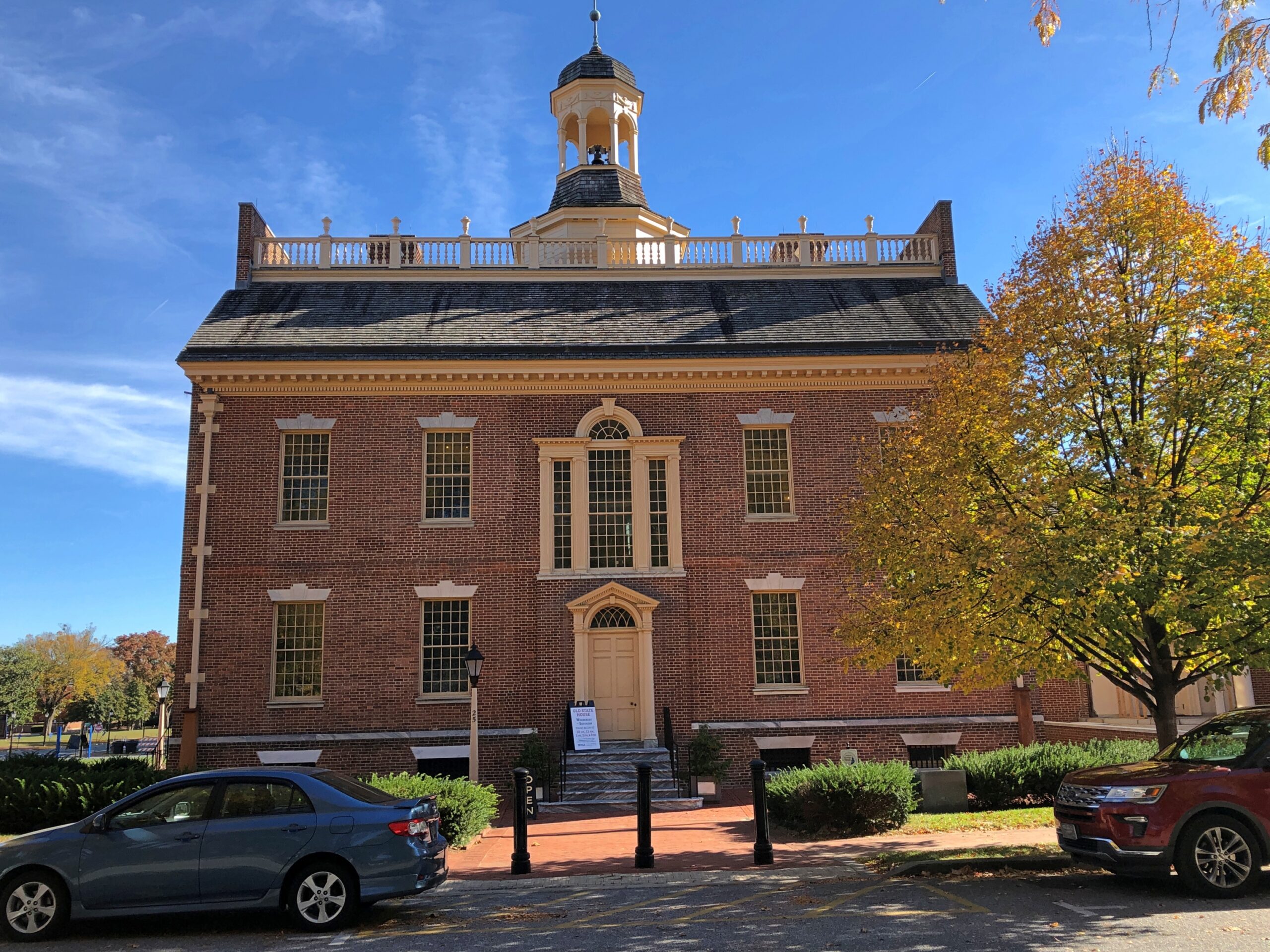
I arrived in Dover late on the October 24. The next morning, a Saturday, I left fairly early. First stop: the Delaware State House. It was closed for the weekend. My reaction: what kind of Mickey Mouse operation is this? I got a good look at the exterior, at least.
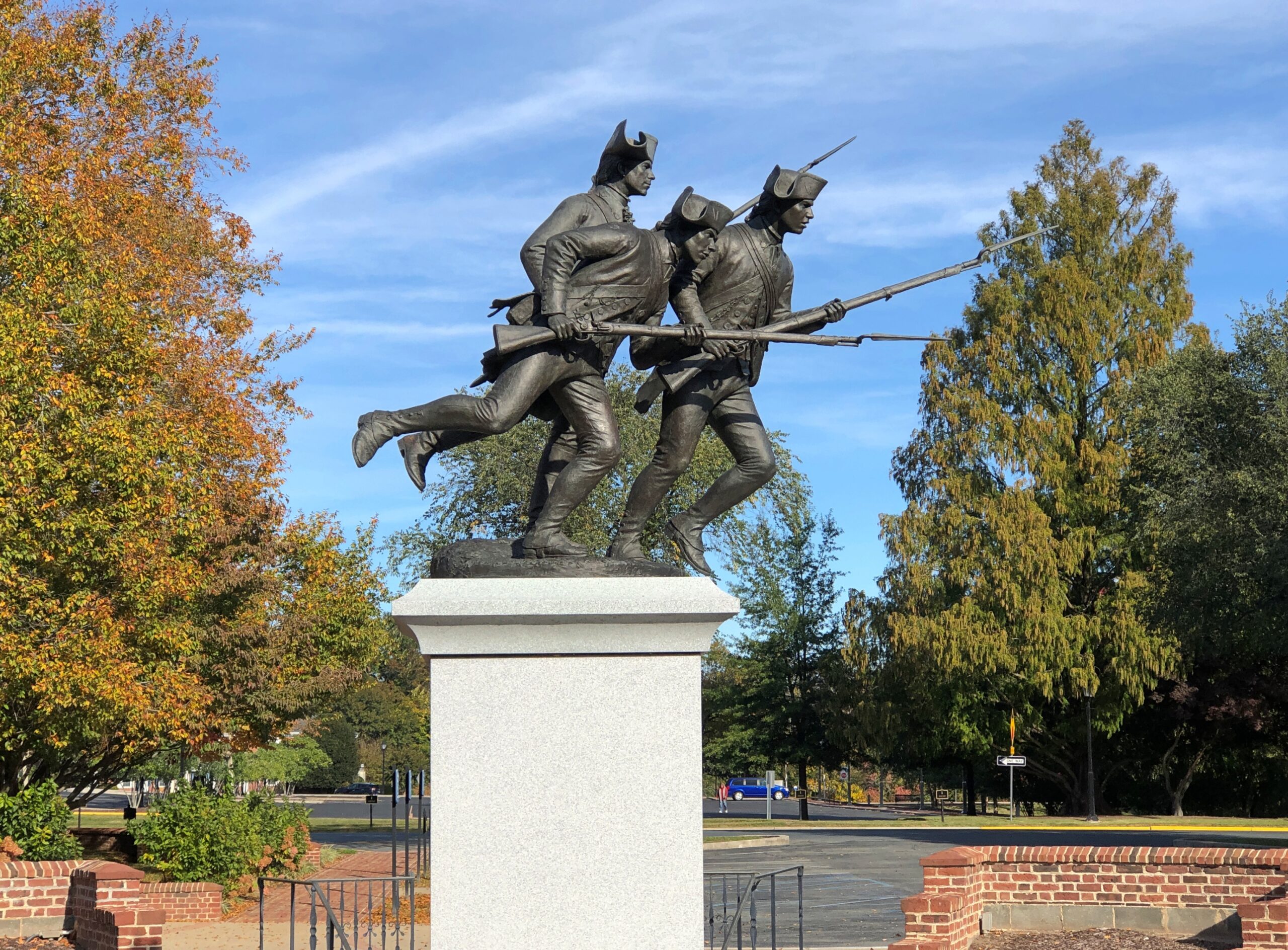
A fairly new sculpture, in front of the capitol: The Delaware Continentals.
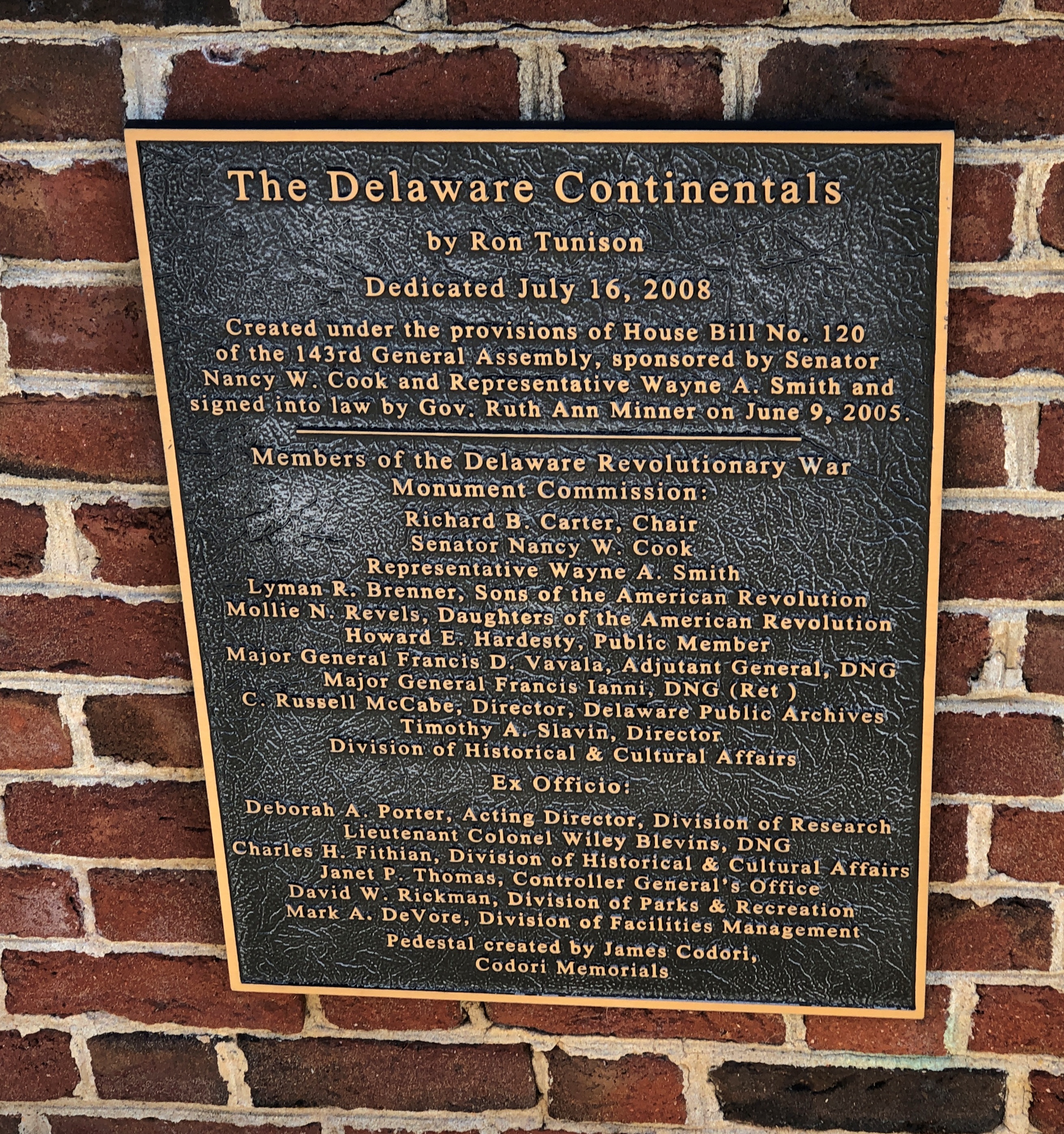
The plaque is long on functionaries’ names, short on information about the Delaware Continentals. An historic plaque up in Wilmington says of them:
Commanded by Colonel John Haslet, the Delaware Regiment consisted of more than 500 battle-ready troops when they marched northward to join the Continental Army in August 1776. After expiration of enlistments and Haslet’s death, the Regiment was reorganized in the winter of 1776-77 under the leadership of Colonel David Hall. Participants in many of the major battles of the Revolution, their conduct earned the praise of their superiors and the respect of their enemies. Forced to endure great hardship, the Regiment was widely acclaimed for its discipline and bravery. Greatly depleted in number, they returned to Delaware victorious in January 1783.
That was hardly the end for the regiment. The 198th Signal Battalion in the Delaware Army National Guard traces itself directly to the Delaware Regiment.
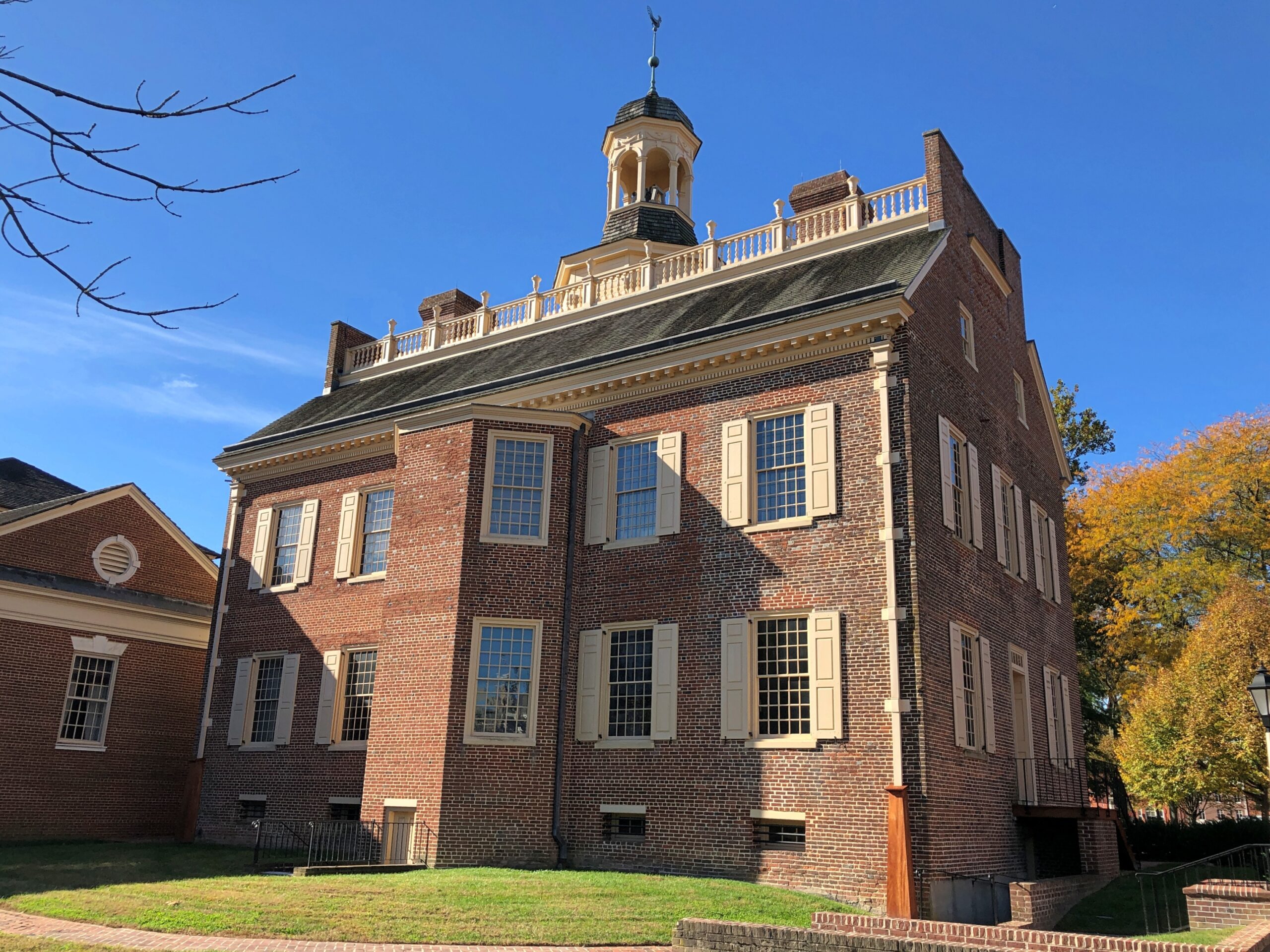
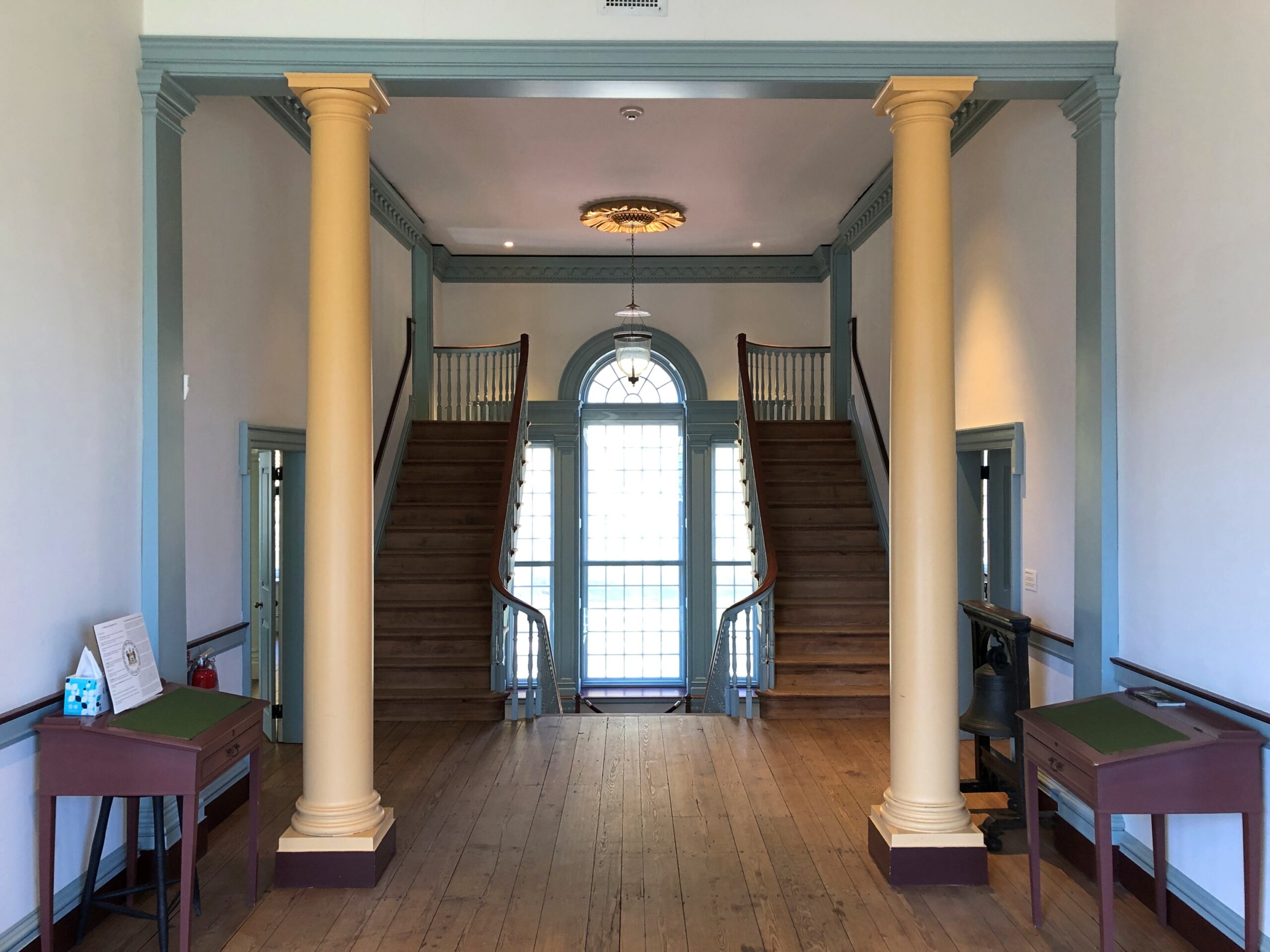
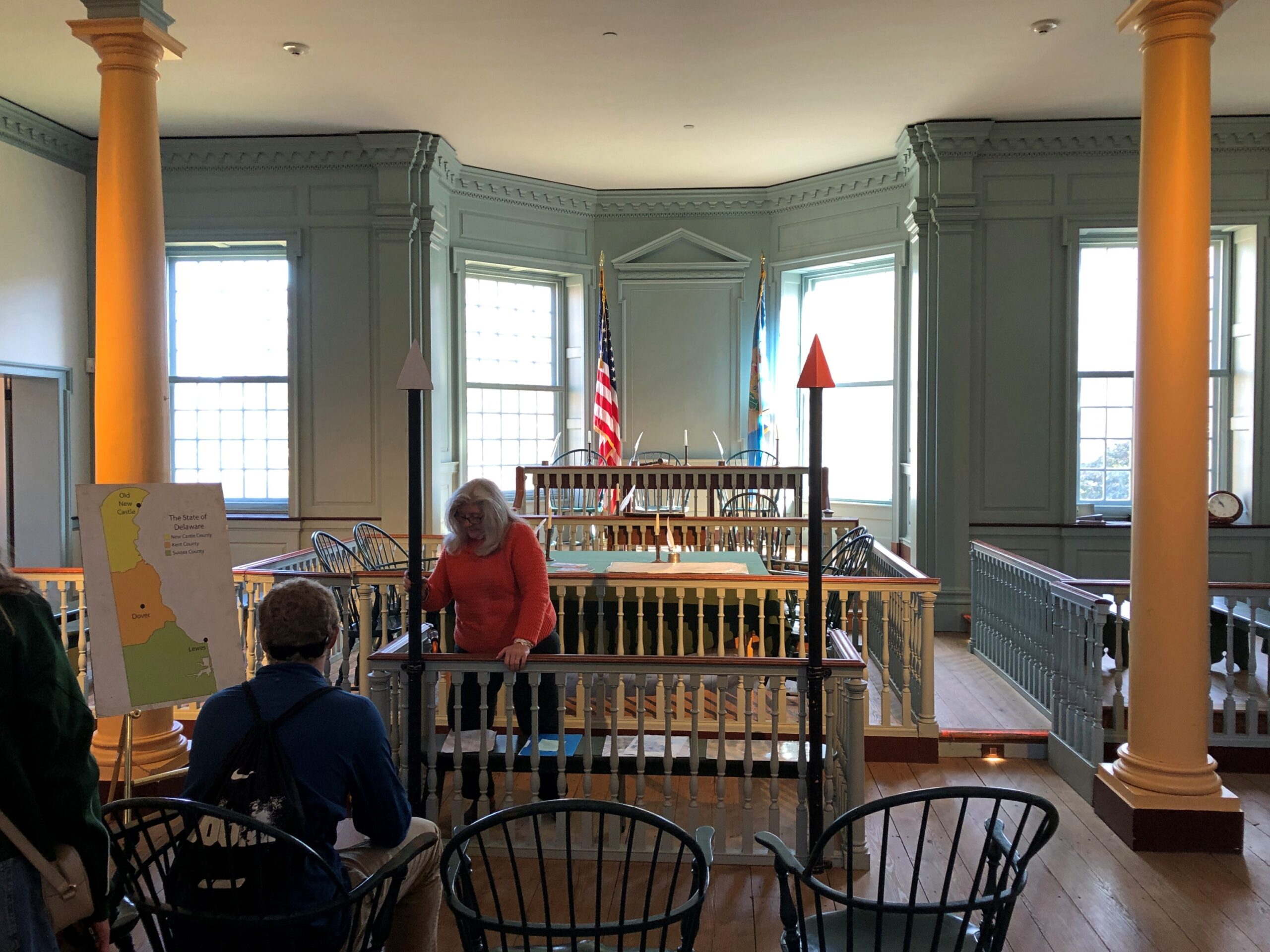
Not far from the current capitol is the former state house, now a museum. It was open.
In fact, I got a tour.
I was happy to learn that here, in this very room, the delegates to the Constitutional ratifying convention met, and made their quick and unanimous decision.
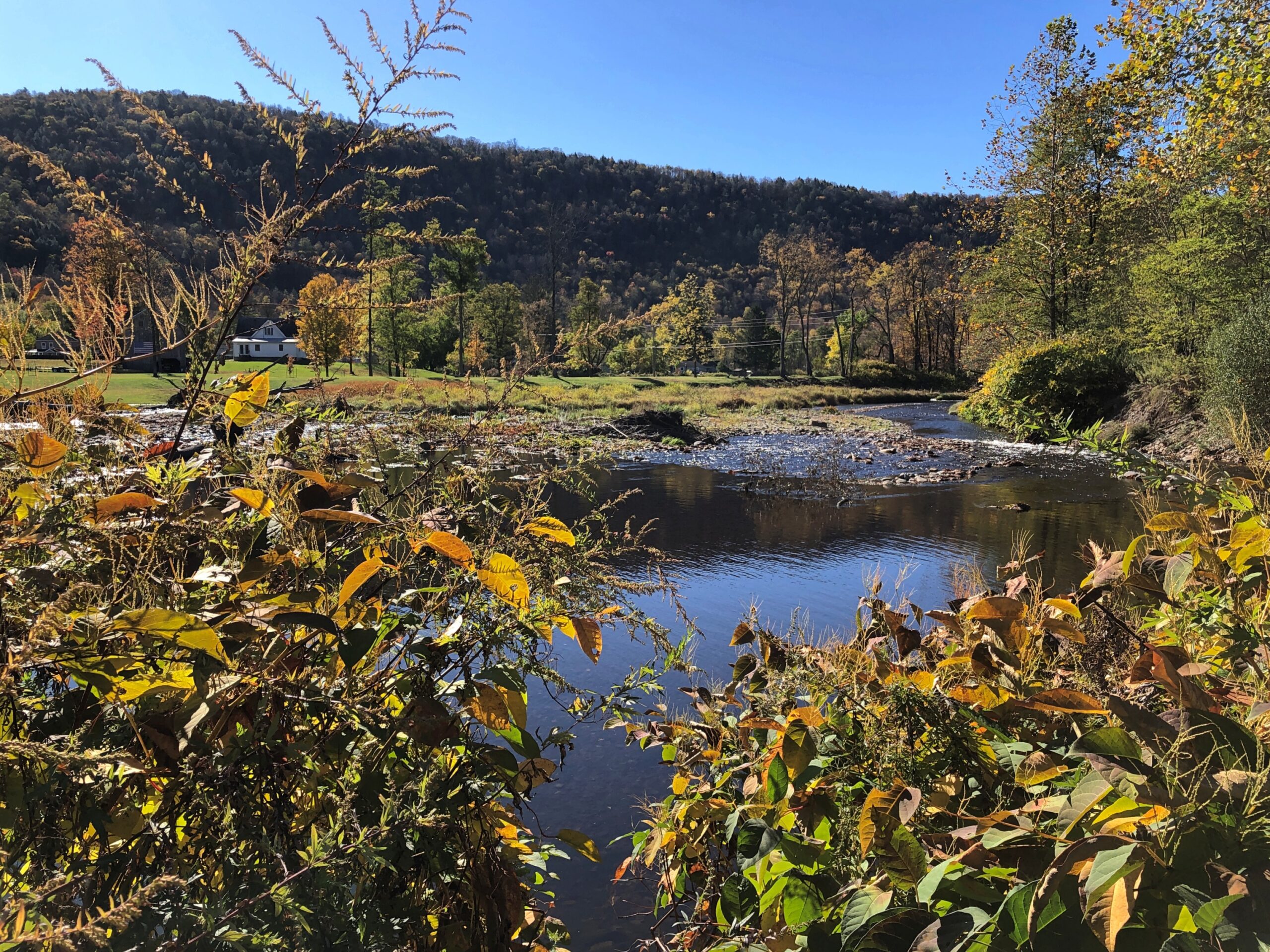
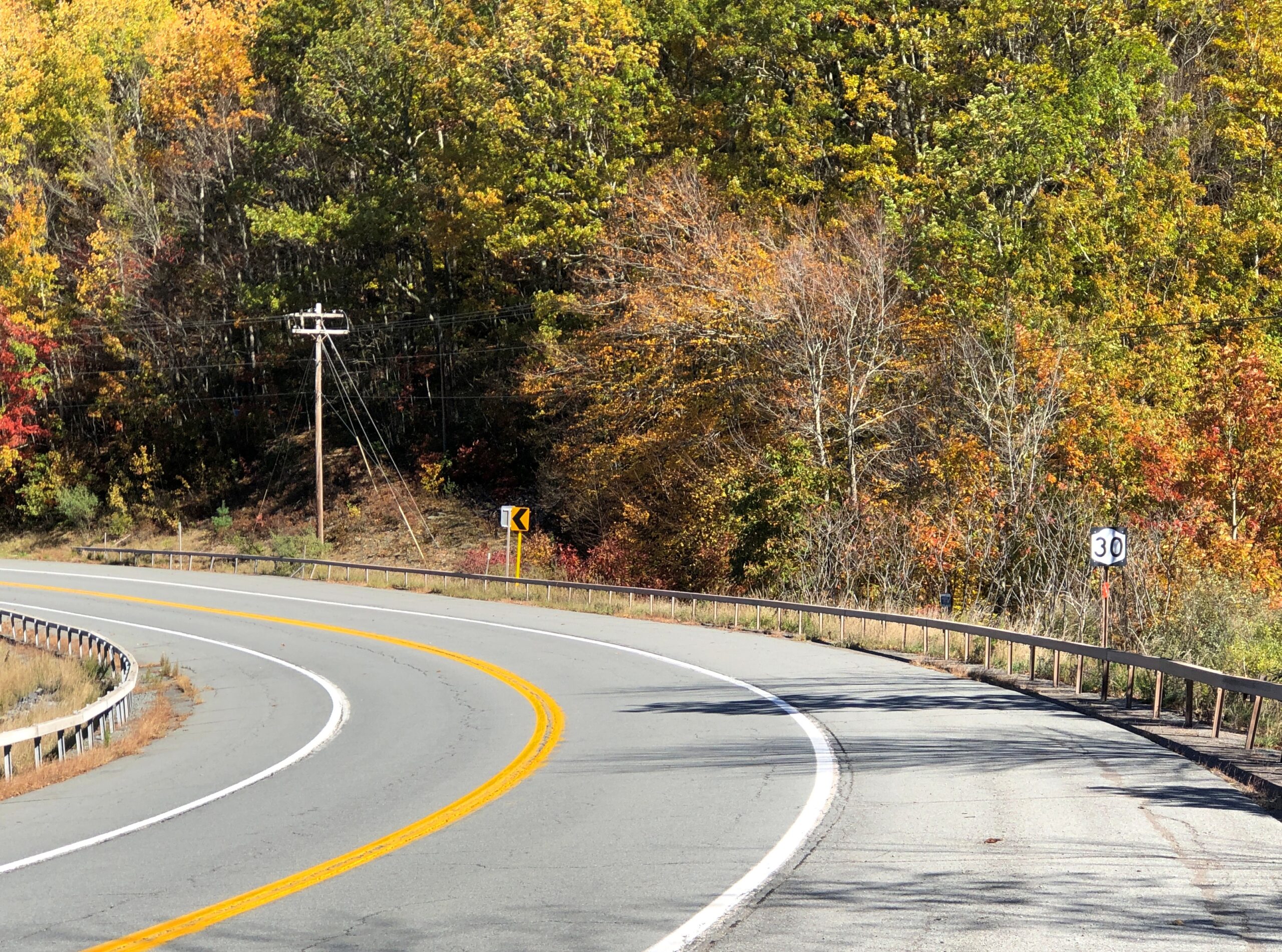
The highway New York 30 winds along the northwestern edge of Catskill Park because it follows the winding East Branch of the Delaware River, which would picturesquely come in and out of view as I drove that highway on the crisp late morning of October 16. I stopped at a place called Downsville. Wiki calls it “census-designated place, and former village in the town of Colchester, Delaware County, New York.”
This raises some questions. How is a village part of a town? (Colchester is marked on maps as not far away, but not on NY 30.) How does a place become a “former” village? People still clearly live there. Maybe I’ll investigate these questions sometime. Maybe not.
Village or former village, it’s at a pleasant spot on the East Branch.
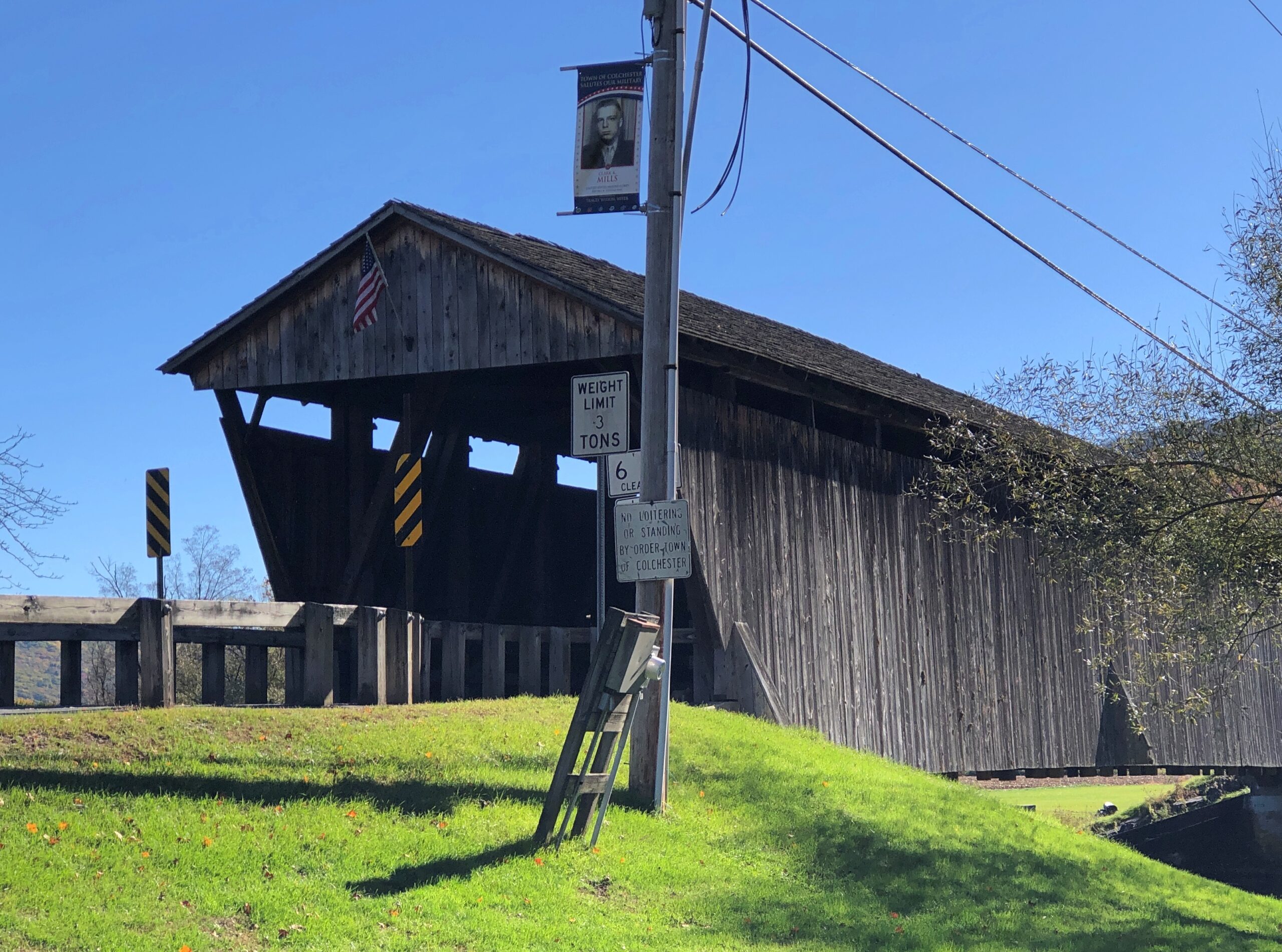
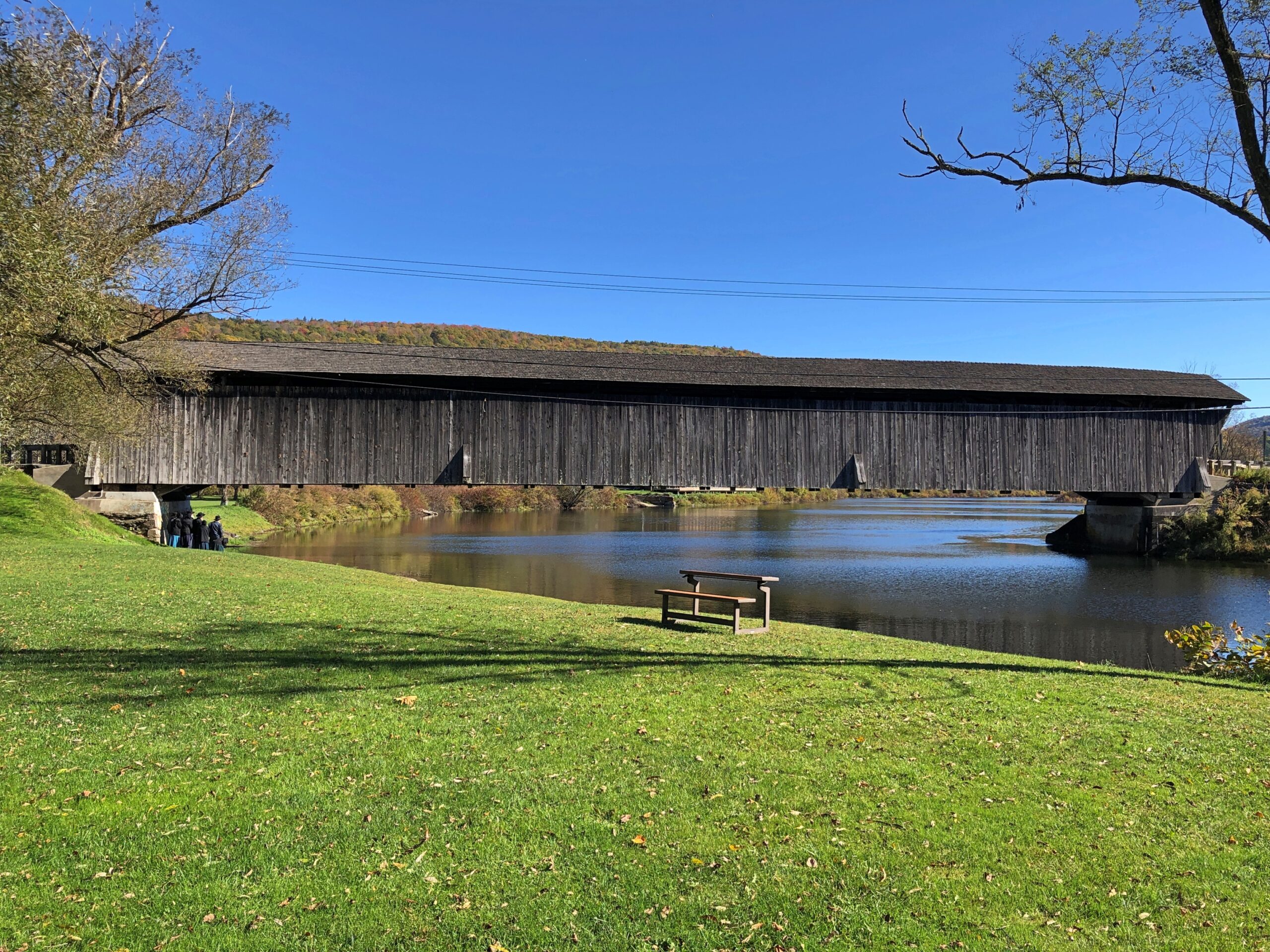
I stopped because a sign directed me to a covered wooden bridge, one that crosses the East Branch about a block away from NY 30.
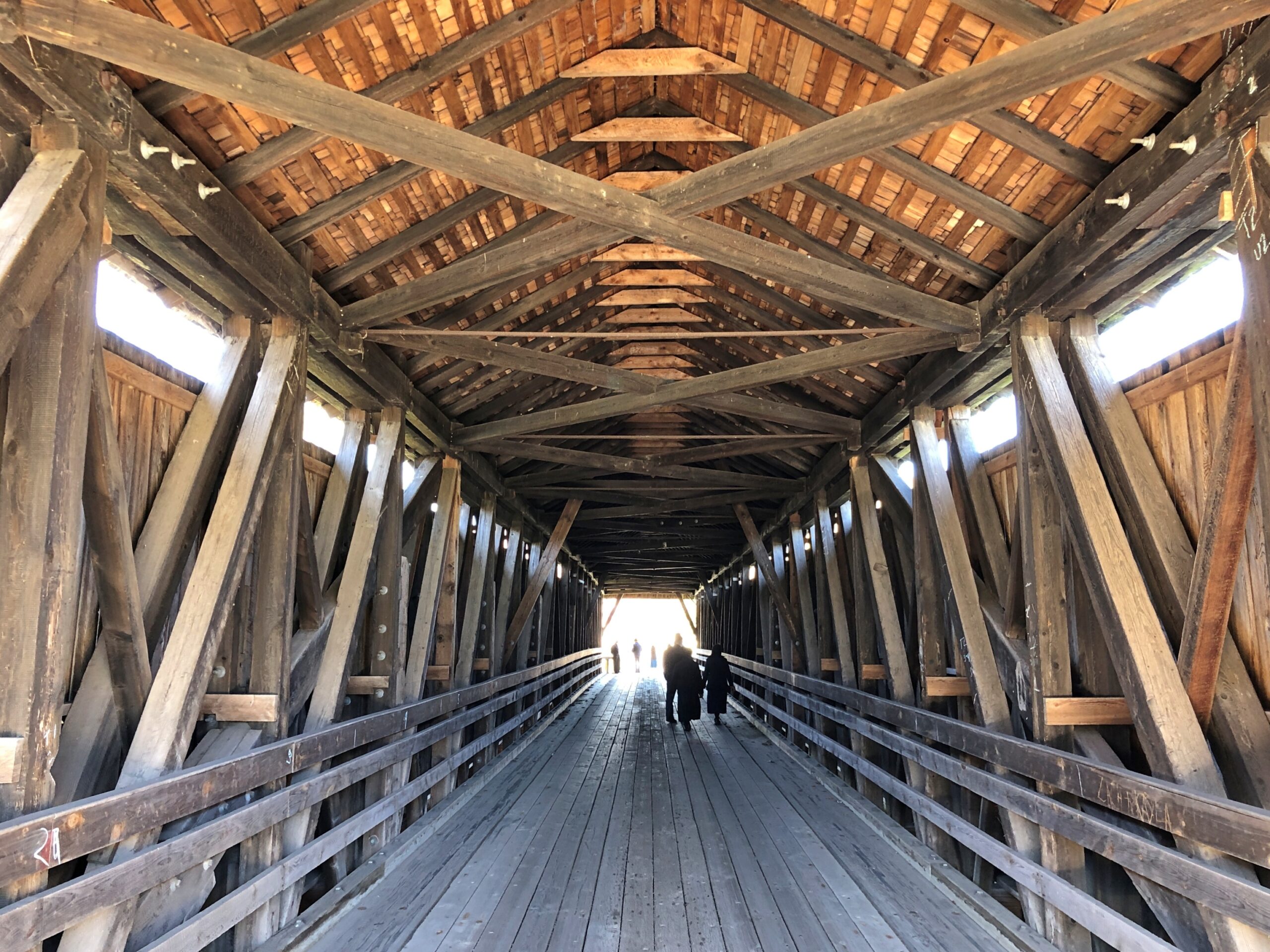
“The Downsville Covered Bridge is one of six covered bridges still standing in Delaware County…” explains the New York State Covered Bridge Society. “Built by Robert Murray in 1854, this 174-foot-long, single span structure incorporates the Long truss design patented on March 6, 1830 by Lieutenant Colonel Stephen H. Long of Hopkinton, New Hampshire, with an added Queenpost truss. This truss design is rare to Northeastern covered bridges.”
Nice work, Mr. Murray, and the workers who have maintained it as a vehicular bridge down to the present day.
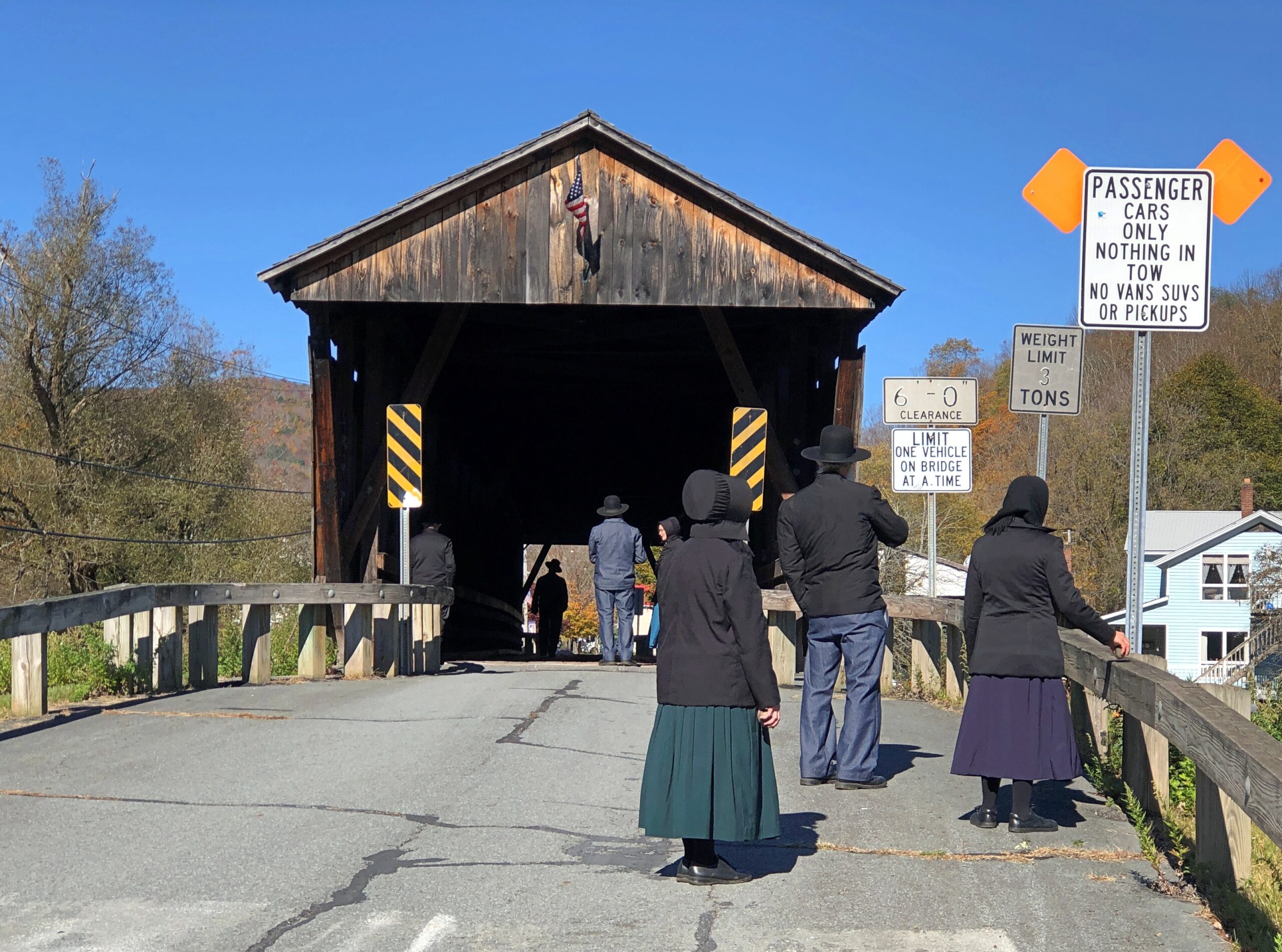
There’s a small park on the river next to the bridge, and a parking lot. Soon after I arrived for a look-see, a large van pulled up to the lot and about a half-dozen Plain People got out. They were there for a look-see too. So we were all on the bridge together.
I try not to do ethnic profiling, but I couldn’t help thinking that a top tourist sight for Plain People might well be a covered wooden bridge. Then I wondered, how is it they came in a van? As I was leaving, I noticed a non-Plain man waiting for them in the drivers seat. The Plain People equivalent of a Shabbos goy, I suppose. Except maybe that he can work any day except the Sabbath?
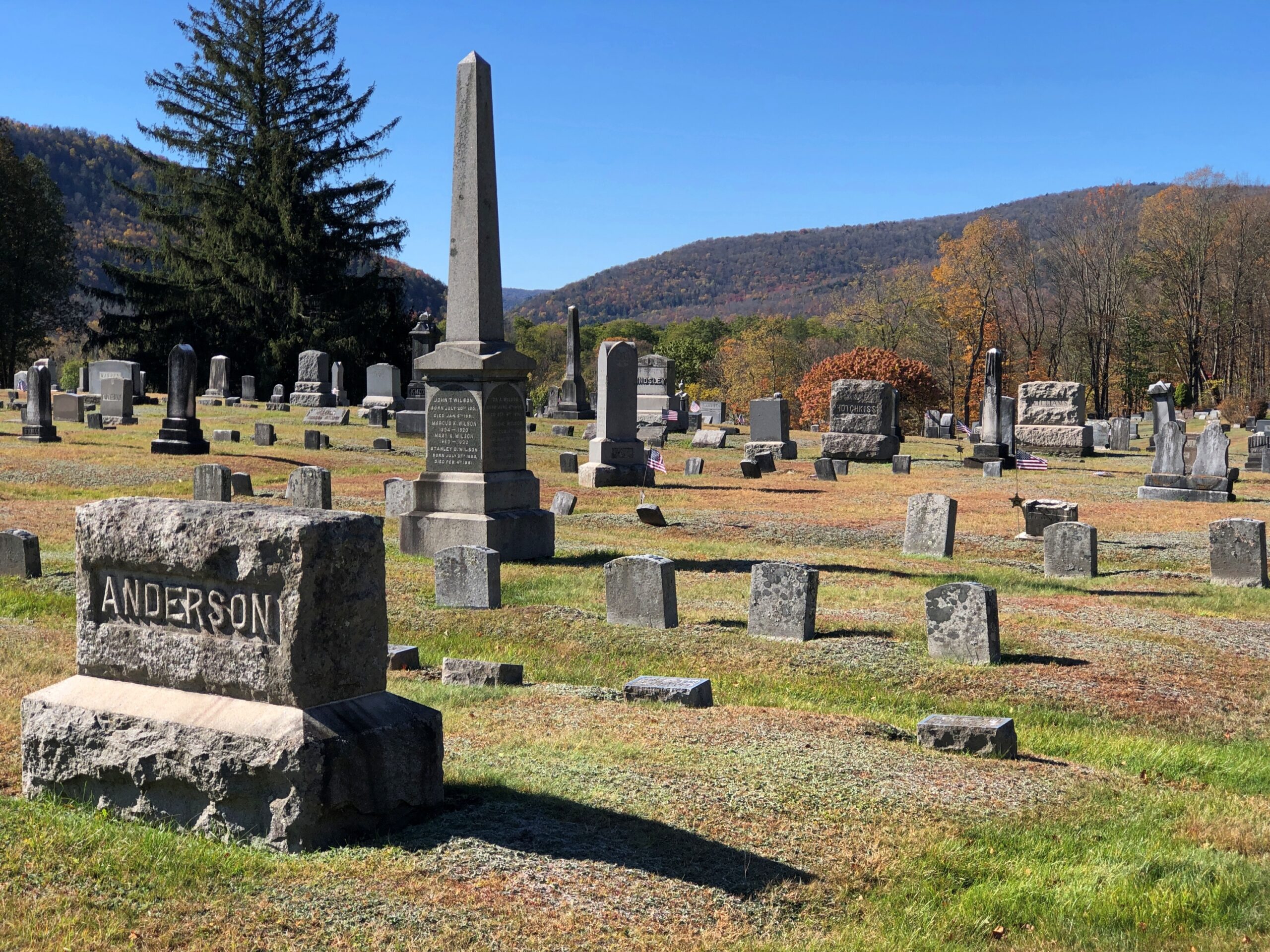
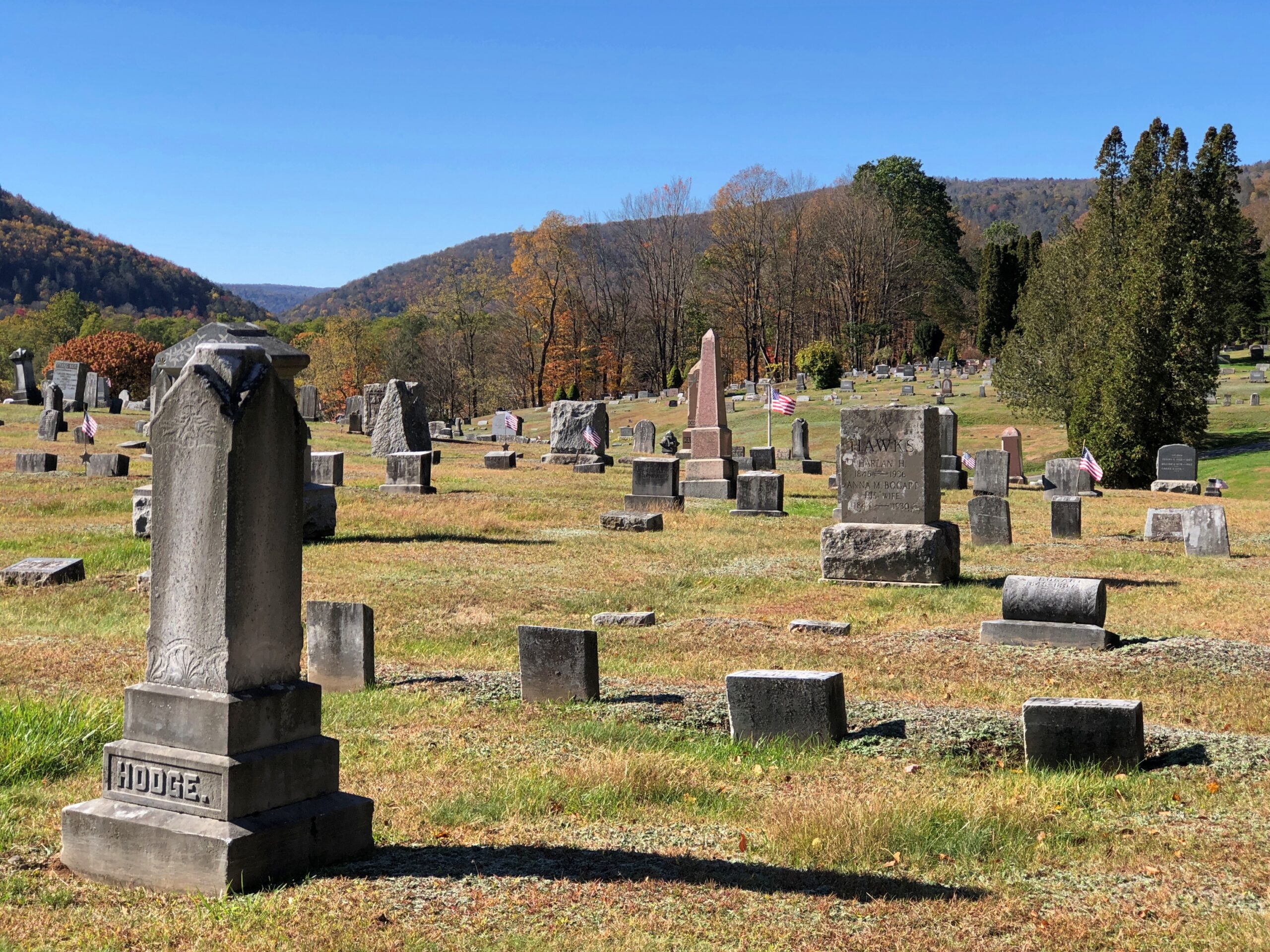
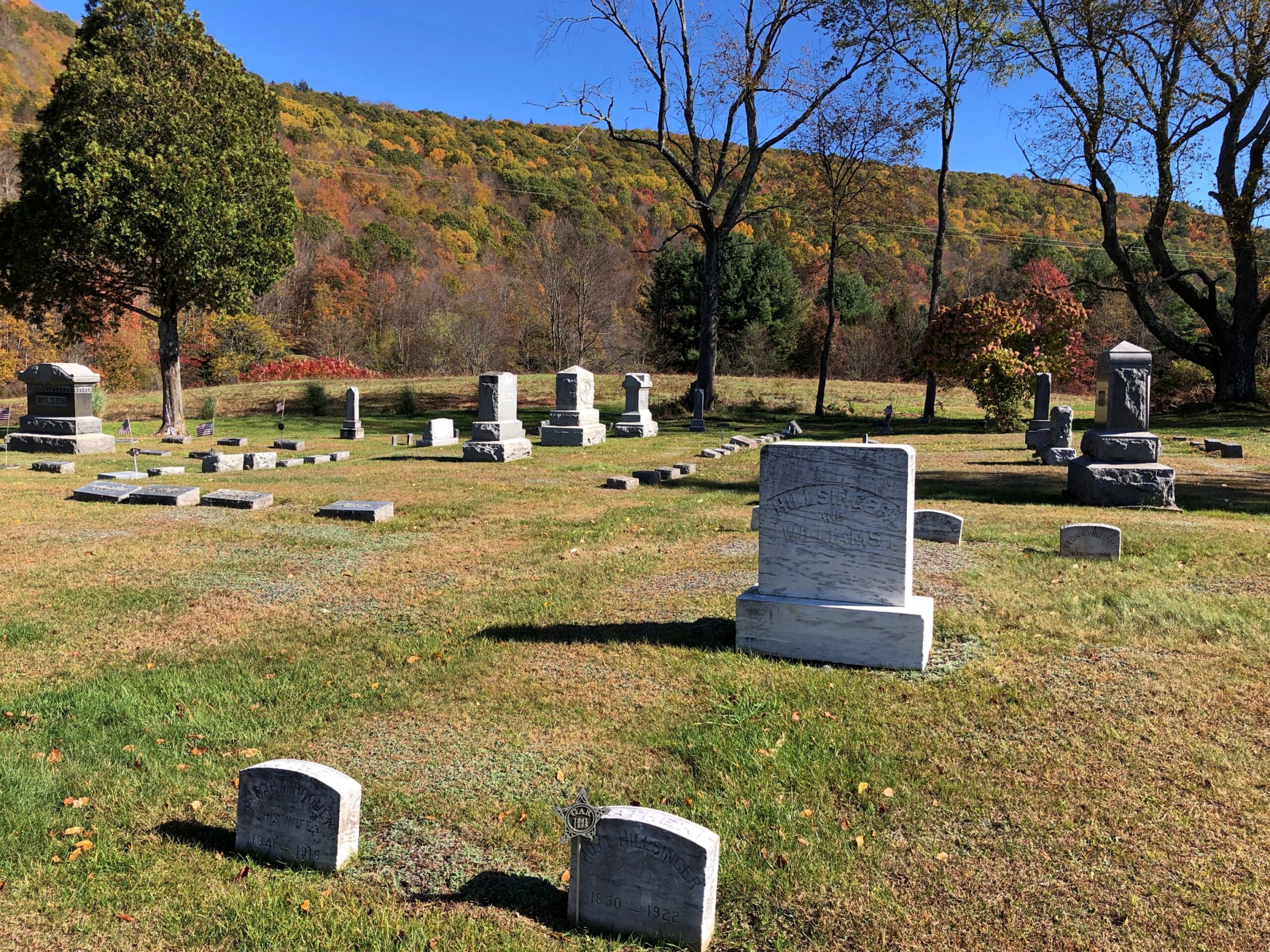
Not far away in Downsville is the Paige Cemetery. I had that to myself, as usual.
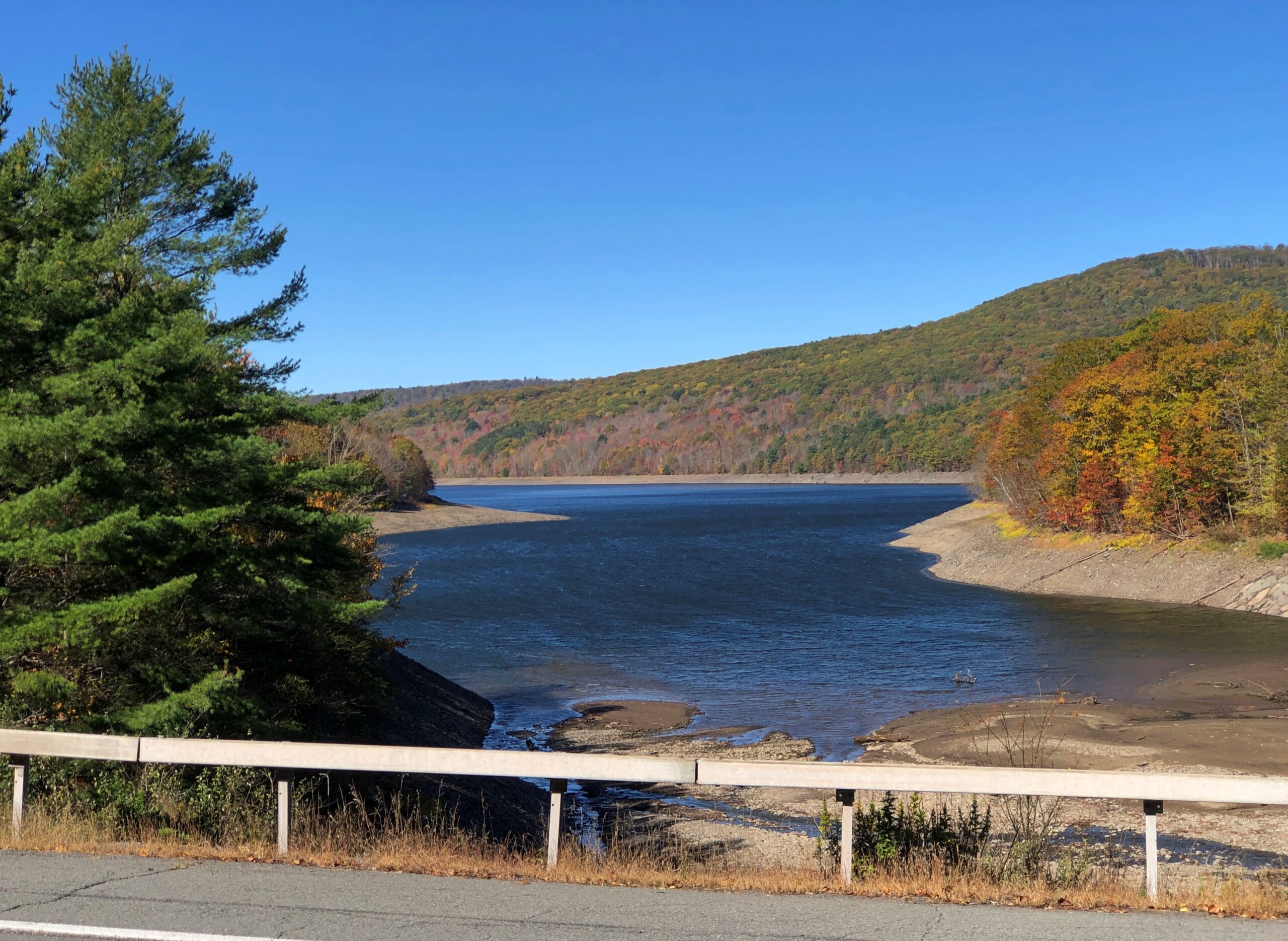
New York 30 continues a long way on the shores of the Pepacton Reservoir. Still car commercial driving.
The Pepacton Reservoir, seemingly so peaceful on a brilliant autumn day, has a hell of a back story.
“It is formed by the damming of the East Branch of the Delaware River, which continues west and joins the lower Delaware River,” says NYC Environmental Protection. “It consists of one basin, approximately 15 miles in length [that] holds 140.2 billion gallons at full capacity, making it the largest reservoir in the city system by volume. It was placed into service in 1955.
“Pepacton Reservoir is one of four reservoirs in the City’s Delaware Water Supply System. As the reservoir with the largest capacity, it normally contributes more than 25% of the total daily water flow into New York City.”
Italics added, because they needed adding.
Once I left NY 30 and headed east on NY 28, which put me on a path toward the Hudson River Valley and NYC and Long Island, traffic kicked up several notches. It was still mostly a pleasant drive.
Most of the traffic was headed west into the park, opposite of the way I was going; as only to be expected on a Thursday ahead of a colorful fall weekend. The Catskills are still a destination, if not quite the Catskills of yore. Some of the old story was told to the rest of the country through TV shows in previous decades, or even more recently: namely, The Marvelous Mrs. Maisel.
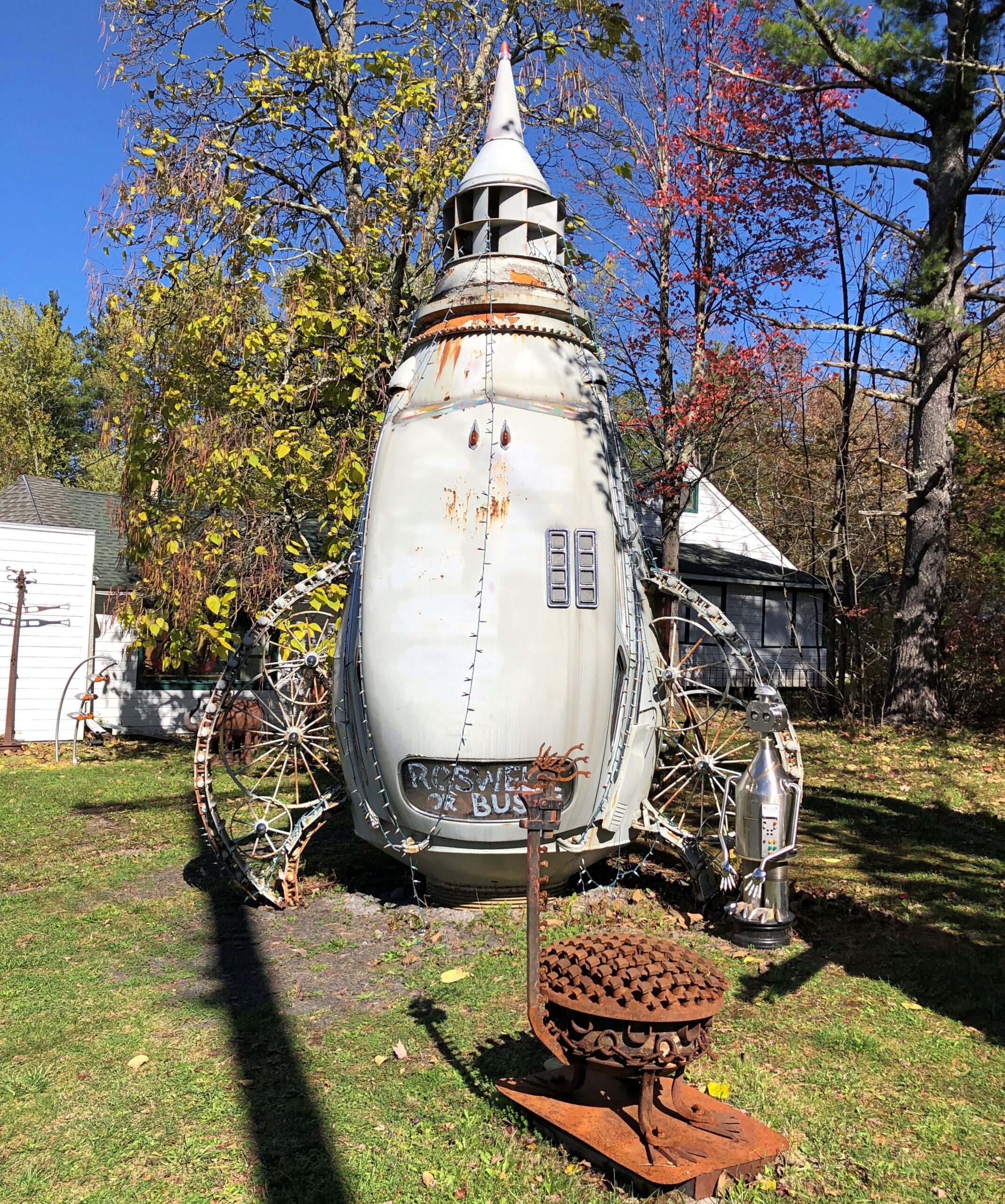
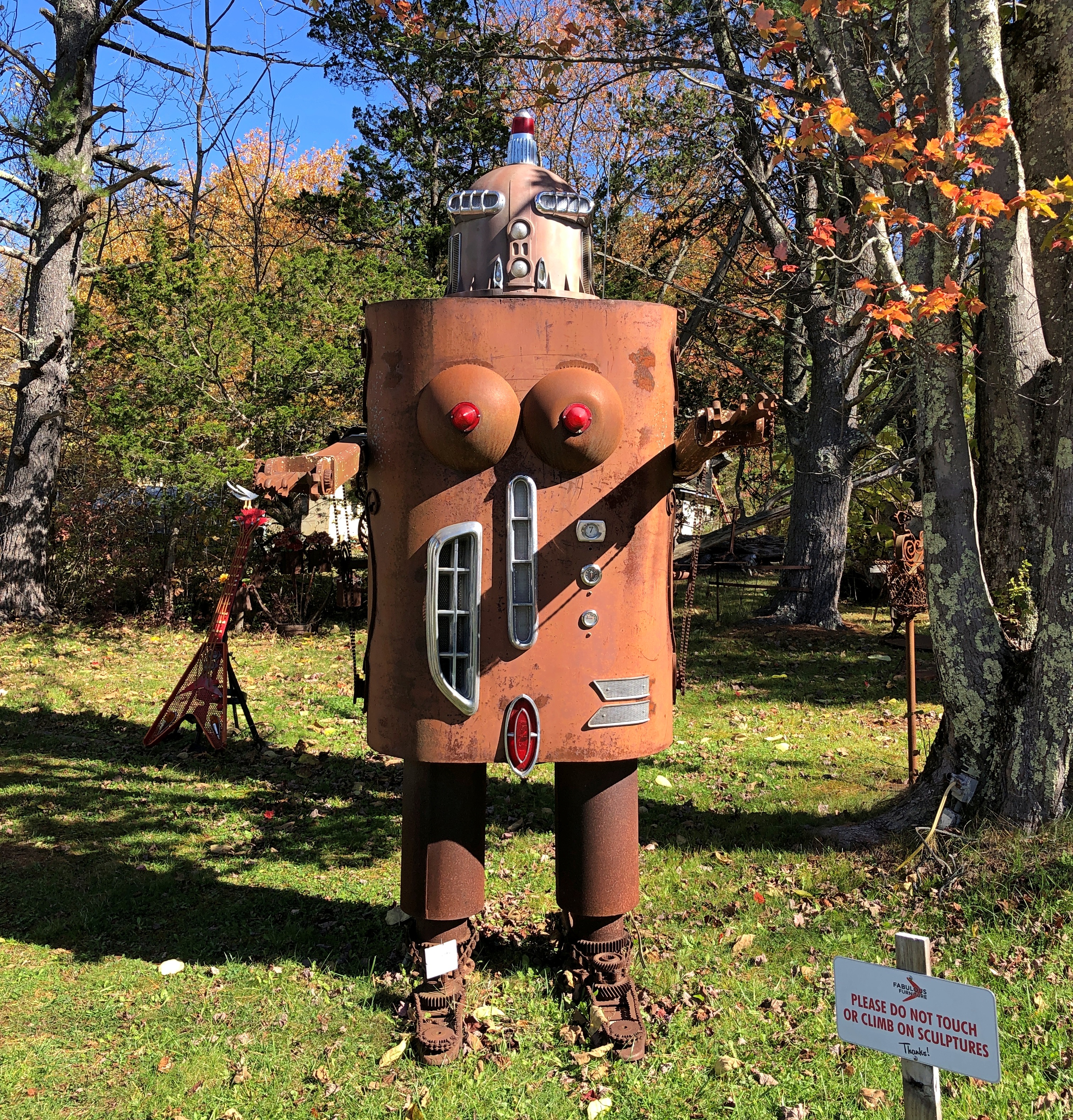
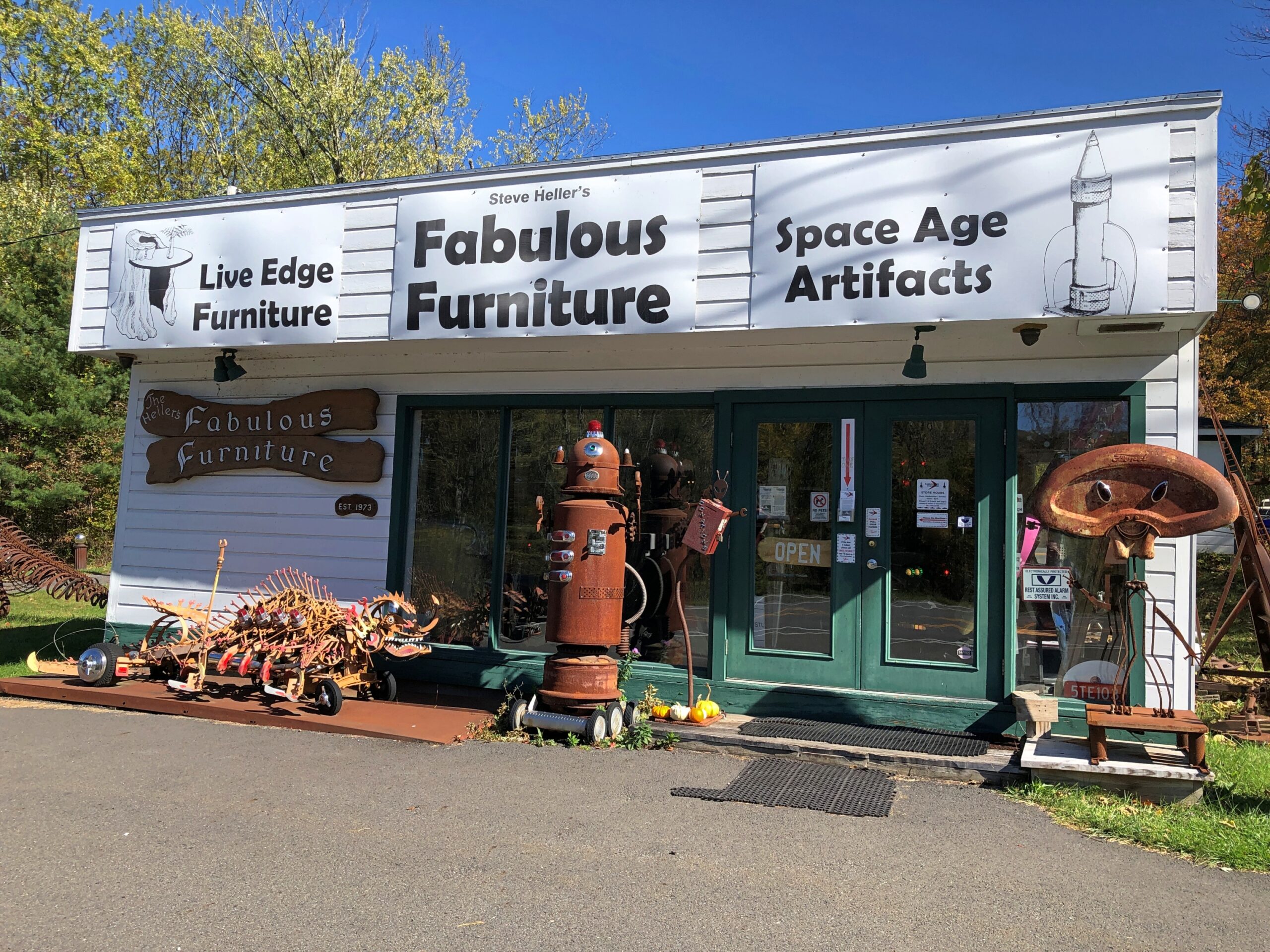
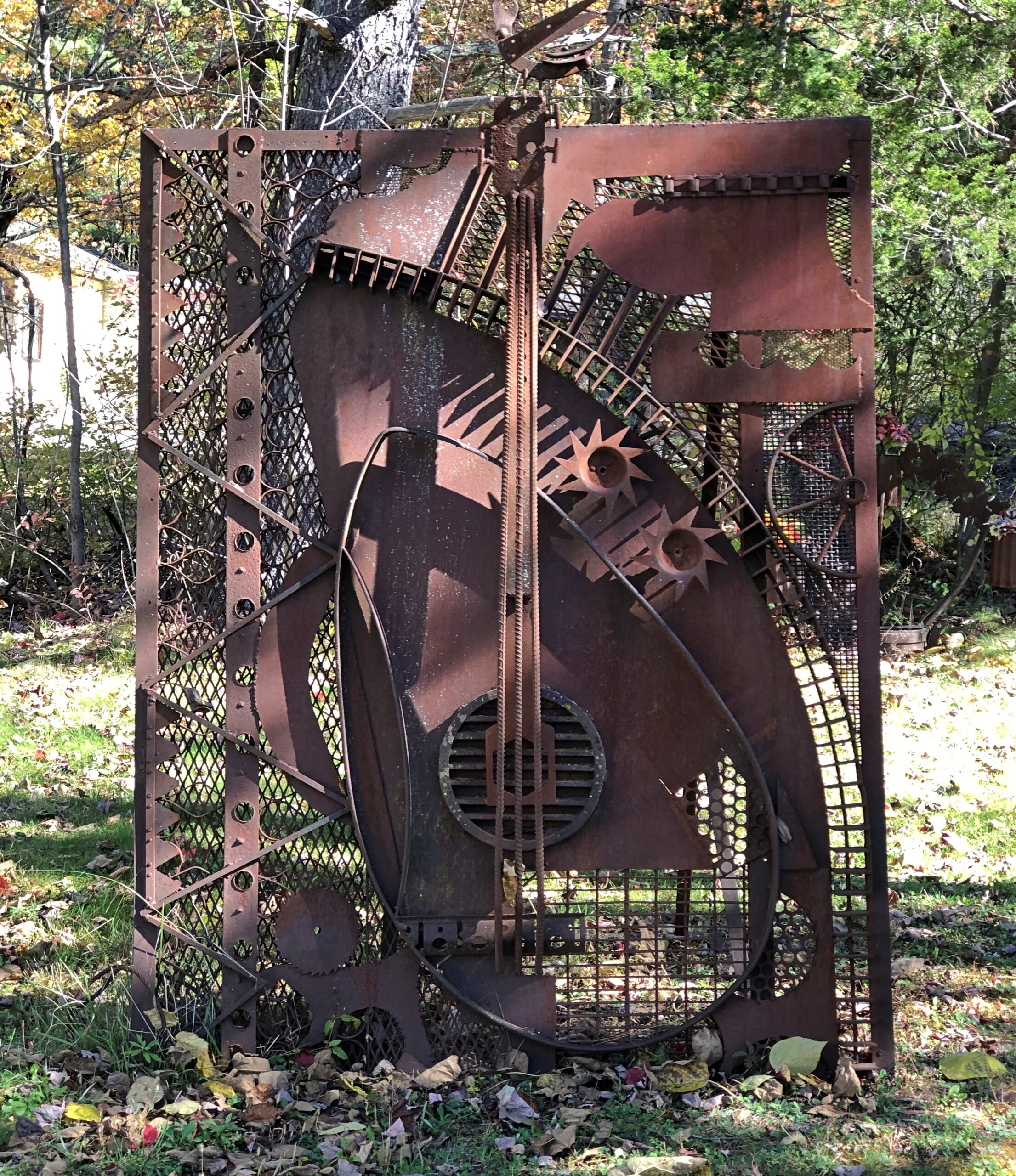
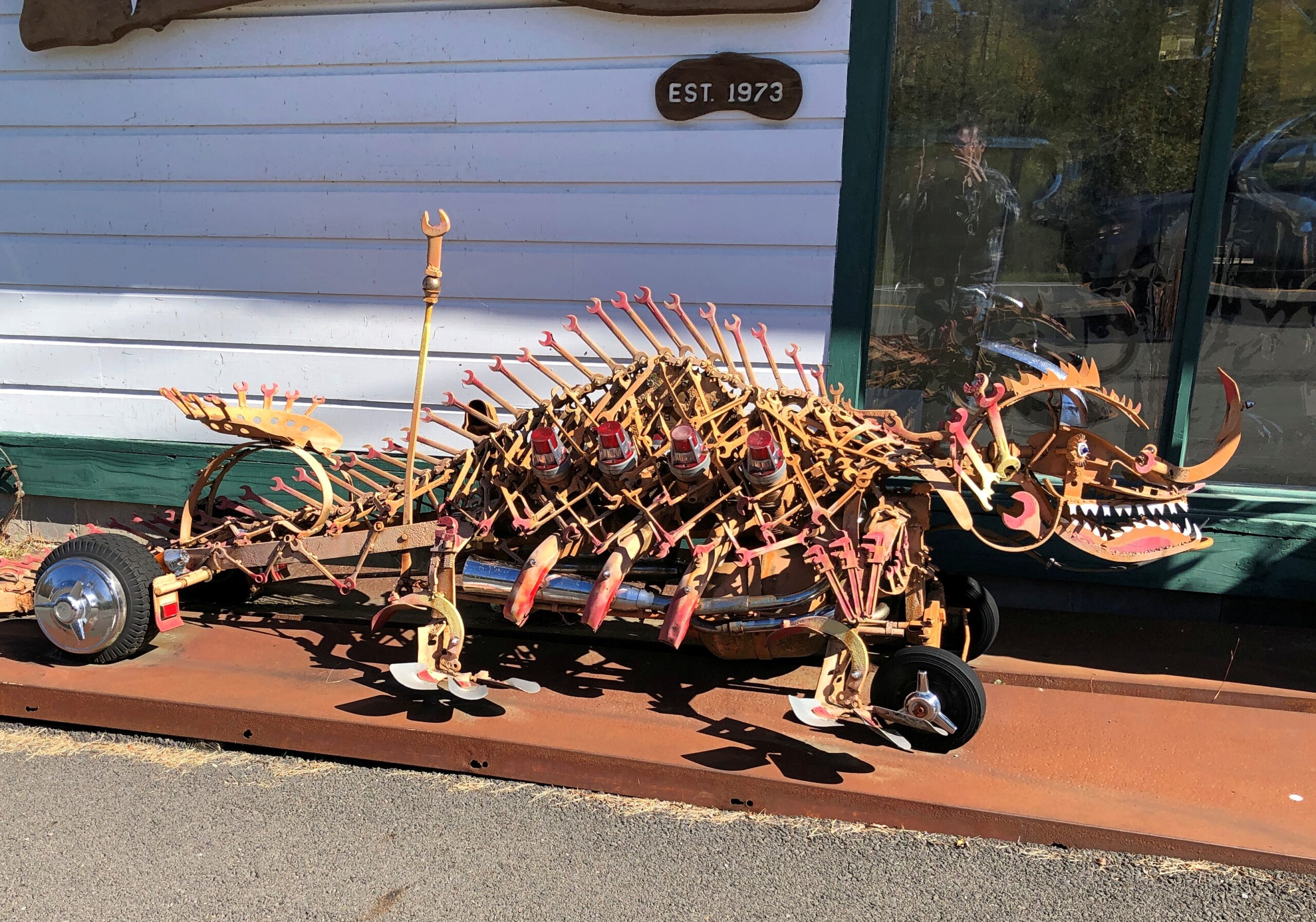
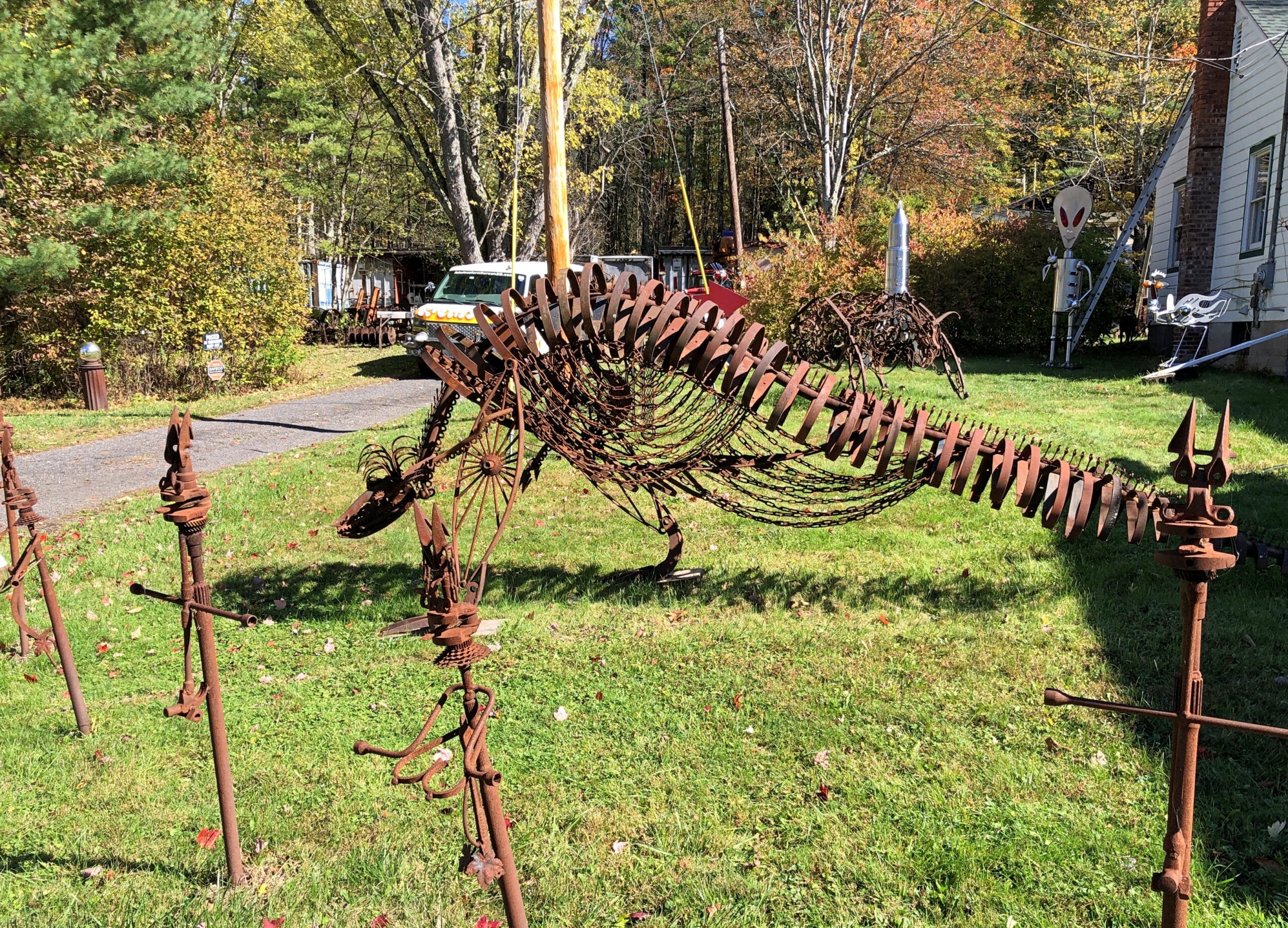
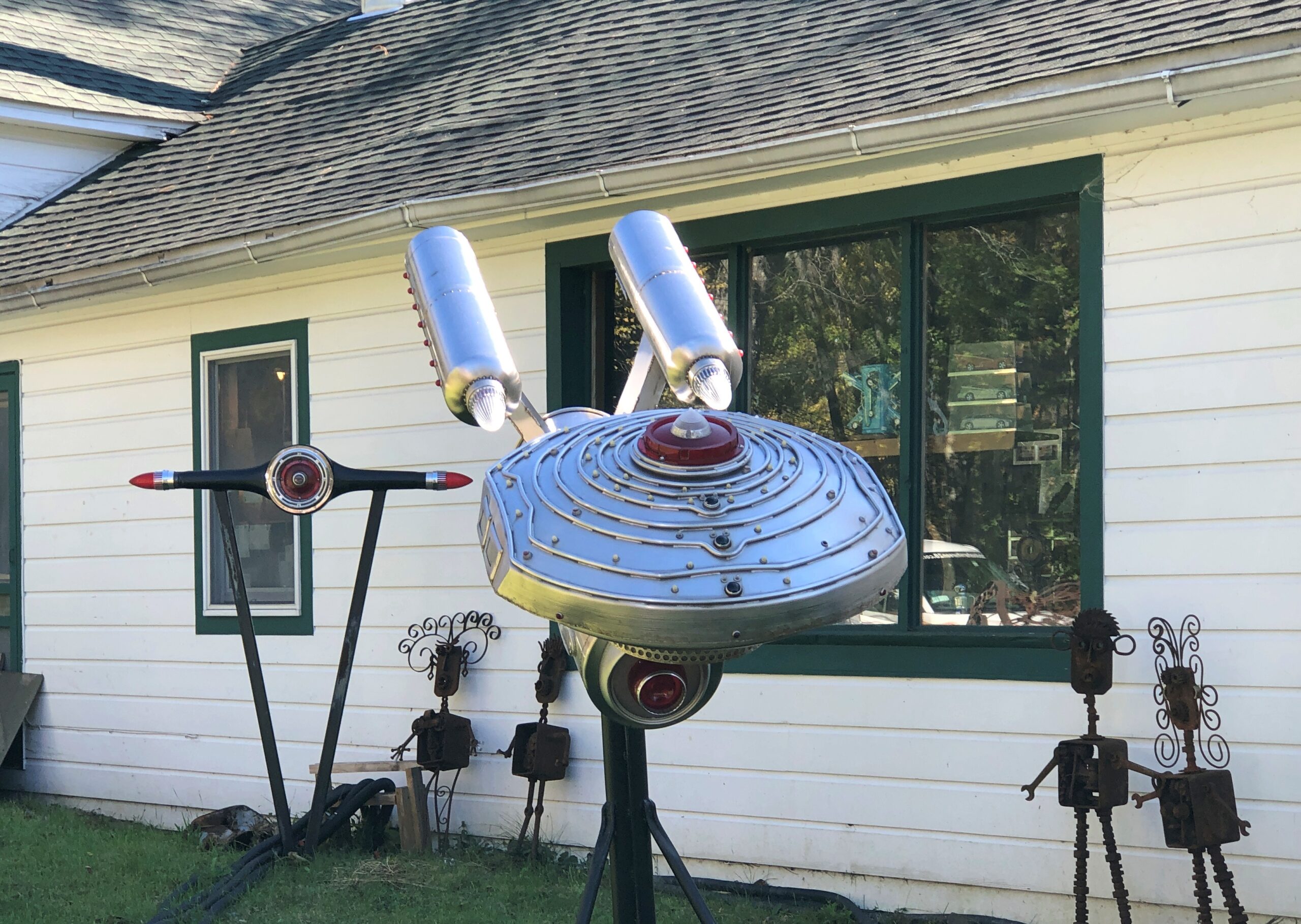
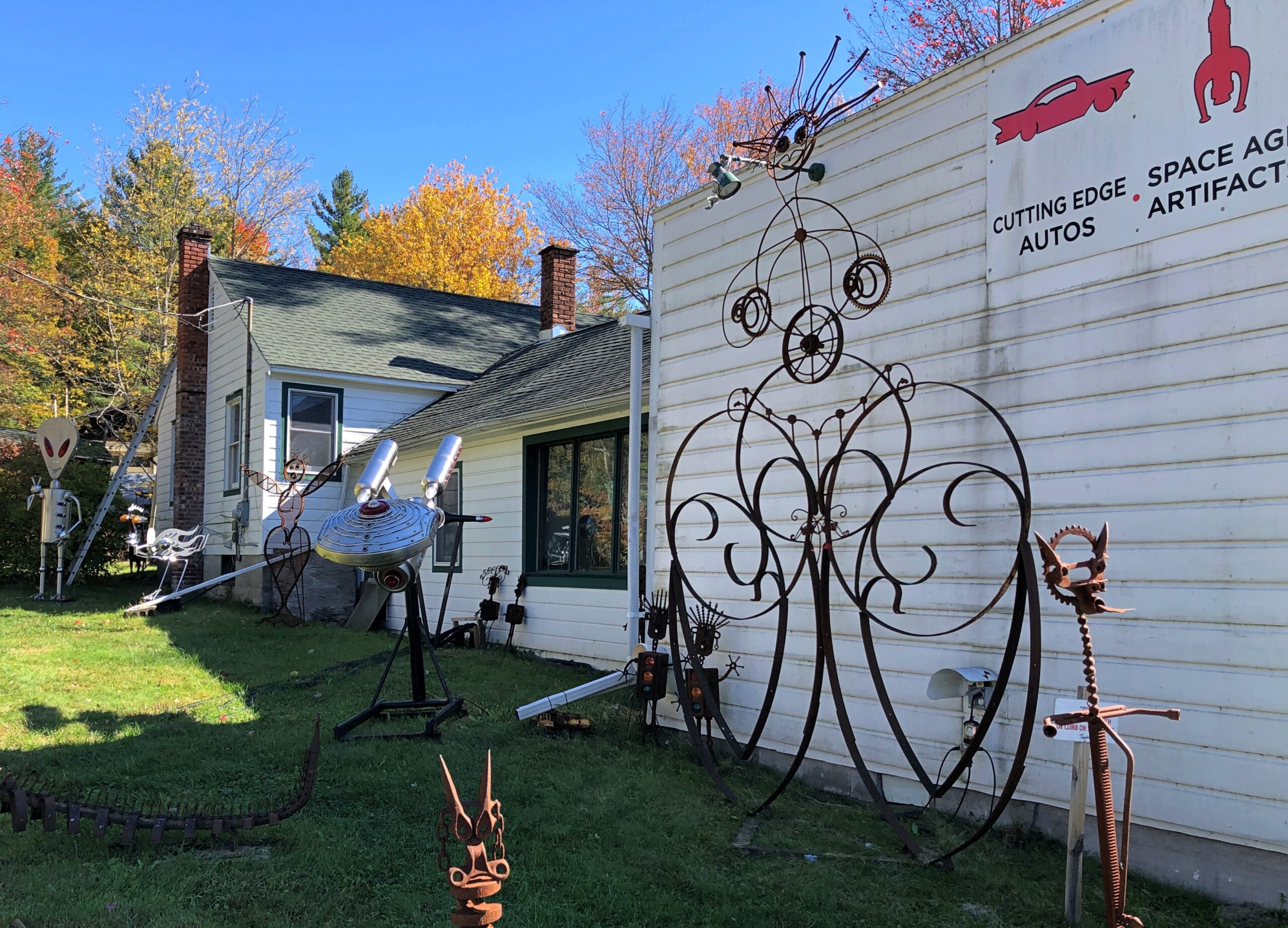
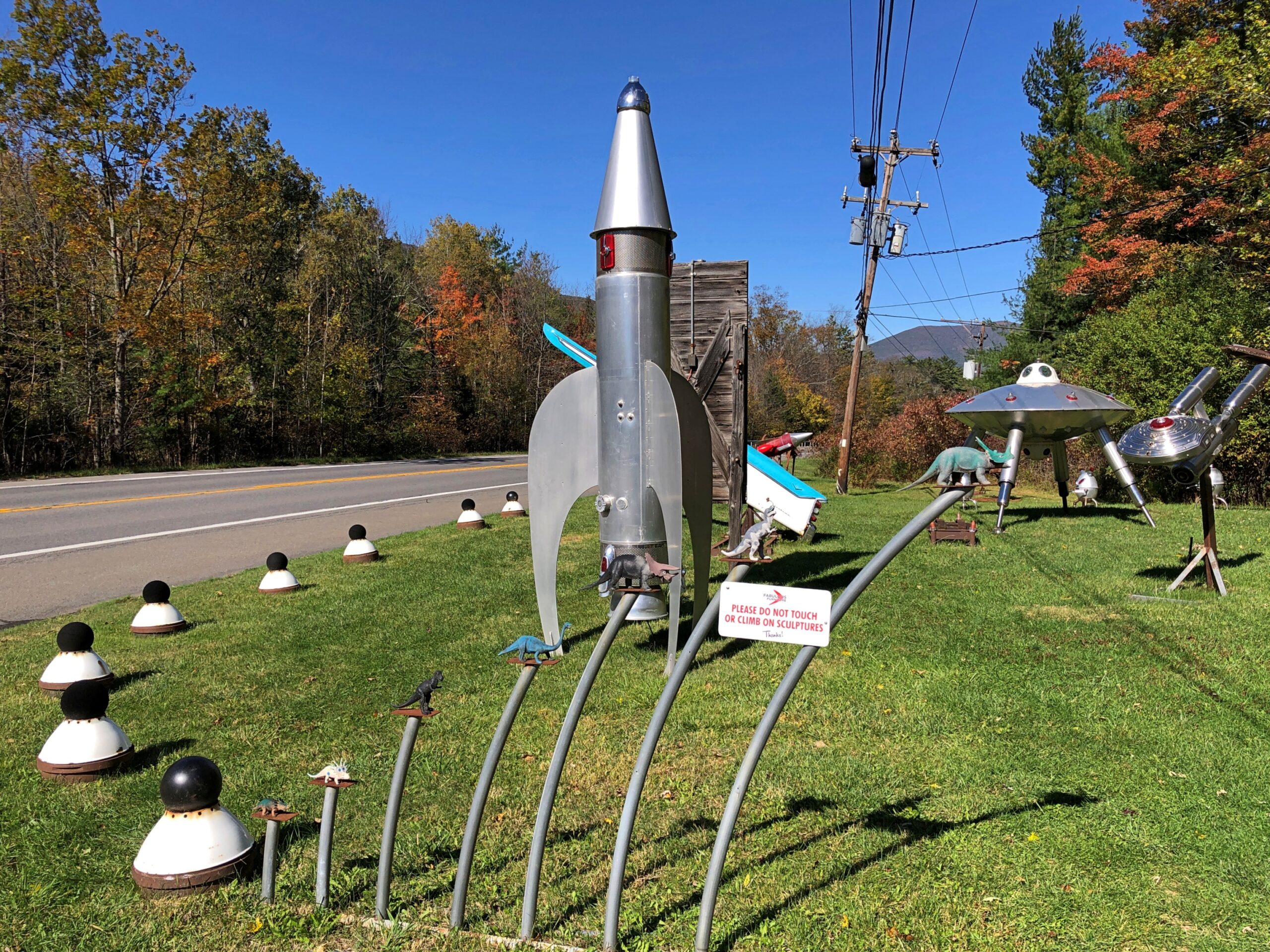
Metal spaceship and robot sculptures haven’t been part of the Catskills narrative that I know of. But there they were, right off NY 28.
As part of this place of business.
Some artful metal for sure.
More.
Fabulous work, Mr. Heller, but those Space Age artifacts are of a Space Age that never quite was. Too bad.
I didn’t realize until last night that I’d driven through some geographic oddities over the last two weeks, on my way to the Northeast and back. Actually state border oddities, such as the Erie Triangle in Pennsylvania, the curious division of the Chesapeake Peninsula, and the panhandle of Maryland.
Except they aren’t really oddities. They just look that way when you’re a kid (or an adult) poring over U.S. maps or putting your state puzzle map together for the nth time. How is it that Pennsylvania has that small chimney? Why didn’t Delaware get more of the Chesapeake Peninsula? What’s the deal with the western extension of Maryland, which narrows to only a few miles at one point?
There are historic reasons for all the shapes, both rational and arbitrary, which are the subject of books and at least one TV show. Lands were granted and claimed, borders were surveyed and quarreled over, and deals and court cases and Congress eventually settled the shapes.
The border oddities may have local and legal significance, but they’re also there to enjoy. Regular borders aren’t nearly as much fun. Sure, it’s interesting that Colorado and Wyoming look about the same, but I always liked the fact that New Mexico has a stub and Idaho tapers to meet Canada, just to name two Western examples, because not all the fun shapes are in the East. Just most of them.
To reach these border areas, I drove 2,853 miles, starting October 14, from northern Illinois to the East Coast and back, through (in order) Indiana, Michigan, Ohio, Pennsylvania, New York state (and city), New Jersey, New York (city and state) again, Connecticut, Massachusetts, Rhode Island, Connecticut again, New York state (and city) again, New Jersey again, Delaware, Maryland, West Virginia, Pennsylvania again, West Virginia again, Ohio again and Indiana again, arriving home today. I got tired just typing all that out.
The original impetus for the trip was to visit New York City during its Open House event. Unlike a rational person, who would have flown there and back, I decided to drive, and let Yuriko fly there and back. NYC is achievable from metro Chicago in two driving days. I decided not to do that, either, and stretch things out to fill in some travel lacunae of mine.
For instance, I wanted to visit Eire, Pa., because I’ve always bypassed it, and many Americans can say the same. I wanted to look around Long Island, or at least part of it, for the same reason. I wanted to spend the night in both Rhode Island and Delaware: the last two states in which I’d never done so. I wanted to see the capitols of New Jersey, Delaware and Maryland, toying with the idea of Pennsylvania too, though I decided it was out of the way. I wanted to see historic sites associated with a number of presidents along the way, and maybe a battlefield or two.
I really wanted to visit a friend in New York, and my nephew Robert, and friends in the Boston area. I’m glad to report that I did so. This has been a year of visiting old friends and relations. I’d like every year to be that way.
I had a much longer list of places to visit, and added to it every time I looked at a map, paper or electronic, since I now use both, and when I was driving — so many possibilities. But there are only so many hours in the day and so much energy in my aging body. Still, I did much of what I set out to do, with one major exception due to forces beyond my control. National Park Service sites were off the table, for reasons all too obvious and not worth rehashing here. So the homes of FDR and TR, along with Antietam and Harper’s Ferry, went unvisited. Some other time, I hope.
No matter. I visited a good number of cities and towns, drove roads large and small, empty and insanely crowded, and enjoyed a few exceptional meals and many very good ones. I saw churches and cemeteries, some historic places not managed by the federal government, and encountered the largest of the many No Kings events. I read plaques. I chatted with strangers and clerks in stores. I took a swim in Massachusetts and long walks in New York. I hadn’t planned to walk across the Brooklyn Bridge again, but Yuriko had that idea, and across we went. I listened to a lot of terrestrial radio, good, bad and indifferent. I burned gas priced between about $2.70 and $3.30 a gallon. I paid entirely too many tolls, because the Northeast is lousy with toll roads and bridges — but driving across some of those bridges, especially the Bay Bridge in Maryland, was a grand experience, and surely worth the toll.
Something I didn’t anticipate, but which improved the trip immensely, was fall color. I should have anticipated it, but I suppose I had other things on my mind. When I got to New York state, driving west to east, it became clear that I’d accidentally designed myself a fall foliage excursion. The trees were gorgeous there, and in NYC (especially Prospect Park), Long Island, and parts of New England, and in Delaware and Maryland all the way across its panhandle. Even Ohio and Indiana had some nice color when I got there, and here at home too.
One more thing: unexpected oddities along the way. It’s important to watch out for those.
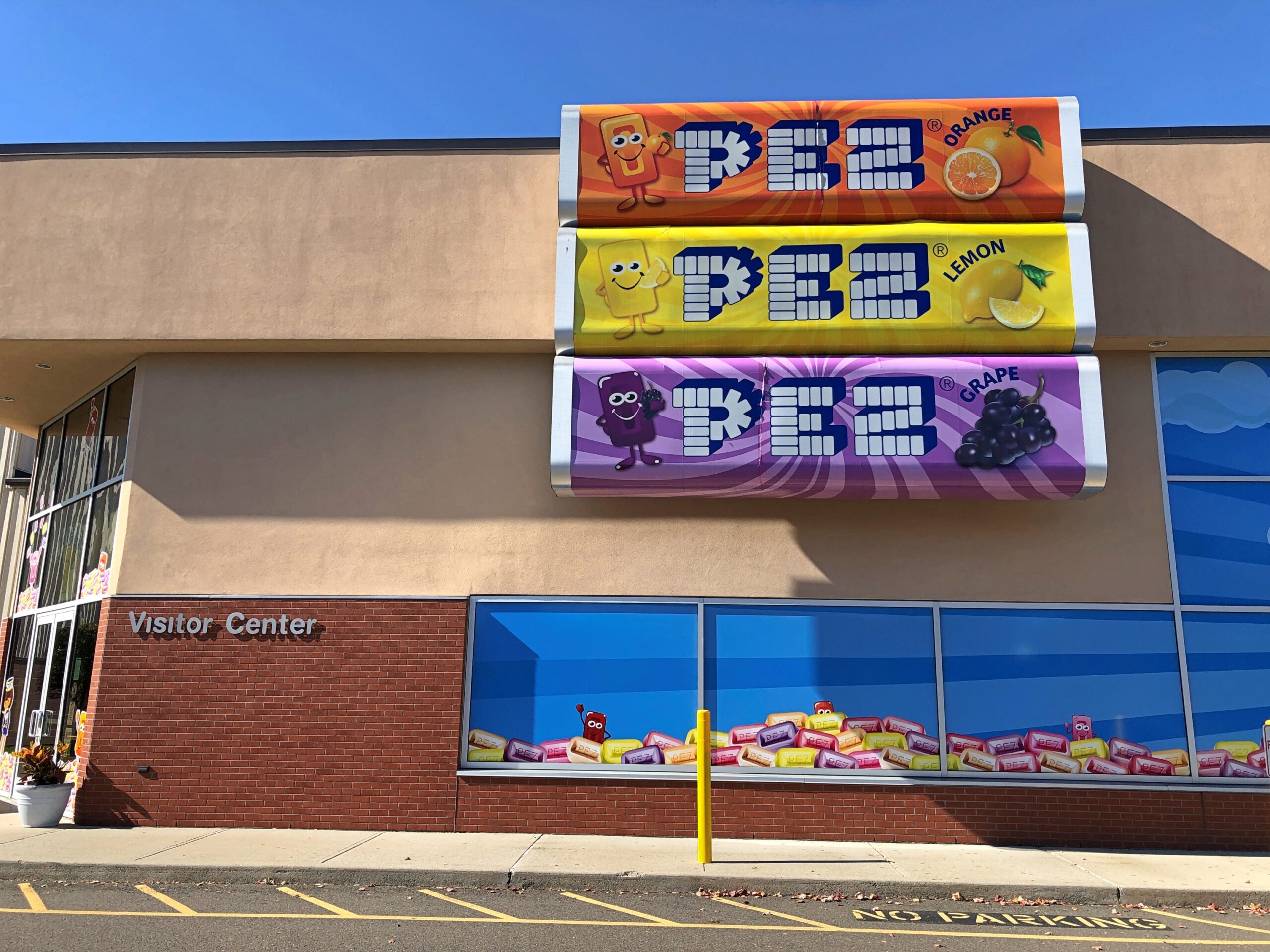
In Orange, Connecticut, I noticed a sign for the Pez Visitor Center. I had to see that.
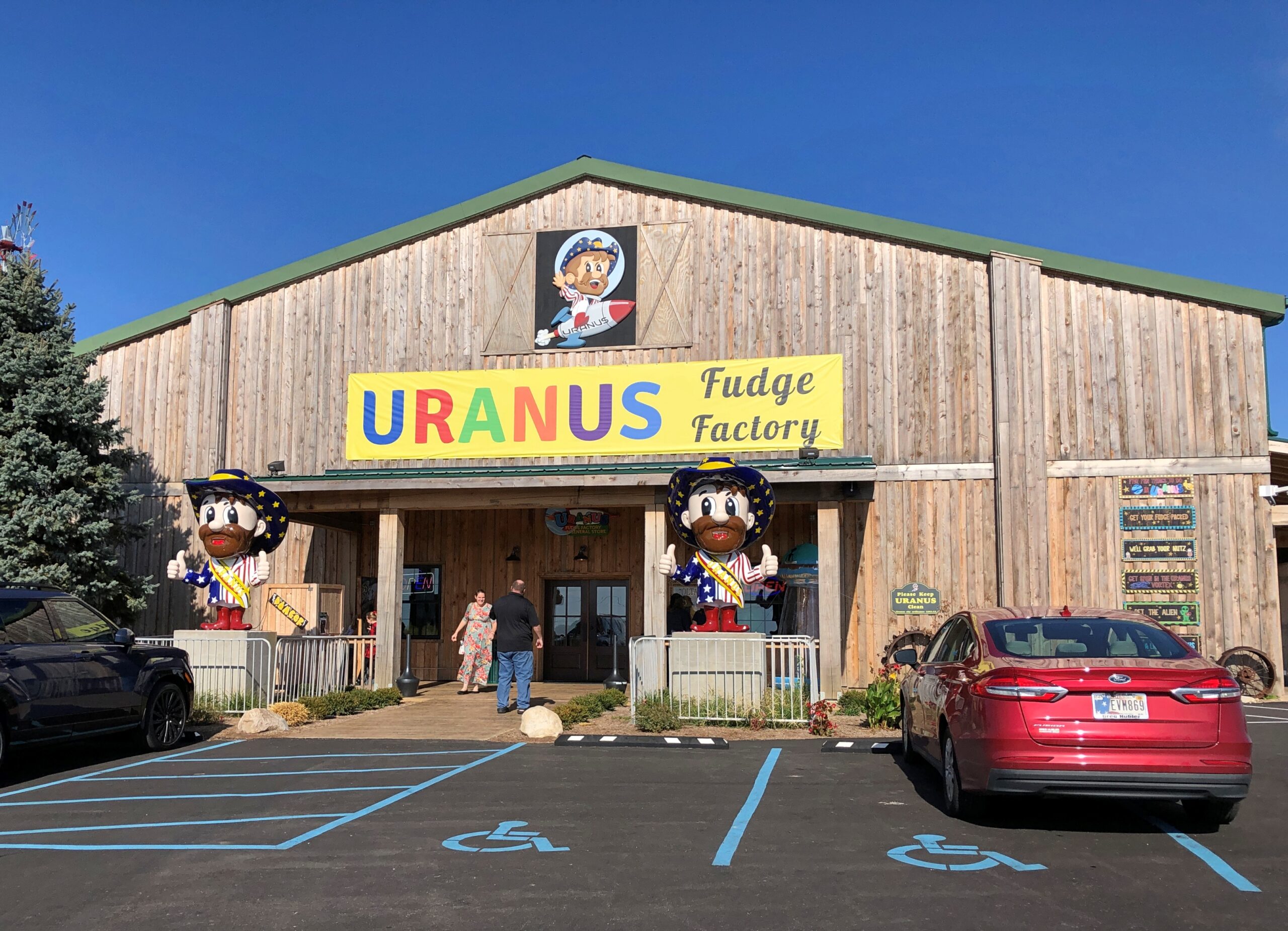
Earlier today, at the border between Ohio and Indiana, I noticed Uranus. I had to stop.
Turns out there’s more than one; I’d only ever seen the one in Missouri (the original) in passing, never stopping. But I did this time. Now I can say I’ve been to Uranus.
Early October this year was much like summer here in northern Illinois. Cooler now, but not even close to freezing just yet. Even the leaves seemed to be cooperating, delaying their colors a little longer than usual. As recently as tonight, some of the hardier crickets were still singing, or whatever you can call it.
Back to posting around October 26. Until then, stay curious.
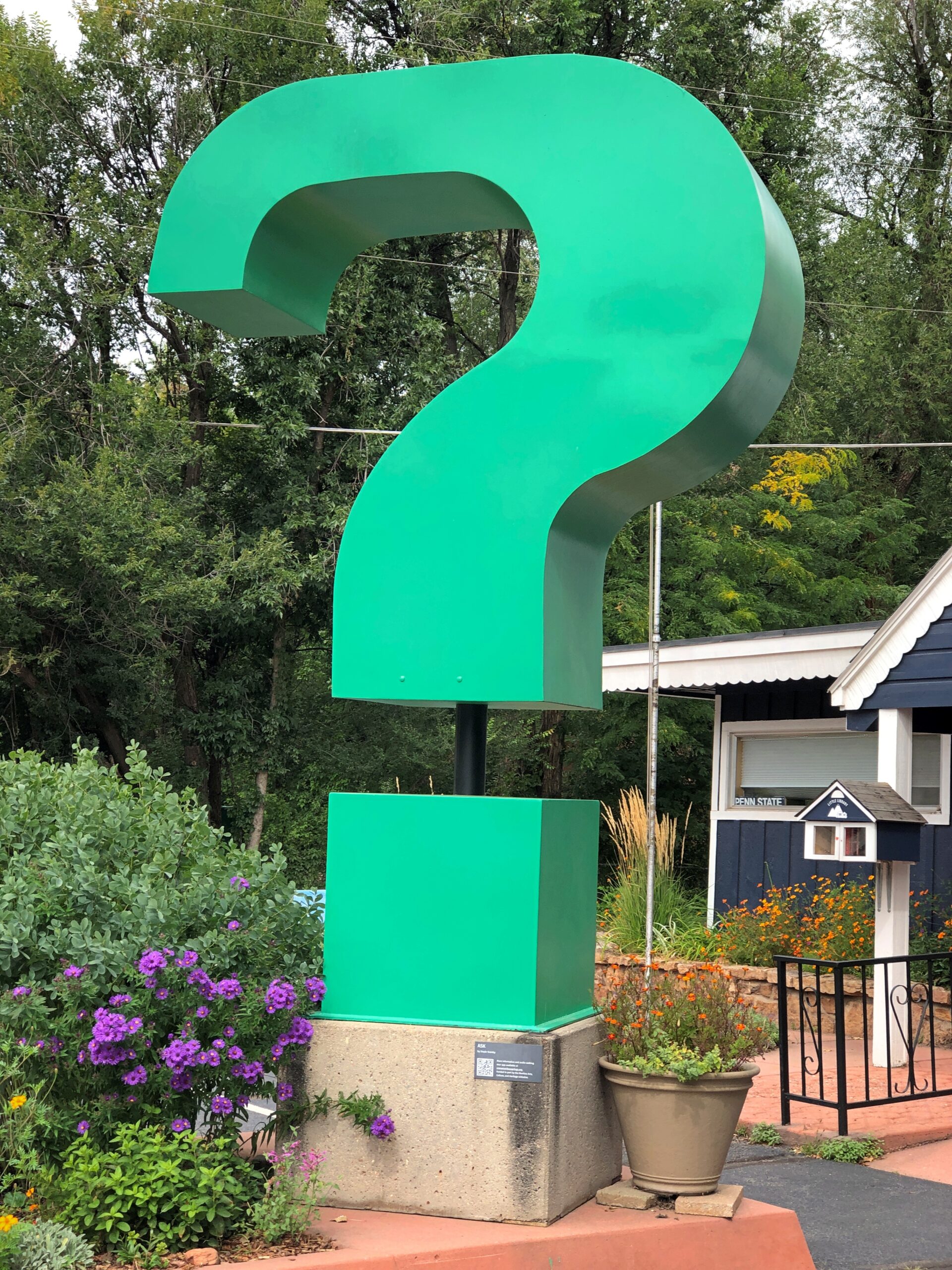
A little context. The question mark can be found in Manitou Springs, Colorado.
My question at that exact moment last month was: is there a public restroom on the grounds of the Manitou Springs C-of-C? I’m glad to say there was.
Labor Day weekend again? How does summer vanish so quickly? Back to posting on September 2.
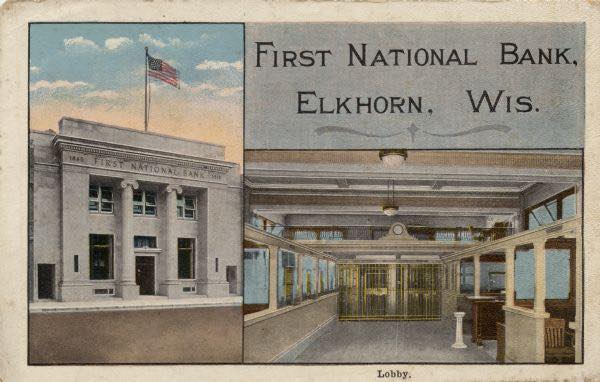
Once upon a time, one of the many First National Banks of the world stood in downtown Elkhorn, Wisconsin, complete with a sturdy bank interior common at the time. As seen in a postcard from the early 20th century.
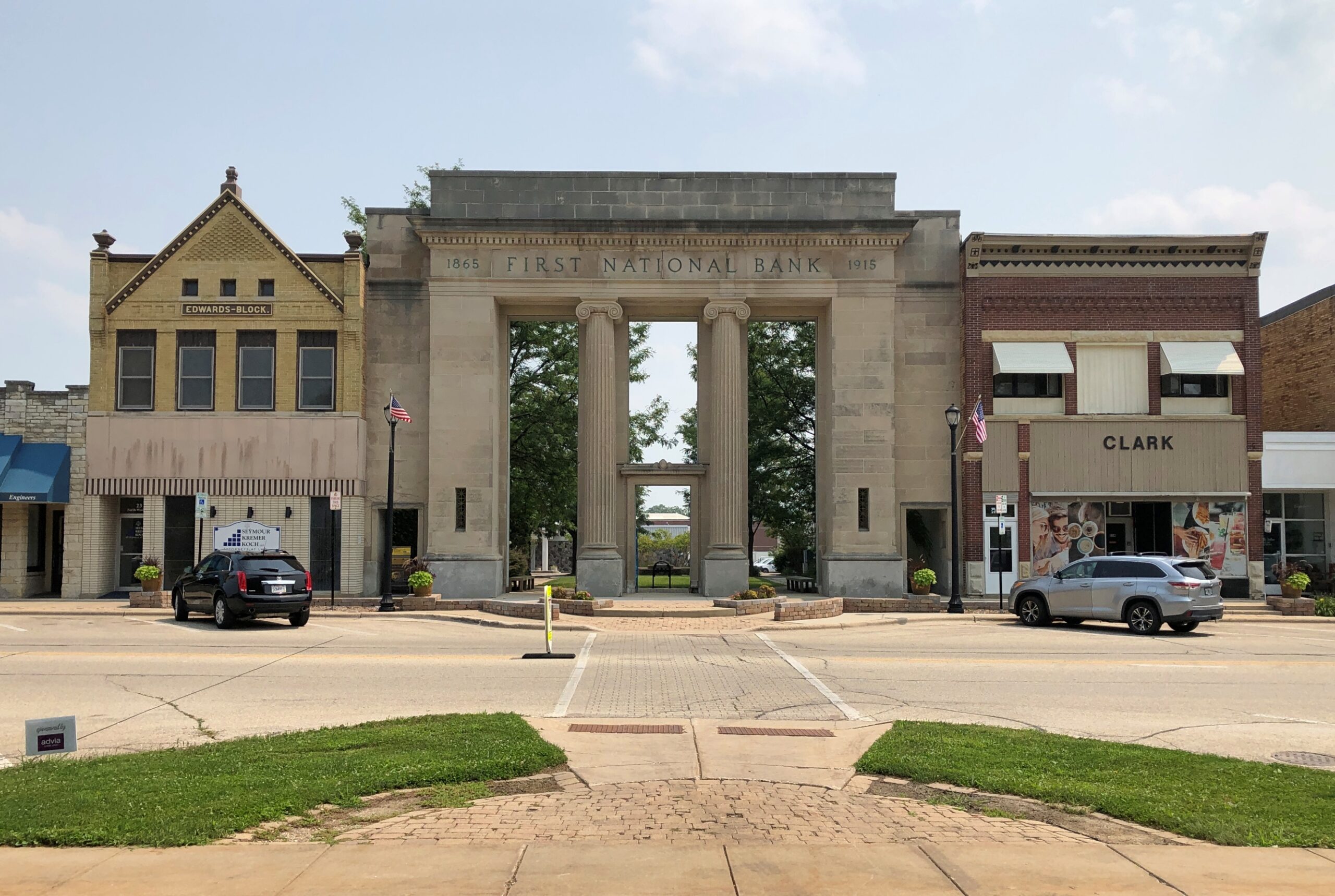
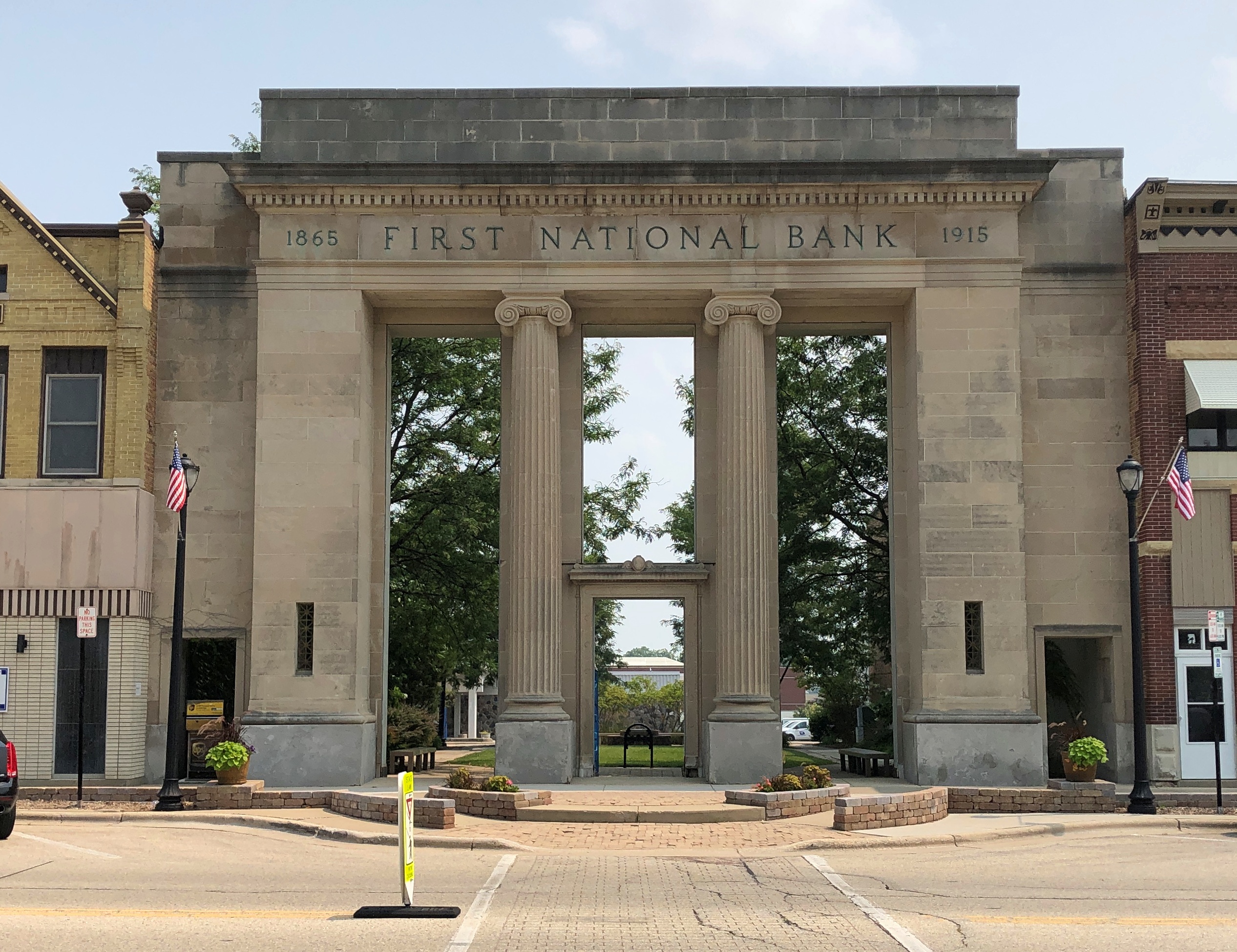
Go looking for the bank these days, and this is what you find.
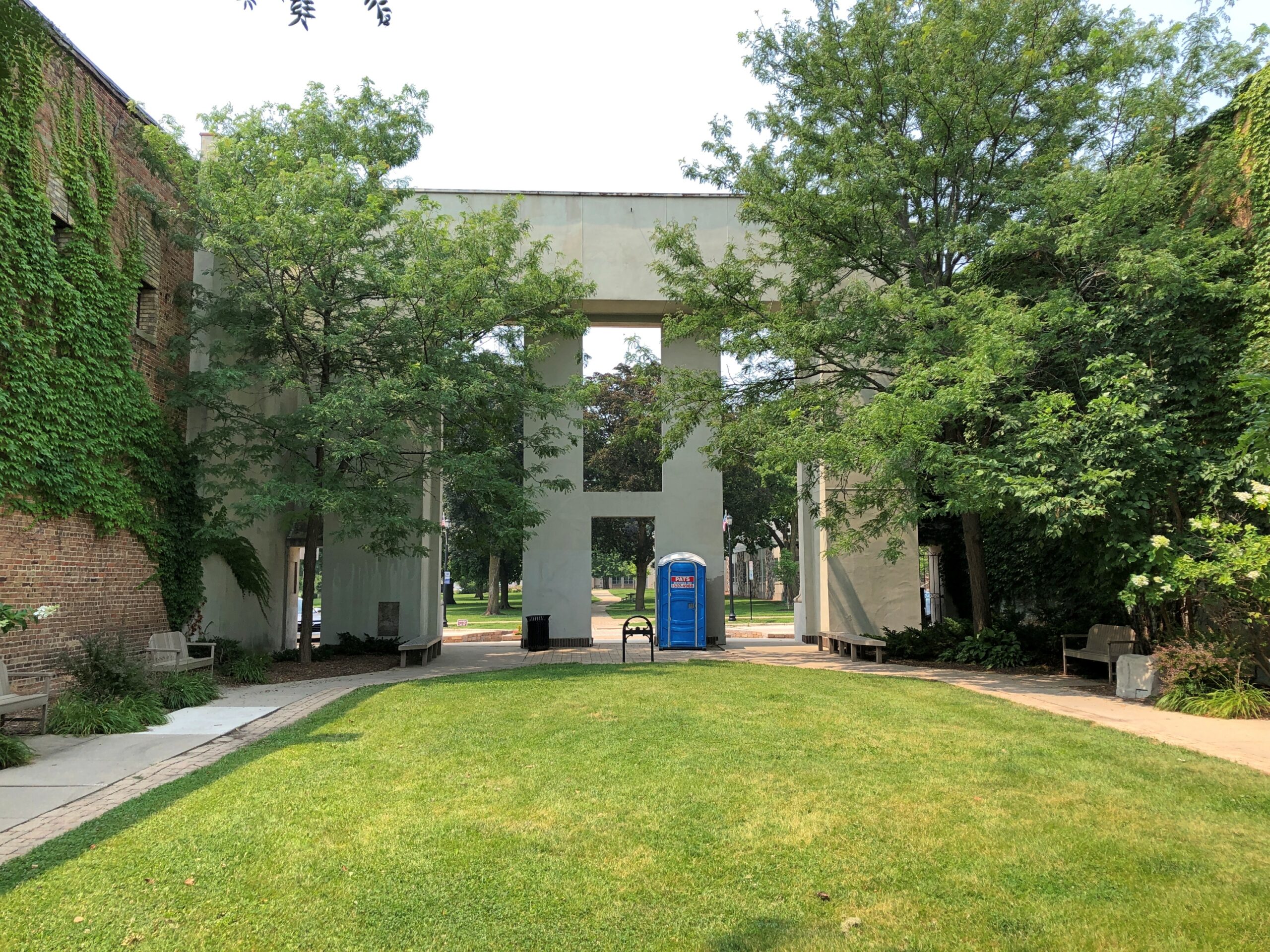
Once a bank, now a pocket park. The view from the inside, looking back at the facade.
There were no signs to indicate how the park came to be. A less imaginative act would simply have been to raze the old building in its entirety and leave a weedy gap in the downtown streetscape, hoping for redevelopment that might never come.
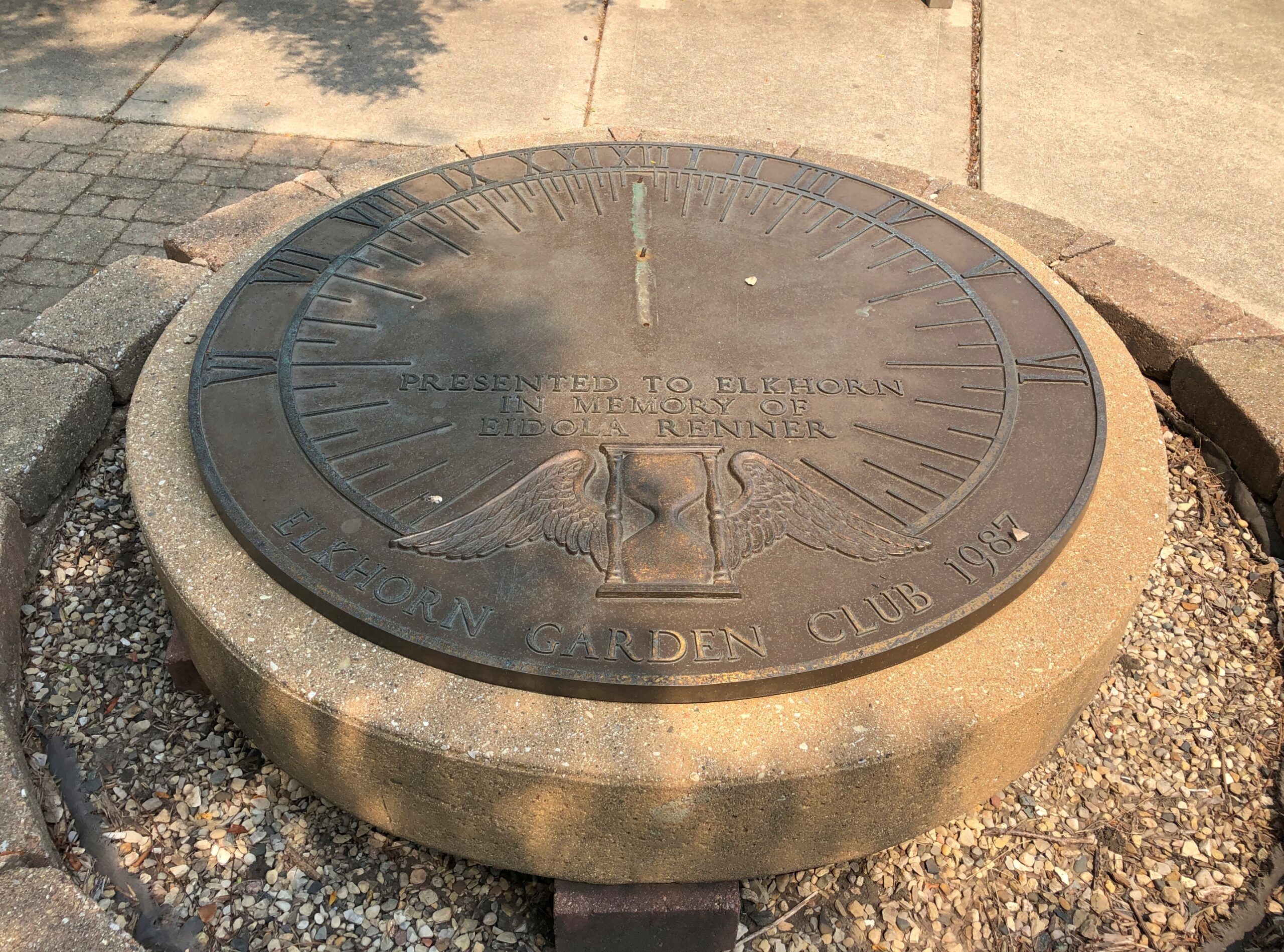
Inside the park is a sundial, dedicated to the memory of one Eidola Renner (d. 1983) of the Elkhorn Garden Club. Ah, garden clubs. The term makes me think of Khigh Dhiegh.
This must be her. The sundial – whose gnomon is missing, so it can’t function for telling time – has been there since 1987, so I assume the park has been there at least that long, if not longer.
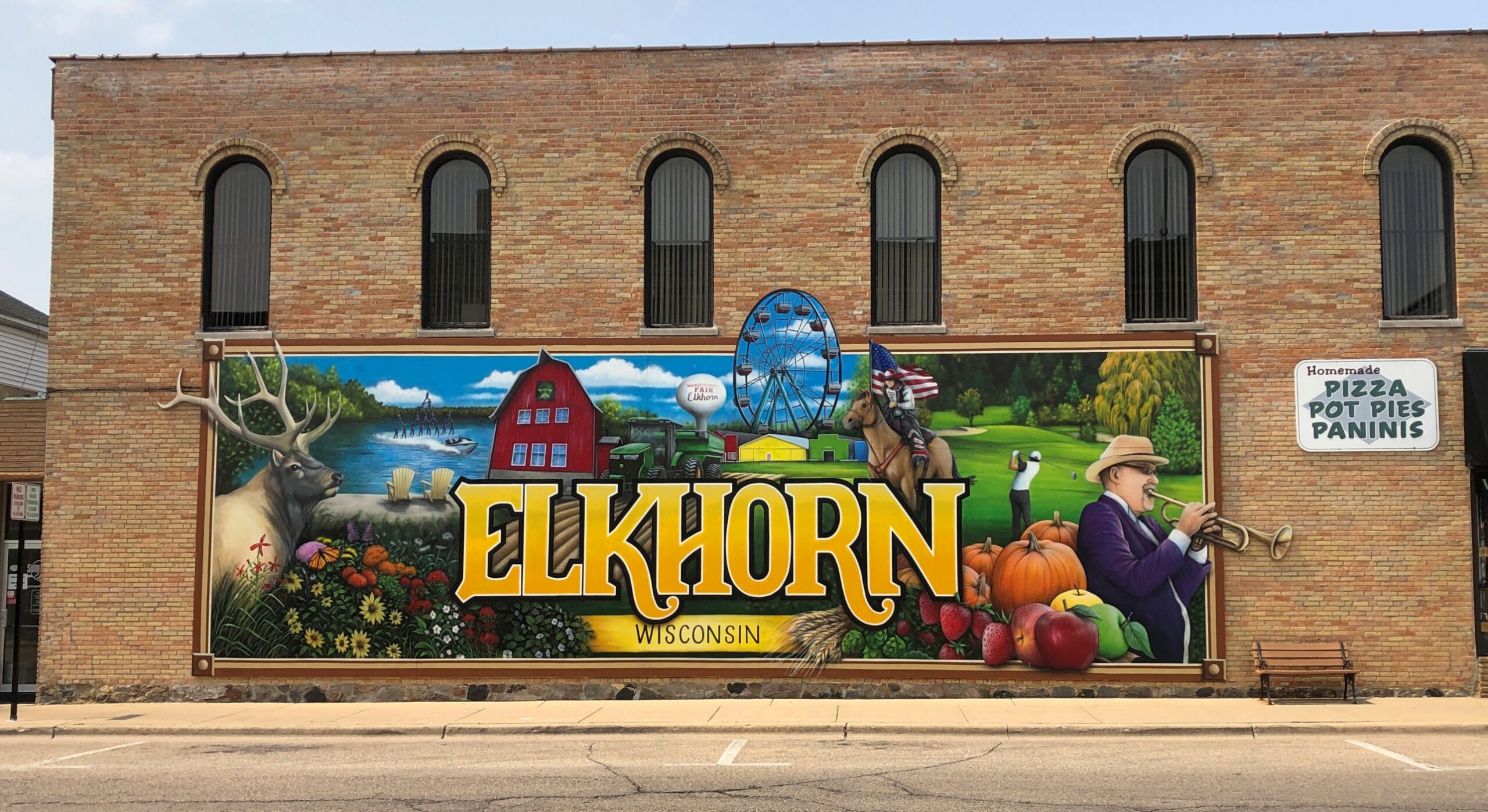
I arrived in Elkhorn on a warm day in early August, traveling by myself in southeastern Wisconsin. It wasn’t too hot for a stroll around the town’s municipal square, home to a “government center,” a mid-century box, but not the storied old courthouse that should be there.
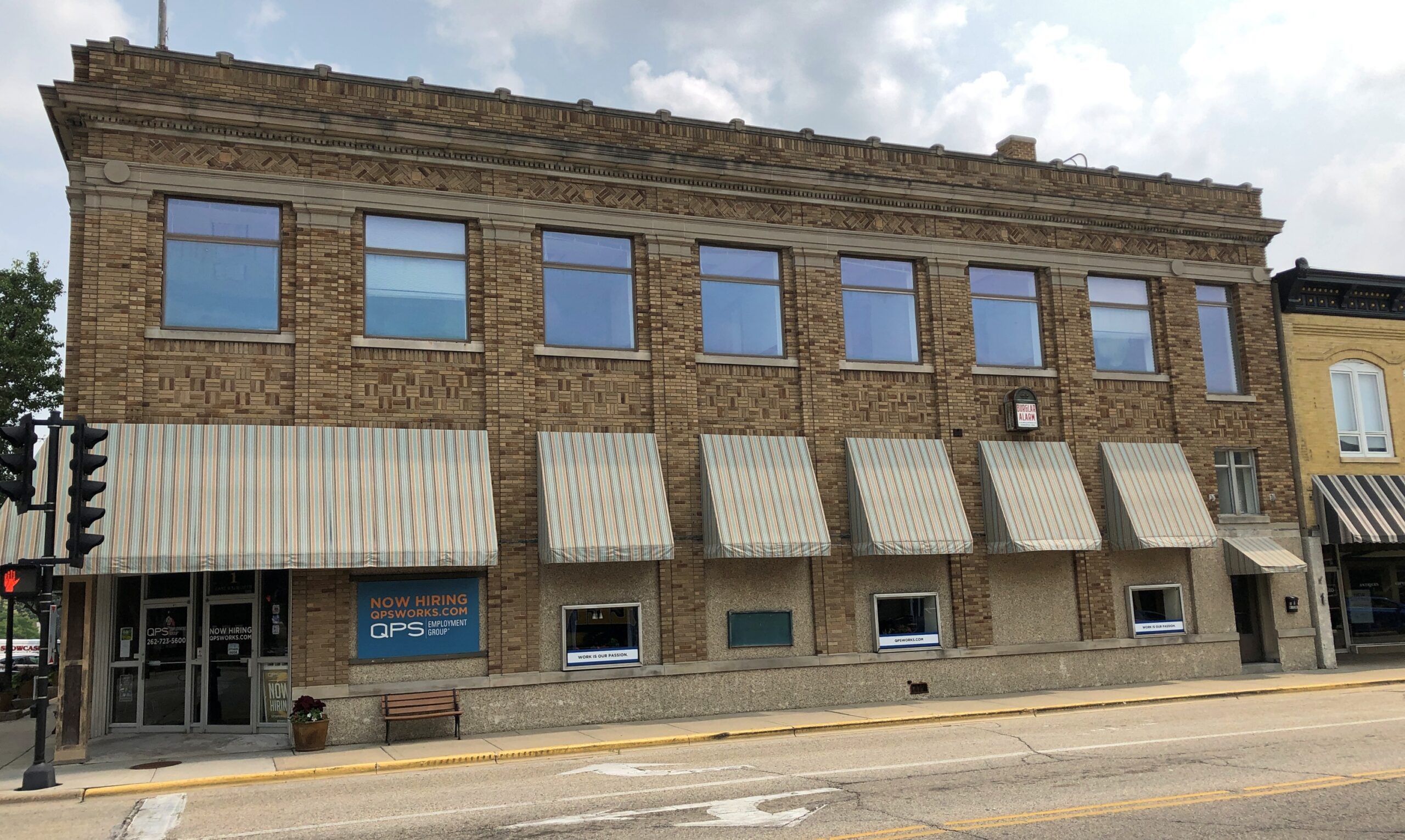
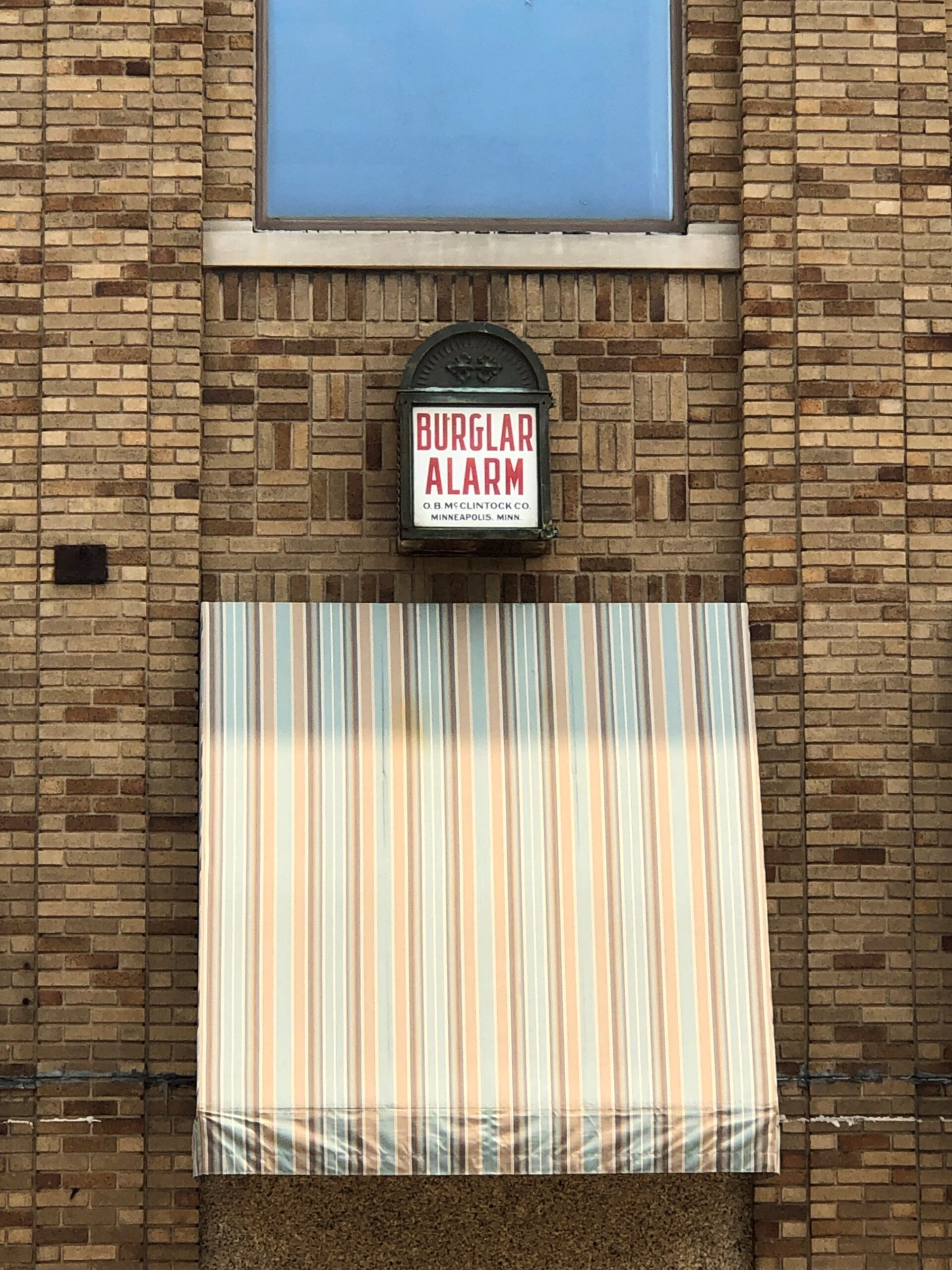
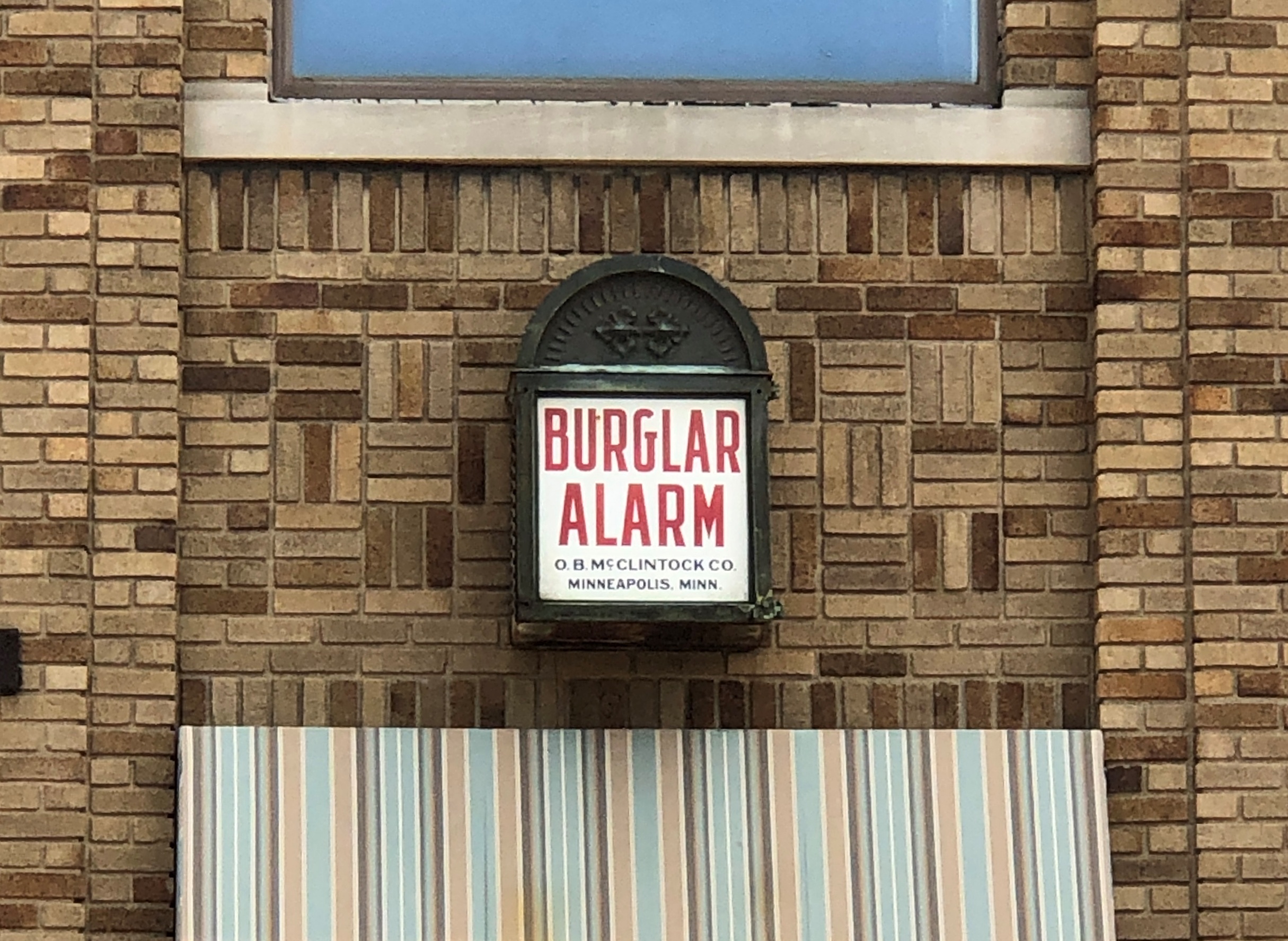
Public notice of an antique alarm system, that’s what.
Not the first one I’ve seen. This one was made by the O.B. McClintock Co. of Minneapolis. “In 1901 O.B. McClintock came to Minneapolis and founded the American Bank Protection Company, which produced burglar alarm systems,” explains a site called Lavilo. “After his resignation in 1908, he opened the O.B. McClintock Company to ‘manufacture electrical chime and clock systems,’ which he sold to financial institutions all across the United States.”
Banks began telling the public the time quite a while ago (McClintock surely wasn’t the first). I’m of course old enough to remember dialing time and temperature, though I can’t remember which financial institution sponsored the service in ’70s San Antonio.
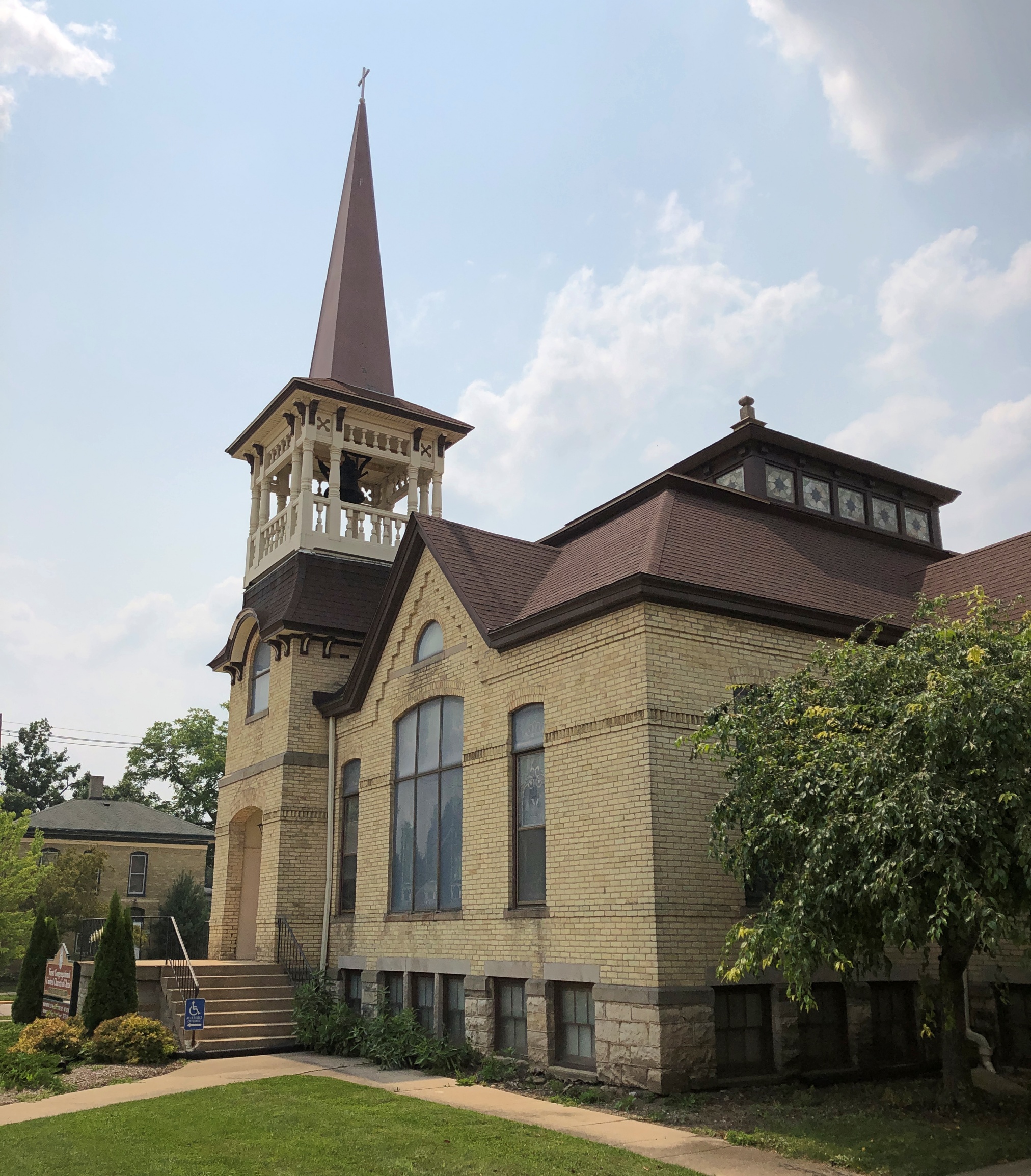
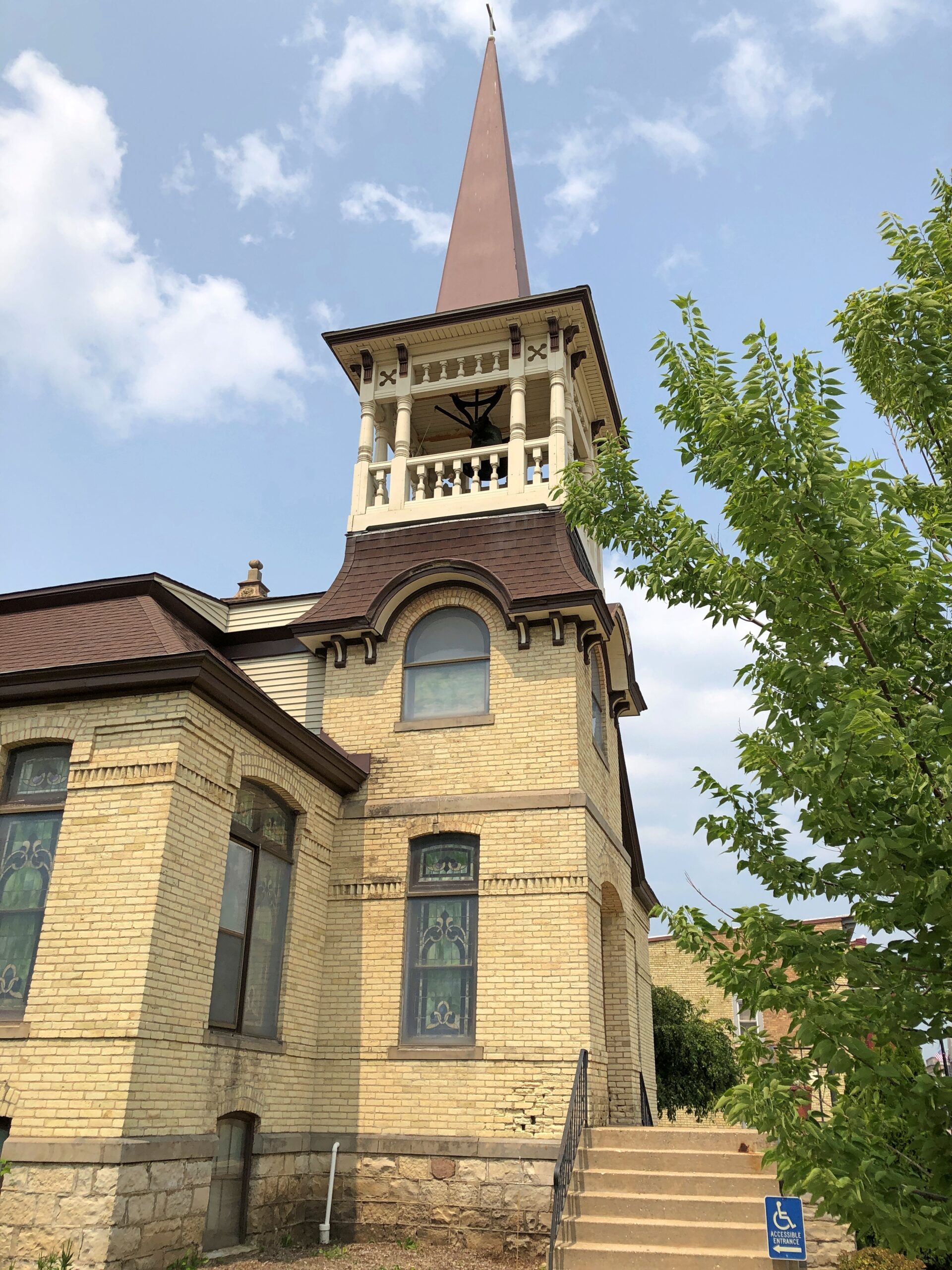
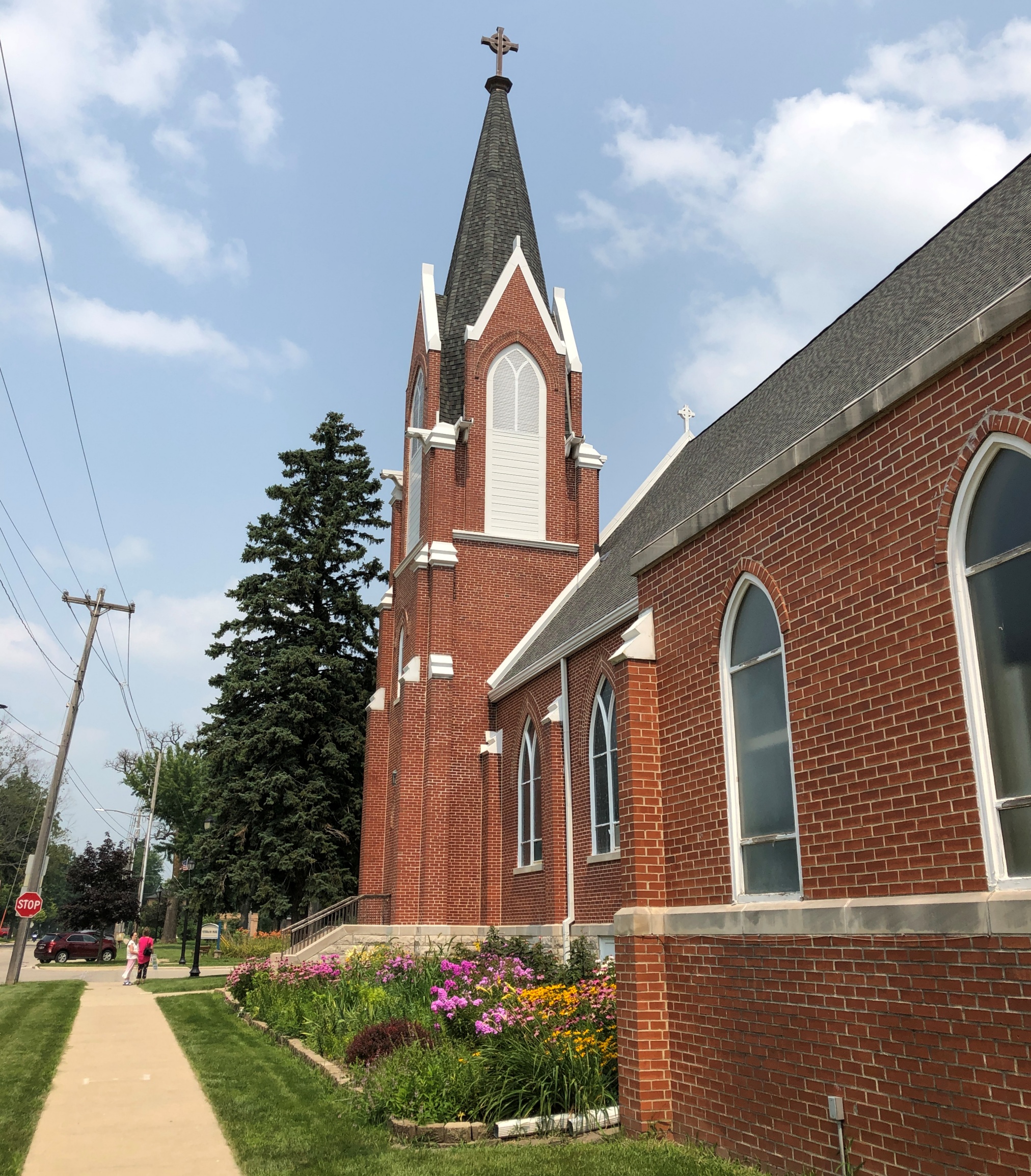
Elkhorn has a fine selection of downtown churches as well. Such as the First Congregational United Church of Christ.
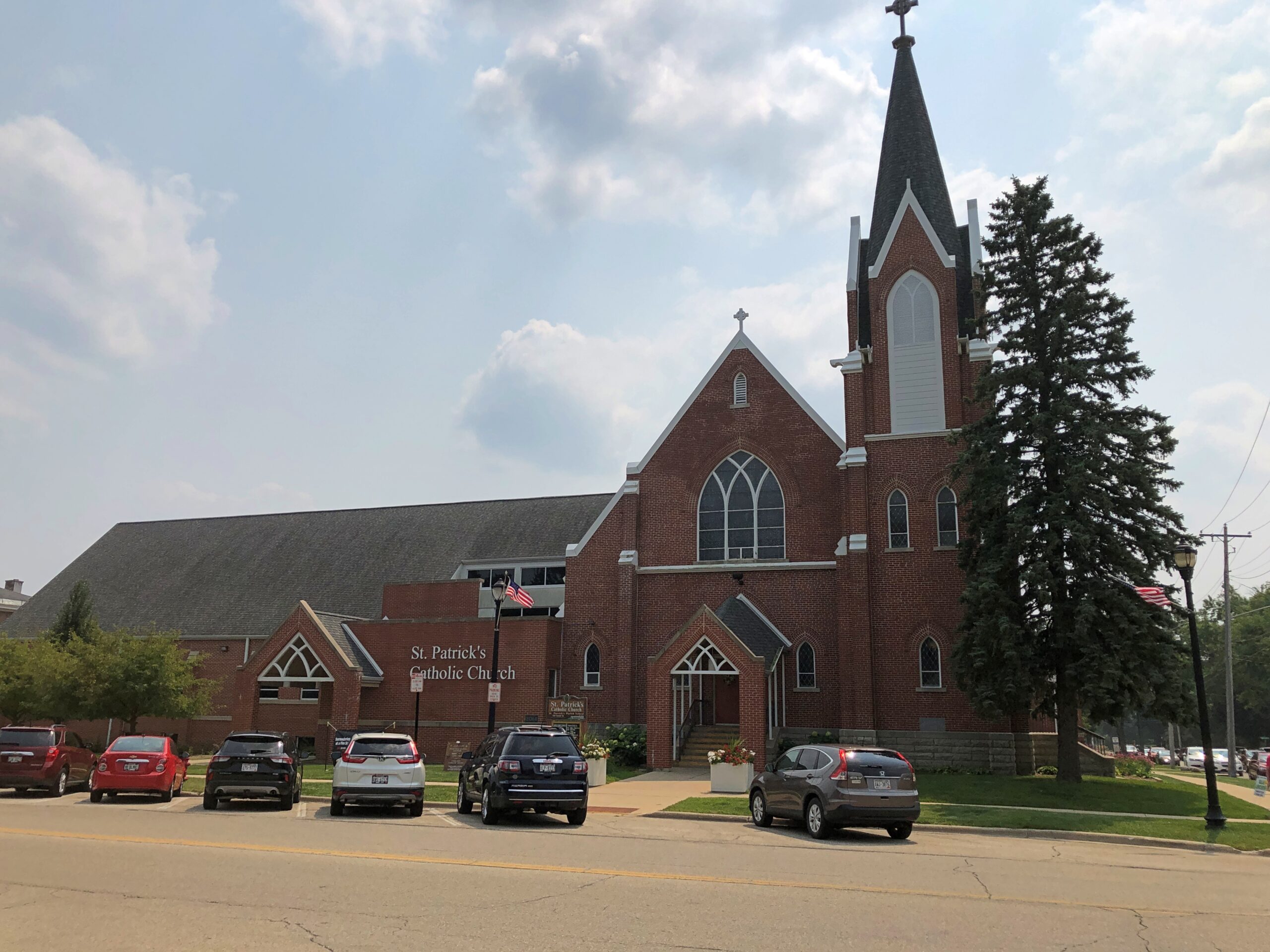
St. Patrick’s Catholic Church.
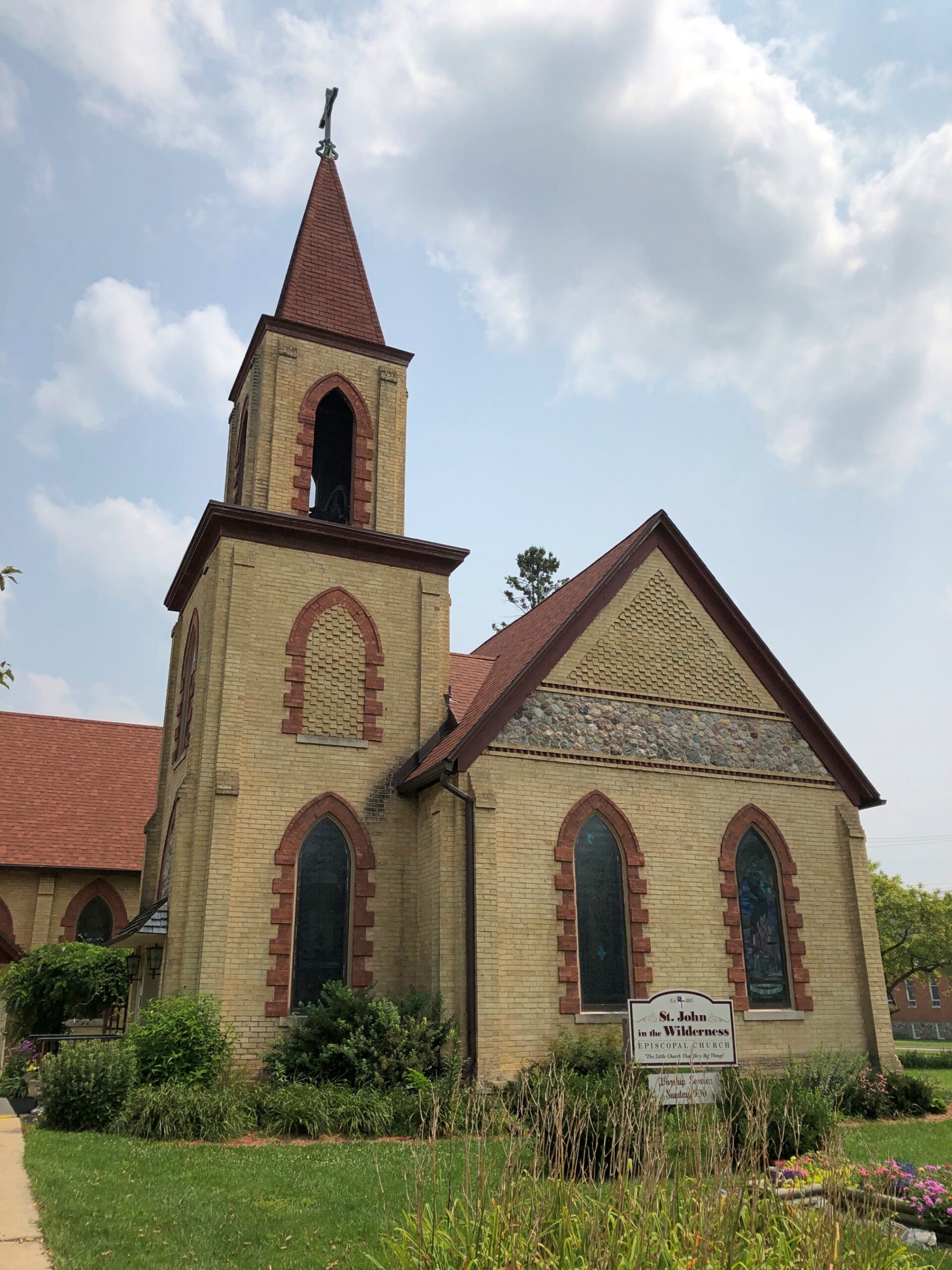
St. John in the Wilderness Episcopal Church.
Founded in 1841, back in Wisconsin Territory days, so “wilderness” was probably apt at the time.
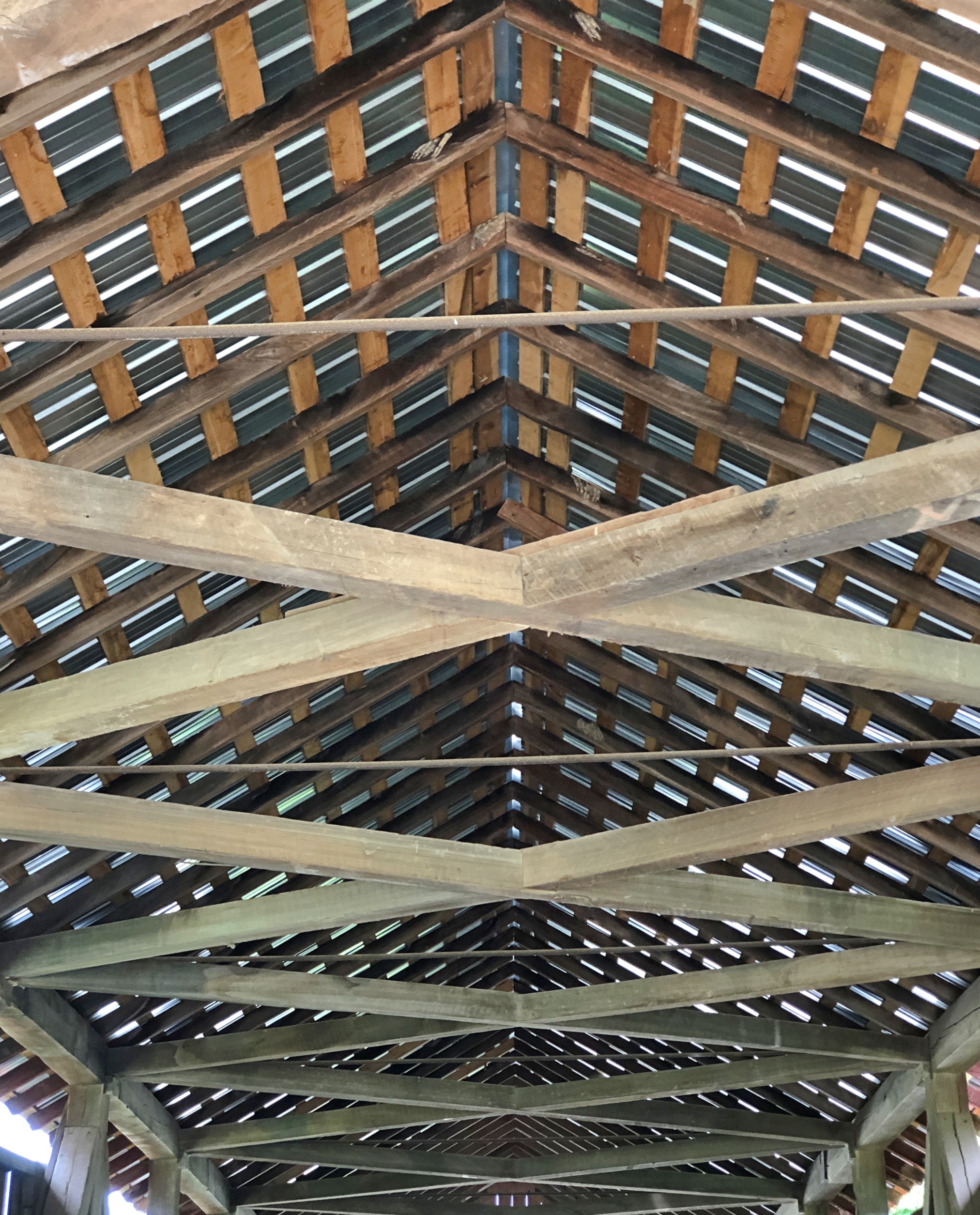
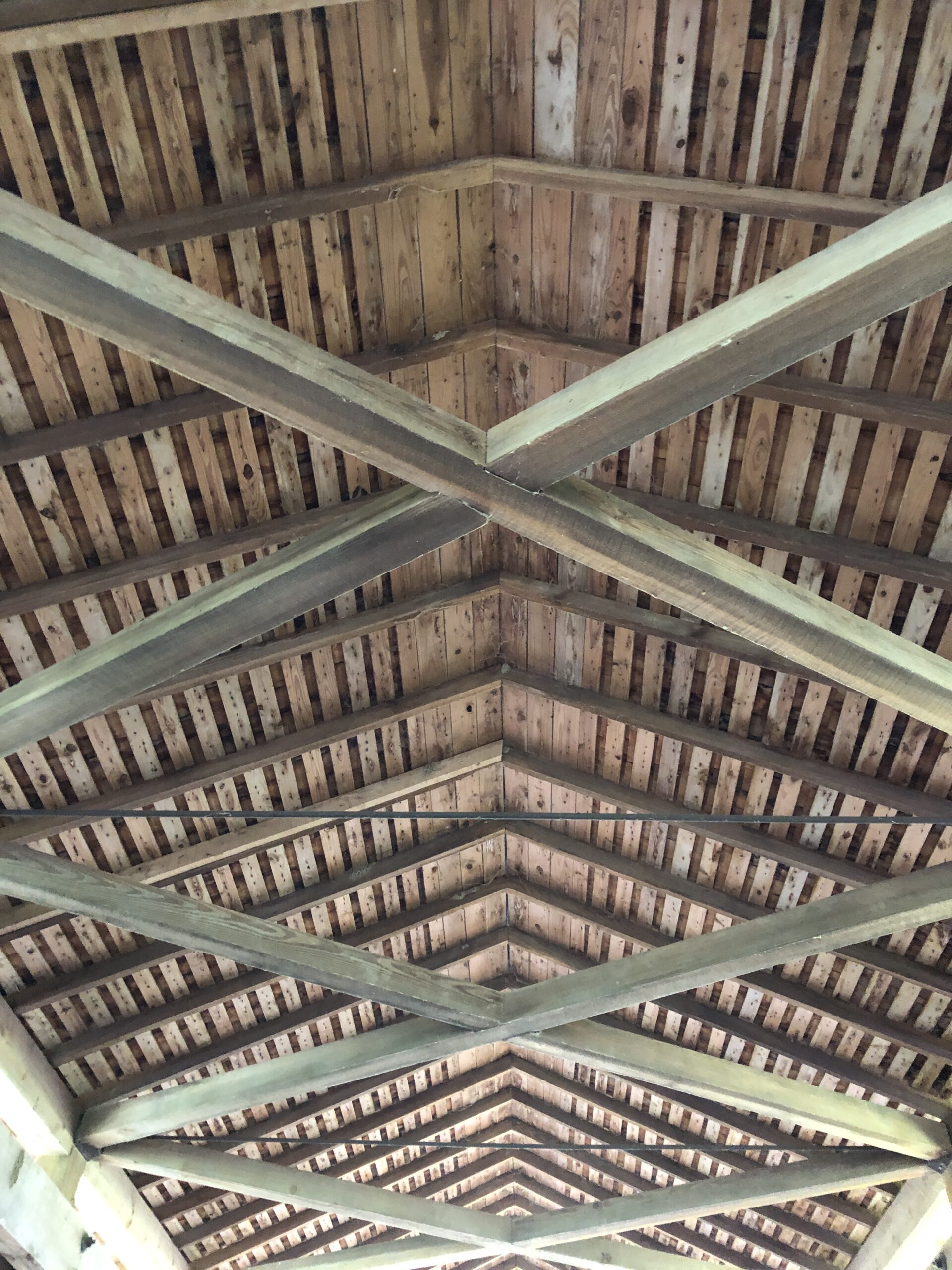
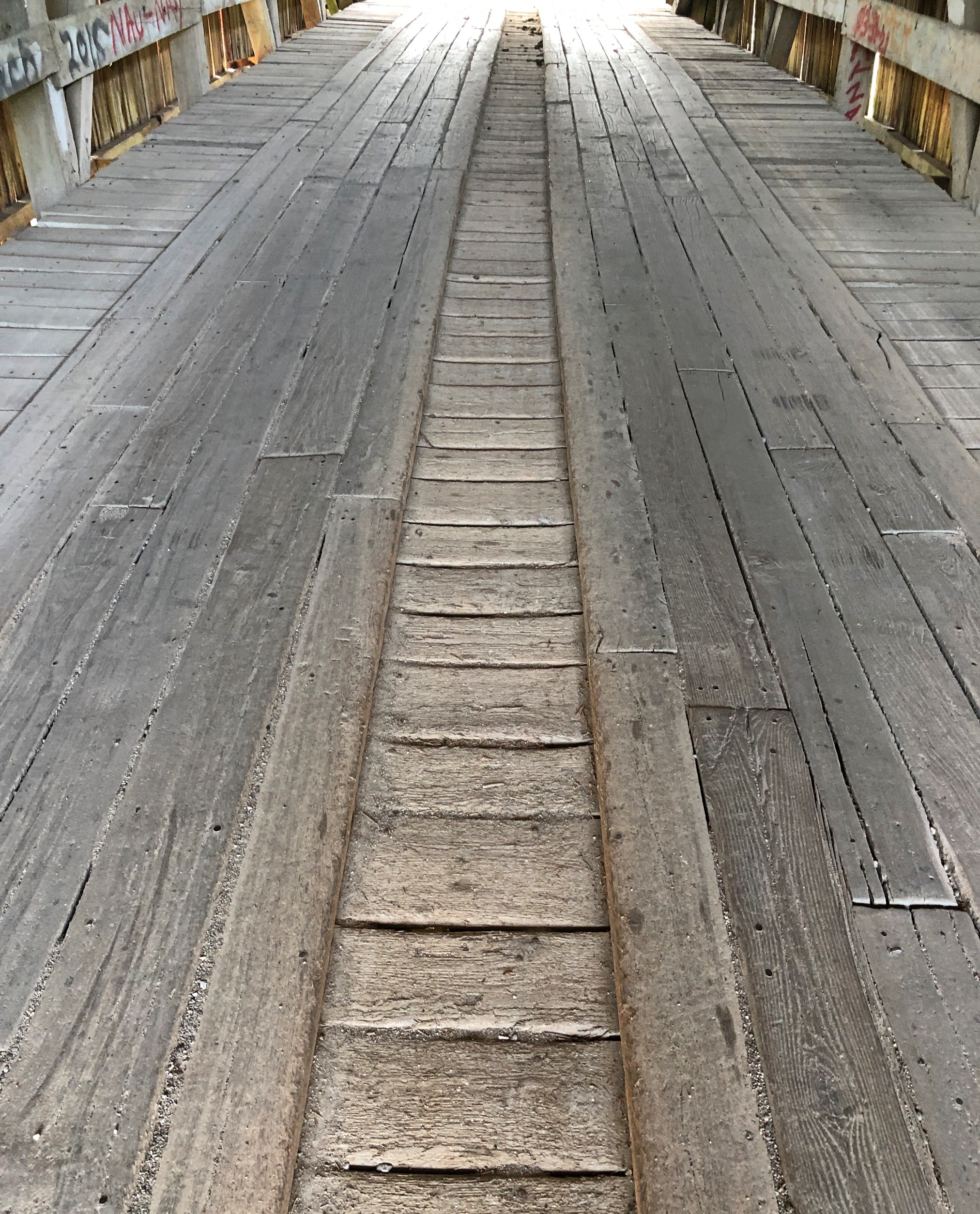
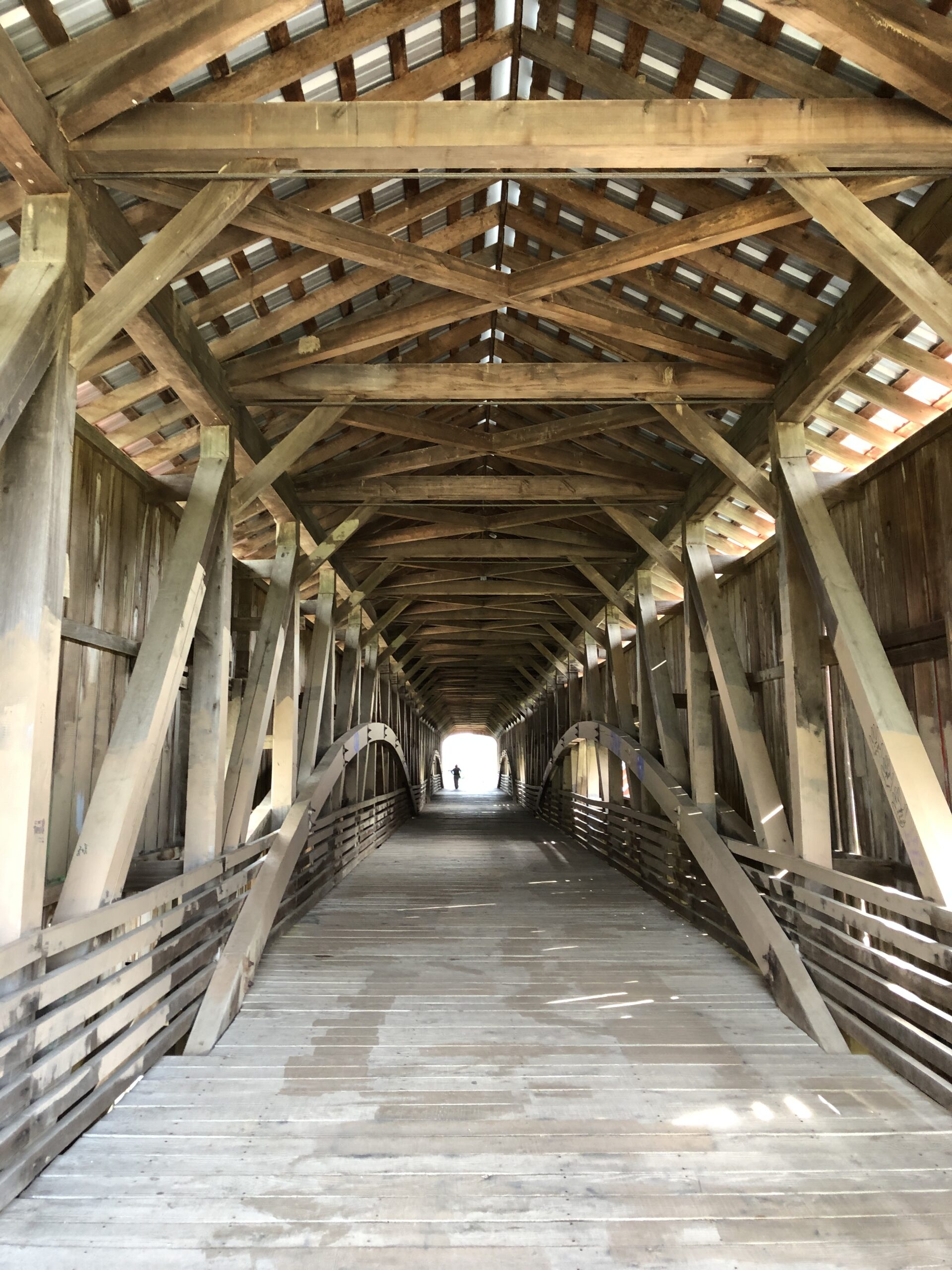
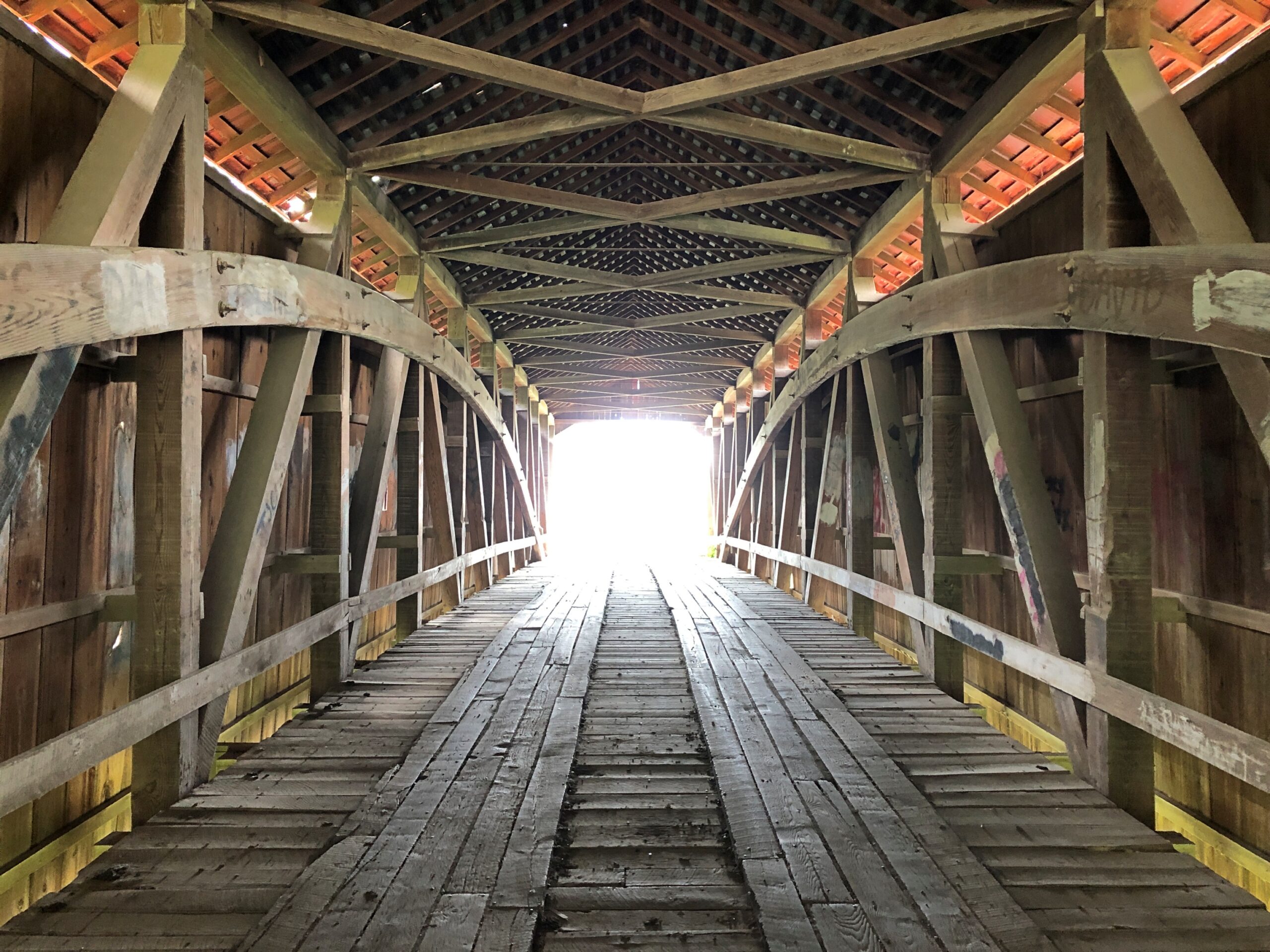
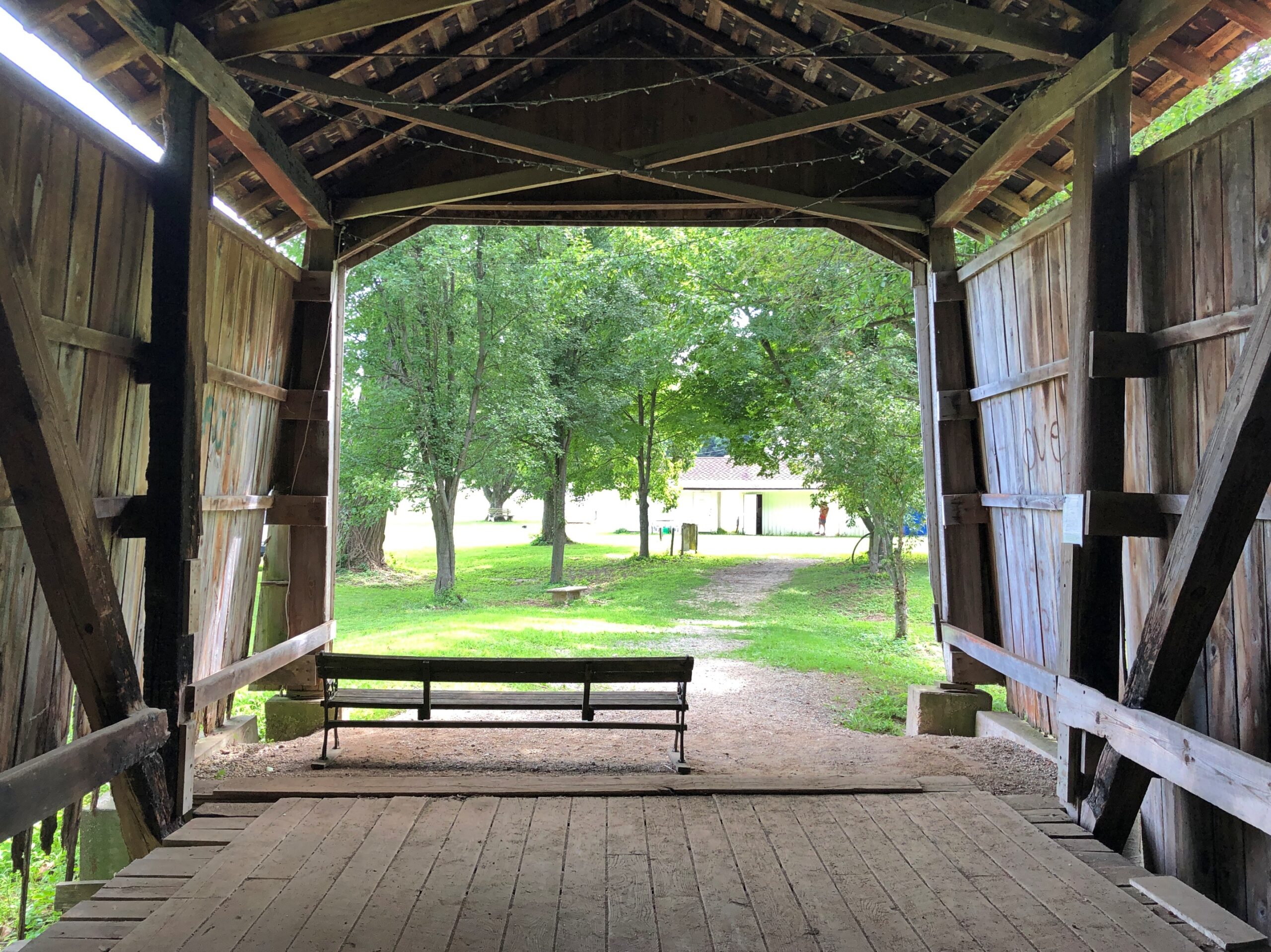
It’s one thing to admire the artistry of a Parke County, Indiana, wooden bridge standing at its entrance, or below near the edge of the creek. Another to wander in and surround yourself with all that wood, from roof –
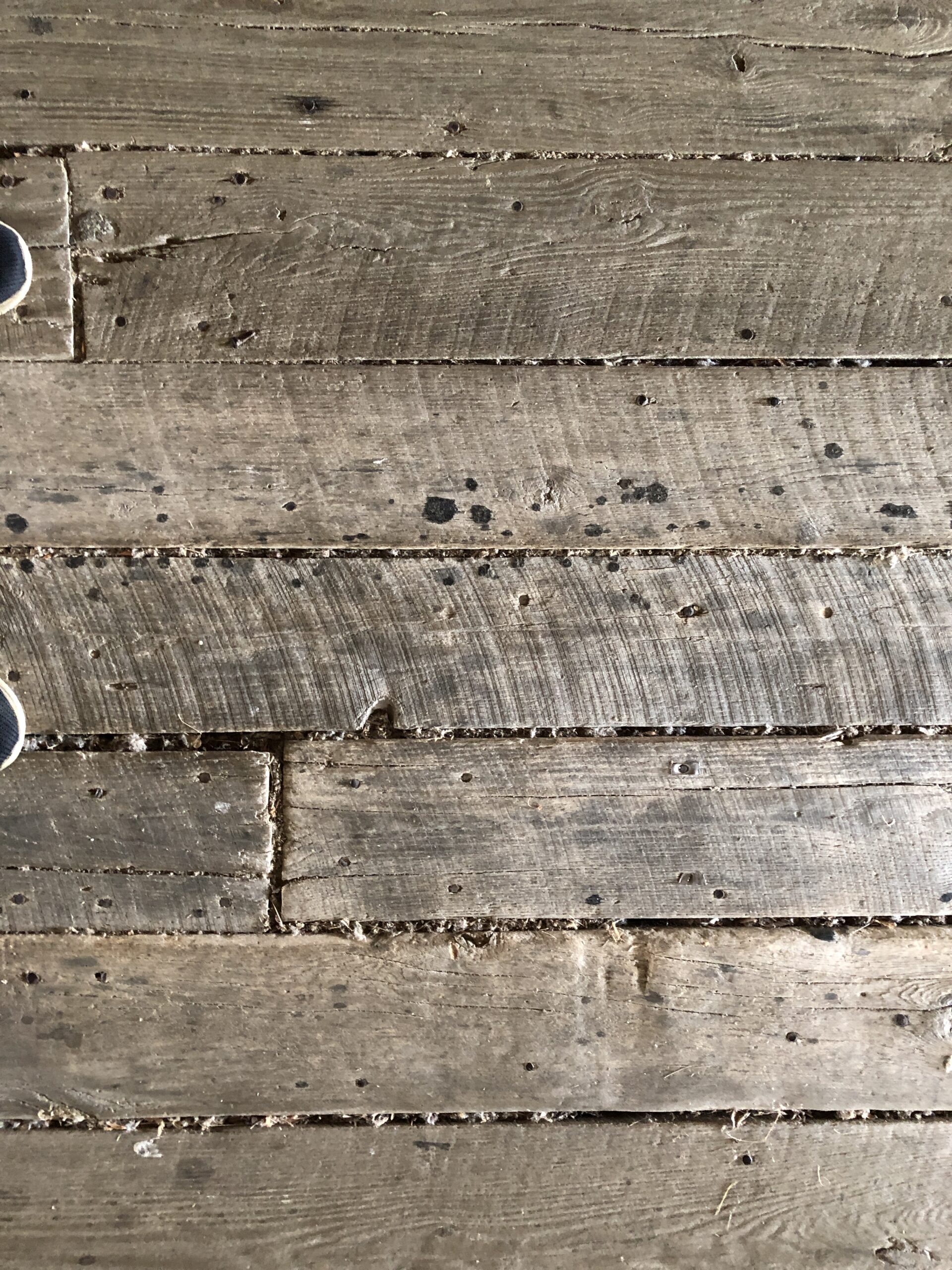
– to floor.
Your eyes spend a few seconds being useless as they adjust, the boards creak and the wood doesn’t exactly smell strongly one way or the other, as it might have when the bridge was new, but even now there’s a faint woody odor, maybe more enhanced after a rain. No recent rain for us, just plodding over dry boards cut well over a century ago.
Being summer, there was a distinct contrast between the brightness outside and the shadows inside a covered bridge. My camera doesn’t interpret the light pouring from the other side of the bridge in quite the way my eyes did. Even so, the camera captured that distinct contrast in its own digital-image way.
Except for those times its image was closer to the eyes’.
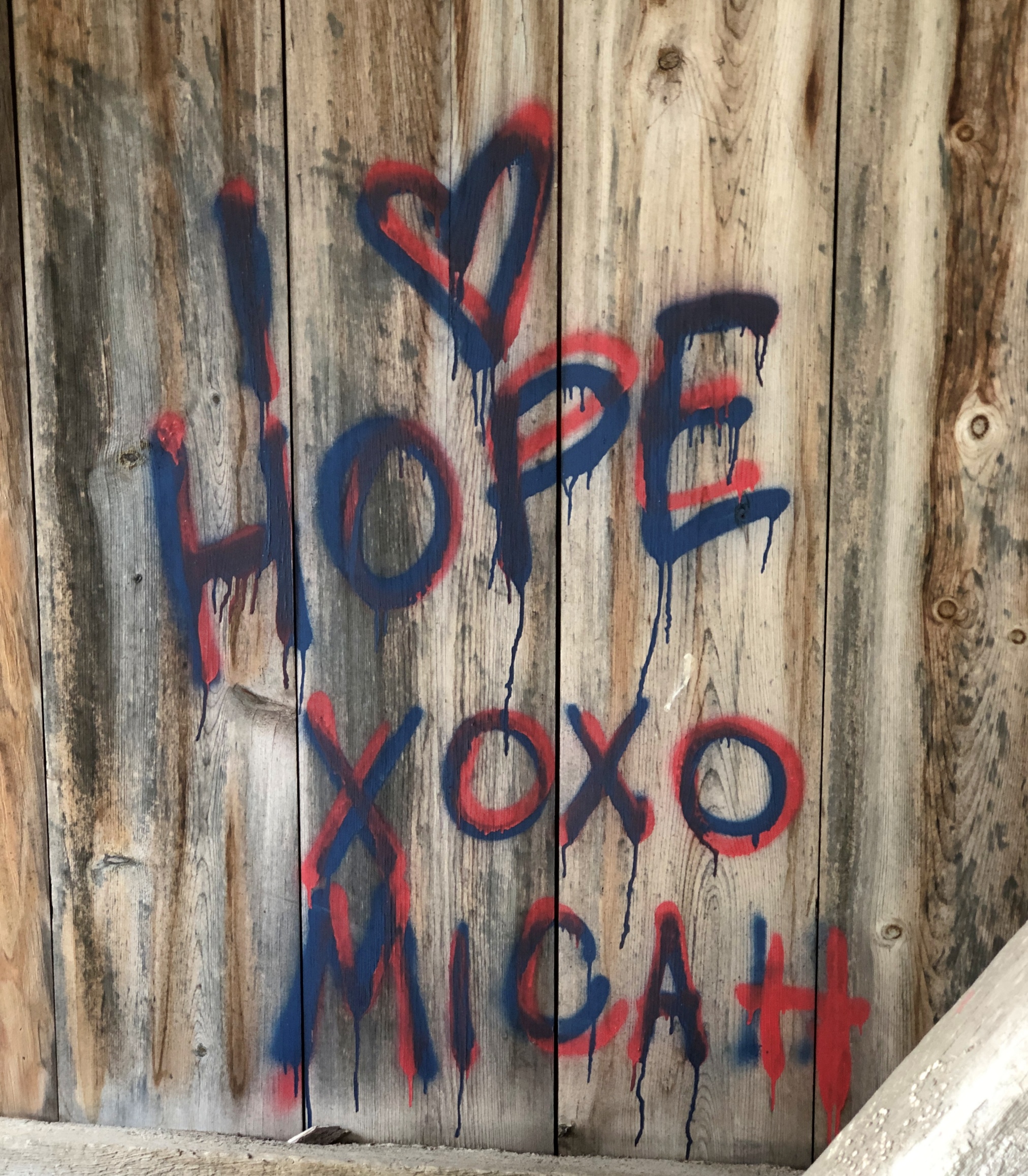
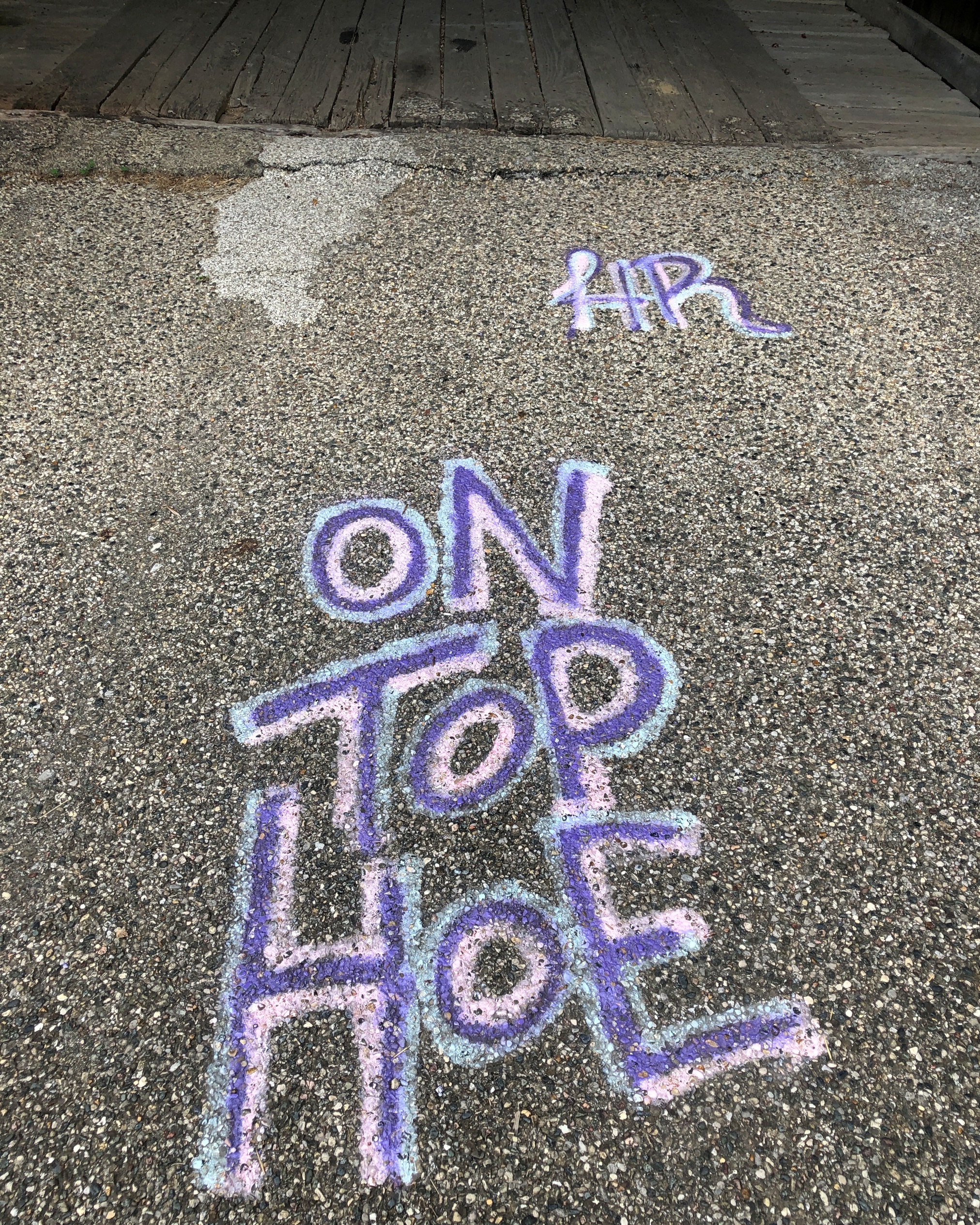
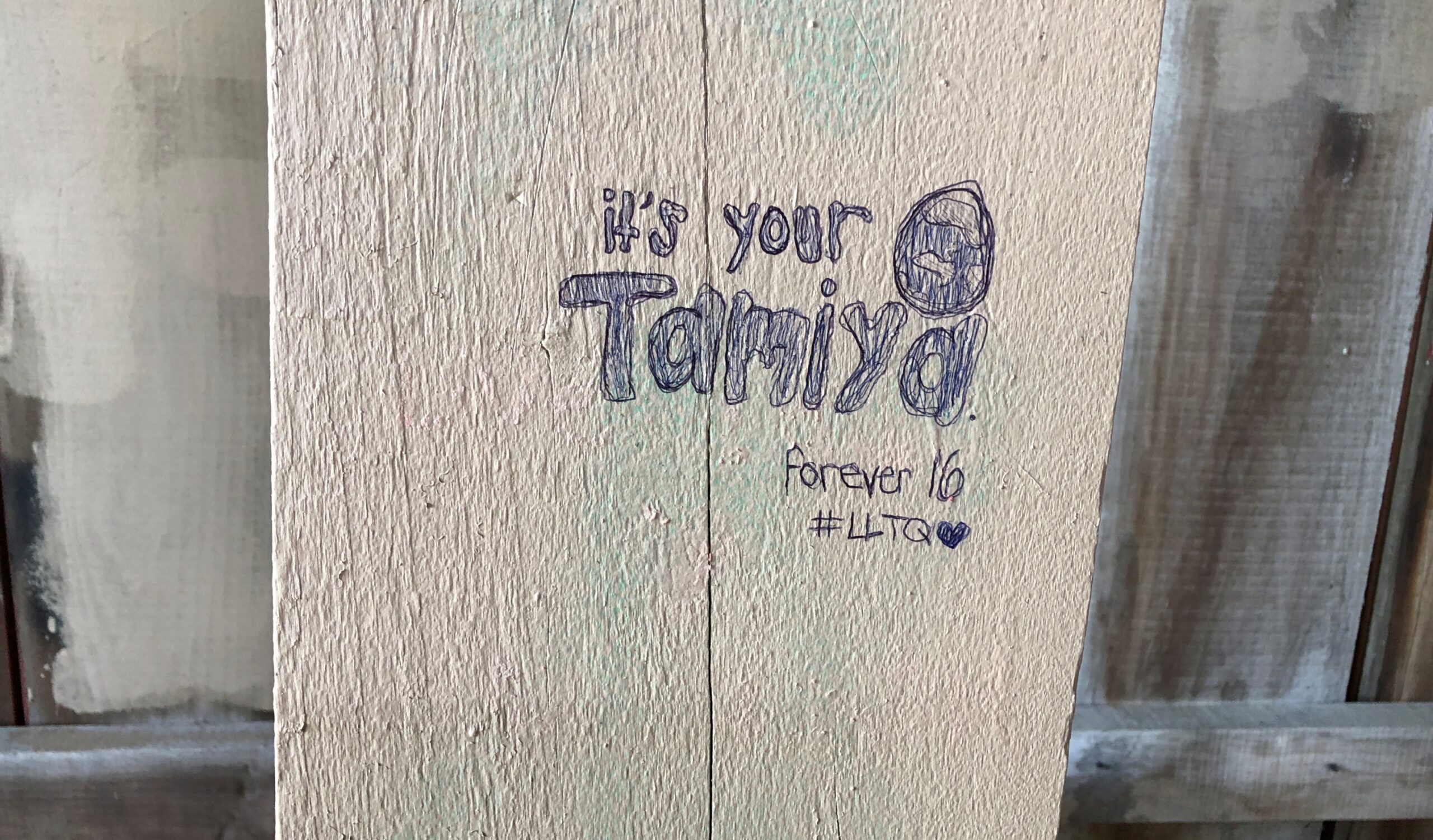
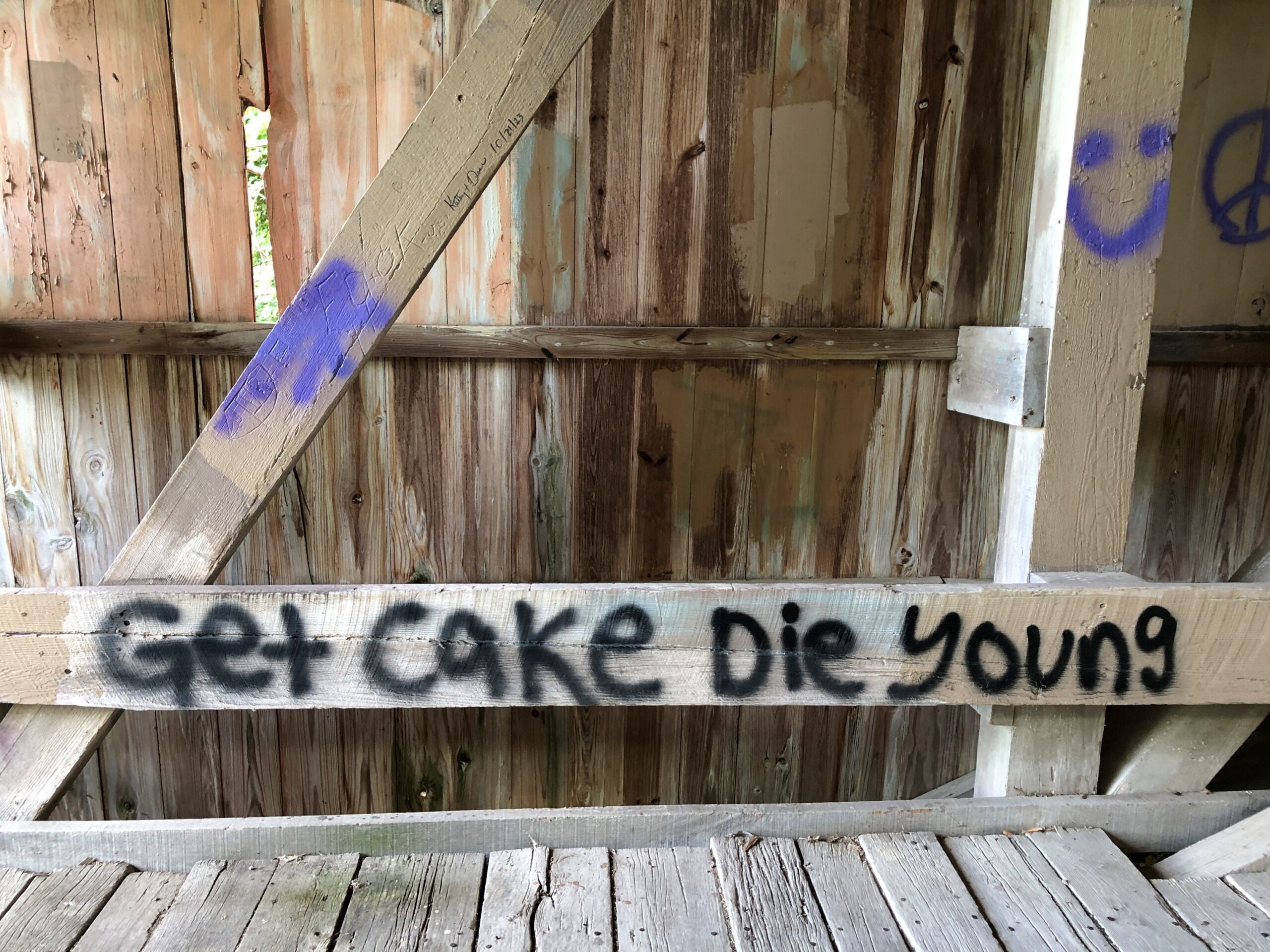
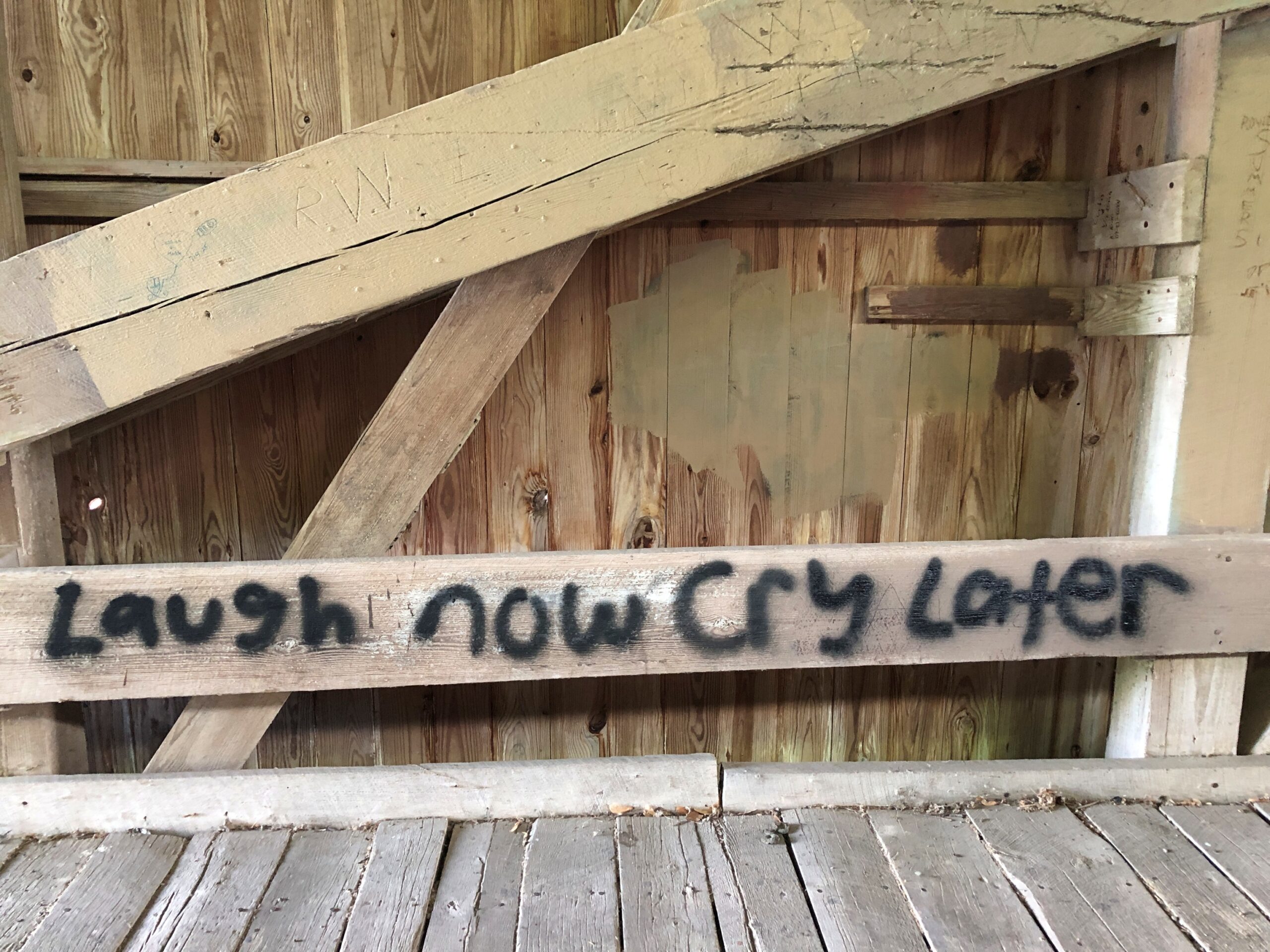
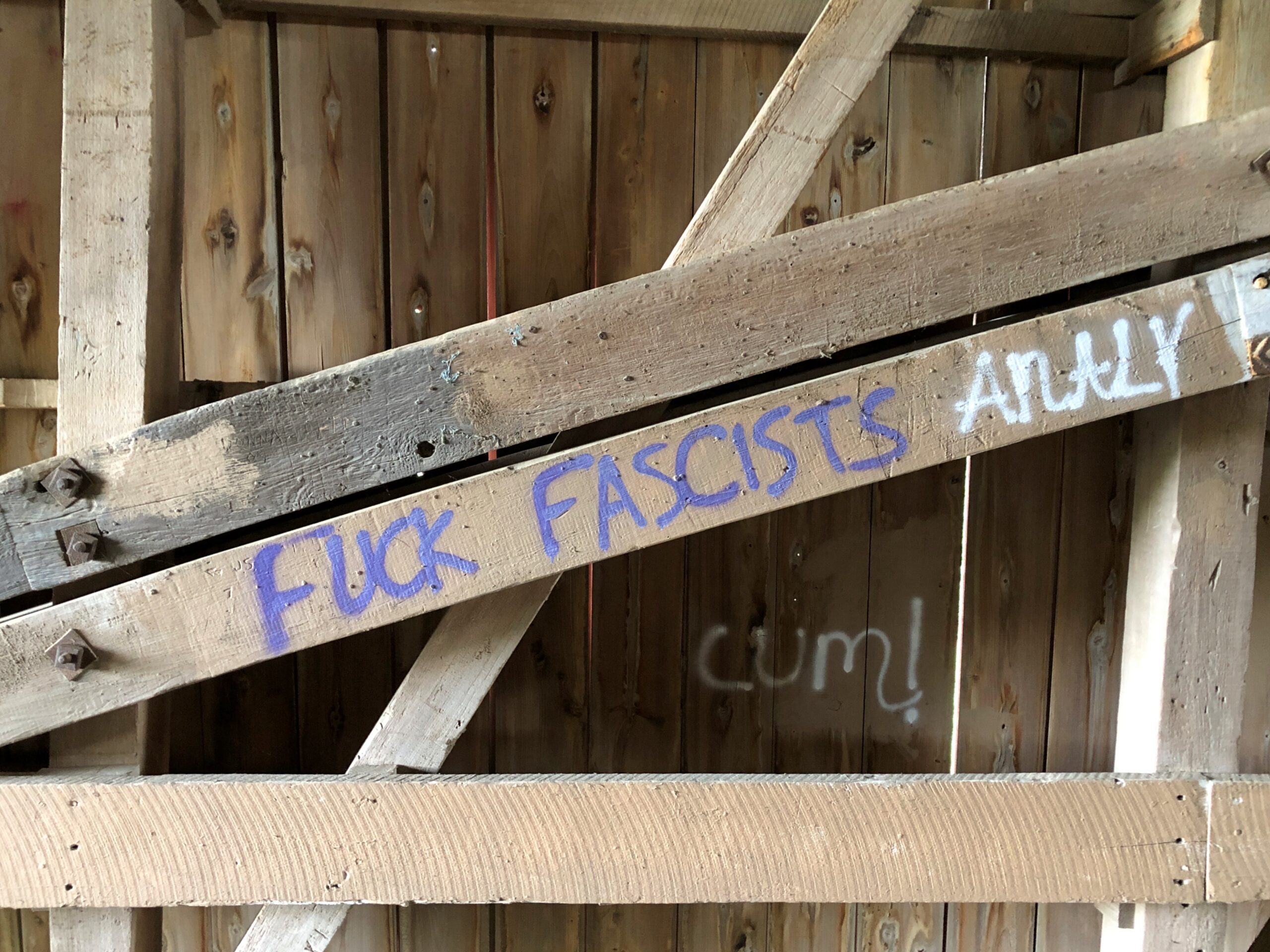
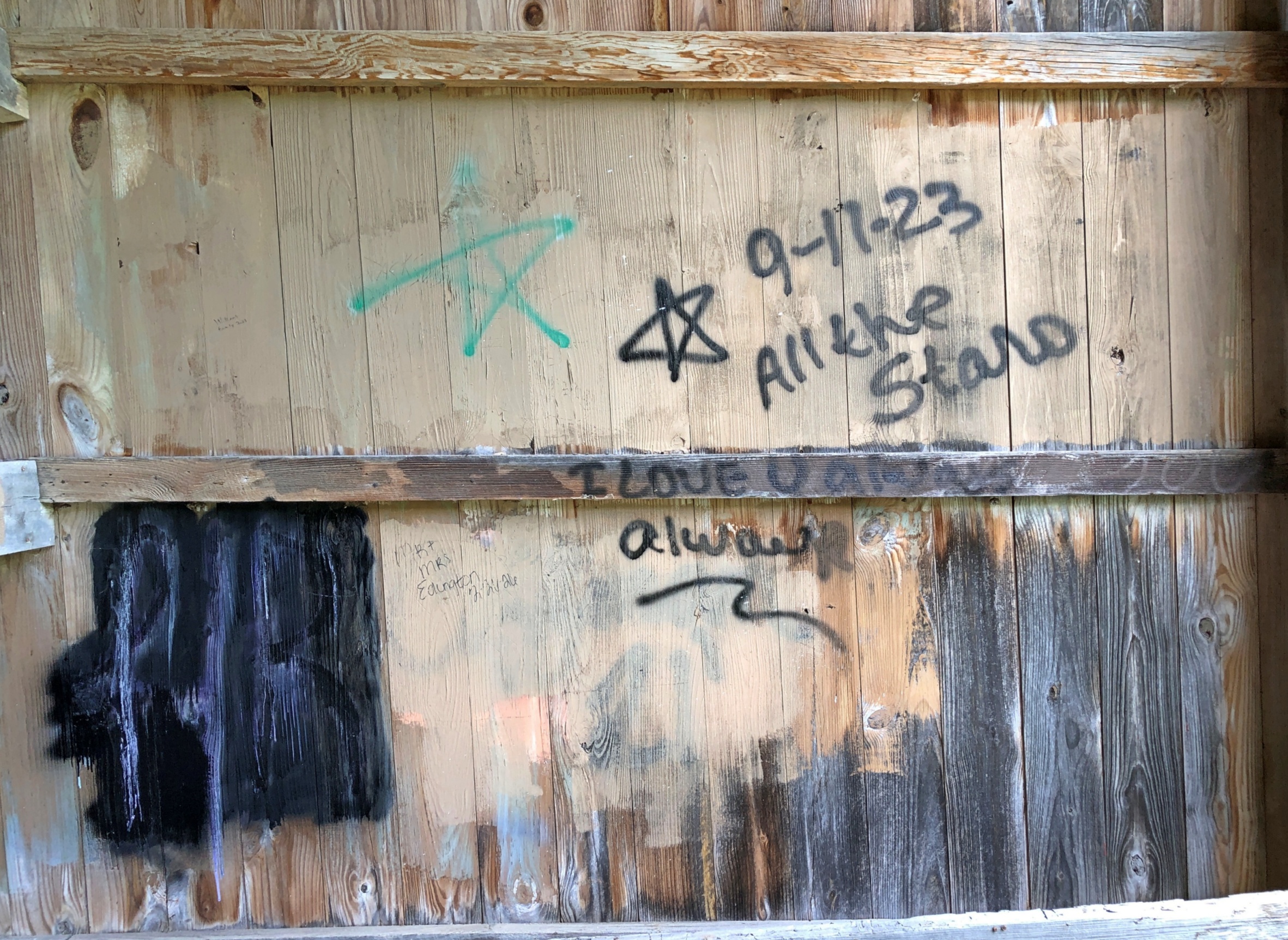
Also inside the bridges: graffiti, of course. The oldest extant covered bridge in Parke County reportedly dates from 1856. I imagine the oldest graffito – what would they use, chalk? – dates from ca. 1856.
The usual collection of declarations of love, puerile insults, political statements, enigmatic phrases and random nonsense.
And the whack-a-mole efforts to suppress it.
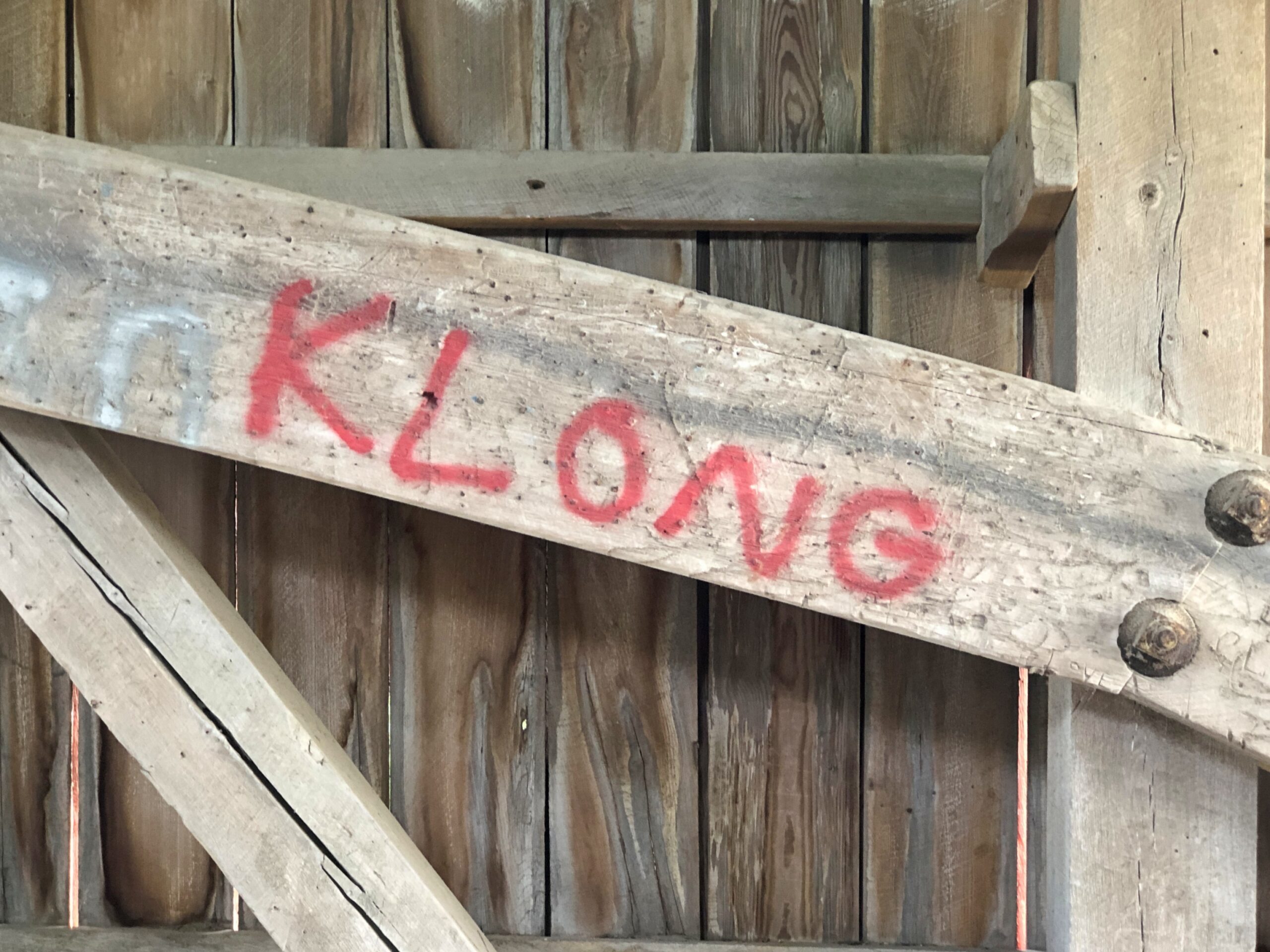
Klong. That’s my favorite from this round of graffiti spotting. An idiosyncratic item.
A dictionary meaning is canal in Thai. An alternate spelling of that, anyway. Or a Swedish homegoods retailer – reminds me of Ikea, but clearly more upmarket. Hard to know the mind of a graffitist, but I’ll bet it’s neither of those.
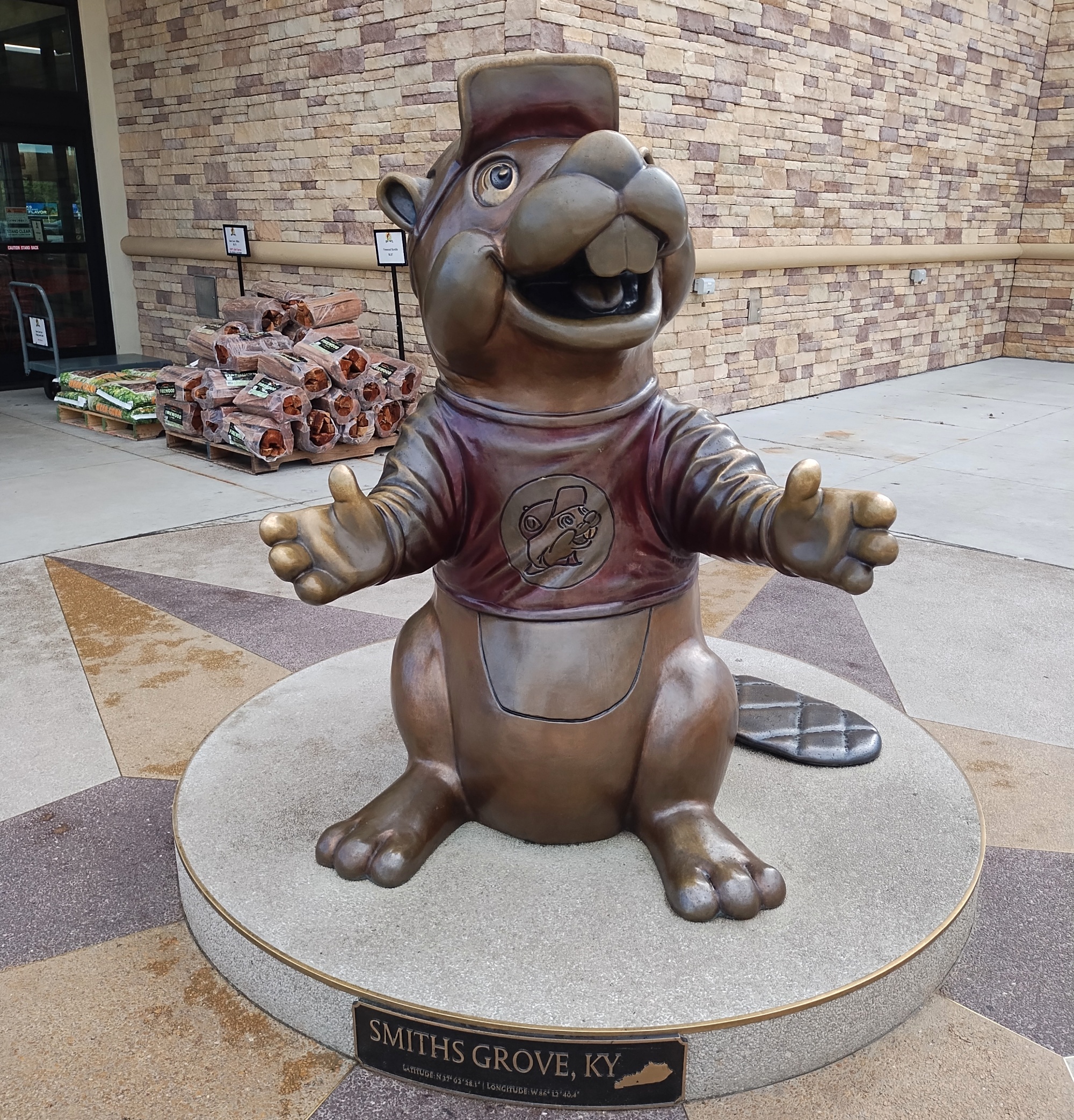
The Buc-ee’s imperium marches on. On my way to Tennessee that first day, I stopped at the location near Smiths Grove, Kentucky, to visit its gleaming facilities. Business was reasonably brisk that Monday, but nothing like the bedlam on the Sunday, nearly two weeks later (on the trip’s last day), when I stopped on the way back home at the same place, for the same reason.
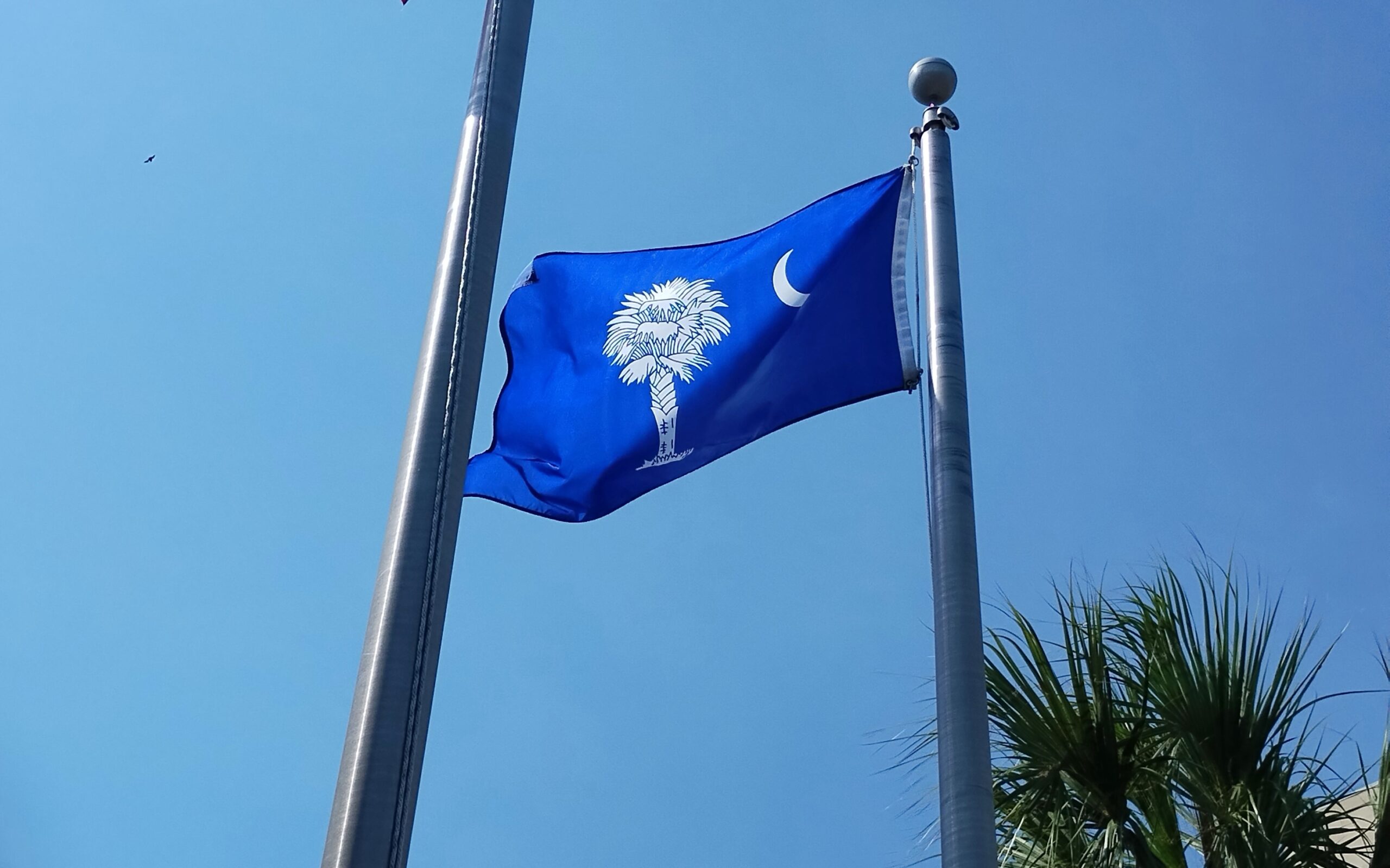
South Carolina
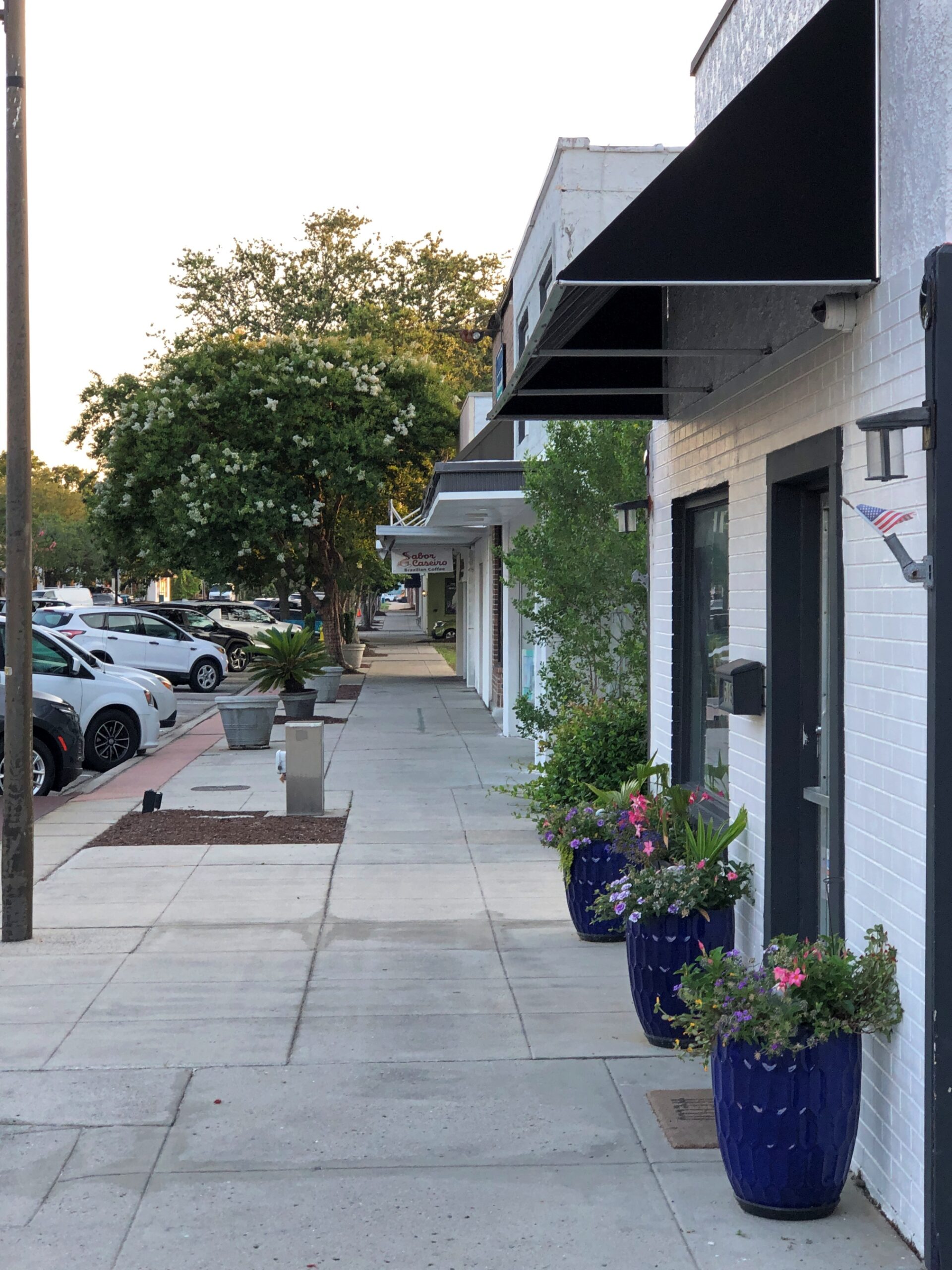
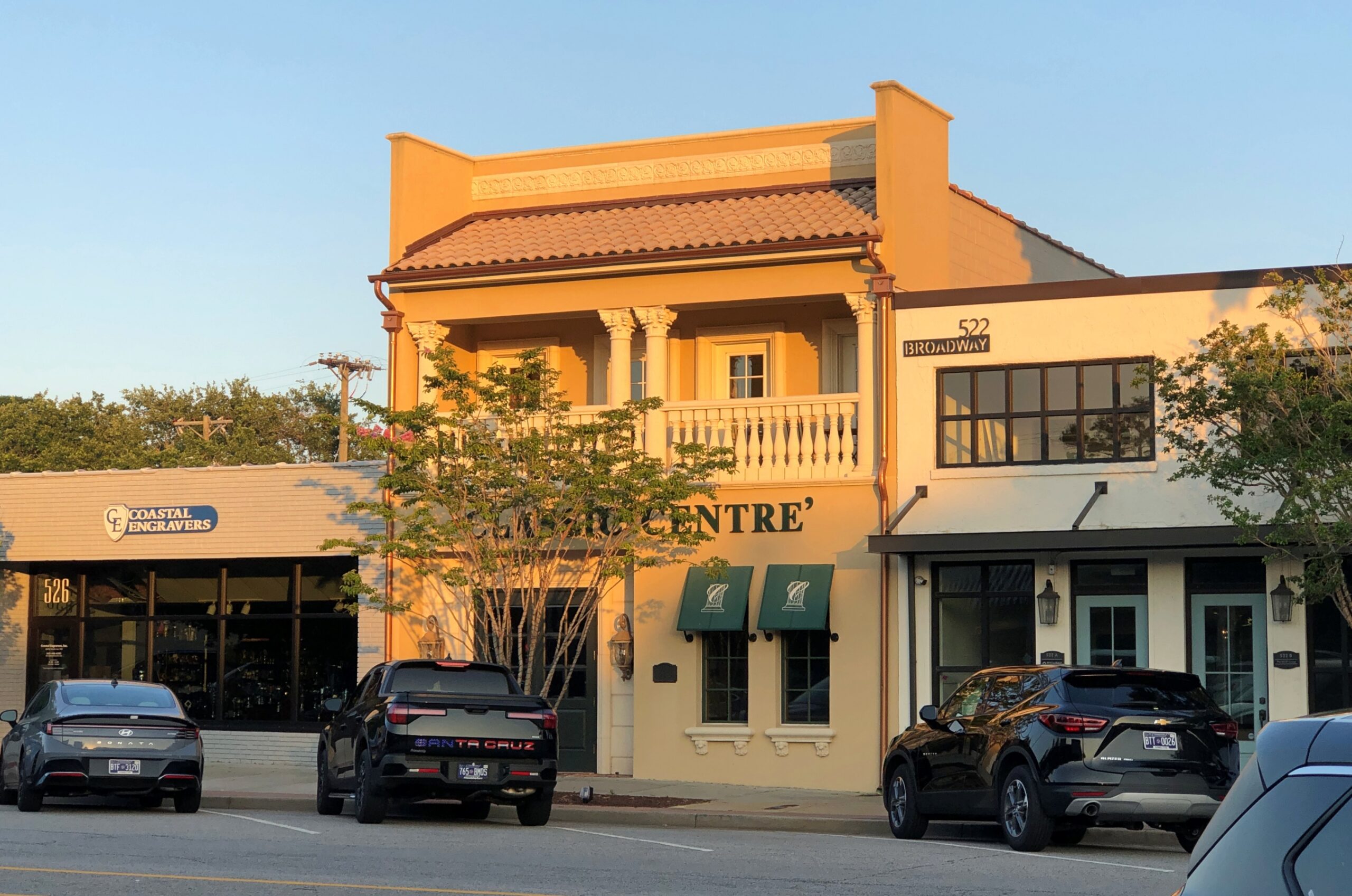
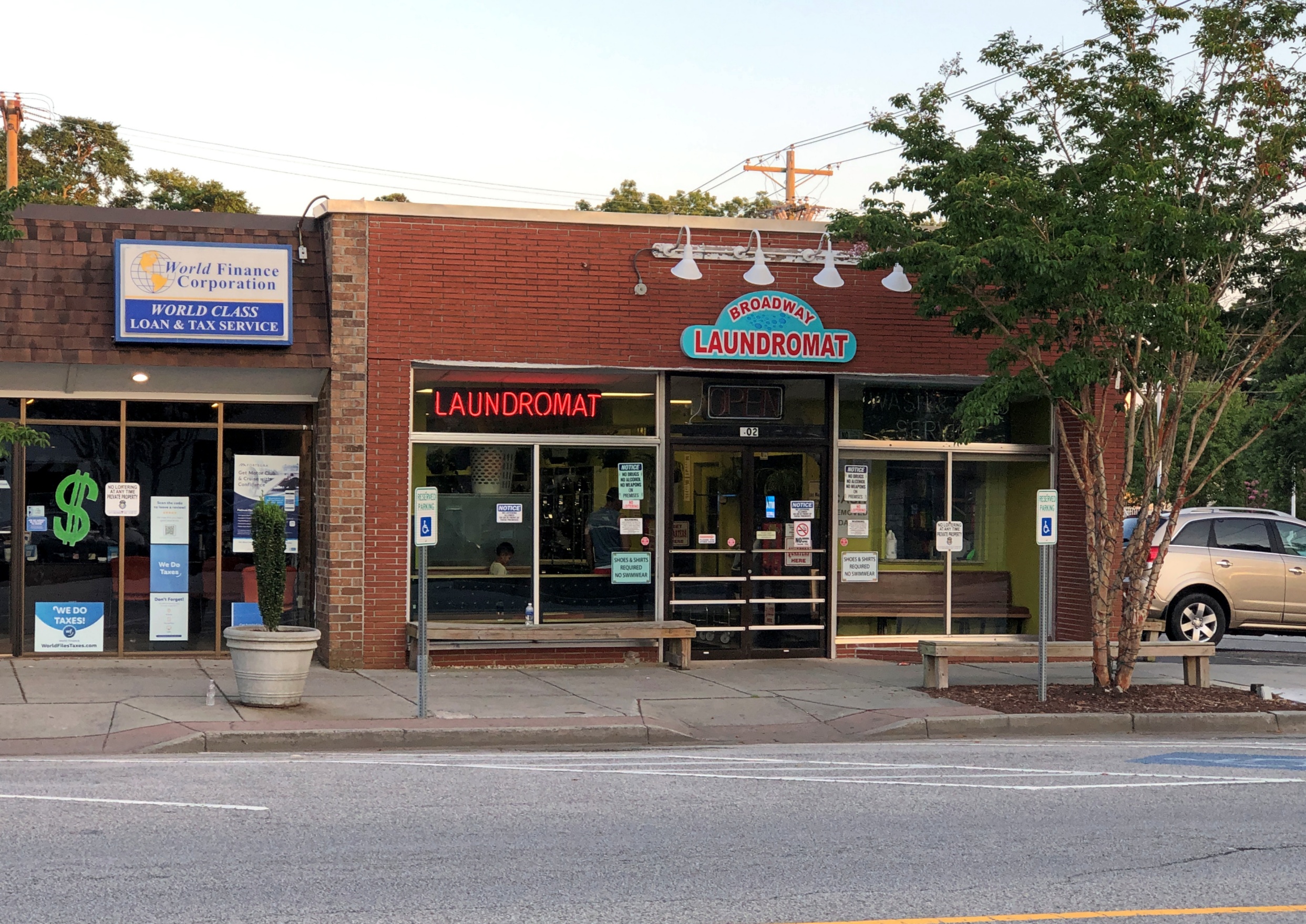
Had a pleasant walk down a non-tourist street on a Sunday in Myrtle Beach. Not a lot going on. The late afternoon light had a nice glow.
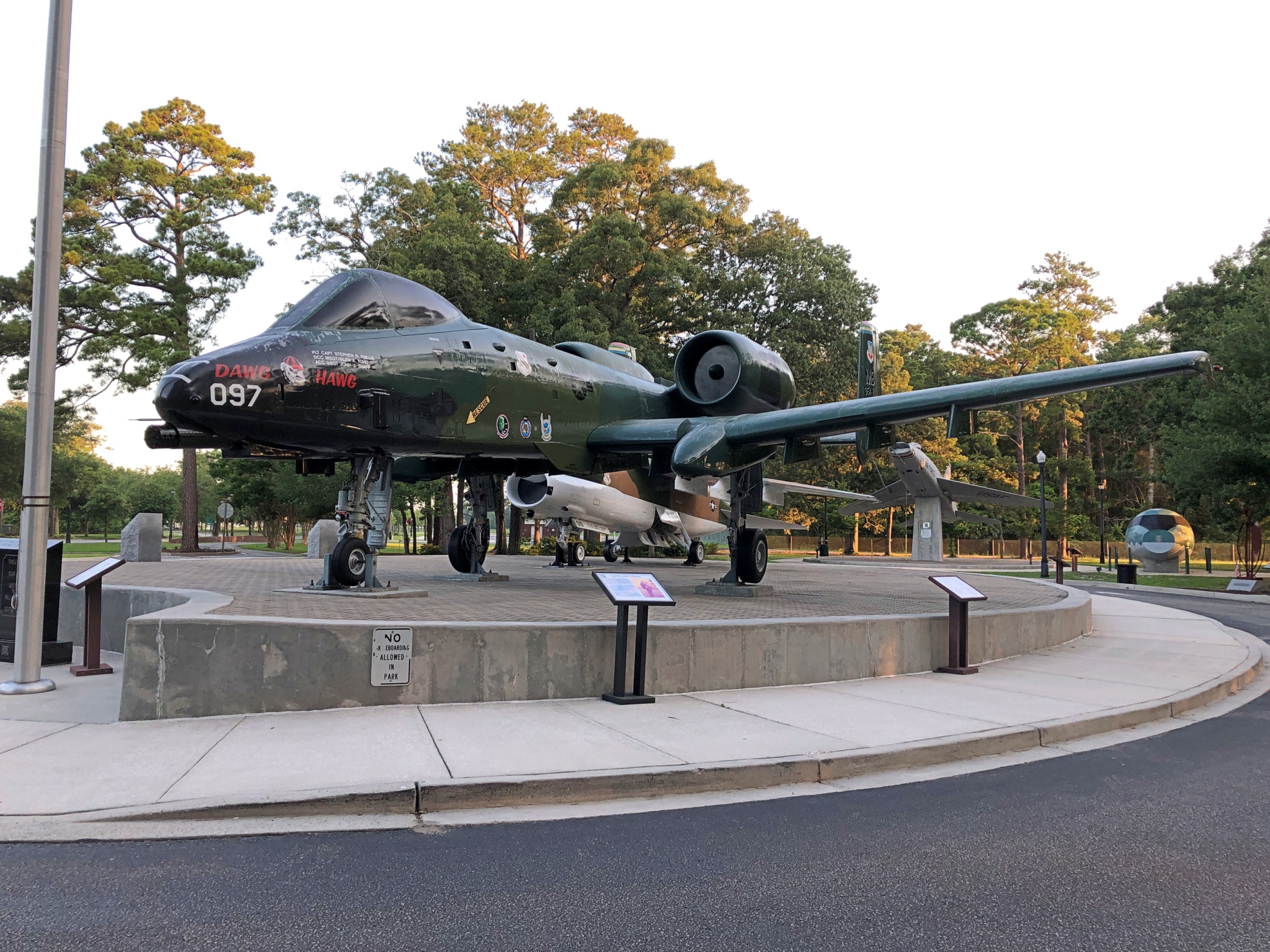
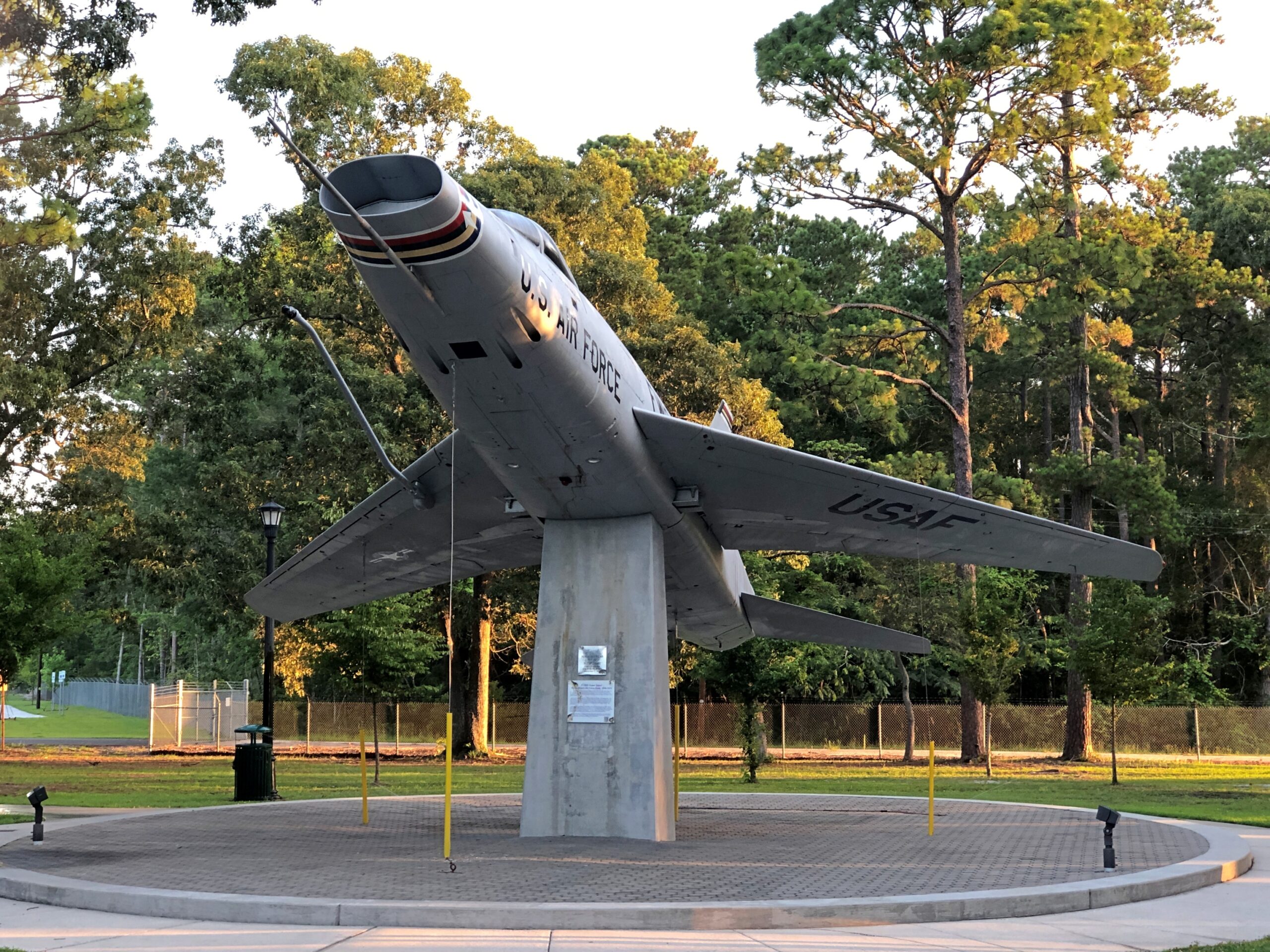
Myrtle Beach International Airport used to be Myrtle Beach Air Force Base, which began as Myrtle Beach General Bombing and Gunnery Range in 1942 for use by the U.S. Army Air Corps. It closed in 1993.
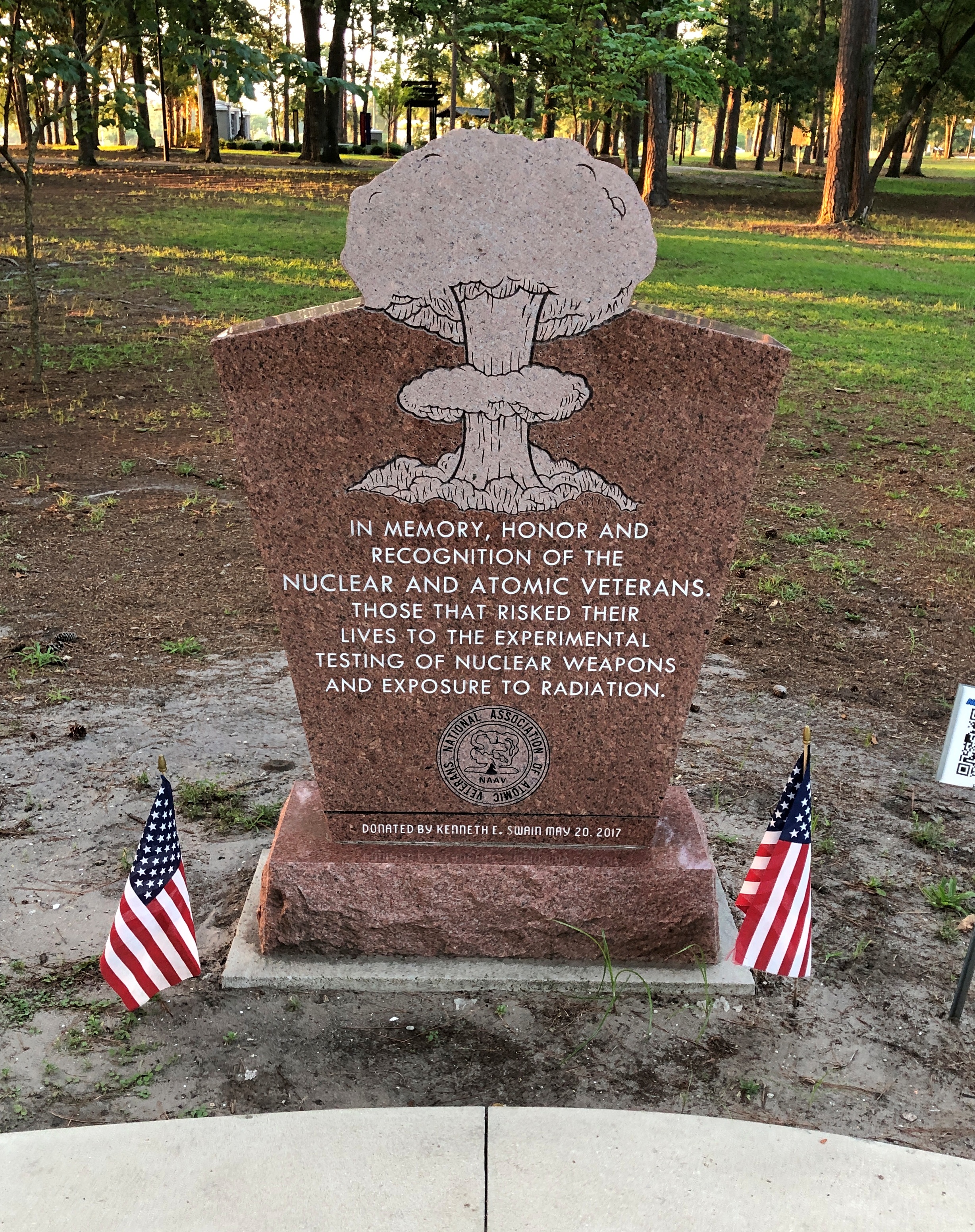
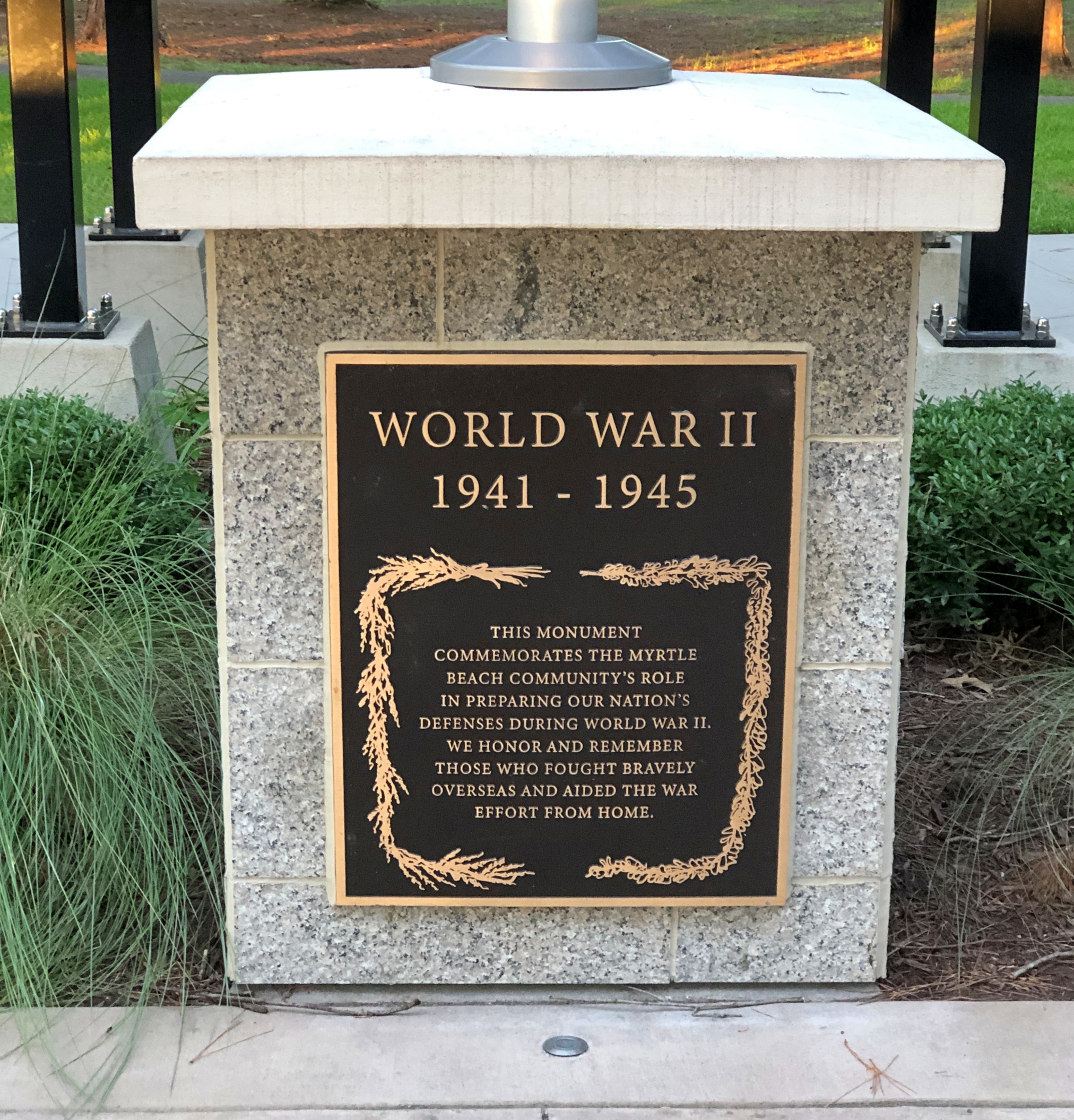
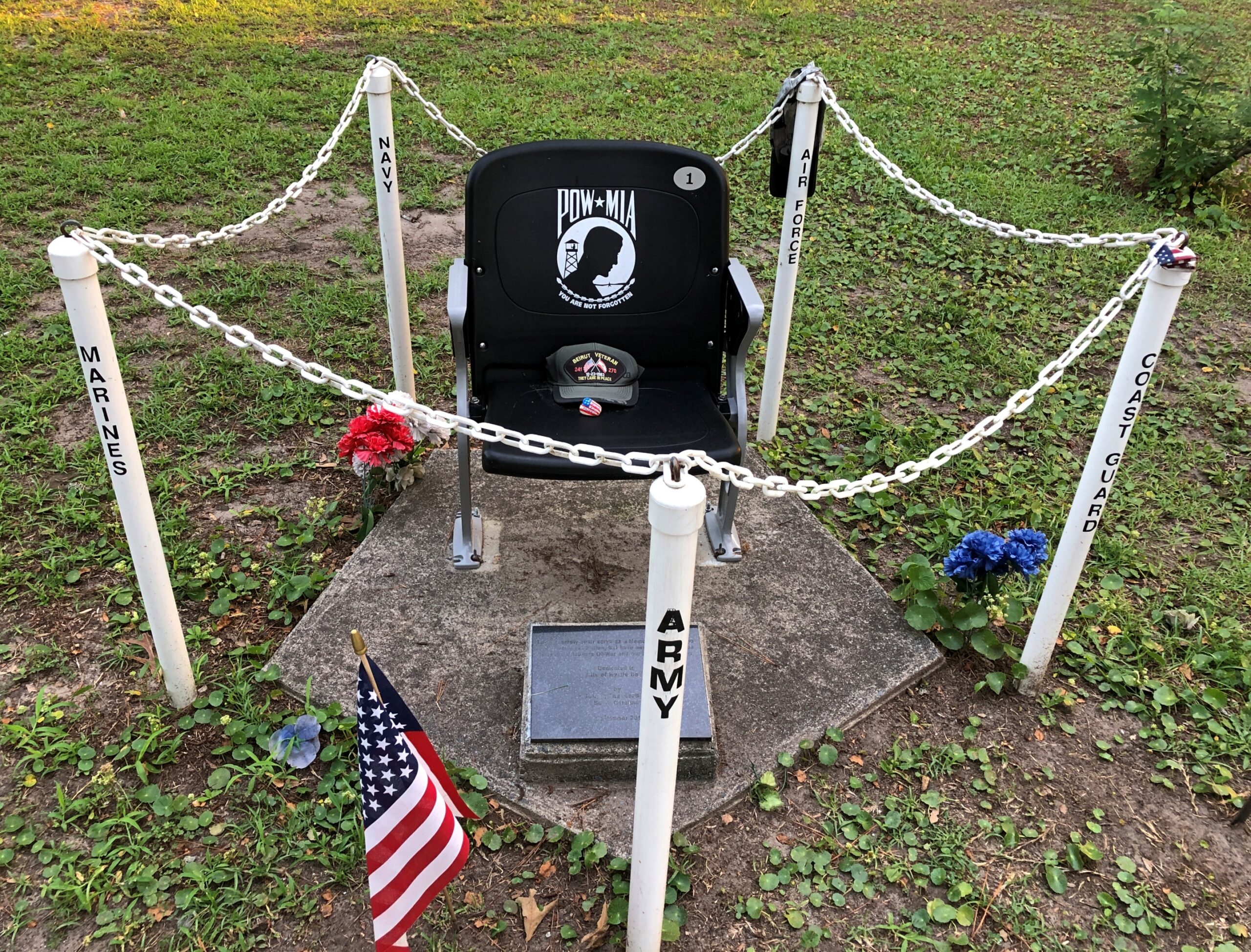
One legacy of the base is a cluster of military memorials near the perimeter of the airport – at a place called Warbird Park, which is fully accessible to casual visitors – that includes something you don’t see all the time.
It is one memorial among many.
As well as some of the aircraft that used the air base.
Found at a MB beach shop among the clothes and beach equipment. Nothing says Myrtle Beach better than skulls, no?
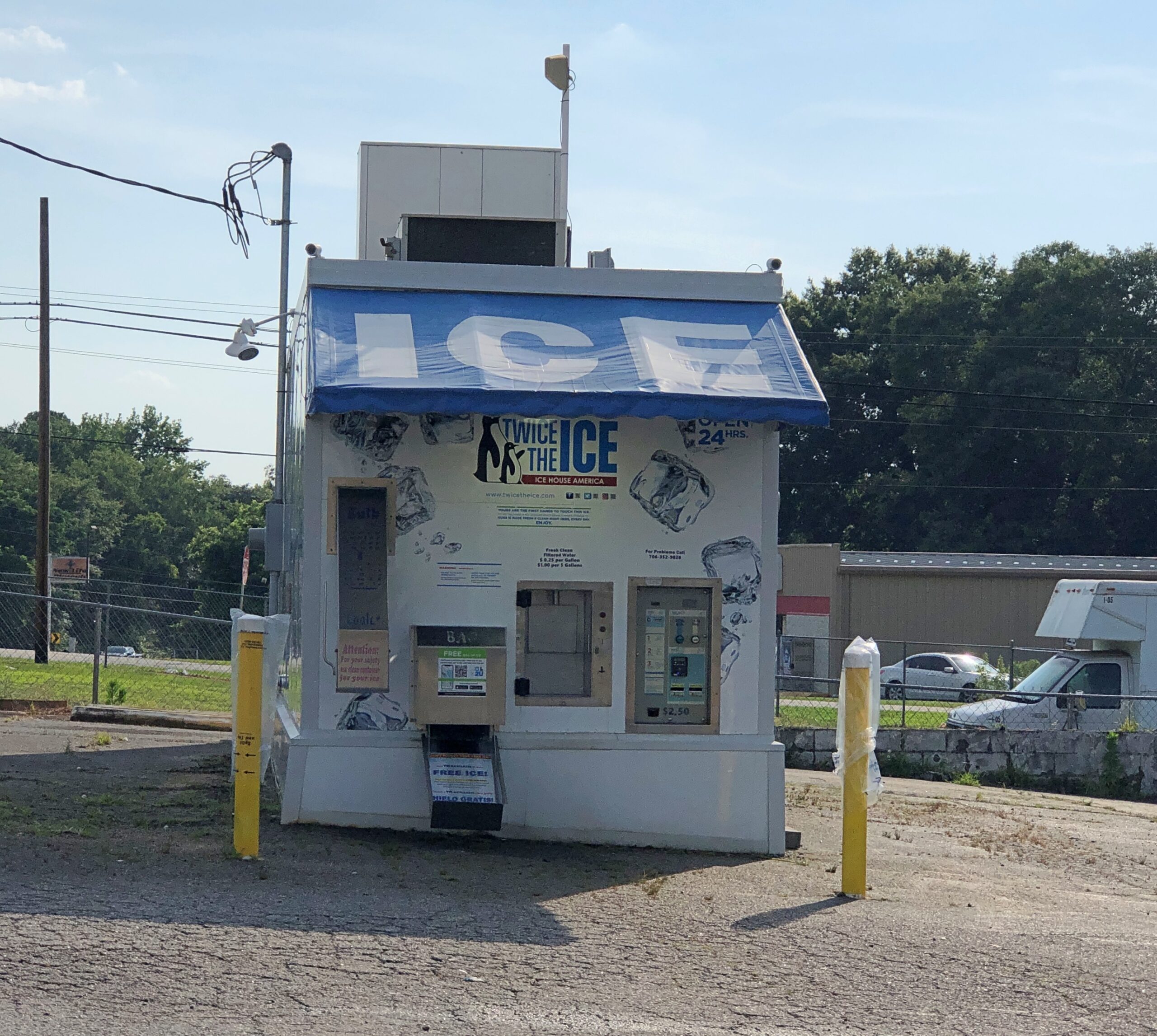
An automated, Fotomat-style ice store in north Georgia. They’re not as common up north, with the closest of this brand to me (I checked) in Aurora, Illinois.
Twice the Ice is the brand name. Quick facts: there are about 3,300 Twice the Ice locations so far in the United States and elsewhere – water and ice “vending machines,” according to one page on the company web site. Another page on the same site puts it at over 4,000 locations, which just means part of the site isn’t being updated. Whatever the exact number, there are a lot, and most if not all are franchised, representing about 1,000 franchisees.
It’s automation we call all get behind. I don’t think the machines are putting ice handlers and baggers at local gas stations and grocery stores out of work, since who holds that specific job?
So far as I know, “Ice is Civilization” is not the company motto. But it could be. It was said with such conviction by Allie Fox in The Mosquito Coast.
Of course, by the end of the book and movie both, he was howl-at-the-moon mad. So maybe some other slogan. Then again, that line is one of the few things – besides the fact that Allie Fox goes nuts chasing Utopia – that I remember from either the book or the movie after about 35 years. So it’s pretty memorable.
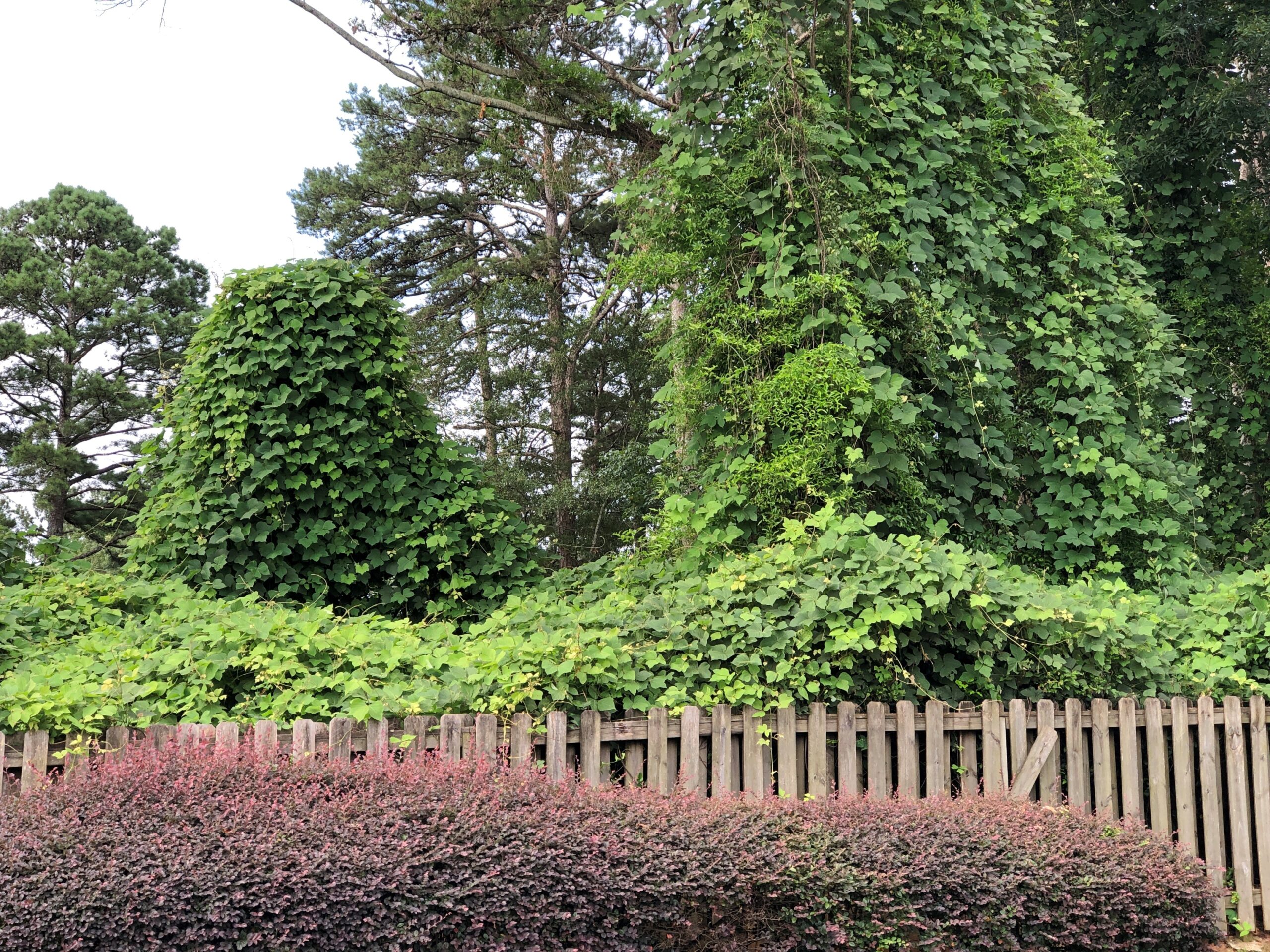
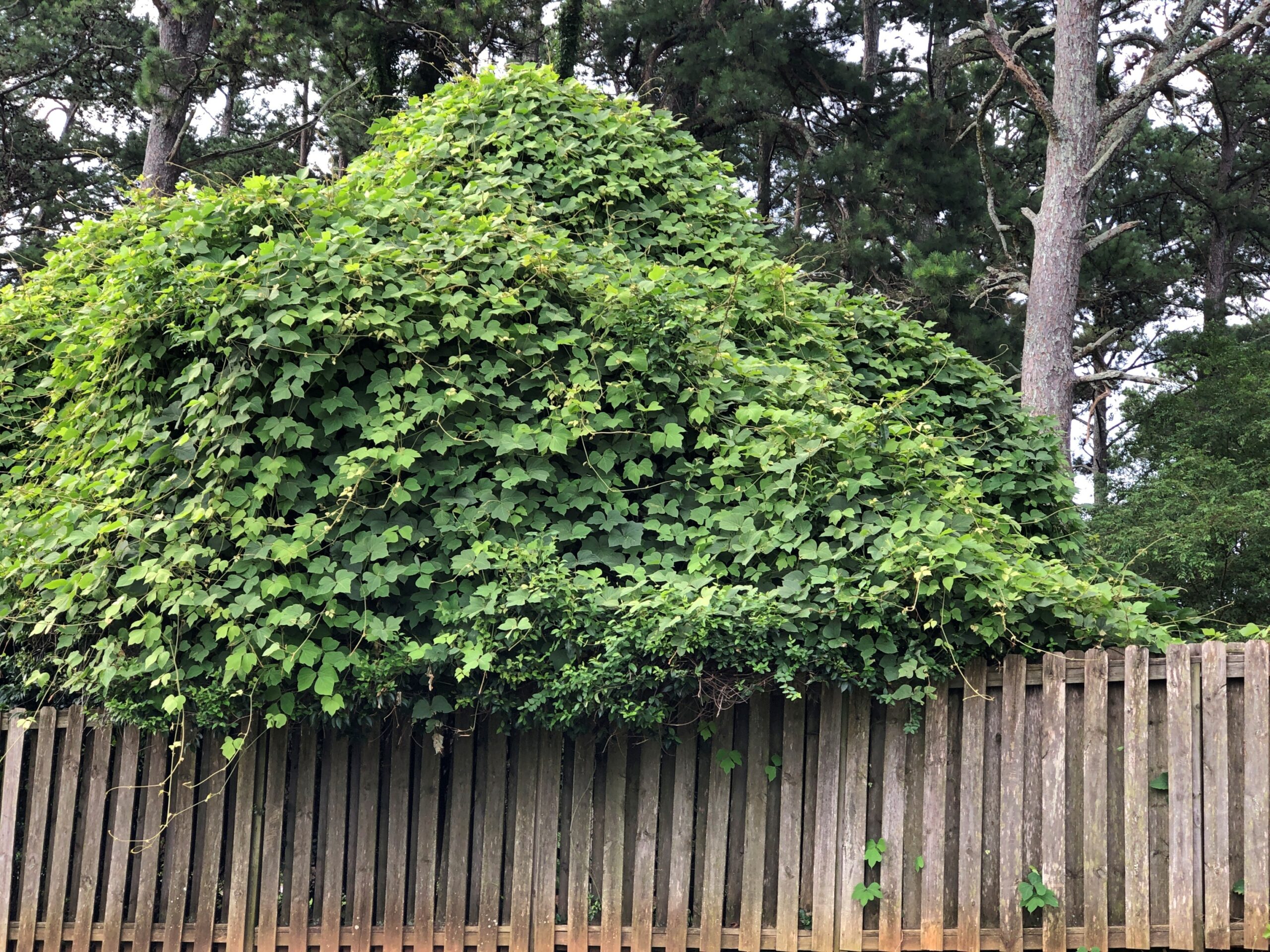
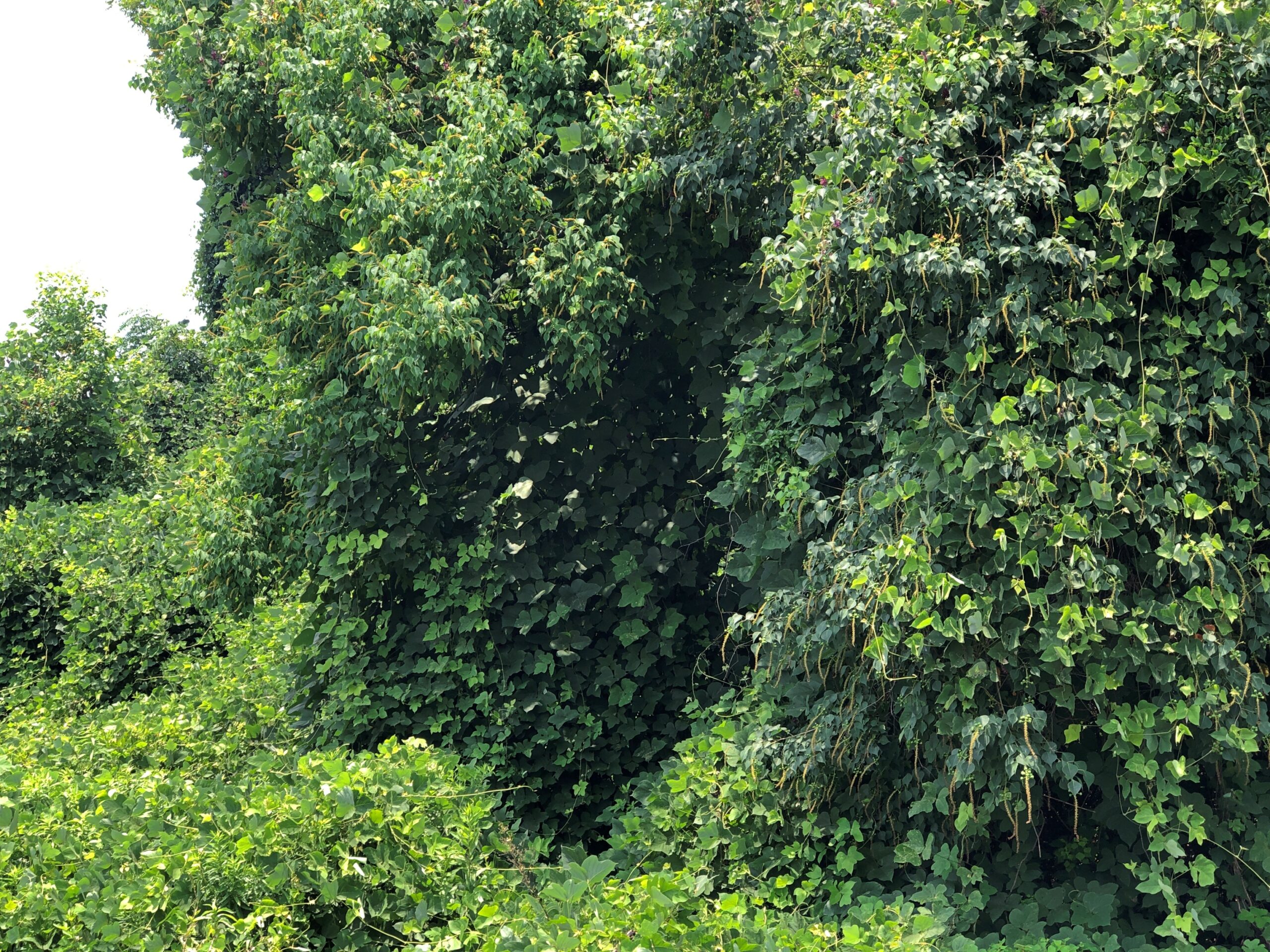
After gassing up at a station in north Georgia, I parked away from the pumps near the edge of the property to fiddle with my phone for a few minutes. Just outside the car window, kudzu lurked.
Which got closer.
And closer. Man, it grows fast.
Not really, but I did see all that kudzu at the edge of the gas station property. Kudzu. Who hasn’t seen the walls of it down South?
“In news media and scientific accounts and on some government websites, kudzu is typically said to cover seven million to nine million acres across the United States,” Smithsonian magazine reported in 2015. “But scientists reassessing kudzu’s spread have found that it’s nothing like that. In the latest careful sampling, the U.S. Forest Service reports that kudzu occupies, to some degree, about 227,000 acres of forestland, an area about the size of a small county and about one-sixth the size of Atlanta.
“That’s about one-tenth of 1 percent of the South’s 200 million acres of forest. By way of comparison, the same report estimates that Asian privet had invaded some 3.2 million acres — 14 times kudzu’s territory. Invasive roses had covered more than three times as much forestland as kudzu.”
Yet kudzu is regarded as a particularly intractable invasive species. How is that? It grows well in highly visible places. Such as next to a gas station parking lot. Smithsonian notes: “Those roadside plantings — isolated from grazing, impractical to manage, their shoots shimmying up the trunks of second-growth trees — looked like monsters.”
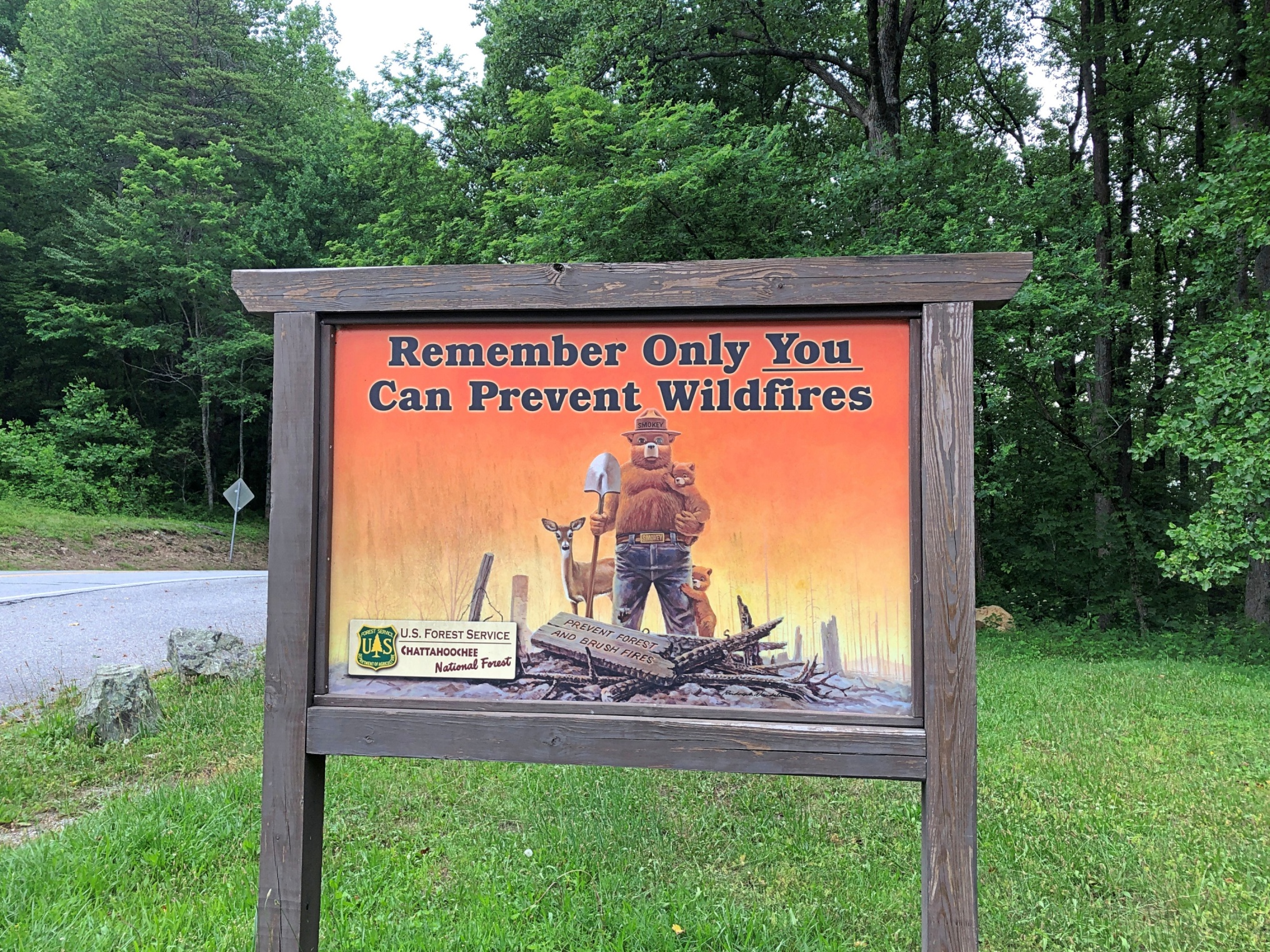
Along Georgia 60 in Chattahoochee NF, Smokey Bear is still at his job.
One thing leads to another online, and Smokey eventually lead me to “Smokey the Bear Sutra.” Only takes a few minutes to read, and it’s a trip. Just like the song “Elvis is Everywhere,” there’s a founding document of a religion in the distant future, one that asserts that humans should never have given up worshiping bears.
Had a bizarre dream last night, which isn’t really unusual, since that’s the way of dreams often enough – but this one – let’s call it rich and strange. And lengthy. It kept going and going, involving an alt version of downtown Chicago, and alt version of the company I worked for in the late 1980s, though no one that I knew was there; a vaguely menacing, nighttime scene always, though it wasn’t a nightmare; a message that had to be relayed, somehow; a fictional character – a very famous fictional character – spoken of as if real, who eventually showed up after a funeral, laughing; and details that made me think, that’s too much of a detail. For a dream. Is this a dream? One detail involved a chipmunk peaking out of a hole in the sidewalk, or maybe the street; another was a globe that I could see but not get close enough to read well, though I really wanted to. But I did notice that the United States, on this globe, included British Columbia and maybe the Yukon Territory, and I woke up thinking that maybe that 54° 40′ or Fight business led to a real war, in which the U.S. prevailed.
Perhaps the strangest thing about this rich and strange dream is that fully an hour and a half after I woke on this bright summer morning in the northwest suburbs, in the waking world I know and inhabit, I was able to write the above description.
Tennessee
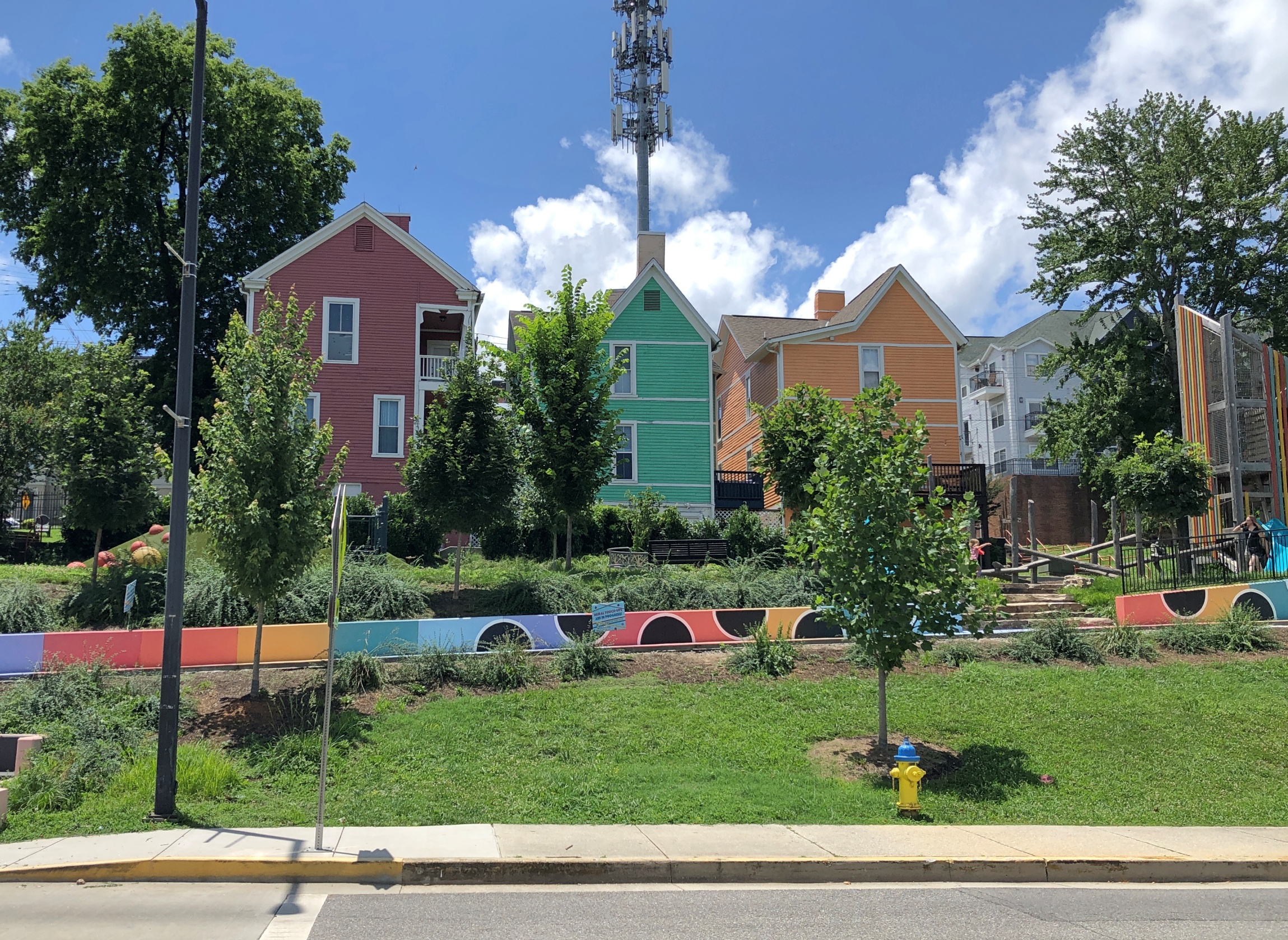
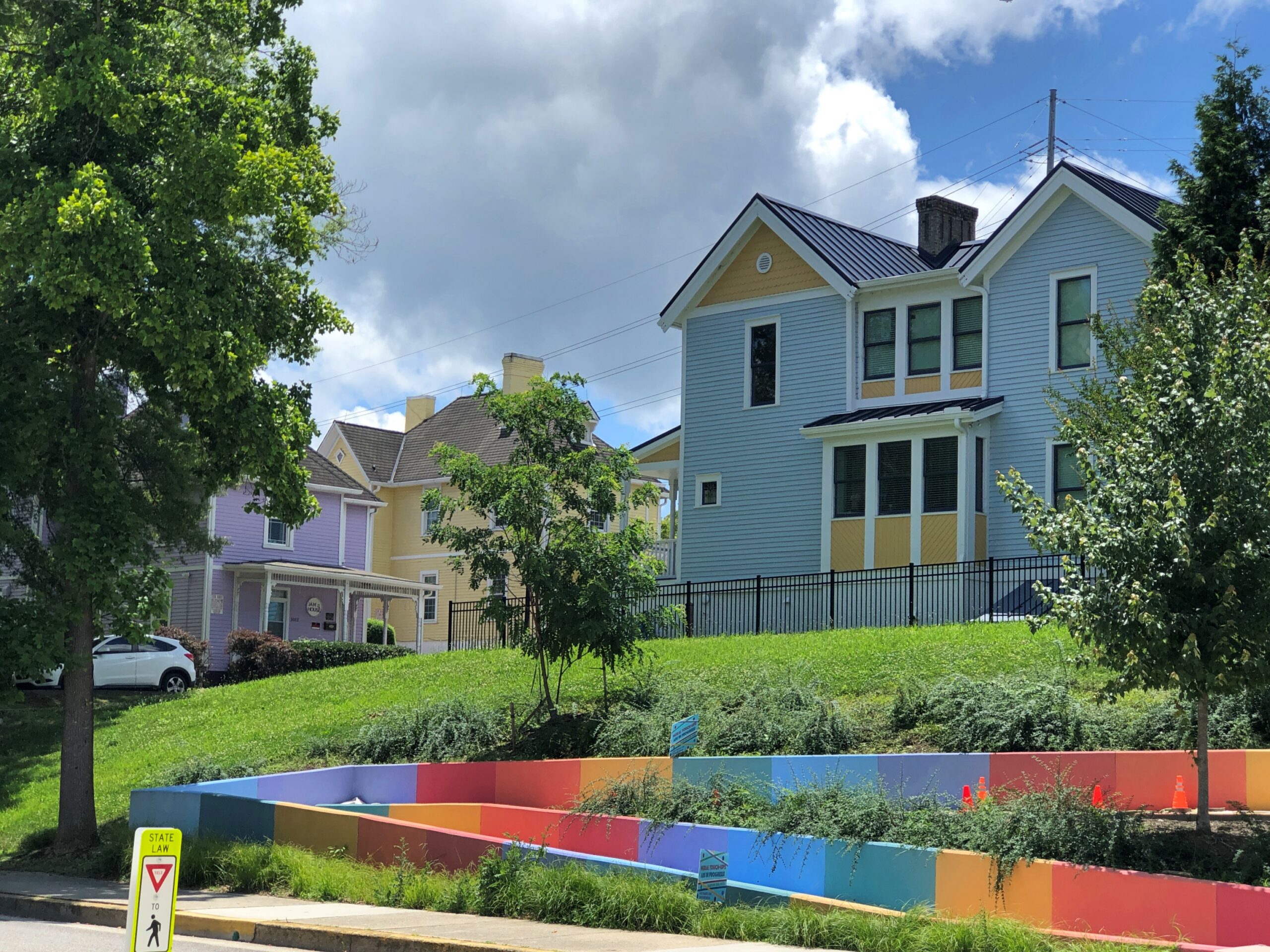
When passing eastward through Tennessee during my most recent interstate drive, I spent a little time in Knoxville, as mentioned, mostly to see the Sunsphere. To get to the tower from the free parking lot, I walked along part of World’s Fair Park Dr., with these colorful pastel houses visible on a small rise nearby. I was reminded of Rainbow Row in Charleston.
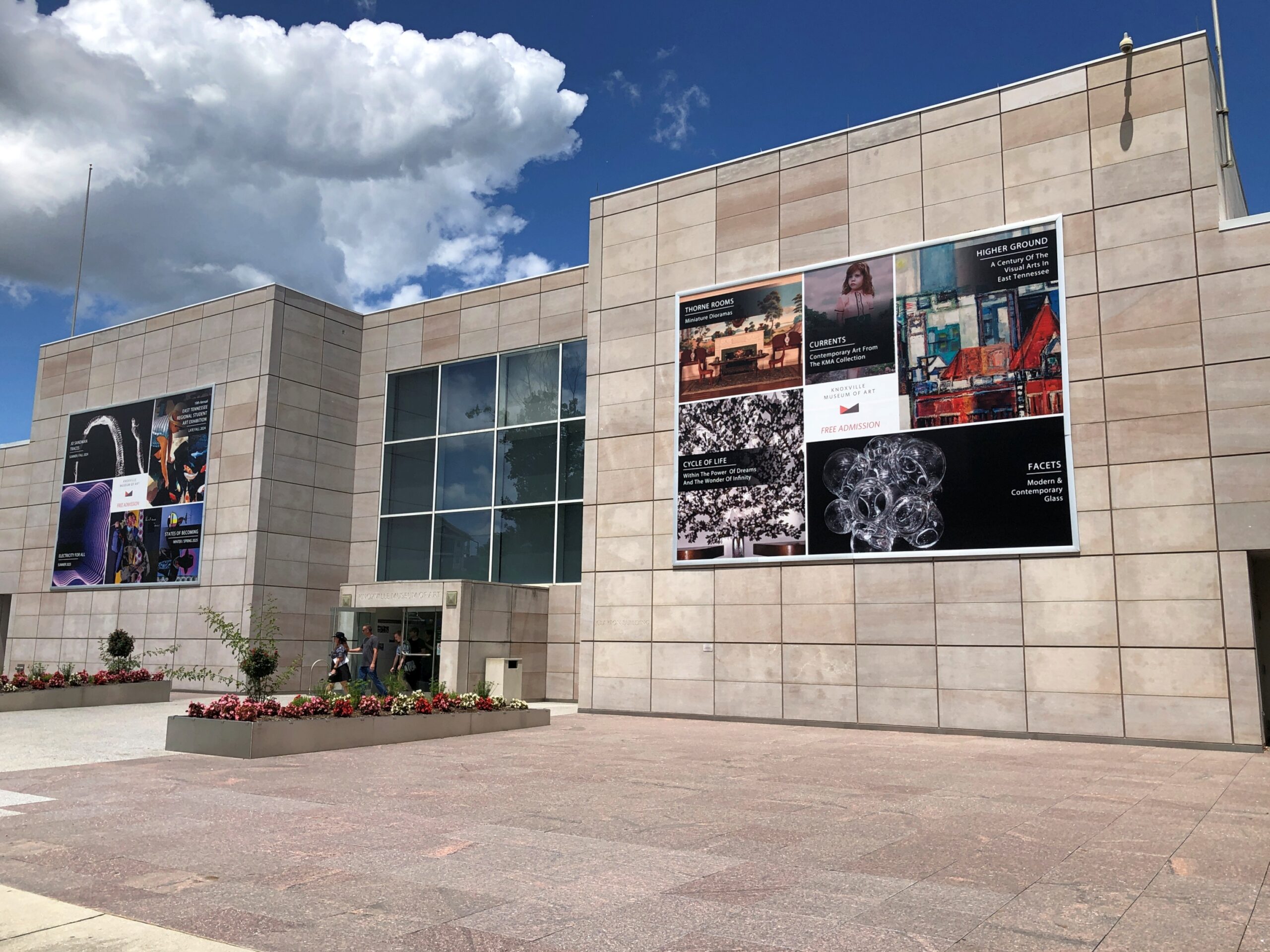
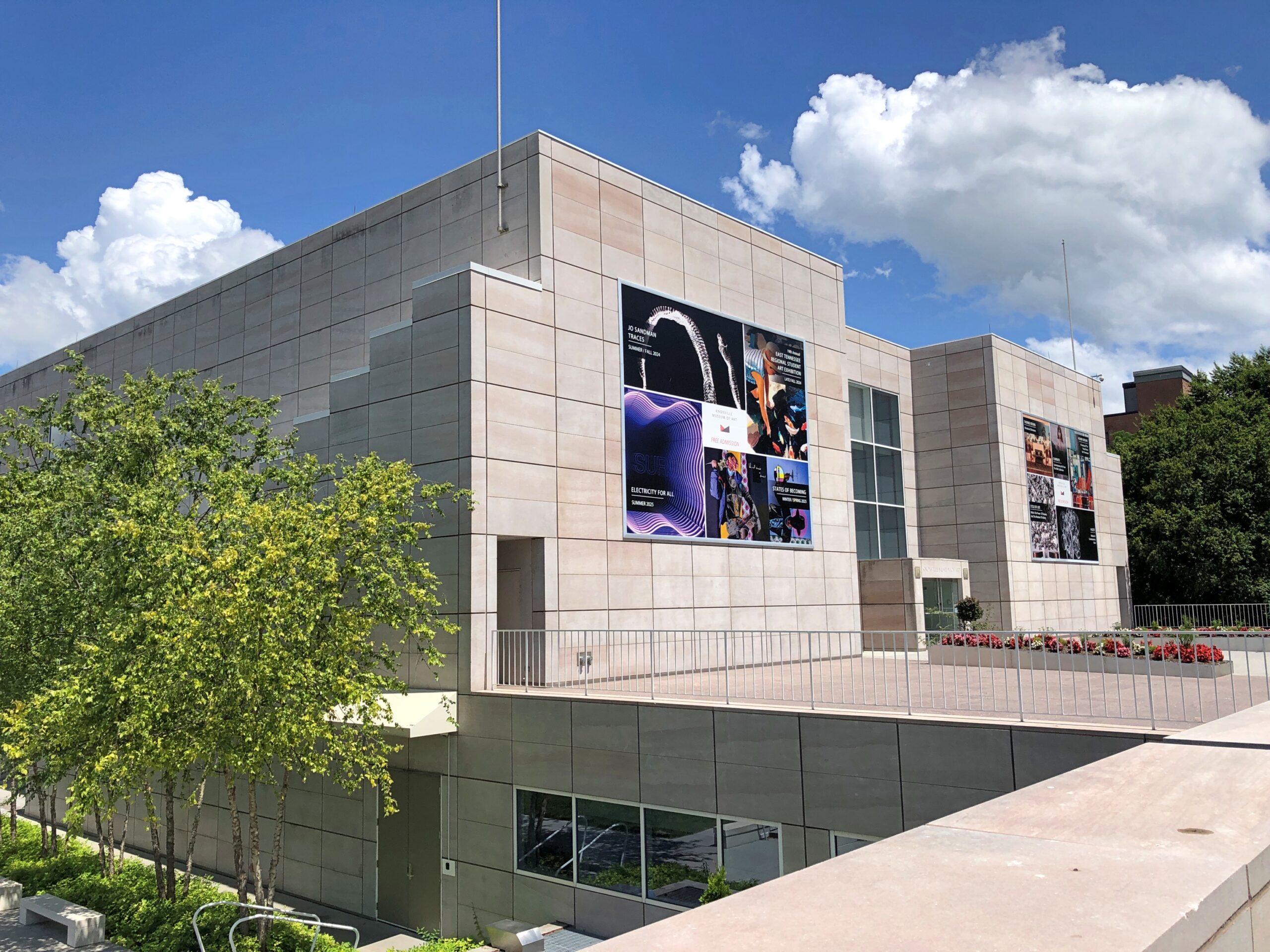
On the way back, I popped into the Knoxville Museum of Art.
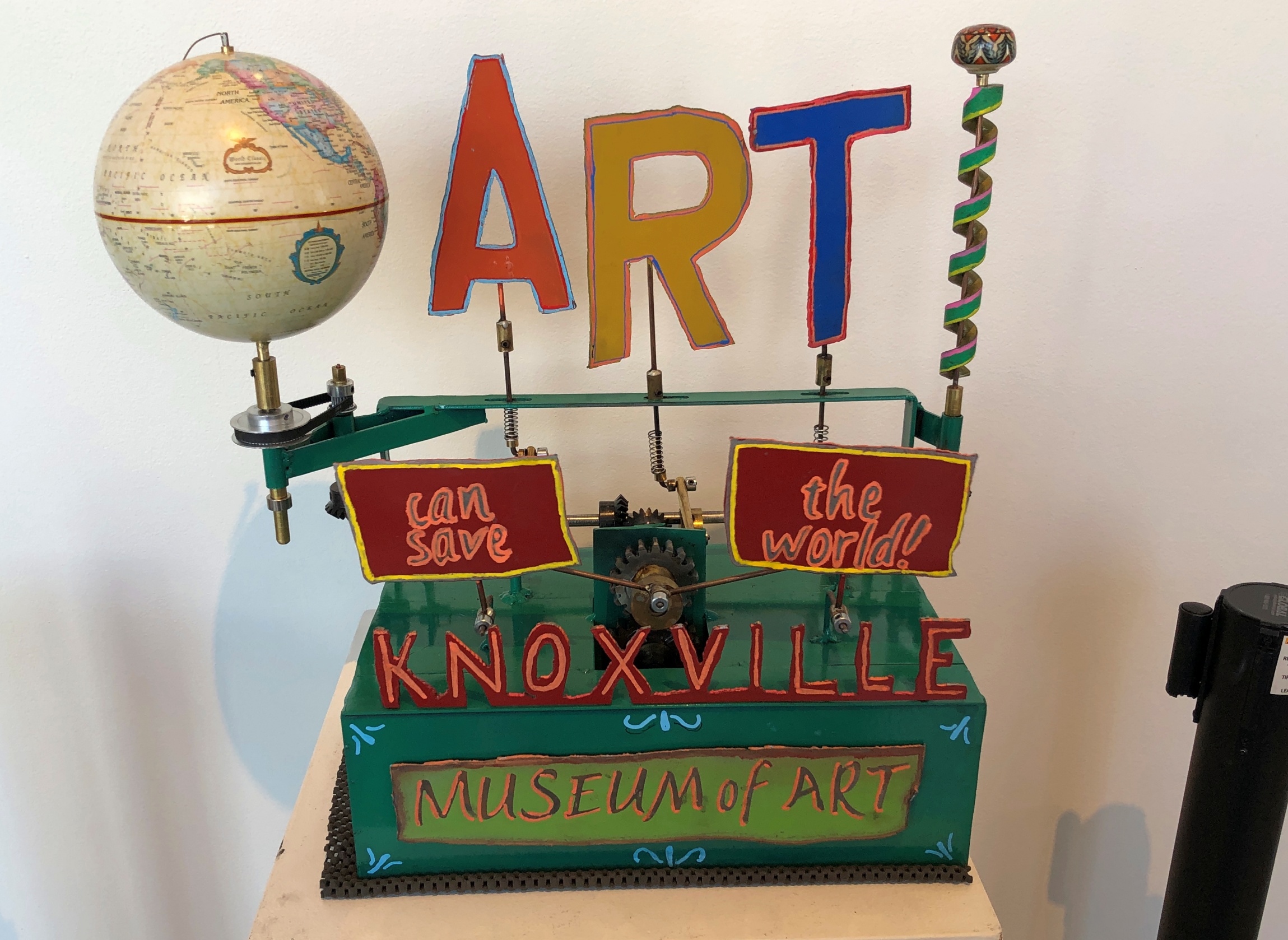
For a brutalist building, a nice bit of work by Edward Larrabee Barnes (d. 2004). If it blackens and streaks in the future, as such buildings tend to do when exposed to urban air, its appearance might morph into something merely ugly. But it looks like it’s been kept clean enough since its construction in 1990. As a museum, KMA has a lot to recommend it, such as air conditioning, free admission and a not-too-vast collection specializing in something you aren’t going to see elsewhere, namely East Tennessee art.
Such as a piece by artist Patrick Deason. Ah, the optimism. Unless he’s being sarcastic.
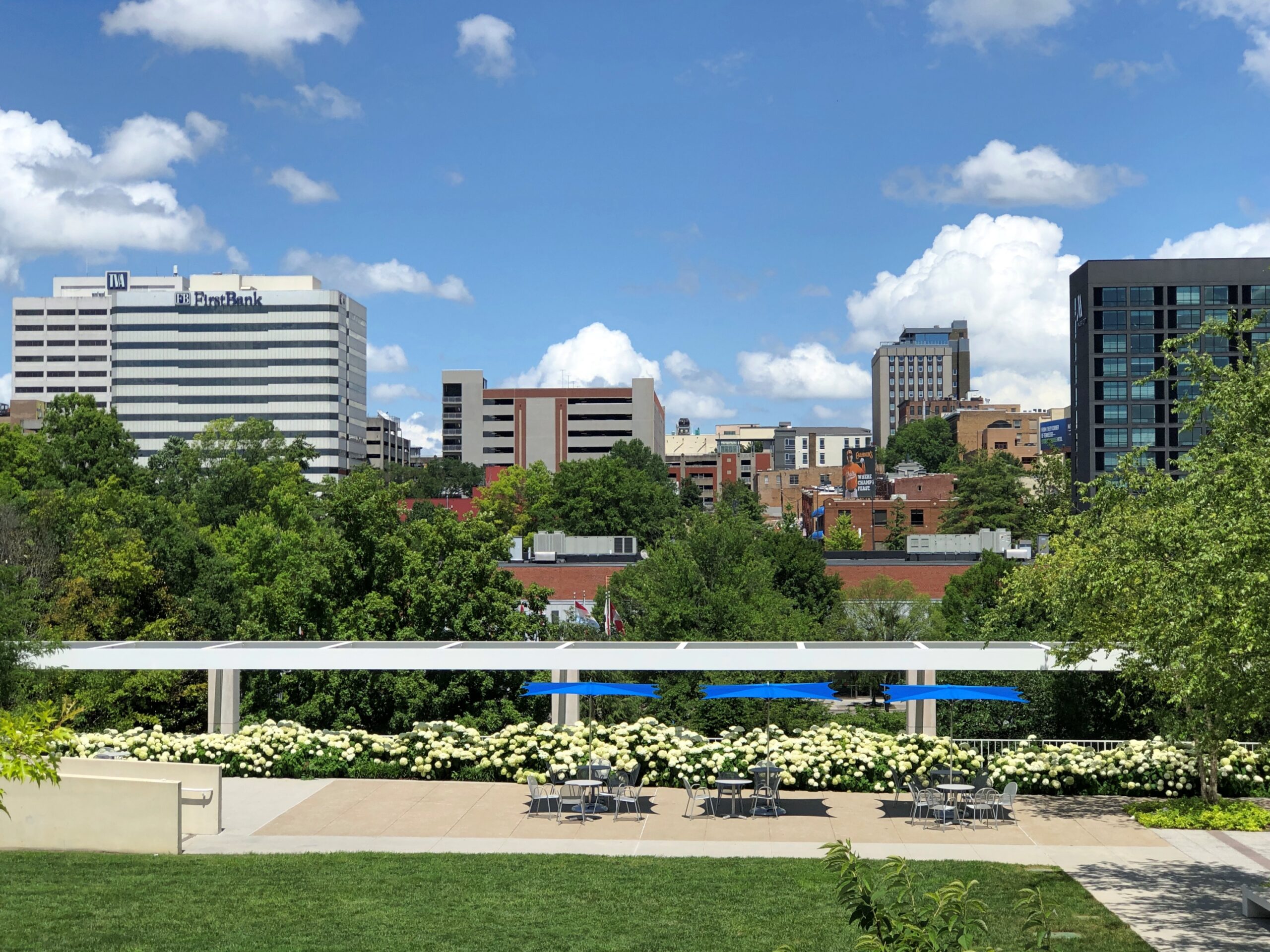
The museum also has a porch with a nice view of downtown Knoxville.
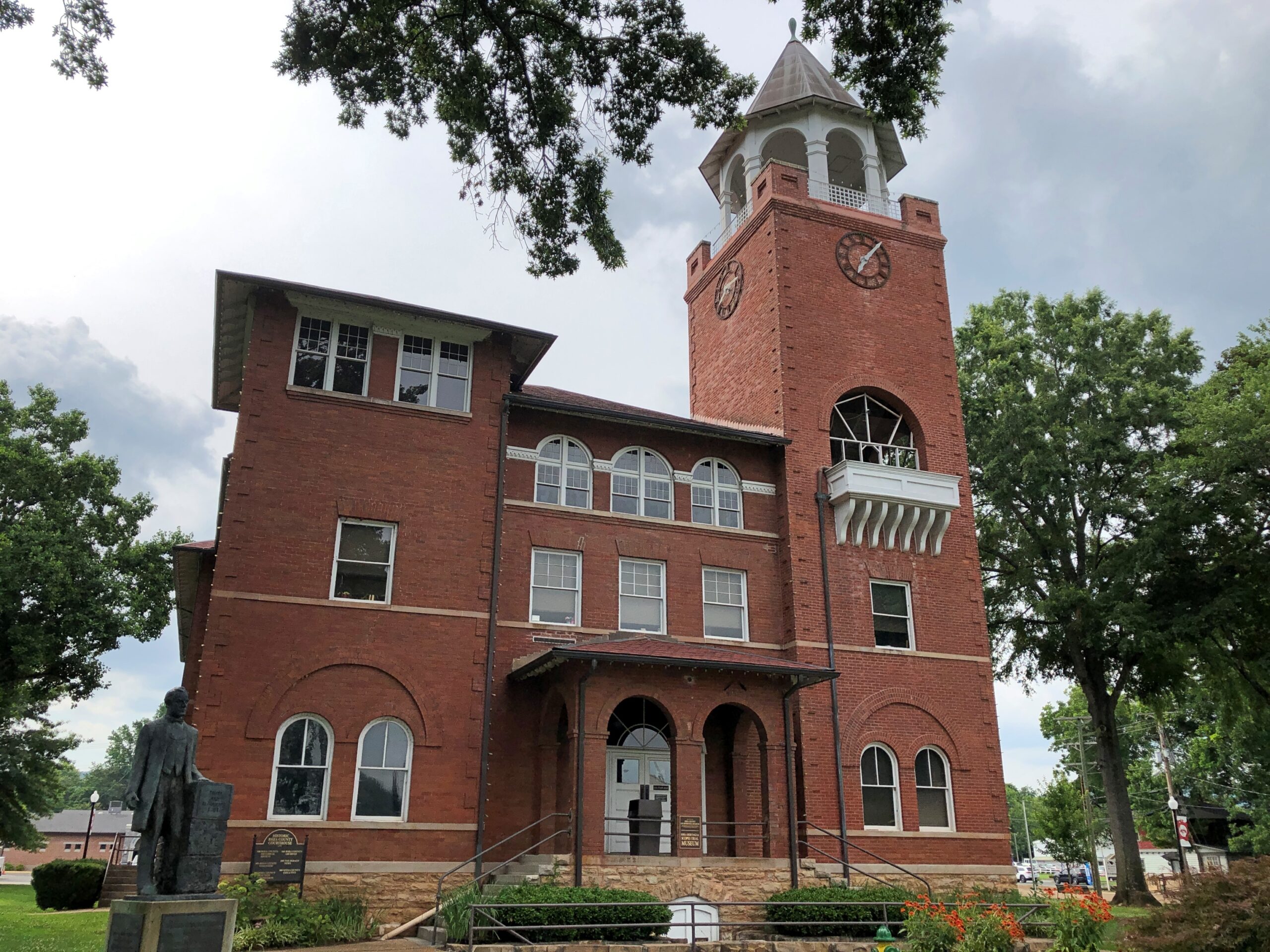
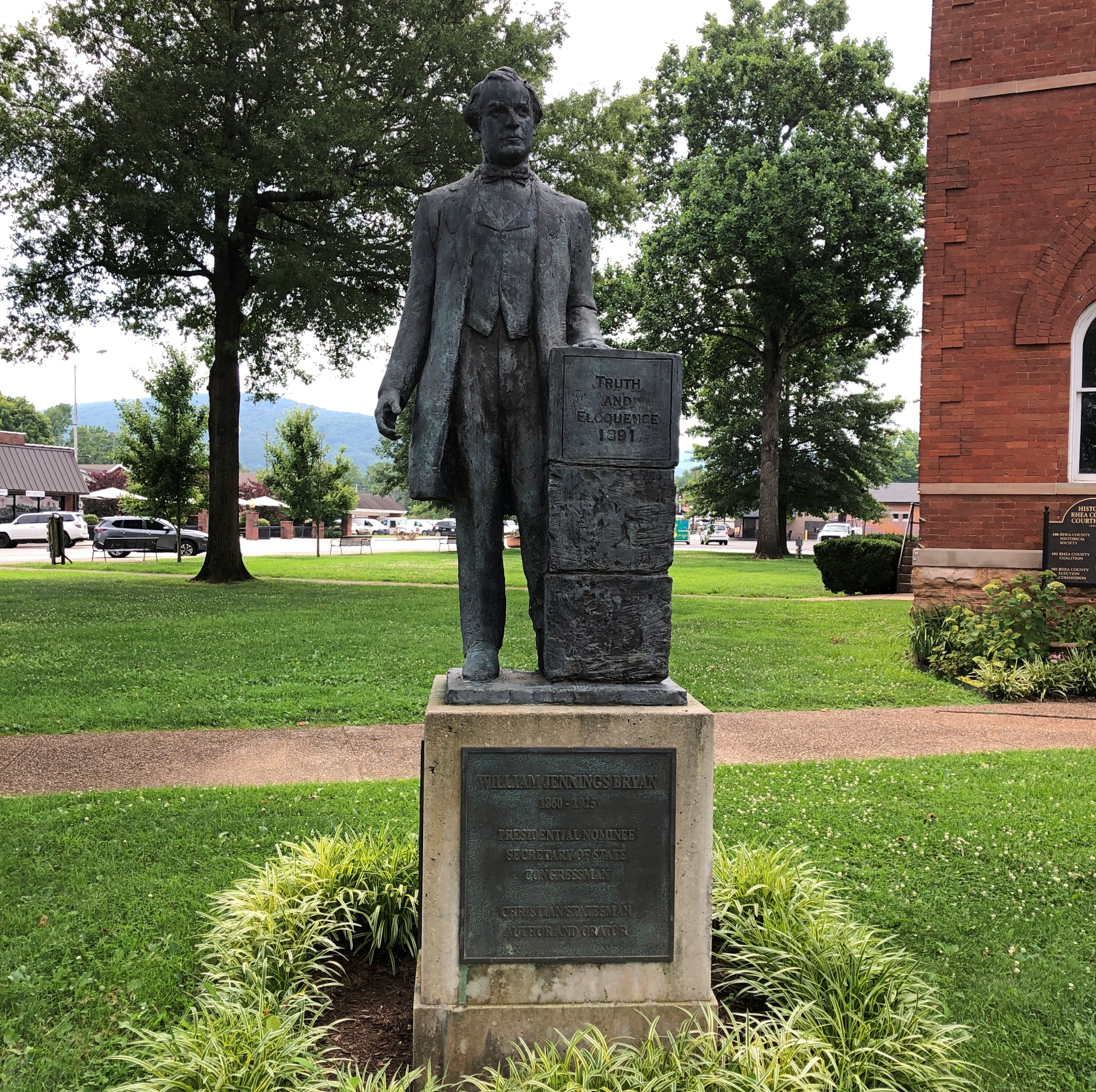
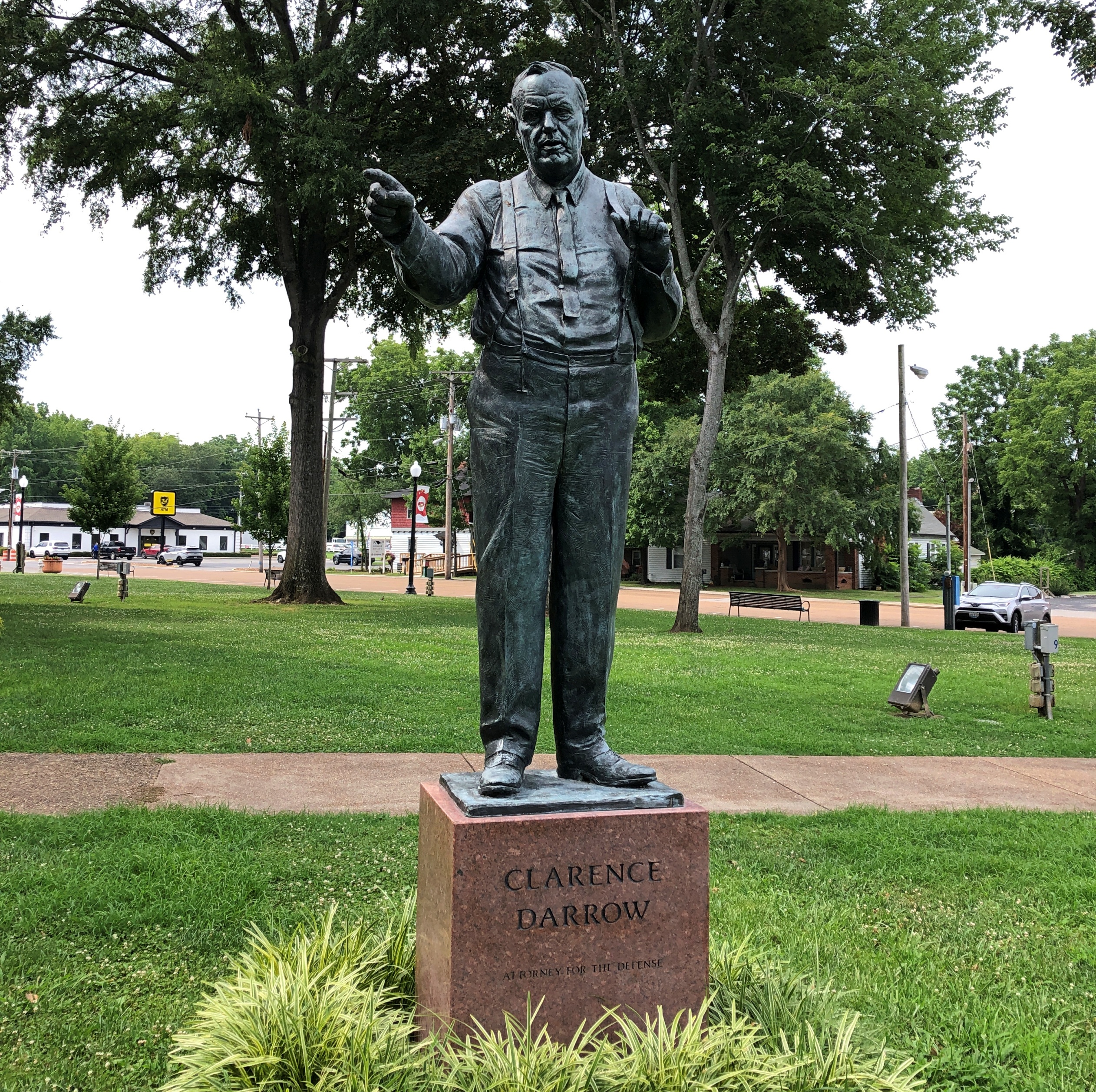
On my return westward through Tennessee, I made a point of passing through Dayton, site of the Scopes Trial, now 100 years ago. There is a museum devoted to the trial in the handsome and nicely restored 1890s Rhea County Courthouse, though I arrived after it had closed for the day.
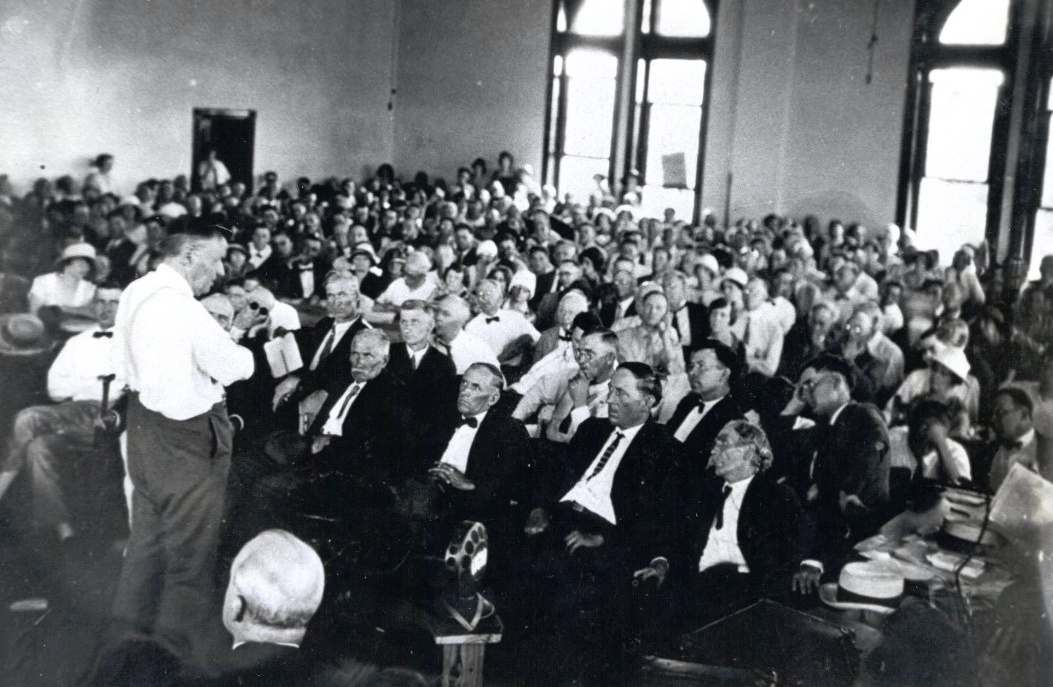
I look at pictures taken during the trial, and wonder how this multitude sat through it all, in an un-air-conditioned building. Guess like my grandma, as late as her last summer in 1970, they were used to it.
Before I got there, I heard a fellow on the radio discussing the (then) upcoming festival that Dayton was planning in honor of the centennial, as a bigger version of an annual event held in July. He might have been the organizer, I forget.
He pointed out that for many years Daytonites mostly wanted to forget about the trial – especially after the movie Inherit the Wind (1960) depicted the residents of Hillsboro, stand-ins for them, as fundamentalist bumpkins, at a time when the actual event was still in living memory. Which is nothing that Mencken didn’t do in 1925. Now the trial and Mencken and the movie are all part of that nebulous thing most people experience as the undifferentiated Past, and the townspeople have largely embraced the trial, according to the man on the radio. As well they should. It’s what Dayton, Tenn., has that no place else does.
On the courthouse square, William Jennings Bryan and Clarence Darrow square off in bronze. Bryan College paid for the former, the Freedom From Religion Foundation the latter.
North Carolina
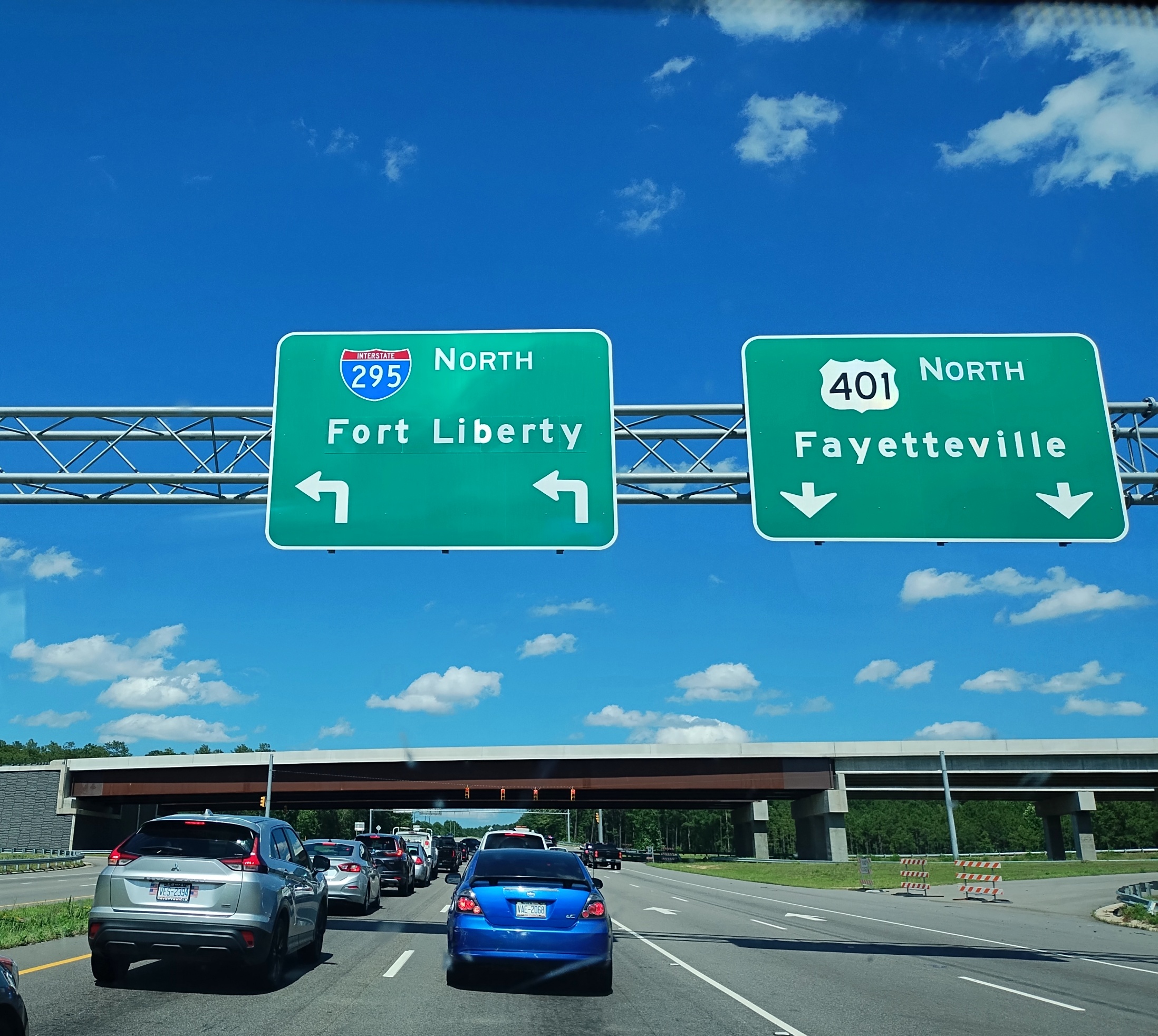
I was stuck momentarily in traffic near the military installation formerly known as Fort Bragg and then known as Fort Liberty and now known again as Fort Bragg. The traffic sign hasn’t caught up with the latest flip-flop.
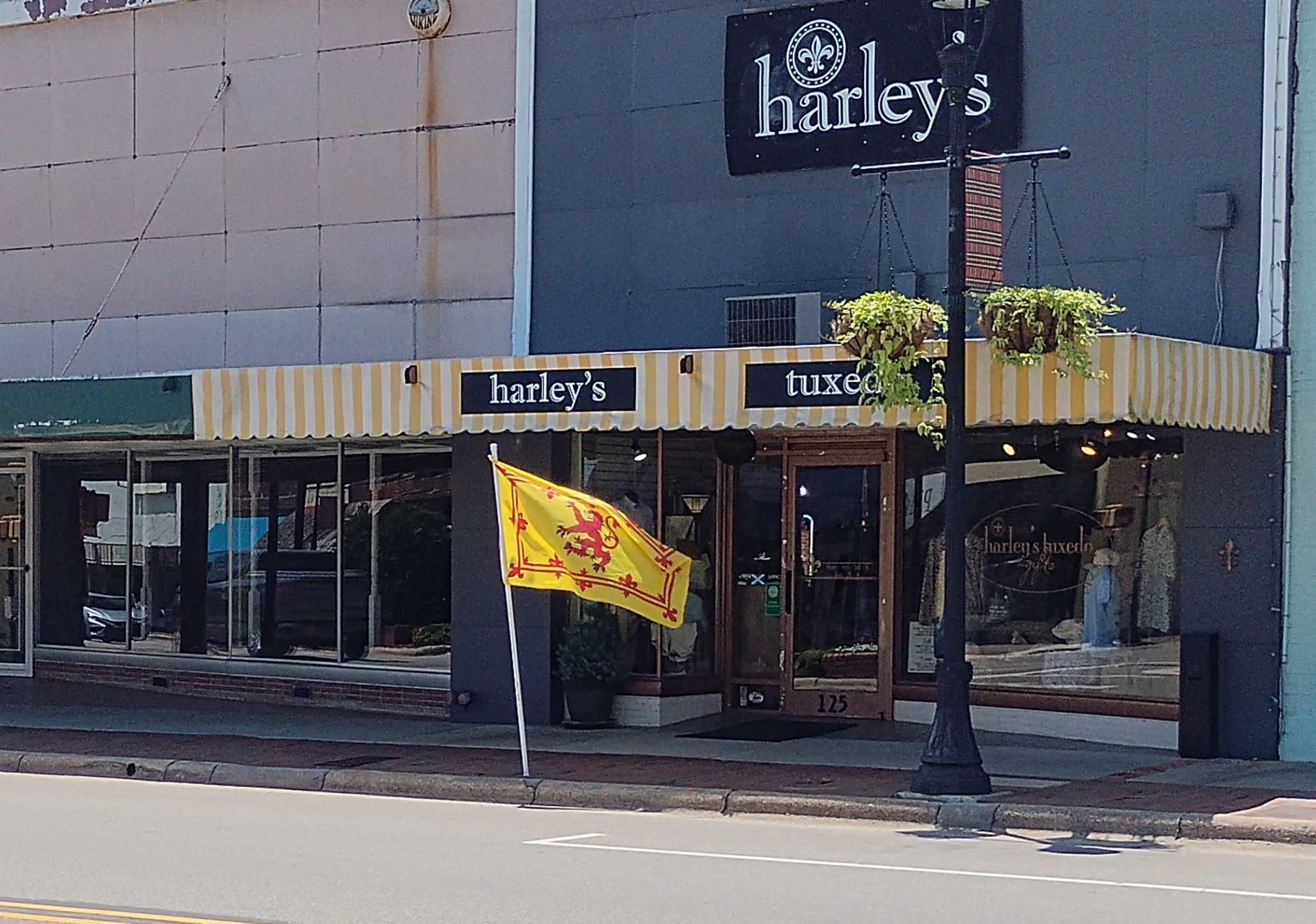
I stopped for lunch in Laurinburg, NC, at a storefront Chinese restaurant. Across the street, a tuxedo shop flew the Royal Banner of Scotland. Not something I’ve ever seen aflutter in the U.S. or anywhere, for that matter. But there is a school called St. Andrews University nearby, so maybe it’s not such a stretch. Make that was — the school closed just this May.
Wiki tells us: “As the personal banner of the Monarch, use of the Royal Banner of Scotland is restricted under the Act of the Parliament of Scotland 1672 cap. 47 and the Lyon King of Arms Act 1867 (30 & 31 Vict. c. 17), and any unauthorised use of such is an offence under the Act.” That has no bearing on its use in North Carolina, I’d say, considering how the Revolution turned out.
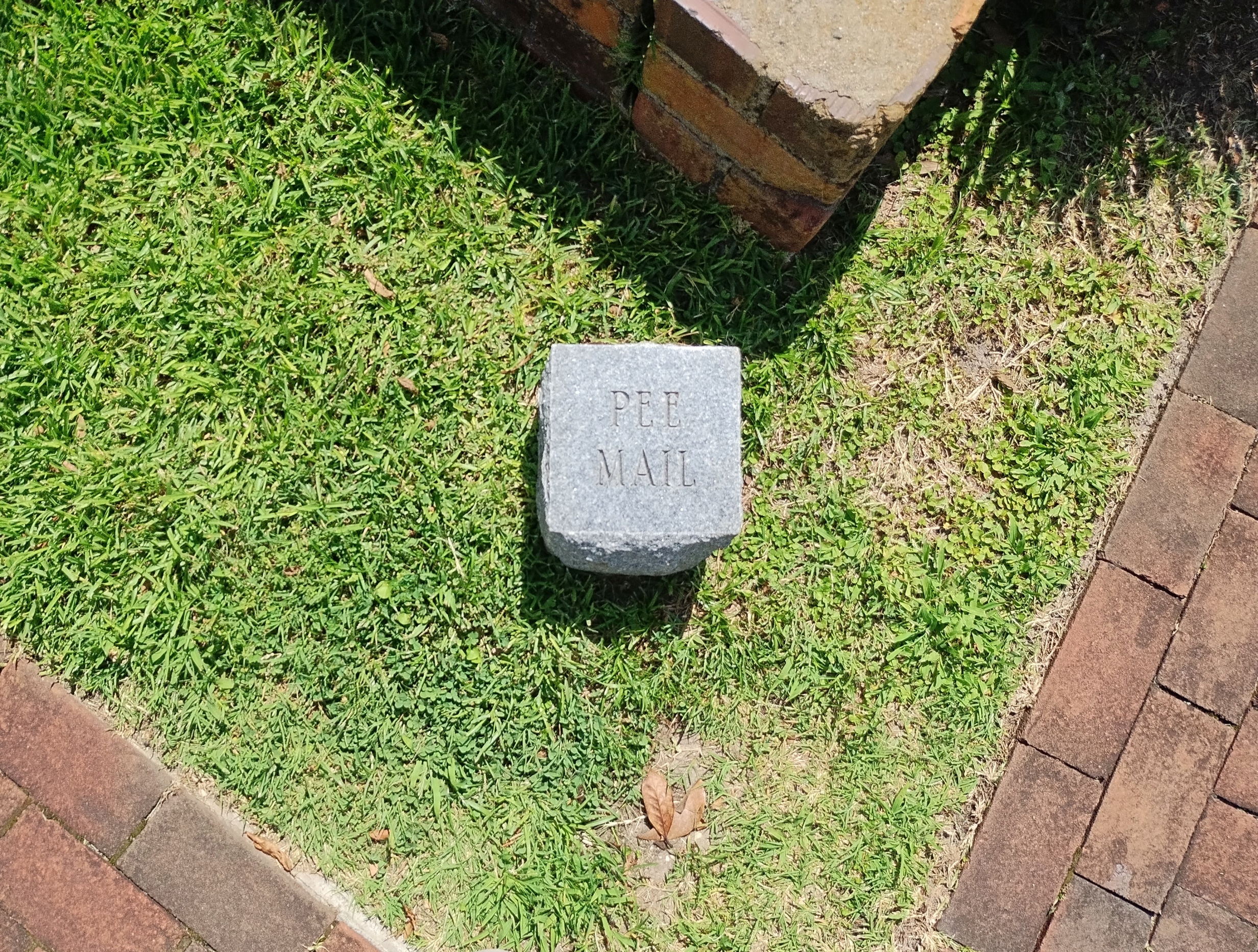
In New Bern, NC, this was a bit of a mystery at first.
Until I figured it out. A place for dogs to leave messages.
Now I can say I’ve been to Athens. The one in Georgia, that is, spending two nights. But most of that day in late June, I was elsewhere in Georgia – the part that Sherman burned – visiting two different old friends, one in the morning, the other the afternoon, so my time in Athens was fairly limited. The neighborhood near the university looked interesting, as college towns often are, so with any luck I’ll be back sometime for a closer look.
But I did spend enough time in town to happen across the aforementioned two-story concrete chicken and egg. It was another example of serendipity on the road. The reason involved traffic patterns in the western part of Athens. My motel was off a fairly busy major road, the Atlanta Highway, meaning that entering the property headed west – away from Athens – meant turning across two intense lanes of traffic without a clearly marked turning lane or a light.
So more than once, I headed west to the next major intersection, made a right, and then turned around to head back east on the Atlanta Highway so I could make a right turn into the motel. One time late in the afternoon, I decided to drive just a little further down that turning road – Cleveland Road – to see what I could see, and was soon rewarded with the concrete chicken.
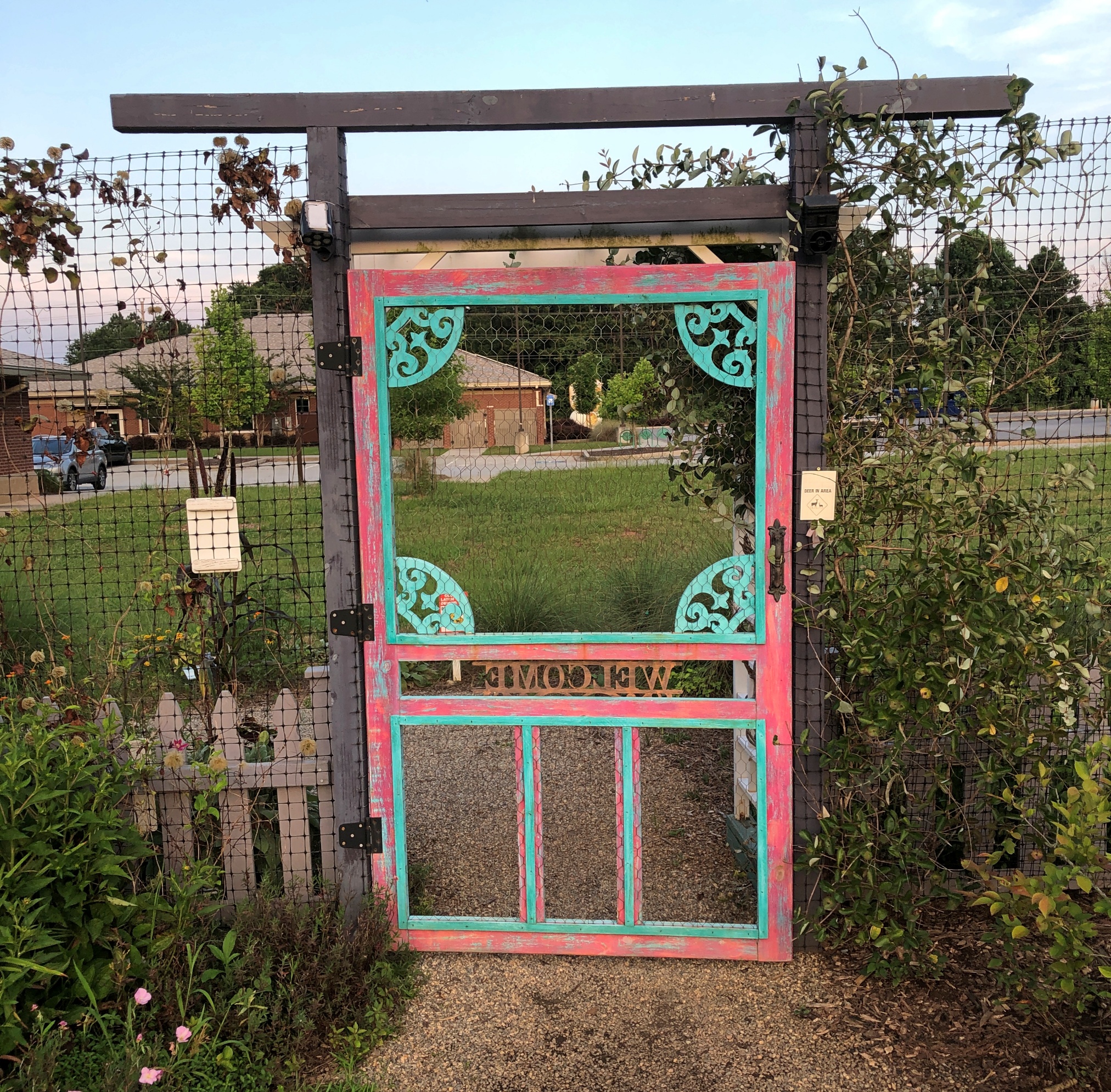
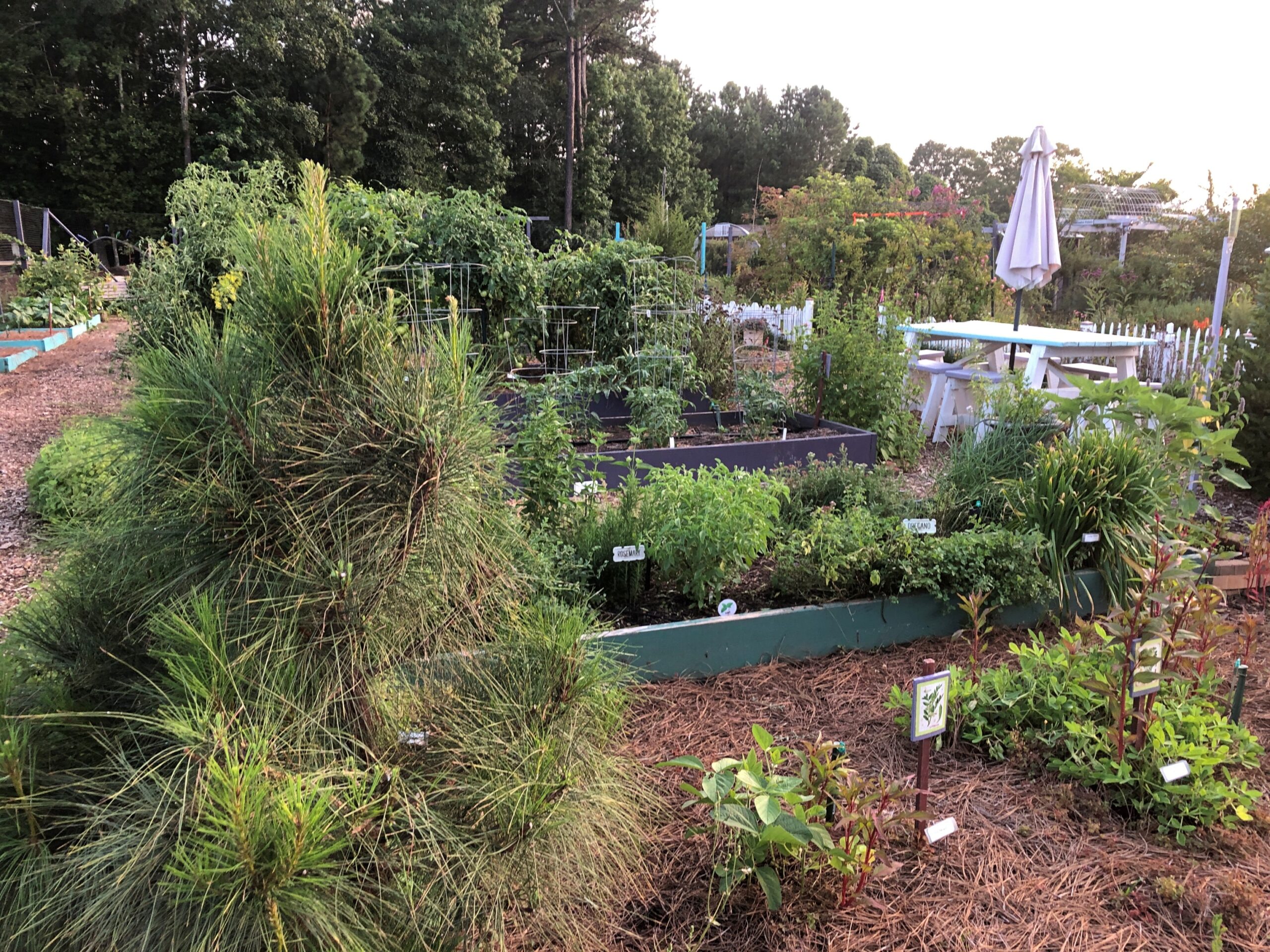
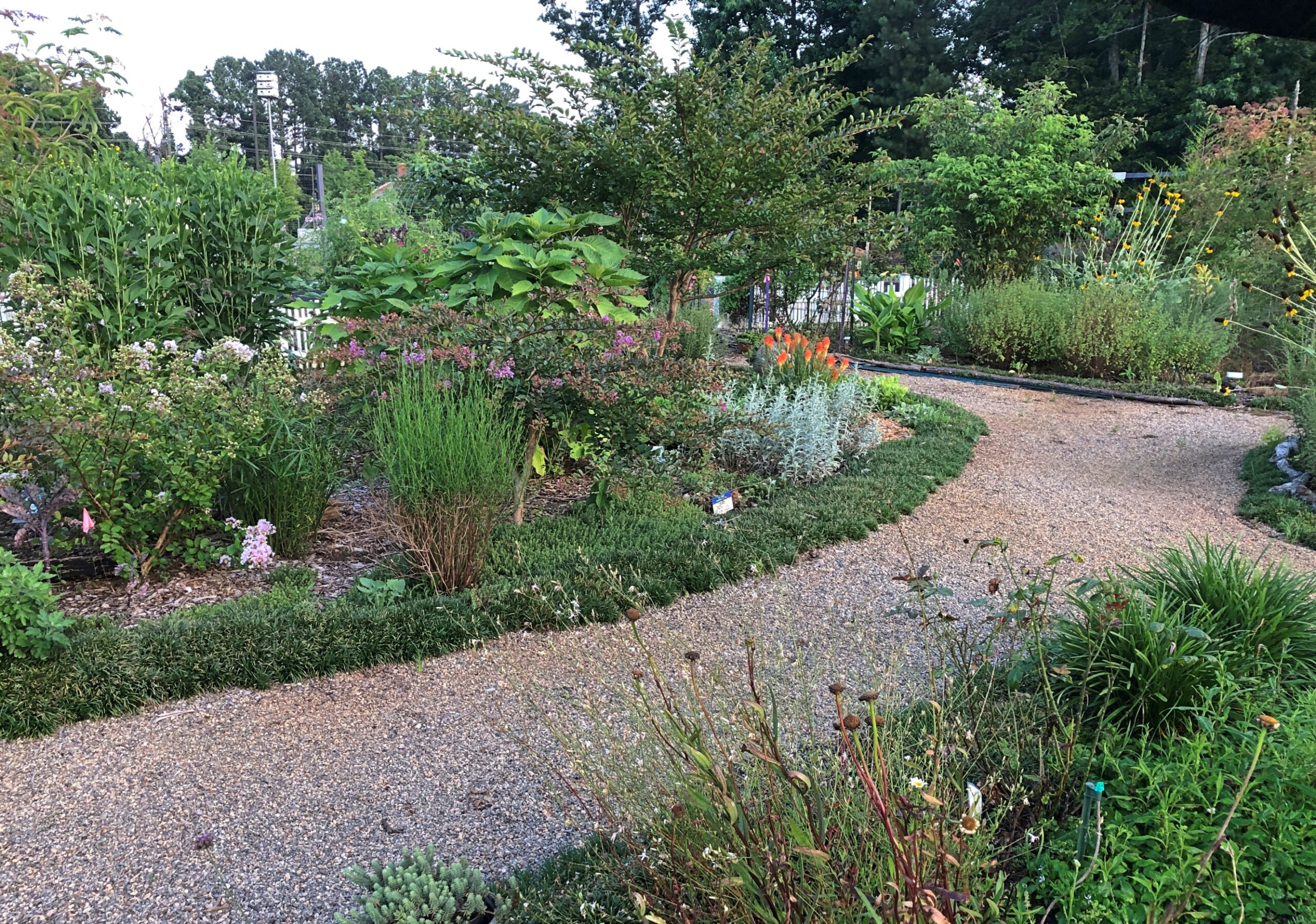
But that wasn’t all. Behind the building that houses the University of Georgia Extension Athens-Clarke County is a sizable garden. The sun was nearly down, so heat was less of an issue. I spent some time looking around. No one else was there.
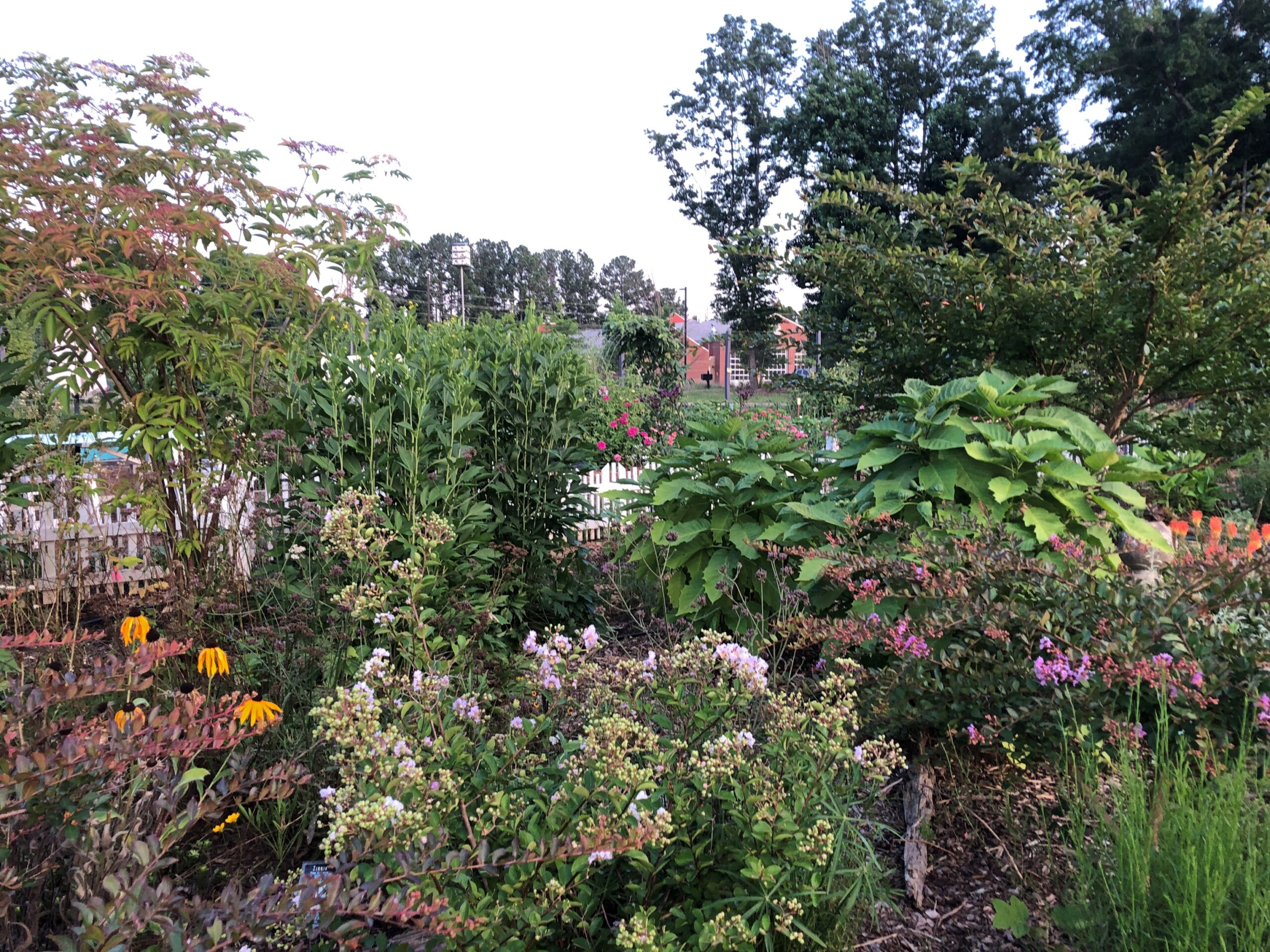
It’s a 17-acre lush garden, including a wide variety of edible plants.
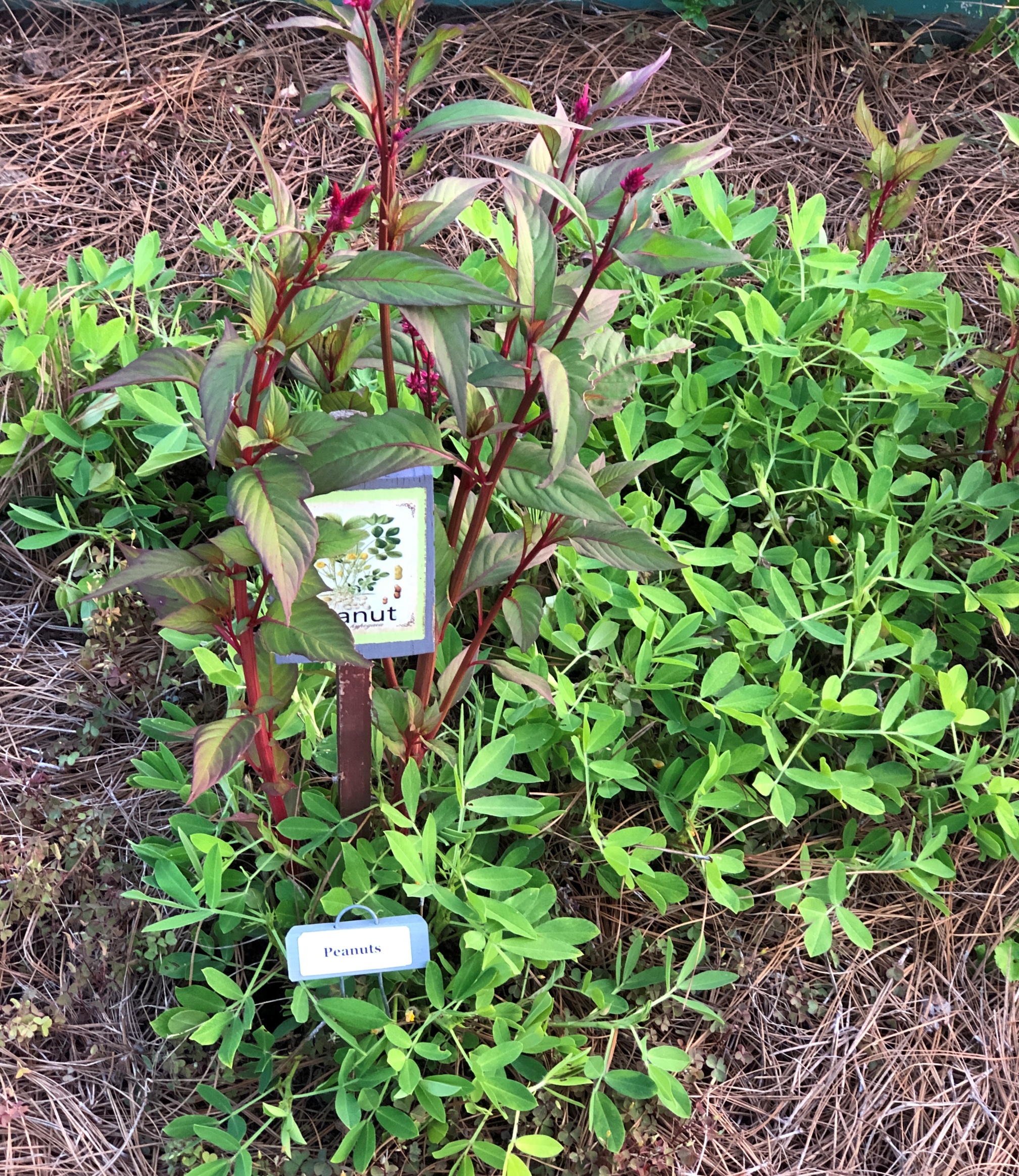
What would a Georgia garden be without peanuts?
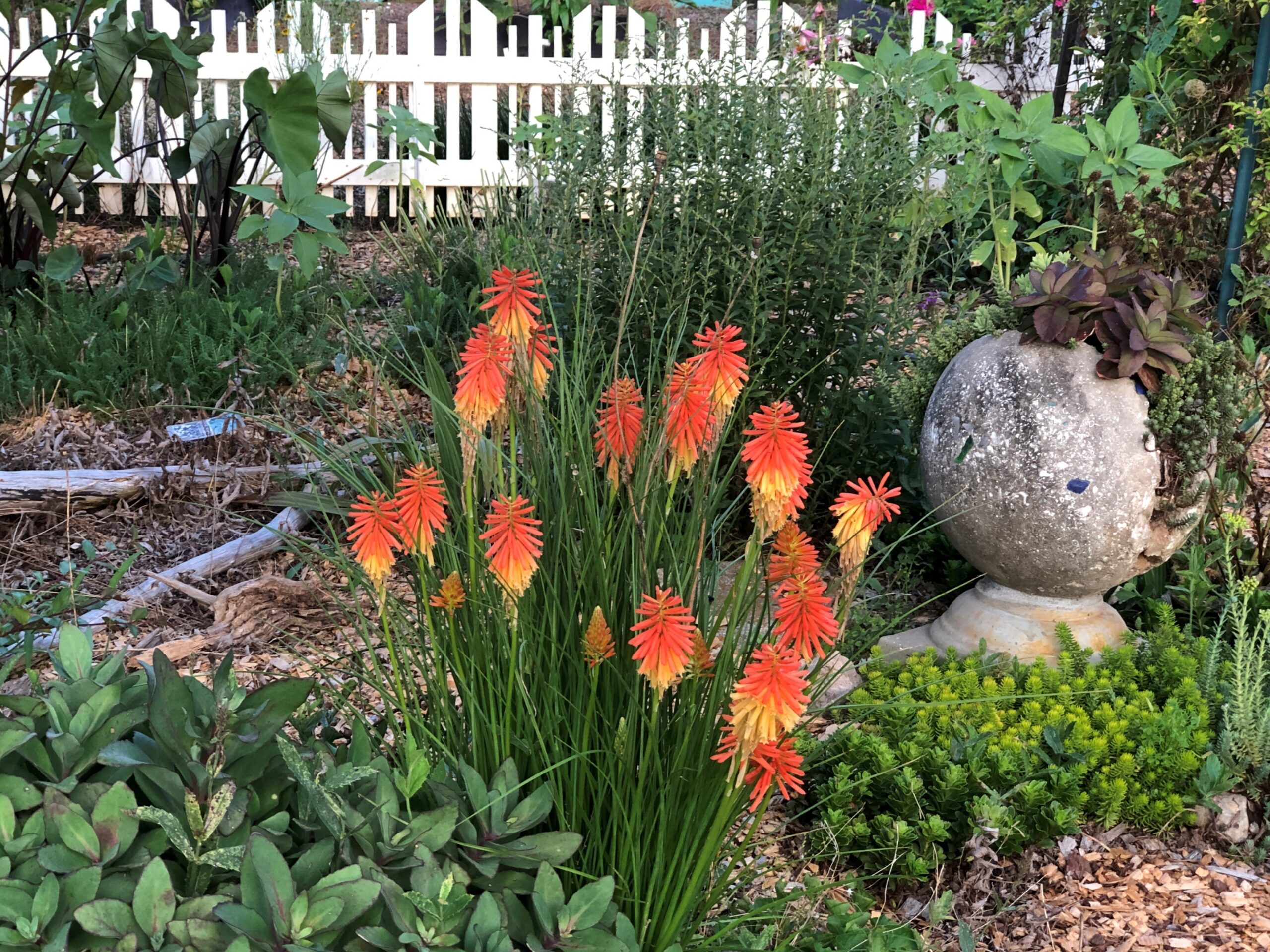
Plus a lot of flowers.
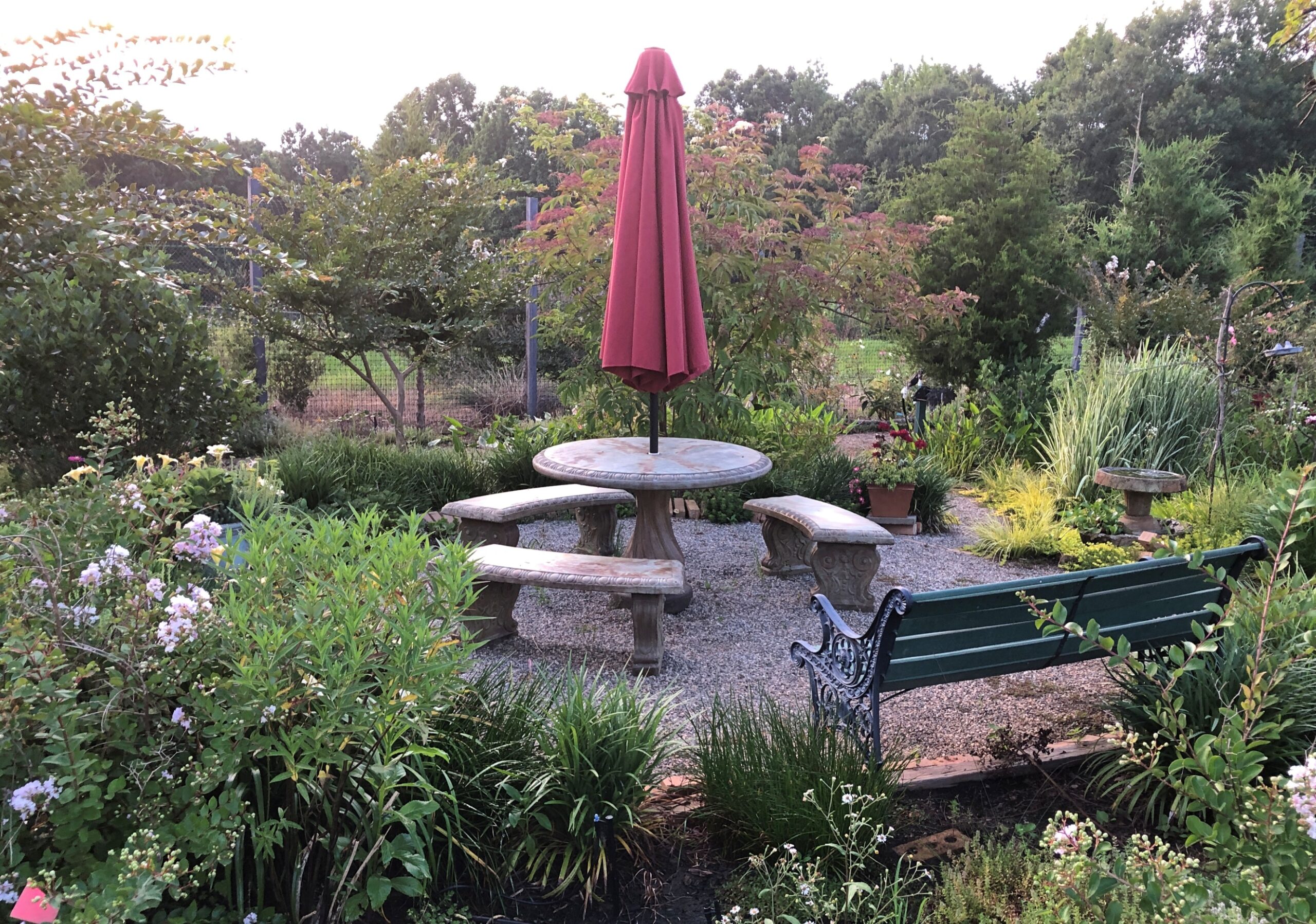
Even a few places to relax.
Wonderful spot. The lesson here: if you see a giant chicken statue by the road, investigate further.