Don’t Forget Dessert!

We still get newspapers, and newspaper circulars, delivered to our house. For how much longer, I don’t know. I’ve called to cancel a few times over the years, but every time I do the newspaper lowers the cost of the subscription a lot.

The paper still has its interests. Even in the circulars.

Found this a while ago — it was at the bottom of a circular advertising a brand of fast food I never buy. Among all of the choices, it’s third or fourth string. The addition of fried Twinkies isn’t going to change that.

I had a fried Twinkie in its native setting a few years ago, at a street festival in the Midwest. Note to my non-existent hipster readers: that is an authentic experience. It costs more than in an inauthentic, fast-food setting, but you should expect to pay more for authenticity. I should add that it’s one of that class of experiences you can do exactly once and not regret never doing again.

What Happens When I Look for a Book

Somewhere in this house I have a copy of The Religions of Man by Huston Smith. An older edition, because later it was retitled The World’s Religions. I read it in a comparative religion class once upon a time. A lot of people can say that.

I looked for it today but didn’t find it. Ann has started comparative religion in her Human Geography class, and I thought I’d at least make the book available to her. She’d get something out of it.

Curious, I looked up Huston Smith. He died only toward the end of 2016, well into his 90s. I’ll look for the book again tomorrow. It’s on one of my shelves.

I did happen across a few other books I’d forgotten I owned. One in particular caught my eye, considering my recent short bit of Bolshevik-themed tourism: Trotsky: Fate of a Revolutionary by Robert Wistrich (1979).

I bought it at a Davis-Kidd Booksellers remainder table. I know that because it still has the price tag on it, which tells me I paid $2.98. Davis-Kidd was a Nashville bookstore I visited often in the mid-80s. It’s gone. Of course it’s gone, though it limped on until 2010.

As for Robert Wistrich, he too is gone. Died 2015. Though he wrote other things, like the book about Trotsky, he’s known as a scholar of the history of antisemitism.

Finally, the publisher of Trotsky: Fate of a Revolutionary was Stein and Day. I’d like to report that it’s a going concern, but no. Closed in 1989. The company published a lot of titles in its time, and it lists a few on the back of Trotsky, which seem to have a theme.

Such as Stalin: An Appraisal of the Man and His Influence, by none other than Trotsky, Khruschev by Mark Frankland, Che Guevara, by Daniel James, The Complete Bolivian Diaries of Che Guevara, edited by Daniel James.

Also four books by Communist turned anti-Communist Bertram D. Wolfe, including The Fabulous Life of Diego Rivera and the amusingly titled Strange Communists I Have Known.

I never did get around to reading Trotsky. Maybe I should. Might be a slog. Leafing through it, the book seems heavy on the development of Trotsky’s ideas, light on the fun stuff, like his dalliance with Frida and his messy end.

Bayeux Tapestry Odds

Faux spring no mo’. Woke up this morning to a light coat of snow. Not even enough to warrant shoveling, but snow all the same.

I check the Paddy Power web site now and then, not because I’m interesting in betting, but because its predictive powers seem pretty good. Usually. The Irish bookies got the 2016 election wrong, but they get a pass for that, since everyone else did too.

Last week Amazon winnowed its second headquarters site selection to 20 cities, something I’m following as a professional matter. I was a little surprised to see that the odds favor Boston right now, at 2/1, with Atlanta, Austin and Washington DC next.

All very interesting, but what really caught my attention on the site was, “Bayeux Tapestry Location Display.” What? It’s going to be displayed somewhere outside Bayeux?

Apparently so. At some point in the next few years, at someplace in the UK. Exactly where is the betting matter.

Paddy Power puts the British Museum as the clear favorite, at 1/2, which seems reasonable, but also possible are Canterbury and Westminster Abbey at 5/1. Less serious possibilities are at Paddy Power Tower or “Any Carpet Right store.”

I assume the tower is the company headquarters in Dublin. As for Carpet Right, which is actually styled Carpetright, that’s a carpet retailer with 426 stores in the UK and 138 in the Low Countries and Ireland. Just a spot of fun from the Paddy Power bookies.

The Internet, being what it is, allows me to find out about other things related to the Bayeux Tapestry with ridiculous ease. For example, if I wanted to spend $230, I could have my own Bayeux Tapestry tablecloth, 95 percent cotton and also made in France. Nice, but no thanks.

Finding George Orwell in Burma

Heavy rain early this morning. I woke at 3 or so and cracked the window slightly so I could hear it as I fell back asleep, like I might do in the spring. Later, I was up to make sure the outside drain and inside sump pump were working, as I might do in the spring. They were.

Seems that we got an warm edge of what ought to have been a blizzard — snow that in fact hit Michigan and Wisconsin and Iowa, essentially an arc around the Chicago area. A storm that the Weather Channel, in its annual silliness on the subject of winter storms, insists on calling by a name, “Jaxson.”

The book I took to Mexico was Finding George Orwell in Burma by Emma Larkin (revised edition, 2011). Nothing like reading about a different country when you’re in different country, and the more different, the better. Burma certainly qualifies as very different from Mexico and, sadly for the Burmese, mostly in bad ways. Previously I’d only had a sketchy idea of how repressive the Burmese government has been for a long time (from what I’ve read, things are somewhat better now. Maybe). Though not writing a polemic per se, Larkin describes the totalitarian aspects of Burma very clearly.

“Burma’s surveillance machine is frighteningly thorough and efficient,” she says at one point. “It consists of a number of departments that come under of the Directorate of Defense Services Intelligence, known informally in Burmese as MI, for ‘Military Intelligence.’ MI’s mandate is vast: to monitor the entire Burmese population. It concentrates on obvious threats to the regime, which includes the armed forces themselves, and targets anyone who has ever criticized the government openly, NLD members, and foreigners both in the country and out. In short, everyone is being watched… in some towns the surveillance mechanism operates at the neighbourhood level, with MI minions filing daily reports to central bureaux… This method of control is highly effective: Big Brother really is everywhere.”

The mention of Big Brother is fitting, because the book is as much about Orwell and his works as Burma. Larkin structured the book as a bit of travel writing, in the sense that she visited places in Burma where Orwell lived as an imperial policeman, and writes about these places and her visits, but it’s much deeper that most travel pieces. She’s been visiting Burma for years and knows it well. She also knows Orwell and his works well, including Burmese Days, which naturally is discussed at length.

I didn’t realize, for instance, that the original publisher made Orwell change certain details, the better to hide the identities of people he’d based his Burmese Days characters on. Later, after the British had bugged out of Burma and all the colonials Orwell knew were dead, the details were changed back in more recent editions.

Sometimes, like standard travel writing, Larkin describes what she sees, and is pretty good at it: “I walked up Limouzin Street,” she writes of the town of Moulmein, where Orwell’s mother was born into the Limouzin family, who were important enough to have a street named after them. “It was a tidy street with a smooth tarmac surface and tin-roofed houses tucked away behind low white walls. Here and there unruly fronts of orange bougainvillea spiked over the fences and on to the pavement. A row of manicured bushes ran along the base of a pagoda wall. As I strolled up the slight incline I heard the faint sounds of radio music seeping out from some of the houses, but I didn’t meet a single person.”

Using the travel structure, Larkin was able to write thoughtfully about both Orwell and Burma, and how living there might have affected his thinking and writing. She also recounts meetings with various Burmese, and what they have to say about how wrong things have gone under military rule, presumably changing their names and all important details, so they don’t end up in some torture cell. In fact, I’ve read that “Larkin” itself is a pseudonym, presumably so she can not be kicked out of Burma when she goes there, or simply not allowed in.

On the whole, it was a good book to read when traveling. A good book might not be as important on the road as your passport or money, but I’d say it’s up there with clean underwear or broken-in walking shoes.

Versus 1981-82

Today was faux spring. That happens occasionally even in darkest winters. The aspects of spring we got today were non-freezing temps, drizzle and mud. The dog at least is happy. And it is better than a subzero day.

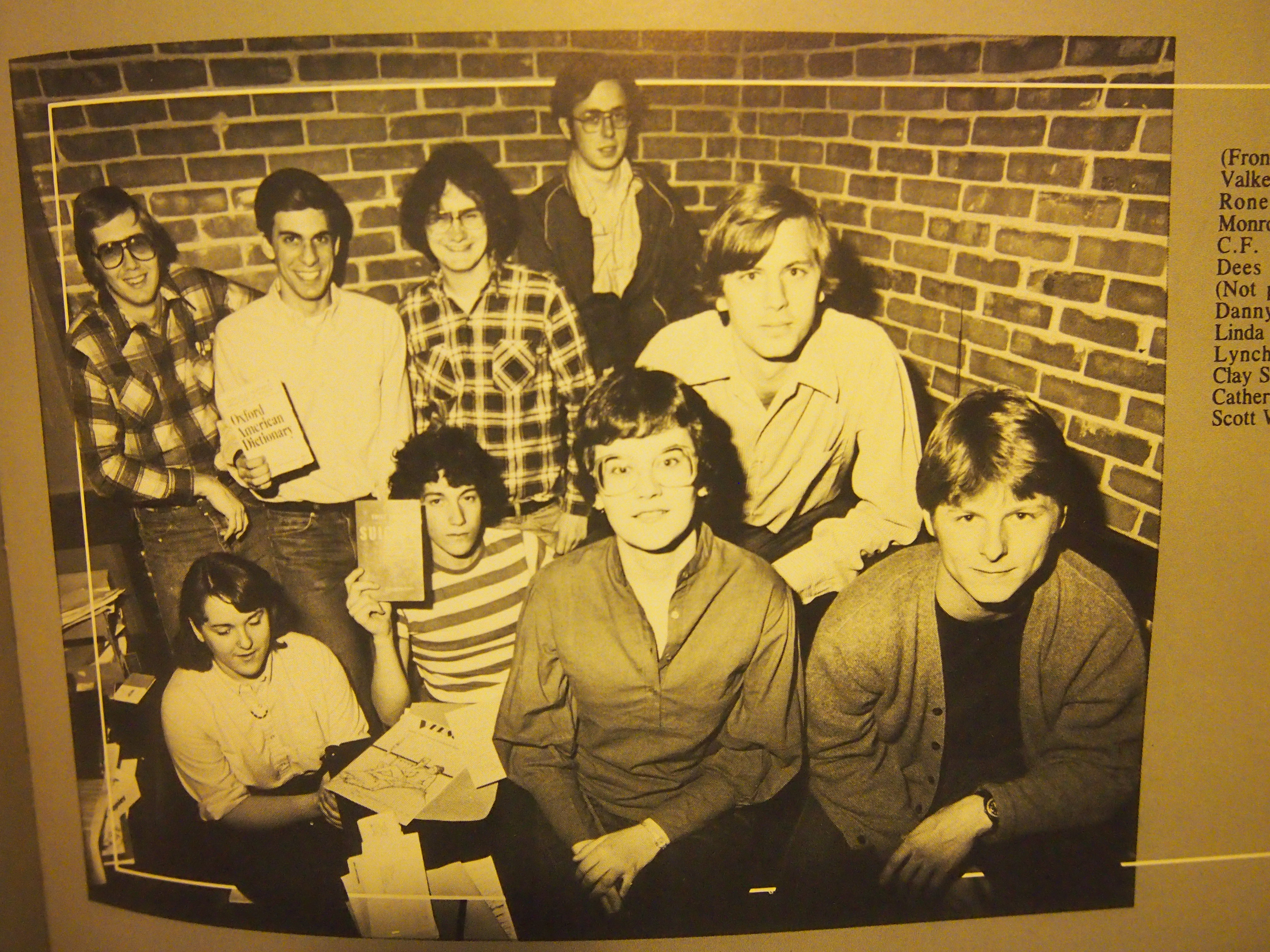
Last year, when looking up William F. Hagerty, a VU alum who eventually became the current U.S. ambassador to Japan — succeeding such notables as Caroline Kennedy, Walter Mondale, Douglas MacArthur II, Joseph Grew, Townsend Harris and arguably Commodore Perry — I also came across this photo in the 1982 Vanderbilt Commodore yearbook.

Pictured are staff members of Versus magazine, the student magazine, 1981-82. Actually only about half of the staff; the editor for that year is not even pictured. I’m third from the left, top row. Or third from the right, come to think of it. These days I’m on Facebook with four of the people pictured, including Dan, bottom row right. I correspond by postcard and email with another person in the picture who doesn’t do Facebook.

The present generation of VU student journalists will not know the joys and irritations of producing a paper magazine. At least not Versus, nor a paper version of the student newspaper, The Hustler. At some point in the current century, those were unceremoniously dumped, as was the terrestrial radio station, WRVU, though that was sold for a mess of pottage.

Mid-January Debris

Never mind what the Rossetti poem says, the bleak midwinter is about now, in mid-January, which is bleak, and which is smack in the middle of meteorological winter.

Dogs don’t mind, though. They’re already wearing coats.

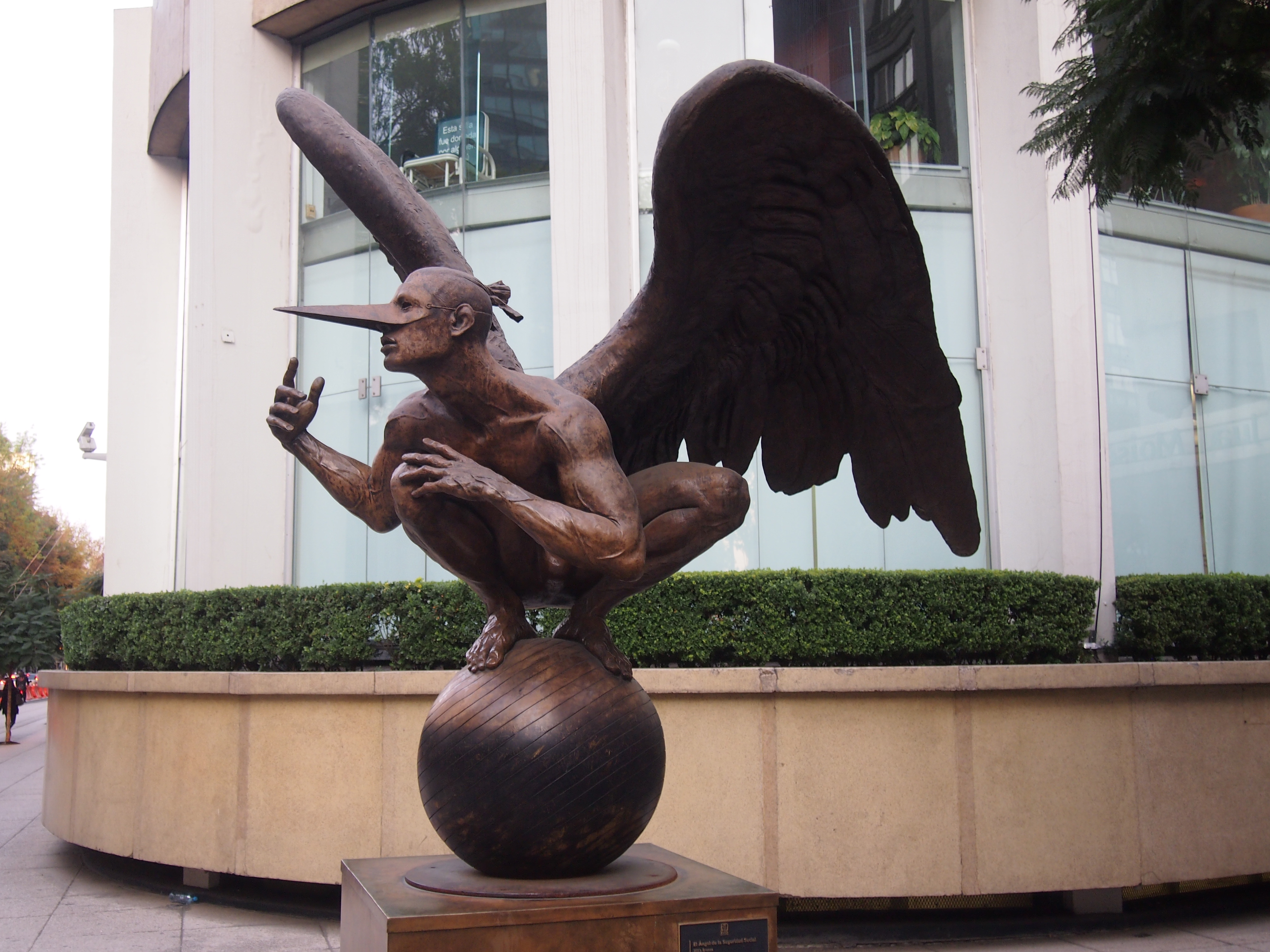
One more pic from Mexico, a statue on Paseo de la Reforma.

“El Angel de la Seguridad Social,” a bronze by Jorge Marin, erected in 2013.

As gob.mx says, “Como parte de las actividades conmemorativas por el 70 Aniversario de la fundación del Instituto Mexicano del Seguro Social (IMSS),” the Mexican Social Security Institute. That’s the branch of the Mexican government in charge of public pensions and public health, established in 1943.

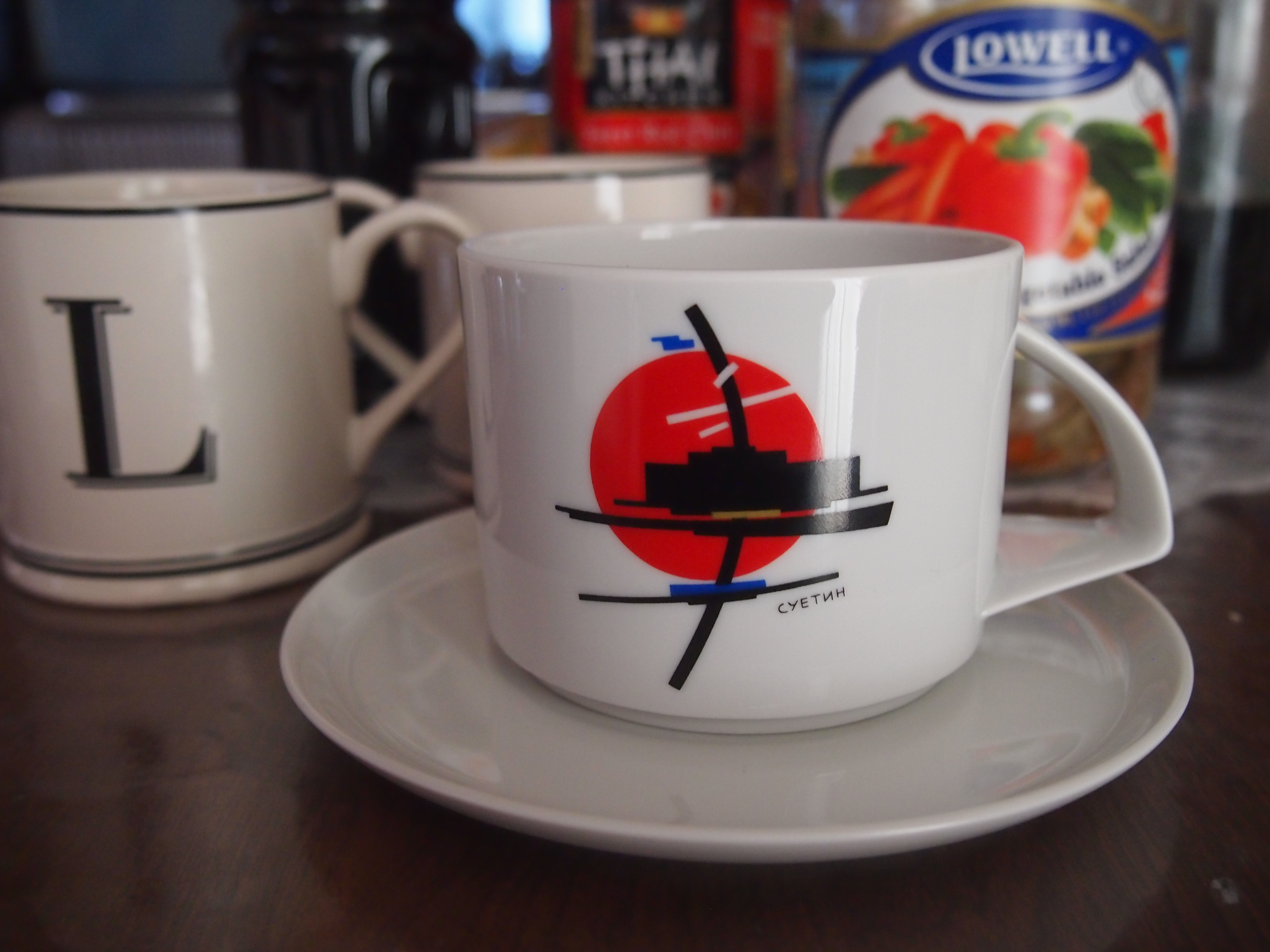
My brother Jay got me a Suprematist tea cup and saucer for Christmas.

On the bottom, something unusual: Imperial Porcelain – 1744 – St. Petersburg – Made in Russia. I’d probably have to look high and low around my house to find anything else made in Russia, and even then there might not be anything else.

Campaign Cards Are Coming

There’s no official moment when it happens, but I think it’s happened all the same. We’ve passed into the Pit of Winter. All days in the pit are cold, as in well below freezing, but they come in varieties: cold sunny days, cold overcast days, cold snowy days. With the potential for a blizzard thrown in for grins.

We can only fondly recall High Summer days, or imagine ones to come, at the remote opposite end of the calendar. They looked like this, at least from my deck.
The first political postcard of ’18 came in the mail a few days ago, sent by a candidate for a relatively minor local office. Not particularly creative: a touch of “next to of course god america i,” a dash of tough on crime, a serving of motherhood (in this case, the candidate is a woman. For a male candidate, a serving of loving family man.)

It’s easy to be cynical about that sort of advertising, as you can see, but it’s the formula that inspires contempt. I don’t really know anything about the candidate. In any case, I expect I’ll be seeing more soon, since the primary is March 20.

YouTube ads for Illinois governor have already started appearing. But at least we won’t hear campaign trucks making noise with loudspeakers, as you do before parliamentary elections in Japan.

Stinkin’ Badges

All of us went to a screening of The Treasure of the Sierra Madre on Sunday, one of the old movies that TCM shows in movie theaters periodically, in this case for the 70th anniversary of its release. I can take or leave Ben Mankiewicz doing the introduction, as he might on television, but for someone who hasn’t seen the movie, I guess they’re informative.

No one else in the family had seen it. I had, on tape about 25 years ago. Good to see it again, and on the big screen. Like for Casablanca, the movie didn’t fill the house, but there was enough of an audience for an audible chuckle when the subject of badges came up, as most of us knew it would.

Remarkably, “Stinking Badges” has its own Wikipedia page.

This is the kind of thing I wonder about when I’m watching a movie again: just how far would a peso go at the time when the movie is set (1925, despite the appearance of some later-model cars)? Maybe that came to mind because I was handling pesos recently.

Early in the movie, Fred C. Dobbs (Bogart) panhandles three times from the same well-dressed American in Tampico — played by director John Huston — eventually claiming not to realize it was the same man, who tells him off. The well-dressed American clearly gives Dobbs a Mexican peso of immediate post-Revolution vintage: one of these, I could see.

A very common coin at the time: from 1920 to 1945, about 458.6 million of them were minted. It’s a nice coin, composed of .7199 silver and weighing 16.66 g (12 g silver) though not as weighty as a U.S. Peace dollar of the time, .9000 silver and weighing 26.73 g. So what was Dobbs receiving when he got one?

According to the movie at least, which I realize had no obligation to be accurate, enough to buy a meal or a few drinks or a haircut with change left over. The haircut scene was interesting for another reason: Bogart was bald by this time, but after the pretend haircut and oiling of his hair, he didn’t look like it. Probably the work of hair stylist Betty Delmont, if IMDb is accurate.

Also, McCormick (Barton MacLane) promised Dobbs and Curtin U.S. $8 a day for working on his oil rig. That’s about U.S. $114 in current money, but what did it mean in pesos in 1925, when the cost of living was surely a lot less in Mexico?

Curious about the exchange rate, I did some looking around and found this interesting table posted by the St. Louis Fed: average annual exchange rates to the U.S. dollar in the 1920s. That would be the Coolidge dollar that Cole Porter sang about being the top. To answer the question about pesos, it seems that ca. 1925, the rate was about two pesos to the dollar. So if Bogart could get 16 pesos a day, when he could feed himself for two or three, that’s not bad.

Of course, Dobbs and Curtin didn’t get any of that until they beat it out of McCormick. You’d think that if McCormick had made a habit of swindling oil-rig workers, and still walked around openly in Tampico, he’d at least have carried a pistol.

Another thing I noted while looking at the table. In 1922, a French franc was worth about 8.2 U.S. cents. By 1926, the rate was 3.2 U.S. cents to the franc. No wonder Hemingway could afford to drink himself silly in Paris, and Liebling could afford to eat himself fat. Further examination of the table traces the course of the great inflation not only in Germany, but also in Poland and Hungary.

One more thing: when looking into the value of the 1920s peso, I happened across an interesting essay about the economics of The Treasure of the Sierra Madre by a Wake Forest economist named Robert Whaples.

Toward the end of the essay, Whaples offers this observation: “In these scenes and others, the film examines altruism; bargaining and negotiation; barriers to entry; creation of capital; capital constraints; compensating wage differentials; contract enforcement; corruption; cost-benefit analysis; credence goods; debt payment; deferred compensation; economies of scale; efficiency wages; entrepreneurship; exchange rates; externalities; fairness; the nature and organization of the firm; framing effects; game theory; gift exchange; incentives; formal and informal institutions; investment strategies; job search; the value of knowledge; labor market signaling; selecting the optimal location; marginal benefits and costs; the marginal product of labor; natural resource extraction; opportunity costs; partnerships; price and wage determination; property rights and their enforcement; public goods; reputation; risk; scarcity; secrecy; sunk costs; supply and demand analysis; team work; technology and technological change; the theory of value; trade; trust; unemployment; and the creation and recognition of value and wealth.

Can any other movie offer more?”

Mexico City Sobras

Back to posting on January 16. Would that Dr. King had been born in the summer, but I’ll take holidays when I can.

The last major sight we visited in Mexico City was the vast Palacio Nacional, the National Palace, on Zocalo Square. It was fairly late in the afternoon of December 31, and we’d already walked a fair amount, so we only had energy enough to see a small slice of the complex. Even now the palace includes the offices of the president of Mexico and other governmental functions, but there’s also artwork and museum space and some impressive plazas, both open air and covered.

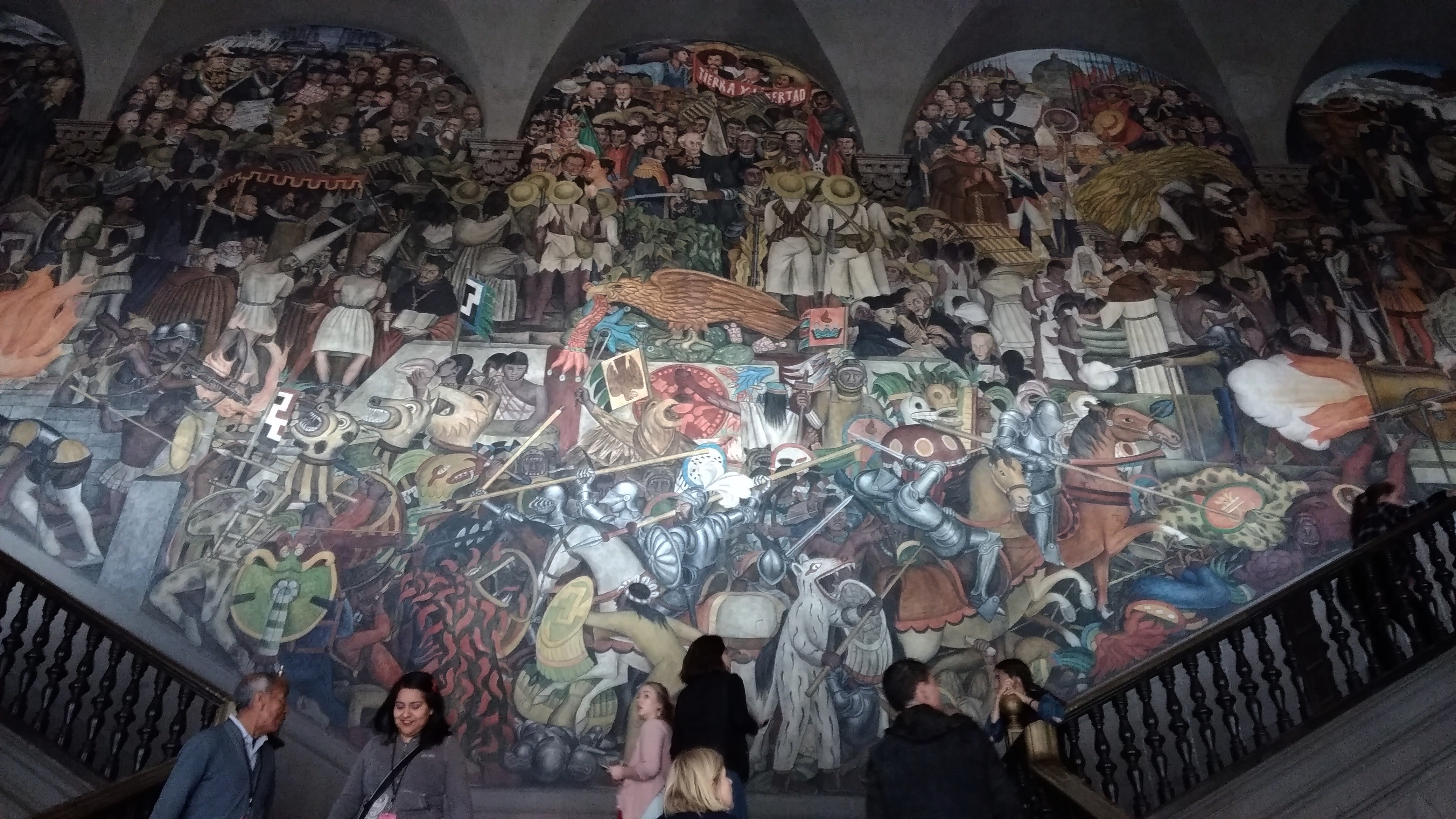
Diego Rivera’s mural depicting the history of Mexico, “The Epic of the Mexican People,” is impossible to miss. This only part of it. My picture does it no justice. One thing it does include is an epic amount of violence.
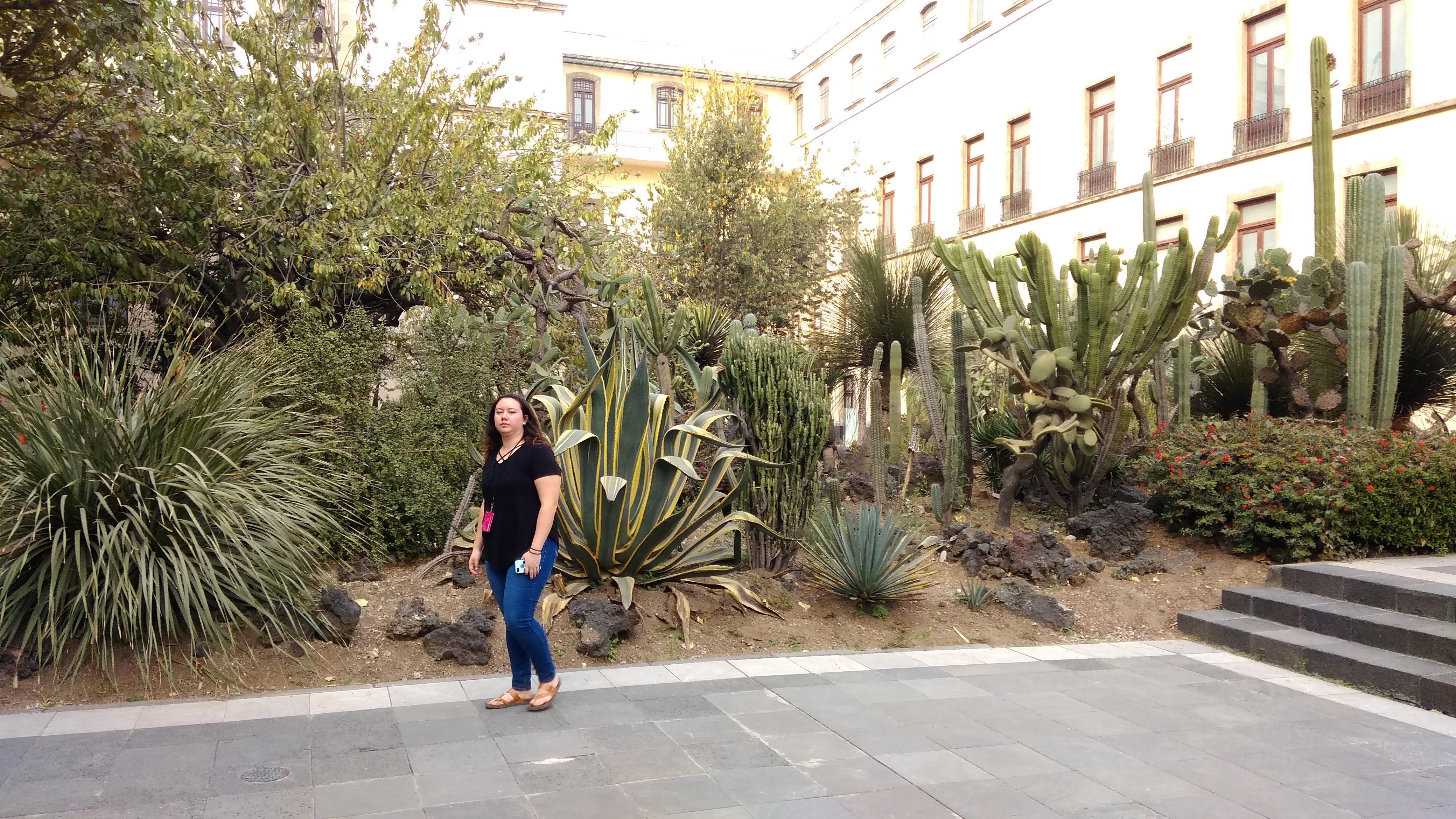
The building, which evolved over the centuries on the site of an Aztec palace and then a fortified compound that Cortez built on top of its ruins, included a spot that features a lot of cacti native to Mexico, along with other flora.
This is the most useful postcard I bought in Mexico City, on the second day we were there, a route map of the Sistema de Transporte Colectivo.
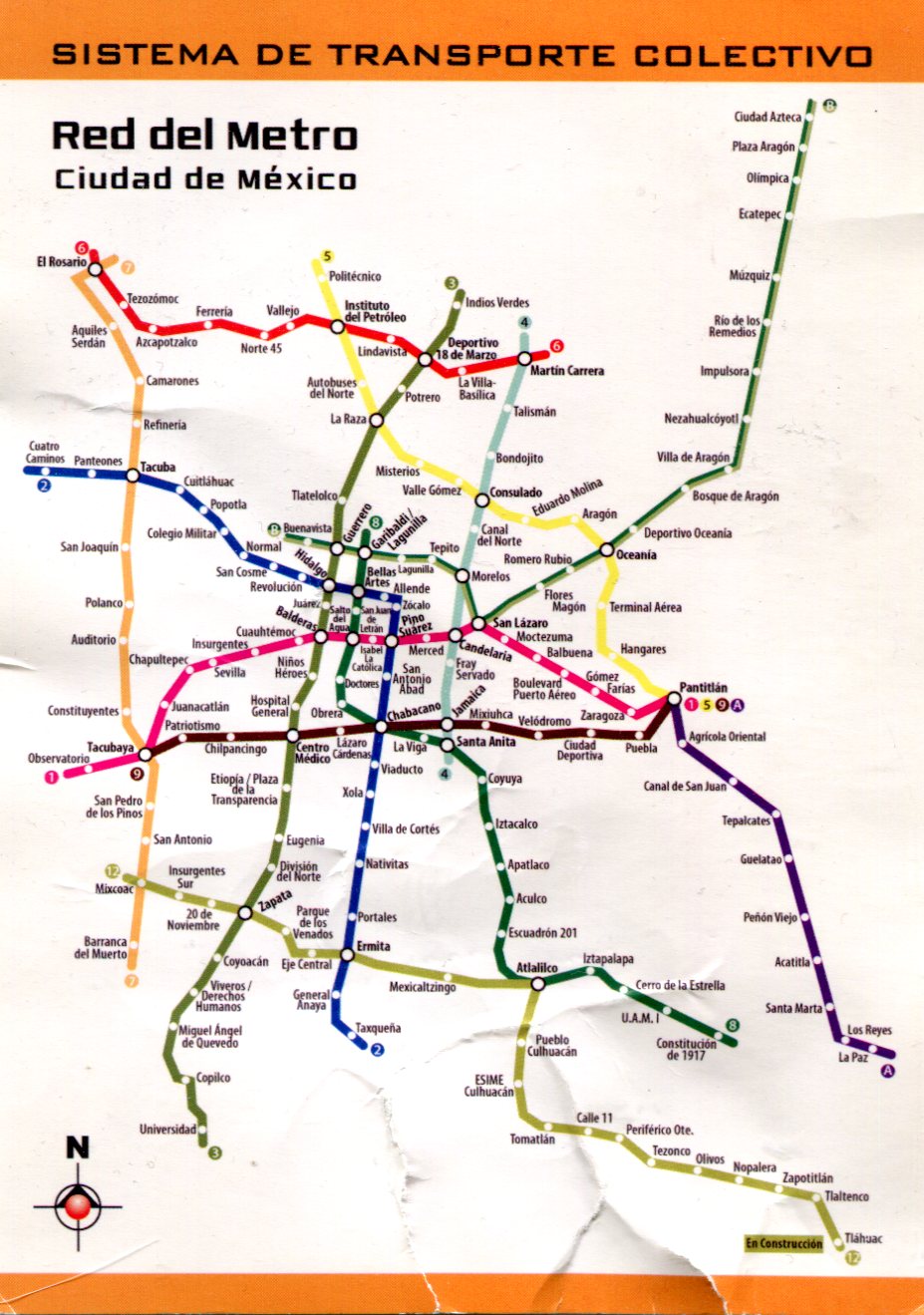
The Mexico City Metro, that is. If we didn’t walk someplace, we took the Metro. Note the crumpling of the card. I had it in my back pocket a lot.

Rush hour was as jammed as any other megalopolis’ subway, and occasionally we’d get the hairy eyeball from someone who presumably disapproved of tourists on the subway, but on the whole it was a good way to get around: quick, clean, and best of all, 5 pesos per ride. About 25 cents, that is. I know it’s because of subsidies. If you’re going to have a metro area of more than 20 million, best to have a large network of subsidized transit.

Wayfinding in the transfer stations was sometimes lacking. As were maps on the walls. Some stations had them, along with maps of the neighborhood, while some didn’t — such as the station closest to our hotel, Sevilla. That’s what made the postcard so useful.

Also of note: each station has a symbol. Sevilla’s, for instance, was a schematic of the old Chapultepec Aqueduct that runs nearby (and which we saw on foot). Construction of the Metro started in the 1960s, and the idea was to devise a system everyone could use, including people who couldn’t read, which was a higher proportion of the population in those days.

Who created the symbols? Remarkably, American graphic designer Lance Wyman, who is still active. Here at his web site are the some of the symbols for Line 1, which is colored pink, including the aqueduct. We rode that line most of all, and discovered that even if you can read, the symbols are quite useful for knowing where you are quickly.

Walking presented its own challenges. Namely, holes and other rough patches in the sidewalks. Some of the Mexico City sidewalk damage, I expect, is from routine neglect. In other places, the recent earthquake probably did some damage that hasn’t been repaired yet.

Still, you got used to watching for sidewalk hazards in pretty short order, and even got to know the bad spots on the streets you walked on frequently. The street we used from the hotel to the Roma neighborhood, where we ate some fine meals, was Calle Varsovia, which then changed to Calle Medellin, and it featured an especially dangerous urban crevasse. The spot had once had a set of steel plates, maybe covering a utility trench, but some of the plates were gone, others cracked. Step into that unknowingly and you’d break a leg.

In Chapultepec Park, we saw this kind of acrobatics.
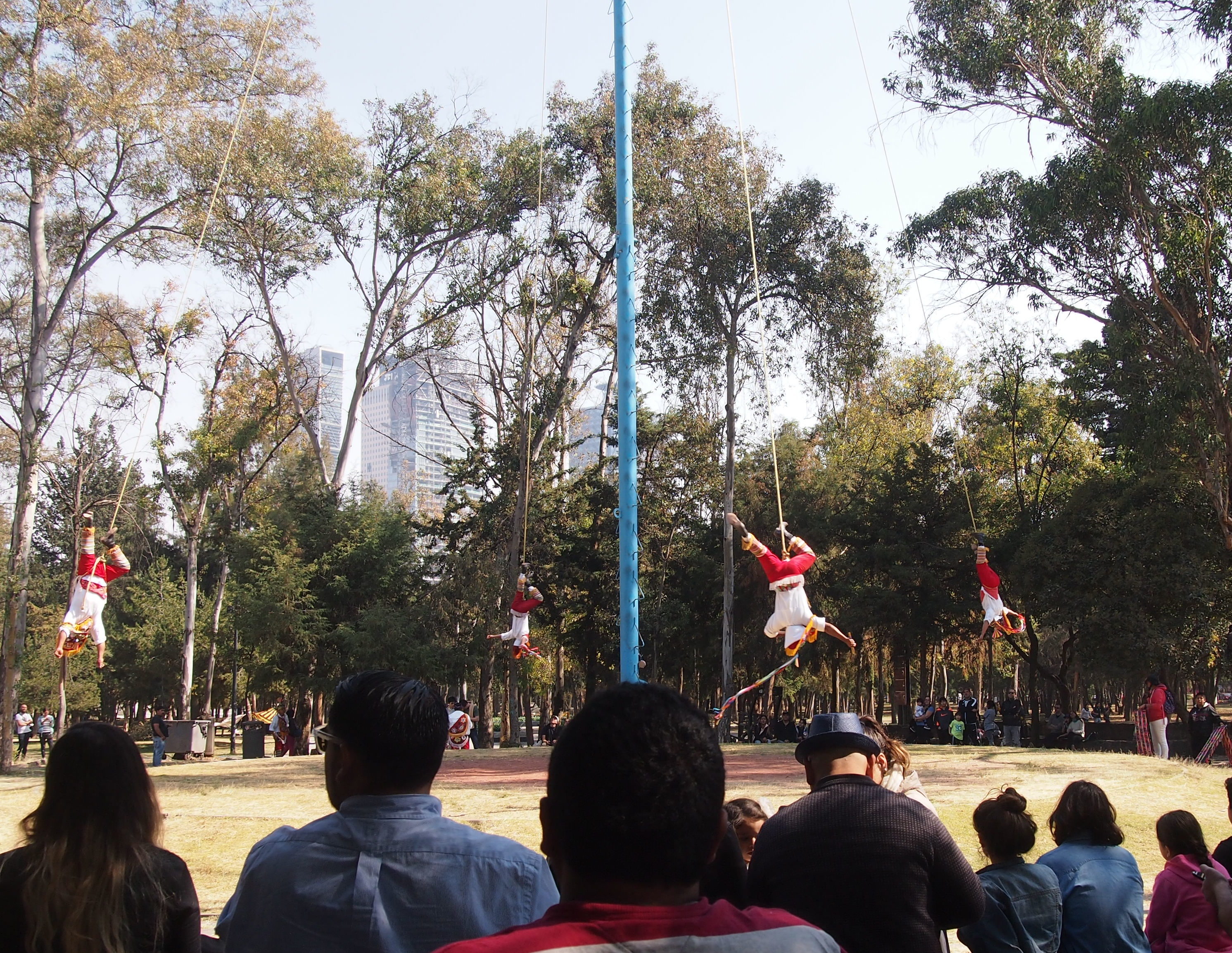
It’s called Danza de los Voladores, Dance of the Flyers. “The ritual consists of dance and the climbing of a 30-meter pole from which four of the five participants then launch themselves tied with ropes to descend to the ground,” says Wiki. “The fifth remains on top of the pole, dancing and playing a flute and drum.”

That’s exactly what we saw, with the four flyers slowly getting lower as they circled the pole. Tom said he’d seen it in other parts of Mexico.

My favorite meal of the trip was at a place called Los Almendros, a handsomely appointed restaurant just north of Chapultepec Park in the well-to-do Polanco neighborhood. Apparently there’s another location in Mexico City and one in Cancun and one in Merida. Fittingly, since it specializes in cuisine of the Yucatan.

We arrived at about 2 pm for lunch, and were a little early. Pretty soon the place filled up. That’s the timing of meals in Mexico: lunch after 2 and dinner after 8. We got into the groove of that without much trouble.

I had the pan de cazón: “a casserole dish in Mexican cuisine that is prepared in the style of lasagna using layered tortillas with shark meat such as dogfish shark, black beans or refried black beans and spiced tomato sauce,” explains Wiki, which are says it’s a specialty of Campeche.

Close enough to the Yucatan, I figure. It was tasty. It also inspired a discussion of the various times we’d eaten shark. For me, that goes back at least to a visit to Long Beach in 1982 when a friend and I acquired shark at a grocery store and cooked it up.

One should try things like Yucatani shark casserole on the road, I think. While in Mexico City, I had an ambition of trying fried grasshoppers, chapulines, and even found a recommended place; but it closed early on New Year’s Eve.

You’d think a place like Los Almendros would be expensive, and I suppose it is, locally, but a strong dollar helped us out: the check for three (no separate checks in Mexico, so Tom and I took turns paying) came to about 1,100 pesos, or about $57, including the meals, beer and tip. Put that restaurant in New York or Chicago or Los Angeles and it would have been three times that, at least.

A bit more expensive was Cafe de Tecuba, not far from the Palacio de Belles Artes, the sort of place that ends up in guidebooks. Indeed, I quote from Moon Mexico City, the book that I had with me: “Occupying two floors of a 17th-century mansion… the fun of eating here is enjoying the Old Mexico atmosphere in the dining room, with its tall wood-beamed ceiling, pretty frescos, and old oil paintings.”

For atmosphere, it was the most aesthetic place we ate. And the food was very good, just not quite as novel as we got other places. I had some enchiladas.

At the other end of the expense spectrum was McDonald’s. Try McDonald’s at least once in each country you visit, to see how it’s different. German McDonald’s have beer, for instance, and the wonderful McTeriyaki is available at Japanese McDonald’s. The only thing different about Australian McDonald’s was that the restaurant stressed to one and all that it served 100% Australian beef.

As for Mexican McDonald’s, it wasn’t so different from its norteamericano counterparts, except that Filet-O-Fish was missing, and the condiments counter had more varieties of local peppers.

One leisurely morning, after the busy day in Chapultepec Park, we ate at Jaxson’s Chicken & Waffles, a smallish joint in the Roma neighborhood that would not have been out of place in Brooklyn, including the bearded hipsters at other tables. More importantly, the place served up a whopping good breakfast — the kind of large breakfast you eat at 10 or 11 to get you through a day of tourism. Each of us had the special: chicken, waffles, hash browns, bacon and a pancake in there somewhere.

Not far away in Roma, on Fuente de la Cibeles square, is Cancino Cibeles. We ate pizza there al fresco, and while the evenings are a bit chilly in Mexico City in December, the restaurant had heaters on poles near the sidewalk tables, the kind that radiate heat downward (Tom didn’t want to sit too close to it, asserting that it would be too hot for his bald head).

To make things as interesting as possible for a setting like that, we picked the Gorgonzola and pear pizza for the main course, a thin-crust wonder of the pizza arts, and a bottle of wine. I don’t remember the name of the wine. But it was red and Portuguese and had a dignified label.

I’m sure people order a bottle of wine for three people all the time, but it was a rare thing for me. The kind of thing the characters in The Sun Also Rises would do, except that they would drink half a dozen bottles and then go somewhere else and drink absinthe. And then do knife tricks.

Palacio de Belles Artes & “El hombre controlador del universo”

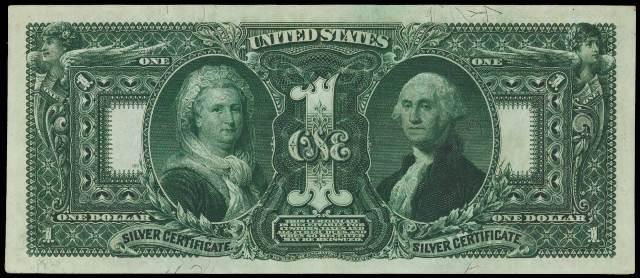
The 500-peso Mexican banknote now in circulation is the largest one I handled during my time in Mexico City, worth about US$26. On one side is Diego Rivera. On the other is Frida Kahlo. Husband and wife on paper money is unusual, but not absolutely unheard of: George and Martha Washington appeared on an 1896 U.S. $1 silver certificate.

I had Rivera in mind on our last full day in Mexico City, which also happened to be New Year’s Eve, and a Sunday. I wasn’t sure places like the Palacio de Belles Artes or the Palacio National, where Rivera murals are on display, would be open. Not only were they open, there was no charge to get in, though I believe that’s always true at the Palacio National.

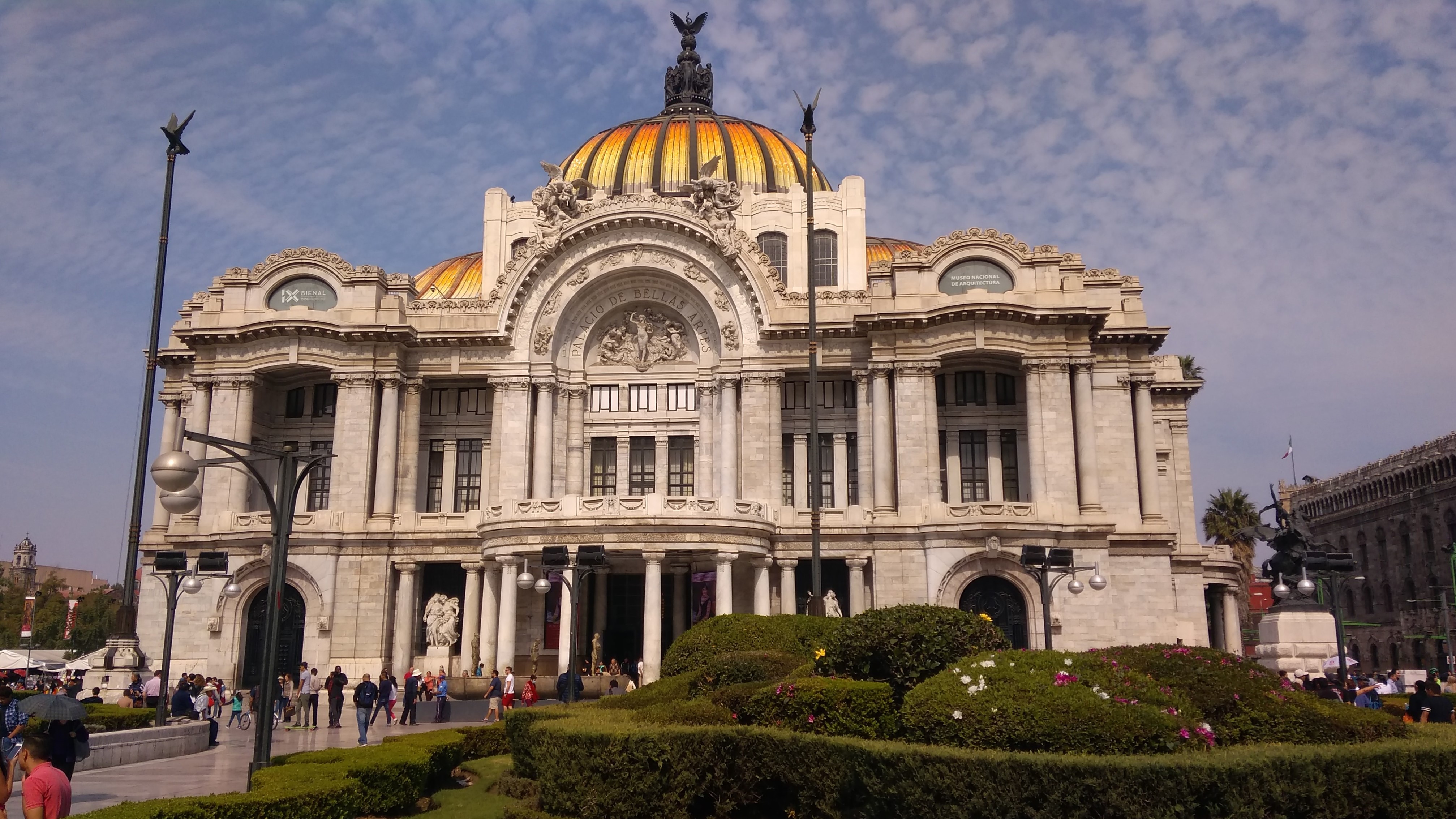
We arrived at the Palacio de Belles Artes just before noon. It looks like an art palace built before WWI, and it is, partly. Porfirio Diaz commissioned it, and work started in 1904. Enough of the exterior was finished by 1913 to give it Neoclassicial and Art Nouveau aspects. Adamo Boari, an Italian architect active in Mexico, did the exterior.

Worked then stopped because of the Mexican Revolution and wasn’t picked up again until 1932. By that time, any art palace worth its salt was going to be art deco. Mexican architect Federico E. Mariscal designed the interior, and it’s an tremendous bit of art deco.

As fine as that was, though, I’d come to see the murals, and I wasn’t disappointed. To quote from Lonely Planet Mexico, which organized the information well:

“On the 2nd floor are two early 1950s works by Rufino Tamayo: ‘México de hoy (Mexico Today)’ and ‘Nacimiento de la nacionalidad (Birth of Nationality)’, a symbolic depiction of the creation of the mestizo (mixed ancestry) identity.

“On the north side of the 3rd floor are David Alfaro Siqueiros’ three-part ‘La nueva democracia (New Democracy)’ and Rivera’s four-part ‘Carnaval de la vida mexicana (Carnival of Mexican Life).’ To the east is José Clemente Orozco’s ‘La katharsis (Catharsis),’ depicting the conflict between humankind’s ‘social’ and ‘natural’ aspects.”

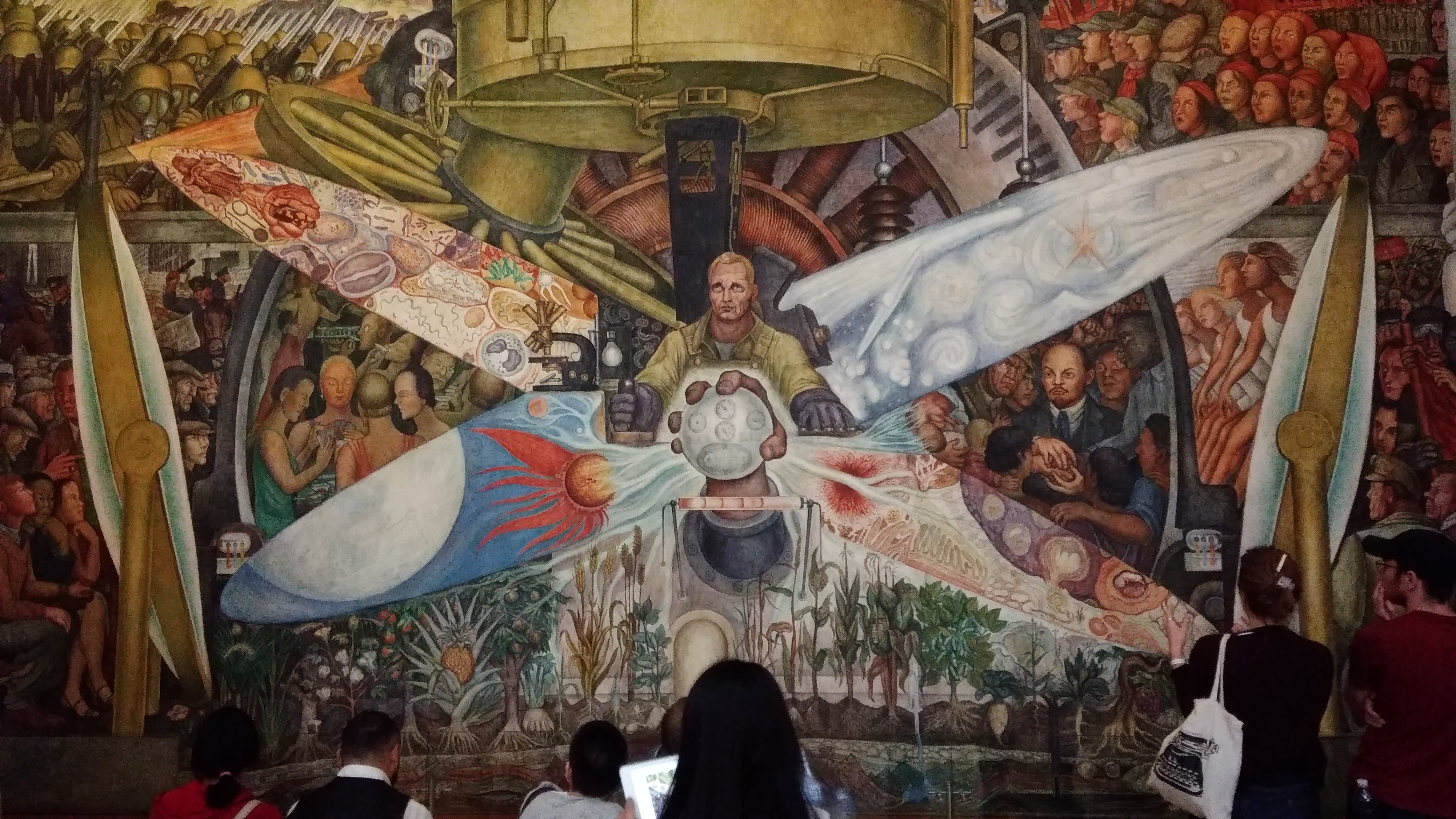
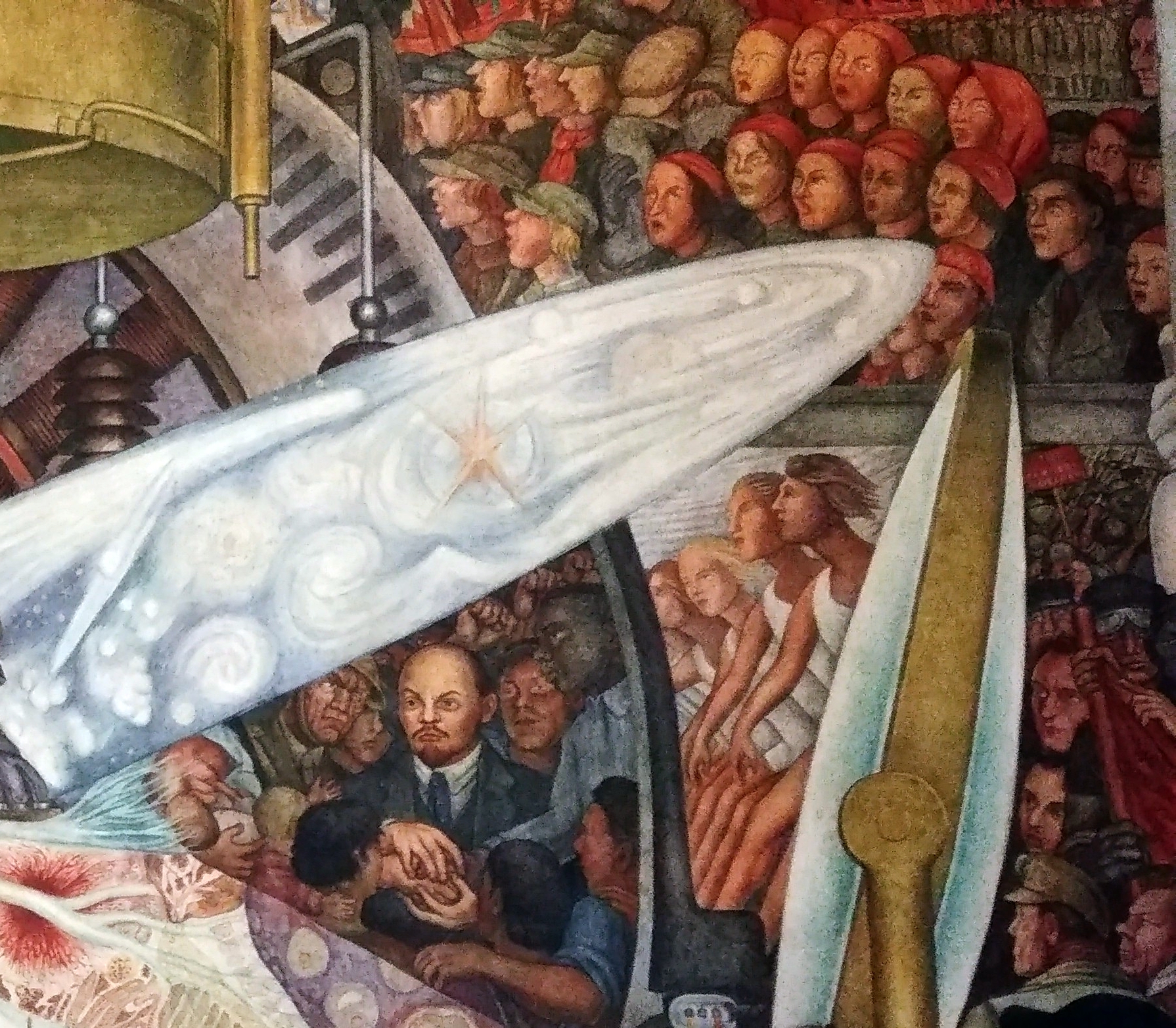
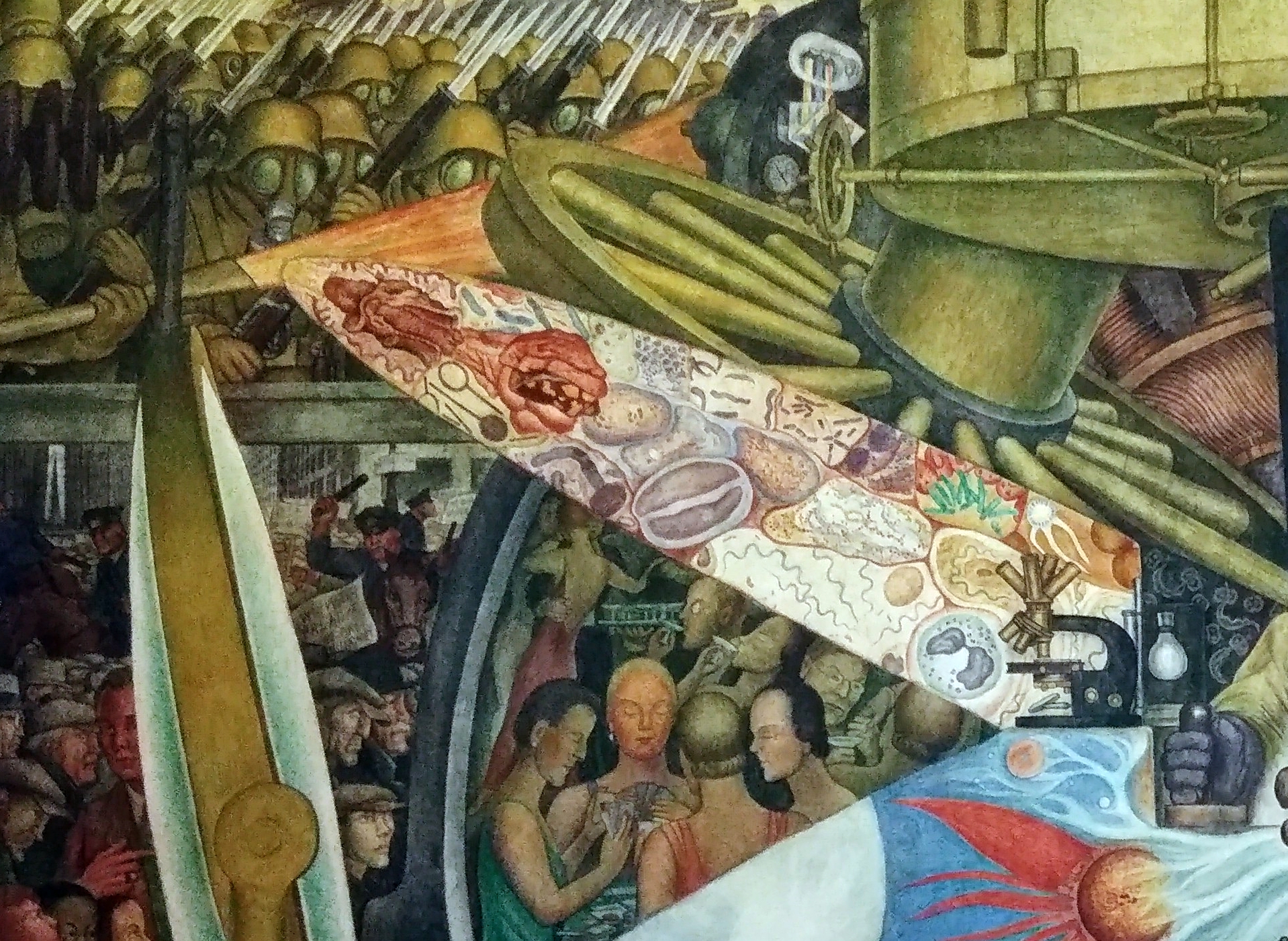
All interesting and sometimes unsettling works. But what I’d really come to see was Rivera’s re-creation of his Rockefeller Center mural. If it were anything like his murals in the Detroit Institute of Arts, I knew it would be astonishing.

“At the west end of the 3rd floor is Diego Rivera’s famous ‘El hombre en el cruce de caminos (Man at the Crossroads),’ originally commissioned for New York’s Rockefeller Center,” continues LP. “The Rockefellers had the original destroyed because of its anti-capitalist themes, but Rivera re-created it here in 1934.”

Indeed he did, though I’ve also heard it called “El hombre controlador del universo (Man, Controller of the Universe).”
Quite a work. We spent a while looking at it. The polemics aren’t subtle. Lenin is famously depicted, but so are organized workers, or maybe just determined masses.

Capitalism has brute force and decadence on its side.

Why, I wondered, were the capitalist allegories to the left and the socialist ones to the right? Then in occurred to me that they are on their own respective right and left.

In between is Man controlling Science — so presumably capitalism and socialism are at odds over capturing the power of Science toward their own ends.

If you asked me, the man has vacant eyes, as if he’s a scientist pretty much ready to serve whomever prevails, capitalism or socialism.