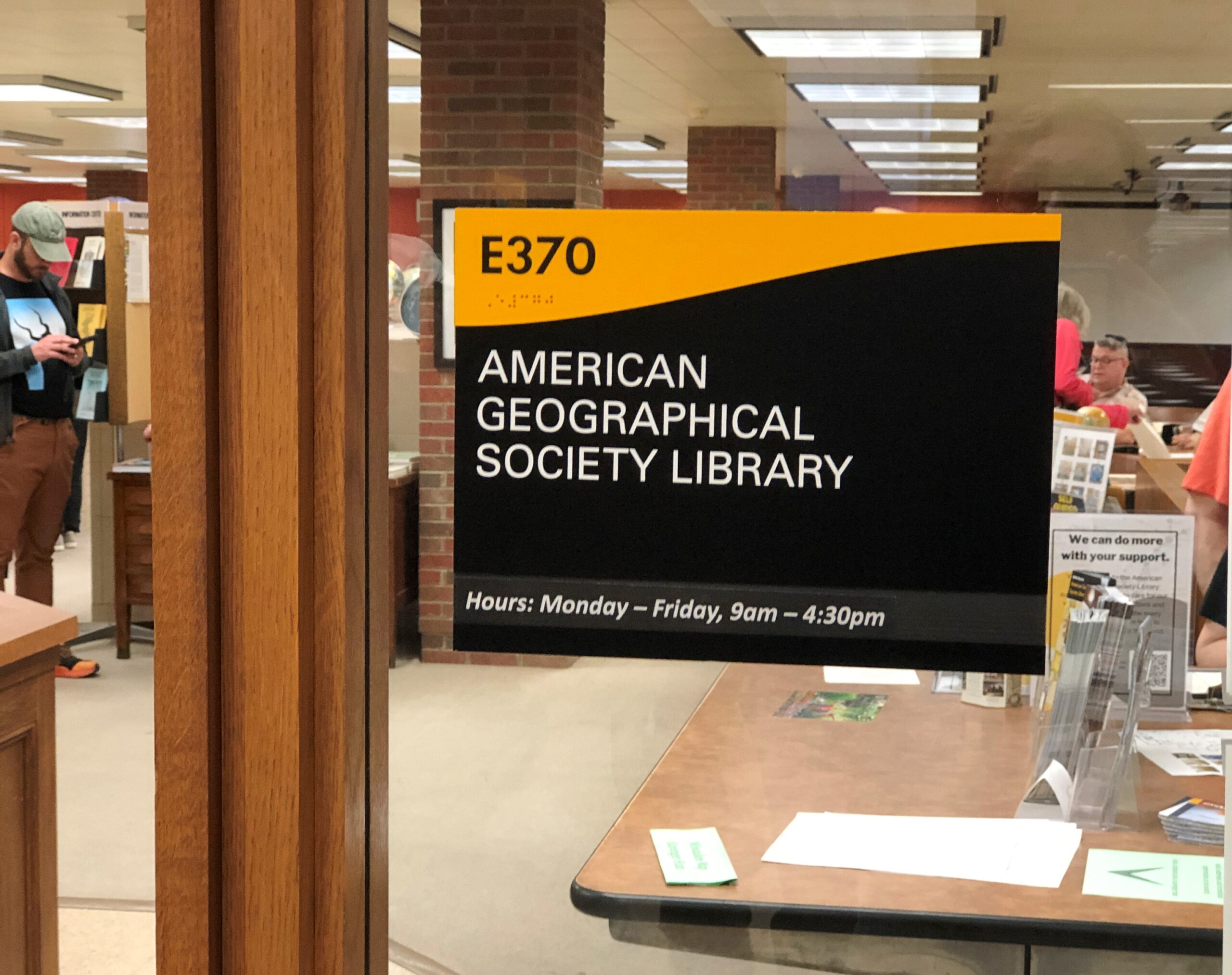
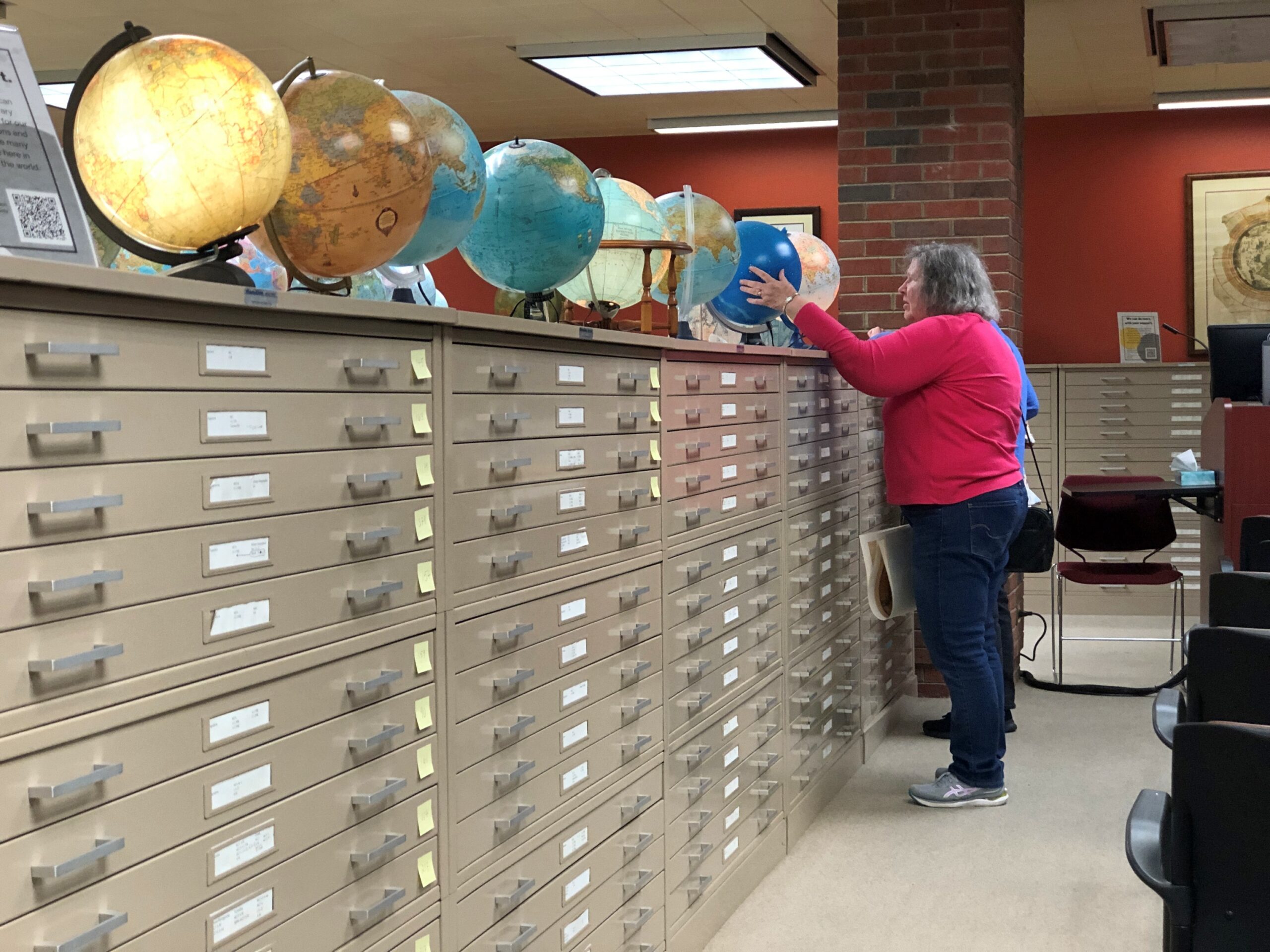
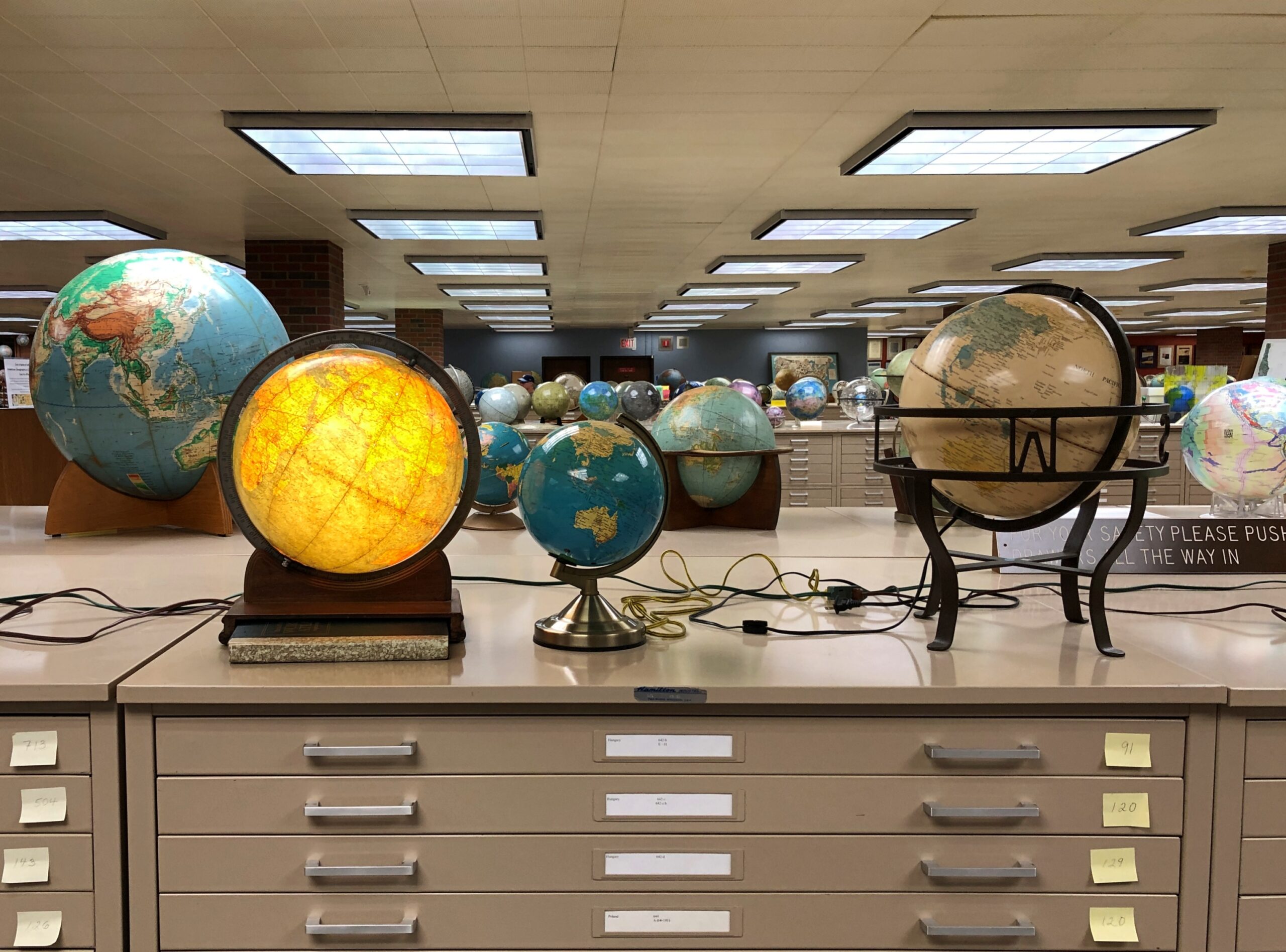
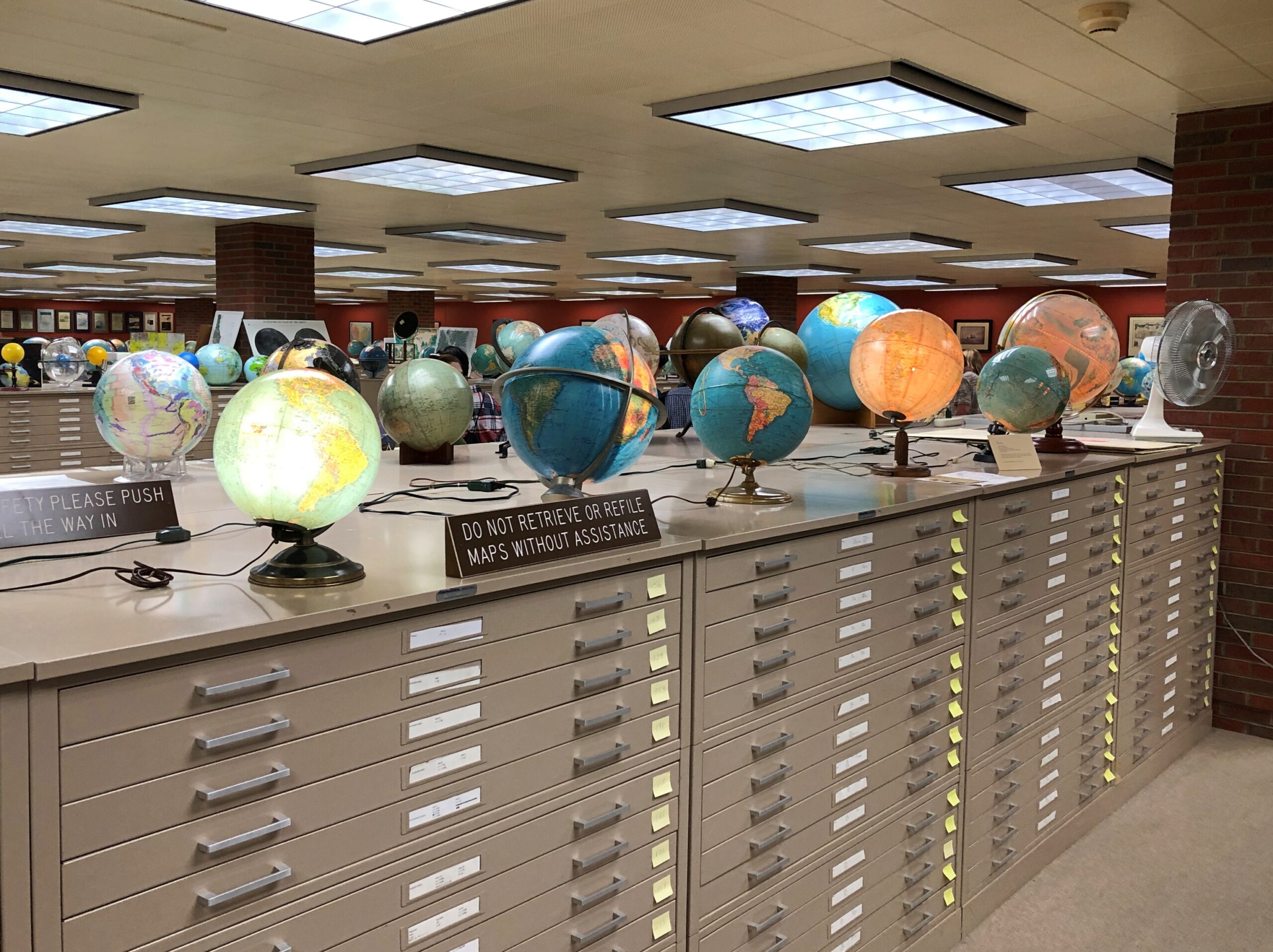
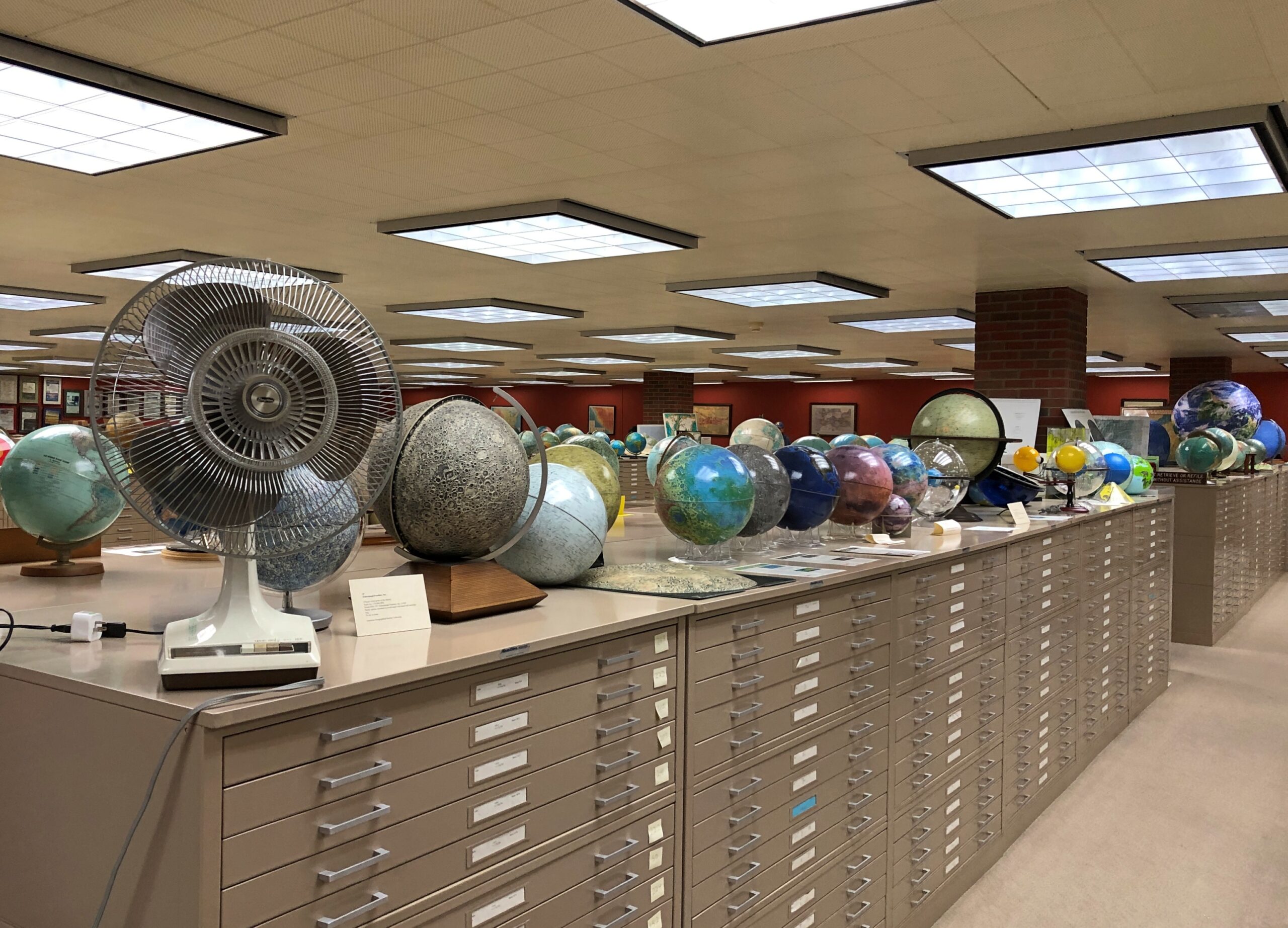
I’m glad to report that more people seemed to be visiting the American Geographical Society Library this year (Saturday before last) than during our previous visits, in 2018 and 2023, when it was also open for the Doors Open Milwaukee event. The library is in the Golda Meir Library of the University of Wisconsin-Milwaukee.
I didn’t take too many pictures of other visitors, but here is one.
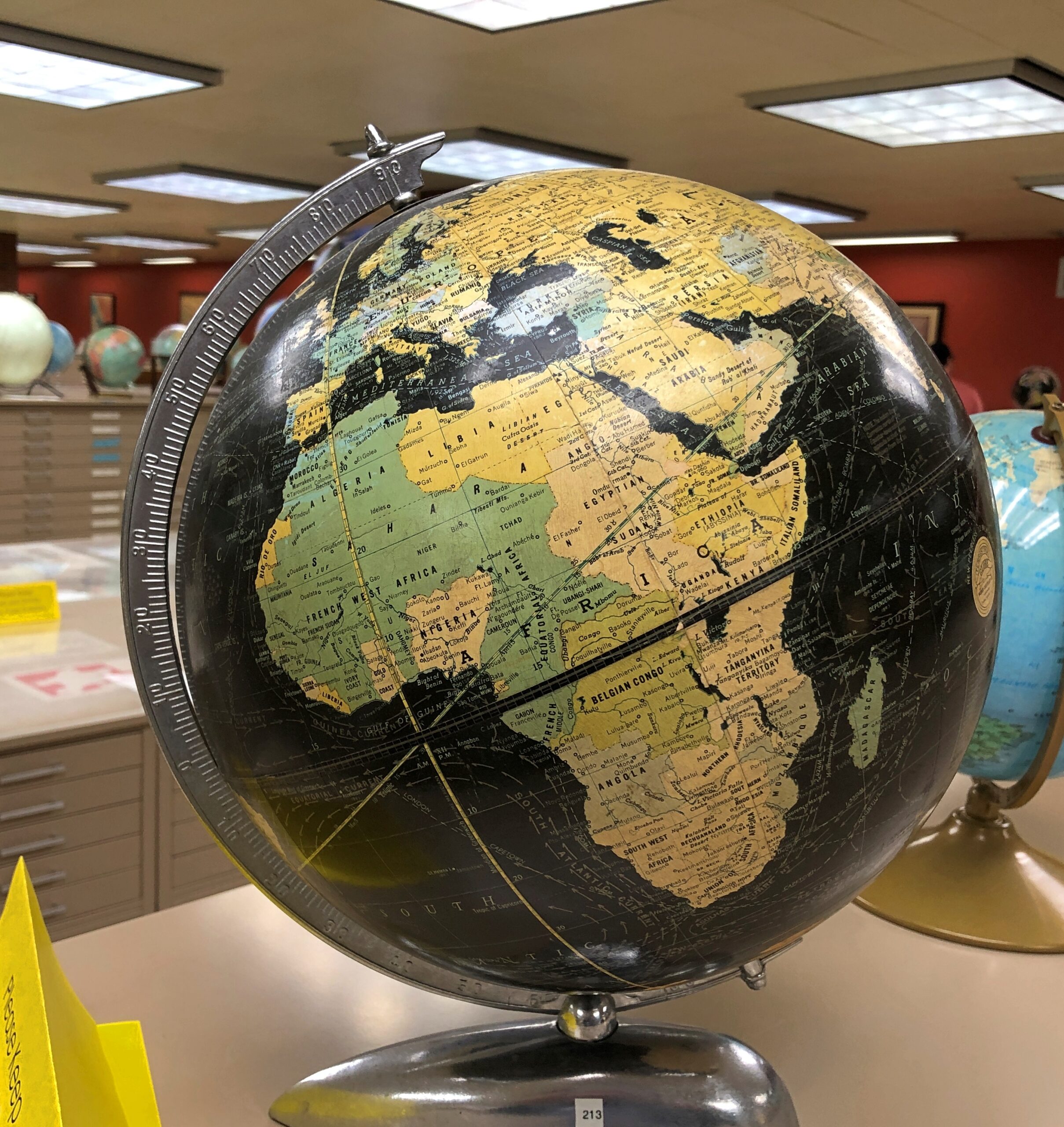
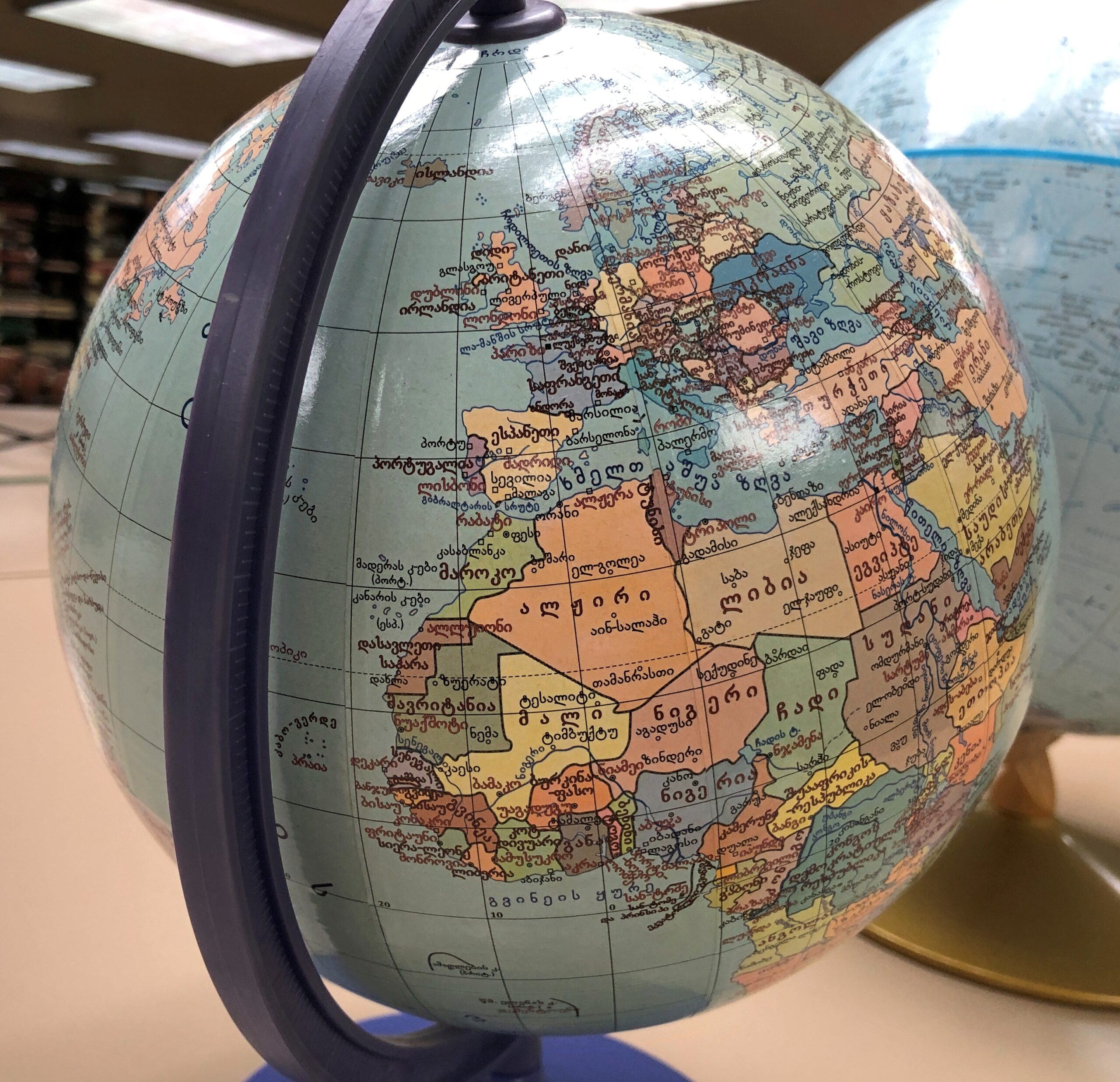
Mostly, I took pics of globes.
Globes, globes, globes.
The other day I discovered a place in Salt Lake City called Dolcetti Gelato that seems to include a lot of globes in its décor. This is a design we can all applaud. Hope the gelato is good. Even coming close to Florentine gelato would be a pretty tall order, though.
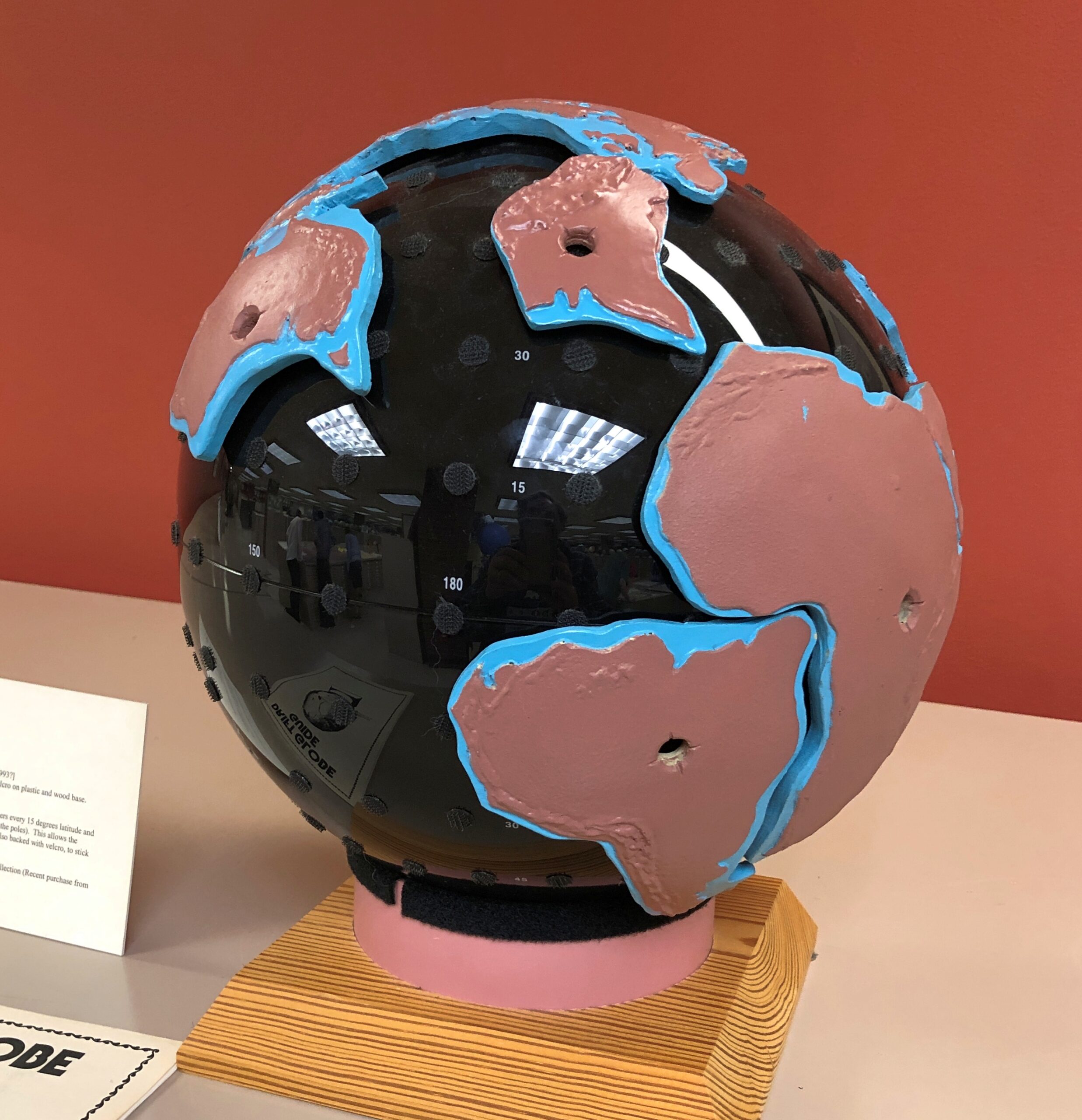
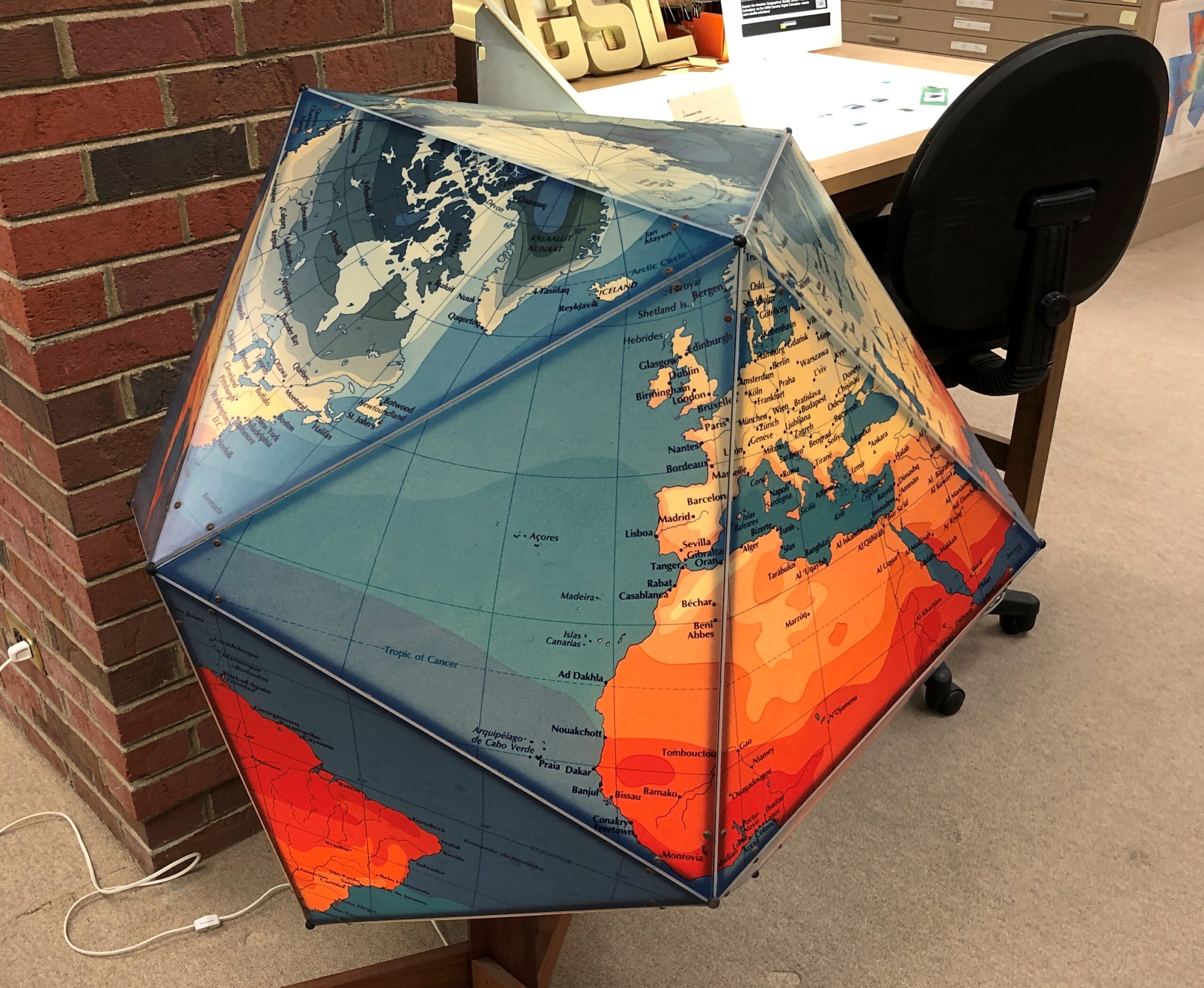
An oddity among the globes.
A nearby sign tells us:
Dymaxion map globe structure. This globe was one of 100 produced by Levi Strauss & Co. as a promotional artifact. Inscription on the globe: This is a Dymaxion globe designed by Buckminster Fuller, best known as the inventor of the geodesic dome. The word Dymaxion and the Fuller projection Dymaxion map design are trademarks of the Buckminster Fuller Institute, 2040 Alameda Padre Sierra, Suite 224, Santa Barbara, California 93103. Copyright 1938, 1967 and 1992. All rights reserved.
By golly, it occurs to me that I’ve accidentally done more Bucky tourism than most people, probably, including a walk by the geodesic dome house in Carbondale, Illinois, and a look at the only existing Dymaxion vehicle, which happens to be in Reno, Nevada. I live a charmed life, clearly. But dang, I missed his grave this year at Mount Auburn Cemetery in Massachusetts.
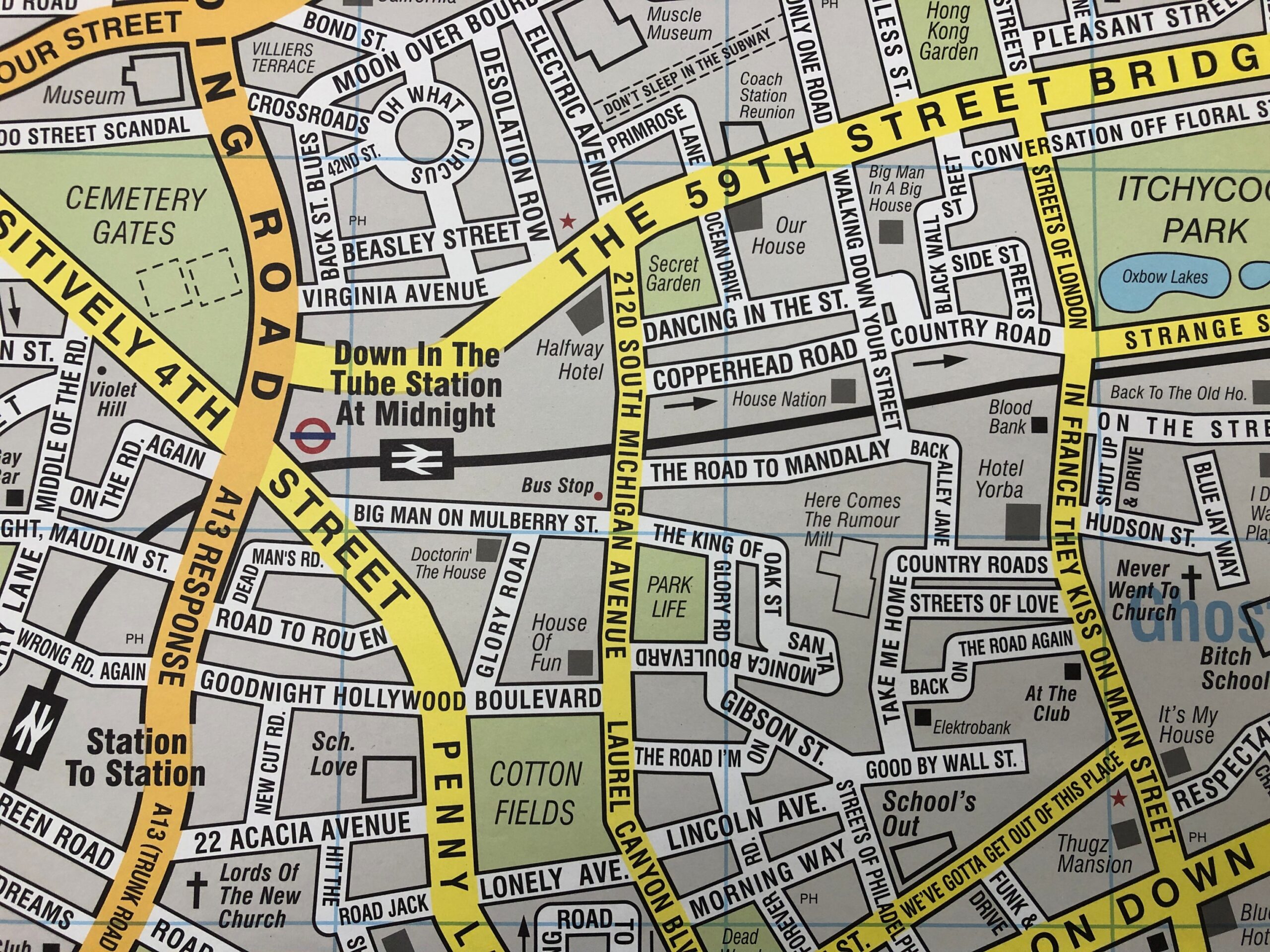
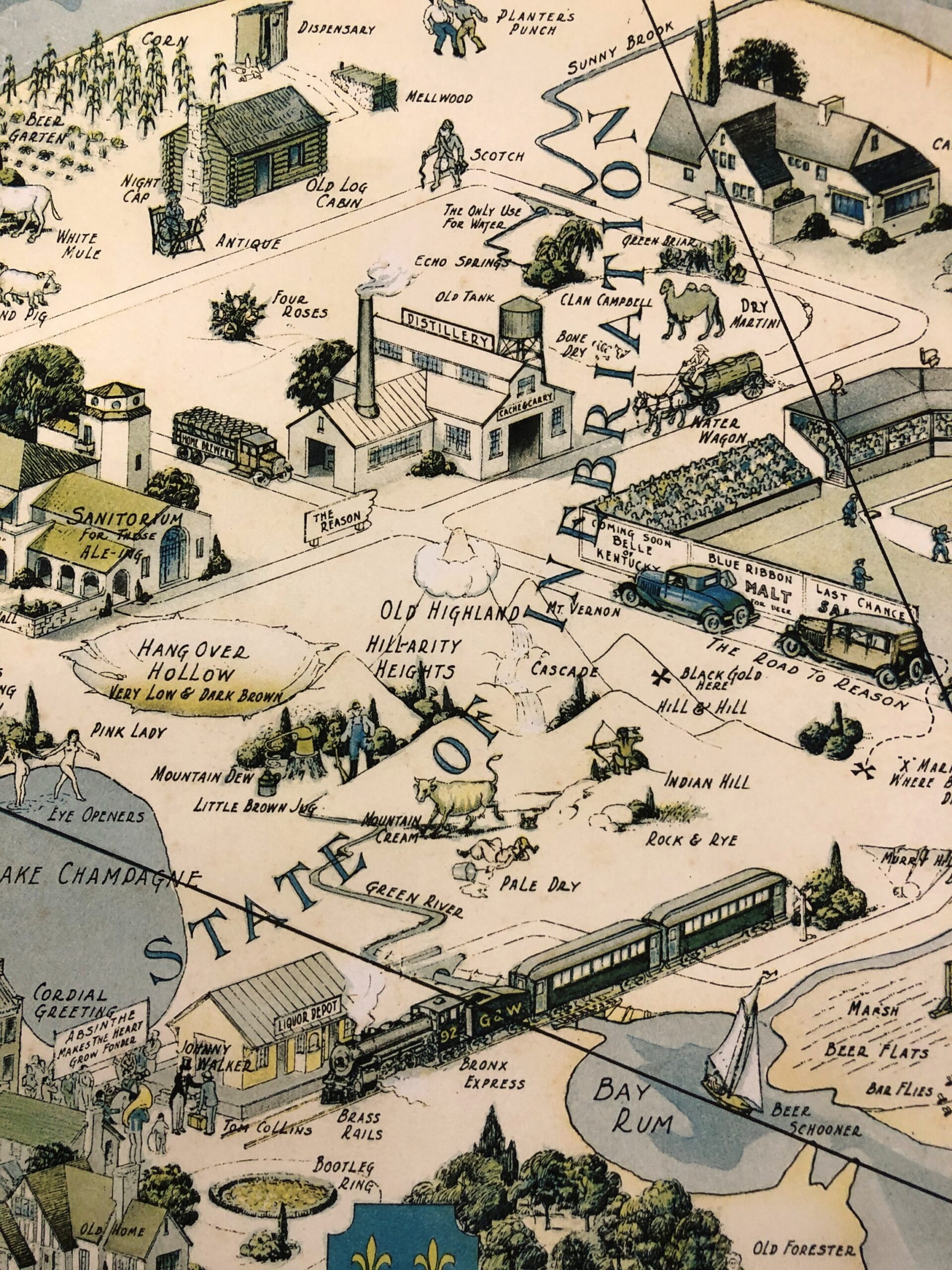
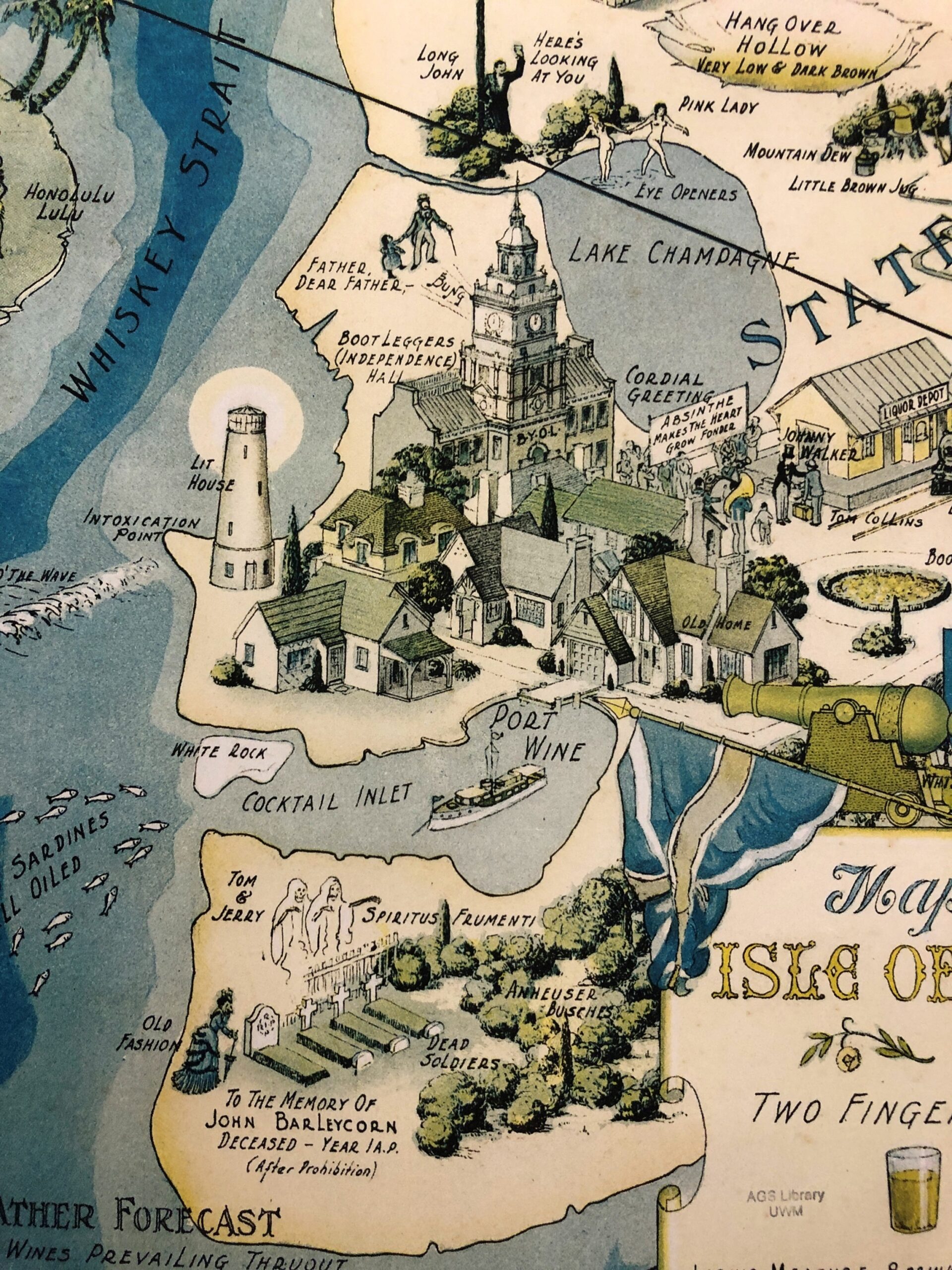
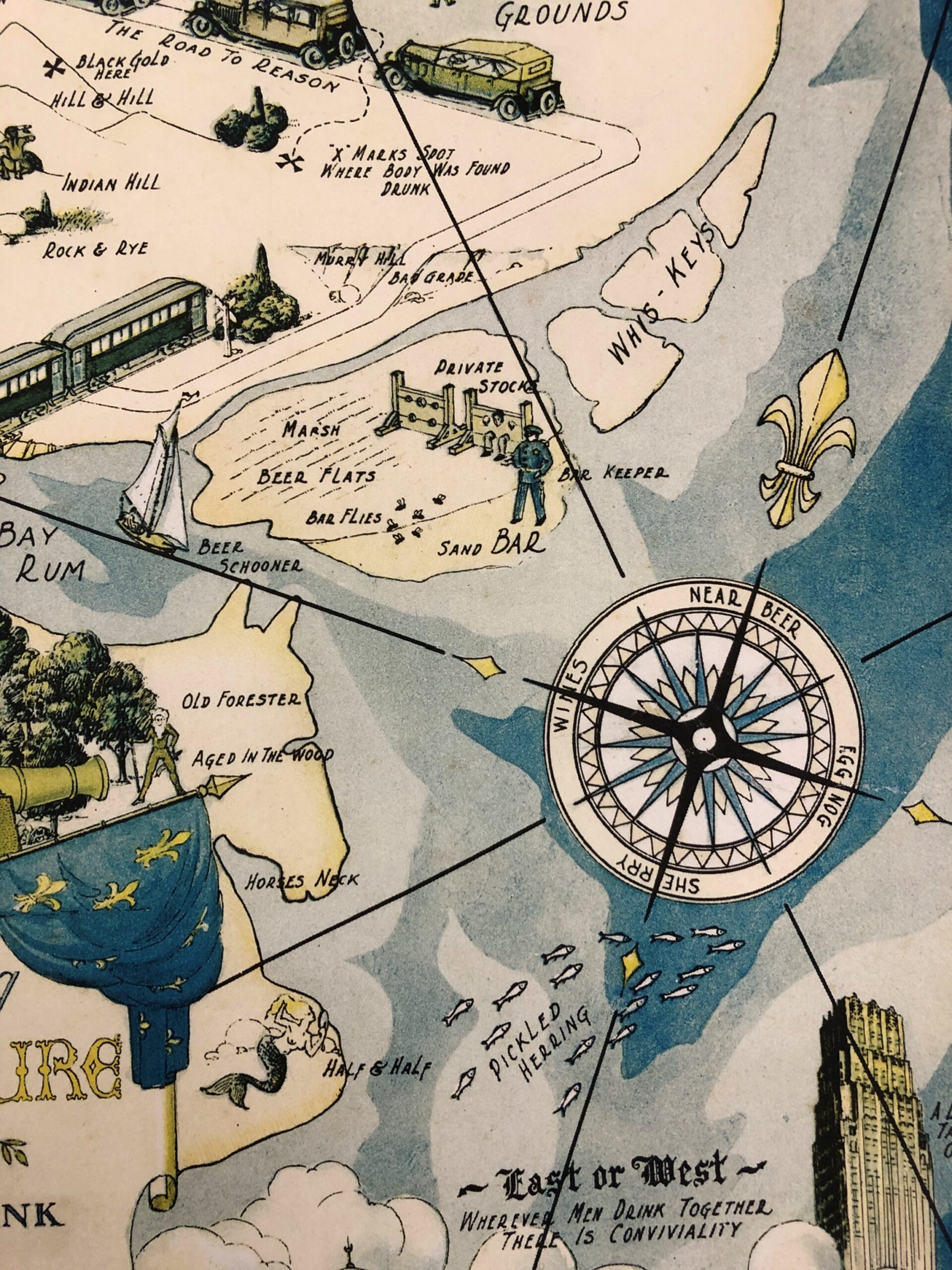
I expect the library has a lot more maps than globes – they take up less space – and a fair number were on display for the event. Including some non-geographic maps, such as one using song titles for place names. A detail.
Details from a map called Isle of Pleasure, all of whose place names relate to alcohol. A late Prohibition-era publication. The main entity is called State of Inebriation.
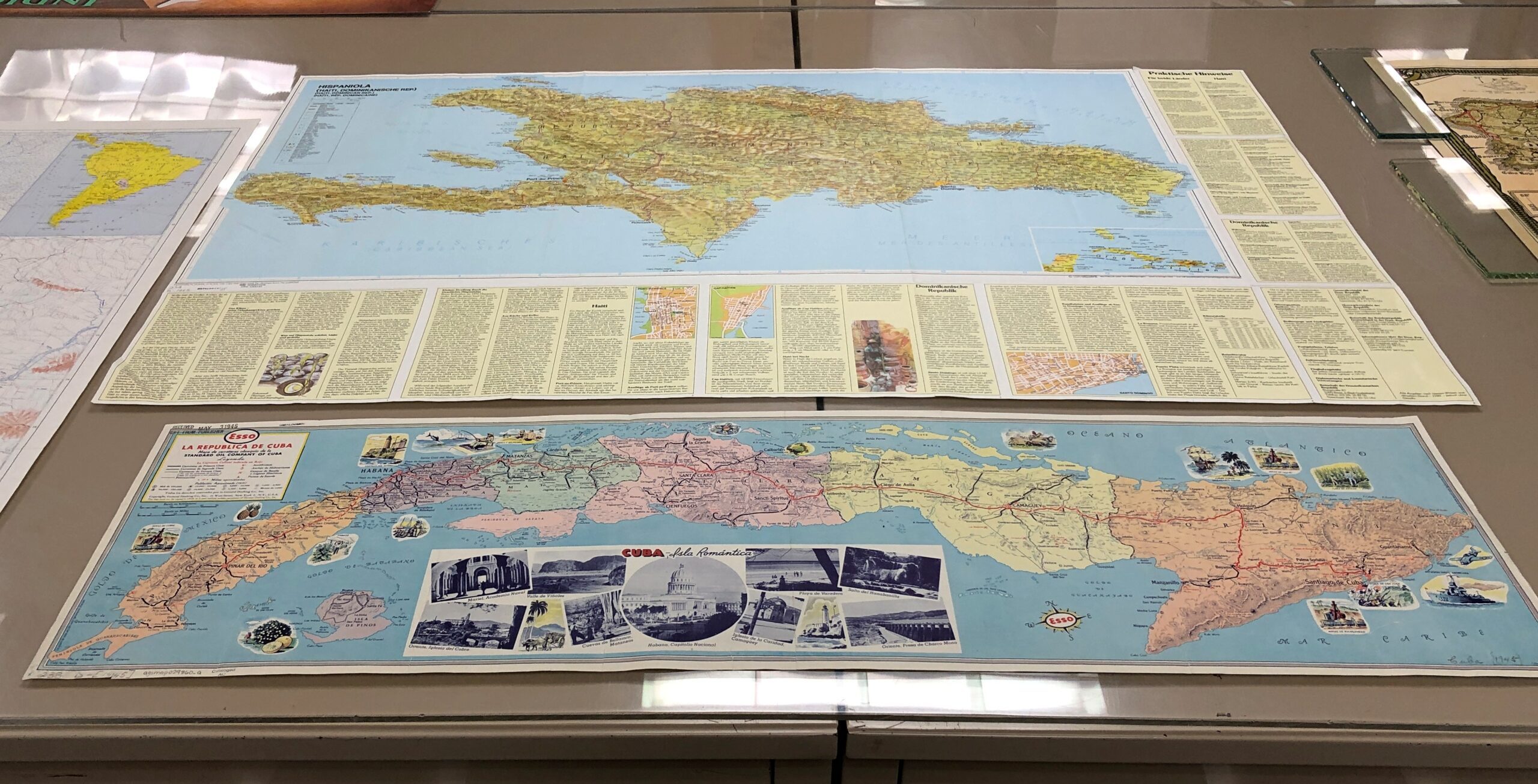
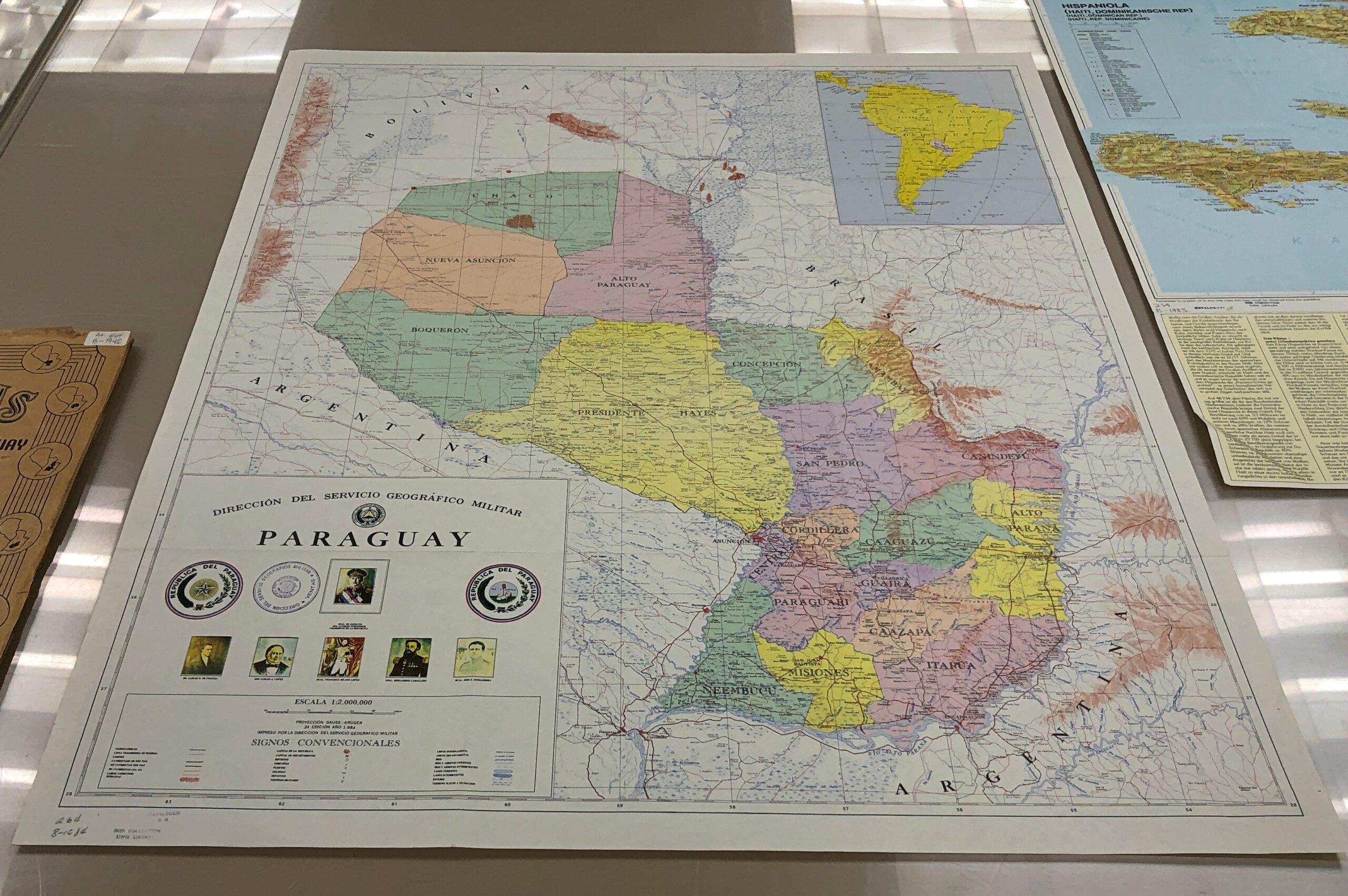
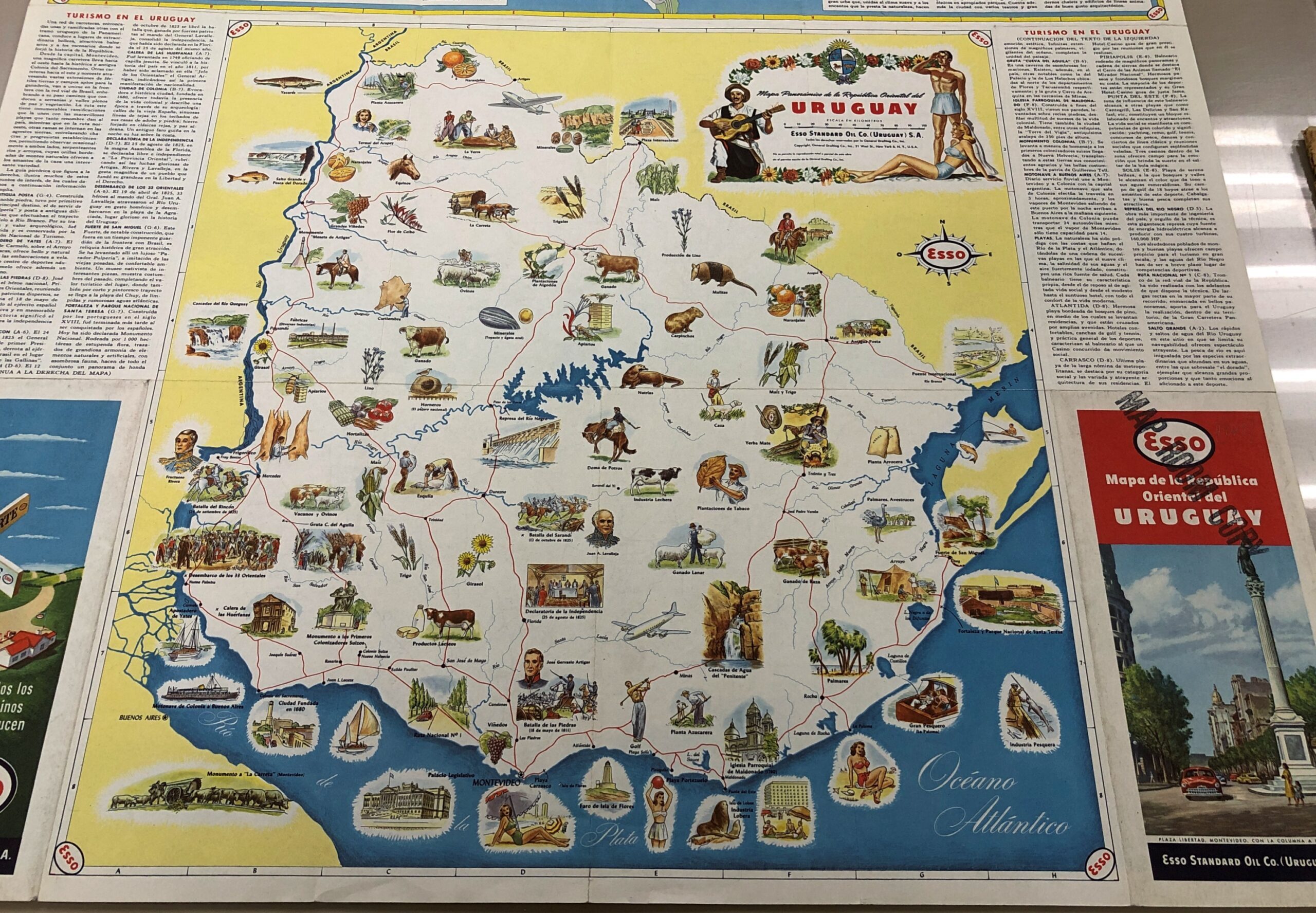
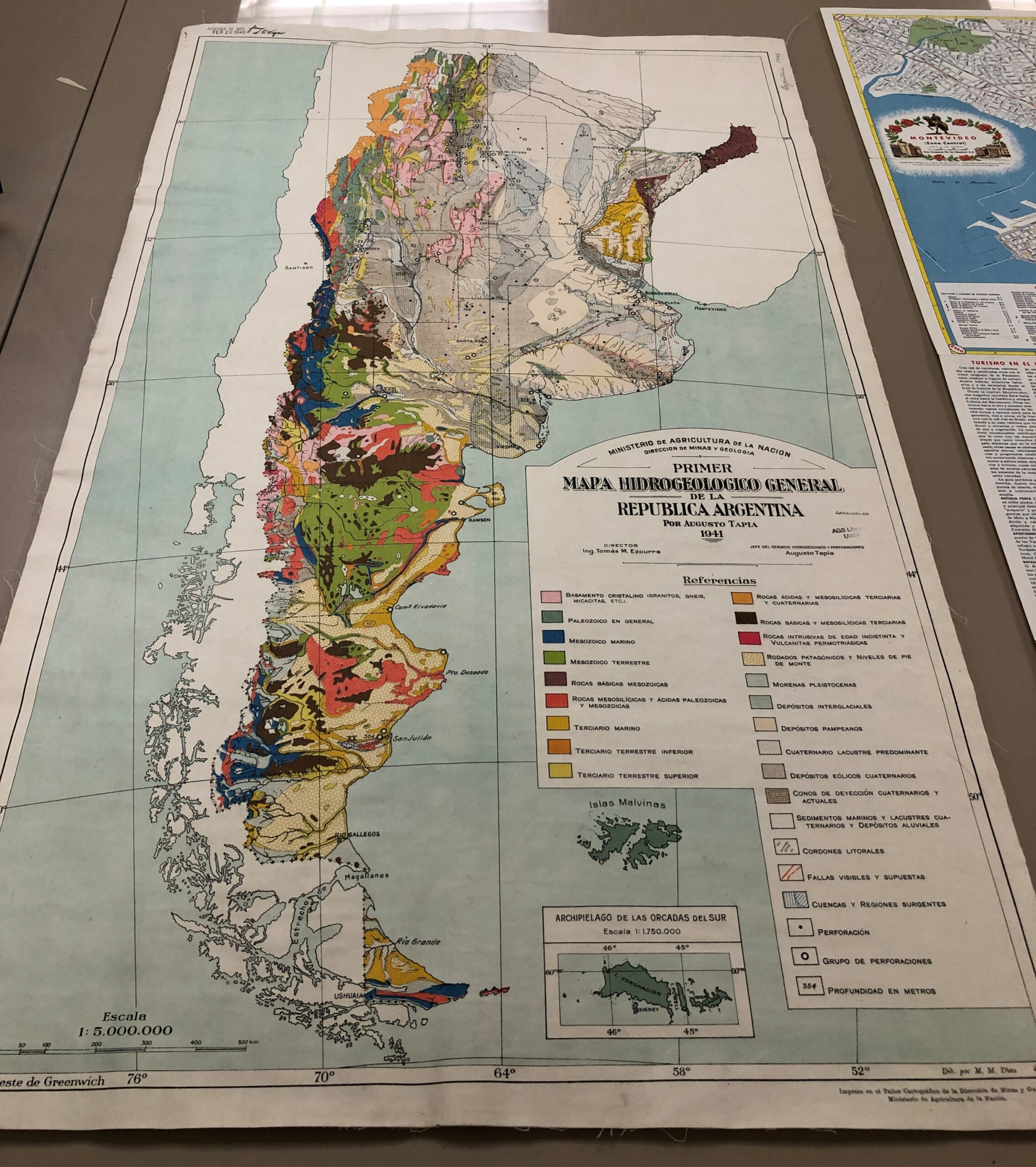
An entire table was given over to Latin America.
This kind of thing gets me all itchy. I checked, and for an investment of $1,200 or so (round trip) and at least 14 hours each way, one can buzz down to Buenos Aires from Chicago. Alas, not today. And yet – the establishing shots for the series Envidiosa on Netflix, which I have been unaccountably watching for a while now (once a month or so) — are quite the advertisement for the Argentine capital.
When I was busy doing one thing and another today, I got distracted by a short video that depicted a state-border-lines-only blank U.S. map, a short stock clip on a site I use sometimes. As the video played, the states were filled in, in various colors, as you see on maps. They were filling in by tiers nationwide, northern tiers down to southern tiers. Roughly. Very roughly.
So I wanted to create my own animation of the states filling in. That’s a novel reaction for me, supported by AI tech that just might be up to the task. Or is it? Jury’s still out on that, but only because the jury is lazy. Anyway, I would have the states color up in order of their accession to the union (and the Dakotas can both change at the same moment), or ratification of the Constitution in the earliest cases.
I’m also too lazy (at the moment) to check for such videos that already exist. I don’t need to check, I’m sure they are out there. I don’t want to see another one, I want to create one.
More than that, I want a twist: east should be up on the map. So the parade of state accessions would fill (very roughly) top to bottom, though of course there are certain exceptions to that, such as the West Coast states. Still, the growth of the U.S. would trend downward as the eye registers it. Why not? Think of it the original orientation, or maybe the Jerusalem tilt.
I imagined that at least drawing such a simple map wouldn’t vex the young, energetic AI programs loose in the world now. Why, I could do that with a simple natural language prompt. Or at least that’s what I thought.
Prompt:
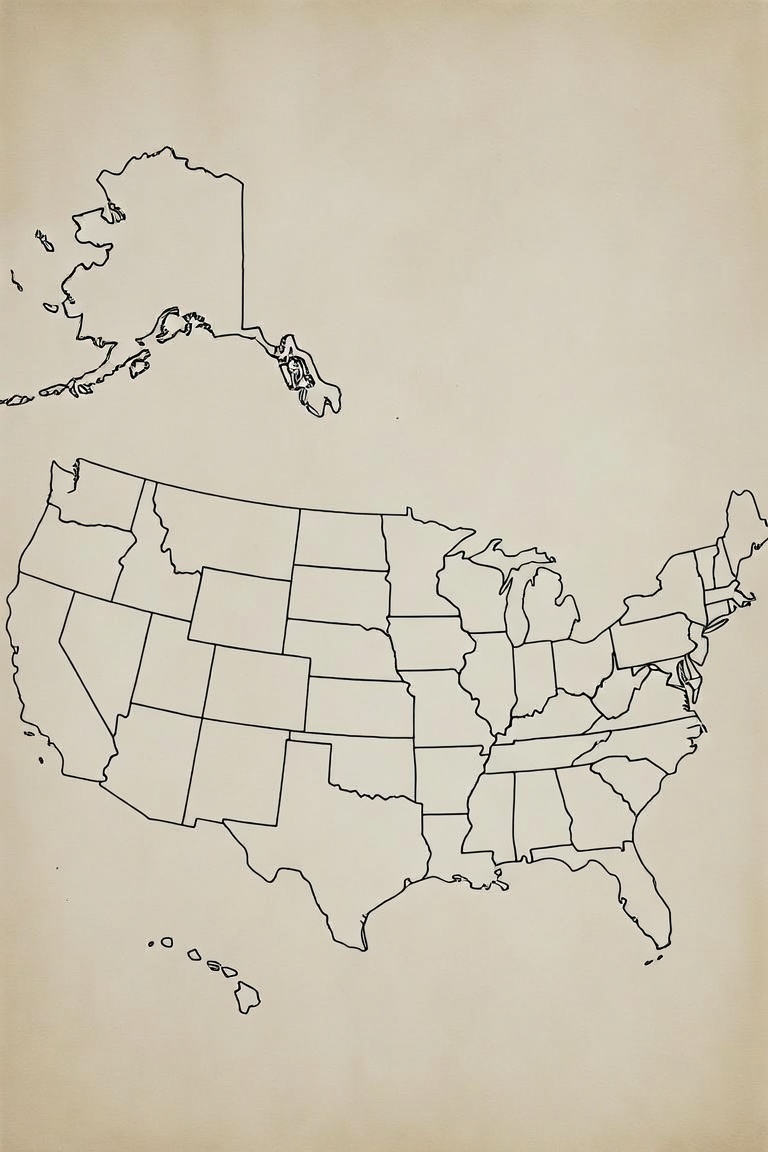
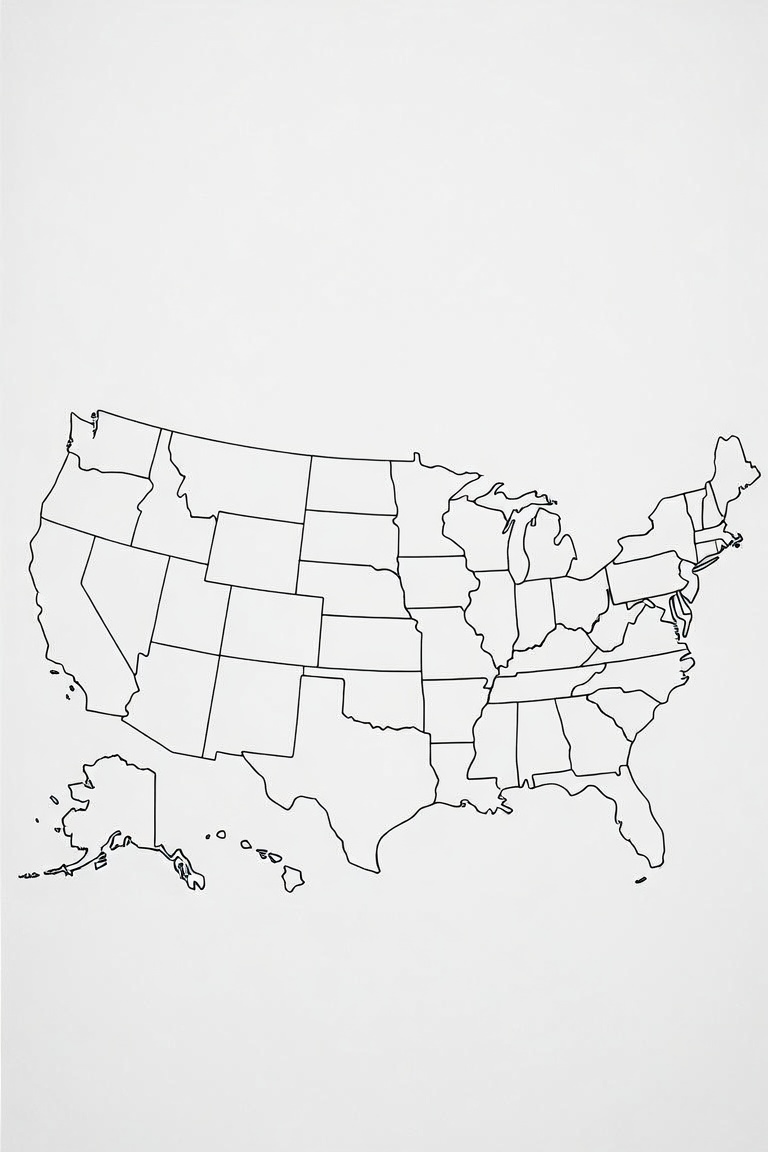
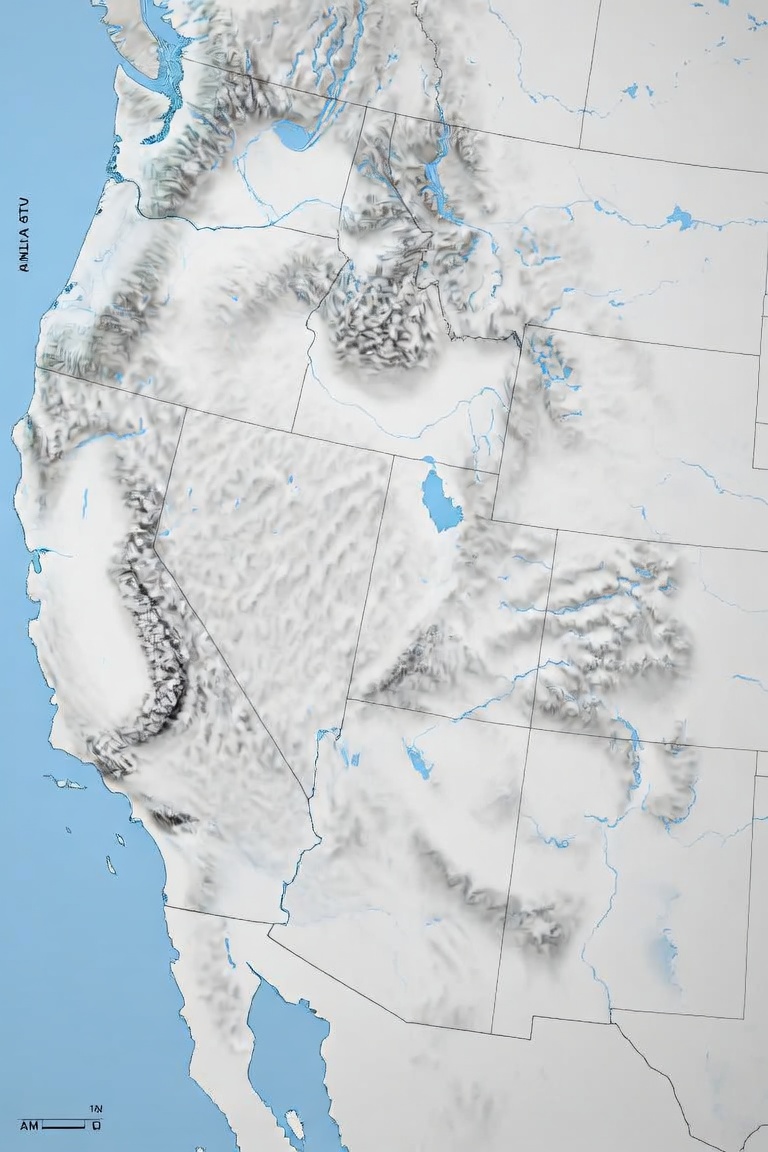
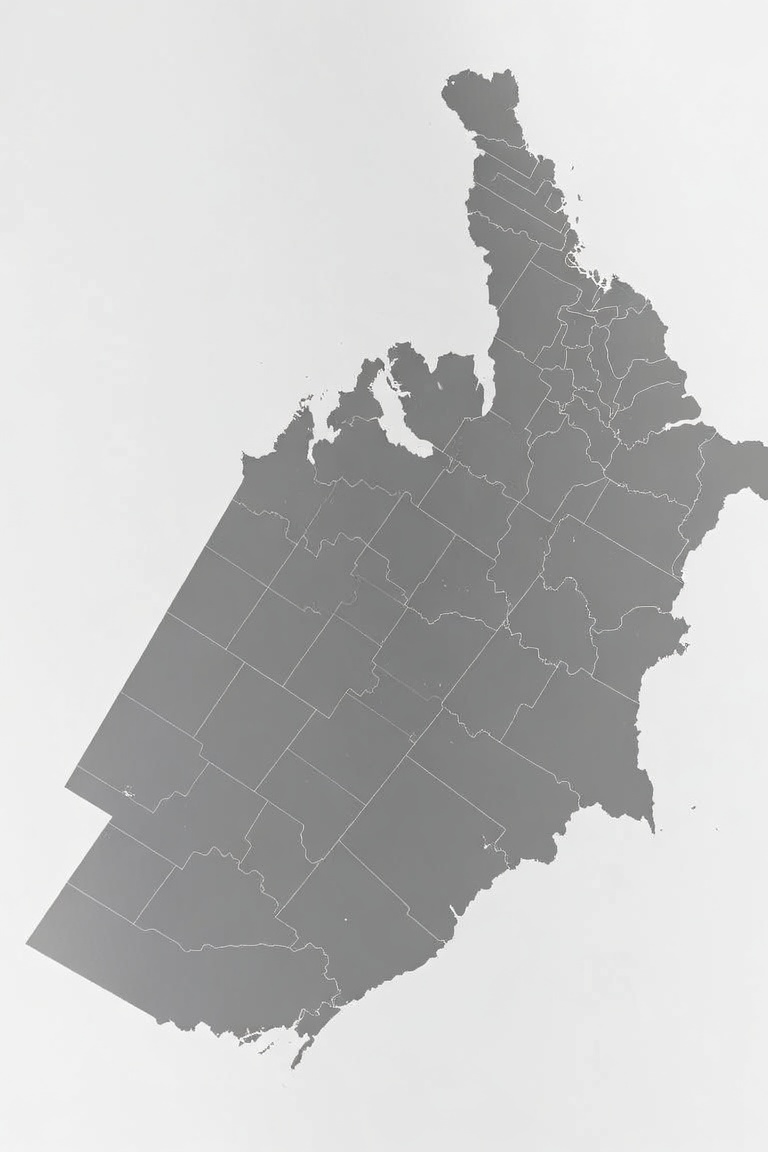
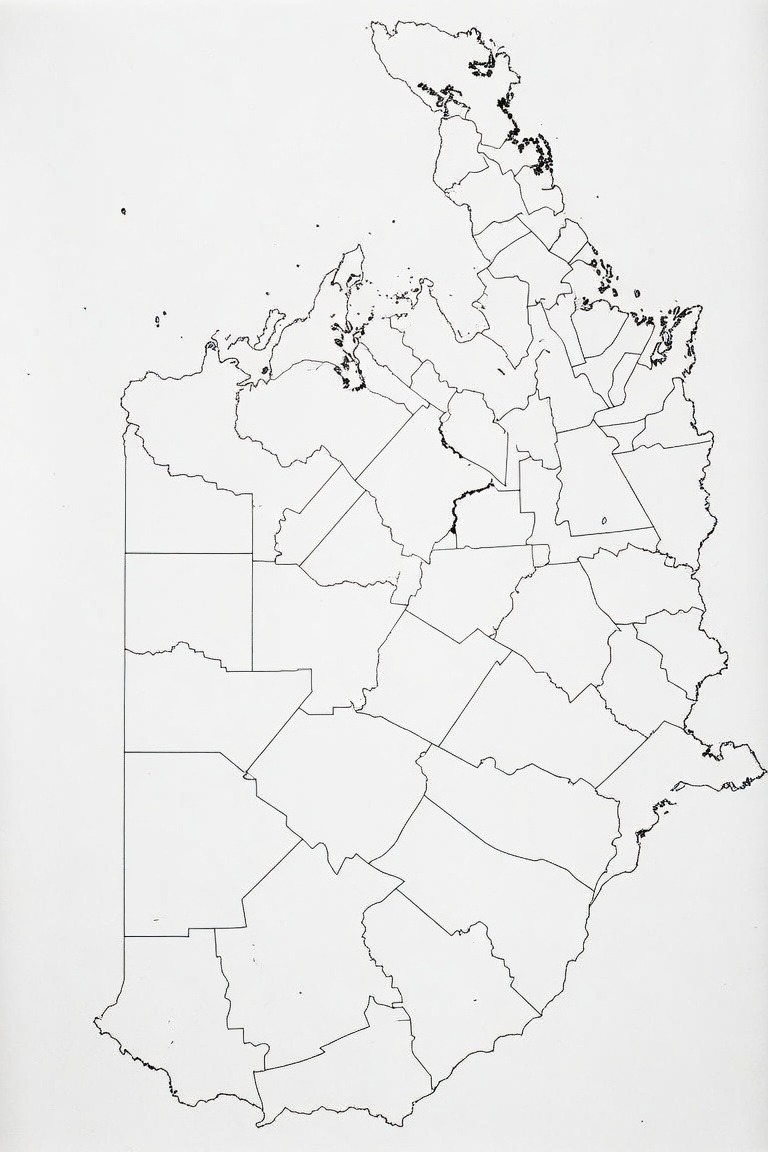
blank map of united states, no words, tipped so that east is facing up.
Some results were perfectly acceptable maps, or a little flawed, but still with east to the right. As usual.
Note that the aspect ratio is narrow. I figured that would give the map room to expand in an east top/west bottom direction, rather than have a conventional north top/south bottom squeezed into the frame. Oh, well.
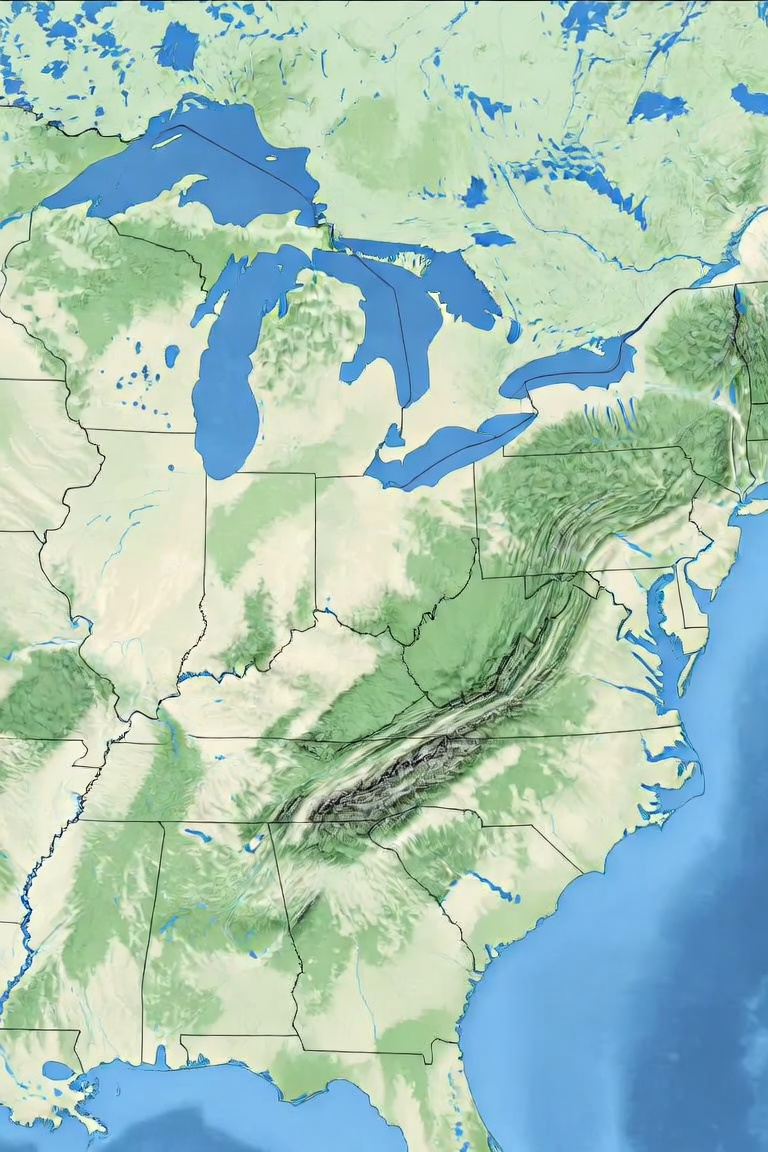
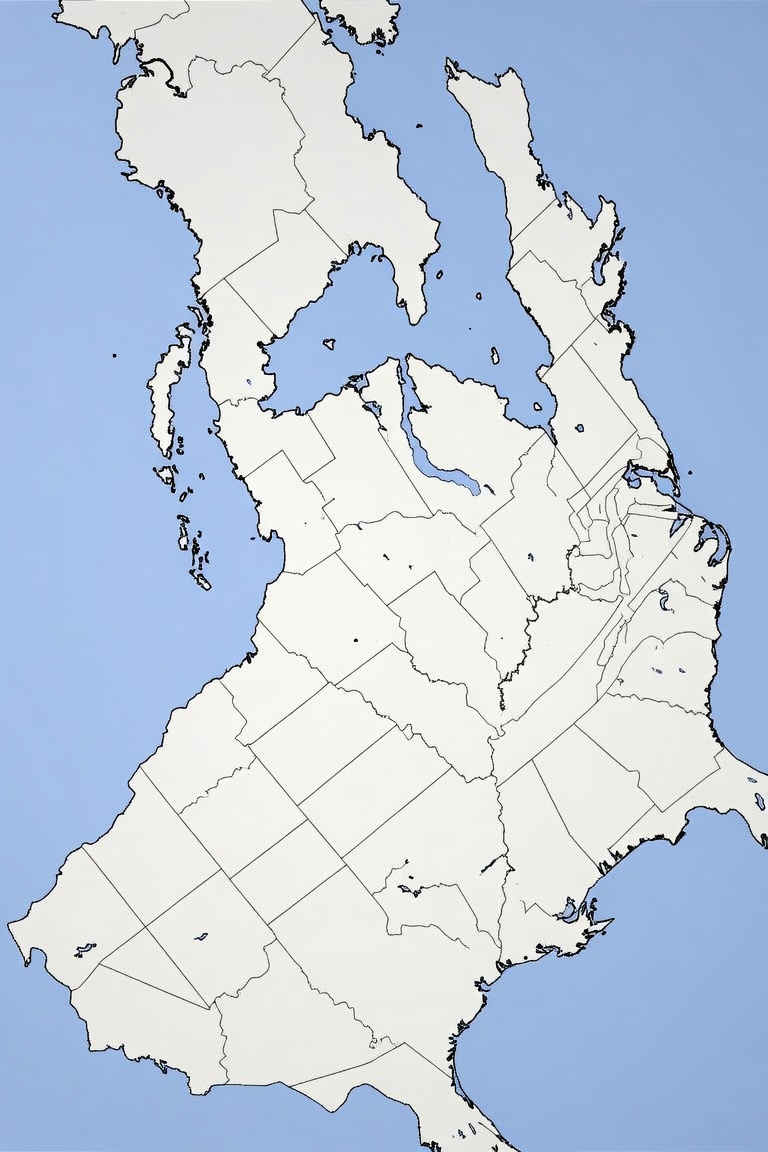
Other generated images inexplicably closeups of west or east.
With geographic features. Because I didn’t specify all of the United States? Because I didn’t specify no geographic features, though I’d think, using natural language like I do, that “blank” covers that pretty well. And, come to think of it, United States pretty much means the whole thing, unless otherwise specified. This is the sort of nuance that, so far, eludes AI, making image generation a sometime crap shoot.
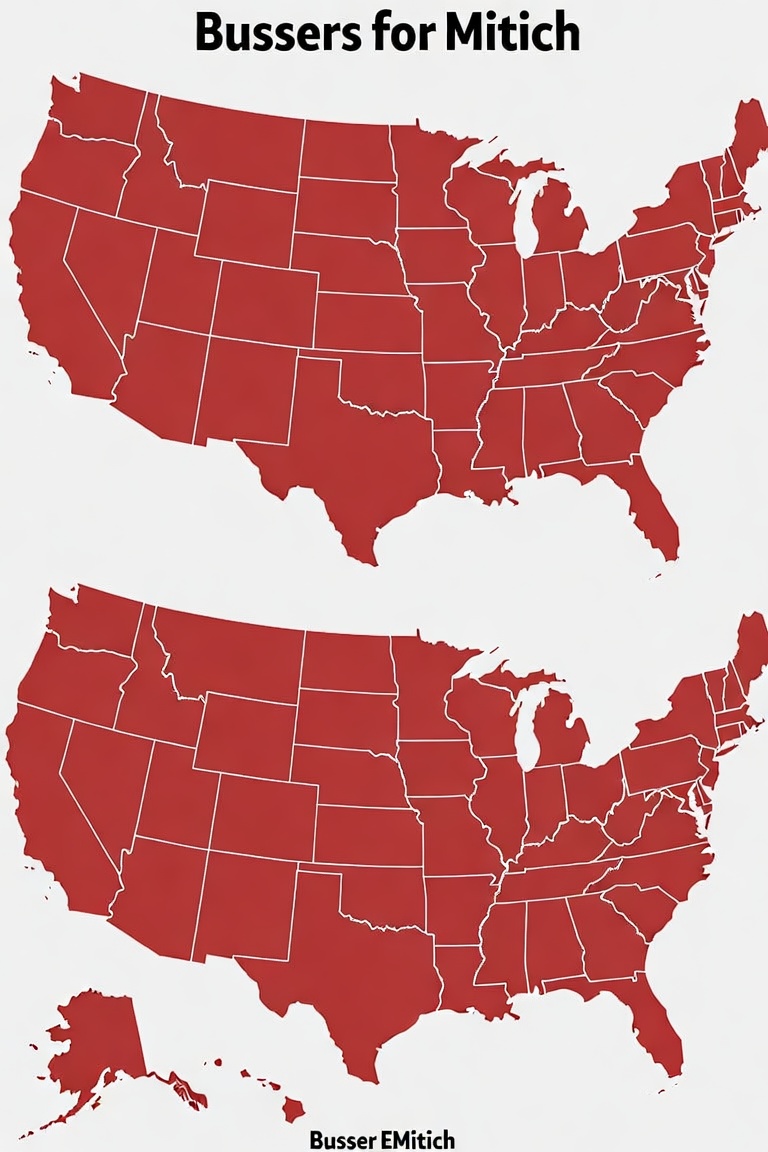
This one — what to say?
I ran that phrase through a couple of search engines (manually) in case it was something I missed, since I miss things all the time. But it doesn’t seem to be, which means my imagination can run with Bussers for Mitich. Could it be that a class of sentient robot servants — nicknamed Bussers from one of their first jobs and proudly calling themselves that — finally won the right to vote, and are supporting Mitich in the 2076 elections?
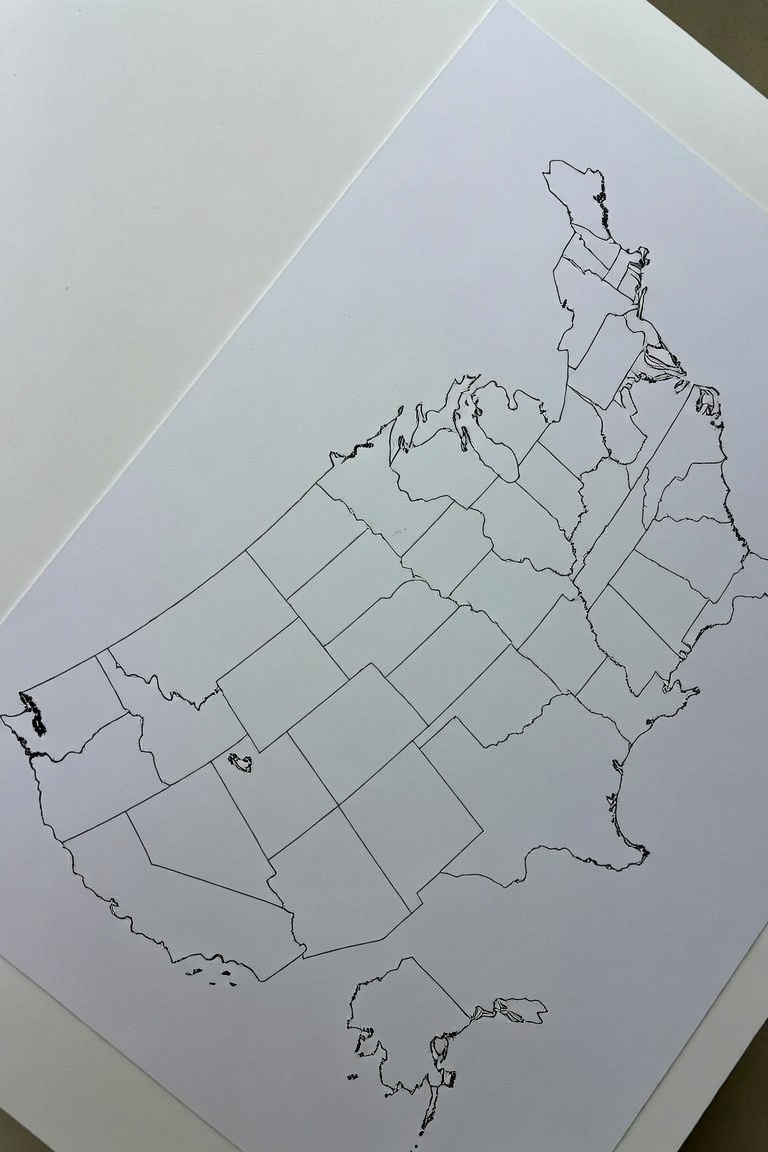
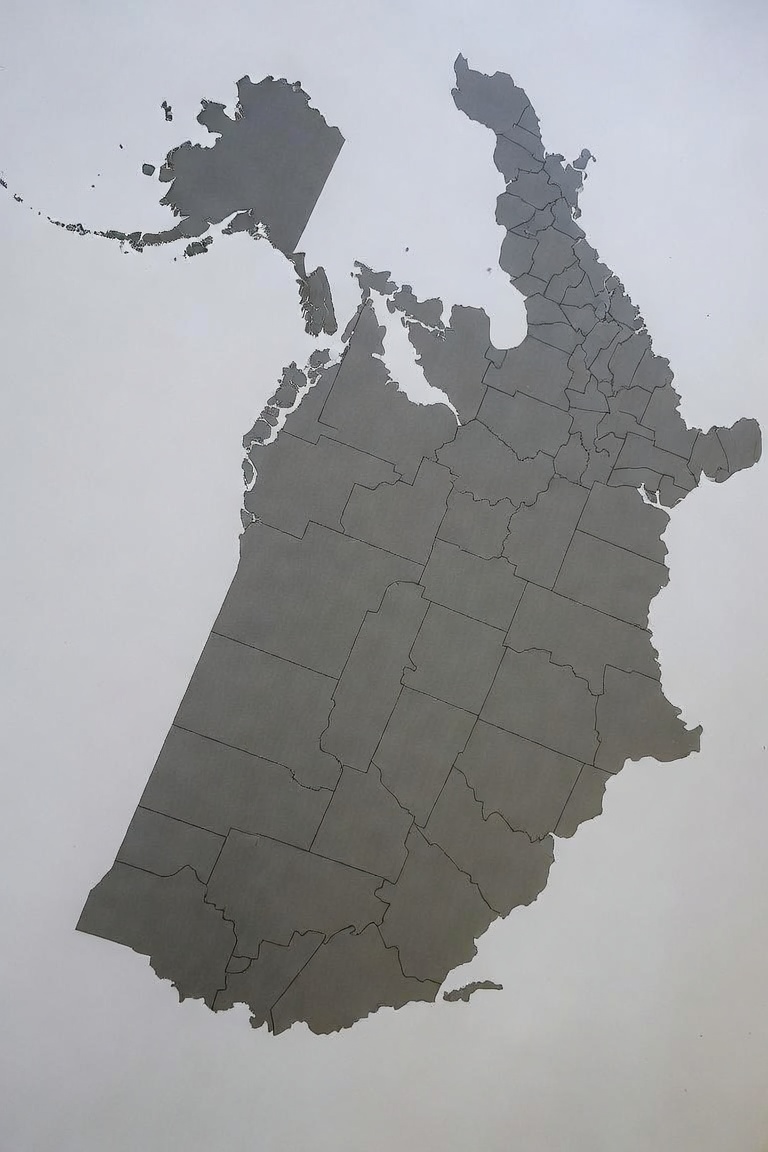
Back to the maps I wanted to be oriented with east up. These below were giving it the old electoral college try, with east clearly trying to point upward, but no go.
They kept getting stranger. Or rather, to be completely accurate, the odd maps were mixed in seemingly at random.
At least that one is east/up. I think. But it isn’t a map of the United States. Some united states, maybe, but in some other reality.
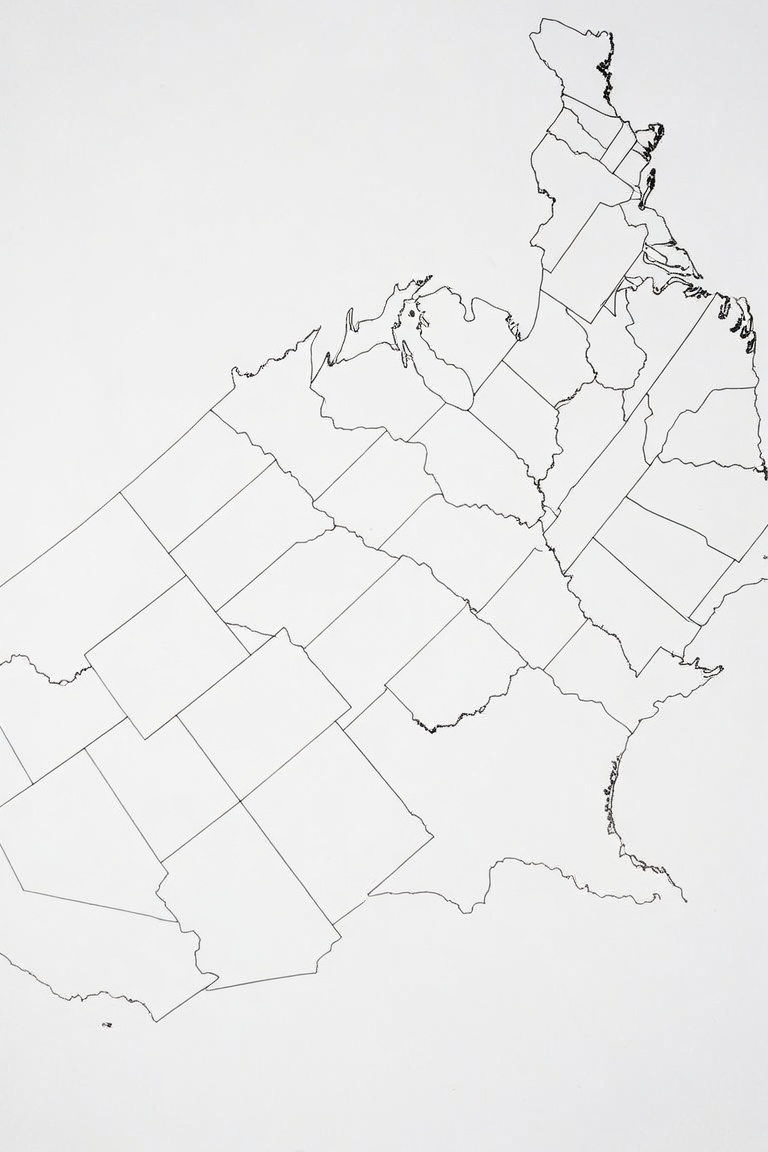
Then there were the smash maps, I call them.
Which have their own interests. You can imagine they were the result of a different North American map created by the last ice age. Or you can image some alternate universe United States. Man, Virginia really got dismembered by the war in that last map, didn’t it?
This is just part one of my efforts to create a map with an east orientation. From here, I’ll try modifying the less eccentric maps. Or I’ll make one myself by tilting a pre-drawn map with my basic image editing program, and then see if AI can handle filling in the states in historic order. This will have to wait, though. I have a life to live this weekend.
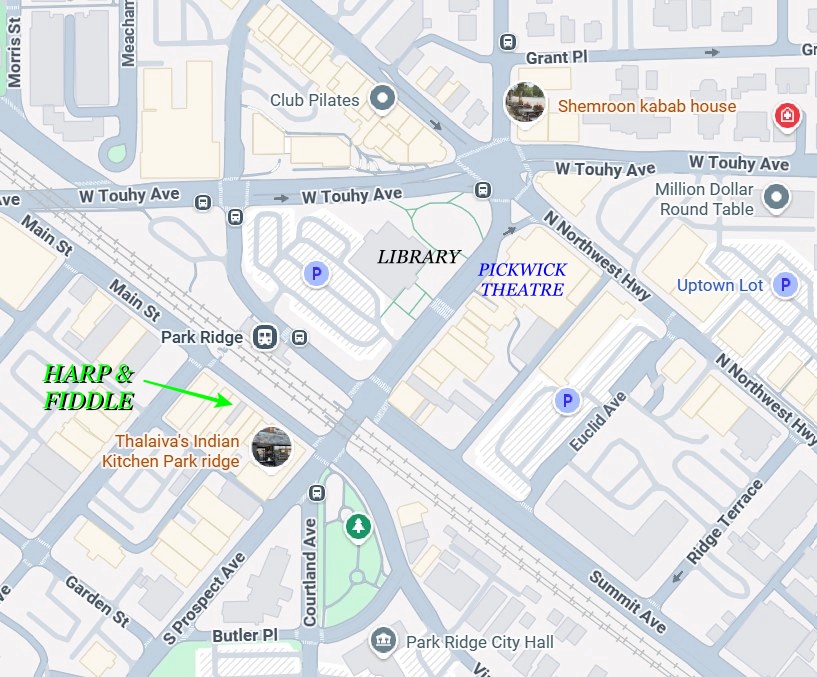
In downtown Park Ridge, Illinois, the Chicagoland grid, which isn’t quite uniform even in the city, breaks down just a little. A cluster of streets, and the commuter rail line, meet at the partial junction of Touhy, the Northwest Highway, Summit and South Prospect Avenues.
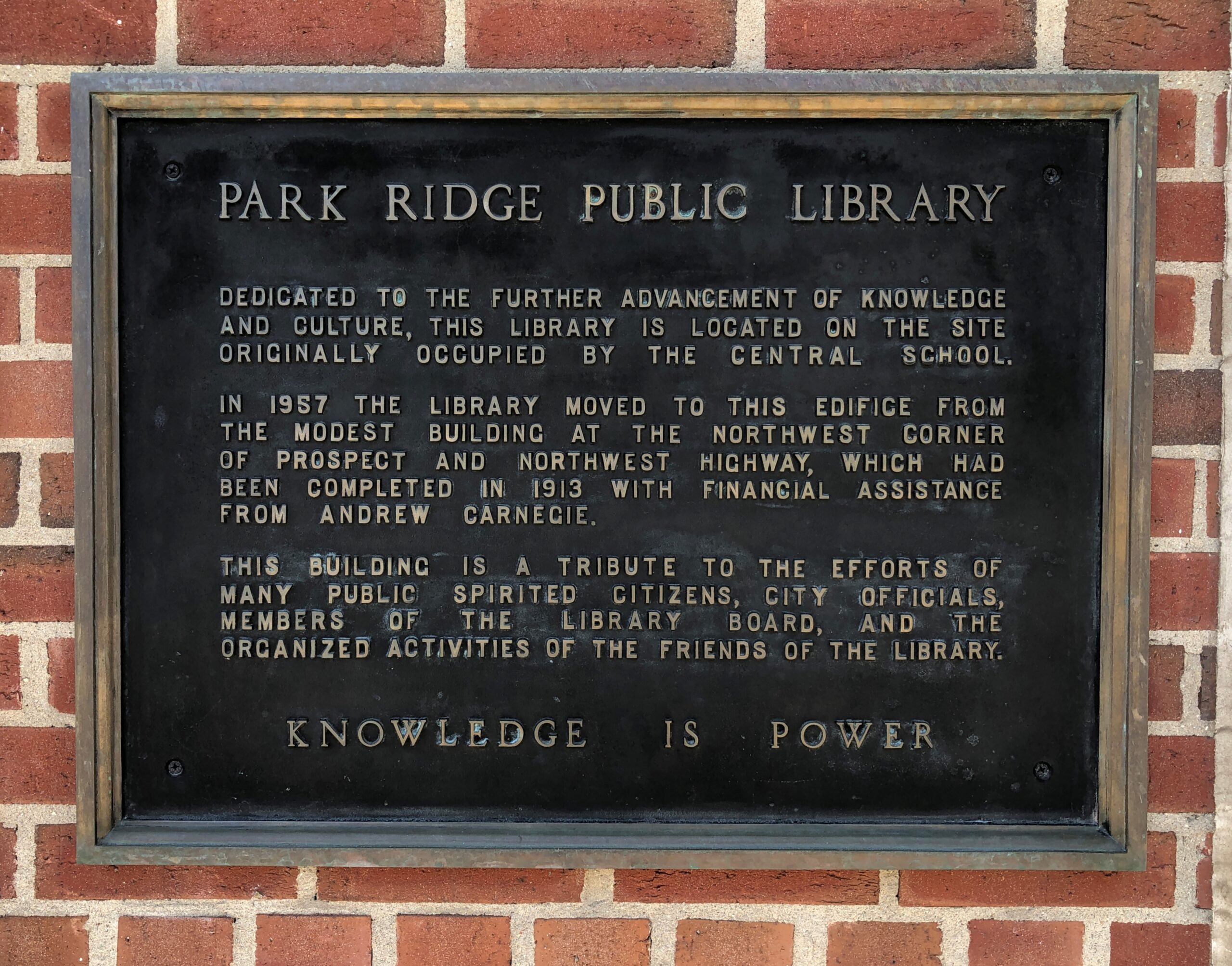
The downtown, which is about 15 miles northwest of the Loop, draws a fair number of visitors on a summer Saturday. Parking was tight, but I managed to shoehorn my car into a space at the library. The library building was dedicated in 1957, back when these kinds of rhetorical flourishes still made their way onto bronze plaques.
Close to the immortal words of Emil Faber, “Knowledge is Good.”
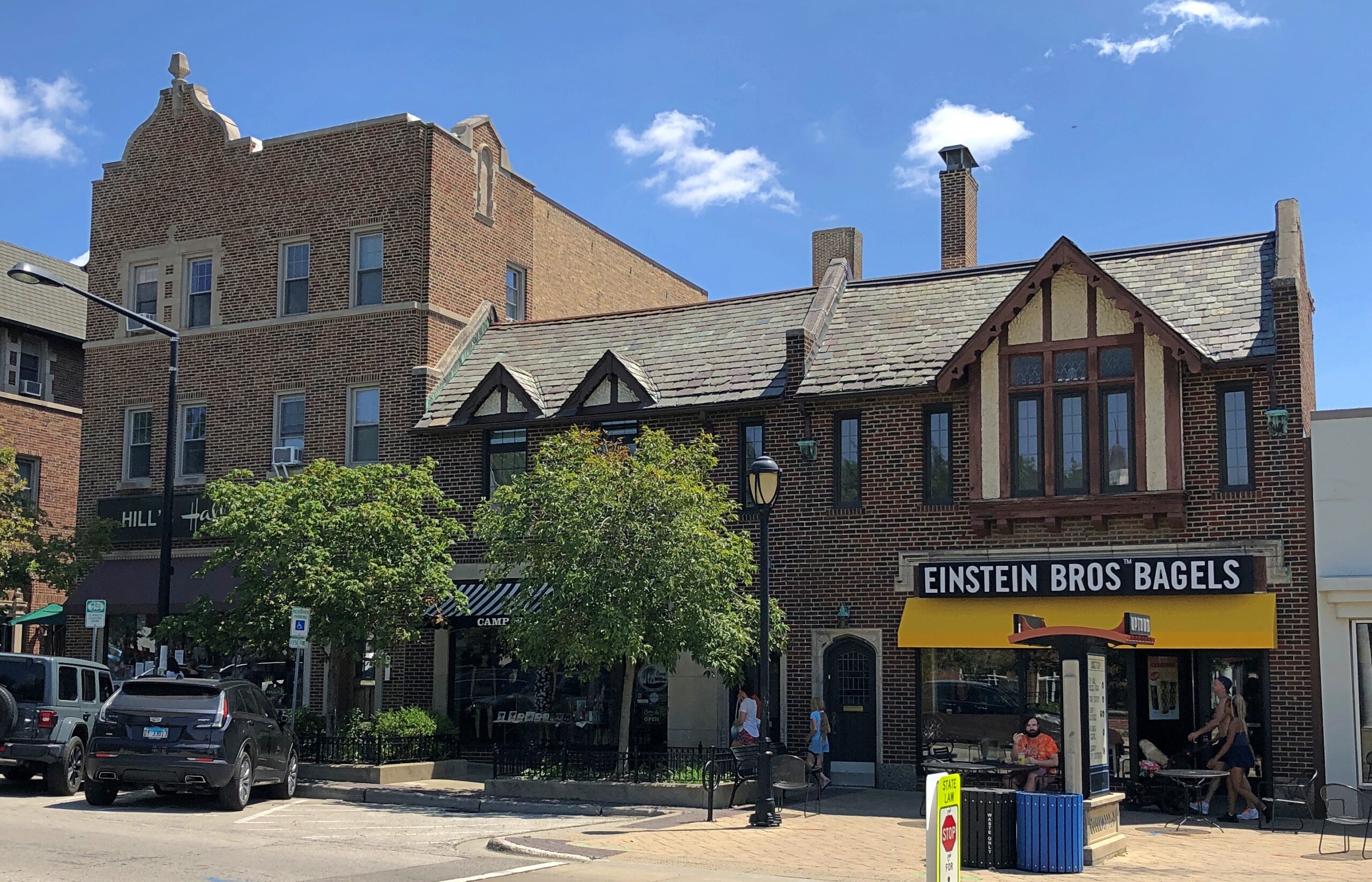
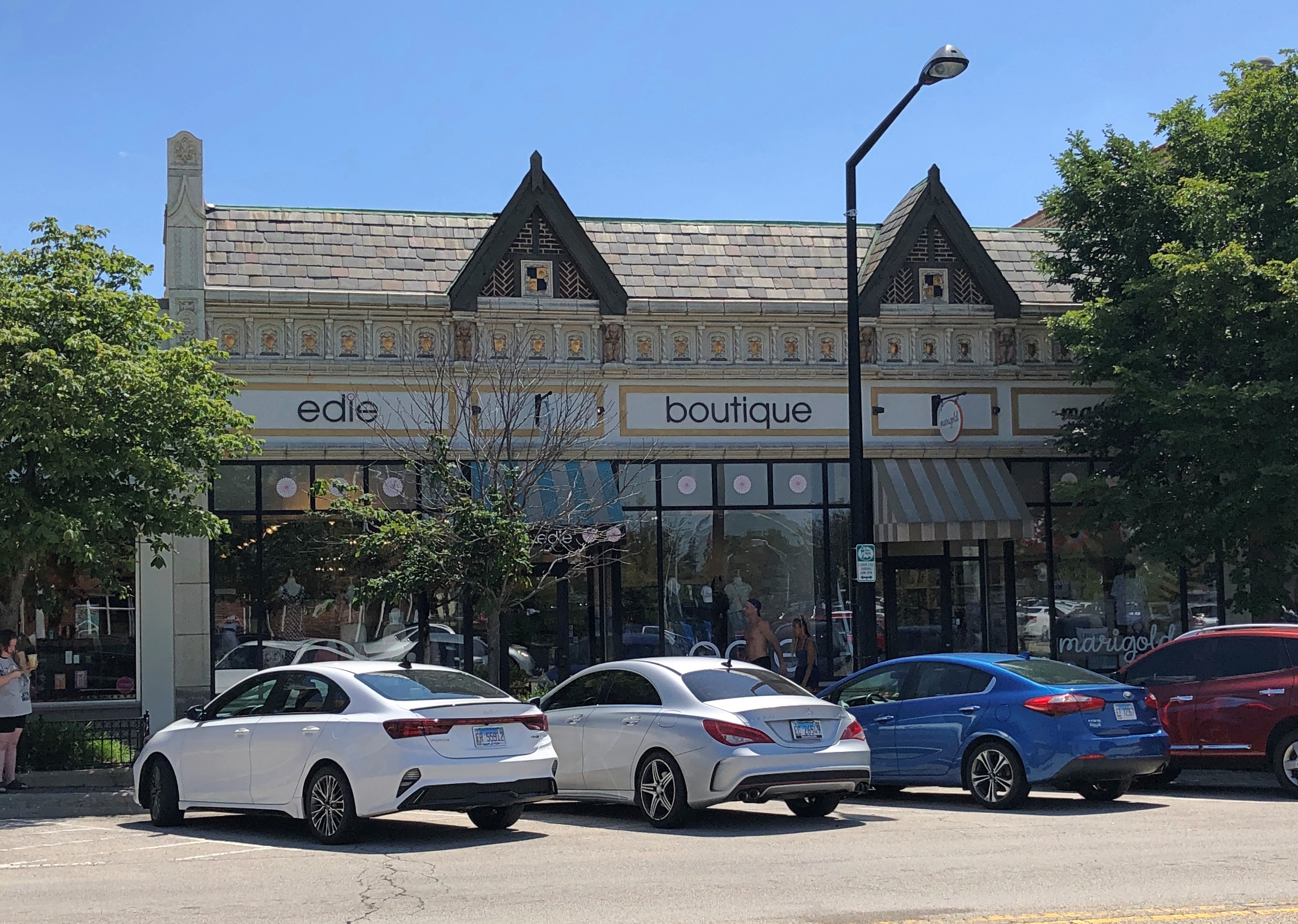
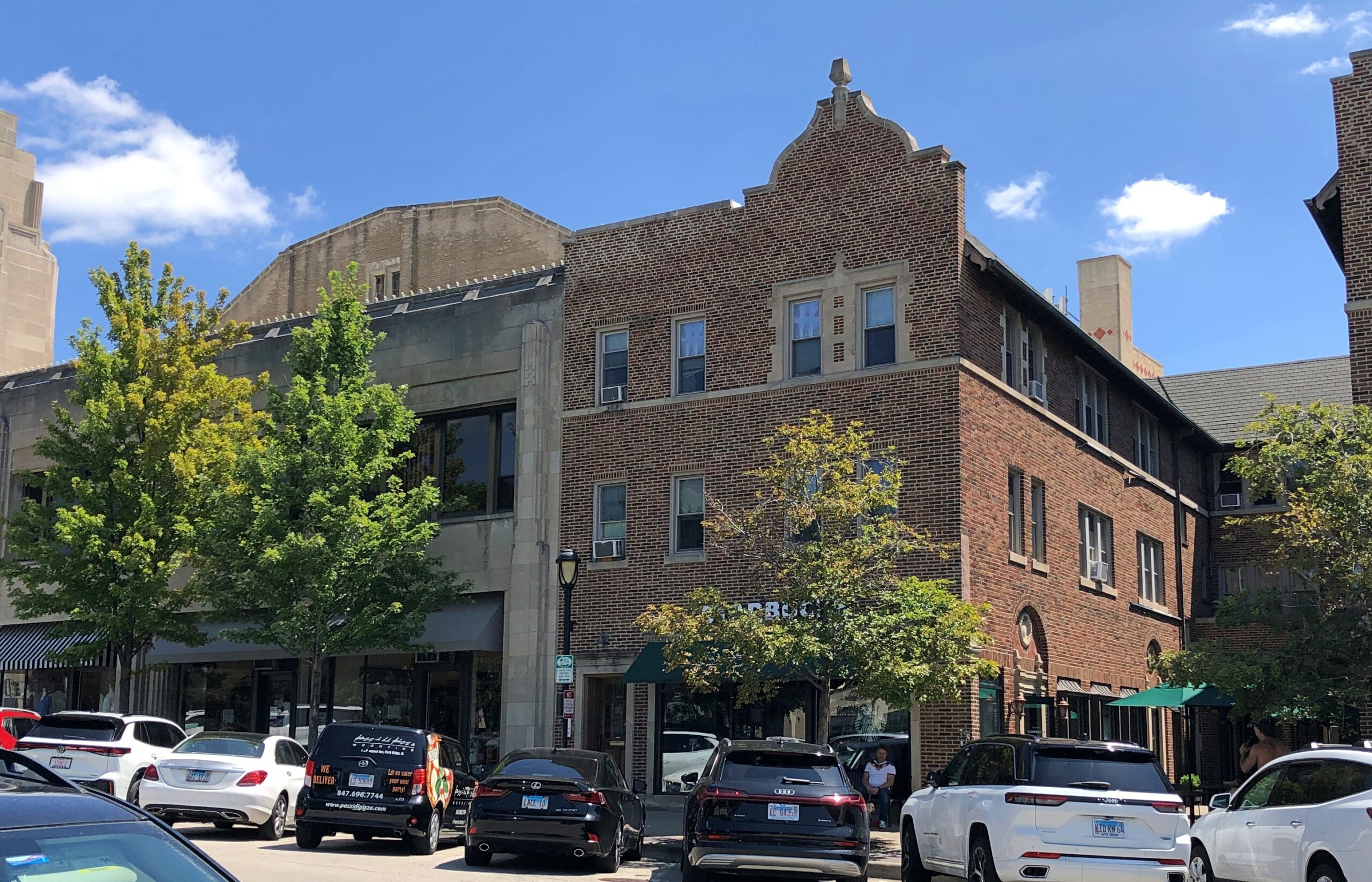
South Prospect has a row of handsome small buildings.
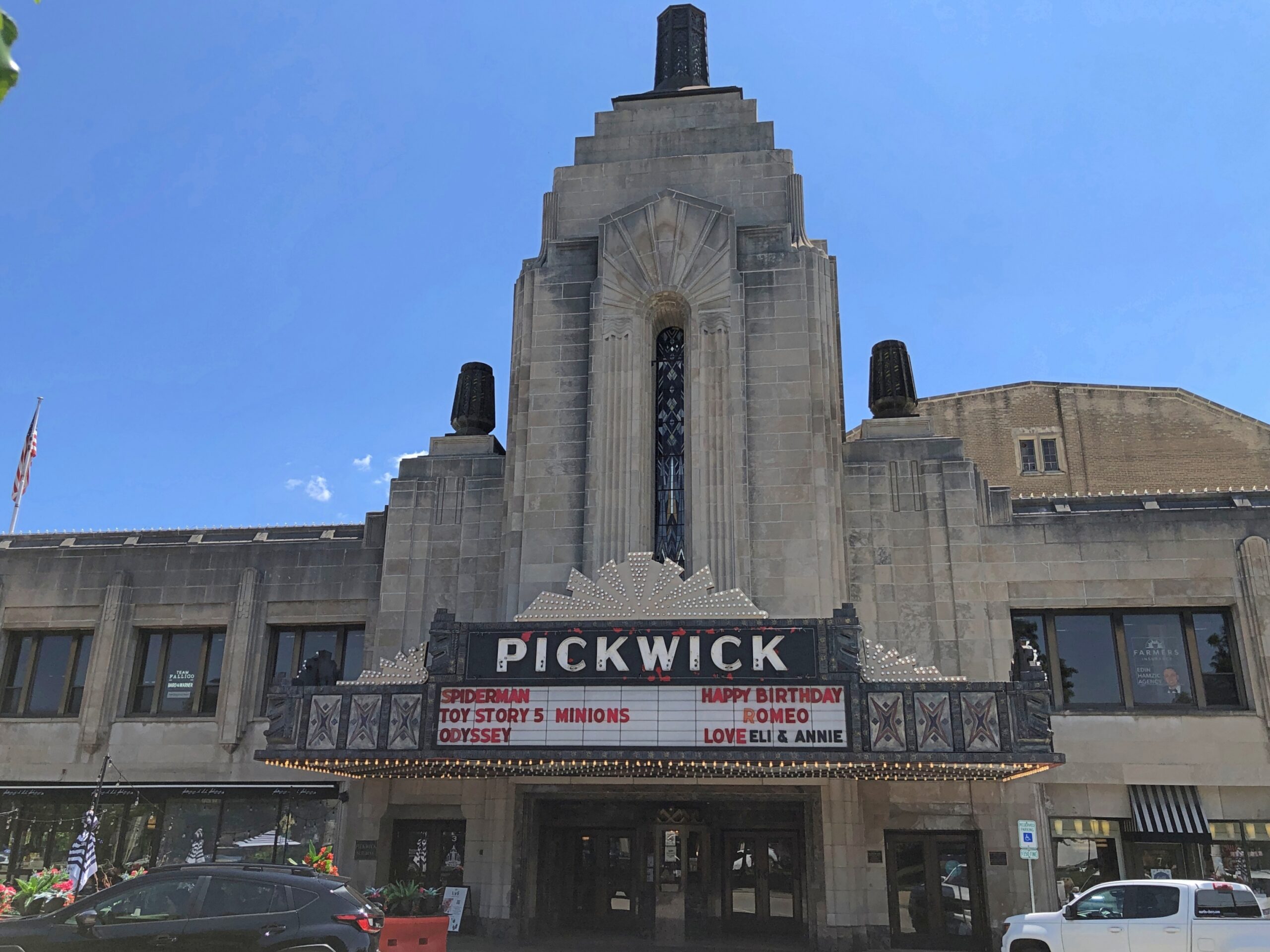
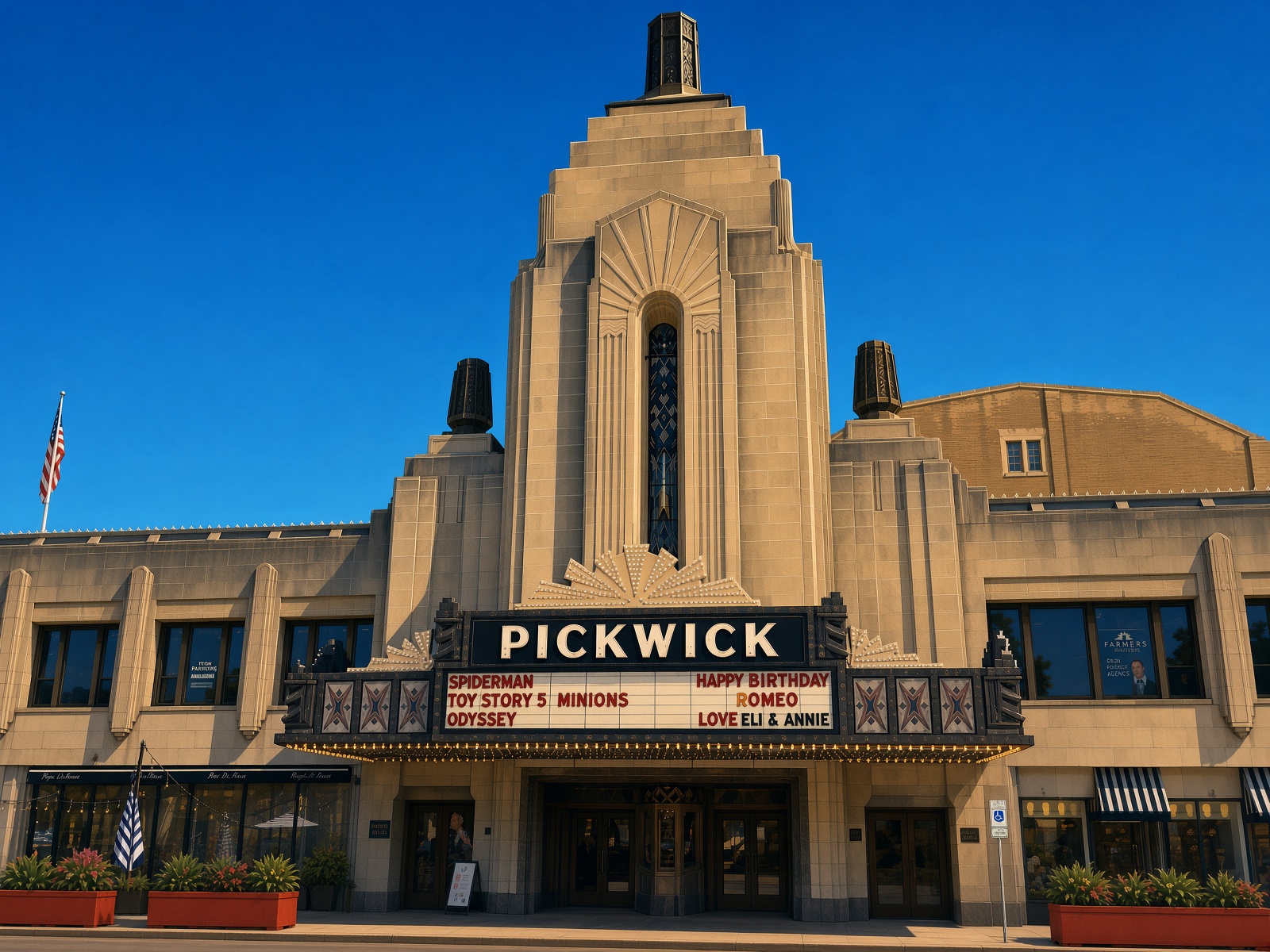
But none to compare with the Pickwick Theatre.
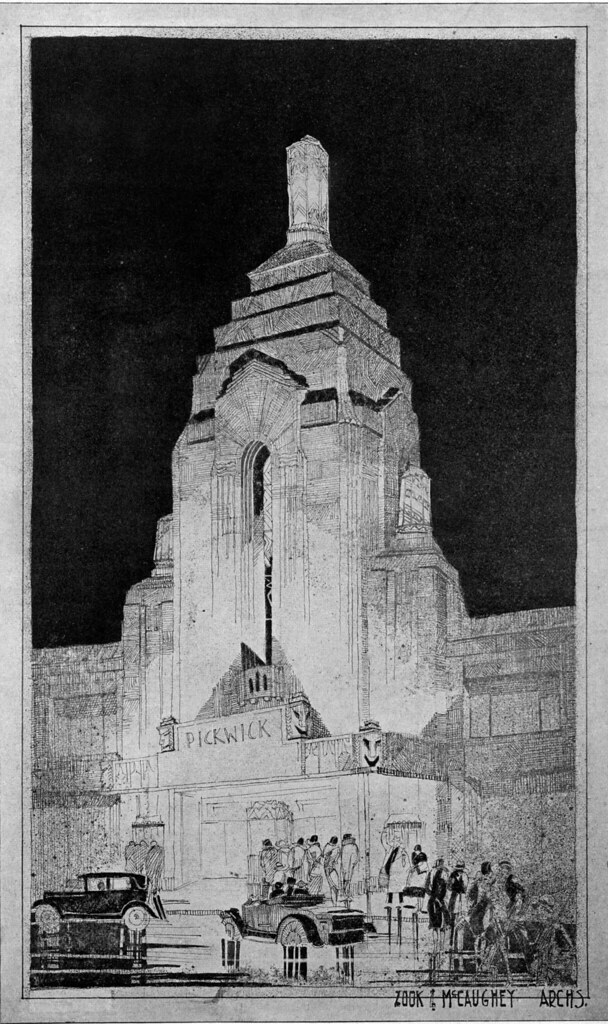
“Designed by the firm of Zook & McCaughey, the 1,500-seat, Pickwick Theatre opened November 26, 1928 with Colleen Moore in Lilac Time plus vaudeville acts on the stage,” Cinema Treasures notes. “It was equipped with a Virtuoso organ which was opened by organist Walter Flandorf.”
In as much as they are known any more, Zook & McCaughey are known for the deco Pickwick. The architects’ rendering, in the public domain, is borrowed from the blog Corridors, which looks to be a real treasure trove of the built environment.
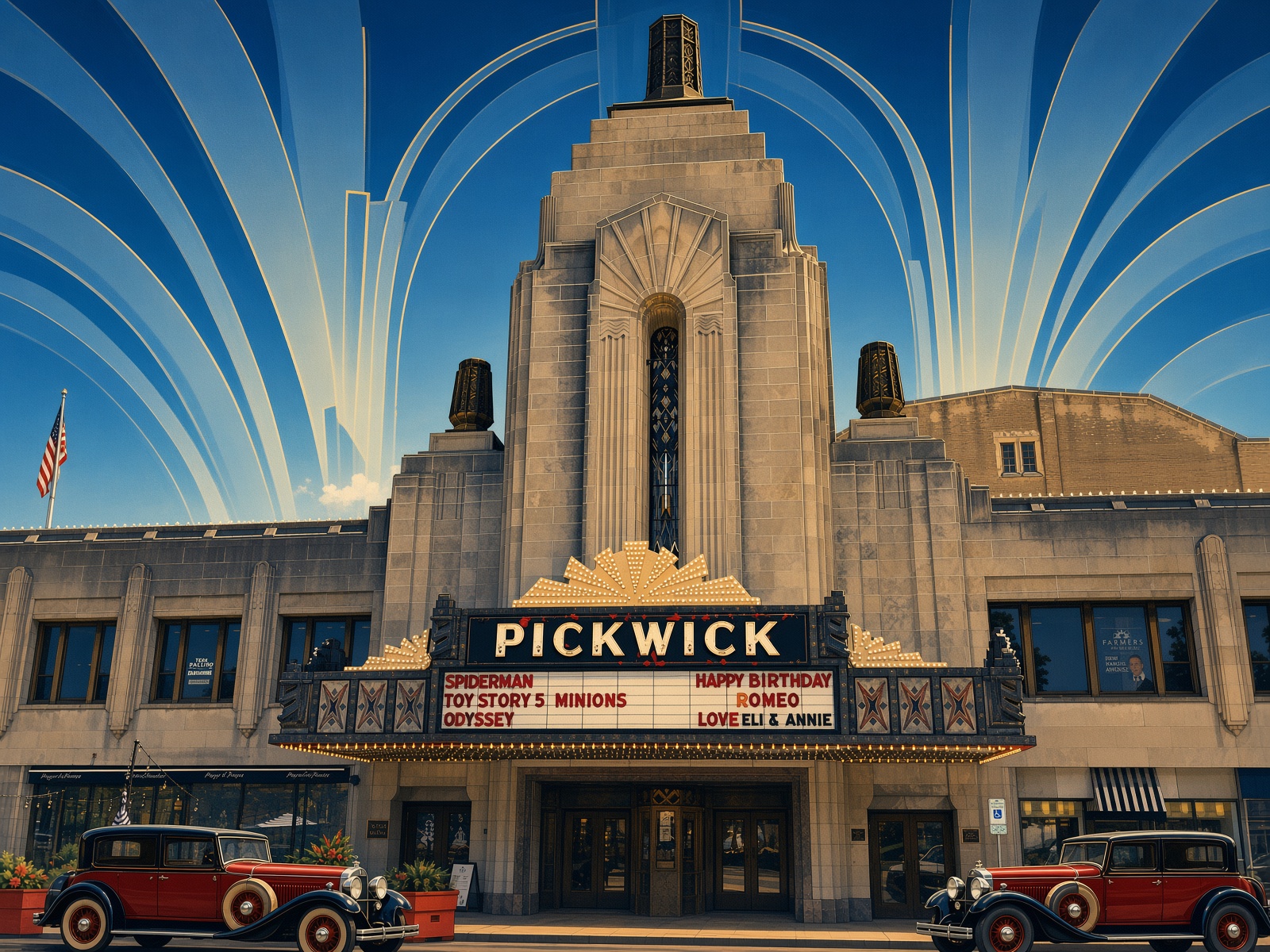
I had somewhere else to be, namely lunch at the Harp & Fiddle across the tracks, or I might have taken in a movie in the historic auditorium, which now seats 1,000, because I never have. But I did have time later to play with one of my images of the Pickwick (the first one, above).
Prompt: Art deco illustration style.
Prompt: 1920s commercial art style.
I like that second one especially. There’s no doubt that it’s AI, but it hews to my goal of not being slop. The cars — a little stilted, but that’s AI for you — are from the 1920s, but the movies are still from the 2020s.
I heard by chance that the Spurs are in the playoffs, again. NBA games are on the list of things I don’t care about, but this is the Spurs we’re taking about, so Go Spurs. I’m old enough to remember when pro sports were considered a modest-priced entertainment, which would have been the days when the Spurs huffed along in the ABA. When that league went under, that paved the way for the basketball monopoly we now enjoy.
I remember a print ad for the Spurs from their early NBA days. A basketball, mostly in shade, set against a pitch black background; a small but bright light is emerging from a crack in the basketball; the tag line says, In the Arena, Everyone Can Hear You Scream. Brilliant.
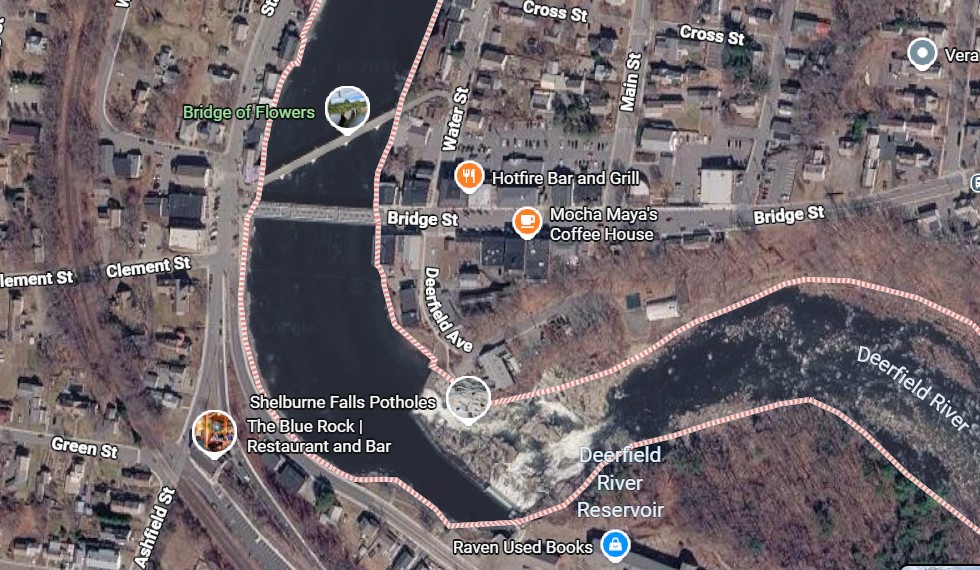
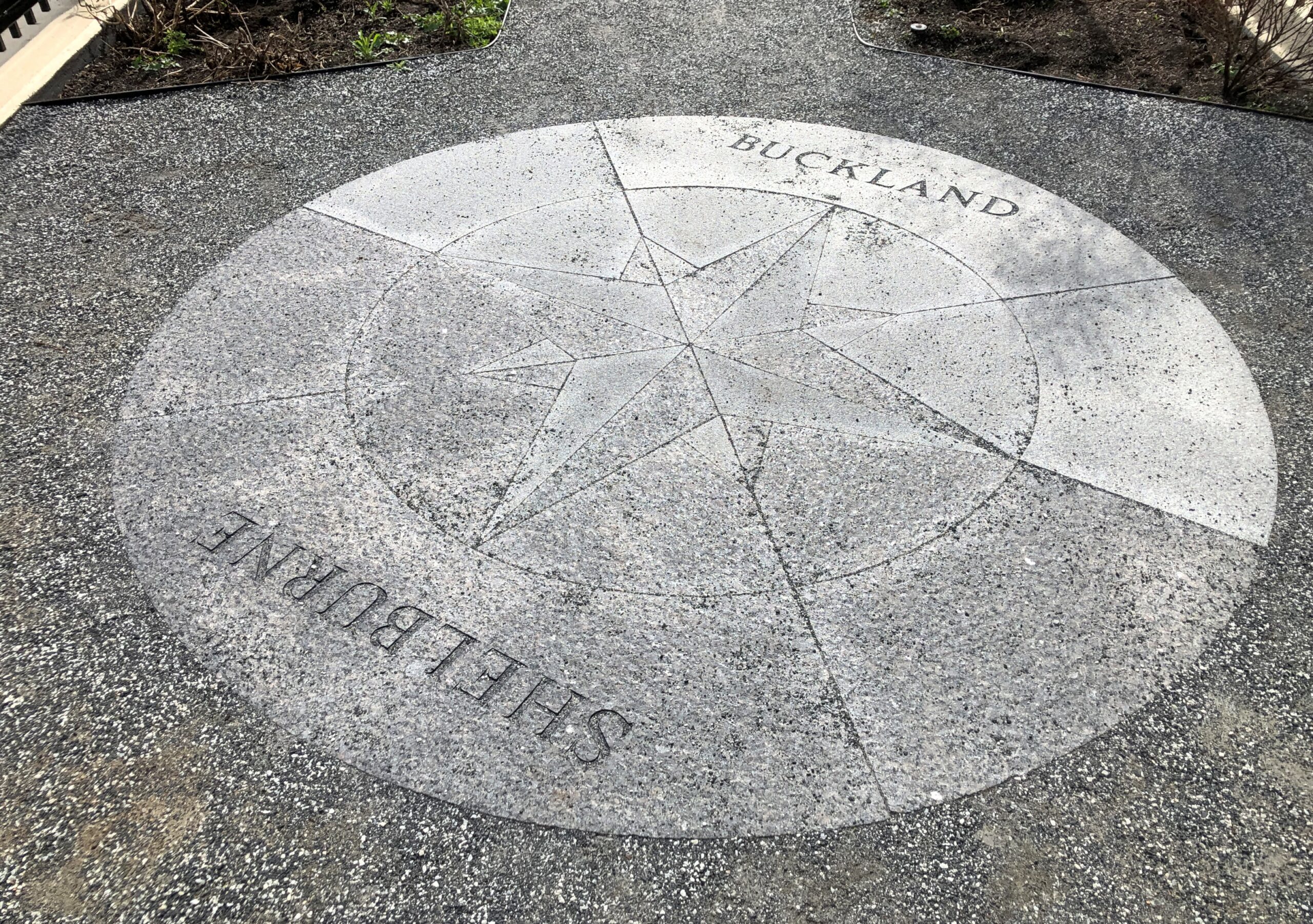
Here we go again with the incongruous Massachusetts place names: “The village of Shelburne Falls is located partly in Shelburne and neighboring Buckland,” notes Wiki.
So I suppose I visited Shelburne Falls the whole time when I visited Shelburne and walked across a bridge to Buckland, and then back to Shelburne on a different bridge.
Interesting that a town in the United States is named for Lord Shelburne, a British prime minister when the Revolution was still ongoing. On the other hand, it was on his short watch – at the end of that war – when the British government said, enough already, be independent if you want it so much. So there ought to be something named for him on this side of the Atlantic (and there’s another in Vermont, besides one in Ontario).
The Bridge of Flowers
I had good weather for my return to the Midwest from the Northeast, beginning on a clear, warm day in Massachusetts. Large towns hang like pearls on Route 2, and while I would have made a selection of them to visit even in chillier weather — and spend time on foot in those towns — the spring warmth was one of those travel bonuses you can appreciate right away. Pop off Route 2 in Franklin County and you’re in Shelburne.
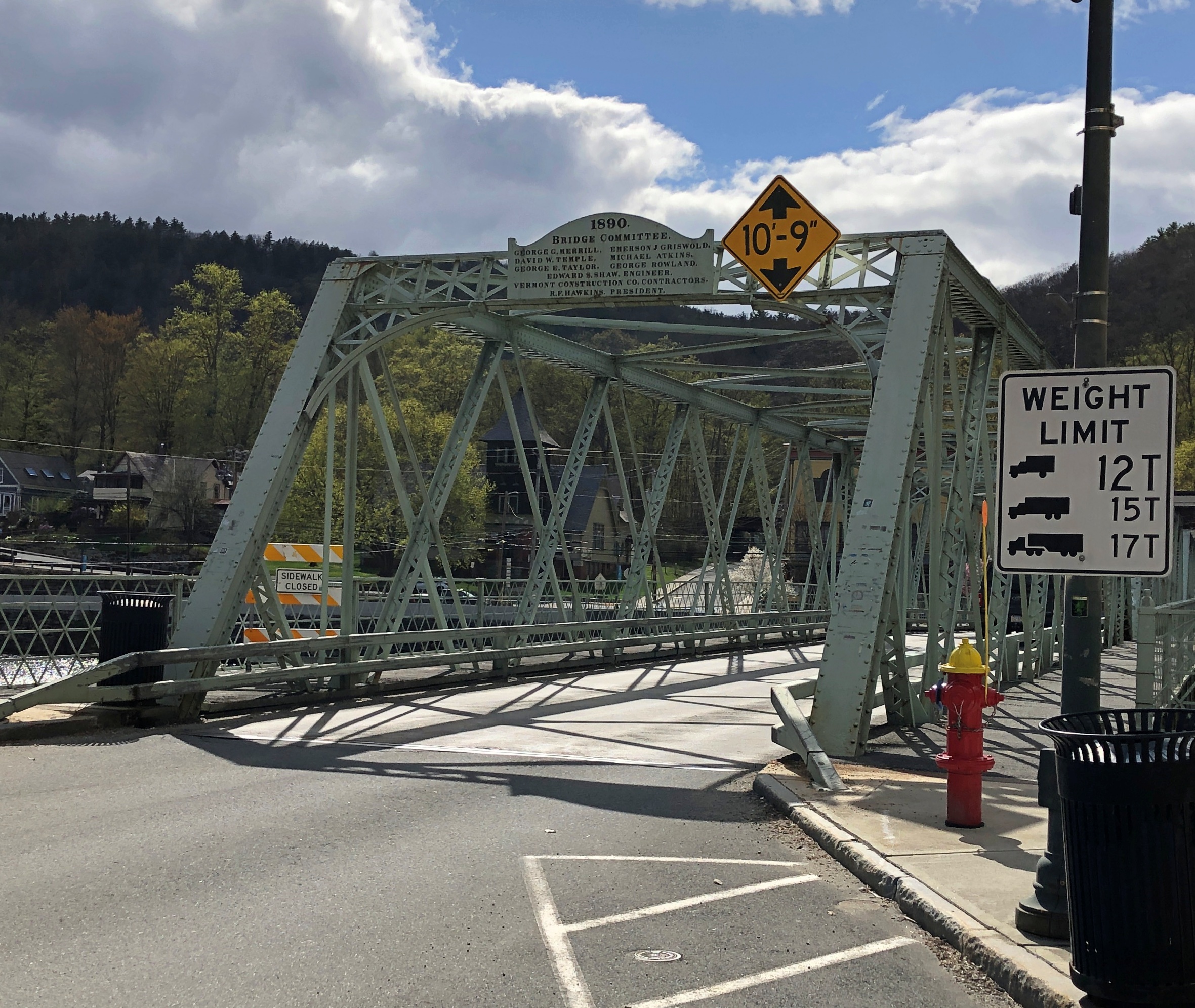
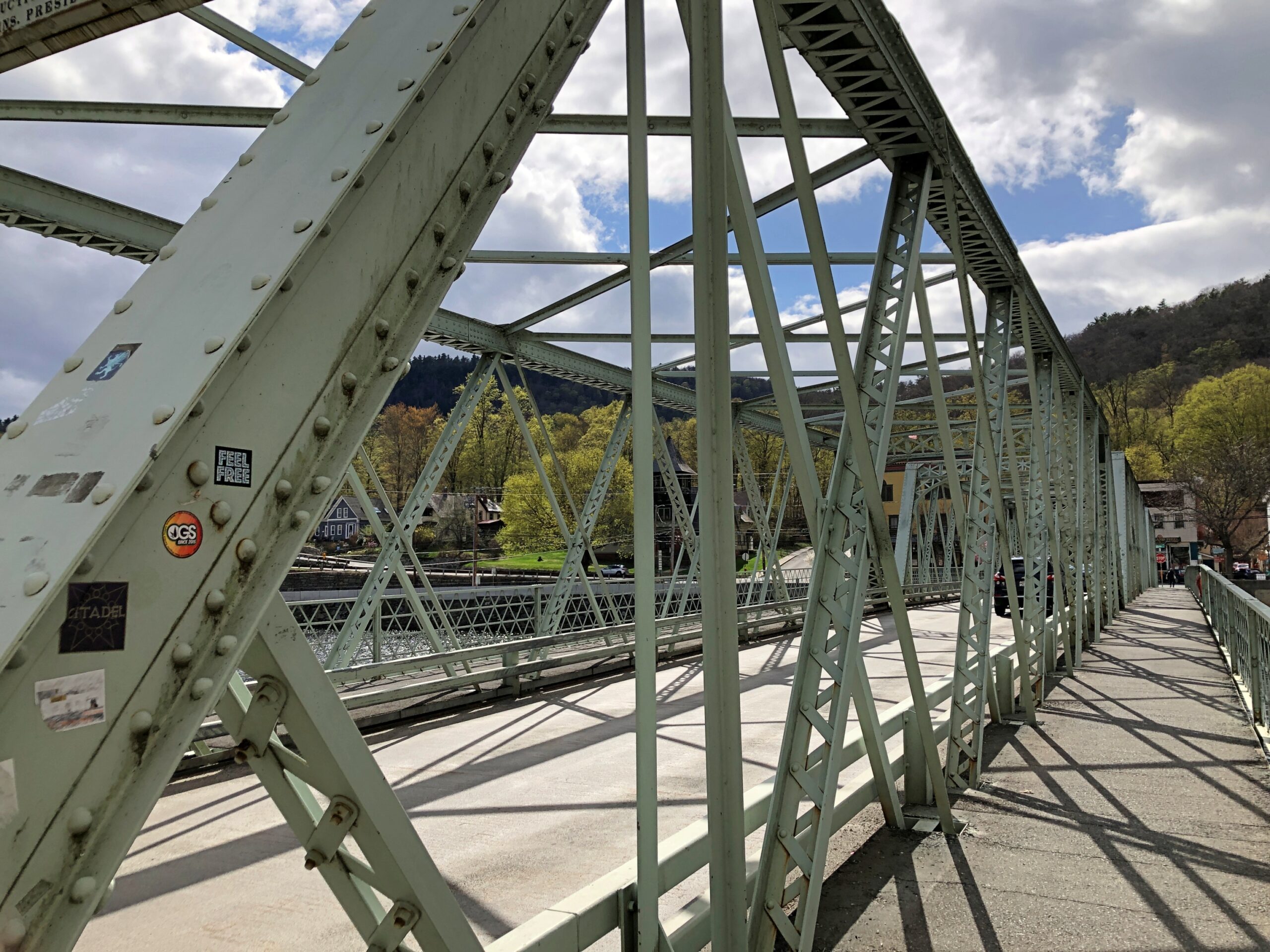
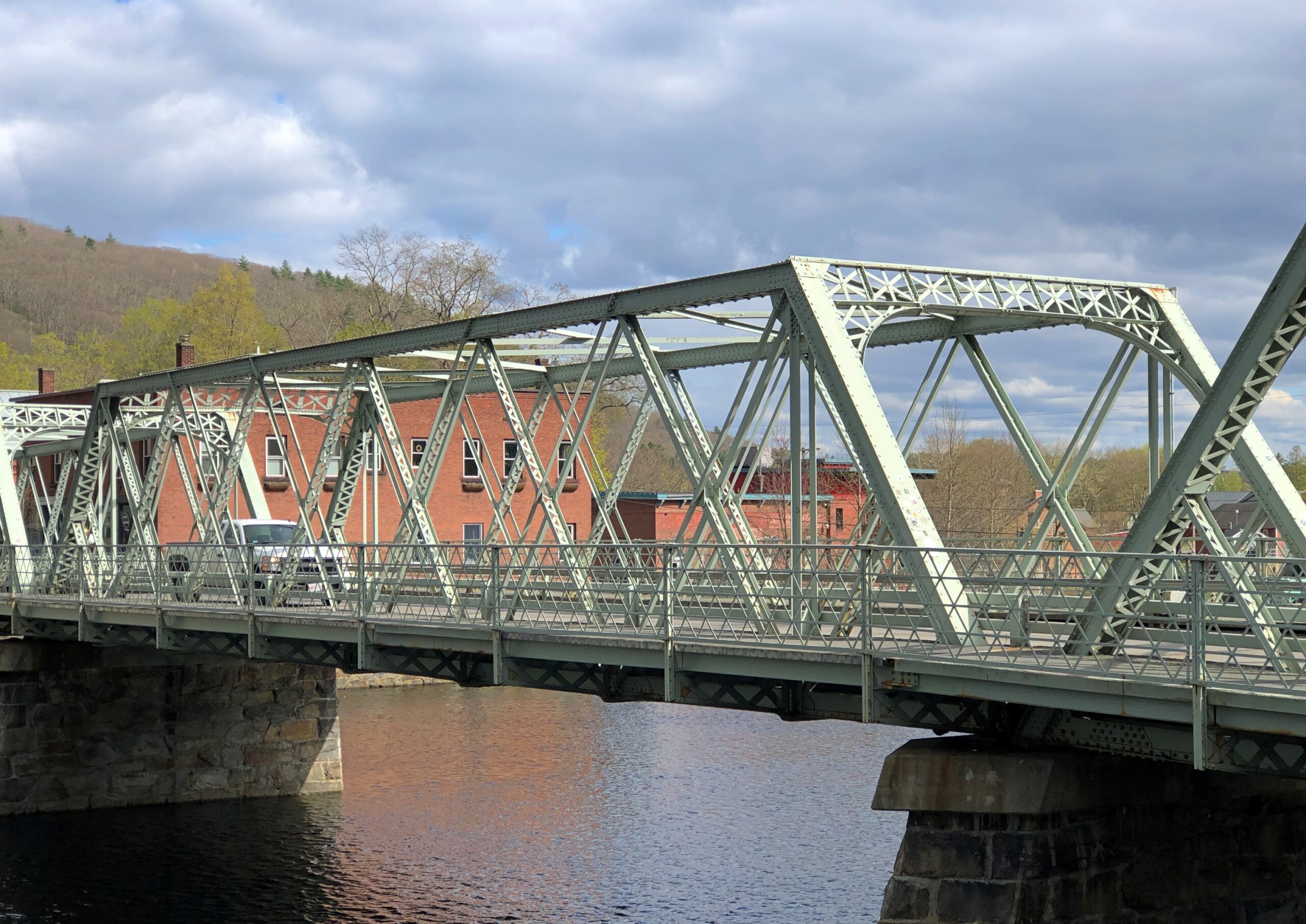
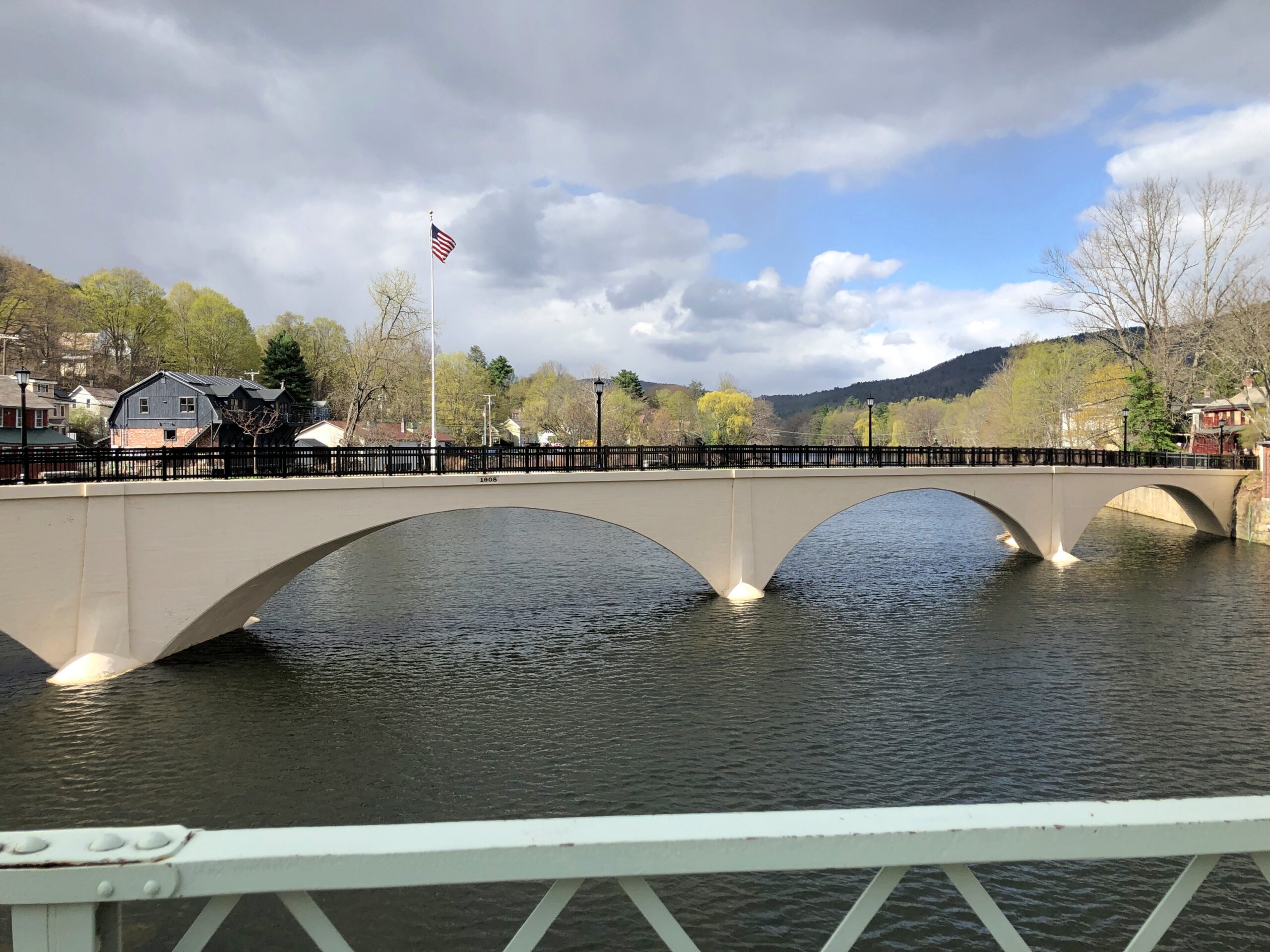
Shelbourne hugs the Deerfield River, so Shelbourne needs bridges. You can still drive across one erected in 1890, which the city fathers of the time signed like it was a work of art. As well they should have. Better, you can walk across the structure, which is known locally as the Iron Bridge. Bridge Street goes across it.
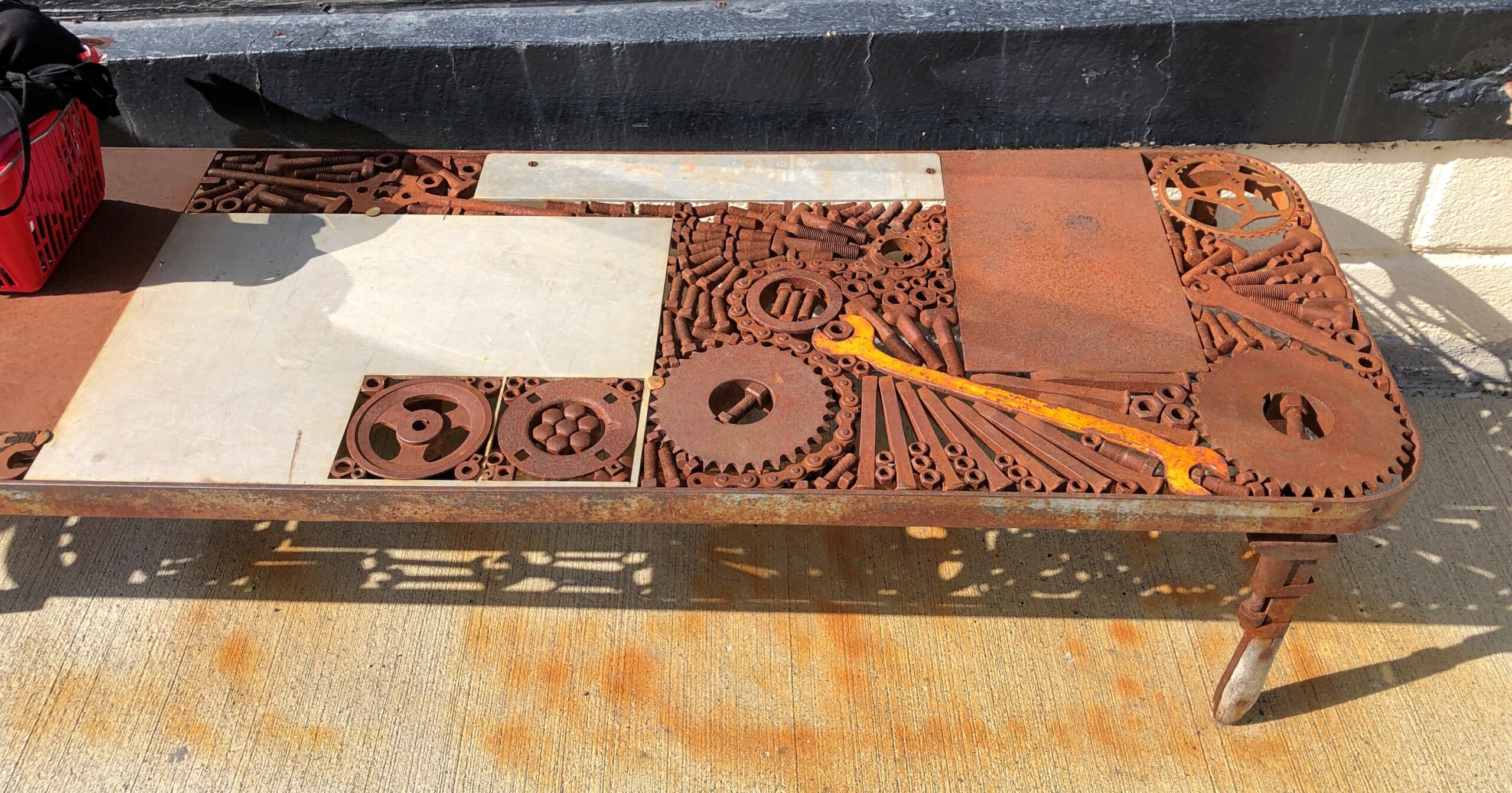
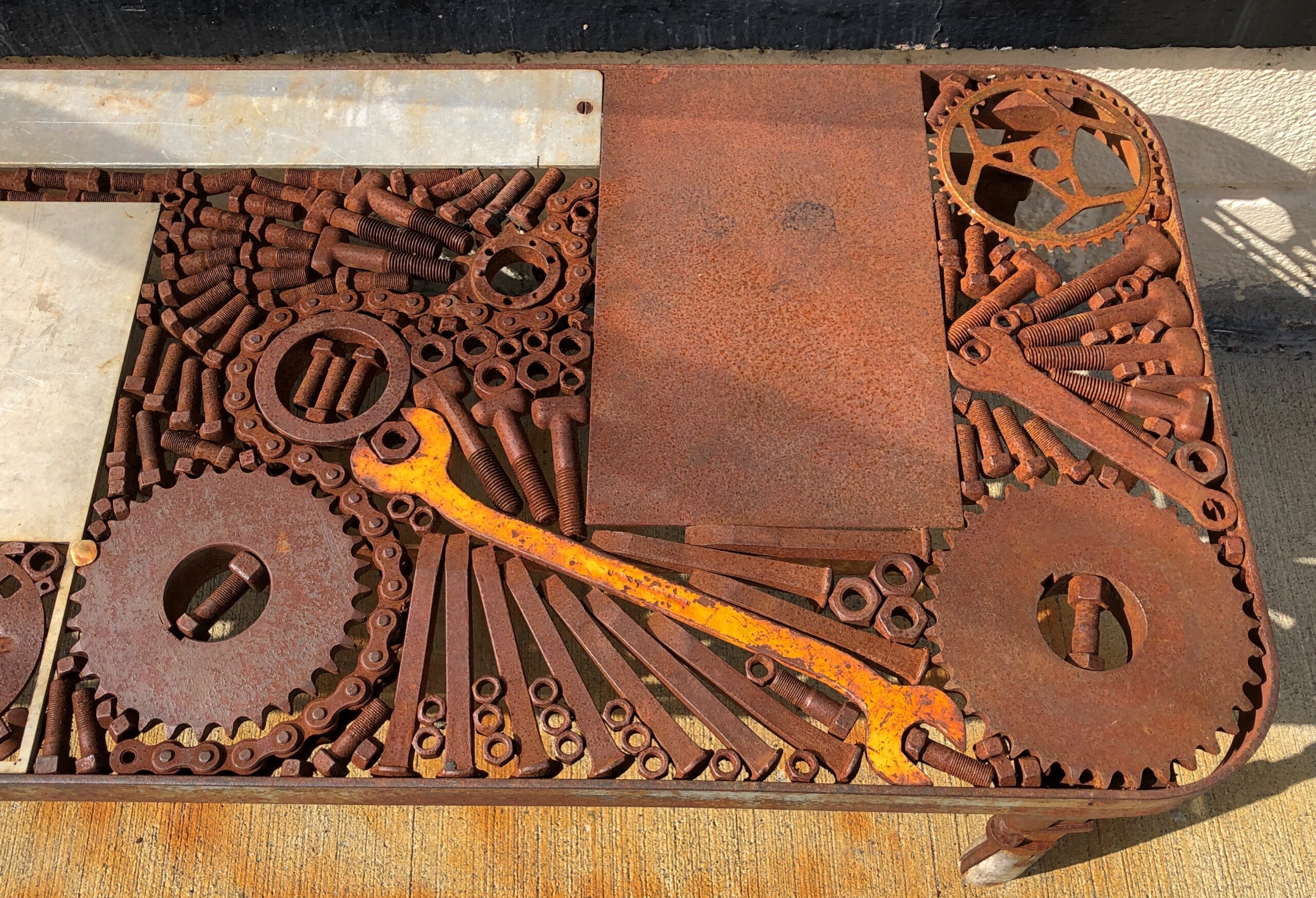
One of the more unusual metal benches I’ve encountered, just off the Shelburne entrance to the Iron Bridge. More iron. Yes, you can sit on it.
The Dearfield, major tributary of the Connecticut.
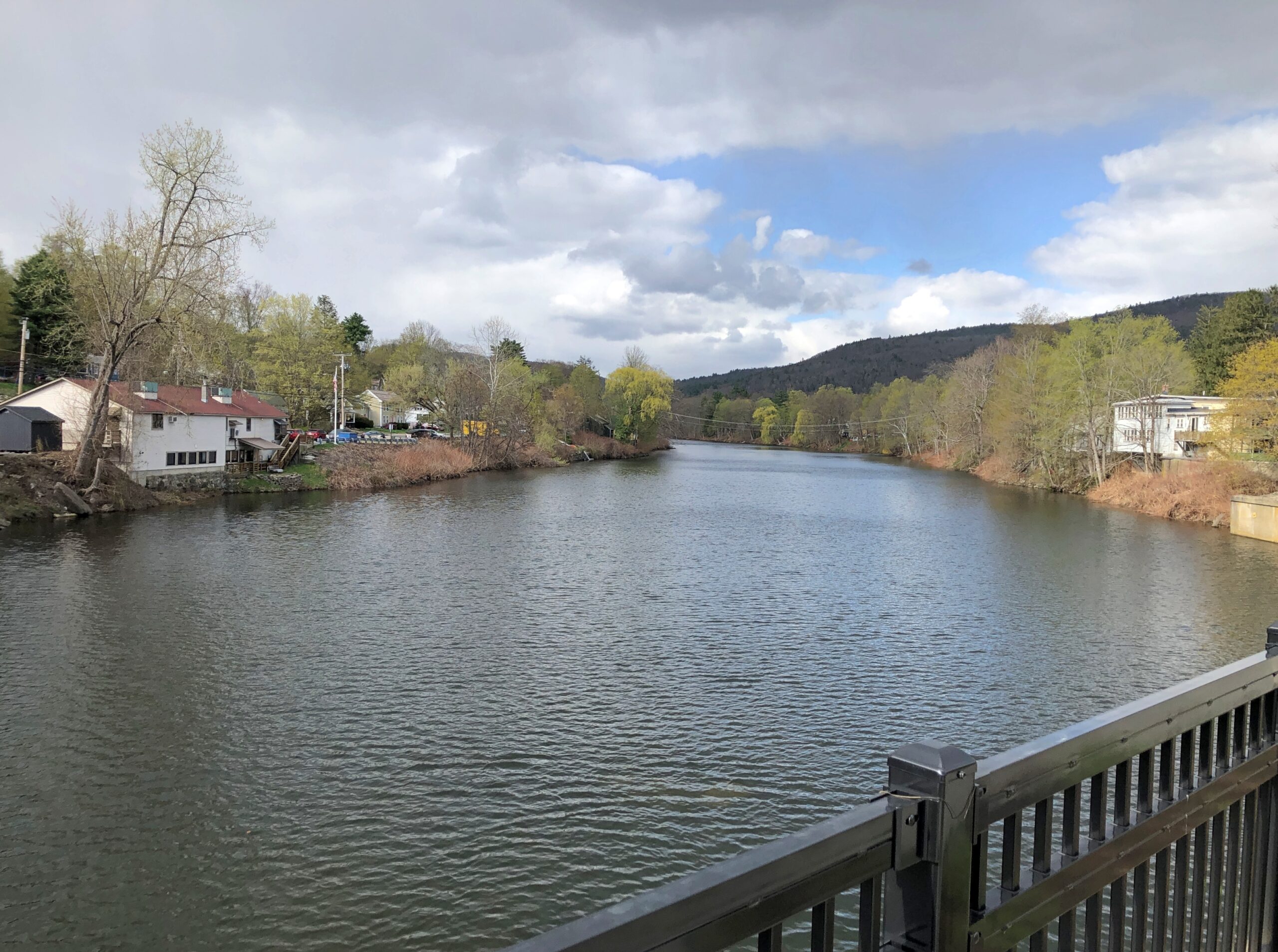
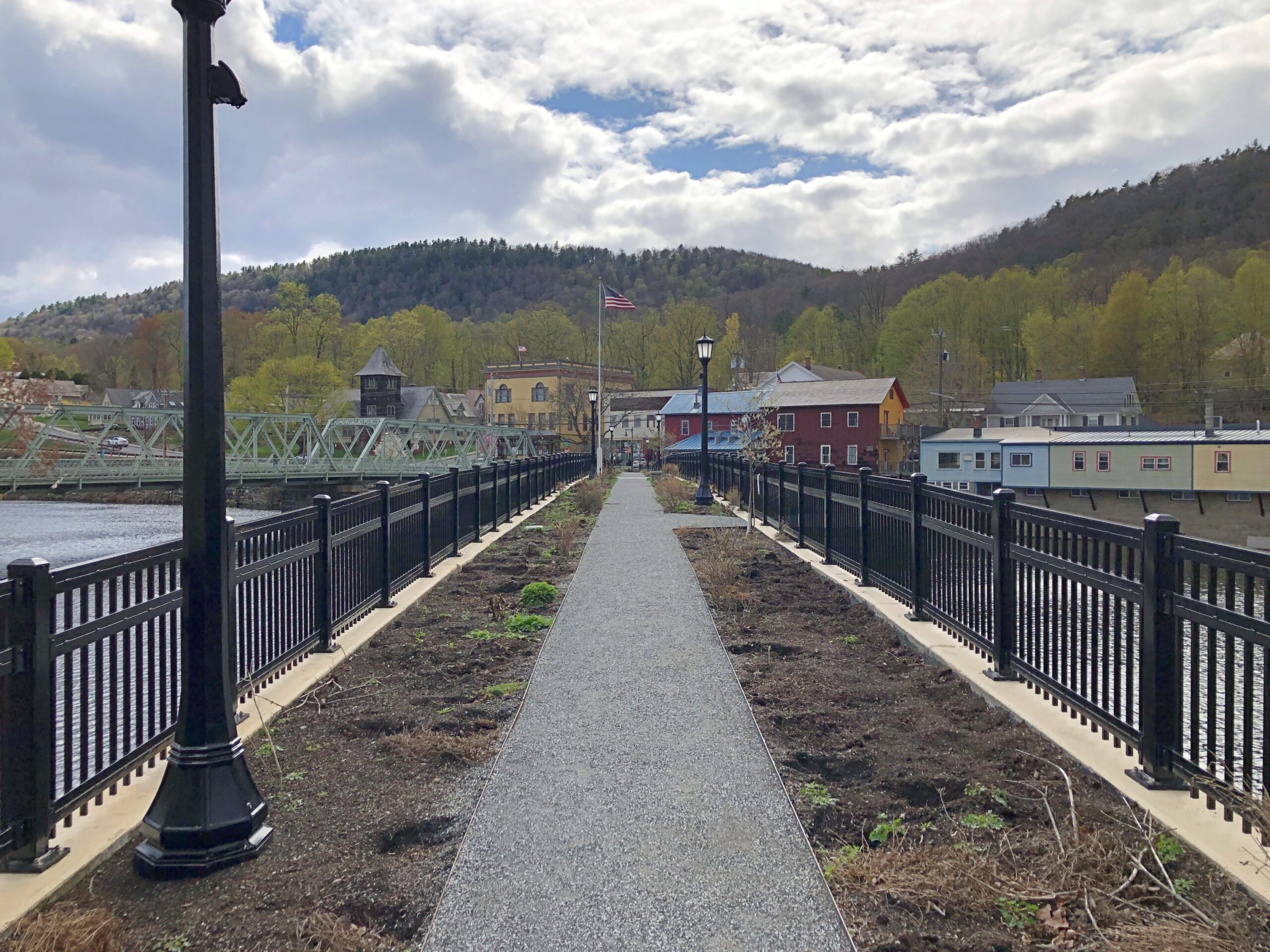
The Iron Bridge takes you to Buckland, though I guess you’d still be in Shelburne Falls, but anyway, a few steps along river – and I mean that literally, maybe 20 or 30 steps – is the Bridge of Flowers. The view looking back across at Shelburne.
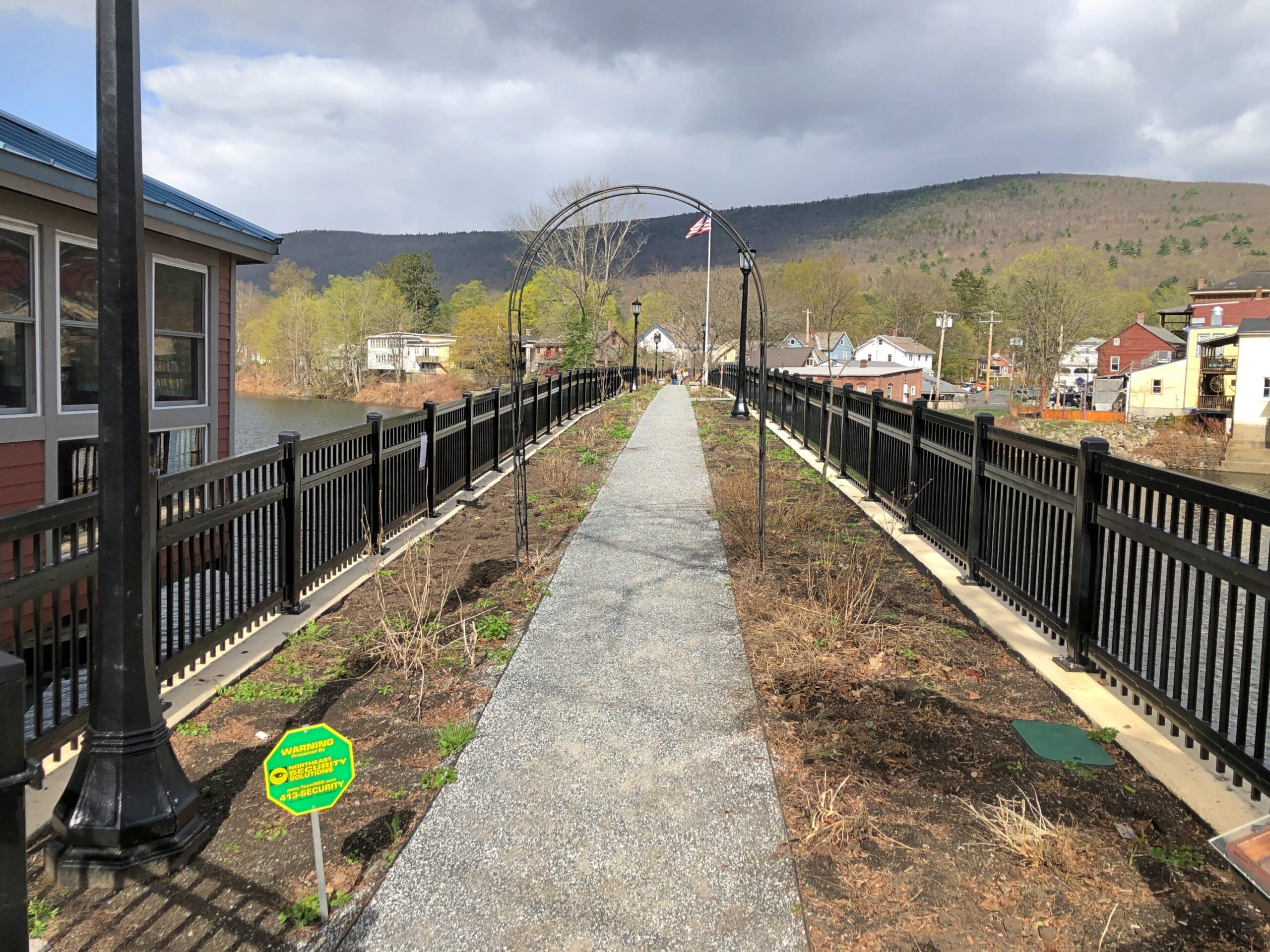
Not many flowers at that moment, but replanting was underway. Long ago the narrow bridge carried a trolley, but after that business went bust in the late 1920s, the Shelburne Woman’s Club facilitated its transformation into a linear garden.
Mid-way across the Bridge of Flowers. Even though not flowering (much), a bridge very much worth crossing.
The view looking back at Buckland.
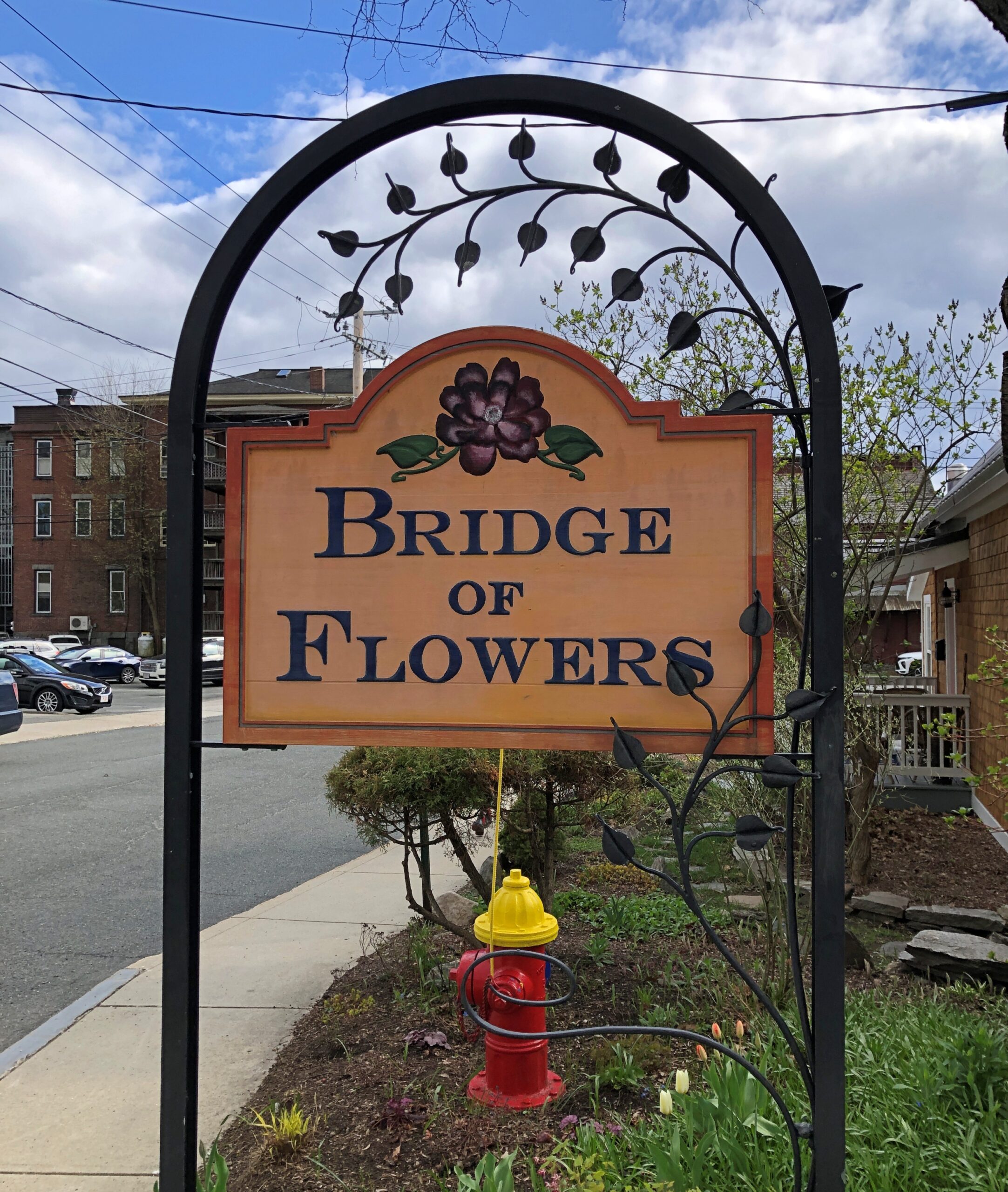
The sign on the Shelburne side.
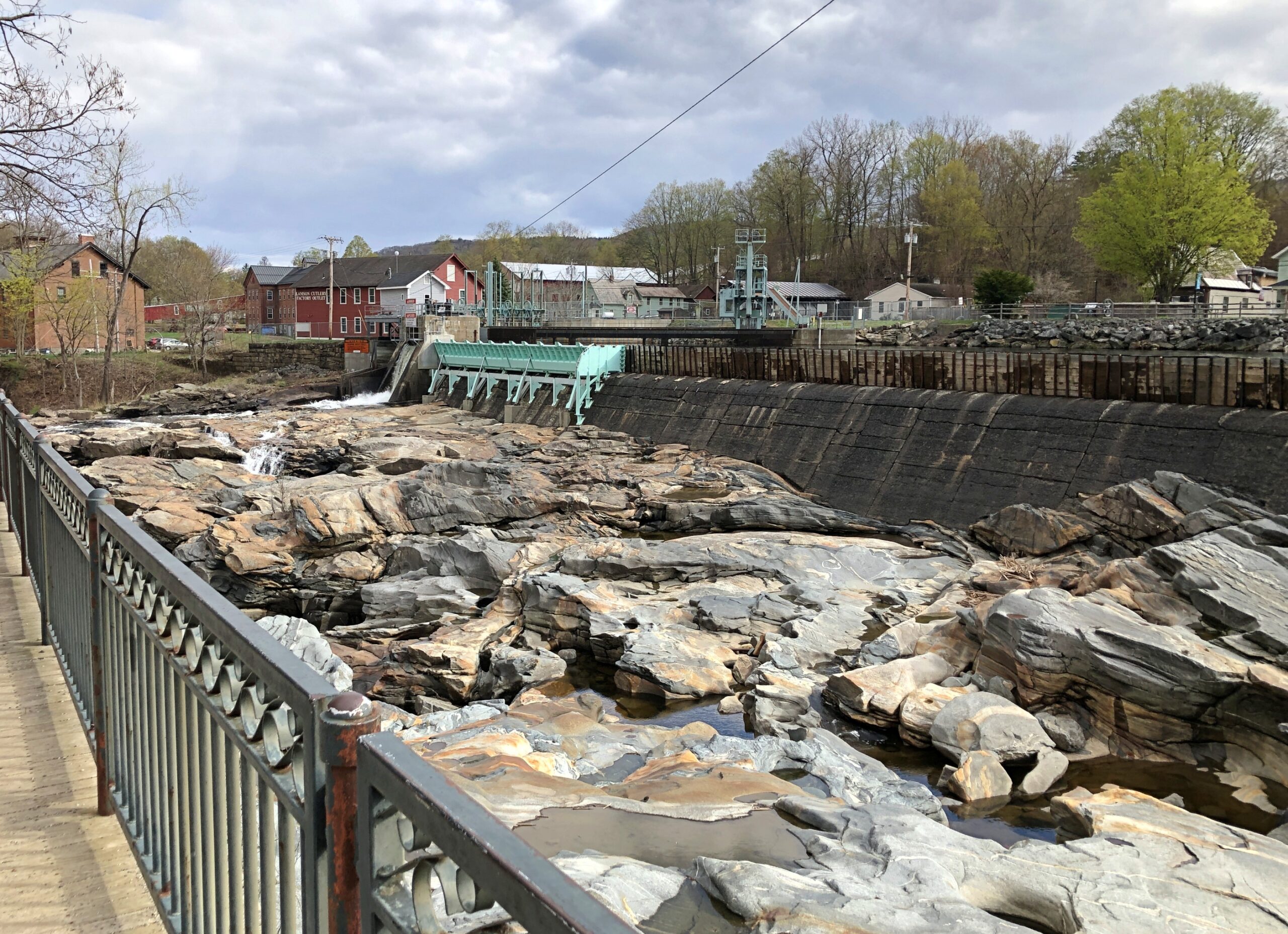
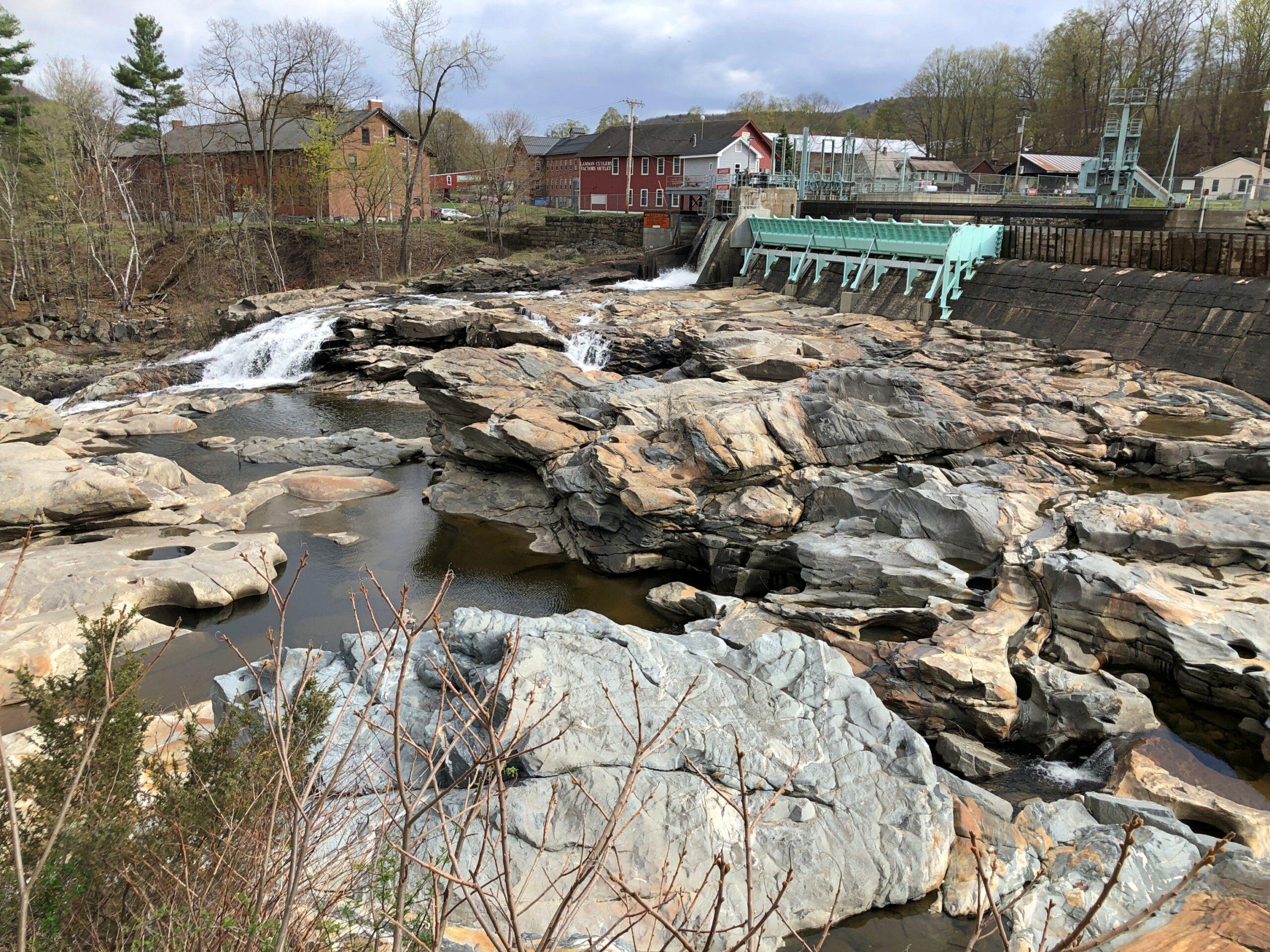
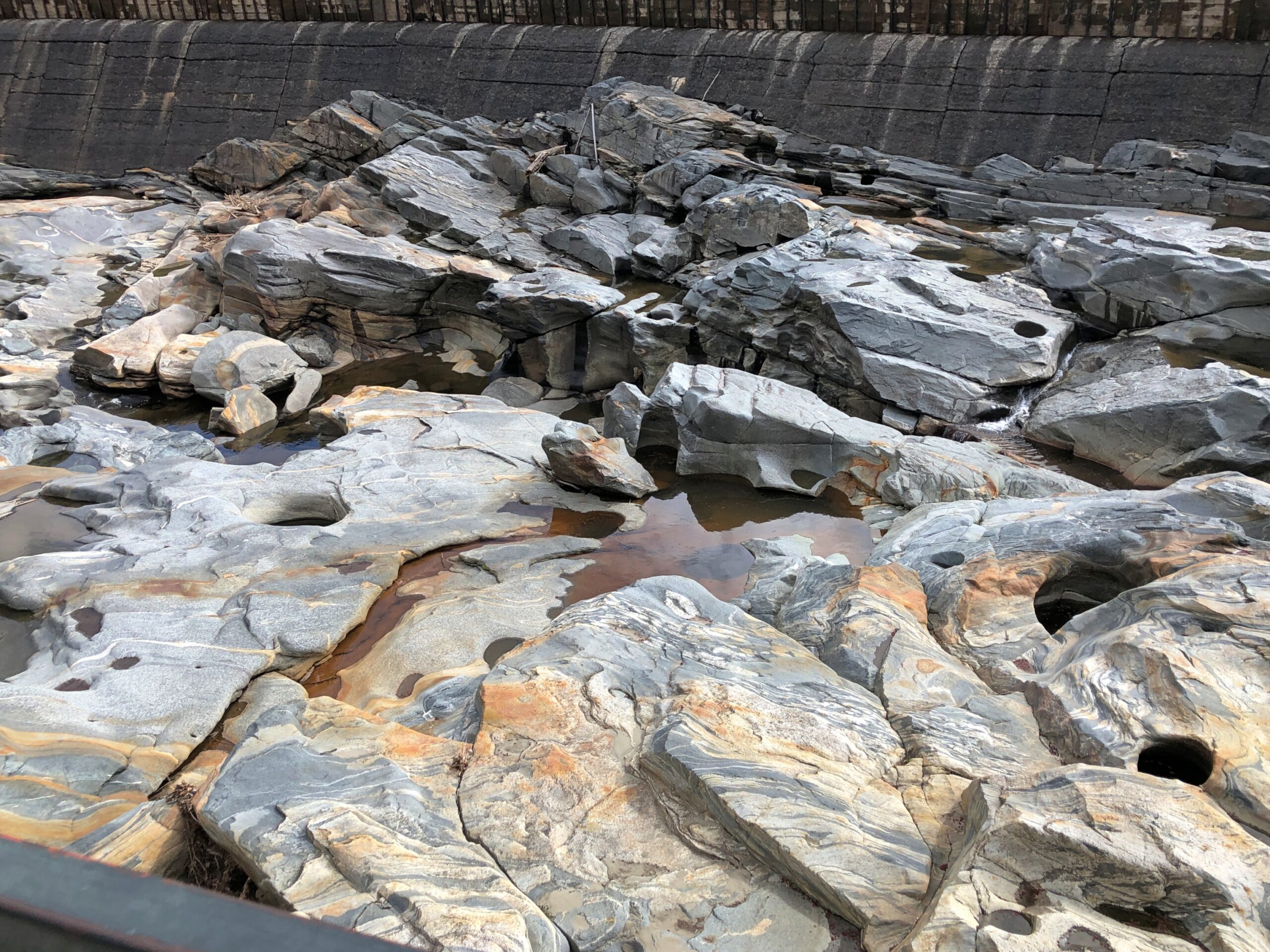
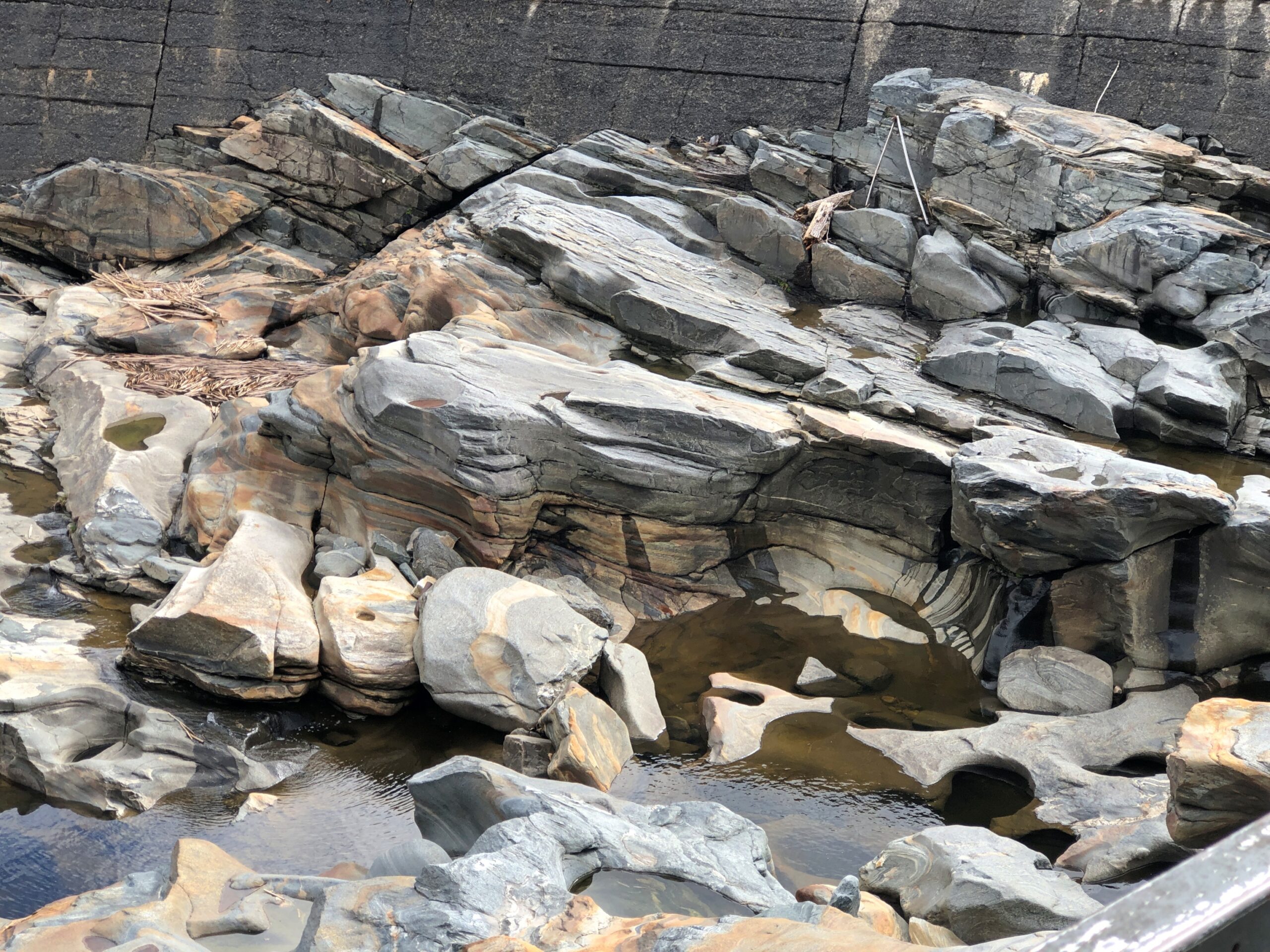
Nothing is far apart in Shelburne, so a short walk takes you to a geological oddity.
Glacial Potholes
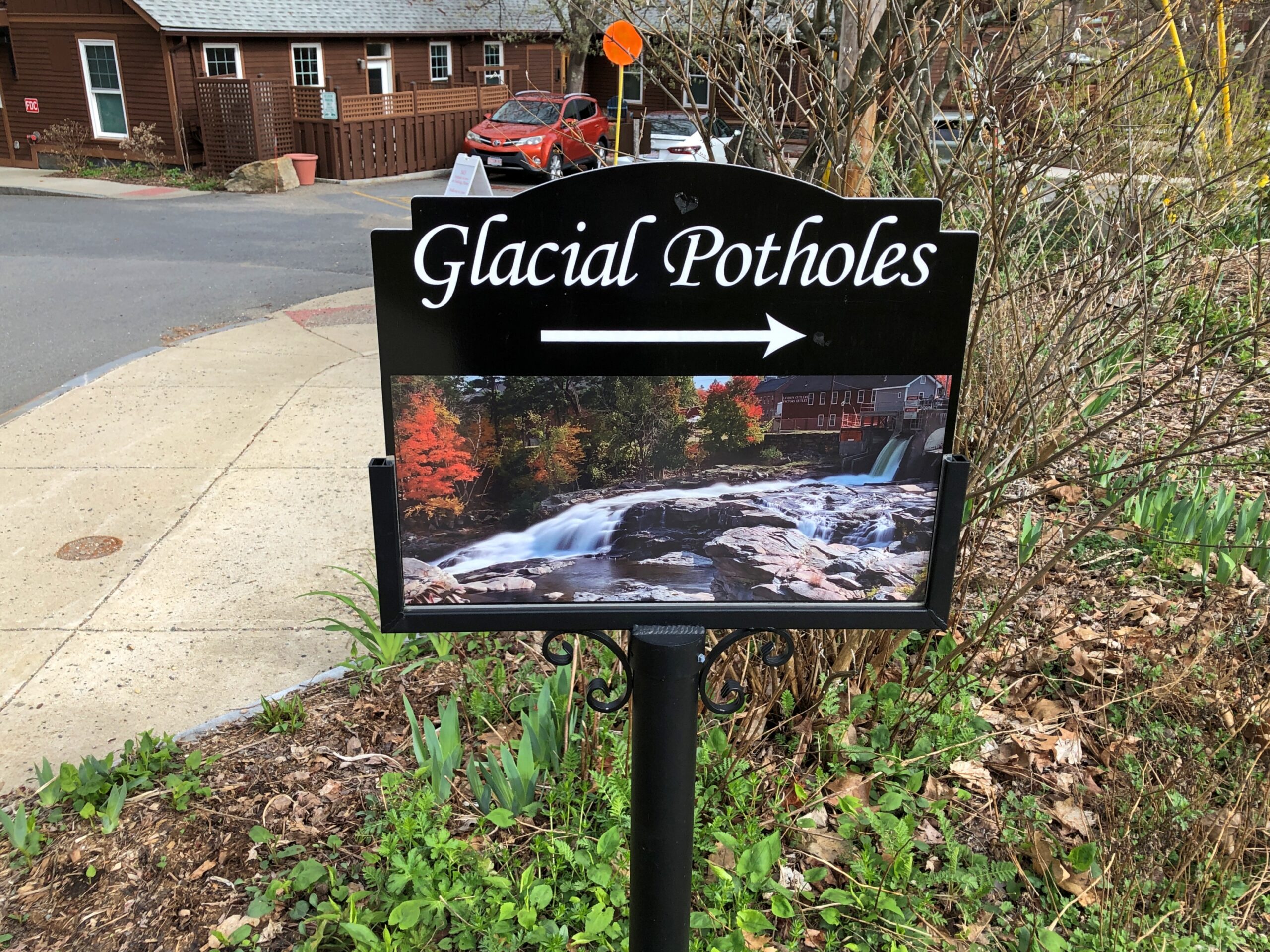
Another sign.
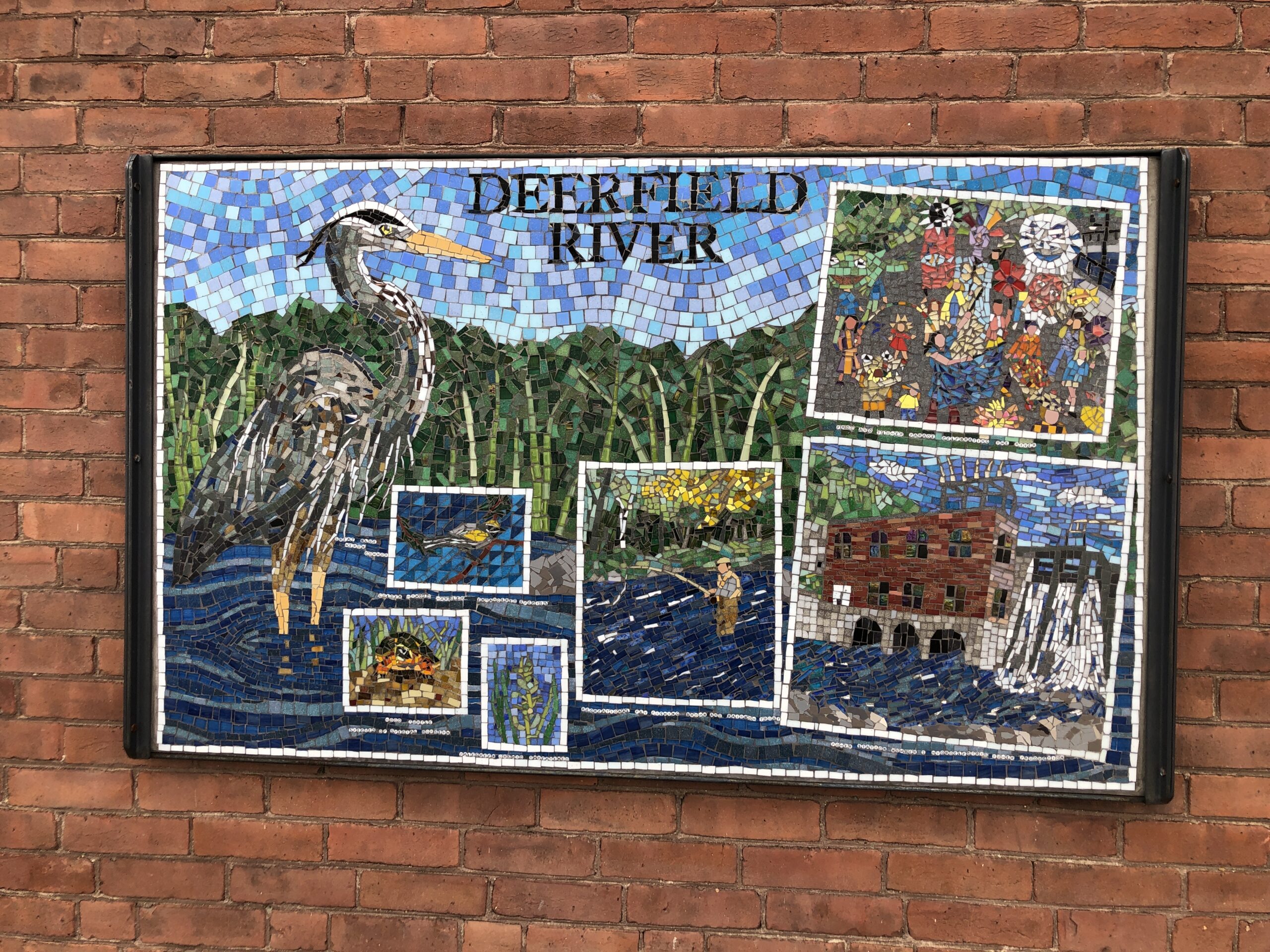
Follow the arrow and you pass a mosaic celebrating the locale. A high-quality image of this would make a good postcard.
Different in details — stone and coloration and process — but erosion as much as Sioux Falls in Sioux Falls. Or on the Bruce Peninsula. Or the coast of Maine, for that matter. Water doing its grind beyond the timescales of humanity.
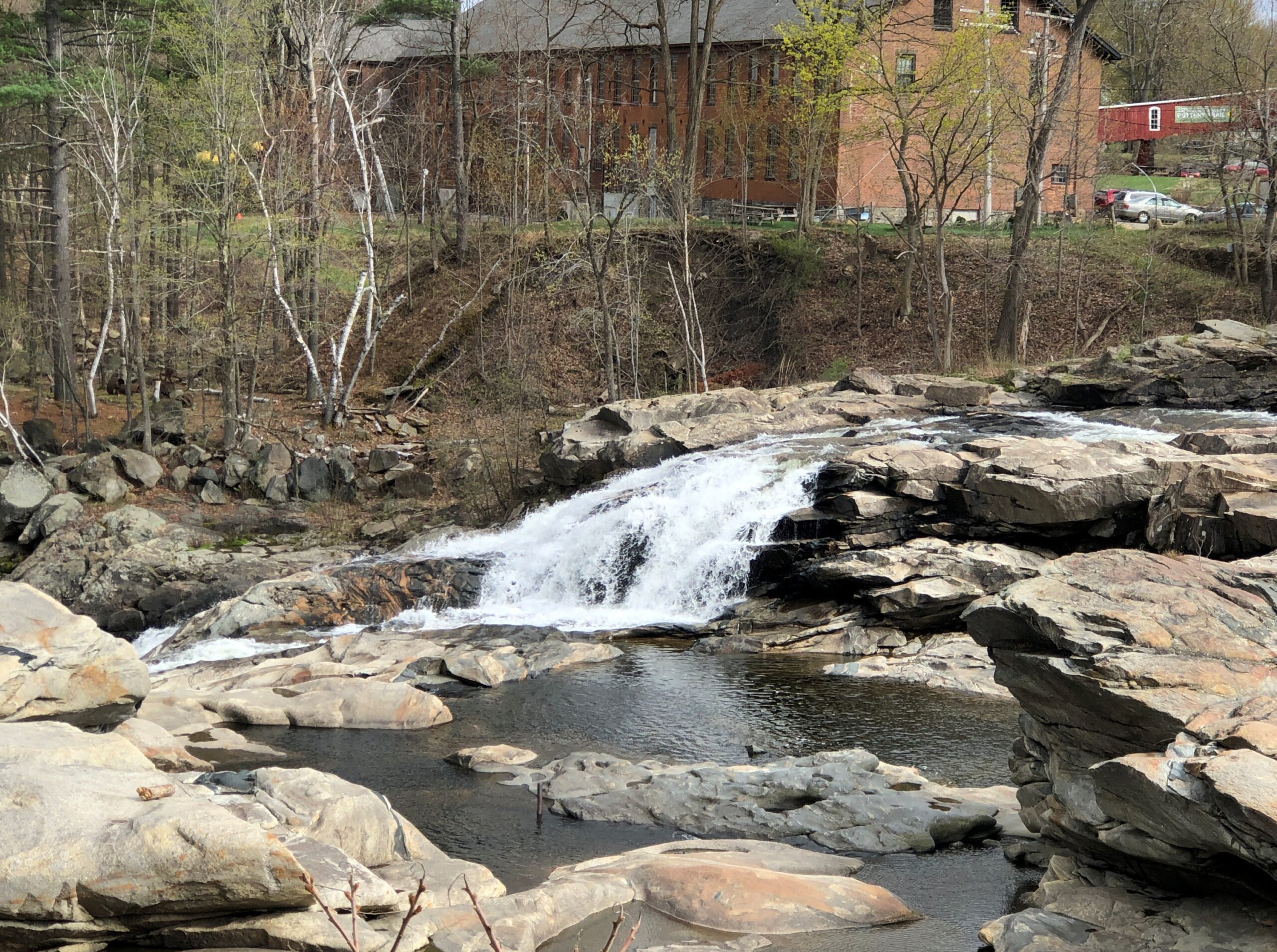
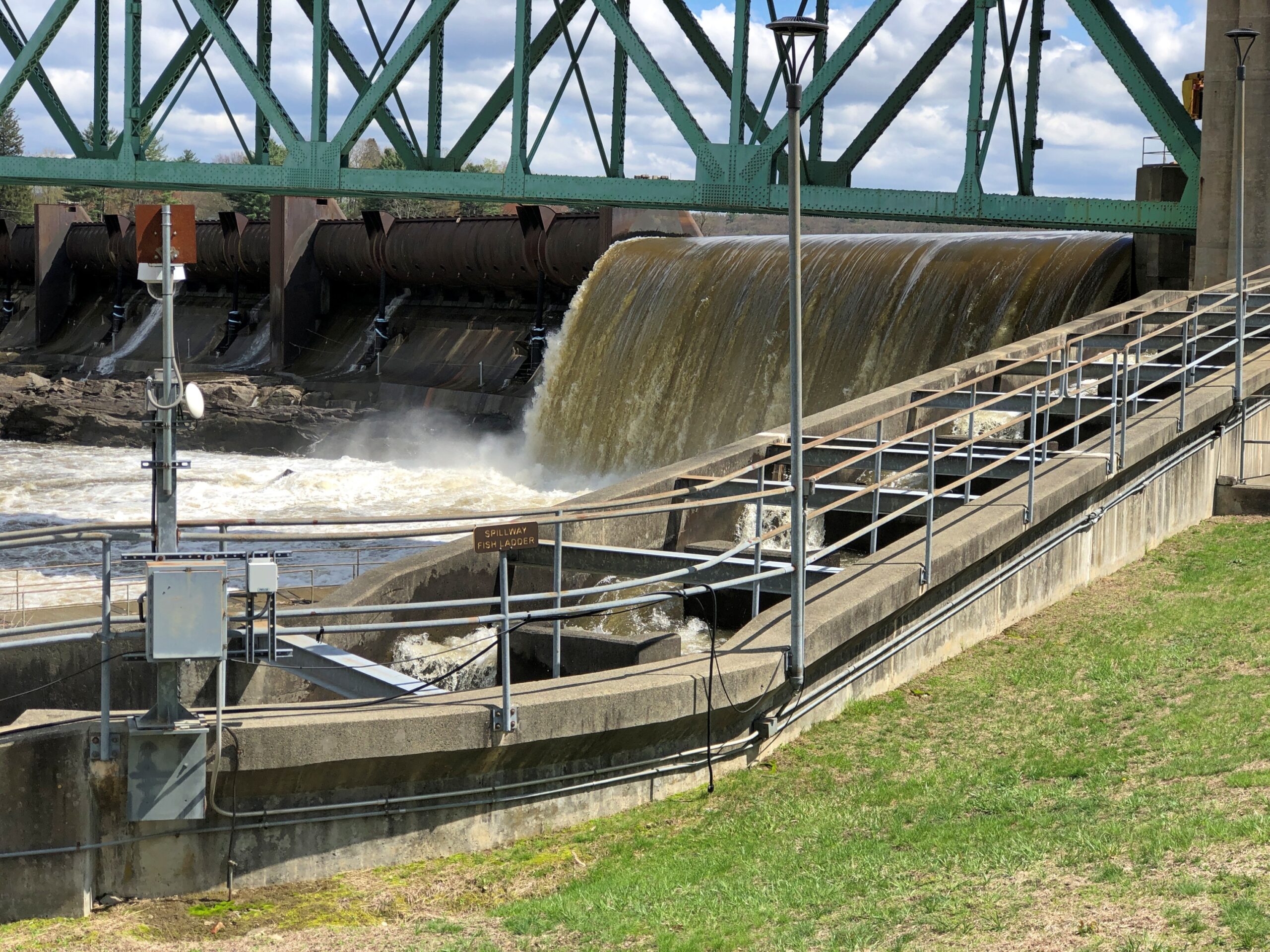
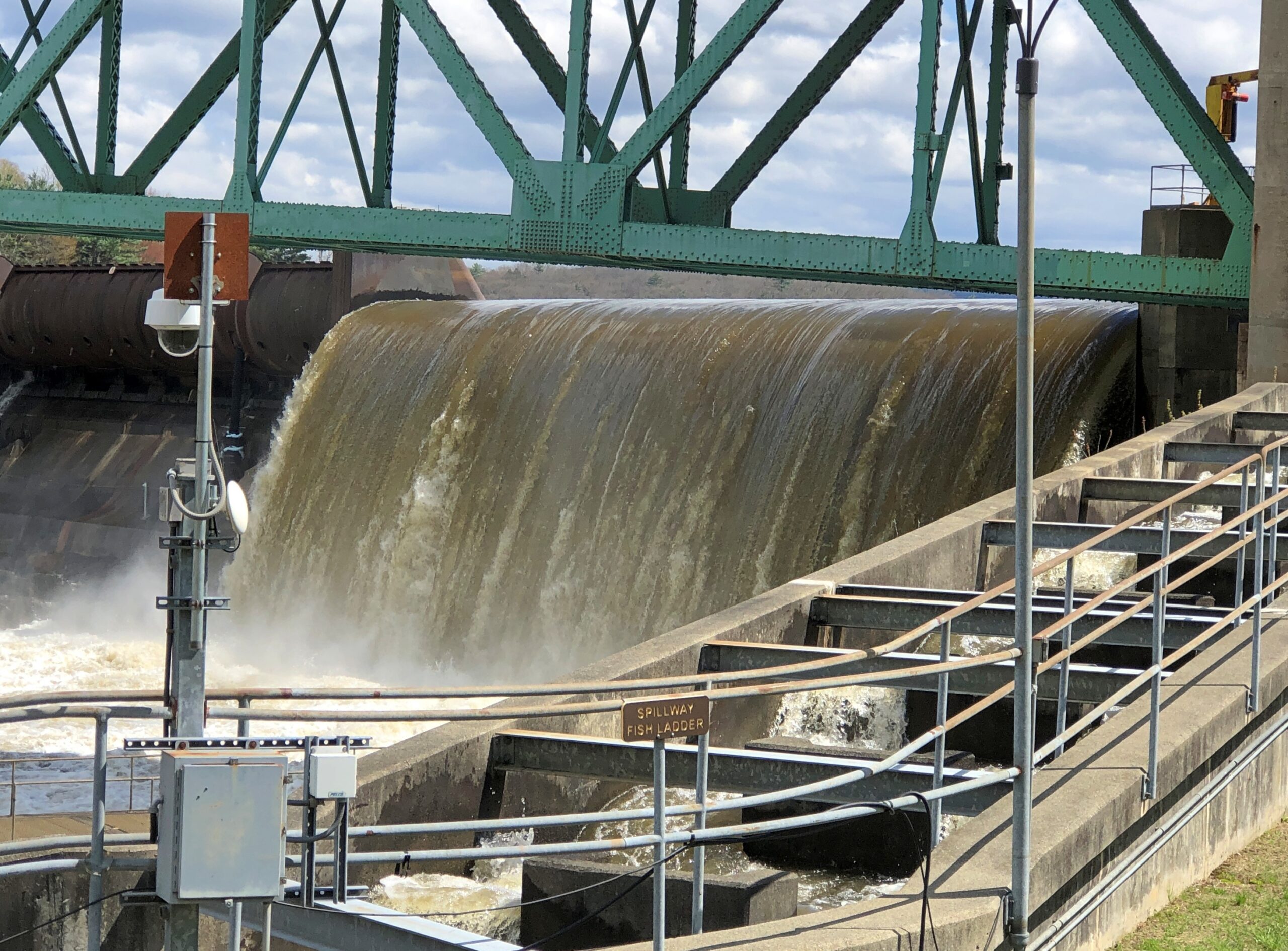
The spillway was busy. It had been a rainy day before.
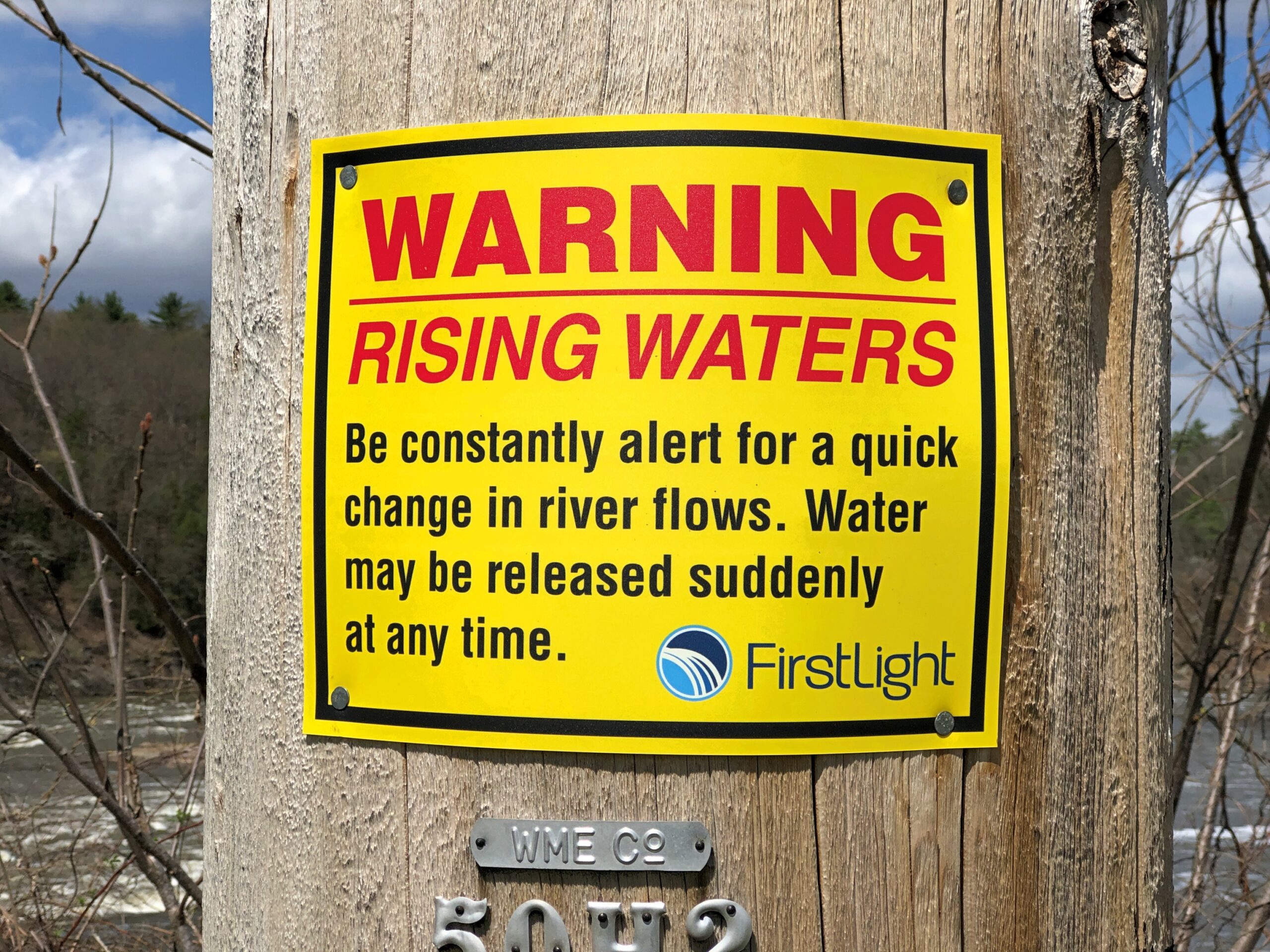
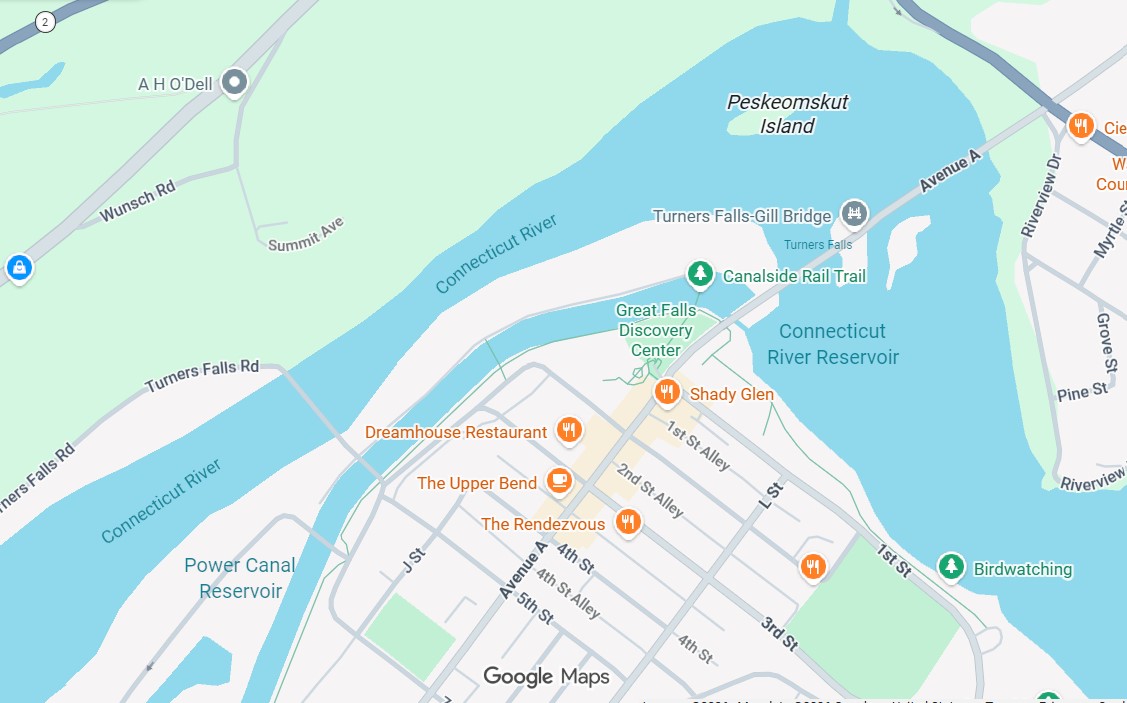
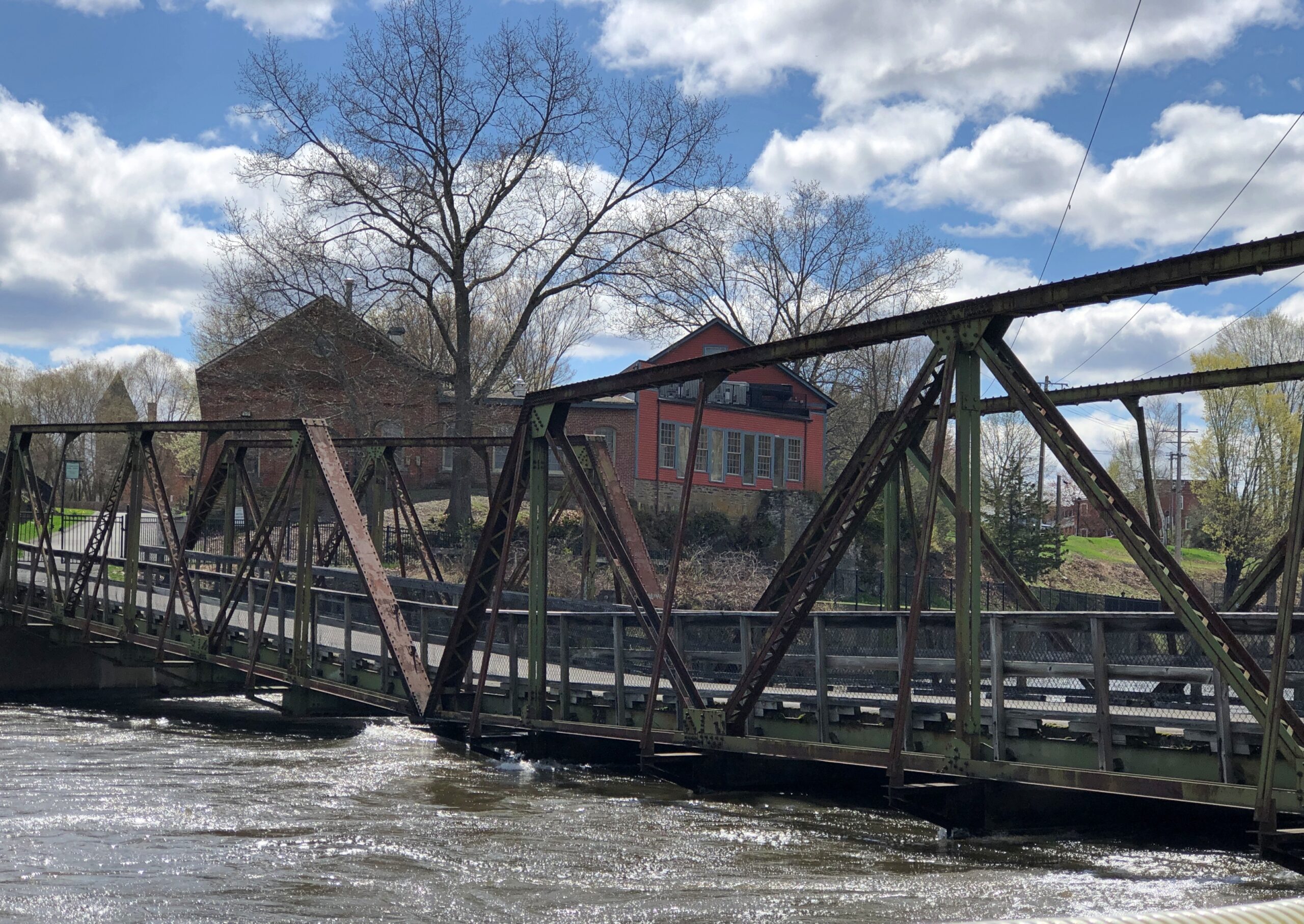
Luckily, the nearby waters didn’t make any sudden moves in the vicinity of my person that afternoon. I was near the Connecticut River at a place called Turners Falls (no apostrophe), Massachusetts. The sign is posted on a man-made island, in fact, created by a canal paralleling the river – Turners Falls Canal.
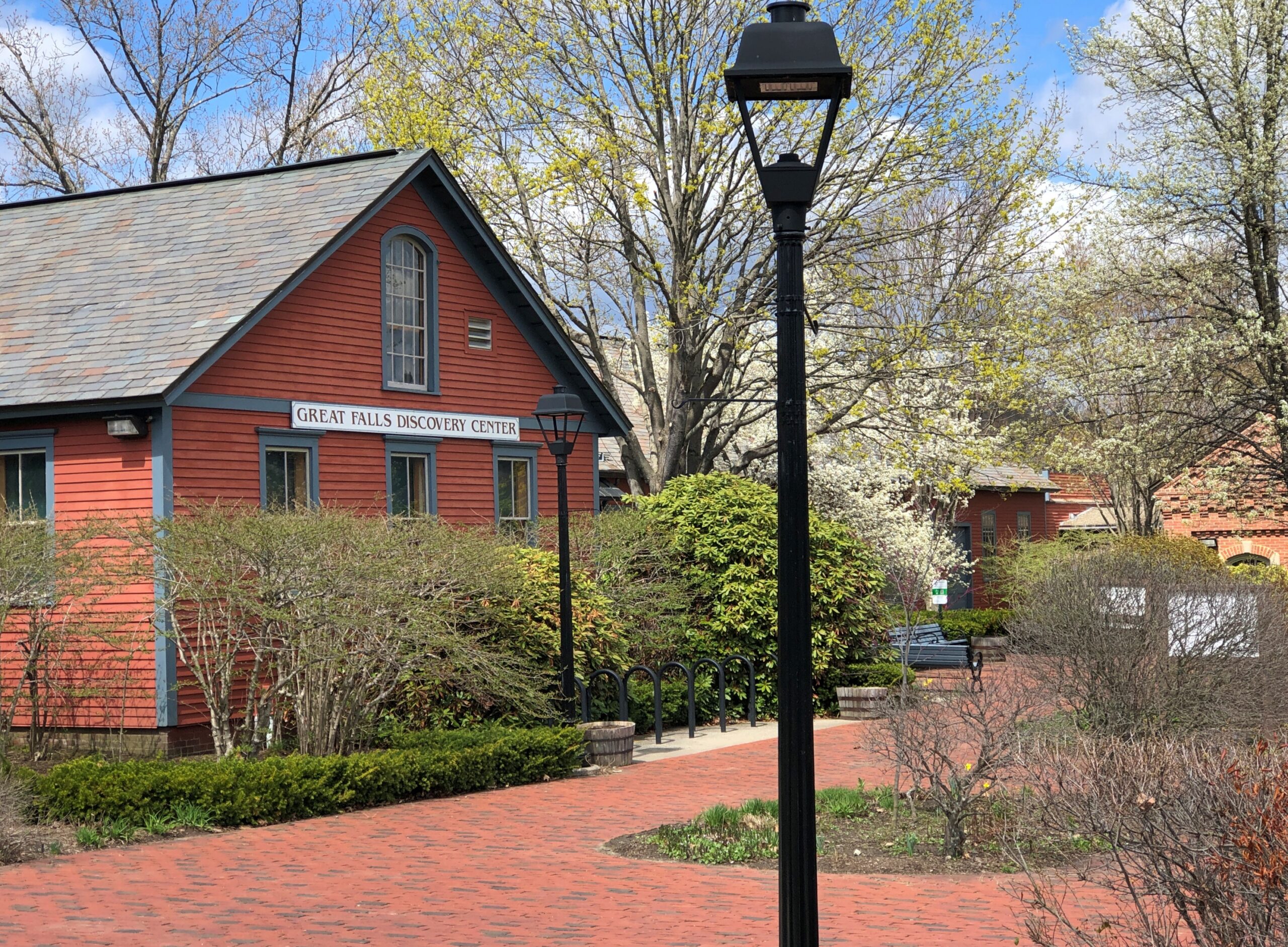
I’d crossed the Connecticut via a bridge, and the canal too, and parked on Avenue A in Turners Falls near the Great Falls Discovery Center, which is housed in restored mill buildings on the south edge of the canal.
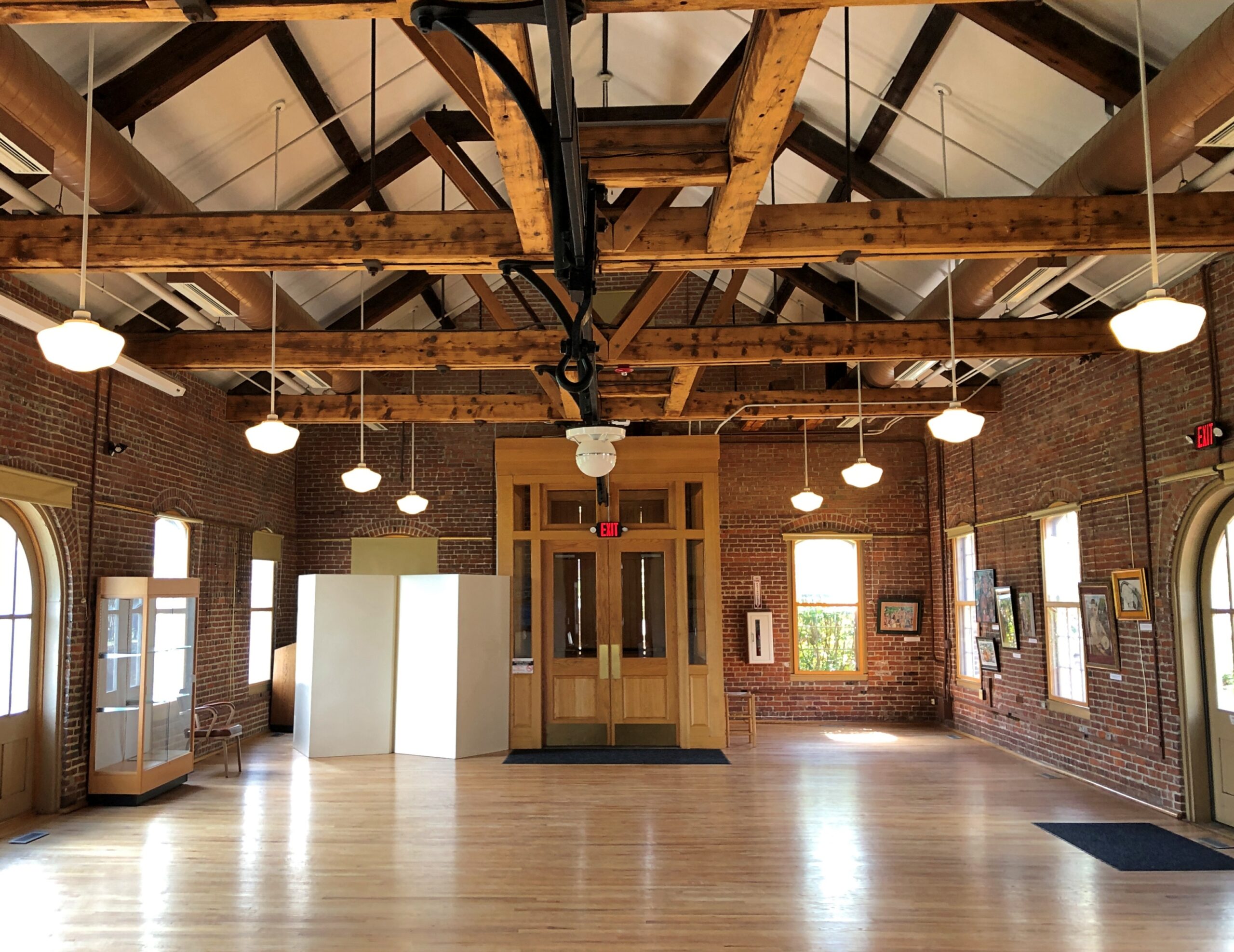
Great Falls Discovery Center, owned by the Massachusetts Department of Conservation and Recreation, includes open habitat exhibits, fish tanks, and dinosaur fossils, and is generally geared to small fry. It does have a nice, if underutilized, exhibit space in one of the restored buildings.
I understand that “Great Falls” is an earlier name of the falls, now the site of a dam, and that a fellow named Turner led an attack on a native settlement on the river 350 years ago, leading to the renaming of the falls – more about all that later. A path from the center leads to the canal.
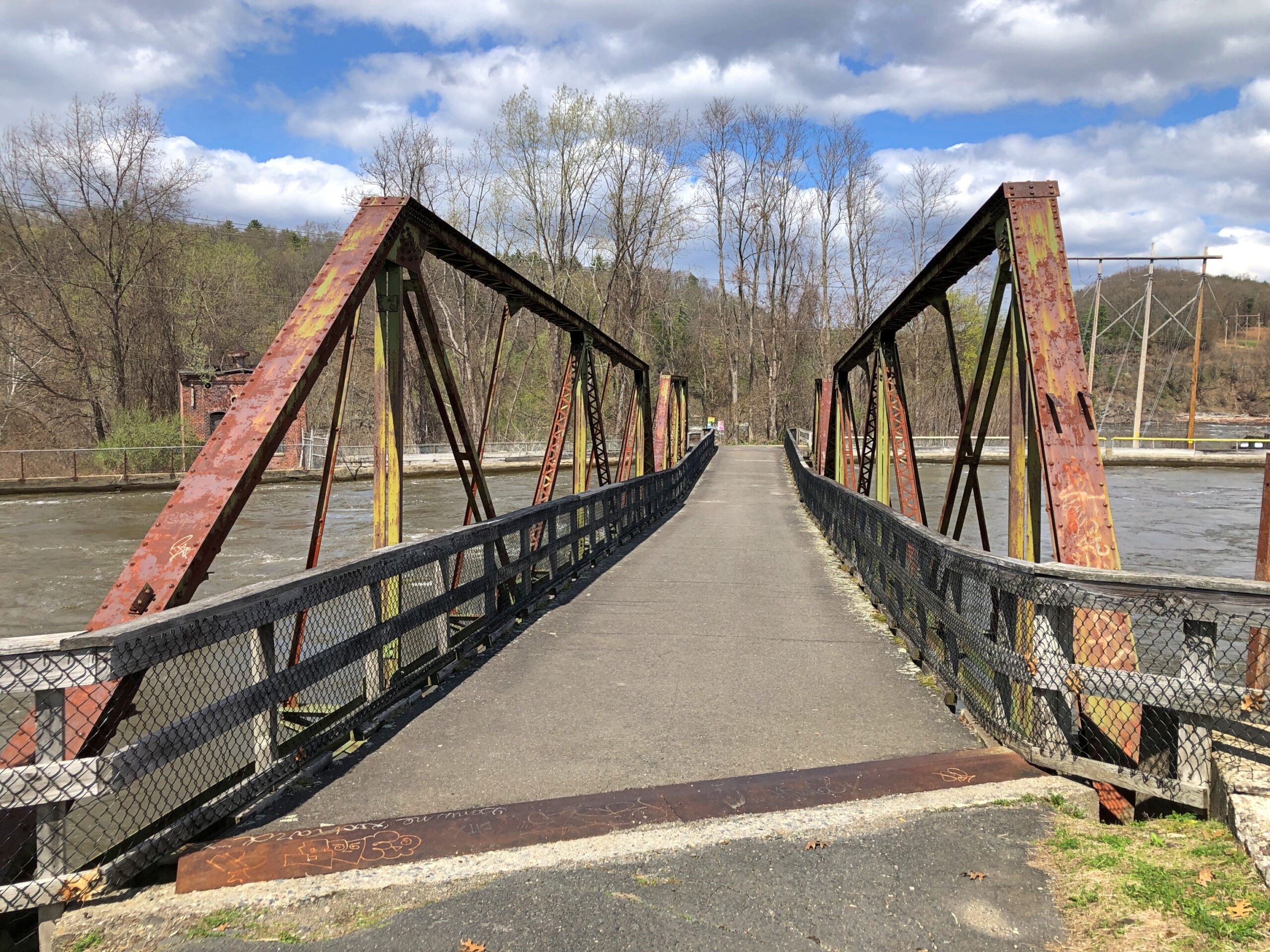
A rusty foot bridge across the canal.
Looks a little dodgy, especially when the flow is strong, as it was that day in the wake of heavy spring rain the day before.
But not dodgy enough to keep me from crossing to take in the views of the canal from the footbridge.
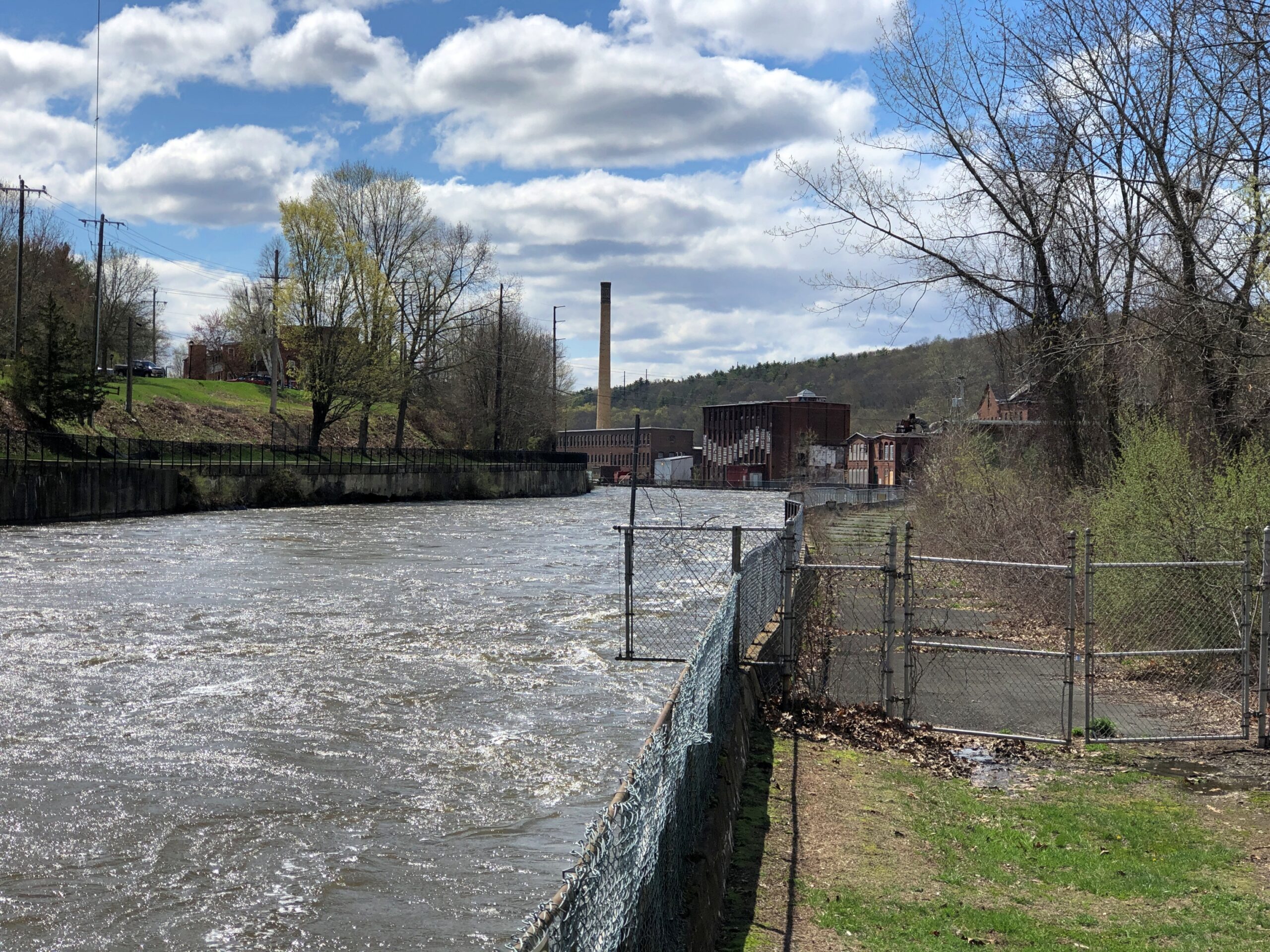
The tip of the island, while accessible at that point, is desolate. The rest of the island seemed to be fenced off.
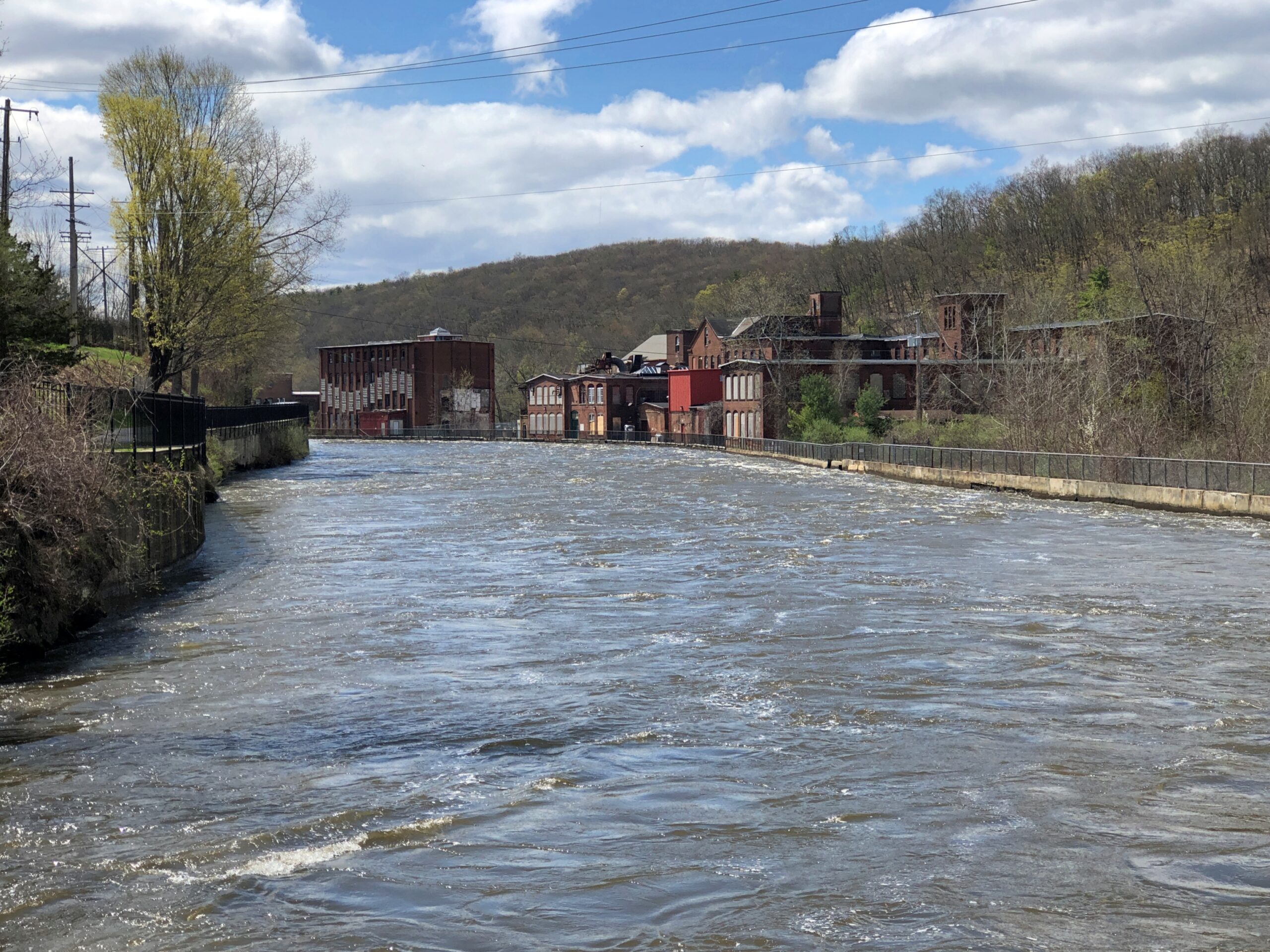
But it does offer a view of the dam and its associated fish ladder. A powerful flow that day.
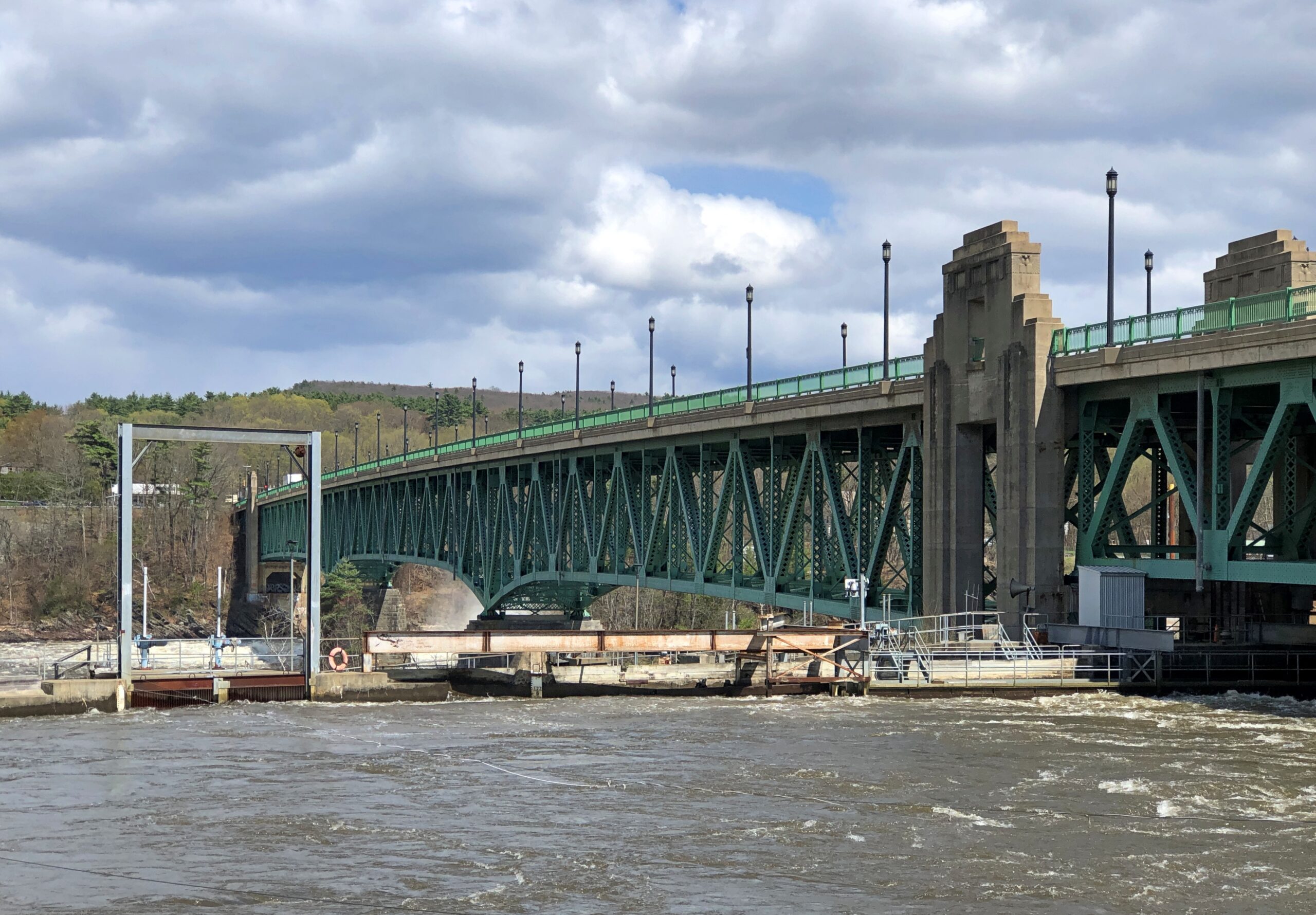
Also visible: the bridge across the Connecticut that I’d driven a little while before, the Turners Falls-Gill Bridge, completed in 1938 and renovated in the 2010s. Gill is the town on the other side.
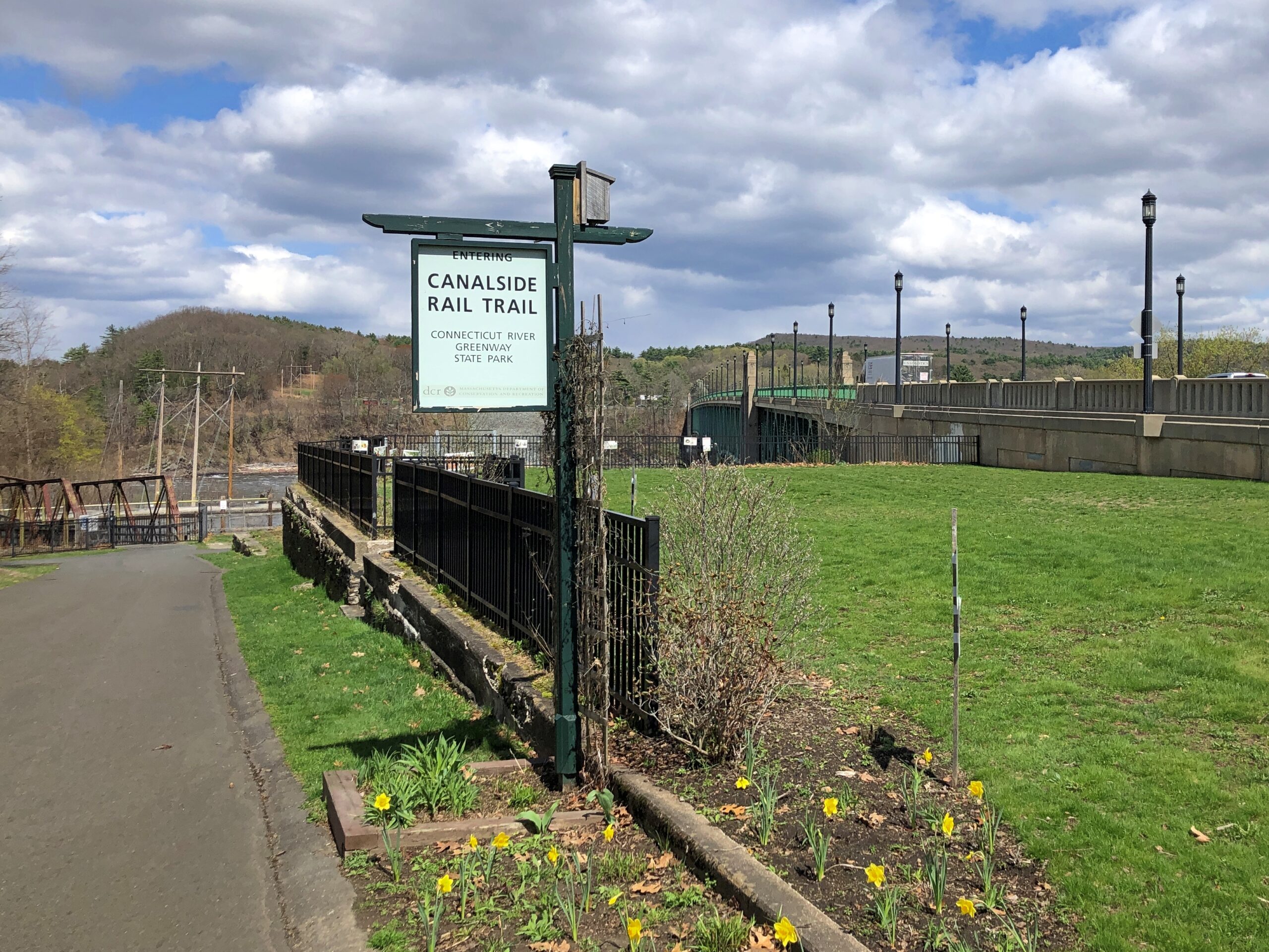
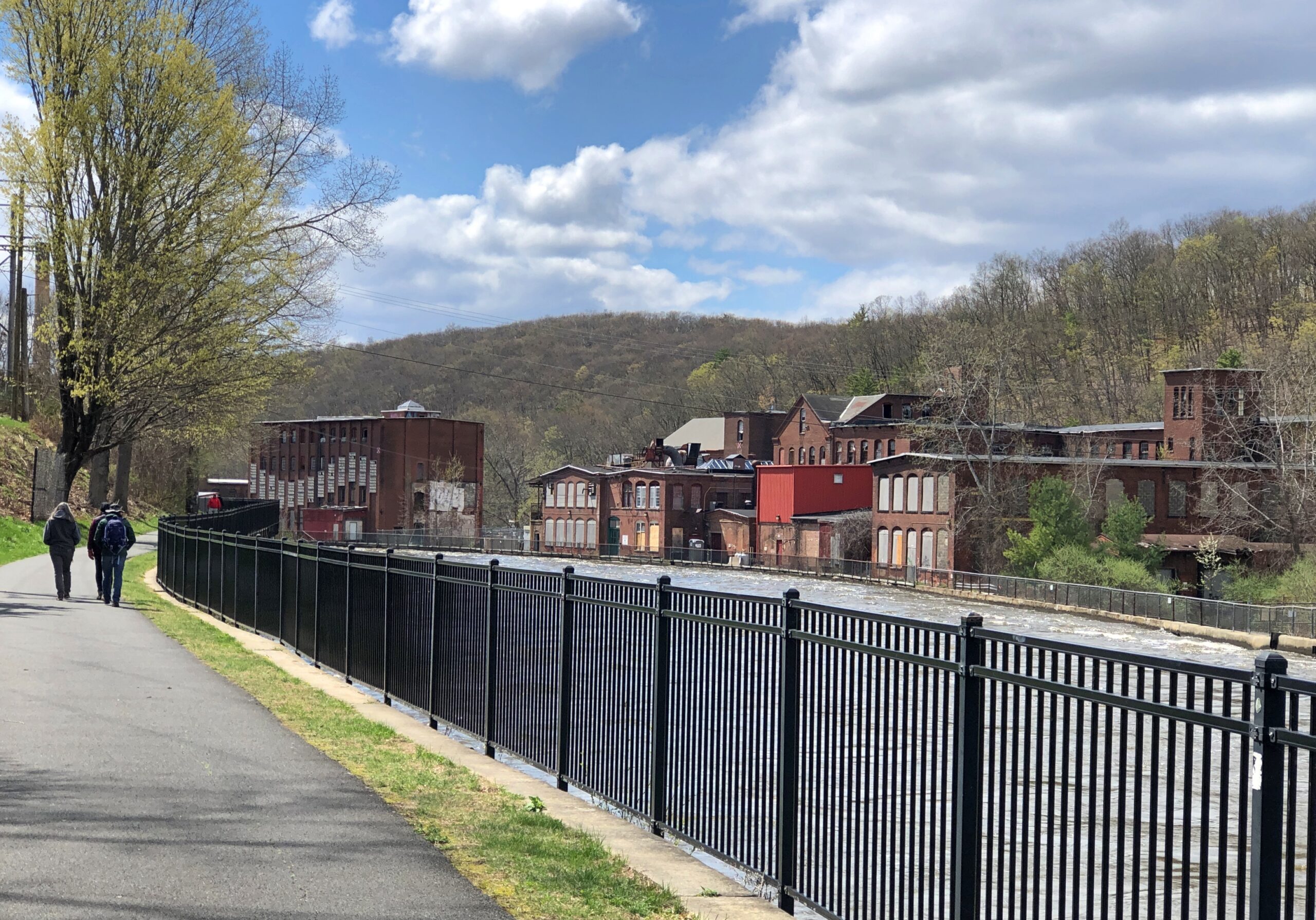
I crossed back and took a stroll down the footpath along the canal: the Canalside Rail Trail.
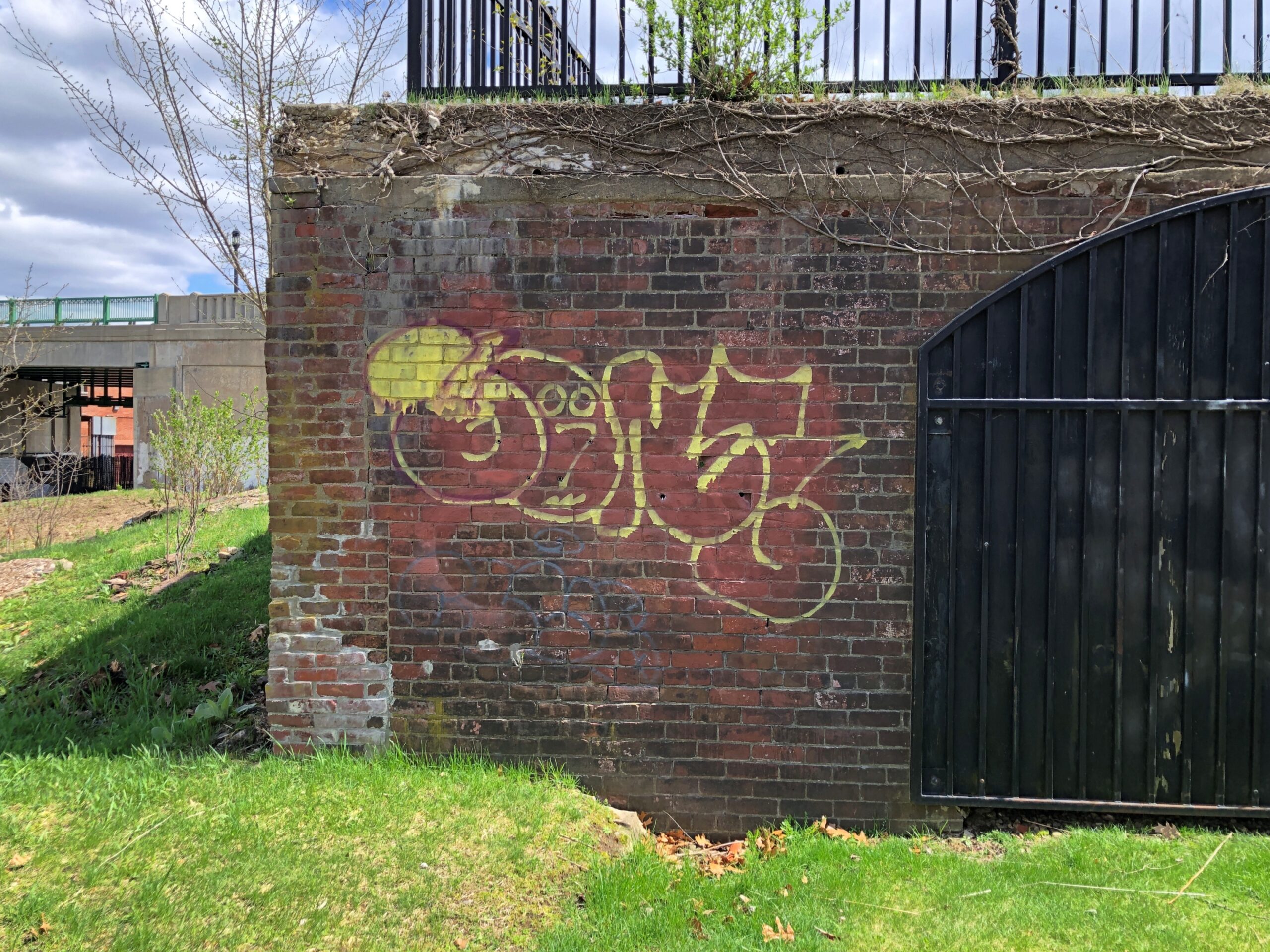
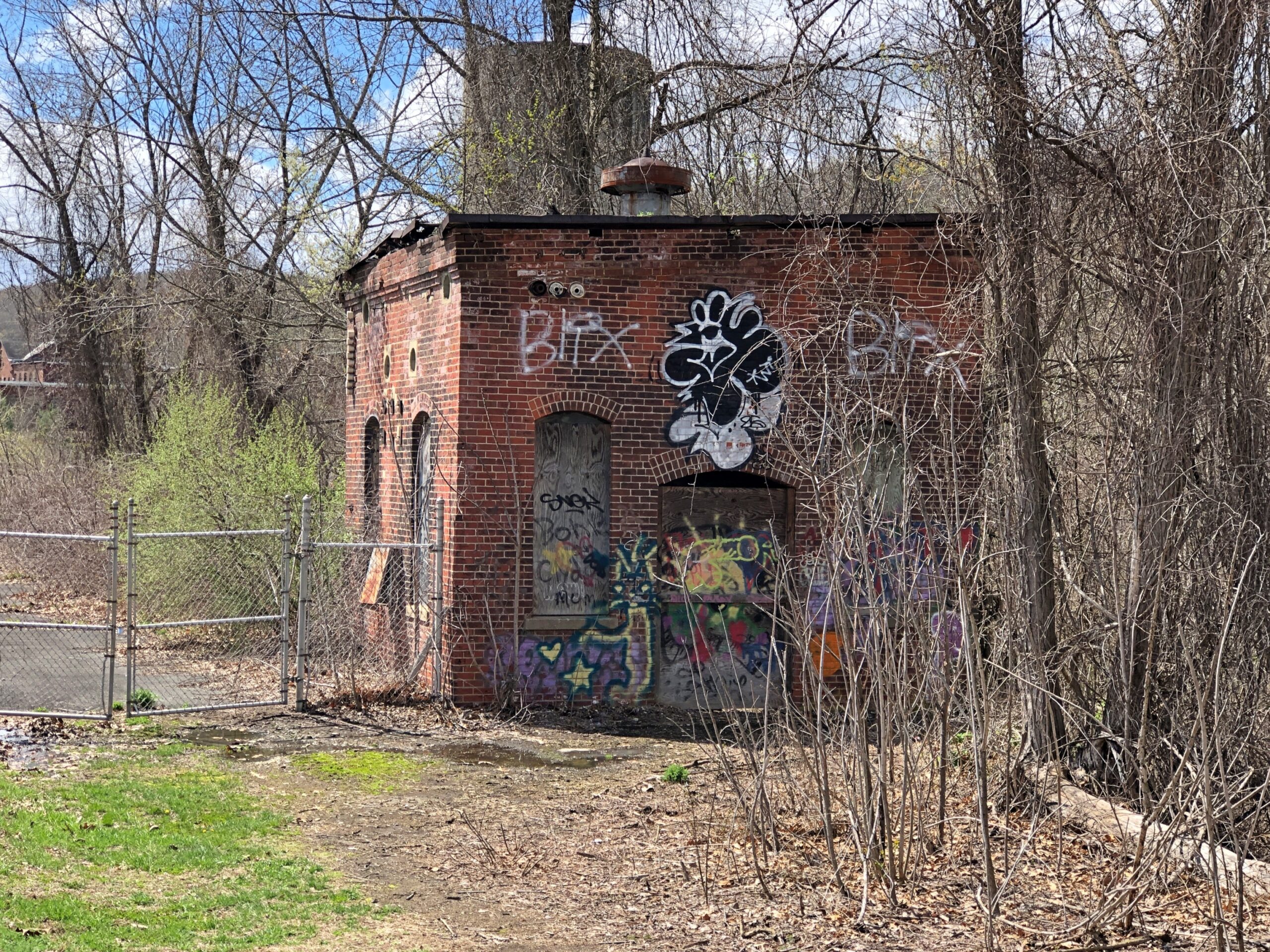
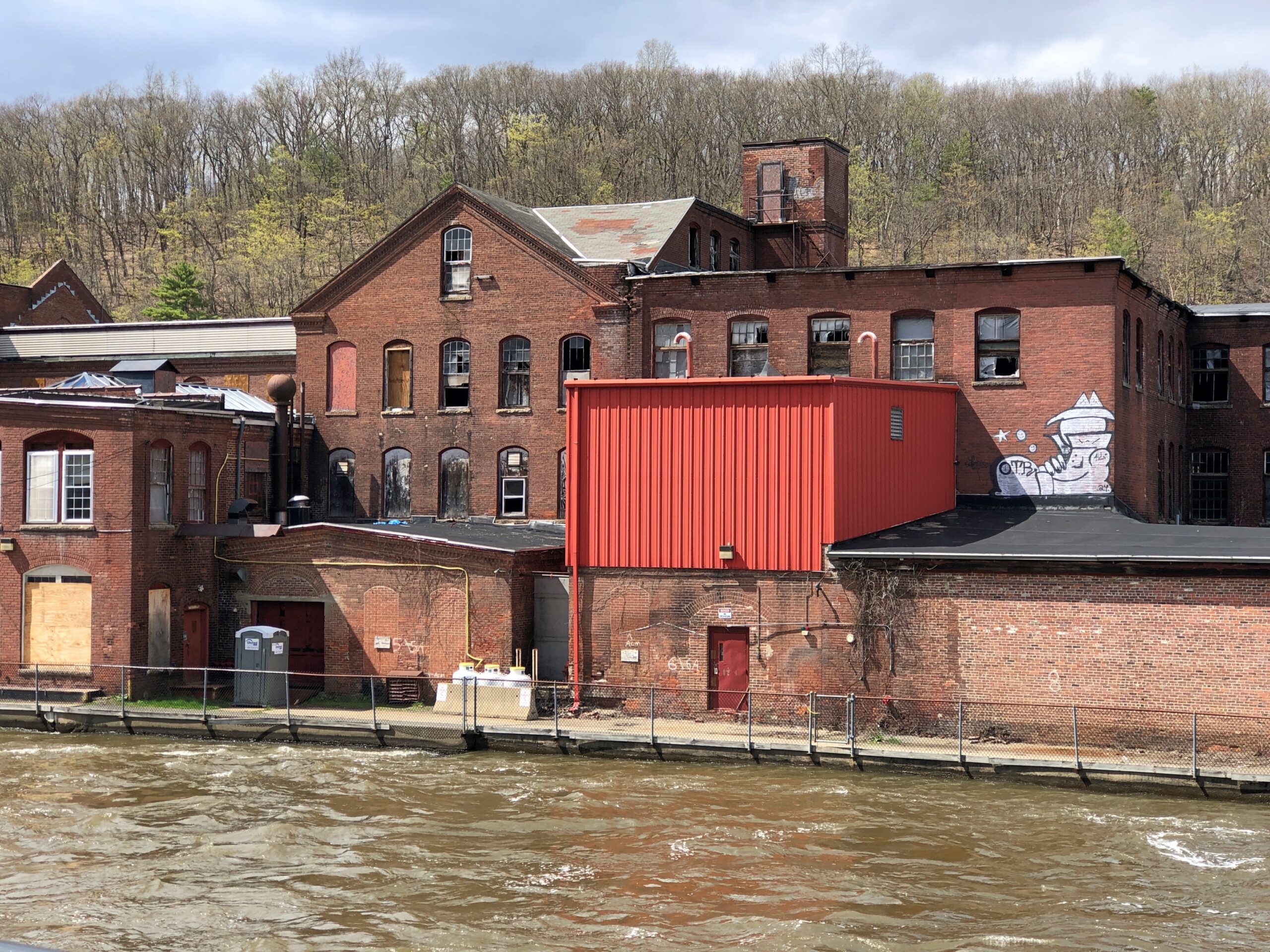
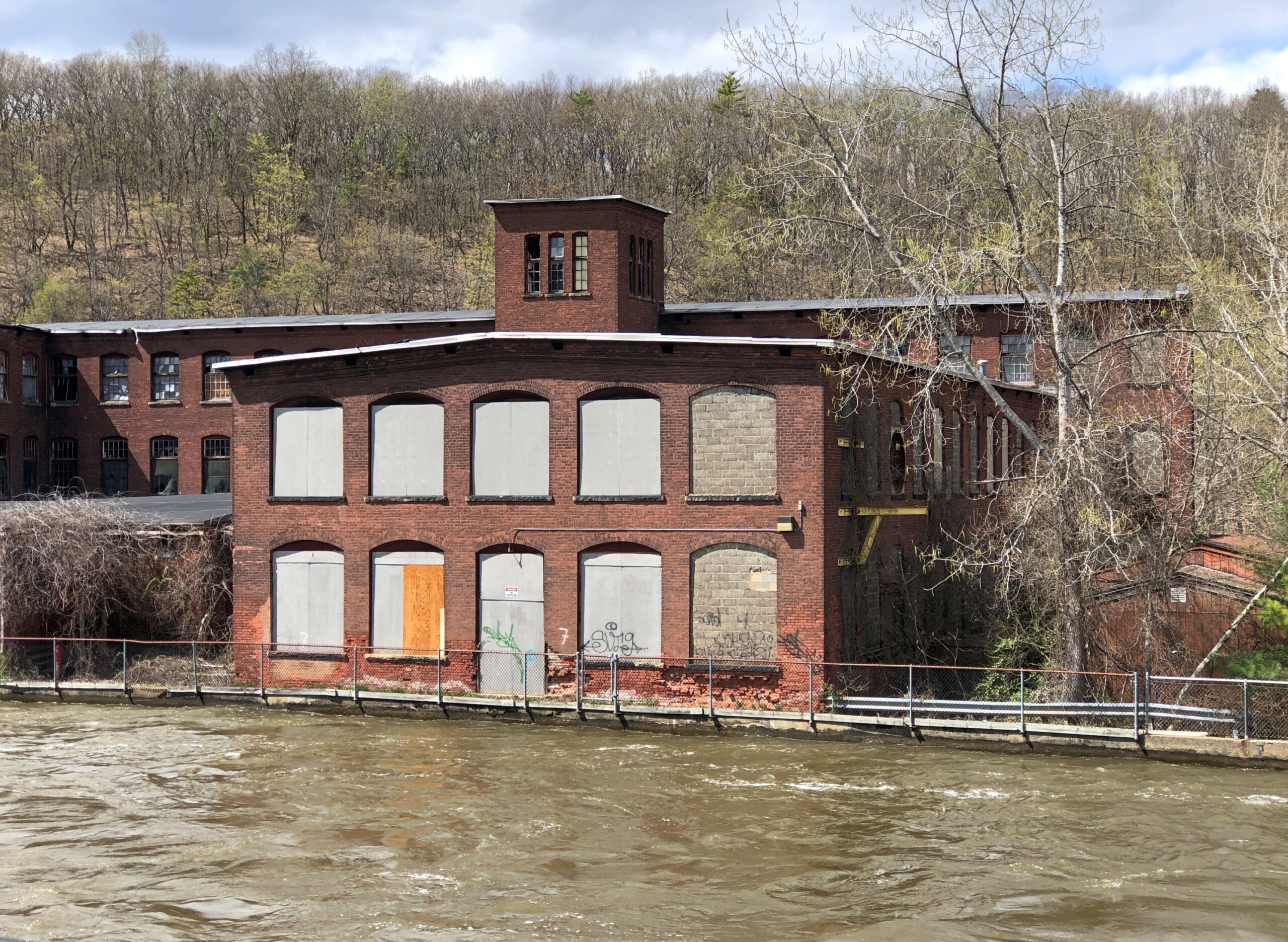
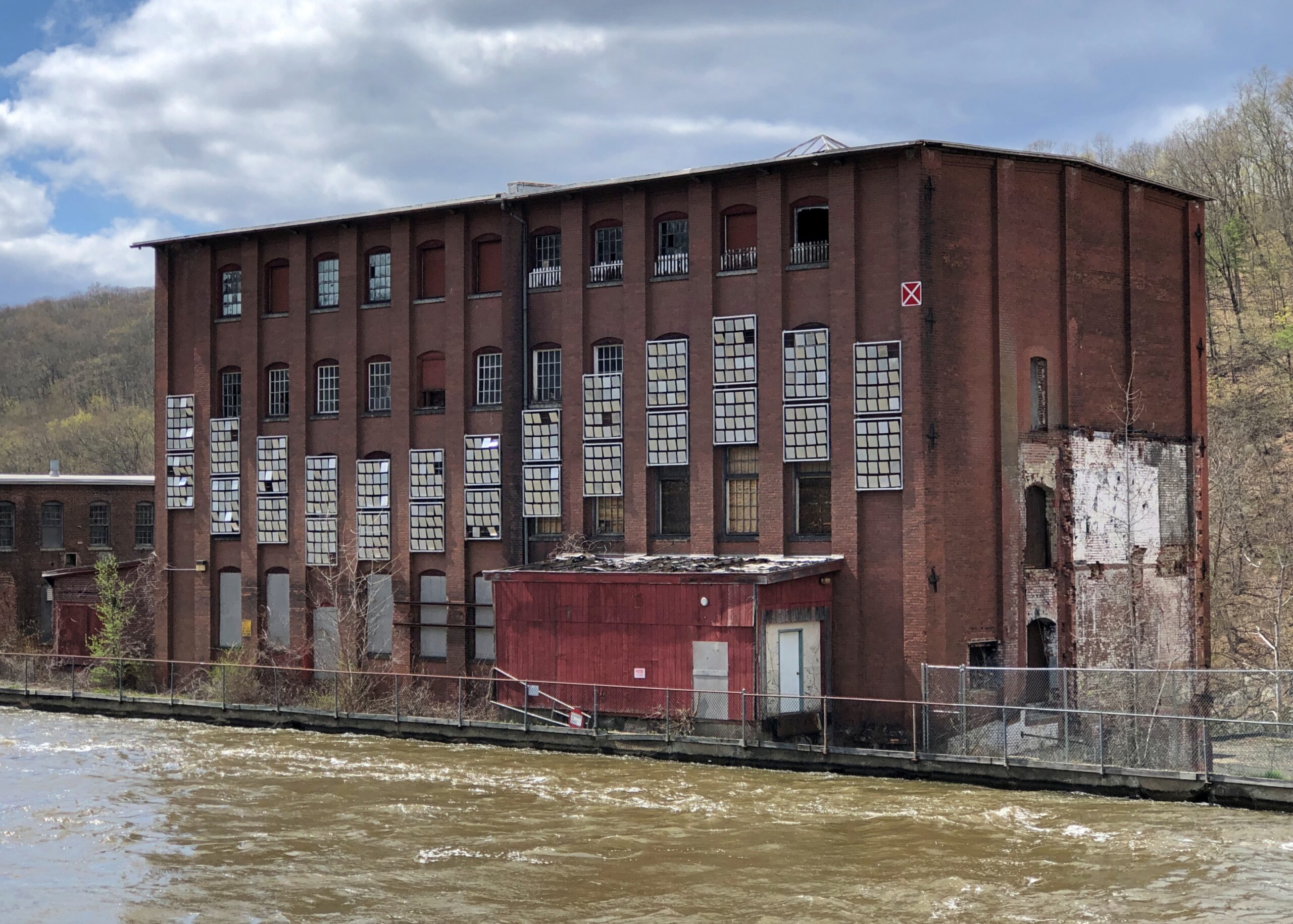
An earlier canal – dug early in the 19th century, just as the U.S. canal boom was getting underway – provided passage via locks around Turners Falls, and a boon to trade in the area. Railroads made that canal obsolete by the mid-19th century, so when the river was dammed, a different canal, a “power canal,” was created to provide water power for factories (the first canal, I believe, was submerged, but I’m not quite sure). Anyway, those factories are closed in our time, but their husks linger.
Waiting for the time when the area’s population is growing again — perhaps during a reverse migration from the too sunny South in the next mid-century — and these sturdy structures can be remade into residential properties.
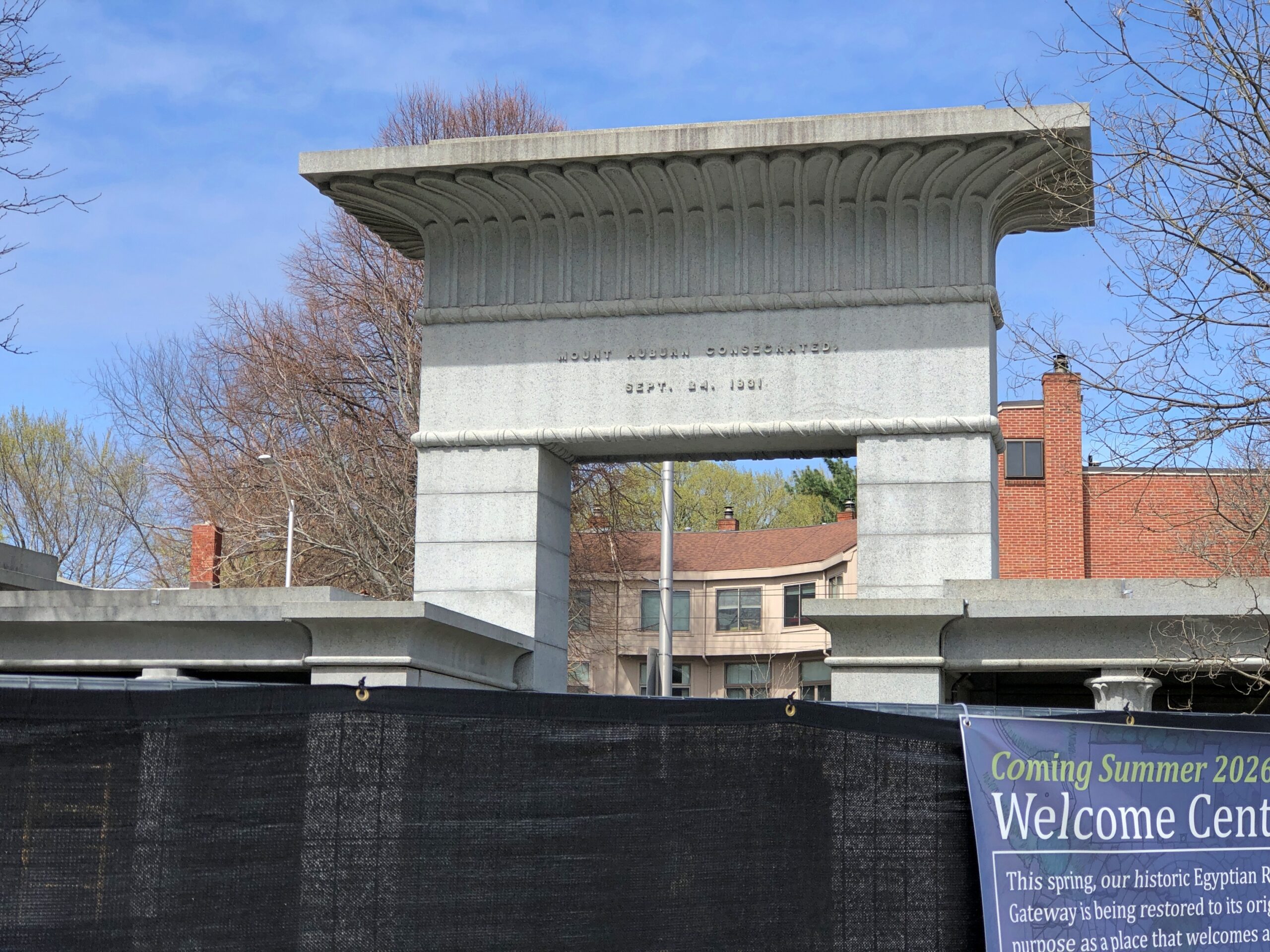
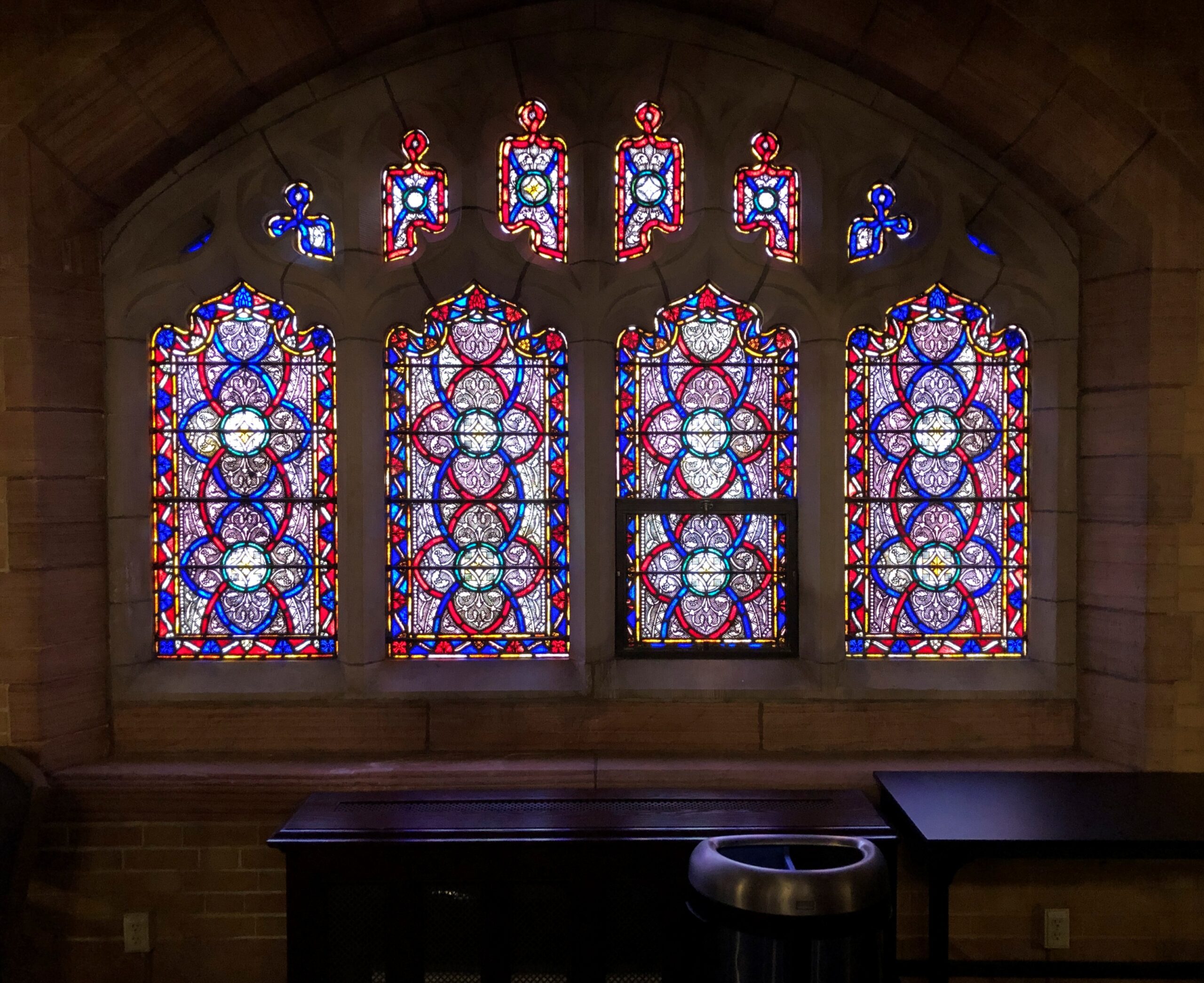
The main gate of Mount Auburn Cemetery, an Egyptian Revival structure, was behind a temporary fence the day I dropped by. That’s only reasonable, as an object that needs periodic renovation.
I took a paper souvenir from the cemetery, one that’s given away: a detailed map and guide. An exceptionally detailed map and guide, I should add, including not only the vehicular roads that twist around the grounds (something like the roads in greater Boston), but all of the many, many footpaths, all of which seem to have names. Also noted are special features, including chapels, ponds, named knolls, the sites of 62 notable people buried on the grounds, plus the sites more than 20 notable memorials or works of funerary art. It’s more than anyone could take in during a short visit, or even a lot of longer visits.
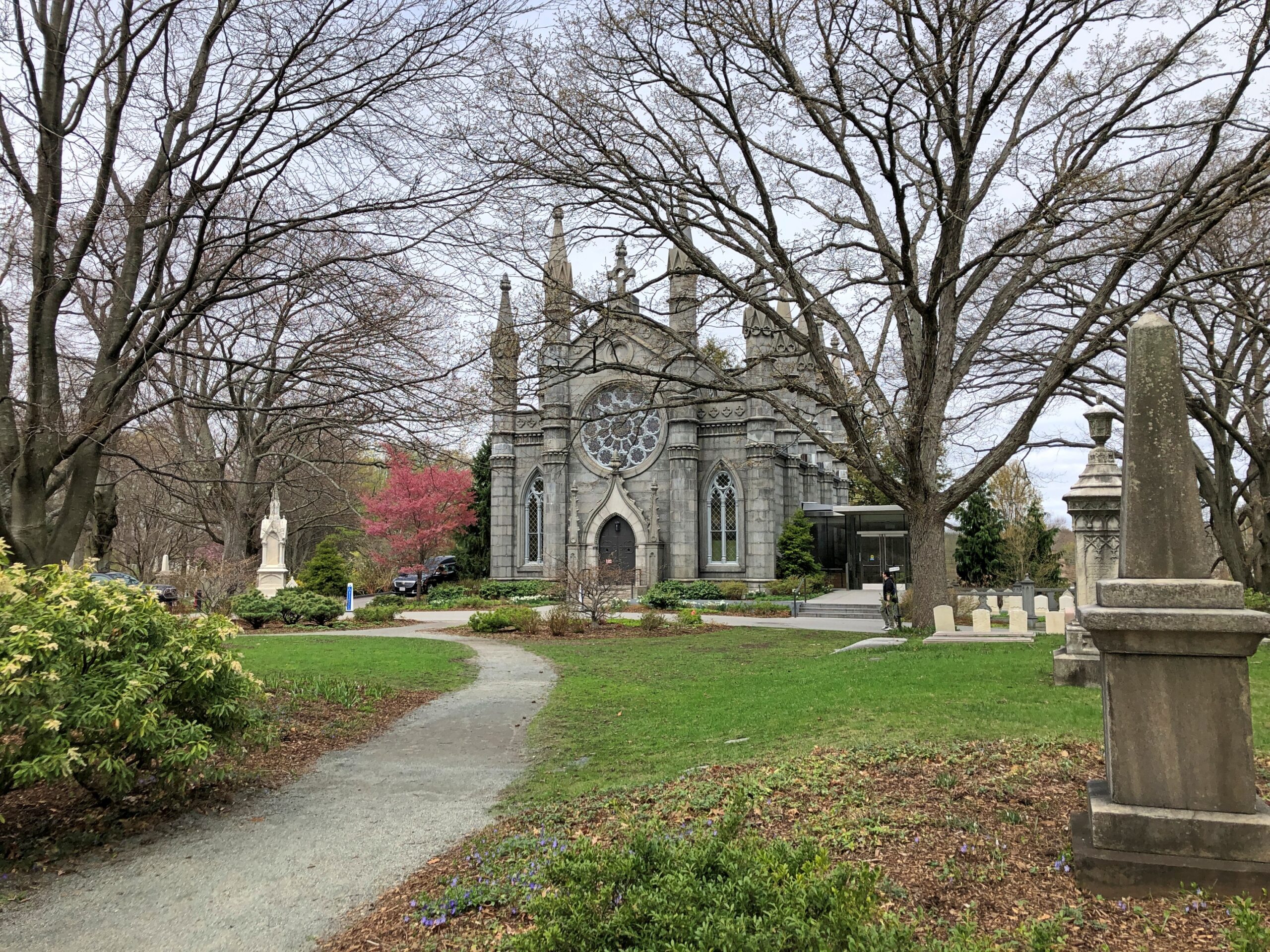
That’s never deterred me. I parked near the entrance and set out, picking up the map at the visitors center and spending a moment at Story Chapel.
The chapel is named for Joseph Story (d. 1845), associate justice of the Supreme Court, colleague of John Marshall and, in as much as I know about the subject (not much), a titan of early U.S. jurisprudence. He was also first president of Mount Auburn and, when his time came, he was buried there, though that was among the many memorials I didn’t happen to see.
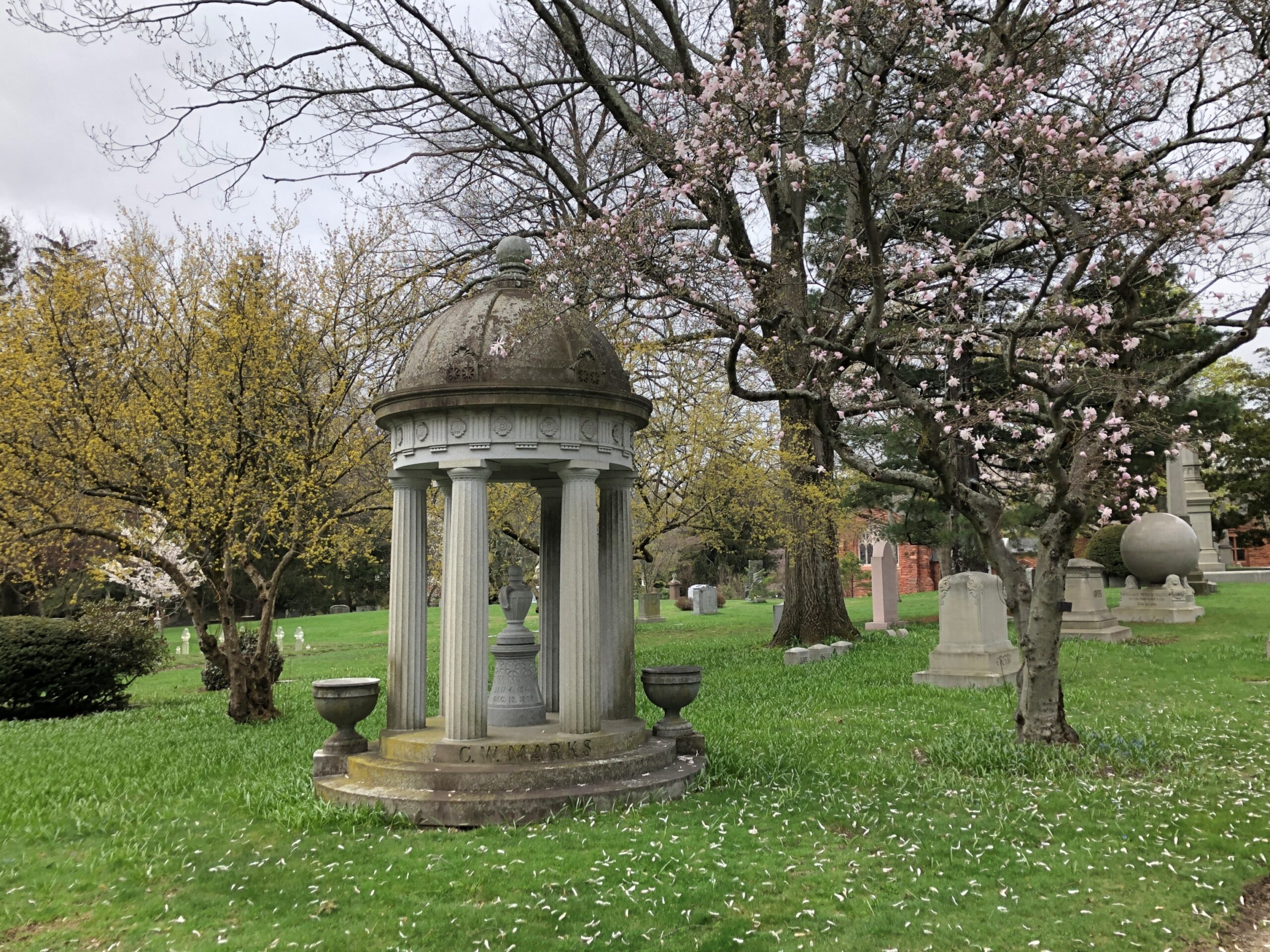
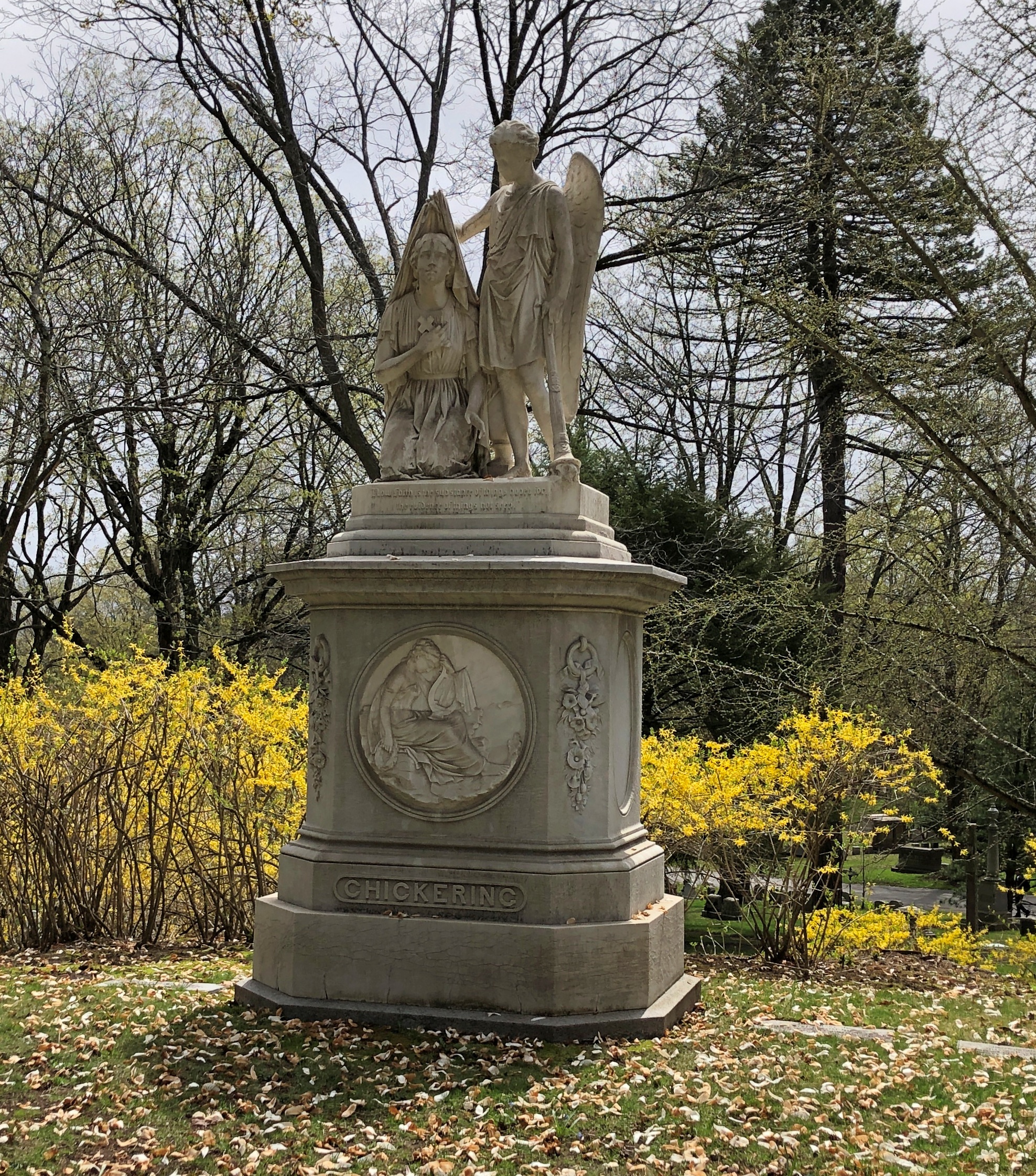
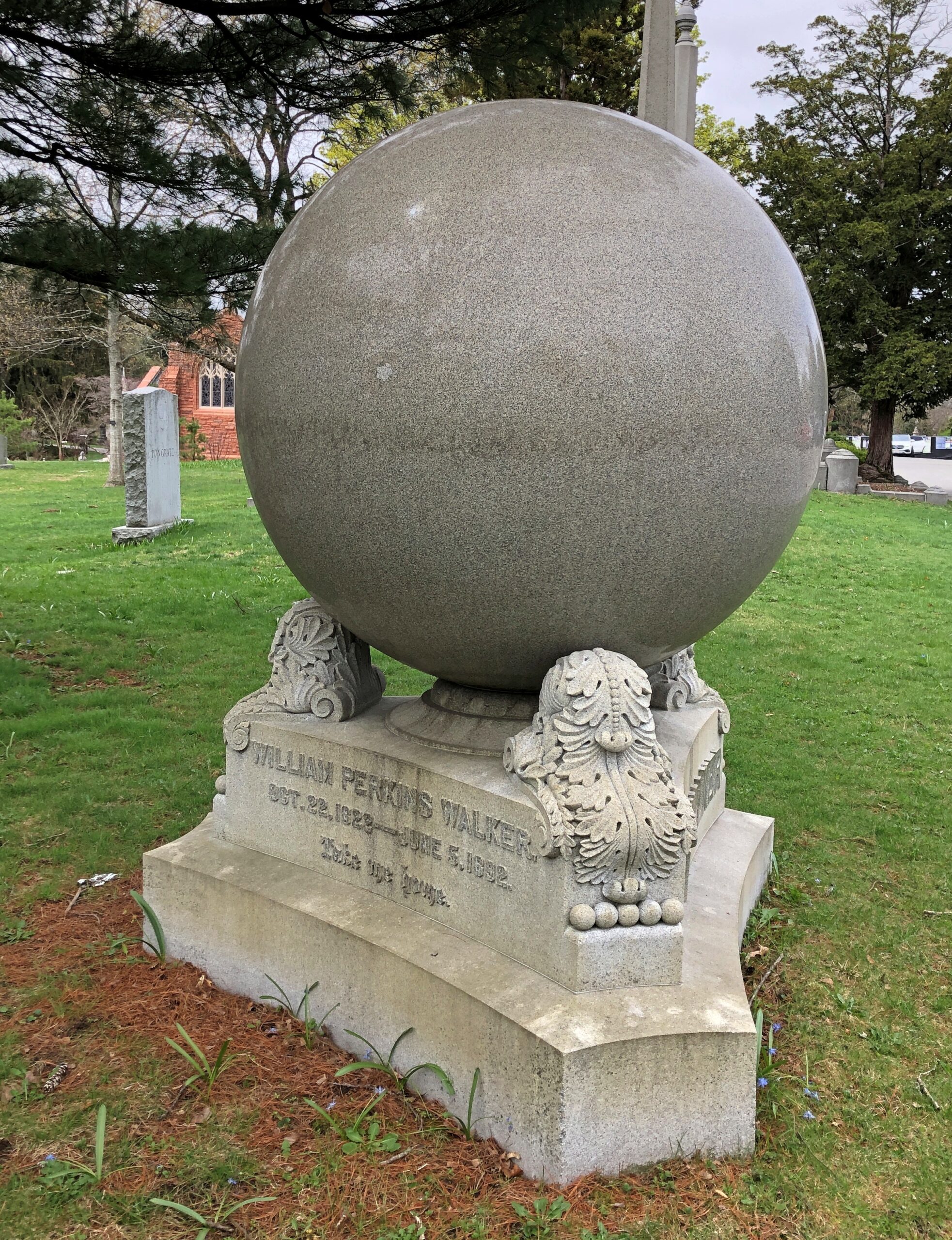
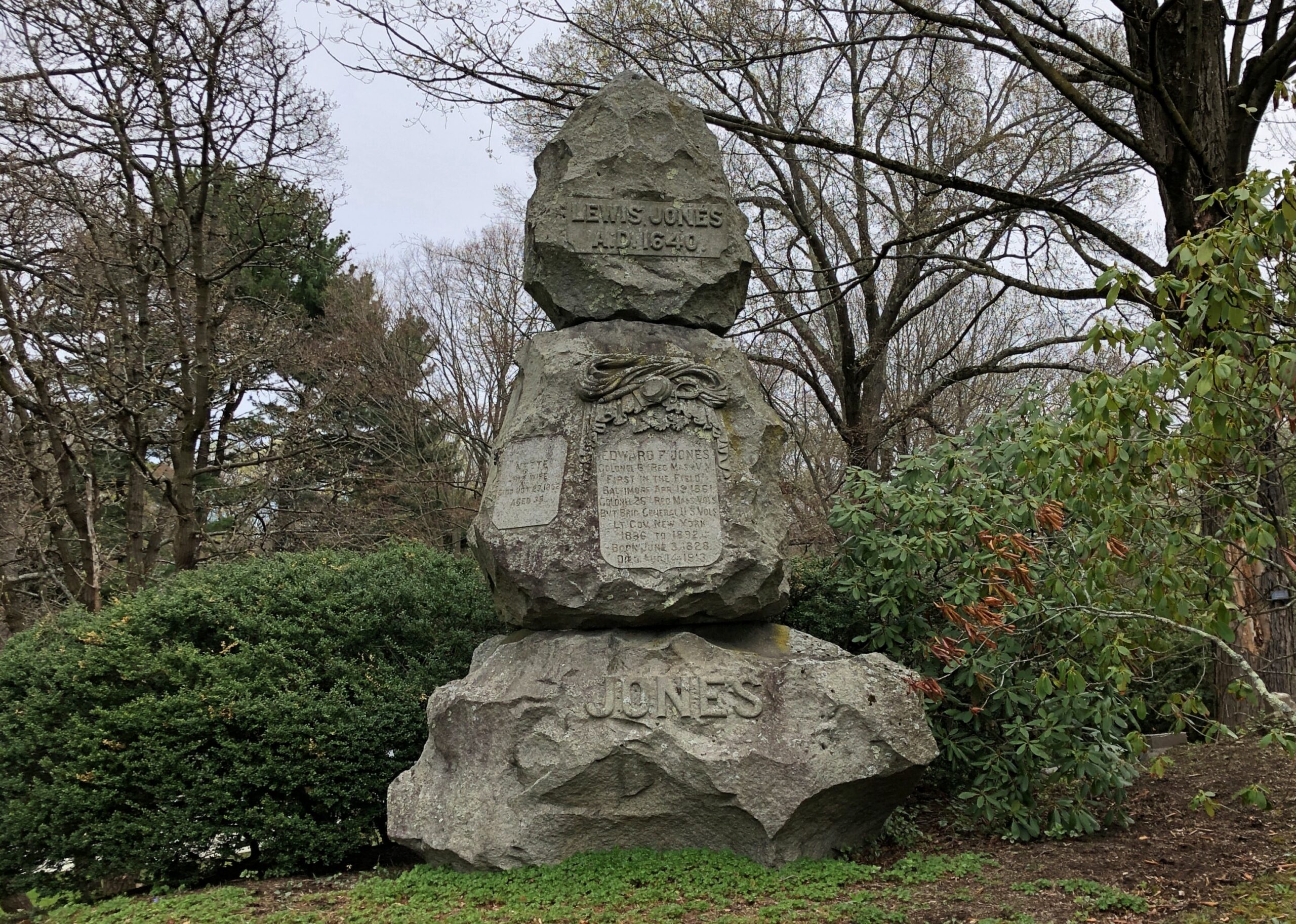
So many memorials. Some more conventional, but no less beautiful or impressive for it.
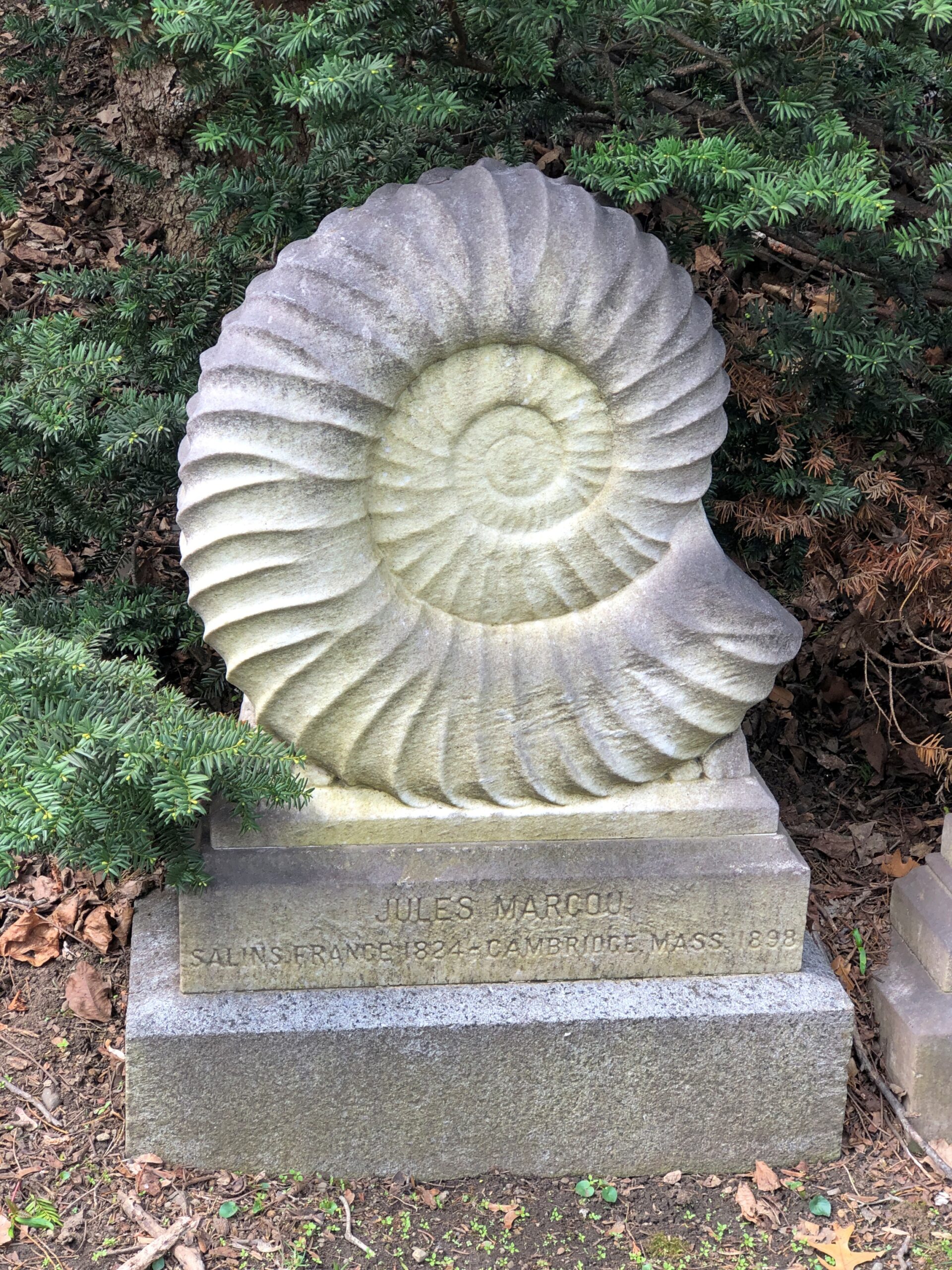
Some less conventional. Any grand cemetery needs a component of the unusual or odd.
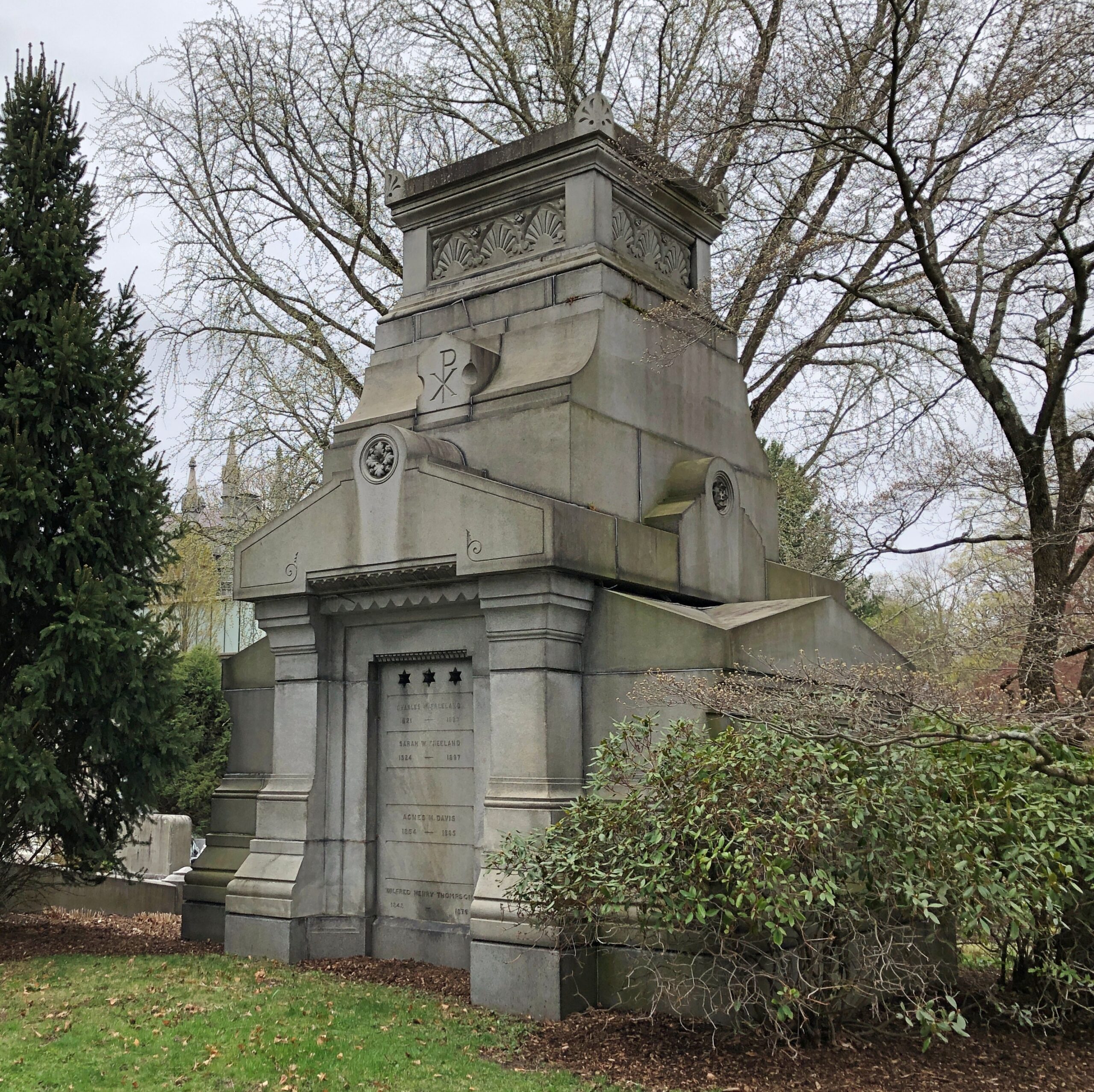
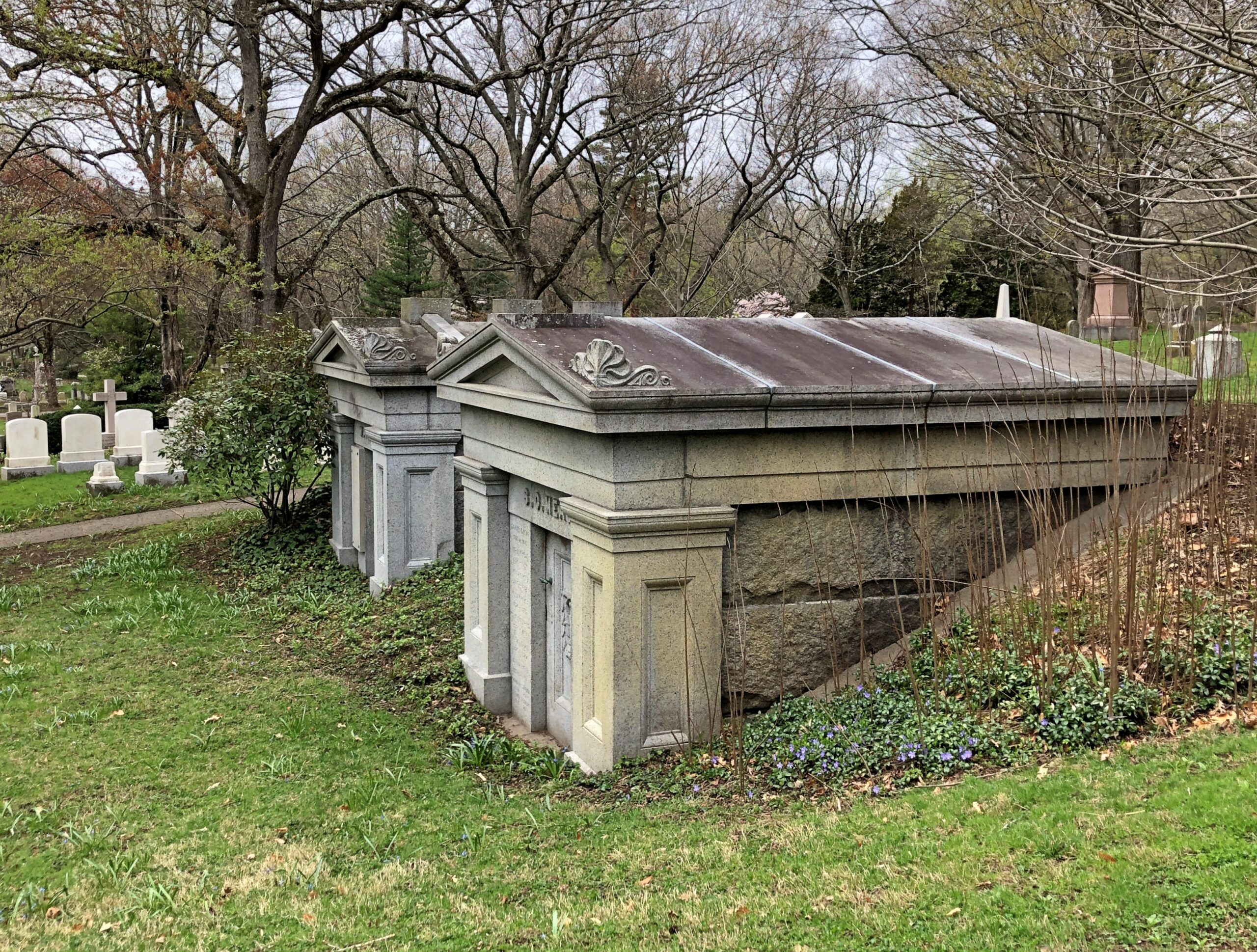
A number of mausoleums, though perhaps not as many as you’ll see at Green-Wood or Woodlawn in the Bronx.
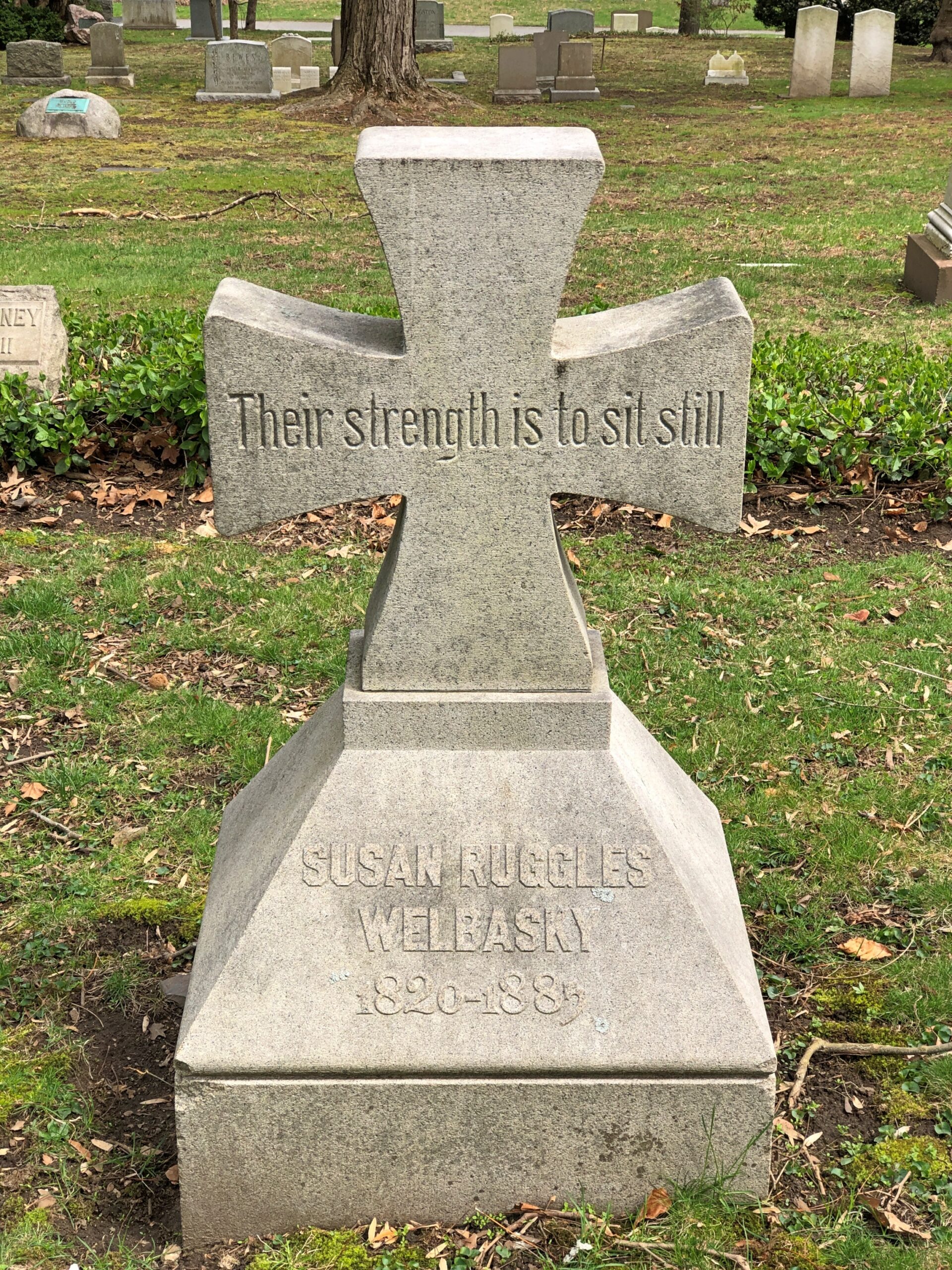
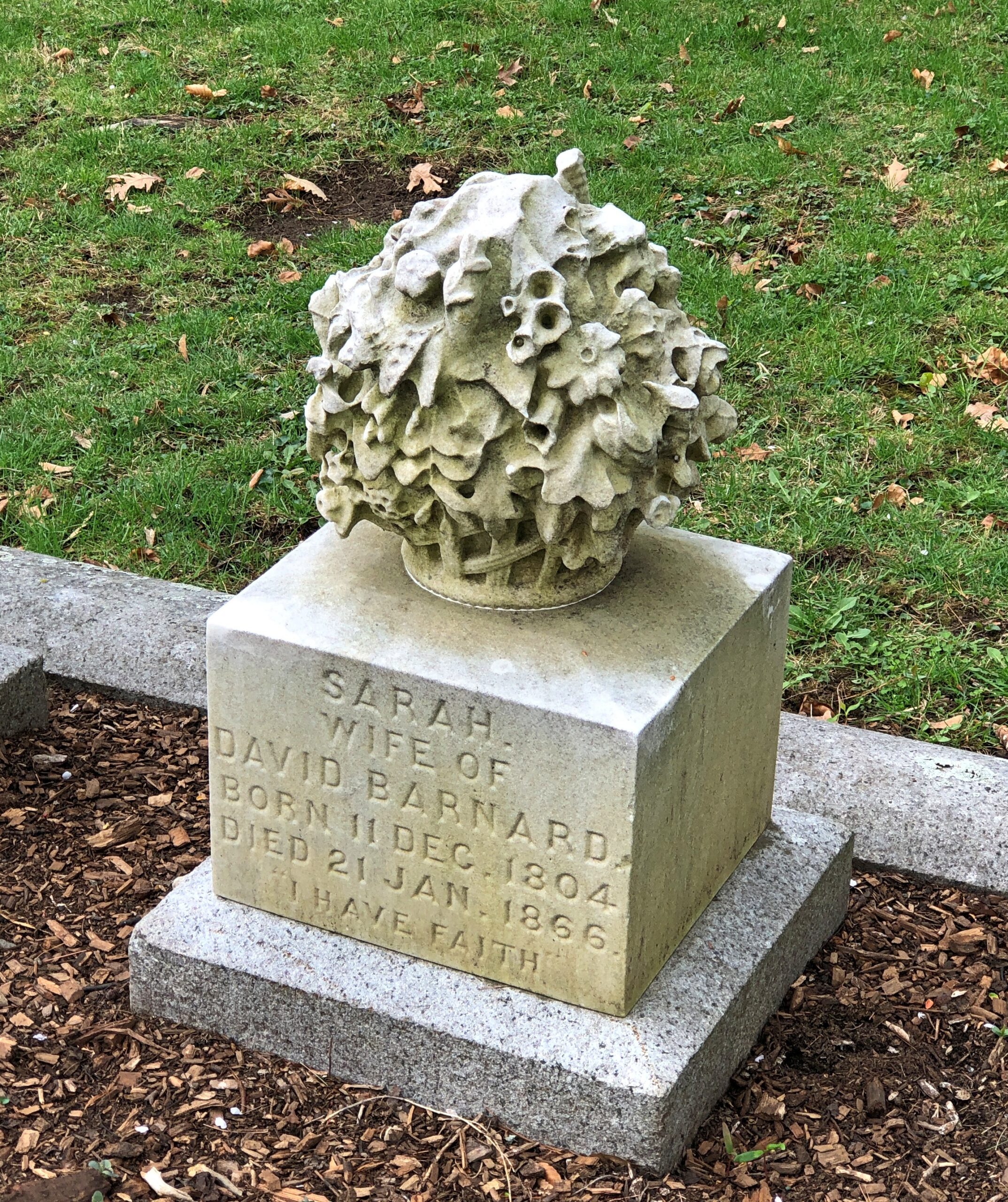
More modest stones.
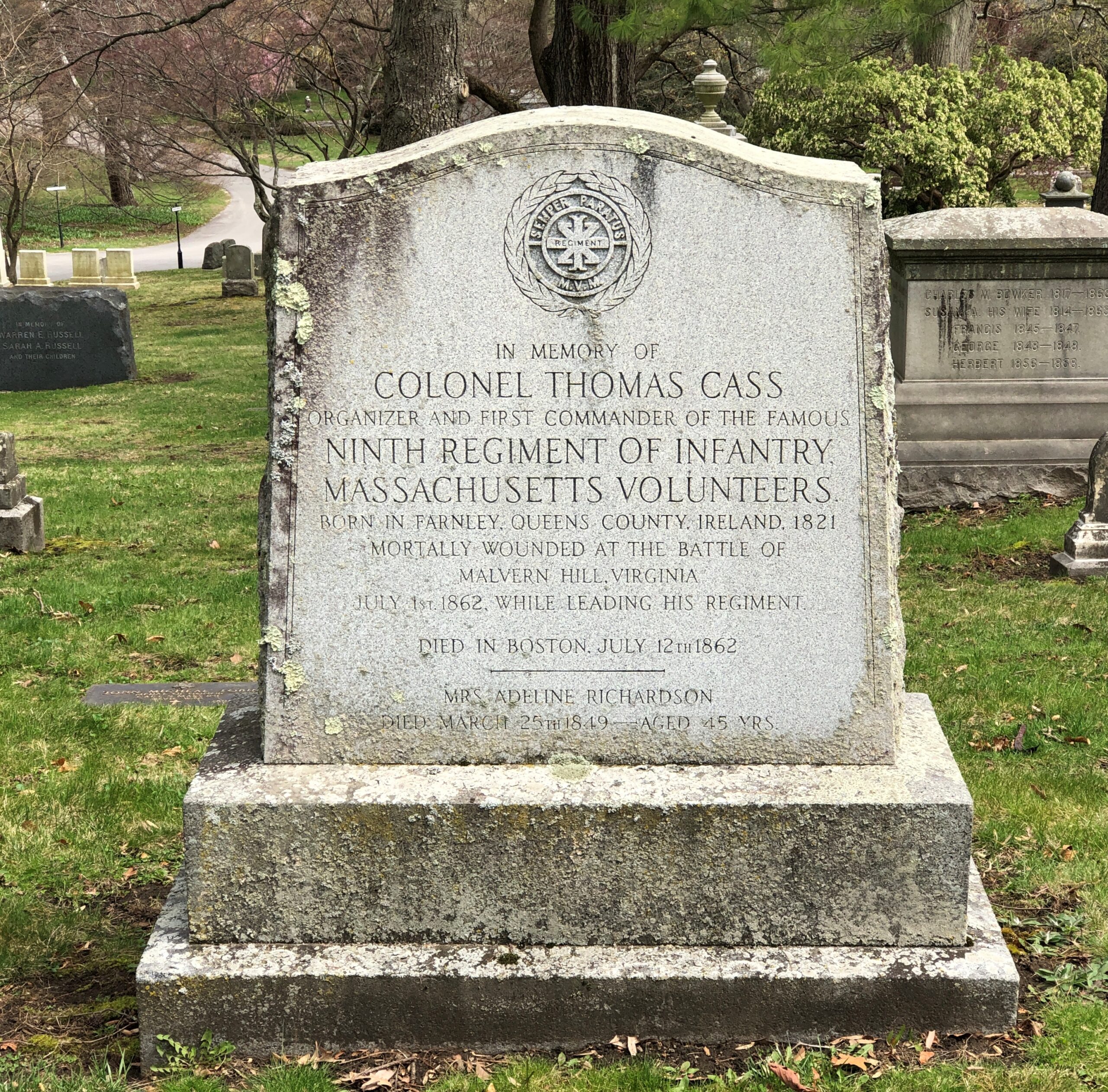
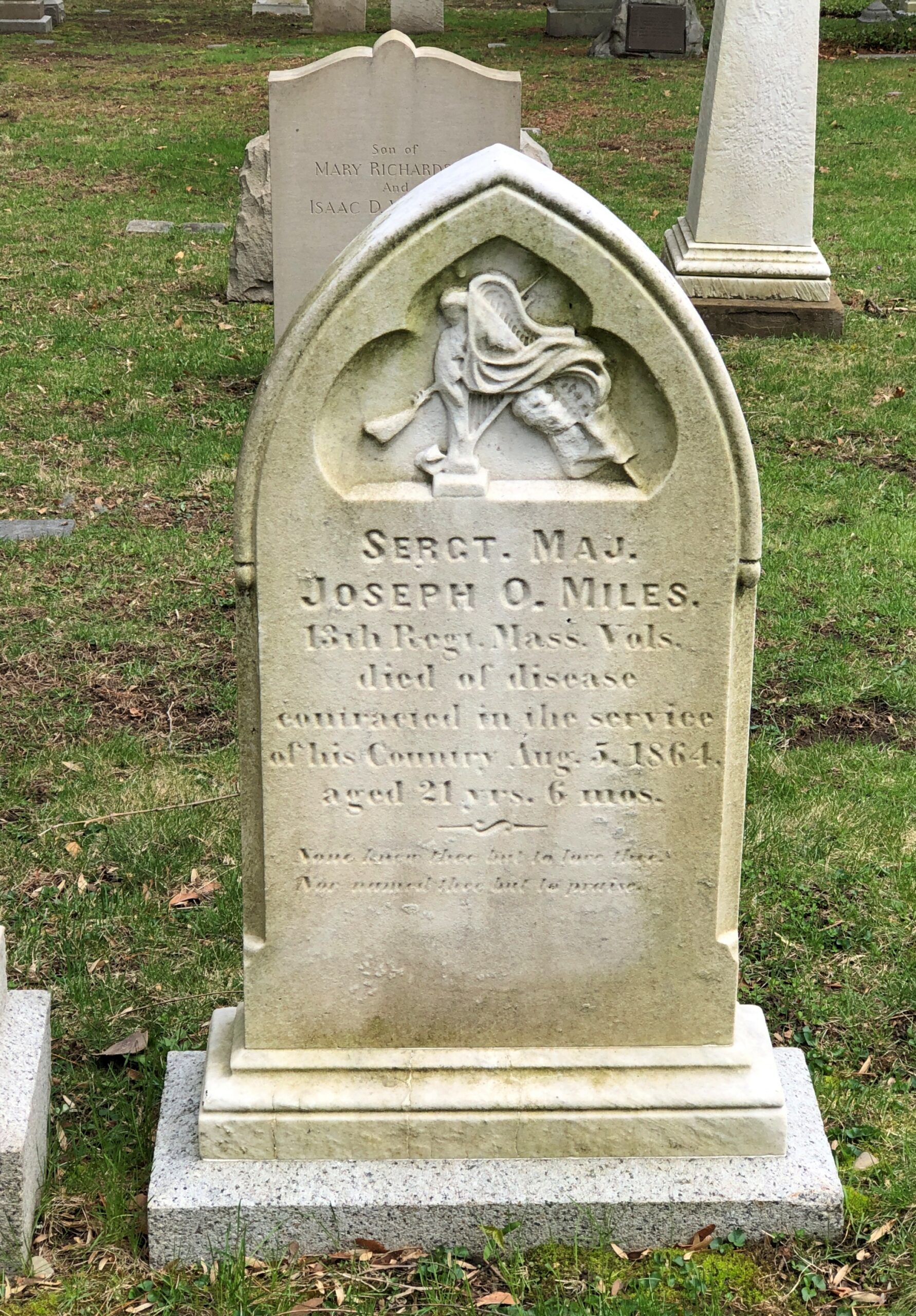
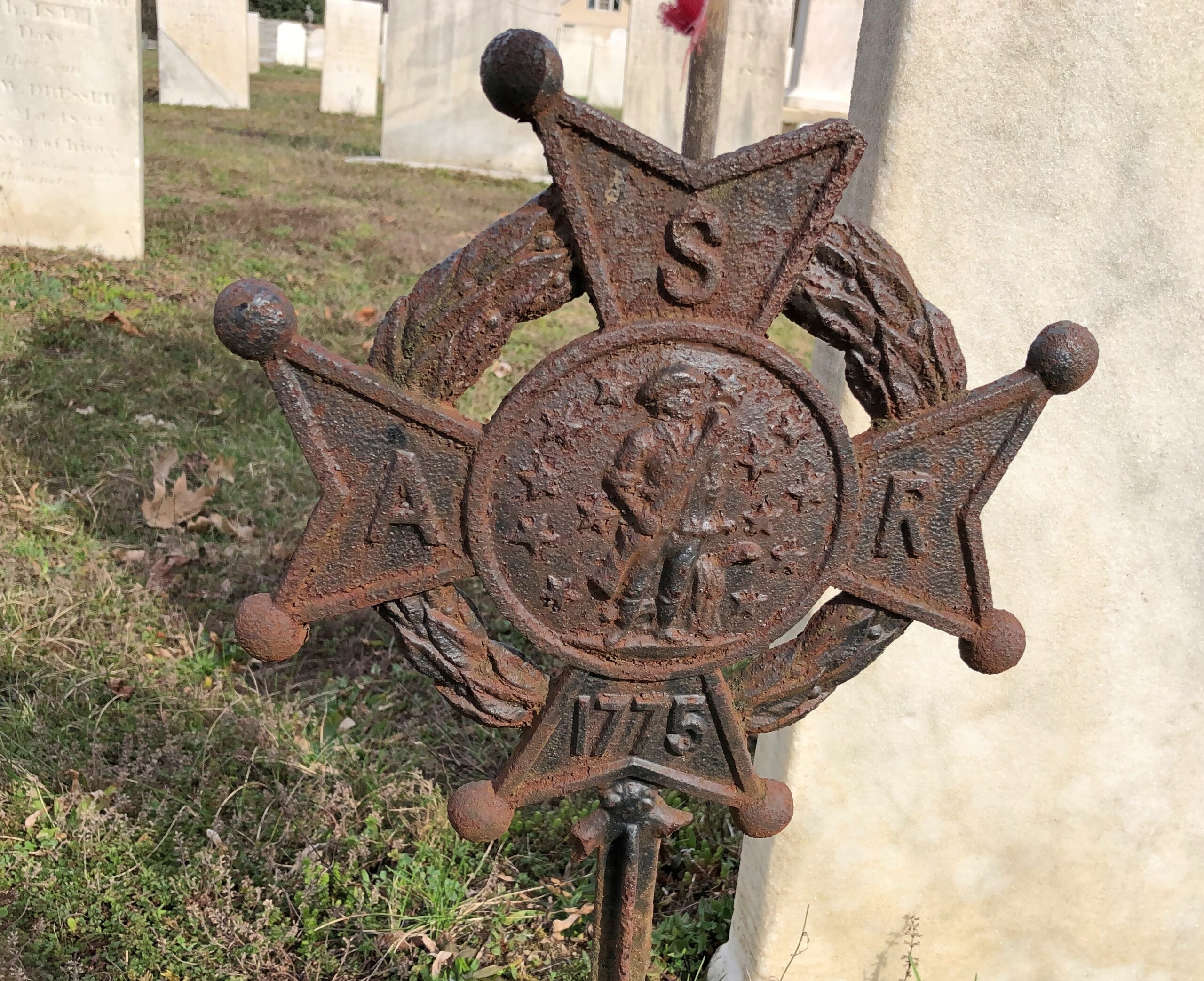
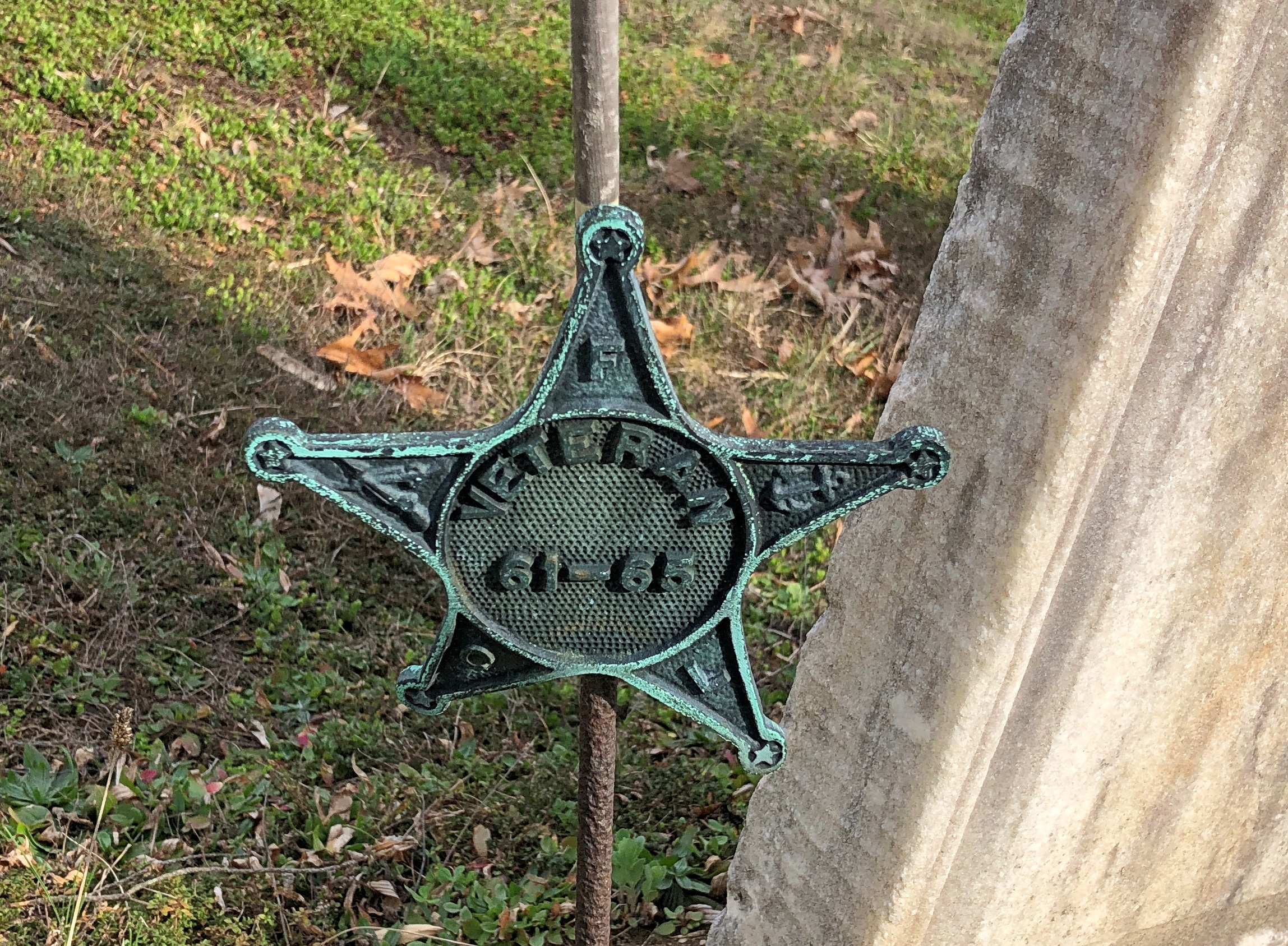
Men who died for the Union.
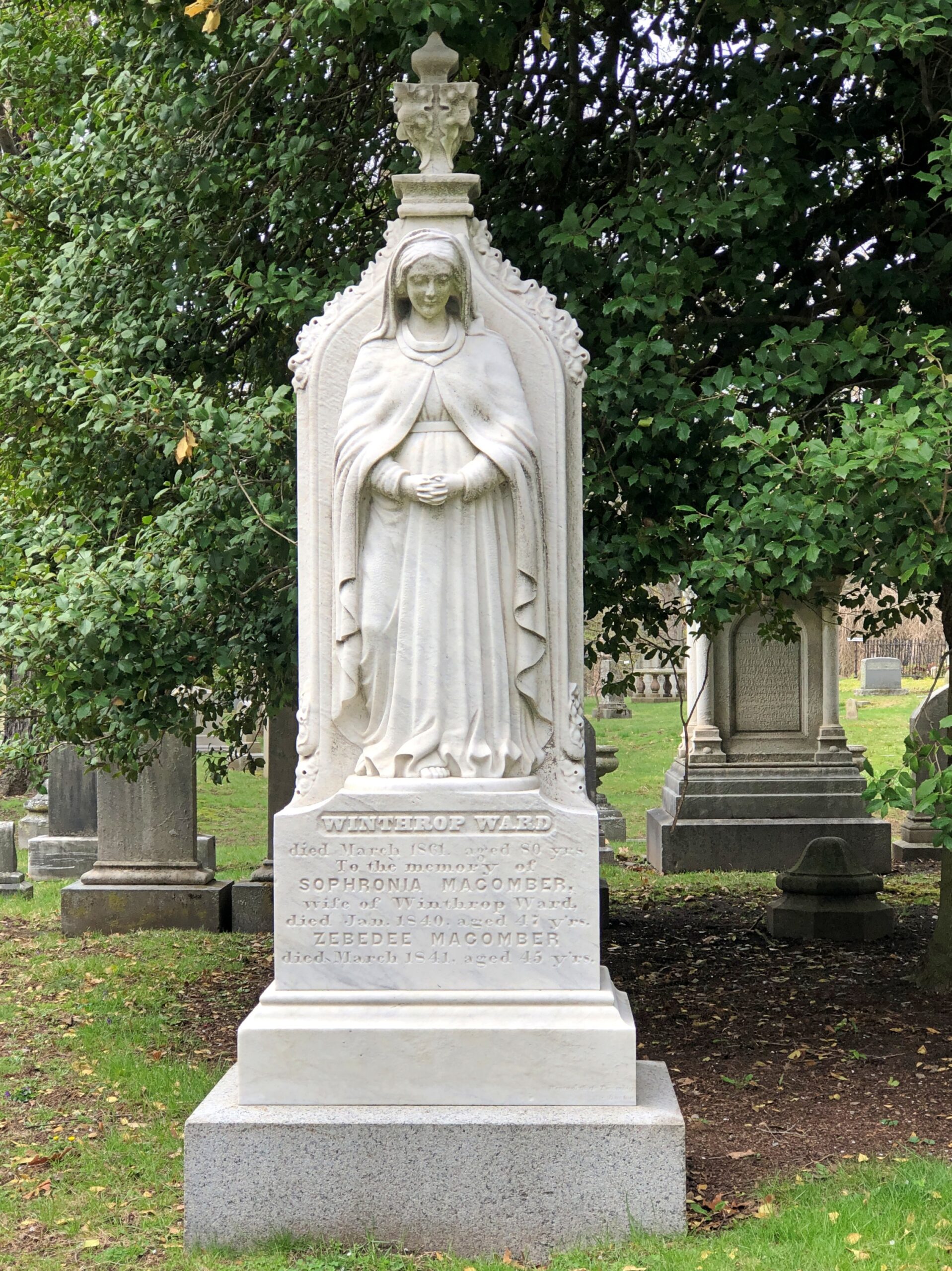
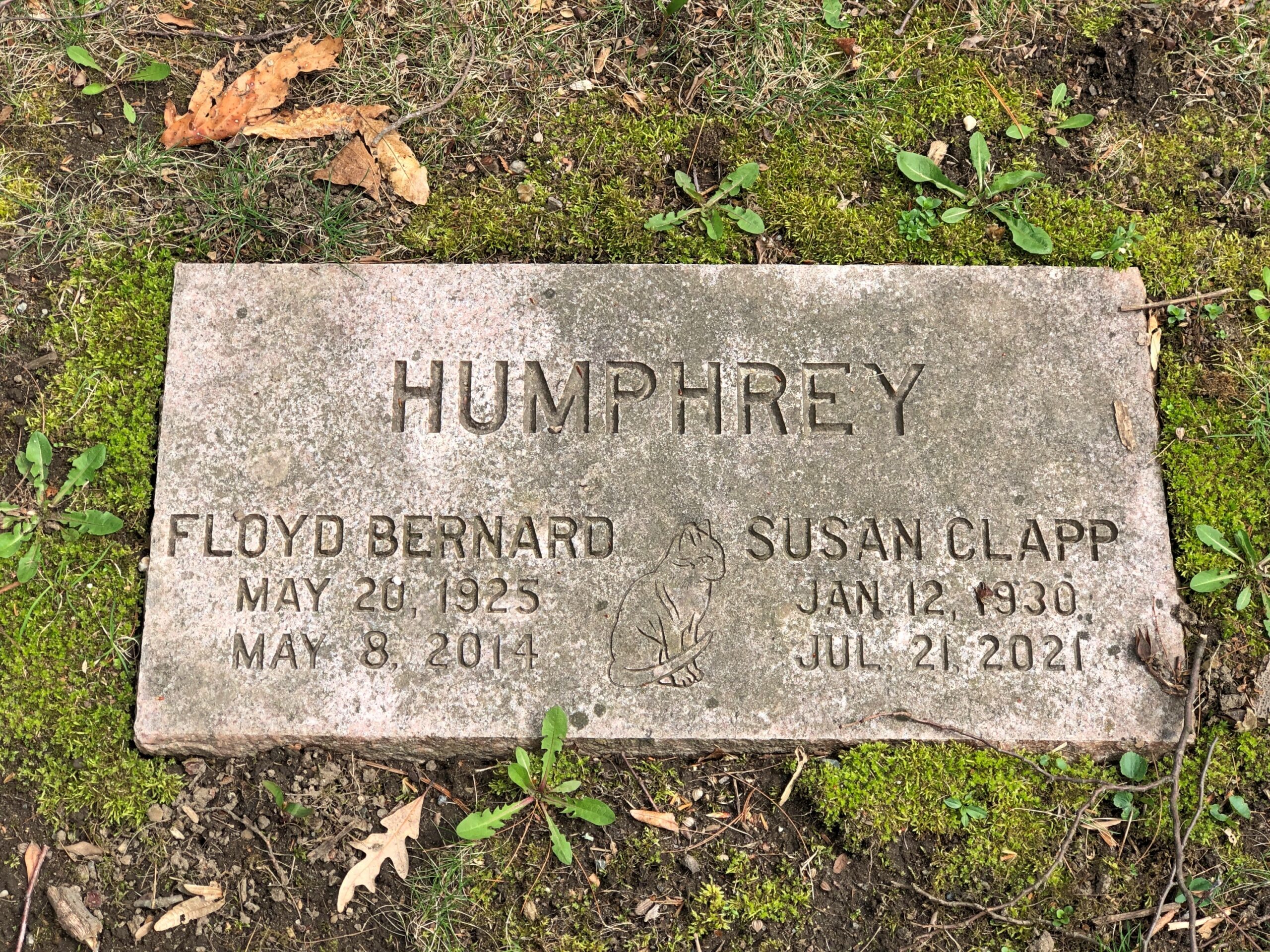
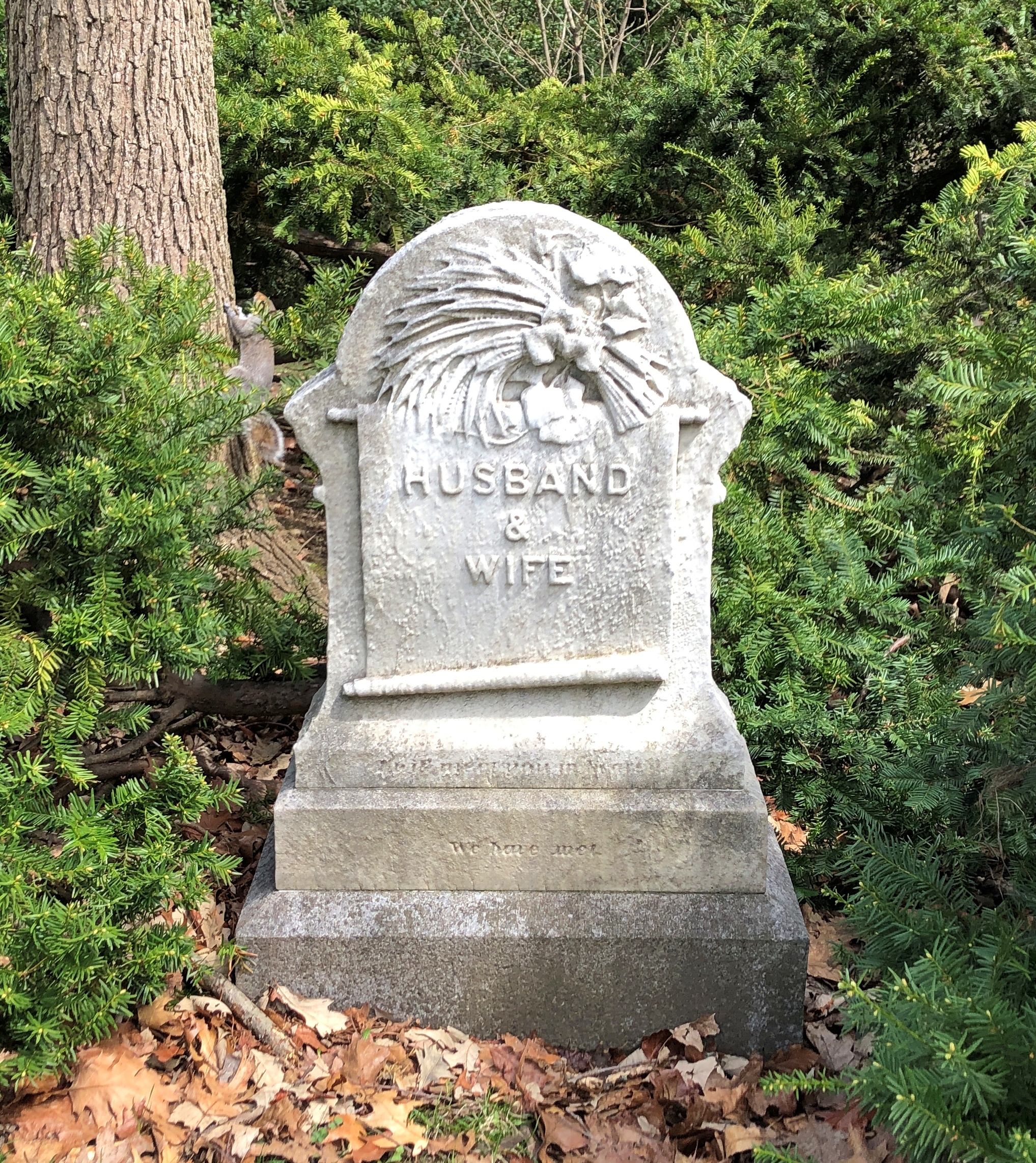
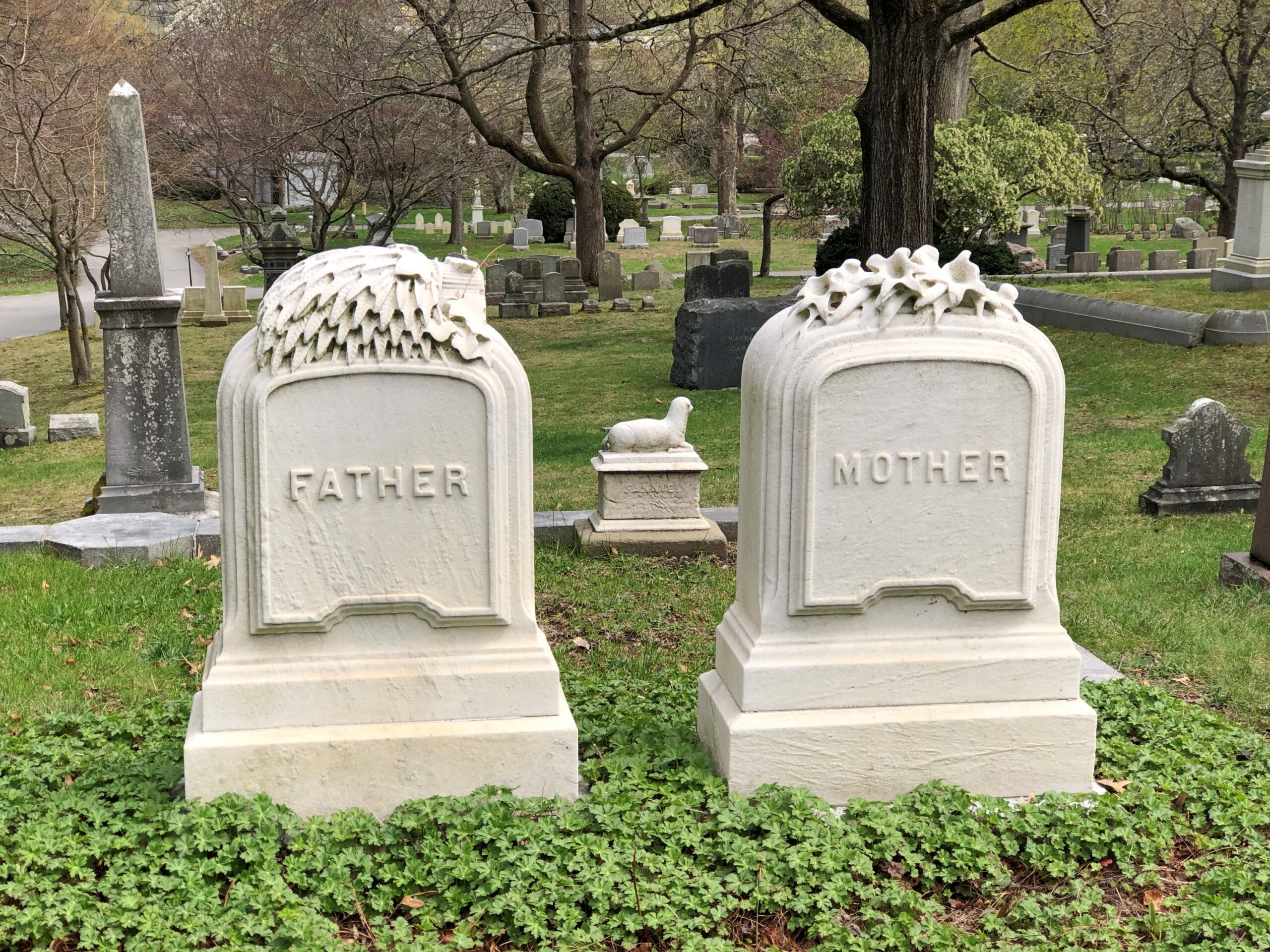
A good many couples.
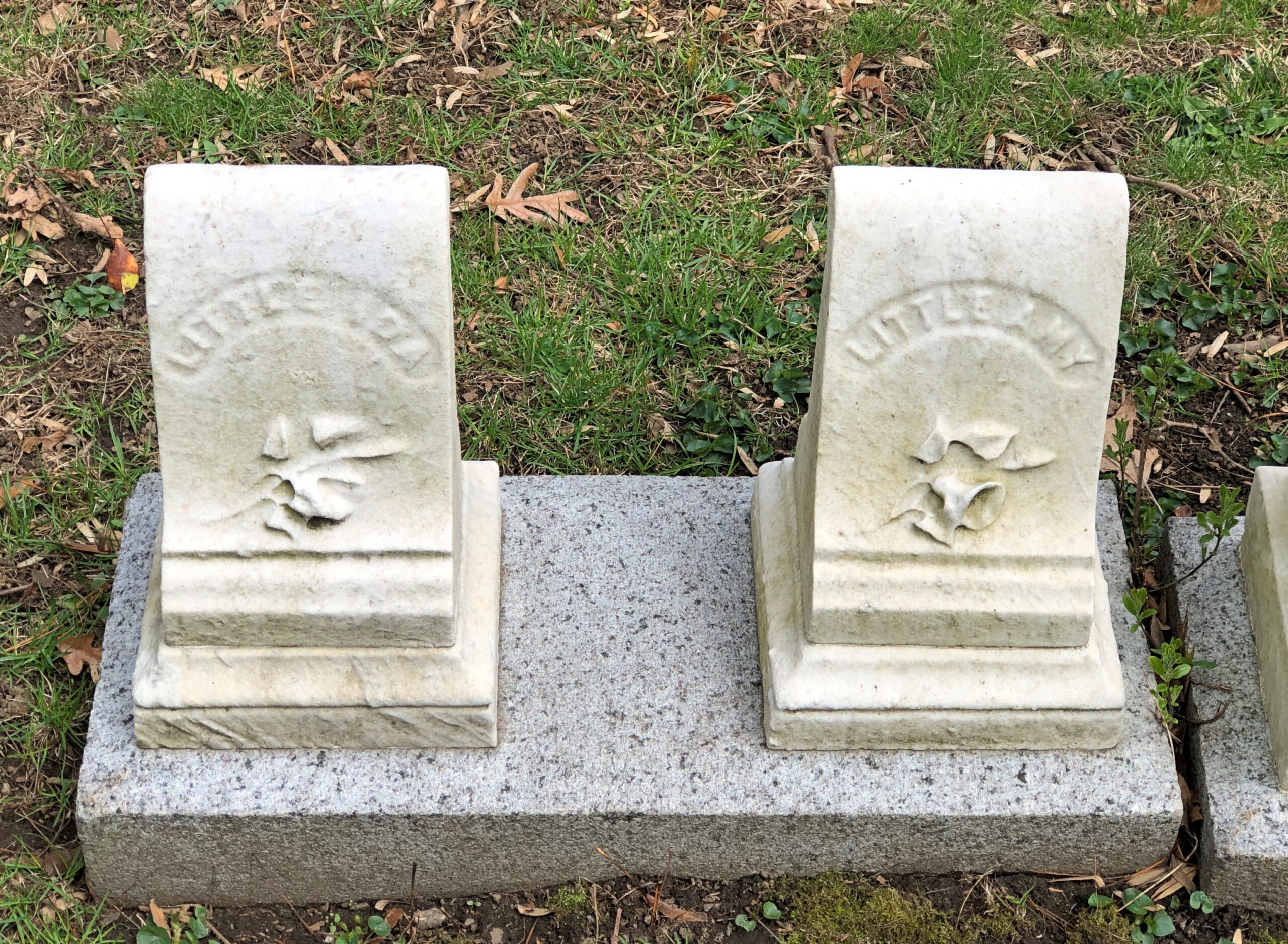
A sad story, one of many.
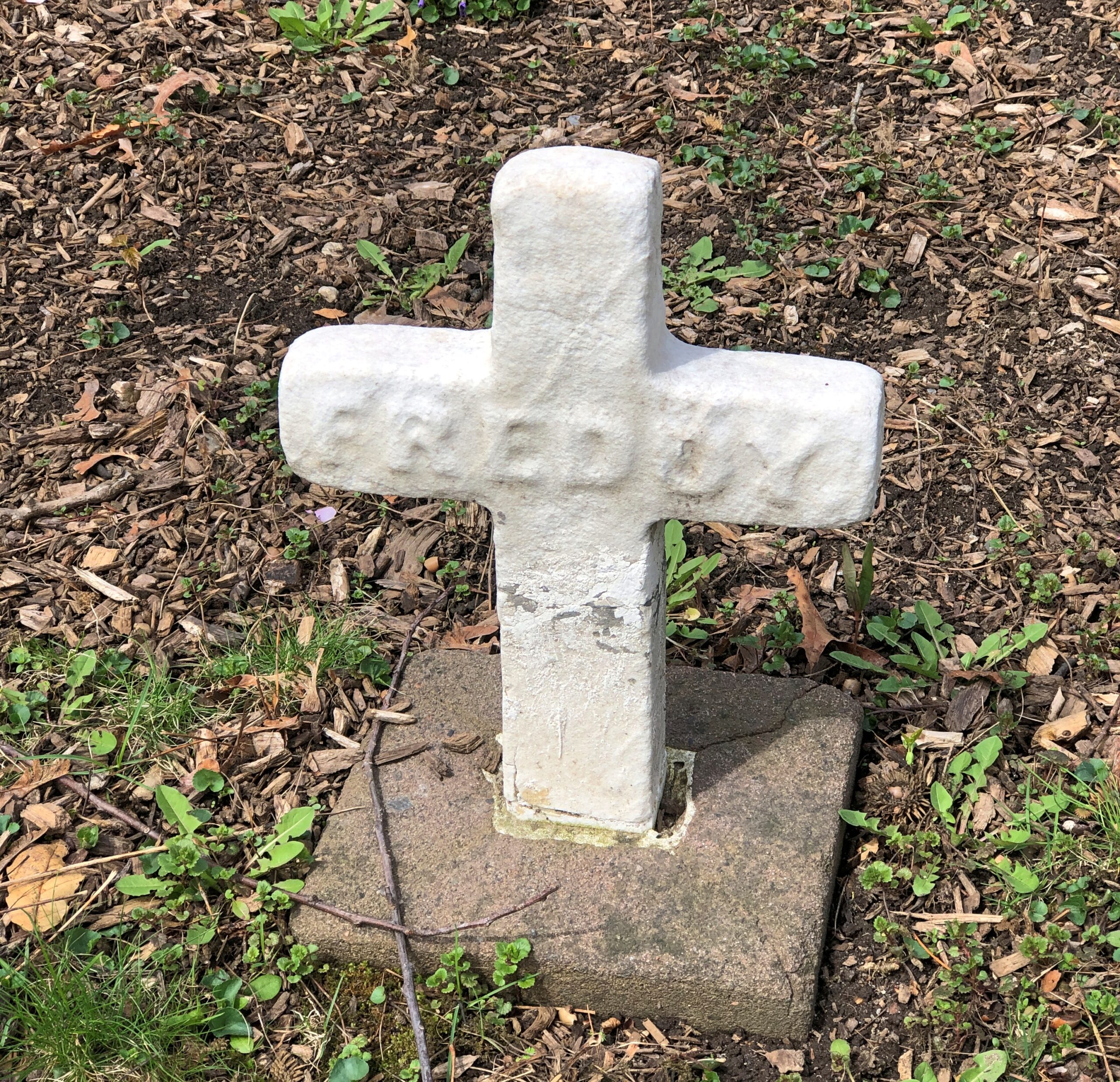
Maybe a sad story. A little enigmatic, anyway.
Looking at the map’s list of famous permanent residents, one thinks: “Right, I know him. And him. And him. And her. There’s another person I’ve heard of. And another. And I think I know that one – I do…”
On it goes. A short selection of those I didn’t have to look up: Louis Agassiz, John Bartlett (of Quotations fame), Edwin Booth, Charles Bulfinch, Dorothea Dix, Mary Baker Eddy (“discoverer” of Christian Science, the map says), Edward Everett (spoke at Gettysburg, was upstaged), Fannie Farmer, Felix Frankfurter, Buckminster Fuller, Charles Dana Gibson, Curt Gowdy, Oliver Wendell Holmes Sr., Julia Ward Howe, Henry Cabot Lodge, Henry Wadsworth Longfellow, Bernard Malamud, Arthur Schlesinger Jr., B.F. Skinner, I.F. Stone, and Charles Sumner.
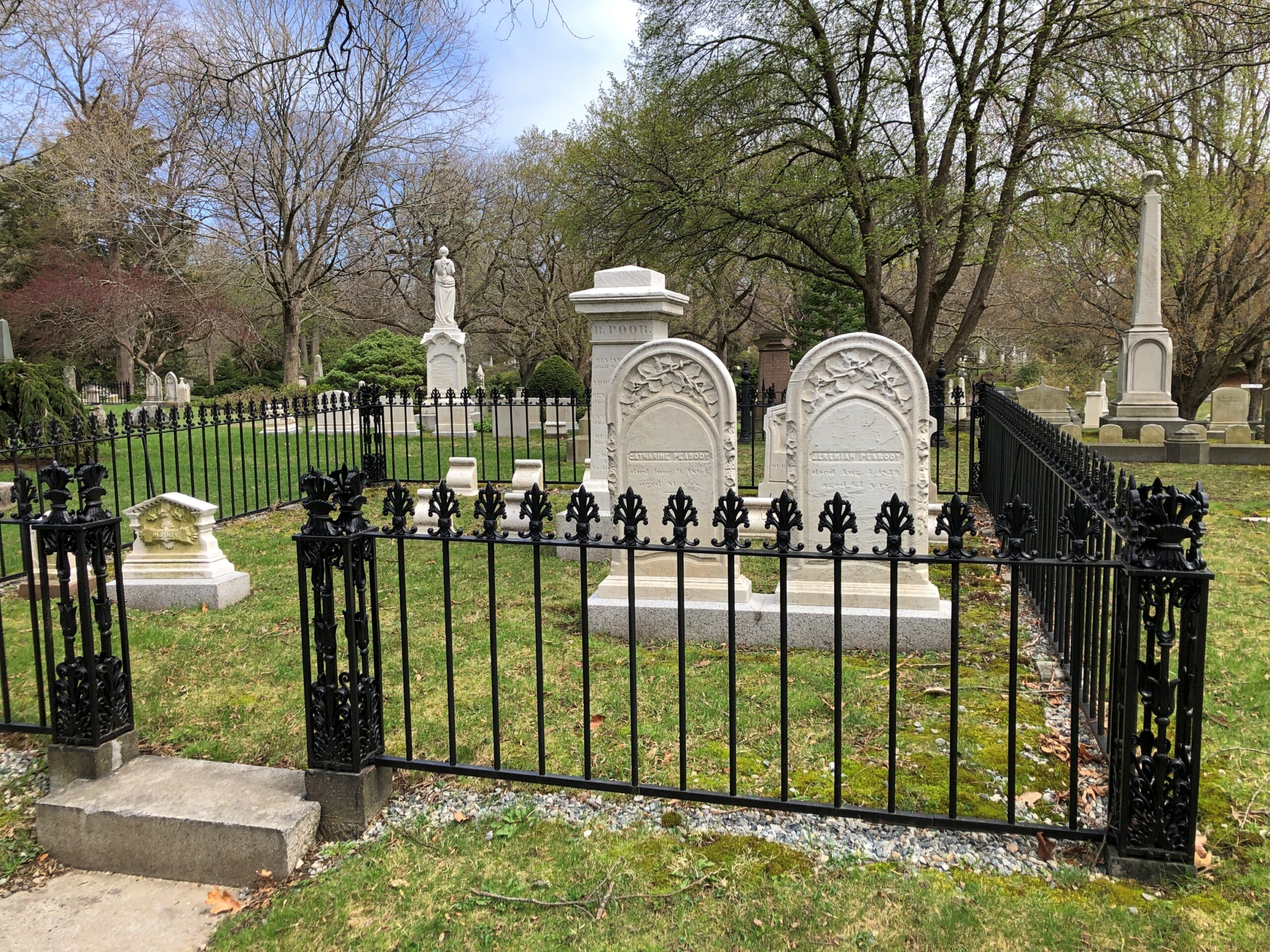
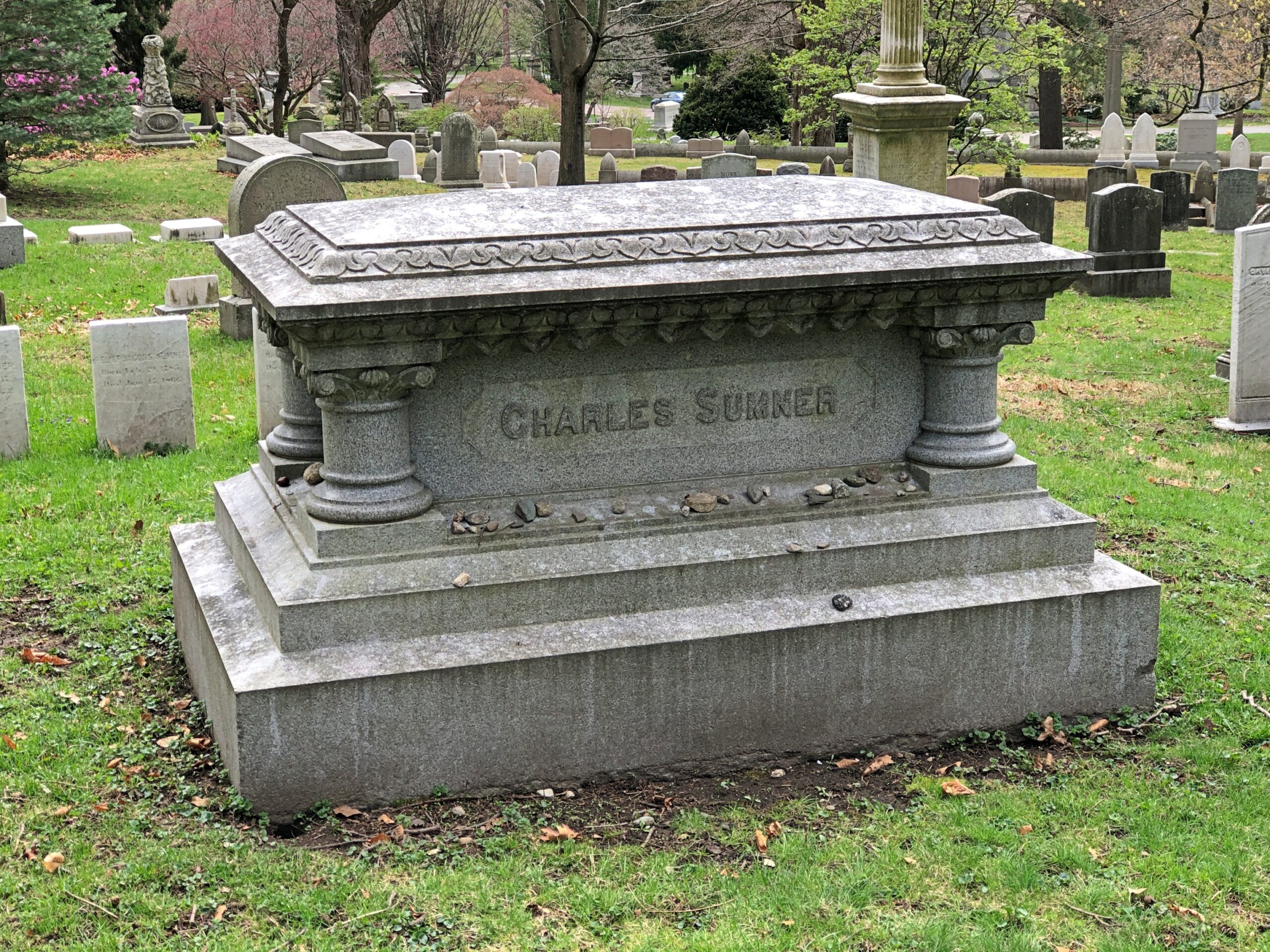
I could have spent all day looking for them, but mostly I didn’t. I did see Charles Sumner’s stone. People leave smaller stones. I found one and did too.
Near Sumner. I’d never heard of him, but I like that name.
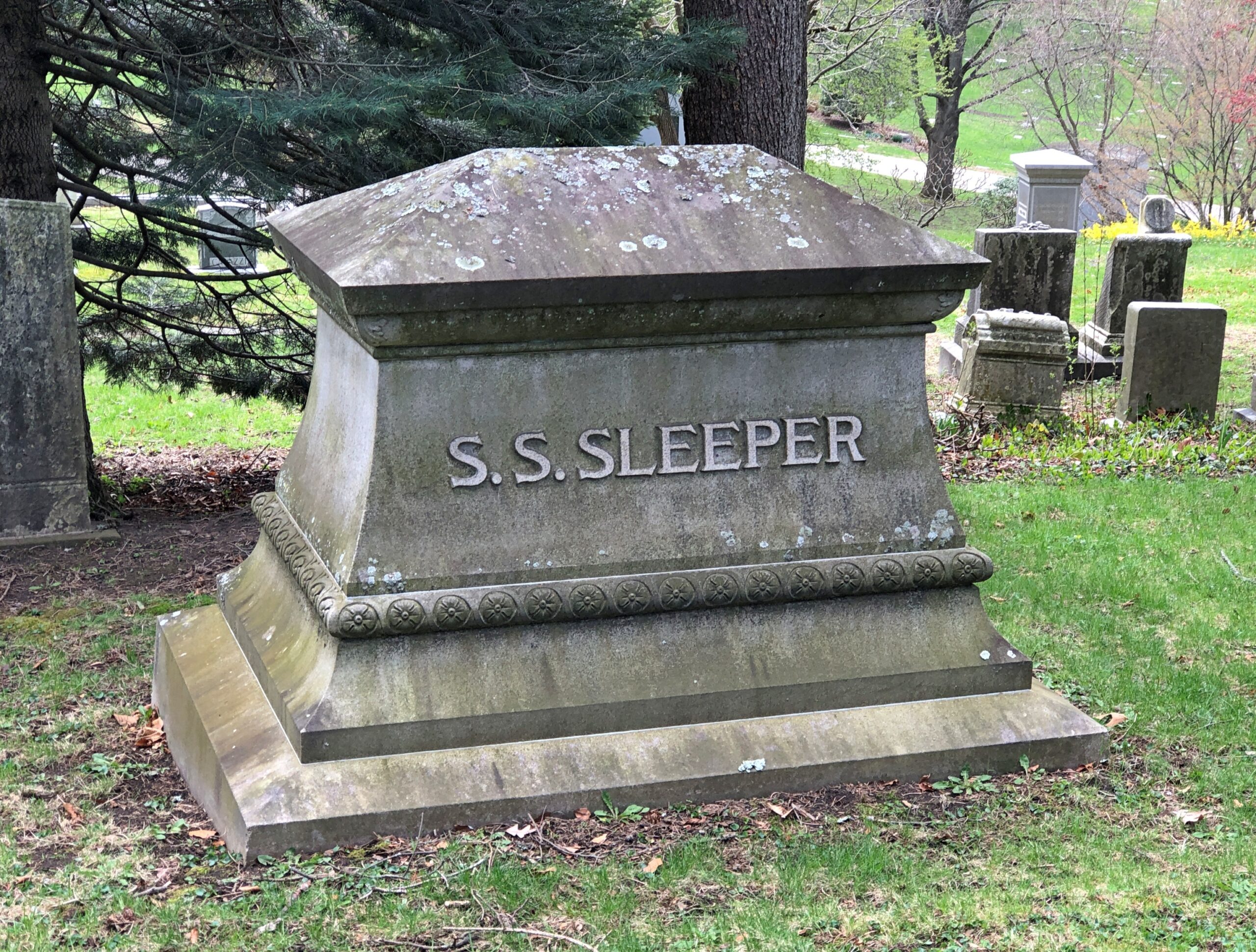
Solomon Sias Sleeper (d. 1895), successful Cambridge merchant and local politico and philanthropist.
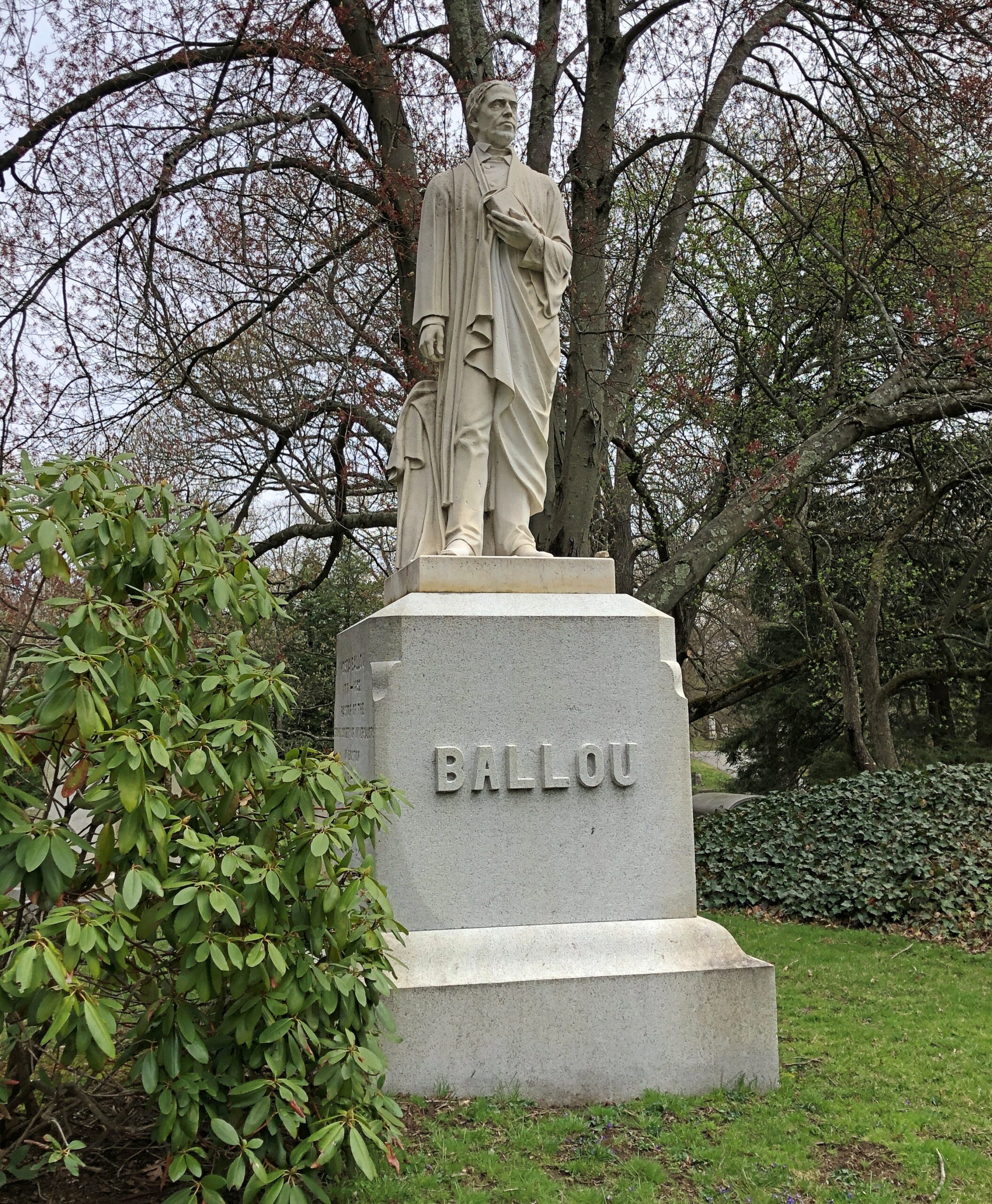
The map also lists impressive memorials. I found a number of those. Such as the Rev. Hosea Ballou Monument, honoring a Universalist clergyman (d. 1852).
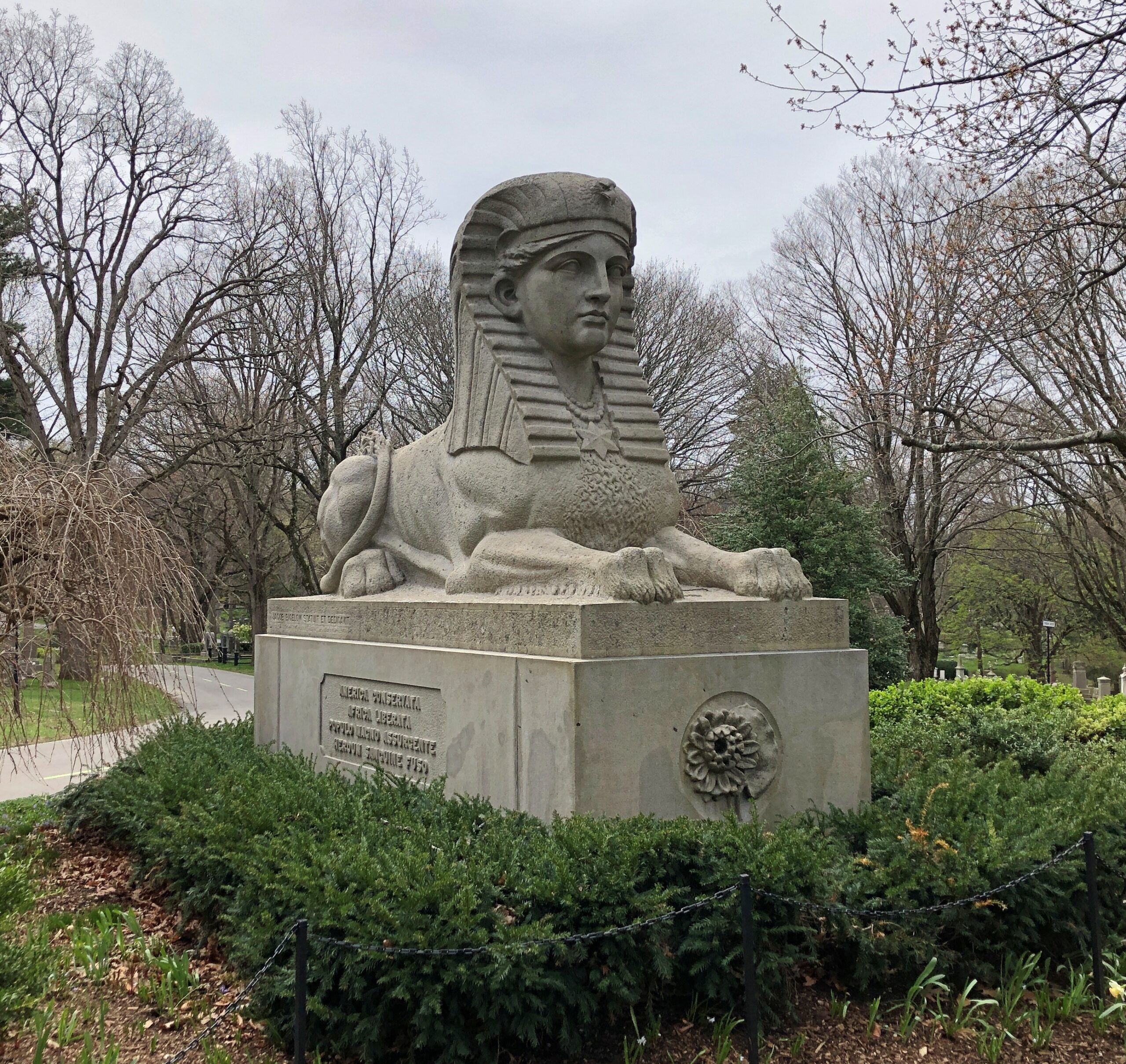
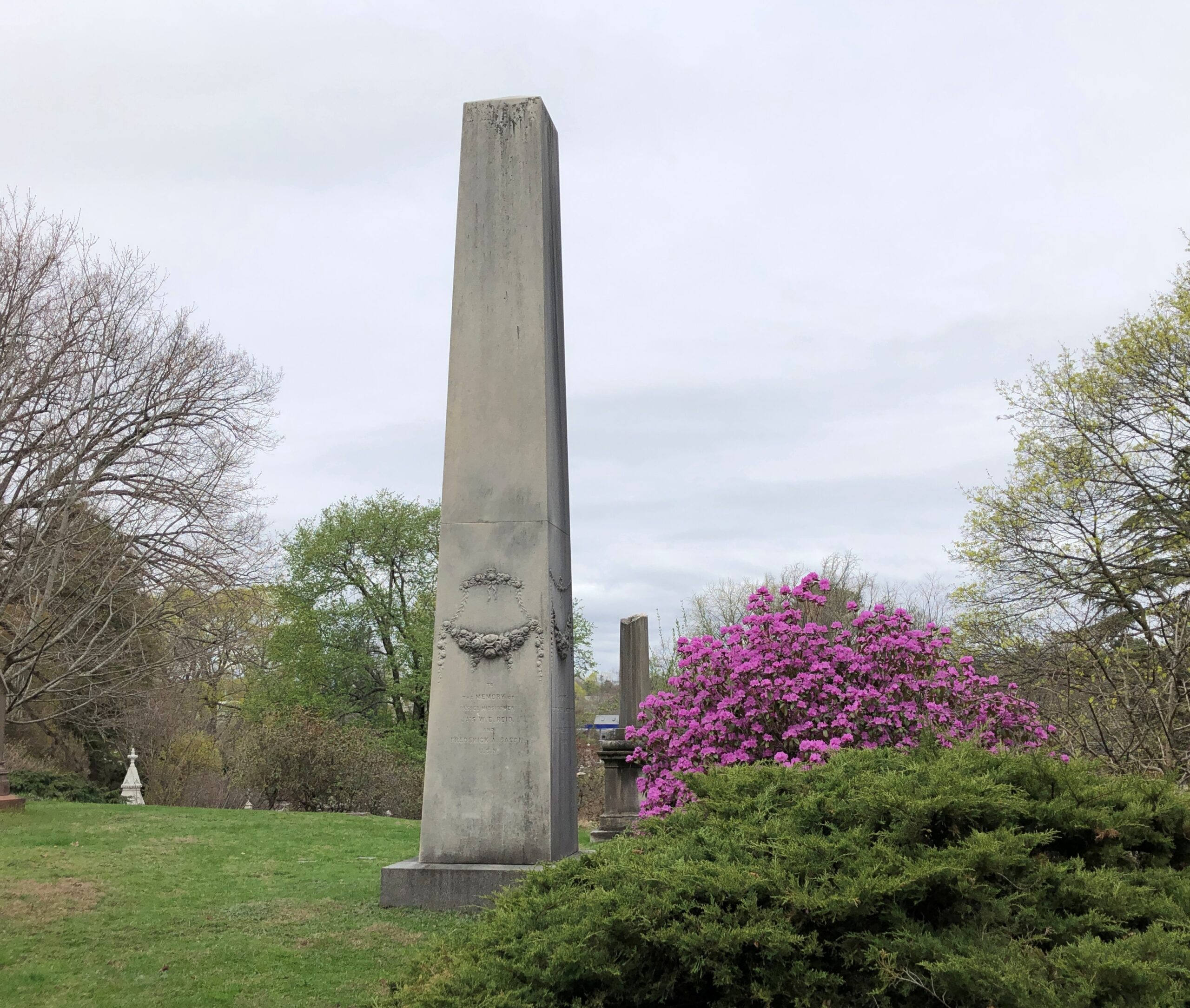
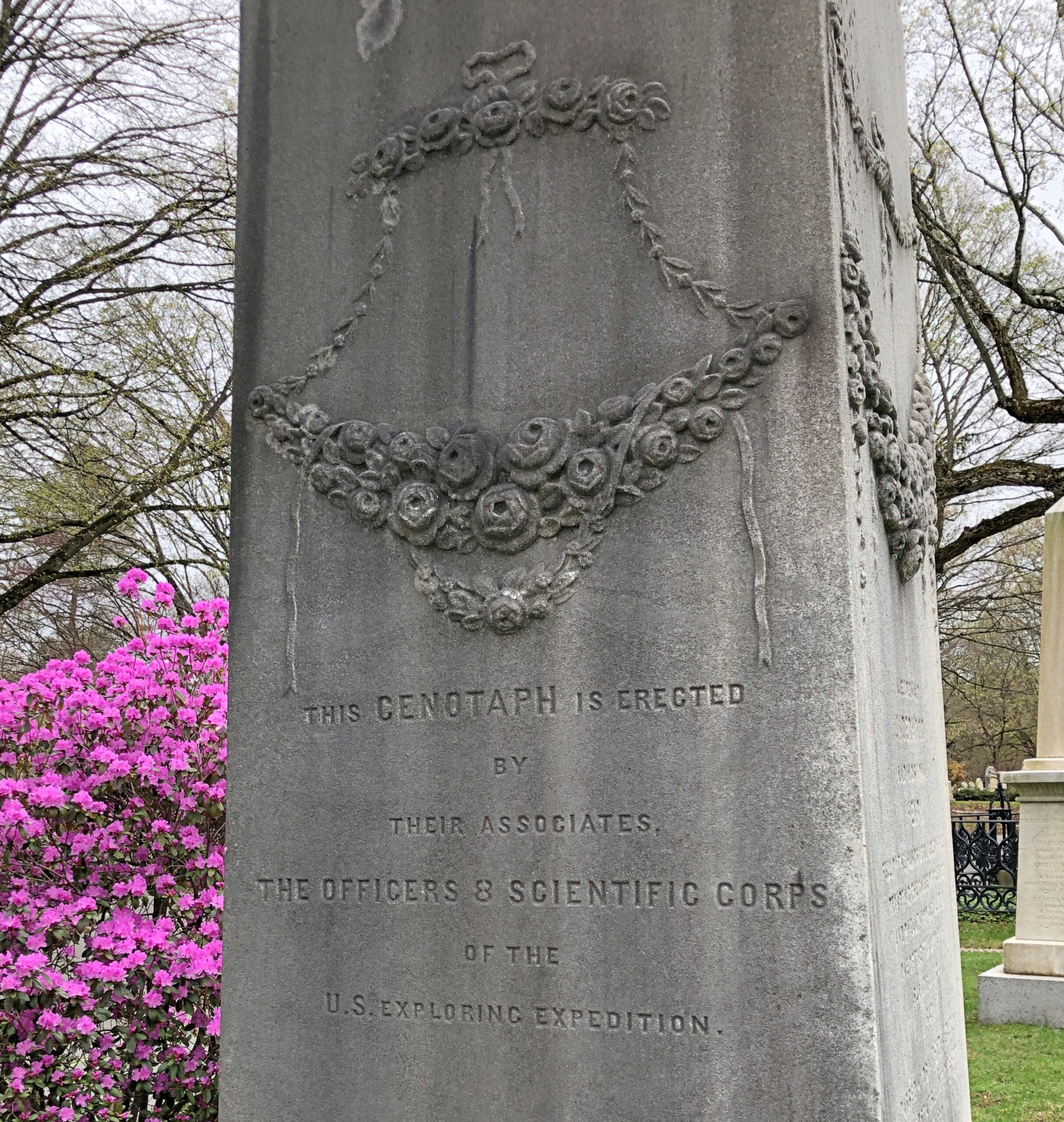
A Civil War memorial, erected in 1872 — the only time I’ve seen a sphinx used for that purpose.
“The sphinx was chosen because of its ideal personification of intellect and physical force and its representation of the combined ideas of beauty and strength,” the notes on the map say. I know the sphinx has a very long history and comes with a lot of encrusted lore, but that sounds like a peculiar Victorian interpretation that didn’t really stick.
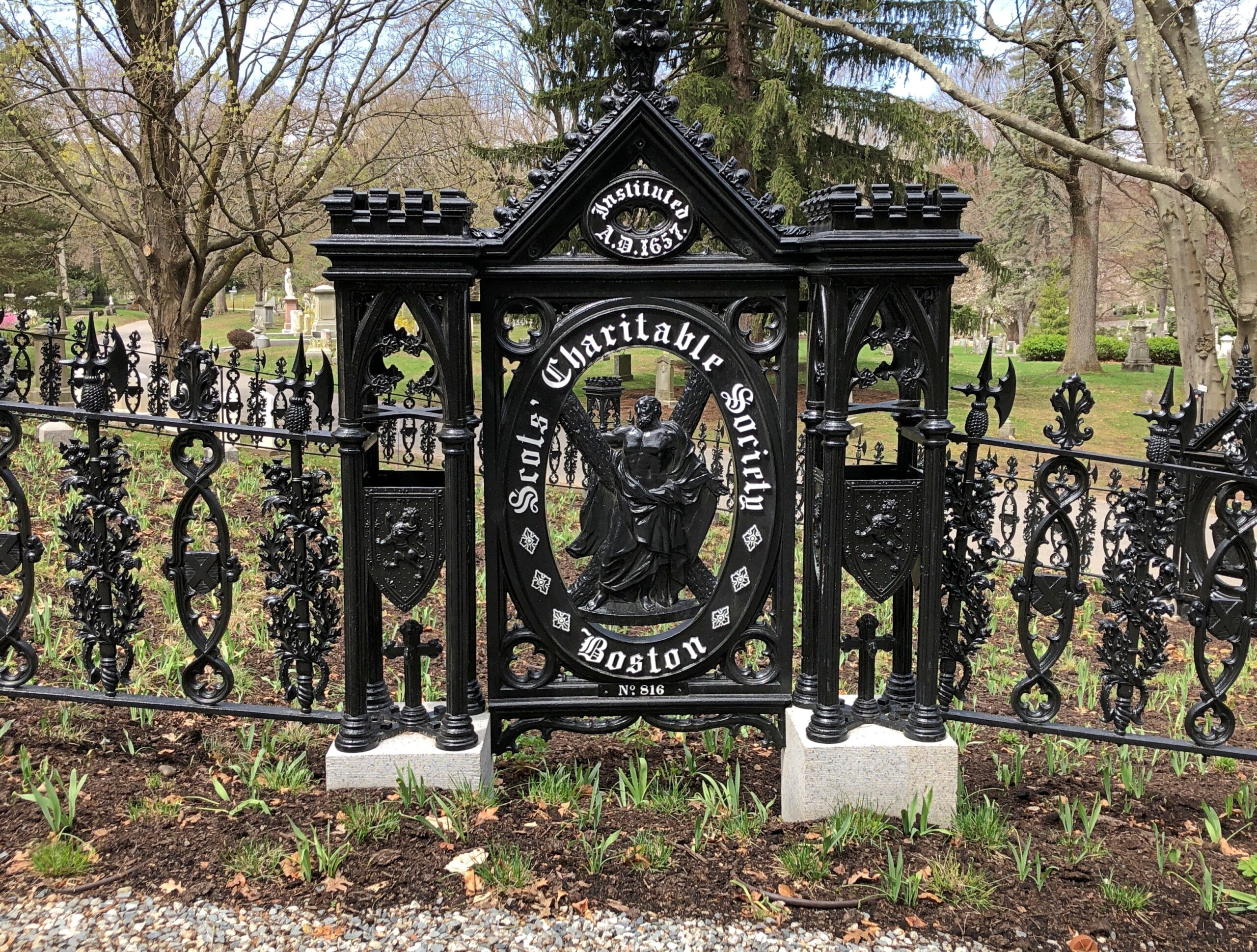
The Scots’ Charitable Society Lot.
An organization founded in 1657 in Massachusetts. It “aims to help people of Scottish heritage by providing relief to Scottish-American individuals and families in need, and by granting undergraduate scholarships to the Scottish-American community,” says its web site because it is still around.
Bigelow Chapel.
Named for Jacob Bigelow (d. 1879), second president of Mount Auburn.
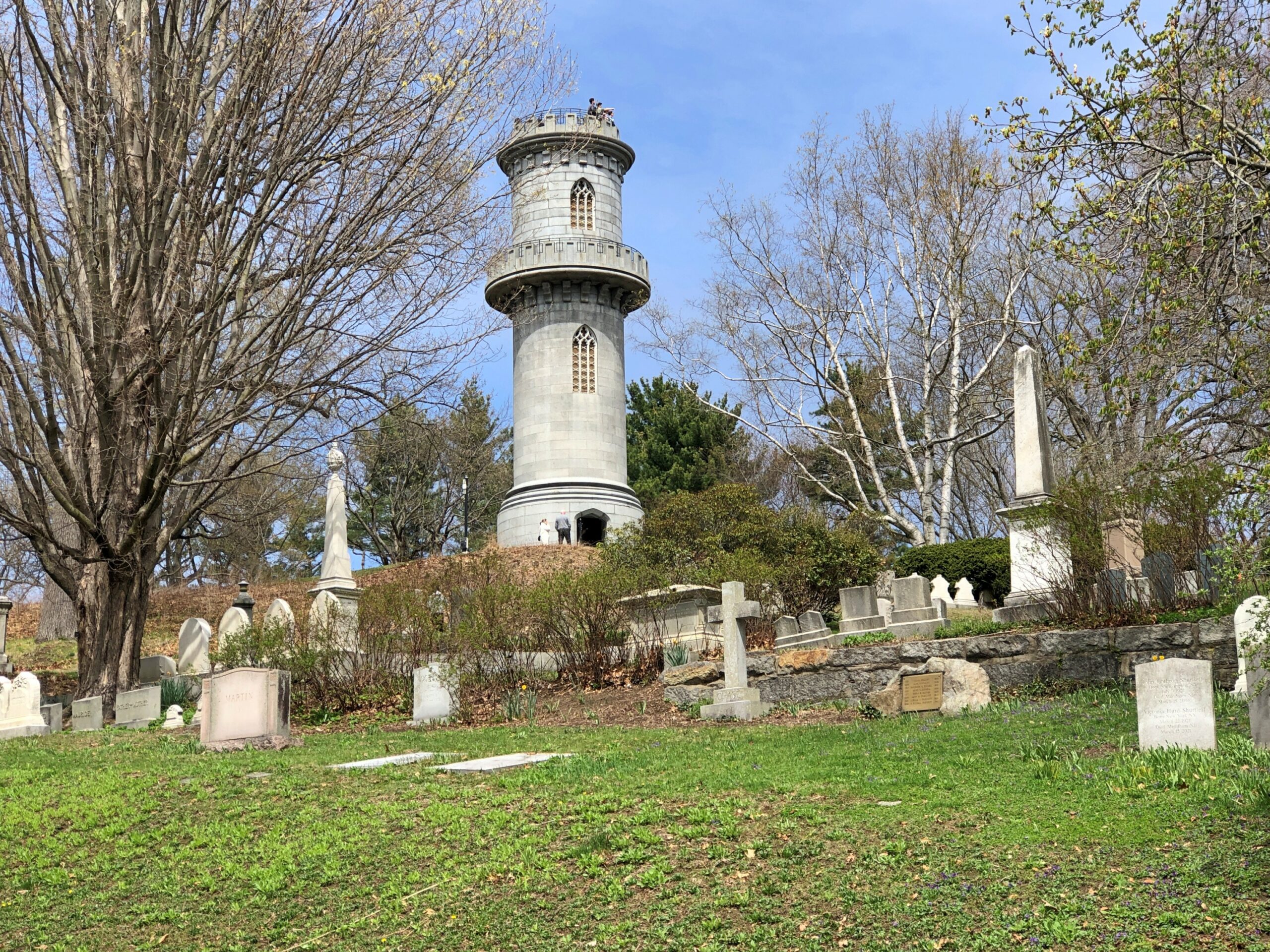
Washington Tower. The highest point on the grounds, honoring George Washington. Designed by Bigelow in collaboration with architect Gridley J. F. Bryant. I didn’t have the energy to climb the hill and then the tower at that moment. Too bad. I understand the view of the Boston skyline from there is terrific.
I was delighted to see it. In its way, as important as Lewis and Clark’s journey, and something I’m certain 99-point-more percent of Americans have never heard of.
Back to Joseph Story. He gave the dedication speech at the cemetery on September 24, 1831. It’s a long one, per custom of the time. Per custom of my time, a short quote:
Here, let the brave repose, who have died in the cause of their country. Here, let the statesman rest, who has achieved the victories of peace, not less renowned than war. Here, let genius find a home, that has sung immortal strains, or has instructed with still diviner eloquence. Here let learning and science, the votaries of inventive art, and the teacher of the philosophy of nature come. Here let youth and beauty, blighted by premature decay, drop, like tender blossoms into the virgin earth; and here let age retire, ripened for the harvest. Above all, here let the benefactors of mankind, the good, the merciful, the meek, the pure in heart be congregated, for to them belongs an undying praise.
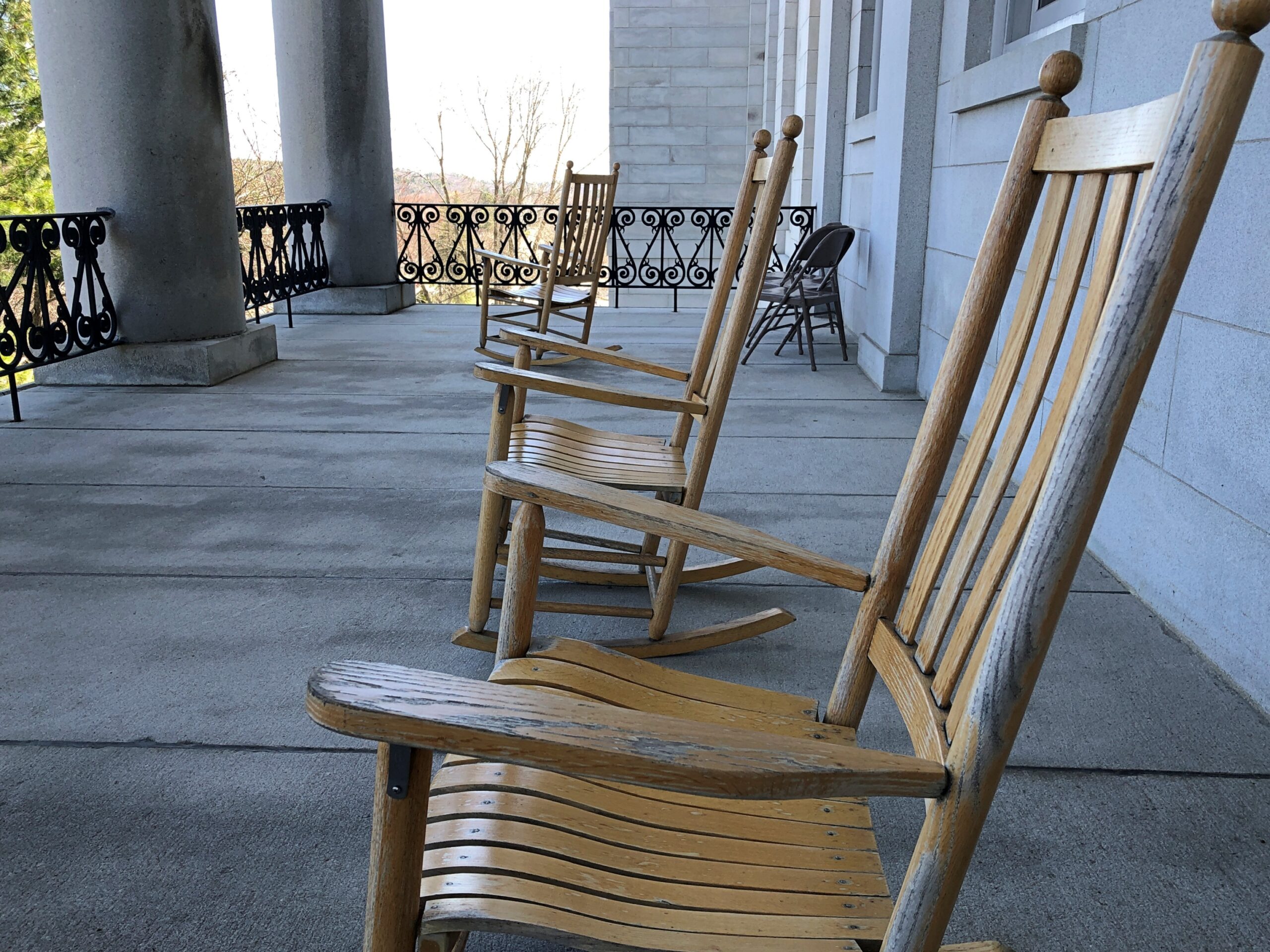
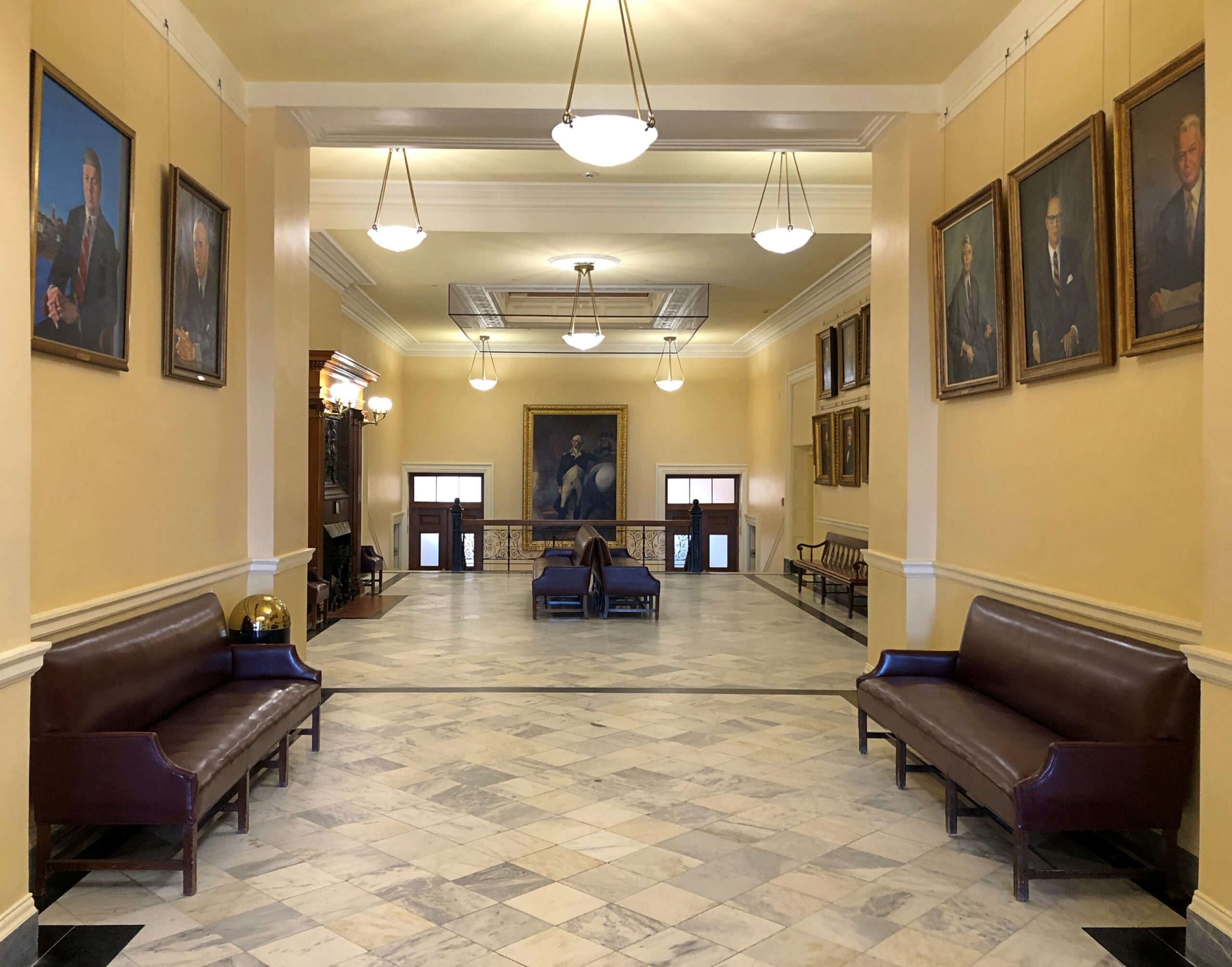
Though state capitols tend to be grand buildings with opulent fixtures and decorous memorials, small surprises outside the official scheme sometimes await casual visitors. Such as rocking chairs at the Maine State House.
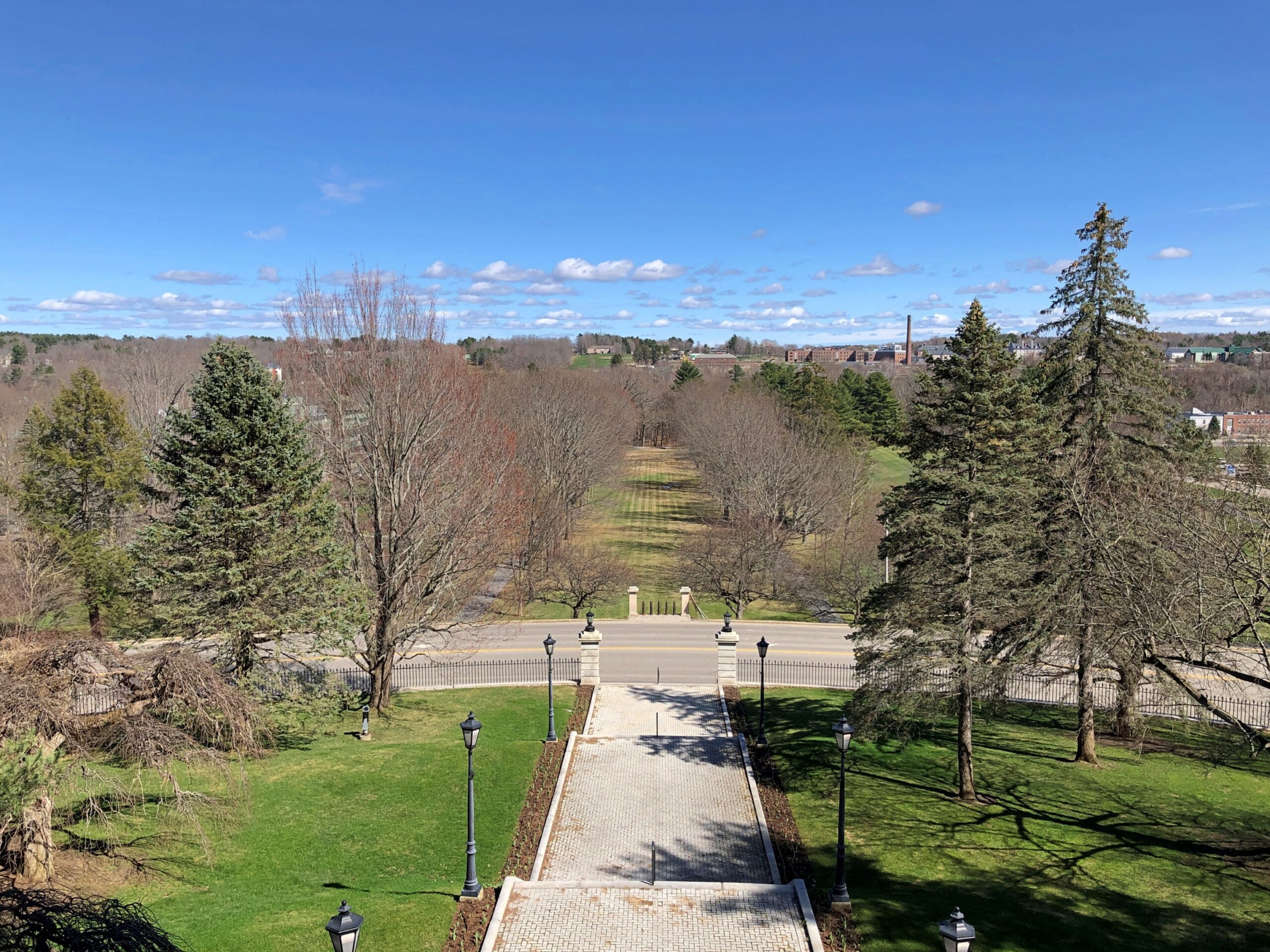
The building is perched on a hill, as capitols sometimes are, with a sizable porch with a long view. Obscured off in the distance is the Kennebec River.
That porch is a good place for rocking chairs, someone thought at some point; someone associated with the capitol in some way that made it a reality, so I suppose in that sense, the chairs are as official as memorial busts or portraits. I had a seat. I couldn’t very well ignore the obvious thing to do in a place where rocking chairs aren’t an obvious thing to have. Also, I get tired more easily than I used to. I took in the view.
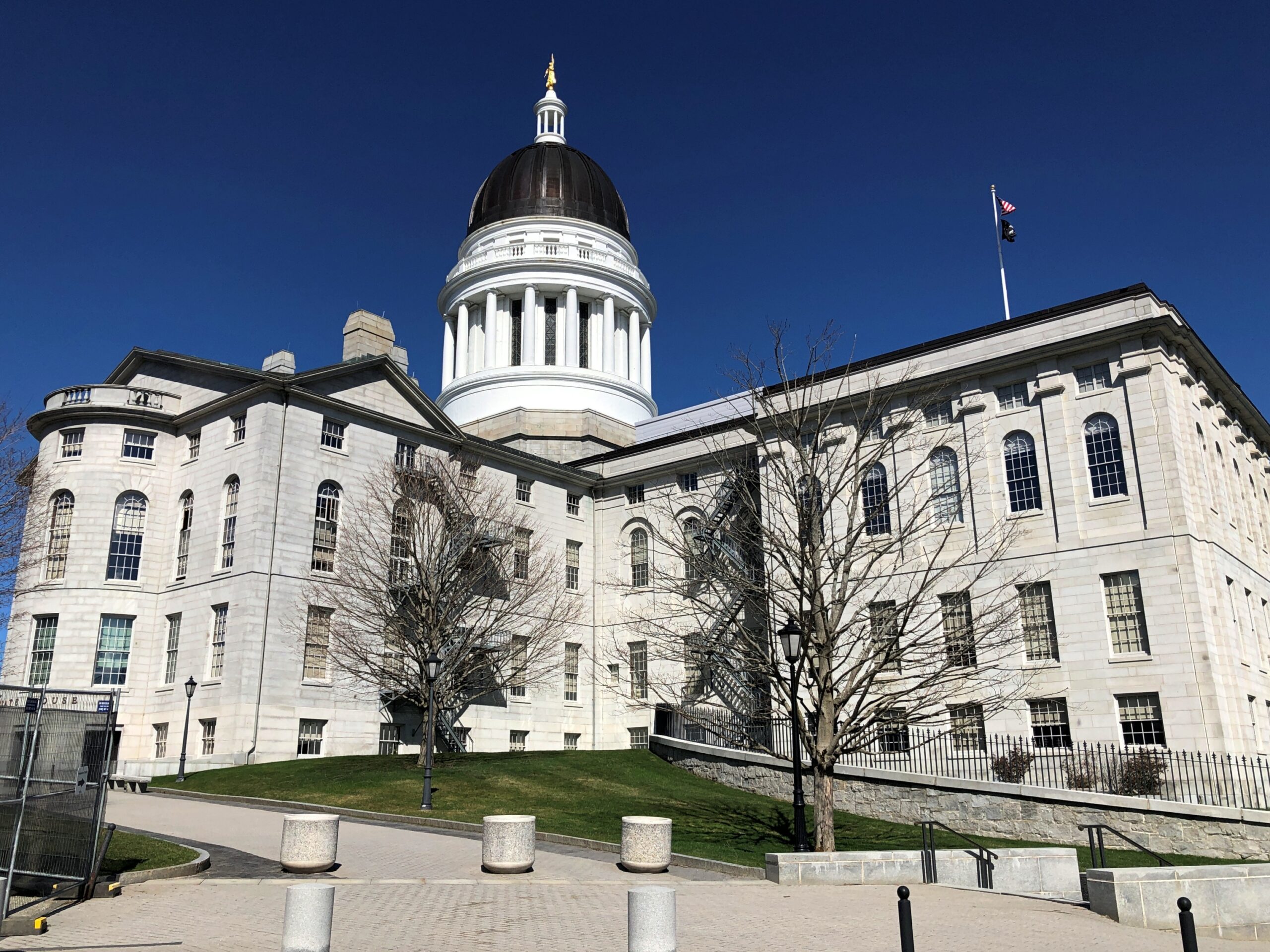
Augusta was the last place I visited in Maine last month. I could hardly miss it on my way out of the state. For one thing, I’d been to Augusta, Ga. less than a year earlier. Mostly, I had a new state capitol to visit. A box to check. Thinking of it that way might perturb travel purists who insist that travel is about “expanding your horizons,” or “living like the locals” or some other vague nonsense. There’s nothing wrong with a few lists to consult along the way. Think of them as “goals.” Gives a little structure to an interest, and I’ve long had an interest in state capitols.
In this case, I was committed to meeting my friends that evening in suburban Boston, so as interesting as Augusta looked – especially the busy State St. on the way to the capitol – I only had time for one thing. The Maine State House was it.
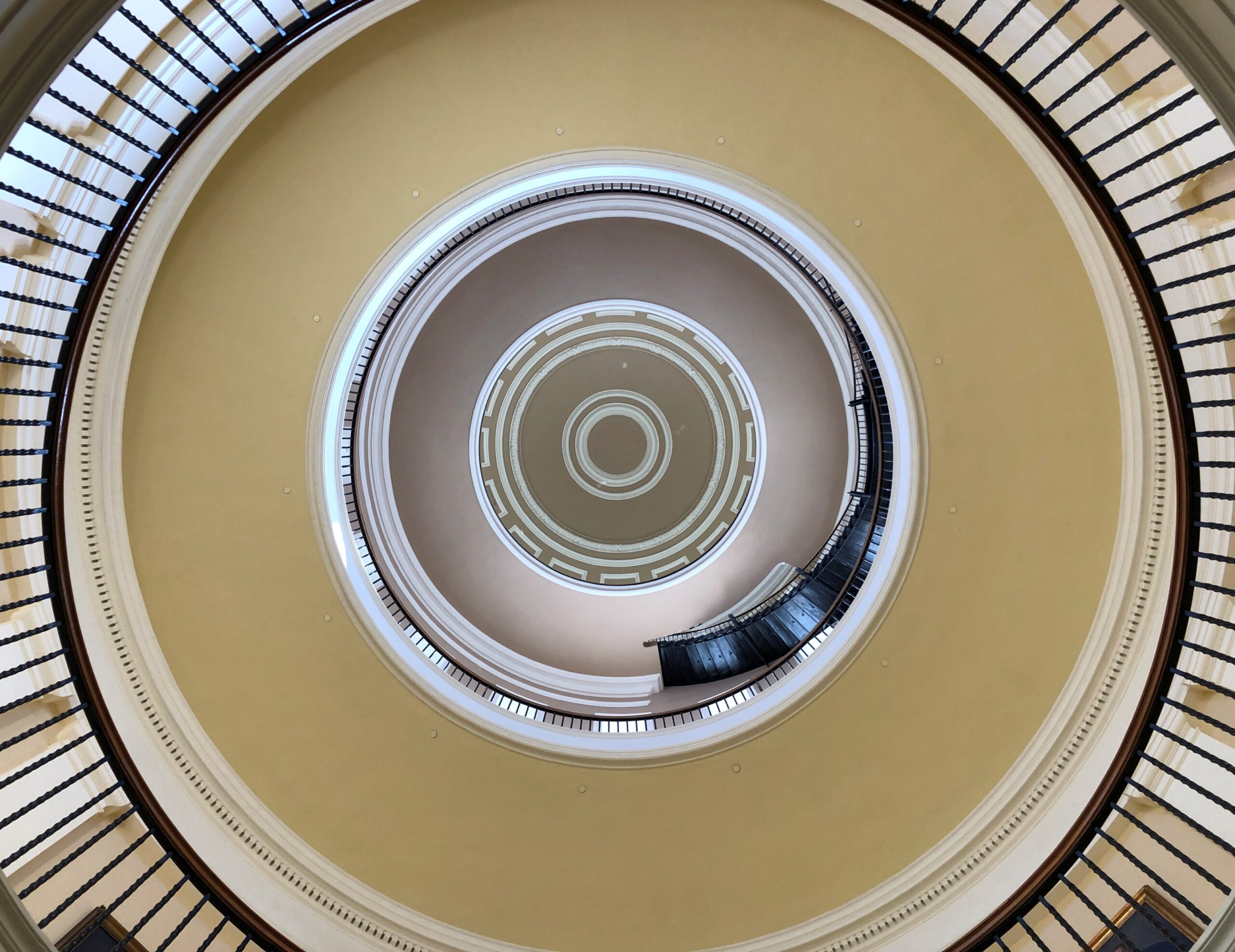
Maine statehood was a process that “took 28 years… six referendums and a war before the District of Maine escaped the rapacious grasp (to some) of Massachusetts,” according to the New England Historical Society. But once the doughy Mainers had broken away, they needed a capital and a capitol. The more-or-less central Augusta for the former, and a design by Charles Bulfinch (d. 1844) for the latter. Bulfinch, who also designed the Massachusetts State House, was an architect of the early Republic, maybe the architect of the early Republic, as the starting point of Federal style.
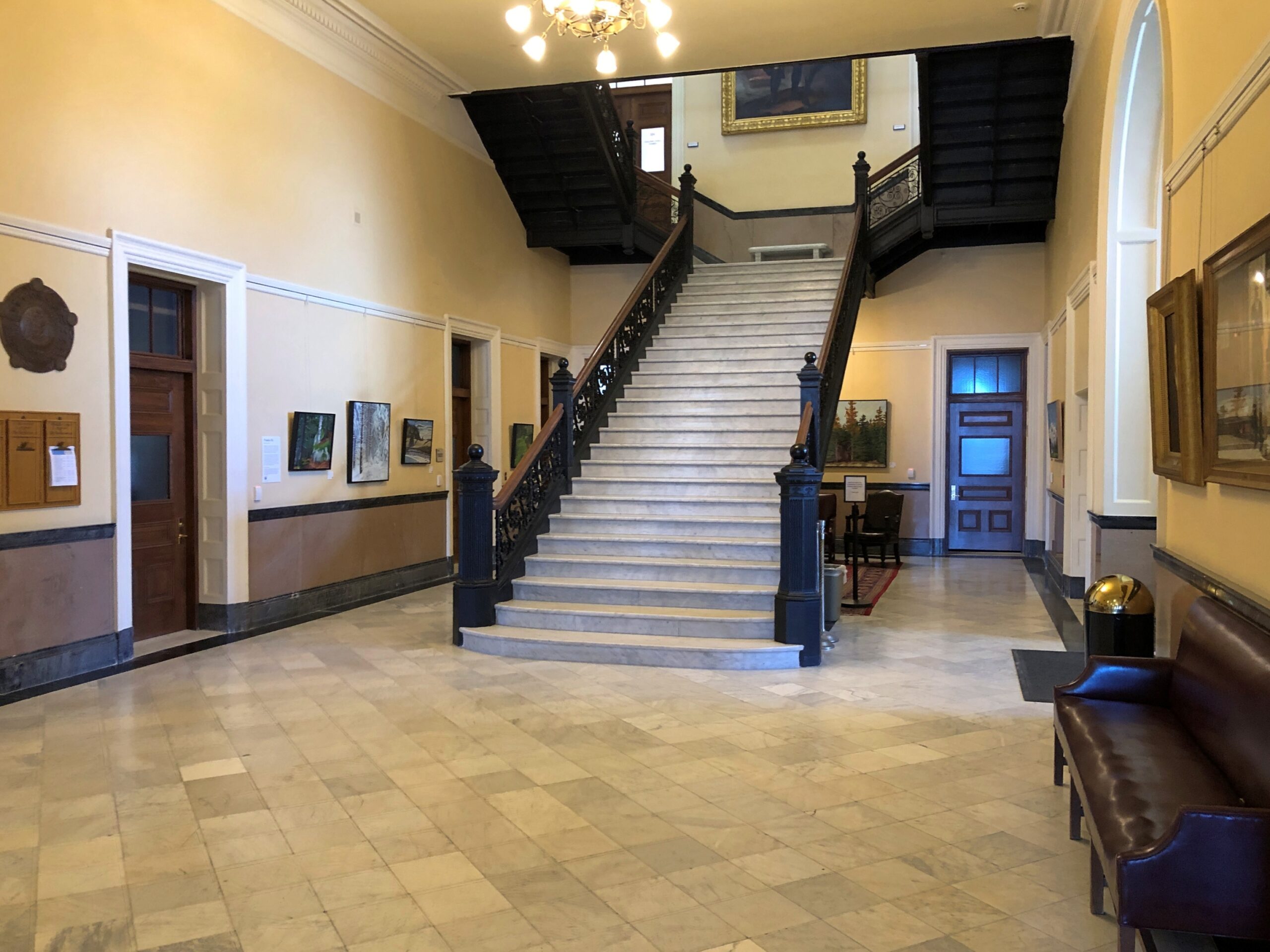
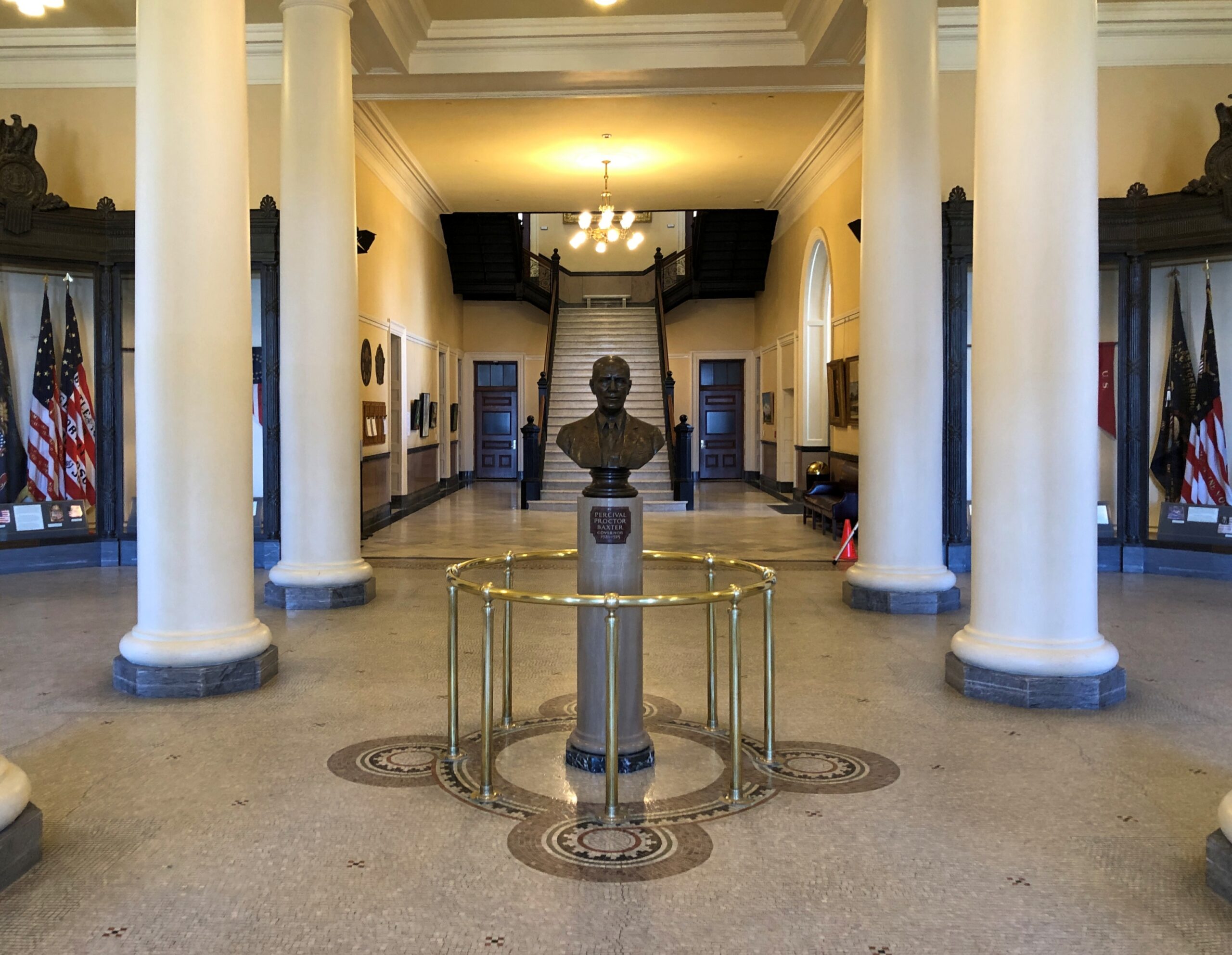
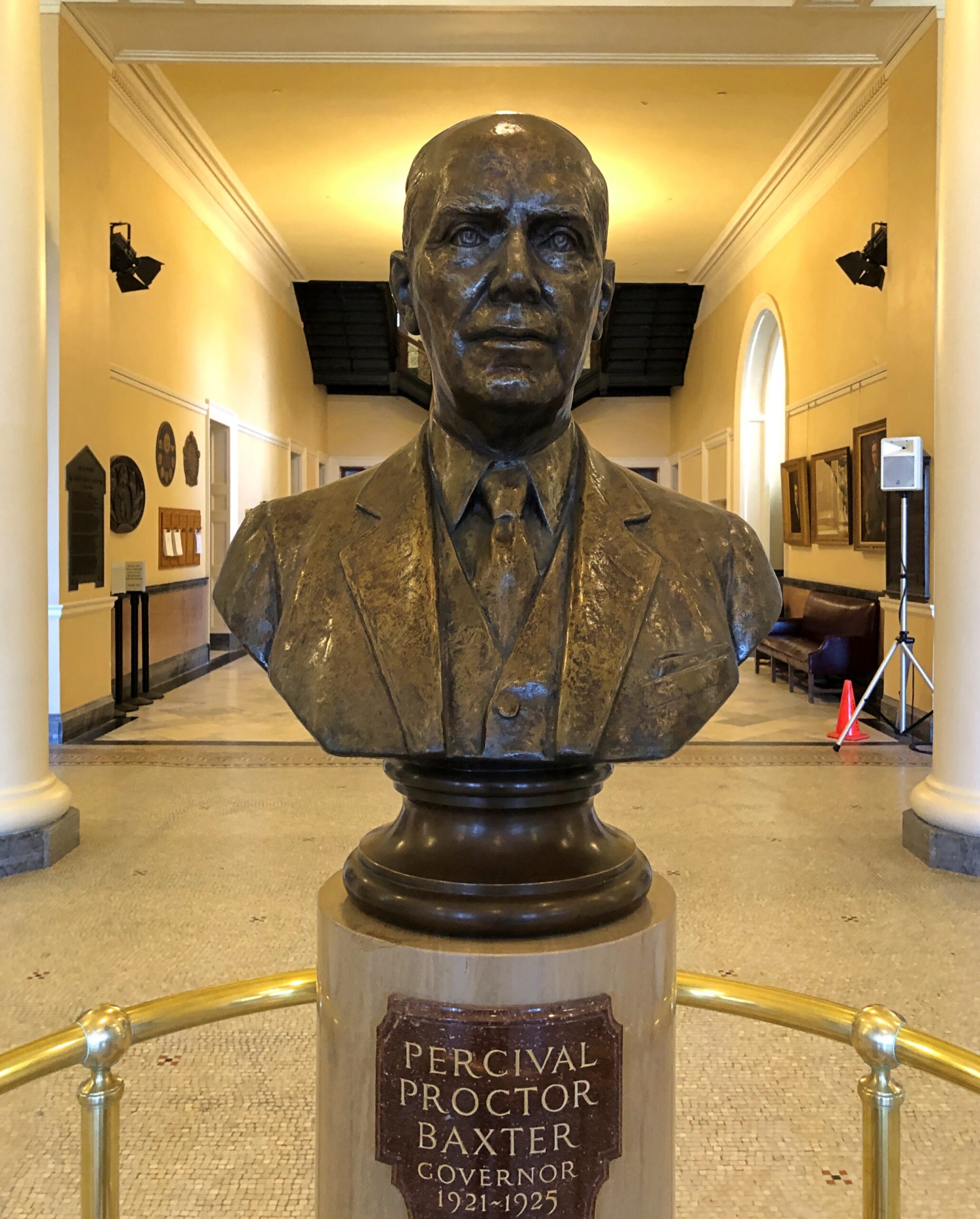
Not the most ornate of capitols, but a pleasant design. Mainers of yore are honored in various spots, but a special place of honor is for Gov. Percival Baxter (d. 1969), who sounds like an all-around swell fellow. Baxter State Park way up in the northern wilderness is named for him, and for good reason: being personally wealthy, he was able to acquire the land for the park himself, which he gave to the state.
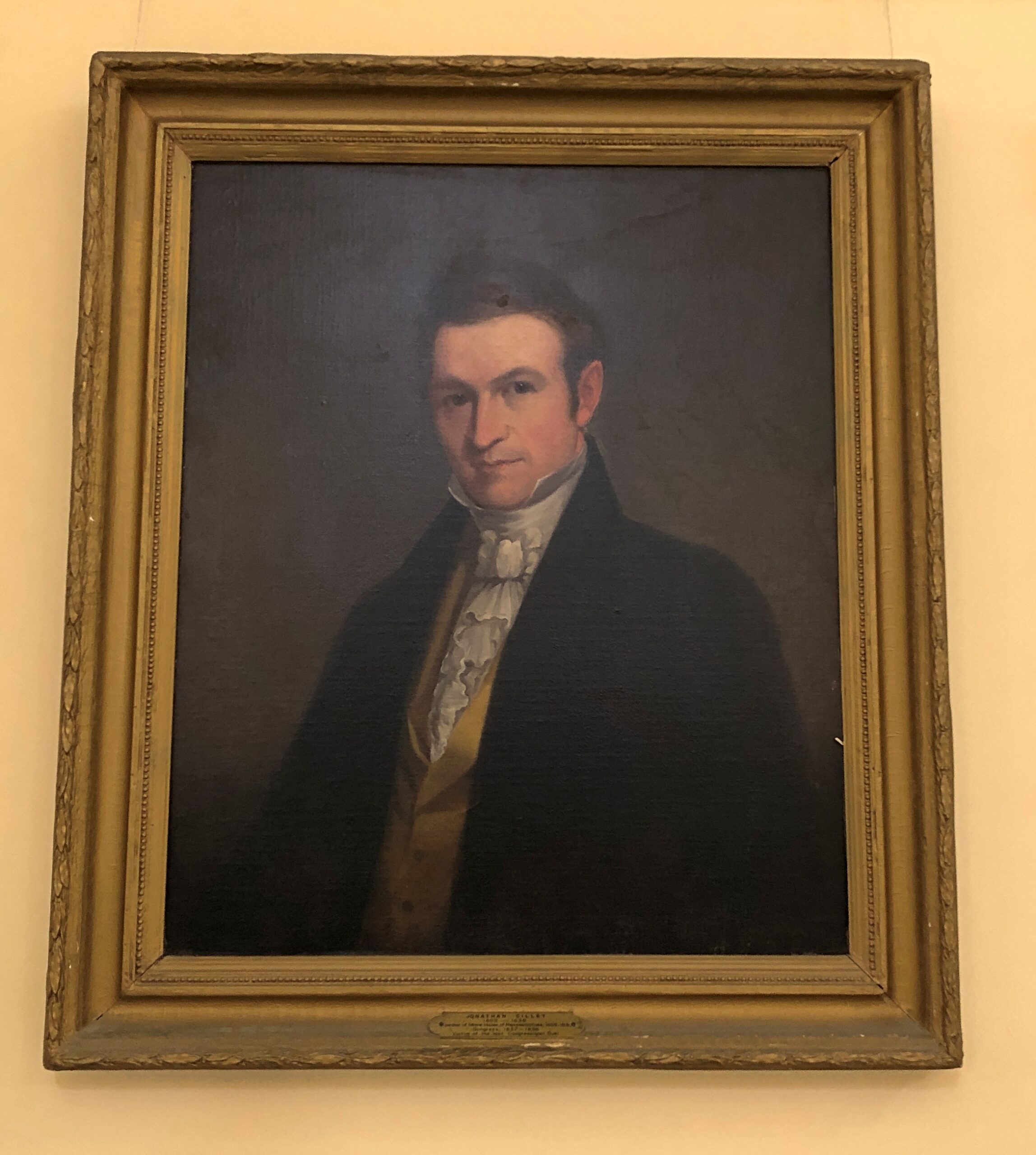
A number of portraits hang on the wall, also as usual for a capitol. One intriguing one: Jonathan Cilley (d. 1838). A Congressman from Maine who, as the sign under the painting says, was “victim of the last Congressional duel.” Shot by fellow Congressman William Graves over some arcane point of honor, he was. Quite the story.
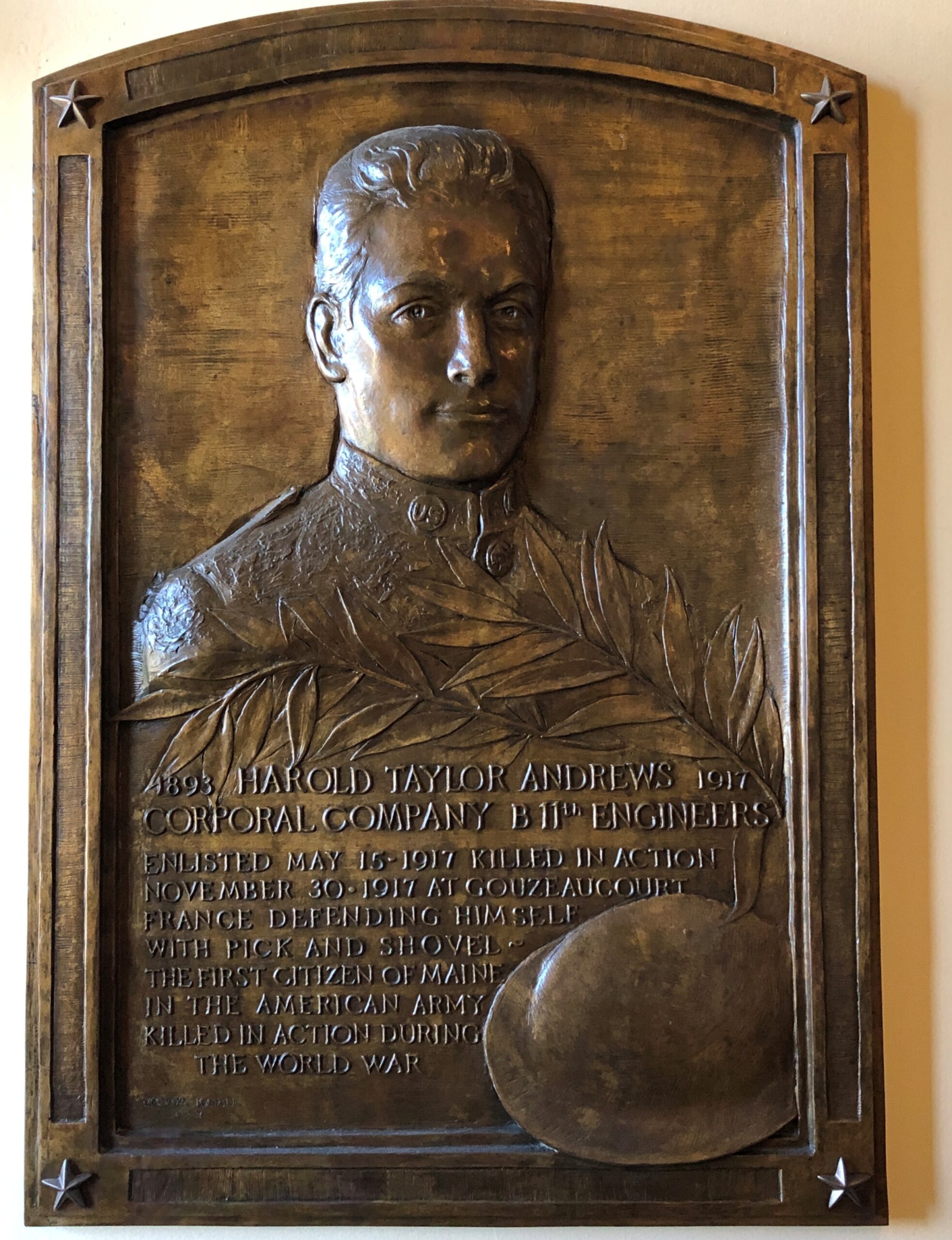
Another story on the wall: Sgt. Harold Andrews, the first U.S. soldier from Maine to die in the Great War (November 30, 1917). An exact contemporary of my grandfather, and an engineer as well. Grandpa returned from France to have descendants, Andrews did not.
If for no other reason than to make the acquaintances of Gov. Baxter and Rep. Cilley and Sgt. Andrews, the Maine State House was a good box to check.
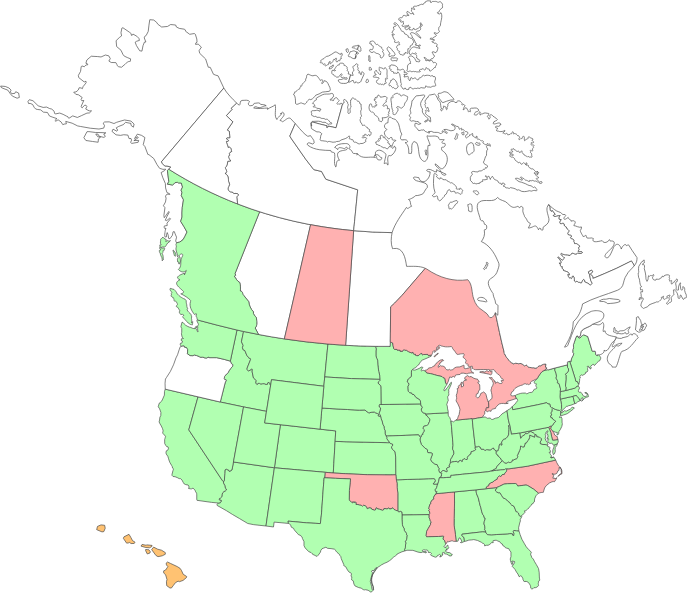
The thing about state capitols, though, is there aren’t many new ones left for me to visit. Got a few more provincial capitols — parliament buildings — however.
Green: interior visits. Orange: exterior visit only. Gold: uncertain. White: more boxes to check.
We live on the crust of the Earth, and what do crusts do? Crumble. Especially when moving water has anything to do with it, as it does along the coast of Maine. Famously so.
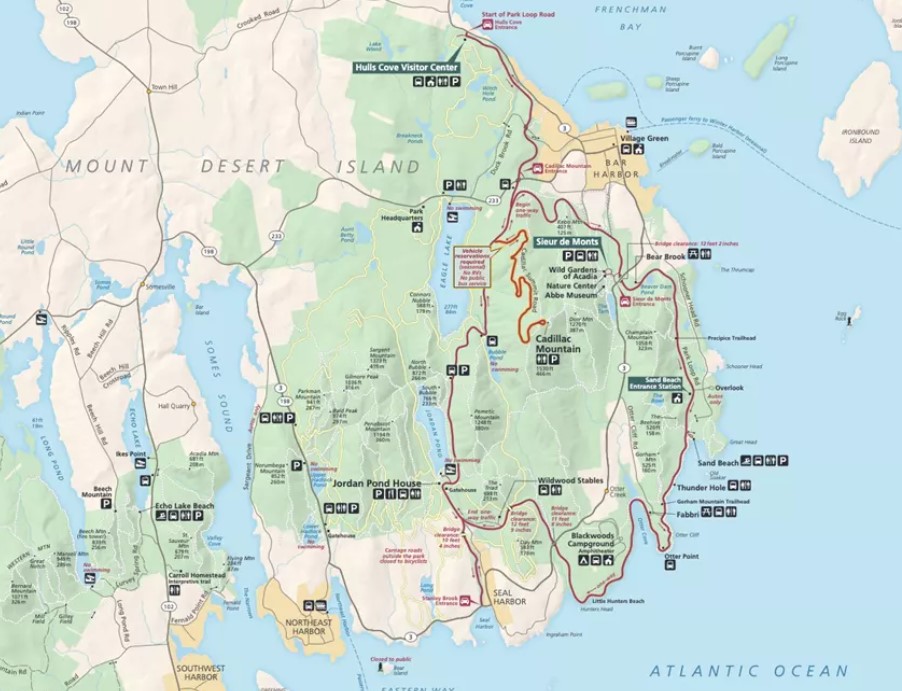
I arrived at the crumbly coastline of Acadia National Park on the morning of April 16. The date is important for only one reason: Park Loop Road, the main scenic drive through the park, opens for the season every year on April 15.
Acadia NP occupies about half of Mount Desert Island and some other nearby peninsula acreage and small islands. The morning of the 16th broke damp and foggy and chilly. From my lodging in the sizable town of Ellsworth, Maine, which is on the mainland near Mount Desert Island, I made my way to the island, then Bar Harbor, then the entrance to Park Loop Road, stopping only for a wonderful breakfast sandwich at one of the few places along the way that was open, Farmstand Coffee House.
The visitors center at the park entrance wasn’t open either. The NPS missed making a sale of post cards to me. By the time I got to the park, the weather was better: slightly less damp and slightly less foggy and slightly less chilly.
Such is Maine in spring. I didn’t mind. In fact, the damp chill meant few other people had come that day. Chilly but no ice underfoot. I like to think that it all melted by April 15. Or maybe on April 15.
I sent a few pictures to Tom in Austin taken while I visiting Acadia NP.
He answered: “Wow. Fabulous. Choosing to visit that national park before May is a bold decision. Looks like you got good weather, though.”
Bold? Maybe. To boldly go where many vacationers have gone before. And will again, real soon.
I didn’t drive particularly fast along Park Loop Road. Little traffic for one thing, too much of a risk of a car-on-tree encounter for another thing, so curvy is it. Gnarly, you could say. The drive, whose construction John D. Rockefeller Jr. facilitated, winds but does not climb much as it follows the curves of the shore. The scenic stops are close to each other, since in national park terms, Acadia is a touch on the small side. Despite that it hardly lacks variety.
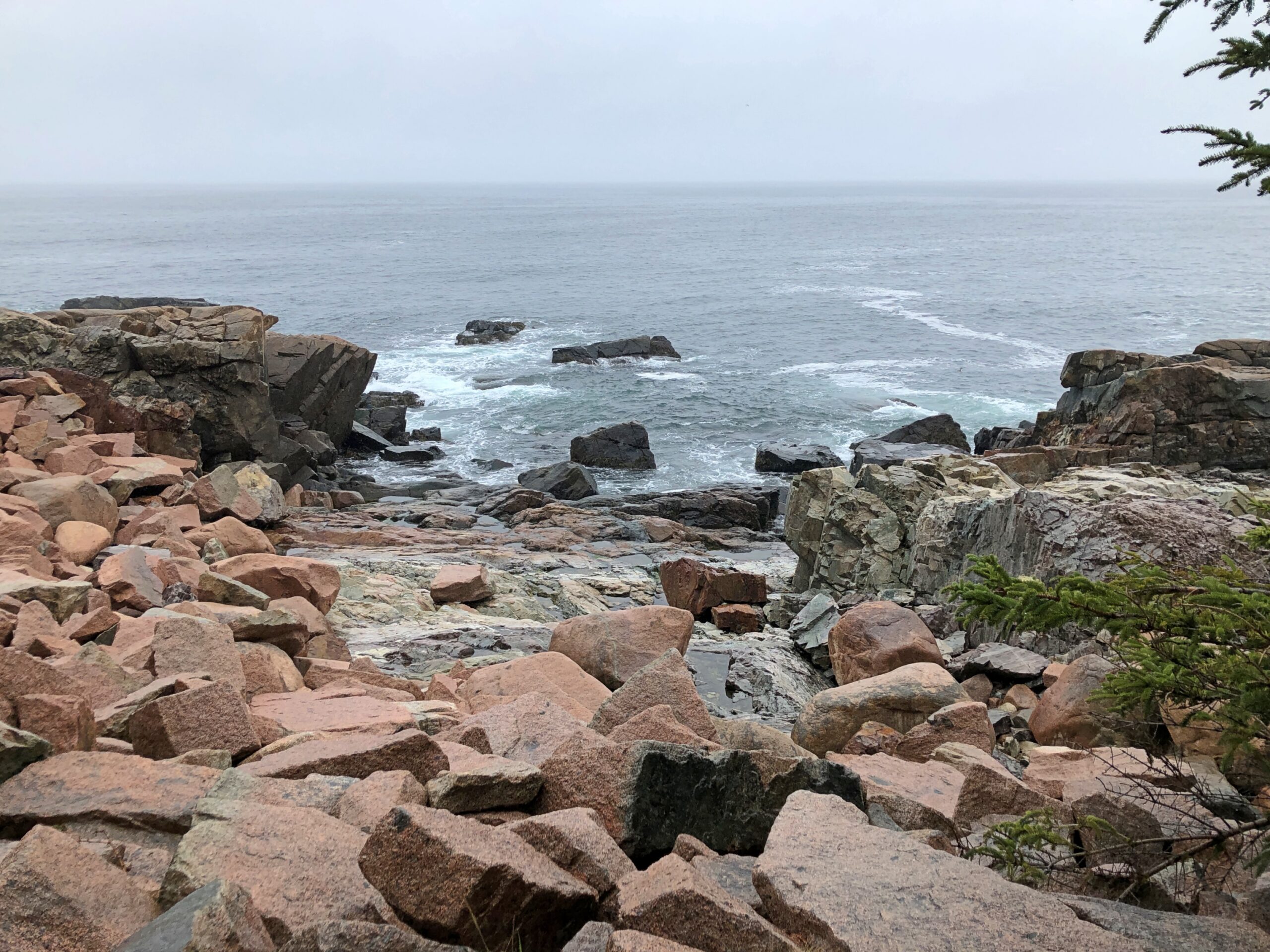
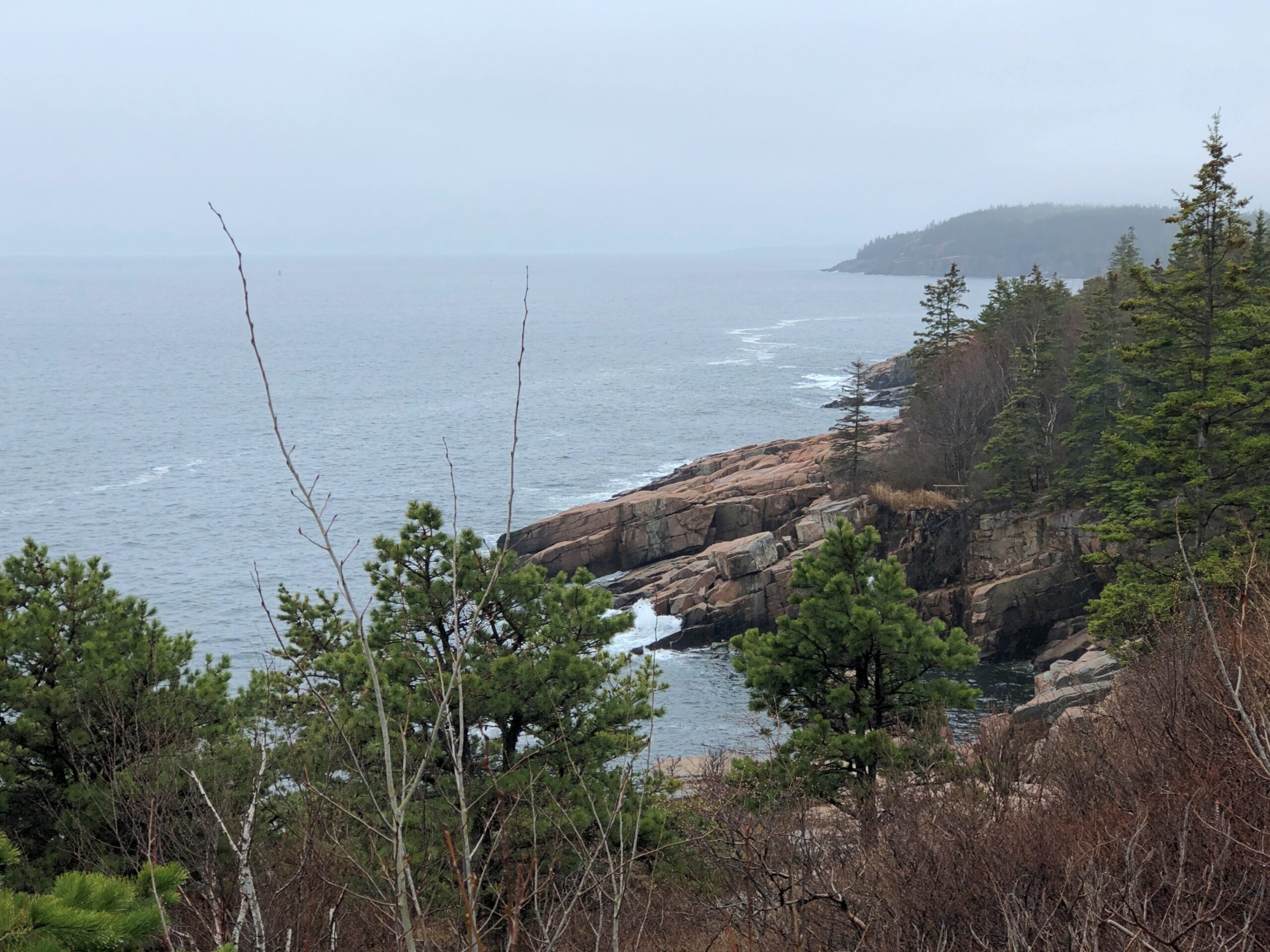
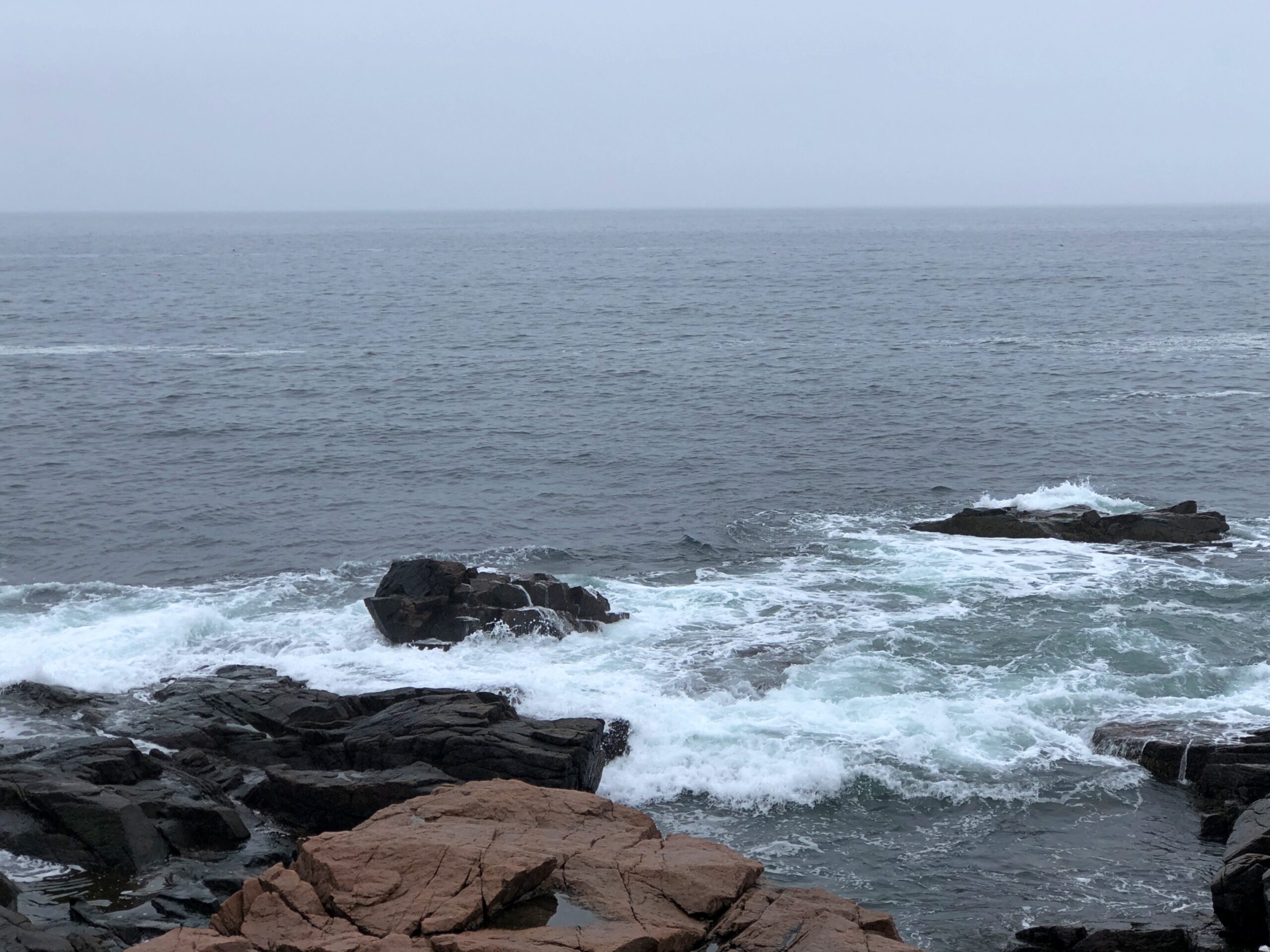
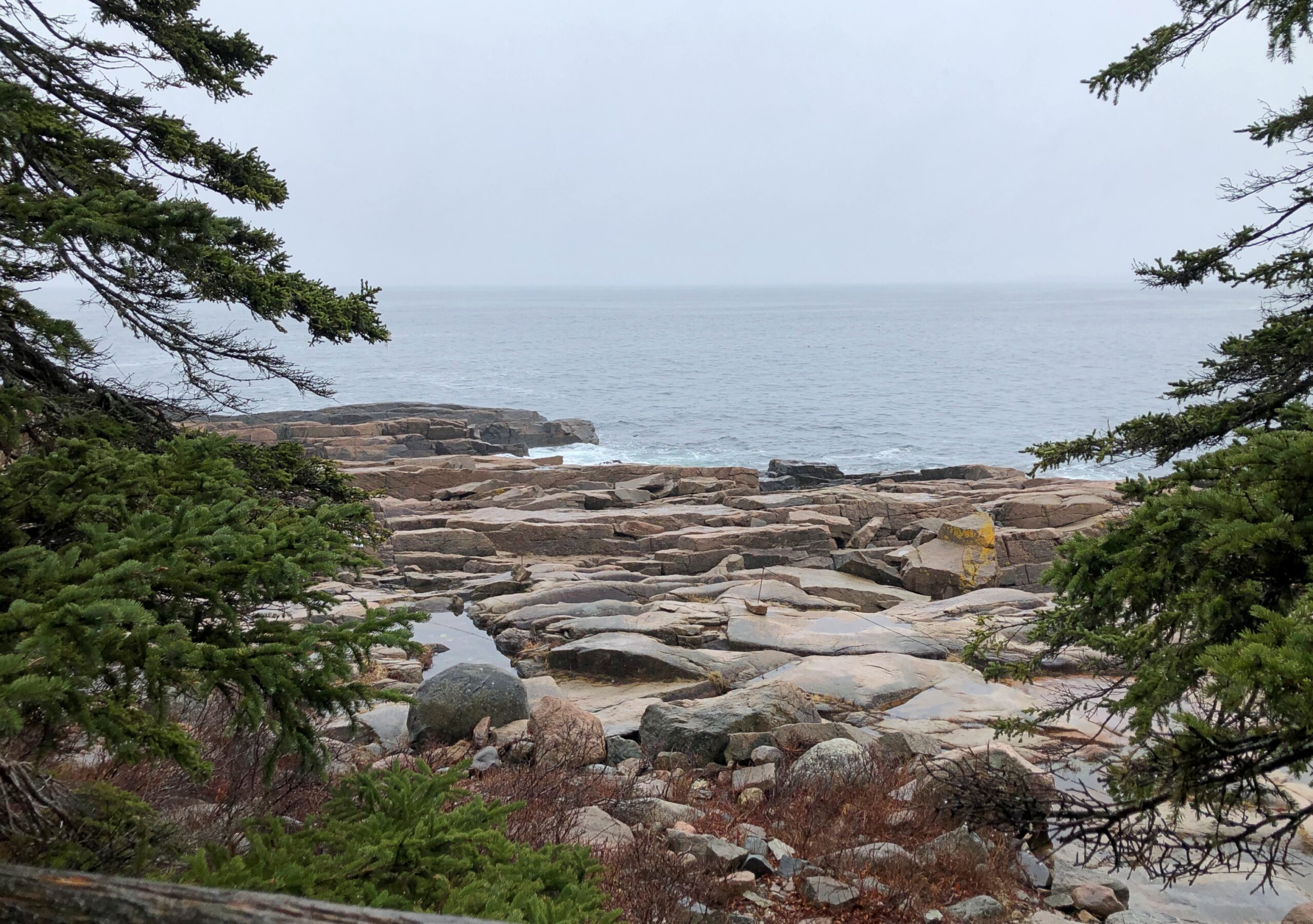
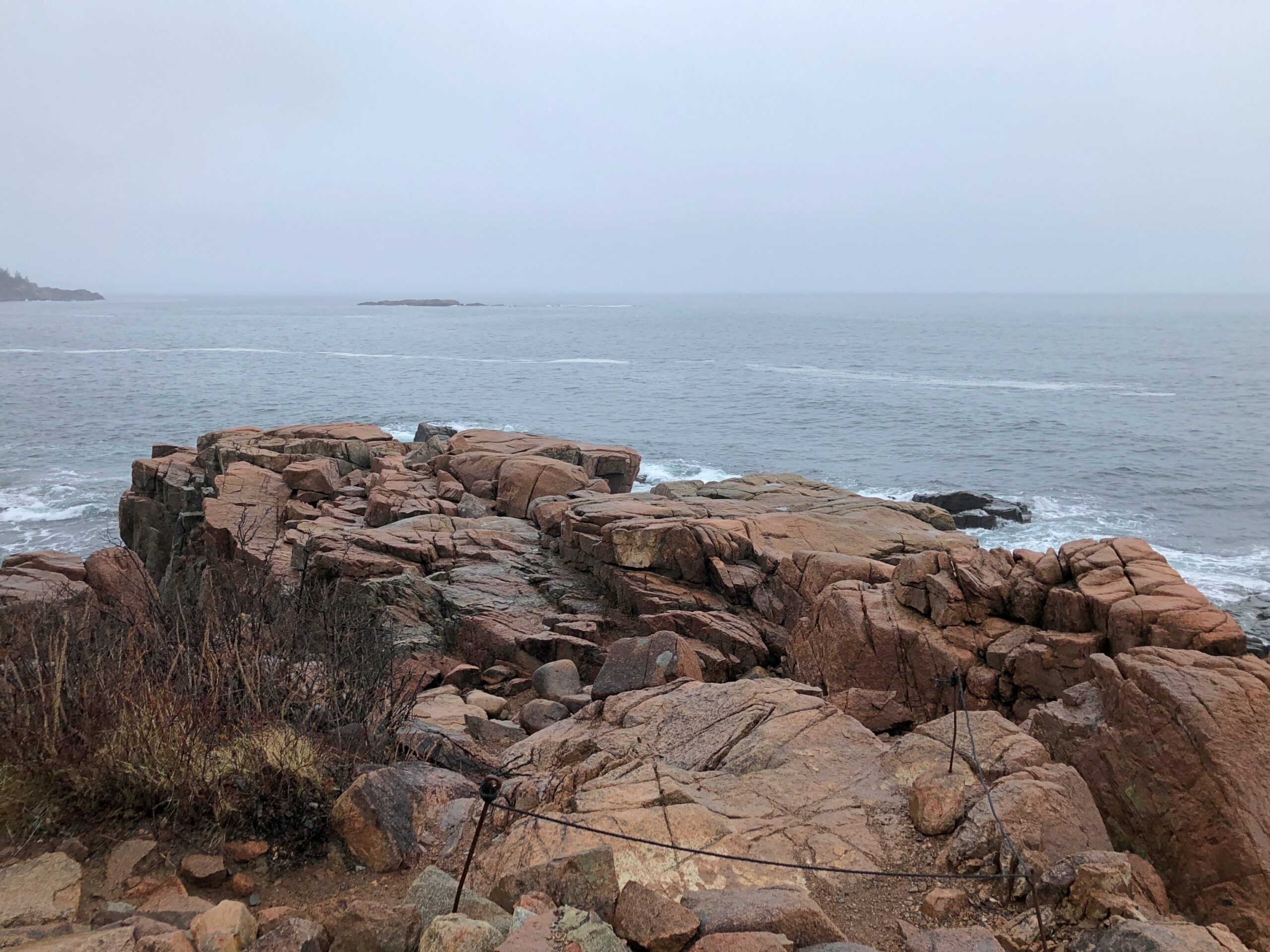
Beginning with the rocky shores you’d expect. The fog that day was a nice Maine touch. The foggy shores of Maine. There’s a song title for an AI song writing program: “The Foggy Shores of Maine.” Sad song about a solider dreaming of home on these shores? It worked for “Galveston.”
Boulders and sizable slabs, on their way to being pebbles and sand.
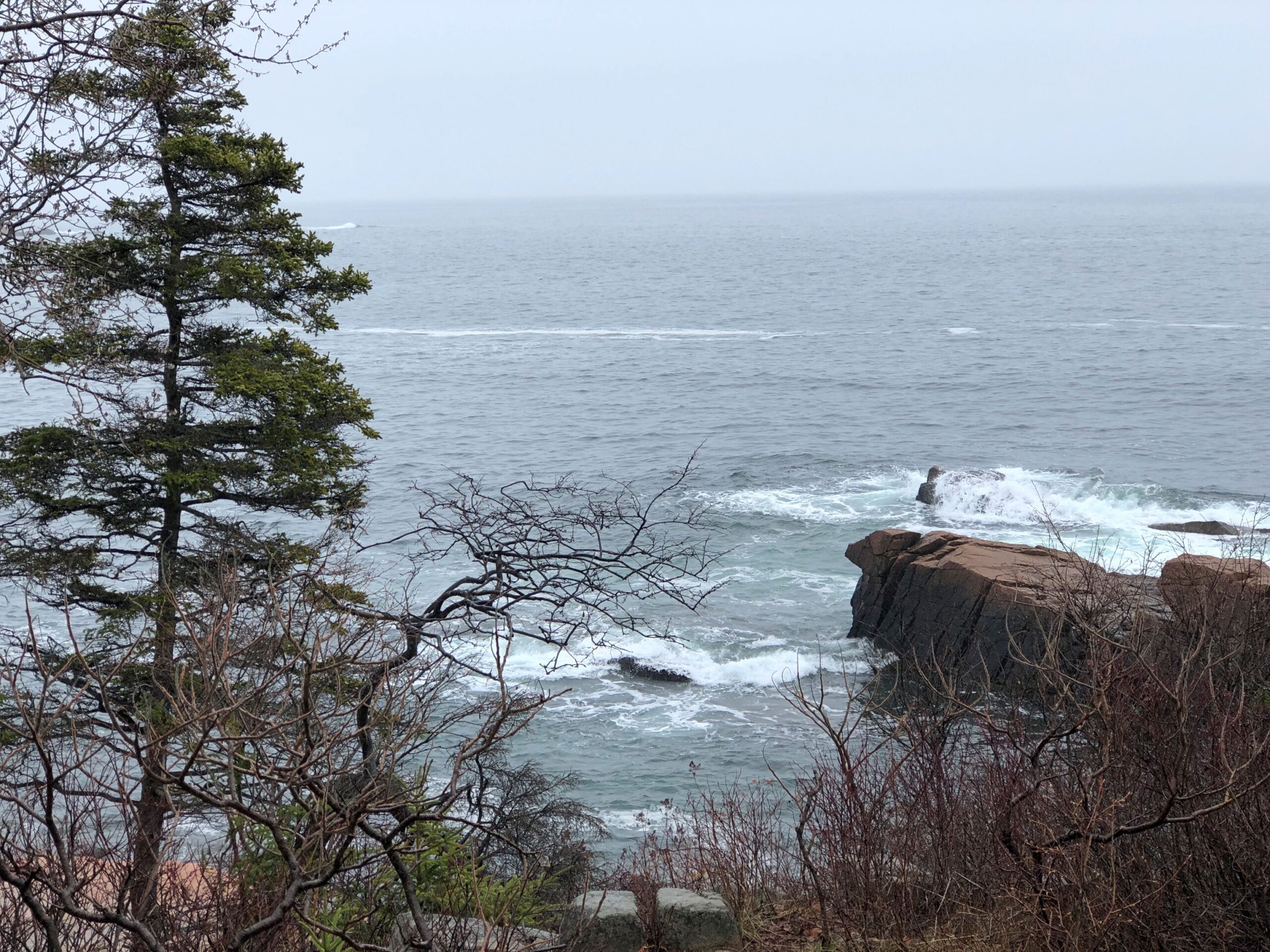
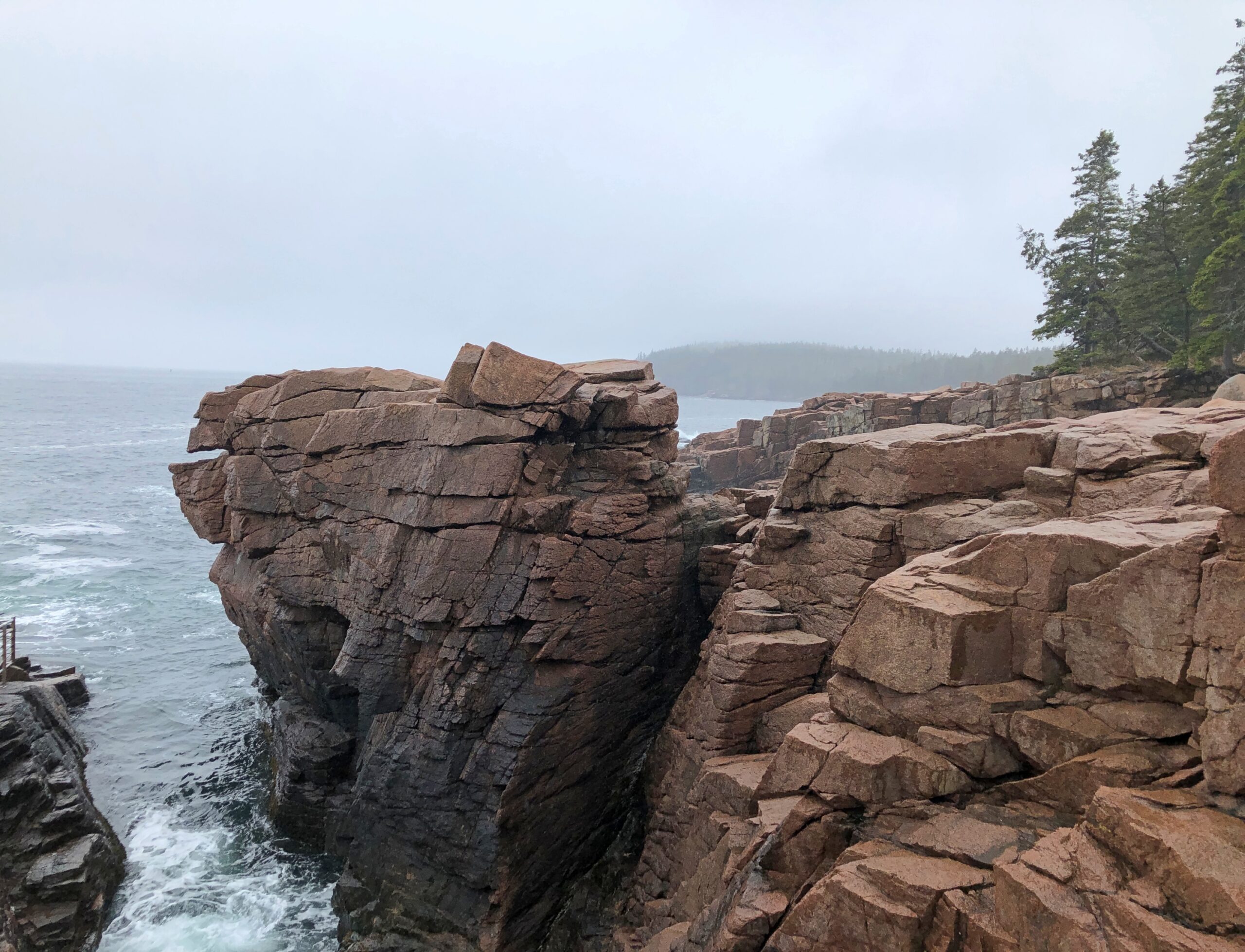
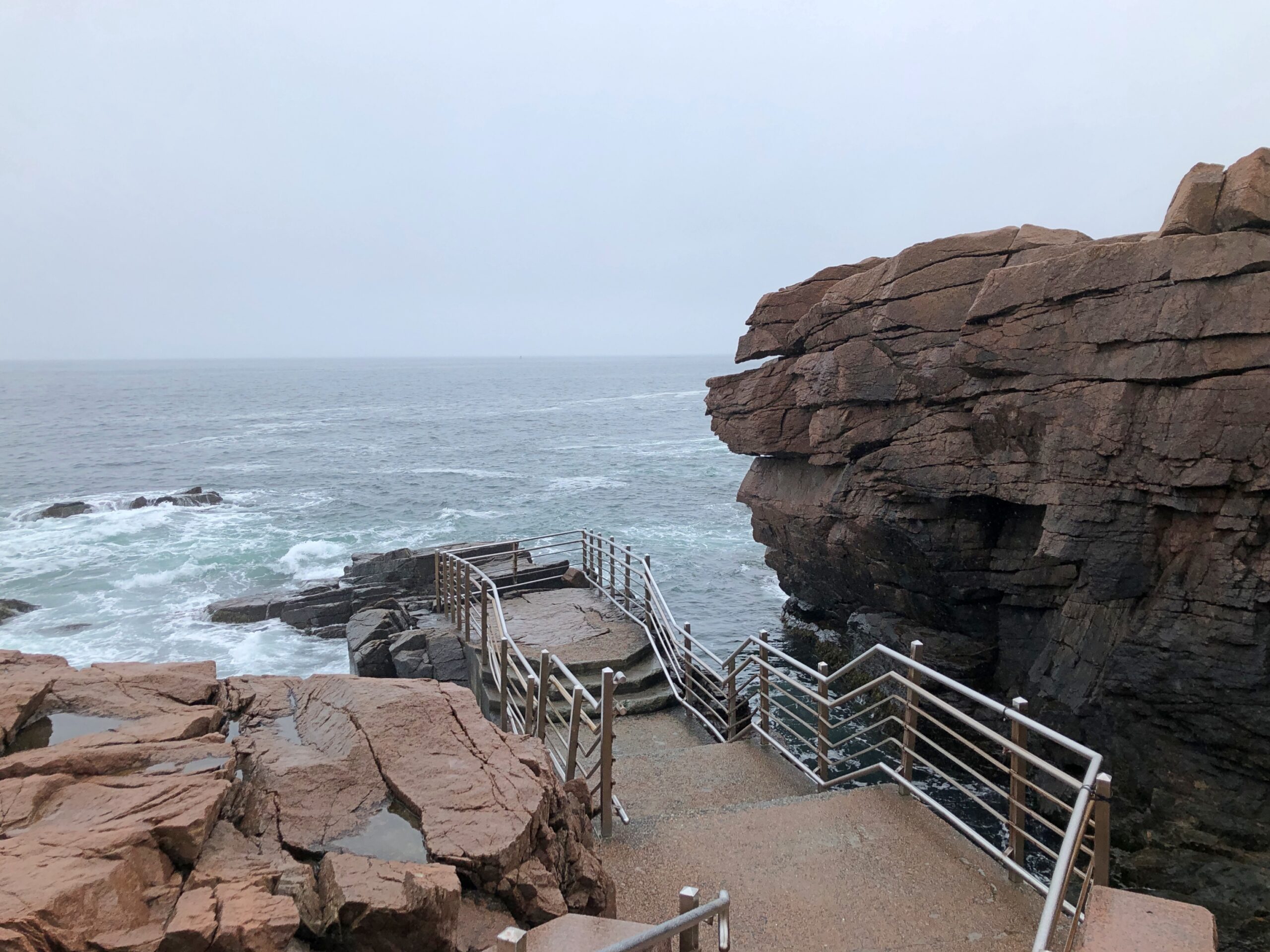
A feature that wears its name well: Thunder Hole.
A loud place, Thunder Hole, the waves bashing the rocks in crash-splashes, followed by the whistling, sucking whoosh as water pulls away from the rocks, followed by another bash against the rocks, all before you can count to three.
You can get closer to Thunder Hole behind the (relative) safety of rails, but that won’t keep you from a good drenching. Not that day, anyway. I kept my distance, and let the sound come to me in its noisy fury.
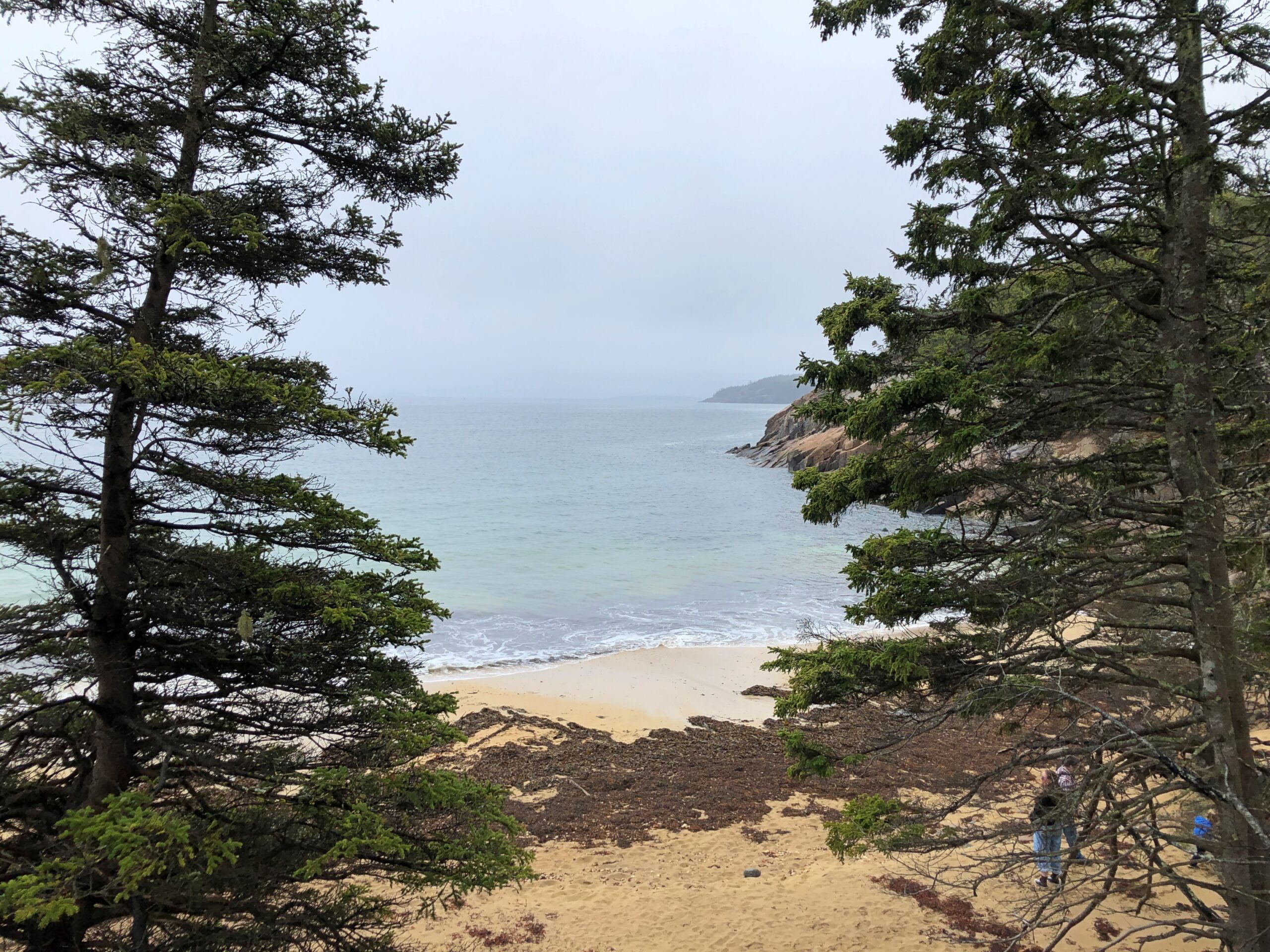
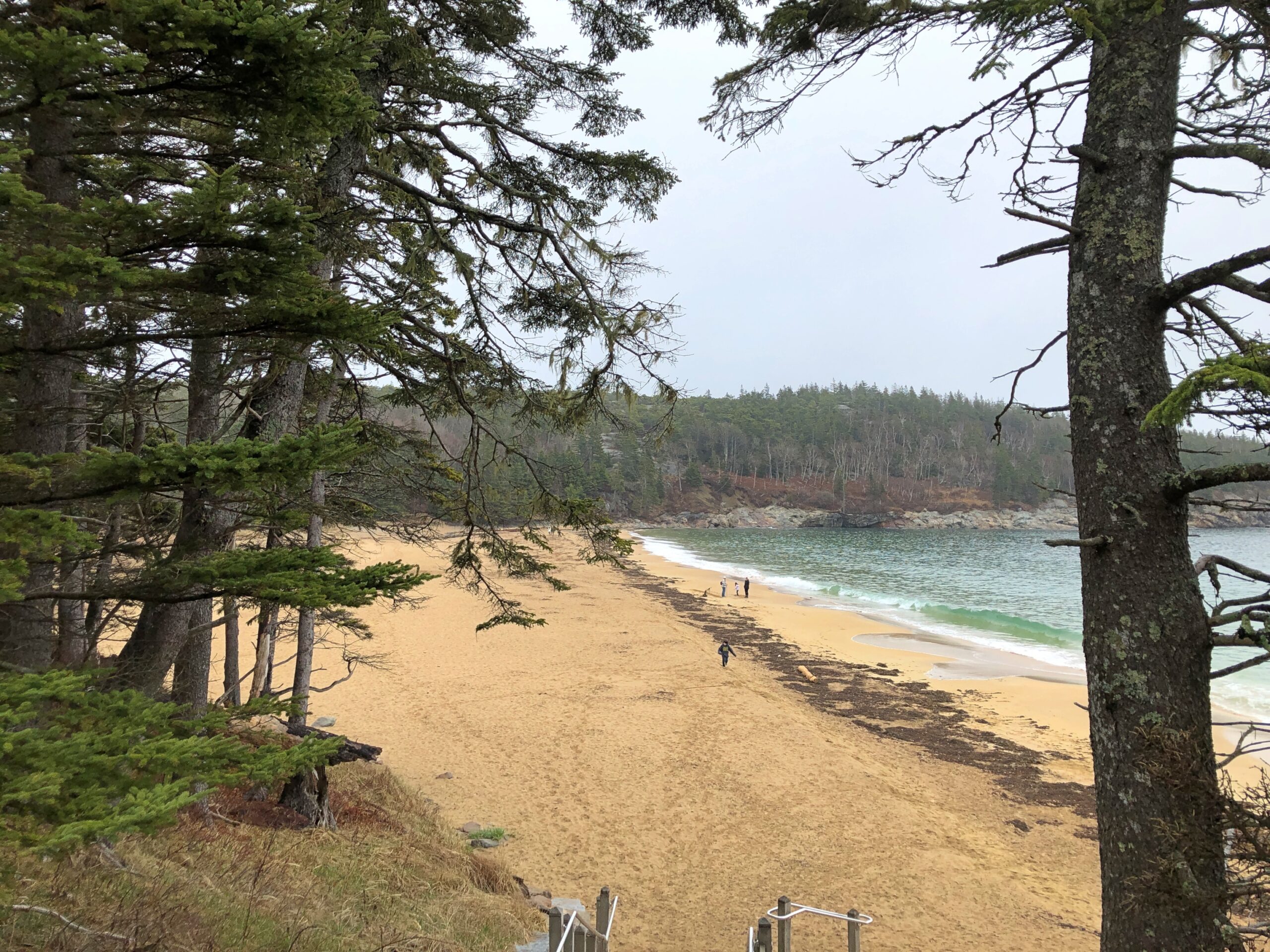
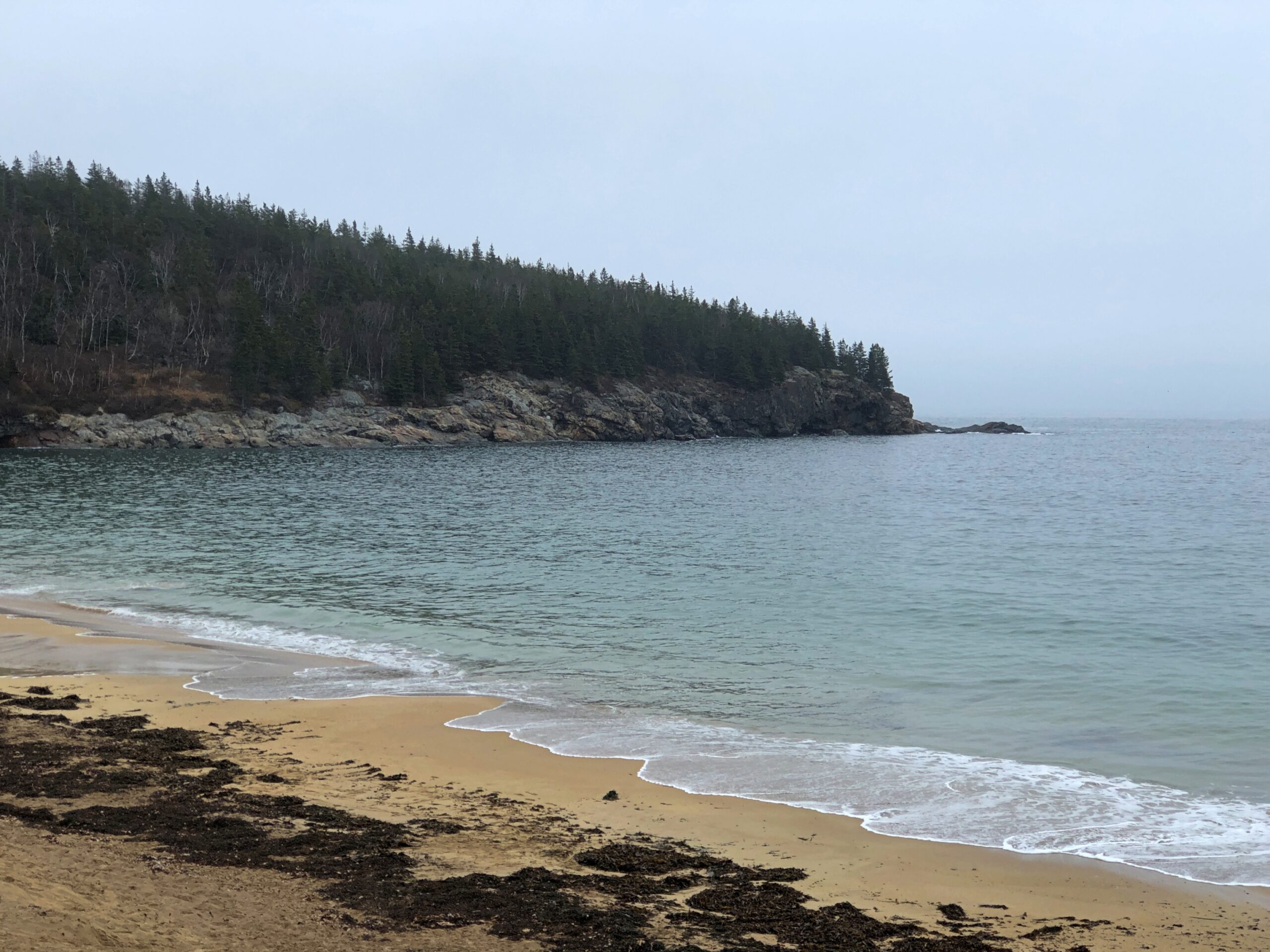
The park has a sand beach, called on the maps, Sand Beach.
I take that as an indication that most of the shore in these parts is topsy-turvy with boulders. I believe it.
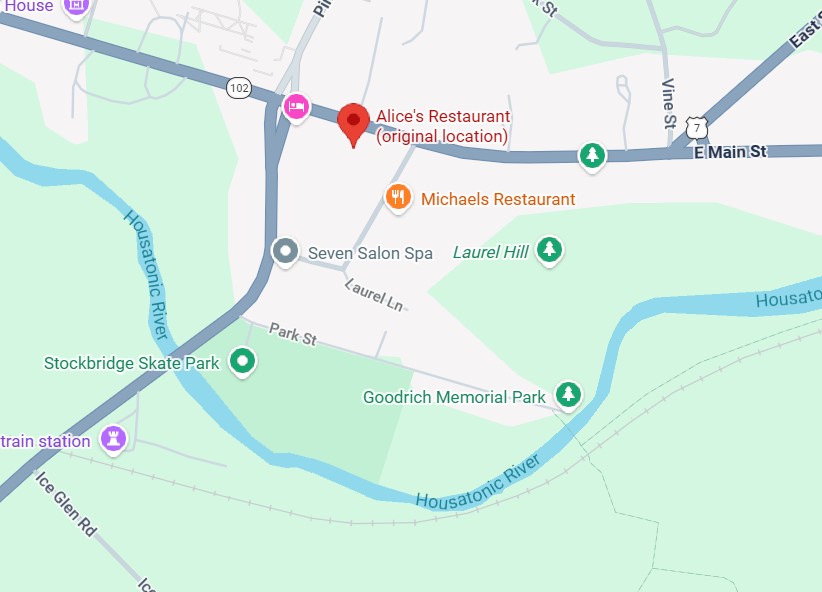
Not long ago, I wondered how accurate the lyrics of “Alice’s Restaurant Massacre” were on one specific point. I had my reasons.
You can get anything you want at Alice’s Restaurant Walk right in, it’s around the back Just a half a mile from the railroad track
Seems like a convenient rhyme, but that’s not all. Google Maps tells me that the site of Alice’s Restaurant is about a half a mile from a railroad track. I didn’t save the scale on this map, but the distanceis correct. This is mildly amazing. Who expects geographical accuracy from a song lyric?
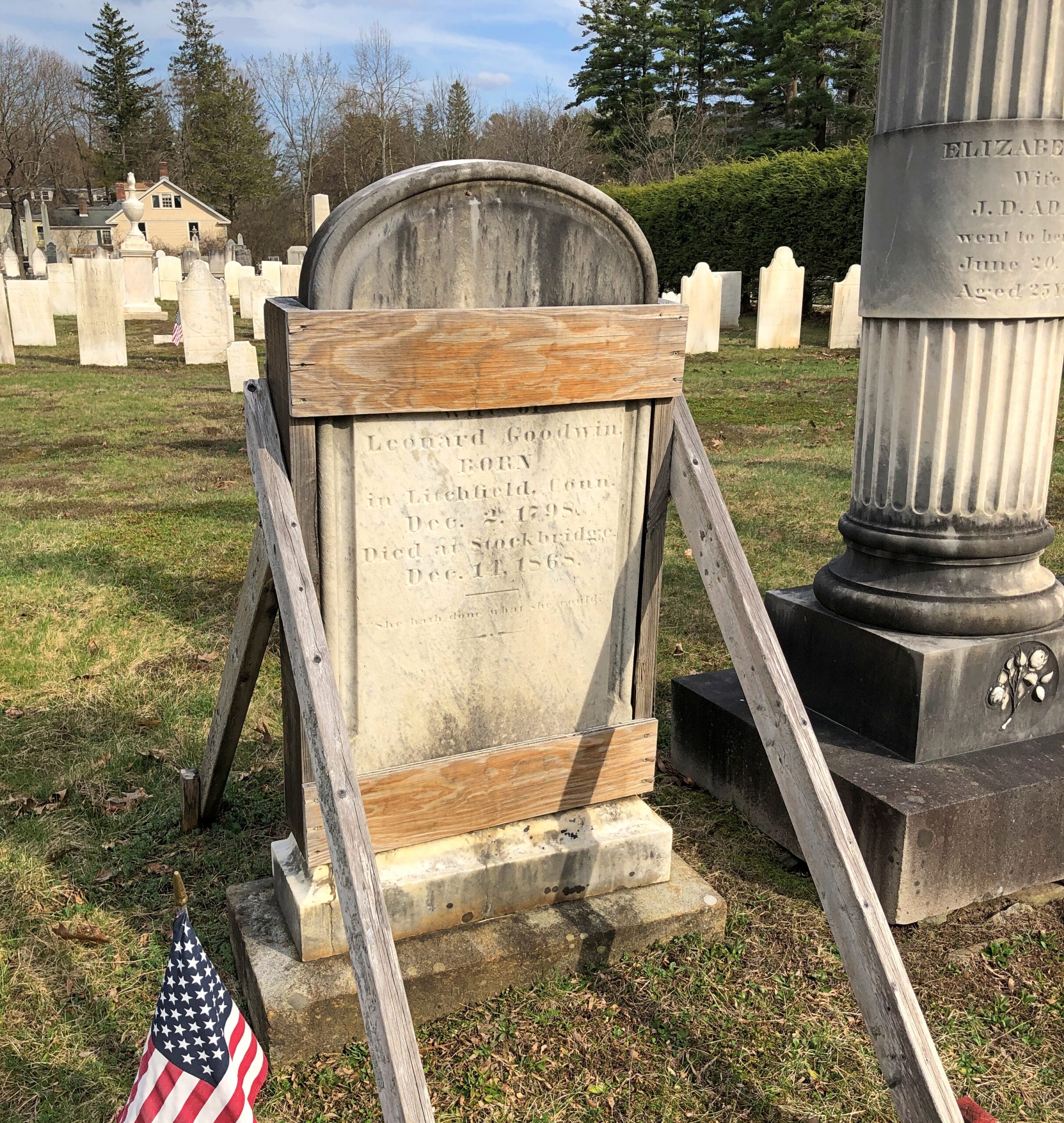
That morning, April 14, I’d extracted myself from Midtown Manhattan via various sorts of transport, retrieving my car at long-term parking at Newark International, and planned to spend the night in Portsmouth, New Hampshire. Though New England isn’t large, it is molasses when it comes to driving through its densely settled areas, and first I had to get out of New Jersey and New York, then cross Massachusetts. All that meant an all-day drive. Stockbridge, Massachusetts, former home of Alice’s Restaurant, was a stop along the way.
Near the eastern edge of New York state, I cruised north on the Taconic State Parkway.
That sounded good, I thought when I noted the name on a map. It was. Budding greenery, smooth driving, no trucks. Or that many other cars, the further north you go. Construction started about 100 years ago, at the urging of then private citizen Franklin D. Roosevelt. The parkway is in the same league as the Natchez Trace Parkway or the Blue Ridge Parkway, though only about a quarter as long as either.
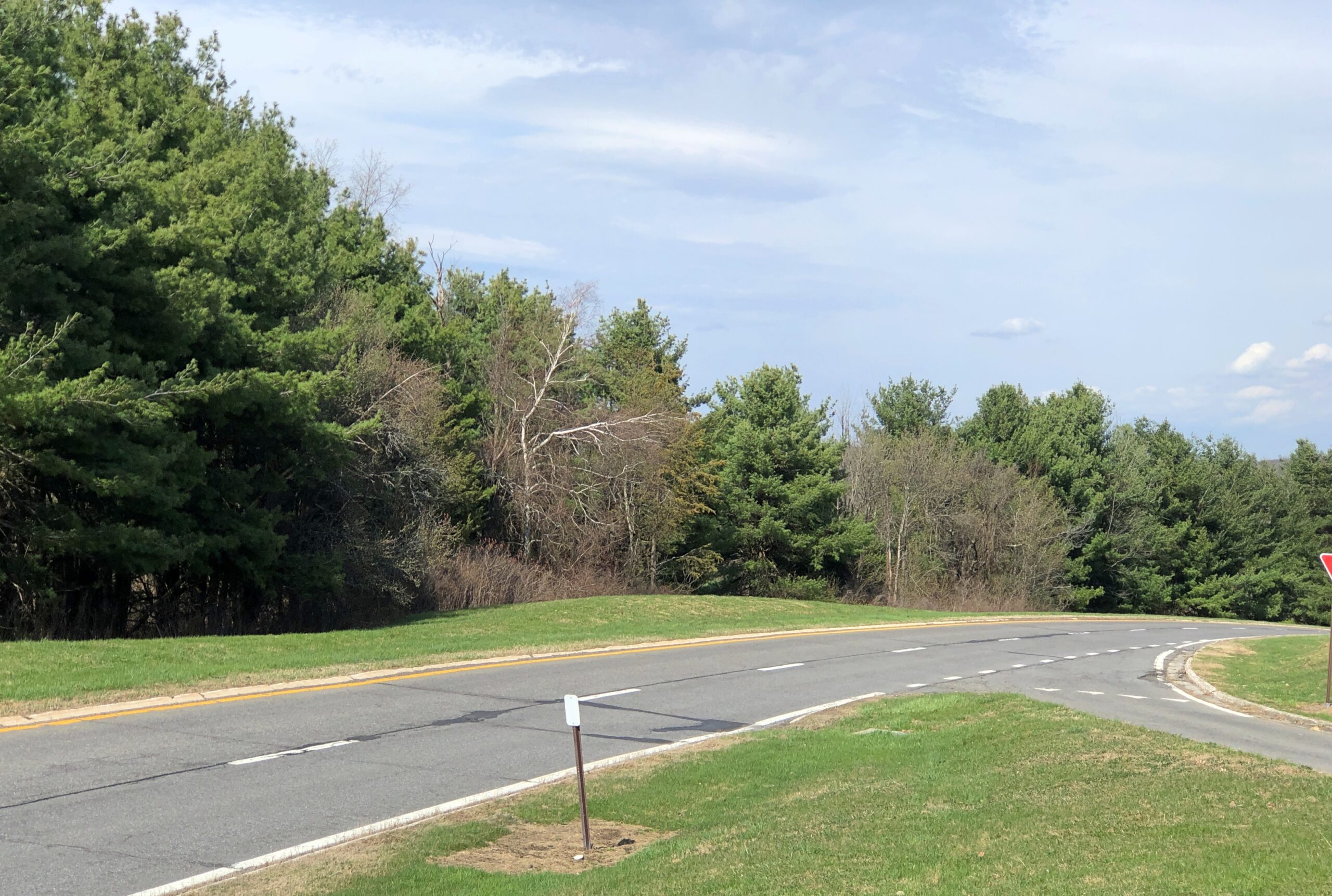
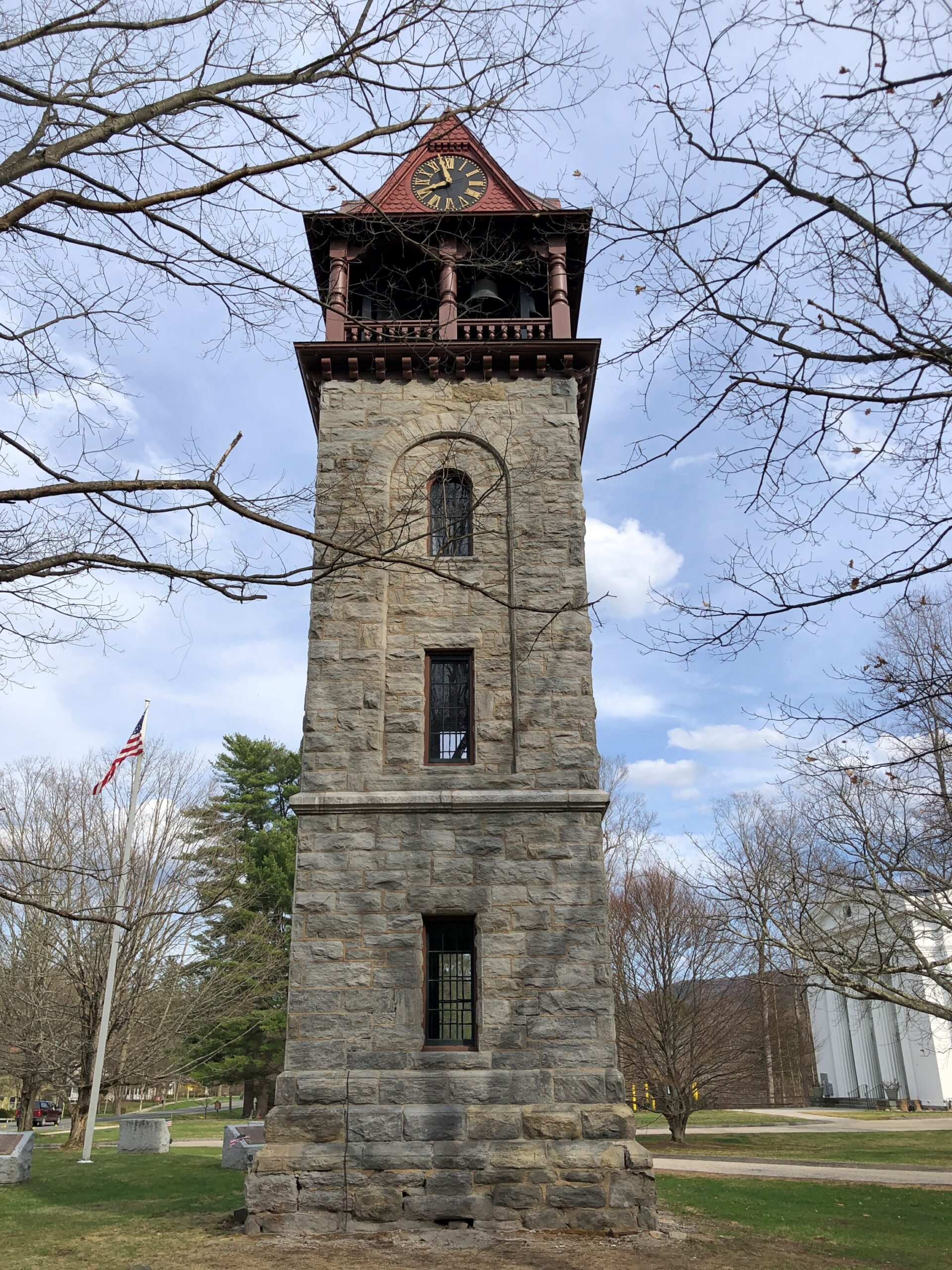
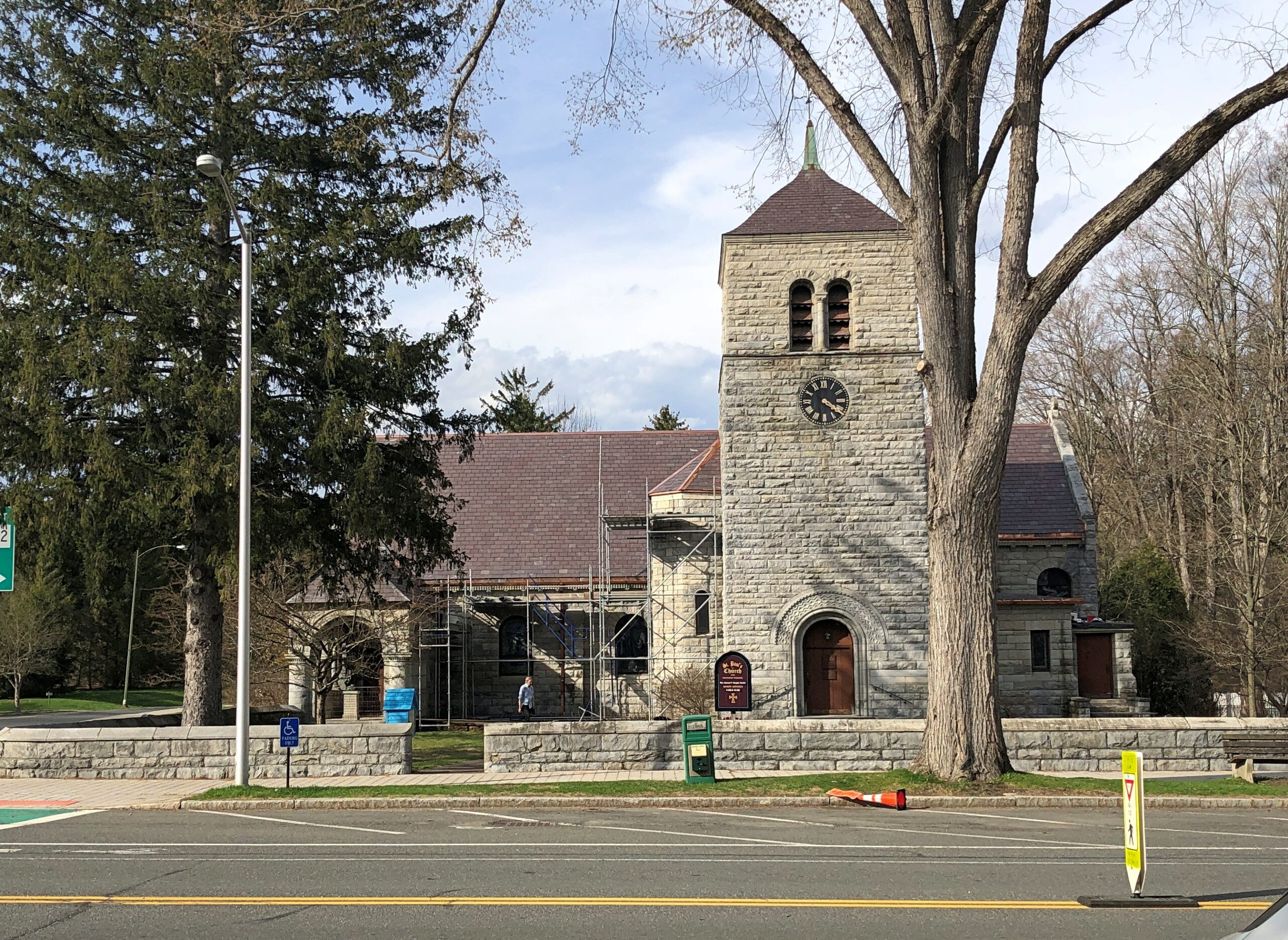
Once I’d gone far enough north, I took connecting roads to the Massachusetts Turnpike. Stockbridge, which is slightly south of the turnpike, counted more-or-less as a midway point on my day’s drive. As I entered town via Massachusetts 102, I noticed a tower. A stone tower, exuding 19th-century New England sturdiness. Its clock was wrong.
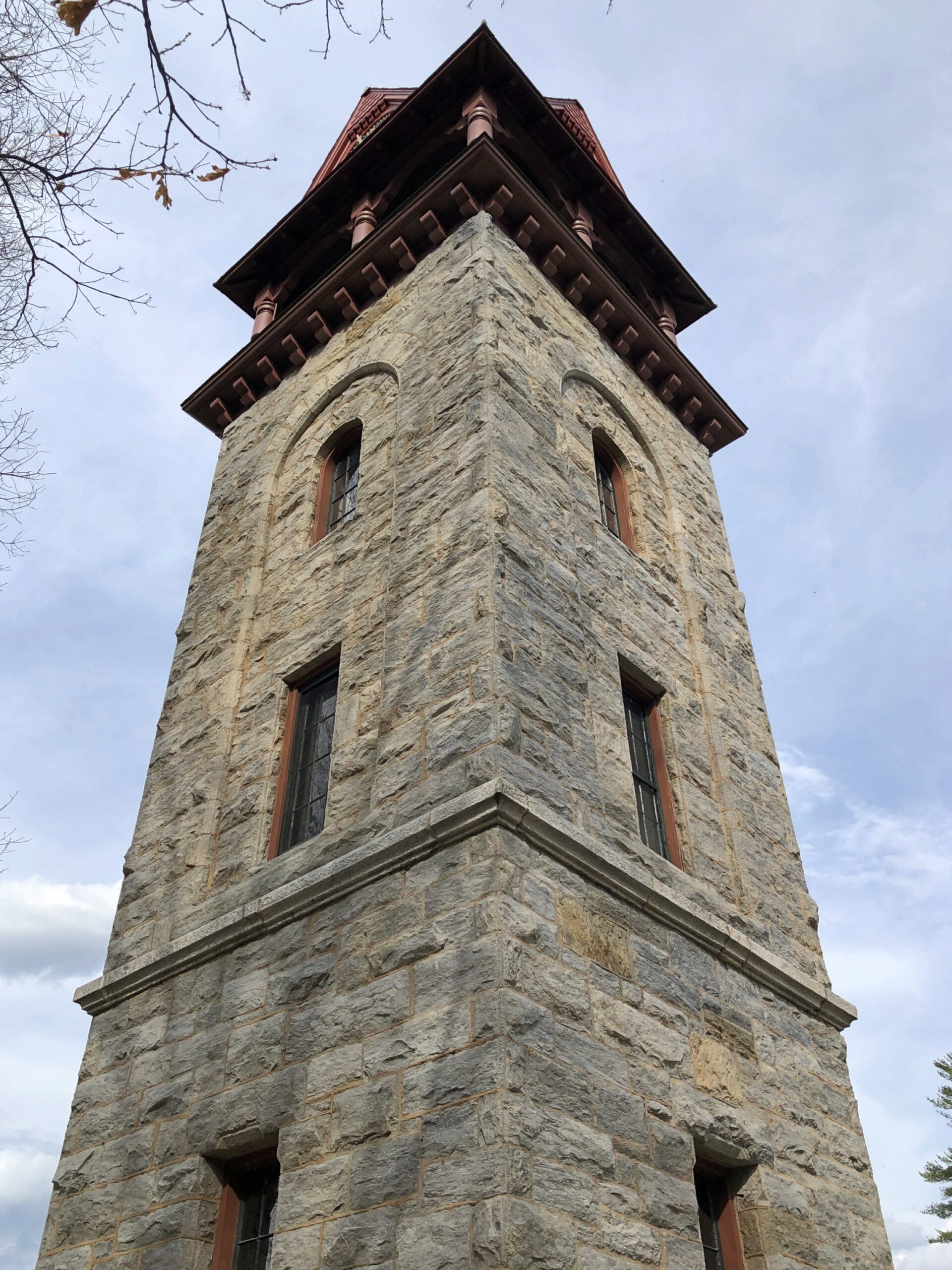
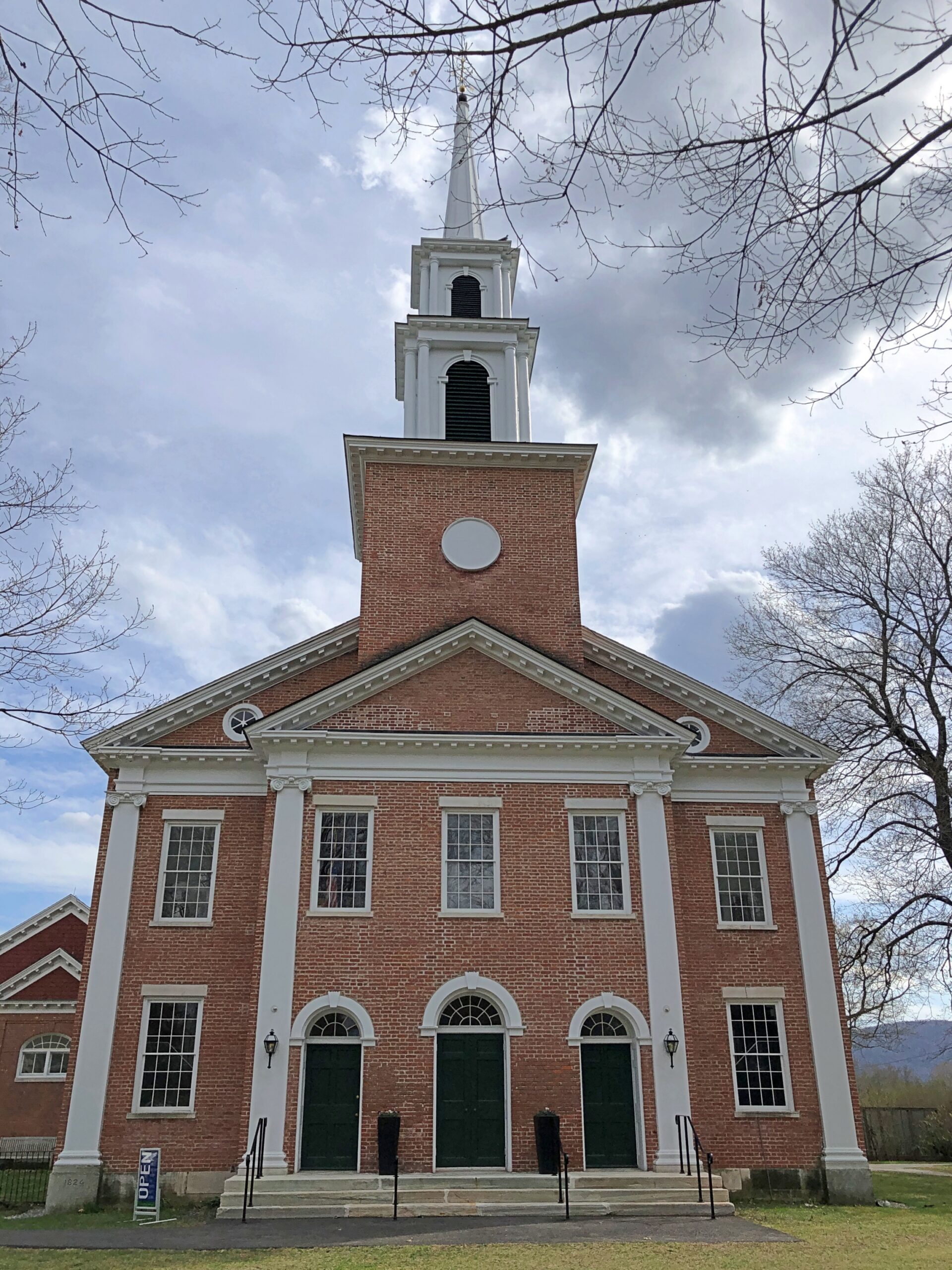
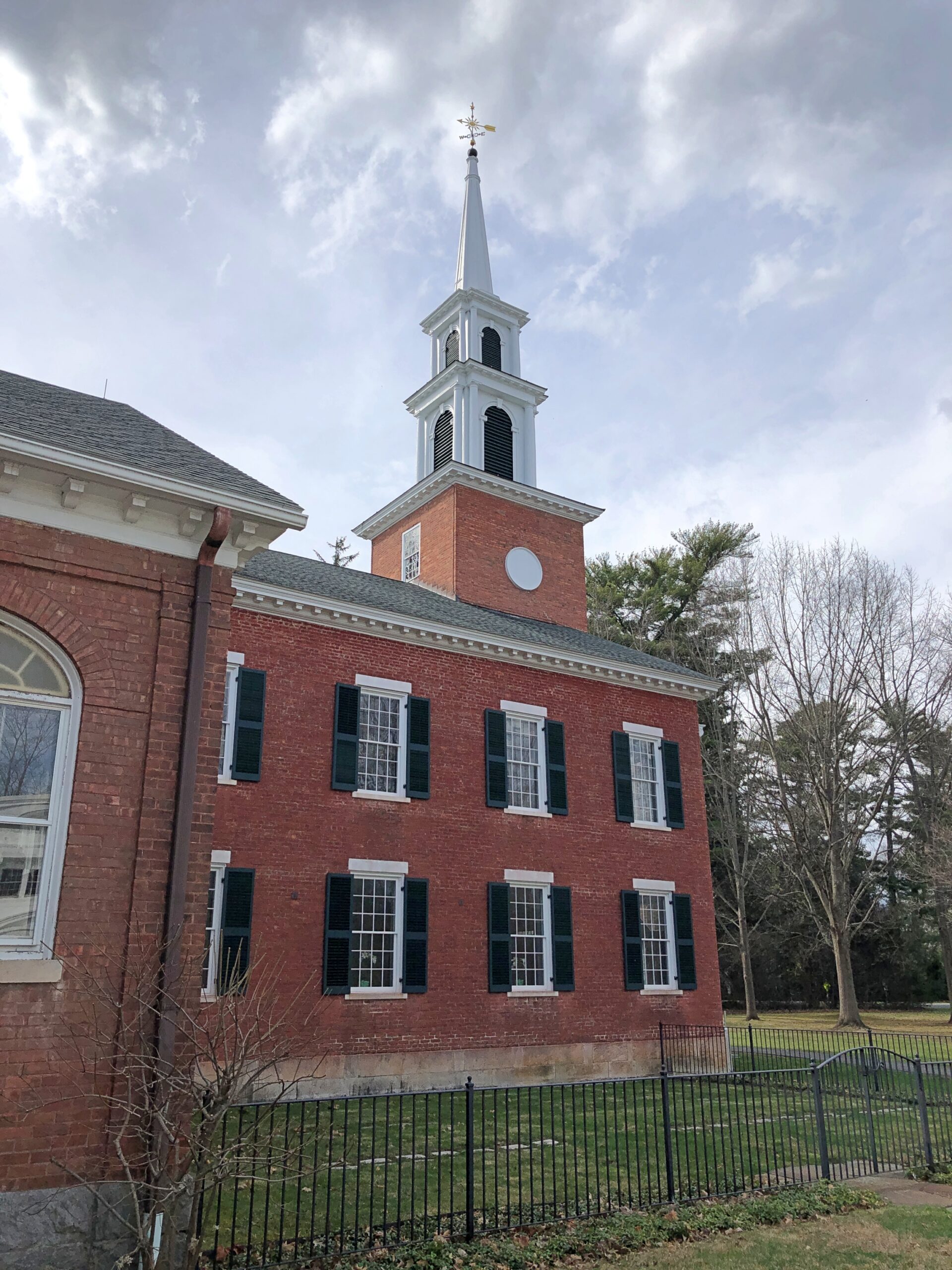
The Children’s Chimes Tower, a 19th-century bell tower built on the site of the town’s original church. A 19th-century replacement for that church stands near the bell tower, looking as New England as can be.
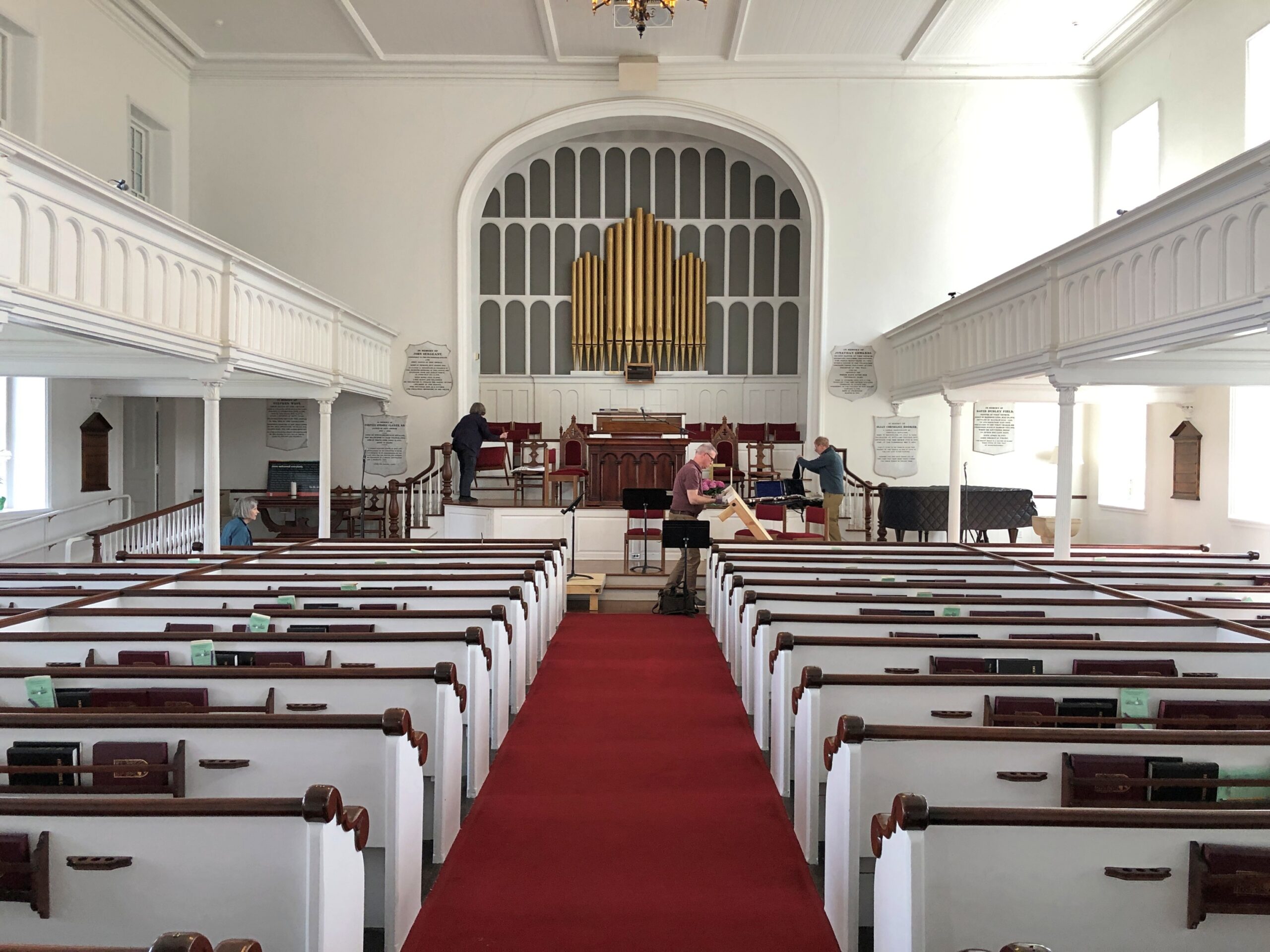
The First Congregational Church UCC. Remarkably, it was open.
Musicians were practicing, or rather seemed to be wrapping up a practice. They paid no attention to me as I looked around.
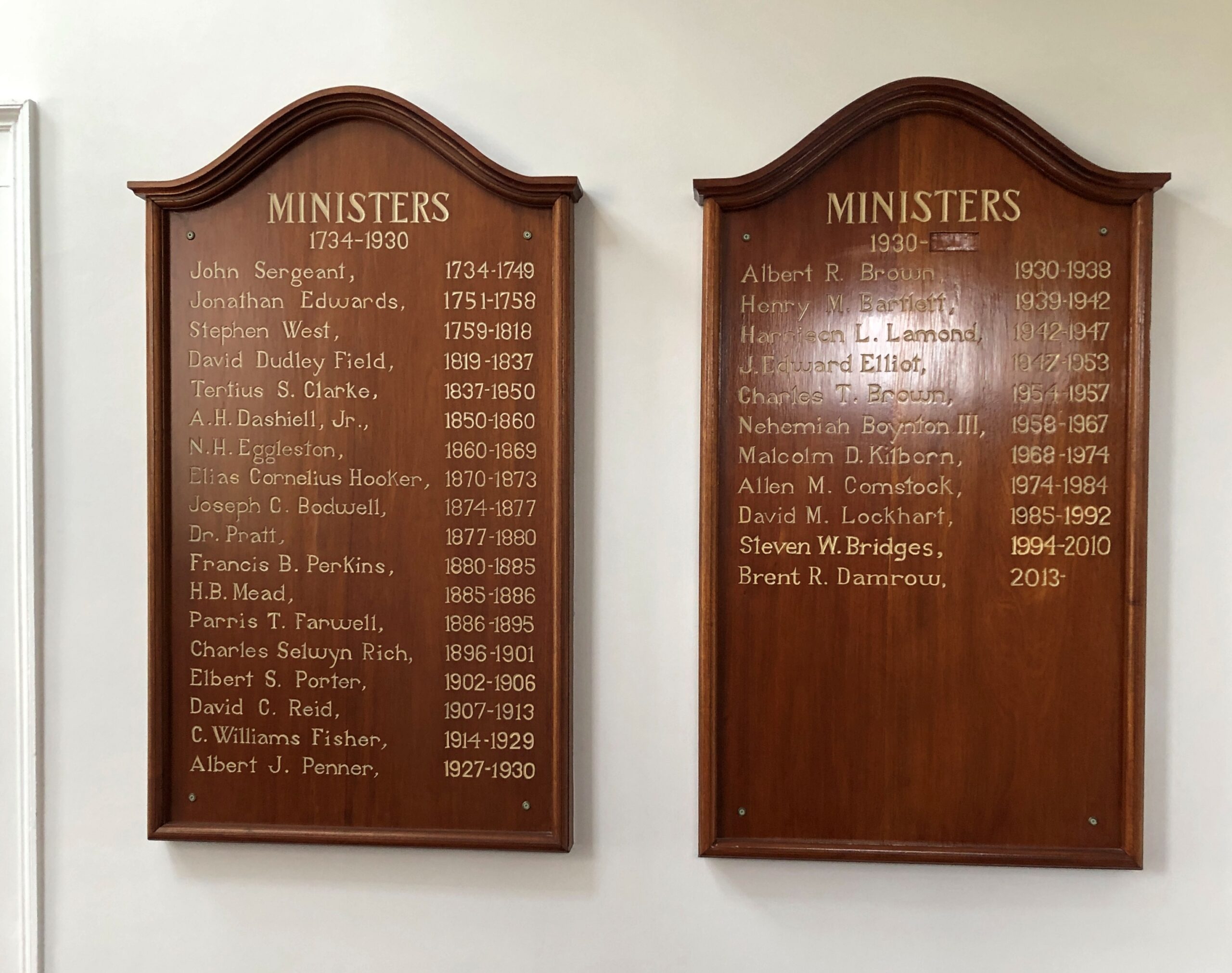
Jonathan Edwards was the church’s second pastor. “Sinners in the Hands of an Angry God” Jonathan Edwards? Yes.
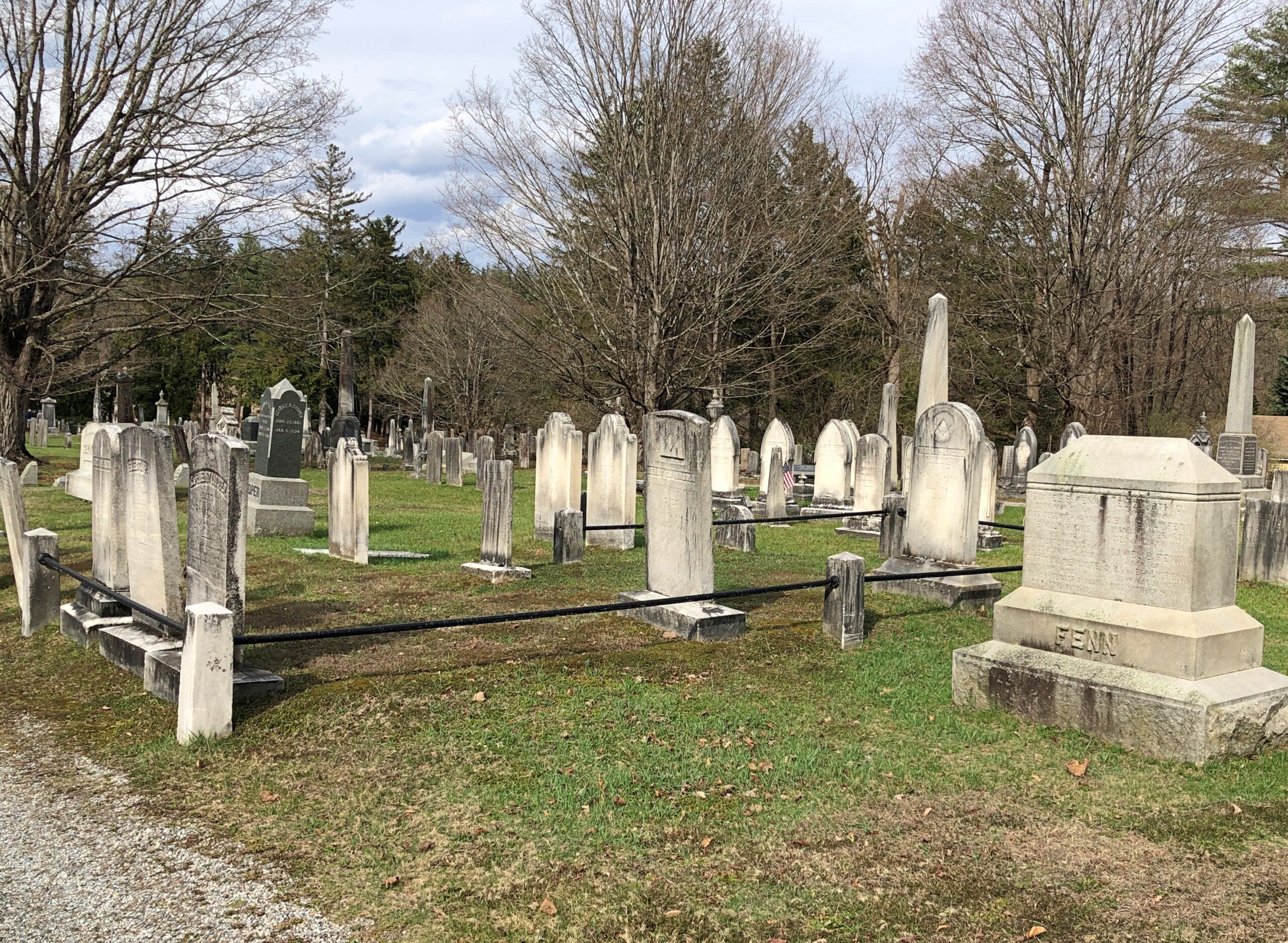
Across the road from the church and freestanding bell tower – which doesn’t chime, except in the summer – is the town cemetery.
“One of the earliest burials was the first minister, John Sergeant, who died in 1749,” says the Stockbridge Library. “Members of the Mohican tribe who joined the church also were buried here. Twenty years later, discussions began about ways to enclose the burial area to keep out cattle, horses, and pigs. It wasn’t until 1853, however, that a new organization in town, the Laurel Hill Association, took on the responsibility to clean and protect the area.”
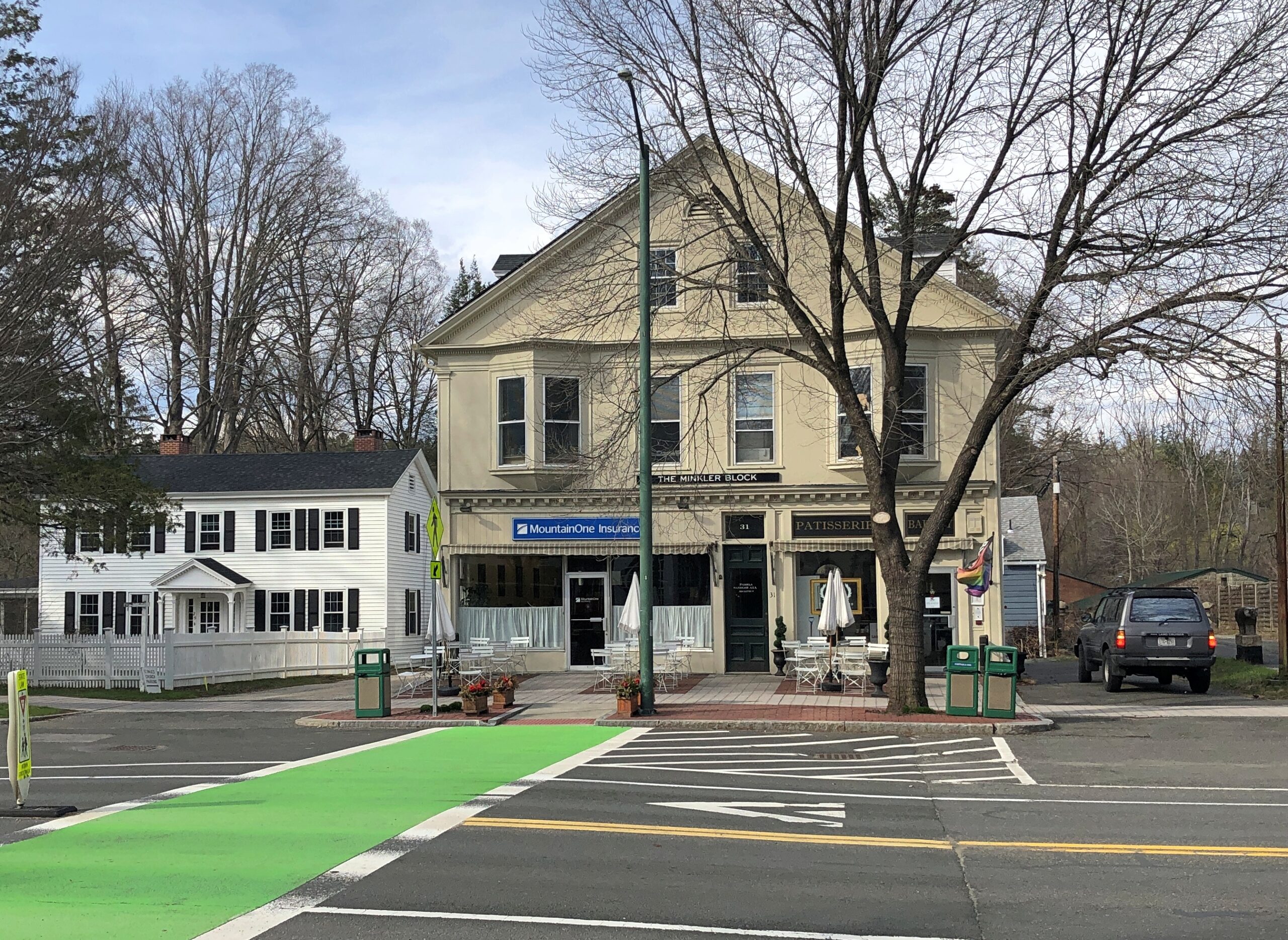
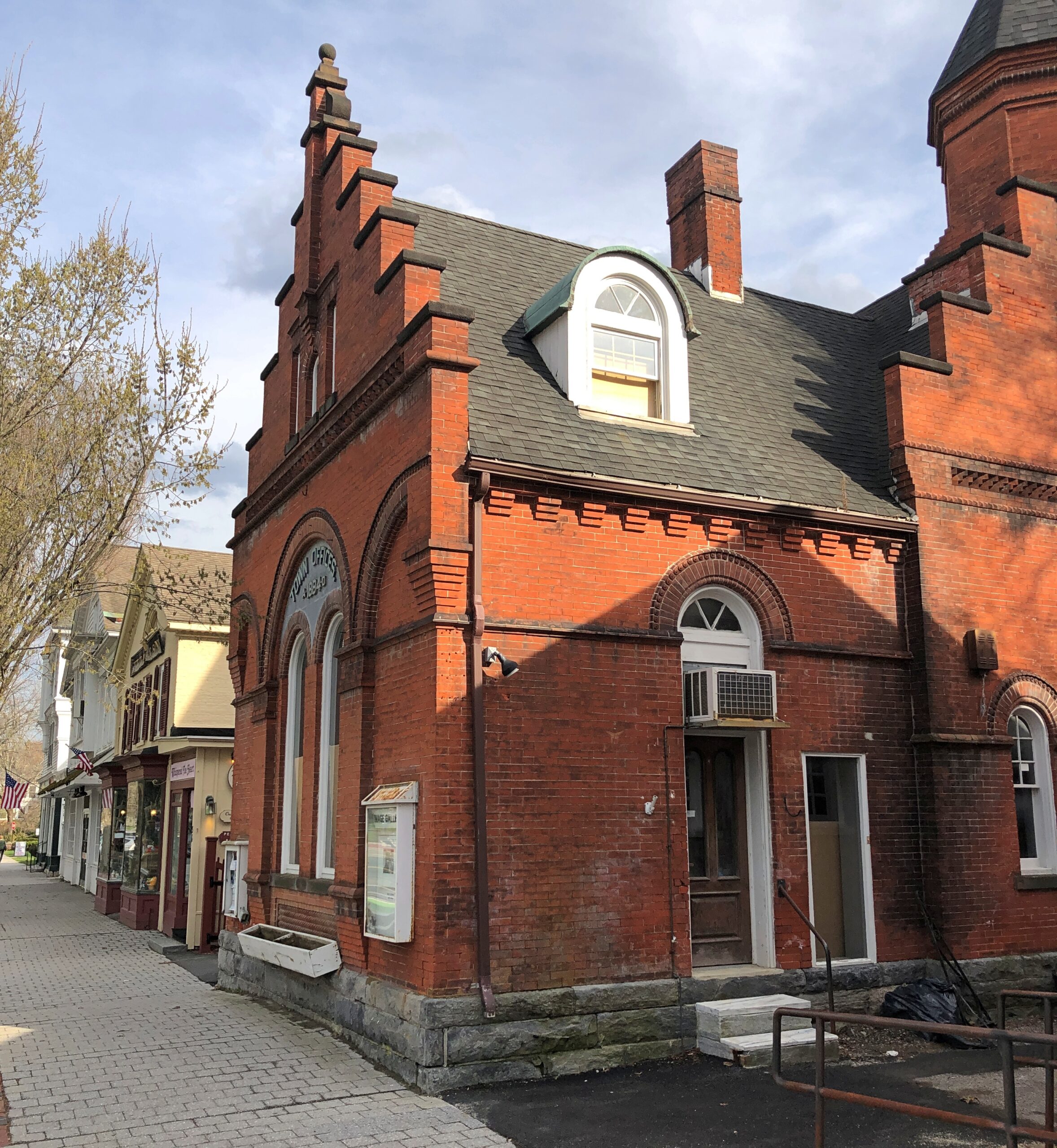
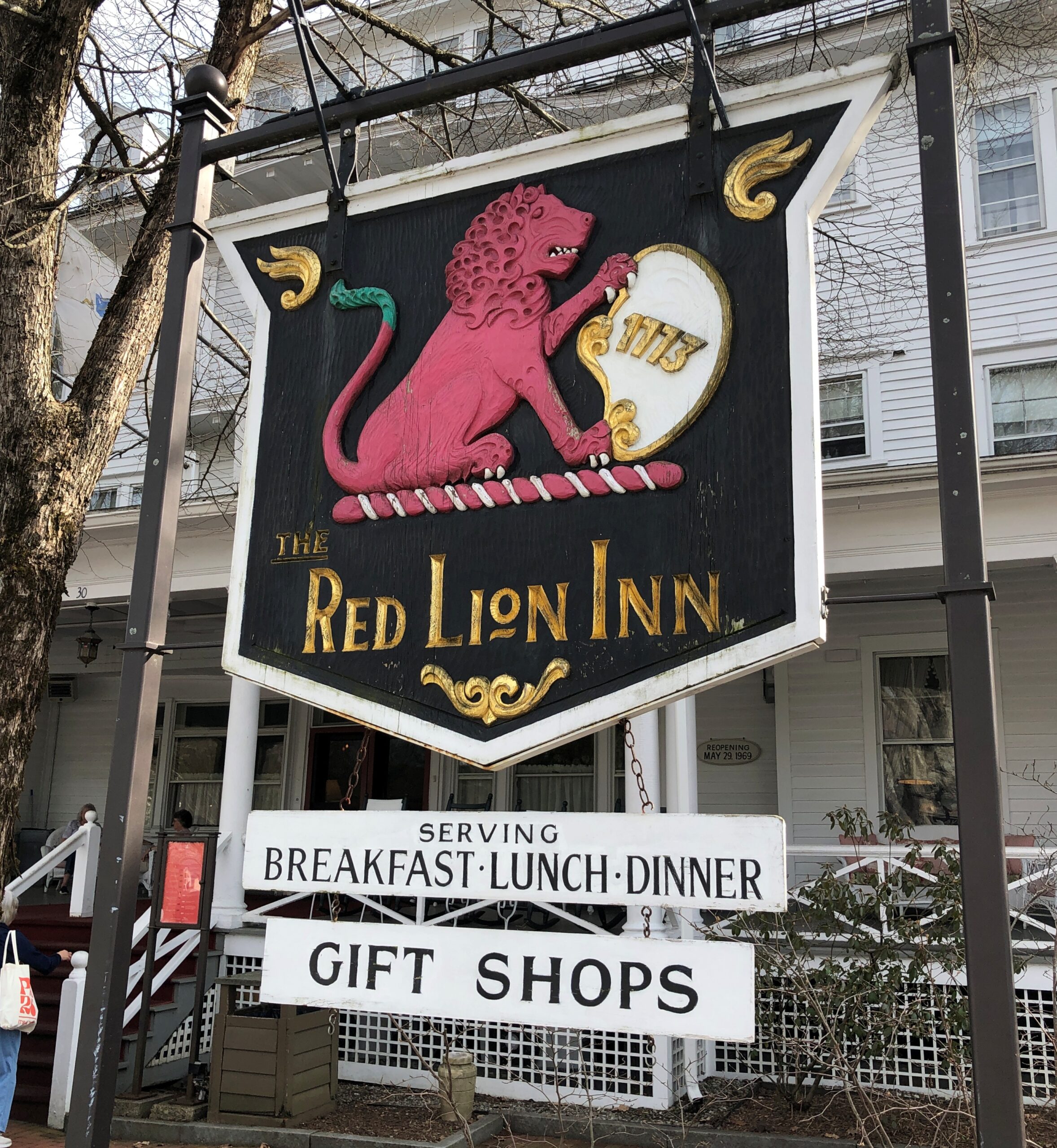
Route 102 turns into Main Street, with its shops, hotels, and other establishiments.
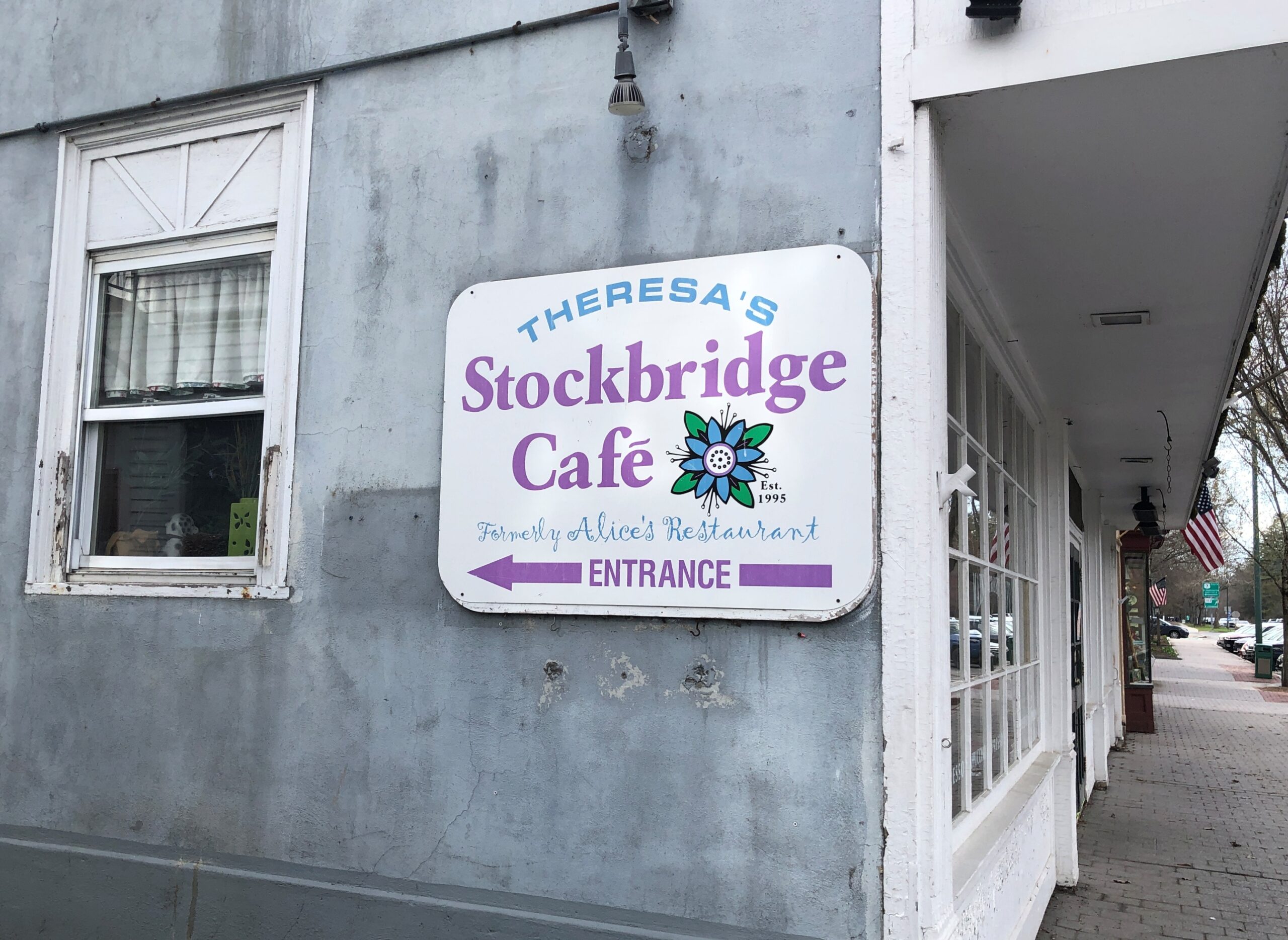
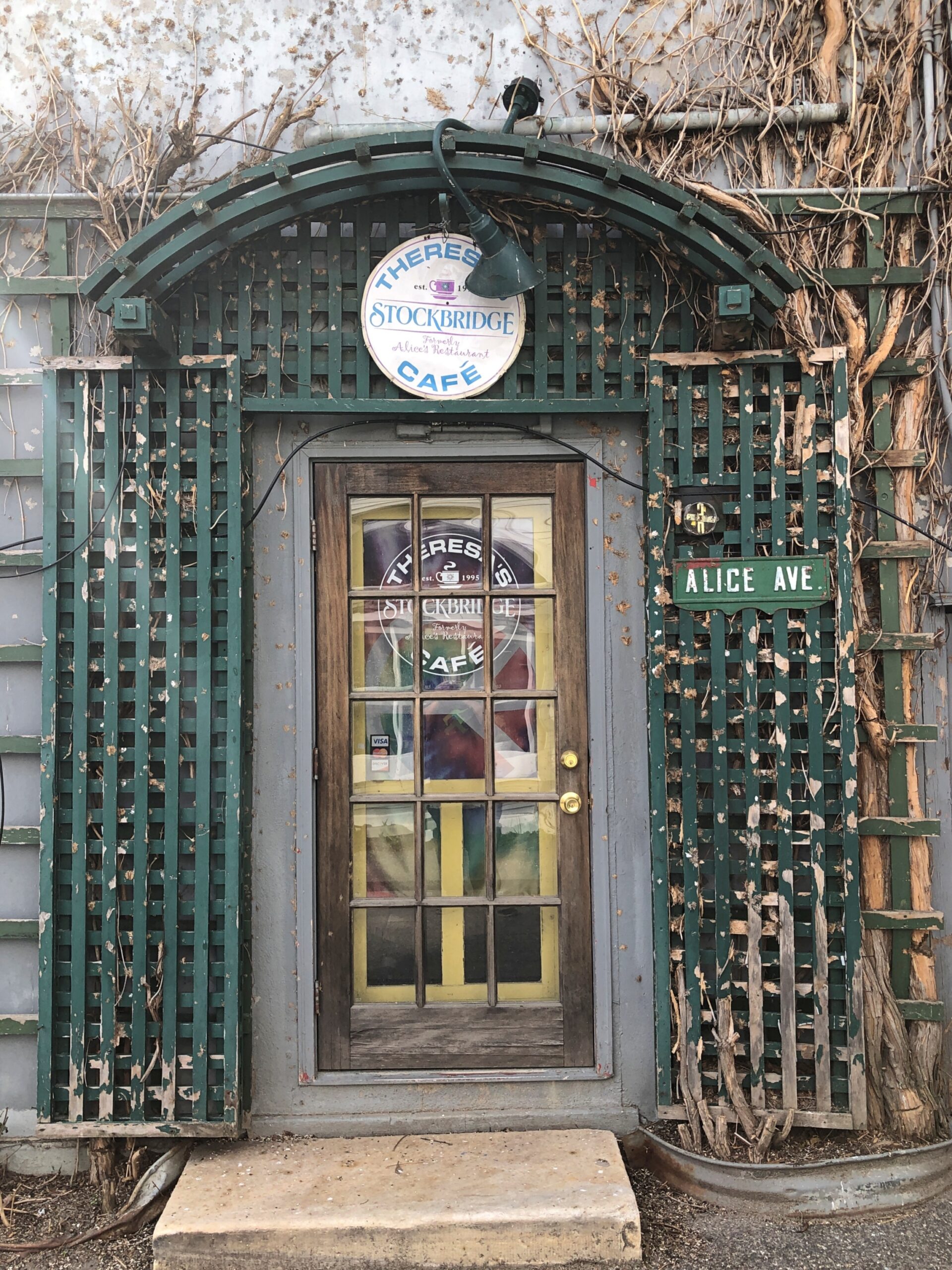
And, around the back (off Main St., that is), just a half a mile from the railroad track, is Theresa’s Stockbridge Café.
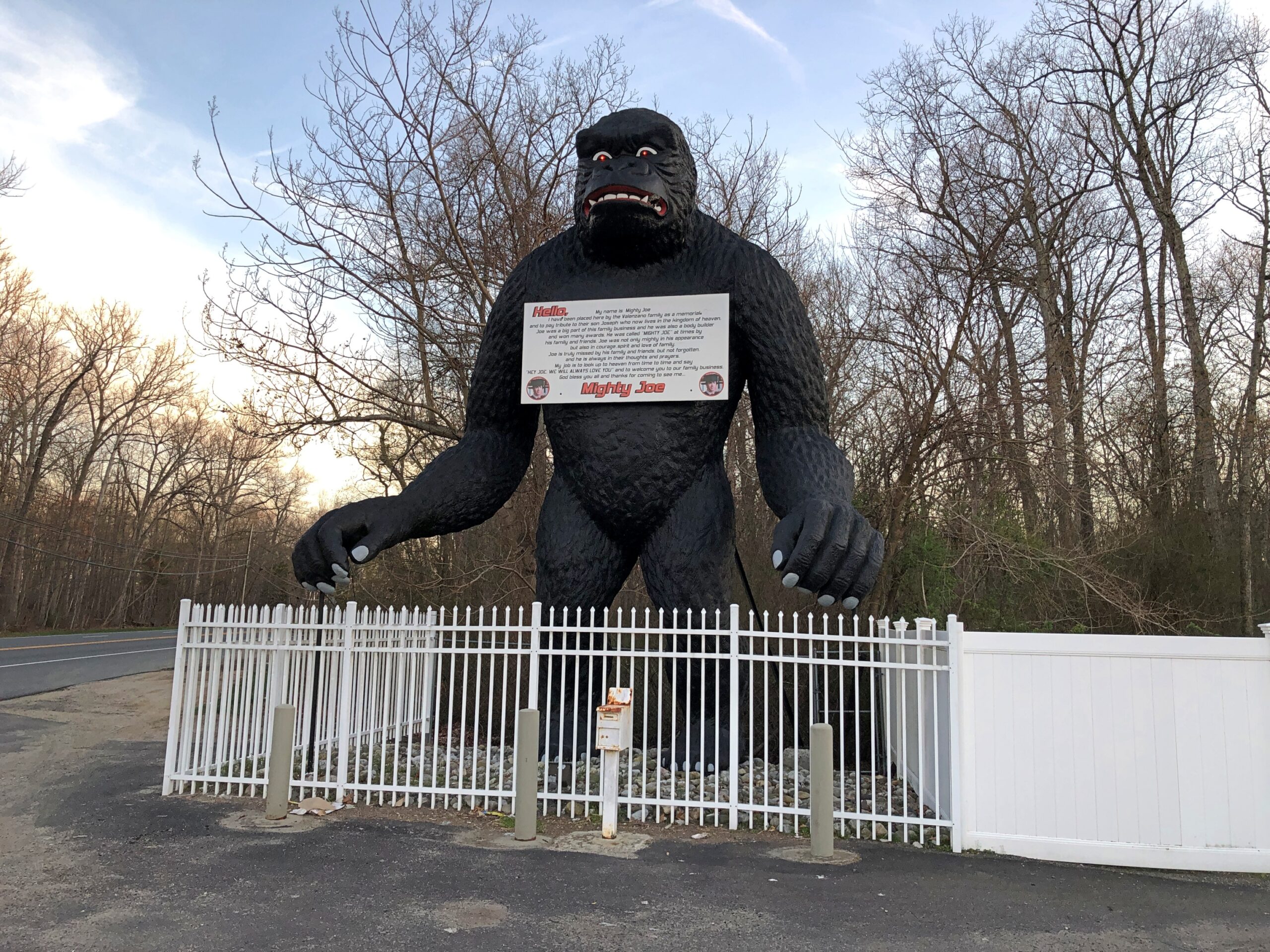
Down in South Jersey earlier this month, I didn’t see the Jersey Devil. I did see Mighty Joe.
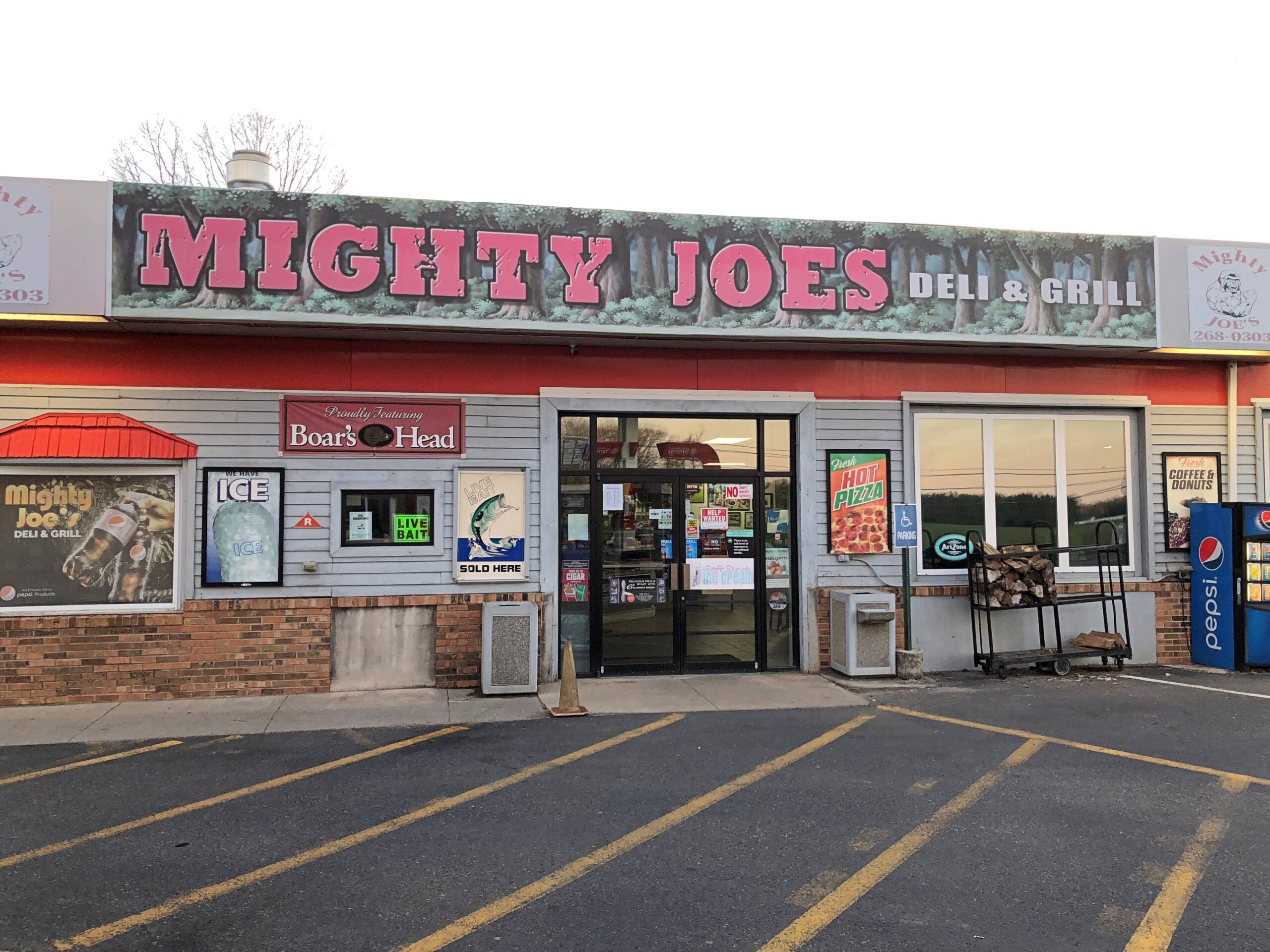
He counted as my introduction to the Pine Barrens, standing at a convenience store on US 206 in Indian Mills, Shamong Township, New Jersey. His story, which Roadside America tells well, began in Spain – really? – though immigrant Mighty Joe apparently has spent most of his existence in New Jersey as a commercial mascot of one kind or another. He’s still that, but also a memorial to the son of the store’s owner, Larry Valenzano, according to the sign on the gorilla’s chest. The younger Valenzano, a body builder nicknamed Mighty Joe, died of cancer in 1999.
I didn’t stop for Joe heading south on US 206. Can’t stop for everything. I figured I wouldn’t see him on my return to Trenton either, since I was planning to return on smaller roads through the heart of the Pine Barrens, after visiting Atlantic City. All went according to plan, until I actually got into the heart of the Pine Barrens fairly late in the afternoon of April 9.
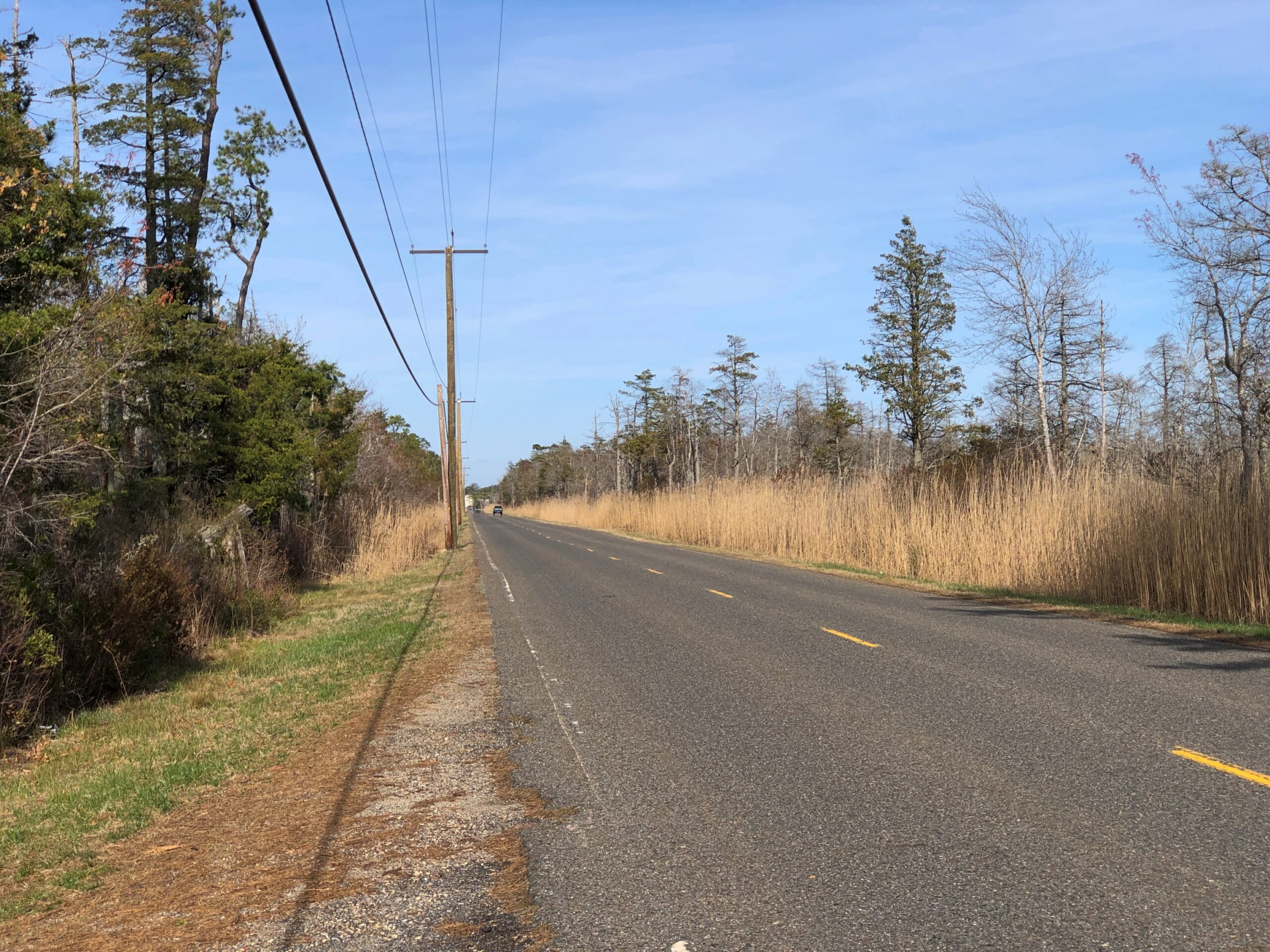
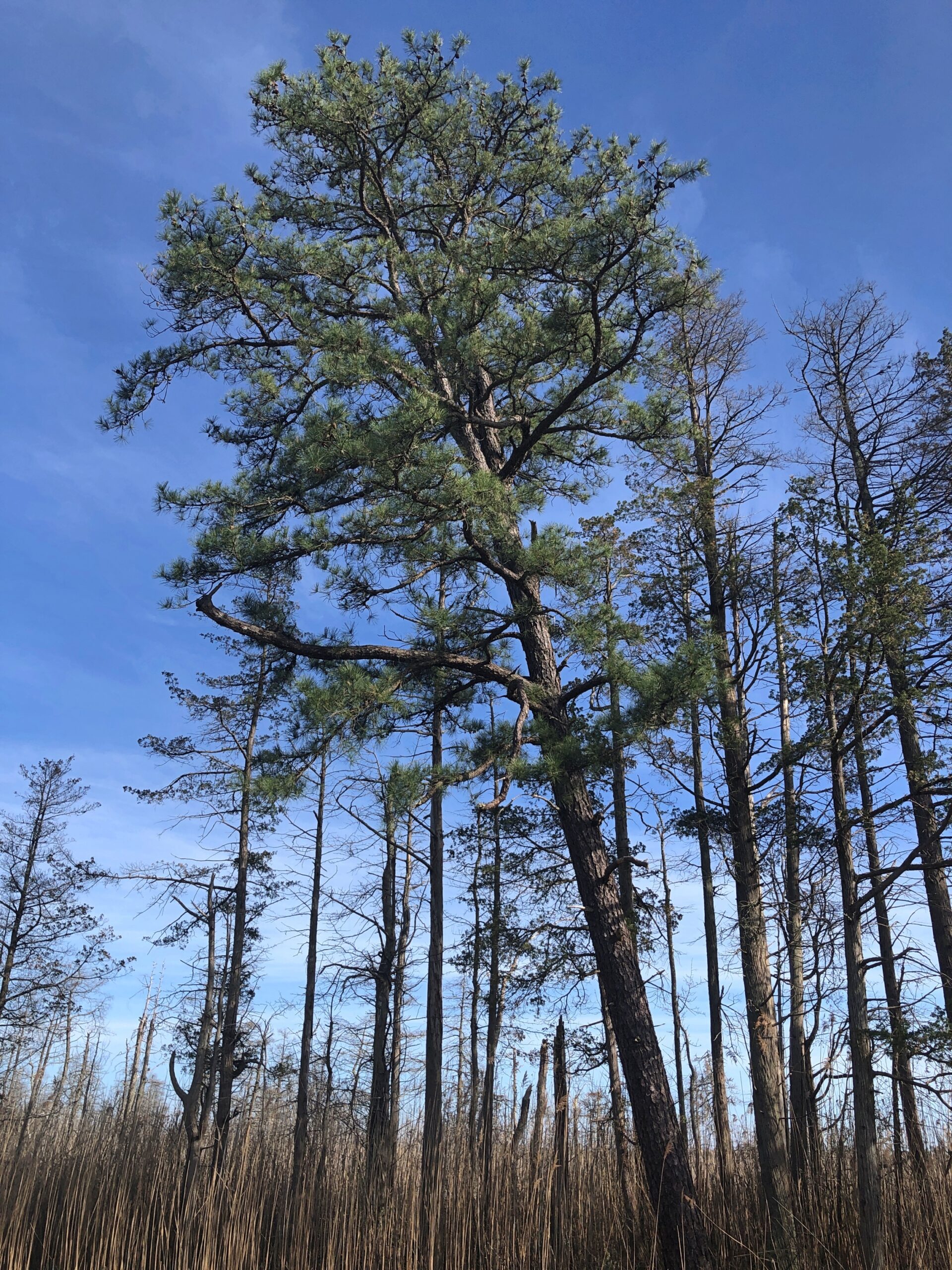
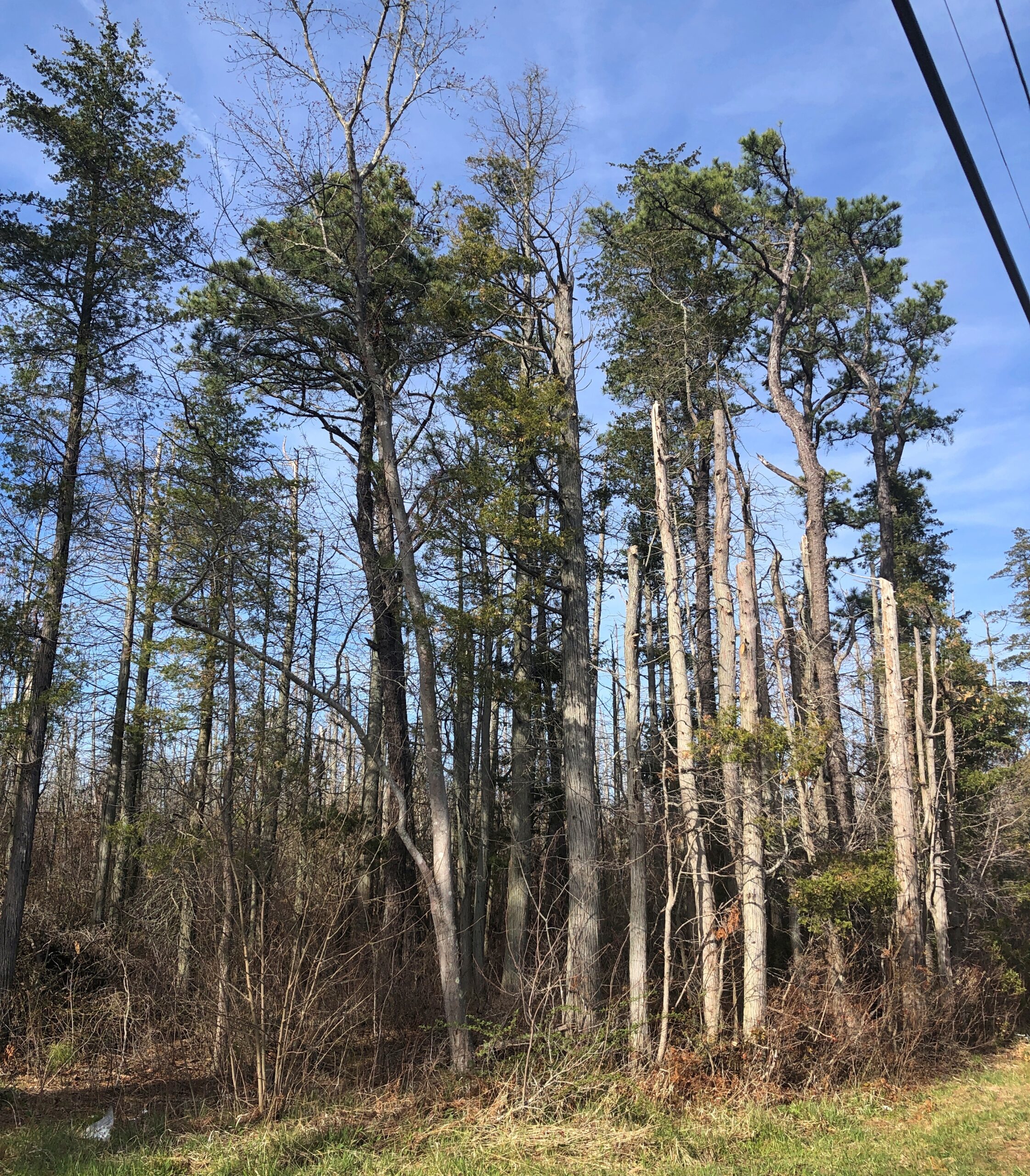
Considering how close you are to Philadelphia and New York, it’s remarkable how remote the Pine Barrens feel. The region, I understand, is the largest surviving forest on the Eastern Seaboard south of Maine’s North Woods, totaling over 800,000 acres.
The region is also called the Pinelands. It certainly fits.
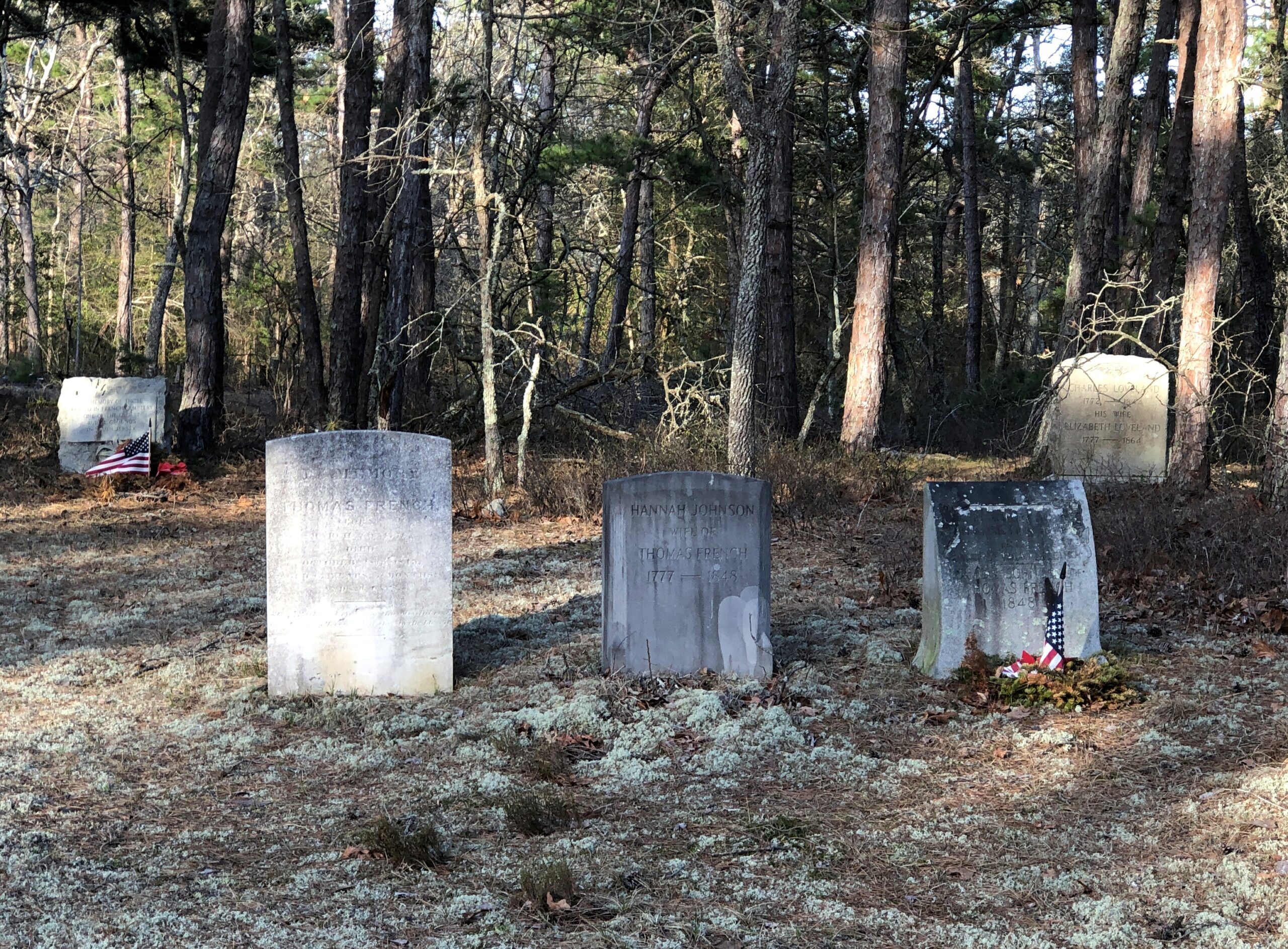
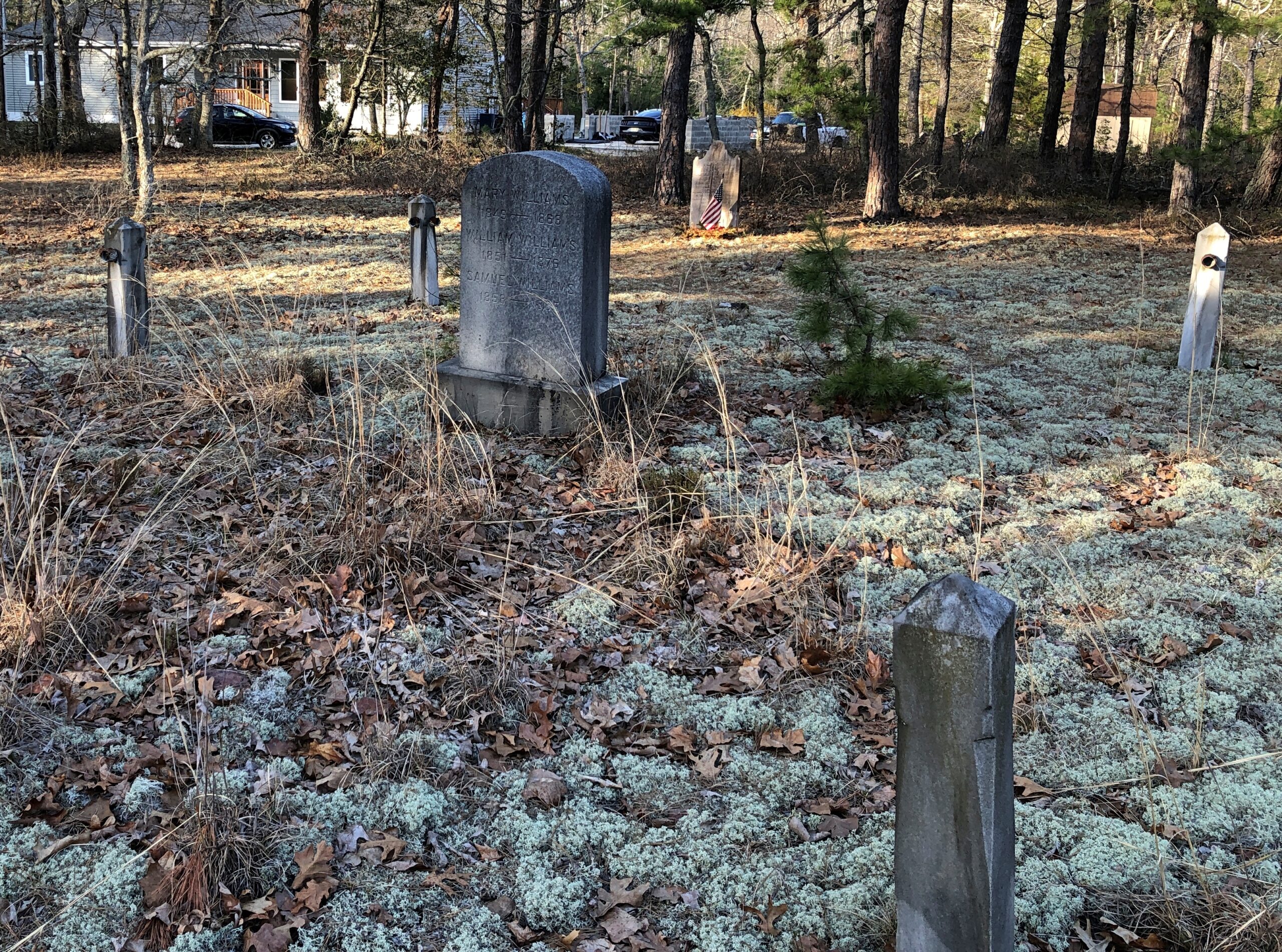
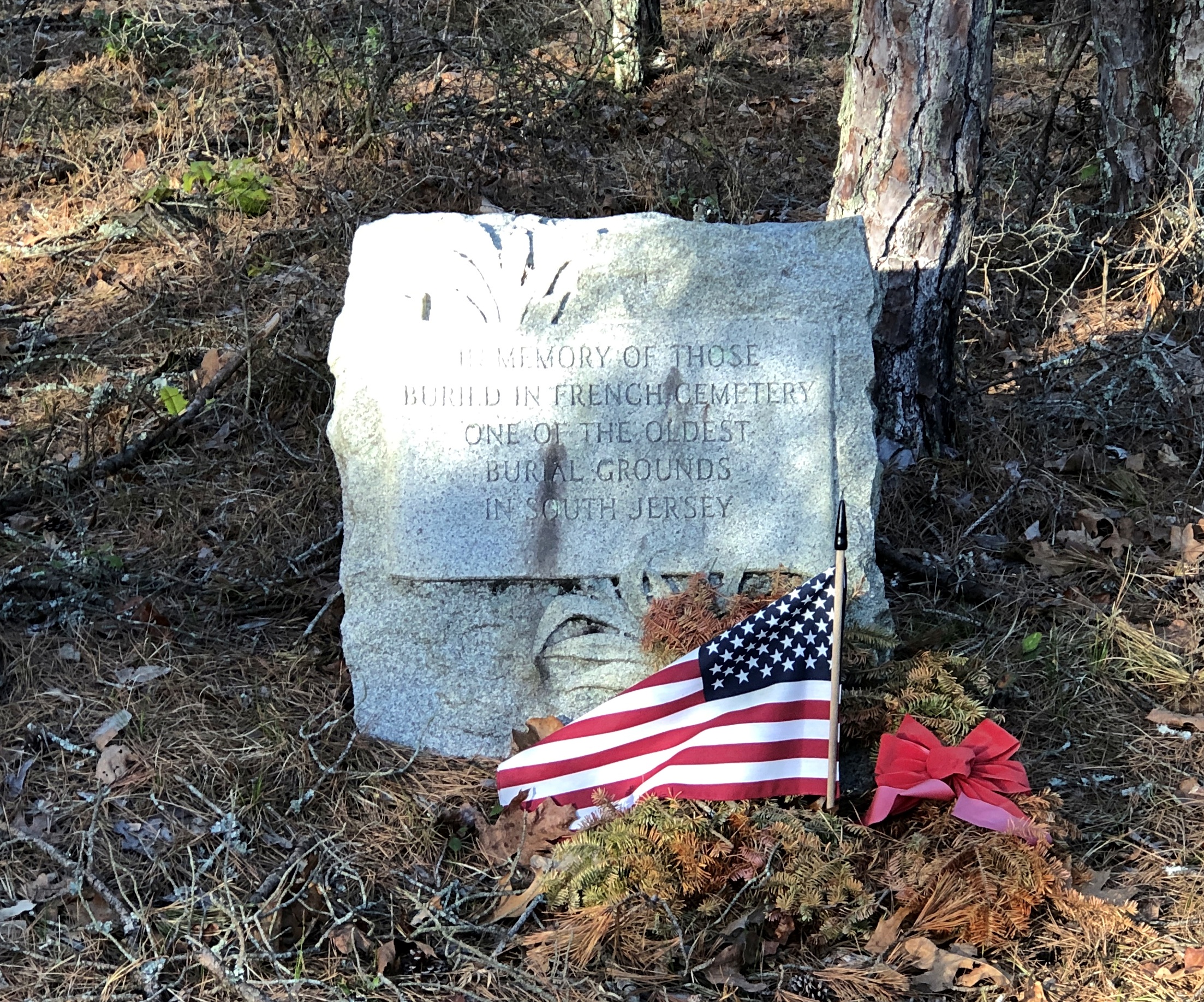
Remote, maybe, but still plenty of signs of human habitation, past and present. I stopped to take my bearings at a wide place in the road, and noticed gravestones.
French Cemetery, named for a number of people buried named French, not for their nationality. “One of the oldest burial grounds in South Jersey,” the stone asserts. Could be, but I have no way to check that.
Interesting little spot anyway, northeast from Egg Harbor City and past the Mullica River and near the Wading River. Or was that the actual location? I was traveling on marked county roads, but pretty soon I started seeing county road signs covered with black plastic bags, next to newer signs. I can only guess, but I think that meant a recent change in the numbering of the county roads.
That further meant that both my paper and electronic maps were wrong – in as much detail as they had anyway, which wasn’t a lot. “Lost” is too strong a word, but I’d say I was disoriented in a web of meandering, ill-marked roads. I stopped more than once among the pines of the Pinelands to try to figure out a better course.
Then it occurred to me: I remembered seeing some of the exit numbers on highways near Trenton had been changed, too. I’m speculating, but I think that had something to do with my GPS going just a little funny in the head the night before. Damn it, New Jersey.
Eventually I worked my way back toward Egg Harbor City, a sizable town on US 30, which connects with US 280, which goes straight back to Trenton; the way I’d come. That’s how I was able to stop to see Mighty Joe.
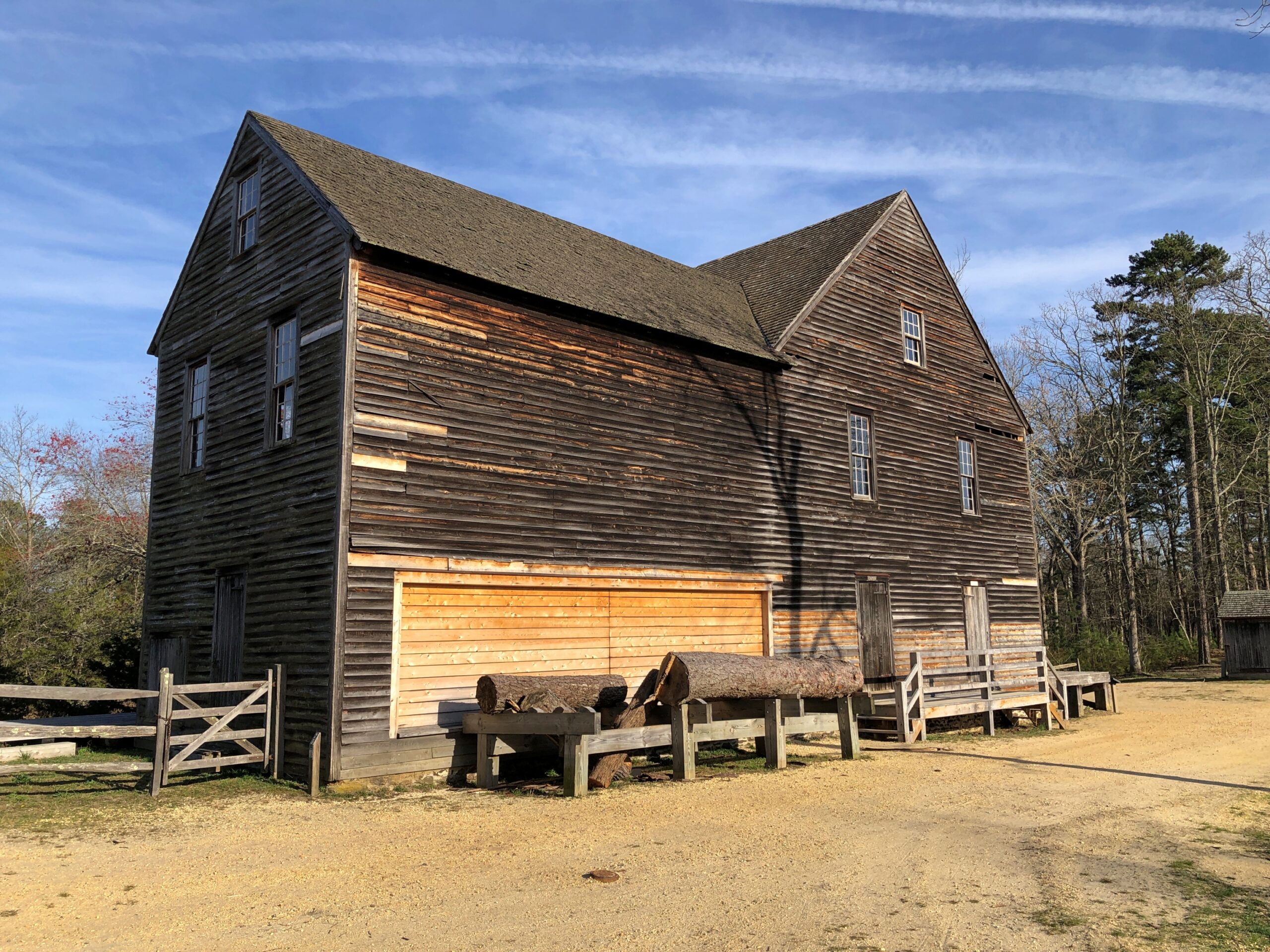
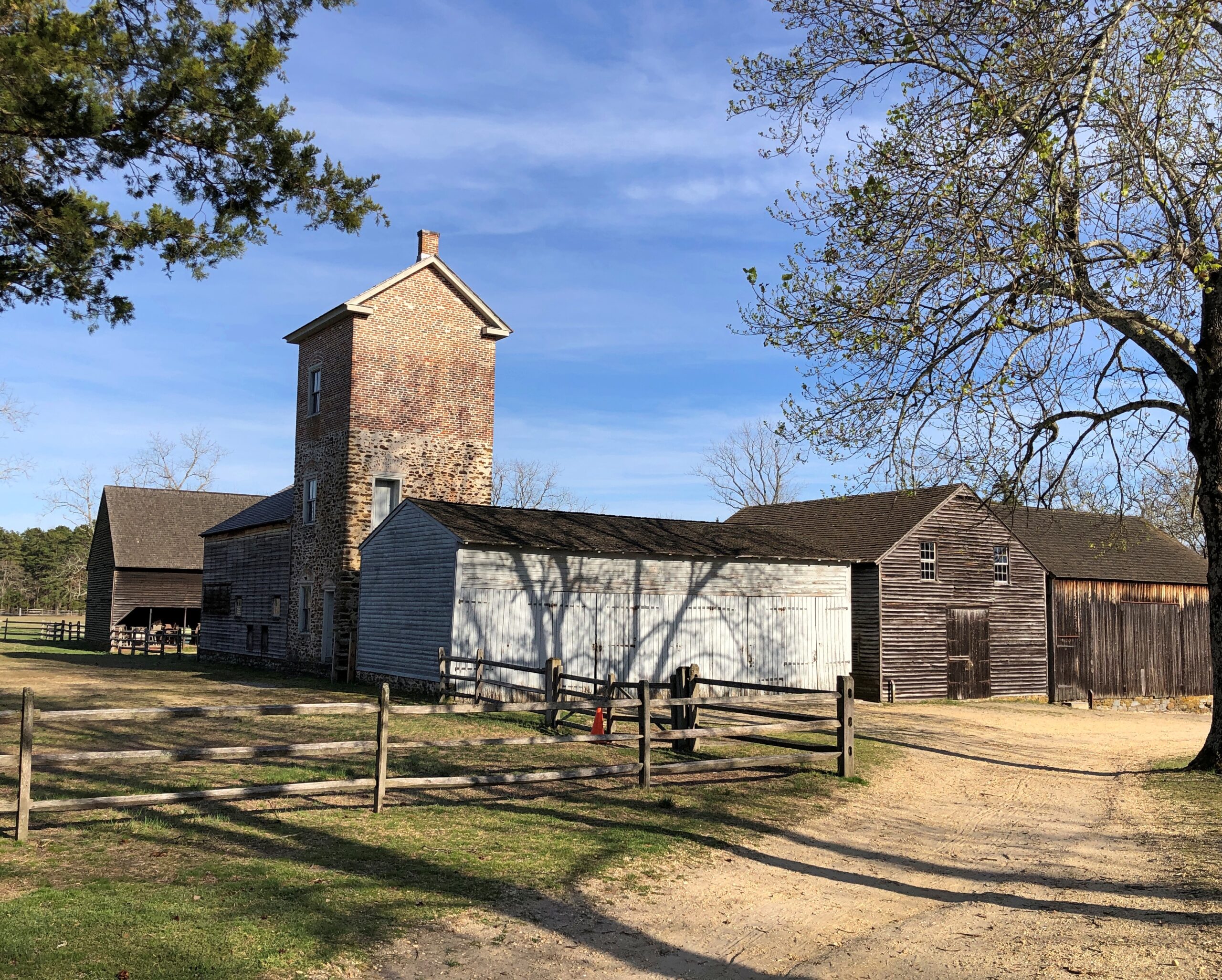
Even so, I happened across a few places in the Pinelands to stop, especially Batsto Village, site of the former Batsto Iron Works.
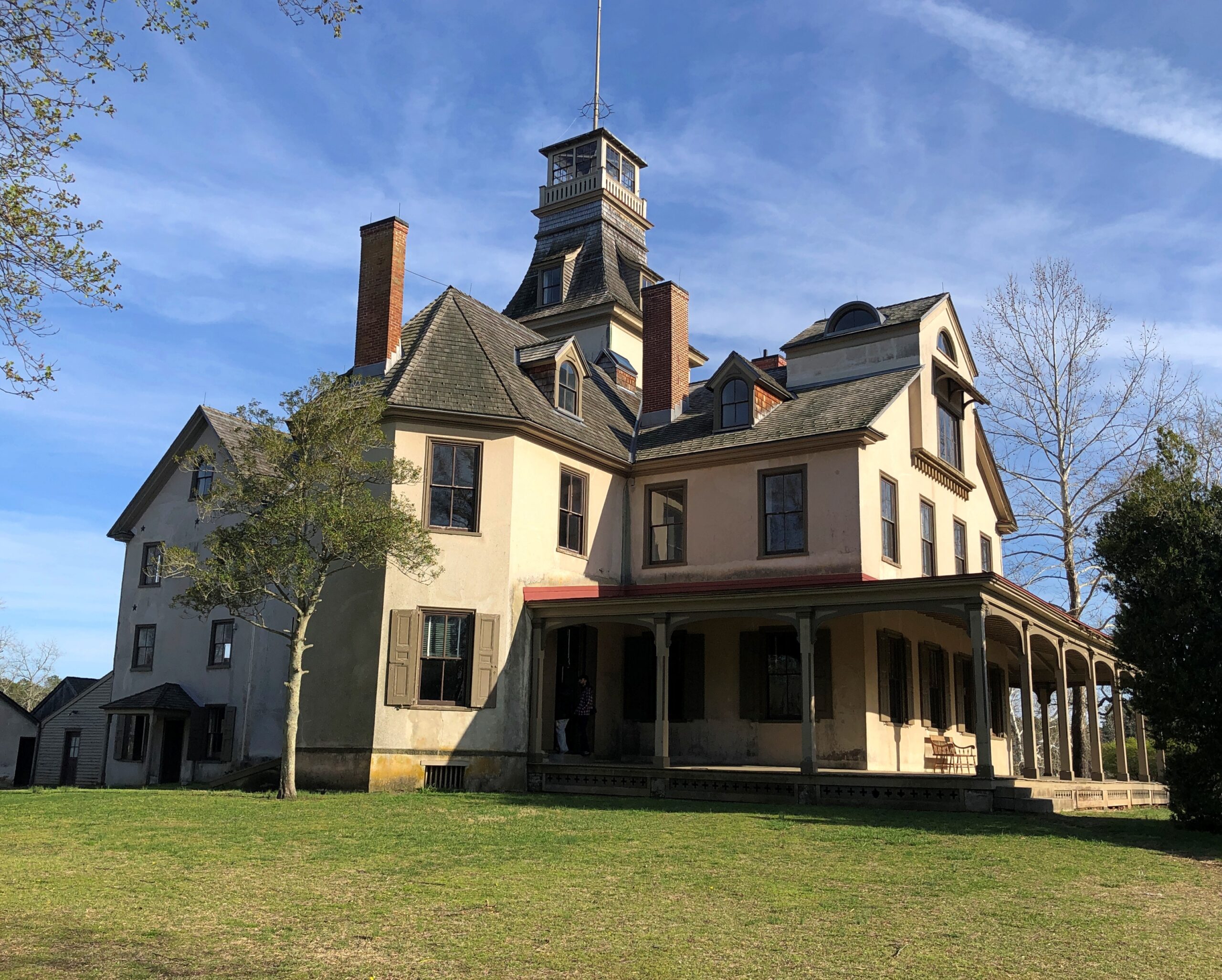
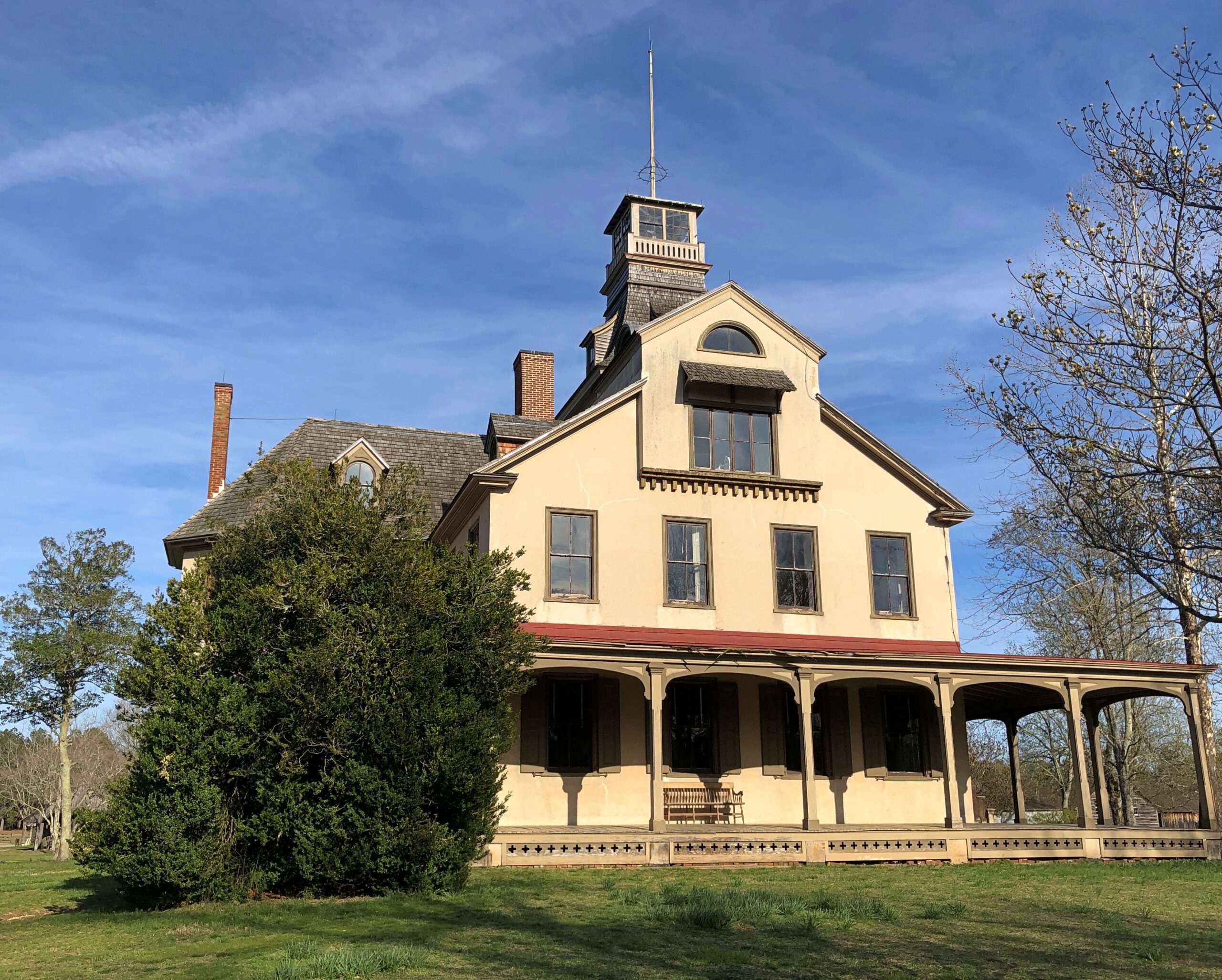
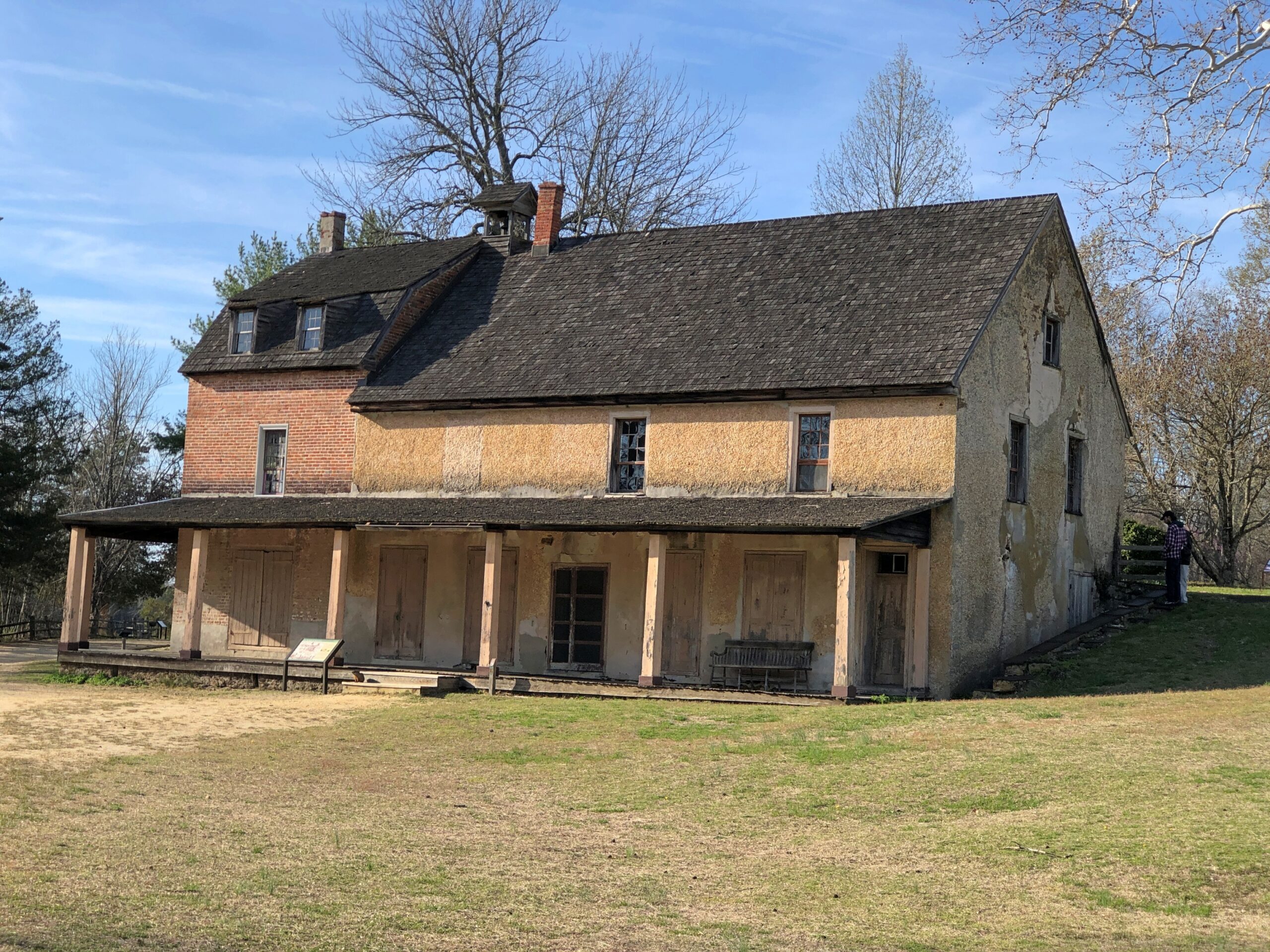
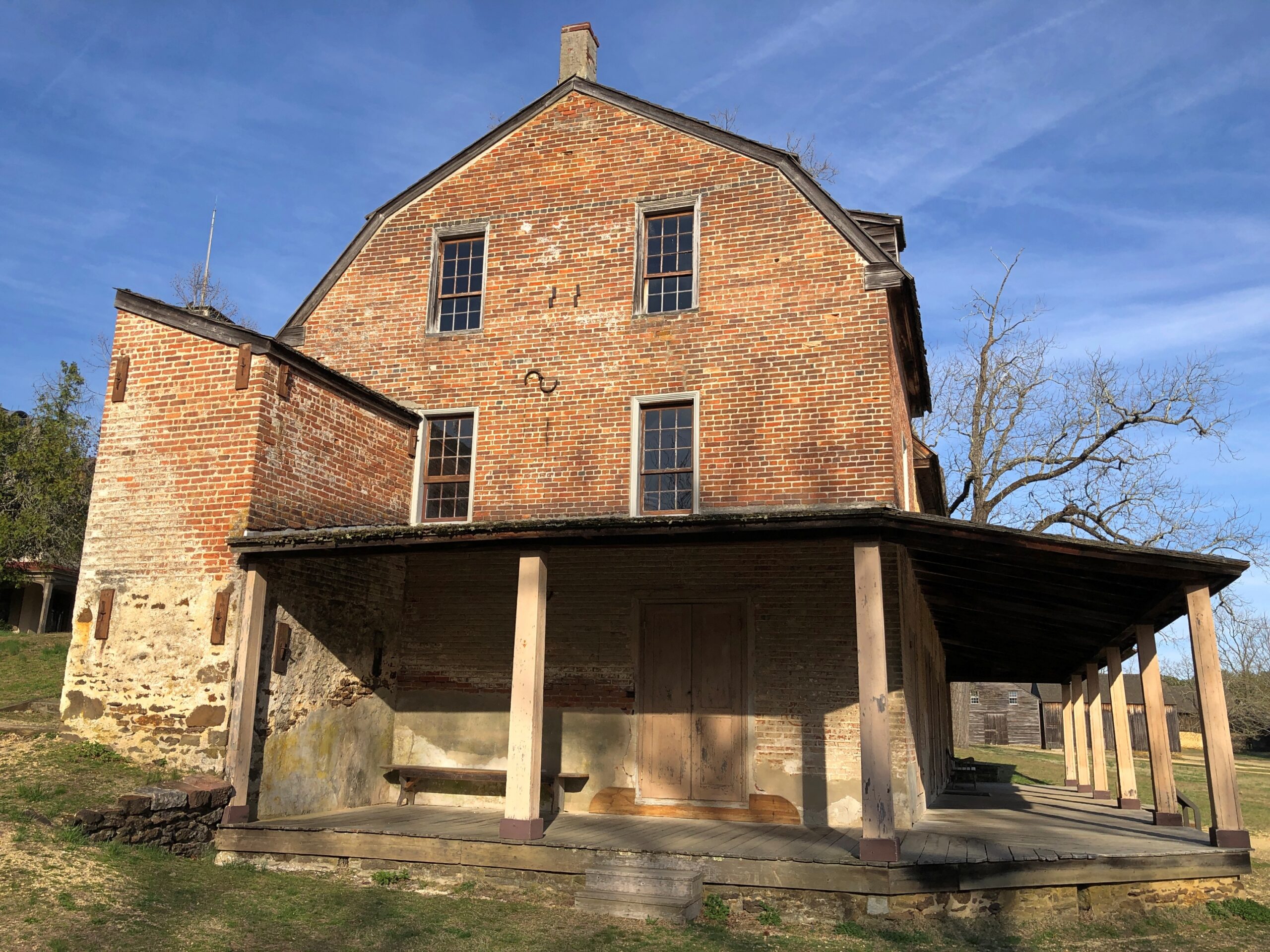
Most of the open-air museum buildings are 19th century, but the Batsto Iron Works had roots that went back to Colonial times. Some enterprising early NJ settlers found bog iron in the area. By the 19th century, the iron smelting was doing well enough to support a company town, including of course the boss’s house.
The company store.
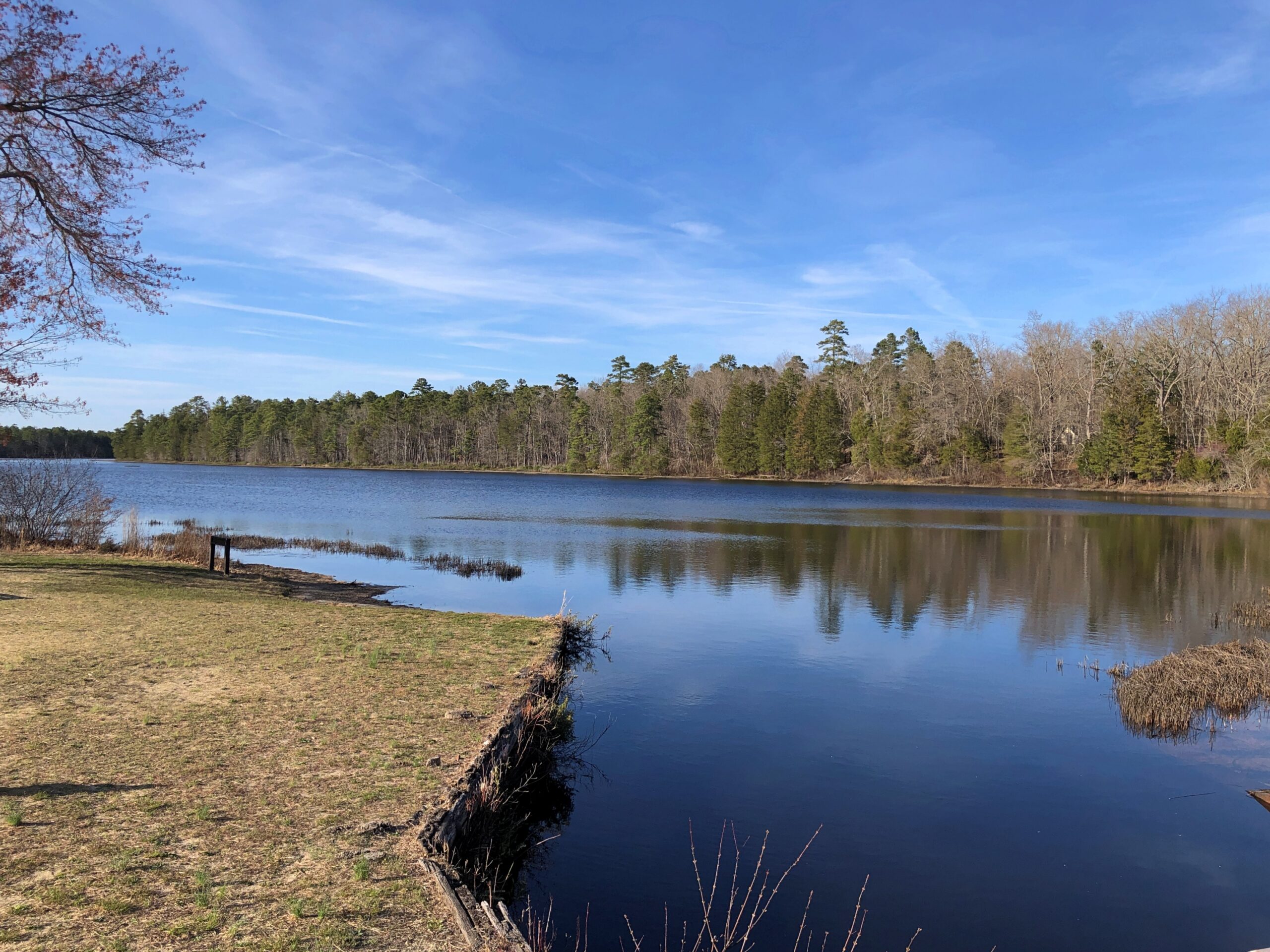
The company paid in script until the workers were organized enough to demand legal tender for their labor. Unlike at Fayette Historic State Park in Michigan, the actual industrial facility, the 19th-century blast furnace, is long gone. The place has a good-looking lake, however. Created by a small dam on Batsto River to harness the water for the sawmill.
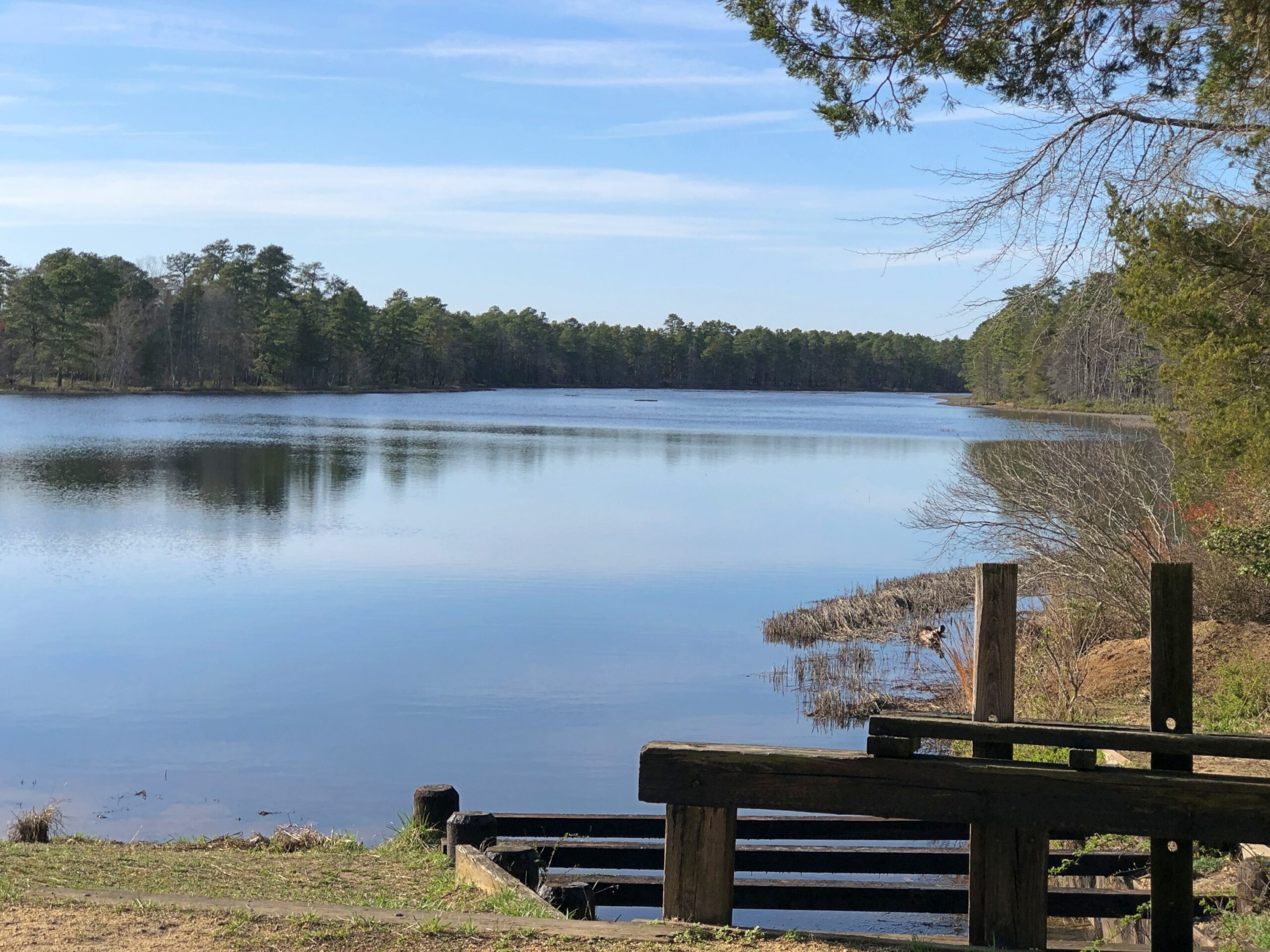
A vista that says New Jersey? Yes, but not the New Jersey of song and story.
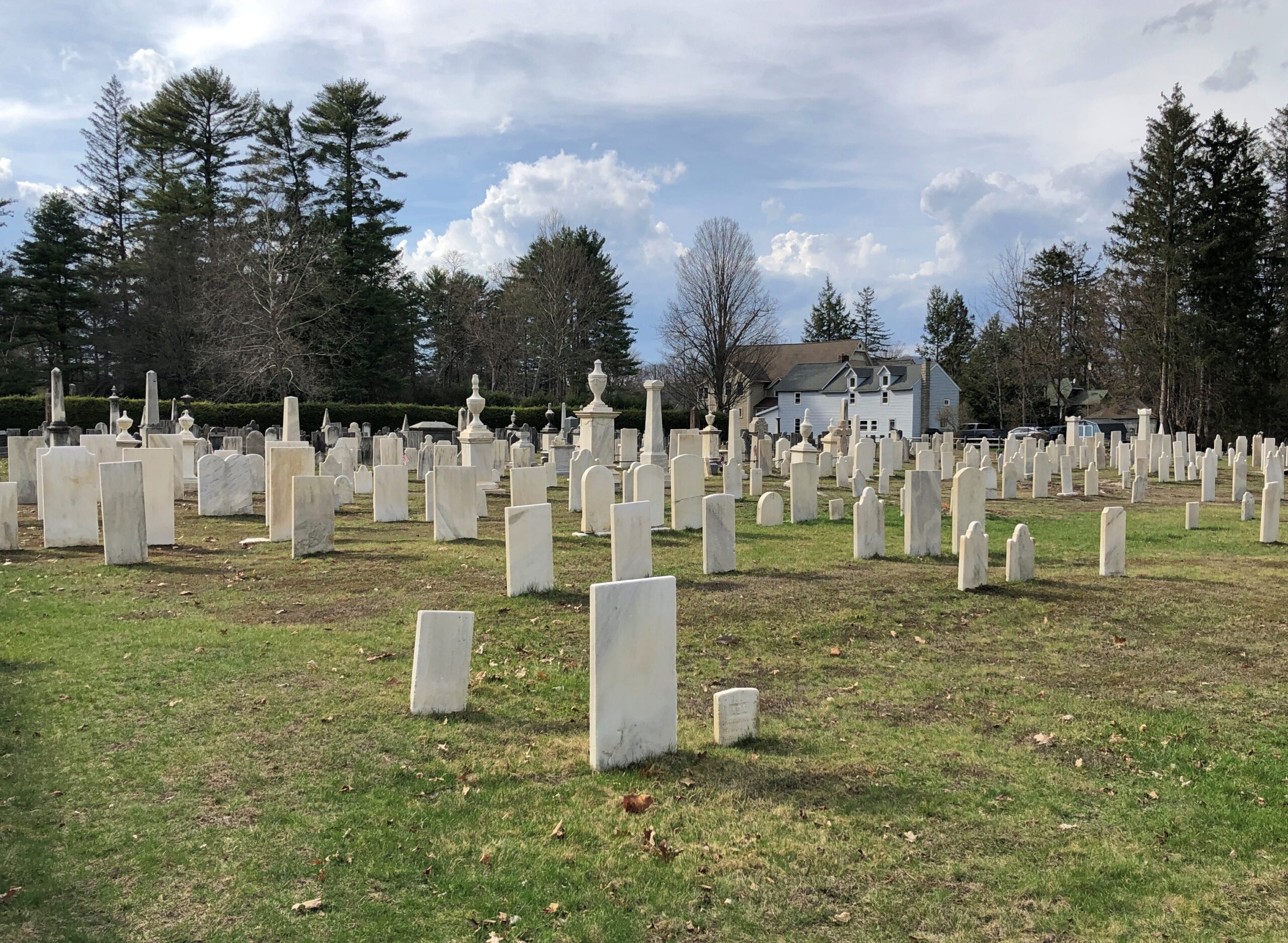
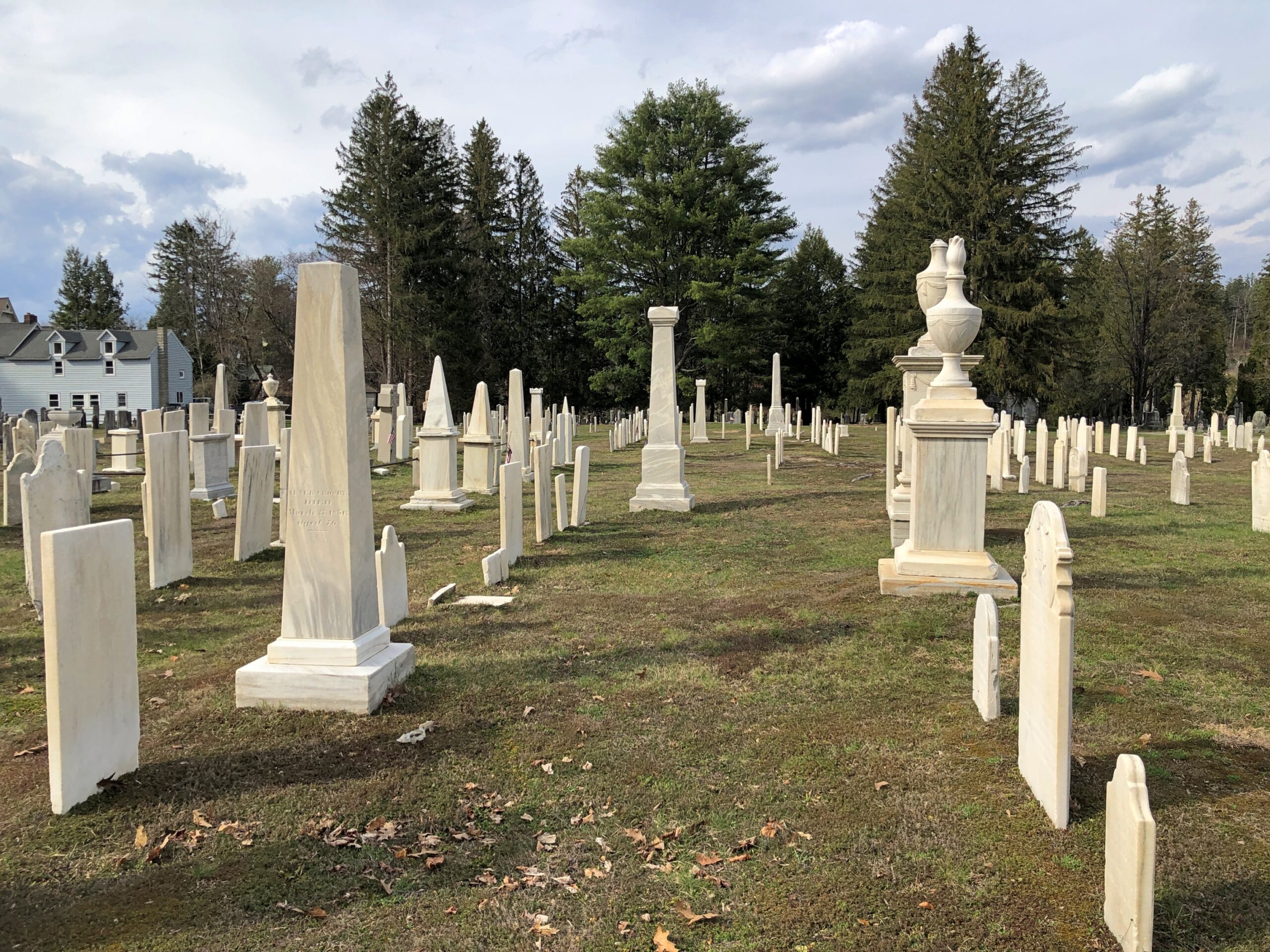
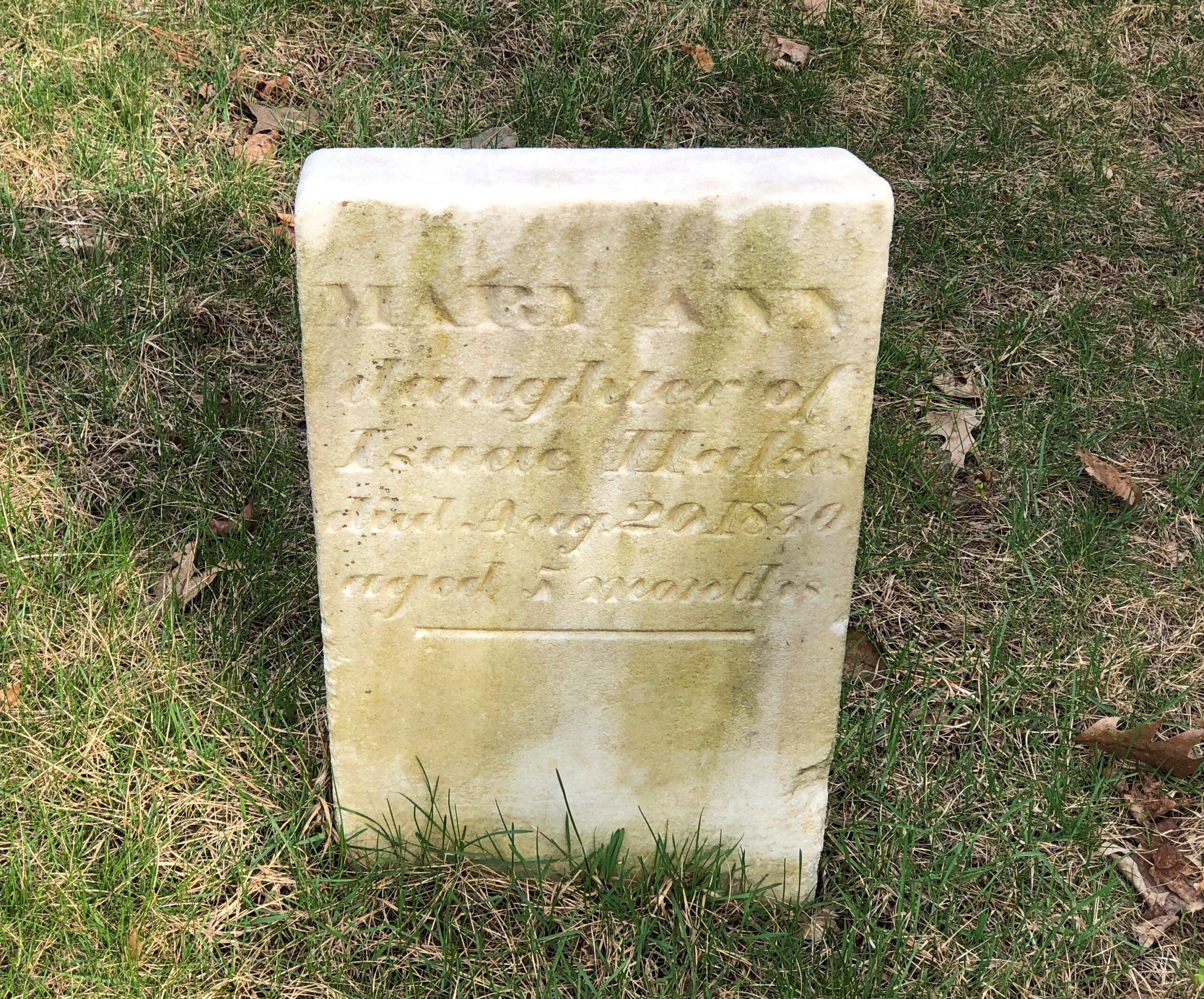
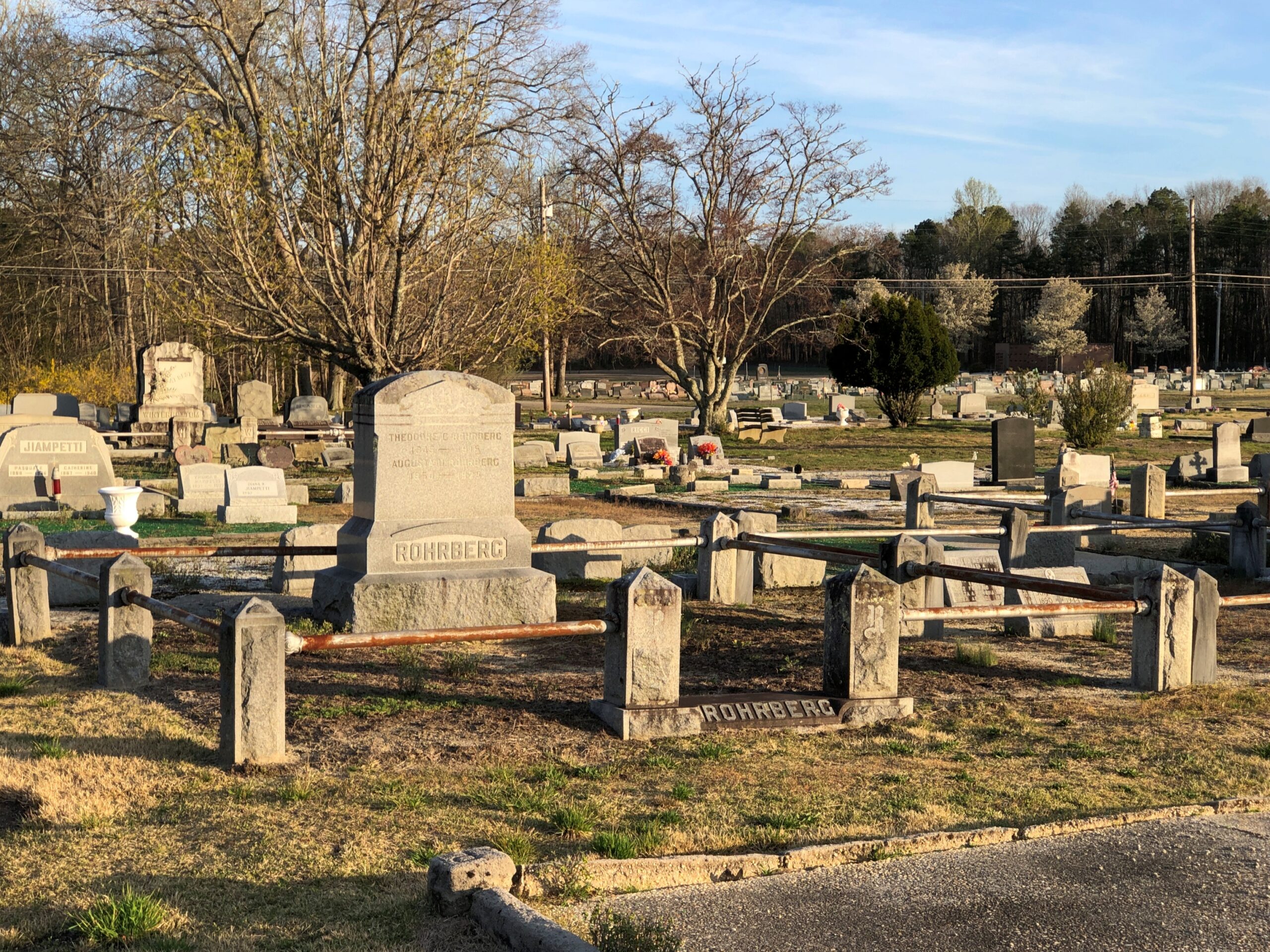
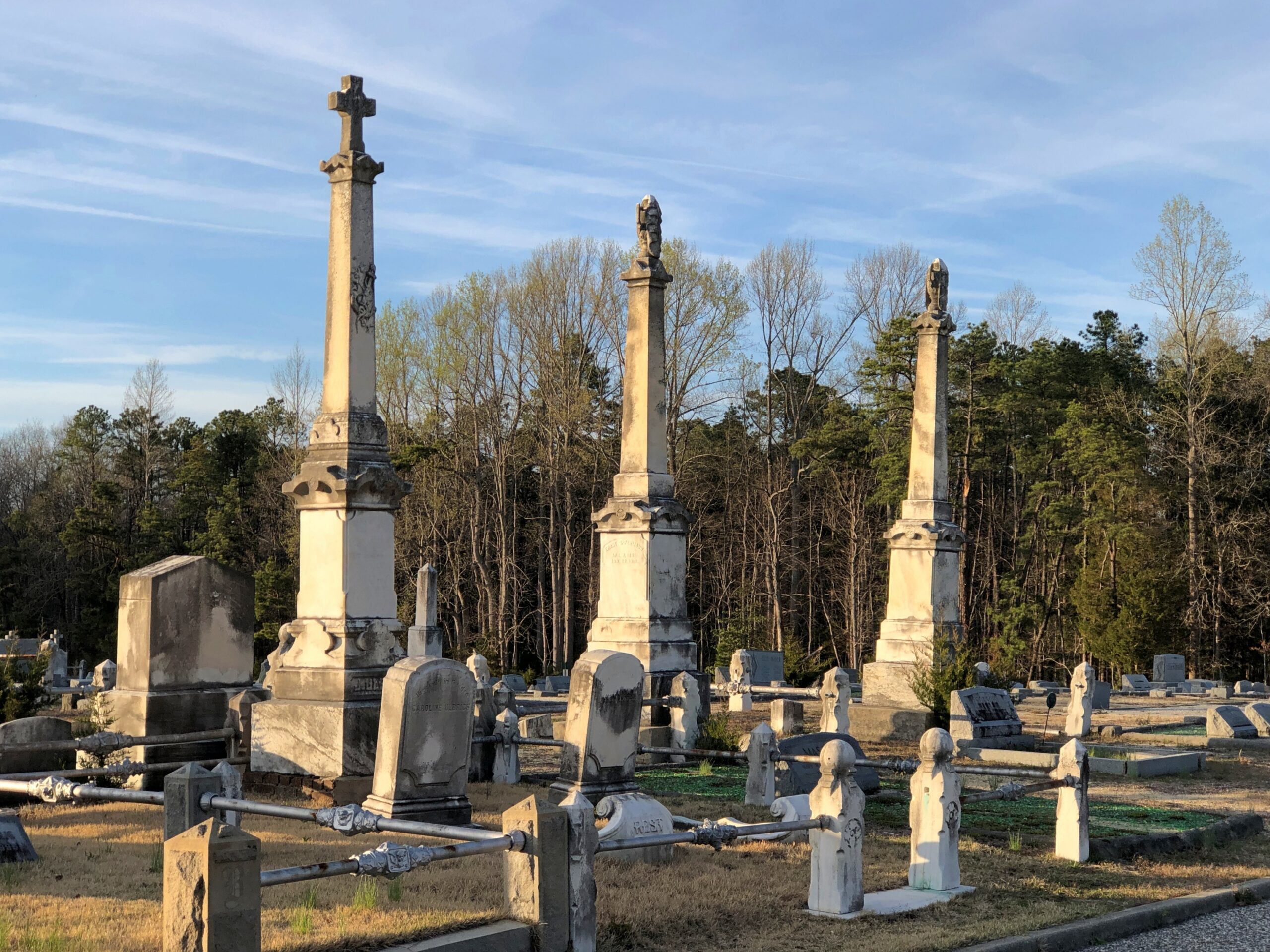
Back in Egg Harbor City (pop. 4,442), I chanced across the Egg Harbor City Cemetery – another reason to leave the GPS inactive most of the time. If the box tells you where to go, you’ll miss minor misdirections that take you to unexpected places.
I’ve come up with my next approach to traversing the Pine Barrens. There will be a next time, provided my health holds out. That’s always a contingency these days, but anyway the approach can’t be as rational as trying to plot oneself on a map, or even follow the directions from a machine.
The region isn’t that large. That is, provided your car is gassed and in good running condition, since walking out of the Pine Barrels, even following surfaced roads, seems like a bad idea unless you’ve prepared yourself to do so. Assuming you drive, pick a direction – say east, toward the morning sun – and head that way, hewing to the direction as much as possible. It won’t be too long before you come to a reliably numbered state or US highway. Or in that case, the Garden State Parkway.
Sounds doable. Unless you encounter the Jersey Devil.