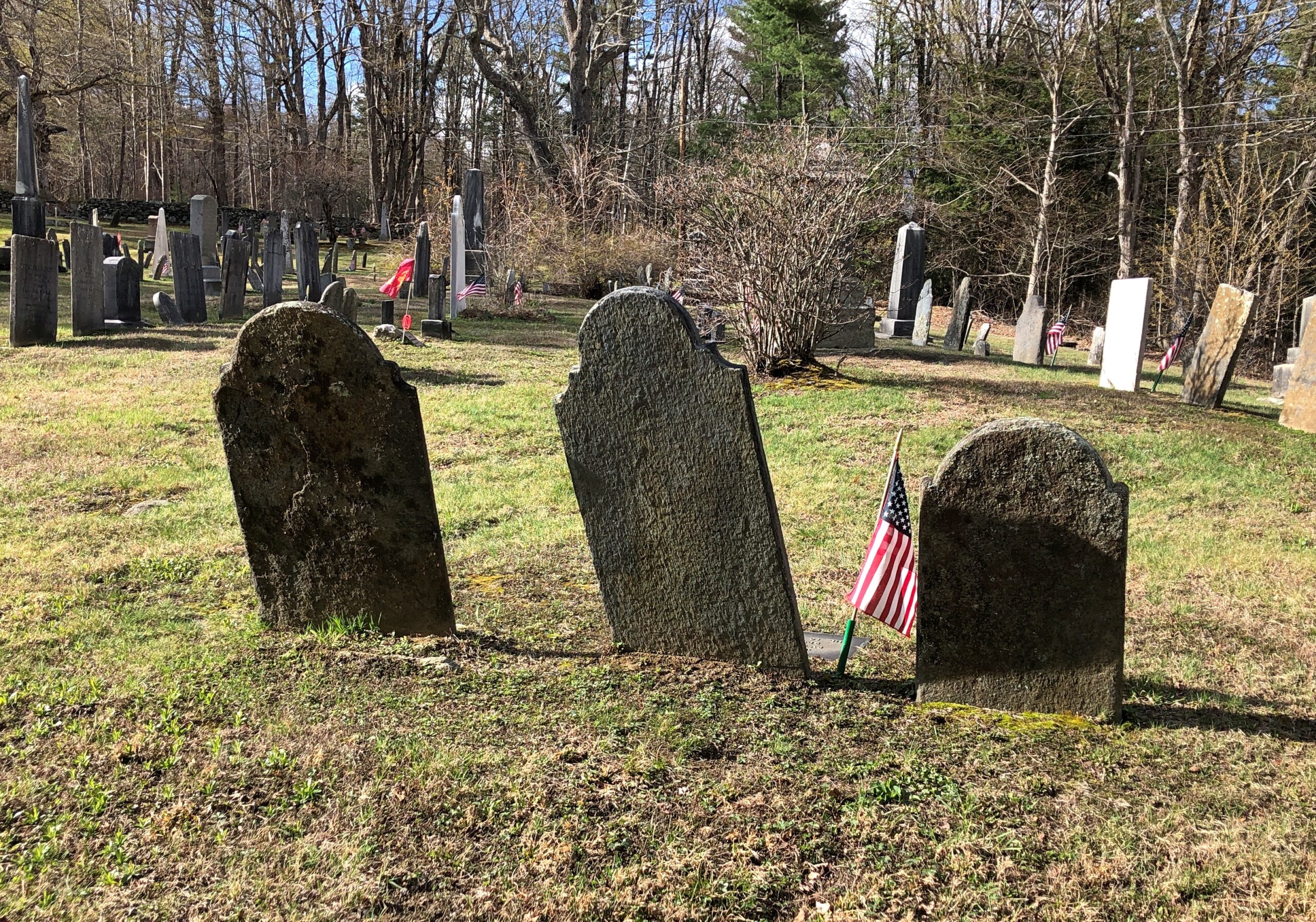
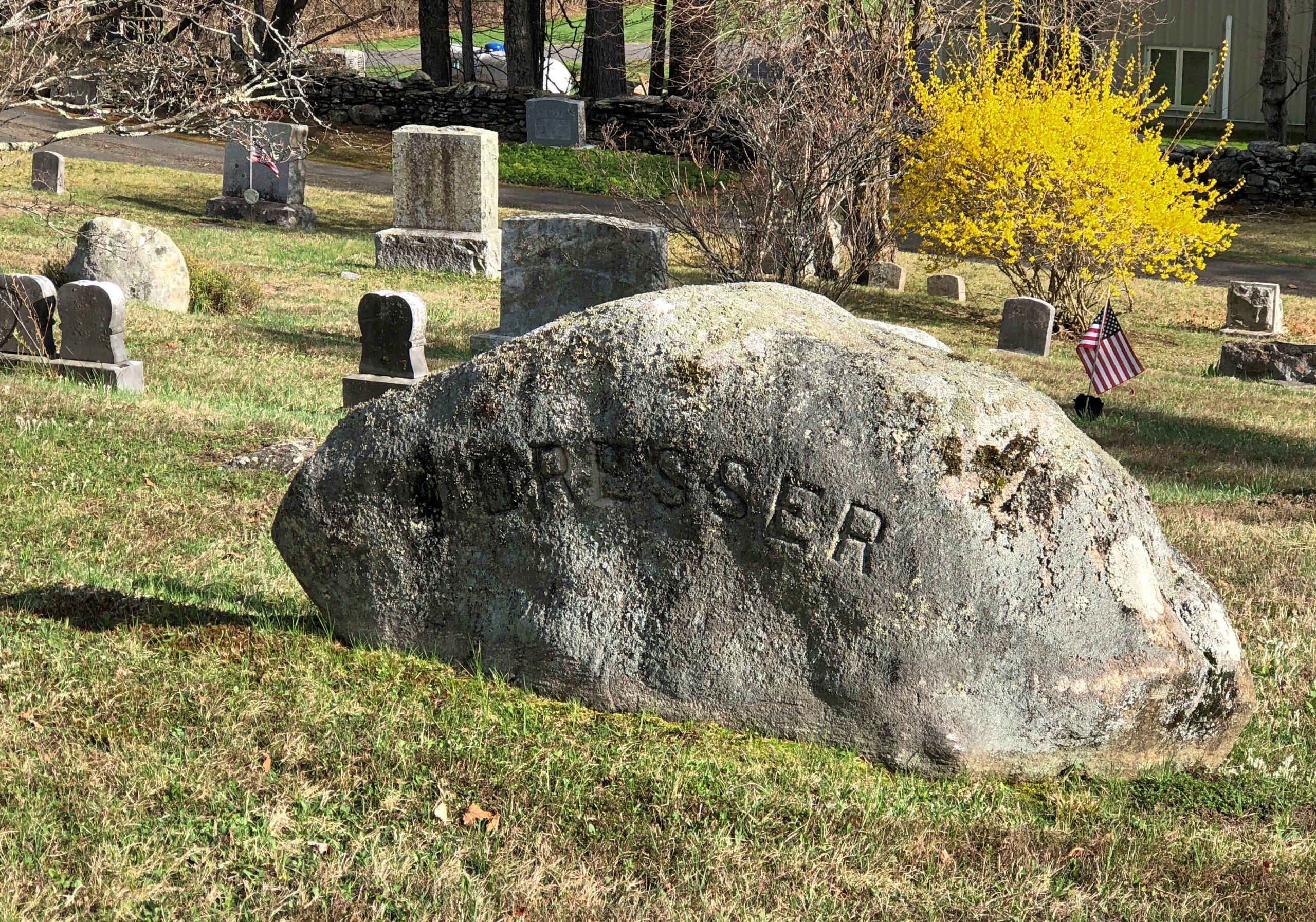
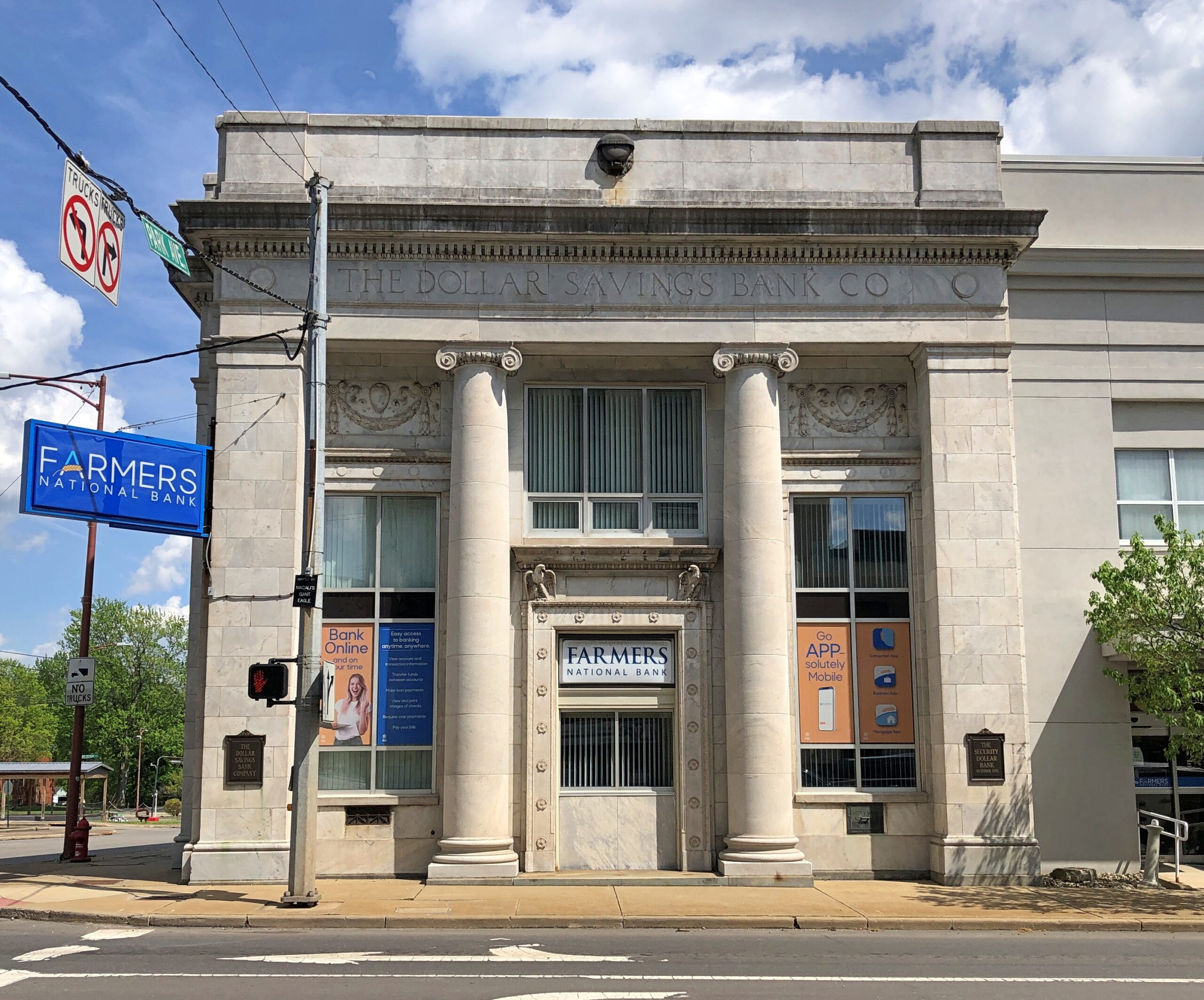
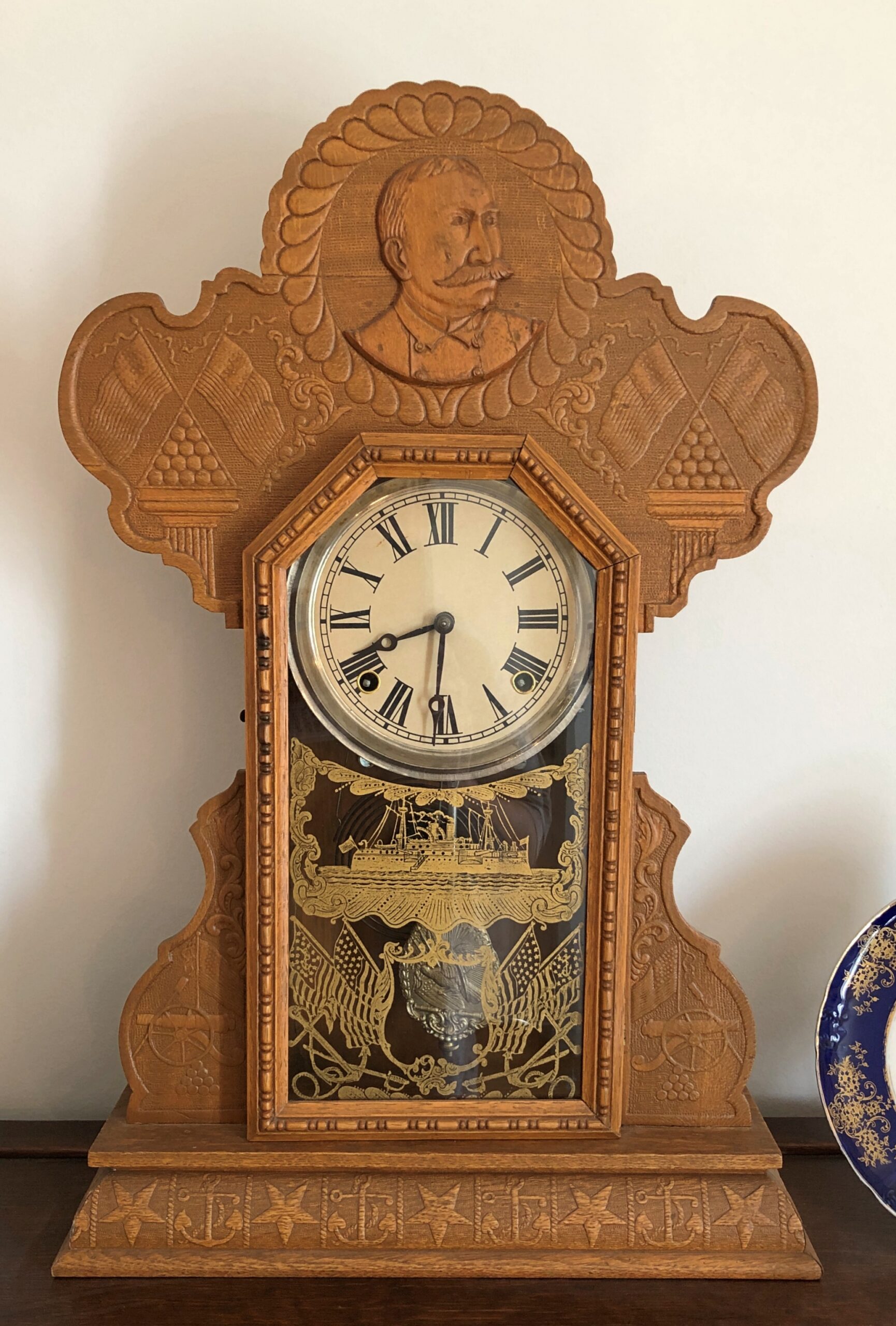
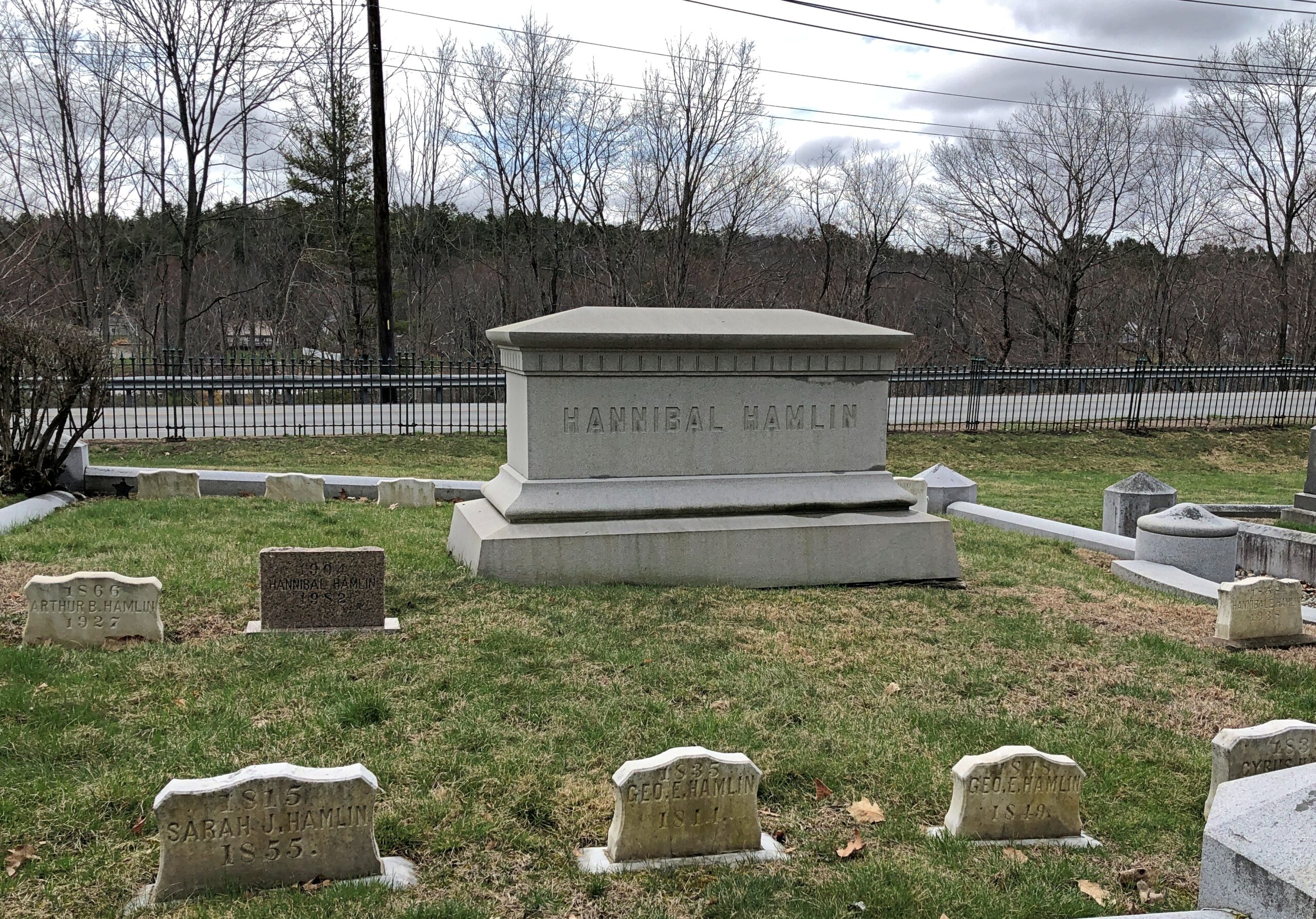
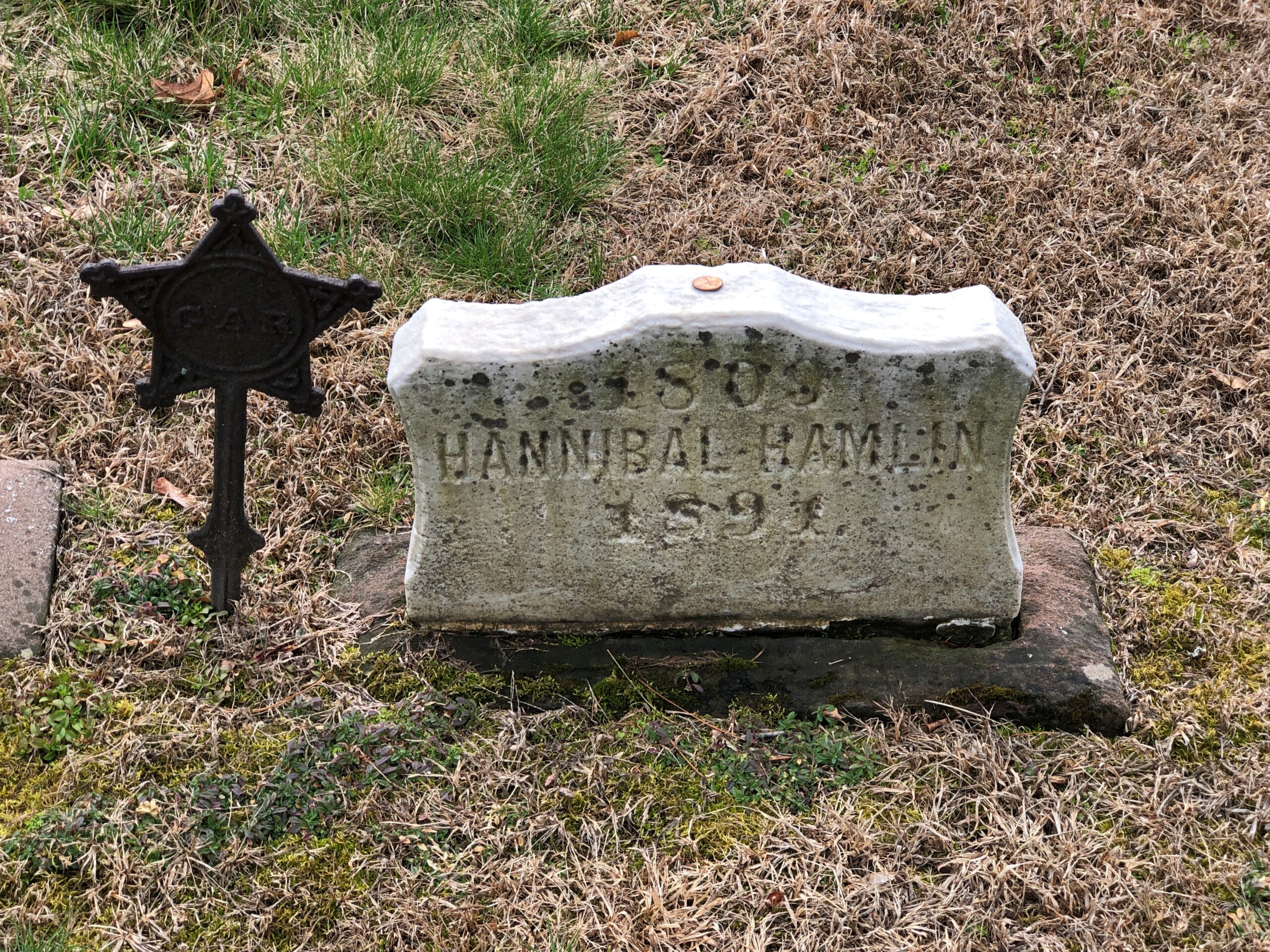
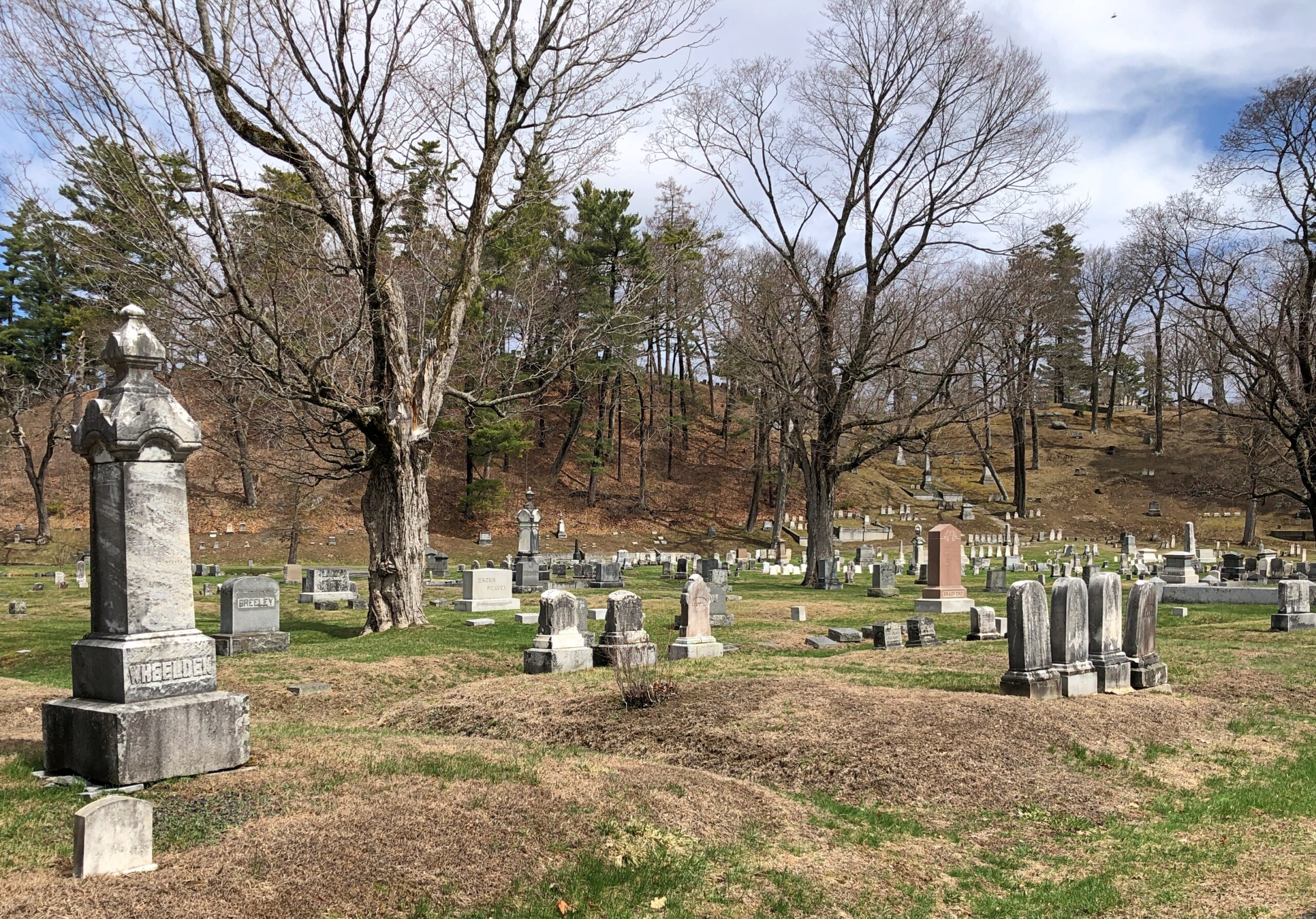
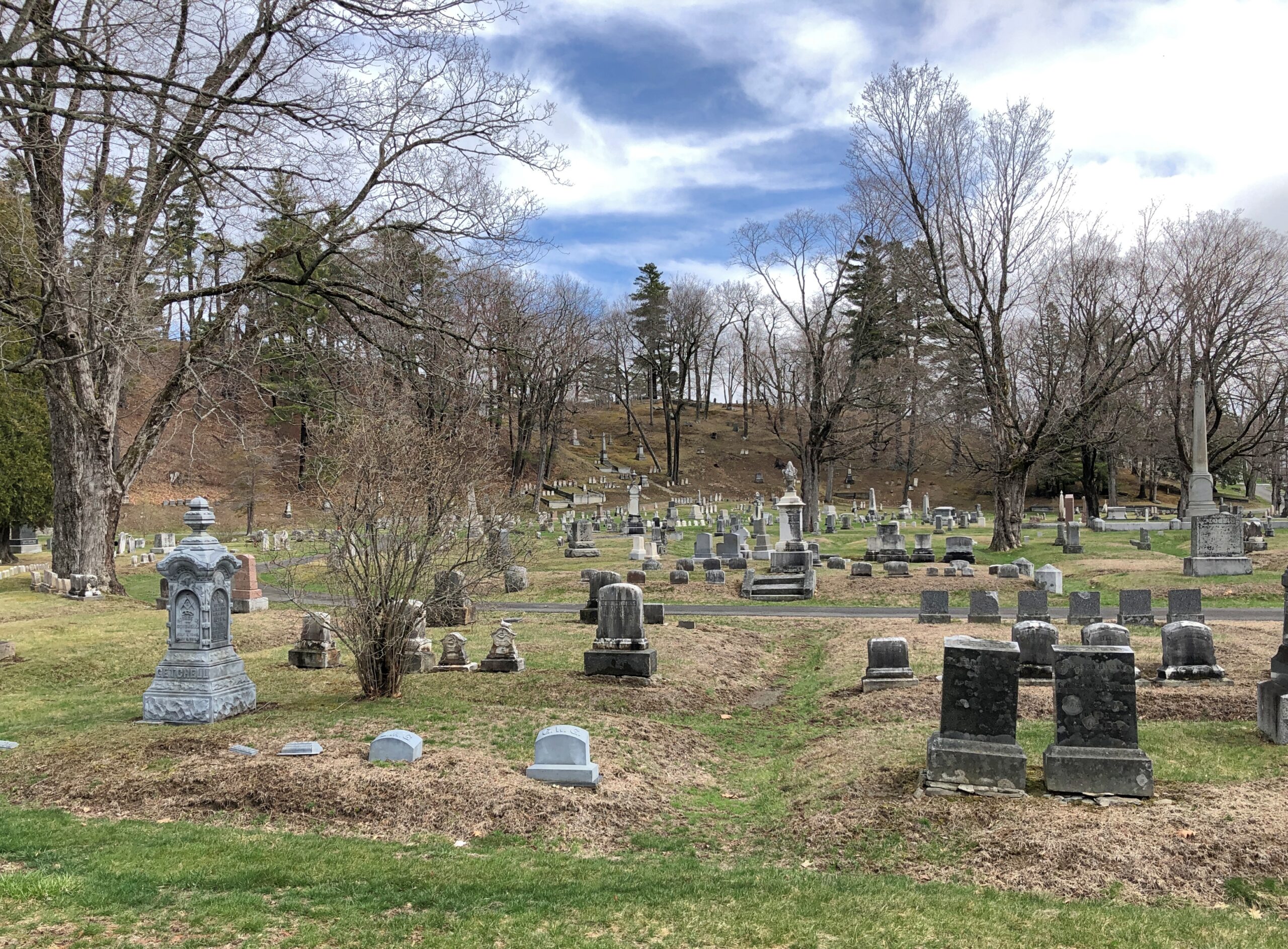
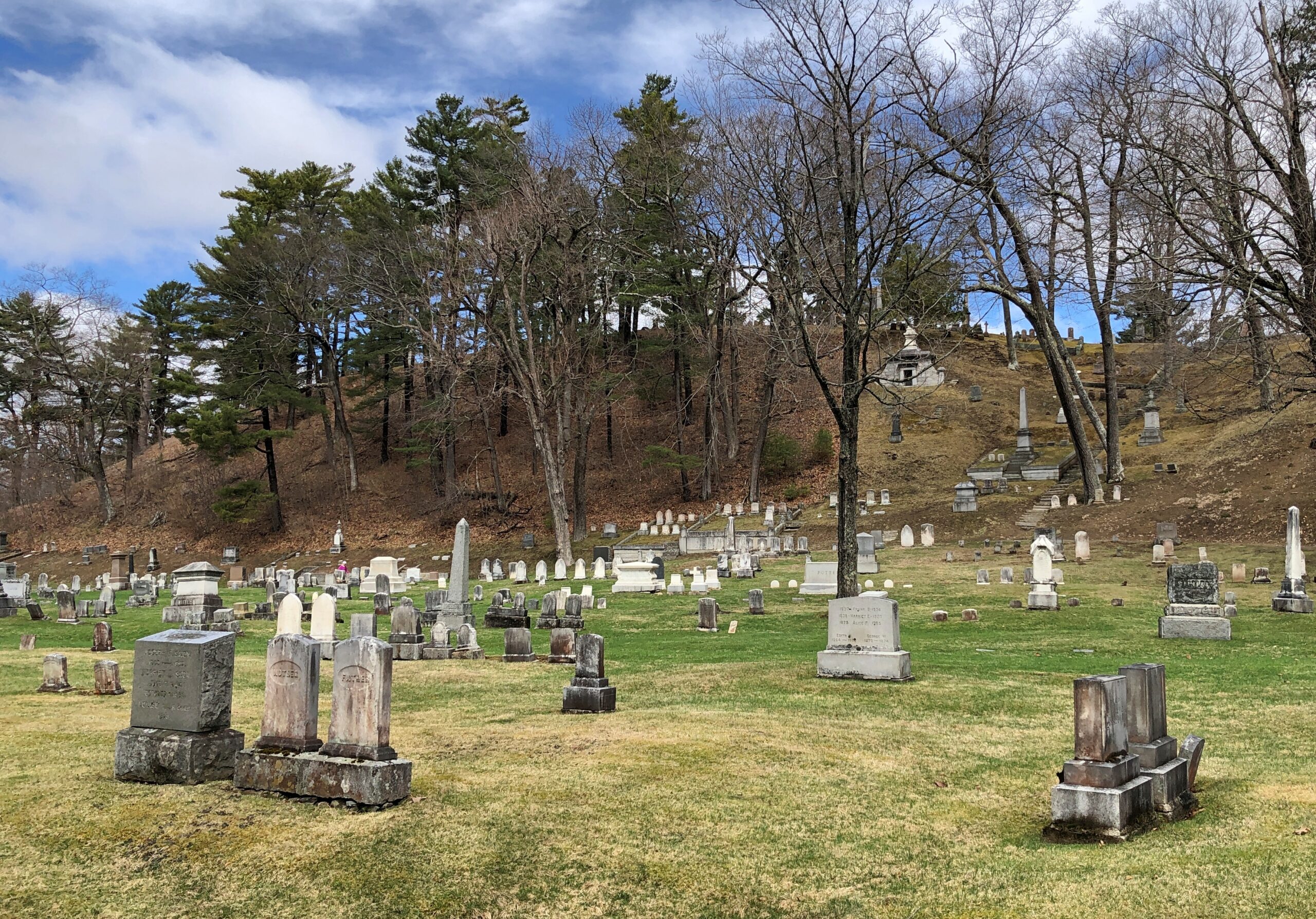
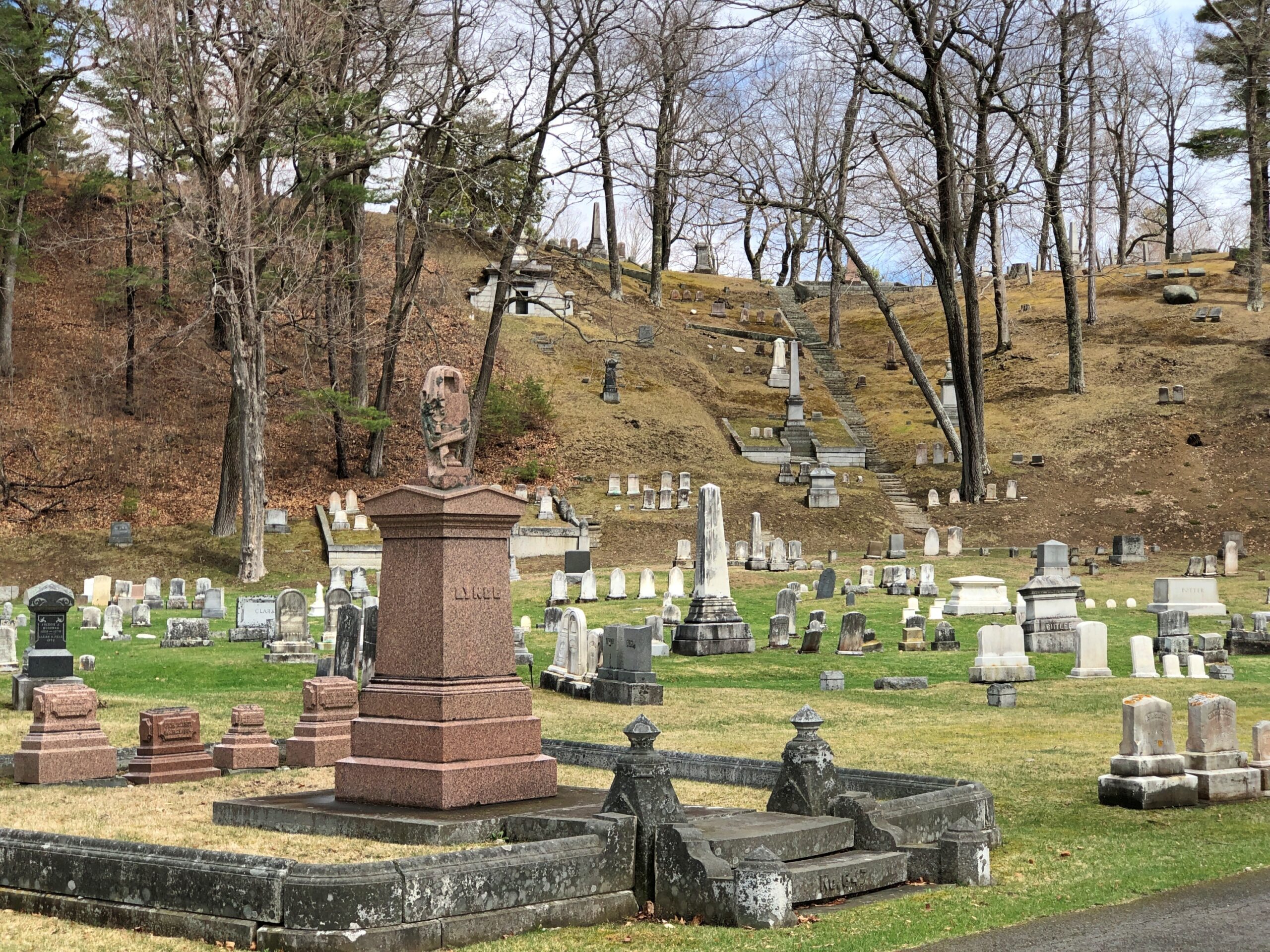
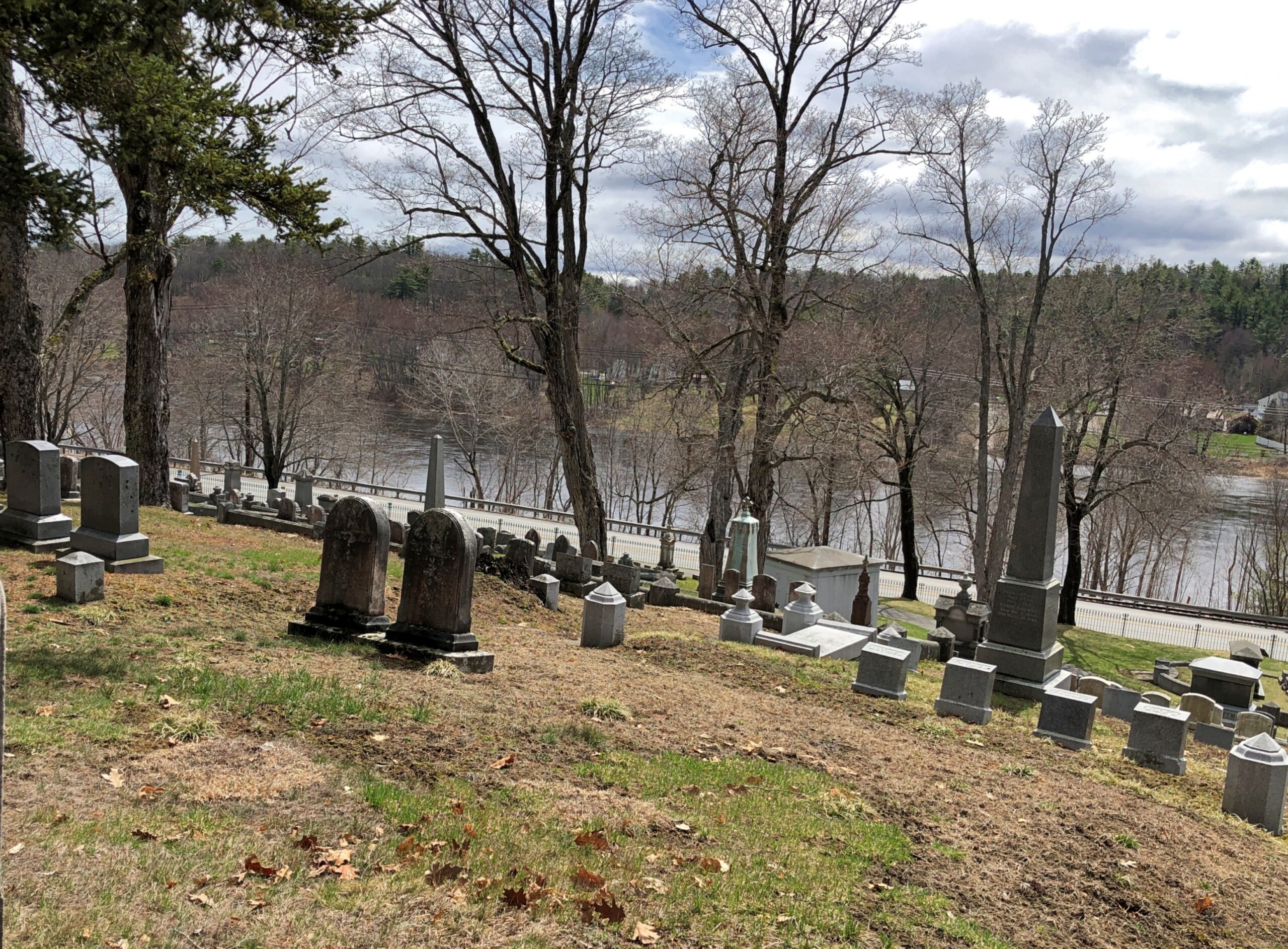
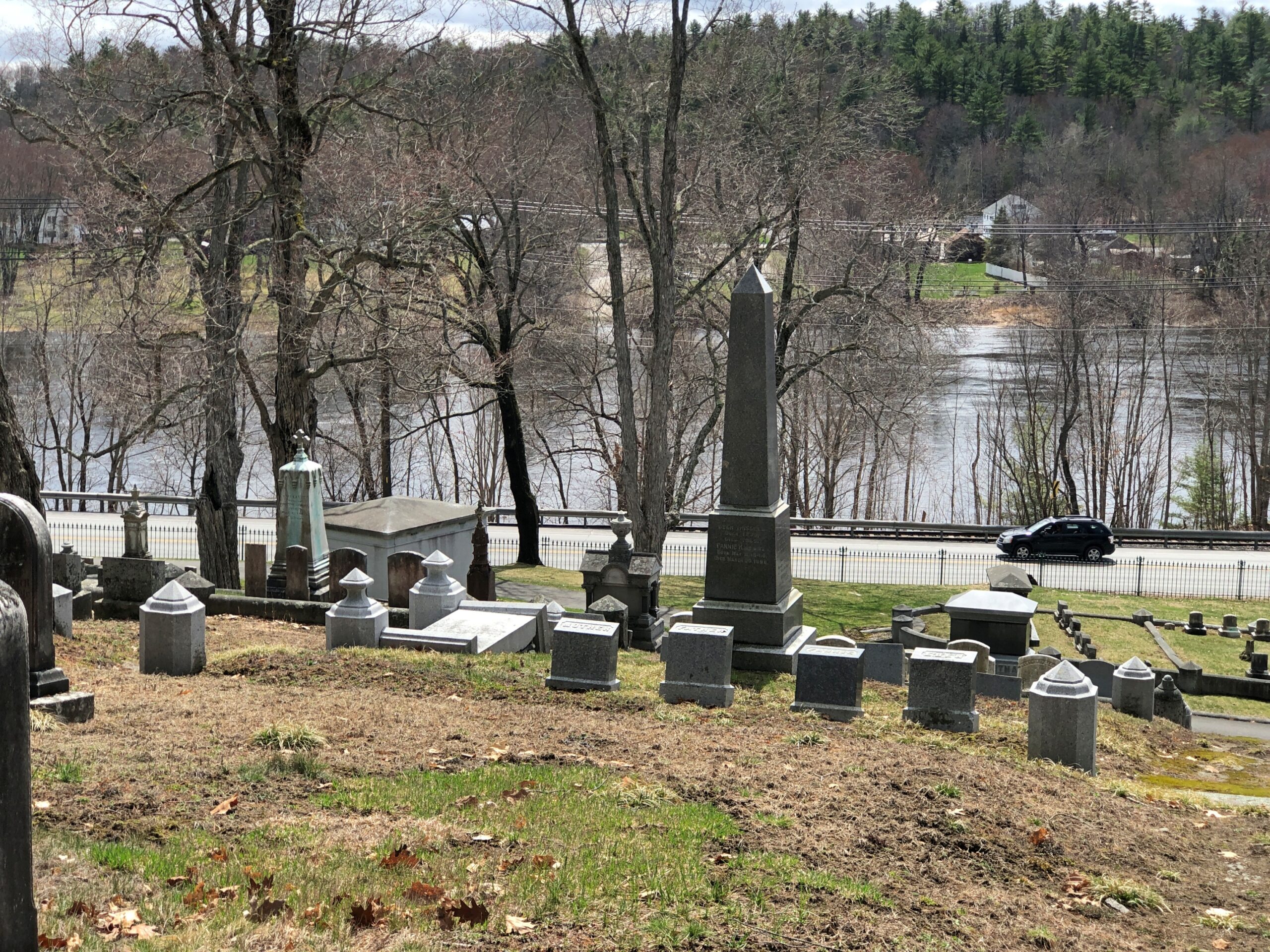
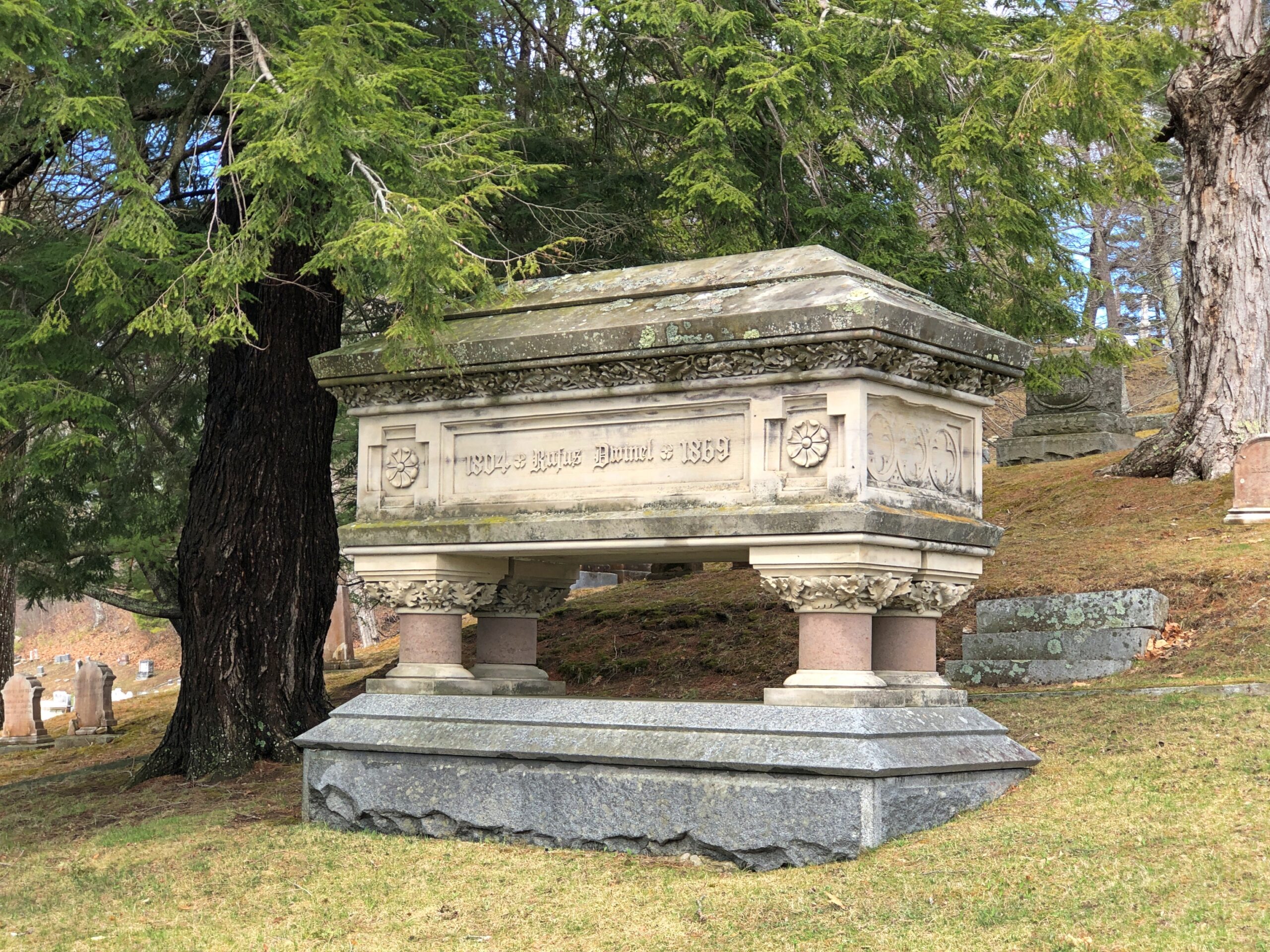
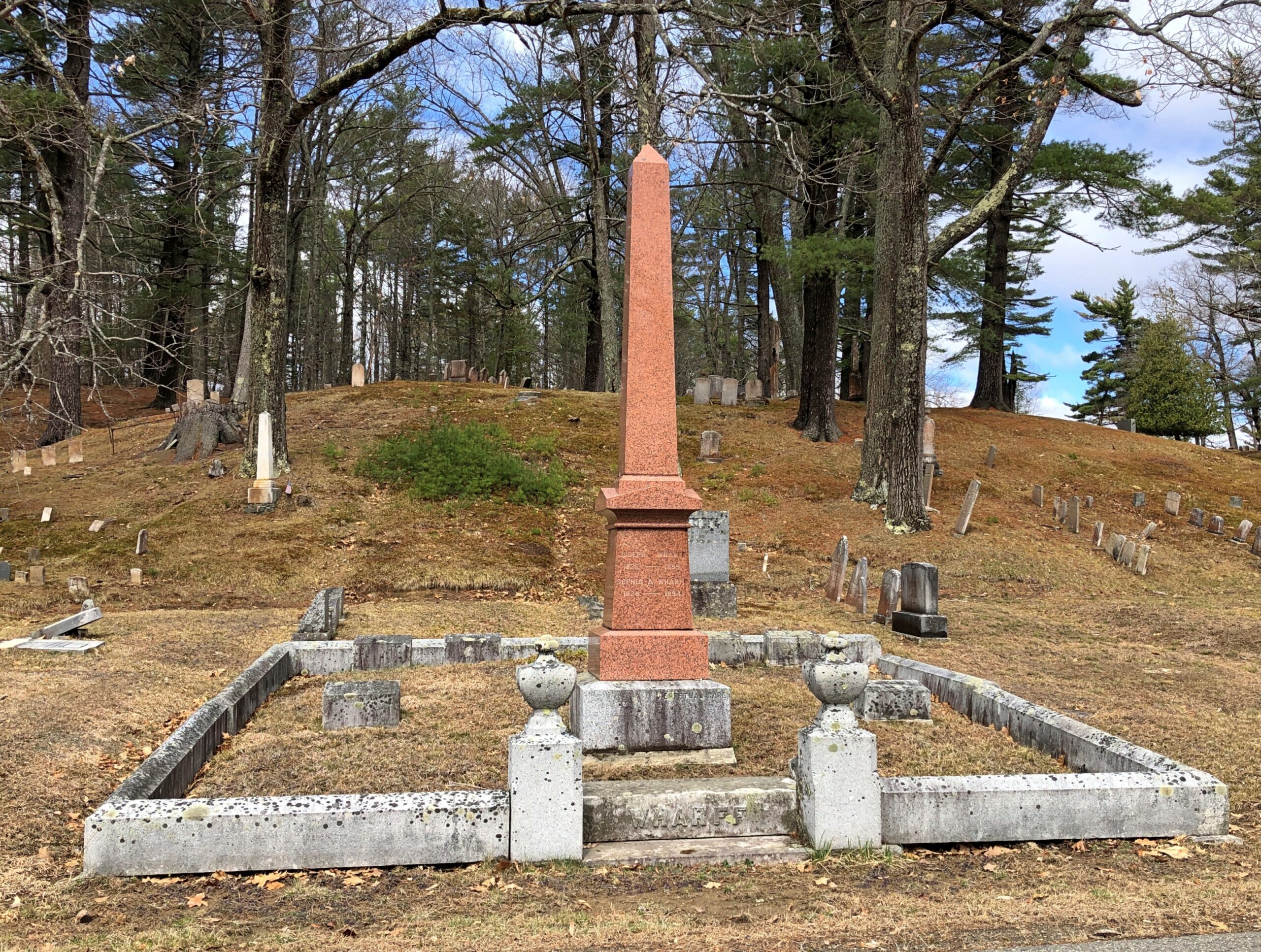
It’s one thing to see Hannibal Hamlin’s bronze in downtown Bangor, but true vice presidential enthusiasts can’t leave it at that. The 15th Vice President of the United States also happens to repose in Bangor, along with a number of other Hamlins, at Mount Hope Cemetery.
He’s in the company of a lot of other Mainers, too.
Including a lot of 19th-century Maine politicos and nabobs, and silent screen actor Ralph Sipperly. Of course I had to look him up, even though I didn’t see his stone.
Wiki notes, ultimately citing the NYT for the theater anecdote: “Ralph Sipperly [d. 1928] was a comic and character actor who appeared in ten films (mostly silents) between 1923 and 1927. His most notable portrayal was as the barber in the Academy Award-winning film Sunrise: A Song of Two Humans (1927).
“During one theatrical performance of Six-Cylinder Love in New York in 1921, Sipperly, who played a high-powered car salesman, accidentally drove an actual automobile off the stage and into the first row of seats. No one was injured, though screams erupted in the sold-out hall, and one woman ‘became hysterical’ as people scrambled out of the way. The incident made The New York Times the following day, but apparently had no effect on Sipperly’s career.”
Mount Hope is credited with being the second U.S. cemetery of the rural cemetery movement. The cemetery organizers picked a partly wooded bluff whose slope rolls down to the Penobscot River. The first such rural cemetery was, of course, Mount Auburn in Massachusetts, which opened in 1831.
“At Mount Auburn, a large tract of land was converted into a romantic park with ponds, bowers, grottos, and a great variety of planting. It was consciously designed for the living as well as the dead,” the cemetery web site says.
“The City of Bangor was not long in following suit. Bangor became very much alive with the settlement of the Penobscot River Valley in the years preceding the Revolutionary War. In 1834, Bangor was declared a city. Among the citizens of Bangor came a strong sentiment for the creation of a new cemetery grounds for the burial of its dead.”
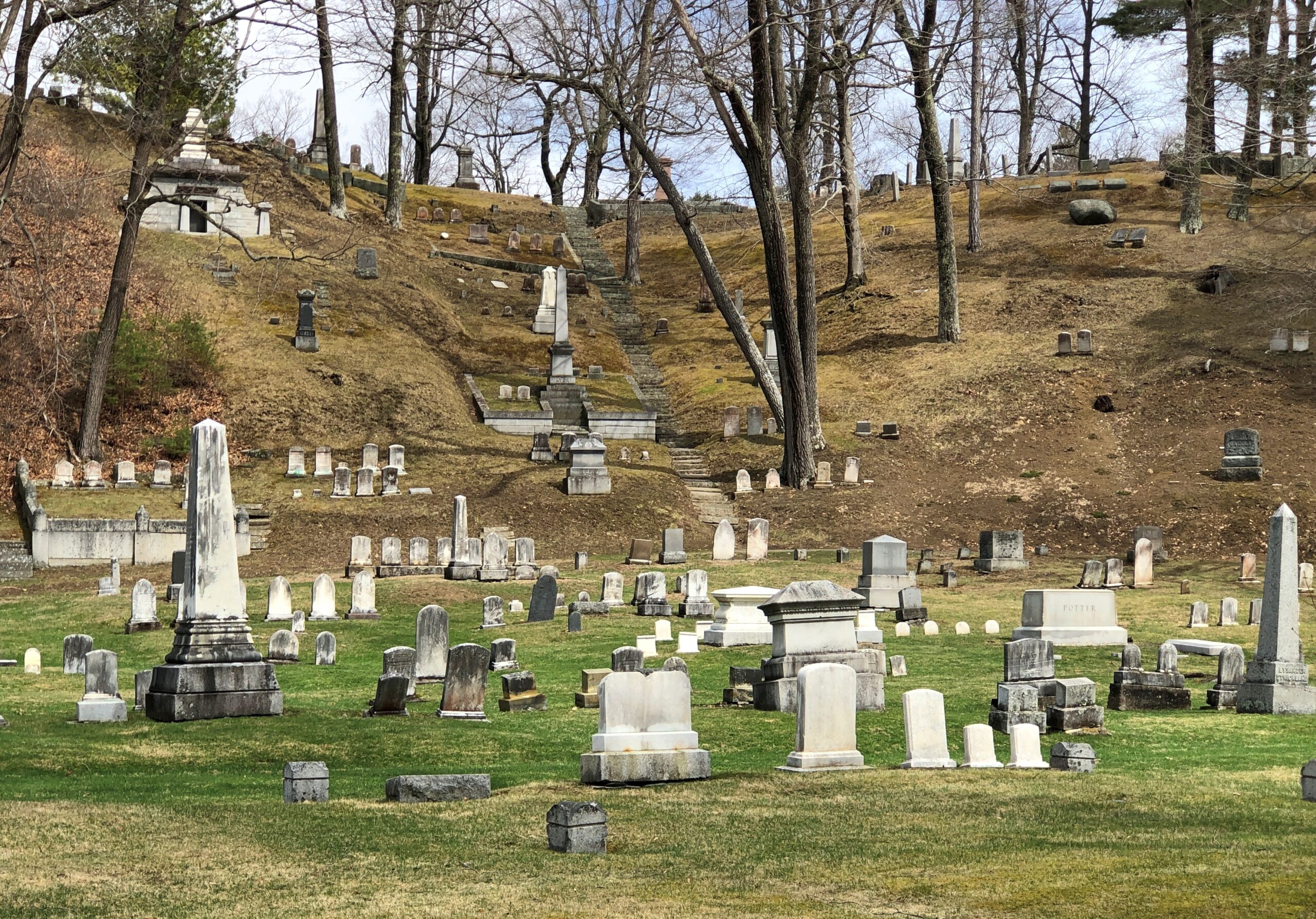
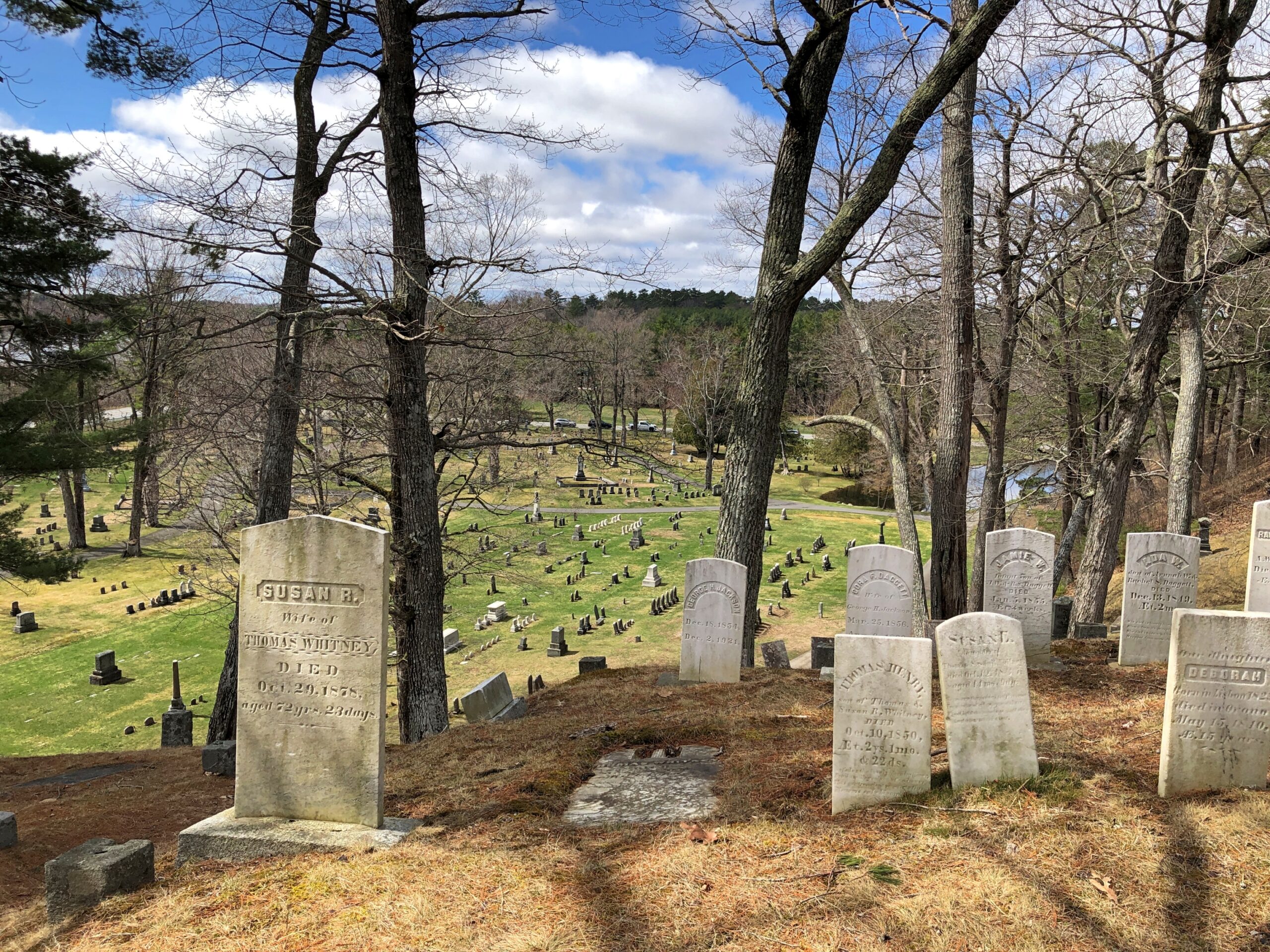
The new cemetery was opened in 1834, along the aesthetic lines pioneered in Boston. Climb the slope – I’ll admit, I drove on the road that snakes up that way – and you’re rewarded with a vista peppered with memorials.
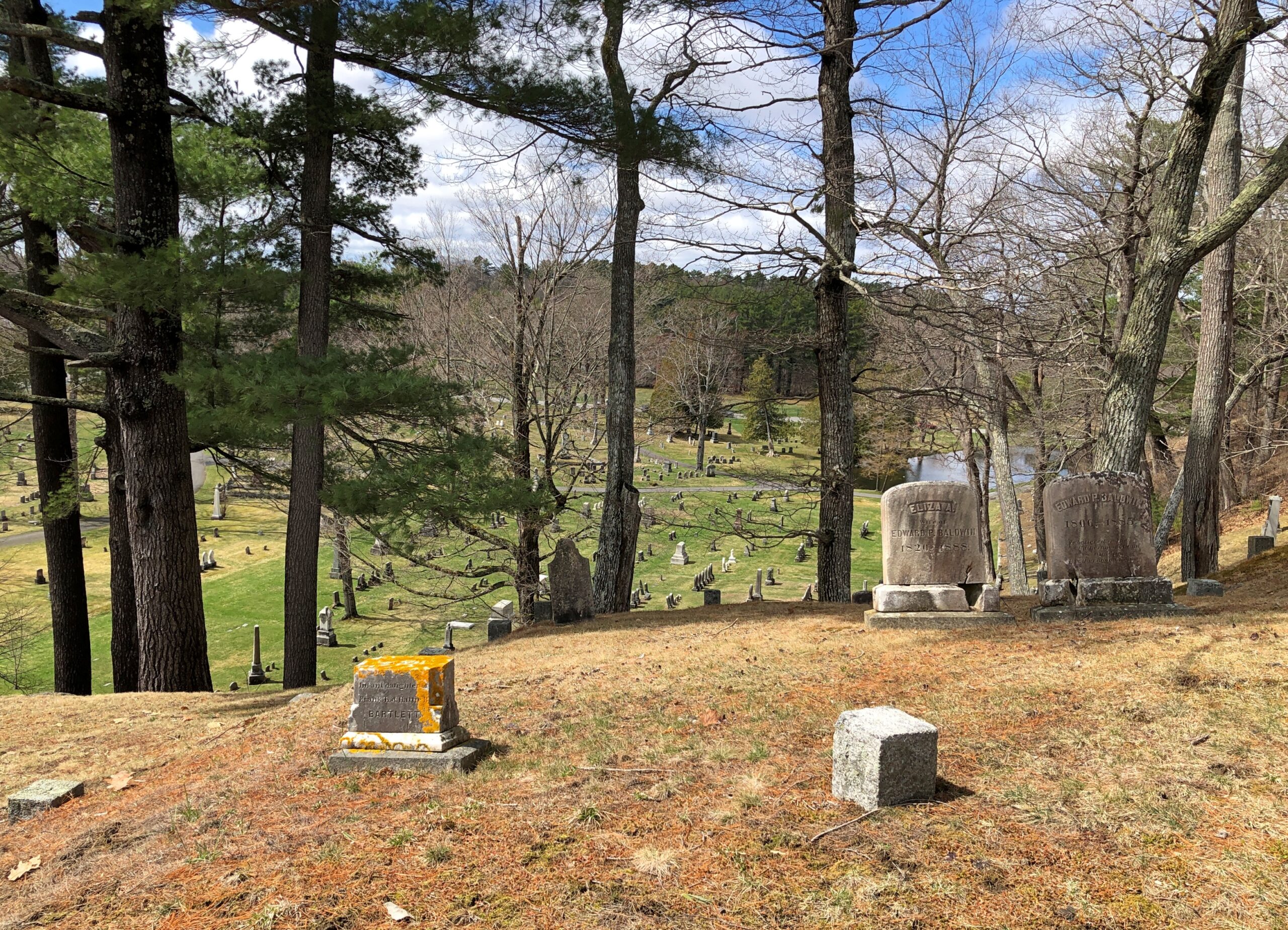
Views of the river and the road that parallels it for a while, the epic US 2.
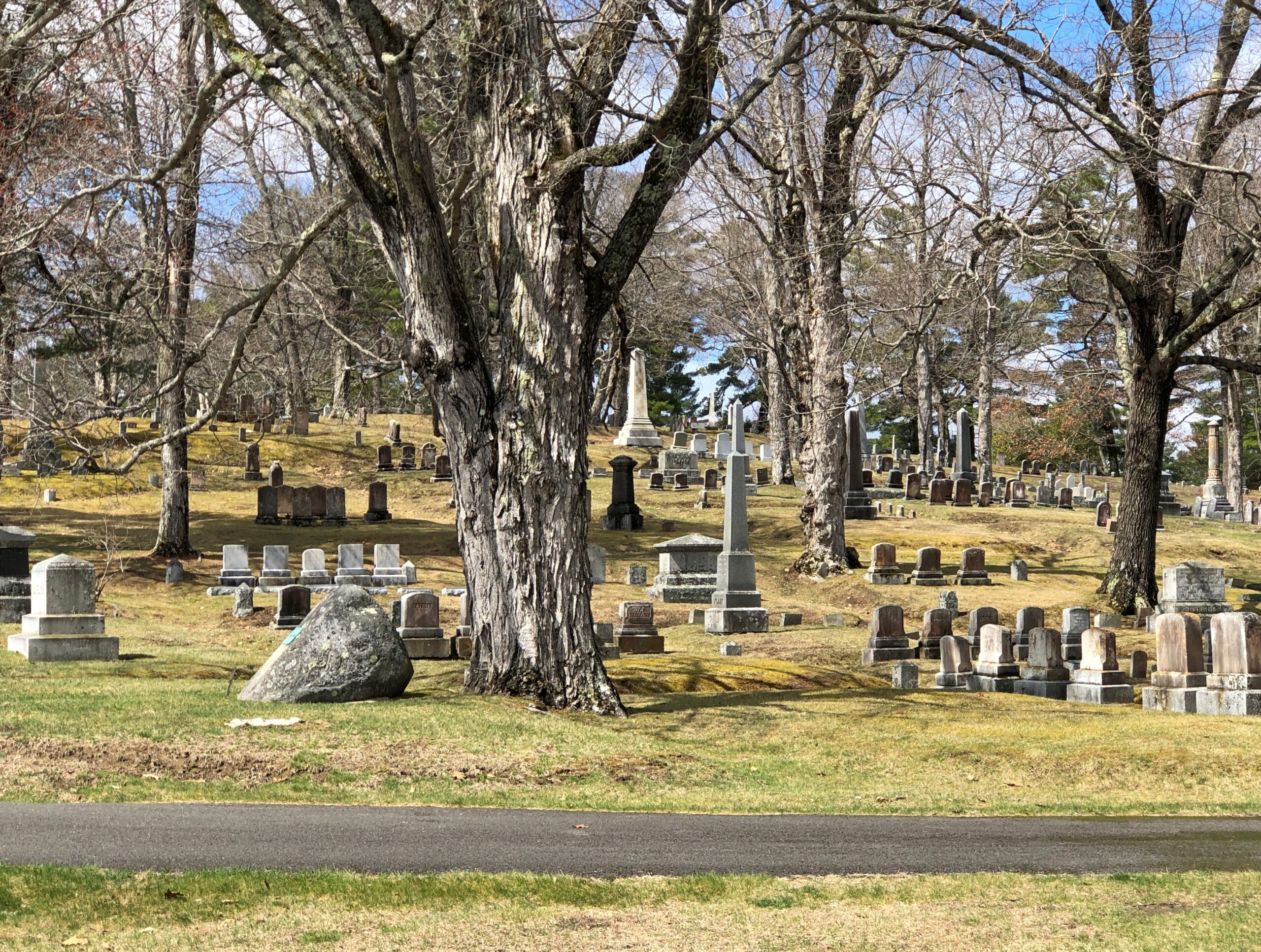
The cemetery extends further inland, all together totaling about 300 acres.
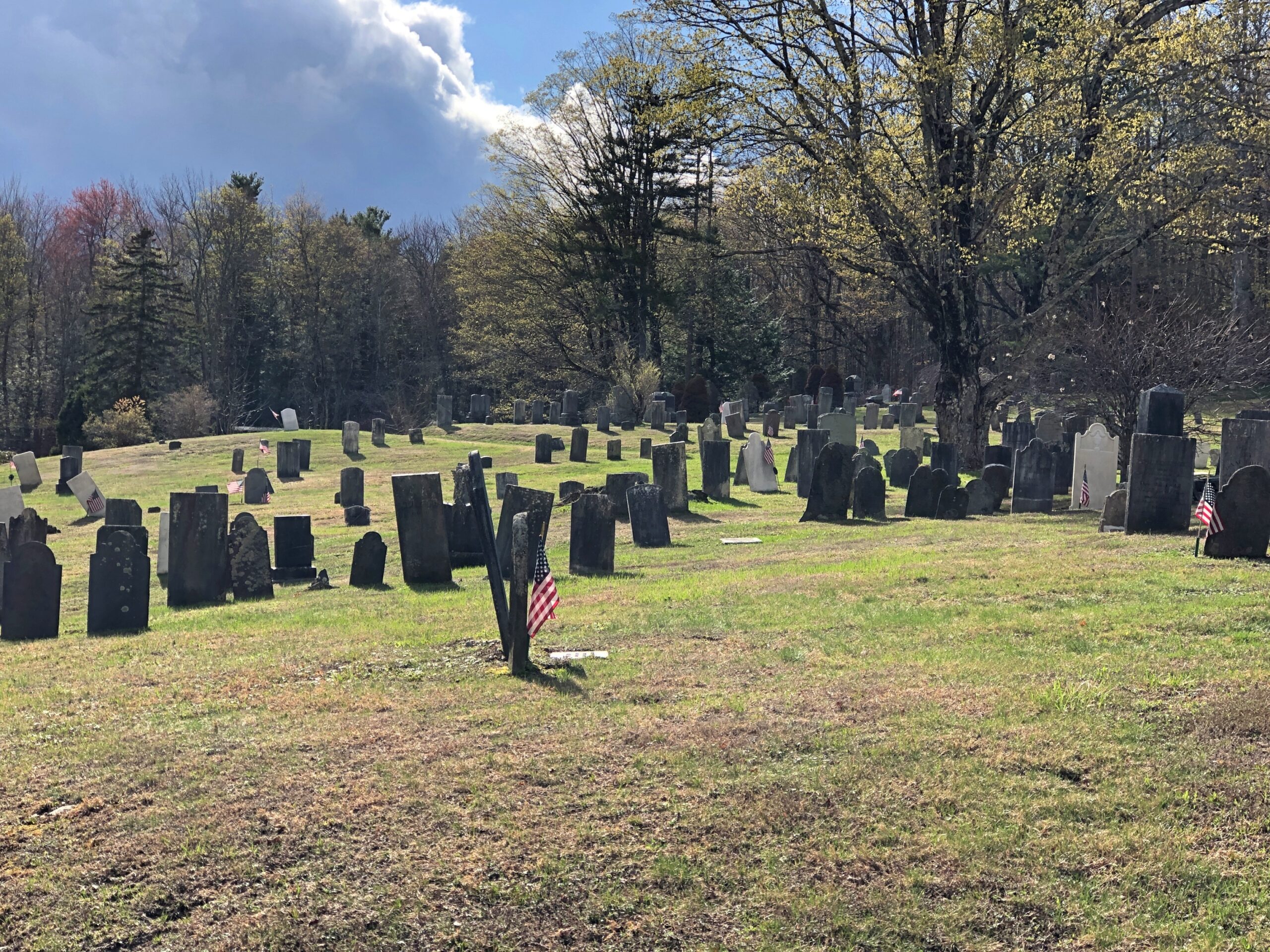
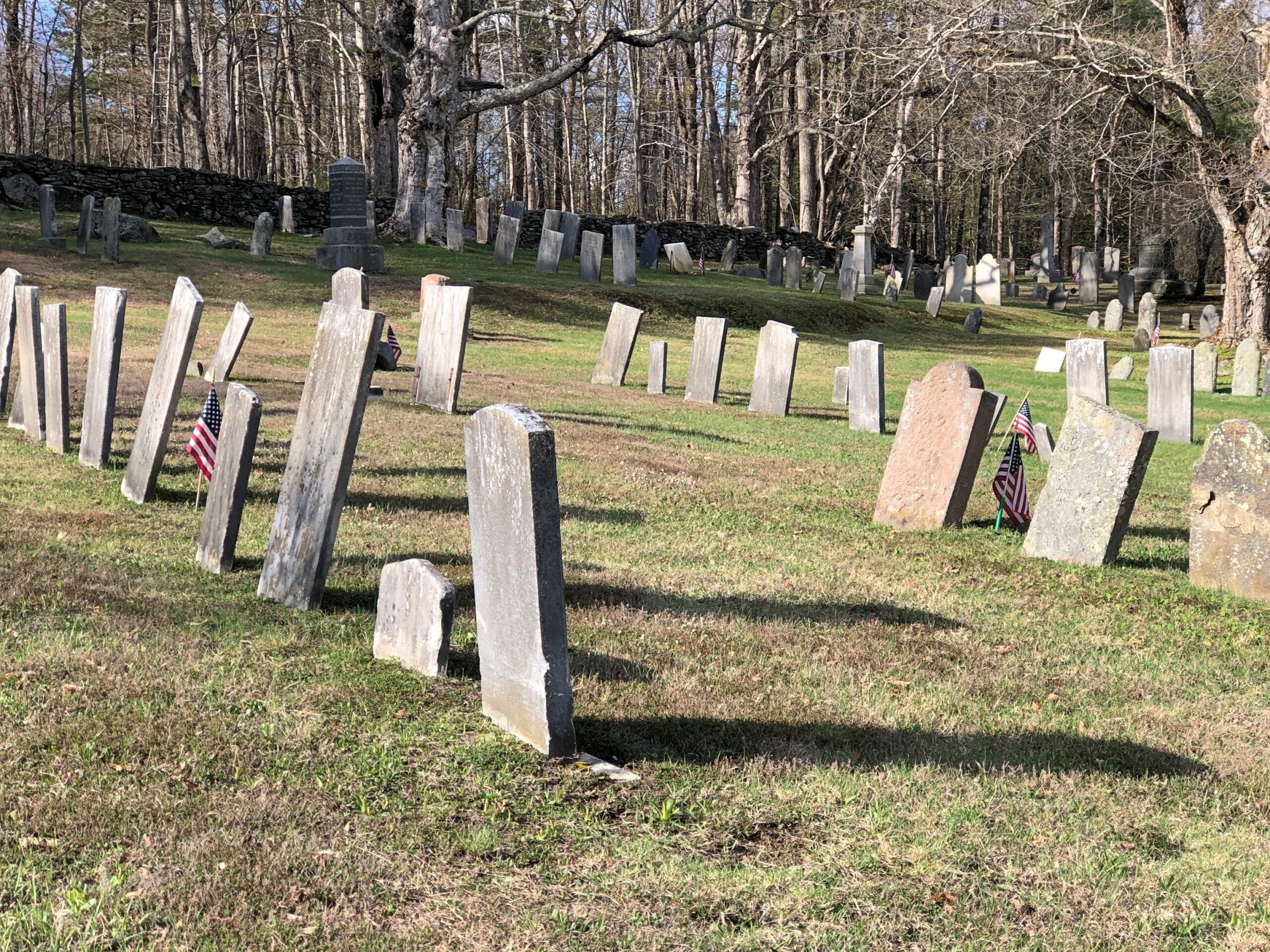
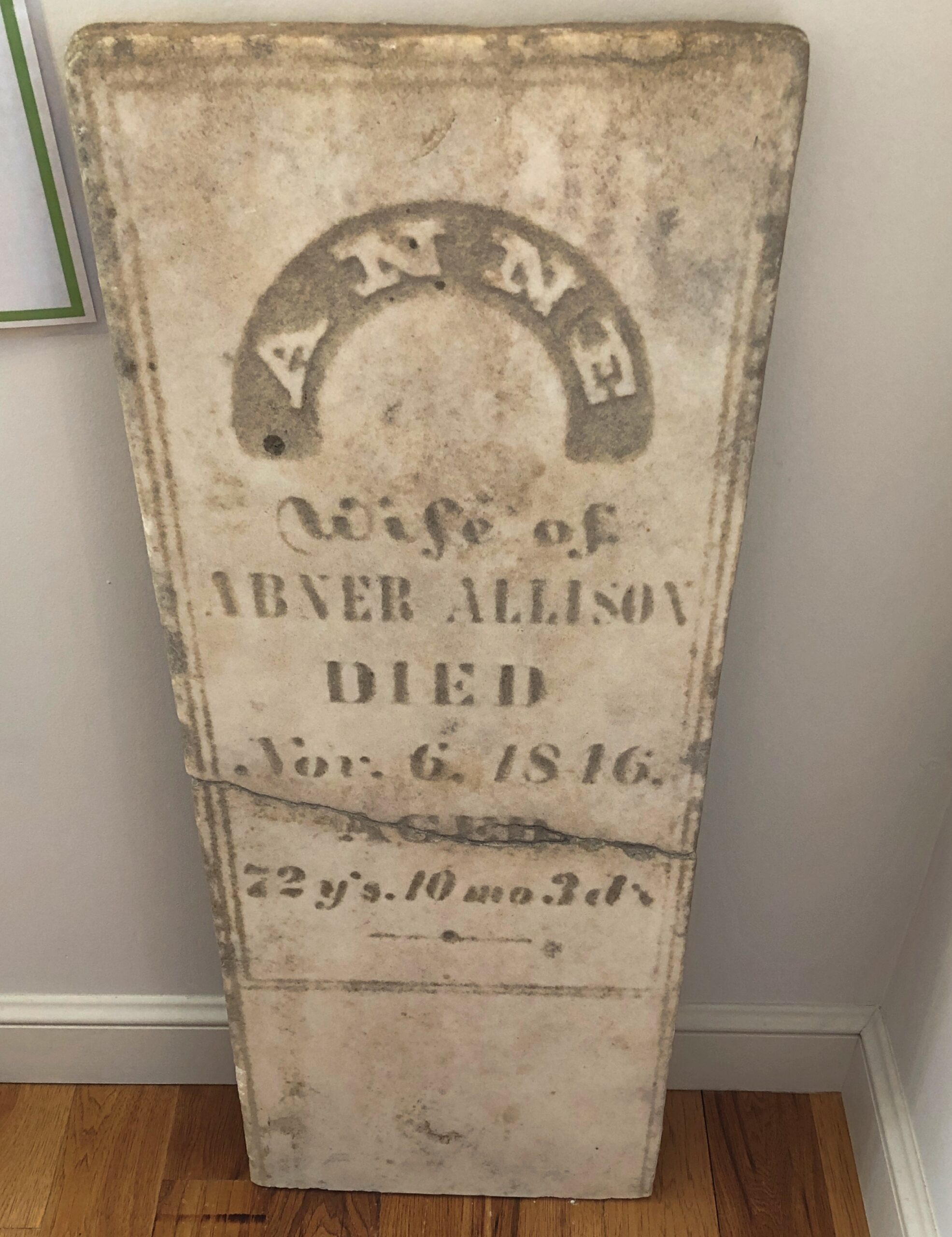
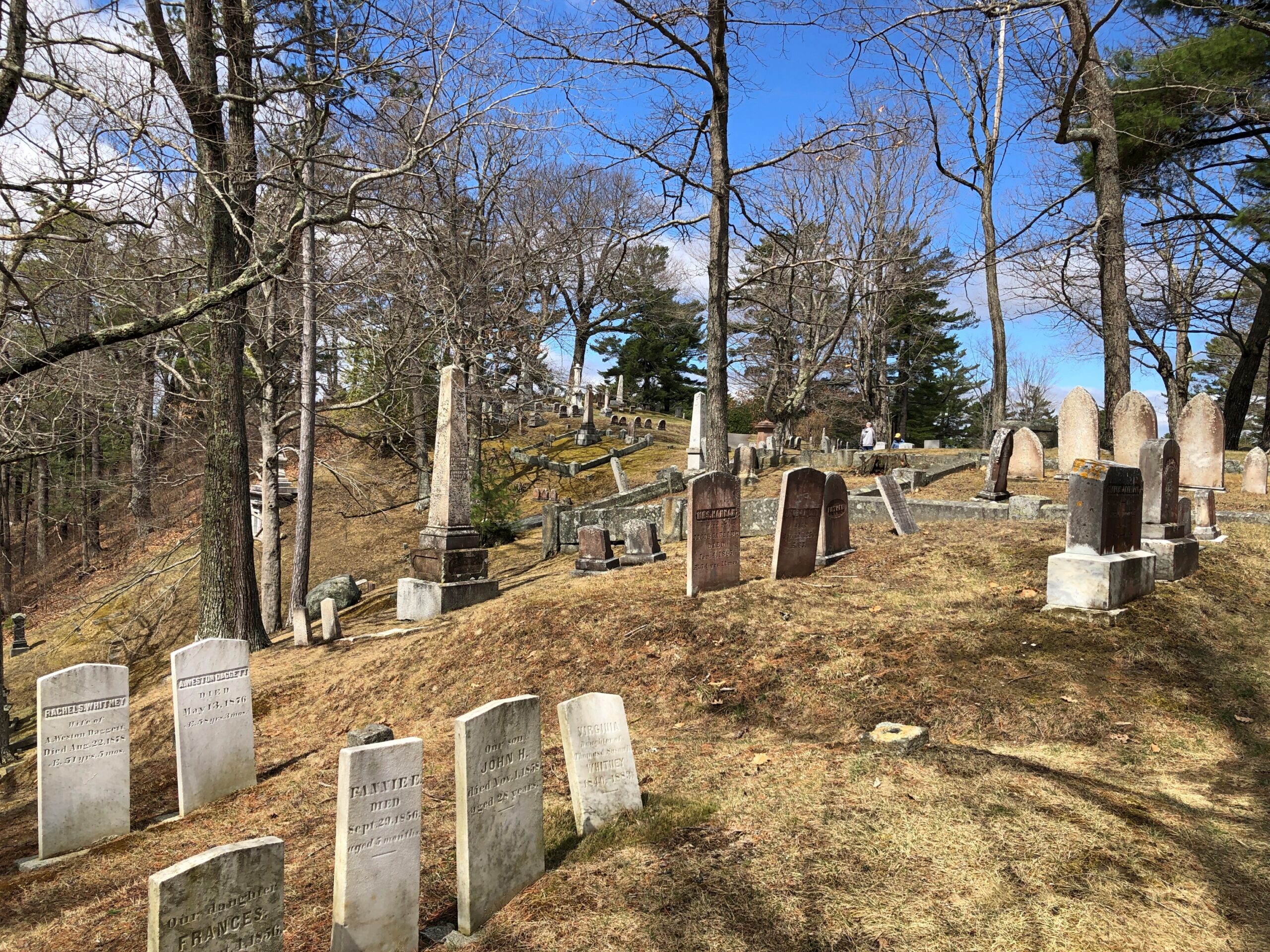
Aged and crumbly stones in mix, as usual.
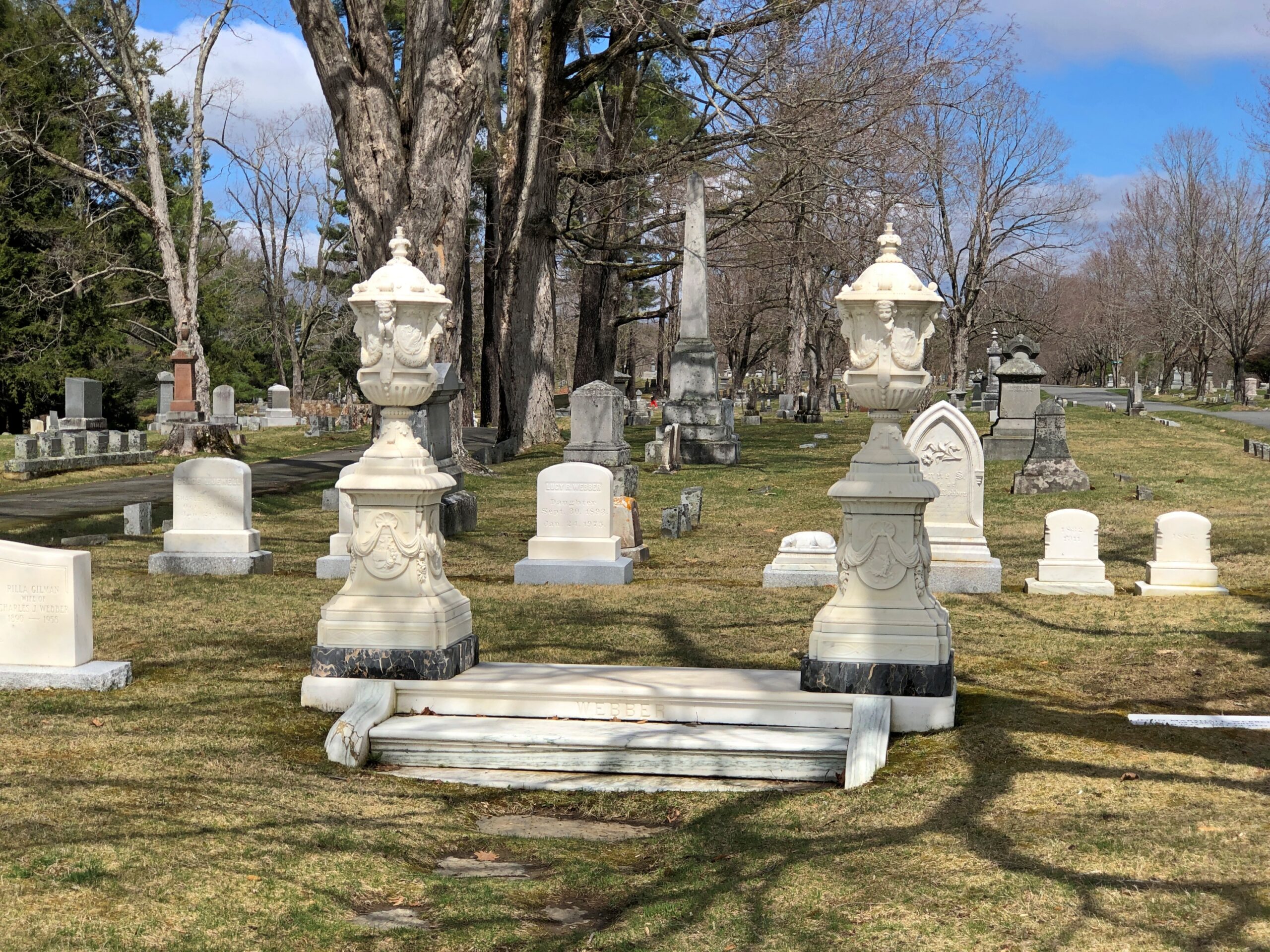
Not a lot of large memorials, but some.
More modest memorials.
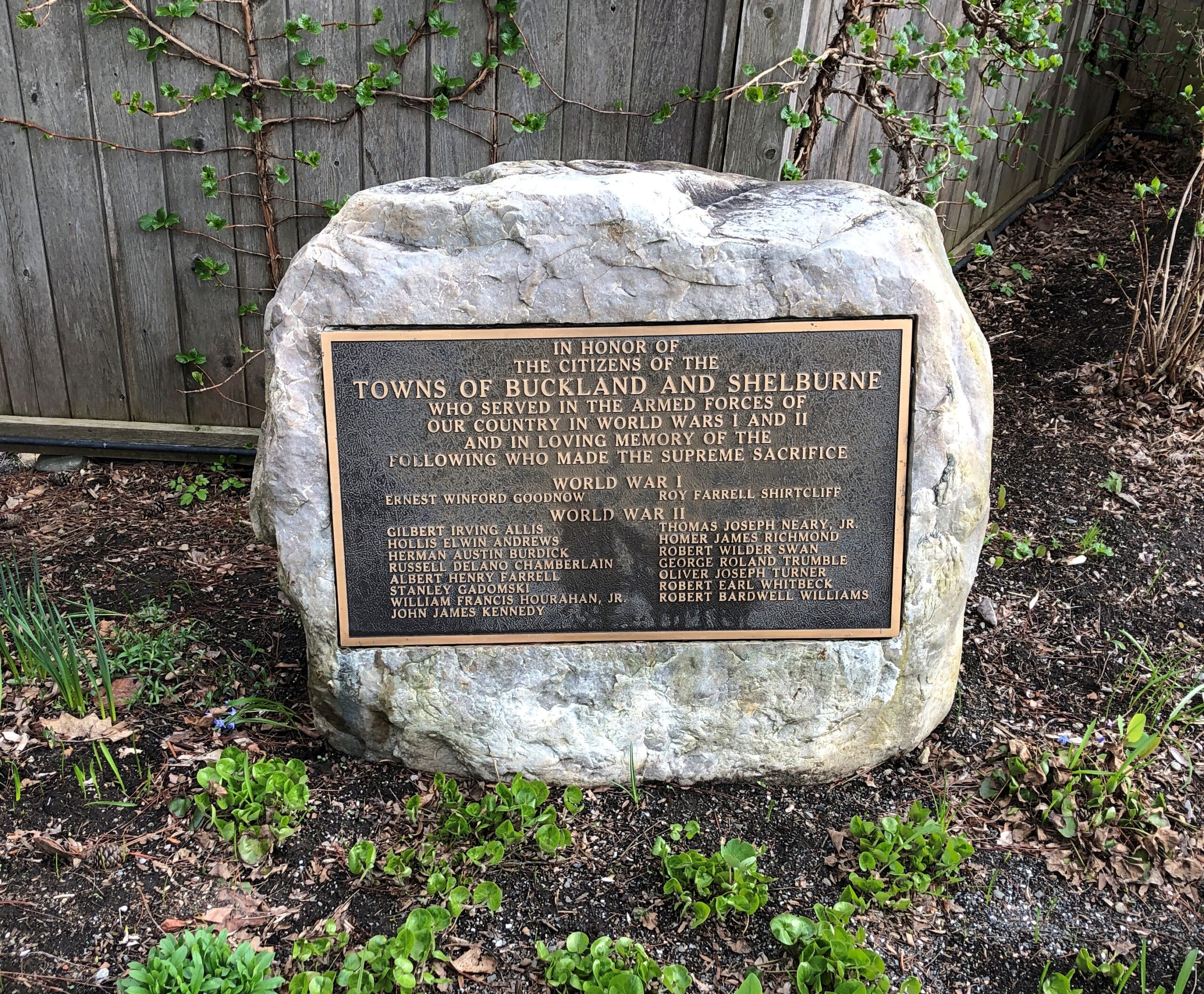
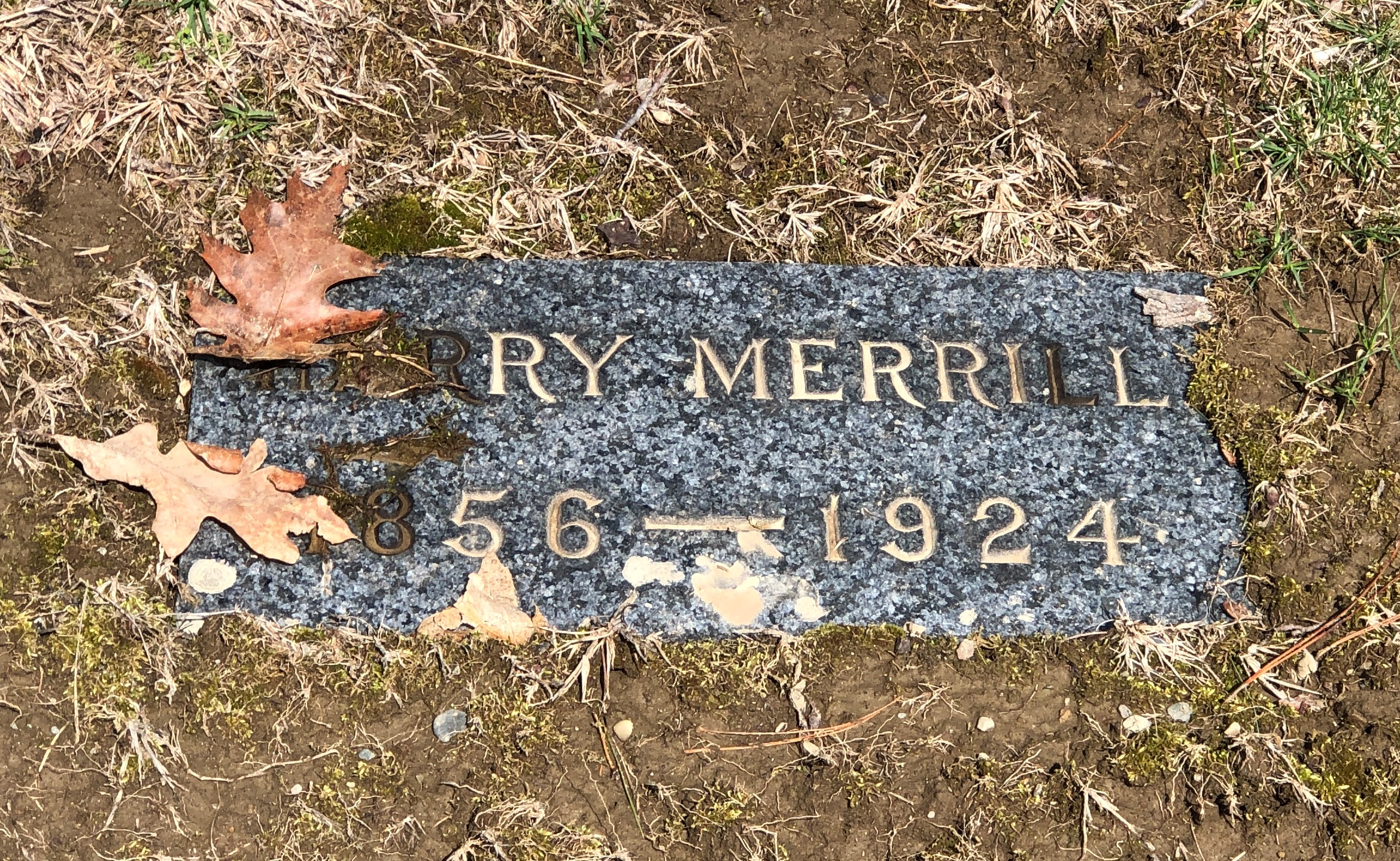
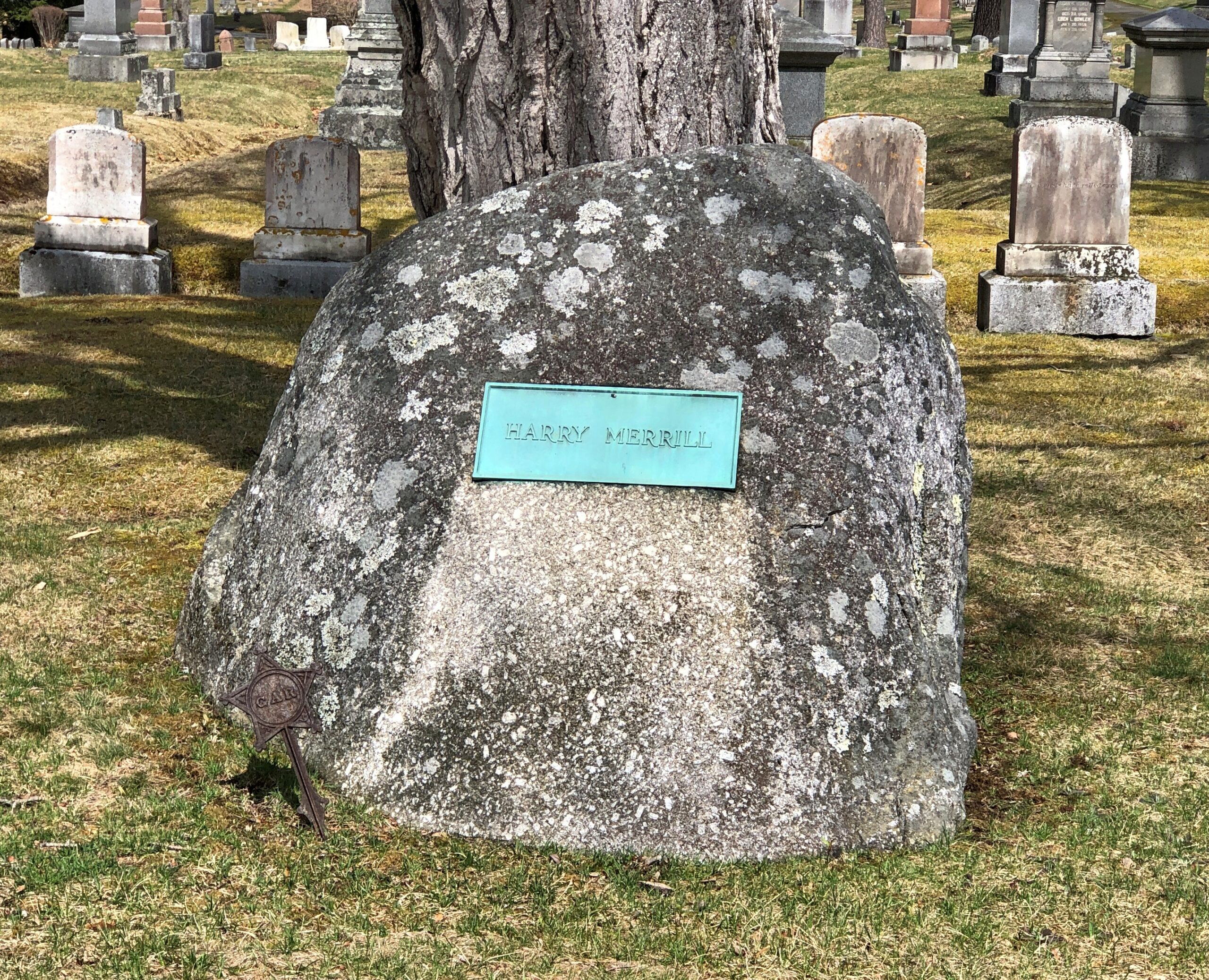
Actually, that isn’t the only memorial for Harry Merrill (d. 1924).
You have to wonder what the decision-making process was like among Harry’s family. Maybe they couldn’t agree on a fitting memorial, and one group went with a ground plaque, the other with a plaque-on-boulder?
“If you’re taking pictures of buildings, you should take one of that building over there,” an old man said to me, pointing at a building partly obscured behind the curve of the street. I had been taking pictures of buildings. A spring day had come to Bangor: the air was a pleasure, so was the friendly warm sun, and I was out and about among the short downtown blocks.
“Thanks,” I said, adjusting my position on the sizable downtown plaza, so that the building came into view.
Wow. As I often do, I looked into the building later. A little gem of the brick arts known as the Circular Brick Building, a no-nonsense Maine sort of name, or the Merchants National Bank building, after a long-time occupant. Part built in the 1900s, part in the 1920s, a bank till the 1980s, a mix of apartments and ground-floor retail since the 2010s, after some decades vacant.
A random old man’s recommendation was a winner. He was idling on a bench in the plaza, so I went back and told him I agreed that it was an impressive building. The man could have been from central casting: Get me an old Mainer in ordinary but not shabby clothes, and don’t forget the bushy white beard and pale pink face. It was a missed opportunity when I asked him whether he’d lived in Bangor his whole life. The comic Mainer answer would have been, “Not yet.”
Instead the old Mainer told me he had. Wouldn’t live anywhere else. Couldn’t imagine living anywhere else. Didn’t want to go anywhere else. He implied he’d had enough of that during his time in the Army, exact years unspecified, and I didn’t ask when, though there’s a distinct chance a shooting war was going on then. That doesn’t mean he was anywhere near it, however. For all I know, he could have been a PFC excrement sanitation specialist (PFC-ESS) in Louisiana, to put it in the way the cinematic Patton didn’t, but the ’60s Army might have.
Anyway, he asked me where I was from, and long experience has taught me to say “Chicago,” and not something in any detail like, “Texas, but I haven’t lived there in a long time, and then I lived some other places like Nashville and Osaka, yes, the place in Japan, but it’s been Chicago for a long time now, except I actually live in the northwest suburbs.” Few people would hear any of that. Everyone pays attention when I’ve said Chicago (or Texas, the times I’ve said that). Somewhere years ago, I think it was a pudgy middle-aged Briton – you know, he looked a little like Benny Hill – who asked me where I was from. At hearing “Chicago,” he pantomimed shooting a Tommy gun.
When old man Mainer heard Chicago, he told me that soon after his discharge from the Army, he found himself in Chicago, in fact at the lakefront. He threw his Army ID into Lake Michigan. “Felt great to be out, but it was a problem, since that was the only ID I had right then,” he said. Obviously he made it back to Bangor.
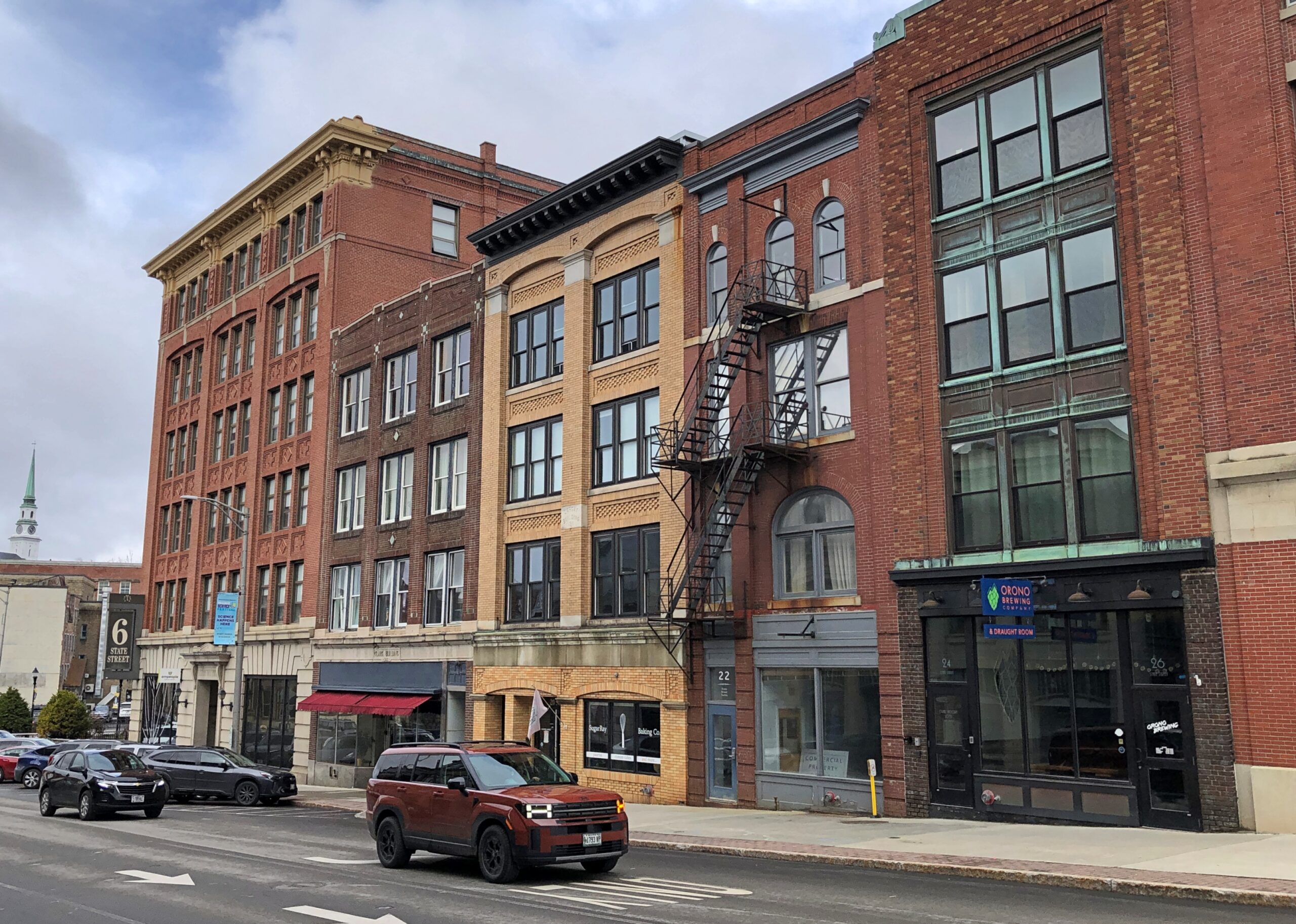
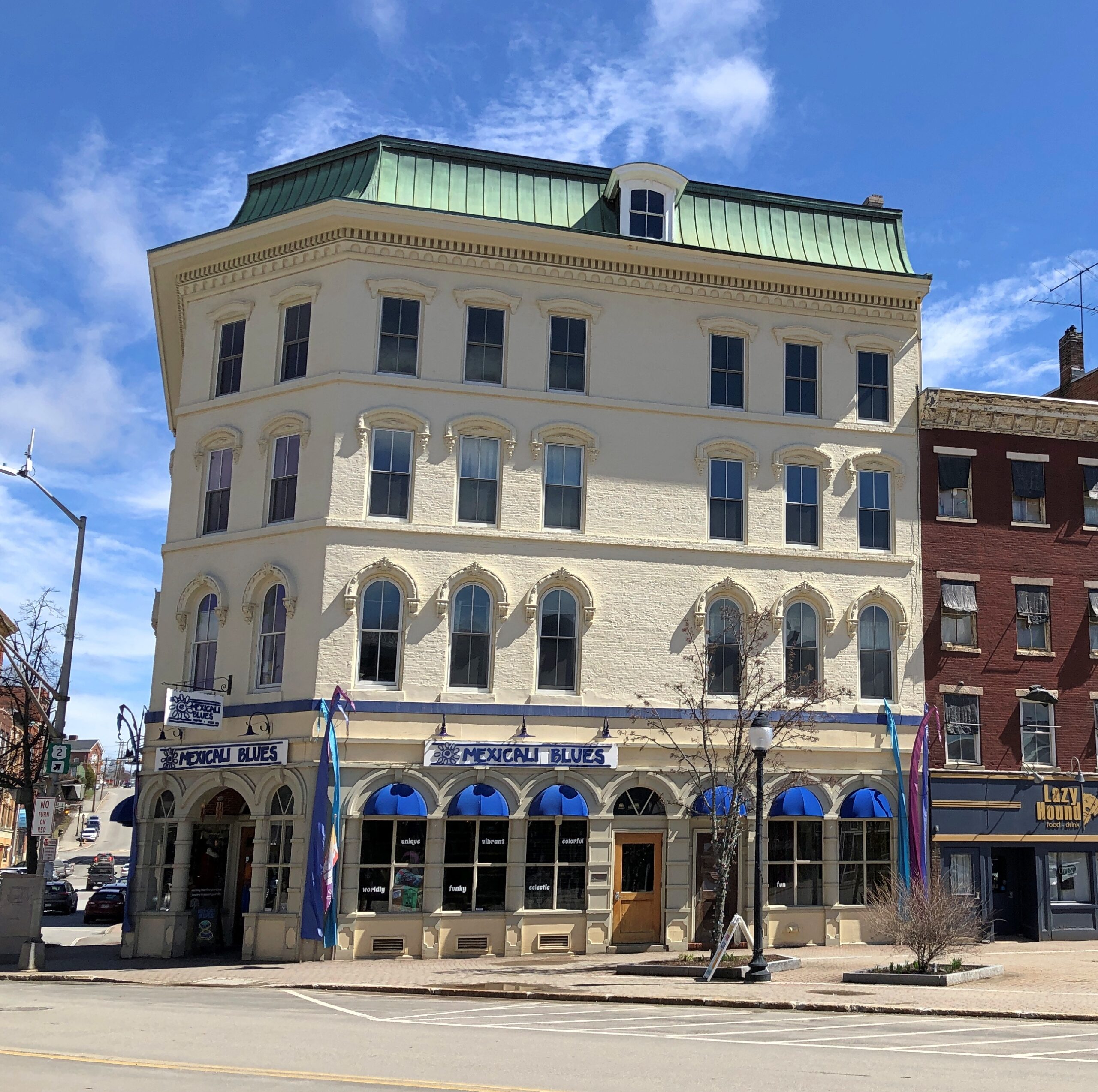
The city’s got some fine streetscapes.
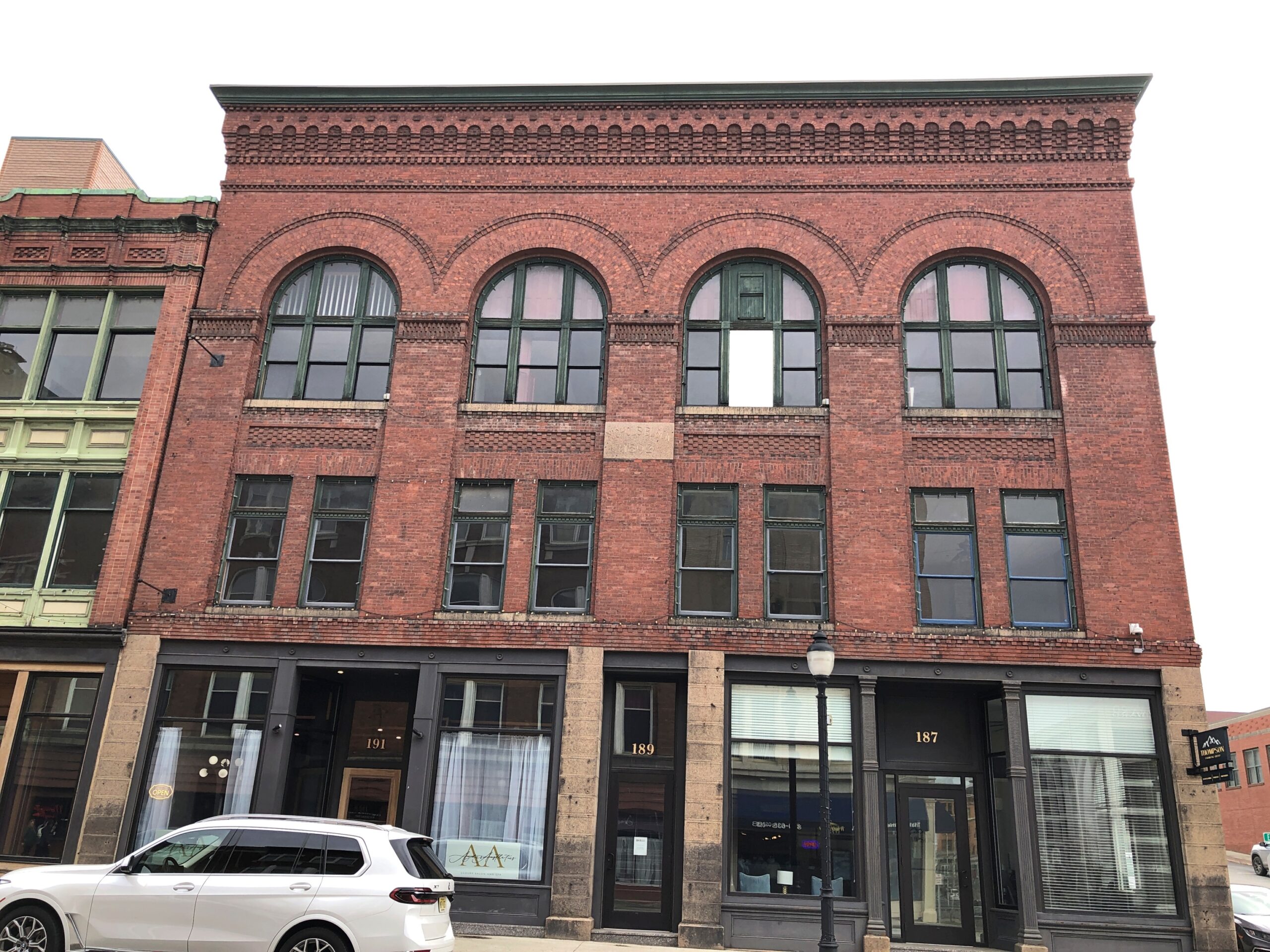
Some other handsome Bangor blocks and buildings.
Early examples of the art of the steel-framed highrise.
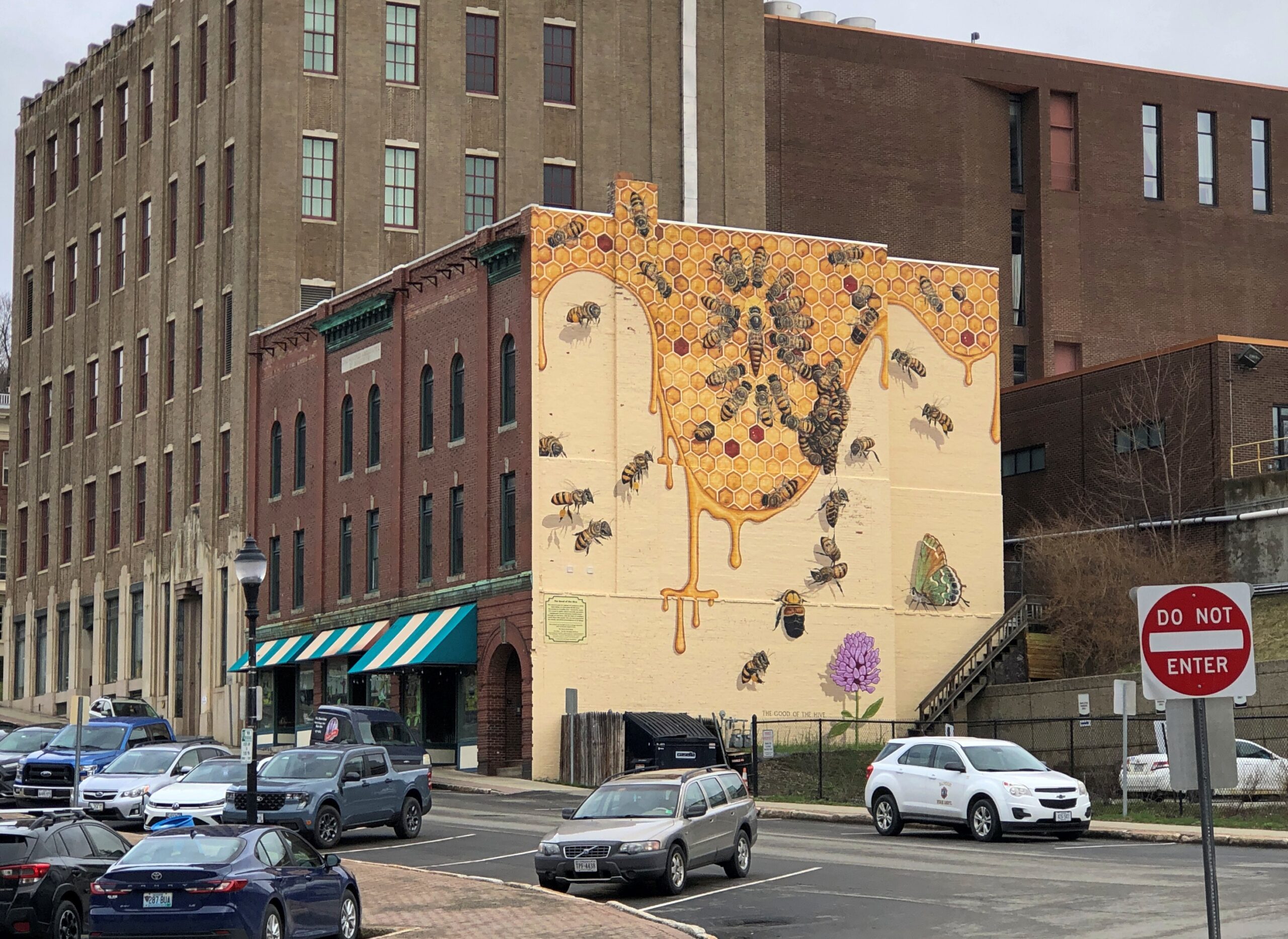
Paul Bunyan isn’t the only mural subject. This one is bees.
Because Bangor is known for honey production? I had to check and probably not much, the sort of thing that gets lumped in with “other” in the ag census for Penobscot County. These bees are bees for the sake of being bees. (Try that three times fast.)
“Bangor Beautiful partnered with Bangor Greendrinks to create a large bee-themed mural in Downtown Bangor during the summer of 2023,” notes the nonprofit Bangor Beautiful.”The artist Matt Willey is the founder of The Good of The Hive, a global mural project with the goal of hand-painting 50,000 honey bees, the number in a healthy, thriving hive. He has painted bee murals all over the world, including at the Smithsonian.”
I knew I got out of bed for a reason today: to find out that there is an artist whose obsession is bee murals. More than 11,780 painted bees so far, according to the artist. Eccentricity of the first order, and I salute it.
You can’t call Bangor bustling, but I’ve seen plenty more vacant downtowns. Business details, former and existing.
Temple of the Feminine Devine, eh? Not to be confused with the Temple of the Devine Feminine, an outfit in Seattle. I could make a Life of Brian reference here, but if you know that reference, you’ve already thought of it.
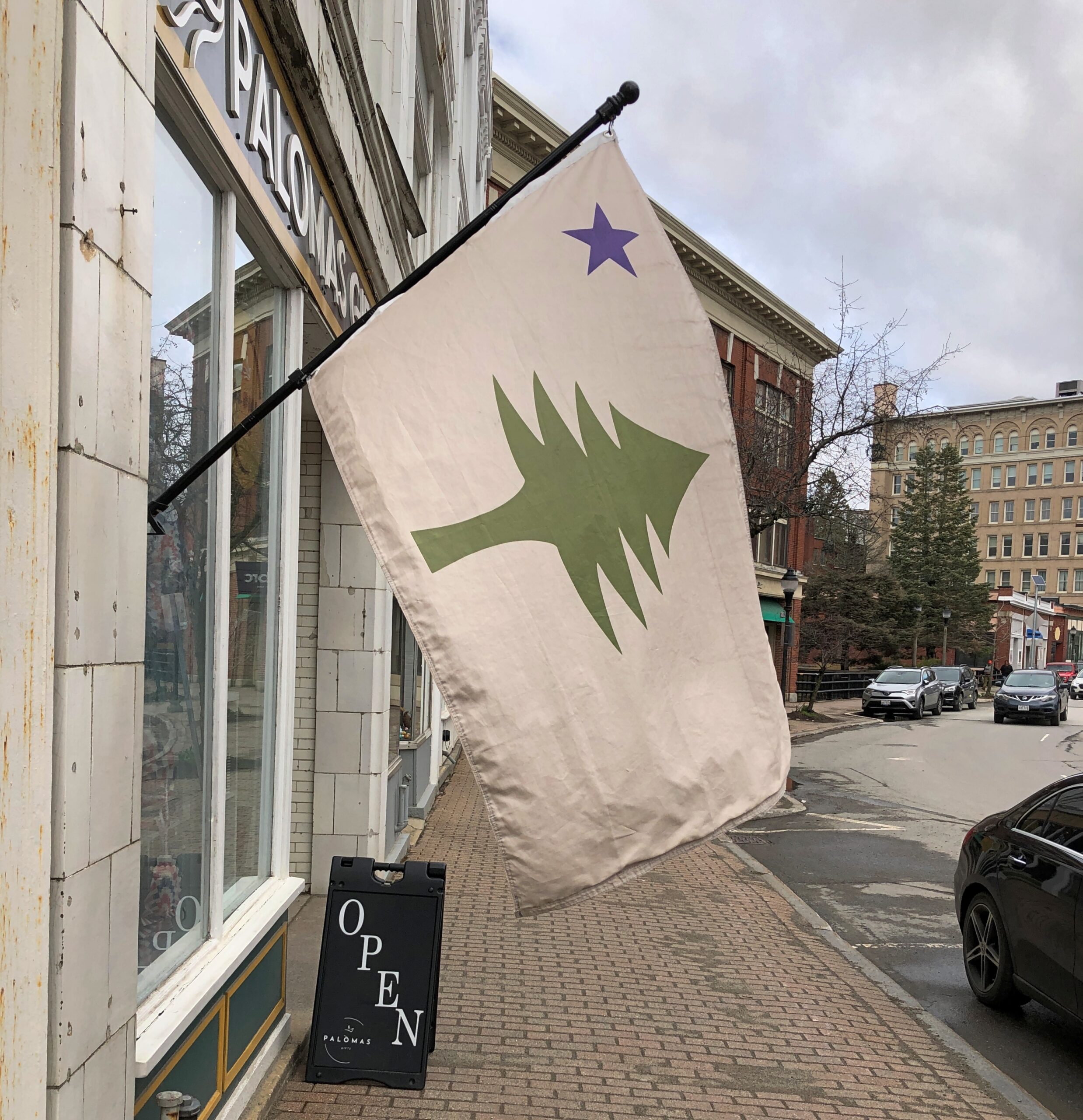
The unofficial Maine flag, and variations.
That flag failed to become official in the last election in a ballot question. No one in Maine cares what I think, but I think it should be made official again, but without disestablishing the current flag. Co-official, you could say. Maine would be unique that way. Also, no fixed pattern beyond a single pine tree and a single star to the upper left. Let a loose a proliferation of lone pine flags begin.
Bangor as a whole hugs the Penobscot River, but downtown clings to the much smaller Kenduskeag Stream, a tributary of the Penobscot.
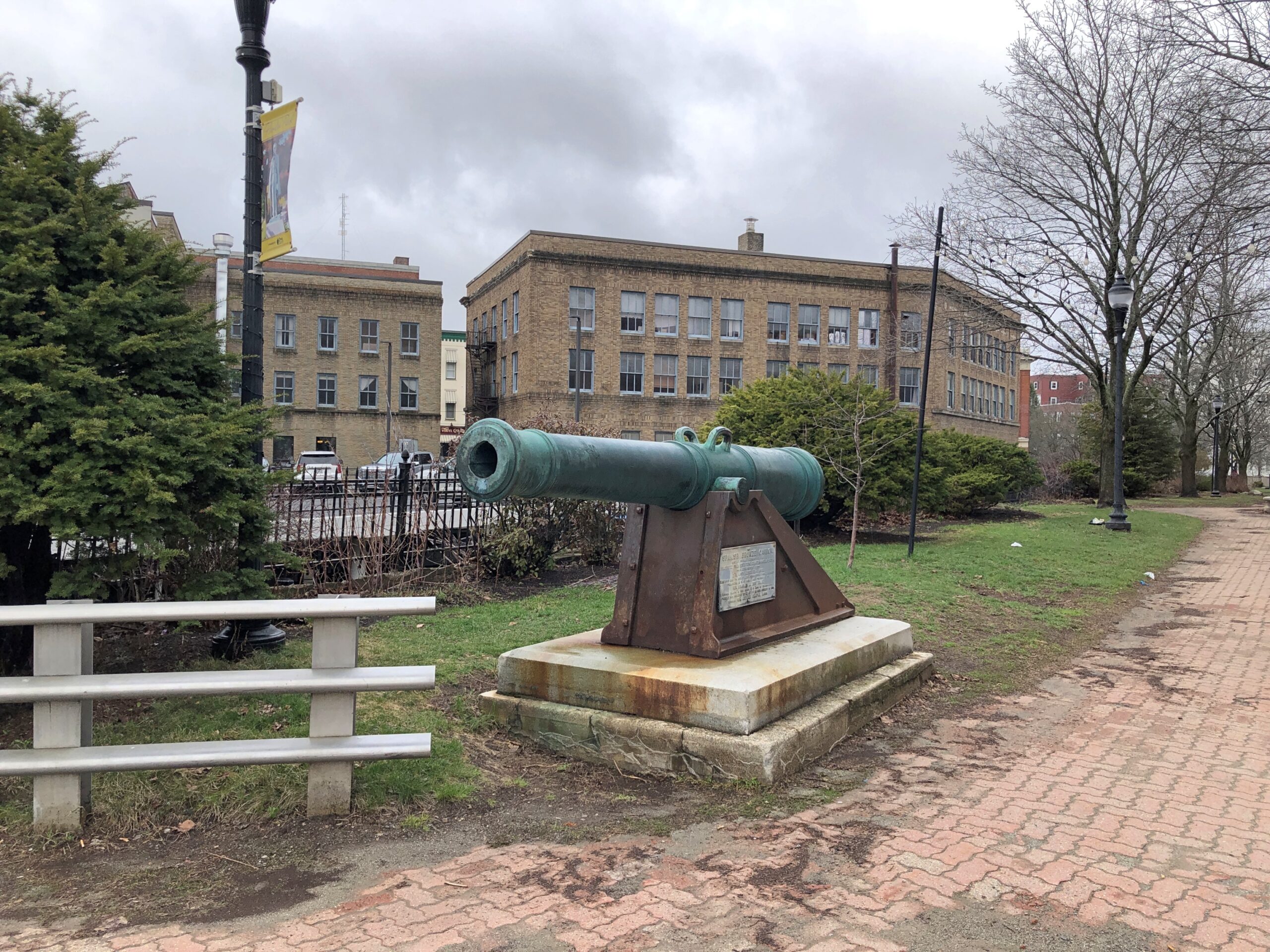
A small island in the stream is a park.
The park sports a cannon captured at Fort Toro, Guantanamo Bay, Cuba in 1898.
It so happened that Rep. Charles A. Boutelle was the chairman of the Committee on Naval Affairs in the U.S. House at that moment, facilitating the war prize cannon’s permanent move to Bangor. Quite the career Boutelle had, per Wiki: “American seaman, shipmaster, naval officer, Civil War veteran, newspaper editor, publisher, conservative Republican politician, and nine-term Representative to the U.S. Congress from the 4th Congressional District of Maine.”
That’s not all. Vice President Hannibal Hamlin, Bangor favorite son, stands in bronze not far from the cannon.
“After Lincoln took office and even with the outbreak of the Civil War, however, Hamlin had almost no role in the administration, as was common for this period in history. Hamlin despised his new position as vice president. He missed being part of the political process and controlling patronage but felt it was his duty to serve. He also found presiding over the Senate boring and was frequently absent. Still, he was disappointed when the Republican Party dropped him from the ticket in 1864.” A curious, but all too familiar quirk of human psychology, in that last sentence.
The “diplomat” on the plinth refers to his posting to Spain in the early 1880s, named to the job during the brevity of the Garfield administration.
Time for spring break. Back to posting around April 26, when it might actually be spring in northern Illinois. There have been a few days recently when I’ve been able to sit out on my deck comfortably, which is my idea of spring, but not that many.
The recent trip to Texas seems like a while ago now. As usual, though, there were many details. A lot more than I can convey, but here are a few more.
Faces
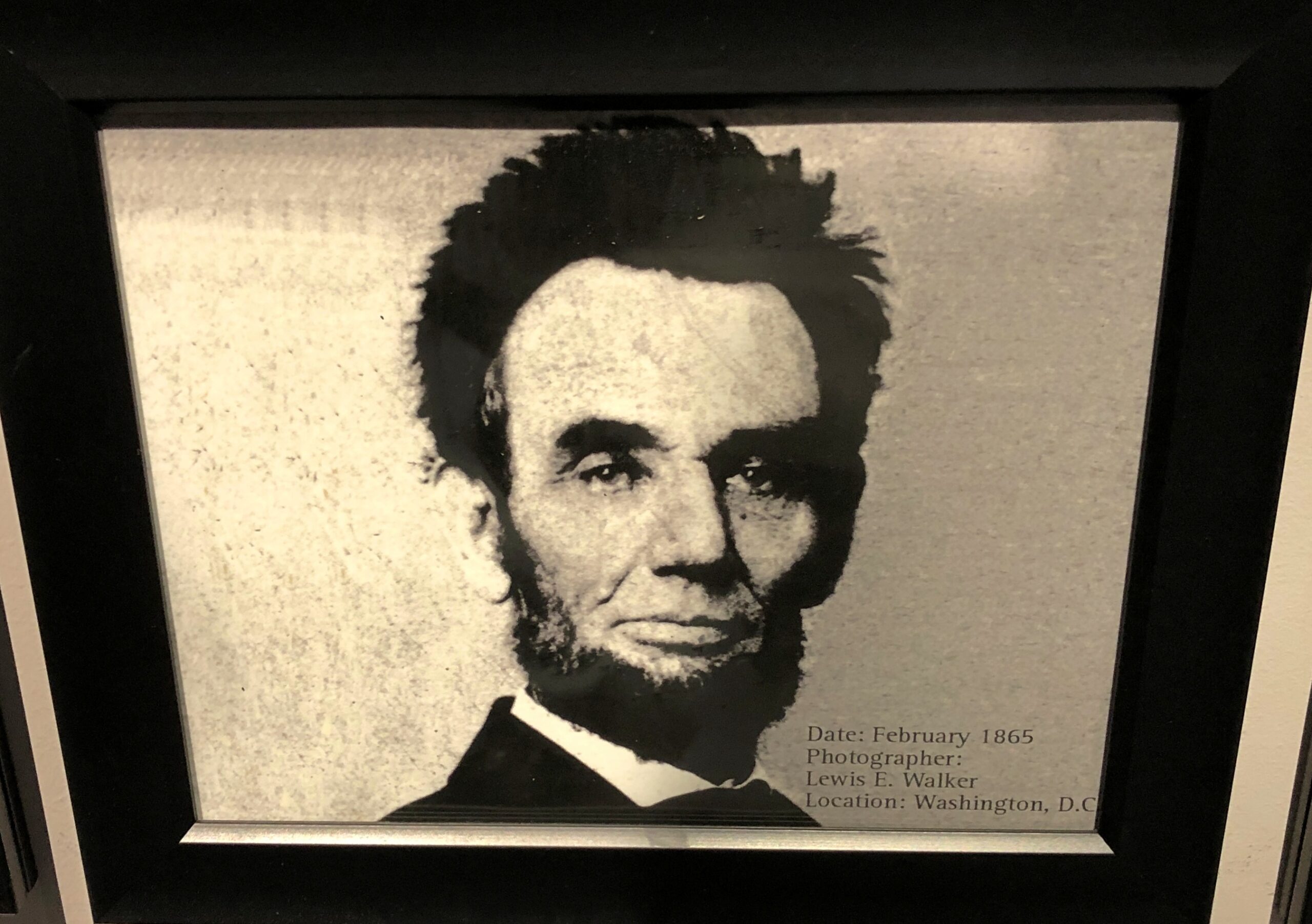
At the National Funeral Museum in Houston, one display featured, chronologically, 20 photographs of Abraham Lincoln. The third to last one, from February 1865, is one you don’t see much.
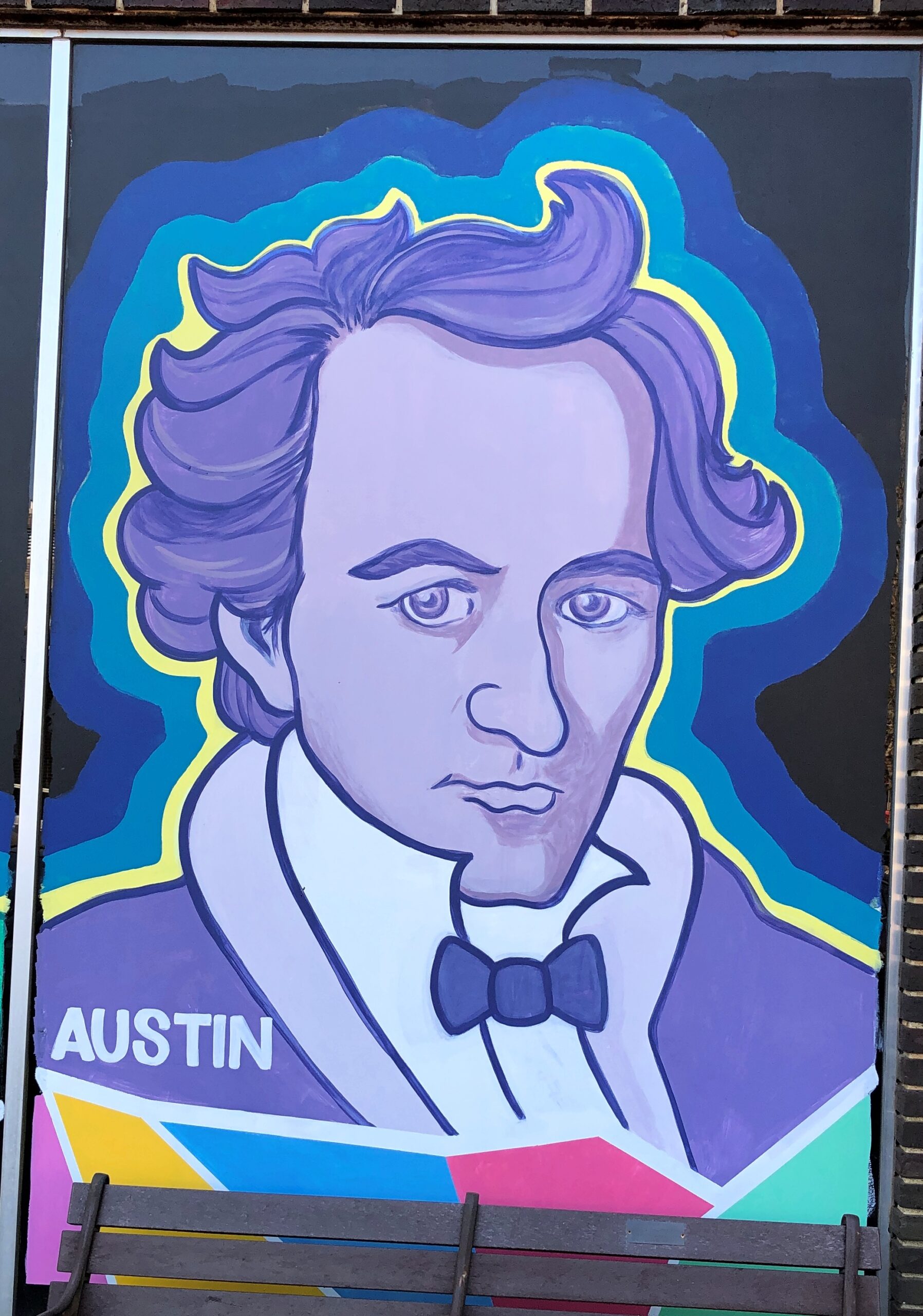
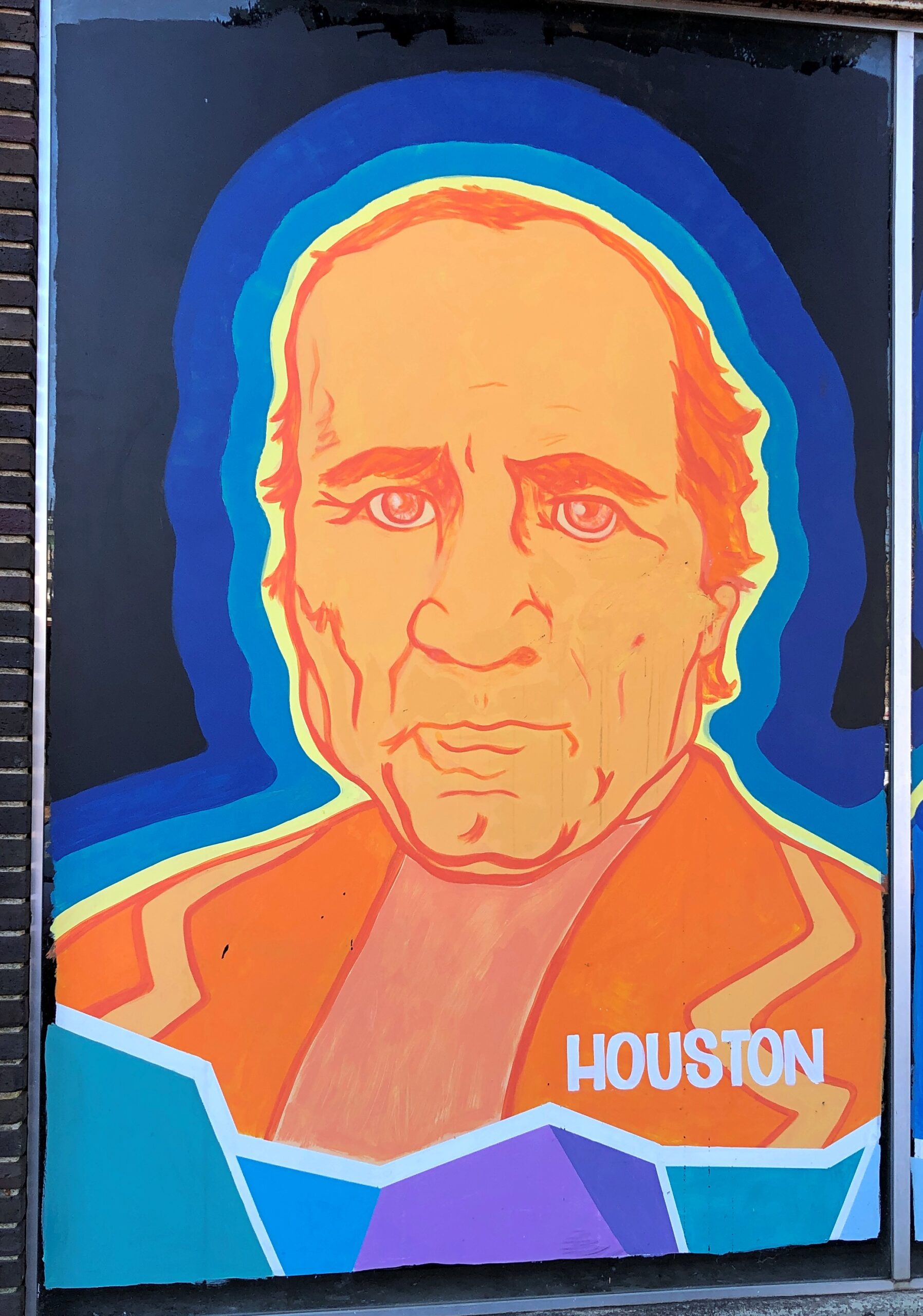
On a wall in downtown Nacogdoches, familiar figures from Texas.
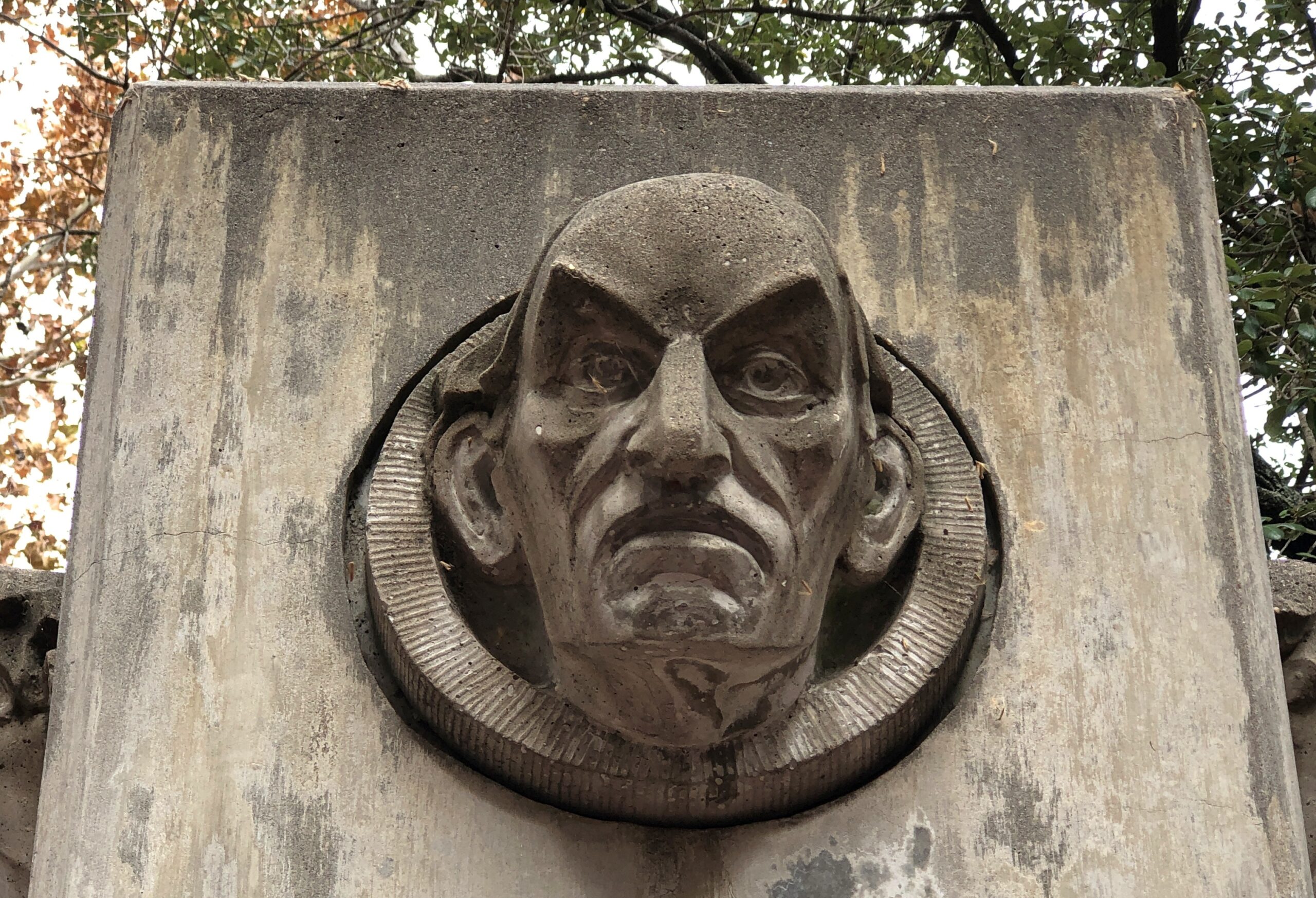
I didn’t work out who this was supposed to be, in downtown Houston. Better that way, I think.
Signs
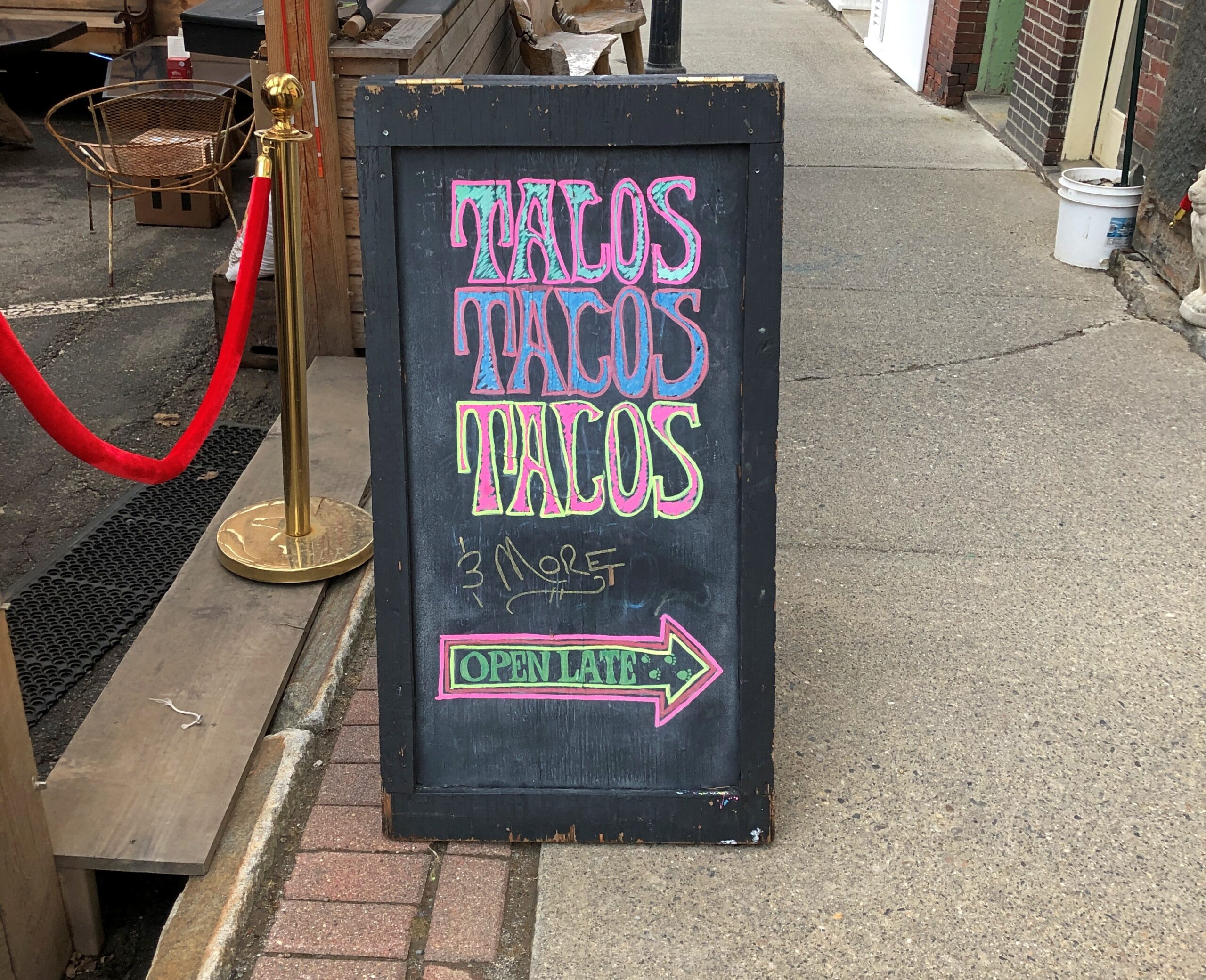
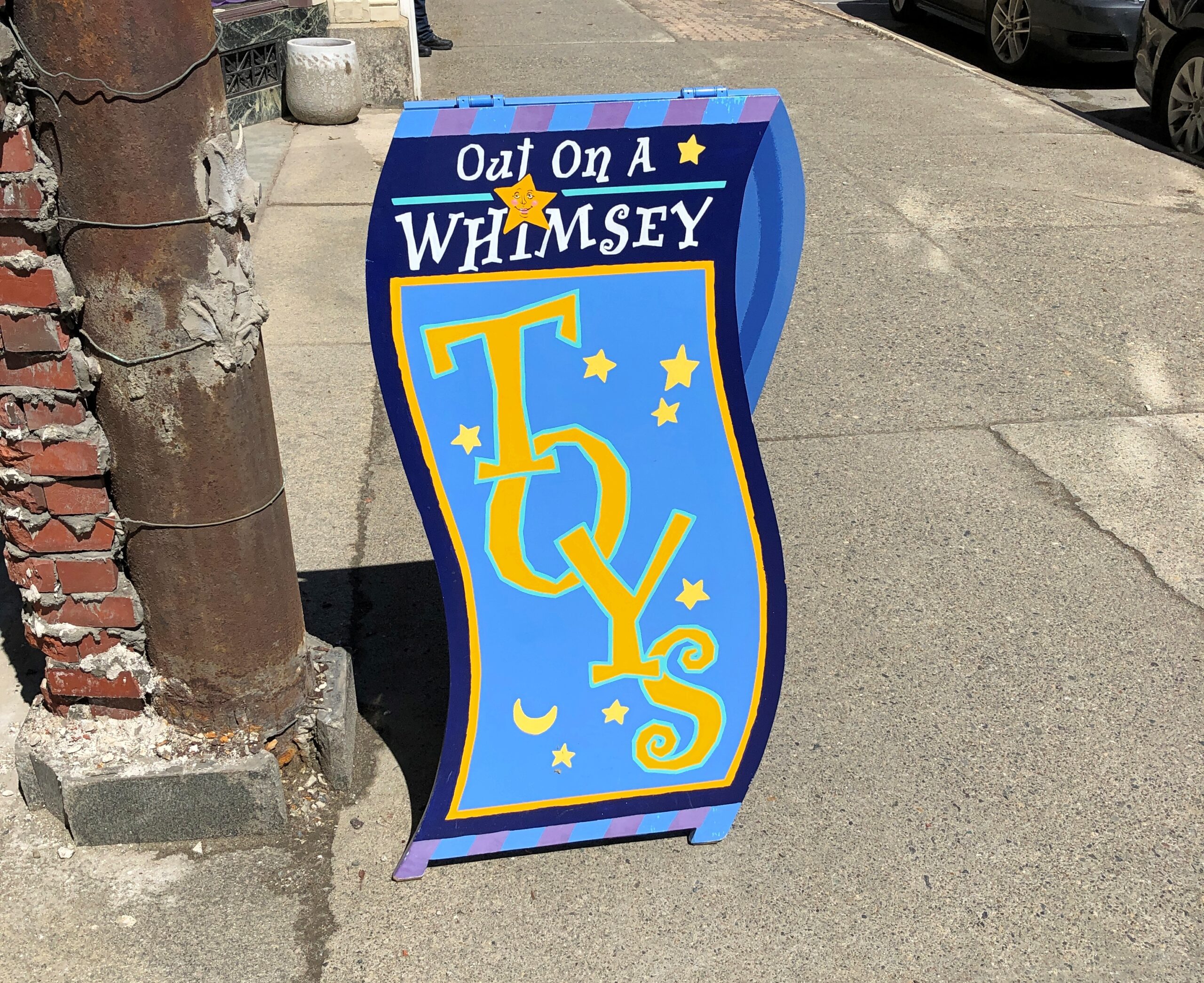
This place in Austin, well known to Tom, serves most delicious tacos.
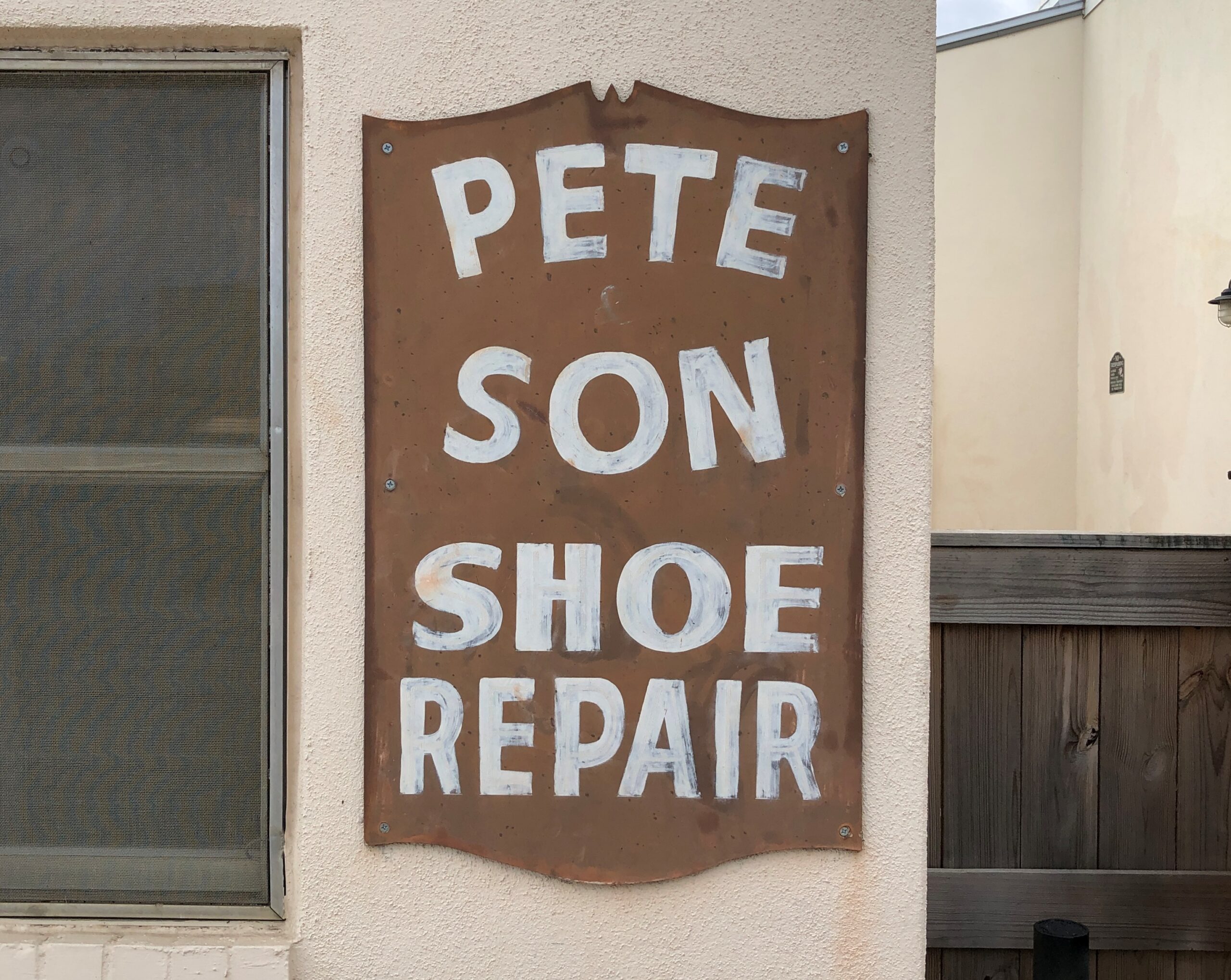
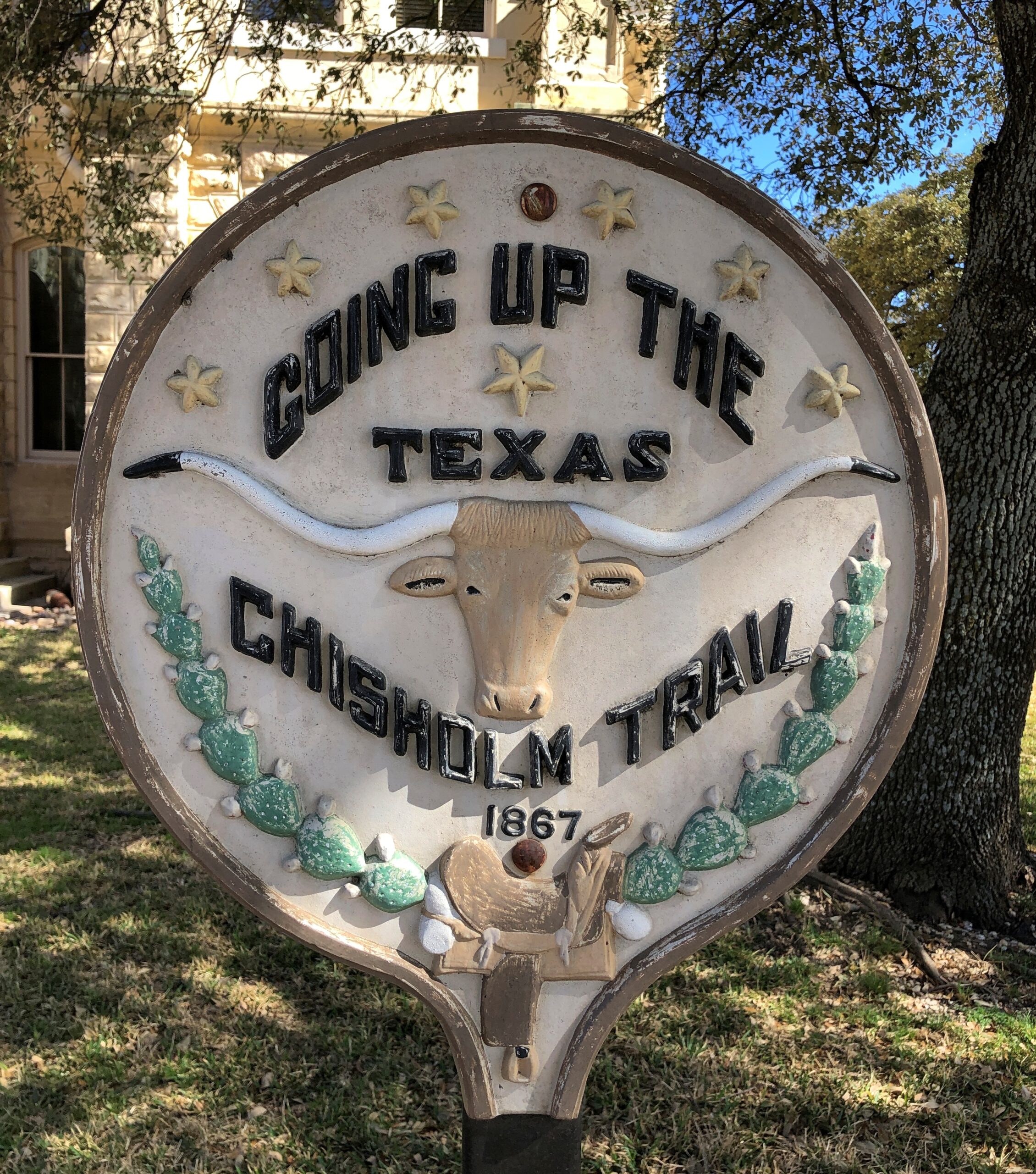
Bastrop: Cobbling runs in the family.
Belton.
Structures
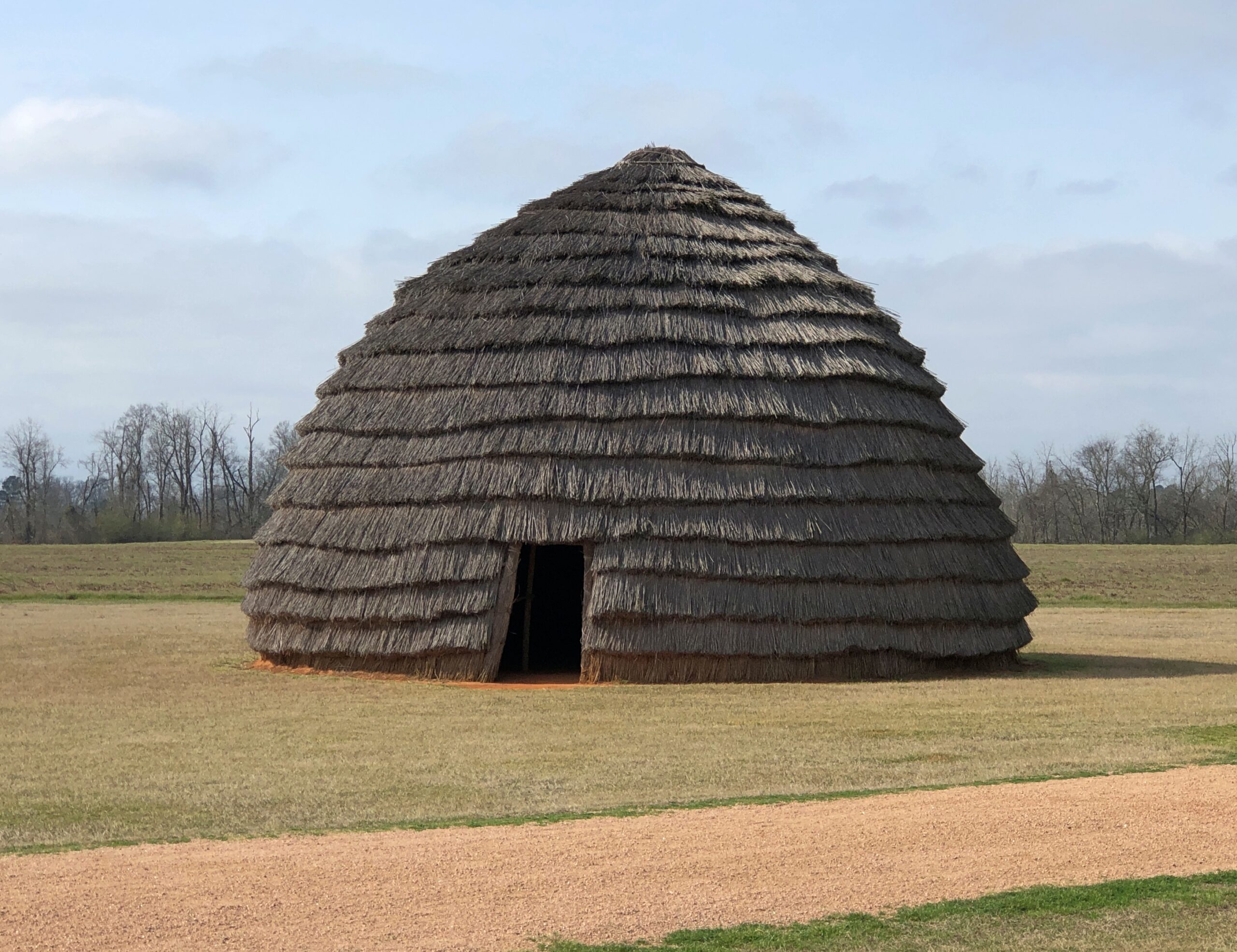
A re-creation of an ancient Caddo home.
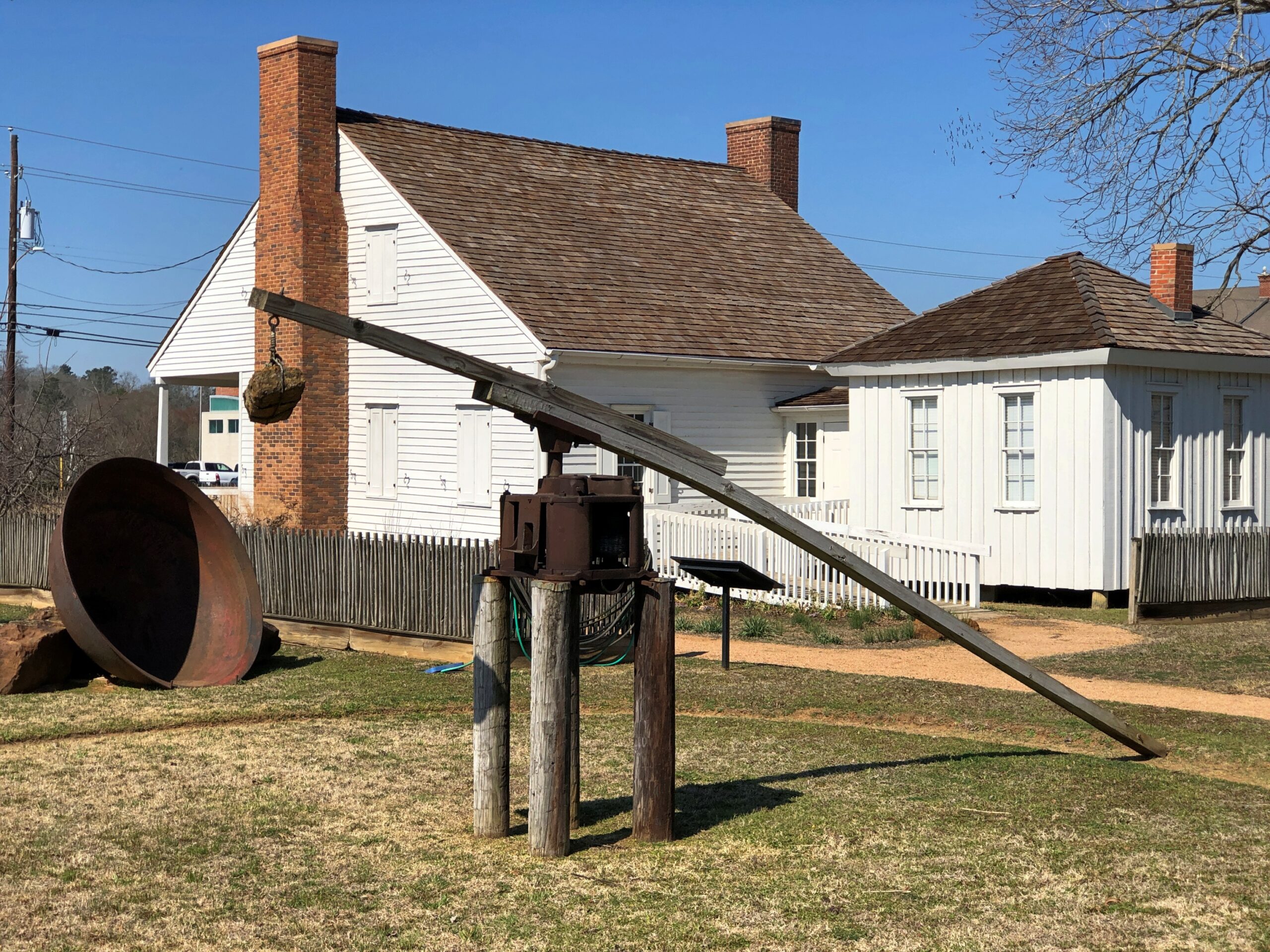
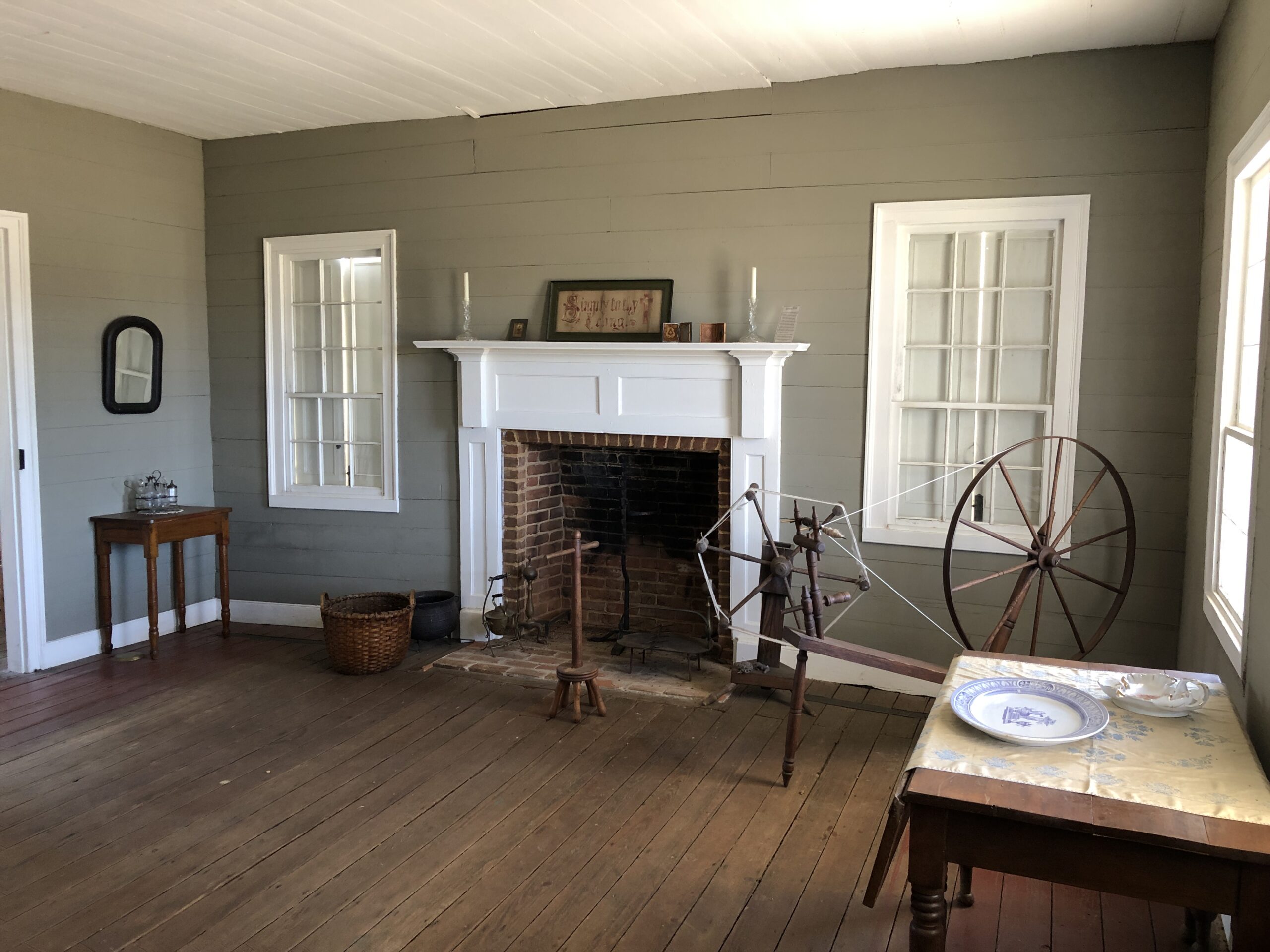
Durst-Taylor Historic House & Garden in Nacogdoches.
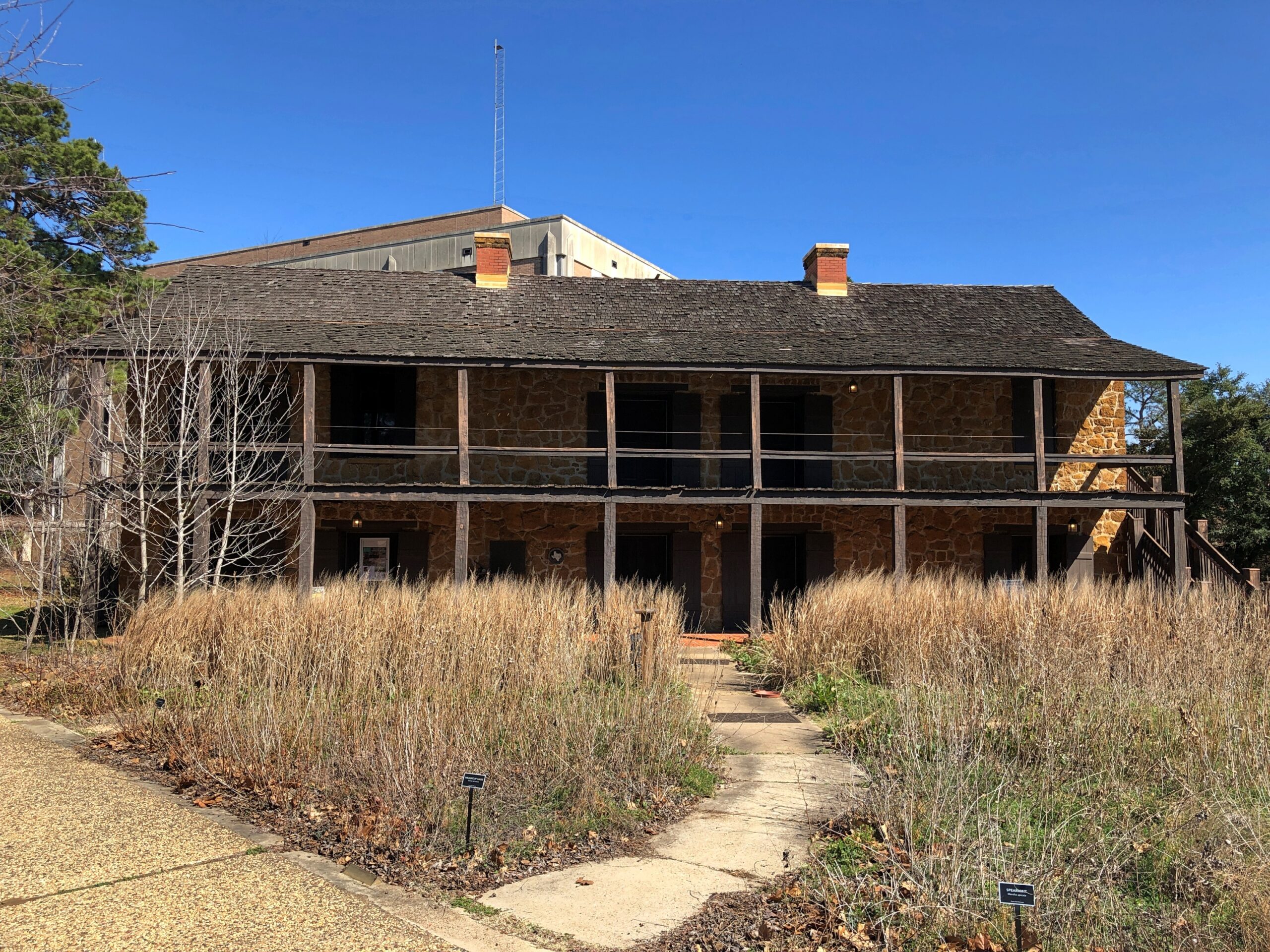
The Old Stone Fort Museum in the same town, which is made of stone, but was never a fort. On the campus of Stephen F. Austin State University. Recommendation to the university: if you want people to visit the place, provide just a little unrestricted parking. A little visitor parking anywhere on campus would be good.
Then again, the university seems determined to move the structure anyway — which might mean taking it apart, and then not putting it anywhere where because such a move would cost too much.
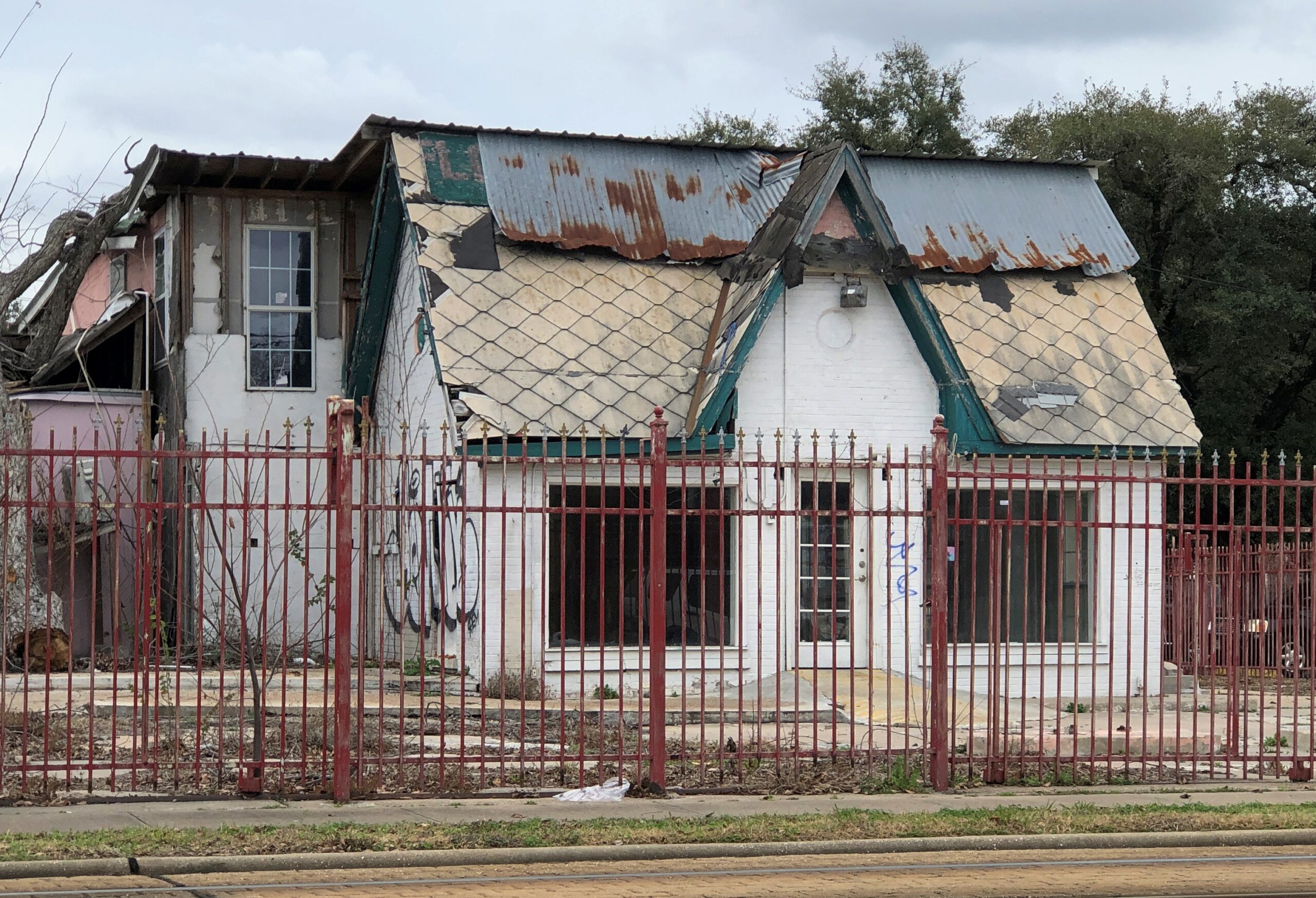
A place that has seen better days in Houston.
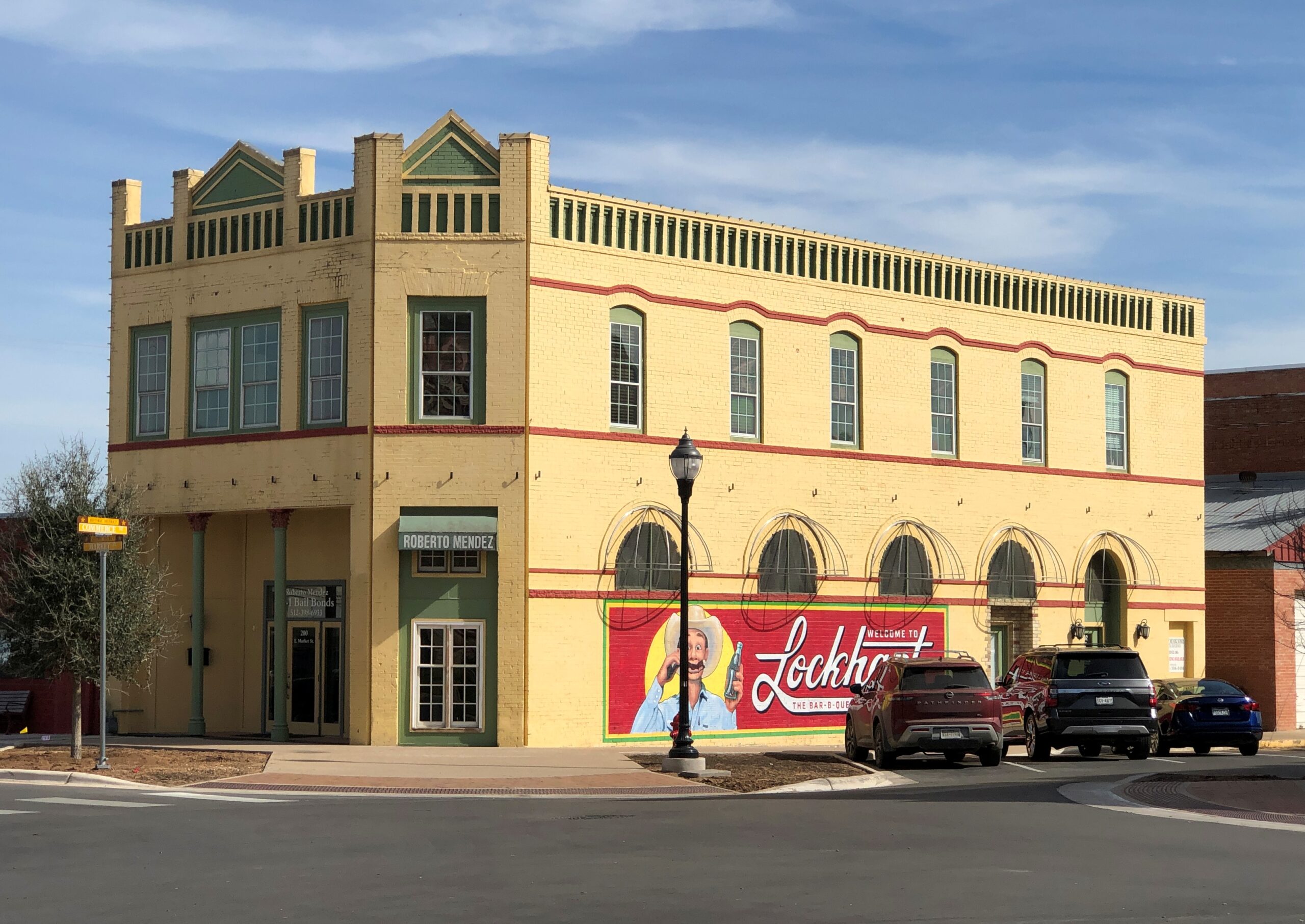
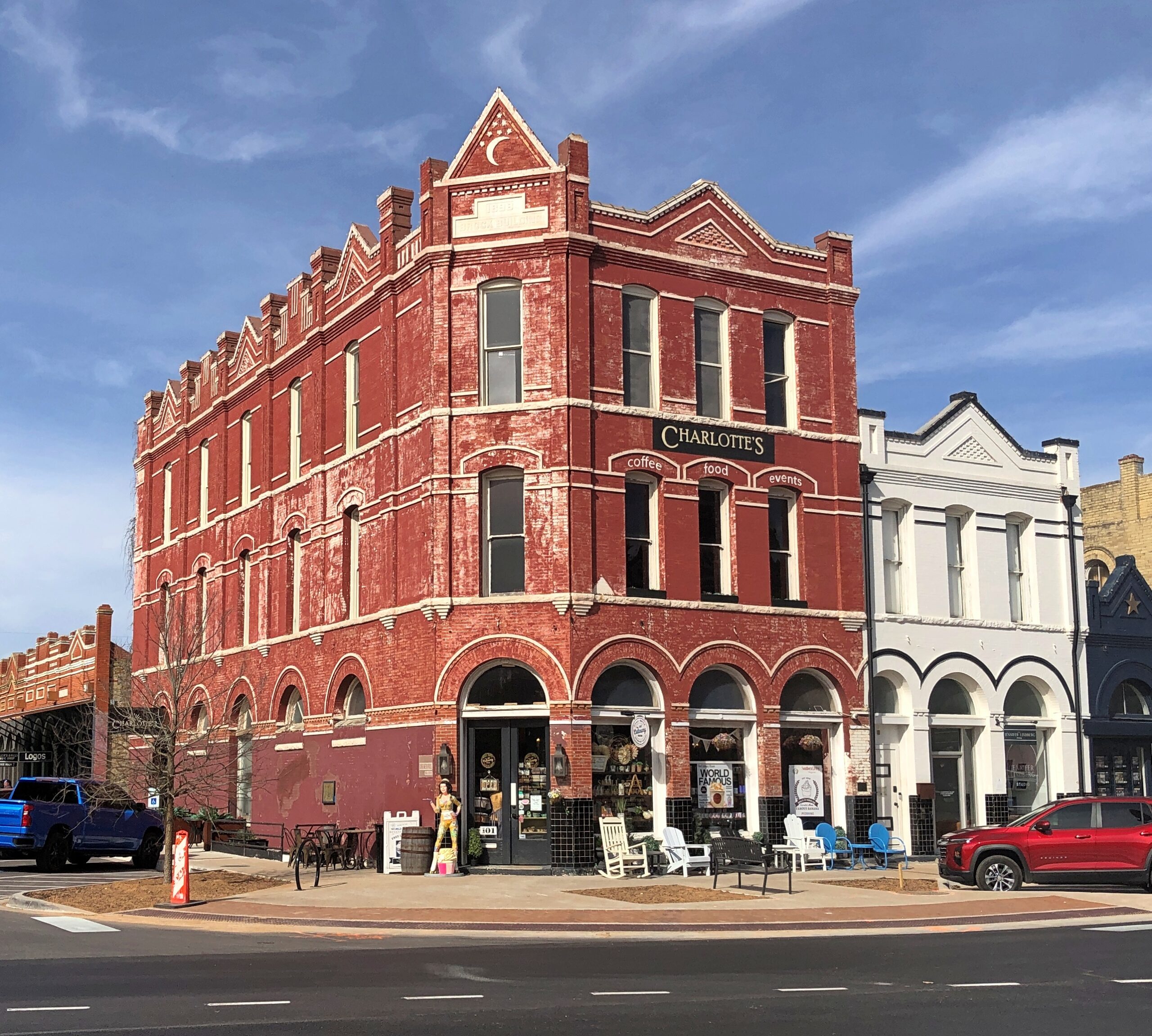
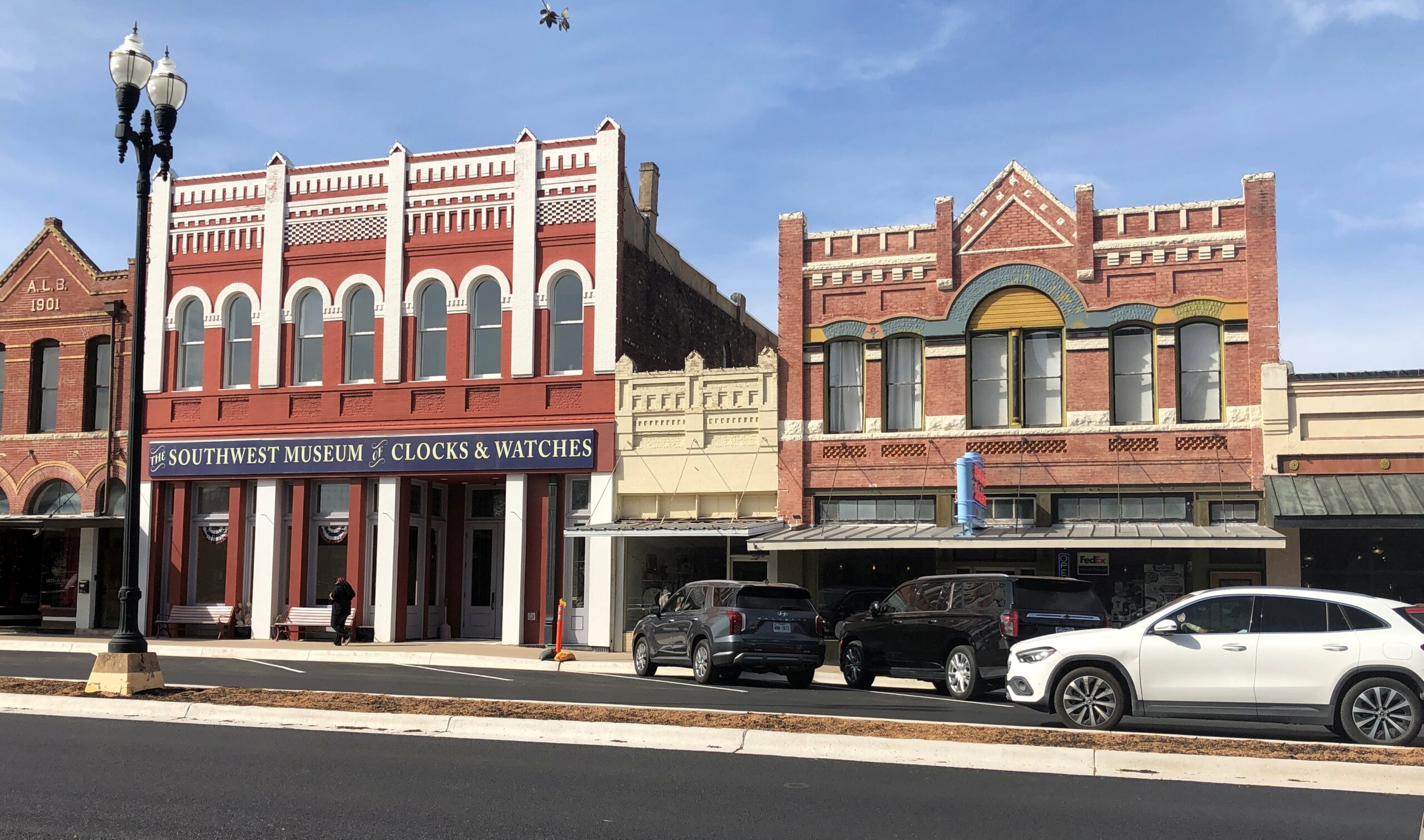
Downtown Lockhart.
The Southwest Museum of Clocks & Watches is permanently closed, alas.
Items
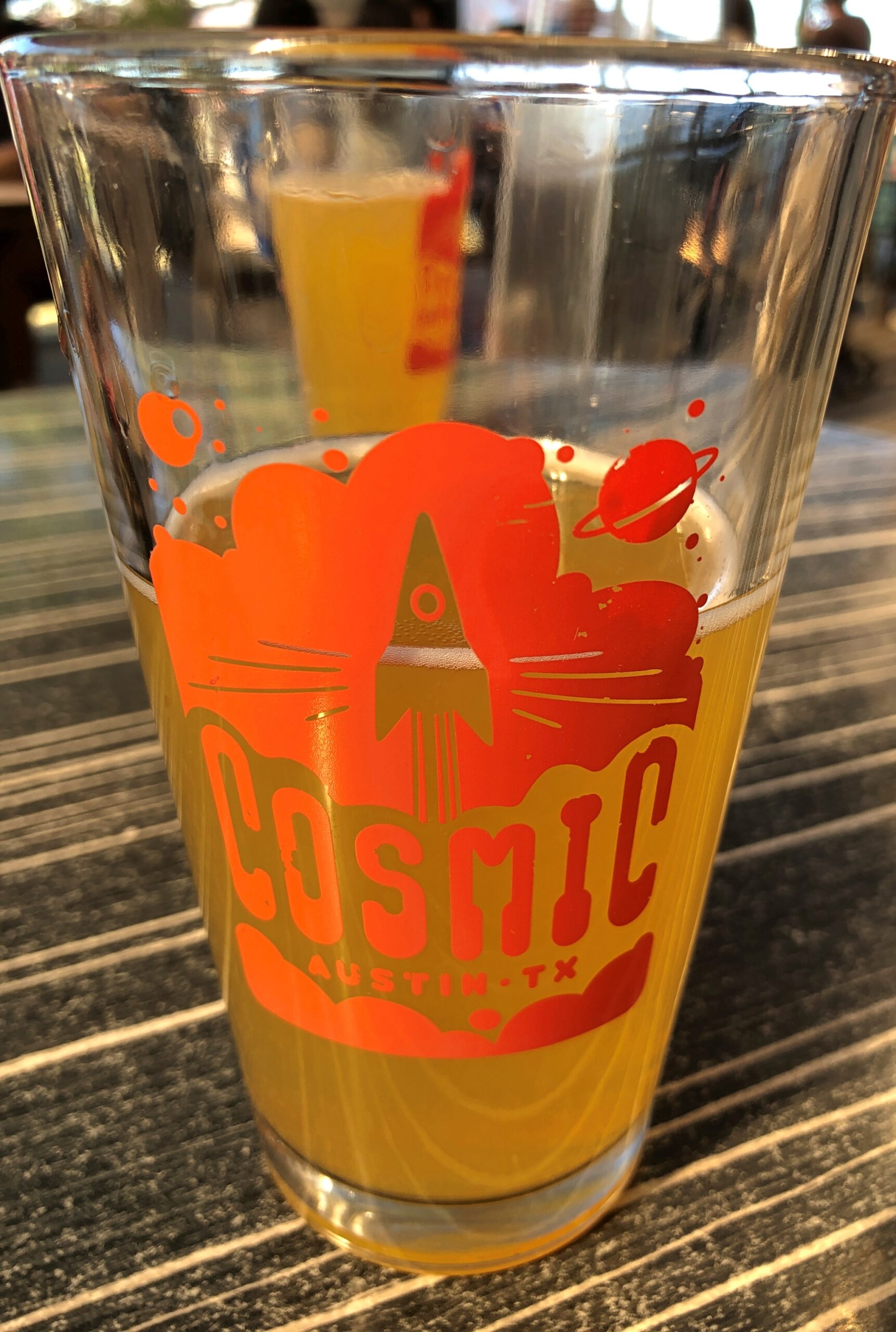
Cosmic in Austin is a bar and a collection of food trucks that surround an informal plaza with a lot of tables and chairs and shade. It’s a very pleasant place, and within walking distance of Tom’s home.
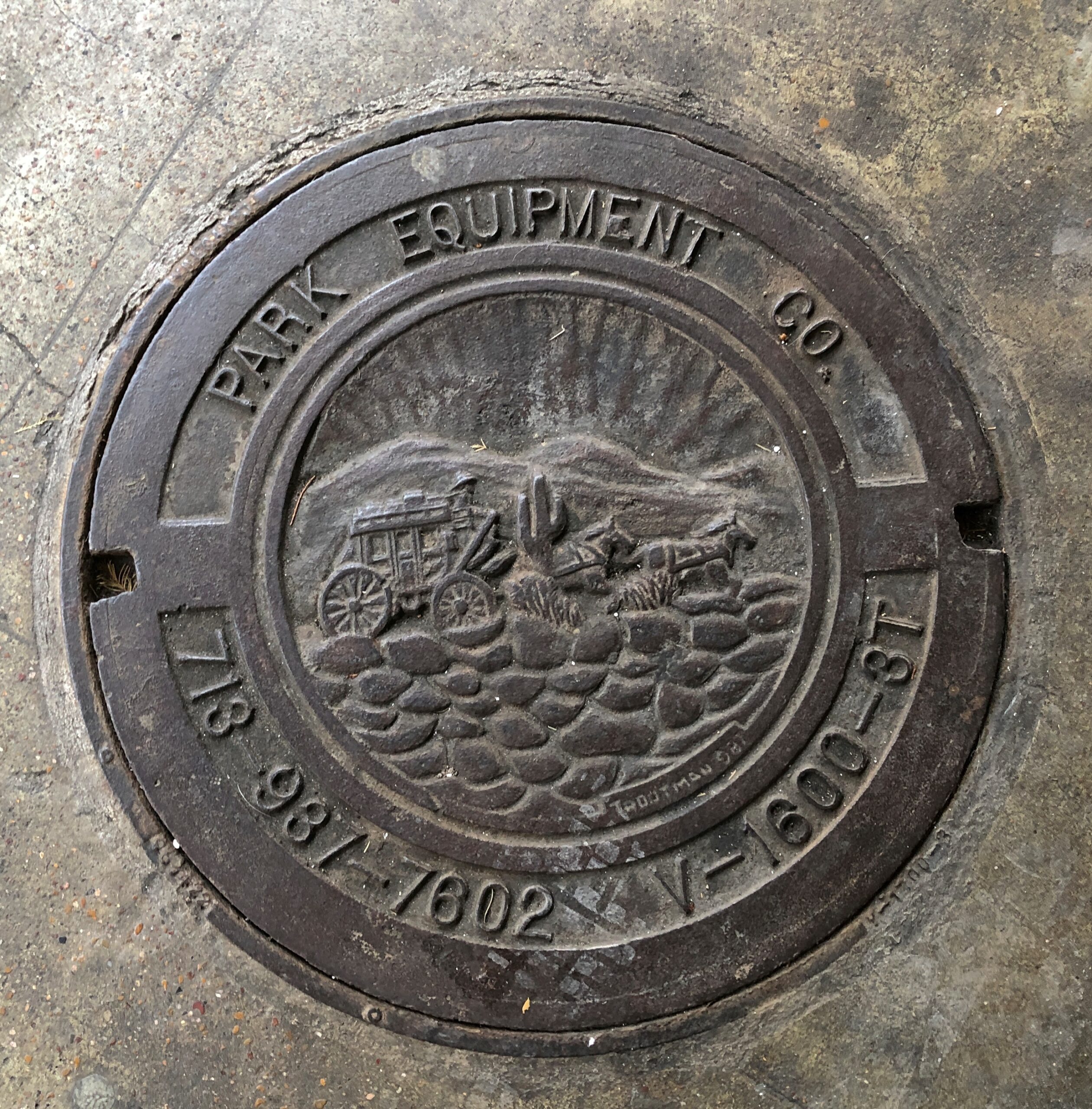
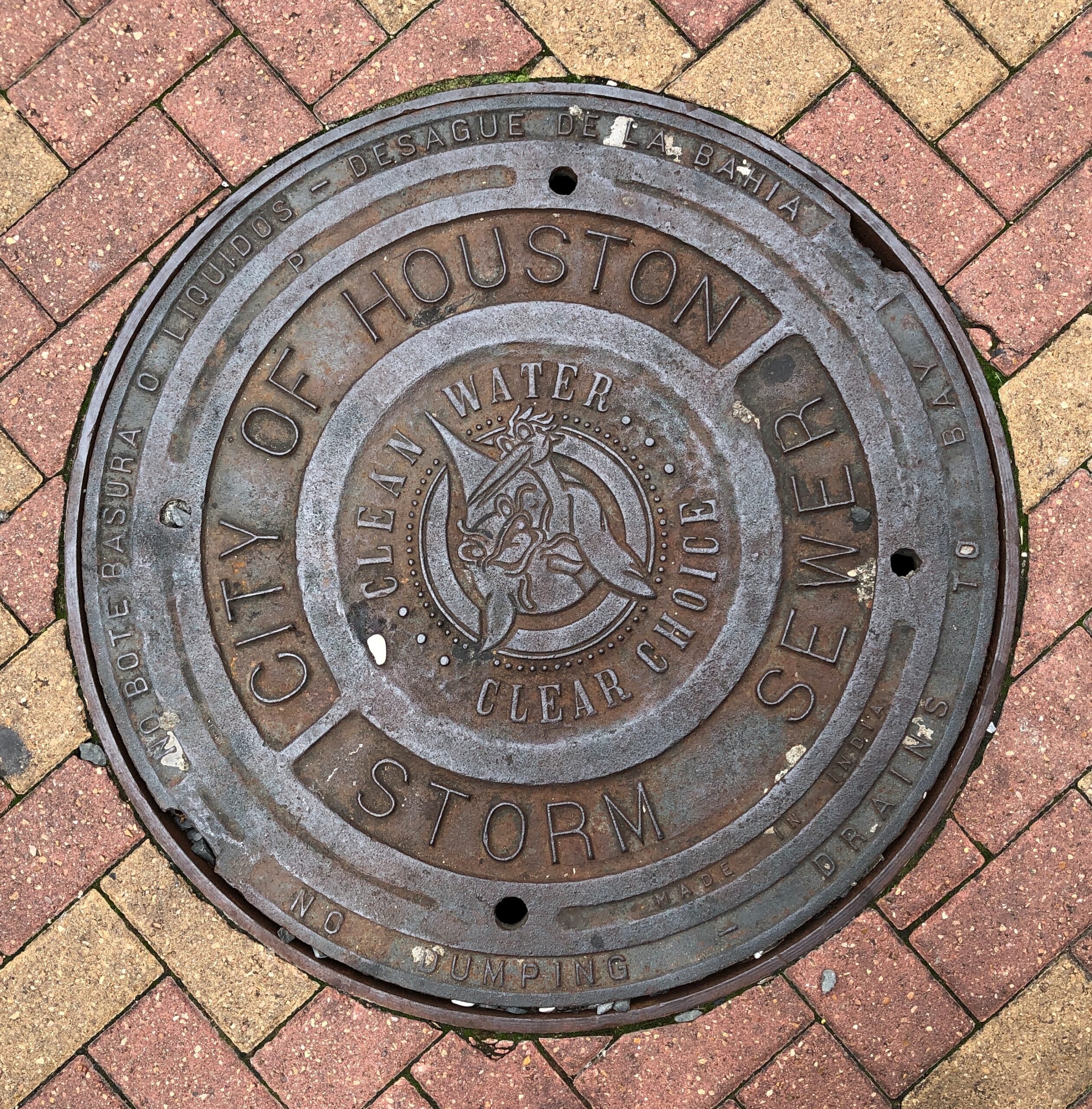
Houston manhole covers.
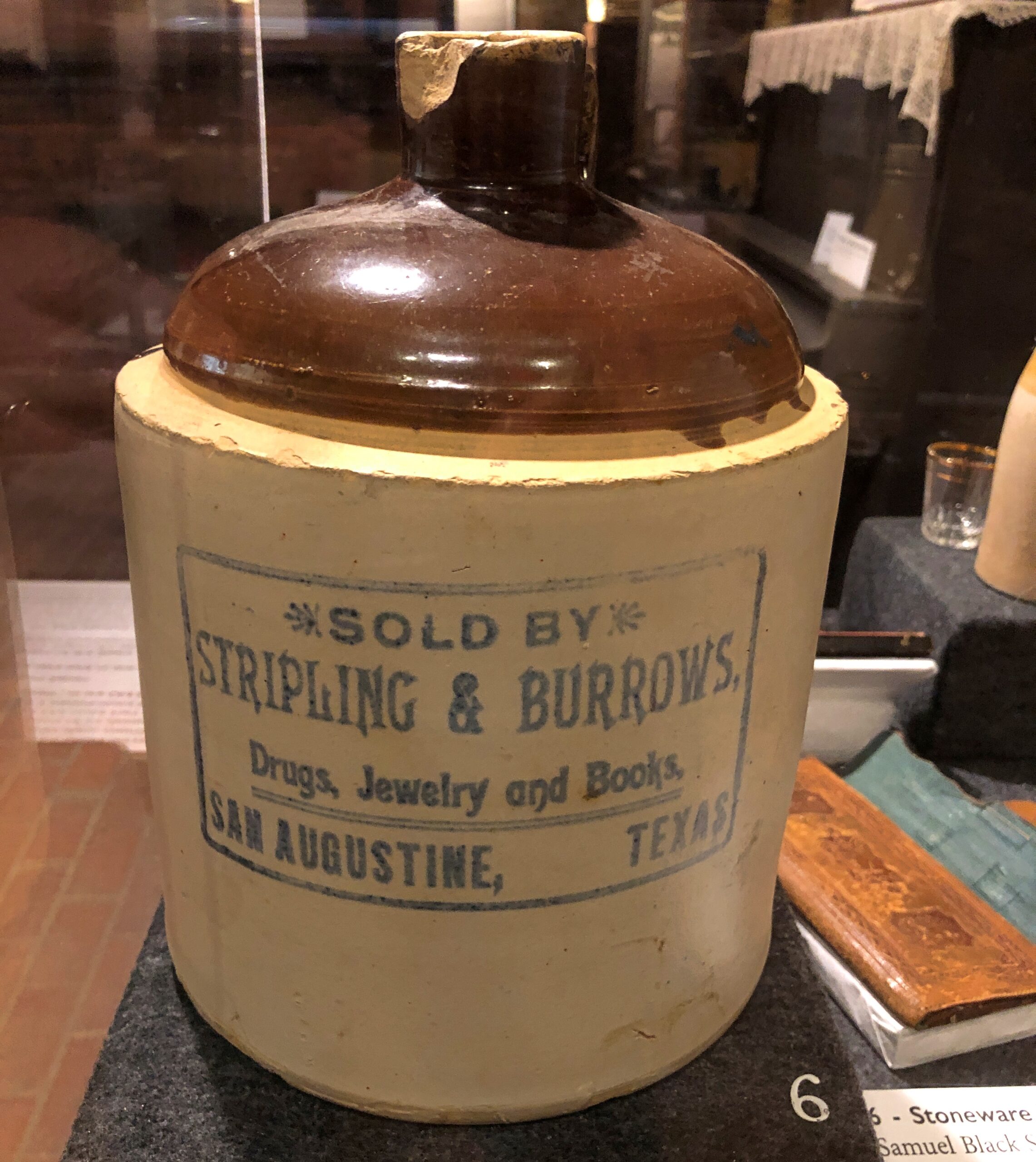
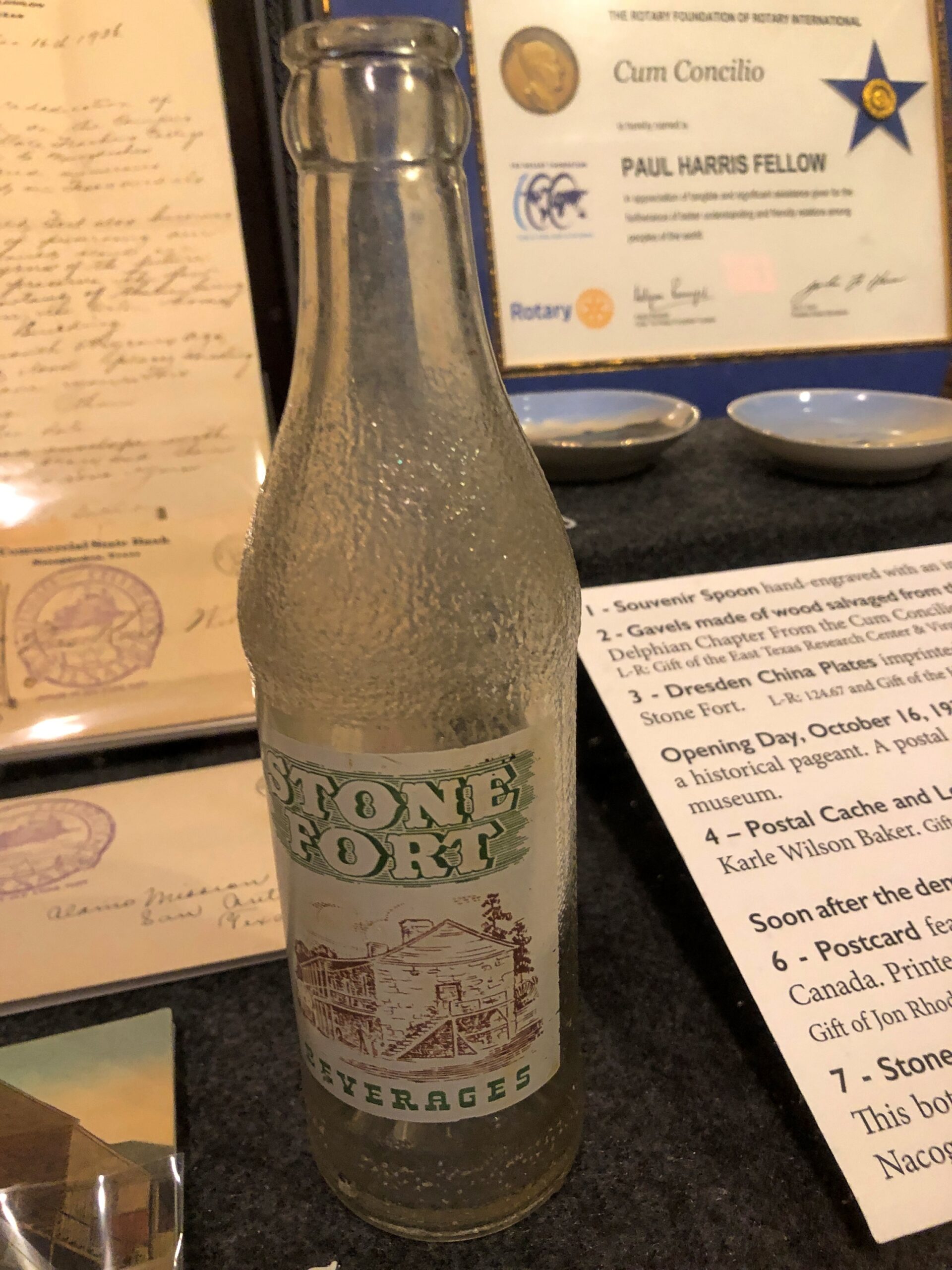
An artifact at the Old Stone Fort, but from San Augustine, and a hyperlocal soda bottle.
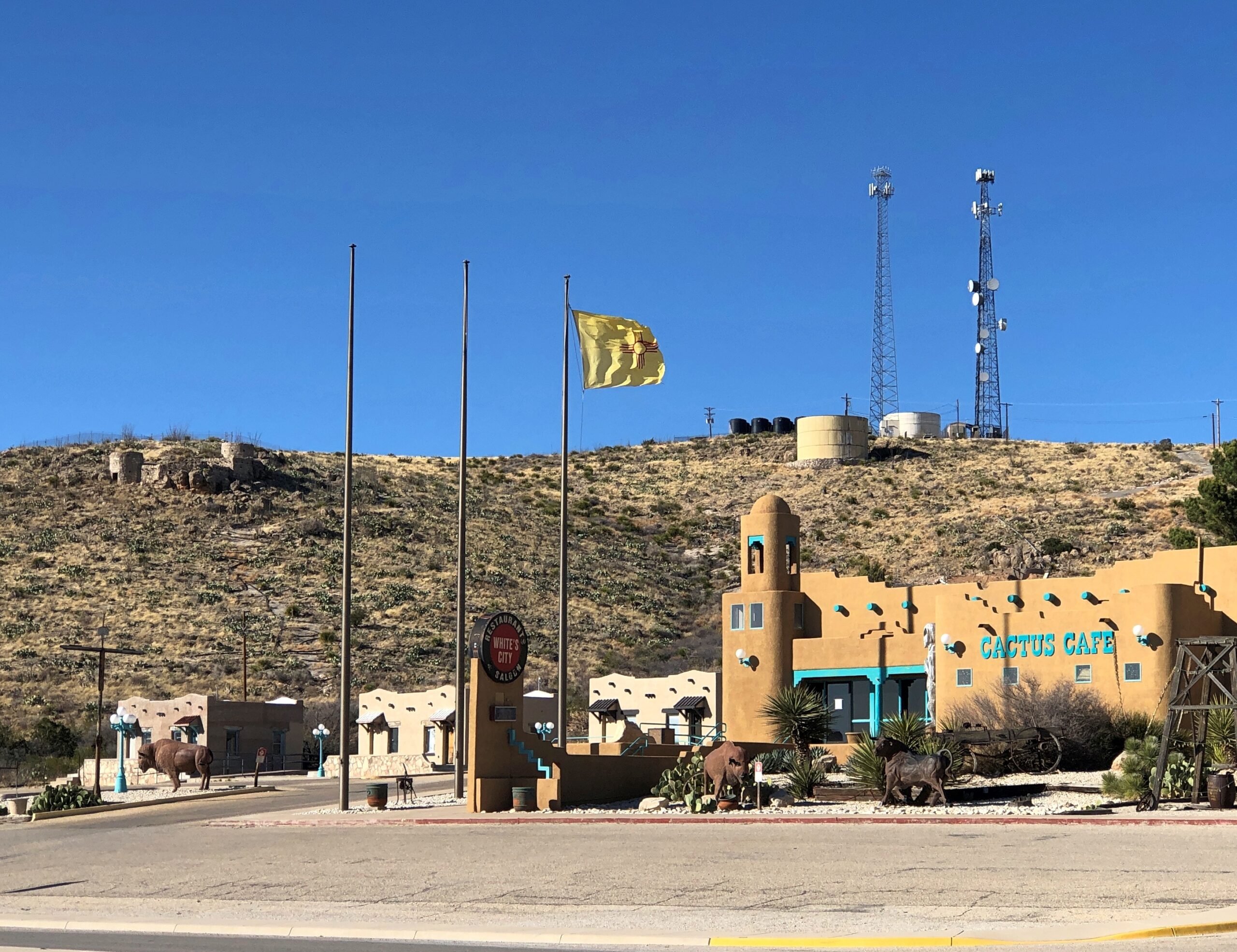
The New Mexico flag near Carlsbad NP.
Landscapes
Not just any landscapes, but within the Sierra Madera Astrobleme in West Texas. US 385 cuts right through the ancient crater for about eight miles, on the way to Marathon. You’d never know but for signs telling you that you’re entering the astrobleme, and one telling you that you are leaving it.
Memorials
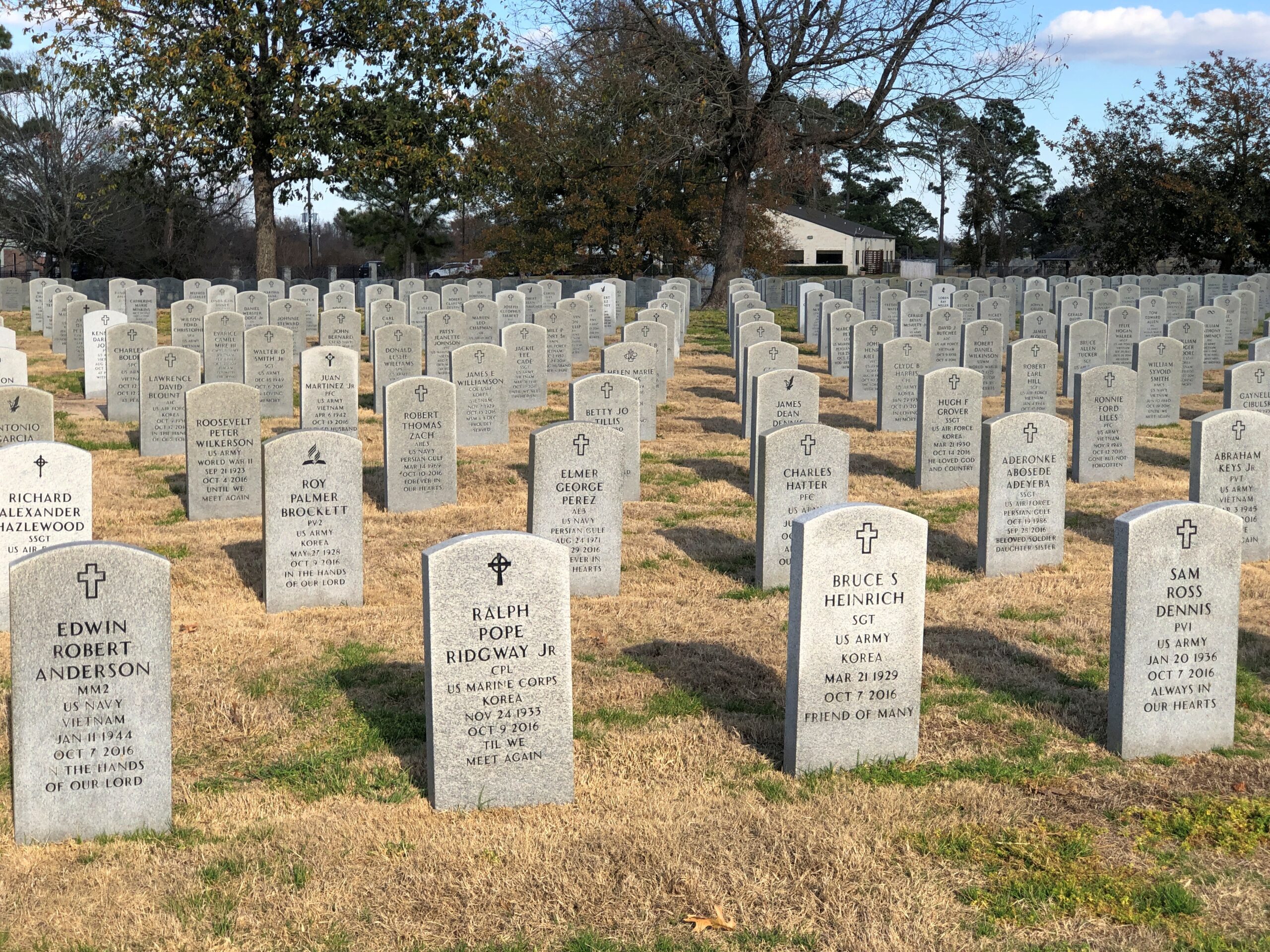
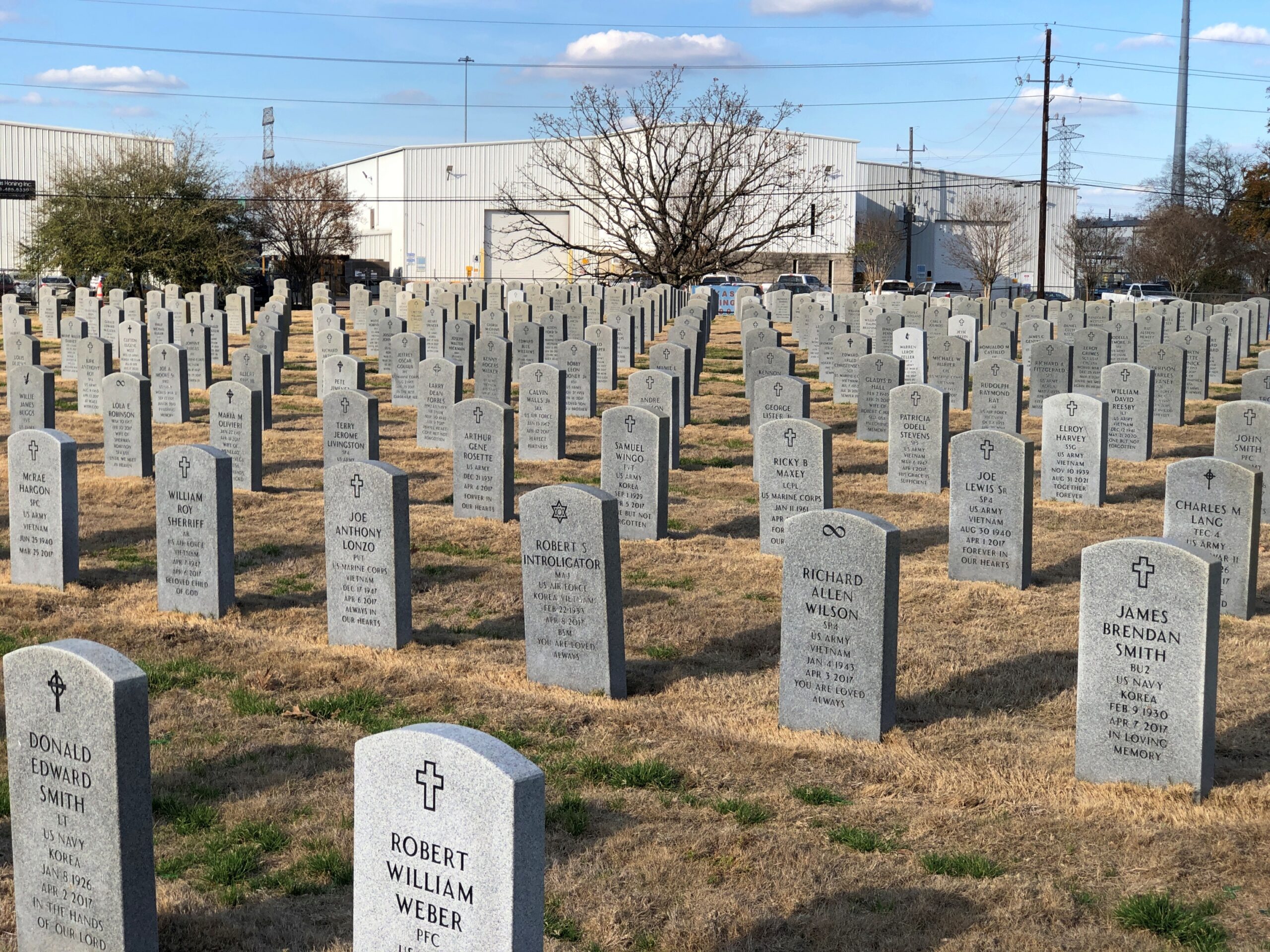
The Houston National Cemetery.
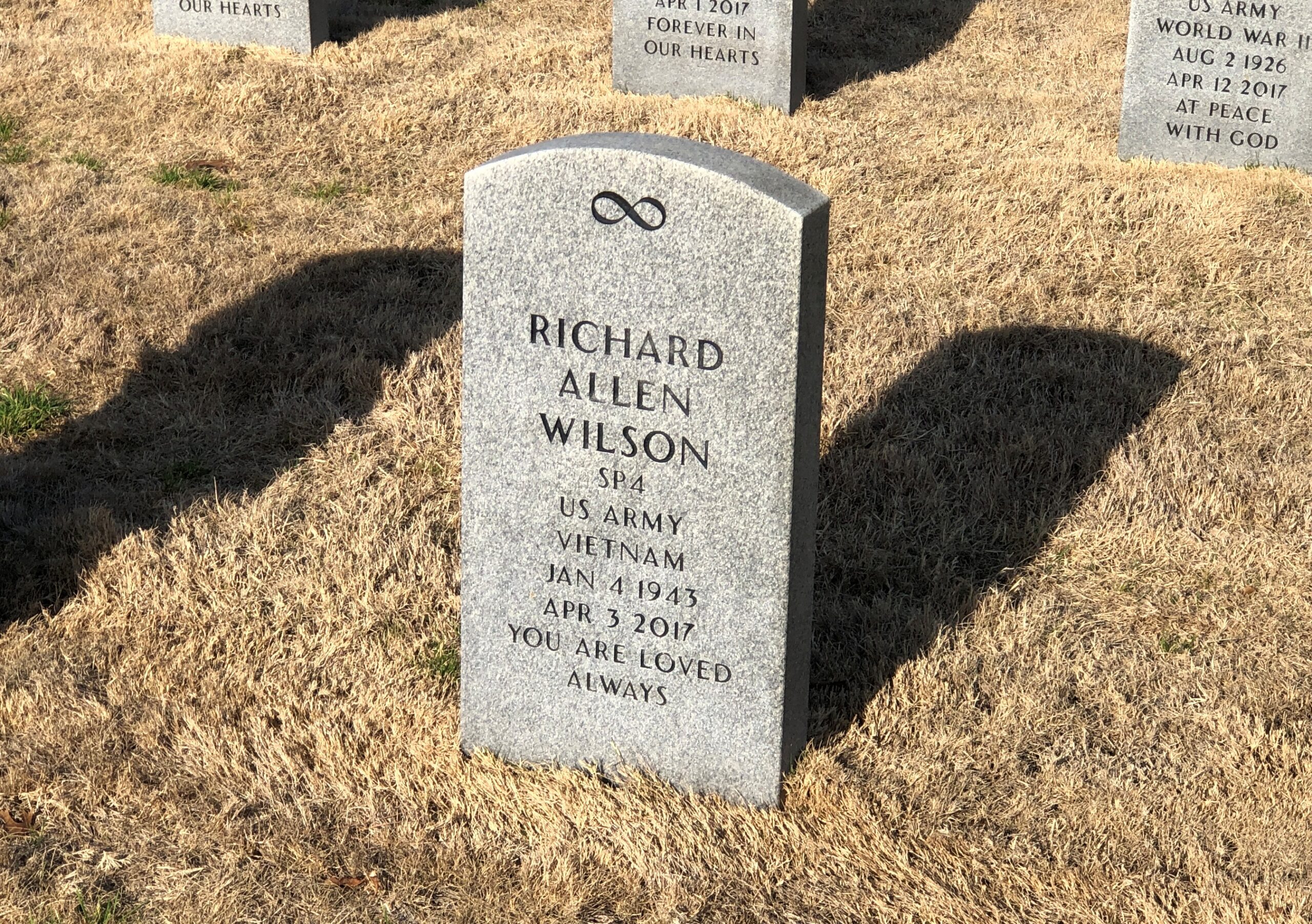
RIP, Richard Allen Wilson. I don’t think that I’d ever seen an infinity symbol on a national cemetery stone. That, of course, made me curious, and I checked: it is one of the 98 various symbols that the National Cemetery Administration allows. The list is here.
I’m familiar with most of them, but not quite all of them, such as the Church of World Messianity, which is a Japanese new religion – it’s hard to keep track of all of those – and the Aaronic Order Church, which may or may not be part of the LDS movement, but in any case is an American sect. Hard to keep track of all those, too.
The NCA says: “No graphics (logos, symbols, etc.) are permitted on Government-furnished headstones or markers other than the available emblems of belief, the Civil War Union Shield, the Civil War Confederate Southern Cross of Honor, and the Medal of Honor insignias… Emblems of belief for inscription on Government headstones and markers do not include social, cultural, ethnic, civic, fraternal, trade, commercial, political, professional or military emblems.”
So (for example) symbols for the Loyal Order of Moose or some odd emoji or maybe a grawlix will not be considered, though as a comment about the Army, the latter would be funny.
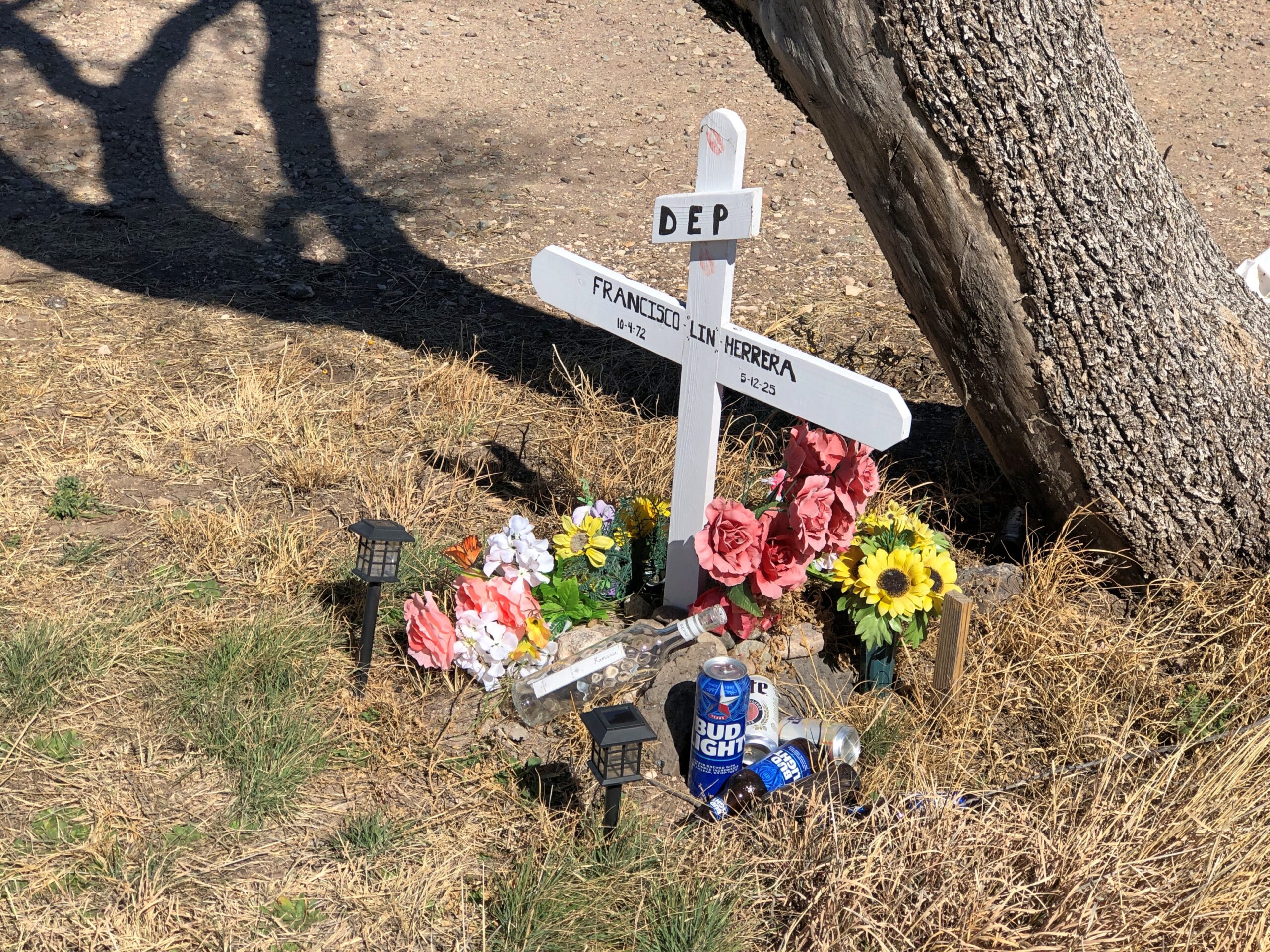
Finally, a less formal memorial, but I’m sure just as heartfelt.
A memorial for Francisco Lin Herrera happens to be near the Giant paintings outside of Marfa. He died in an accident along that stretch of US 90. RIP, Francisco.
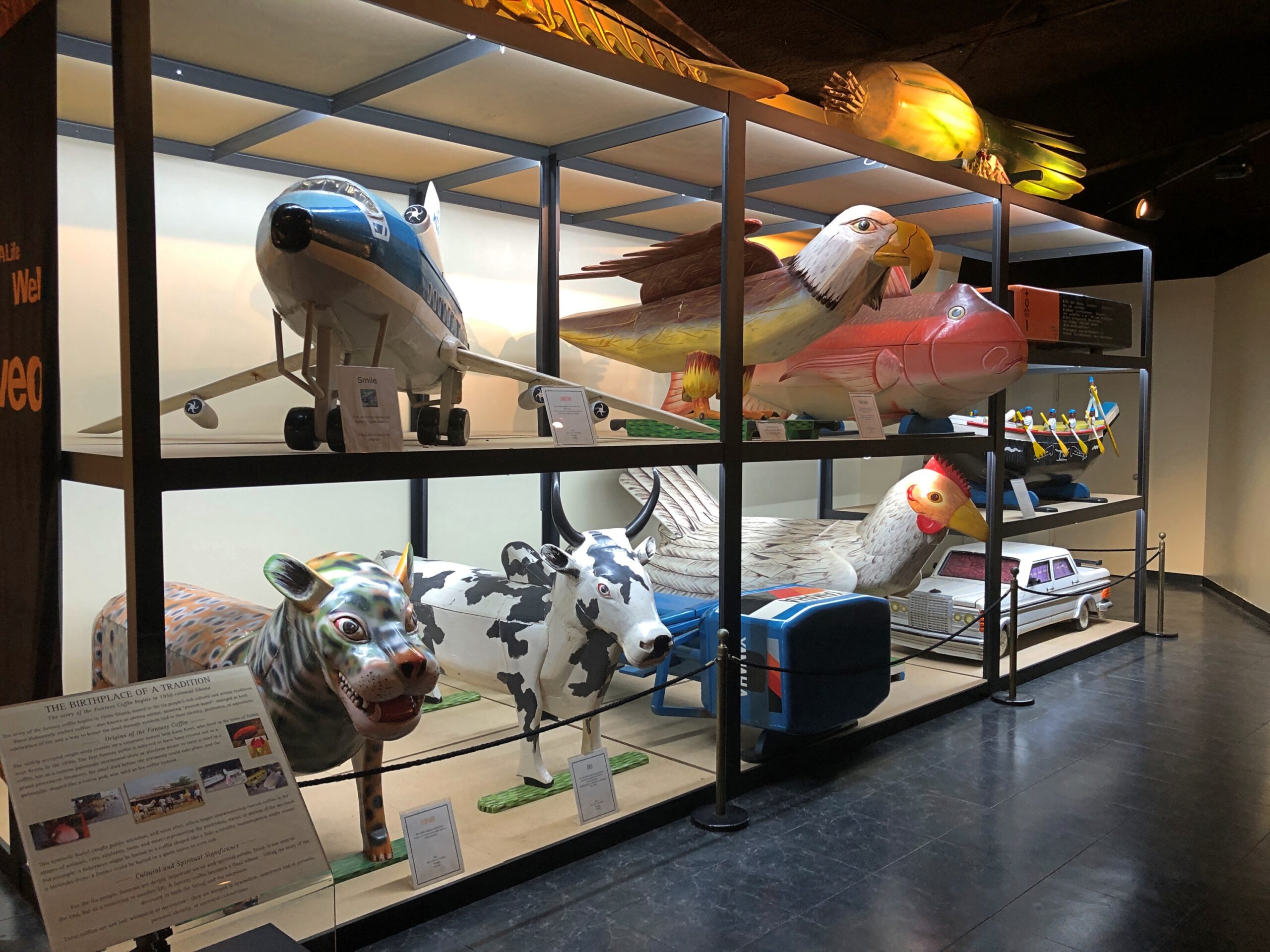
One place I didn’t go in February was Ghana, the west African nation. If I had to pick a place to visit in that part of the world, I might well pick Ghana, for various reasons. One is that the coffin shopping is unlike anywhere else.
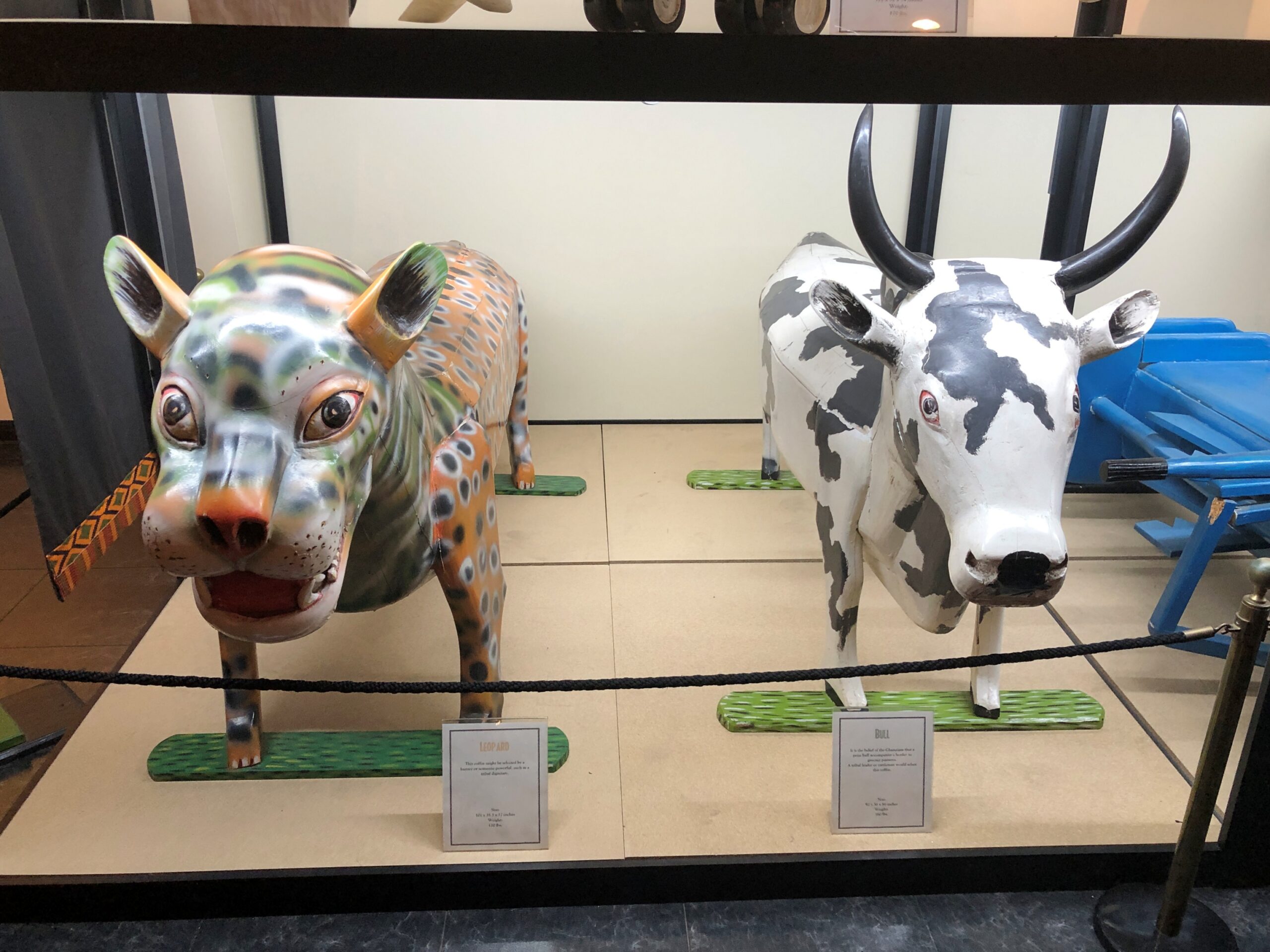
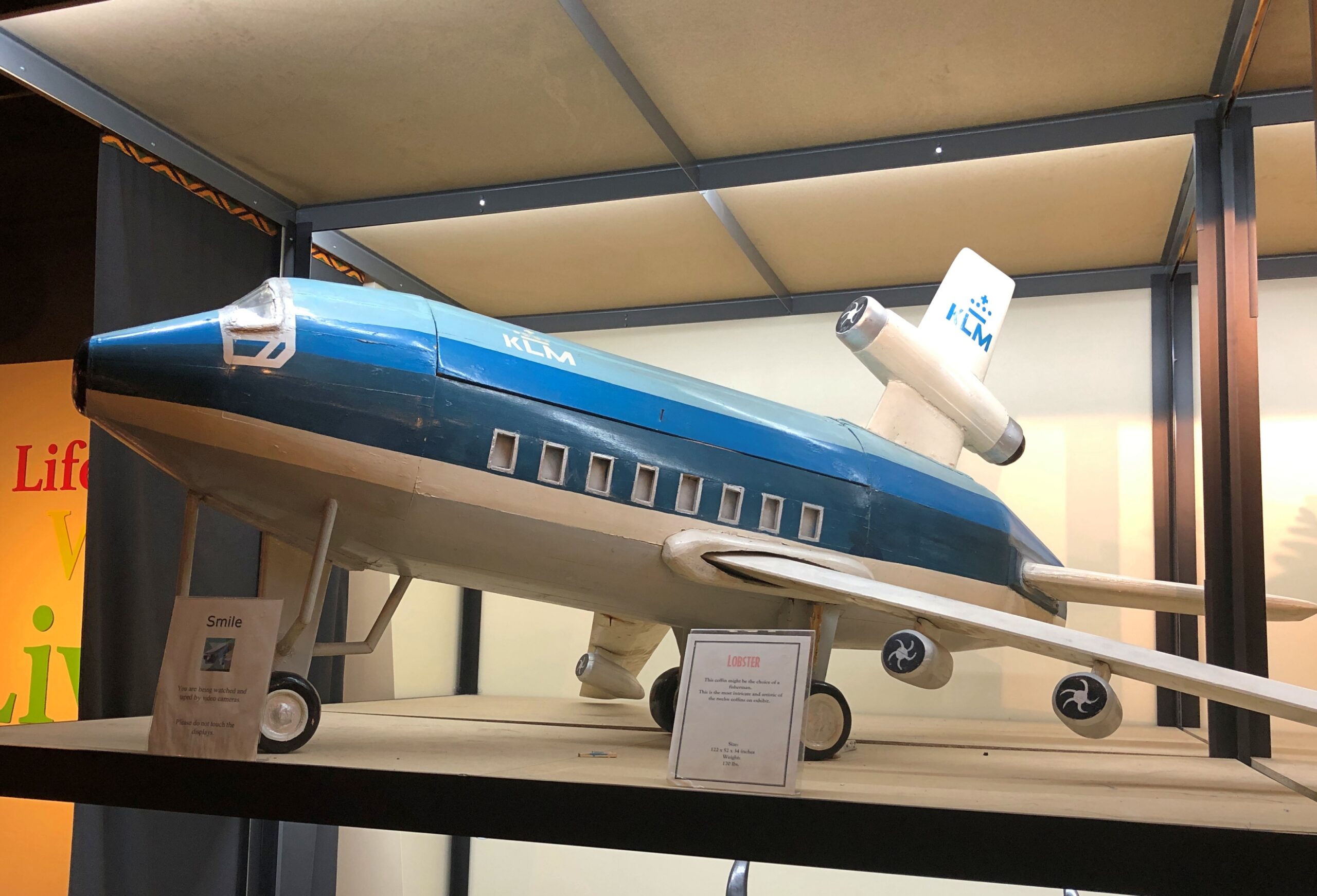
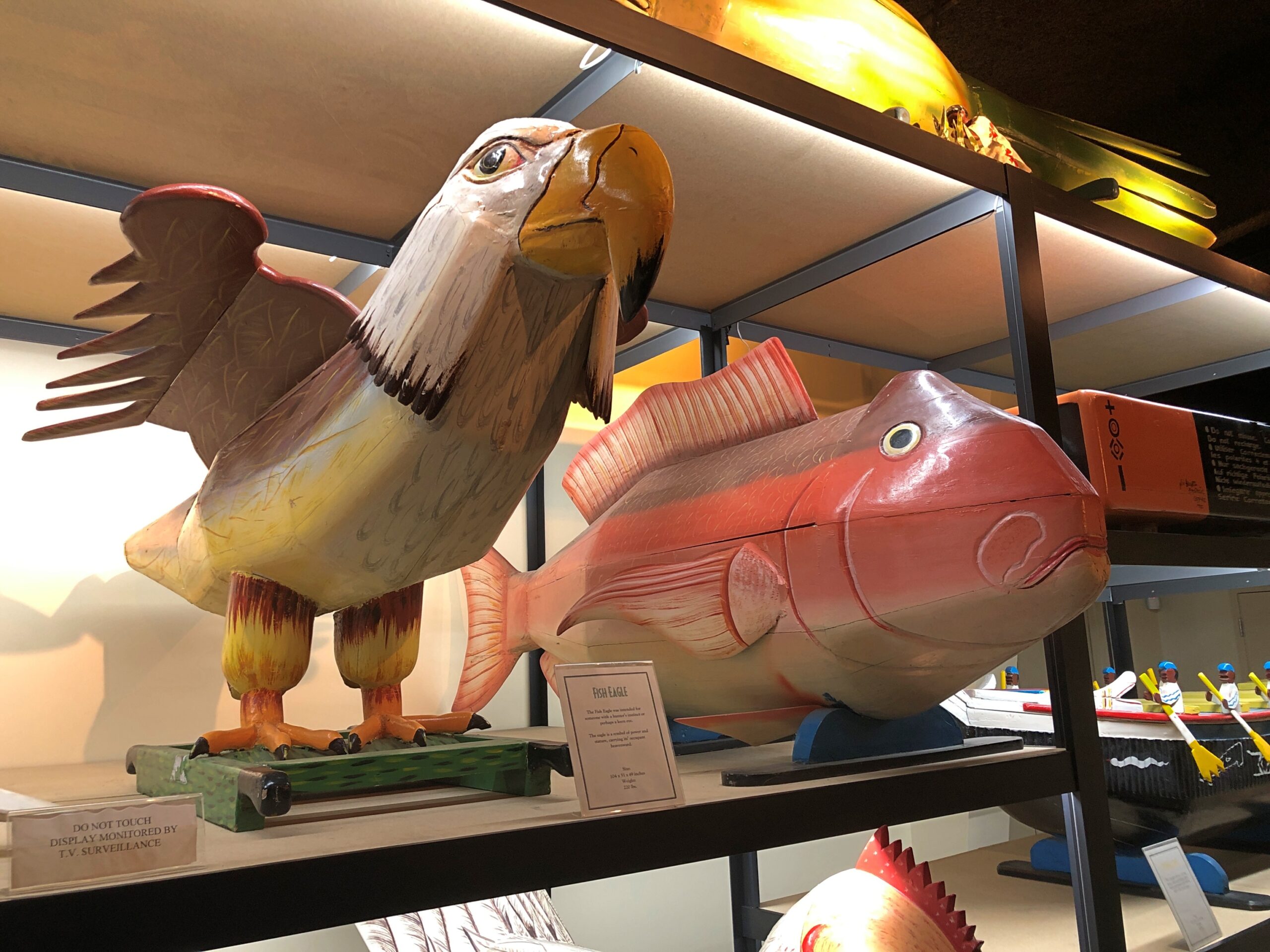
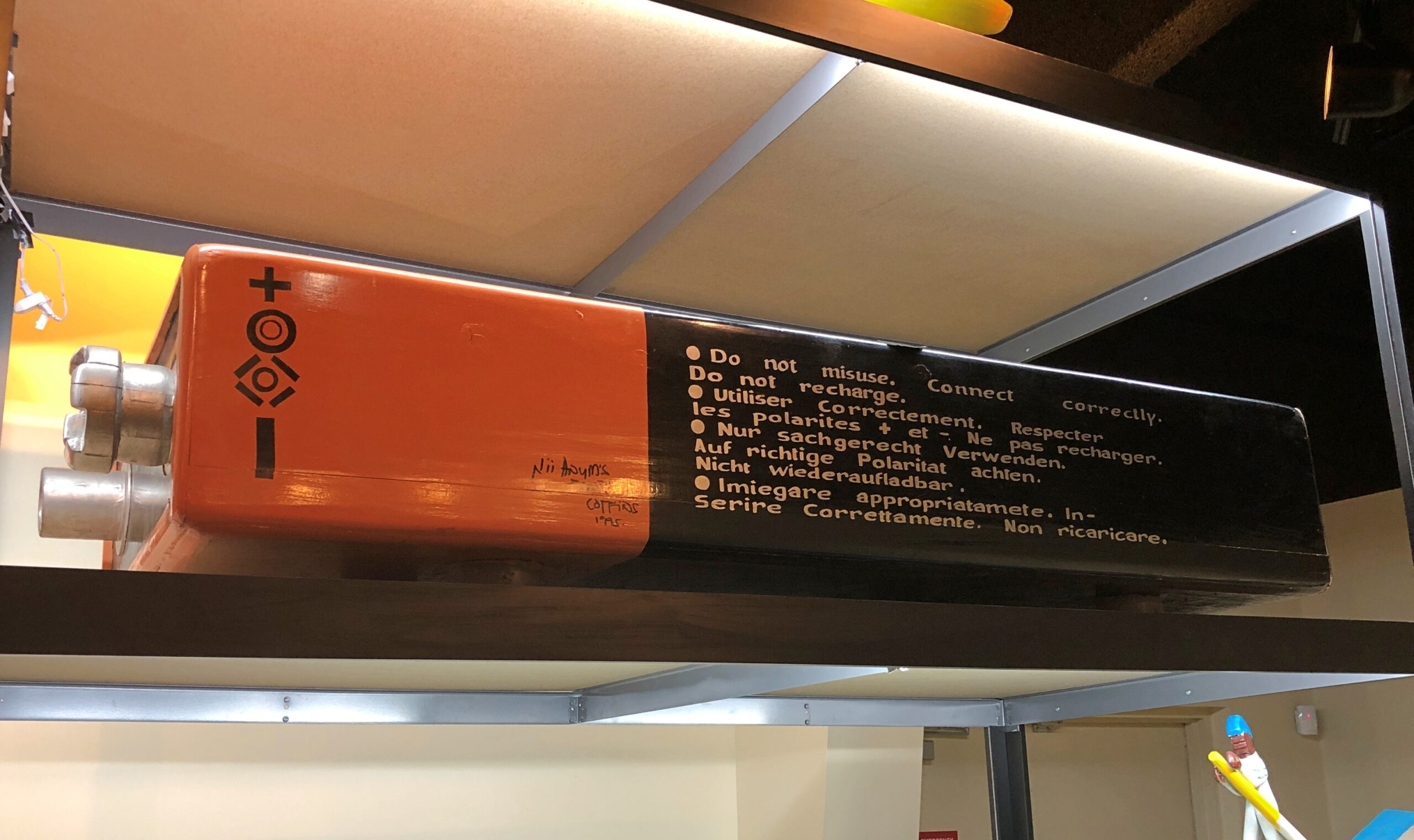
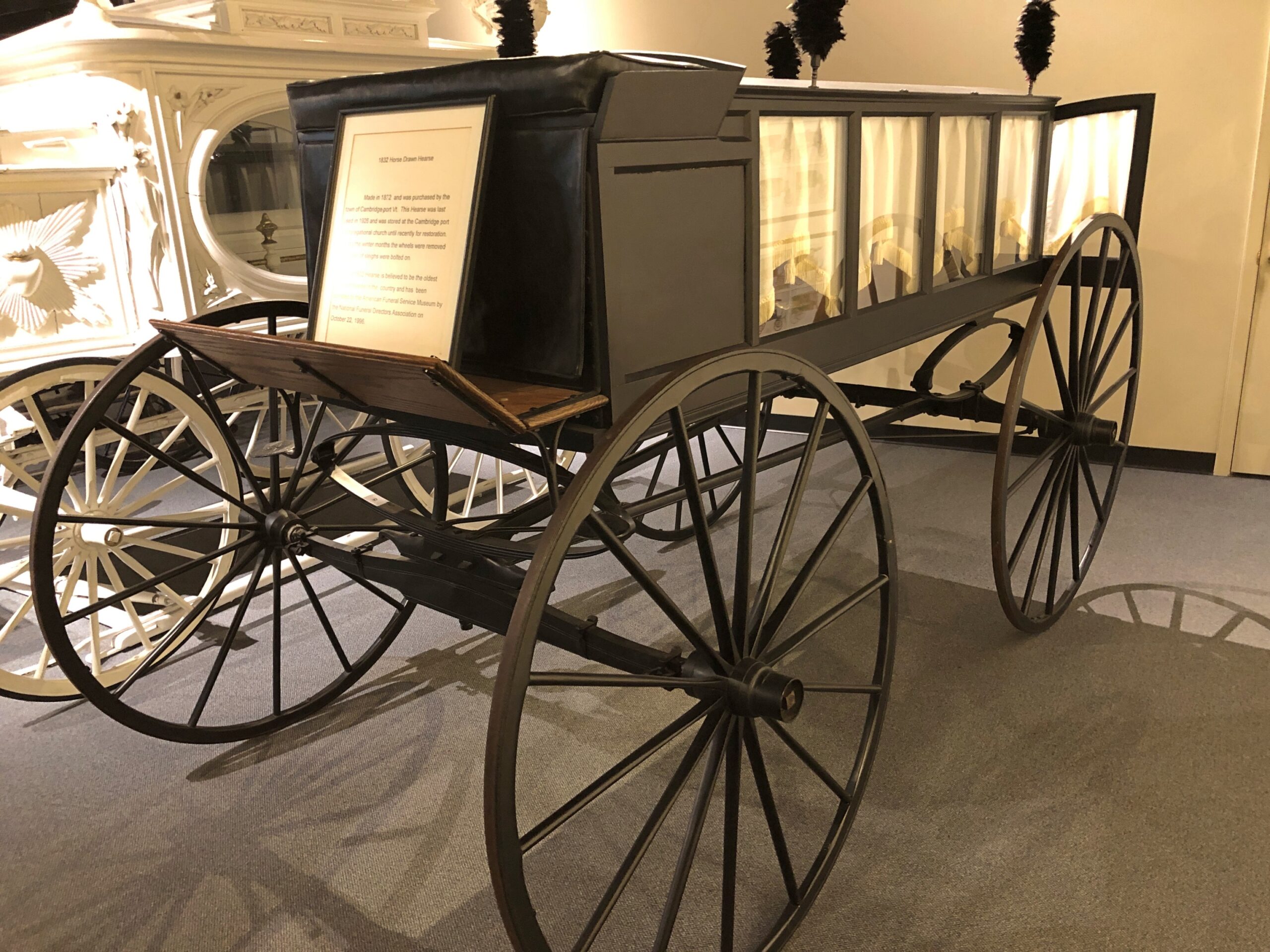
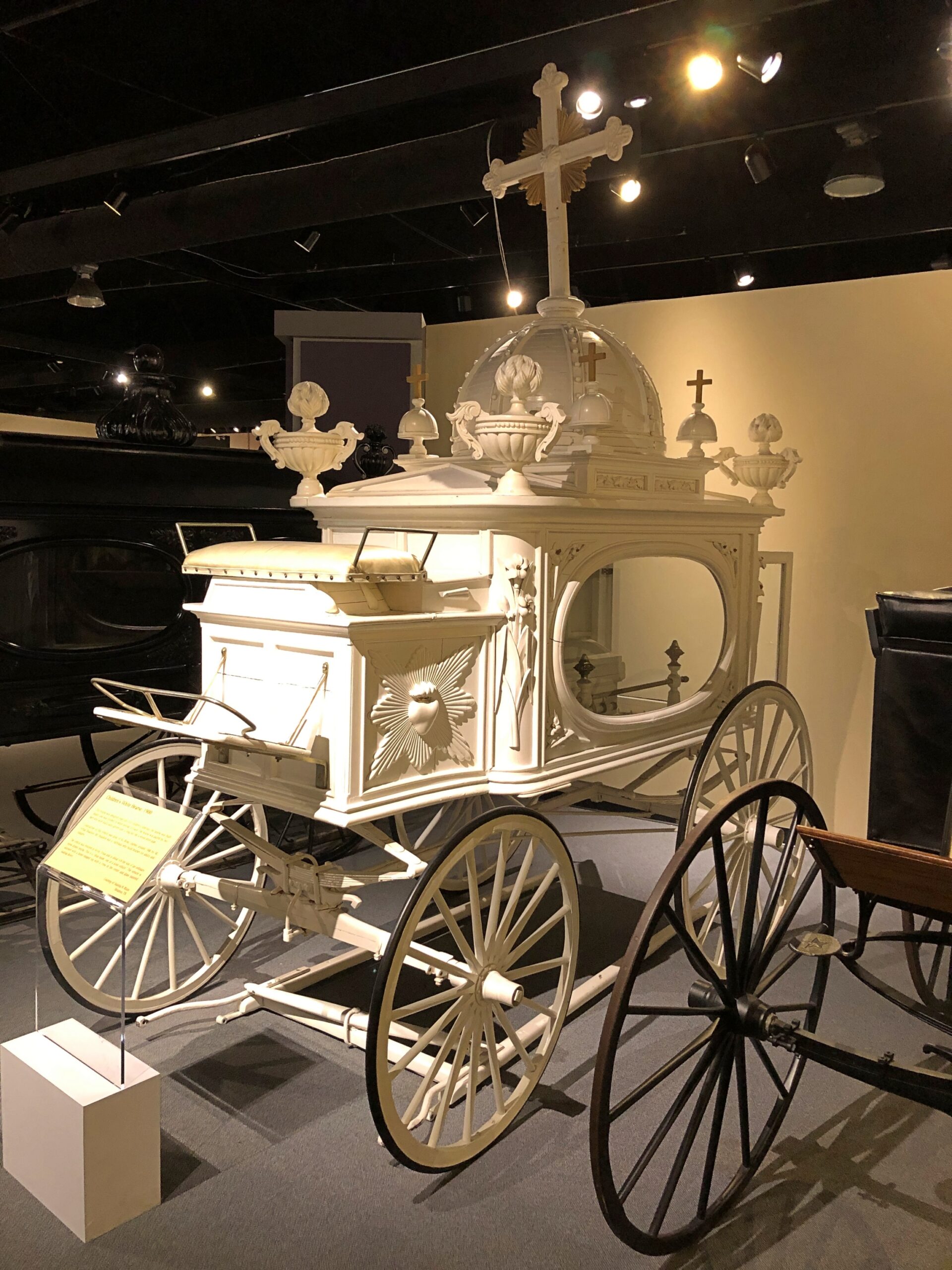
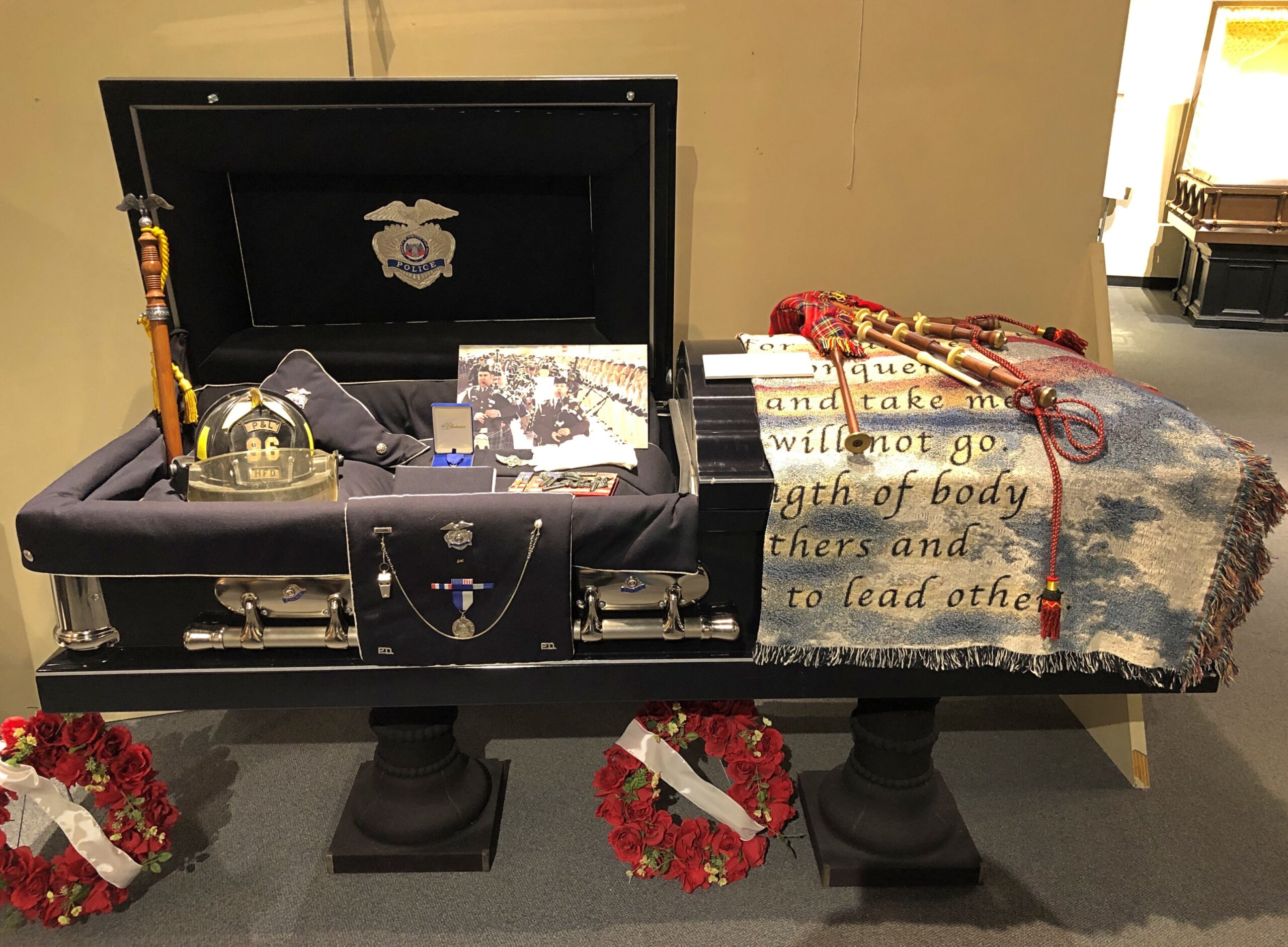
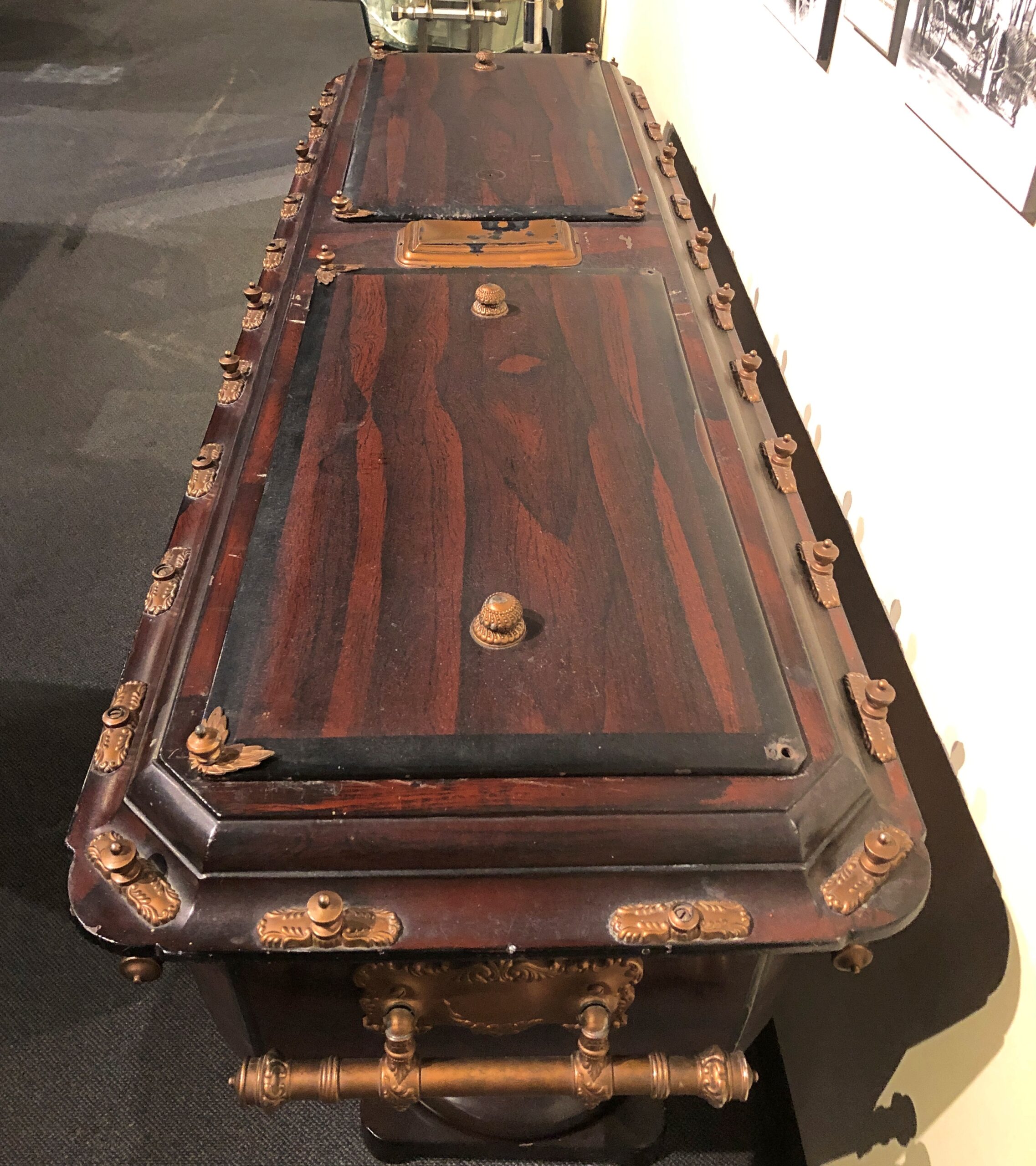
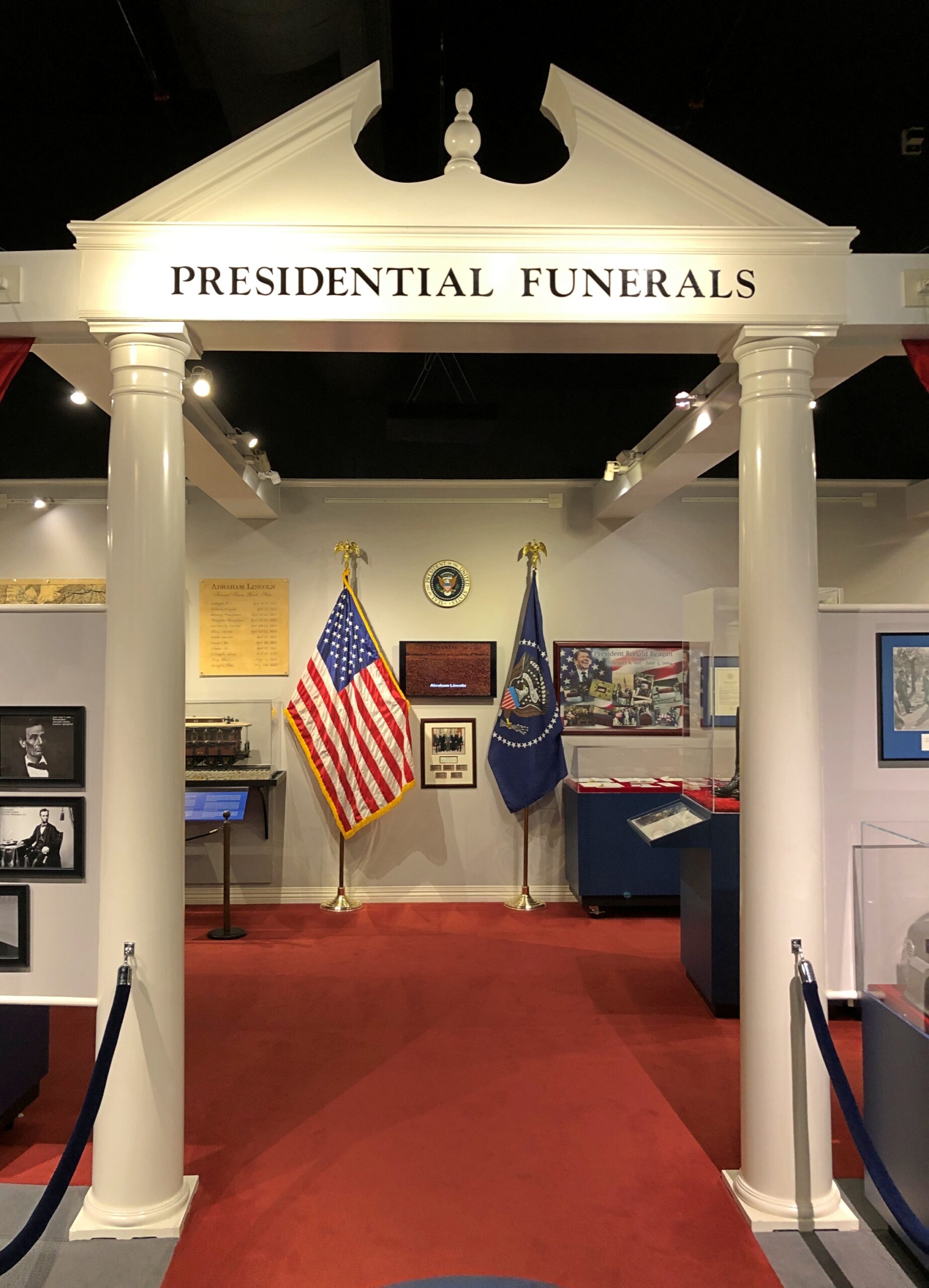
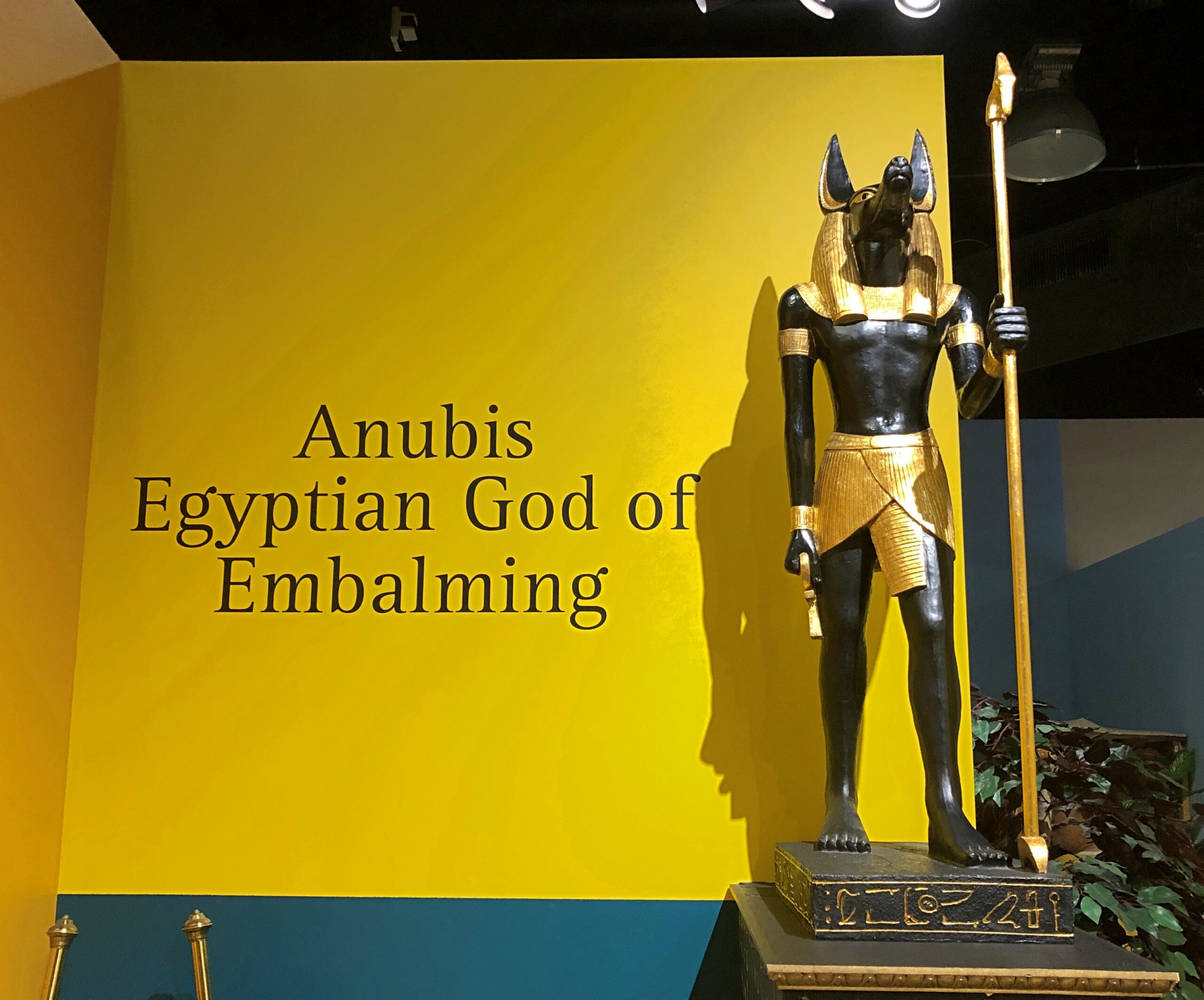
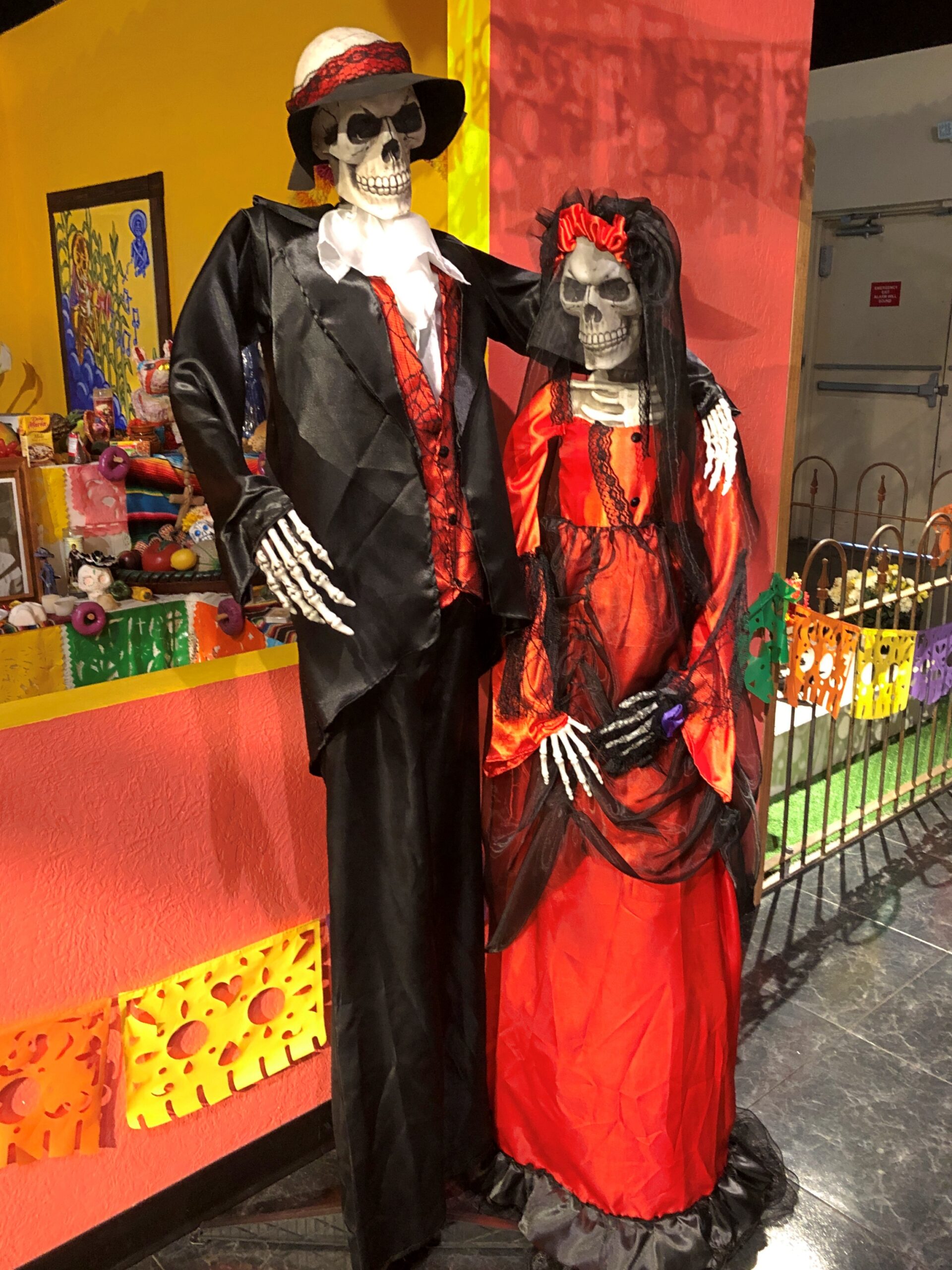
Rather, I stopped by the National Museum of Funeral History in northern Houston, which has a connection to Ghana. I was expecting a display of coffins maybe, but the museum has so much more: many hearses, horse-drawn and automobiles; items from the funerals of U.S. presidents and popes, including a large display about the funeral of President George Bush the elder; entire sections on cremation and embalming from the earliest times to now; Victorian death memorabilia in its macabre (to us) variety; a Day of the Dead exhibit; and, to my surprise, Ghanaian coffins, which the museum calls the largest such collection outside west Africa.
My favorite, though it’s a hard choice: the Duracell coffin, with its distinct copper top. Guess those batteries are sold in west Africa. You’d think Energizer would be the better choice.
The museum, founded in 1993, occupies more than 30,000 square feet in an unassuming building in a neighborhood of unassuming buildings. Had it not been for the billboard advertising it on the highway into Houston, I might have missed it. Or not. I have a way of ferreting out smaller museums. One important advantage of the NMFH: it’s open on Mondays. Many Houston museums are closed on Mondays and Tuesdays — the two days I was in town.
As with many specialized museums, NMFH is the legacy of a single person with a driving interest in a single subject and, in his case, access to many of the relevant artifacts. The subject just happens to be death adjacent, so when I mention the museum, people get a little weird.
“The idea for the Museum grew from Robert L. Waltrip’s 25-year dream of establishing an institution to educate the public and preserve the heritage of death care,” the museum says. Waltrip, a Houston mortician born to an undertaker father, didn’t need death care himself until recently, dying in 2023 at 92.
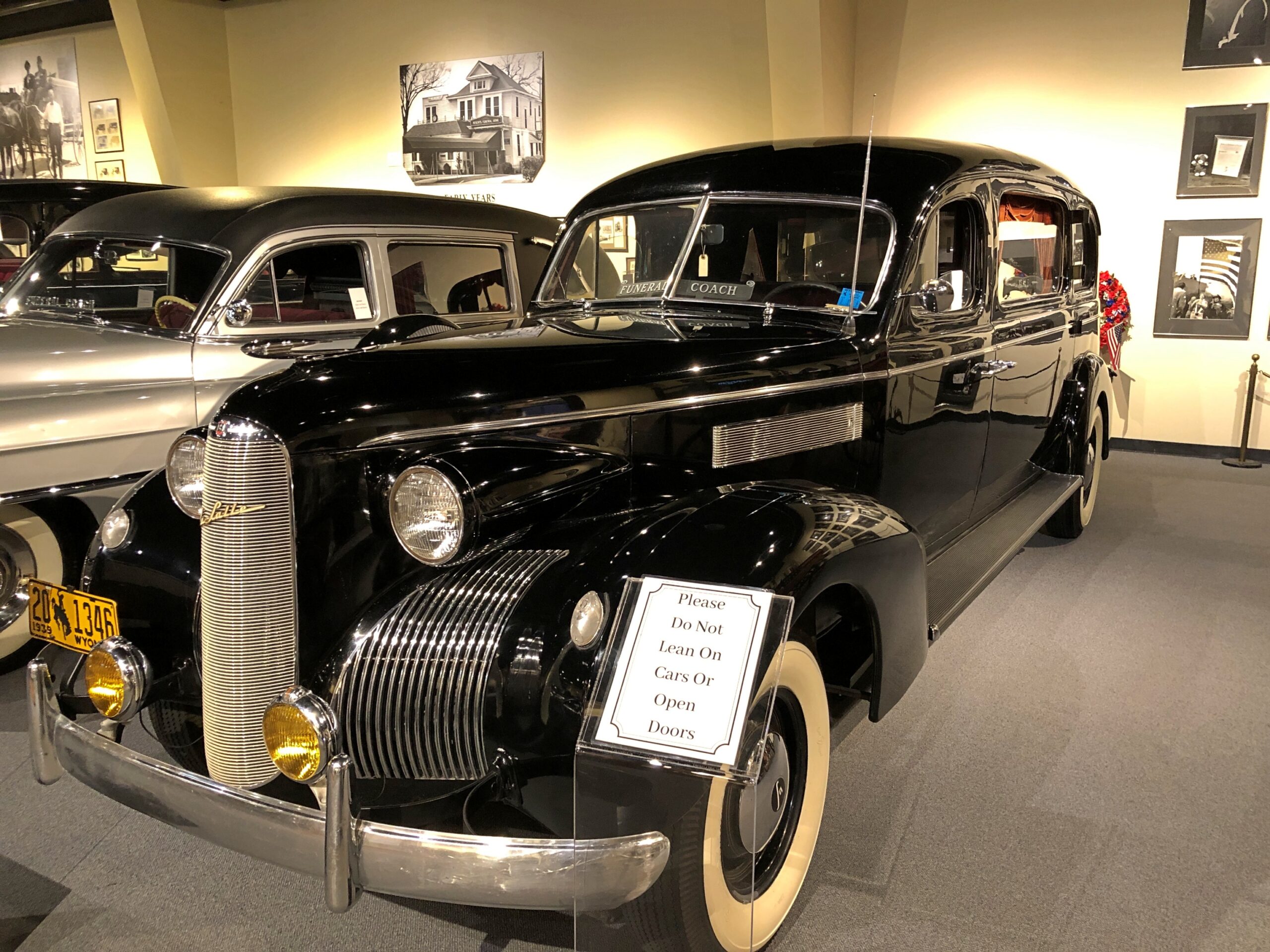
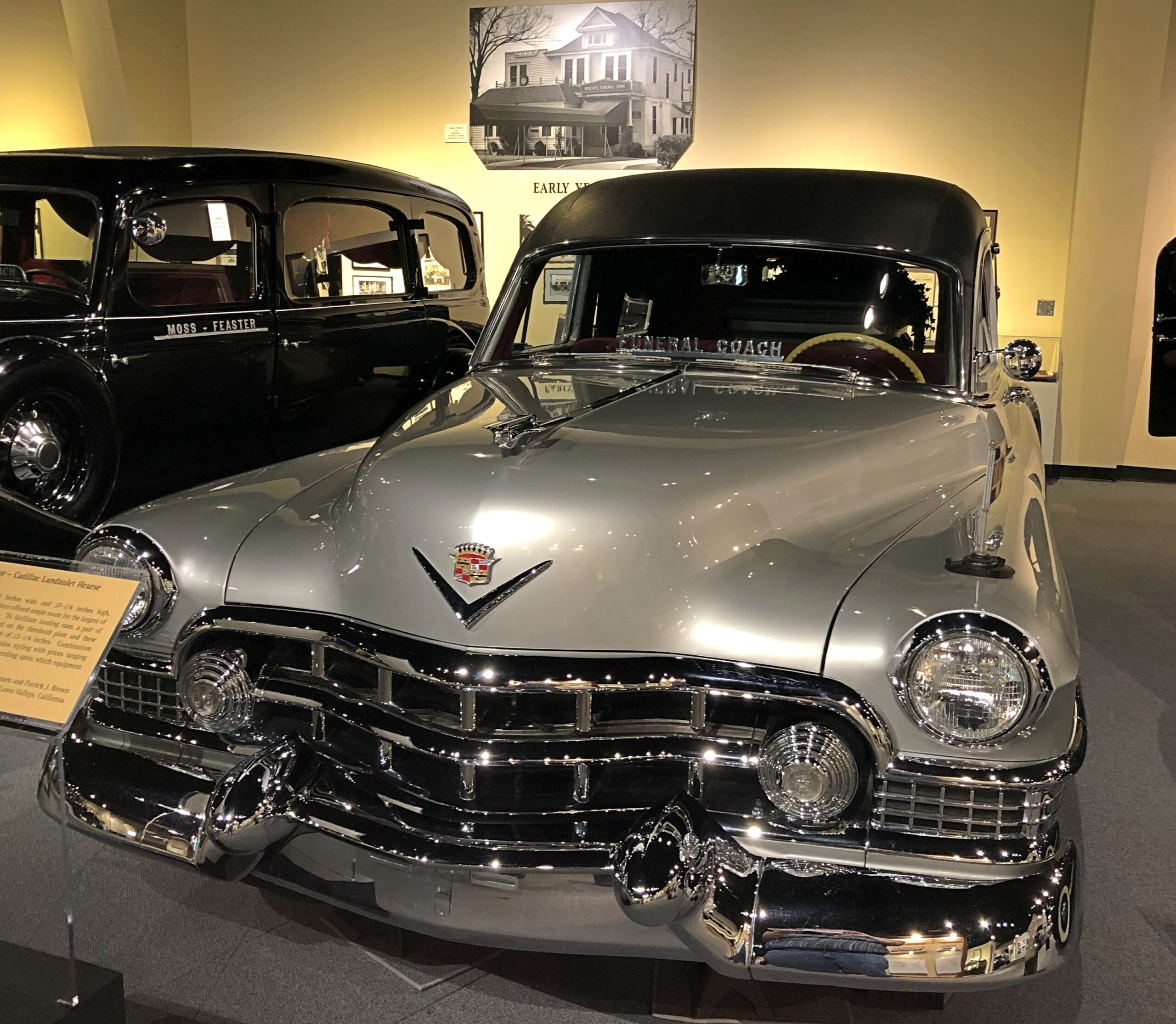
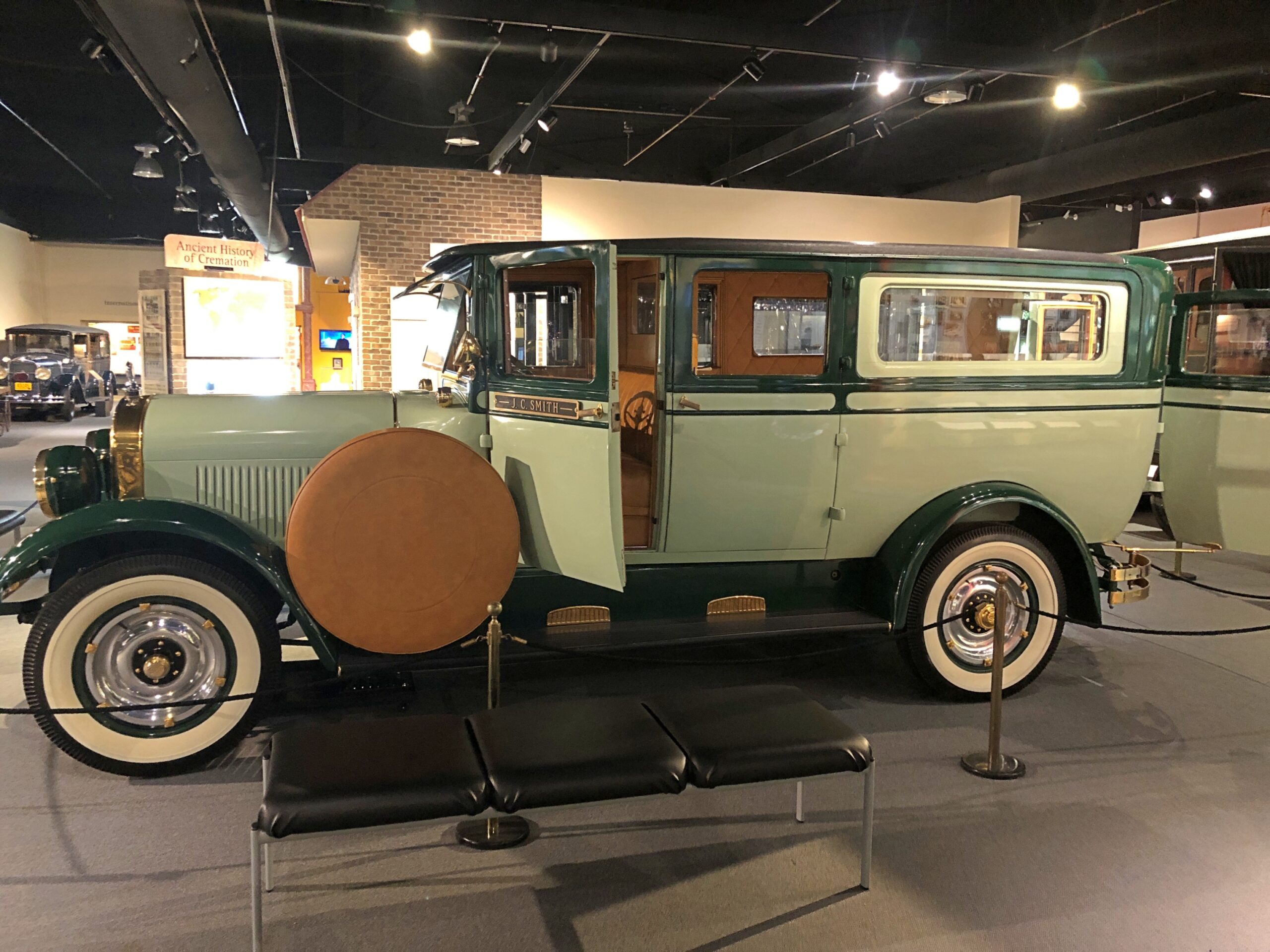
The hearse collection is impressive, making the museum count as a carriage and auto museum. Not all automotive hearses, at least in earlier times, looked like the stretch postwar hearses one thinks of now.
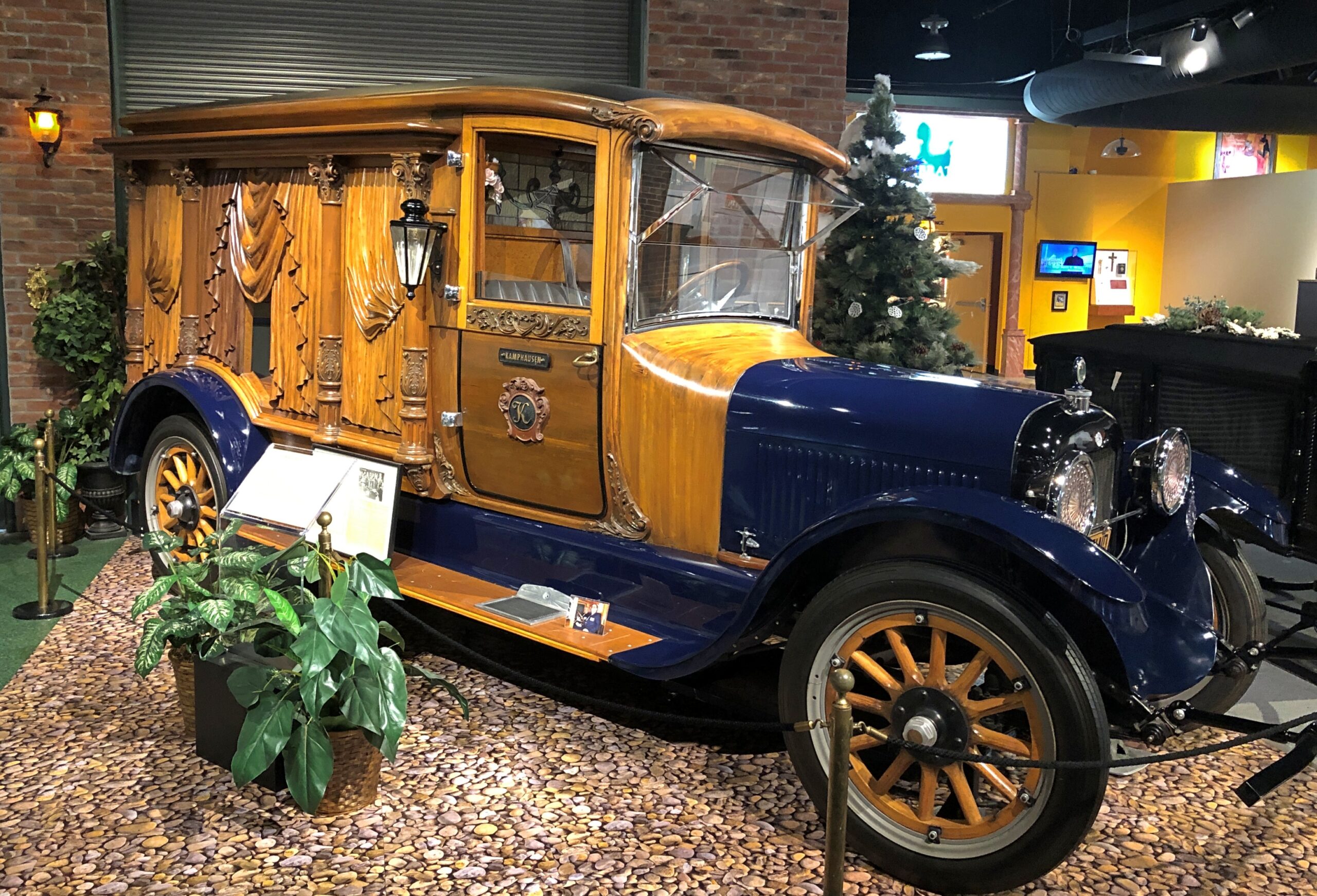
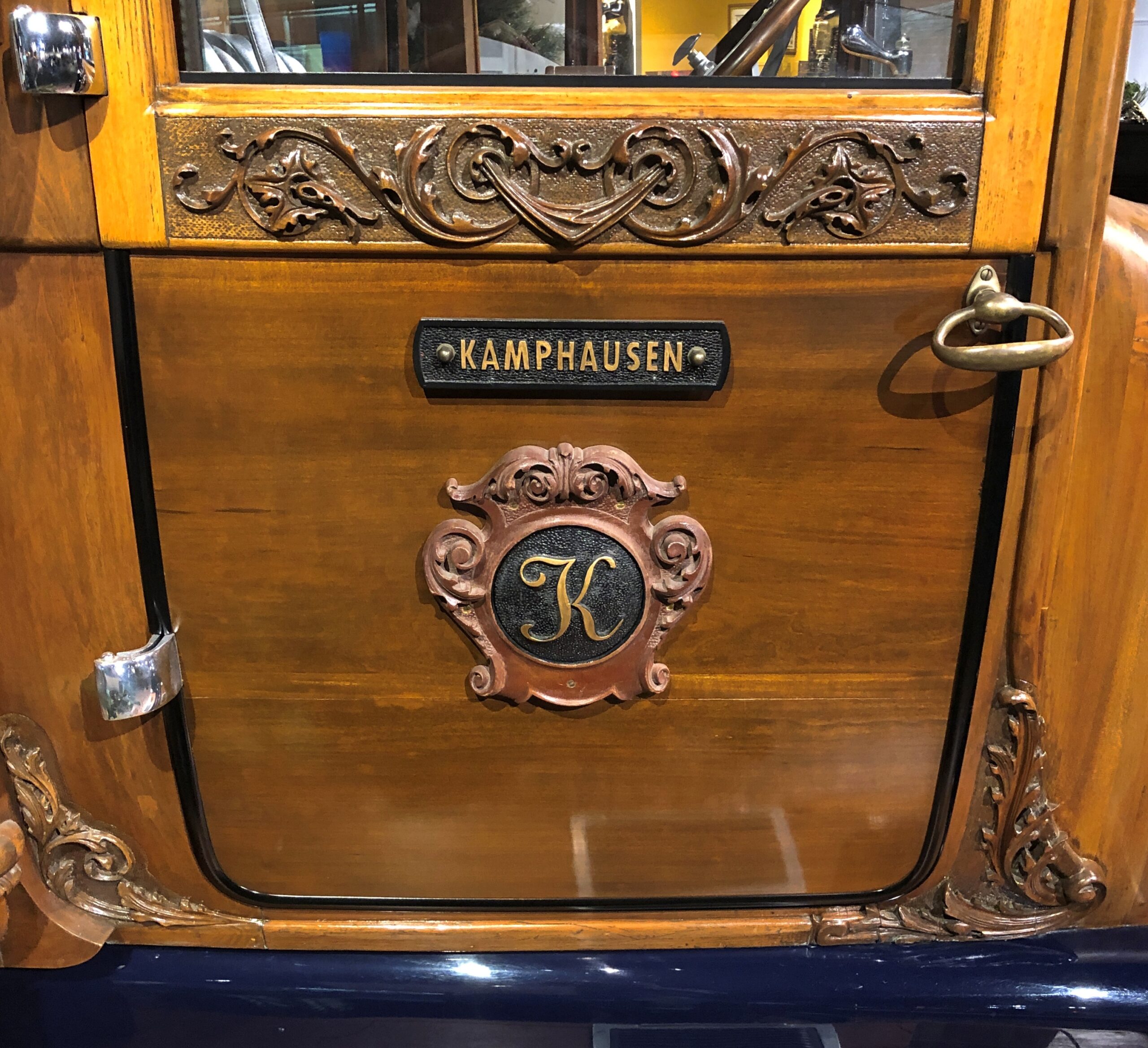
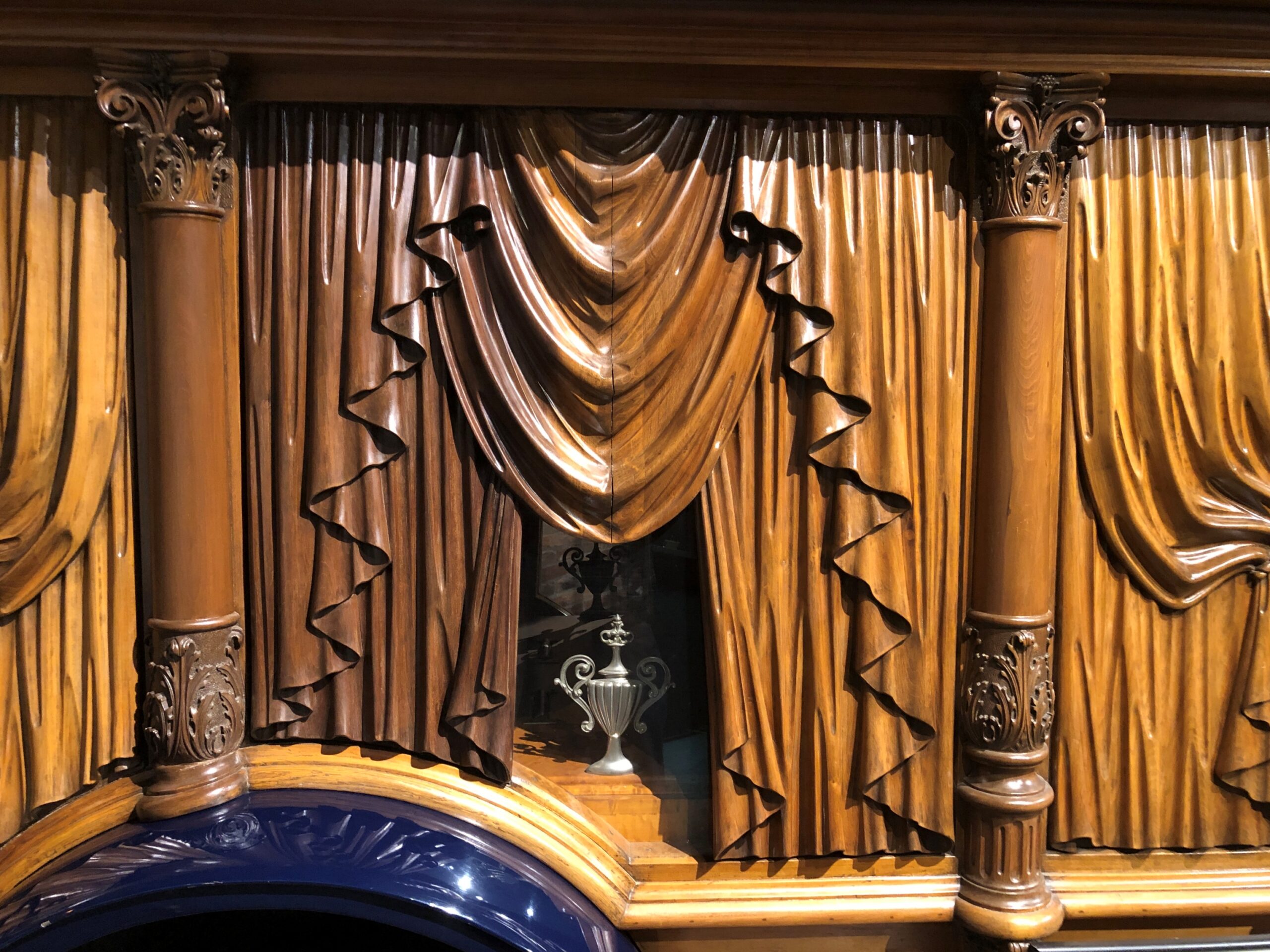
A vehicle the likes of which I’d never seen: a 1921 Rockfalls Hearse, built in Sterling, Illinois, the museum says. The hearse’s hand-carved body is composed of six types of wood.
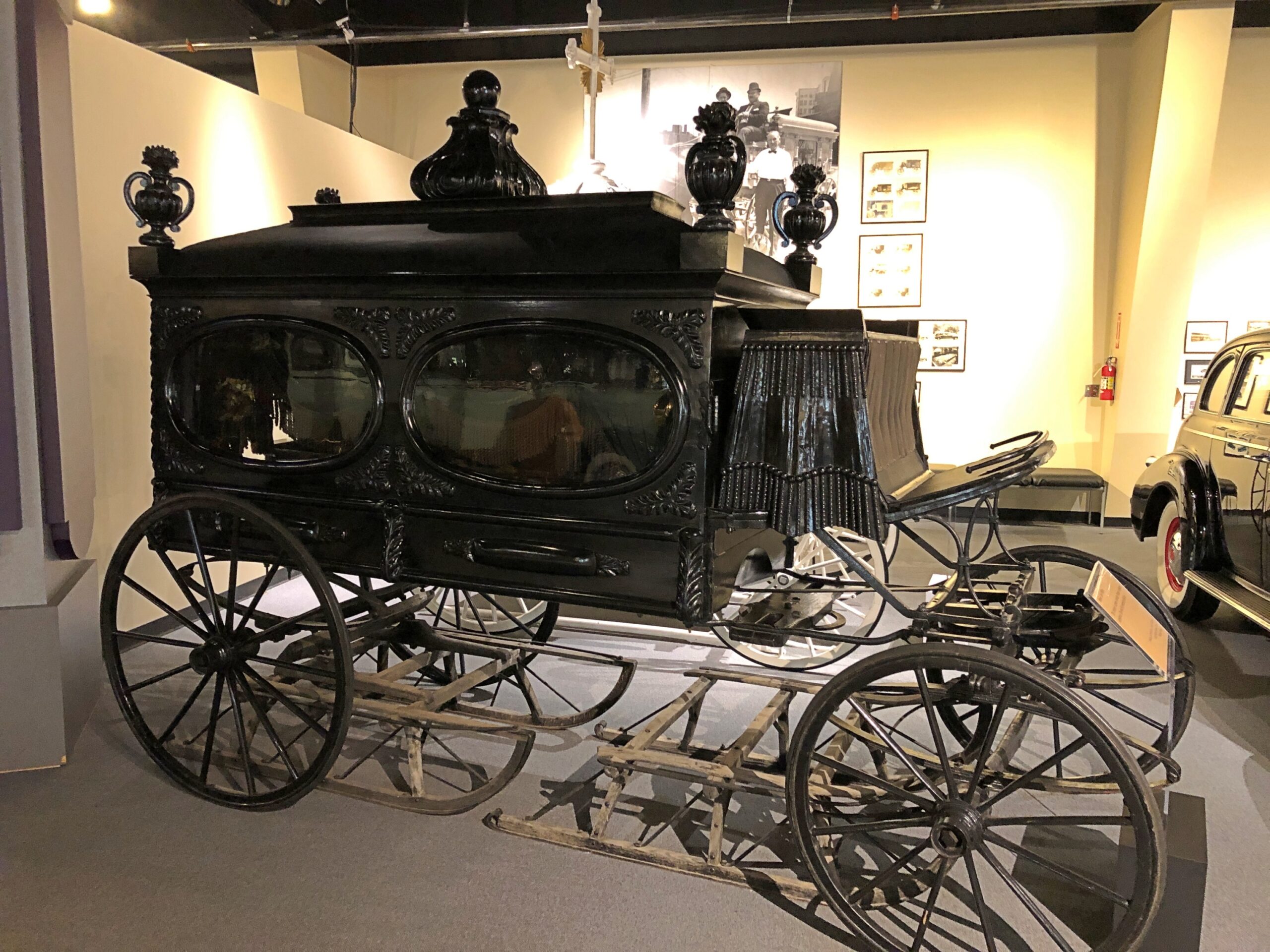
Some horse-drawn hearses.
A children’s hearse from, of course, Victorian times.
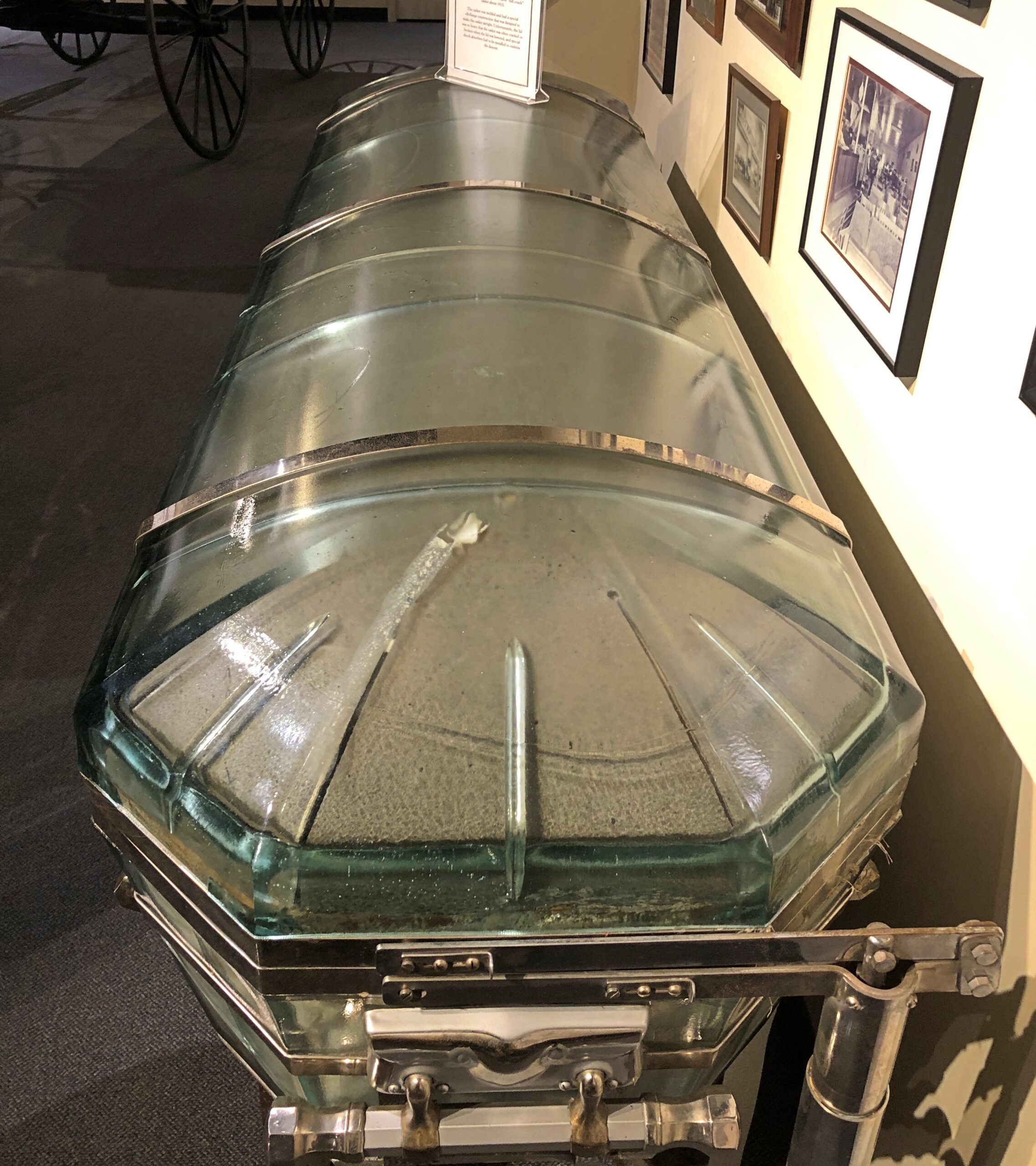
Some coffins and caskets, too. “It’s not the cough/that carries you off/but the coffin/they carry you off in.”
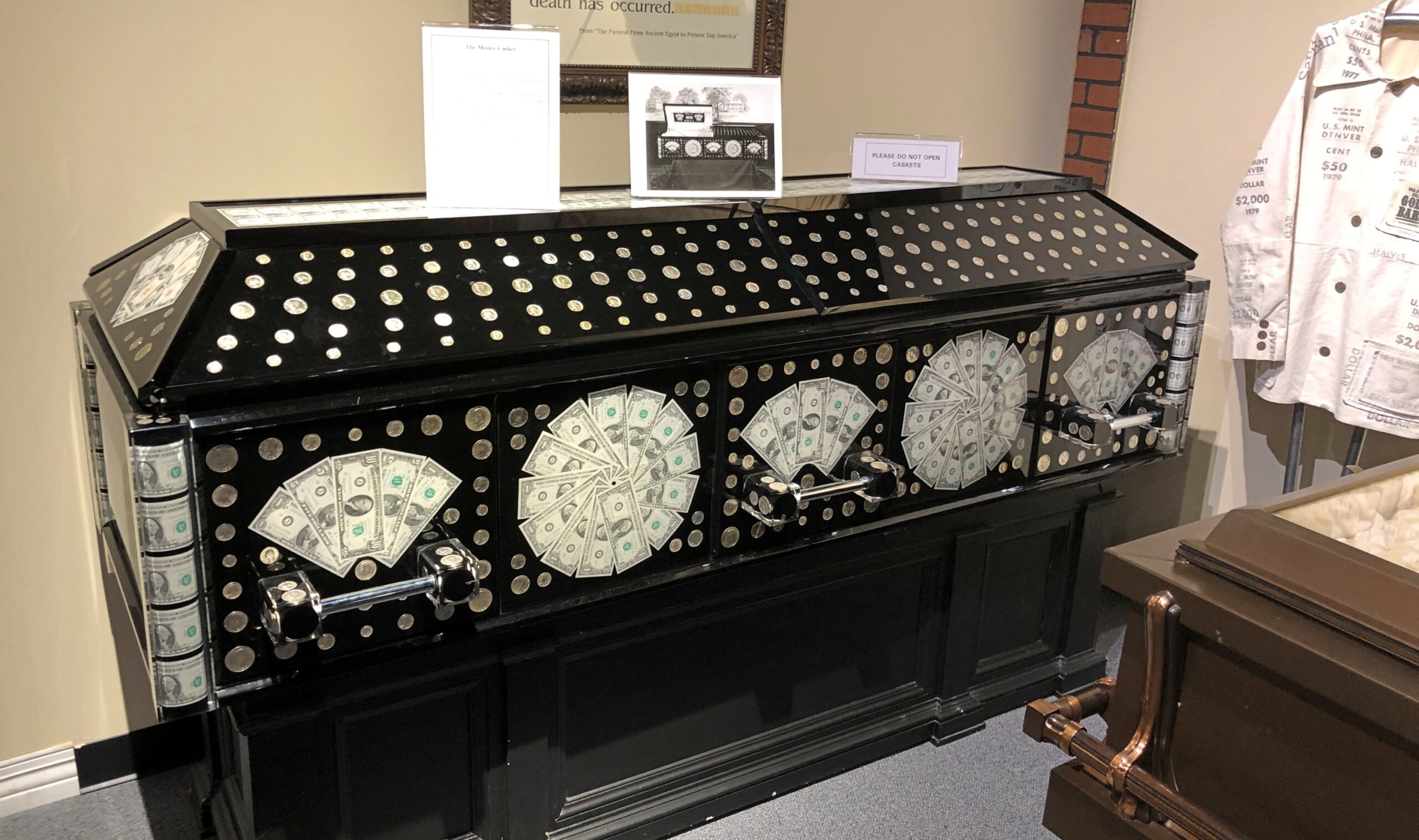
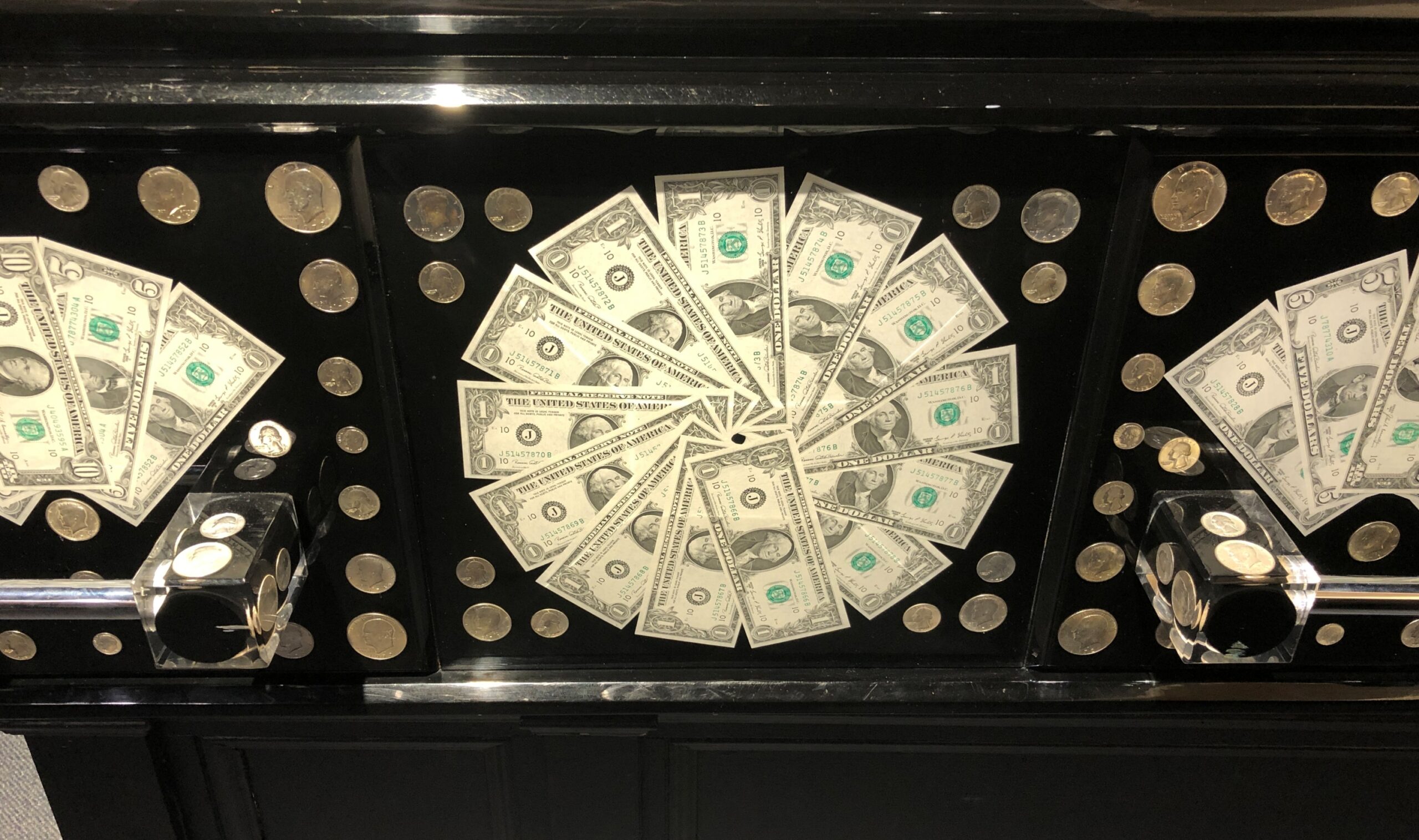
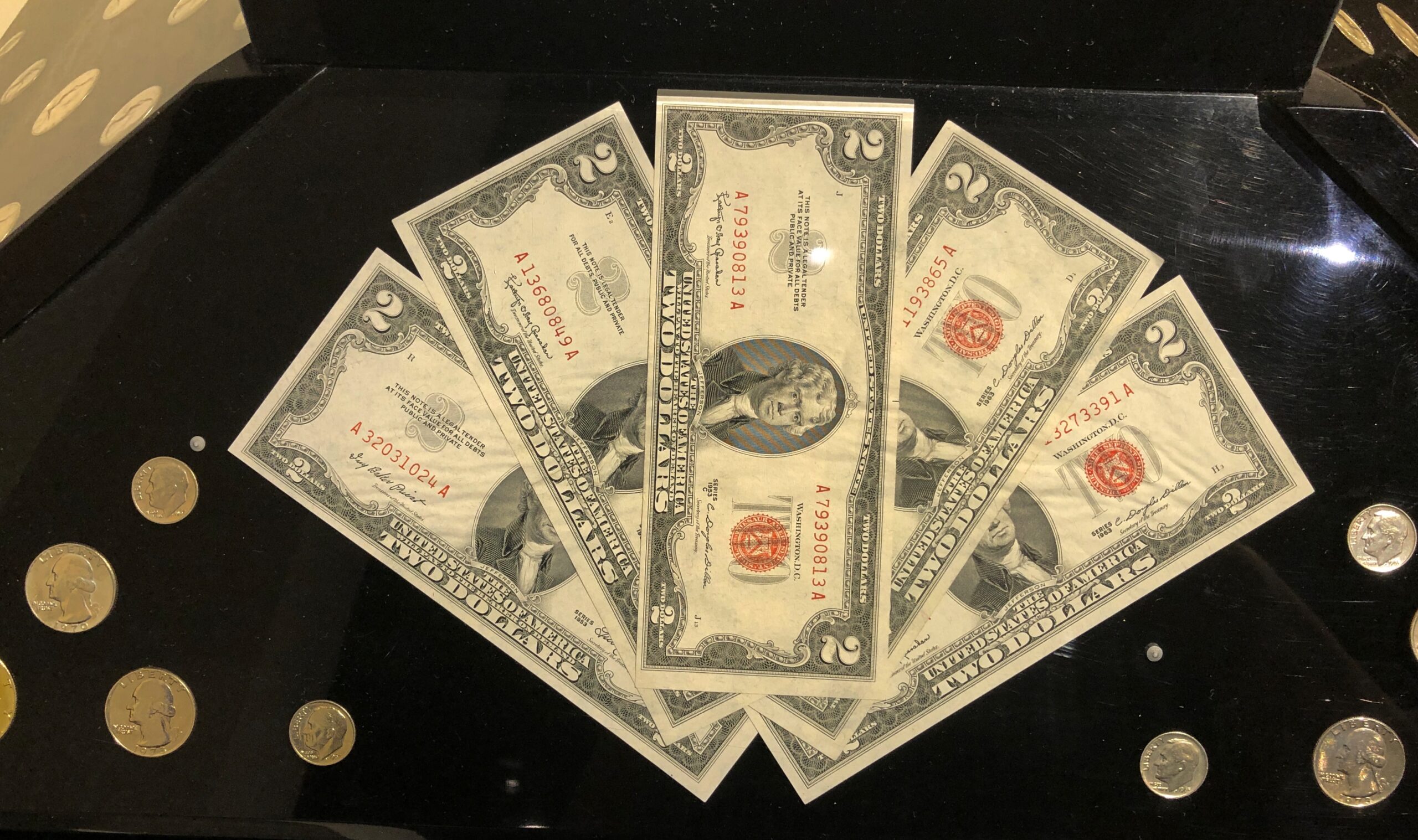
Including an oddity known as the Money Casket, which is on loan to the museum, and was never meant to be put into the ground.
A section about presidential funerals. I spent a while there.
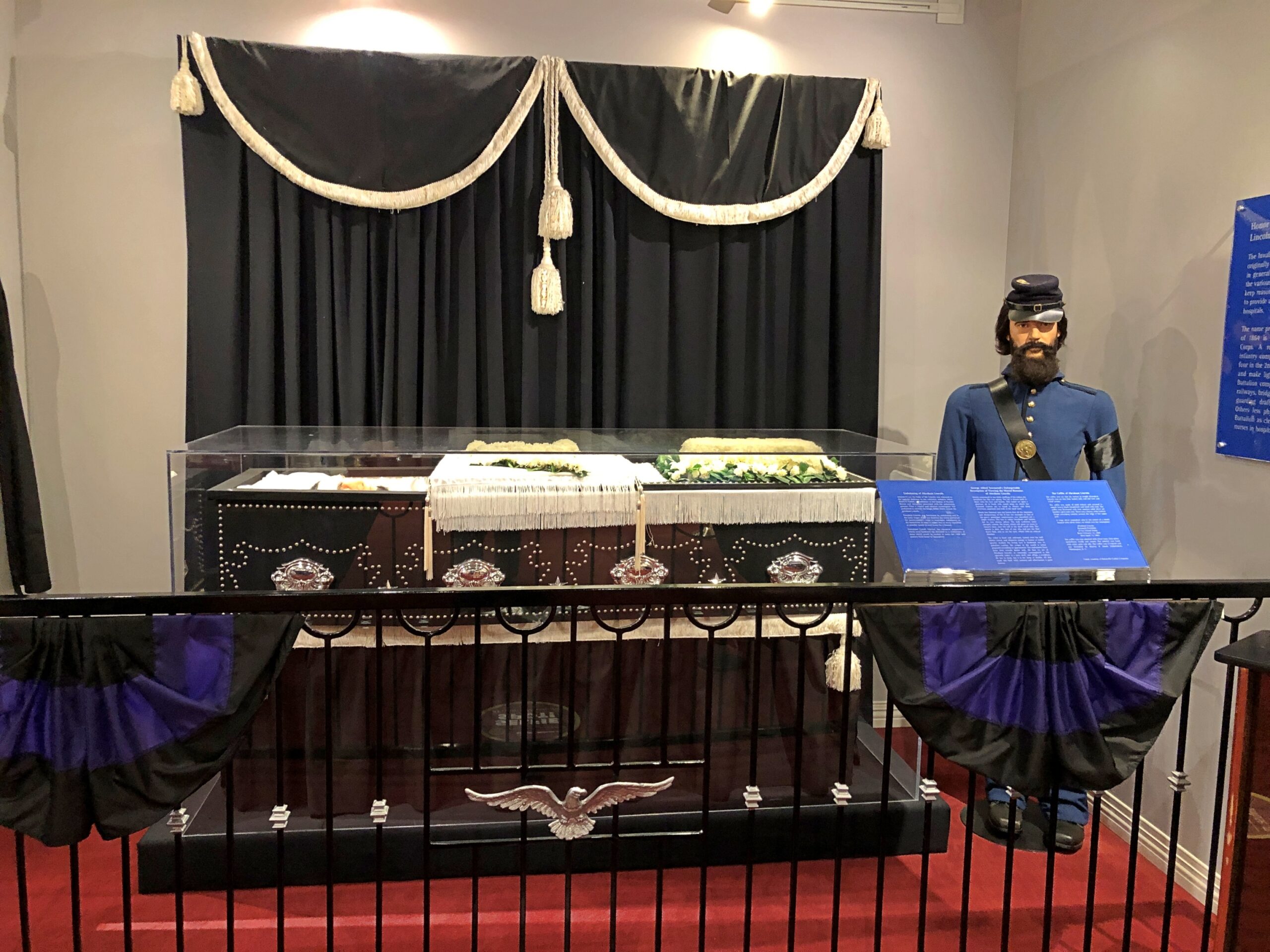
Prominent is a replica of President Lincoln’s casket.
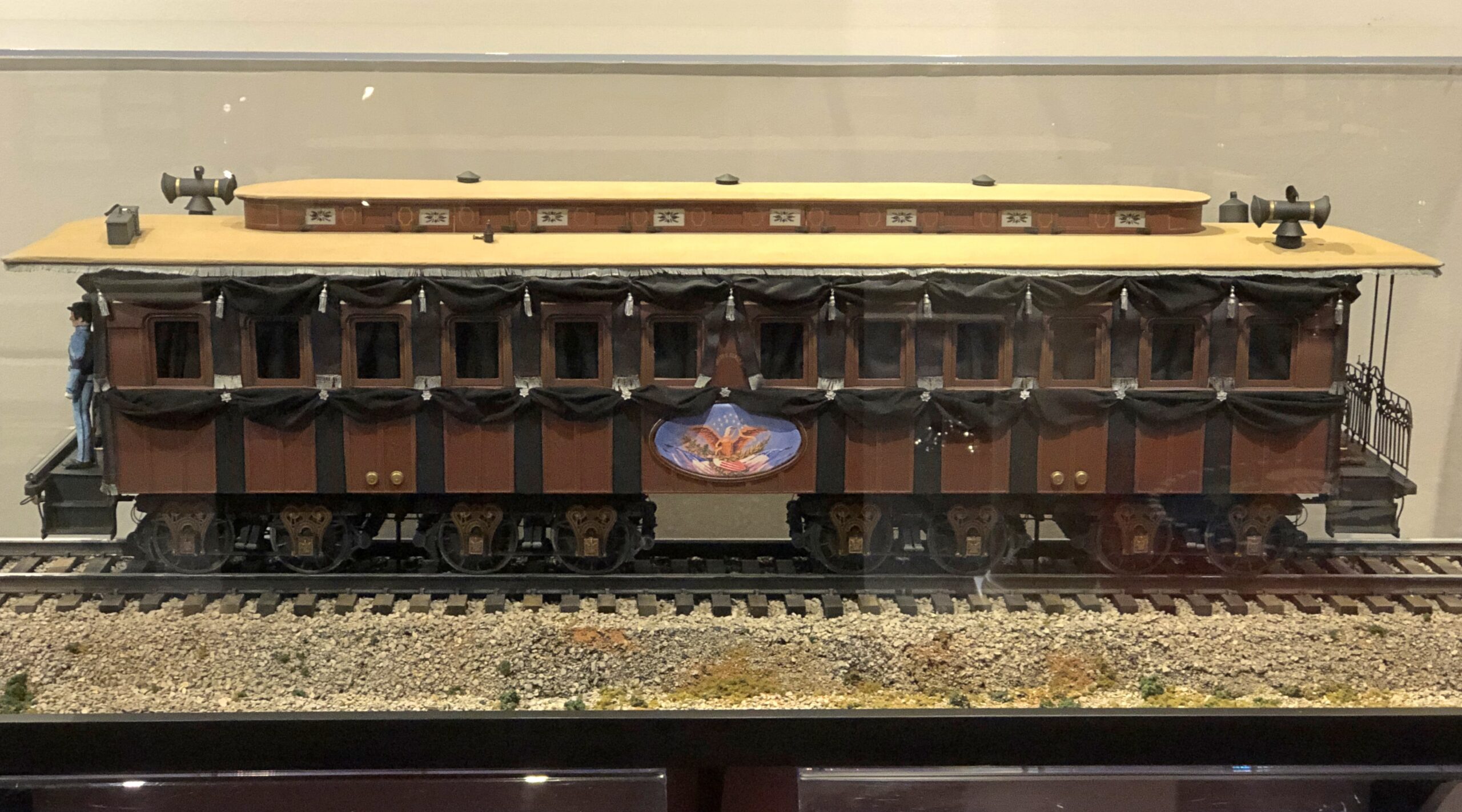
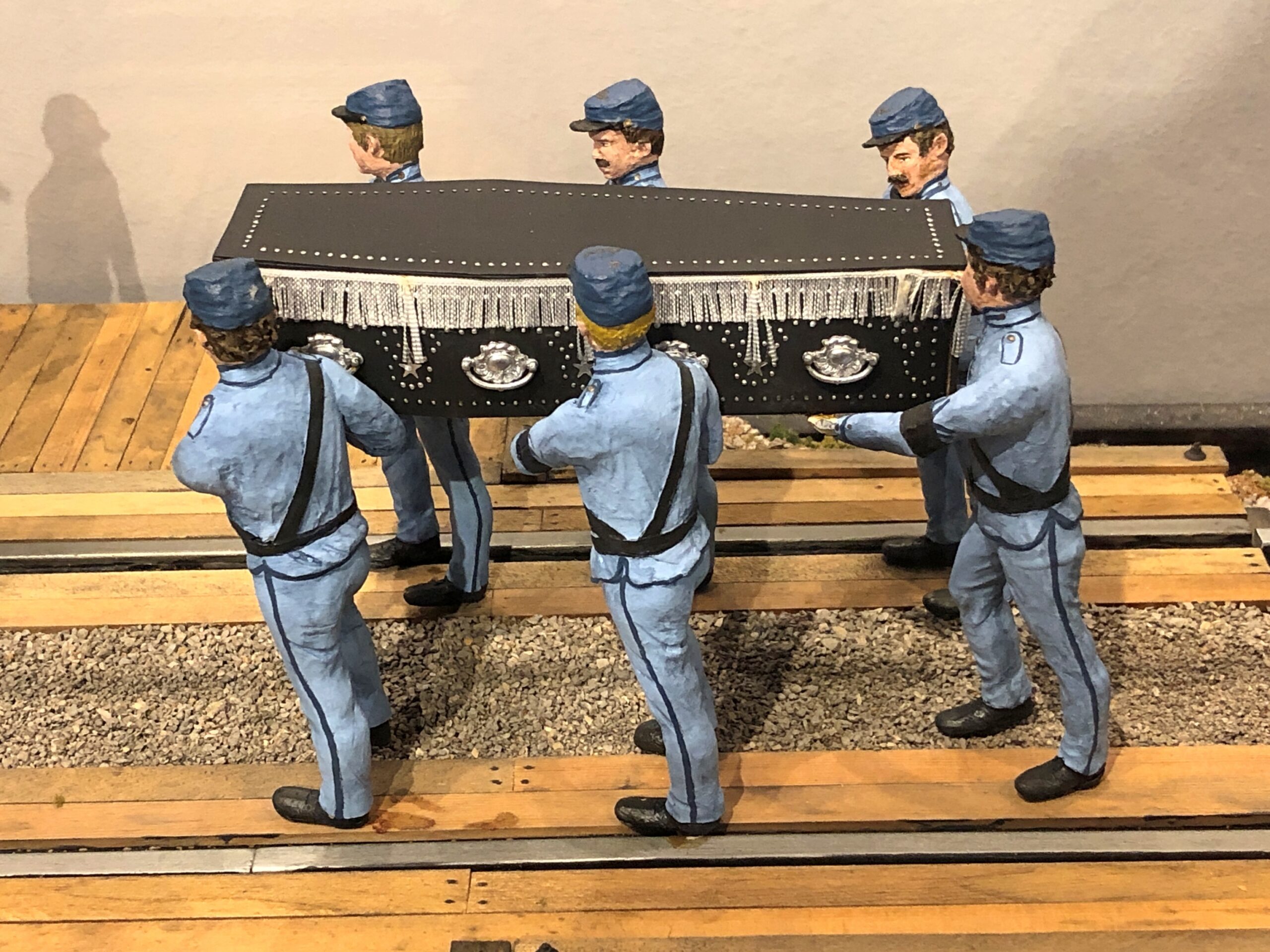
There was a model of Lincoln’s funeral car, probably the most famous such in American history.
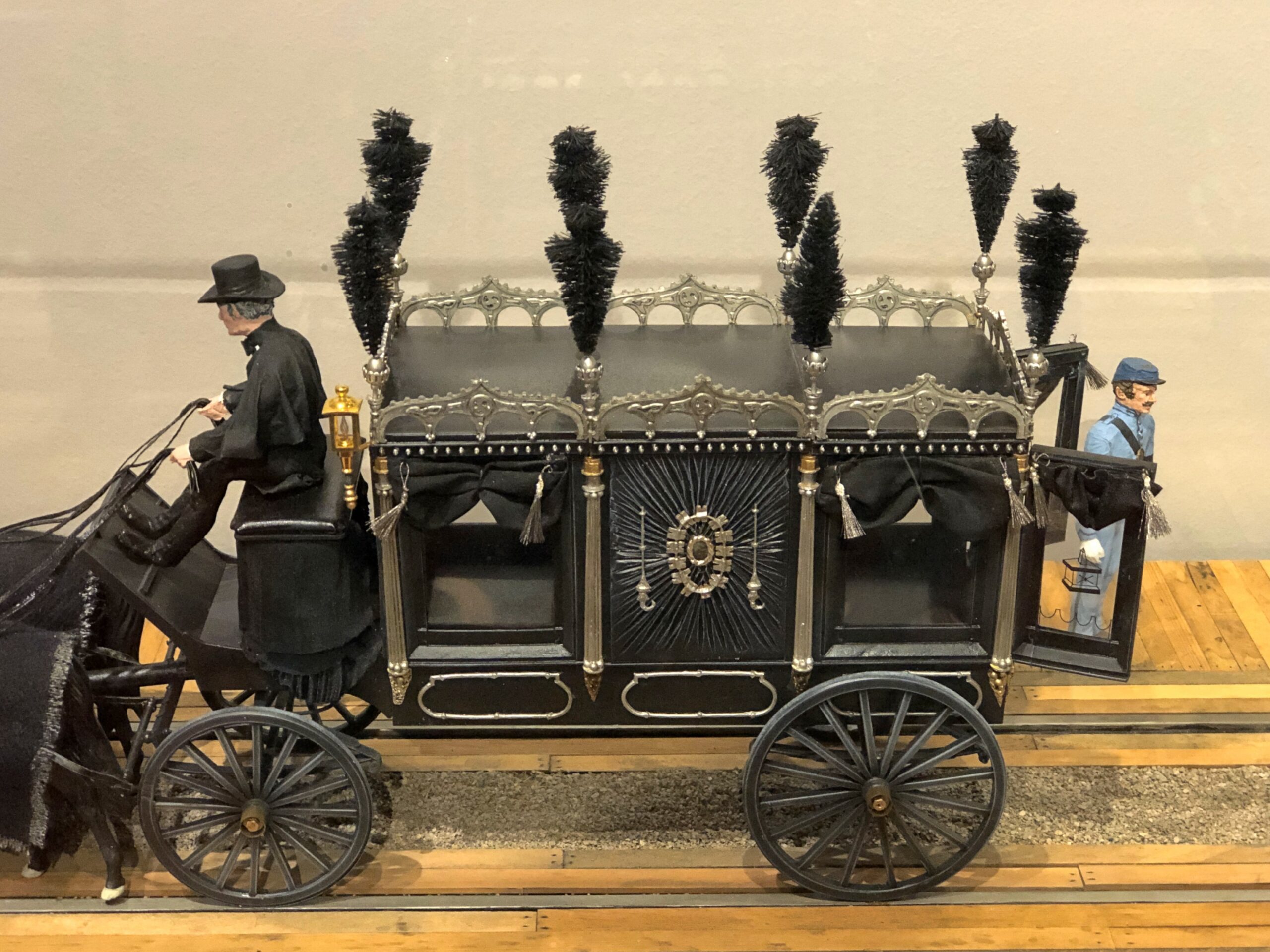
Other methods for carrying Lincoln when he wasn’t on the train.
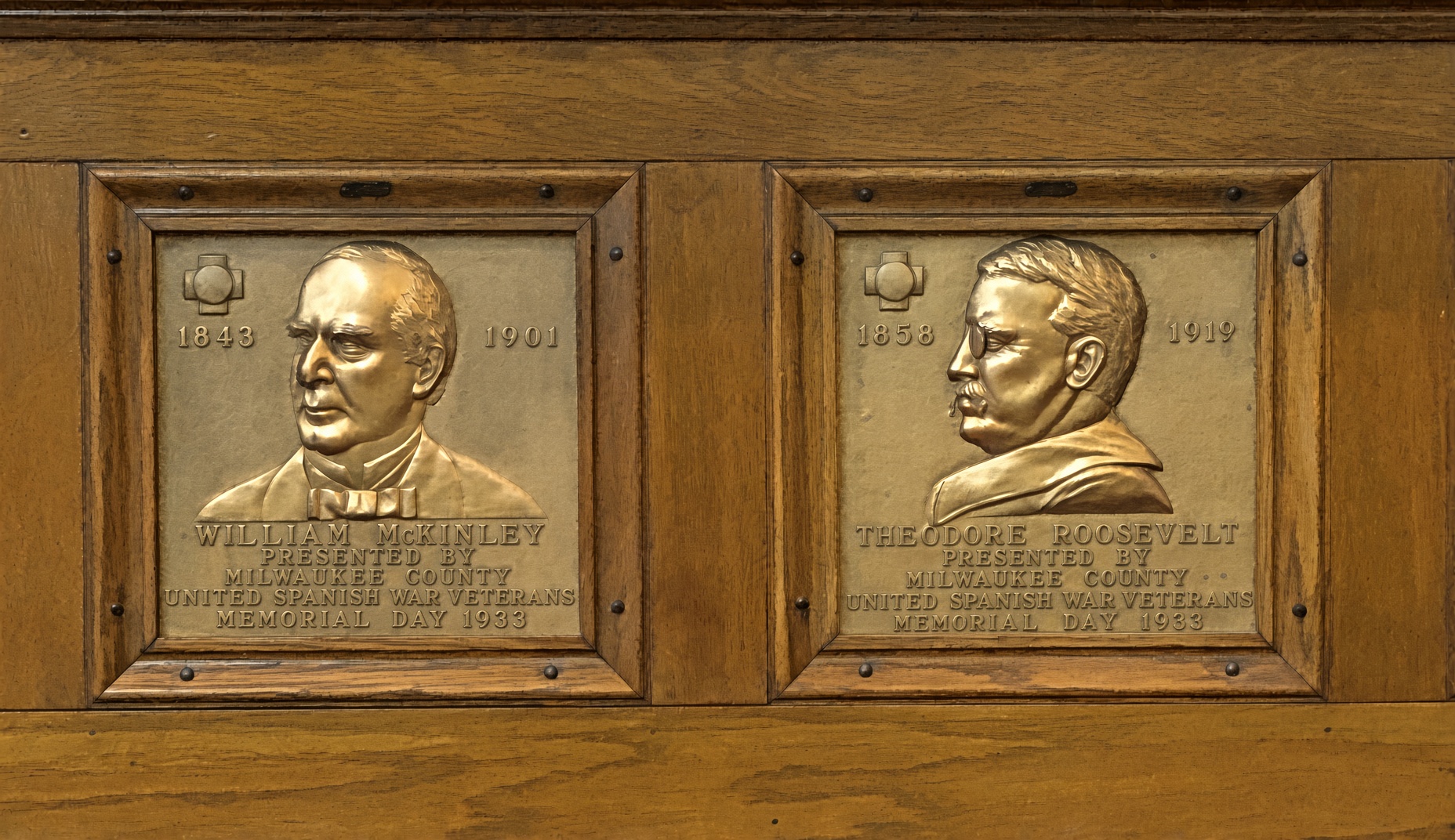
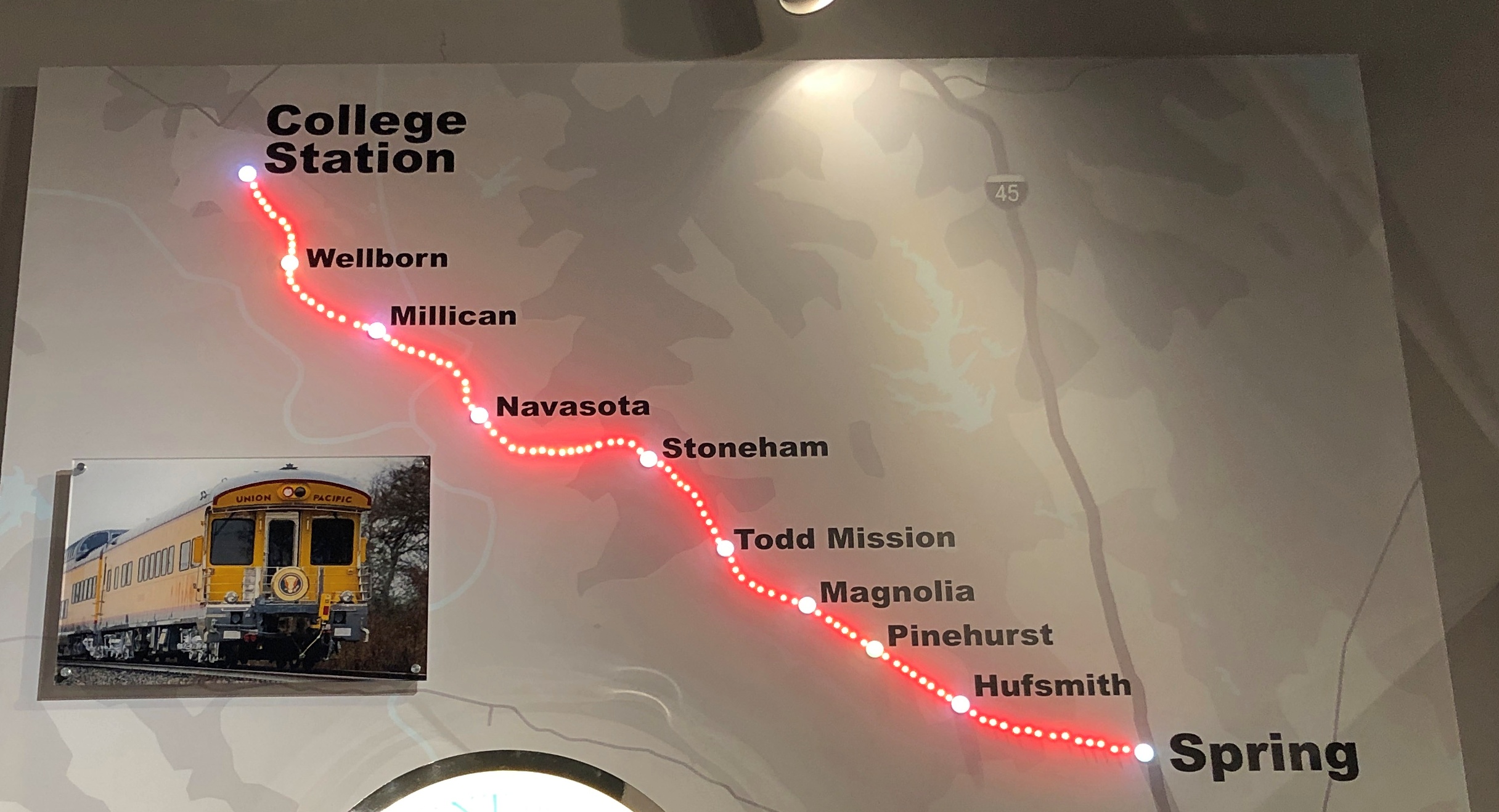
Other presidential funerals got their due, such as those of Washington, Grant, Garfield, McKinley, TR, FDR, Truman, Eisenhower, JFK, LBJ, Nixon, Ford and as mentioned, an entire small room about the elder Bush. He had a funeral train as well, though relatively modest: from Spring to College Station, all within east Texas.
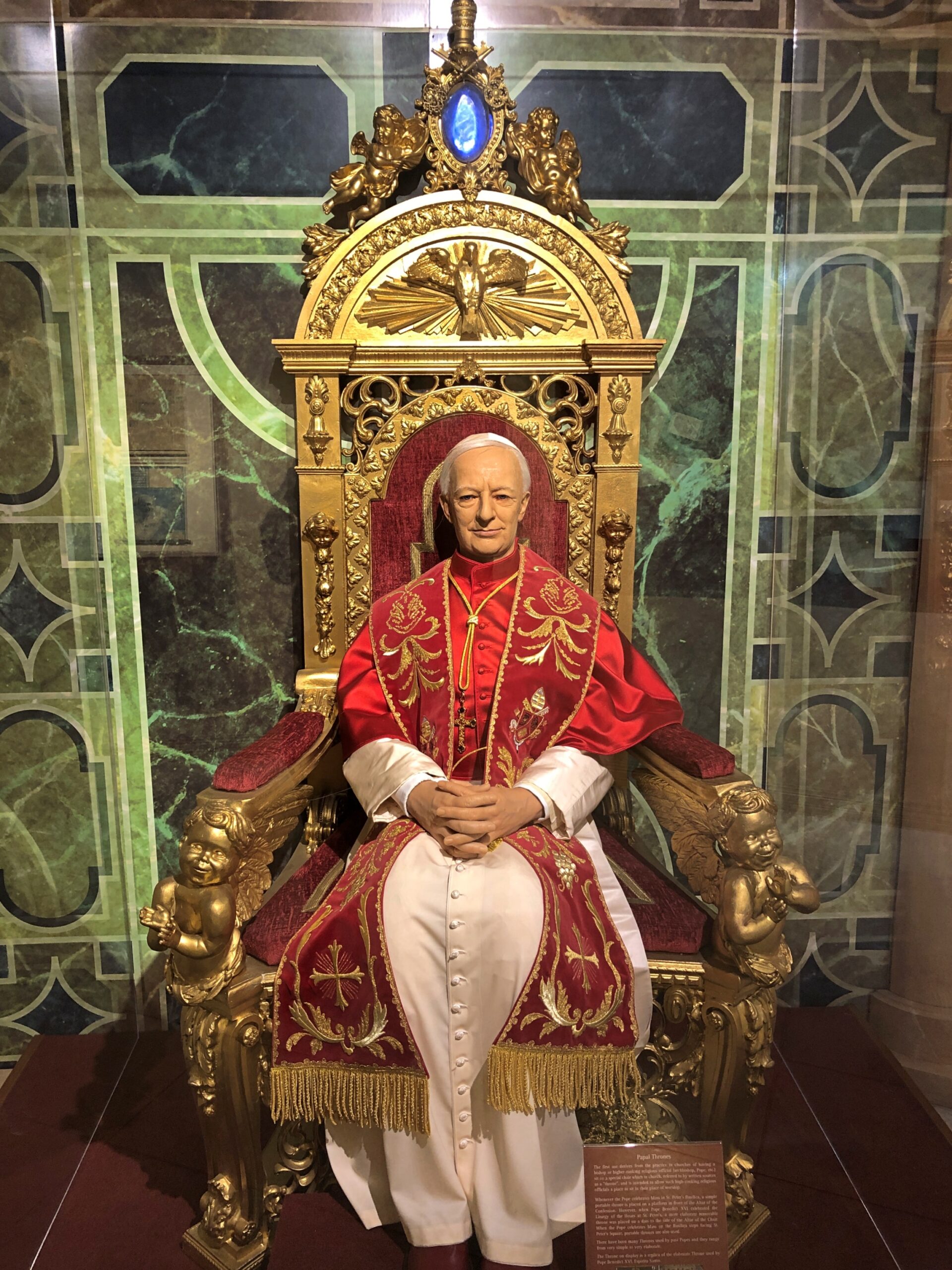
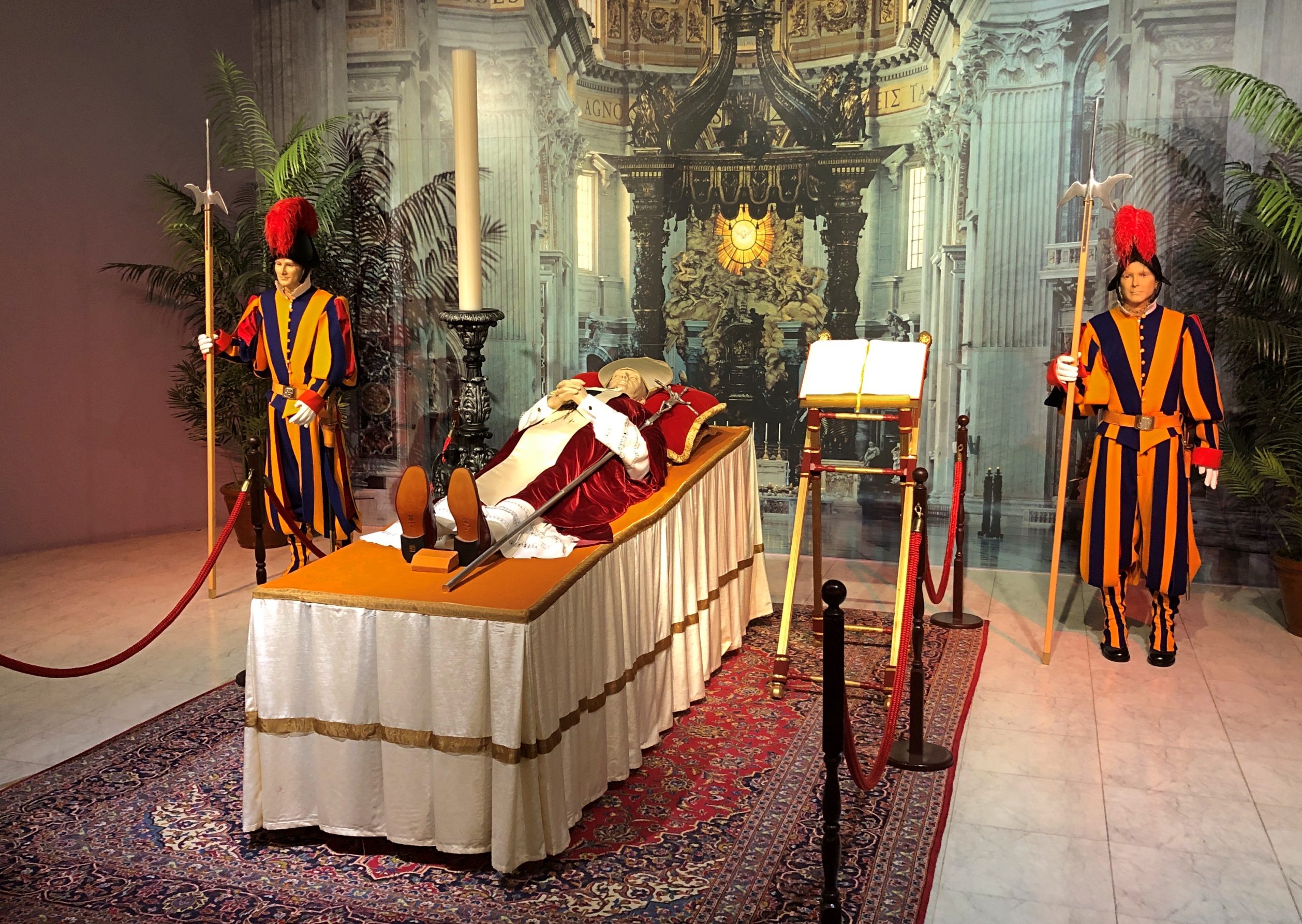
Papal funerals, as you’d think, involve a highly precise set of rituals, told in some detail by the museum.
There is much more.
All in all, a first-rate museum about coping with finality.
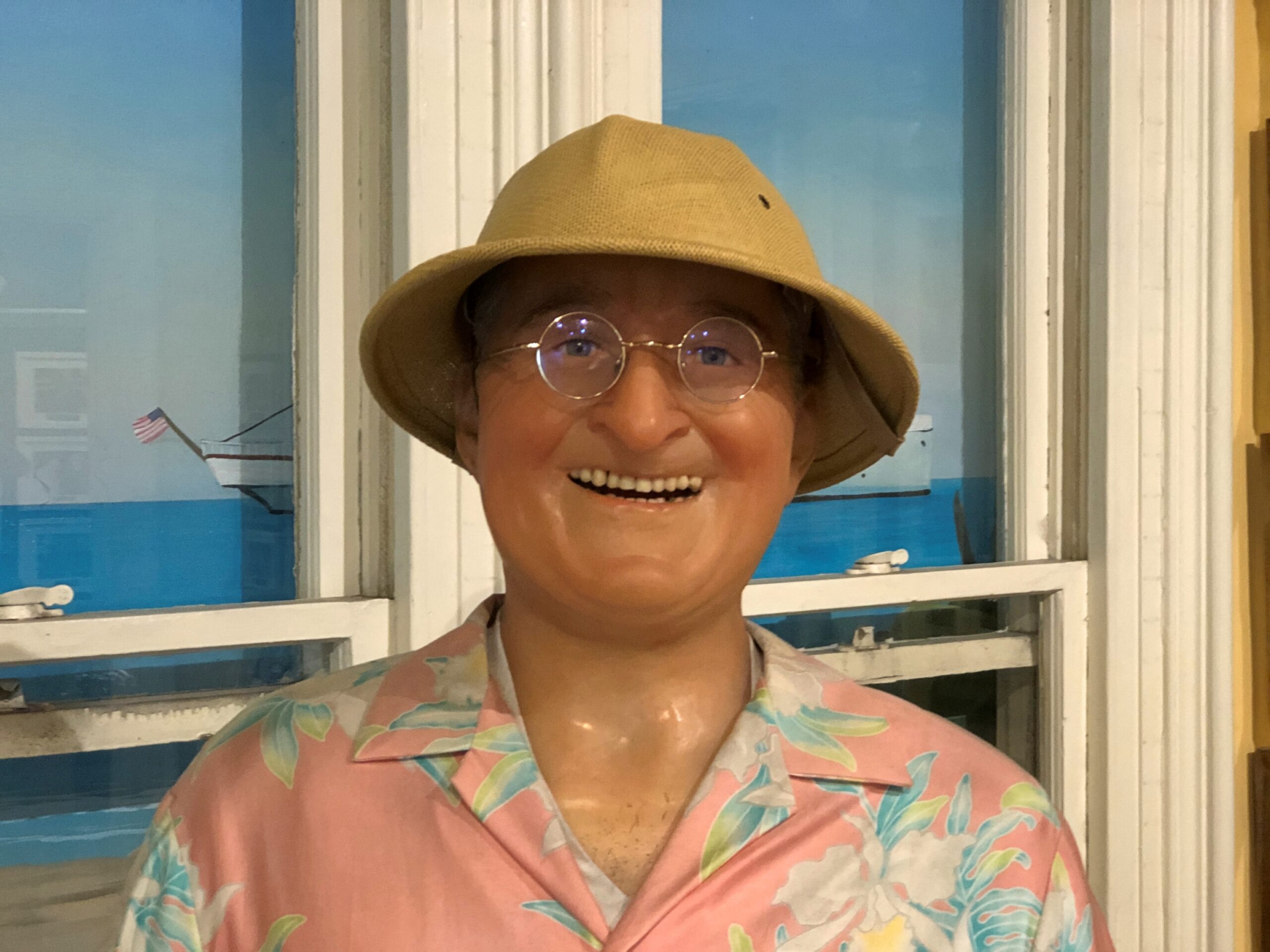
Nightmarish human faces weren’t invented by demented AI, but have long been with us. Case in point.
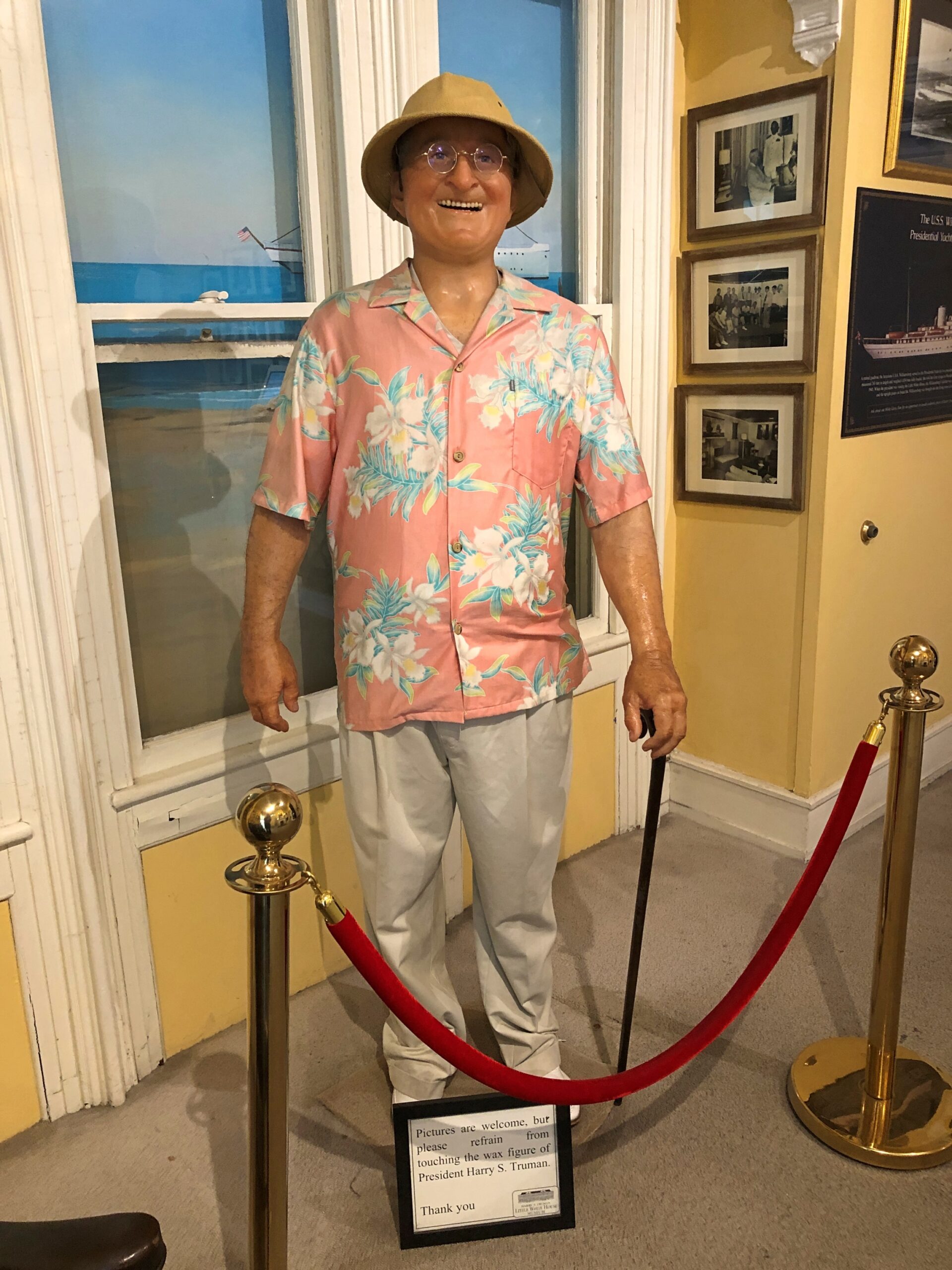
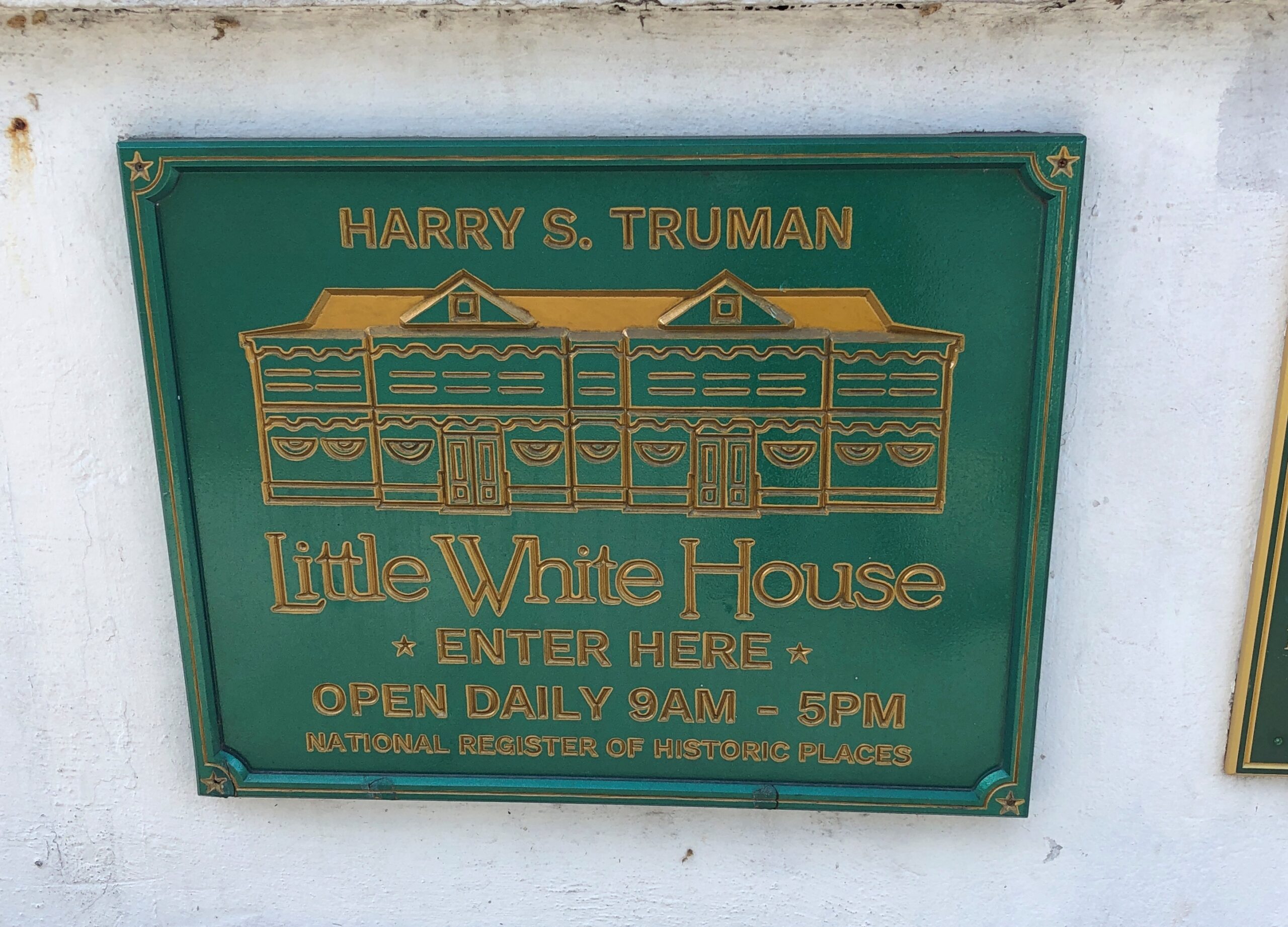
There’s Harry Truman in there somewhere. This particular wax dummy watches patrons in the small gift shop at the Harry S. Truman Little White House, which we toured on our second day in Key West.
The property belongs to the state of Florida these days, but of course was once a federal facility. Specifically, used by the Navy as officers’ quarters for the base at Key West. Truman took a cotton to the island early in his presidency, and visited often, and this is where the Navy put him up. He came to relax and play cards and fish and drink, naturally, but also to be president somewhere besides Washington in winter, since by the 1940s communication tech could facilitate such a thing.
The museum has been restored to its appearance in the late 1940s, and damned if it isn’t like walking into my grandparents’ time, entering an ordinary sort of American house of the period. The president might have stayed there, but Harry and Bess weren’t the sorts who went in for the latest expensive styles, but rather the sort of things available at a department store or via mail order: couches with some color but not too much, wooden coffee and end tables, mid-century lamps, etc.
Except, that is, for the handsome custom-make card table. That wasn’t available from Montgomery Ward.
“The poker table was a gift to Truman in 1949 by three civilian contractors working in the U.S. Naval Station cabinet shop,” says Wood Shop News. “The table is a marvel of craftsmanship and one of the most popular pieces at the Key West facility. Measuring 58” in diameter and 28” high, according to Little White House executive director Bob Wolz, it is based on a poker table that was used on the U.S.S. Williamsburg presidential yacht. The piece is made of mahogany with built-in chip holders and ashtrays crafted from recycled brass shell casings. A solid tabletop can be used to cover the poker table to turn into a dining space.”
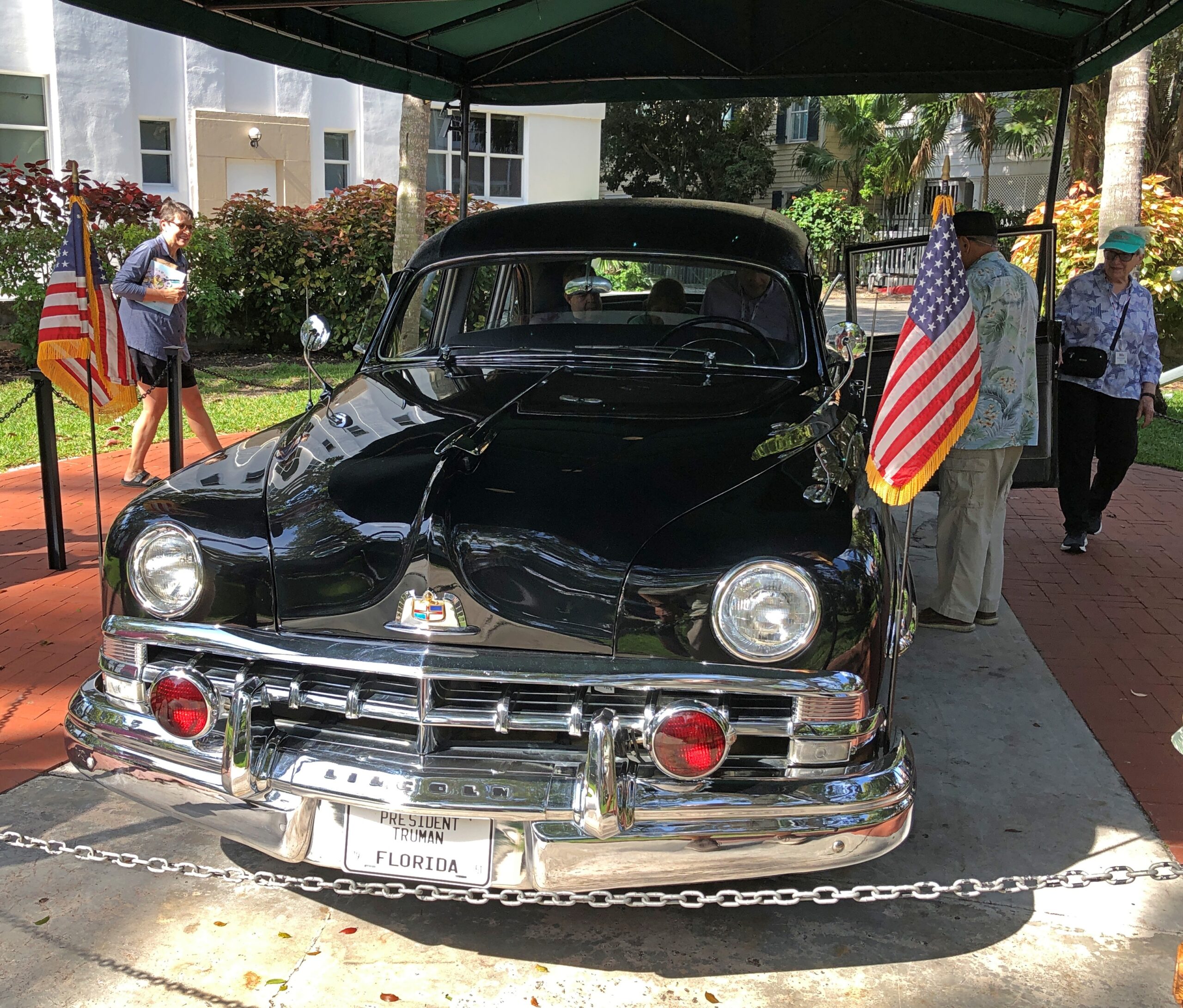
The limo parked on the grounds of the Little White House wasn’t standard mid-America either.
A nearby sign says that it is a 1950 Lincoln Cosmopolitan Presidential Limousine. One of nine that the Truman administration used, since in those days presidential vehicles weren’t transported by air, as they are now, so the government had them stationed in various parts of the country, ready to use.
The car is a museum piece, but no mere museum piece, since I understand that the current owner, the Key West Harry S. Truman Foundation, rents it under specific conditions. Namely, you pay some large fee, and are driven around Key West for a while. I learned this when we saw an elderly couple get in the back seat, followed by a uniformed driver, and off they went.
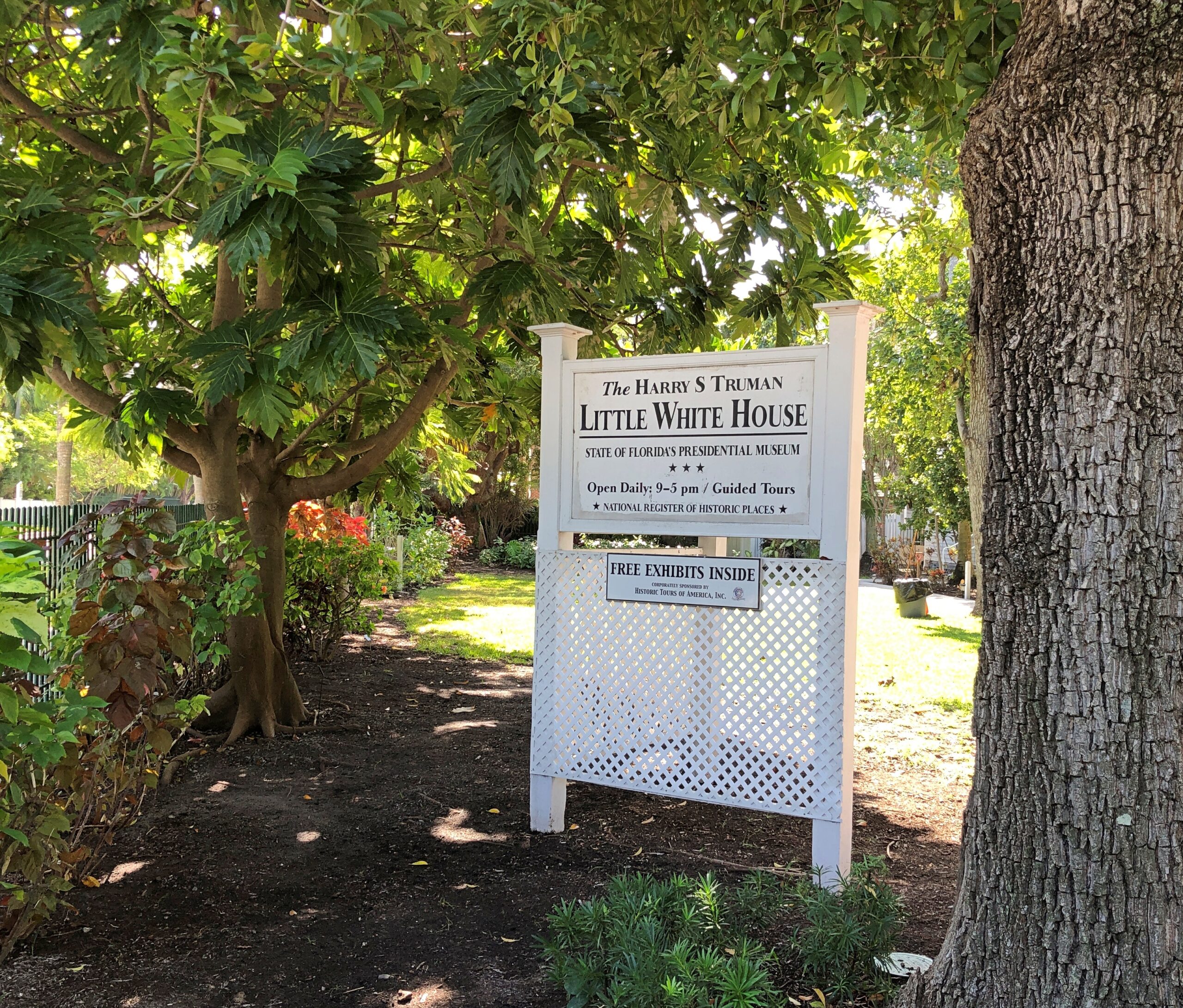
One more thing about the Little White House: the grounds are a small arboretum.
Flora includes well-known varieties, such as avocado, coconut, date palm, mahogany and mango, plus less-than-household names, such as Fiji fan palm, soapberry tree, and my own favorite name, gumbo limbo, whose “wood, though soft, was used in the past to carve carousel horses,” the museum tells us.
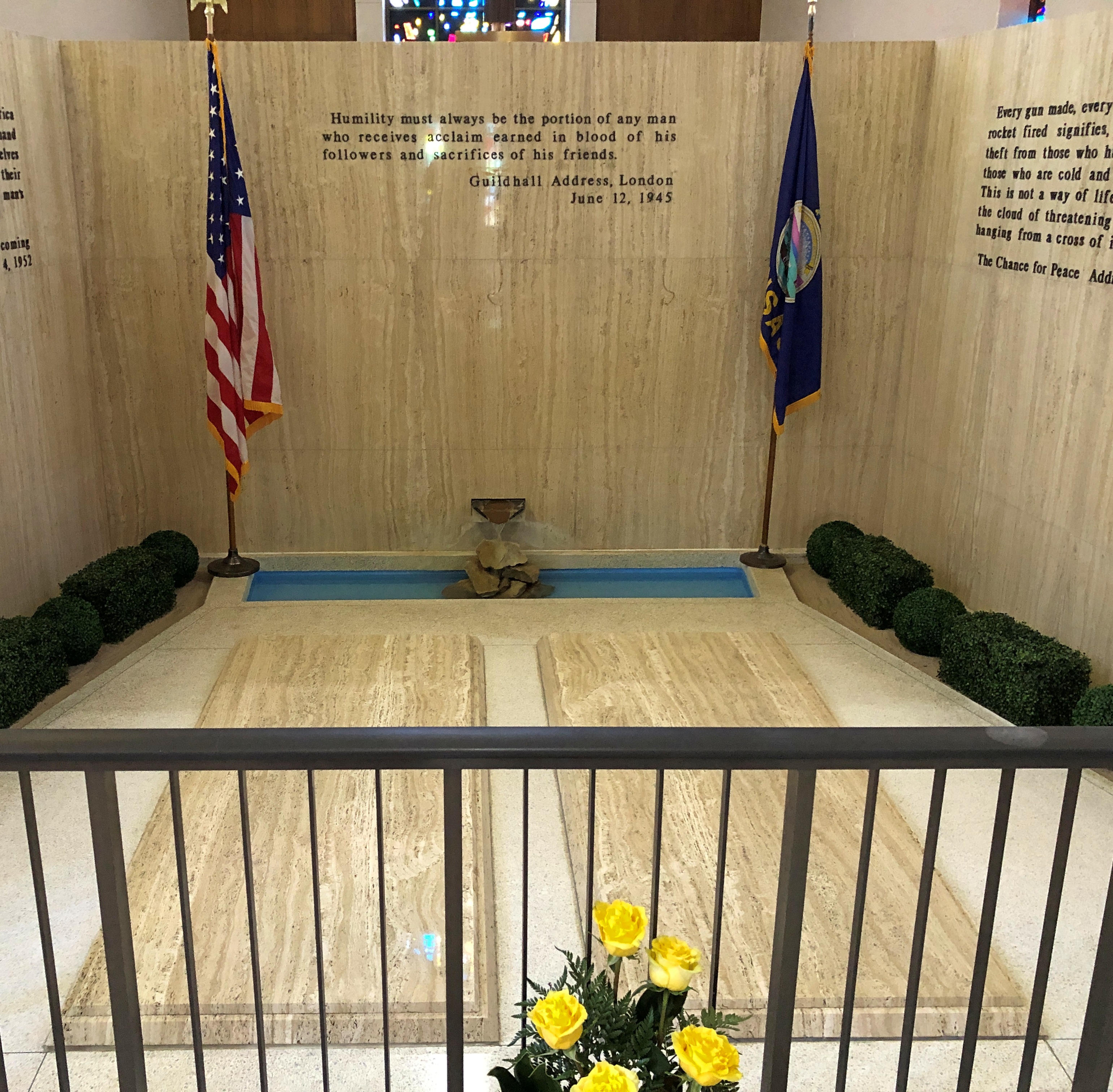
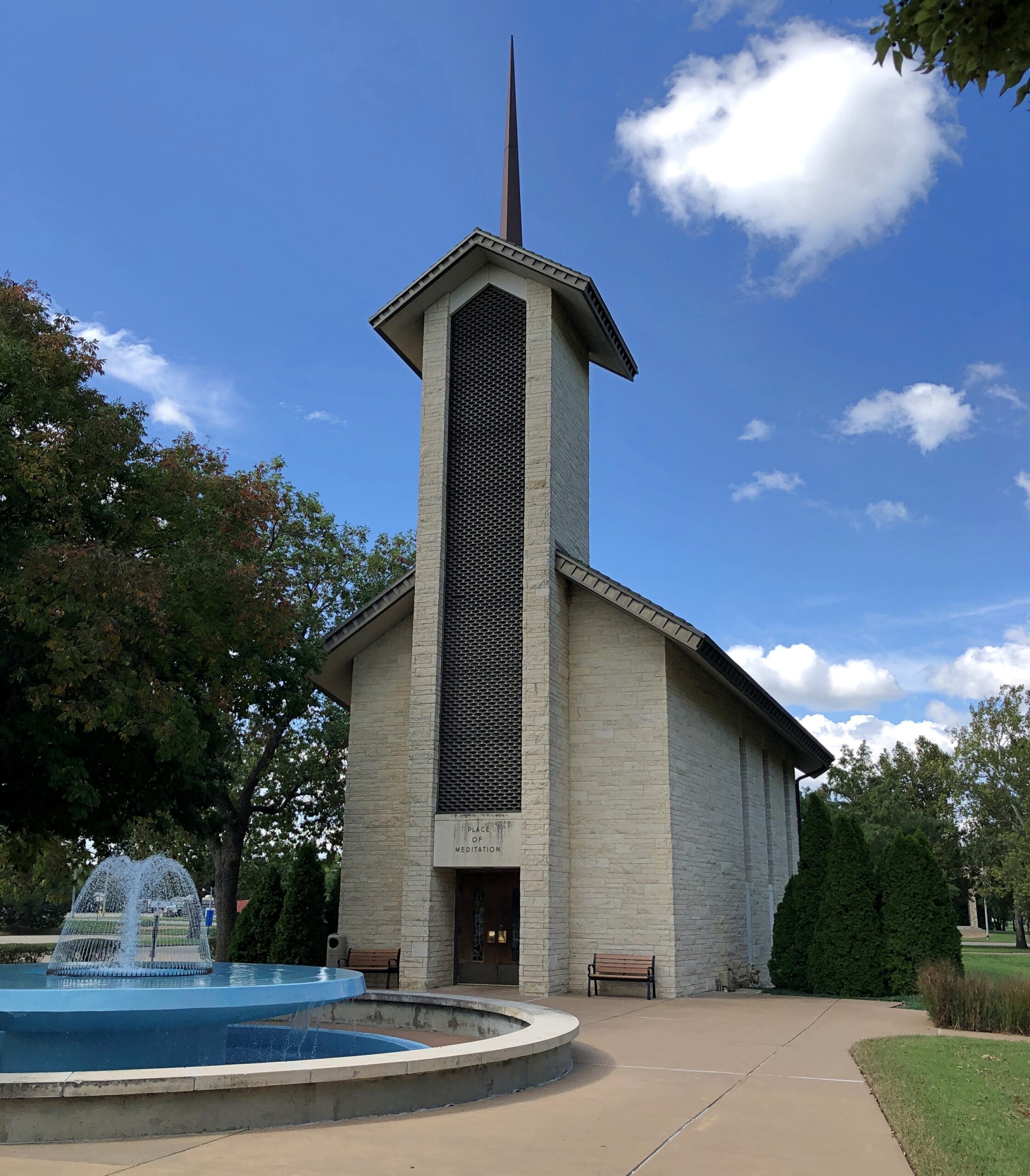
In Abilene, Kansas, not long ago, I found myself wondering, whatever happened to Manus Hand? That’s because I stood at that moment near the graves of President and Mrs. Eisenhower, Ike and Mamie.
The 34th President of the United States and the First Lady repose in a chapel-like structure on the grounds of the Dwight D. Eisenhower Presidential Library, Museum and Boyhood Home in Abilene, pop. 6,400 or so, the town where the president came of age.
I’ve been told I visited before, with my family during a trip to Kansas when I was a wee lad, but I don’t remember that at all. So I count this as a new visit to a presidential sight, including a grave site, which makes 21 presidential graves all together. But for the federal shutdown in October, there would be four more at least: Adams père et fils, FDR and TR.
I thought of Manus Hand because, back in the Neolithic age of the Internet, he had a web site featuring photos of him at presidential grave sites. In my own dead presidents days, I found Hand’s site at some point. He had visited almost all of them by then, 36 by his count. His site is still in existence, without much change, except an update to note that George H.W. Bush had died (2018), but not Jimmy Carter.
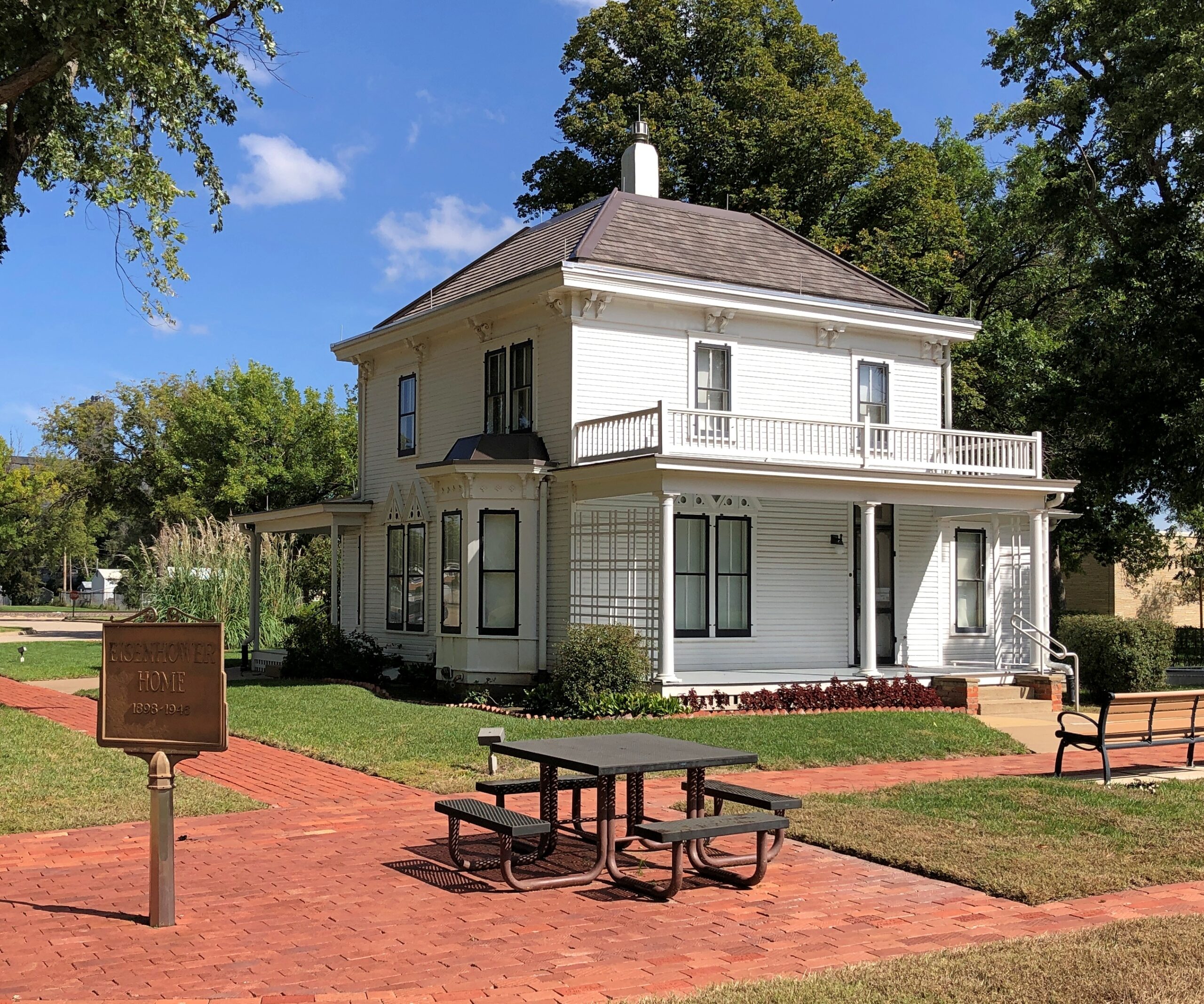
The Eisenhower Boyhood Home, moved to the site. No tours available when I came by.
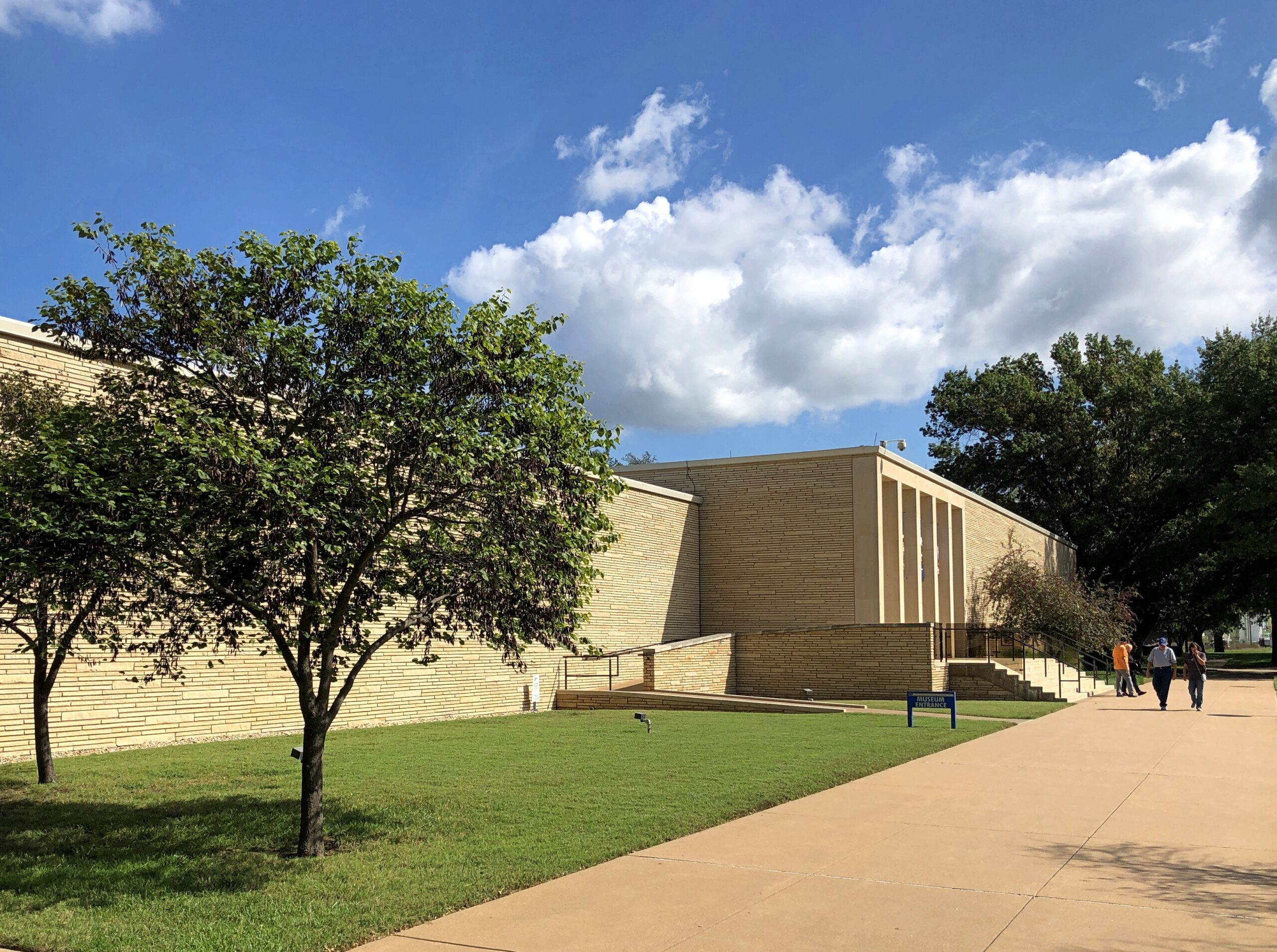
The Eisenhower Museum.
Midcentury, and what could be more fitting for Eisenhower? It’s chronologically organized: early Ike in Abilene; his Army career before WWII, including his cross-country epic; during that war and right after the war; his presidency and post-presidency, and a gallery about Mamie. Well organized, interesting artifacts, but (for me) none more interesting than a titanium sphere.
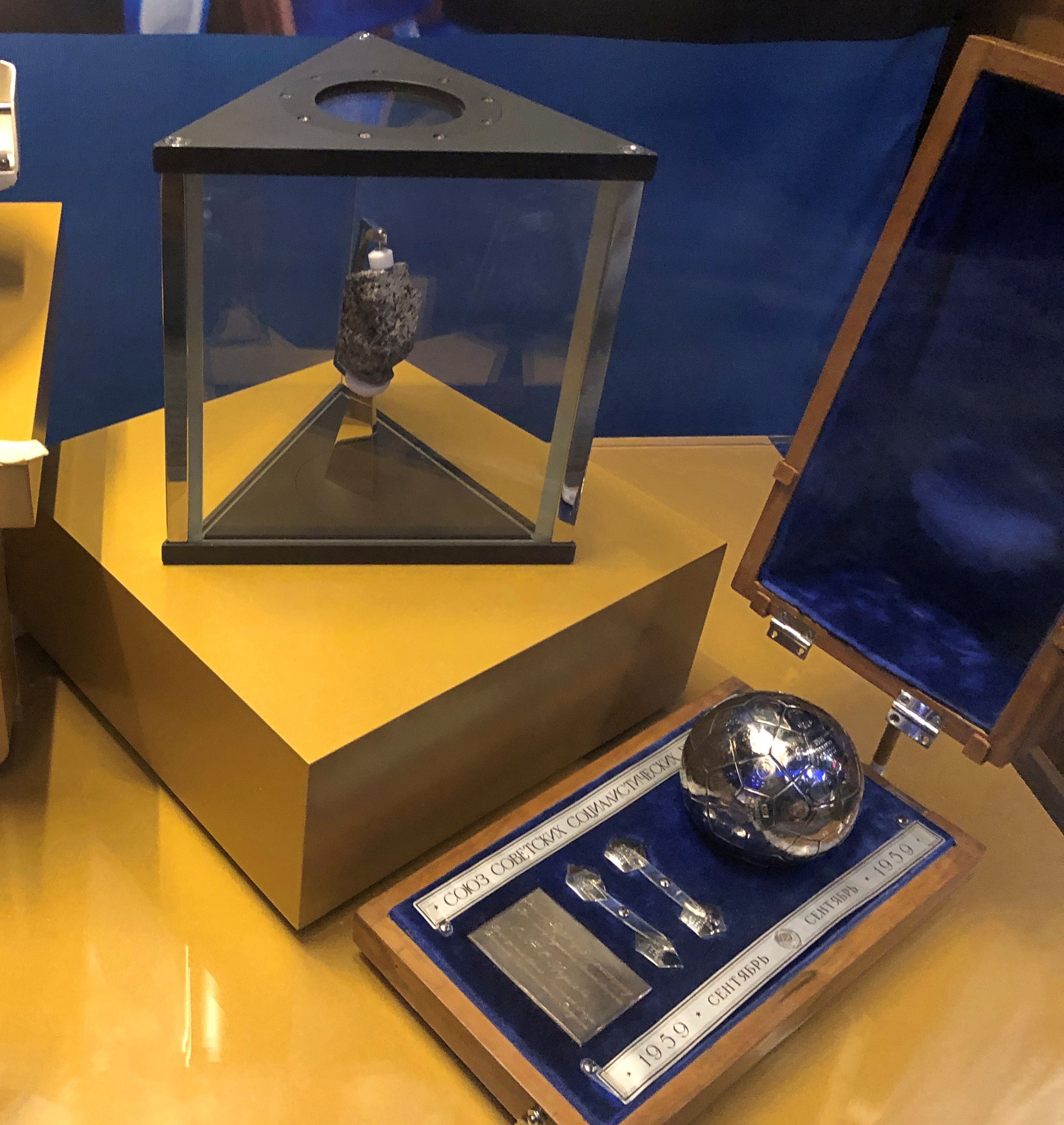
The sphere is a replica of the pennant sphere that traveled to the Moon in 1959 aboard the Soviet spacecraft Luna 2, which was the first manmade object to reach the lunar surface, or any celestial body. The sphere was a detail that I remembered from long-ago reading about space exploration. I didn’t realize one existed any more, even in replica form. Khrushchev presented it to Eisenhower during his famed visit to the U.S. that year (Khrushchev’s due at Idlewild!).
Luna 2 carried two spheres filled with liquid and an explosive charge, designed to burst apart on impact and scatter pentagonal pennants, the Moon Registry says. The pennants were imprinted with: 1) Sentiabr 1959 (September 1959); CCCP… ; and the state seal of the USSR, a wreath of grain around the hammer and sickle. It is theorized that the medallions vaporized on impact.
Russia is still shooting Luna missions to the Moon. The most recent, Luna 25, crashed near the lunar south pole in 2023 but, unlike Luna 2, not on purpose. Oops. More about the many pennants the Soviets sent into space is here. On display next to the sphere is a lunar rock, which must have been a posthumous gift, since Ike didn’t live quite long enough to benefit from astronauts rock-gathering on the surface, though he was still alive during Apollo 7, 8 and 9.
A close second excellent artifact was a dagger Marshal Zhukov presented to General Eisenhower on the occasion of the defeat of Germany, a good-looking blade with an ivory hilt and gold decorations. I picture an exuberant Zhukov, as in The Death of Stalin, handing the knife to Ike and saying something earthy. Apparently the two, Ike and Zuke, got along well in the early months of the joint occupation of Germany. Differences aside, they had job experience in common. I don’t remember seeing anything about that in the museum, but there was a lot of material, so that could have been easily missed. That and any reference to Kay Summersby.
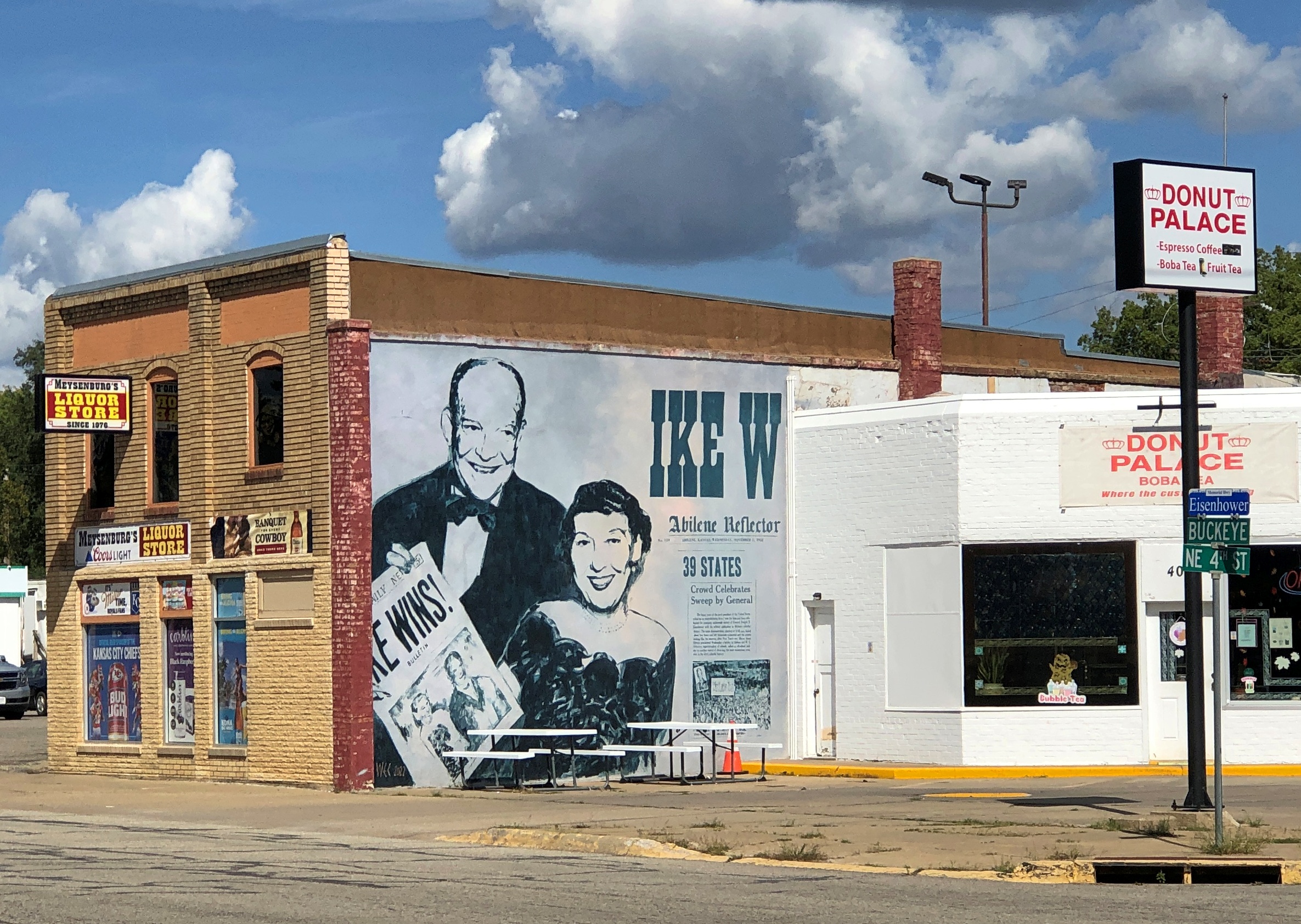
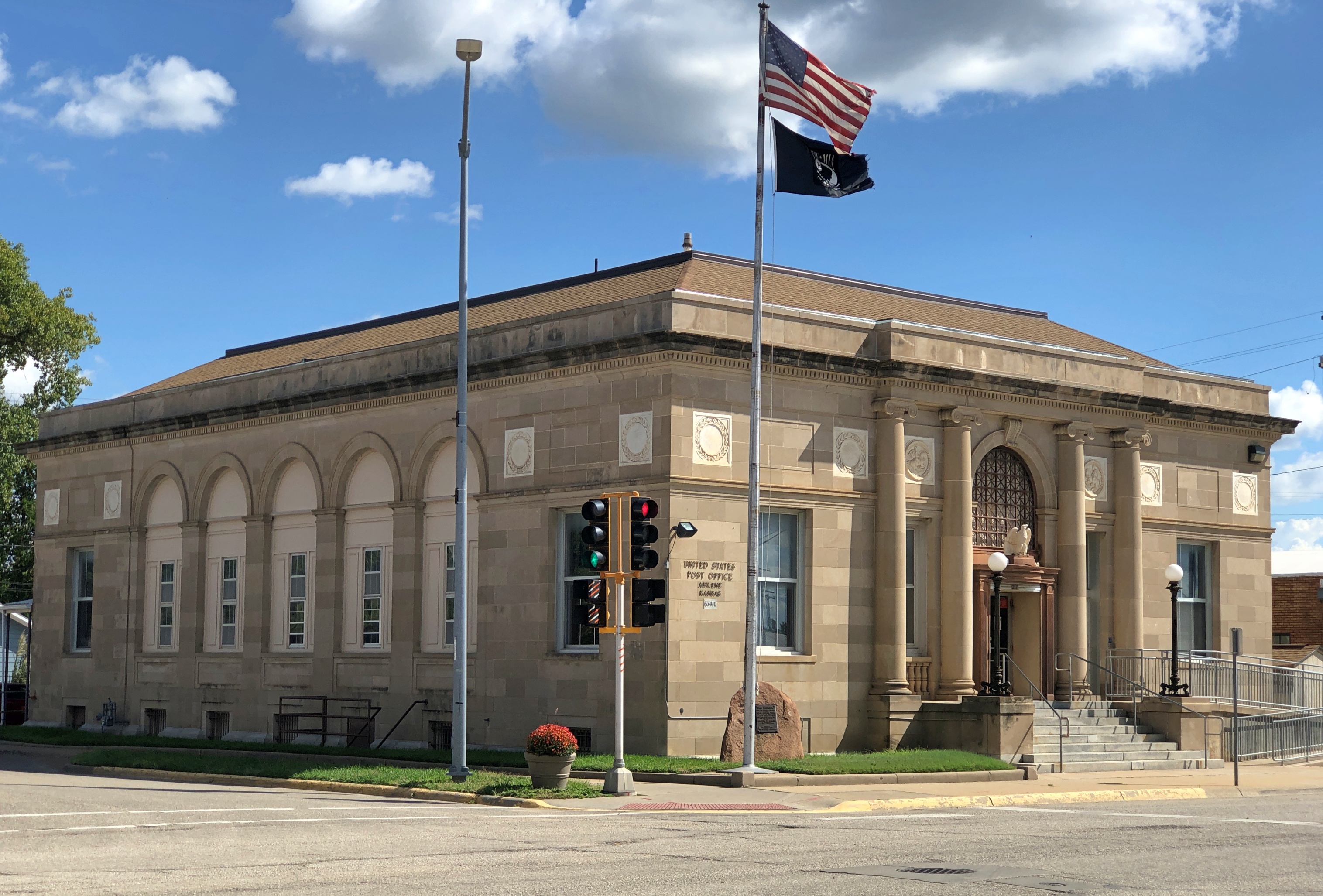
It was hot that day, September 24, but after visiting the museum, I took a look around Abilene anyway. The town hasn’t forgotten its most famous native son. Also, Donut Palace was closed.
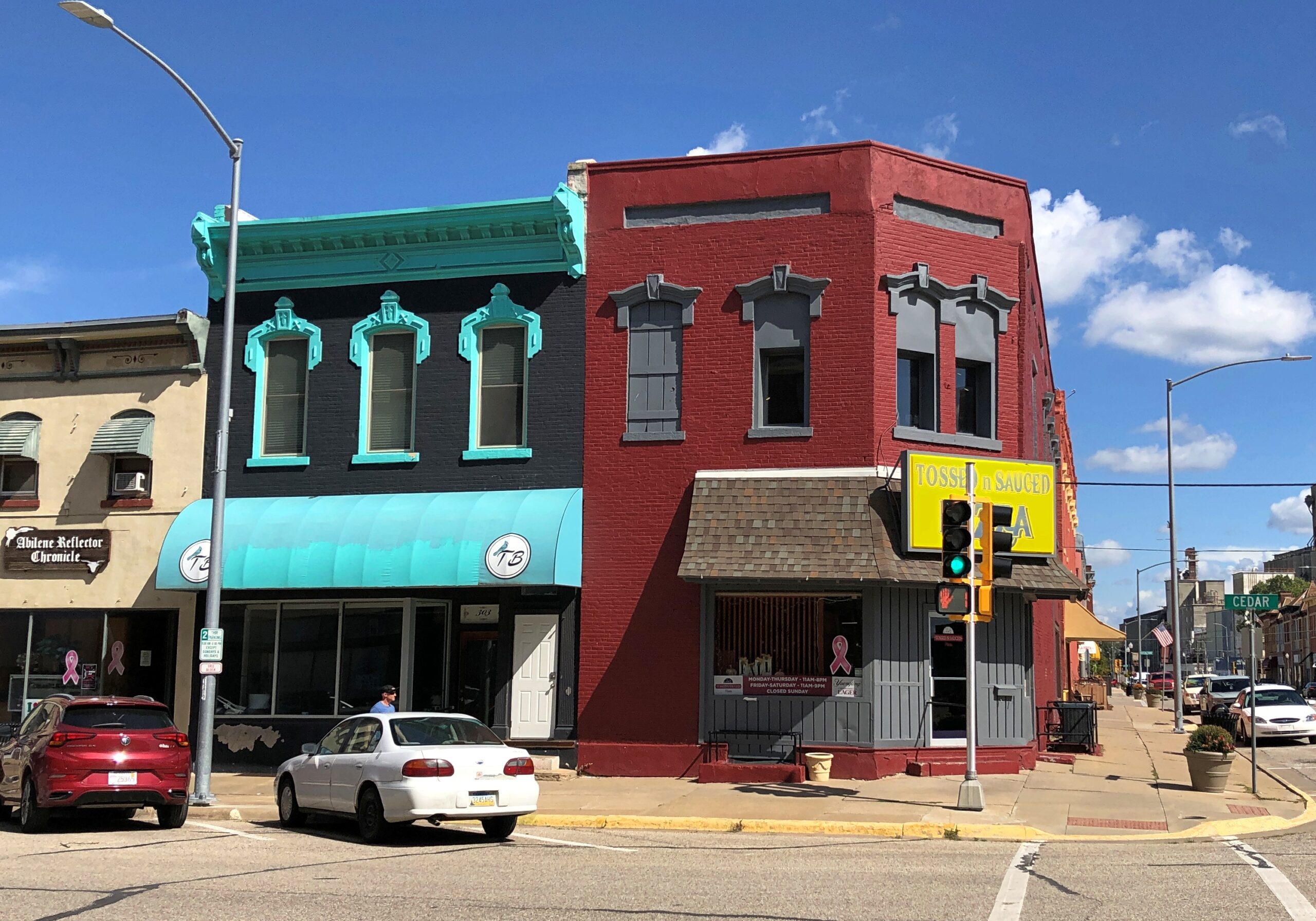
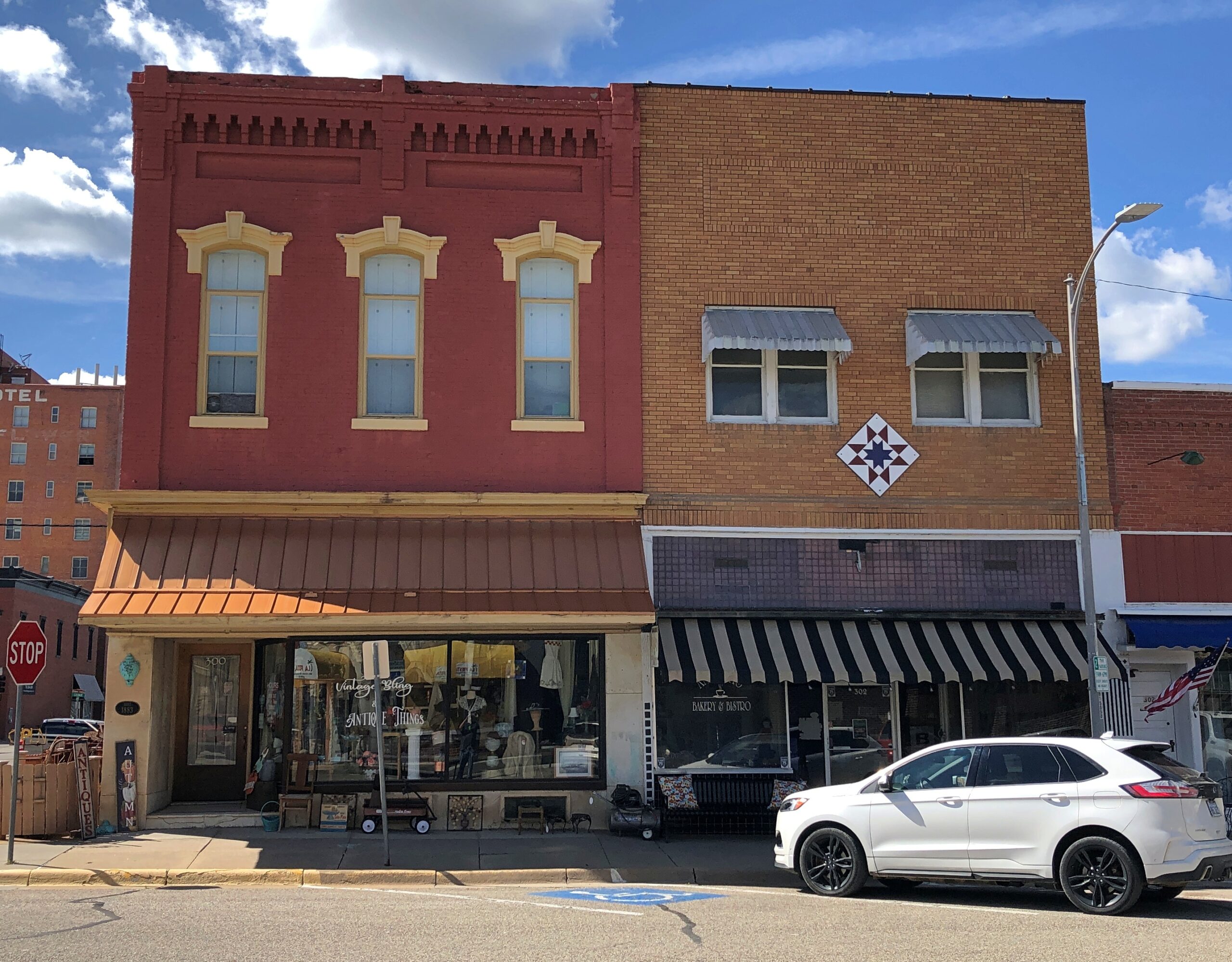
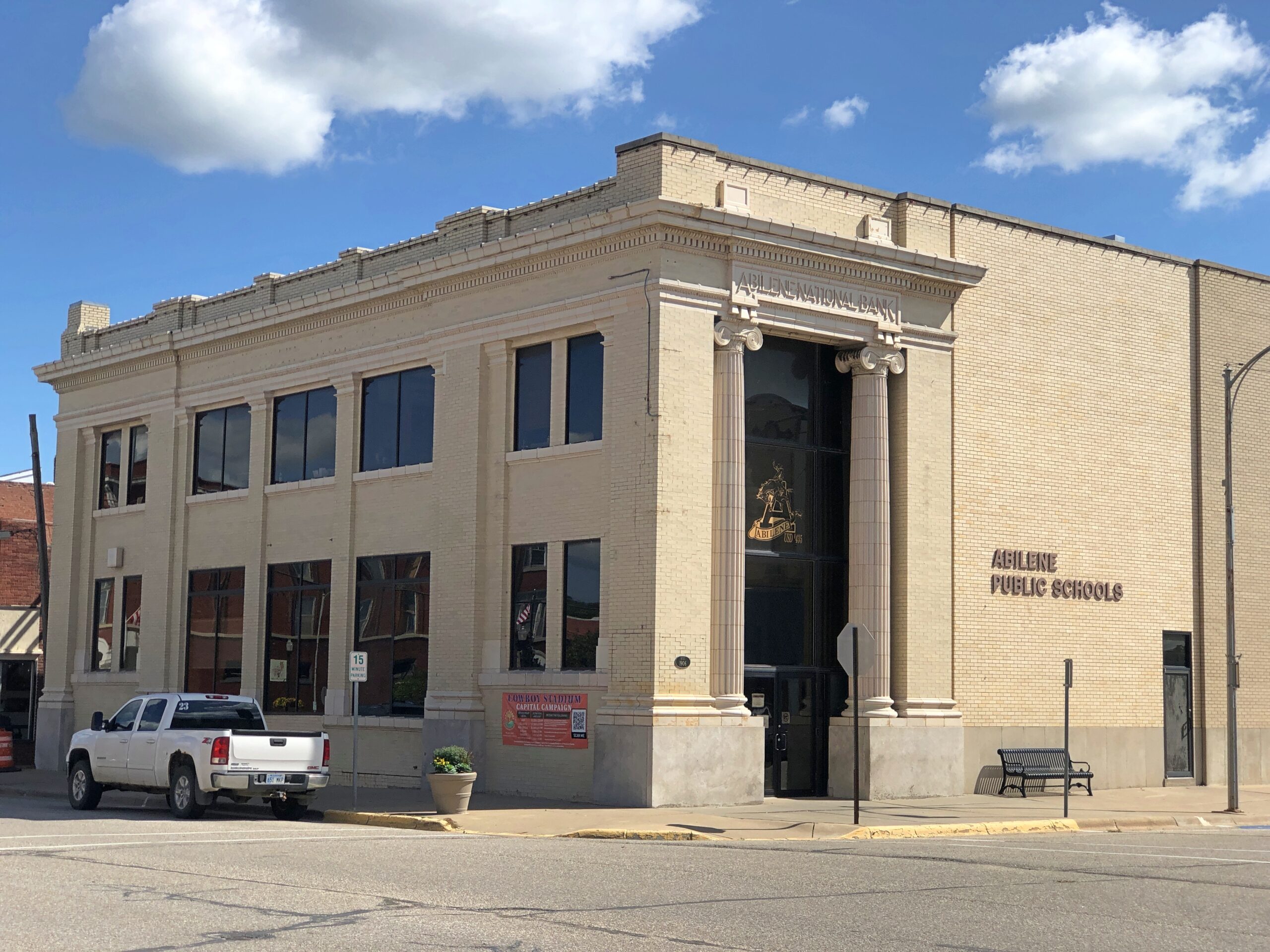
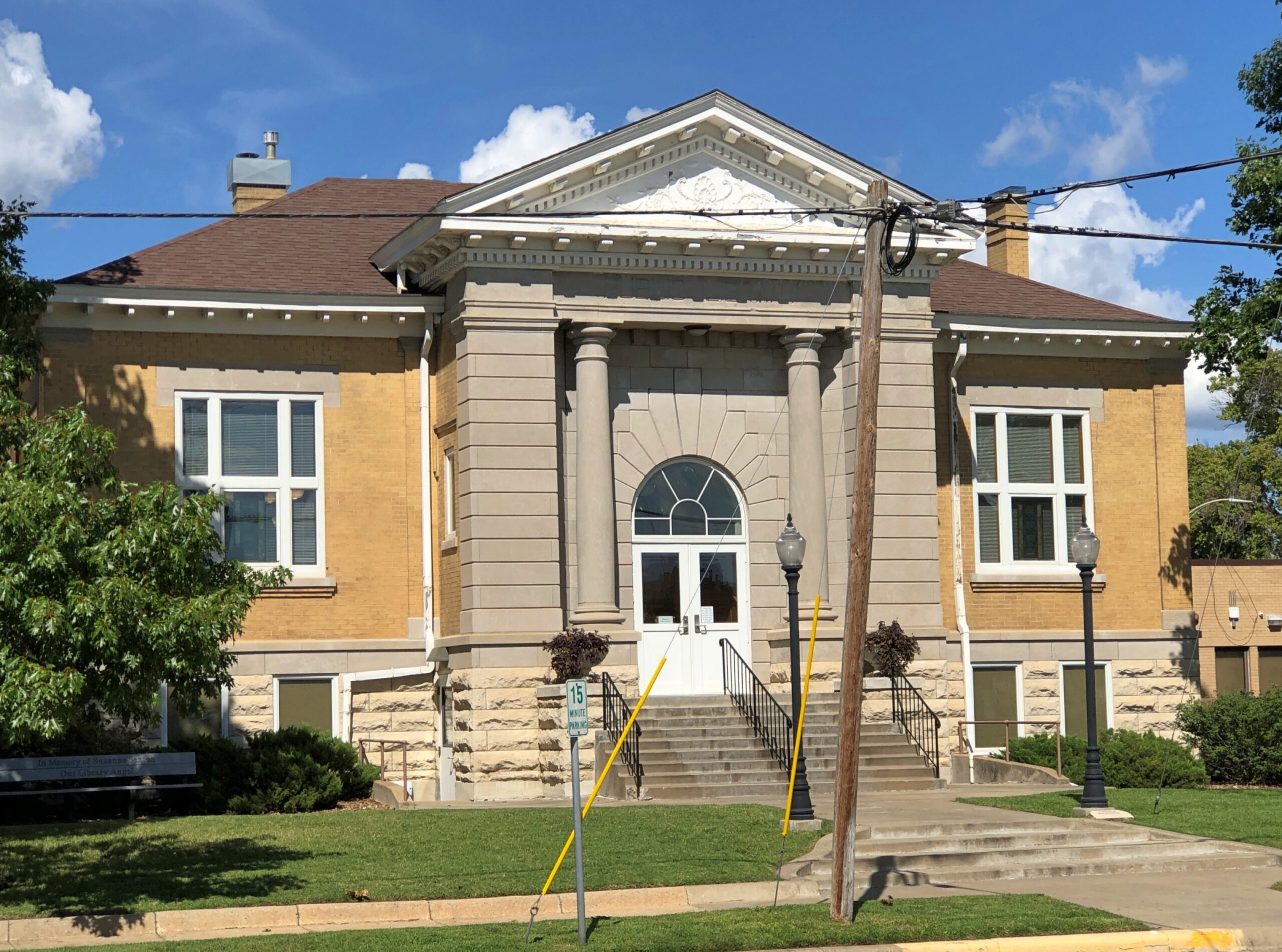
A lot of the detail would be different, but I’ll bet Ike would still feel at home with the scale of Abilene. Small town, small buildings, but some solid touches.
Including at least one building Ike would have known.
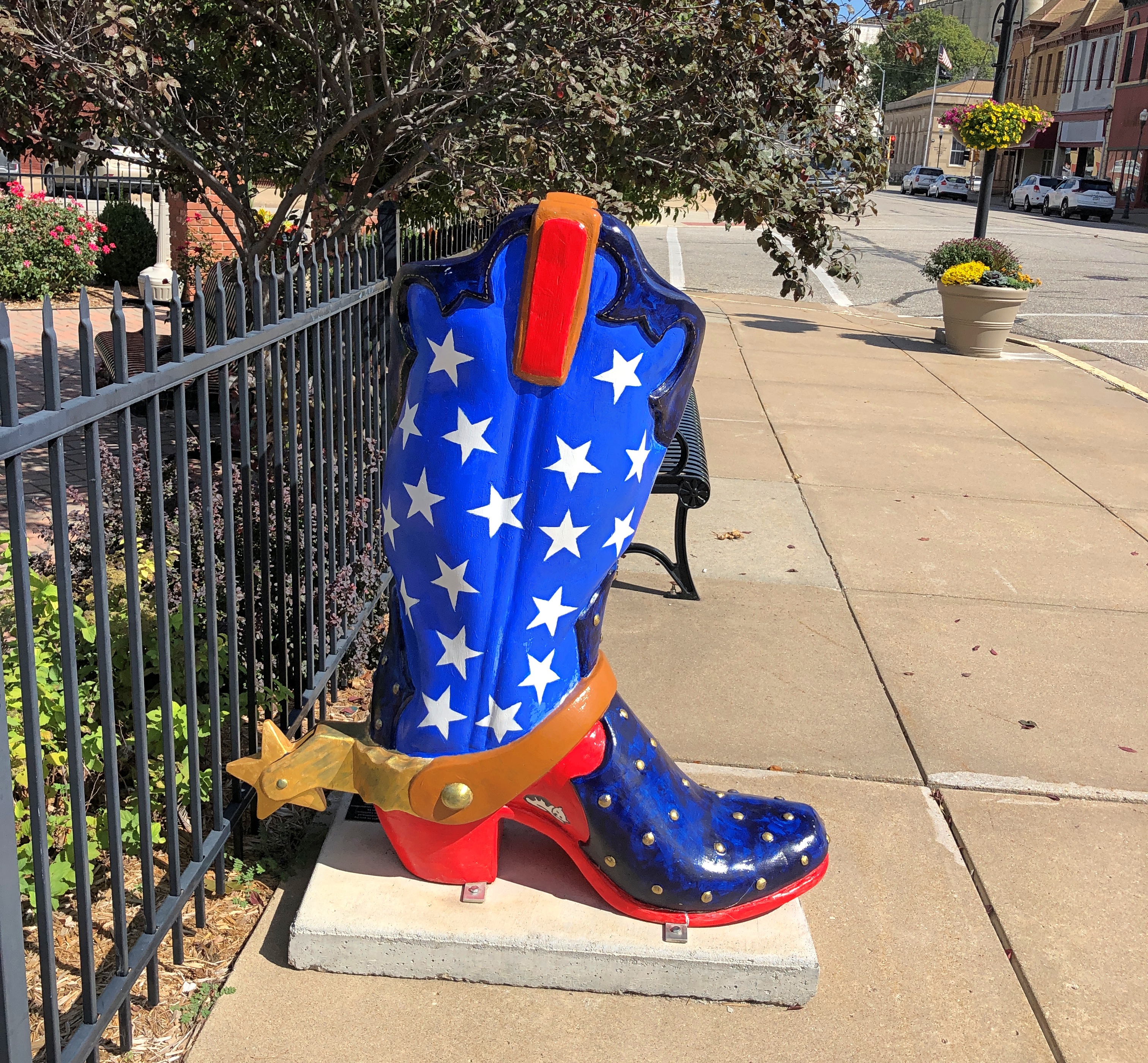
Chicago had cows, Abilene has cowboy boots.
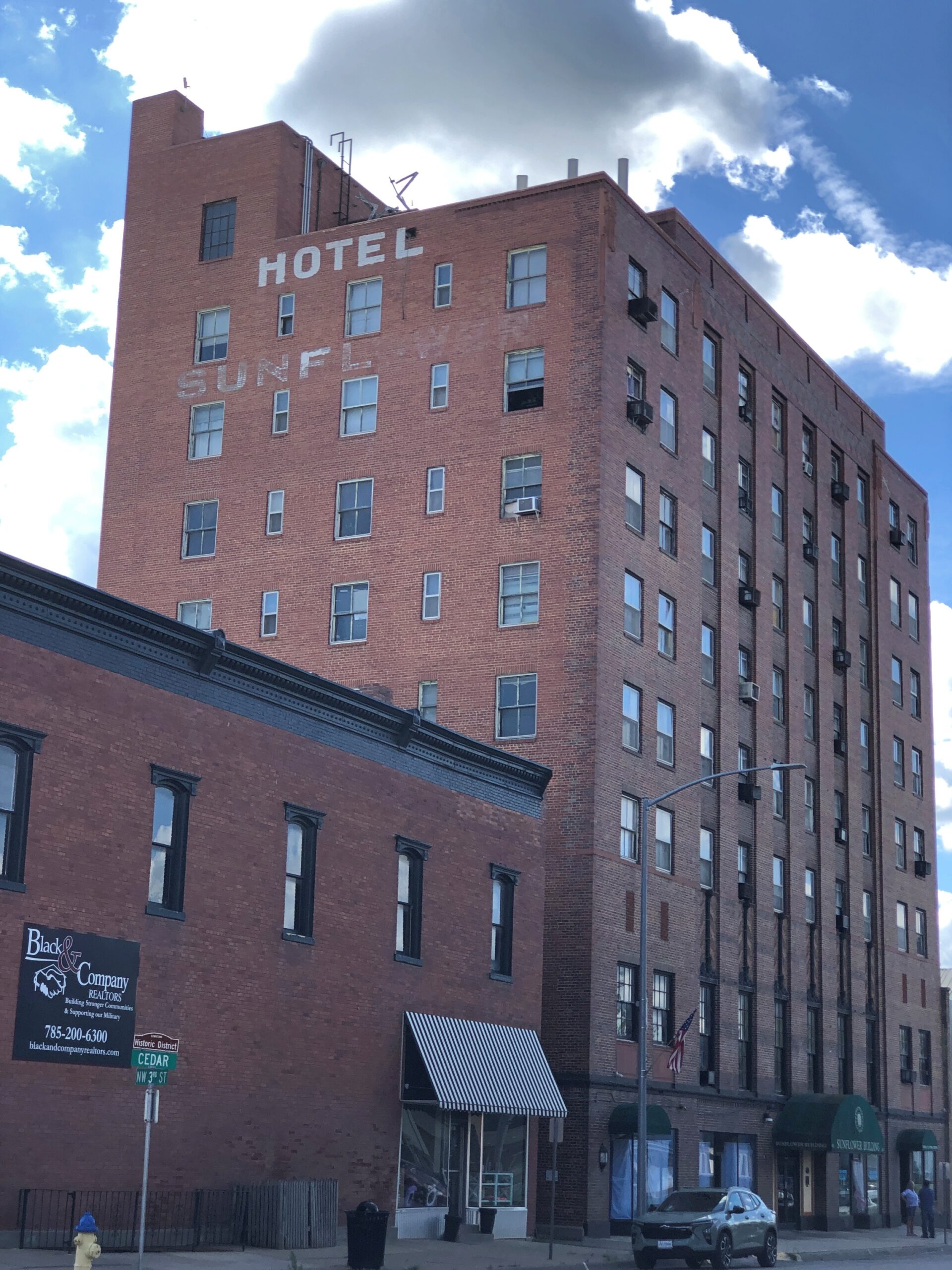
The Hotel Sunflower. Former hotel, that is, now apartments.
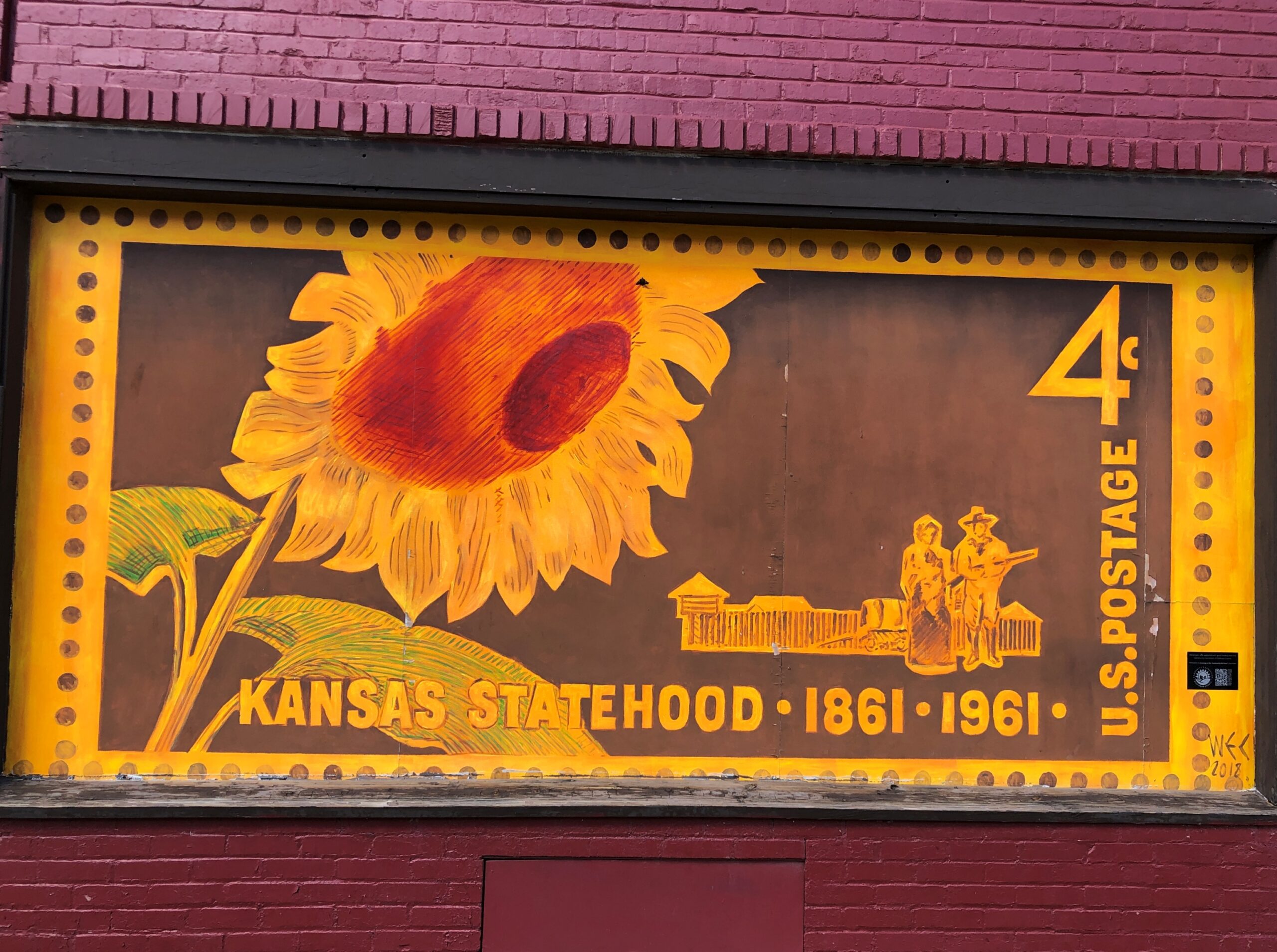
The Sunflower State. The flower looks a little ominous, peering down at the settlers.
Structures that aren’t grand, but stately even so. Petite stately, you might call them.
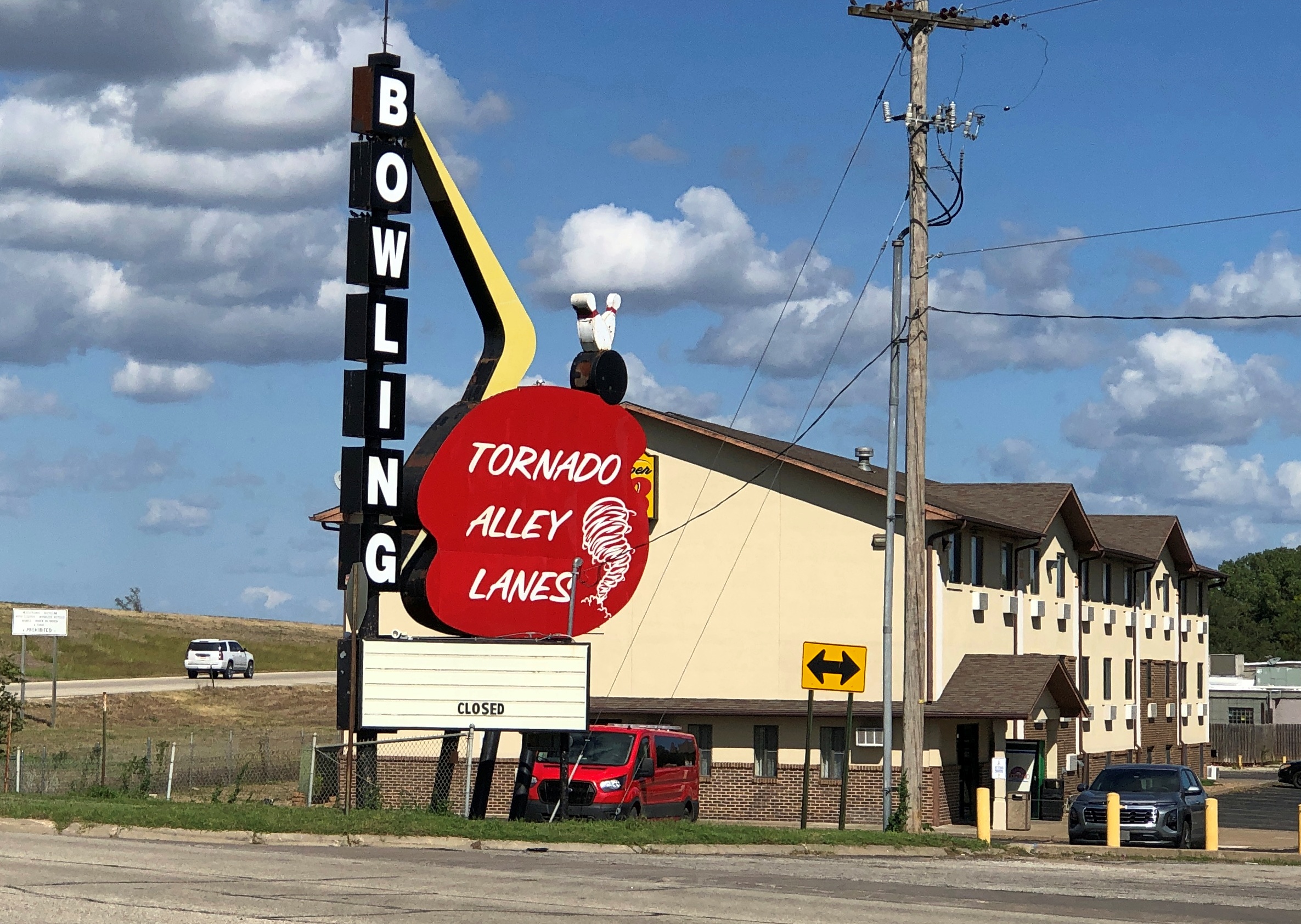
Out near the highway: truth in naming. But note also, the bowling alley is closed. I could go either way on the reopening of an alley in that location, but I really want the sign to stay.
One more thing Abilene is known for, at least since 2022.
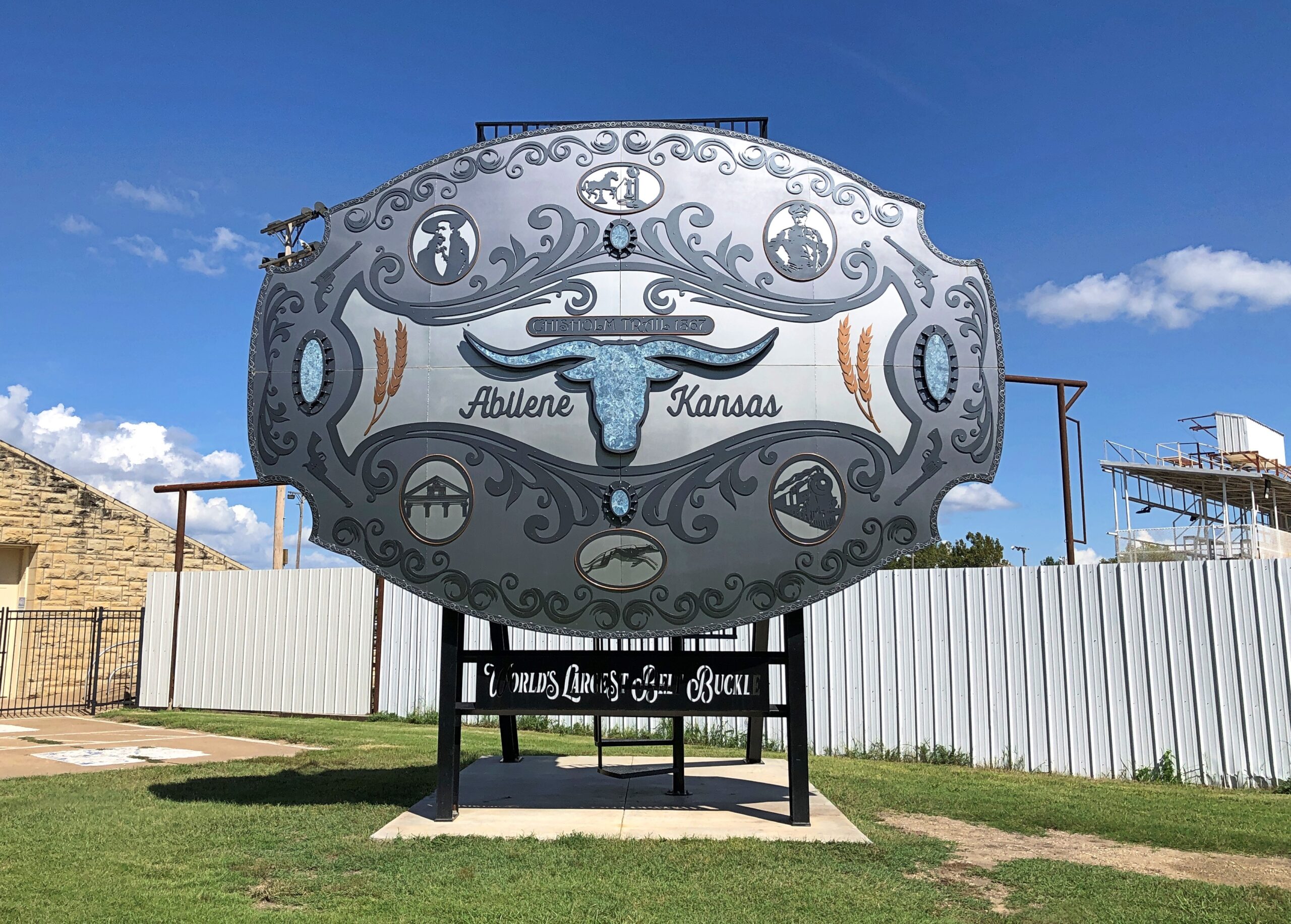
The World’s Largest Belt Buckle. Says so right there on it. How large would that belt have to be?
“Designed by local artist Jason Lahr, Fluter’s Creek Metal Works, the buckle features Dwight D. Eisenhower, Wild Bill Hickok, Abilene & Smoky Valley Railroad, Historic Seelye Mansion, C.W. Parker carousel horse, C.L. Brown telephone, a racing Greyhound and Chisholm Trail longhorn inlaid with blue quartz,” says the city of Abilene, Kansas.
“The buckle is a project of the Abilene Convention and Visitors Bureau which hopes the new roadside attraction will entice travelers to stop and visit the Best Historic Small Town.”
Yesterday I asked ChatGPT a question. I had my reasons.
Human (me)-generated question: How many U.S. state controllers or comptrollers have been honored with bronze statues?
Machine-generated answer (entirely sic): As of my knowledge cutoff in 2023, two U.S. state controllers or comptrollers have been honored with bronze statues:
William S. “Billy” McKeller (Tennessee) – McKeller was the Comptroller of the Treasury for Tennessee from 1923 to 1953. He was honored with a bronze statue that stands at the State Capitol in Nashville. The statue was unveiled in 1956, following his retirement.
Edward J. “Eddie” O’Neill (Massachusetts) – O’Neill was a longtime Comptroller for the Commonwealth of Massachusetts. He was known for his tenure and service, and a bronze statue of him was placed at the Massachusetts State House.
Both statues honor the legacy of these public servants for their dedication and leadership in state finance and governance.
However, it’s worth noting that statues of public officials in general tend to be more common for governors, senators, or prominent historical figures, so the specific recognition of state comptrollers or controllers through bronze statues is quite rare. There may have been updates or new statues since my last update, so I recommend checking local state records or news sources for the most current information.
Wow, that’s a solid example of an AI hallucination. There may have been human beings named William S. McKeller and Edward J. O’Neill living at some point in Tennessee and Massachusetts, respectively, but neither of them held that office. See the Tennessee Blue Book for a list comptrollers of the treasury in that state. As for Massachusetts, comptroller isn’t a constitutional office, so a list of them is a little elusive. (The commonwealth has an elected “treasurer and receiver-general.”)
Just as dispositive is a list produced by the commonwealth that lists the artwork at the Massachusetts State House. A bronze honoring Edward J. “Eddie” O’Neill isn’t one of them.
That said, the machine is probably correct that “specific recognition of state comptrollers or controllers through bronze statues is quite rare,” but, considering that the machine’s examples are bogus, that ranks as nothing but educated speculation that I didn’t need ChatGPT to create for me. I can guess that myself.
Just as damning, however, is that the machine missed a perfectly real example.
During my visit to Annapolis, Maryland in late October, I chanced to meet Louis L. Goldstein. His memorial, that is, a bronze at the corner of Bladen and Calvert streets, about a block from the Maryland State House.
The statue is in front of the office building occupied by the state comptroller. Goldstein was comptroller of Maryland from 1959 until his death in 1998 and, it seems, a character. A character who was also a successful politician, which is an increasingly rare combination, unless you count those pretending to be wingnuts.
“Many recognized Goldstein as the state’s white-haired, robustly outgoing goodwill ambassador, a handshaker’s handshaker, passing out fake coins as souvenirs and bestowing his trademark greeting, ‘God bless y’all, real good,’ “ the Washington Post reported at the time of his passing.
More politicos should pass out fake coins. I have fond memories of the aluminum Silber Dollar we had around after the 1970 election in South Texas. It’s probably still around.
Admittedly one ChatGPT answer is a small sample size, but still – how is it that three years have passed since I asked the machine to come up with examples of a certain kind of real estate deal in the past, and it spat out five completely make up ones? Shouldn’t this kind of thing be less likely by now? Apparently not.
Never mind, Maryland has a handsome capitol, one built remarkably enough in the 1770s – beginning before the Revolution and completed in the throes of that war, in 1779.
The view from the steps. The small rally below, at a place called Lawyers Mall, is demanding that Maryland Gov. Wes Moore to kick Avelo Airlines out of BWI airport, for its deportation flights for ICE.
Detail on the exterior: the obverse and reverse of the Great Seal of Maryland.
A cool seal, if you asked me. Including an Italian motto used, for obscure reasons, by the Calvert family. Fatti maschii, parole femine has drawn criticism, enough that the state has an innocuous “official translation,” which is fine, if a little silly.
Of course, Maryland also has a cool flag, the heraldicbanner of arms of Cecil, Second Baron Baltimore, acknowledging the state’s founding as a proprietary colony of the Calvert family. It’s also worth noting that the flag wasn’t official until 1904, by which time the family had become merely a colorful part of History.
Unlike Delaware, Maryland’s capitol was open on a Saturday.
With a few volunteers talking to visitors.
The Maryland State House has the distinction of being the capitol of the United States, from November 26, 1783 to August 13, 1784. Two important events happened in the building during that narrow window: George Washington came before the Confederation Congress to resign his commission as commander-in-chief of the Continental Army, and Congress ratified the Treaty of Paris, which acknowledged U.S. independence.
Maryland doesn’t want you to forget that Washington stepped down in the state house. On display are artifacts and artworks to illustrate the point.
Including portraits of those who were there for the event. Some of those who were, I assume.
The scene itself, depicted later, and on display at the state house.
The speech. Washington had a gift for brevity. A more prolix (and vain) fellow might have gone on at length about the virtuousness of Cincinnatus — hint, hint, like a certain other man you might know — but I suspect he knew that his audience, and maybe posterity, would make the comparison without it being explicit.
The heat was already on by the time I arrived in Scottsburg, Indiana on the first day of the trip, June 16. But not enough to keep me from taking a stroll around the Scott County courthouse, where I found native son William H. English.
After only a few hours on the road, by chance, I’d come across a presidential sight. Presidential adjacent, anyway, since English (d. 1896) is that most obscure of obscurities, someone who ran for vice president and lost – in 1880 in his case, on the Democratic ticket with Winfield Scott Hancock, who himself isn’t going to ring any bells outside presidential history buffs. The statue went up in 1908.
That was the election James Garfield won, which he no doubt regretted before long.
English, or his heirs, felt that a book he wrote, Conquest of the Country Northwest of the Ohio River 1778-1783, was worth a mention along with the offices he held or aspired to. The marvel here in the 21st century is that the work is just about instantly accessible (Vol. 1 and Vol. 2). An illustration facing the Vol. 1 title page (on the optitle page?) not only falls into the They Don’t Make ‘Em Like That Anymore category, it’s squarely in, No One Would Think of It territory. Just as well, I figure.
To get to Nashville from metro Chicago, the direct route is via I-65, which cuts across Indiana. Considering the importance of both of those cities to me, I’ve driven the route more times than I can count. But I have to report that it isn’t one of the more interesting drives in the nation, and at eight to nine hours drive time in the best of conditions, you feel it yawn beneath your wheels when you yourself yawn.
So the strategy over the years has been to break up the trip. Such as a place like Scottsburg, pop. 7,300. The town is close enough to Louisville to be its exurb – maybe. I haven’t spend enough time in Louisville, as interesting as it is, to have any sense of its greater co-prosperity sphere, or at what distance that might peter out.
Scottsburg has one thing a picturesque exurb needs: a picturesque courthouse square. Or at least elements of it.
Downtown is in fact a national historic district: Scottsburg Courthouse Square Historic District. I get a kick out of discovering that kind of thing retroactively, which I did this time.
“The district is composed of one-, two-, two-and-a-half and three-story brick and stone commercial structures with zero setbacks, which form an essentially contiguous perimeter to the wooded courthouse lawn,” its registration form on file with the U.S. Interior Department says. “There are a total of 48 contributing buildings within the district. The character of the district is defined by late 19th and early 20th century commercial architecture with significant examples of the Italianate, so Richardsonian Romanesque, Renaissance Revival, Colonial Revival, and Art Moderne styles.
“The predominant building material is red brick, as evidenced by the courthouse and 29 commercial buildings within the district. Secondary materials include Indiana limestone and various shades of buff and yellow brick, decorative brick work, cast iron, ornamental pressed metal and glazed tile and Carrera glass…”
In the heat of the moment (literally), I neglected to get a decent shot of the courthouse itself, but someone called Bedford thoughtfully put an image in the public domain.
Could it be a Carnegie Library?
Yes. Completed 1917, still a library. One of the more than 1,680 in the United States funded by the robber baron, many of which endure after a century plus.
Some courthouse square details.
Dirt Boys Vintage Collectibles joins the likes of city offices and law offices, but also Warriors Den coffee shop, Time Zone Pizza Arcade, Chicago City Pizza and Bootlegger’s Bar & Grill. Those not needing to eat can visit Wildflowers Boutique, Moxie Music Center or Working Class Tattoo Parlor, all there on the square.
So is a plaque to the memory of one Michael J. Collins (d. 1985).
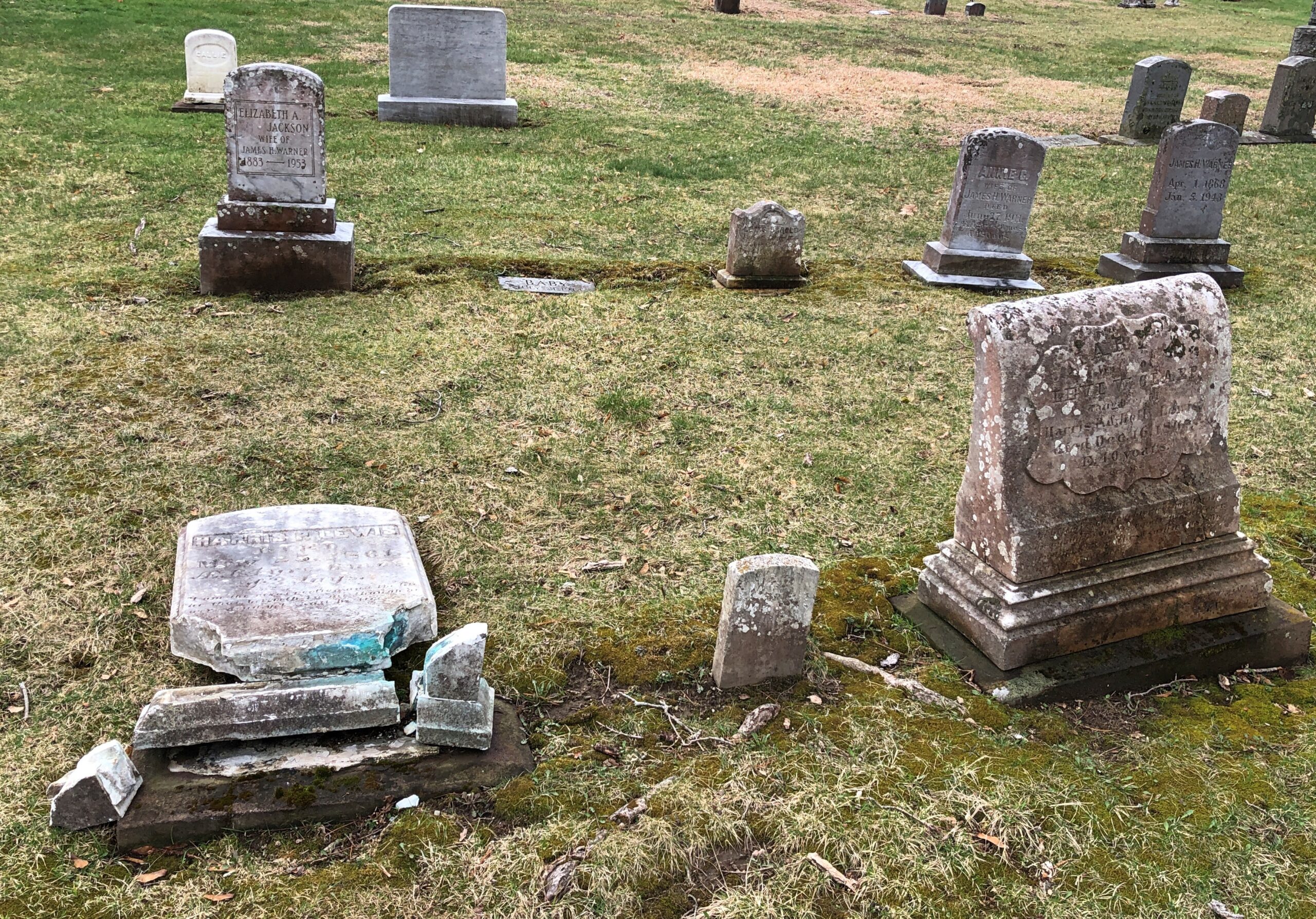
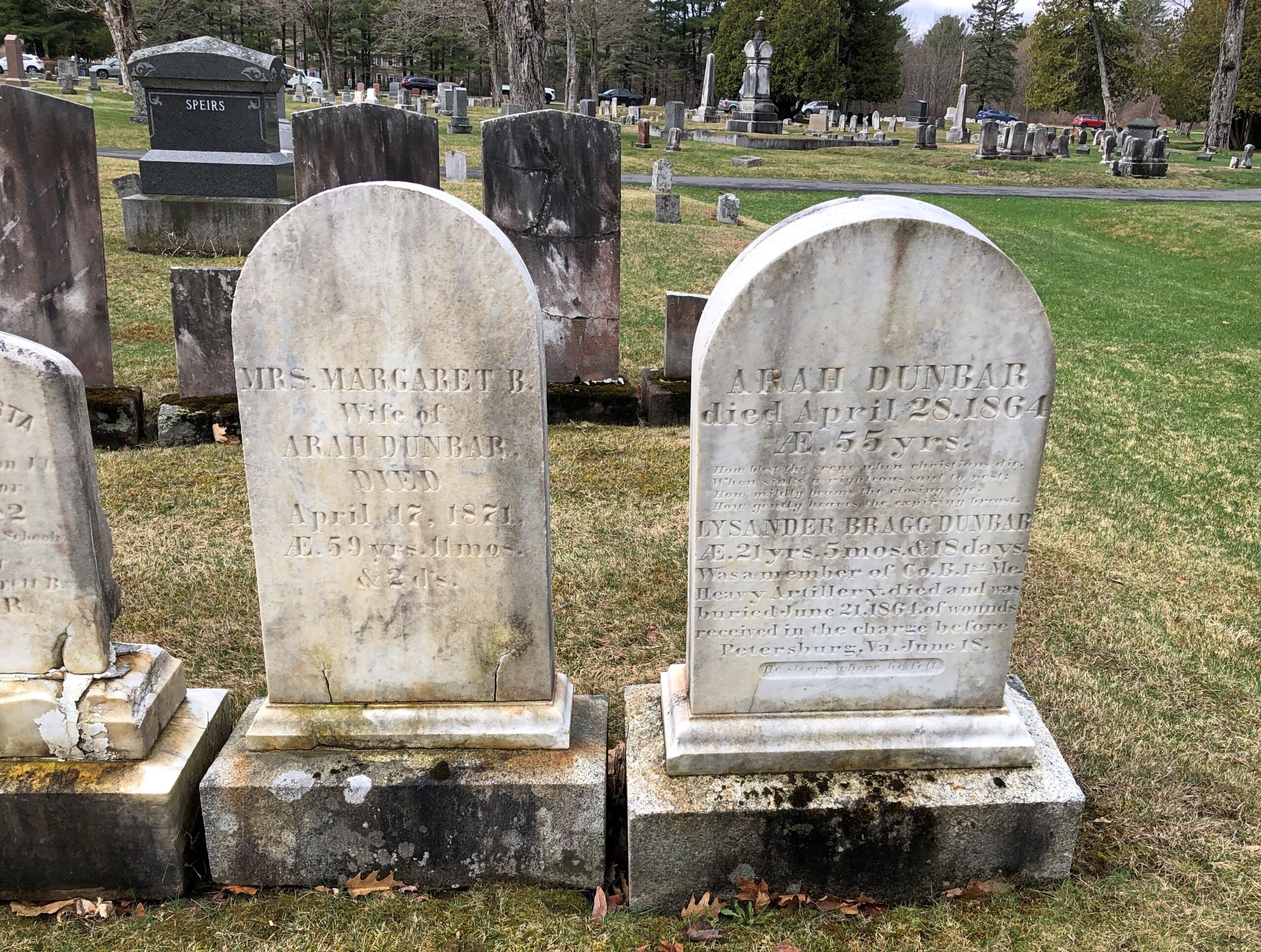
A contemporary of mine who didn’t make it far out of the gate. RIP, Michael, whoever you were. Are.
It was a nicely structured day trip to Corpus Christi earlier this month, if I say so myself. We left not ridiculously early from SA, but early enough to catch a few easy sights in Corpus before lunch. After lunch: a single main attraction and then a drive home in time for dinner.
It was a Texas dinner: drive-through Whataburger.
The main attraction that day: The USS Lexington, CV-16, nickname, the Blue Ghost. That is to say, the 16th aircraft carrier belonging to the U.S. Navy, commissioned in early 1943 in the thick of the war in the Pacific, where it kicked ass. The ship survived the war with close calls and Japanese propaganda broadcasts asserting more than once that she had been destroyed. After a period of decommissioning beginning in the late ’40s, Lexington returned to serve throughout most of the Cold War.
Note the rising sun flag. That is where a kamikaze struck the ship off Luzon in November 1944, killing 50 men and wounding many more. RIP, sailormen.
That afternoon my brothers and I were entering what is now called the USS Lexington Museum, which is permanently moored across the ship channel from downtown Corpus Christi, where it has been since 1992, within sight of the Texas State Aquarium, the scattered buildings of North Beach, and the old highway bridge and the new one.
The Blue Ghost is one of five aircraft carrier museums nationwide, with two others in California, and one each in New York and South Carolina. These days, tourists enter the Lexington via the Hanger Deck. This deck and all the other lower decks are thick with exhibits, on many of the available surfaces, about the ship and its active service.
George H.W. Bush as a young naval aviator. A sign is careful to point out that the future president was never assigned to the Lexington, but spent a few days recuperating here (“sack time,” he later called it) in June 1944 after being rescued from the ocean when mechanical issues forced him to ditch. Also, he trained as a naval aviator at Air Station Corpus Christi, so there is that connection.
We climbed a number of staircases to higher decks, through the Foc’sle and ultimately to the Flight Deck. Slow going at our age, but we went.
Some of the exhibits were very specific, such as the rat guards used by the vessel. I remember seeing those depicted in a Carl Barks comic, maybe a Scrooge McDuck adventure.
Others were more generalized, such as entire room in the Foc’sle about the attack on Pearl Harbor. Eventually we made our way to the Flight Deck, towered over by the island (the towering section including the bridge). Mostly, the Flight Deck is an open-air aircraft museum.
Sage advice.
Restoration in progress on a Phantom II.
An A-6 Intruder. Like a number of the other airplanes at the Lexington, on loan from the National Naval Aviation Museum in Pensacola.
An AH-1 Cobra. There’s a warrior slogan for you, on the nose.
A T-2 Buckeye, developed in the late ’50s as a trainer. The marvel, when it comes to naval aviation, is how anyone learns it without getting killed.
How indeed. The sign mentions an incident on the Lexington in 1989, when a T-2 Buckeye flown by a trainee crashed into the aft section of the island, killing five and injuring others. Among the dead: Airman Lisa L. Mayo, 25, of Oklahoma City, the first woman killed aboard a U.S. carrier in the line of duty. Again RIP, those who died.
More.
Onward to the Bridge.
There’s the captain.
Spare and utilitarian, the Bridge is. Except for that wig.
A vision, but no mystic revelations. When I saw the Jesus bobbleheads in Milwaukee on the Friday after Christmas, I thought that a really good lyricist could do a follow up song to “Plastic Jesus,” which would be called “Bobblehead Jesus.” But I am not that person.
We’d dropped by the National Bobblehead Hall of Fame and Museum, where the bobbleheads crowd shelf after shelf after shelf: some 6,500 on display of the 10,000 figures the museum says it has.
But for Google Maps I might have missed National Bobblehead, which reminded me at once of the American Toby Jug Museum in Evanston. Still, there are some differences. Most of the tobies are behind glass, but not the bobbleheads, and most of the bobbleheads are sports figures, while the tobies have a wider variety of figures.
Like that other museum, National Bobblehead started with a single collection that morphed into something bigger – in this case, a bobblehead business for the two founders, Milwaukeeans Phil Sklar and Brad Novak. It isn’t enough that they collect them, though they still do, but they make them and sell them as well.
The museum asserts that Chinese nodding dolls had a vogue in Europe in the late 18th century, and that afterward various bobbly figures were made worldwide, with references to Germany and Russia and other places. These days sports figures dominate. Maybe three-quarters of the bobbleheads on display are sports figures, including both players and mascots.
Their popularity in the sports world has been growing since their introduction in the early 1960s in baseball. The first player-specific bobbleheads formed quite a lineup: Roberto Clemente, Mickey Mantle, Roger Maris and Willie Mays.
Most of the others are entertainers and political or historic figures, as you’d expect.
More of him than I’d expect.
Can you really be a famous entertainer if you don’t have a bobblehead?
Near the gift shop – which sells bobbleheads, naturally – is a more than complete collection of U.S. presidents, in order, back-to-front, left-to-right, Washington to Biden.
More than complete because FDR is represented twice, once standing (with a cane) and the other in a wheelchair. Grover Cleveland is represented only once, however. Curiously, beginning with Herbert Hoover, all of the figures have their hands raised, as one does to a crowd. Before him, only TR does so, and he’s holding a top hat.
One more note: the museum occupies part of the second floor of one of the redeveloped Kramer International Foundry buildings in the Walker’s Point neighborhood of Milwaukee. That early 2000s project was an early one in the transformation of the neighborhood from industrial to retail and residential.