Nor’East Drive ’26

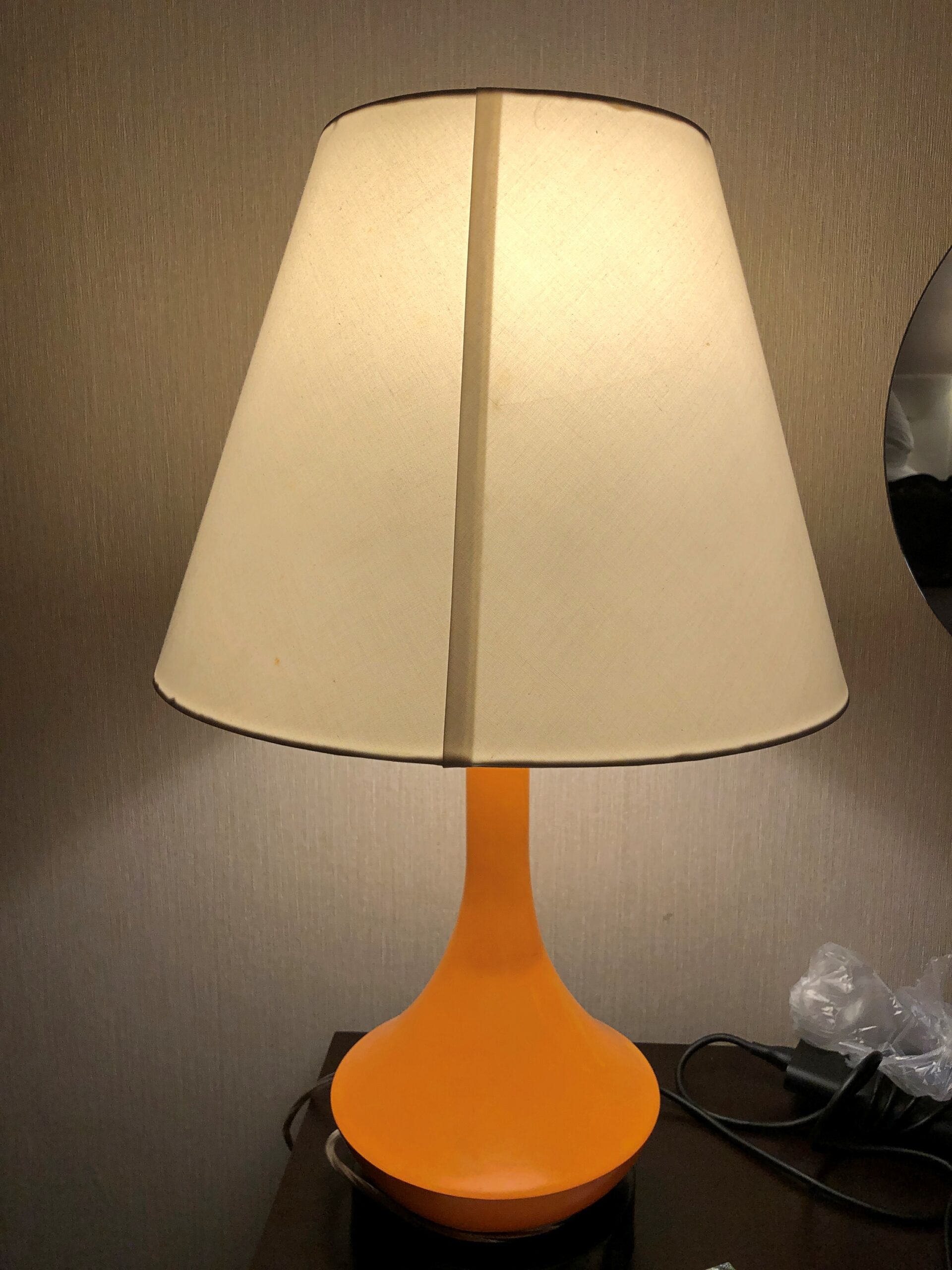
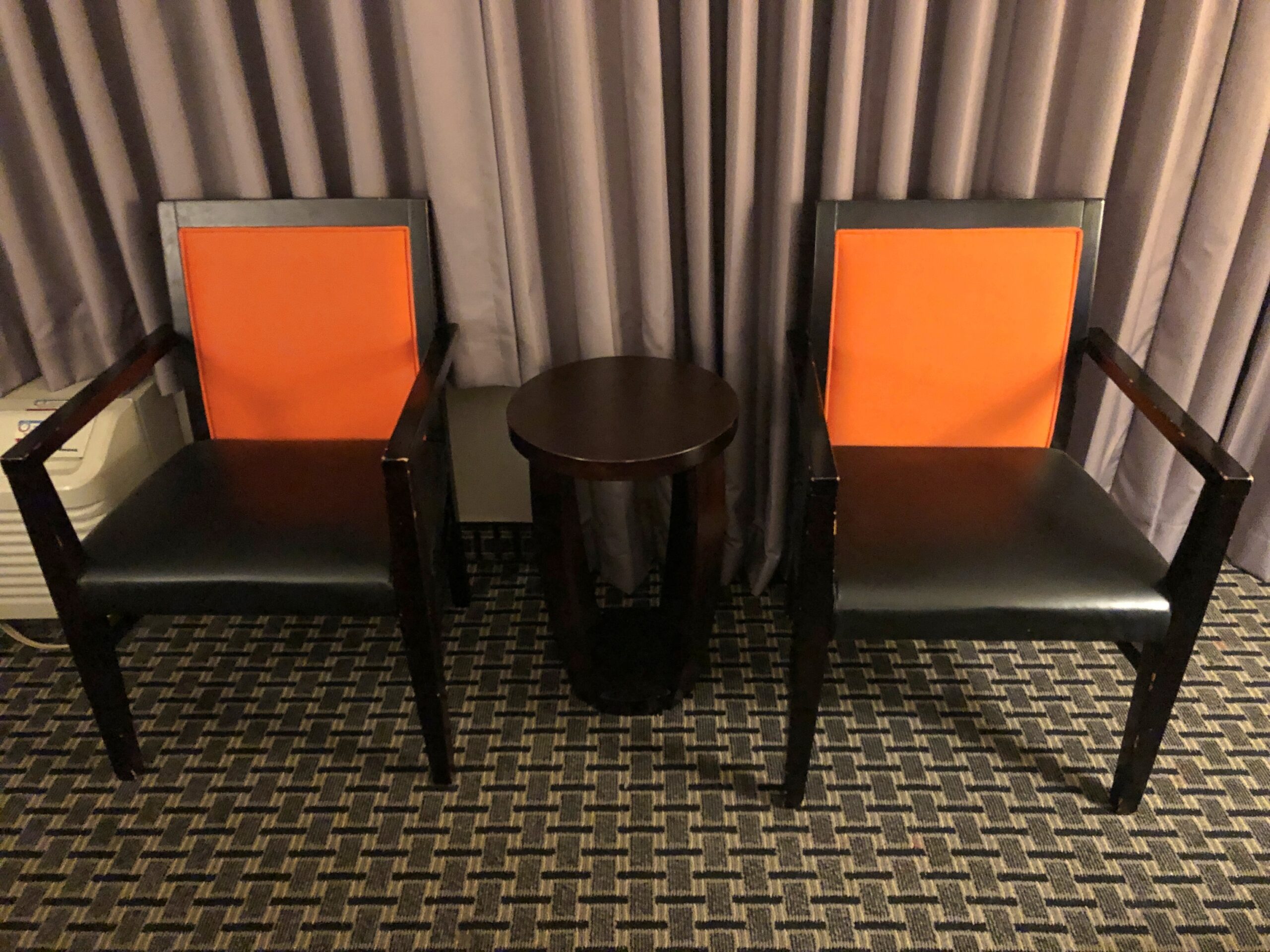
Howard Johnson, it turns out, is serious about renovating its rooms retrostyle. What says Howard Johnson midcentury, the heyday of the much-diminished chain, better than orange? – a lot of orange.
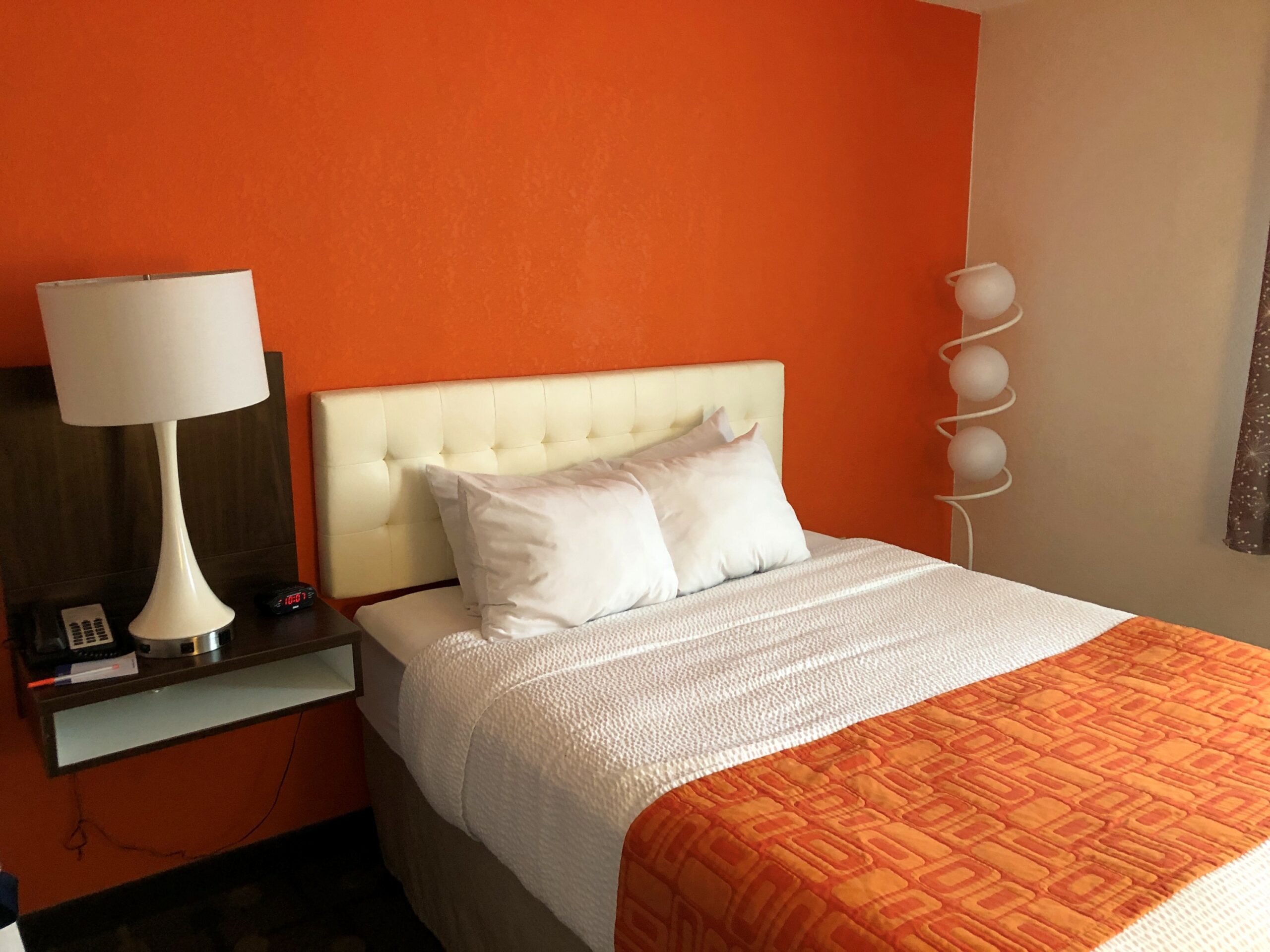
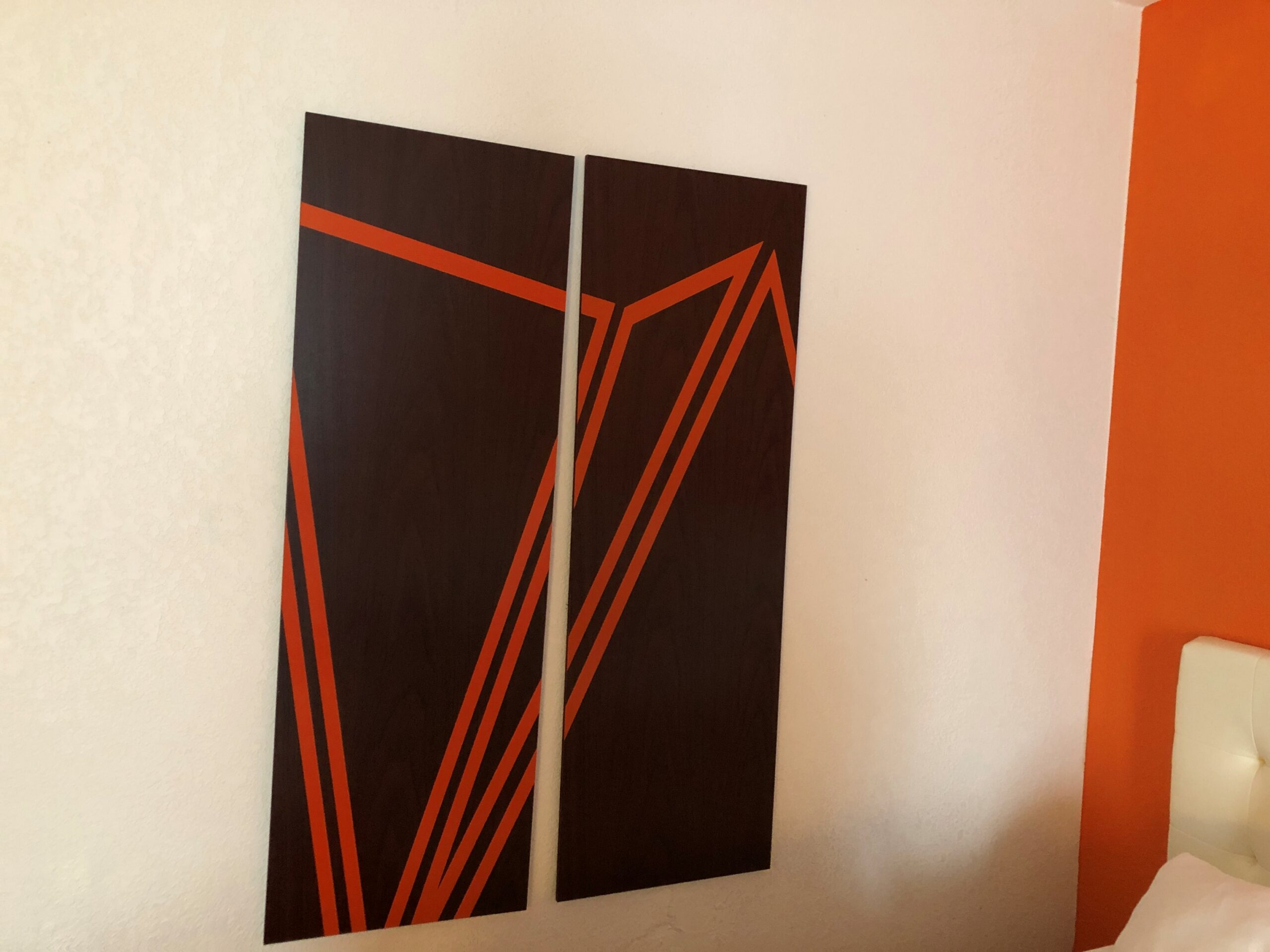
I’m just old enough to be nostalgic for midcentury motels. Maybe I’m just the right age, since as a kid, I didn’t have to concern myself with the details of getting to the motels or paying for them. I was along for the ride and the stay. I did, however, starting with the Cave Vacation of 1972 at age 11, concern myself with packing – my own stuff, but also the items everyone would need, put in the trunk of the car. To the mild amazement (I think) of my mother.

The Portsmouth, New Hampshire Howard Johnson, whose full brand name these days is Howard Johnson by Wyndham, checked a lot of the other boxes besides raw orange overload.
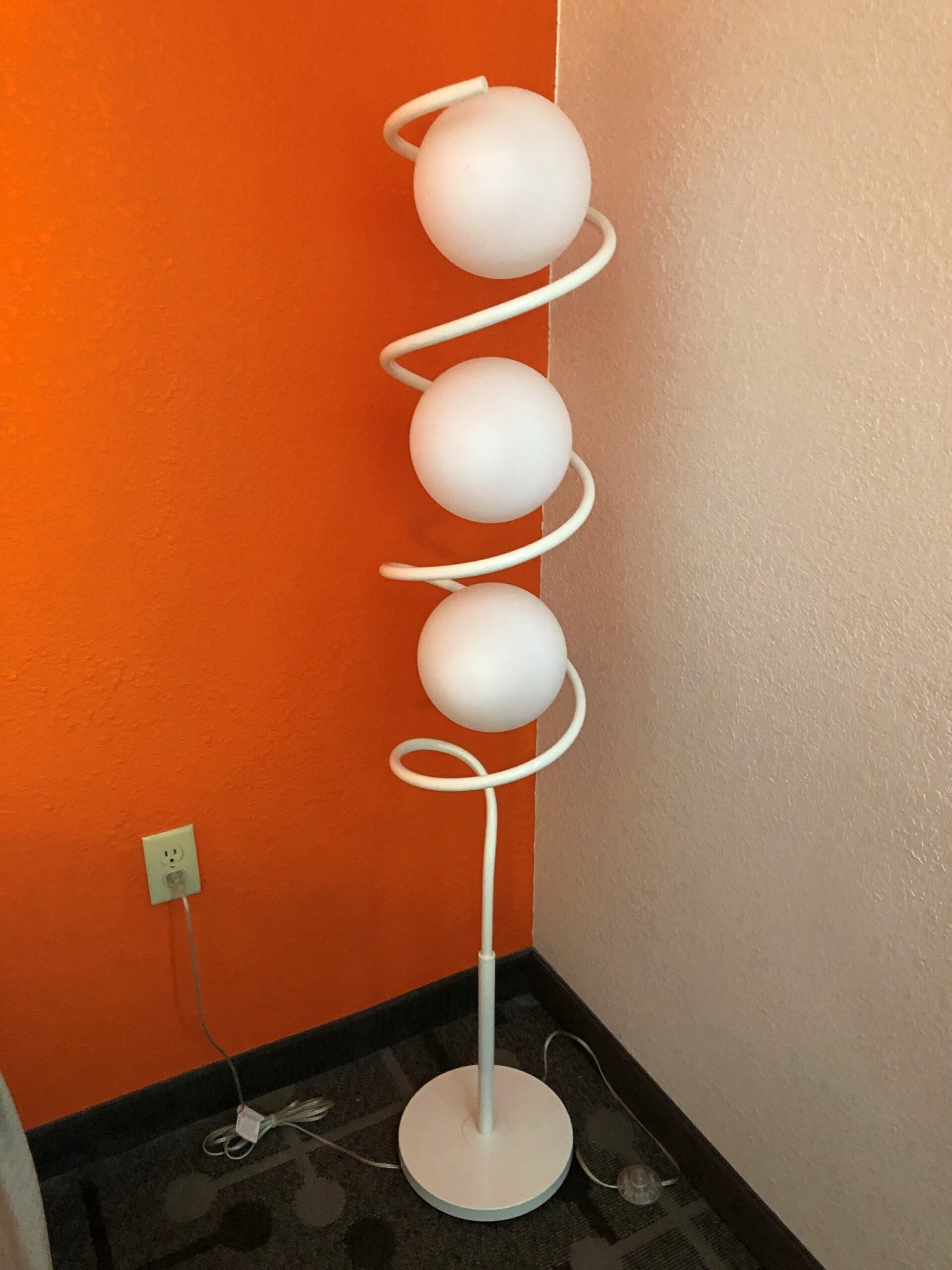
Not sure if these are precisely period lamps, but they remind me of the period.
The room had a modern TV, naturally, and as befitting our time, a lot of outlets, including USBs. Unfortunately, there was no bottle opener attached under the sink. Or a gossamer paper ribbon around the toilet announcing that it had been sanitized for my protection. Just quibbles. The room had the right feeling.

I found myself in New Hampshire in mid-April headed east to Maine. Some days earlier, on April 7, I’d left metro Chicago by car for the Northeast again. I returned on April 24 after 3,499 miles on the road. Dang, I should have gone that extra mile we’re always hearing about.

After visiting the Northeast last October, I hadn’t intended to return quite so soon. Then Lilly and Dan scheduled their engagement party for April 11, 2026, in Midtown Manhattan, which meant a return to New York City at least. The easier (and cheaper) thing to do would have been for all of us to fly there, spend a few days, and then fly home.

I wanted to go to the party, of course, but that approach to getting there didn’t appeal – so I drove by way of Indiana, Ohio, Pennsylvania and New Jersey, where I squeezed a day into my schedule to look around. Yuriko and Ann flew in the day before the event, and we attended the party in the upstairs Manhattan Manor room of Rosie O’Grady’s on 51st, between 6th Ave. and 7th Ave. I’d never heard of the place before, but eventually learned that Rosie O’Grady’s is a sentimental favorite of Lilly and Dan’s when they visit New York. That only goes to show that one’s children have, or should have, aspects of their lives you know nothing about.

We had a large time that evening, meeting members of Dan’s family and many of his friends, and seeing many of Lilly’s friends for the first time or the first time in years. My nephew Dees was able to attend from Austin and my nephew Robert and his fiancée Meredith came from Brooklyn.

That wasn’t quite it for NYC – my nth visit, Yuriko’s third and Ann’s first – since we had another day and a half to kick around. We spent time strolling in a budding springtime Central Park and at MoMA and in a couple of Greek diners and one of the locations of the delightful Angelina bakery. All in all, an enjoyable time, all too short. Yuriko and Ann flew home, but I made my trip just a little longer.

Namely, I had another large time, this one in Boston, with my friends Rich and Lisa and Steve. That was slated for a week after the party, so I had a few days to spend between NYC and Boston. Where to go? Maine. Geographically not between those major metros, but nothing is that far apart in New England, as all drivers who grew up in Texas know.

After my visit with my Boston friends on the weekend of April 18-19, I took a (fairly) slow drive home, passing through western Massachusetts and stopping in upstate New York long enough to visit historic places I couldn’t in October because the federal government shutdown. From there, I traversed Pennsylvania, Ohio and Indiana again, along a somewhat different route than I’d come. Of course.

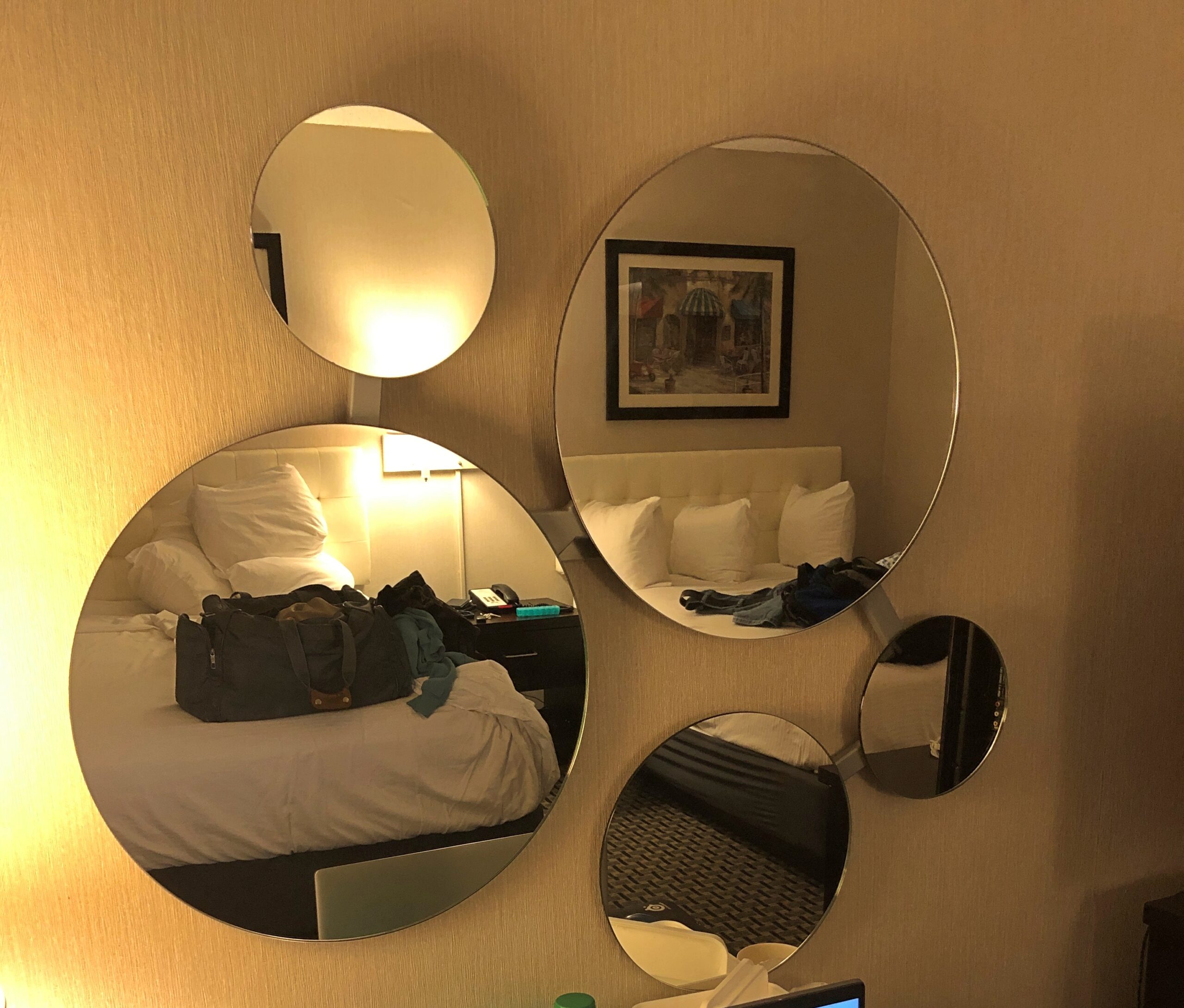
The last night of the trip, I stayed at another Howard Johnson. It had the location I wanted, in western Ohio, and the price wasn’t bad, but I was also curious how orange it was going to be. The answer: not quite as much as the Portsmouth property, but more than most places.
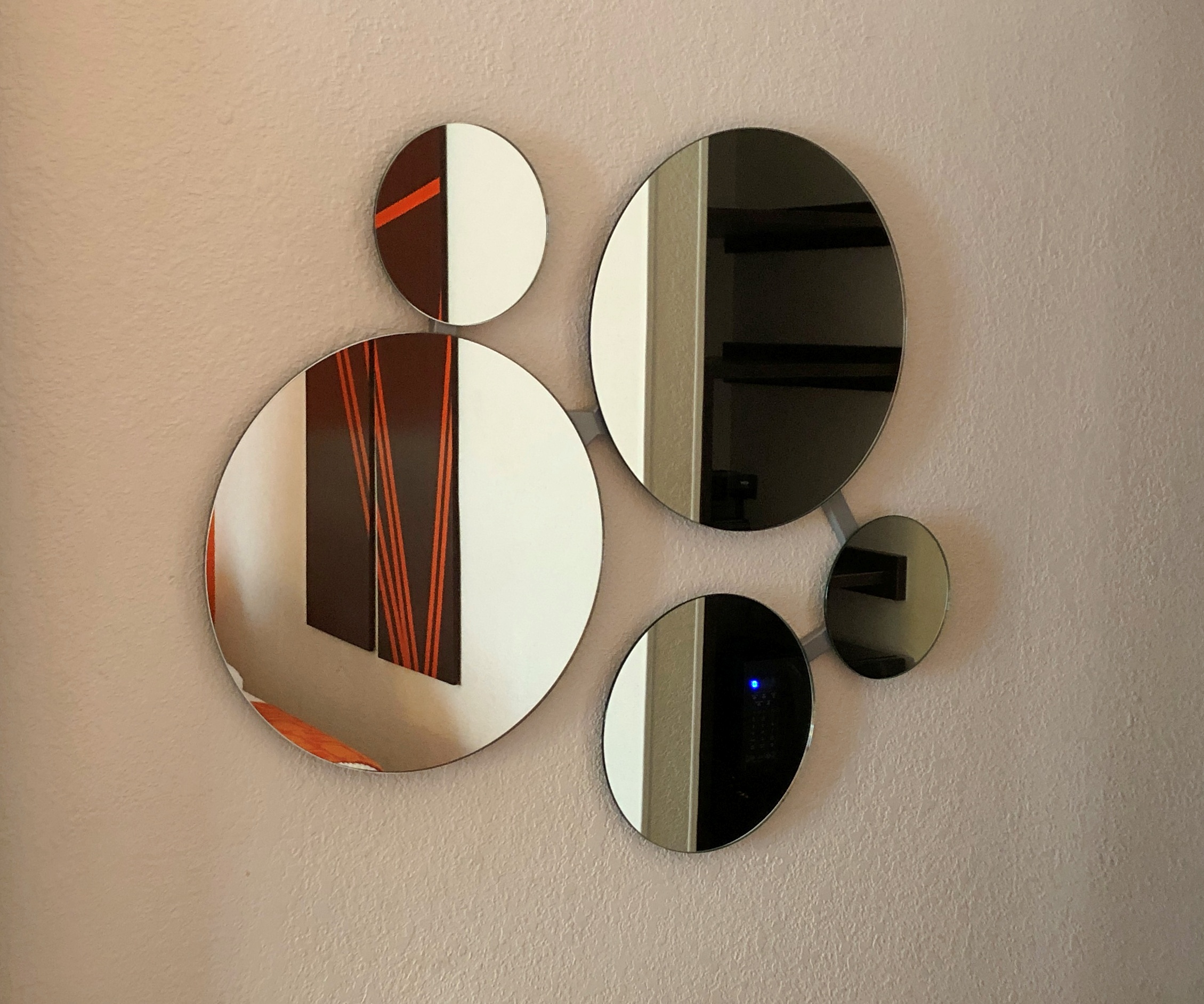
Including the same circular mirror array. Wyndham must have gotten them in bulk.
The unusual thing about the Lima, Ohio Howard Johnson is its sizable enclosed atrium — visible from my room’s balcony, also unusual in a limited-service hospitality property.
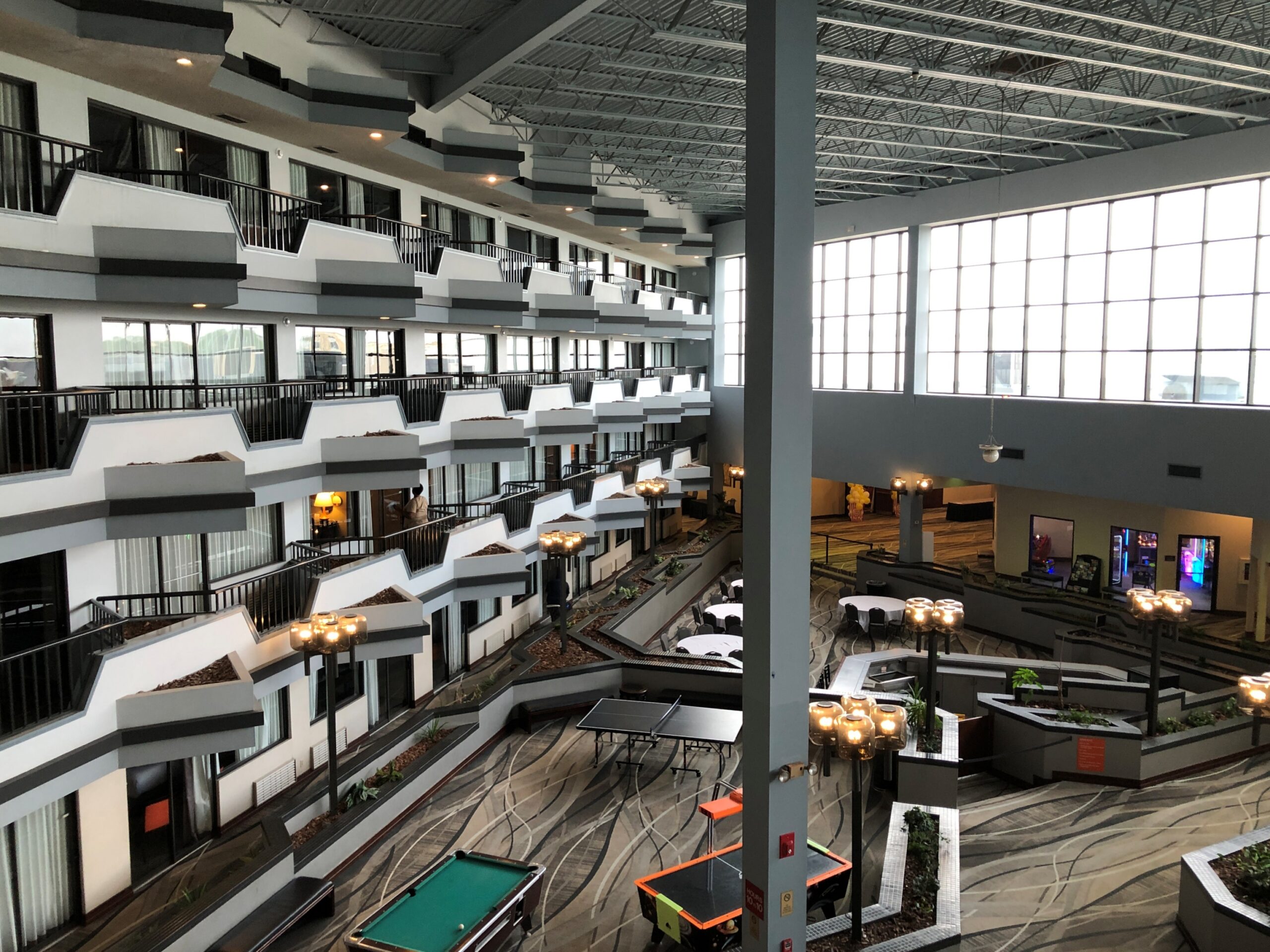
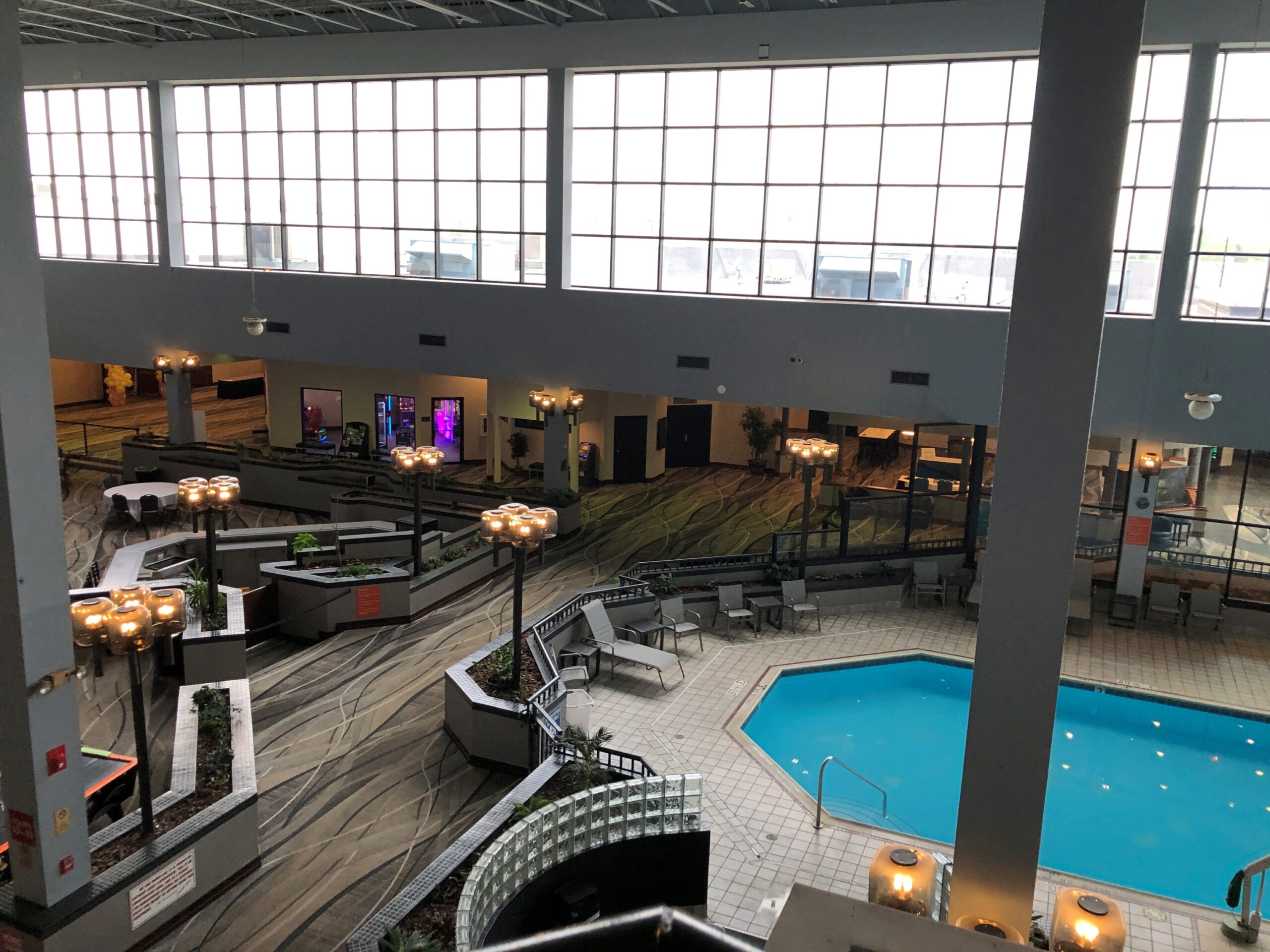
I asked the clerk if the property had been something else, once upon a time, and she said it had, offering a name I didn’t recognize and don’t remember, though I expect it might have been an independent property trying to make a go of it. Tough going in Lima, I bet.

GTT ’26, With a Small Side of NM

Never cared much for the term snowbird, with its connotations of getting up every morning to play golf during winter in some arid place, or spending the evenings with members of your cohort in some gated community, maybe drinking but definitely grousing about the state of the world. Still, considering that in the winter of 25/26, I’ve spent two out of the last three months – the hard winter months, up Illinois way – in warmer places, it would be churlish to cast shade on fellow old people who happen to enjoy golf or grousing.

On the other hand, I’m not about to claim snowbird as descriptive for myself. I just happen to be able to take long trips during the cold months (along with my laptop, for work). In December, Florida. In February, Texas.

Back on February 3, I got on a plane and flew to Austin. I flew home from Dallas on March 3. In between, I spent time – and Yuriko joined me for a while – traversing the state of Texas, going so far west at one point that we ended up in New Mexico. By traversing, I mean long drives, in a rental car part of the time, and in my brother Jay’s car as well, a blue Subaru known as the Blubaru.

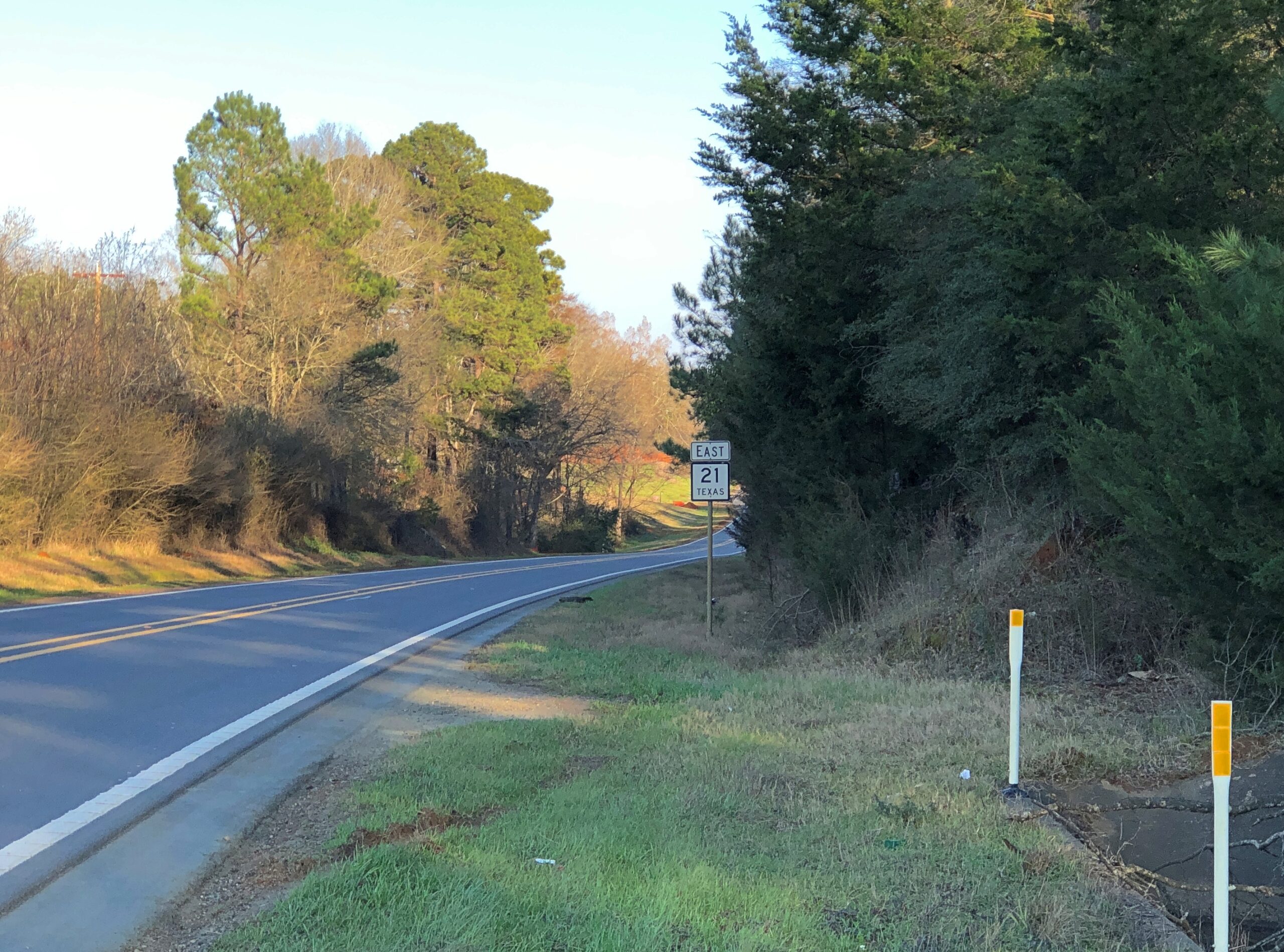
I drove from Austin east to Houston, mostly on US 290; from Houston to Nacogdoches, mostly on US 59; then to Dallas on various state highways, such as Texas 21 and 19; and from Dallas to San Angelo to Marathon, Texas, on US 67 and on the grandly remote US 385, which will also take you to the desert reaches of the Big Bend.

From Marathon, Texas, across to Carlsbad, NM, our route took us along US 90, then Texas 56, then US 62/180. Later, US 62/180 took us from Carlsbad part way back to Dallas — to Sweetwater, Texas — but mostly we went on the faster but less interesting I-20. Dallas to San Antonio was partly I-35, but also US 281, which takes you around the perma-gridlock that is Austin.

Of all those, the road between Nacogdoches and San Augustine on a day trip, Texas 21 heading east, winding through greenish (for February) rolling hills, was a favorite.

The towns listed above were just the places I spent the night, alone or with Yuriko or with my brothers. In between were such places as Bastrop, these days a day-trip from Austin, with the requisite boutiques and restaurants; Huntsville, home of Sam Houston and memorials to the first president of Texas; San Augustine, rival with Nacogdoches in claiming to be the oldest town in Texas; Stephenville and Ballinger, geographically about as deep in the heart of Texas as you can be; the West Texas art town of Marfa and the way station of Van Horn; a string of oil patch towns such as Hobbs, NM, and Seminole, Lamesa, Snyder, and Sweetwater, back in Texas. Later, traversing north to south and back again, I stopped in Hillsboro and Belton, along the I-35 axis; and Lockhart, which has claimed for itself barbecue capital of the state.

Along the way, oddities were encountered. Otherwise, why drive on smaller roads?

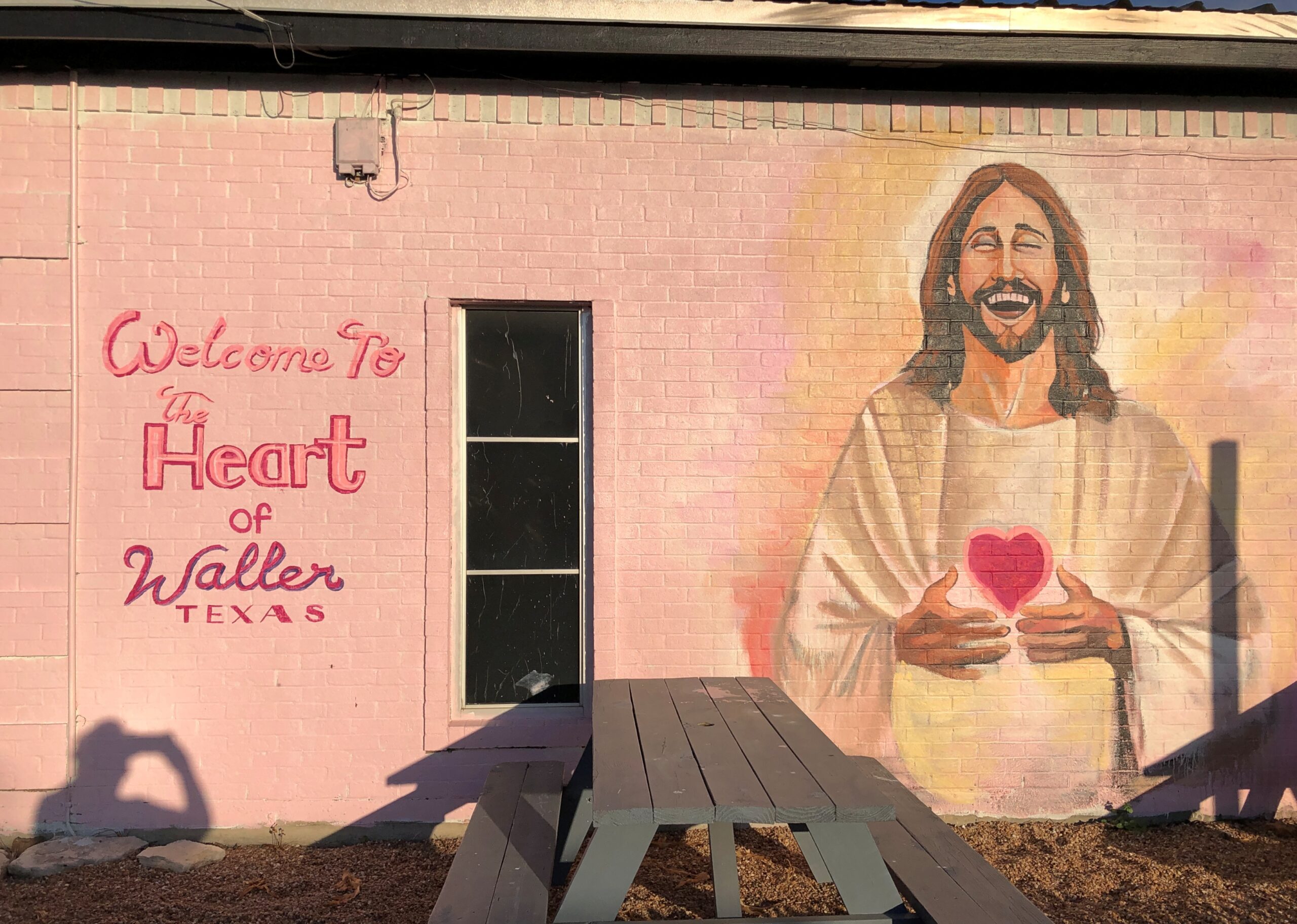
Such as an ice cream shop in Waller, Texas.

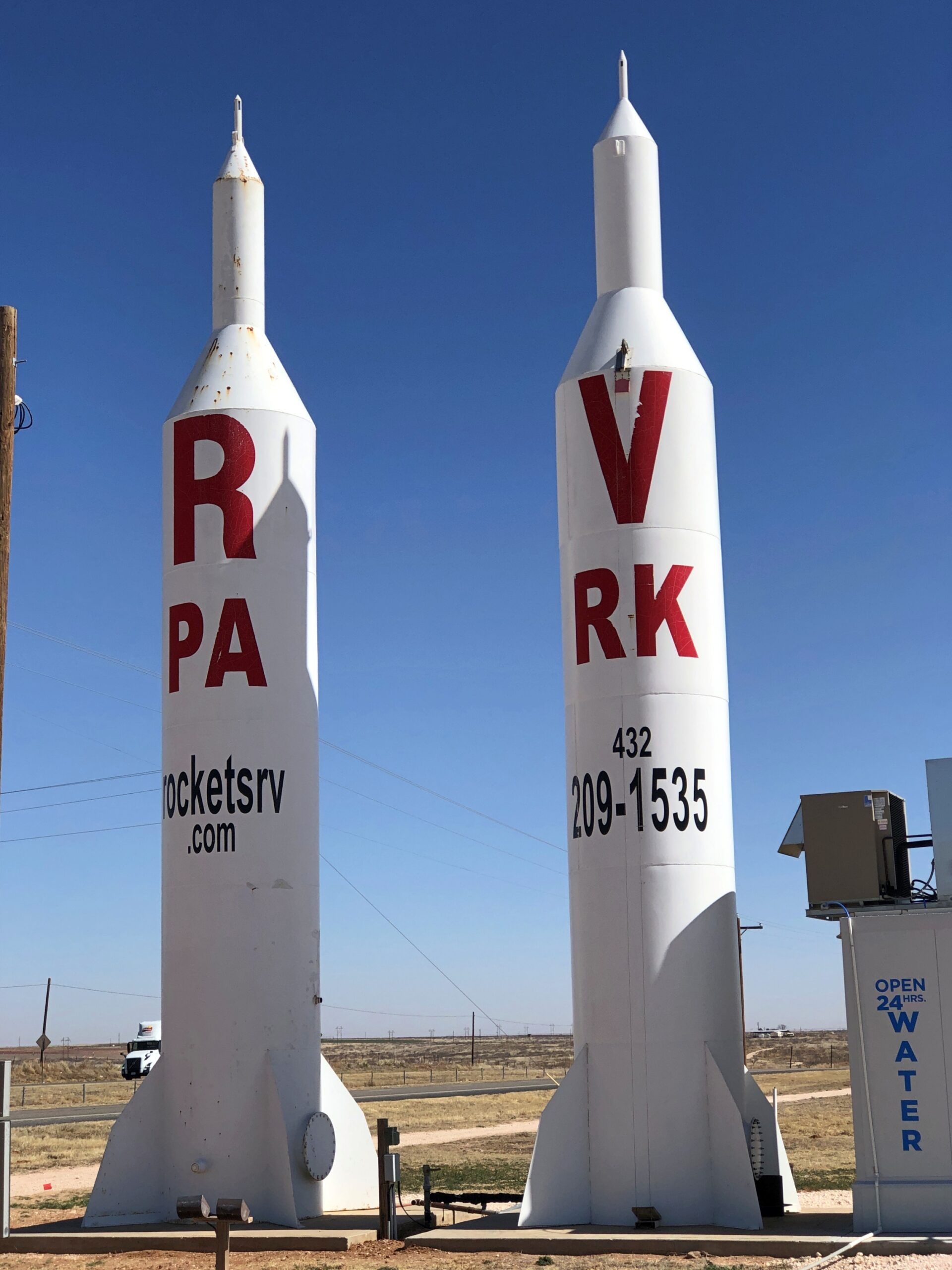
Or a highly visible ad for Rockets RV Park in Gaines County, Texas, not far east of the border with New Mexico.

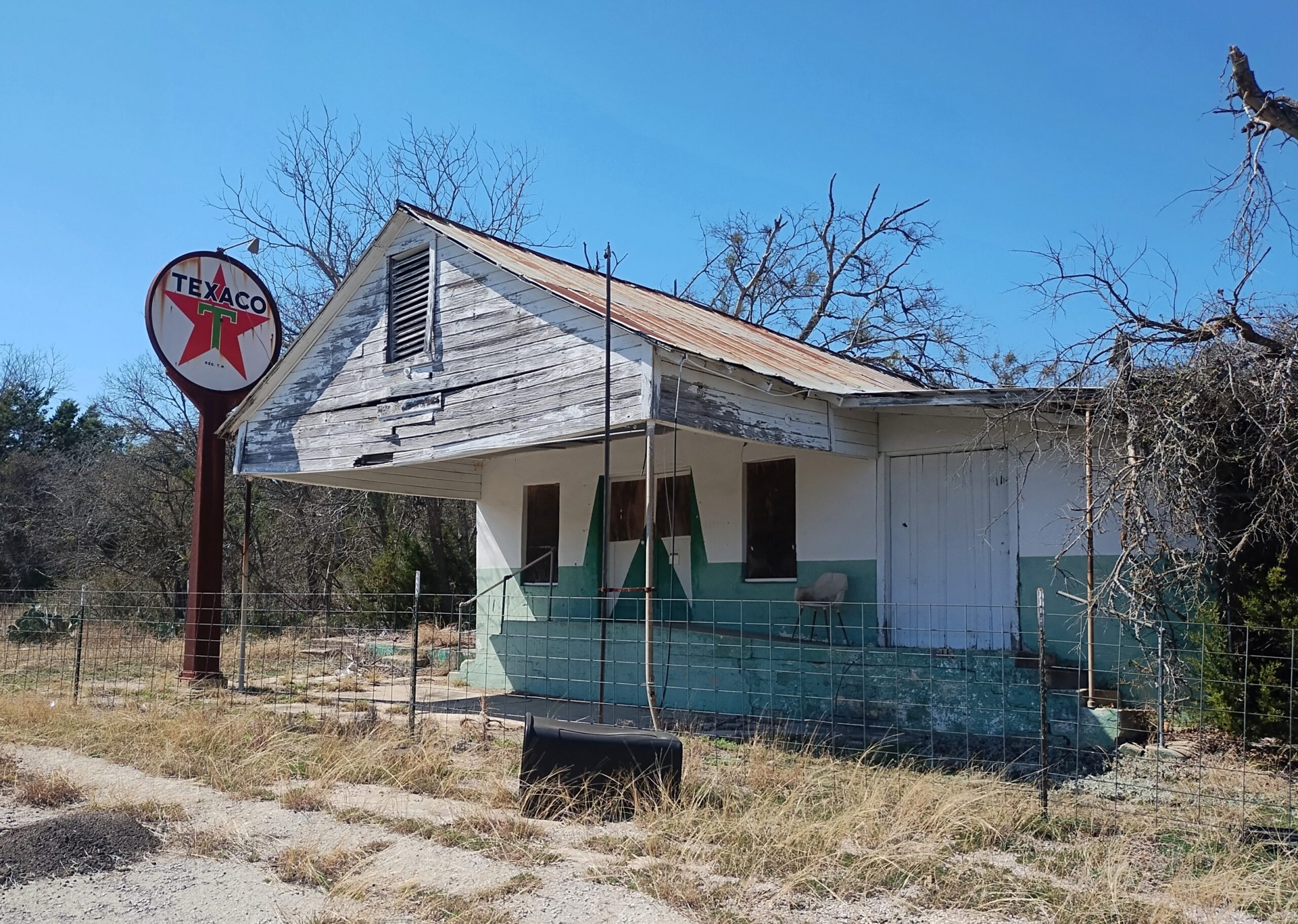
A former Texaco station on an obscure Texas highway (Farm-to-Market 1690).

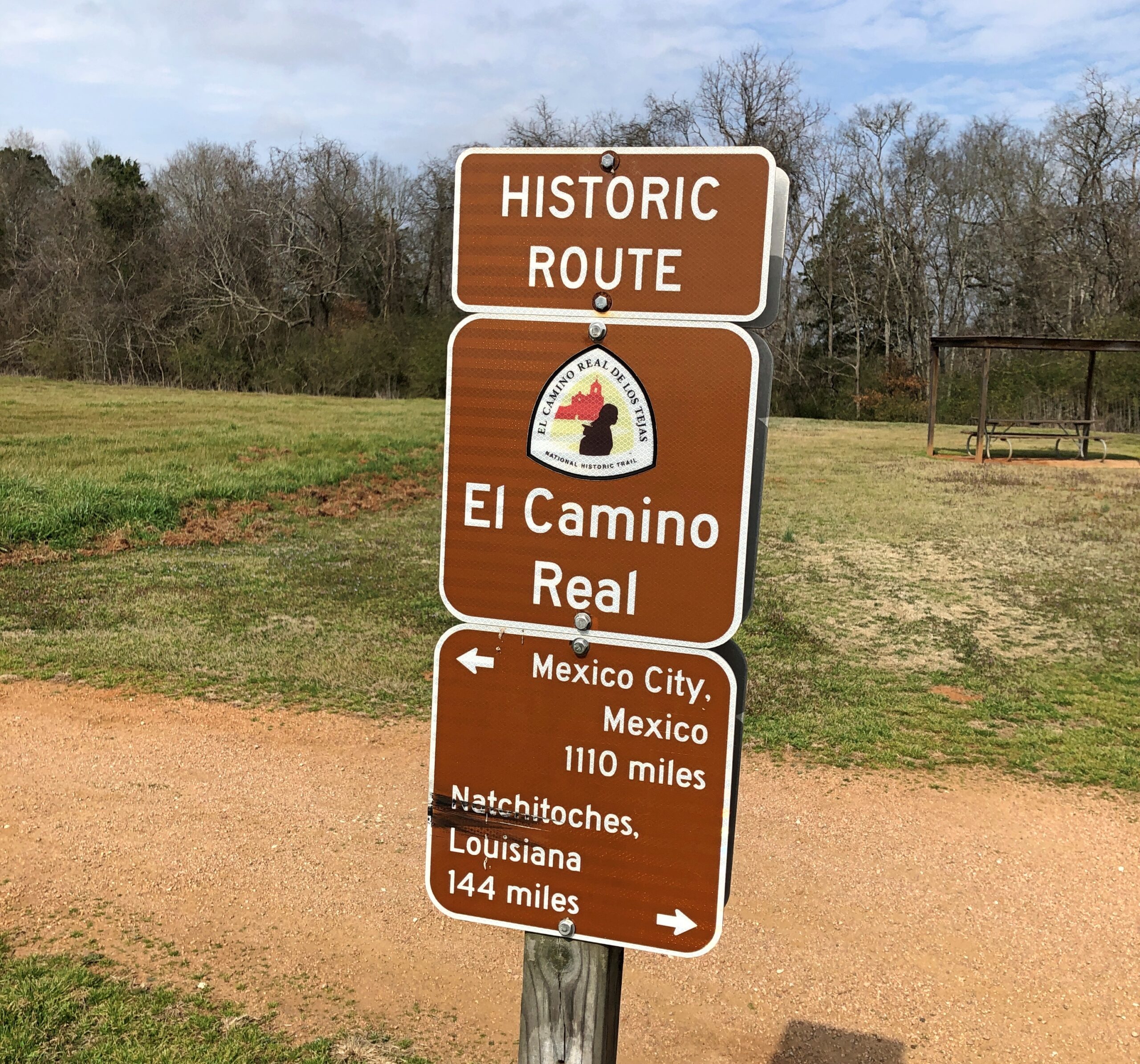
Had various encounters with the historic El Camino Real, whose various tendrils crossed a large slice of the future state of Texas, once upon a time.

Yuriko and I visited Big Bend National Park, Guadalupe Mountains National Park and Carlsbad Caverns National Park. I saw the National Museum of Funeral History in the city of Houston and the museum devoted to Houston (the man) in Huntsville. Also, Roadside America in Hillsboro, an eccentric collection of American commercial art, complete with a personal tour by the proprietor, and the outdoor art at the Chinati Foundation in Marfa, that is, brutalist concrete structures in the brutal desert environment. I became acquainted with the splendid Glenwood Cemetery in Houston and the smaller and more ragged, but no less interesting city cemeteries in Huntsville and Nacogdoches and Palestine. I stopped and looked at about a dozen county courthouses, of which Texas has many.

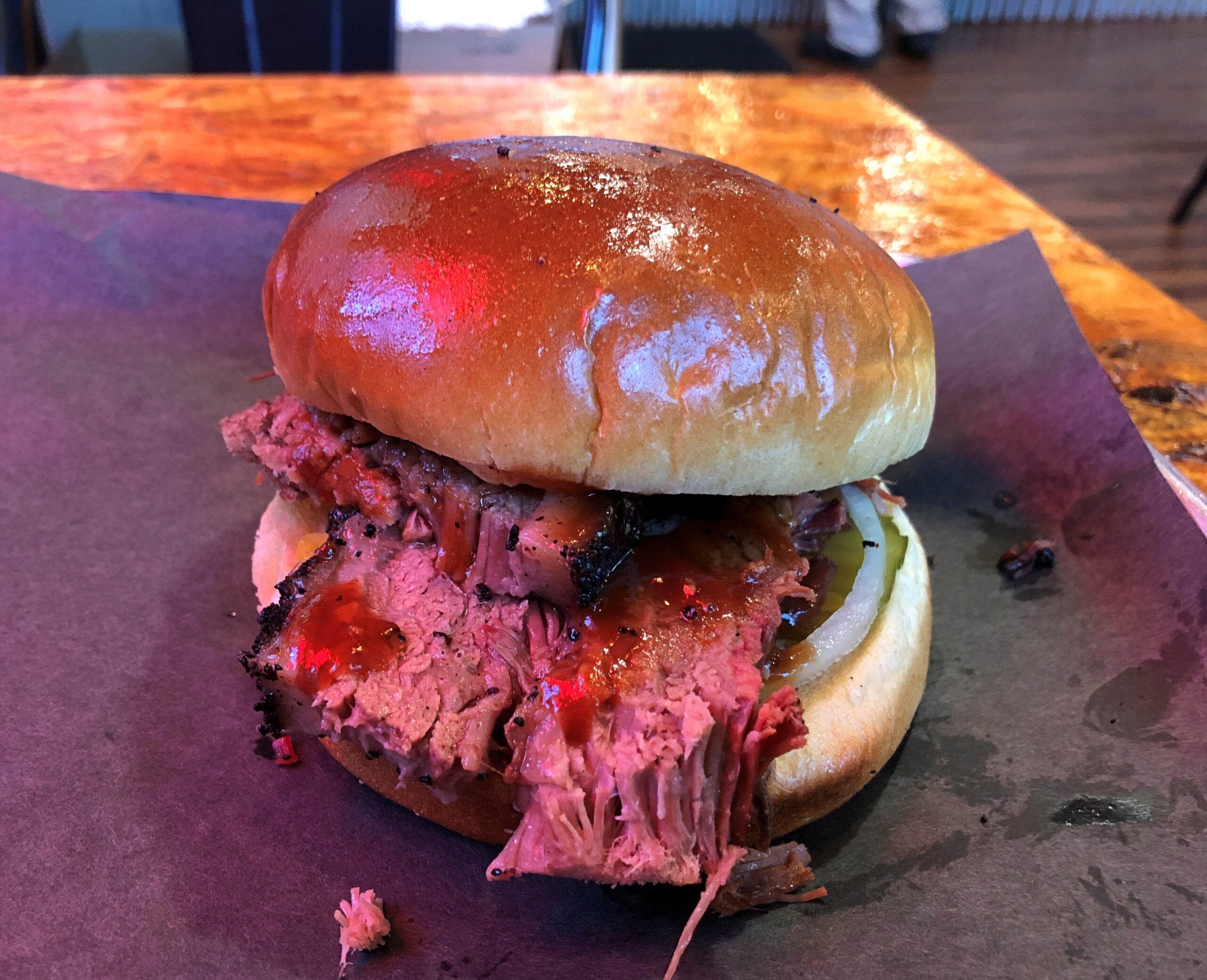
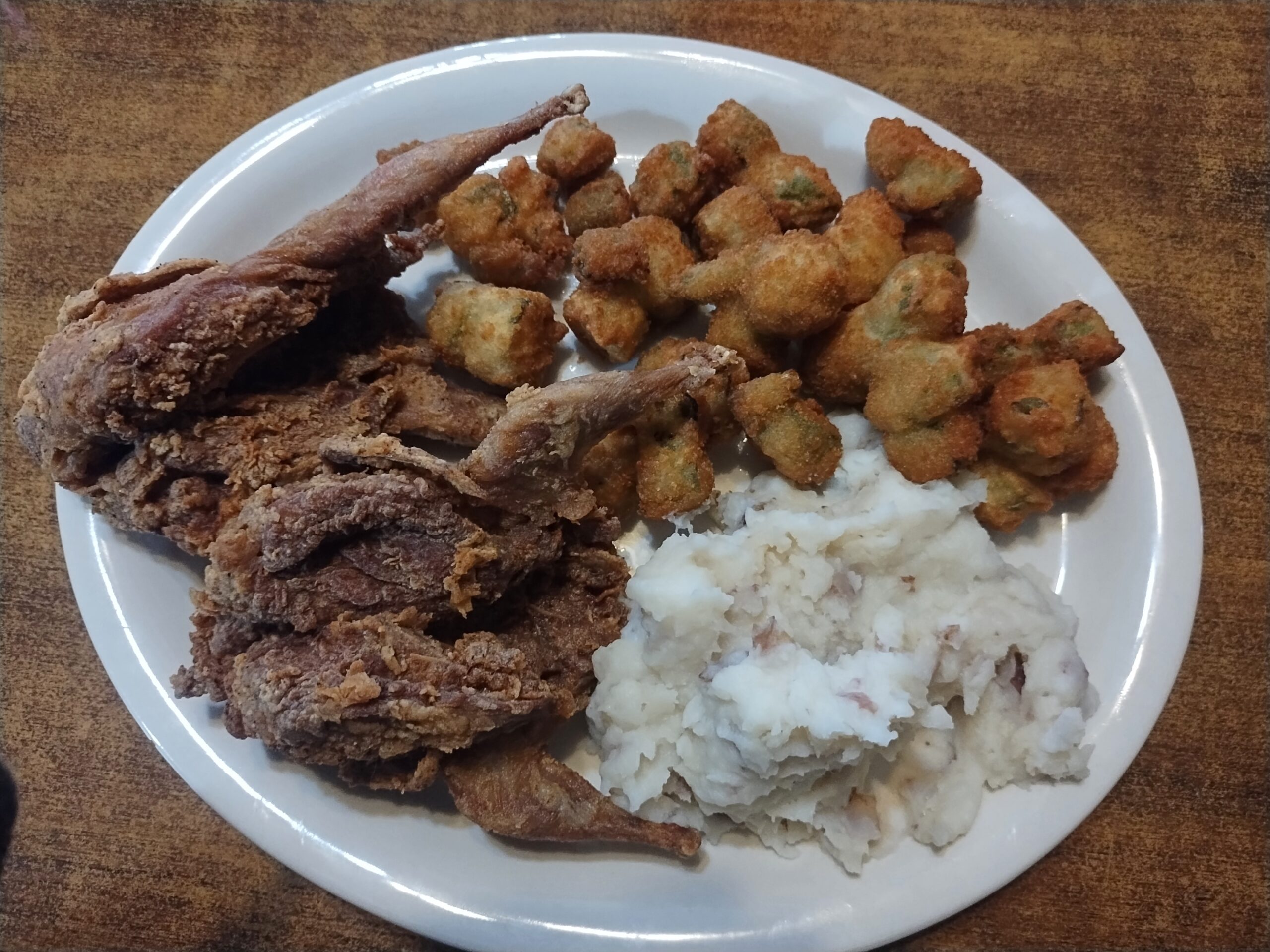
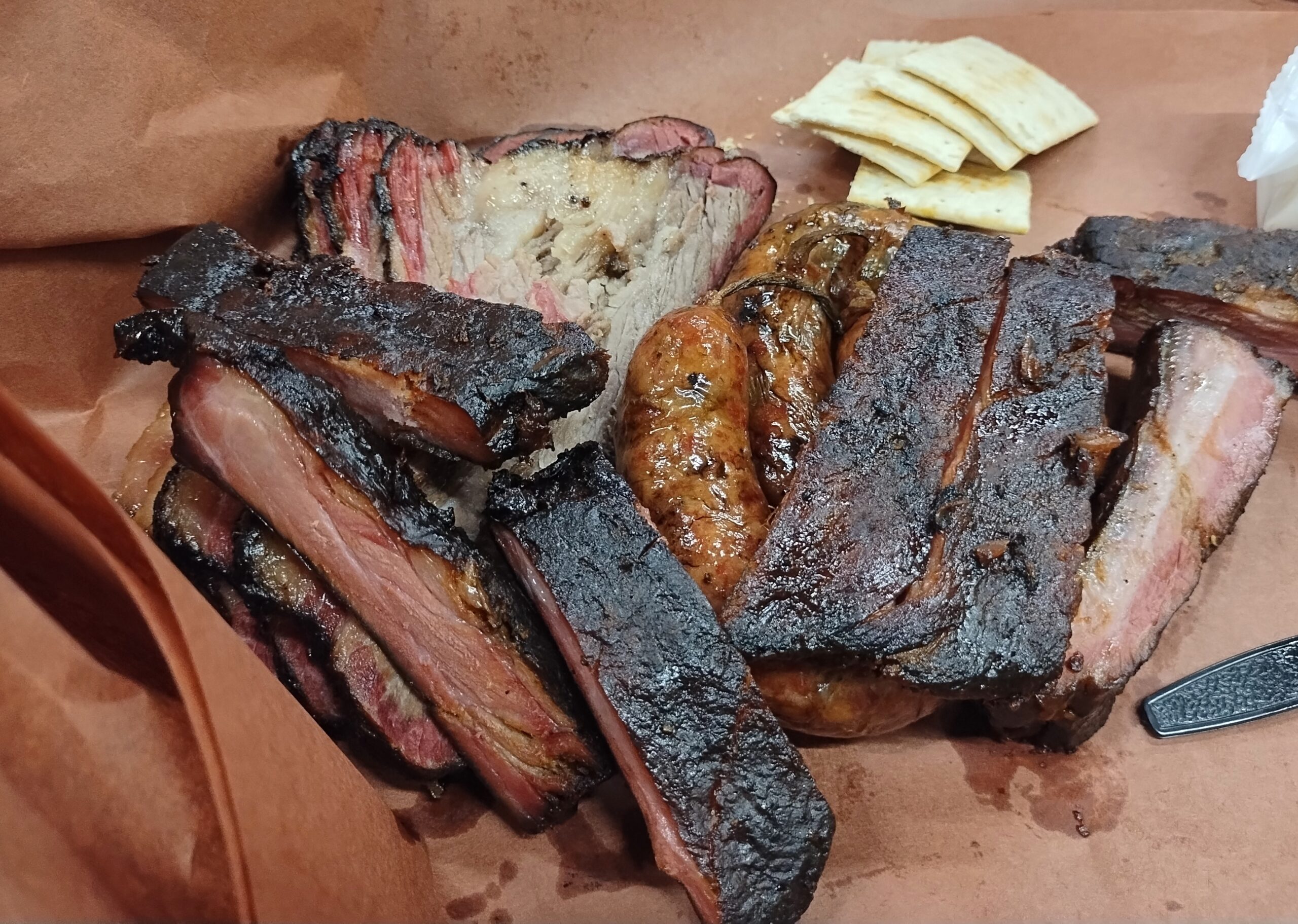
We ate a lot of meat along the way. As one does in Texas.

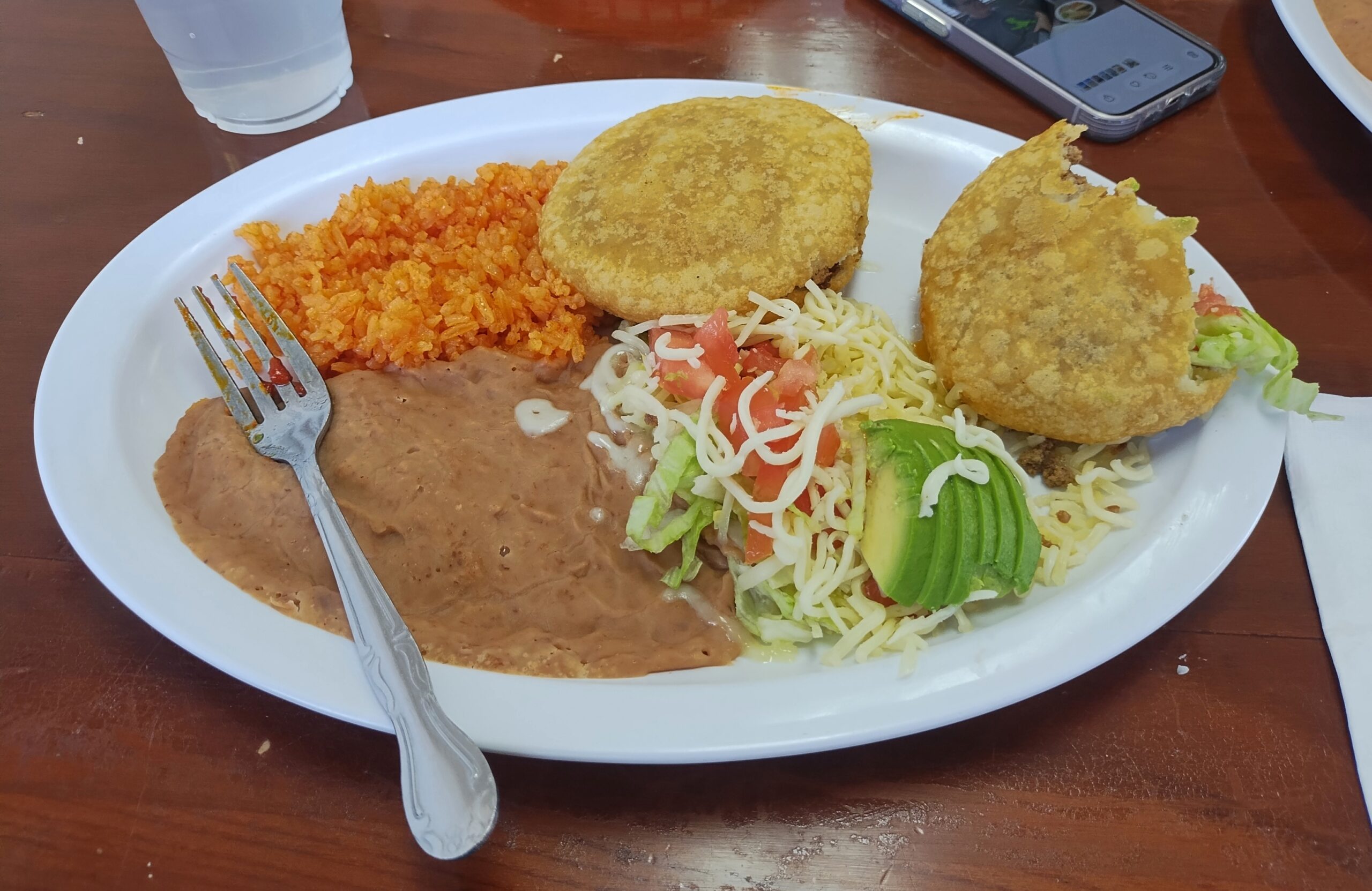
Also, Mexican food.

Eat like that and you’d better do some walking, and I did: various places in Austin and Houston and Dallas, in all three national parks, around downtowns and courthouse squares in a number of small towns, and a handful of local parks.

All that was good, but of course best of all, I had time to visit friends and relatives, of whom there are many in Texas: Tom and Nancy in Austin, Kirk and Lisa in Nacogdoches, another Tom and Steve and Ron and Greg and Judith in San Antonio, to list the friends; both brothers, two out of three nephews and their wives and all four of their children, to list relatives, along with the mother of one nephew’s wife (niece-in-law sounds peculiar, but that fits too). Also, I met for the first time two good friends of Tom’s in Austin, and one of Kirk and Lisa’s granddaughters.

I’d set out to do four long drives when I was 64, but this makes five. Guess I’m an overachiever about driving, anyway.

Florida ’25

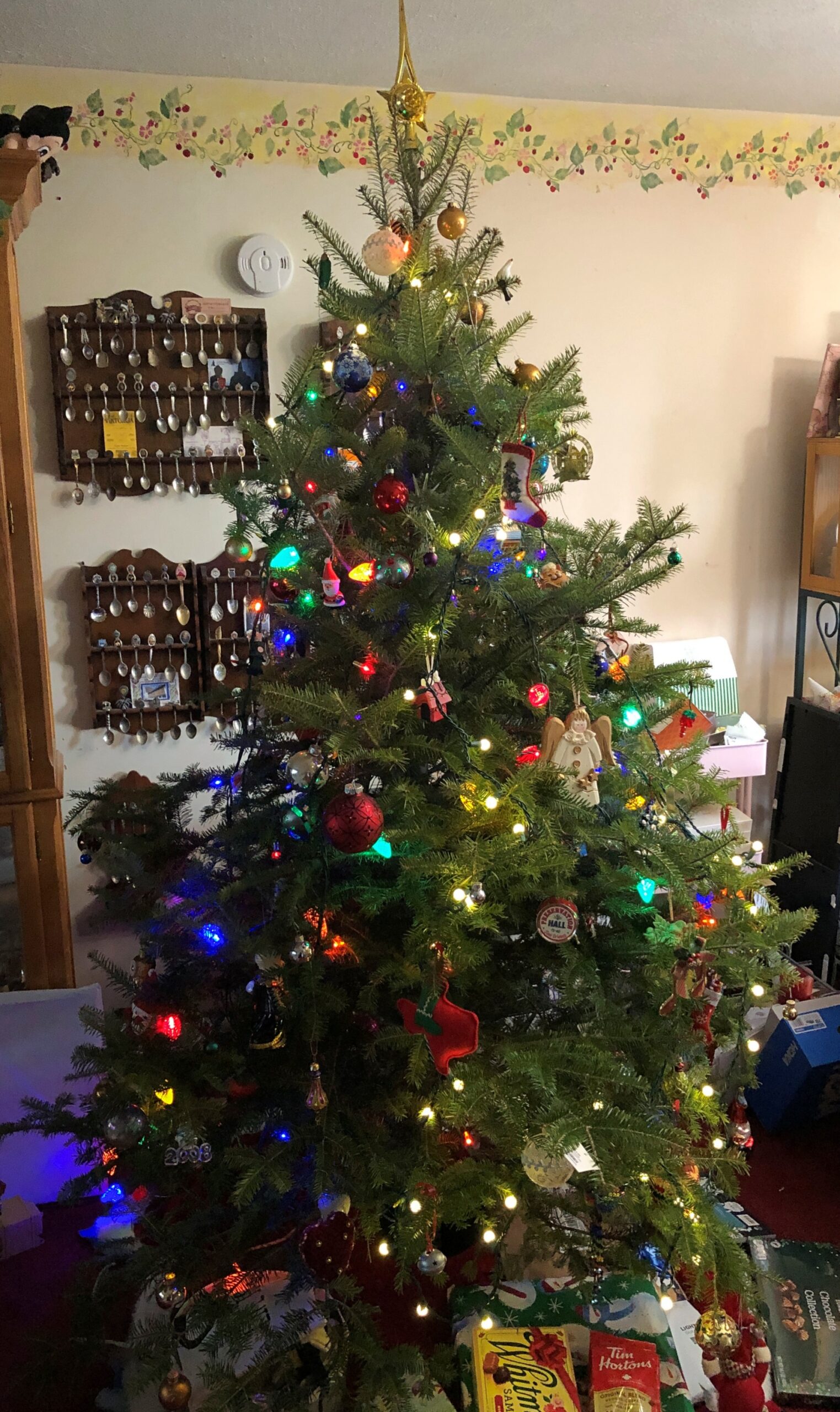
Decorating for Christmas this year meant a rapid set-up. We spent a fair number of hours on the 23rd making the living room ready for a tree – moving clutter, mostly. On Christmas Eve, I brought the tree in from the garage, and Ann mostly decorated it. Finishing touches, by me, were in progress even on the morning of Christmas Day, but since that moment in the life of our family doesn’t involve an early-morning rush downstairs by children anticipating Santa’s bounty any more, that was doable.

Xmas 2025

Ann did a fine job of decorating, in the style of our family: fill up the tree with a wide variety of glowing and glinting objects accumulated across the decades.

We got a late start on decorating for Christmas, though when I think about, decorating after the Solstice discourages the sort of front-loading of Christmas that a lot of people complain about, but which they do anyway.

We had a good reason for the late start: a drive to Florida and back, beginning on December 4 and ending on the 22nd. Not just to Florida, but as far as you can go in that state, at least by car, namely to Key West and back. Early to mid-December seemed like a good time to do such a thing, after any traveling people do for Thanksgiving but before the worst of the Christmas-New Year’s rush. A short shoulder season in other words, but a good one, with room rates not quite subject to surge pricing, and crowds thick in some high-volume tourist destinations, but not impossible.

Florida '25

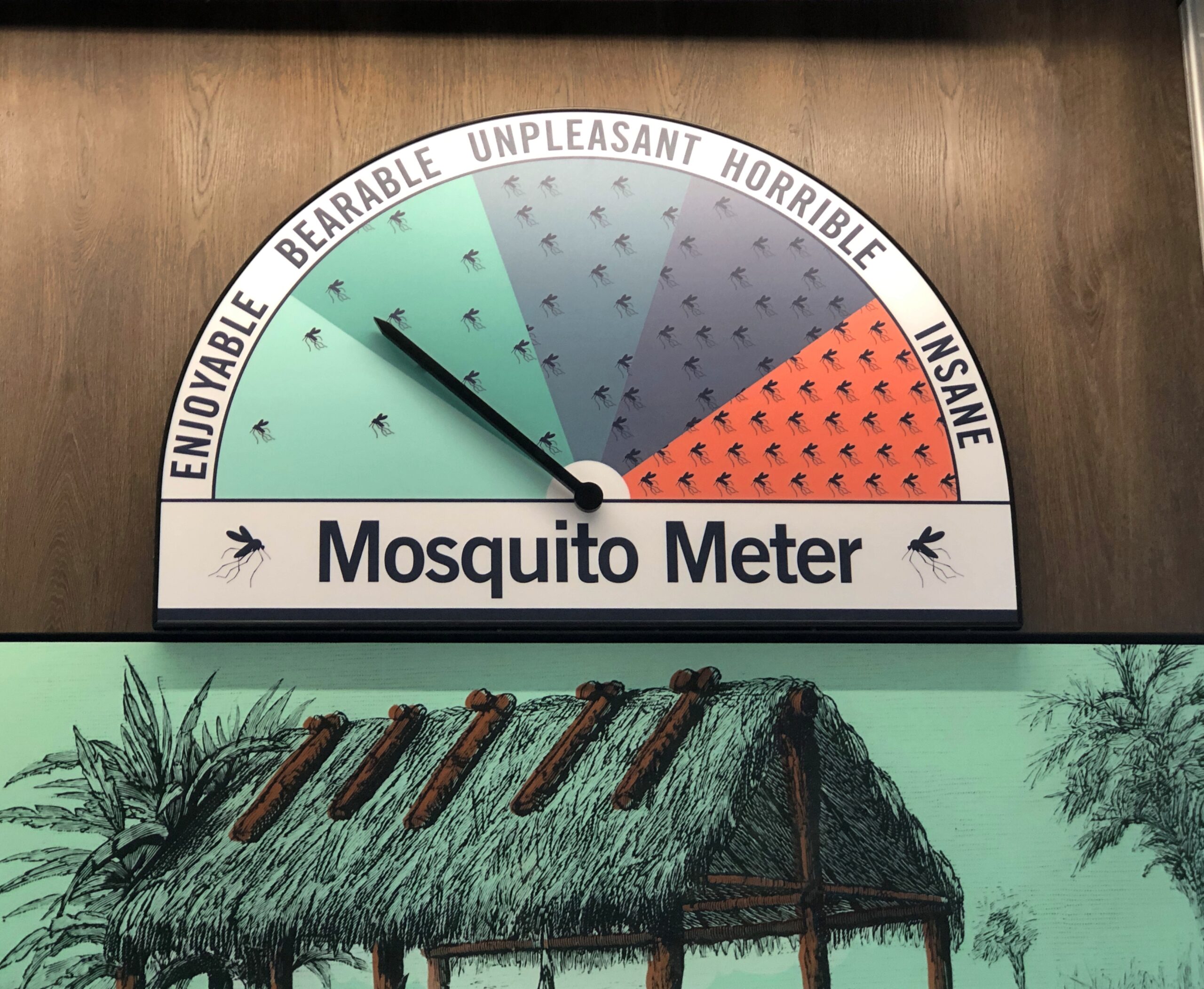
Also, Florida has few mosquitoes this time of year. Not no mosquitoes, as we found out one day in the southern reaches of the peninsula, just a “bearable” number.

Florida '25

Sometime earlier this year, I got the idea that I wanted to take four long drives after turning 64. Four for 64, you could say. Doing so by the end of 2025 wasn’t part of the idea, but that’s how things worked out. The drive to Florida and back, by way of such places as Indianapolis, Louisville, Chattanooga and Atlanta, totaled 3,682 miles. For all four trips since June, the total is about 14,300 miles.

That could be made to sound impressive, but in fact American men my age average more than that every year, about 15,000 miles, at least according to this source, which cites US DOT data. Younger men drive even more annually. Most of that is commuting, however. My commuting mileage by car has been exactly zero this year, and while I drive locally to stores and such, it couldn’t be more than a few thousand miles. So it seems clear that, as an American man, it was my duty to get out and drive.

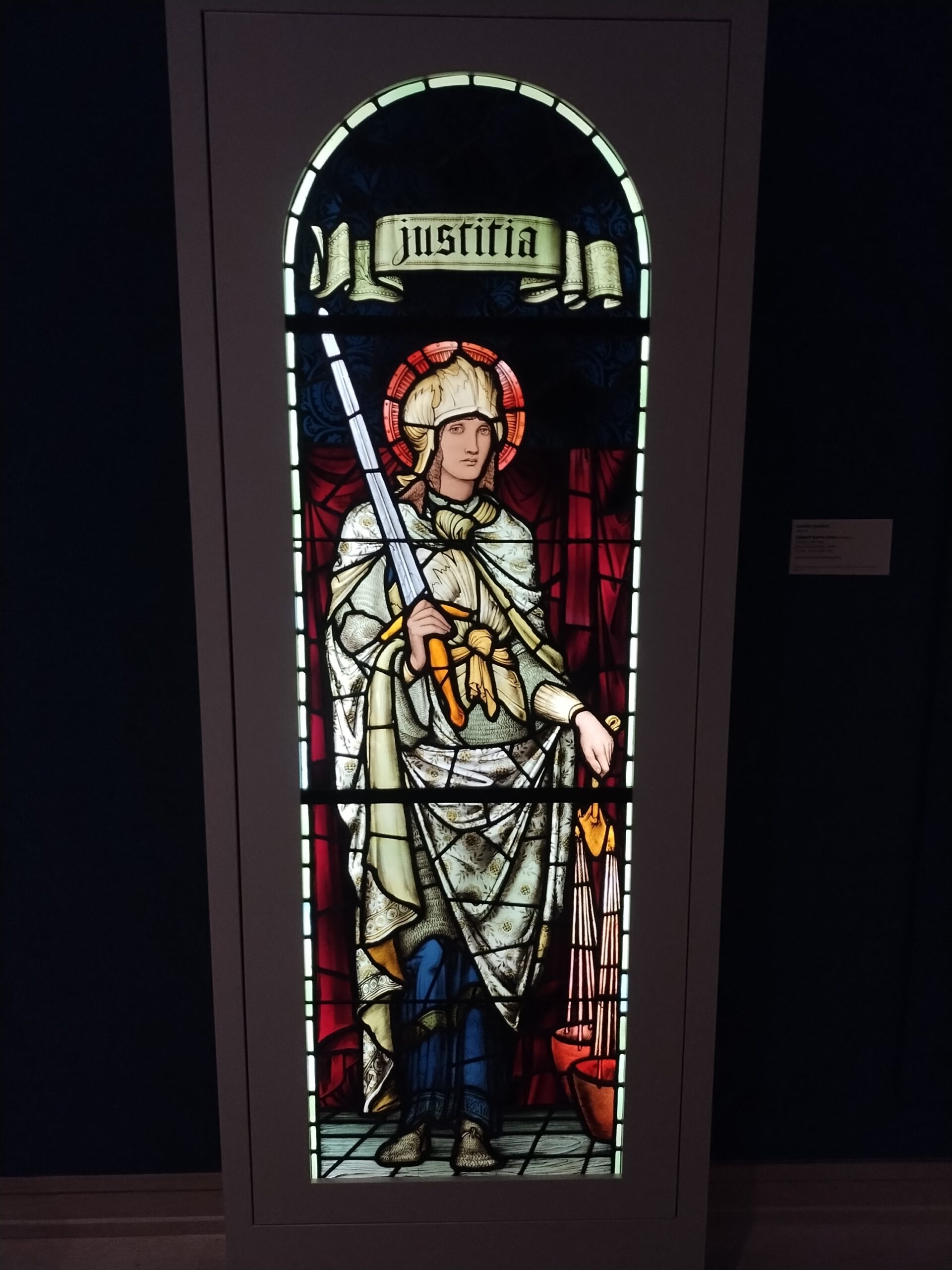
When we headed south in early December, snow covered the ground all the way past Indianapolis, where we stopped for a few hours at the Indianapolis Museum of Art, which is part of a larger campus called Newfields – and better examined in summer, I think. But the museum is a good one, with a solid collection, especially 19th-century American and European works. Such as “Justitia,” a Morris & Co. work from the 1890s.

Justitia
Justitia

After overnighting south of Louisville, we diverted from I-65 and took smaller roads through southern Kentucky and into Tennessee to a holler in Jackson County, where we were the guests of dear friends. Tennessee musicians from those parts — some professional, others skilled amateurs — gathered on the the evening of Saturday the 6th, for one of the periodic jams in our friends’ barn, which houses no animals these days, but a small stage and some sound equipment and a fair number of folding chairs. A joyful jam it was. Food was potluck. I like to think we went to a hootenanny.

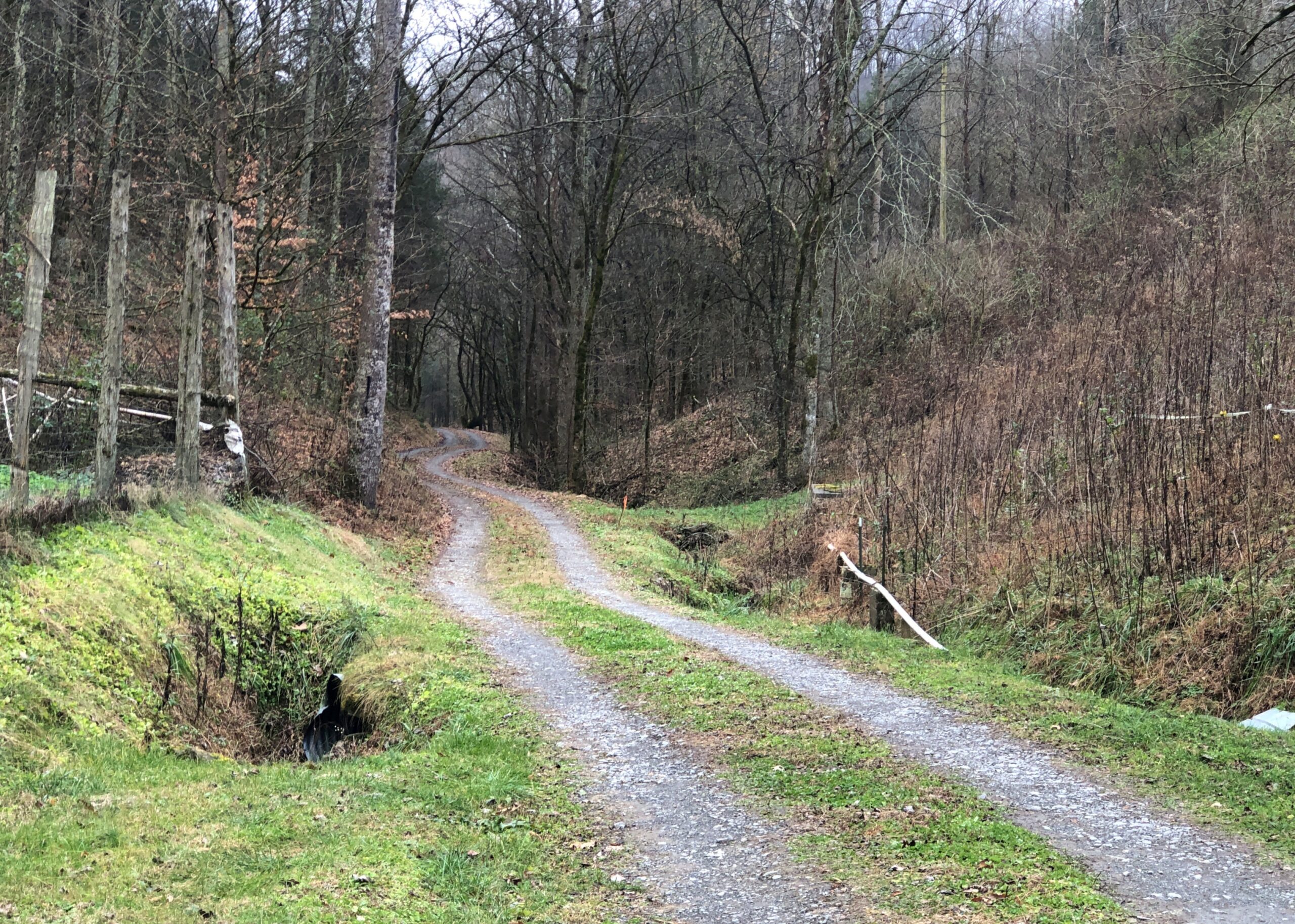
The road through the holler. By this point, no snow. We were trading cold for warmth. That was one of the goals of the trip. Maybe the main one.

From there it was mostly a straight shot down through Georgia on I-75 to Florida, and eventually US 27 to Orlando by way of non-coastal Florida places like Gainesville, Ocala and Lady Lake, a string of settlement less agricultural and less pastoral now than ever, more like an endless outer suburb. Heavy traffic is an invasive species in this part of Florida, surely as pythons are in damper parts of the state. Not just masses of cars and trucks, either, but also golf carts. We passed close enough to The Villages to see billboards advertising legal representation in the event of golf cart accidents. Carts, I’ve heard, provide transport in great numbers in that sprawl of a settlement.

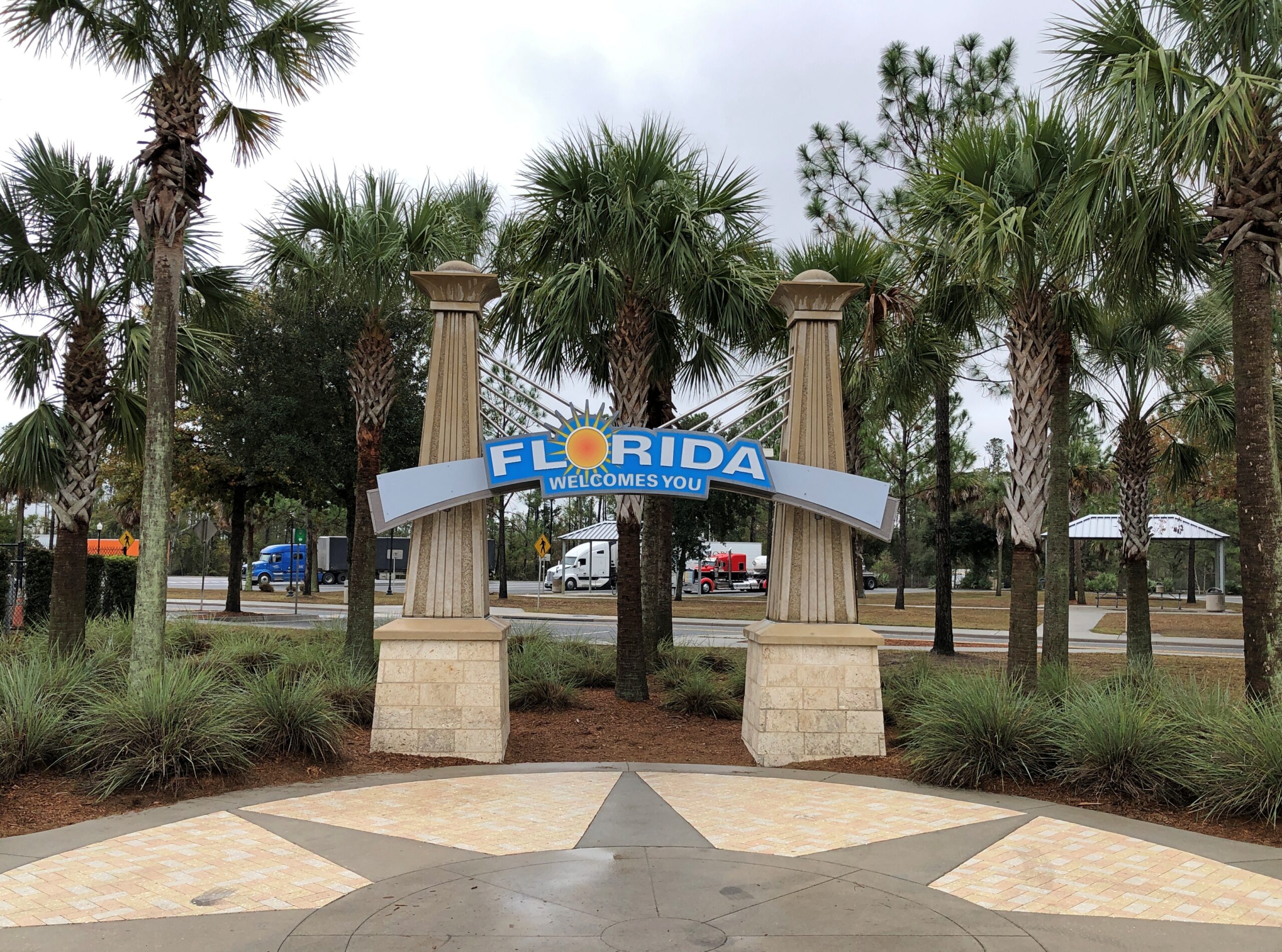
The drive to and in Florida involved the usual North American mix of large and small roads, smooth and ragged, grid-like and irregular, though Florida cities tended toward the irregular (except for Key West), and as crowded as can be and as empty as can be. Snow lined the way up north, thinning out the further south we went, giving way to brown landscapes and bare trees. Then we came into greenery – evergreens and palms and even deciduous species turning color. We crossed mighty bridges over mighty rivers, small culverts over alligator haunts, and the string of bridges that make up the civil engineering marvel known as the Overseas Highway (US 1). We crossed barely acknowledged borders and signs at the Florida visitor center on I-75 proclaiming The Free State of Florida.

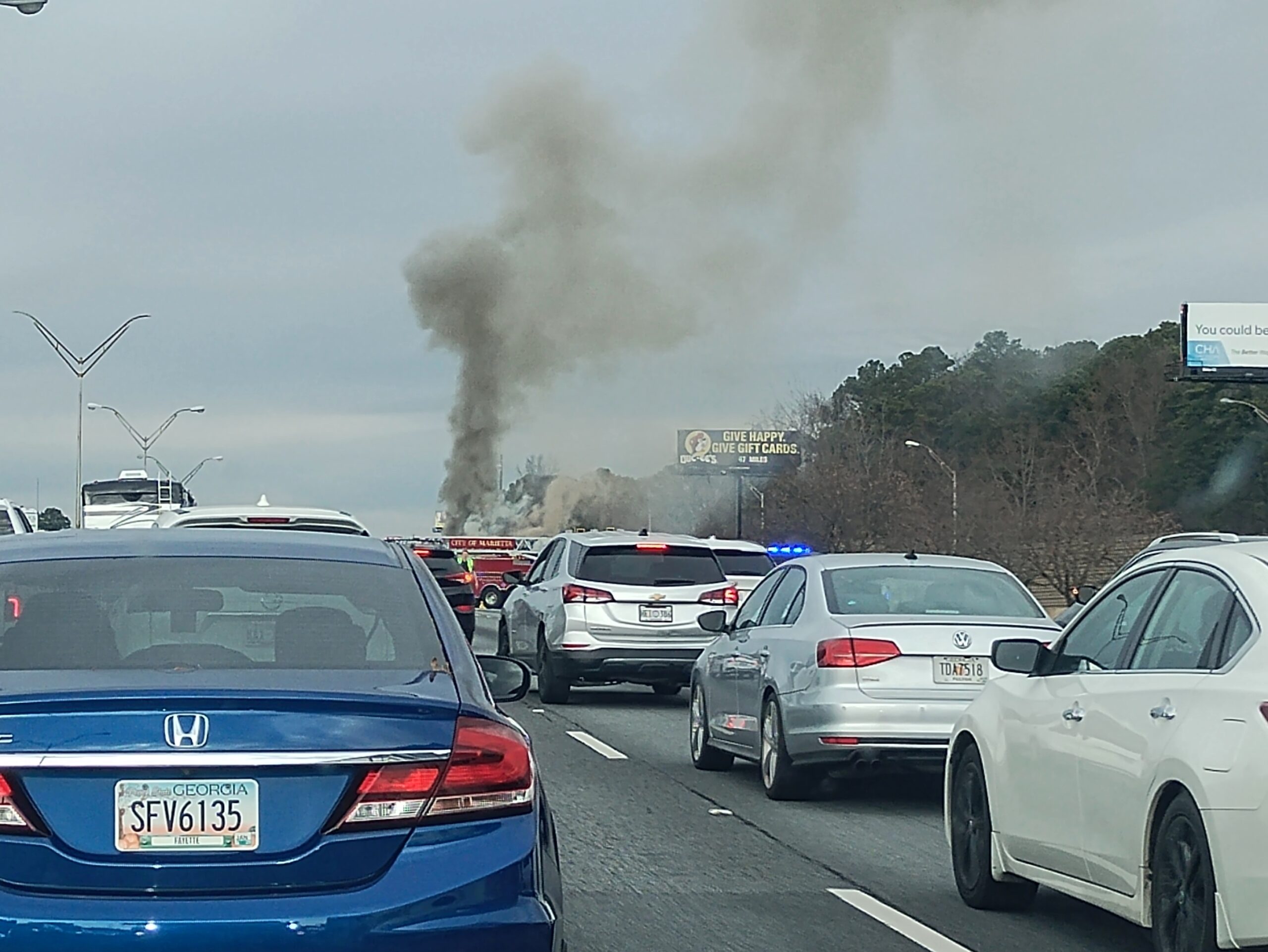
Florida Man was out and about, weaving in and out of high-speed traffic, pushing 100 and pretty sure that physics doesn’t apply to him, though I have to admit that Florida isn’t different from any other state in that way. Traffic stopped cold more than once: for a banged up, upside-down SUV; for a raging RV fire, attended by a half-dozen firemen; for a serious two- or maybe three-car wreck on the other side of a divided highway; for construction, usually without any workers in sight; and once for no reason that we could tell at all.

In Orlando, we spent all December 9 at Universal Epic Universe, a theme park that only opened in May. Ann flew in the day before we went to the park and flew home the day afterward, taking advantage of the low prices that discount airlines offer to high-volume places in a shoulder season, if you take no bags and buy nothing to eat or drink at sky-high prices, literally and figuratively. A small bag of hers had been stowed in our car for the visit.

A theme park is one thing, but I wanted a look at Orlando, at least a sliver of it, the next day. Ann’s flight was fairly late that day, so we were able to spend part of it in posh Winter Park, including a tour boat ride through the town’s small lakes, lush with greenery and expensive houses on their banks, and connected by canals.

A drive that included the stretch of US 41 that passes through the Everglades took us to Homestead, Florida, and the mid-century charms of The Floridian motel. A day in Everglades NP followed, including an airboat tour and a drive to the coast at Florida Bay. The next day, before leaving Homestead for a drive in the rain across the Overseas Highway to Key West and while the sun still shined, we toured the Coral Castle, a one-man construction project using 1,000 tons of oolite to make walls, carvings, stone furniture, and a castle tower.

Key West was a two-day, three-night mid-December ramble on the busy and less busy streets of Old Town, including humans but also chickens, taking in the likes of the Hemingway House, the Little White House, Mallory Square, the San Carlos Institute, the Key West Aquarium, and the Key West Cemetery. Also, tourist shops, boutiques and the building where Pan-Am was founded. We ate and drank, though as our wont, nothing alcoholic. Key West was decked out for the holidays but not over the top. We walked and walked some more. It felt like a couple of pleasant summer days.

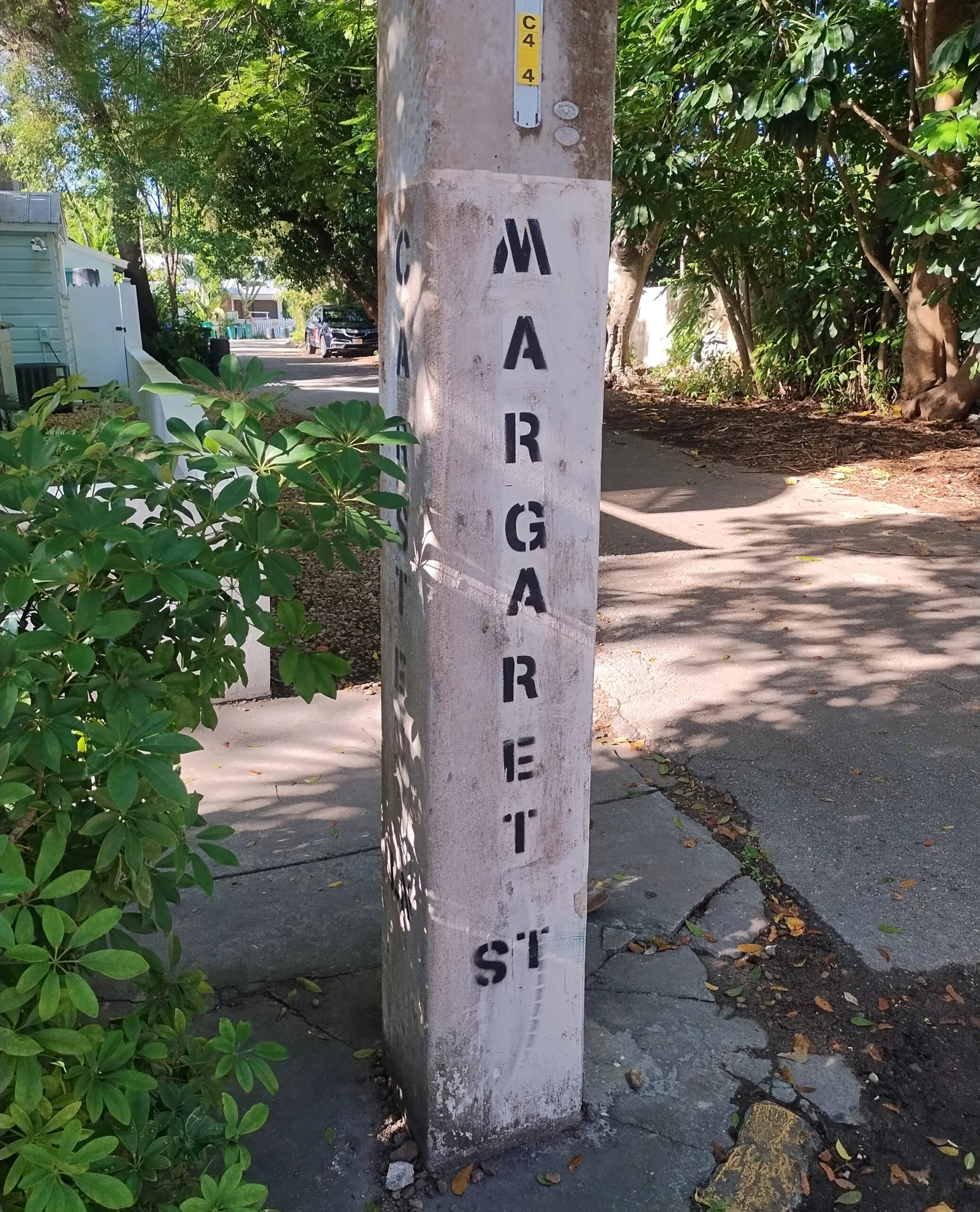
From my 2014 visit, I knew that on the back streets near the little-visited cemetery, parking was possible on an otherwise cramped island. So it was. On Margaret Street, within sight of the cemetery.

Margaret

The return drive took us up the eastern coast of Florida, but avoiding the worst traffic in Miami-Dade by taking Florida’s Turnpike. By December 17, we’d arrived in Orange Park, a large suburb of Jacksonville, for a stay with two other dear friends, former Austinites now in northern Florida. Part of the next day was in and near downtown Jacksonville, one of the larger U.S. cities I’d never visited before (I believe San Jose is now the largest on that list). During our downtown stroll, we encountered the coolest building in Jacksonville and certainly one of the coolest in Florida.

We quit Florida on the 19th, but weren’t quite done with the trip. Yuriko had never been to Atlanta and wanted to go. Though I’d been however many times since 1982, I was happy to oblige, so we spent two nights and a day there, using the day to see the astonishing Georgia Aquarium and the impressive but somewhat overpriced World of Coca-Cola.

The last legs of the trip were long drives: Atlanta to Elizabethtown, Kentucky; and from there to home the next day. I wasn’t about to let them be completely dull drives, so we stopped on the second-to-last day in Chattanooga, to see the conveniently located, blocks-from-the-highway Chattanooga Choo-Choo redevelopment. On the last day of the trip, we stopped in Jeffersonville, Indiana, and walked across the Big Four Bridge, a former RR bridge across the wide Ohio, now serving pedestrians and bicyclists.

Home and then — Christmas, when things slow down for a week or so. Good timing.

Nor’East Drive ’25

I didn’t realize until last night that I’d driven through some geographic oddities over the last two weeks, on my way to the Northeast and back. Actually state border oddities, such as the Erie Triangle in Pennsylvania, the curious division of the Chesapeake Peninsula, and the panhandle of Maryland.

Except they aren’t really oddities. They just look that way when you’re a kid (or an adult) poring over U.S. maps or putting your state puzzle map together for the nth time. How is it that Pennsylvania has that small chimney? Why didn’t Delaware get more of the Chesapeake Peninsula? What’s the deal with the western extension of Maryland, which narrows to only a few miles at one point?

There are historic reasons for all the shapes, both rational and arbitrary, which are the subject of books and at least one TV show. Lands were granted and claimed, borders were surveyed and quarreled over, and deals and court cases and Congress eventually settled the shapes.

The border oddities may have local and legal significance, but they’re also there to enjoy. Regular borders aren’t nearly as much fun. Sure, it’s interesting that Colorado and Wyoming look about the same, but I always liked the fact that New Mexico has a stub and Idaho tapers to meet Canada, just to name two Western examples, because not all the fun shapes are in the East. Just most of them.

To reach these border areas, I drove 2,853 miles, starting October 14, from northern Illinois to the East Coast and back, through (in order) Indiana, Michigan, Ohio, Pennsylvania, New York state (and city), New Jersey, New York (city and state) again, Connecticut, Massachusetts, Rhode Island, Connecticut again, New York state (and city) again, New Jersey again, Delaware, Maryland, West Virginia, Pennsylvania again, West Virginia again, Ohio again and Indiana again, arriving home today. I got tired just typing all that out.

The original impetus for the trip was to visit New York City during its Open House event. Unlike a rational person, who would have flown there and back, I decided to drive, and let Yuriko fly there and back. NYC is achievable from metro Chicago in two driving days. I decided not to do that, either, and stretch things out to fill in some travel lacunae of mine.

For instance, I wanted to visit Eire, Pa., because I’ve always bypassed it, and many Americans can say the same. I wanted to look around Long Island, or at least part of it, for the same reason. I wanted to spend the night in both Rhode Island and Delaware: the last two states in which I’d never done so. I wanted to see the capitols of New Jersey, Delaware and Maryland, toying with the idea of Pennsylvania too, though I decided it was out of the way. I wanted to see historic sites associated with a number of presidents along the way, and maybe a battlefield or two.

I really wanted to visit a friend in New York, and my nephew Robert, and friends in the Boston area. I’m glad to report that I did so. This has been a year of visiting old friends and relations. I’d like every year to be that way.

I had a much longer list of places to visit, and added to it every time I looked at a map, paper or electronic, since I now use both, and when I was driving — so many possibilities. But there are only so many hours in the day and so much energy in my aging body. Still, I did much of what I set out to do, with one major exception due to forces beyond my control. National Park Service sites were off the table, for reasons all too obvious and not worth rehashing here. So the homes of FDR and TR, along with Antietam and Harper’s Ferry, went unvisited. Some other time, I hope.

No matter. I visited a good number of cities and towns, drove roads large and small, empty and insanely crowded, and enjoyed a few exceptional meals and many very good ones. I saw churches and cemeteries, some historic places not managed by the federal government, and encountered the largest of the many No Kings events. I read plaques. I chatted with strangers and clerks in stores. I took a swim in Massachusetts and long walks in New York. I hadn’t planned to walk across the Brooklyn Bridge again, but Yuriko had that idea, and across we went. I listened to a lot of terrestrial radio, good, bad and indifferent. I burned gas priced between about $2.70 and $3.30 a gallon. I paid entirely too many tolls, because the Northeast is lousy with toll roads and bridges — but driving across some of those bridges, especially the Bay Bridge in Maryland, was a grand experience, and surely worth the toll.

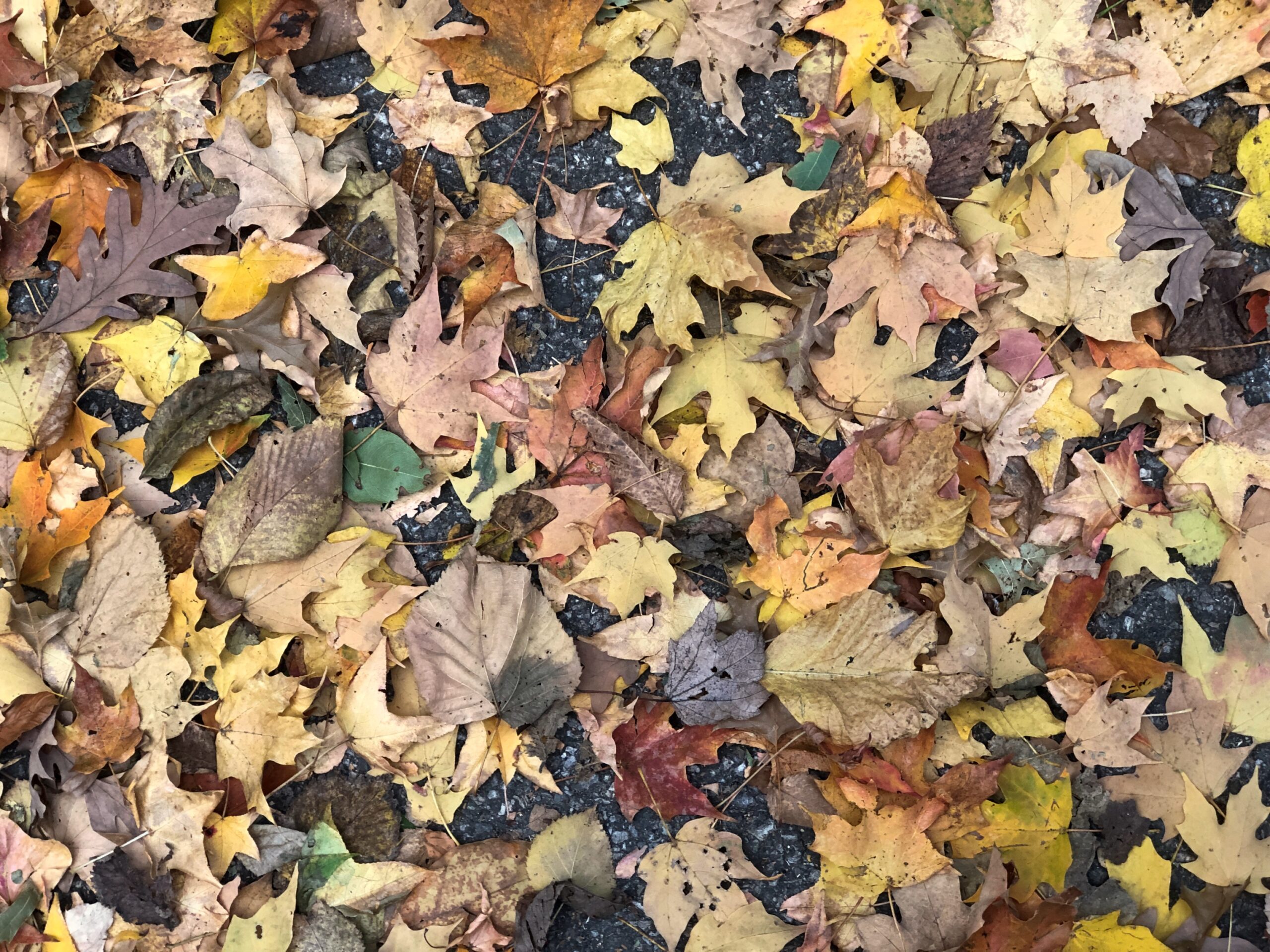
Something I didn’t anticipate, but which improved the trip immensely, was fall color. I should have anticipated it, but I suppose I had other things on my mind. When I got to New York state, driving west to east, it became clear that I’d accidentally designed myself a fall foliage excursion. The trees were gorgeous there, and in NYC (especially Prospect Park), Long Island, and parts of New England, and in Delaware and Maryland all the way across its panhandle. Even Ohio and Indiana had some nice color when I got there, and here at home too.

Prospect Park leaves

One more thing: unexpected oddities along the way. It’s important to watch out for those.

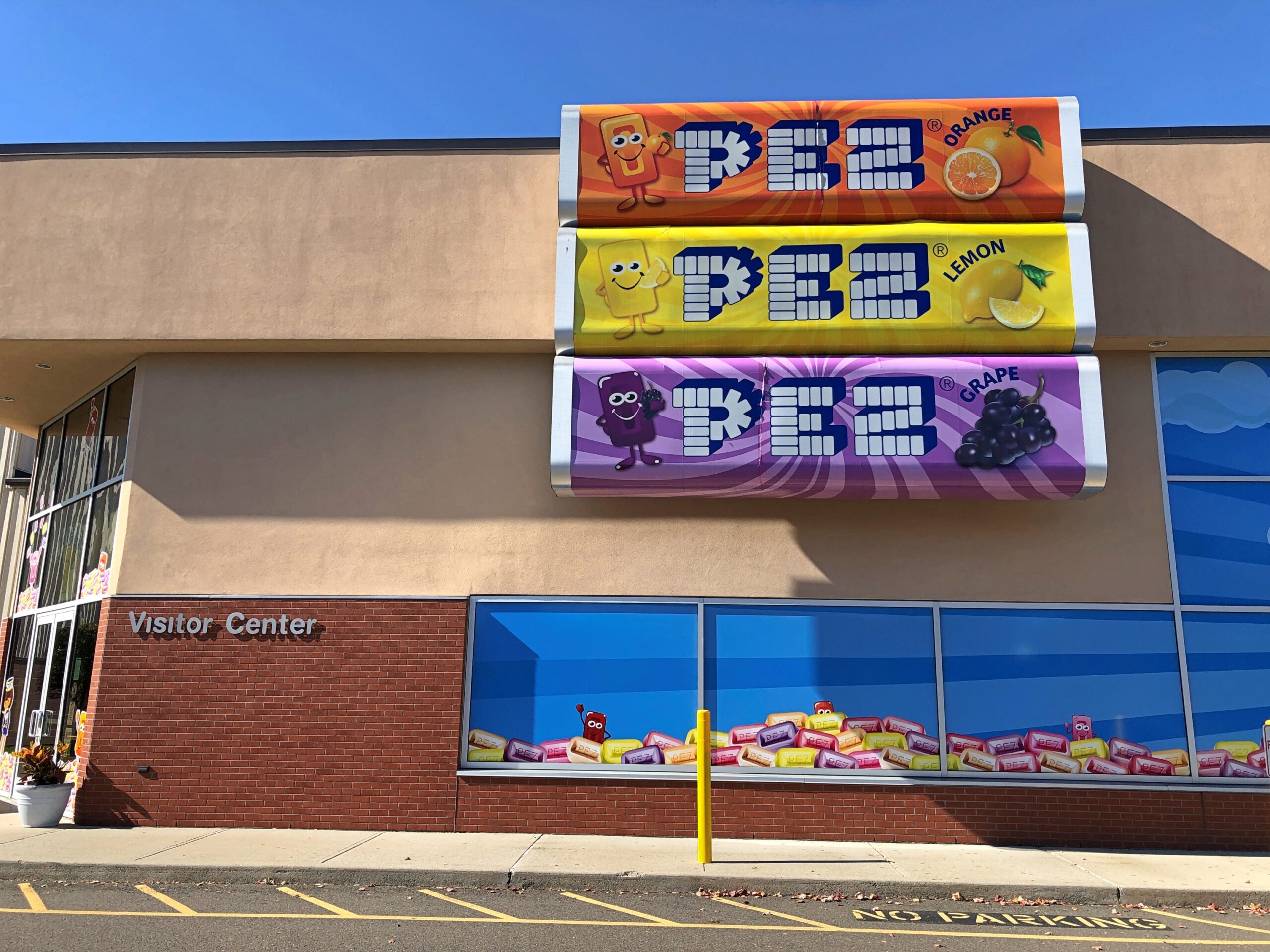
In Orange, Connecticut, I noticed a sign for the Pez Visitor Center. I had to see that.

Pez Visitors Center

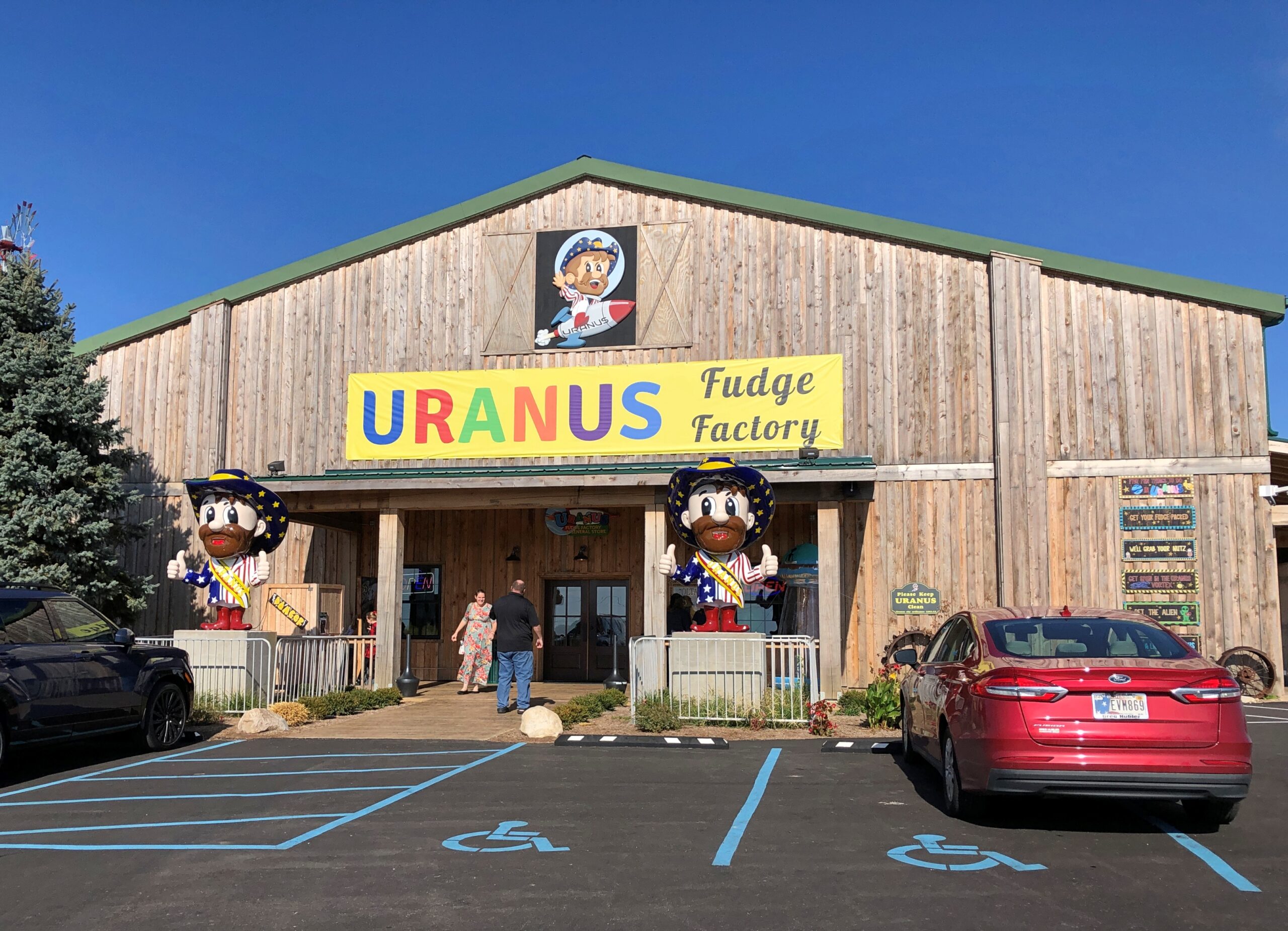
Earlier today, at the border between Ohio and Indiana, I noticed Uranus. I had to stop.

Uranus

Turns out there’s more than one; I’d only ever seen the one in Missouri (the original) in passing, never stopping. But I did this time. Now I can say I’ve been to Uranus.

Colorado Lasso ’25

Driving down from the alpine wonders of Rocky Mountain National Park a couple of weeks ago on highway US 36, I realized we’d be passing through Boulder, Colorado. So during one of the moments of standstill traffic on that highway as it winds into Boulder — it’s a crowded road, especially on a weekend during warm weather — a thought occurred to me. More of a memory-thought, since it harkened back almost 50 years.

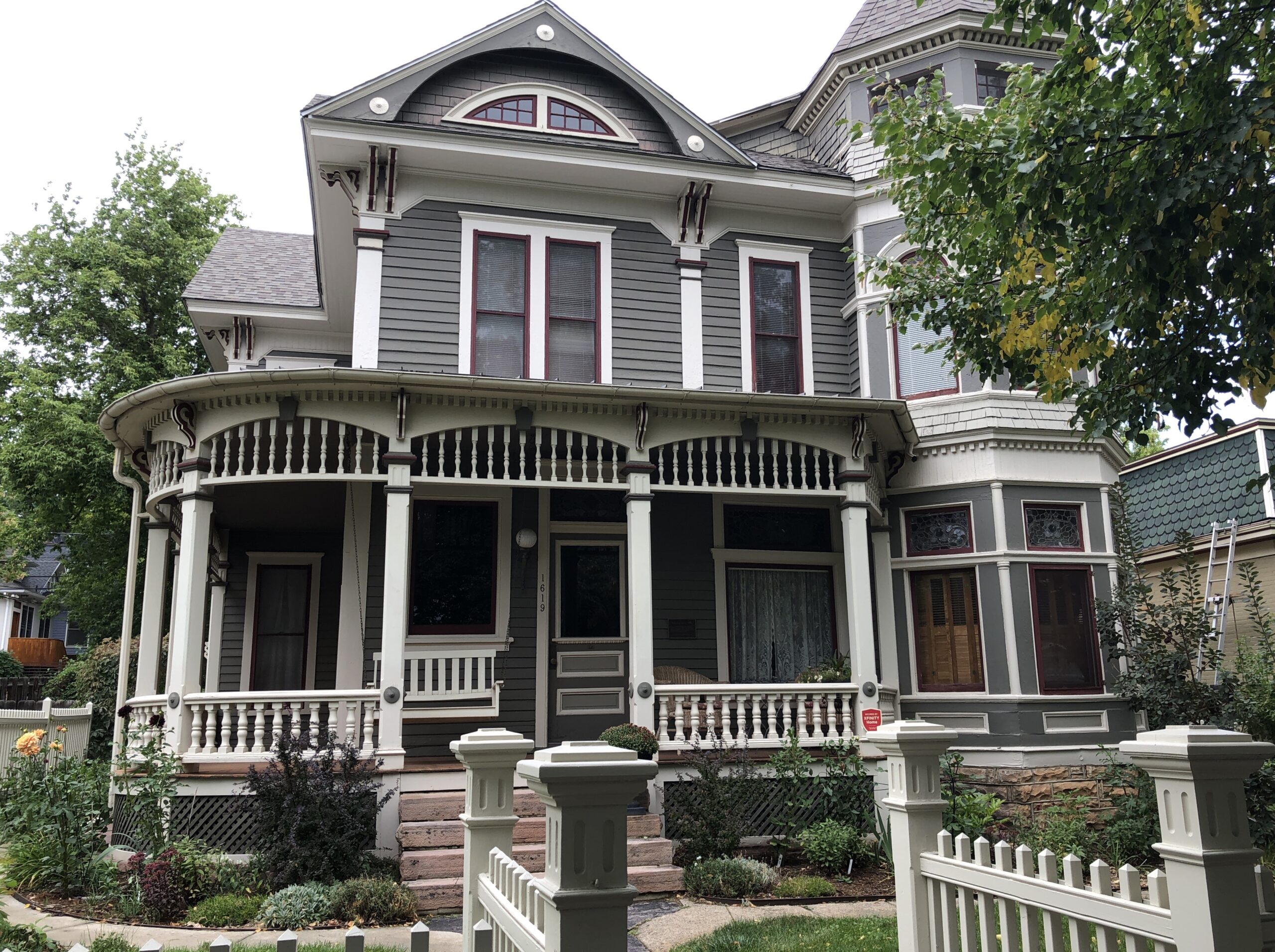
At zero mph, I had time to consult Google for more information. (Remarkably, the signal was strong.) Google Maps pinpointed the location I’d thought of, on a leafy street in Boulder. That day I expended some tourist energy, of which I don’t have quite as much as I used to, to find Mork’s house.

That is, the house used in establishing shots in Mork & Mindy to show their home, since the show was set in Boulder. I know I’d seen Boulder on maps. Funny name, I thought as a kid. Really Big Rock City. It’s still a little funny. But other than as a spot on the map, the show was probably the first time I’d heard anything else about the place.

The passengers in my car, Yuriko and Emi, having grown up outside of the orbit of ’70s American sitcoms, didn’t particularly appreciate the place. At least not until I conveyed the information that the show made Robin Williams famous. He’s a known quantity. I read a bit about the house later, and there seems to be no consensus about whether the owner cares whether anyone stops by the take a picture. My guess would involving factoring in a dwindling number of people coming by. You know, because the show went off the air over 40 years ago.

Then again, if my U.S. travels have taught me nothing else, it’s that retirees are out being tourists. They have the time they didn’t used to, and currently are just the right age to take a peek at Mork’s house at 1619 Pine Street, which is easy enough to find. Even if, like me, their fondness for that show was lukewarm at best.

Boulder and Mork came early in the second leg of my three-legged, 4,498-mile drive, which seemed to kill that many bugs on the windshield and front hood and bumper. The house counted as merely one spot in a trip that took me through hundreds of places. I spend most of September on the road, heading west from Illinois early in the month along I-80 and smaller roads, especially Nebraska 2 through the Sandhills, and spending time in western Nebraska and its rocky outcroppings and in southeast Wyoming, before going to Denver. That would be the first leg. Which, I’m very happy to say, included a good look at Carhenge.

Yuriko flew to Denver on the last of the points I got from SWA for the Christmastime FUBAR a few years ago and we met there. (New motto for the airline: Now We’re Just Another Airline!) After an overnight jaunt to Rocky Mountain NP in the company of our friend Emi, the two of us then spent more than a week taking a clockwise circle-(like) course — a lasso, you might call it, a straight line connected to a loop — from Denver to Colorado Springs to Pueblo to Walsenburg to Alamosa to (coming down from Wolf Creek Pass) Pagosa Springs to Durango to Silverton to Ouray to Montrose to Salida and back to Denver, where Yuriko flew home. That was the second leg. The drives were varied and gorgeous.

You’d think that would be enough, but I had to drive home, loosely following I-70 this time, making my way from Colorado through Kansas, Missouri and Illinois, and making a number of stops, big and small, such as Kit Carson, Colorado; Abilene, Kansas; and Kansas City, Missouri, for a third and final leg. No single small road took me through Kansas, but a series of them did, some as empty as, well, eastern Colorado and western Kansas. That’s some fine driving. Mountains are great, but after a week or so of their twisty ups and downs on two lanes, flat is all right. More relaxing, even.

For reasons that will soon be obvious, not long ago I looked up 2024 visitation statistics for the four national parks in Colorado: Rocky Mountain, Mesa Verde, Great Sand Dunes, and Black Canyon of the Gunnison.

Far and away the top national park draw in Colorado is Rocky Mountain NP, which received 4.2 million people last year, according to the NPS. In fact, it’s a top ten among most-visited U.S. parks. That isn’t so much of a surprise, considering the monster population that lives nearby in greater Denver and other parts of the Front Range. Indeed, for a lot of people, RMNP is easily a day trip.

That isn’t true for the other three national parks, but even so I was surprised to learn how few people actually visit any of them. They aren’t that remote. We aren’t talking Gates of the Arctic NP or American Samoa NP remote. Still, out of the 63 current U.S. national parks, last year Mesa Verde ranked 41st, Great Sand Dunes 44th, and Black Canyon 49th. The three of them combined saw only about 30 percent as many visitors as Rocky Mountain in 2024.

We set out to see all four of the national parks in Colorado. And we did. You could call it a national park trip, along the lines of the one a few years ago mostly on the Colorado Plateau. But the parks were only a framework, never the total picture, over mountains and across plains. We saw a lot else besides, such a male bear outside our window about 10 miles north of Durango, a female in a tall nearby pine snarling at him, and cubs higher up in the tree. More detail to come on that, in the fullness of time.

Rocky Mountain NP is an exercise in rising above the tree line, by vehicle but also on foot, up a path, into to a satisfying exhaustion before majestic mountains. The pale sand dunes of the Great Sand Dunes NP rise from a valley and back up against a mountain range, as if a giant broom swept it off to corner, and for visitors amounts to a giant sand box. Mesa Verde NP, where the stone dwellings of the Ancient Ones are tucked away in steep stone canyons, shows how much effort people will put into making a home for themselves. Black Canyon of the Gunnison NP is a scenic great unknown, a great dark crack in the earth that reminds you that gravity is in charge, its ragged cliff edges rife with opportunities to die for an Instagram image.

Parke County Dash: Klong

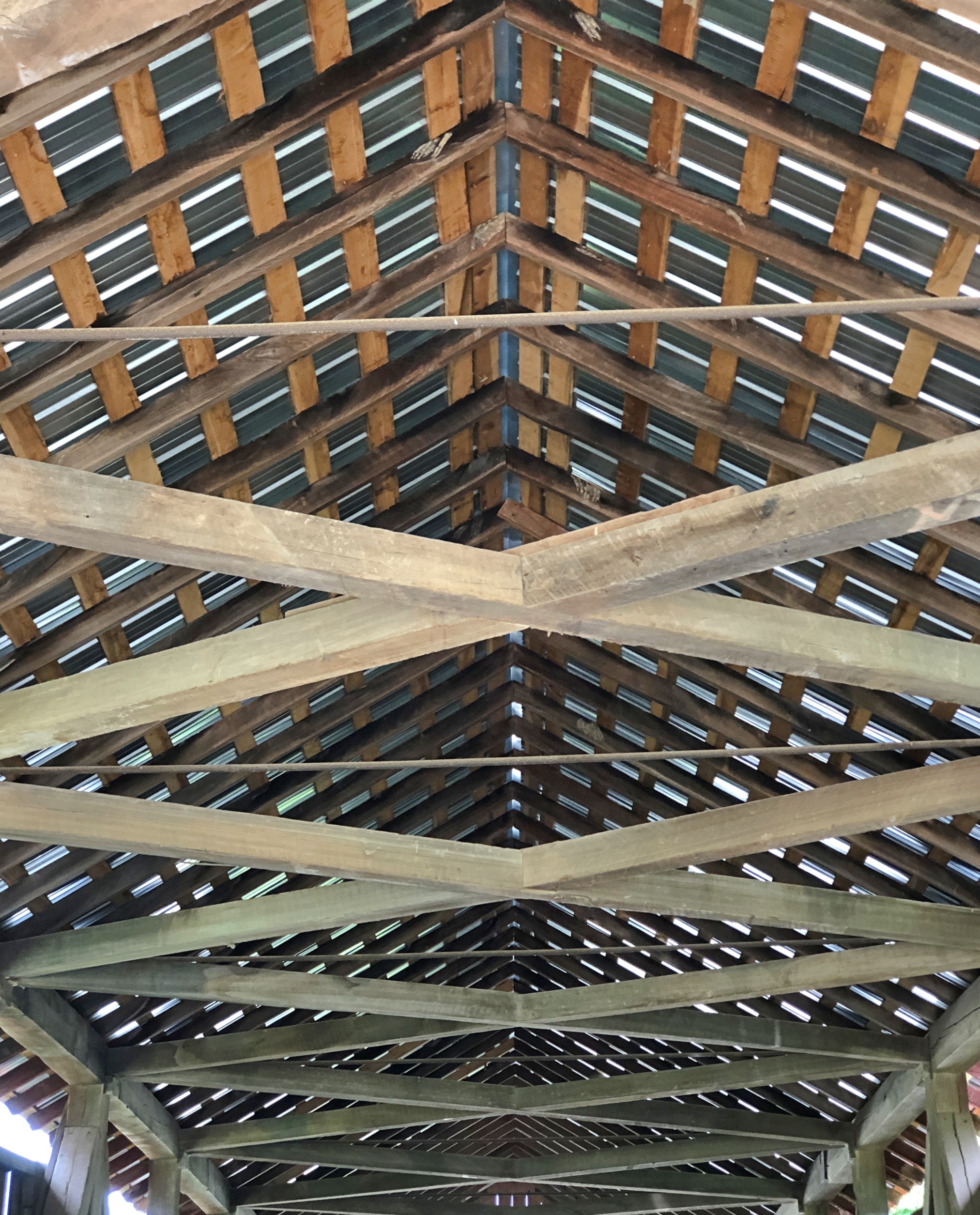
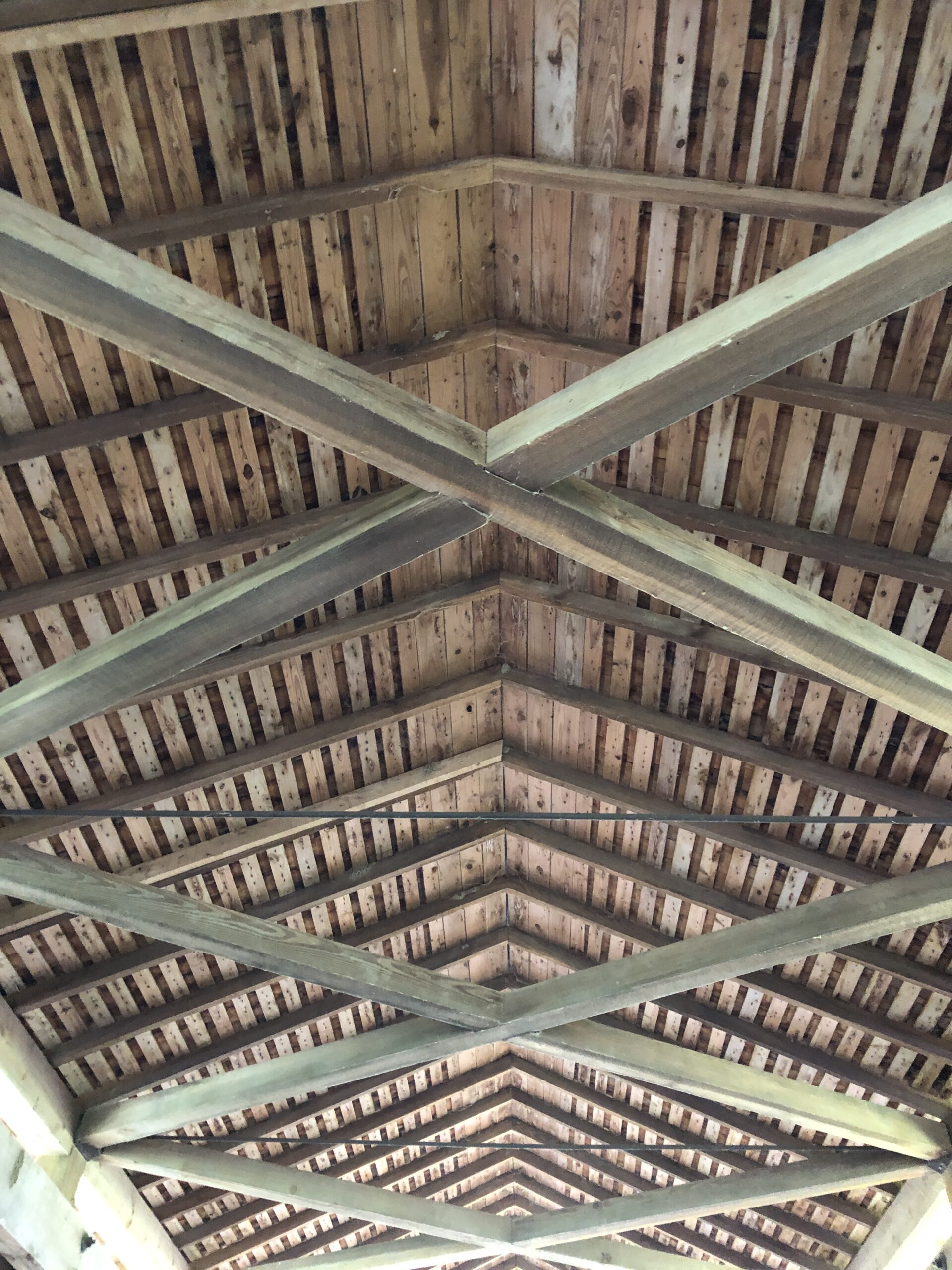
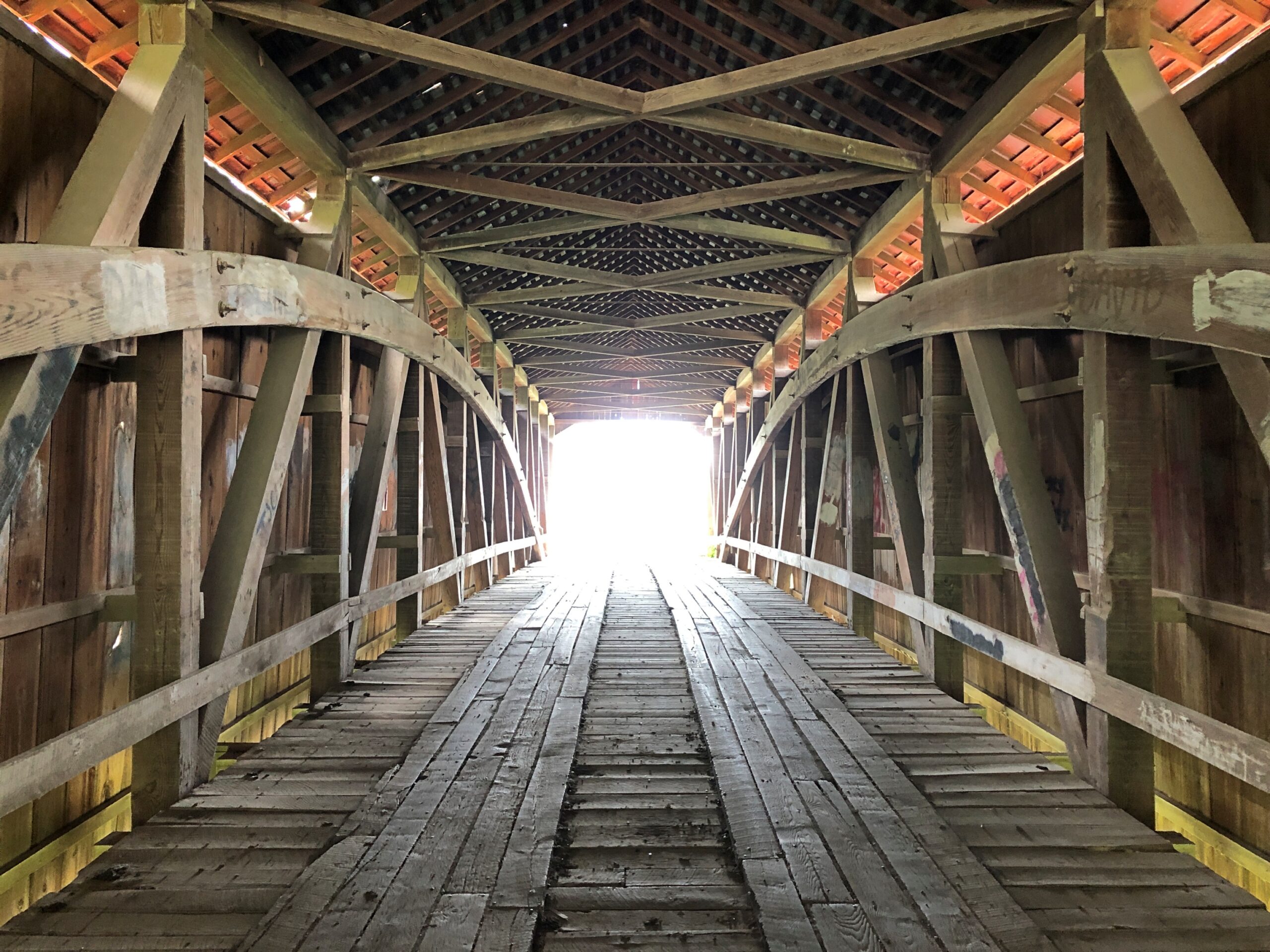
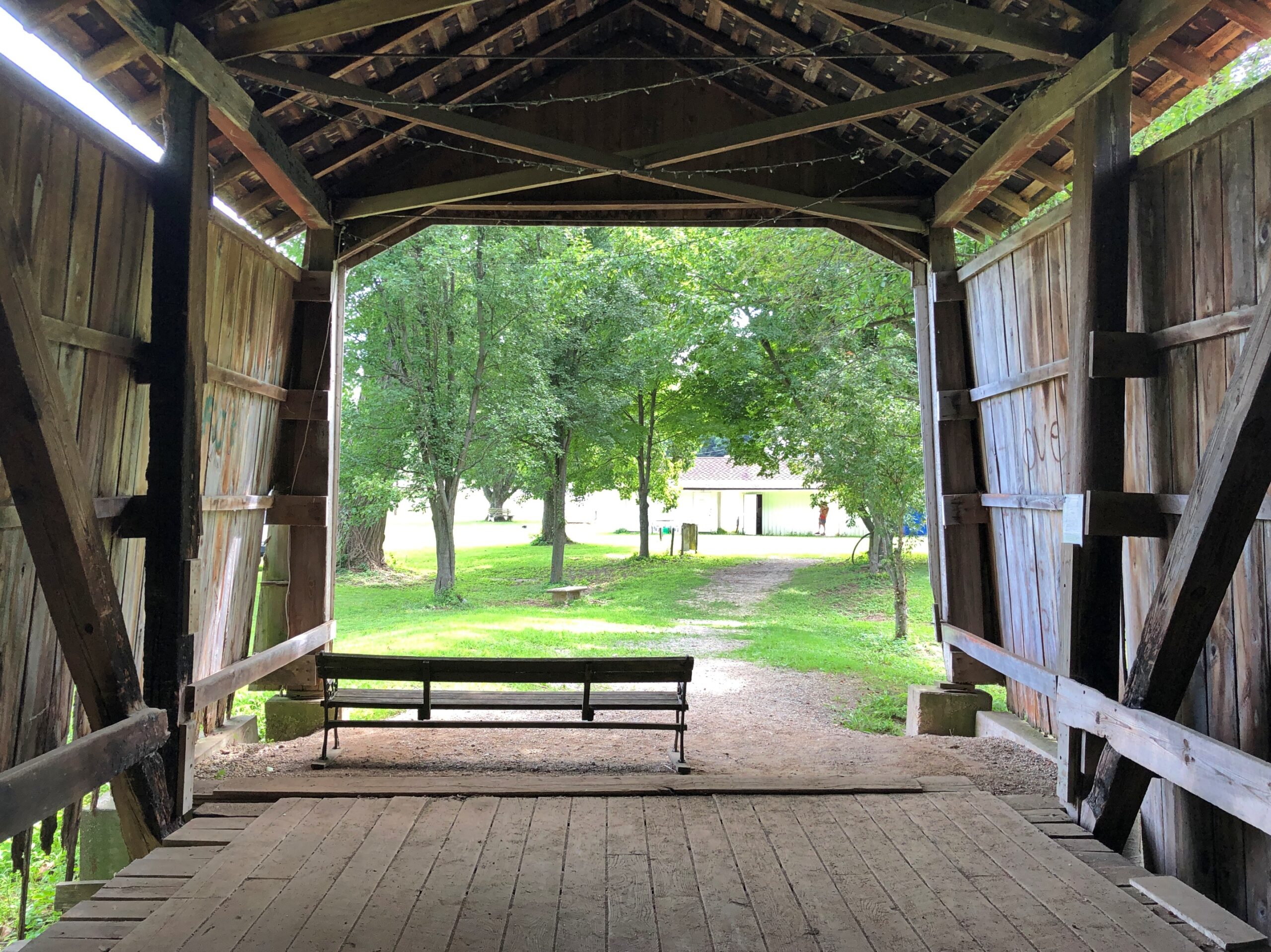
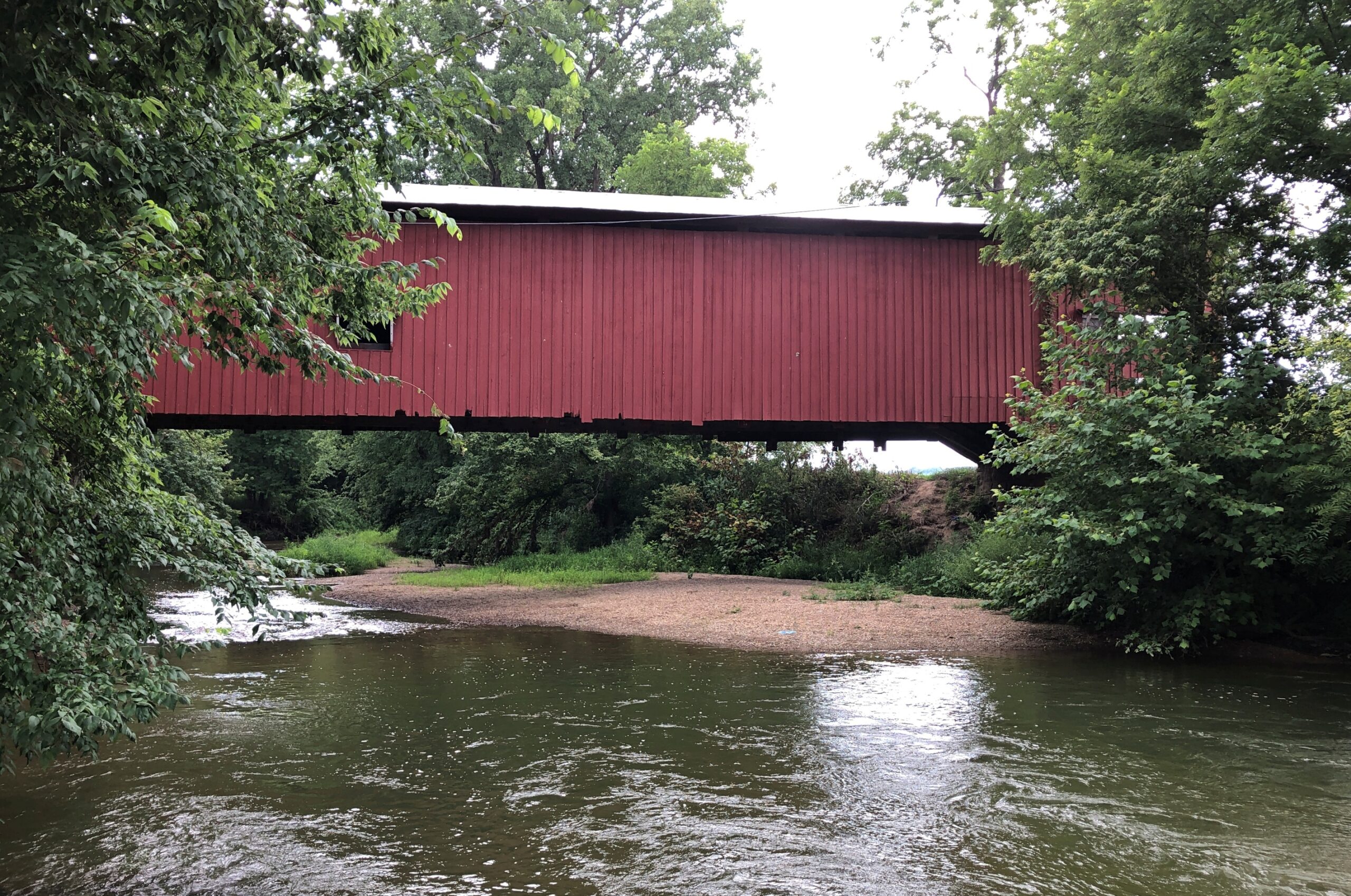
It’s one thing to admire the artistry of a Parke County, Indiana, wooden bridge standing at its entrance, or below near the edge of the creek. Another to wander in and surround yourself with all that wood, from roof –

Parke County, Indiana bridges

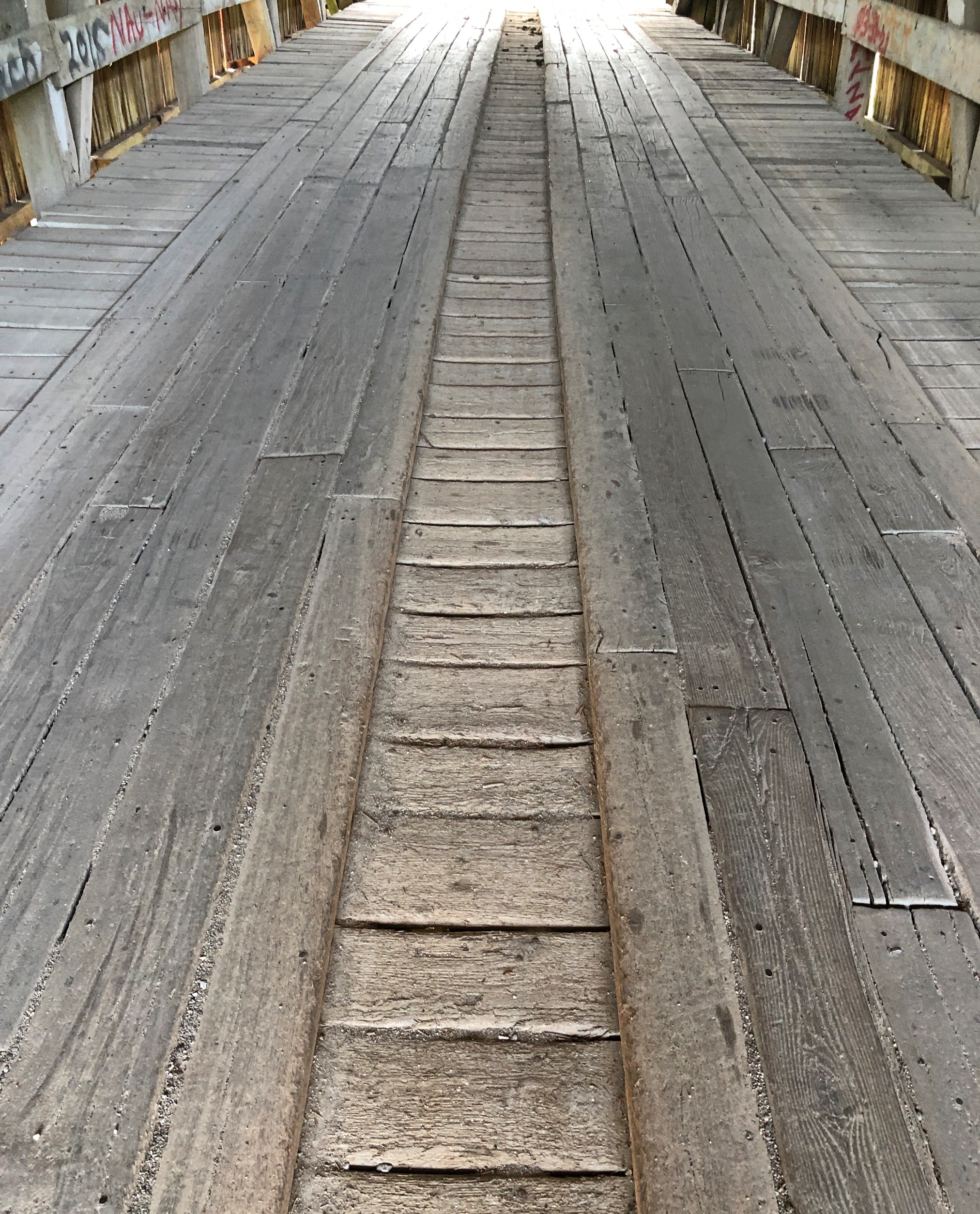
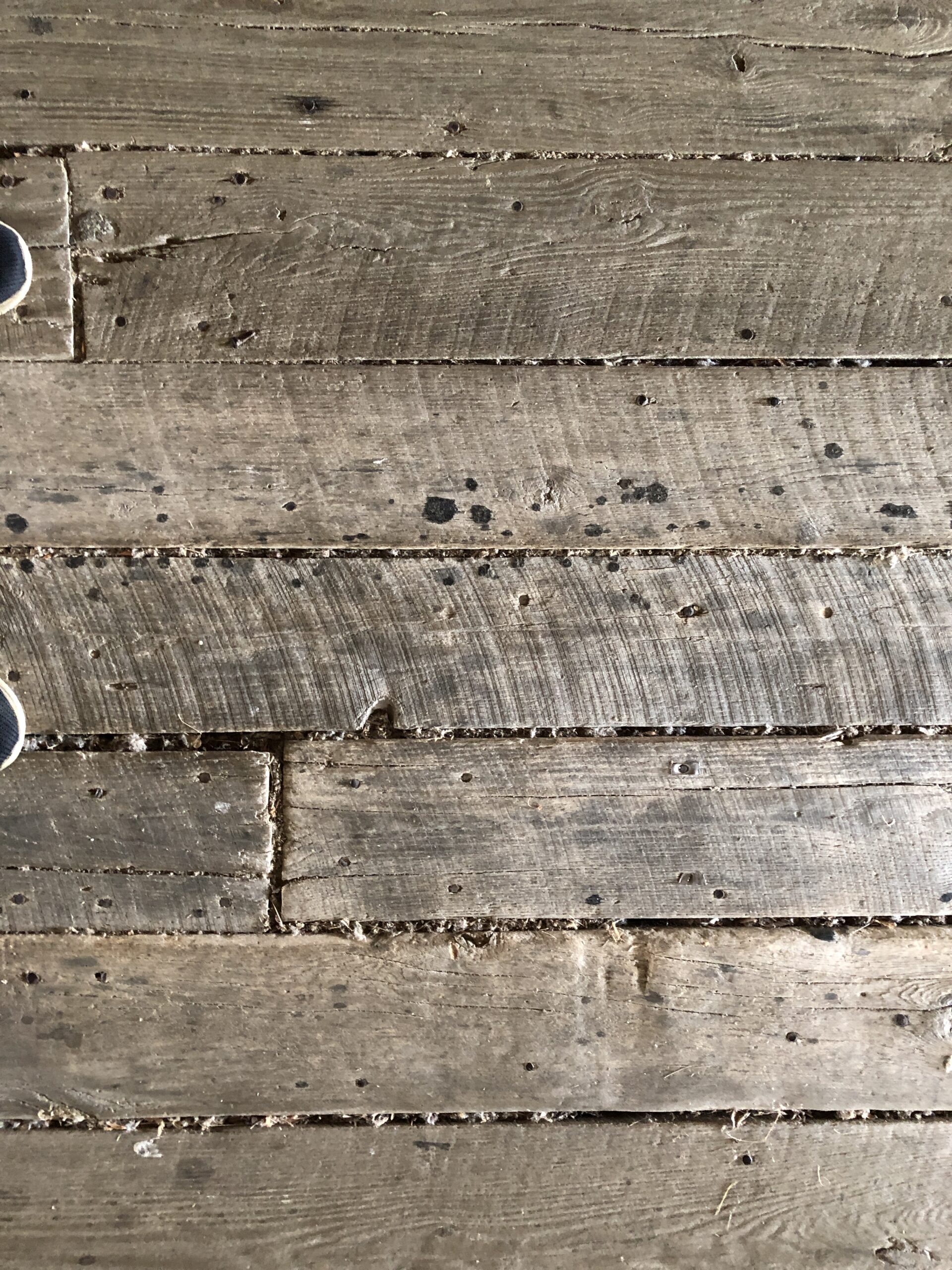
– to floor.

Parke County, Indiana bridges

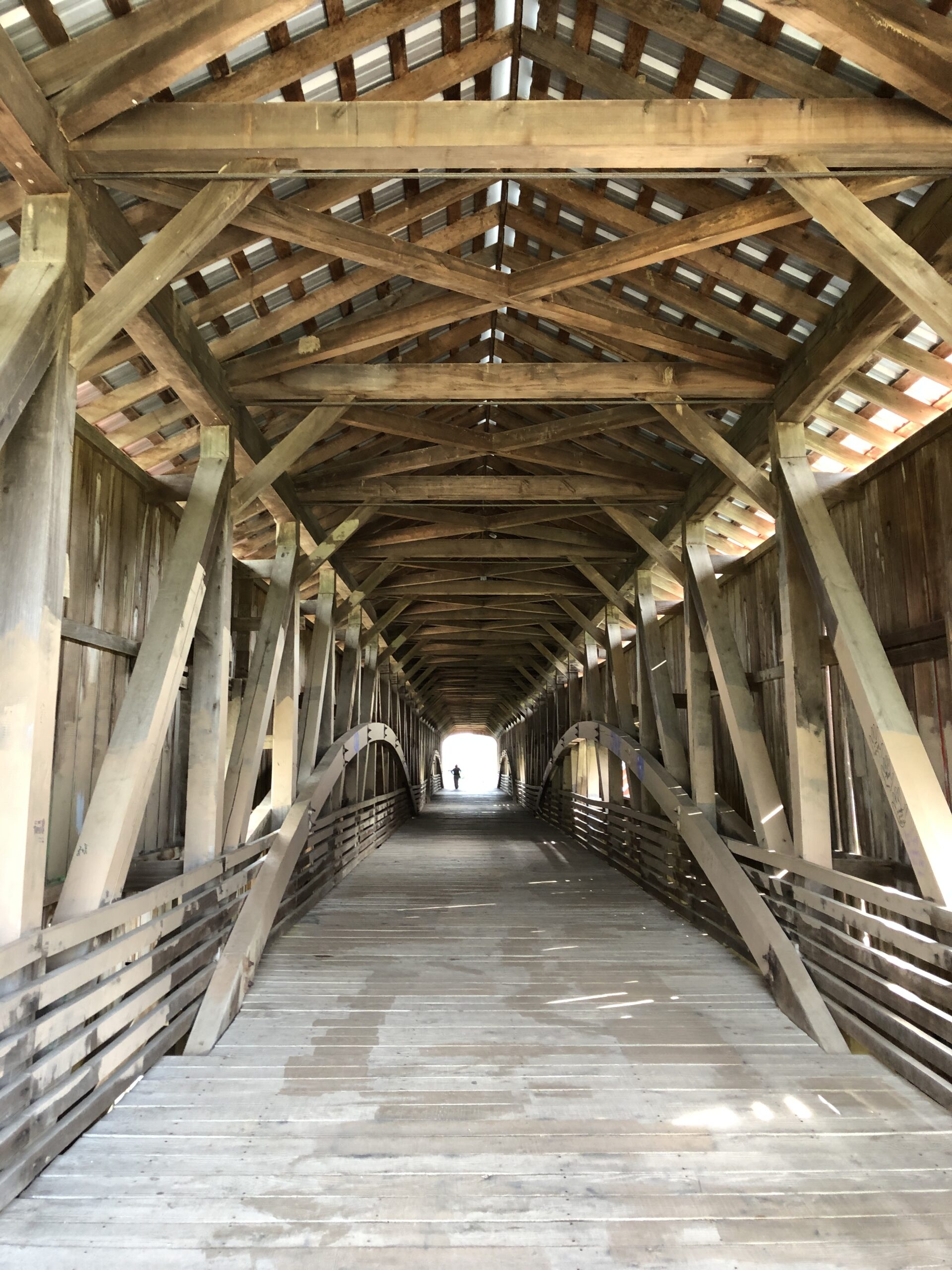
Your eyes spend a few seconds being useless as they adjust, the boards creak and the wood doesn’t exactly smell strongly one way or the other, as it might have when the bridge was new, but even now there’s a faint woody odor, maybe more enhanced after a rain. No recent rain for us, just plodding over dry boards cut well over a century ago.

Being summer, there was a distinct contrast between the brightness outside and the shadows inside a covered bridge. My camera doesn’t interpret the light pouring from the other side of the bridge in quite the way my eyes did. Even so, the camera captured that distinct contrast in its own digital-image way.

Parke County, Indiana bridges

Except for those times its image was closer to the eyes’.

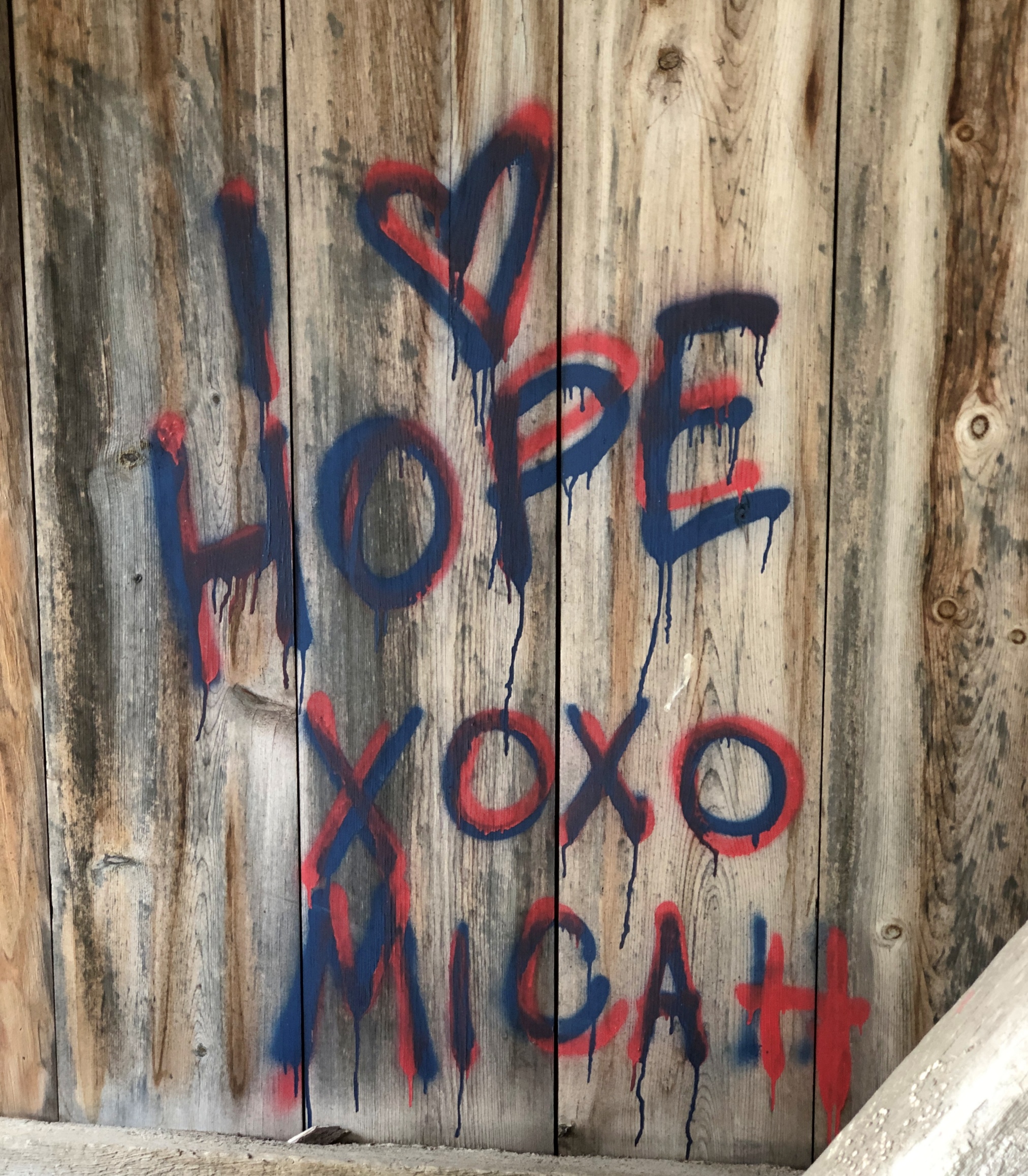
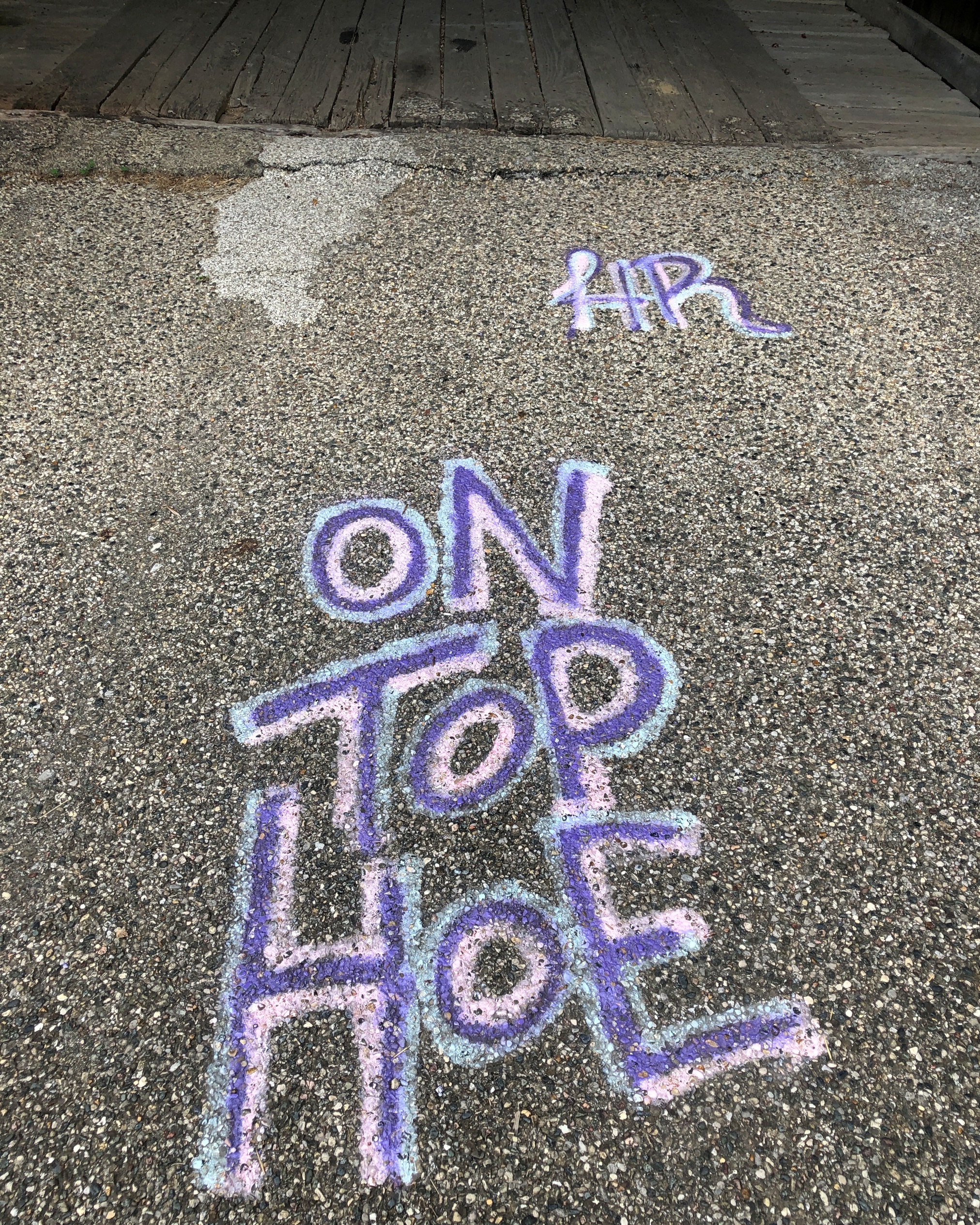
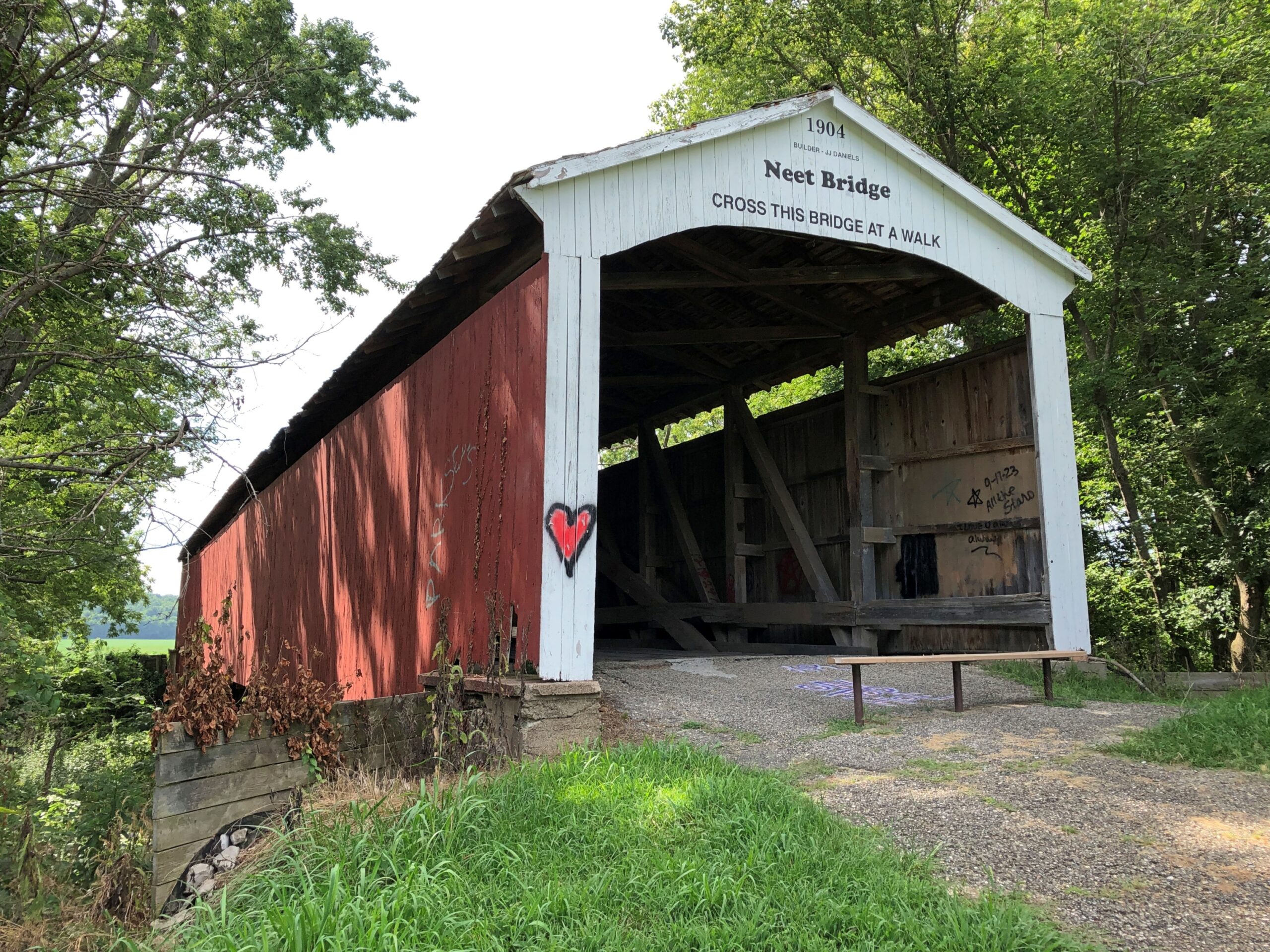
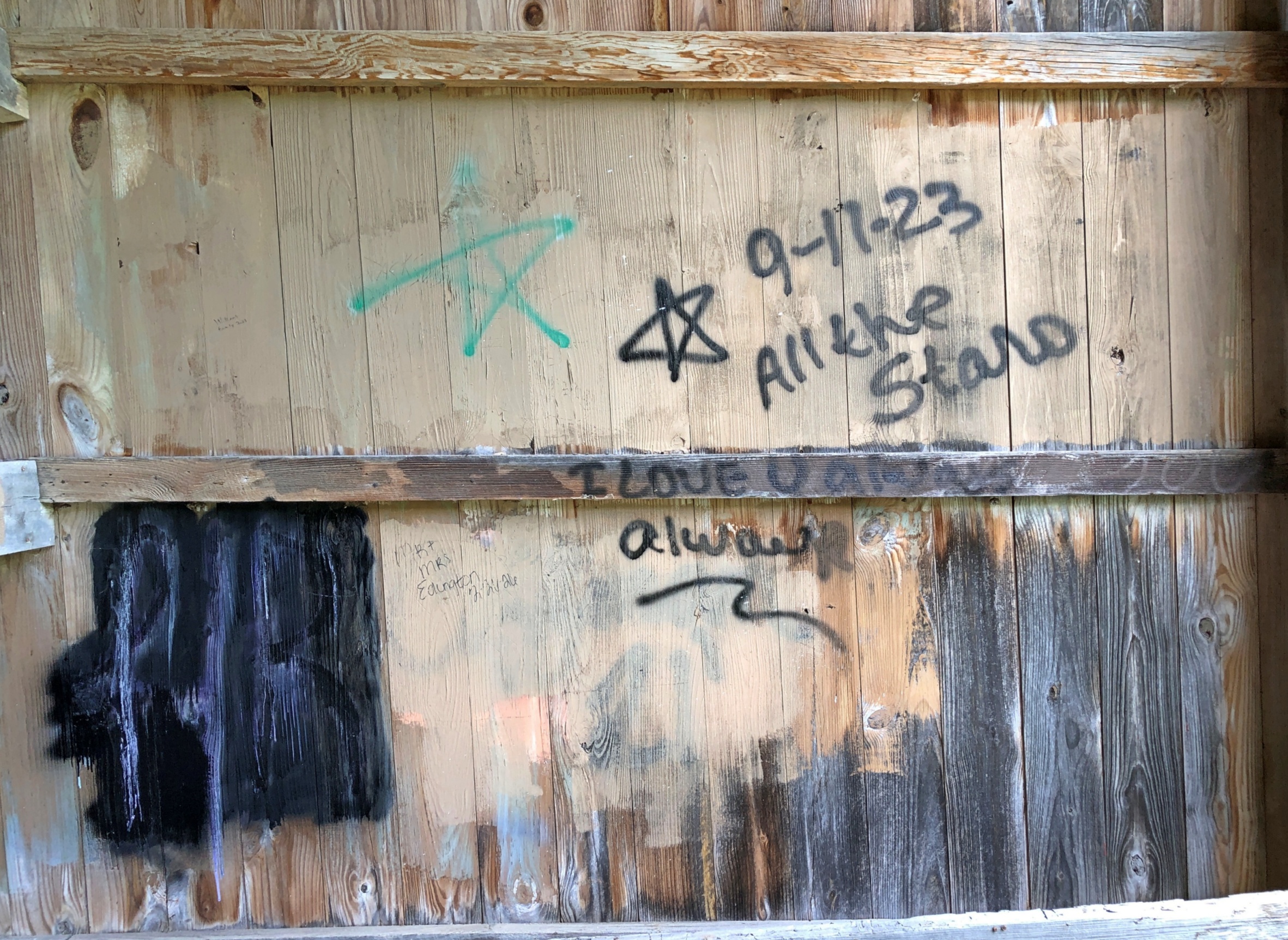
Also inside the bridges: graffiti, of course. The oldest extant covered bridge in Parke County reportedly dates from 1856. I imagine the oldest graffito – what would they use, chalk? – dates from ca. 1856.

Parke County, Indiana bridges

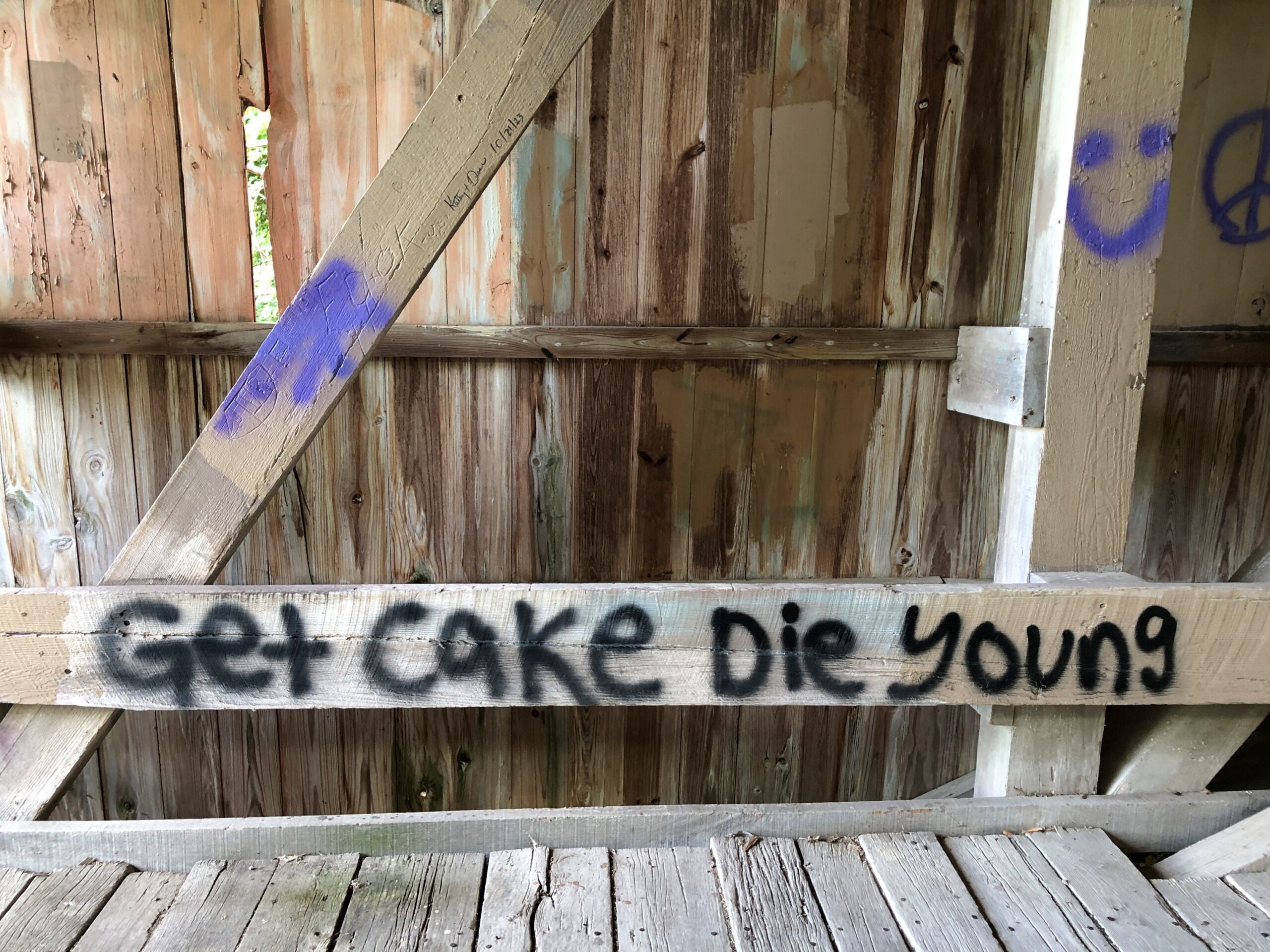
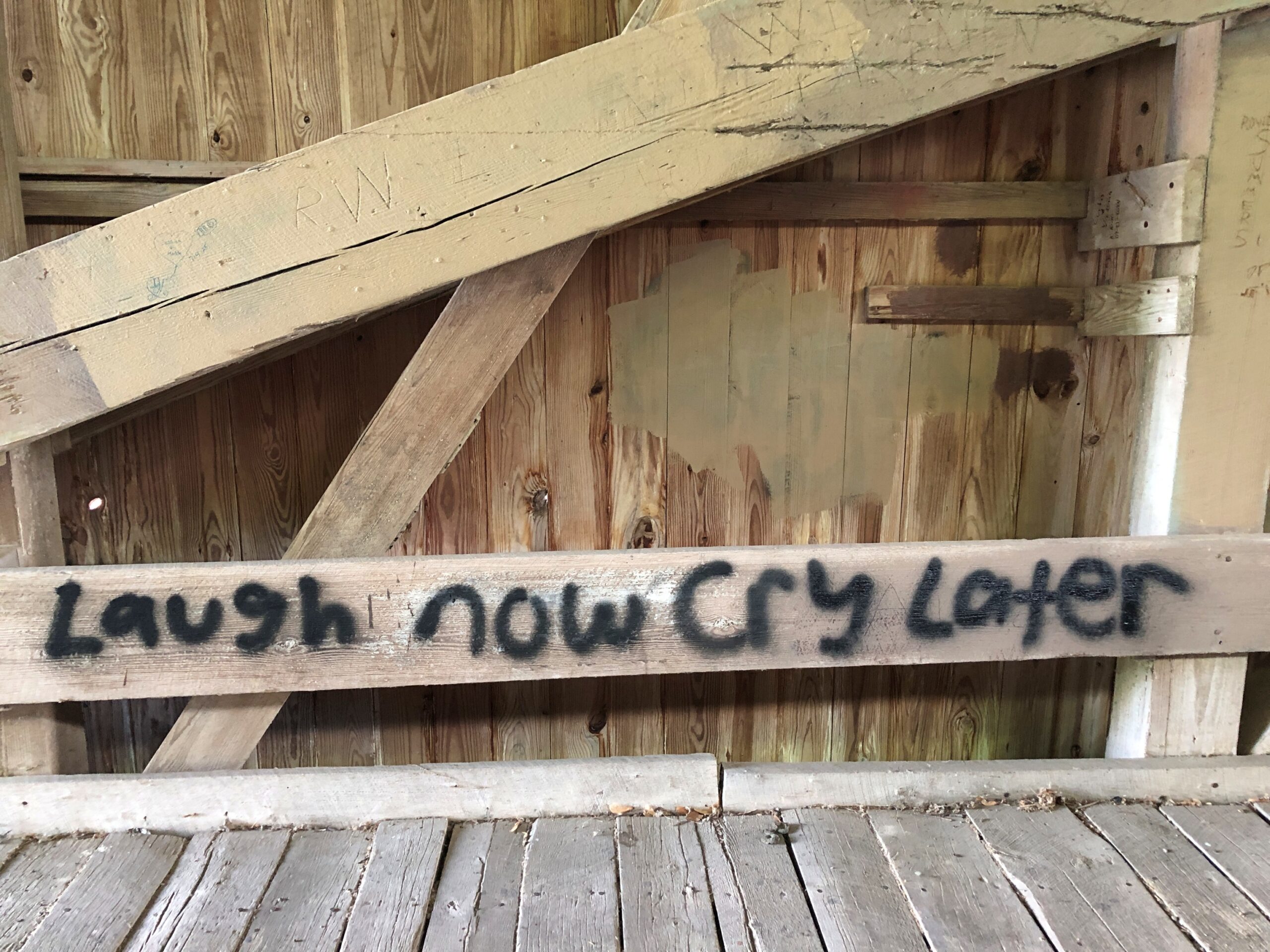
The usual collection of declarations of love, puerile insults, political statements, enigmatic phrases and random nonsense.

Parke County, Indiana bridges

And the whack-a-mole efforts to suppress it.

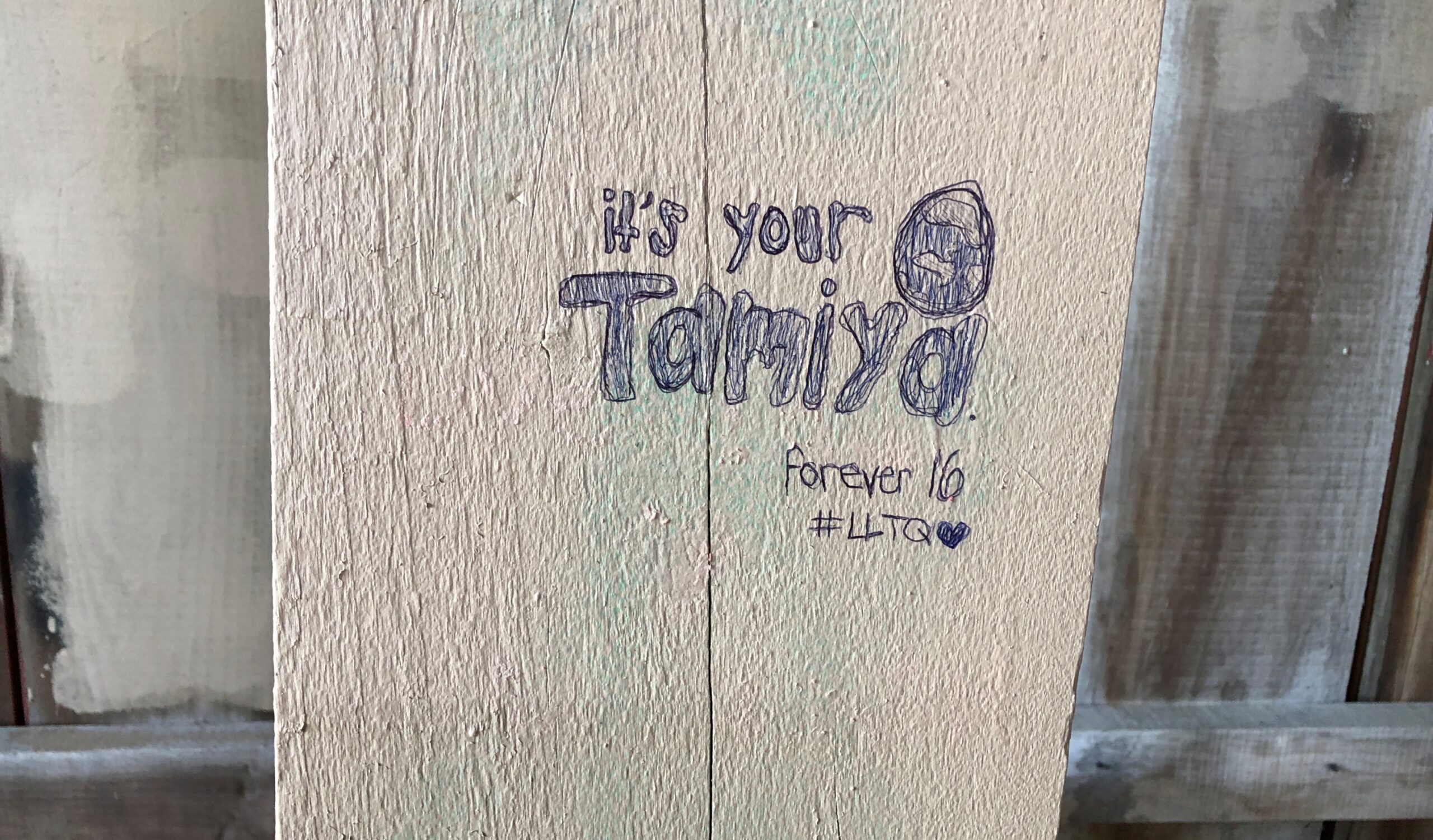
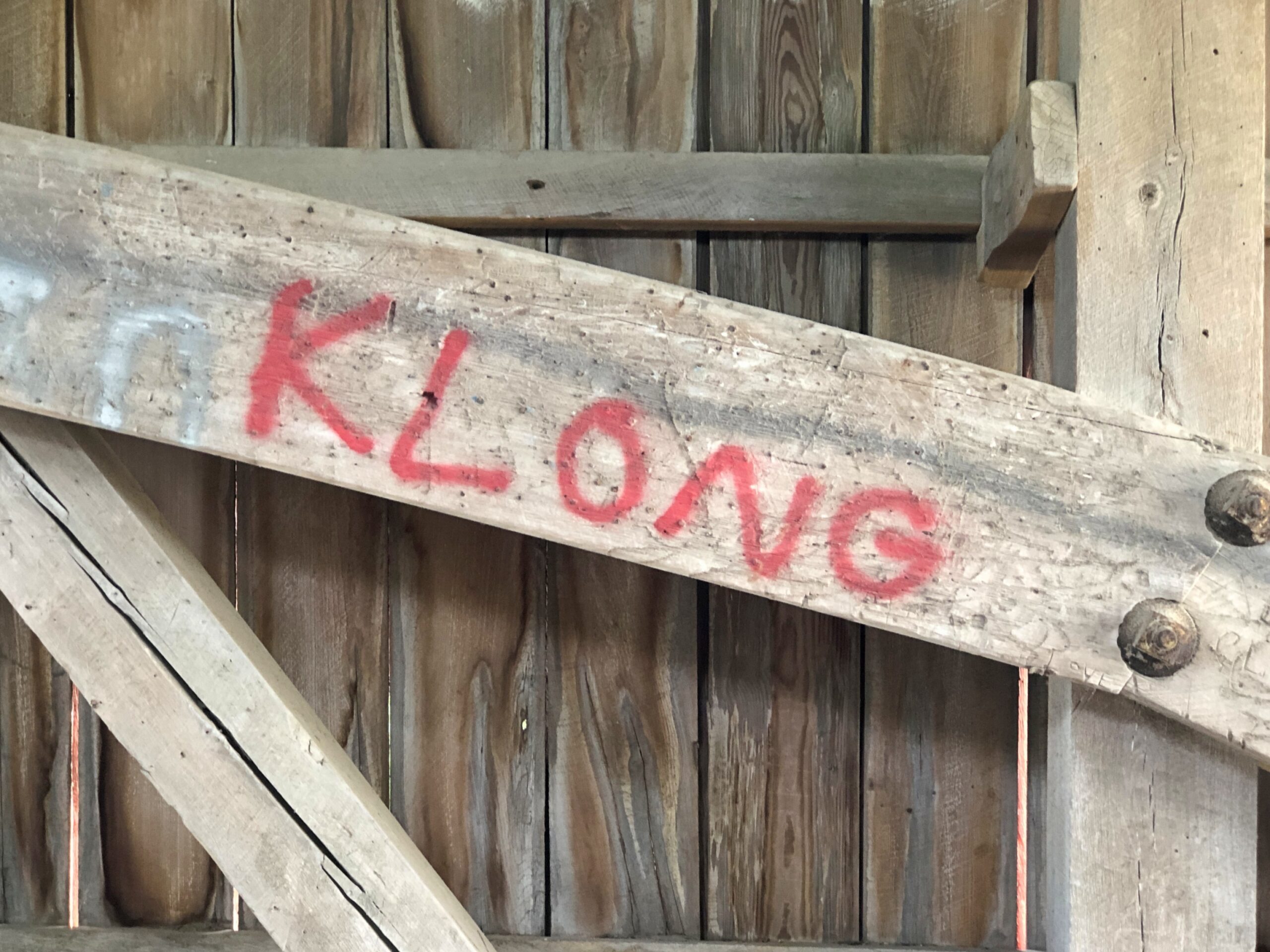
Klong. That’s my favorite from this round of graffiti spotting. An idiosyncratic item.

A dictionary meaning is canal in Thai. An alternate spelling of that, anyway. Or a Swedish homegoods retailer – reminds me of Ikea, but clearly more upmarket. Hard to know the mind of a graffitist, but I’ll bet it’s neither of those.
Parke County Dash: Bridges

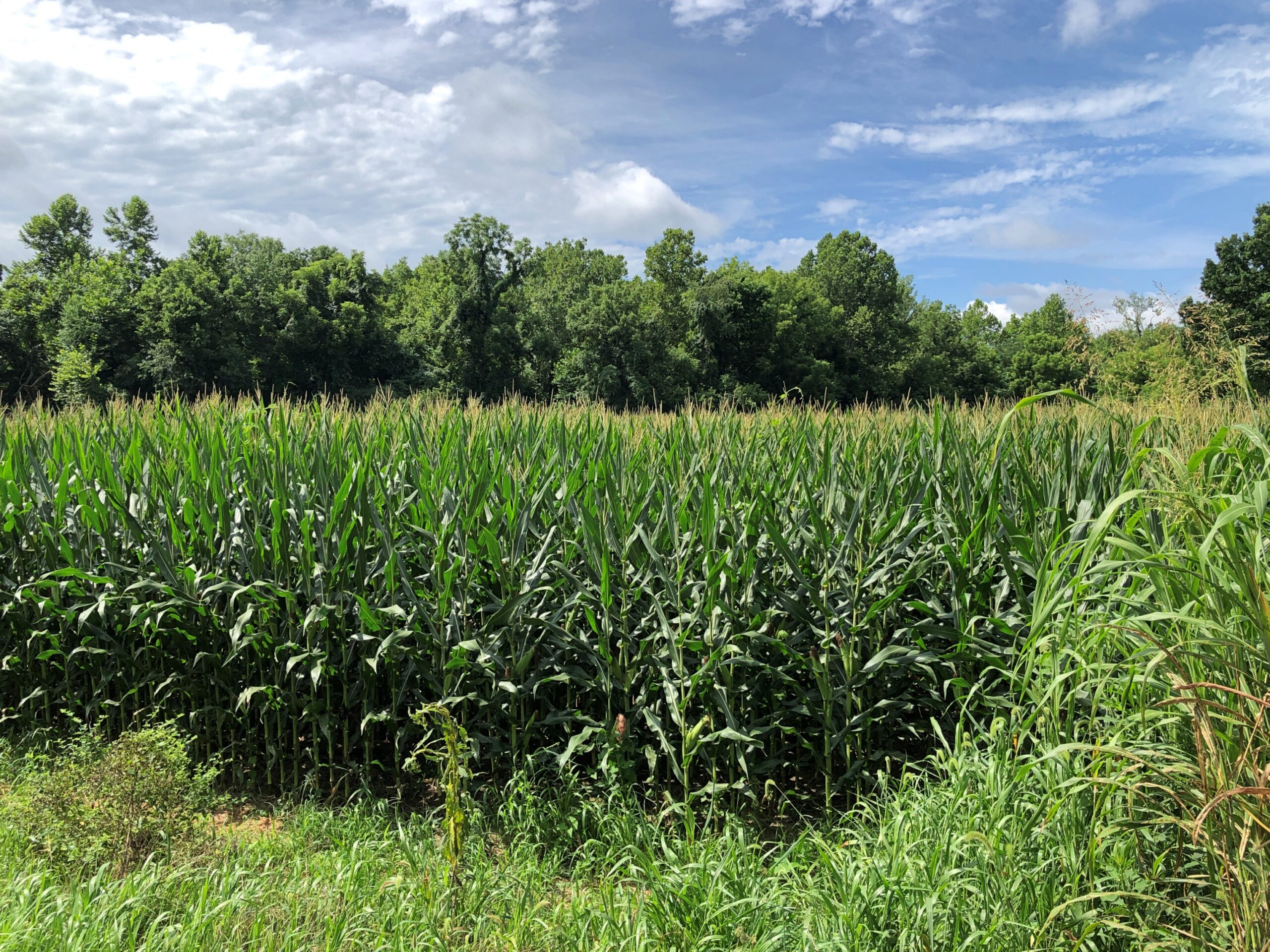
Even though you see enough corn driving through the Midwest, it’s still a little hard to imagine 5.1 million acres of corn (or anything else). Yet that’s how much corn – maize, Zea mays – was planted in Indiana alone in 2024, according to the Indiana Corn Marketing Council, with 5.05 million acres harvested. Even after being in the thick of a summer crop, the thought of that much boggles the mind.

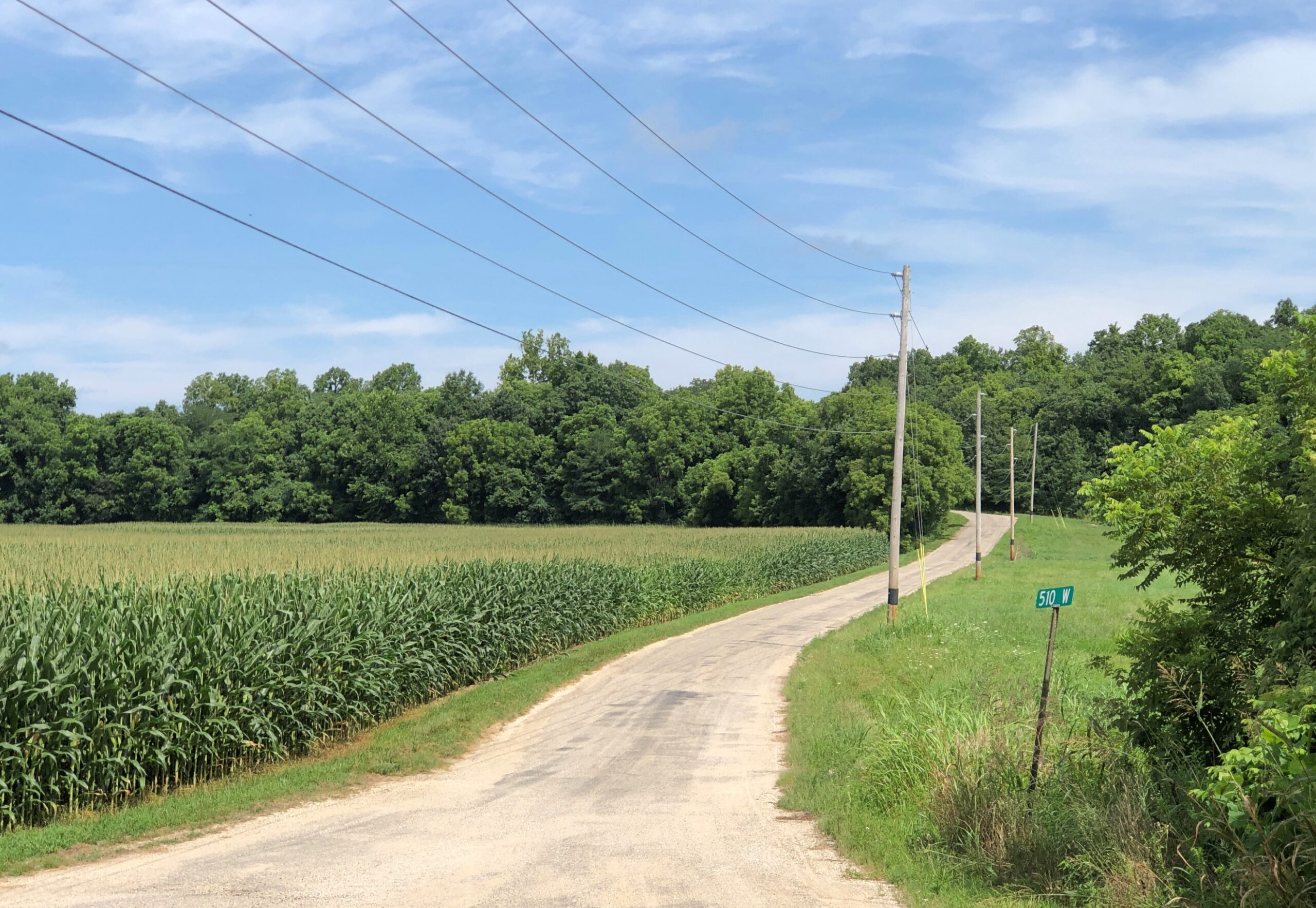
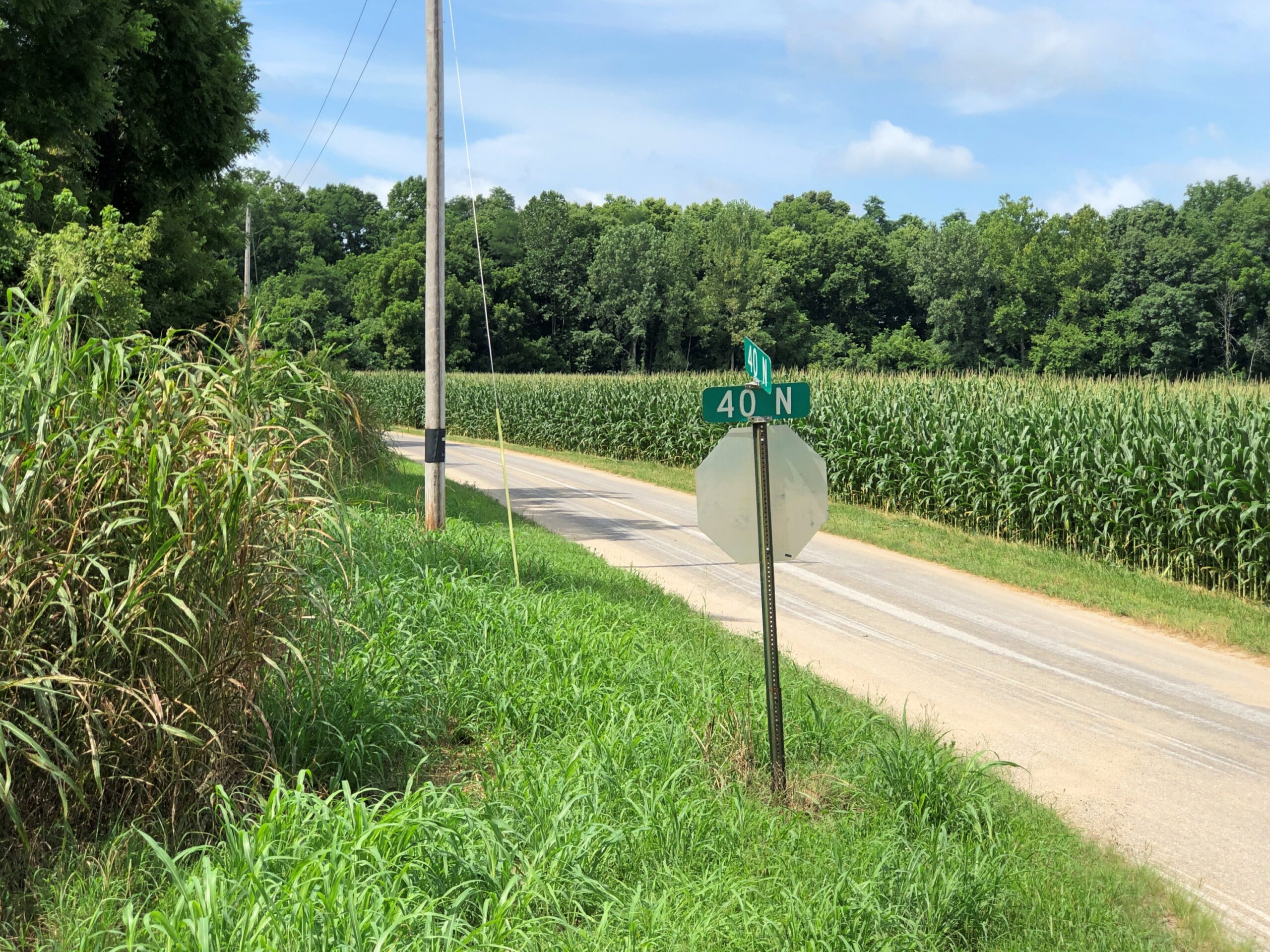
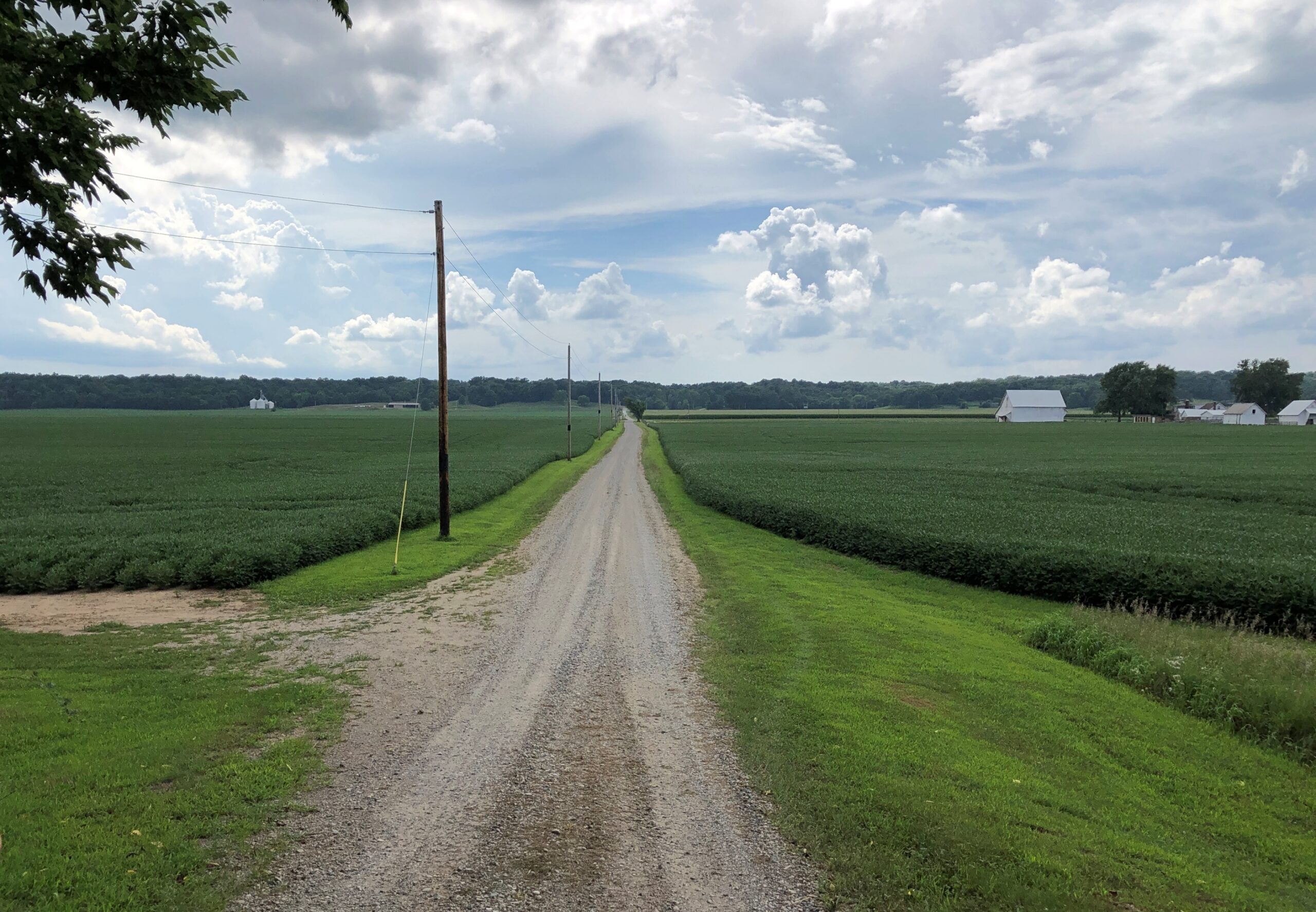
We didn’t go to Parke County, Indiana, in late July to admire the corn, though I did take a moment to make a few higher-than-an-elephant’s-eye corn pictures. You don’t have to go nearly that far to find corn. We came for the covered bridges, spending a Saturday night in the county seat of Rockville, Indiana, and out looking for bridges on Saturday afternoon and Sunday morning. To get to them, you have to take to the small roads crisscrossing the area, some paved, some not, but all pretty high quality.

Parke County, Indiana

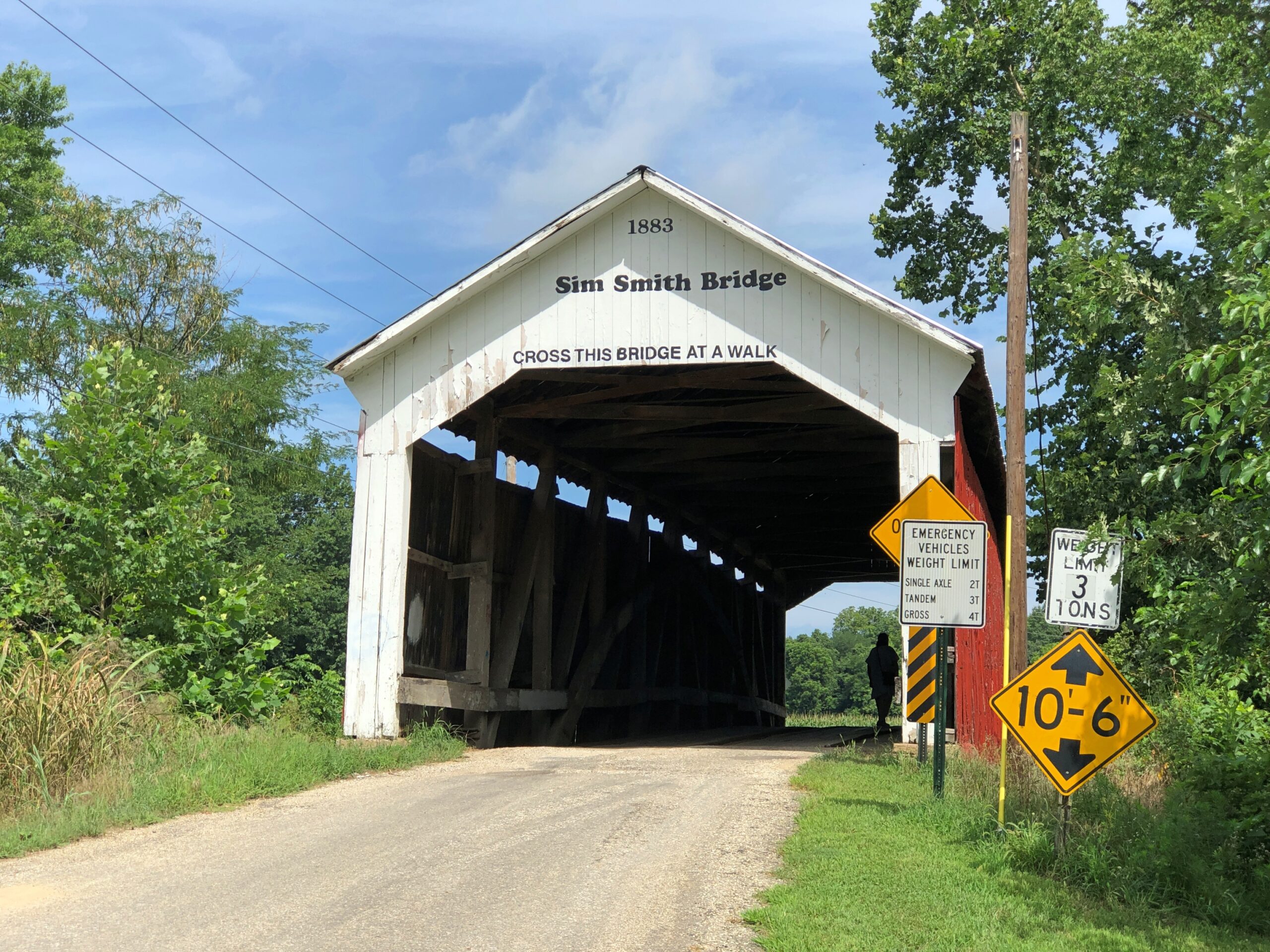
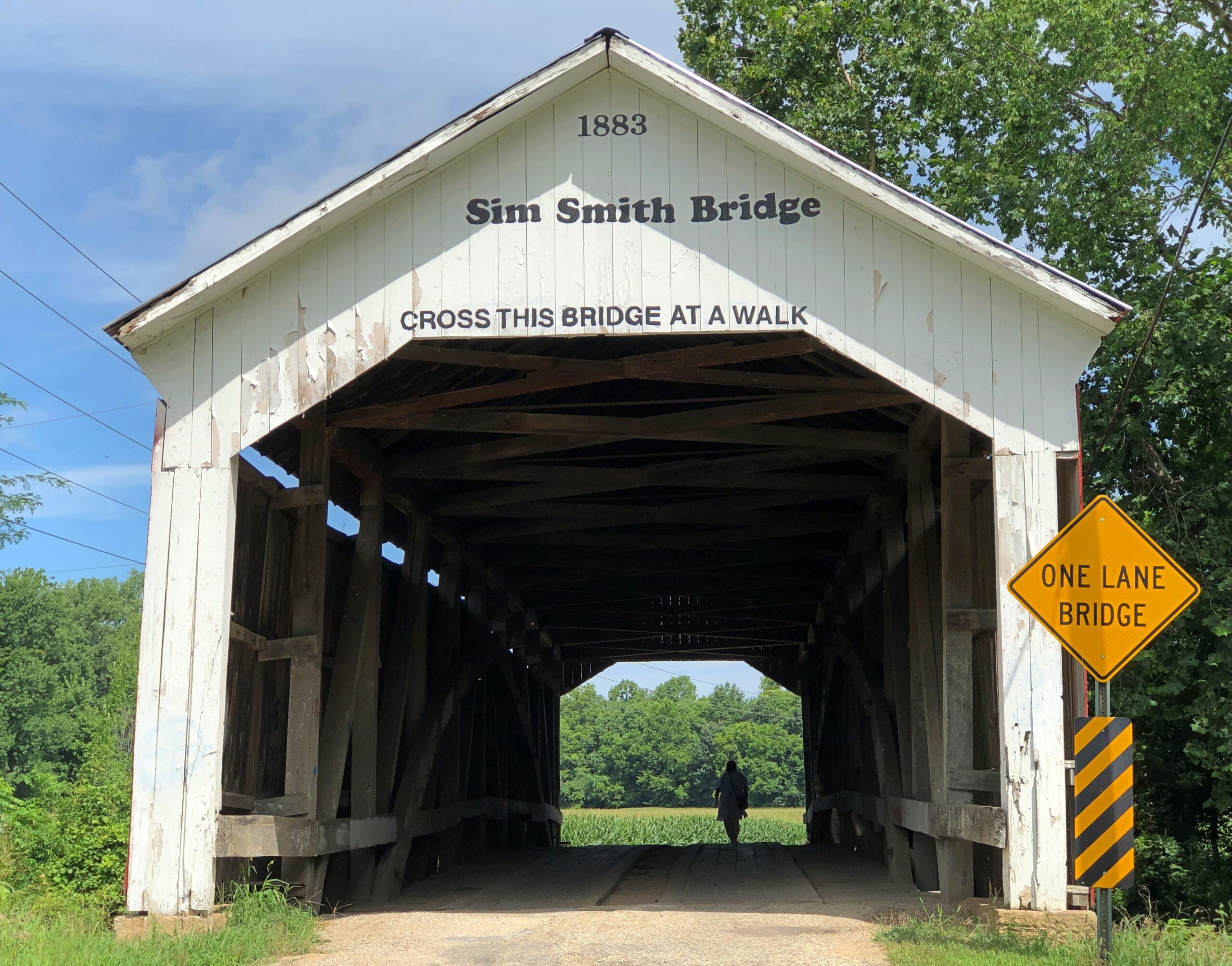
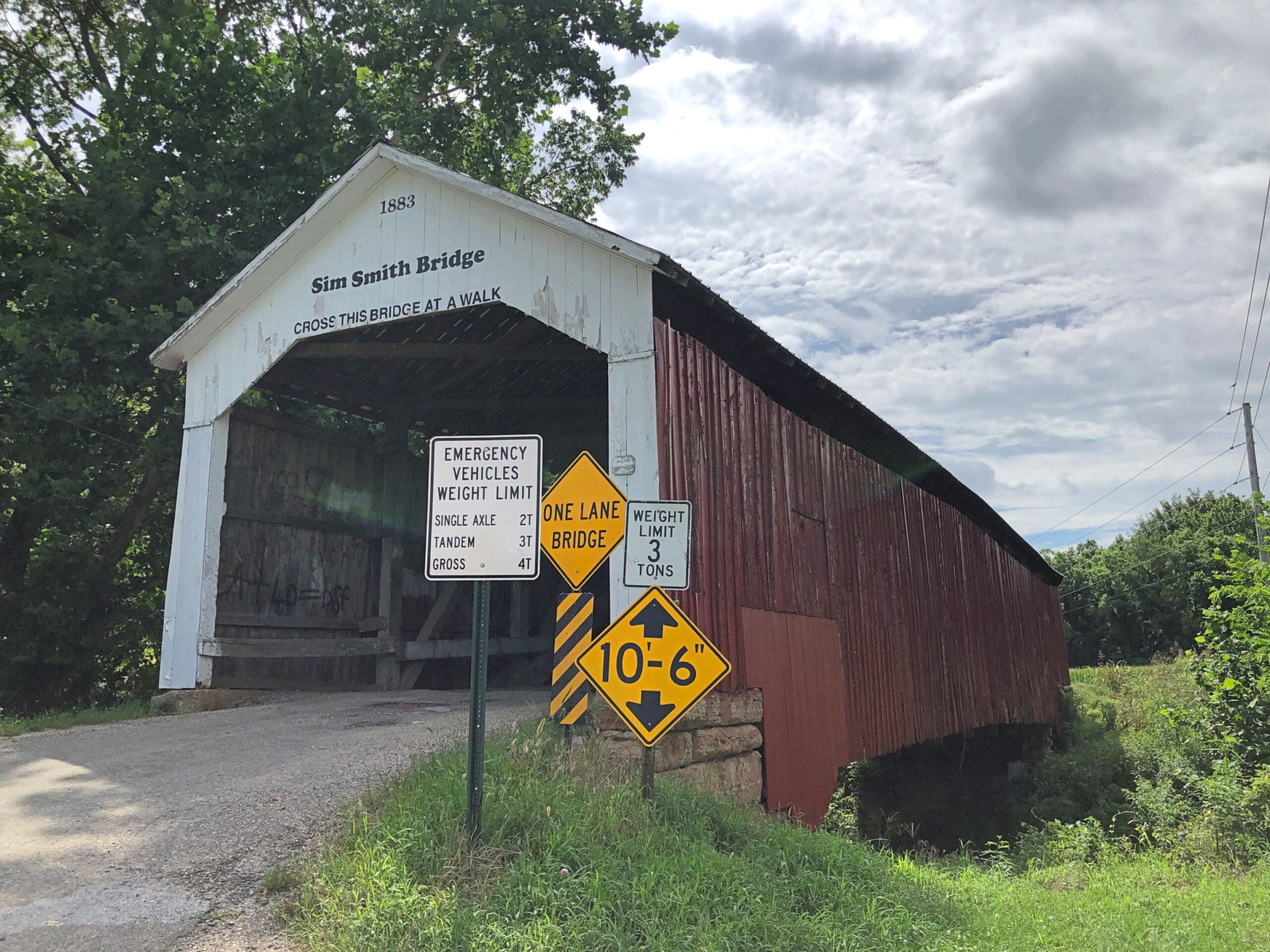
Roads lead to bridges, such as Sim Smith Bridge, vintage 1883, which crosses Leatherwood Creek. “Locally, this bridge has the reputation as haunted,” says a guide map I picked up. Uh-huh.

Parke County, Indiana

West-central Indiana is well-watered, a welter of creeks feeding the Wabash River. Covered wooden bridges cross many of them, each of more than a century old. Cedar is the main material. I’d guess being well-watered was good for the farmers here in the late 19th century, except for one thing: they complicated shipping one’s crop to buyers, either to animal feed processors or human-food makers. So, bridges.

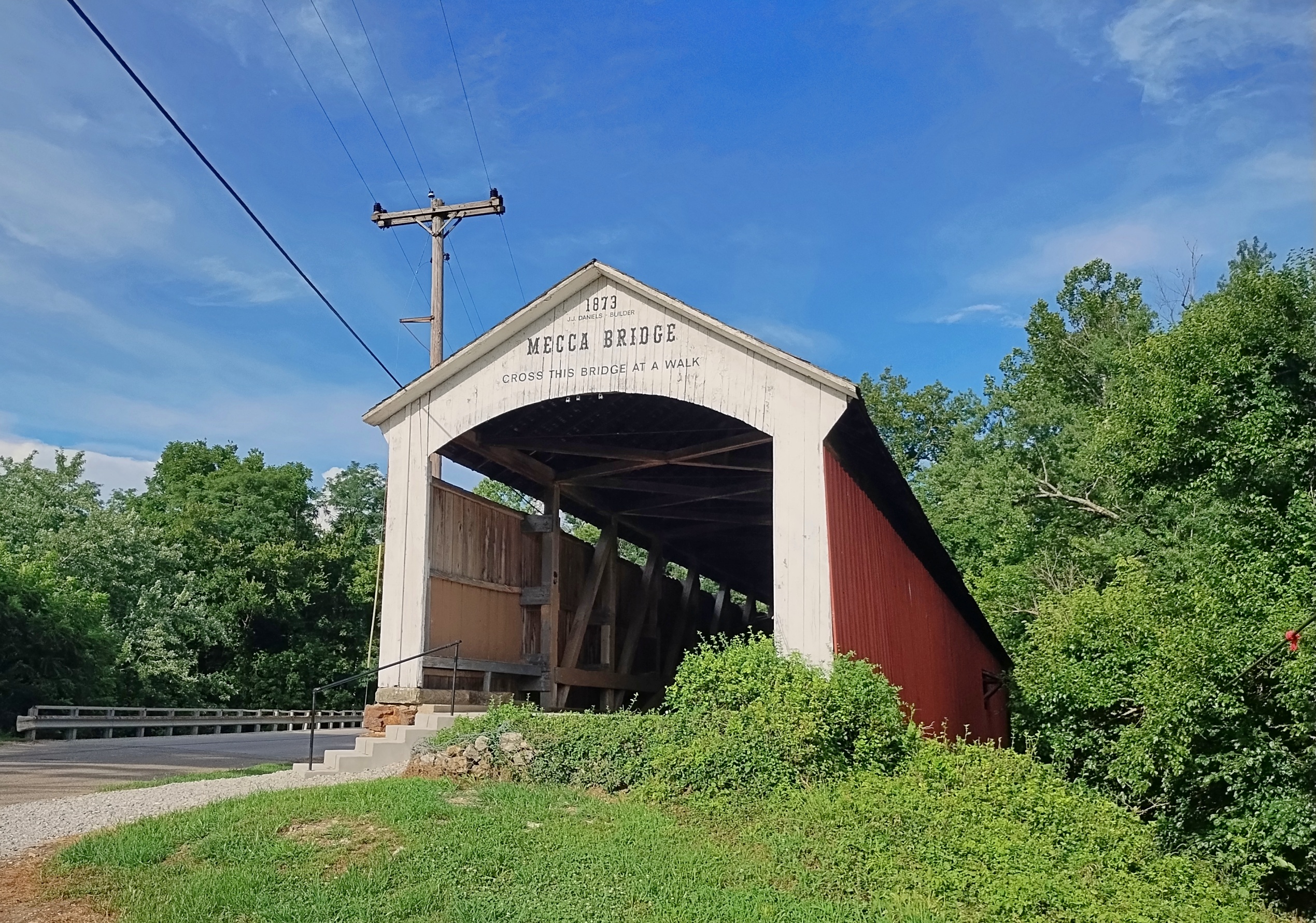
Mecca Bridge, near Mecca, Indiana, across the Big Raccoon Creek. 1873.

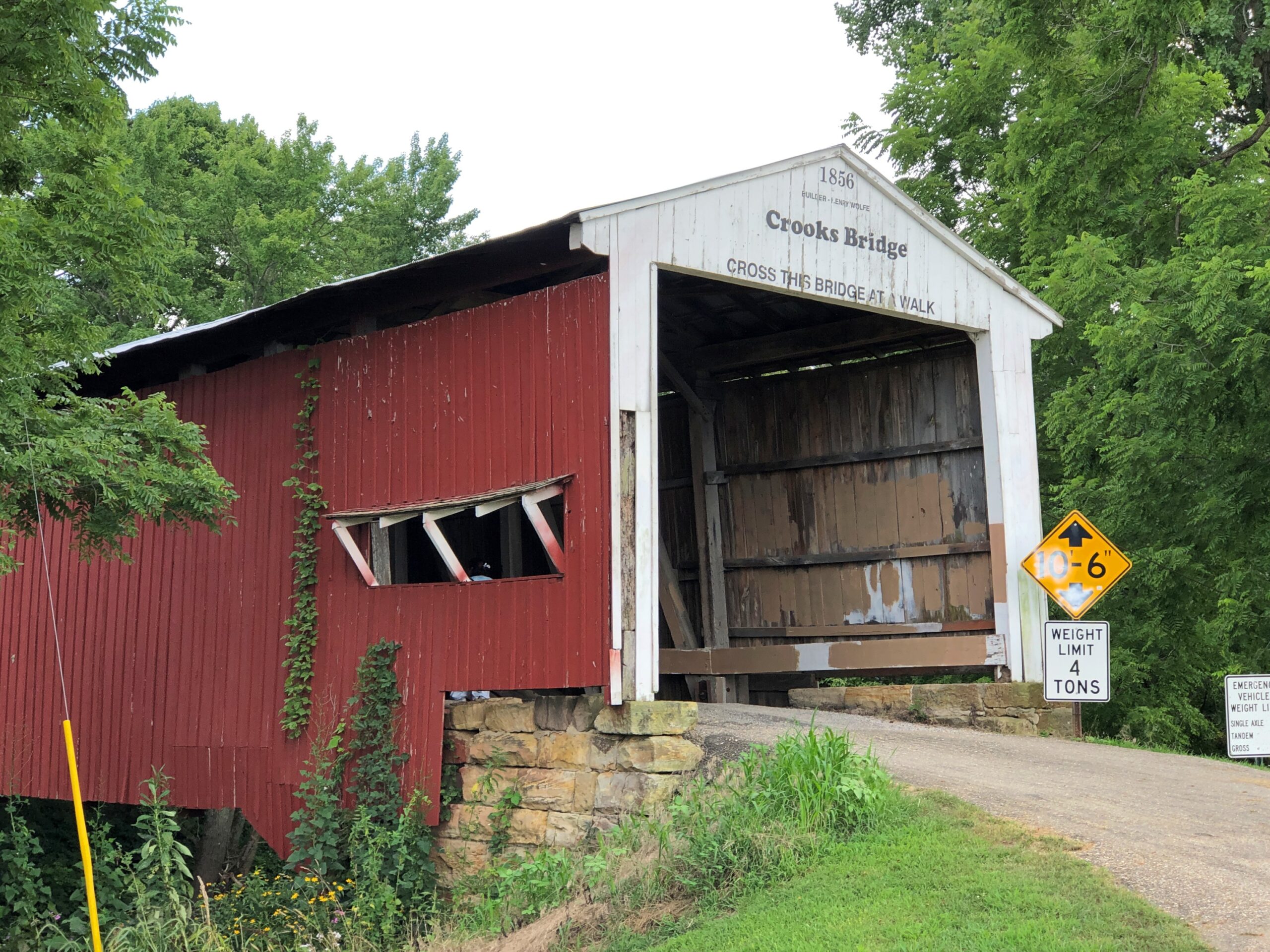
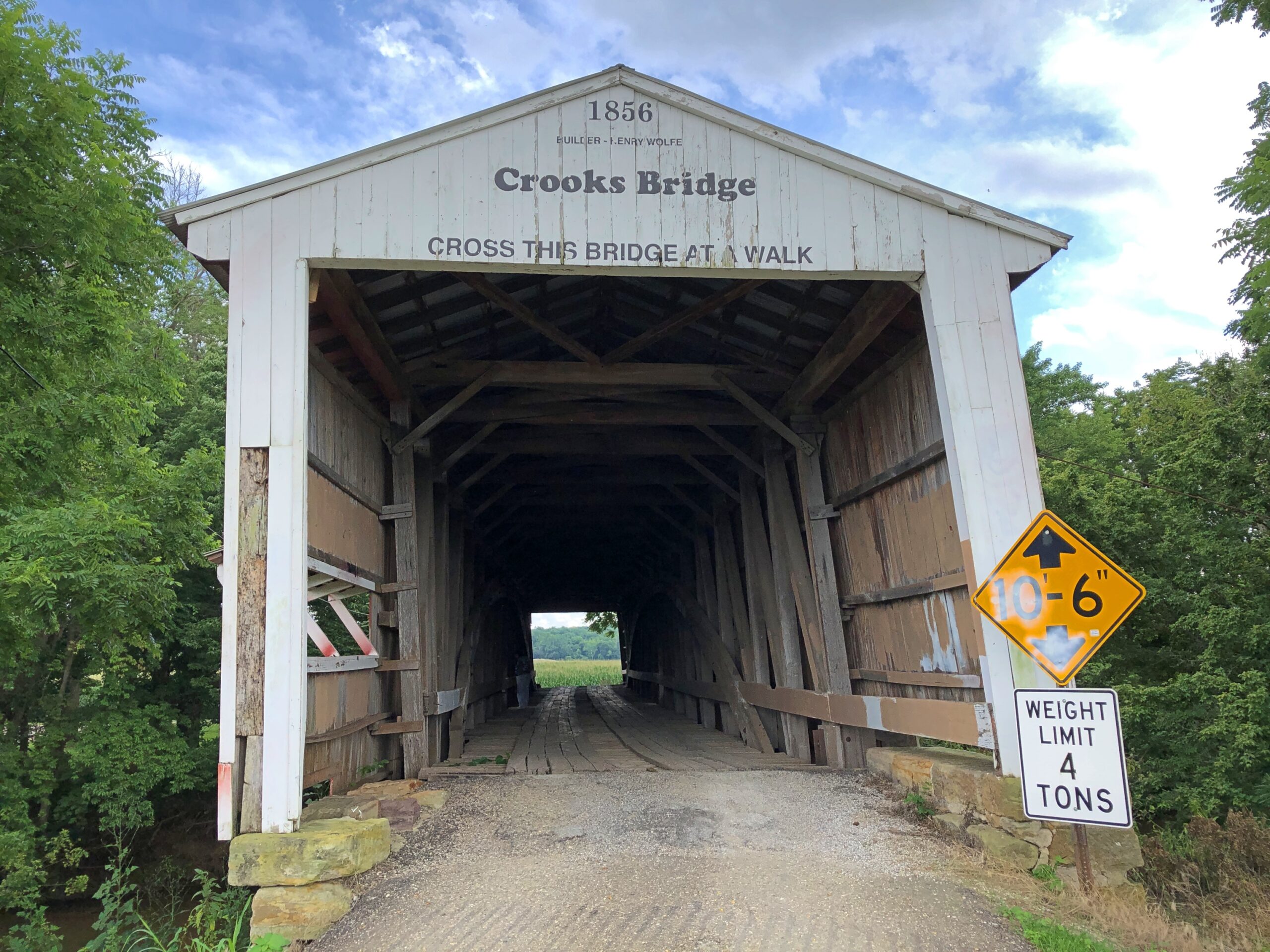
Crooks Bridge, across Little Raccoon Creek. Competed in 1856.

Parke County, Indiana

Neet Bridge, 1904, also across Little Raccoon Creek.

Local organizations count 31 historic bridges in Parke County, each with a name and known origin. Local organizations promote historic bridge tourism, as well they should, including a give-away paper guide (Parke County Guide) that other guides should aspire to, so detailed and useful is it. But I can also report that even on a summer weekend, when it was hot but not dangerously so, or especially humid, overtourism hasn’t spoiled the place. Most of the time, at the half-dozen or so bridges we visited on a weekend, we were alone. Even the bridges that still carried auto traffic had little, so that walking across each on foot was never an issue.
An carpenter (and lawyer) named J.A. Britton (d. 1929) built many of the bridges in Parke County in the late 19th and early 20th centuries, presumably as the organizer of a small construction crew, but also with the sort of hands-on approach that had him laboring alongside the other men. I like to think so, anyway, but whatever the arrangement, bridge building was his business, and he built them to last. Some are still vehicle bridges. Others are pedestrian bridges. Most are in situ, with a few moved to parks or other places.

Parke County was enough of a market for a few decades that J.A. Britton had a competitor, J.J. Daniels, who left behind some structures as well, such as the Neet and Mecca bridges.

Most of the Parke County bridges are Burr Arch Truss bridges, following a design that combines a truss and an arch, invented by a bridge builder back east in the early 19th century, one Theodore Burr. Seems like the design works really well for this kind of bridge.

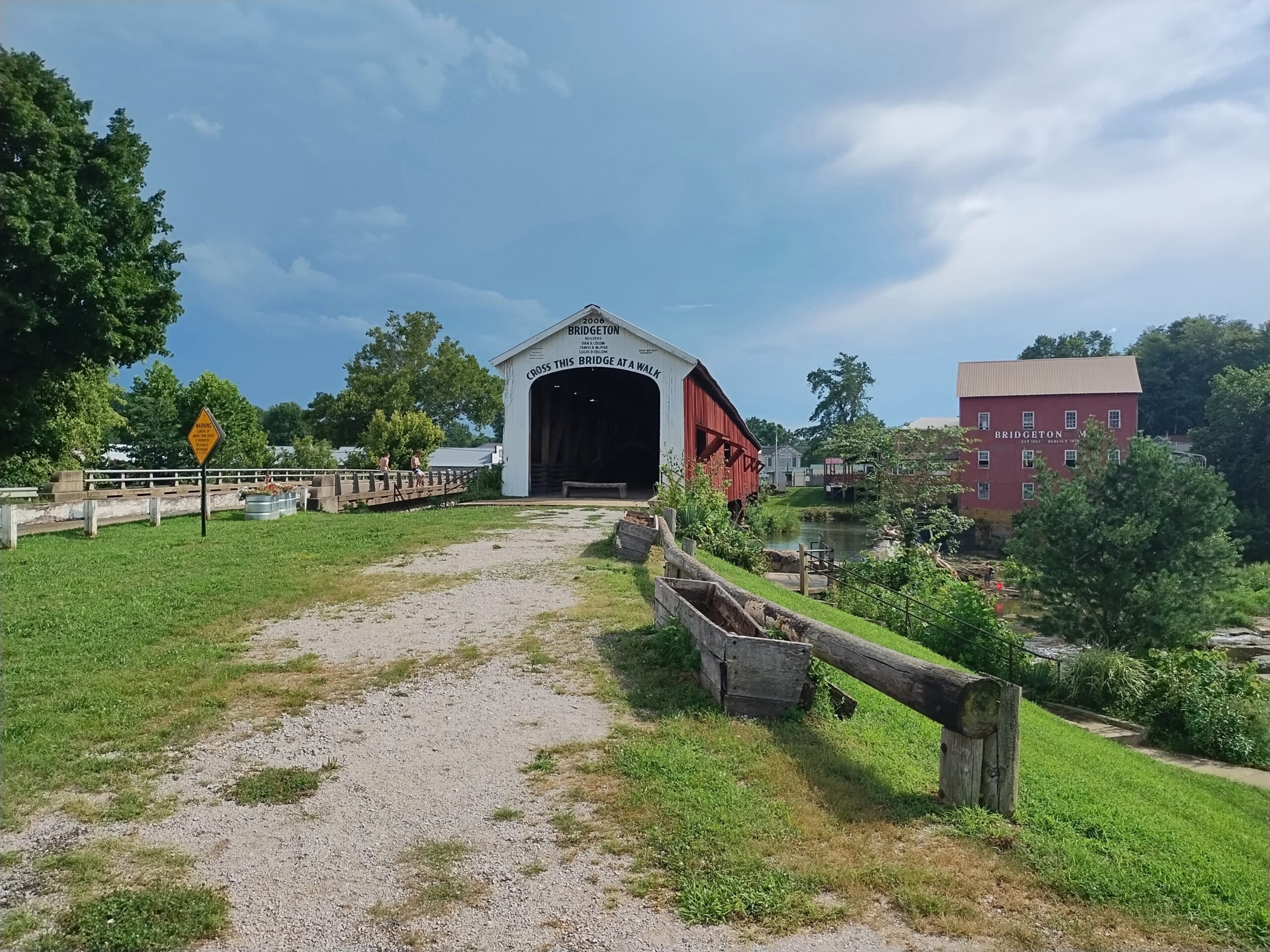
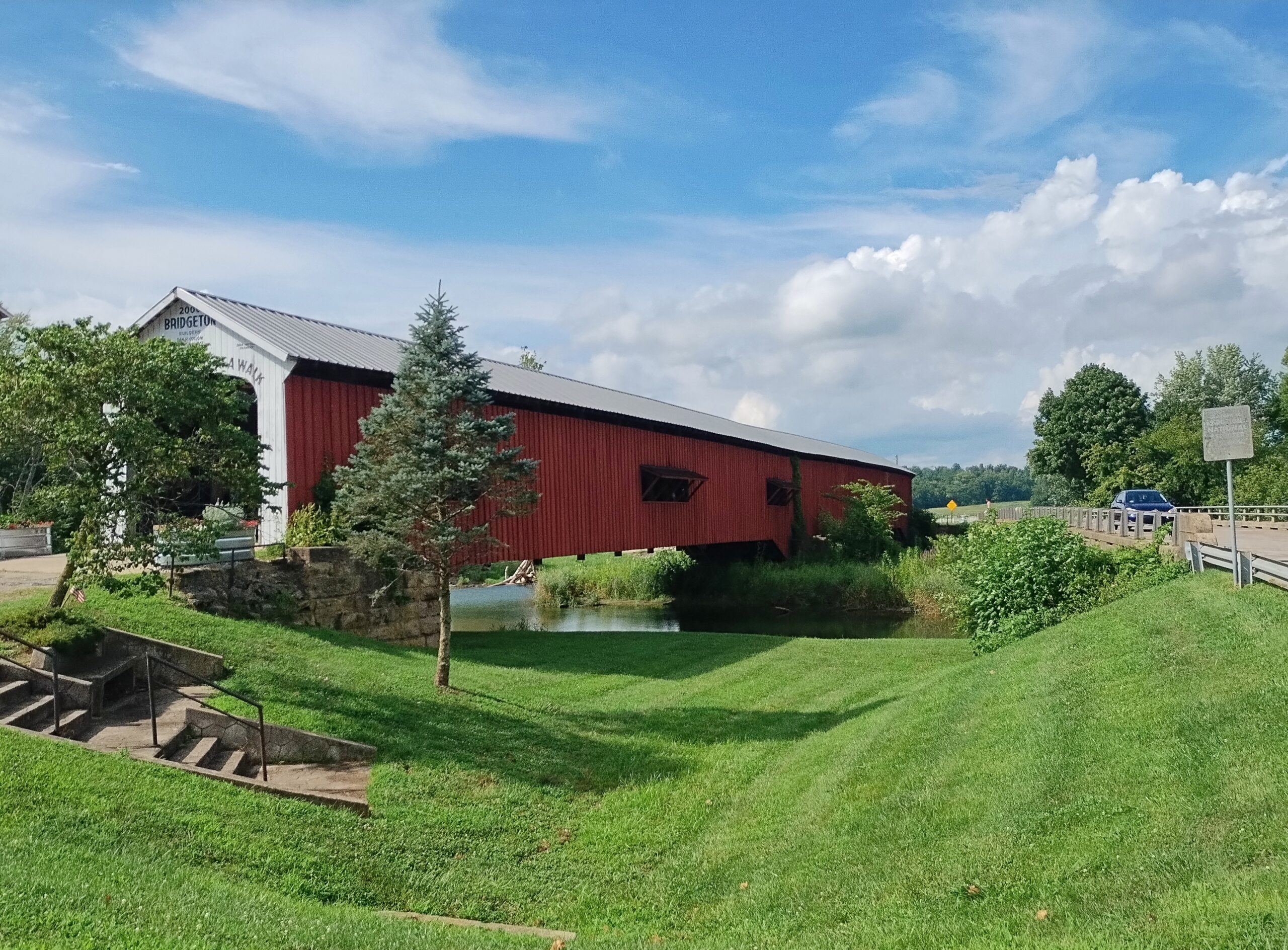
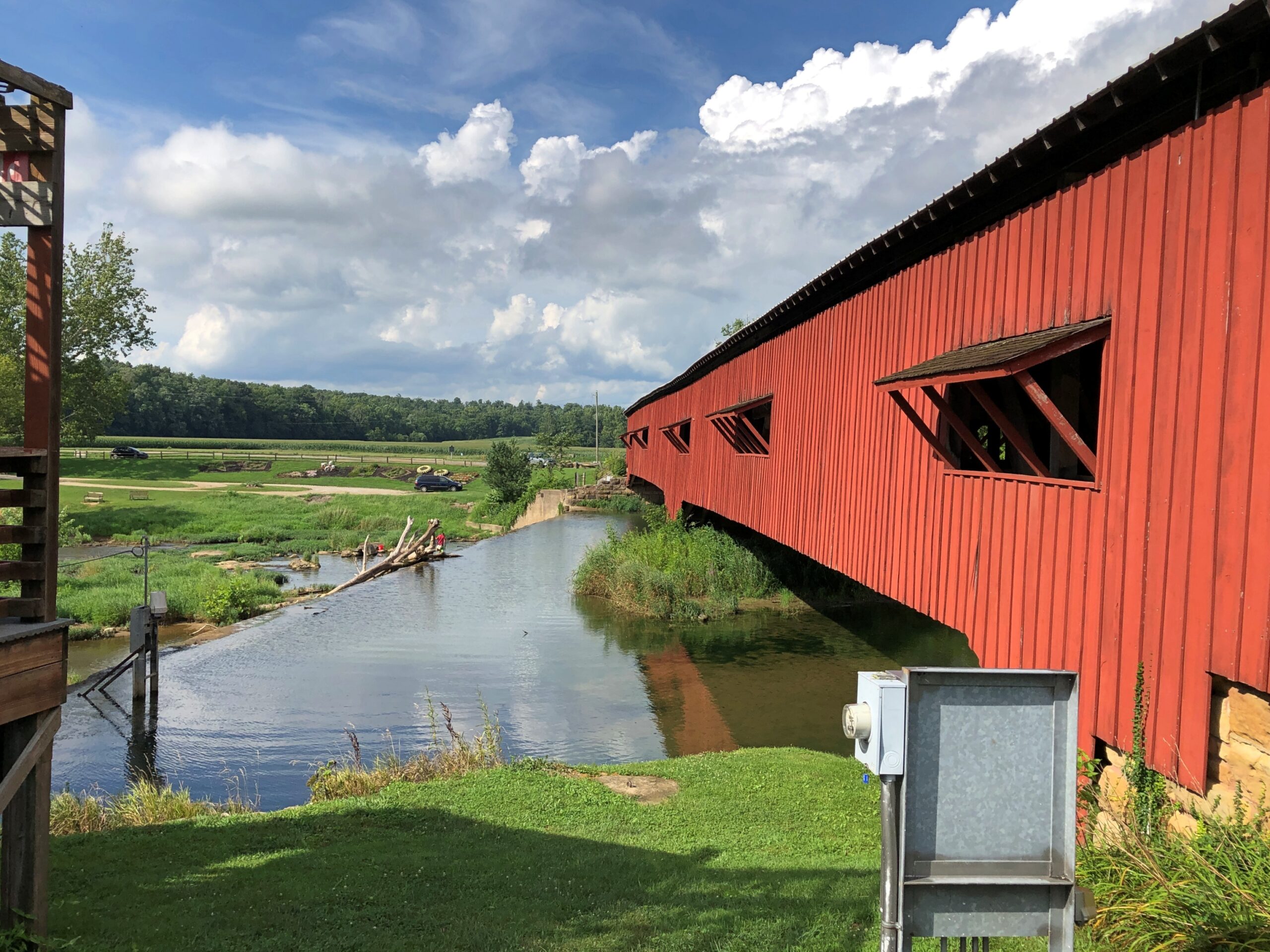
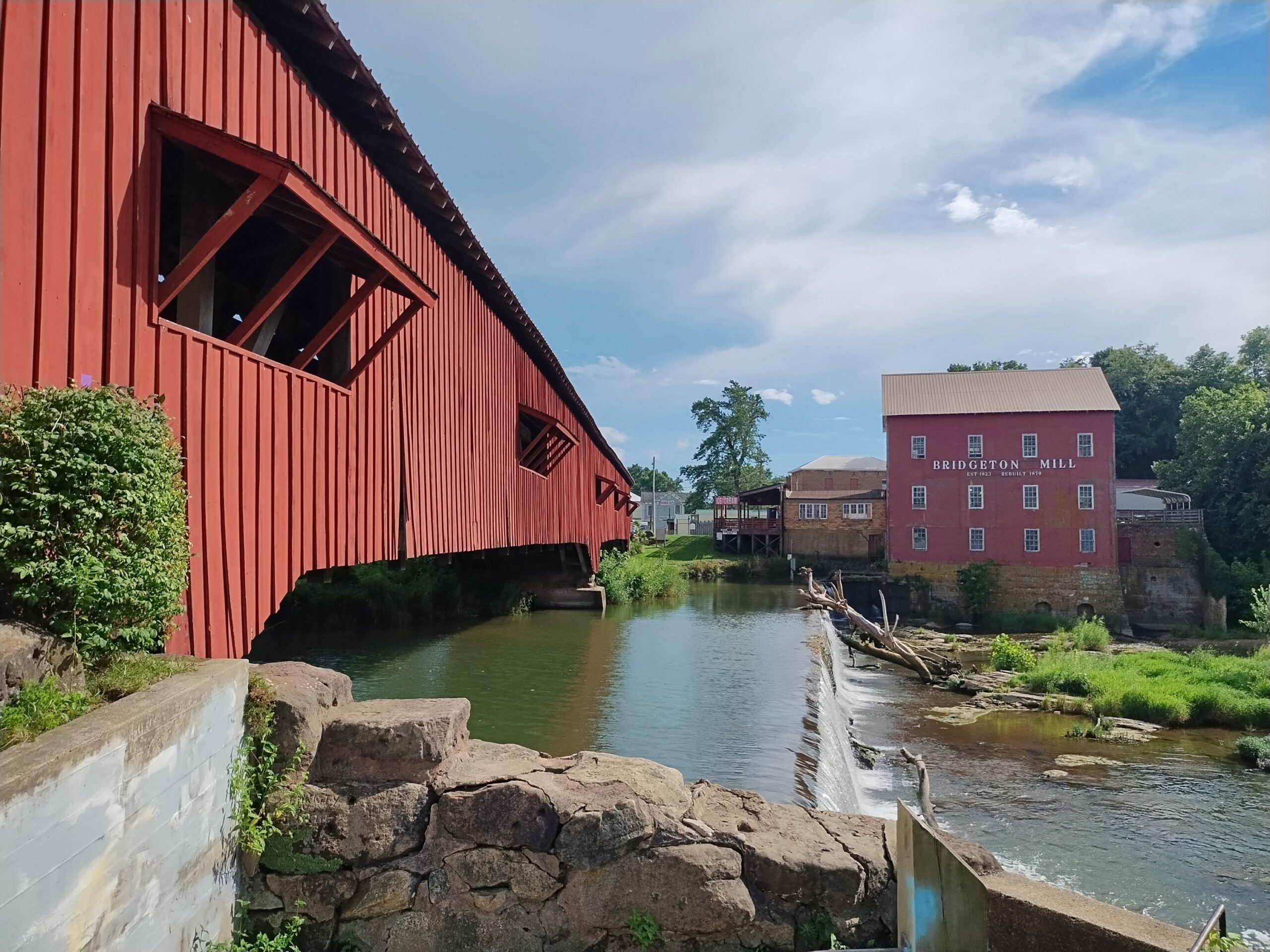
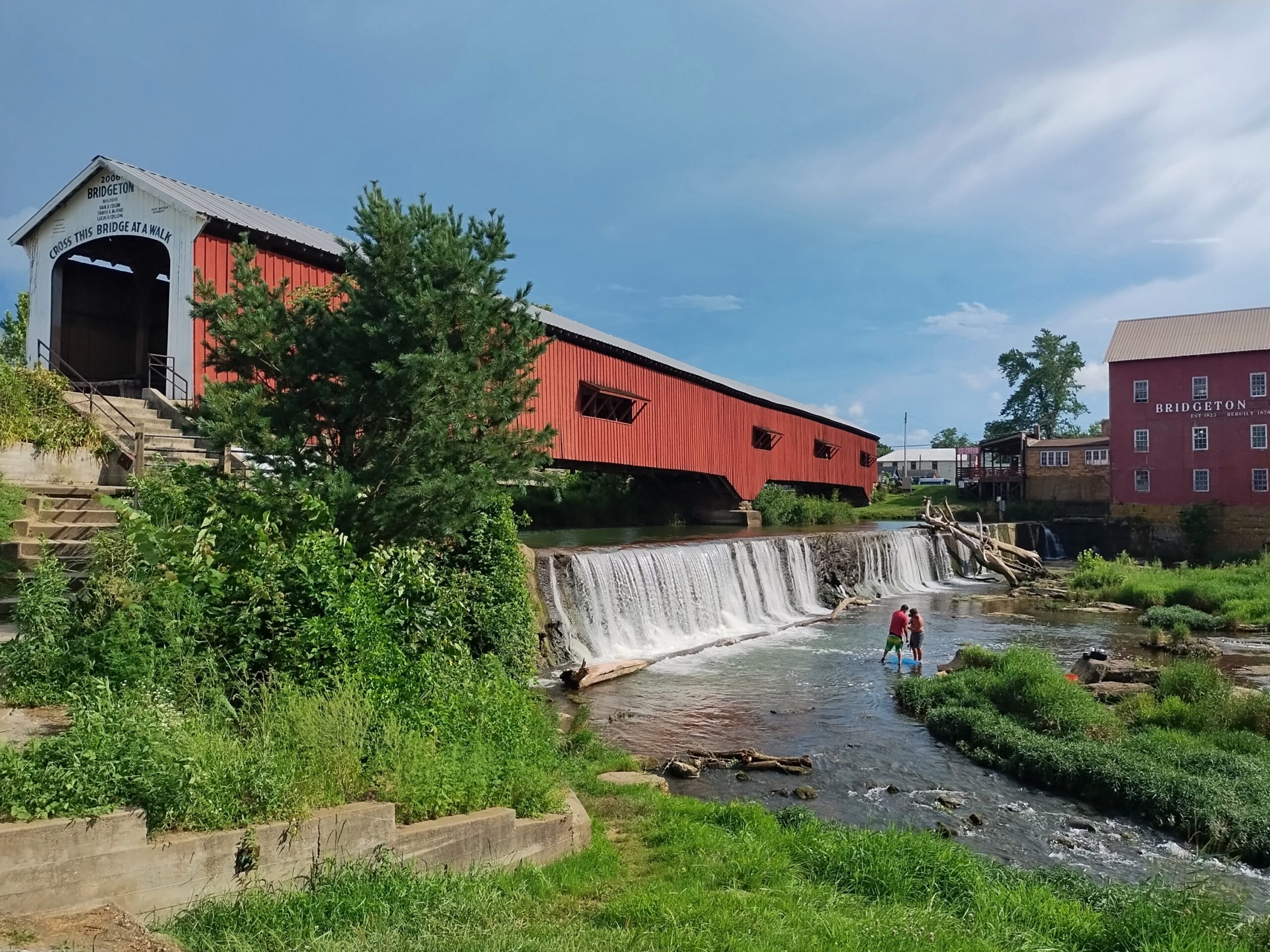
Not all the bridges are out in the corn-planted countryside. Bridgeton Bridge, crossing Big Raccoon Creek, is in the small town of Bridgeton, Indiana, which includes a former mill rising over the creek, now retail. Unlike the others we saw, it dates from 2006, a faithful replica of an earlier bridge destroyed by wanker arsonists.

Over a waterfall, for that extra picturesqueness.

Parke County, Indiana

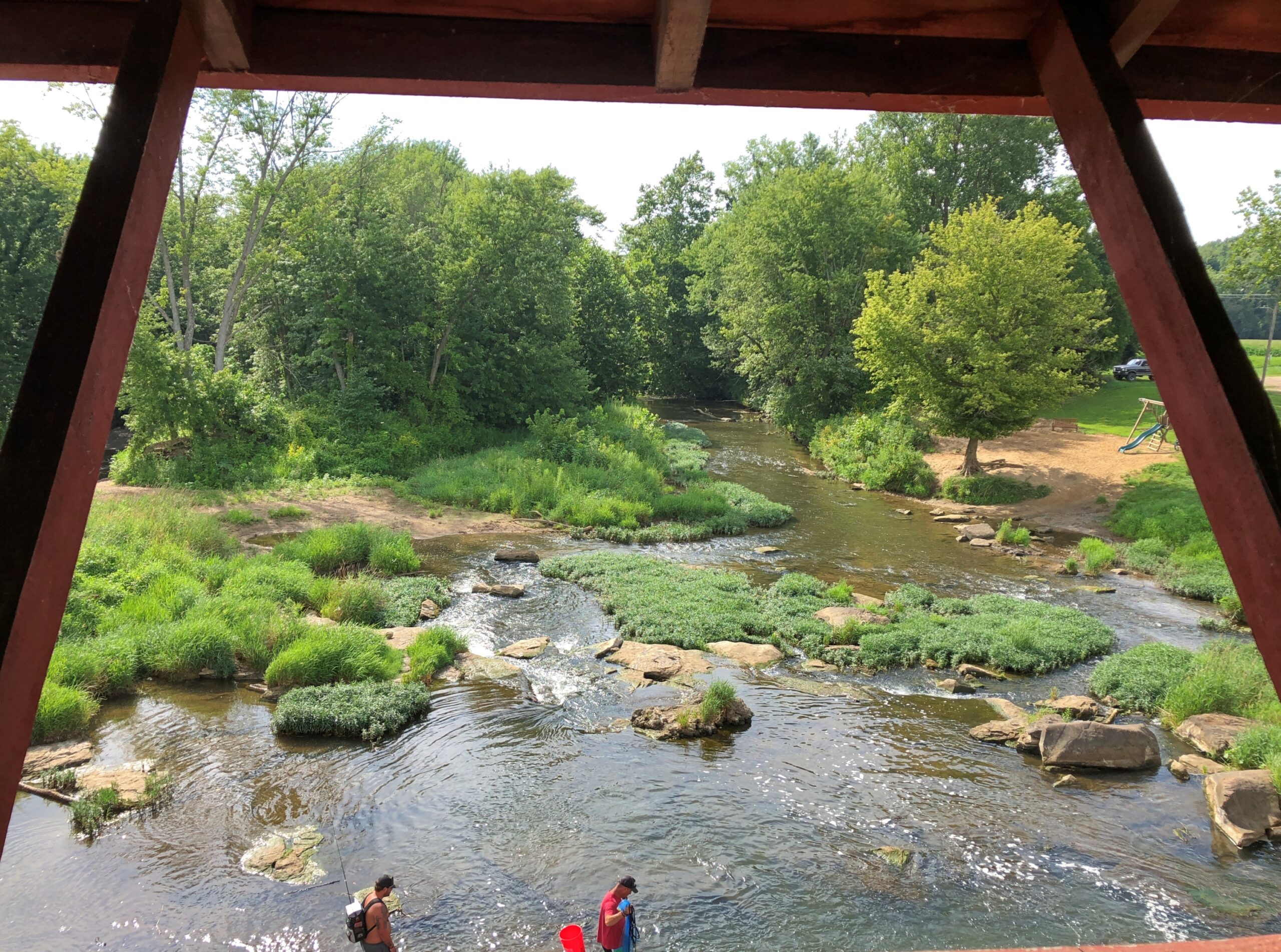
The view from the bridge.

Parke County, Indiana

The creek below was deep enough to allow teenagers, some boys but also at least one girl, to jump off the modern vehicle bridge next to the wooden bridge as a matter of fun, not grievous injury, because while we were around, we saw and heard them doing so. Good to see kids out having fun that didn’t involve small electronic boxes, by gar.

Southern Loop ’25

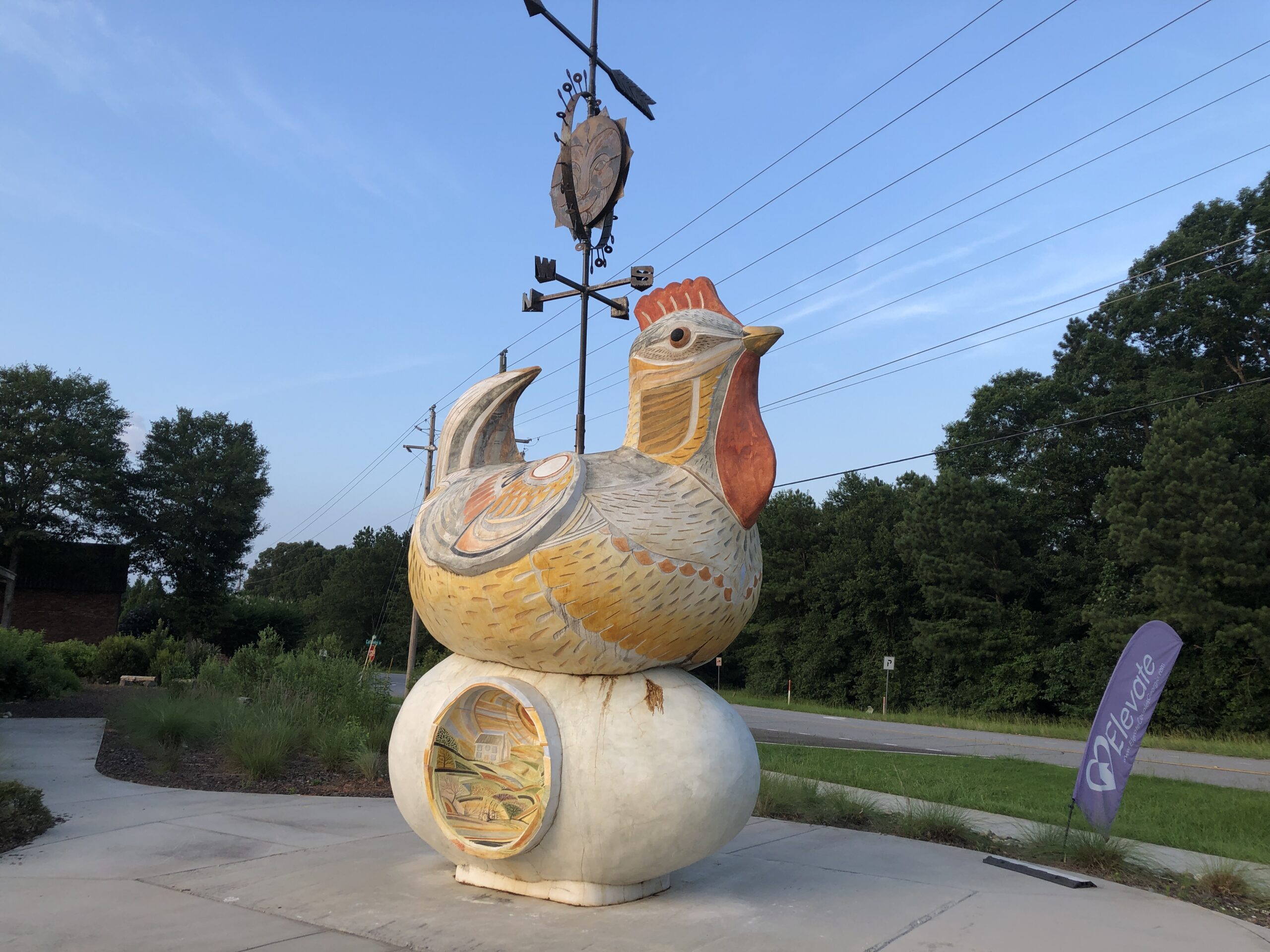
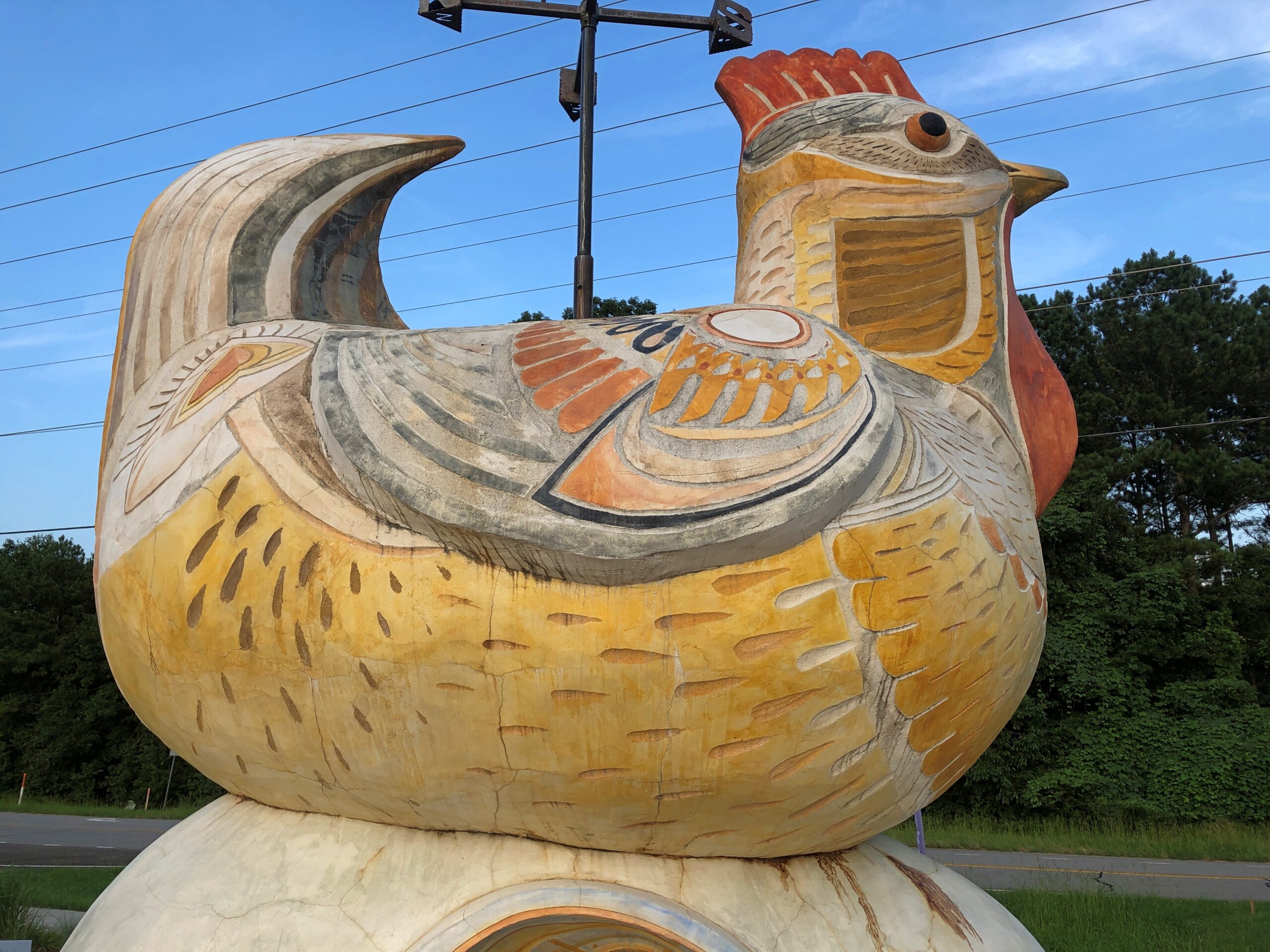
Sometimes you’re driving along, minding your own business because your business at that moment is driving, and you see a two-story chicken near the road. Three stories if you count the iron weather vane perched atop the bird.

Chicken!
Chicken!
Chicken!

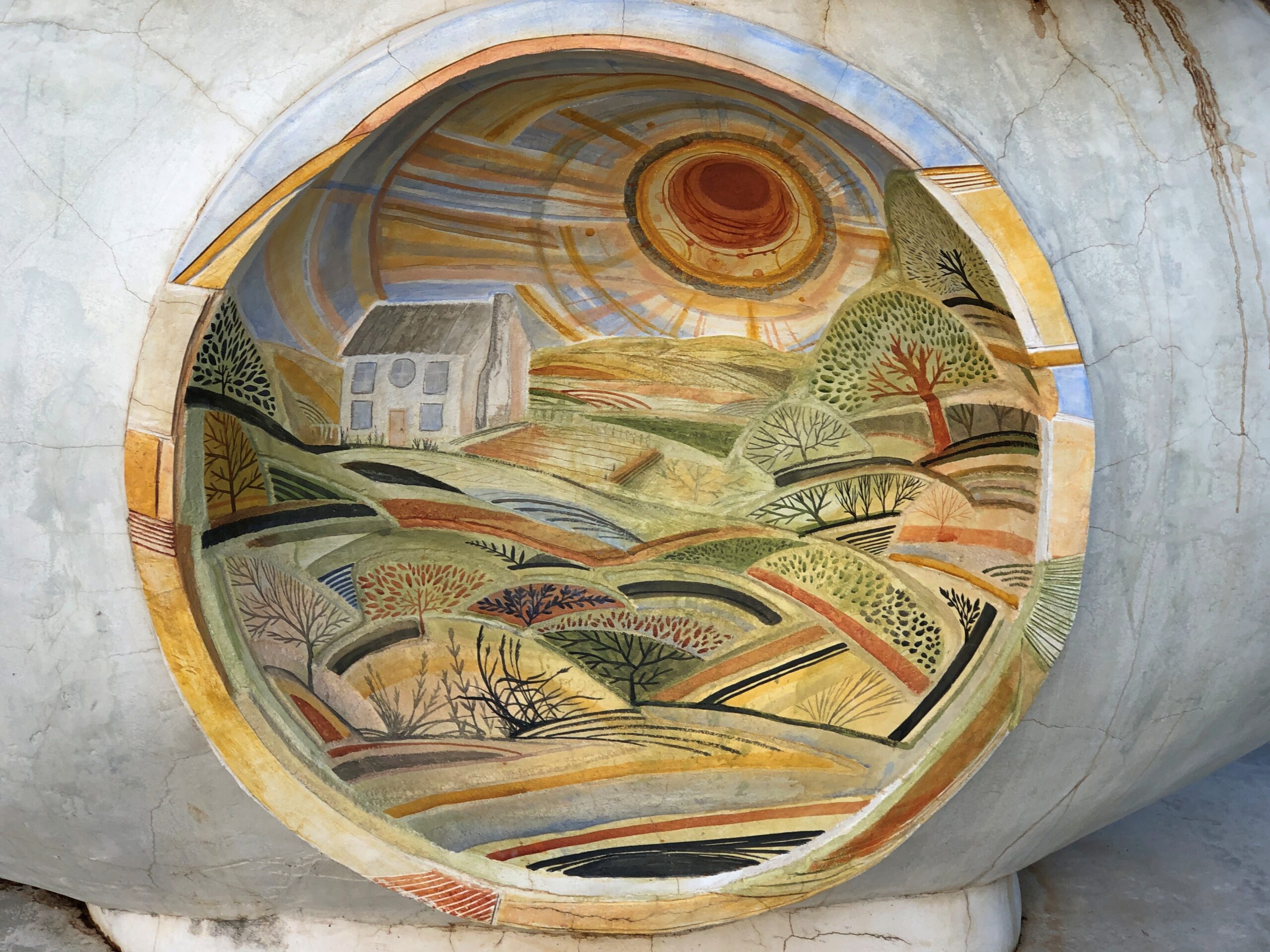
I had to stop to see that. More precisely, it’s a concrete chicken on a concrete egg, settling the question of which came first (the concrete did). The chicken, and the egg, are on property owned by the University of Georgia, used for the Athens-Clarke County Extension in Athens. Erected in 2022. More about the work, “Origins,” is here. All ag extensions should have just a little whimsy.

The chicken appeared roughly in the middle of the 3,285 miles I drove between June 16 and June 29, taking a lasso-shaped path from the Midwest across the Southeast, all the way to the ocean at Myrtle Beach, South Carolina: through Indiana, Kentucky, Tennessee, North Carolina, South Carolina, and Georgia, and back through Tennessee, Kentucky and Indiana.

The concrete hen took the cake for novelty, but along the way I saw a memorial to a mostly forgotten incident in the War of 1812, went into a mirrored tower built for a world’s fair, chanced on the spot where the mostly forgotten diplomat who brought the poinsettia to the U.S. is buried, and braved the tourist sprawl that is Mrytle Beach. I heard stories of Blackbeard while near the coast, near his hideouts. I strolled the genteel downtown of the second-oldest town in North Carolina, passing the notable spot where Pepsi-Cola was invented. We visited a three-story souvenir shop that has stood the test of time in Myrtle Beach, which I’m happy to report sells not just postcards, but vintage local postcards, at popular prices. One evening we wandered past sculptures and colored lights among the Spanish moss in South Carolina. For a moment I beheld a complete set of the U.S. gold coins minted in Dahlonega, Georgia.

I drove by houses, farms and fields, past small businesses open and defunct, and junkyards and billboards — an industry that would collapse without ambulance chasers, I believe — and factories and water towers and municipal buildings. That is to say, structures and greenery of all manor of use and upkeep, an inexhaustible variety of human and natural landscapes. Homogenization my foot. Except, of course, every burg with a zip code also has at least one dollar store.

We – my machine and I and sometimes Yuriko, who flew to Myrtle Beach to meet me for a weekend – experienced an incredibly lush Southeast not long after a rainy spring, on big roads and small, straight and curvy, all the while defying the heat. I heard it enough on the radio: a “heat dome” had settled over the eastern United States. It persisted from the first day in Indiana to the last day in Indiana, though it had moderated a bit by then. Temps were in the 90s most days, but nothing that’s going to faze a Texan with an air conditioned vehicle and bottled water.

We did adjust our schedule to mostly be out in the morning or evening, except at Myrtle Beach, where a walk in the heat that made me feel my age and maybe then some. A less hot but more humid walk in a mostly forgotten national park in South Carolina saw flights of mosquitoes barreling down on me. A few of them penetrated my DEET coverage.

I saw and did all that and much more, but that was only the bronze and silver of the trip. The gold was visiting old friends.

That was actually the priority this time around. Before the trip, one of the friends I planned to visit asked me via text: “What’s your trip about?”

My text answer: “Visit old friends, see new things & take long drives.”

In Nashville, Stephanie and Wendall.

In North Carolina, Dan and Pam. She had enough sense not to wander around in the heat with us.

In rural Tennessee, Margaret and Dave.

Separately in Georgia, Layne and Stuart. I was glad to see them all, and I think they were all glad to see me. Known most of ’em since the 1980s, and we had a time — then and now.

Around the World ’25

At times like this, in the funk that comes after a long trip, I ask myself, did I actually do that? An odd question, maybe, but long travels have that odd effect. Somehow such a trip seems less than real. Also more than real. Those are essential features of the intoxication of the road, and hangovers follow intoxication.

Ponder this: Over roughly the last five weeks, starting on February 8, in a series of eight airplane flights, a small number of intercity train trips on either side of the Eurasian land mass (including one of the fastest trains in existence), a large number of bus, subway, streetcar and even monorail rides, a few taxi rides, other car rides provided by friends and relatives and a hired driver, a bicycle rickshaw ride — and you haven’t lived and almost died (or at least felt that way) till you’ve taken such a conveyance in Delhi — climbing a lot of stairs and using a lot of escalators and elevators, and taking more than a few long walks, and many short walks, on sidewalks and cobblestone streets and railway station platforms, I went around the world in a westward direction, from metro Chicago to metro Chicago, by way of Japan, India, the United Arab Emirates, Germany and the Czech Republic.

All that effort for what? To see the world, of course. That and skip out of much of winter in northern Illinois.

How did I have the energy for this, here at the gates of old age? How are the logistics possible?

But it really isn’t that hard. This is the 21st century, and travel is mostly by machine, and part of a mass industry, so even old men firmly from the middle class can go. Retired and semiretired old men, who find themselves with more free time than in previous decades. Moreover, the logistics were the least of it: all you need in our time is a computer to set things up.

I’m convinced that the hard part, for many people, would be finding the will to go. Luckily I have a practically bottomless supply. My always-eager-to-go attitude toward seeing point A and then points B, C and so forth also meant I was completely persuaded that buzzing around the world was a good idea. Tired as I am now — and boy am I tired — I haven’t changed my mind, though I need to rest up a bit at the moment.

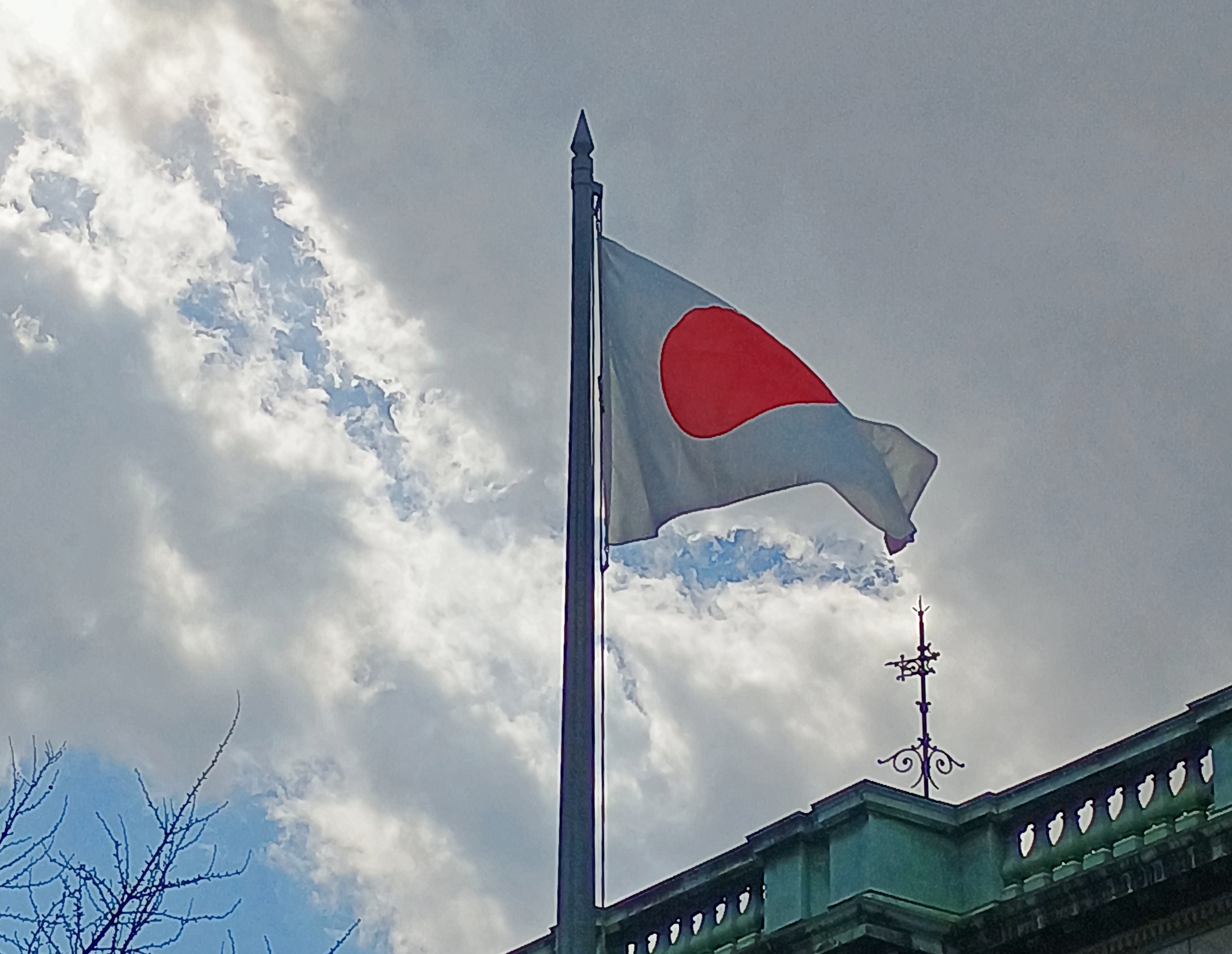
Japan: my first visit in 25+ years.Rising Sun

It felt familiar — I did live there for four years — but the passage of time also infused the place with a feeling of the unfamiliar as well, a strange combo sensation indeed.

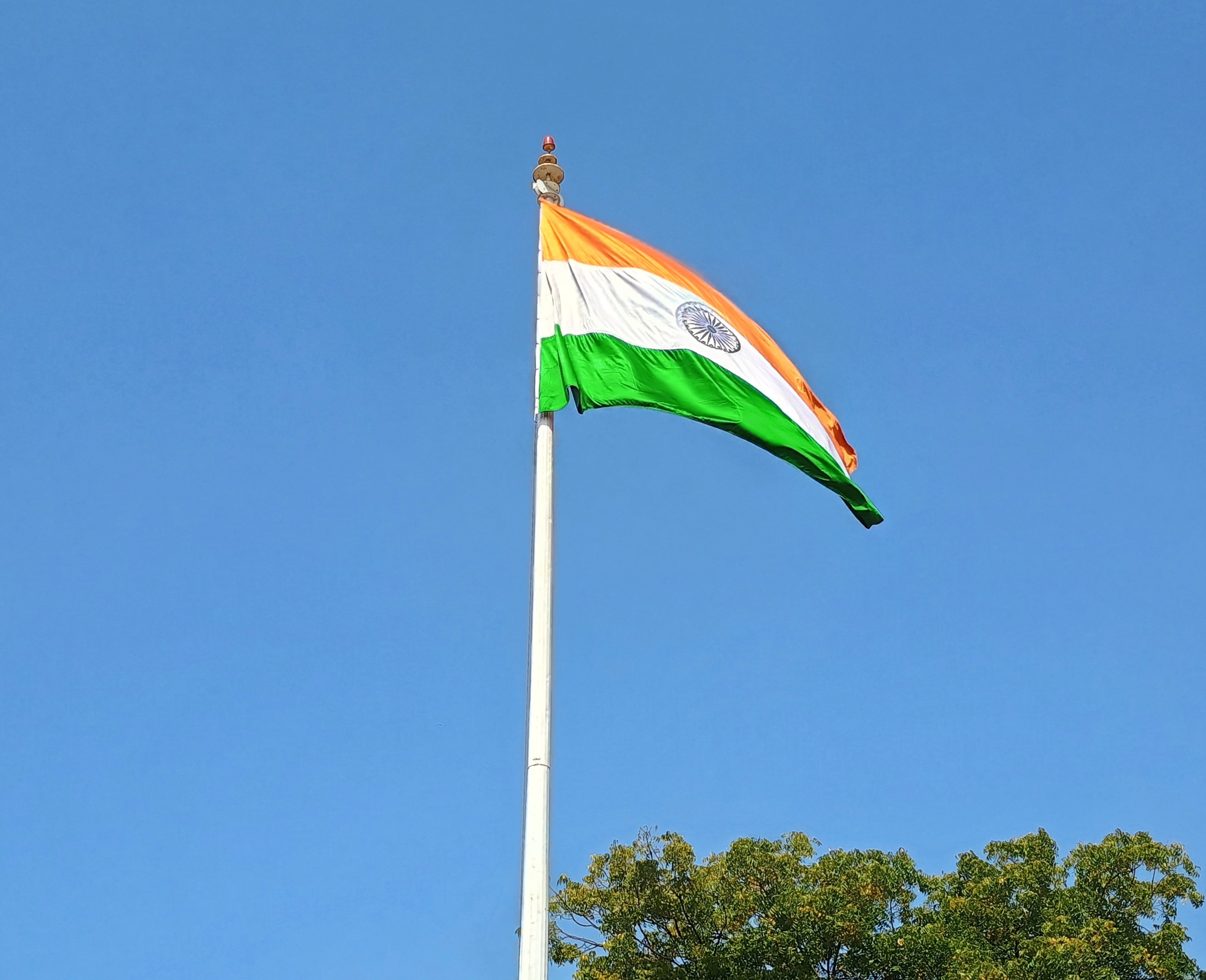
India: A major lacuna in my travels, now just a little less so.Indian Flag

A friend who goes to India sometimes on business told me last fall, “India makes me tired.” I might not have been on business, but I ended up feeling the same way.

And yet —  a phantasmagoria unlike anything I’ve seen, especially the teeming city streets. Teem was never more an apt verb, in my experience. Yuriko came as far as India with me, after we visited Japan and her family and friends there. Then she headed back eastward to Illinois.

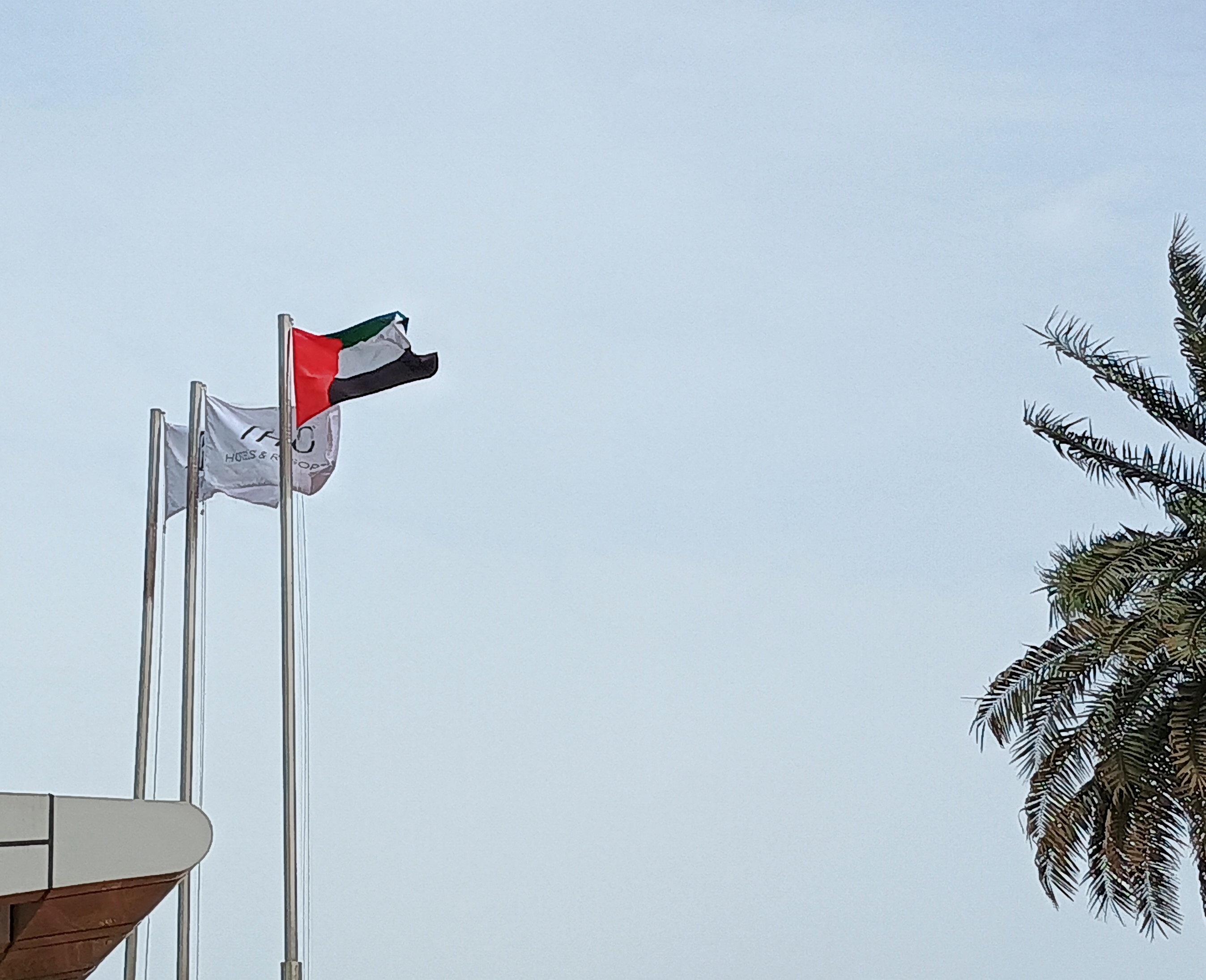
I went on alone from India to the UAE.UAE Flag

In an even less familiar part of the world, a city of towers somehow rises on the edge of the Arabian desert. Just that is astonishing in its own way, but there is plenty else.

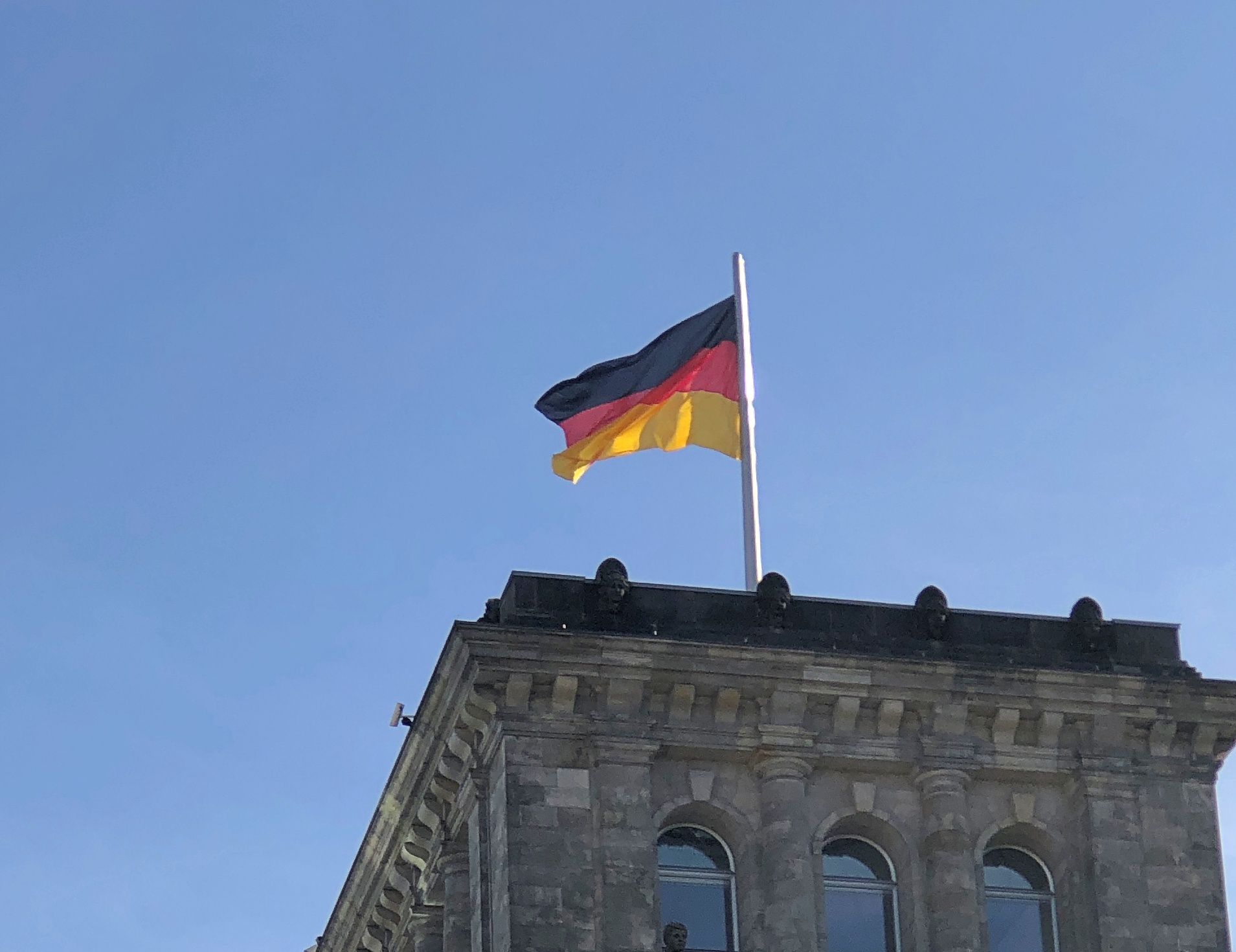
Then to Germany: An old friend I hadn’t seen in a long time, since about five golden weeks in my youth. A long, long time ago: the last time I was there, there were two Germanies and two Berlins and a Wall and the Stassi and Trabbis and a firm living memory of the cataclysm only 40 years earlier.German Flag

Berlin was the focus this time, where I joined my brother Jay for the visit. We’d been kicking around the idea of traveling there together for a while, and ultimately didn’t want to wait till either of us got any older. He had not made it to Berlin in ’72.

A major side trip from Berlin was to Prague. Not quite as old a friend, but old enough.Czech Flag

Yuriko and I visited in ’94, but it was new territory for Jay, another slice of the former Astro-Hungarian Empire to go with his early ’70s visit to Vienna.

Actually, when you visit a place you haven’t seen in 40 or 30 years, it’s like you’ve never been there. I had that sensation in both Berlin and Prague. The old memories are packed away, only loosely connected to their setting any more, which has changed partly beyond recognition anyway.

Now I’m back. Unlike Phileas Fogg, I didn’t return a day earlier than I thought I did (we have a stronger awareness of the International Date Line). But I did manage to miss the no one-likes-it spring transition to daylight savings time, just another little bonus of the trip.

GTT ’25

One way to deal with January, the grimmest month here in the frozen North (today’s high, 2° F.): adjust your latitude southward. Not everyone has that option, or really even that many people do. Humans get around, but we aren’t a migratory species. Anyway, I managed to travel recently from around 40° North to around 30° North and stay there for 10 days.

I flew from Chicago to Austin on January 9: from clear and chilly to overcast and not quite chilly enough for any precipitation to freeze. The flight path took us up and over an enormous winter storm passing south of Chicago at that time, whose southern edge expressed itself as cold rain in Austin. The storm made for spots of unnerving turbulence and some flight cancellations that day at places in between, such as Dallas, and a long descent into Austin Bergstrom through a gray soup. Hurray for radar.

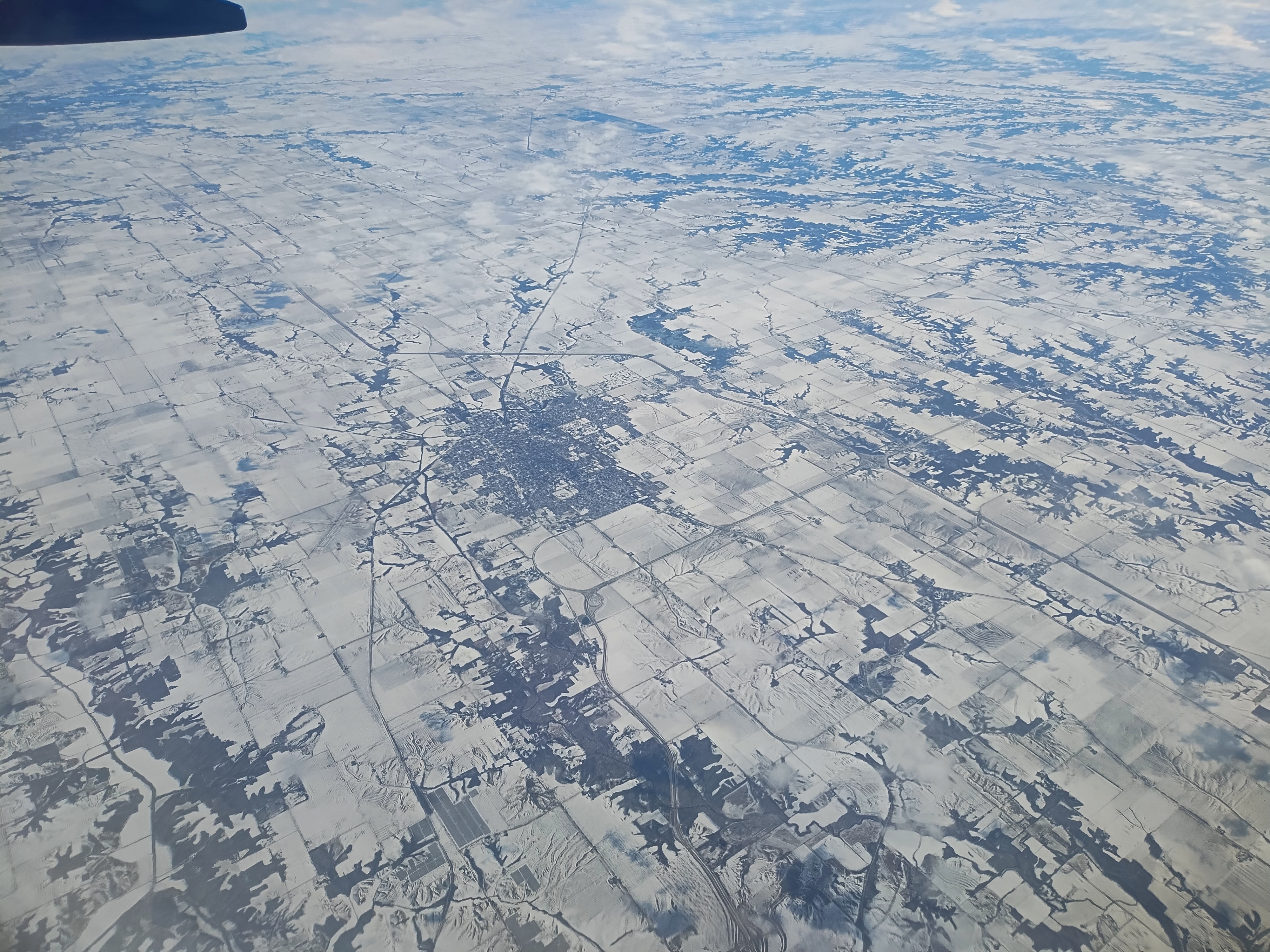
On my return flight on January 19 out of Dallas — where I’d driven by then — I saw remnants of the earlier storm on the ground below. Somewhere over Missouri or southern Illinois that day, the ground still appeared white miles below, as far as I could see from my 737-800 perch.Post Snowstorm Midwest Jan 2025

Back in Chicago, there is very little snow on the ground. Dry January, indeed.

This was a family and friends trip, visiting more old friends than expected in Austin and San Antonio, including some I knew well in elementary school, meeting them in person for the first time in 40+ years, though I was on a zoom with one of them a few years ago. I’ve been making an effort to visit old friends for a few years now, because of mortality. Mine and theirs. People get a little weird if you say that part out loud, but I believe everyone feels the quiet ticking of the clock.

Also an Austin-San Antonio-Dallas trip, with a day in Corpus Christi thrown in for fun. Some places are like old friends you haven’t seen in decades, and so it was with Corpus, as Texans often call it. Not exactly a favorite destination from the old days, but I do have memories of high school speech tournaments at CC Ray and CC King (two Corpus high schools) maybe as recently as early 1979. I’m fairly sure Corpus was the first city except for San Antonio that I drove a car in, though that might have been Austin.

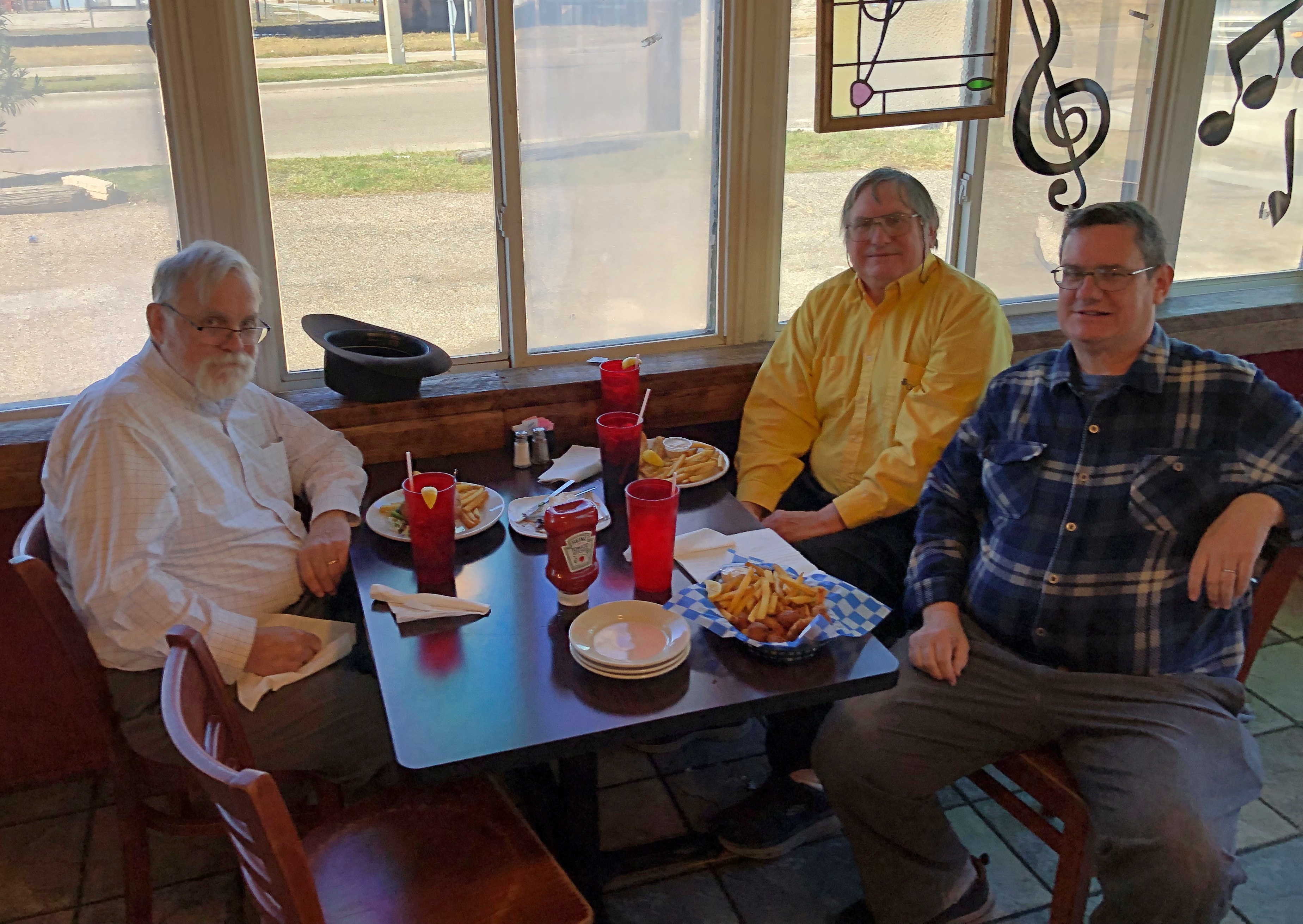
My brothers and I had lunch in the North Beach neighborhood of Corpus.Blackbeard's on the Beach

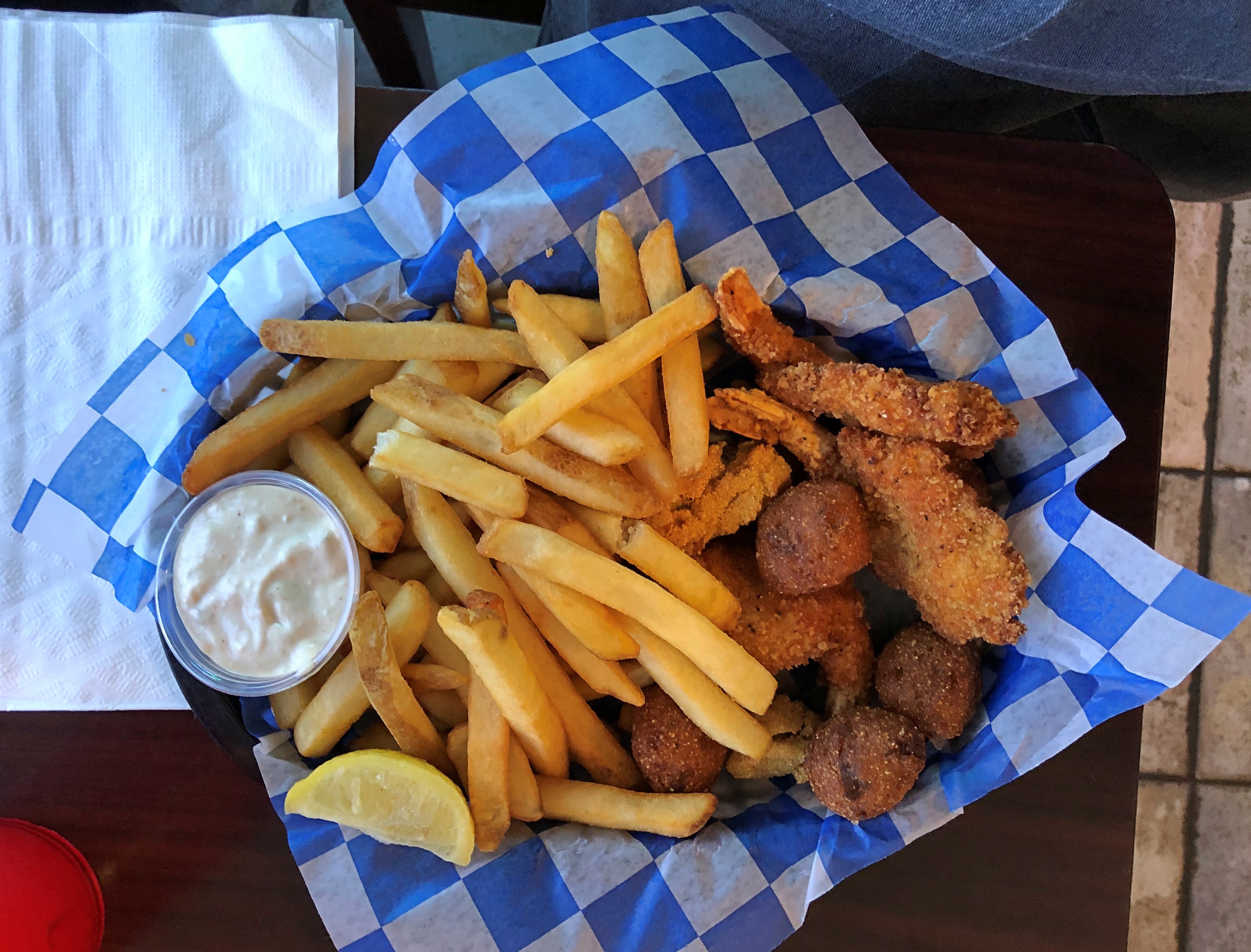
Seafood. The thing to eat on the Coast.Blackbeard's on the Beach

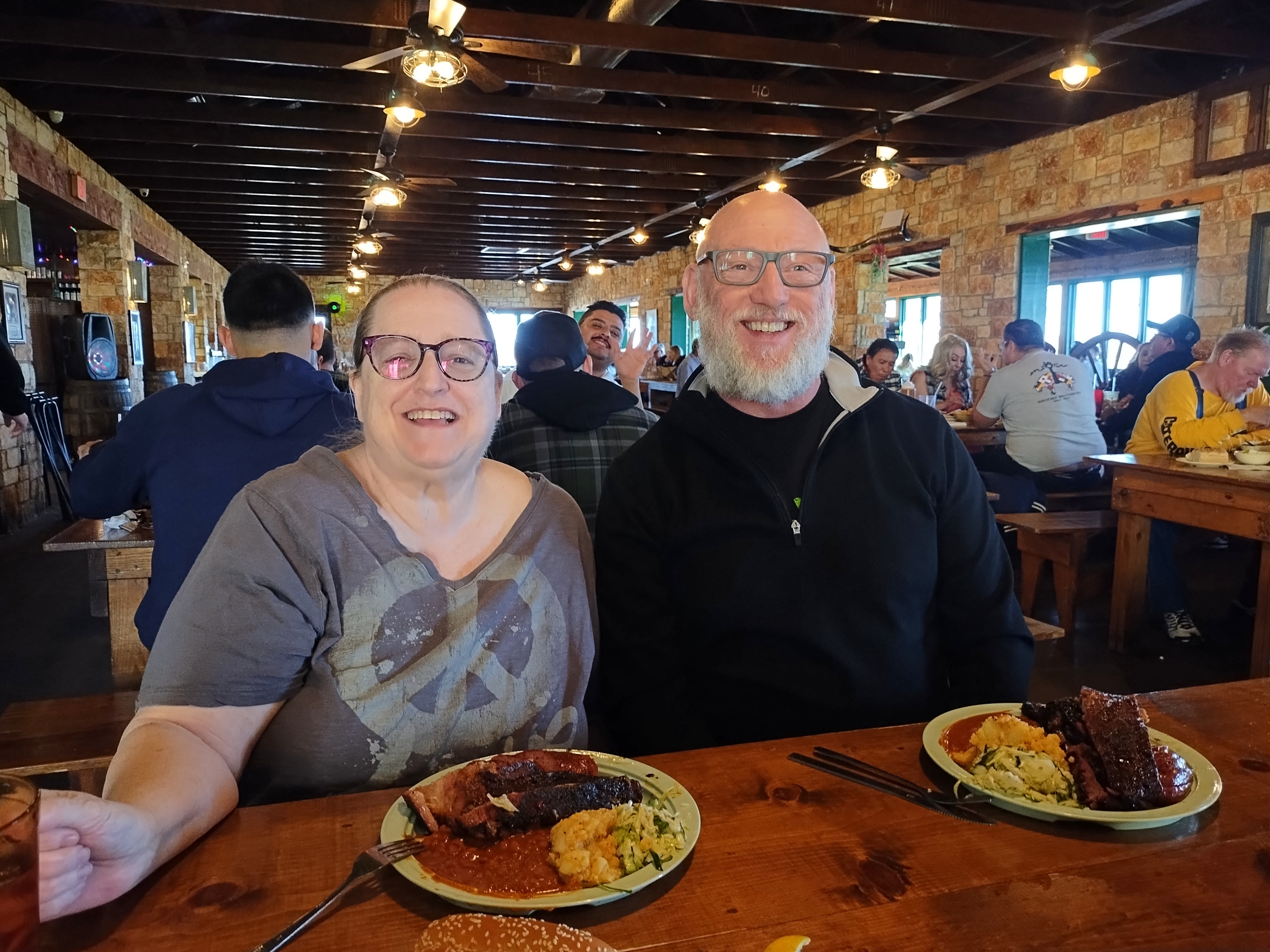
It was mostly an urban trip, but one fine day (nearly 60° F), old friends Tom and Nancy and I went to the suburban outskirts of Austin for lunch at the Round Rock location of the Salt Lick.

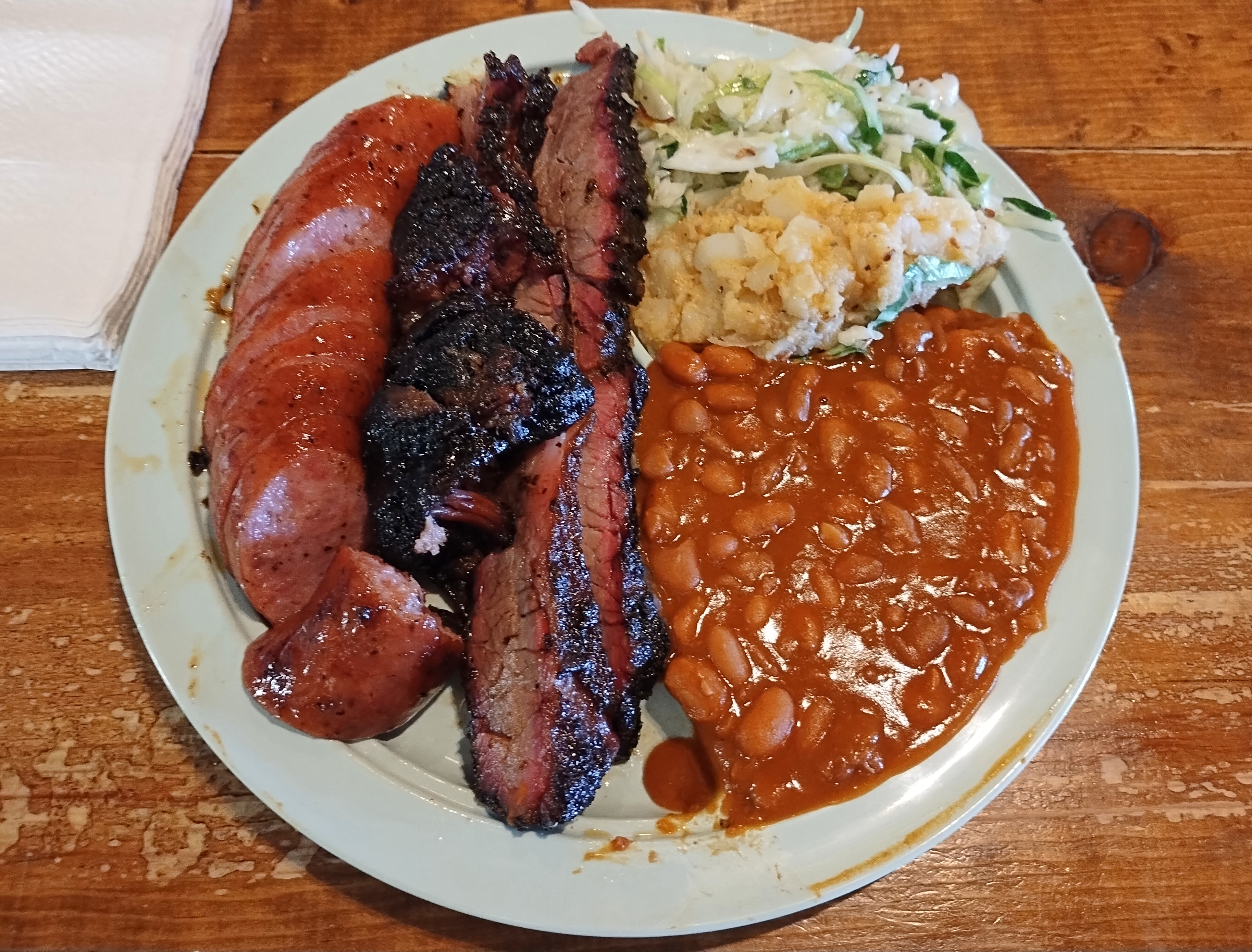
That too was visiting an old friend, in a way, though my fond memories are of the original Salt Lick in 1993, further out from metro Austin, in Driftwood, Texas, which is about as Hill Country as you can get. Still, the branch in Round Rock, with its long dining room and long tables and stone construction, seemed true to my memories of the original location. More importantly, the barbecue was just as good.Salt Like BBQ

Afterward, we took a walk in the historic district of Round Rock – our Round Rock Ramble – near the intersection of Main and Mays, among the finely restored late 19th- and early 20th-century stone edifices with names like the Old Broom Factory, the Otto Reinke Building and the J.A. Nelson Co. Building. Businesses of the 21st century seem to be doing well in these old two- and three-story stone commercial buildings, including the likes of Fahrenheit Design, Organica Aesthetics (a plastic surgery spa), Gharma Zone Korean Food and the Brass Tap.

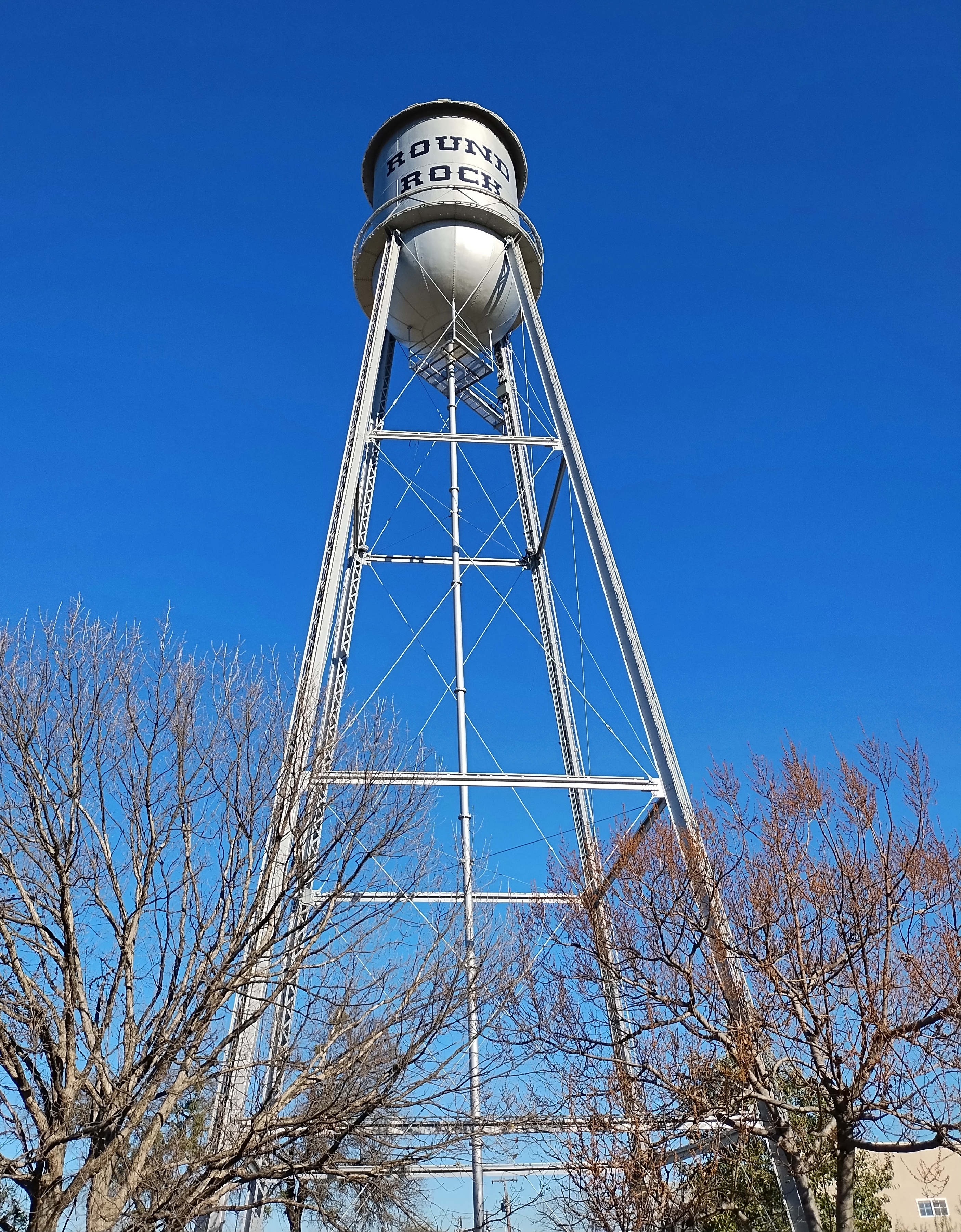
Nearby stands an impressive old water tower in a small park (Koughan Memorial Water Tower Park, according to Google Maps and Wiki).Round Rock, Texas

The tower is yet another legacy of the WPA. Even better –Round Rock, Texas

– you can stand right under it, something that isn’t always possible when it comes to public water infrastructure.