Libertarian on the Thoroughfare

Political signage isn’t all that thick here in the northwest suburbs this year, only a scattering of statewide races, and I hadn’t seen a single presidential sign until the other day. Could be that, since Illinois isn’t remotely in play in that election, no one is bothering.

Then again, there’s a certain house on a small road I’ve been driving by regularly for more than a decade, and every election — every one — Republican signage is prominent in the yard, especially the presidential nominee during those contests. This year, nothing. Maybe they’ve moved. Or maybe their presidential nominee just embarrasses them.

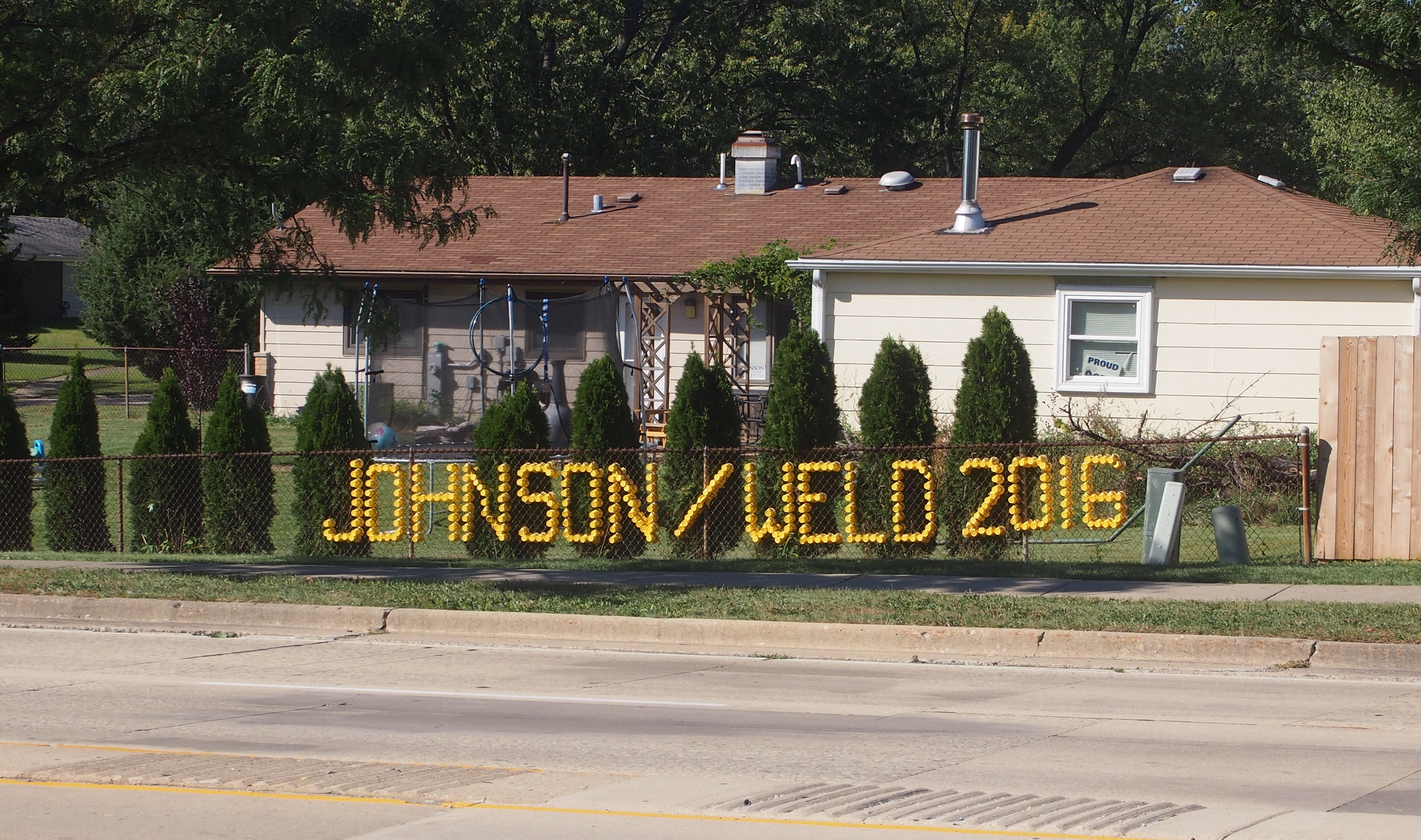
But recently I did see a bit of presidential advertising, near the intersection of Schaumburg Road, a major thoroughfare, and Salem Road.

Gary Johnson Sign made of yellow cups

That’s the more visible part, made of yellow cups stuck in the fence. Less visible, and off to the side in blue cups, is # LET GARY DEBATE.

Museum of Contemporary Art, Chicago

A docent at the Museum of Contemporary Art (MCA), Chicago, asked me how long it has been since I last visited the museum. I couldn’t remember. I’m pretty sure it was sometime after the current building opened 20 years ago, though I couldn’t say when, or what I saw. Reason enough to visit again on a pleasant September Saturday in 2016.

Encyclopedia Chicago says that “the new building clad in aluminum and Indiana limestone opened in June 1996 in a 24-hour summer solstice celebration. Referencing the modernism of Mies van der Rohe as well as the tradition of Chicago architecture, the $46 million structure is among the largest in the United States devoted to contemporary art. Its 45,000 square feet of galleries, with a permanent collection boasting more than 5,600 works and a 300-seat auditorium and outdoor sculpture garden, is suitable for large-scale artworks, new media, and ever larger audiences.”

Maybe so, but the structure, designed by German architect Josef Paul Kleihues, presents an unfriendly face to the public.
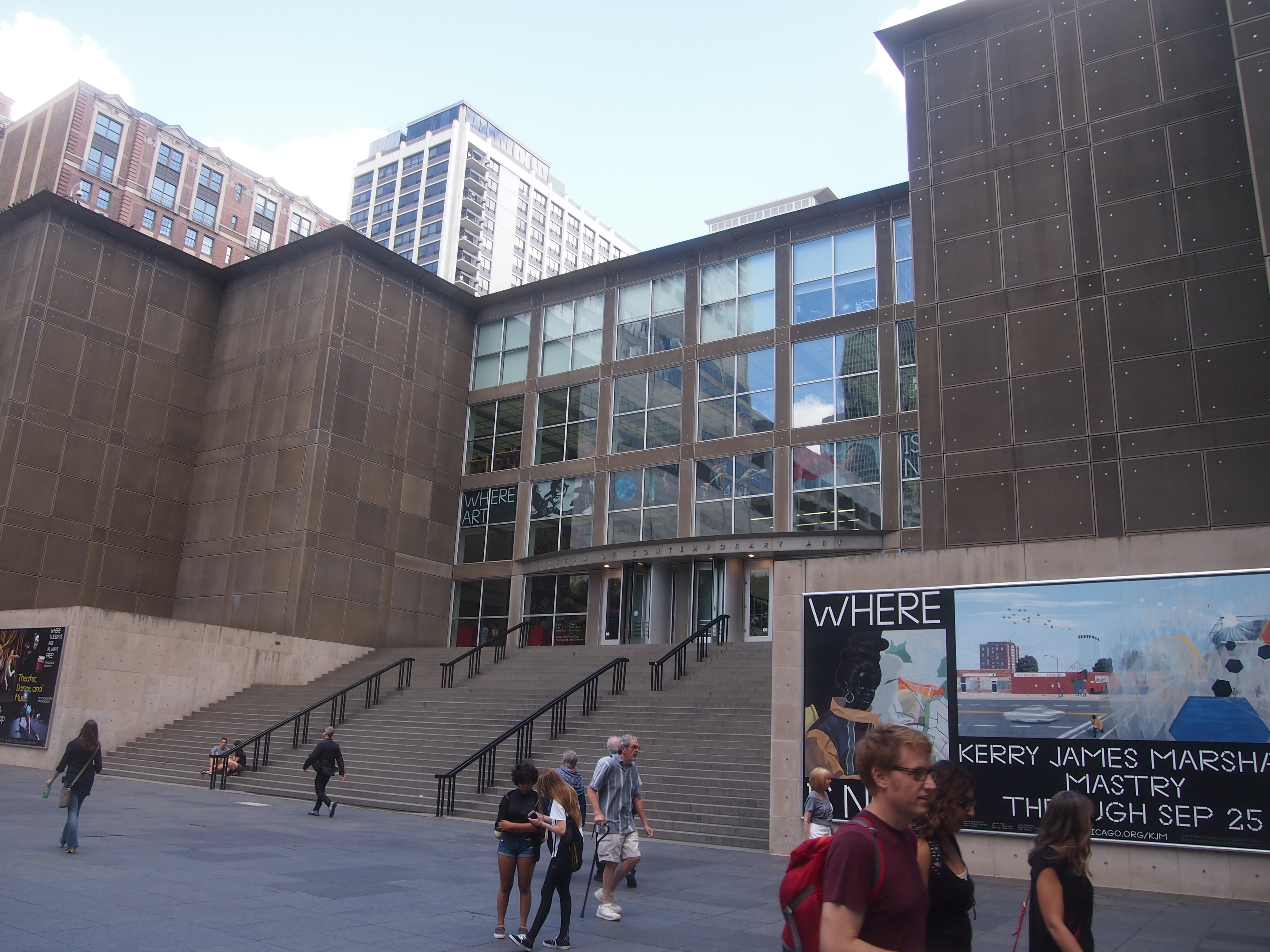
Museum of Contemporary Art. ChicagoI don’t dislike it, exactly, but it doesn’t say art museum to me. Change the signage just a little and you’ve got a police headquarters, a telecom company, or a top-drawer server farm. Then again, art museums don’t have to look like the Art Institute either. MCA is what it is on the outside, and an interesting museum on the inside.

The inside is more welcoming. One example: MCA has some of the more comfy chairs — small sofas enclosed by spacious cubical-like structures — of any museum I’ve been to. Toward the end of our visit, if we’d stayed too long in one of these after so much time on foot, we might have fallen asleep.
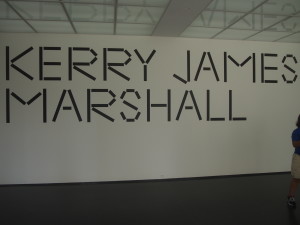
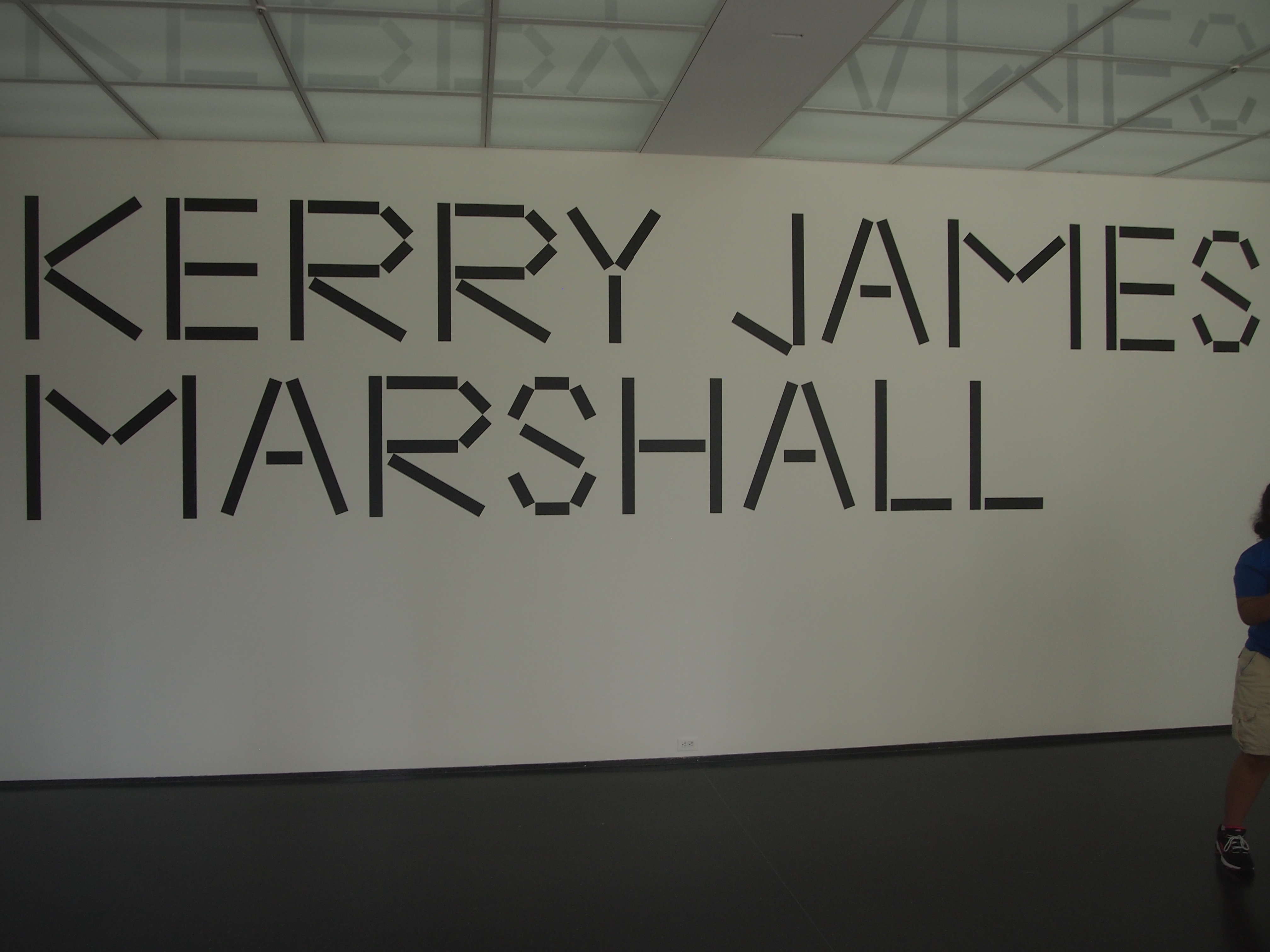
Museum of Contemporary Art ChicagoCurrently the big MCA exhibit is of Kerry James Marshall, an artist I was wholly unfamiliar with, in a show called “Mastry.” That just shows how little I pay attention to contemporary art. He’s a living artist, only a few years older than I am, and a resident of Chicago’s Bronzeville neighborhood. A remarkable body of his work is on display.

Of Marshall, Sam Worley wrote in the April edition of Chicago magazine this year, just before the MCA show opened, “At 25, he decided to return to the basics and paint a self-portrait—a classic portrait, almost. Its title alluded to a great literary work: ‘Portrait of the Artist as a Shadow of His Former Self.’ [1980]
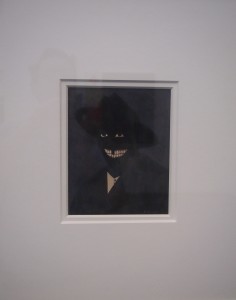
“Marshall used egg tempera, a 13th-century favorite. He adopted compositional techniques associated with artists such as Michelangelo, Leonardo da Vinci, Raphael. But, of course, his subject was black. So black that the shade of his skin is deeper than the portrait’s black background, which he fades into, as if invisible. Compared with conventional European portraiture, it’s like a photo negative….

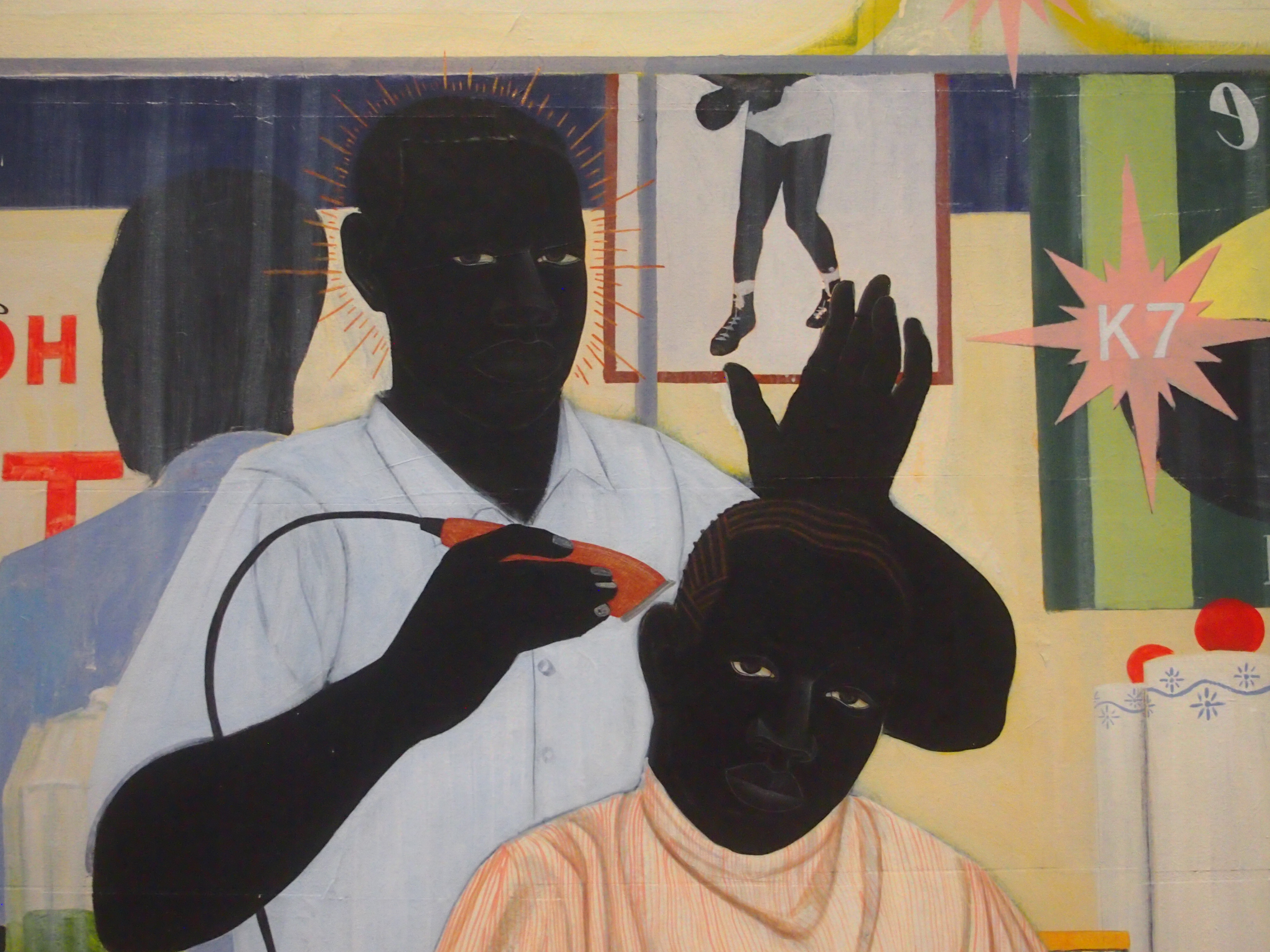
“And so Marshall settled on creating a body of work inspired by and in dialogue with the classics—his early barbershop portrait ‘De Style,’ for example, its name a sly play on the Dutch abstract art movement de Stijl—while remaining resolutely its own thing. He found success with a simple insistence on placing black people, and black history, at the center of his raucous, colorful paintings, and that has opened a space for younger artists.”

A detail from “De Style” (1993).
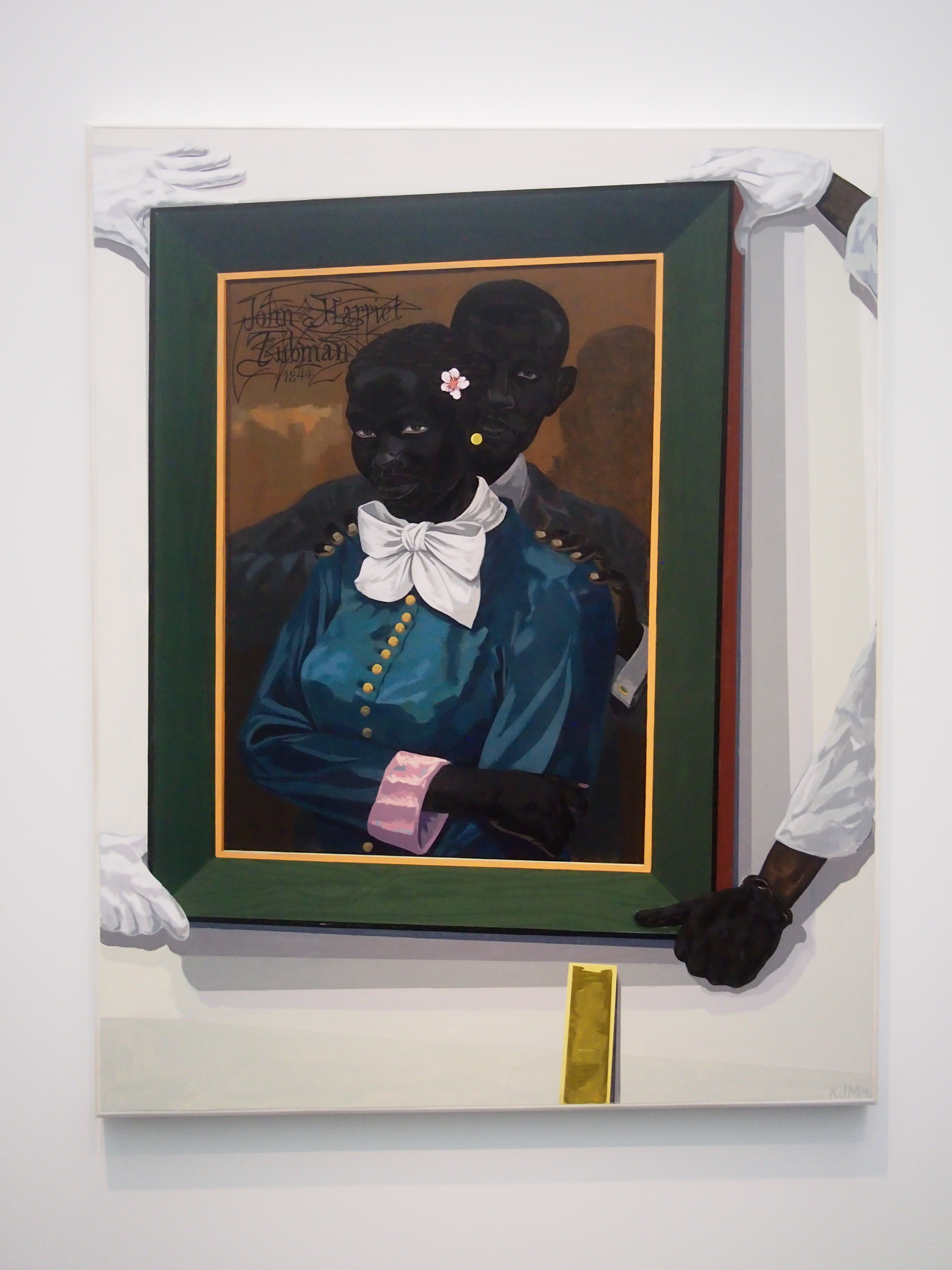
Here’s one I particularly liked, a more recent painting, “Still Life with Wedding Portrait” (2015).
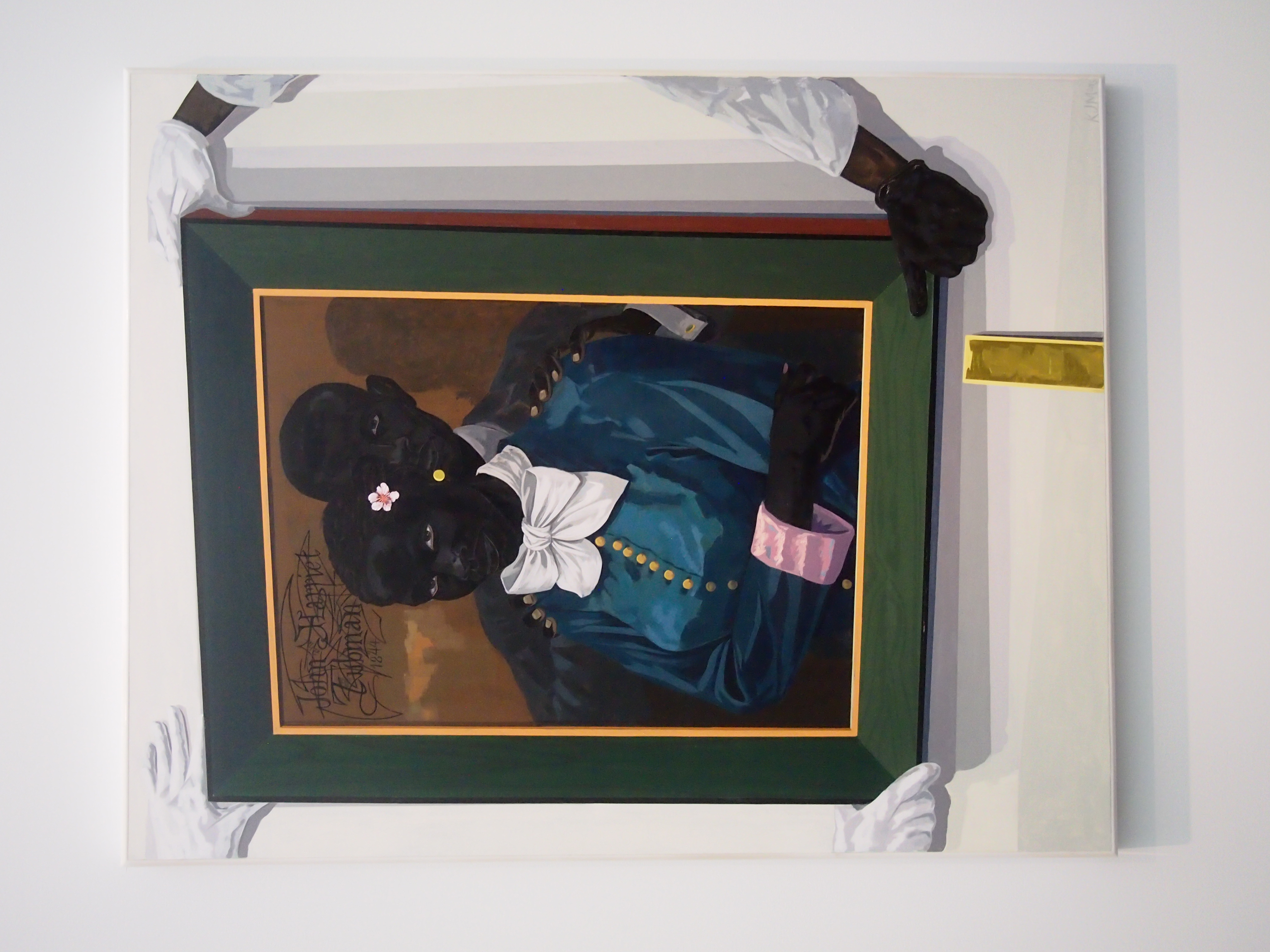
“In this painting, Marshall imagined a wedding portrait of a young Harriet Tubman… and her first husband, John… presenting her as someone’s beloved wife and not simply the stalwart resistance hero portrayed in standard histories,” the MCA notes.

As interesting as the Marshall show was, we also made time for other galleries. I always enjoy a spot of neon.
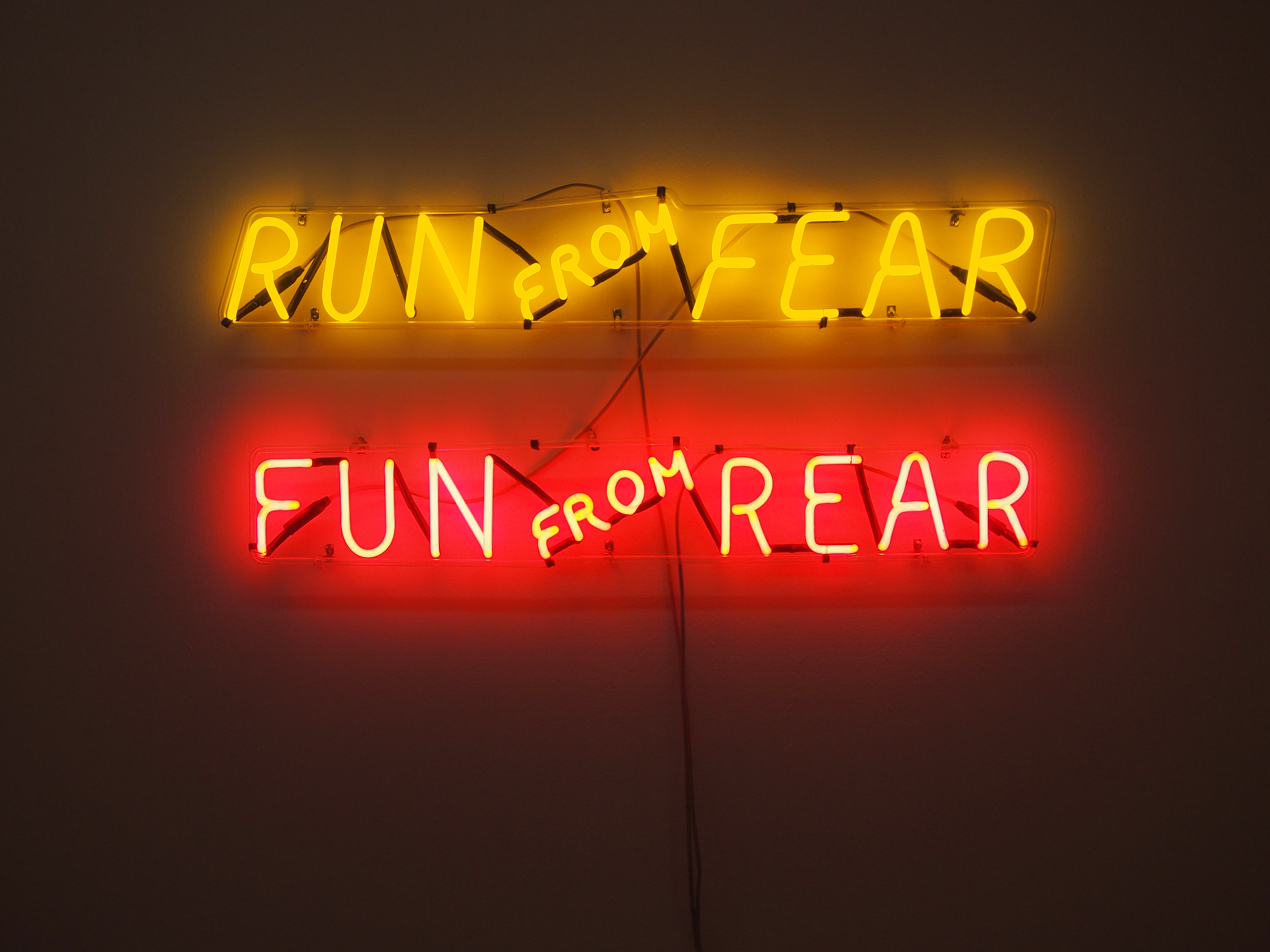
“Run From Fear, Fun From Rear” (1972) by Bruce Nauman.

Here are all the portraits of Patty Hearst you could want in one place. Twenty-six, to be exact.
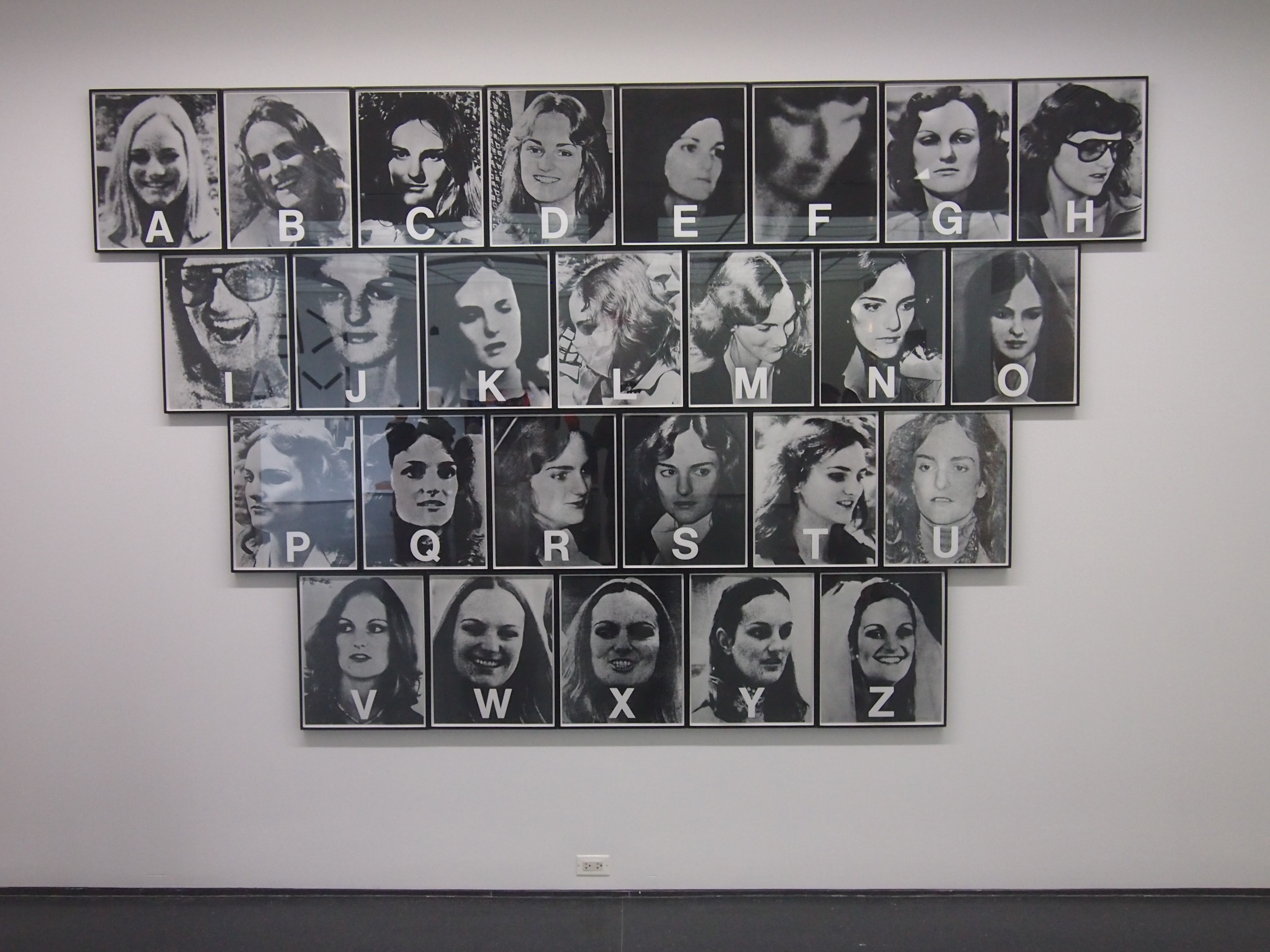
“Patricia Hearst, A thru Z” (1979) by Dennis Adams.

I liked this especially: seven tons of sand on the floor in a dark room, along with radios, LED light box, and some ambient sound.
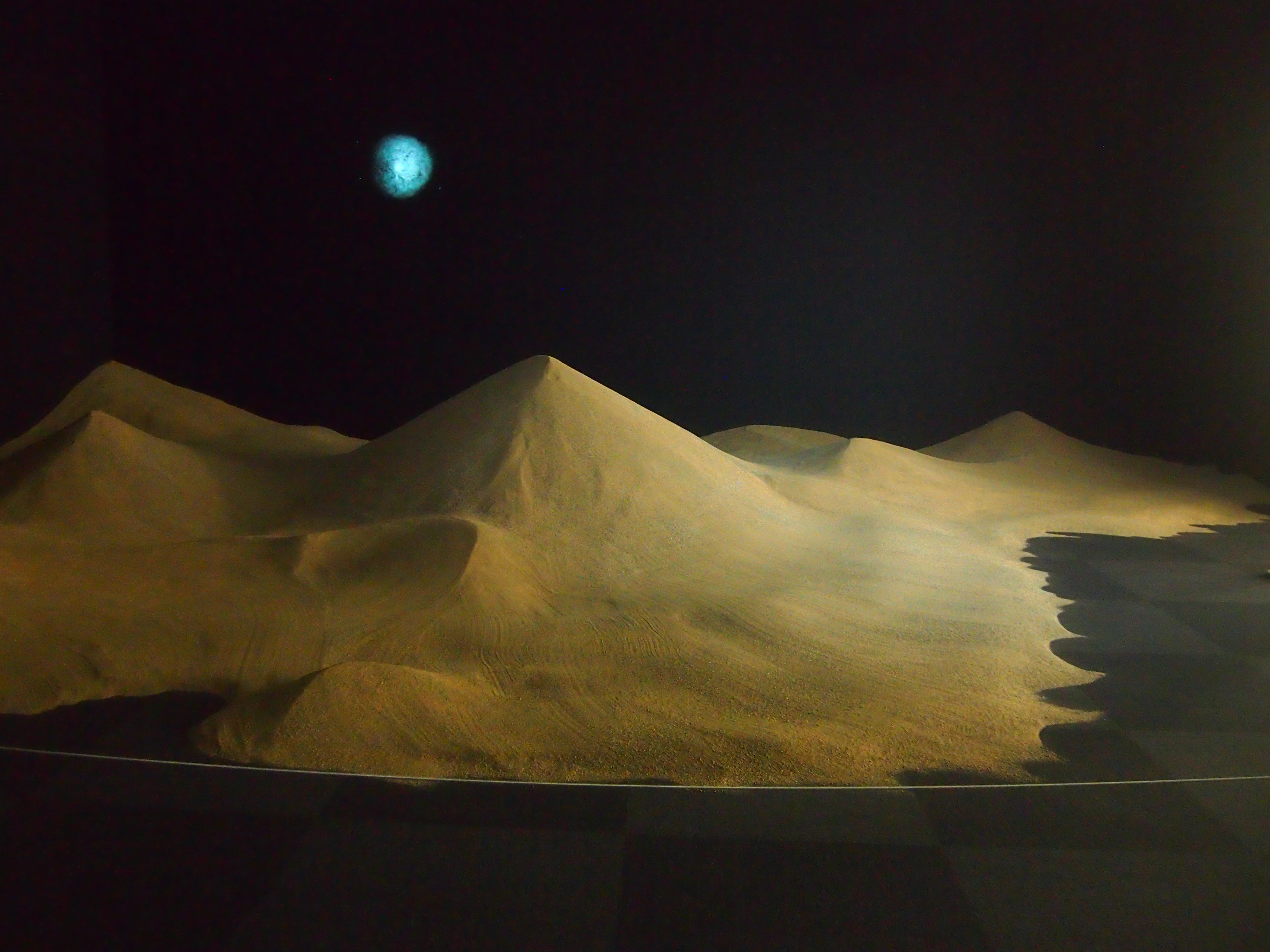
“A beach (for Carl Sagan)” (2016) by Andrew Yang.

MCA says of this: ” ‘The total of stars in the universe is larger than all the grains of sand on all the beaches of planet earth.’ So claimed Carl Sagan. In fact, astronomers estimated in 2003 that for every grain of sand on Earth’s beaches and deserts there exist ten times as many stars above. Yang takes Sagan’s pronouncement to heart in a scale model of the Milky Way in which one grain of sand represents one star; the estimated 100 billion stars are approximated by more than seven tons of sand.”

A scale model in numbers, but not size. How far would you have to scatter the sand to get that? That probably wouldn’t be too hard to figure out, but I don’t feel like it just now. I imagine it would be from here to one of the outer planets in the Solar System.

Behind the building, the museum has a sculpture garden. With only four — or was it five? — works. Quantity isn’t everything, but I think there should be more. Here’s “Graz Grosse Geister,” by German artist Thomas Schütte.
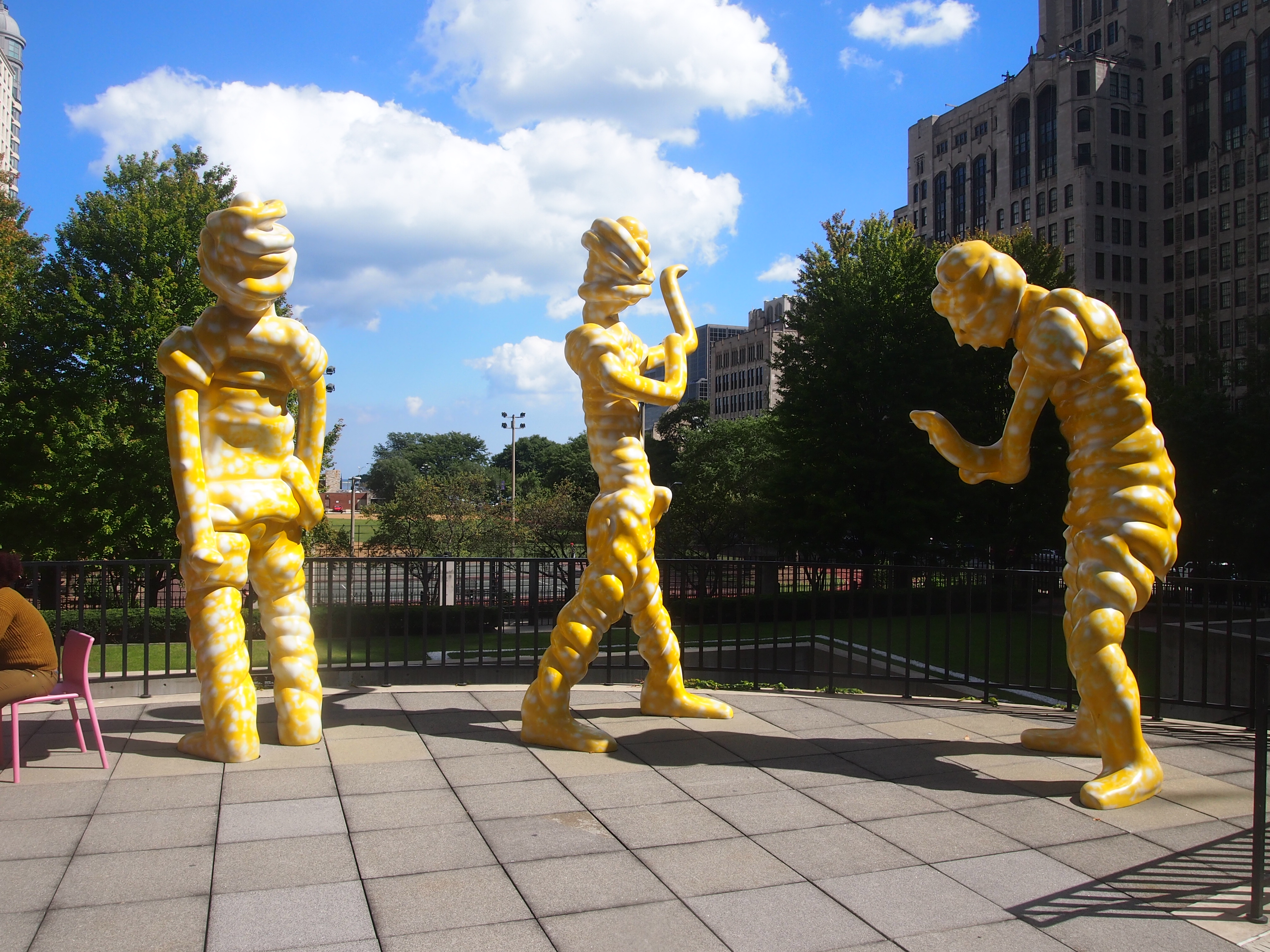
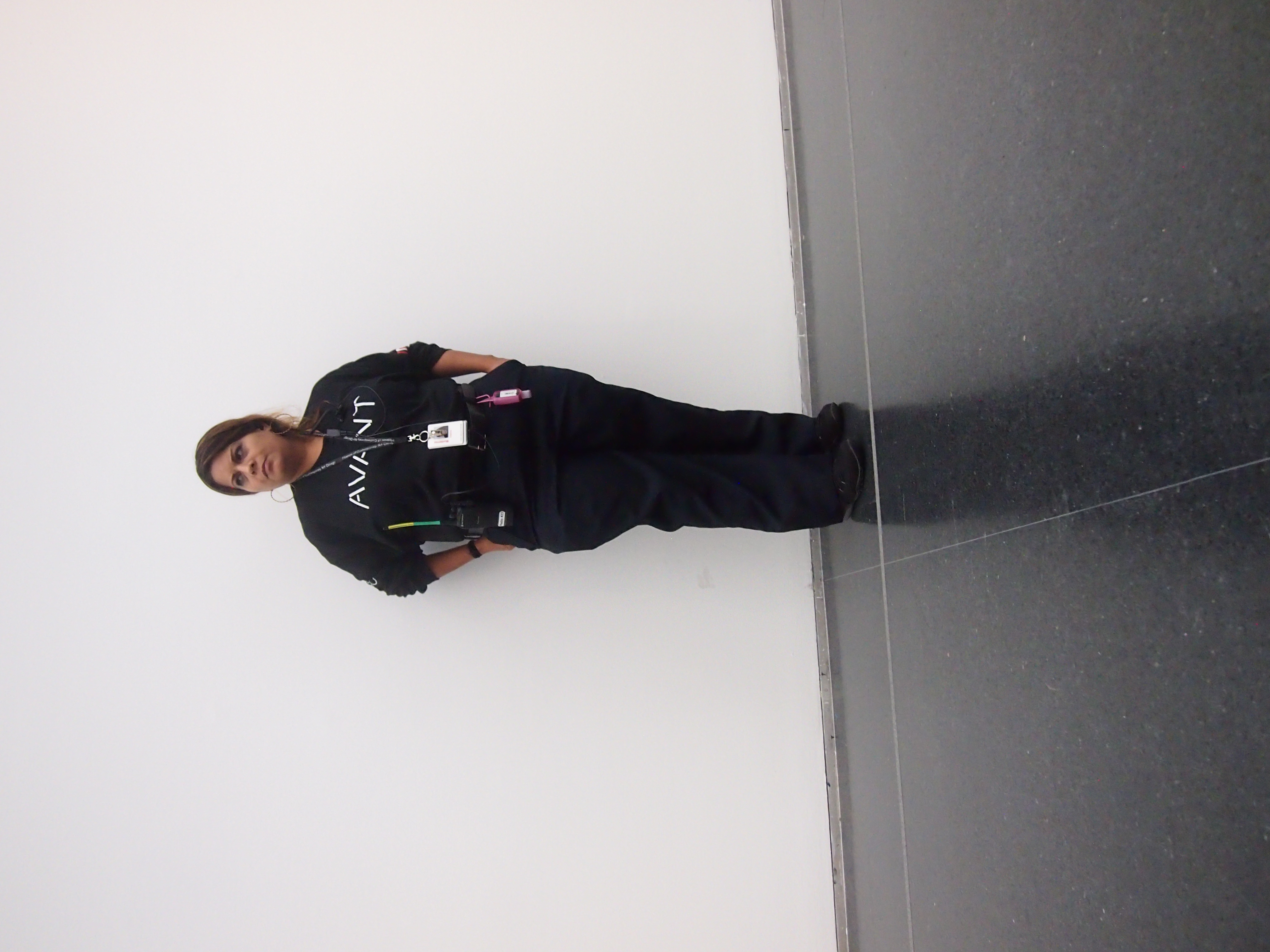
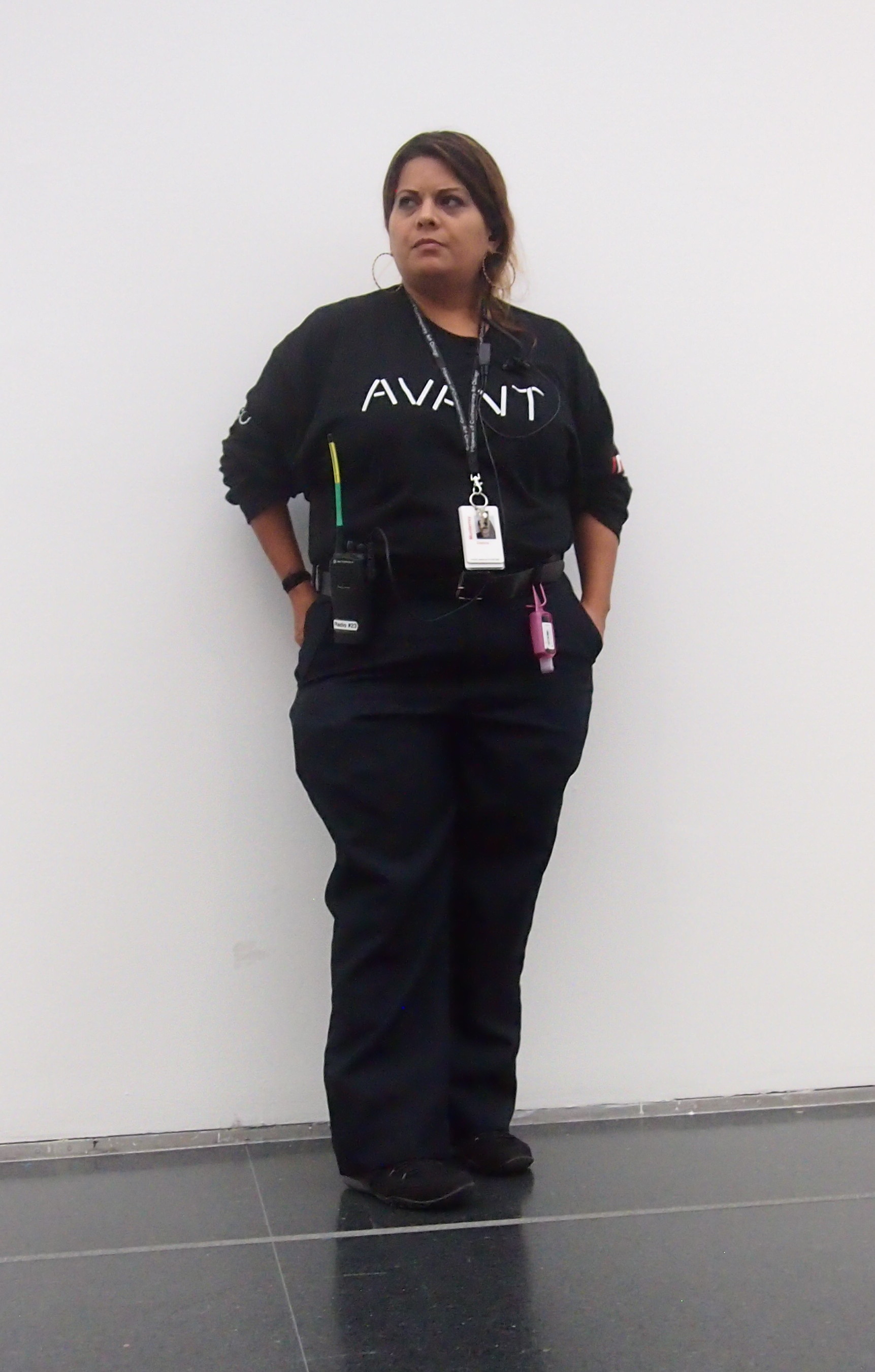
Museum of Contemporary Art, ChicagoAt some point during the visit I noticed that the museum guards weren’t just wearing black shirts with GUARD written on the back.
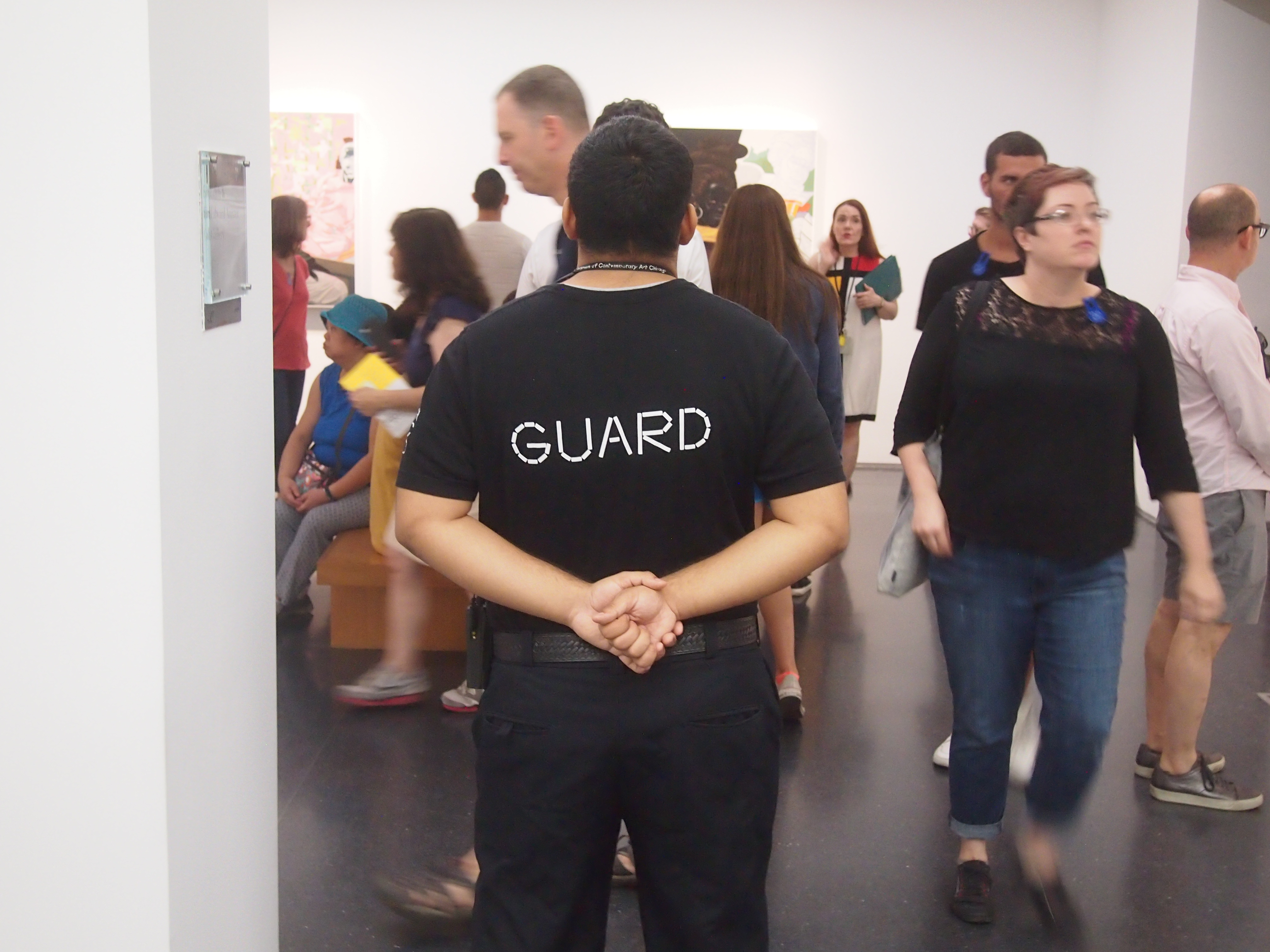
Museum of Contemporary Art, ChicagoAVANT was on the front.

Just a little art joke, no extra charge.
The Fourth Presbyterian Church of Chicago

Saturday was the annual Churches by Bus tour organized by the Chicago Architectural Foundation, which we were on last year and the year before. Not this year. We’ve been to two of the five churches listed on the tour. The tour isn’t precisely cheap, so I wanted a little more novelty. Four out of five, maybe.

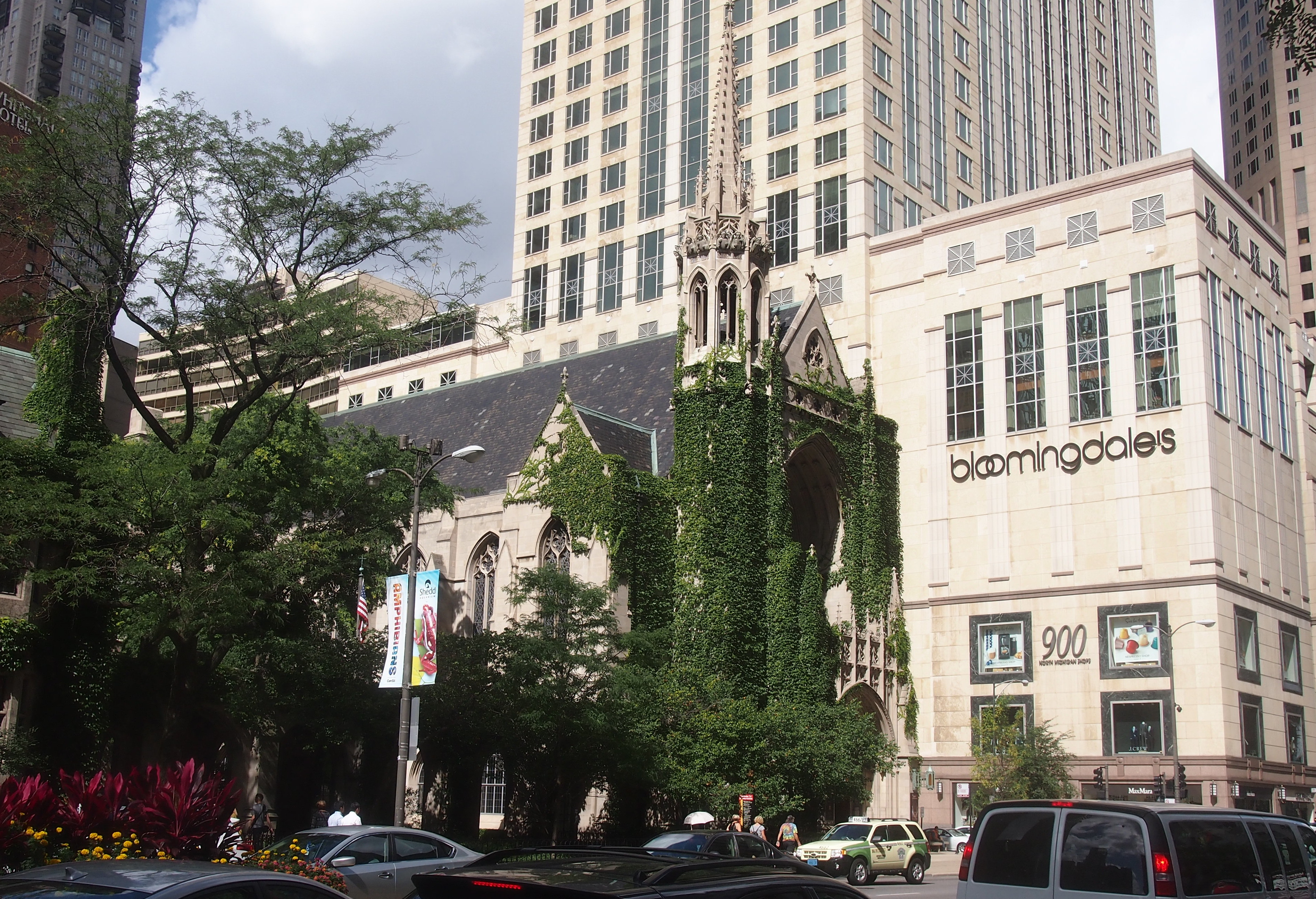
So we planned to look at four churches around Michigan Ave. while in the neighborhood. Nothing new — almost nothing new — but no charge either. As it turned out, only two of the four were open, and a third had a service in progress; not the time to wander around looking at it. The open one that wasn’t busy was Fourth Presbyterian Church of Chicago on Michigan Ave., a fine Gothic structure in the heart of the shopping district.
Fourth Presbyterian Church Chicago

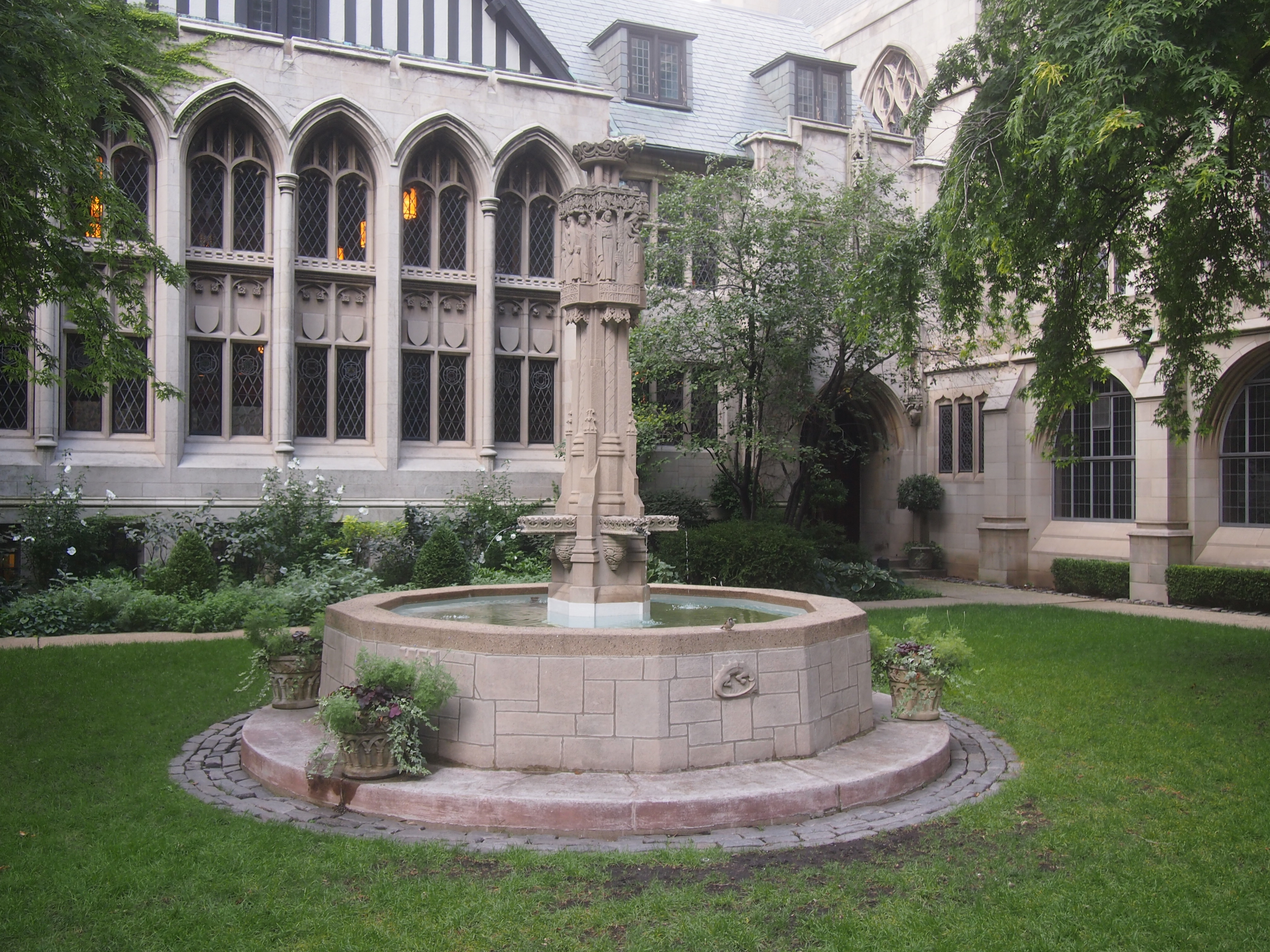
Nice courtyard to the south of the main building, too.

Fourth Presbyterian Church Chicago

When the church was finished in 1914, however, that part of Michigan Ave., still called Pine St., was no great shakes. Cheap land, in other words. All of the action on Michigan Ave. was still south of the Chicago River. That changed with the completion of the Michigan Avenue Bridge over the river in 1920, and Fourth Pres has watched temples of mammon grow up around it since then.

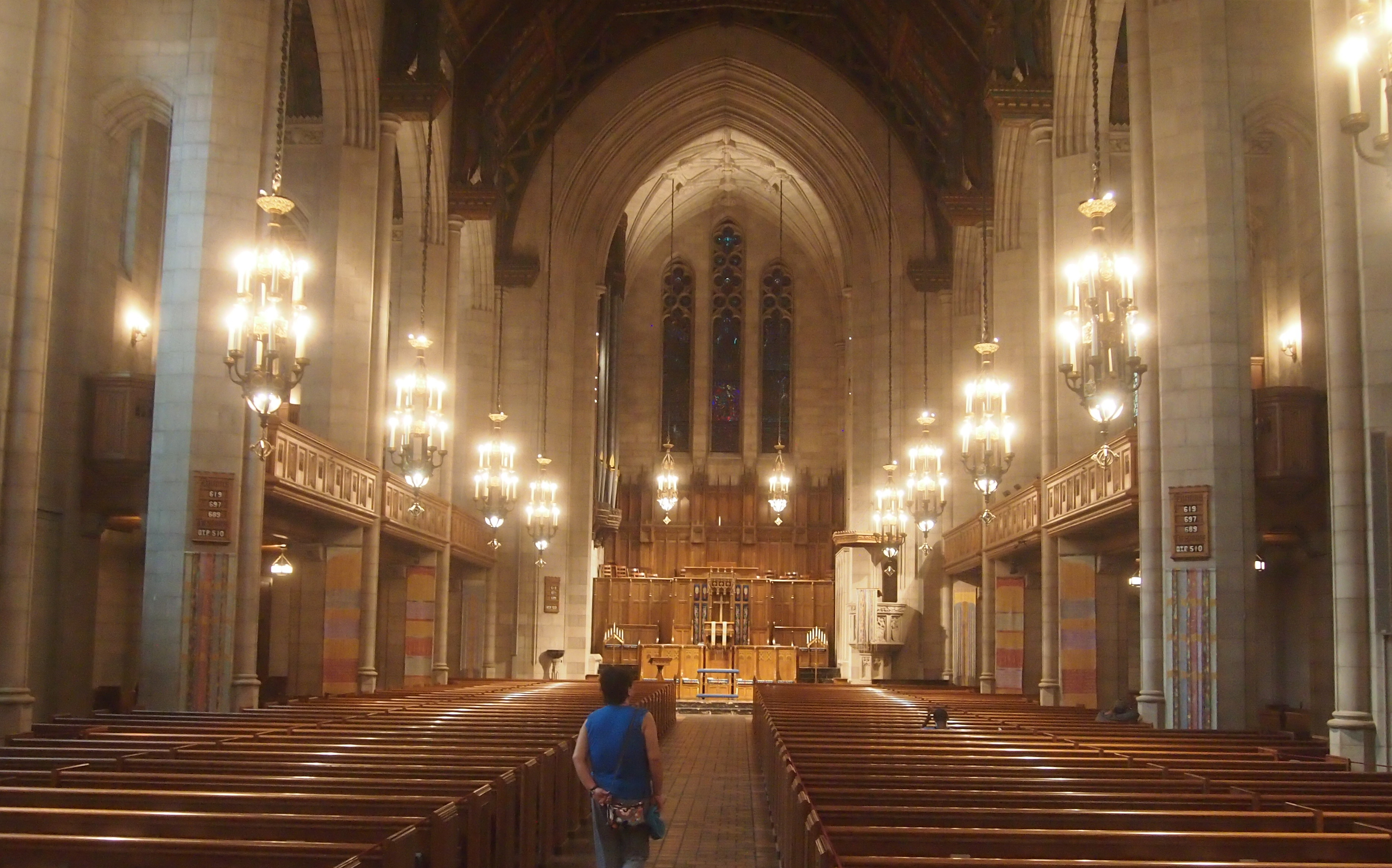
A fine interior. Been inside a number of times over the years. The ceiling’s a little dark, but lights up there would be expensive not only in electricity usage, but maintenance, I figure.

Ralph Adams Cram (1863-1942), an architect who did a lot of ecclesiastical work, designed the church. He’s also known for the Cathedral Church of St. John the Divine in Manhattan.

Adjacent to the church is a much newer structure, the Gratz Center, which was completed only in 2013 to house a preschool program, the Buchanan Chapel, a new dining room and kitchen, offices, and rooms. We took a look at the second-story Buchanan Chapel, which is mostly spare, but well lit with natural light, and with a labyrinth on its floor. The chapel’s architect was Brian Vitale, in Gensler’s Chicago office.

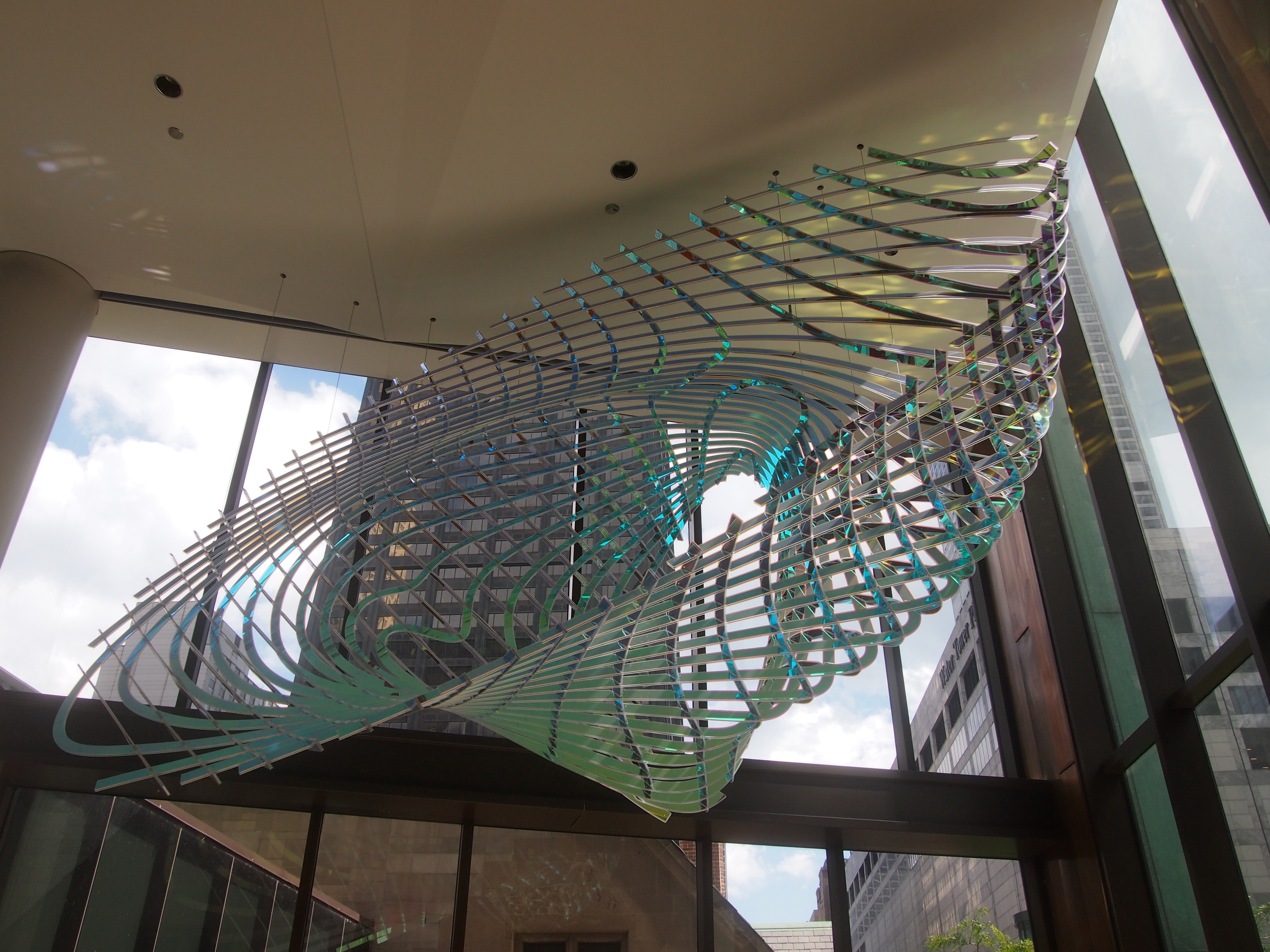
Up in the corner of the chapel hangs “Quaternion,” a 2014 piece by Alyson Shotz, a Brooklyn artist.

"Quaternion," a 2014 piece by Alyson Shotz, Interesting. Often, that’s all I ask from bits of the world.

Michigan Avenue on a September Saturday Afternoon

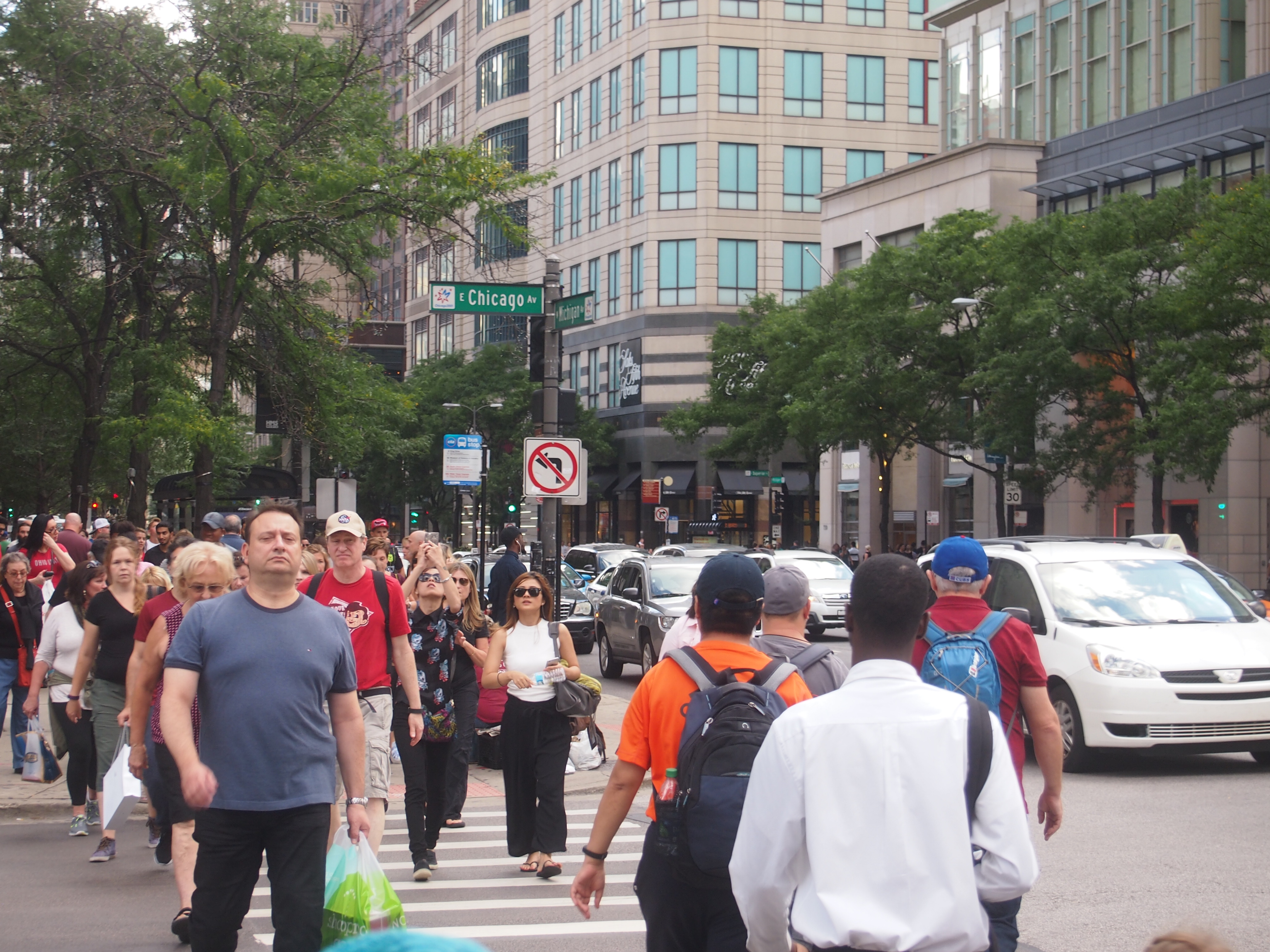
We went downtown again on Saturday, more specifically to Michigan Avenue and within a few blocks to the east and west of that famed street. A famed street, and crowded on a Saturday during the time of year when it’s still warm.
Michigan Avenue Sept 2016The sidewalk wasn’t always that crowded. But sometimes it was, suddenly.

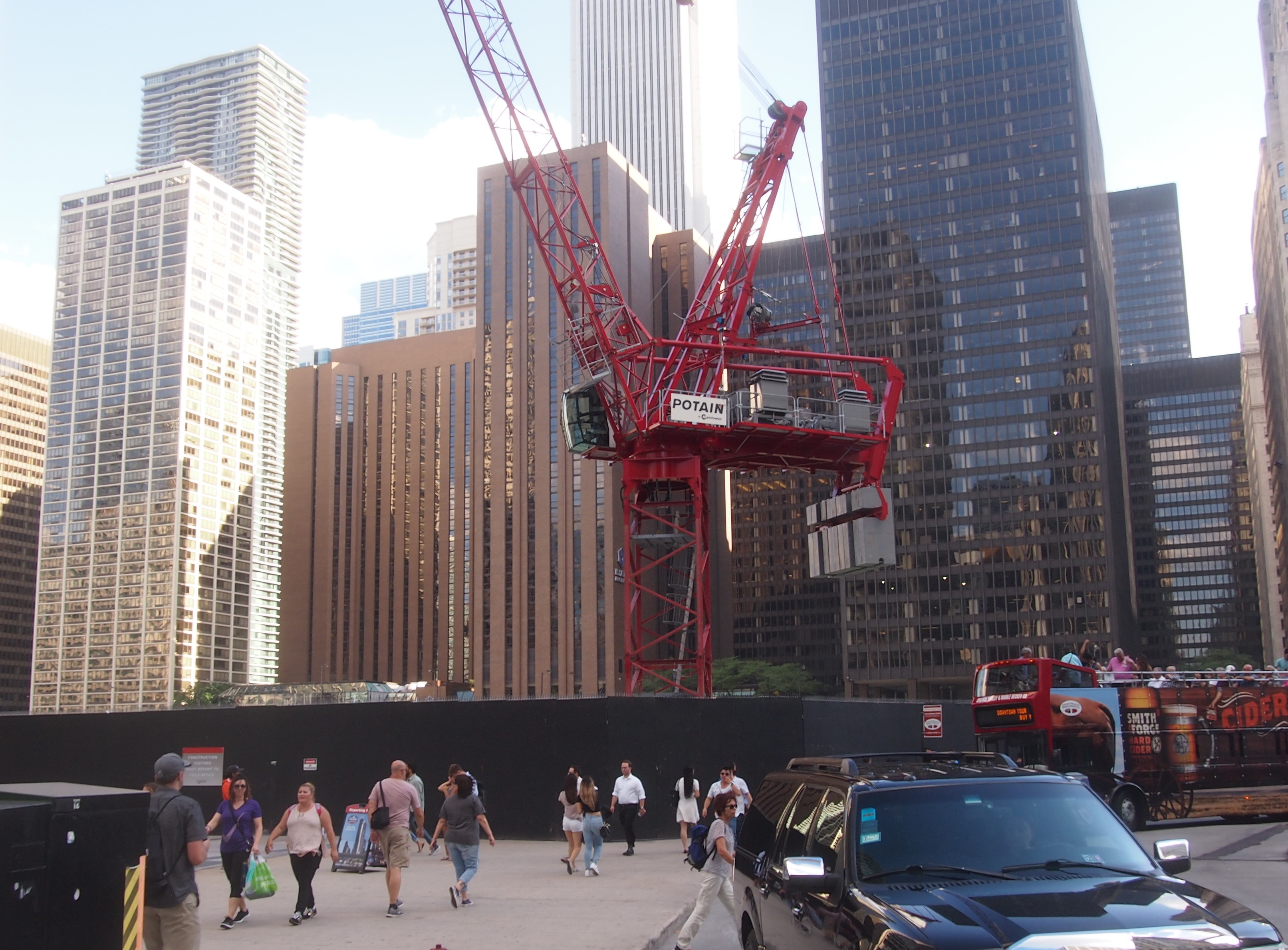
At the spot officially called Pioneer Court — I don’t know anyone who actually calls it that — in front of the Equitable Building and just south of the Tribune Tower, the new Michigan Avenue Apple Store is under construction, to take the place of the store further to the north on the avenue. They say it’ll be a humdinger when it’s done.
Pioneer Court, Chicago, Apple under construction 2016Wonder whether the bronze Jack Brickhouse will be in Pioneer Court near the Tribune Tower for much longer.
Jack Brickhouse statue, Pioneer Court, Chicago, 2016After all, the Tribune hasn’t owned the Cubs in a while, and the Tribune isn’t even going to own the Tribune Tower much longer (the company got $240 million for it). Then there’s the matter of Brickhouse being dead for nearly two decades. That’s a long time not to be on the radio. Time flies, people forget, your statue ends up in a less prominent location. Just speculation.

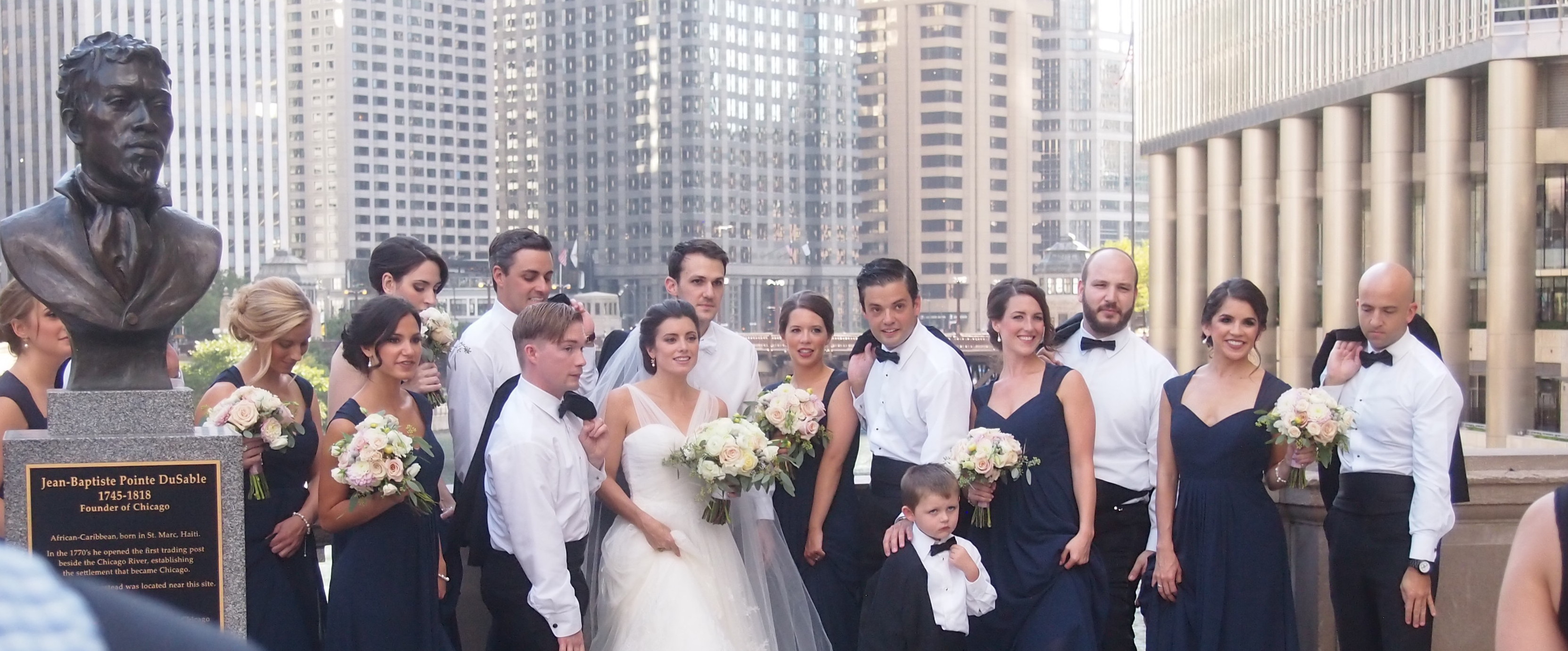
The plaza across the street from Pioneer Court, in the shadow of the Wrigley Building, was just the place on Saturday for some wedding photography. At least this party thought so, and they could do a lot worse.
The bust in the corner is of Jean-Baptiste Pointe DeSable, the fellow from Haiti — I suppose that would be from Saint-Domingue — who founded a trading post on the Chicago River near this site in the 1770s, making him the first non-Indian Chicagoan. I think that bust used to be where the Apple store is being built.

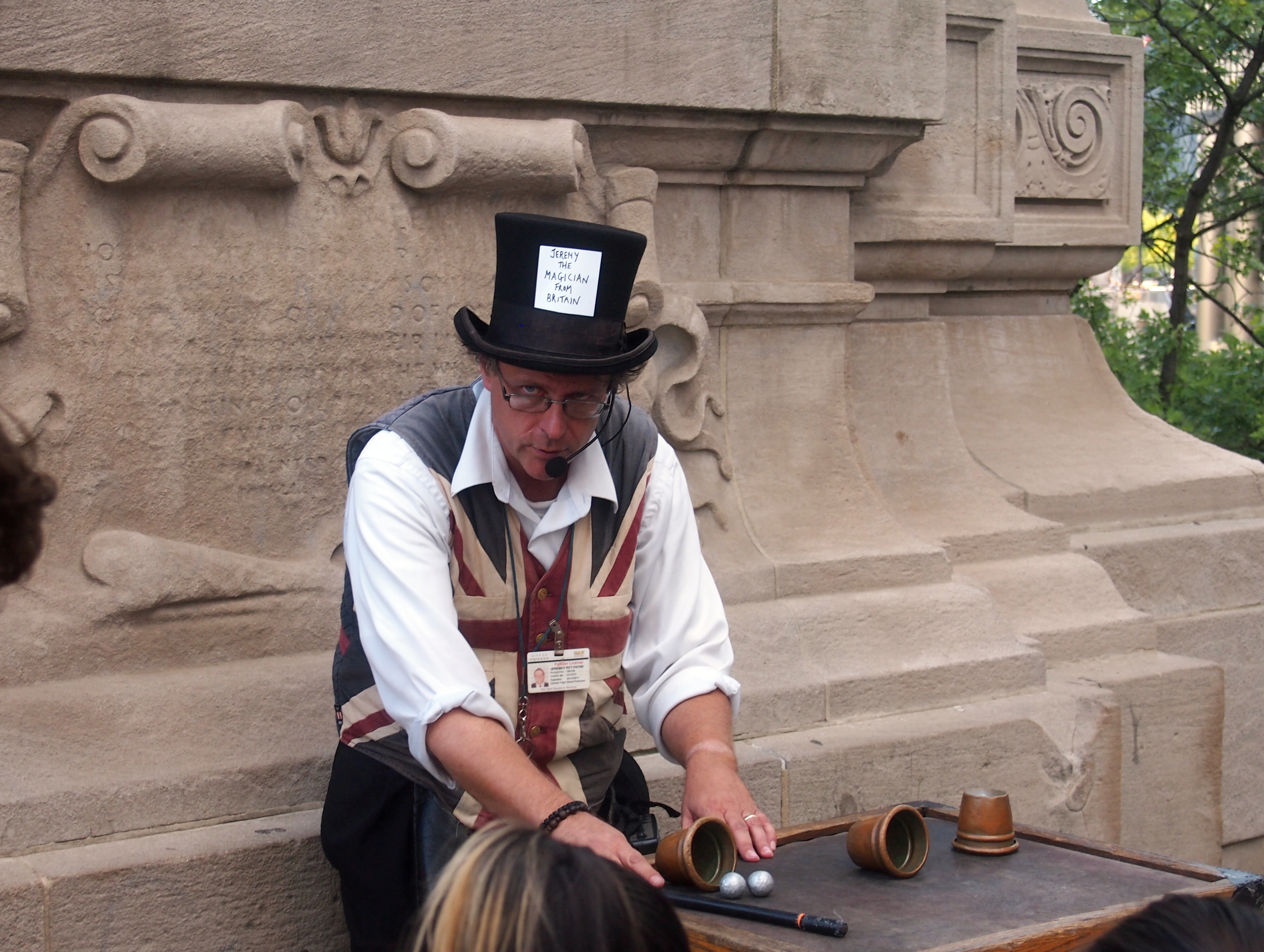
Not far away, just at that moment, was Jeremy the Magician from Britain. That’s what his hat said, anyway, and he had the accent for it, and a Union Jack vest, in case you didn’t get the point.
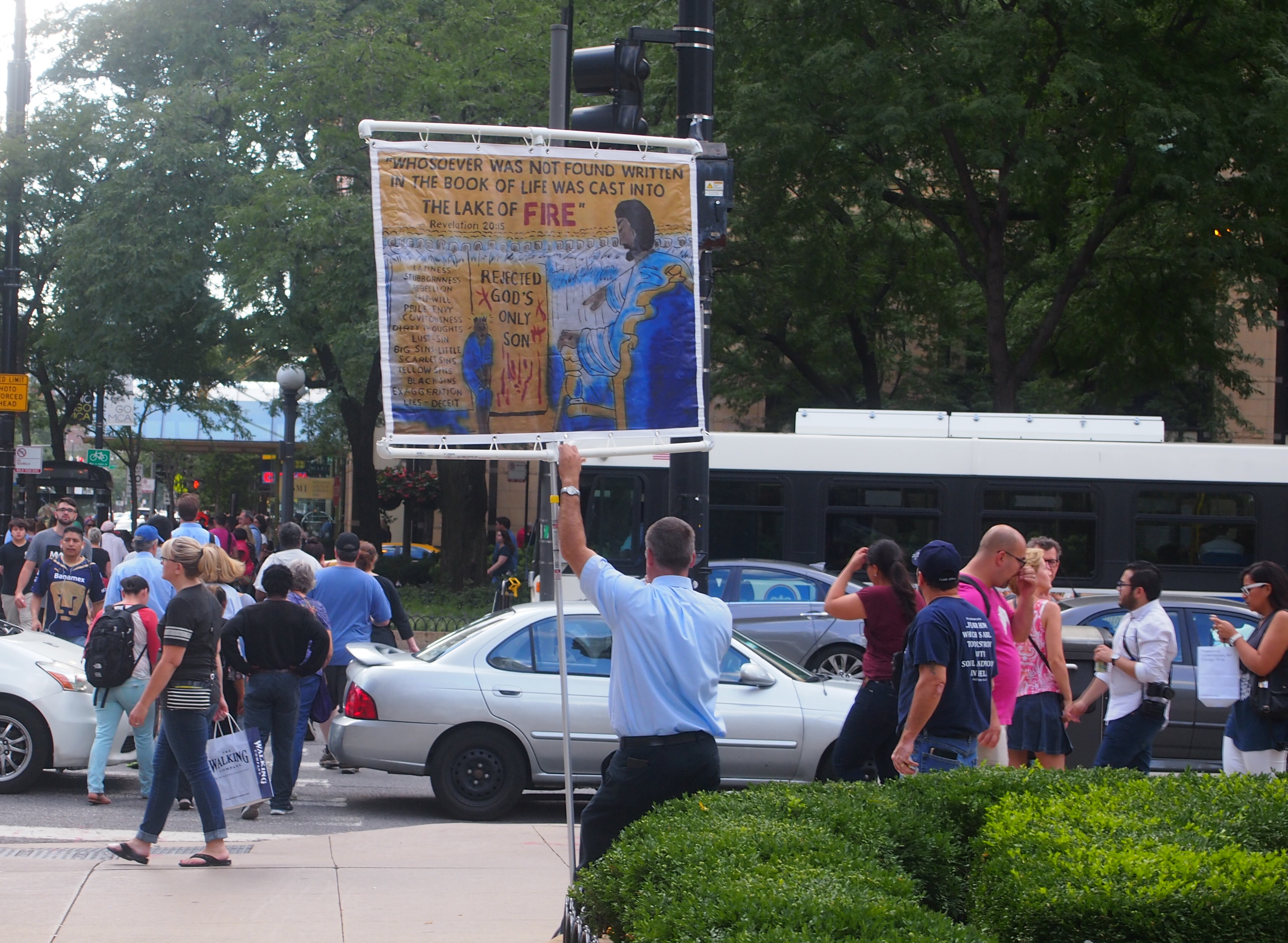
Michigan Avenue Magician Sept 2016Further north, in fact not far from the Chicago Water Tower (can I call it iconic? Too bad that word’s been beaten to death), this fellow had a different sort of message.Street preacher, Michigan Avenue, 2016

Namely, you’re going to Hell.

(Capitalize “Hell.” English Language & Usage Stack Exchange says: “No less an authority than Fulton Sheen had the galleys for his latest book come back from the typesetters with ‘Heaven’ and ‘Hell’ knocked down to lowercase. He carefully re-capitalized each occurrence. When his editor called to request an explanation, he gave what I think we can regard as the definitive answer to [the] question: Because they’re places. You know, like Scarsdale.)

Royal Oak Orchard, 2004 (and ’05)

About 12 years ago, I wrote, “I will, however, write about a place that needed less detailed notes: the Royal Oak Orchard, near Harvard, Illinois, where I took the whole family a week ago Saturday. It’s a U-Pick-Em orchard, the sort of place that one never thinks to go without small children…. Besides the rows of apple trees open to all pickers, there was a fruit shop, restaurant, souvenir shop, shack shop, playground, petting zoo, rings for campfires, a hayride, and a teepee inscribed with Bible verses.”

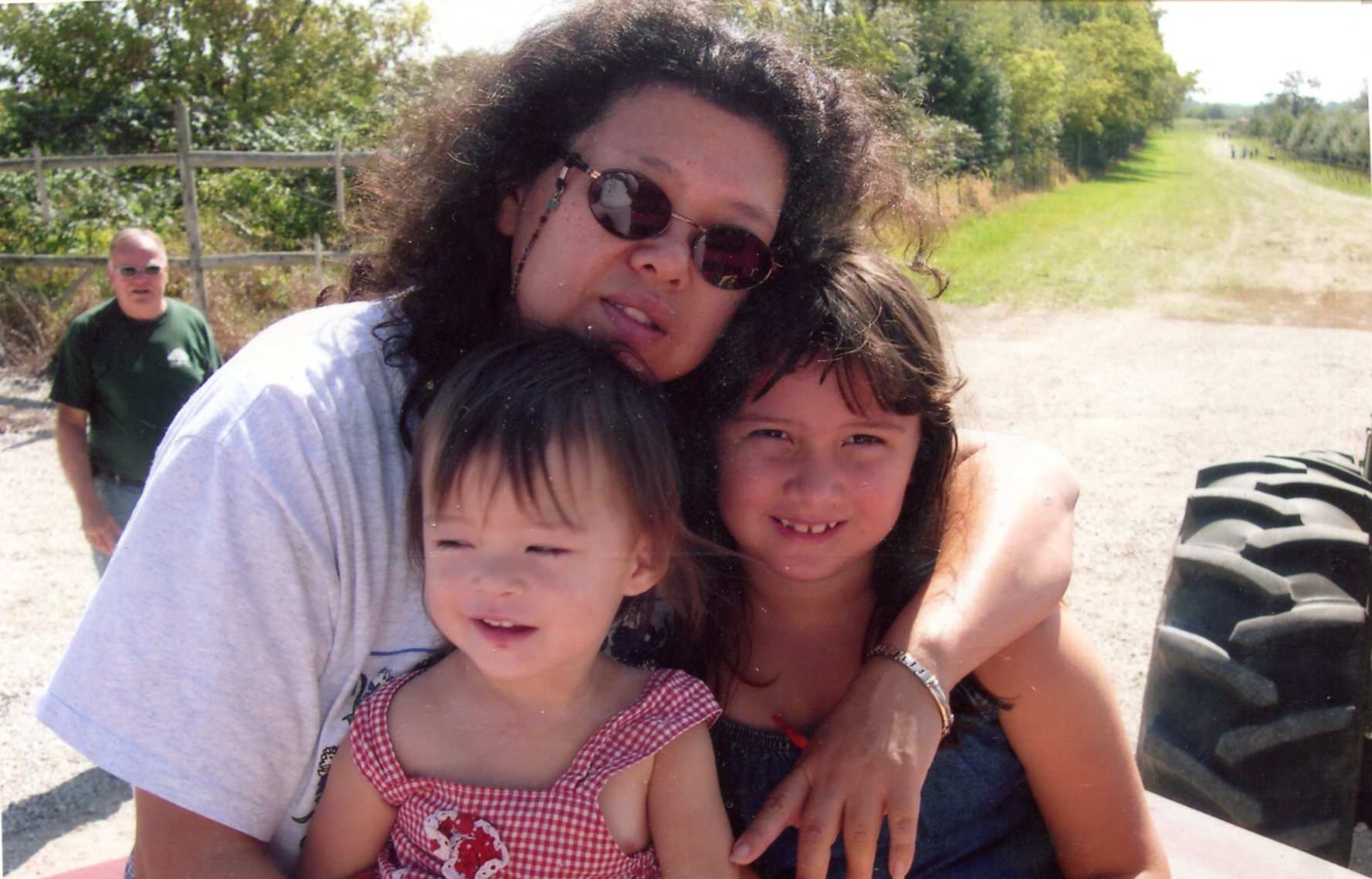
I took a favorite As-We-Were picture at the orchard that day, September 18, 2004.
orchard1Don’t know who the fellow in the green shirt was. Just standing around, probably. It makes me wonder how many images, scattered around in all sorts of places, I’ve accidentally gotten myself into.

To continue: “It was a fine day for picking, sunny and warm, and we had a pleasant drive into the exurbs. The orchard is about five miles east of Harvard, a town hard against the Illinois-Wisconsin line. I’d estimated that it would take an hour to get there; Yuriko thought it would be two hours; it worked out to be an hour and a half, true to the spirit of compromise in a marriage.”

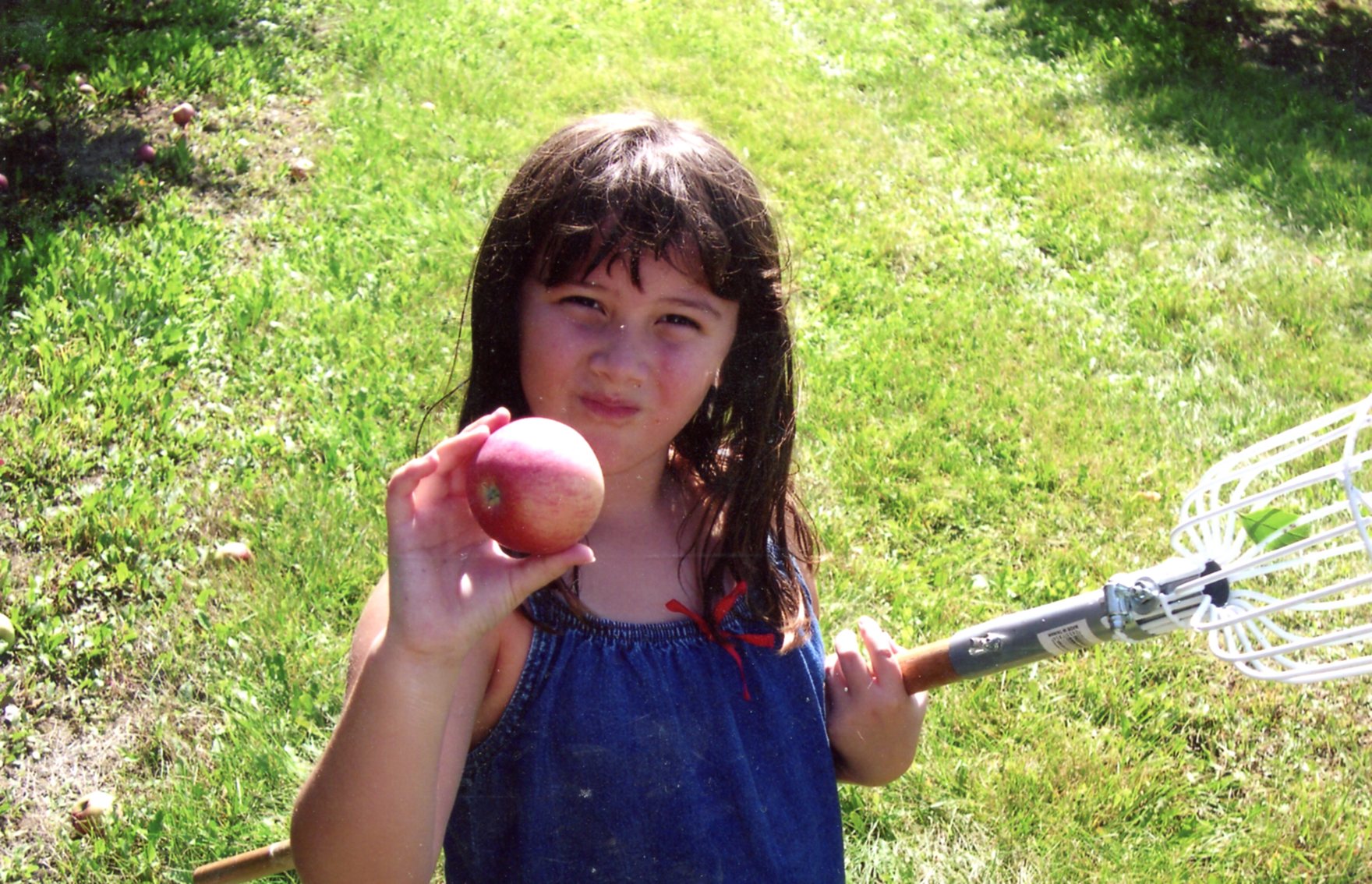
Lilly was into the spirit of apple-picking.
orchard2“We got down to the business of picking apples, yellow ones and red ones and colors in between, with variety names that I don’t recall (guess I could use some notes). Regardless of their names, they were all tasty apples. Many of them were low enough for Lilly to reach, and even Ann sampled a number of different ones, though actual picking was a little beyond her.”

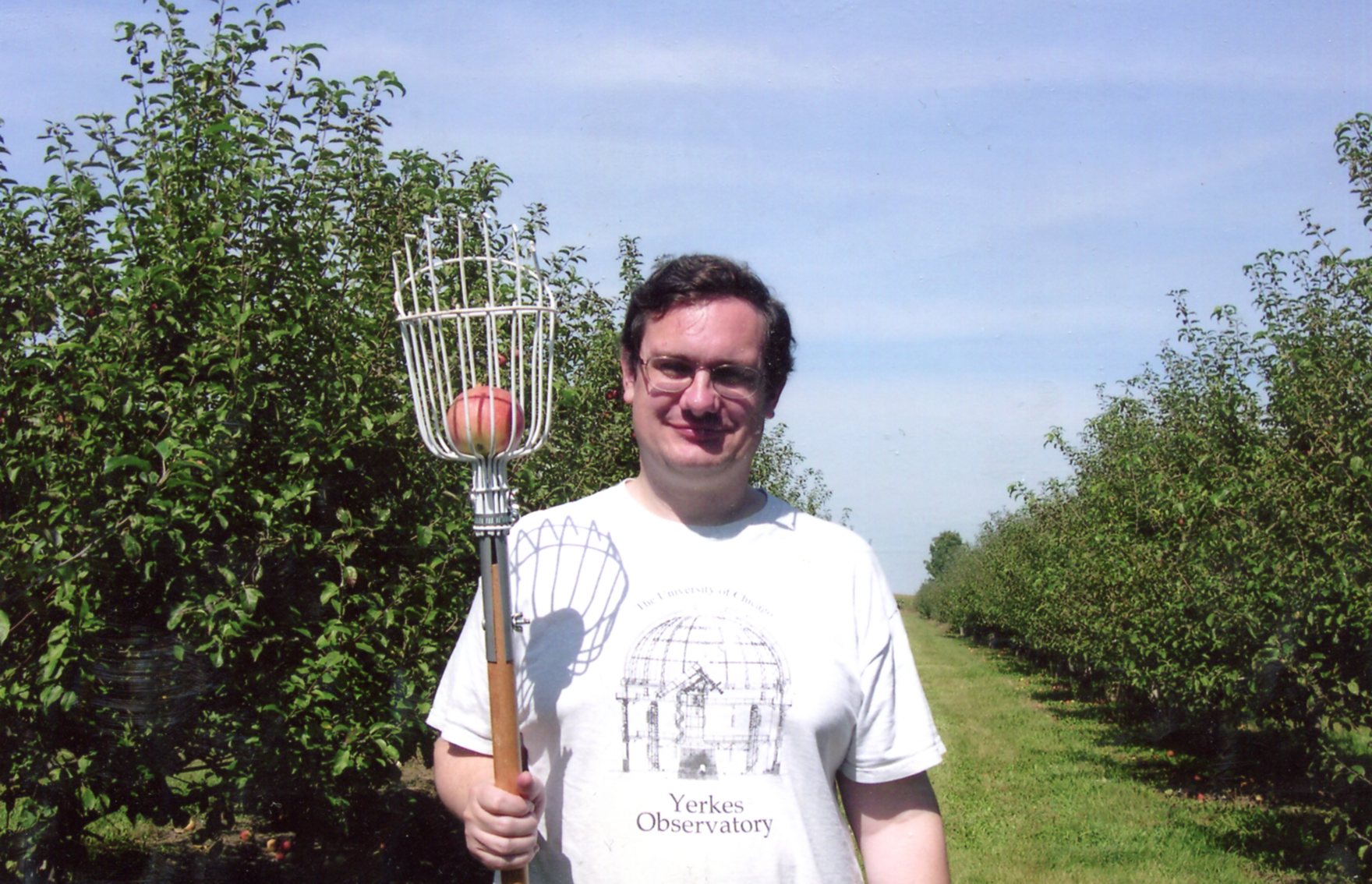
I had a fine time myself.

orchard3We’d picked apples the year before at a place I don’t remember so well, and the next year we went back to Royal Oak Orchard, but got rained on, and bought a bag instead of picking them.

No such problem in 2004: “Afterwards we repaired to the picnic area to eat lunch. A sign prohibited outside food, that is, picnic lunches such as the one we brought, but we ignored this. Pop Christian music played unobtrusively, but distinctly, from a speaker near the snack shop. Curious, but purveying apples and spreading the Gospel doesn’t seem mutually exclusive.”

We haven’t picked any U-Pick-Em apples since. Just one of those things you never quite get around to again, and then everyone’s lost interest.

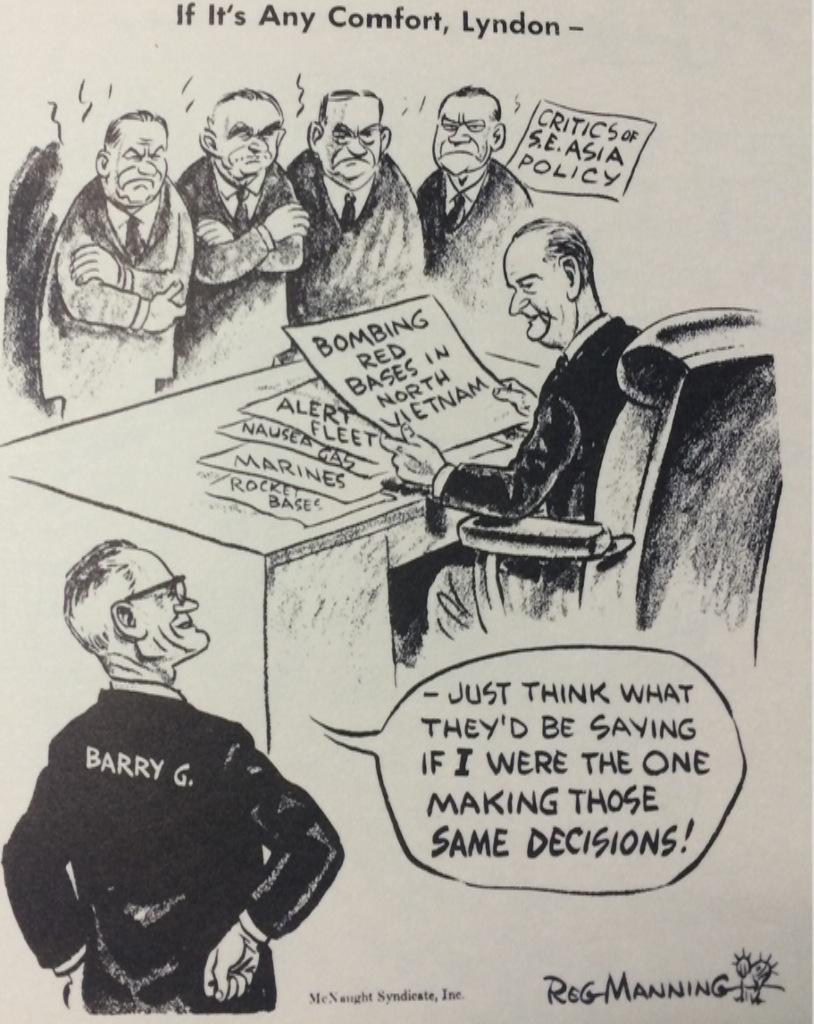
A Reg Manning Travelcard — No. 15

Lately, thanks to the Special Collections & University Archives of Wichita State University, I’ve learned that “Reginald Manning was born in Kansas City, Missouri, on April 5, 1905. He moved to Phoenix, Arizona, in 1919 and studied art in high school. Shortly after graduation, Reginald began working for the Arizona Republic, starting work on May 1, 1926. He worked there for the next 50 years.

“Manning’s job at the newspaper originally was a photographer and spot artist. Before too long, he was drawing daily editorial cartoons and a weekly full-page review of the news called ‘The Big Parade.’ He quit drawing the ‘Parade” in 1948 in order to devote more time to his editorial cartoons. In 1951, Manning won a Pulitzer for ‘Hats.’

“In addition to his lectures, Manning has published many books. Some of the books that he produced are A Cartoon Guide to Arizona (1938), What Kinda Cactus Issat? (1941), From Tee to Cup (1954), and What Is Arizona Really Like? (1968).

“Reg Manning was one of the most prominent conservative voices in cartooning and has won numerous awards for his work. Besides winning a Pulitzer Prize, he has also won the Freedom Foundation’s Abraham Lincoln award two years in succession.”

He died in 1986. Somehow I missed knowing a thing about him until recently, when I was looking through some cards I’d bought at a resale shop. Seems that he did gag postcards, too. At least 15 of them.

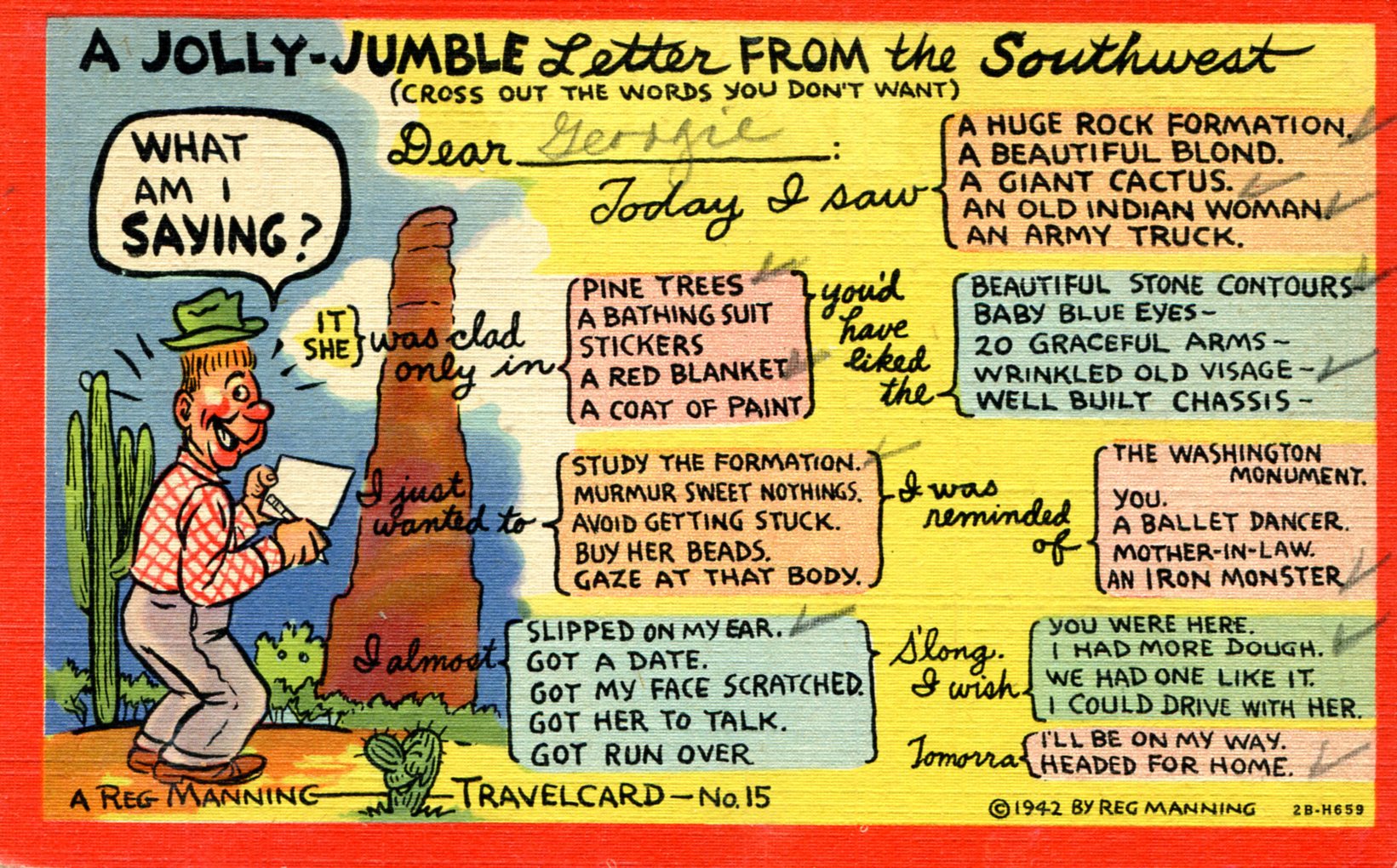
regmanningHis style seems familiar. Probably I’ve seen his work without attaching a name to it. The card I have, copyrighted 1942, was mailed from Flagstaff in March 1946, addressed to a Master Georgie, so I’ll assume it was from a relative or family friend to a child — no one signed the card.

He or she did check off some of the lines on the card, which is amusing. Guess that was the intention. Wonder whether Georgie — later George — kept the card his whole life from the age of around 10 (say) to much more recent times, when it wound up in a box of cards at a resale shop. Maybe George, lately around 80, passed on not long ago, and his heirs had no use for gag cards from the 1940s. All speculation, but sometimes that’s just the thing for a found object in your possession.

Queen Elizabeth Cake, NW Suburban Style

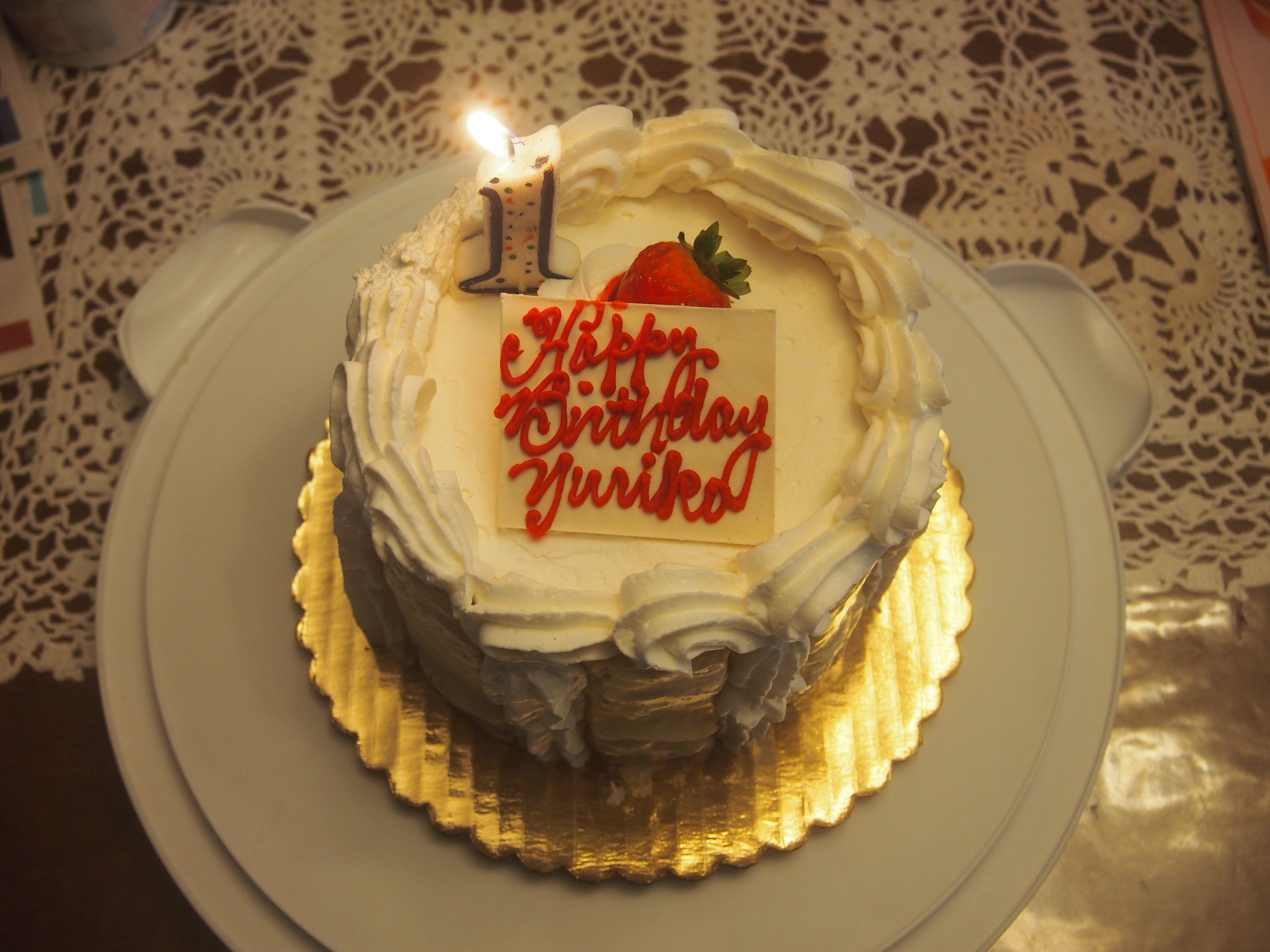
A recent birthday cake in our house.

Queen Elizabeth Cake, Deerfield BakeryOne candle because no one could be bothered to come up with some other combination. “It’s for your first half-century,” I told Yuriko.

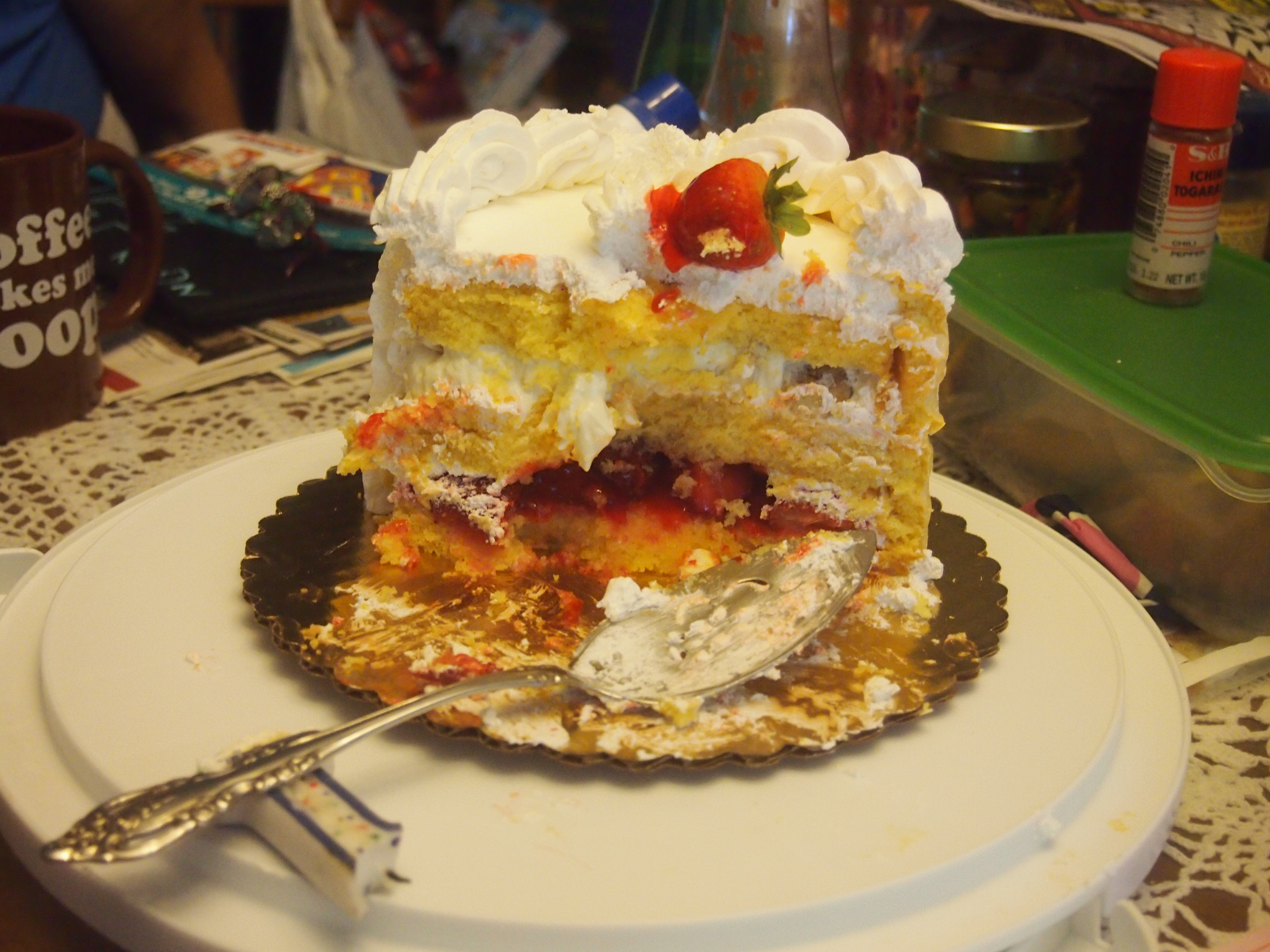
It’s called a Queen Elizabeth Cake, a creation of the always-talented Deerfield Bakery here in the northwest suburbs. The bakery’s web site tells me that it’s “yellow cake filled with strawberries, Bavarian cream and sliced bananas.” That jibes with my experience of eating some of it.

Also, “a single strawberry crowns this dessert, created by Henry Schmitt in honor of Queen Elizabeth’s visit to Chicago in 1959.” That would be part of the Queen’s tour along the spanking-new St. Lawrence Seaway that year. (A bit of major infrastructure that should be better known; I’d bet that only a small number of kids in Lilly’s dorm, just to pick one sample of people that age, know what it is.)

Henry Schmitt, coming from a line of bakers from Germany, founded Deerfield Bakery in metro Chicago in the 20th century. Apparently his QE Cake was an idiosyncratic take, since elsewhere (such as allreipes.com), I’ve read that the term refers to “a date nut cake… crowned with a broiled coconut topping.”

That sounds good too, but it isn’t anything like the Deerfield Bakery creation.

Queen Elizabeth Cake, Deerfield BakeryWhich is very, very good.

Schaumburg Town Square, Augmented

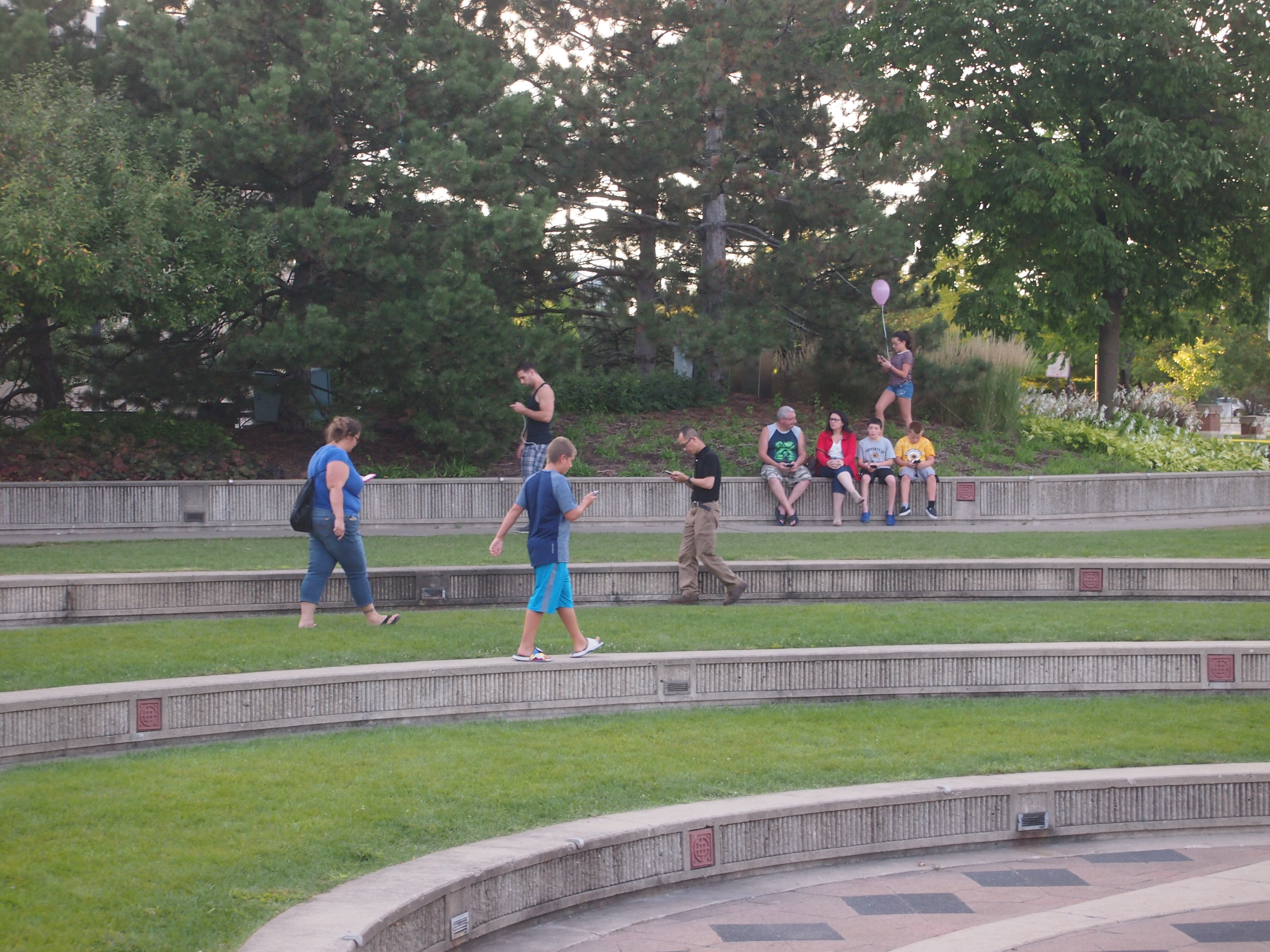
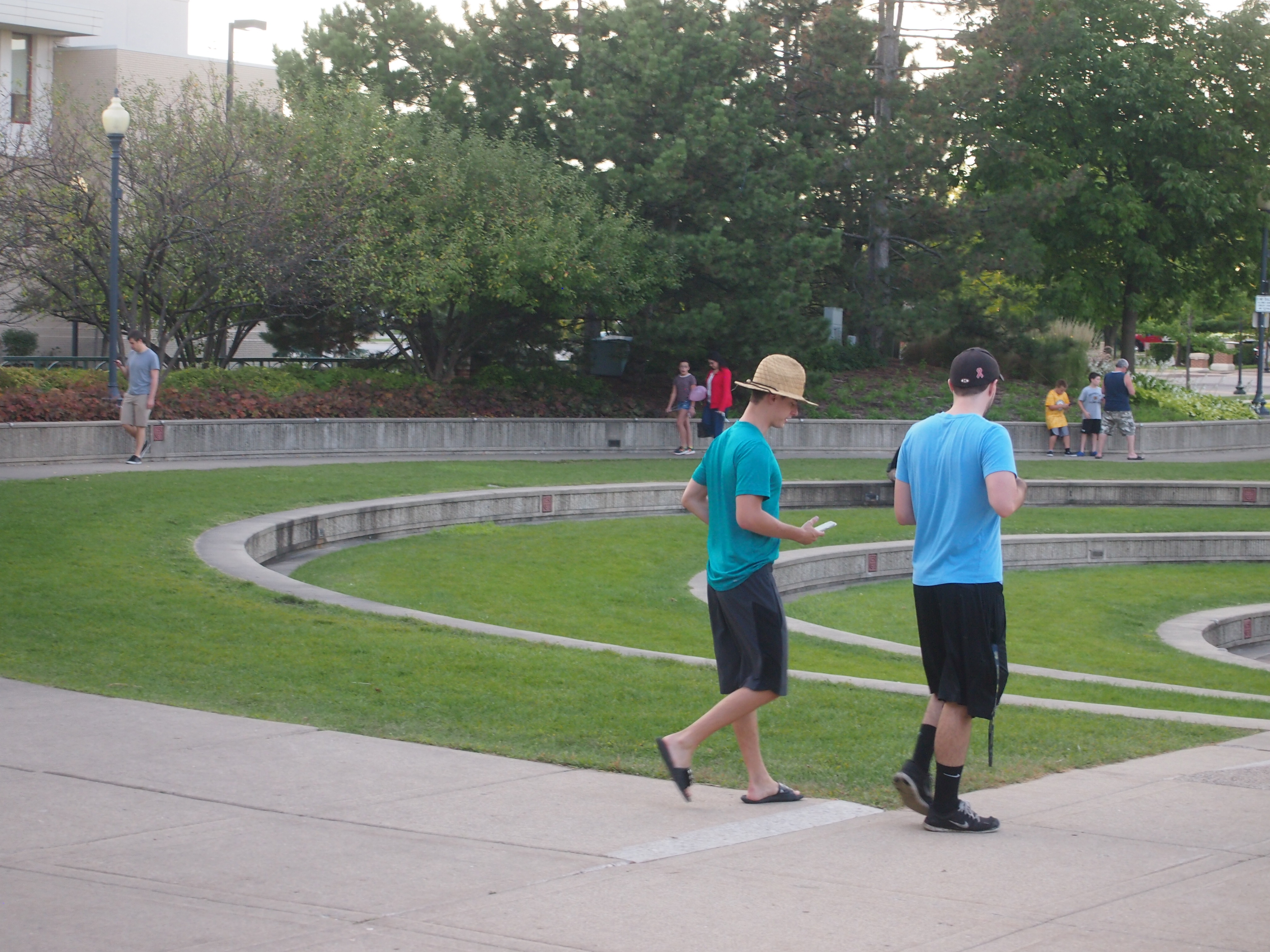
Before she left for school, Lilly told me that people spend time at Schaumburg Town Square on warm evenings — all of them, this time of year — playing Pokemon Go. Not long ago I took a look myself, to see if she was pulling my leg.

She wasn’t.

Playing Pokemon Go at Schaumburg Town Square 2016Among other things, Schaumburg Town Square, which includes the township library and some retail space, features a small grass-surfaced amphitheater, and the game seemed especially popular there. I watched for a while to make sure that’s what they were doing, and confirmed it for certain when I heard a couple fellows talking about it. These guys.

Playing Pokemon Go at Schaumburg Town Center, 2016As The Hitchhiker’s Guide to the Galaxy said about Earth, “mostly harmless.”

I Went And I Believe

Still green, still summerish. I even saw people practicing baseball in the park over the weekend, though most evenings it’s now peewee footballers. Goldenrod has made its appearance in vast thick waves in some places, but only as a few sprigs in my back yard. Even so, that’s the first time I remember seeing goldenrod in the back yard.

Spotted in a big box retail store parking lot recently: a Jetta with a license plate frame that said on the bottom, “I WENT AND I BELIEVE.” From a normal standing position, the top part of the frame wasn’t visible, so I bent down to see just what the first part of that terse declaration might be. “Delphi” seemed unlikely.

Digression: According to Paths from Ancient Greece by Carol Thomas (1988), the last Delphic oracle was given to Julian the Apostate in 362. Wonder what that could have been. Maybe, “Dude, you’re hosed.”

The top of the plate frame said, CREATION MUSEUM. Must be the place in Petersburg, Ky., that also recently opened an interpretation of Noah’s Ark elsewhere in the state. I had to look into that a little further, and the owner of the car paid $30 to get in, or $60 for the “museum” and the Ark combo ticket, and who knows how much for the license plate frame.

I was a little surprised to discover that the Creation Museum also includes a planetarium. The CM web site says, “Sit back and be amazed as the planetarium projector displays vividly realistic images upon a 30-foot-diameter dome, allowing stargazers to travel anywhere in the universe. Enjoy learning from scientists and astronomers who affirm young-earth creation and explain how what we see in the night sky confirms God’s Word in Genesis.”

I can’t be civil about this any more. Morons. Does God in His wisdom want wide human variety? Including morons? I have to wonder.

Scenes of Post-People’s Republic Mongolia

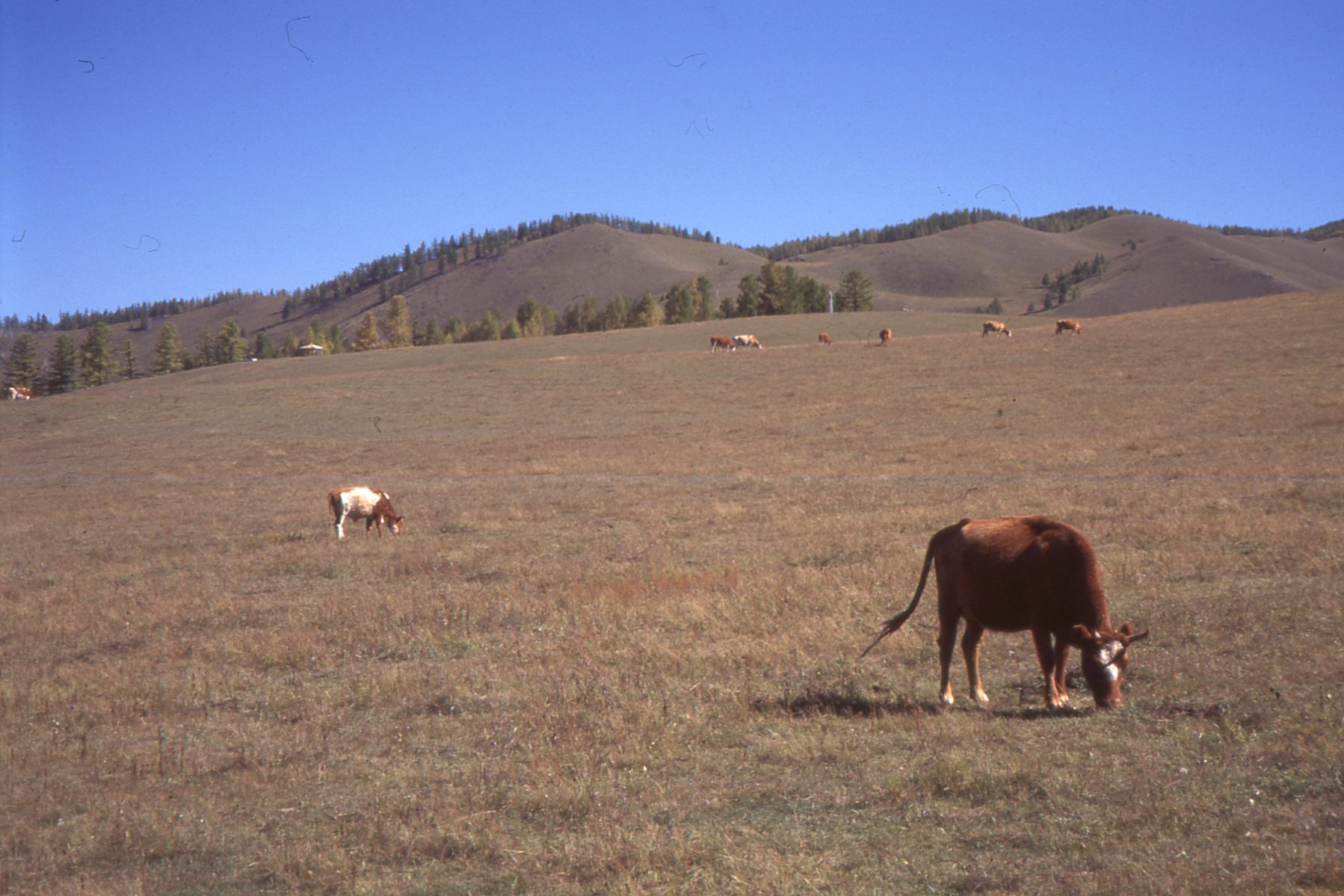
The part of rural Mongolia that we saw in September 1994 — in and near Gorkhi-Terelj National Park, 20 or so miles from Ulaanbaatar — looked a lot like this. Ulaanbaatar wasn’t a sprawling kind of place in those days, unless you count the large neighborhoods composed of thousands of ger (yurts).
Rural Mongola 1994In places the trees were fairly dense, with streams flowing through the land. Most of all, though, it felt remote. Even more remote than the arguably further-from-absolutely-everything Cape Leeuwin in Western Australia, because the infrastructure was so much more developed there, as far SW as you could go on the entire continent.

Ulaanbaatar didn’t feel so remote, though in ’94 sometimes livestock were seen wandering the streets. I wonder if that’s now a thing of the past for the Mongolian capital, as traffic inevitability increases. How do I know that traffic has increased in 20-plus years? That’s just one of those things that happens.

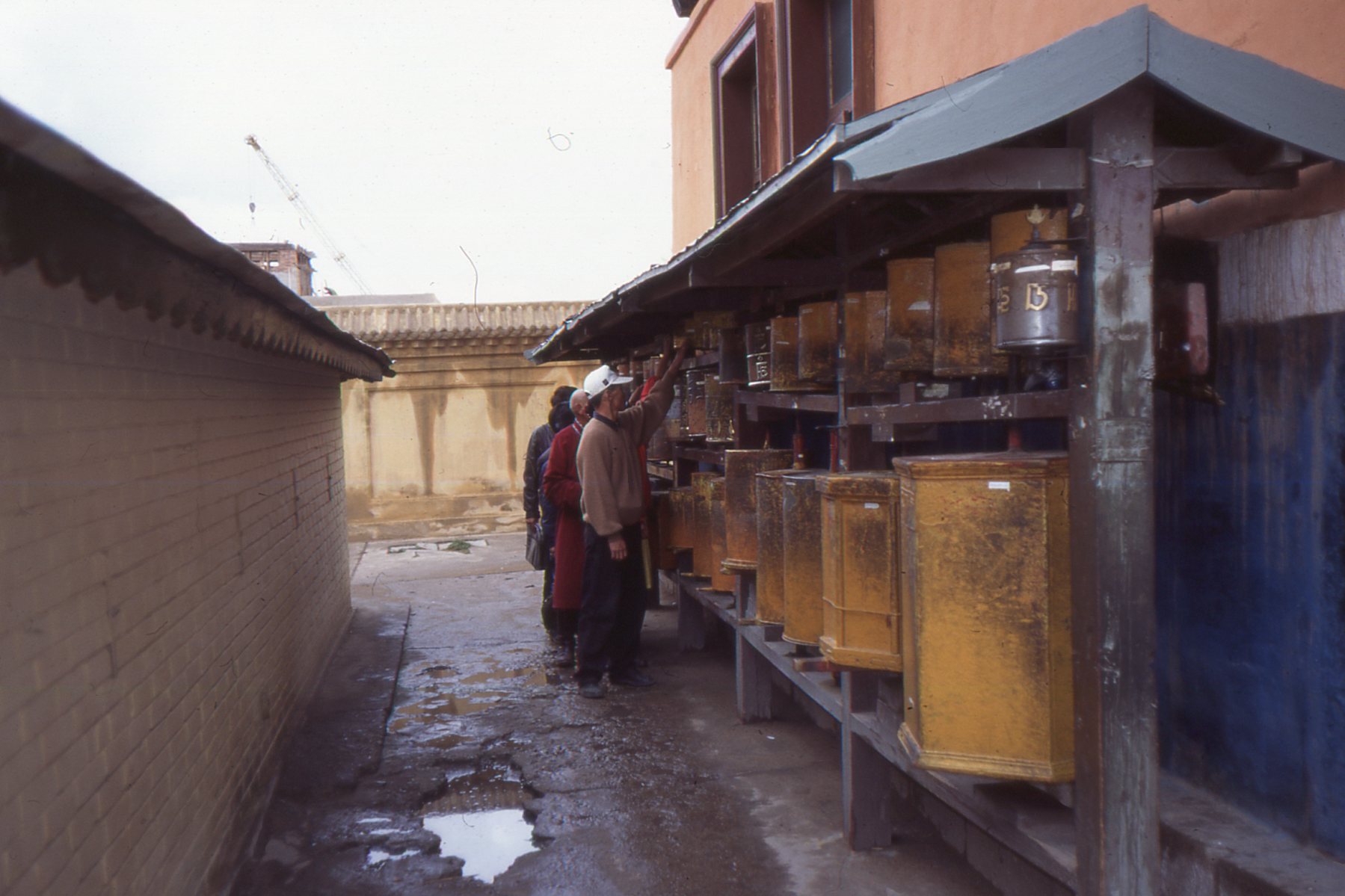
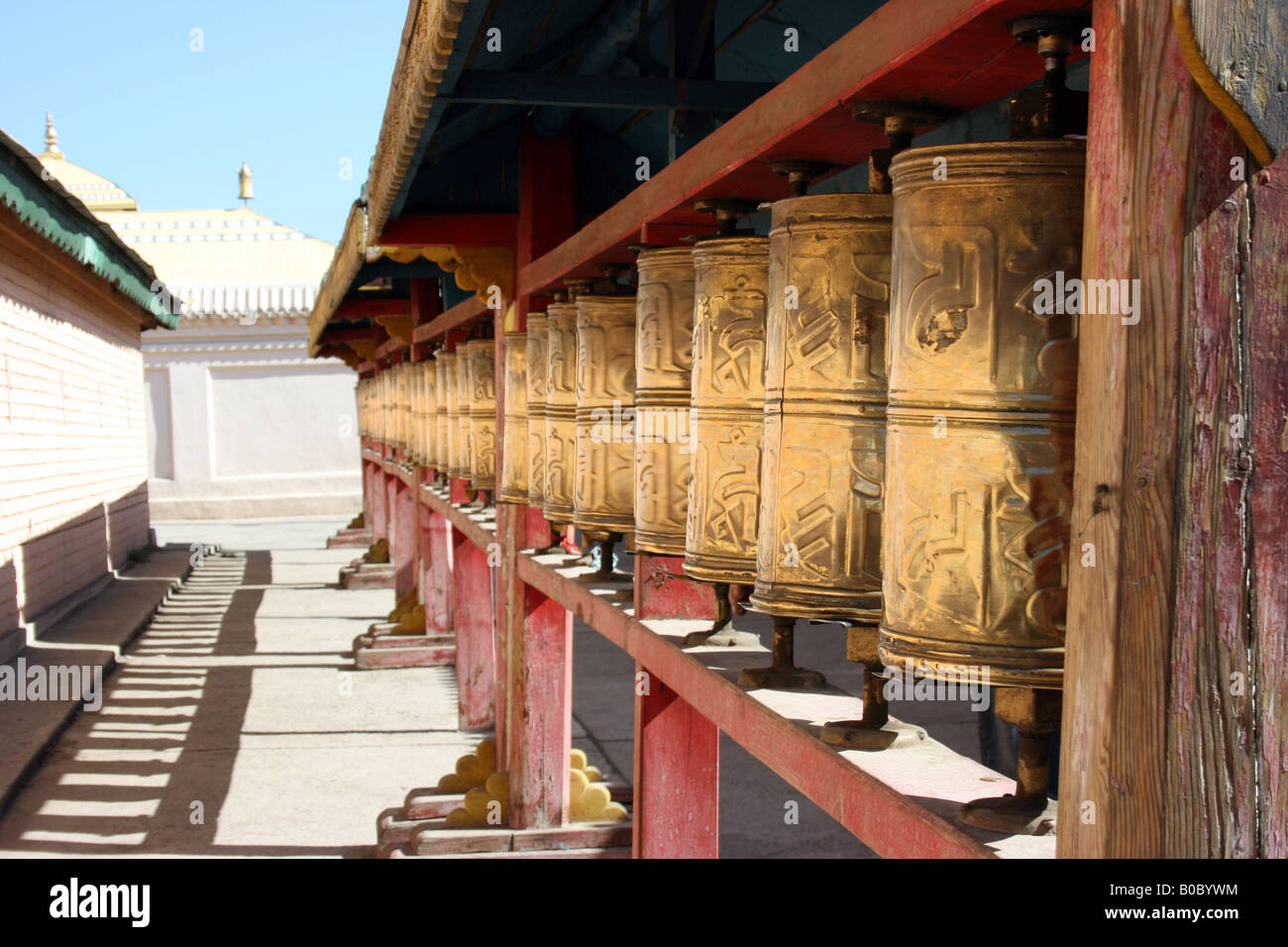
These prayer wheels were at the Gandantegchinlen (Gandan) Monastery in the city.
Gandantegchinlen (Gandan) Monastery MongoliaFrom the looks of more recent pictures, some restoration work has been done since then. At least, I’m fairly sure that the stock photo I linked to was taken at about the same place I stood; it certainly looks like it, taking into account various renovations and additions over the years.

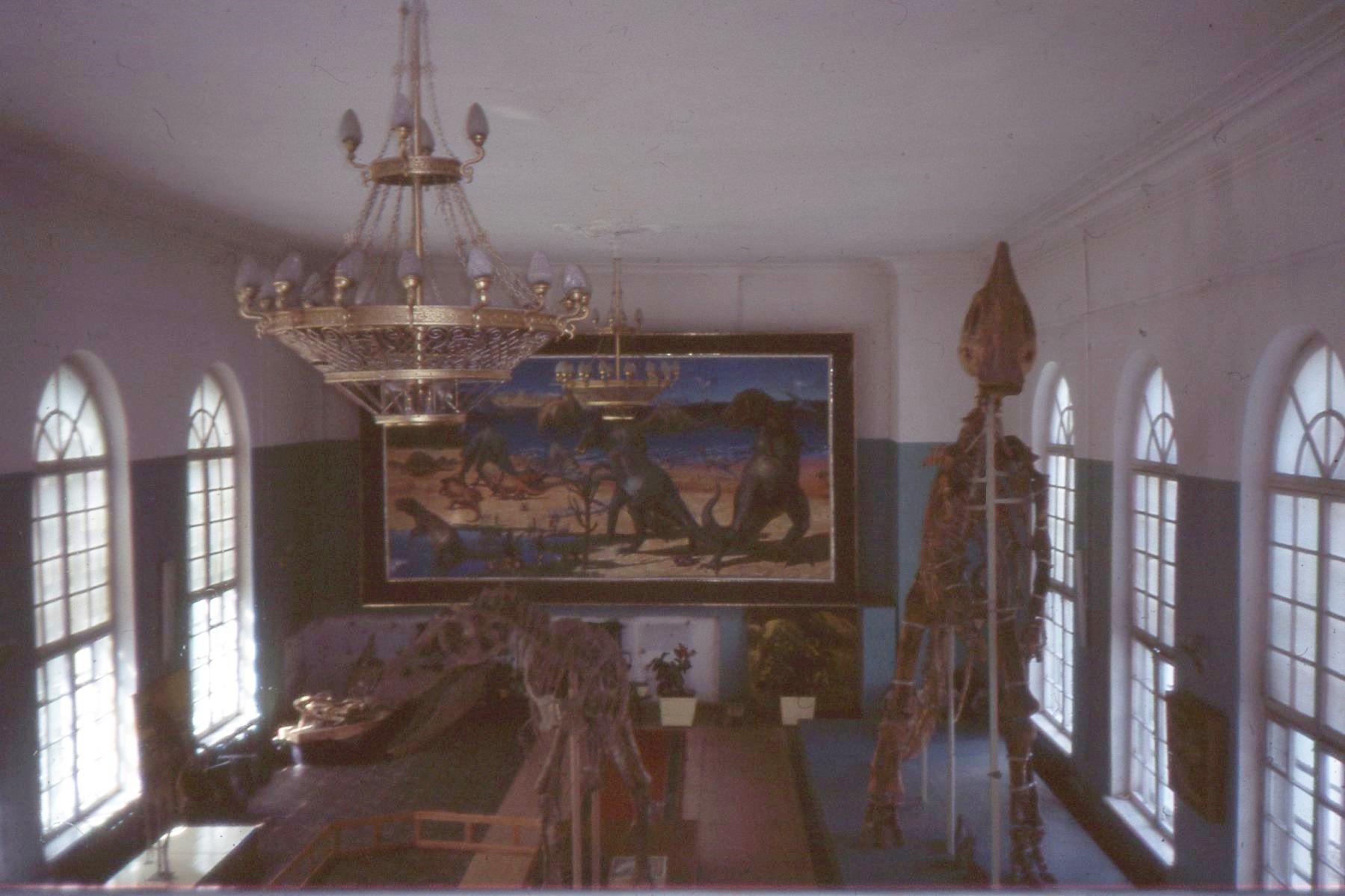
In the city, we also visited the Mongolian Natural History Museum, known the world over for its dinosaur artifacts. “The museum is particularly well known for its dinosaur and other paleontological exhibits, among which the most notable are a nearly complete skeleton of a late Cretaceous Tarbosaurus tyrannosaurid and broadly contemporaneous nests of Protoceratops eggs,” Wiki says. I remember those eggs.

And, of course, the big skeletons. You could go up on a balcony for a look at them.

Mongolian Natural History Museum - dinosaursPhotography involved paying an extra fee. Or so the museum staff told us at the entrance. None of us paid such a fee, and pretty much everyone in our group took pictures, though as you can see, the light was lousy. I don’t even think any staff were in the big dinosaur room with us, keeping an eye on us. Things were lax. Hope nobody over the years took advantage of that to take anything besides pictures.