The Last of the Summer Weekends. Maybe.

On Friday afternoon, we took the dog for a walk at Poplar Creek Nature Preserve. A balmy afternoon. Most of the tree foliage is still green, but includes distinct tinges of yellow or brown. Goldenrod blooms profusely, and so do white daisy-like flowers, along with a larger version that’s lavender-colored, but not actually lavender. The tall grass is brown, the short grass green. The cicadas still buzz and the grasshoppers still hop.

The Woodfield Mall was busy in its own way on Saturday afternoon. I can’t remember the last time I was there, but it’s been a while. There’s a certain amount of renovation going on in the common areas, but nothing that affects the flow of people too much. A number of stores displayed Star Wars merchandise in highly visible ways. I haven’t been keeping track, but that must foreshadow a movie along those lines.

Sure enough, a line in the Sunday Tribune Arts and Entertainment section tells me that, “As a new Star Wars movie looms [interesting choice of verbs], many of the franchise’s original fans are as devoted as ever.” Guess the merch is partly for them and their offspring. As far as I’m concerned, the first three movies, while very entertaining in their time, need to go in a box labeled Things of the Past.

Most of Sunday was overcast, so I wondered whether I was going to see the lunar eclipse. A couple of hours before dark, however, the clouds cleared away, and at about 8:30 I went out to see the shadow of the Earth falling on the Moon. At about 9, Yuriko, Ann and I were out, and then again 15 minutes later for totality. The dog was out, too, but typical of dogs, she didn’t give a fig for the celestial phenomenon (no smell involved, I guess). The copper moon was a pretty sight, but it didn’t look any bigger than usual to me.

In time for the eclipse, the Atlantic posted these images, marvels of 20th-century manned space exploration. These images are more recent marvels of (mostly) unmanned space exploration.

Lilly was at a friend’s house on Sunday evening, so I did what you do these days, and sent her a text about the eclipse. Later she said she’d seen it. I’m also glad to report that at least two neighboring families on my block were out to see it, too. I noticed that while taking the garbage out under the dark copper moon.

The EMP Museum

By chance today I saw about 10 minutes of Pompeii, a movie that apparently came out last year. The scene pitted gladiators vs. Roman soldiers, and clearly the gladiators were the put-upon salt-of-the-earth hero and his friends, while the soldiers fought for a cartoon Roman upper-class twit bad guy. I watched anyway. Nothing like a little implausible sword play to liven your afternoon. It didn’t take long to come to the conclusion that overall the movie was very stupid indeed.

But maybe I should have watched the end. According to Marc Savlov in the Austin Chronicle: “We all know what happens in the end and, to his credit, Anderson [the director] totally nails the vulcanization of Pompeii. You want it? You got it: flaming chariot melees, massive tsunamis, and a downright hellacious pyroclastic flowgasm that makes the ones in Dante’s Peak look like so many Etch-a-Sketch doodlings (all of it shot in well-above-average 3-D). Pompeii delivers the goods – well, at least during its final 20 minutes.”

It took me a while to remember what EMP stands for in the EMP Museum in Seattle, which I visited on the afternoon of August 28. That evening I said (jokingly) that I’d gone to the Electromagnetic Pulse Museum, because I’d forgotten it stands for Experience Music Project.

The EMP is at Seattle Center, just north of downtown. Seattle Center was the site of the 1962 world’s fair, interestingly known as the Century 21 Exposition. EMP didn’t come along until near the actual beginning of the 21st century, back in 2000, as the creation of Microsoft billionaire Paul Allen and right-angle averse starchitect Frank Gehry.

It’s a colorful 140,000-square foot blob of a building, roundly hated by many. I didn’t hate it, but it didn’t inspire much admiration in me either. I’ve seen plenty uglier buildings, following my own visceral and idiosyncratic standard for ugliness, which is uninformed by theory. Most parking garages are worse. So are many brutalist and otherwise concrete-based structures. EMP just seemed like Gehry being Gehry.

I understand it was a technical marvel to build, with more than 21,000 exterior aluminum and stainless steel shingles all uniquely shaped and designed to fit together like pieces of a puzzle, and an interior defined by strange irregular shapes and held up by 280 steel ribs. I found myself looking up at the interior with more admiration than the exterior. The engineers needed a terrific amount of computing power to design and put the thing together, which somehow seems fitting, considering that a software philanthropist paid for it.

Here’s an odd assertion from the museum: “If [the building’s] 400 tons of structural steel were stretched into the lightest banjo string, it would extend one-fourth of the way to Venus.” That must mean the average distance, since the true distance from the Earth to Venus changes every moment. Or maybe it means the distance between the orbits of Earth and Venus.

Wonder how many ping-pong balls it would take to fill it. Someone at the museum needs to figure that out.

Richard Seven wrote in the Seattle Times in 2010: “A smashed guitar, in honor of Seattle’s Jimi Hendrix and his rebellious style, was the inspiration and template. But the real collision was between one of the world’s most relentlessly anti-box architects, an unfathomable task of trying to freeze the rock ‘n’ roll process, and a wealthy private client who embraced the costs and advances in computing and engineering that allowed a building like that to even stand…

“When he toured the building just before it opened in the summer of 2000, Gehry told reporters, ‘It’s supposed to be unusual. Nobody has seen this before or will see it again. Nobody will build another one.’ ” Probably so.

As a museum, EMP is devoted to pop culture. Though “music” is in the name — and Jimi Hendrix and Nirvana each have their own galleries — that’s only part of the equation. One of the current exhibits, for instance, is “Star Wars and the Power of Costume,” which sounds like a display of costumes from that franchise. It cost extra, so I took a pass.

I didn’t miss “What’s Up Doc? The Animation of Chuck Jones.” That alone was almost worth the inflated price of admission to EMP. Besides original sketches and drawings, storyboards, production backgrounds, animation cels, photographs, and a fair amount to read, there was the opportunity to see cartoons on big screens, such as “What’s Opera, Doc?”, one of the Roadrunner cartoons — I forget which, not that it matters — and “One Froggy Evening,” which I probably hadn’t seen in more than 30 years, and which I didn’t fully appreciate when young. Especially the notion of a frog singing tunes from the 1890s.

The museum features some impressively large installations. One is made of guitars. A lot of guitars, arrayed upward in a kind of mass cone of guitars (and banjos and keyboards and other musical instruments) two stories high. The work is called “IF VI WAS IX,” and it was put together by a Seattle artist who goes by the single name Trimpin.

It’s more than just a cone of instruments. EMP notes that “short stretches of music were played into a computer then organized by Trimpin into a continuous electronic composition, with notes assigned to specific instruments. Customized robotic guitars play one string at a time. Six guitars work together to create the sound of one chord—a mechanical metaphor for how musical styles and traditions continue to influence one another.”

Nearby is the “Sky Church” room, whose main feature is a 33’ x 60’ HD LED screen that projects images on (from?) an enormous wall. The 65-foot ceiling is illuminated with parasols that seem to float overhead, and the space is well equipped with special-effects lighting. Technically impressive.

The perfect venue for, say, the restored color version of A Trip to the Moon. Or “Steamboat Willie.” Or “Duck Amuck.” Or the “Thriller” music video. Or any of many possibilities. All short, all worth seeing on a vast screen. Maybe shorts like these play at the Sky Church, but the day I was there, the venue seemed mostly to pump out music videos for people under 30.

I’ve read that the full name of the museum used to be the Experience Music Project and Science Fiction Museum and Hall of Fame (with the clunky initials EMP|SFM), but some years ago, the science fiction aspect was demoted. The museum still covers science fiction, as well as the horror genre, but in two galleries in the basement.

Not bad displays. I enjoyed seeing an assortment of SF movie and TV show props, such as the original Terminator’s leather jacket and I forget what else (no Lost In Space Robot, though), and playing with at least one of the interactive features: a large globe that would take on the likeness of each of the Solar System’s planets, along with the Moon (and Titan?), at the touch of a button.

Oddly enough, I got more out of the horror exhibit than the SF one. Besides static displays and props and the like, the horror gallery included a number of alcoves in which you can watch well-made short films on various renowned horror movies. These proved interesting, even though I don’t much care one way or the other about the genre.

Because of these shorts, I’m now inspired to watch two horror movies I’ve never gotten around to: The Cabinet of Dr. Caligari and The Exorcist. The former was on TCM late Sunday night, but I didn’t want to stay up late to watch it; such is middle age. I did see the haunting green credits, however, and I’ll get around to the whole thing before long.

There’s also a first-floor gallery devoted to the fantasy genre, but by the time I got there, I was a little tired of the museum. At least I happened to see the costume that Mandy Patinkin wore as Inigo Montoya.

As mentioned, two Seattle musical acts, Jimi Hindrix and Nirvana, had their own galleries. Of the two, I spent more time in the Hindrix room, despite being too young when he was alive to fully appreciate his talents, since he was common enough on the radio well into the 1970s. As for Nirvana, I was too old to appreciate them when they were around, and in fact out of the country during their heyday. I remember hearing about Kurt Cobain’s suicide right after I arrived in Hong Kong in April 1994, and my first thought was, Who?

Both galleries apparently change from time to time, rather than being generic tributes to the artists. The Hendrix exhibit I saw was  “Wild Blue Angel: Hendrix Abroad, 1966-1970.” It detailed his travels as a successful musician. As the museum explains: “At the height of his fame, Jimi Hendrix performed more than 500 times in 15 countries and recorded 130 songs in 16 studios. He was a musical nomad, his life an endless series of venues, recording sessions, flights, and hotels.”

His passport was on display. I got a kick out of that. Even better, while the original was behind glass, you could leaf through a replica, which I did. The dude got around.
Thursday Oddments

Back to publishing around August 30. I might have a few new things to post about by then.

Distinctly cool last night, down toward 60 F., following heavy rains the night before, and cooler than usual today. That sometimes happens this time of the year. It’s to remind us of the long slide into ever colder temps, beginning soon.

Another marker of the passing of summer: peewee football players in our nearby park. For a while, baseball will be played and practiced there, too, but not for long.

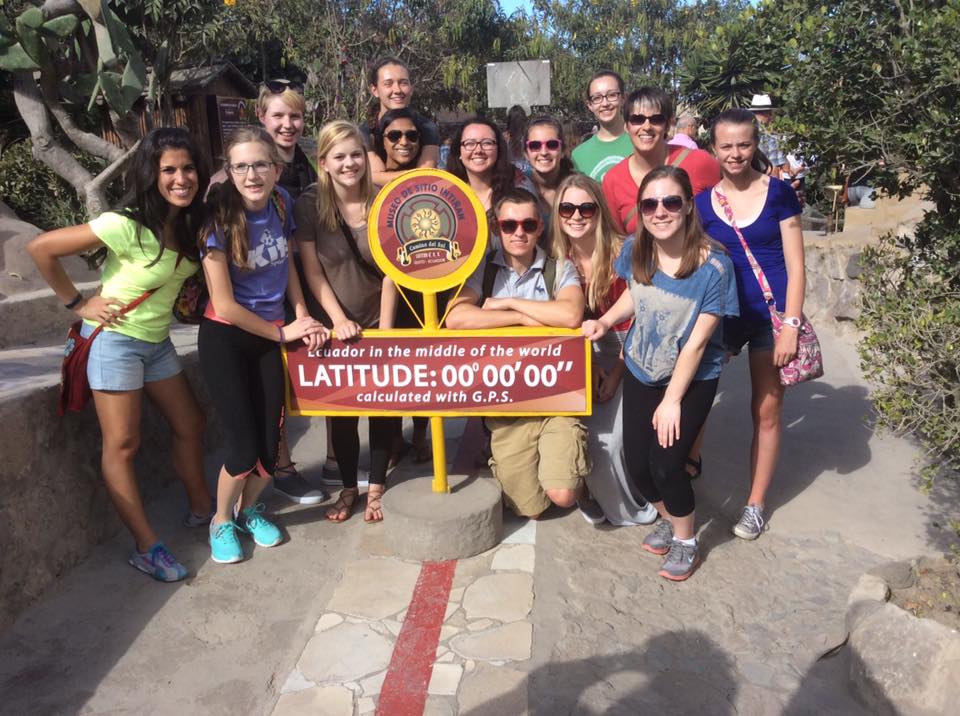
I noticed the other day that Lilly has hung Ecuadorean and Panamanian flags on the wall in her room. She didn’t mention bringing them back, but I suppose she did. An interest in flags is no surprise.

She also brought back this picture from the tourist equator. Something to recall the summer of ’15 by.
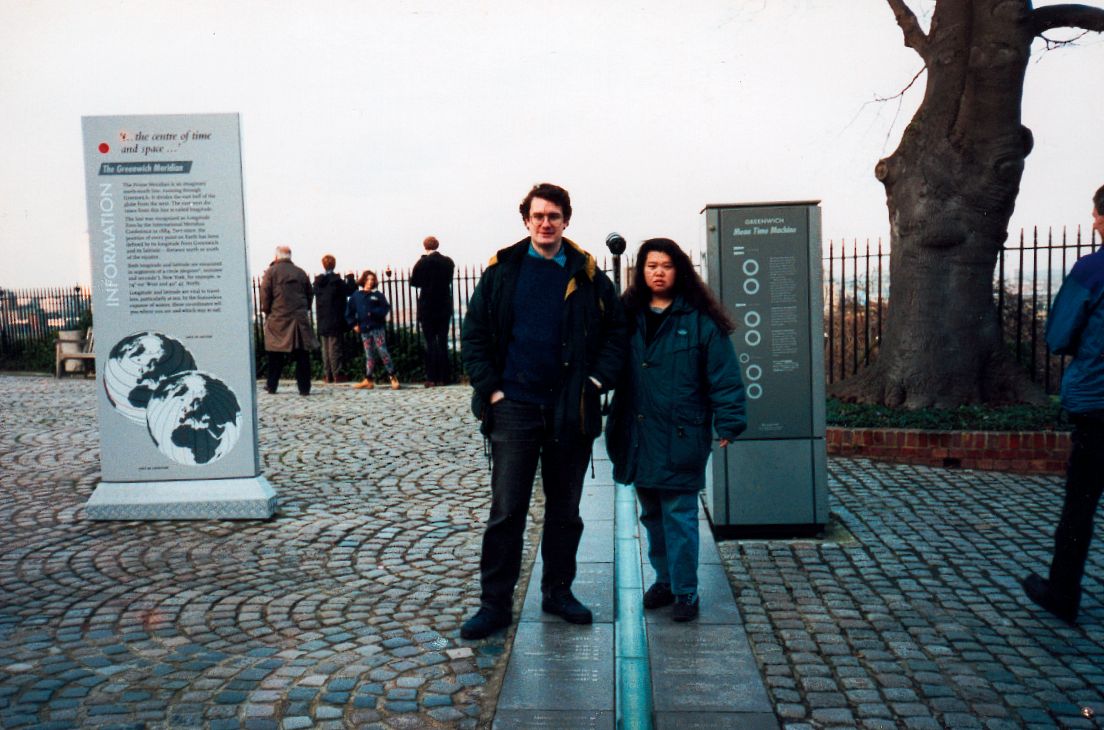
Ecuador 2015Naturally, I’m reminded of this picture (winter of ’94).

Greenwich1994One of these days, Lilly will probably make it to the tourist prime meridian. I’ve less sure I’ll ever stand on the tourist equator. Enough to have crossed the actual line a few times.

I watched Kelly’s Heroes (1970) on DVD the other day. Interesting movie: not quite a black comedy, nor anti-war movie, nor straight up war movie, but including elements of all those in a mostly successful blend. The stellar cast had a lot to do with that: Clint Eastwood, Telly Savalas, Donald Sutherland, Carroll O’Connor, even Don Rickles, all pretty much in their prime, though you could argue that Eastwood’s prime went on for a long time, petering out only around the time of his discussion with an empty chair.

Donald Sutherland’s character, never called anything but Sgt. “Oddball,” was the funniest of the lot, once you got past the palpable anachronism of him being a hippy tank commander in the U.S. Army of 1944. Pre-Archie Bunker Carroll O’Connor was the least effective, but he sure did chew the scenery in his relatively few scenes as an Army general.

Among the minor characters were a number of familiar faces, such as a barely pre-Murray Slaughter Gavin MacLeod, and an actor named Jeff Morris as Pfc. “Cowboy.” Turns out he later played Bob, the owner of Bob’s Country Bunker in The Blues Brothers.

Thursday Misc.

More spring on the way: a baseball game in the field visible from our back yard; budding bushes; woodpeckers; almost warm days, though I hear that next week won’t be so warm. Such is the seesaw of spring.

Ad leaflets are appearing at my door, promising yard service. One recent one was a large Post-It-like notice, stuck to my door, offering to keep my lawn to bourgeois standards for only $25 a week. That wasn’t quite the wording, but never mind. I suspect unkempt lawns are going to be the fashion in a few decades anyway. Either because a new-found appreciation for the aesthetics of long grass, or maybe because in a hotter and drier climate, long grass will be harder to grow, and therefore more prized.

I found out today that the Colorado House Speaker is named Dickey Lee Hullinghort. Say what you want about Colorado pols, they’ve got some interesting names, including Gov. John Hickenlooper as well. (The President of the state Senate is a more prosaic Bill Cadman, though).

Recently I did a short squib about a drive-in movie theater that managed to raise the money necessary to re-fit with digital projection equipment, and so will be able to stay open (that’s a blow for Americana, or something). Then I thought, we should go to a drive-in. The family’s never been to one. There’s a functioning drive-in in the suburb of West Chicago, which isn’t the one I wrote about, and which already has digital projection.

Trouble is, I don’t want to see Home, which is one of the features, and I really don’t want to see Paul Blart: Mall Cop 2, which is the other. Previews for that movie have been showing up on YouTube recently, and as far as I can tell, its formula is Kevin James Falling Down = Funny. I’ll go along with that, except substitute “≠” in that formula. (Also, what kind of name is Blart? Did they pick it because it rhymes with “fart”?) Maybe something better will come along.

Hard Day’s New Year’s Eve

Snow today, after a rain-ice mix yesterday that made slush. December ’14 was remarkable in that not a bit of snow fell here in northern Illinois, none that stuck anyway. That suited me, though mostly it was cold, especially as the month ended. Everyone who was out after midnight on New Year’s braved temps around 15 degrees F., with some wind.

I stood outside for a short spell to capture the sounds of the early ’15, just after midnight. It’s faint, but if the volume’s all the way up, you can hear the steady pops of technically illegal fireworks. Not sure what the loud pop is at about 10 seconds.


Before midnight I watched A Hard Day’s Night. Fun movie. Somehow or other I’d never seen it before, except for the famed opening, in which a mass of screaming girls chase the lads through a train station.

One amusing line — which must be understood less and less as time goes by — involved “Paul’s grandfather.” (Wilfrid Brambell played Paul’s grandfather, sometimes stealing the show. I thought he looked familiar. Turns out he played the father in Steptoe and Son.)

At one point, Paul’s grandfather sneaks off and runs up a tab at a posh club. The Beatles and their manager show up to collect the old man, and the club manager says, “There’s the matter of the bill.”

The Beatles’ manager looks at it and says, “180 pounds?”

“180 guineas!” answers the club manager.

O-Bon 1990

Things I Did During O-Bon (August 12-19)

Saw the Daimonji Gozan Okuribi on August 16 in Kyoto. I parked myself on the banks of the Kamogawa River among a large crowd also there to see the event. Sure enough, not long after dark, the first of the bonfires came to life, a 大 shape, “dai” or large, defying a bank of rainclouds that occasionally cut loose on the audience. It looked a little distant, but it was worth seeing once.

[The Japan National Tourist Board tells us that “although there are several interpretations as to the origins of this event, it is generally regarded as a fire set alight at the gate for seeing off the souls of ancestors after commemorating the welcoming of their souls. The character of “dai” (meaning “large”) on Mt. Daimonji, and those of “myo” and “ho,” which make up the word “Myo-ho” (wondrous teaching of Buddha) on Matsugasaki Nishiyama and Higashiyama mountains are famous.”]

Took some long walks in Osaka and one in Kyoto, from the Kenkakuji (Golden Pavilion) to the Nijojo Castle. The latter was closed by the time I got there [I eventually visited the Nijojo.]

Visited a few museums, including the Osaka Municipal Museum; the Kyoto National Museum; and the Museum of Oriental Ceramics. [Some years later, I told an acquaintance of mine who’s a gifted potter that I’d been there, and he was clearly envious of the experience. I liked the pottery well enough, but his instincts were right. It should have been him rather than me, in terms of who could appreciate it best.]

Also spent time at the National Museum of Ethnology, which has all kinds of interesting artifacts, such as a yurt, Polynesian vessels, African masks, lots more. The museum is at Expo Park, site of Expo ’70, the world’s fair held in Osaka that year. That’s probably the first time I’d ever heard of the city. Other relics from the fair include the enormous outdoor sculpture called “Tower of the Sun,” looking very much like something created in the late 1960s. [By Taro Okamoto, who died in 1996. I had no idea there was anything inside the work.]

Discovered a second-run theater in Osaka, admission only 600 yen for two movies. Good place to go for air conditioning, a traditional reason to go to the movies. This week saw Lair of the White Worm and Salome’s Last Dance, a sampler of Ken Russell’s recent twisted visions. Before seeing them, I’d mostly known his movies by reputation. Altered States, which I did see once upon a time, was much worse than either of these.

Two Bridges of Madison County

While in Winterset and environs, I took the opportunity to see two of the wooden covered bridges of The Bridges of Madison County fame. The movie, at least, seems to be relegated to a chick flick ghetto. Wrongly, I think. The story was at least as much about the visiting photographer – the man – as it was about the farm wife.

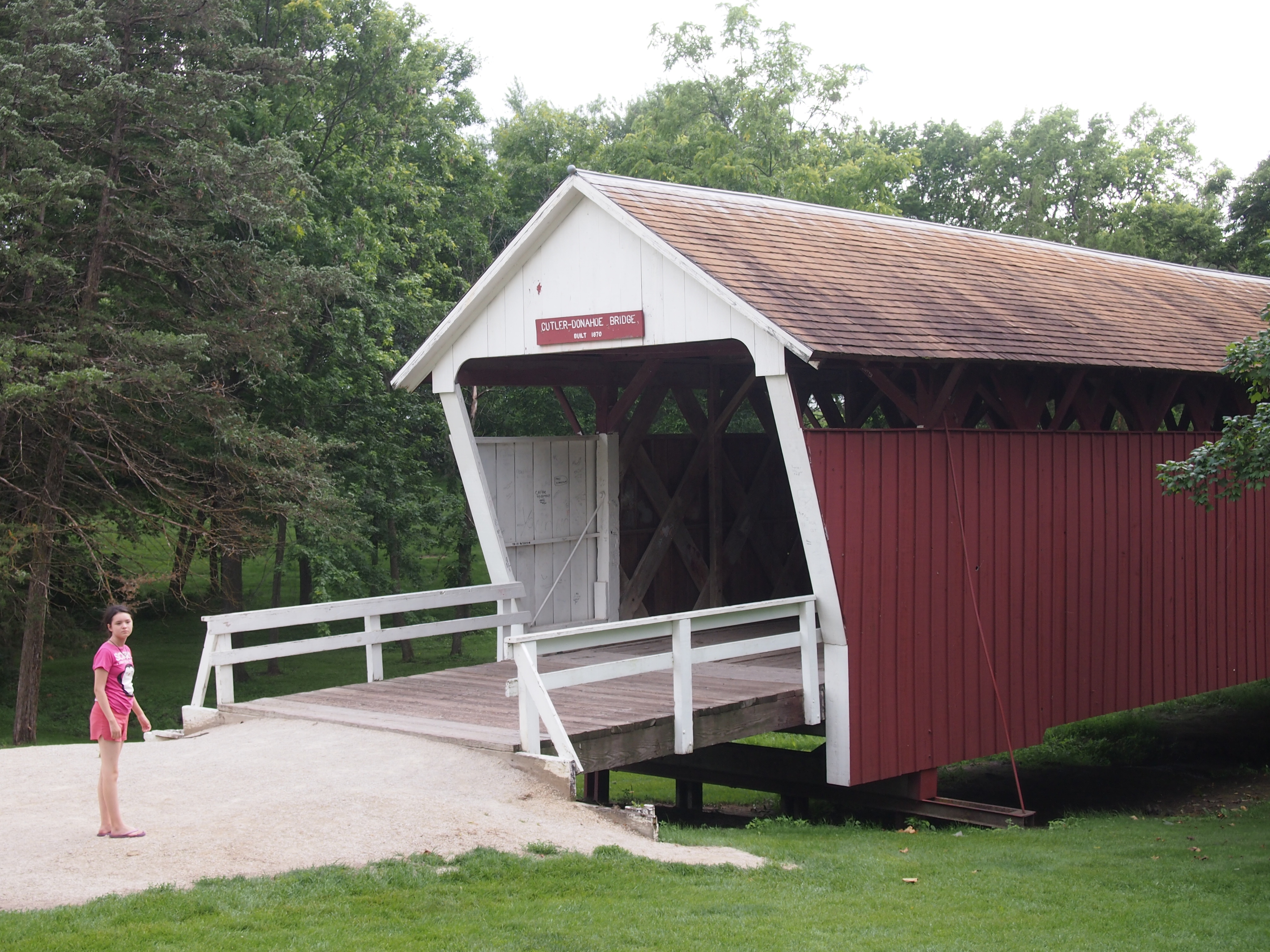
Movie or not, I liked the bridges. At least the two I saw.  It’s remarkable that such artful wooden construction has survived for more than a century, but they have. Ann was less impressed. When we visited the first structure, the Cutler-Donahoe Bridge, she said something like, “What’s so special about this bridge?” You have to be older to appreciate older things, maybe. (Though I’ve liked old things since I can remember. I’m peculiar that way.)

Cutler-Donahoe Bridge, July 2014

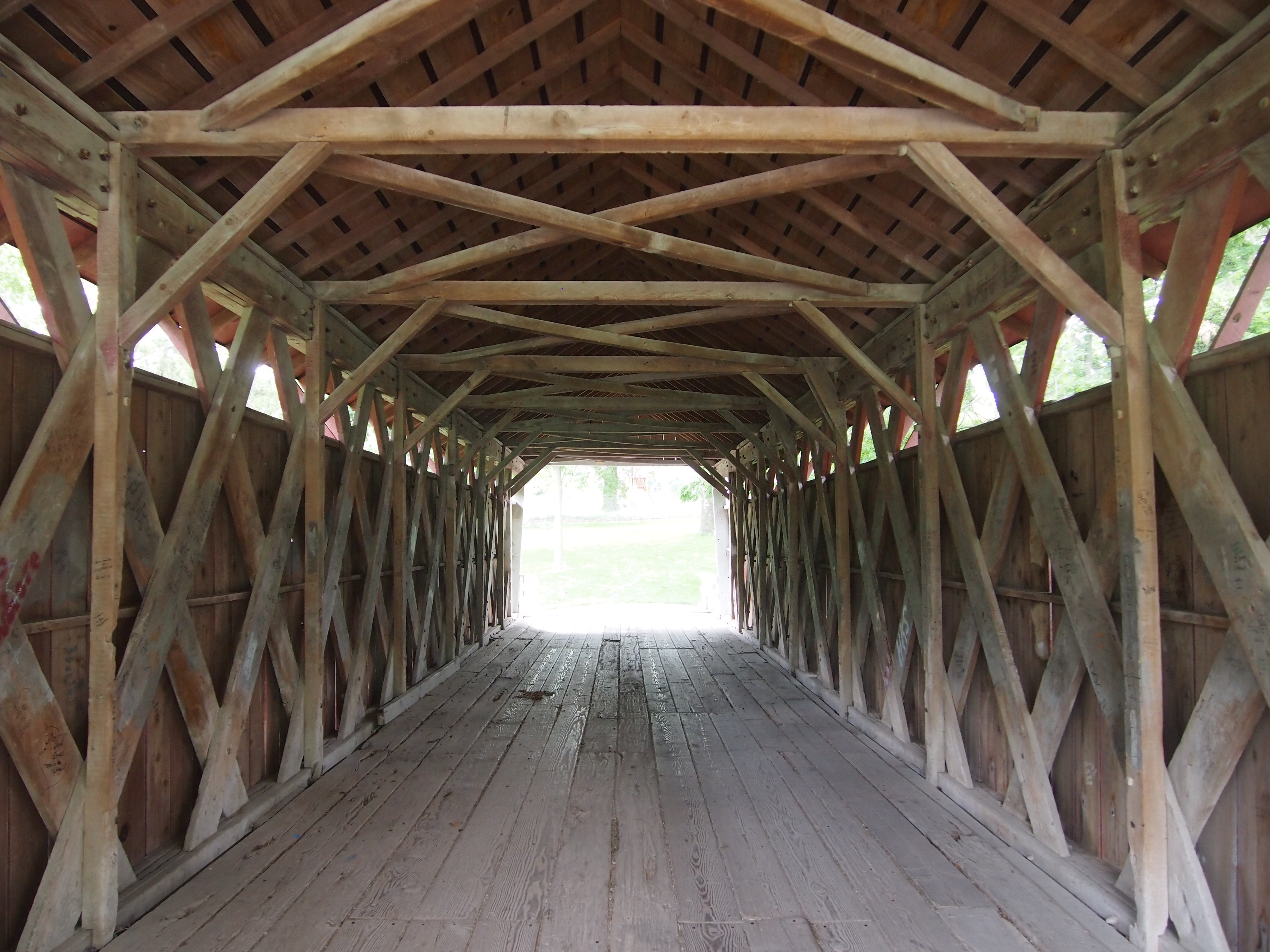
The Cutler-Donahoe Bridge dates from 1870, built by one Eli Cox. In 1970, it was moved to Winterset City Park, where we saw it. Length, 79 feet. Weight – and you’d think it would be lighter – 40 tons. Nice work, Eli.

Cutler-Donahoe Bridge interior

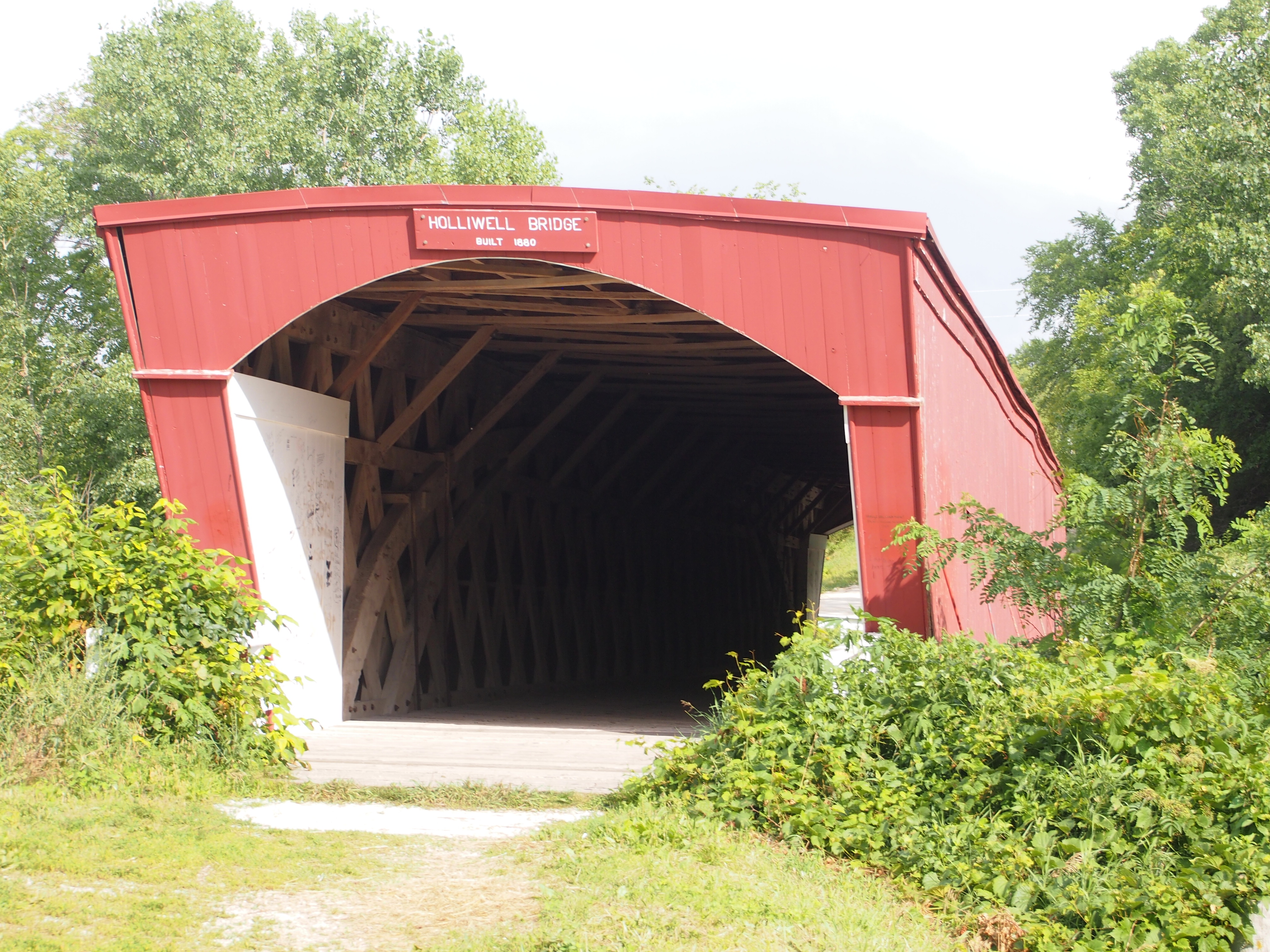
Not far from town is the Holliwell Bridge, in situ over the Middle River.

Holliwell Bridge, July 2014Ann stayed in the car for this one. The structure’s a little newer than Cutler-Donahoe, built by Benton Jones in 1880 and renovated in 1995 (on the occasion of filming the movie, I guess, but my sources don’t say so explicitly).

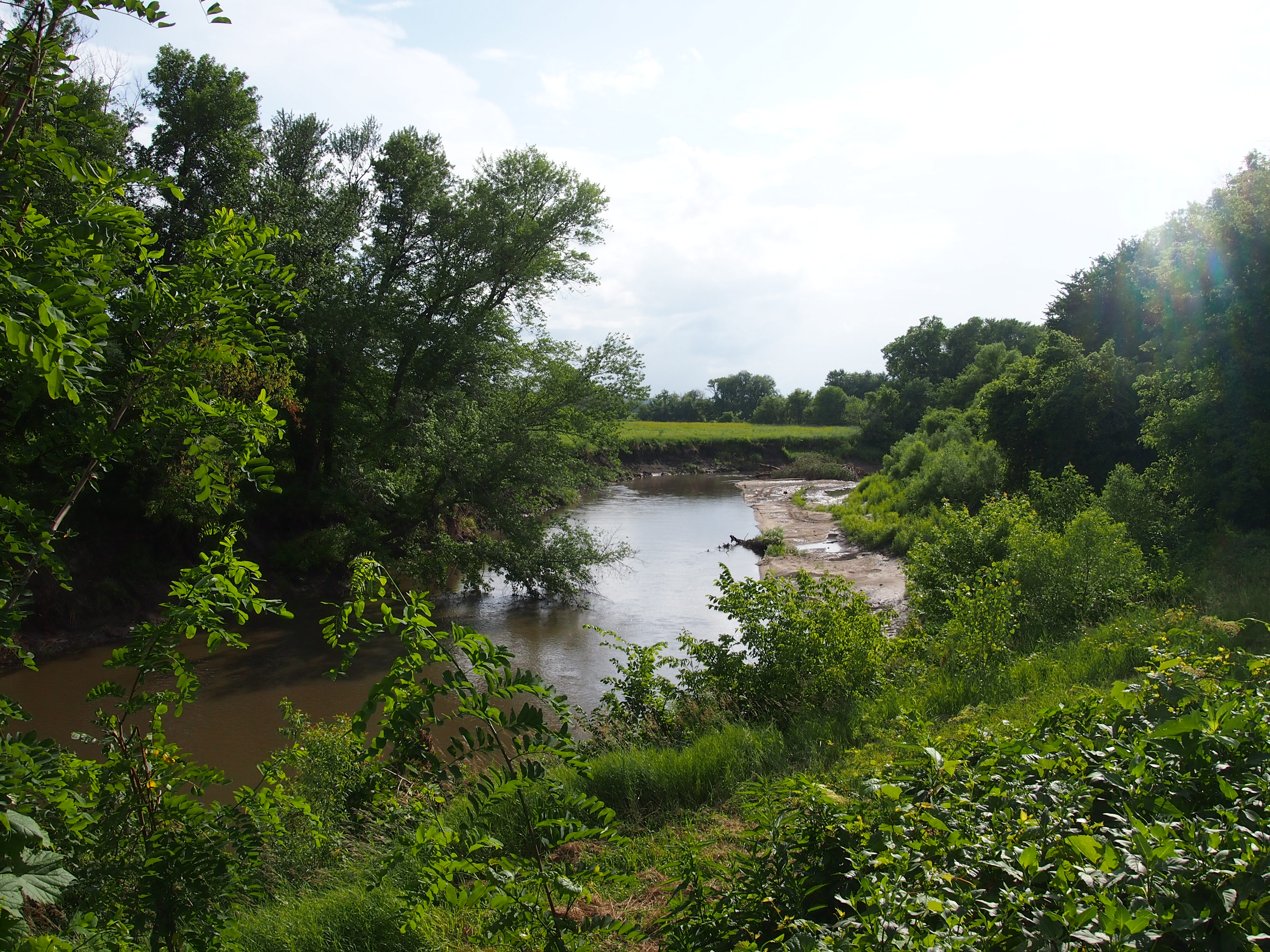
Middle River, Iowa, July 2014This is the view from the north end of the bridge, looking out on the Middle River, a tributary of the Des Moines River that runs through the county. Iowa’s nice and lush this year.

The Duke in Winterset

The thing to do when heading out of Des Moines in a southerly direction is to detour into rural Madison County, southwest of the capital, whose county seat is Winterset. If you have time. I decided we had time, since how could I pass up a look at a bronze of Winterset’s favorite son, Marion Robert Morrison?

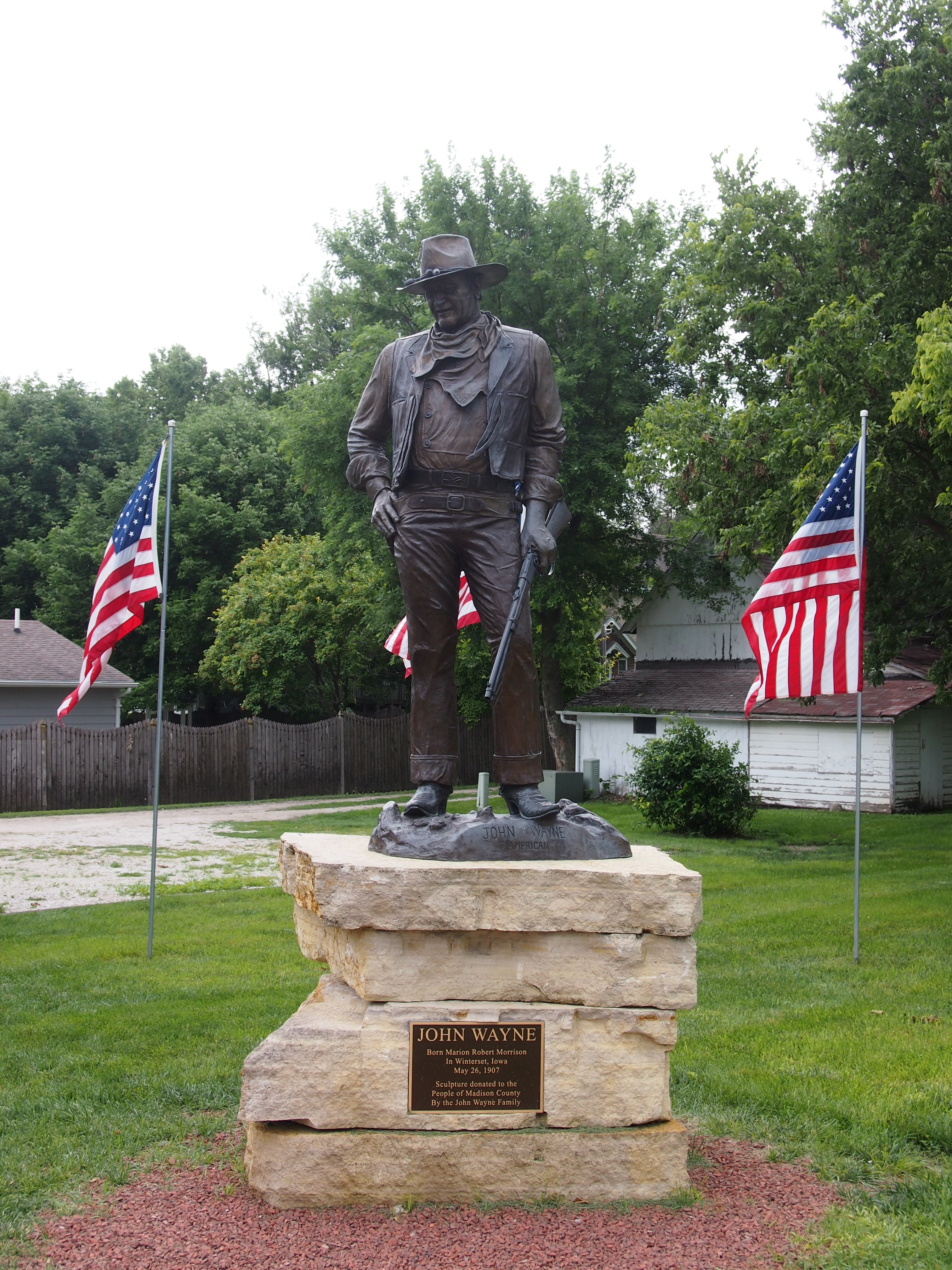
John Wayne, Winterset, Iowa 2014JOHN WAYNE

Born Marion Robert Morrison

In Winterset, Iowa

May 26, 1907

Sculpture donated to the

People of Madison County

By the John Wayne Family

The statue of John Wayne is a short block from his birthplace house, now a museum that (like the capitol) happened to be closed when we arrived. No matter. A good look at the bronze was enough for now, and we weren’t the only ones doing so. A few other families pulled up for a look-see while we were there. Wayne’s fame has some staying power.

Next to the statue is a Chevy van, detailed to honor Wayne. According to the birth site museum web site, “Several years ago, an anonymous person from Arizona donated a full-size 1980 Chevy van that has been extensively customized for the true John Wayne fan….

“This one-of-a-kind vehicle is covered with $50,000 of artwork from John Wayne movies—even the windows are etched to continue the design! The interior boasts hardwood floors, carpeted walls, a wet bar, TV and VCR (this was 1980, remember?), a souped-up sound system, and saloon-style swinging doors that lead to the queen-sized bedroom [sic] in the back.”

I didn’t realize it when we were there, but the statue usually resides at a corner of Washington St. and John Wayne Dr. – one of the main drags through town – but has been moved a block away, so it won’t be damaged during construction of the John Wayne Birthplace Museum. Work started in 2013 on the new museum, which is slated for completion for the 2015 John Wayne Birthday Celebration (and it’s convenient that baby Marion was born pretty close to Memorial Day). Last year my old friend Kevin, quite the fan of the Duke, went to the birthday fest. He said he had a large time.

One more thing: there are other John Wayne bronzes out in the wider world. You have to go to California to see these two.

Entertainment Oddities, Some Involving Actors Named West

As it happened, on July 4 one of the channels was running a Batman marathon, and by Batman, I mean the one starring Adam West. Accept no substitutes. I watched two episodes, which is about enough at any one time, a pair originally broadcast one night after the other in 1966. Catwoman was the villain. At one point, after capturing the Dynamic Duo, she separates the two using a vacuum tube, saying: “It’s time to separate Damon and Pythias.”

Did I hear that right? A casual Classical allusion on mid-60s TV? Yes, indeed. Hadrian and Antinous would have been funnier, but even more obscure.

At a grocery store parking lot not long ago, I saw an ordinary sedan, one car among many, except for one thing: “NCC-1701” was detailed on either side. I couldn’t help mocking the owner in abstentia on the way into the store (Lilly was with me). “To boldly go shopping,” “Hope he doesn’t use his phasers in the parking lot,” etc.

She Done Him Wrong (1933) is an odd movie, at least to modern eyes. I tried to imagine what it would have been like to see the movie new, when it wouldn’t (presumably) have been so odd, but it was hard. Still, the movie must have had its attractions in its time, since it made Paramount a bucket of money in the pit of the Depression.

Mae West is one of those people now mainly known by reputation, and that includes my impressions of her. I’d never seen one of her movies until last week, when I watched this one. She’s famous for her one-liners, and justly so. And of course for her sex appeal. I think it helps to have been born around 100 years ago to fully appreciate it.

Another thing I wondered about was the setting. The movie was set in the 1890s, which the intro refers to by its common sobriquet, the Gay Nineties, a ’20s invention. I wonder just what kind of nostalgia people of the 1930s felt for the 1890s. It’s possible to be nostalgic about anything, so I guess that applies to a decade marked by its own depression and bitter labor disputes.

The Field & the Basilica

As of June 21, 2014, there was no new development that I could see at the Field of Dreams movie site, which is near Dyersville, Iowa, about 20 miles west of Dubuque. Apparently there’s been a hubbub – or maybe a brouhaha (not sure which is greater dustup) – about plans for further development at the site.

I won’t dwell on that. Enough to say that the new owners of the property, who have a mortgage to feed, want it to be more than a baseball field amid the corn, while some residents of greater Dyersville and others very vocally do not want that to happen. More about the fracas here.

This is the kind of tourist that I am: although I’ve never actually seen Field of Dreams, I wanted to see the accidental tourist attraction created in haste in the summer of 1988 to serve as one of the main sets for the film. Why? Because it’s there. Or more exactly, because I was going to be near there anyway.

Besides, Yuriko had seen the film. As we drove in the vicinity of the Field, her eyes widened a bit. “This is what it looked like in the movie,” she said. She saw it a long time ago, and couldn’t really remember the story. I’d never seen it, but knew that the movie involved ghost baseball players, including Shoeless Joe Jackson. (Maybe Shoeless Joe got a raw deal from Baseball in his lifetime, but in terms of posthumous fame, he’s one of the better-remembered ball players of the early 1900s.)

The site is appealingly simple. You drive down a small road to get to it, park nearby, and walk a short distance over to the baseball field. It looks pretty much like any other non-pro baseball field, except in a wet late June, the backfield is bordered by lush rows of corn.

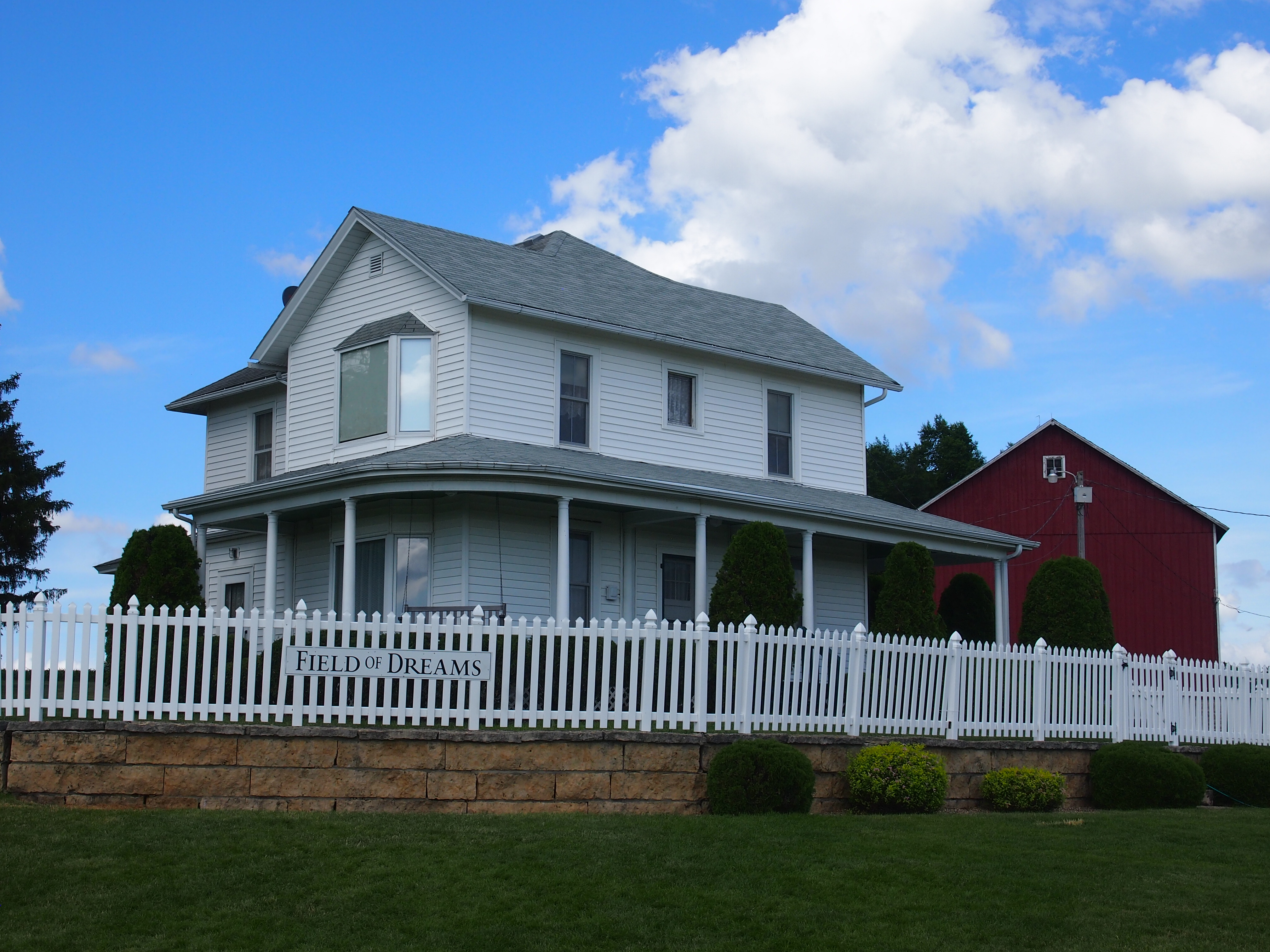
Field of Dreams, June 2014The immaculate white house stands nearby, along with a red barn. I understand that the movie producers added the white picket fence around the house to make it look more like our collective notion of rural Iowa (and they had to paint some of the surrounding vegetation green in that drought summer of ’88). Odd, it didn’t even occur to me to go see if the house was accessible. It looks like someone’s house, which it was until recently, so approaching too close would have seemed like trespassing.

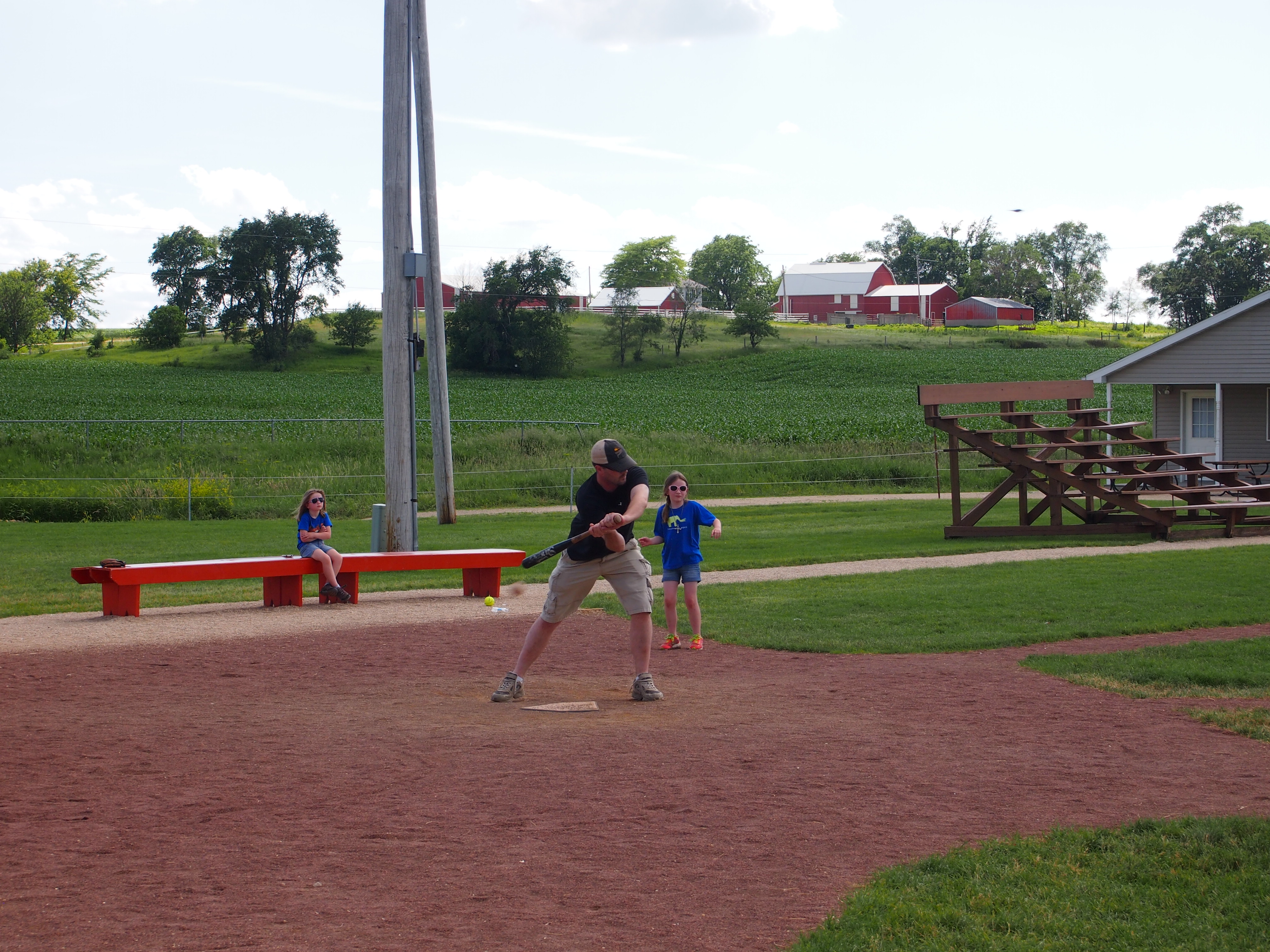
A fair number of people were visiting on that Saturday in June. No one was playing a game, exactly, but people were tossing and hitting balls, including a man taking swings at a ball pitched by a kid who probably was his son.

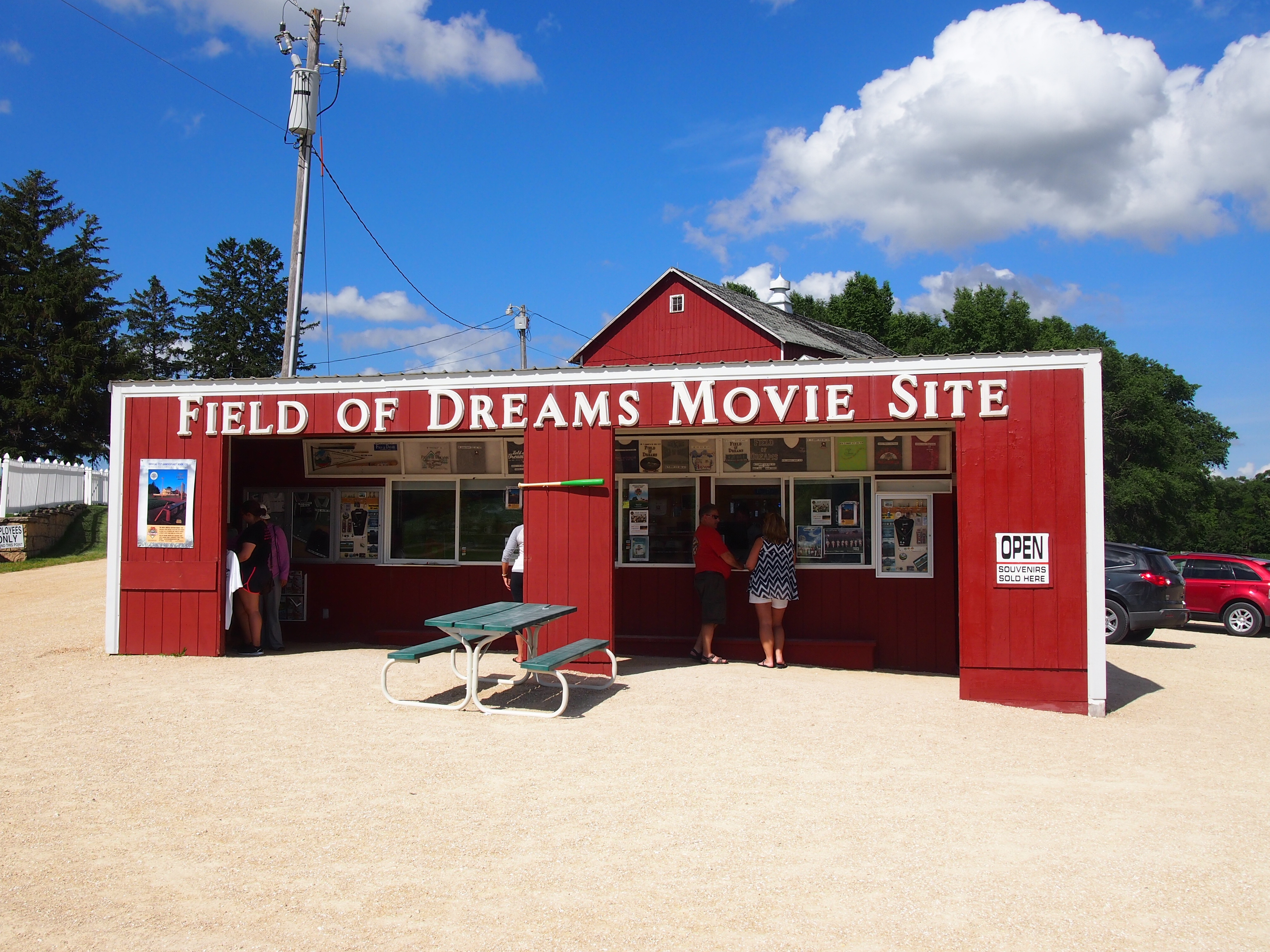
Field of Dreams, June 2014Naturally, there’s a gift stand. It’s a modest operation, not generating enough revenue to feed a large mortgage, I bet. In any case I bought a few postcards and a souvenir spoon for Yuriko.

Field of Dreams, June 2014The Field of Dreams isn’t the only thing to take a look at in Dyersville. The town is home to the National Farm Toy Museum, and while in theory that might have been interesting to visit, we bypassed it to take a look at the Basilica of St. Francis Xavier, an enormous and very ornate Gothic church right in town.

The interior was restored in 2000 and ’01, so it must have some of the brilliance of the original 1880s design. How many small-town basilicas are there in this country? Not many, I think.