Tri-State Summer Solstice Weekend ’14

Late on Friday morning we drove west for a few hours – and enjoyed a remarkably long in-car conversation among ourselves, no radio or other electronics playing – and by mid-afternoon arrived at Mississippi Palisades State Park, which overlooks the Mississippi River just north of Savanna, Ill. The plan included bits of three states in three days. My plan, really, since my family humors me in such matters, and lets me think up the details of little trips like these.

Friday was Illinois. We camped at Mississippi Palisades, which is an Illinois State park and incredibly lush this year, and we spent time in Savanna, a little river town on the Great River Road, mostly to find a late lunch. Toward the end of the day, we made our way to Mount Carroll, Ill., which is the county seat of Carroll County and home to a good many handsome historic structures.

On Saturday, we ventured into Iowa – it really isn’t far – and first saw Crystal Lake Cave, just south of Dubuque. In Dubuque, lunch was our next priority, followed by a visit to the Fenelon Place Elevator. Which is a funicular. When you have a chance to ride a funicular, do it. The last time we were in Dubuque, I remember the Fenelon Place Elevator being closed for the season (uncharacteristically, I don’t remember when that was — the late ’90s?). Anyway, this time I was determined to ride it.

Afterward, we headed west a short distance to the town of Dyersville, Iowa, home to the Basilica of St. Francis Xavier, but better known for The Field of Dreams movie set, which still draws visitors. We saw both.

Today was mostly about getting home at a reasonable hour, but I had to add a slice of Wisconsin by navigating a number of small roads until we came to Dickeyville. It would be just another rural Wisconsin burg but for one thing: the Dickeyville Grotto, which actually includes a main grotto, smaller grottos, shrines, a church and a cemetery (and a gift shop, for that matter). Like funiculars, grottos demand our attention, especially such as striking bit of folk architecture as the Dickeyville Grotto.

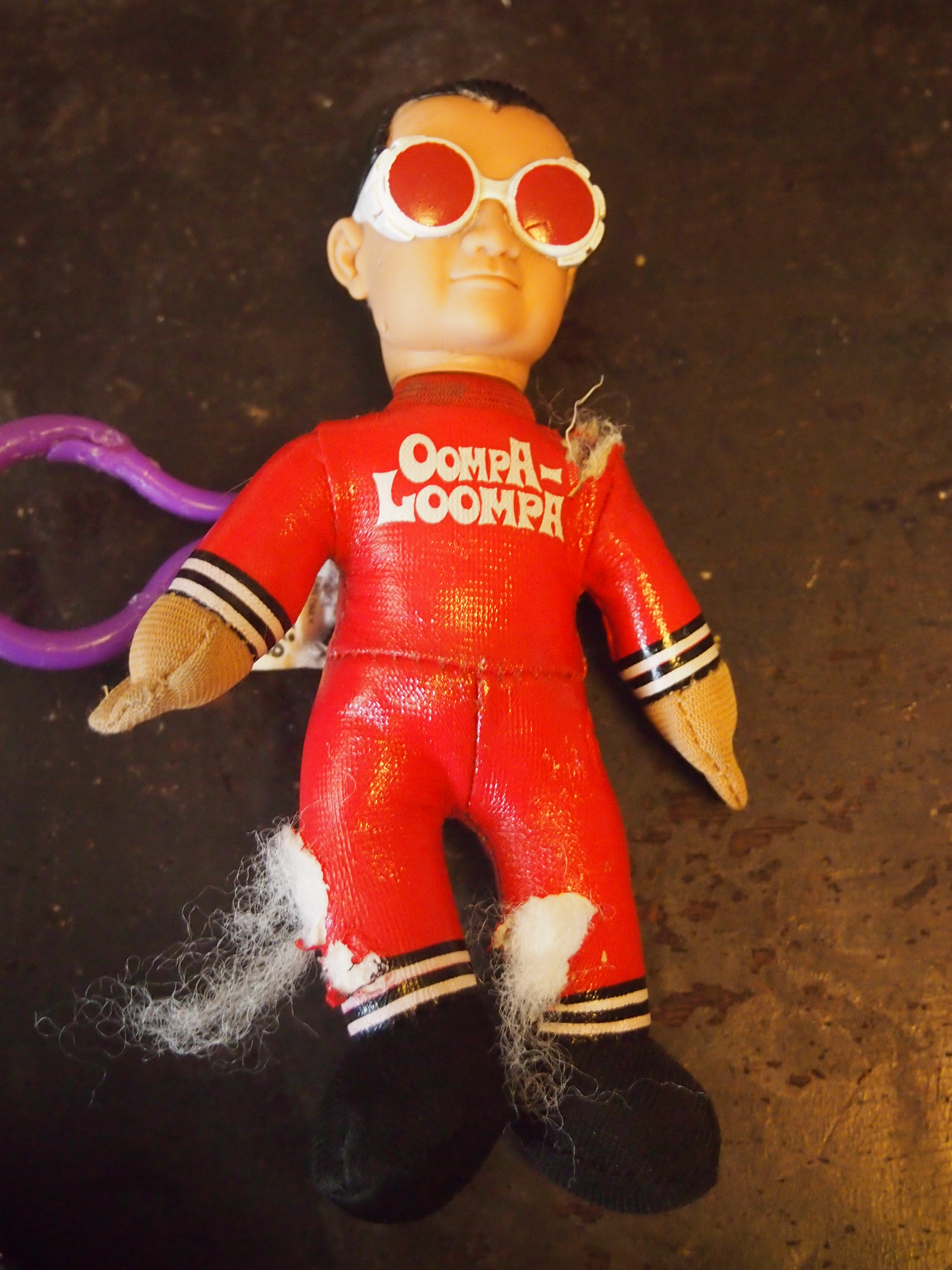
Dog 1, Oompa-Loompah 0

This is a good year to post WWI images, for obvious reasons. I’m not taken with its headline — how much or little Europe has changed hardly seems the point — but this collection of images is worth a look.

Also, here’s a recent dog picture, taken by Ann. Why? Because it’s been a whole year since she arrived at our house. She’s so completely a part of the family it’s hard to remember what the house was like before she came.

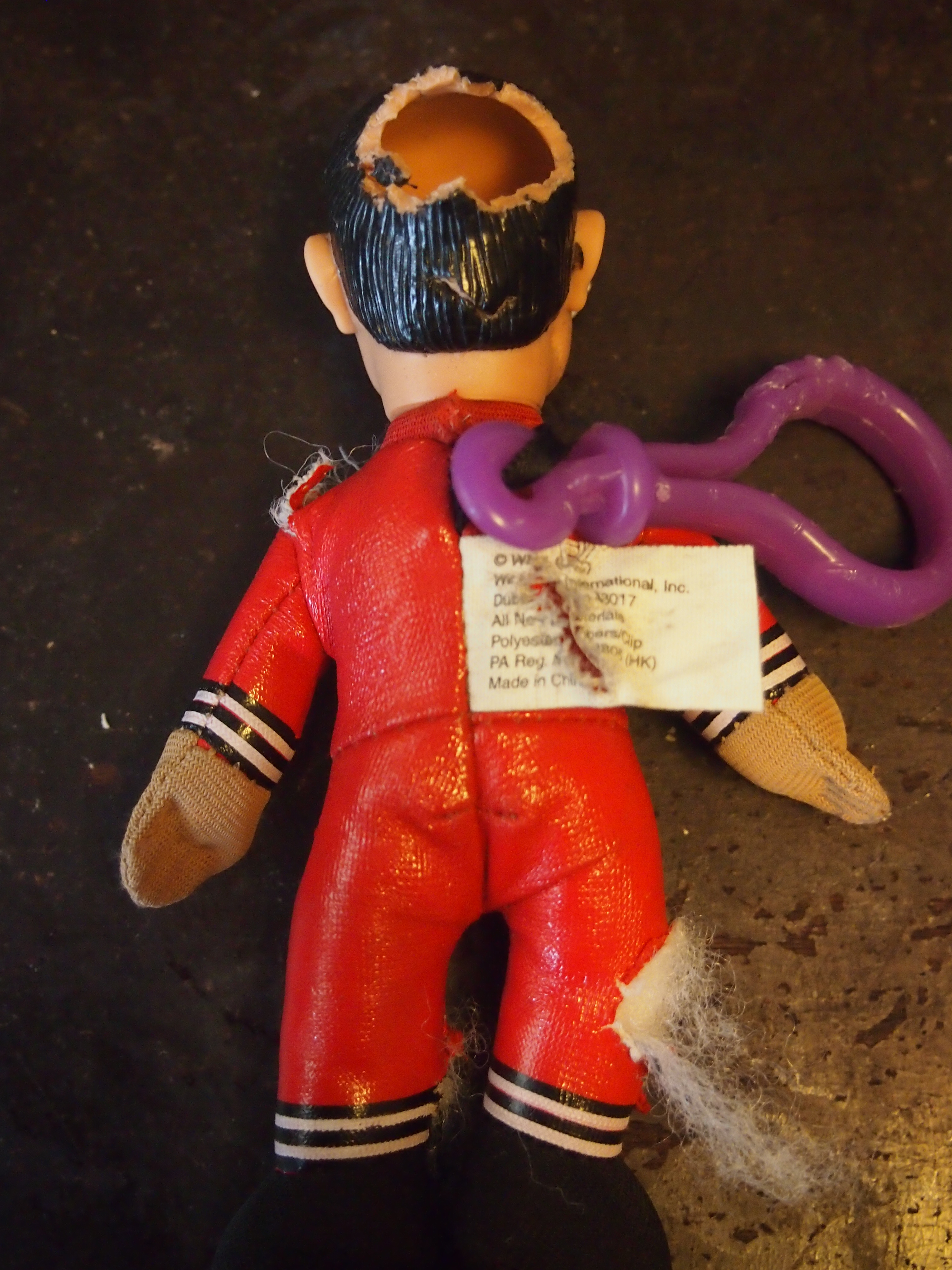
OLYMPUS DIGITAL CAMERAShe’s still a healthy young(ish) dog with an appetite for doggish activities, such as chewing things. Recently I found this figure on the floor.OLYMPUS DIGITAL CAMERA A toy Oompa-Loompa. I think it was a promotion from when Charlie and the Chocolate Factory was a new movie. Anyway, our hound clearly did some fang-work on it. From this side, mere flesh wounds. Turn it over, and you see this.

OLYMPUS DIGITAL CAMERAI don’t think any future Toy Story movie is going to depict anything quite like this. Or this.

Untimely Demises

Woke up from a dream this morning with the notion that Ed Asner had died. That was a little odd, considering that I seldom dream about well-known people. For a moment I wondered, did that happen? No, I dreamed it. I wish Mr. Asner well, and hope he has more years yet.

Guess it would have been really strange if I’d dreamed about Harold Ramis, whose passing made me wonder, for a moment, what his colleague – co-conspirator – Douglas Kenney would have done if he’d lived as long. Probably not too much on-camera work, though he had a single, memorable line in Animal House, which he co-wrote.

Speaking of untimely death, not long ago I got around to seeing a Smithsonian Channel documentary, The Day Kennedy Died, which first aired in November. Narrated by Kevin Spacey and directed by British documentary filmmaker Leslie Woodhead, it’s a first-rate bit of work. A lot of the material’s familiar, of course, but it also included less-familiar aspects of the story, along with lesser-known images, deftly woven into a strong narrative that eschews the conspiracy speculation that’s encrusted the event.

Also worth watching: a short documentary about the eruption of Mt. St. Helens, vintage 1984 and posted on a YouTube channel called Rare Educational and Entertaining Videos. Until I watched the video about the eruption the other day, I hadn’t realized that there’s a children’s song about Mt. St. Helens. But I knew about stubborn old Harry Truman and some of the intrepid scientists who died trying to gather information about the volcano.

Ann at 11

“Did I make this much noise when I turned 11?” Lilly asked on Friday evening, soon after Ann’s 11th birthday get-together and sleepover got under way.

“Yes, you did,” I answered. That was the year she and her friends talked about calling the spectre of Bloody Mary, but didn’t get around to trying.

OLYMPUS DIGITAL CAMERAEleven times around the Sun for Ann. Still a child, but edging away from it. There were no efforts to call out Bloody Mary at Ann’s event. I wasn’t expected any. But there was a lot of electronic game-play and standard-issue giggling. Pizza and cake were served.

OLYMPUS DIGITAL CAMERAOn Saturday evening, we watched Moneyball on DVD. Or at least Ann and I did; Yuriko was too tired for it, and Lilly was out with friends. I’d heard it was good, and it was. I didn’t know the history of the 2002 Oakland As, so the arc of the story – if not the substance of it – was new to me. I’m glad it wasn’t an underdog-goes-all-the-way story. Instead, it was an underdog-has-a-better-season-than-expected story. Using math.

I didn’t realize that Philip Seymour Hoffman was even in that movie until I read one of his obits this morning. He played the obstreperous manager Art Howe. While watching that character I thought, he looks familiar. But I couldn’t place him. I guess that’s the mark of a fine character actor. He can disappear into his character.

Arcane Sunday Bits

More snow on Saturday, which probably removes the risk that we might see patches of ground again before sometime in March. More shoveling last night, though this time Lilly helped. That was the price of borrowing the car today.

Tenchi Meisatsu (Samurai Astronomer) was an interesting movie. As I was watching it yesterday, it occurred to me that I knew little about the pre-Meiji Japanese calendar, except that it had been borrowed from the Chinese, and tossed out in favor of the Gregorian calendar. Tenchi Meisatsu (2012) is the story of Yasui Santetsu, the first official astronomer of the Tokugawa shogunate, and his dramatized efforts to reform the Japanese calendar in the 17th century.

As the reviewer at the imbd points out, that’s an unusual subject for a movie, yet it’s effective. As a Japan Times reviewer points out, “it’s probably the best film about calendar making you’ll ever see.” So far, that’s true. I don’t expect to see an action thriller about Pope Gregory any time soon, and poor old Sosigenes didn’t even rate a mention in the HBO series Rome that I recall, though he seems to have been a character in the 1963 movie Cleopatra.

Another arcane matter: It’s never occurred to me to have a favorite map projection, but I know enough to find this funny. I’m fond of most any map, except for grossly inaccurate tourist maps. That is, the sort that have a few vague lines of actual geography, but which mostly sport drawings of famous places or random fun-time activities. They aren’t real maps anyway.

These are some interesting maps. Especially this one.

Tuesday Recommendations

Butter toffee from Guth’s End of the Trail Candy Shoppe in Waupun, Wis., a burg southwest of Fond du Lac. Every year a PR company I’ve long dealt with sends me a box for the holidays. It’s the only time I eat toffee. It’s insanely good. Only a few pieces will make you feel a little queasy, so rich is the confection. But you eat them anyway.

The Man of Bronze. It’s the first Doc Savage novel, and probably the only one I’ll ever read. With genre pulp, that’s usually enough. I have memory fragments of the mid-70s Doc Savage movie I didn’t see – not many people did – so I’m probably remembering the commercials. My friend Kevin recommended Doc Savage as an entertaining read of no consequence, and I’ll go along with that so far. You have to like a yarn that begins with the sentence, “There was death afoot in the darkness.”

Gravity. It’s a really engaging Man Against Nature story, or to be more exact, Woman Against Vacuum. With a one-damn-thing-after-another plot that keeps your attention. Also, worth the extra money to see in 3D, and not too many movies are. In fact, the depiction of space alone is worth the price of admission. A few of the space-science stretchers bothered me a little – I don’t think hopping from spacecraft to spacecraft is quite that straightforward – but not that much. I don’t want exact space science from a movie, just high verisimilitude, and this movie delivers.

Lizard Point Consulting’s geography quizzes. Every now and then, I make Lilly and Ann take some of the easy ones, such as U.S. states or capitals. It’s my opinion that every adult American citizen without cognitive impairment ought to know all of the states.

But I can’t brag about a lot of the other quizzes. It’s clear that my knowledge of, say, French regions is fairly meager, and sad to say I don’t do that well on Japanese prefectures, either – I tend to remember only the ones I’ve been to, plus a scattering of others (like Aomori, where Aomori apples come from, because it’s due south of Hokkaido).

Even quizzes that ought to be easy-ish, such as African nations, have their confusions. Without looking, which one is Swaziland, which one Lesotho? Which is Benin, which one Togo? Which one is Guinea, which one Guinea-Bissau? (That should be easy, Guinea’s bigger.) Similarly, it’s hard to keep track of which –stan is which in Asia, except for Pakistan, Afghanistan, and Kazakstan.

To Dully Go When No Man Has Gone Before

More snow today. Seems like we’ve already gotten more snow this winter than last, even ahead of the Solstice. Which is just the Solstice, not the “beginning of winter.” Winter got out of the gate early this year.

File the following under (1) movies I’ve seen pieces of lately and (2) movies I saw long ago that I never need to see again in their entirety, which is actually most of them. I chanced across Star Trek: The Motion Picture the other day, about which I have vague recollections from early 1980. That is, I vaguely remember it being a yawn.

So I watched about 10 minutes of it. The Enterprise had encountered one of those sprawling, amorphous energy beings that it seemed to run into with some regularity, and the ship was boldly going into it. Or at least going in with some trepidation.

Two things struck me. First, the purpose of the scene seemed to be to show off the movie’s special effects, which probably did look swell on the big screen in 1980. But the scene went on and on, with the characters and the audience seeing light patterns go by, something like the “through the star gate” scene in 2001, only a lot slower.

Also, everyone on the bridge just stood there, wide-eyed. This is the bridge crew of the Enterprise we’re talking about. They’ve seen a lot of outer-space marvels and weird things in their time. So why weren’t they at their instruments, trying to figure out what the thing was?

Im Cabaret, Au Cabaret, To Cabaret

What’s winter up North without a spot of snow? Last winter, that’s what. So far this winter — which seems to be under way, despite what people say about the solstice marking the beginning — has more snow than last. At least, we got some today.

The dog likes to run around in it.

On Saturday, Lilly and I watched Cabaret on DVD. That movie and I go back a long way. In fact, I was taken to see it with the rest of my family when it was new, though I was too young to understand much of it. Since then, I’ve seen it — four? five times? It’s one of my favorite musicals, though technically I suppose it isn’t a musical, but a drama with a sort of Greek Chorus. We had the soundtrack on LP and later I got it on CD.

Some time ago I saw Cabaret on the stage, and more recently read The Berlin Stories, which count as the source material, though it’s remarkable how different all the iterations are. For instance, I remember working my way through Christopher Isherwood’s stories and thinking, when is Sally Bowles going to show up? She does, in one story. In the greater scheme of the narrative, she’s one of a number of passing characters. Well drawn and with some the elements of the later Sally, but not the main character she’d ultimately become. If I were a completist, I’d look into the ’50s movie I Am a Camera, but I don’t have a particularly strong urge to do so.

Lilly had something of a 16-year-old girl reaction to the film. Which is only reasonable. She didn’t like the fact that by the end of the movie, Sally and Brian weren’t together any more. But they weren’t right for each other, I said. No matter, that isn’t the ending she wanted. She reported greater satisfaction from Catching Fire, which she saw on Saturday night with her friends and assorted millions of others. Wonder which entertainment will stick with her longer.

Thursday Bits

In the mid-afternoon, a call center employee called me, pitching an extended service plan for a major appliance I bought about a year ago. That doesn’t count as violating the do-not-call list, I suppose, because of some verbiage in the sales agreement. She was about 15 seconds into her pitch when I offered up a curt “no thanks” and hung up.

My reasoning about most service plans and extended warranties and so on is fairly simple. If it were to my benefit, the company wouldn’t be offering it. The odds are I’d pay them to do nothing, and they know it. I know it too.

I saw about 20 minutes of Geronimo the other day – the latest in a long line of movies I’ve seen bits and pieces of. It’s vintage 1962, so while the Indians were portrayed sympathetically, the title character wasn’t actually played by an Indian. I recognized him at once: Chuck Connors.

His blue eyes weren’t the only Hollywood stretchers in the movie. In 1886, when the story takes place, Geronimo was already in his late 50s. Connors was about 40, and a buff 40 at that. The Apache warrior’s wife was played by an Indian, however. An actress born in Bombay.

Never mind. One of the U.S. cavalry officers looked awfully familiar. The one who wanted to let Geronimo surrender, rather than blow him up with artillery, as his commander seemed eager to do. Who? I thought for a minute. Adam West. A pre-Batman Adam West.

Here’s a lesser-known Geronimo story: as an old man at the St. Louis World’s Fair in 1904.

I had reason to be out briefly at about 11 p.m. tonight, under a near-cold, clear sky. I had to look for him and he was there, off in the southeast, large and rising over the horizon: Orion. Harbinger of winter in these parts. So are the chill in the air and the increasingly bare trees, but it’s good to have celestial cues, too.

The Dangers of Philosophy

The DVD box for the movie The Clone Returns Home (2008) contains the following line, in red, and all capitals: WARNING: THIS MOVIE CONTAINS SIGNIFICANT AMOUNTS OF PHILOSOPHY.

I understand the danger. I knew some guys back in college who OD’d on philosophy. It’s easy enough to do. You start out with Greeks, maybe even some pre-Socratics, then move on to humanists and German idealists, and the next thing you know, you’re strung out on Heideggerianism.

We have to return the disk soon, so I’m not sure I’ll have time to watch The Clone Returns Home, a Japanese movie about an astronaut who dies, is reborn in his clone somehow, and bad things happen to him that allow the audience to philosophize. I don’t mean to snidely prejudge the movie, since I haven’t seen it, but that’s my takeaway from reading the back of the DVD box. It’s probably an interesting movie, if you can suspend your disbelief about certain things, such as Japan having a manned space program.

I rarely get to see whole movies these days anyway, at least at home. Too many distractions. Sometimes I manage to see representative slices, such as a bit of The Messenger: The Story of Joan of Arc (1999) the other day. It might not have been such a great movie all together, but 15 minutes worth of 15th-century French and English soldiers hacking at each other was worth watching.