How I Learned to Stop Worrying and Watch the Movie

“Presidents Day” is around the corner. The holiday is still officially for Washington’s Birthday, and yet because it’s the third Monday of February by law, it can’t ever actually be on his New Style birthday, the 22nd. This year, it’s exactly a week before.

Still, time to dwell on the immortal deeds of William Henry Harrison, Millard Fillmore, Rutherford B. Hayes, et al. You know, the greats. Back to posting on Tuesday, February 16.

On the last night I was in Seattle last summer, I attended a dinner party in Fremont with my old college friend Bill and his wife. Bill was wearing a Dr. Strangelove t-shirt, one featuring the menacing, cigar-sporting face of Gen. Jack D. Ripper, complete with the caption PURITY OF ESSENCE. It looked a lot like this.
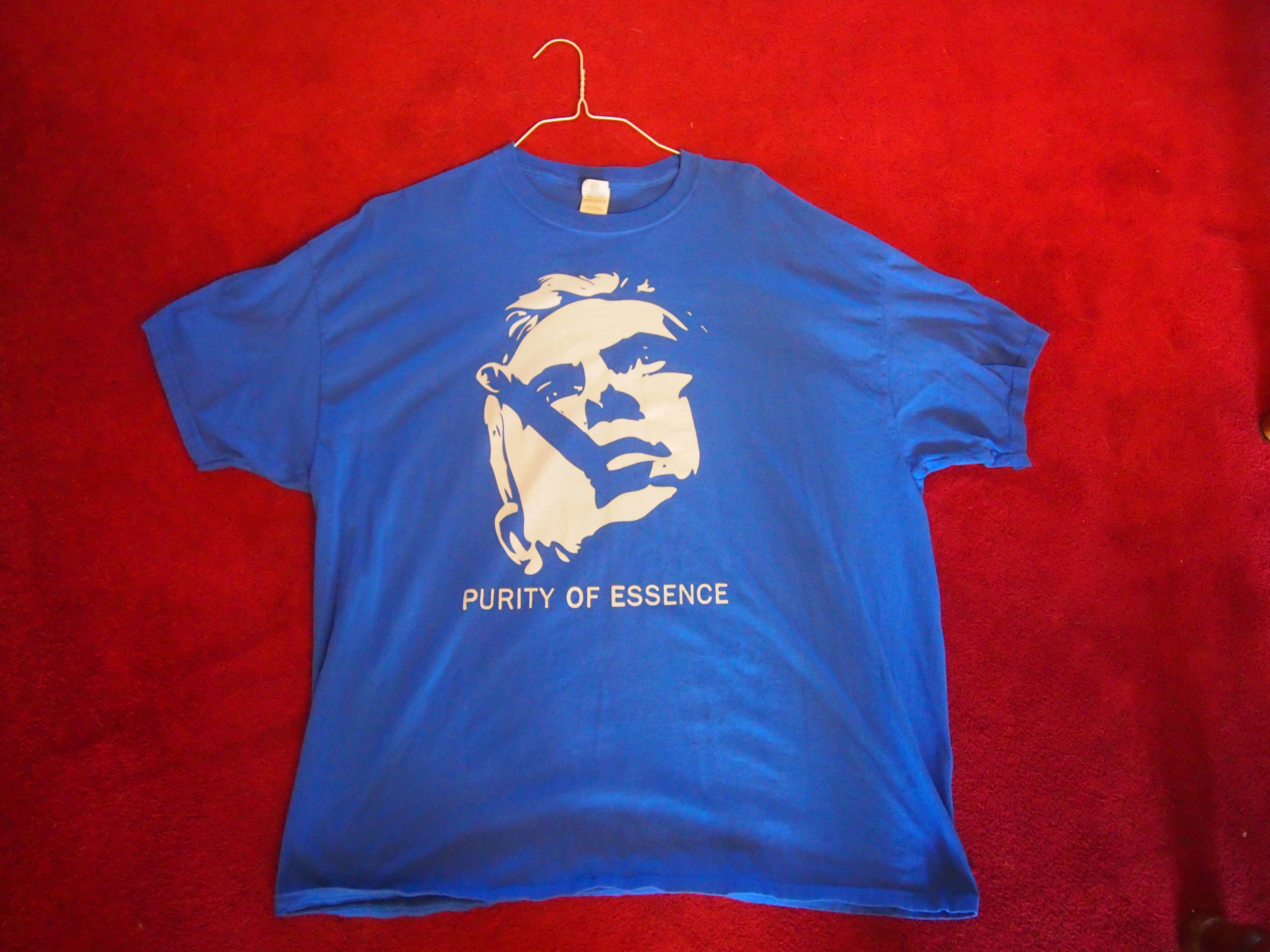
Strangelove teeI thought so highly of the shirt that Bill told me the web site where I could buy my own, which I did when I got home. It’s pictured above. In October I wore the shirt to the State Fair of Texas, where it got a few looks and exactly one comment in passing, “Love that shirt!”

A few weeks ago, I watched Dr. Strangelove for the nth time. Late one night in the late ’70s, I happened across the last 20 minutes or so of the movie, perhaps on one of San Antonio’s UHF channels, which was the first time I saw any of it. I couldn’t make heads or tails of it, and only when I saw it in college did I realize what I’d seen. Oddly enough, I also caught the last few minutes of Lolita on the same channel, and only realized it when it was shown in film class some years later; maybe that UHF program director had a thing for Kubrick.

Dr. Strangelove is many things, especially dark Cold War satire with endless allusions to sex, as has been pointed out many times. I had another idea about it this time around, one that makes some sense as an interpretation: the movie’s also about various aspects of the masculine psyche.

In popular lore, especially in idiotic bits like “Manslator,” men are simple creatures, but no human being is simple, much less either of the genders imagined as a whole. The following are notes about the six main characters in that light. Not that I believe that anyone thought about the masculine psyche when the movie was being created, just that it’s an idea worth kicking around these 50-odd years later.
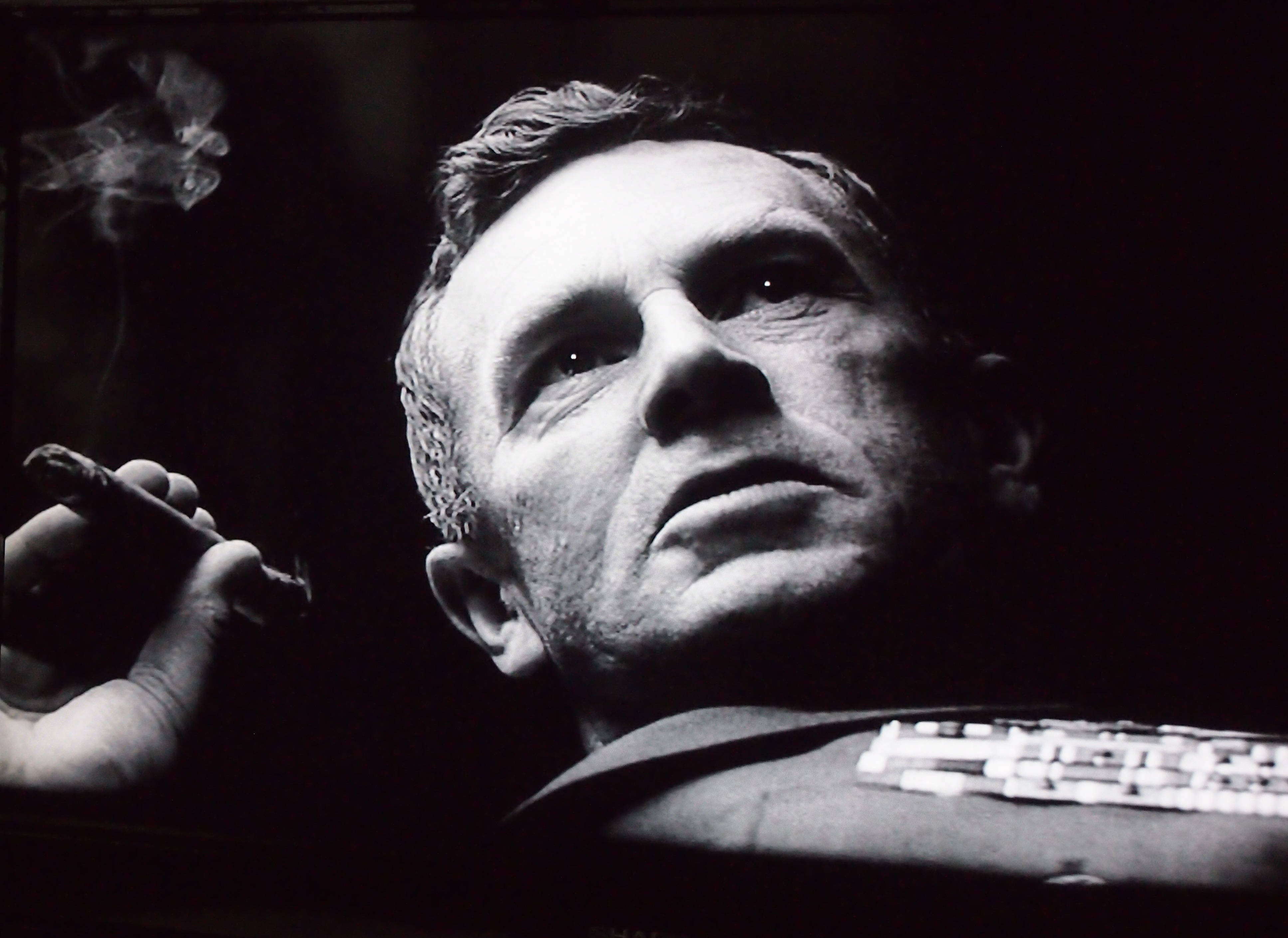
Gen RipperGen. Jack D. Ripper, the Psycho Killer. A fine example of an unsubtle name for a fictional character, but it does get to the point: Ripper wants to kill. Mind you, he isn’t a mindless killer. He’s a high-functioning, detail-oriented, completely delusional killer who fully believes he’s doing the right thing. This makes him exceptionally dangerous to everyone else.

Ripper feels under attack: an invisible, poisonous attack by a loathsome enemy aimed at his very manhood or, as he so famously put it, his “precious bodily fluids.” So for Ripper, it’s self-defense. For everyone else who isn’t a psychopath, it’s murder. Like it or not, the psycho killer’s definitely part of the masculine psyche, though fortunately not the controlling part for most men most of the time.
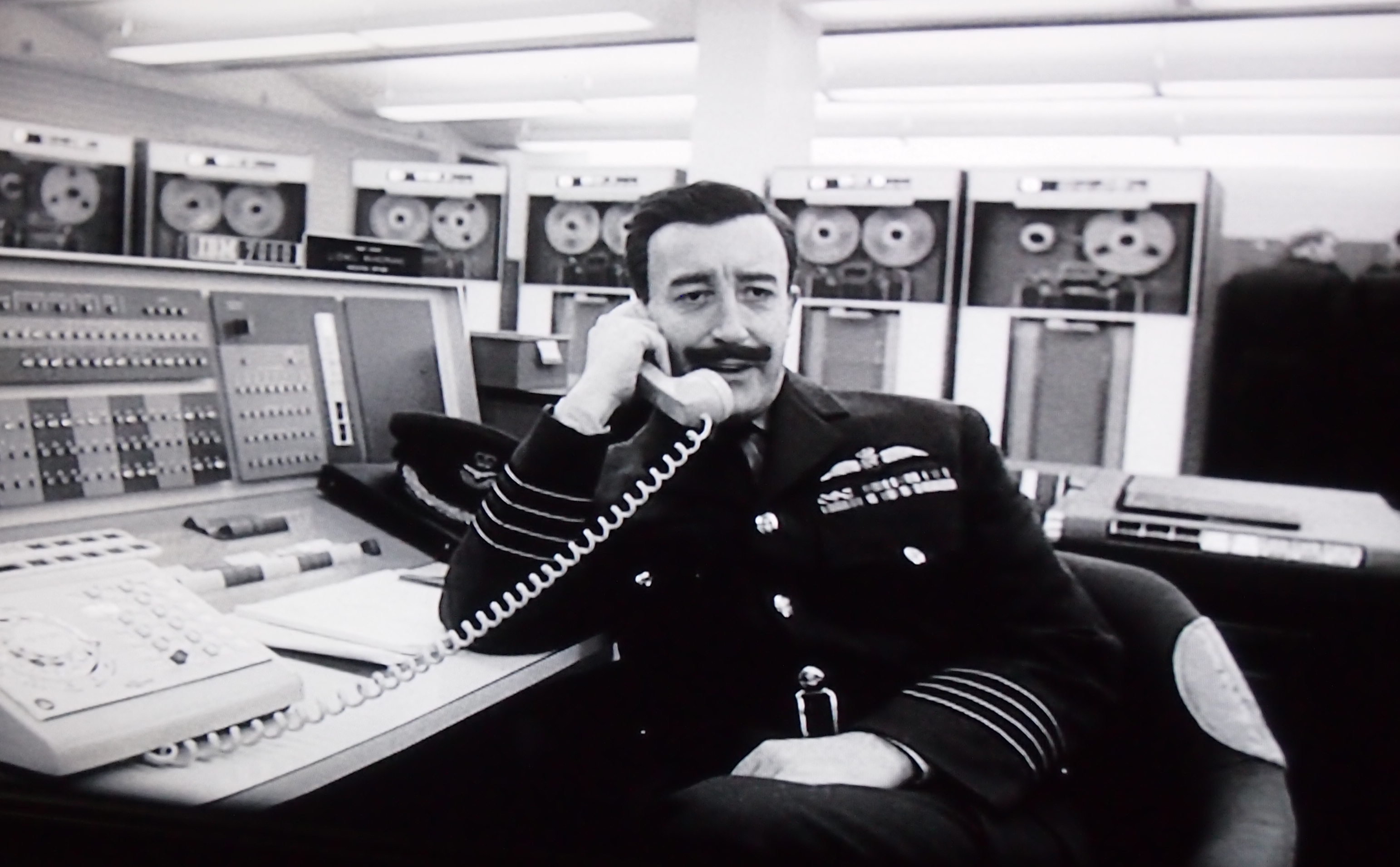
Group Capt. MandrakeGroup Captain Lionel Mandrake, the Rational Man. Mandrake is as rational as Ripper is delusional. He understands what’s happening, even asking Ripper why he launched the attack, to get to the bottom of things. Note his bitter laugh as he realizes just how nuts Ripper is and, at the end of the clip, how he rationally dives for cover when shots break the windows, while Ripper stands up. He also understands how horrible the situation is, and he’s fully committed to stopping the madness.

Rationality too is part of the masculine psyche, stronger in some men than others. Yet, like reason is in so many situations, Mandrake’s powerless in the face of determined madness, at least until the madness self-destructs. Even then, he doesn’t quite succeed, because of a string of impossible-to-predict incidents that defy reason: the bomber not being able to receive the recall order, the unexpected change in target, the dogged persistence of Major Kong.
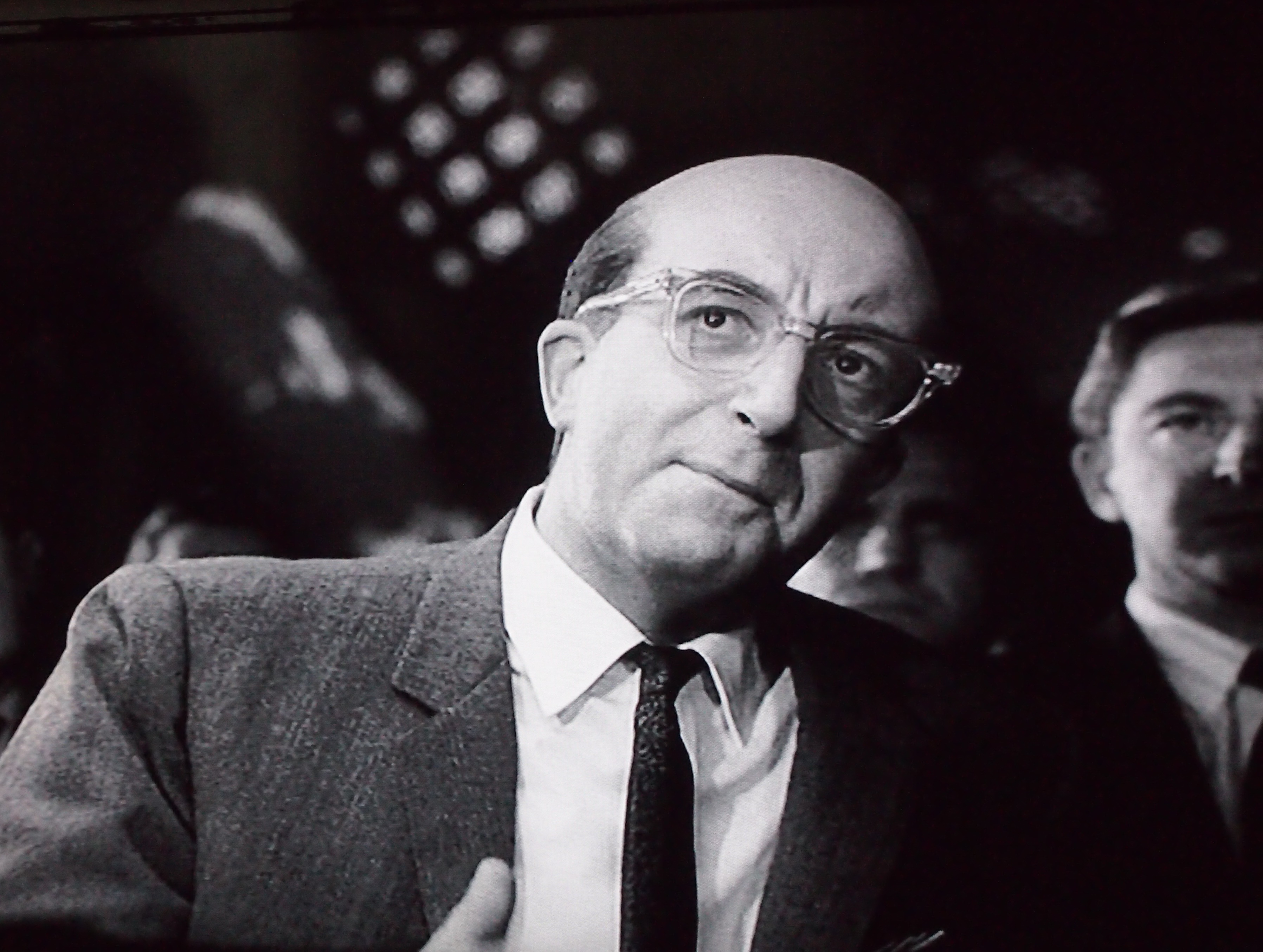
President MuffleyPresident Merkin Muffley, the Nurturing Man. To say President Muffley represents the feminine side of a man’s psyche is to risk trading on stereotypes about women, so perhaps “nurturing” is better, even though Muffley’s name more than hints at womanhood: muff and merkin, which is a pubic wig theoretically for either gender, but more often associated with women.

Not only is the president eager to prevent a nuclear exchange, he’s aghast at the prospect of it, since it represents mass murder, the complete opposite of protecting and nurturing. Moreover, he has moral authority, and acts decisively. He calls out Gen. Turgidson more than once (like a mother bawling out her teenage son), he demands an audience with Gen. Ripper, tries to be calming with Premier Kissov, and wonders whether the survivors in Dr. Strangelove’s mine shafts would be too distraught to carry on. Like Mandrake, his best efforts fail. This is, of course, a pessimistic movie.
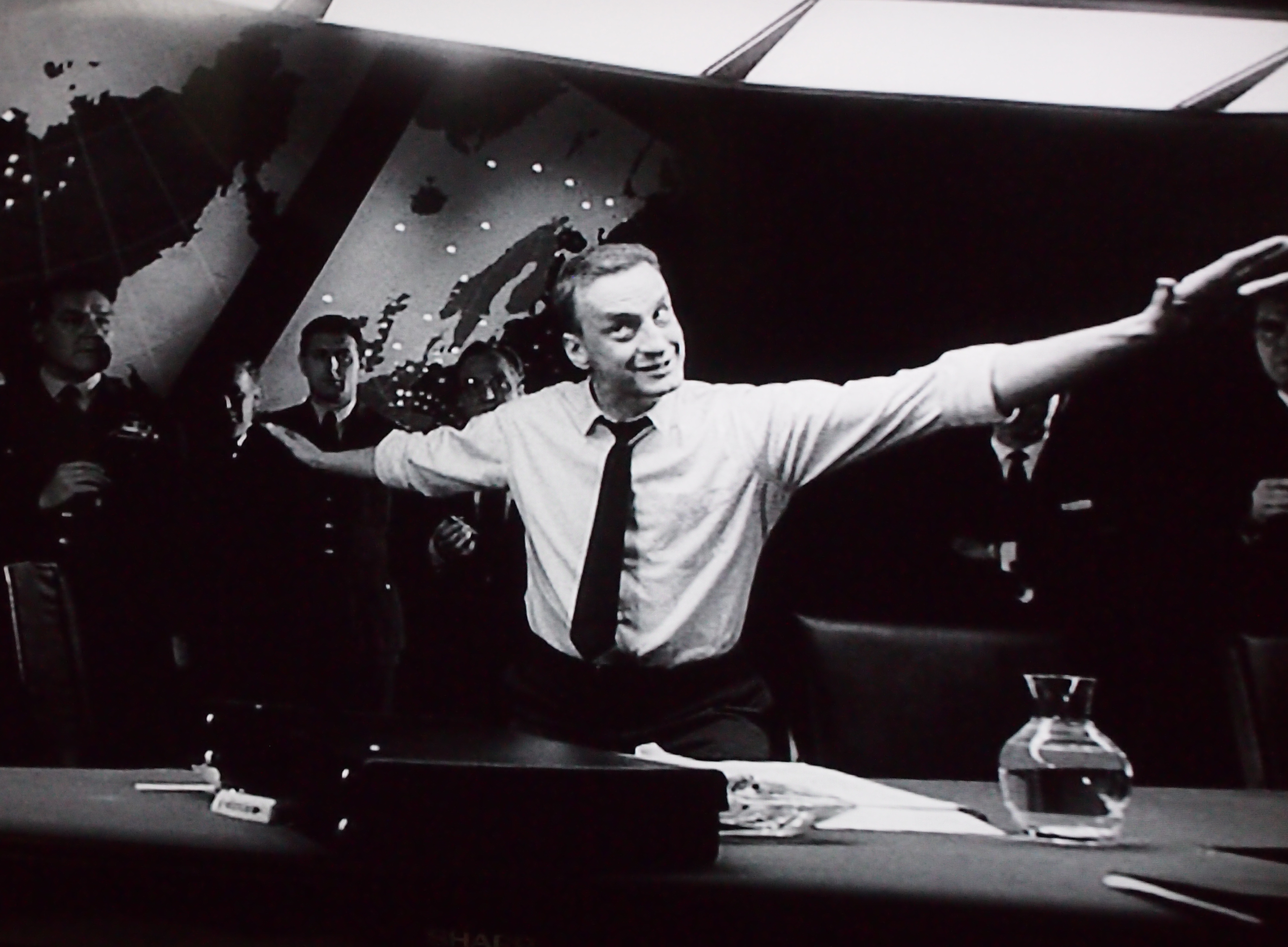
Buck TurgidsonGen. Buck Turgidson, the Adolescent. Like all of the names in Dr. Strangelove, “Turgidson” is absurd yet also speaks volumes. Adolescent boys are well known, and rightly so, for their turgidity. But as important as nooky is to an adolescent — it’s pointed out quite often that the only female character in the movie happens to be Buck’s mistress, and she happens to be in a bikini the whole time — adolescence is also marked by impulsive behavior, never mind what happens next. Gen. Ripper launched his wing? Damn, we’d better attack right now, hit ’em with everything we’ve got!

Adolescence also involves, in boys at least, an urge to fight, literally or figuratively, and enthusiasm for the cause. Turgidson tussles with the Soviet ambassador — literally — downplays 10-20 million deaths as mussed hair, and is quite excited in describing how a talented B-52 pilot can get through to his target, only realizing right at the end what it means, namely the end of the world. Adolescents are, after all, still learning that actions have consequences. One nice touch: Turgidson’s chewing gum most of the time.
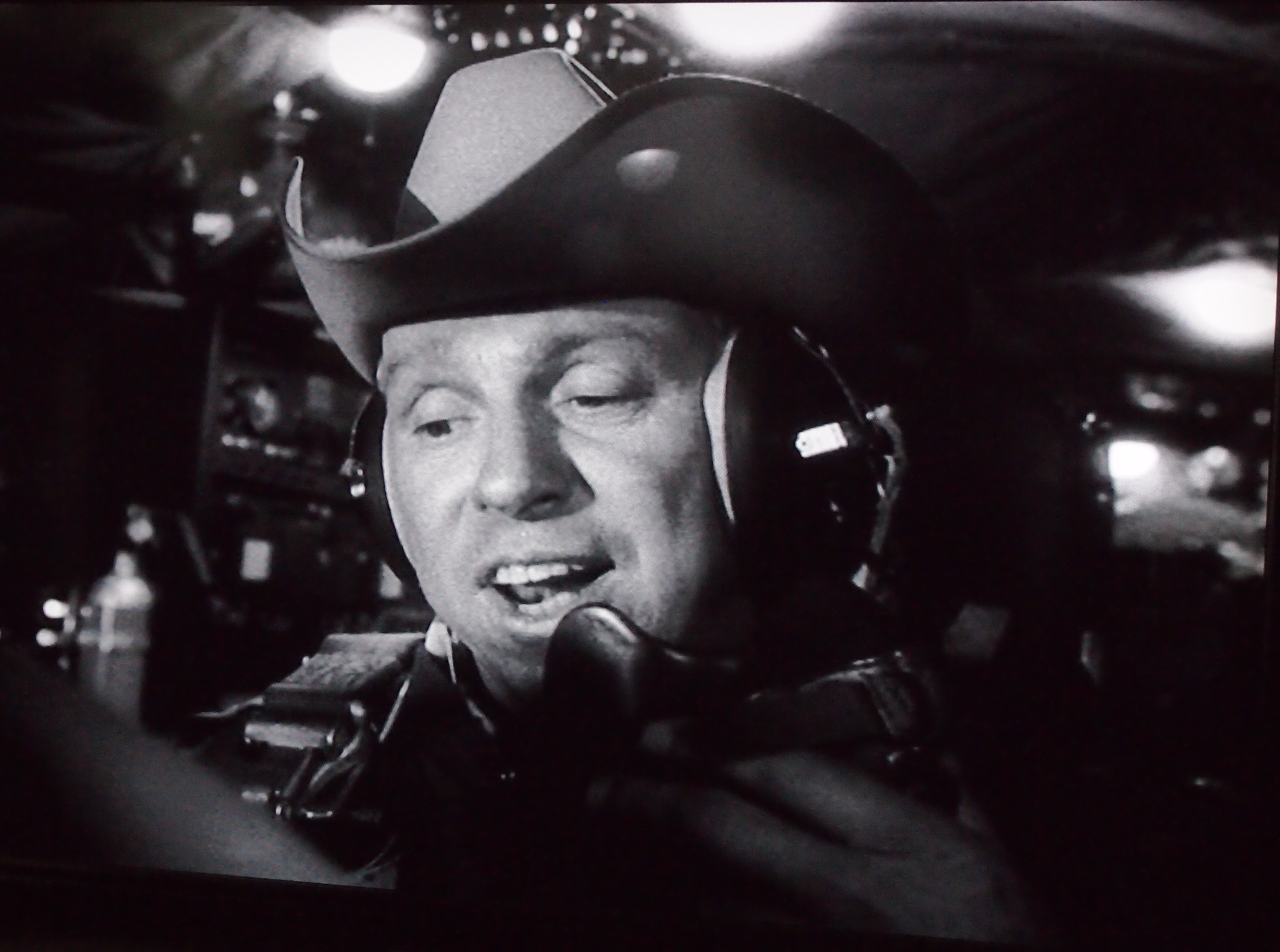
Major KongMajor T.J. “King” Kong, the Engineer. People who happen to be engineers are many things, like anyone else, but Major Kong is the engineer whose focus, whose overriding concern, is to solve problems and get things done. Beyond that, he’s out of his competence. He can’t quite imagine the consequences of the thermonuclear war he’s participating in — at one point, he predicts promotions and medals, as if it were a conventional war; and there’s the hilarious line about “nookuler combat toe-to-toe with the Rooskies.” But he knows he has to do his part, and by gar, he’s going to do it.

So he puts his considerable talents toward that end, overcoming a hostile attack, damage to his aircraft and a stubborn bomb bay door. All that cleverness, all that technical prowess, all that problem-solving, all that persistence: even so the result is doom. The name Kong suggests brute force, which certainly is fitting for nuclear weapons, but Kong and his plane are a little more than that: a force that, once turned loose, is impossible to control again.
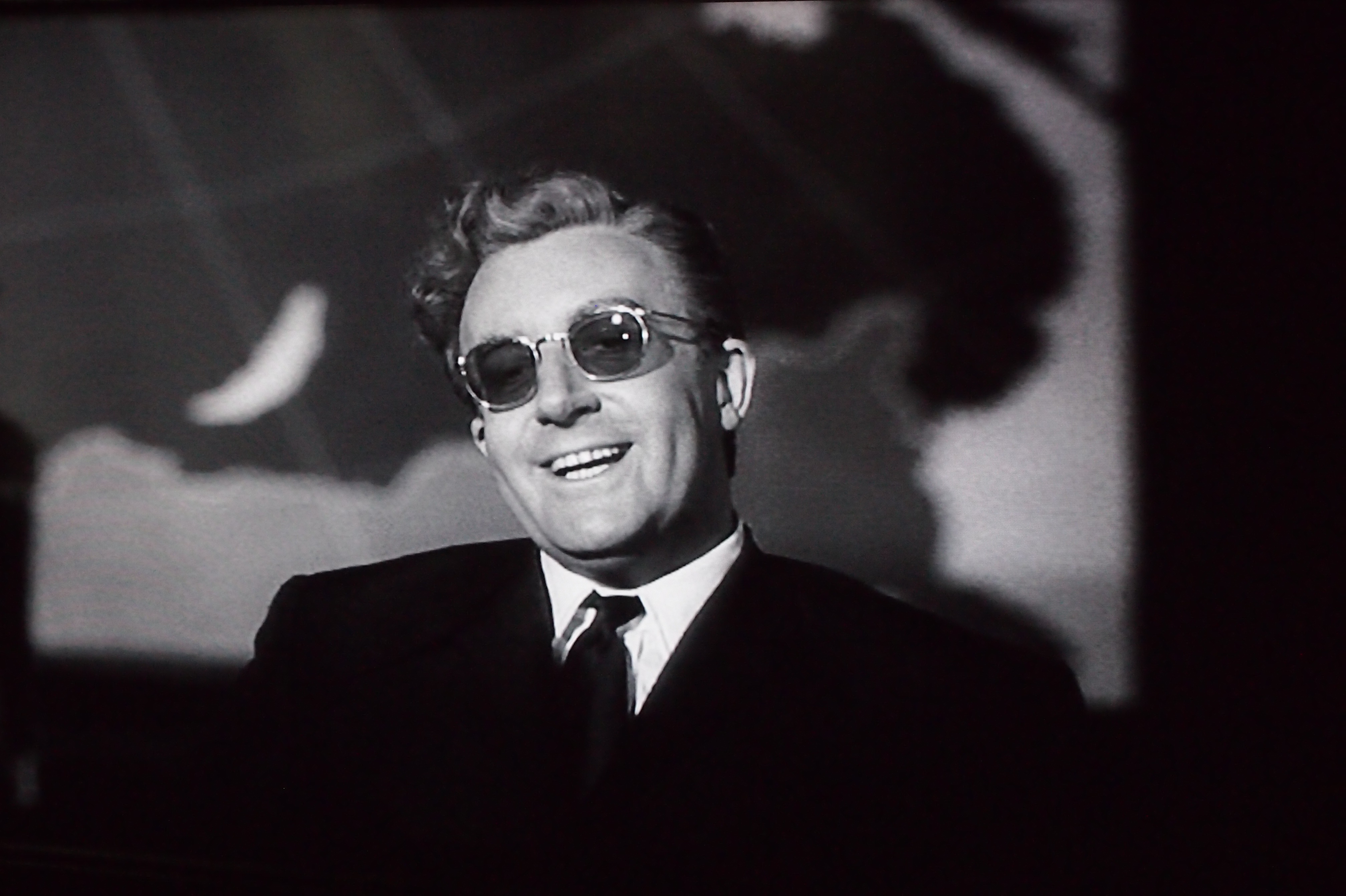
Dr. Strangelove, aka MerkwürdigliebeFinally, Dr. Strangelove, the Amoral Power Seeker. Nazis are hardly the only amoral power seekers in history, but they are a prime example of men seeking absolute power over other men. Strangelove is a barely reformed Nazi whose job is weapons research. How, in other words, to better project your power over other people. He isn’t a killer per se, but if people die as a result of his machinations, that doesn’t matter. With lust for dominance as his driving force — one of a number of kinds of lust in the movie — Strangelove nevertheless isn’t quite in control of himself, which give Peter Sellers a chance to be very funny indeed with the doctor’s Nazi-saluting, neck-grabbing hand, his true impulses beneath a veneer of sophistication.

Strangelove’s also coldly calculating, and considers the American people he’s supposedly working to protect as little more than animals. It’s telling that he says that a “nucleus of human specimens” might be “preserved,” and that men in the mine shafts will need to do “prodigious service” to “breed.” If most people are really like animals, it’s up to the strongest men — it’s practically their duty — to run things, by Strangelove’s calculations.

If I thought about the movie more, I might dream up interpretations for those amusing minor characters, Ambassador Alexei de Sadeski (“Our source was the New York Times“) and Col. Bat Guano (“You’re going to have to answer to the Coca-Cola Company”). But I think I’ve thought about it enough for now.
Mala Ars Longa, Vita Brevis

“There, now, that wasn’t so good, was it?” — Leonard Pinth-Garnell

I’m rarely persuaded that something bad, especially a movie, is so bad that it’s good. Usually bad is bad. I’m not going to waste much time watching bad romantic or other comedies, bad drama, bad action flicks, bad horror, bad adaptations of comic books, bad SF, bad war movies, and so forth. I have soft spots for some of the bad movies I saw as a child — The Robot vs. the Aztec Mummy, The Killer Shrews, Frogs, Godzilla vs. the Smog Monster, and a few others — but even so I don’t really want to see them again.

Reading about bad movies is another matter. The Book of Lists, mentioned earlier this week, introduced me to a number of titles universally acknowledged as bad, the only ones of which I’d be temped to watch — a few minutes of anyway — would be The Conqueror, just to see the ridiculousness of John Wayne pretending to be Genghis Khan, or Che! to see Omar Sharif as Che and Jack Palance as Castro. Other titles on its list included The Horror of the Beach Party, Lost Horizon (1973), Robot Monster, Santa Claus Conquers the Martians, and That Hagen Girl.

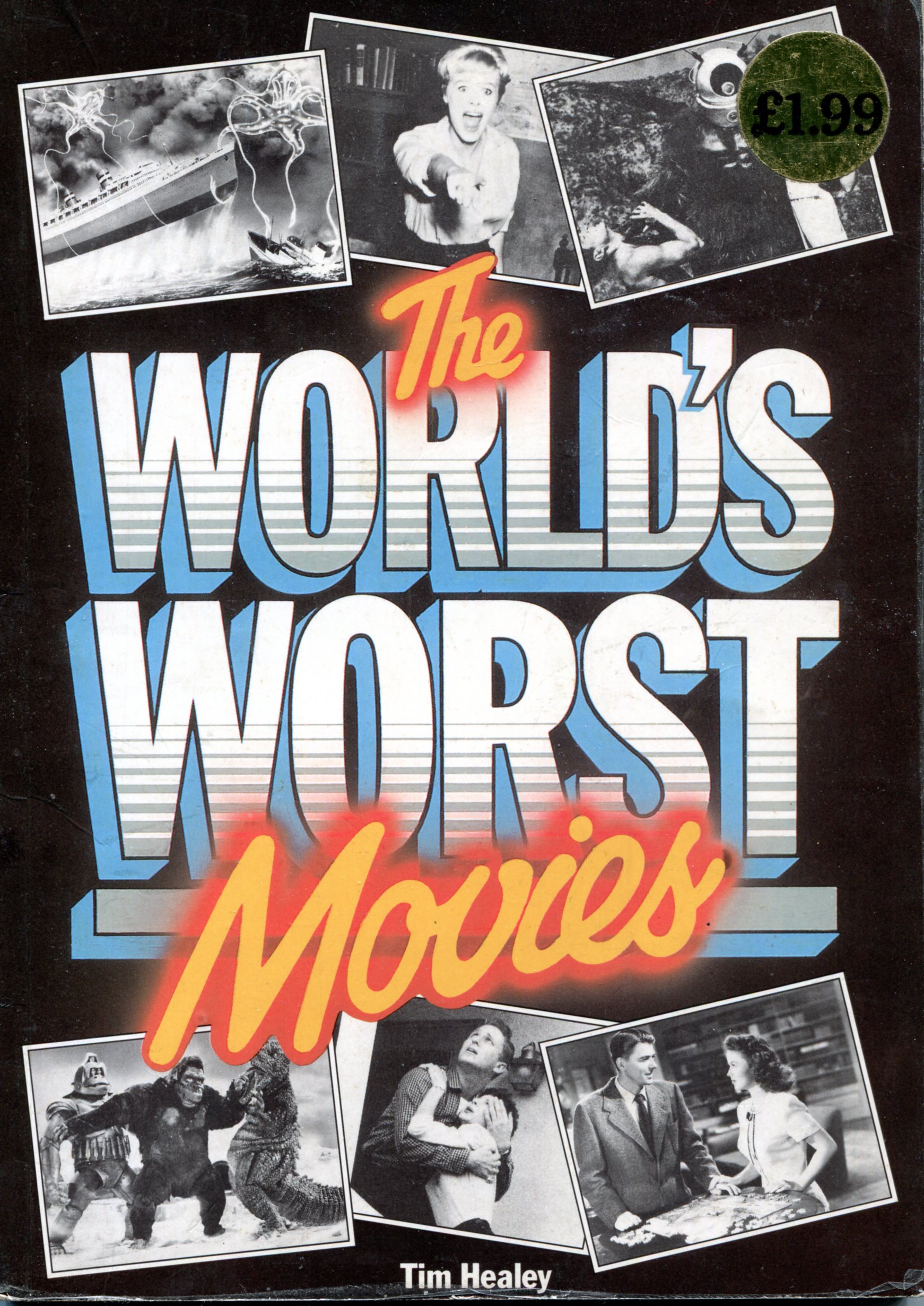
WorstMoviesIt’s a little hard to remember that before the Internet, lists like that, while not rare, weren’t everywhere you looked. They were still something of a novelty. On the remainder table at Harrods’ book department in 1988, I happened across a fuller example of a bad-movie list in the form of The World’s Worst Movies by Tim Healy (1986). For all of £1.99, it was a deal.

It’s more than a series of lists. Instead, the chapters are thematic essays — entertaining, not very serious essays — mocking bad monster movies, bad SF, bad action pictures, “sex schlockers” and “teenbombs,” along with subchapters along the lines of the Worst of Joan Collins, the Worst of Ronald Reagan, the Worst of Elvis, and the Worst of Roger Corman. Many familiar titles are discussed: Plan 9 From Outer Space, They Saved Hitler’s Brain, The Swarm, Glen or Glenda? etc, etc.

The book also introduced me to movies I’d never heard of, such as Night of the Lepus (1972), which is “a horror film about a horde of monster rabbits which roams the Arizona ranchlands in carnivorous packs leaving trails of destruction of their wake.” Or Zombies of the Stratosphere, a 1952 serial featuring a young Leonard Nimoy as a Martian. Or Percy (1971), about which the book asks, “What could be worse than a film about a penis transplant?” The answer: “Another film about a penis transplant,” referring to the sequel, Percy’s Progress (1974).

I will say that I went out of my way to watch Plan 9 From Outer Space on tape after I saw the entertaining movie Ed Wood. It was as bad as promised. Yuriko watched about 10 minutes and then left the room. I stuck with it and noticed that while Ed Wood tried to re-create some of the bad performances of that movie, they didn’t always work. Most notably, Bill Murray as Bunny Breckinridge, who was the “The Ruler” in Plan 9. Bill Murray is simply too good an actor to be that bad.

Bicycle Thieves

Some days you get up and think, I haven’t seen enough Italian neorealist movies. Well, maybe it doesn’t happen exactly that way, but anyway you have a sudden urge to see Bicycle Thieves, also known as The Bicycle Thief, though it’s clear enough that Ladri di biciclette, the Italian title, is plural, and for good reason, as things turn out in the story.

At least, I had a urge to see Bicycle Thieves recently. It’s been a long time in coming. Back in high school, I had a copy of The Book of Lists, one of the more fun (if not very scholarly) reference works of the pre-Internet age.

In its section on movies, the book included the results of three Sight & Sound magazine polls of the ten best movies of “all time,” polls done in 1952, ’62, and ’72. Topping the 1952 list was The Bicycle Thief, as it was known then in English, though it came in at no. 6 ten years later and wasn’t on the ’72 list.

It was a movie I’d never heard of on a list compiled by a magazine I’d never heard of in a time and place (ca. 1978, Texas) when accessing either the movie or the magazine would have been difficult, so I had every reason to forget it. Which I did. Almost. Somewhere, for years afterward, tucked in the labyrinthine warehouse of filing cabinets that form my memory, was a little folder called The Bicycle Thief, whose entire contents were, “Wonder what that’s about. Why did some critics like it?”

Sight & Sound, incidentally, is still published by the British Film Institute, and it still does a greatest-movie poll every 10 years. In 2012’s poll, Bicycle Thieves was no. 33 out of 50, for what it’s worth. But it’s hard to take a great-movie list that omits Dr. Strangelove too seriously.

In 1983, I noticed The Bicycle Thief discussed in one of the better textbooks I’ve ever had, Understanding Movies, Third Edition (1982) by Louis Giannetti, which I used in my VU film class, though we didn’t see the movie in that class. I still have the book, which says, “[The] Bicycle Thief deals with a laborer’s attempts to recover his stolen bike, which he needs to keep his job. The man’s search grows increasingly more frantic as he criss-crosses the city with his idolizing, urchinlike son…”

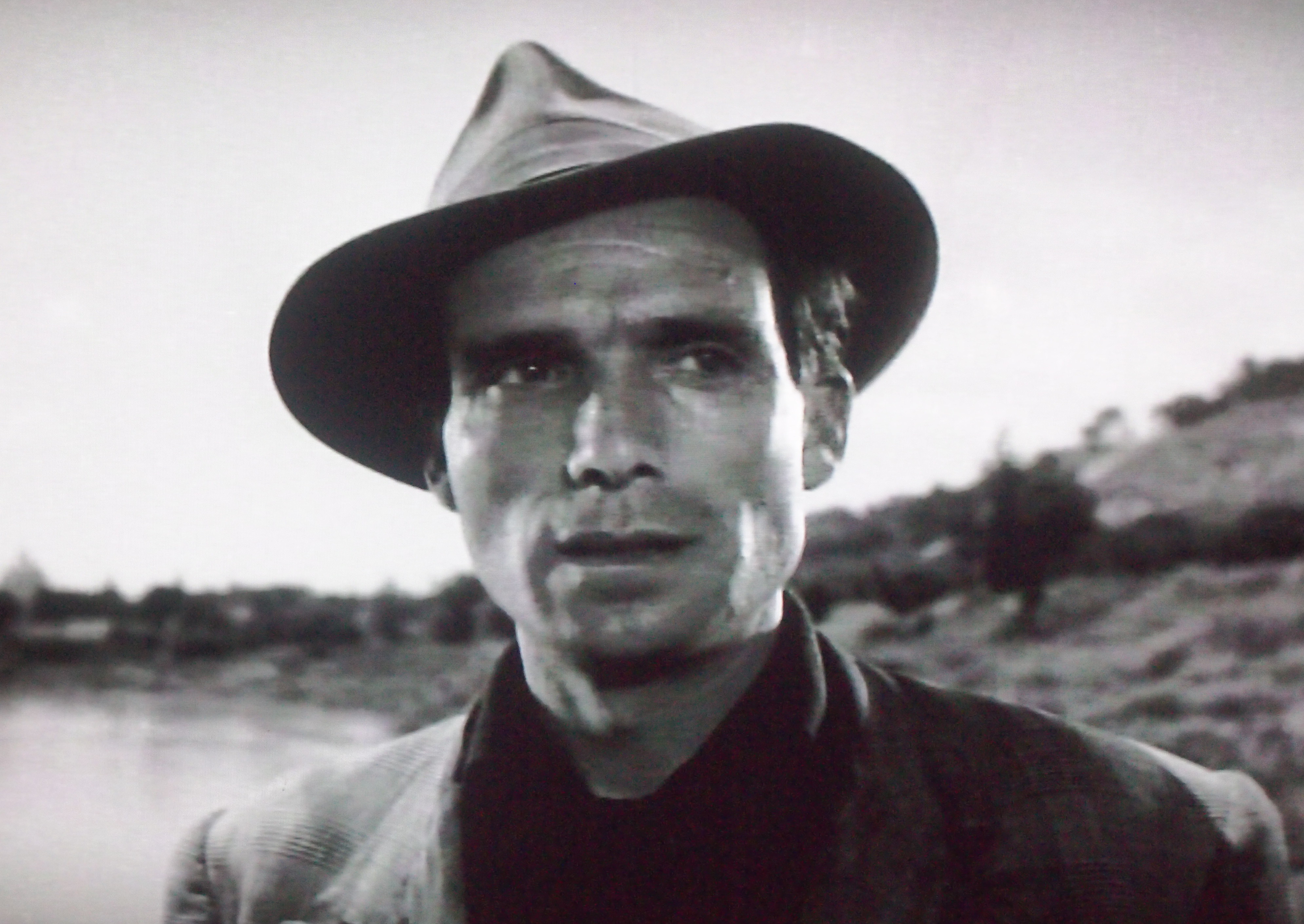
Put like that, it doesn’t sound like much of a story. Yet it is. Mainly it’s about how awful poverty is, and how someone stuck in it just can’t catch a break — without making it an overt polemic about class injustice. The man and his son are fully human, with the serious misfortune of being poor. By the time the movie’s nearly over, you’re really pulling for Antonio (the father, pictured above) and Bruno (the son). You want them to find the bicycle, but you know it isn’t going to happen, and you know what Antonio’s going to do about it, and think, I might do the same, even though it turns out to be a bad idea.

“After a discouraging series of false leads, the two finally track down one of the thieves, but the protagonist is outwitted by him and humiliated in front of his boy,” Giannetti continues. “Realizing that he will lose his livelihood without a bike, the desperate man sneaks off and attempts to steal one himself… he is caught and again humiliated in front of a crowd — which includes his incredulous son.”

Director Vittorio De Sica used nonprofessional actors in the lead parts of father (Lamberto Maggiorani, above) and son (Enzo Staiola). It probably helped that Maggiorani was an actual factory worker, but how De Sica teased such a remarkable performance out of seven-year-old Staiola is astonishing.

Also of interest: Rome, 1948. Much of the movie was shot out in the streets of Rome. It might be the Eternal City, but a lot must have changed in nearly 70 years: the streetscapes, the non-monumental buildings, the way the crowds look and get around town. I tried to notice as much of the background as I could. Even when I visited Rome in 1983, there seemed to be a lot more cars than depicted in De Sica’s city, though at one hair-raising point Bruno’s nearly run over by two careless drivers, something that seemed entirely believable to me.

In all, an exceptionally good movie. So I’m glad that, for whatever reason a few weeks ago, I thought, I never did see Bicycle Thieves. Time to do it. In our time, when you have such a notion, you can put the movie in your queue — or get it at once on your gizmo. I saw it on DVD. People who are put off by old movies, or black-and-white movies, or movies that have subtitles, seriously don’t know what they’re missing sometimes.

Another Round of Thursday Bagatelle

I saw Travels With My Aunt (1972) not long ago. Like a fair number of movies, I’d have to say that the book is better, though the movie wasn’t bad. Then again, I’ve forgotten most of the book, since I read it at least 25 years ago.

I was startled to see Cindy Williams as the young American on the Orient Express. She was merely a young actress at the time, but even so I kept expecting to see Penny Marshall show up. Such is the conditioning effect, even after 40 years, of mediocre sitcoms; you just can’t get rid of them. Yet even that show had a few charms, which are best watched in the form of a YouTube video collections of Lenny & Squiggy entrances. Or if you like, the setups and then their entrances. The two were the butt of essentially the same joke for years.

Apparently Teen Spirit deodorant is a real thing. I saw some at a dollar store a while ago. I had no idea is was an actual product. Entertainment lore has it that the product inspired the song name, not the other way around. On its label it promised a “girly” smell.

Naturally the Greek exhibit at the Field Museum ended with a gift shop. We poked around and I found a small owl statue for Yuriko, who’s fond of owls, but I didn’t find any postcards. I asked the clerk about it, and she posited that note cards, which the shop carried, would sell better. Nuts to that.

Someone will be the new President of the United States a year from now, so I took a look at the oddsmakers at Paddypower. That outfit calls itself “Ireland’s biggest, most successful, security conscious and innovative bookmaker.”

Hillary Clinton remains the favorite, according to Irish bookies: 5/6. Much more astonishingly, at least in historical terms, Donald Trump is next at 7/2. Marco Rubio and Bernie Sanders are at 6/1. Ted Cruz, 11/1. Jeb Bush’s many donors must be steamed that he’s 22/1. Chris Christie, 33/1. Somehow Mitt Romney is 100/1, same as Paul Ryan. Guess the scenario there is a brokered convention with either of those jamokes selected. In the can’t-get-anyone-to-notice them category are John Kasich, 125/1, and Martin O’Malley, 150/1.

I won’t bother with the others, except Rocky De La Fuente, at 300/1. Most Americans don’t know him, but I do, though I hadn’t realized he was in the race. He’s a real estate developer from San Diego, so I suppose that makes him the lesser-known real estate mogul running for president (the anti-Trump, and as a Democrat, in point of fact). I don’t know anything about his politics, but I will say he’s got a fun presidential name.

Back to the Music Box

In December 2003, I posted the following recollection of December 1996: “It’s been a good week leading up to Christmas. On Sunday the 22nd Yuriko and I went to the Music Box Theatre for the double feature sing-along. Between the movies, a Santa Claus — lean and not very old — came out to lead the audience in singing Christmas songs, some standard and some spoofs. The Music Box has an organ for occasions like this, and the organist was in fine form.

“The place was packed, and it was a spirited crowd, jingling the bells they brought and singing along with the bouncing ball (I wonder who thought that up originally?). They also hissed with gusto at Mr. Potter, the villain in you-know-what sentimental holiday movie, which was the other half of the bill with White Christmas.”

For some years I’ve been thinking about returning for the Christmas sing-along at the Music Box. This was the year. On Saturday I went with Lilly and Ann, who each brought a friend. I’m pretty sure 1996 wasn’t the last time I’d been to the Music Box, which is on Southport Ave. on the North Side of Chicago, since I went periodically when I lived in the city and occasionally after that, but I don’t remember my last visit. It’s been some years. I’m glad to report that it looks exactly like it used to, down to the small framed movie poster in the men’s room: the face of Clara Bow, advertising Love Among the Millionaires (1930).

That was probably a picture the Music Box showed in its first year, since it opened as a neighborhood movie palace in the summer of 1929. “The plaster ornamentation of the side walls, round towers, faux-marble loggia and ogee-arched organ chambers are, by Hollywood standards, reminiscent of the walls surrounding an Italian courtyard. Overall the effect is to make the patron feel that they are watching a film in an open air palazzo,” the theater’s web site fancifully asserts.

“The Music Box Theatre opened on August 22, 1929, a time when the movie palaces in downtown Chicago each had seating capacities of around 3,000 people. The Music Box, which sat 800, was considered an elaborate little brother to those theatres. Theatre Architecture magazine noted in 1929 that the theatre ‘represents the smaller, though charming and well equipped, sound picture theatre which is rapidly taking the place of the “deluxe” palace.’

“The building was designed by Louis A. Simon, a local architect who was better known for his Depression-era WPA Post Offices and homes for the nouveau riche. The building was erected by the Southport Avenue Businessmen’s Association and operated by Lasker and Sons, who operated several smaller neighborhood houses in Chicago.”

Naturally the Music Box fell on hard times in the 1960s and ’70s, but in 1983, “management reopened the theater with a format of double feature revival and repertory films. Eventually, foreign films were reinstated, and independent and cult films were added to the roster. The Music Box Theatre now presents a yearly average of 300 films.”

Including It’s a Wonderful Life and White Christmas every December. I only wanted to stay for the former this year. As in ’96, the crowd was festive. An organist played and a faux Claus led the singing, which included lyrics on the screen but no bouncing ball, and no parody songs this time. Still, it was a jolly time.

I can’t say how many times I’ve seen It’s a Wonderful Life all the way through. Maybe four. I didn’t see it when it was ubiquitous on TV in the ’80s because that’s when I had no TV. I probably saw it first in Japan on VHS. That’s no way to see it. You want to be part of an audience that hisses at Potter, rings bells at Clarence, and cheers when George Bailey Does The Right Thing, such as finally getting together with Mary or turning down Potter’s offer of $20,000 a year — which would have the buying power of more than $243,000 now.

(And the money Uncle Billy lost is the equivalent of more than $97,000. Man, that’s carelessness.)

When Bedford Falls reveled itself to be Pottersville, it occurred to me: Wouldn’t have Bedford Falls been a more interesting place with a few of the venues on tap in Pottersville? At least a place to hear some hoppin’ jazz, as Nick’s offered?

Since I didn’t have to pay attention to the arc of the story like my daughters and their friends did (imagine seeing it for the first time), I was able to notice details I’d never noticed before. One thing that struck me is how visually rich the sets are. The building and loan, the Bailey house, and even Potter’s office all look like someone actually uses them day-to-day, sporting the kind of pictures and objects and knickknacks that people accumulate when they’ve been somewhere a long time.

So it’s time to acknowledge the set designer of It’s a Wonderful Life, one Emile Kuri (1907-2000), who also did work on Mary Poppins and Rope, and over the course of his career won two Oscars. I don’t think he gets the attention he deserves when that movie is discussed.

Another detail that jumped out at me — and I guess it would count as a function of costuming — involved Mr. Gower the druggist as an alternate universe ex-con and rummy. When he stumbled into Nick’s to panhandle a drink, his thin coat is slightly open, revealing newspapers inside, added for warmth. I’m certain it would have made no difference to the story or even the scene whether that paper was there. It was just a good touch of a thoughtful costume designer.

One Edward Stevenson (1906-1968) did the costumes for the movie. He also worked on such films as Gunga Din, Citizen Kane, The Magnificent Ambersons, Sinbad the Sailor, and Cheaper by the Dozen, among many others, including some that just credit him for the gowns. He too won an Oscar.

Buildings in the Clouds

Ann wanted to borrow my camera during part of our walkabout on Saturday, so I lent it to her. She took some good images. Such as the Wrigley Building on Michigan Ave., just as the light faded for the day.
Wrigley Building Dec 12, 2015I’ve read that giant grasshoppers crawled on the building in The Beginning of the End (1957). “You can’t drop an atom bomb on Chicago,” protests a young Peter Graves. That does seem like burning down the house to get rid of the termites, but never mind.

Note the soaring structure beside the Wrigley Building, right up into the clouds. That’s the You-Know-Who Tower, with the name of the property mogul running for president — in classy 20-foot stainless steel letters — slapped on the side facing the Chicago River last year.

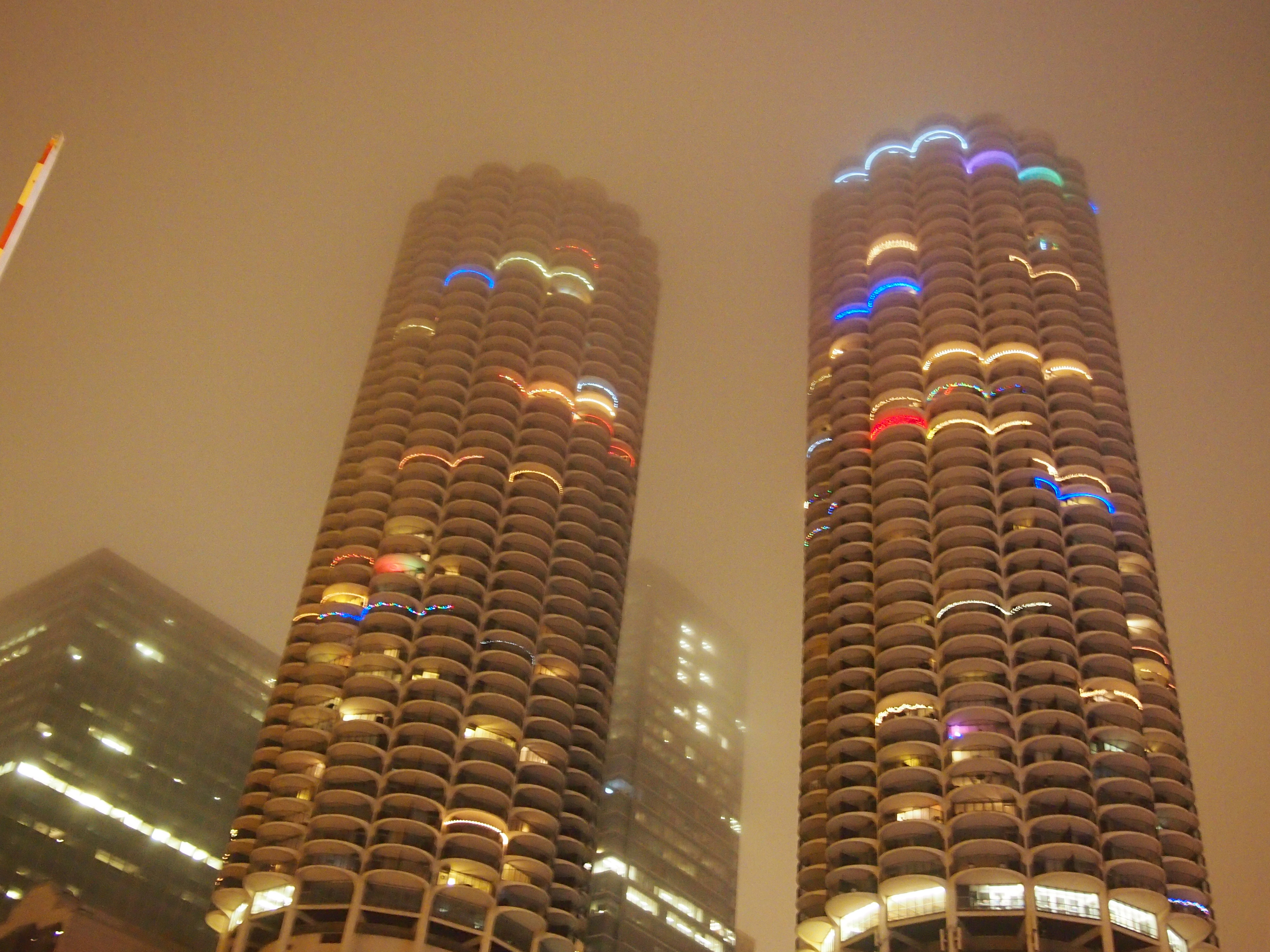
Also reaching into the clouds, as seen from State St.: Marina Towers.

Marina Towers, Dec 12, 2015They too have been in movies, notably The Hunter (1980), which was Steve McQueen’s last picture. I haven’t seen the whole thing, but in the age of YouTube, it’s easy to see just the part in which a car plunges from the towers — which have parking decks on their lower levels — into the Chicago River. The scene was so good that a similar one was created for an insurance commercial, though I have to add that if you’re running from the cops, I doubt that any policy’s going to cover the damage.

Thanksgiving & The Days After ’15

On the whole, Thanksgiving outside was gray and rainy, but pleasantly warm for this time of the year. The days afterward were drier but much chillier, though not quite freezing.

Pictured: an all-too-common meal snapshot, in this case most of my Thanksgiving dinner. Note the artless presentation. I did that myself. I don’t remember what the plastic fork was doing there, but I will assert that we used metal utensils.
Thanksgiving chow '15The ham came from a warehouse store, while Lilly prepared the various starches, with Ann’s assistance. She combined four or five different cheeses for the macaroni and cheese. It isn’t Thanksgiving without that, she said, and it was the star attraction of the plate. For those who fret about such things, there was a green item on the menu, too: green beans, which didn’t make into the picture, but did make it into my stomach.

Once again, Martinelli’s sparkling cider was the main drink — original and cranberry/apple — though we also opened a bottle of wine we bought at a winery near Traverse City in 2007. I’d post the name of the wine, but that would involve going out to the refrigerator in the garage, where it’s now stored, and reading the label. It was a pretty good Riesling.

Some people shop on the Friday after Thanksgiving. That’s never been my ambition. My ambition is to do as close to nothing that day as possible. Days like that are very rare. This year I almost achieved it. Almost, but not quite.

Which reminds me of this exchange in Office Space.

Michael Bolton: You were supposed to come in on Saturday. What were you doing?

Peter Gibbons: Michael, I did nothing. I did absolutely nothing, and it was everything that I thought it could be.

On Saturday, we watched Vancouver Asahi, a Japanese movie on TV about the baseball team of that name, composed of Japanese-Canadian players during its heyday in the 1930s, when there used to be a Japantown in Vancouver. Not bad on the whole, though about 30 minutes too long. It also had the virtue of being about something I’d never heard of before.

After the movie ended, at about 11:30 in the evening, I went out on the deck and could see Orion to the south, parading across a nice clear sky. Never mind the solstice. Winter’s here.

Guy Fawkes & Martians &c

One more warm day. Then no more. Unless the forecasts about next week are right. What kind of November is this?

It’s Guy Fawkes Day again, and not a burning effigy in sight. It’s really something we should import. Lately I’ve been reading What If? 2, a collection of counterfactual history essays that I picked up used for 50 cents, but “What If Guy Fawkes Had Succeeded?” isn’t one of the subjects. Naturally that question’s been taken up elsewhere.

All of us went to see The Martian on Sunday. All in all, a well done bit of hard SF. Titanium hard, though considering the story, the focus on the technology of space travel and survival in a hostile environment isn’t misplaced. The movie also managed to present its exposition — and there was a lot of it — in a way that didn’t goo up the narrative, which is no small trick.

One thing (which the author of the book has acknowledged): the Martian atmosphere is so thin that a raging storm of the sort that got the hero in his jam would be impossible. The planet does have dust storms, of course, but not hurricanes of dust. Never mind.

There’s no overt indication of when the story takes place, so I figured it was either 20 years or so from now — very optimistic indeed, considering the sluggish pace U.S. manned space exploration these days — or in a present-day world in which a program to send people to Mars got started in earnest in the 1990s (it was, after all, something the elder Bush proposed). The flags on the spaceships and shoulder patches, I noticed, had 50 stars. A nice detail would have been to use the 51- or 52-star designs.

I suspect the only way U.S. astronauts are getting to Mars in a few decades is if the Chinese decide to attempt it.

From a web site I’d never heard of before but happened across recently, purporting to cover real estate news (all sic): “According to Investor Daily, TIAA-CREF’s Phil McAndrews has recently stated that the United States economy is under fairly good state that tantamounts to the continuing optimistic forecasts for the commercial property segment.”

That’s a sample from an item laid out like a real article, but clearly not written by a native speaker of English. The item, in fact, is a little hard to read, and larded with advertising links and other annoyances. And then it crashed my browser with an irritating “Unresponsive Script” message. I’m not overly worried about competition from such Mickey Mouse efforts as this.

Does anyone use “Mickey Mouse,” as in amateurish, any more? I had a teacher in junior high, our band director Mr. Fields, who was fond of the term. Now it sounds like it belongs to an earlier generation — Mr. Fields’ generation, or about the same age as Mickey himself. Maybe in more recent years, Disney minions have made trouble for anyone who uses Mickey like that. I’d better watch out.

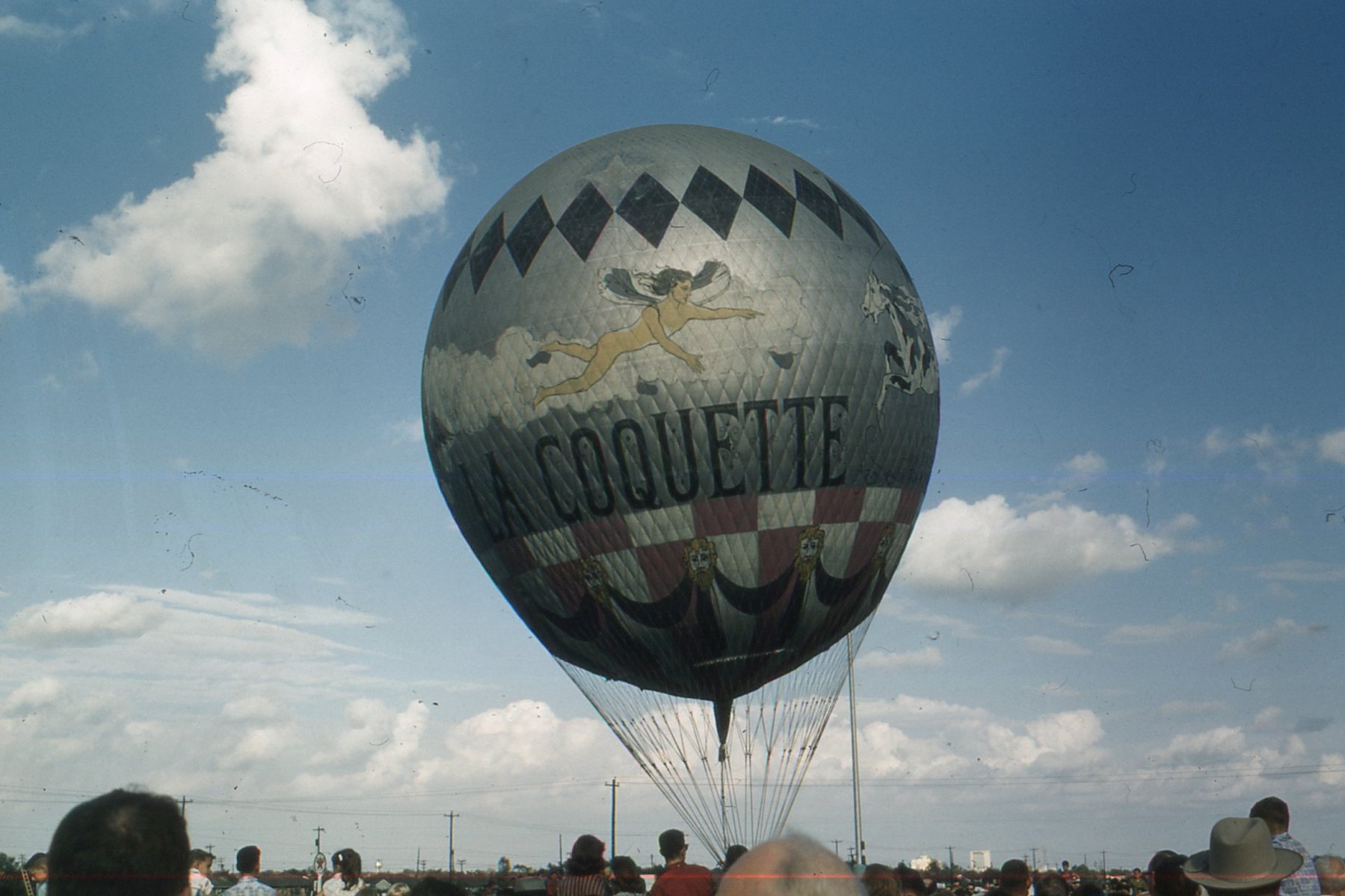
La Coquette, 1957

I’m able to pinpoint this image taken by my father with some certainty, because it’s the La Coquette balloon. That’s the balloon featured in the 1950s film adaptation of Around the World in 80 Days, as this site explains in considerable detail. Apparently the balloon did no actual flying in the movie. It was a set, essentially. But it could and did fly for various events.

La CoquetteSo I’m fairly certain this is La Coquette at the grand opening of the Meyerland Plaza mall in Houston on October 31, 1957. The balloon was there, and my family, who lived in Houston at the time, made it to the event as well. I can’t imagine my father would have gone by himself, anyway.

According to the web site of the mall: “Meyerland Plaza Shopping Center opened in October of 1957 with a celebration of ‘Around the Shopping World in 80 Acres.’ There was a hot air balloon that took riders to the Shamrock Hotel.” Meyerland, since redeveloped, is still around and traded hands as recently as 2013, when the Houston Chronicle did an article about the deal that featured the balloon as a bit of background detail. The balloon also did a stint at Disneyland in the early 1960s, it seems.

Thursday Tidbits

Cool air to begin October. Fitting.

I saw part of The Iron Giant on TV a few years after its 1999 release, coming away with the impression that I ought to see all of it someday. That day was Saturday: Yuriko, Ann and I watched it on DVD. Upon its theatrical release, apparently the studio dropped the ball in marketing it, so the movie didn’t do well, but it caught the attention of critics. I can see why. Not flawless, but high-quality animation and a fun story.

Occasionally we still discover another food that the dog will eat. This week it was refried beans. She was pretty enthusiastic about them, in fact.

NASA has just published remarkable images of Charon, moon of Pluto. Or are they considered twins these days? I haven’t kept up with those definitions. Anyway, how often do we see something that’s absolutely, for sure never been seen by humans before? Not often.

Around 30 years ago, when I bought my first car, I remember pricing some Volkswagens. As usual for a young man, I was looking for an inexpensive car. Volkswagens of the time weren’t as inexpensive as I thought they would be.

A decade earlier, when you wanted an inexpensive car, they would have been the thing. They were People’s Cars, after all. But somehow the brand had strayed away from the entry level by the early 1980s, and before long I owned an entry-level Toyota, a company that remembered to make models at a variety of price points. I’ve bought a number of other Toyotas since then, too, above entry level.

Now that Volkswagen’s been caught committing mass fraud, I imagine the talk a few years ago between two upper-level company managers (in cartoon German accents). After all, imagined conspiracy scenes can be fun.

Hans: Can we really get away with this?

Fritz: Ja, the Americans are too stupid to catch on.

Obviously they learned nothing from the history of the 20th century.