Bradley University Walkabout

Before each Easter comes around, you don’t know whether you’ll get a pleasant early spring day or a chilly late winter one, at least at my latitude. This year, as if to echo the glory of the holiday, we enjoyed a flawless spring day.

Easter Monday and Easter Saturday were pretty nice, too, and on the latter of those two, Ann and I spent much of the afternoon in Peoria, Illinois. During this Vaccine Spring, appointments have proven hard to book close to Cook County, and so I’d found one for her at a pharmacy in Peoria, not far as it happened from the campus of Bradley University.

Since driving down to Peoria, getting the shot, and zipping right back seems like an opportunity wasted to me, we didn’t do that. Bradley was close at hand, so after the shot we took a walk in the springtime sunshine around campus.

Bradley isn’t the grandest or prettiest or most historic campus I’ve ever seen (UVA would contend for all of those, actually), but it had its interests, such as the Hayden-Clark Alumni Center, which fronts a wide lawn.
Bradley University
“Adjoining the circa-1897 Bradley Hall, the center welcomes alumni, students and visitors in a three-story, multi-use building for tours, meetings and special events,” Peoria magazine wrote of the building, which was completed in 2011. “The center’s Shaheen Hall of Pride has become a popular destination, featuring 22 display cases, dioramas and videos that chronicle the university’s growth and influential history.

“Designed by architectural/engineering firm Dewberry, the building incorporates elements of collegiate gothic architecture, such as arches, buttresses and a crenellated tower. The façade is constructed of Indiana limestone, like Bradley Hall and other historic campus buildings.

“Four hand-carved limestone gargoyles sit atop the center. In a gesture of appreciation to the past, two of them are replicas of existing gargoyles on Bradley Hall. The other two are original, overlooking a new view to the west. Technically, they are ‘grotesques,’ rather than gargoyles. Gargoyles are functional — usually as waterspouts and drains — but these are ornamental.”

I have to appreciate a 21st-century building that bothers with gargoyles. Elsewhere, there’s a bronze of Lydia Moss Bradley (1816-1908) in her later years.Bradley UniversityShe founded Bradley Polytechnic Institute in 1897, later to become a university. The statue was erected for the centennial of the school in 1997.

Other campus details that caught my eye follow. A small sampling.Bradley University Bradley University Bradley University
That last one is another bit of Bradley art, “Split Figure: Woman,” by Nita K. Sunderland, an art professor at the university who died only last year.

April Foolishness

Back again on Easter Monday, April 5. Happy Easter to all.

On a day like today, and in fact today and no other day, I wake up and think, It’s April, fool. I could do that each day for the next 29 and still be right, but it’s not the same somehow.

Well below freezing this morning, but such temps won’t last. Not long ago I was pleased to see clover underfoot.

I’ve seen two (?) four-leaf clovers over the years. I can’t remember exactly. I know I spotted one in Nashville years ago. This source at least, claiming an empirical survey, says that one clover per 5,076 has four leaves, so it is a rarity. And five-leaf clovers are one in 24,390. Never seen one of those, or the one-in-312,500 six-leaf clover.

How is that most “clover-leaf” interchanges have four circular ramps, like the variety we aren’t likely to see? Shouldn’t we think of another name? Maybe Buckminster Fuller did. Quadrocircles or something.

A cell tower I saw last weekend near Jelke Creek Bird Sanctuary.

Why take a picture of something so pedestrian? It occurs to me that members of some future generation might quarrel about preserving some of the last standing cell towers as reminders of the 21st century. Most were long gone, having outlived their usefulness after everyone had those satellite-receiving transponders implanted behind their ears.

Also: more about governmental units from the Census Bureau. Jay once told me that Texas is fond of setting up specialized governmental districts, and so it seems.

“Texas ranks second among the states in number of local governments with 5,147 active as of June 30, 2012,” the bureau says. No townships — the Republic of Texas originally spurned such notions, perhaps, and maybe the state banned them in the 1876 constitution (everything’s in there) — but there are 2,600 special district governments.

Besides ordinary things like school districts and housing authorities, they include (and this isn’t a complete list) advanced transportation districts, coordinated county transportation authorities, county development districts, fire control and prevention and EMS districts, freight rail districts, fresh water supply districts, groundwater conservation districts, irrigation districts, levee improvement districts, local mental health authorities, intermunicipal commuter rail districts, multi-jurisdiction library districts, navigation districts, municipal power agencies, noxious weed control districts, rural rail transportation districts, rural and urban transportation districts, soil and water conservation districts, water improvement districts, sports and community venue districts, sports facility districts, and underground water conservation districts. What, no fire ant control districts?

Also: the Edwards Aquifer Authority, Palacios Seawall Commission, Riverbend Water Resources District, Ship Channel Security District, and the Upper Sabine Valley Solid Waste Management District.

Whew. To cross Texas is to cross a welter of districts. Who is number 1 in governmental units, if vast Texas is second? Illinois, with 6,936 as of June 30, 2012. What about the state with the least governmental units? I’d think it was Idaho or Vermont or Little Rhody, but no: Hawaii, with 21. Rhode Island is no. 49, with 133.

I understand that the Louvre has made all of its works available for viewing online, so the other day, I looked up “L’Arbre aux corbeaux,” by Caspar David Friedrich — “Krähenbaum” or “The Tree of Crows” (1822).

This is what I saw.

At Wikipedia, you can see this.

Both images unretouched. What’s up with that, Louvre?

From a press release that came my way recently: “Over the last few years, we’ve seen the rise of cleanfluencers from Mrs Hinch to Clean Mama. Like others, they’ve made the jump over to TikTok to provide us with their best tips and tricks, but how much could they potentially earn from their videos?”

Cleanfluencers? As usual, I’m behind the curve. As usual, I don’t give a damn. And of course, the reaction to this sort of nonsense isn’t new either.

Chestnut Park

According to Google Reviews, or at least one reviewer, Chestnut Park, which is part of the Hoffman Estates Park District, is a good place to fish. Nice to know, though I don’t plan on fishing there. The other day I stopped by for a look at the park. Why? Because I’ve been driving by it for years — nearly 18 years — and never had done so.

It’s a pleasant pocket park, surrounded by houses and probably put in by the subdivider 50-odd years ago, with the fishing pond as the central feature. Maybe we can detect the hand of Jack Hoffman himself in the configuration of the park, or least one of his draftsmen.
Chestnut Park, Hoffman Estates

Chestnut Park, Hoffman Estates

Note that the grass has turned green. That seems to happen overnight around this time of year, sometimes in early April, but this year in late March.

As I was leaving, I noticed a plaque on a rock. I’d never noticed that before, either. Chestnut Park, Hoffman Estates

Chestnut Park, Hoffman Estates

One of the large genre of sad plaques. It isn’t hard to learn what happened to Meghan. Not even 15 years old, she was killed crossing a major street near the park.

Not long afterward, the Illinois House passed a resolution honoring the girl, promising to build pedestrian overpasses at the major roads near Hoffman Estates High School, to prevent such a thing happening again. I drive by that location often, and I have to report that the Meghan Krueger Overpasses were never built here in chronically cash-starved Illinois.

Seen at Walmart

People of Walmart has been around a while, but I don’t go to Walmart enough to see anything that strange. Until I did. Not long ago, I spotted a fellow sitting at the post-vaccination waiting area in a Walmart, paying attention to his phone. Nothing odd about that.

He had a swastika tattooed on his face (right-facing 卐), and I have to say that’s just a little odd. I didn’t have my good camera with me, so it’s a little hard to see. But it was there.

He might claim that it’s an ancient symbol of spirituality, and of course he’d be right. Except that it was so completely shanghaied by the Nazis that the symbol in our time comes with, let’s say, some insurmountable baggage. Yeah, he said to himself at one point, I want that inked on my face.

Jelke Creek Bird Sanctuary

One thing leads to another, especially on the Internet, and yesterday I found myself curious about the township as a unit of government. That led to a document published by the Census Bureau, which tells me (p. 80) that there are 1,431 township governments in Illinois, at least as of 2012. There are townships in one form or another in 20 of the several states, and in Illinois, 85 of the state’s 102 counties have townships within their borders.

I looked into townships when I found out that Jelke Creek Bird Sanctuary is a township park, not part of the Forest Preserve District of Kane County. Specifically, the sanctuary is overseen by Dundee Township, which occupies almost 36 square miles in the northeast corner of Kane County.

Last weekend was another divided one, at least as far as the weather was concerned. Saturday was pleasant and warm, while Sunday proved blustery and chilly. So on Saturday we headed mostly west and took a walk at Jelke Creek Bird Sanctuary. We took a loop through the property that didn’t happen to pass by Jelke Creek, which is a tributary of the Fox River and, of course, ultimately the mighty Mississippi.
Jelke Creek Bird Sanctuary

Why there? I found it by one of my usual techniques: scanning Google Maps.

The sanctuary is fairly new as a public space. “This open space site was formerly owned by Chicago Elmhurst Stone and the Schuetz family,” the township explains. “The property was purchased as two separate parcels in 2000 and 2001 with grants from IDNR’s Open Lands Trust program at a cost of $4,128,709. The site’s 244 acres are partially protected by an IDNR easement.”
Saturday was a good day for a walk there. Summer would be less pleasant, since there isn’t a lot of shade along most of the trails.Jelke Creek Bird Sanctuary

Jelke Creek Bird Sanctuary

Jelke Creek Bird Sanctuary

There are some water features. Mid-sized and small ponds. A few spots along the trails were muddy, but mostly they were dry.Jelke Creek Bird Sanctuary Jelke Creek Bird Sanctuary

Not too many people were around, though at one point we did see four horses and riders. Not the Four Horsemen, fortunately.
Jelke Creek Bird Sanctuary
All together, we walked about a mile and a half, I’d say. The dog seemed to enjoy the walk too, including the opportunity to lap up a little muddy water. She wisely stayed clear of the horses.
Jelke Creek Bird Sanctuary
As for birds in the bird sanctuary, we heard some singing, but didn’t see more than a few sparrows and red-winged blackbirds. We passed by one small marshy spot and heard the croaking of frogs, which I took to be males in search of females for springtime action. As we got closer to the spot, the croaking tapered off. Maybe the frogs don’t like large animals eavesdropping on them. More likely, they’re as wary as small animals tend to be at the approach of something bigger.

Old Blanco County Courthouse

While I was footloose in the Texas Hill Country five years ago this month, I paid another visit to the Old Blanco County Courthouse in Blanco. I’d been there the year before, when Jay and I were in search of the Central Texas Bat Trail. It’s a fine old building, restored in recent decades.
Old Blanco County Court House Old Blanco County Court House Around back.
Old Blanco County Courthouse
Blanco isn’t the county seat of Blanco County and hasn’t been for more than 130 years; Johnson City is. So for decades the old courthouse was one thing and another, and now has an interesting little local museum on the ground floor, and office space as well.

The State of Texas recognizes the structure as historic, and the building wears the distinctive Texas Historical Commission medallion.
Old Blanco County Courthouse
I remember seeing those medallions for almost as long as I can remember, especially the one on St. Paul’s Episcopal Church in San Antonio, which I found oddly fascinating as a kid. Who knows, that very one might have planted the seed for my later interest in the sort of markers, plaques, medallions and minor memorials that the world tends to stroll by without a glance.

South Suburban Vax Thursday

Today was fairly chilly, and wind and rain is forecast for the evening. But I’m glad to see croci in the back yard.

The main event today, after filing a couple of stories, was a drive to the south suburbs for my first Covid-19 vaccination (until a few weeks ago, my publication’s style was COVID-19, which was too much like screaming). The site was an ordinary chain drug store. I found the appointment via a non-official web site that tracks drug store-based vaccinations that was set up, as far as I can tell, by Some Guy.

That’s the American way, I suppose. Government action for a big thing, ad hoc initiative to fill in the details. Sometimes that works well enough, sometimes less so.

The process wasn’t quite as efficient as that run by the 101st Airborne, but I didn’t have to wait too long after my appointment time. The injection itself took only a moment, of course, and I was rewarded with my own CDC card, which is sure to be a vaguely remembered relic someday, like ration books.

One jab down, five to go for this household. Three of those are scheduled.

I was far enough south to stop here, at the Chicago Southland Lincoln Oasis on I-80, not far from the Indiana line. On that most congested of metro Chicago highways, especially with trucks.
Lincoln Oasis I-80
Here are some of the trucks, resting temporarily from the role as part of the congestion.
Lincoln Oasis I-80
The other day I spotted an abandoned booklet in a public park. Even at some distance I could tell the content was religious, so I picked it up, hoping for the strange fascination of a Jack Chick work. I assume that his work has continued, even though the man himself might have died and gone to —

Anyway, it wasn’t a Jack Chick, but another brand by an organization I’d never heard of based in… it doesn’t say, and mostly it offers text, with a only scattering of pictures to illustrate the thing. The booklet is, however, trilingual: English, Spanish and Korean, so I’ve picked up some interesting phrases in Spanish.

Life is short! ¡La vida es corta!

Man is a sinner. El humano es pacador.

The wages of sin is death. Las paga del pecado es la muerte.

One more thing. A web site devoted to an incredibly obscure aspect of popular entertainment.

Maternity of the Blessed Virgin Mary Catholic Church, Bourbonnais

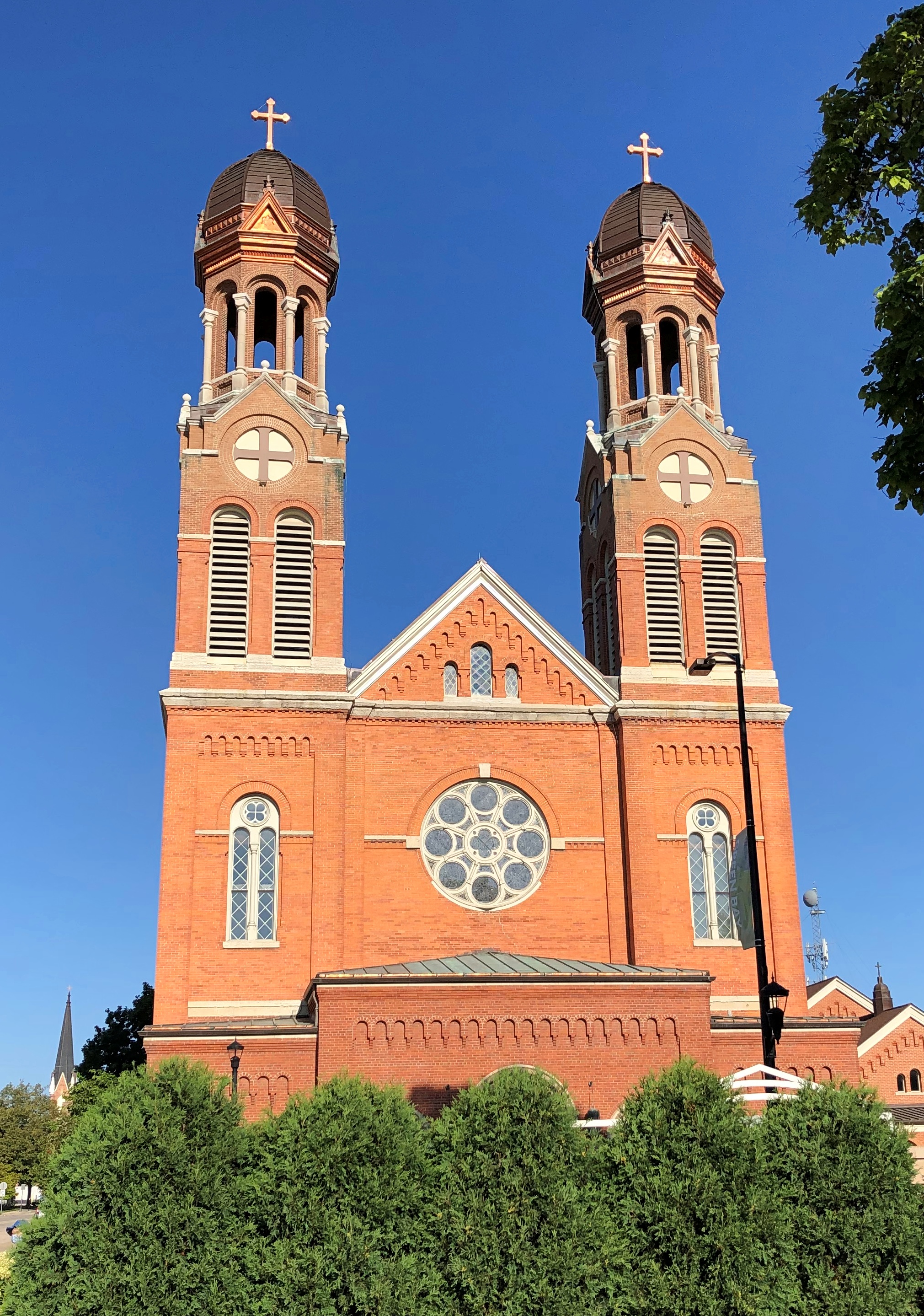
While visiting Olivet Nazarene University in Bourbonnais on Sunday afternoon, I spotted a church building from a distance that I took to be the campus chapel or the like. I decided to drive over to its parking lot for a closer look.Maternity of the Blessed Virgin Mary Catholic ChurchI was wrong. It was Maternity of the Blessed Virgin Mary Catholic Church, which is decidedly not part of ONU, though adjacent to it for historic reasons that I will get into.Maternity of the Blessed Virgin Mary Catholic Church“The original Maternity BVM Catholic Church, a 110-foot-by-50-foot wood-framed structure, had burned to the ground in September 1853,” Jack Klasey wrote in the Daily Journal, a local paper. “The frame church had been built in 1847 to replace the settlement’s first Catholic house of worship, a small log structure known as the church of St. Leo. The log church had been erected in 1841.

“Like many of his parishioners, [Rev. Isadore Lebel] had been born in Canada. The plan that he brought to Bourbonnais Grove reflected the church architecture of his native Quebec province. It is believed to be based upon a church in Cap-St.-Ignace, located on the south shore of the St. Lawrence River, a short distance downstream from Quebec City… Construction work was probably begun some time in 1855 or 1856 and not completed until 1858.”
I was certain the building would be locked (as it was, too bad), but I got out the car for a look anyway. Then I noticed a patch of land next to and behind the church that seemed worth investigating.
Maternity of the Blessed Virgin Mary Catholic ChurchA grotto.Maternity of the Blessed Virgin Mary Catholic Church Maternity of the Blessed Virgin Mary Catholic Church

Maternity BVM has an informative walking tour on its web site for downloading. The centerpiece of the grotto, it tells me, is a shrine built to Our Lady of Lourdes.

“Br. John Koelzer, a Viatorian brother, began building the grotto just over 100 years ago, in 1915. It took three years to complete [and] is fashioned (using stones carved by local residents) in the image of Our Lady of Lourdes, when she appeared to young Bernadette.

“Over the years, she has interceded for the safety of soldiers as far back as World War I, as well as countless school children, bridal couples, rosary groups and worshippers of all ages who have sought her protection.”
The Viatorians — another group I’d never heard of till I researched a place I’d been — are “an international Roman Catholic religious congregation comprised of priests, brothers and lay associates, headquartered in Arlington Heights, IL. Collectively, the congregation is known as the Viatorian Community.”

“Fr. Louis Querbes (1793-1859) founded the congregation in Vourles, France in the 19th century during the years following the French Revolution. Realizing the need to provide education for youth, Fr. Querbes’ vision was to send religious brothers and lay catechists of deep faith and competent learning to parish schools in the countryside.

“As patron saint of the congregation, Fr. Querbes chose St. Viator, a young, 4th century catechist-lector of the cathedral church of Lyons, France.”

True to their education focus, the Viatorians who found their way to Bourbonnais from Canada set up a school that became St. Viator College in 1868. The Depression put an end to the school, however, and the site was sold to Olivet Nazarene University.

The church and the grotto remain. As does a cemetery on the grounds. I wasn’t expecting that.
Maternity of the Blessed Virgin Mary Catholic Church

“Now take a look around the cemetery/grotto and you will also notice several headstones scattered throughout the space,” the tour says. “The cemetery was opened near St. Leo’s Chapel in 1842. By 1884, the old graveyard had no more empty spaces as hundreds are buried here. Many of the grave markers have deteriorated over the years, but there are approximately 30 headstones that still exist and have legible engravings. The earliest legible burial was David Spink, 1848.”

Deteriorated indeed.
Maternity of the Blessed Virgin Mary Catholic ChurchElsewhere on the grounds is a sundial.Maternity of the Blessed Virgin Mary Catholic Church

Maternity of the Blessed Virgin Mary Catholic Church
When I stood in front of the sundial, it was about 3:30 CDT, or 2:30 by the sun, a time I could have indeed told by the shadow. The sundial was a gift from the St. Viator College Class of 1917, dedicated on June 13 of that year. Eleven members of that class are listed on the sundial plaque, including the class treasurer, Fulton J. Sheen. He had quite a career ahead of him, with influence in unexpected places.

Near the entrance of the grounds is a boulder with a plaque askew.
Maternity of the Blessed Virgin Mary Catholic Church
The plaque has been in place almost exactly 100 years, having been dedicated on Decoration Day, 1921. It honors the aforementioned “sturdy Viatorian pioneers” (the plaque’s term) who founded St. Viator College.

Just as we were about to leave — I was already back in the car — I spotted yet another plaque, one considerably harder to see, under a bush. In spring or summer, it might be impossible to see.
Maternity of the Blessed Virgin Mary Catholic Church baseball home plate plaque“I have to see one more thing,” I told my family. They’re used to that kind of thing. But I knew if I ignored it, I’d wonder about it later. I was well rewarded by my curiosity, since the plaque made me smile. It wasn’t anything remotely like I expected.
Maternity of the Blessed Virgin Mary Catholic Church baseball home plate plaqueA home plate memorial. Listen closely on moonless nights, maybe, and you can hear the faint cheers of late 19th-century Catholic collegians playing base ball.

Olivet Nazarene University

College campuses usually offer pleasant places to stroll on warm days, or even when it isn’t so warm, so with that in mind I wanted to take a walk around the 250-acre Olivet Nazarene University in Bourbonnais, Illinois, on Sunday. Since we’d just taken a walk at Kankakee River State Park, the rest of the family was less enthusiastic about the idea. They waited in the car while I took a 10-minute amble.

I’d heard of the Strickler Planetarium. I imagined it would be a little larger, but no doubt it’s a good facility.
Olivet Nazarene University
Nice clock tower.
Olivet Nazarene University
“The Thomas H. Milby Memorial Clock Tower is provided by the J. Harlan Milby Family to remind us that during his student days in 1956, Tom walked these paths on his way to heaven,” the university says. There are carillon bells up there, but I wasn’t around long enough to hear them.

Not far away is a smokestack. As far as I know, it isn’t named in honor of anyone. For a suitable donation, I’ll bet it could be arranged.
Olivet Nazarene University
I’d call it the Old ONU Stack. Or maybe not so old. If what I read here is correct, it had to be rebuilt after a tornado knocked it down in 1963.

ONU, as the name says, is a Nazarene university. The school’s roots go back to 1907, around the time that various Pentecostal and Holiness groups started merging to form the modern Nazarenes, a process entirely too complicated to summarize here.

ONU itself got started in a wide place in the road called Olivet, Illinois, not far south of Danville, and was originally Illinois Holiness University, a name I believe I would have kept. The school mascot could have been the Rollers, for instance. Or maybe the Fighting Wesleyans.

Be that as it may, the school took the name of the town, no doubt for its association with the Mount of Olives, and kept the name when it moved to Bourbonnais in 1940 after a fire destroyed its main building in Olivet.

Even the small details harken to the school’s early time. Such as on the manhole covers.
Olivet Nazarene University manhole cover
Nice design. Features the seal of the school, noting its 1907 origin. One of the many manhole covers of the world that receive little attention, but which are actually pretty cool.

Kankakee River State Park

Late Sunday morning we headed south once more, dog and all, to walk on paths under clear skies and through warm air. March has provided some good weekends so far.

But first we had lunch in the car at a small park in Bourbonnais, Illinois, bought from the drive-thru of a delightful place called Niro’s Gyros, across the road from Olivet Nazarene University. We would have eaten at the park shelter, but it was warm enough for al fresco to be pleasant only out in sun, not in the shade.

Nero’s Gyros would be funnier, but I guess the owner’s name is Niro or something like it. I ate a gyro, and Niro does right by them. Yuriko had a Philly cheesesteak and Ann some Italian sausage, and were well satisfied too.

Then we went to Kankakee River State Park, a few miles away. I first went there in the late ’80s, but we visited most recently — not that recent, really — when Ann was small enough to play on the swing set like this.
So it’s been a while. Most of the 4,000-acre park includes both banks of the Kankakee for 11 miles or so, but not quite all of it. Yesterday we picked a part of the park that doesn’t follow the Kankakee River, but rather a tributary called Rock Creek.
Kankakee River State Park
That part of the park has one thing to recommend it: a trail that follows the creek, then loops around through the forest back to the parking lot. One source puts it at two miles, but it didn’t feel that long. It might be two combined with another loop trail to the north, but never mind. We had a good walk.Kankakee River State Park, Rock Creek Trail

Kankakee River State Park, Rock Creek TrailWhen I said the trail follows Rock Creek, what I meant was that it follows a bluff about 30 feet above the creek. There were paths to climb down to the creek, but we didn’t bother with anything more than taking in some of the views.Kankakee River State Park, Rock Creek Trail Kankakee River State Park, Rock Creek Trail

It’s one of the wider trails I’ve been on lately, at least the part paralleling the creek.
Kankakee River State Park, Rock Creek Trail
At one point is a view of a waterfall.
Kankakee River State Park, Rock Creek Trail
Niagara it ain’t, or even some of the wonderful falls in the UP, but as I told Ann, who knows, in 50,000 years it might be a mighty waterfall.

The trail, as mentioned, looped away from the creek and passed through wooded territory back to the start. Nice and smooth, with most of the mud dry. Very pleasant.
Kankakee River State Park, Rock Creek Trail
The only curiosities along the way were manmade. Sunglasses.
Kankakee River State Park, Rock Creek Trail
A shoe.
Kankakee River State Park, Rock Creek Trail
I can see some one dropping the sunglasses, and someone else putting them on the sign. But the shoe? A nice-looking one, too. Put there just to make passersby wonder why it was put there? If so, it succeeded momentarily.