Carpe Diem Songs

The first serious cold wave of the season came with yesterday’s wind, putting temps as low as 13 degrees F. by the wee hours this morning. Of course, those kinds of lows will be a regular thing by January, with plenty of days even colder, but the first one of the season always seems particularly bitter.

One remarkable thing about YouTube is that it allows me to have a slightly informed opinion about different versions of mostly forgotten songs. Also, I can discover whole subgenres — or maybe sub-subgenres — such as songs whose theme is carpe diem.

Not long ago, the bots suggested the recording of “Enjoy Yourself (It’s Later Than You Think)” by Guy Lombardo (1949). If I’d heard it before, and I probably had, I’d forgotten about it. Charming little song, definitely with a carpe diem message. Music by Carl Sigman, lyrics by Herb Magidson, though as other versions were recorded, all sorts of new lyrics appeared.

That got me looking around and I spent a while listening to other recordings, of which there are a fair number. Pretty soon I had a favorite. None other than Louis Prima’s.

Hard to go wrong with Louis Prima, who brings that Louis Prima je ne sais quoi to just about anything.

Interesting that the alternative to having an enjoyable life, in the song, is the constant effort to make money. So you might call it a postwar boom song. Ten or 15 years earlier, that sentiment might not have flown quite as well. After all, 1933 was the year that gave us “We’re in the Money.”

Anyway, I like Prima’s version a little better than Lombardo’s, and a lot better than Tommy Dorsey’s, which I didn’t much like, or the borderline novelty by Bing and Bob Crosby, which is worth a listen only about once.

Among more recent versions, ska-man Prince Buster did a version with a somewhat different message, as did The Specials, and I especially like Jools Holland’s New Year’s version as captured in the mid-2010s (with Pauline Black and Tom Jones too!).

There are, of course, other carpe diem songs. More, probably, than I’d want to look up, but when I meditated on the subject, I thought of a couple immediately. Including Howard Tate’s “Get It While You Can,” by Janis Joplin, who brought a remarkable energy to this 1970 television performance, a few months before her death.

Finally, an old favorite of mine with similar title, “You Better Get It While You Can,” by Steve Goodman (d. 1984).

Glad I got to see Goodman. It was entirely by chance. I went to see Steve Martin on stage in 1979, and Goodman — whom I’d never heard of — was the opening act. I was lucky to see him, since all too soon, he was gone. Sometimes serendipity and carpe diem go hand-in-hand.

Most of the Thoughts I’m Ever Likely To Have on Pickleball

Strong winds last night and into the morning. Strong enough that when I got up, I noticed that our sizable trash and recycle containers were both on their sides. I’d left them upright, ready for collection, the night before. I put on my coat and went out to stand them upright. An hour later, I noticed they were on their sides again. I set them up again and then quit watching.

Strong winds ushering in subfreezing temps, I should add. But no ice on the ground. That’s about all I ask from winter.

Received the following in an email today: “The Margaritaville USA Pickleball National Championships presented by Pickleball Central is USA Pickleball’s premiere event and features about 2,500 of the nation’s best pickleball athletes, including top players Tyson McGuffin, Matt Wright, Lucy Kovalova, Anna Leigh Waters and more…

“If you are interested in attending Media Day on Wednesday, or getting in touch with us for a future story, please see below.”

I wouldn’t mind writing about pickleball, at least occasionally, though I’m afraid it isn’t on my beat. Also, I wouldn’t mind being in Indian Wells, California, site of the event, about now. I didn’t know that anyone keeps track of the nation’s best pickleball athletes, but I do now. The thought of Media Day at the pickleball championships is also intriguing. Wonder how many journalists cover pickleball, even part time?

A Bit of the Old Christmas Leer

Mist and cold rain through much of the day. The kind of day when you stick pretty close to base camp. No snow or ice, for now. Won’t be long.

One of the Christmas ornaments that my parents picked up in West Germany in the mid-50s.German Santa 1950s

The leering Santa, I think of it. Some ornaments are distinctive enough that you remember from decades past when you see them again. Such as this Santa, which I happened across a few years ago at my mother’s house in San Antonio.

Thursday Scraps

December started off fairly mild this year, especially today, when a few nearly warm hours meant an outdoor lunch of leftover chicken. The lack of wind especially made the quick meal pleasant.

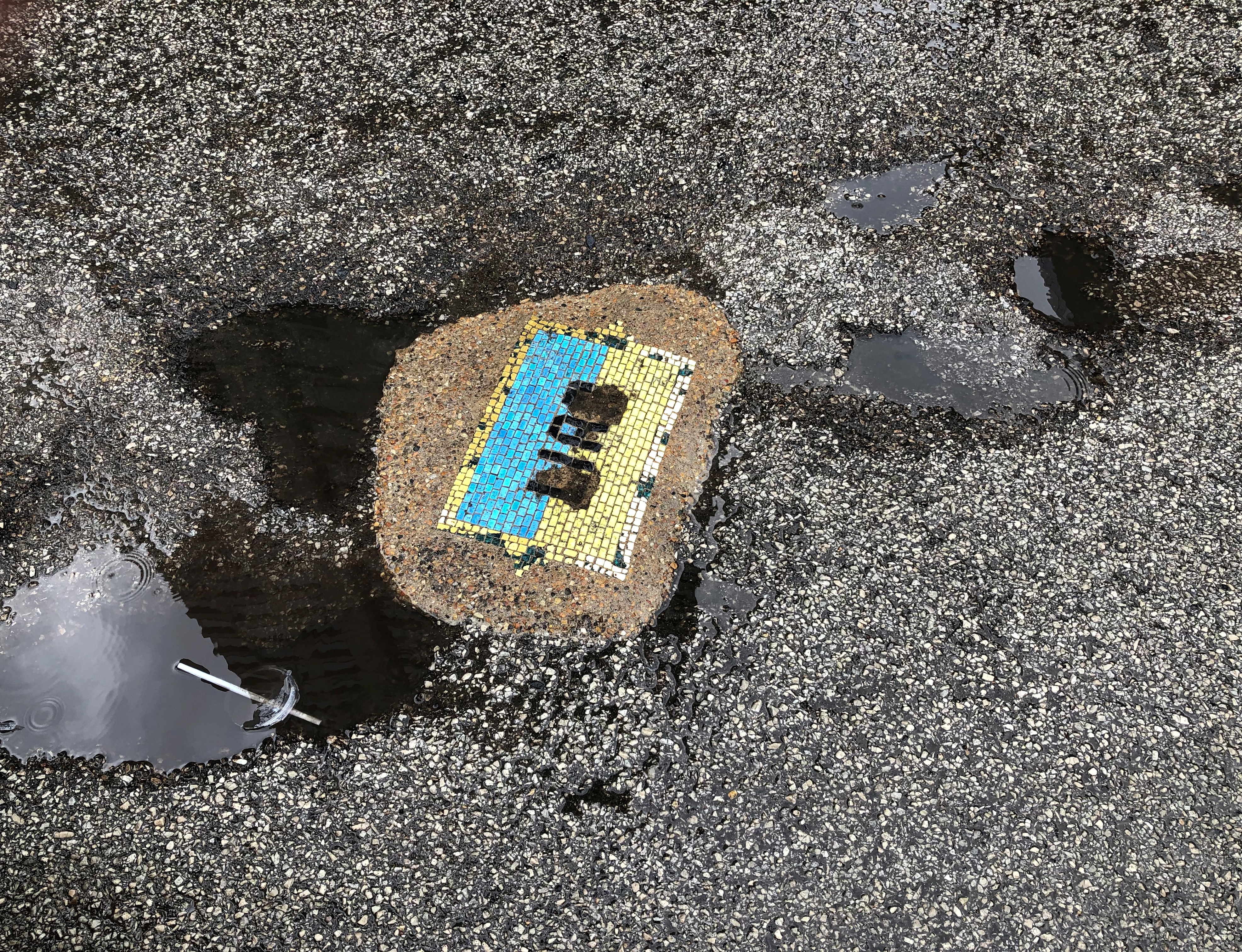
One more thing I spotted in Dwight, Illinois, last weekend.
one small step for a man

One small step for a man. Maybe that’s the only mark that person got to leave on the world.

Here’s a mark I wouldn’t mind leaving: I want to un-invent the leaf blower. Good thing I’m not prone to violence, and have fairly good impulse control, or some noisy leaf-blowing neighbors would be at risk.

Then again, I’ve never been persuaded that “leaving your mark” on the world is such a worthwhile ambition. Seems like the world has entirely too many marks on it already.

A few days ago, I heard an ominous crack as I moved in the office chair I sit in most days. The noise was from the chair’s support system.

A few days later, an even louder crack made it definitive: the chair would collapse under my weight if I leaned too far — not far at all — to the right.

So on Sunday, the old chair will be out for the junkman. One of the roving junkmen, anyway. I’m not sure how, or whether, they divide their territory. Someone will pick it up regardless. Meantime, I’ll have to put together the new chair still in its box, which is in the garage.

Further afield, any notions of international travel will remain on the shelf for now.
“The testing requirement for international arrivals is being further tightened: Starting December 6, all international arrivals, vaccinated or not, will need to be tested for COVID within 24 hours before flying to the U.S.,” Afar reports.

And if you’re positive? Or false positive? I don’t think I want to get stuck somewhere on the say-so of testing tech. Vaccination should be a free pass. Good thing I’ve still got a lot of domestic destinations in mind. A lot.

Wright in Dwight, But Also Odd Fellows, Cobb, and a Relic of Quackery

Ambler’s Texaco Gas Station is on the edge of Dwight, Illinois, not far from the Interstate, and after our short visit on Sunday, Ann and I went further into town, seeking a late lunch. We found it at El Cancun, a Mexican restaurant in the former (current?) Independent Order of Odd Fellows building, dating from 1916. Looks like the orange of the restaurant has been pasted on the less-colorful IOOF structure.IOOF Dwight Illinois

I didn’t notice IOOF on the building until after lunch, so I didn’t think to ask the waiter about the building, though I did notice that the restaurant space, whose walls were large and colorfully painted, had a gray ceiling that evoked the late 19th/early 20th century. Maybe once upon a time it was a meeting room or bar for the Odd Fellows of greater Dwight.

Even if I’d asked the waiter, I’m not sure he would have known. Got the impression he didn’t grow up in these parts. He was eager to upsell me a margarita, however. I declined. Had the enchiladas verdes, which were quite good, and a classic teetotaler beverage, water.

The IOOF building is across the street from the back of Dwight’s historic railroad station, now a museum. This is the front.Historic Depot Dwight IL
Historic Depot Dwight IL

About the depot, more info is easily available. “As with other neighboring central Illinois towns, Dwight began as a locomotive watering stopover,” explains The Great American Stations (now that’s an interesting web site).

“The Chicago and Mississippi Railroad sent surveyors in the early 1850s to this prairie location, and while the stop was just two small buildings and a water tank, James Spencer, Richard Price Morgan, John Lathrop and the brothers Jesse and Kersey Fell of Bloomington participated in laying out a town that they would name for Henry Dwight, who had funded most of the building of this section of the railroad.

“Dwight began growing rapidly in the 1870s, with significant railroad traffic through to Chicago from St. Louis, and the town hired Henry Ives Cobb to design their larger, grander railroad depot.”

Jesse Fell, by golly. Him again. He was definitely a big fish in the little pond of central Illinois.

As for Cobb, he designed the wonderful Newberry Library in Chicago and the phallic but interesting Yerkes Observatory in southern Wisconsin, among many other things.

But for big-name architecture, Cobb’s work isn’t Dwight’s star attraction. That would be the modest Frank Lloyd Wright bank building facing the front of the station. FLW was trying to smash that pre-FDIC paradigm of grand bank buildings, it seems.Frank L. Smith Bank

Known as the Frank L. Smith Bank when built in 1905, it’s now the Dwight Banking Center of Peoples National Bank of Kewanee. I like the old name better: Frank’s Bank. How many of us get to have our own banks?

Next to the bank is the Fox Development Center, a state-owned facility for treating people with various unfortunate conditions.Former Keeley Institute Building, Dwight, IL

Pretty spiffy for a government structure, eh? Originally it was one of the buildings owned by the Keeley Institute, built in 1891 and rebuilt after a fire in 1902 in its current brick-and-stone Greek revival style.

I wasn’t familiar with the Keeley Institute. Here’s the long and short of it: there was a patent medicine for everything in the late 19th century, and the product of one Leslie Keeley, a small town doc, promised to cure alcoholism with injections and liquids to drink. His cure containing a substance whose exact formula was a secret, though Keeley asserted it contained the element gold in one form or another.

Not too many people believed that, but a lot of people believed the Gold Cure might just work, enough to make Keeley a fortune and open up locations around the world that lasted well into the 20th century. The institute’s international HQ was in Dwight.

Curing alcoholism with injections might seem odd to us, but actual medicine was only just beginning to separate itself from patent medicine in those days.

“I will take any liquor habitue there, soddened and saturated by twenty years of alcoholic debauch, sober him in two hours, cut short his worst spree in four hours, take him from inebriety to perfect sobriety without nervous shock or distress, and leave him antipathetic to alcoholic stimulants of every sort and kind inside of three days,” Keeley said of his treatment. He also developed “cures” for opium addition and nervous exhaustion. Ah, if only it were that easy.

Note the slogan on this ad for the Gold Cure.Gold Cure

We Belt The World. Though it’s a little hard to see, that same slogan is still above the entrance of the Fox Development Center, wrapped around a globe in the pediment.Former Keeley Institute Building, Dwight, IL

More about Keeley and the Gold Cure is here. Fascinating the things you find on the road.
Ambler’s Texaco Gas Station

Dwight, IllinoisThe National Park Service takes more of an interest in the former U.S. 66 than I would have thought. On this page, the NPS lists dozens of historic sites associated with that road, including 12 in Illinois plus a listing on “Illinois Road Segments.”

One of the sites is Ambler’s Texaco Gas Station in Dwight, Illinois, which is about half way between the northwest suburbs and Bloomington-Normal. On the way back to take Ann to ISU on Sunday, we stopped there.Dwight, Illinois Dwight, Illinois

Though called Amber’s by the park service, the name on site is the Ambler/Becker Station, and the NPS does mention the facility’s other designations over the decades it was a gas station (1933 to 1999): Vernon’s Texaco Station and Becker’s Marathon Gas Station.Dwight, Illinois

After the place ended its existence as a car-care facility, it became a tourist attraction. Sure enough, we’d been attracted for a look, though it was closed on Sunday afternoon.

“With the help of a $10,400 matching grant from the National Park Service’s Route 66 Corridor Preservation Program, the Village of Dwight painstakingly restored the station to its former glory, taking the main office and canopy area back to the 1930s and the service bay area back to its 1940s appearance,” the NPS says. “Today, the station serves as a visitor’s center for the Village of Dwight.”

La Salle Churches

After our walk at Matthiessen State Park on Friday, we went to the town of La Salle and found a mid-afternoon lunch at a sandwich shop called Obee’s. Good sandwiches and chili, too.

Rather than head home right away, we stopped to look at a few of La Salle’s sizable church buildings. None of them were open, but the afternoon light illuminated their exteriors nicely.

First stop: Queen of the Holy Rosary Memorial Shrine.Queen of the Holy Rosary Memorial Shrine
Queen of the Holy Rosary Memorial Shrine

Once a parish church, these days Queen of the Holy Rosary is a Diocesan Shrine dedicated to Mary in memory of all U.S. veterans. Designed by Arthur F. Moratz of Bloomington, it dates only from the 1950s. A late work for him. I’ve run across Moratz before; he did the Normal Theater.

Not far away (nothing is too far away in La Salle) is St. Patrick’s, a much older church, completed in 1848 to serve the Irishmen working on the I&M Canal. One Patrick Joseph Mullaney did the design.St Patrick's Church, La Salle, IL

According to a plaque on the front, St. Patrick’s is the “oldest living parish church in Illinois.” With a resplendent interior, from the looks of these pictures.

Elsewhere in La Salle is a church building that had the look of being closed. Permanently closed, that is.St Joseph's Church, La Salle IL

St. Joseph’s, according to a stone in the wall, dedicated in 1907.St Joseph's Church, La Salle Il

More remarkably, the cornerstone lists the architect: Henry Schlacks, whose work I’ve seen before. I don’t think I’ve ever seen an architect mentioned on the exterior of a church, but he was a pretty big bug among church designers more than 100 years ago.

In any case, St. Joseph’s isn’t listed as an active parish by the local Catholic church, and there isn’t any evidence that any other denomination occupies the place.

On the other hand, St. Hyacinth looks active. Just not open when I happened by.St. Hyacinth Church, La Salle IL St. Hyacinth Church, La Salle IL

St. Patrick was originally for Irish immigrants, while St. Hyacinth was for Polish immigrants, a later wave to this part of Illinois. It was completed in 1892 to replace an earlier church that burned down, and was also designed by another prolific church architect, George P. Stauduhar.

I could see other steeples off in the distance, since La Salle is still a low-rise town, and steeples are often the tallest structures around. But the light was fading and the afternoon getting chillier, so we called it a day after Hyacinth.

Matthiessen State Park

Thanksgiving dinner this year wasn’t quite as conventional as other years: lamb shank with homemade macaroni and cheese (a complex mix of cheeses by Ann) and barbecue-flavored beans. The bread was traditional: the cheapest brown-and-serve rolls I could find. I didn’t forget the olives.

Last summer, on the way back from New Buffalo, Michigan, we bought some grape juice at St. Julian Winery, and had one of those bottles to drink with our Thanksgiving food. All in all, a pleasant meal, not a vast feast.

On Friday, we drove down to Matthiessen State Park, just south of the Illinois River in La Salle County and not far from the better-known Starved Rock State Park. The 1,938-acre Matthessen is a more modest park, but has a good set of trails along, and down in, a winding ravine formed by a creek.

To get to the ravine, you need to go down.Matthiessen State Park

Those stairs lead to a bridge over one part of the ravine. Nice view from the bridge. For perspective, note that there are people at the bottom.Matthiessen State Park

The bottom is accessible by another set of wooden stairs.Matthiessen State Park
Matthiessen State Park

Though a few degrees above freezing, there were patches of thin ice here and there on the surface of the creek, which I poked with my walking stick, watching it break into fragments.

On to the other part of the ravine, which we reached by taking this path, then a different set of stairs. Matthiessen State Park
Matthiessen State Park

A short section of ravine wall is marked by generations of carvings in the sandstone.
Matthiessen State Park

The trail sometimes meant crossing on stones over the shallow creek. A misstep into the creek would have meant uncomfortably wet shoes, at least.
Matthiessen State Park

Before long, there’s another bridge and a waterfall formed by a dam that creates Matthiessen Lake. Another set of stairs, not visible in the picture, leads up to the bridge. We did a fair amount of stairclimbing at the park.
Matthiessen State Park

Still, a good walk, even on a chilly day, especially since there was little wind down in the ravine.

The park is named for Frederick William Matthiessen (d. 1918), whose land it used to be, with later additions by the state. He was the other zinc baron of 19th-century La Salle County, along with Edward Carl Hegeler, whose house we toured a few years ago.

Umbrella Tea House

I went out ’round midnight last night to put the car in the driveway. When I finished, I got out of the car and looked up, and there he was, bright as could be: Orion. Winter is here. Been cold much of this month anyway. Off in the distance, an owl woo-woo’d softly.
Back again on November 28. A good Thanksgiving to all, and don’t forget to be up at 4 a.m. on the day after for all those doorbuster sales. I plan to be asleep then, though I might be up to go to the bathroom.

The name of the place we visited recently, according to the sign over the door, is the Umbrella Tea House. That made me wonder: what was the place where Winston Smith hung out at the end of 1984, ahead of his eventual vaporization? The post-Ministry of Love Winston Smith, that is, who loved Big Brother.
That’s the kind of thing I might wonder. I didn’t even have to find my paper copy of the book to find out.

“The Chestnut Tree was almost empty. A ray of sunlight slanting through a window fell on dusty table-tops. It was the lonely hour of fifteen. A tinny music trickled from the telescreens. Winston sat in his usual corner, gazing into an empty glass.”

So I might call the Umbrella Tea House the Chestnut Tree, just for a bit of dark humor that no one would understand unless I explained it. Orwell might have gotten Big Brother and doublethink and maybe even memory hole into the common lexicon, but not the Chestnut Tree.

Umbrella Tea House, which is in a retail strip near the Schaumburg Township District Library, is anything but dark. It’s a bright place.Umbrella Tea House

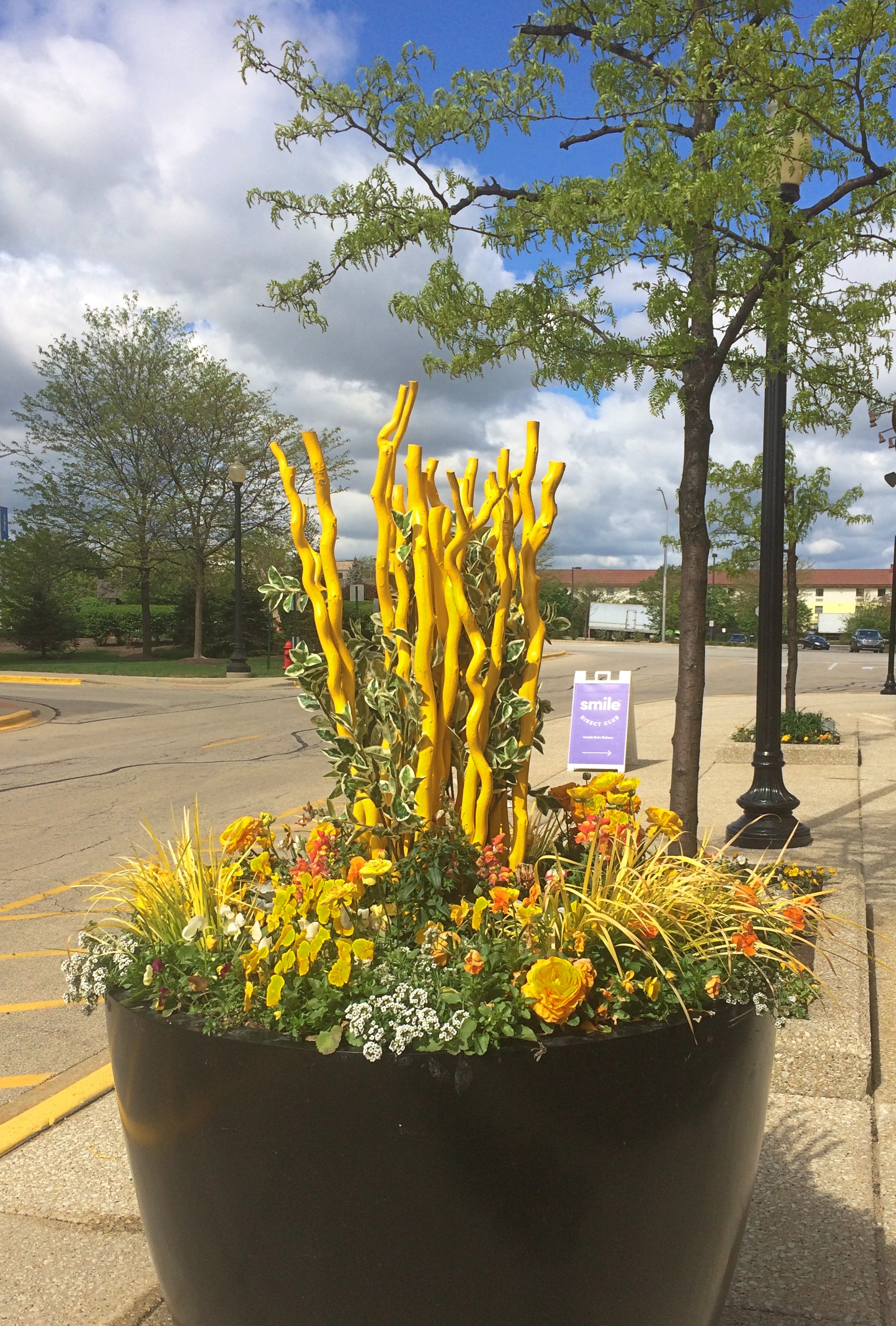
It has all sorts of interesting features, such as a tip pig, and — not sure how to characterize the second image.Umbrella Tea House Umbrella Tea House

Naturally, umbrellas figure in the décor. Up on the ceiling. Umbrella Tea House
Umbrella Tea House

A pleasant place to occasionally drink fancy tea, which we did.

Waterfall Glen Forest Preserve

Been a distinctly winterish November this year, except that trees seem to have held their leaves a little longer than in recent years. But there have been a handful of warmish hours, such as on Saturday in the afternoon.

We made our way to Waterfall Glen Forest Preserve, south of where I used to live, but only by a few miles, and walked a while.Waterfall Glen Forest Preserve

Nice description of the place on the Forest Preserve of DuPage County’s web site:
“The 2,503-acre Waterfall Glen Forest Preserve in Darien is one of the most ecologically impressive parcels of open space in the Forest Preserve District of DuPage County, if not northern Illinois. It is also one of the District’s most popular forest preserves, known for its Rocky Glen waterfall, Sawmill Creek bluff overlook, and extensive trails.

“Waterfall Glen offers gently rolling to hilly terrain with 11 miles of trails popular with hikers, bicyclists, horseback riders and cross-country skiers. It also offers fishing and an orienteering course, model airplane field and youth group campground.”Waterfall Glen Forest Preserve Waterfall Glen Forest Preserve

Had an autumnal moment or two along the trails.Waterfall Glen Forest Preserve Waterfall Glen Forest Preserve

Last year was a year of forest preserves. Didn’t keep up the pace this year. Rather, it turned out to be a year of vistas, for which I always try to be glad.