North Carolina, South Carolina

Maybe I should have looked at something like this before driving between Knoxville and Charlotte last month.

Note the array of Construction Zone markers along I-40. Turns out travelers are lucky to be able to drive the road at all, considering that Hurricane Helene last year did so much damage that the highway – an Interstate of considerable importance regionally – was closed for five months, only reopening on March 1.

Reopening as a two-lane road, with each lane bounded on the outside by those concrete barriers you never want to see when driving. Separating the lanes is what amounts to a curb, painted yellow. This goes on for about 12 miles, as reconstruction work goes on. That isn’t a long stretch of road under normal conditions, but when you’re between barriers, behind a truck and in front of a truck, with traffic (many trucks) coming the other way just on the other side of a yellow curb, and little margin for error on anyone’s part, your reaction as a driver is going to be: when will this end?

That was my reaction, anyway. Had some nice drives on this trip. Western North Carolina I-40 wasn’t one of them.

“The hurricane washed away about 3 million cubic yards of dirt, rock and material from the side of I-40,” NCDOT reported. I’m having trouble visualizing a million cubic yards, much less three, but I’m sure it was a staggering amount.

“The stabilization process involved driving steel rods into the bedrock, filling the rods with grout, applying a metal screen then sprayable concrete to the face of the walls. There were four different rigs operating at the same time.

“Crews installed 90,000 square feet of soil-nail walls across the 10 different damage locations in less than 130 days. They also drilled nearly 2,100 feet of nails and fortified 4 miles of the shoulder for truck traffic.”

My goal for the afternoon had been to take I-40 from Knoxville to Asheville and then I-26 south to its junction with South Carolina 11, which is Cherokee Foothills Scenic Highway, and take that road east. I’d been advised that the town of Saluda, NC, on US 167, was a pleasant place to stop, and it was, though most of the shops were closed by the time I got there.
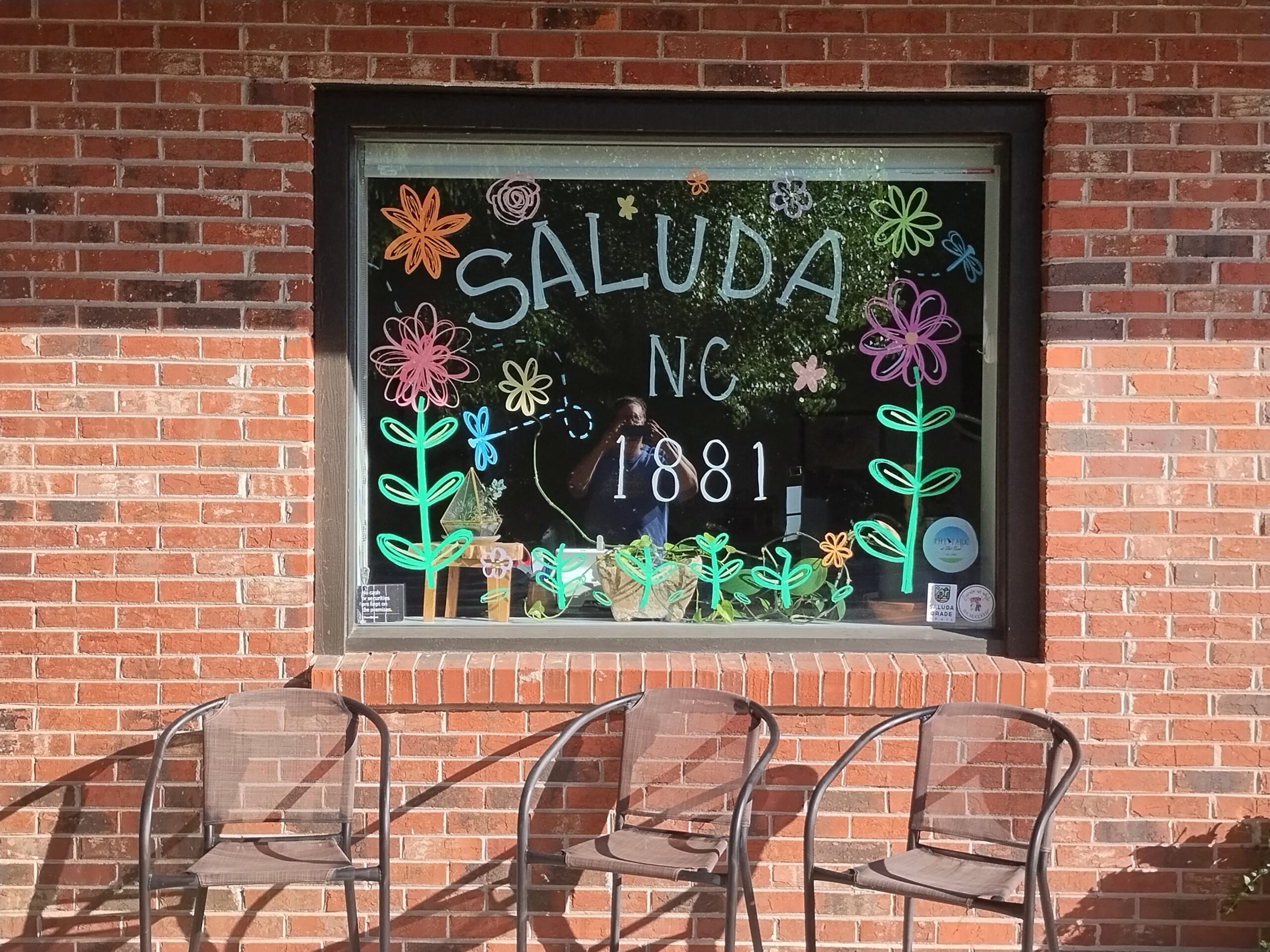
Saluda, NC

I had the idea that I would drive US 176 to the next town, Tryon, NC. Oops, no. Road closed. Maybe the hurricane did that as well.
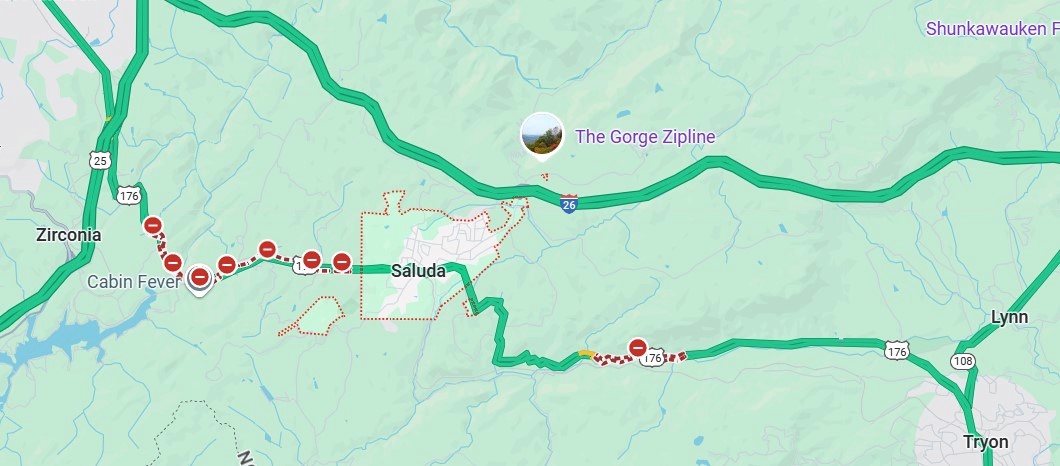
So I got back on I-26 and went to the Tryon exit. I didn’t have any idea what to expect in Tryon, certainly not the Tryon Horse, which is a large toy horse on wheels. It stands on US 176, known as South Trade St. at that point. This is the fifth iteration of the horse in nearly 100 years.
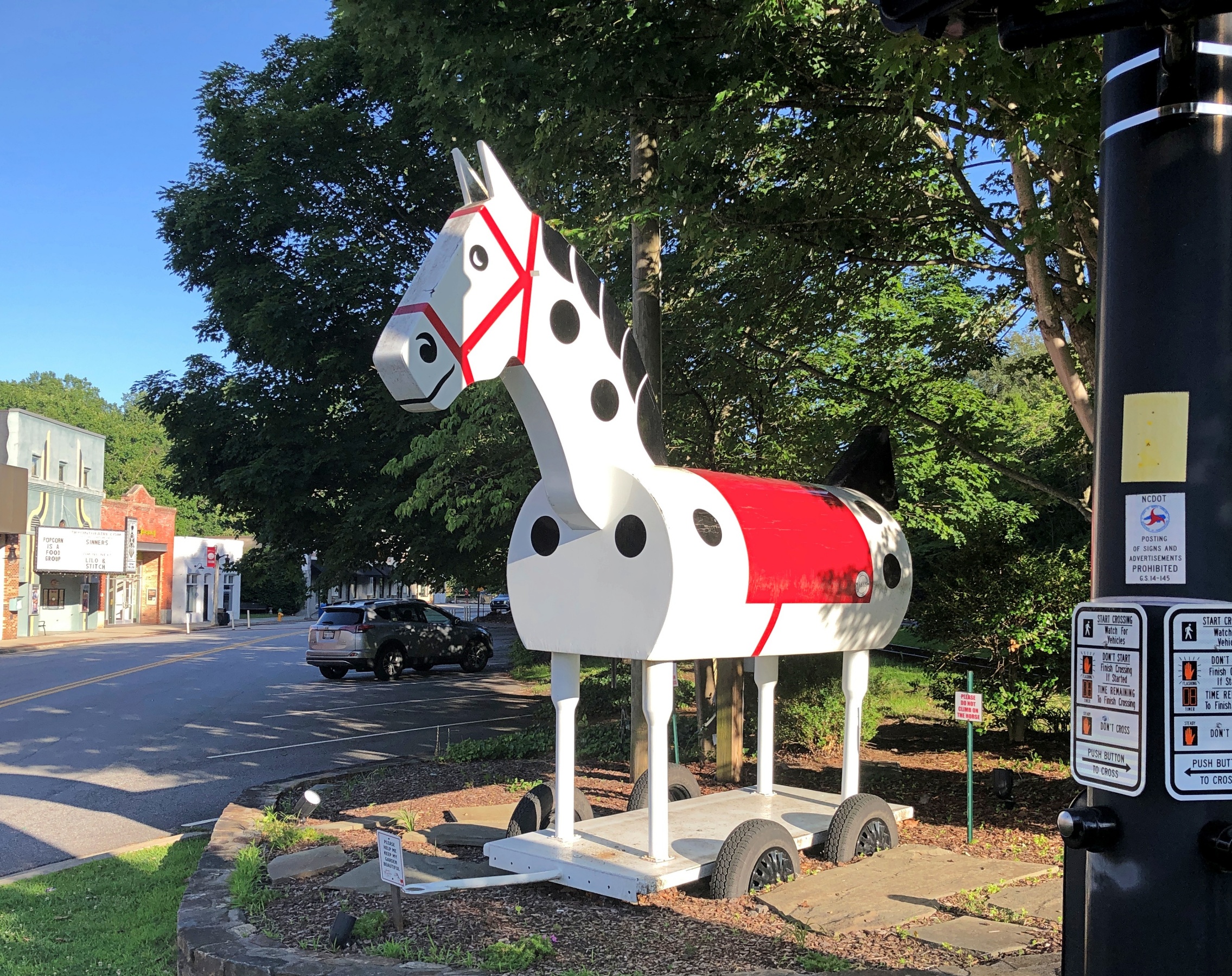
“[The first Tryon Horse] was originally designed as an advertisement for the first horse show held in Tryon at Harmon Field in 1928,” says the Tryon History Museum. “It came from a drawing done by Eleanor Vance, based on an idea from Romaine Stone, who was active in the Tryon Riding and Hunt Club, and from then seventeen-year-old master builder Meredith Lankford.

“The Tryon Horse was built in the basement of Miss Vance and Miss Yale’s house by Meredith Lankford and Odell Peeler and was assembled in the driveway… The Tryon Horse… was brought out for future horse shows and parades, and was stored in the Paper Box Factory located on Depot Street. Unfortunately, the first horse was destroyed when the factory burned in the 1930s.”

It was no accident that the talent was available locally in the 1920s to build such a thing. At the time, Tryon was noted for a company that made toys, especially high-end wooden toys.

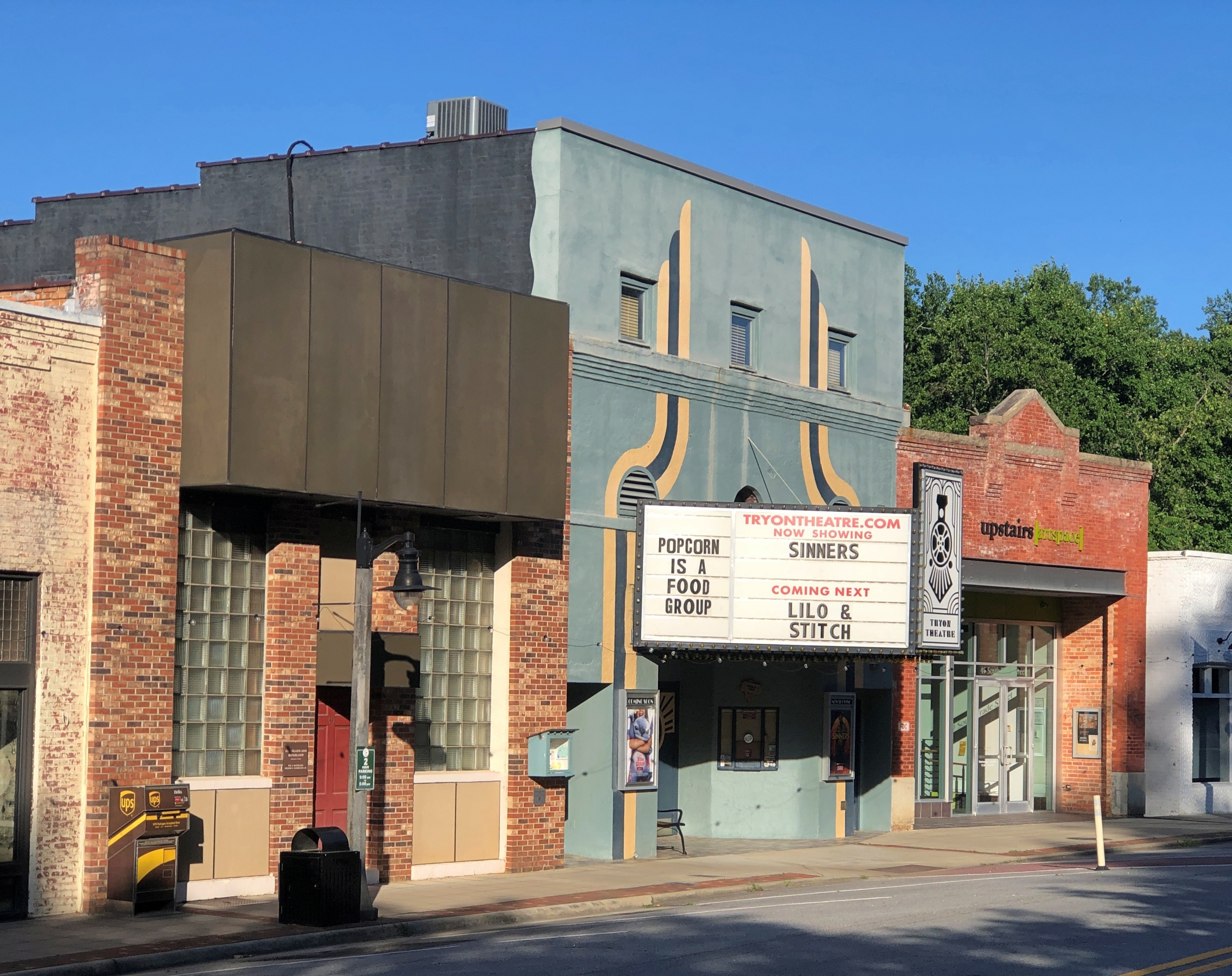
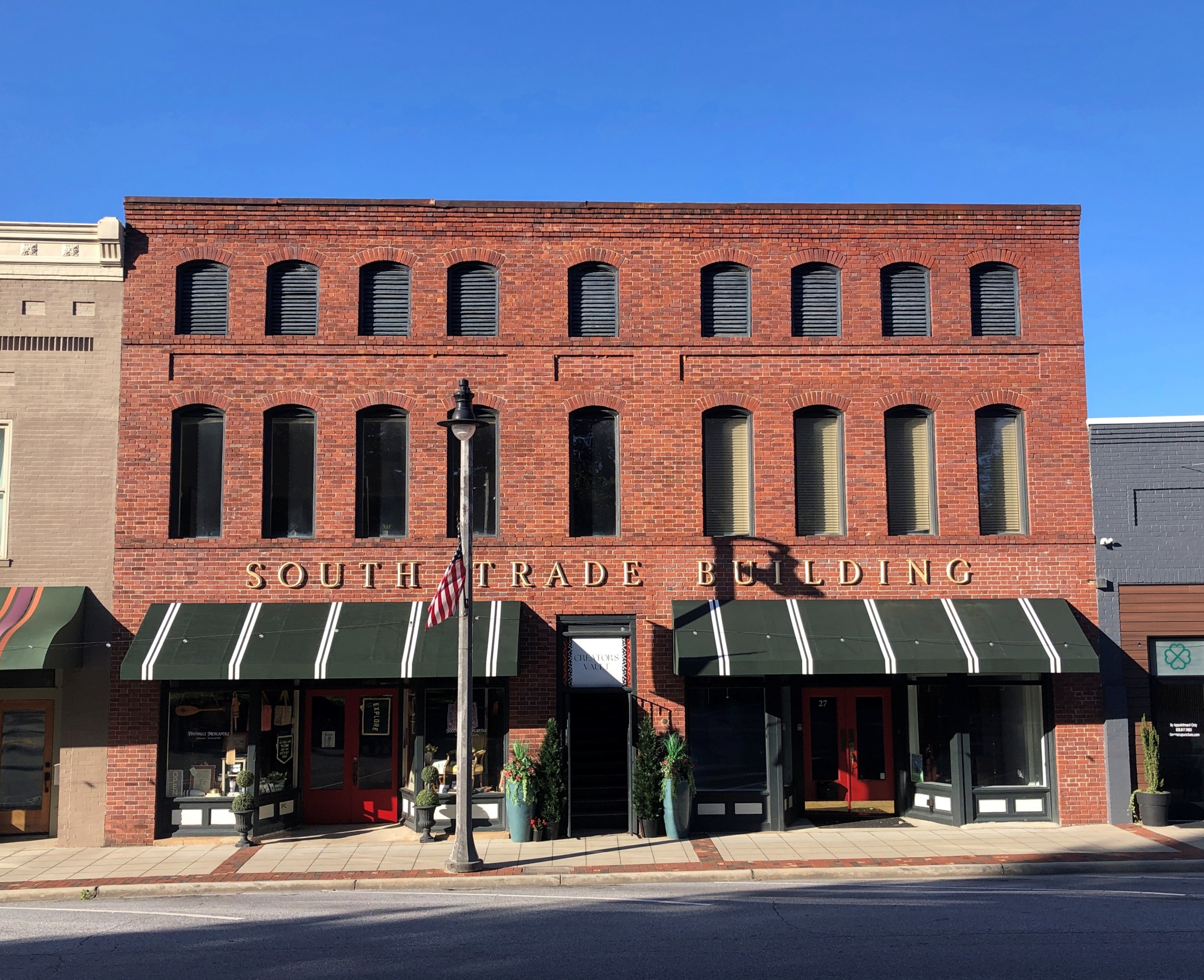
South Trade St. is a handsome thoroughfare, populated by older buildings developed to support trade.
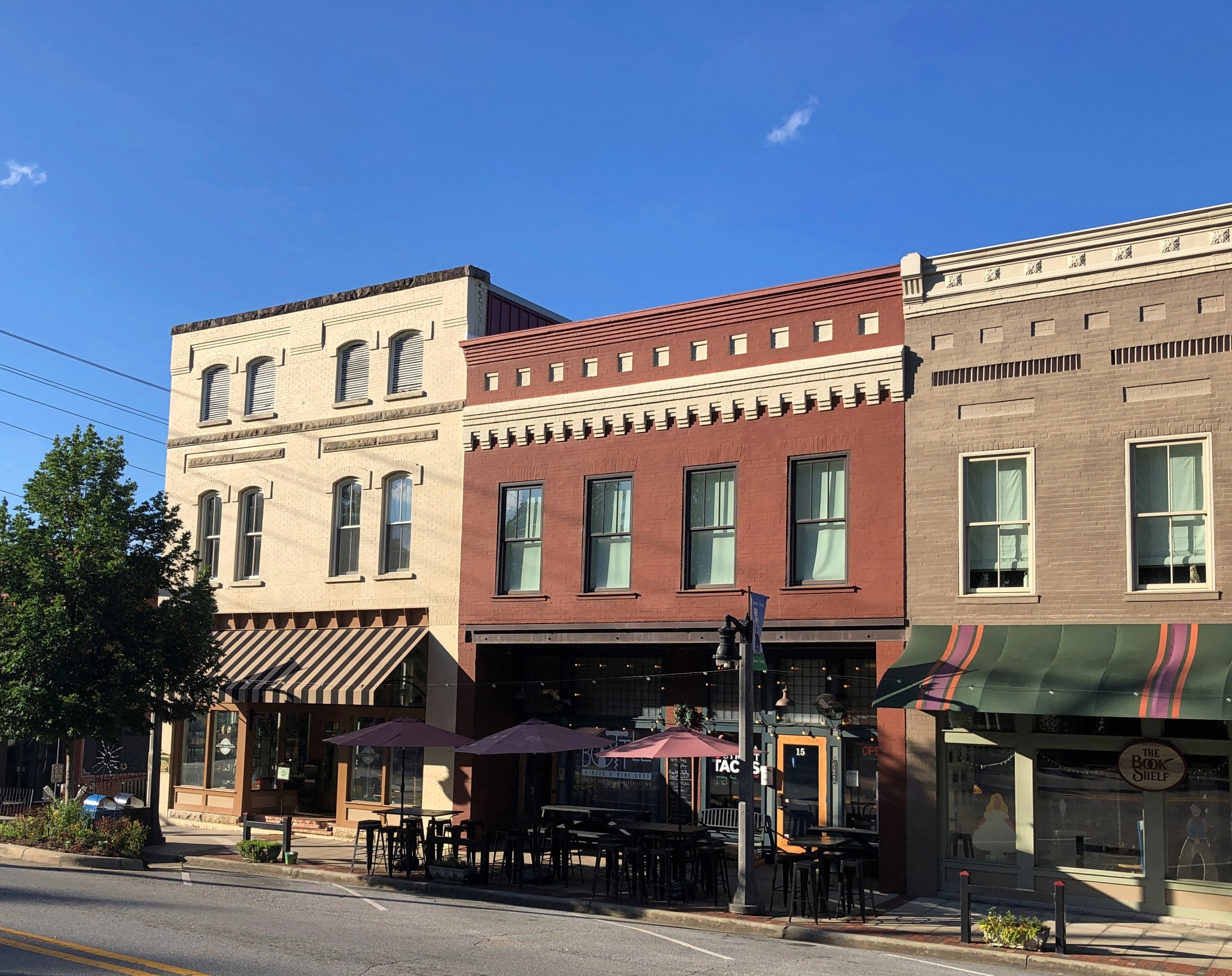
Tryon NC
Tryon NC

Something else I didn’t expect on the street: Nina Simone Plaza.
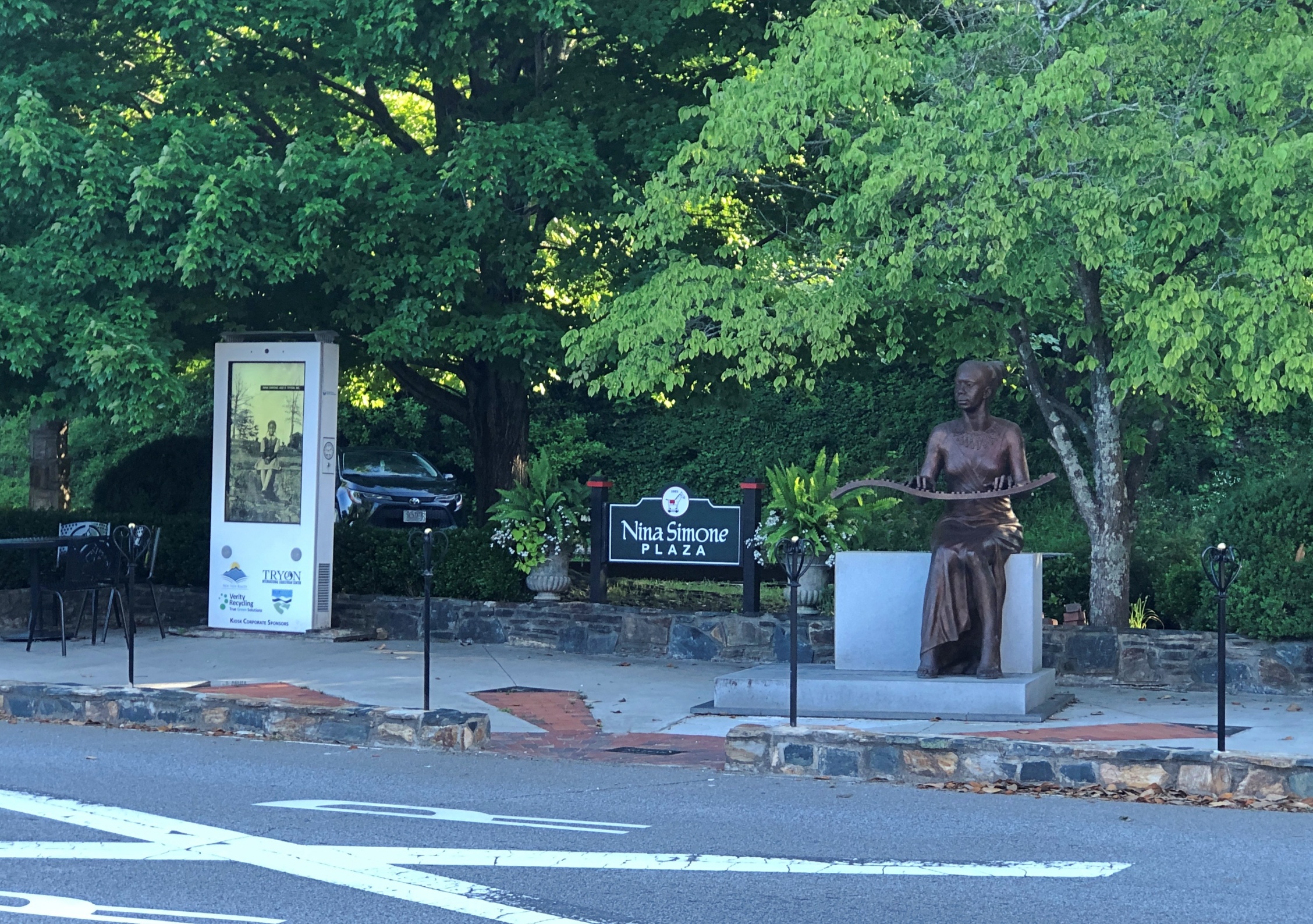
Complete with a bronze of the musician and activist, who grew up in Tryon, and who no doubt got out as soon as her talents allowed. She died in 2003; the statue was dedicated in 2017.
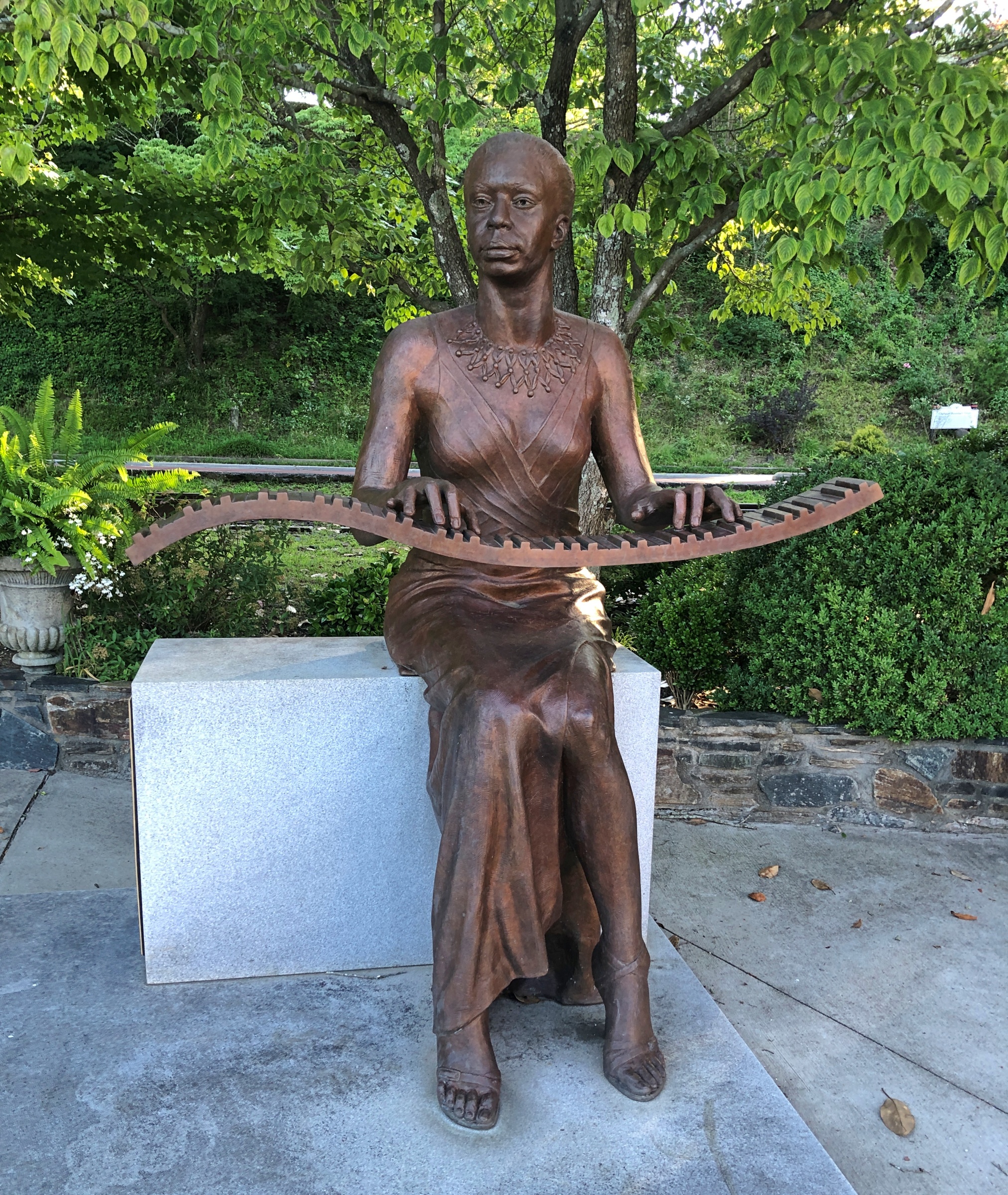
Nina Simon bronze, Tryon NC

A remarkable detail (so I’m remarking on it): “The sculptor, Zenos Frudakis, included a bronze heart containing Simone’s ashes welded to the interior of the figure’s chest,” says the University of North Carolina. For his part, Frudakis has had quite a career.

Later in the day, I eventually made it to South Carolina 11 at Campobello, SC, and drove east to its end for 50 miles or so to Gaffney, SC. I’d intended to visit Cowpens National Battlefield along the way.
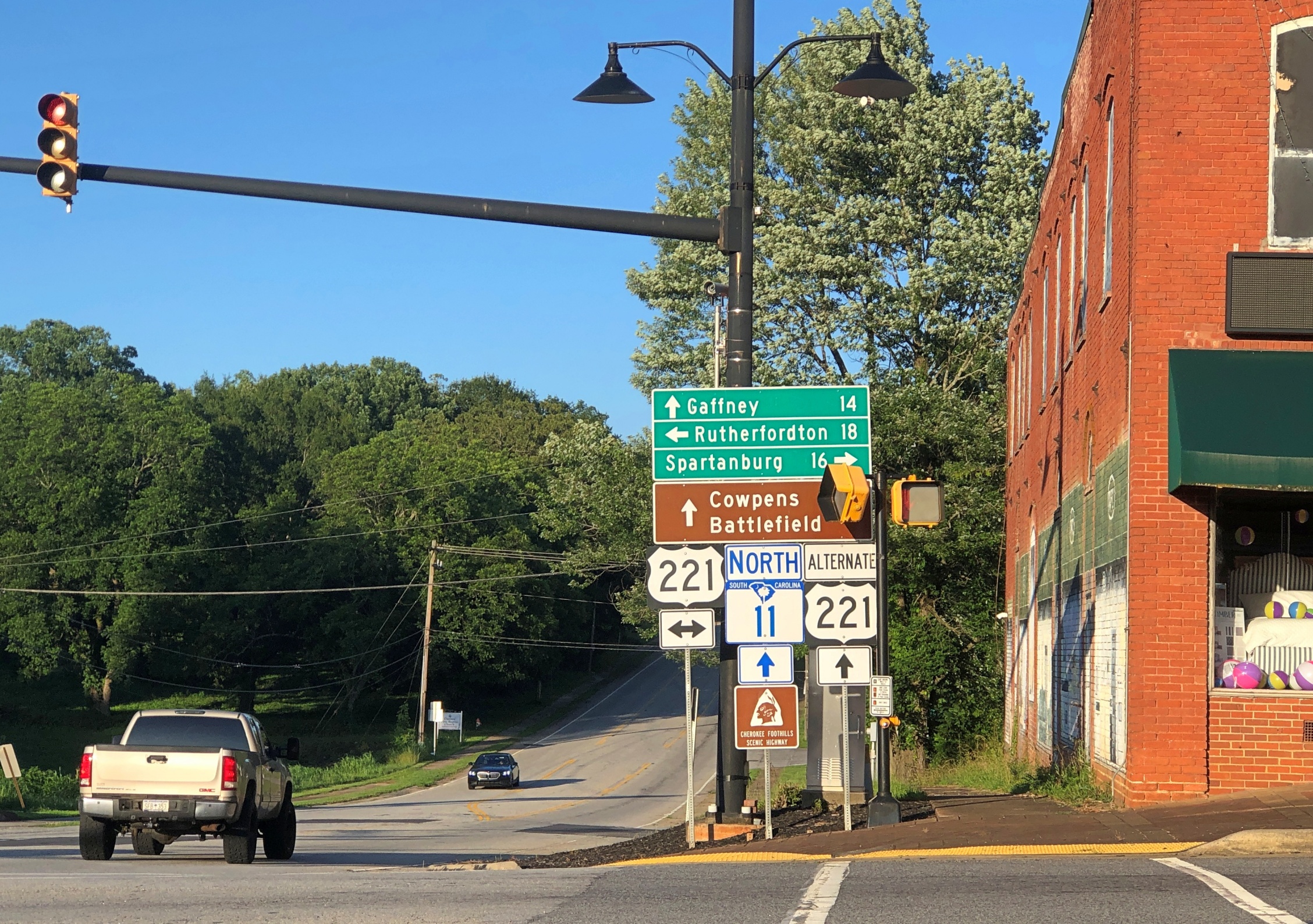
No dice. The main entrance to Cowpens was closed by the time I arrived. I understand closing the visitors center at the end of the day, but the entire place? A mile or so east on SC 11 was an alternate entrance, so I stopped there.
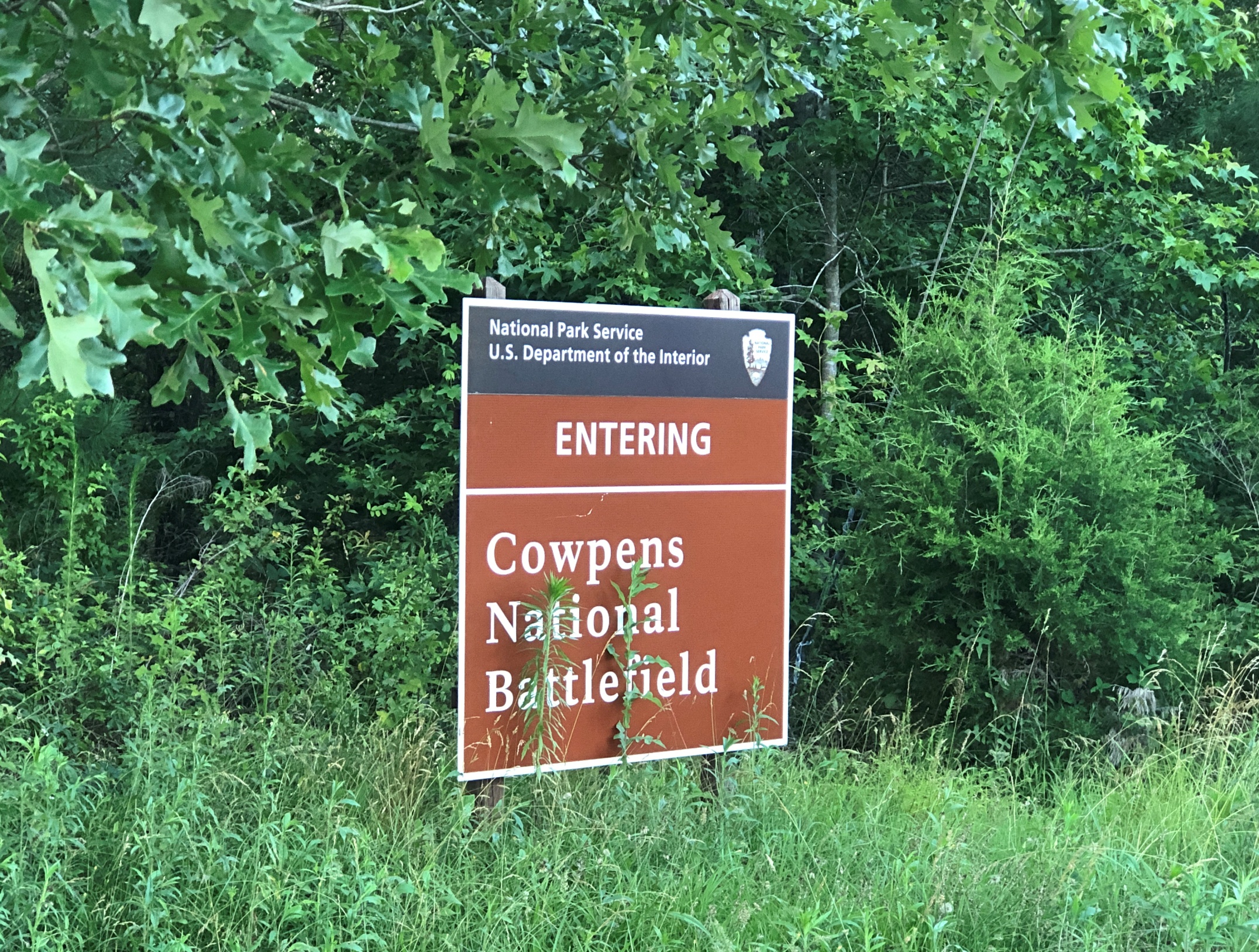
I walked down the path toward the battlefield, but thought better of it after about 10 minutes.
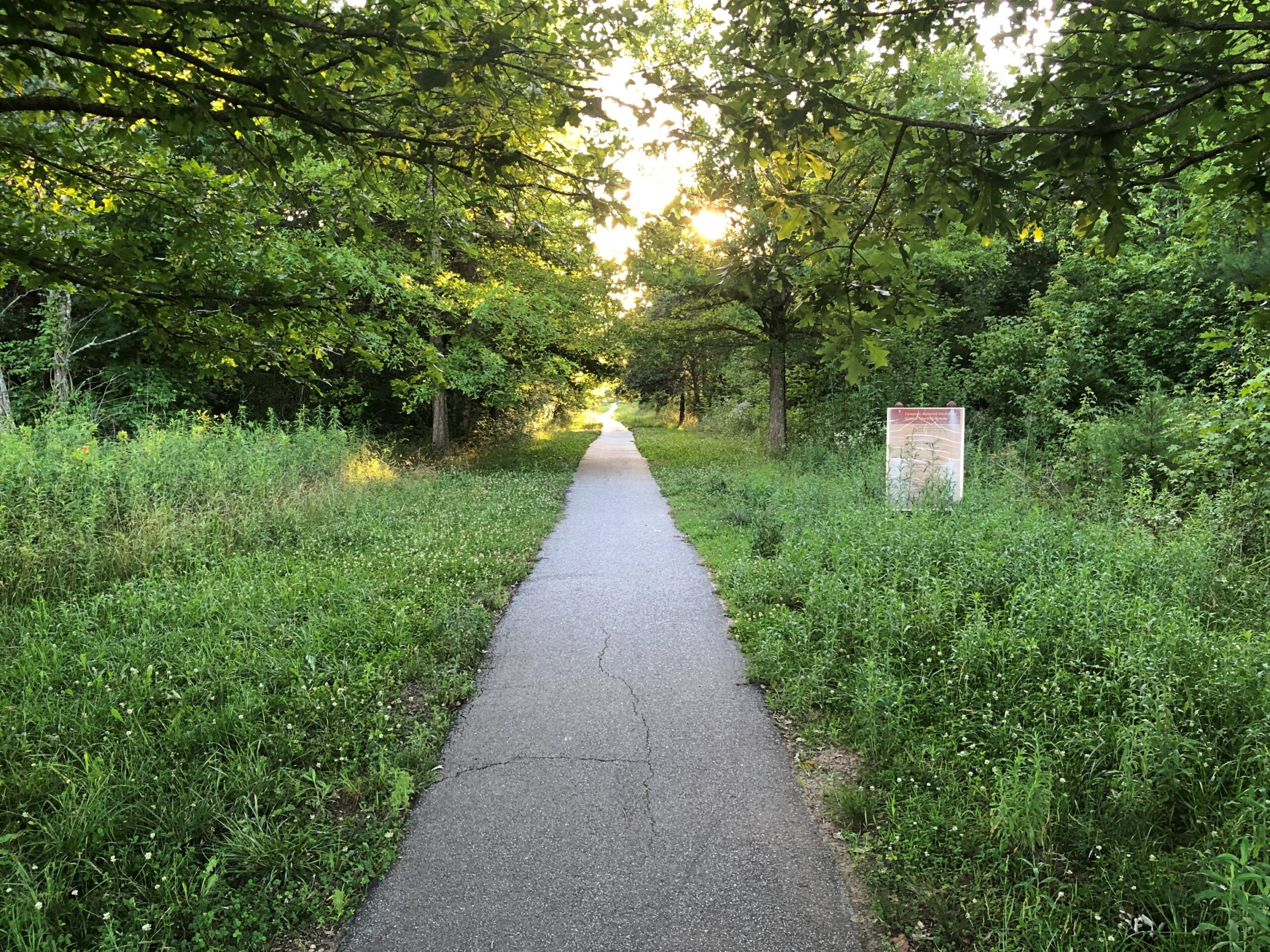
Cowpens National Battlefield

I wanted to get to Charlotte before the end of the day. Summer days are long, but not endless. Also, mosquitoes.
Southern Loop ’25

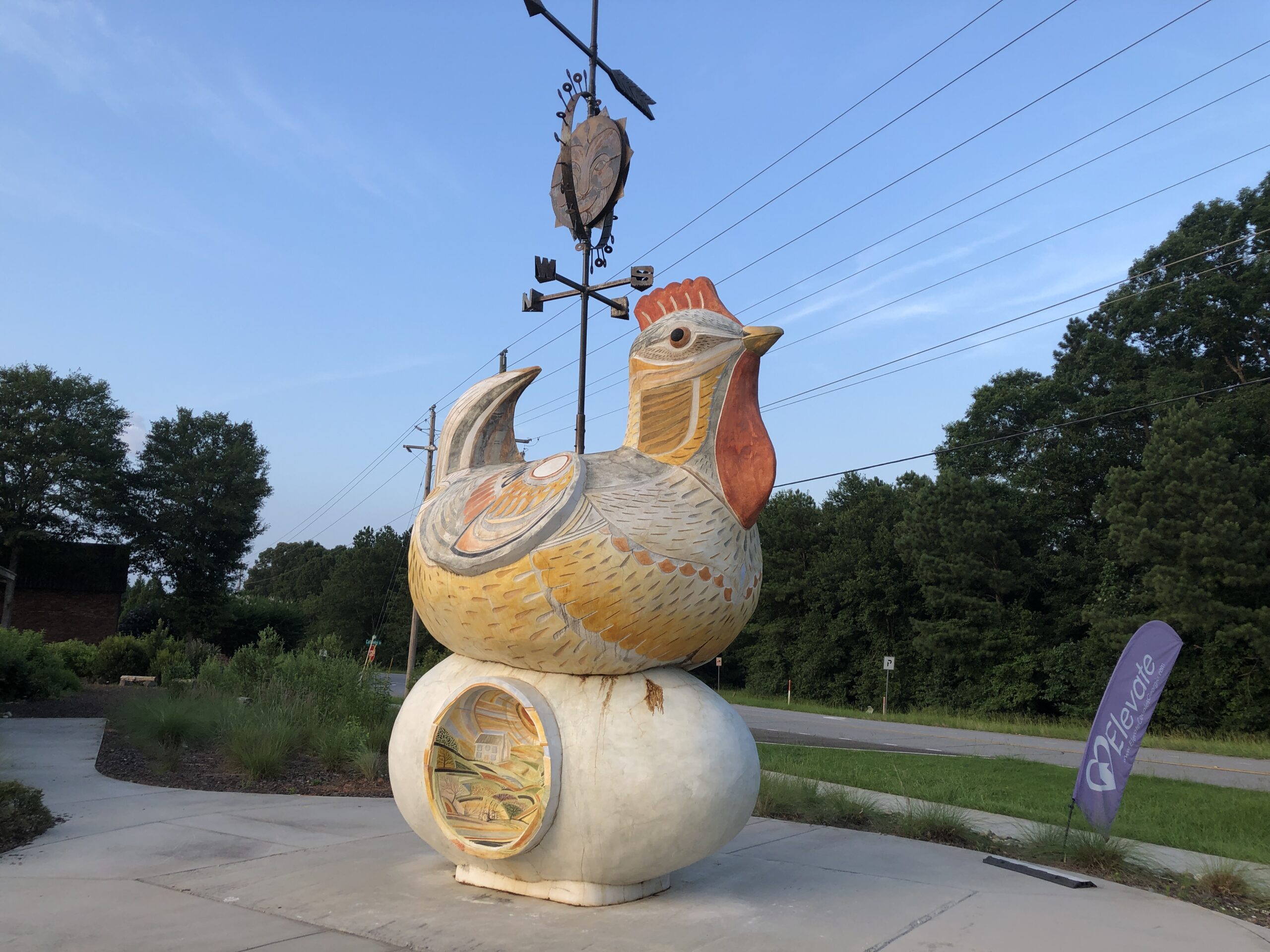
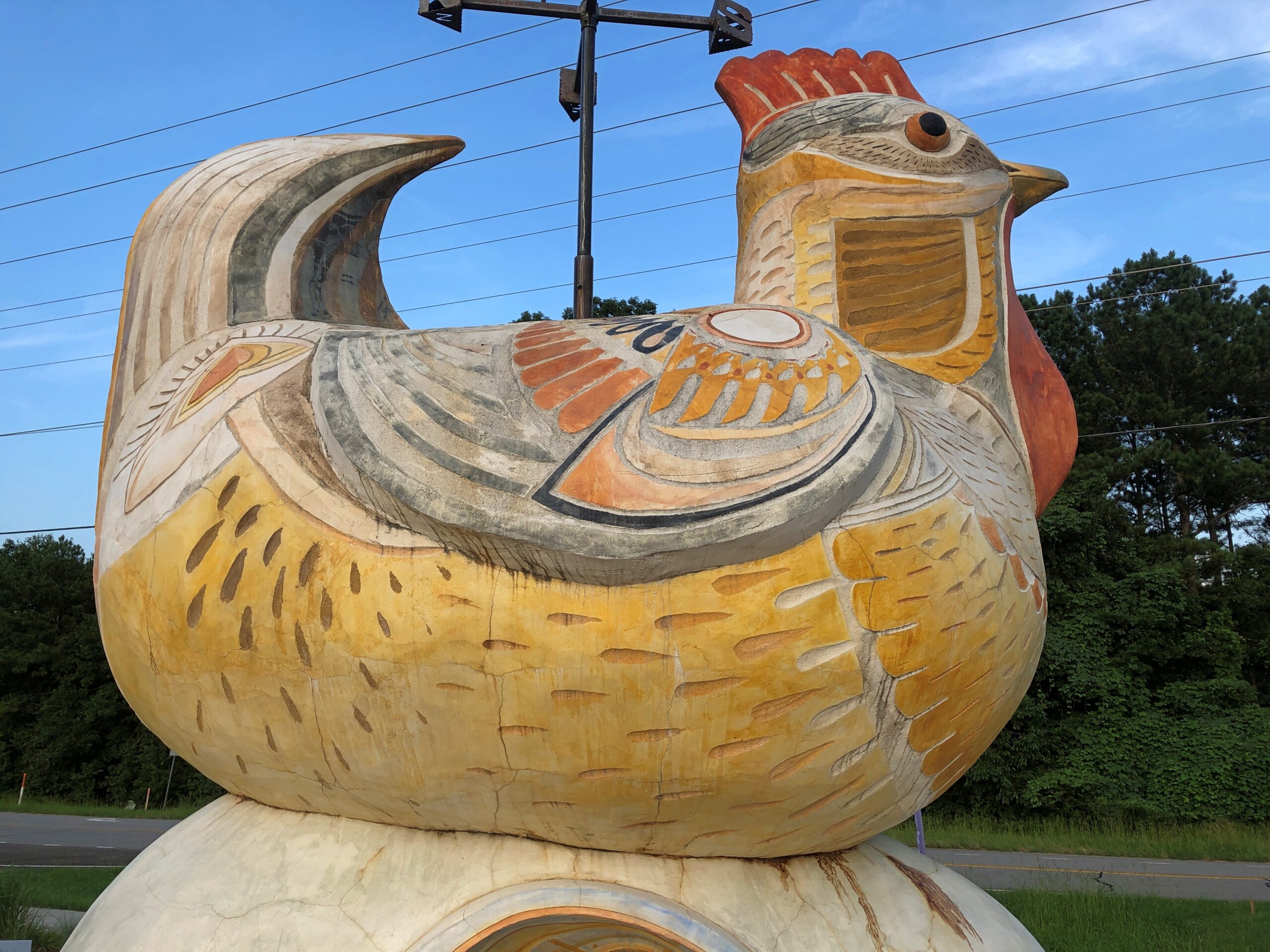
Sometimes you’re driving along, minding your own business because your business at that moment is driving, and you see a two-story chicken near the road. Three stories if you count the iron weather vane perched atop the bird.

Chicken!
Chicken!
Chicken!

I had to stop to see that. More precisely, it’s a concrete chicken on a concrete egg, settling the question of which came first (the concrete did). The chicken, and the egg, are on property owned by the University of Georgia, used for the Athens-Clarke County Extension in Athens. Erected in 2022. More about the work, “Origins,” is here. All ag extensions should have just a little whimsy.

The chicken appeared roughly in the middle of the 3,285 miles I drove between June 16 and June 29, taking a lasso-shaped path from the Midwest across the Southeast, all the way to the ocean at Myrtle Beach, South Carolina: through Indiana, Kentucky, Tennessee, North Carolina, South Carolina, and Georgia, and back through Tennessee, Kentucky and Indiana.

The concrete hen took the cake for novelty, but along the way I saw a memorial to a mostly forgotten incident in the War of 1812, went into a mirrored tower built for a world’s fair, chanced on the spot where the mostly forgotten diplomat who brought the poinsettia to the U.S. is buried, and braved the tourist sprawl that is Mrytle Beach. I heard stories of Blackbeard while near the coast, near his hideouts. I strolled the genteel downtown of the second-oldest town in North Carolina, passing the notable spot where Pepsi-Cola was invented. We visited a three-story souvenir shop that has stood the test of time in Myrtle Beach, which I’m happy to report sells not just postcards, but vintage local postcards, at popular prices. One evening we wandered past sculptures and colored lights among the Spanish moss in South Carolina. For a moment I beheld a complete set of the U.S. gold coins minted in Dahlonega, Georgia.
I drove by houses, farms and fields, past small businesses open and defunct, and junkyards and billboards — an industry that would collapse without ambulance chasers, I believe — and factories and water towers and municipal buildings. That is to say, structures and greenery of all manor of use and upkeep, an inexhaustible variety of human and natural landscapes. Homogenization my foot. Except, of course, every burg with a zip code also has at least one dollar store.
We – my machine and I and sometimes Yuriko, who flew to Myrtle Beach to meet me for a weekend – experienced an incredibly lush Southeast not long after a rainy spring, on big roads and small, straight and curvy, all the while defying the heat. I heard it enough on the radio: a “heat dome” had settled over the eastern United States. It persisted from the first day in Indiana to the last day in Indiana, though it had moderated a bit by then. Temps were in the 90s most days, but nothing that’s going to faze a Texan with an air conditioned vehicle and bottled water.

We did adjust our schedule to mostly be out in the morning or evening, except at Myrtle Beach, where a walk in the heat that made me feel my age and maybe then some. A less hot but more humid walk in a mostly forgotten national park in South Carolina saw flights of mosquitoes barreling down on me. A few of them penetrated my DEET coverage.

I saw and did all that and much more, but that was only the bronze and silver of the trip. The gold was visiting old friends.

That was actually the priority this time around. Before the trip, one of the friends I planned to visit asked me via text: “What’s your trip about?”

My text answer: “Visit old friends, see new things & take long drives.”

In Nashville, Stephanie and Wendall.

In North Carolina, Dan and Pam. She had enough sense not to wander around in the heat with us.

In rural Tennessee, Margaret and Dave.

Separately in Georgia, Layne and Stuart. I was glad to see them all, and I think they were all glad to see me. Known most of ’em since the 1980s, and we had a time — then and now.

Uncle Walt’s Band, 1982

Nearly two years ago, media distribution company Orchard Enterprises provided 21 songs to YouTube, cuts on a collection called Uncle Walt’s Band Anthology. Subtitled — and it really captures the essence of that band — “Those Boys From Carolina, They Sure Enough Could Sing…”

Sure enough. The three-man band, Walter Hyatt, Champ Hood and David Ball, all originally from Spartanburg, SC, existed for a few years in the early 1970s and again in the late ’70s and early ’80s. They produced four original albums, did solo work, and played with a good number of other musicians in Austin and Nashville over the years. Those few reviews one can find about Uncle Walt’s Band tend to characterize them as Americana, and I supposed they were — a mix of American styles by South Carolina musicians who honed their skills in Nashville and Austin both.

Though fondly remembered by a few, especially other musicians, wider fame eluded Uncle Walt’s Band. I already knew that, but the point is hammered home by looking at the view count for some of their wonderful songs on Anthology — such as the fun “Seat of Logic” (only 533 views after two years, not 533,000 as by rights it ought to be); the winsome “Ruby” (only 569 views); and the sweetly melancholic “High Hill” (only 344 views); and on and on.

Forty years ago this evening I had the exceptionally good fortune of seeing Uncle Walt’s Band live in Nashville. “Crystalline sound,” I wrote in the diary I kept at the time, along with other unhelpful scraps when it comes to remembering it now. Still, the show was some of the best live music I saw in college, or ever really. A less fanciful way to characterize the gentlemen who played for us that evening would be near-perfect three-voice close harmony, with guitar, fiddle and bass.

I had taken a month-long trip not long before that evening, returning to Nashville less than a week earlier, with plans to attend summer school, but not take it all that seriously. That is exactly what I did and I don’t regret a moment of it. While I was away, my friend Dan had obtained the records Uncle Walt’s Band (a renaming and reissue of the 1974 Blame It On The Bossanova) and An American in Texas (1980, the same year the band appeared on Austin City Limits).

To put it in music biz terms, those records were in heavy rotation around the house where Dan and Rich lived, and where Mike, Steve and I were constant visitors that summer. As soon as I returned to Nashville, I heard it too. Then we got wind of the fact that Uncle Walt’s Band was playing live on Saturday the 12th at a place called The Sutler. We couldn’t believe our luck, and we weren’t about to miss that.

At time I called The Sutler “a tavern next to a bowling alley, a bakery and a restaurant,” which it was, though I didn’t record its address on 8th Ave. South in the Melrose neighborhood. That was further than we usually went, though (I know now), not that far from campus. Dive might not quite have been the word for the place, but it certainly wasn’t posh, and while I’m pretty sure I went there a few times in later years, I only remember seeing UWB there, and the joint’s last iteration closed only this year. It was standing room only for a while, but eventually we got a table. We stayed for the whole show. My mind’s eye can visualize it even now, and my mind’s ear can hear a crystalline echo of their sound.

UWB broke up for the last time the year after we saw them, but their musical presence that summer made an impression on me. Enough that in the late ’80s, when I was visiting Austin, I noticed a small poster somewhere advertising a show by Walter Hyatt at the famed Waterloo Ice House on on Congress Ave. We have to go to that, I told Tom Jones, whom I was visiting, and so we did.

During one of the breaks in that show, I asked Hyatt where I could buy copies of the two records that I remembered so fondly from the summer of ’82 — I think I even mentioned the show at The Sutler — since finding obscure music was more of a chore in those days. He gave me an address to send a check to, and soon after I did, I received an audio cassette of Uncle Walt’s Band and An American in Texas, which I listened to periodically over the years and own to this day.

Forty years is a long time, and time has taken its toll. Walter Hyatt died in the ValuJet Flight 592 crash in 1996 and Champ Hood died of cancer in 2001. David Ball has had a successful career as a country musician and is now pushing 70.

One more thing: I didn’t realize until the other day that the subtitle, “Those Boys From Carolina…” was no random pick. Lyle Lovett, Texan of distinct hair and winning ways with song, mentioned UWB in a song he recorded long after the band was gone, but before Walter Hyatt died, the amusing “That’s Right, You’re Not From Texas.”

Those boys from Carolina,
They sure enough could sing.
But when they came on down to Texas,
We all showed them how to swing.

Thursday Flotsam

I think I was in the 8th grade when I learned the difference between flotsam and jetsam. Mr. Allen’s English class. He was firm in his belief that you should learn things in school. I suppose most teachers feel that way, but he was particularly adamant. Once a wiseacre named Tim asked Mr. Allen why anyone had to learn what he was teaching. “Because if you don’t know it, you’ll be ignorant,” was his answer.

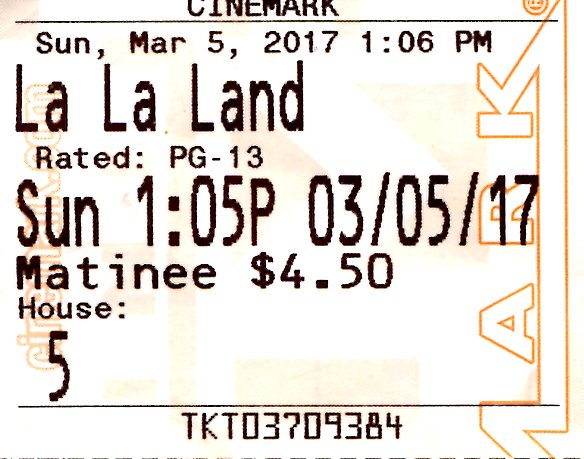
Saw La La Land recently. It was everything it needed to be. Namely, skillfully made and visually appealing light entertainment, with an especial fine use of the Griffith Observatory as a setting, and an ending a bit above the usual formula. A lot else has been written about it, of course. Endless commentary. As far as I’m concerned, that’s overthinking the matter.

My parents’ and grandparents’ generations weren’t right about everything, but I think they had a healthy take on song-and-dance movies. Mostly light entertainment, though there was the song that was just as powerful a weapon as any cannon or battleship in the First World War.

Speaking of war, after posting about the evacuation of Fort Moultrie on December 26, 1860, I found the digital version of The War of the Rebellion: a Compilation of the Official Records of the Union and Confederate Armies to see if Maj. Anderson’s telegram was indeed the first item in that sprawling compendium. It is.

I was amused by the second item, also a telegram, dated December 27.

Major Anderson, Fort Moultrie:
Intelligence has reached here this morning that you have abandoned Fort Moultrie, spiked your guns, burned the carriages, and gone to Fort Sumter. It is not believed, because there is no order for any such movement. Explain the meaning of this report.
— J.B. Floyd, Secretary of War

Or as Sec. Floyd might have said privately, “The deuced you say! He did what?” Three days later, Floyd resigned as Secretary of War, and is remembered — when he’s remembered at all — for suspicious behavior in that office, at least as far as the Union was concerned, and as an incompetent Confederate general.

General Floyd, the commanding officer, who was a man of talent enough for any civil position was no soldier, and possibly, did not possess the elements of one. He was further unfitted for command for the reason that his conscience must have troubled him and made him afraid. As Secretary of War, he had taken a solemn oath to maintain the Constitution of the United States and uphold the same against all enemies. He had betrayed that trust.
— Personal Memoirs of Ulysses S. Grant

Recommended eatery in Charleston: Bluerose Cafe.

Bluerose Cafe

I started looking for dinner a bit late on a Friday night, and went to one place I’d found on Google maps. It was jammed, and more importantly, so was its parking lot. I went to my second choice. It too was full. Facing the possibility of fast food, which I didn’t really want, I headed back toward to hotel, when I noticed the Bluerose. Plenty of parking there.

The restaurant wasn’t packed either. In fact, at about a half hour before closing, only one table was occupied, with a fellow eating at a counter, and a hostess/waitress behind the counter. The place was simply decorated, but not drab, and the longer I looked around, the more I started noticing Irish touches, such as the sign that said, Céad Míle Fáilte (a hundred thousand welcomes).

I sat at the counter as well, and the man eating there said, “I’ll get you something as soon as I’m finished. I haven’t had a chance to eat all day.”

He had a distinct Irish brogue. Turned out he was Denis O’Doherty, the proprietor. I told him not to hurry. We talked a bit, and he told me that he’d come to the United States a good many years ago, living in Boston quite a while, but in Charleston for the last 13 years or so, running the Bluerose. People get around.

I ordered the pan fried flounder before too long, and Mr. O’Doherty went back to the kitchen, which is visible from the counter, to prepare it. While he was at work on that, a woman came in and ordered some food to go, and talked a while with Denis as she sat at the counter. A regular customer. I got the feeling that the place had a lot of regular customers.

He didn’t let the talk distract him too much, because when I got my fish, it was superb. Which was the exact word I used when he asked how the fish was. Sometimes, when it comes to finding good food on the road — even in the age of Yelp and Tripadvisor and all that ya-ya — you just have to get lucky.

Magnolia Cemetery, Charleston

Out of idle curiosity, I recently Googled “Magnolia Cemetery” and by the most cursory of investigations, found properties of that name not only in Charleston, SC, but also in Augusta, Ga., Mobile, Beaumont, Norfolk, Va., Baton Rouge, Houston, Orange Park, Fla., and Meridian, Miss., just to name some of the Southern spots.

There are also Magnolia Cemeteries in Philadelphia — Pa. — Harrison County, Iowa, and Stark County, Ohio. That might seem odd, but then again certain kinds of magnolia grow in the North. Saw some in Rockford, Ill. Or maybe the Northern cemetery namers just liked the shady, peaceful associations of the magnolia.

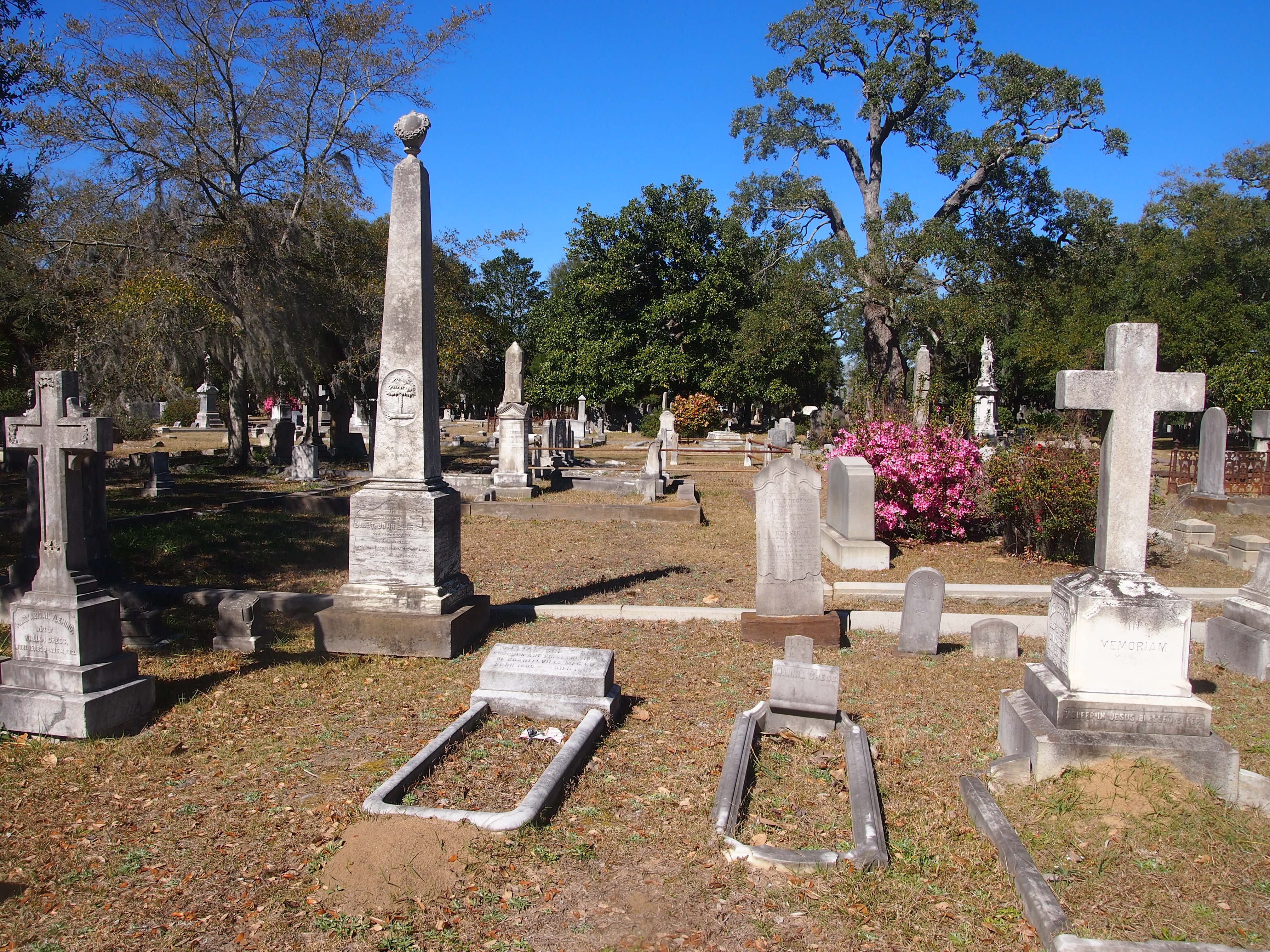
Magnolia Cemetery in Charleston got its start in 1850, during the rural cemetery movement of the 19th century. Rural then, but fully in the city now. Still, it’s a peaceful place, full of the things a park-like cemetery should have: old stones, funerary art, mature trees, bushes, flowers, water features, winding trails, memorials evoking local history.

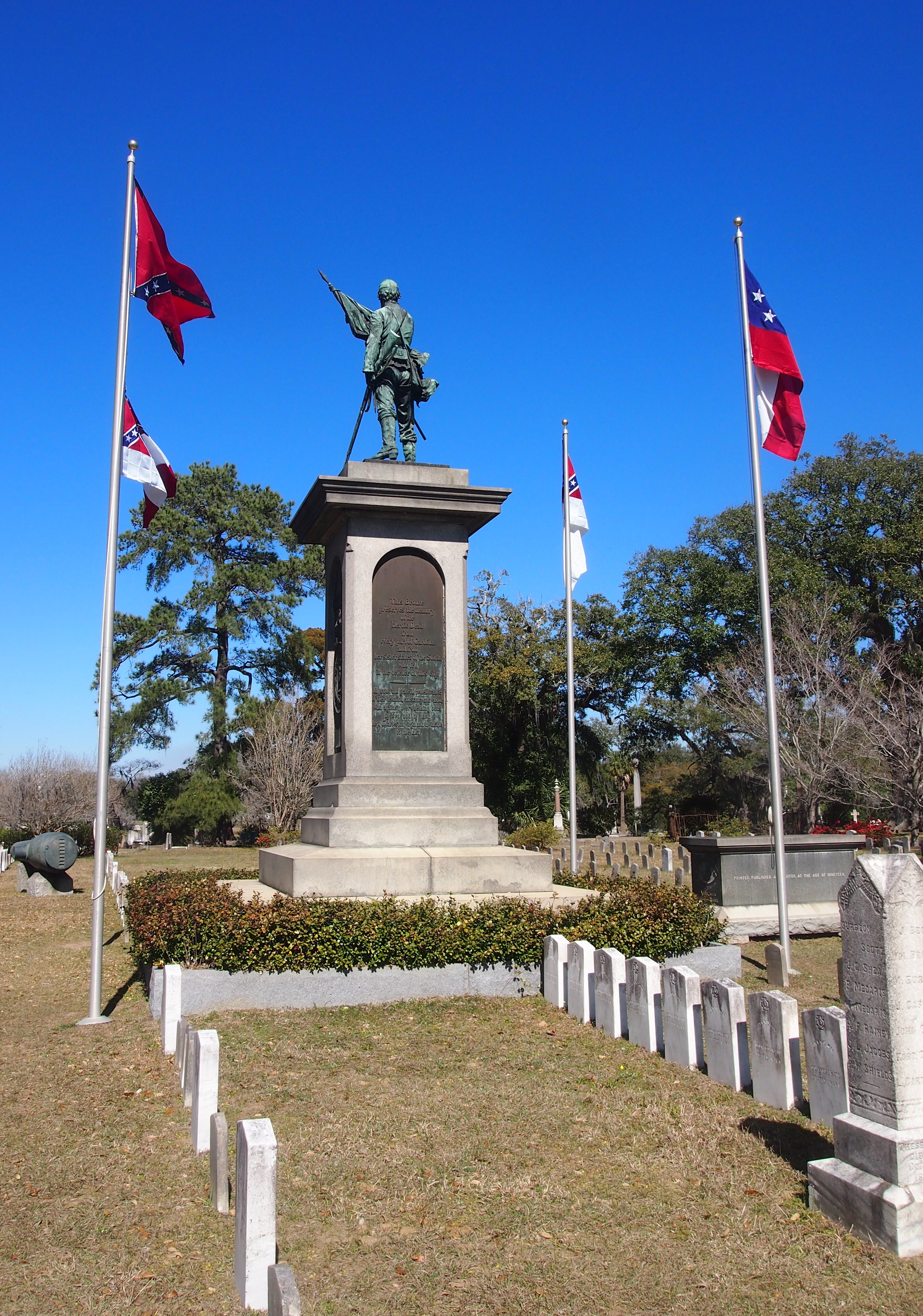
In Charleston, the War Between the States looms large in local history memorialization. Here’s the monument at Soldiers Ground, a section for Confederate dead set aside during the war.
Magnolia Cemetery, Charleston Confederate Memorial 2017The tablet on this side of the plinth says:

This Bronze preserves the memory of the Heroic Dead from every part of Carolina and from her sister states of the South who fell in the defense of this city.

In proud and grateful remembrance of their devotion, constancy and valour, who against overwhelming odds by sea and by land kept Charleston virgin and invincible to the last.

Interesting turn of phrase, even for a memorial. It would be snide to claim that Charleston’s “virginity” was kept because Sherman had other things to do (that is, burn down Columbia), so never mind. The four flags are the three national Confederate flags, plus the battle flag.

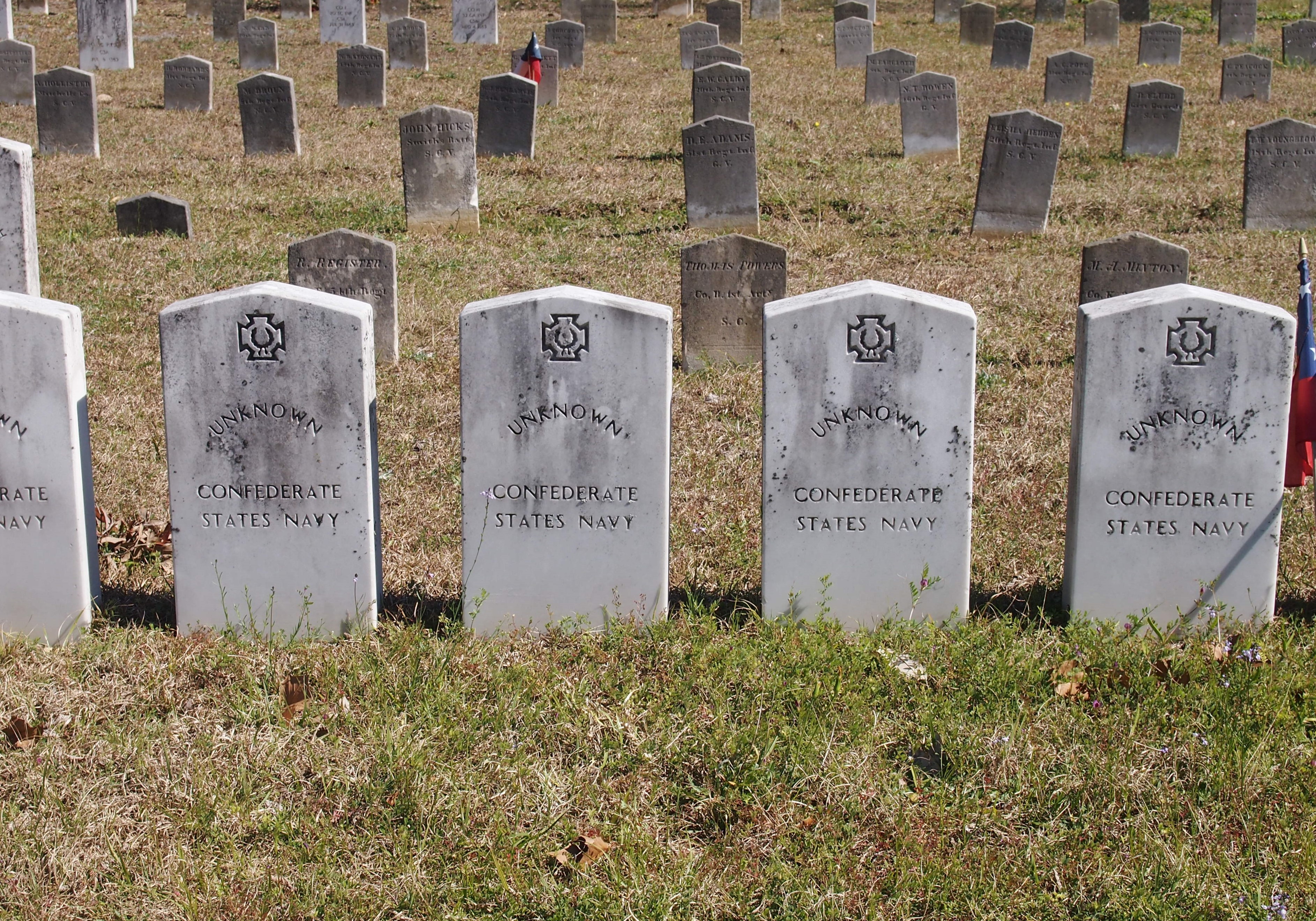
I don’t ever remember seeing CSA sailors at rest, but Magnolia has some, identities unknown.
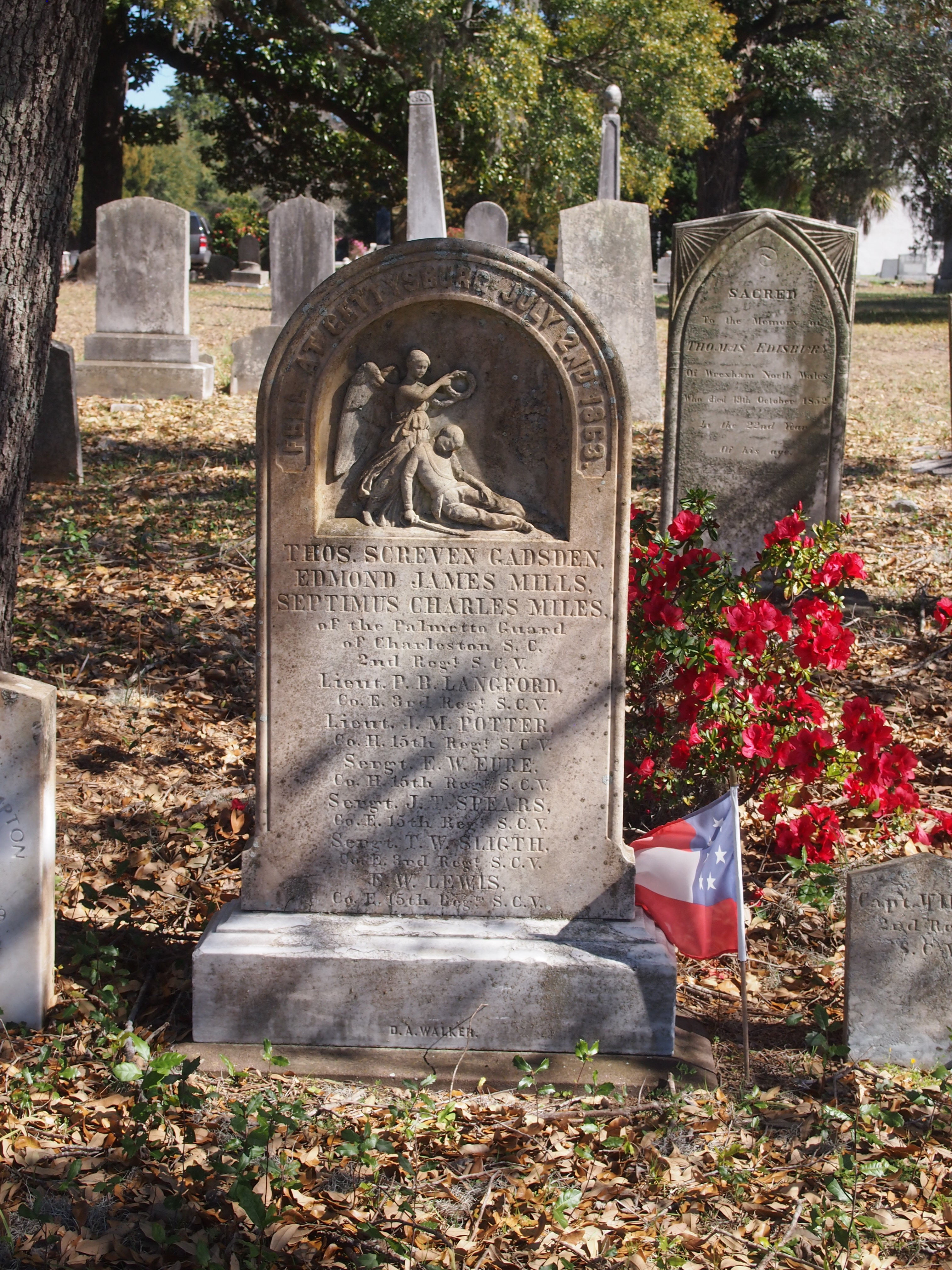
Magnolia Cemetery, CharlestonThere’s also a memorial to South Carolinians who fell at Gettysburg.
Magnolia Cemetery, CharlestonElsewhere are reminders not of war death, but plain old death.
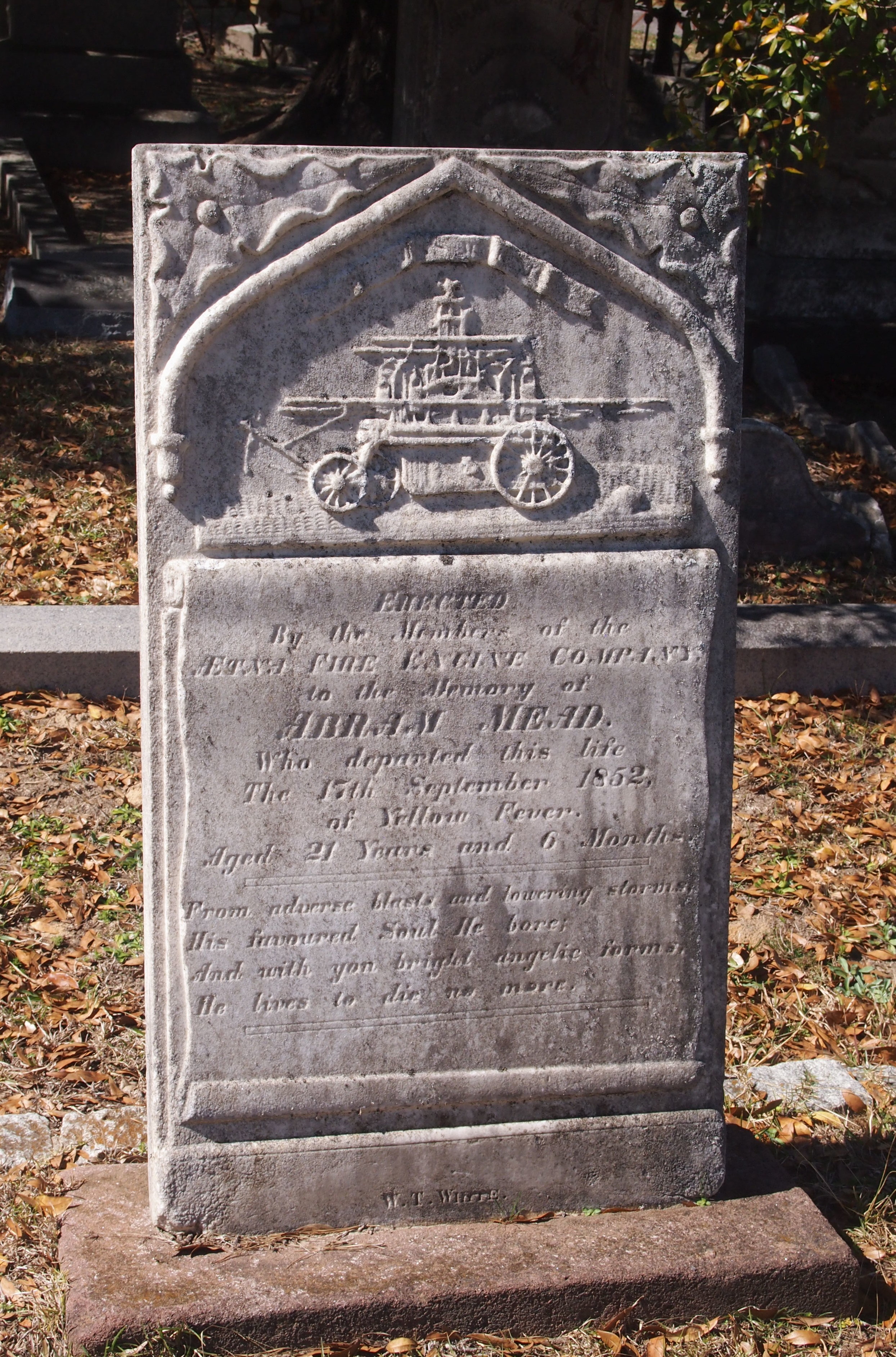
Magnolia Cemetery, CharlestonThere are also specialty stones, such as this memorial of one Abram Mead, a member of the Aetna Fire Engine Company. Or rather Ætna, named for the volcano, I suppose. Nice to find a ligature in stone.

Charleston - Magnolia CemeteryIt’s pretty rare to find cause of death on a headstone, but there it is: Departed this life the 15th of September 1852 of Yellow Fever, Aged 21 Years and 6 Months.

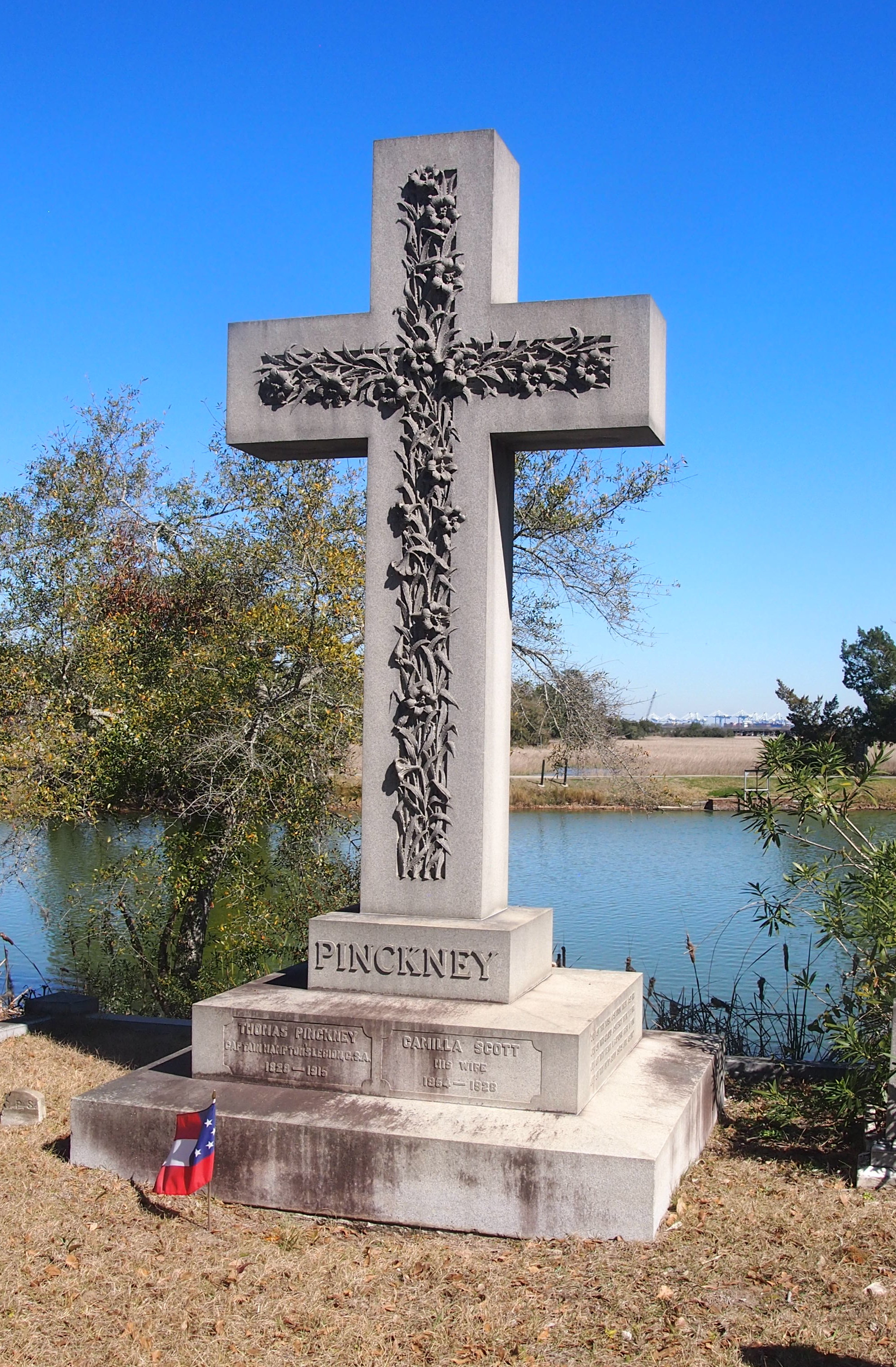
Something a little more imposing, near the cemetery’s pond. This Thomas Pinckney isn’t the Pinckney of the Revolution and post-Revolutionary period, but his grandson.

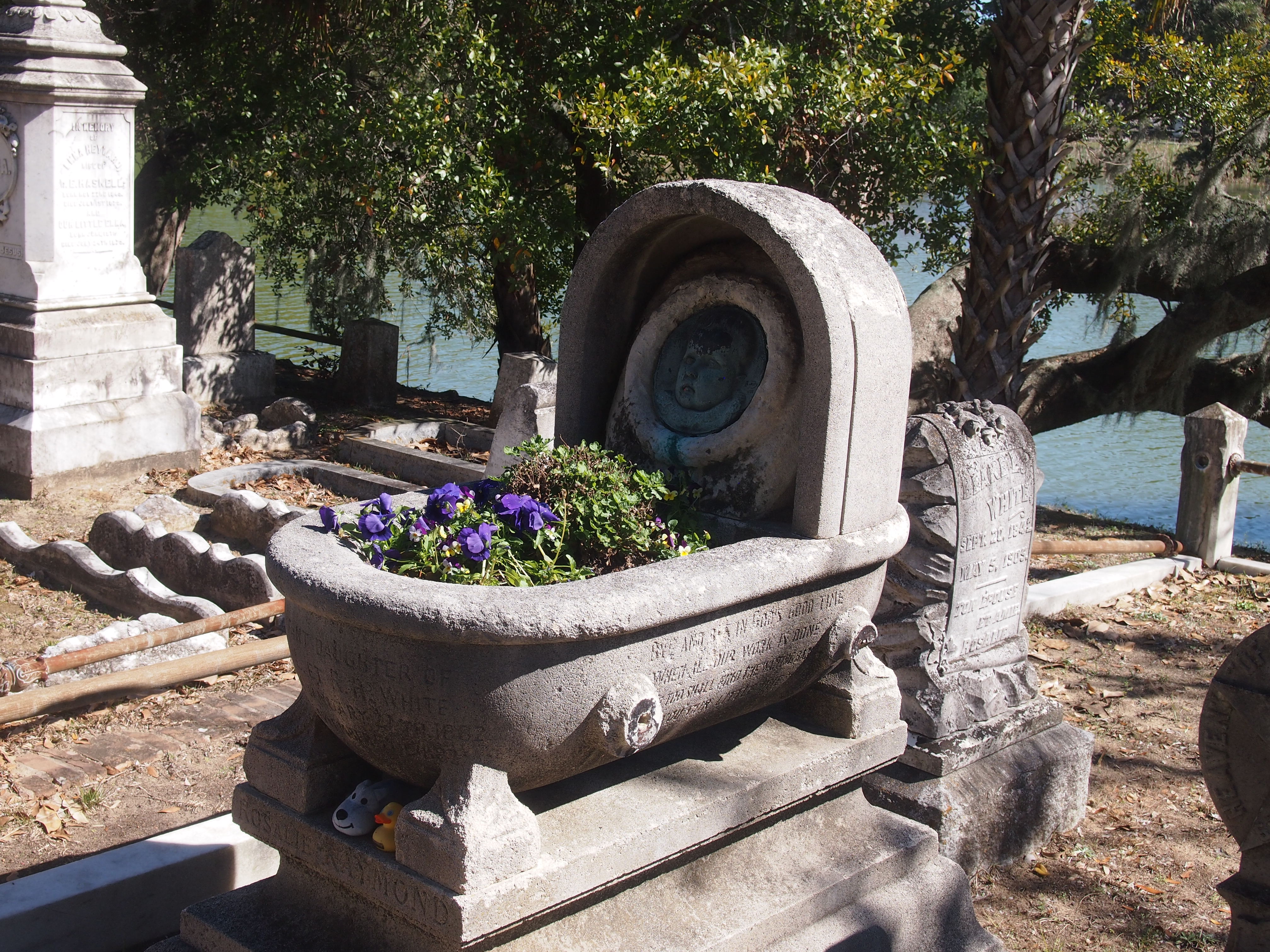
Pinckney grave, Magnolia Cemetery CharlestonA child’s stone the likes of which I’ve never seen.
Magnolia Cemetery CharlestonNote that in more recent times, someone left a rubber duck and toy bear for the girl, Rosalie Raymond White, who lived for a few months in 1882.

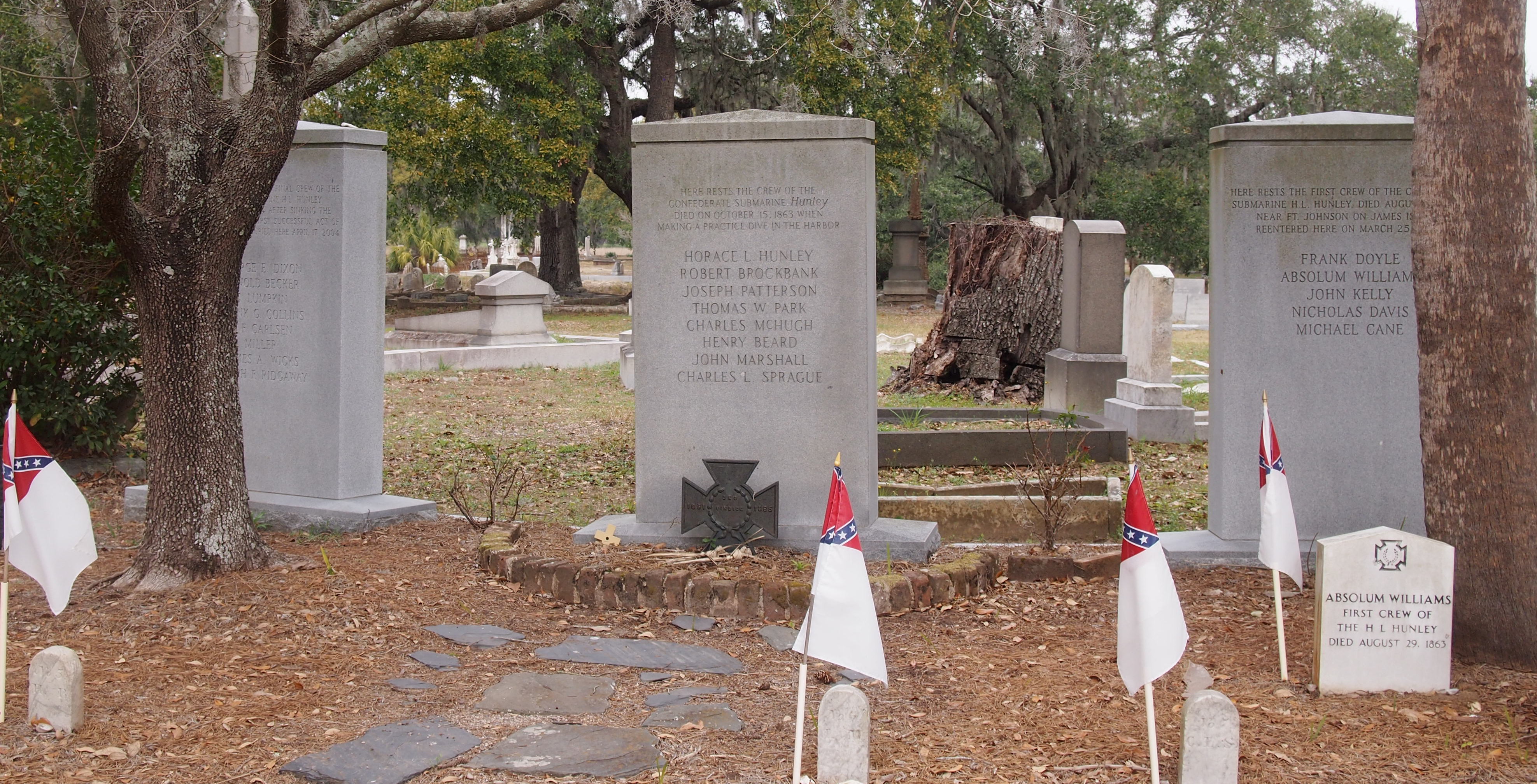
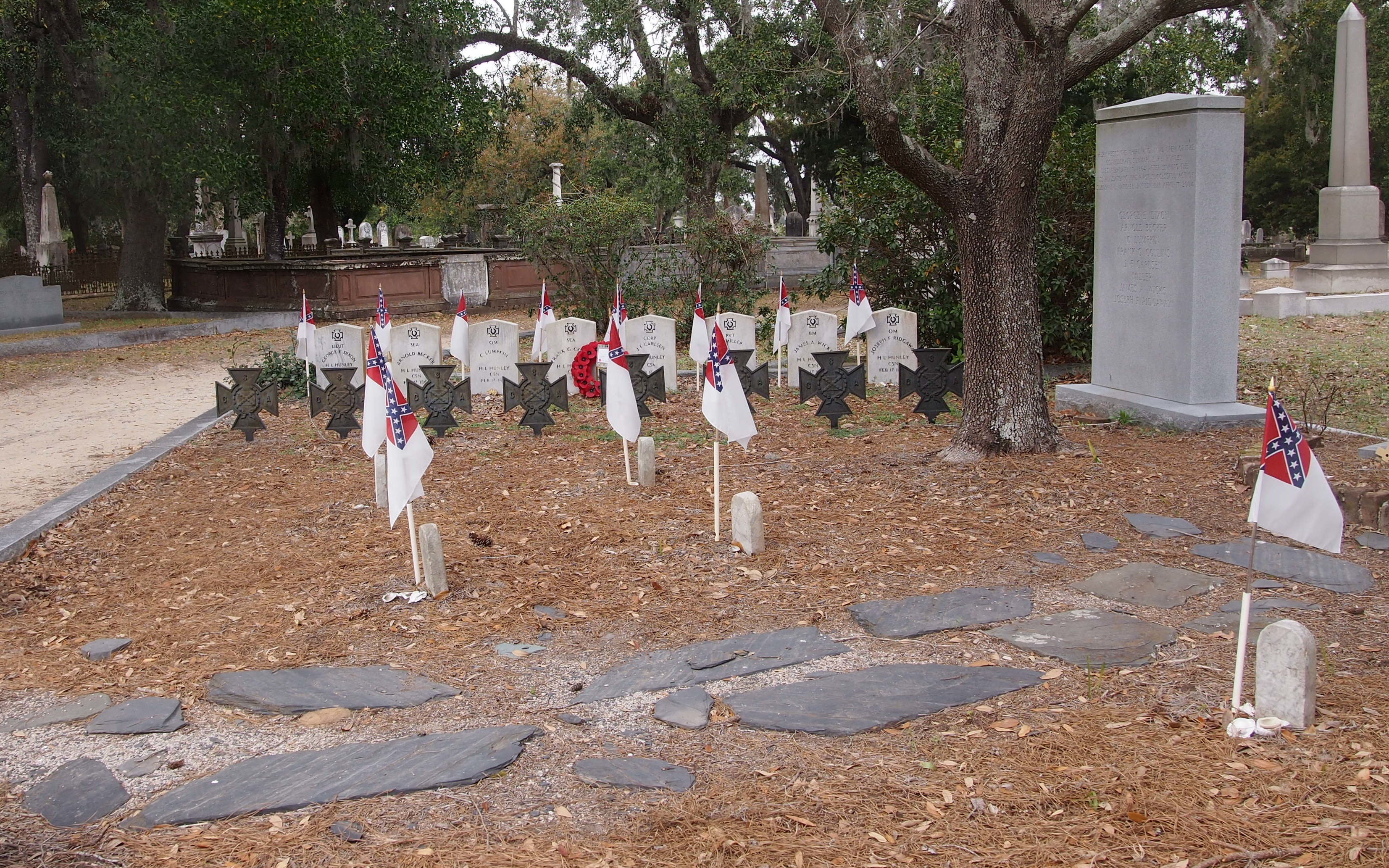
Finally, the three crews of the H.L. Hunley are interred at Magnolia Cemetery, each crew with modern memorial stones, and stones for the individuals as well, each with a Stainless Banner.

Hunley Memorial, Magnolia Cemetery CharlestonHunley memorial, Magnolia Cemetery CharlestonThe third crew were entombed in their vessel for about 135 years (their stones are in the row pictured above). The Hunley was raised in 2000 and, presumably after the forensic archaeologists had had a long look at the crew’s bones, they were buried at Magnolia in 2004 with considerable ceremony.

Fort Sumter National Monument

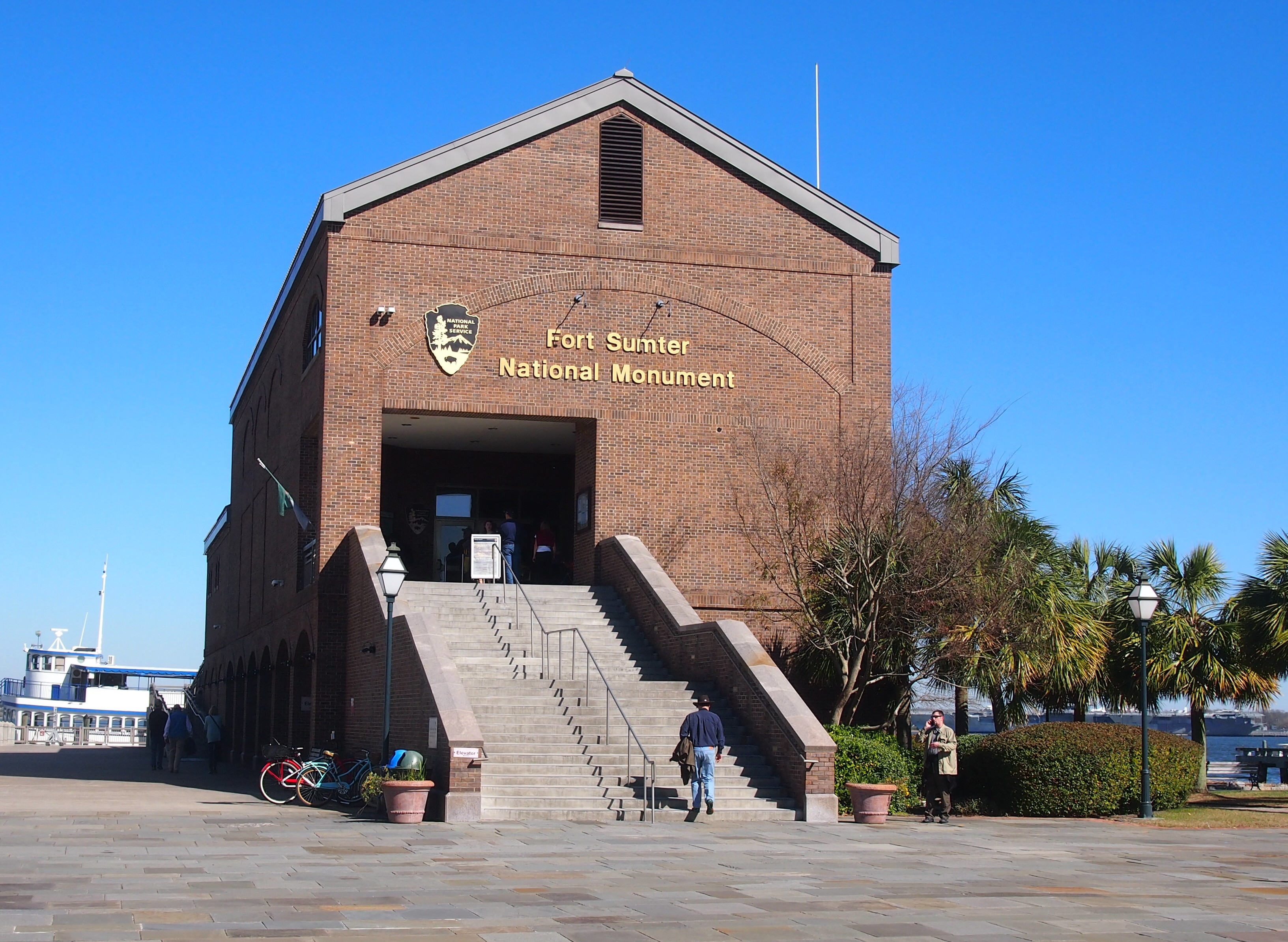
To reach Fort Sumter National Monument, you start at Liberty Square, on Charleston’s waterfront, at this building.
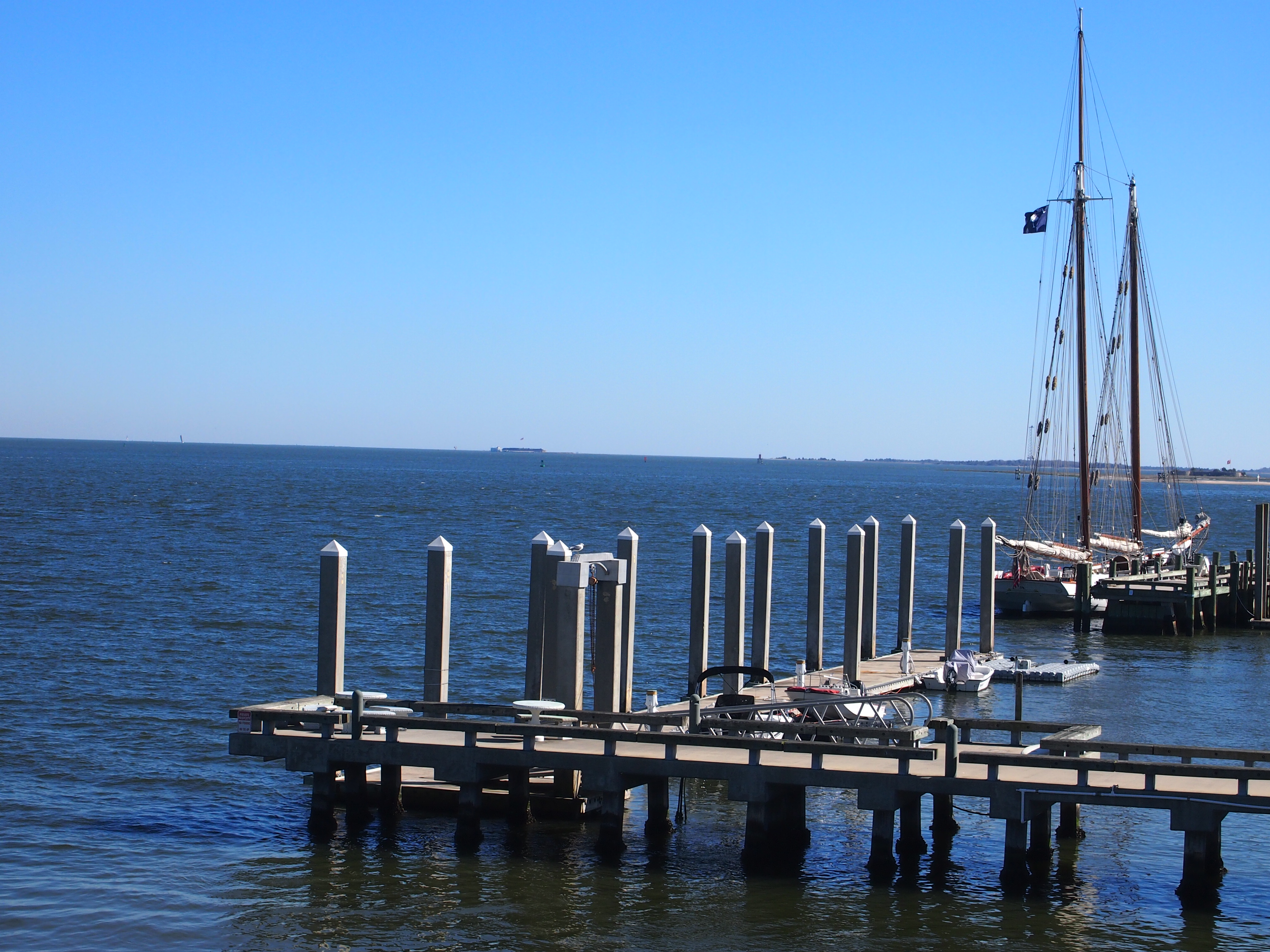
Fort Sumter National MonumentAt the other end of the building is a pier were the tourist boats dock, as is visible in the picture above. The view from there, toward Fort Sumter, looks like this on a clear day.
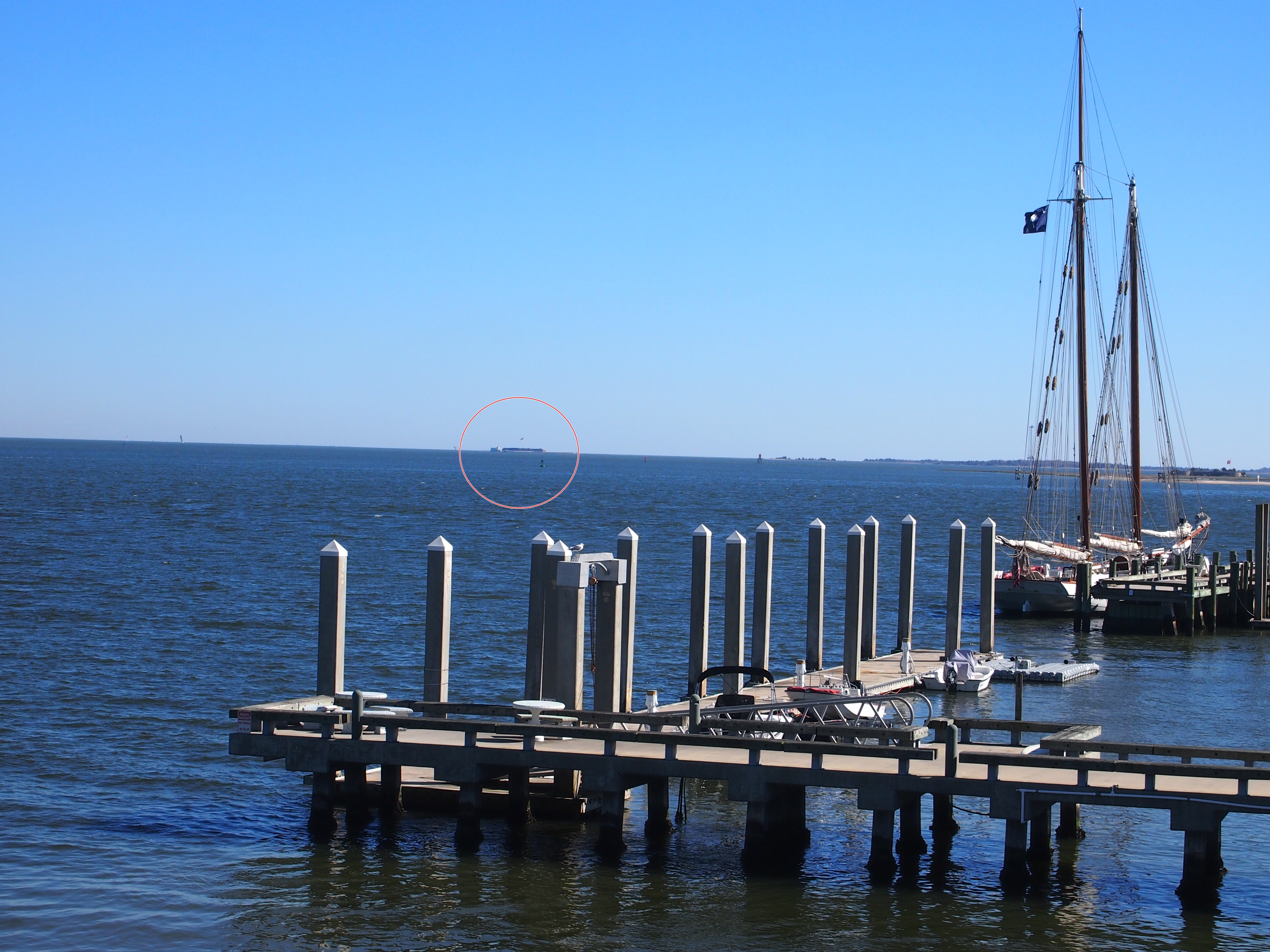
Fort Sumter National Monument - dockAlso included in the monument is Fort Moultrie, but I didn’t make it there. The Fort Sumter part of the national monument is a little hard to pick out, but it is visible on the horizon.

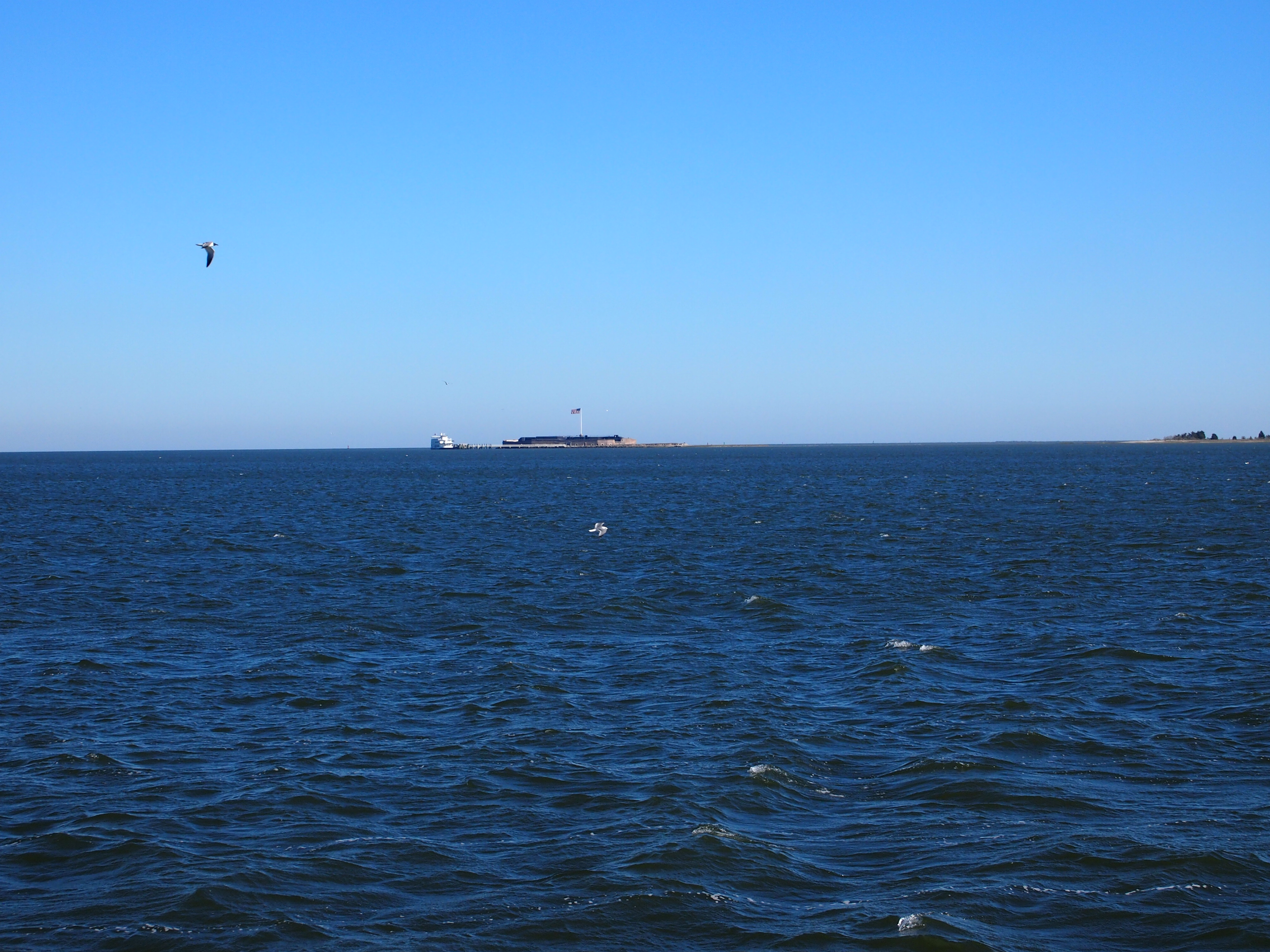
The ride is about 30 minutes. As you proceed, Fort Sumter gets closer.
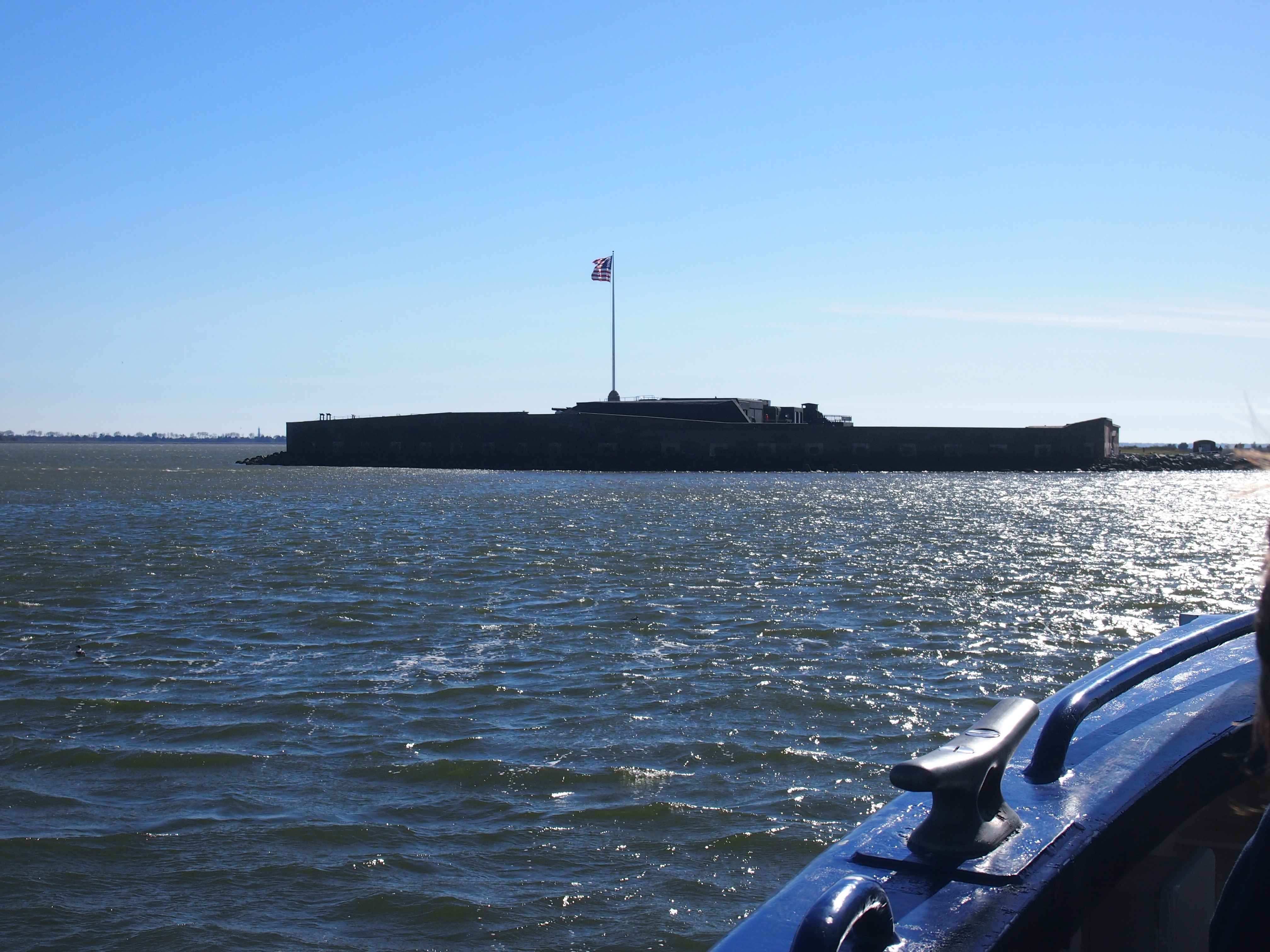
Fort Sumter And closer.
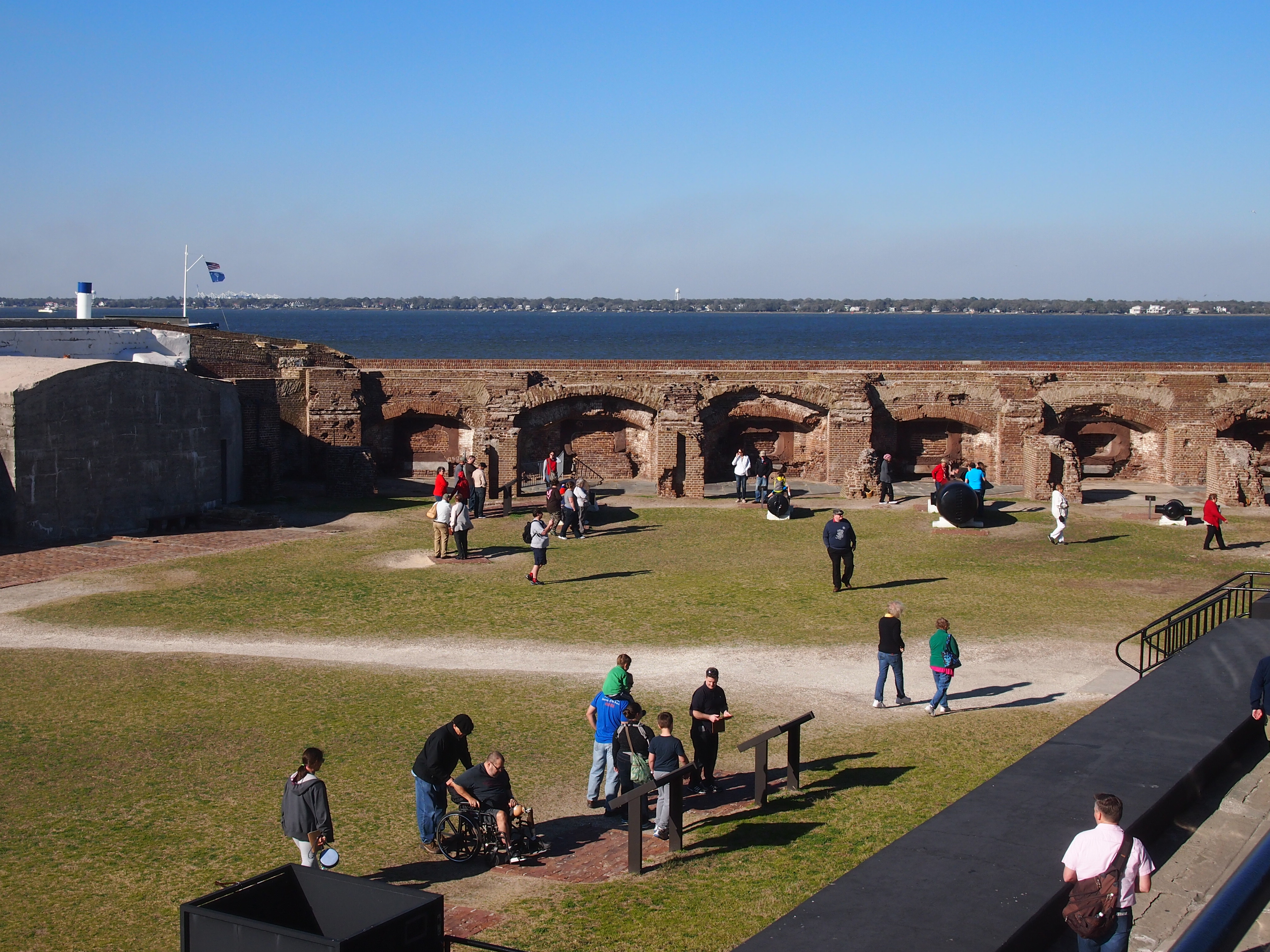
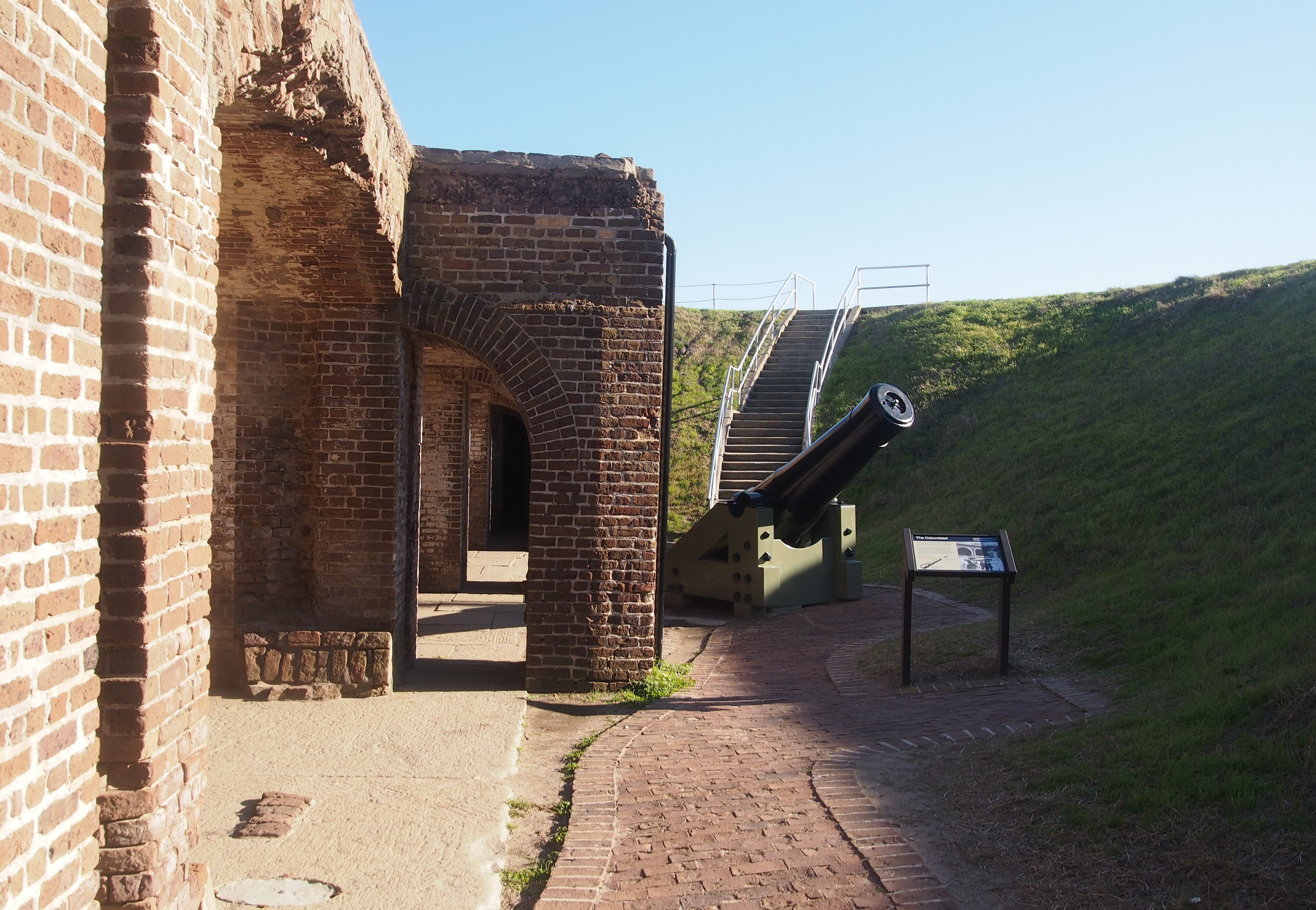
Fort SumterPretty soon the boat docks at the former fort for about a hour and a quarter visit, which includes a look at the walls, cannons, the former parade ground, the monument’s large flagpole and flag, and Battery Isaac Huger, a sizable black-painted structure built inside the walls at the time of the Spanish-American War that now houses a small museum and gift shop.

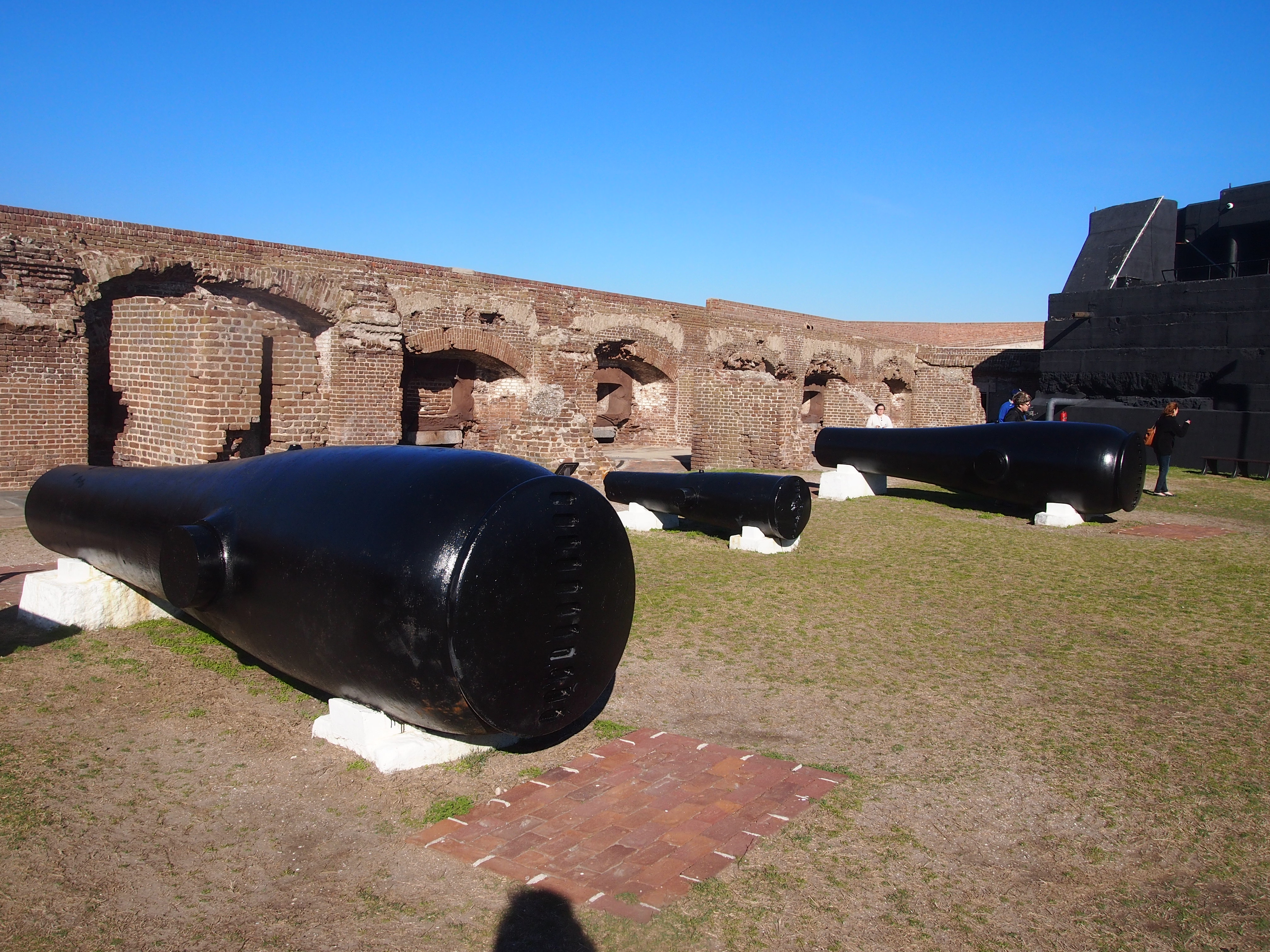
Some of the cannons were enormous. Can you imagine that thing going off near your ears in an age before ear protection?

Fort Sumter

Fort Sumter

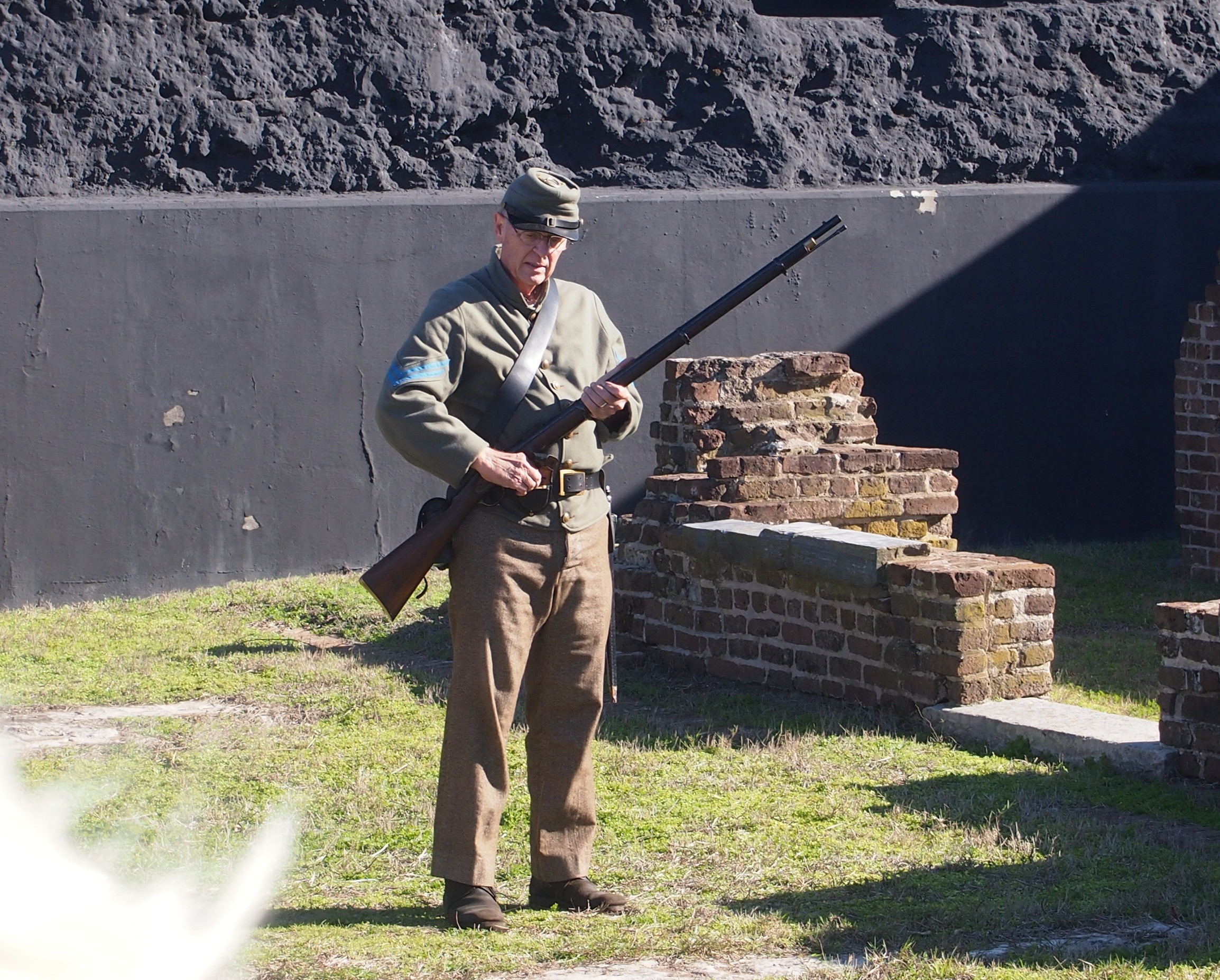
A Park Service volunteer demonstrated the loading and firing of a Civil War-era rifle.

Fort Sumter volunteer rifleman

He didn’t load it with a real minié ball, put otherwise the demonstration was authentic. After he showed us all of the steps to load the rifle, and fired it once, he did it again as fast as he could a few times, which was very fast, firing in succession. A true enthusiast.

Behind the battery is a slope up to an open field.

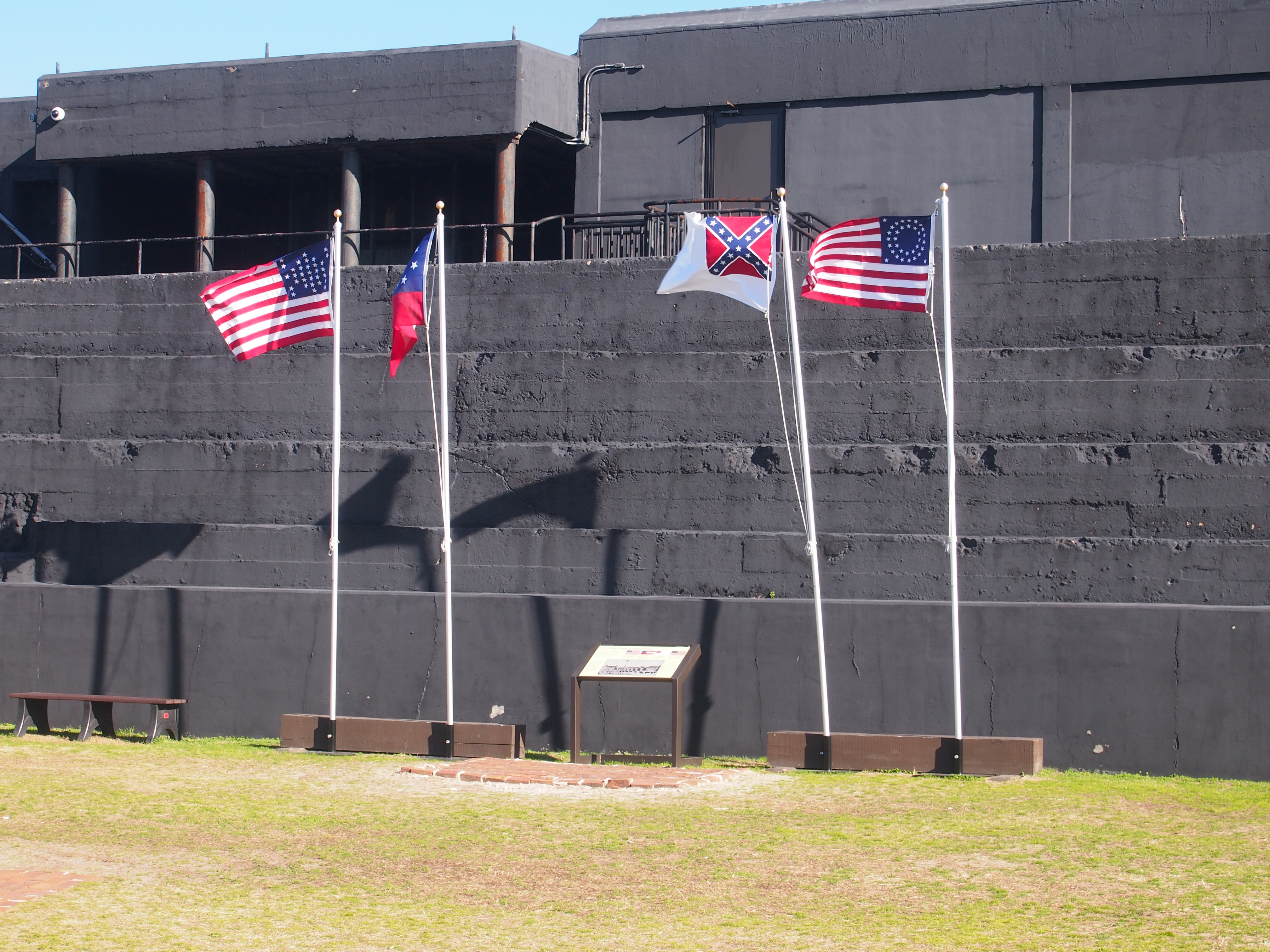
Fort SumterHere are representations the four flags that flew over Sumter during the war: the 33-star U.S. flag like that which flew on April 12, 1861; the first and second Confederate flags; the 35-star U.S. flag after Federal re-occupation of the fort in 1865. Fort SumterThe flag that Major Anderson had lowered when he surrendered the fort, and the one that was raised again symbolically in 1865 — Anderson returned for the occasion — is on display in the national monument’s museum. So is the Palmetto Flag that the South Carolinians flew when the fort was first captured.

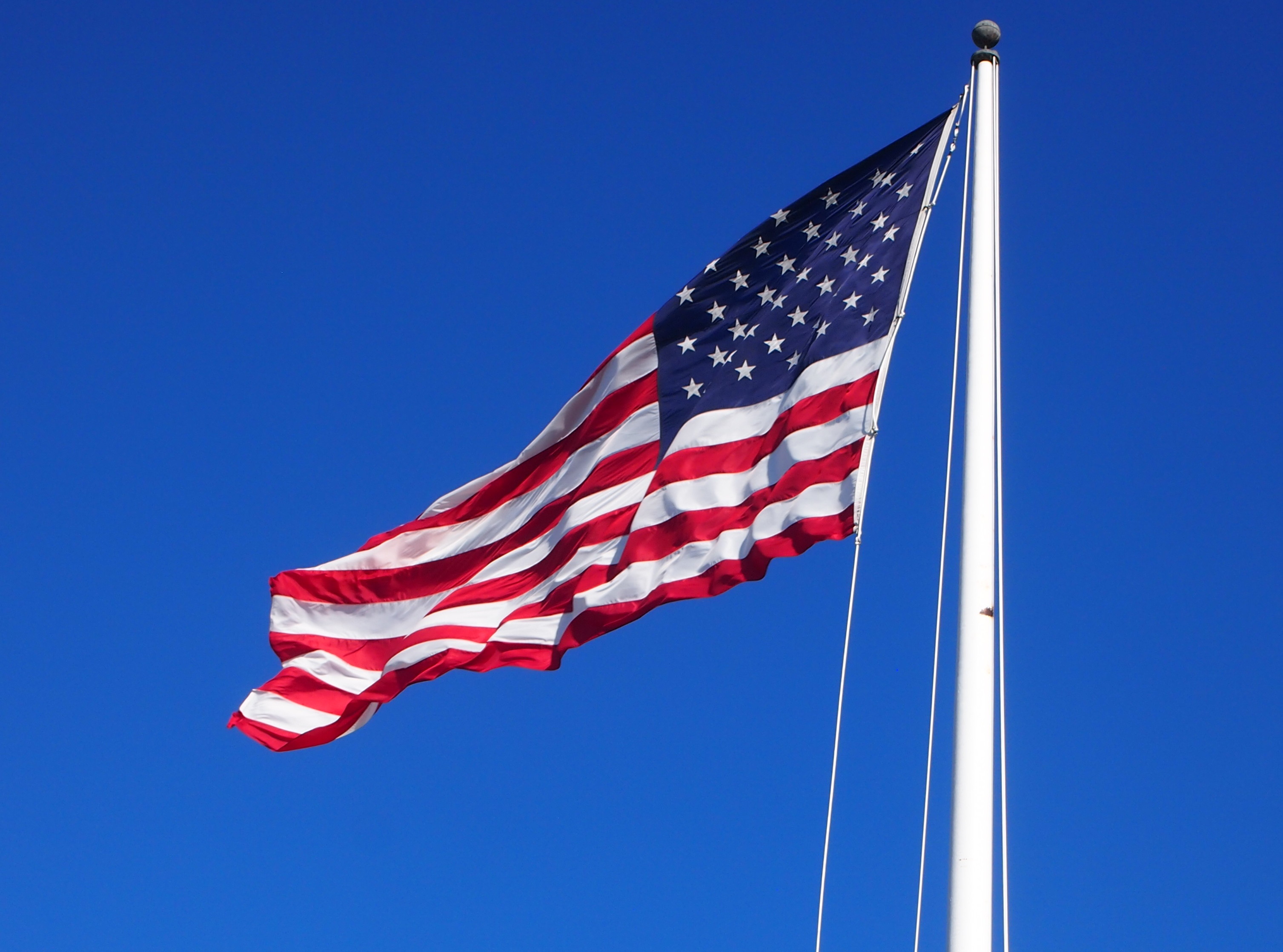
The current Stars and Stripes, visible from far away, is atop a large flagpole behind the battery.

Fort Sumter flag

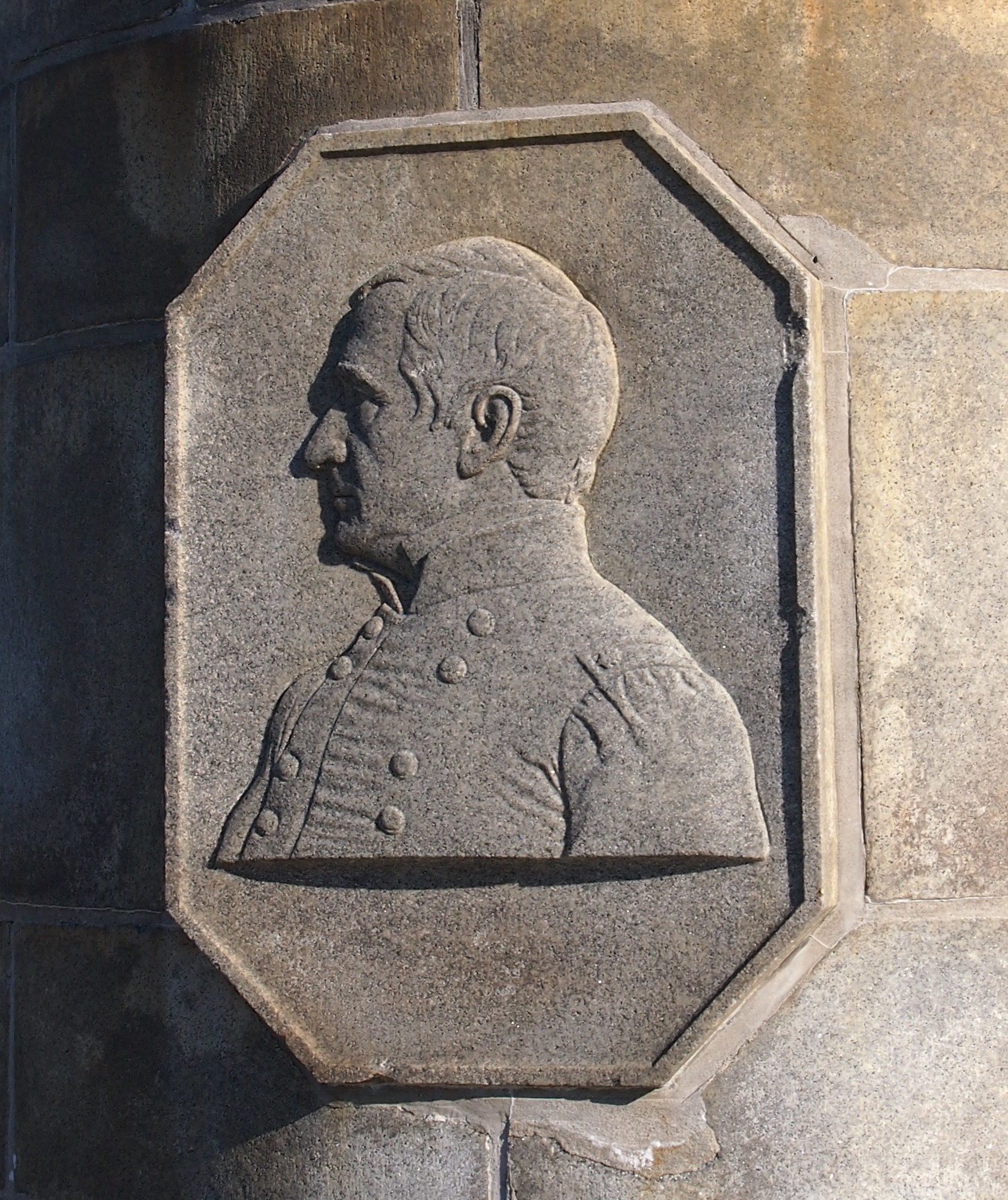
Major Anderson is honored in relief at the base of the large flag pole.

Fort Sumter

From 1861 by Adam Goodheart: “It would be one thing if President Buchanan had simply announced that he was withdrawing the troops from Charleston Harbor and turning the forts over to South Carolina, a decision that Anderson would have certainly obeyed, perhaps even welcomed. But he would be damned if he was to surrender — even worse, perform a shabby pantomime of a surrender — before a rabble of whiskey-soaked militiamen and canting politicians.

“Like so much else about the beginning of the Civil War, Major Anderson’s move from Fort Moultrie to Fort Sumter is largely forgotten today. At the time, however, the little garrison’s mile-long journey was seen not just as a masterstroke of military cunning but as the opening scene of a great and terrible national drama… ‘Major Robert Anderson, thundered the Charleston Courier, ‘has achieved the unenviable distinction of opening civil war between American citizens by a gross breach of faith.’ Northerners, meanwhile, held enormous public banquets in Anderson’s honor; cannons fired salutes in New York, Chicago, Boston, and dozens of other cities and towns.

“And considered in retrospect, Anderson’s move seems freighted with even more symbolism. He lowered his flag on an old fortress, hallowed by the past, yet half ruined — and then raised it upon a new one, still unfinished, yet stronger, bedded in New England granite…

“Twenty years after the war, when officials at the War Department began preparing the Official History of the War of the Rebellion, a massive compilation of documents that would eventually grow to more than two hundred thousand pages, the first of all the uncountable documents that they included was Anderson’s brisk telegram announcing his arrival at Sumter. Nineteenth-century historians knew that without this event, the war might not have happened…”

More Charleston Scenes

The Nathaniel Russell House on Meeting St. in Charleston, SC, completed in 1808, was originally home of one of the wealthiest men in the city at the time, Nathaniel Russell. In our time, it’s an historic property open for tours.

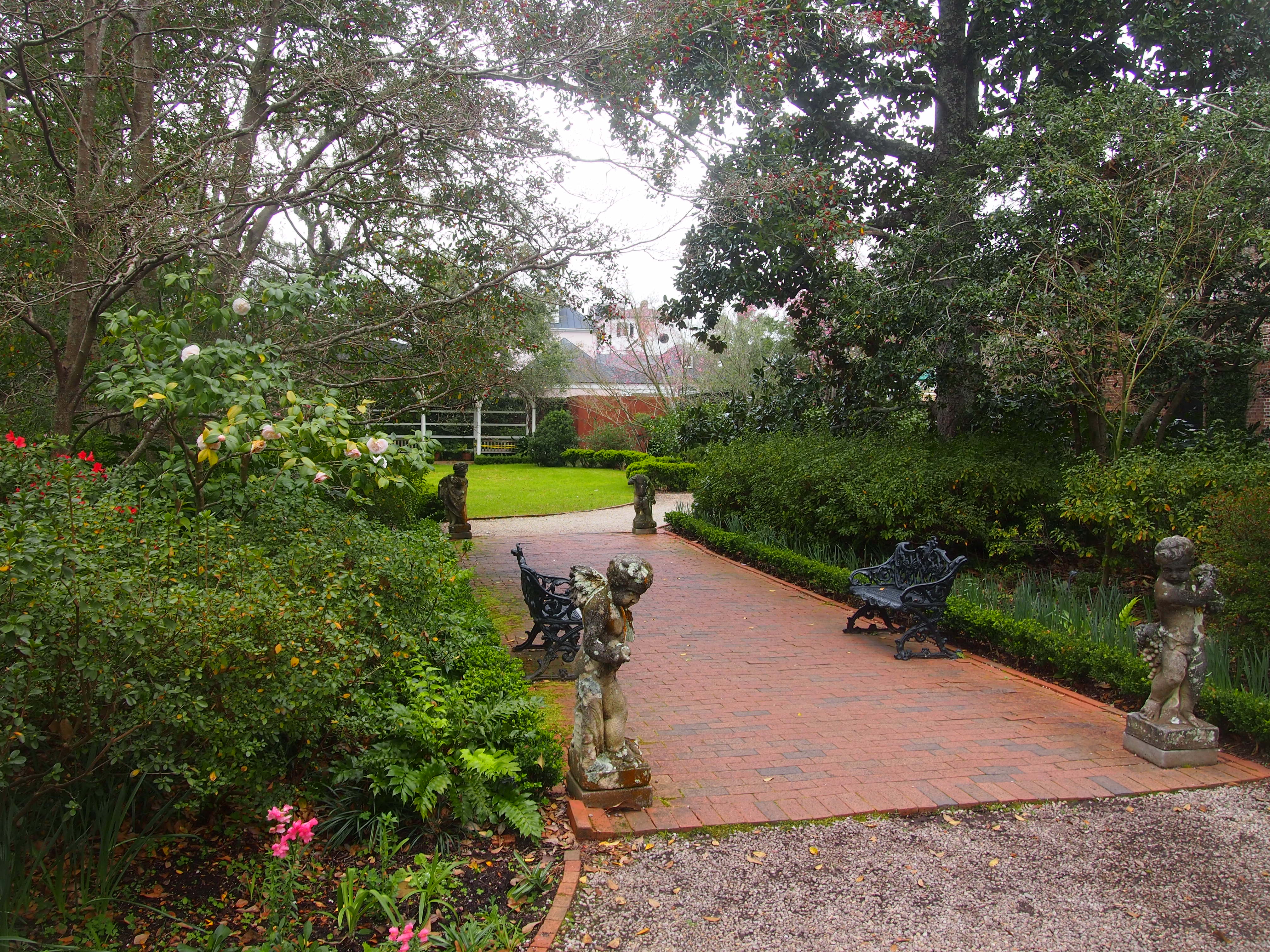
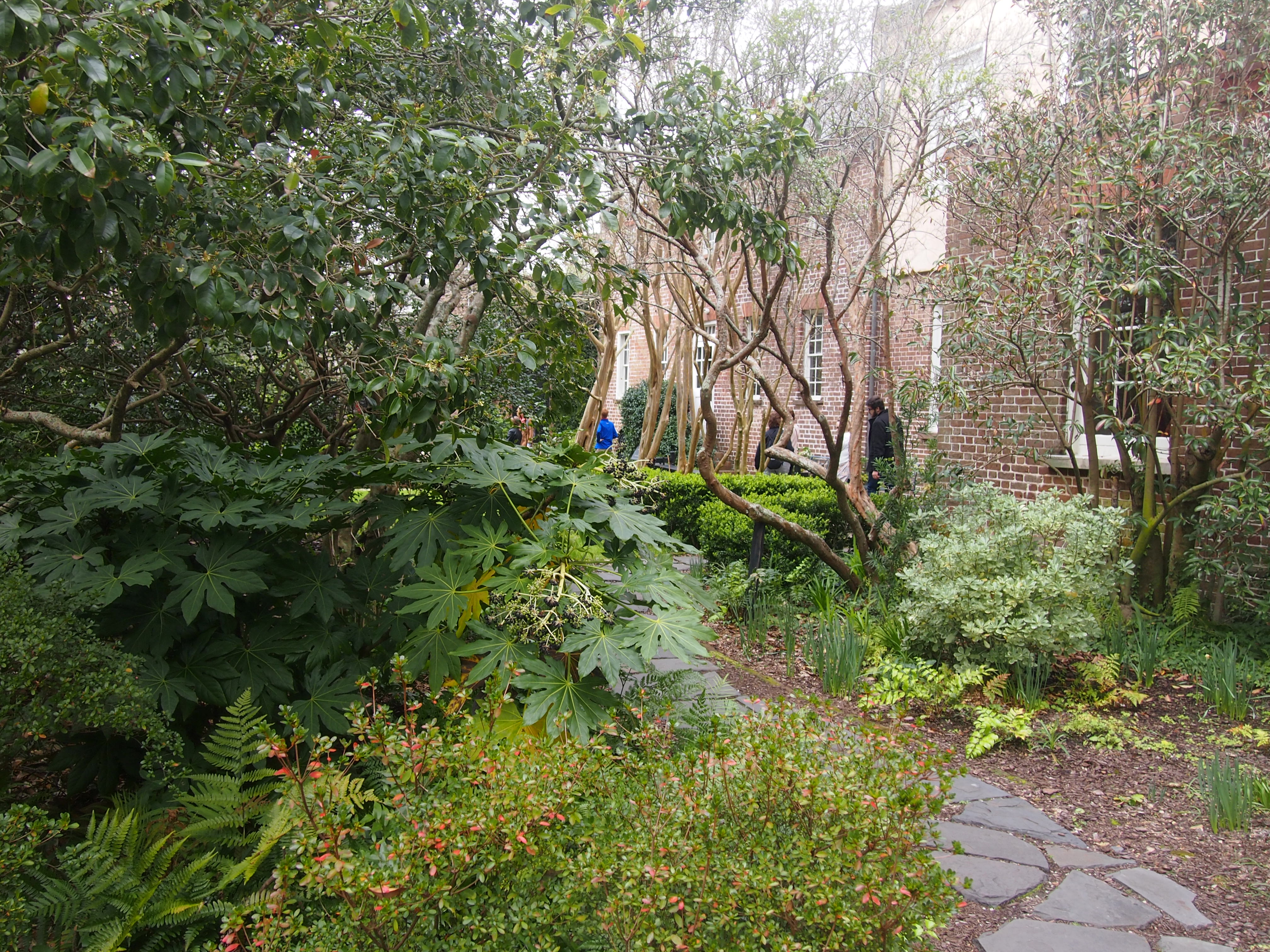
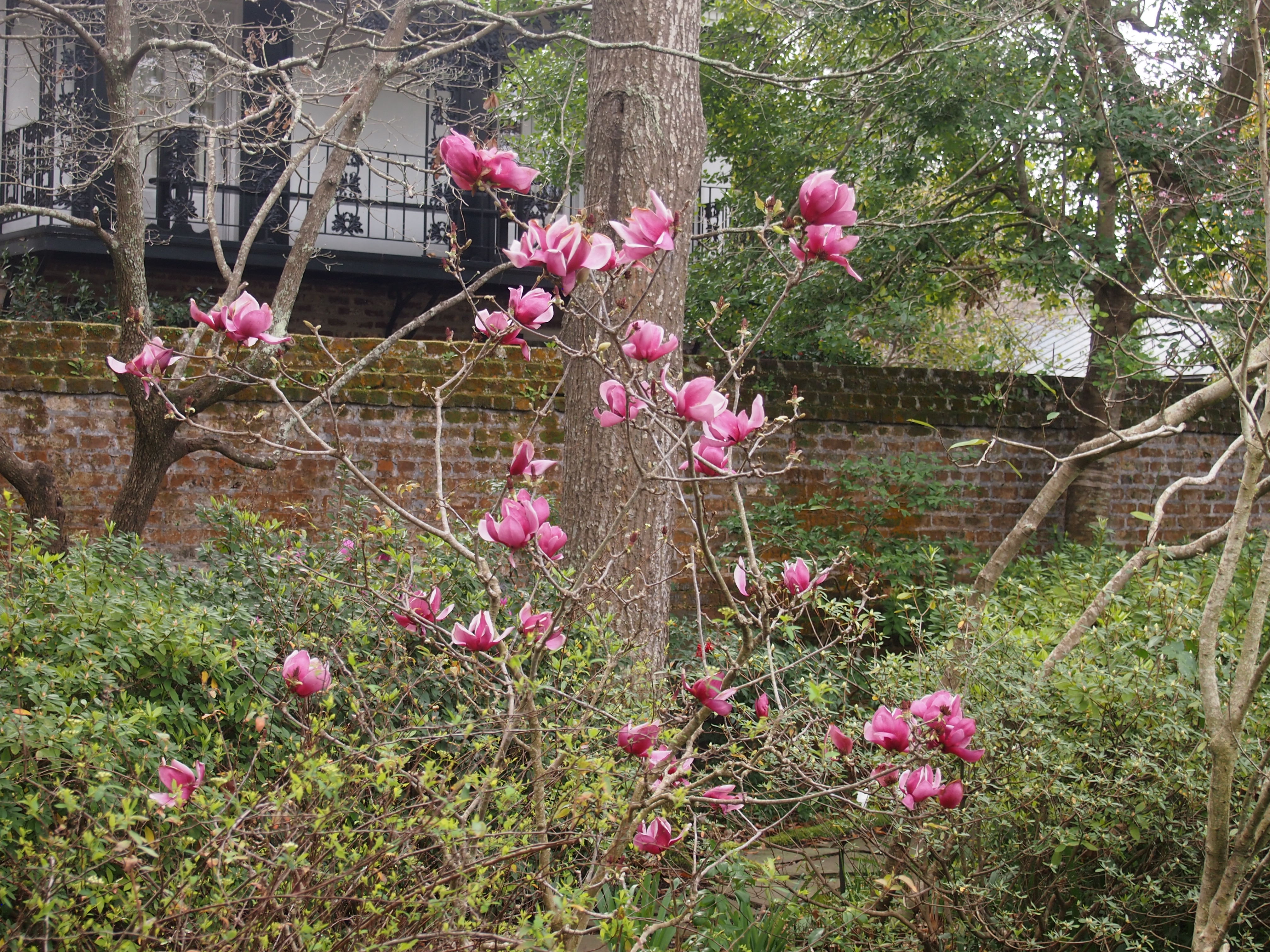
I didn’t have time to take a tour. I did have time to wander around its picturesque garden, which is open to the public. More remarkably, in mid-February this year, the garden looked like spring already.

Nathaniel Russell House gardenNathaniel Russell House gardenLocal sources told me that the weather lately had been unusually warm, even for Charleston. Flowers and other plants responded to the warmth in the only way they know how.
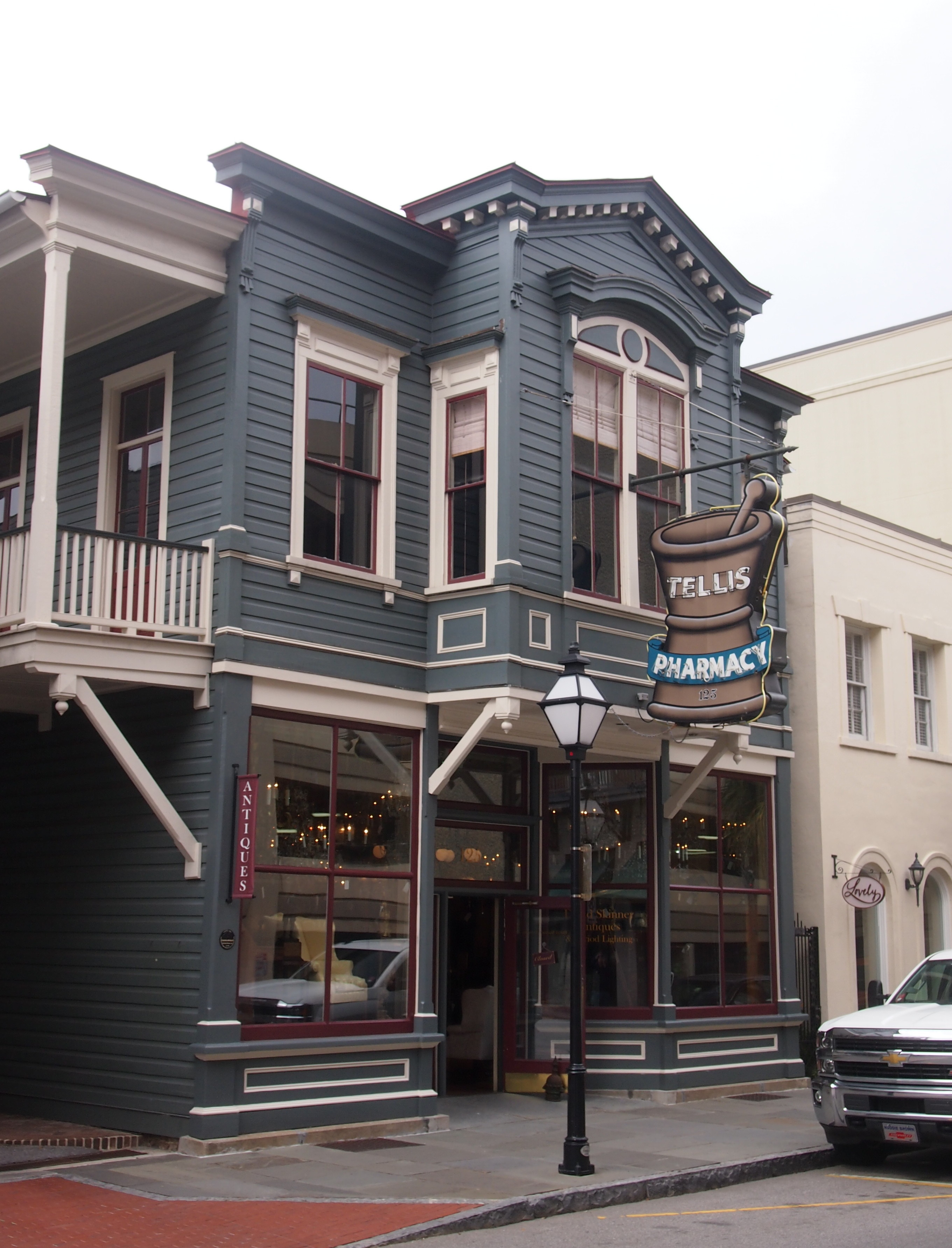
Nathaniel Russell House gardenSignage sometimes has its charms in Charleston.
Tellis Pharmacy, Charleston SC 2017That’s what more drug stores need, mortar-and-pestle symbology. Alas, it’s only a relic now, since the drug store on this site apparently closed a few years ago. Looks like an antique shop occupies the building, which is on King St. At least the new owners decided to keep the sign; or maybe it’s protected.

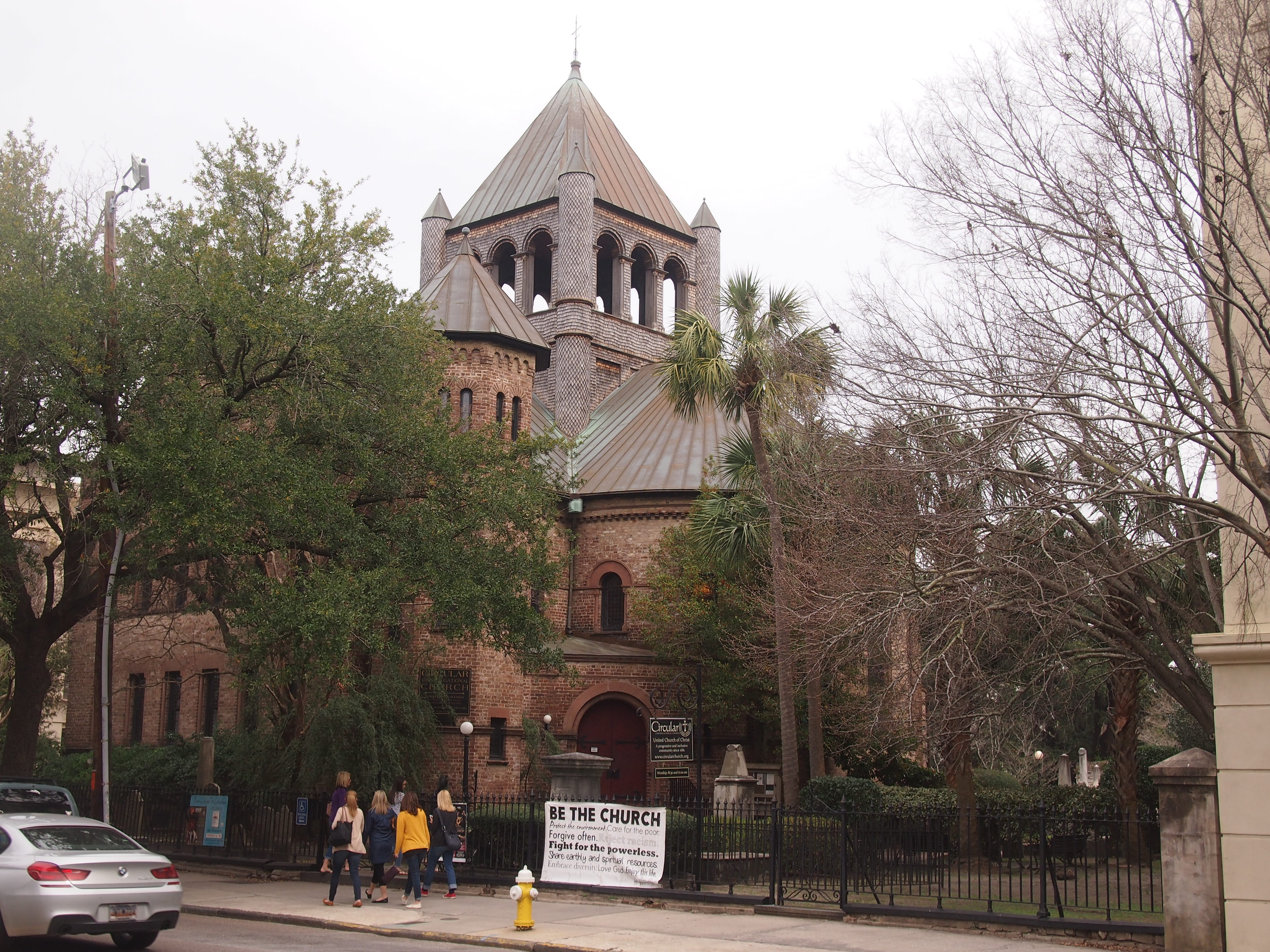
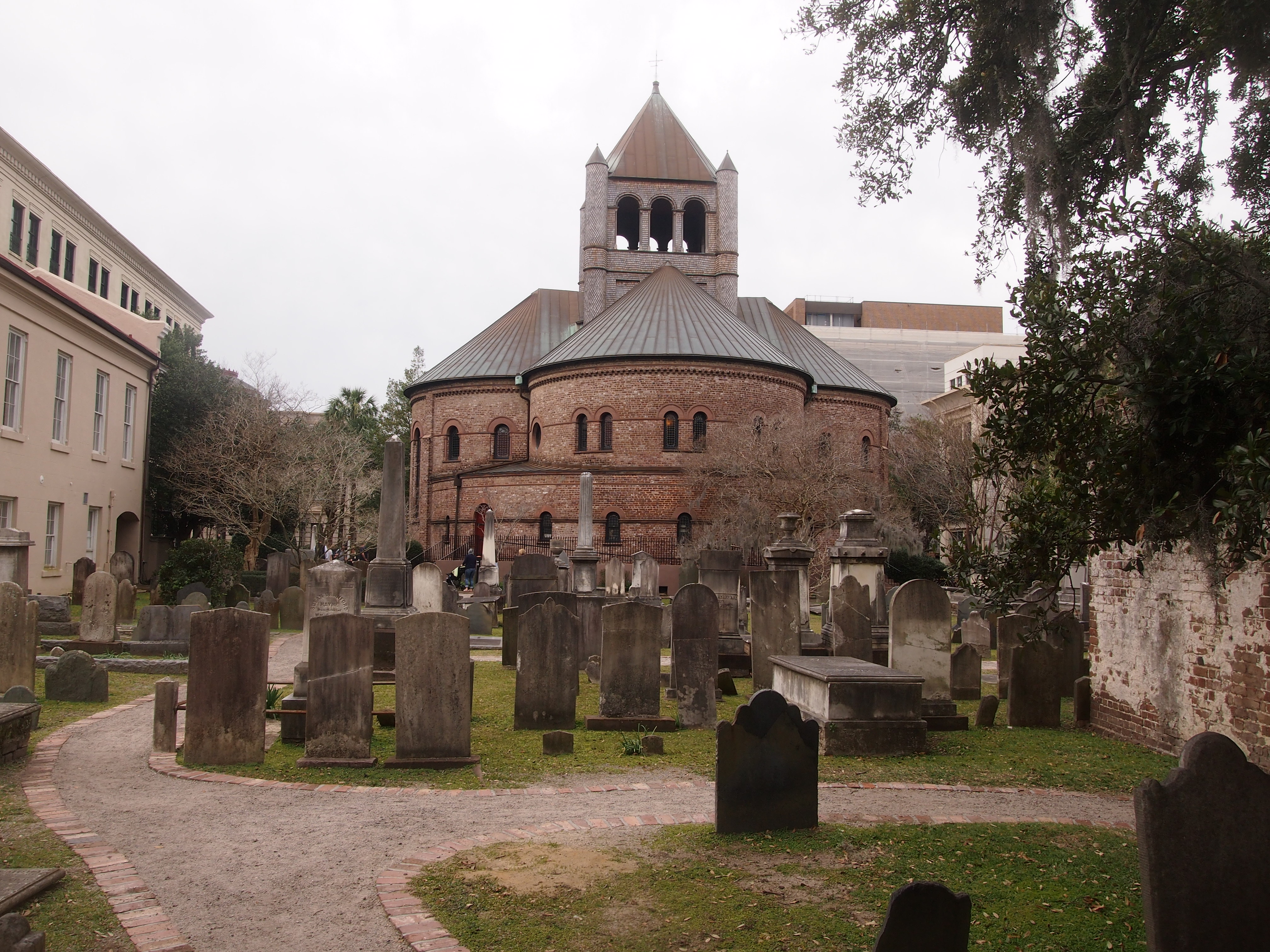
Unlike St. Philip’s graveyards, which were locked away behind imposing iron fences (though I could see the stone of Vice President Calhoun in the distance), the Circular Congregational Church’s graveyard is open to all during the day.

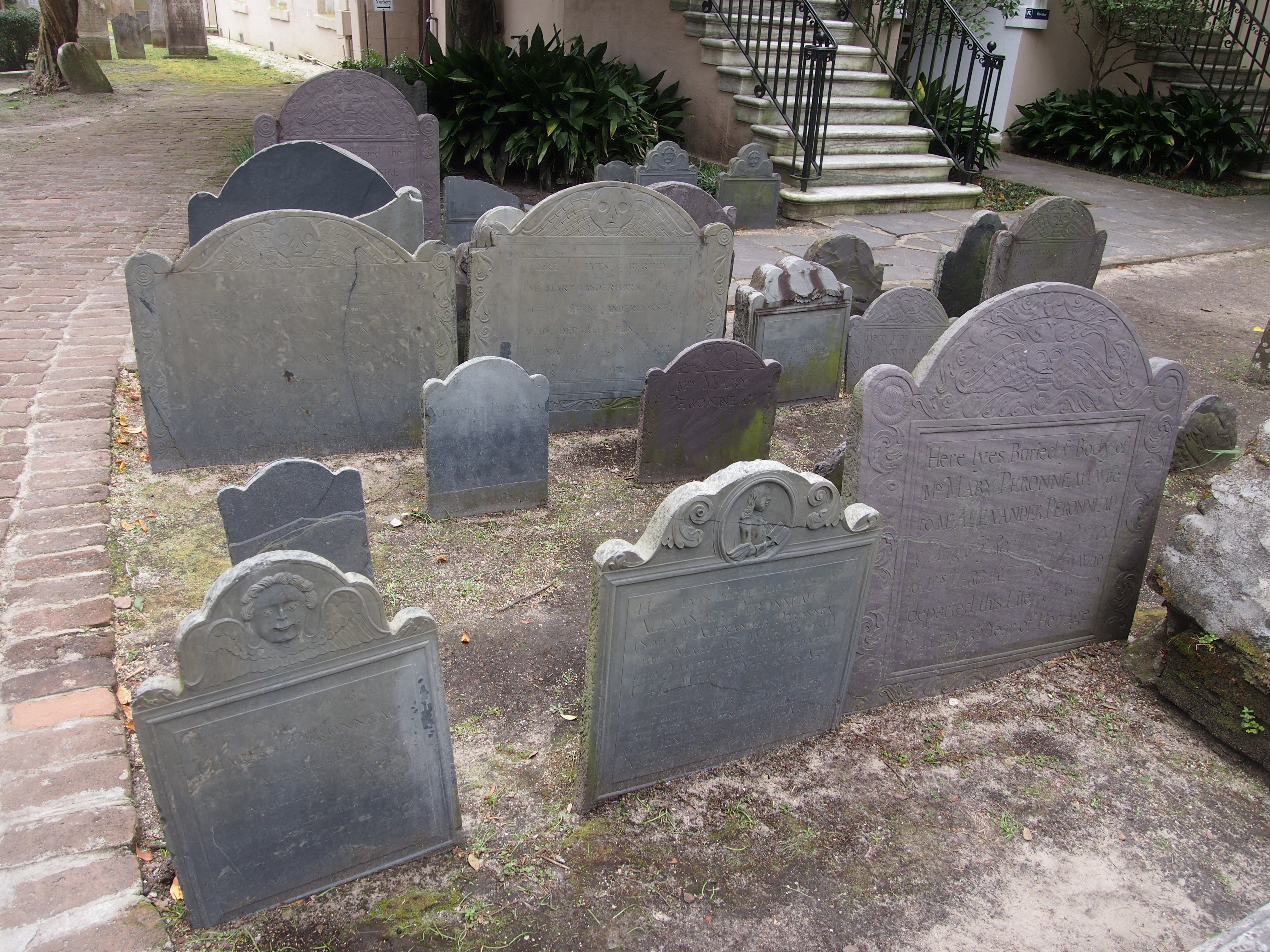
 Circular Congregational ChurchThe cemetery included some stones, pre-Revolution in vintage, that reminded me very much of the old stones in Boston’s downtown graveyards.
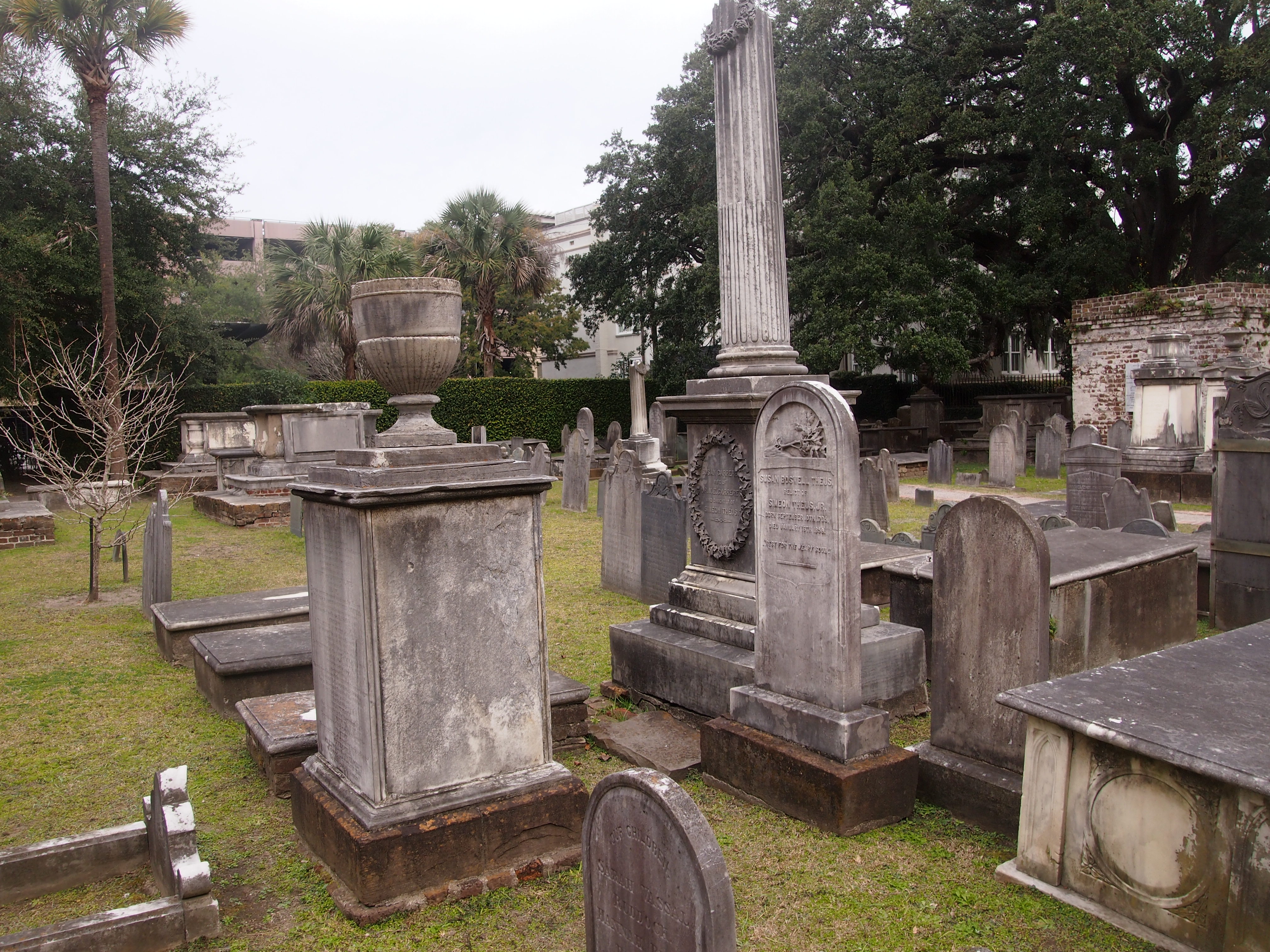
 Circular Congregational Church cemeteryPlus plenty of later 18th- and 19th-century stones.
 Circular Congregational Church cemeteryAnd some nice views of the back of Circular Church.
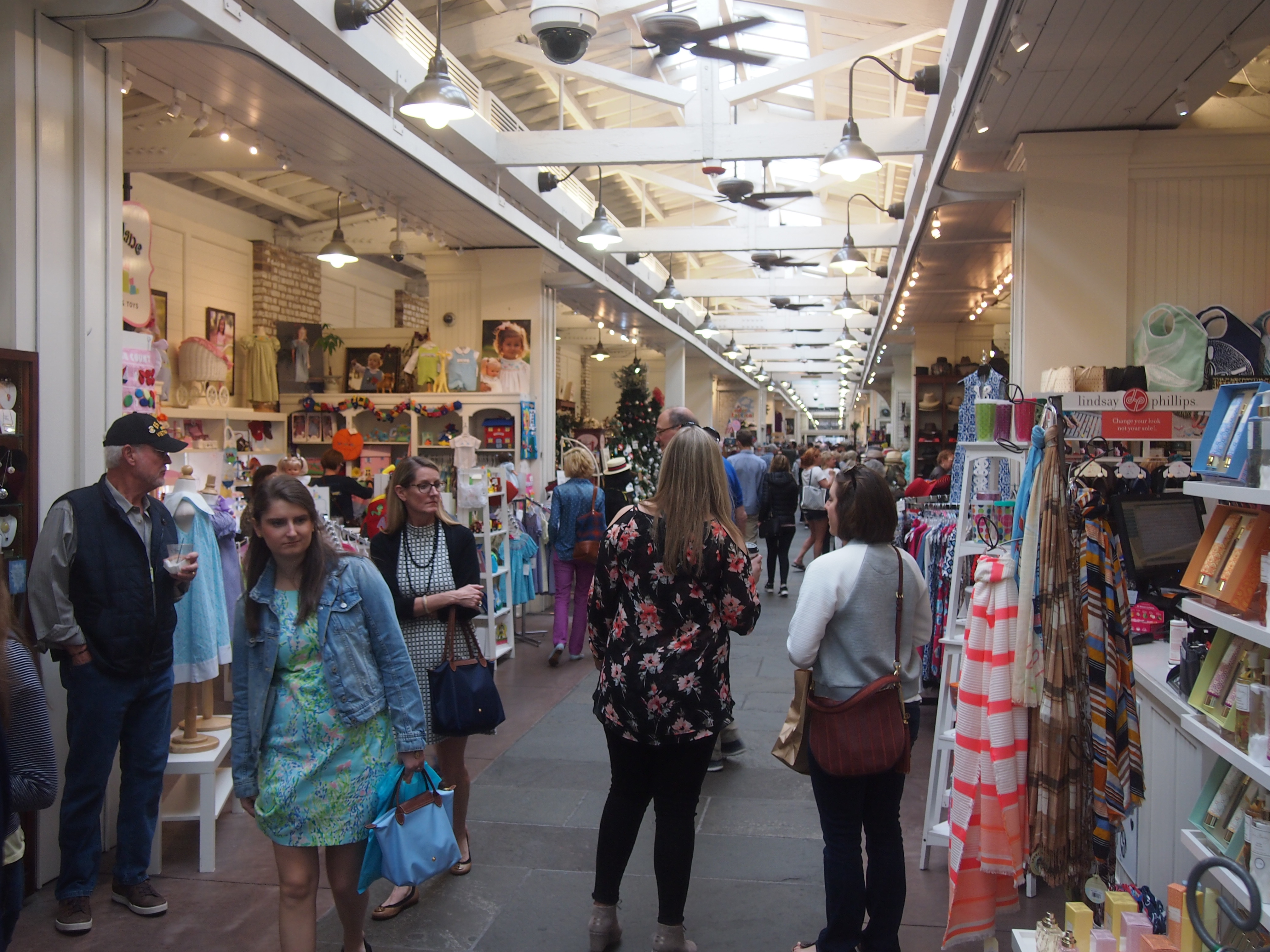
 Circular Congregational Church cemeteryOne of the best known tourist attractions in Charleston is City Market, which has been the site of a public market for more than two centuries. I’ve never been one to eschew tourist destinations just because they’re popular among tourists, so I popped it for a look. Not bad, but not nearly as interesting as the Pike Place Market in Seattle.
City Market, Charleston 2017One more structure: Charleston City Hall.
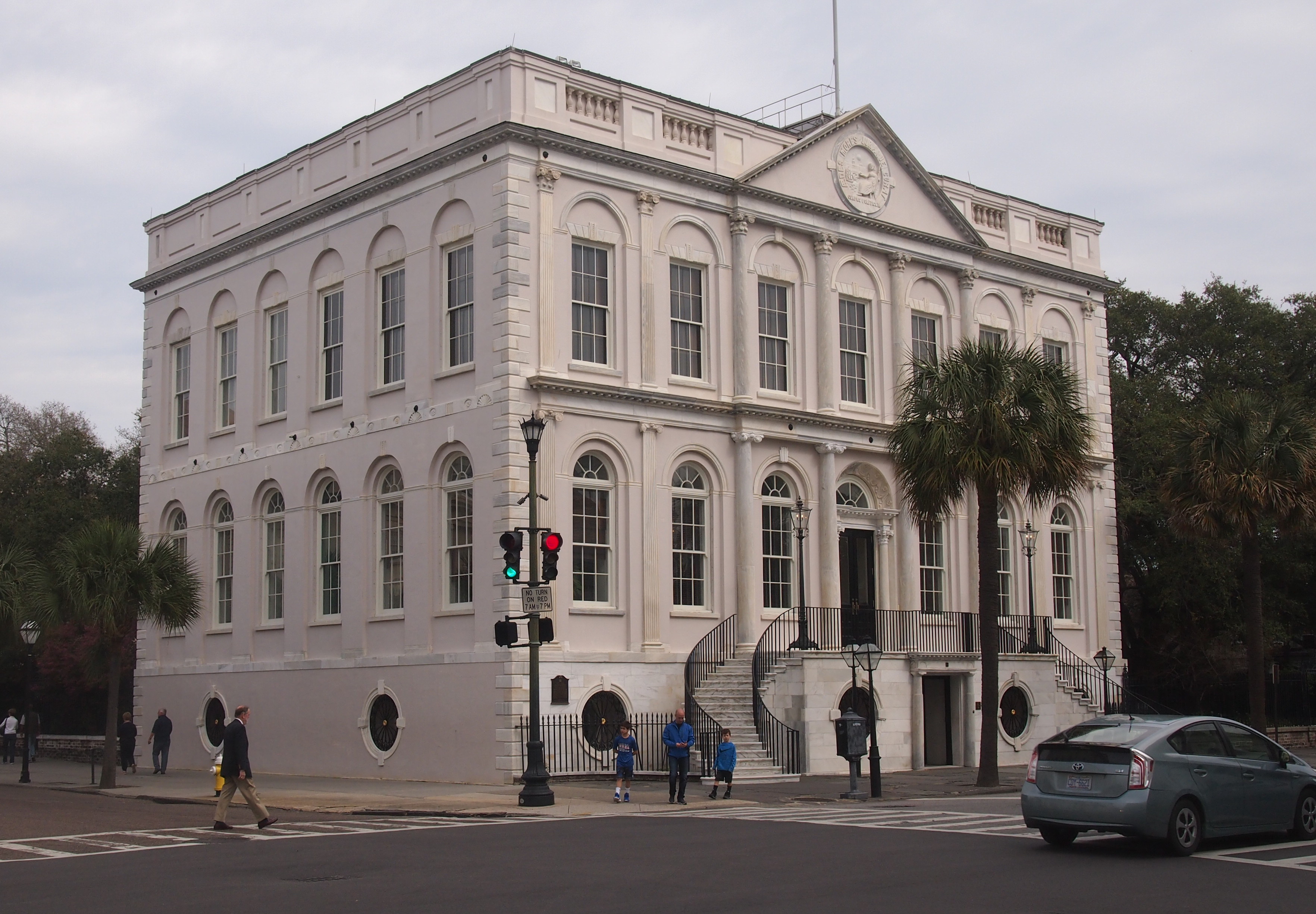
Charleston City HallDiscover South Carolina says: “On the site of a Colonial marketplace, this handsomely proportioned 1801 building first housed the Bank of the United States and then became Charleston’s City Hall in 1818. The design is attributed to Charlestonian Gabriel Manigault, a gentleman architect credited with introducing the Adamesque style to the city after studying in Europe.”

Also worth knowing: the building has some of the few public restrooms in downtown Charleston that are open on the weekend.

Charleston Walkabout

Here’s something I learned about the oldest part of Charleston, SC, when I visited recently: good to walk through, not so much to drive through. I could have guessed that anyway. Small streets, many cars, extremely restricted parking.

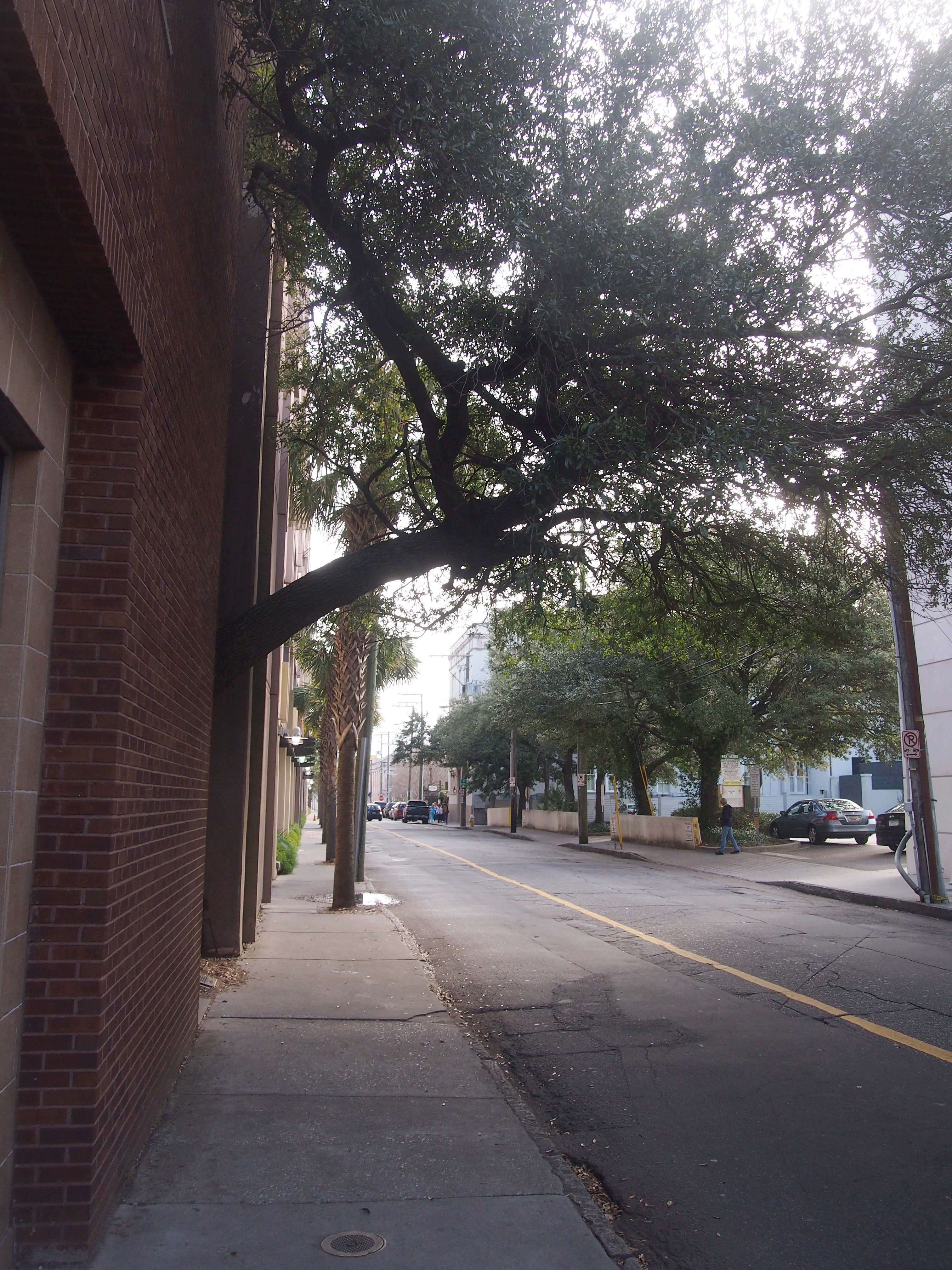
But early Saturday morning, when the cars roaming the streets were still few, wasn’t a bad time to come to town by car. I arrived and found a parking garage as soon as I could. On foot from there, on Cumberland St., I encountered traces of historic Charleston almost immediately in the form of the city’s most obscure plaque (maybe), fixed to the ground just north of the sidewalk on the north side of that street, between Meeting St. and Church St.

This Oak Was Planted In Celebration Of

ARBOR DAY 1984

It stands above a portion of the fortification wall that once protected the early Charleston settlement. The wall has been destroyed through time as the city spread beyond it’s [sic] original boundaries. The only visibly [sic] portion of the original fortification is the half moon battery, located in the basement of the Exchange Building.

Dedicated by the City of Charleston
Joseph B. Riley Jr., Mayor

Mr. Mayor, you could have ponied up a bit for a proofreader, considering that the text is in bronze. Anyway, the tree isn’t in the most picturesque part of Charleston.

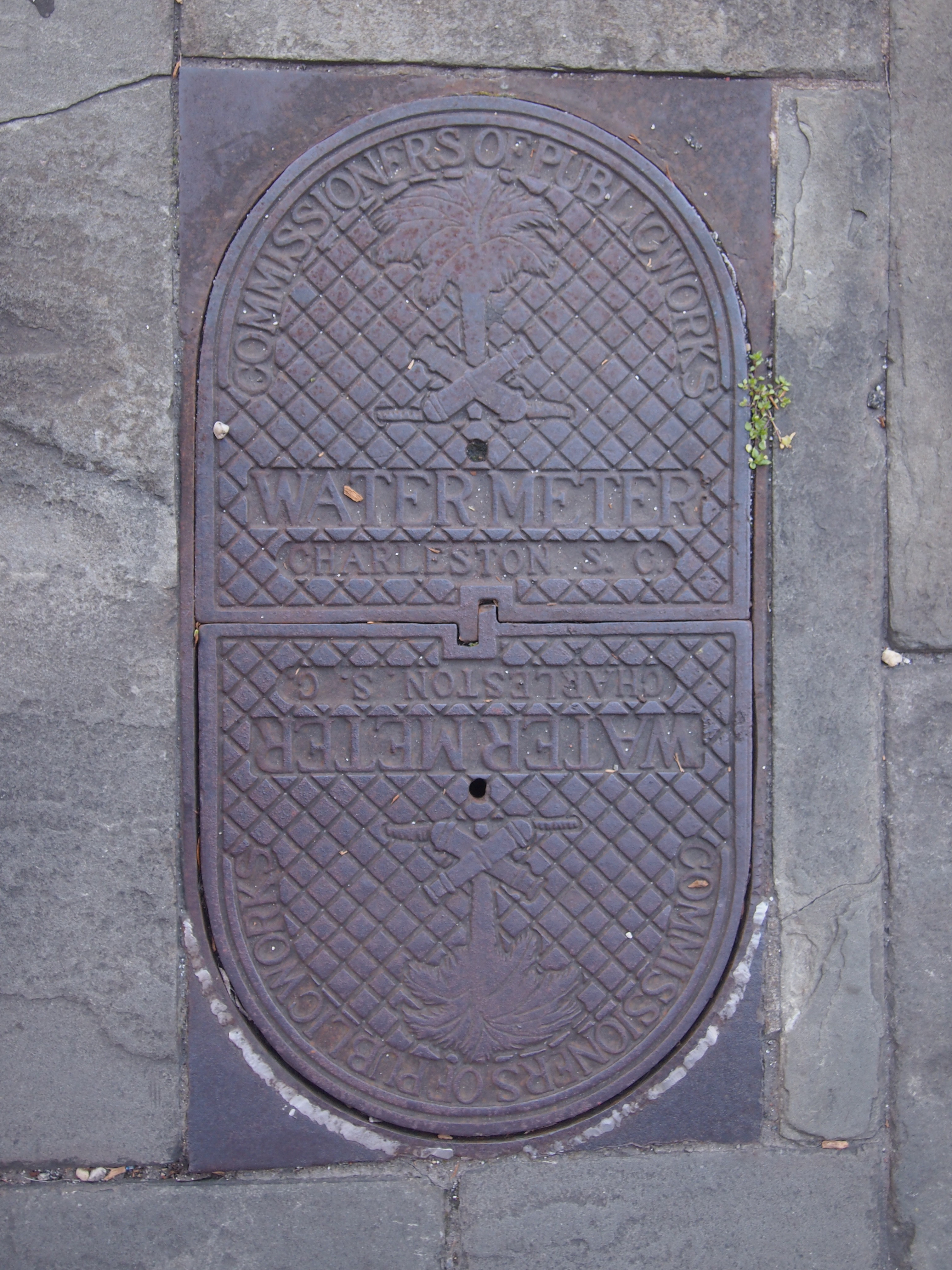
Soon I moved on to better-looking urban core scenes. The city even has aesthetic water meter covers.
Charleston SC water meterThe palmetto is easy enough to figure out, but the cannons? According to one source (which says it’s “probably true”), the cannons refer to Col. William Moultrie’s victory over the British attack on Sullivan’s Island in 1776. Palmetto logs, which had some ability to absorb cannon fire, were used to reinforce the earthenwork defense.

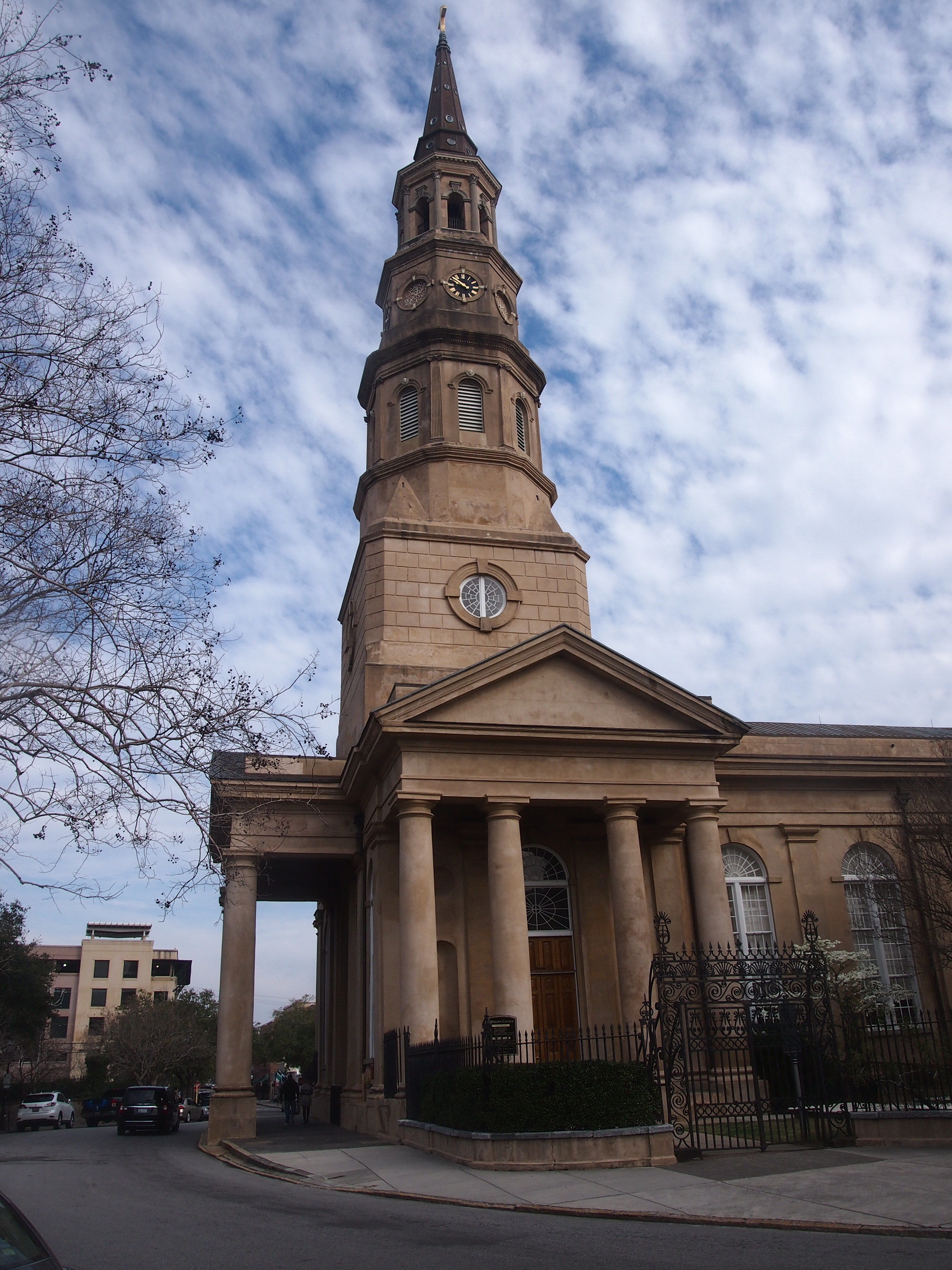
St. Philip’s, an Episcopal church, stands fittingly on Church St. between Cumberland St. and Queen St.
St Philip's Episcopal Church, Charleston SCThe church, the third for this congregation and the second on this site, dates from 1838. The early history of the church, and Charles Towne for that matter, was one damn thing after another. From a short history of St. Philip’s on its web site:

1728-40: Fires, hurricane, epidemics of smallpox, yellow fever, slave uprisings, Indian attacks, threats of war from the Spanish occurred.

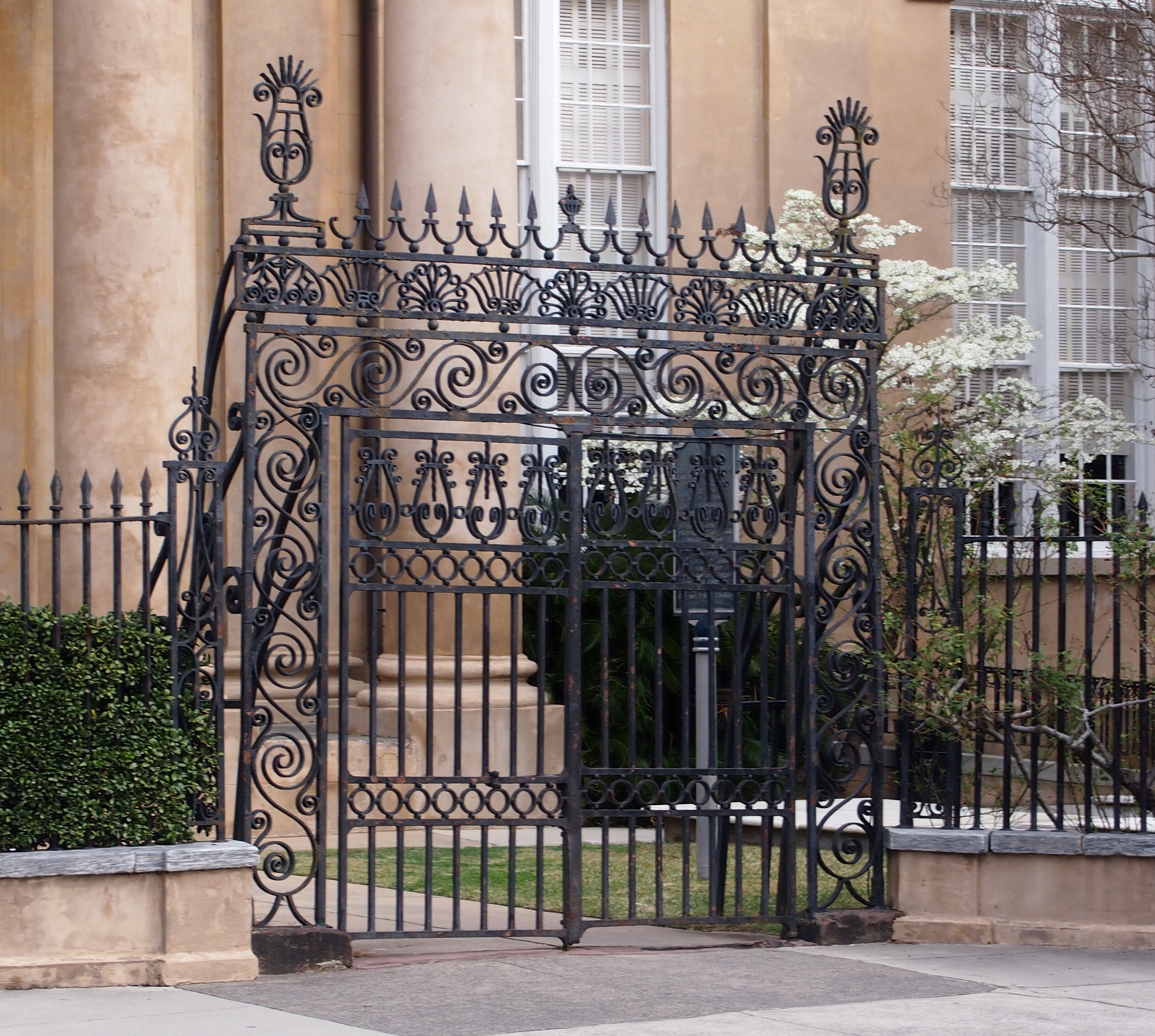
Ah, but Charleston flourished. Slave-cultivated rice, indigo and then cotton from the Carolinas did the trick (part of the bondsman’s two hundred and fifty years of unrequited toil). Highly skilled slaves, I understand, were involved in the wrought iron gates around St. Philip’s, which are a marvel by themselves.
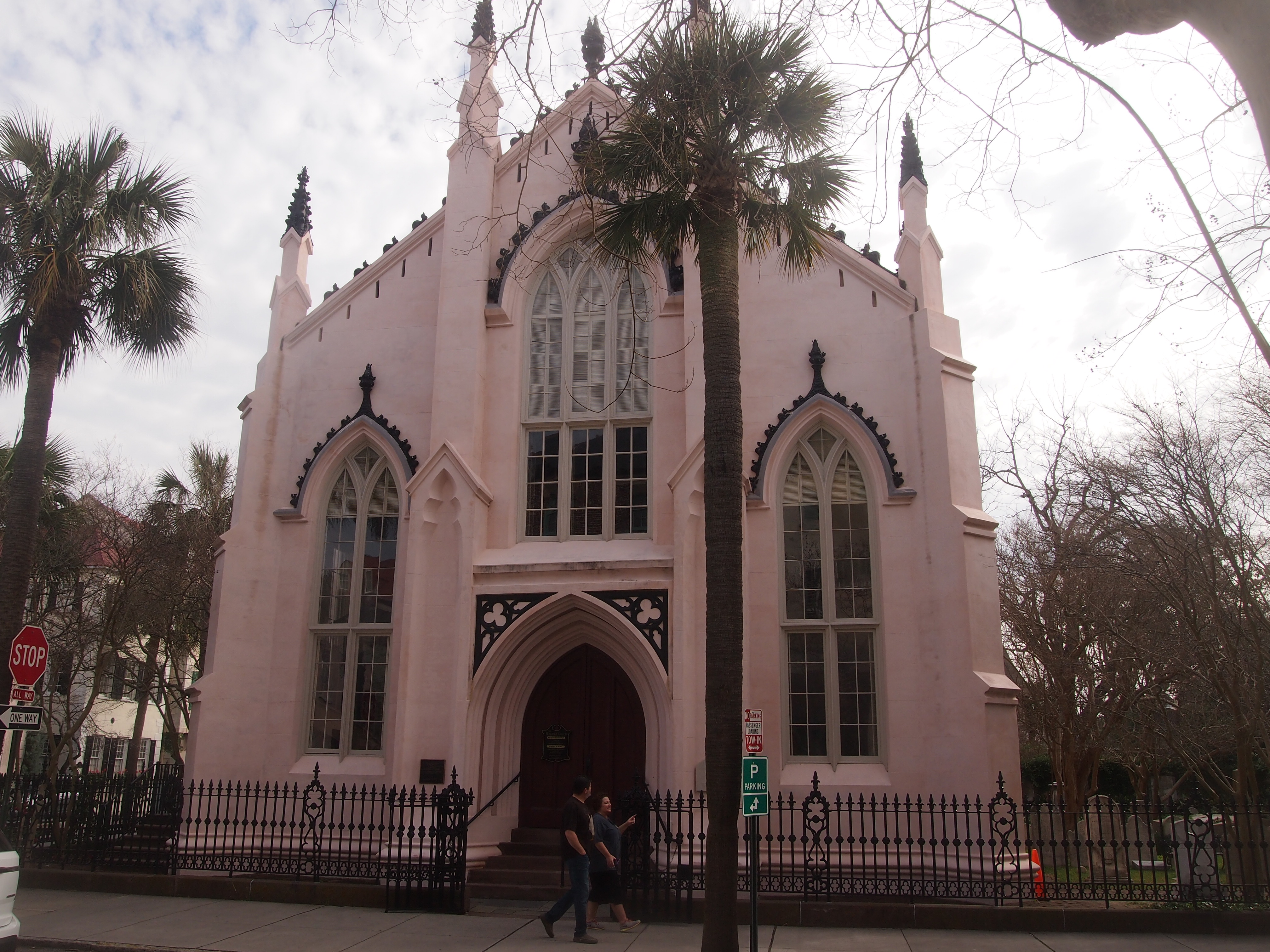
St Philip's Episcopal Church, Charleston, SC iron gateNearby is the light pink Huguenot Church, dating from 1844, at the corner of Church and Queen. It was the first independent Huguenot congregation in America (more-or-less Calvinist, starting in the 1680s) and now the last one.
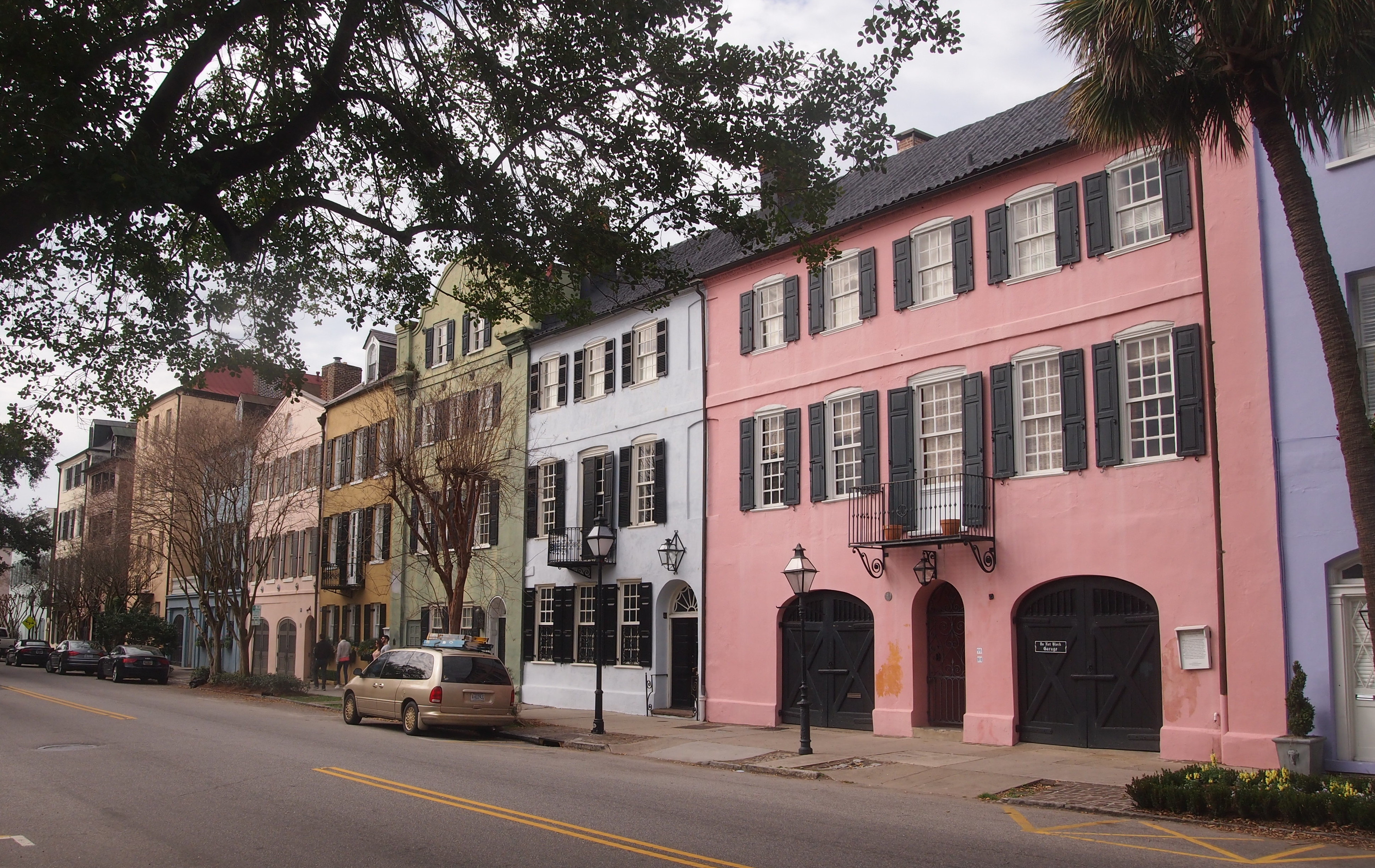
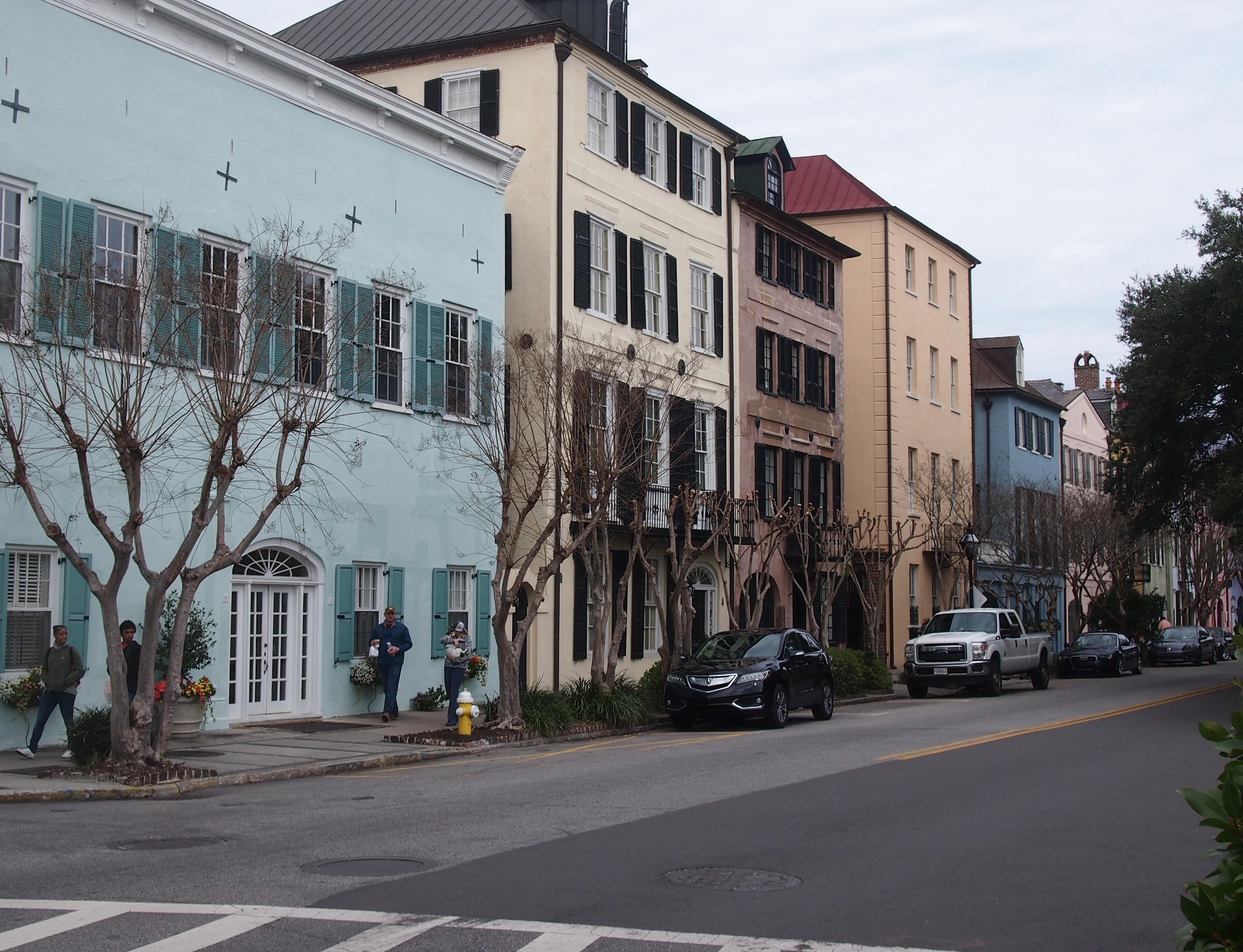
Huguenot Church, Charleston SCRainbow Row, the nickname for a stretch of East Bay St., features colorful row houses, 13 in all, mostly dating from the late 18th century.
Rainbow Row, Charleston SC 2017They’re in a tightly controlled historic preservation district, except for one thing: the owners get to choose the colors. The pastels were originally put on in the 1920s and occasionally change.
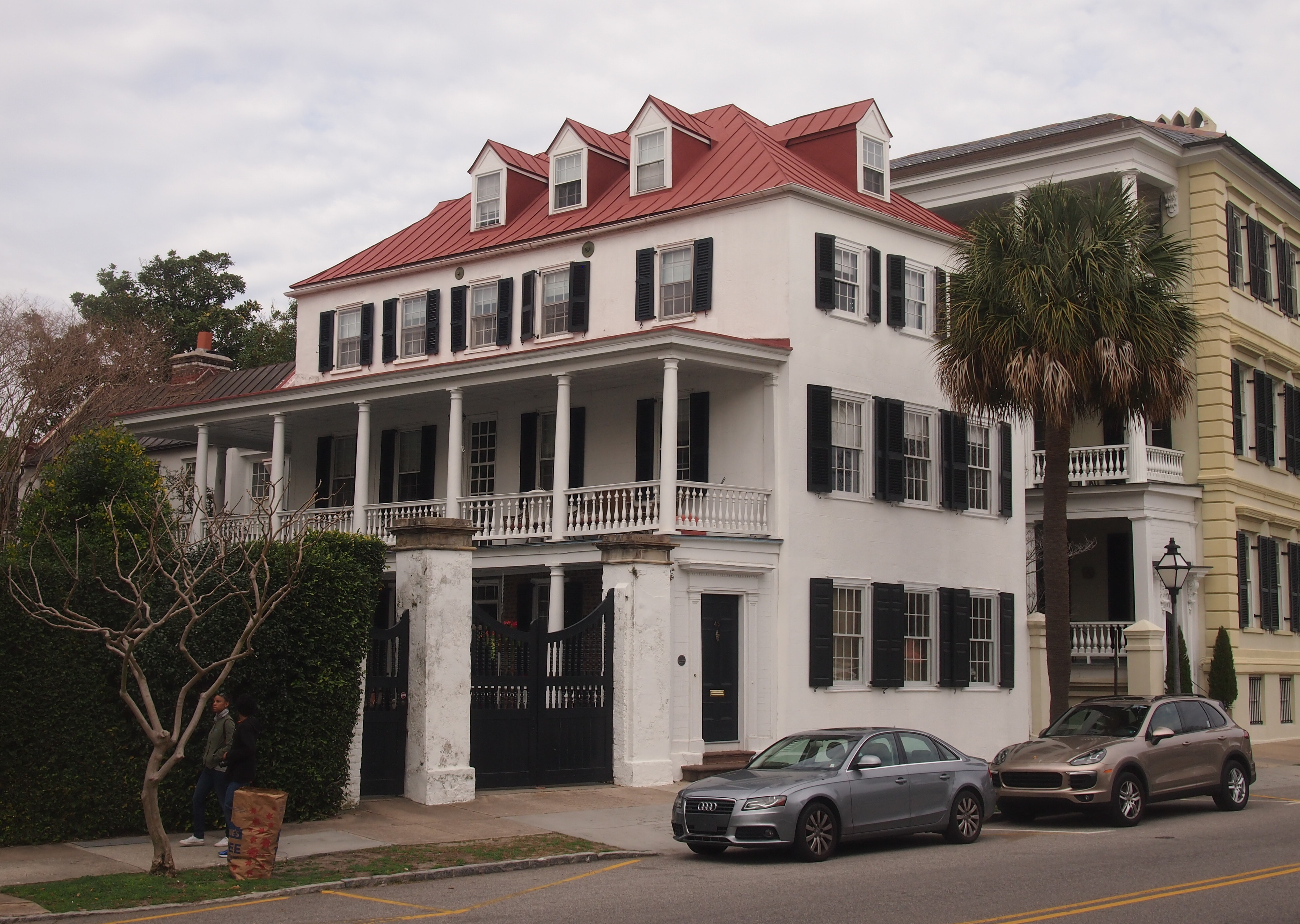
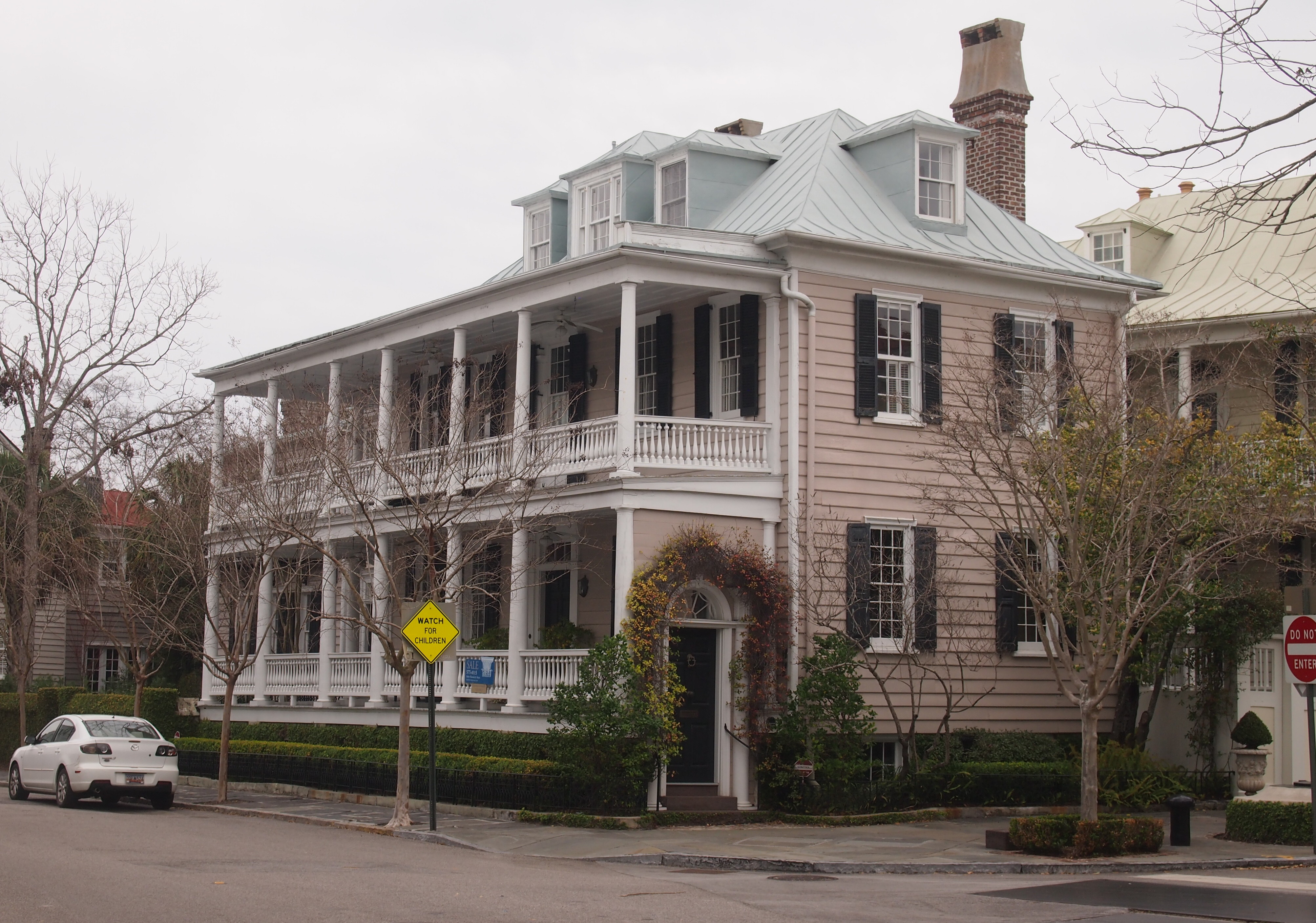
Rainbow Row Charleston SC 2017There are plenty of other handsome houses in that part of Charleston as well. Reminded me a bit of the East End of Galveston.

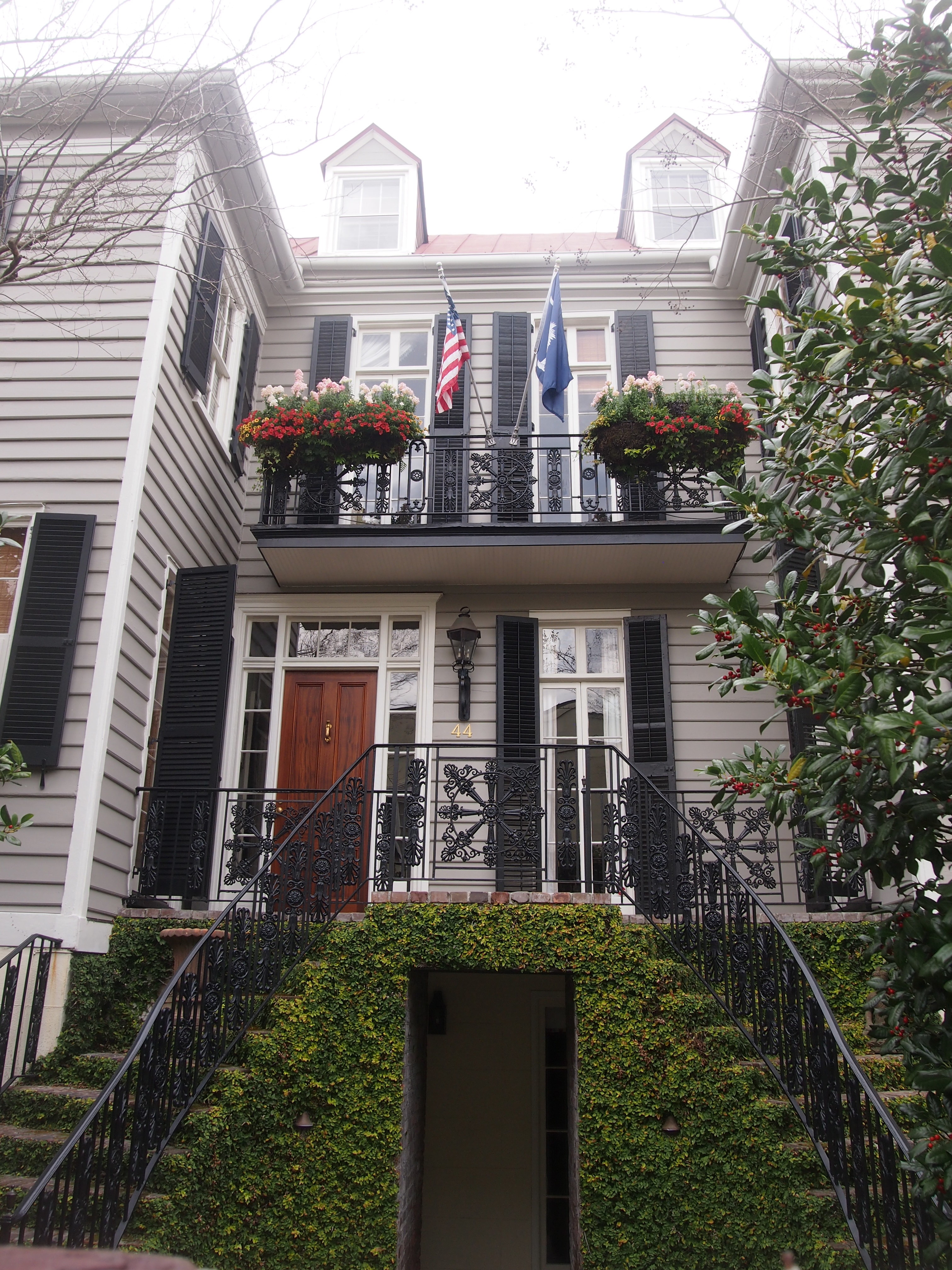
Charleston, SC 2017Charleston, SCCharleston, SC 2017All in all, a good place to see on foot, provided it isn’t summer.

Char-Tex ’17

Recently, before I went to Texas for a week, I had a day to spend in Charleston, SC, a city I’ve wanted to visit for many years. Just a day, so I packed in the sights. It wasn’t an example of slow travel. Sometimes, you’ve got to hit the ground and go.

I saw the oldest part of Charleston — the site of Charles Towne — on foot for a few hours, took the boat out to Fort Sumter, which took a few more hours, visited Magnolia Cemetery, and saw the H.L. Hunley later in the afternoon.

The old part of Charleston is very handsome, replete with structures surviving from the Antebellum period squeezed into tight city blocks along such streets as Calhoun, Cumberland, Meeting, and at the intersection of King St. and Queen St. A fine thing to do on a February morning that’s warmer than it should be, even in the South: wander past the elegant or curious buildings, admire the churches, take in the details of the streetscapes and sidewalks.

The War Between the States and Reconstruction crushed the local economy. Bad for the people who lived then, good for historic preservation in the late 20th and early 21st centuries, when considerable prosperity has returned to Charleston. Had prosperity continued in the 19th and early 20th centuries, the city might sport handsome Victorian architecture, or might have been Eisenhowered into something less pleasing.

Fort Sumter National Monument is about a 30-minute boat ride away from the city. The fort is as historic as can be, but apparently doesn’t look much like it did in 1861. The war flattened it, the post-war U.S. Army rebuilt and redesigned it until the place was turned over to the Park Service after WWII.

The Confederate submarine H.L. Hunley, whose insufficient design killed more men than the vessel did as a weapon of war, now rests in a tank of water at the Warren Lasch Conservation Center, an industrial structure north of the good-looking parts of town, near other industrial facilities. Eventually, the Hunley will be the star of its own museum, but for now conservation efforts are ongoing.

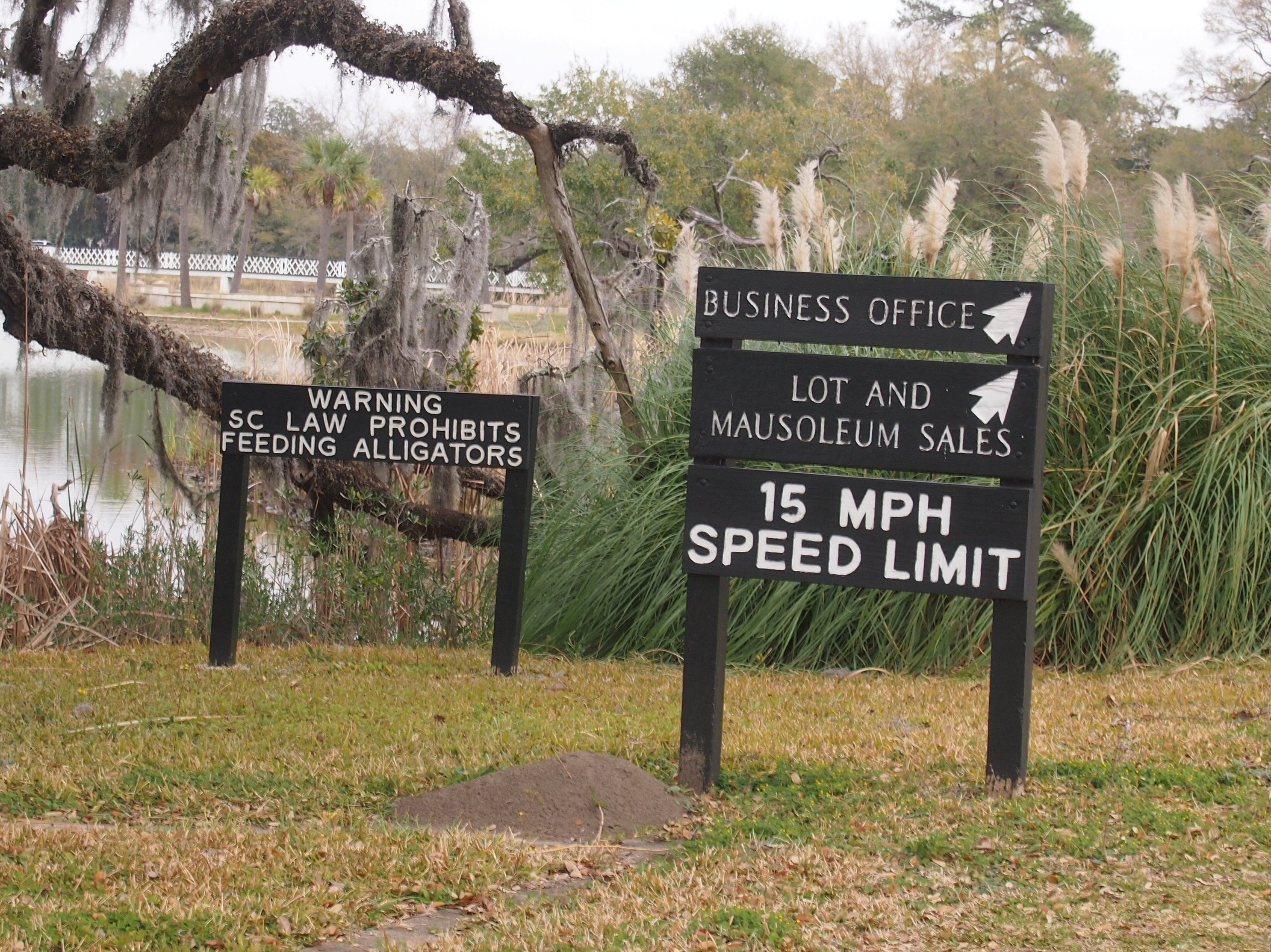
The Magnolia Cemetery is also north of the old part of town. An old cemetery, it’s rich with old stones, funerary art, monuments to the Lost Cause, and trees festooned with Spanish moss. Also, a warning about not violating South Carolina law.

Magnolia Cemetery, CharlestonWho sees an alligator and thinks, I want to feed it.

July Idles

This year was a stay-close-to-home Fourth of July. That is, metro Chicago. Some are, some aren’t. We returned to our old haunts in the western suburbs on Saturday night to see the Westmont fireworks, from the vantage of Ty Warner Park. It’s always a good show.

That was a high point of the weekend. So was taking my daughters to Half Price Books, at their request, on the evening of the 3rd.

The low point of the weekend was walking the dog on the 4th, not long before we left for the fireworks show. Late afternoon, that is. Part of our usual route takes us along a path between a dense row of bushes and a small patch of land sporting enough trees to block the sky, when they have leaves. Pretty soon I re-discovered its mid-summer nature as Mosquito Alley. The mossies were especially forceful when I was cleaning up after the dog.

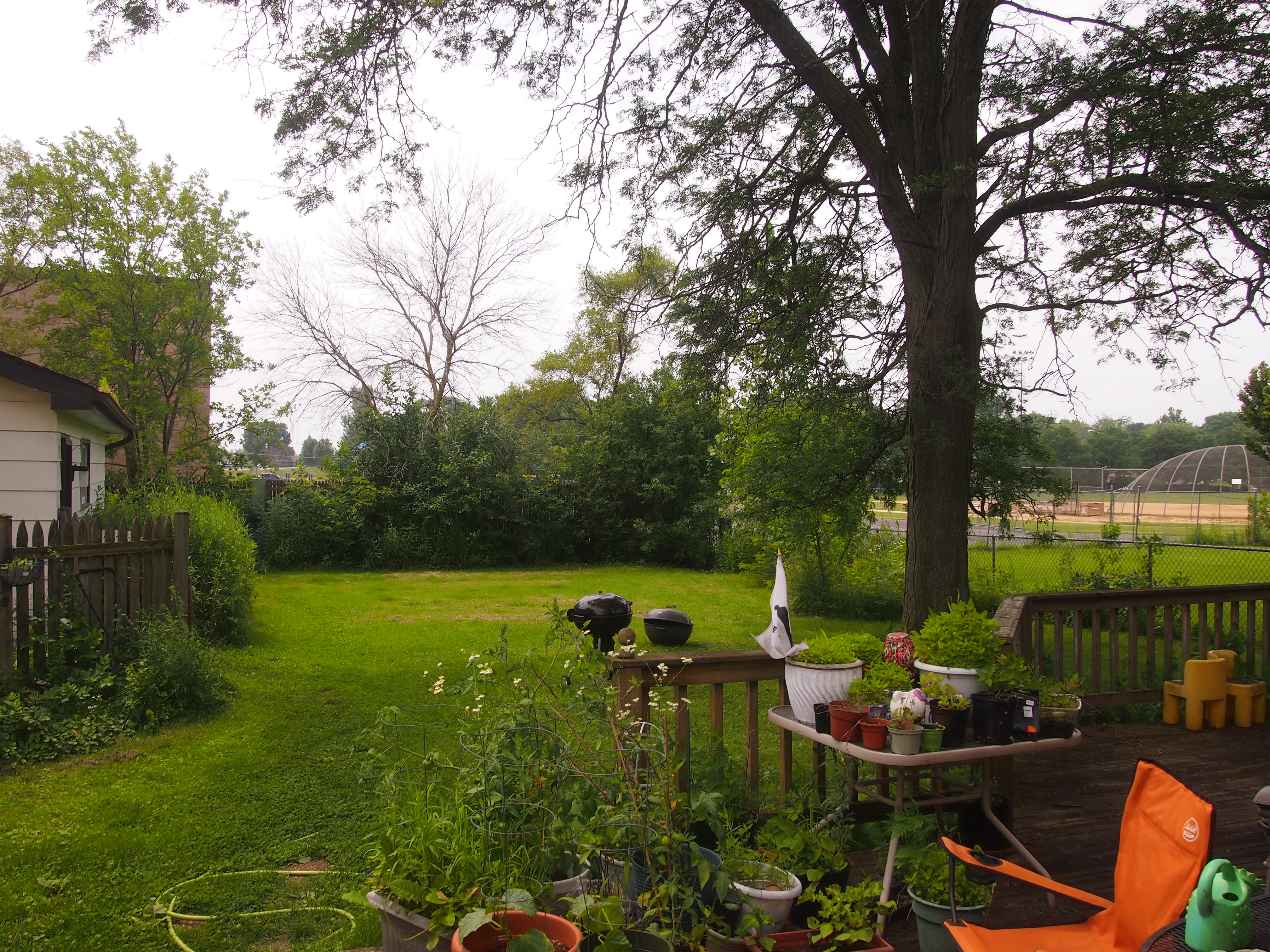
Complaining about mosquitoes, though, is just carping. I’d rather look out of my back door and see this (an early July shot).

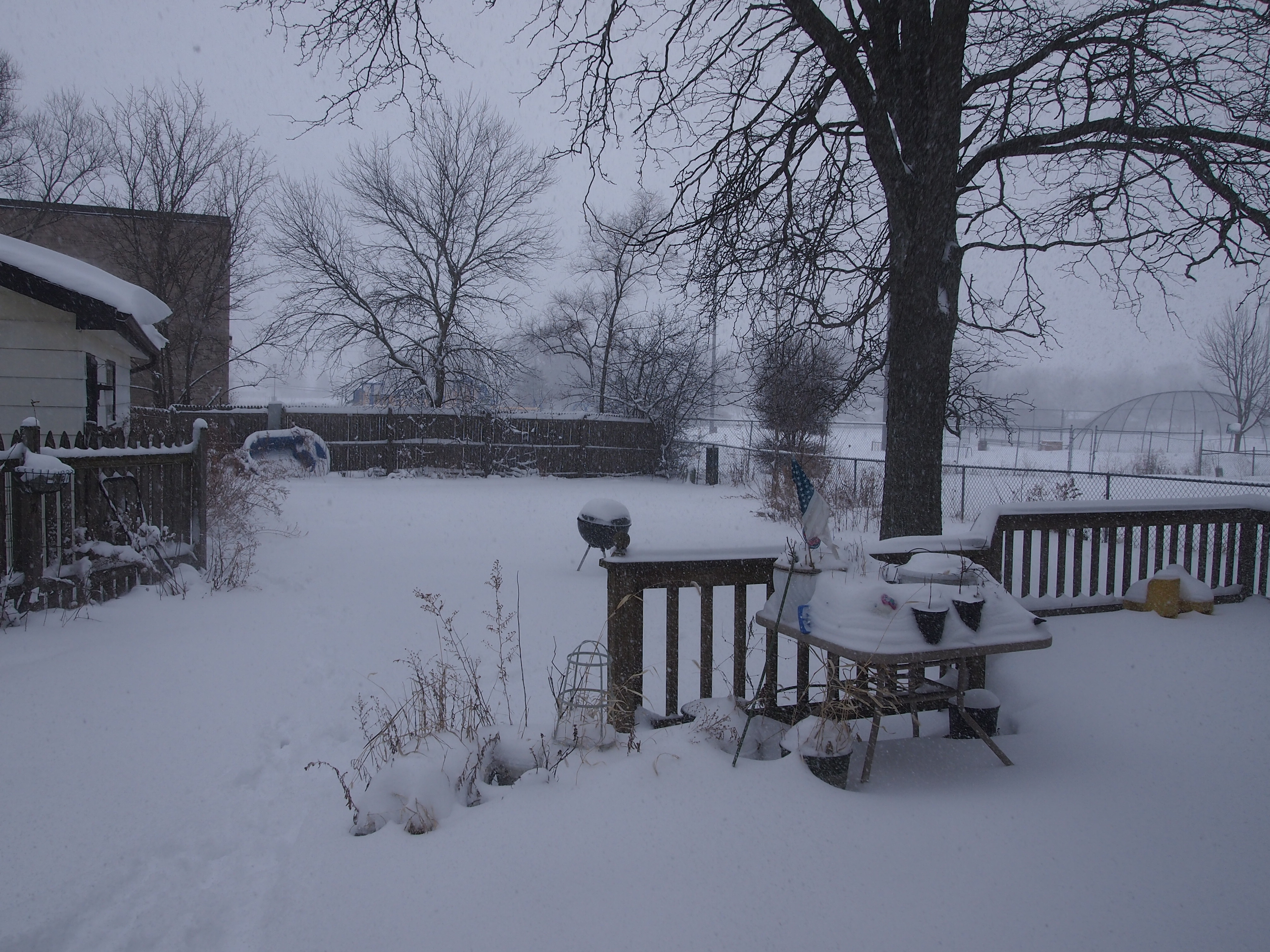
Schaumburg, July 2015Than this (an early January shot).

Schaumburg, Jan 2015Bugs aside, I spent a fair amount of time over the weekend on the deck reading The H.L. Hunley by Tom Chaffin (2008), a fine book about the submarine of that name, along with its predecessor vessels (the Pioneer and the American Diver). Or, as I learned reading the book, the “submarine boat,” which is a 19th-century usage. The Confederates gave underwater warfare a shot, but it turned out Age of Steam technology — as inventive as it clearly was — wasn’t quite up to the task. Not without killing more submarine boat crew than Union sailors.

Also, it’s another reason to visit Charleston, to see the vessel, now an artifact on display at the Warren Lasch Conservation Center. Not that I’d need any more reasons for a visit.