RIP, Amando Chavez

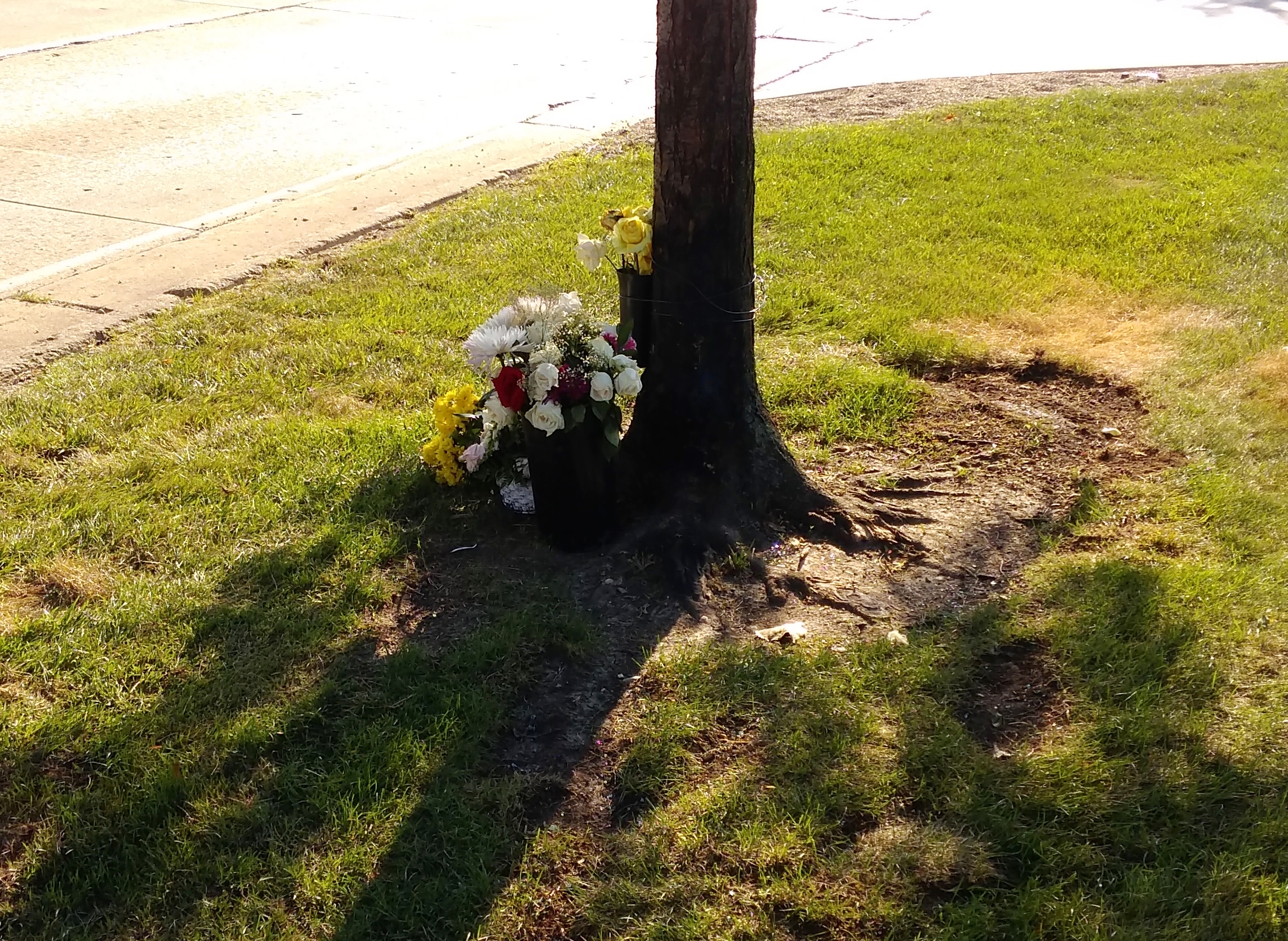
I didn’t know Amando Chavez. I only heard about him after he died a week ago Wednesday in a traffic accident on a road near where I live. A road I drive on frequently.

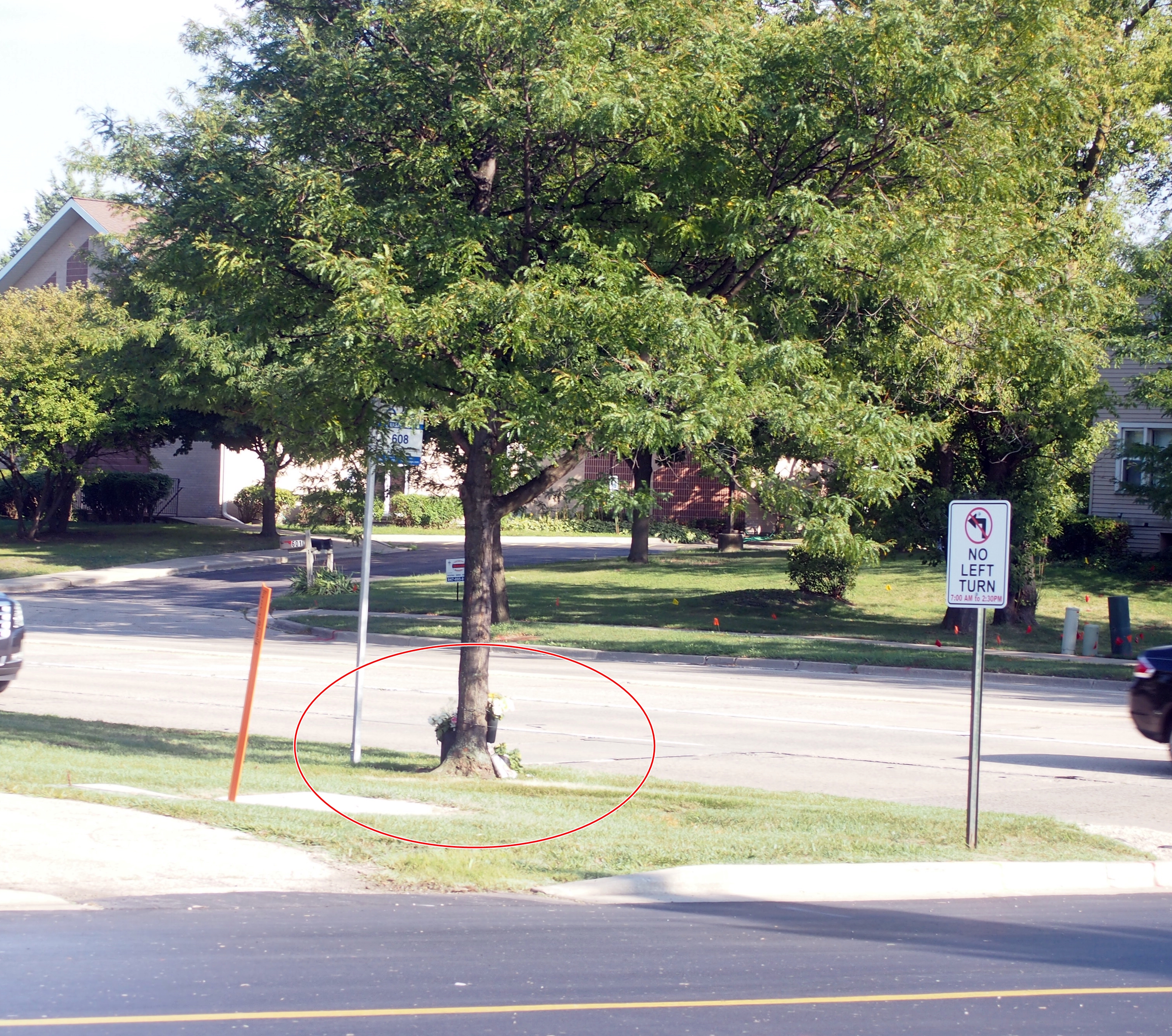
A small, informal memorial is at the site. I stopped by there this afternoon.

To give a little more context to that image, here’s a wider shot.
An ordinary suburban road. “Accident” isn’t quite the word, though, since by all appearances, a DUI driver was completely at fault. That road isn’t particularly busy at that time of the evening, so there’s even less excuse for what happened.

Looks like the driver at fault was one of those young fools who darts around other cars as fast as his engine will take him. Everyone’s seen that kind of ass, in a hurry to get to the next red light, as he weaves around you or around the cars ahead, with scant room for error — and error’s all too likely when DUI.

It’s the kind of accident that sets my teeth on edge. It didn’t have to be Mr. Chavez. It could have been me or anyone in my family. All the same, I’m not going to avoid that road.

Graue Mill & Fullersburg Woods Forest Preserve

Not long ago I was passing through the western suburbs, not too far from where I lived — and it feels a little strange to put it this way — around the turn of the century. Since I had a little extra time, I decided on a whim to visit the Graue Mill and Museum.

Re-visit it. The last time I was there, I remember pushing one of my daughters in a stroller. I don’t remember which one. In either case, that was a while ago. Around the turn of the century.

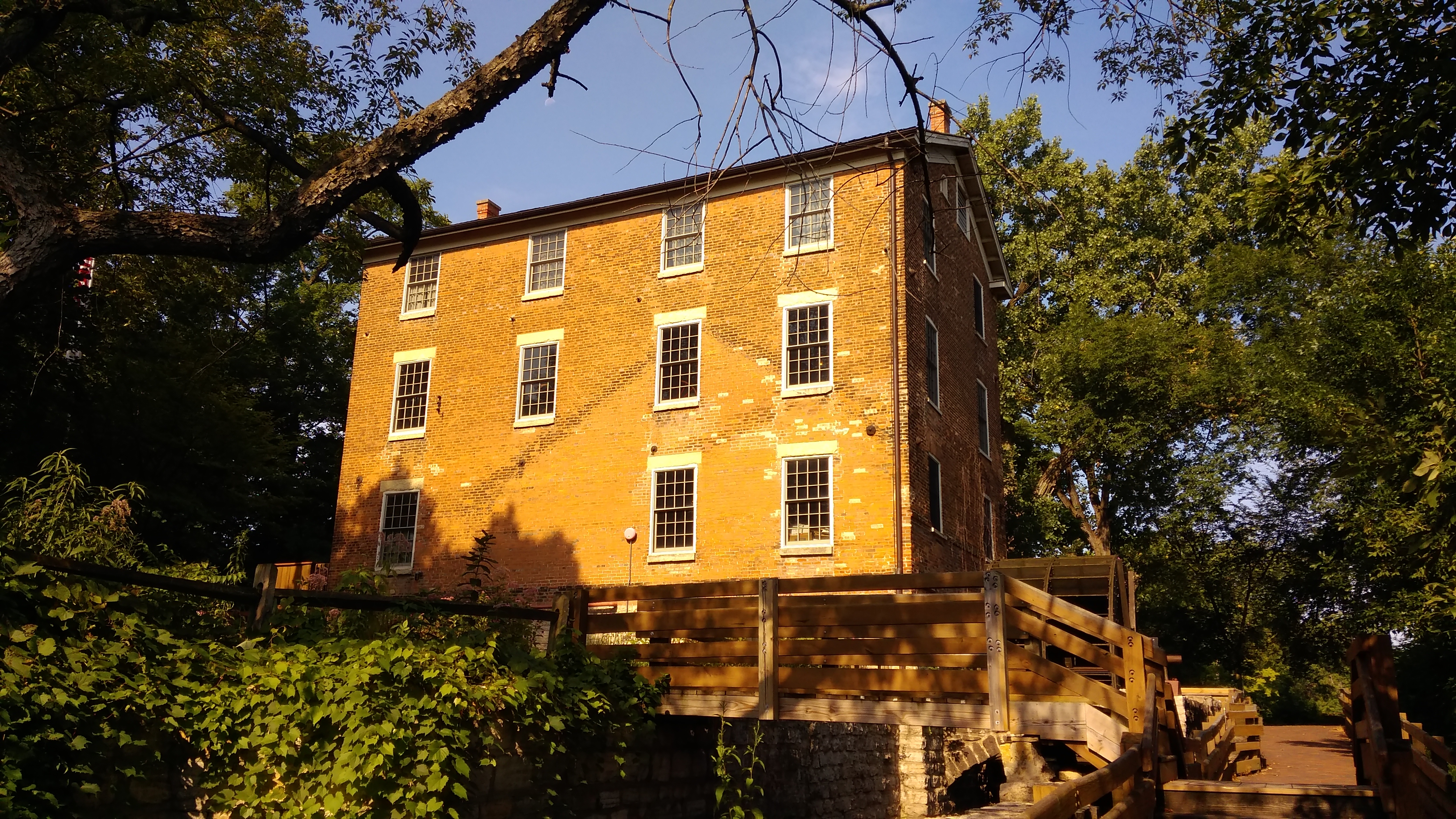
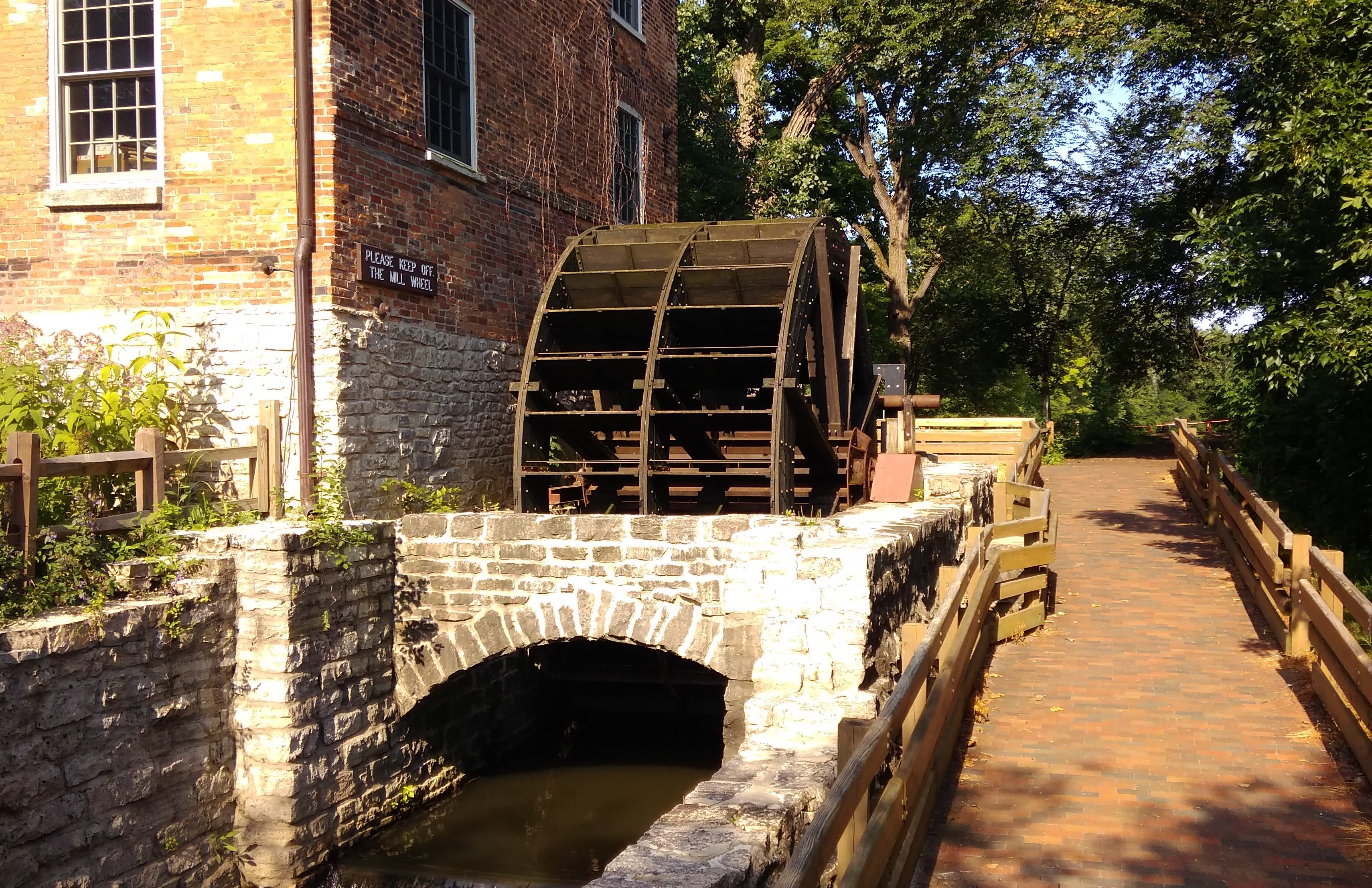
Graue Mill is a water-powered grist mill on Salt Creek in DuPage County, dating from the 1850s. The machinery inside is elaborate, restored to operation, and still grinding small quantities of grain that the museum sells. I didn’t go inside this time, but pondered the handsome exterior of the mill.

As well as its large water wheel.
“Frederick Graue was born in Germany, came to the United States and settled in Fullersburg, Illinois, in 1842,” the museum’s web site says. In 1849, he purchased the site of a sawmill that had burned down, along with his partner William Asche, and constructed a gristmill there. Asche later sold his share to Graue.

“Limestone for the basement walls was quarried near Lemont; bricks for the rest of the walls were made from clay from the Graue farm and fired in kilns near the mill site; flooring, beams, and posts were from white oak timbers cut along the I&M canal. The four one-ton buhrstones used for grinding were imported from France. After the gristmill opened in April 1852, it ground wheat, corn and other grains produced by local farmers.

“The mill was a major center of economic life during the 19th century and was also used by Fred Graue to hide runaway slaves on their journey to freedom in Canada.”

In the 20th century, the now-obsolete mill fell into ruin, but it was restored in the 1930s by none other than the CCC. Specifically, Troop V-1668, made up of veterans. These days, the mill is part of the Fullersburg Woods Forest Preserve, which is a unit of the DuPage County Forest Preserve District. The village of Fullersburg, for its part, was never incorporated and doesn’t exist as a modern entity.

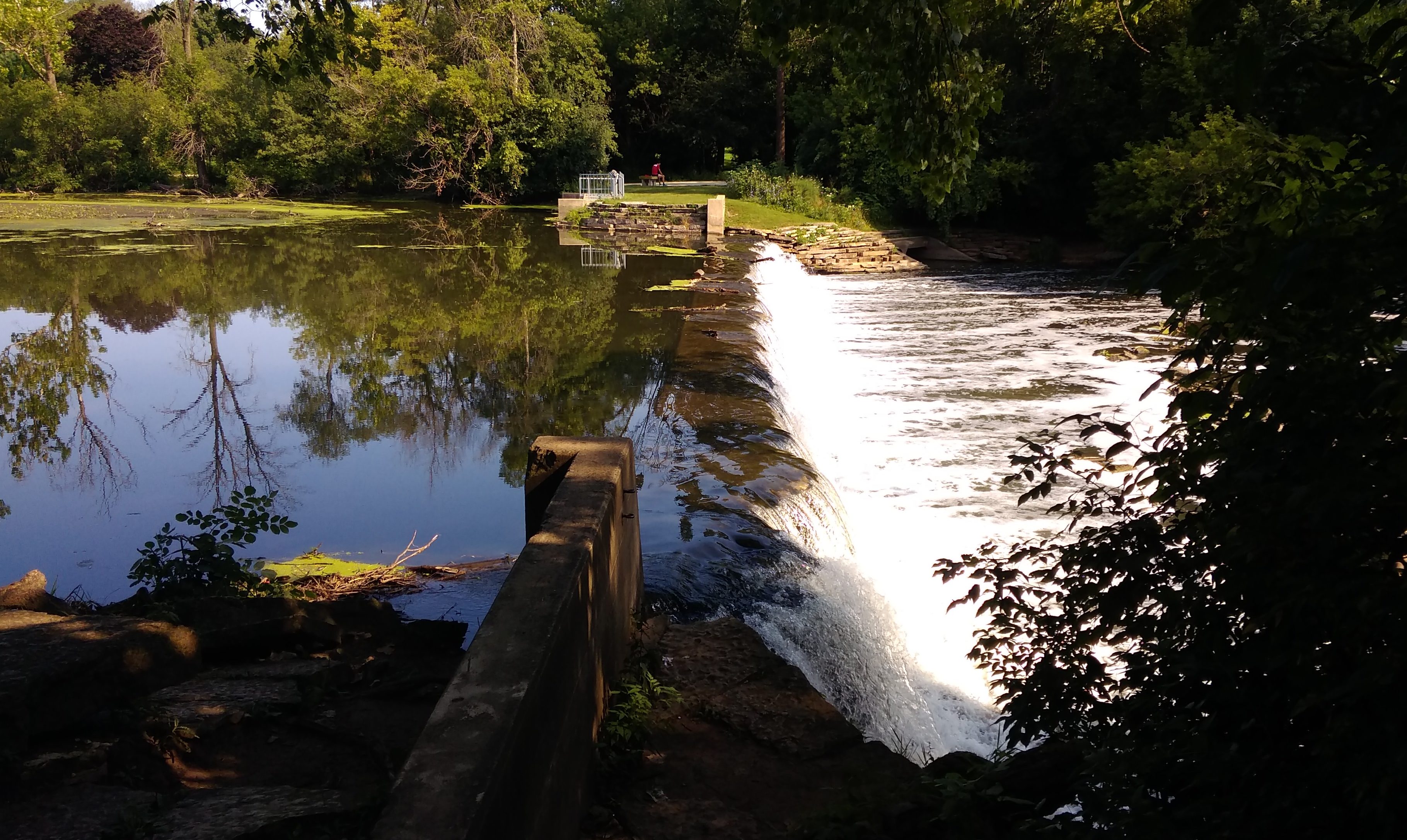
This is Salt Creek next to the mill, which gives it its power.
Salt Creek, despite its name, is really more of a river in this part of DuPage County, but never mind. It joins the Des Plaines River in Cook County, which later joins the Illinois and then of course the Mississippi.

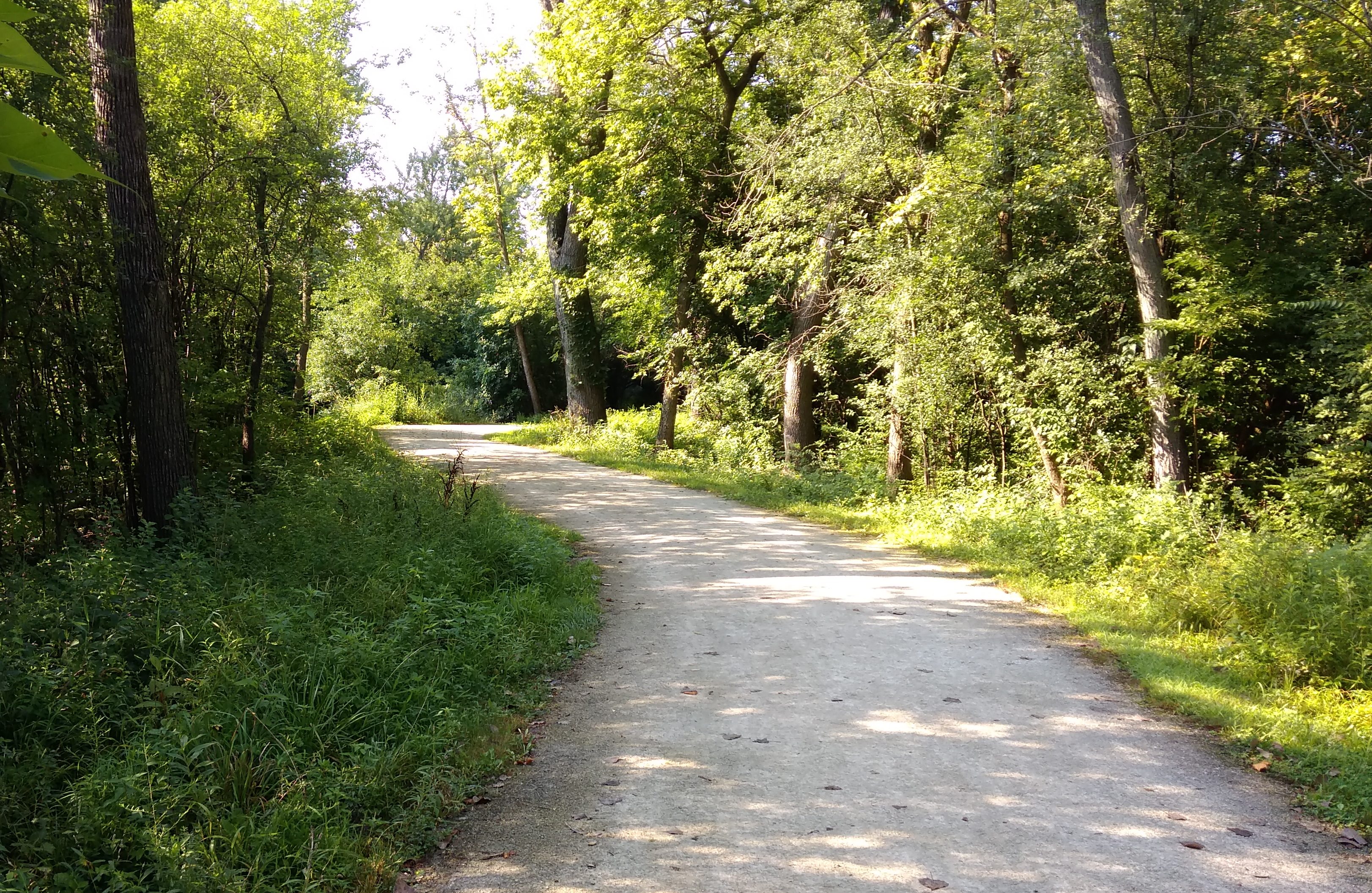
I had time enough to take a stroll on one of the paths through Fullersburg Woods Forest Preserve, not too far from the mill.

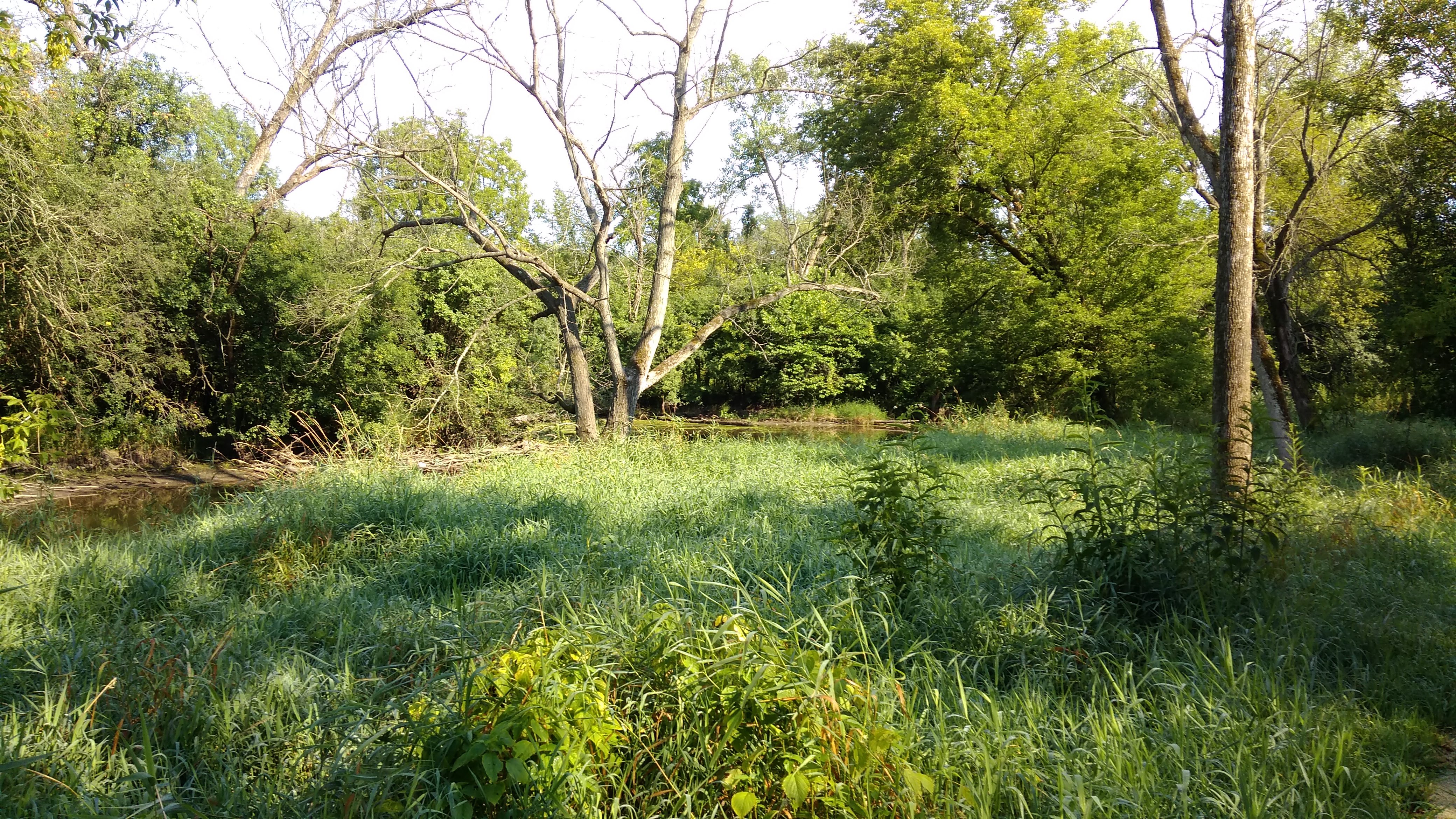
Along the way, the path takes you past other views of Salt Creek, slightly upstream from the mill.
Past summer fields. The years do go by like so many summer fields.
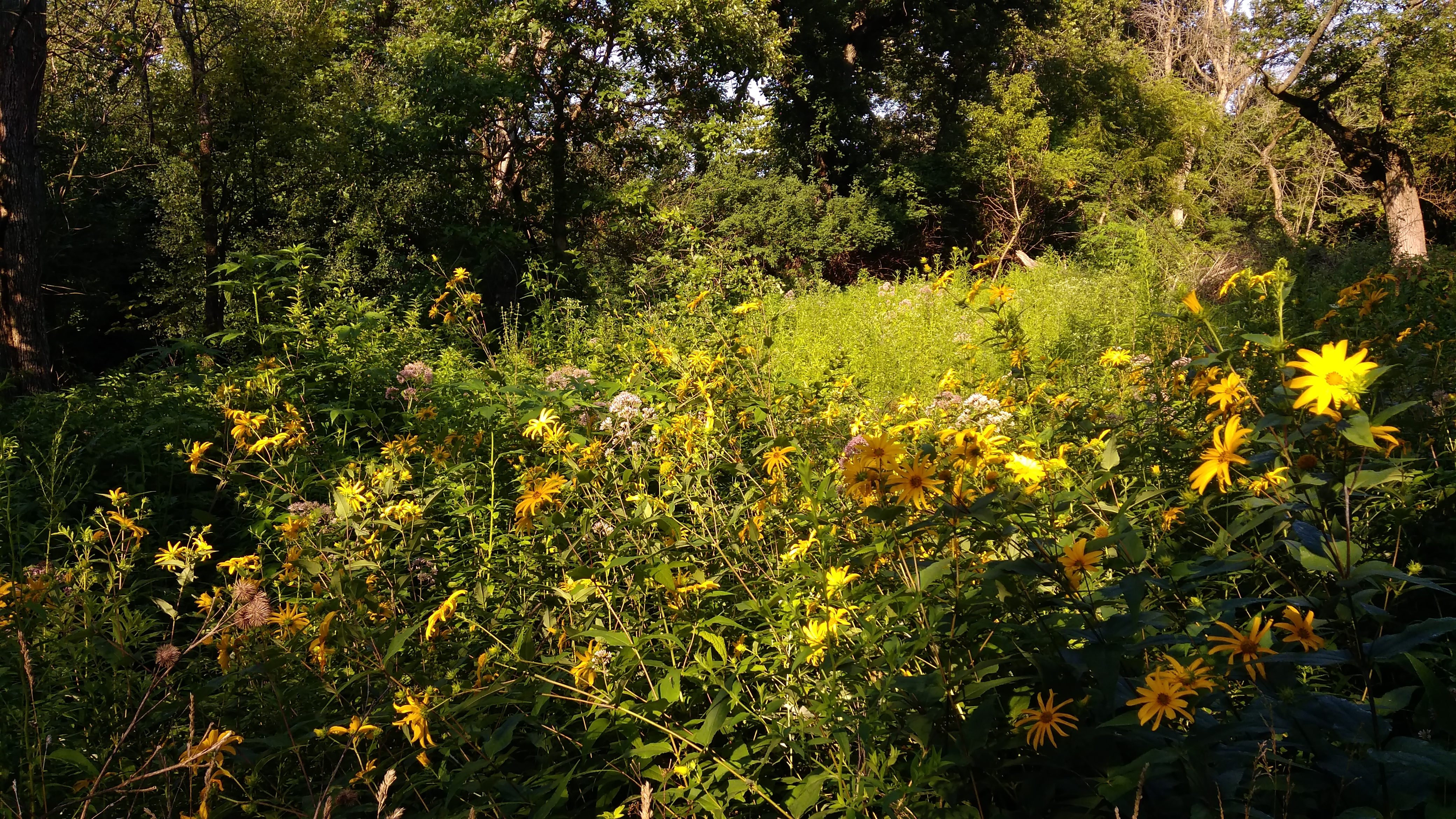
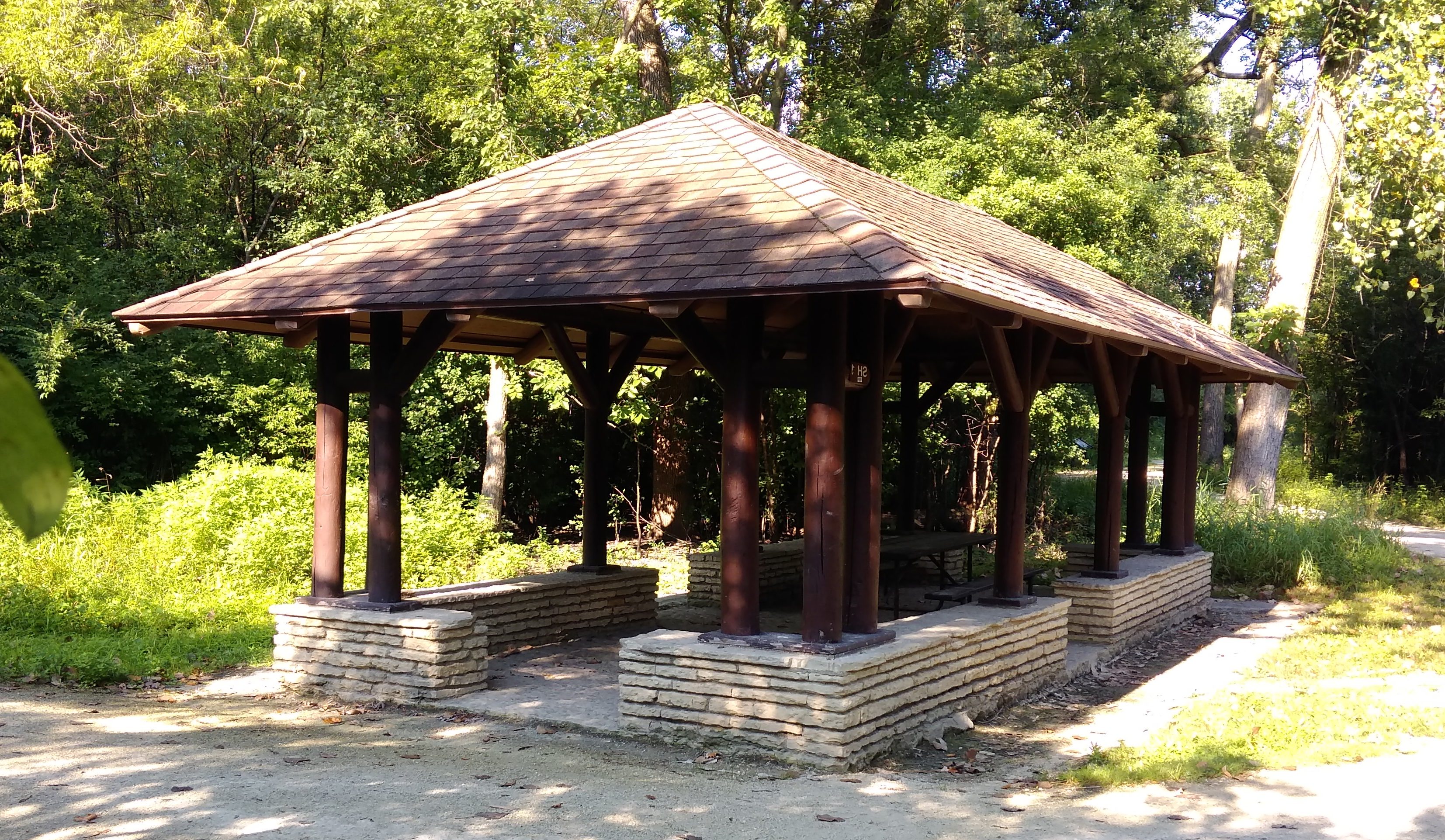
And a handful of well-maintained CCC structures.
Though I didn’t capture any of the activity with my camera, the paths of Fullersburg Woods are very popular with dog walkers and their dogs.

Faces in the Grocery Aisle

Besides helping Lilly move her stuff into her new apartment in Champaign, we also took her to a major grocery store. Management seemed eager for the population of UIUC students to swell, as it does every year at this time.
I got distracted among the product aisles. It’s hard not to. For instance, I wondered about the odd longevity of the Vlasic stork.
When the mascot was created (1974, according to Vlasic), the parody of Groucho Marx, including the pickle-as-cigar, would have been instantly recognizable to the audience. Nearly 45 years later? Not as much. I guess the Vlasic stork exists pretty much as its own thing now.

Why a stork? But better always to ask, why a duck?

Another familiar face, Chef Boy-Ar-Dee. But it’s a younger Boy-Ar-Dee (or Boiardi, to be pedantic).
What gives? Boy-Ar-Dee has been an avuncular fellow, a gray presence, since Chef Boiardi was still alive and unafraid to attach his name (phonetically) to such a product.

Maybe the young Boy-Ar-Dee is part of the “throwback recipe” theme, designed to evoke what — the golden age of canned pasta?

Moving along, I was happy to see this phrase.
The bee’s knees is a phase that needs a new life. As for the product, it’s distinction seems to be honey mixed in.

Finally, what’s a grocery store without an array of Spam? More varieties than I remember.

Lovely Spam! Wonderful Spam!

The Colonel Wolfe School

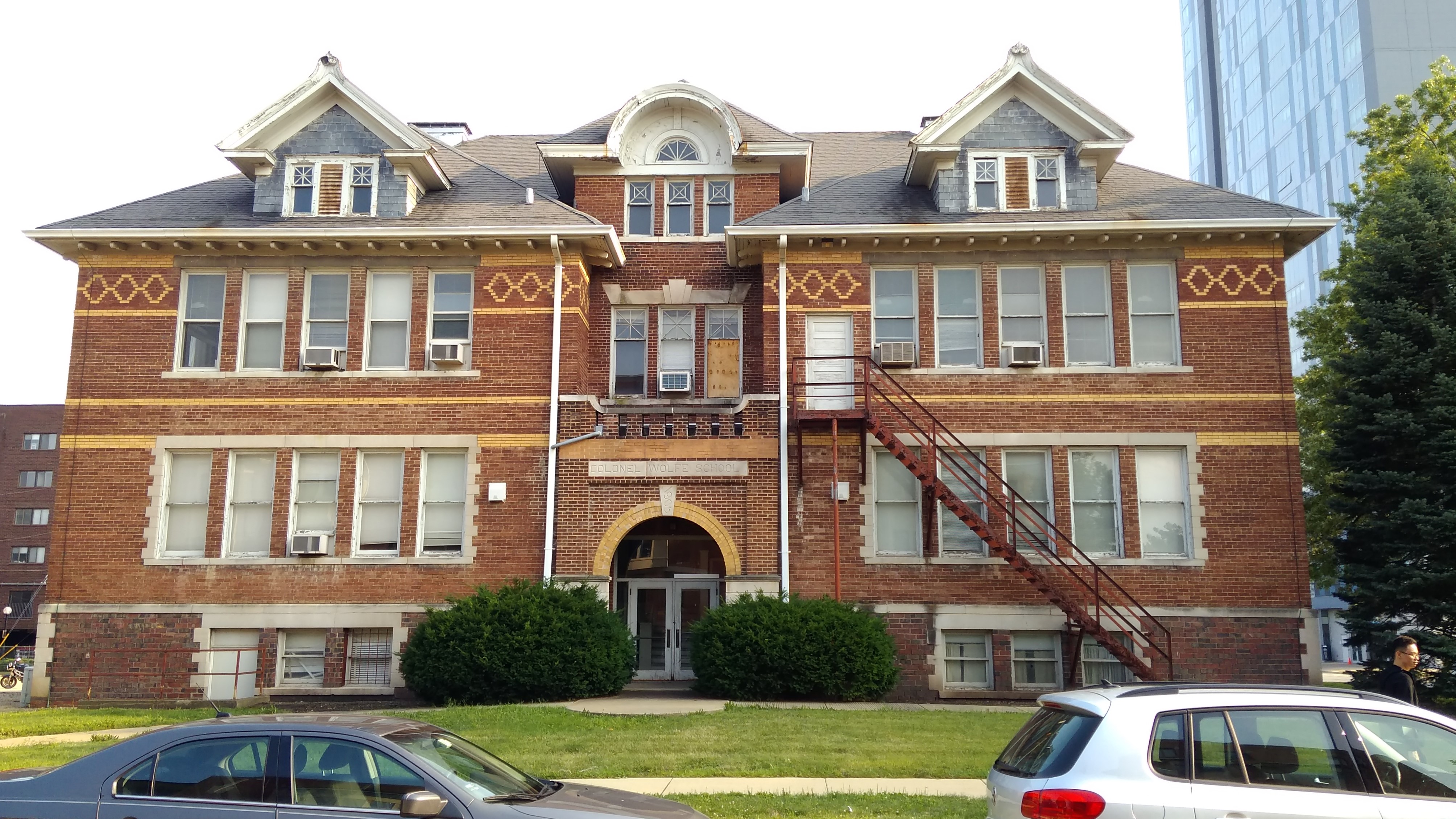
I’ve gotten to know Champaign-Urbana better since 2016, and on Saturday was back again, helping facilitate Lilly’s return to UIUC for the 2018-19 academic year. I didn’t have a lot of time to look around, but one thing did catch my eye: the Colonel Wolfe School building.

Looks a little run down, but seems like it has good bones. The name, hard to see at a distance, is carved in stone over the main entrance.

Lilly will be seeing this building with some regularity, so I asked her whether she knew anything about it. She didn’t. Neither did I, so I did the next best thing: made something up.

“I’ll bet it was a private school run by this fellow Wolfe in the late 19th century,” I said. “One of those schools where the students were mistreated. You know, regular beatings for minor infractions. On quiet moonlit nights, maybe you can hear their ghosts moaning inside the old school.”

Lilly brushed off this suggestion, but I will say in my defense that I suspect that’s how places acquire their reputation as haunted: by people saying they are.

The facts of the Wolfe School are more prosaic. There isn’t a gush of information online about it, but I did find out it was a Champaign public elementary school built in 1905. That was a time of school building reform, so it probably had the latest amenities, such as light-admitting windows and toilets on each floor.

As a school, Colonel Wolfe lasted into the 1970s. Some time later, UIUC acquired the building and used — uses? — it for this and that (sources are a little vague). Doesn’t look like the university has put much money into spiffing up the exterior.

As for Colonel Wolfe — John Wolfe (1833-1904) — he was a civic leader, though not an office holder, in late 19th-century Champaign. As a young man, he fought for the Union as a member of the 20th Illinois Volunteer Infantry and then the 135th Illinois Infantry.
An obit is online. Wolfe never even saw the building, much less thrashed his charges there.

The Warrenville Garden, 1987

About once a month during the warm months of 1987, and maybe a few times the year after that, I drove from Chicago to southwest suburban Warrenville — it seemed pretty far away — to visit a friend of mine who had just bought a house in that suburb. He lives in Texas these days, and I’ve since lost touch with him, except for a nominal link on Facebook.

He cultivated a large garden in his large back yard and I helped him out because it was a novelty and because he gave me some of the produce. There was a lot of produce.
“We aren’t gardening for food,” he once said. “We’re gardening for virtue.”

He was a conscientious gardener, and I took home so many vegetables and melons that I further took some to my office and gave them to anyone who wanted them. They were a hit. A woman in the office who’d grown up on a downstate farm complimented the squash in particular.

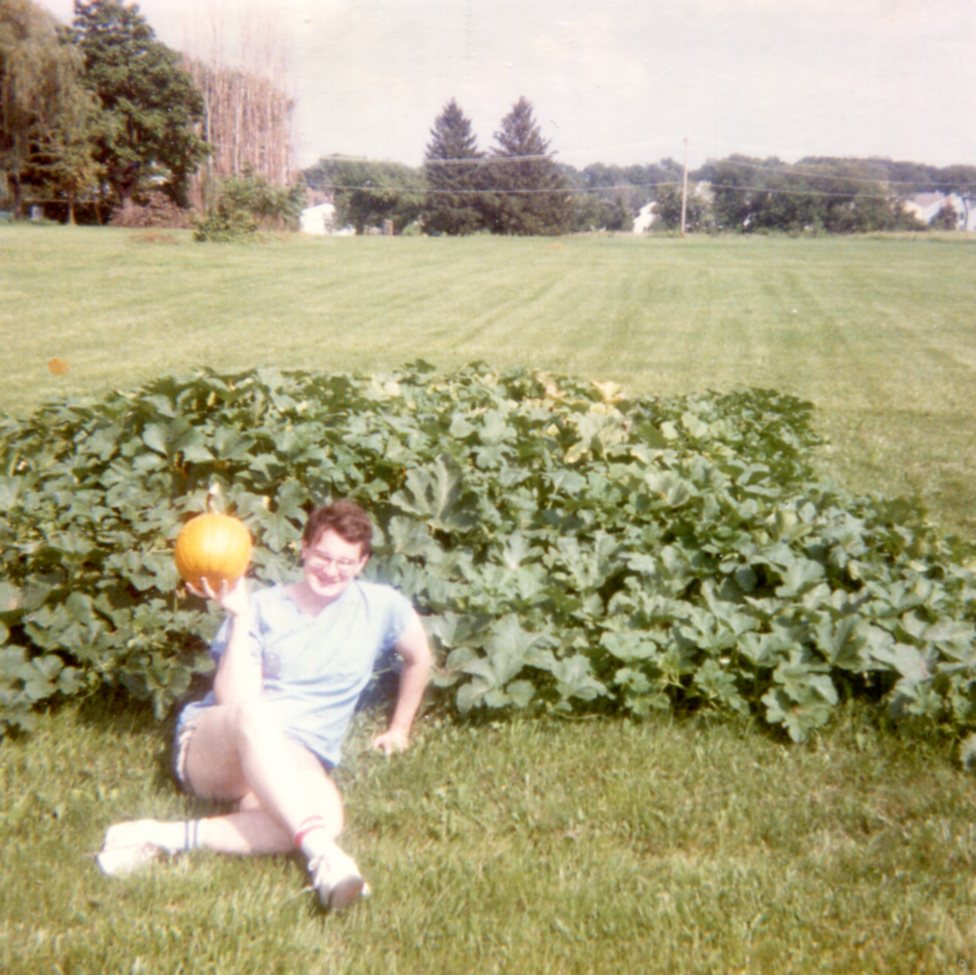
I’d forgotten that my friend had made pictures of the garden. Also that I had a few of them tucked away.

Corn, tomatoes, melons, carrots, peas, green beans, cucumbers, squash and much else I’ve probably forgotten.

Not a bad thing to do for part of a summer. But I also found I had no natural passion for gardening. Later attempts in my own back yards were indifferent and lackluster. One problem in particular, aside from hating to weed: when the plants I wanted to grow were just sprouting, I couldn’t always tell them apart from weeds.

The pictures of the plants on the seed packages were no use in making that determination, either. They always showed idealized, fully grown examples.

Stray Thursday Items

Various things my computer has told me lately:

Object reference not set to an instance of an object.

Description: An unhandled exception occurred during the execution of the current web request. Please review the stack trace for more information about the error and where it originated in the code.

Sure, whatever you say.

Tremendous loud thunderstorm yesterday evening. Short but dramatic. The yard needed the water. Been a dryish August so far. But not too hot. I try to enjoy lunch on my deck daily, and sometimes breakfast, because soon the air will grow cold. All too soon.

Cicadas are in full voice during the day now. Crickets are on the night shift, singing their songs. Sounds just the same — to my human ears — as it did in 2015. But for all I know, the songs have morphed since then, and are as different to the insects as Middle English compared with Modern English.

Presidential sites are pretty thin on the ground up on the north shore of Lake Superior, but I did find one place during our recent trip that has the vaguest connection to a U.S. president. Its name: Buchanan.

Here it is.
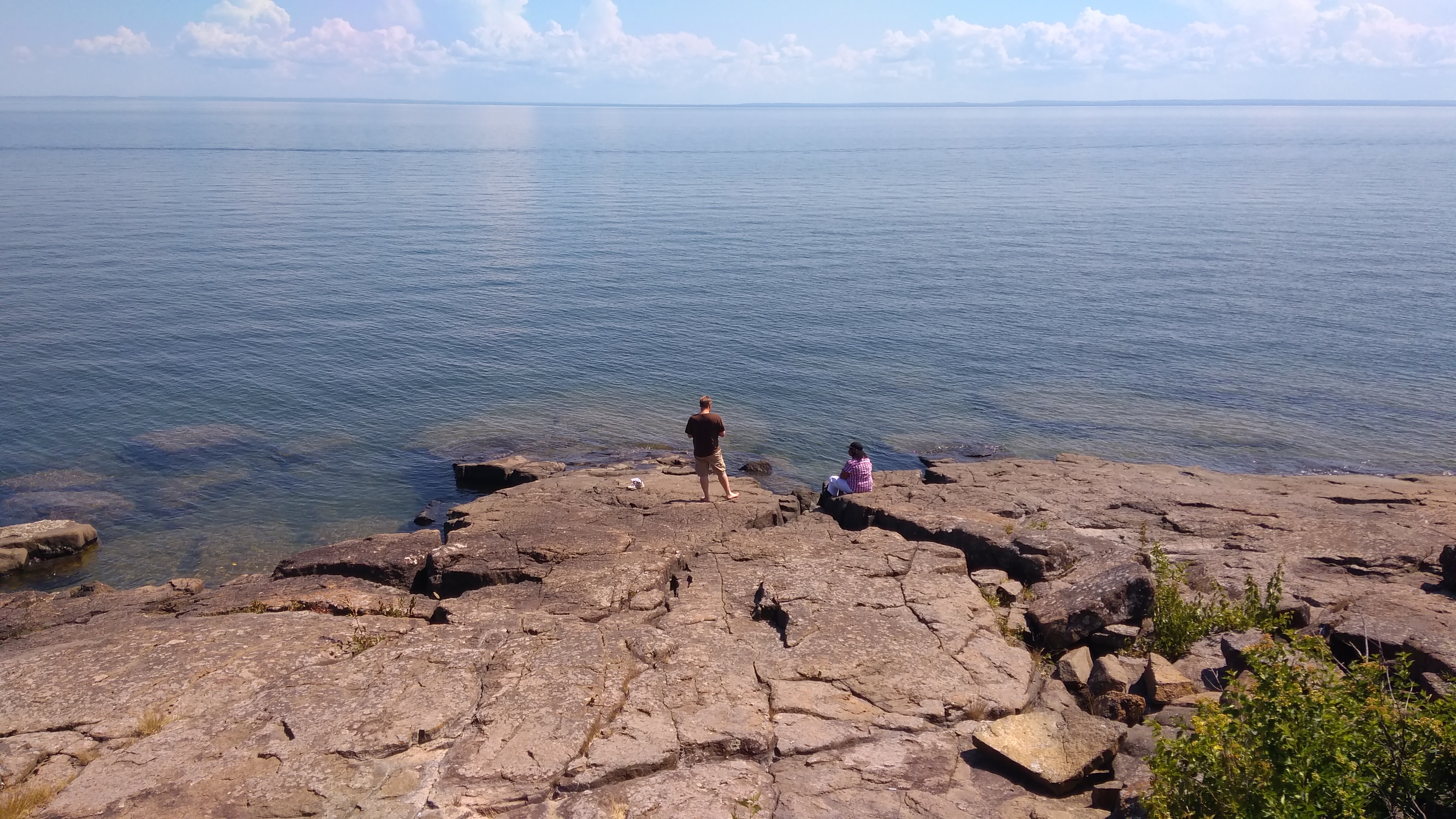
That might look like undeveloped shore on Lake Superior, and it is, but not far from shore a plaque says: This town site, named after President Buchanan, was laid out in October 1856. From September 1857 until May 1859 the place, though little less than wilderness, was the seat of the U.S. land office for the northeastern district of Minnesota. After the removal of the land office, the settlement disappeared.

This sizable sculpture is on the campus of University of Minnesota Duluth, near that school’s planetarium. It’s called “Wild Ricing Moon.”“The sculpture… was designed by John David Mooney, a Chicago sculptor with an international reputation,” the university says. “The piece is 89 feet tall. The first half of this large-scale outdoor sculpture was erected in October 2005. The first installation, a large steel circle, 40 feet in diameter, represents the full, rice-harvesting moon of late summer.
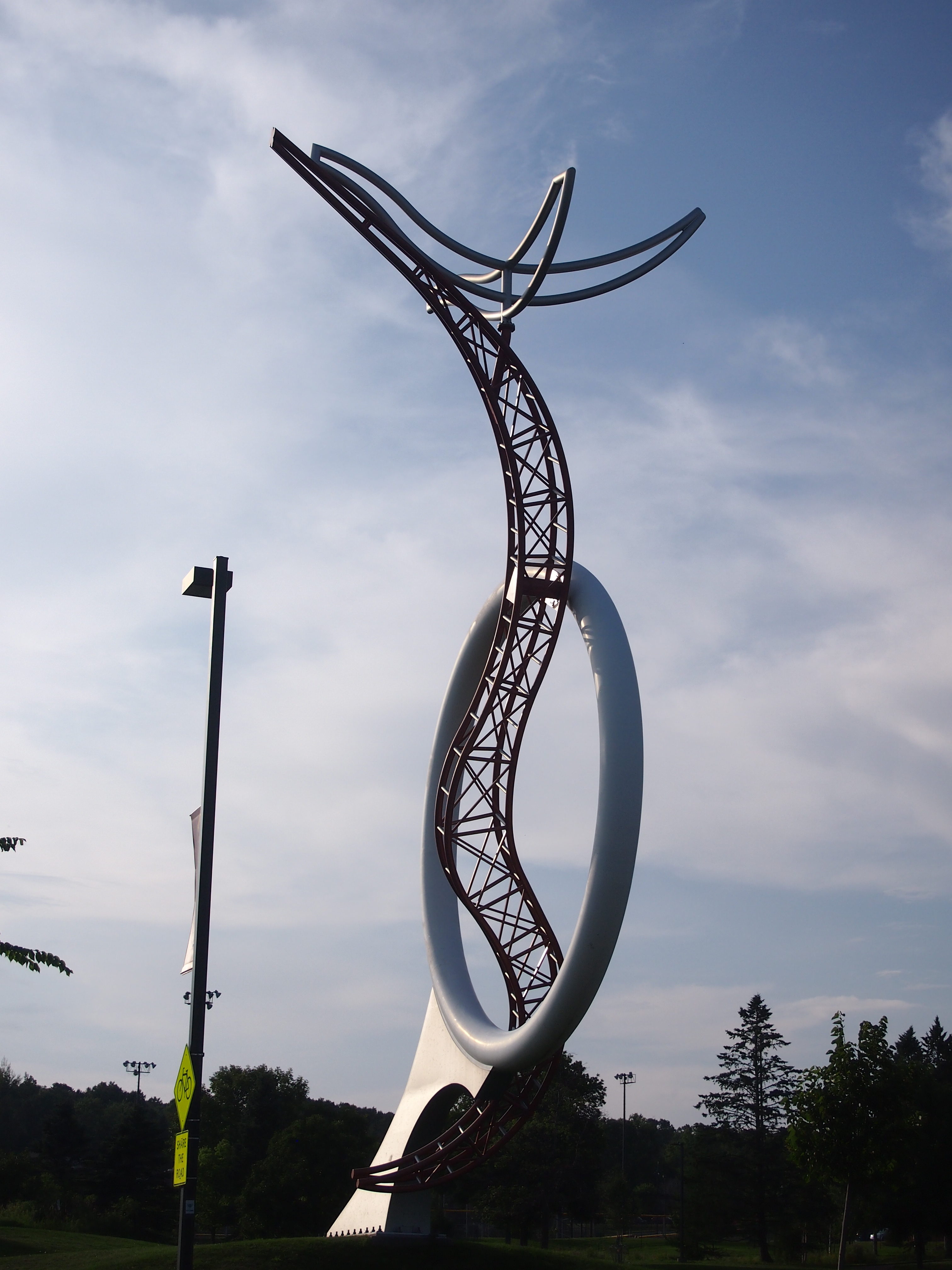
“A ‘rice stalk’ section and bird was included in the pieces that arrived in June. Mooney described the sculpture as reflecting the North Shore of Lake Superior and natural features of the region.”

Here’s the pleasant open area behind the Allyndale Motel in Duluth.
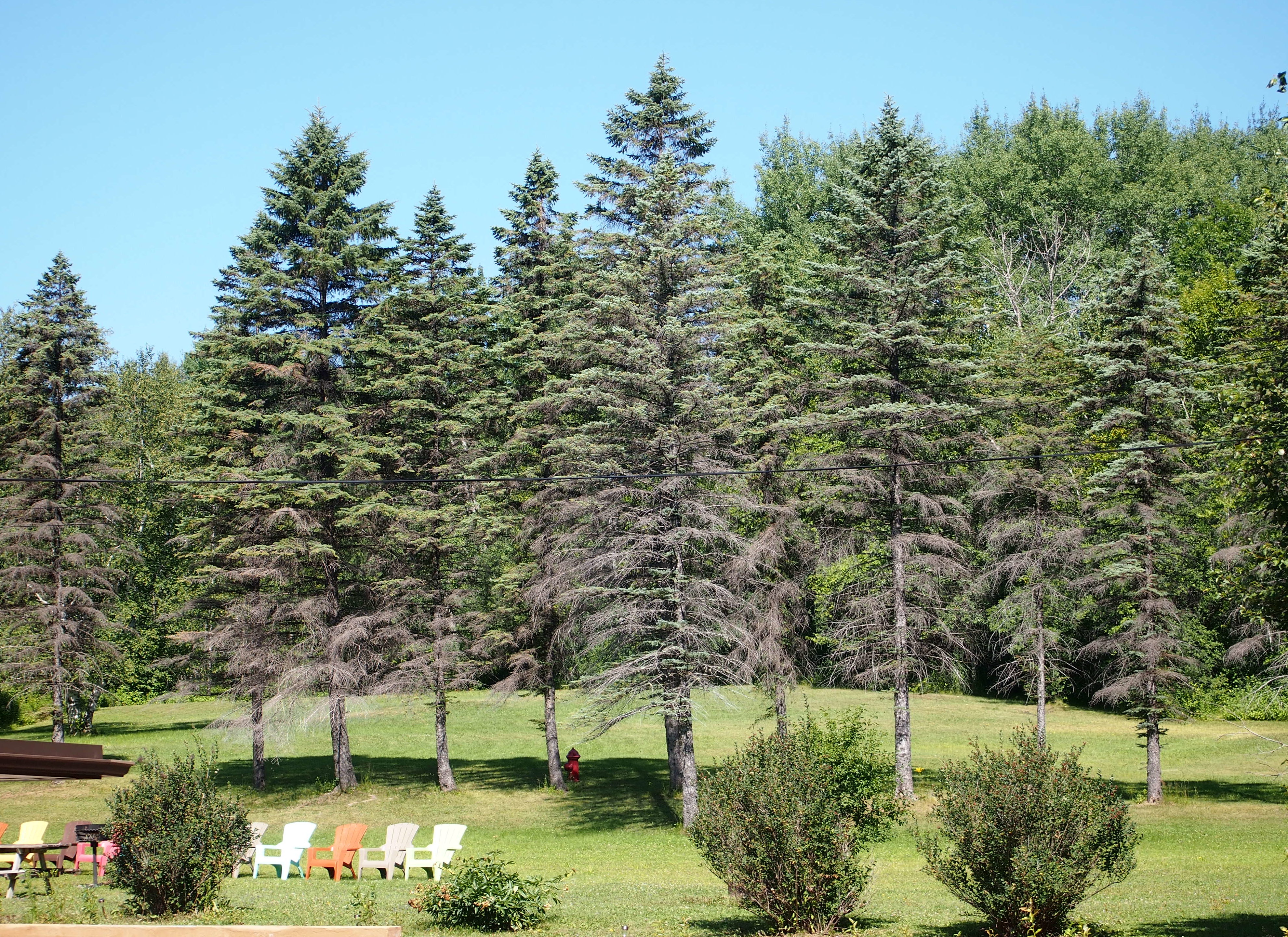
One morning I ate a rudimentary breakfast there as the girls slept. One night I went there on the thin hope that the northern lights would be visible. No dice.

I spent a few minutes tooling around Eau Claire, Wis., on the Saturday morning on the way up to Minnesota. One thing I saw in passing was the impressive Sacred Heart-St. Patrick Parish church.
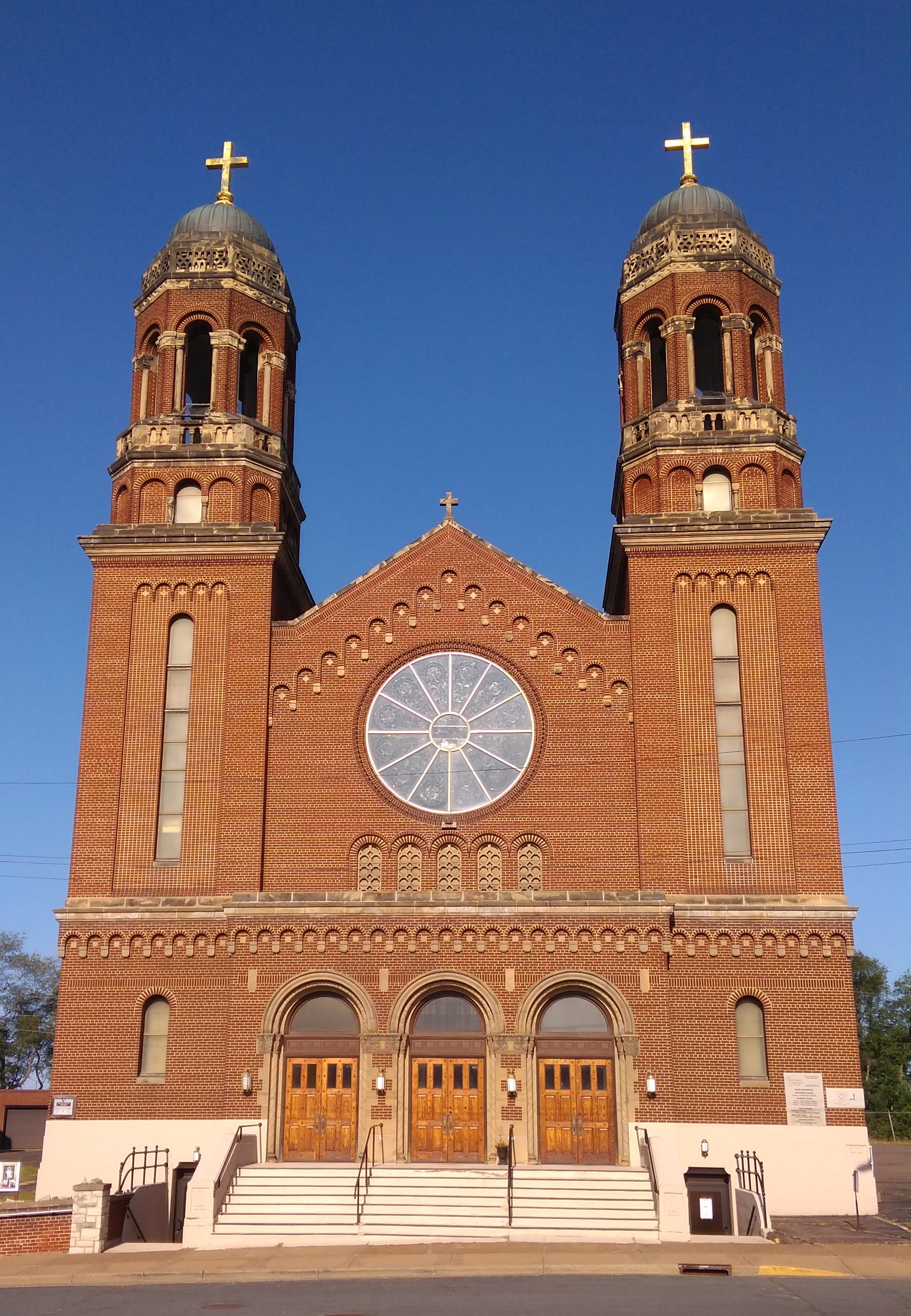
Unfortunately, the church was closed.

A little later that day we stopped at Leinenkugel Brewery in Chippewa Falls. The tourist-facing part of the operation is known as the Leinie Lodge®, which “is filled with historical photos, vintage brewing equipment and plenty of Leinie’s wearables and collectibles to take home,” notes the brewery web site. There’s also a bar. Guess what it serves.

Boy, the Leinie Lodge was crowded. That’s the result of years of clever advertising (autoplay) and what we get for going on a Saturday morning. But that wasn’t the irritating part, not really. Leinenkugel Brewery tours cost $10. Admission for a brewery tour?

I’ve been on brewery and vineyard and distillery tours all over the world, including a beer brewery in Denmark, a bourbon maker in Kentucky, a winery in Western Australia and a sake brewery in Japan, and that’s one thing I haven’t run across. Because, you know, the tour is marketing — building goodwill — introducing new customers to your product — not a damned revenue stream. For the birds, Leinenkugel, for the birds.

But I have to confess that Lilly wanted a Leinenkugel shirt, so I got her one. Her souvenir for the trip. I got a couple of postcards.

On the way back from Minnesota, as I’ve mentioned, we ate lunch in Madison, Wis., at the excellent Monty’s Blue Plate Diner.

Across the street from Monty’s is the Barrymore Theatre. I like its looks.
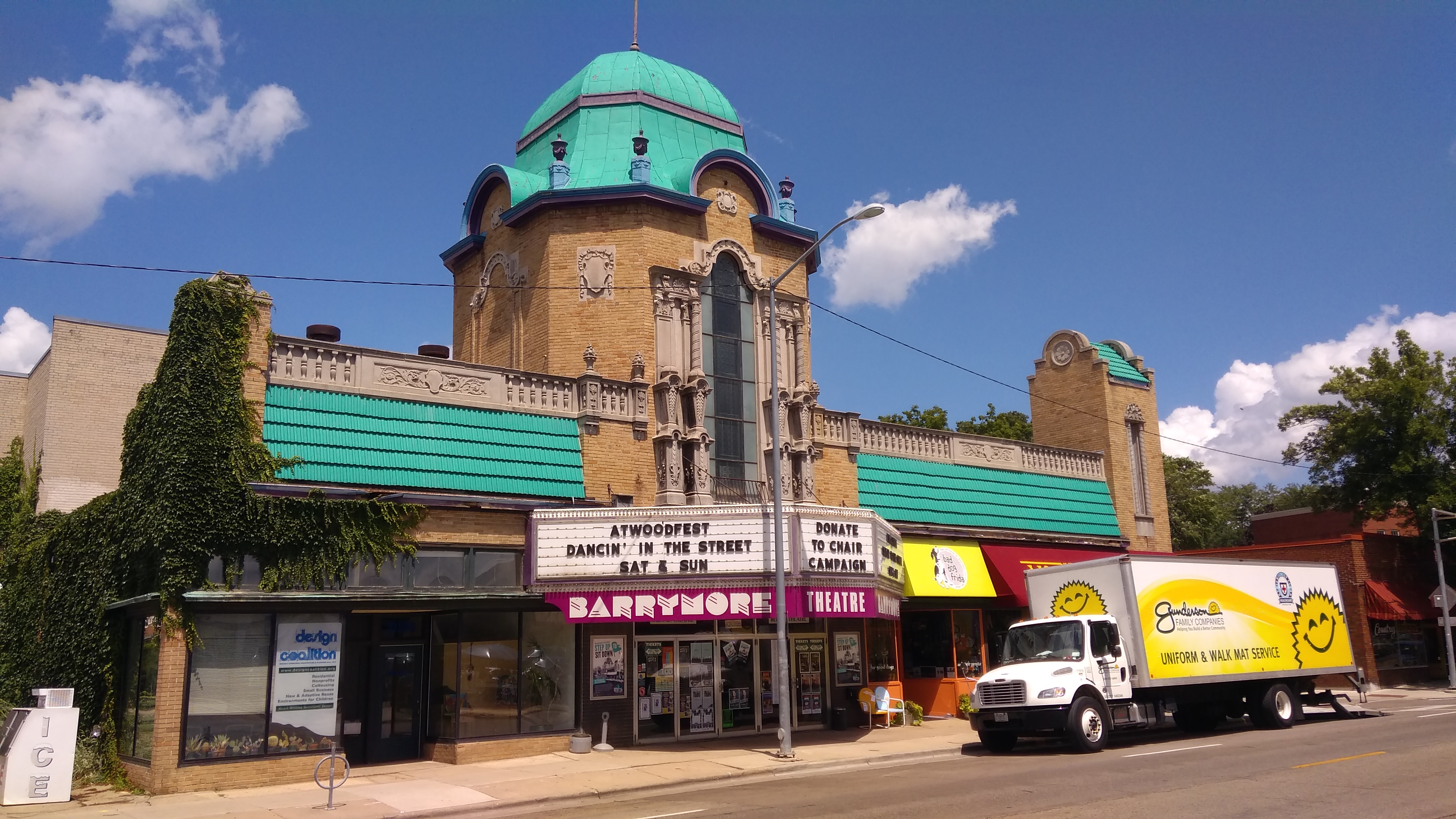
Various live acts play at the Barrymore. Looking at the upcoming list, I see that They Might Be Giants will be there in October after dates in the UK, Germany and Canada. Maybe I should see them again — it’s been almost 30 years now — but it’s a Tuesday show, so I don’t think I’ll make it.

One more thing. At a rest stop on I-94 near Black River Falls, Wis., there’s a state historical marker honoring, at some length, the passenger pigeon. Among other things, the marker says: “The largest nesting on record anywhere occurred in this area in 1871. The nesting ground covered 850 square miles with an estimated 136,000,000 pigeons.

“John Muir described the passenger pigeons in flight, ‘I have seen flocks streaming south in the fall so large that they were flowing from horizon to horizon in an almost continuous stream all day long.’ “

Wow. 136 million pigeons more or less in the same place? A marvel to behold, I’m sure. That and an amazing amount of noise and a monumental torrent of droppings.
Leif Erikson and His Rose Garden

According to Wiki, which cites a book called Vikings in the Attic: In Search of Nordic America by Eric Dregni (2011), there are statues of Leif Erikson in Boston, Milwaukee, Chicago, St. Paul, Duluth and Seattle.

According to Leif Erikson.org, there are also statues of him in Reykjavik, as well as Newport News, Va.; Trondheim, Norway; Minot, ND, Eiríksstaðir, Iceland; Brattahlid (Qassiarsuk), Greenland; Cleveland (a bust); and L’Anse aux Meadows, Newfoundland.

That’s not counting the more generic Viking Big Ole, who stands in Alexandria, Minn., home of the pretty-sure-it’s-a-hoax Kensington Runestone.

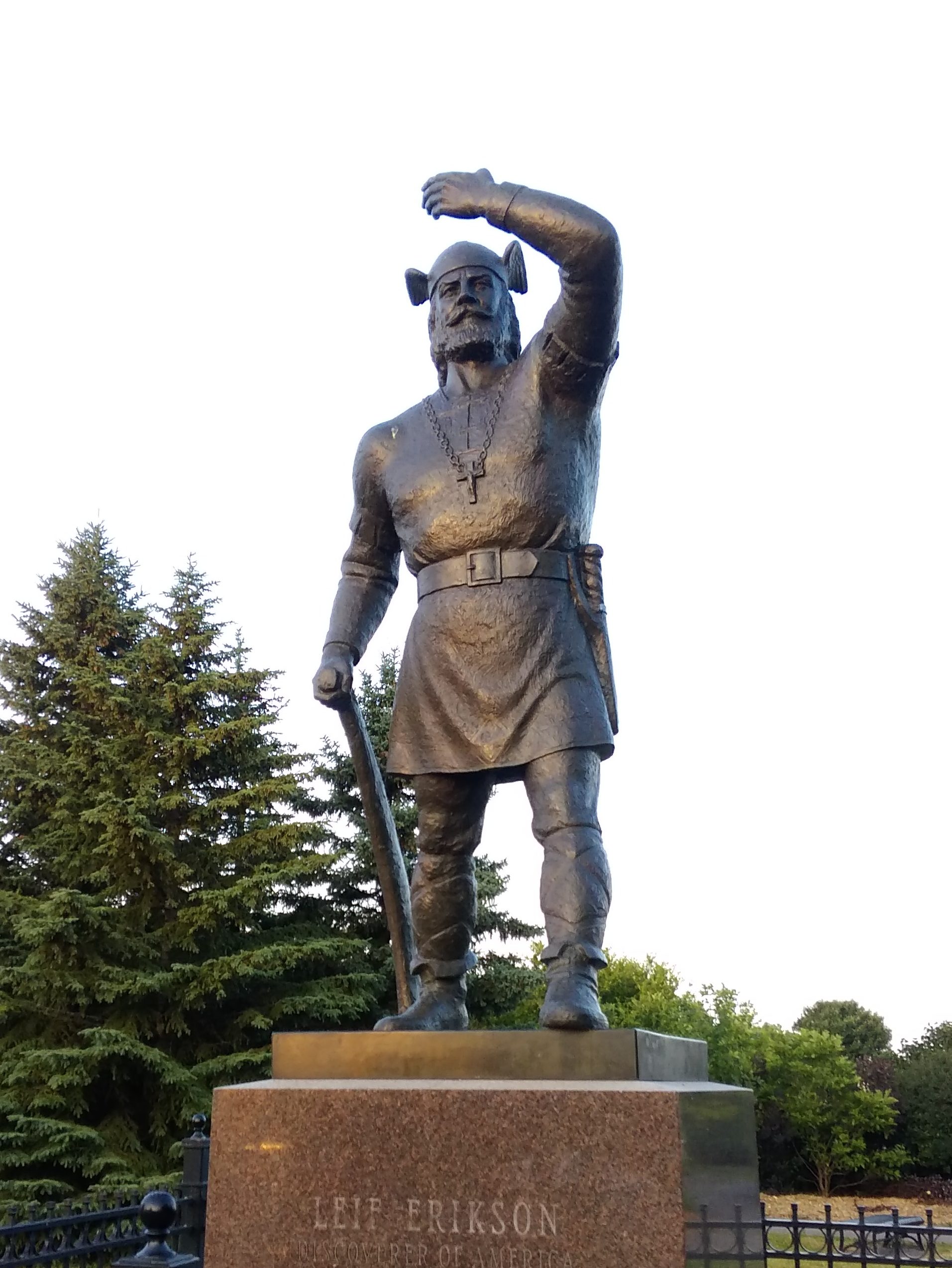
I’ve seen the Chicago Leif Erikson myself; it’s in Humboldt Park. Now I’ve seen the one in Duluth. Here it is.

Carved on the plinth are the Viking’s name and “Discoverer of America 1000 A.D.” Also that the statue, designed and executed by John Karl Daniels, was erected by the Norwegian American League (no hyphen) of Duluth and “popular subscription.” It was “presented to the city” on August 25, 1956.

I wonder what Leif, an obscure chieftain from a remote island 1,000 years ago, would make of his current modest fame, which came to his name more than 800 years after his death. Modest fame, but then again, how many other 10th/11th-century figures are so well known in the 20th/21st century?

Who among the teeming billions on the Earth now, through some completely convoluted and unpredictable set of circumstances across the centuries to come, will be remembered at the beginning of the fourth millennium, for reasons impossible to imagine?

A stout iron fence surrounds the statue, I guess to discourage casual vandalism, but ardent vandals, statue revisionists, or garden-variety wankers could climb the fence without too much trouble. As far as I know, there hasn’t been much grumbling about old Leif, though skinhead lowlifes apparently try to co-opt a statue of the lesser-known Icelandic explorer Thorfinn Karlsefni in Pennsylvania each October 9.

That being Leif Erikson Day. Time And Date.com says: “October 9 was chosen because it is the anniversary of the day that the ship Restauration arrived in New York from Stavanger, Norway, on October 9, 1825. This was the start of organized immigration from Scandinavia to the USA. The date is not associated with an event in Leif Erikson’s life.”

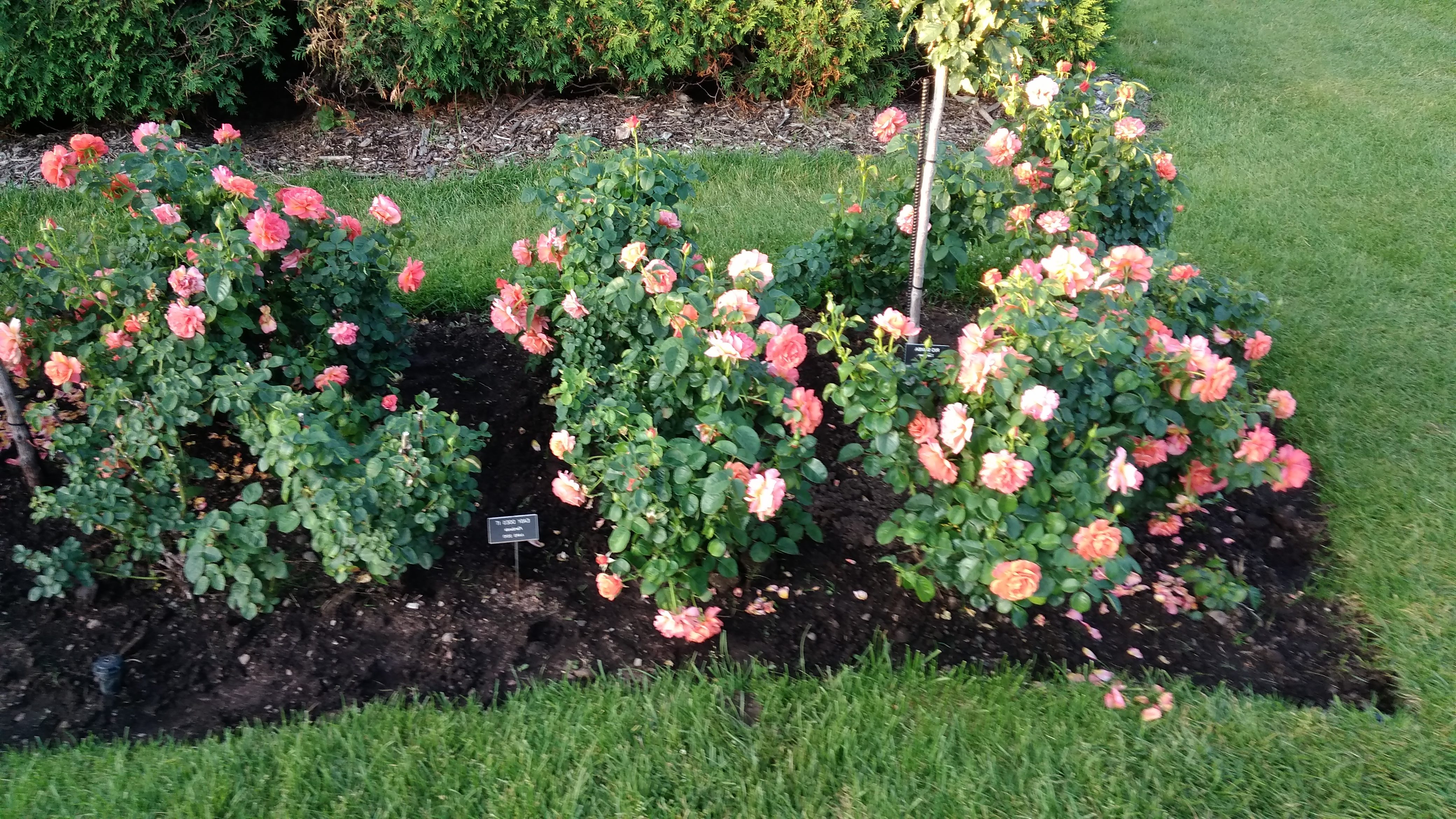
Some context for the Leif Erikson statue in Duluth: it’s in Leif Erickson Park (sometimes styled Erikson) and next to the Leif Erikson Rose Garden, also known as the Duluth Rose Garden. It has some fine plantings.
The garden “was begun by Mrs. John Klints, a native of Latvia, who wanted to give her adopted home of Duluth a beautiful formal rose garden similar to those she’d known in Europe,” says Public Gardens of Minnesota. “It opened in 1965 within Leif Erickson Park, with 2,000 roses, all arranged in gently curving beds surrounding an antique horse fountain. Here it remained for 25 years….

“A vast and ambitious city redevelopment project, and a clever Department of Transportation solution to the termination point of the freeway entering Duluth, resulted in the new location of the rose garden. The garden reopened in 1994 after four years of construction… again as part of the new Leif Erickson Park.

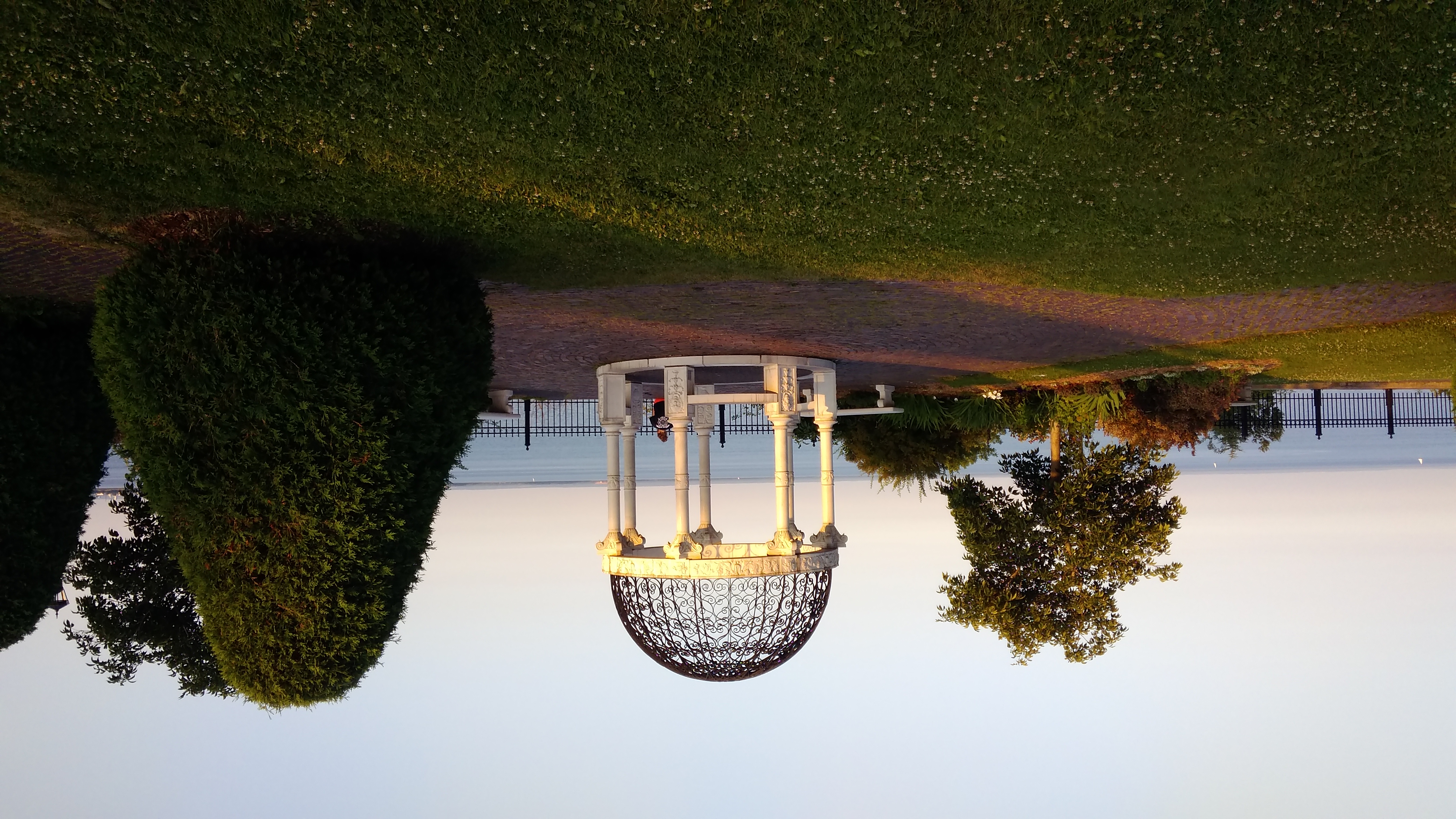
“The six acres are still formal in nature and still have the fountain and gazebo from the original garden, but the beds are now two long beds and four circular beds. There are now in excess of 3,000 roses and 12,000 non-rose plantings, including day lilies, evergreen shrubs, mixed perennials and an herb garden.”

Good to see the garden’s gazebo. It has a nice view of Lake Superior. That’s what this country needs, more public gazebos.
Forest Hill Cemetery, Duluth

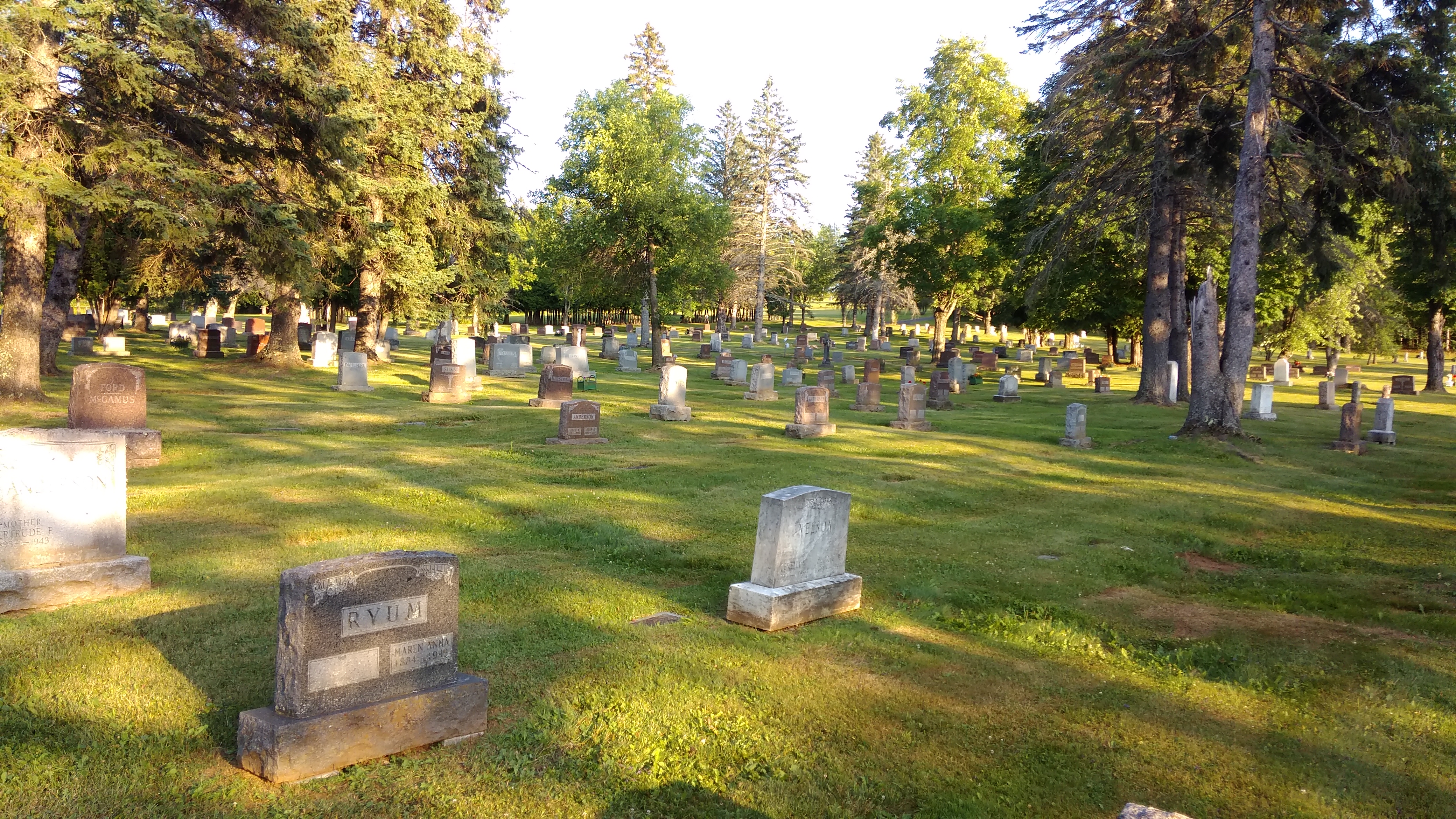
Late in the afternoon on the last day of July, I visited Forest Hill Cemetery in Duluth. I didn’t explore it as well as I might have. I’ve since read that there’s a “millionaire’s row” of mausoleums that I completely missed.

Ah, well. C’est la mort. Forest Hill Cemetery has a pleasant setting in the hilly land toward the northeastern edge of the city. When founded in 1890, Forest Hill wasn’t in the city, but part of the rural cemetery movement — a fairly late entry, since the movement had kicked off more than 50 years earlier.

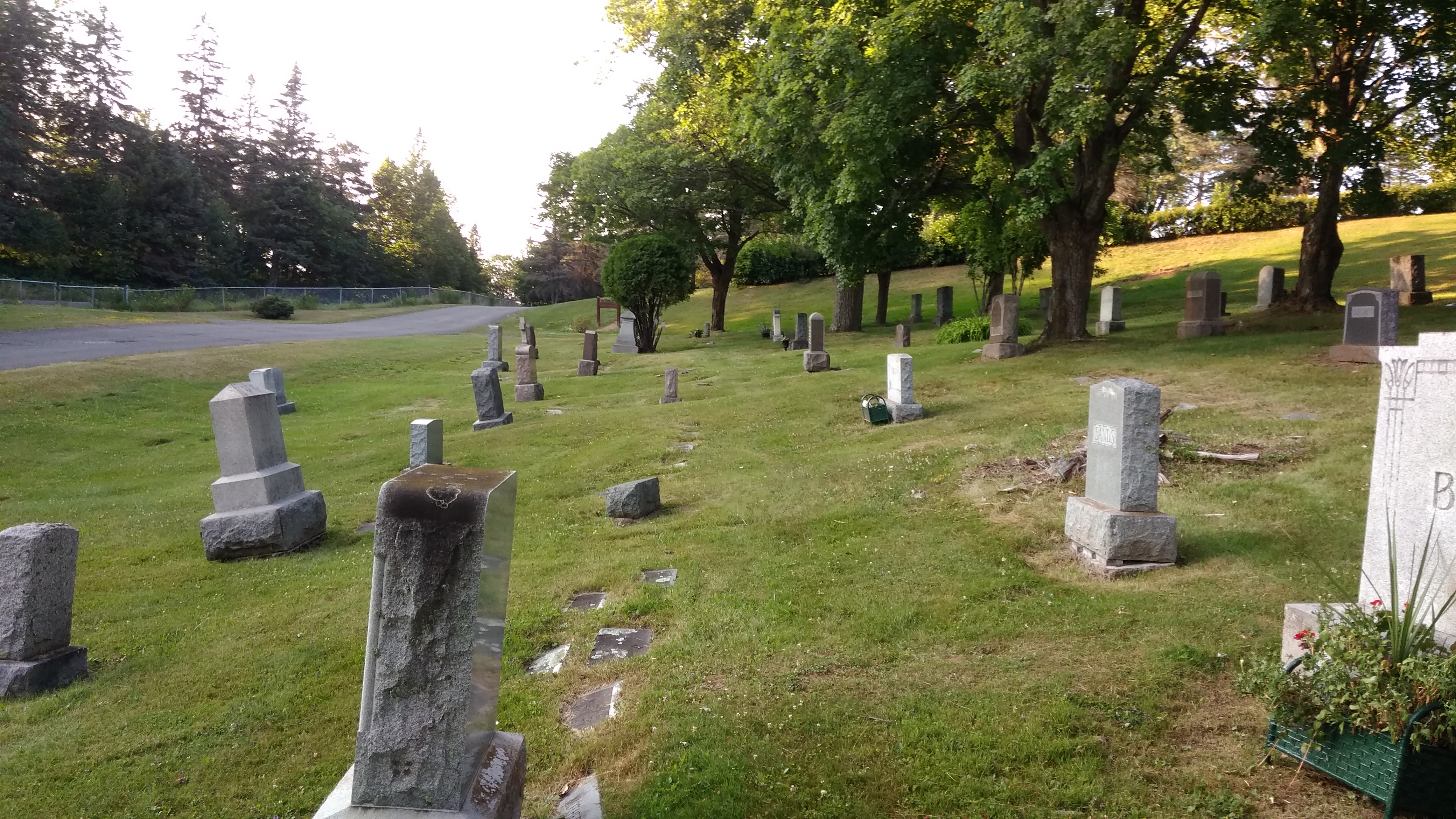
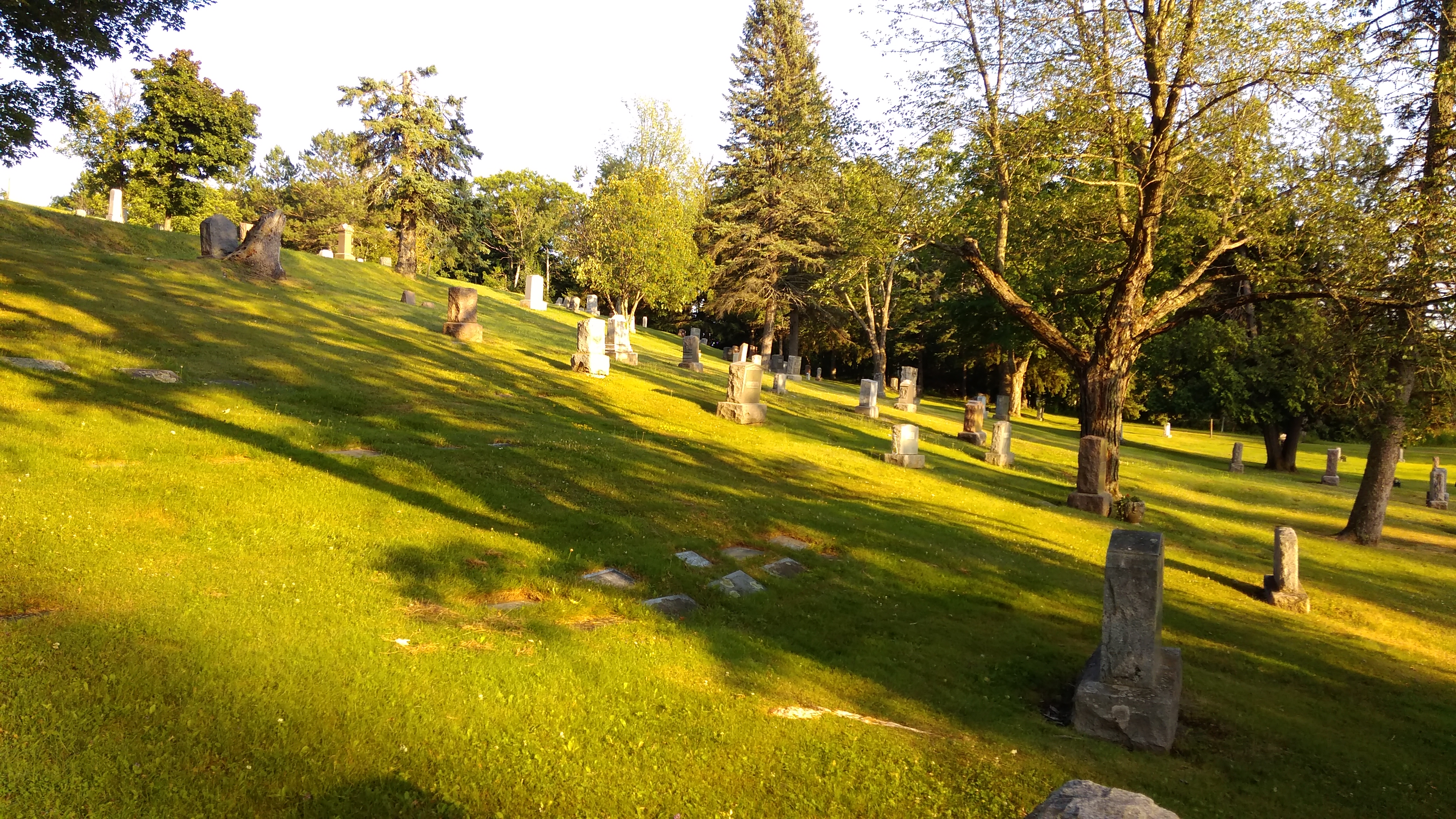
Maybe that helps account for the relative lack of funerary art so beloved by Victorians. Or maybe the cemetery is characteristic of Minnesota reserve. Anyway, mostly it’s headstones. Parts are lightly forested.
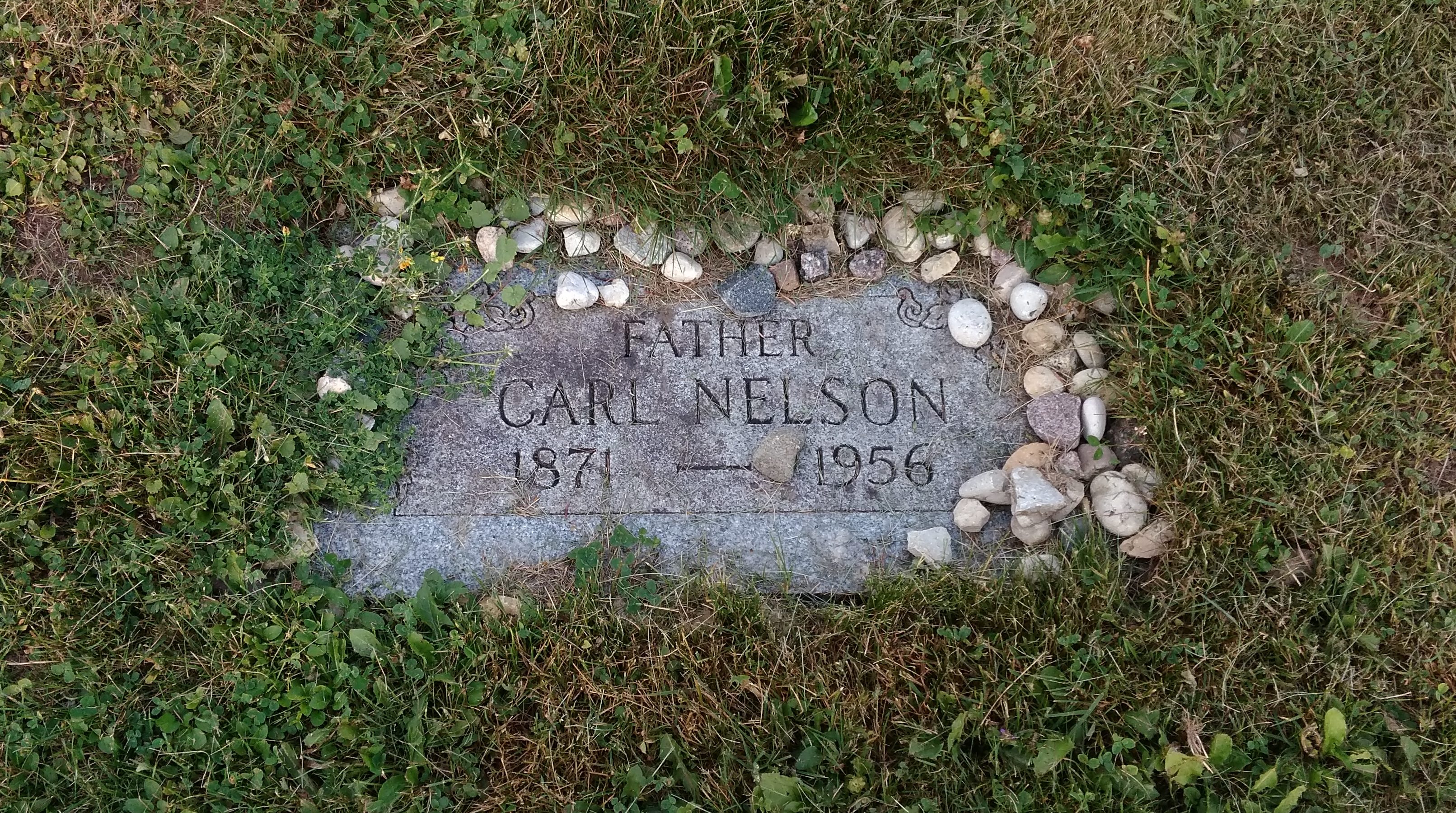
There are slopes, which is characteristic of much of Duluth.Whoever Carl Nelson was, gone these 60-plus years, he still seems to get visitors.
Nearby, Clarence R. Nelson has a fair number of stones as well. His headstone says he was a sergeant in WWII, with the only date given being Oct. 20, 1942, presumably his death.
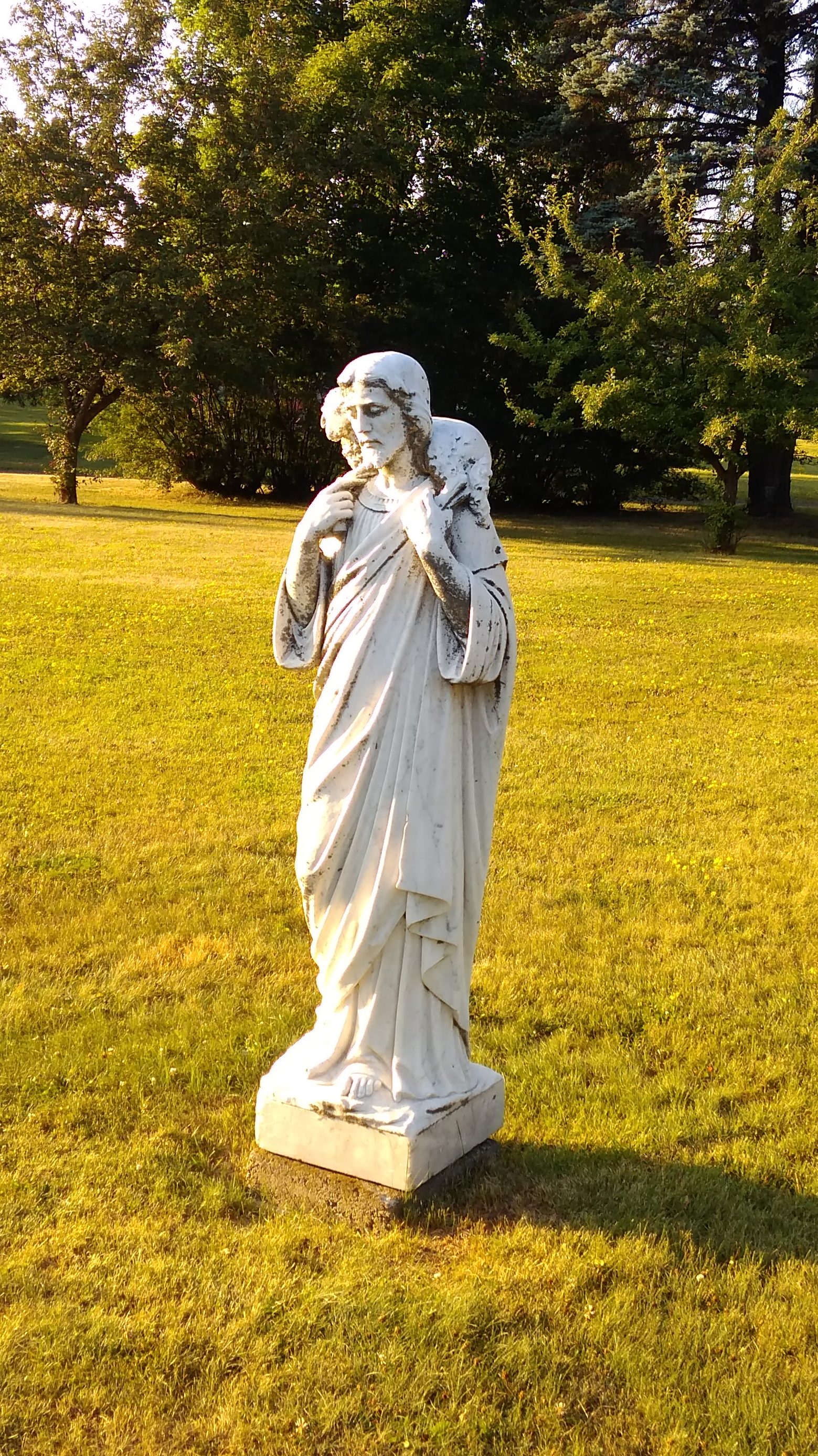
One of the few statues that I saw. A somber Jesus overlooks a melancholy section called Babyland.

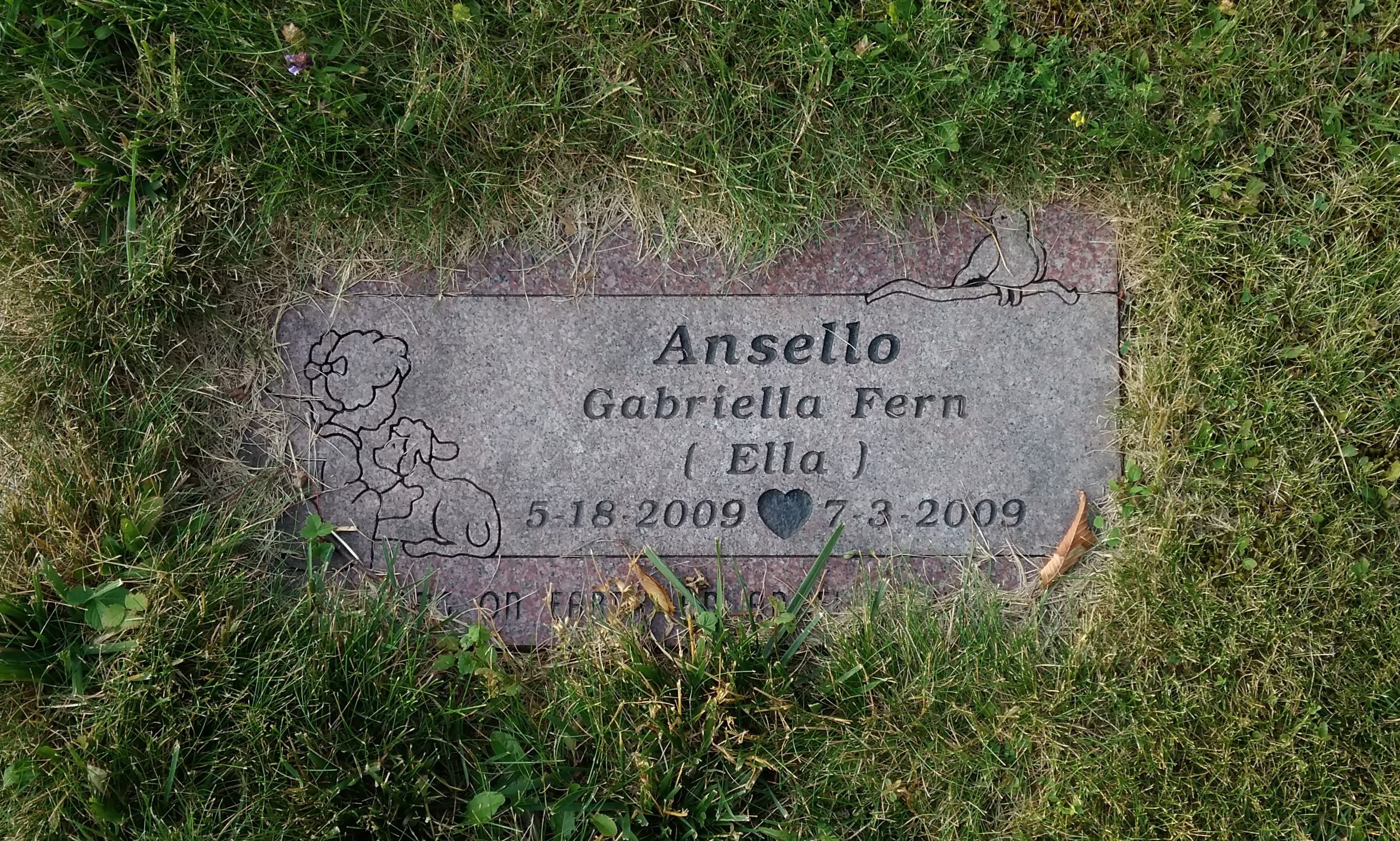
Which includes such residents as baby Ella.
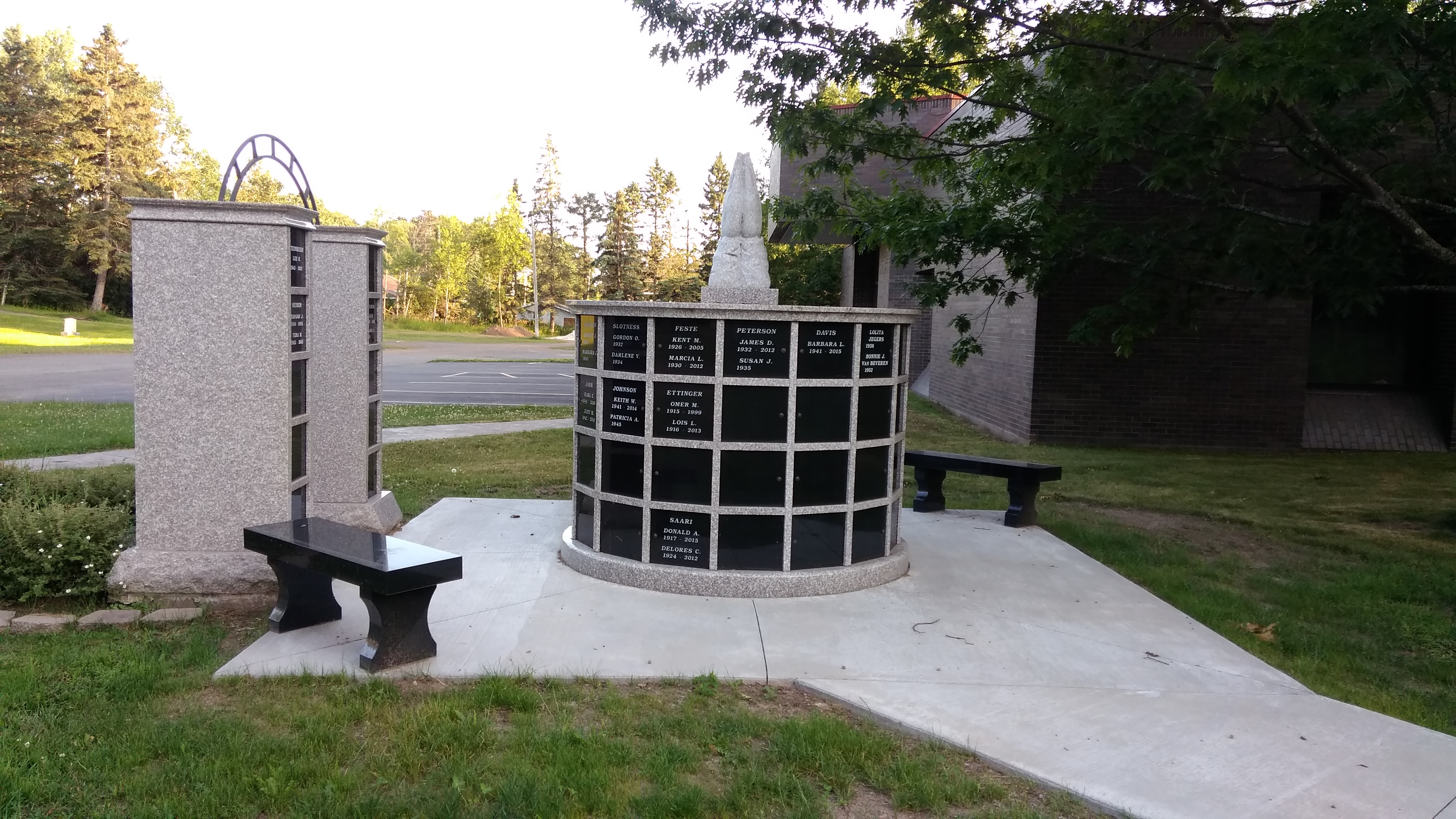
Elsewhere is a small set of columbaria, complete with a small praying hands (diminutive compared to these in Tulsa, which I saw back in ’09).
Not sure I’d want my memorial quite so close to a parking lot. Oddly, a road would be OK, at least a lightly traveled one like in a cemetery. But it’s a matter of de gustibus non est disputandum anyway.

The Great Lakes Aquarium

On the last day of July, we spent a few hours at the Great Lakes Aquarium in Duluth, perched on the lakefront near Canal Park since it opened in 2000. At $17 admission for an adult, I wasn’t entirely persuaded at first that it would be worth it, but eventually I got some satisfaction for that price.

Besides, it’s a deal compared with the Shedd Aquarium, whose rack rate for an adult ticket is a hefty $40, a price devised to sell memberships and gouge one-time visitors from far away — and the reason one puts up with mass crowding on its occasional free days. Then again, the Shedd is a marvel and its collection vast and varied. The Great Lakes Aquarium, while certainly interesting, isn’t quite in the same league.

Maybe that’s because Great Lakes is only part aquarium. It’s also partly children’s museum, and while that might be a fine thing, I’ve seen enough of that kind of edu-tainment until the time comes when I might possibly entertain grandchildren.

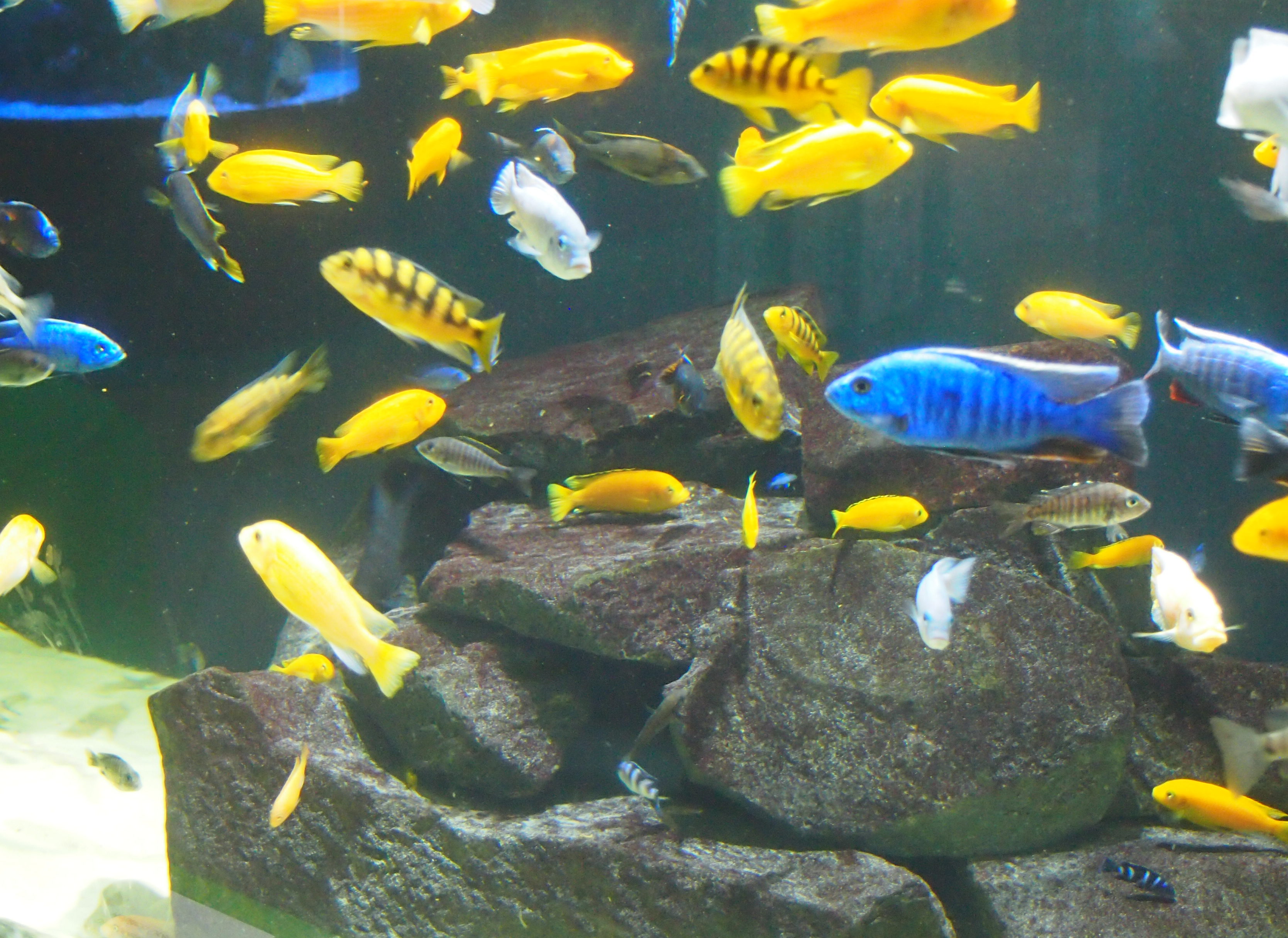
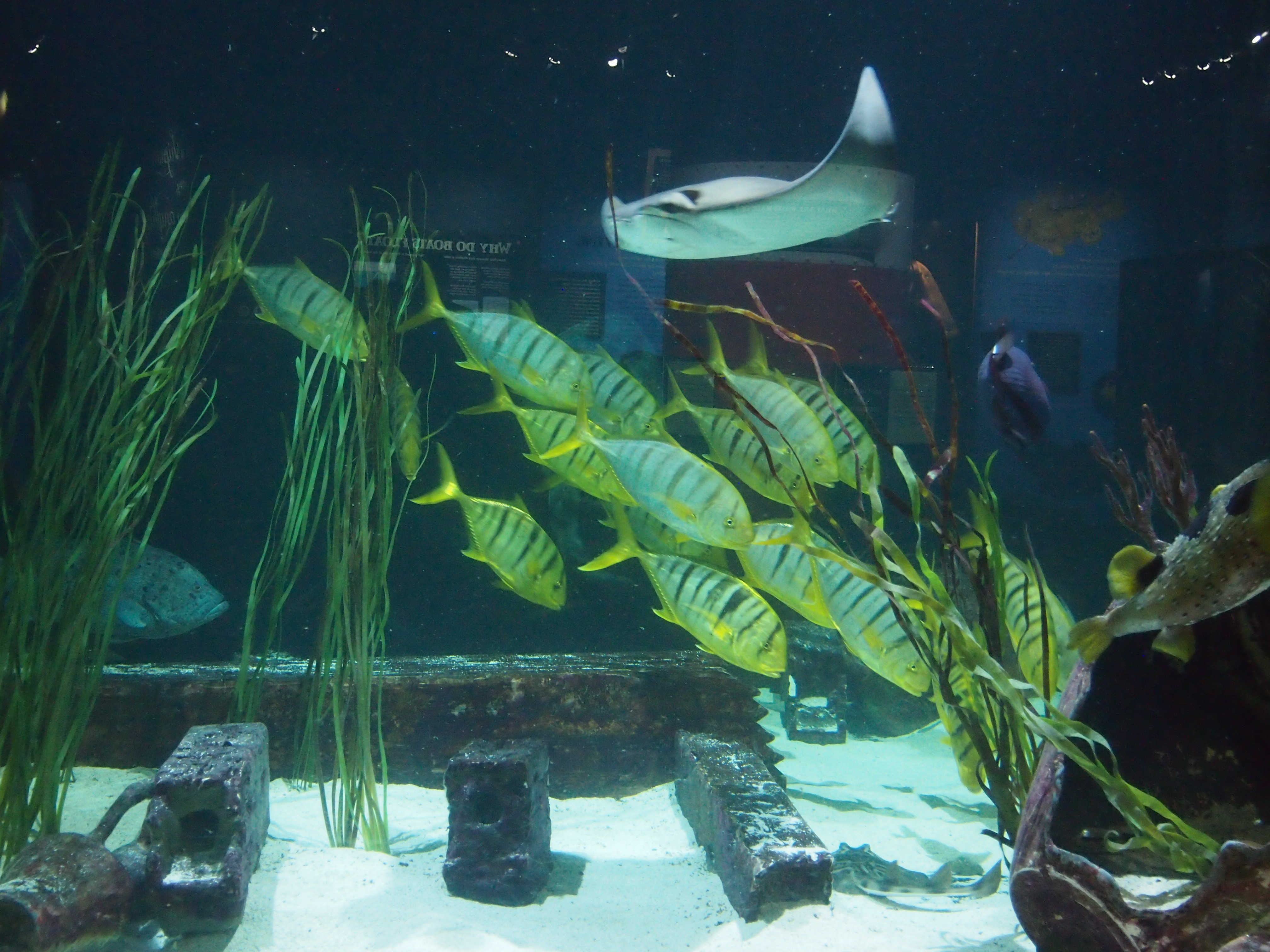
As I said, there was some satisfaction to be had at the Great Lakes. For one thing, it focuses on freshwater creatures, including but not limited to the actual Great Lakes, which is unusual. There’s no lack of tanks and other things to see. The exhibit on Lake Baikal, for instance, was good, and the tanks featuring freshwater tropical fish tended to be colorful.

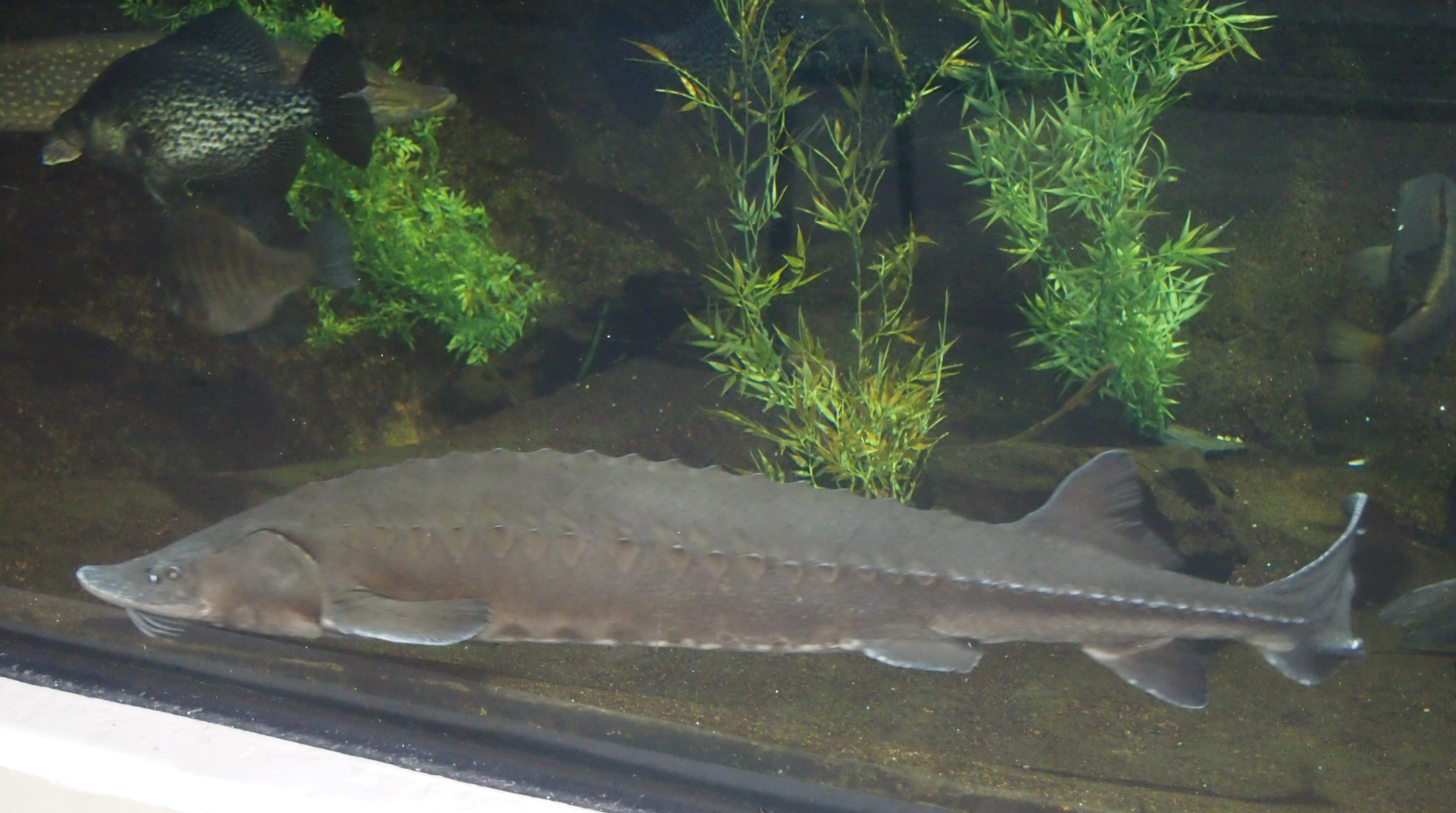
Also on display, a whopping big Lake Sturgeon, which the sign near the tank said can be found in the waters right outside the aquarium.
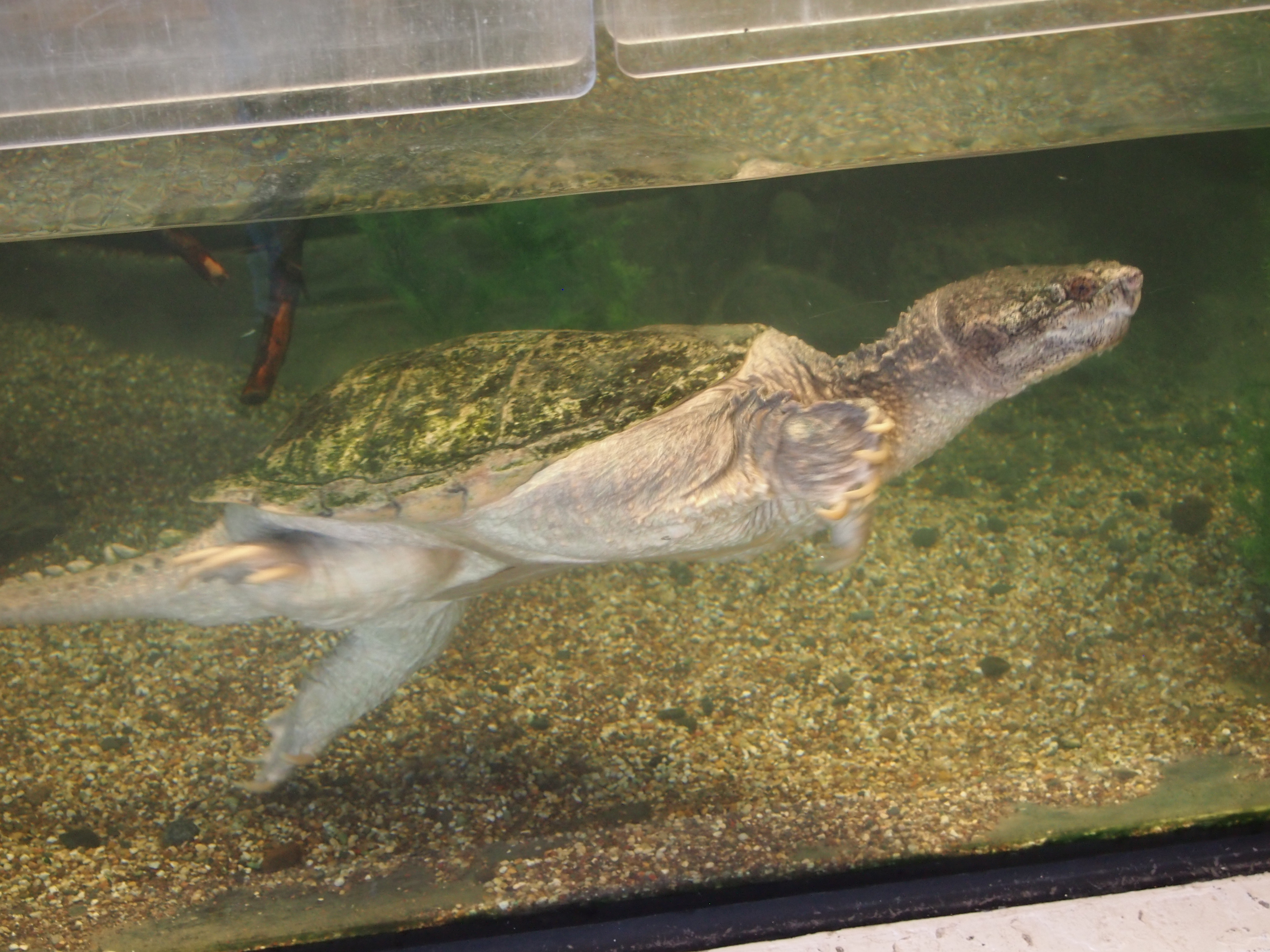
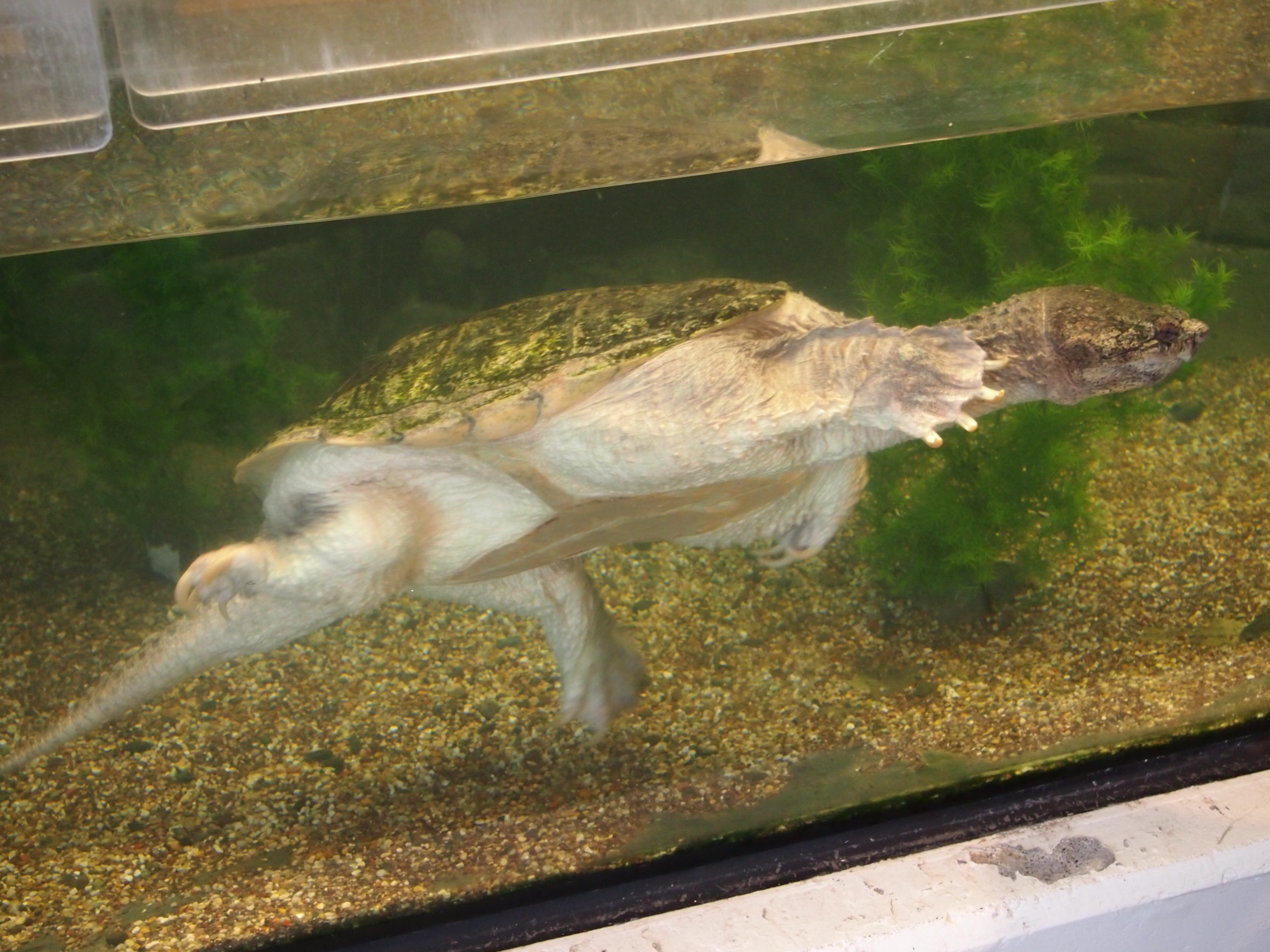
A snapping turtle in motion.
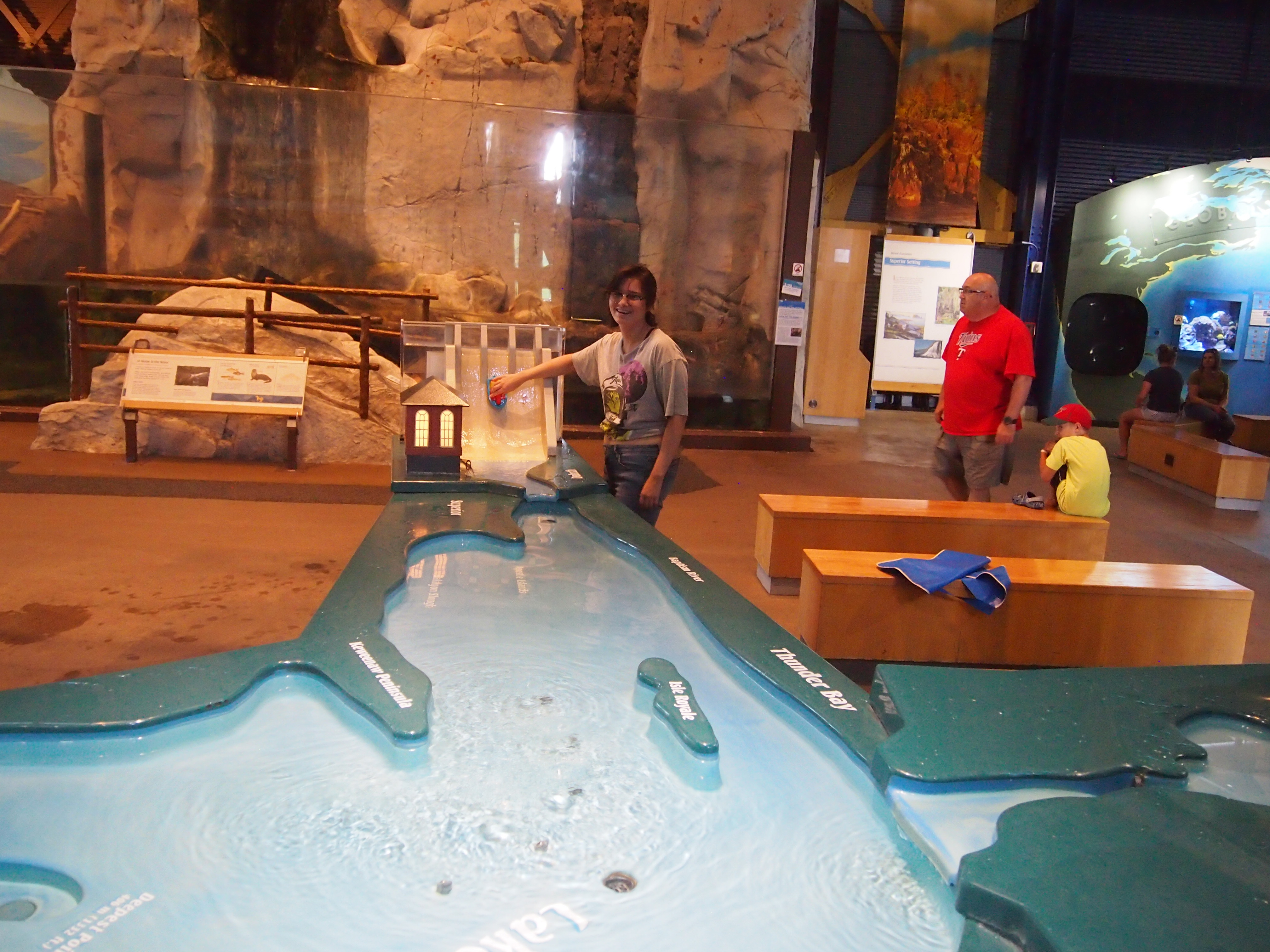
The girls had some fun with the children’s museum elements (and so did I), especially the model Great Lakes, on which you float toy boats and open and close toy locks between some of the lakes, to illustrate their respective elevations.
This was near the tank of river otters, as you’d guess.
One of those things installed purely for entertainment.

Bong!

On the morning of July 31, as the girls slept a little late, I drove from Duluth to Superior, Wis., via the Richard I. Bong Memorial Bridge. It’s a long, not particularly wide bridge over St. Louis Bay, in service since 1985.

Richard Ira Bong, who grew up on a farm near Superior, is credited with shooting down 40 Japanese aircraft as a fighter pilot with the U. S. Army Air Corps, and likely got other kills that weren’t credited. Driving through Superior a few days earlier, I’d noticed the Richard I. Bong Veterans Historical Center on the lake, so after crossing his namesake bridge, I made my way to the Bong Center to take a look.

It’s a small military museum with a strong Bong component, but not entirely devoted to him. Walking in, it’s hard to miss the centerpiece P-38 Lightning fighter plane, the very sort that Maj. Bong flew to such lethal effect on the enemy.

This aircraft isn’t the one Bong flew. While he was stateside, it crashed while another pilot was flying it. The Army took delivery of the one on display in July 1945, after Bong had been ordered to quit flying combat missions. The Richard I. Bong American Legion Post of Poplar, Wis., acquired the plane from the Air Force in 1949, and it was on display in that town for some decades.
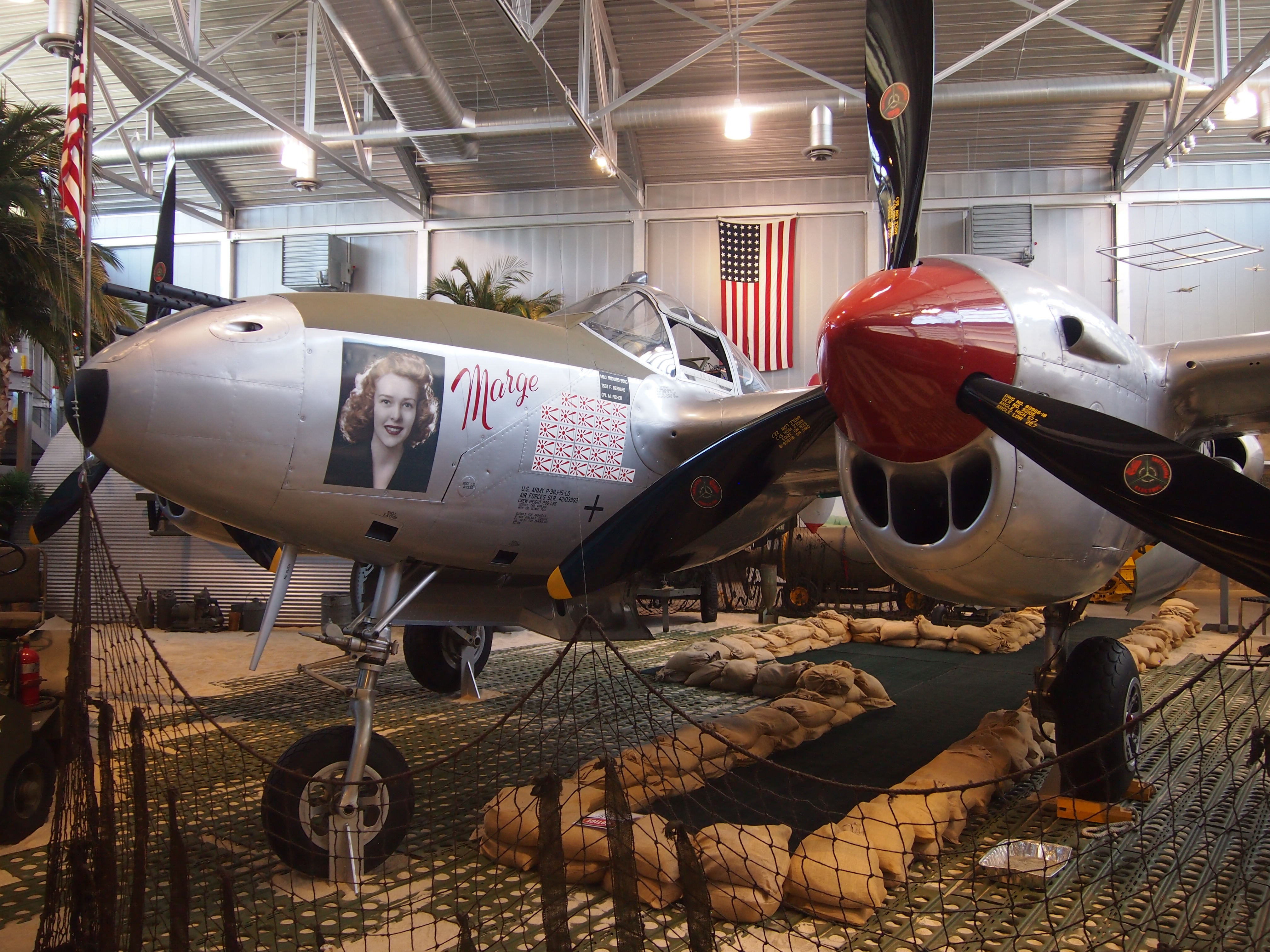
In the 1990s, the plane was restored to resemble Bong’s P-38J “Marge,” complete with his fiance Marge’s portrait on it.

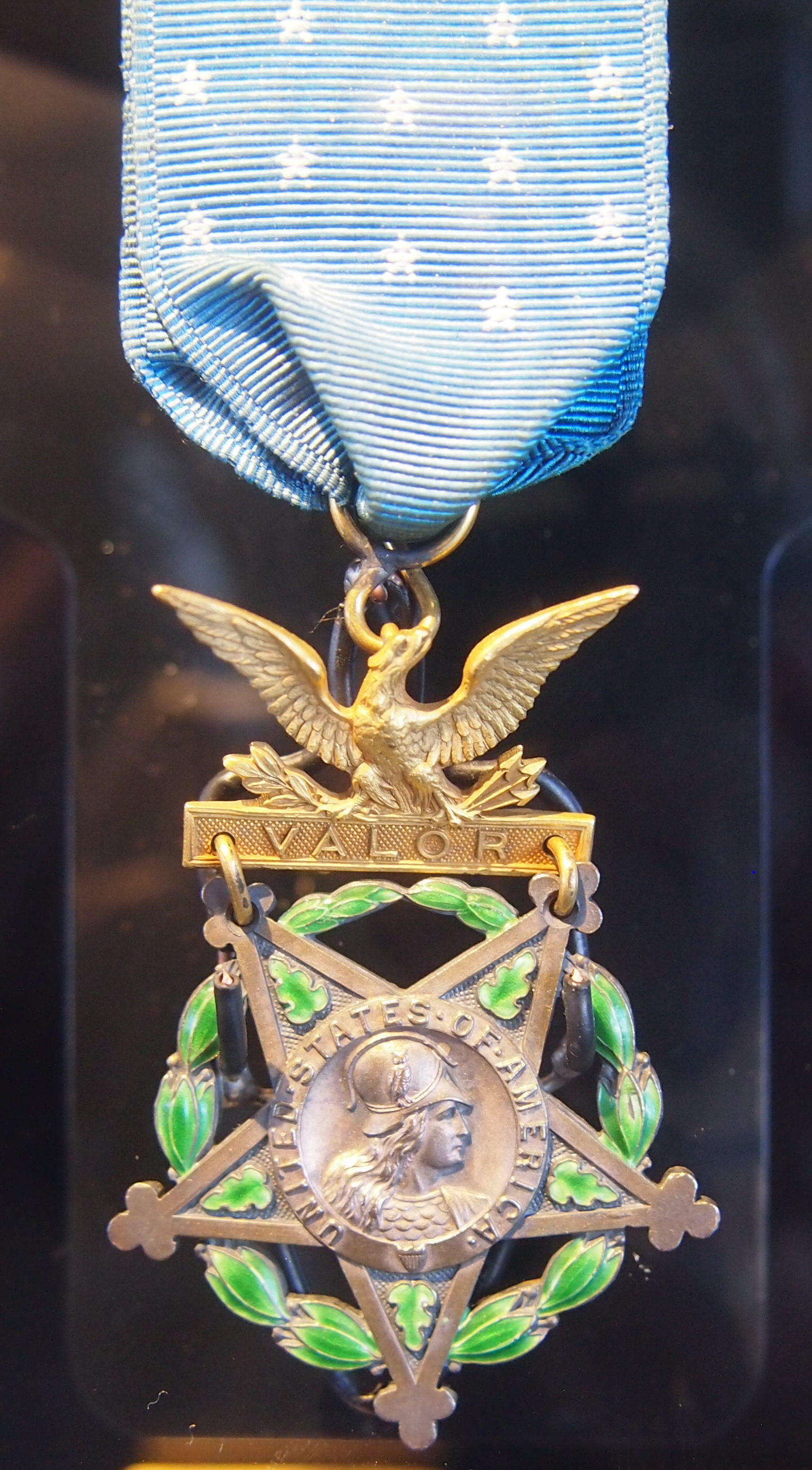
Bong’s Medal of Honor is on display. His citation says: “For conspicuous gallantry and intrepidity in action above and beyond the call of duty in the Southwest Pacific area from 10 October to 15 November 1944.

“Though assigned to duty as gunnery instructor and neither required nor expected to perform combat duty, Maj. Bong voluntarily and at his own urgent request engaged in repeated combat missions, including unusually hazardous sorties over Balikpapan, Borneo, and in the Leyte area of the Philippines. His aggressiveness and daring resulted in his shooting down 8 enemy airplanes during this period.”

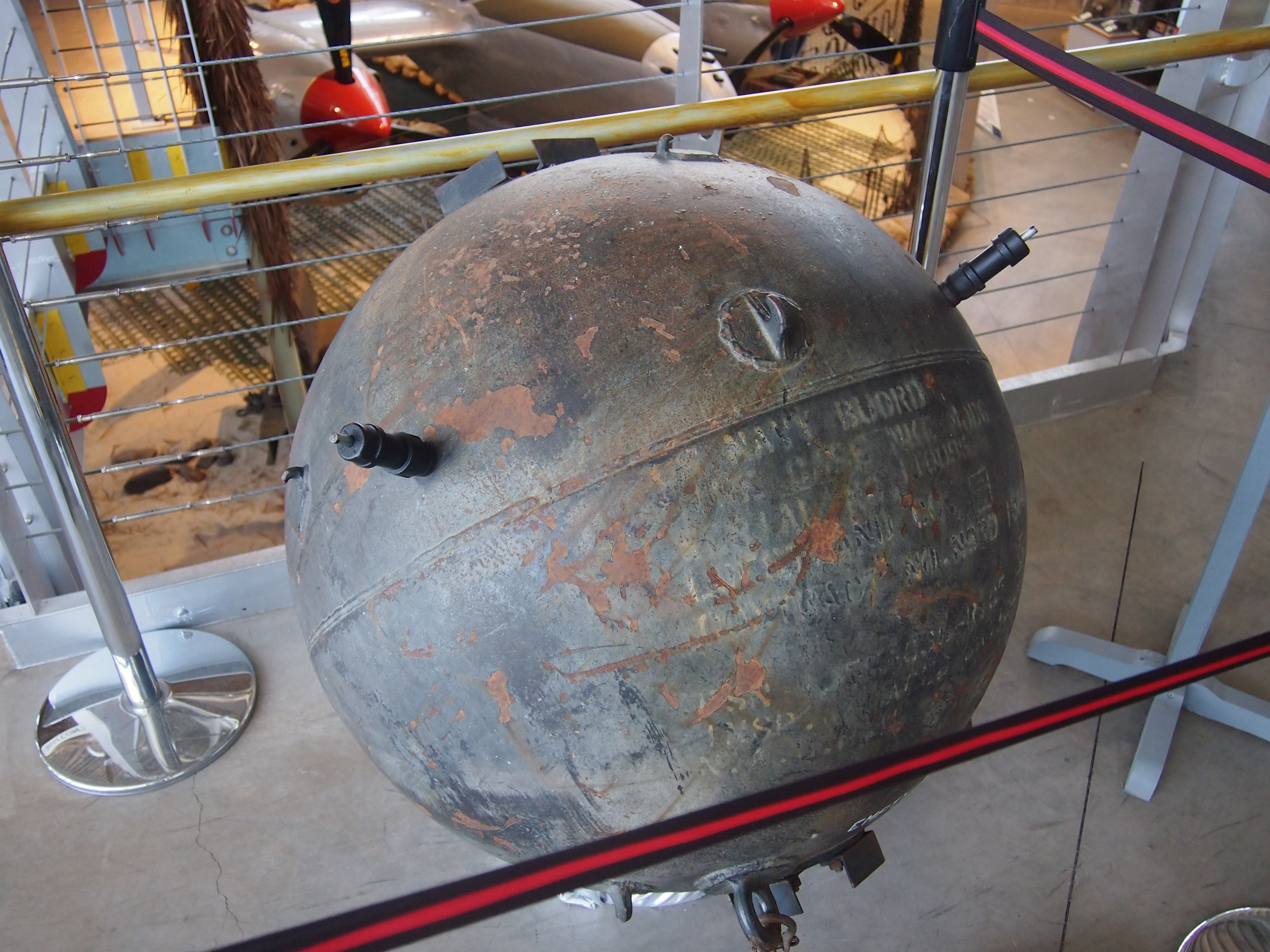
As mentioned, the museum isn’t all about Bong. There’s an assortment of artifacts, such as this magnetic mine.

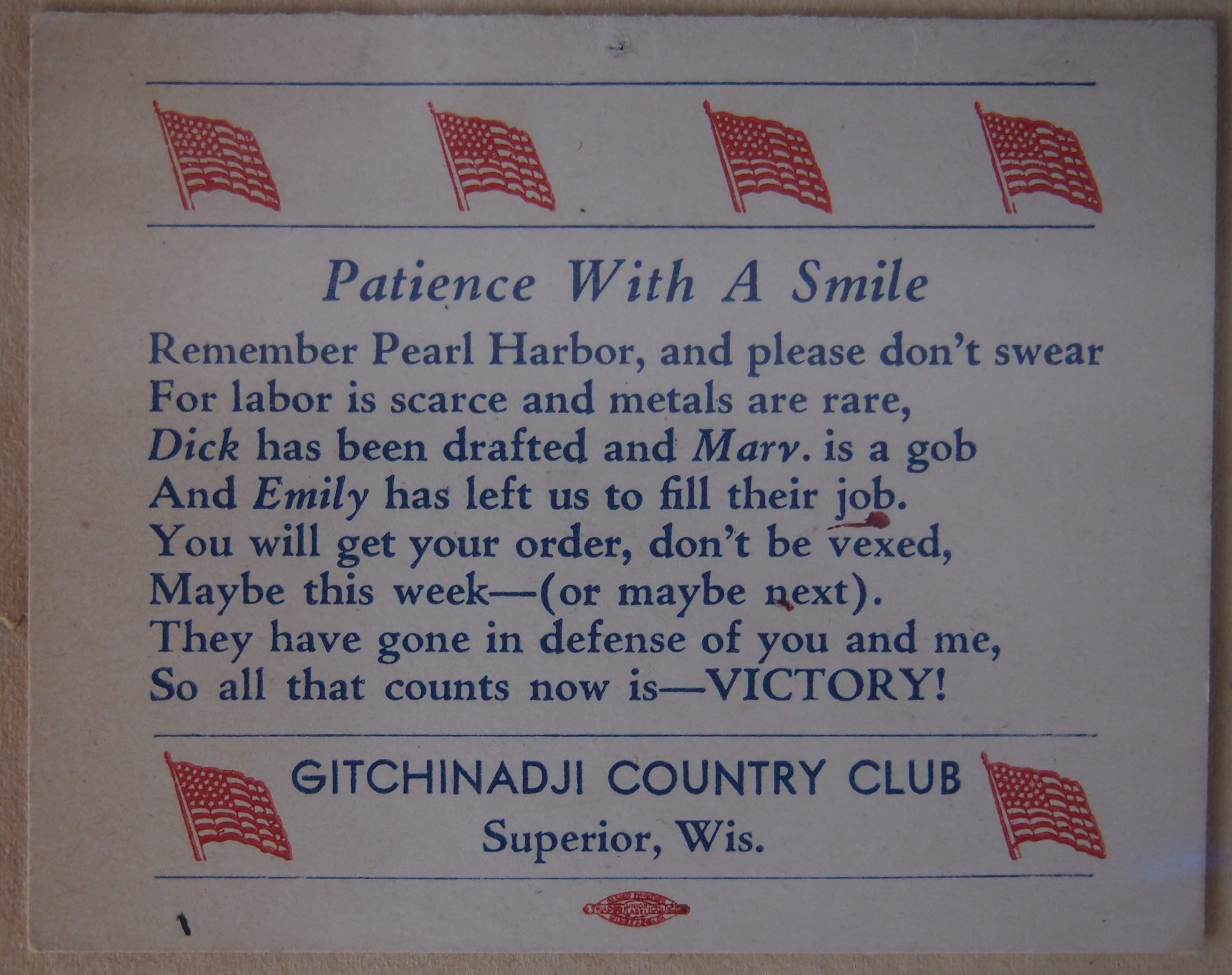
Some home-front ephemera.

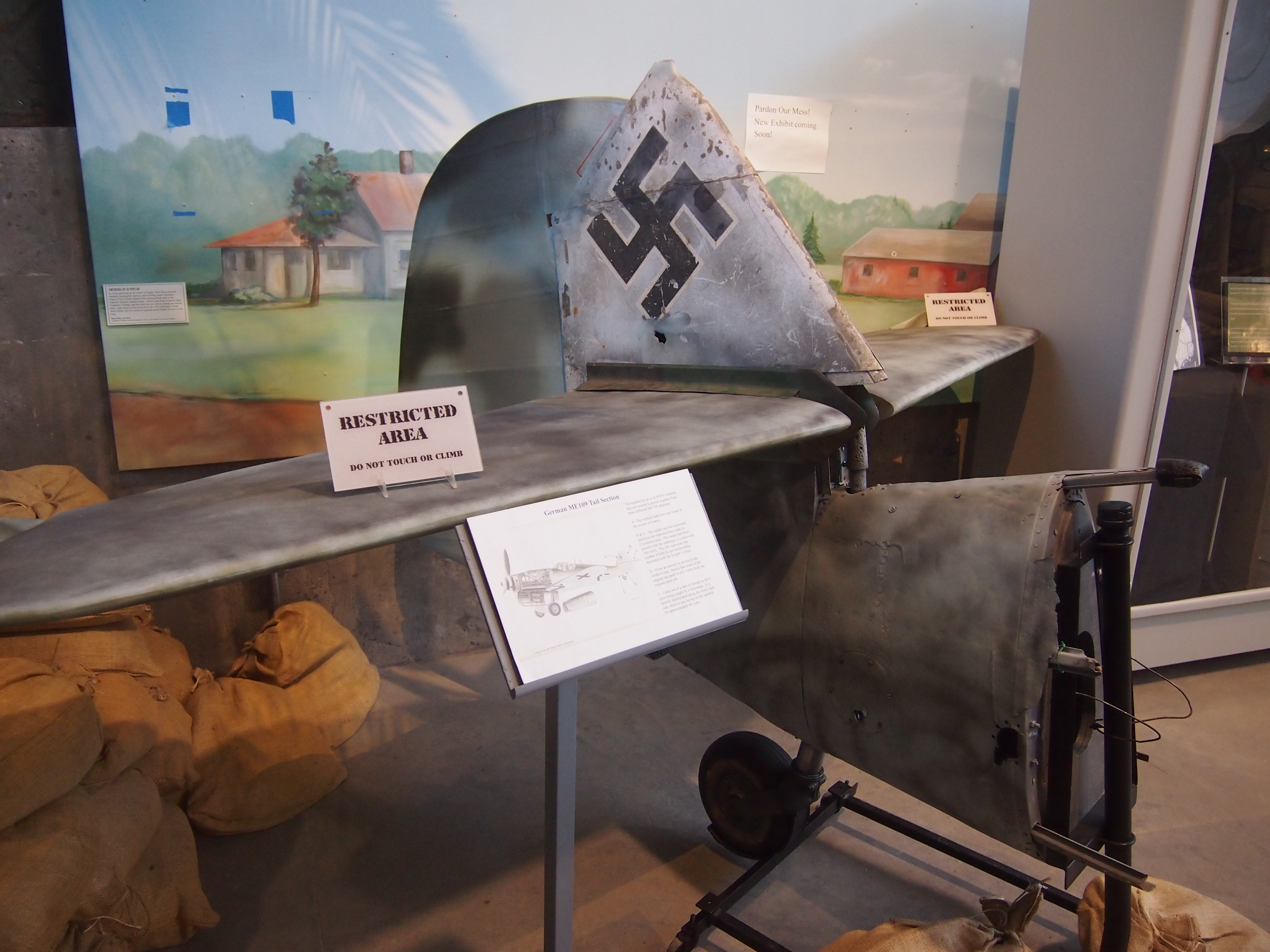
A piece of a Messerschmitt 109.

Bong came home for good in 1945, before the war was over, and did some test piloting of jet aircraft for the Army in California. Being a test pilot turned out to be more dangerous for Bong than facing the Japanese in the Pacific.

His plane crashed in an accident on an otherwise famed date: August 6, 1945. He and Marge had only been married a short while (she died in 2003, after playing an important part in establishing the museum).