CineFix

I was able to eat lunch on my deck on yesterday, and sit there and read after I mowed the lawn. There’s some chance those things might not be possible again until some unexpectedly warm day in March. Or there could be a string of dry, warm days throughout this month. You never know with October.

CineFix does a nice job on YouTube of the usually vapid format “Best 10” lists about movies, certainly a lot better than the dimwitted WatchMojo, though it does use the annoying construction “Best X or Most Y of All Time.” That’s always bothered the nitpicking editor that I am. It should be the “Best X or Most Y So Far.”

Still, the production team behind CineFix, whoever they are, clearly knows a good deal about cinema, and they write well about it. The lists are organized not so much as a countdown, but as a collection of movies that share certain characteristics (more or less). For instance, Movie Villains includes outright evil characters, likable bad guys, repulsive villains, amoral killers and so on. Each of these subcategories is illustrated with a handful of movies, with one ultimately picked to illustrate the point best, in the opinion of CineFix.

Though the majority of the picks are English-language movies, as befitting the audience, CineFix isn’t afraid to praise movies with (gasp) subtitles, old movies, even silents, or black-and-white movies. I’ve never understood the prejudice against any of those kinds of movies. Quite a few of all them are included in the videos. As illustrated by Character Arcs or Rule-Breaking Movies or Most Beautiful Animation.

Best of all, I’ve come away from some of the lists wanting to watch some of the movies mentioned. Some I’ve heard of, a number I knew nothing about before. Not a bad use of YouTube at all.

The Surviving Kankakee Gazebo

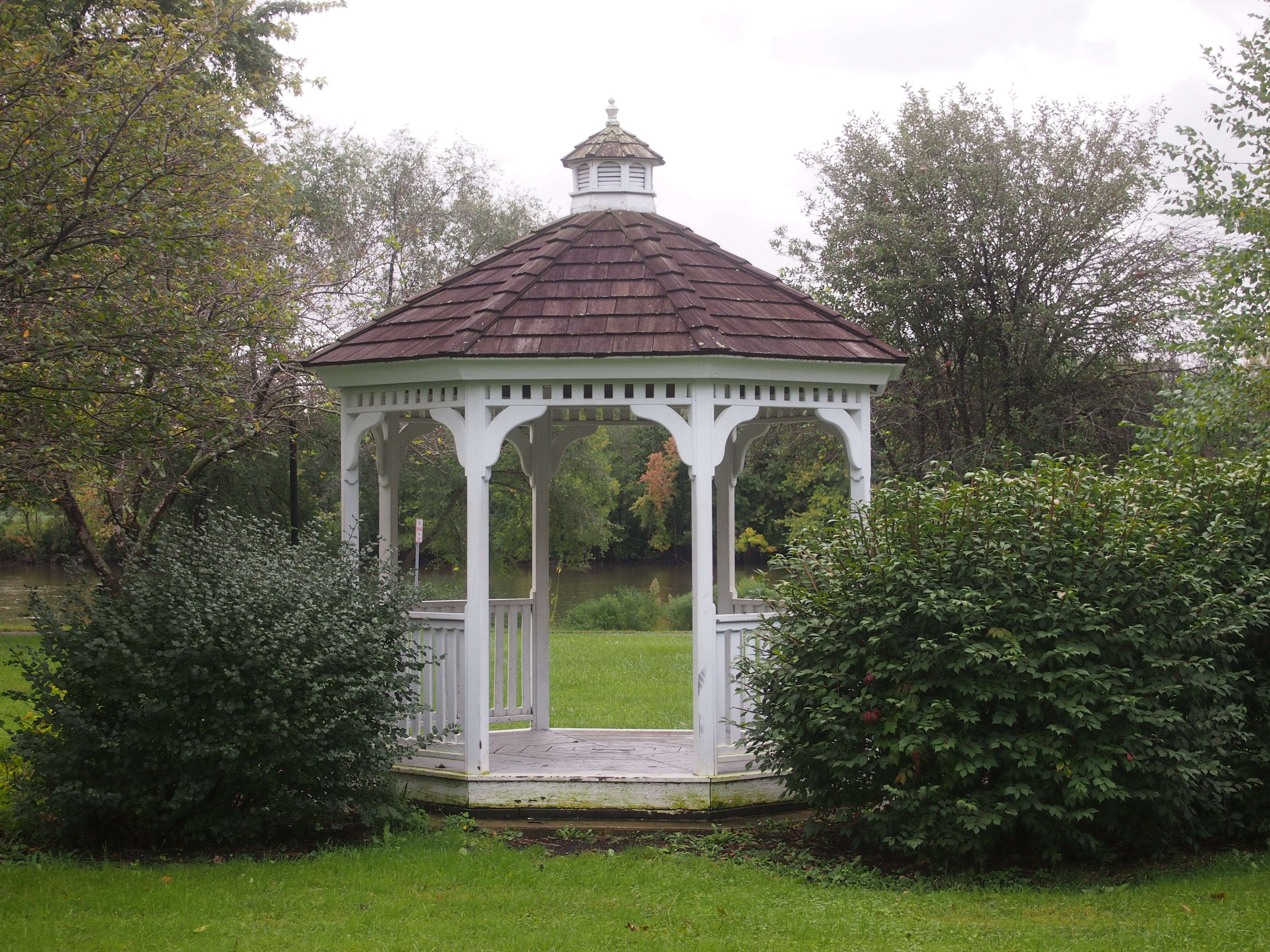
One more thing about Kankakee: there’s only one surviving gazebo of the two that David Letterman gave the city. Of course I had to see that.

Kankakee Dave Letterman Gazebo, Cobb Park

It’s in Cobb Park, near the Kankakee River. Not the most impressive of structures, even among gazebos (this one’s better). It’s like something someone would buy at a DIY store and put in his back yard.

But that’s not so important. A sign inside the gazebo says, “this is one of the world famous [sic] gazebos as seen on the Late Show with Dave Letterman. Presented to Kankakee on air in 1999, in a spoof to nickname the city: “Home of the Twin Gazebos.” In 2015, the City of Kankakee returned their [sic] gazebo on air to Dave Letterman in the form of a rocking chair.”

Needed an editor, that sign. It meant that the city, at the suggestion of Kankakee high school students, tore down one of the two gazebos and used some of the wood to build a rocking chair for Letterman (to remind him of his retirement?). The other one still stands, or at least it did as of October 1, 2016, when I got out of my car — Yuriko wasn’t interested, and waited in the car — and crossed Cobb Park to see it. More detail is in the Chicago Tribune.

I vaguely remember Letterman making fun of Kankakee (“puts the ill in Illinois” and “puts the annoy in Illinois”) after the city ranked last in some places-to-live article. Giving the city a couple of gazebos was a Lettermanesque extension of the gag, I guess. Also, it doesn’t hurt that “gazebo” is simply a fun word to say.

The B. Harley Bradley House

I wondered recently, when did I first hear about the small Illinois city — or maybe the large Illinois town — of Kankakee? (Pop. 27,000 or so.) Not a very urgent question, since there’s usually no reason to remember when you first heard of most places — and no way you can remember. With a few exceptions in my case, such as Stevens Point, Wis., which I never heard of till Mu Alpha Theta held its national meeting there in 1978, which I attended.

Even so, I’ll bet I heard of Kankakee because it was in the lyrics of “The City of New Orleans” in the early ’70s, so artfully written by Steve Goodman, so memorably sung by Arlo Guthrie. “Kankakee” makes a clever rhyme with “odyssey.”

All along the southbound odyssey
The train pulls out at Kankakee
And rolls along past houses, farms and fields.
Passing trains that have no names
And freight yards full of old black men
And the graveyards of the rusted automobile.

A lot of people could probably say that’s where they heard about Kankakee. Even some Germans. Years ago, my friend Rich played a German-language version of the song for me. Apparently it too was popular. In our time, those lyrics are easy to look up.

Auf seiner Odyssee nach Süden passiert der Zug Kankakee,
rollt an Häusern, Farmen und Feldern vorbei,
passiert andere namenlosen Züge,
Abstellplätze voller alter farbiger Männer
und verrostete Autofriedhöfe.

More recently, the Bradley House in Kankakee came to our attention. In full, the B. Harley Bradley House, vintage 1900.
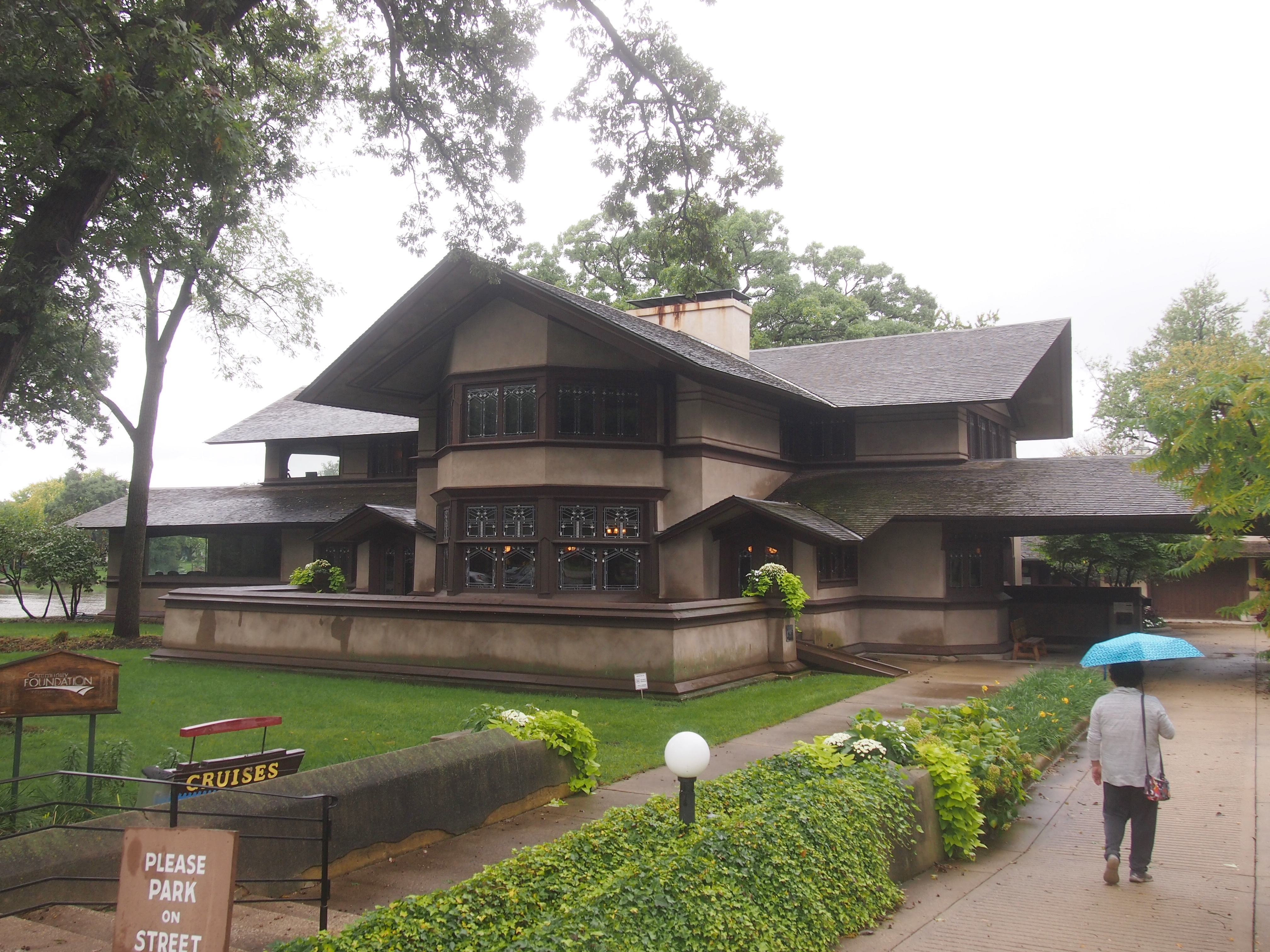
The B. Harley Bradley HouseIt doesn’t take too much looking to see that Frank Lloyd Wright did the house. One of the first ones — the docent claimed the first one, others claim differently — done in his distinctive Prairie School. I can’t comment authoritatively which was first, and I don’t really care, but even so the house was interesting enough for a day trip.
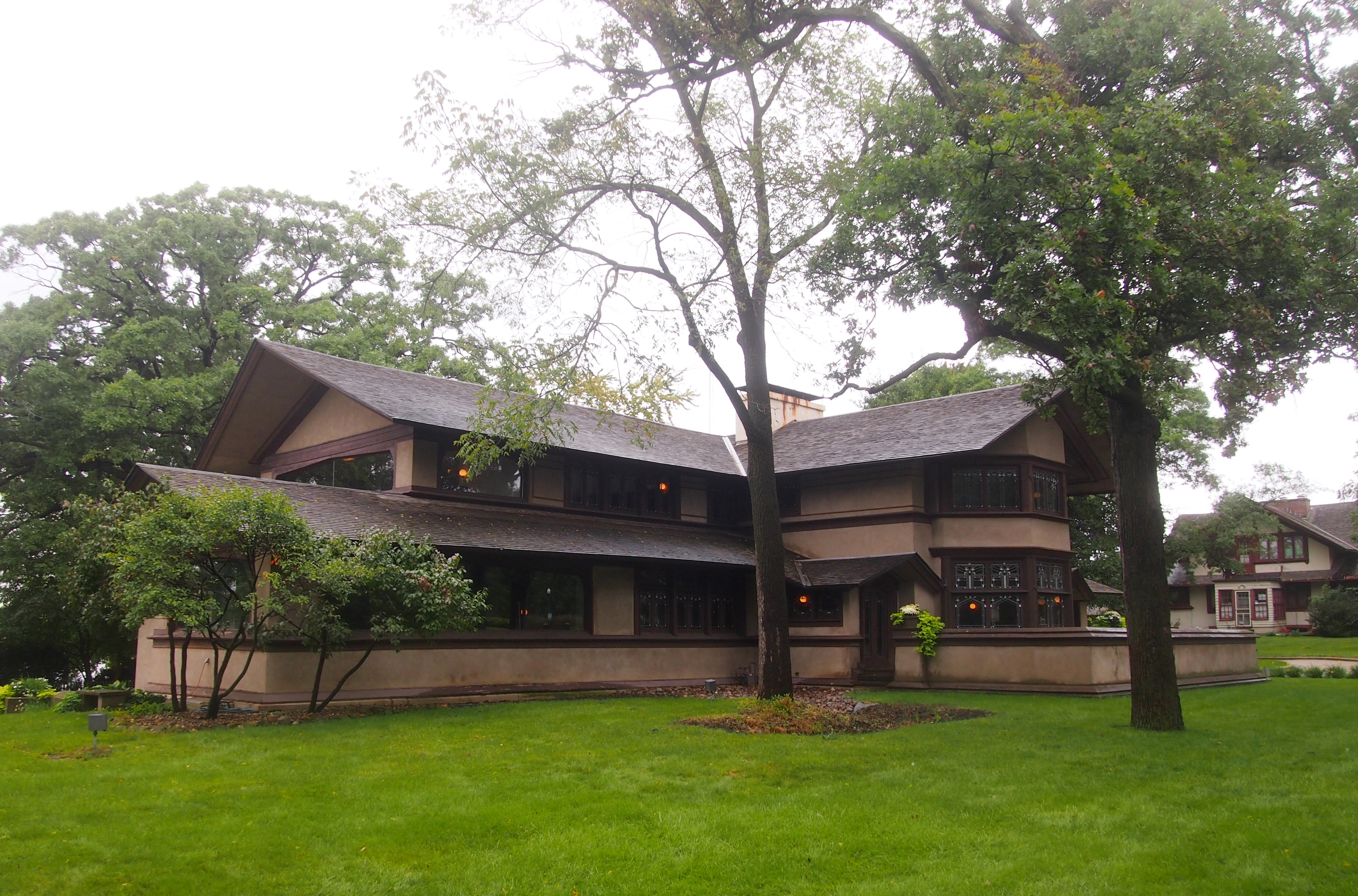
The B. Harley Bradley HouseThe house, and the one next to it — the Warren Hickox House (behind it in the pic above), another Wright design that’s still a private residence — are in the the western edge of the town’s Riverview Historic District. The neighborhood features large old houses in various states of repair, but no others like these two.

The Bradley House is also close to the Kankakee River.
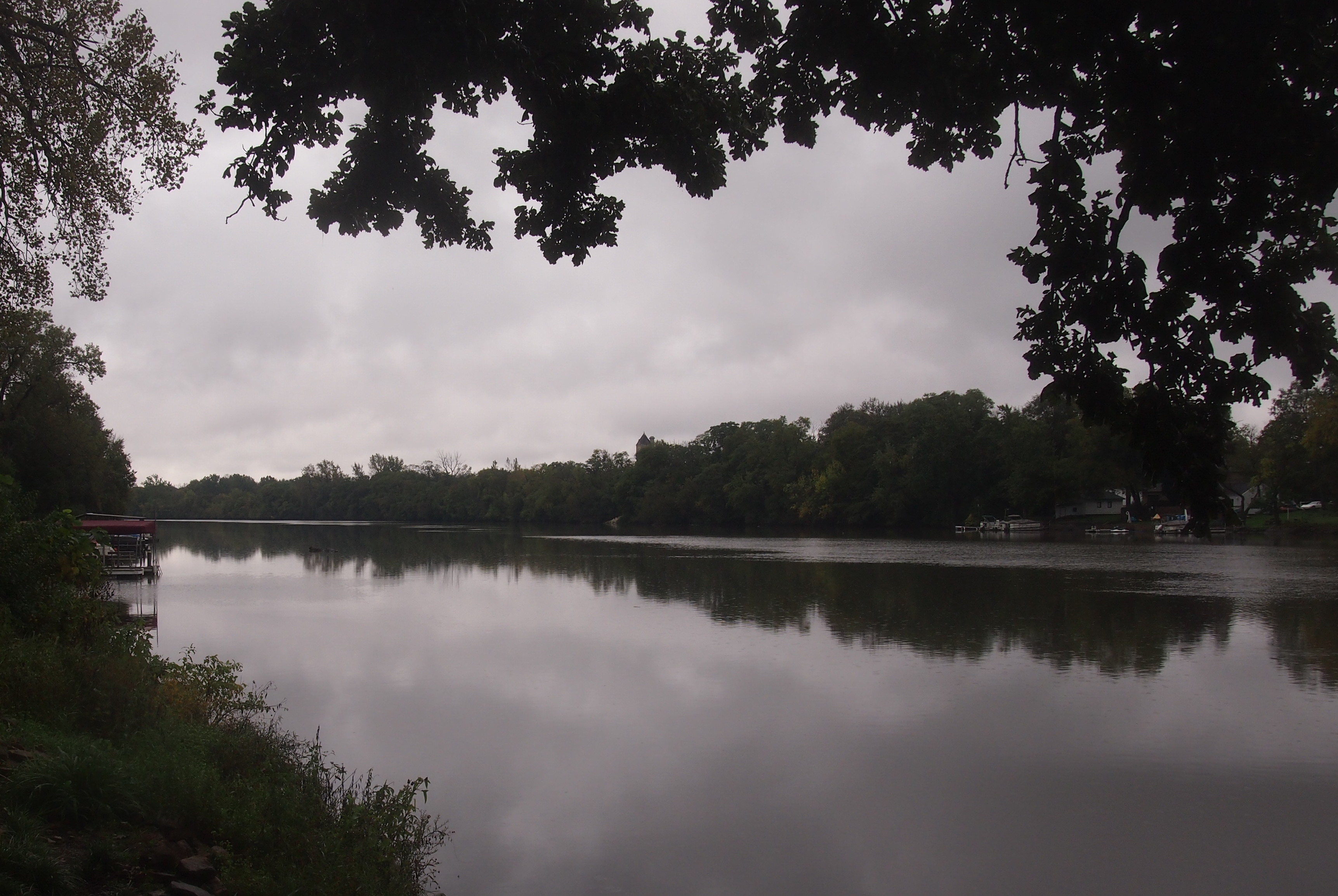
Kankakee RiverDuring the tour, I asked the docent whether flooding had ever been an issue — as it has with the Farnsworth House — but apparently the Kankakee isn’t as testy as the Fox River, at least at that place.

The house has had a long string of owners over the last century-plus. Within living memory, for instance, it was a well-known local restaurant, The Yesteryear. For a considerable time in the early to mid-20th century, a wealthy man named Joseph H. Dodson owned the place. He was a bird lover and used the house’s stable, which is now the gift shop, as a bird house factory. It seems that Dodson bird houses were quite an item at one time.

Then there’s the sad story of Stephen B. Small. Another wealthy Kankakee resident, he acquired the property in the mid-80s and set about to restore it. That came to a halt in 1987 when he was kidnapped and buried in a box whose air tube wasn’t large enough to supply him enough air, and so he died (both kidnappers are still in the jug).

More recently, through various twists and turns, the house came to be owned by a nonprofit that’s aiming to pay down its mortgage. Our little part in that was paying for the tour, along with buying a postcard an a refrigerator magnet.

I did not, however, want to pay $5 to take interior pictures, which wouldn’t have turned out all that well anyway. The interior restoration, completed only in 2010, restored the place to its 1901 appearance. A nice bit of work: long halls, spacious rooms (except for the servants’ quarters), wooden floors, art glass in the windows, and the kind of alcoves and recesses and the like you associate with Wright, though few low ceilings. Guess this was before, as The Genius, he could insist on ceilings fit only for short people.
Kankakee Walkabout

For no charge, the Kankakee County Convention & Visitors Bureau will send you a 24-page booklet (six forms of four pages each) called “Historic Churches of the Kankakee Area Self-Guided Walking and Driving Tour.” It’s a high-quality, full-color bit of work, with some text, a few maps and a lot of interior and exterior pictures of Kankakee-area churches, such as Asbury United Methodist, Wildwood Church of the Nazarene, First Presbyterian, St. Paul’s Episcopal, and others.

There’s also a few interesting historical tidbits about some of the buildings. This is my favorite, about St. Paul’s: “Divine intervention spared the stained glass windows during two great hail storms in 1932 and 1982.”

The churches weren’t the only reason we went to Kankakee on Saturday, braving intermittent rain, but as long as we were going to be in the area, I wanted a look. Ideally, a look inside a few of the churches, including divinely protected stained glass, but I suspected that would be impossible. We went to four of them, all in walking distance of the Kankakee County Courthouse, and none were open.

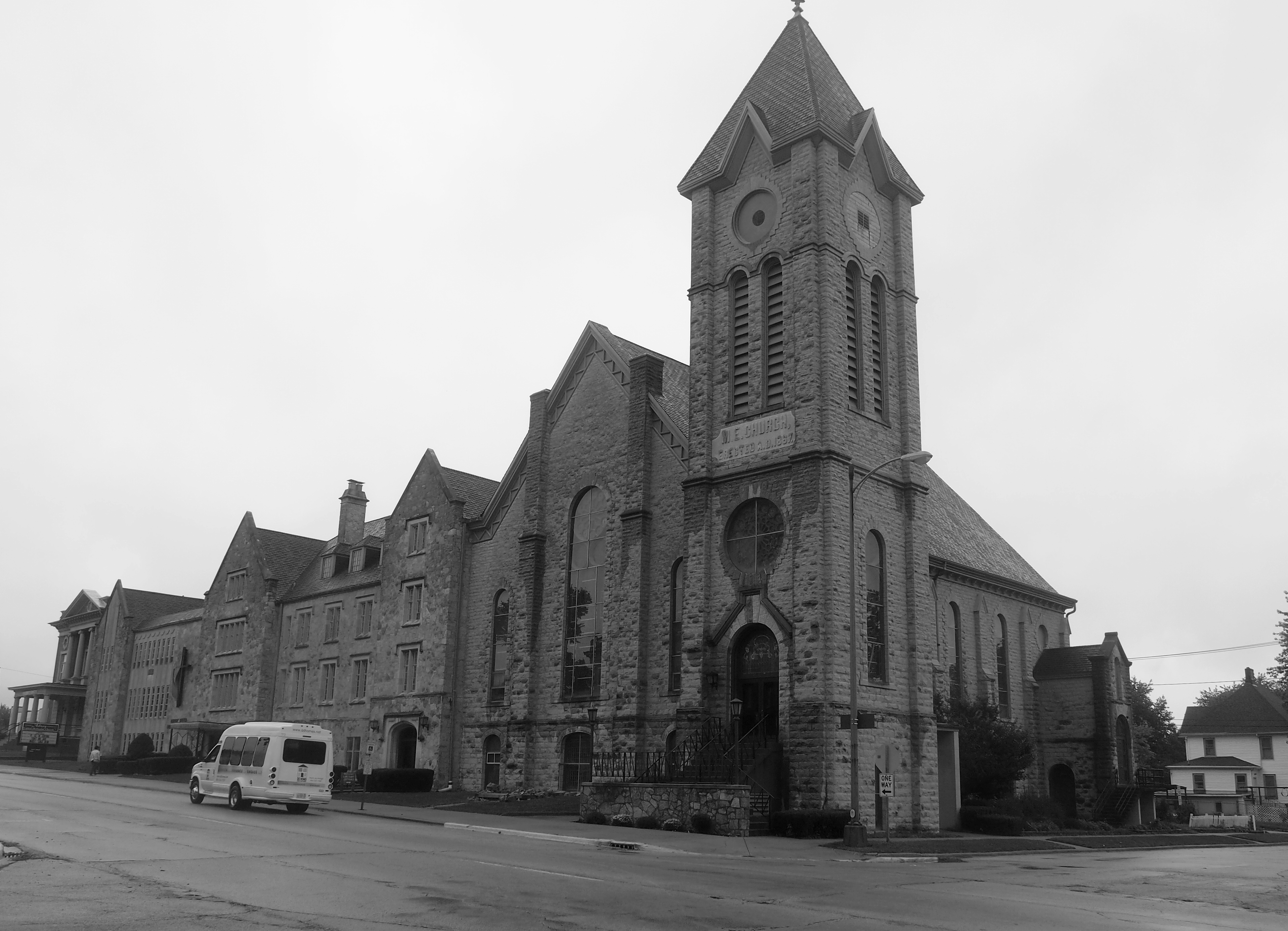
I understand the reasons. Things would go missing if they didn’t lock up most of the time. Still, it was irritating. We did get a look at the outsides, some of which are impressive enough, such as Ashbury United Methodist, which dates from 1868.

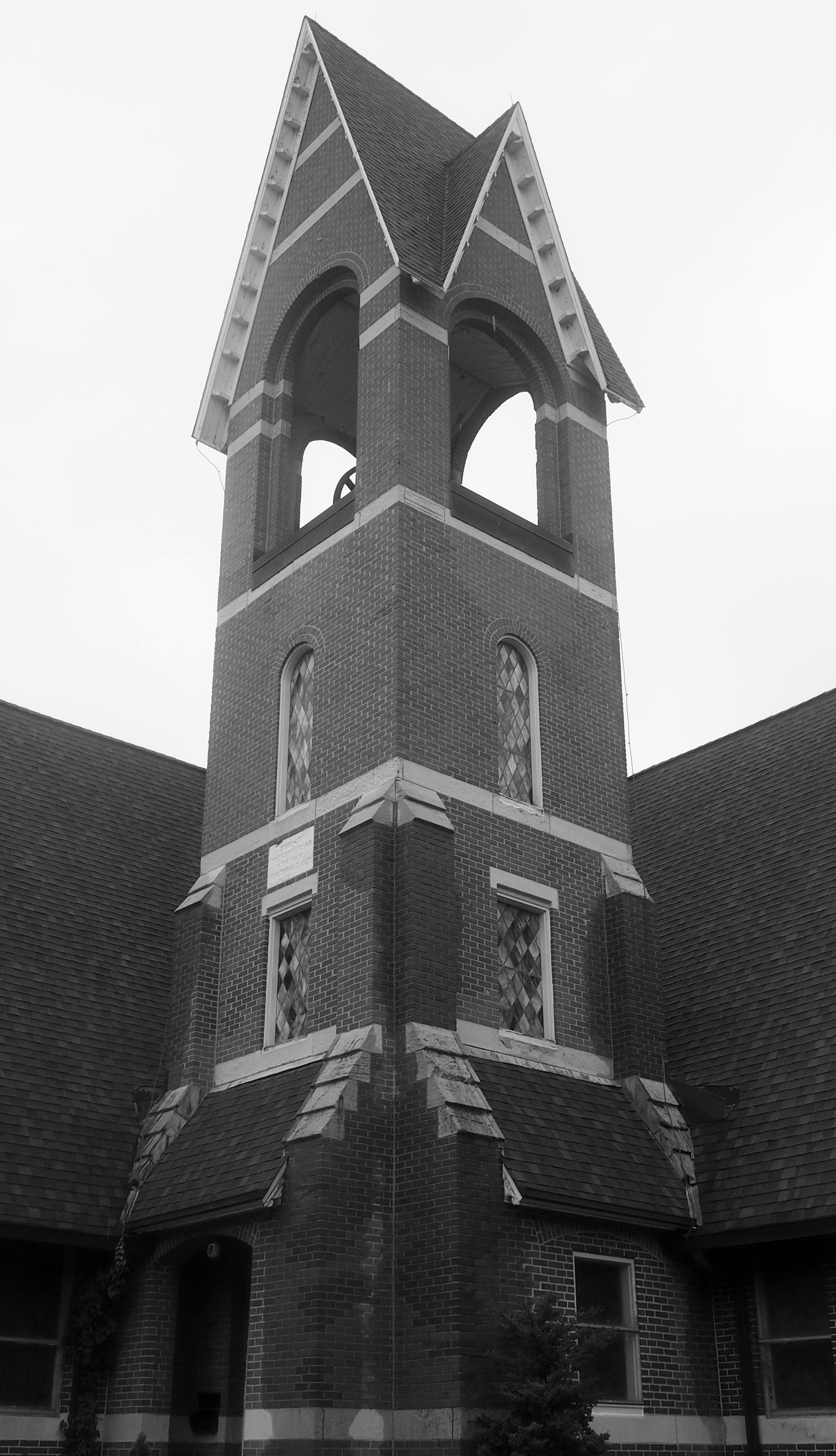
Ashbury United Methodist, Kankakee 2016I liked the bell tower of First Presbyterian, vintage 1855. According to the booklet, its 2000-lb. bell is rung by hand on Sundays.
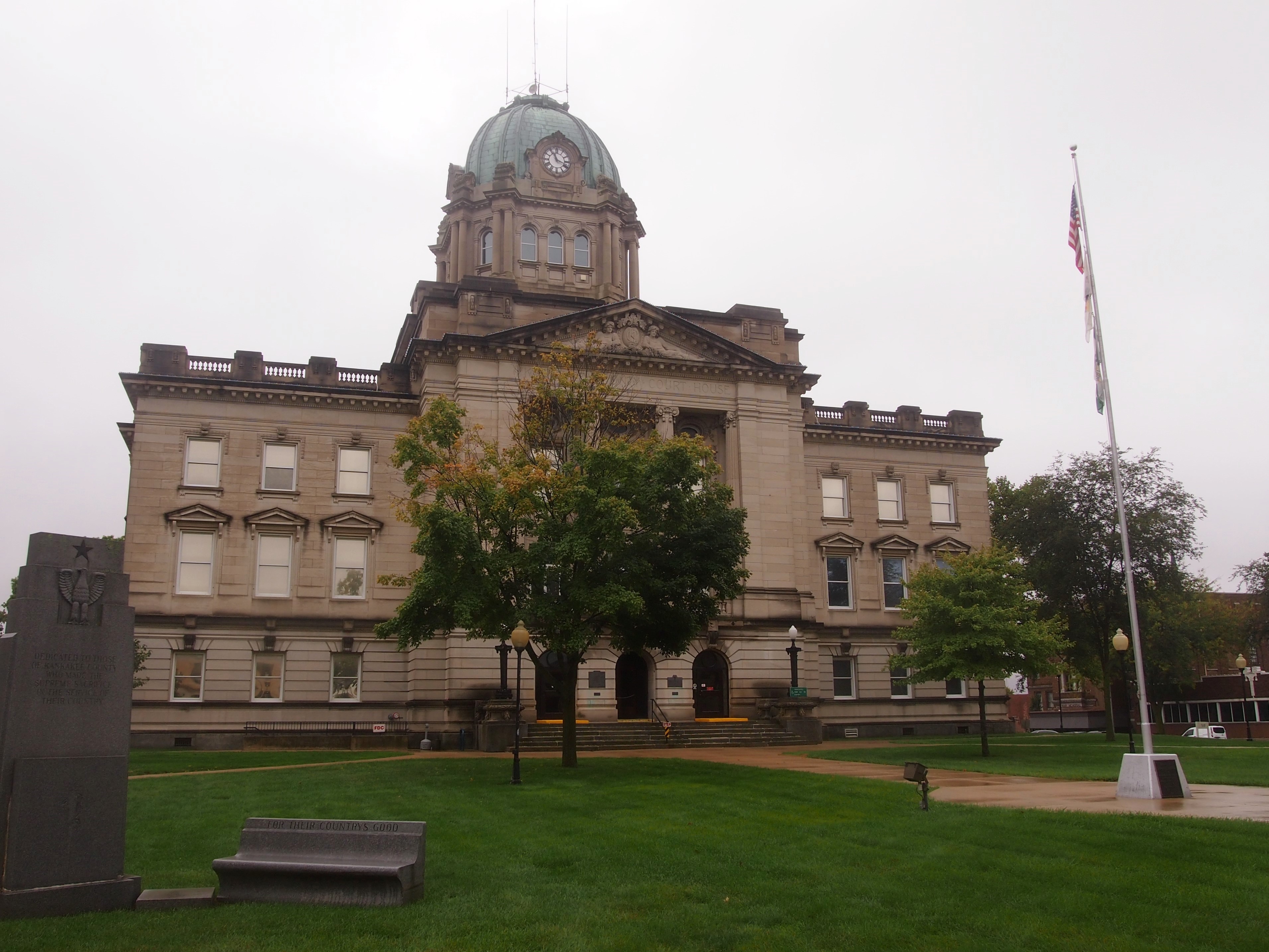
First Presbyterian Church of Kankakee 2016Churches weren’t the only buildings of note. This is the Kankakee County Courthouse, standing on this site since 1912.
Kankakee County Courthouse 2016The architect who designed it, Zachary Taylor Davis, ought to be better known in Chicago, considering that he also did the original Comiskey Park (gone) and the still-beloved and still-standing Wrigley Field. It should also be remembered that lunch-counter baron Charlie Weeghman commissioned that ball park for his team, the Chicago Whales of the Federal League.

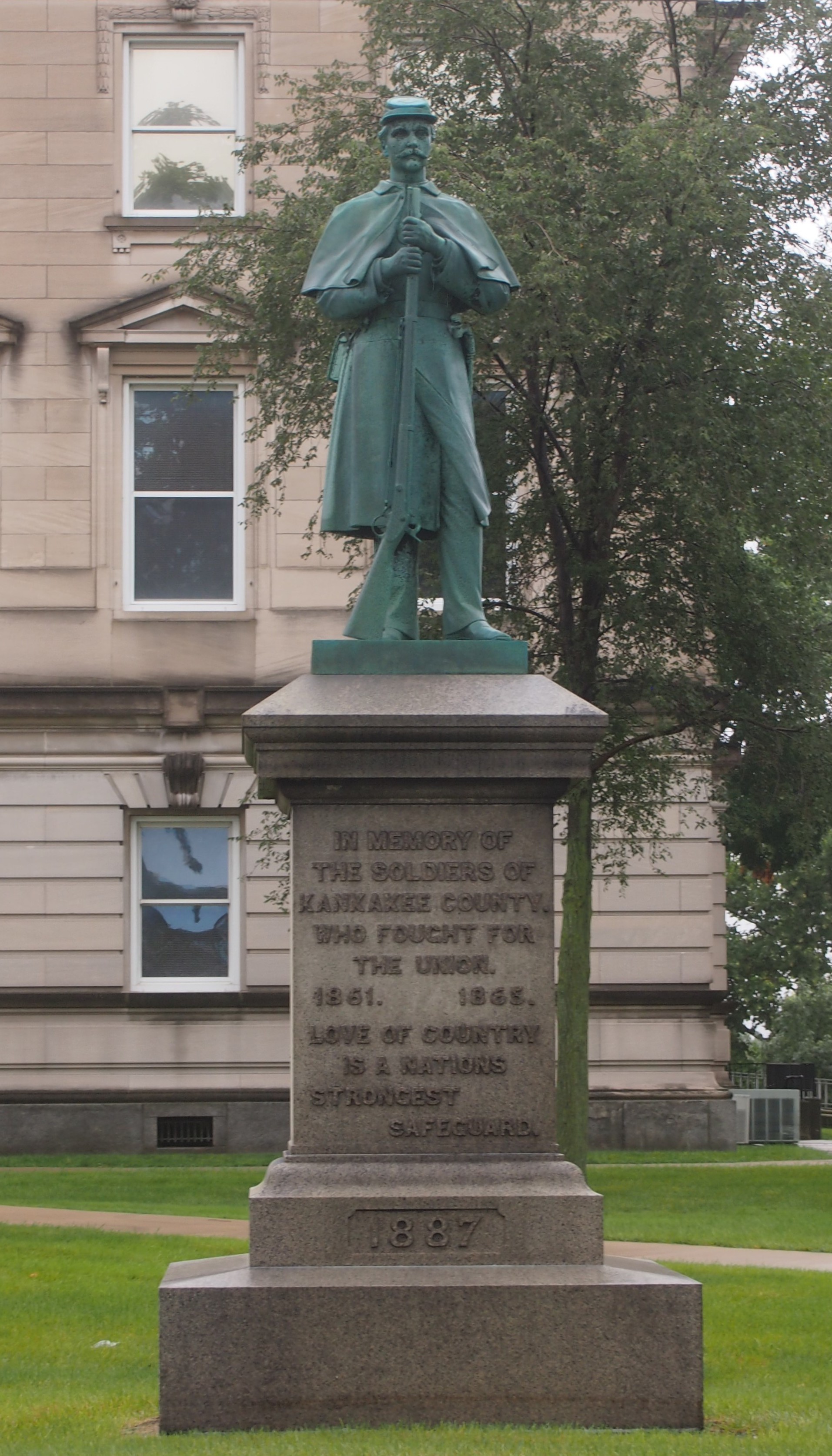
The courthouse statute, dated 1887. As you’d expect, “In memory of the soldiers of Kankakee County who fought for the Union.”
Kankakee County Courthouse statue 2016One more Kankakee County structure, just south of the courthouse: the brutalist county “detention center.”
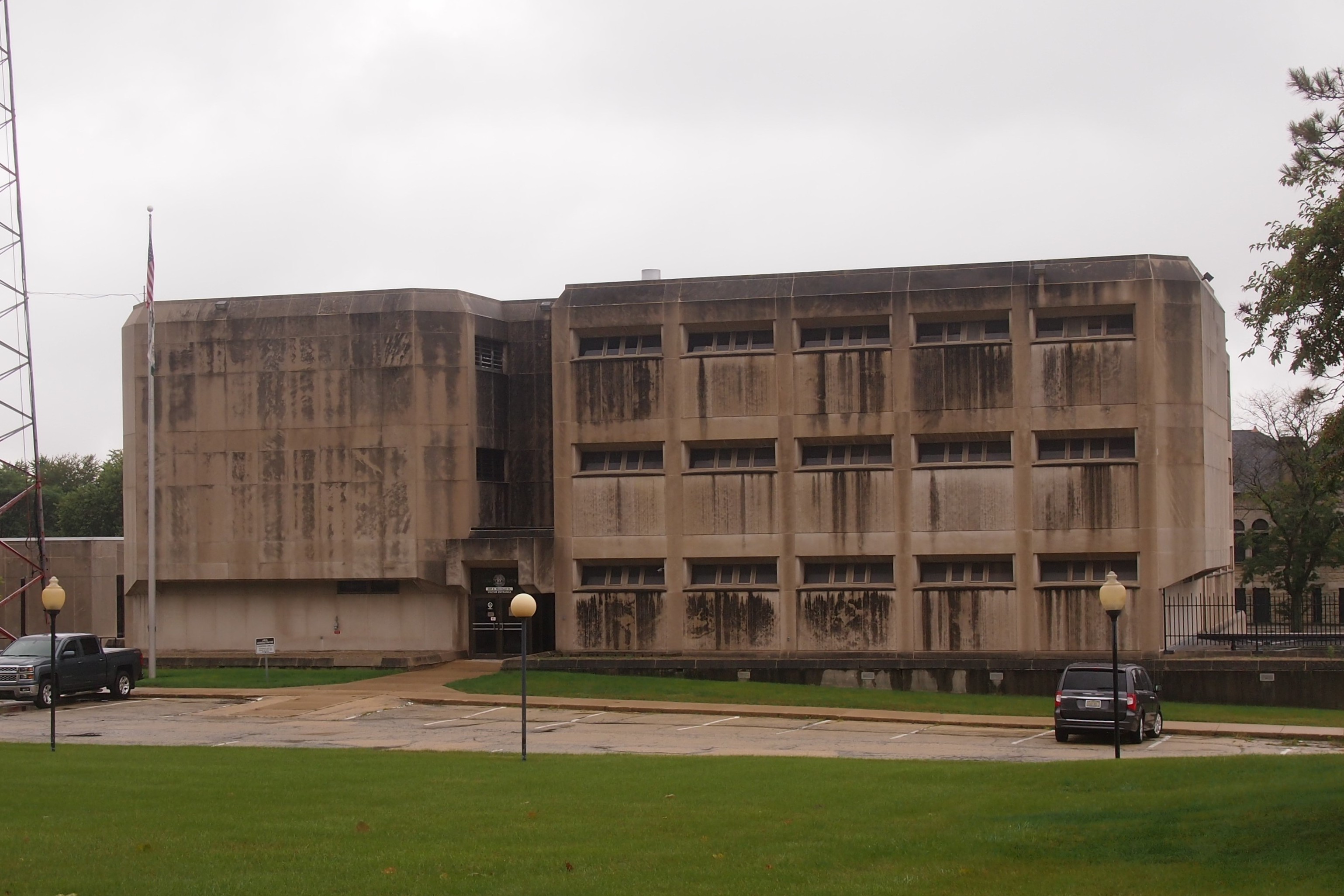
Kankakee County jailThe jail, that is. Detention is what you get in school. Otherwise it’s just official euphemism.

St. Petersburg 1994

After Moscow comes St. Petersburg. Of course it does. We spent the last days of our Russian visas in St. Petersburg after taking an overnight train between the cities, and after hearing stories about how thieves would pump knockout gas into our train cars and proceed to rob us naked. Somehow that didn’t happen.

If the Russians had been less prickly about extending tourist visas, we might have spent a few more days in the country, spending some of the hard currency we had that they wanted. But no.

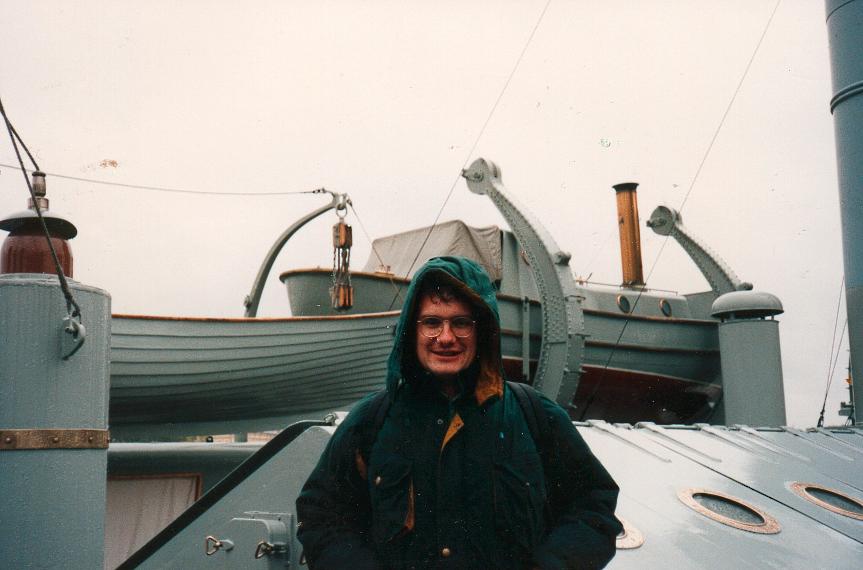
StPete94.1It was a balmy October day when we boarded the Aurora. The vessel survived the Battle of Tsushima and later of course had her part to play in the October Revolution. Since the mid-Soviet period, Aurora has been a museum ship.

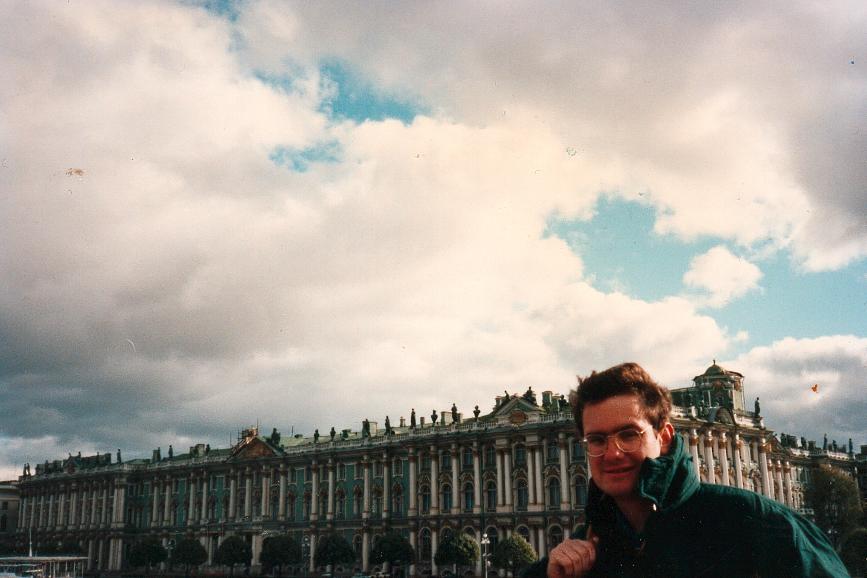
StPete2Also balmy outside the Hermitage. Much spectacle on the exterior, many fine works of art inside, but dank and crummy amenities, especially the bathrooms.

Thursday Natterings, But Not From Nabobs of Negativism

I woke the heater up yesterday from its summertime hibernation, mainly to see whether it would wake up and blow hot air, which is all I ask of it. Fortunately, the machine snapped to its single job without any complaint, such as some weird noise I don’t want to hear. The previous night had been quite cool, as they are starting to be, lowering the house temp to 69 F. My test took it up to 70 F. Normally I keep the house at 68 F. when it’s cold outside.

I saw the first Halloween decorations in the neighborhood the other day when walking the dog. It was a small faux cemetery in a front yard, featuring hand-painted sturdy cardboard (or cheap wood) tombstones. I don’t remember what any of them said.

Probably not Here Lies Les Moore. No Les, No Moore. I think I saw that in a Ripley’s Believe It Or Not collection years ago. That one I believe. Sounds like frontier humor to me.

Another remarkable collection of recent space photos from the Atlantic. As the intro notes, “We [as in, mankind] currently have spacecraft in orbit around the Sun, Venus, Earth, Mars, Ceres, a comet, Jupiter, and Saturn; two operational rovers on Mars; and a recent close flyby of Pluto.”

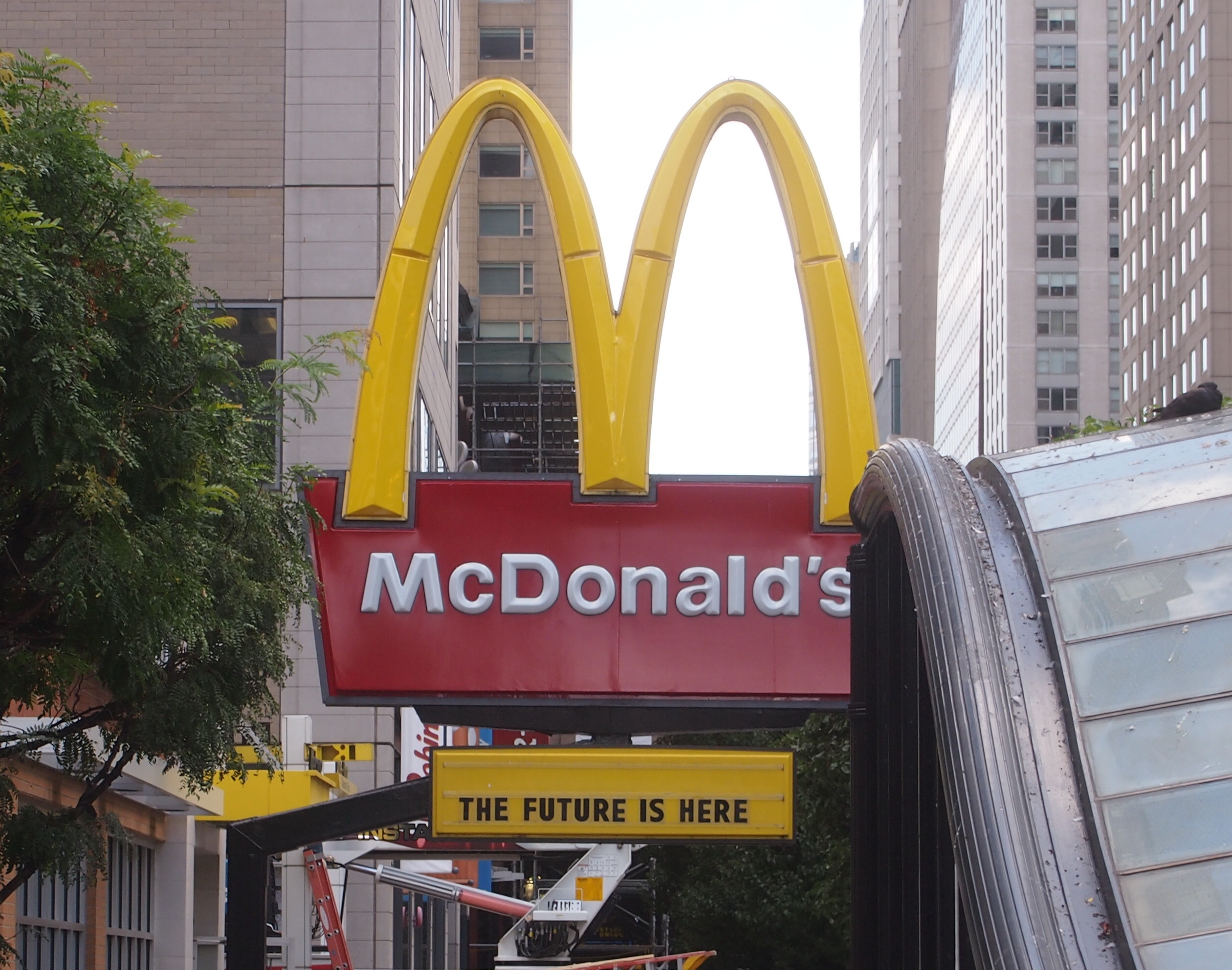
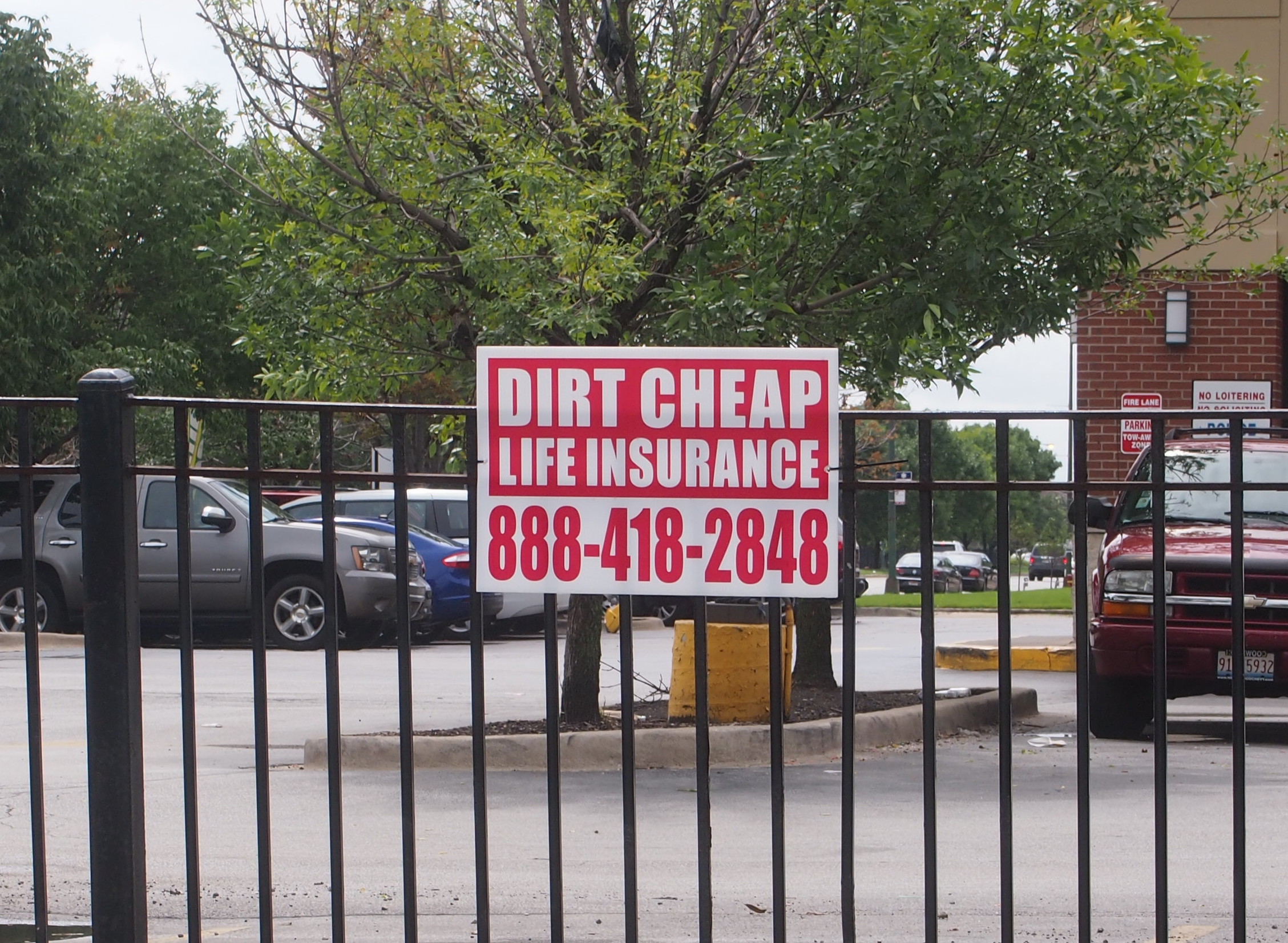
Closer to home, here are two signs I saw recently in Chicago.

That’s a little alarming. I can think of a lot better places to pass the future. The only future I want from McDougall’s are occasional breakfast sandwiches.

Dirt cheap, eh? And what do your beneficiaries get? Enough to pay for the dirt that covers you, maybe.

The last Weaver is gone. Fred Hellerman died recently, I just learned. Time then to listen to the re-union Weavers sing “Get Up and Go.”

One more thing: I don’t think I’ve ever seen olives packed this way before. A Trader Jose offering, as the package tells us.

olives

I opened them today at lunchtime. Not bad at all.

Items from the (Very Large) Dustbin of TV History

I happened across a YouTube video the other day called “11 Intros to Tacky 80s Sci-Fi/Fantasy TV,” and decided to watch it. Not sure that “tacky” is the right word. Maybe “short-lived” or “justifiably obscure” or some such. But the thing that surprised me — though it shouldn’t have — is that not only had I never seen any of them, I’d never heard of any of them.

That might sound like bragging. Actually, I will brag a little. I didn’t own a TV in the 1980s, and with certain exceptions, such as the last episode of M*A*S*H or the airing of The Day After, I didn’t watch much. I’m certain I’m better for it.

(Then again, the ’80s had no monopoly on TV SF failure: these are intros from 1975-80, all of whom failed. I watched much more TV then, but only vaguely remember Time Express and Buck Rogers, and watched Battlestar Galactica for a short while, until its stupidity got to be too much to take. Whoever complied the video left out Quark.)

The 11 shows in the video from the 1980s are Automan, Manimal, The Wizard, Wizards and Warriors, Misfits of Science, Shadow Chasers, The Phoenix, Powers of Matthew Star, Starman, Outlaws, The Highwayman. I wonder what kind of coke-bender decision-making allowed some of them to go on the air, just judging from some of their ridiculous — that’s the word, “ridiculous 80s Sci-Fi/Fantasy TV” — intros.

I recognized a handful of the actors. The Wizard’s David Rappaport was easily the best-known dwarf actor of his generation, and I remember he did a good job in the underrated Time Bandits (need to see that again; maybe I overrated it 30 years ago). Glad to know Rappaport had his own TV show, even one that didn’t last long. Sorry to learn that he didn’t last long, since he shot himself to death in 1990.

Robert Hays is instantly recognizable in Starman, though there’s no way he’s getting away from Ted Striker and his drinking problem.

Among the 11, the prize for most ridiculous concept (according to me, and it’s a tough competition) goes to Outlaws, whose intro explains that a gang of Texas outlaws from 1899 is magically transported to the late 20th century, along with the sheriff who was chasing them. More than time travel magic, too, since they somehow or other ended up on the right side of the law in the 1980s. You’d think they’d take to knocking over convenience stores and passing bad checks in our time. Also, one of them is black, perhaps the most improbable plot element of all. Played by Richard Roundtree, who will never get away from John Shaft.

The prize for bad intro writing goes to The Highwayman. They are supposed to be supernatural guardians of the world, or something — and if so, why did the producers pick a word that means bandits on the road? Anyway, the intro, which sounds like it’s read by William Conrad (a job’s a job), goes like this:

“There is a world, just beyond now, where reality rides a razor-thin seam between fact and possibility. Where the laws of the present collide with the crimes of tomorrow. Patrolling these vast outlands is a new breed of lawman, guarding the fringes of society’s frontiers. They are known simply as Highwaymen, and this is their story.”

The “razor-thin seam between fact and possibility”? Whoever wrote that was trying for Rod Serling, and failing.

The Pigeons of ’48

Missed the big-hairy-deal debate last night. Nothing either of them could say at this point is going to change my mind. This election has gone on long enough already.

Instead I worked, as I usually do on Monday nights, and late in the evening read for pleasure, as I often do. Currently I’m working my way through 1948 by David Pietrusza (2011), which is about (as the subtitle says), “Harry Truman’s Improbable Victory,” or the story of an election that didn’t go on quite so long, and had its share of surprises. I read Pietrusza’s book about presidential politics in 1920 some time ago, and it was fairly good. So is 1948.

I haven’t been in a hurry to get through 1948, diverting into other books as well, such as a second reading of The Right Stuff (first time was in the early ’90s, and well worth the re-read), and first readings of The Basketball Diaries and Death Comes for the Archbishop. It’s a rare time when I just read one thing all the way through to the exclusion of others. I might even take up News from Tartary soon, since it’s been much too long since I read any Peter Fleming.

1948’s got some interesting detail. Here’s an anecdote about the Democratic National Convention that year that I like: “With the convention running three hours and forty-three minutes behind schedule, [Sam] Rayburn nevertheless undertook one last chore before introducing the exceedingly patient Truman: ‘I want to introduce Mrs. Emma Guffey Miller, Pennsylvania delegate-at-large. She has a surprise for us which I hope the convention will enjoy.’

“The plump, white-frocked, seventy-three-year-old Mrs. Miller, younger sister of former Pennsylvania senator Joseph Guffey, had prepared an elaborate, six-foot-high floral display composed of red and while carnations, in the shape of the Liberty Bell. Imprisoned inside it for several hours were forty-eight caged white pigeons, officially and symbolically designated ‘doves of peace.’ In the horrible heat, a couple had already expired. The band stoked up ‘Hail to the Chief,’ and the surviving birds — crazed by the noise, lights, and the heat — exploded out of the opened ‘Liberty Bell.’

“Pigeons flew into the rafters. They dive-bombed delegates. Men and women shouted, ‘Watch your clothes!’

” ‘Though the press delicately did not mention it,’ noted Clark Clifford (who did), the ‘doves of peace began, not surprisingly, to drop the inevitable product of their hours of imprisonment on any delegate who had the bad luck to be underneath them.’

“Some birds landed on the platform. Rayburn frantically shushed them away. One nearly landed on his glistening, bald head… ‘Get those damned pigeons out of here!’ he screamed over live radio and TV.

” ‘As [Truman] spoke,’ Time reported, ‘pigeons teetered on the balconies, on folds of the draperies, on overhead lights, occasionally launched on a quick flight to a more pigeonly position.’

“Thus, Harry Truman’s choice of a crisp, double-breasted white suit that evening may not have been the wisest choice of the campaign…”

Nevertheless, Truman’s ’48 Democratic Convention acceptance speech famously turned out to be a barnburner: “Senator Barkley and I will win this election and make these Republicans like it — don’t you forget that!”

Split Scooter

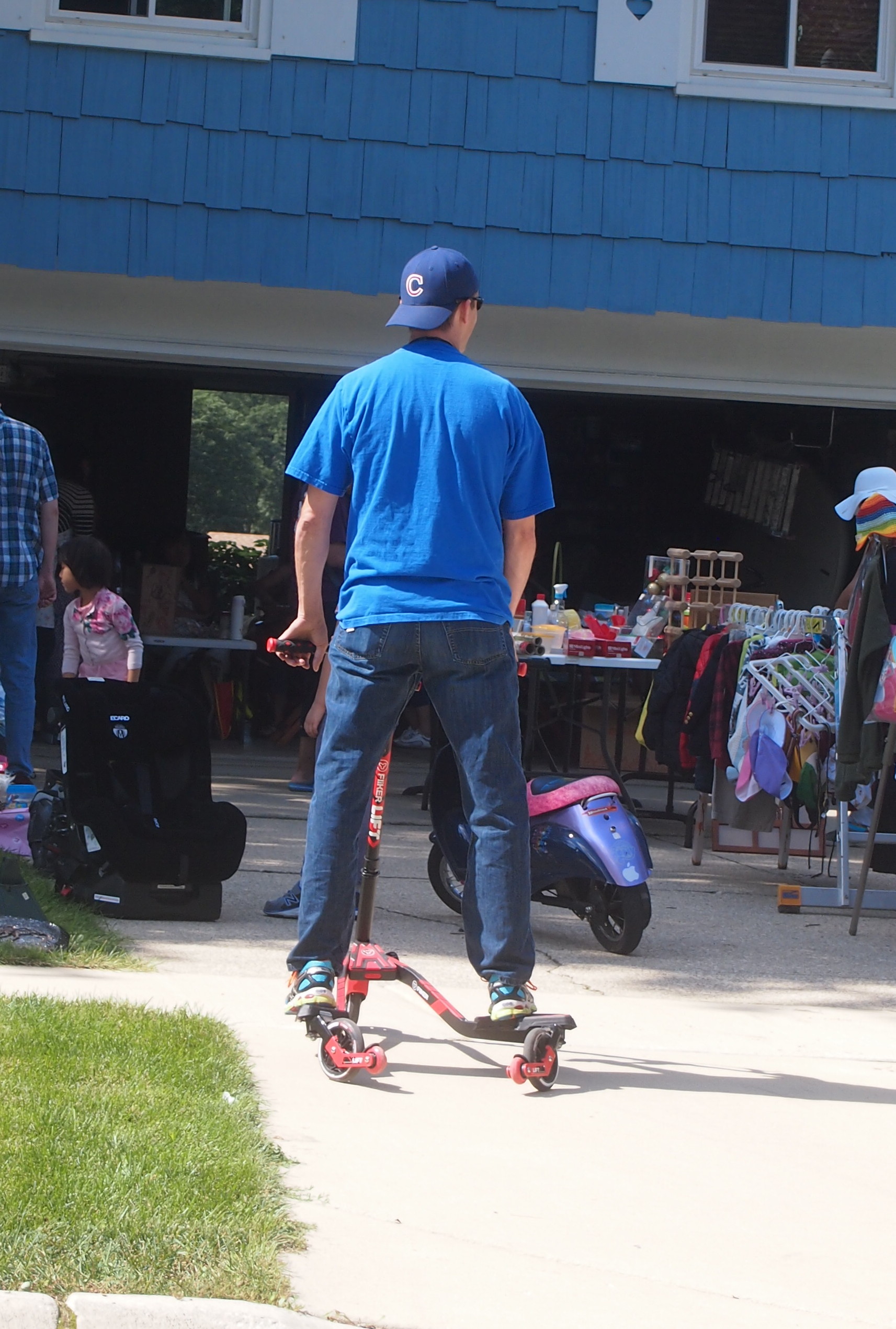
I’d never seen a scooter exactly like this before.

Split scooterNot long ago we stopped at a garage sale in a neighborhood north of ours. Yuriko went to look around, I stayed in the car. At one point, this fellow rode up on his — split scooter? I looked it up using those words and it seems to be a common thing. Learn something new all the time, if you’re paying attention.

The Last Days of Kiddieland

Once upon a time, Kiddieland Amusement Park in west suburban Melrose Park featured rides and amusements for small fry, and somewhat older children, for a not-too-outrageous price. The park was around long enough for parents who had been taken as children to take their own children, and come to think of it, grandparents who had been to take their grandchildren.

Not being from around Chicago originally, I didn’t have that experience, but I did take my children three or maybe four times in the late 2000s. I don’t remember for sure, but I think one of Lilly’s friends originally suggested that she go. It was a little far to go very regularly, but not too far for an occasional visit.

Kiddieland was an unpretentious place, with rides such as a small but fast wooden roller coaster, a modest-sized Ferris wheel, a merry-go-round, a Tilt-A-Whirl, small car rides, small boat rides, other things that went up, down and around, and a 14-in. gauge miniature railway (always enjoyable to find a miniature railway; the Brackenridge Eagle rides on a 2-ft. gauge, just to compare). I won’t say Kiddleland was a one-of-a-kind place, because it used to be one of a class of locally owned, pre-Disneyland amusement parks. Yet it was a survivor, in the 21st century, from an earlier time.

I can only speculate why. The park wasn’t that expensive or unmanageably large. The staff seemed well trained and polite. Soda — all you wanted — was part of the price of admission (imagine, say, Six Flags doing that). The rides were entertaining even for small children, a real place in an age of electronic faux places.

Kiddieland might still be around but for a dispute among cousins who owned the place, the grandchildren of the founder. Seems like a strange division: One group owned the amusement park; the other owned the land. When push came to shove, the amusement park owners were shoved off the land, and the park closed for good in late September 2009.

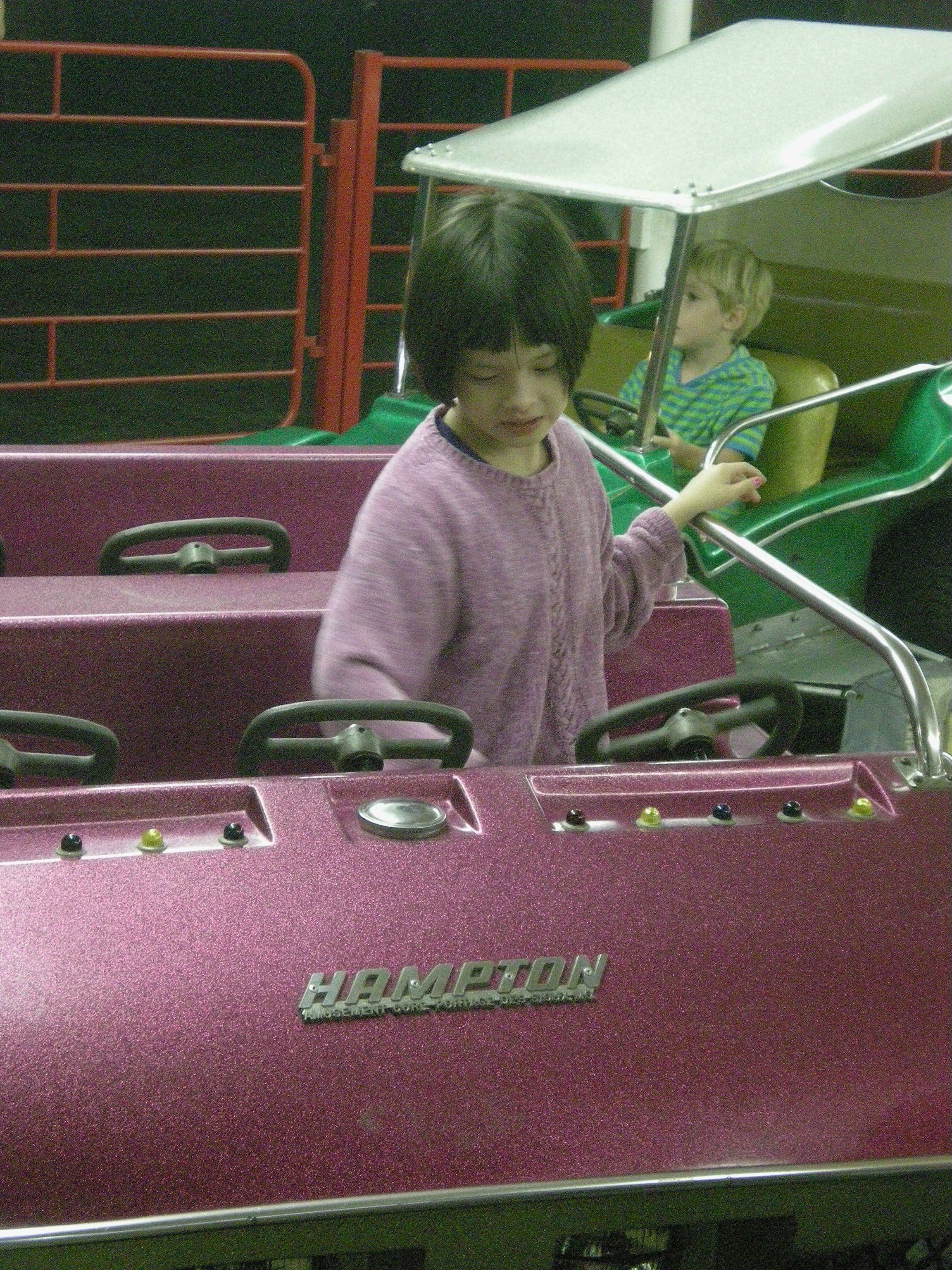
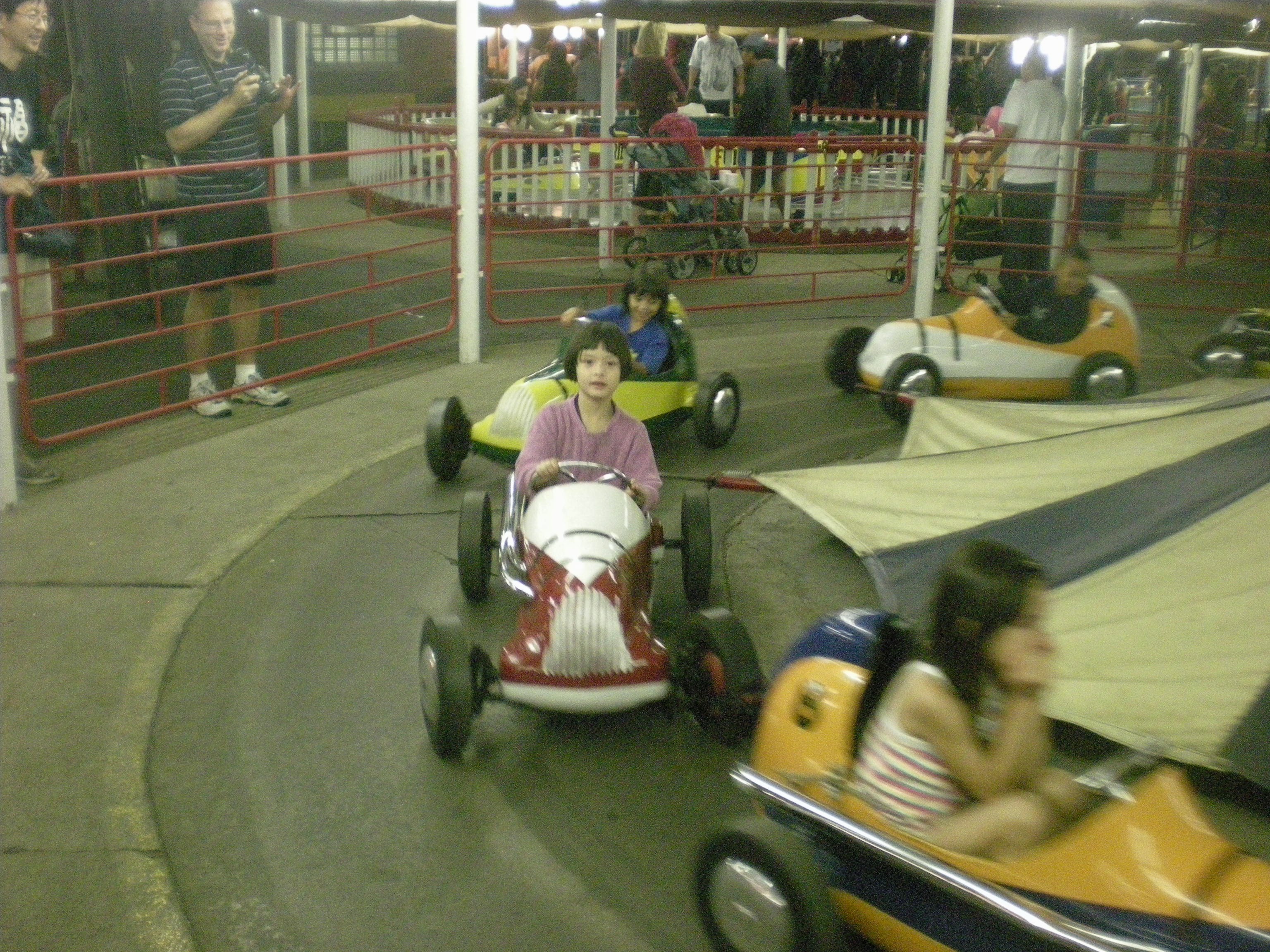
When it was clear that Kiddieland was going to close, seven years ago this month, we went one more time. I think Lilly and her friends ambled around themselves, while I took Ann around. Here’s Ann and a couple of the small-fry rides.
Kiddieland 2009Kiddieland 2009There’s a Costco there now. The land owners were clearly looking for bigger bucks. Generally I’m for the highest and best use of real estate, and I like Costco well enough, but still. Something that could be anywhere replaced something distinctive about a particular place, so the world is slightly poorer for it.