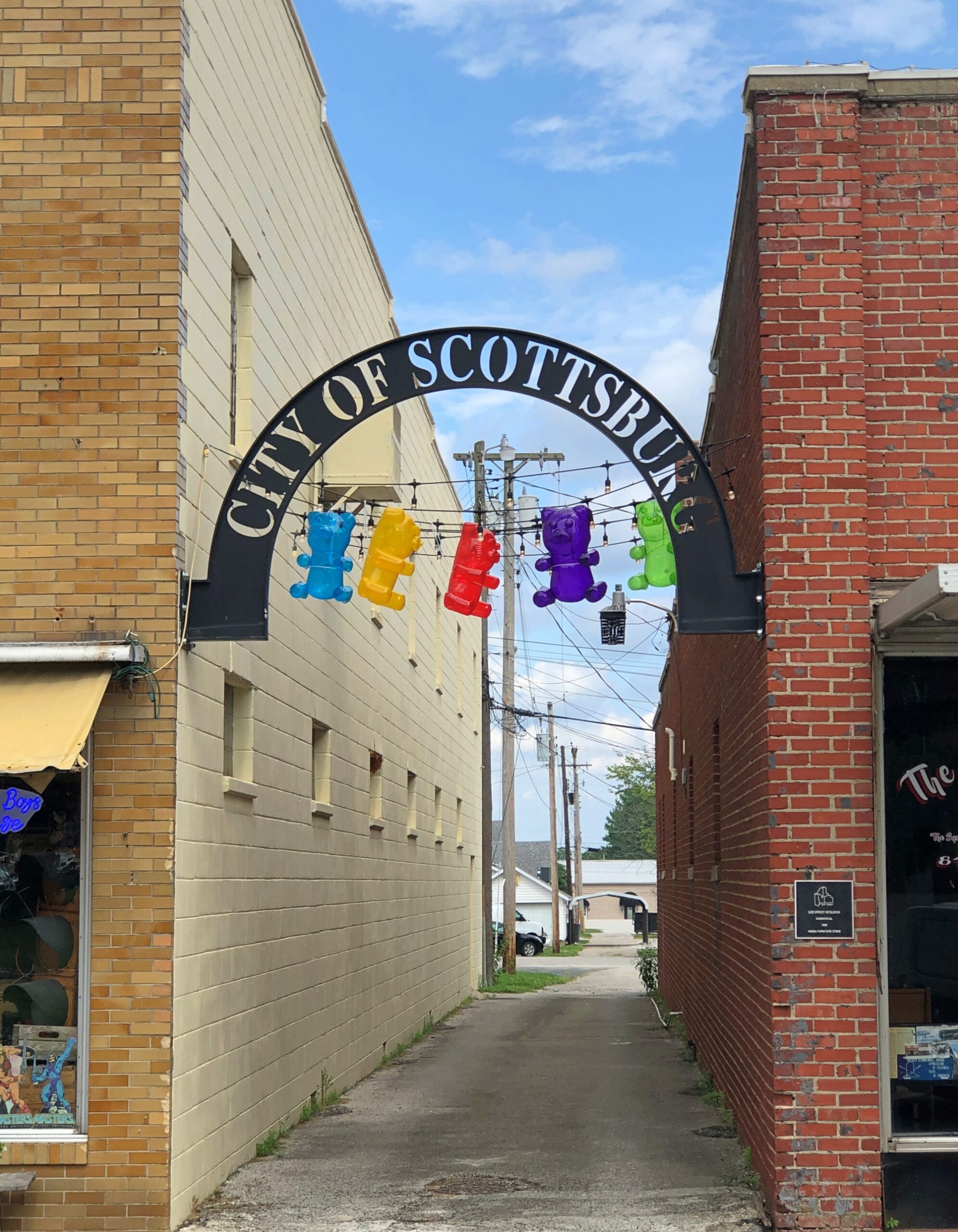
Scottsburg, Indiana

Just the latest in bad news: the lodge on the North Rim of the Grand Canyon burned down due to wildfire. At least no one died in the incident, but it’s always unfortunate when a grand edifice meets its end. I wouldn’t bet on reconstruction, either.

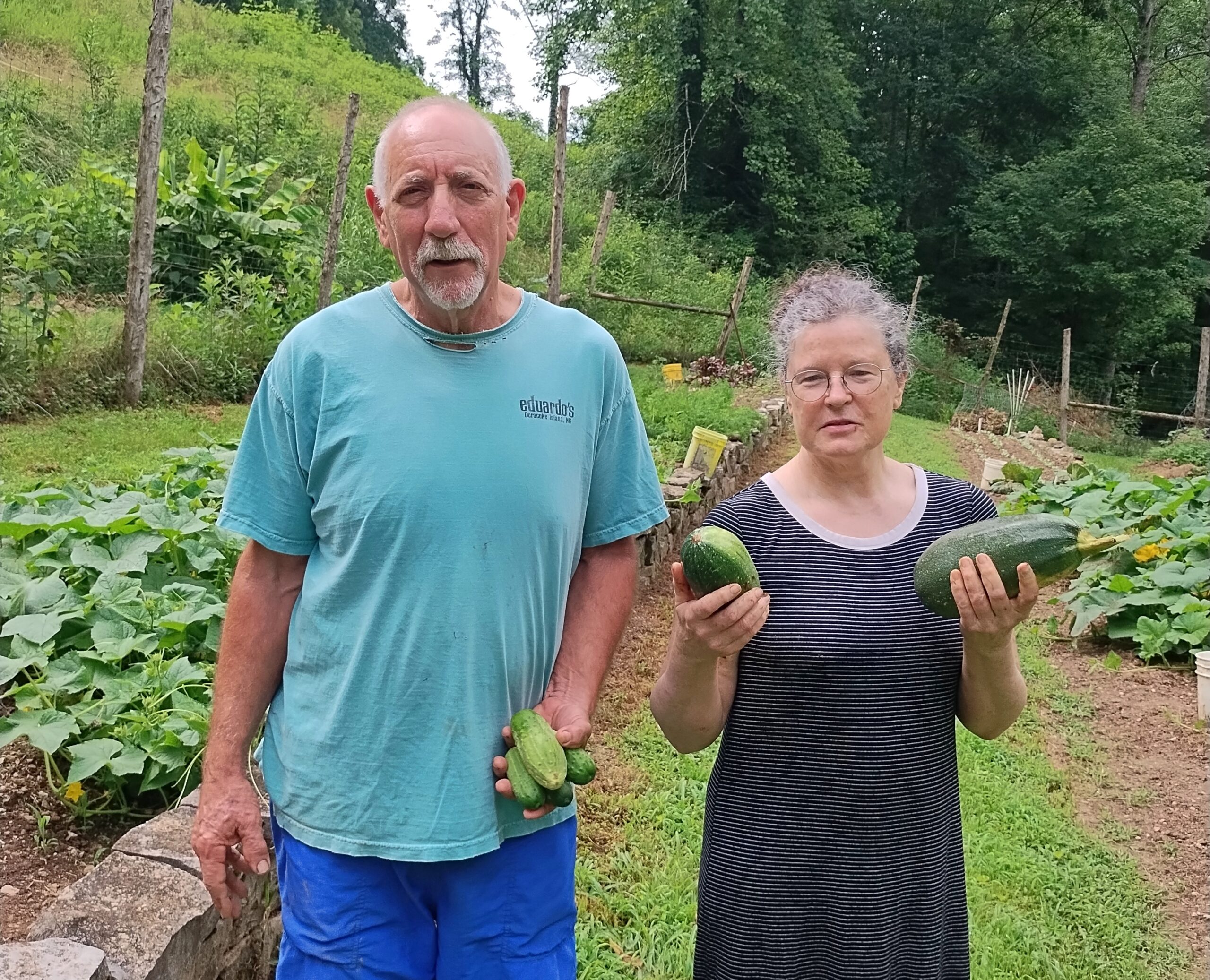
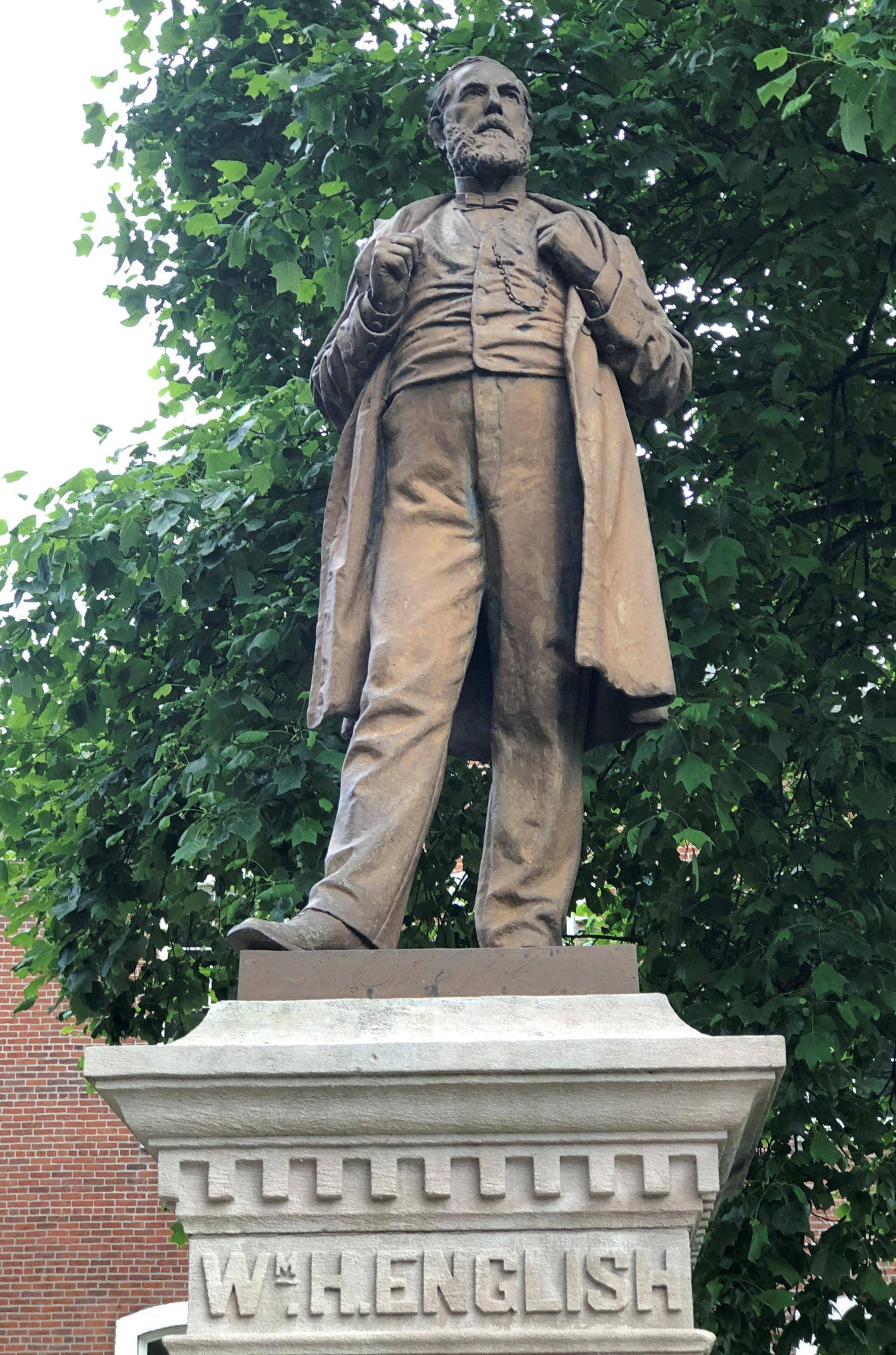
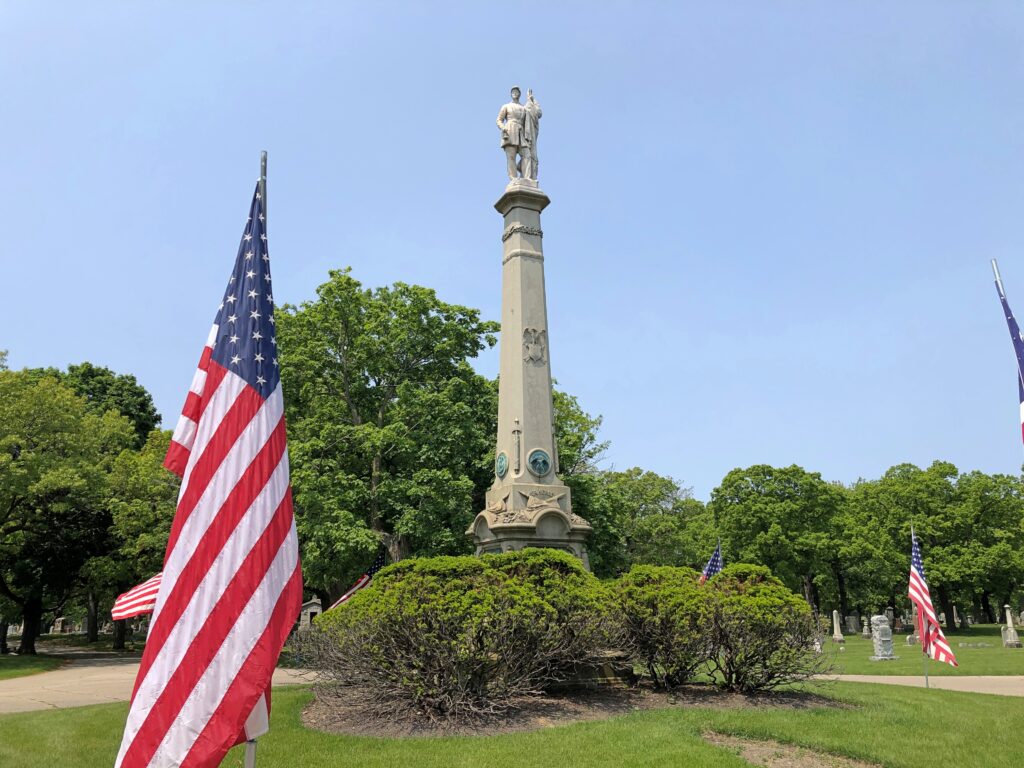
The heat was already on by the time I arrived in Scottsburg, Indiana on the first day of the trip, June 16. But not enough to keep me from taking a stroll around the Scott County courthouse, where I found native son William H. English.
Scottsburg, Indiana Scottsburg, Indiana

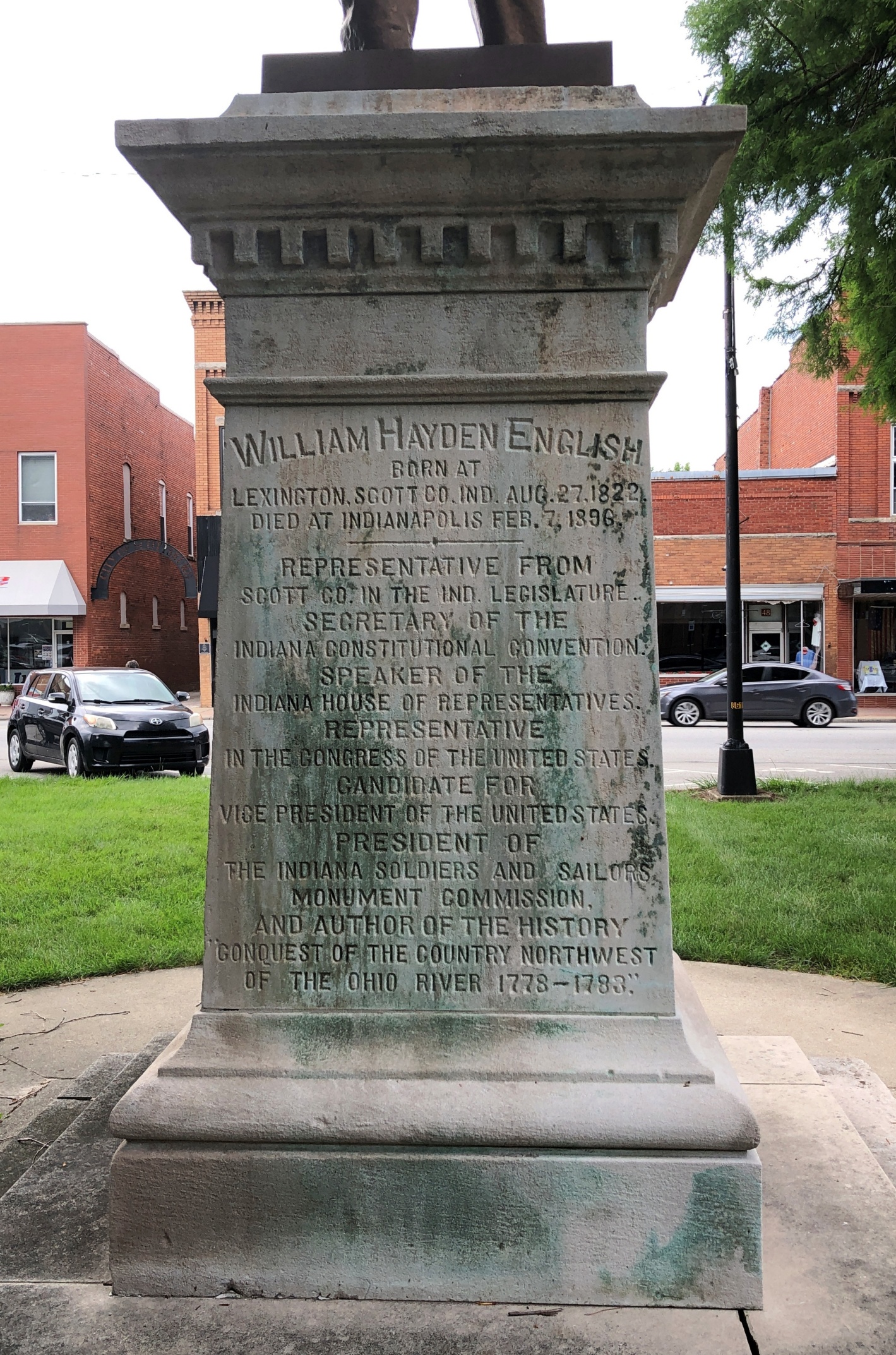
After only a few hours on the road, by chance, I’d come across a presidential sight. Presidential adjacent, anyway, since English (d. 1896) is that most obscure of obscurities, someone who ran for vice president and lost – in 1880 in his case, on the Democratic ticket with Winfield Scott Hancock, who himself isn’t going to ring any bells outside presidential history buffs. The statue went up in 1908.
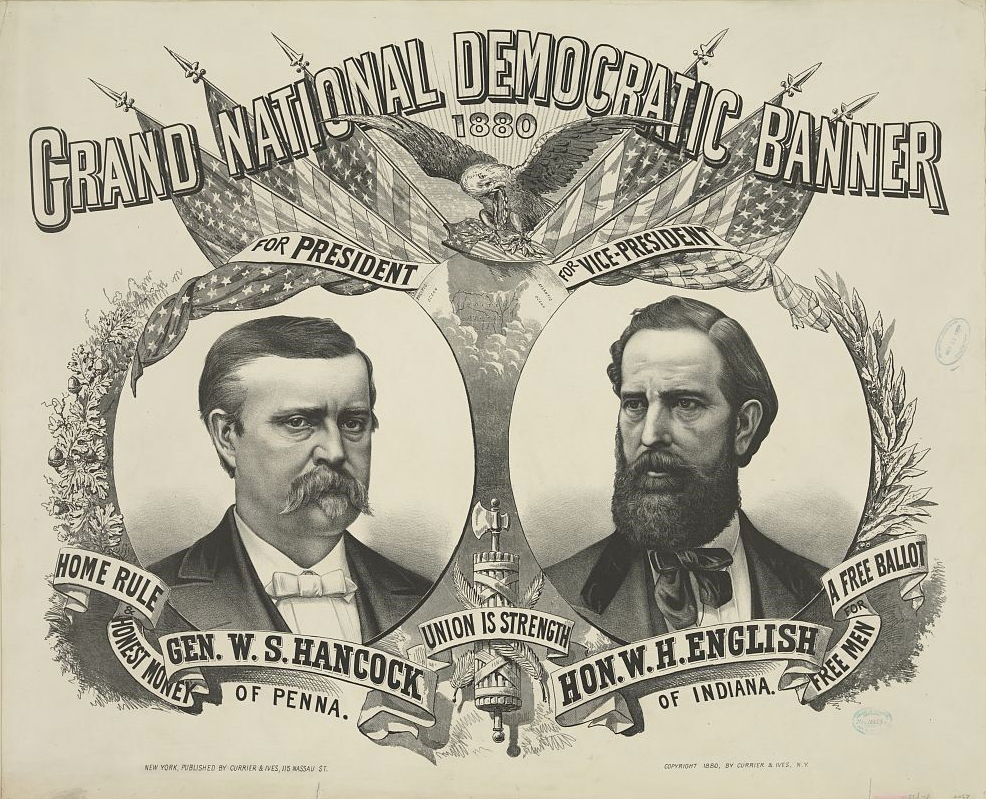
That was the election James Garfield won, which he no doubt regretted before long.

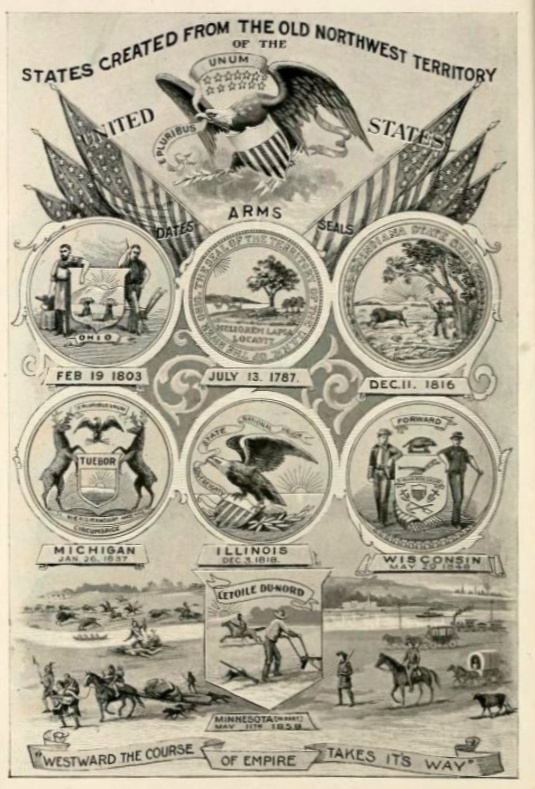
English, or his heirs, felt that a book he wrote, Conquest of the Country Northwest of the Ohio River 1778-1783, was worth a mention along with the offices he held or aspired to. The marvel here in the 21st century is that the work is just about instantly accessible (Vol. 1 and Vol. 2). An illustration facing the Vol. 1 title page (on the optitle page?) not only falls into the They Don’t Make ‘Em Like That Anymore category, it’s squarely in, No One Would Think of It territory. Just as well, I figure.
To get to Nashville from metro Chicago, the direct route is via I-65, which cuts across Indiana. Considering the importance of both of those cities to me, I’ve driven the route more times than I can count. But I have to report that it isn’t one of the more interesting drives in the nation, and at eight to nine hours drive time in the best of conditions, you feel it yawn beneath your wheels when you yourself yawn.

So the strategy over the years has been to break up the trip. Such as a place like Scottsburg, pop. 7,300. The town is close enough to Louisville to be its exurb – maybe. I haven’t spend enough time in Louisville, as interesting as it is, to have any sense of its greater co-prosperity sphere, or at what distance that might peter out.

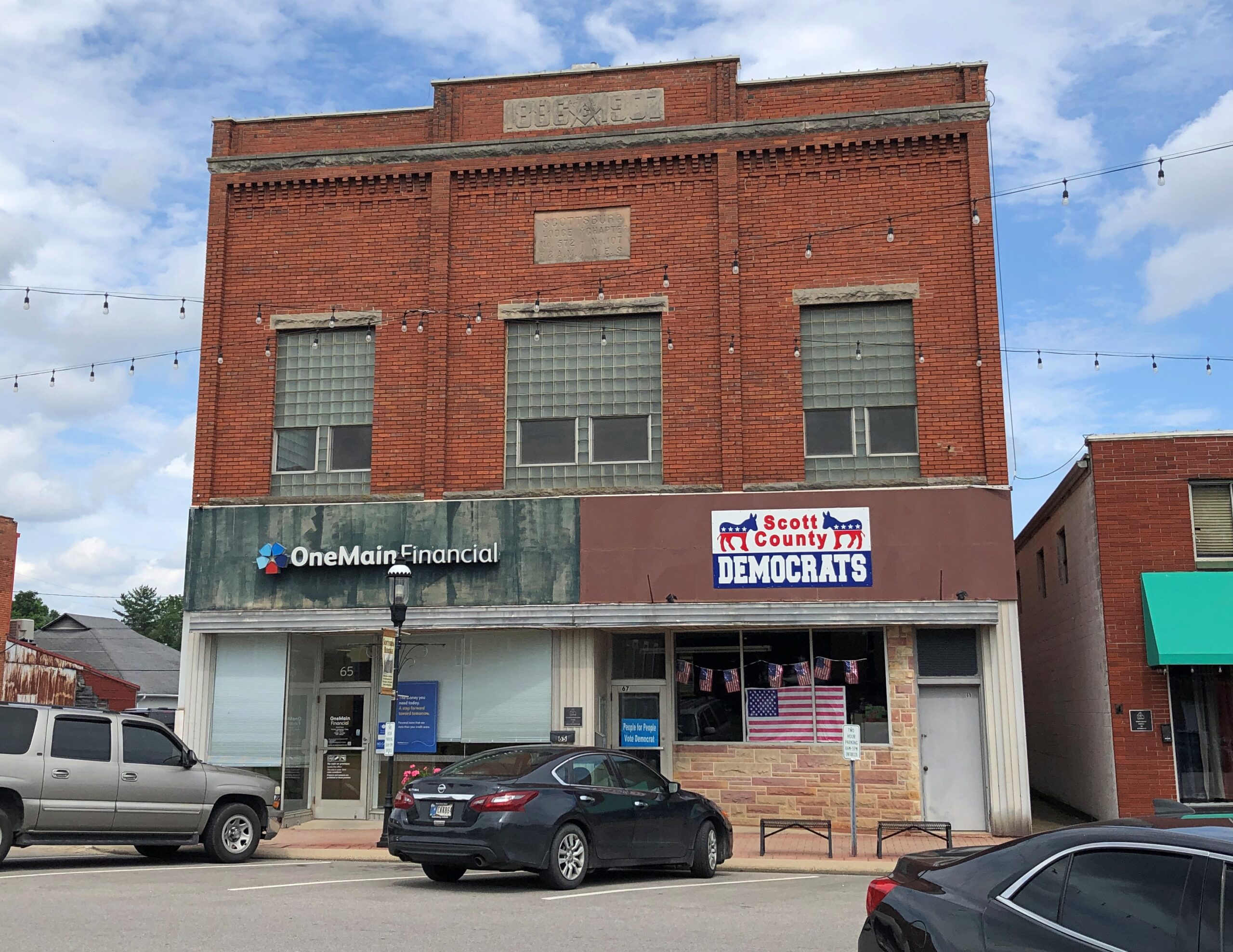
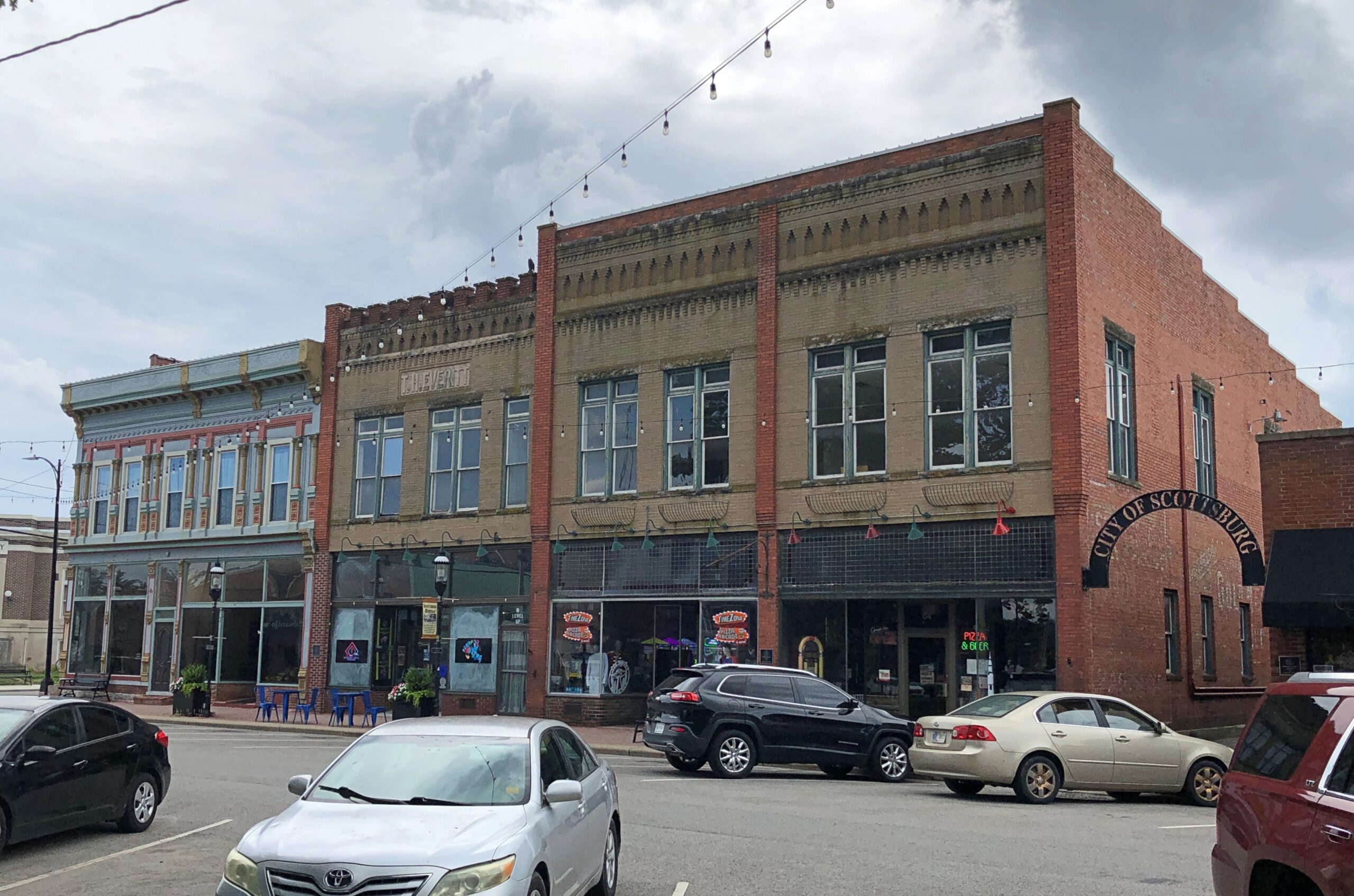
Scottsburg has one thing a picturesque exurb needs: a picturesque courthouse square. Or at least elements of it.
Scottsburg, Indiana Scottsburg, Indiana

Downtown is in fact a national historic district: Scottsburg Courthouse Square Historic District. I get a kick out of discovering that kind of thing retroactively, which I did this time.

“The district is composed of one-, two-, two-and-a-half and three-story brick and stone commercial structures with zero setbacks, which form an essentially contiguous perimeter to the wooded courthouse lawn,” its registration form on file with the U.S. Interior Department says. “There are a total of 48 contributing buildings within the district. The character of the district is defined by late 19th and early 20th century commercial architecture with significant examples of the Italianate, so Richardsonian Romanesque, Renaissance Revival, Colonial Revival, and Art Moderne styles.

“The predominant building material is red brick, as evidenced by the courthouse and 29 commercial buildings within the district. Secondary materials include Indiana limestone and various shades of buff and yellow brick, decorative brick work, cast iron, ornamental pressed metal and glazed tile and Carrera glass…”
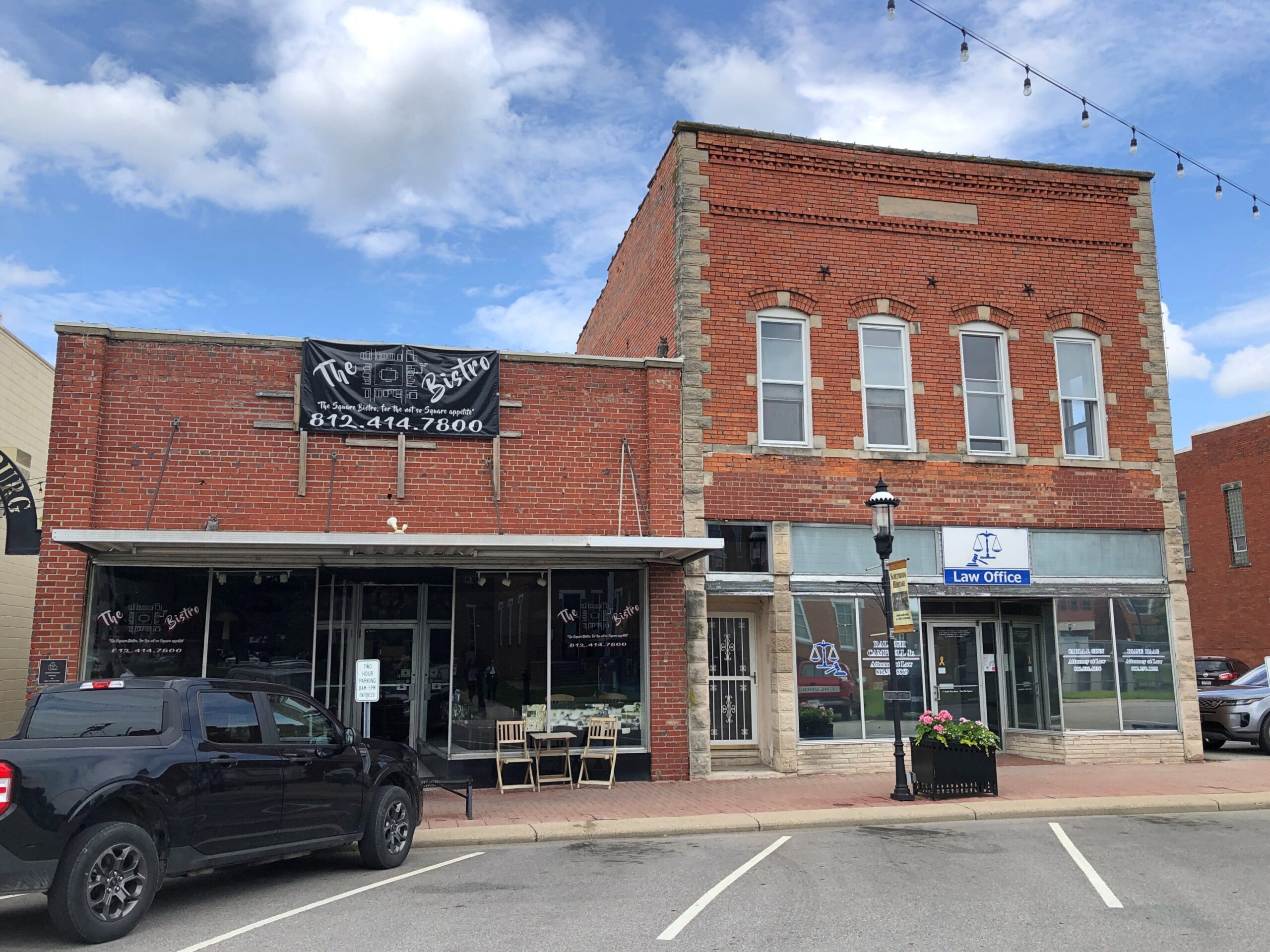
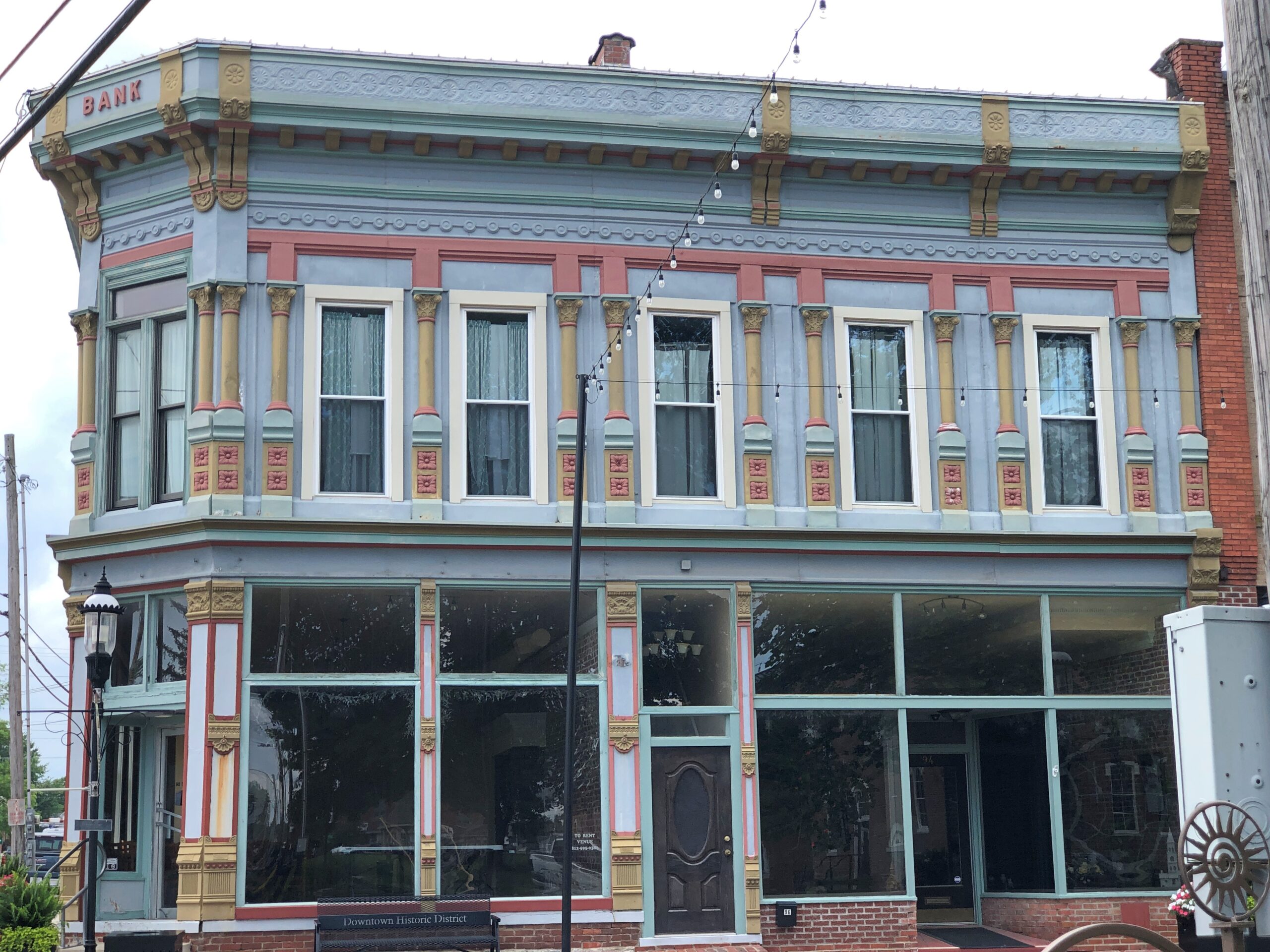
Scottsburg, Indiana Scottsburg, Indiana

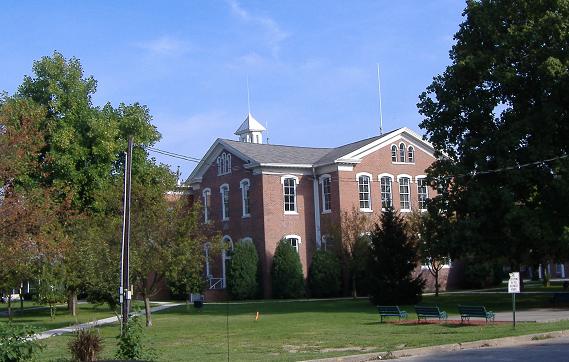
In the heat of the moment (literally), I neglected to get a decent shot of the courthouse itself, but someone called Bedford thoughtfully put an image in the public domain.
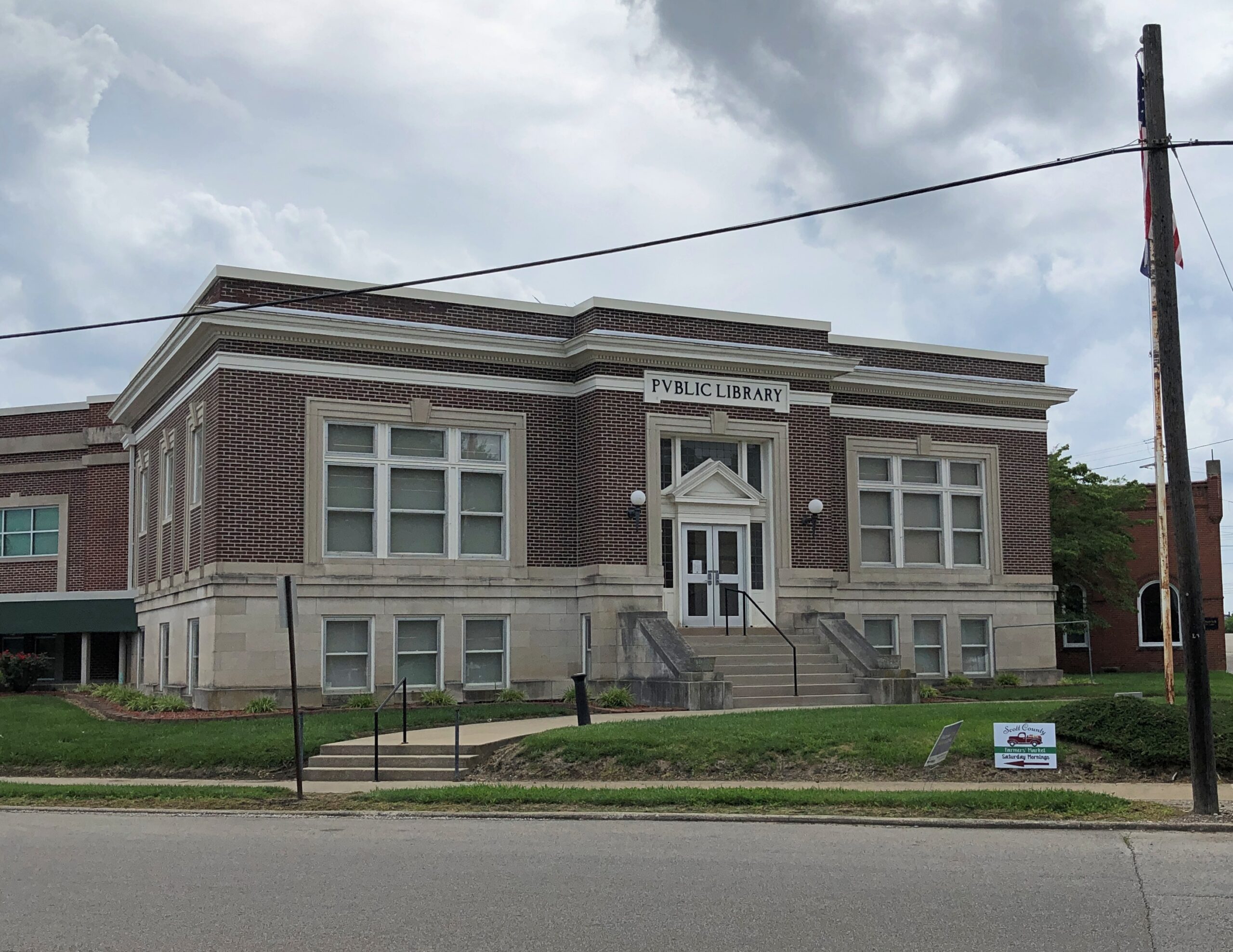
Could it be a Carnegie Library?
Scottsburg, Indiana

Yes. Completed 1917, still a library. One of the more than 1,680 in the United States funded by the robber baron, many of which endure after a century plus.

Some courthouse square details.

Dirt Boys Vintage Collectibles joins the likes of city offices and law offices, but also Warriors Den coffee shop, Time Zone Pizza Arcade, Chicago City Pizza and Bootlegger’s Bar & Grill. Those not needing to eat can visit Wildflowers Boutique, Moxie Music Center or Working Class Tattoo Parlor, all there on the square.

So is a plaque to the memory of one Michael J. Collins (d. 1985).
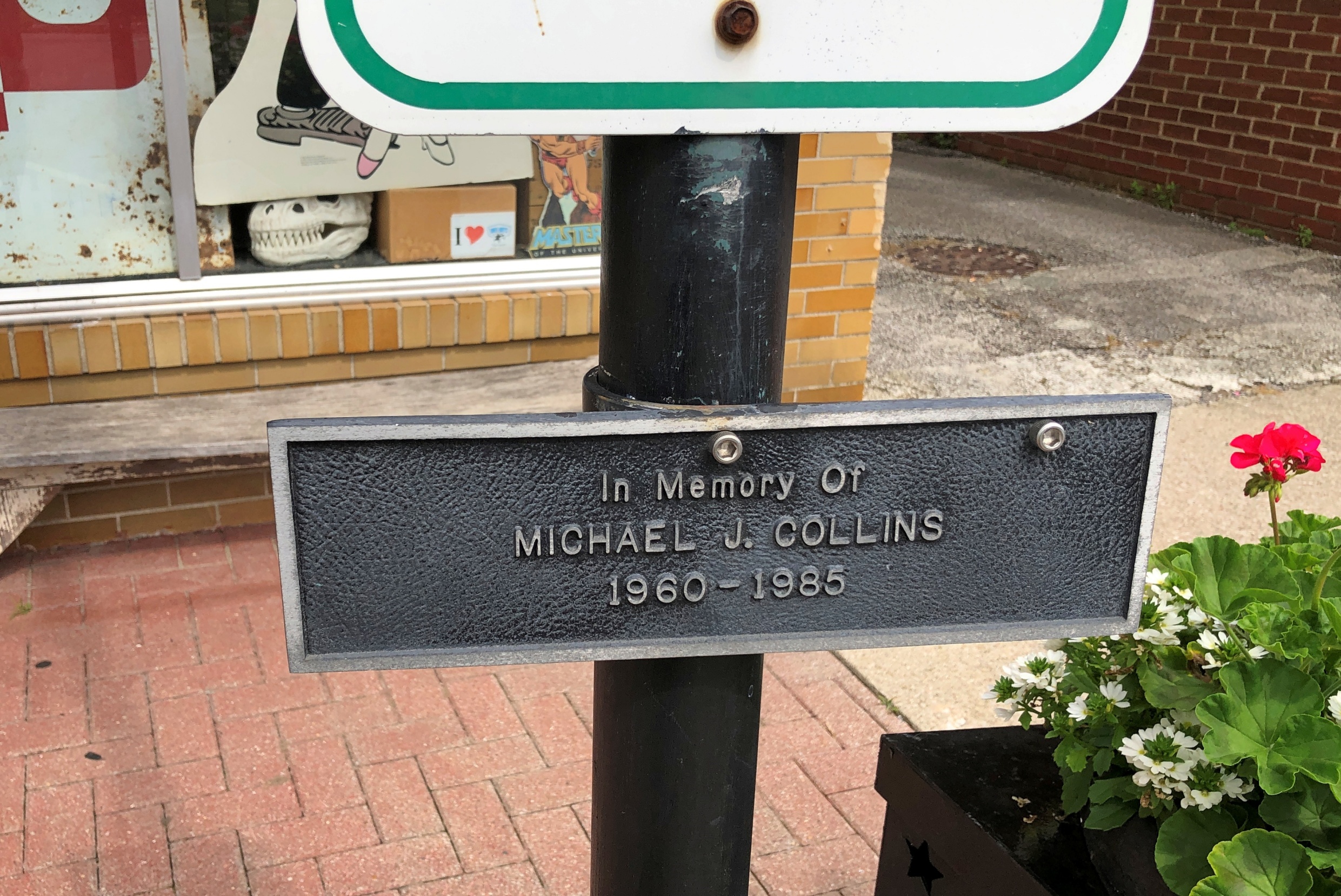
Scottsburg, Indiana

A contemporary of mine who didn’t make it far out of the gate. RIP, Michael, whoever you were. Are.
Southern Loop ’25

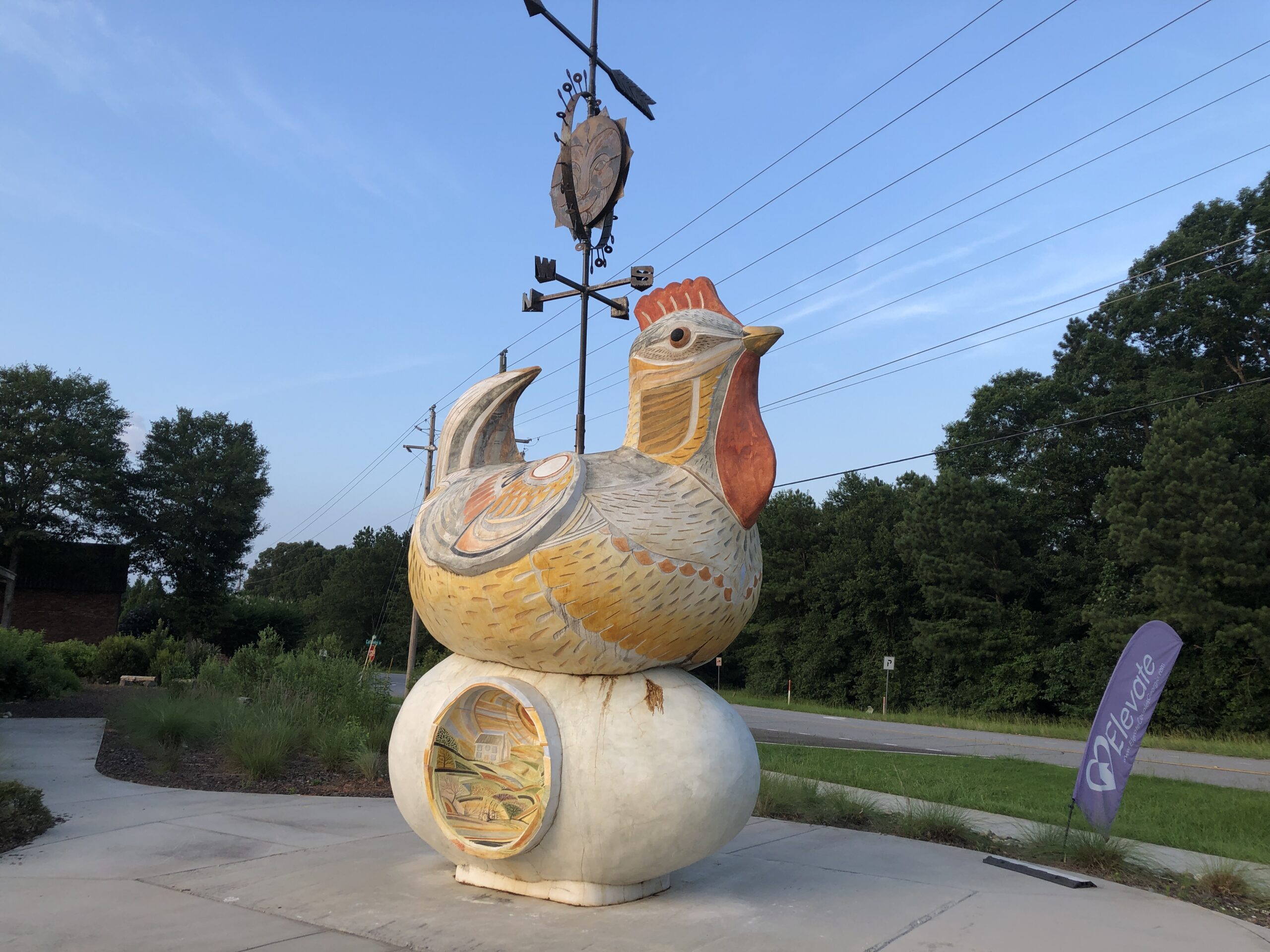
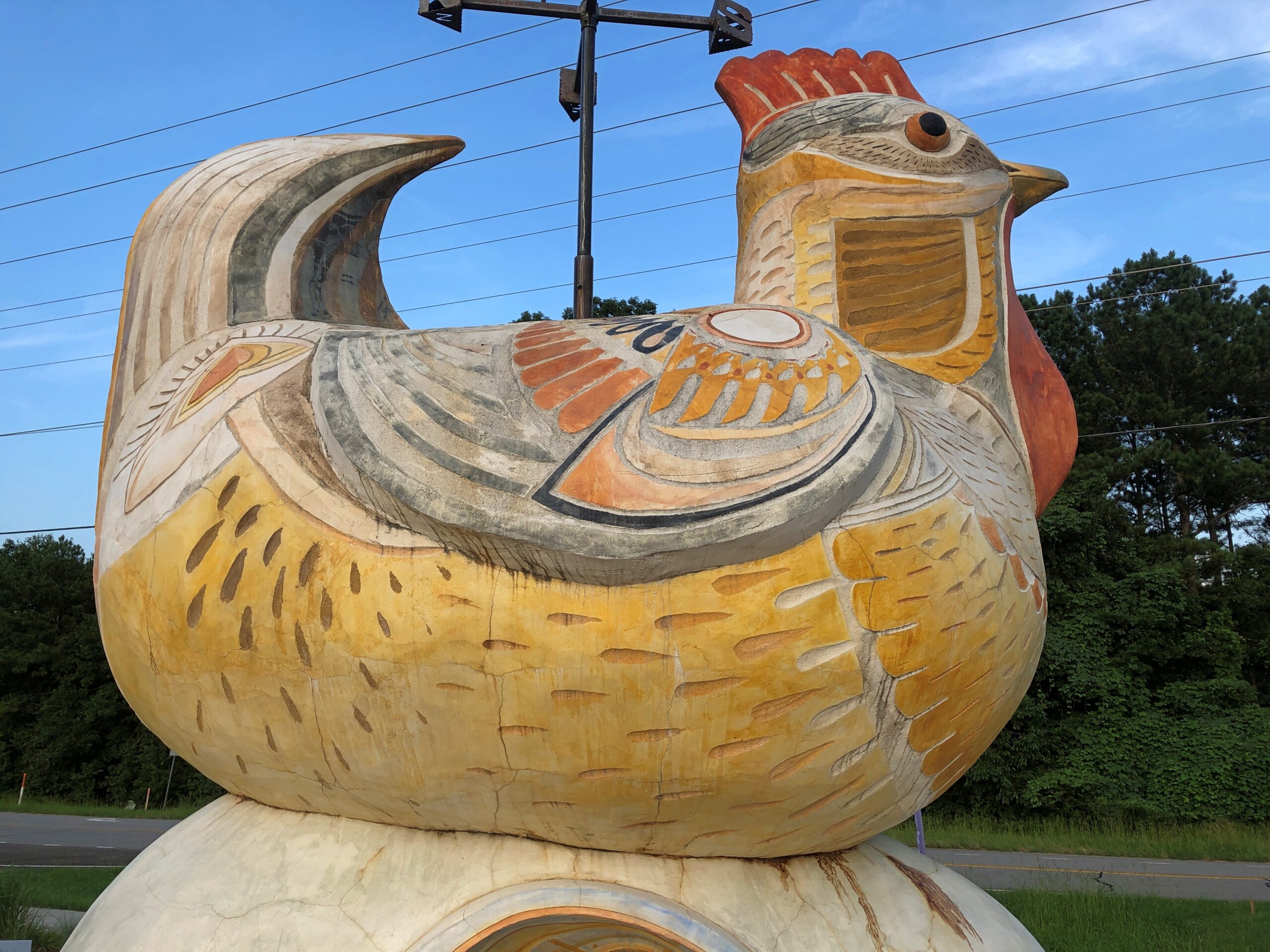
Sometimes you’re driving along, minding your own business because your business at that moment is driving, and you see a two-story chicken near the road. Three stories if you count the iron weather vane perched atop the bird.

Chicken!
Chicken!
Chicken!

I had to stop to see that. More precisely, it’s a concrete chicken on a concrete egg, settling the question of which came first (the concrete did). The chicken, and the egg, are on property owned by the University of Georgia, used for the Athens-Clarke County Extension in Athens. Erected in 2022. More about the work, “Origins,” is here. All ag extensions should have just a little whimsy.
The chicken appeared roughly in the middle of the 3,285 miles I drove between June 16 and June 29, taking a lasso-shaped path from the Midwest across the Southeast, all the way to the ocean at Myrtle Beach, South Carolina: through Indiana, Kentucky, Tennessee, North Carolina, South Carolina, and Georgia, and back through Tennessee, Kentucky and Indiana.

The concrete hen took the cake for novelty, but along the way I saw a memorial to a mostly forgotten incident in the War of 1812, went into a mirrored tower built for a world’s fair, chanced on the spot where the mostly forgotten diplomat who brought the poinsettia to the U.S. is buried, and braved the tourist sprawl that is Mrytle Beach. I heard stories of Blackbeard while near the coast, near his hideouts. I strolled the genteel downtown of the second-oldest town in North Carolina, passing the notable spot where Pepsi-Cola was invented. We visited a three-story souvenir shop that has stood the test of time in Myrtle Beach, which I’m happy to report sells not just postcards, but vintage local postcards, at popular prices. One evening we wandered past sculptures and colored lights among the Spanish moss in South Carolina. For a moment I beheld a complete set of the U.S. gold coins minted in Dahlonega, Georgia.

I drove by houses, farms and fields, past small businesses open and defunct, and junkyards and billboards — an industry that would collapse without ambulance chasers, I believe — and factories and water towers and municipal buildings. That is to say, structures and greenery of all manor of use and upkeep, an inexhaustible variety of human and natural landscapes. Homogenization my foot. Except, of course, every burg with a zip code also has at least one dollar store.

We – my machine and I and sometimes Yuriko, who flew to Myrtle Beach to meet me for a weekend – experienced an incredibly lush Southeast not long after a rainy spring, on big roads and small, straight and curvy, all the while defying the heat. I heard it enough on the radio: a “heat dome” had settled over the eastern United States. It persisted from the first day in Indiana to the last day in Indiana, though it had moderated a bit by then. Temps were in the 90s most days, but nothing that’s going to faze a Texan with an air conditioned vehicle and bottled water.
We did adjust our schedule to mostly be out in the morning or evening, except at Myrtle Beach, where a walk in the heat that made me feel my age and maybe then some. A less hot but more humid walk in a mostly forgotten national park in South Carolina saw flights of mosquitoes barreling down on me. A few of them penetrated my DEET coverage.

I saw and did all that and much more, but that was only the bronze and silver of the trip. The gold was visiting old friends.

That was actually the priority this time around. Before the trip, one of the friends I planned to visit asked me via text: “What’s your trip about?”

My text answer: “Visit old friends, see new things & take long drives.”

In Nashville, Stephanie and Wendall.

In North Carolina, Dan and Pam. She had enough sense not to wander around in the heat with us.

In rural Tennessee, Margaret and Dave.

Separately in Georgia, Layne and Stuart. I was glad to see them all, and I think they were all glad to see me. Known most of ’em since the 1980s, and we had a time — then and now.

RTW ’25 Leftovers

Summertime, and the living’s not bad. Pretty good, really. But those aren’t as catchy as the actual lyric. Time to pause posting for the summer holiday string: Flag Day, Juneteenth, Canada Day, Independence Day and Nunavut Day. Come to think of it, that’s an exceptionally representative run of holidays for North America. Back around July 13.

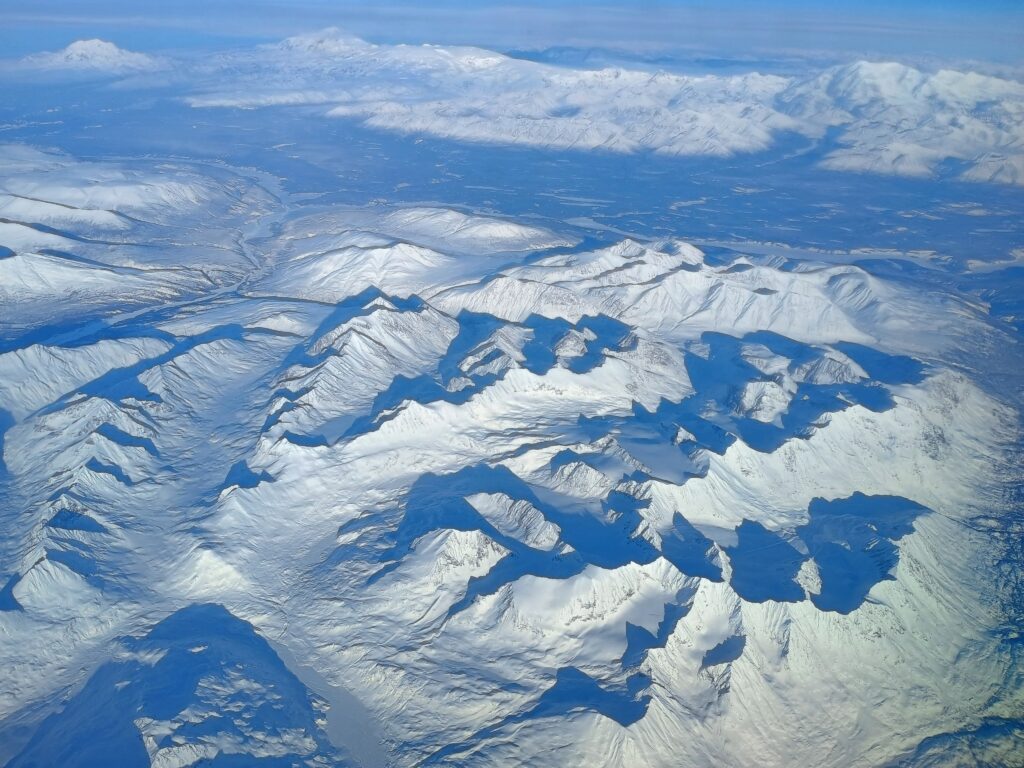
The flight from Chicago to Tokyo took us far north, as that flight path usually does. There was more light than I thought there would be, looking down at this moment on the February snows of the Yukon or Alaska; I’ll never know which. I could have been eying the border, for all I know, which suggests that borders are a gossamer fiction at these latitudes.

Japan

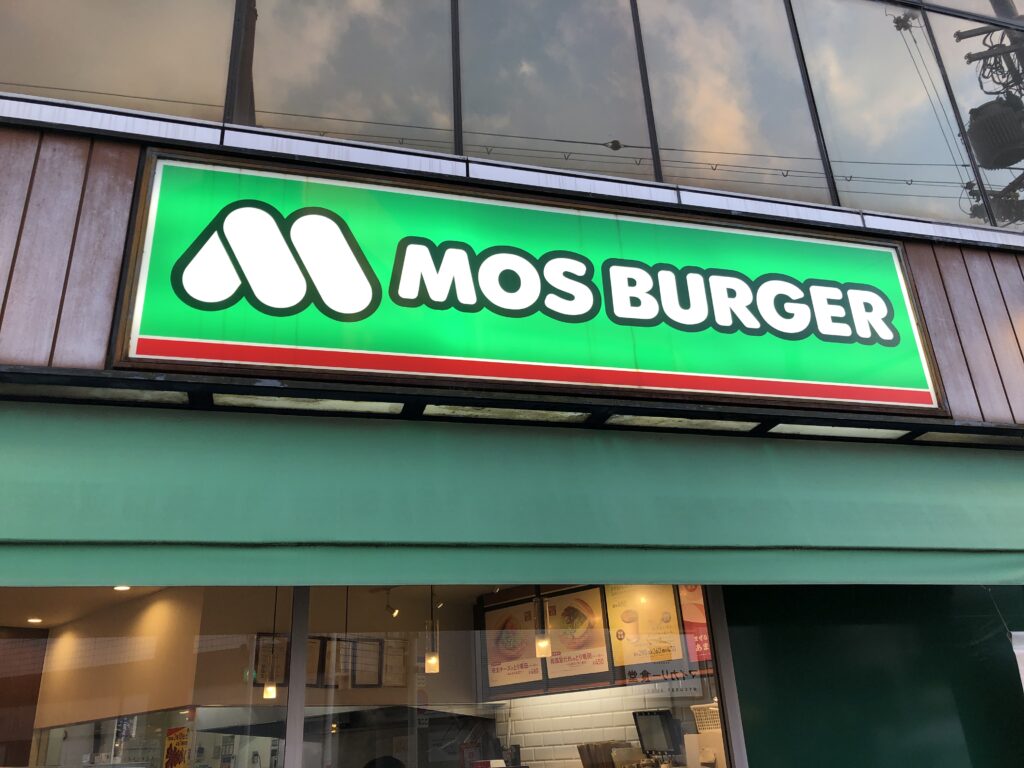
It was a happy moment when we ate at Mos Burger. One of these days, I’m going to dig out my paper copy of an article I wrote for Kansai Time Out in 1993 about four varieties of Western-style fast food chains founded in Japan, and post it. Today isn’t that day. But I can say that Mos Burger was the best of them.

As good as I remember it from 25+ years ago, the last time I went to one.

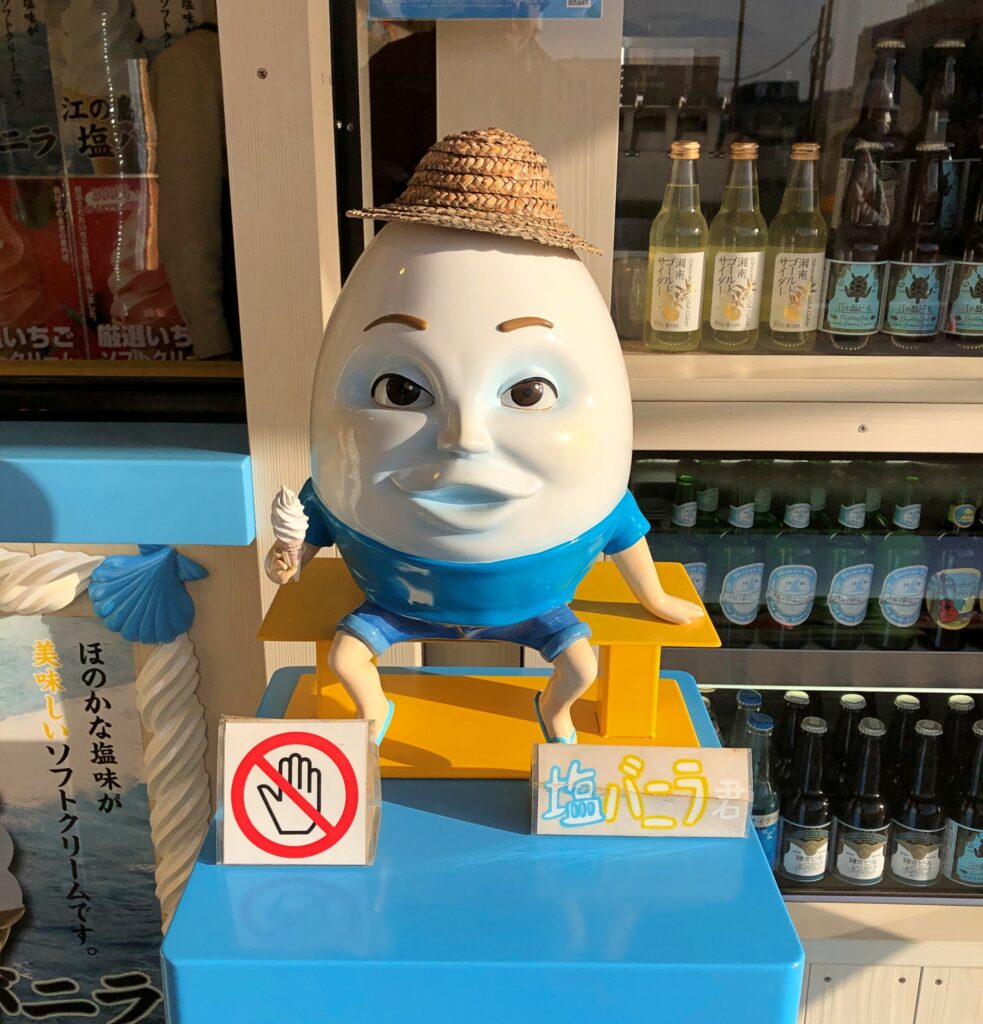
In Enoshima, near the ocean, this fellow hawks soft serve ice cream. Goo goo g’joob. Look but don’t touch.

I am the Eggman

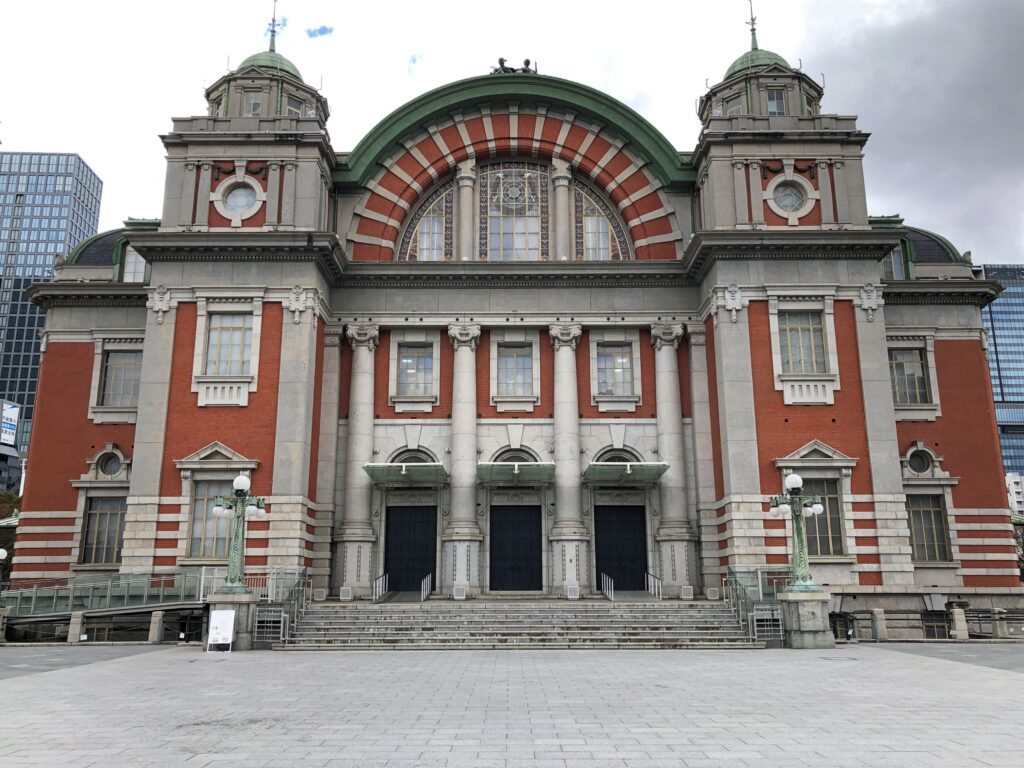
The handsome Osaka City Central Public Hall, completed in 1918. Amazing that it survived the war and urban renewal 20 years later, those forces that generally gave modern urban Japan the boxy concrete character it enjoys today.

India

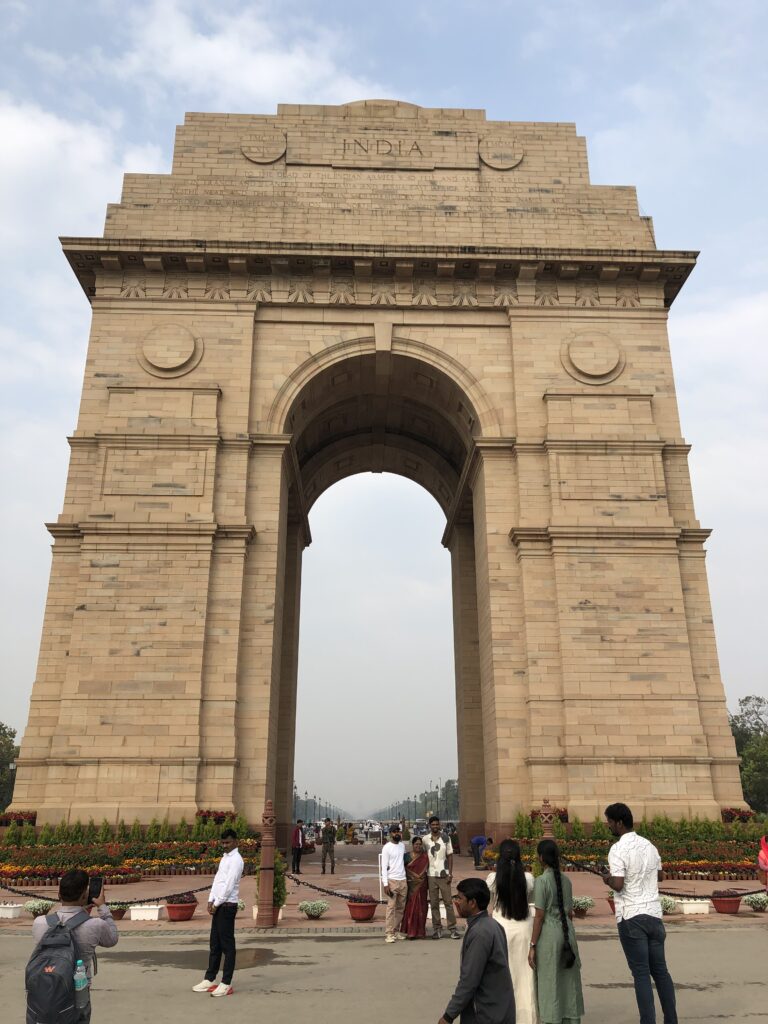
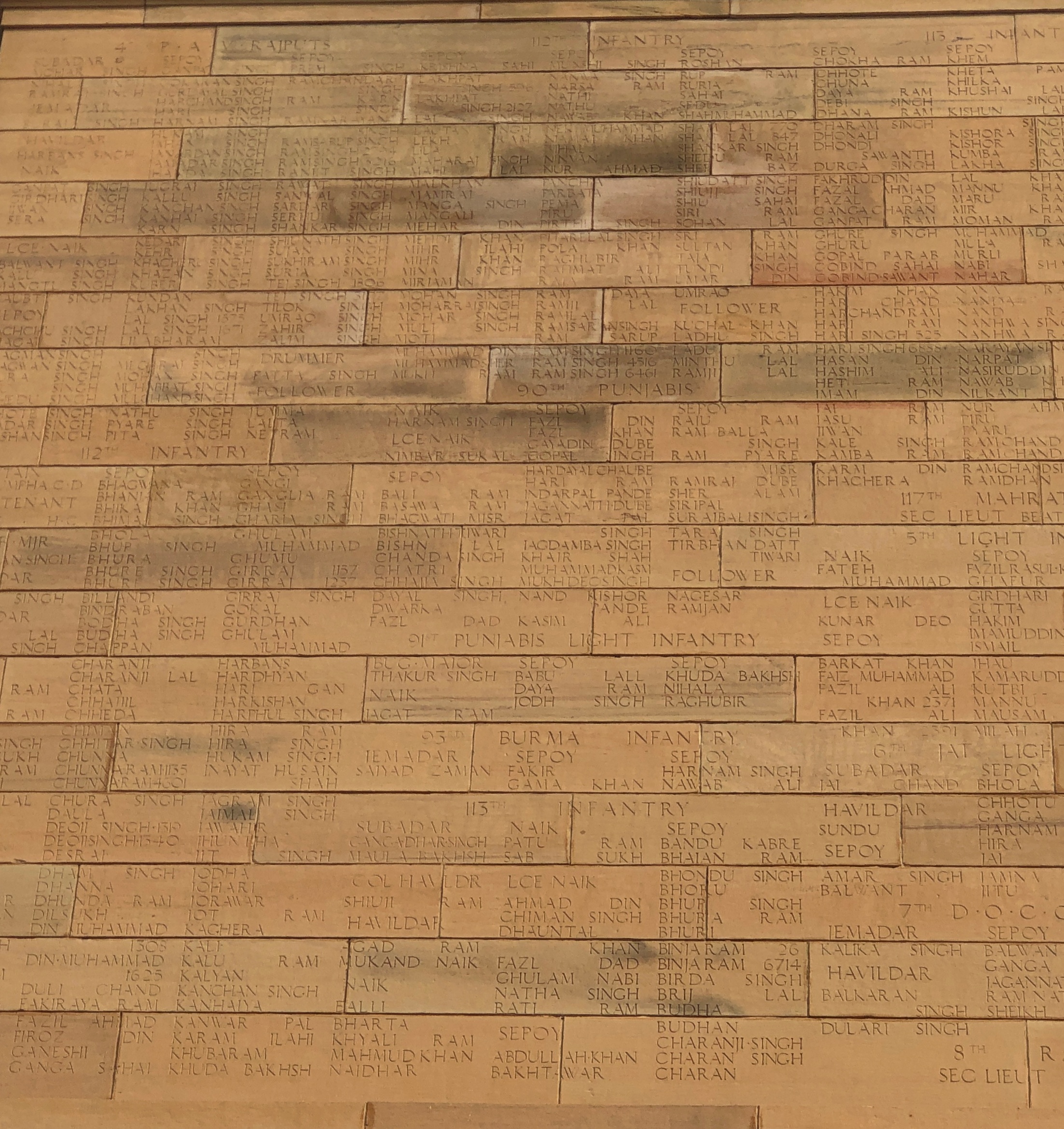
A monumental monument in New Delhi: India Gate, which honors more than 74,100 soldiers of the Indian Army who died during the Great War, and a number more in the Third Afghan War a few years later. They did their part. One of the larger relics of the Raj, unless you count things better described as legacies, such as railroad lines, parliamentary government, and the bitter feud between India and Pakistan.

While we were looking at India Gate, a group of about a dozen uniformed schoolboys, who had detached themselves from a larger group, approached me and asked where I was from. They were gleeful to hear “America,” a reaction I didn’t know anyone would have anymore, but I suppose they’ve seen a lot of our movies. A middle-aged male chaperon appeared in short order and shooed them away, while giving me a sidelong glance with a hairy eyeball, though I hadn’t precipitated the encounter in any way. I was just a suspicious foreigner, I guess.

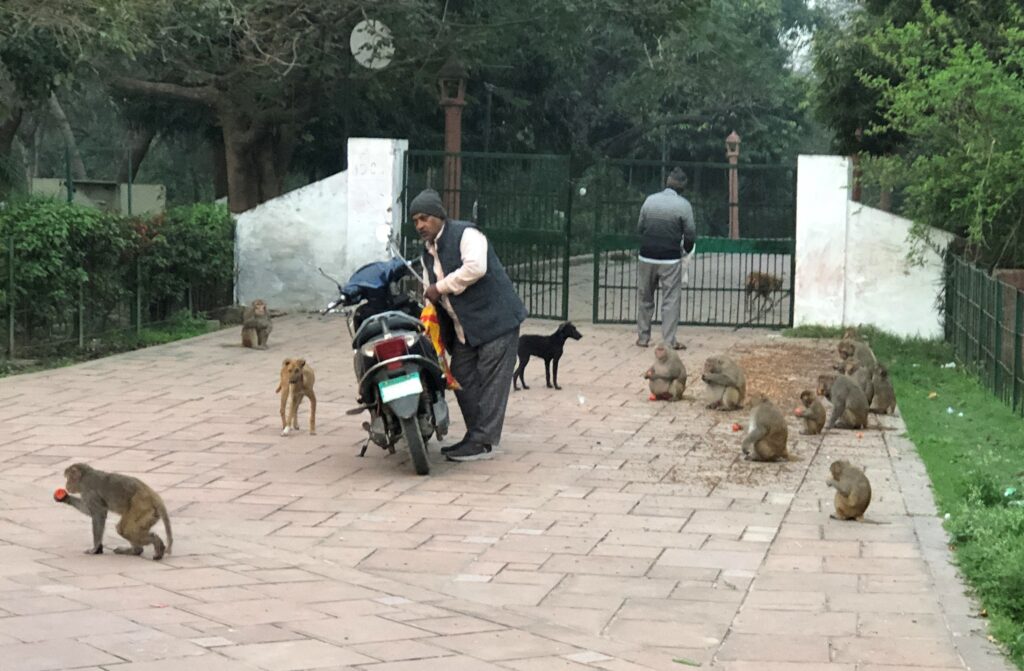
The Taj Mahal has a fair amount of parkland around it. That means a population of monkeys, too. I spotted more monkeys in urban India than I would have anticipated. These didn’t seem to be bothered by the men, the dogs or the motorcycle.

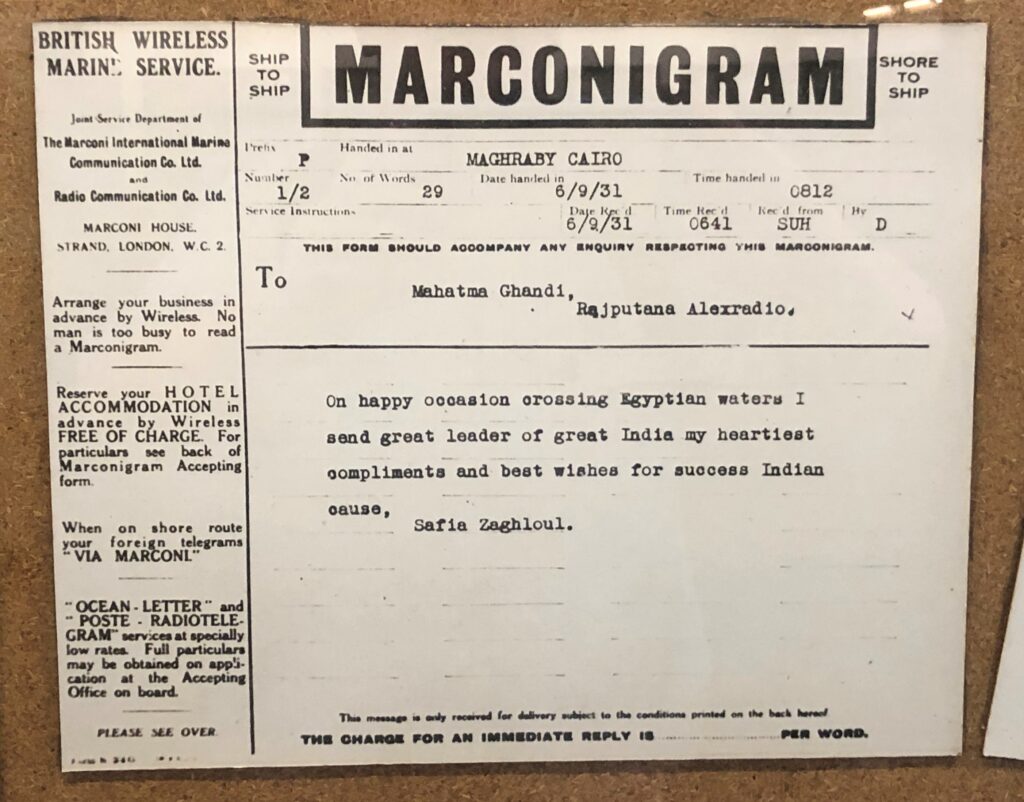
On display at the Ghandi Museum: a Marconigram. I don’t know that I’d ever seen one of those before. Or maybe there was one on display at the Titanic Museum in Branson. Anyway, that’s one good reason to go to museums: for things once common, now curiosities. Safia Zaghloul was an Egyptian political activist of the time.
United Arab Emirates

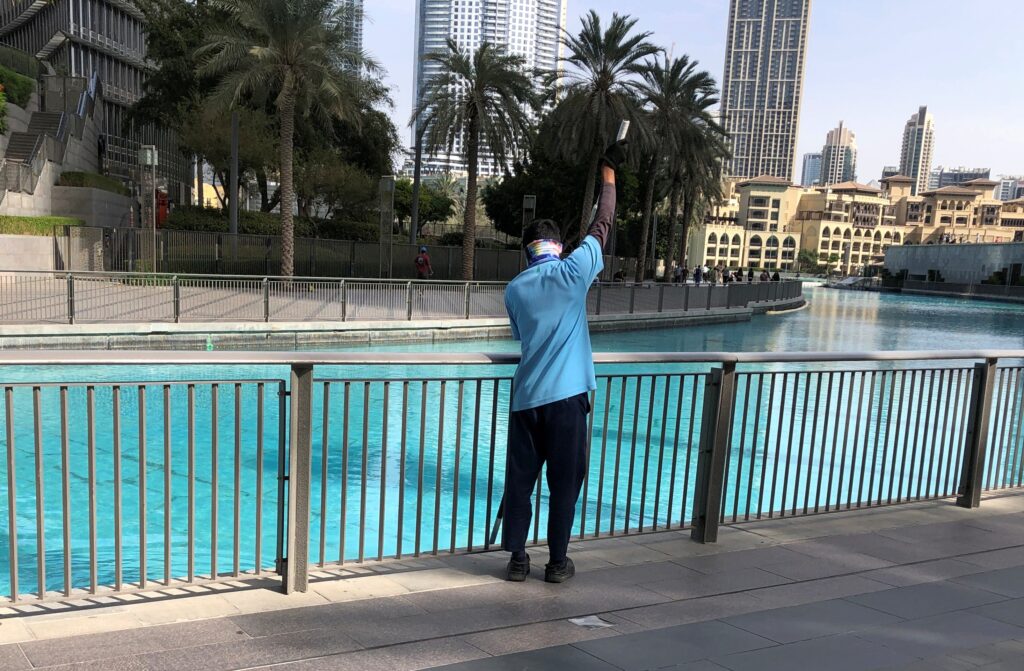
In Dubai it seemed like there were more men at work sweeping, mopping and other cleaning of floors and other flat places, per square meter, than anywhere else I’ve ever been. There are worse things to do with cheap labor.
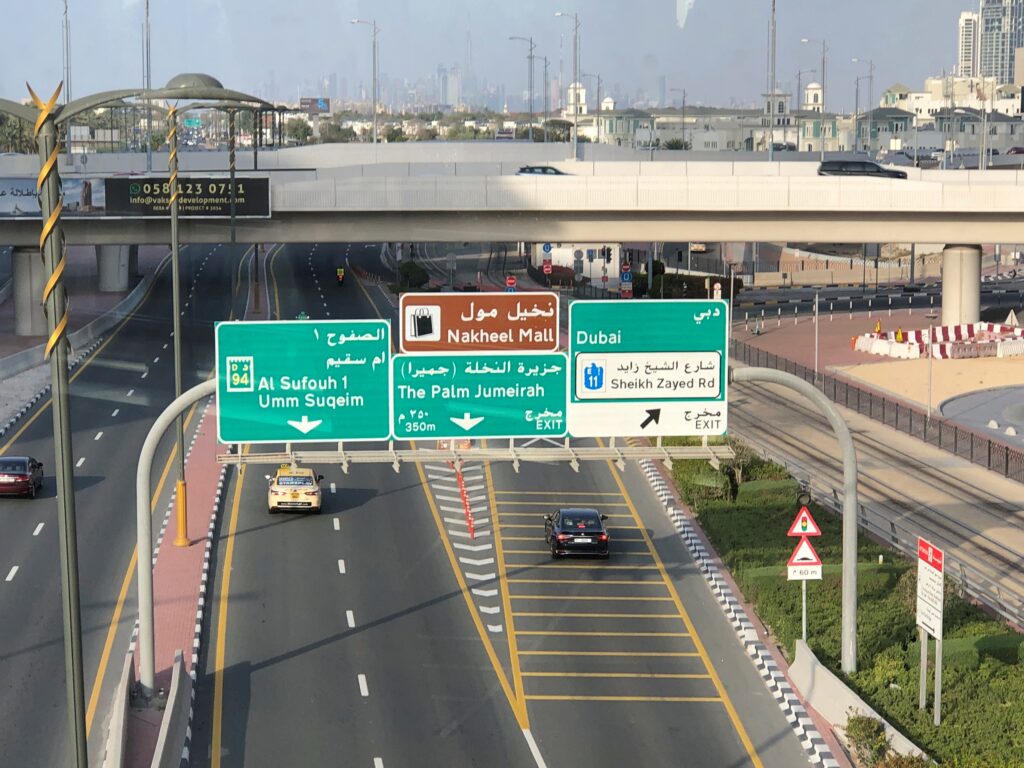
Not sure exactly where this was, except somewhere out on Palm Jumeirah. Must have been a wall, or like a wall, in one of the posh retail corridors winding through one of the posh resort properties amid the poshness of the island.

Note: White on green is common indeed around the world.

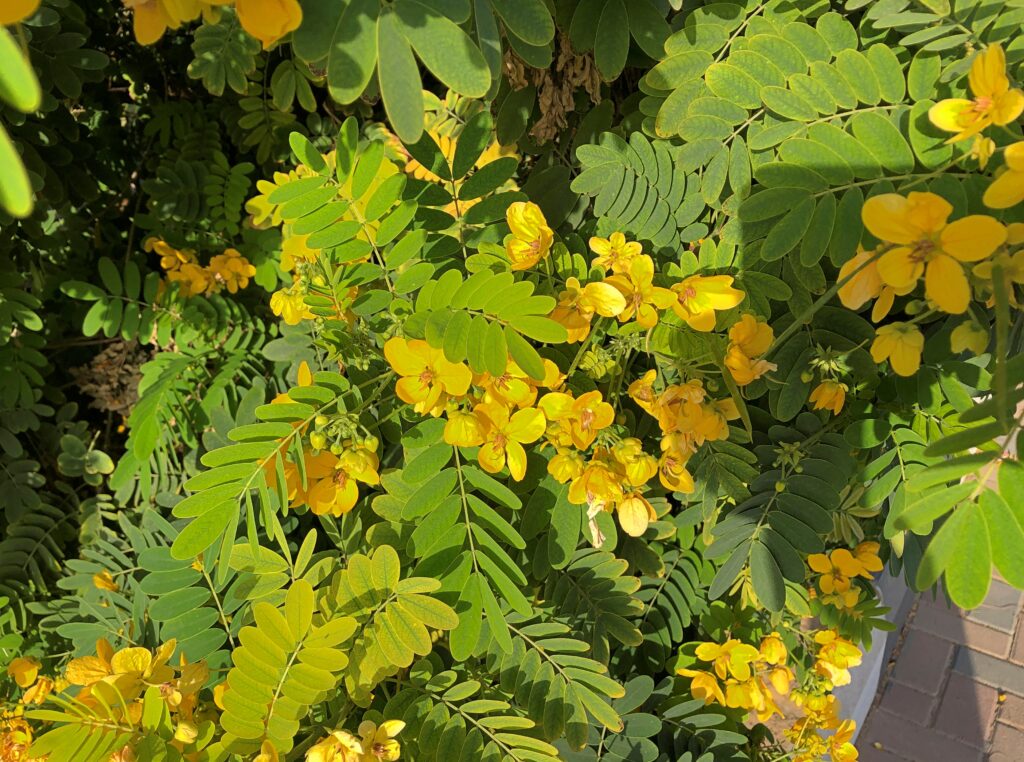
Desert flowers. Of course, sprinklers water that bit of terrain at regular intervals.

Germany

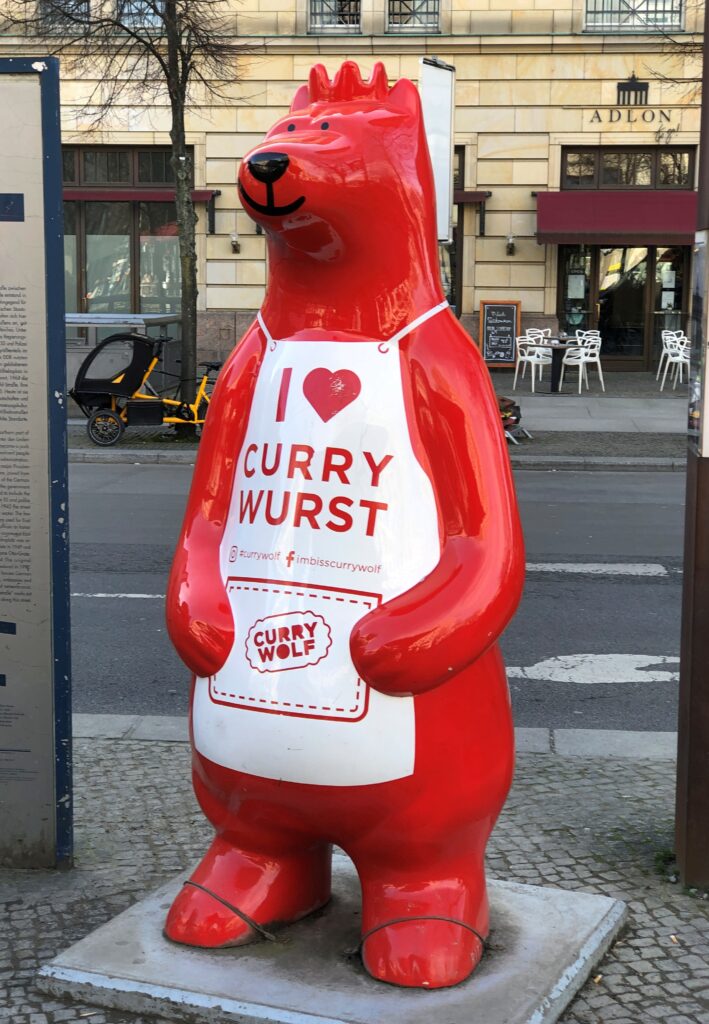
What’s Berlin without currywurst? They say it came into style soon after the city was divided.

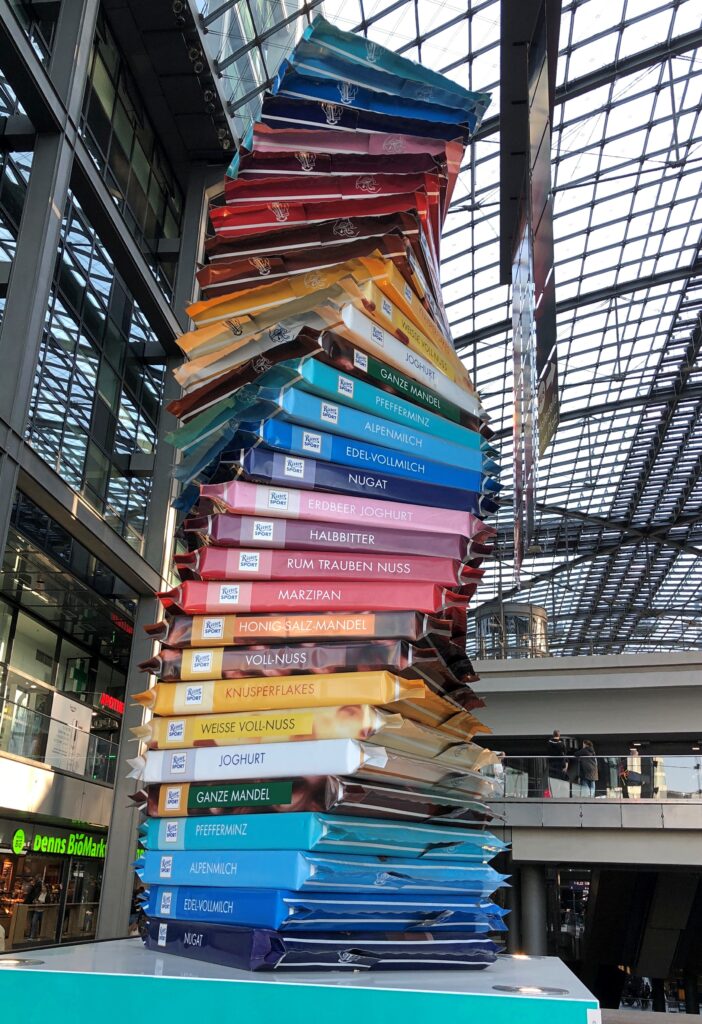
What would Germany be without Ritter Sport? A giant stack of them can be seen, in their great variety, at the Hauptbahnhof in Berlin. Later, I bought about 10 squares of RS at a discount price at a Netto grocery store near our hotel. Think Aldi or Lidl, but more cluttered.

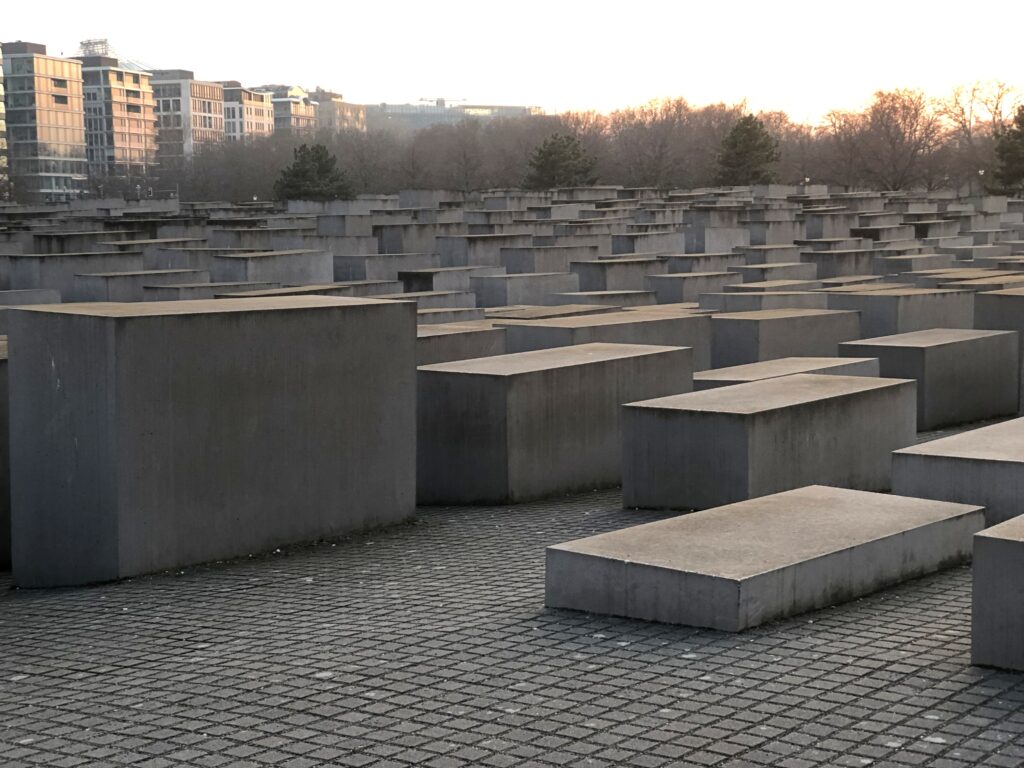
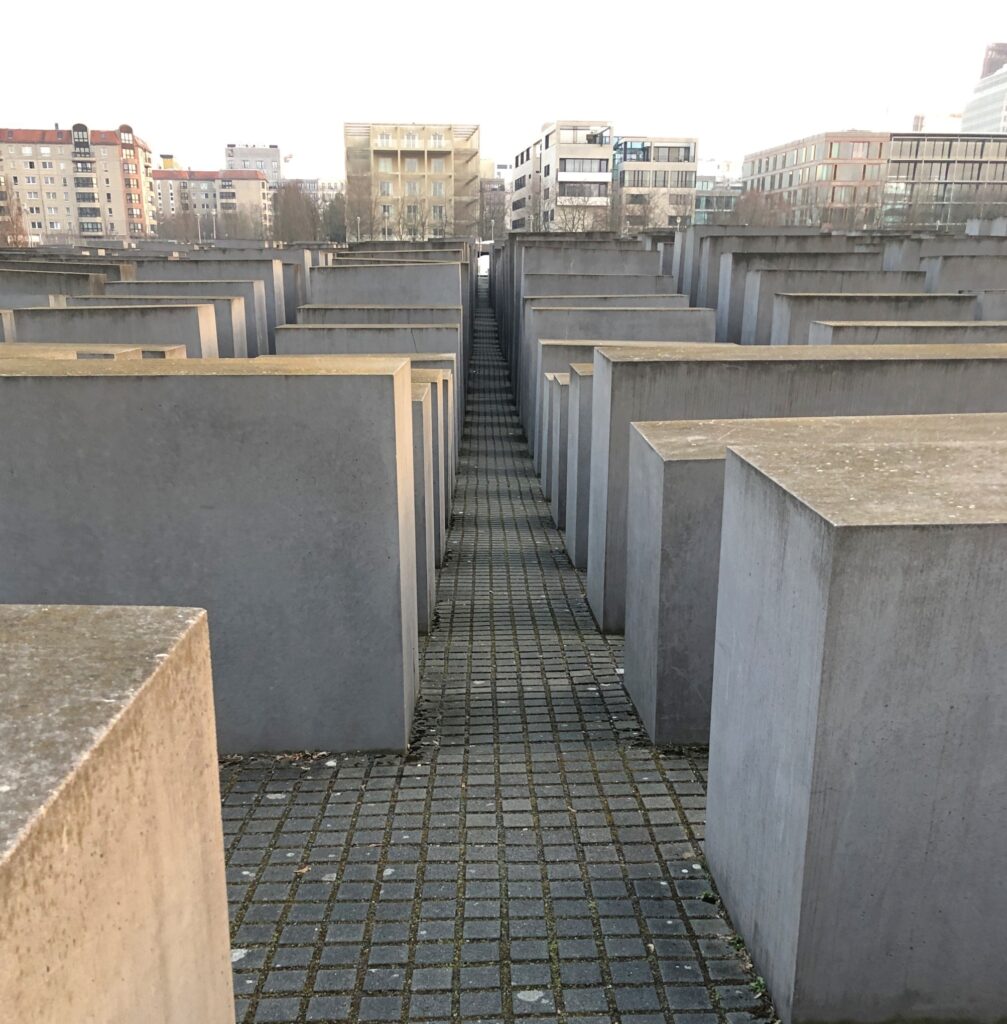
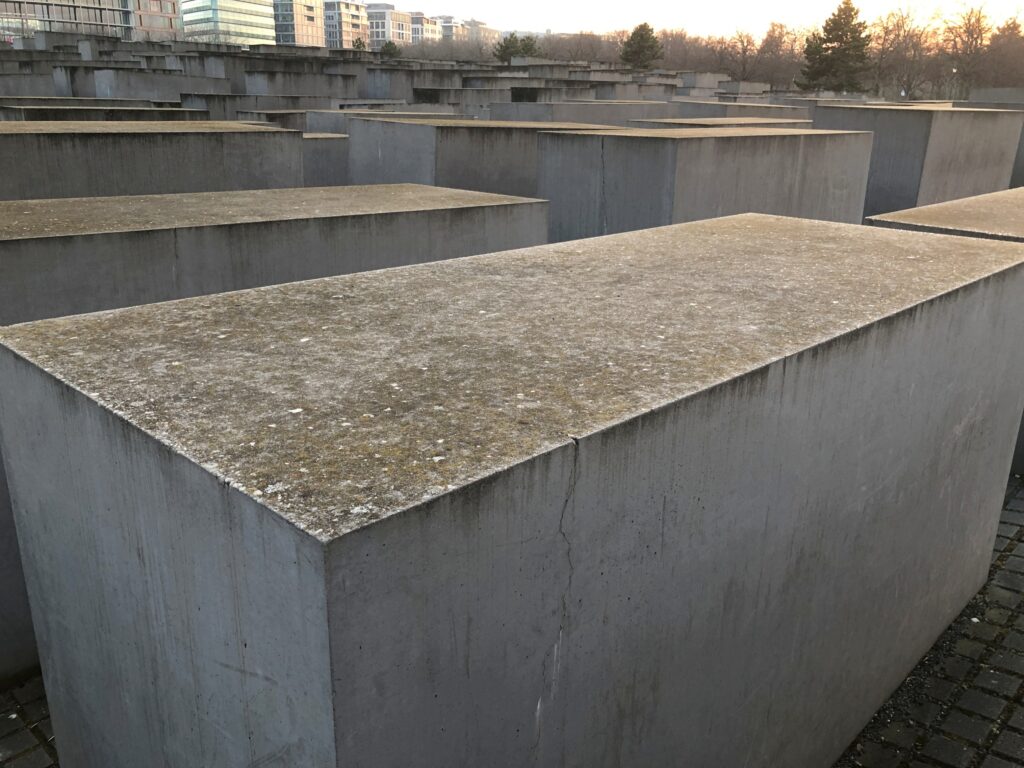
Views of the Memorial to the Murdered Jews of Europe, Denkmal für die ermordeten Juden Europas, near the Tiergarten in Berlin. It wasn’t there in 1983.

Czech Republic

Not calling it Czechia. Or, if it ever comes to it, not calling India Bharat, either.

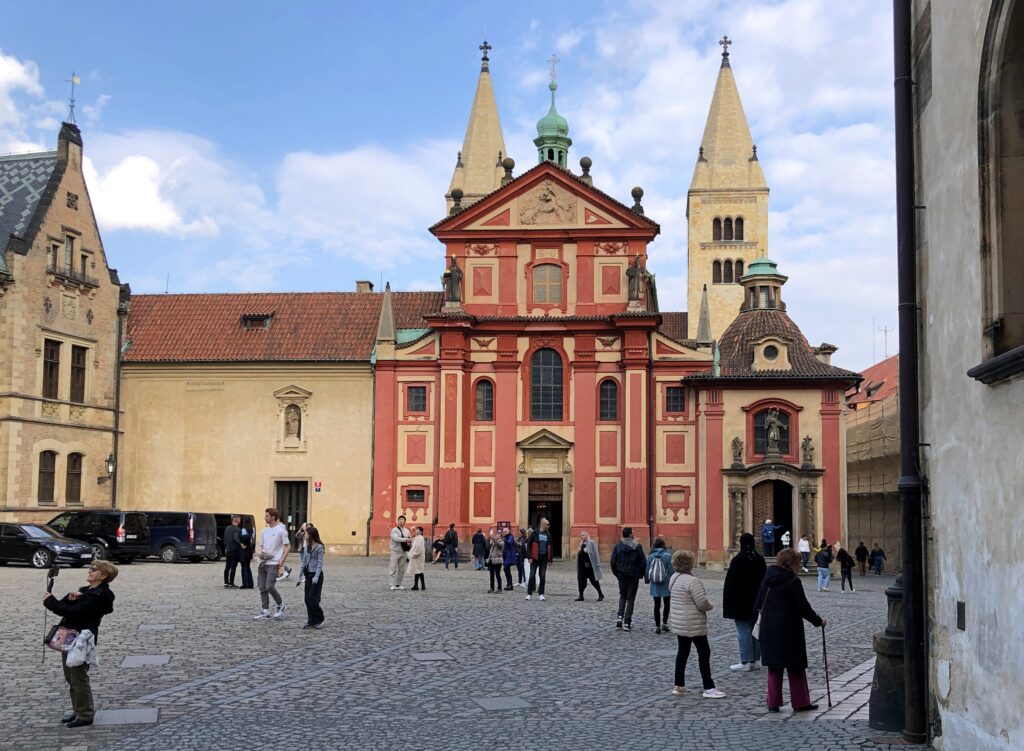
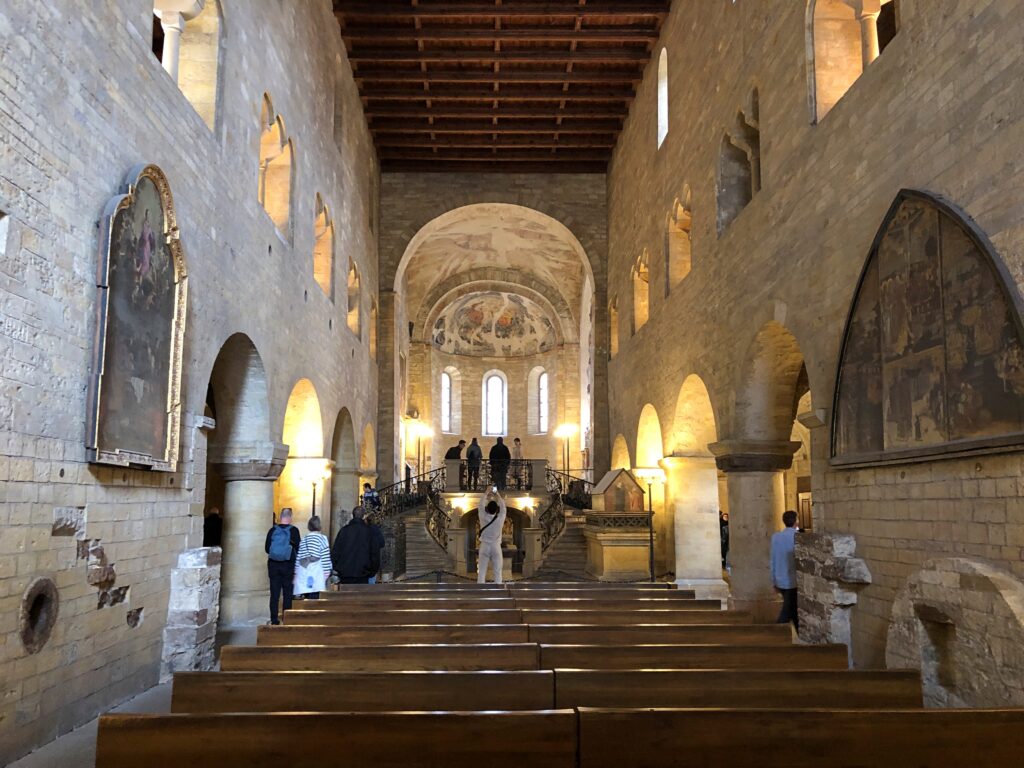
St. George’s Basilica. I admired the nearby St. Vitus Cathedral. That’s a grand edifice. But St. George’s has that human scale, and echoes of an even earlier time. It was completed during the time of Good King Wenceslaus.

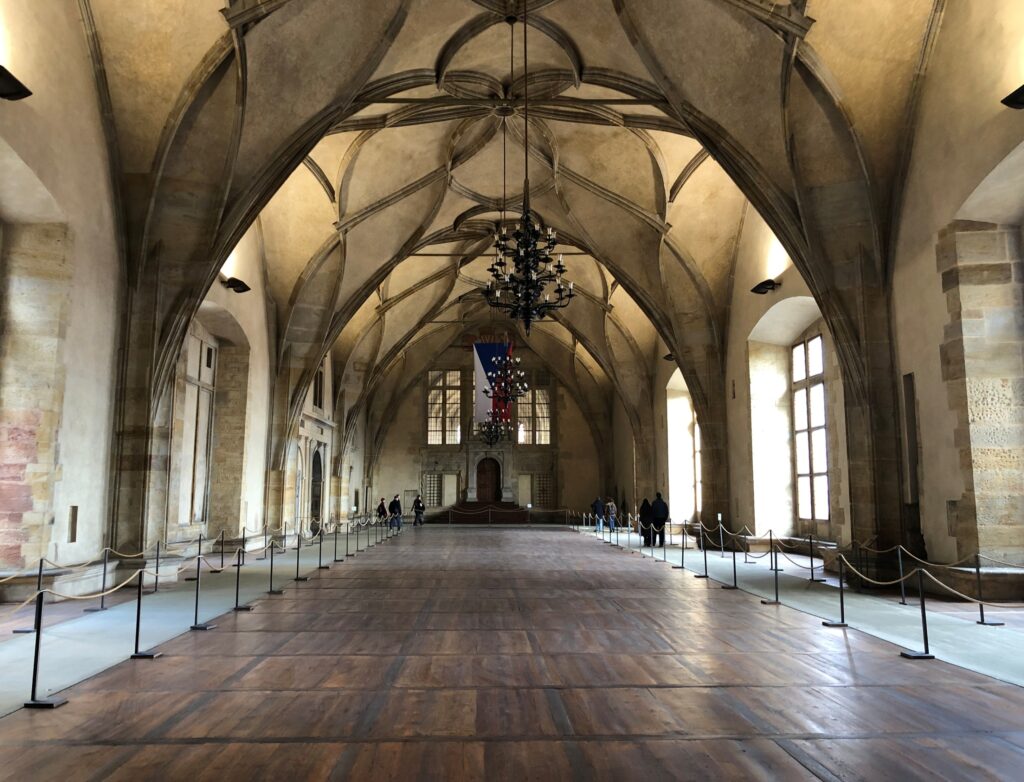
Vladislav Hall. The site of centuries of Bohemian parties, banquets and balls, me boys. That and affairs of state.

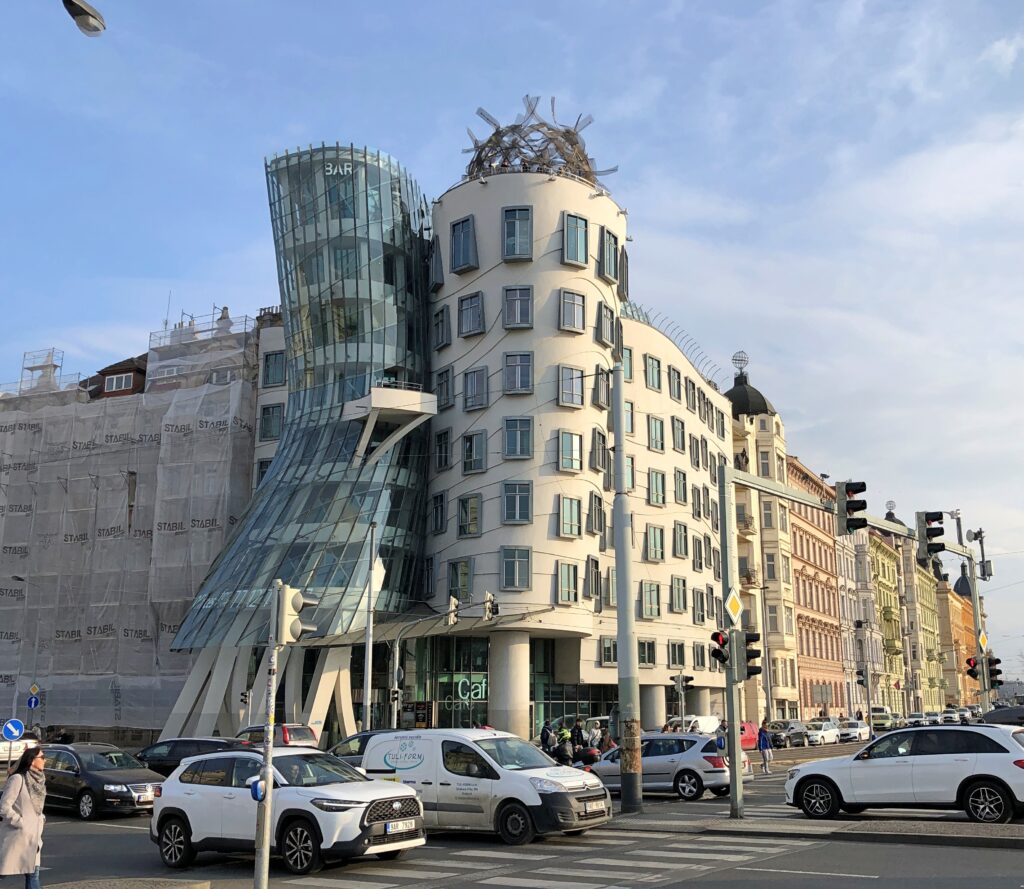
The Dancing House. We rode a streetcar line out of our way to see it, though not that far. It wasn’t there in 1994.

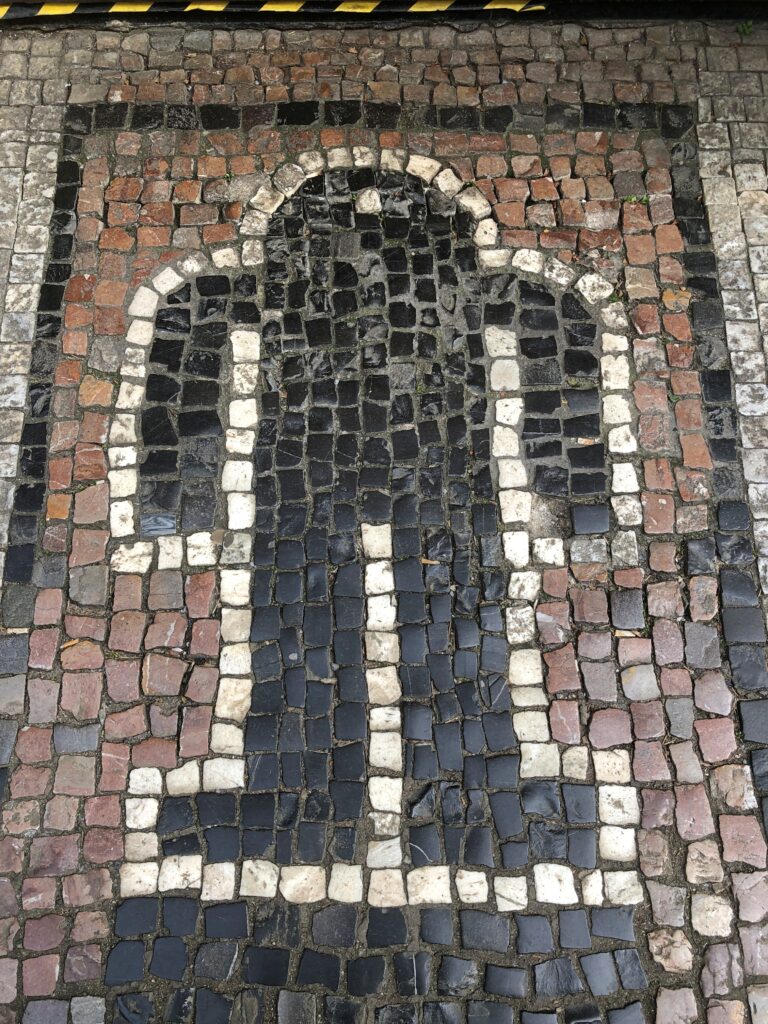
A sidewalk golem in the old Jewish Quarter of Prague. The Sidewalk Golems was a relatively obscure band who sometimes toured with Irwin Hepplewhite and the Terrifying Papoose Jockeys.

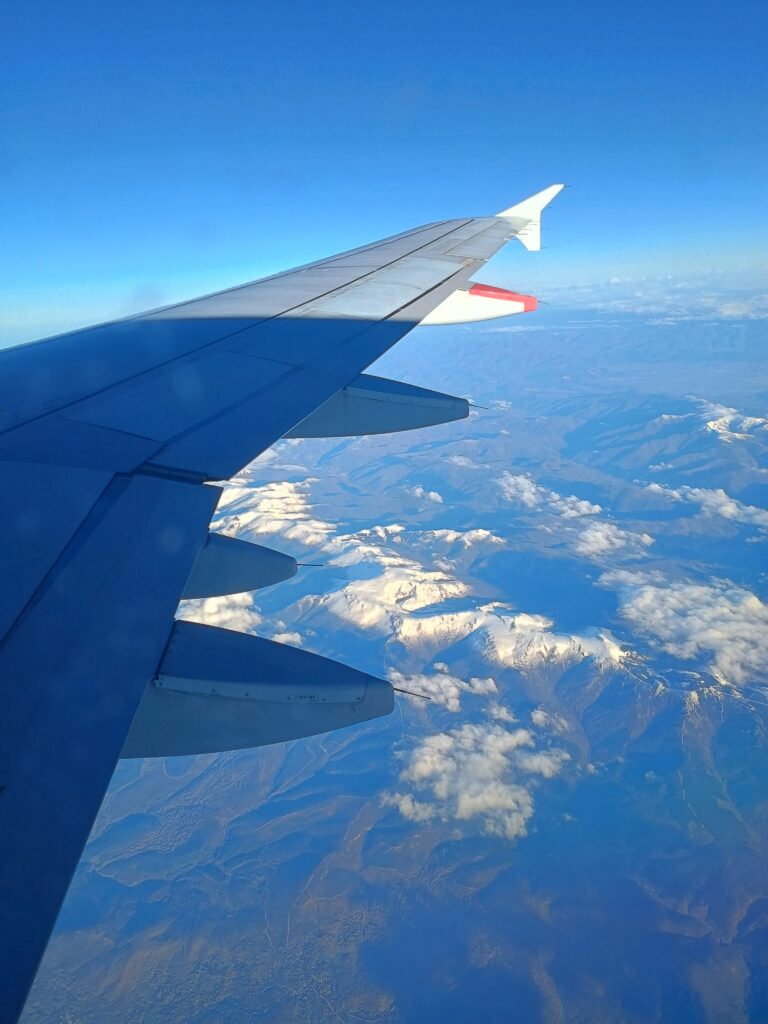
This could have been over Spain or Portugal.

The last image of thousands that I took, a staggering number in any context except digital images that take practically no time or effort to make.

Rosehill Cemetery: For Union and Liberty

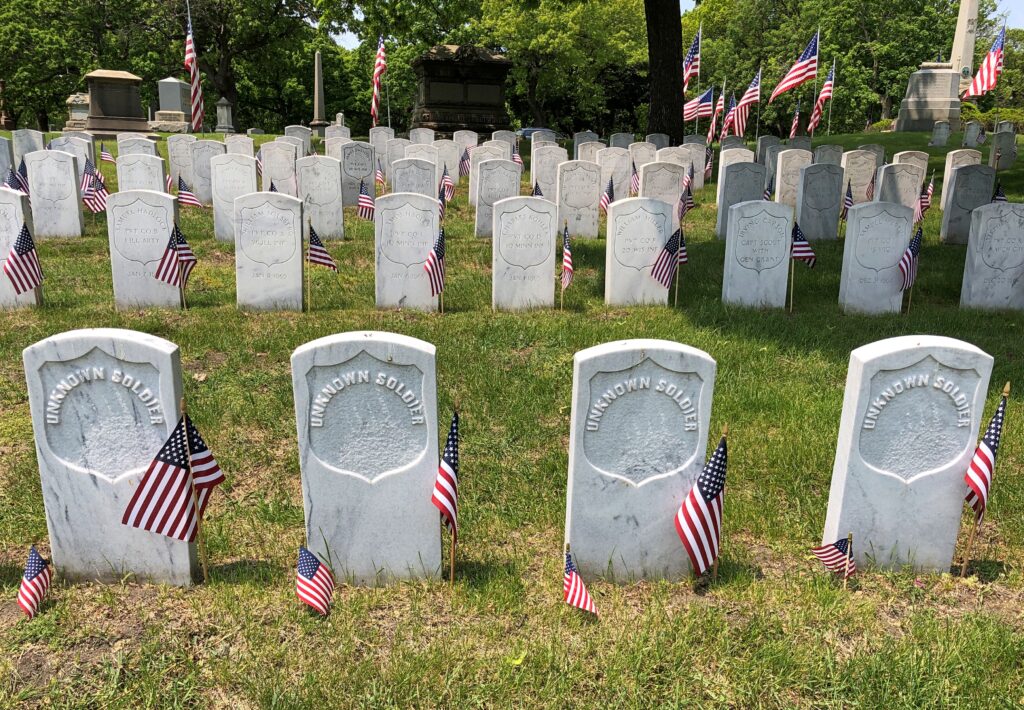
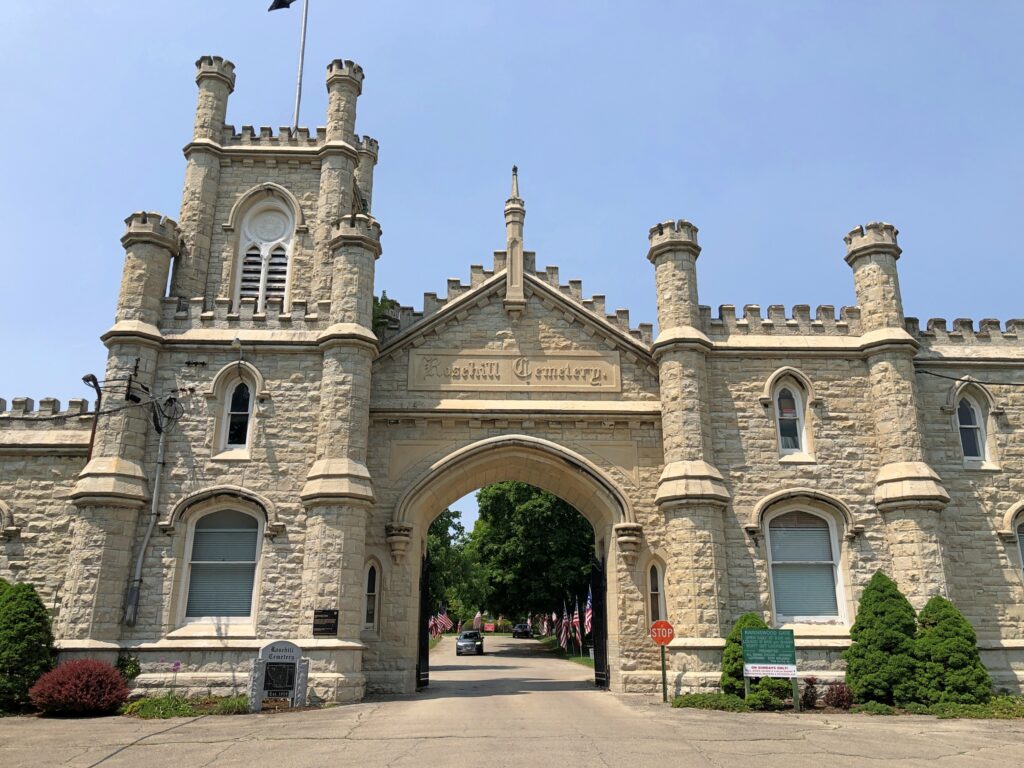
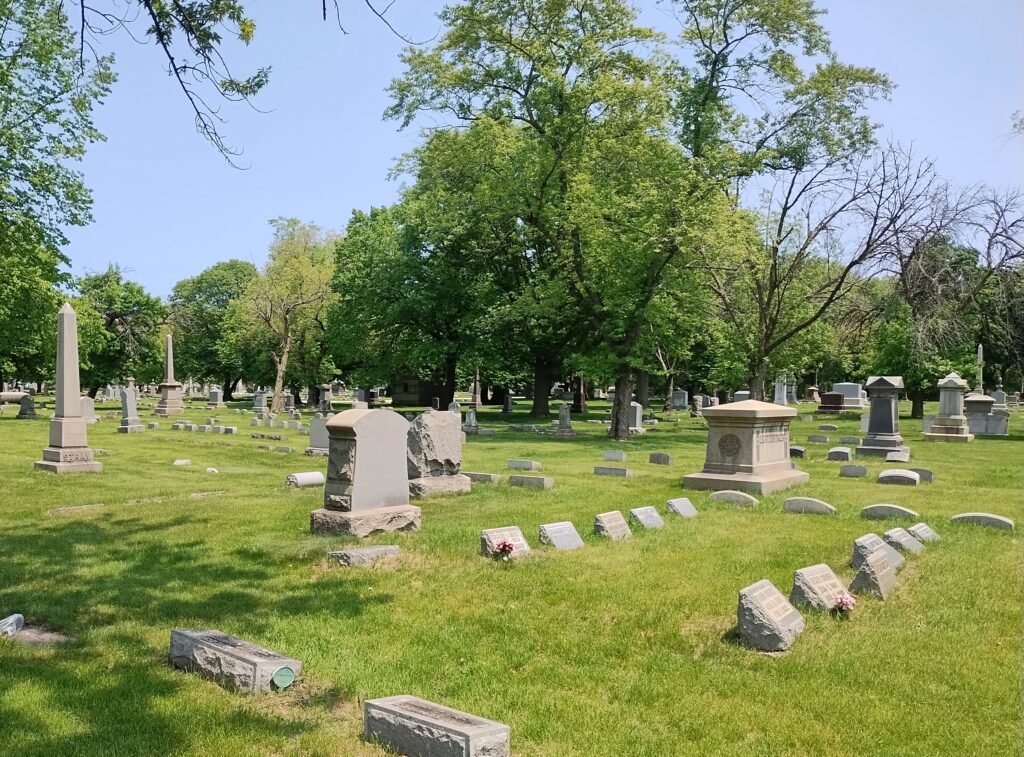
Rosehill Cemetery in Chicago opened in 1859, just in time to receive war dead in the days before dog tags.

Rosehill Cemetery

Still, most of the stones had names and, for now, flags that must have been placed for Memorial Day, which was the weekend before I took my stroll at Rosehill.

Rosehill Cemetery

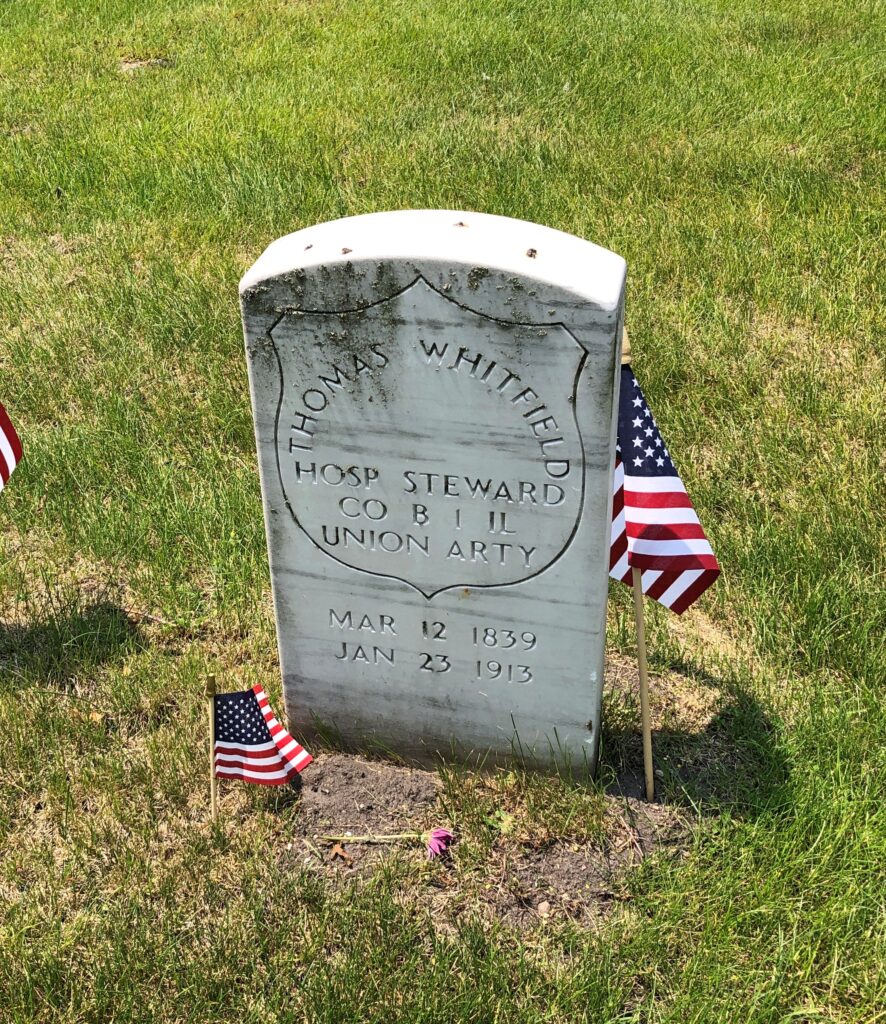
The first hospital steward I’ve ever seen among stones of this kind. That couldn’t have been an easy or pleasant job.

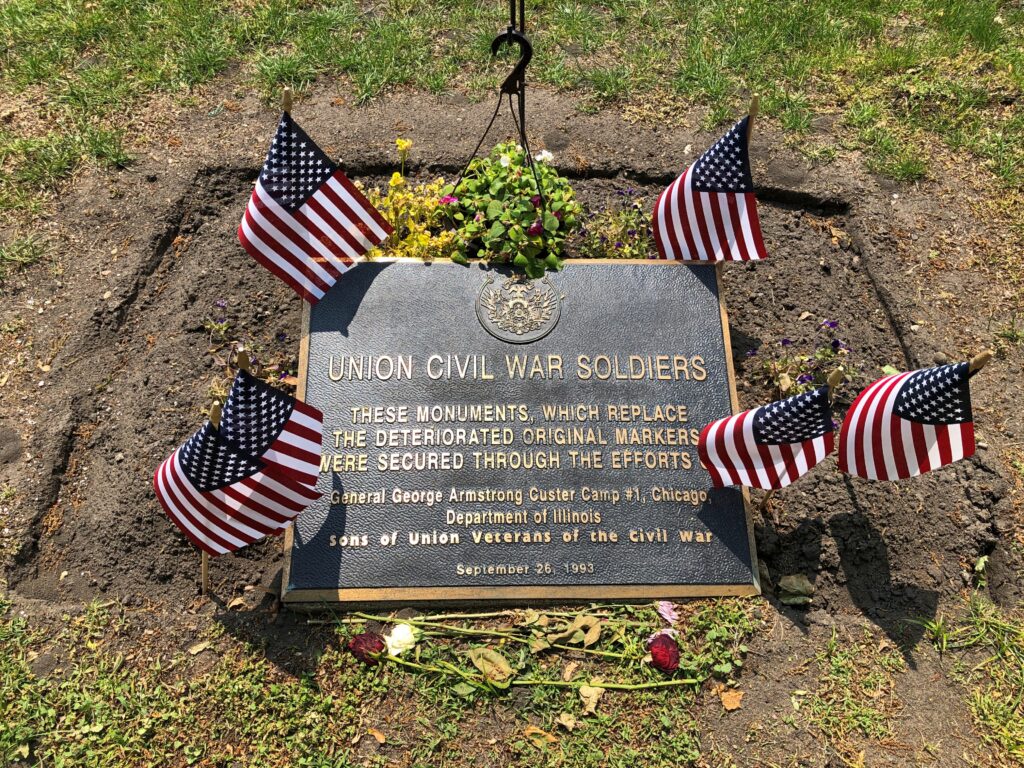
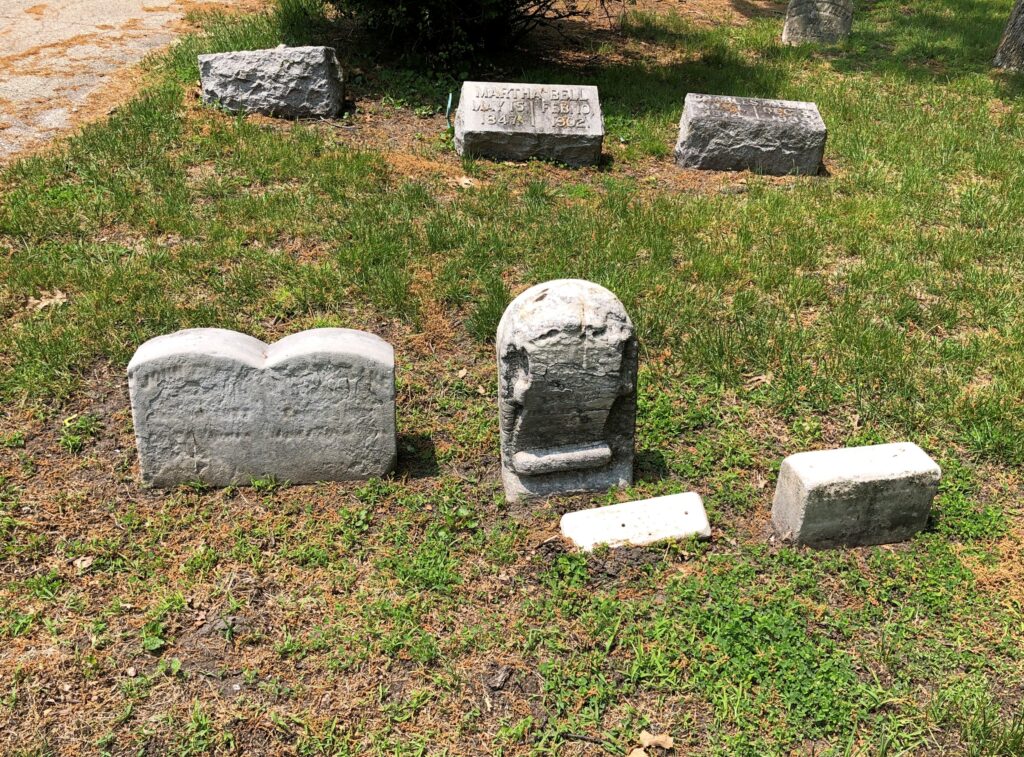
The stones looked fairly new. Turns out they are replacements for the originals.

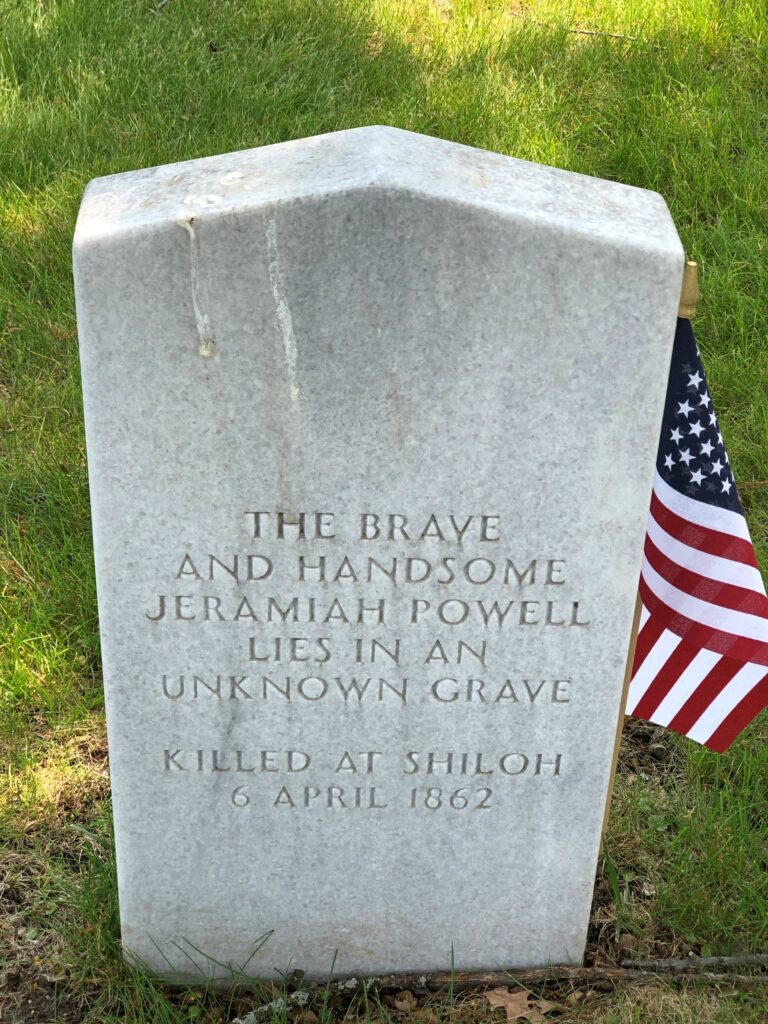
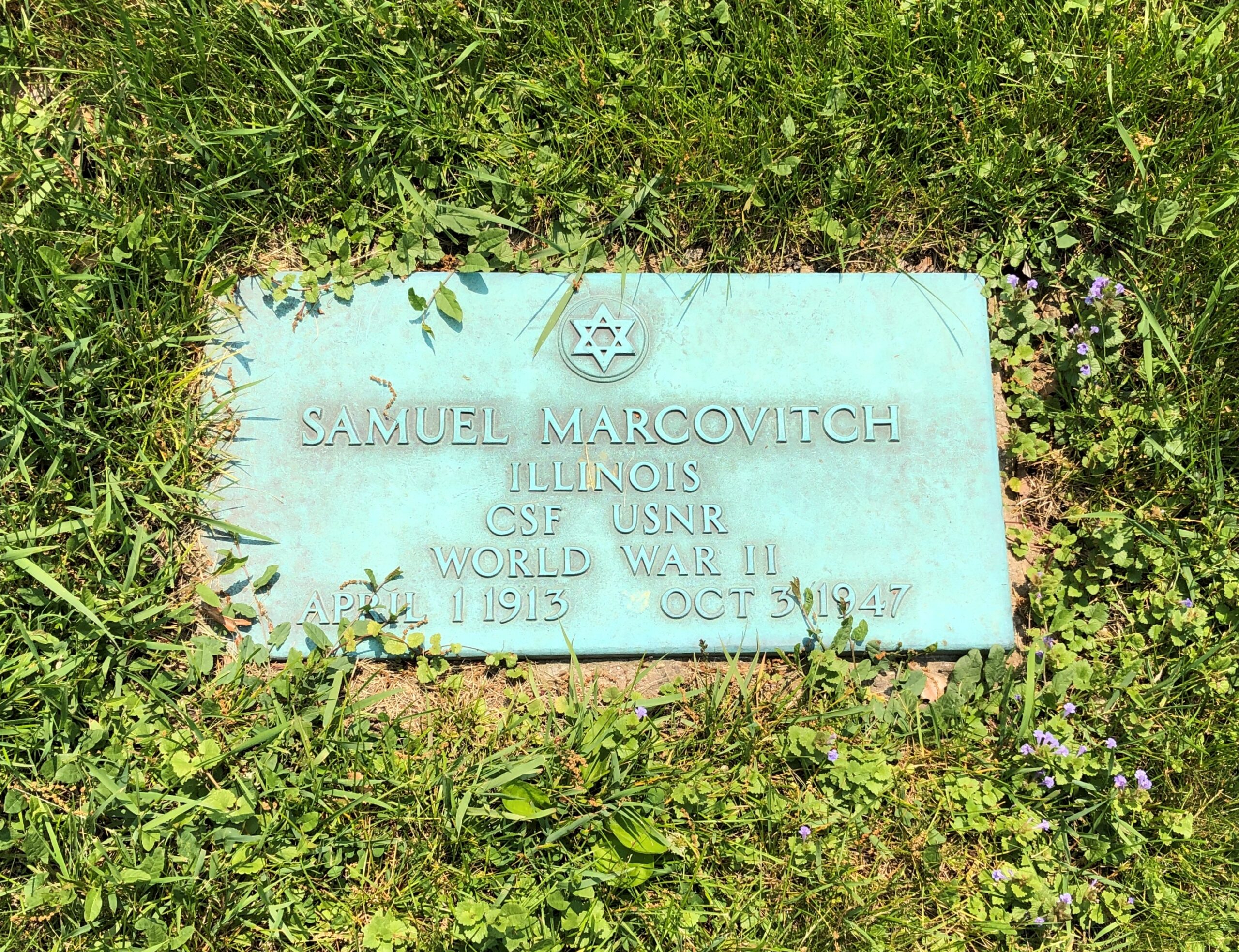
Often pointed-top stones designate Confederates, but not in this case. Died for the Union at Shiloh, but not buried in Chicago.

Rosehill Cemetery
Rosehill Cemetery

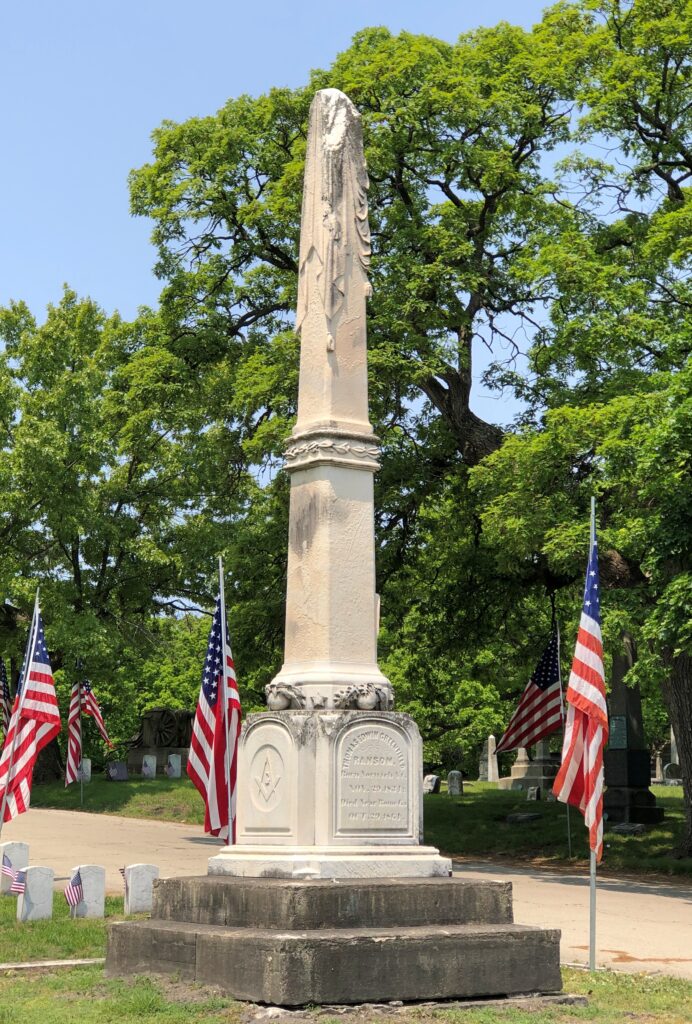
A draped obelisk marking the grave of Gen. Thomas E.G. Ransom (d. 1864).

Rosehill Cemetery

The Civil War was a hands-on conflict even for high-ranking officers, who thus died or were wounded in some numbers. They also shared the risk of disease, and in fact dysentery felled Gen. Ransom, though he had been wounded more than once in combat.

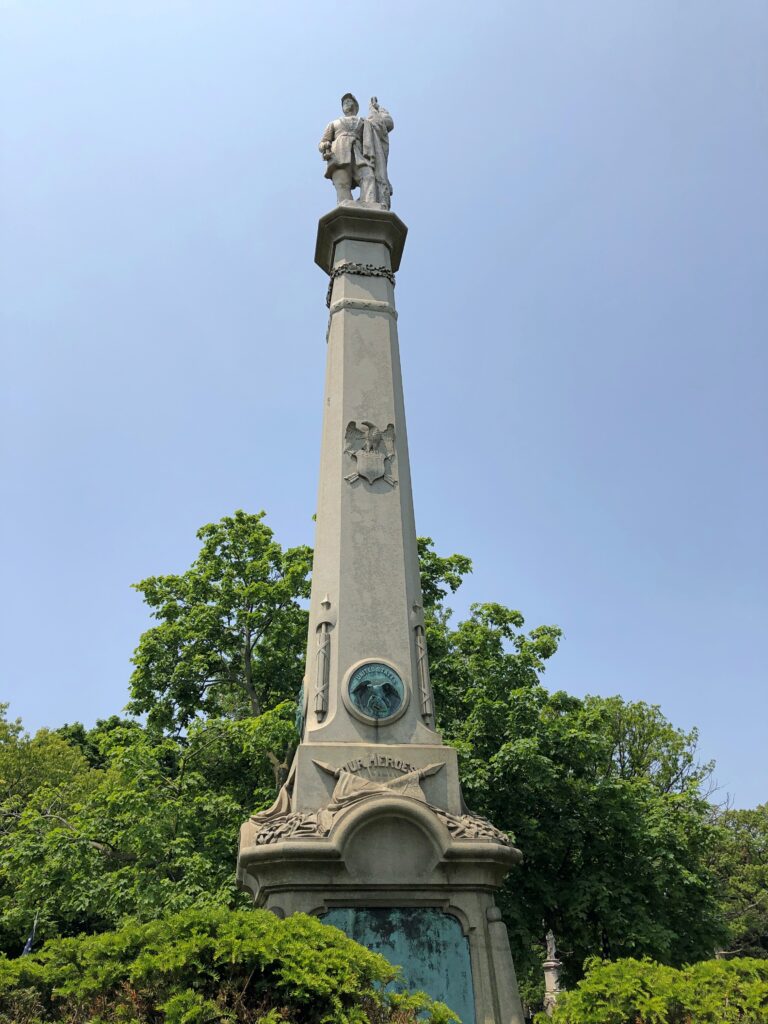
The war dead are clustered near the cemetery’s grand entrance. This memorial says Our Heroes and was dedicated on Decoration Day 1870, with the bronze atop and the bas-relief panels on the sides by noted sculptor Leonard W. Volk (d. 1895). He also did the tomb of Stephen Douglas.

Rosehill Cemetery
Rosehill Cemetery

“An immense train, composed of twenty-three cars, was found necessary to transport the people who desired to attend the ceremonies,” the Chicago Tribune reported the next day. “These, added to the number which had taken the forenoon train, as well as those who had proceeded to the spot in carriages, swelled the attendance to over five thousand persons, there being about an equal number of ladies and gentlemen. Arrived at Rosehill the crowds formed into a procession and, headed by Nevans & Dean’s full band, marched to the music of a dirge to the vicinity of the monuments, where a few moments were occupied in the inspection of the structures.”

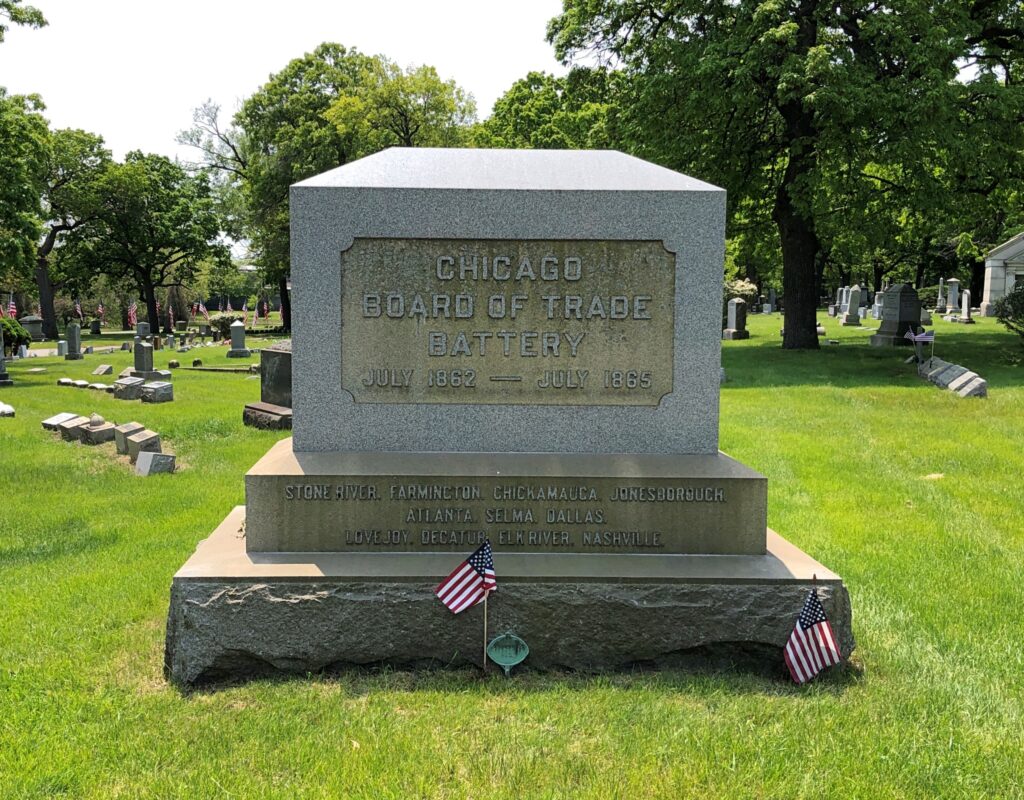
The report mentioned monuments, plural, and besides Our Heroes, also dedicated that day was a memorial to the Chicago Board of Trade Battery, an artillery battery, noting the many battles it participated in.

More artillery.

Rosehill Cemetery

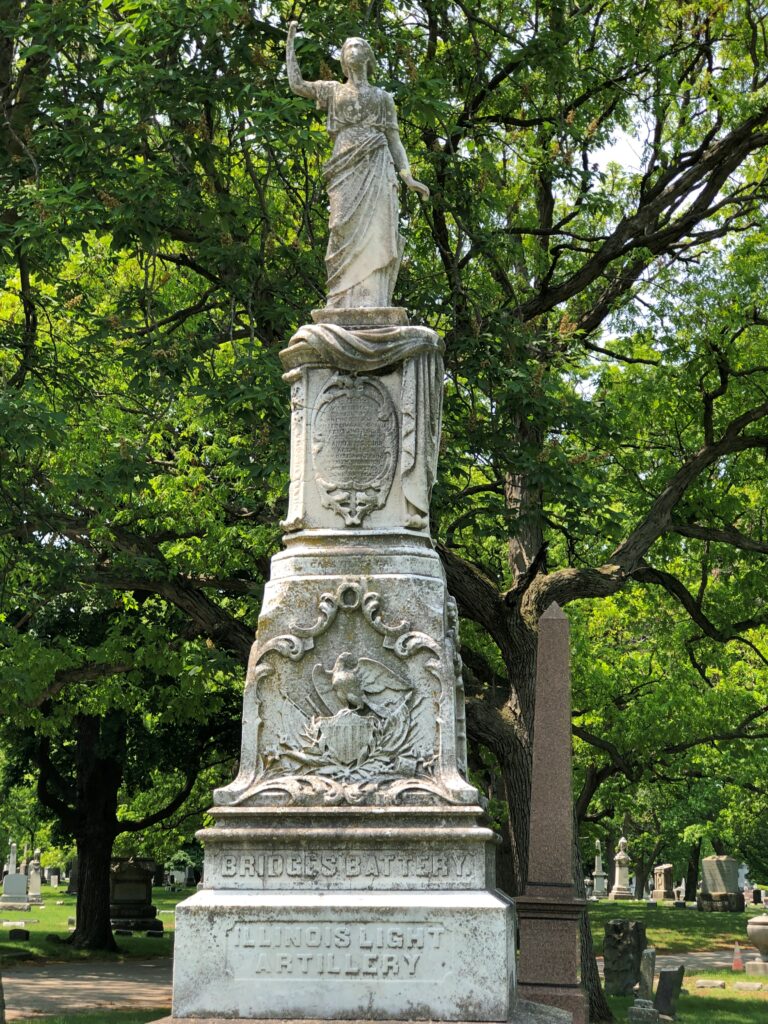
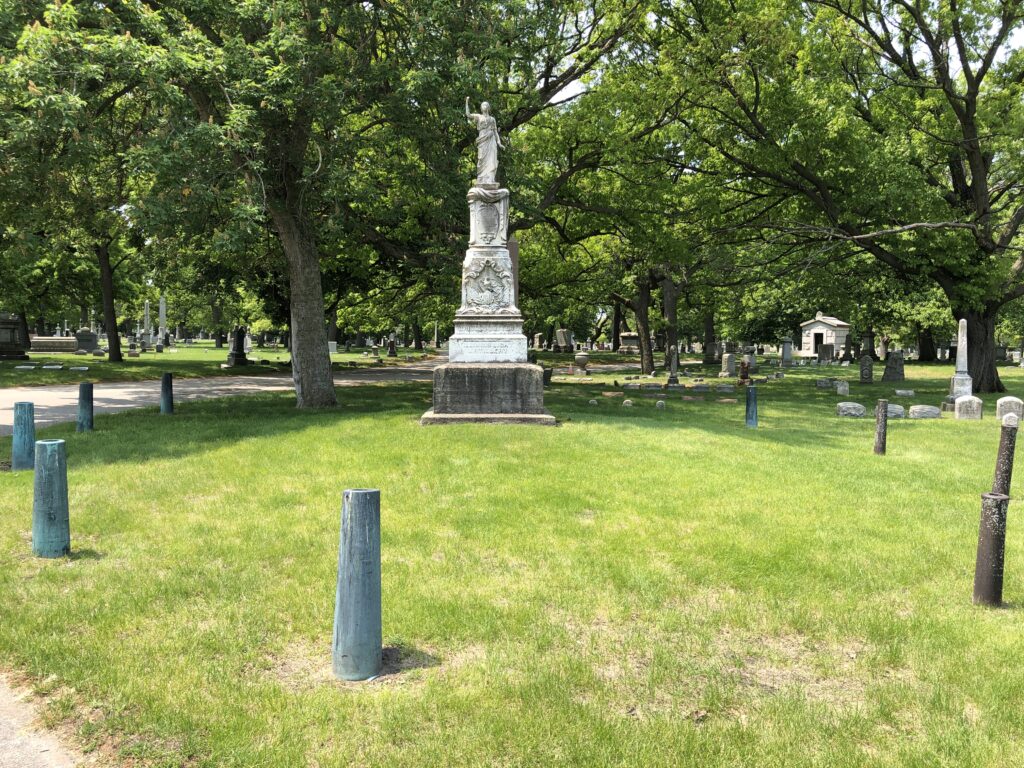
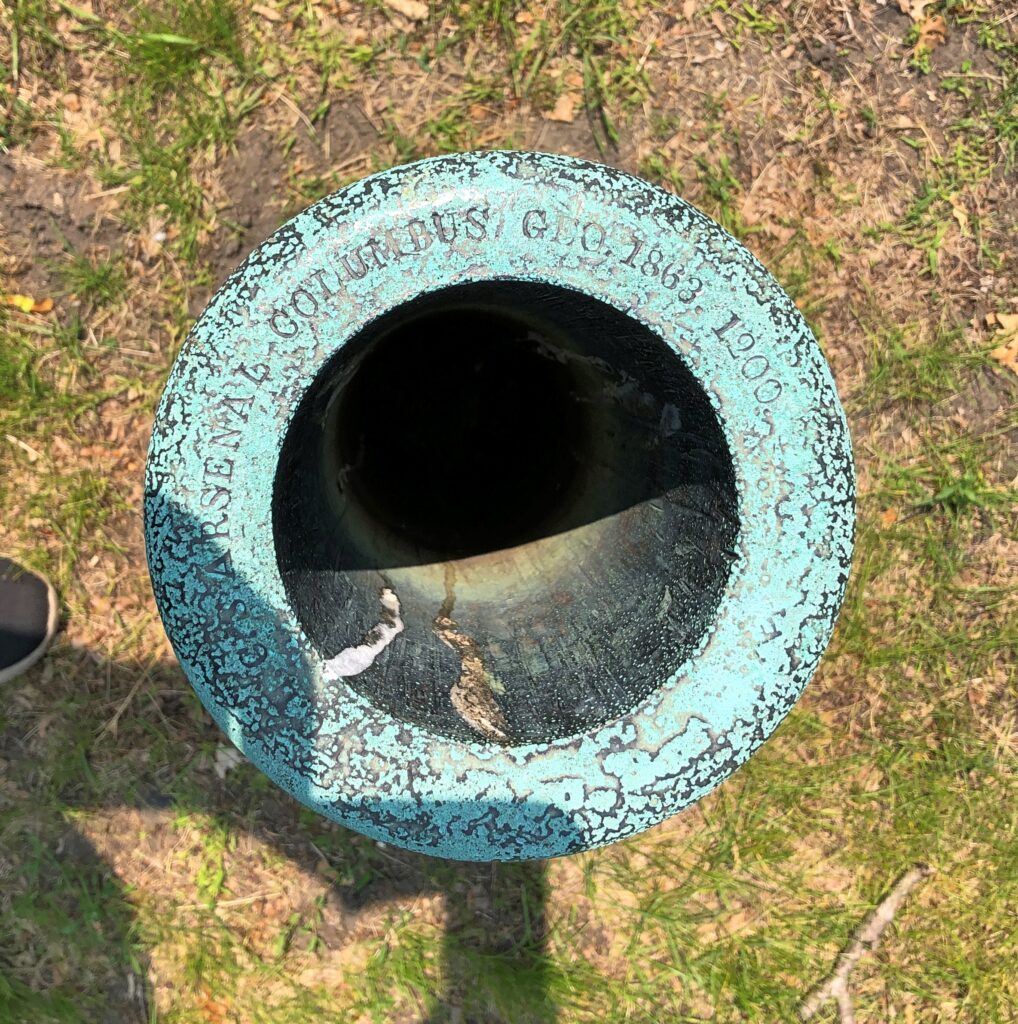
Bridges’ Battery, Illinois Light Artillery, is ringed by what look to be captured — and repurposed — cannons.

Rosehill Cemetery
Rosehill Cemetery

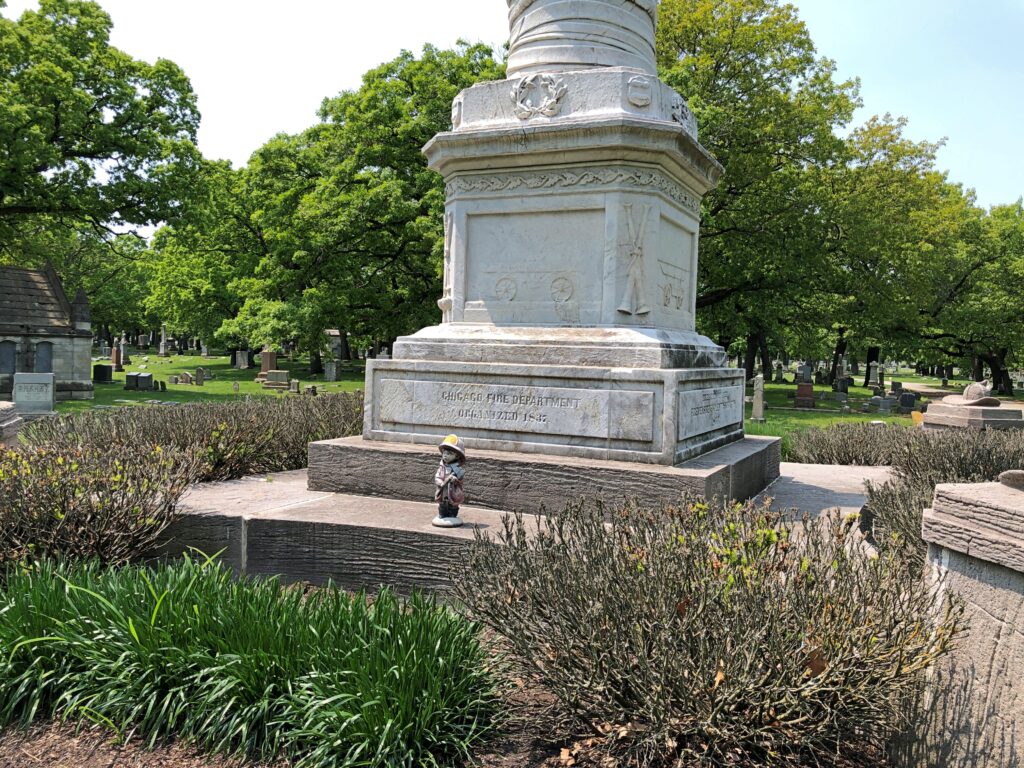
The cemetery office had photocopied map-guides to the grounds, and that inspired me to go look for the Rock of Chickamauga, which isn’t that close to most of the rest of the Union war dead. Along the way is a memorial to Chicago volunteer firemen. While not directly related to the war, it’s from the same time, 1864.

Rosehill Cemetery
Rosehill Cemetery

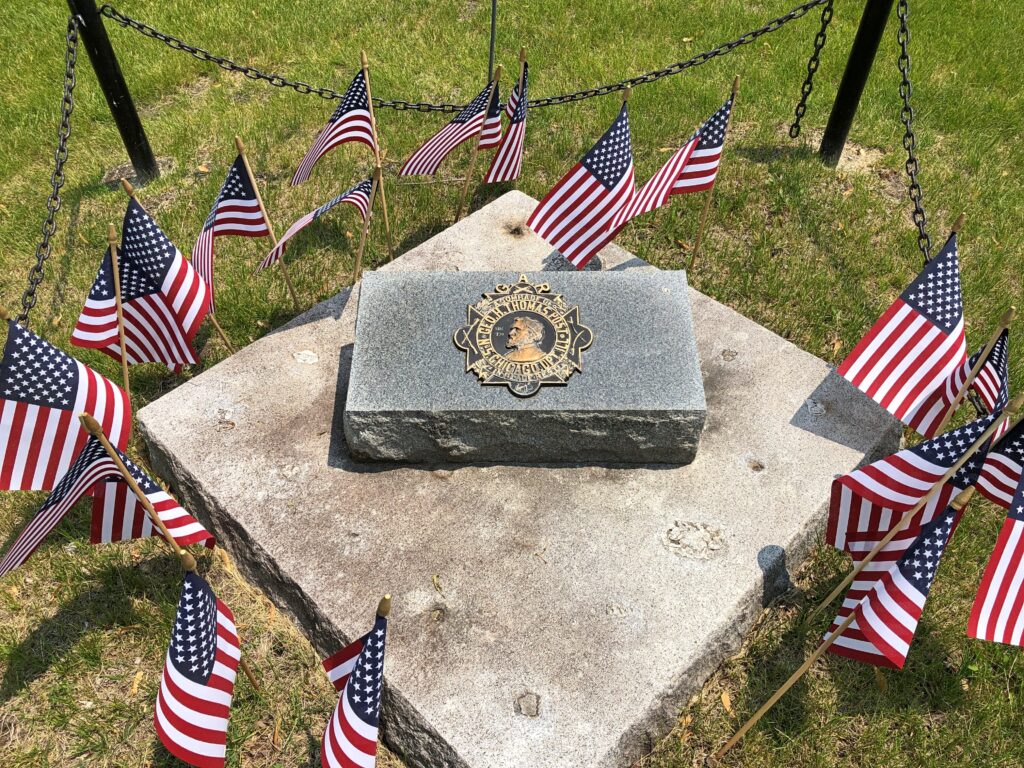
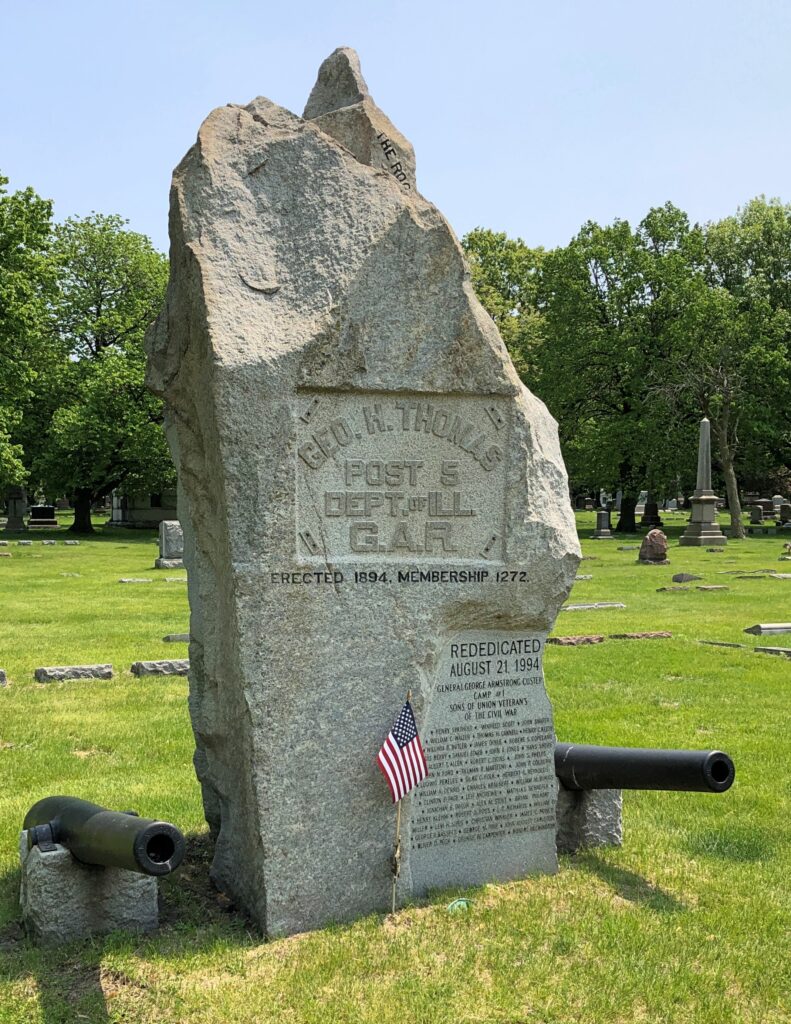
Gen. George Thomas (d. 1870), the Rock of Chickamauga, isn’t buried at Rosehill, but rather in upstate New York. Still, he’s honored in Chicago.

Rosehill Cemetery

A Chicago post of the GAR took his name and in 1894, honored him by erecting a 12-ton boulder taken from the cliffs at Chickamauga National Battlefield. As marked on the boulder, it was rededicated in 1994.

So while the metaphorical Rock of Chickamauga isn’t at Rosehill, a literal rock of Chickamauga is.

Rosehill Cemetery: Stones Among the Green

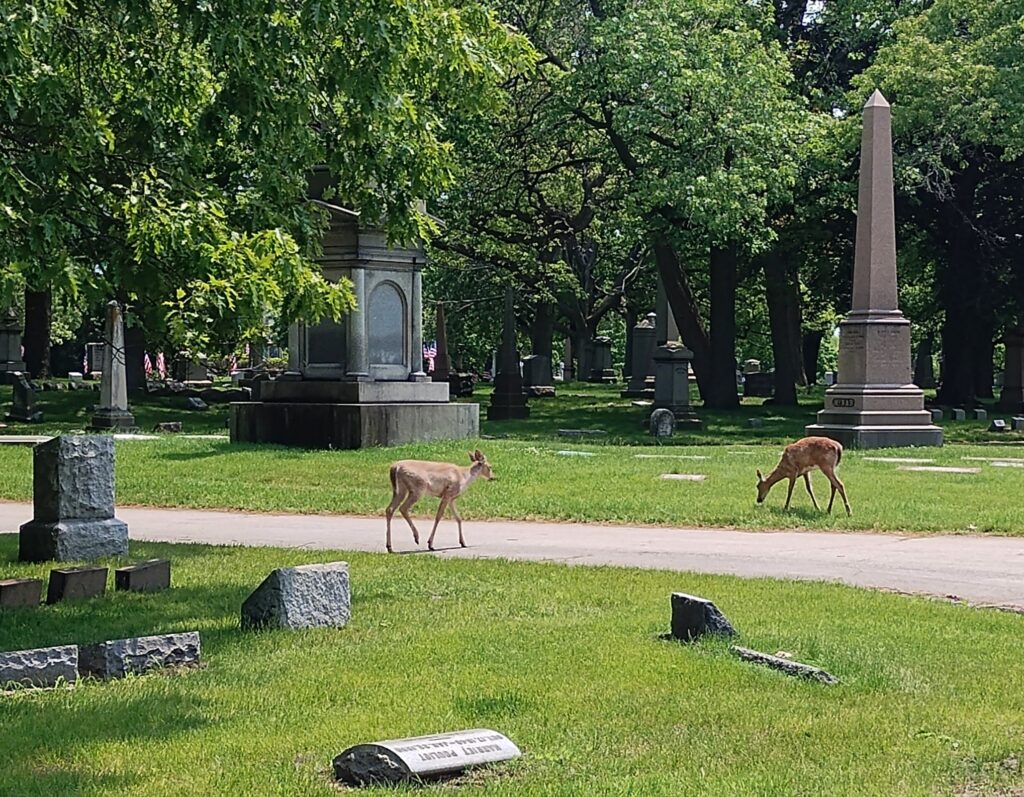
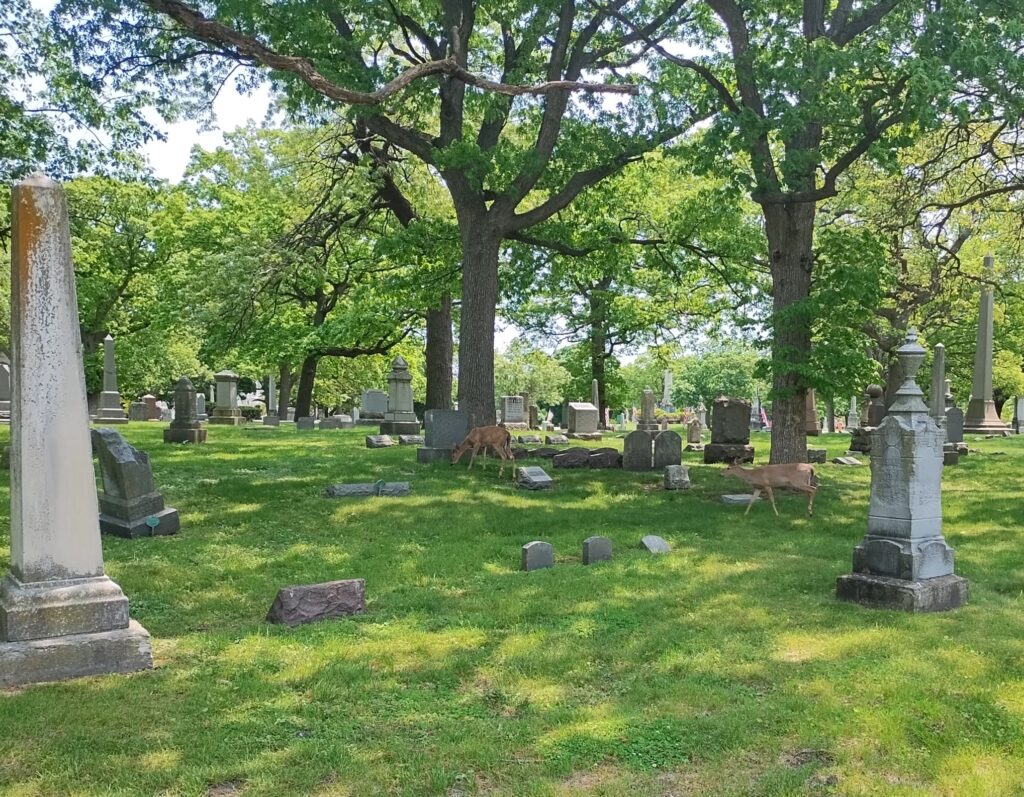
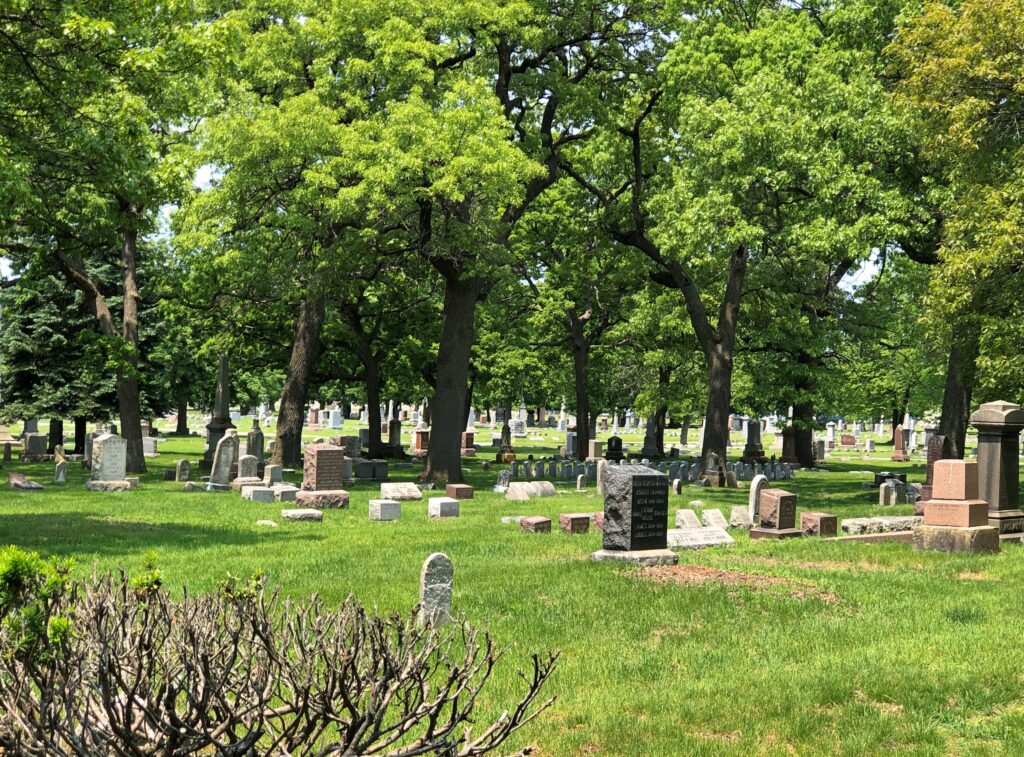
Something I didn’t expect to see Sunday before last at Rosehill Cemetery – which is surrounded by the densely populated North Side of Chicago – were deer. But there they were, peacefully munching on grass, living the unusual life of urban deer on the cemetery’s 350 acres. By acreage, Rosehill happens to be the largest in the city.

Rosehill Cemetery

I dropped Yuriko off at her cake class in Humboldt Park that morning and headed north to visit the cemetery. It was a fine, warm day. I couldn’t remember the last time I’d been there, but I knew it had been too long, since Rosehill is one of the great metro Chicago cemeteries, in the same league as Graceland, Bohemian National, Mount Carmel, Oak Woods and Forest Home.

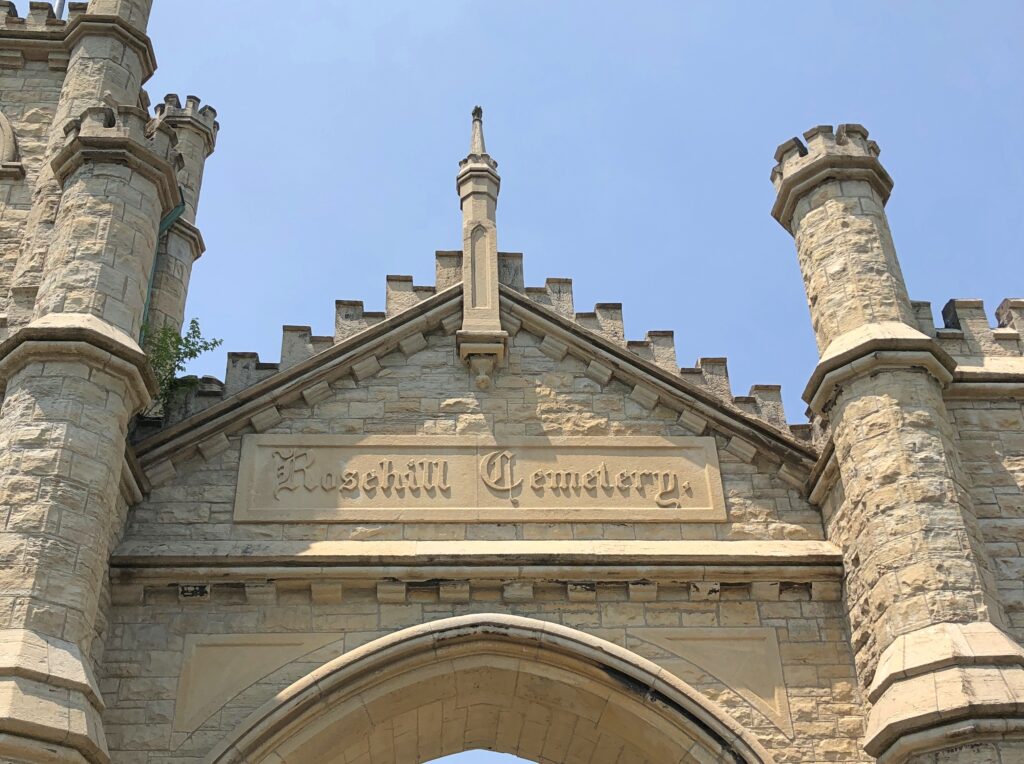
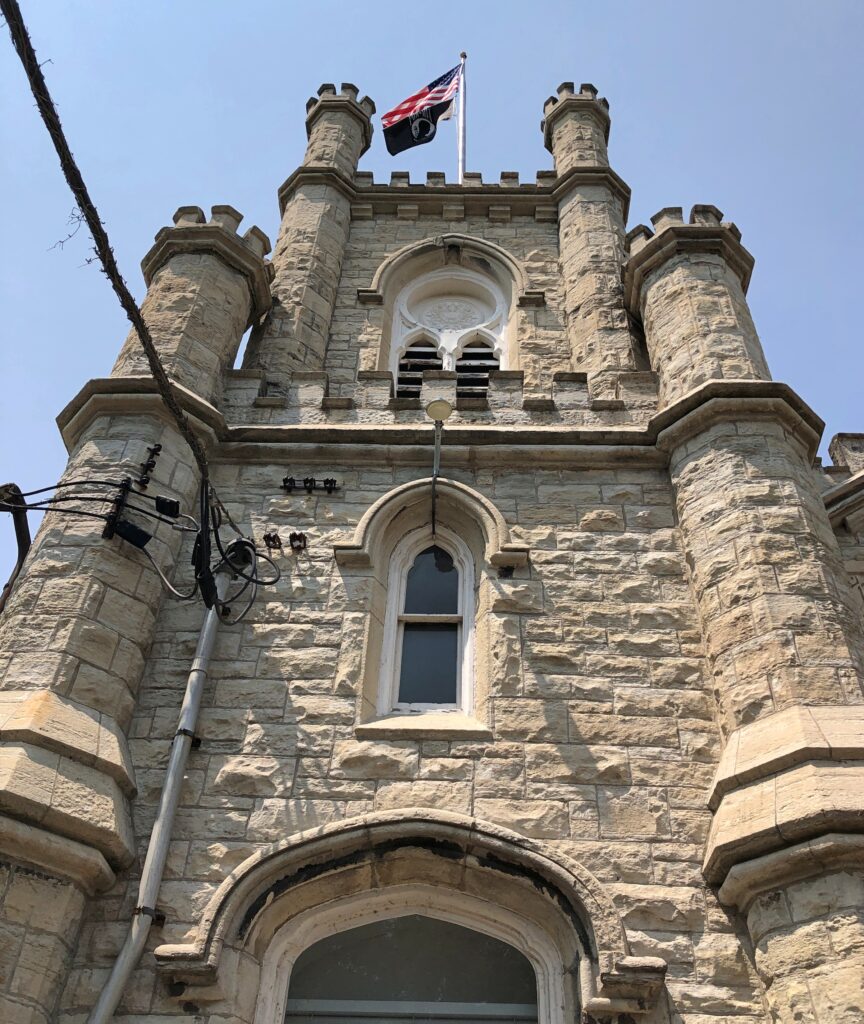
Of all those, Rosehill has the grandest entrance. Once upon a time, trains brought caskets to a station nearby, and hearses would take their funereal loads through the limestone gate, designed by William Boyington (d. 1898), who is better known for the Chicago Water Tower. Just based on those two examples, seems like he was partial to crenellations.

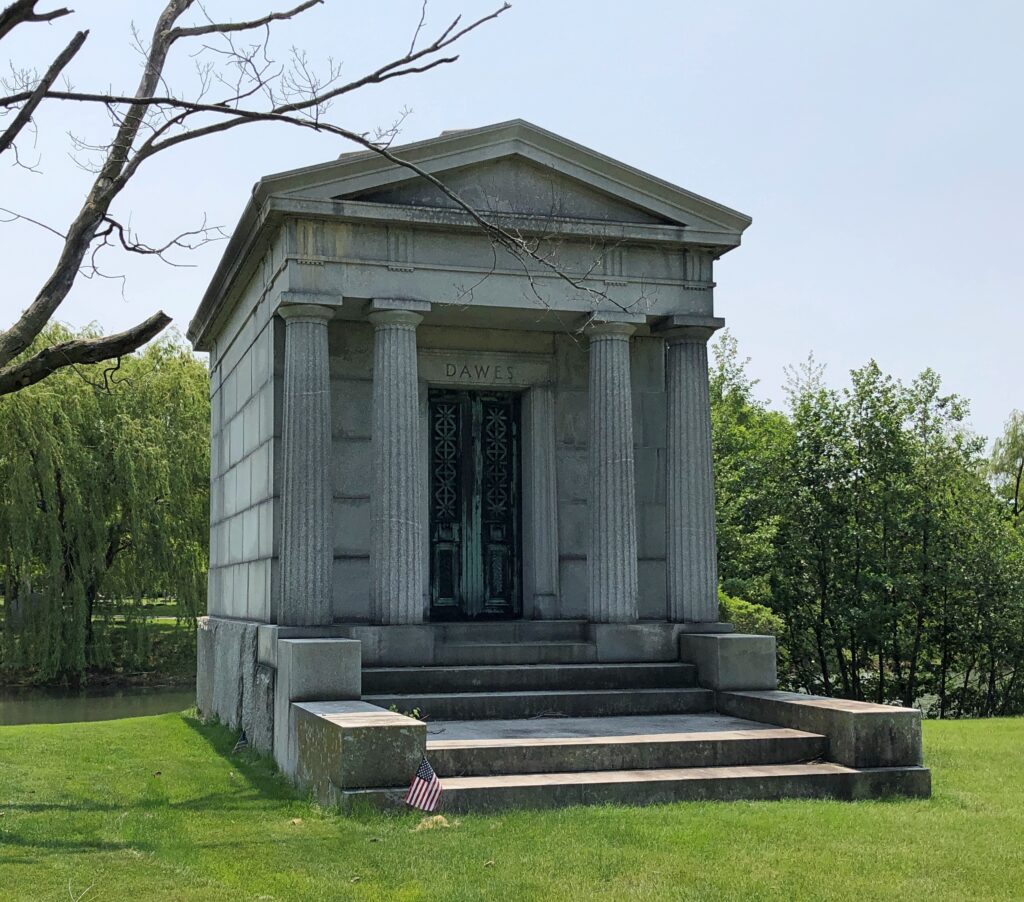
Boyington is also buried in the cemetery, but I didn’t look for him. There was too much else amid the greenery to track down everyone notable. I did make a point of finding the mausoleum of Charles G. Dawes, 30th Vice President of the United States, who served during Coolidge’s full term from 1925 to ’29.

Rosehill Cemetery

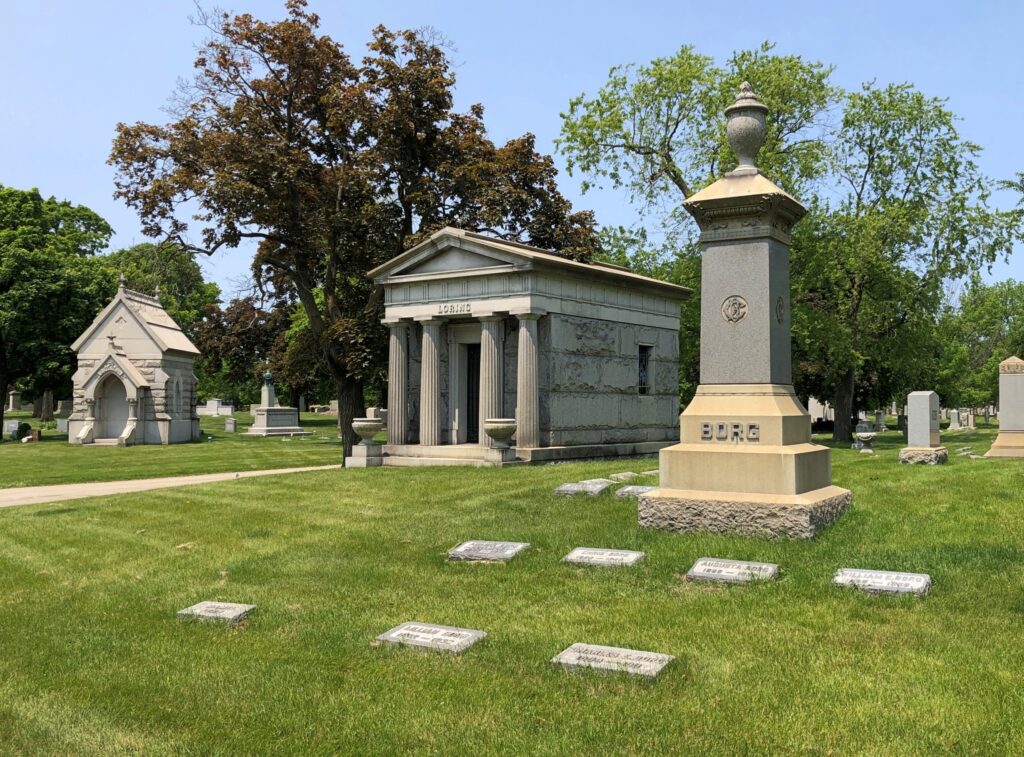
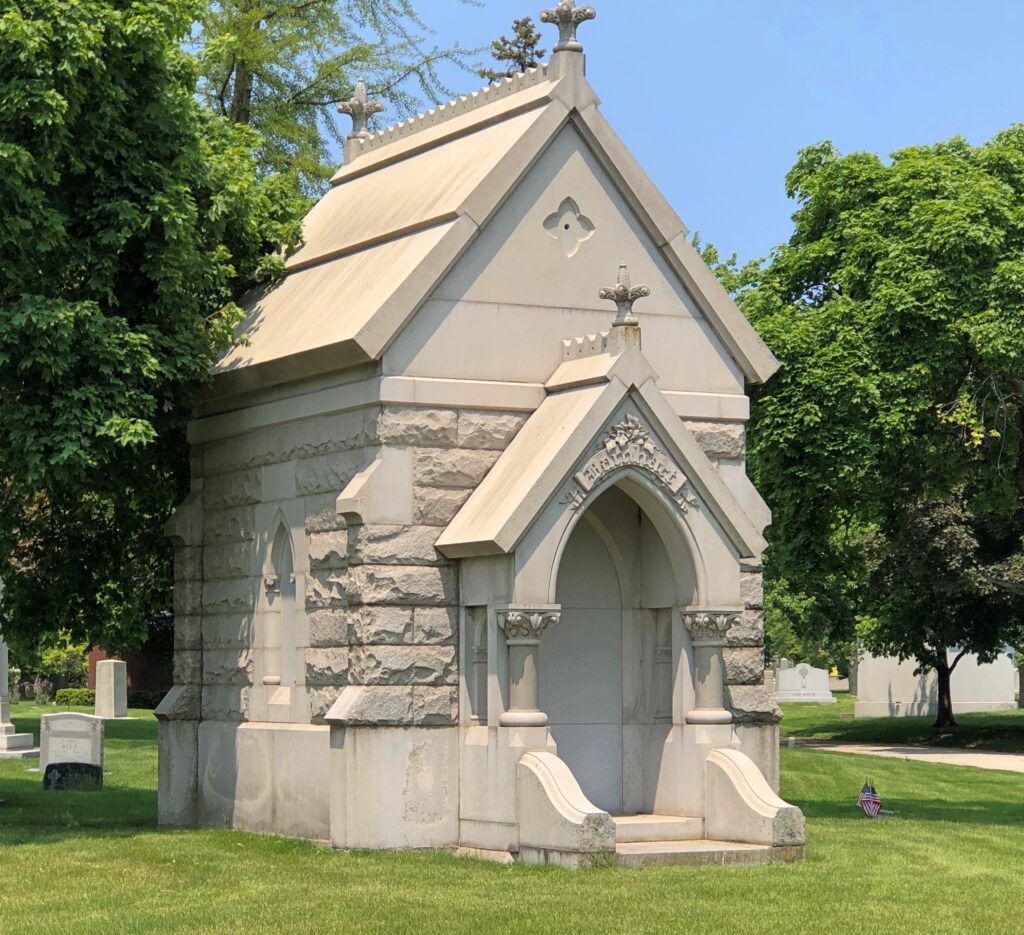
Rosehill doesn’t have a vast number of mausoleums, but there are some others.

Rosehill Cemetery

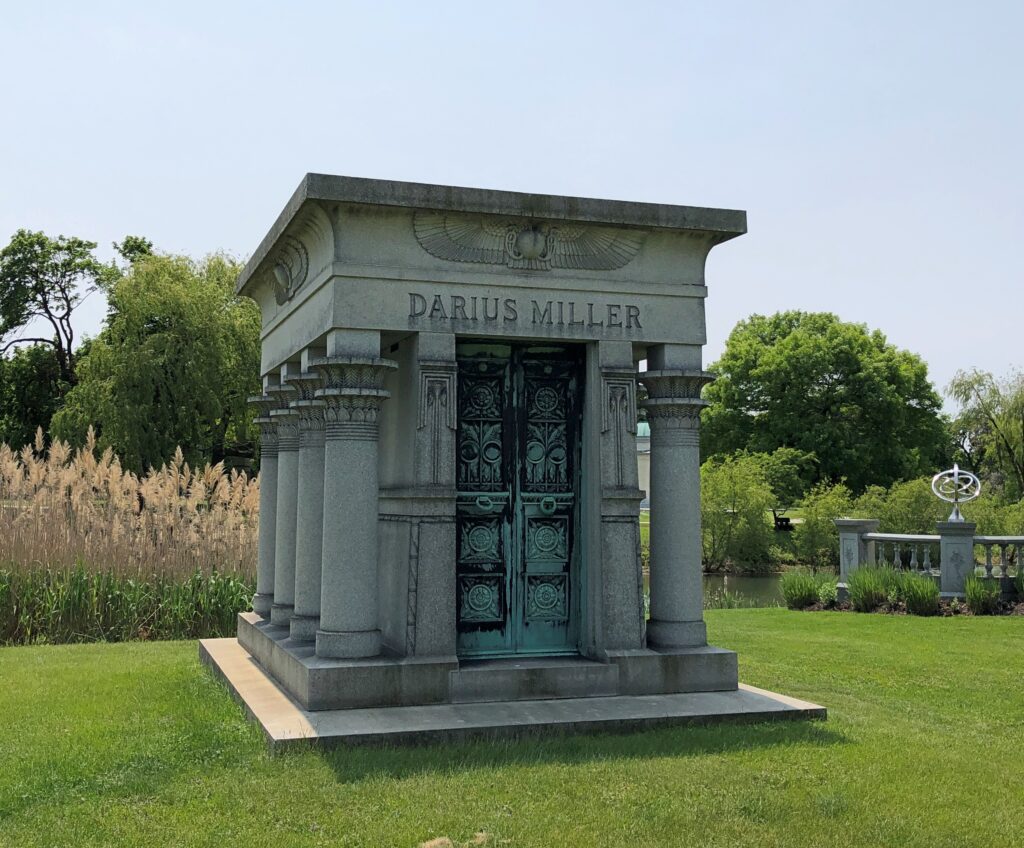
Hey, it’s Darius!

In his Egyptian-style tomb. One for the ages. As a baby name, Darius had a vogue just before and after the turn of the 21st century, when as many as 0.06 percent of babies born in the U.S. received that name. Mostly boys (as you’d think), but a few girls. It would have never occurred to us to append that name to either of our daughters during those years, which happened to be prime child-naming years for us.

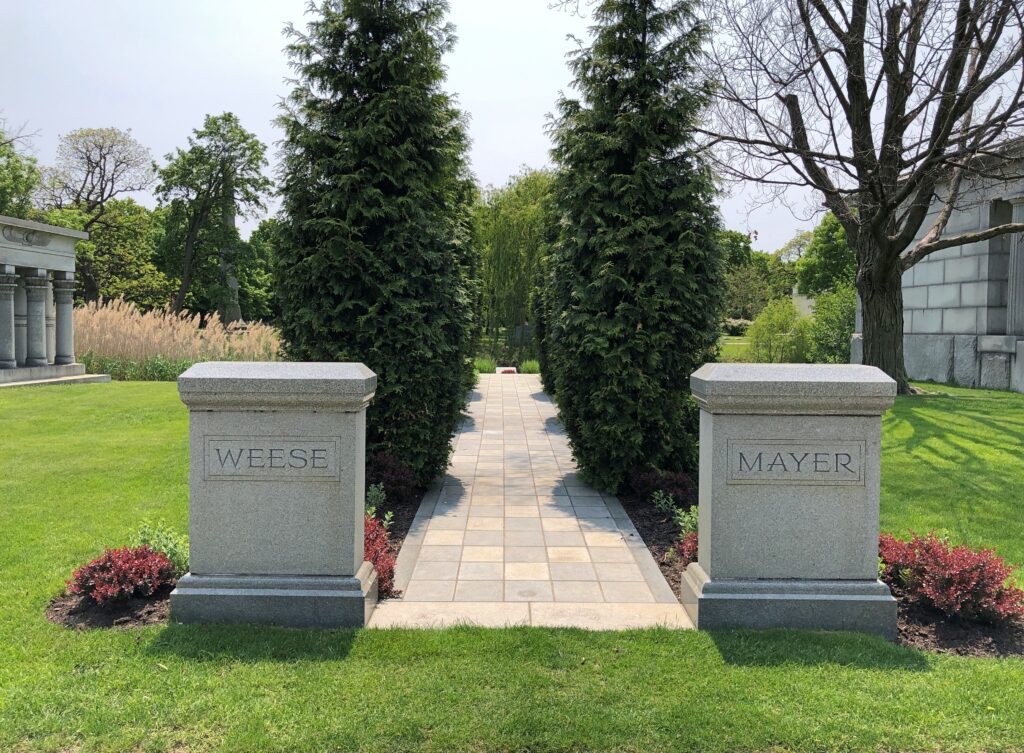
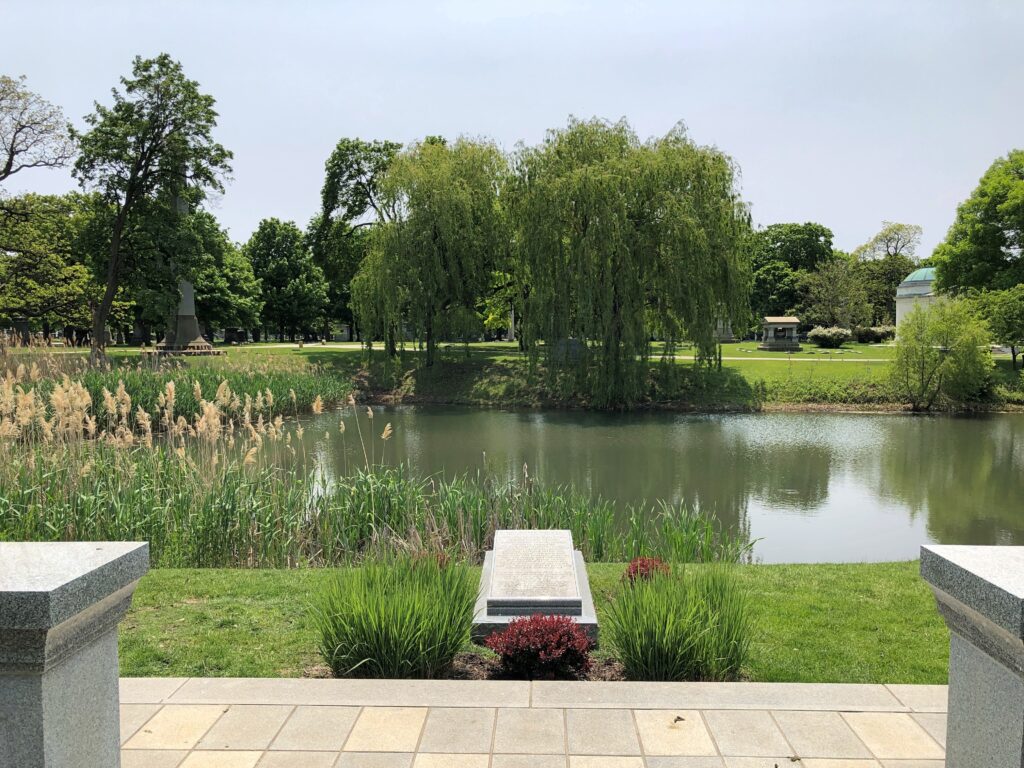
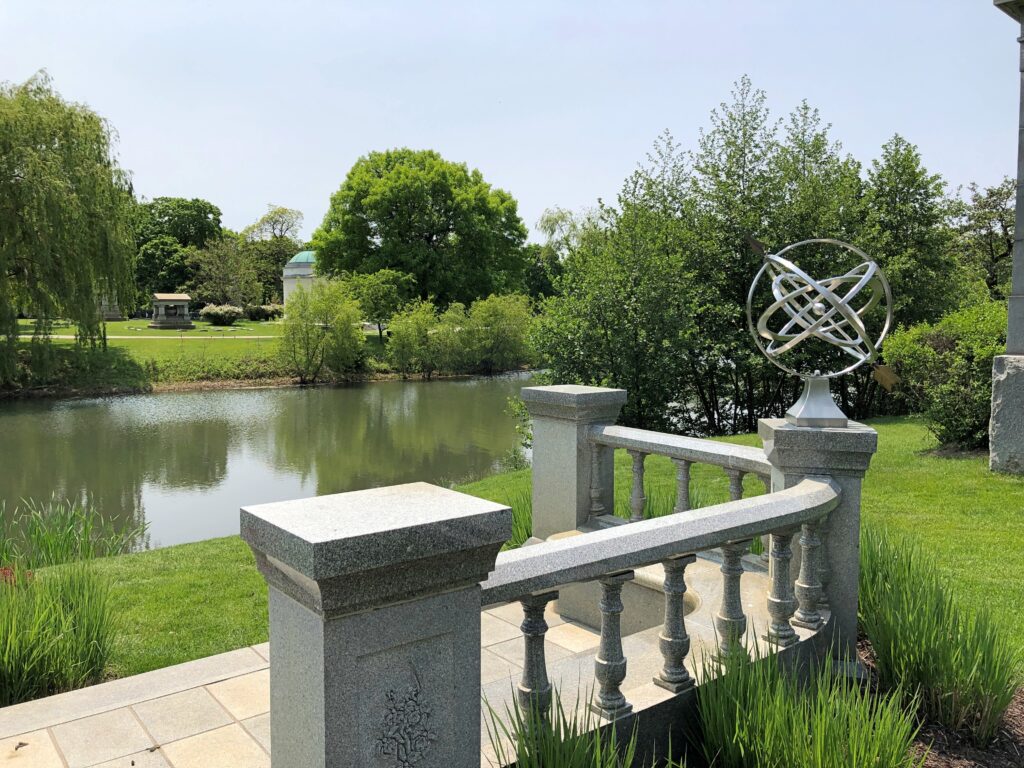
I liked this memorial – a path to the water feature, shared by the Weese and Meyer families.

Rosehill Cemetery
Rosehill Cemetery
Rosehill Cemetery

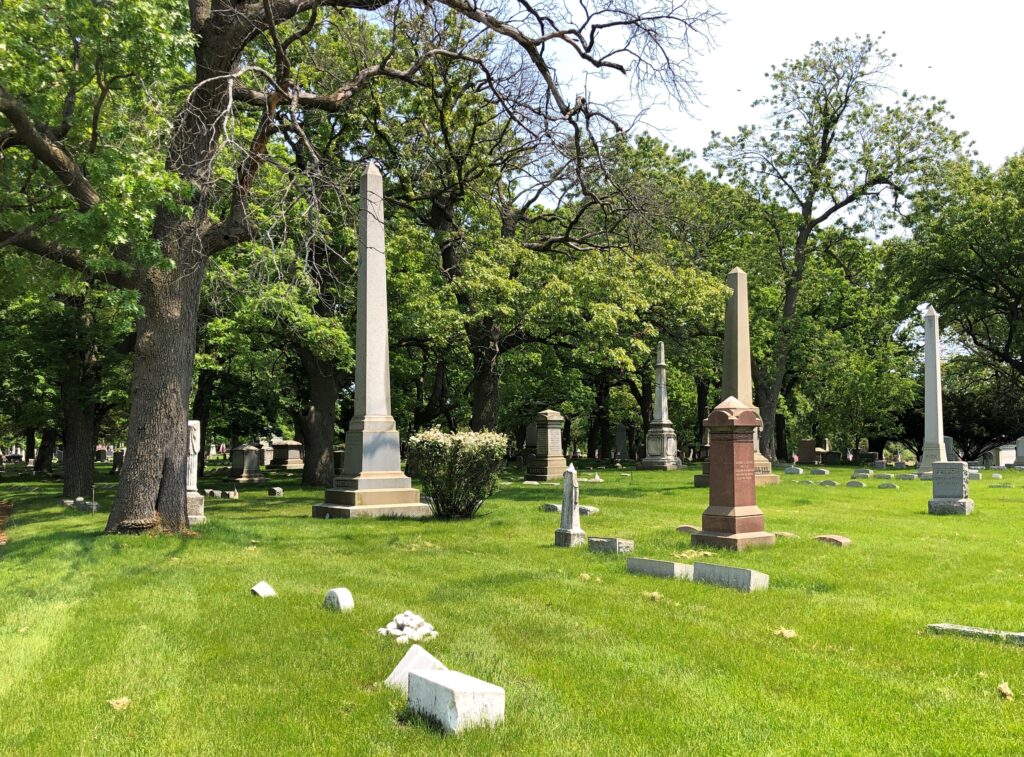
Mausoleums are well and good, but the main reason Rosehill is among the Chicago greats: a rich variety of memorials in a lush setting.

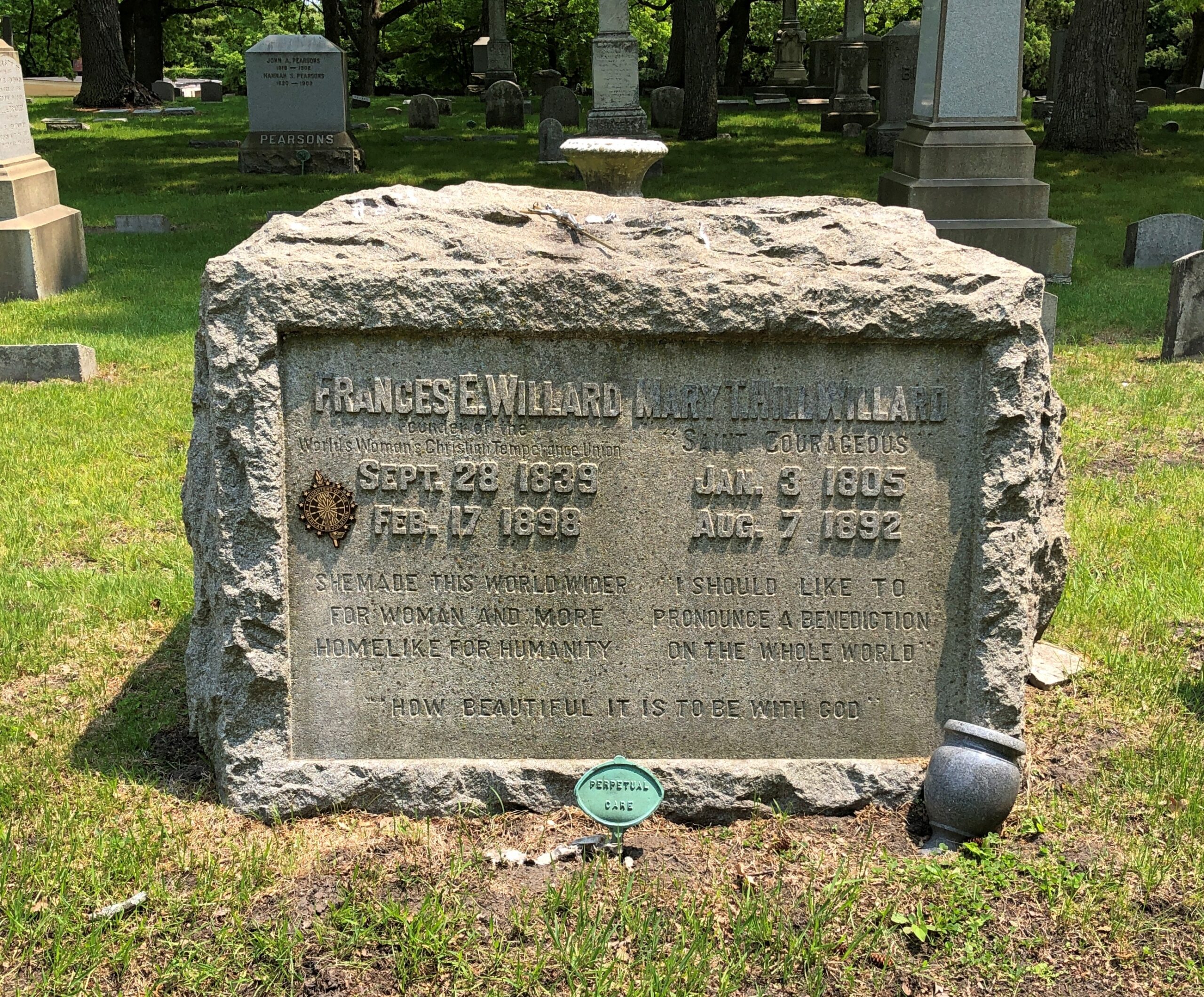
This is Francis Willard, founder of the WCTU.

Rosehill Cemetery

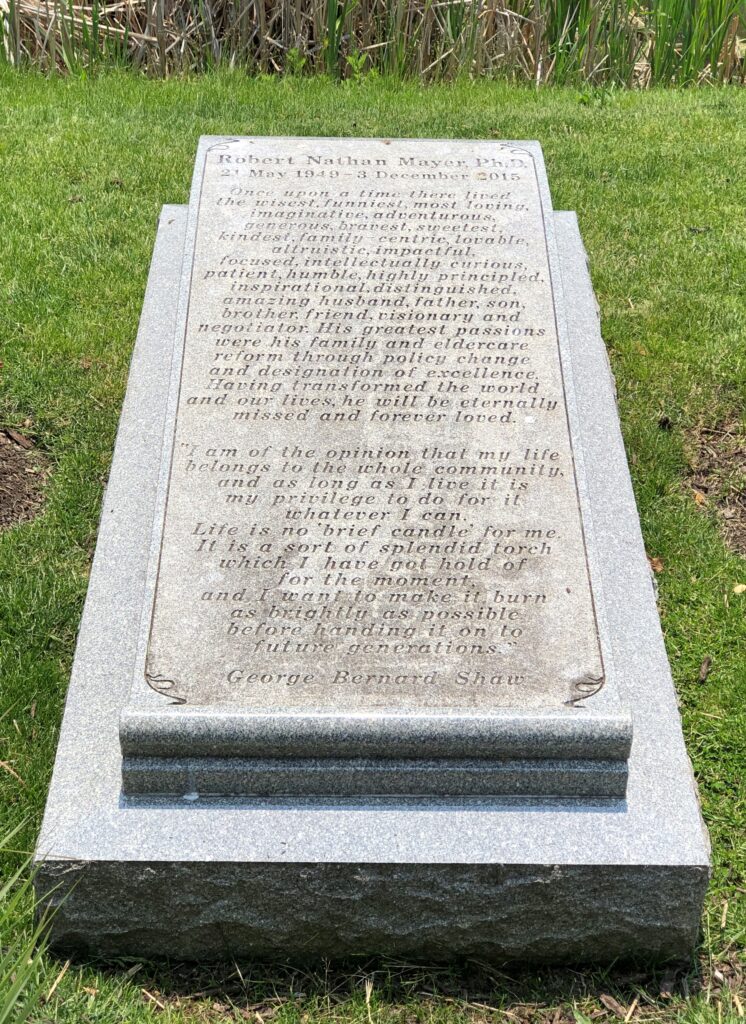
A wordy memorial, though I’m sure with fond intentions on the part of his family. Here is an obit. Sadly odd that for an expert in eldercare, he only lived to be 66. Not terrifically old, in my current opinion.

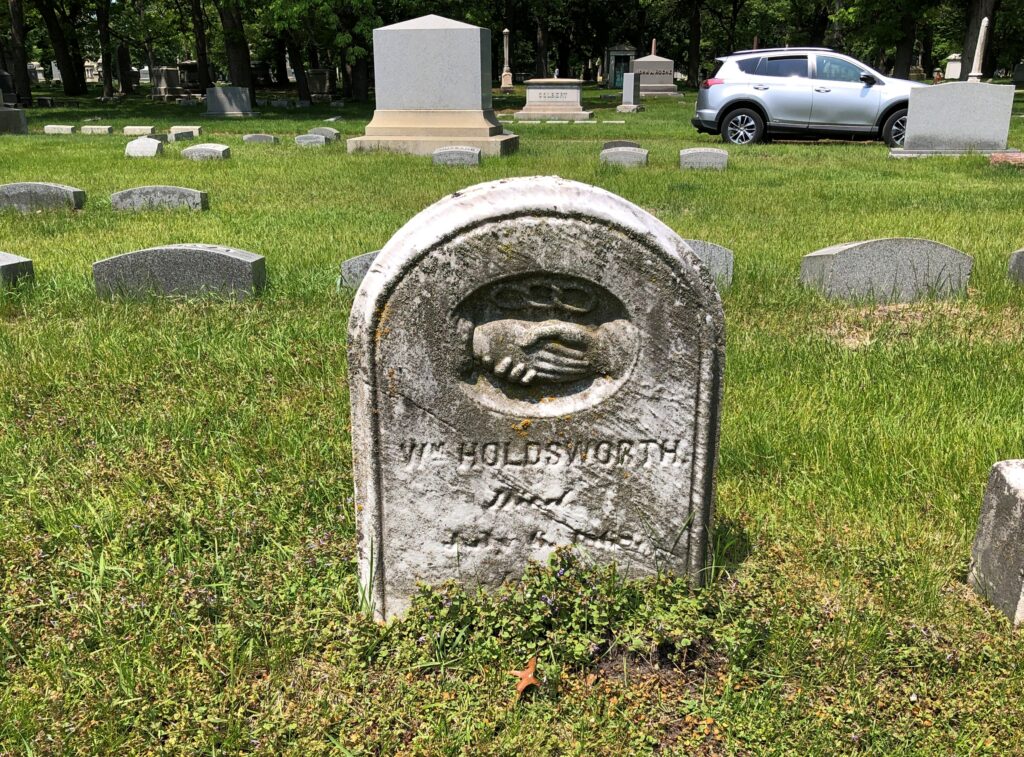
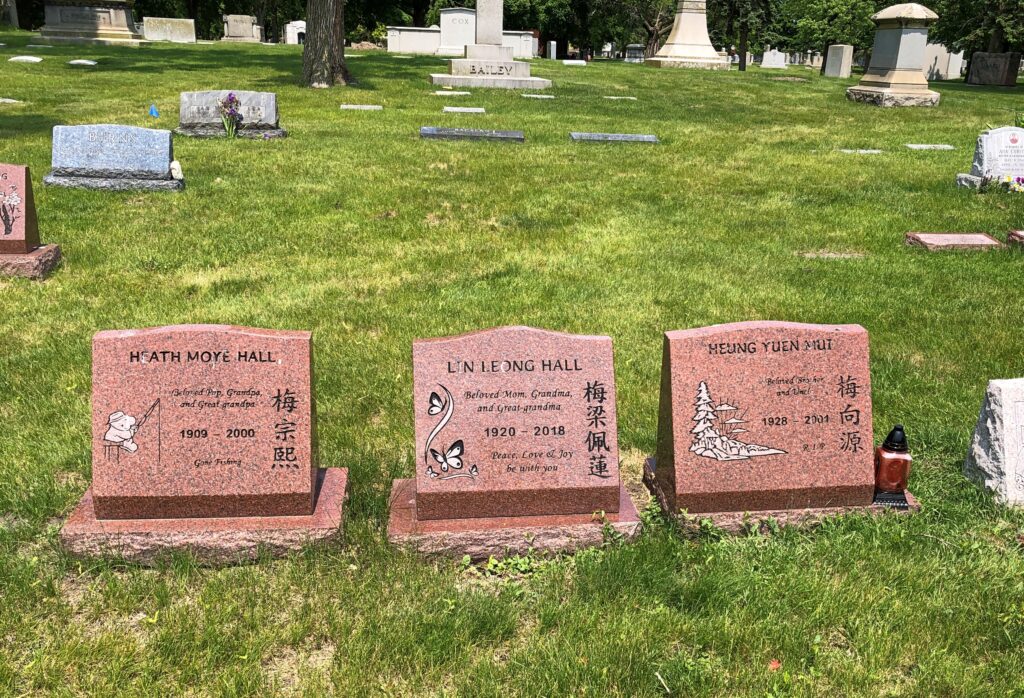
Most permanent residents were not notable in life, something almost everyone could say at any point in history. What remains are stones old and worn or merely simple. The most affecting ones, in some ways.

Rosehill Cemetery
Rosehill Cemetery
Rosehill Cemetery

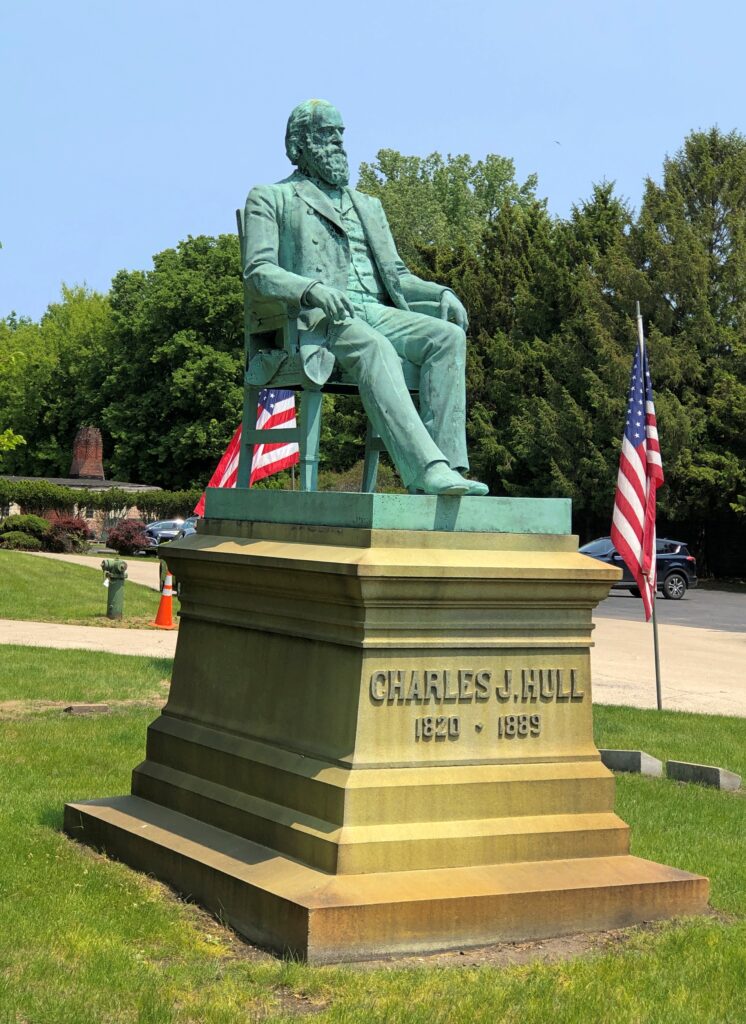
For the affluent who don’t want a mausoleum, there’s always a bronze. Good to give living artists some work, if you or your heirs are going to spend money that way.

Charles J. Hull (d. 1889).

I had to look him up. As this article says, an unusual sort of man. Even for the 19th century, when odd men aplenty could be found in the young Republic. Eventually he made his fortune in Chicago real estate and was a major philanthropist, but I enjoyed more reading about his young life. As a teenager – a term no one would have used at the time – he ran an unlicensed tavern in Ohio for three years. That came to a bad end, and he not only became a teetotaler afterward, he eventually was a temperance activist. Not that I’d want to have lived then, but I feel a sneaking admiration for the lax rules of the time.

Daiso USA

Retail comes and goes. After we visited Jo-Ann’s – where I bought a single item, an olive-theme doormat for our deck – we went a short distance to something new. Newish, that is, to North America, but well-established in Japan: Daiso.

We hadn’t noticed this particular northwest suburban location before. Back in February, we visited one in Tokyo, which was my first time at the chain, though I’d written about it before. Worldwide, there are about 6,000 Daiso locations, with only 150 in the U.S., and even those are fairly recent arrivals.

The store has an impressive amount of inexpensive goods, and a more imaginative selection that you’d find in a dollar store. Better designed, too. Things cost money in Japan, naturally, and sometimes quite a lot, but that country doesn’t share the notion, common here in America, that if you don’t pay a lot, you deserve crappy design.

Socks and clocks, among many other items.

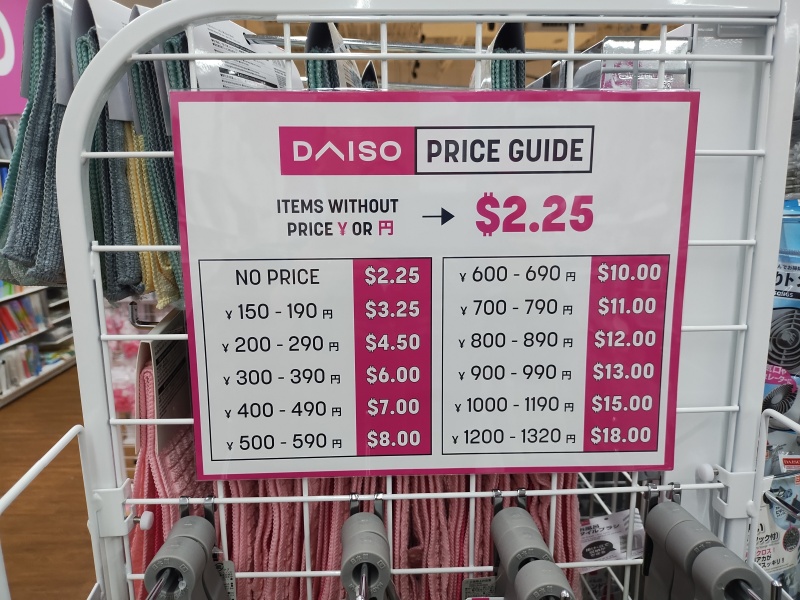
Also, an unusual pricing structure.

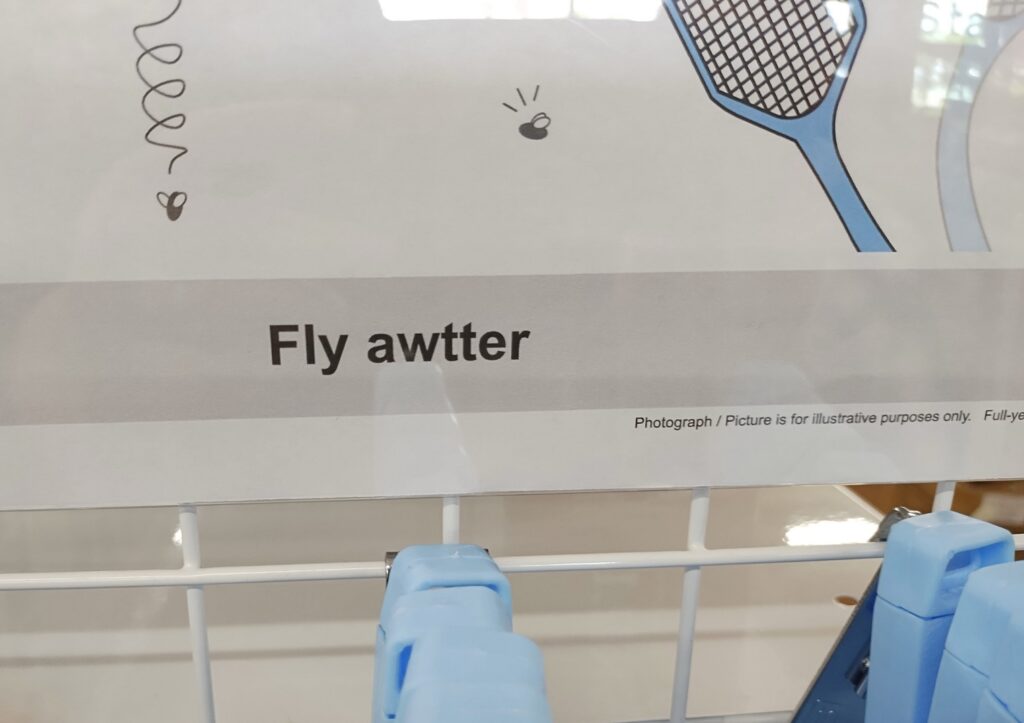
I didn’t buy one of these, because we have one – an odd souvenir from the Bluegrass Inn during a stay in ’08. More recently I used it to swat moths.

Mangled English, no extra charge. An authentic Japanese touch.

The End of an Era? No.

Recently I was thinking about the closure of Jo-Ann stores, for reasons that will be obvious shortly. Seeking more information about the retailer, I came across an article published at a site called dengarden. The headline says, It’s the End of an Era: Joann Fabrics Has Officially Closed All of Its Stores.

A human- or machine-written head? It doesn’t matter, there’s a cliché that needs to be retired. End of an Era, eh? I remember thinking the same thing when the last Radio Shack bit the dust. Or maybe not.

The company is – was – Jo-Ann Stores. What will customers do without it? “Big-box retailers like Michaels and Hobby Lobby offer a decent selection of fabric and craft materials,” the article says. “Online shops, from niche sewing stores to large marketplaces, have stepped in to fill the gap. Many small, independently owned fabric and yarn stores are also gaining attention as shoppers turn local.”

The closure might be a hardship for those who lost their jobs, but for everyone else, this barely qualifies as the turn of a page, much less the end of an era.

But I quibble. A few weeks ago, at Yuriko’s request, we went to a nearby Jo-Ann store to look for bargains. Rather, she did.

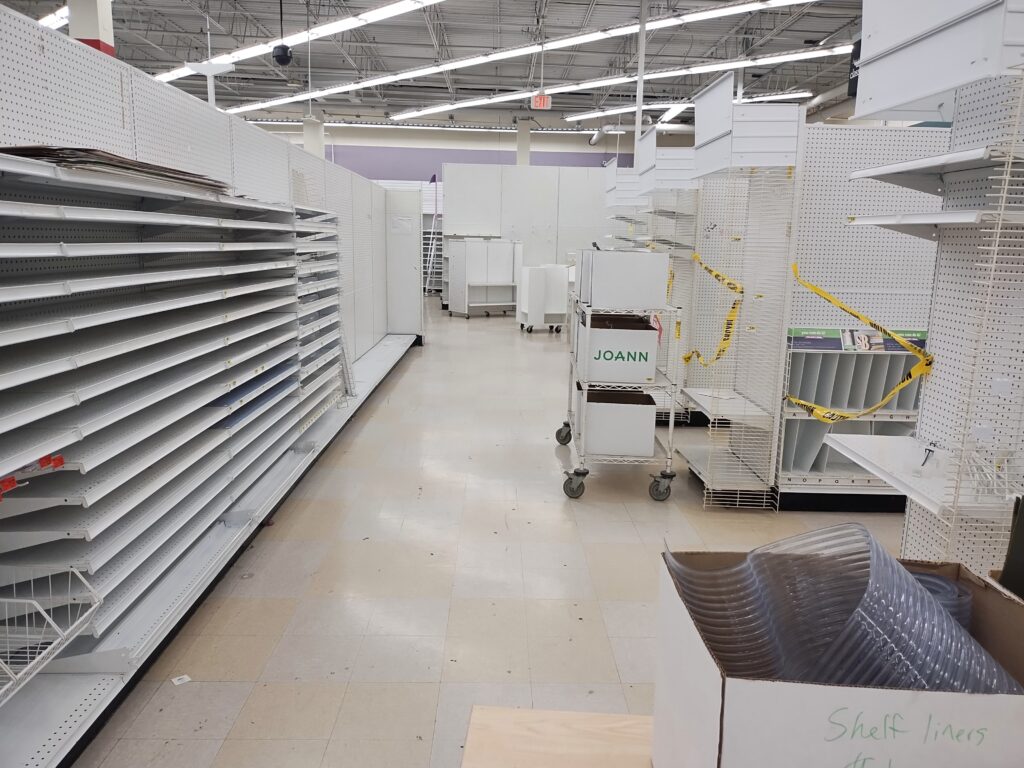
I went to witness the retail dissolution in person. The place had that Venezuelan store look, assuming the reports about that nation are still correct.

Even toward the end of a store’s existence, there can be oddities.

I didn’t buy it, even at a steep discount. Will I regret my decision from now on, until I reach my deathbed? Nah.

The Quick and the Dead

In Japan, it was never necessary to have a car. In theory, one could wish such a condition for North America, but I wouldn’t want to give up the option of getting in a vehicle and driving a few hundred miles at a go, or further, to seek out fun roads.

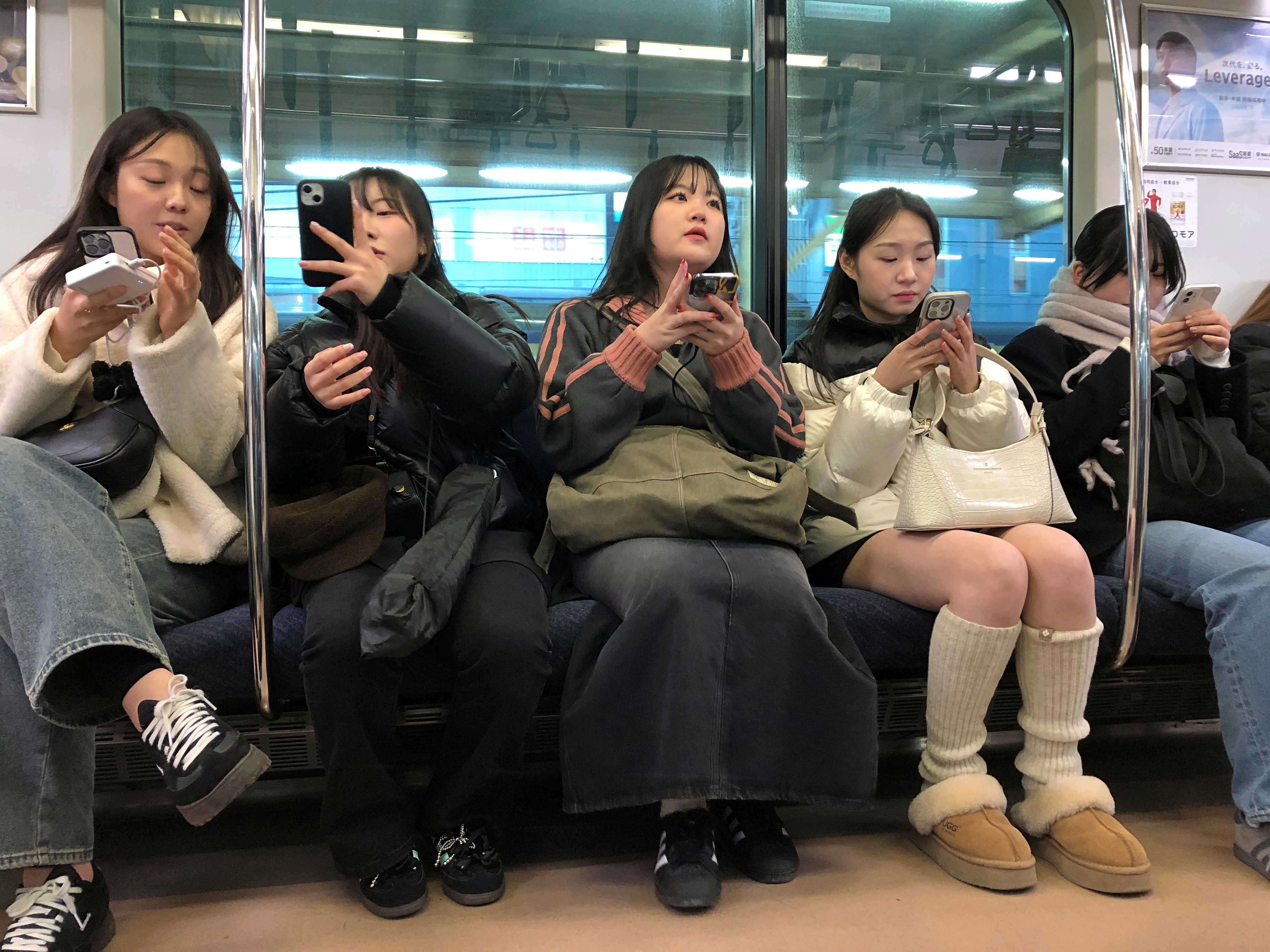
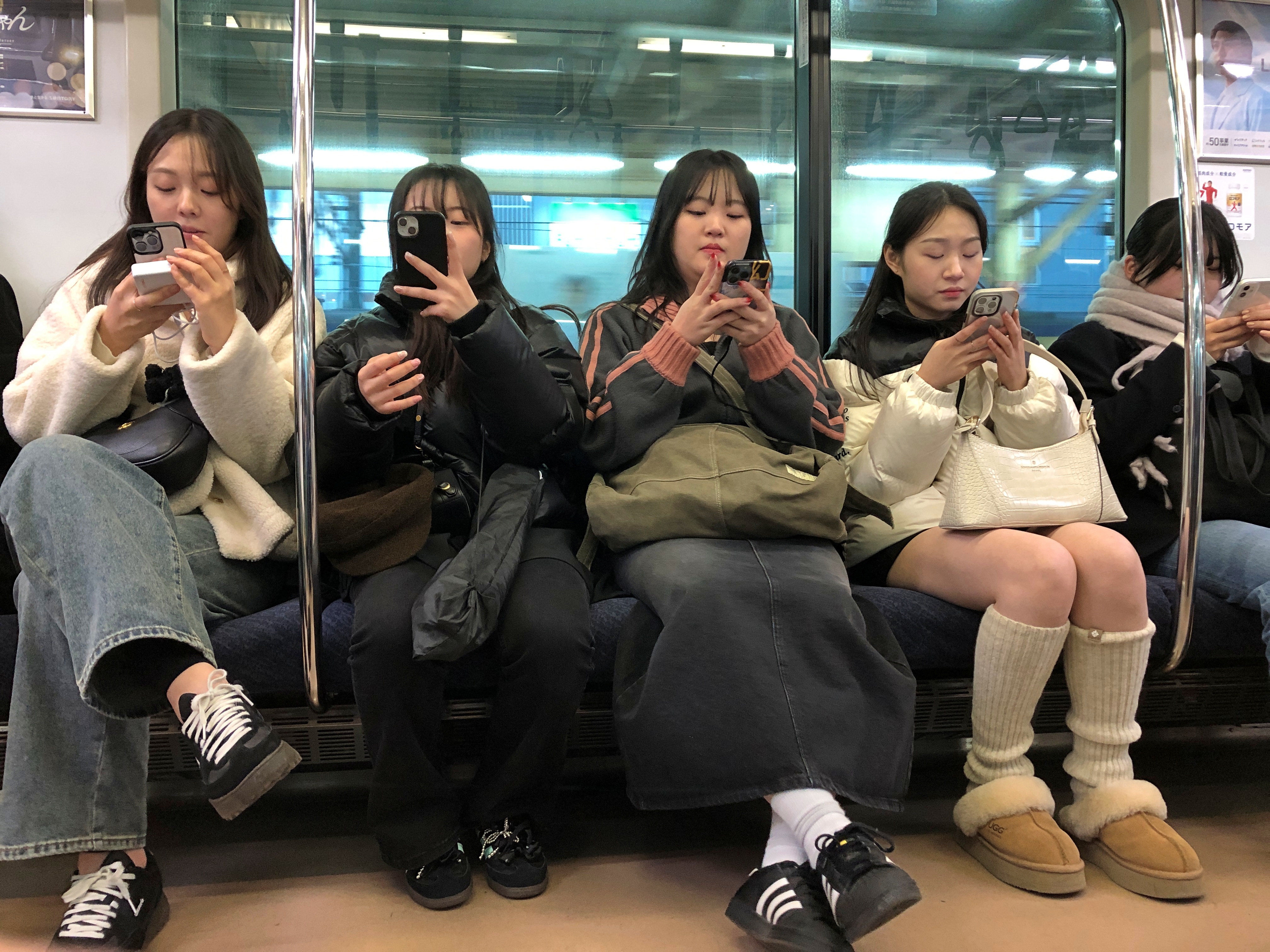
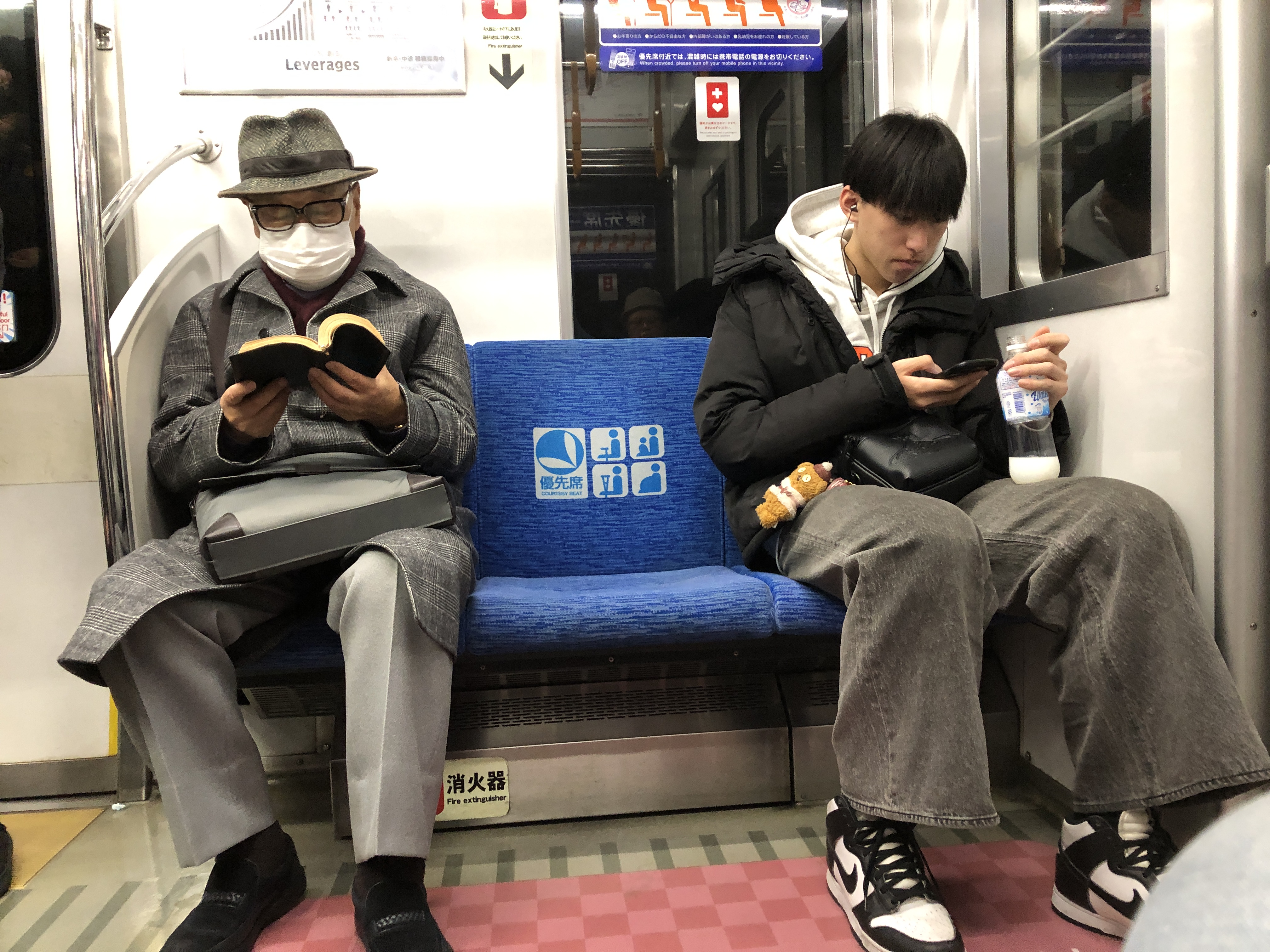
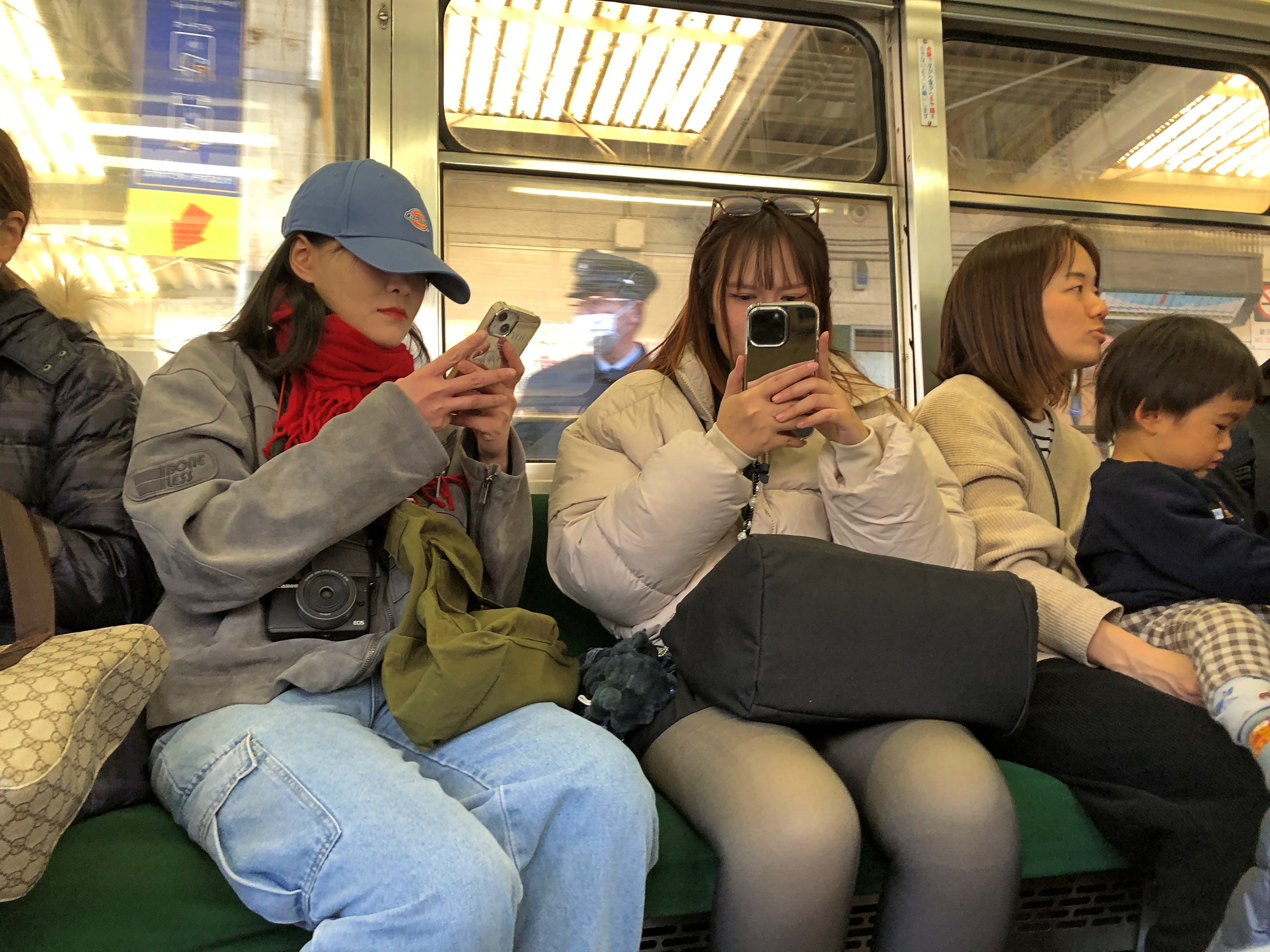
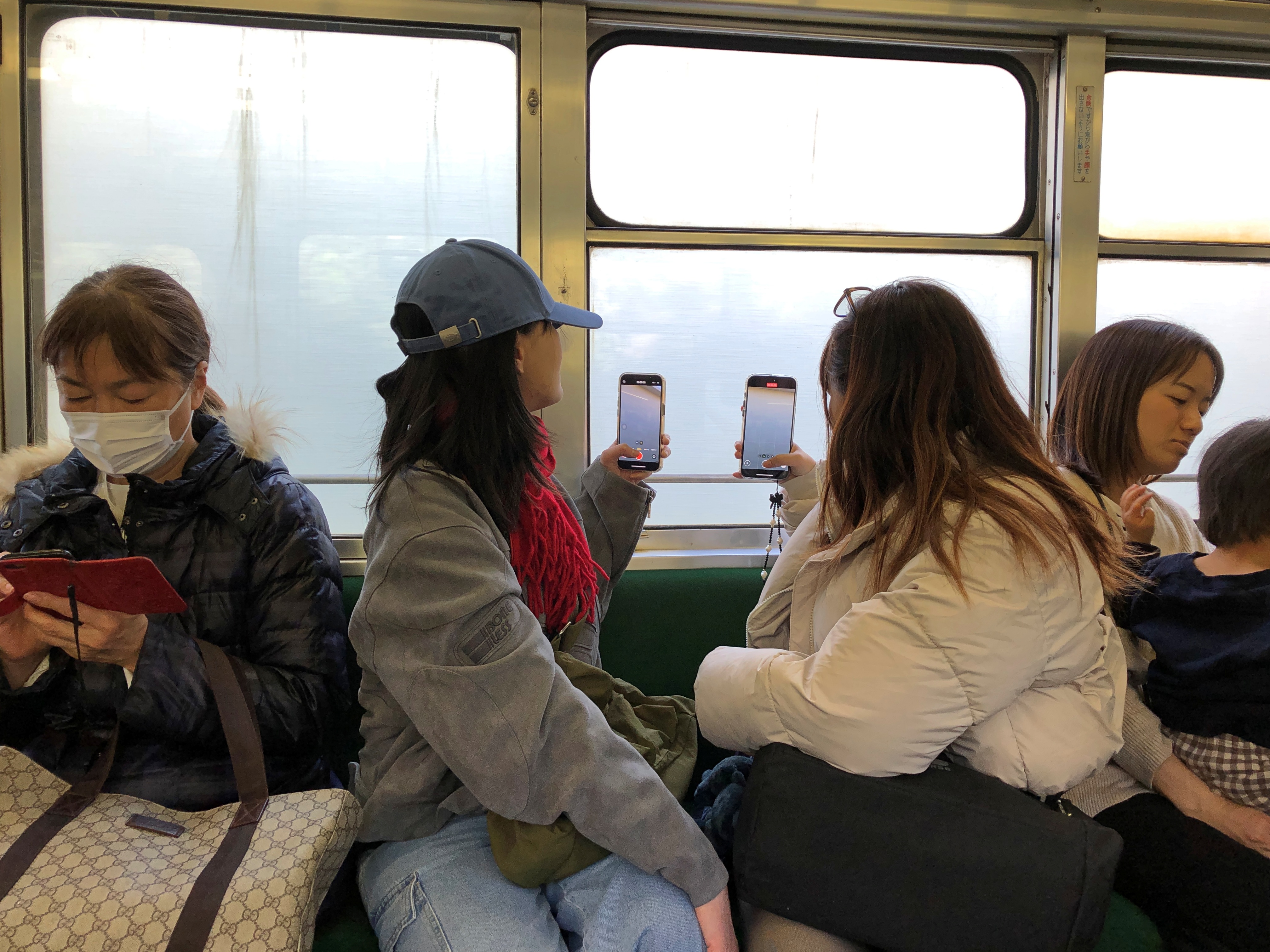
There are probably similarly engaging roads in Japan, but I prefer trains there. We took quite a few during the recent visit. Some were crowded, as subways in rush hour tend to be, but none required the assistance of white-gloved train employees shoving passengers into cars – an image known to gaijin lore as much as the vending machines that sell weird items, but one I never saw at any time, even during rush hours in the ’90s. (And the vast majority of Japanese vending machines sell drinks.)

Scenes on the trains.Japan, 2025

Almost everyone was paying attention to their phones, but not quite everyone. Still, the fellow reading a book – maybe manga – was a rarity this time around. Thirty years ago, half the car would have been reading physical books.Japan, 2025

The train from Kamakura to the seaside spot of Enoshima runs along the ocean for a while, inspiring some passengers to take pictures of the scene.Japan, 2025 Japan, 2025

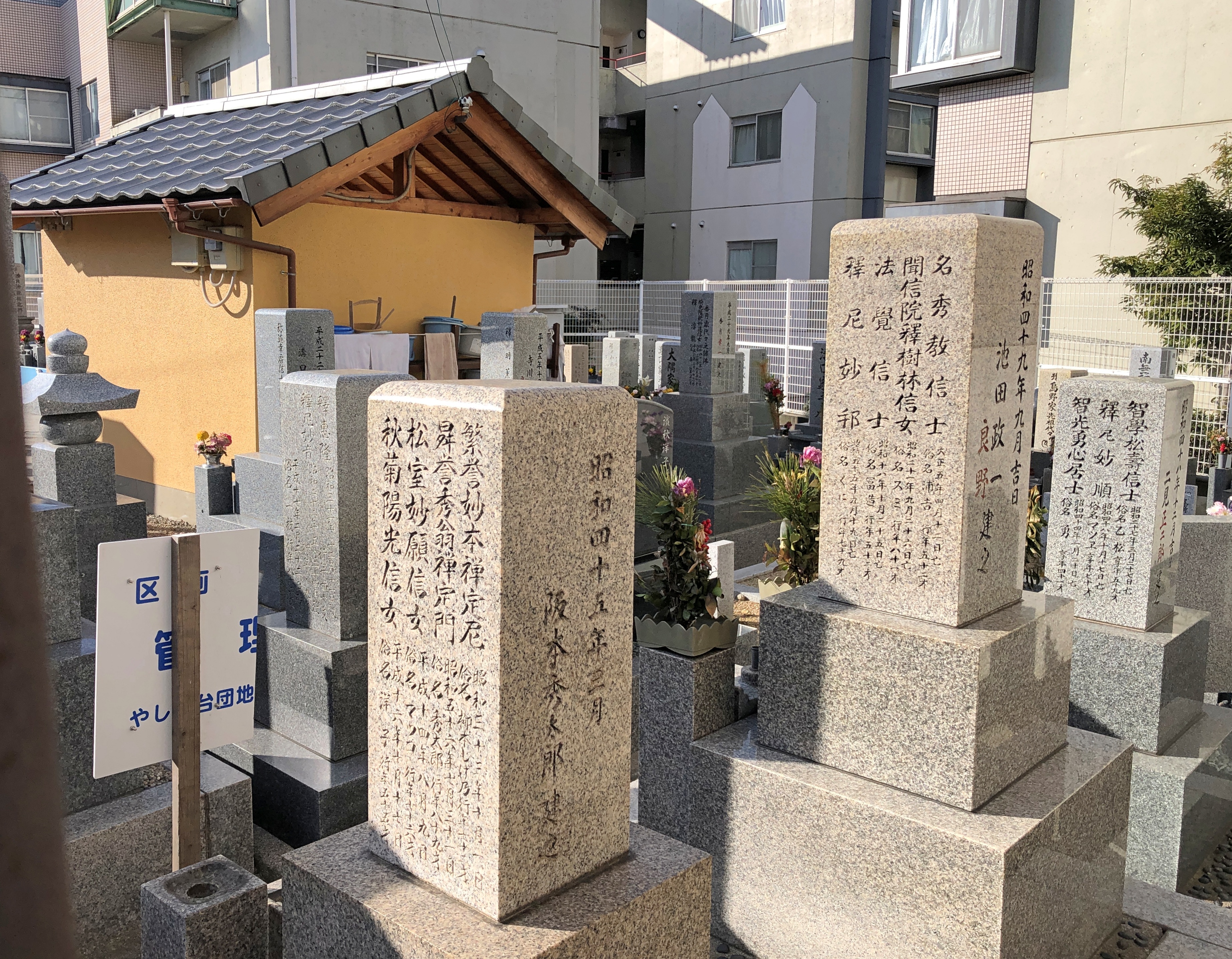
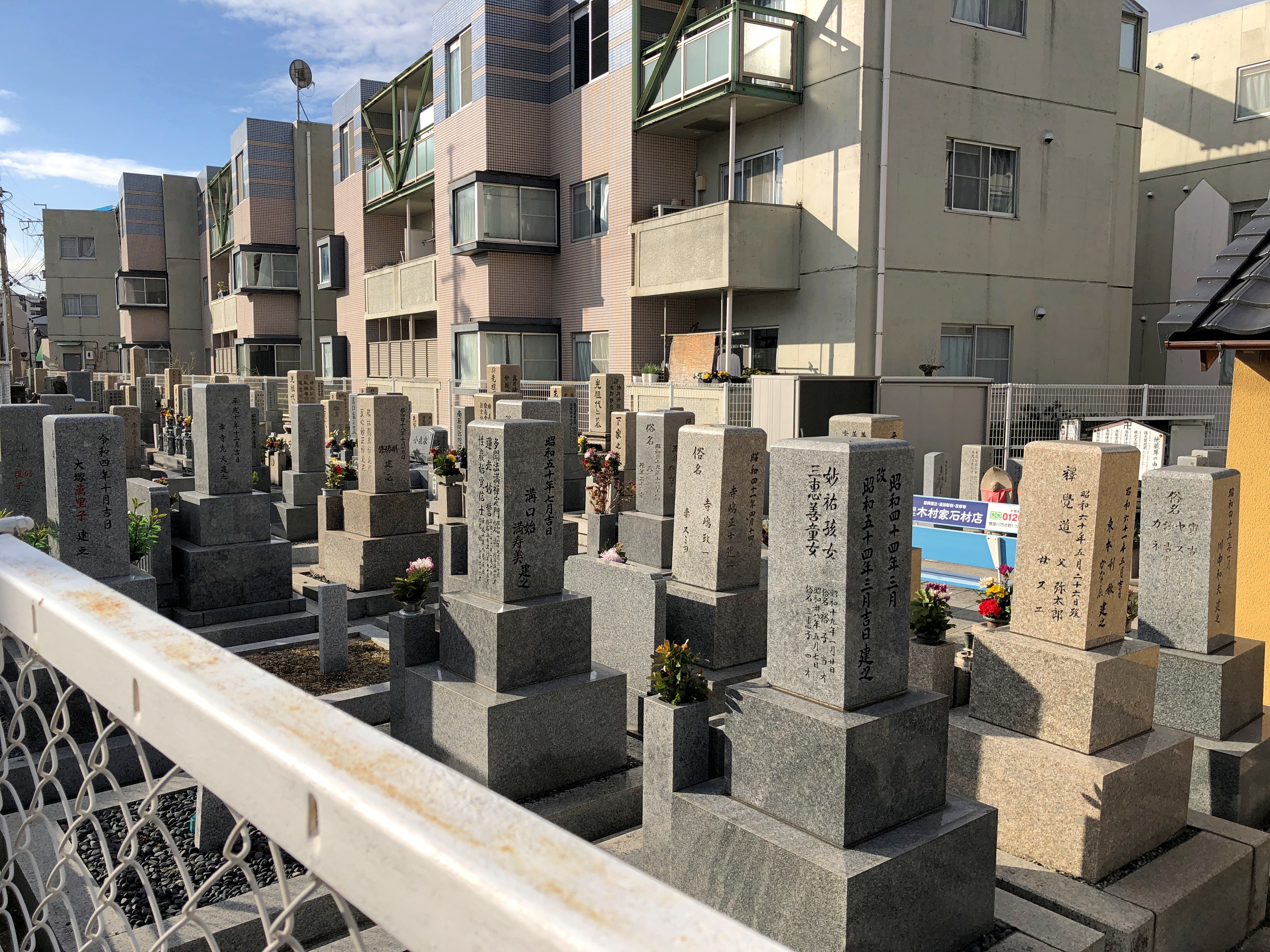
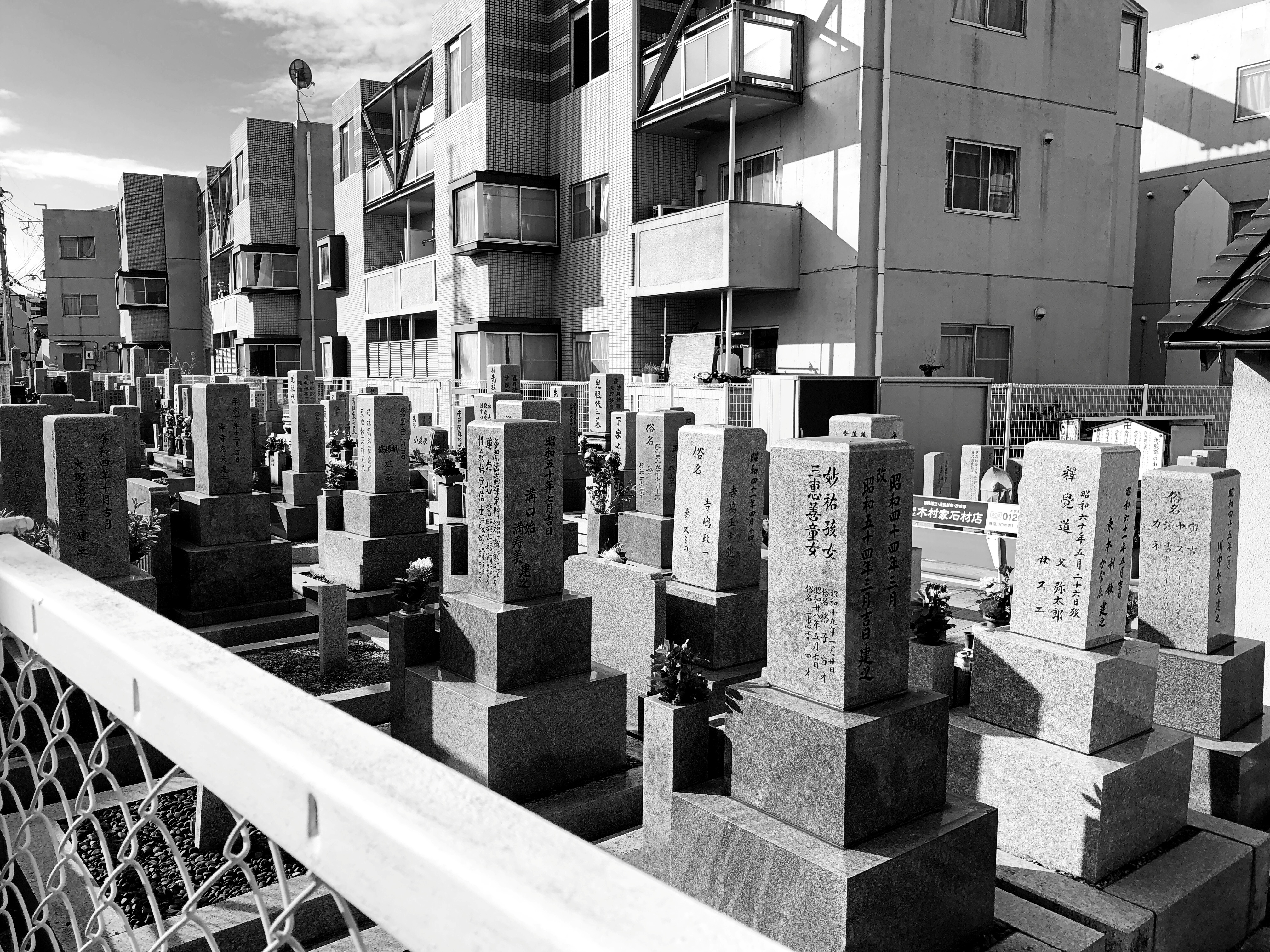
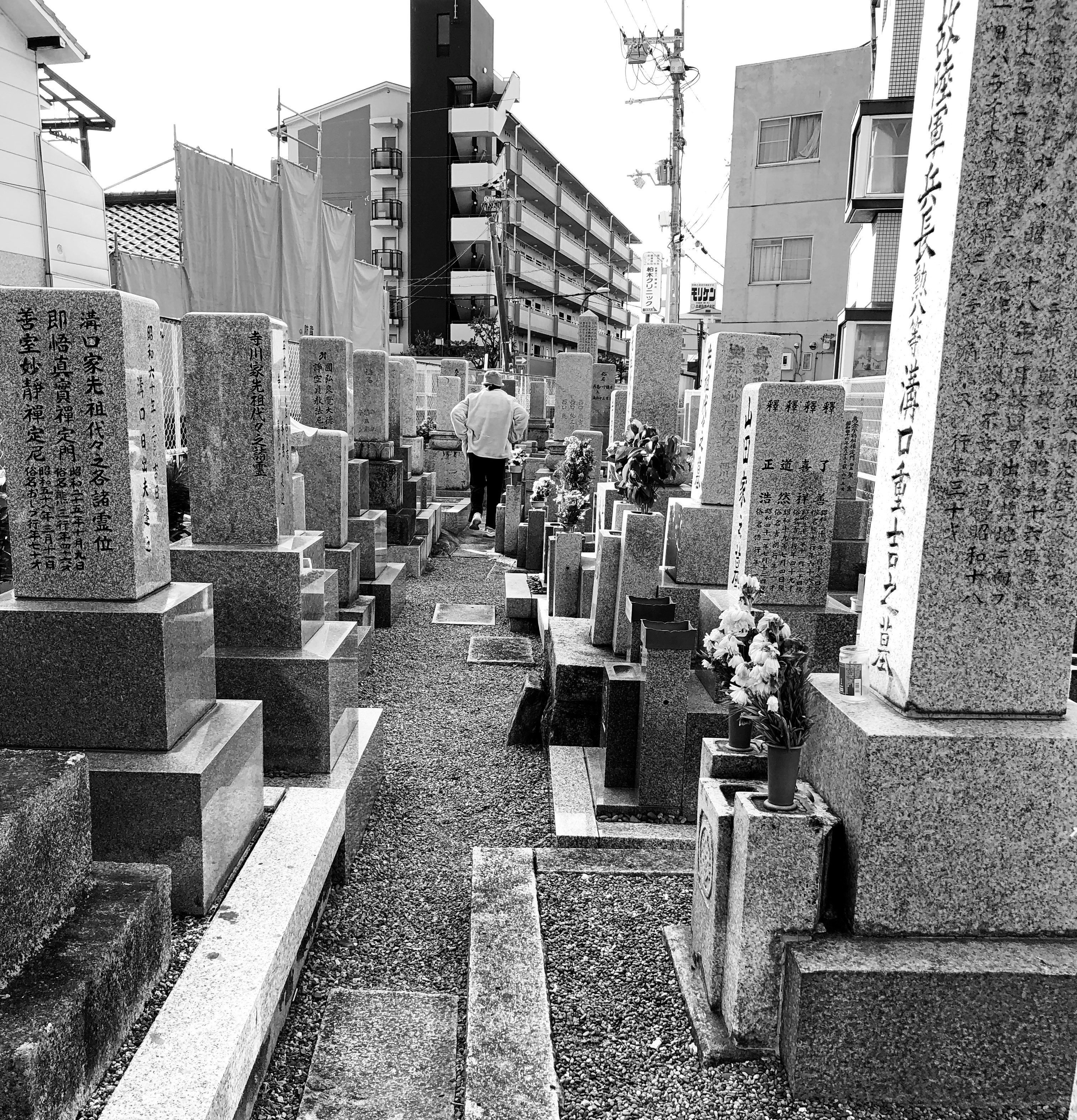
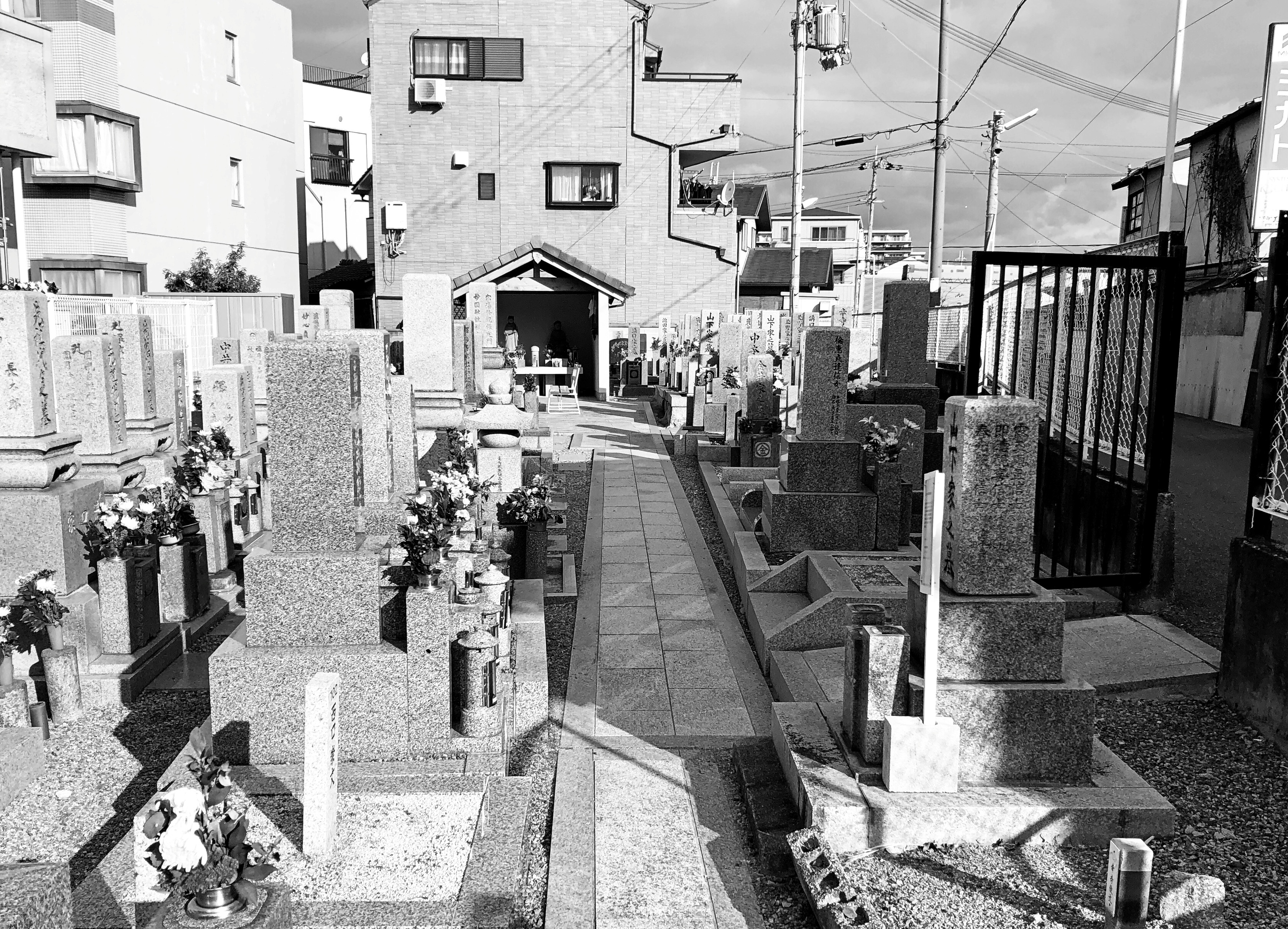
Unfortunately this time there was no time to visit that most beautiful of cemeteries in Japan or anywhere else: Okuno-in at Koya-san, which is about an hour’s train ride from central Osaka. But there was a cemetery near where we stayed, a more ordinary one in the far reaches of suburban Osaka. I don’t know its name.Japan, 2025 Japan, 2025

It is essentially just a sliver of land not dedicated to anything else. Around it is a short fence.Japan, 2025 Japan, 2025

Around that is a neighborhood.Japan, 2025 Japan, 2025

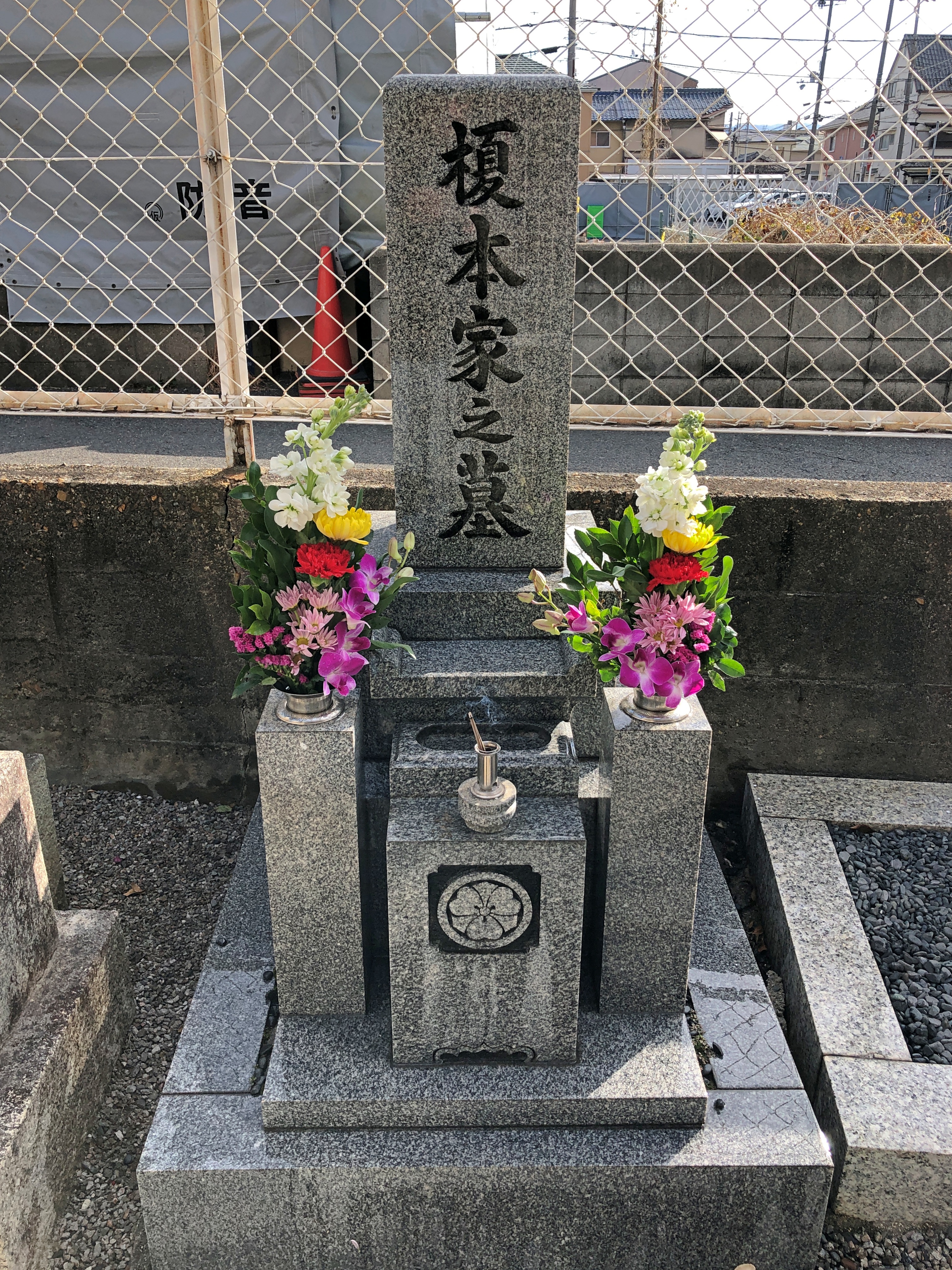
It also happens to be the location of my mother- and father-in-law’s memorial and ashes.Japan, 2025

RIP, Enomoto-san.

Kamakura Stroll Garden

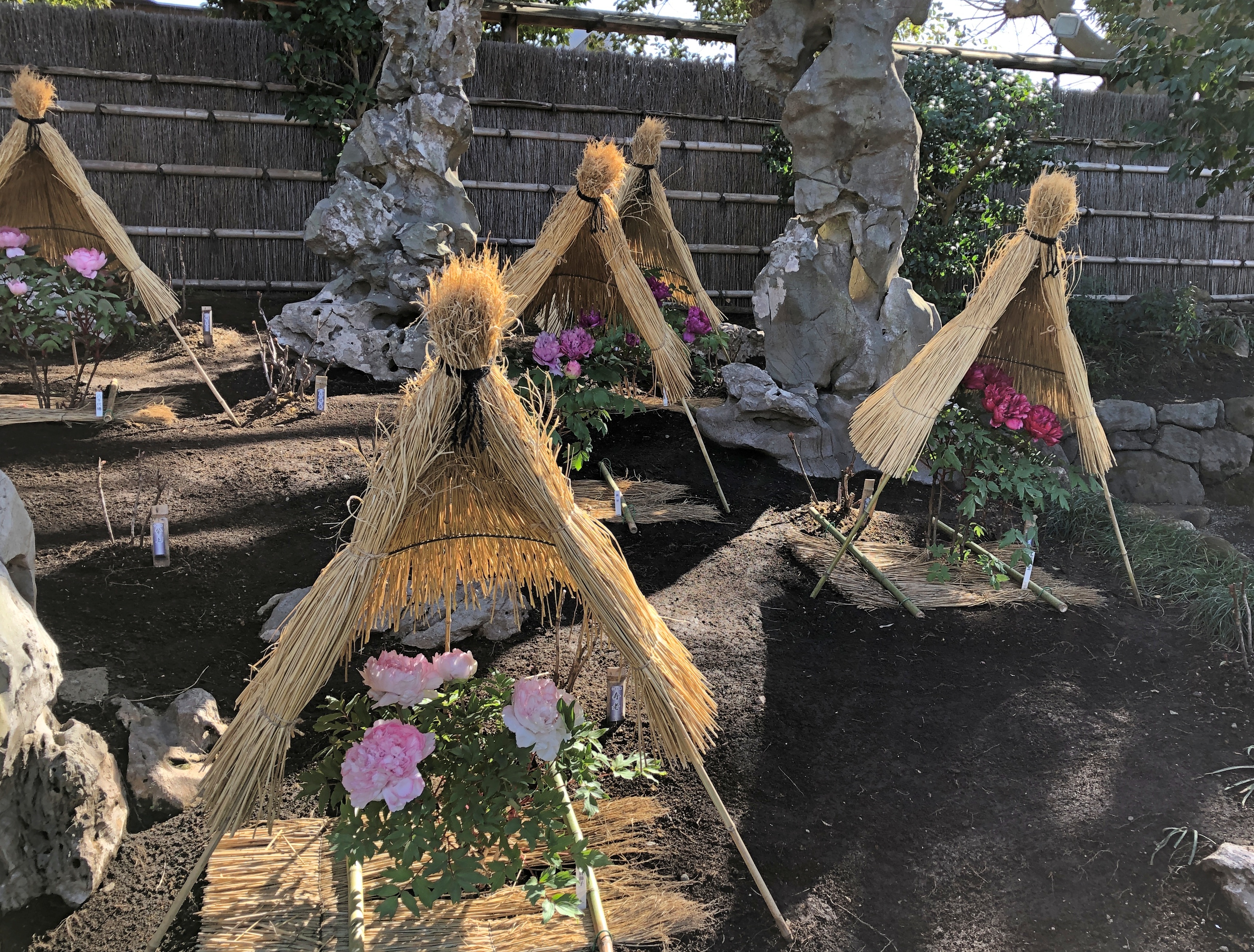
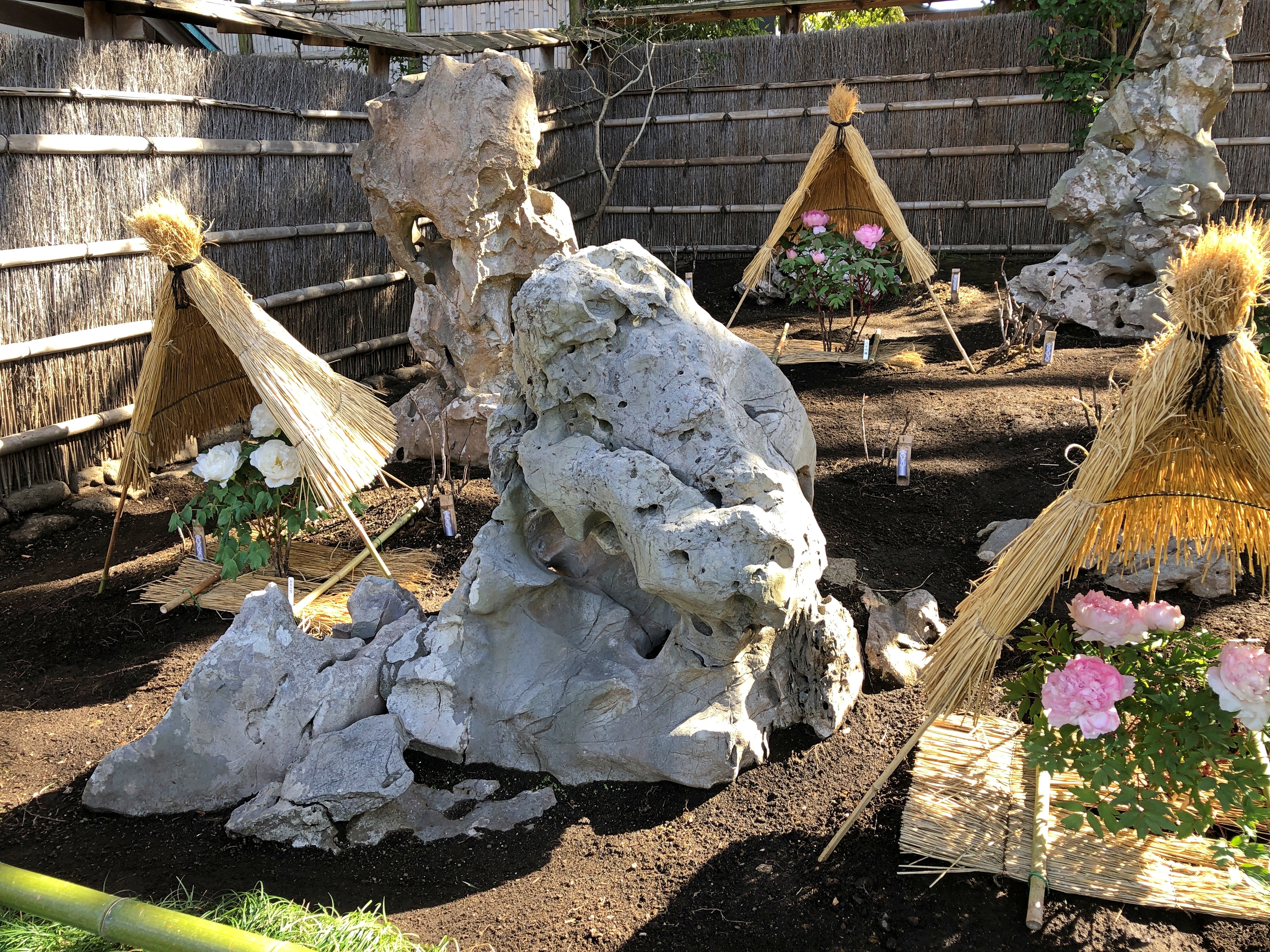
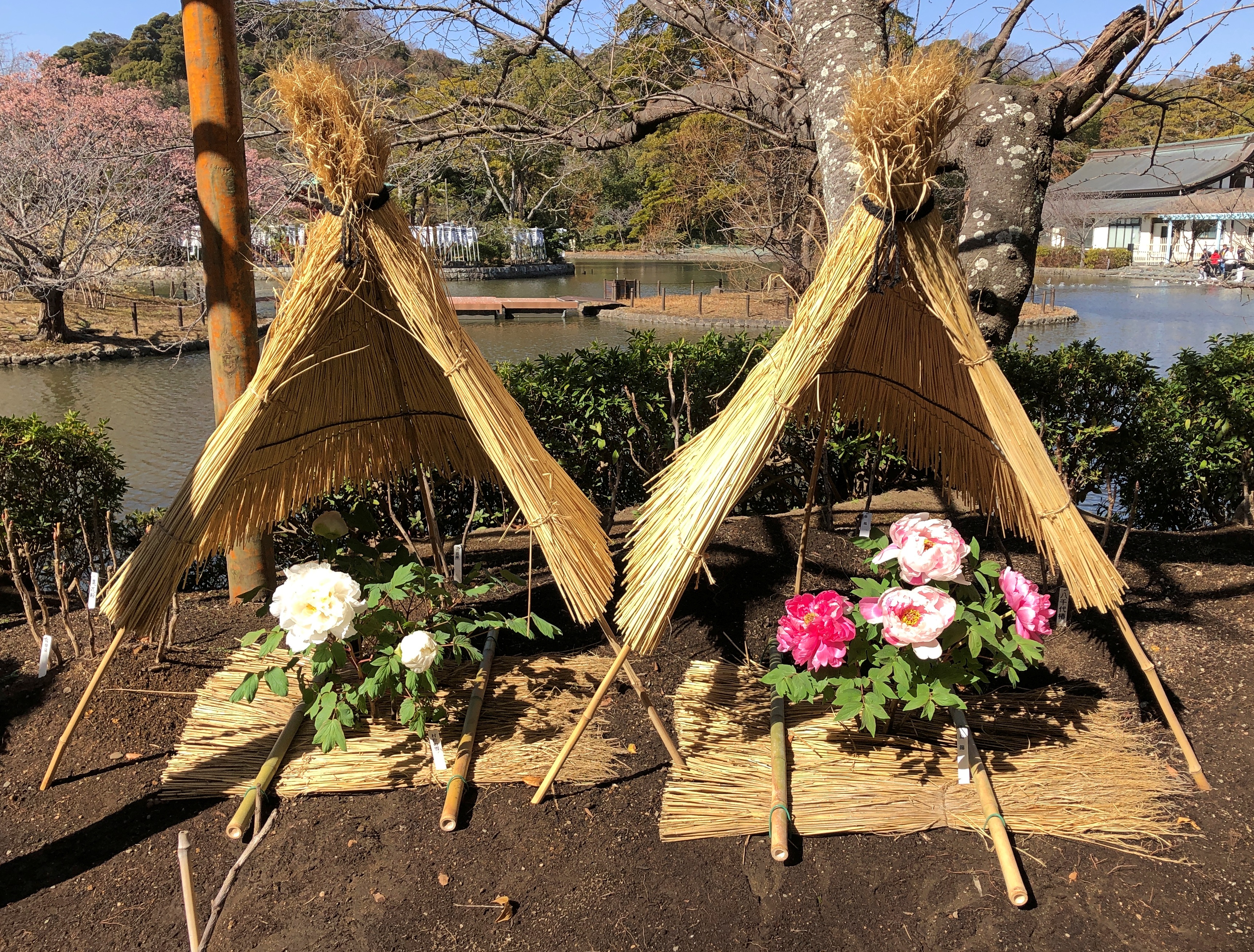
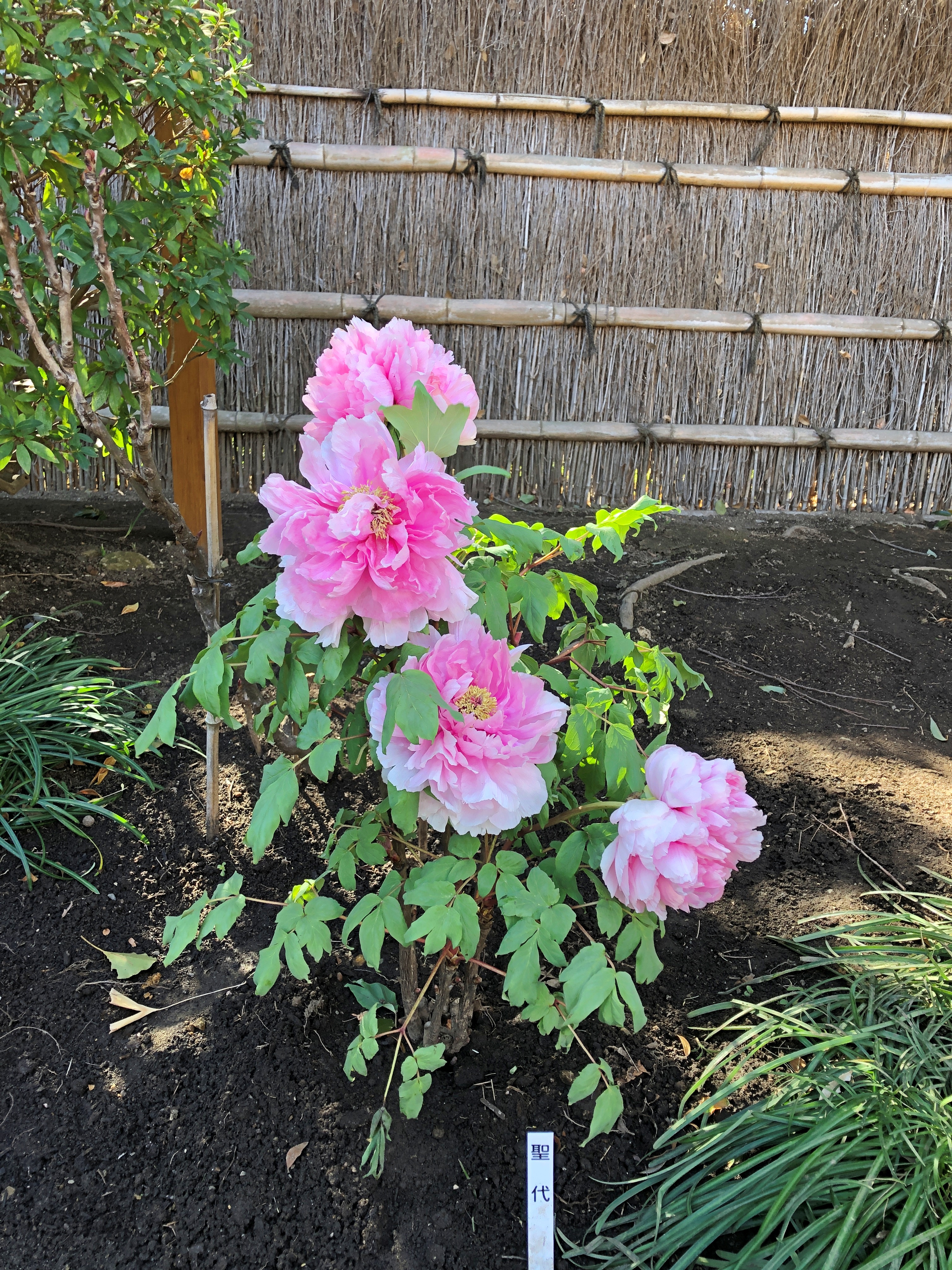
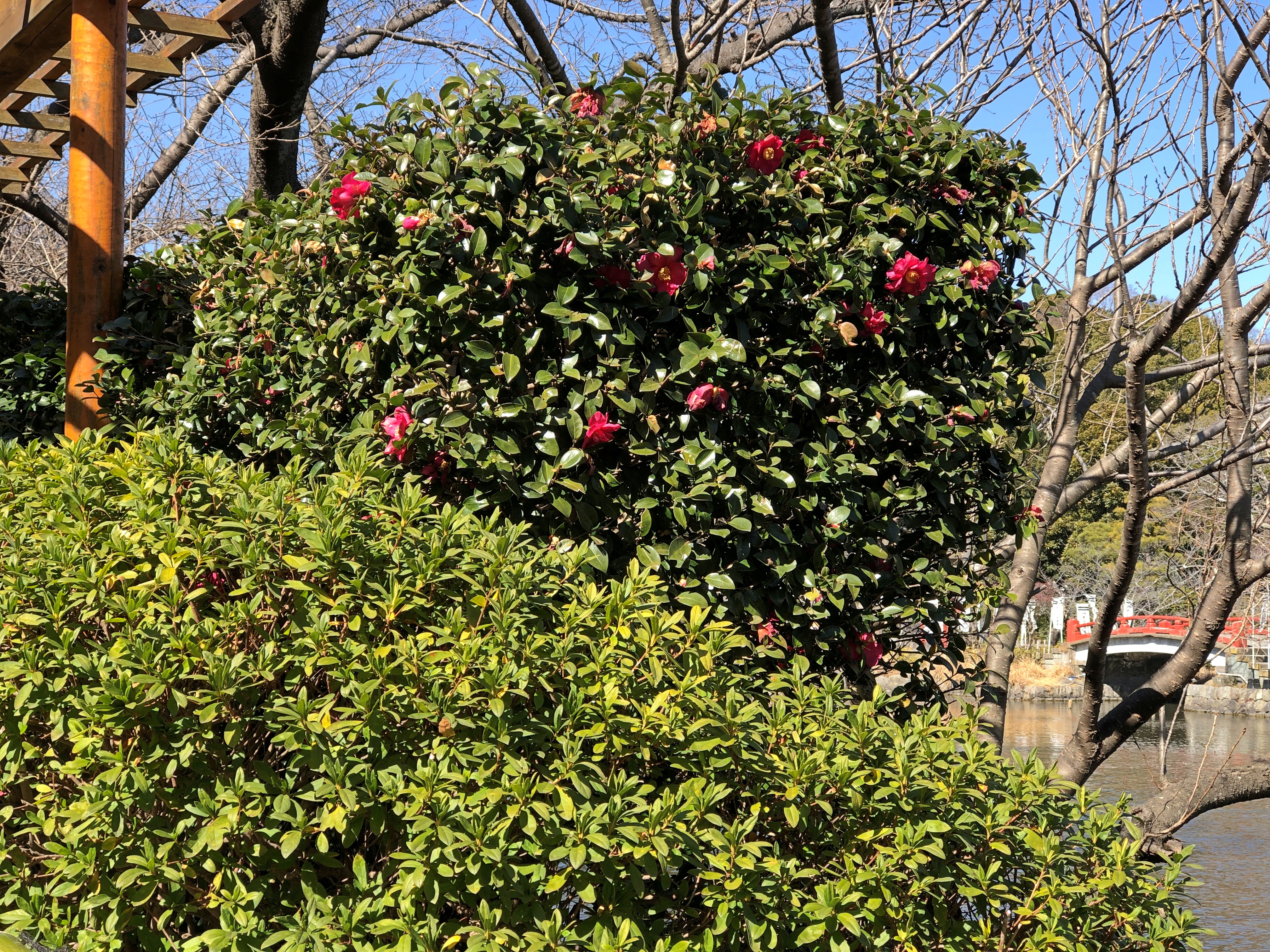
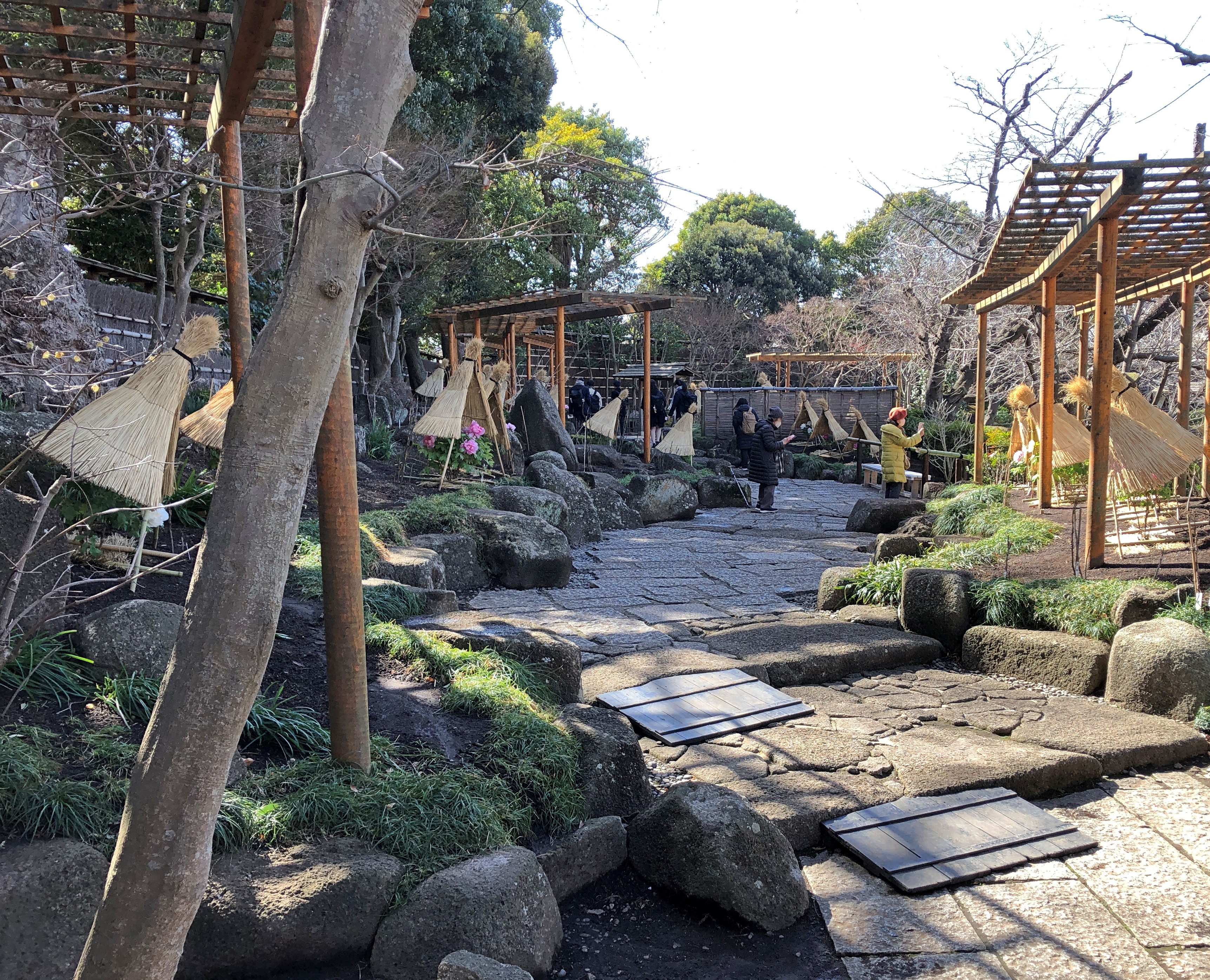
On the extensive grounds of Tsurugaoka Hachimangu Shrine in Kamakura – or maybe a separate entity adjacent to the shrine, it wasn’t quite clear – was a garden that managed to sport flowers in mid-February.Kamakura Japan

Part of the gardeners’ strategy seemed to be tepee-like straw structures over the blooms, many of them ‘mid the garden stones.Kamakura Japan Kamakura Japan Kamakura Japan

There must be a word for that sort of cover. In English or Japanese or some other language, and it must work somehow, though speaking as a non-gardener, it doesn’t look like it would keep cold air out. The area is roughly the same latitude as Nashville or Oklahoma City, certainly far enough north for some chilly winter days, though presumably the ocean off Kamakura moderates temps somewhat in Kamakura. Anyway, it does get cold there, as this detailed climate page notes.

Or maybe the growing season is longer than it used to be. Whatever could be the cause of that?

Not every floral growth was covered.Kamakura Japan

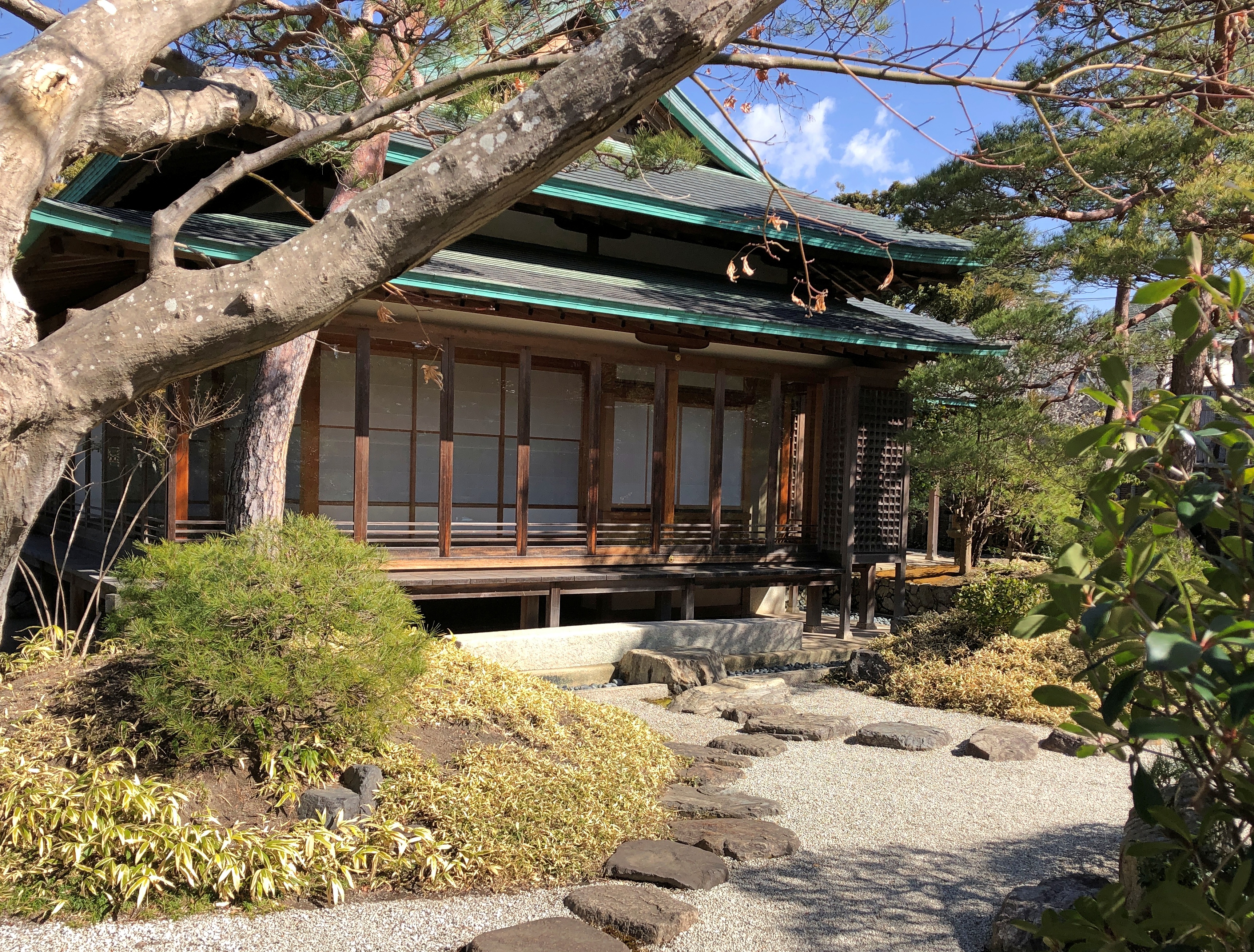
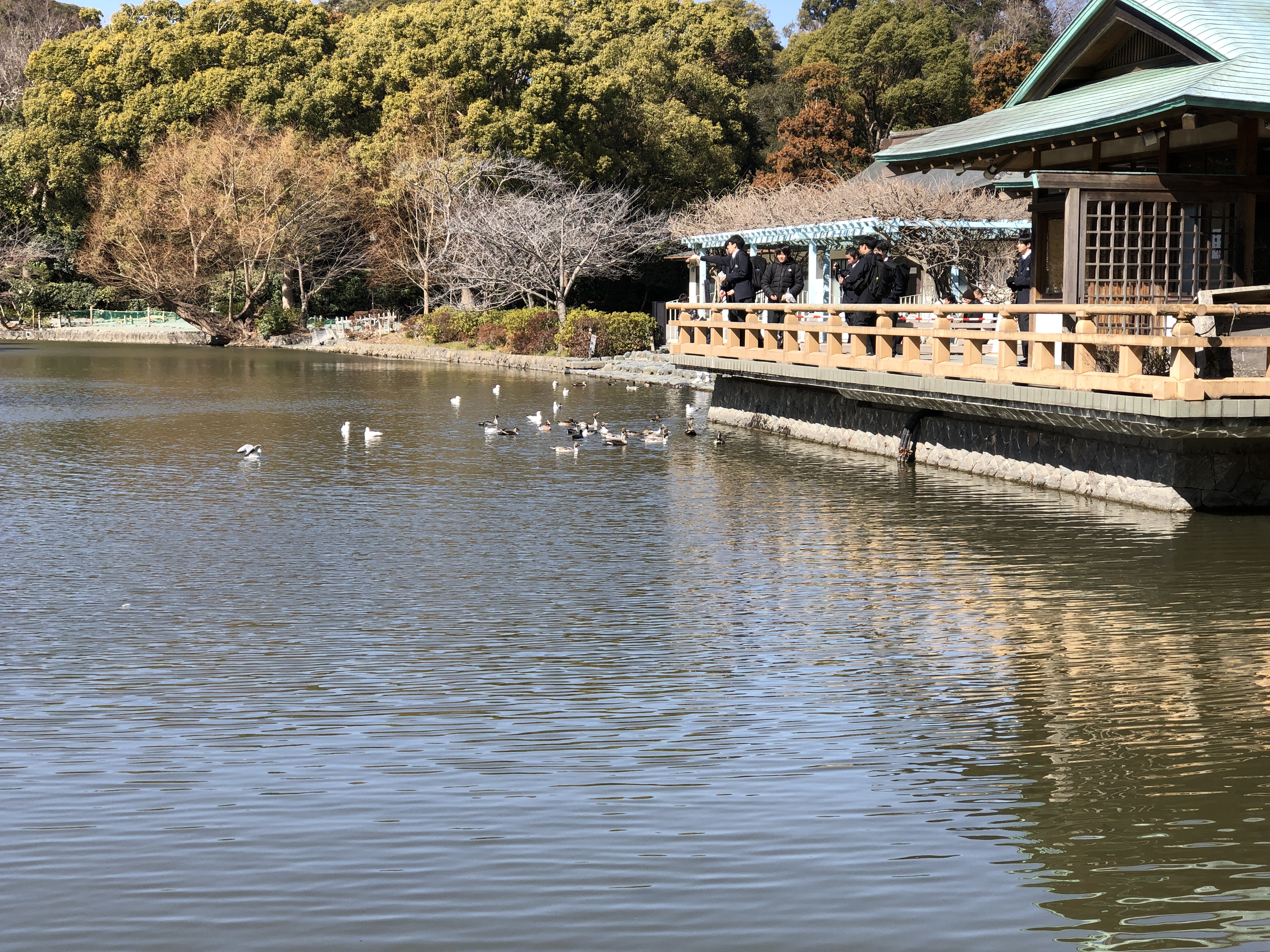
Even without flowers, the place made for a pleasant stroll in an elegant setting.Kamakura Japan Kamakura Japan Kamakura Japan

What would a kaiyushiki teien, a stroll garden, be without bamboo?Kamakura Japan

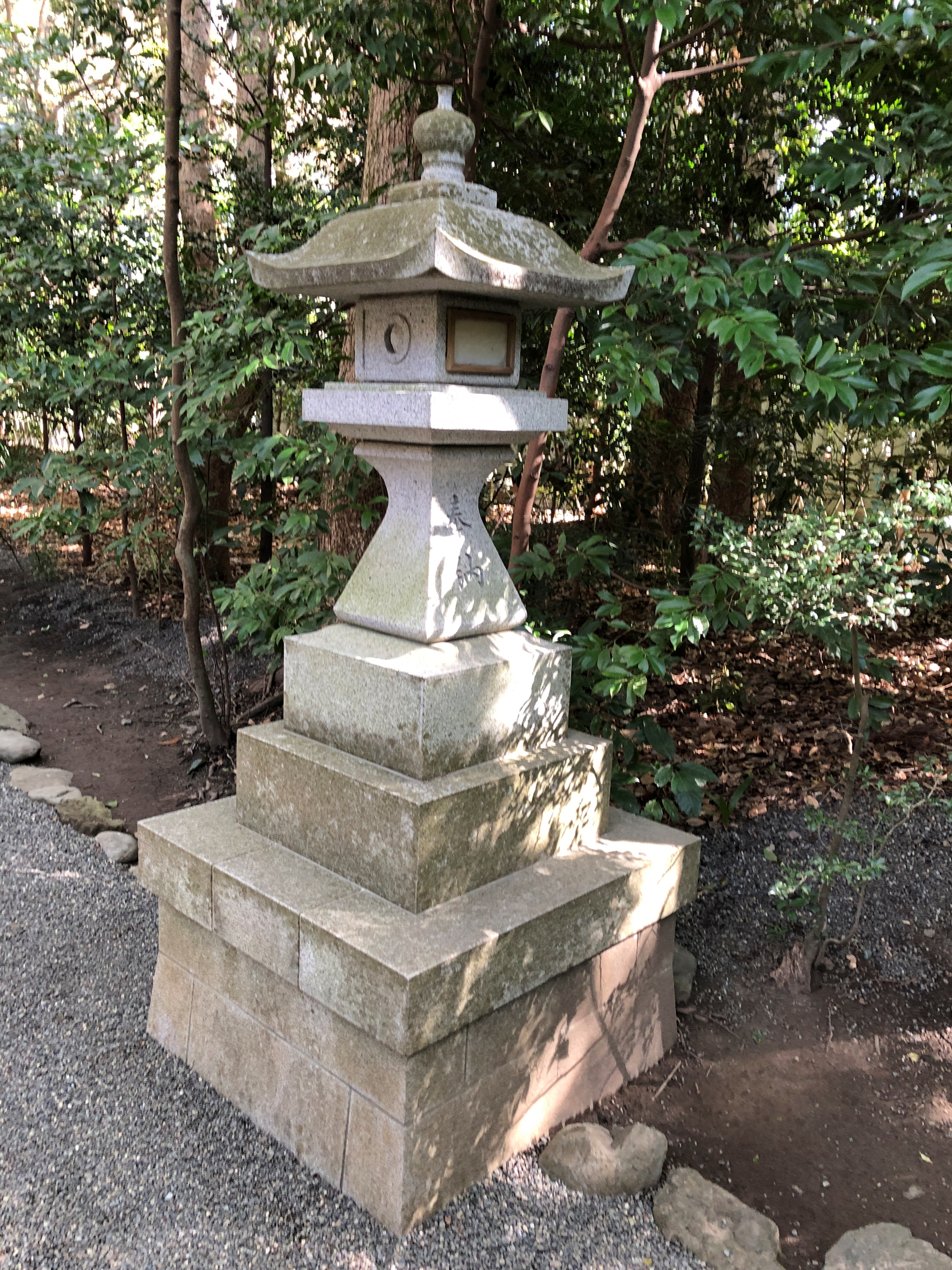
Or a stone lantern?Kamakura Japan

After we strolled the garden, we made our way to the Kamakura Daibutsu, the Big Buddha, a bronze of many tons that somehow makes you think about impermanence. As February days go, the one in Kamakura was top-notch.

Birdman of Osaka Castle Park

In Chinese city parks during our visit in 1994, it was fairly common to see (mostly) elderly men out for a walk with their birds. Their songbirds in cages, that is, which the men carried along with them and would hang somewhere nearby while they rested on benches. This article at least asserts that the practice goes back to the Qing Dynasty, which was founded in 1644. I’d never seen such a thing before anywhere else, and not since, until we visited Osaka Castle Park in February.

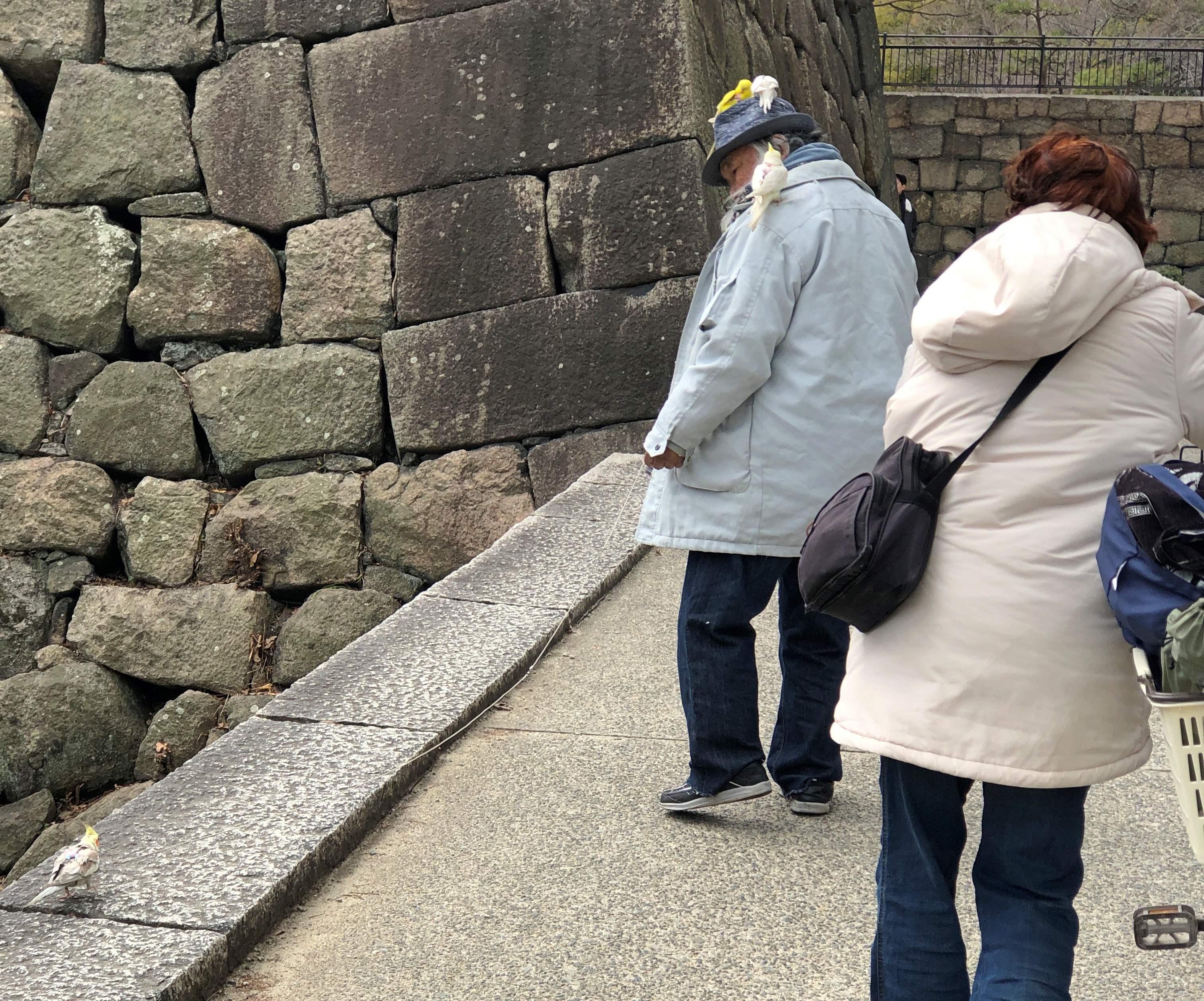
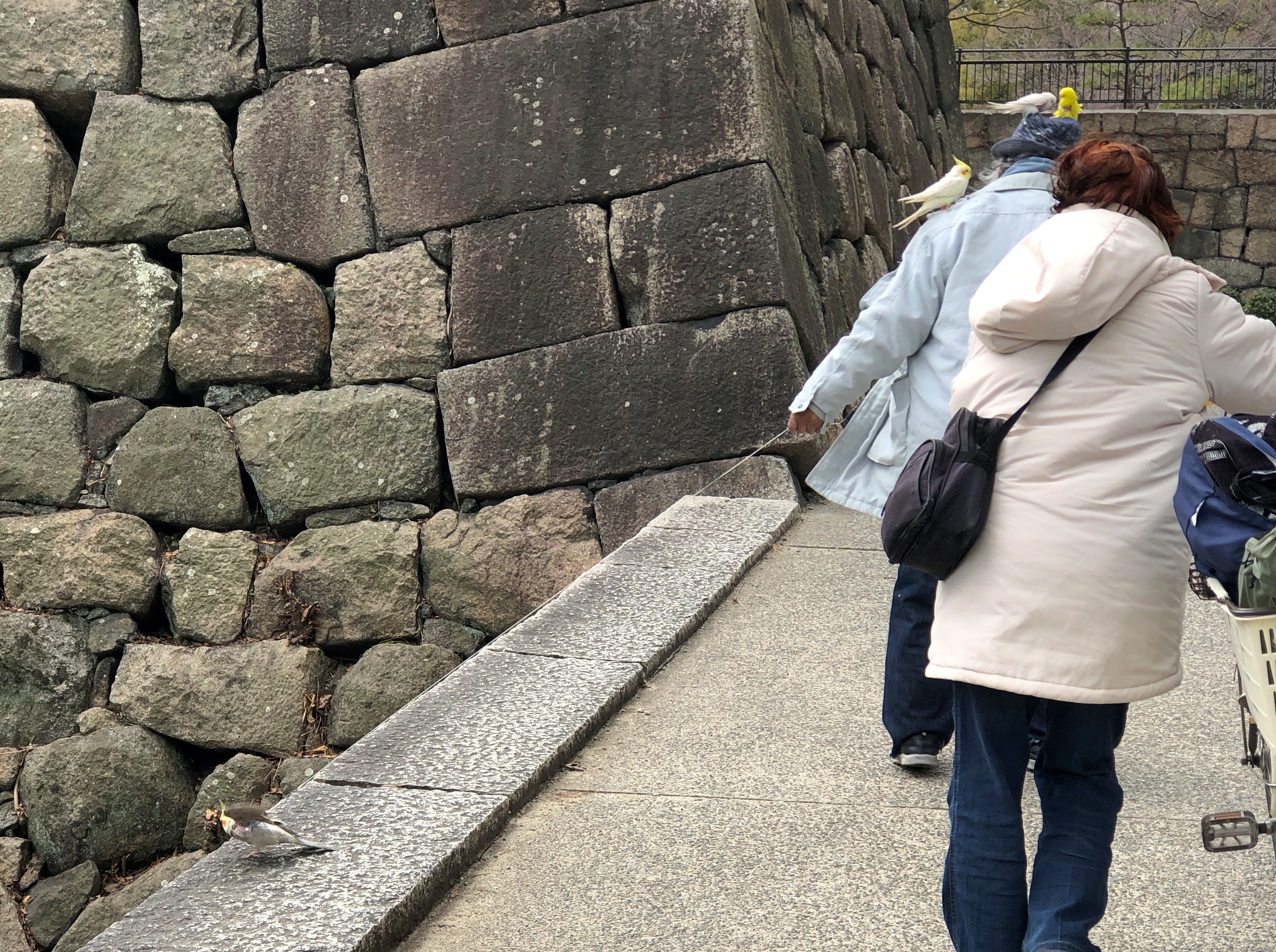
Note the fellow in the blue jacket and blue hat, near one of the former castle walls, with birds perched on his head and shoulders. He seemed to be out for a stroll with his birds.Osaka-jo Koen

They were living, chirping birds that would periodically fly away, but they would also come back. The bird at the left bottom corner of the image was one of his as well, tethered to a string he’s grasping with his hand. Guess that was a bird in training.Osaka-jo Koen

Of course, Japan is not China, however much the Japanese borrowed from China in earlier centuries. Bird walking wasn’t one of those borrowings, so I believe this man and his birds were eccentric outliers who eschewed cages for freedom of movement. Still, the level of training is impressive. It’s one thing to train the birds to return – carrier pigeons do that – but do they know to go somewhere else when it’s time to drop a load? I’d hope so, but I don’t know whether that is possible.

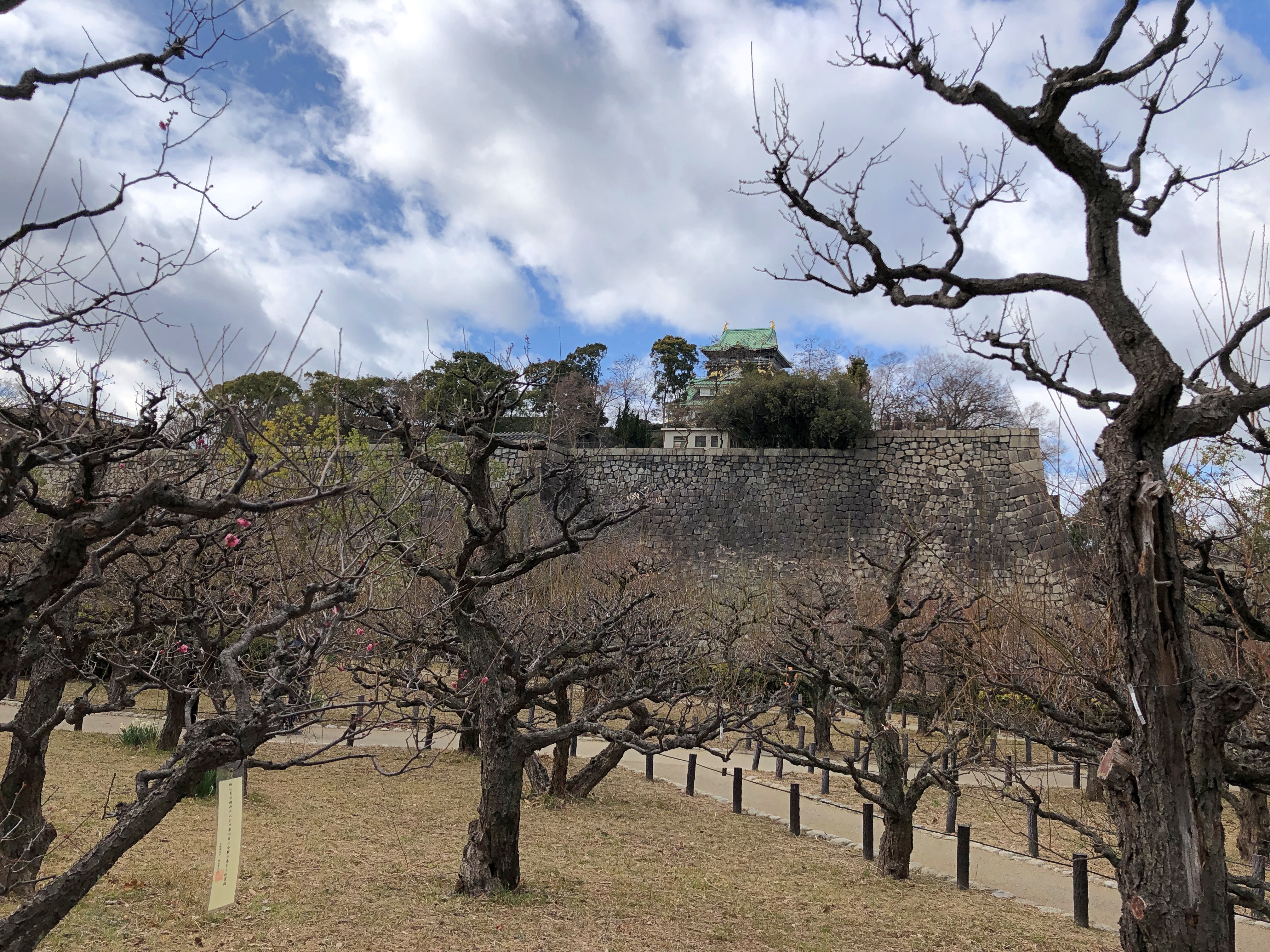
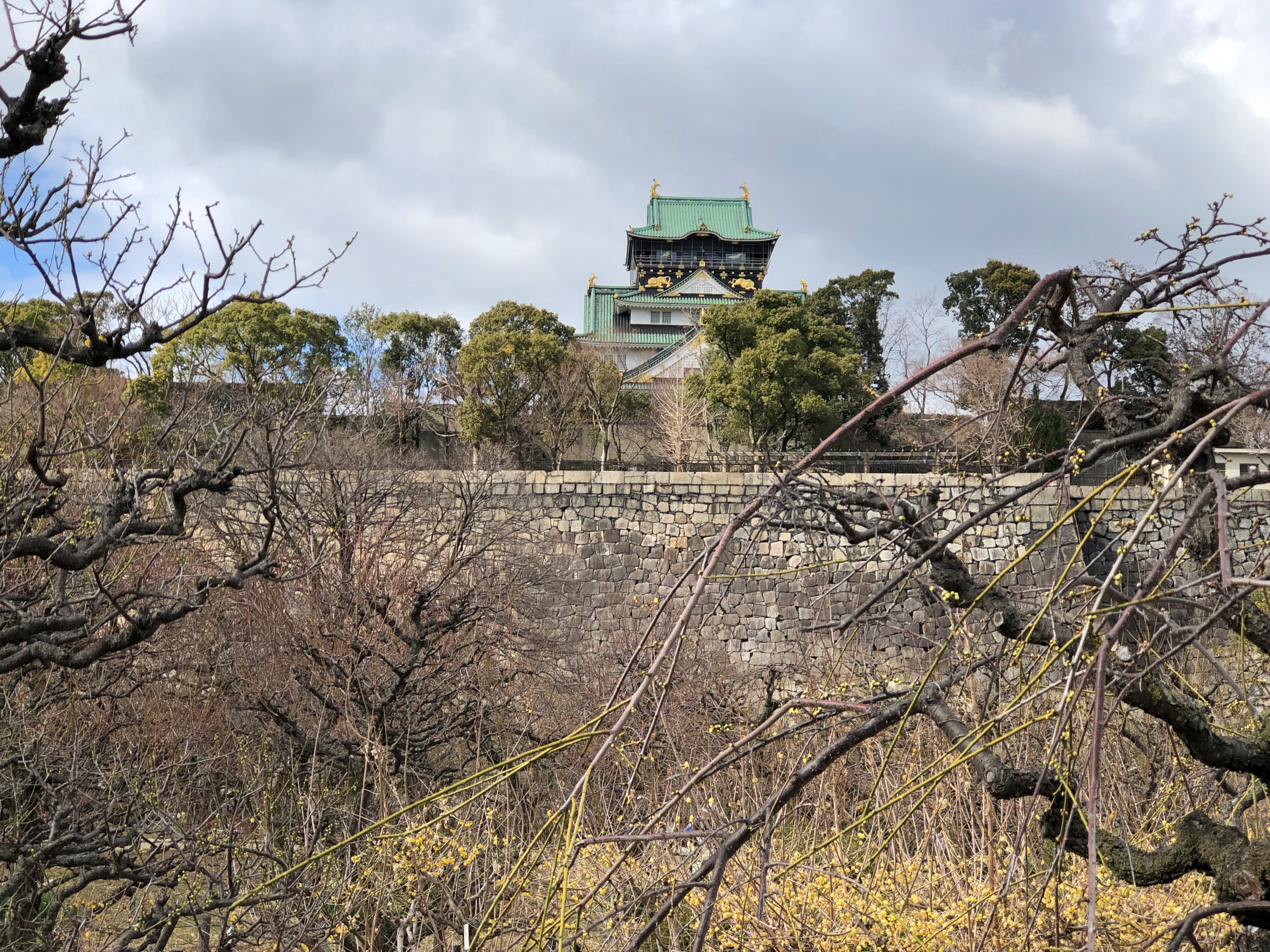
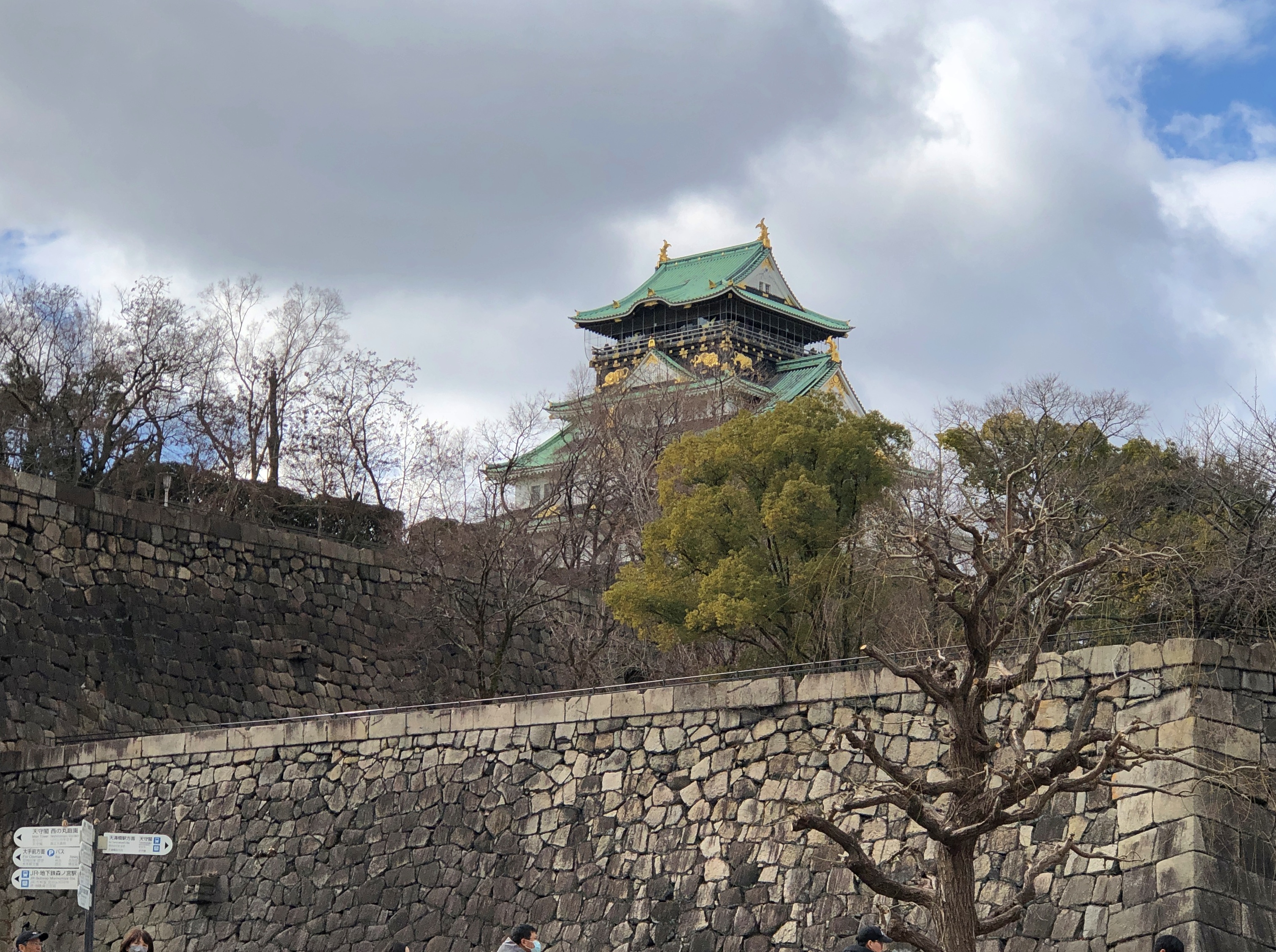
Even in winter, Osaka Castle Park (Osaka-jo Koen, 大阪城公園) is a pleasant place to stroll. We didn’t enter the castle itself, where we’d both been a few times before, but took in some nice views of it.Osaka-jo Koen Osaka-jo Koen Osaka-jo Koen

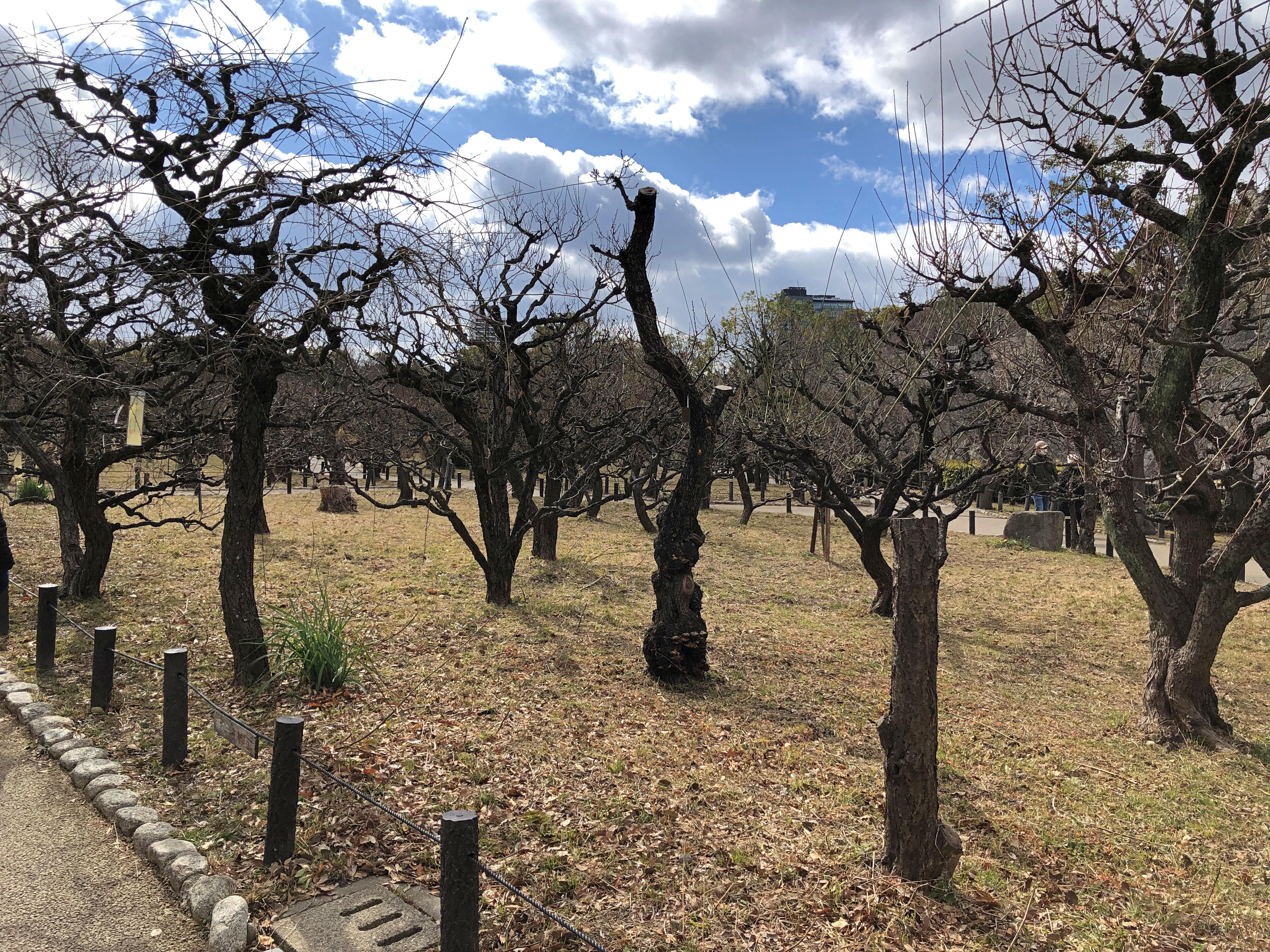
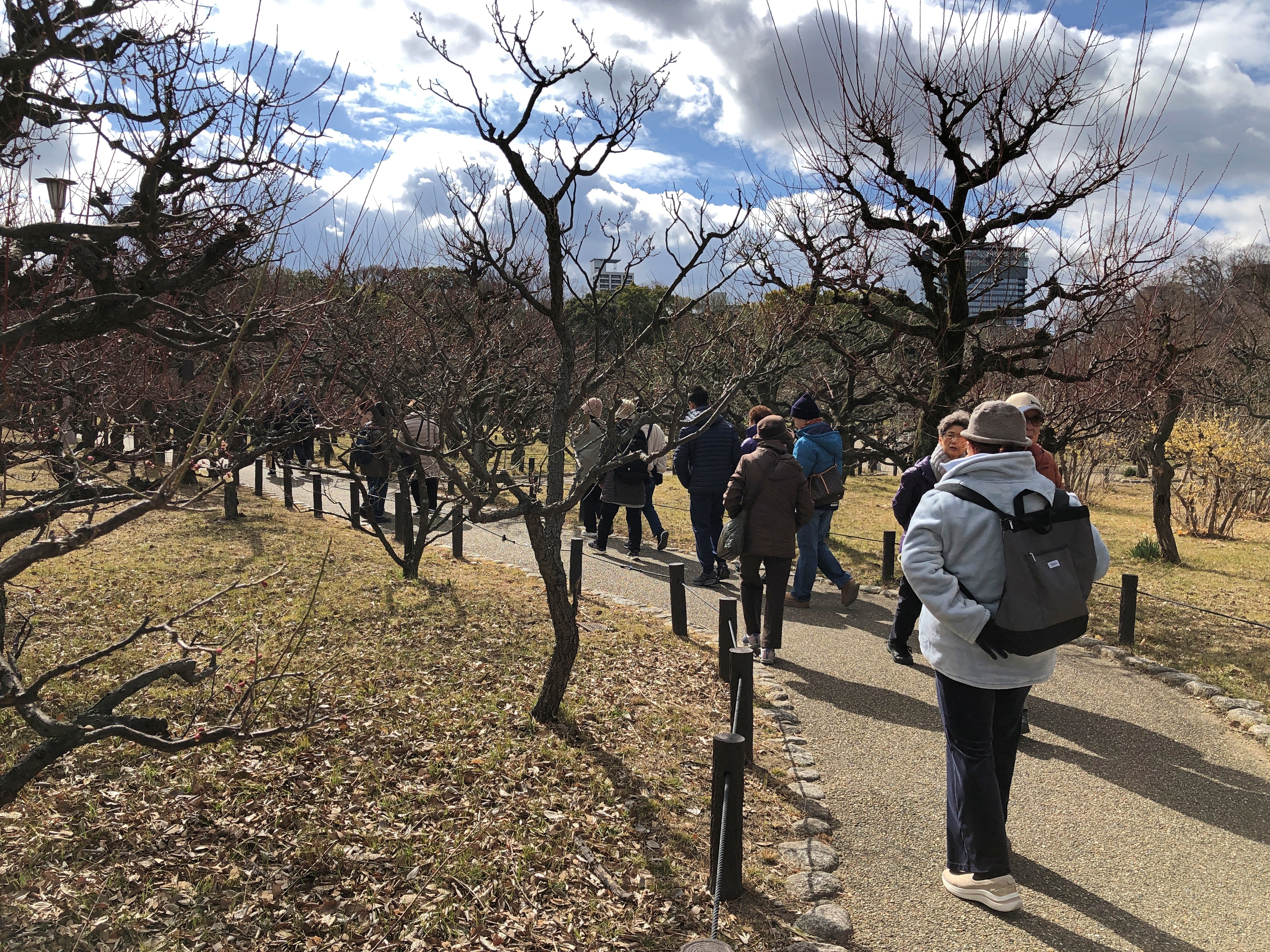
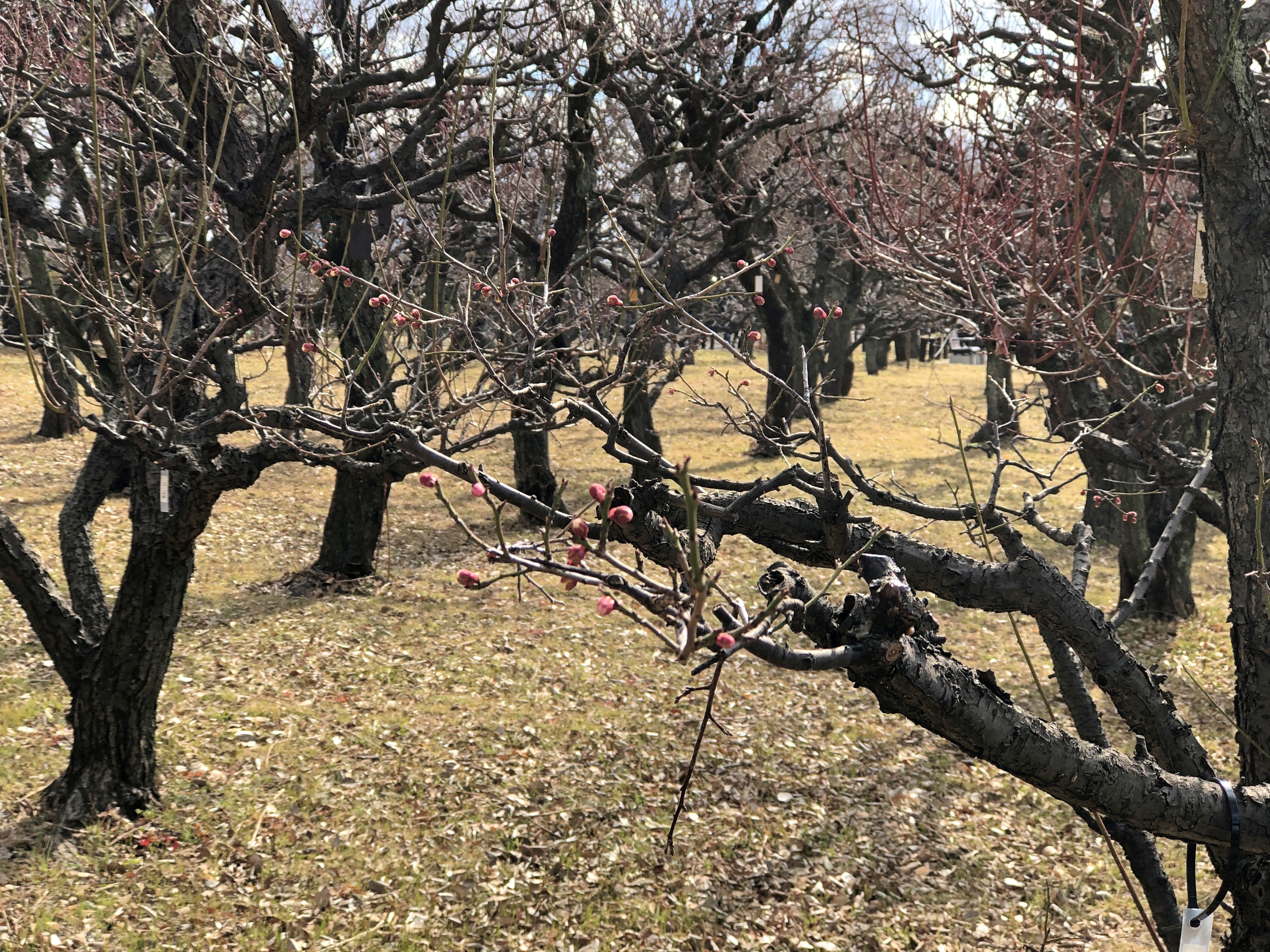
Many of the trees are plums. They are the first to blossom, and we could see the very beginnings of buds, but we were too early for full flowering.Osaka-jo Koen Osaka-jo Koen Osaka-jo Koen

Later, peach and cherries blossom in the park, though the place to see cherry blossoms in Osaka without the crowds in 1990s – and there were always crowds in the large parks, including the grounds of the Japan Mint – was Osaka Gogoku Shrine in Suminoe Ward. I’ll bet it still is.