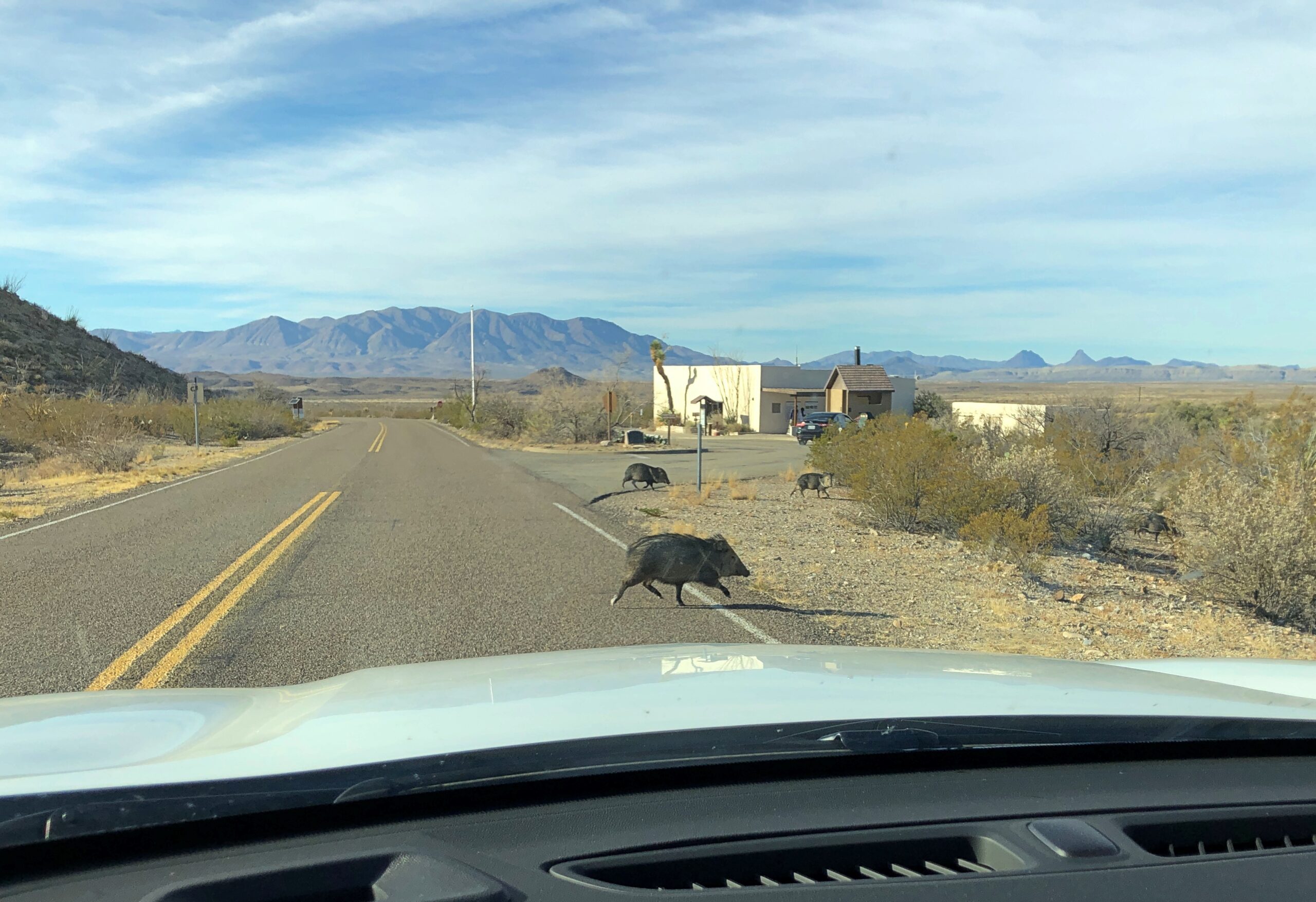
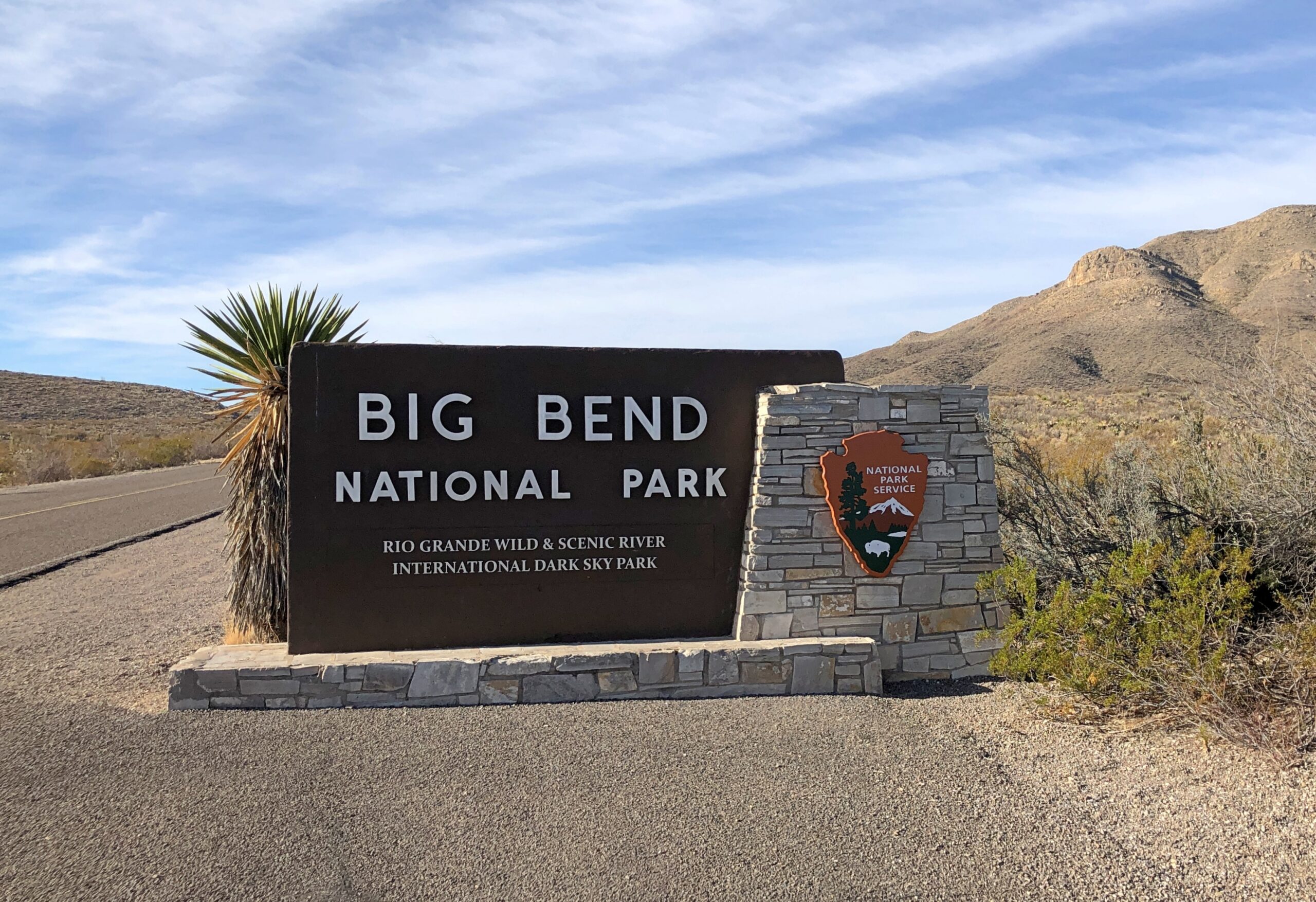
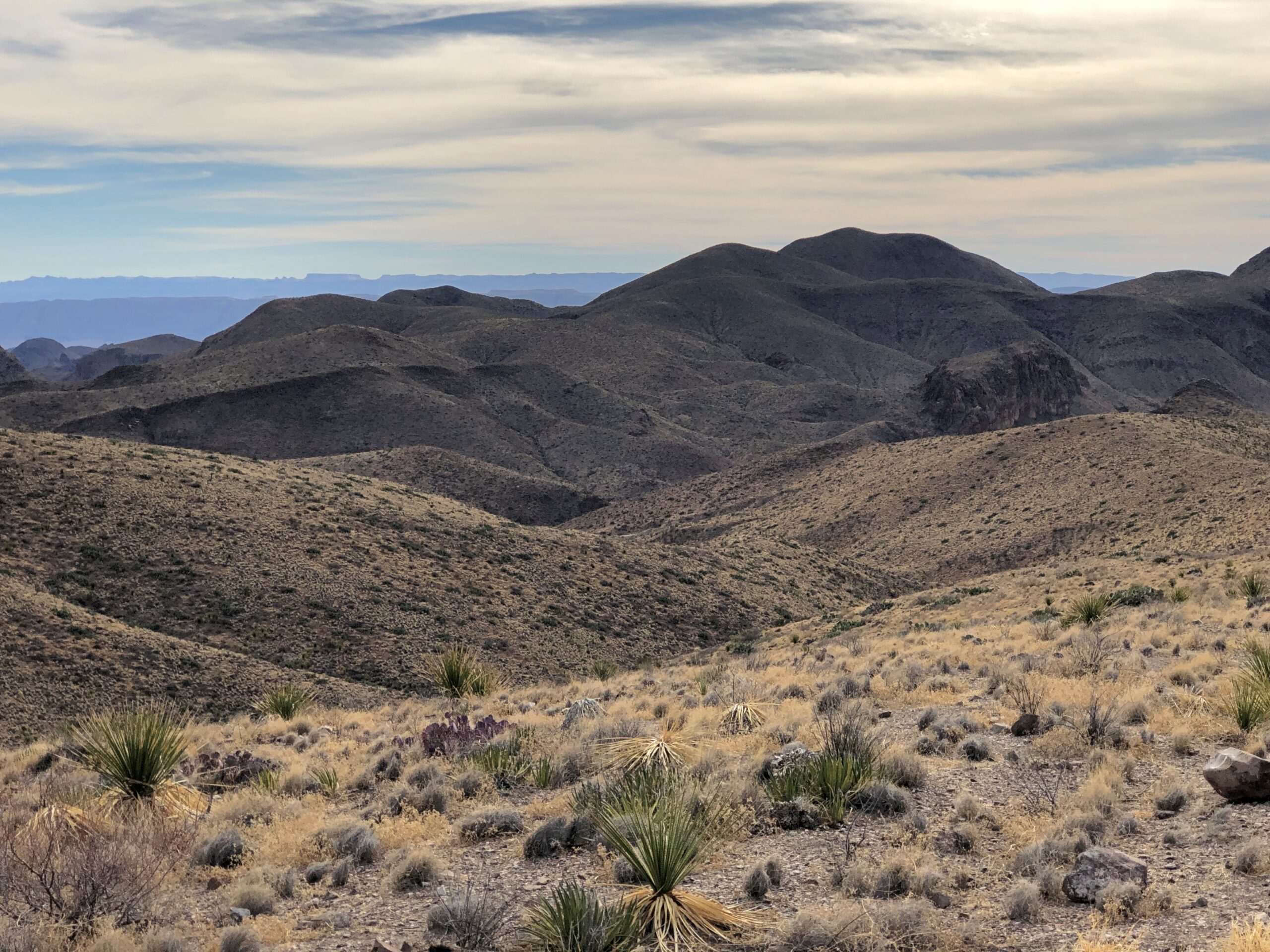
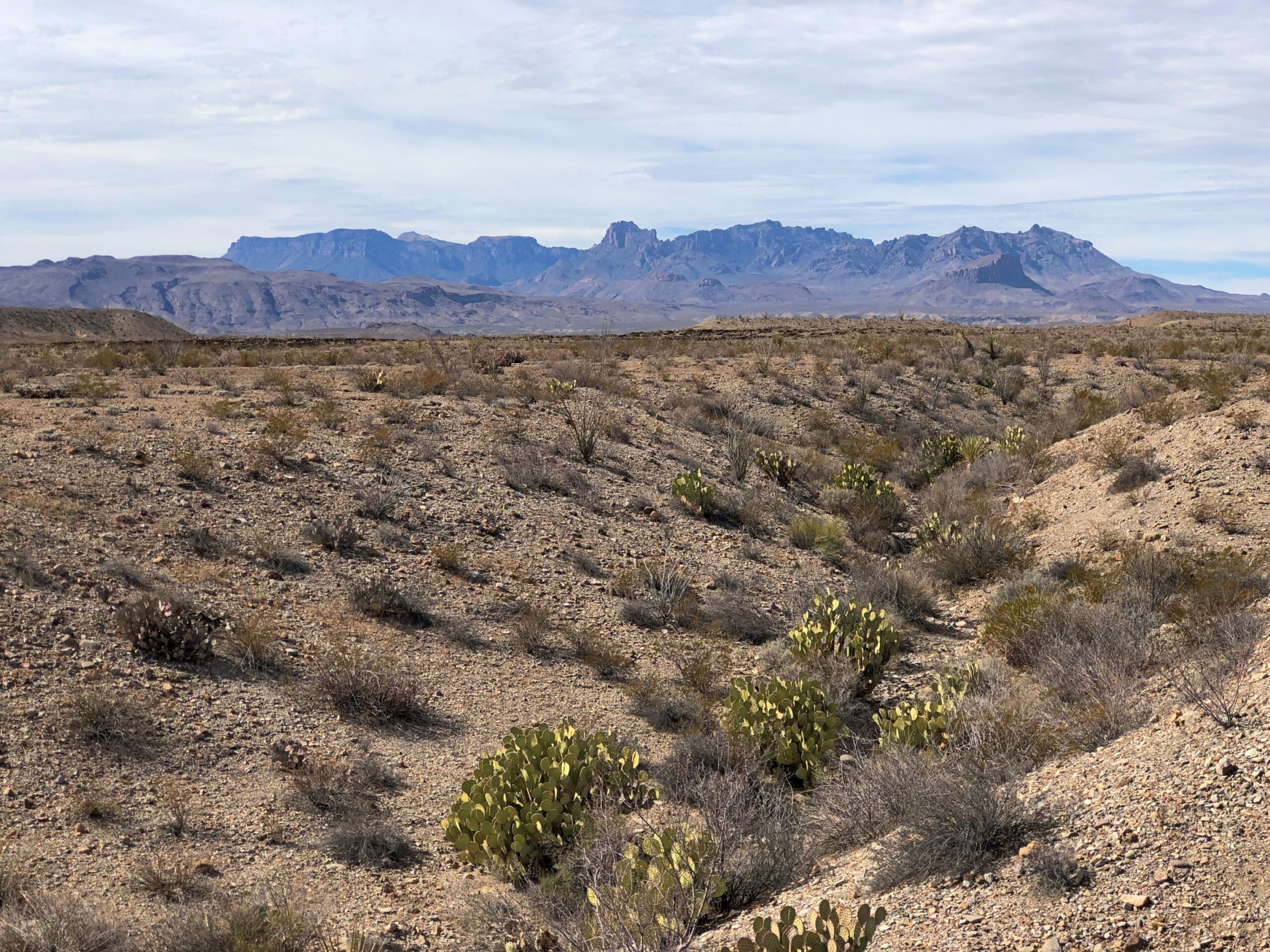
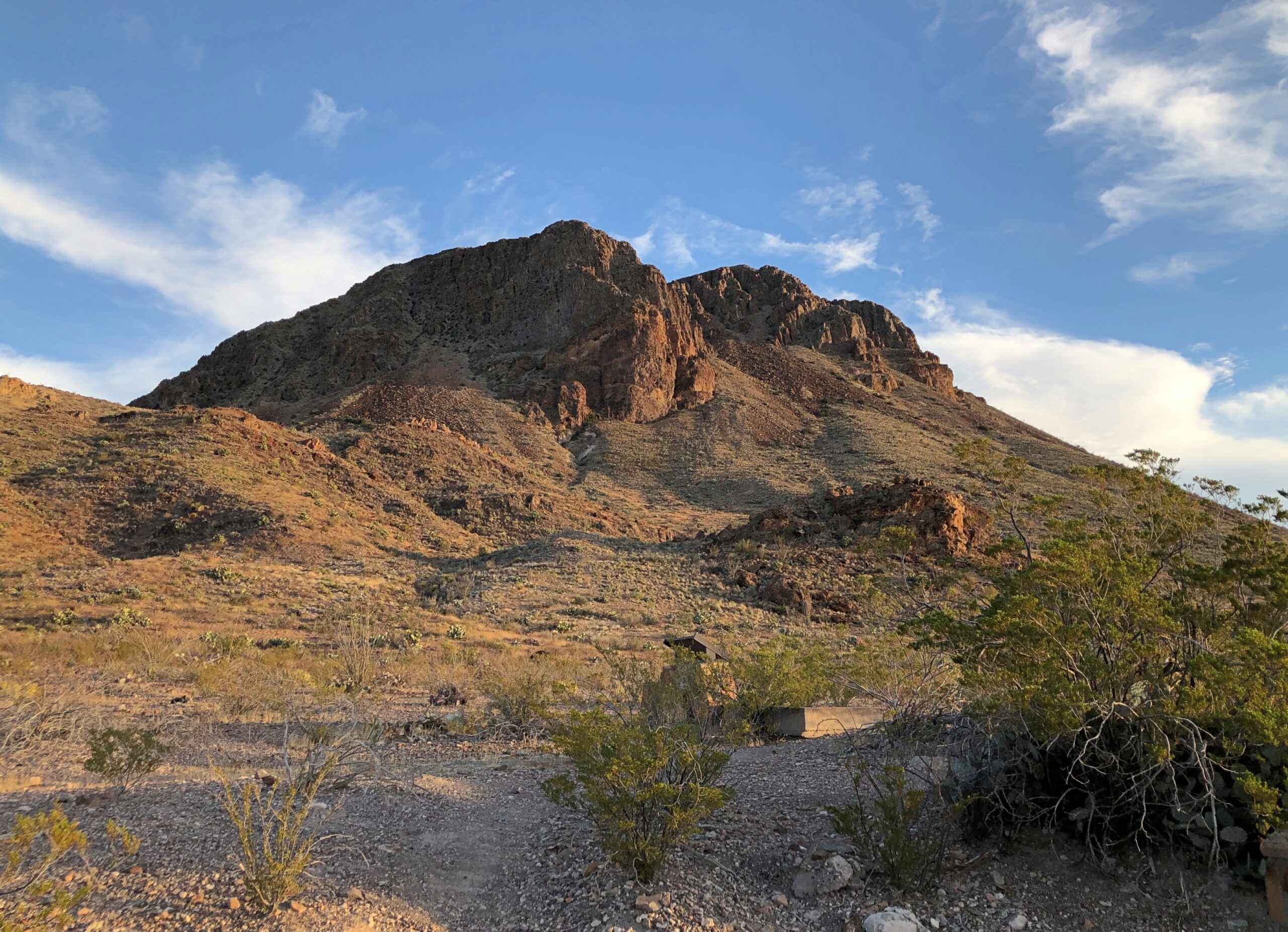
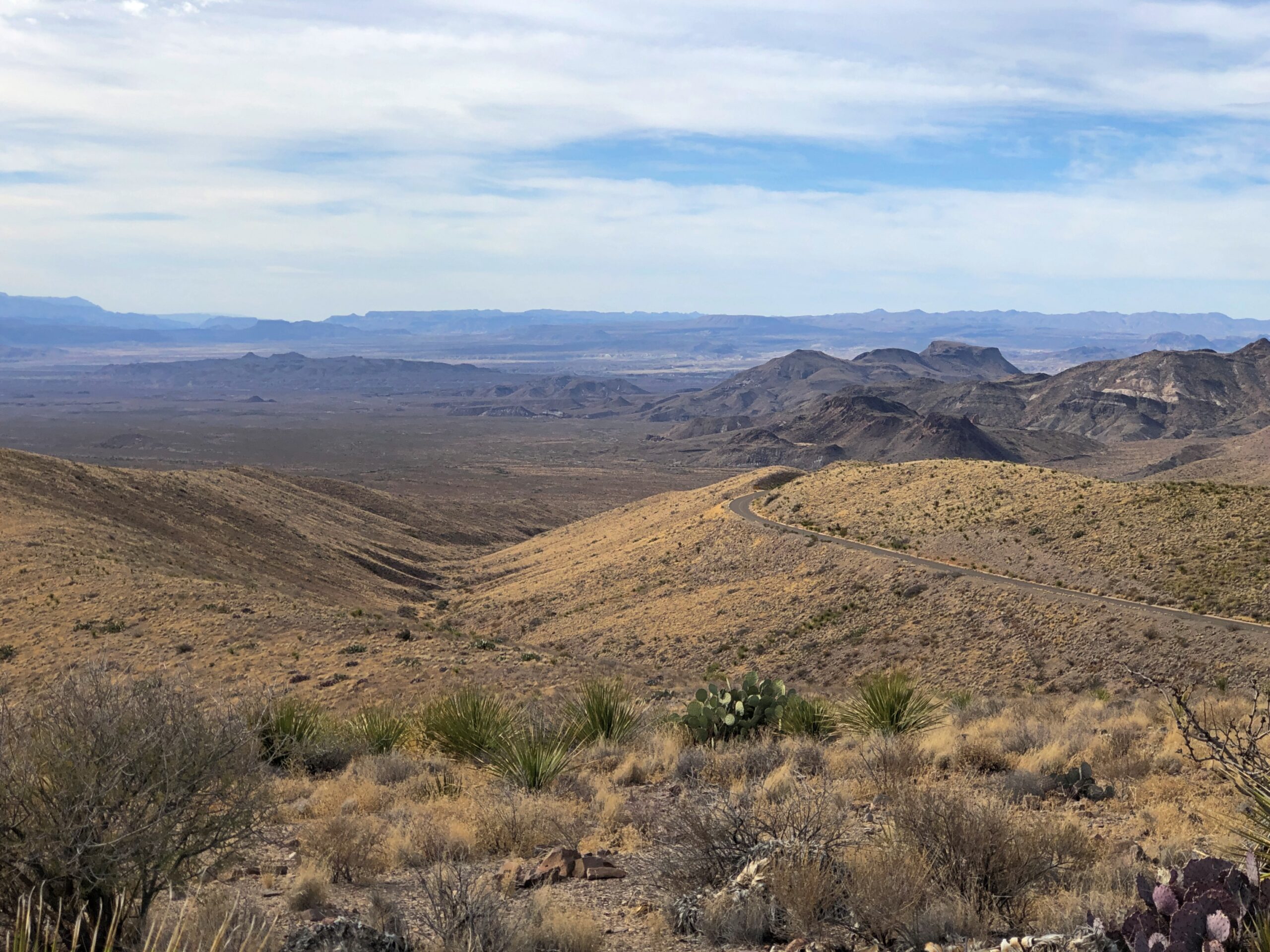
Texas has a feral hog problem. Driving at night on Texas 130 east of Austin, where the speed limit is 85 mph – the highest posted limit in the Western Hemisphere, according to Wiki – car-hits-hog is no idle scenario. Busted hog, busted machine. So I drove with care when I spotted what I took to be wild hogs on the remote main road into Big Bend National Park.
Took me a minute to work out that they weren’t quite pigs, though clearly evolutionary cousins: javelinas. Also known as peccaries. One of the many creatures living in the desert reaches of Big Bend.
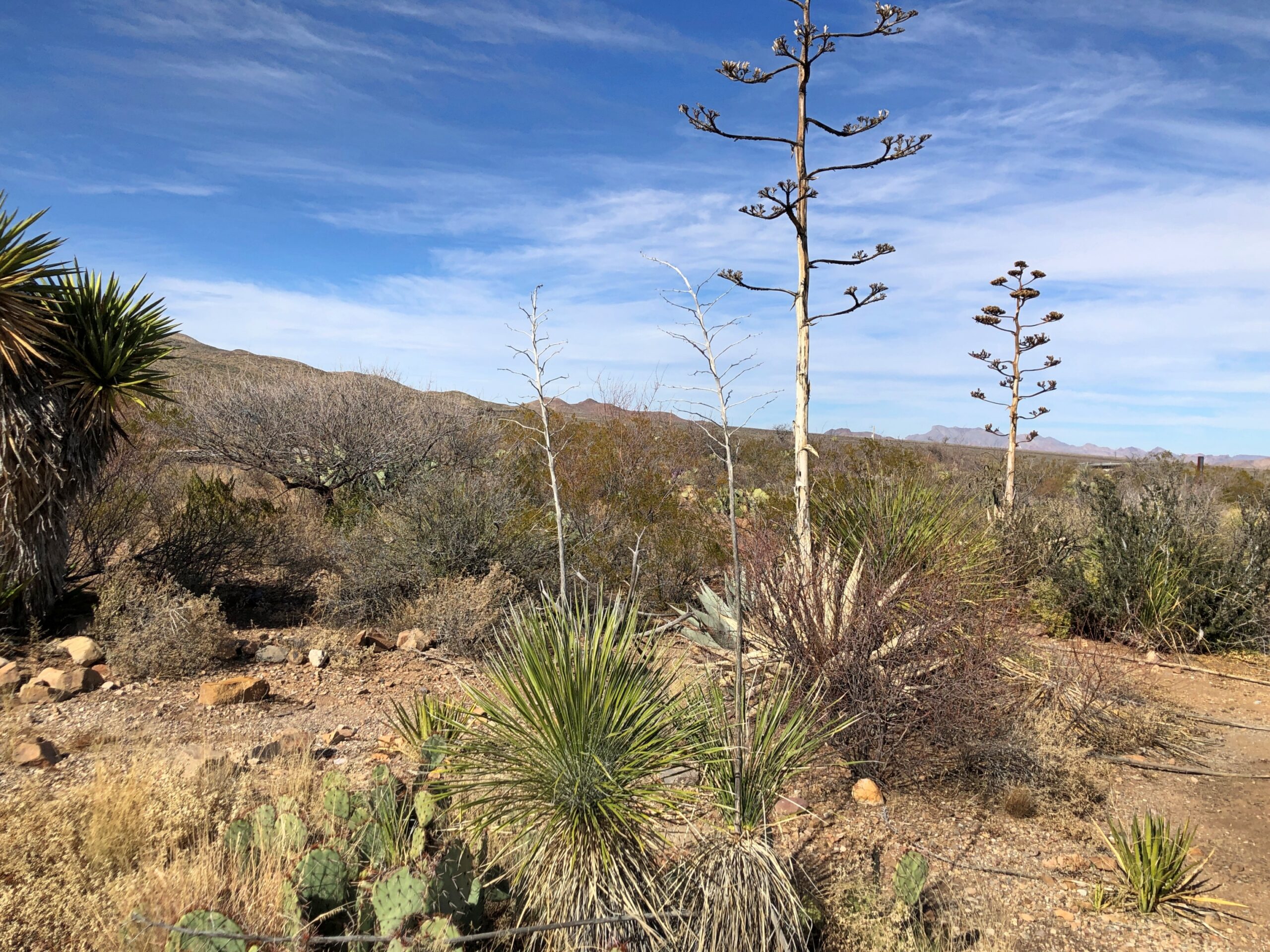
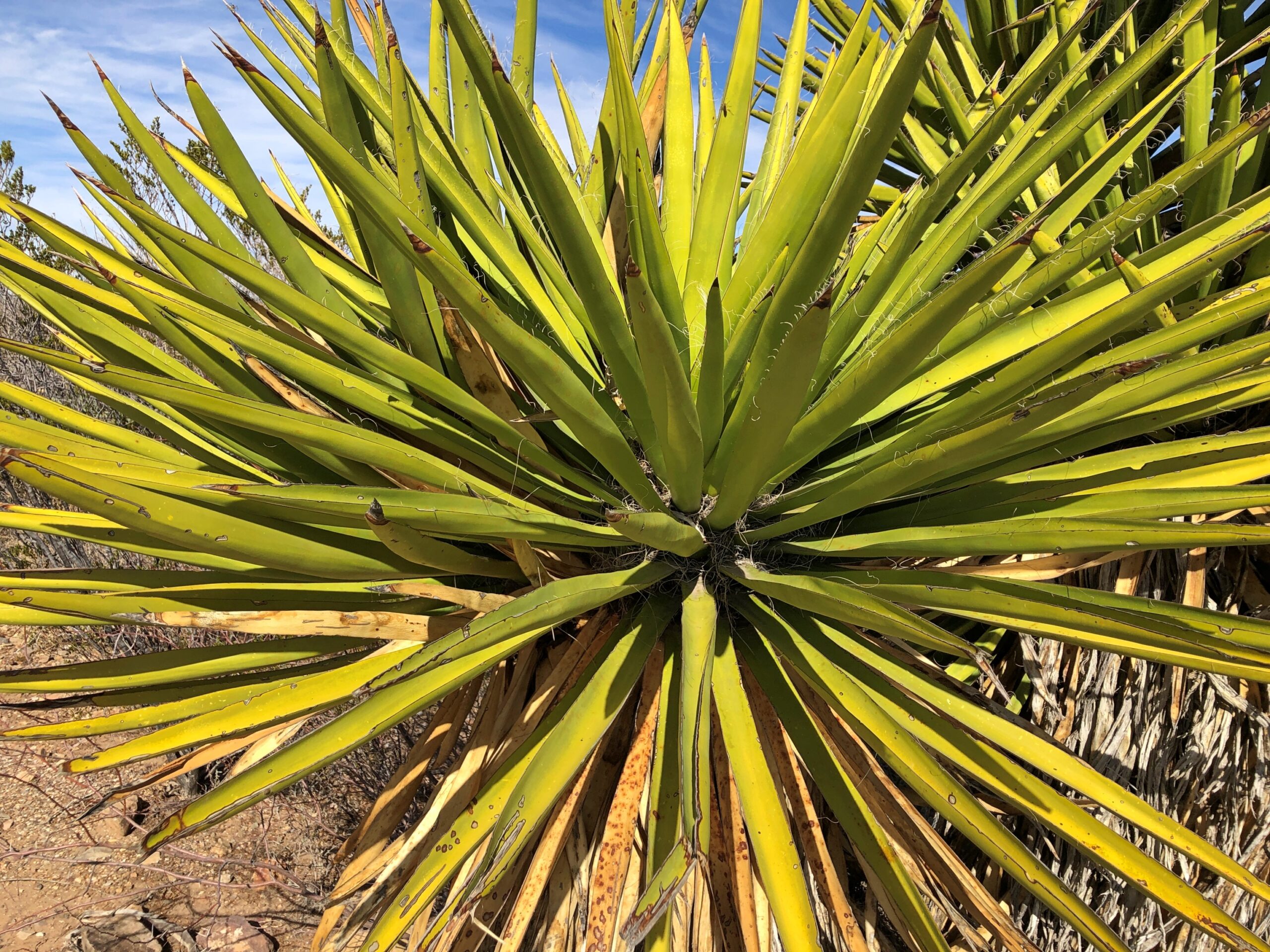
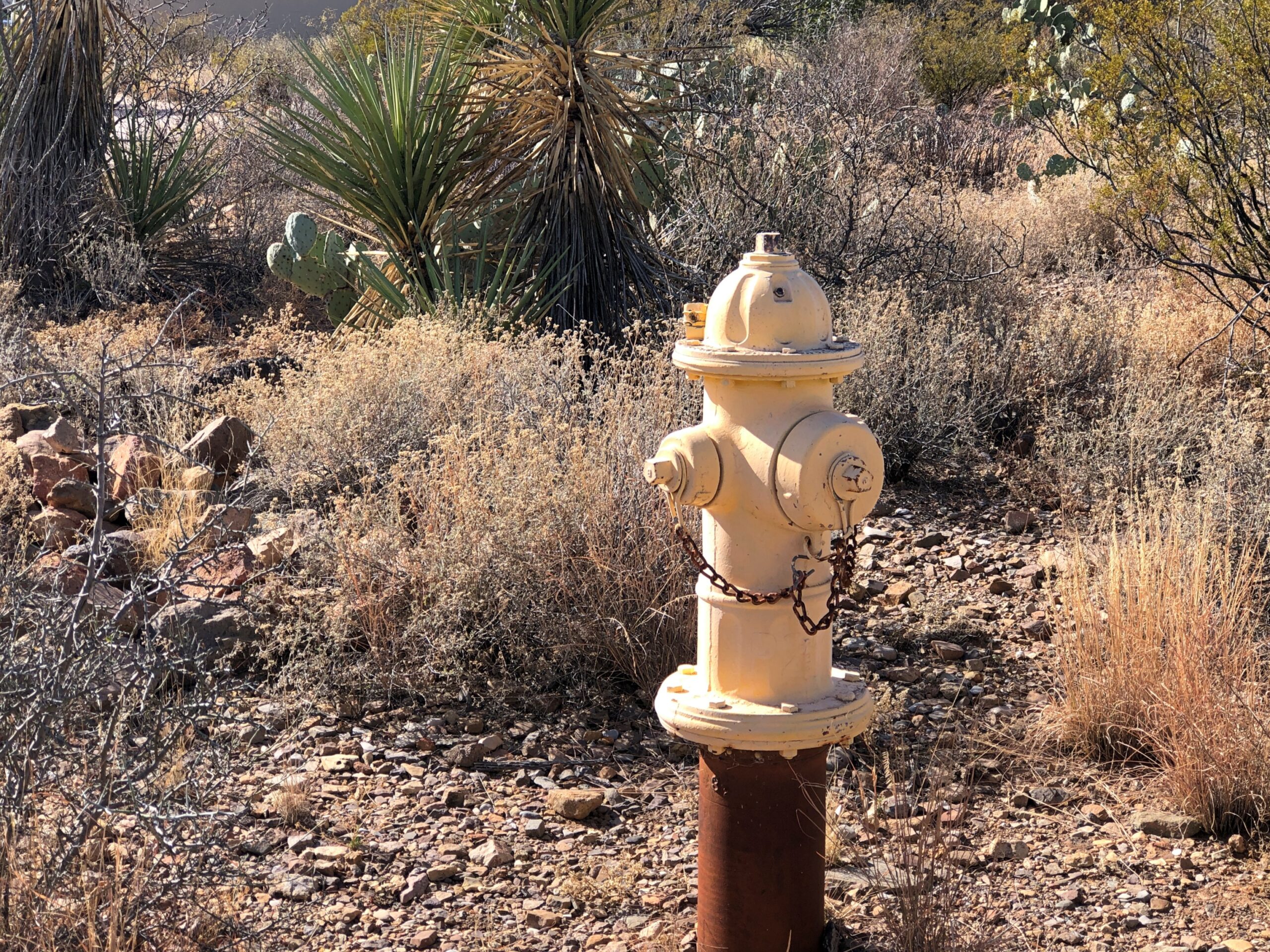
We’d come on February 17 for Yuriko’s first visit to the park, but not mine. Not an issue, since no two visits are ever alike in such an epic desert. First stop, a trail near the visitor center, for a closeup look at some flora, and signs describing them.
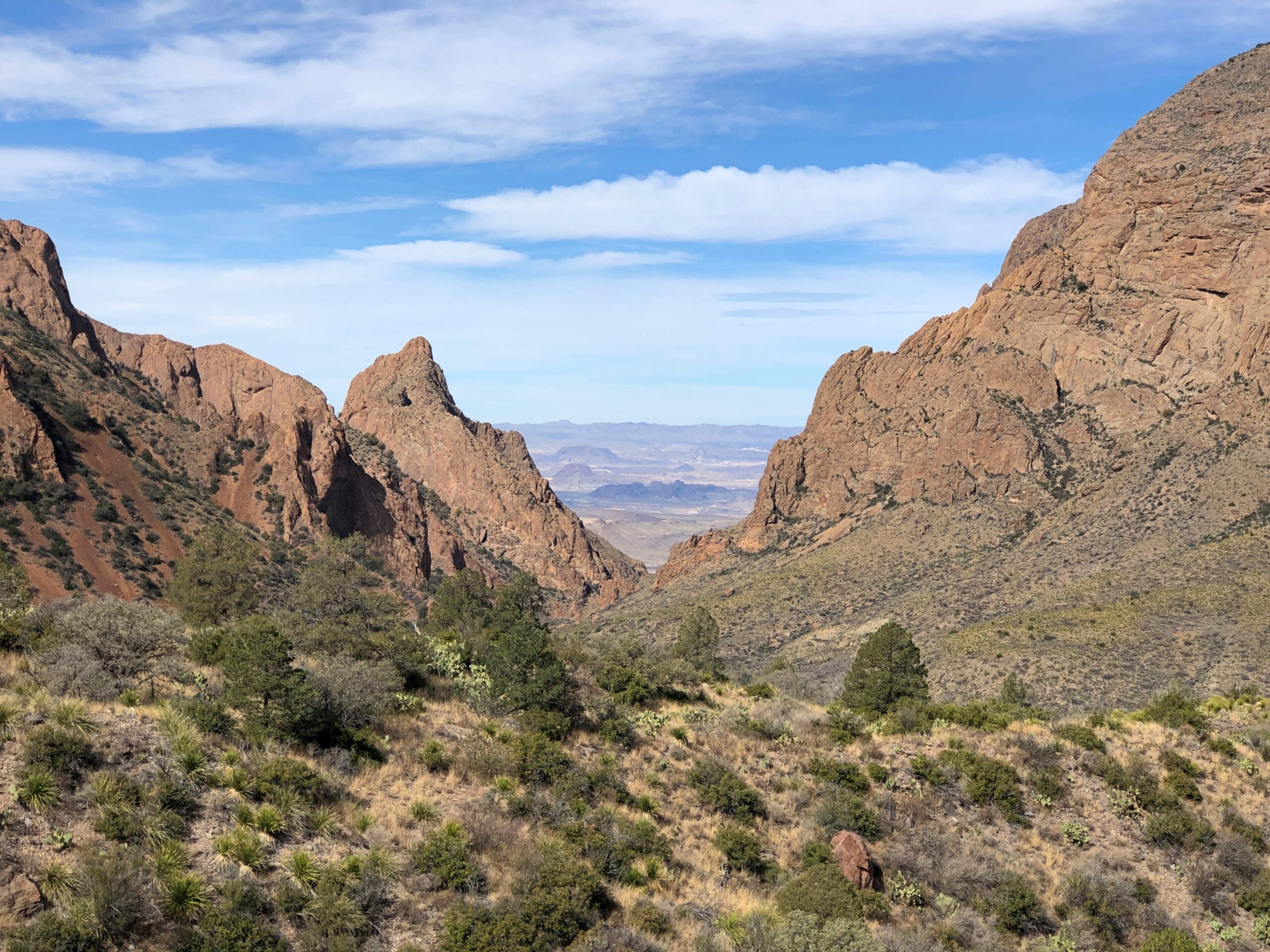
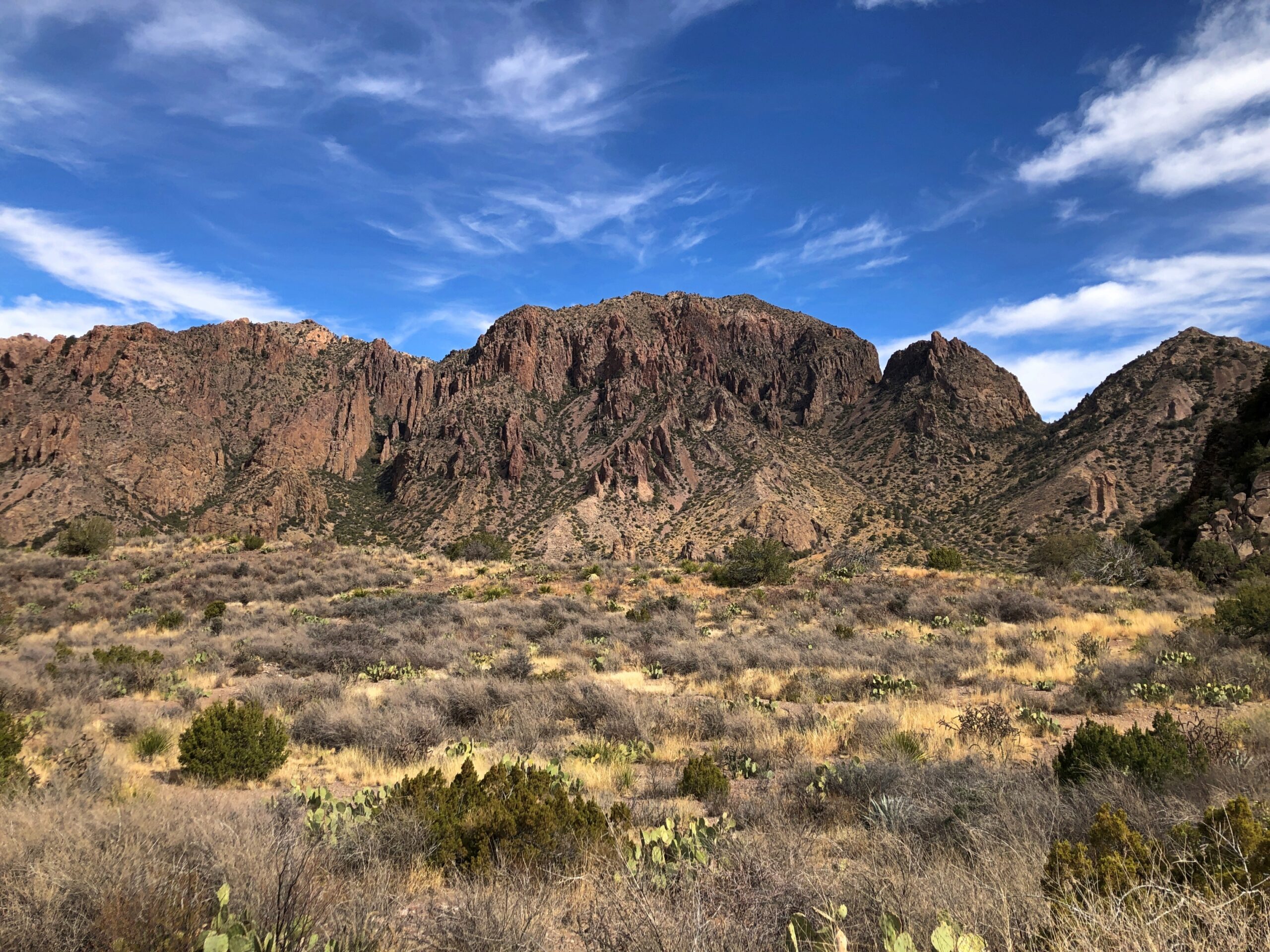
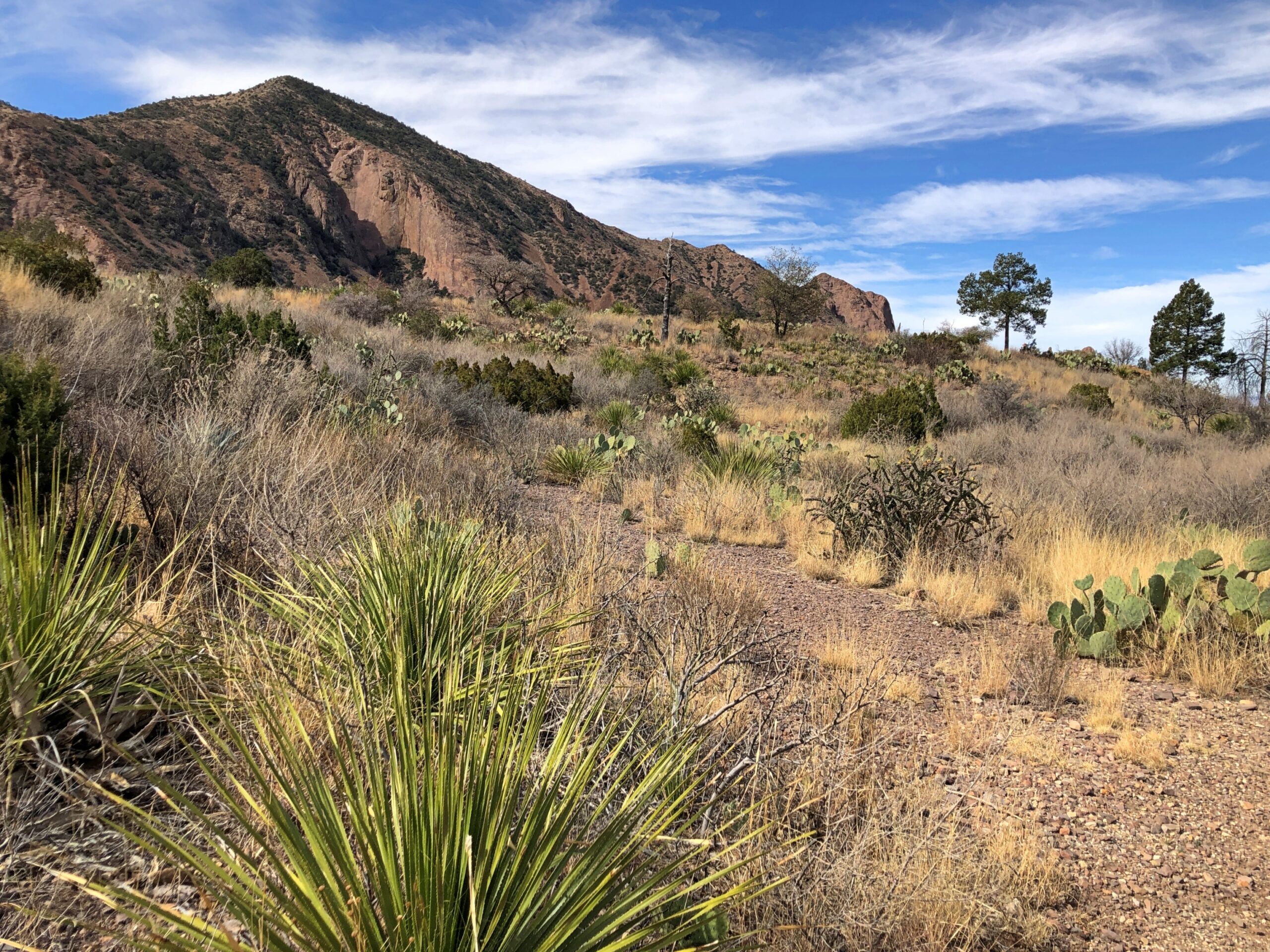
We drove where it was possible to drive in the park, such as Chisos Basin, and did some walking where it was possible to walk. But not long walks, since temps were touching 90 F.
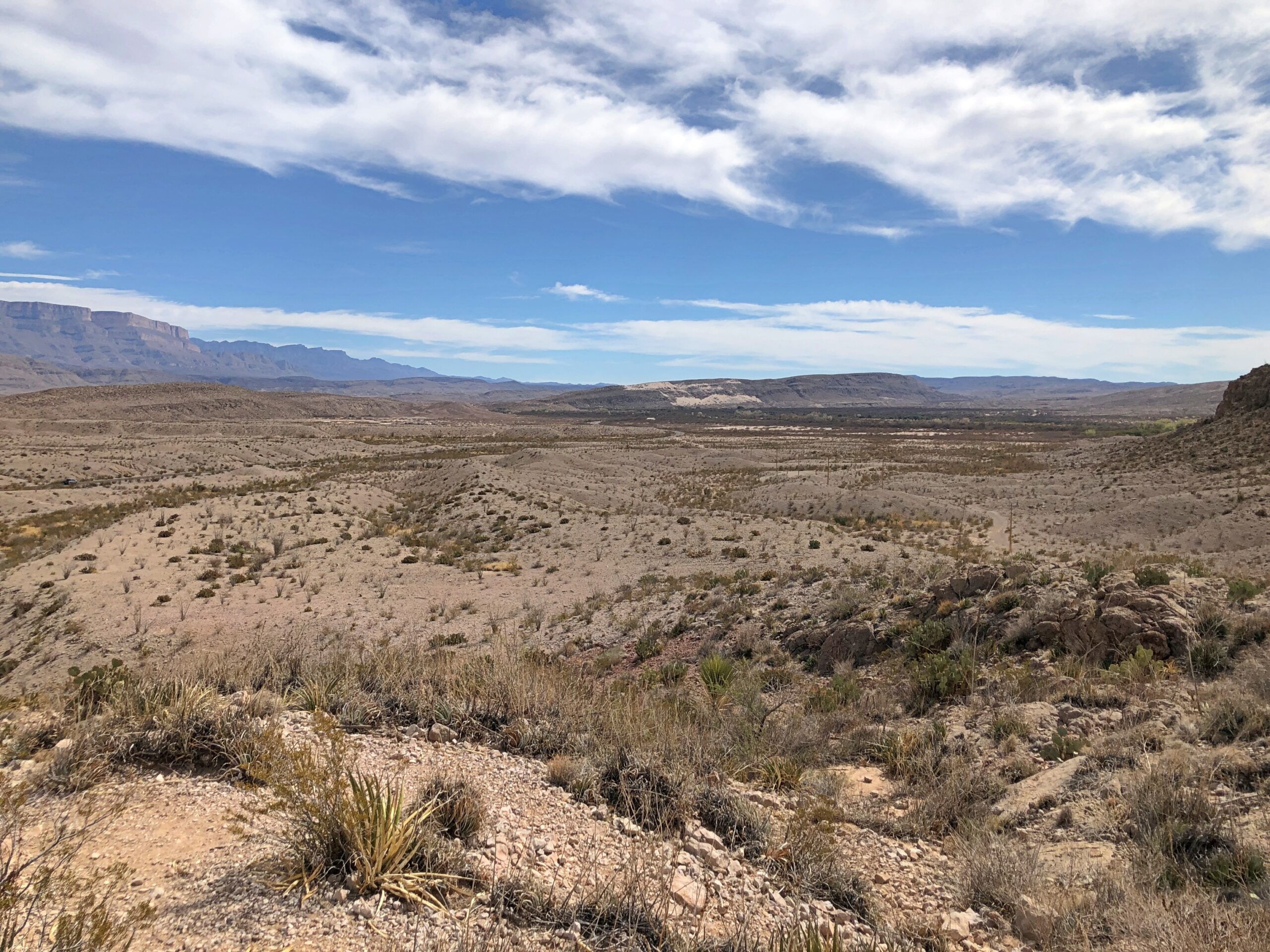
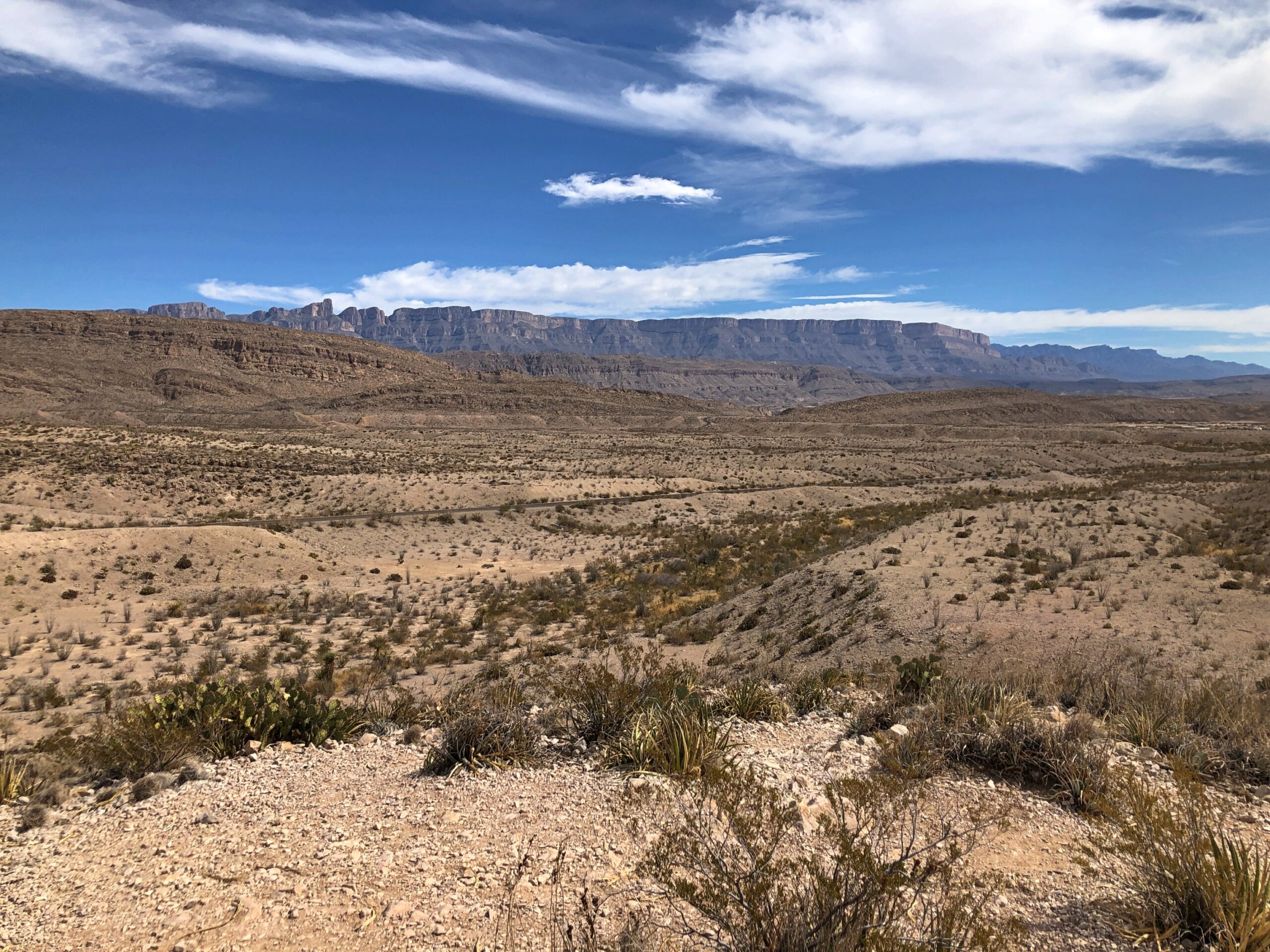
Toward the east end of the park is a spot off the road labeled “Rio Grande View” on the map.
Good view, including some of the Sierra del Carmen, but you have to squint to see the Rio Grande. There it is, I said, spotting a narrow ribbon of greenery off in the distance that might have been the river. Yuriko wasn’t sure she could see it.
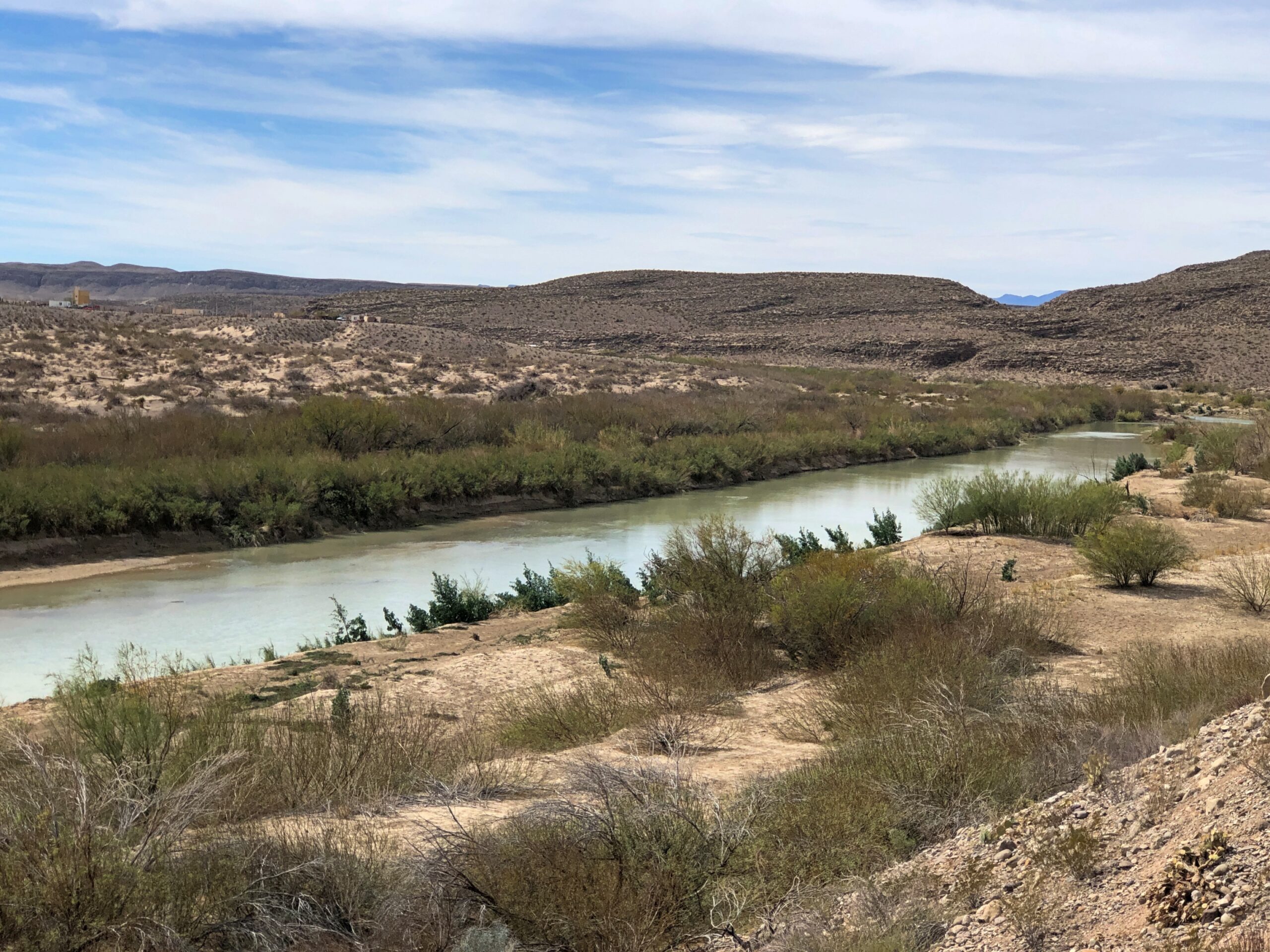
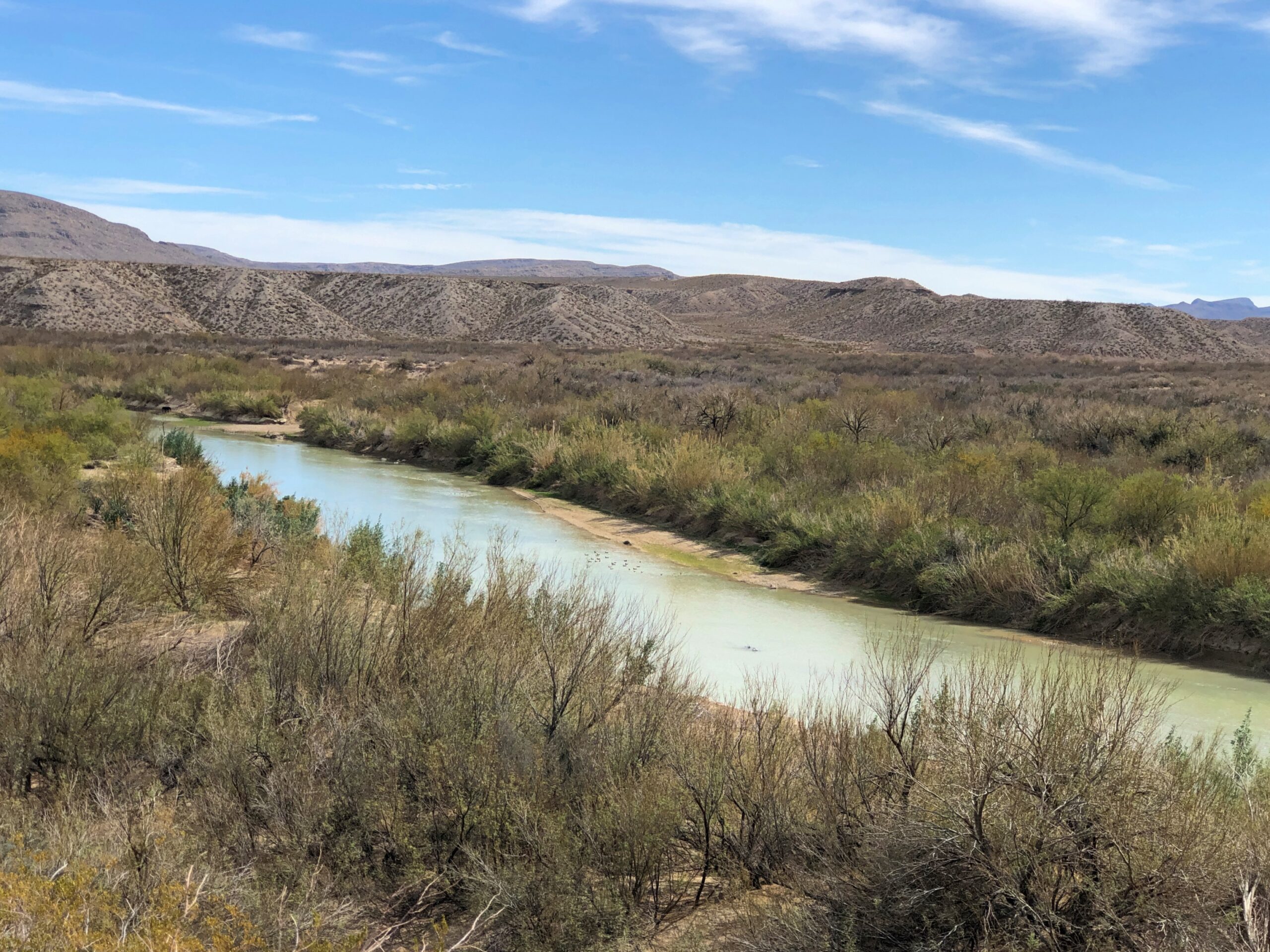
A few miles further east, the riverine border is very much visible from a bluff atop the U.S. side, the Boquillas Canyon Overlook.
We’d come to the eastern part of the park for the Hot Spring — the ruins of a bathhouse, these days — but flooding last year made the unpaved road leading that way impassable to vehicles. It was possible to walk there two miles or so along the ruined road, treating it as a track, but we opted out of that, taking the formula Heat + Age + Long Walks = Trouble seriously.
No matter, we backtracked and went to the Ross Maxwell Scenic Drive, a road I’d thoroughly enjoyed in 2018, and I did again.
An overlook on that road shows you how little territory a road actually occupies. A ribbon crossing a vast expanse.
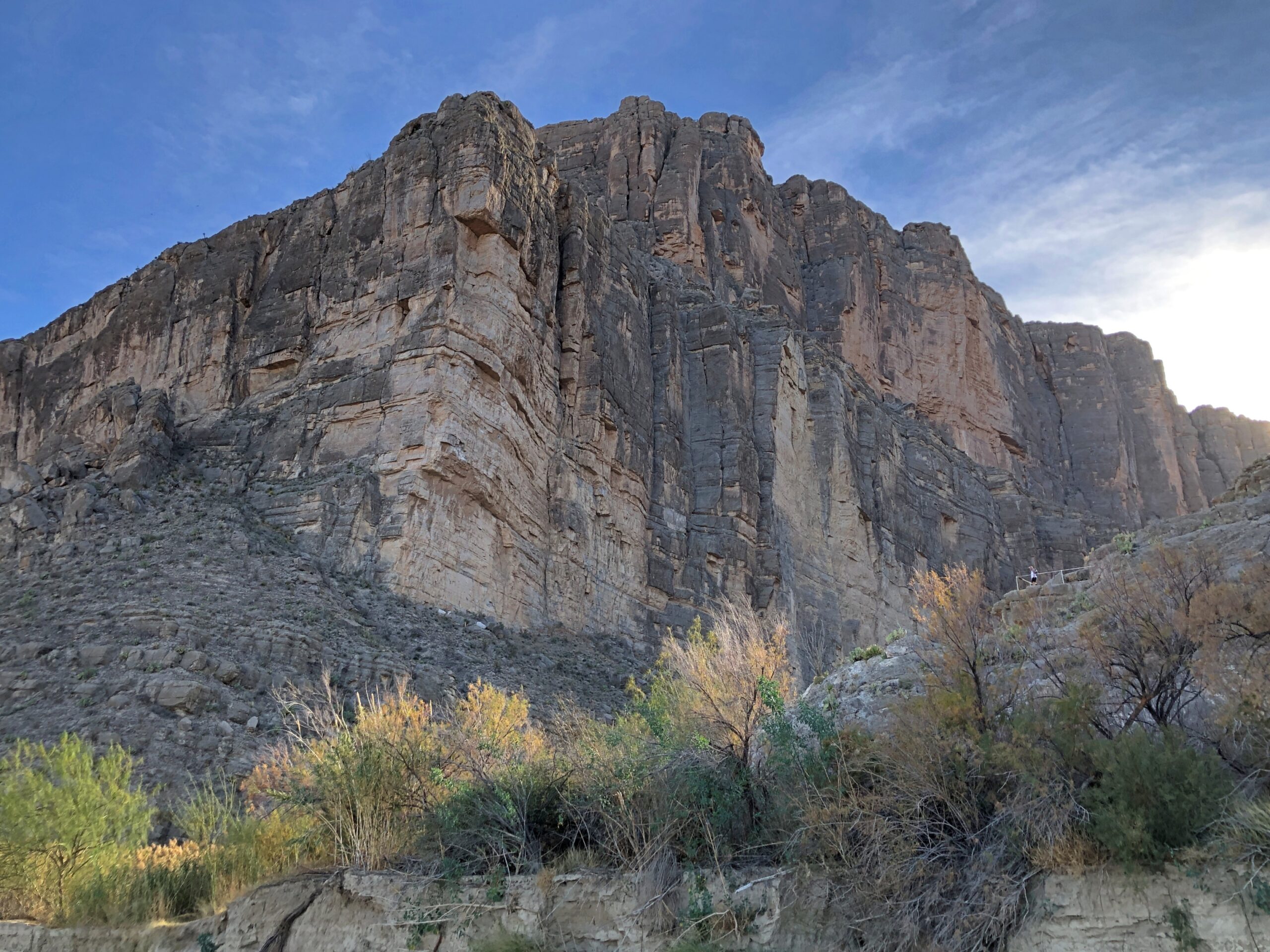
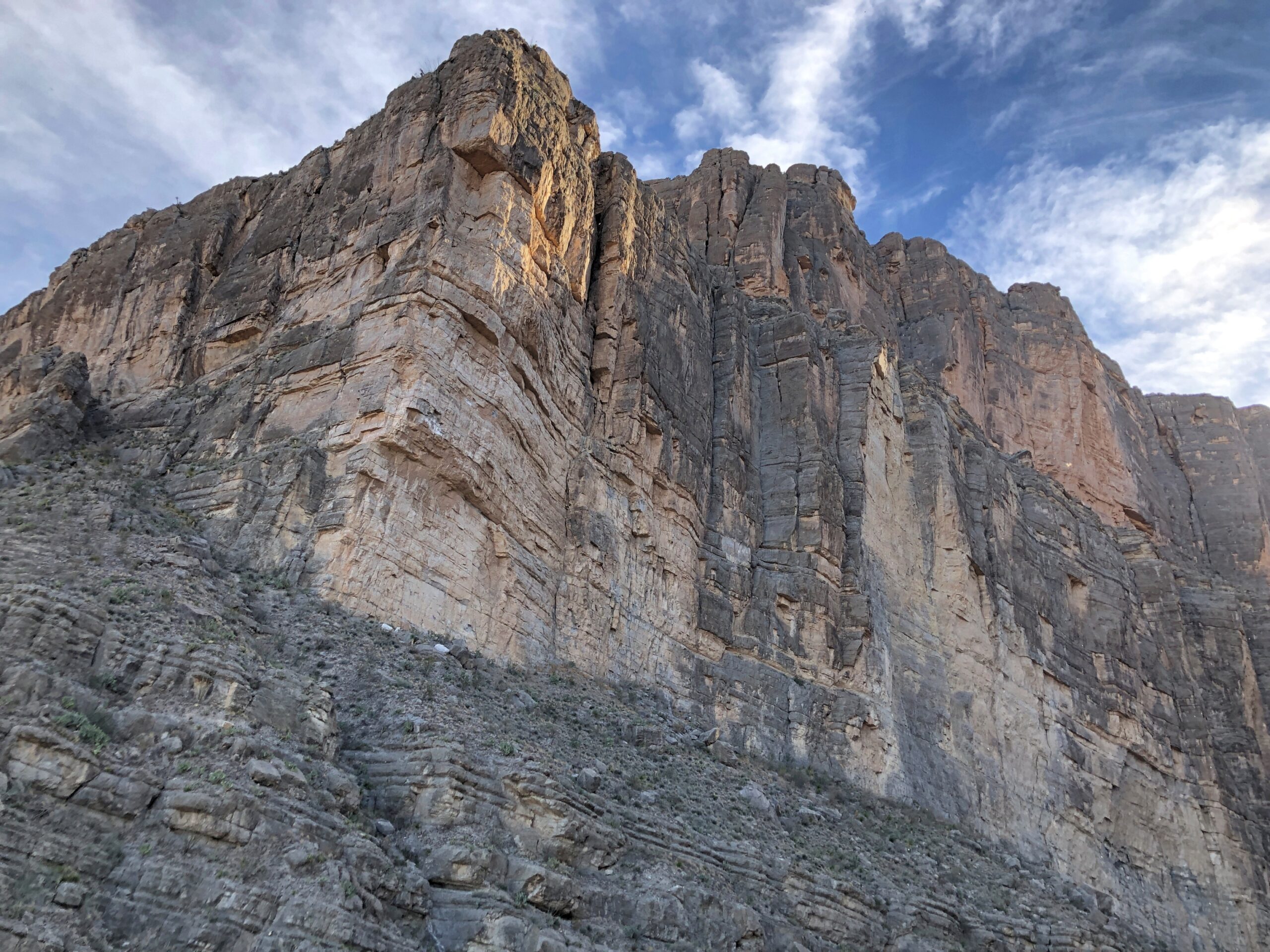
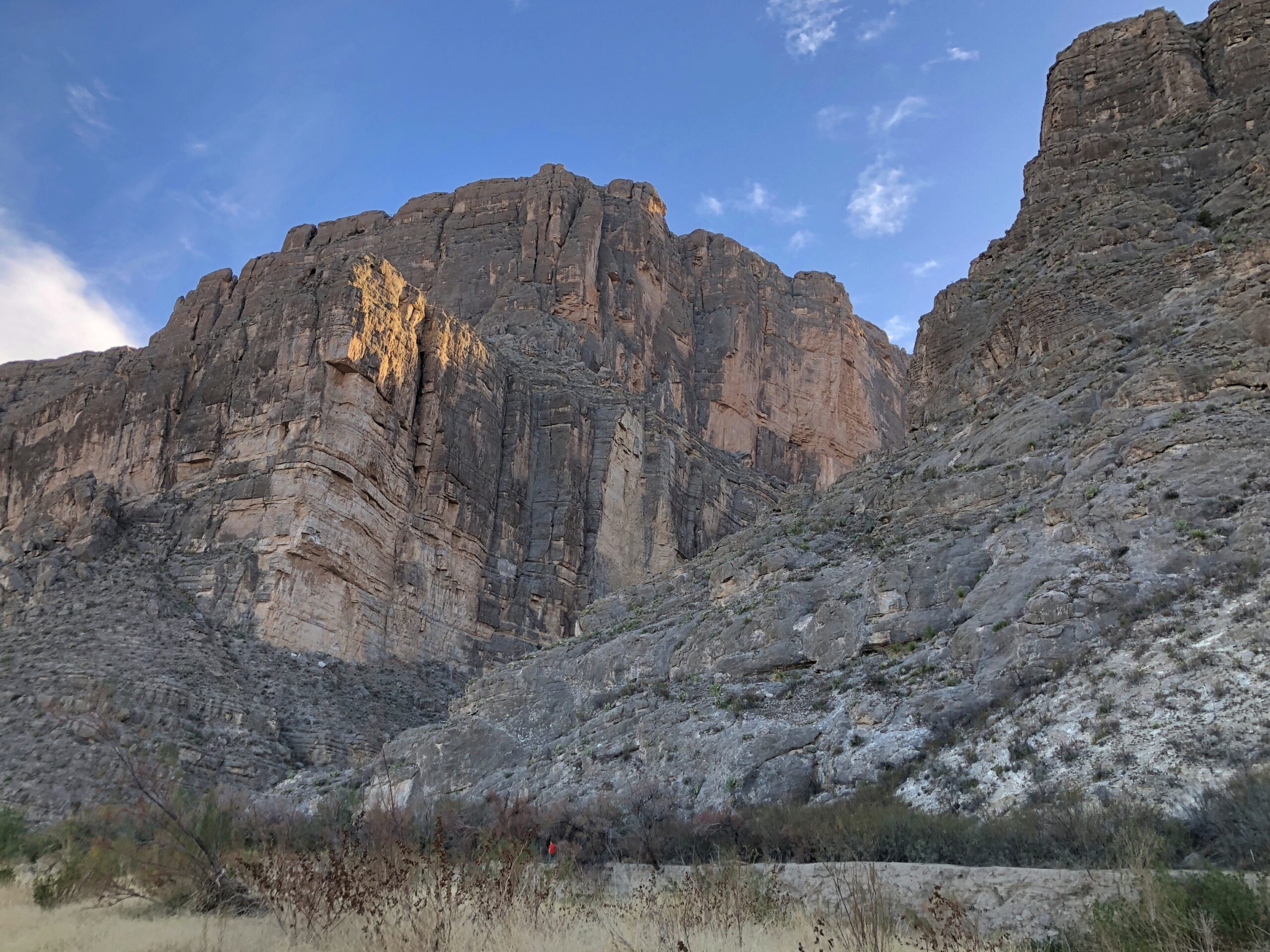
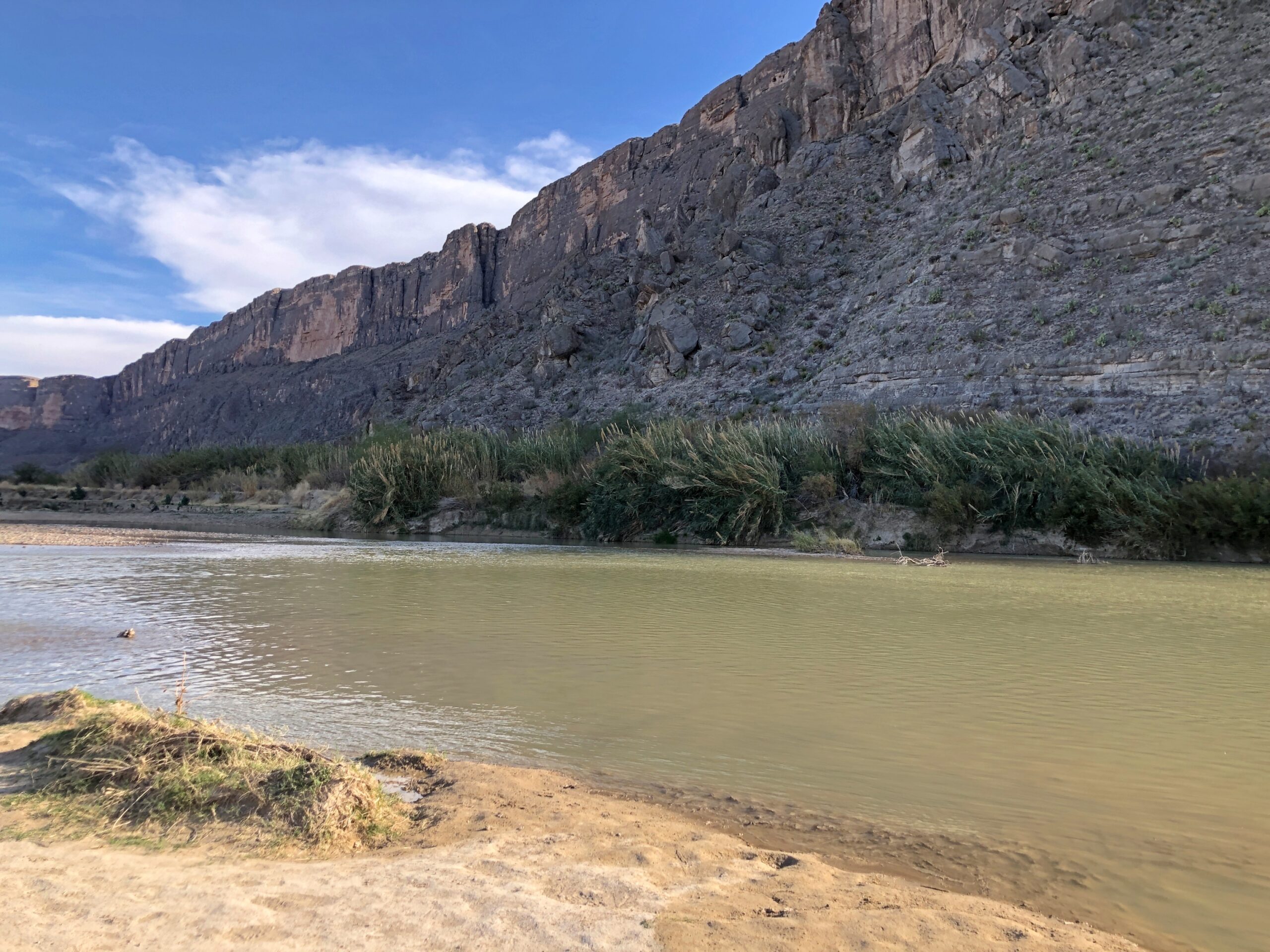
My own favorite part of the park: Santa Elena Canyon.
The high bluffs are in Mexico, on the other side of the Rio Grande. ‘
Never cared much for the term snowbird, with its connotations of getting up every morning to play golf during winter in some arid place, or spending the evenings with members of your cohort in some gated community, maybe drinking but definitely grousing about the state of the world. Still, considering that in the winter of 25/26, I’ve spent two out of the last three months – the hard winter months, up Illinois way – in warmer places, it would be churlish to cast shade on fellow old people who happen to enjoy golf or grousing.
On the other hand, I’m not about to claim snowbird as descriptive for myself. I just happen to be able to take long trips during the cold months (along with my laptop, for work). In December, Florida. In February, Texas.
Back on February 3, I got on a plane and flew to Austin. I flew home from Dallas on March 3. In between, I spent time – and Yuriko joined me for a while – traversing the state of Texas, going so far west at one point that we ended up in New Mexico. By traversing, I mean long drives, in a rental car part of the time, and in my brother Jay’s car as well, a blue Subaru known as the Blubaru.
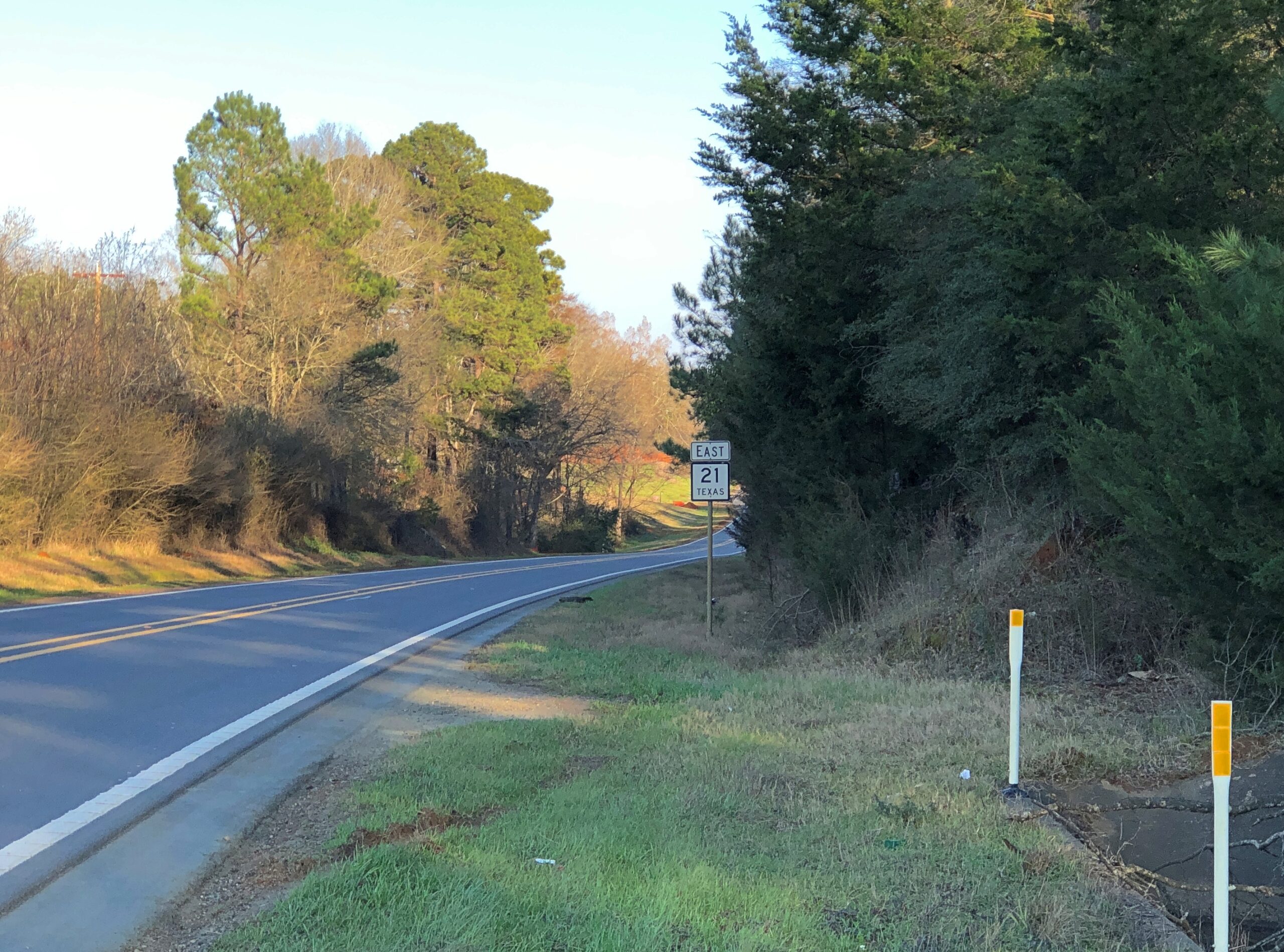
I drove from Austin east to Houston, mostly on US 290; from Houston to Nacogdoches, mostly on US 59; then to Dallas on various state highways, such as Texas 21 and 19; and from Dallas to San Angelo to Marathon, Texas, on US 67 and on the grandly remote US 385, which will also take you to the desert reaches of the Big Bend.
From Marathon, Texas, across to Carlsbad, NM, our route took us along US 90, then Texas 56, then US 62/180. Later, US 62/180 took us from Carlsbad part way back to Dallas — to Sweetwater, Texas — but mostly we went on the faster but less interesting I-20. Dallas to San Antonio was partly I-35, but also US 281, which takes you around the perma-gridlock that is Austin.
Of all those, the road between Nacogdoches and San Augustine on a day trip, Texas 21 heading east, winding through greenish (for February) rolling hills, was a favorite.
The towns listed above were just the places I spent the night, alone or with Yuriko or with my brothers. In between were such places as Bastrop, these days a day-trip from Austin, with the requisite boutiques and restaurants; Huntsville, home of Sam Houston and memorials to the first president of Texas; San Augustine, rival with Nacogdoches in claiming to be the oldest town in Texas; Stephenville and Ballinger, geographically about as deep in the heart of Texas as you can be; the West Texas art town of Marfa and the way station of Van Horn; a string of oil patch towns such as Hobbs, NM, and Seminole, Lamesa, Snyder, and Sweetwater, back in Texas. Later, traversing north to south and back again, I stopped in Hillsboro and Belton, along the I-35 axis; and Lockhart, which has claimed for itself barbecue capital of the state.
Along the way, oddities were encountered. Otherwise, why drive on smaller roads?
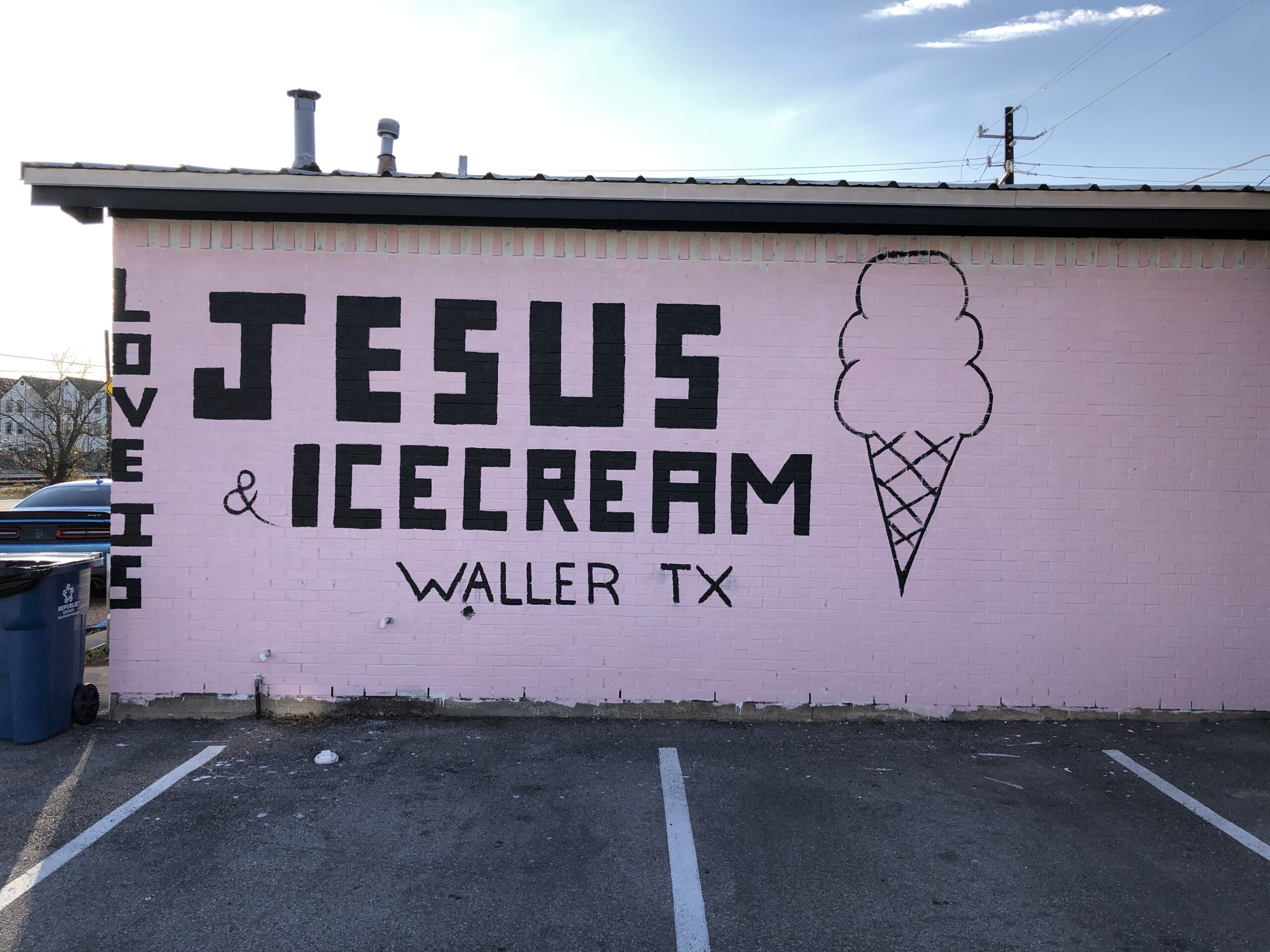
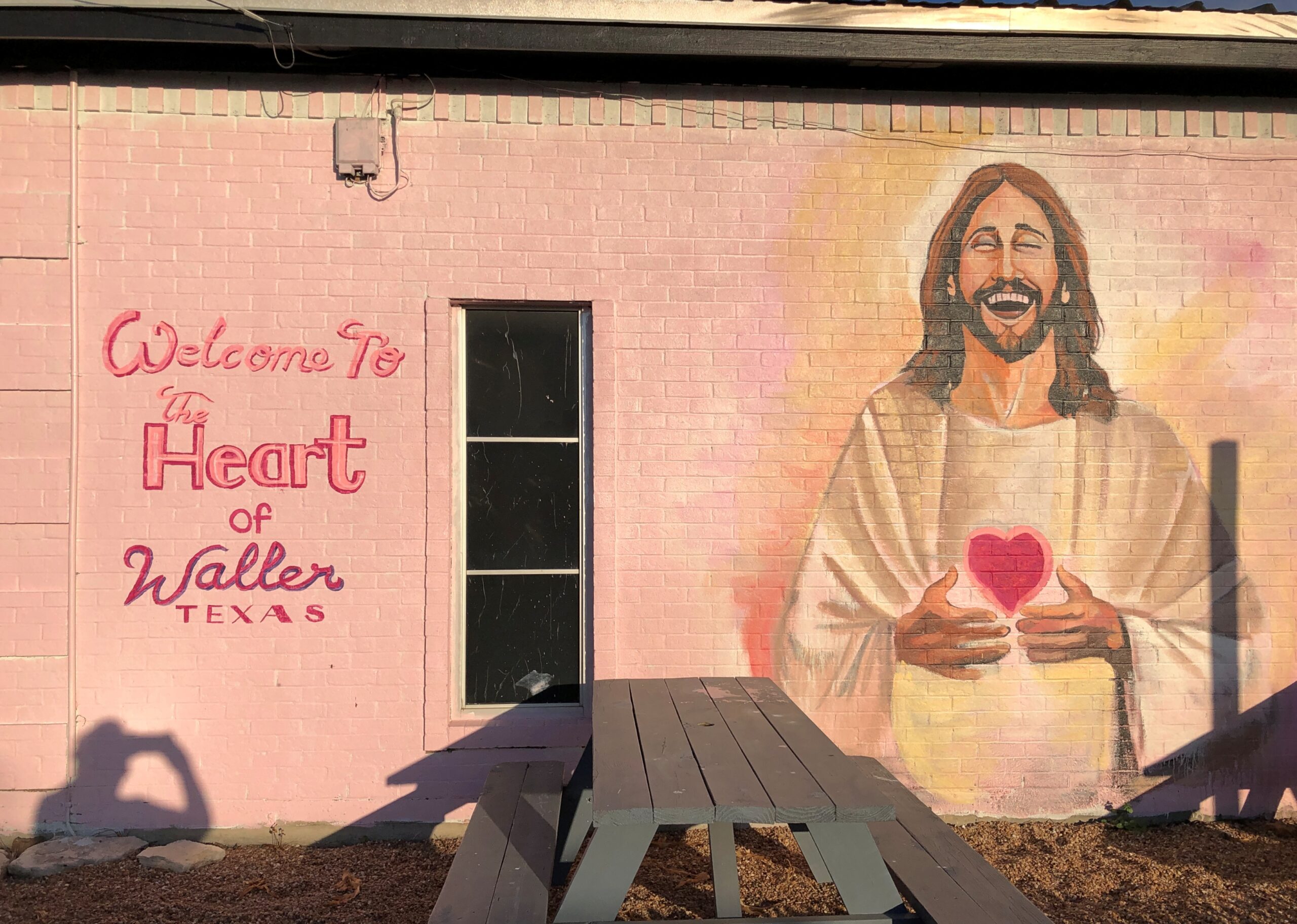
Such as an ice cream shop in Waller, Texas.
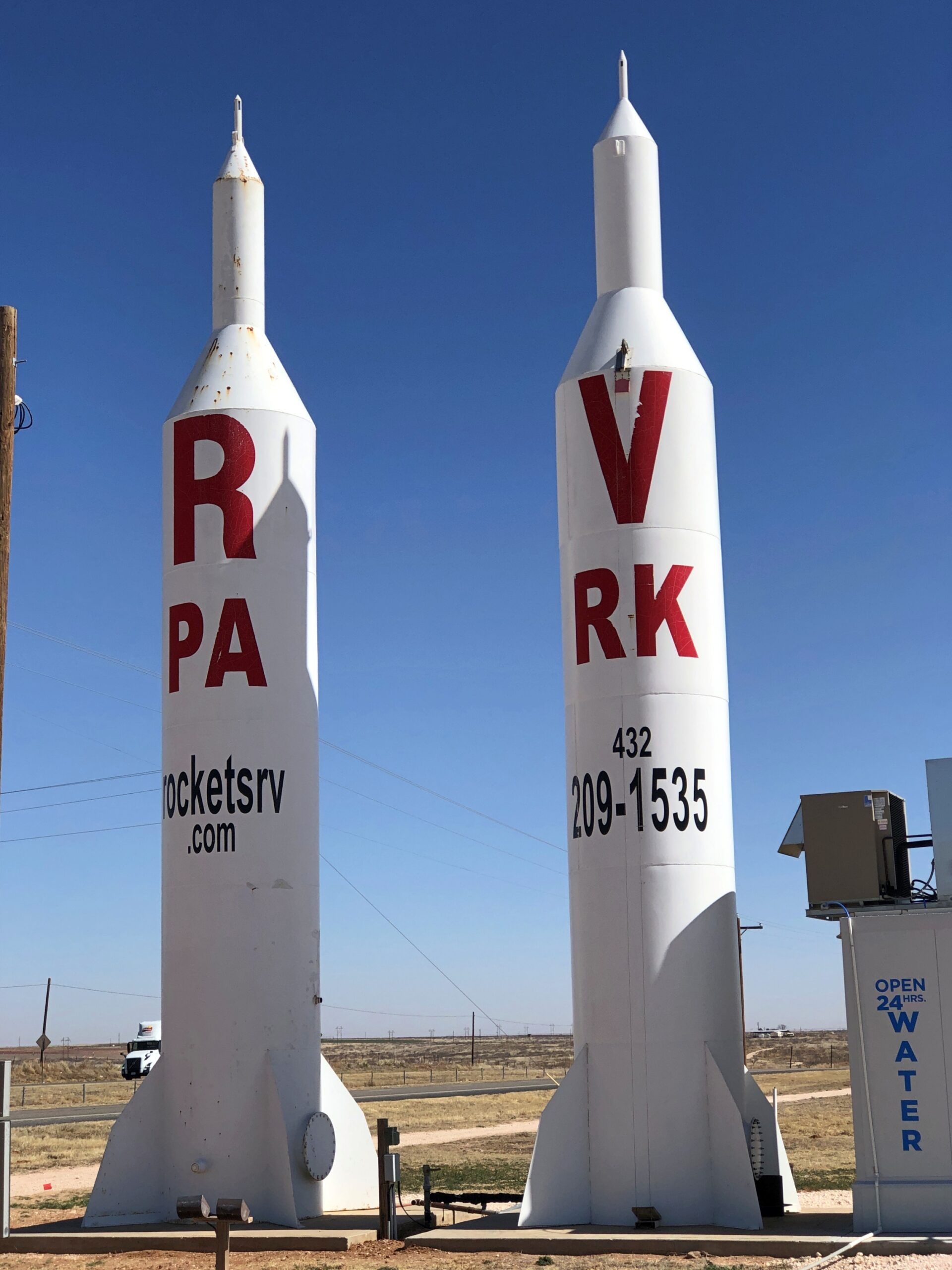
Or a highly visible ad for Rockets RV Park in Gaines County, Texas, not far east of the border with New Mexico.
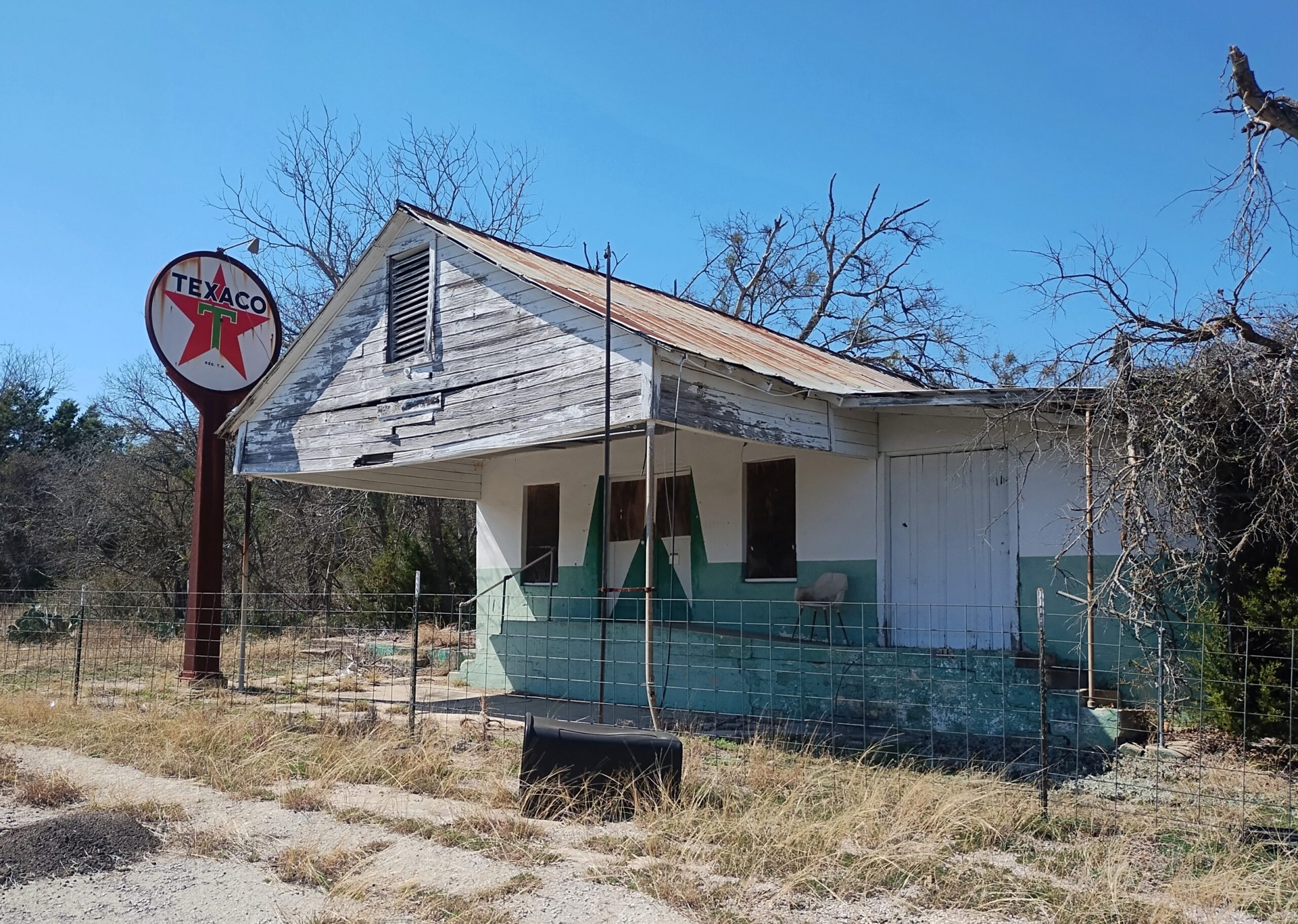
A former Texaco station on an obscure Texas highway (Farm-to-Market 1690).
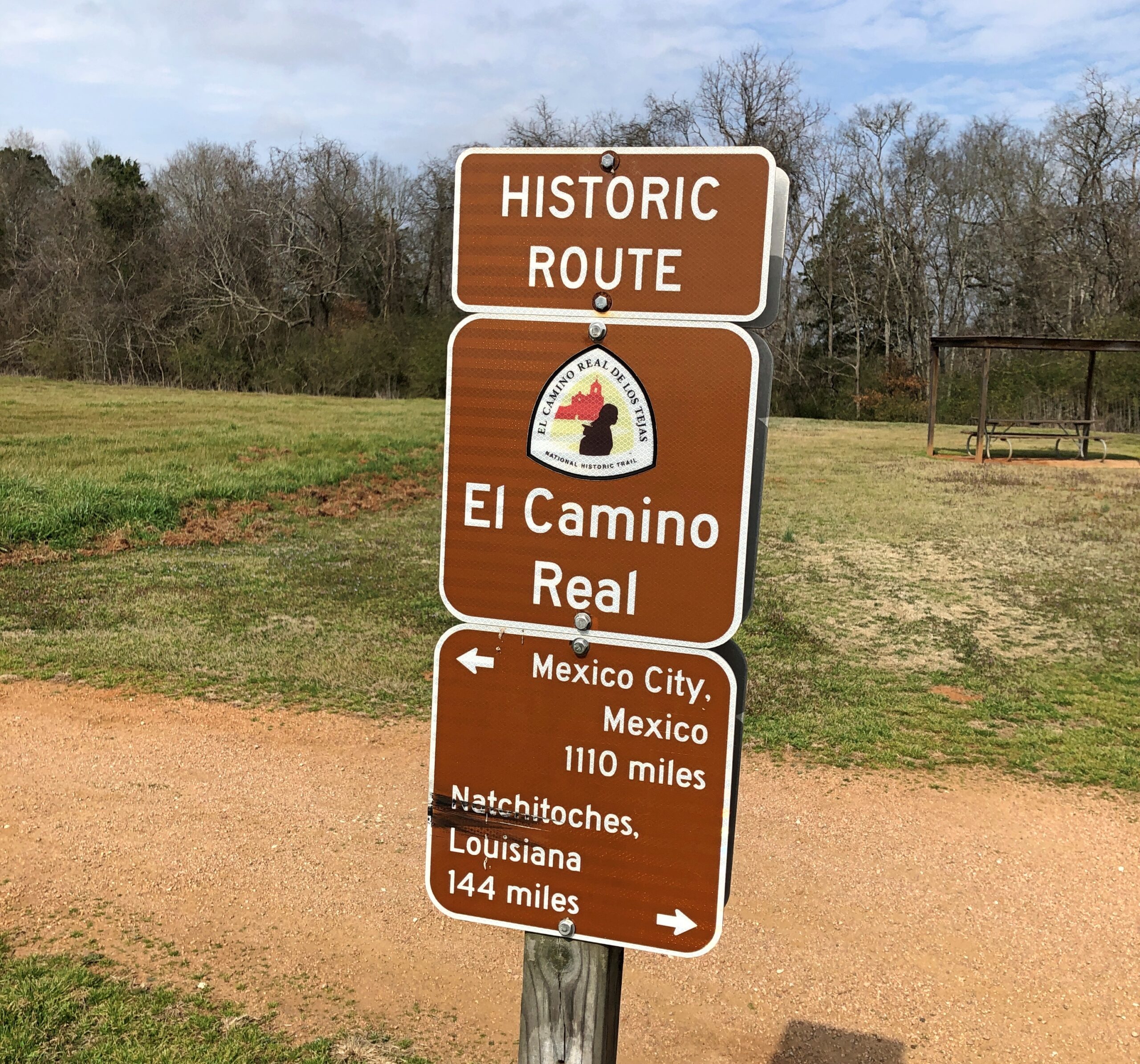
Had various encounters with the historic El Camino Real, whose various tendrils crossed a large slice of the future state of Texas, once upon a time.
Yuriko and I visited Big Bend National Park, Guadalupe Mountains National Park and Carlsbad Caverns National Park. I saw the National Museum of Funeral History in the city of Houston and the museum devoted to Houston (the man) in Huntsville. Also, Roadside America in Hillsboro, an eccentric collection of American commercial art, complete with a personal tour by the proprietor, and the outdoor art at the Chinati Foundation in Marfa, that is, brutalist concrete structures in the brutal desert environment. I became acquainted with the splendid Glenwood Cemetery in Houston and the smaller and more ragged, but no less interesting city cemeteries in Huntsville and Nacogdoches and Palestine. I stopped and looked at about a dozen county courthouses, of which Texas has many.
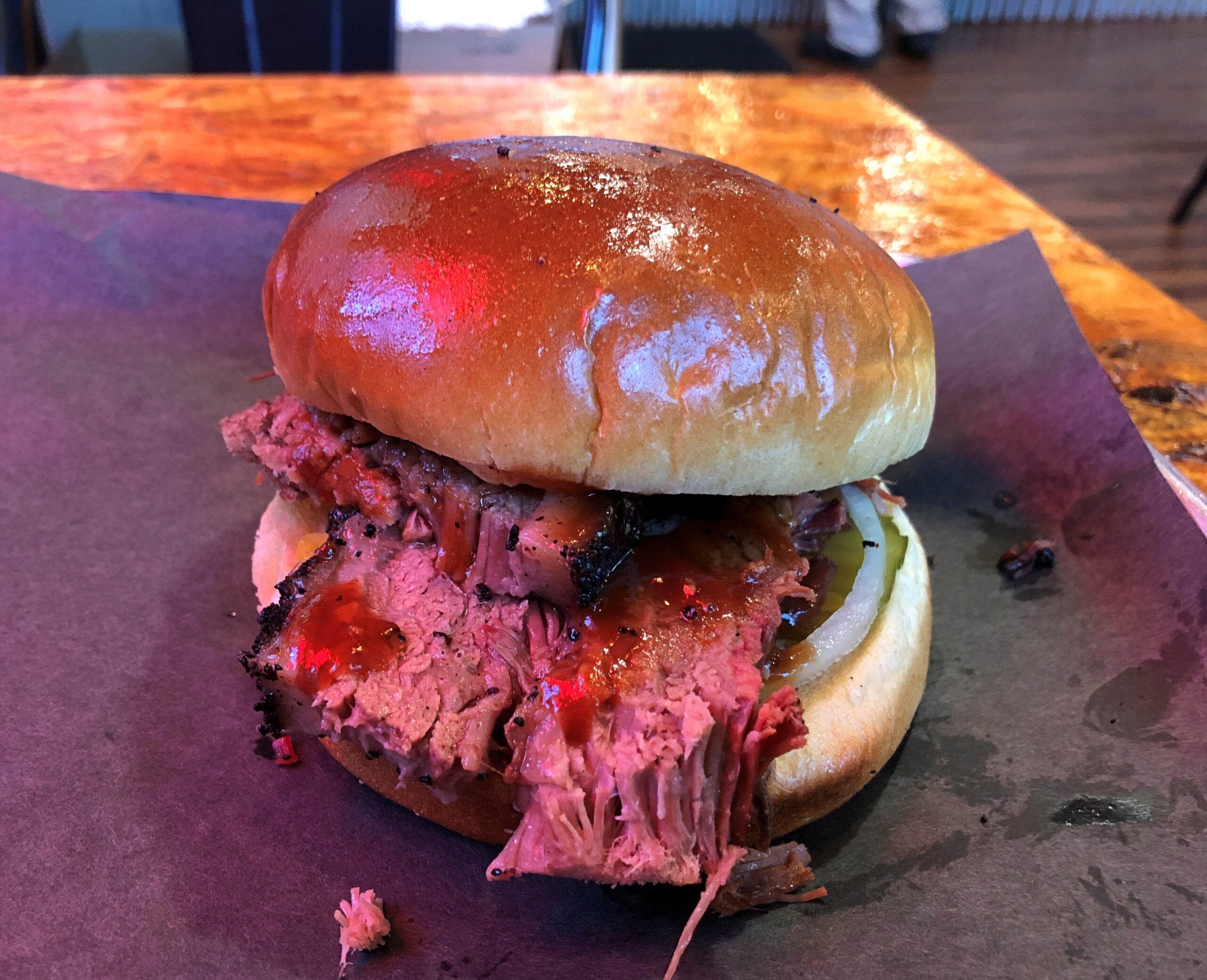
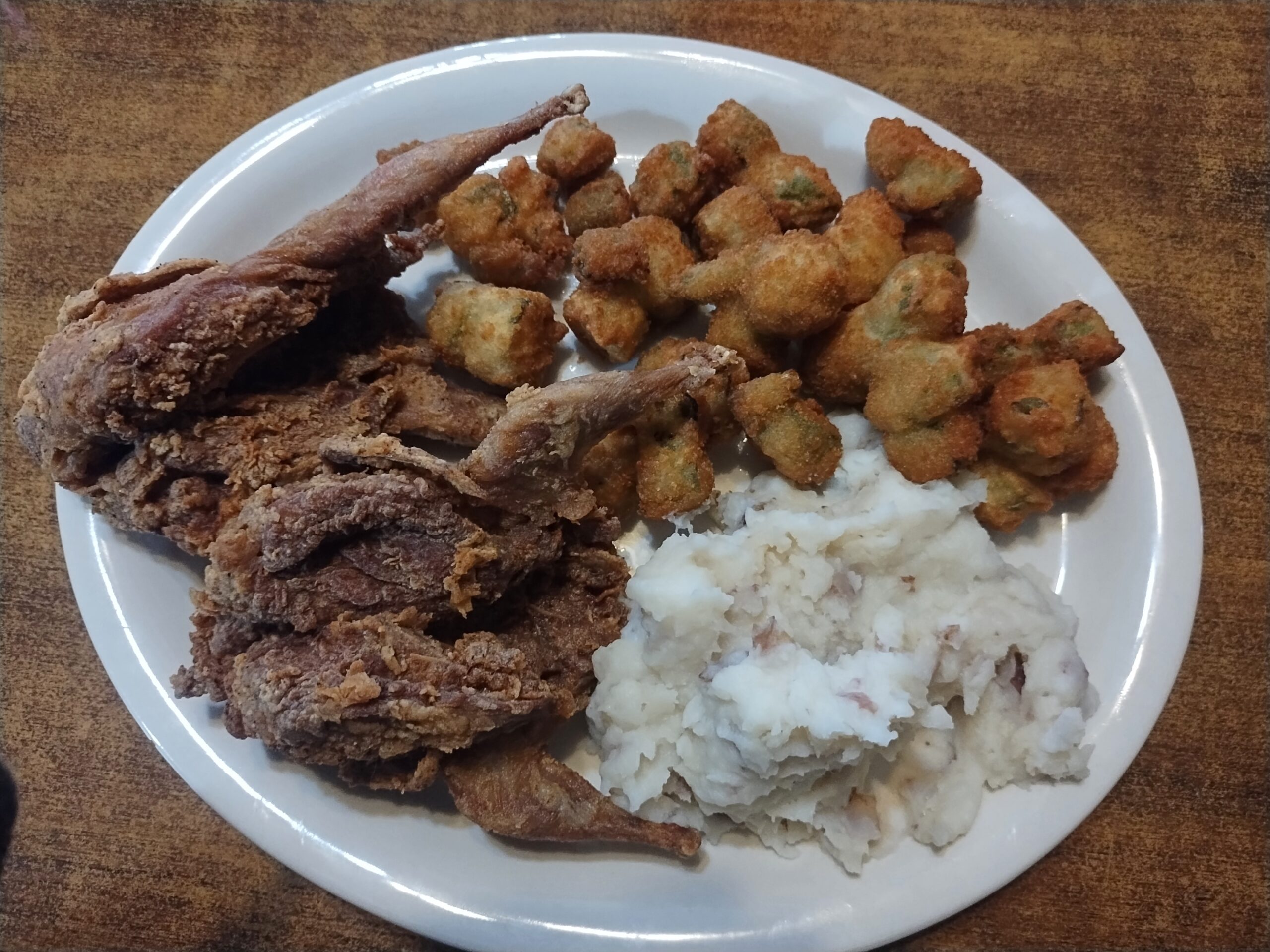
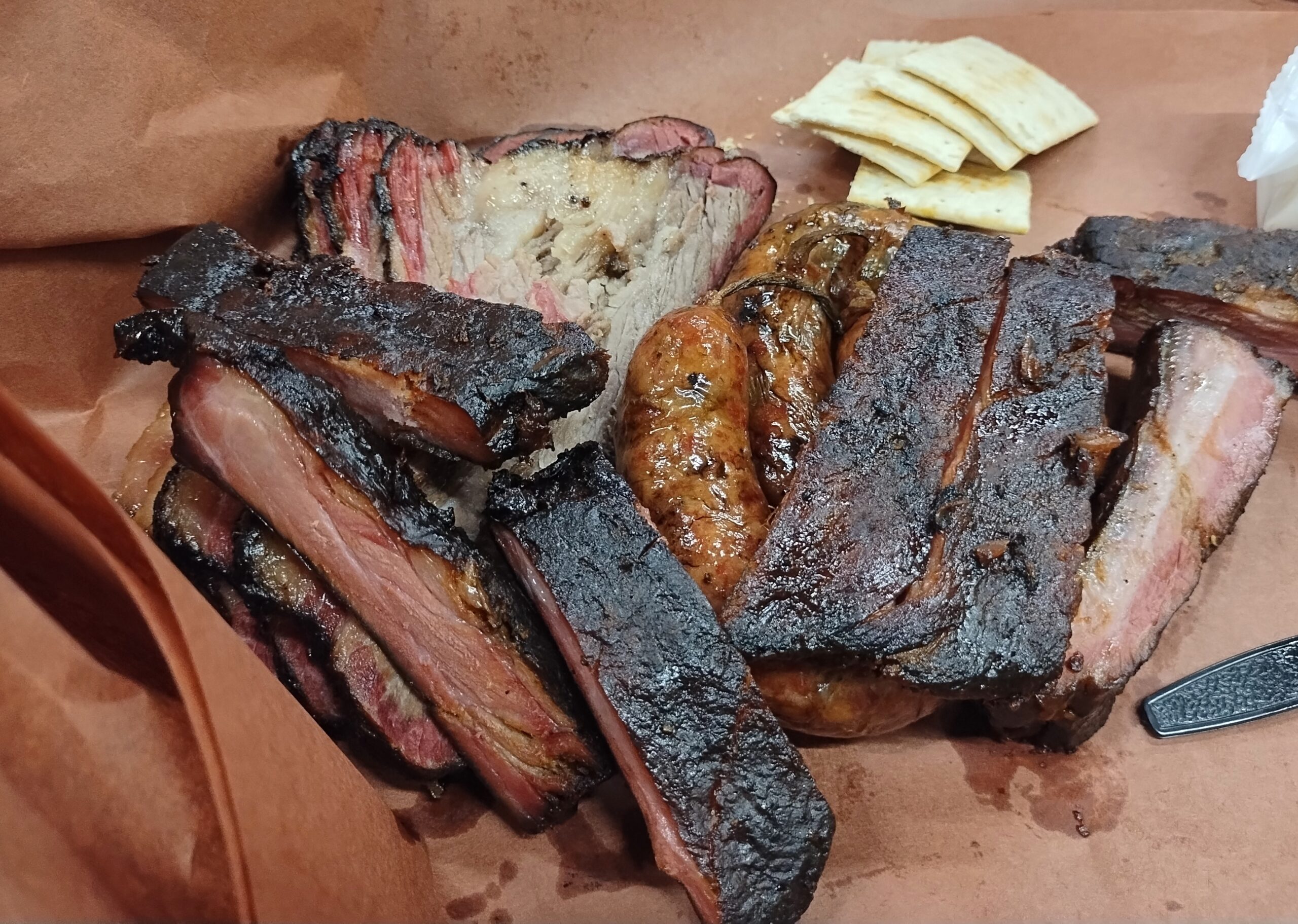
We ate a lot of meat along the way. As one does in Texas.
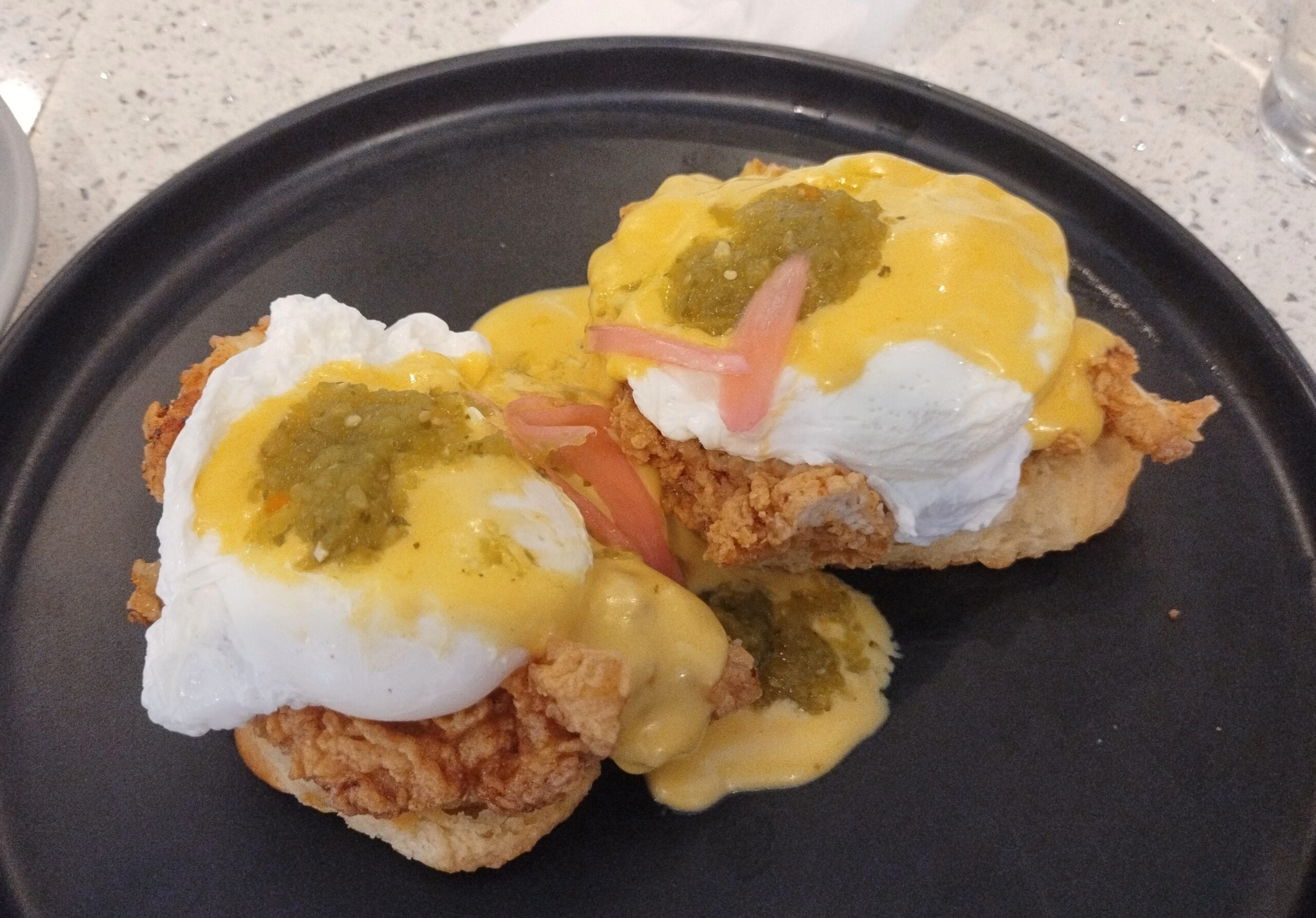
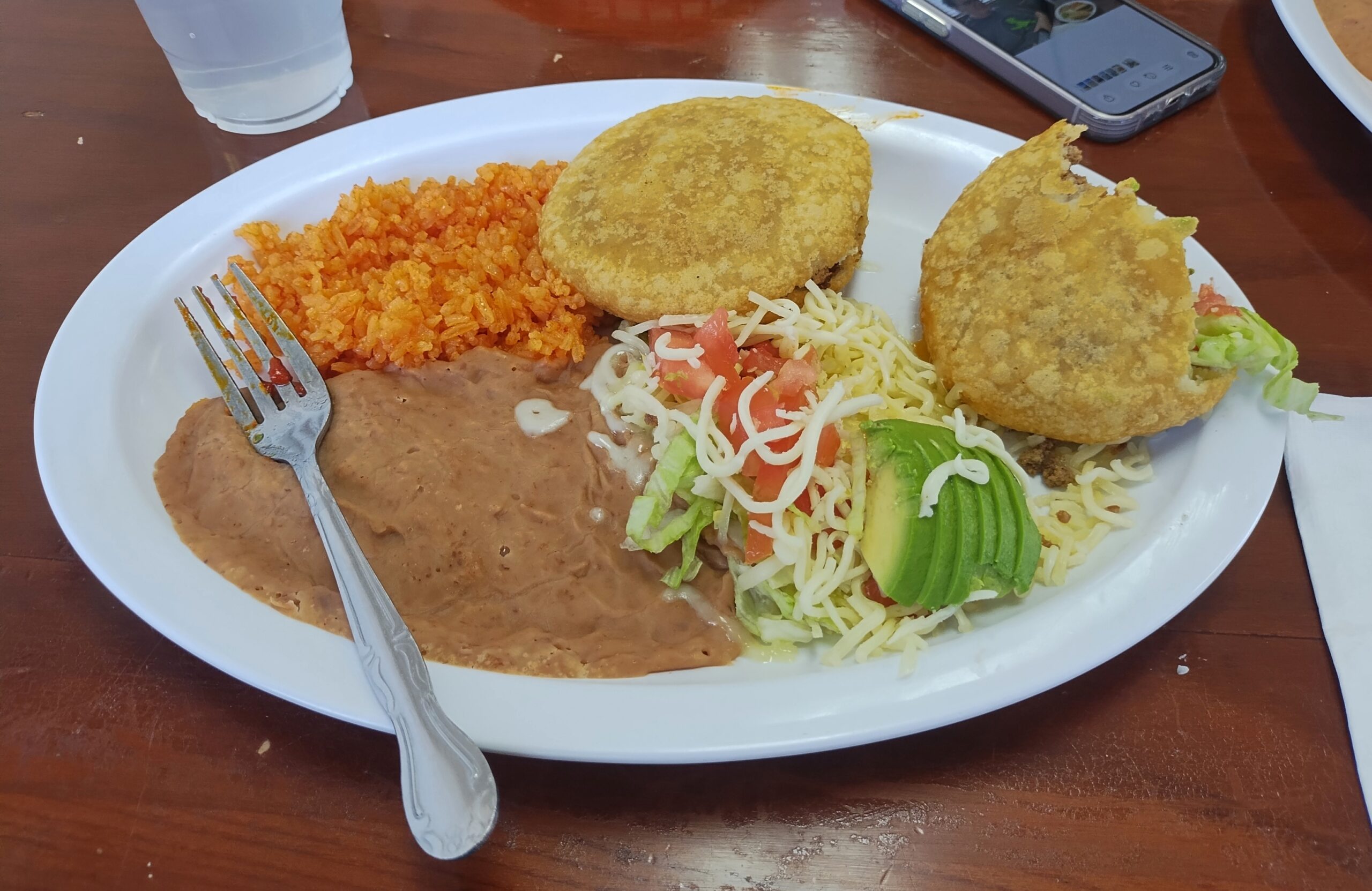
Also, Mexican food.
Eat like that and you’d better do some walking, and I did: various places in Austin and Houston and Dallas, in all three national parks, around downtowns and courthouse squares in a number of small towns, and a handful of local parks.
All that was good, but of course best of all, I had time to visit friends and relatives, of whom there are many in Texas: Tom and Nancy in Austin, Kirk and Lisa in Nacogdoches, another Tom and Steve and Ron and Greg and Judith in San Antonio, to list the friends; both brothers, two out of three nephews and their wives and all four of their children, to list relatives, along with the mother of one nephew’s wife (niece-in-law sounds peculiar, but that fits too). Also, I met for the first time two good friends of Tom’s in Austin, and one of Kirk and Lisa’s granddaughters.
I’d set out to do four long drives when I was 64, but this makes five. Guess I’m an overachiever about driving, anyway.
Time for another winter hiatus. Back in the first week of March, which is still winterish in northern Illinois, but at least the snow tends to melt after a few days. Snow was persistent in January this year, a refresh every few days, and temps too low to lose any of it.
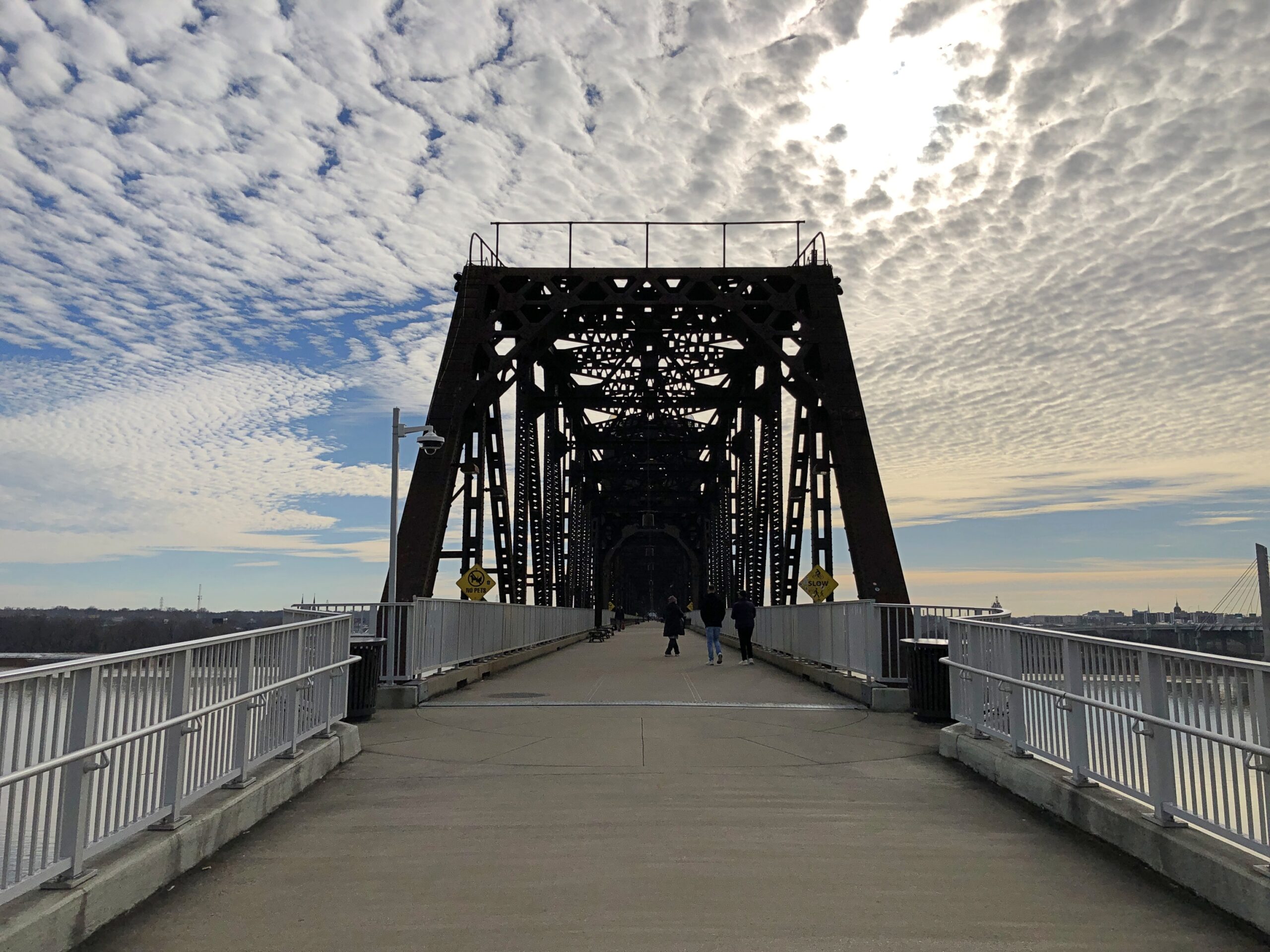
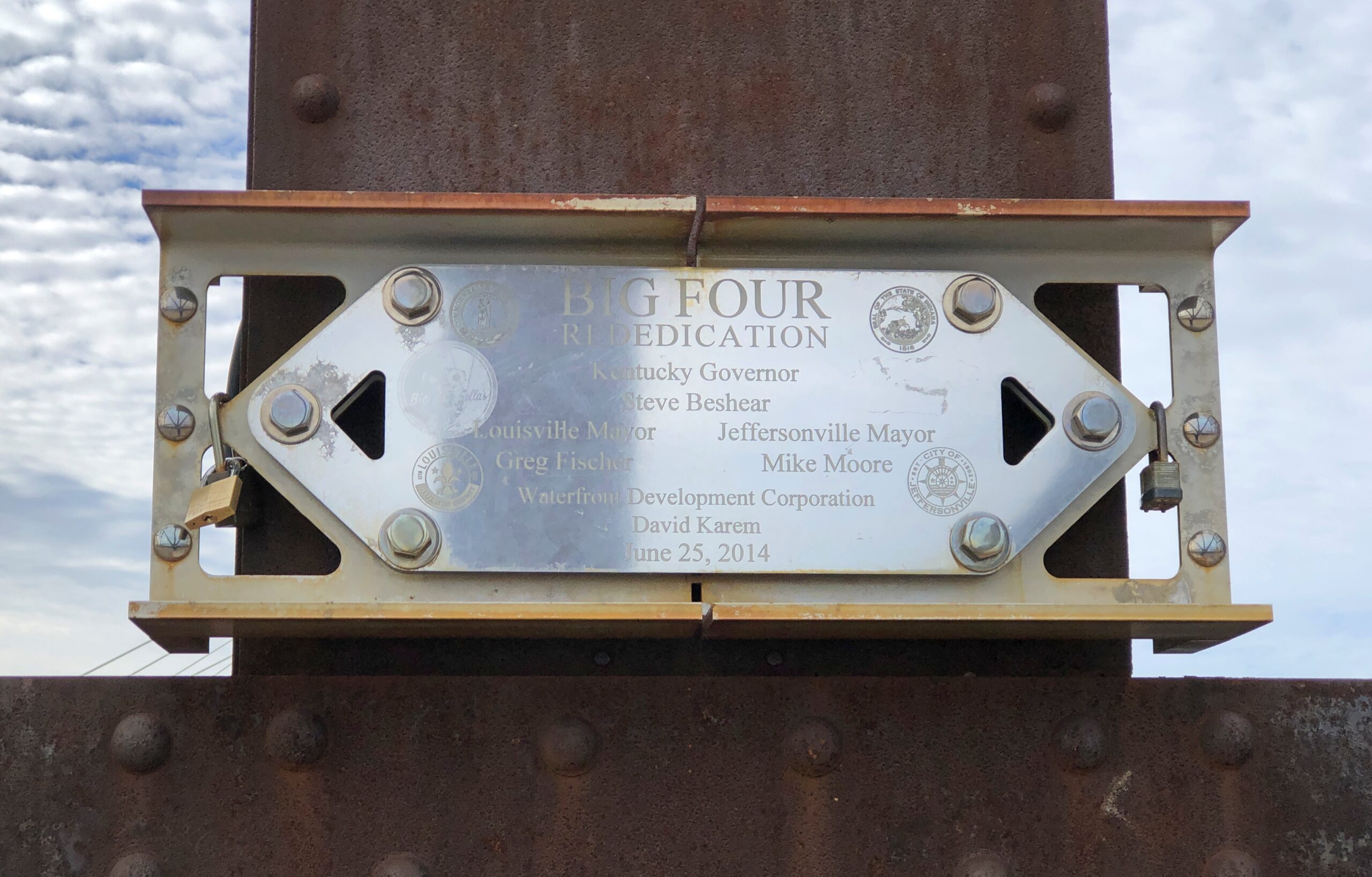
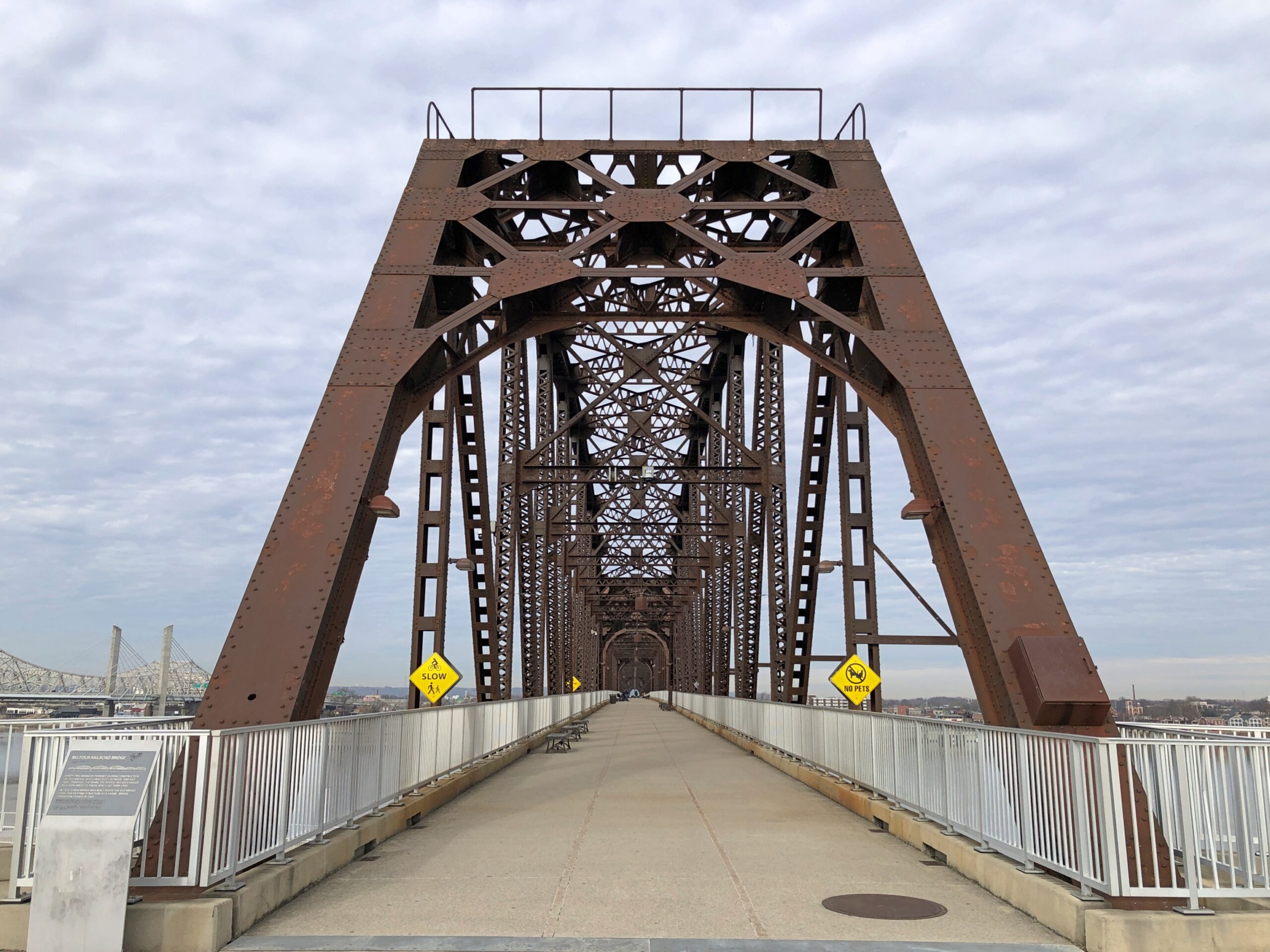
Even the last day of a long trip can include – should include – something to see. With that in mind on December 22, after we crossed the Ohio River from Louisville on the I-65 bridge, which I have done many times, we took the first exit to go to Jeffersonville, Indiana, which I have done only once, in 1990. Then we went back across the river to Louisville, this time on foot on a massive iron structure known as the Big Four Bridge.
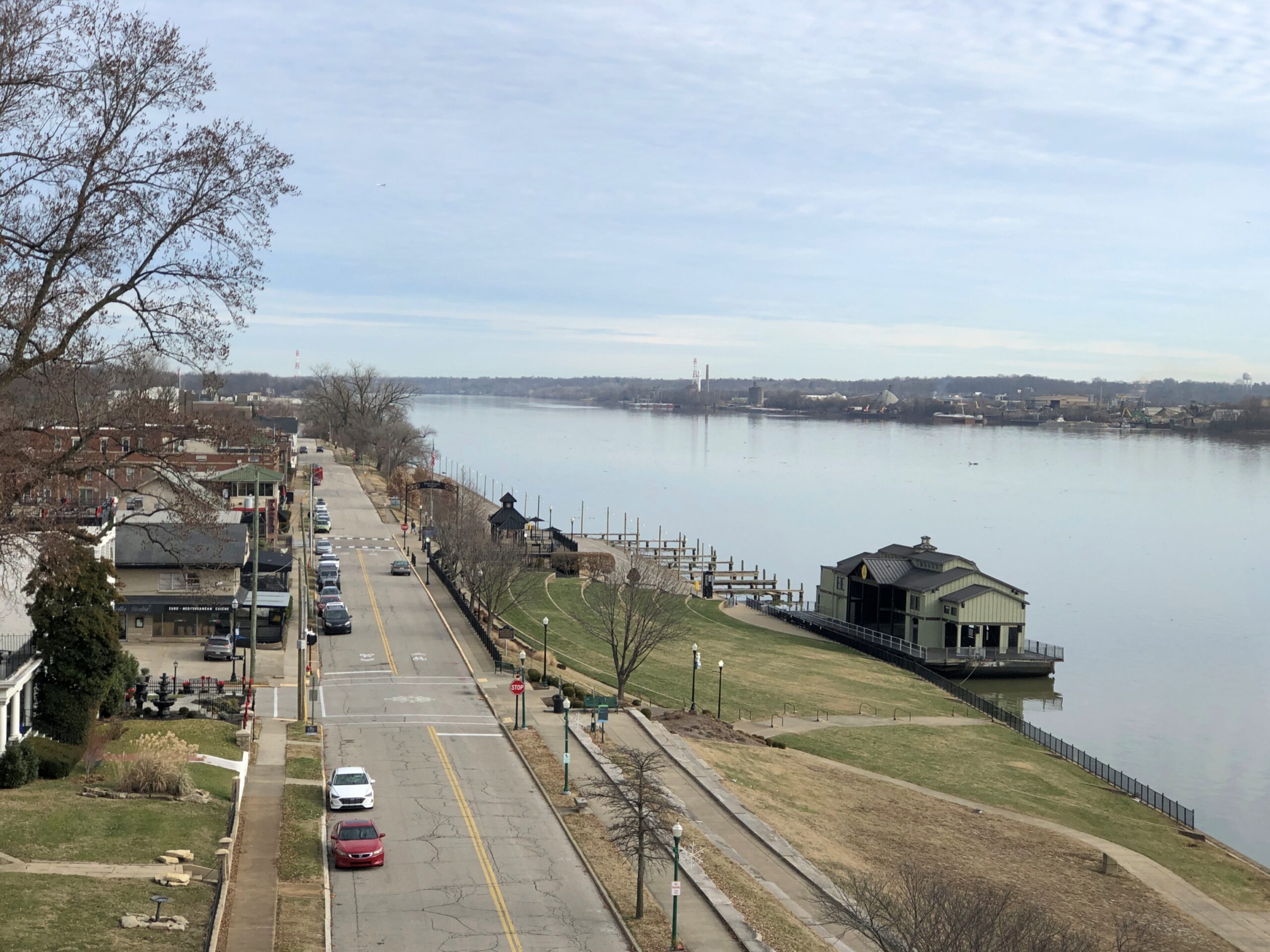
The Jeffersonville side of the bridge offers views of that town and its riverfront, where I took a wintertime stroll all those years ago. At that time, Big Four Bridge was a decaying relic, inaccessible to the public.
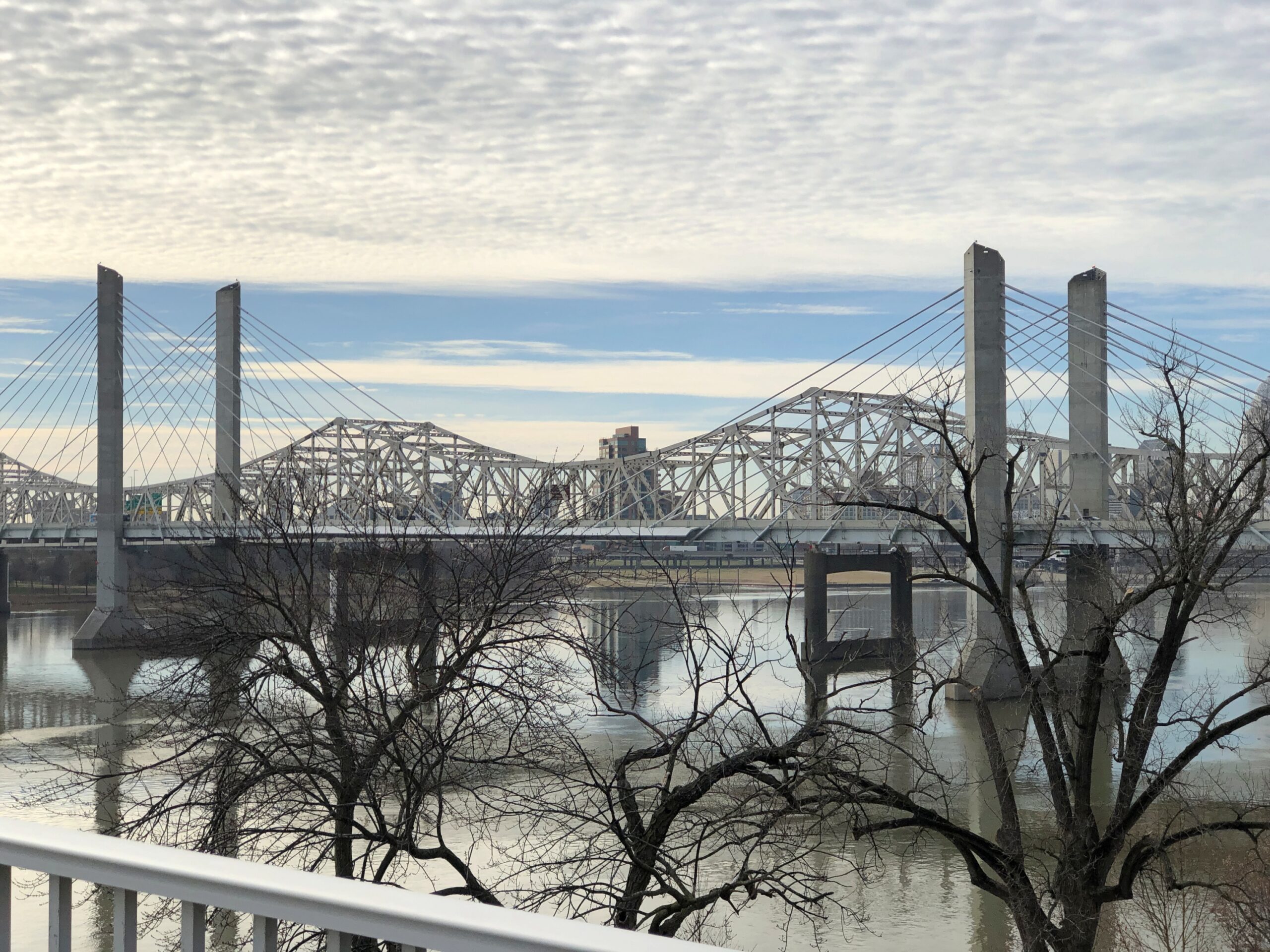
You can also see the I-65 bridge from that vantage. It too is an elegant design.
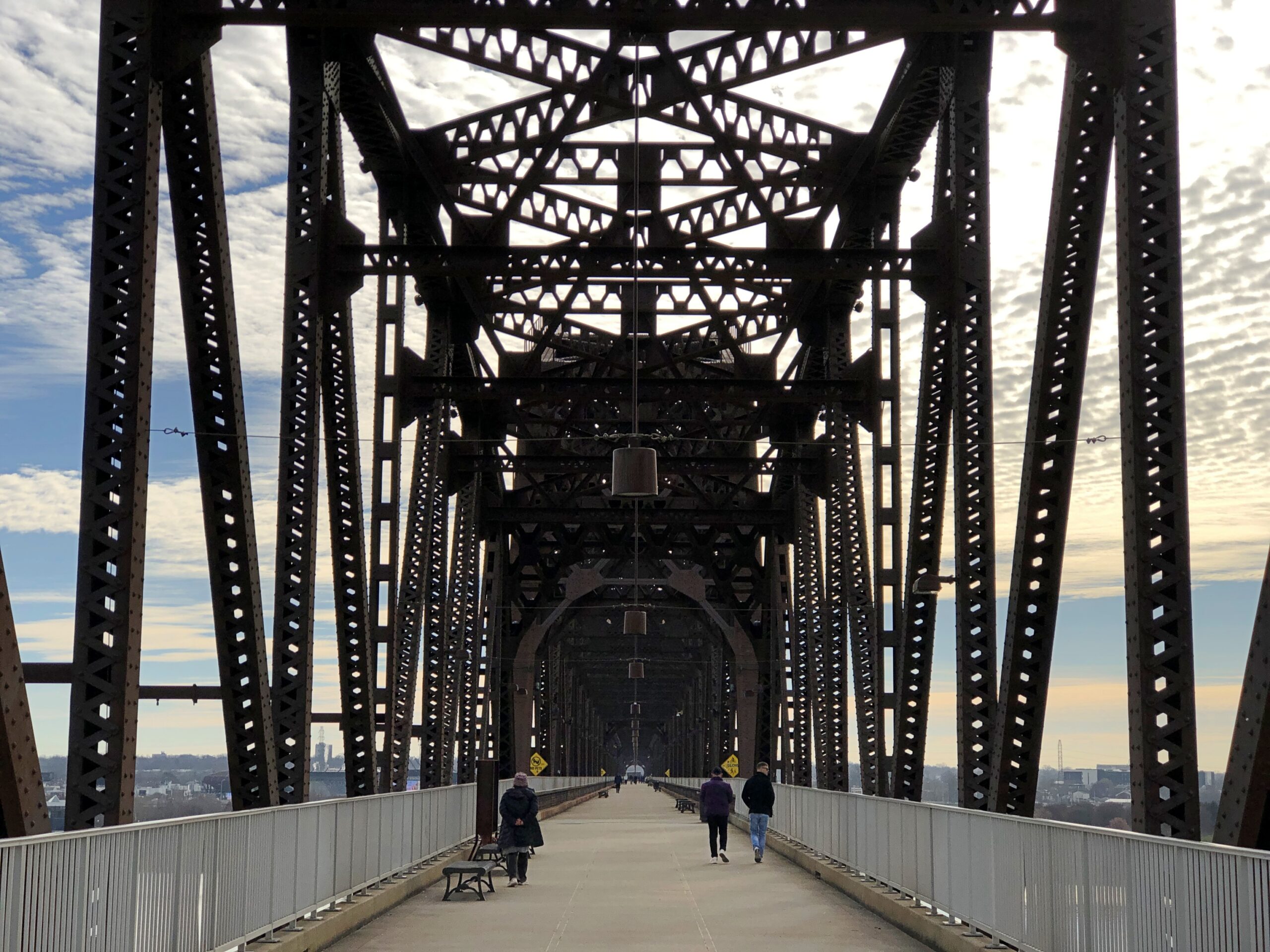
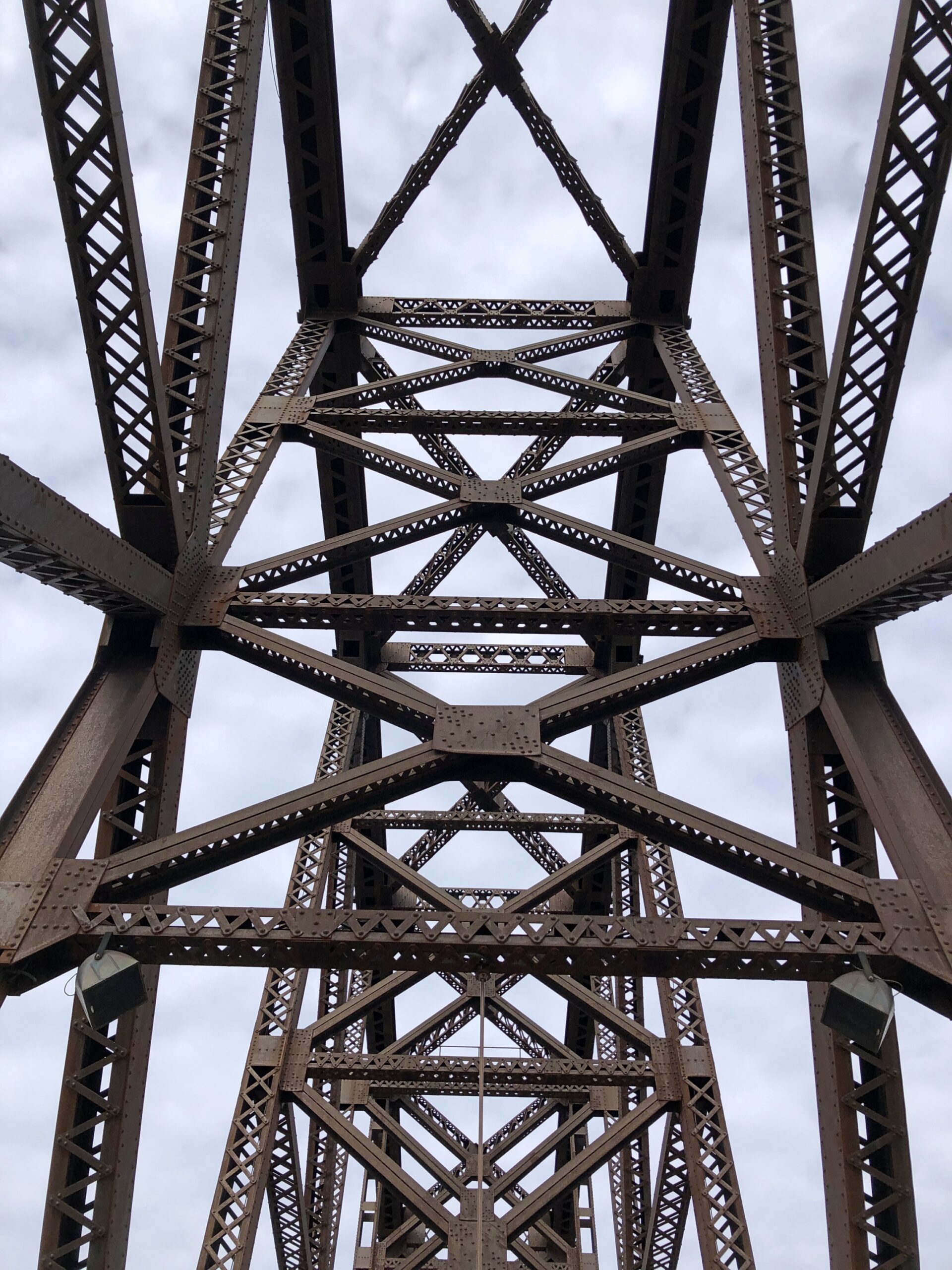
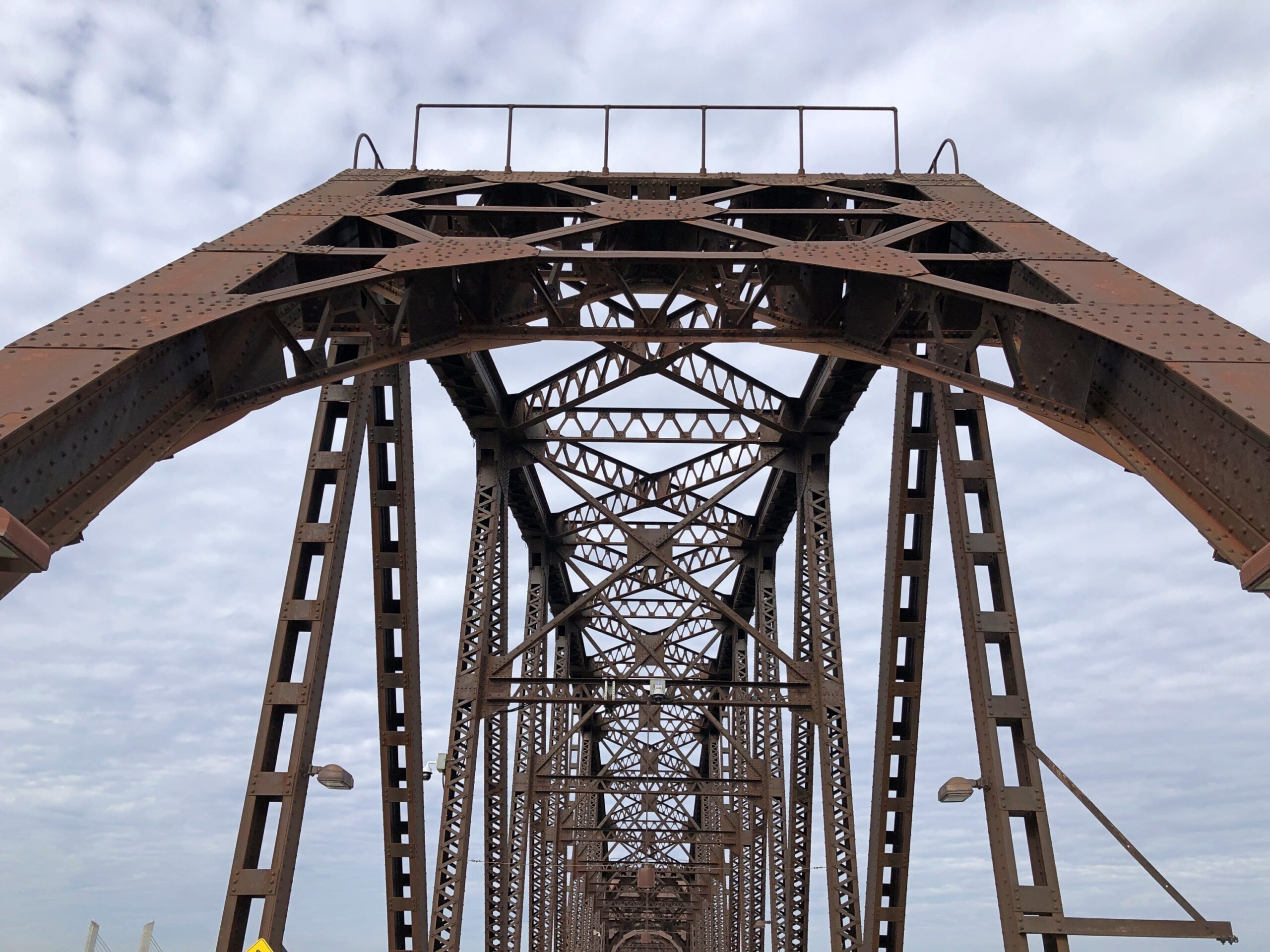
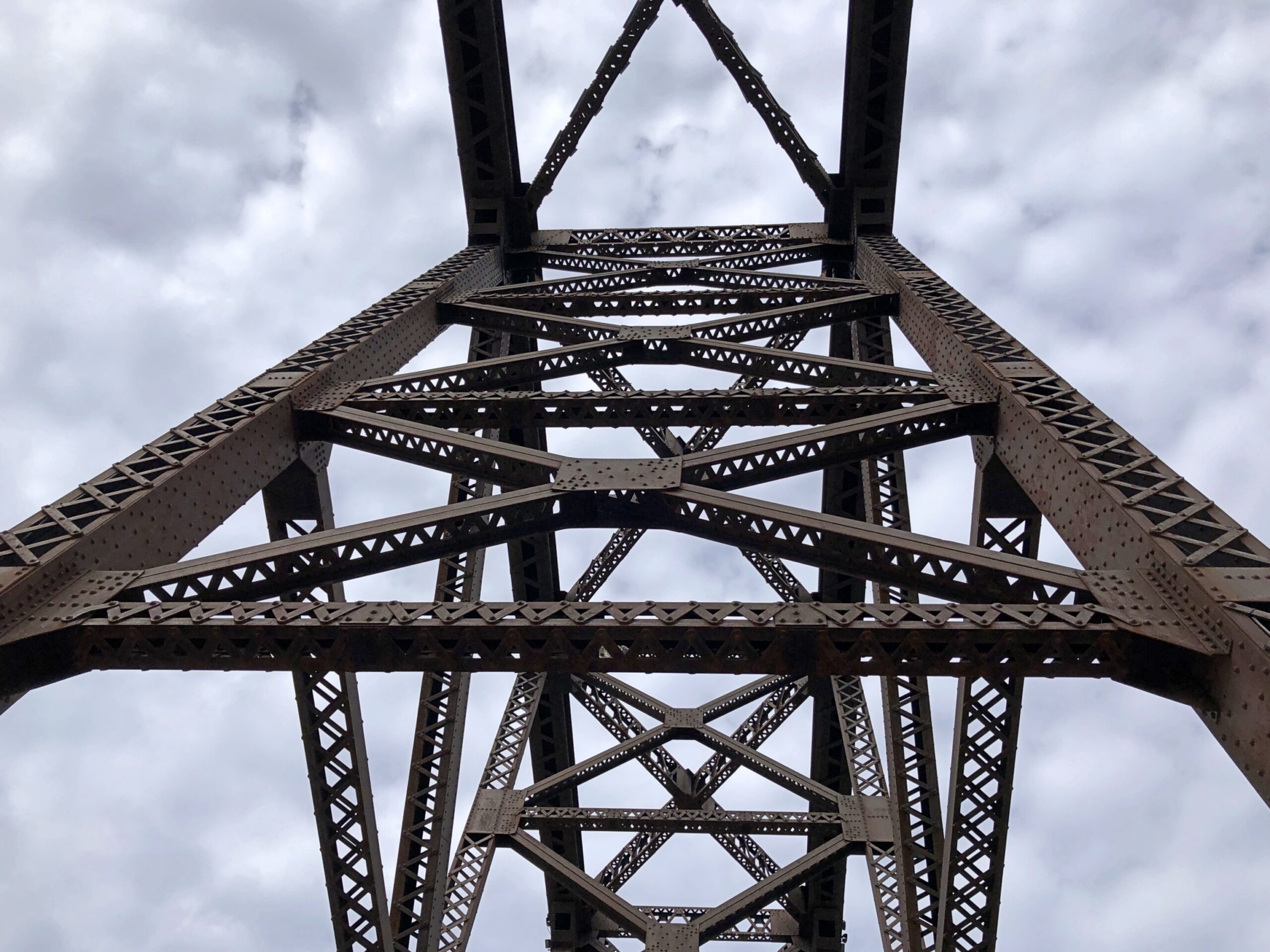
But not as impressive as the sweeping ironwork of Big Four Bridge.
The Ohio sweeps along as well.
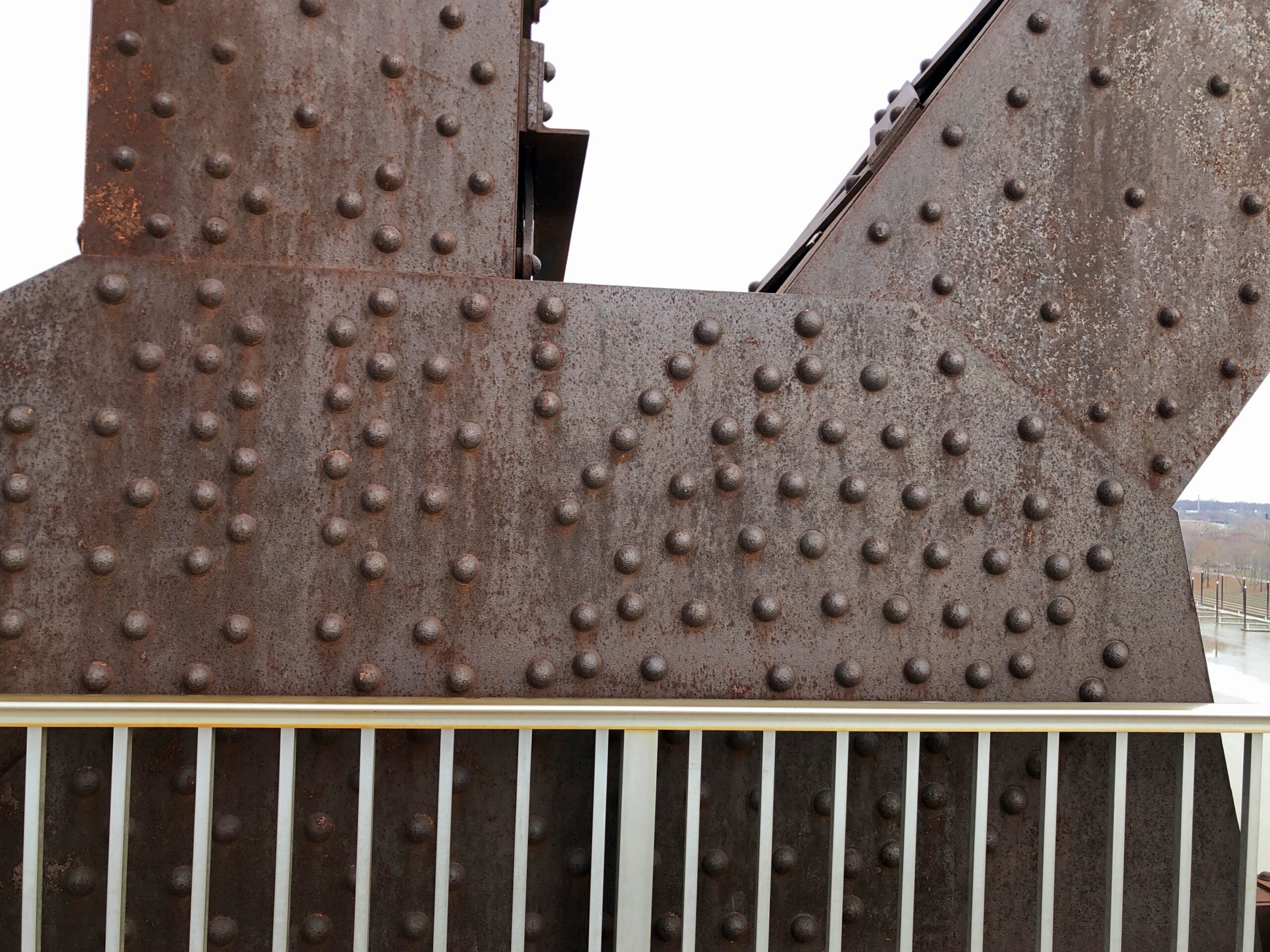
I couldn’t take enough pictures of Big Four.
Once upon a time, Big Four carried the Cleveland, Cincinnati, Chicago and St. Louis Railway, also nicknamed the Big Four Railroad. The 2,525-foot span contains six trusses, beginning as a late 19th-century project, the sort of pre-OSHA work that killed dozens of workers during construction (so why not ghost stories?).
Completed in 1895, “The Big Four Bridge allowed freight traffic to dramatically increase in Louisville, and began carrying high-speed interurbans on September 12, 1905…” says Bridges & Tunnels. “Due to bigger and larger trains, not only in size, but in weight, contracts were let in June 1928 to build a larger Big Four Bridge. The new span, constructed by the Louisville & Jefferson Bridge Co., was built on the piers of the old bridge, while leaving the existing span intact while it was upgraded.”
That is the structure we see today, except that in the early 21st century, it was redeveloped into a pedestrian/bicycle bridge.
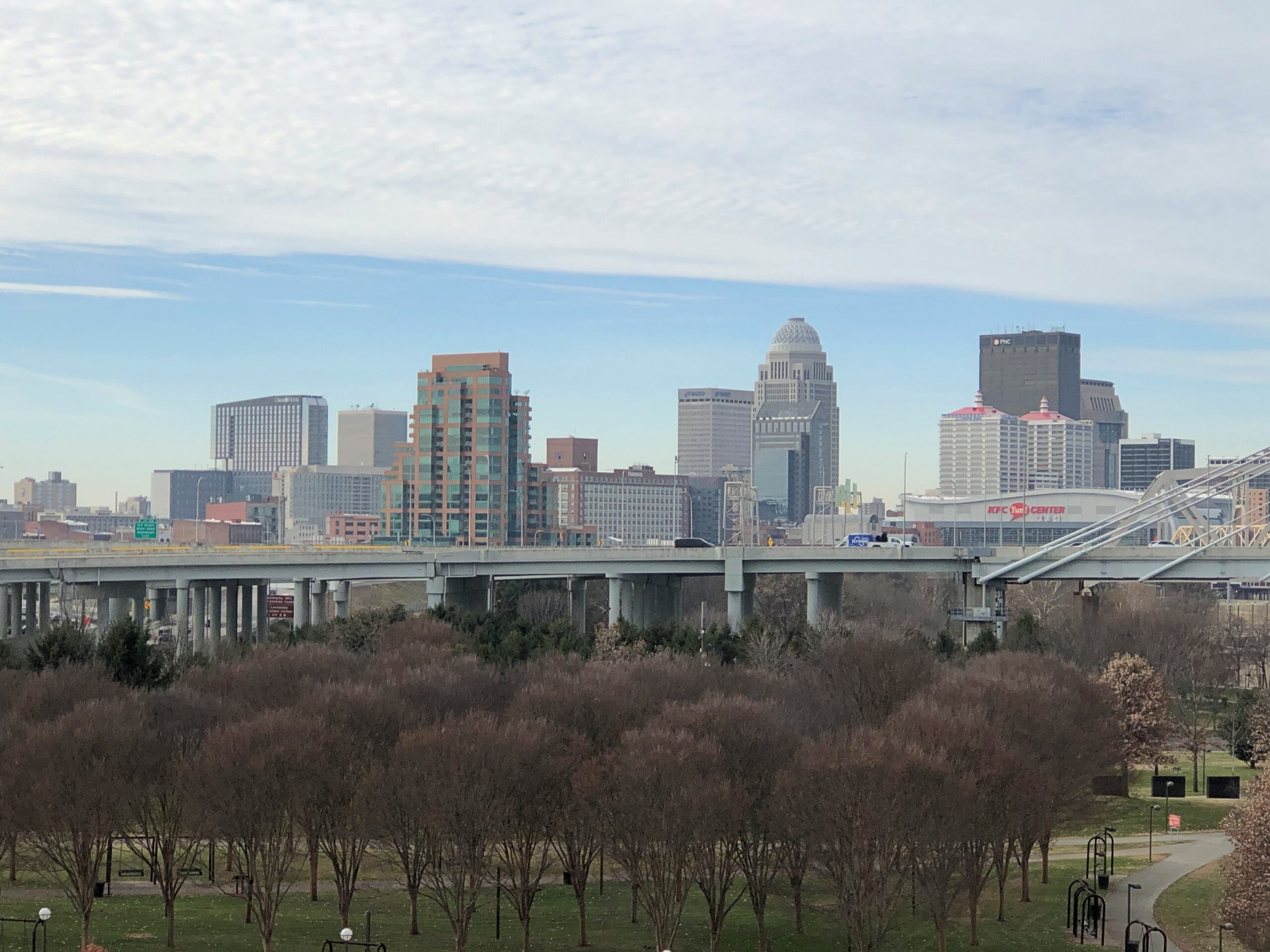
At the Louisville side of the bridge, views of the city.
And looking back at the bridge from the Kentucky (Louisville) side.
We saw the daytime bridge, of course. But “the Big Four Bridge has an LED lighting system that wraps the iron fretwork in vibrant colors,” says Our Waterfront. “The lights can be programmed to have a rainbow effect, highlighting the beauty and strength of the bridge structure. At night, the bridge becomes a colorful beacon in our city. Lights operate daily from twilight until 1 am.”
Another reason to come back to Louisville-Jeffersonville, obviously.
For good reasons. I was only 13 when the movie came out, with no memory of the original reference, and you couldn’t just dial up any old song on your machine in those days. Still, I’m happy to say I saw Young Frankenstein in the theater, as I did Blazing Saddles that same year, which also included some references I didn’t understand until later, notably the names of Lili Von Shtupp and Gov. Le Petomane.
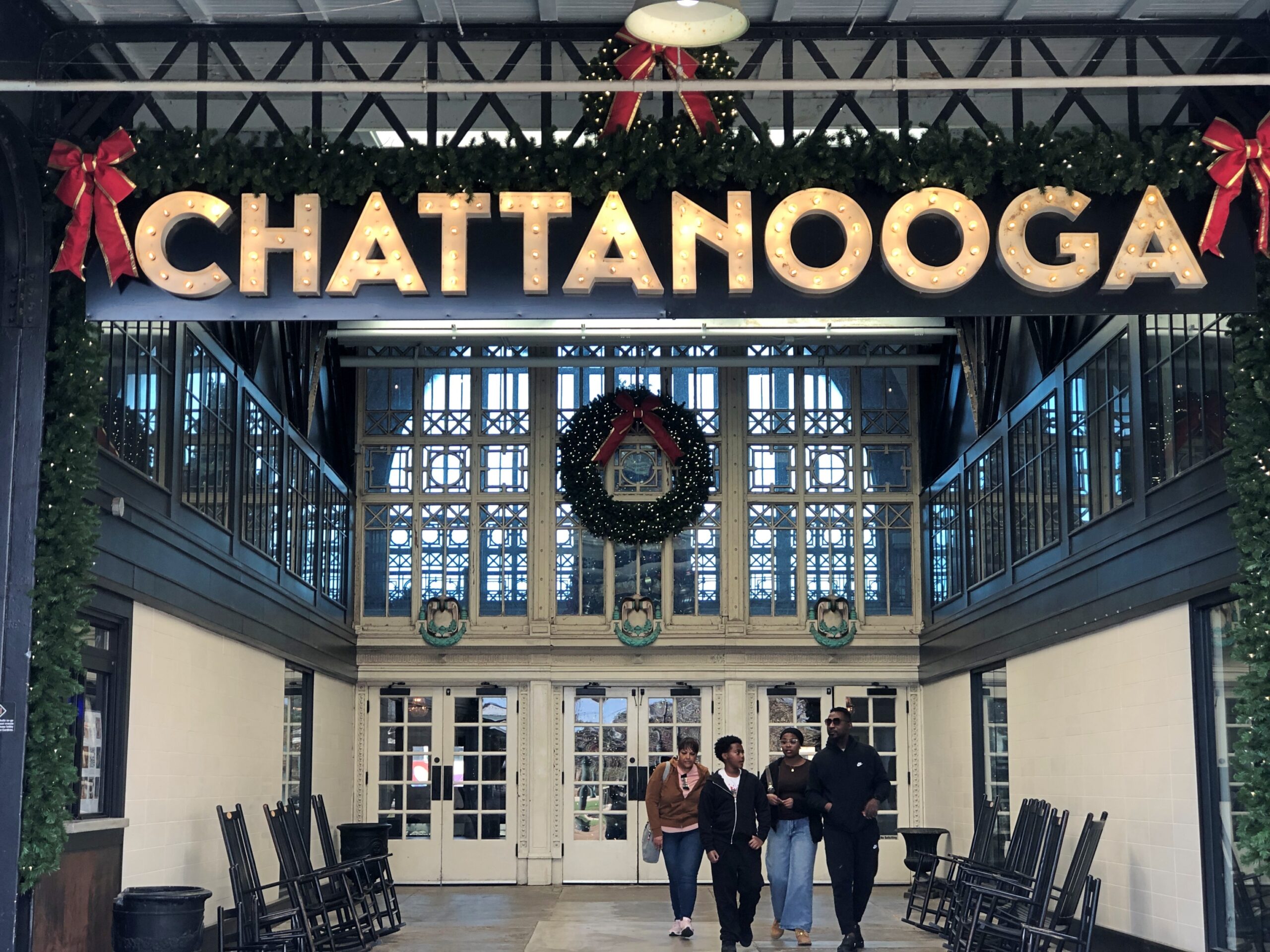
On the road home from Florida, we passed through Chattanooga, a city I hadn’t visited since sometime in the 1980s. I also have handful of memories of Chattanooga during our family road trip around the South in 1969, especially the hotel.
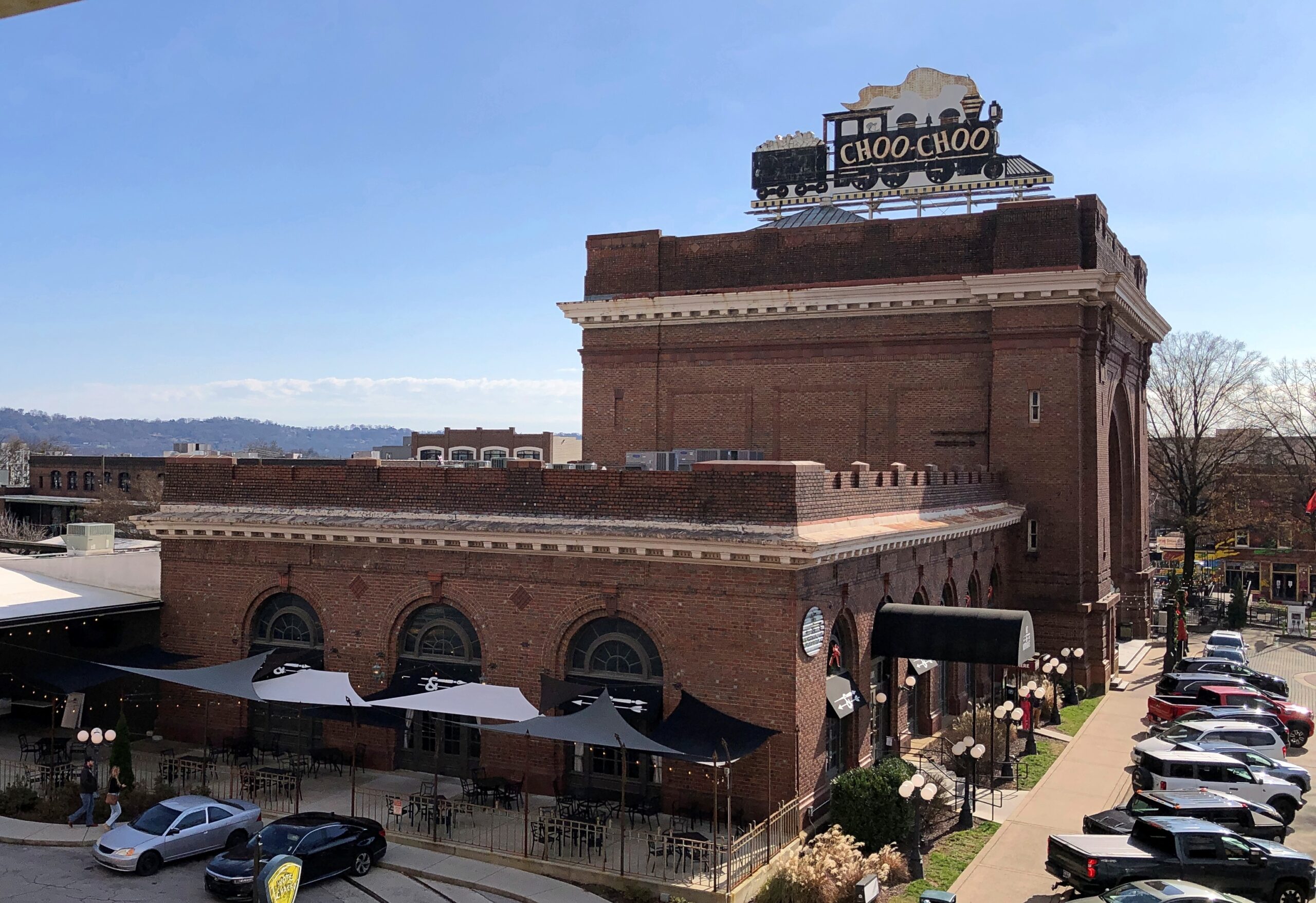
This time I noticed that the Chattanooga Choo-Choo was only a few blocks from the Interstate. So we paused our drive for a short visit.
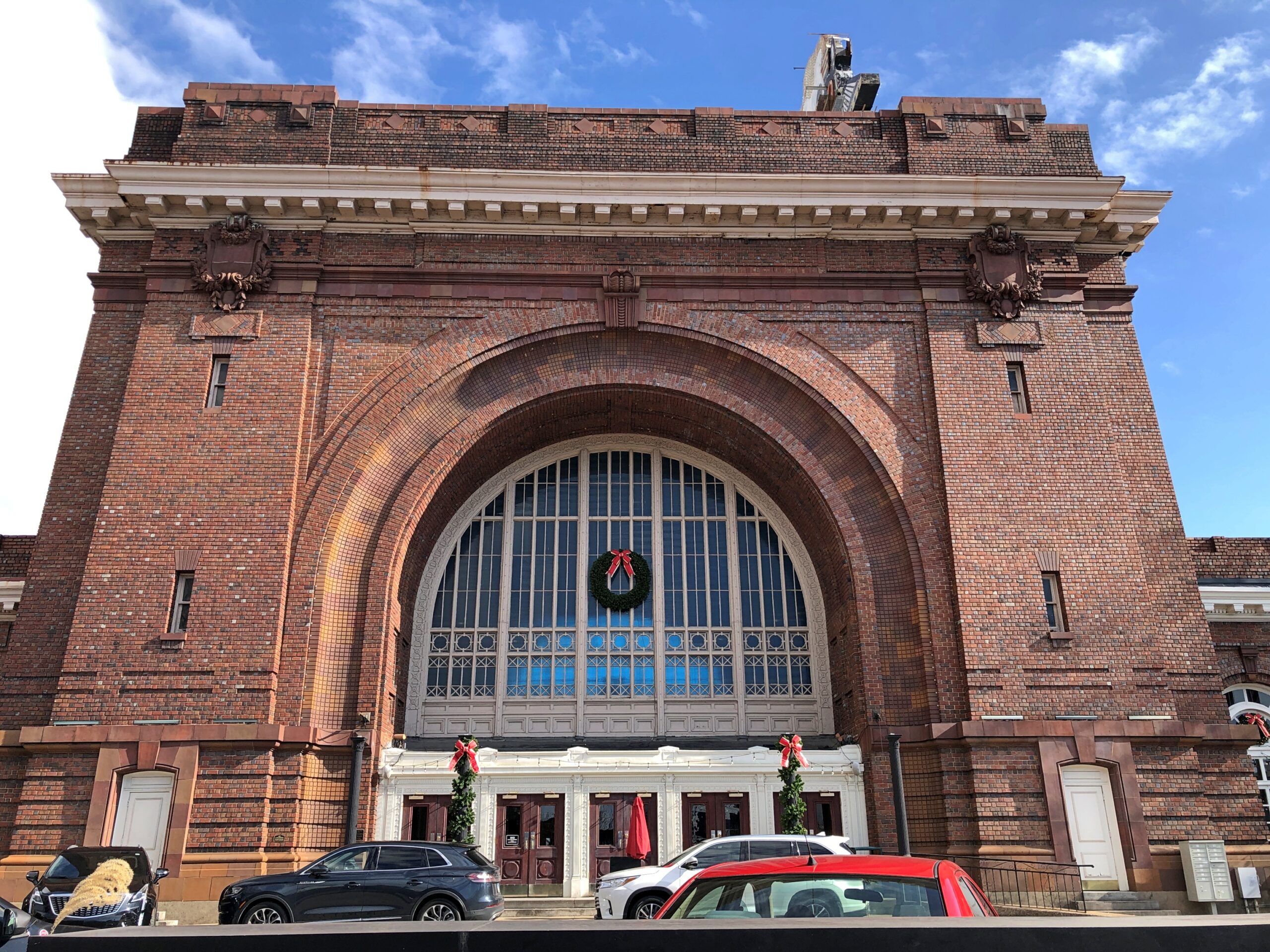
“This landmark Chattanooga hotel located on Market Street in downtown Chattanooga initially served as the Southern Railway Terminal,” the Tennessee Encyclopedia says. “Designed by Beaux-Arts-trained architect Donn Barber of New York City, this magnificent architectural gateway to the Deep South opened during the Christmas season of 1909.”
With the mid-century decline of passenger rail in the U.S. came the near-demolition of the terminal, but the lesson of Penn Station and the era’s other thoughtless architectural destruction was apparently enough to fuel the Southern Railway Terminal’s preservation. With its redevelopment into a hotel-retail-entertainment complex came a new, instantly recognizable name: the Chattanooga Choo-Choo.
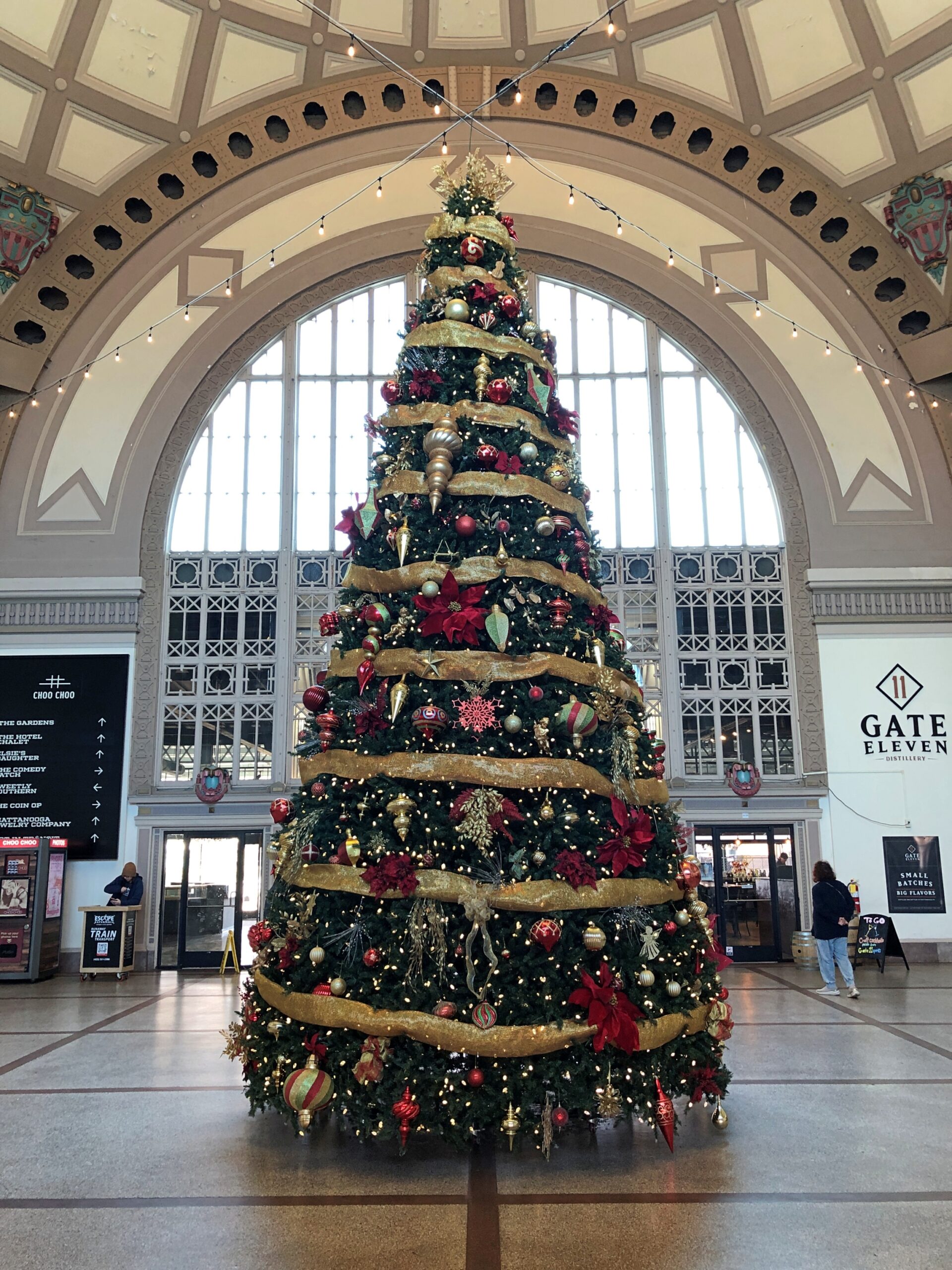
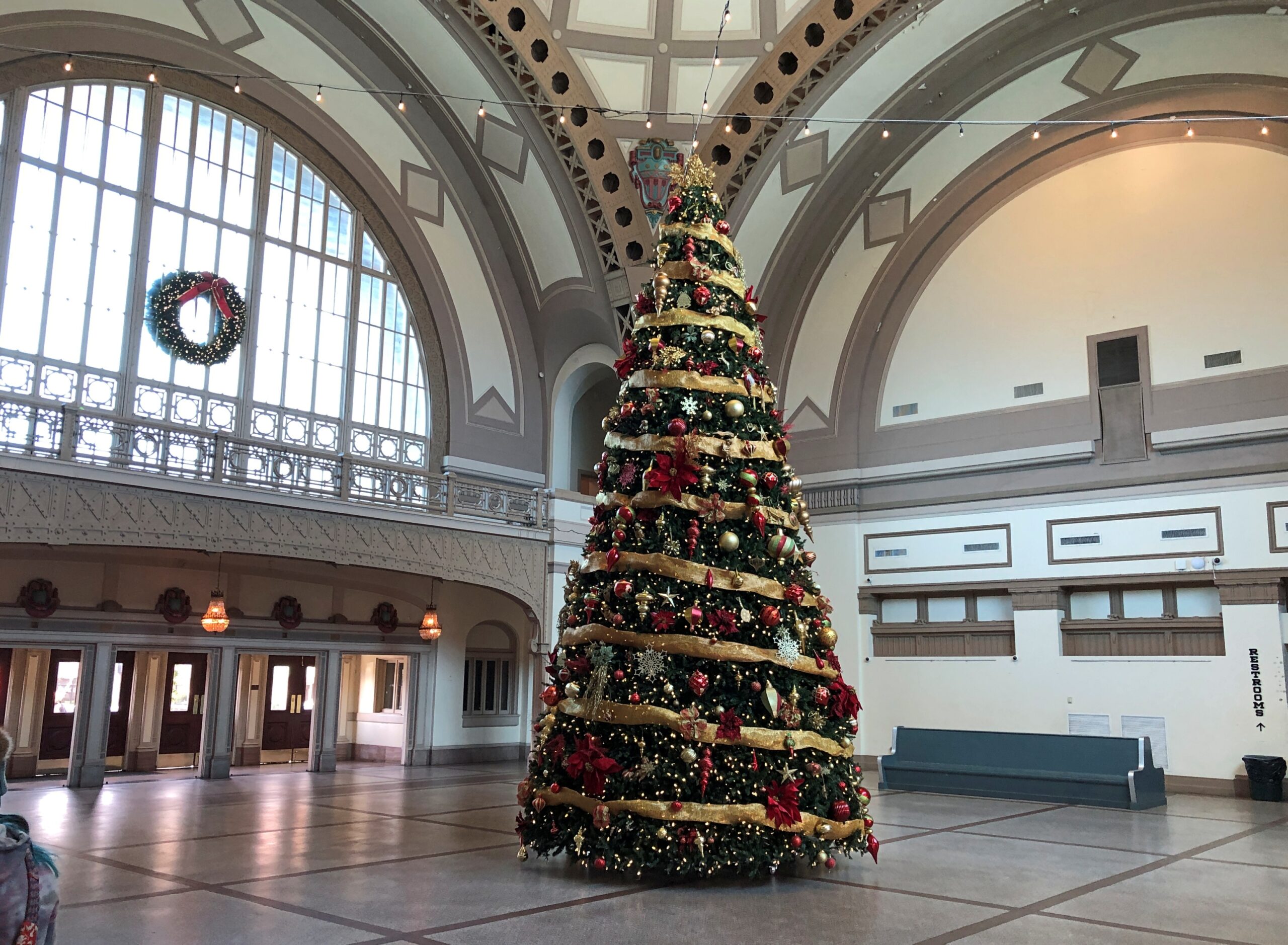
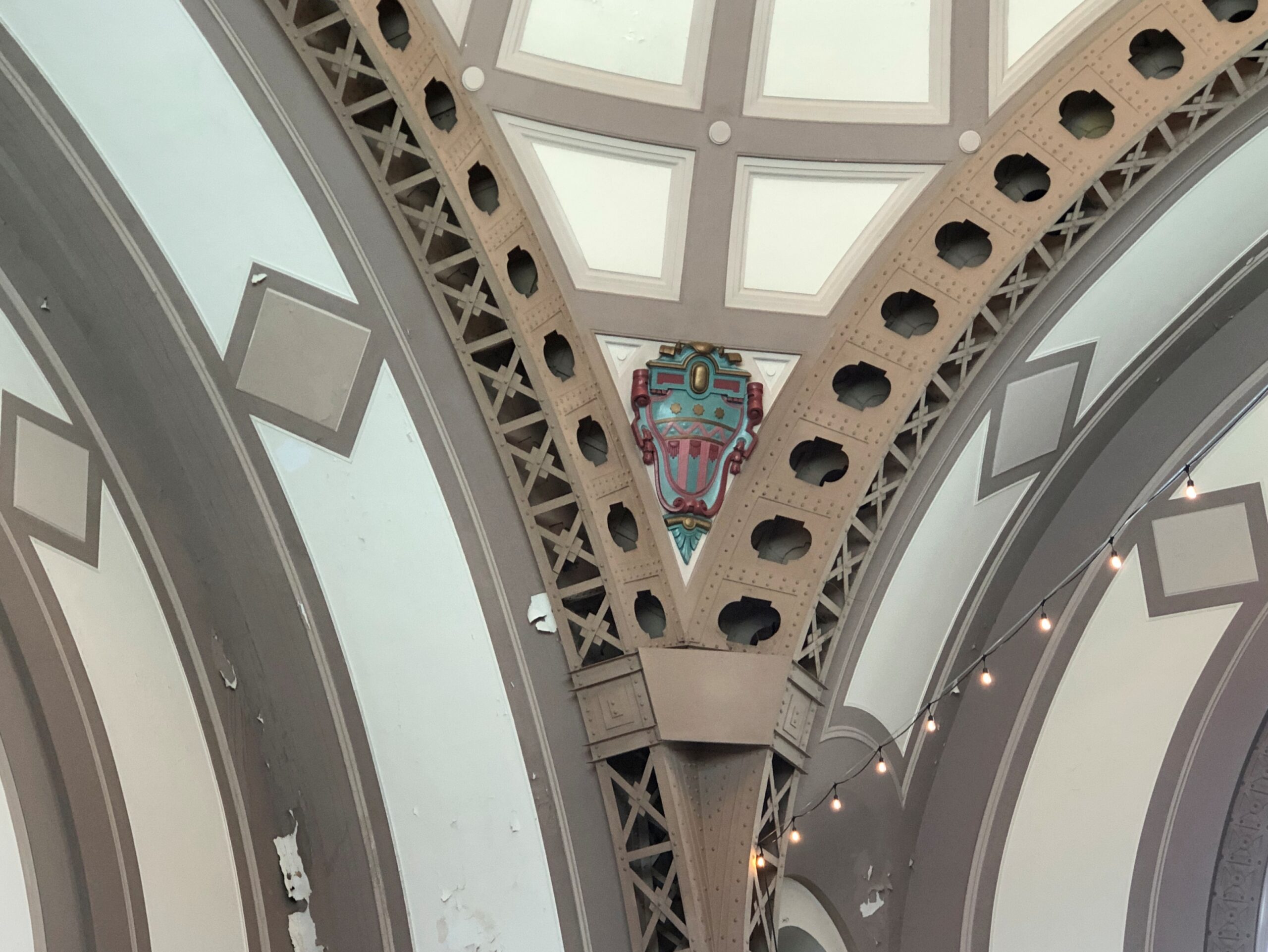
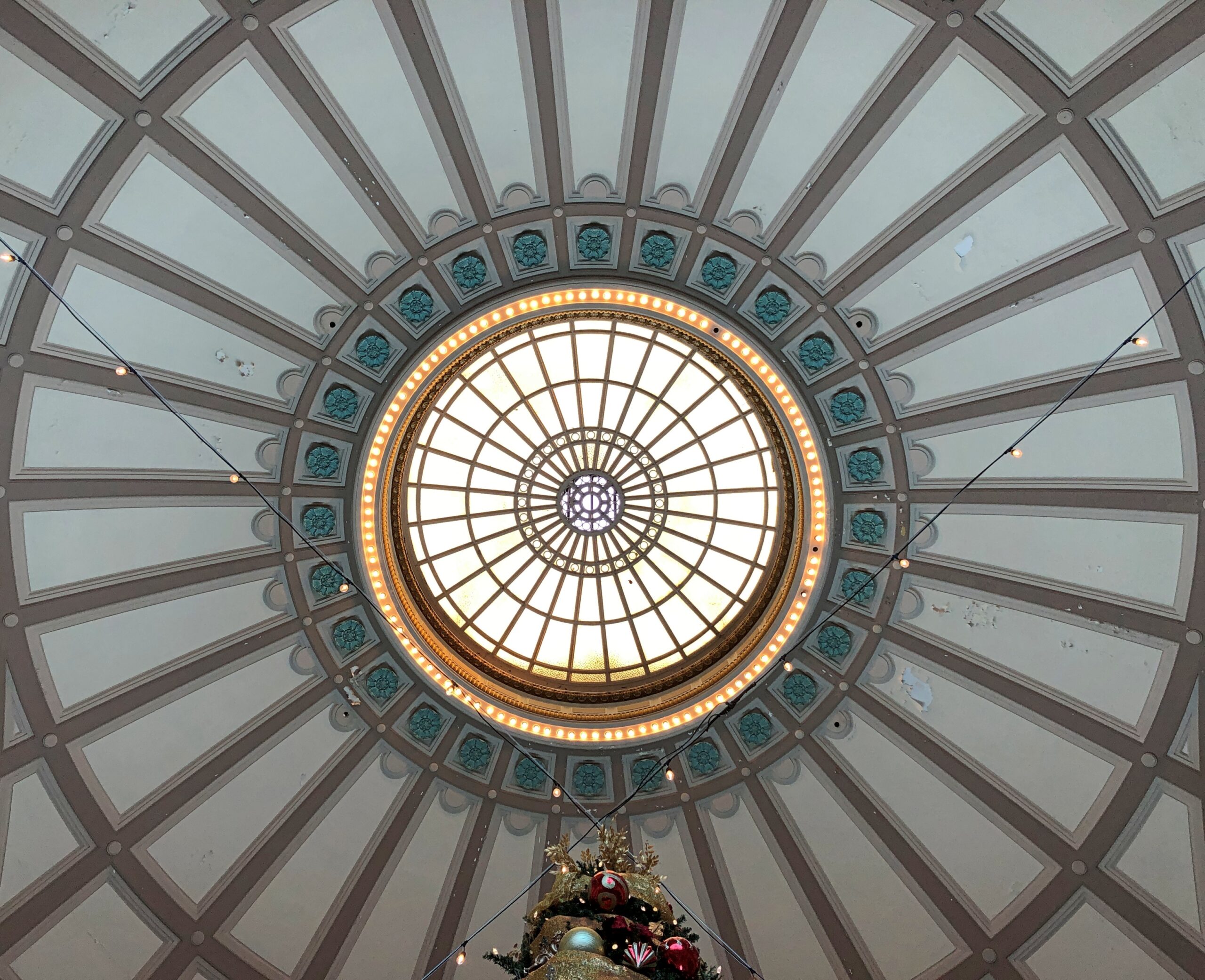
Inside, the sort of grand hall that marks grand old train terminals.
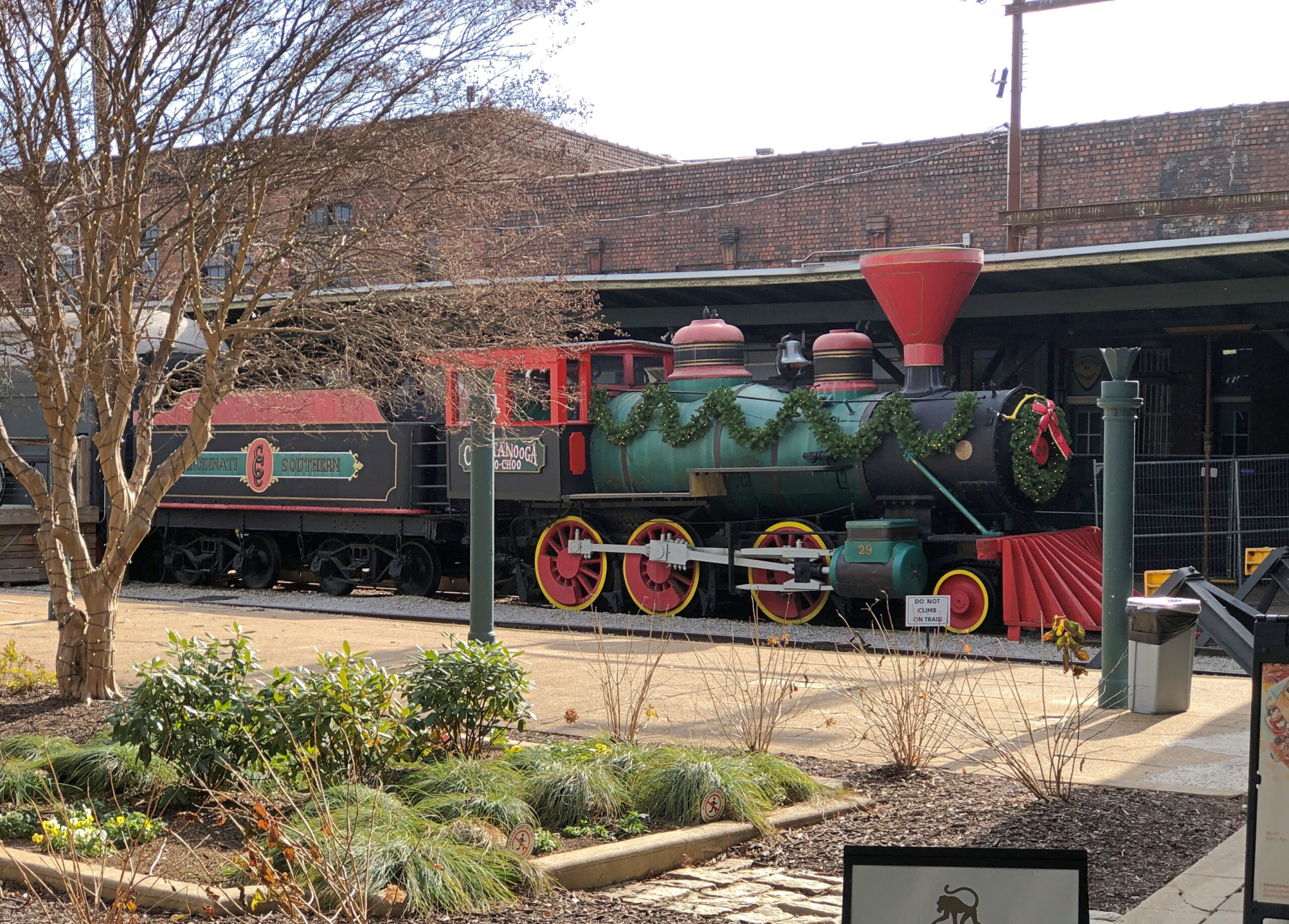
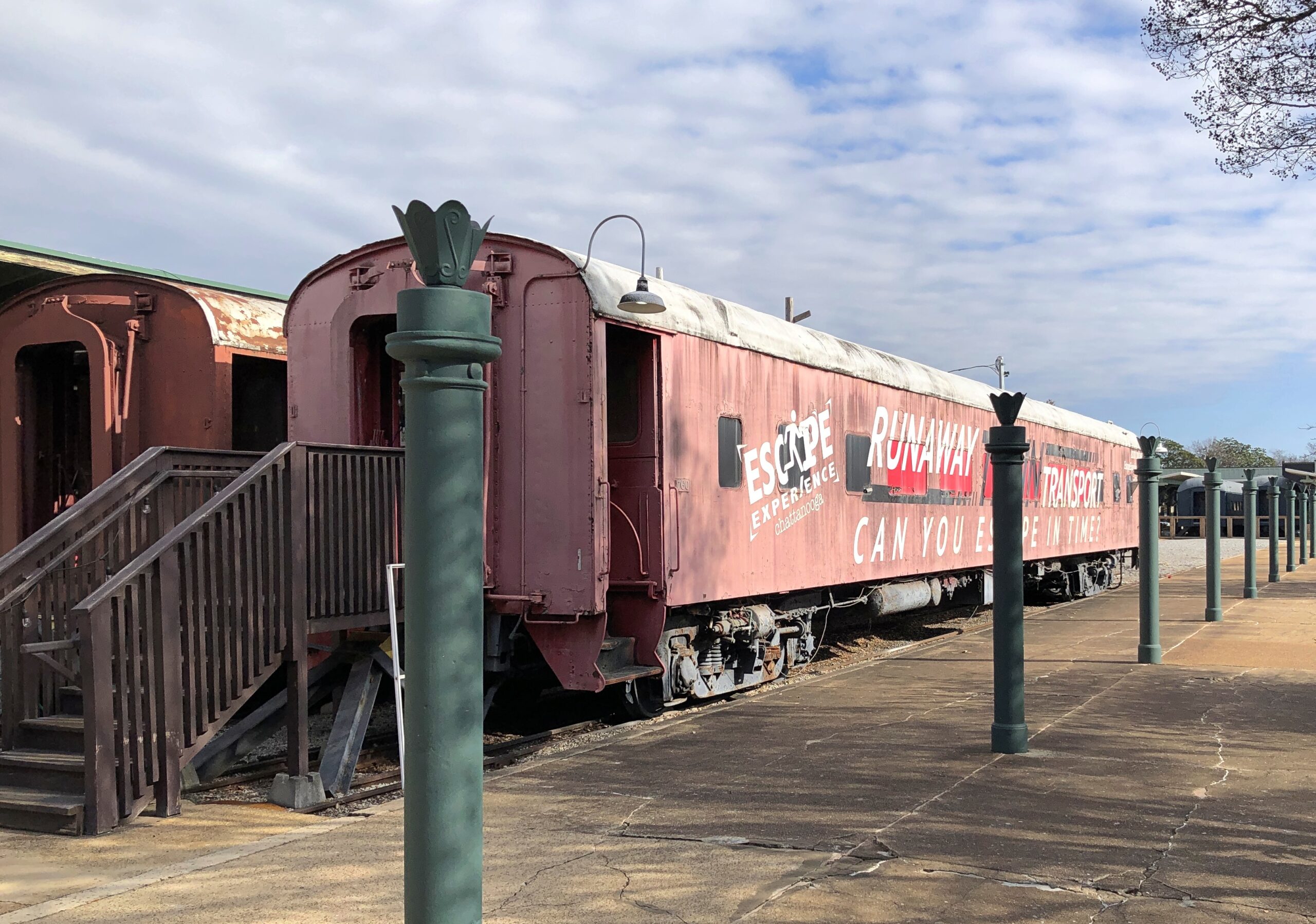
Behind the main building, relics of past choo-choos.
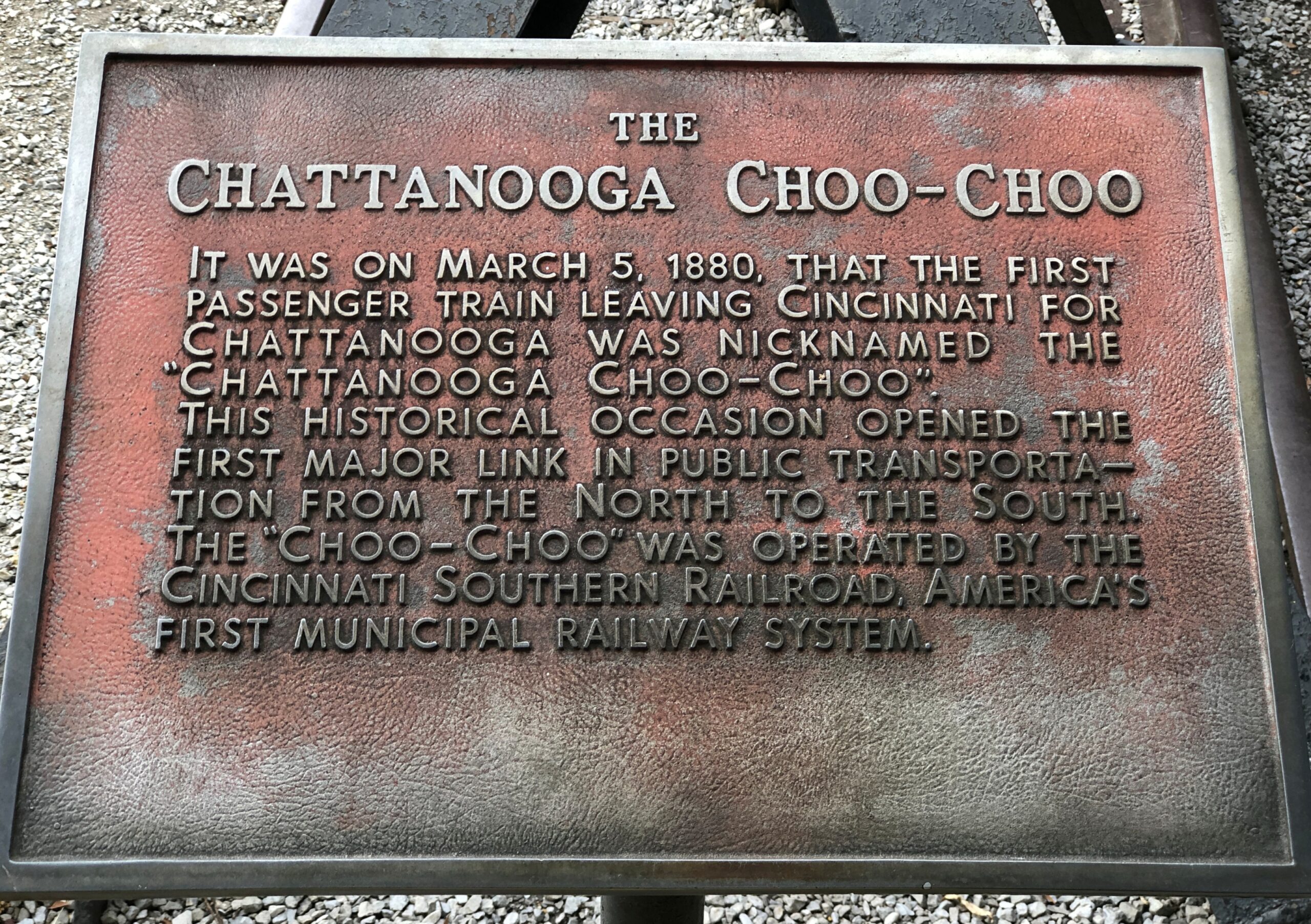
In case you’ve forgotten where you are.
Shovel all the coal in, gotta keep it rollin’ Woo, woo, Chattanooga, there you are
Years ago, when we visited the Spam Museum in Austin, Minnesota, I noted with satisfaction that Monty Python’s Spam Sketch was playing on demand in one of the exhibit rooms. I understand the museum has moved to a different location in Austin since then, but I hope they still play the sketch.
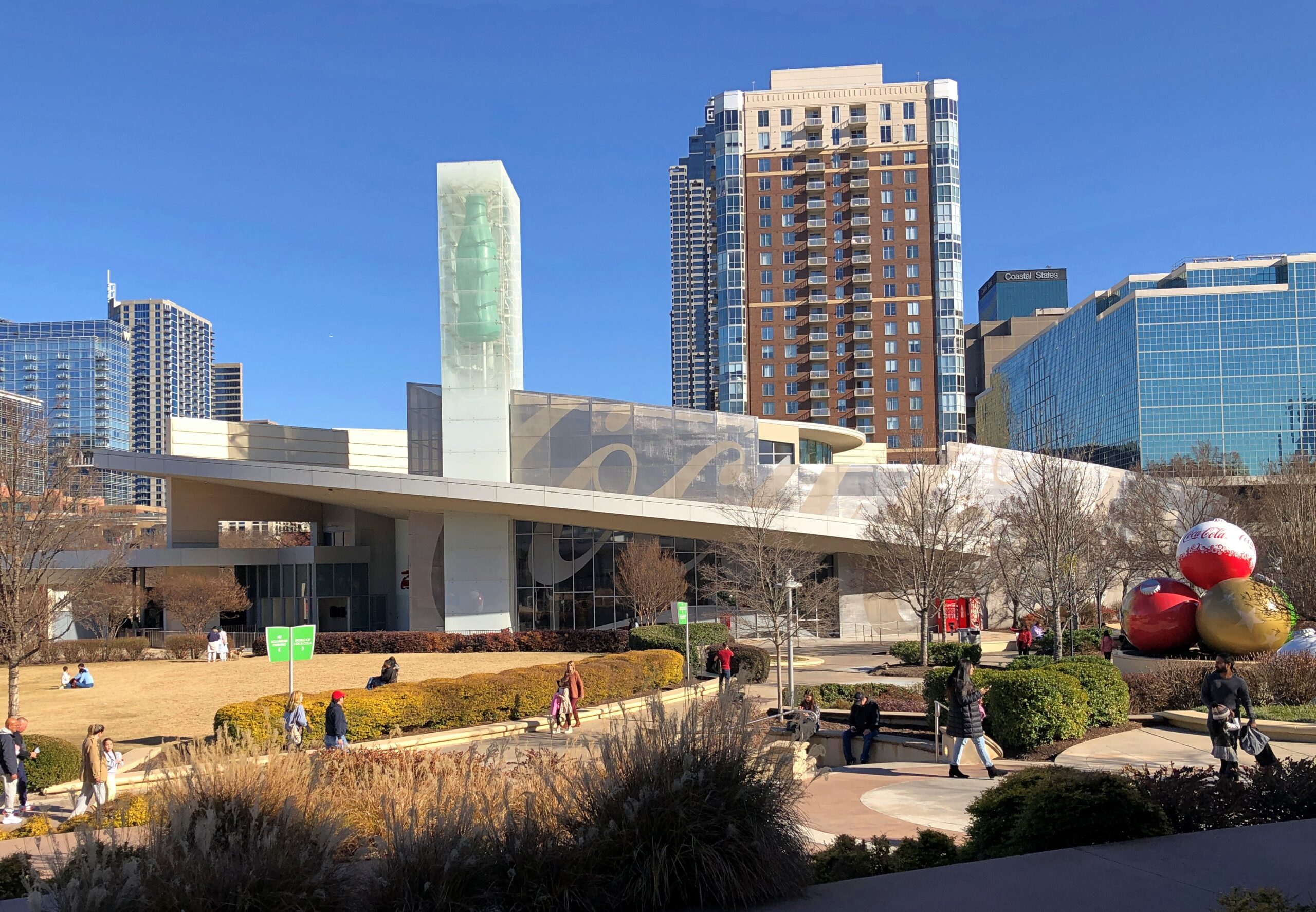
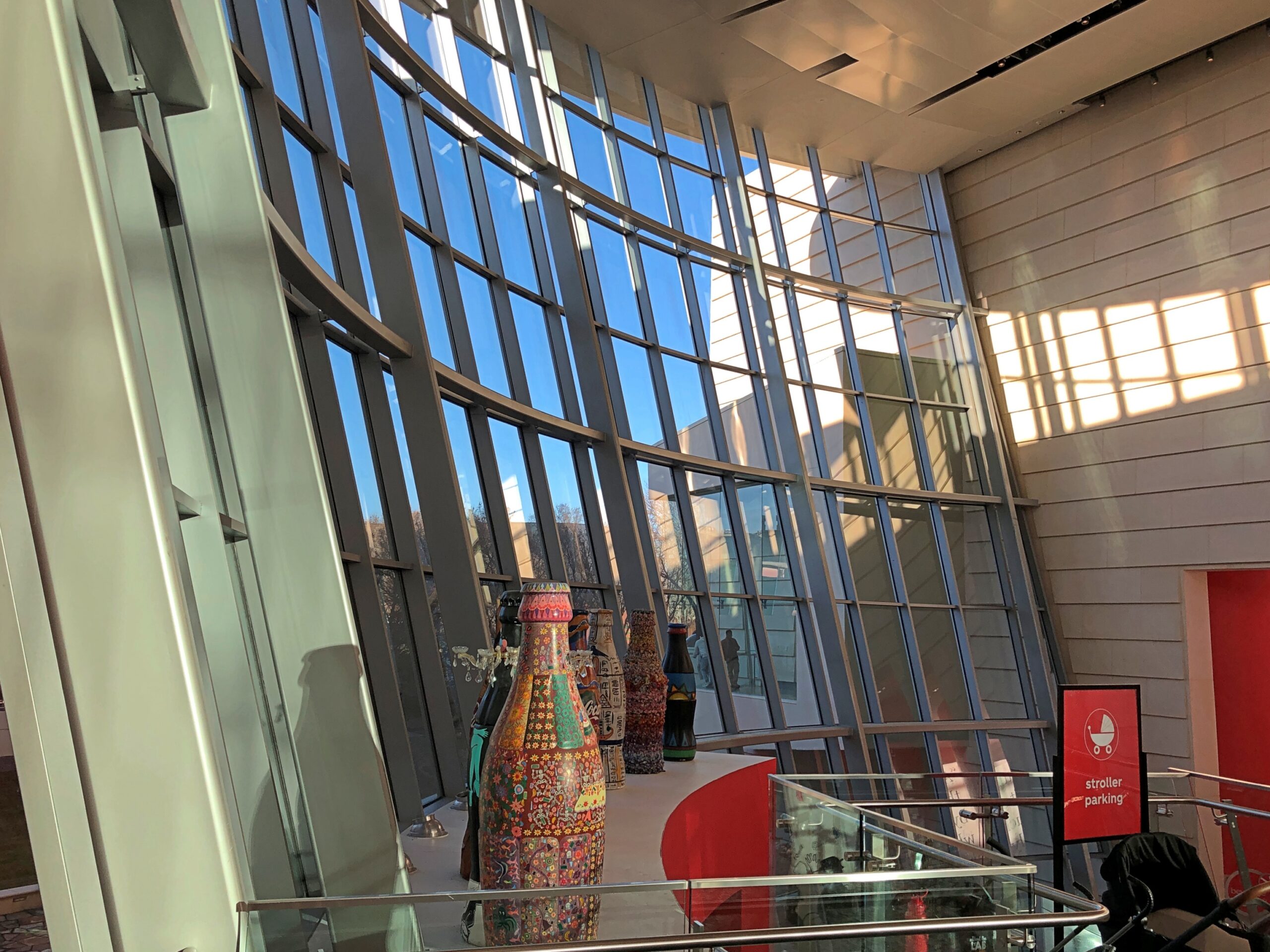
As far as I noticed, there was no clip of One, Two, Three playing at the World of Coca-Cola in Atlanta last month. The scene I’d pick is the back-and-forth about Soviet scientists’ efforts to replicate Coca-Cola without its famously secret formula: “Even the Albanians wouldn’t drink it.”
I’d have this clip playing, too.
Or even the jingle scene from The Coca-Cola Kid. Nice jingle.
The World of Coca-Cola shares a plaza with the Georgia Aquarium. Pemberton Plaza, named for the doctor who invented a particularly successful “brain tonic,” back in the days when enterprising doctors and druggists did that sort of thing. Interestingly, the museum doesn’t play up Lt. Col. John Pemberton’s military service for the CSA, or his morphine addiction, which drove him to experiment with a new wonder drug, cocaine, to kick his habit. That didn’t work out, but he did leave a lasting soft drink legacy.
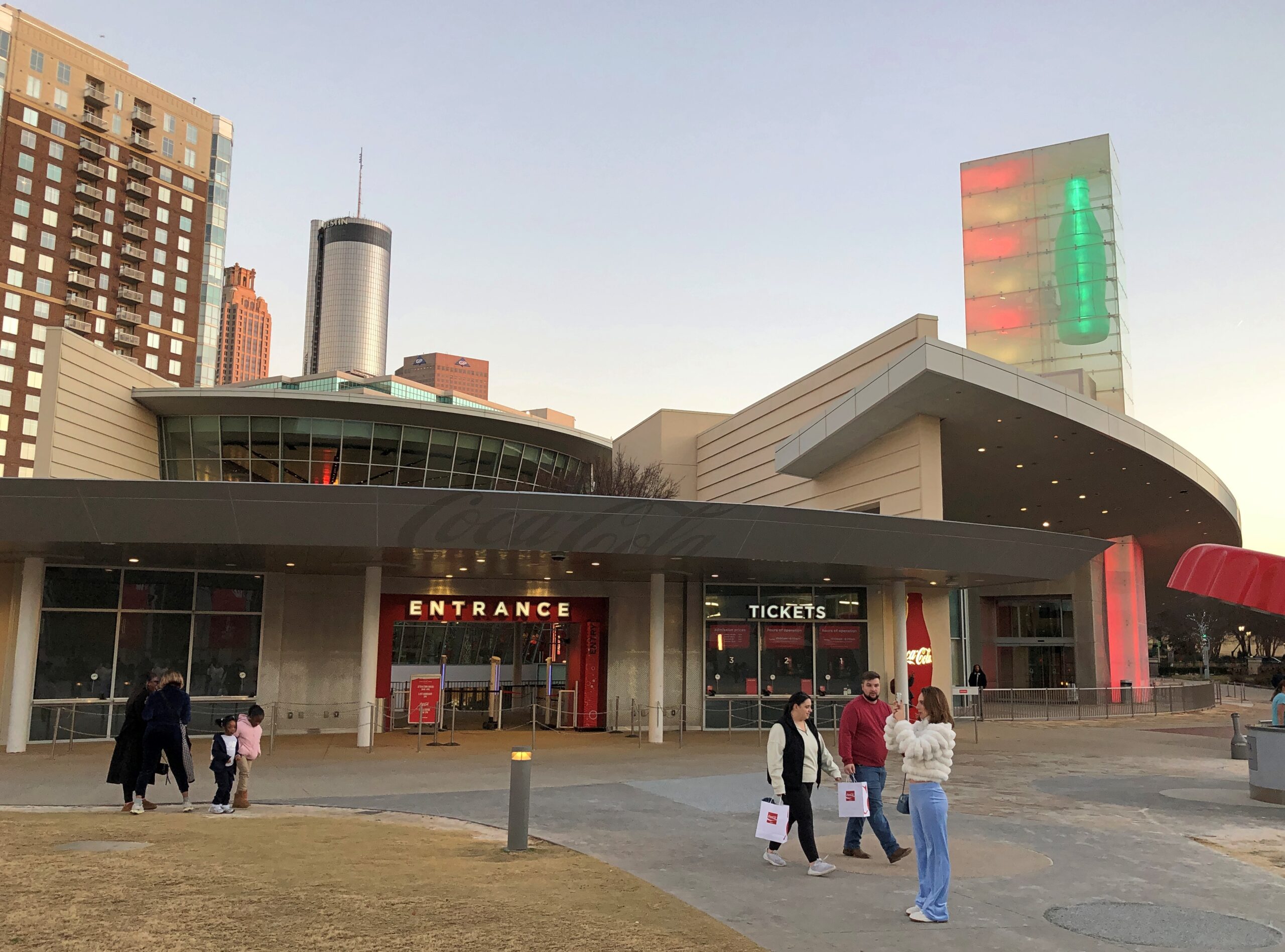
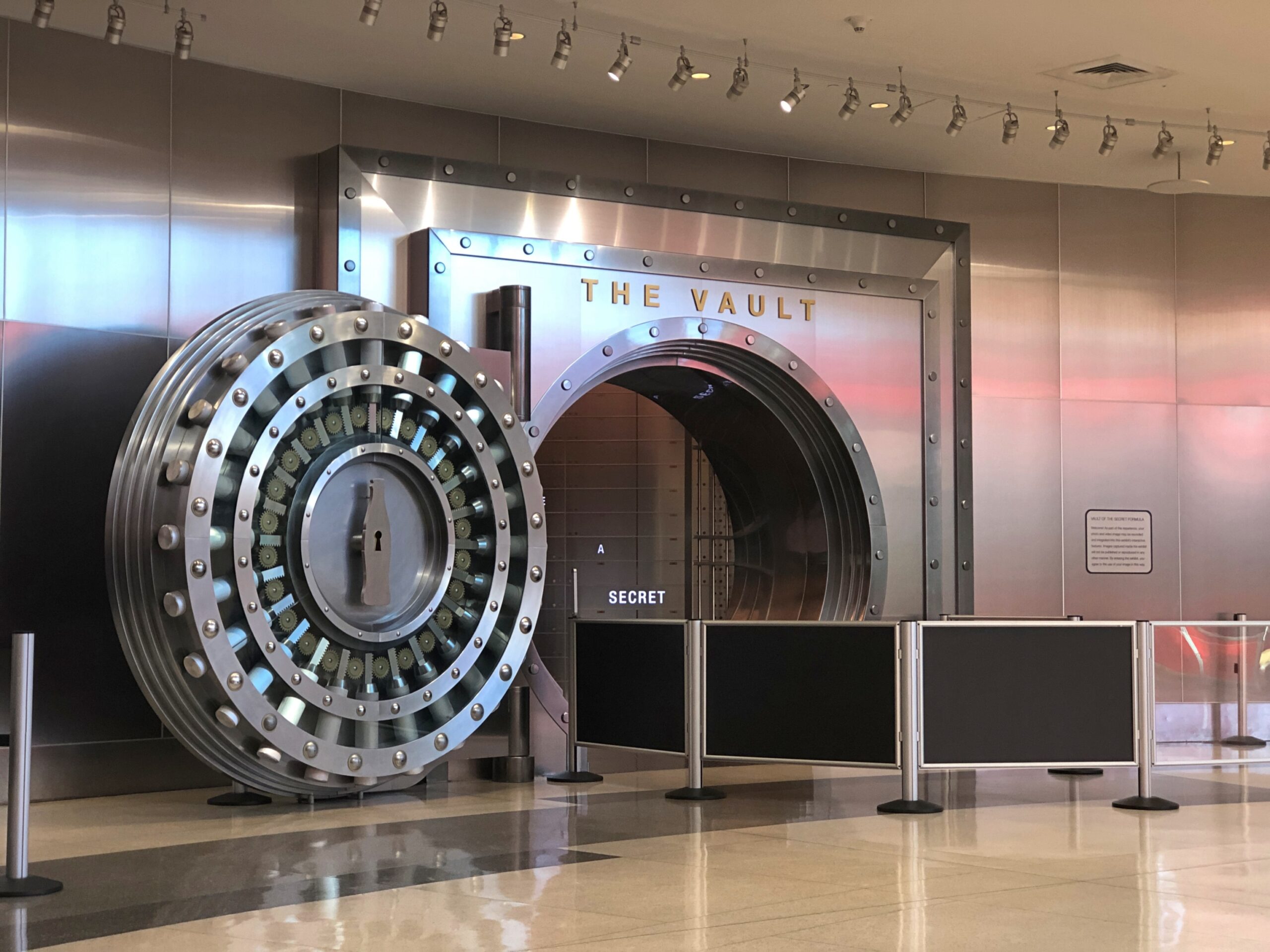
As a museum, the place includes a number of interactive exhibits and activities, starting at the Coca-Cola Theater with a six-minute commercial. I mean, a short history of Coke. You can also see the vault where the secret formula supposedly resides —
— check out various smells associated with the cola-making process, “explore Coca-Cola’s iconic influence on art, music, fashion, sports, and entertainment,” and “engage with interactive displays and AI magic that bring Coca-Cola’s legacy to life in new, unforgettable ways,” the museum explains. You can even, if you register – maybe with some app? – stand in line to have your picture taken with a person in a polar bear suit.
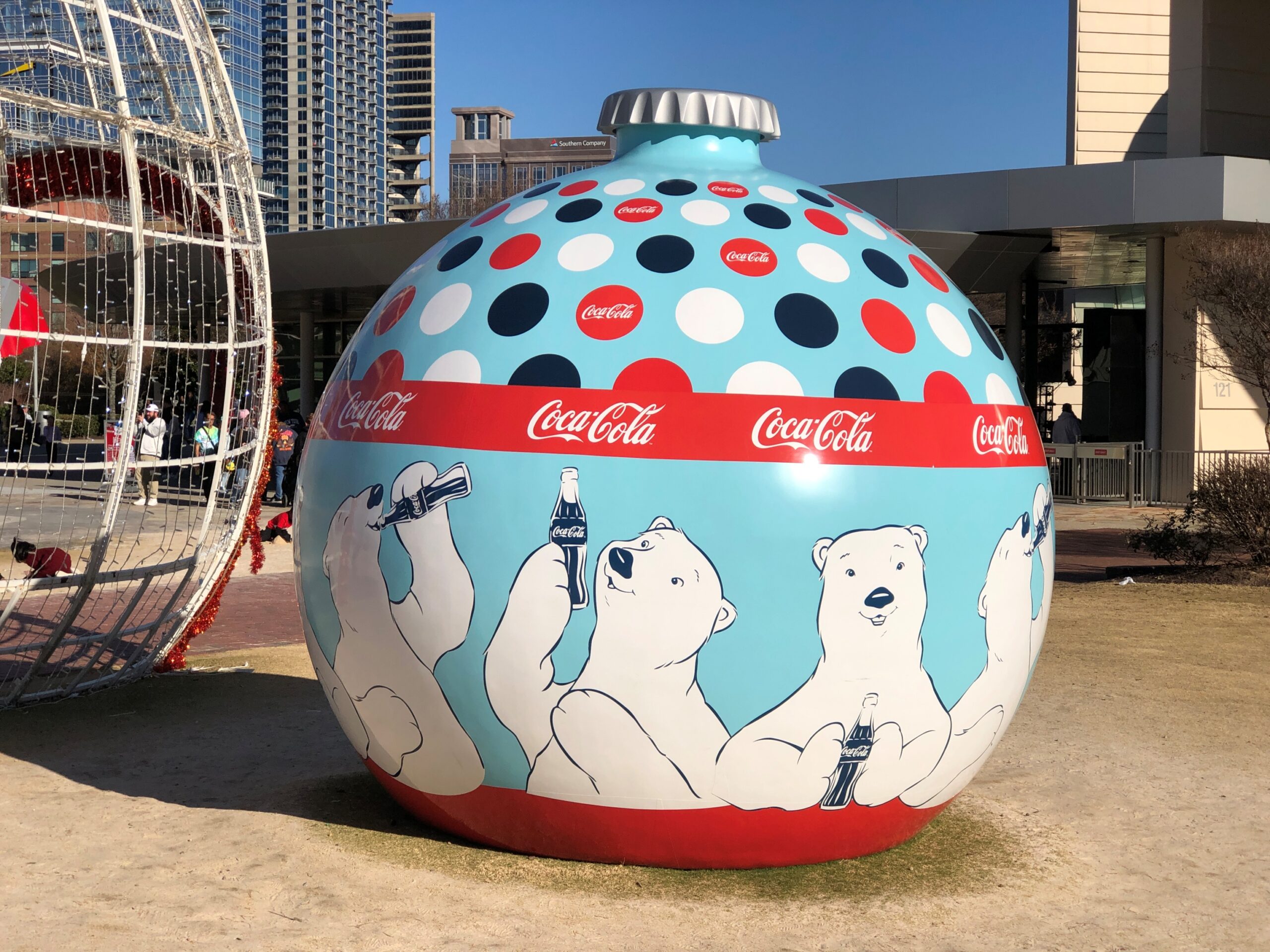
“The Coca-Cola Polar Bear… became truly iconic in 1993 with the launch of the ‘Always Coca-Cola’ campaign. In the famous ‘Northern Lights’ commercial, created by Ken Stewart, animated bears gather to watch the aurora borealis while enjoying Coca-Cola — a scene that brought the Polar Bear to life and captured the hearts of viewers worldwide,” the museum notes.
Does it rise to the level of icon? Somehow the Coca-Cola Polar Bear had made only a faint impression on either of us, so we took a pass on it. Also, there was a line. And it cost extra? Always with the revenue streams. But I did enjoy the more standard sort of museum exhibits on offer at World of Coca-Cola.
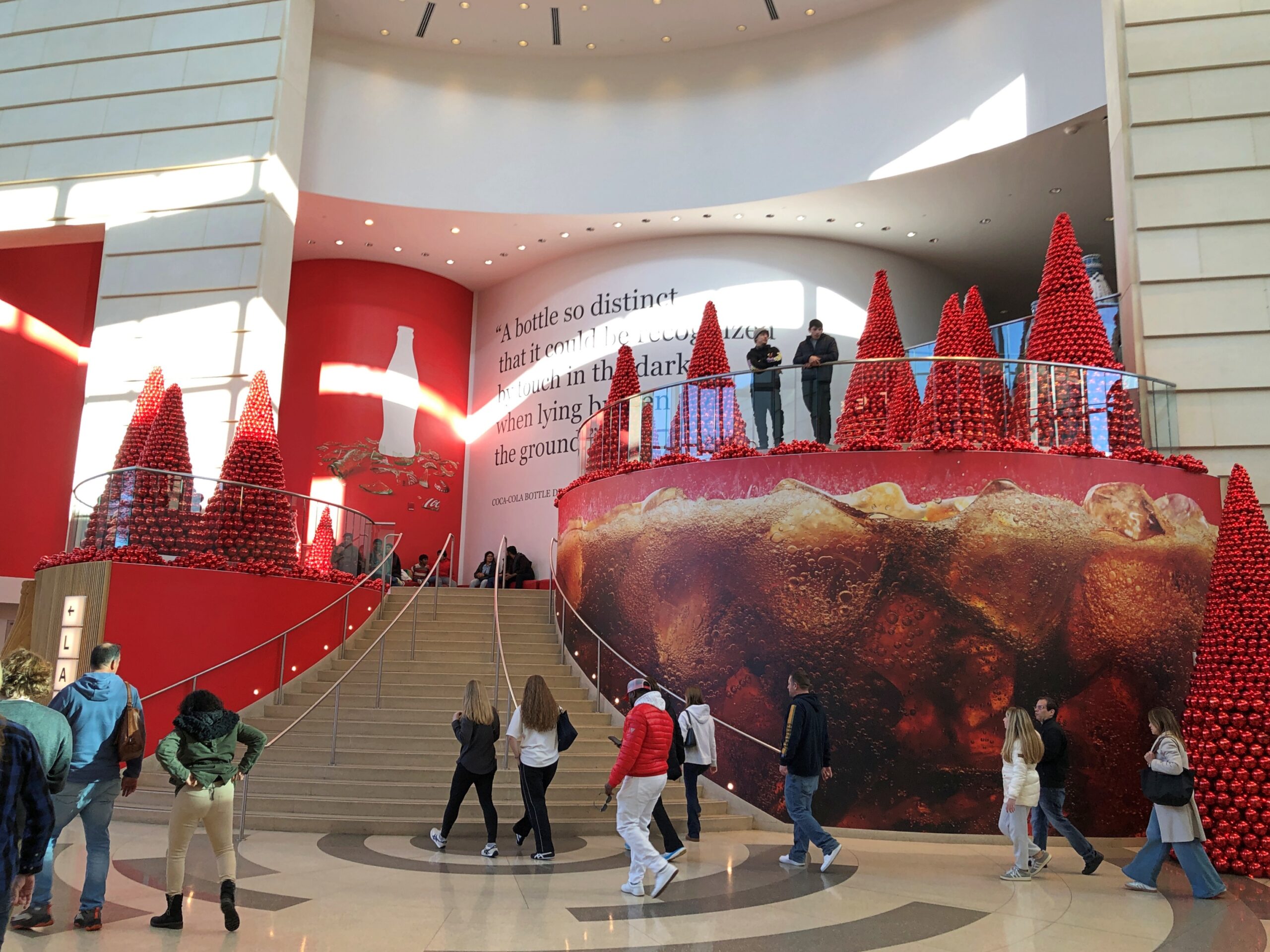
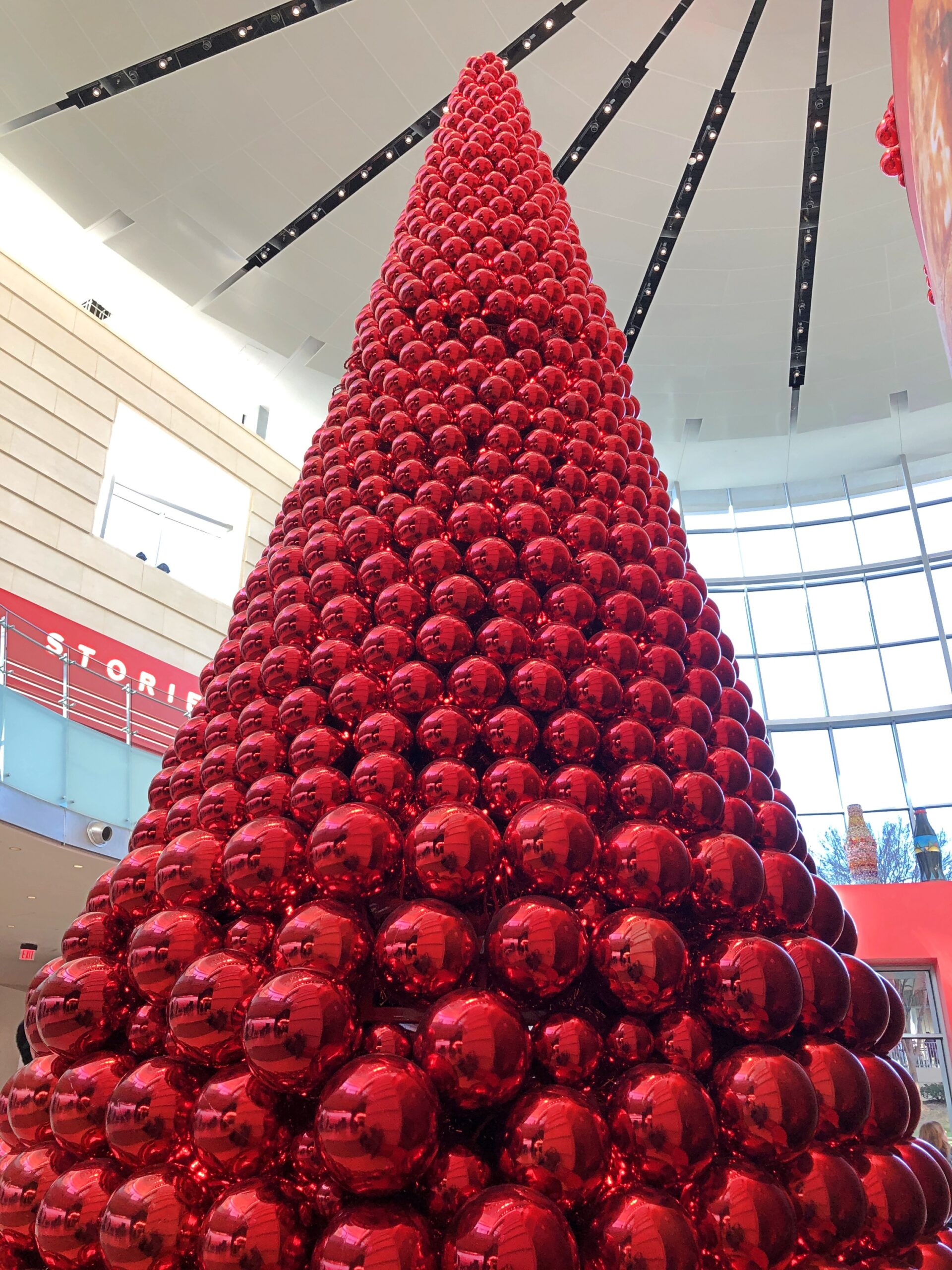
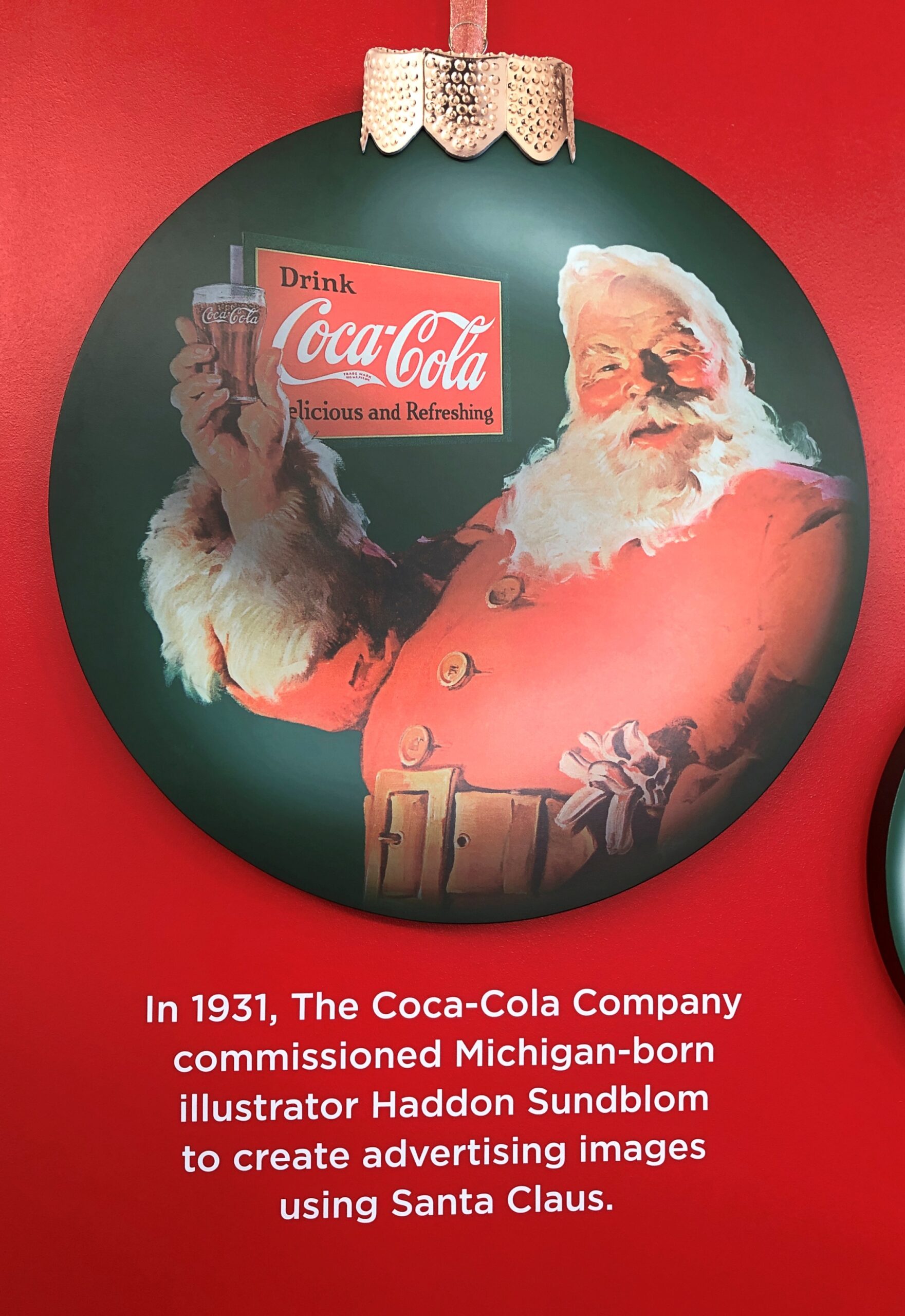
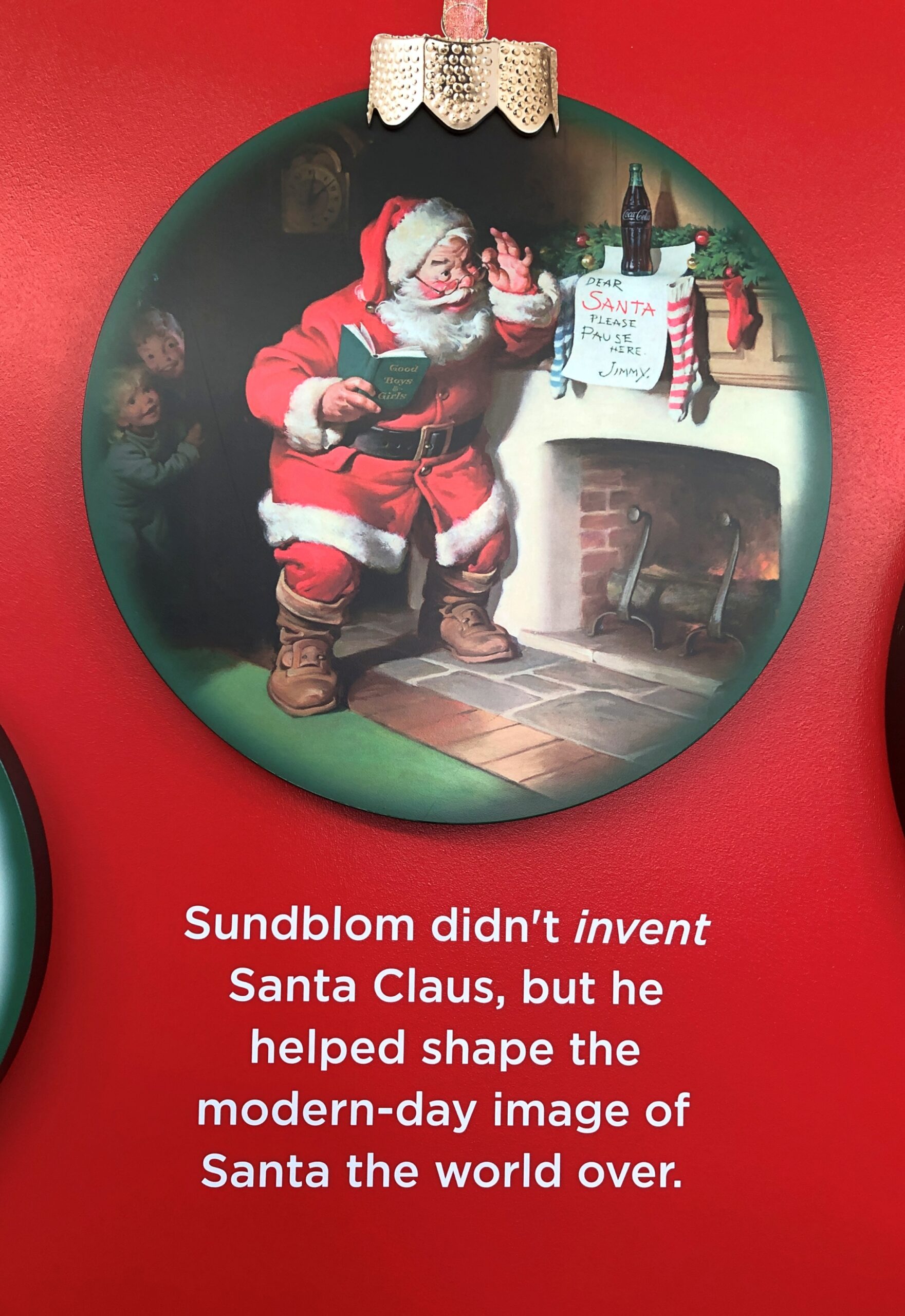
A seasonal observation.
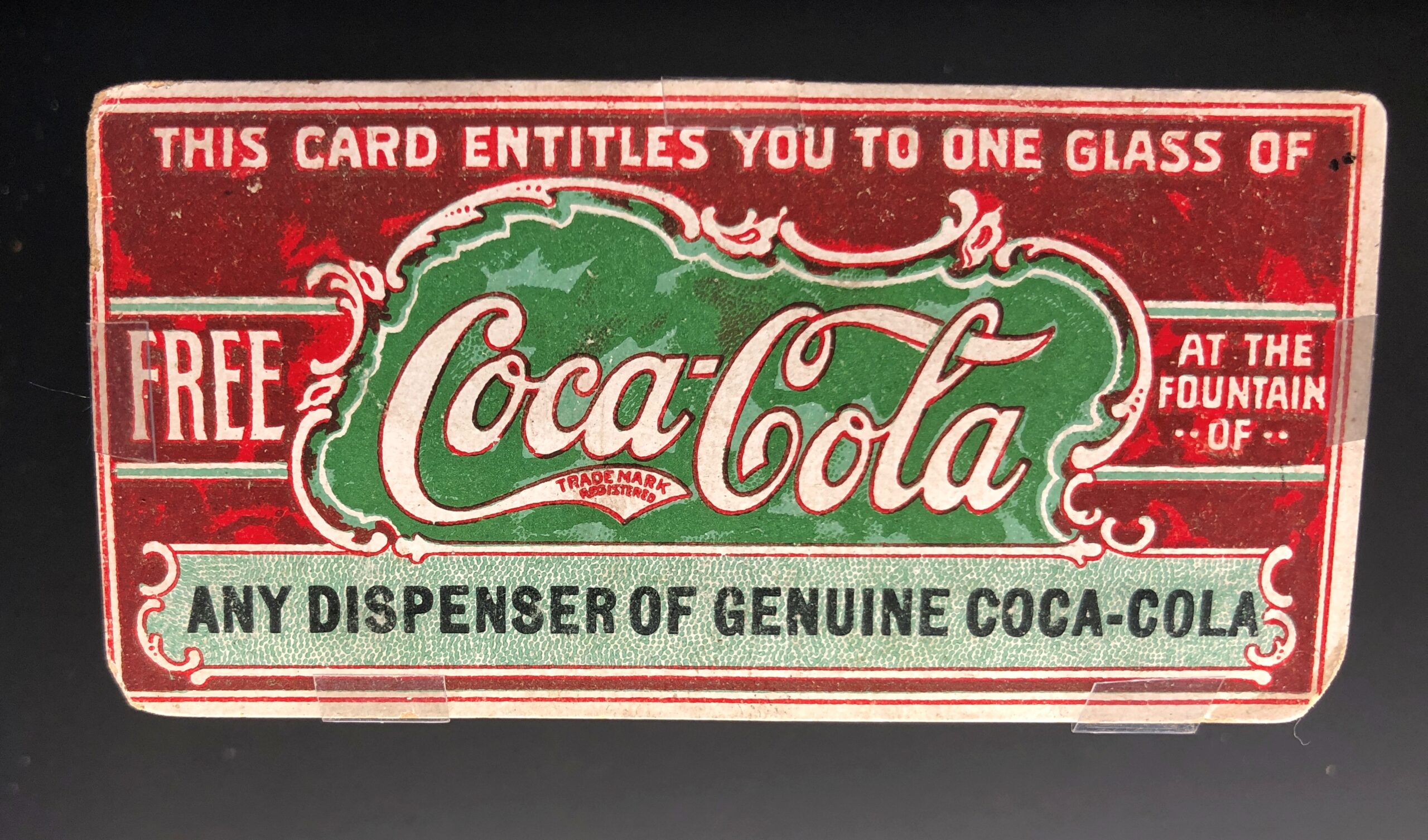
Artifacts from long ago.
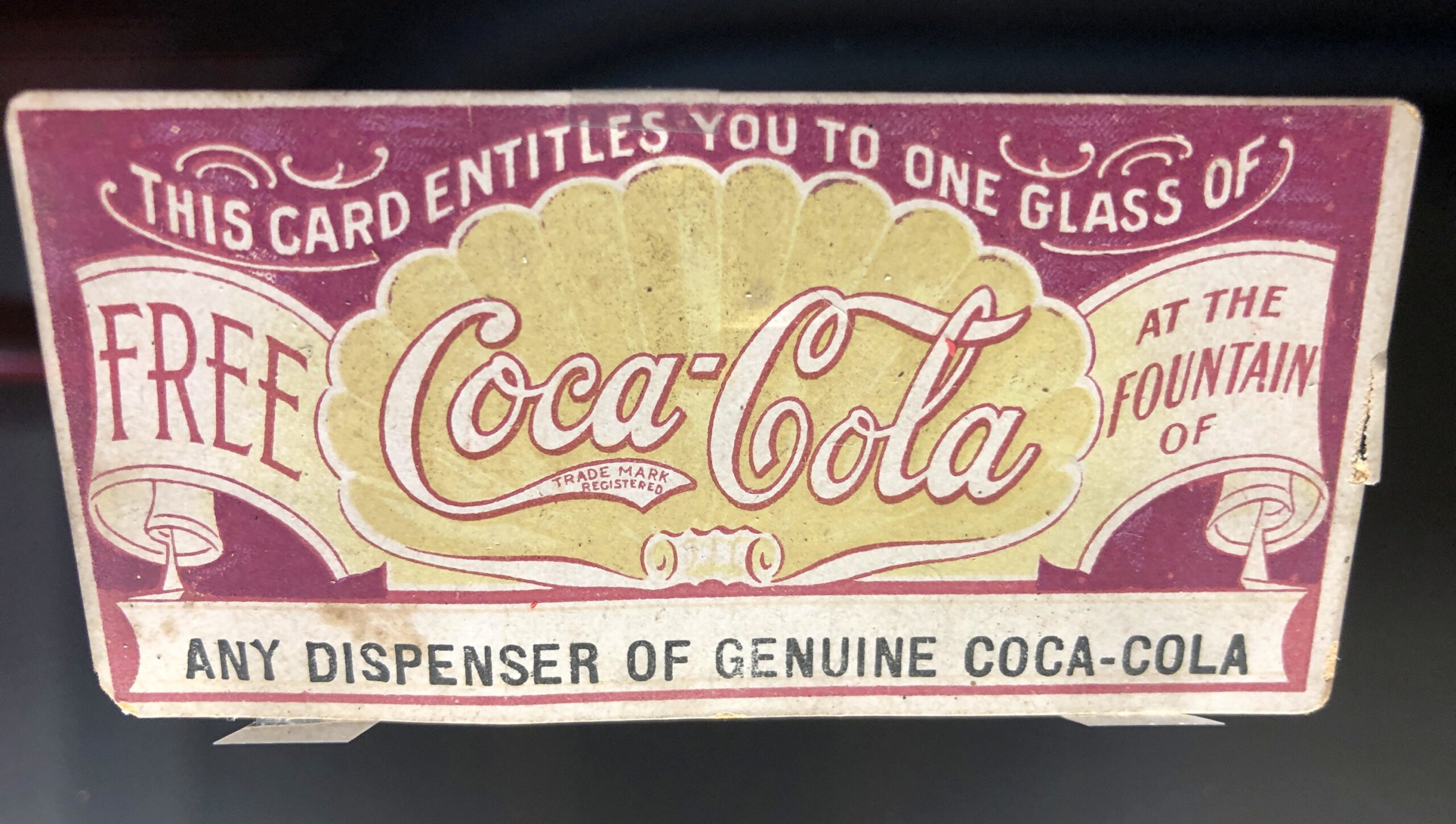
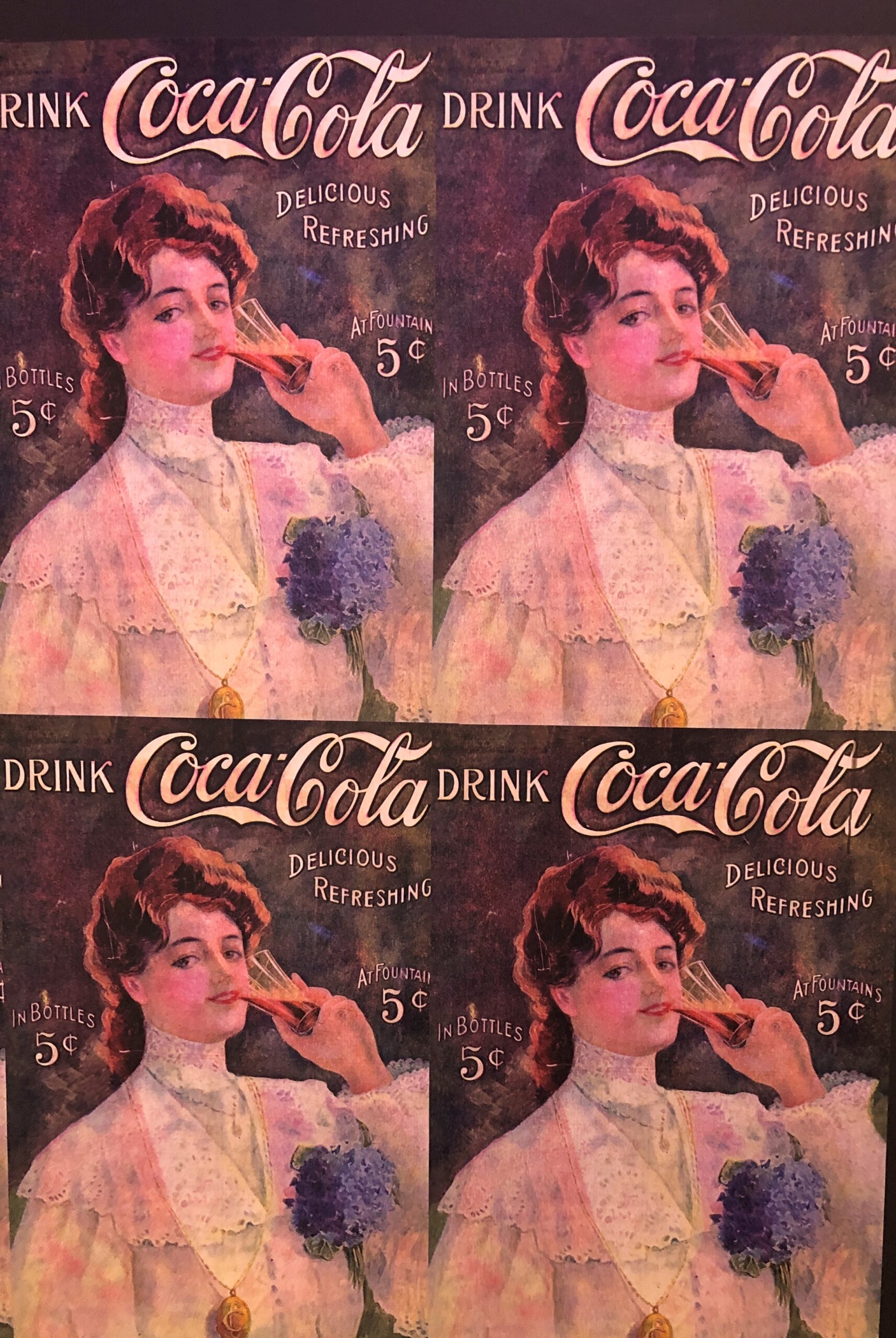
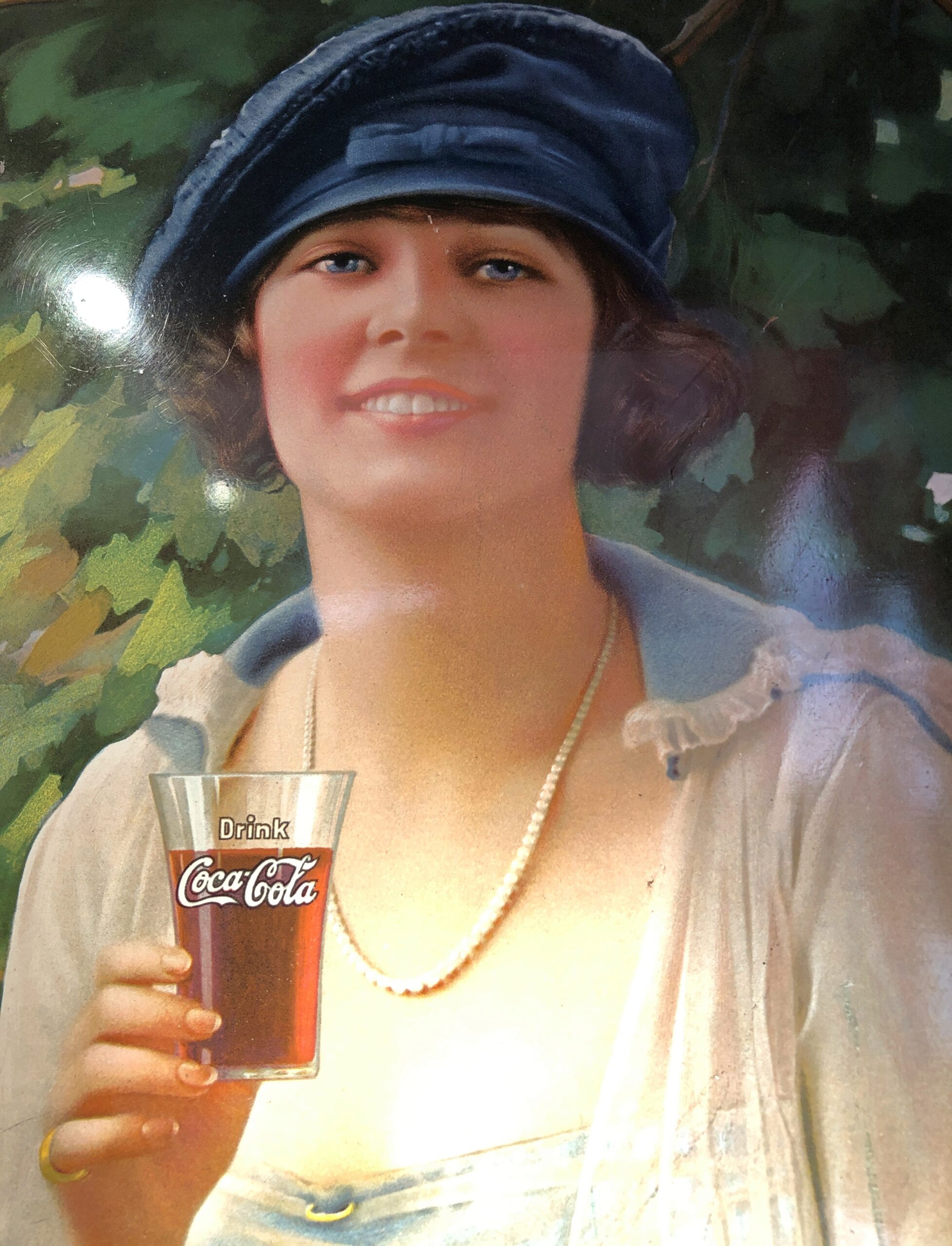
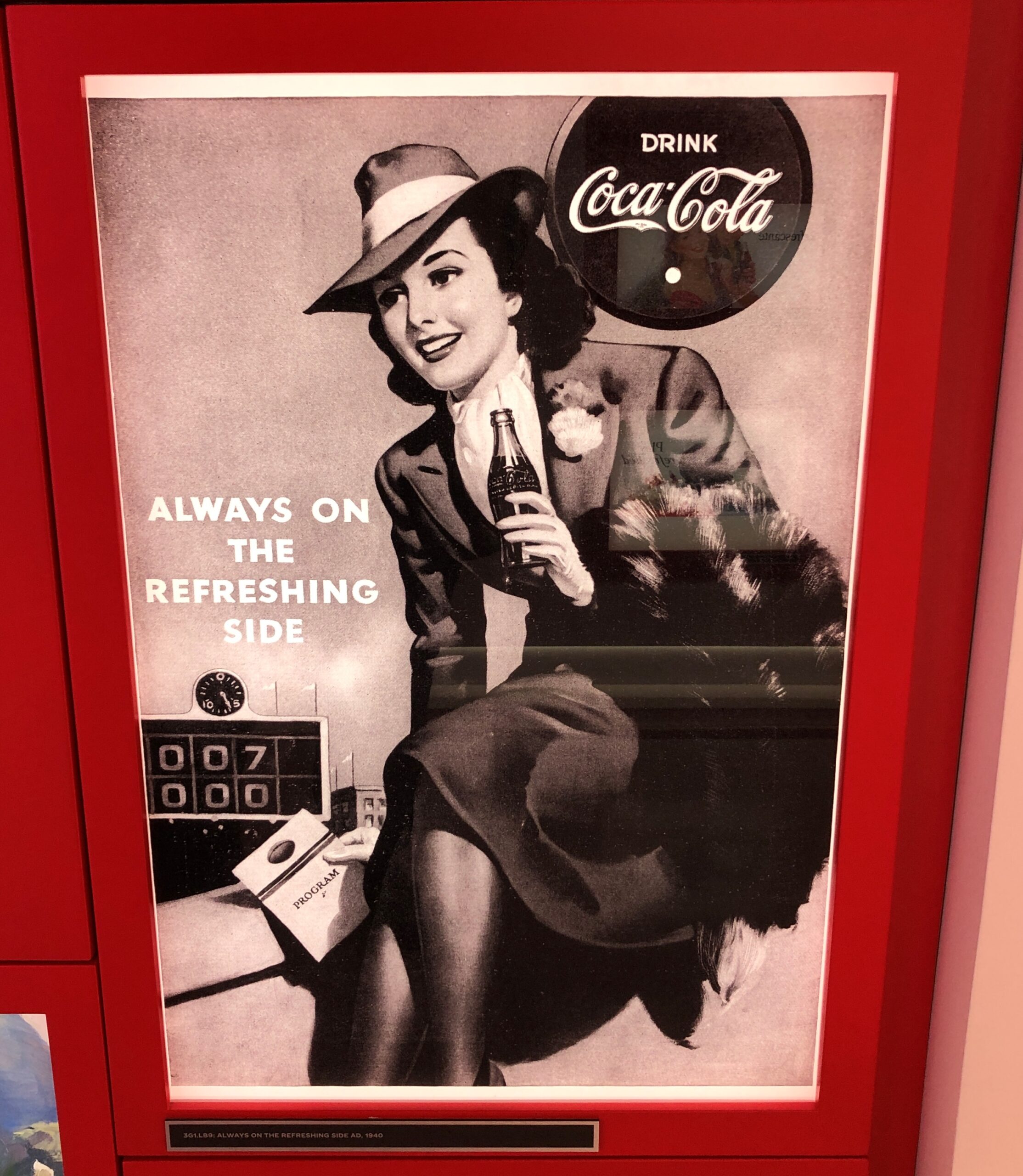
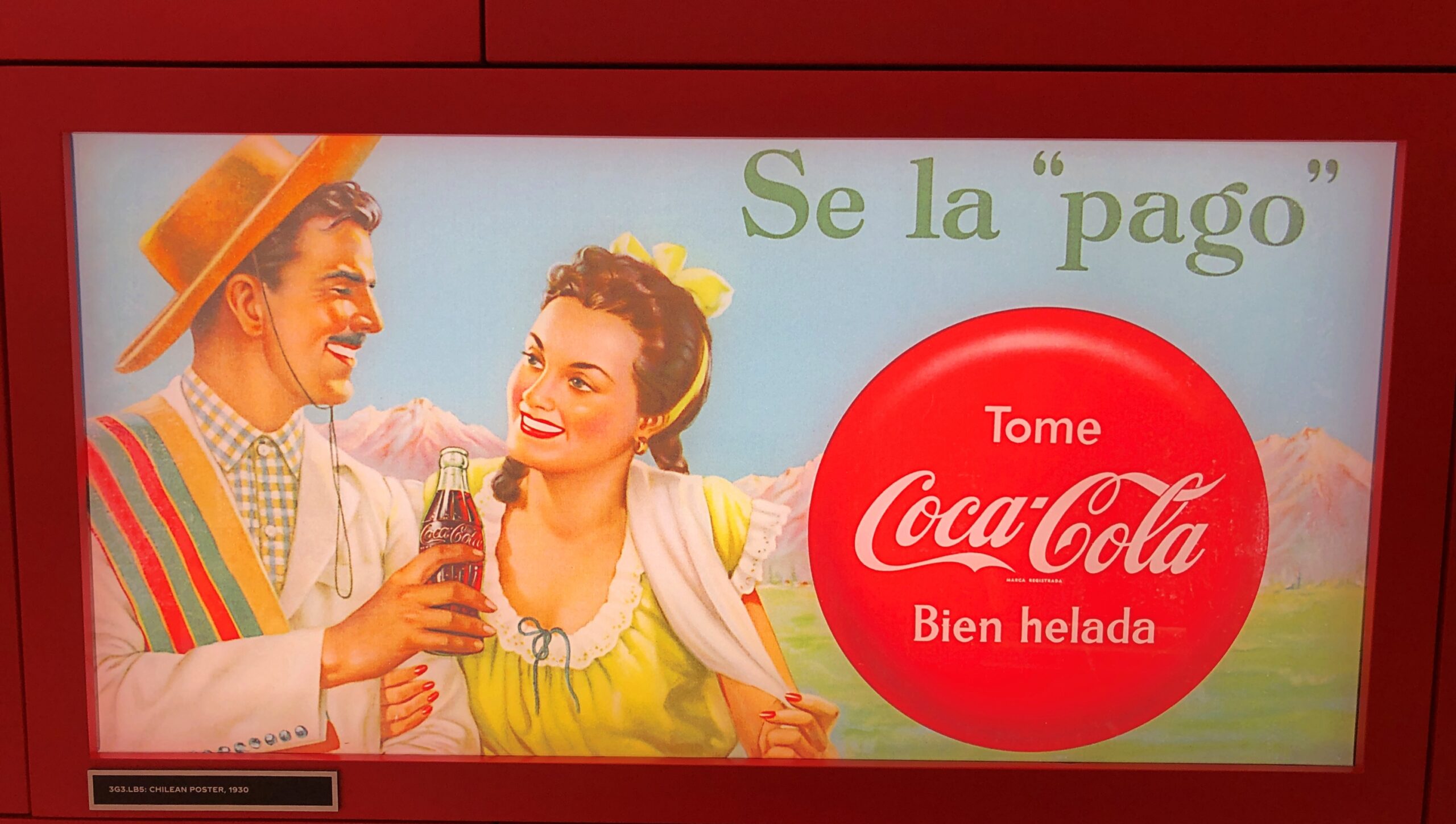
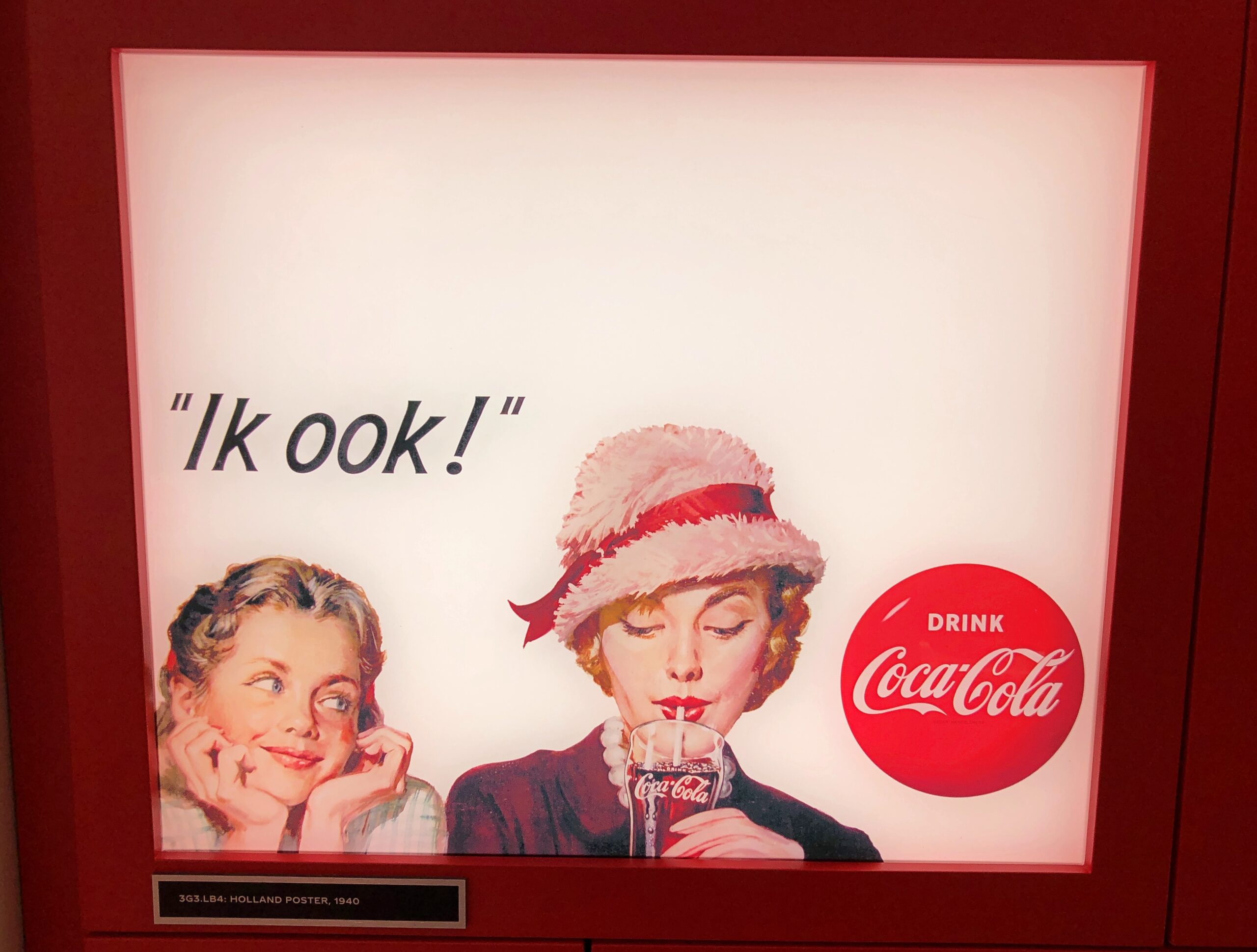
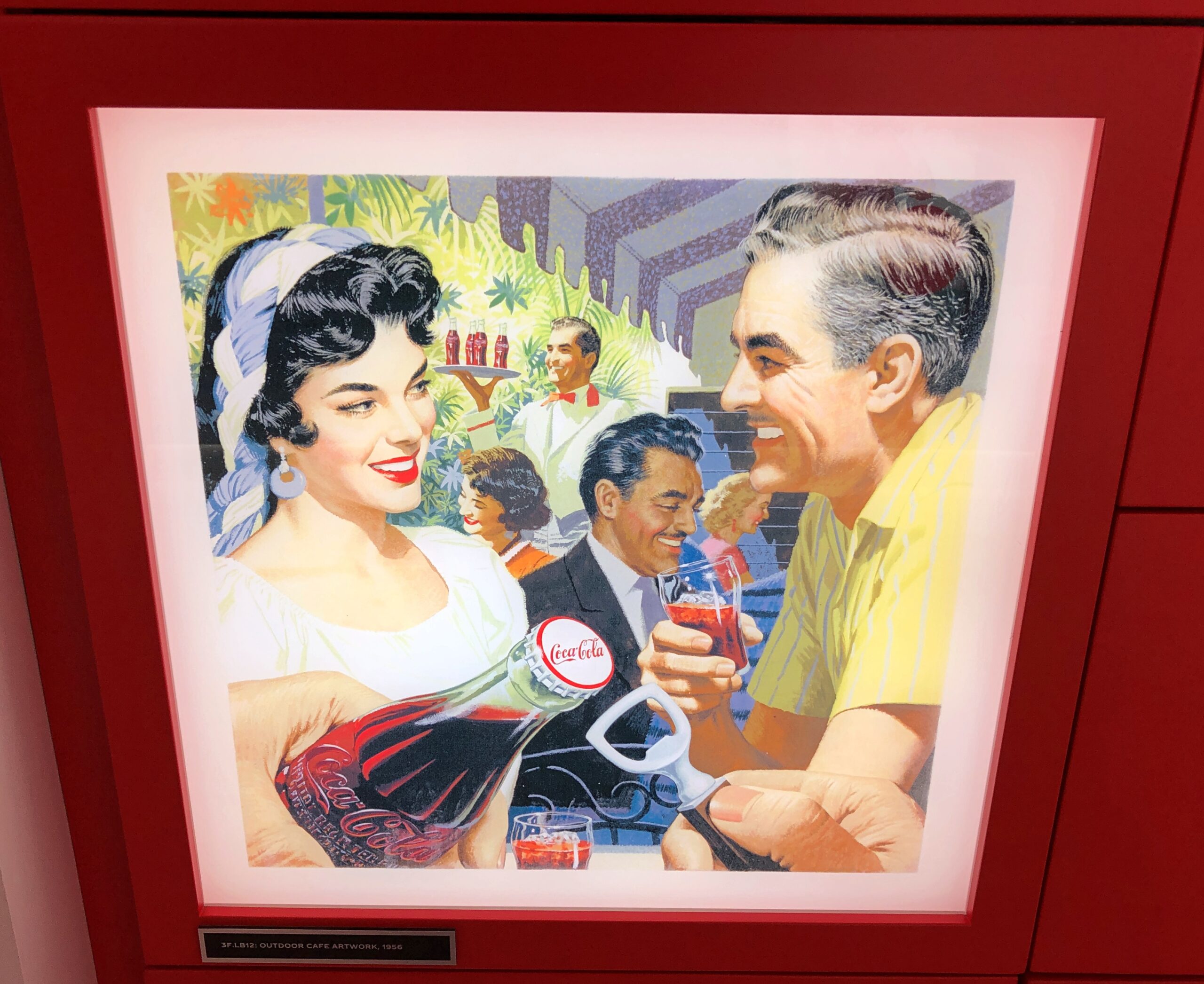
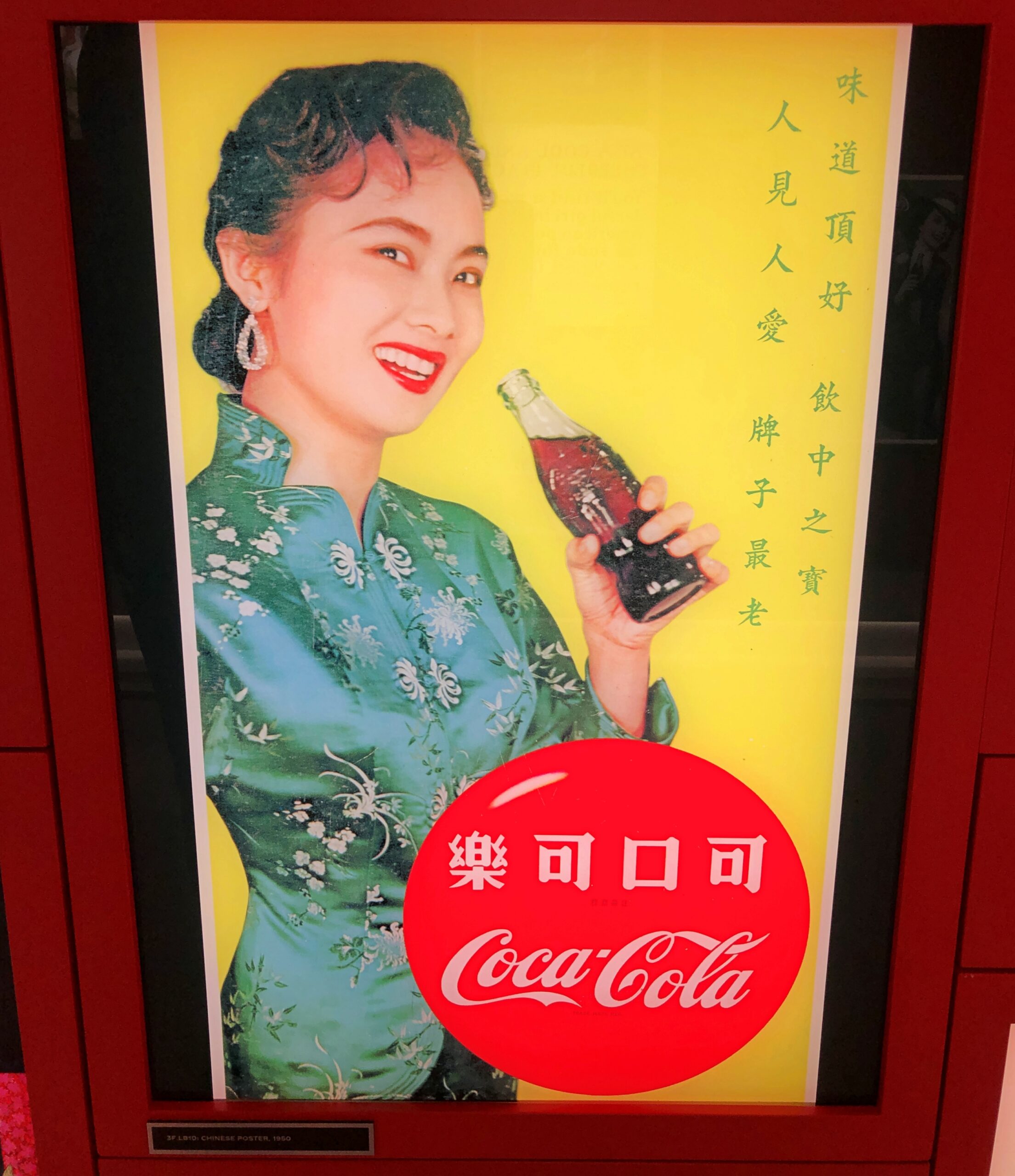
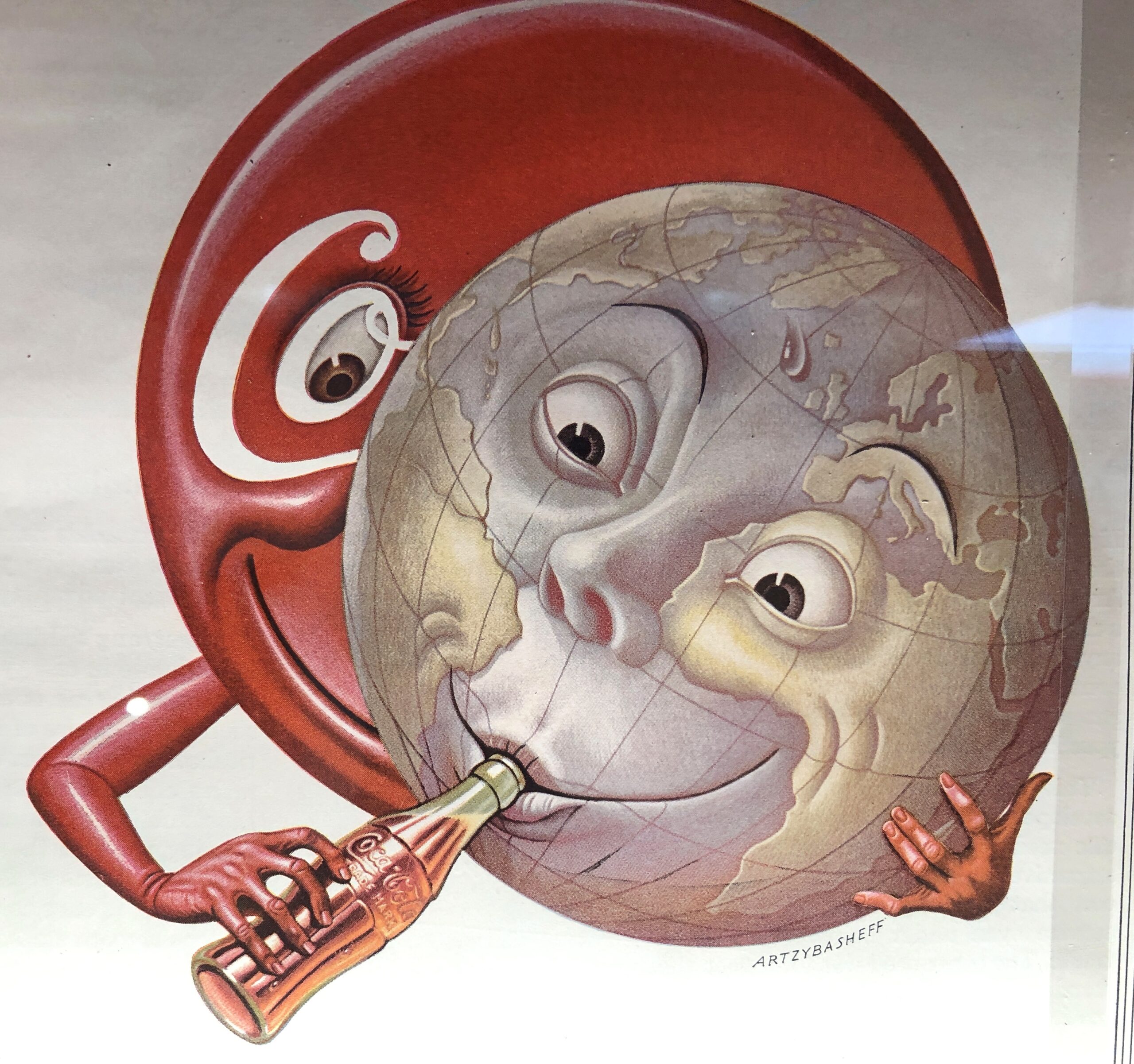
Ads from long ago.
And from distant places.
I seem to remember a similar political cartoon of featuring the Earth being nursed back to health after the ravages of WWII, but I can’t quite place it.
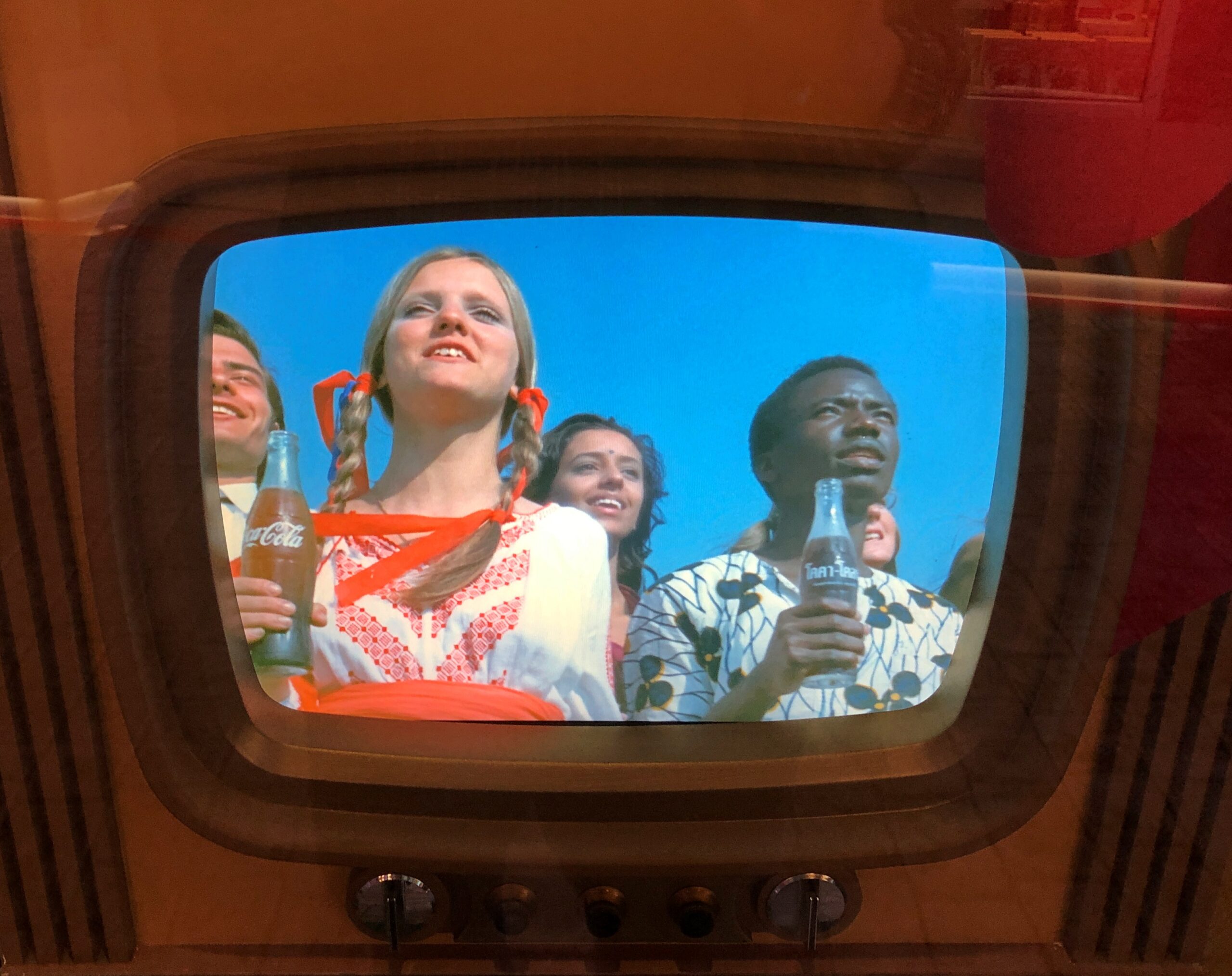
There were video clips, including of course the “Hilltop” commercial. That, I remember. Many people old enough do too, which naturally gave the final moment of Mad Men its punch.
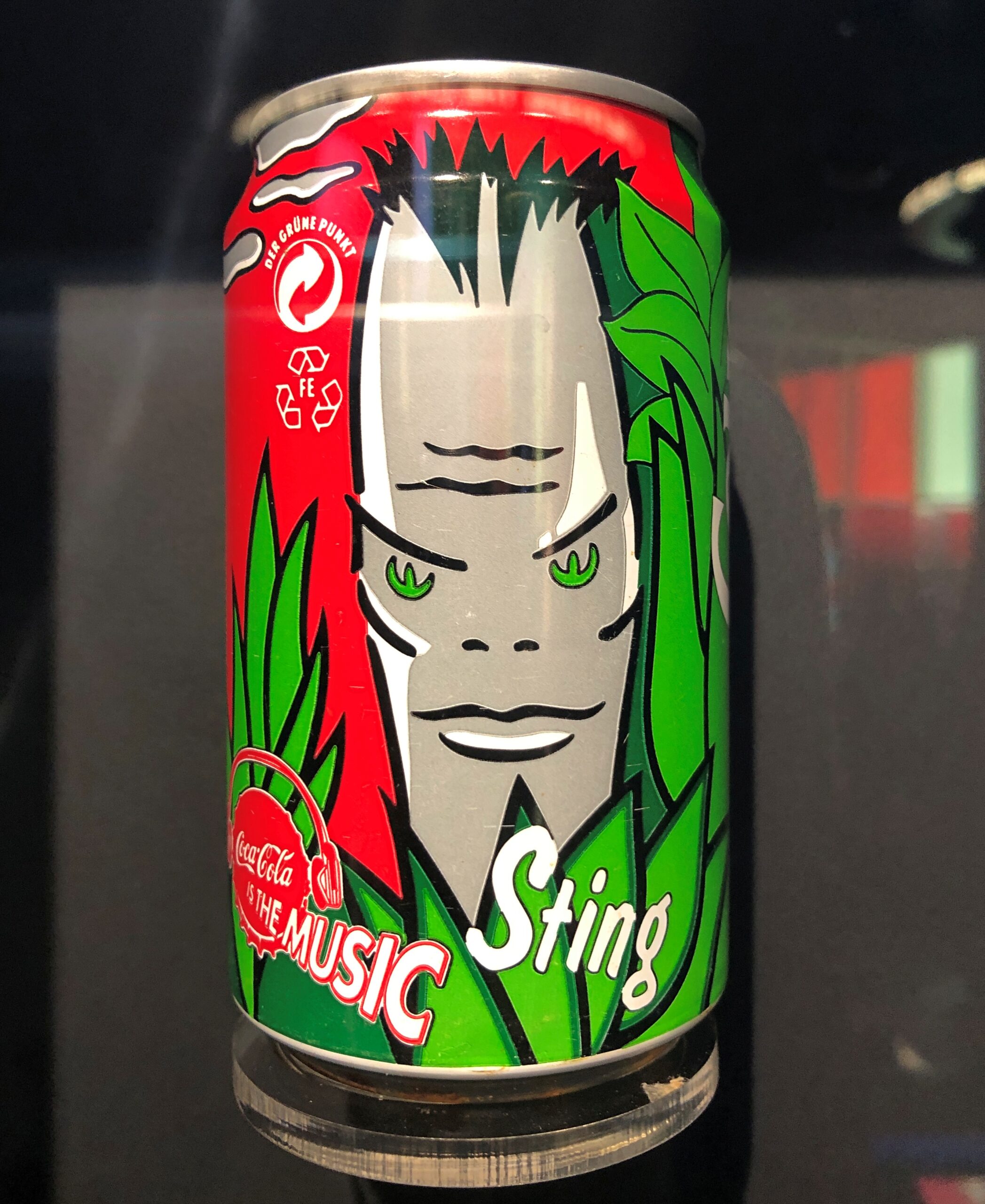
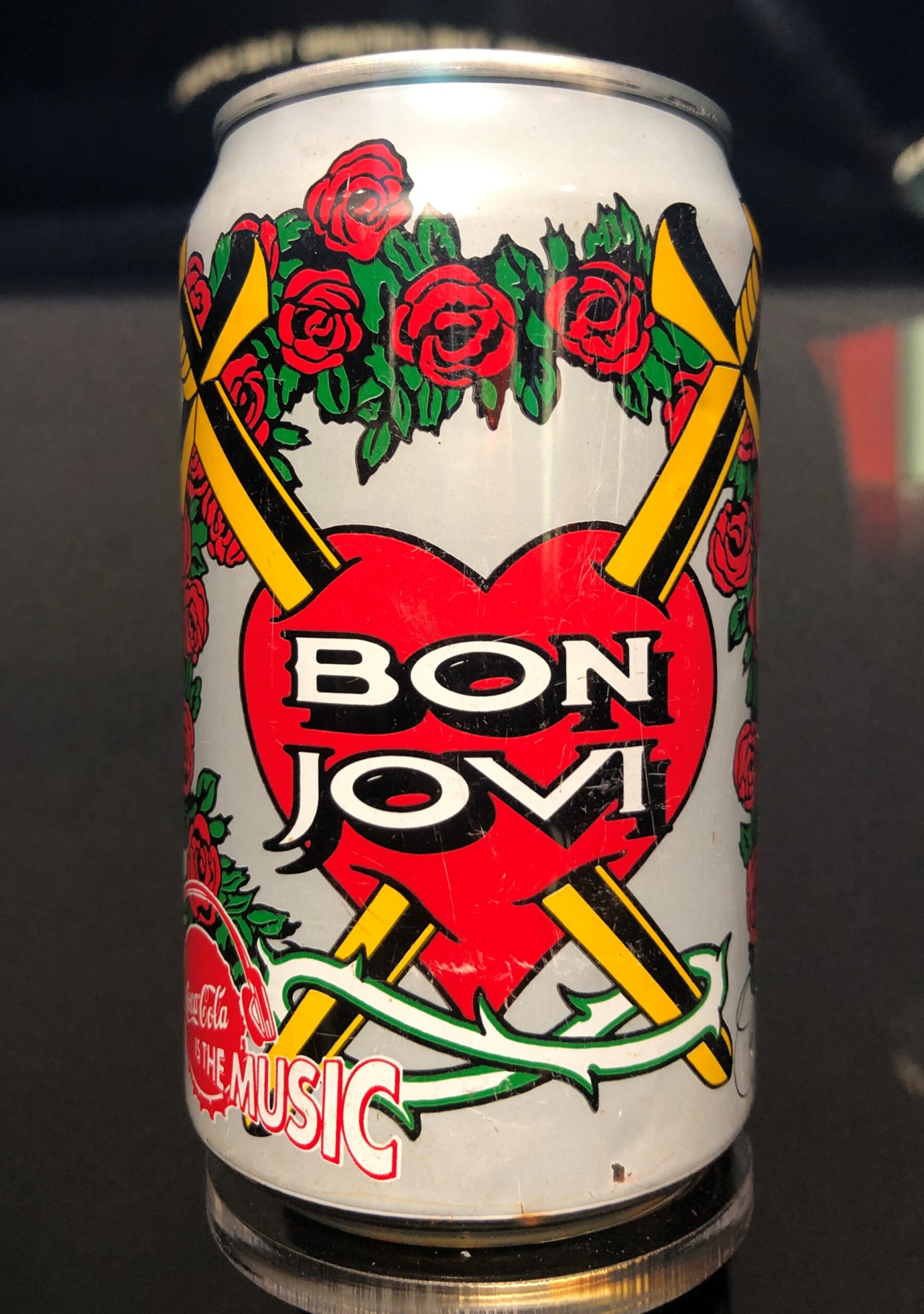
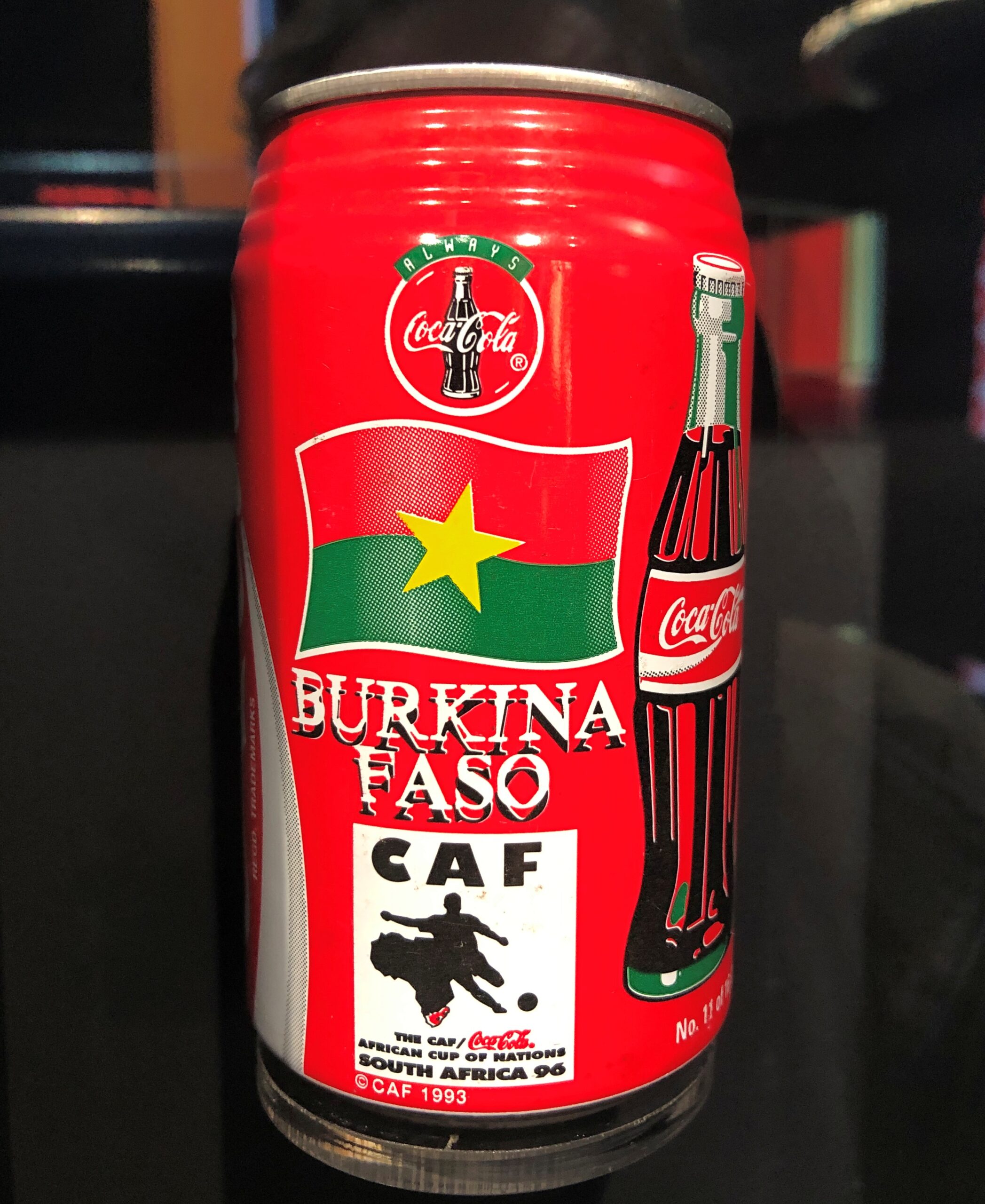
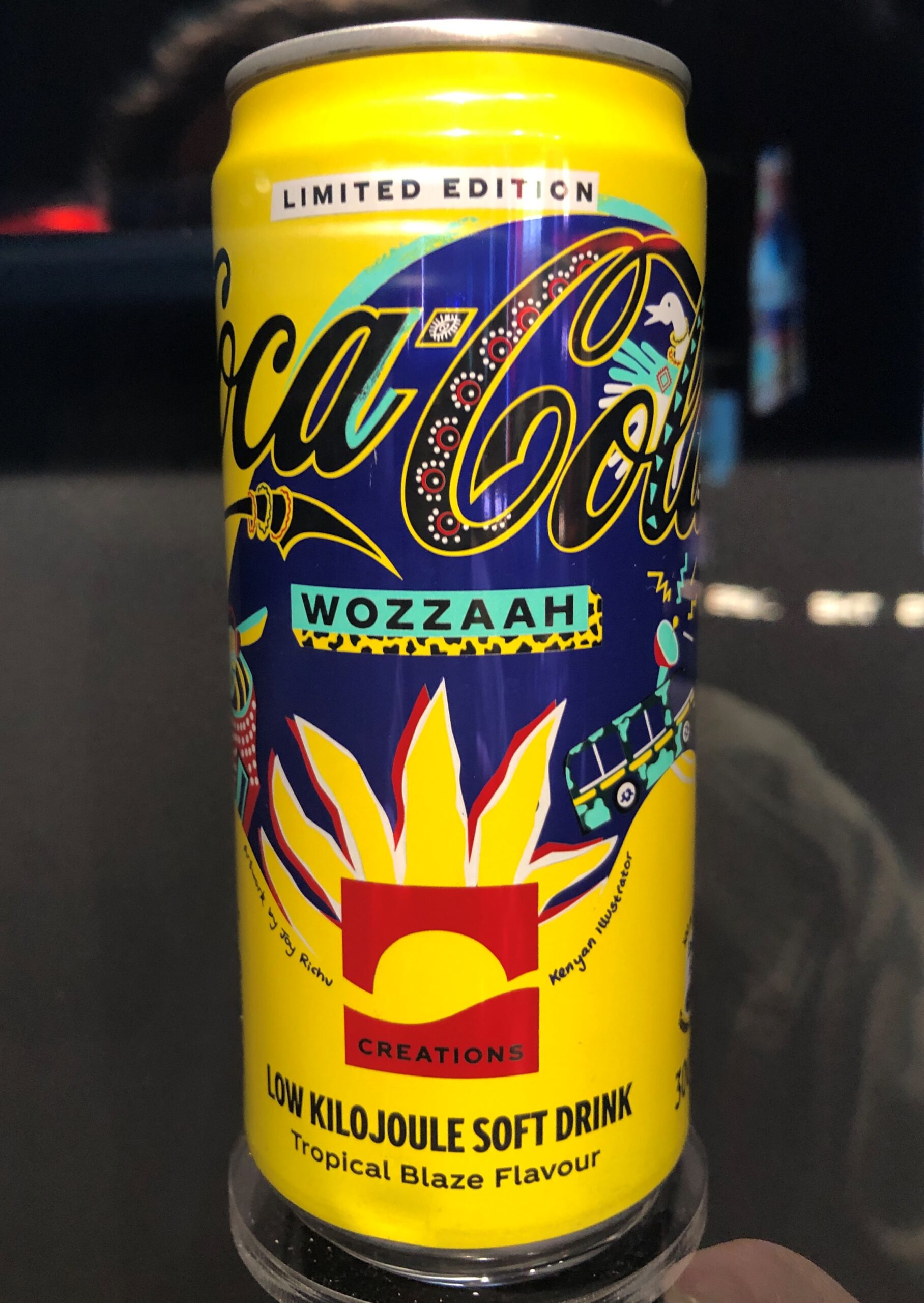
The museum also featured Coke product cans and bottles of various kinds (but not a collection of caps that I saw), many more than you see in everyday grocery stores. For instance, Sting and Bon Jovi had their own cans at one point, as part of a musician series.
Cans from around the world.
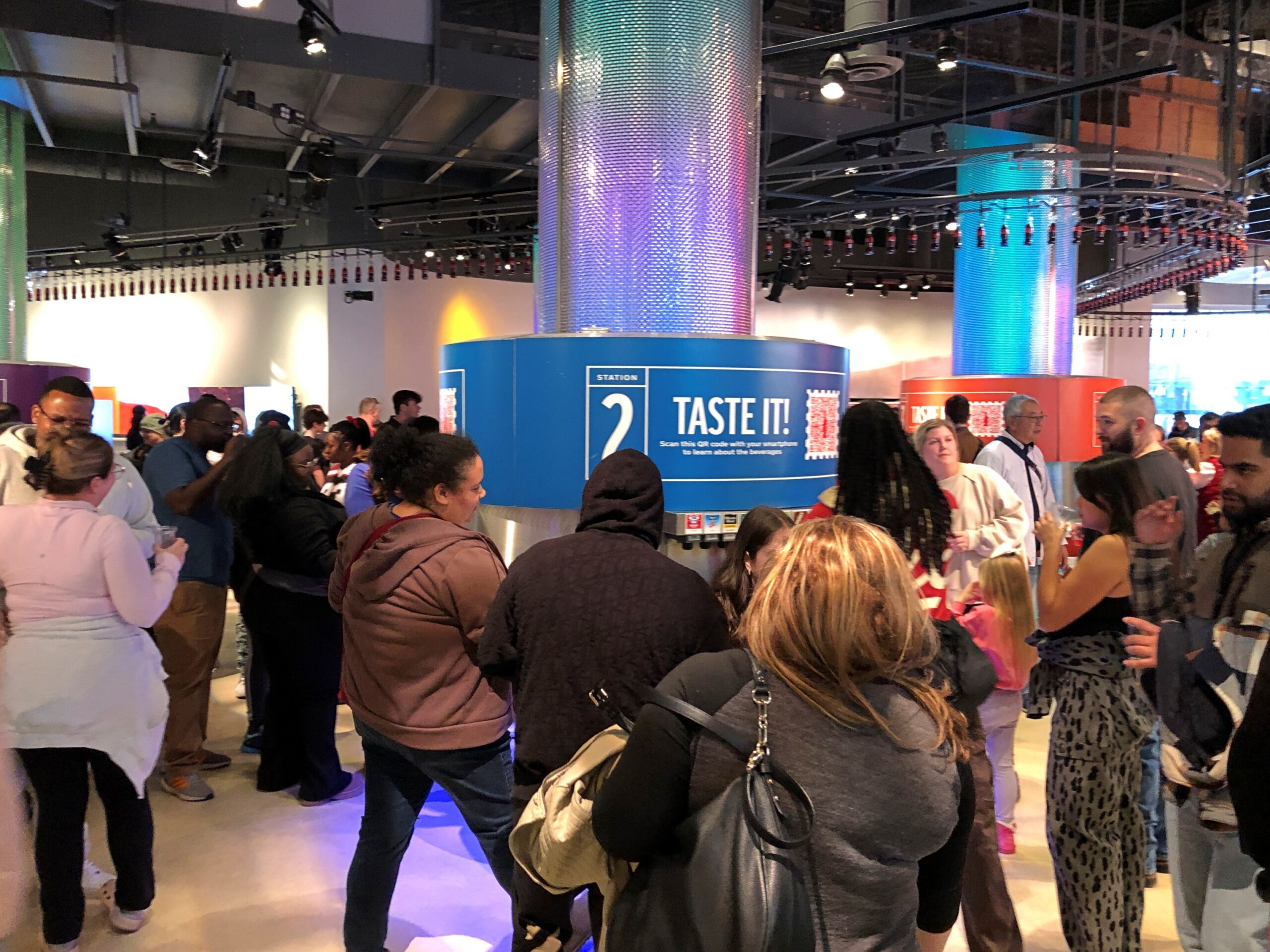
A very crowded room includes soda and water dispensers that allow visitors to sample Coca-Cola products from around the world. We went to town trying the various concoctions, as did a lot of people, and eventually I found my favorite: Bonbon Anglais, a wonderful fruit drink from Madagascar.
The web site Madagasikara tells us: La boisson gazeuse Bonbon Anglais est fabriquée à Madagascar, un pays reconnu pour ses produits naturels et son savoir-faire artisanal. I would expect no less.
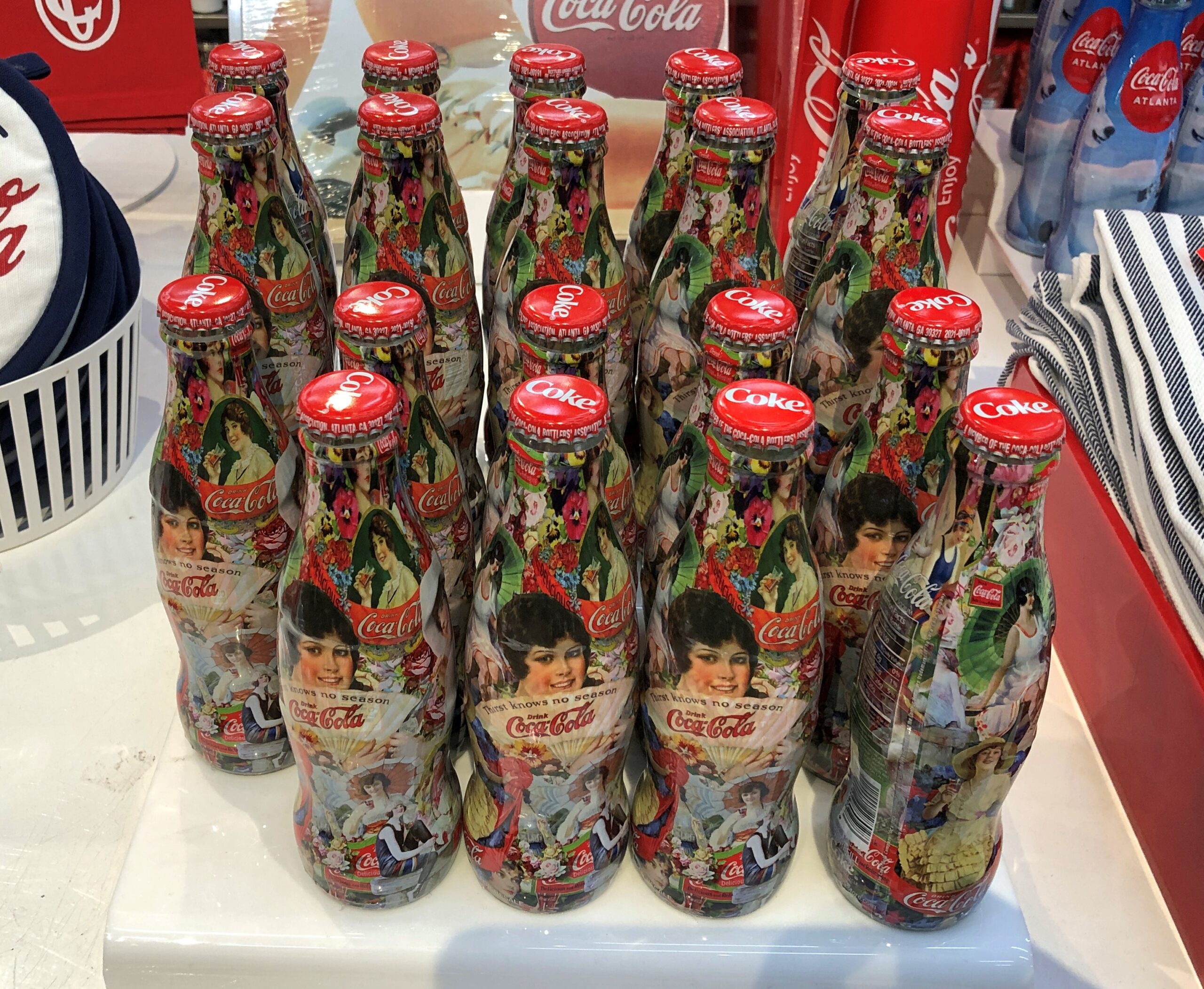
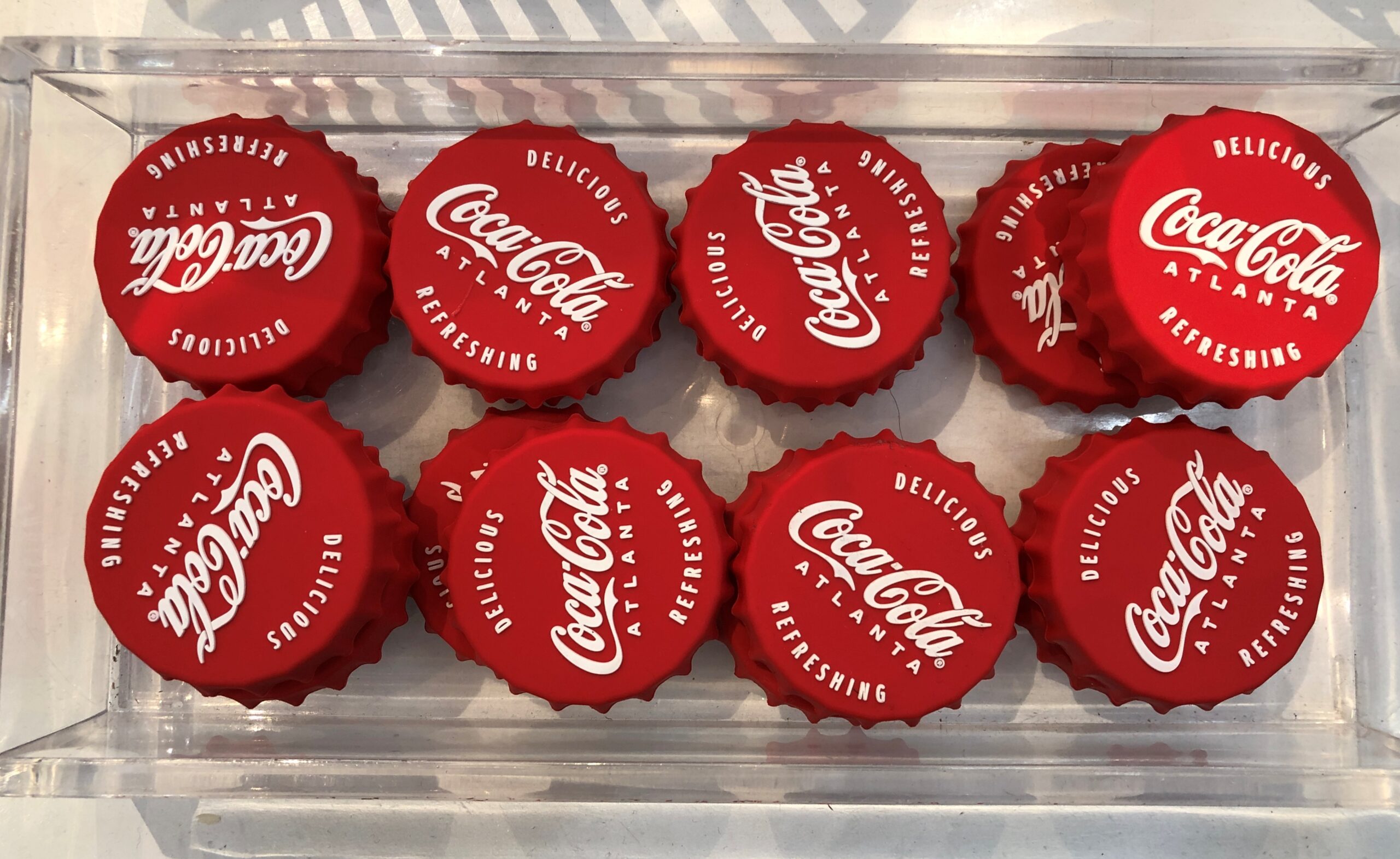
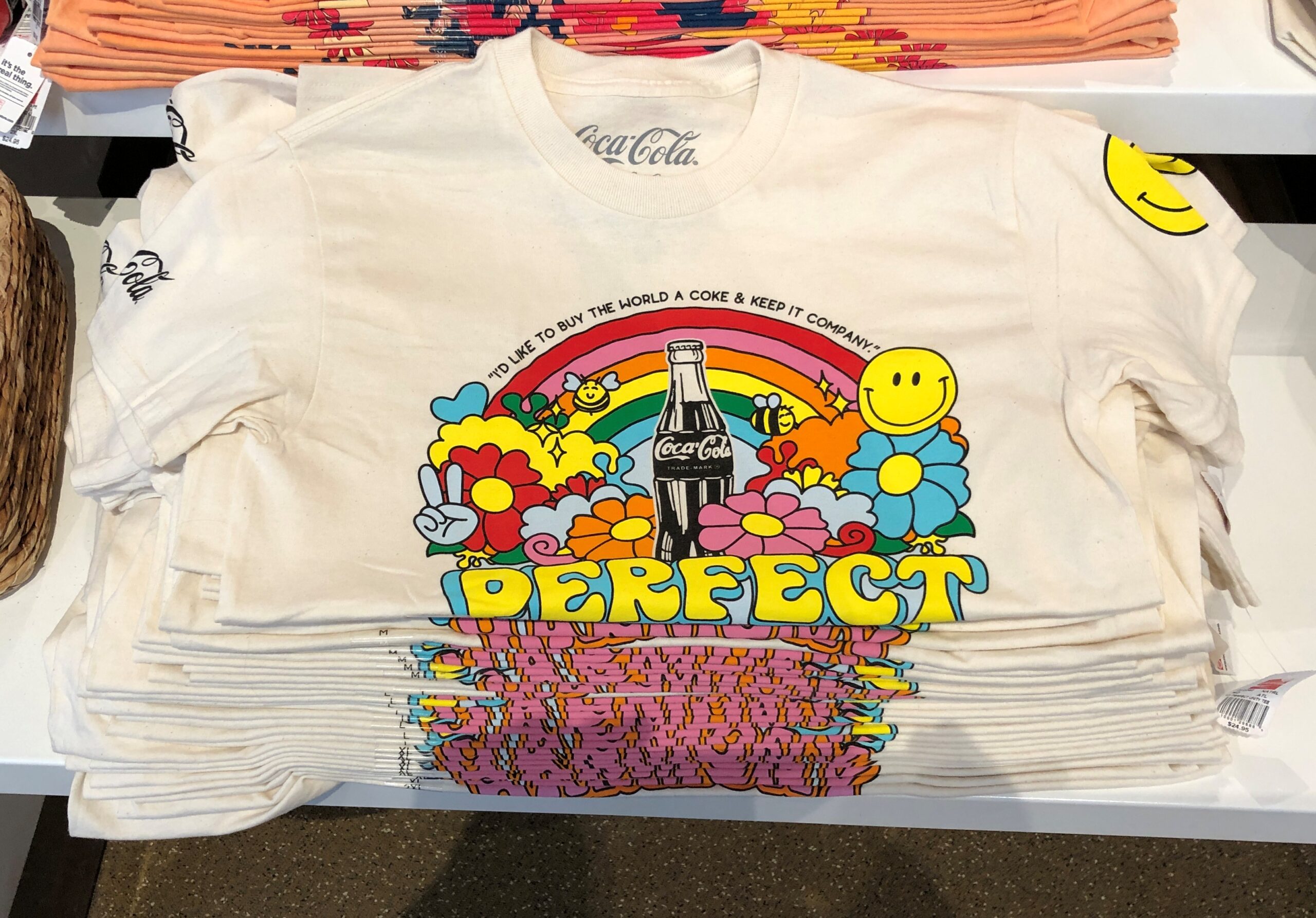
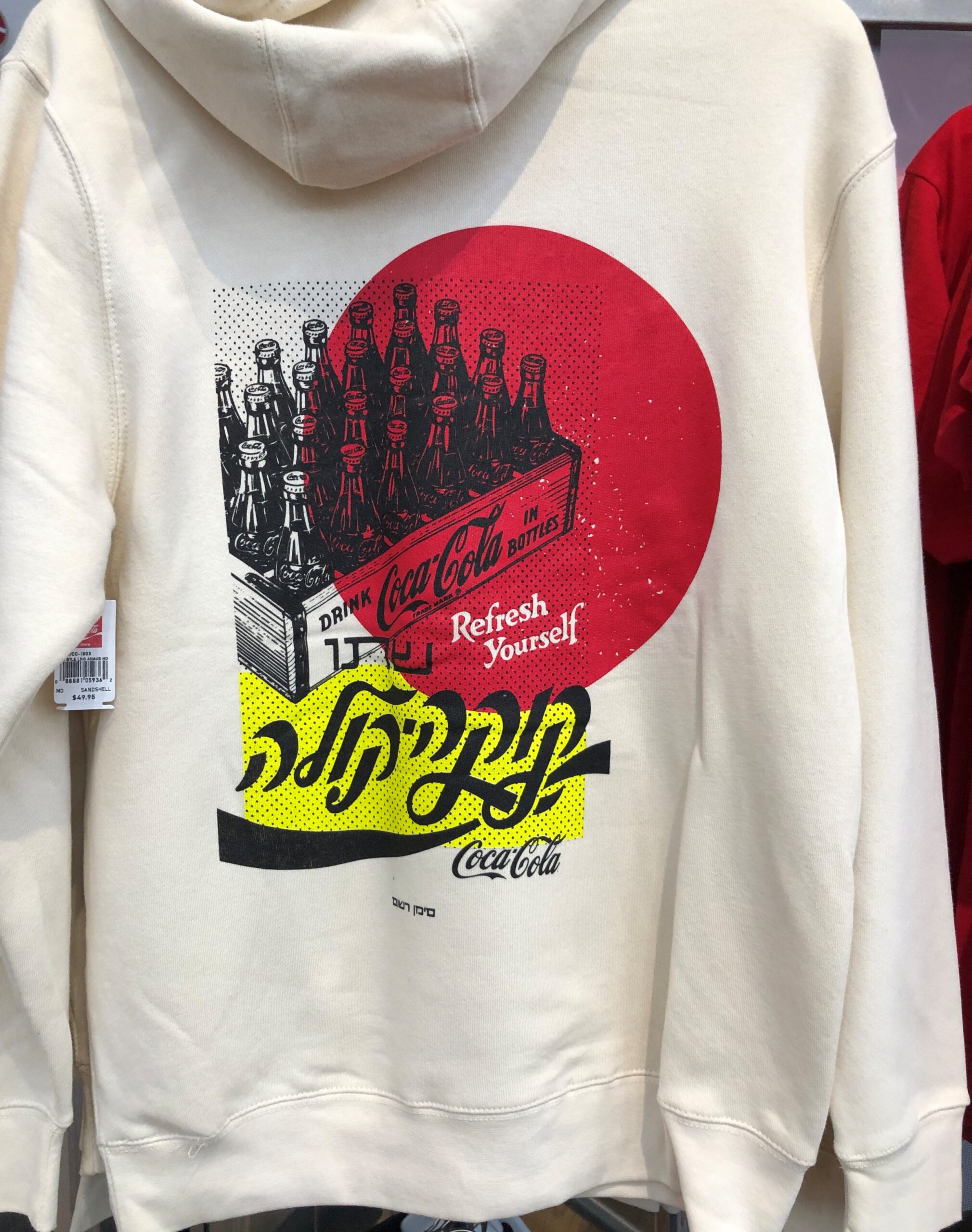
The gift shop was crowded, too. I took pics but bought no Coke merch. (I might have bought a postcard, but found none.)
To my way of thinking, the Coca-Cola Co. should pay me – even a little – to advertise its products on my person. Also, while I’m on that particular hobby horse, the World of Coca-Cola shouldn’t charge admission, especially not as much as a standard museum.
I ran the numbers, and World of Coca-Cola admission costs more than twice as much as admission to the Taj Mahal. Sure, Georgia isn’t Uttar Pradesh, but it’s galling that you’re paying at all, just to be marketed to. Obviously Middle America disagrees with me – and Yuriko didn’t mind paying for both of us – so that idea will just have to be a quixotic hobby horse of mine.
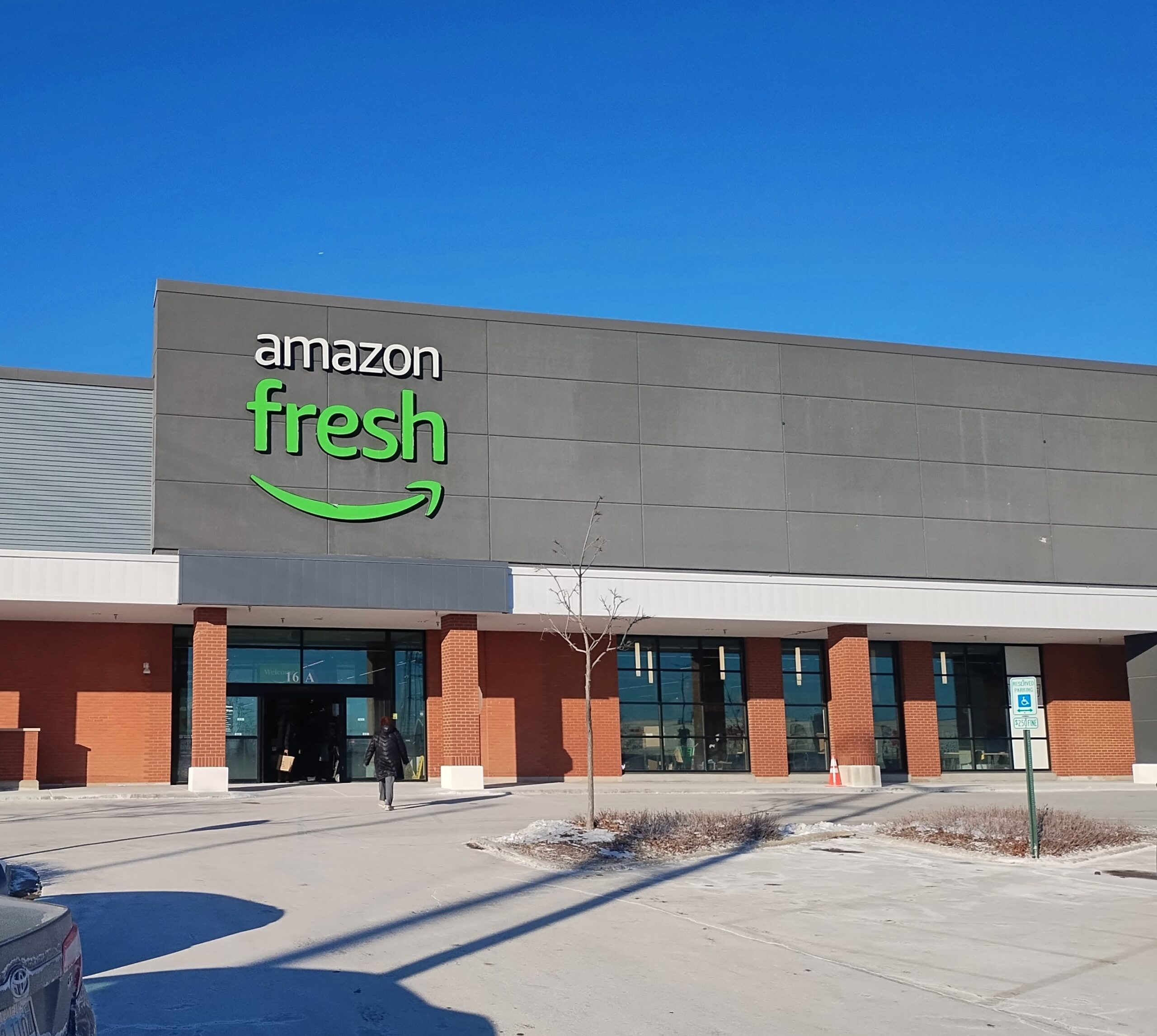
Yesterday, behemoth retailer Amazon announced that its Amazon Fresh grocery stores are closing. All of them, about 70 locations, and closing soon, as in Sunday. I read about that this morning, and happened to mention the fact to Yuriko early this afternoon, so we decided to mosey over to the closest Amazon Fresh, about a 10-minute drive from our home here in the northwest suburbs.
We’d been there. In the store’s early days especially, a few years ago, weekly fliers came in the mail offering coupons that could, if used right, mean 40 percent or even 50 percent discounts. That was worth some visits. After a few months, however, the coupons got progressively more miserly or disappeared all together.
That was no surprise. The coupons’ main function was to get you in the door, and acquainted with the store, and ideally form a good opinion that inspires return visits. A good marketing plan, even if it relies on something as analog as paper coupons, and it might have worked but for one thing: there was very little distinctive, to an ordinary shopper, about Amazon Fresh.
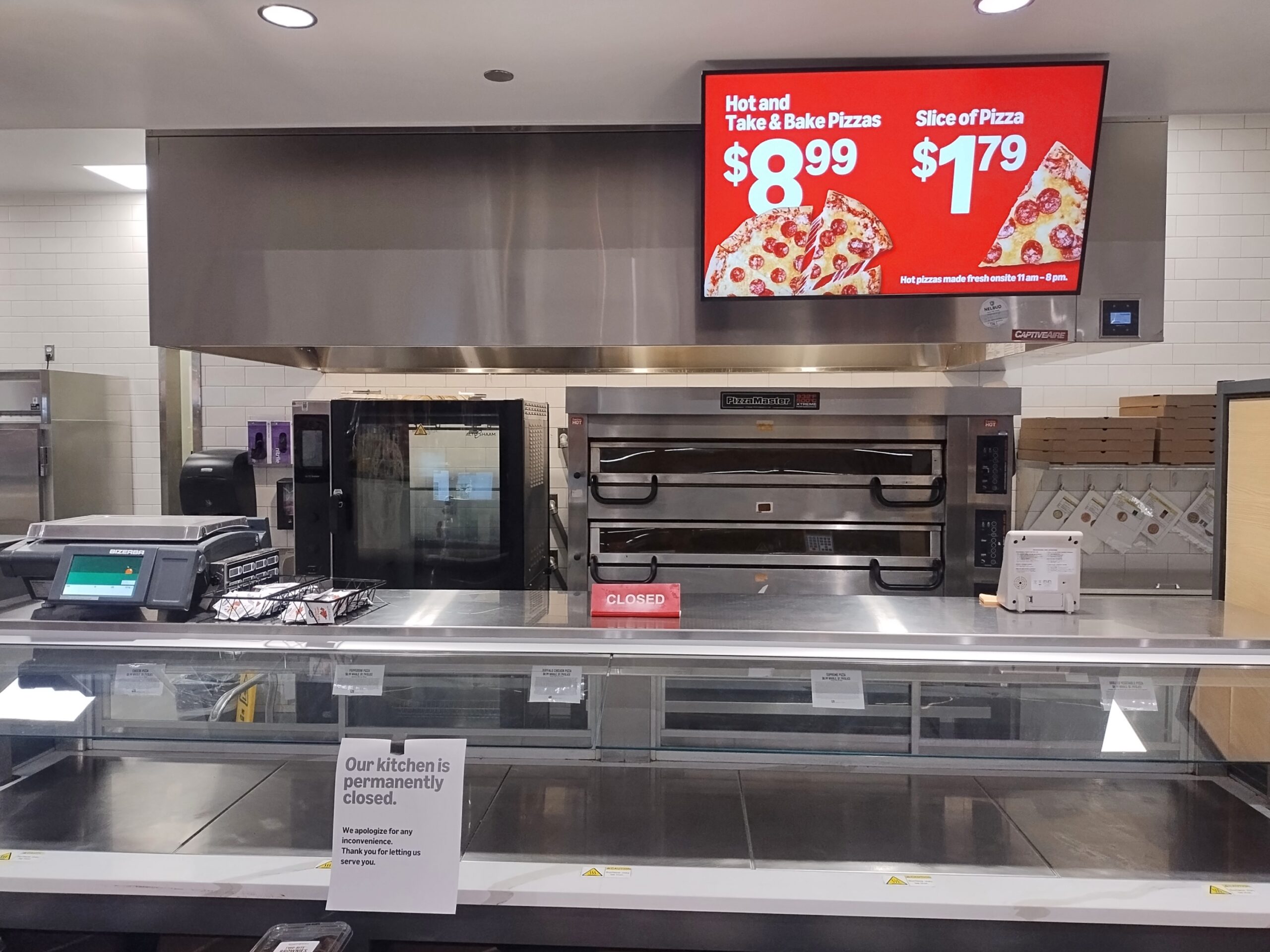
The store promised to be something of a discounter, and sometimes it was. Until recently, for example, it sold sizable and reasonably good pizzas for $9 a pie or less than $2 a slice – entirely competitive. Other items were sometimes discounted as well, but in that the store was no different from any other store in the area.
Even that might not been a discouragement, if the store had competed on selection. By current standards, the NW suburban Amazon Fresh is mid-sized, so isn’t going to be able to offer everything under the sun. But even smaller stores can pull off a remarkable selection, if they try. Such as Trader Joe’s. Or even Aldi, whose more recent iterations are about the same size as the Amazon experiment in grocery stores.
But no. The Amazon Fresh selection is good enough, and certainly would be a boon in a food desert, or even at the edge of one. But the NW suburbs are the opposite of a food desert: we have hyperstores, warehouse stores, standard supermarkets of considerable size, discount grocers, and plenty of ethnic specialty grocery stores of varying sizes, all within a fairly reasonable driving radius. There are even dollar and convenience stores thrown into the mix, and every variety of take-out food that you can imagine. These parts are a highly competitive retail grocery and food & beverage environment, is what I’m saying.
And what did Amazon Fresh bring to the table in such an environment? A lot of meh.
Then there was this business of “Dash Cart.” Amazon Fresh made a big deal about how technically advanced the stores were, because you could “Skip the checkout line. Scan, bag and pay – right from your cart.” Well, OK. Some of the carts had consoles for self-scanning.
Did Amazon actually want its customers to adopt Dash Cart, or was it just showing off? I ask because any hint of any instruction about how to use the thing was lacking. Call it an engineers fallacy: this tech is so cutting-edge, so impressive, so neat that people will be eager to learn it. People will not. Maybe had there been an employee whose job it was to school us old timers, we might have been interested, but of course that costs money, and just wait until customers don’t even have to deal with checkout clerks, how much that will cut labor costs!
Besides, you still have to do the work the store should be doing – scanning your items – for free. That is the essential irritation of any self-scanning scheme. Turns out self-scanning isn’t going to completely replace clerks anyway, for various reasons, and I’m glad.
How could Dash Cart and its ilk actually work? One: activate the cart with a debit or credit card. No messing around with some app, no inputting some code that comes to your phone, or any of that nonsense. Two: the cart itself automatically scans items as you put them in, and shows in a highly visible way how much you’re paying, so that the price jibes with the price on the shelf. Three: That’s it, you leave. You are charged a total – again, a highly visible total – as you leave, just as you would be otherwise.
Is all that technically possible? How should I know, but I’m leaning toward yes. Or it could be.
Never mind all that, we figured the store might be knocking off 10 or 20 percent in the face of its demise. The first indication that we were wrong was the store parking lot, which was as crowded with cars as I’d ever seen it. The second clue was the lack of shopping carts outside — at all, including in corrals in the parking lot or next to the entrance. No shopping carts inside the door, either.
Hand baskets were available, and Yuriko started with that, her initial goal being vegetables. I waited inside the door (since it was about 15 F outside) and after a few minutes, got a cart that was being returned. While I was waiting, a store employee announced at the front of the store that checking out, even self-check, would involve and hour or hour-and-a-half wait. It was a thing that makes you go hmmmm.
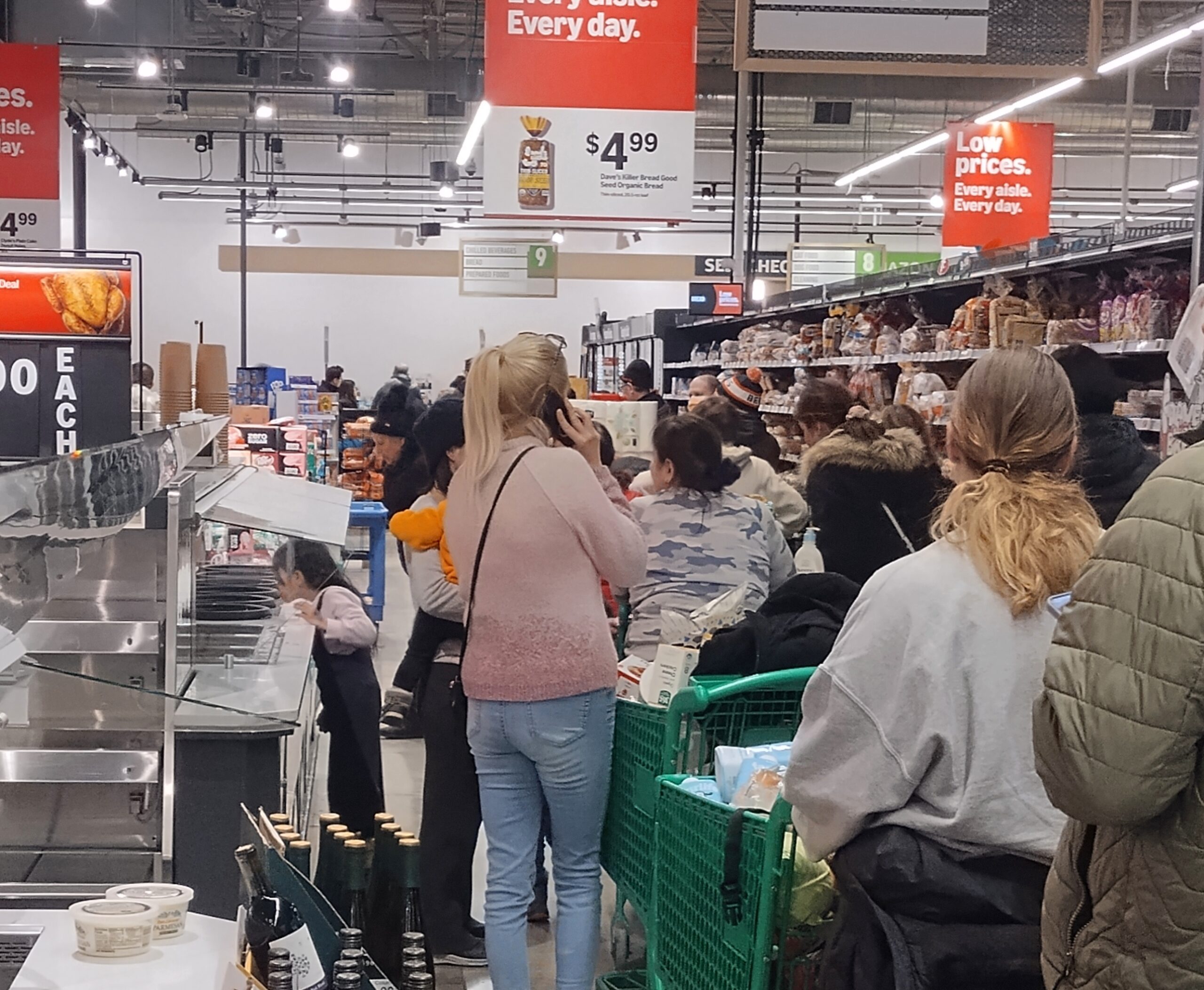
Shopping cart delivered to Yuriko, I set out to investigate. The first thing I found out: the place was crowded. An entire large cross-section of the population of the nearby Chicago suburbs was loose in the store, younger and older, families with little kids, single shoppers, people whose ancestors (sometimes pretty recently) had come from Central Europe, East Asia, the Indian subcontinent, Latin America and more. Put them all in the store and it was Supermarket Sweep time. I’ve never seen a grocery store so crowded or so many carts piled so high.
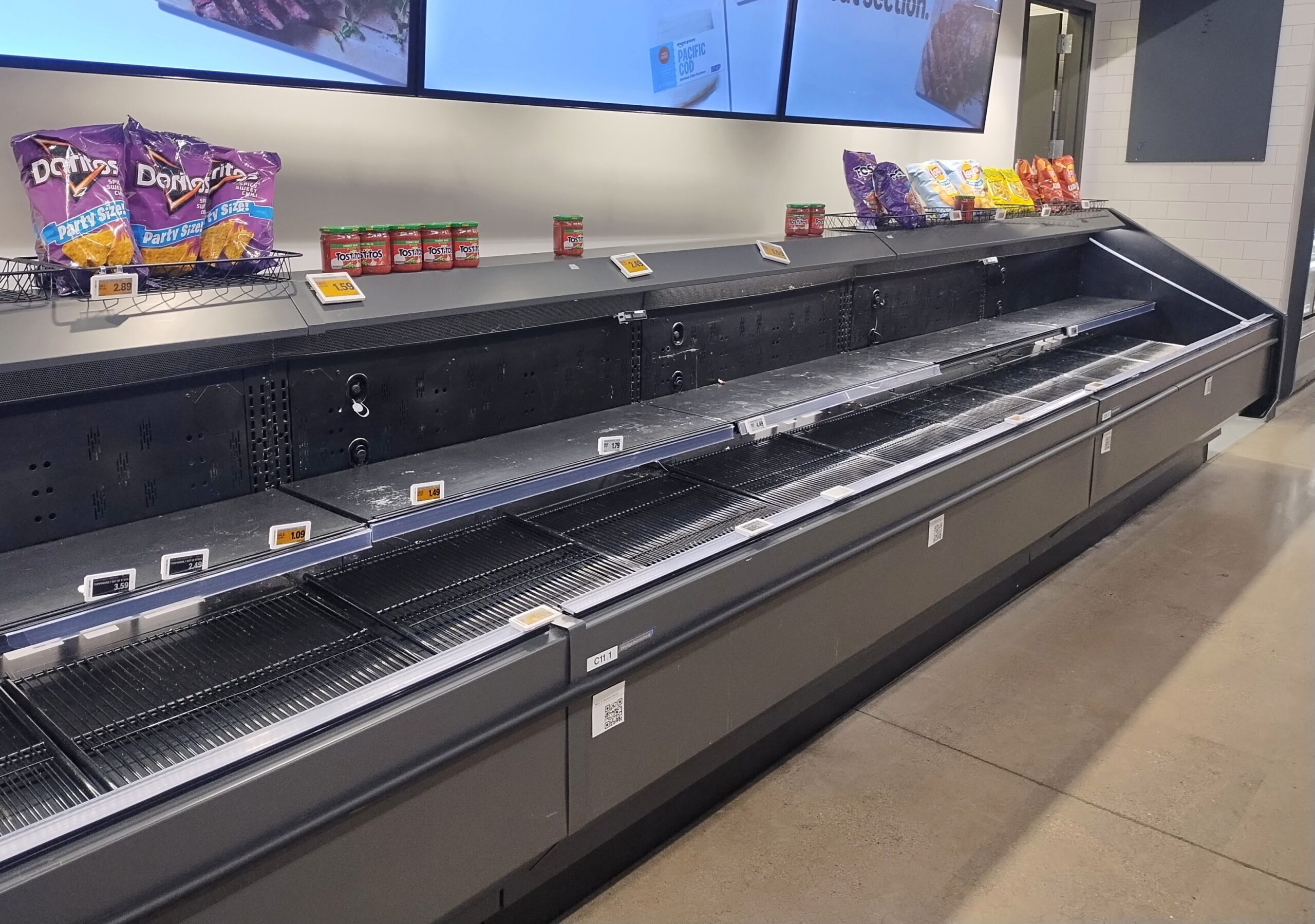
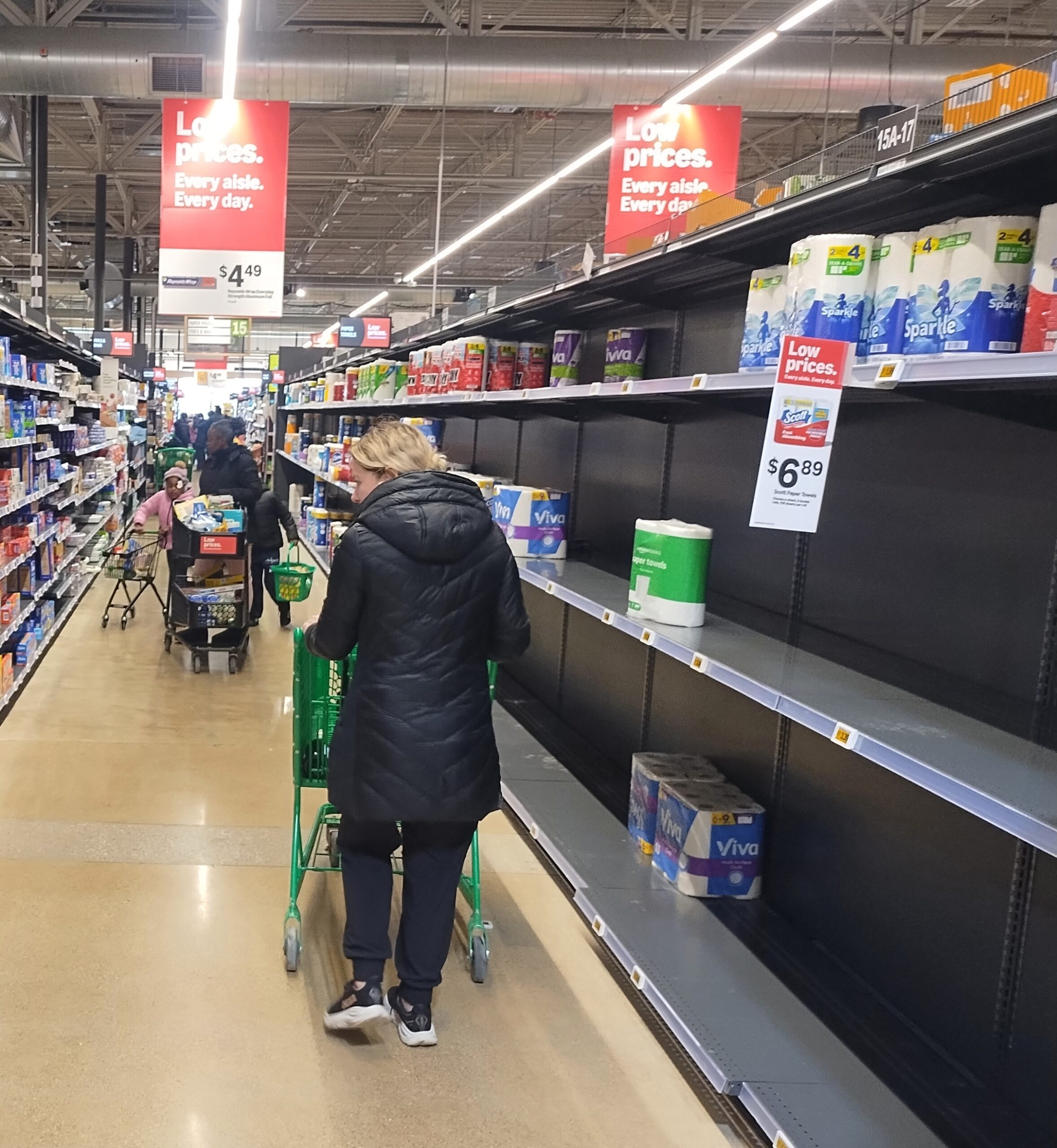
That resulted in some empty shelves, especially in the meat aisle and paper goods.
Sorry to say, the kitchen had already been closed permanently, its ovens cold and its workers presumably left to take their talents elsewhere, if possible. I’d wanted a slice of pizza at less than $2 just one more time, but no go.
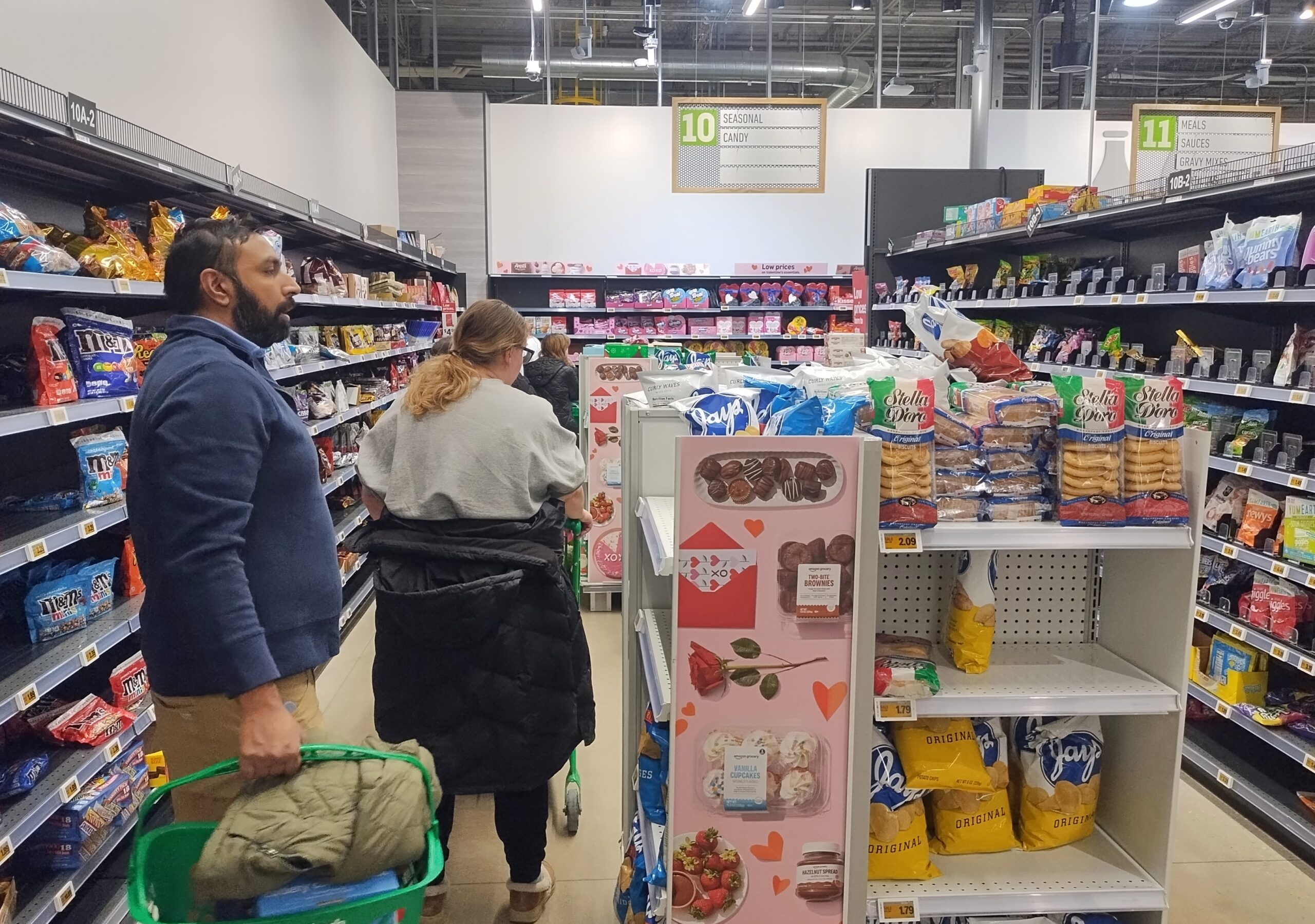
But I’d misrepresent things if I left it at that. Many of the aisle and shelves still held the bounty of American agriculture and the never-ending efforts of food technologists.
What brought the crowd? Deep discounts, of course. It didn’t take long to work that out. Later I did some back-of-the-envelope calculations and determined that nominal prices were back to late 1990s levels. Thirty years of inflation, slow and then fast, poof. That’ll pack ’em in. We joined the fun.
But the woman wasn’t kidding about the wait. The checkout line went back along the right-side aisle to the back of the store, turned a corner and went along the back aisle (dairy and such), and then turned a corner again at the left-side aisle, and ended about halfway back to the front of the store. Later, the line grew to go all the way around the store, back to the checkout area.
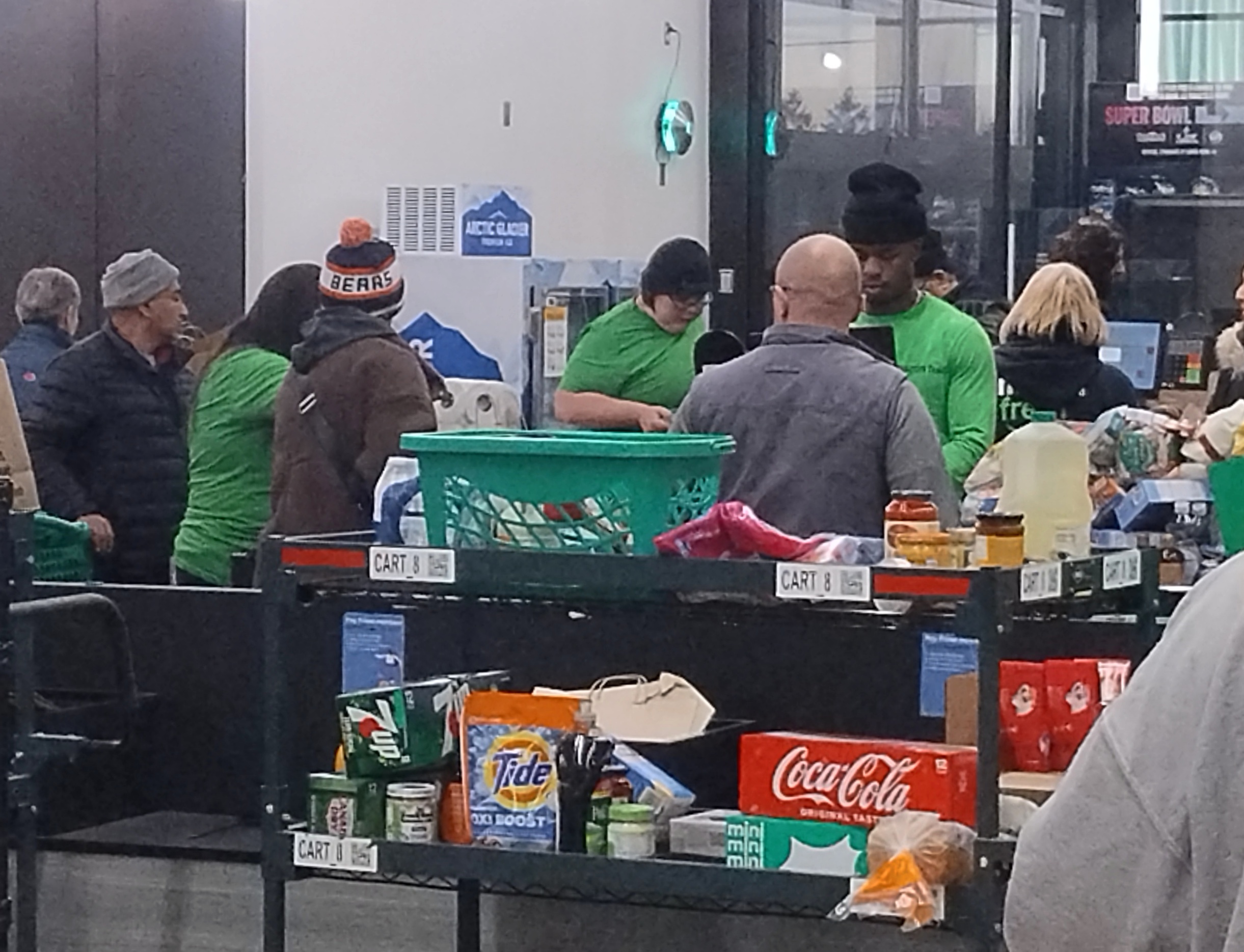
Before that happened, I got in line with the cart and Yuriko went out scouting for items, and later sometimes I did. This was a strategy employed by a number of couples in line. A view from the line:
I also went out to the car and re-arranged the items in the back, in anticipation of a large influx. Which happened, eventually, once we filled our cart – to the top – and got through checkout.
Checkout, which indeed had taken more than an hour to reach, was an anticlimax. It was just like any checkout, except more stuff than usual. Still, this is worth noting: We spent a shade over $250 on items that listed a few days ago for around $500. Definitely a deal, whatever you think of the behemoth retailer or its failed experiment in Amazon-branded supermarkets.
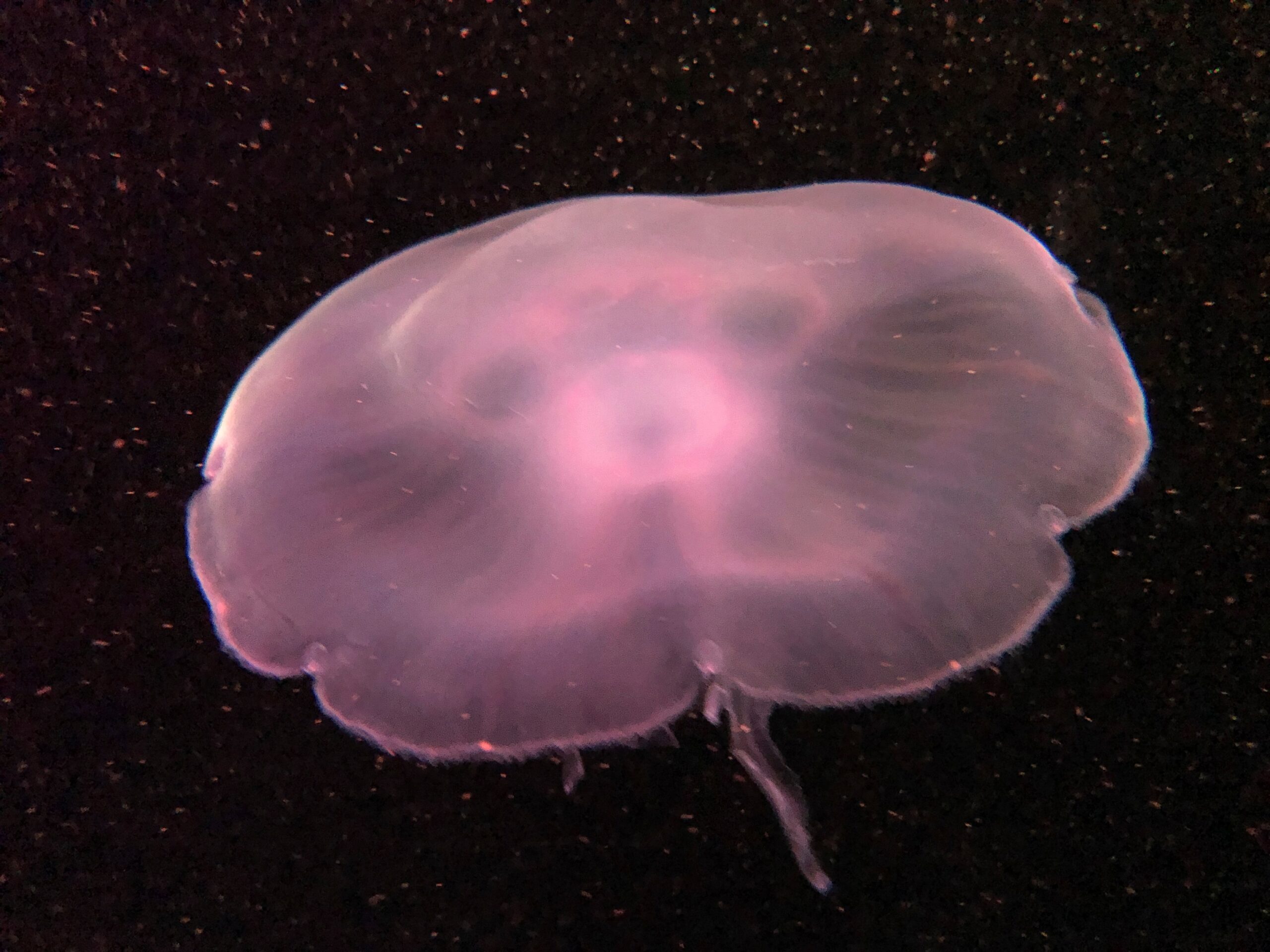
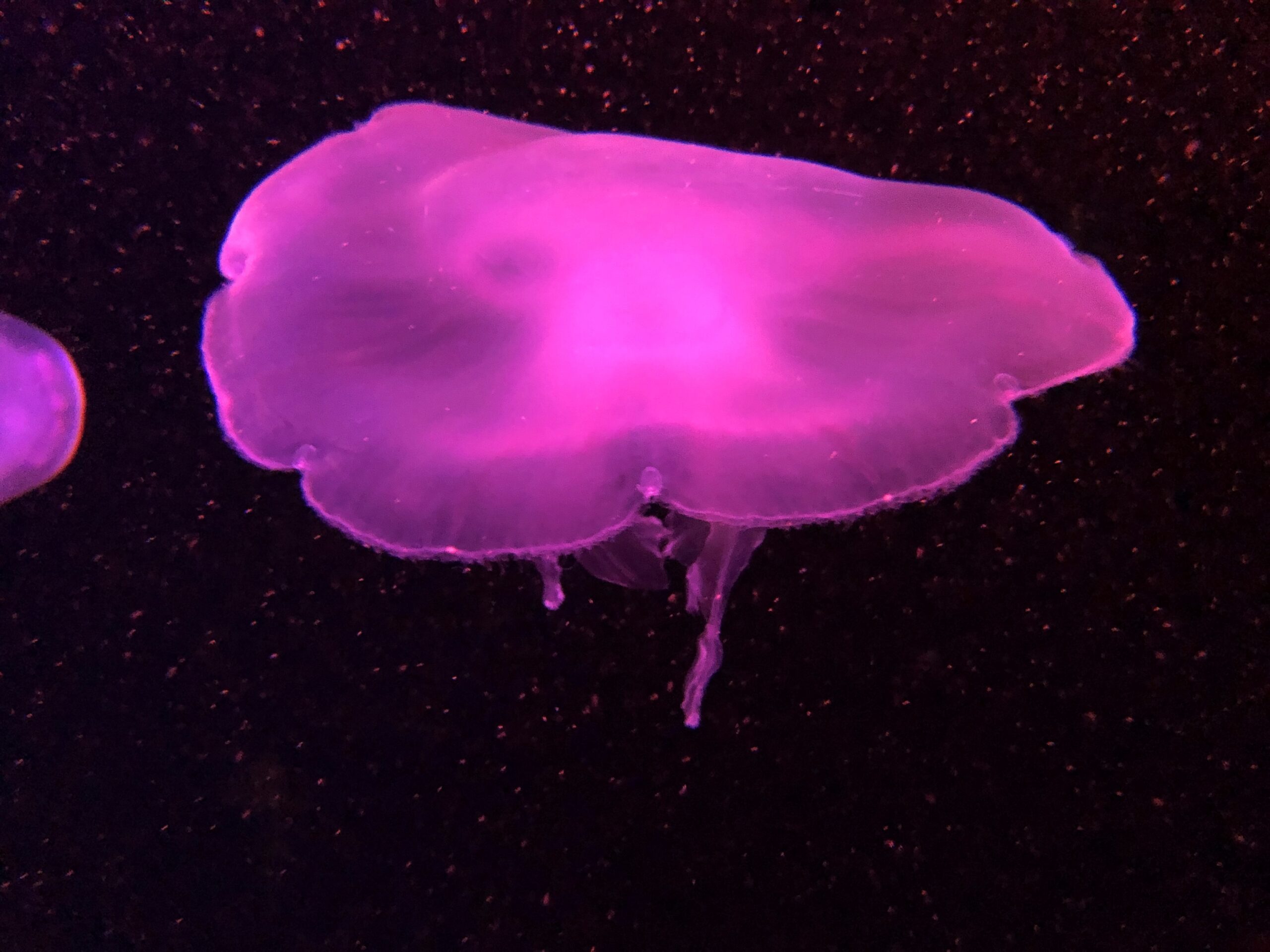
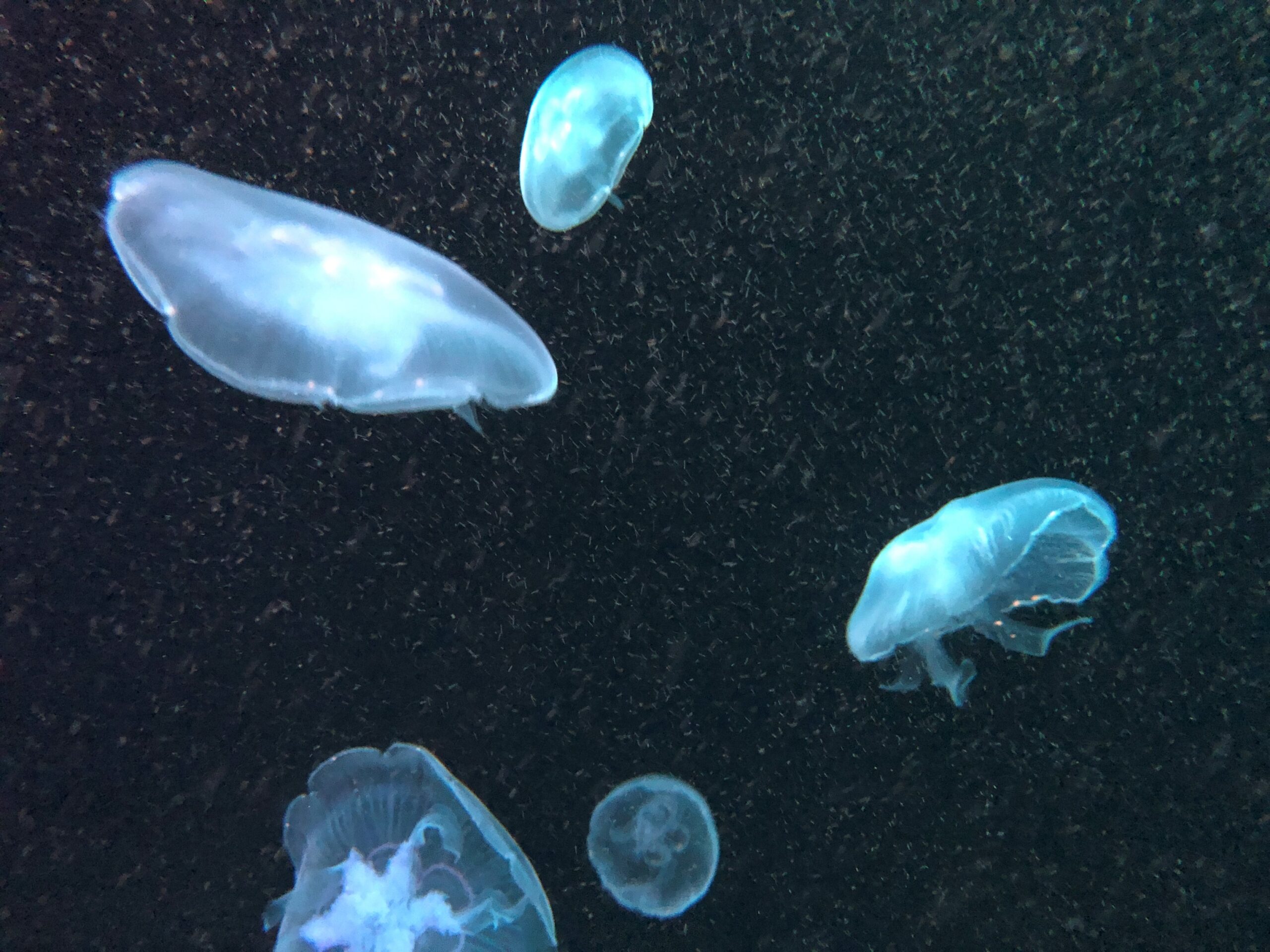
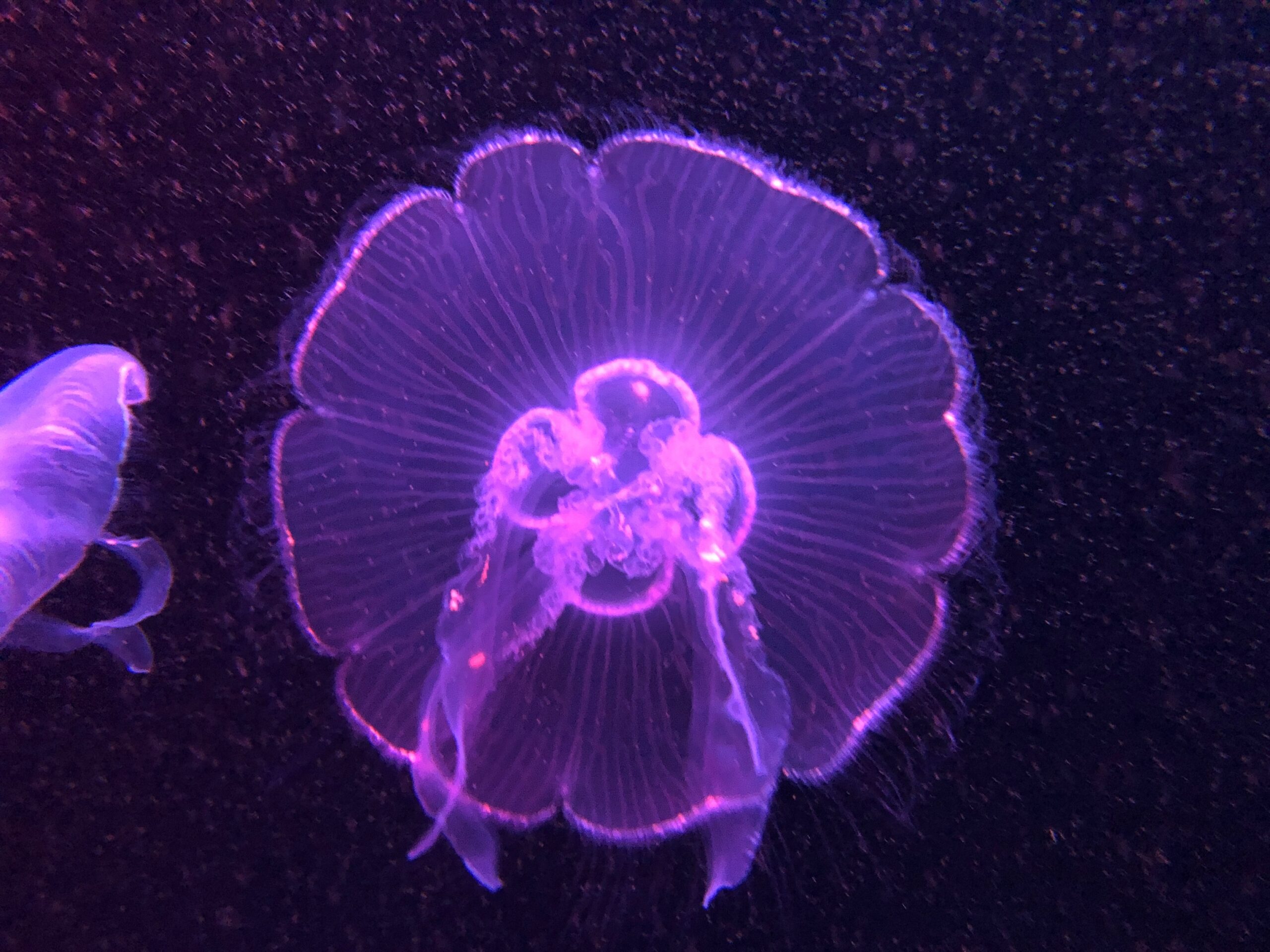
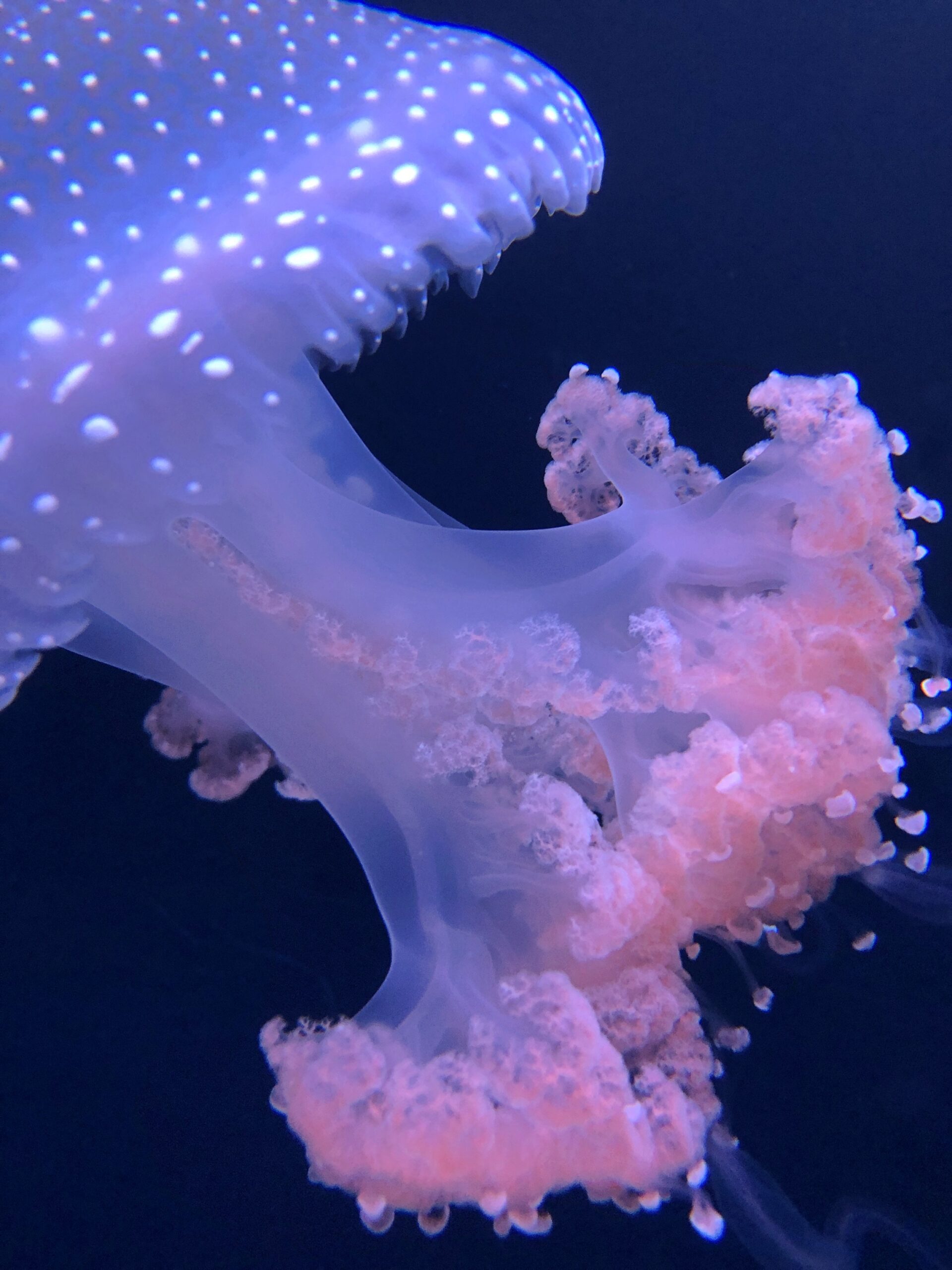
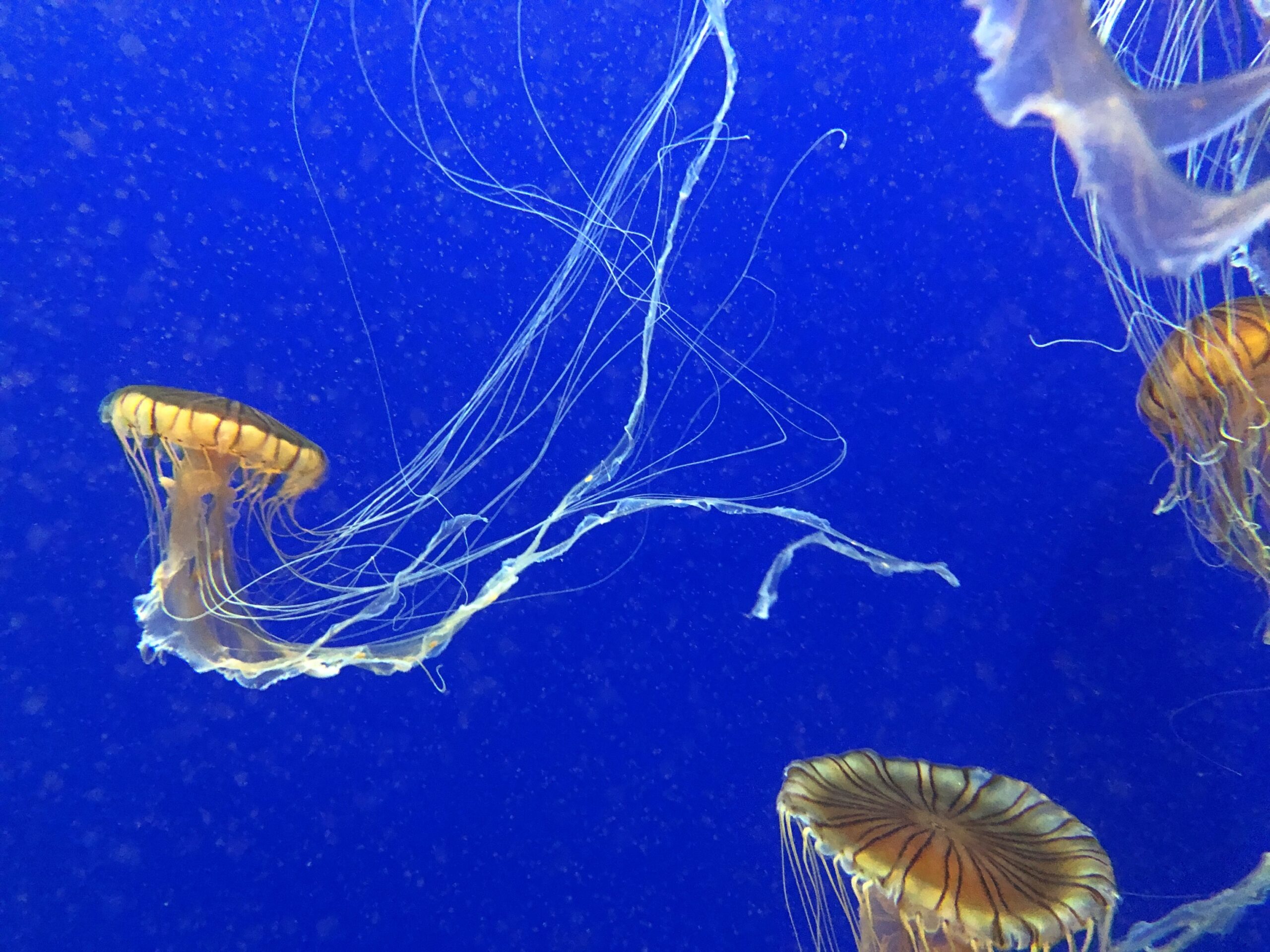
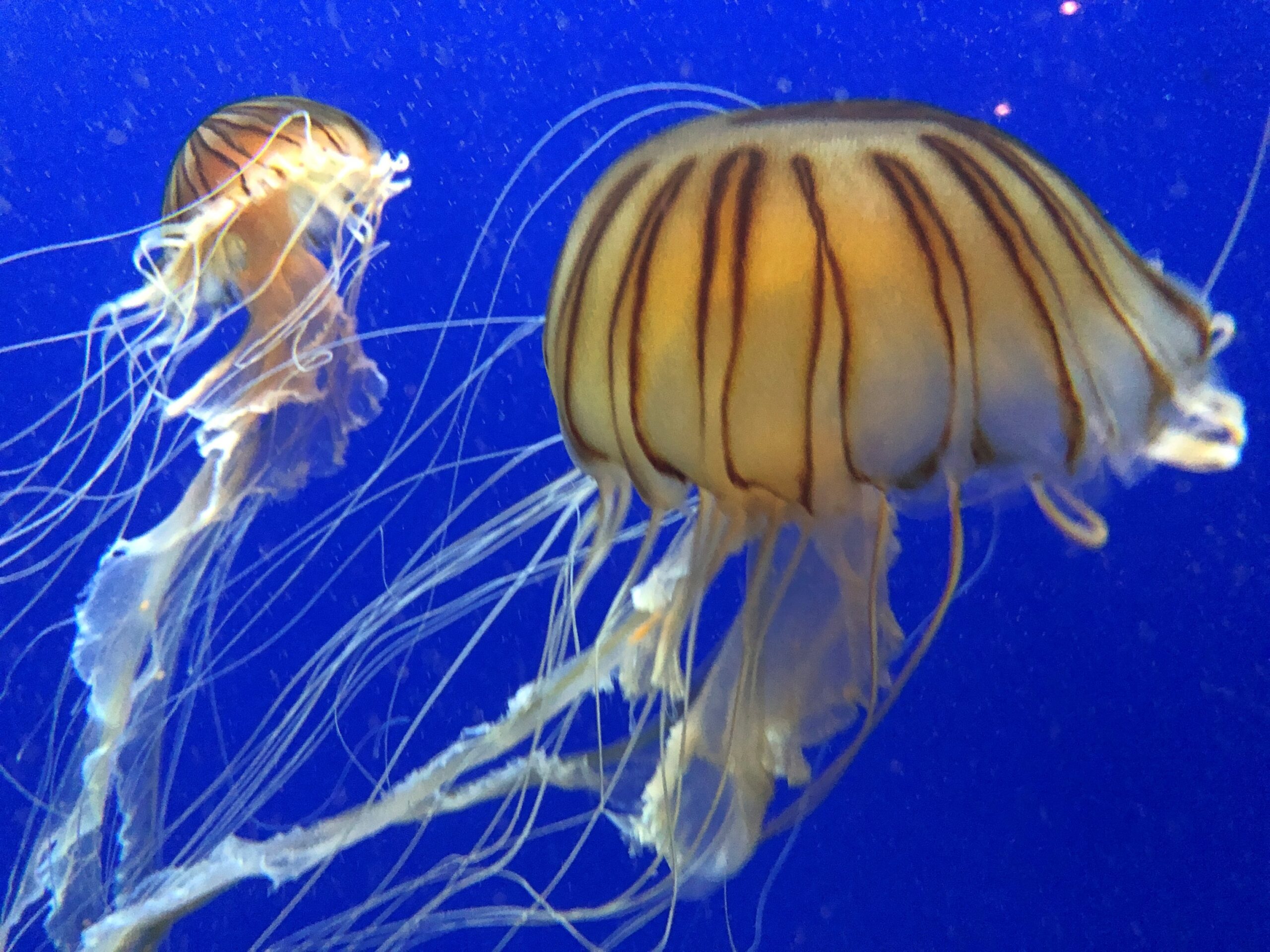
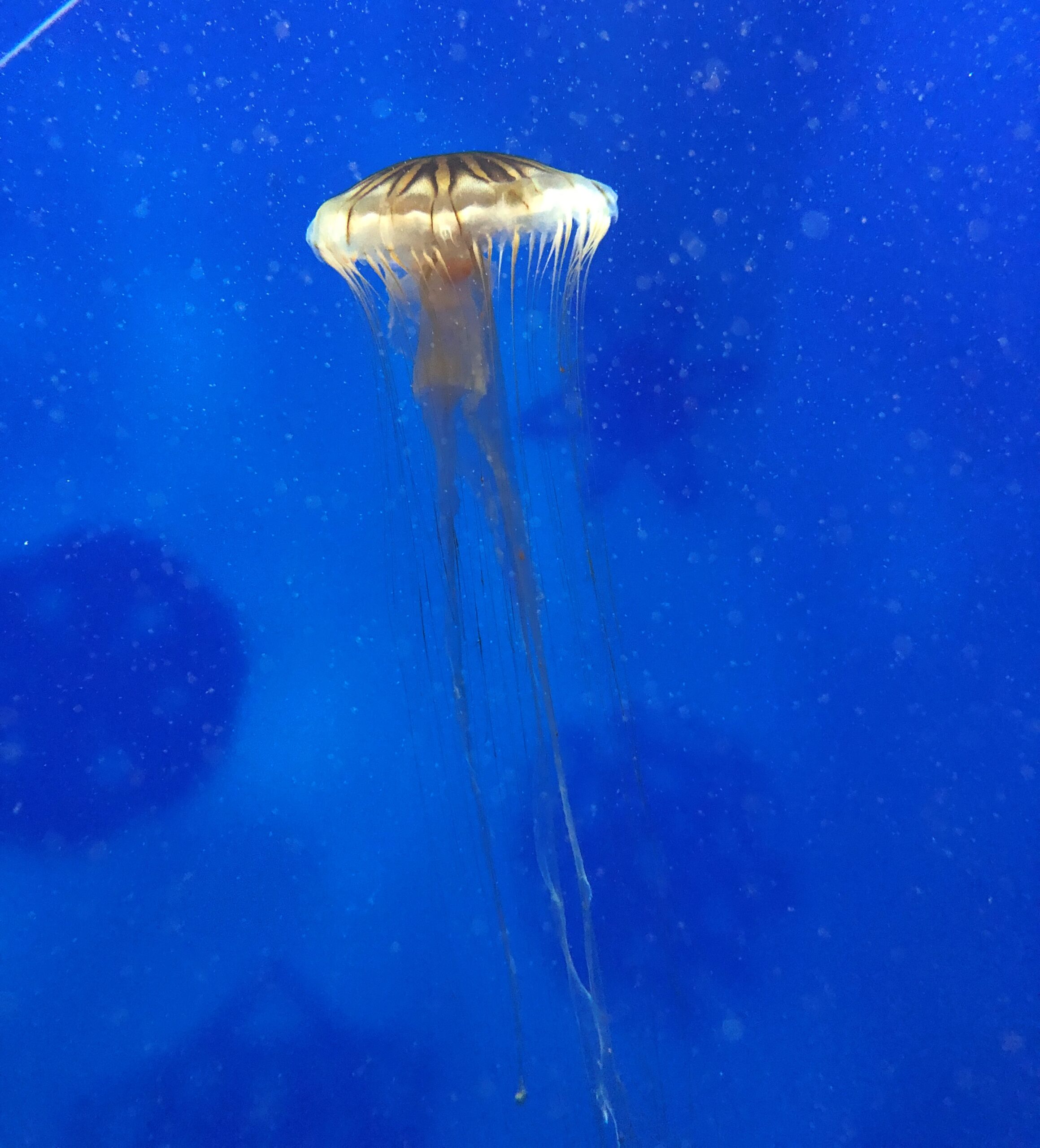
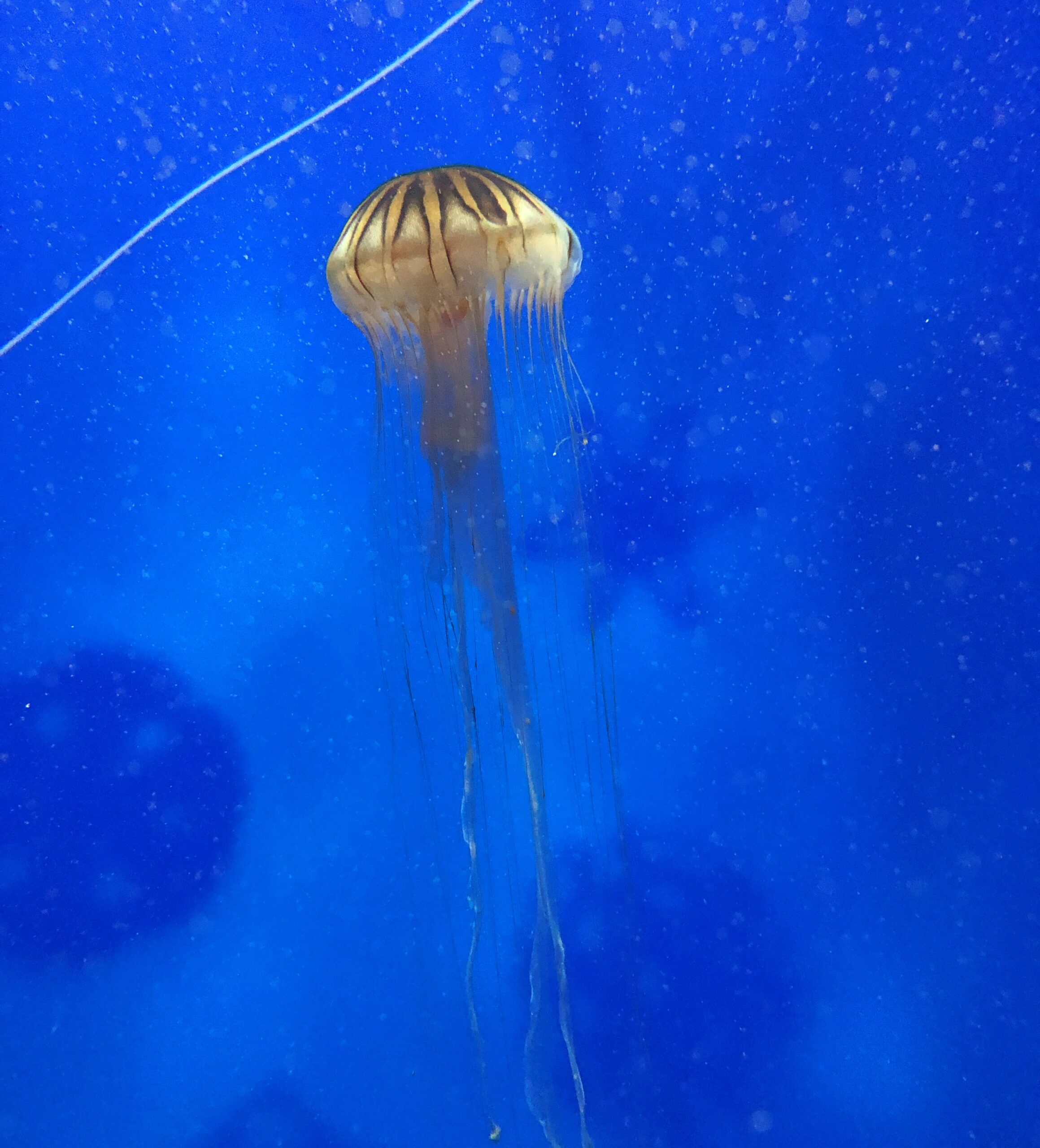
I’m always glad to spend some time peering into a tank where the moon jellies drift, but also somehow contract their entire selves to glide along in deep quiet.
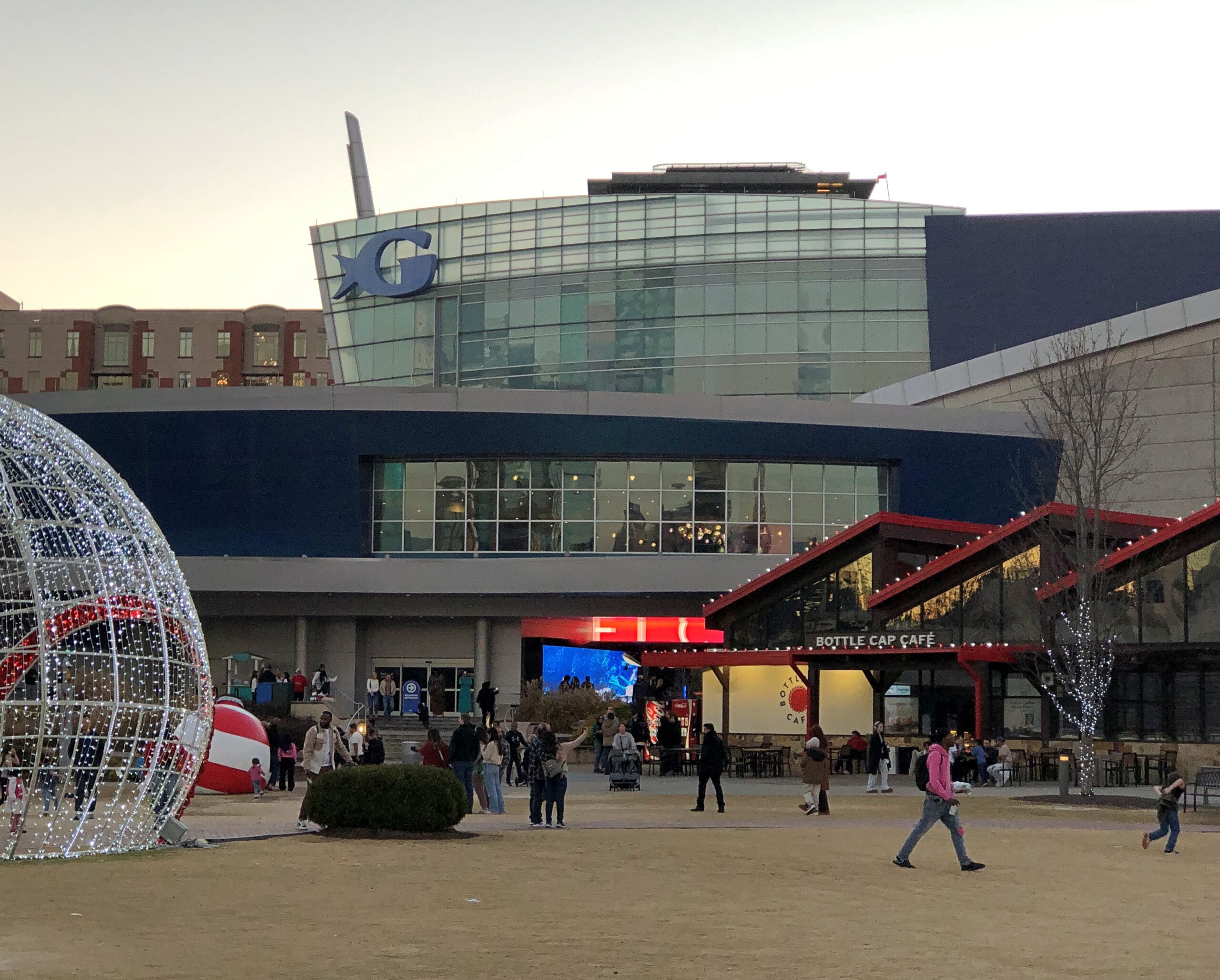
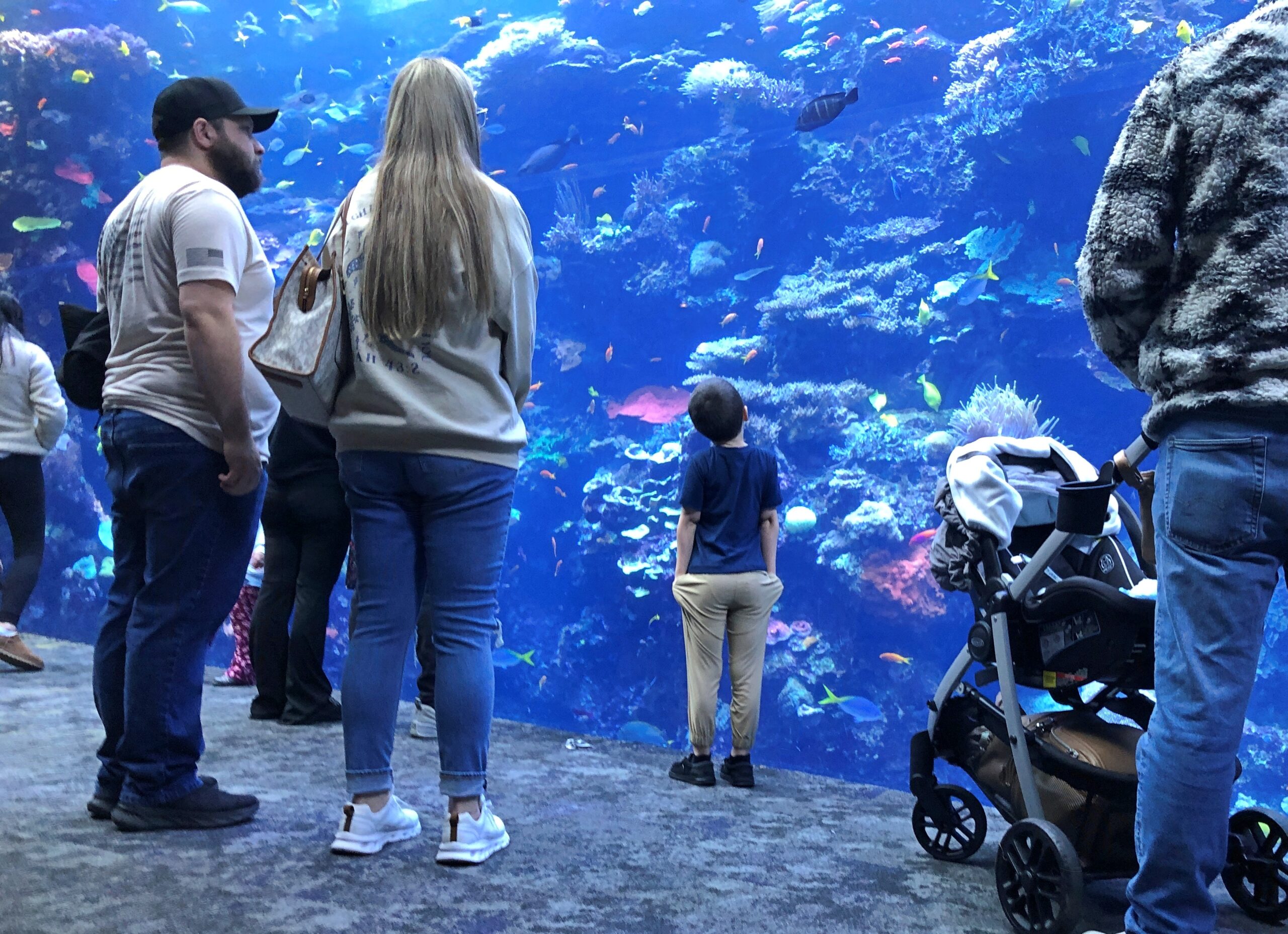
We’d come to the Georgia Aquarium, which keeps company in downtown Atlanta with the World of Coca-Cola, the National Center for Civil and Human Rights, and a large parking deck on about 20 acres of a plaza known on maps as Pemberton Place. To its south is Baker St. and Centennial Olympic Park; to the north, Ivan Allen Jr. Blvd. and a massive substation behind walls. For just an instant I thought that was Irwin Allen Jr. Blvd., and was disappointed to realize otherwise.
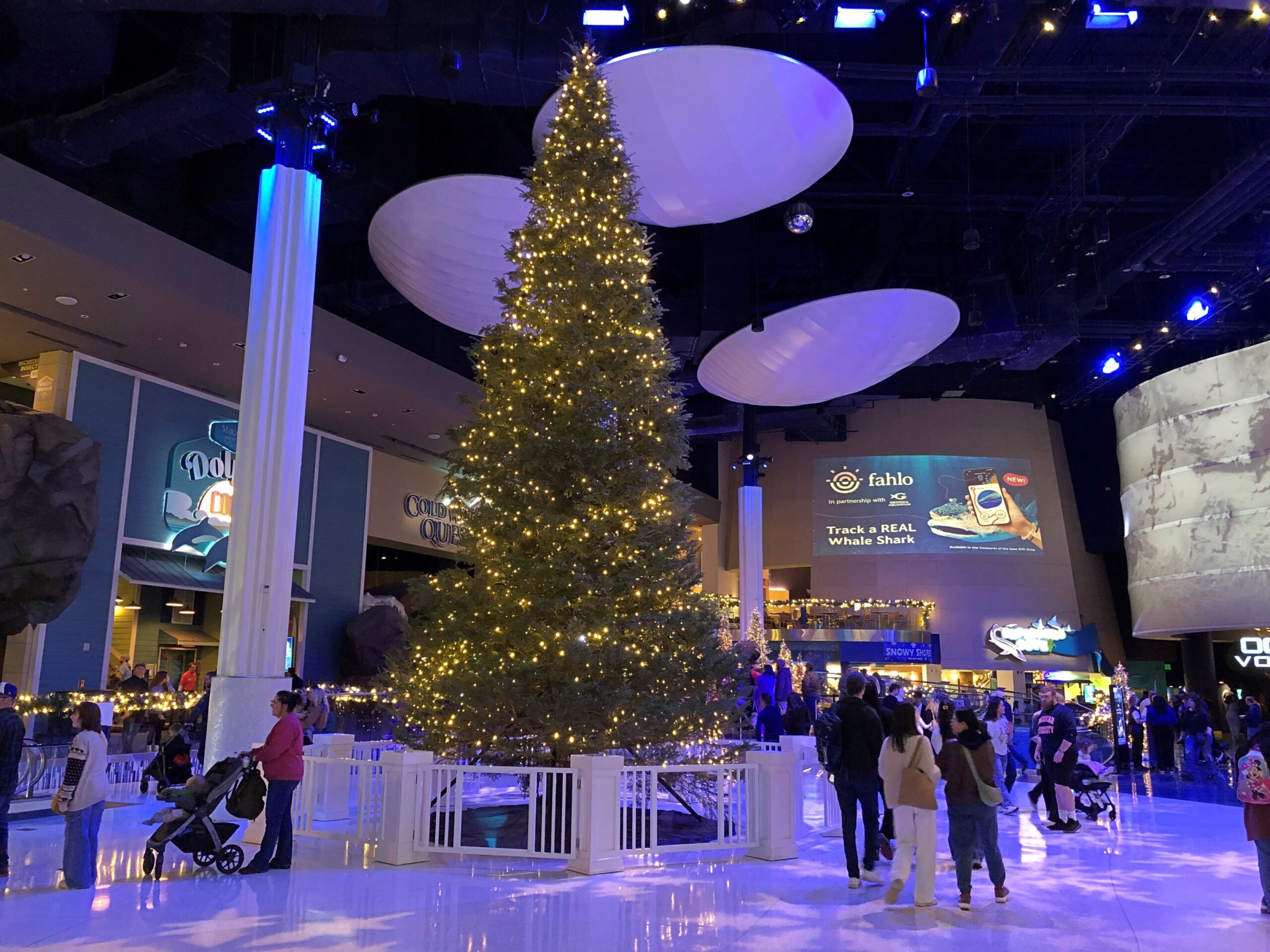
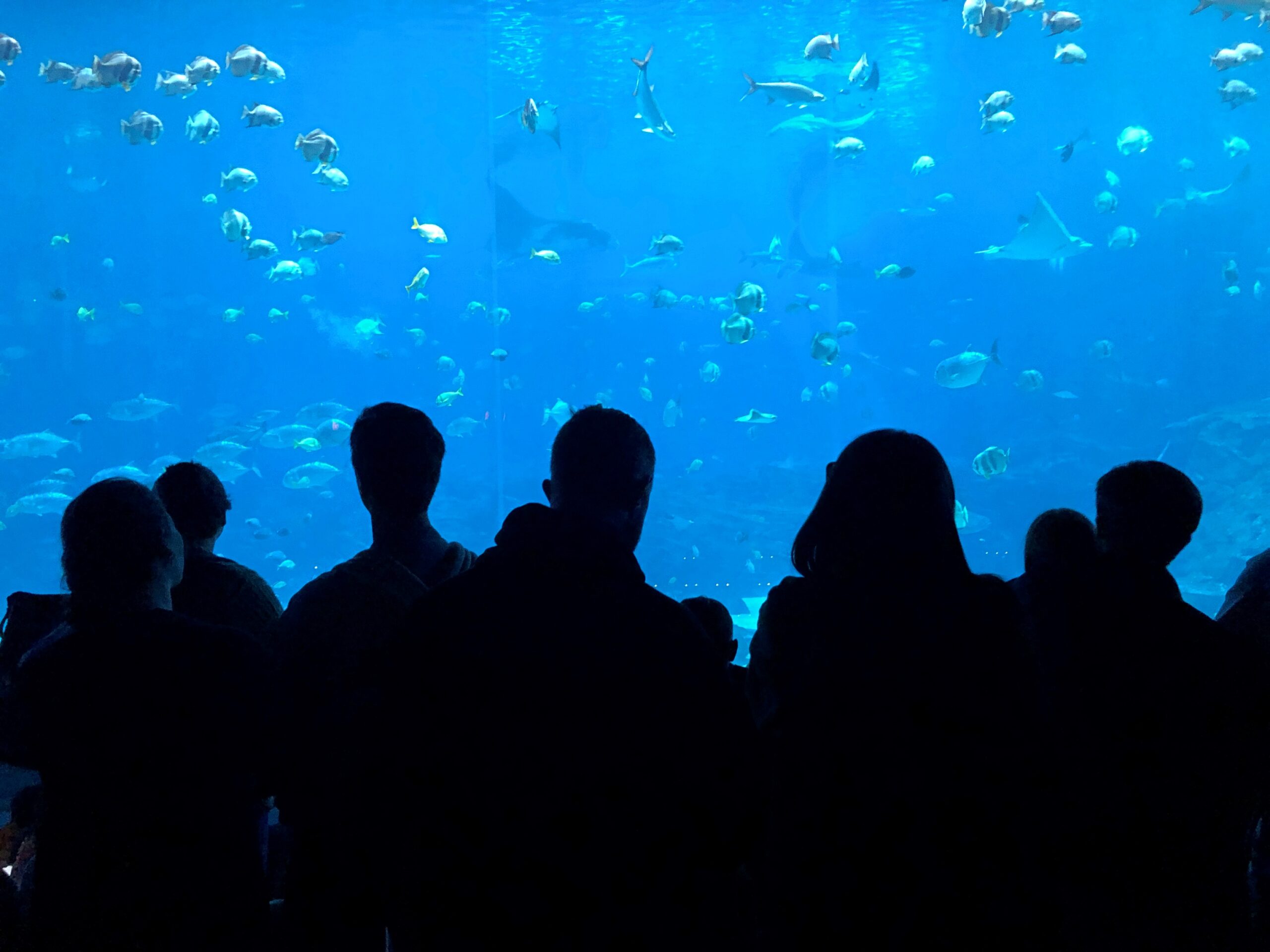
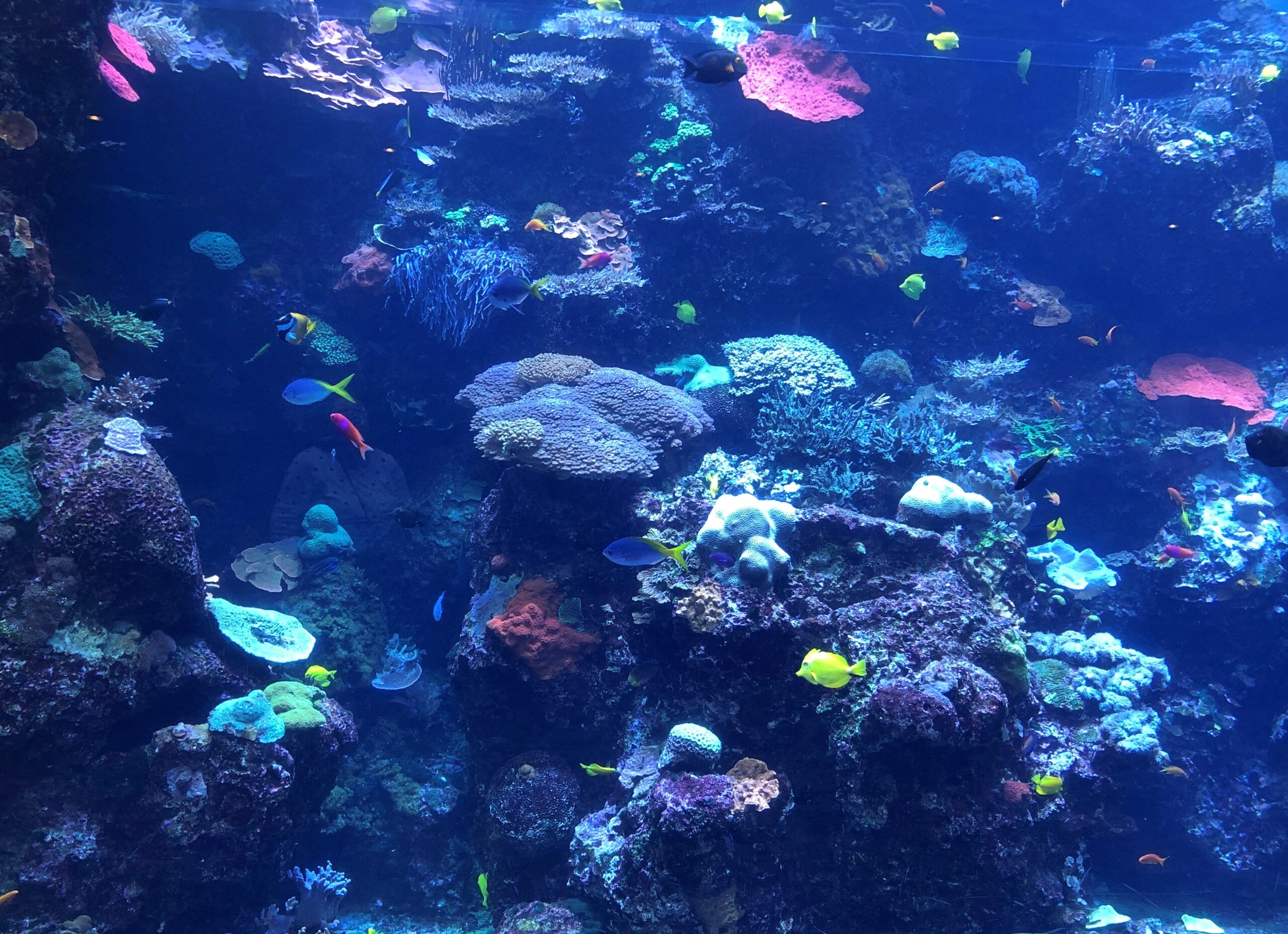
At 11 million gallons – which is apparently how major public aquariums are measured – the Georgia Aquarium is listed on Wiki as the sixth largest in the world and the largest in the United States, and I believe it. The structure is hub-and-spoke, with an enormous, vaulting hall with sizable exhibit spaces radiating from that hall: Tropical Diver, Ocean Voyager, Explorers Cove, Cold Water Quest, Southern Company River Scout, Dolphin Coast, Truist Pier 225 and Aquanaut Adventure.
Five days before Christmas, much of the human population of Atlanta was there, gawking at the sea and land creatures. We did our own gawking.
The invertebrate collection included much more than moon jellies. There were other kinds of jellyfish, too, looking like the sort of thing that if you see on the beach in Australia (or anywhere), you’d better not to touch.
They puff along.
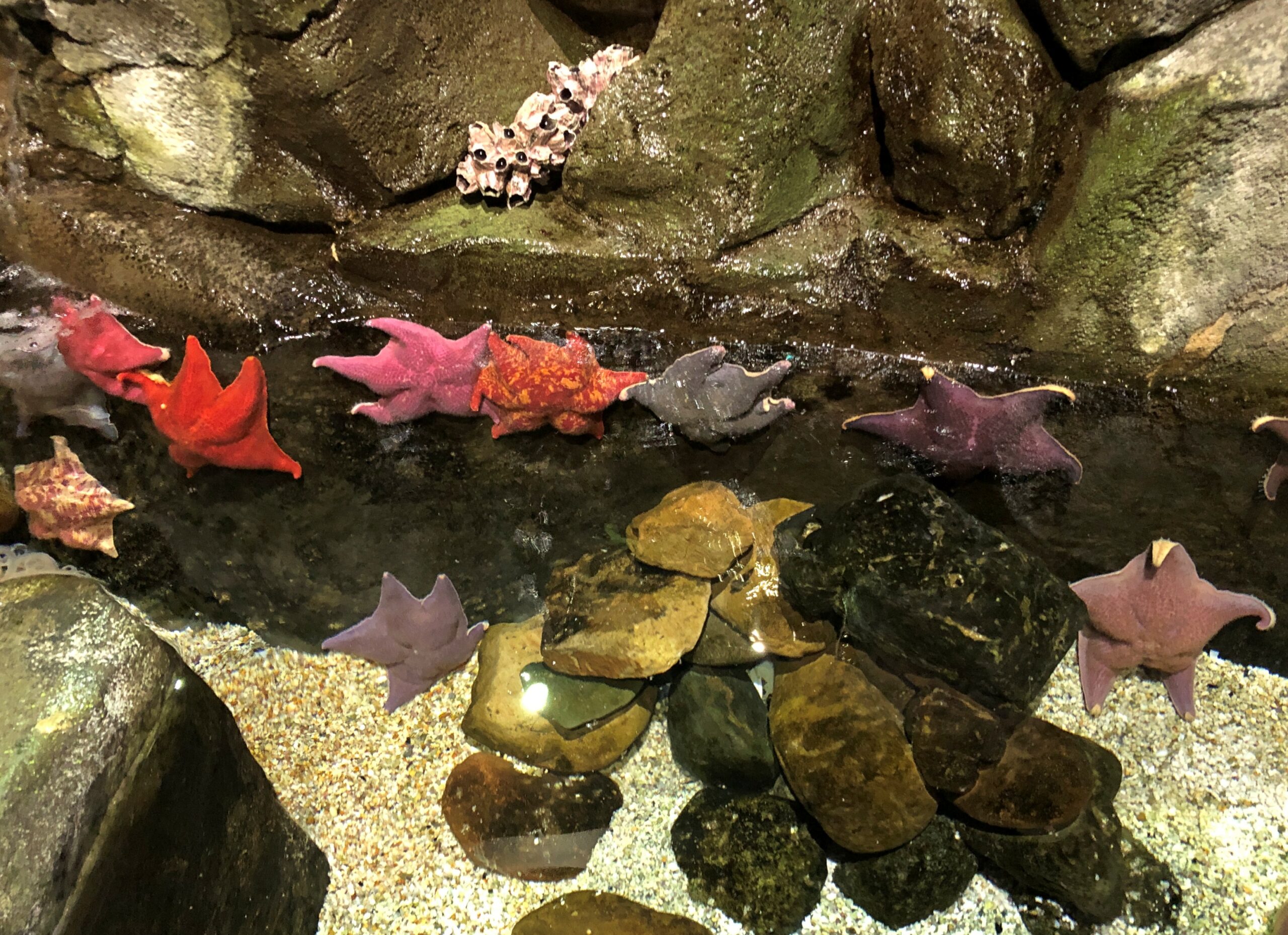
Other invertebrates. Such as the inspiration for Patrick Star.
And of course, fish. Many, many fish.
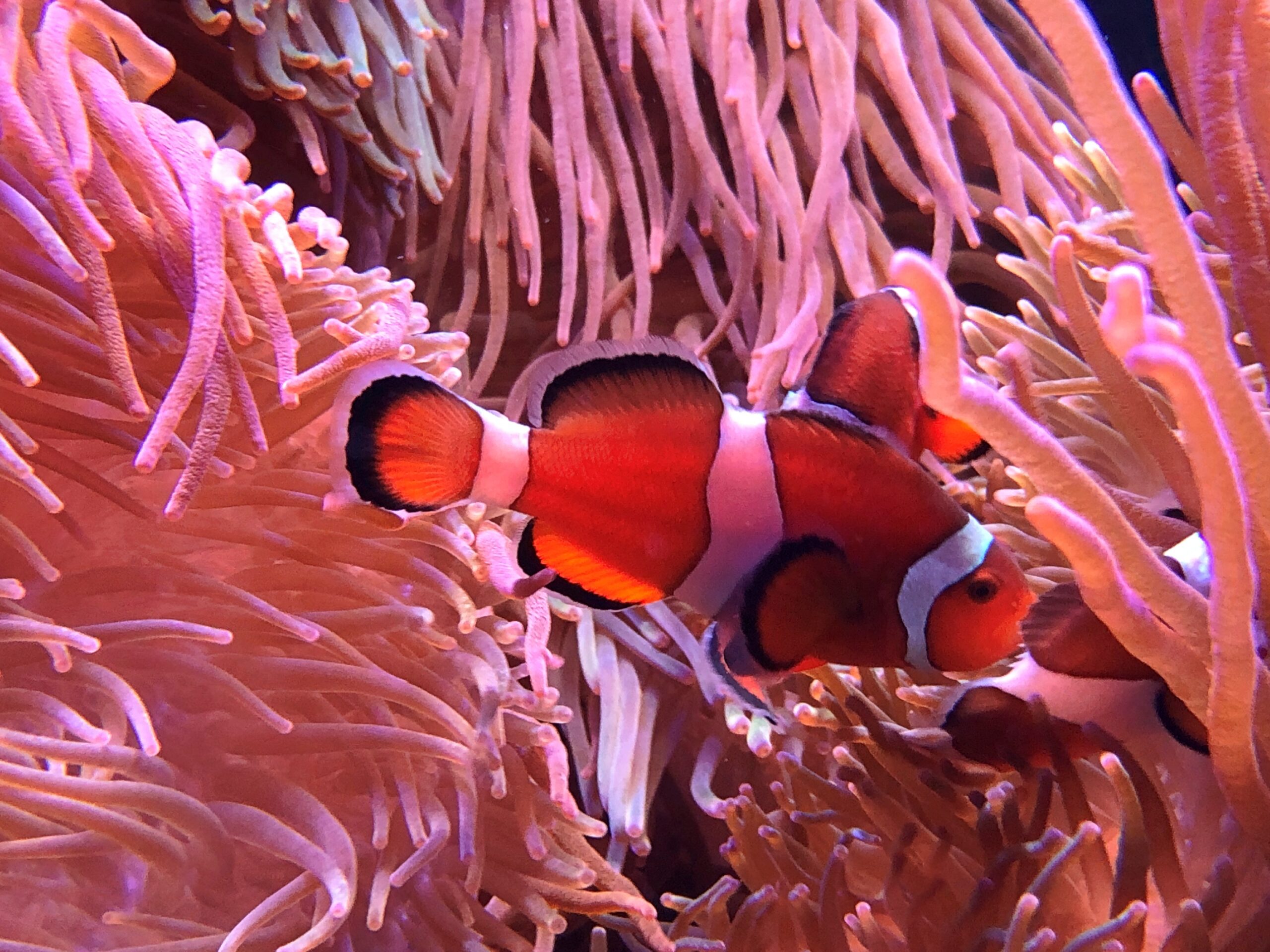
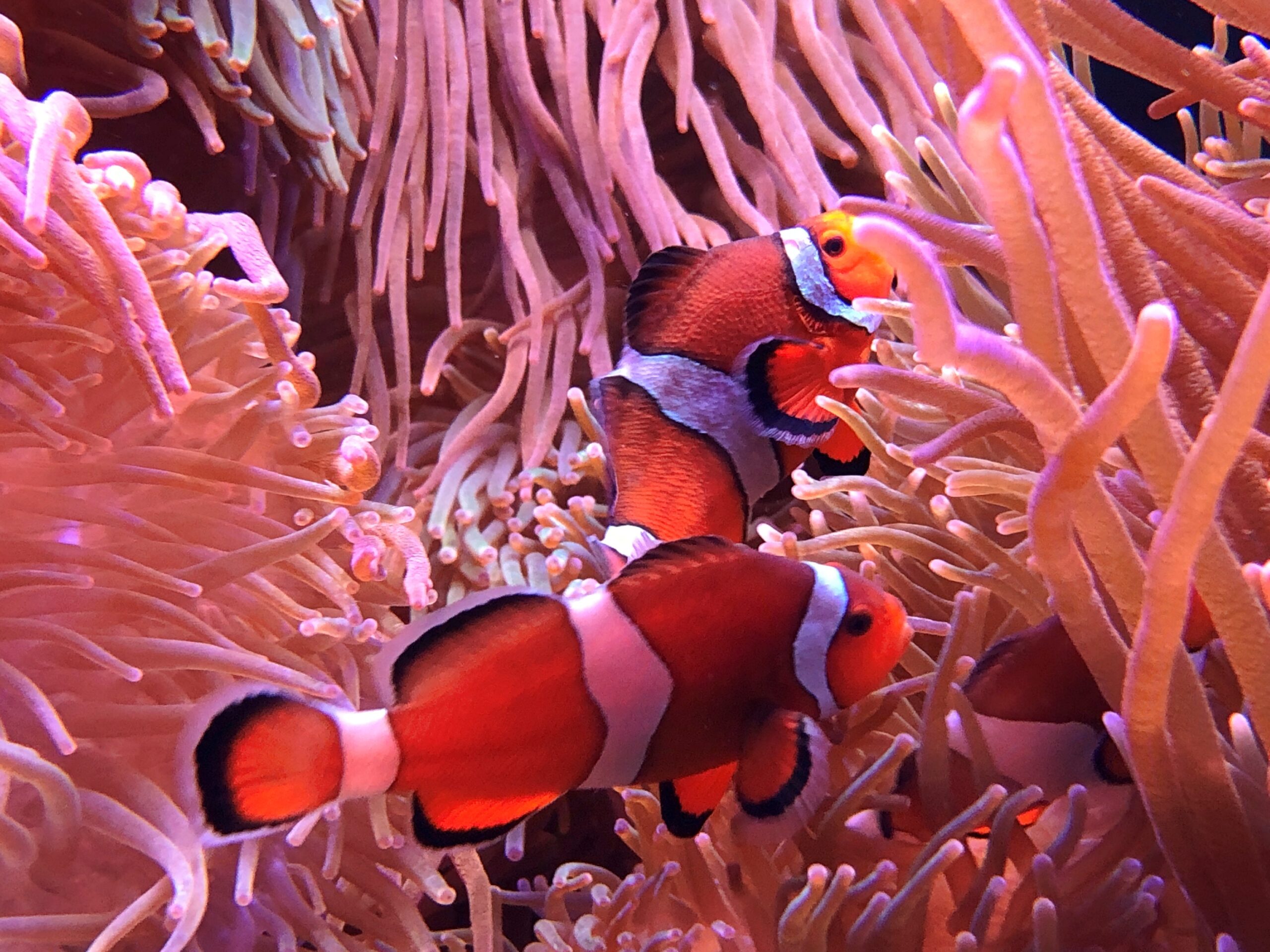
Including the inspiration for Nemo.
Small creatures can be intriguing or even enchanting, but what really packs ’em in are the likes of whale sharks, the largest fish species know to science, and one of the aquarium’s signature attractions. There’s no shortage of other kinds of sharks as well, it always being Shark Week at the facility: tiger sharks, silvertip sharks, blacktip reef sharks, and great hammerhead sharks.
More from the sea: Manta rays, goliath groupers, green sea turtles, Japanese spider crabs and weedy sea dragons. Freshwater creatures include, but are hardly limited to, Asian small-clawed otters; black spot piranhas — just how many kinds of piranhas are there, anyway? — snapping turtles; banded archerfish; discus fish; and shovelnose sturgeon.
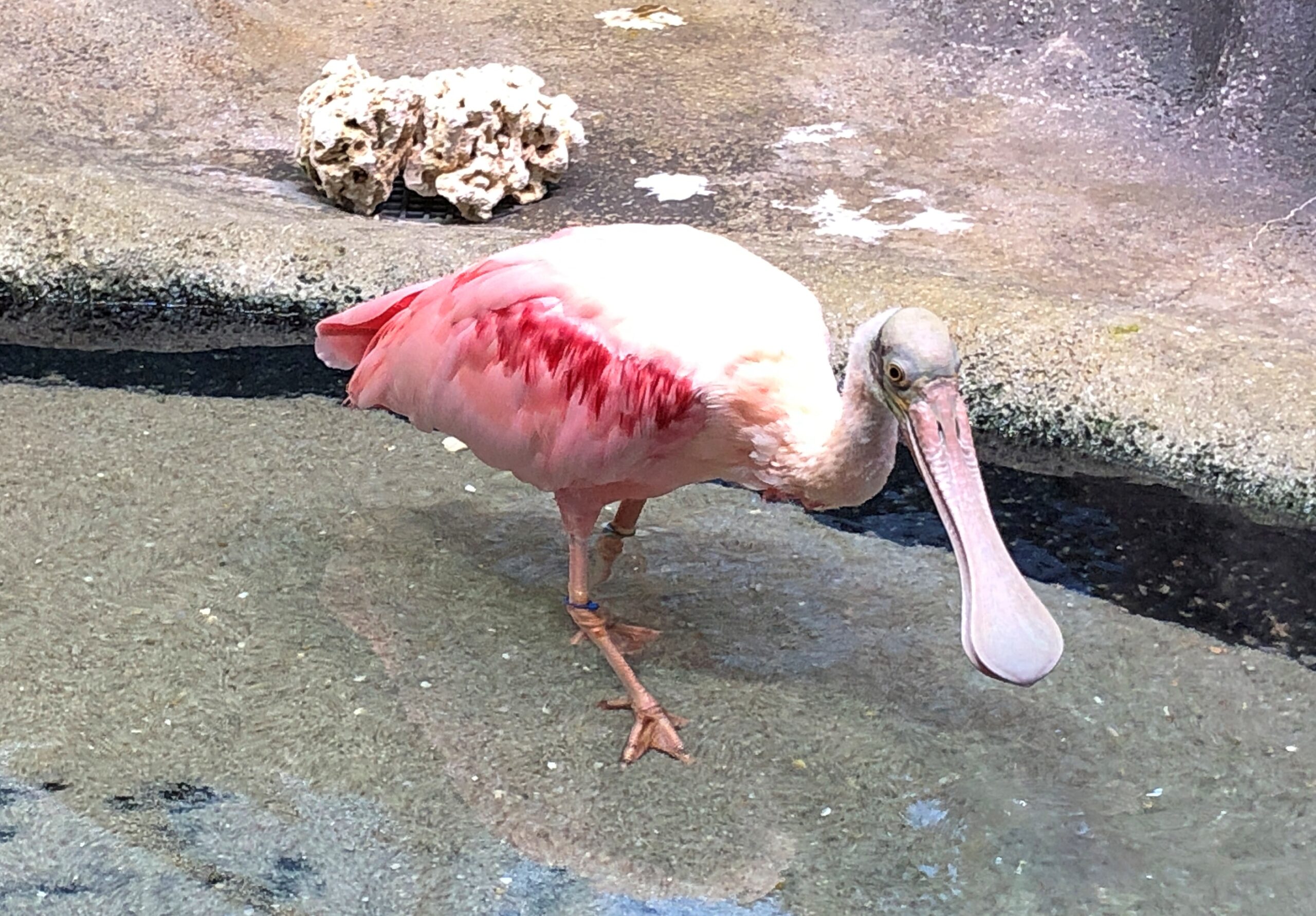
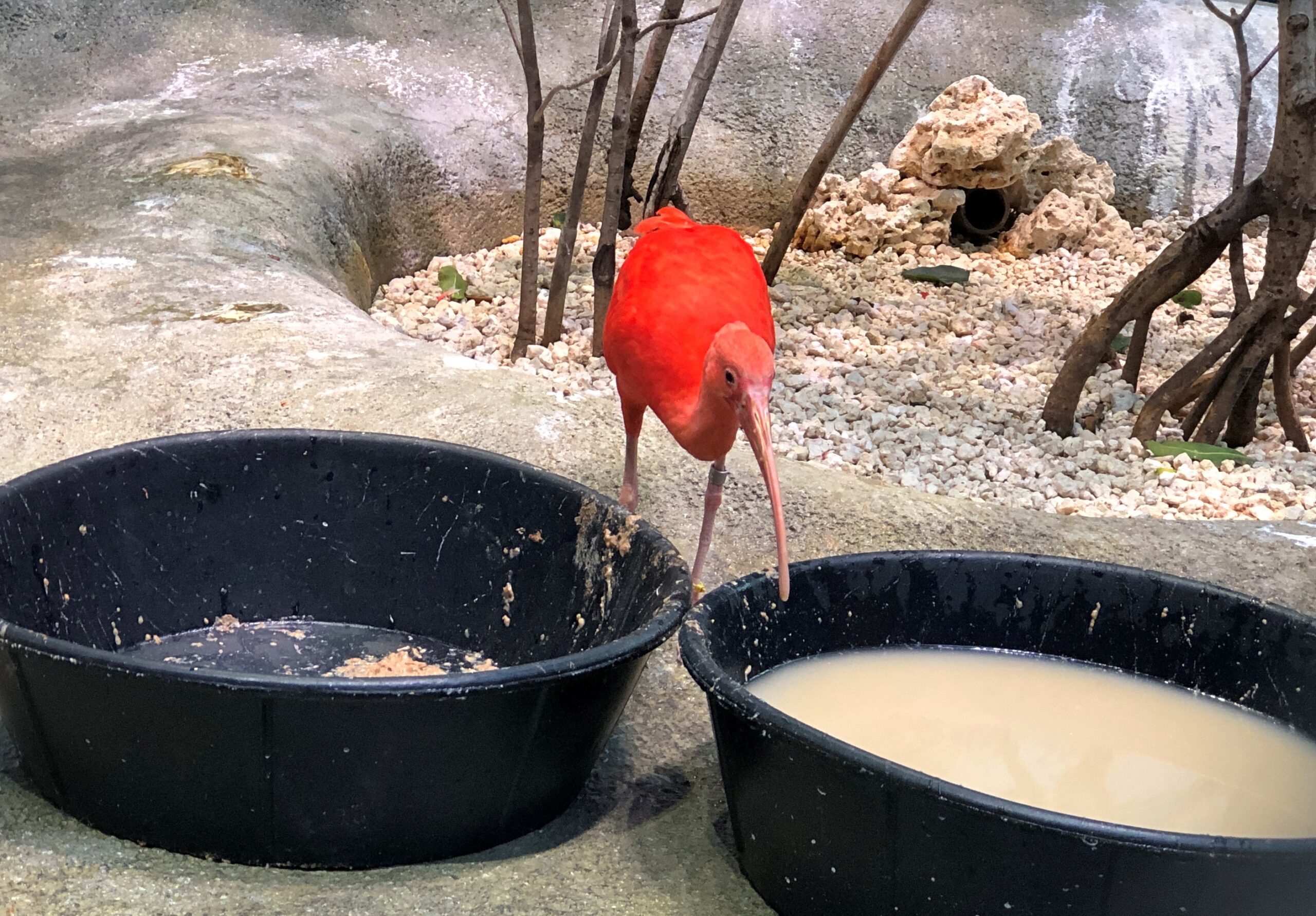
A few birds are on hand, such as spoonbills and ibises. Ones that subsist on fish, in other words.
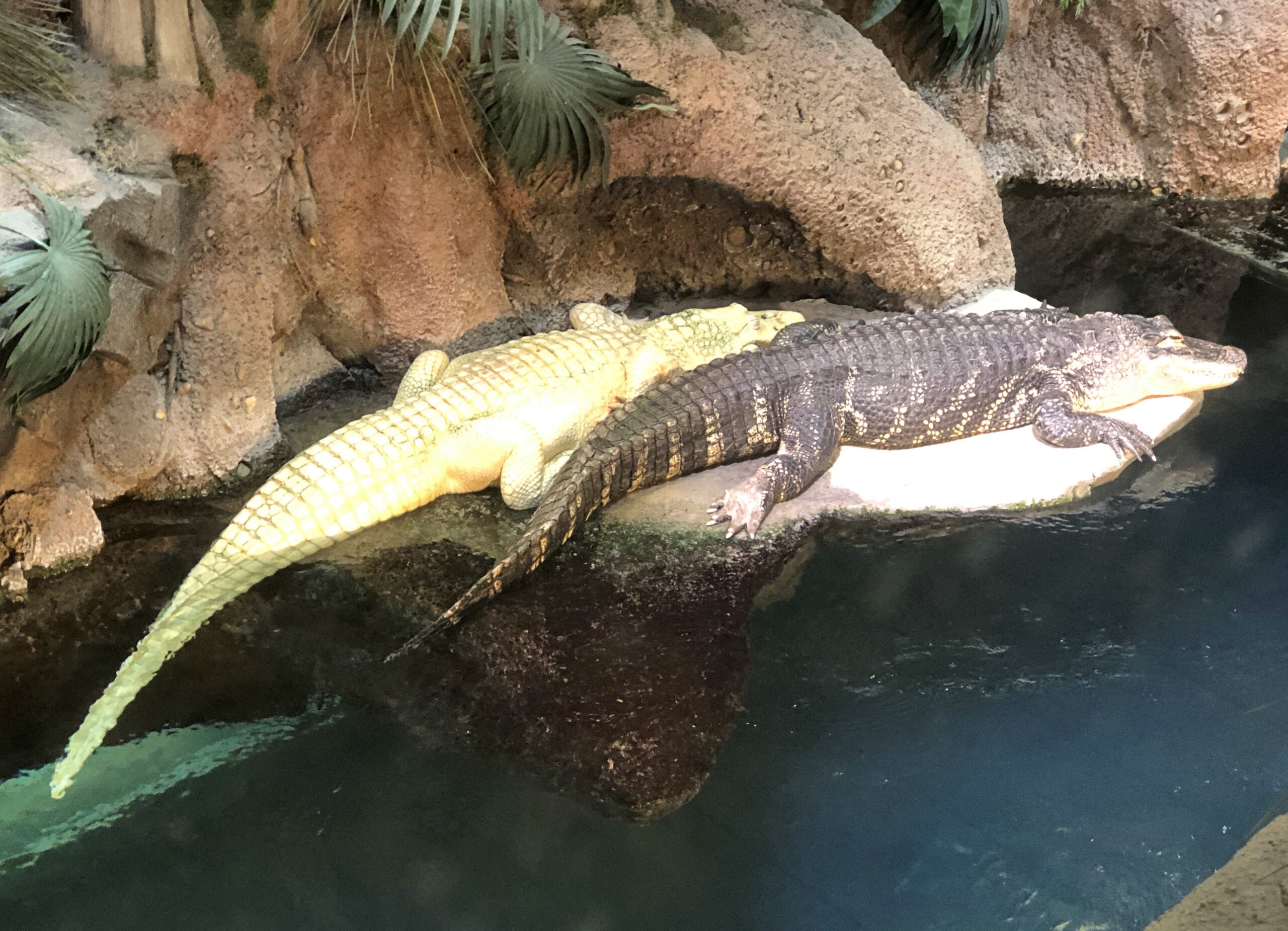
In case we hadn’t had enough gators in Florida, the aquarium had a few Georgia gators, including a rare albino. I take it Georgia gators were the inspiration for Albert in Pogo.
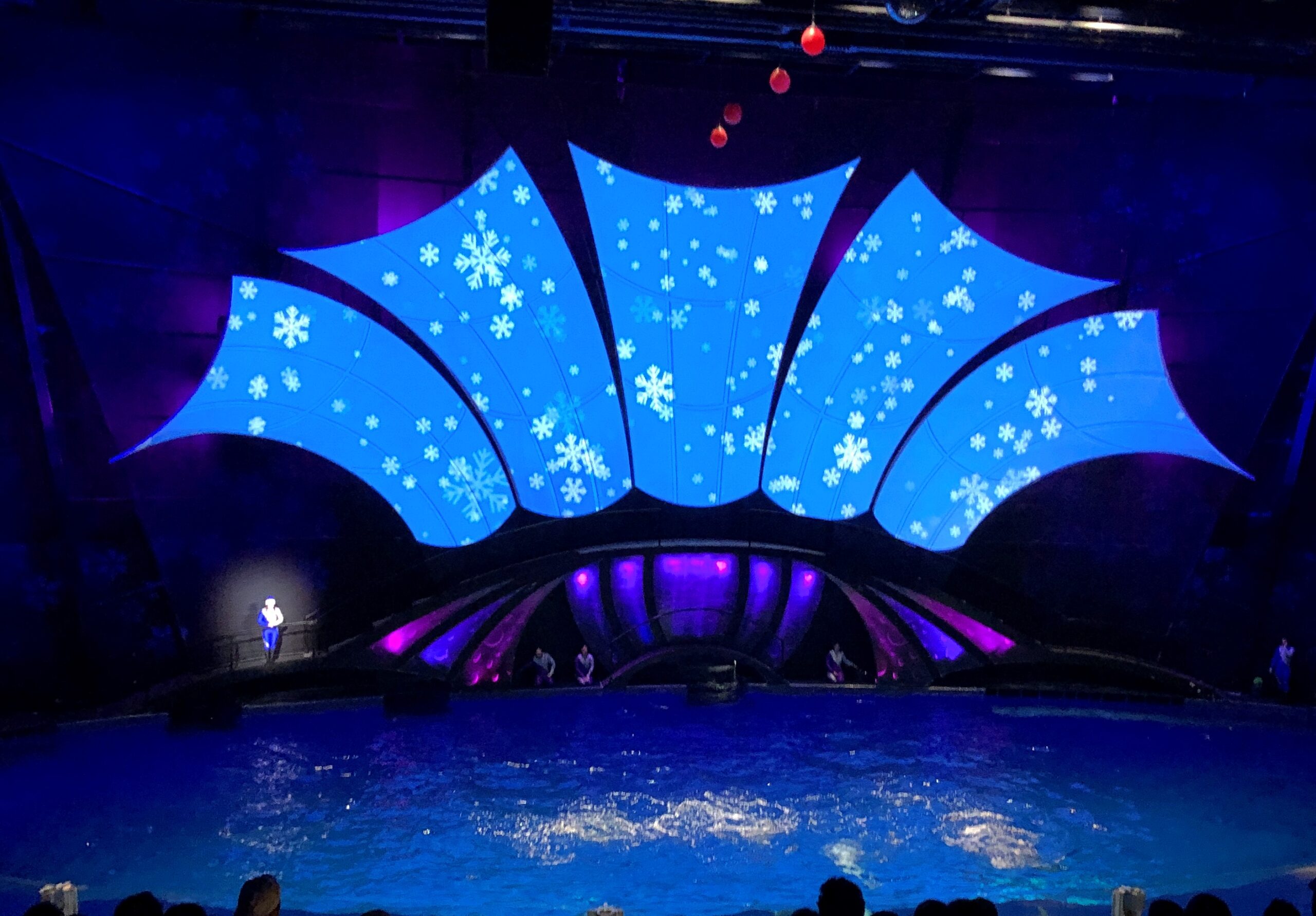
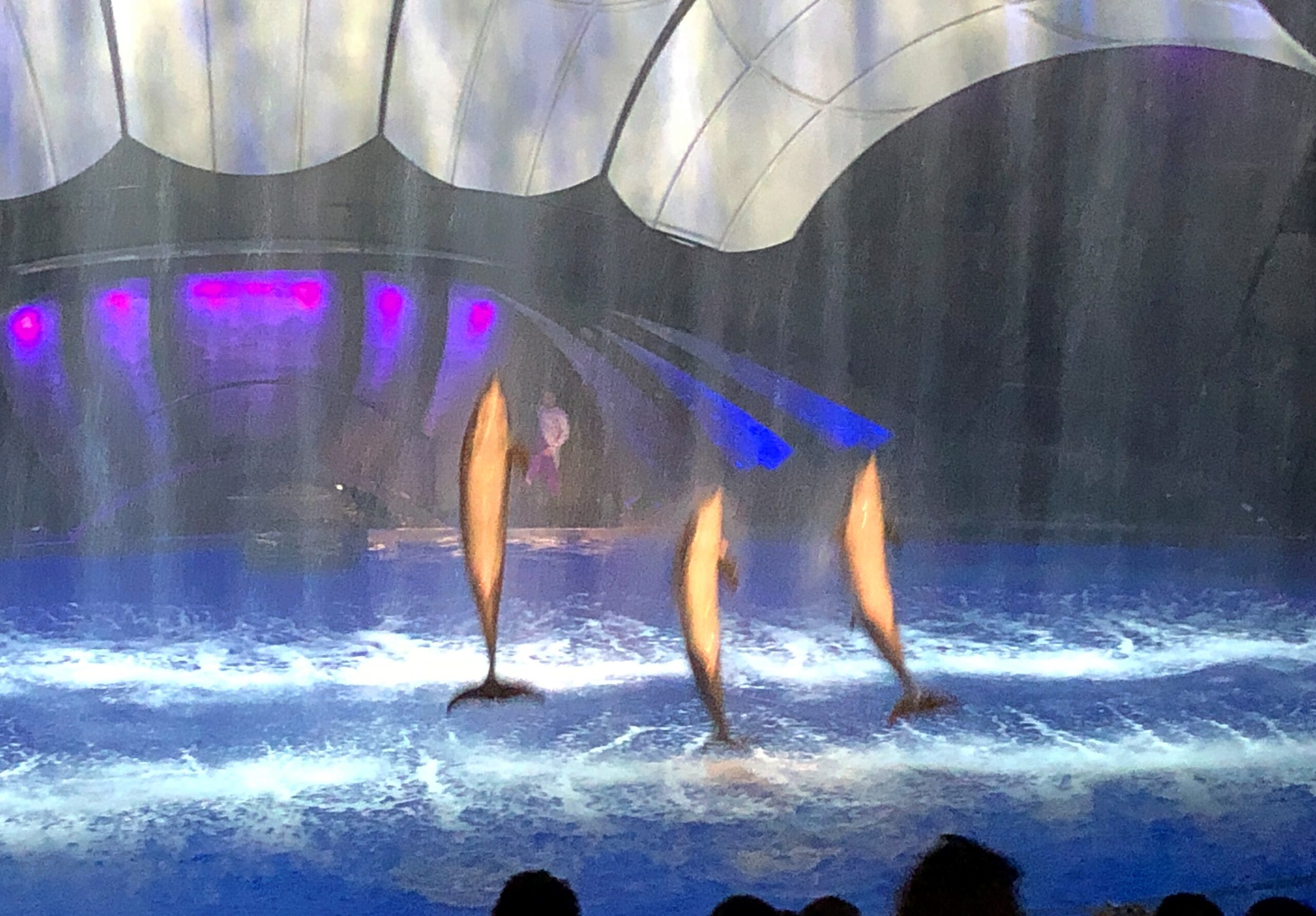
We saw the dolphin show. My still camera wasn’t the best for capturing the action, and there was a lot of jumping and splashing, but squint and the second shot looks like an impressionist work featuring a line of mid-air dolphins.
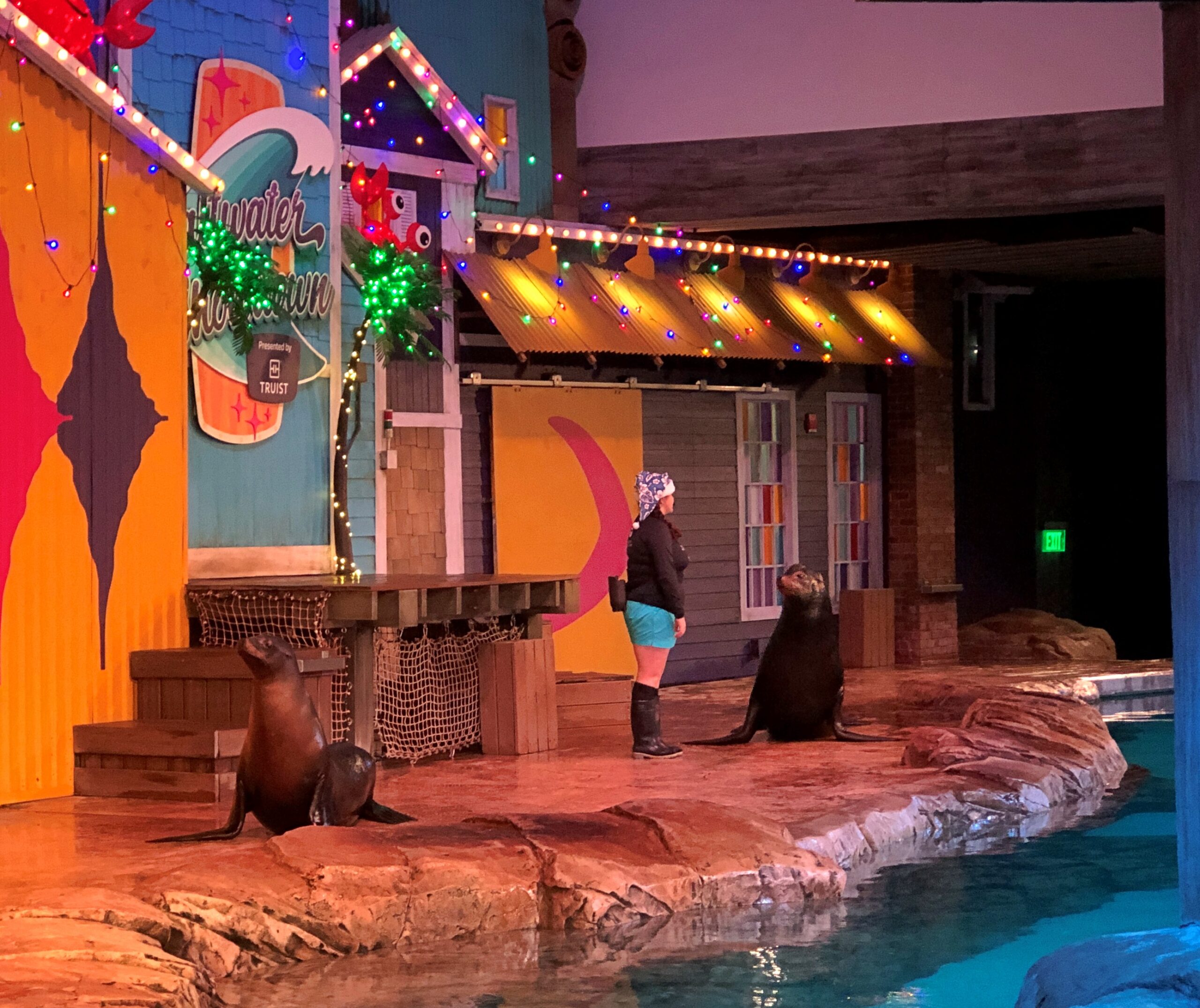
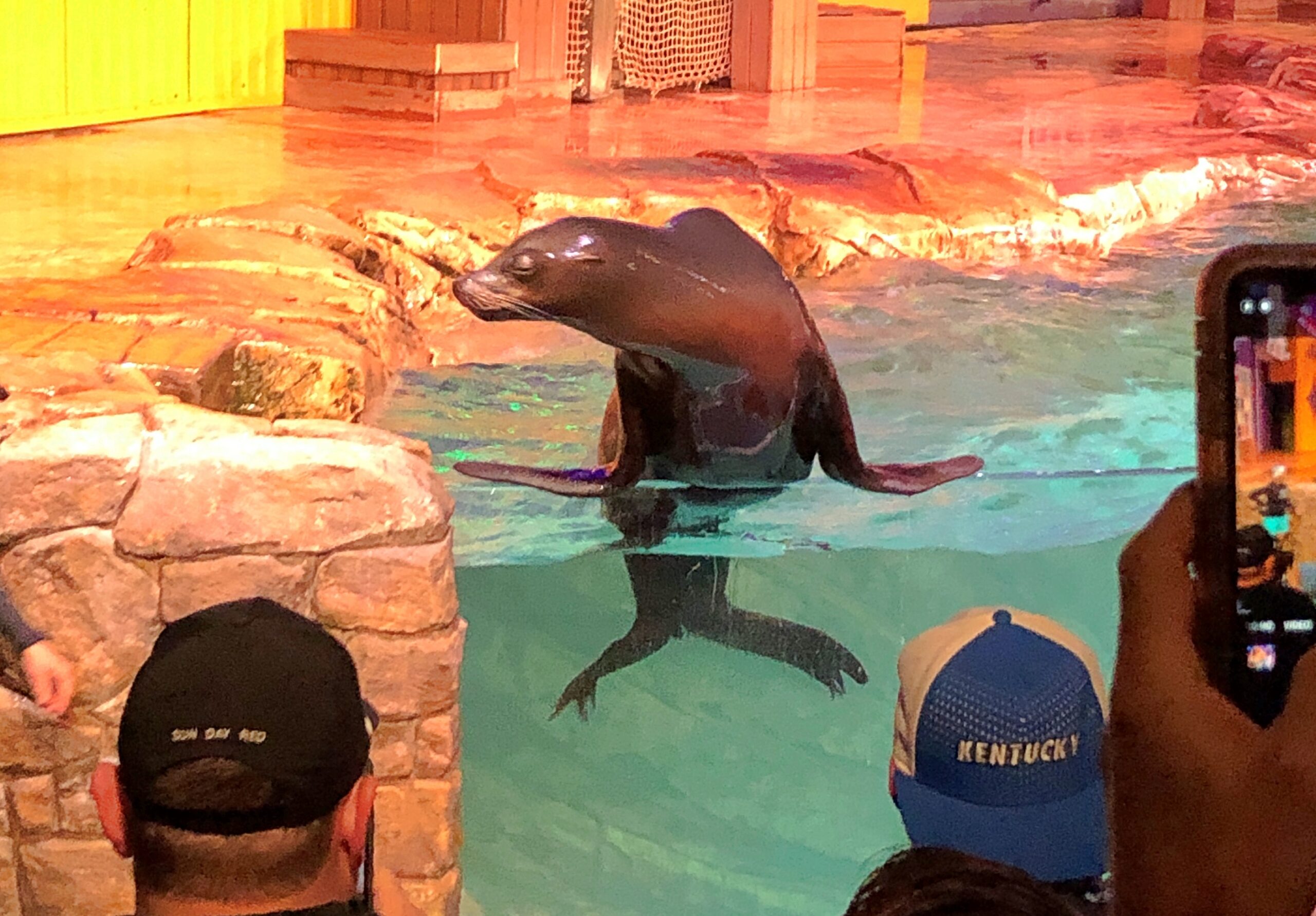
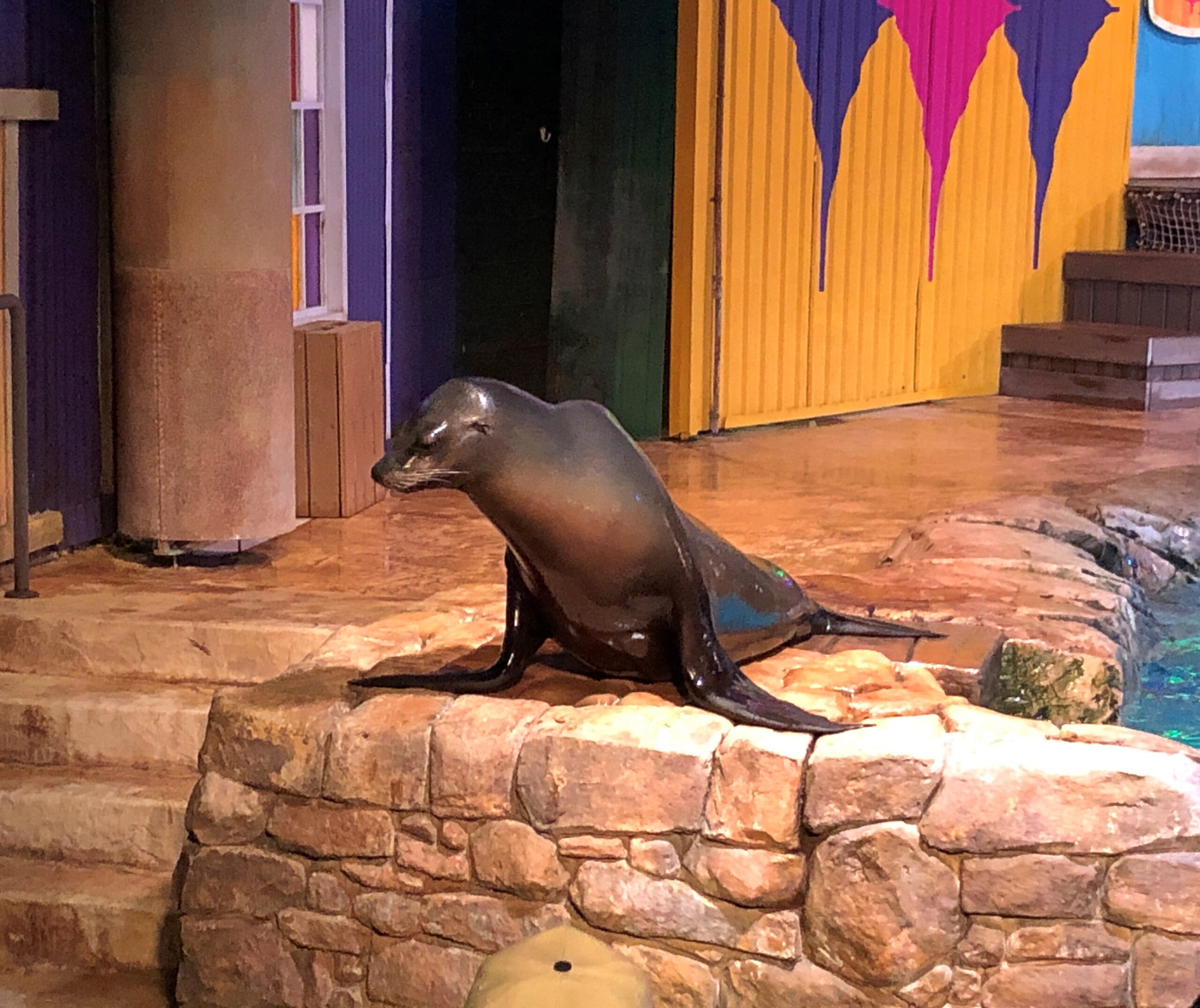
A separate show features seals and sea lions, doing seal and sea lion things for fish rewards.
About half as many people crowded into the aquarium would have made for a better experience, but I can’t begrudge the Georgia Aquarium its massive popularity, since it delivers the aquatic goods. Better a crowd than too few people. They’re out seeing real things. Often better, I believe, to see some part of the physical world than an electronic simulacrum.
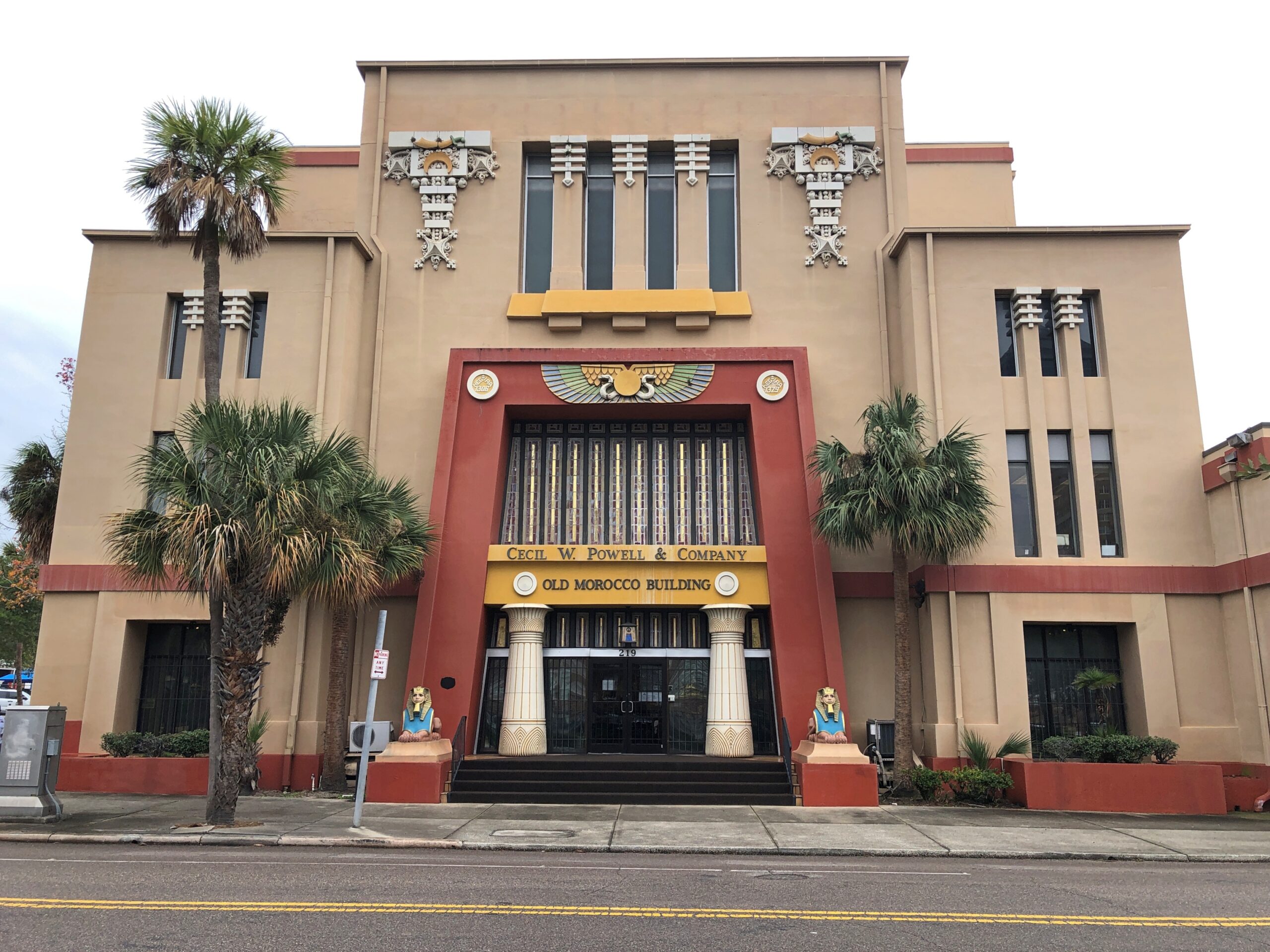
The coolest building in downtown Jacksonville: the Old Morocco Building (a.k.a. the Morocco Temple).
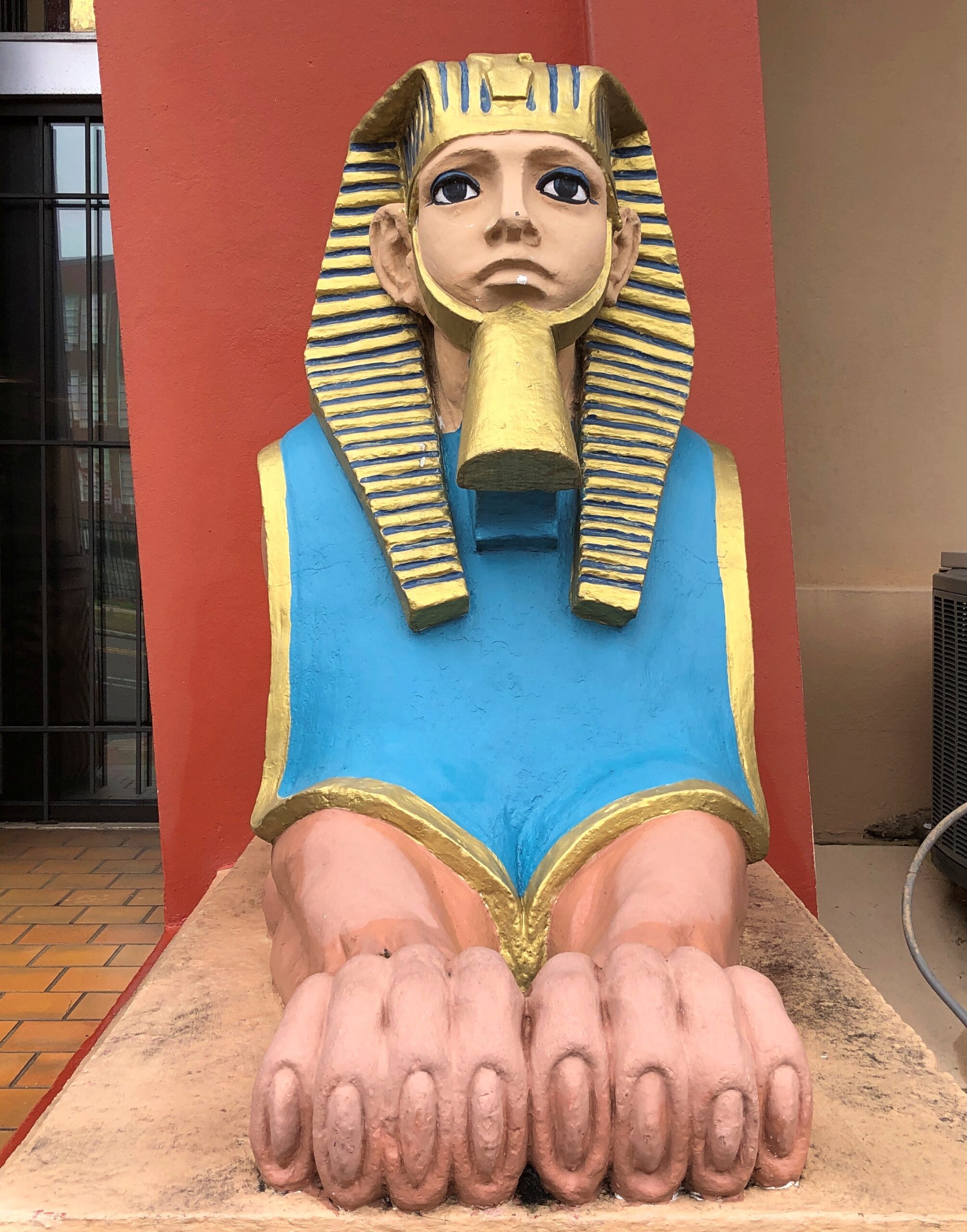
That’s my opinion, formed pretty much instantaneously on December 18, during our wander around downtown. We only spent a few hours in that part of Jacksonville, meaning my exposure was necessarily limited, but I’m sticking with my opinion. After all, what could be cooler than an Egyptian revival-Prairie School structure with sphinx-like guards out front? (And how about them toes?)
“The main facade features Egyptian-style terra-cotta columns with lotus-leaf capitals, tinted art-glass, sphinx-like sculptures, and a terra-cotta sun disk ornament with cobra heads,” notes Prairie School Traveler.
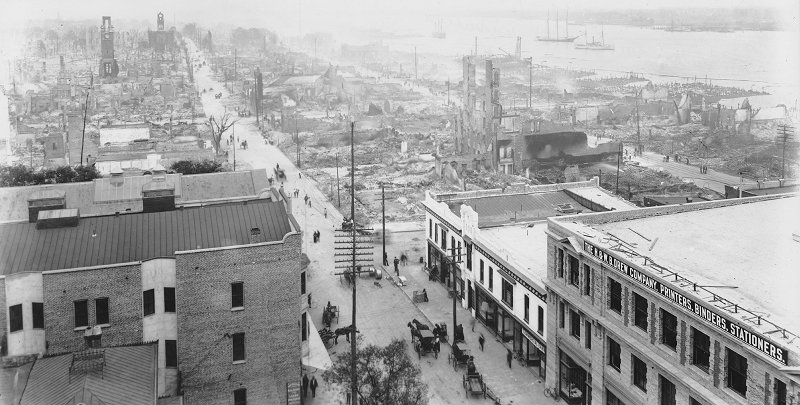
The Shriners – who else? – tapped architect Henry John Klutho to design the building, which was completed in 1911. Klutho had been based in NYC, but after the Great Fire of 1901 in Jacksonville, he came south to participate in the redevelopment of the city. If he did nothing else, the Morocco Temple would be enough. I understand the interior is similarly exotic, though modified after the Shriners moved out in the 1980s, but we didn’t venture in.
The aftermath of the fire. Redevelopment opportunities galore.
We’d come to Jacksonville, two days after leaving Key West, for two reasons. One, to visit old friends. Last year, I managed to visit old friends in Austin, San Antonio, Tokyo, rural Tennessee, coastal North Carolina, central Georgia, Denver, New York, suburban Boston, and finally Jacksonville. An essential ingredient for the year, these visits.
Also, I wanted to visit the generally ignored Jacksonville. A place one doesn’t hear about much. Miami has its Vice and Orlando its Mouse and Key West its Jimmy Buffett. But Jacksonville?
We were advised that parking would not be an issue in downtown Jacksonville, even on a weekday. It wasn’t. We set out to see what we could see.
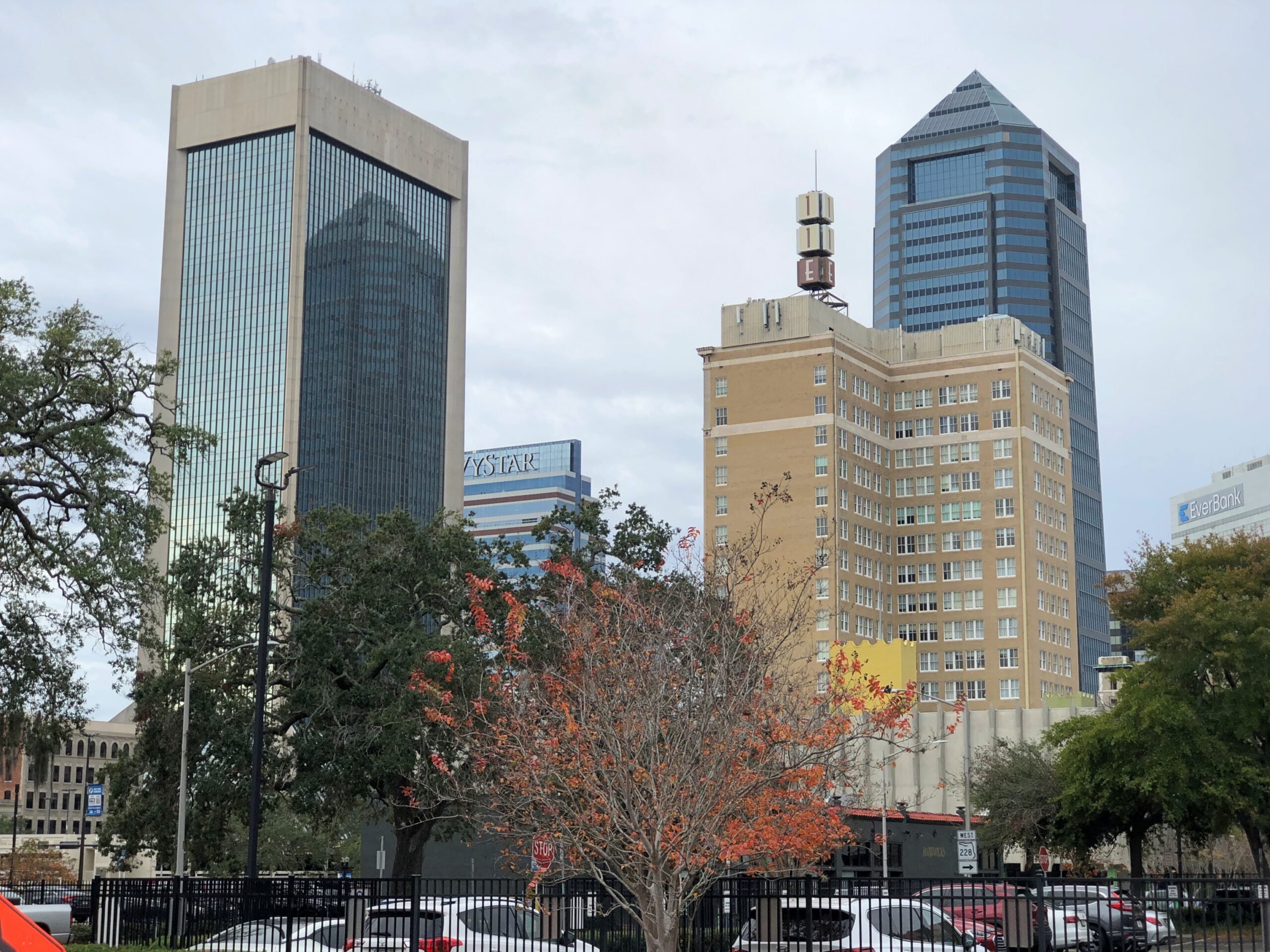
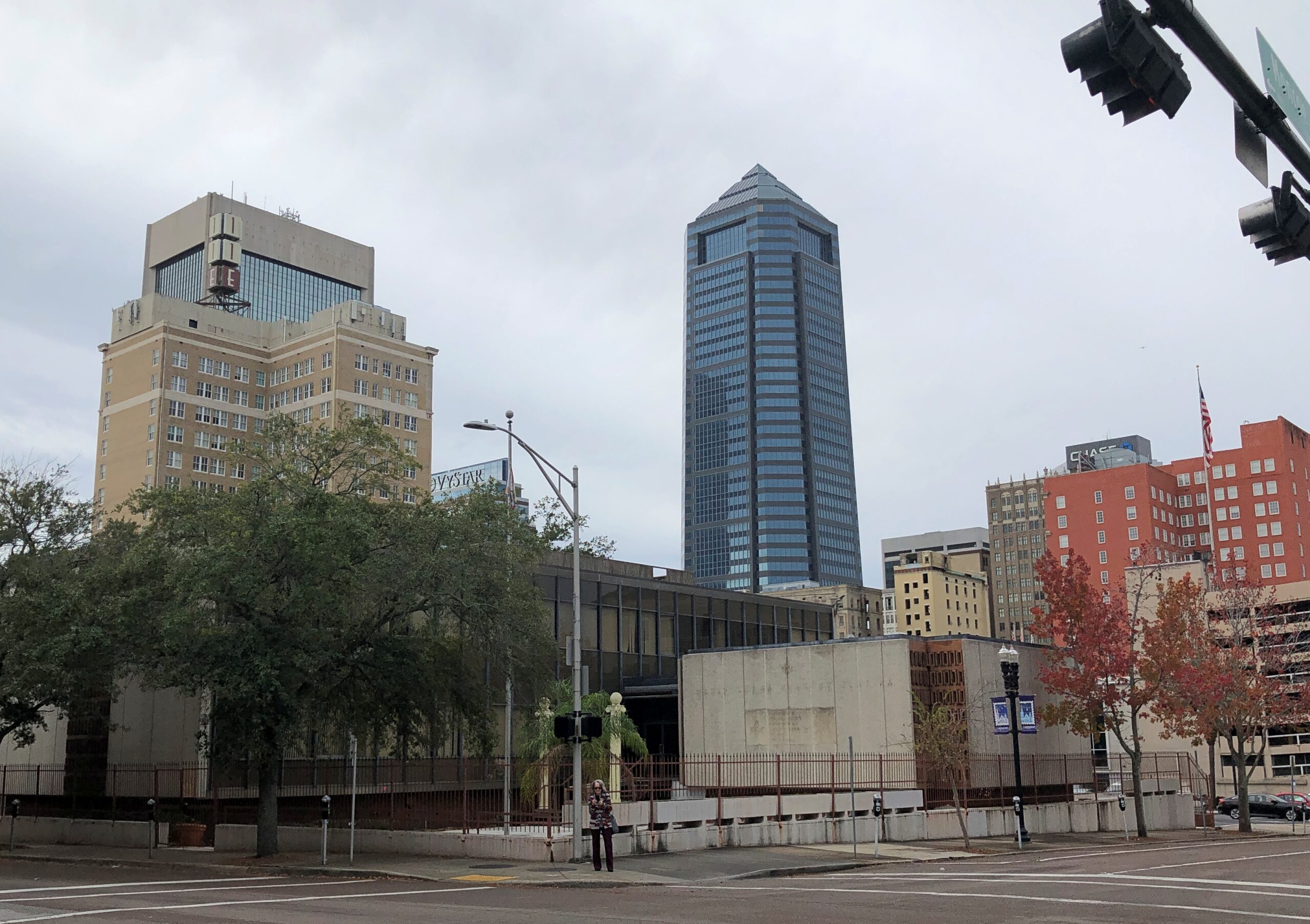
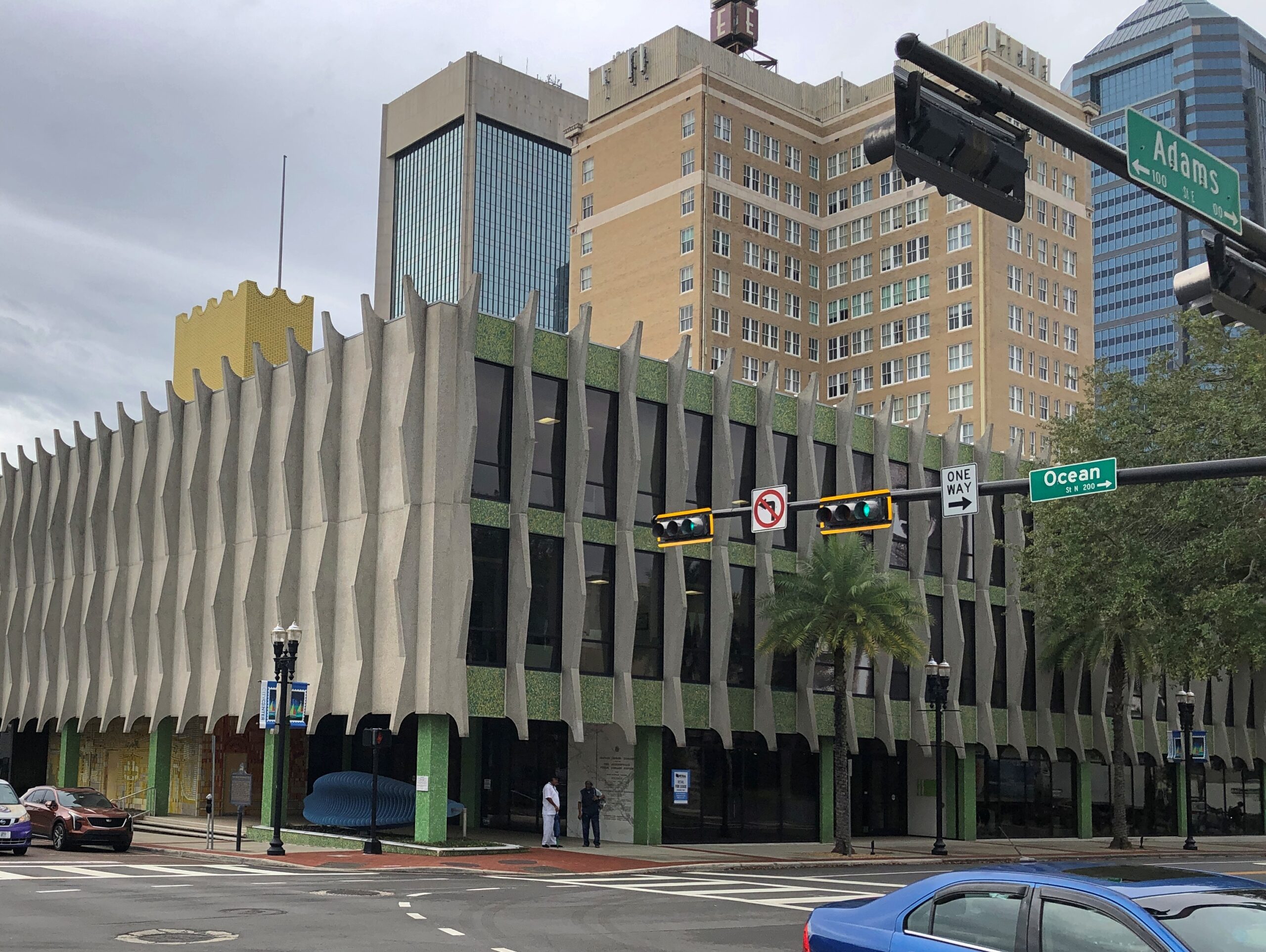
It was almost spooky how empty downtown was. Even the downtown Detroit of recent years is more active.
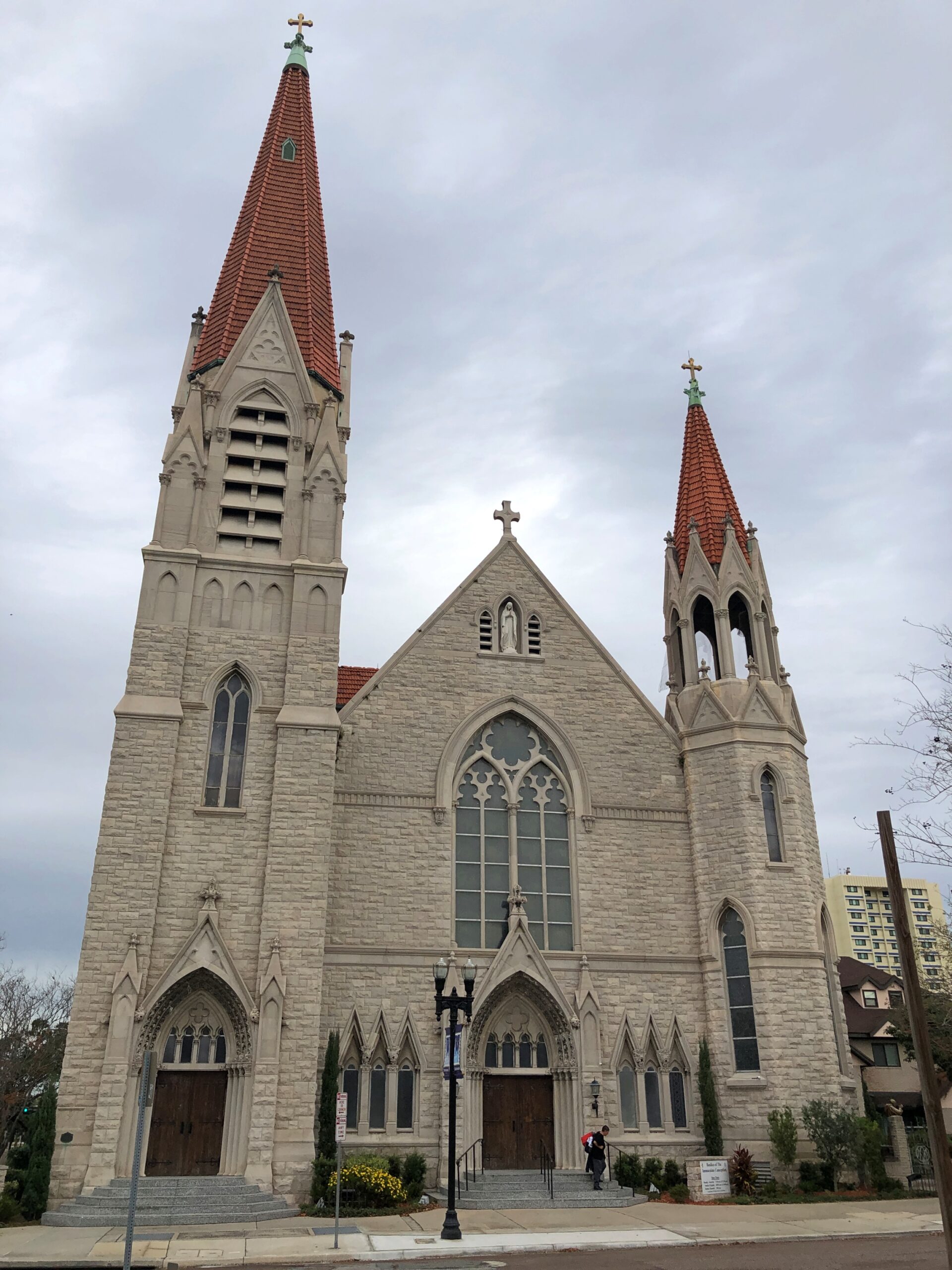
Downtown Jacksonville included some large but closed churches, such as the Basilica of the Immaculate Conception.
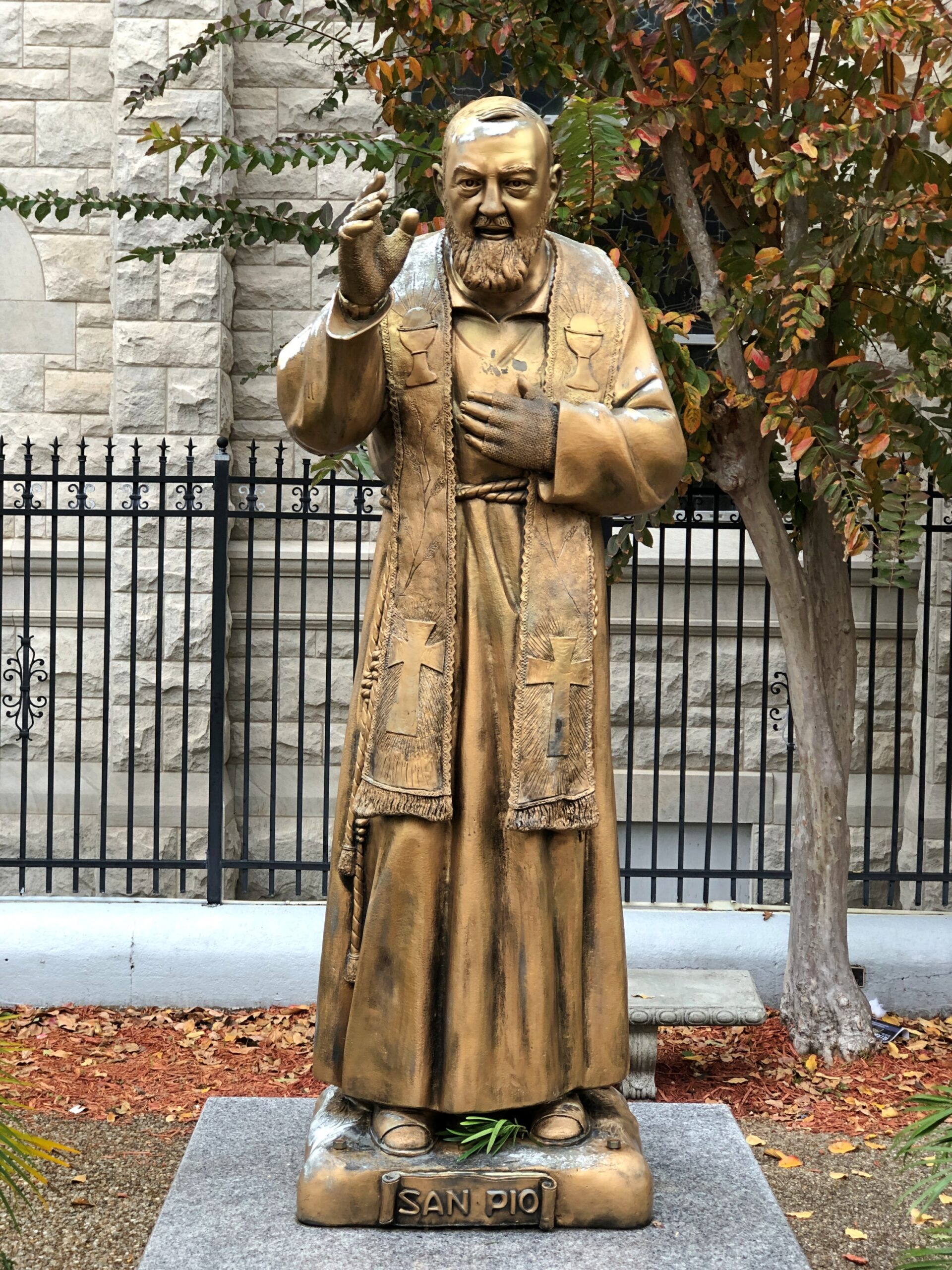
But at least Padre Pio is near the basilica to greet you.
If I’d known what to look for – because I had to look him up later – I’d have noticed the bandages covering both of his wrists. Among other things, St. Pio was known for his stigmata.
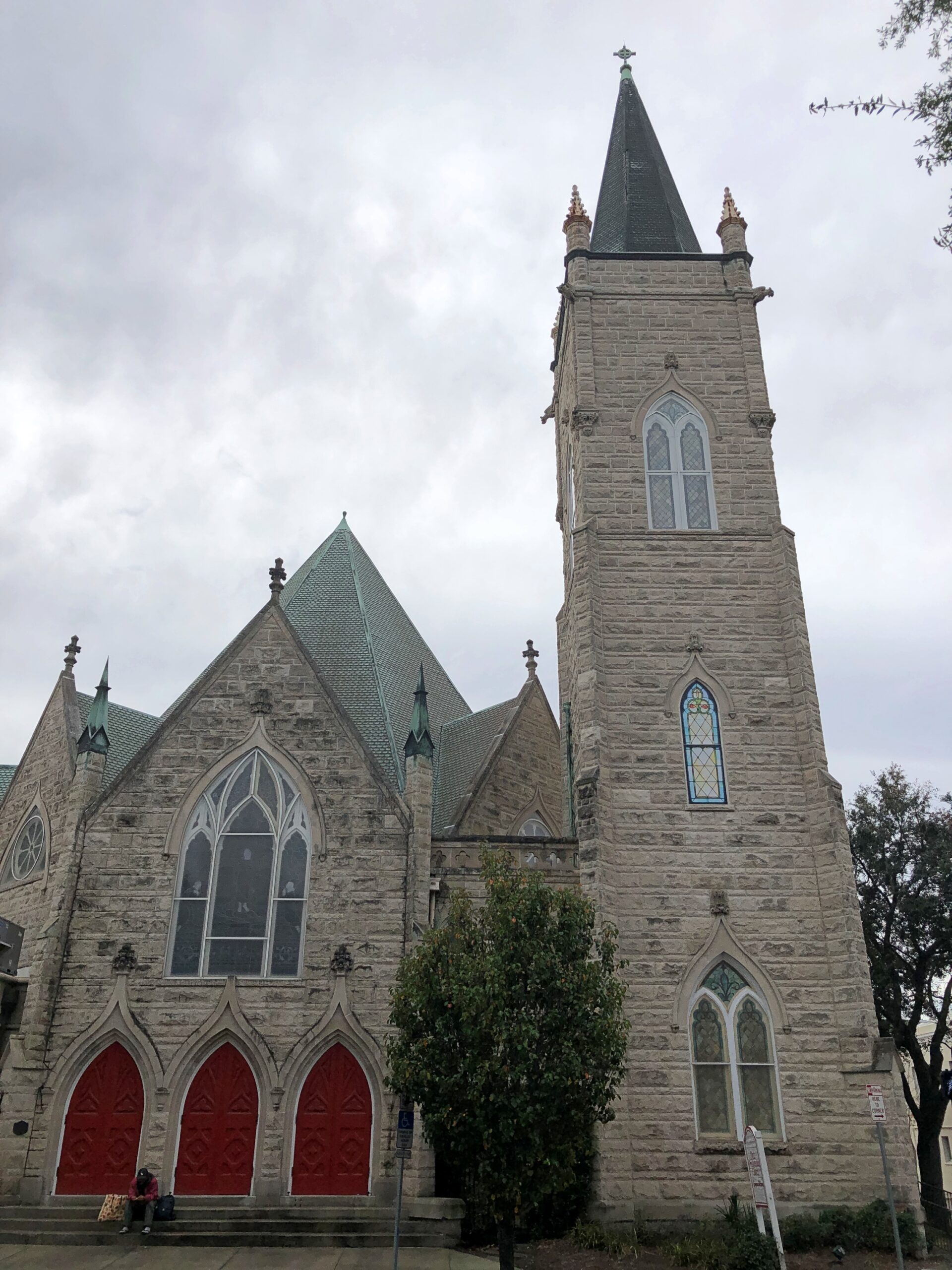
Down the street, also closed: First Presbyterian.
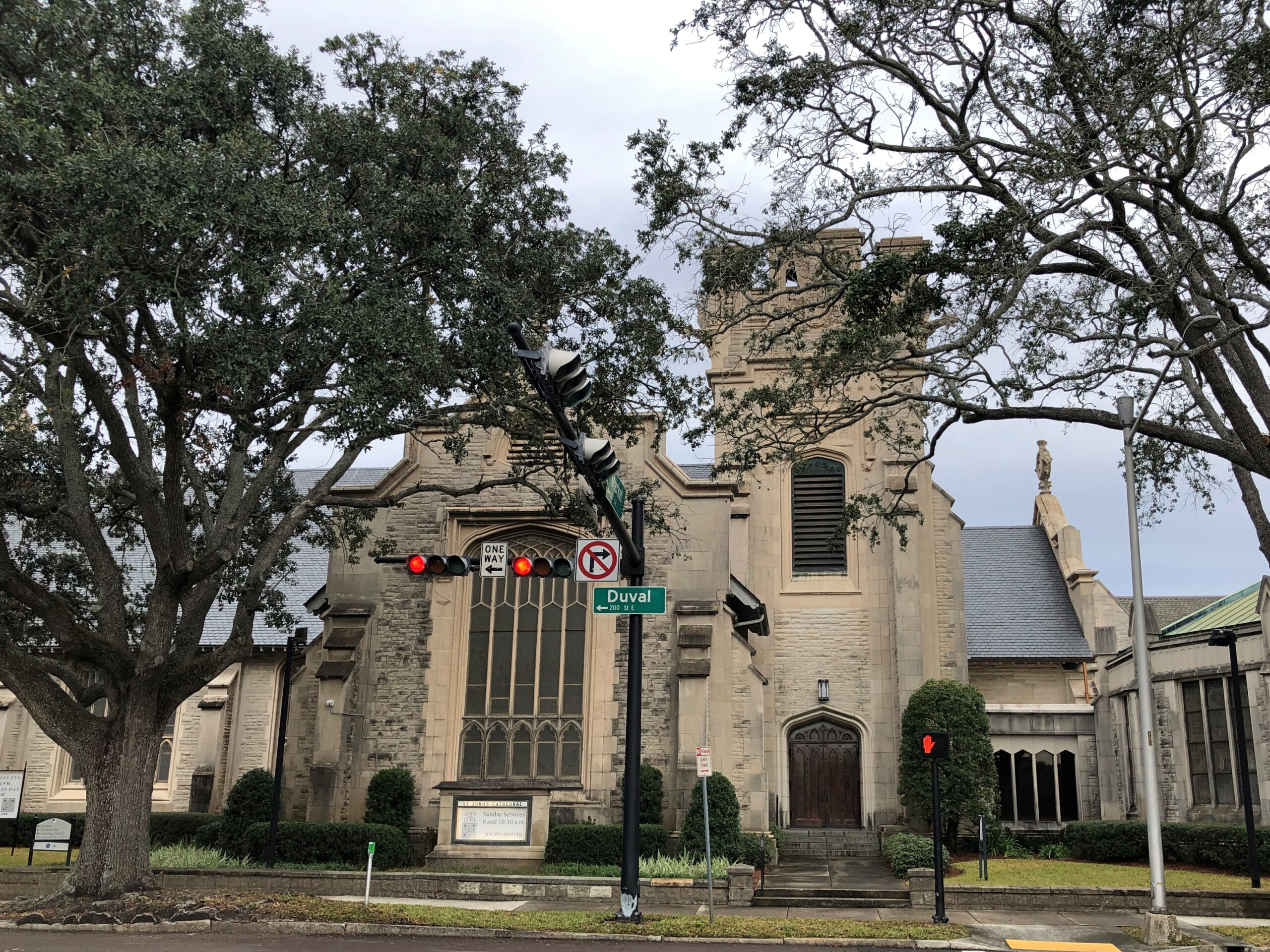
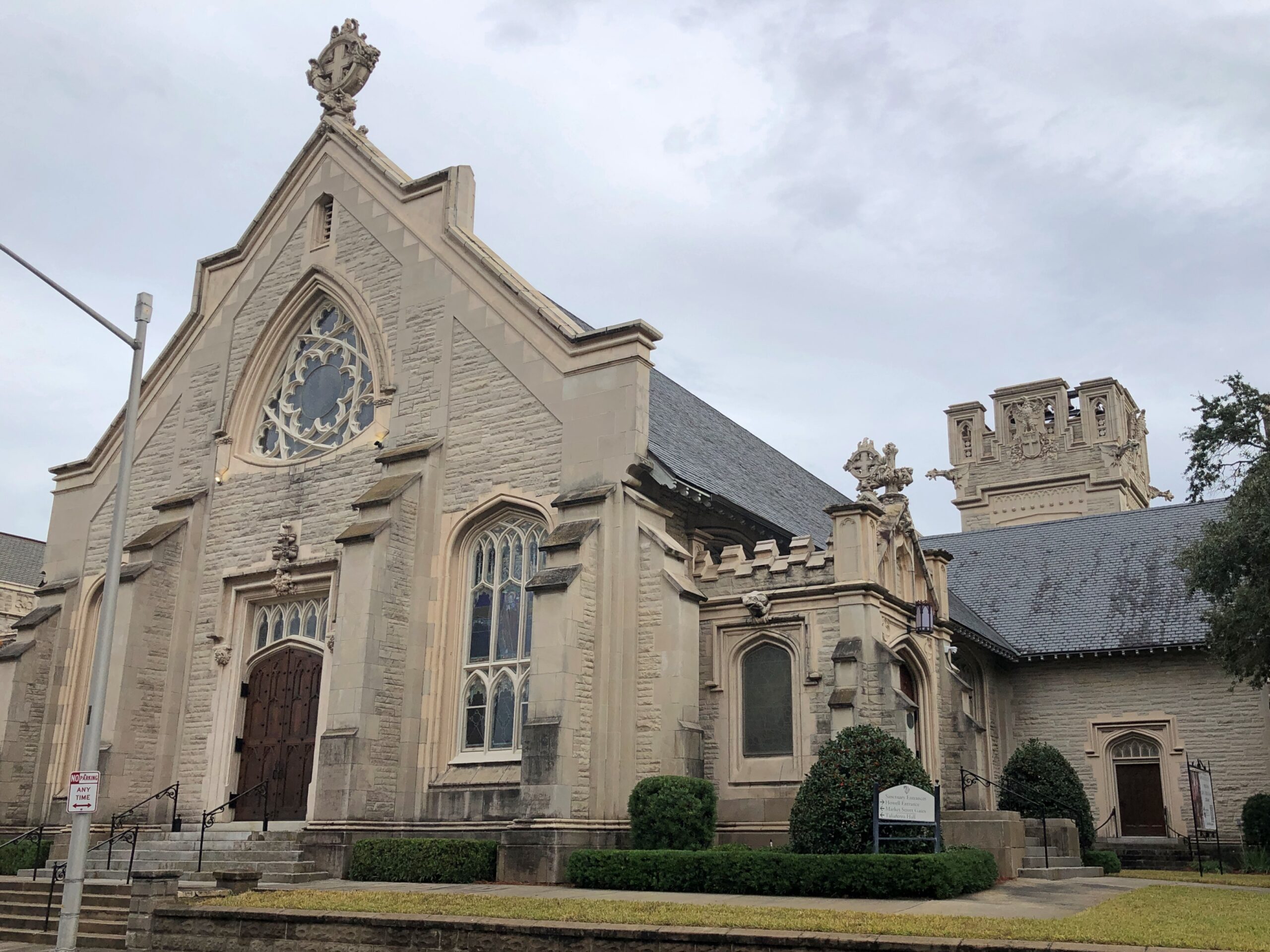
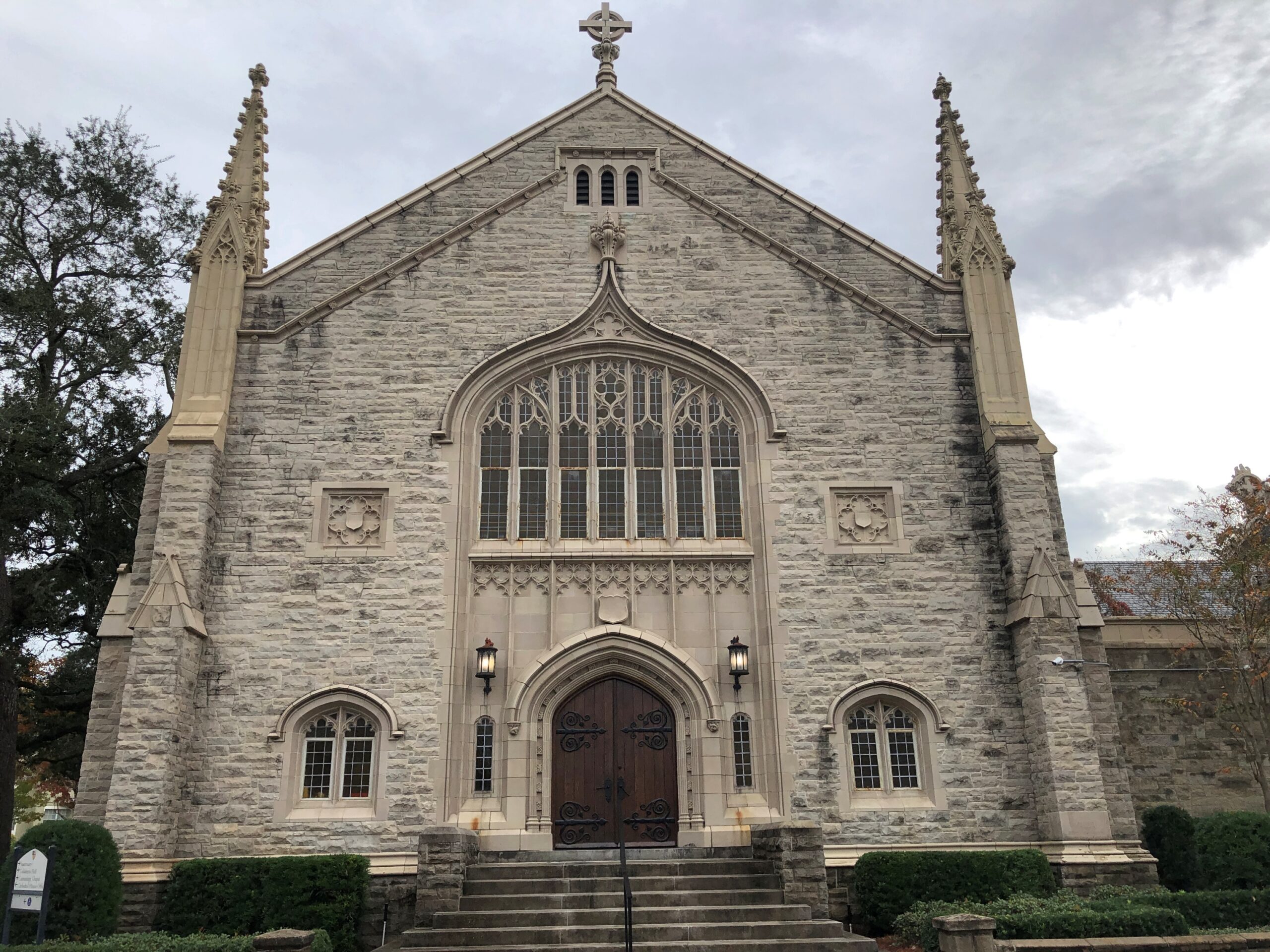
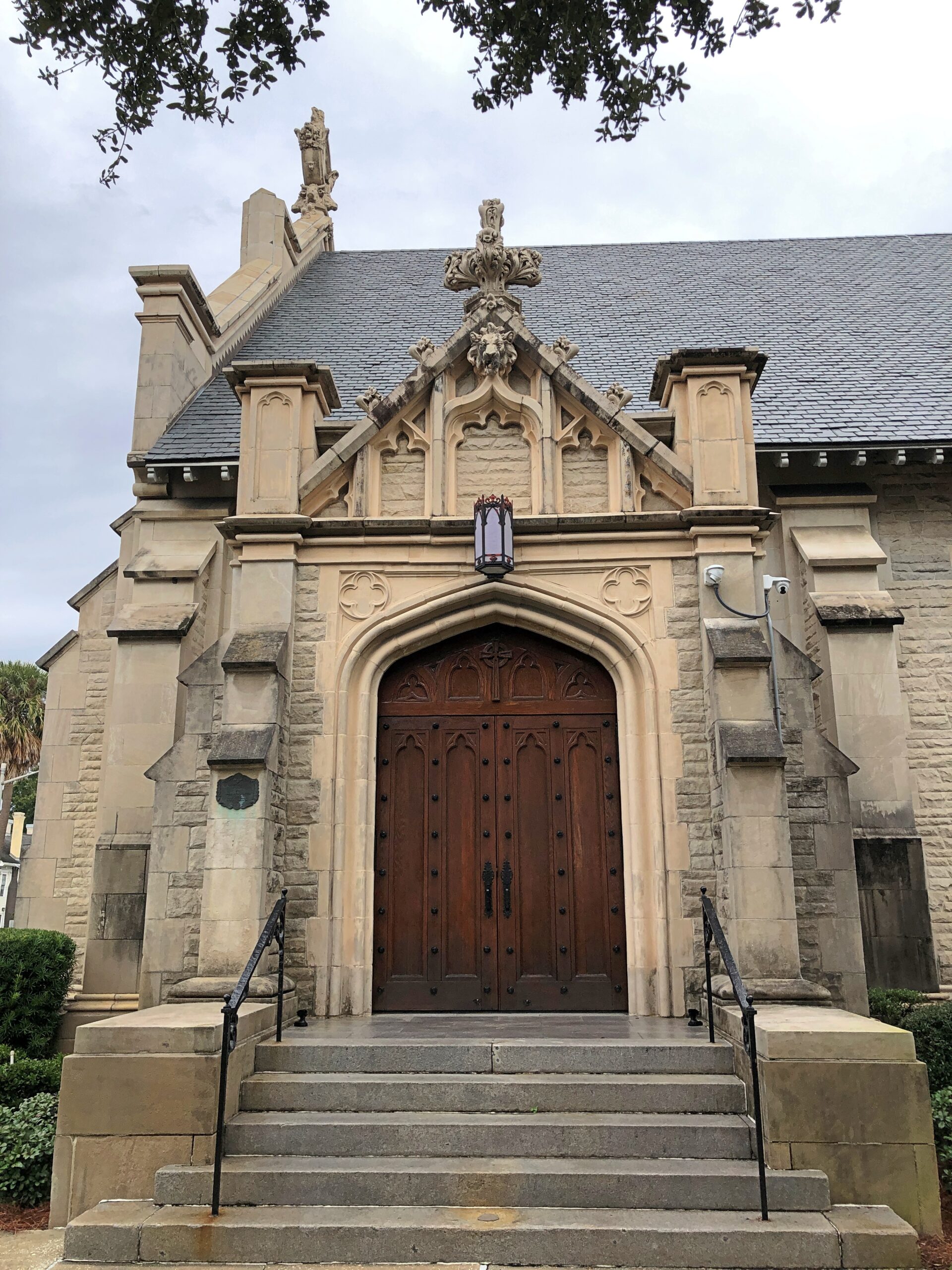
St. John’s Cathedral, Episcopal. At first I assumed it was closed.
This is the third church on the site. An 1840s structure burned down (and sank into the swamp?) in 1862, during one of the times the city changed hands between Union and Confederate. A grander church replaced it after the war but, oops, along came the aforementioned Great Fire of 1901. The current structure dates from 1906, the work of noted church architect Howard Nott Potter.
We found a way in, almost hidden around back. We were well rewarded.
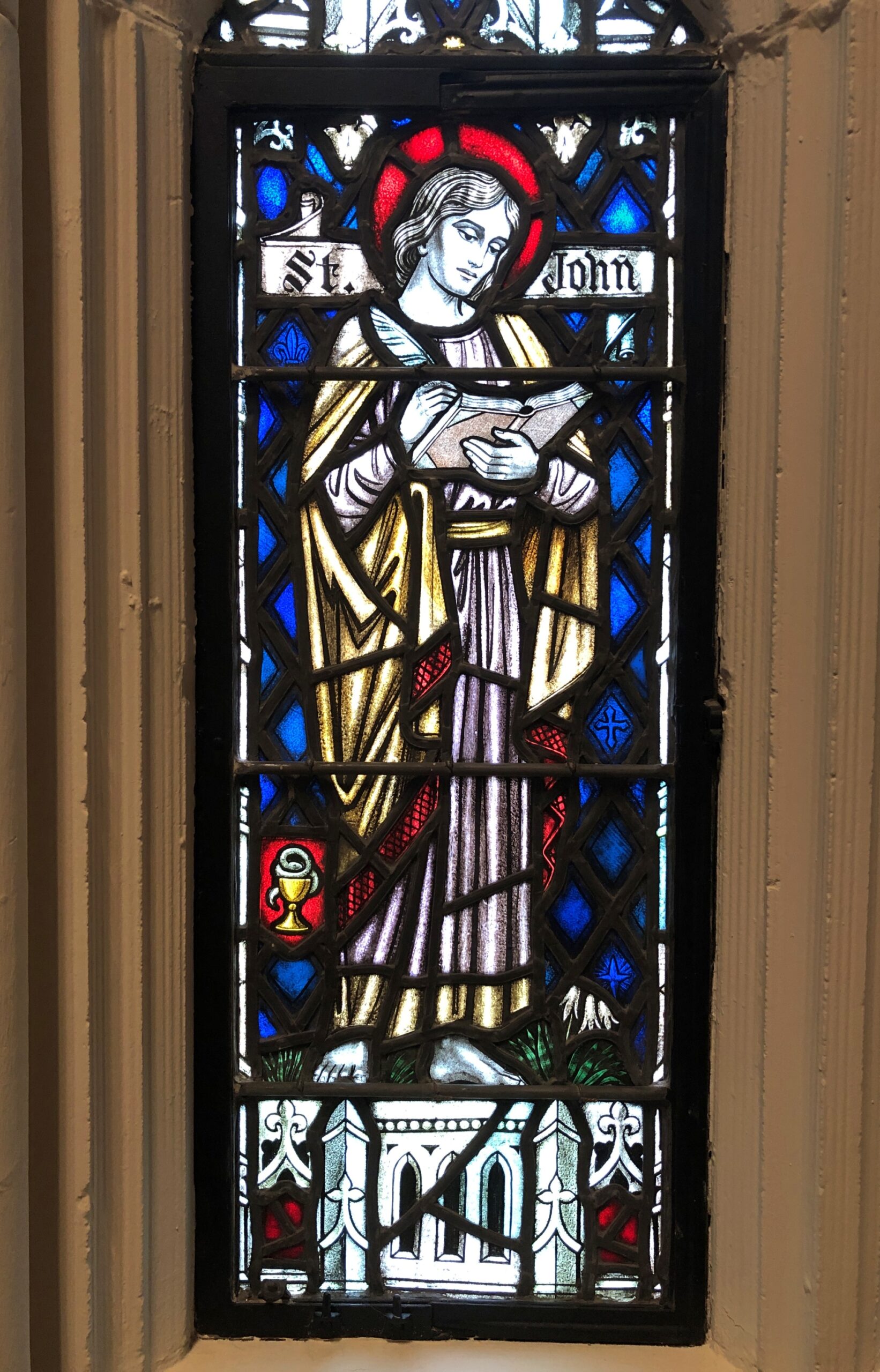
Fine stained glass. St. John makes an appearance, as you’d think.
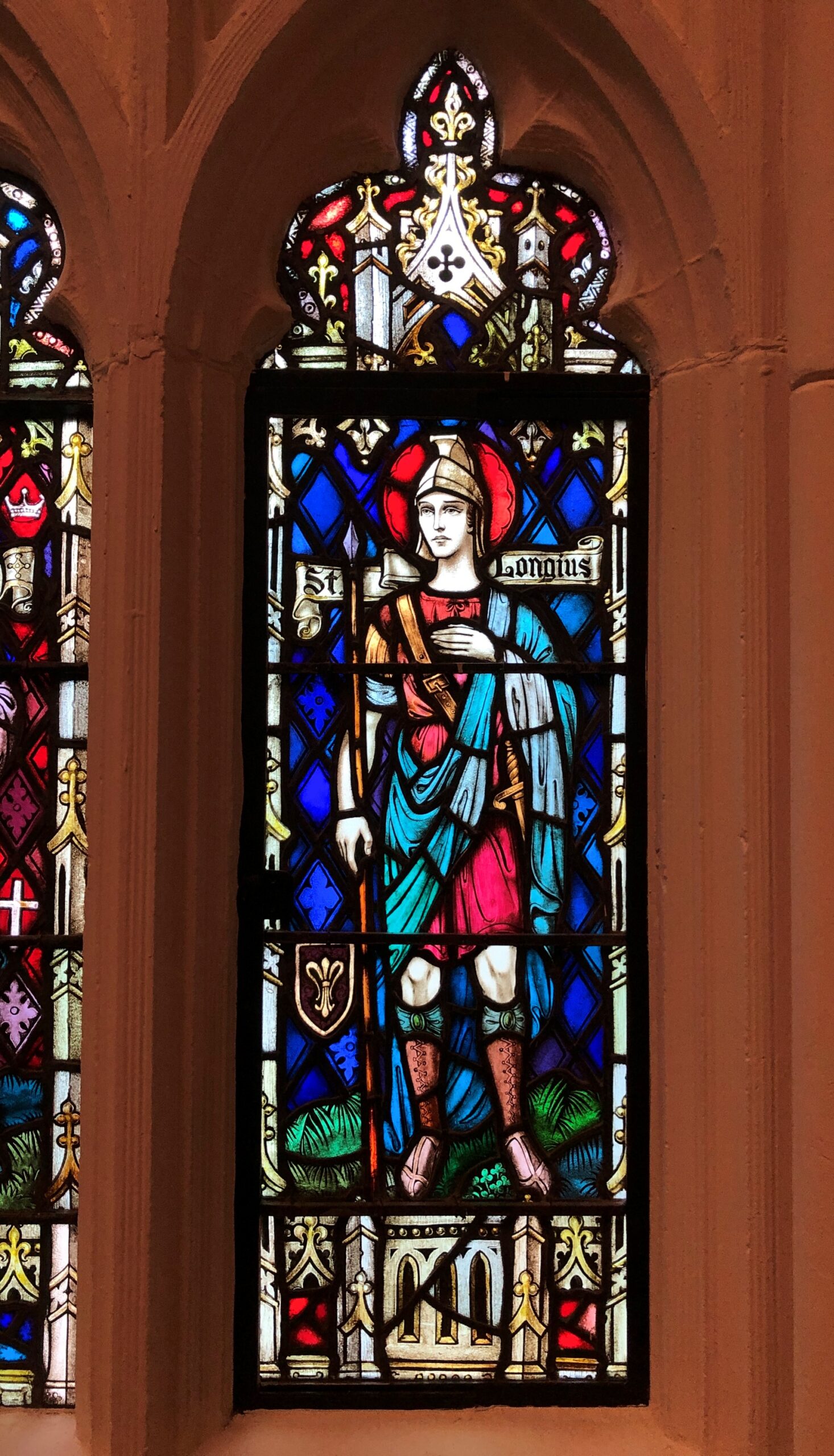
So does St. Longinus.
You might say he had a bit part in during the crucifixion, mentioned in one line exactly (John 19:34) and not even by name. But from such small acorns large bodies of belief grow.
A few days ago, I sent the following email to the curator and historian at the Key West Art & Historical Society, Dr. Cori Convertito:
Dr. Convertito,
I recently visited Key West for another pleasant visit, and came away with a question I haven’t been able to answer, though perhaps I haven’t looked in the right places.
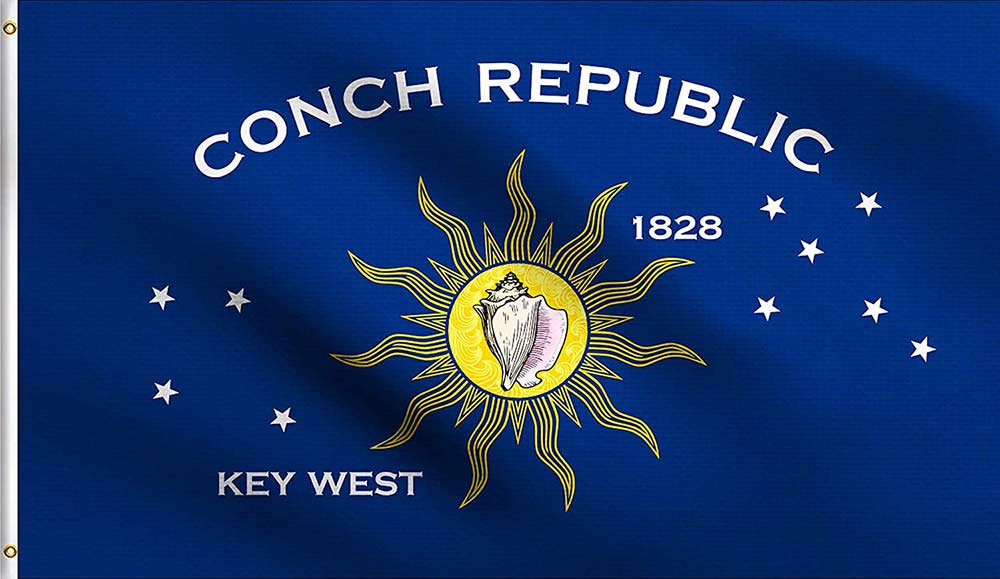
Who is credited with the creation of the Conch Republic flag? I understand that it appeared at the same time as the infamous roadblock and the “secession,” but detail on its creation is lacking. Do you happen to know that?
One reason to ask is that it’s a handsome design, though I’m not sure about the star pattern asterisms — is one or another supposed to be the Southern Cross?
Today she answered:
That’s a perceptive question, and a difficult one to answer definitively. The Conch Republic flag emerged alongside the 1982 ‘secession,’ but attribution is complicated by the fact that several individuals have, over the years, laid claim to the original iteration of the artwork, and reliable contemporary documentation is limited. As a result, it’s hard to credit a single creator with certainty.
What is clearer is the intent behind the design elements. In addition to the conch shell and sun, the star groupings are generally understood to represent two navigational asterisms: the Southern Cross and the Northern Cross (Cygnus). Their inclusion appears deliberate, reinforcing Key West’s maritime identity and its symbolic position between hemispheres.
I hope that helps clarify what is known, and what remains unresolved.
So the short answer is, like with a number of historical questions – even ones as recent as this – no one is sure. Good to know. Thanks, Dr. Convertito.
The Overseas Highway, from mainland Florida to Key West, or vice versa, is epic all around: an epic construction project once upon a time, and an epic drive in our time. Through the Upper Keys, the likes of Key Largo and Islamorada, the ocean isn’t usually visible, obscured behind thick development: commercial and residential buildings and omnipresent marinas. But it isn’t long before you’re skipping from key to key, some larger, some smaller, with water widely visible on both sides of the road.
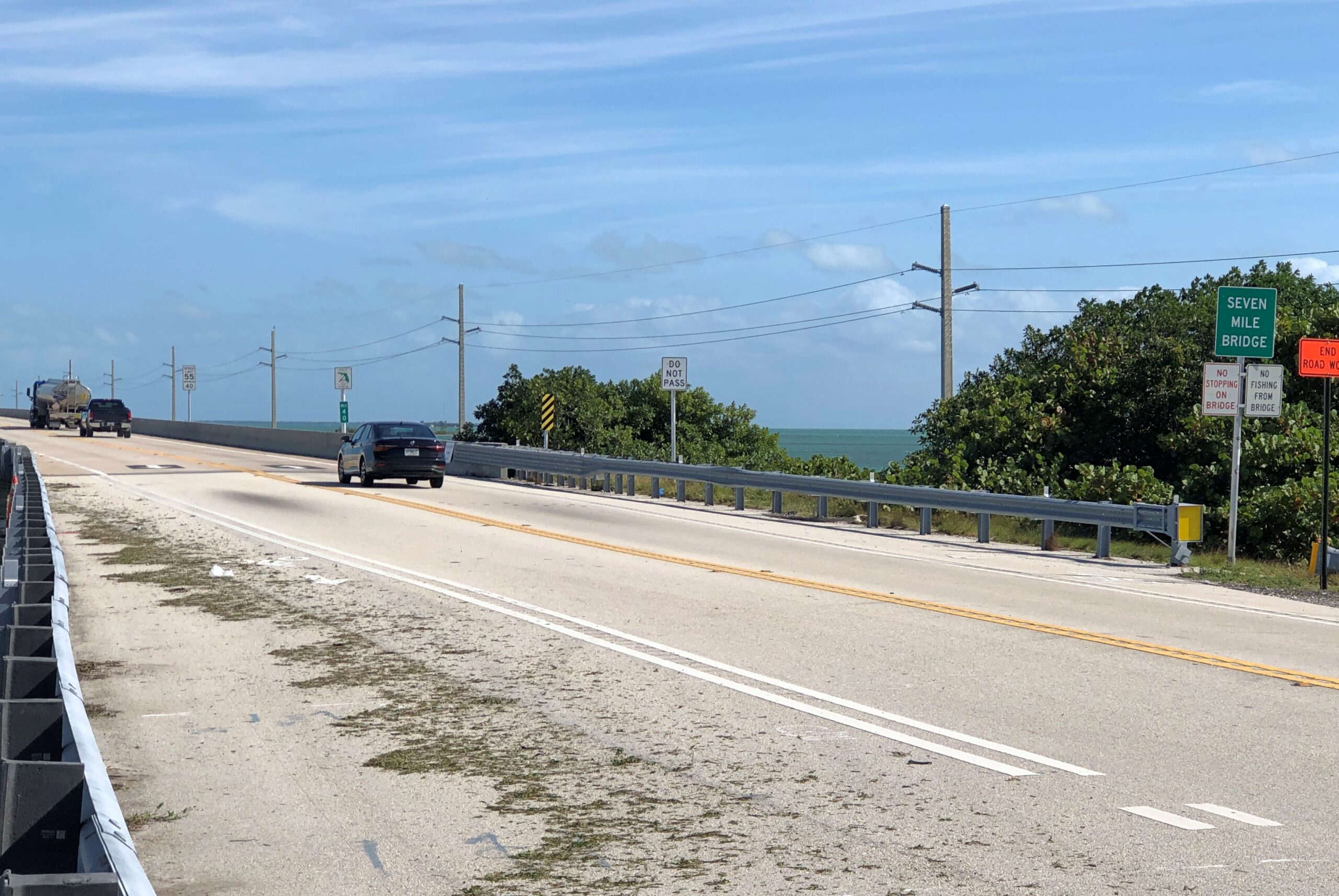
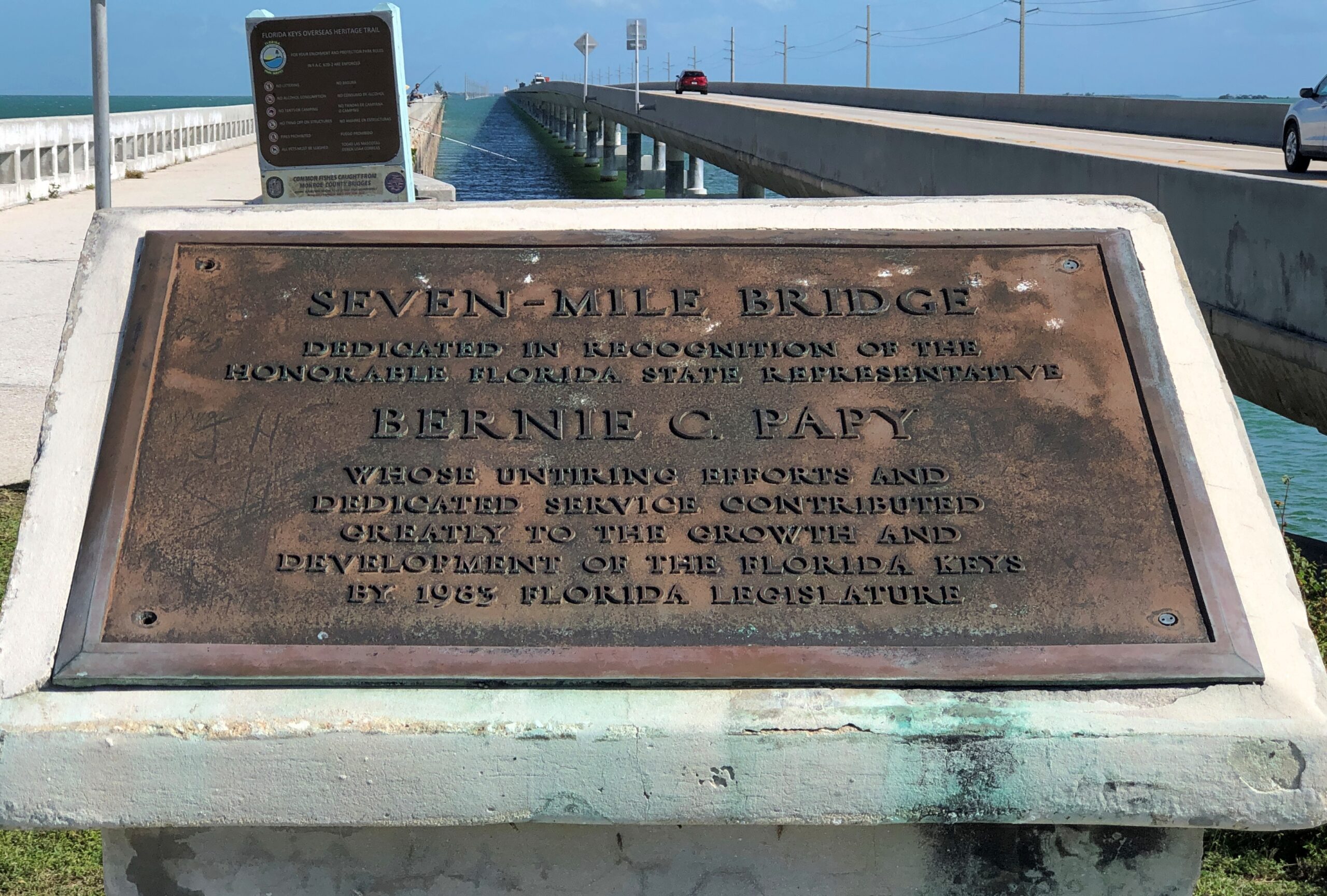
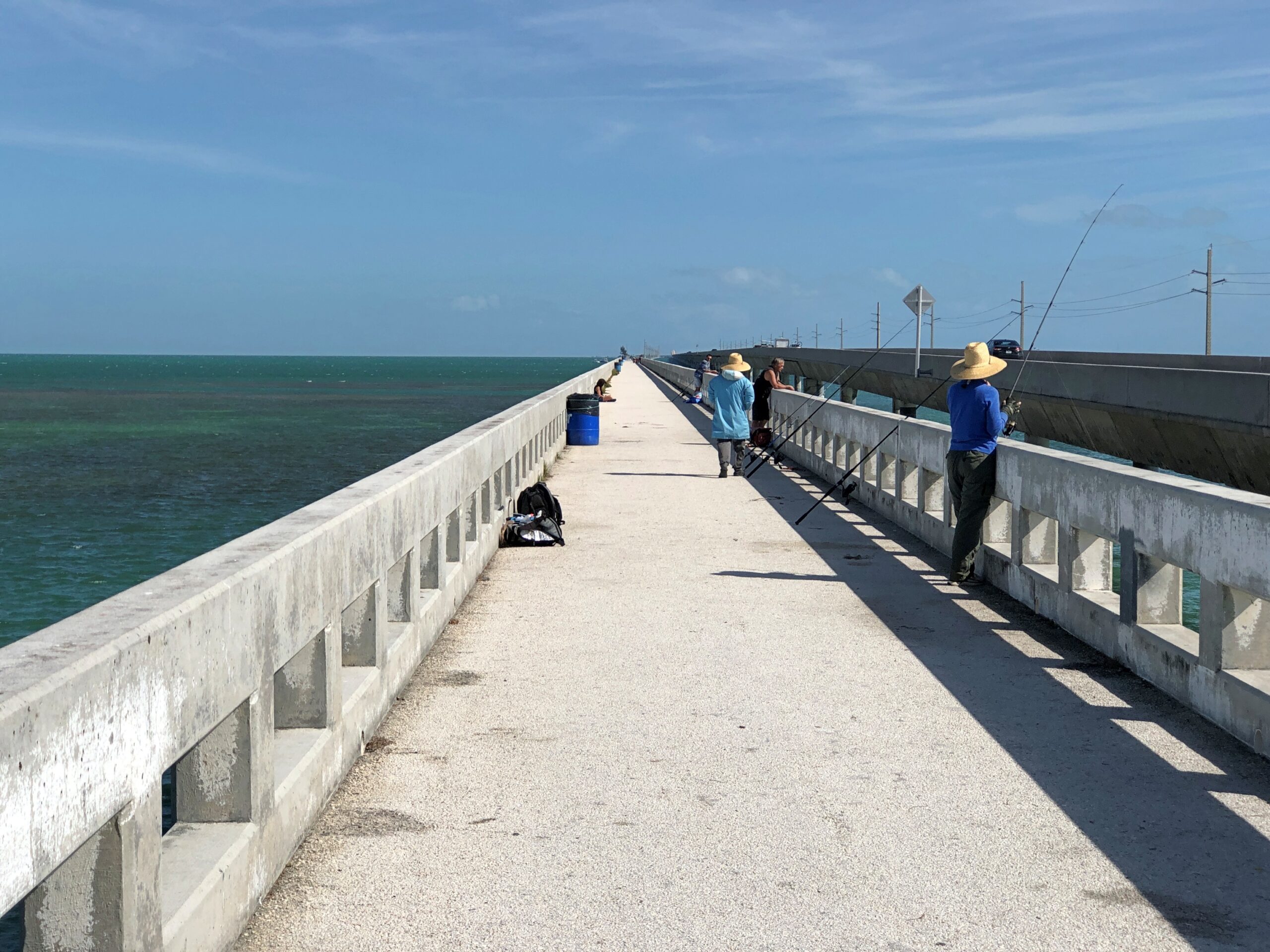
The most epic section of the crossing, as far as I’m concerned: Seven-Mile Bridge.
On an ordinary highway, seven miles isn’t much of a stretch at highway speeds. Listen to one song or another on the radio and you’re practically done with it. Those same minutes have a different quality over the wide water, glinting in the sun and spotted with boats and occasional small keys in the distance. There’s a sense of the mildly impossible. Of course it’s entirely possible, via a feat of 20th-century civil engineering, as is the 100-plus miles of the whole highway. I don’t believe my civil engineer grandfather ever drove the Overseas Highway, but I’ll bet he read about it with considerable satisfaction.
“The original 7 Mile Bridge, also known as the Knights Key-Pigeon Key-Moser Channel-Pacet Channel Bridge, was constructed in the early 1900s as part of Henry Flagler’s ambitious Overseas Railroad project,” notes the Key West Blog. “This railroad connected mainland Florida to Key West, revolutionizing transportation and trade in the region. However, after a devastating hurricane in 1935, the railroad was destroyed, and the bridge was converted into a highway.”
The history is a little more complicated than that, with the current bridge a 1980s work, leaving part of the original as a pedestrian and (especially) a fishing bridge. I’m no sport fisherman, but I understand tarpon, snook, snapper, grouper, bonefish and barracuda swim these waters.
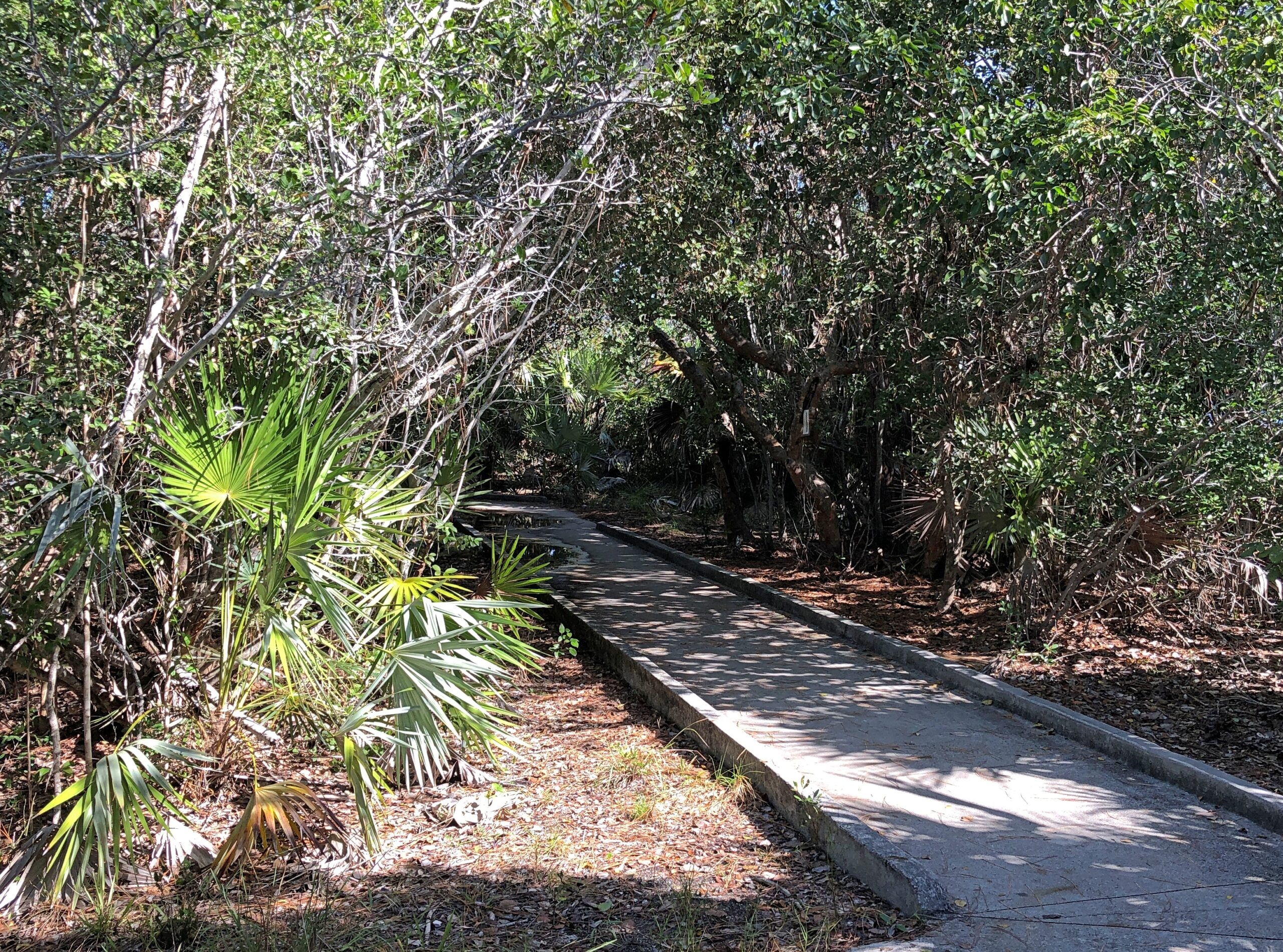
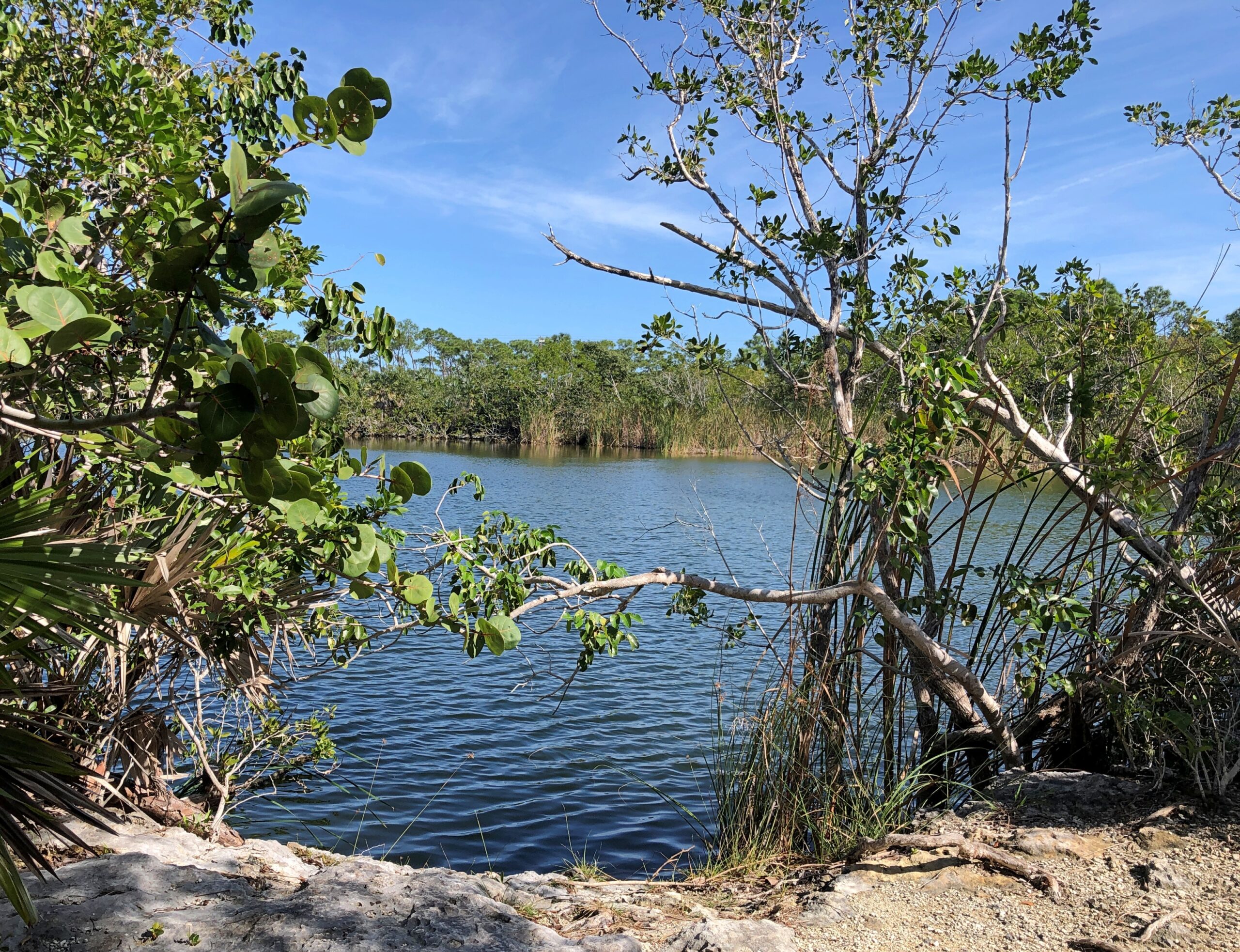
At Big Pine Key, we stopped for a visit to the National Key Deer Refuge, a place focused on giving key deer a place to live, as it says in the name. For human visitors, there is a trail.
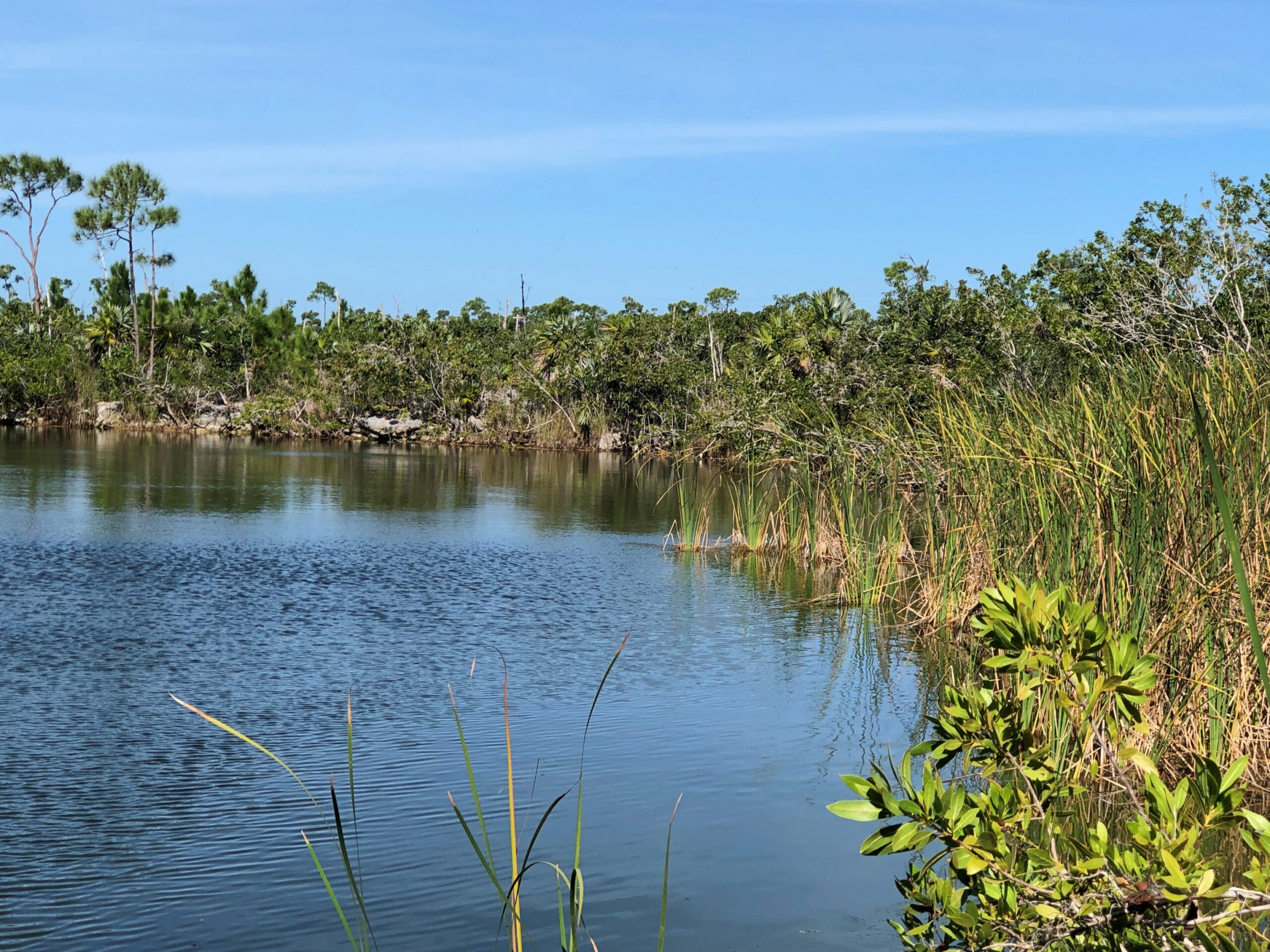
It goes partly around a pond in the refuge. No deer were to be seen.
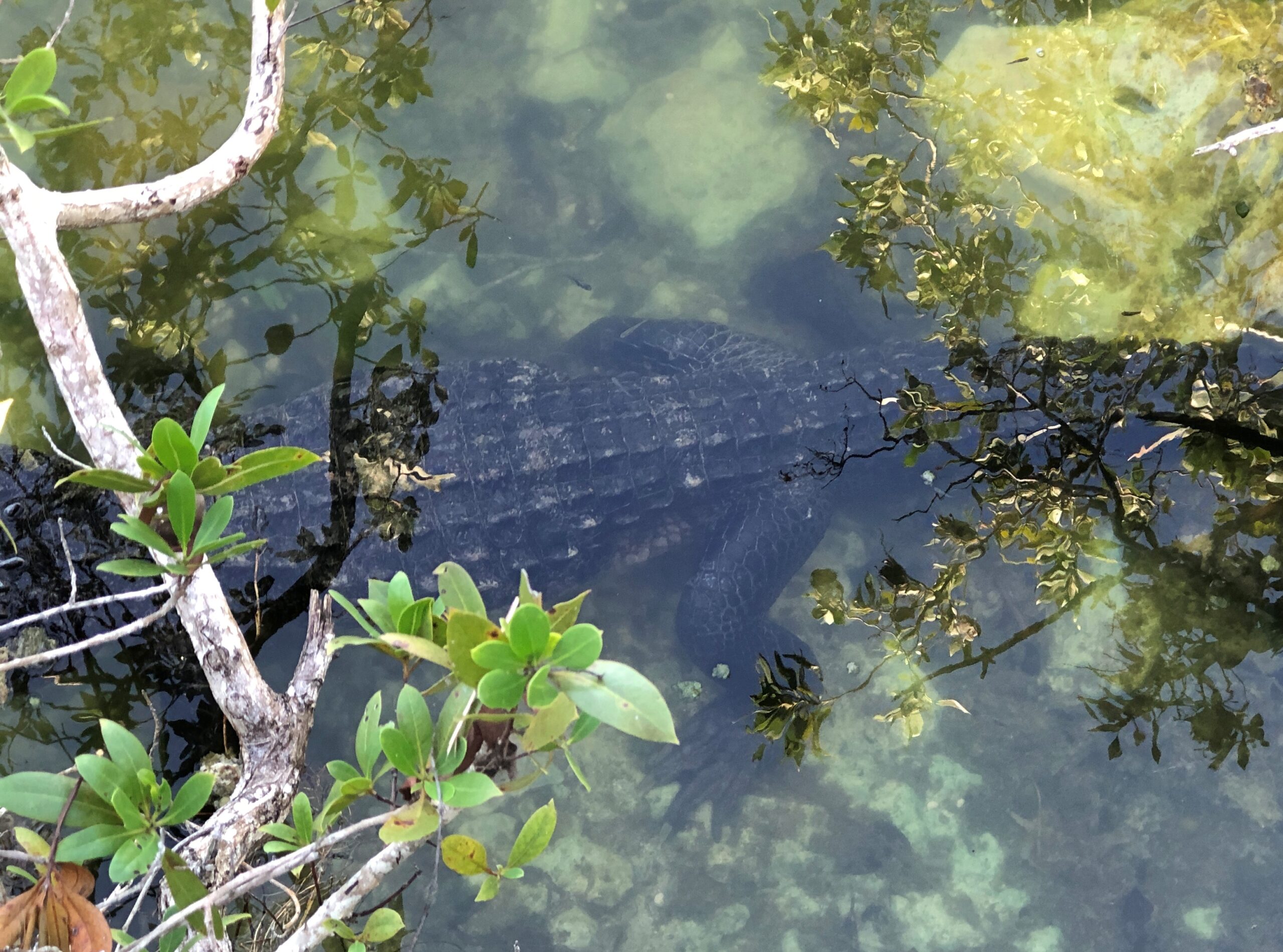
We did spot a gator, however. Or maybe a croc. Hard to tell at this angle. They both live in southern Florida.
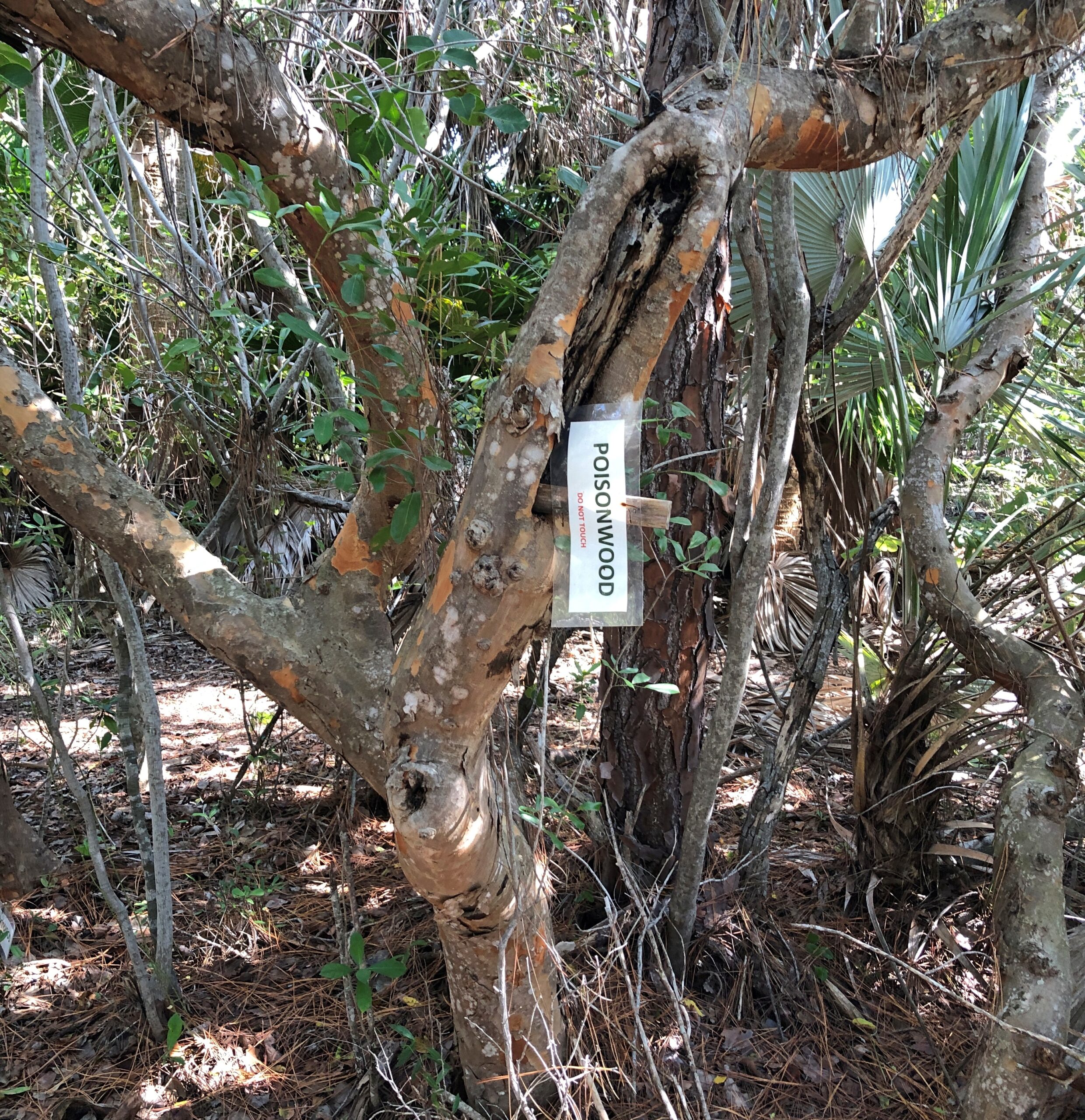
A sign on the trail warns visitors not about reptiles, but a nearby poisonwood tree.
Poisonwood? A native to the Keys. It sounds bad, and it is.
“Metopium Toxiferum [poisonwood] is related to poison oak, poison ivy, and poison sumac,” says the Tree Care Guide. “The tree produces the same irritant, urushiol, which causes an itchy, blistering rash. The oils from Metopium toxiferum cause dermatitis ranging in severity from a light red rash to intense skin blistering. Tea made from Metopium toxiferum leaves and twigs combined with bleach has been used to induce abortions but has also tended to kill the patient.”
Yikes. We took the advice of the sign and didn’t go near it.
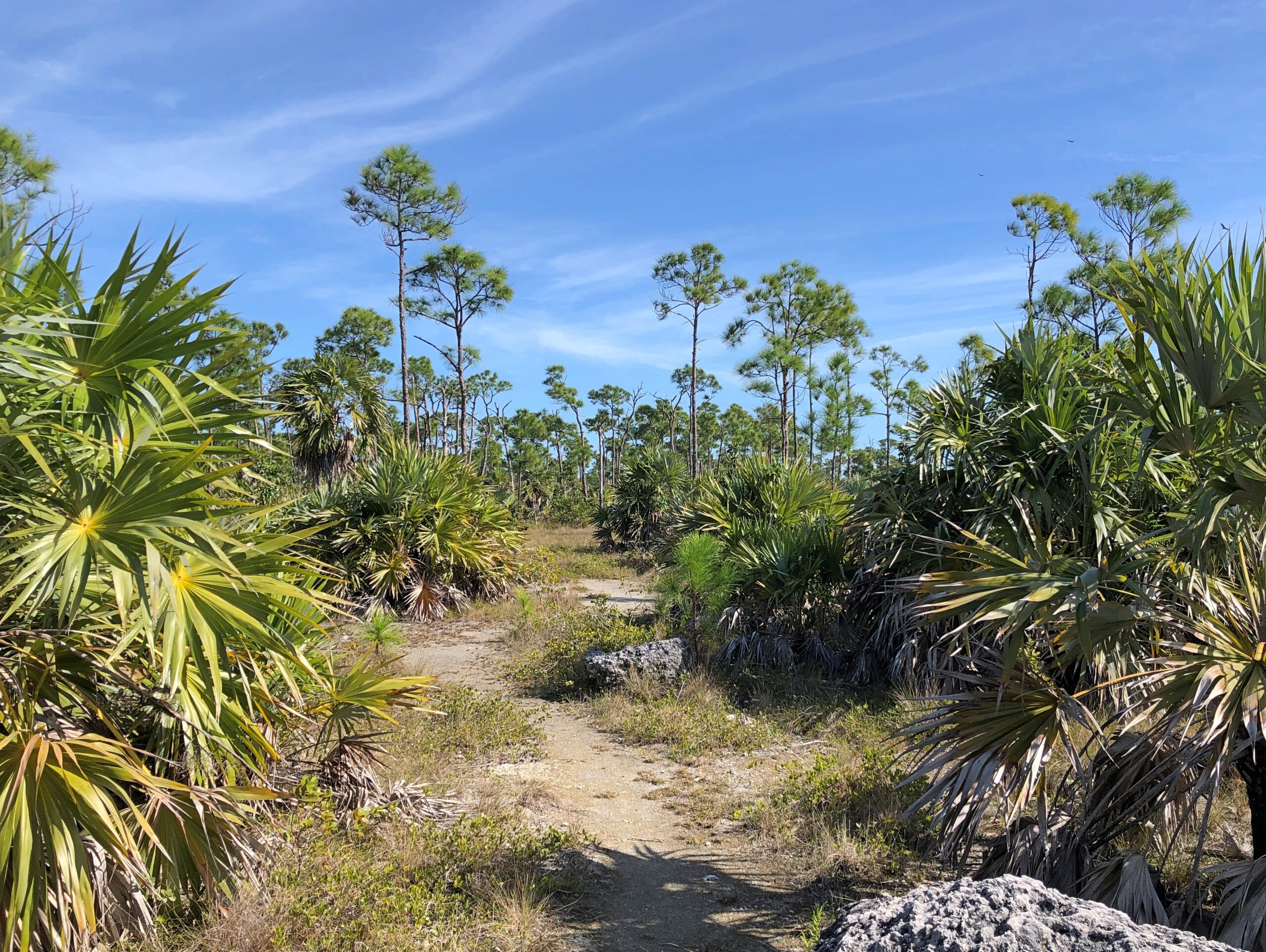
Across the road from the refuge parking lot, some undeveloped key landscape. There couldn’t be that much of that, at least on the keys connected by the highway.
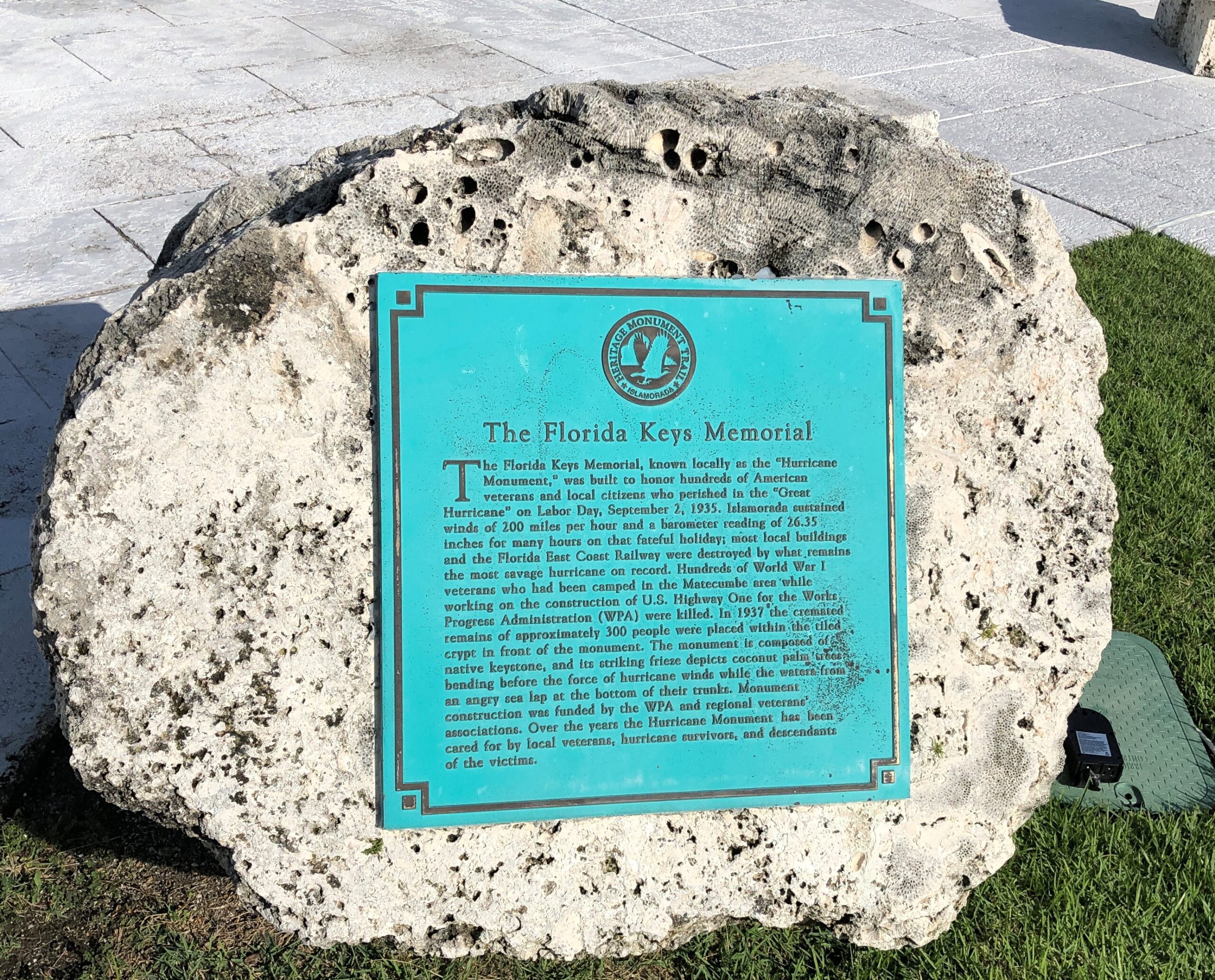
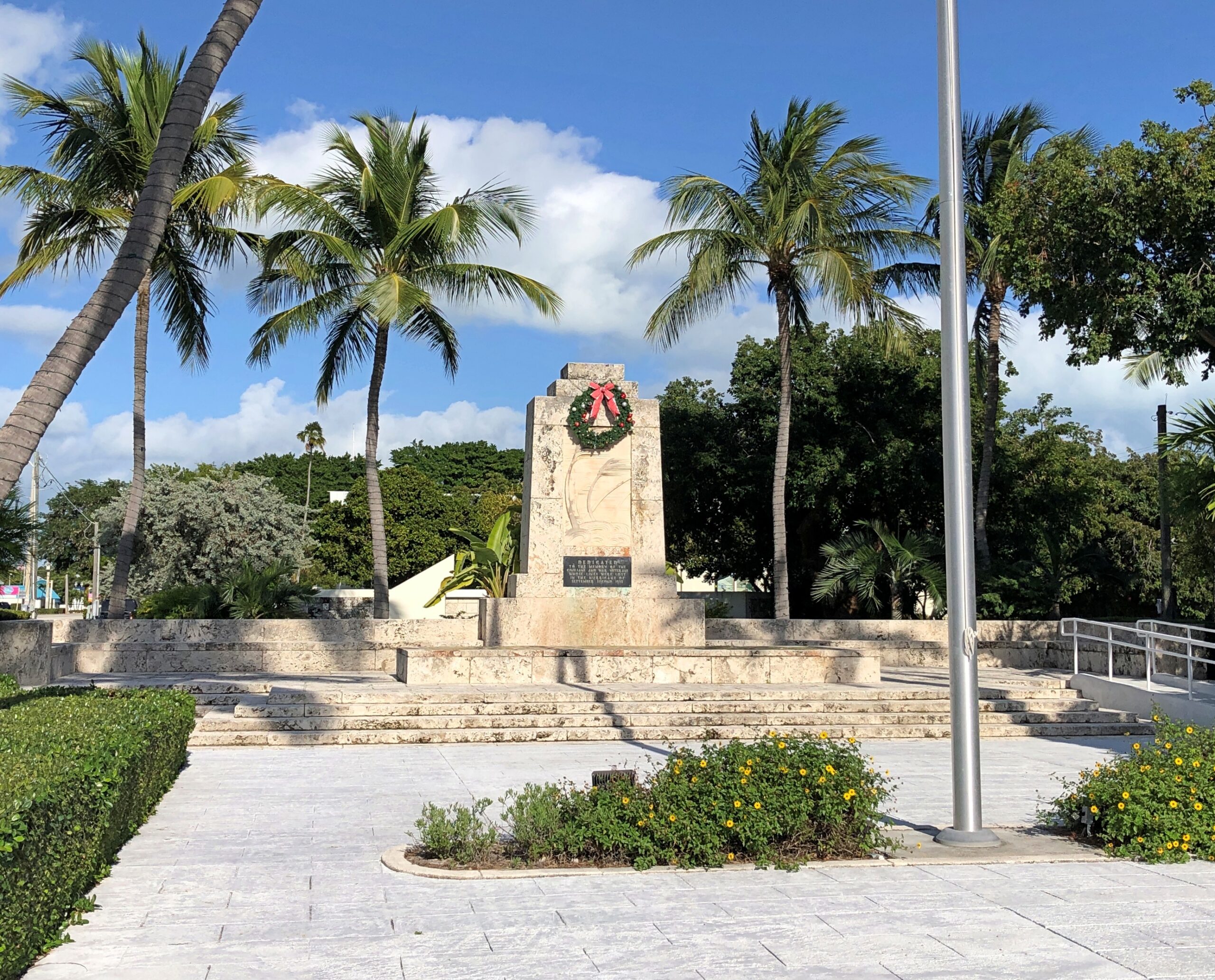
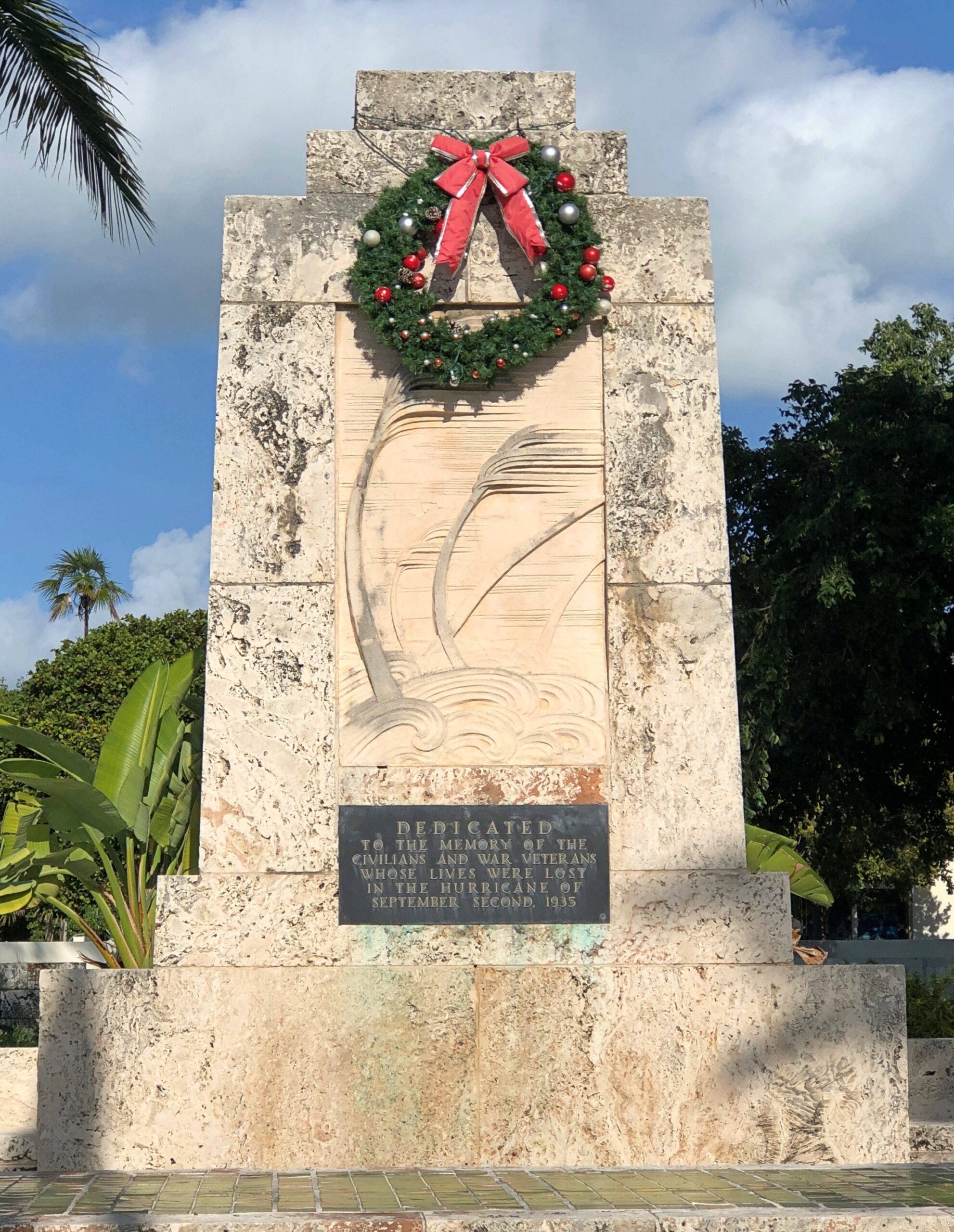
In Islamorada, which is spread across five small keys much closer to the mainland than either Key West or Big Pine Key, we stopped to pay our respects at the memorial to those who died in the 1935 hurricane.
Also in Islamorada, we drove past Betsy the Lobster, but sorry to say, didn’t stop for a closer look. What was I thinking?