Castillo de Chapultepec

Grim cold January days here in the North and, I’ve heard, it’s fairly cold in the South too. Why this is a big news story is another matter. It’s winter. You know, the season when it gets cold. Sometimes very cold.

Also, weather ≠ climate, as far as I understand these things. A cold winter no more disproves climate change than a hot summer proves it.

Way down in Mexico City, the weather was completely consistent during the days we were there. Cool in the early mornings, warm by noon, very warm in the afternoons, cool again in the evenings. Not a bit of rain, since the rainy season isn’t now. We were reluctant to leave that pattern and come back to the cold.

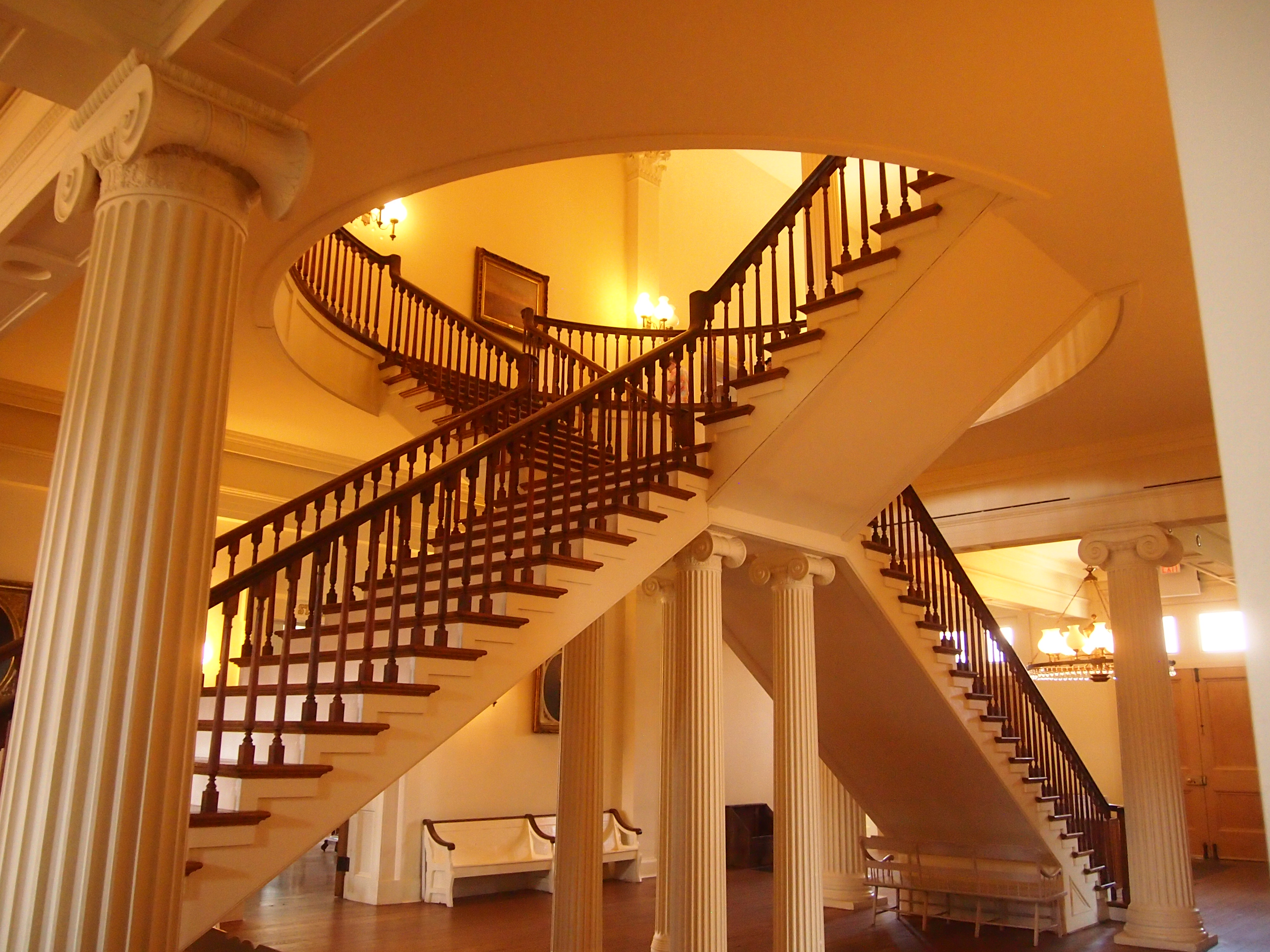
Were Mexico City tropical, the walk up to the Castillo de Chapultepec would have been a lot less pleasant. In modern times, the castle is on a high hill in Mexico’s vast Bosque de Chapultepec (Chapultepec Park, measuring 1,695 acres, or 686 hectares) and is open to the public. Chapultepec, I’ve read, means grasshopper hill in Nahuatl.

In earlier centuries, the hill might not have been so public. I’ve seen it described as sacred to the Aztecs, but it wasn’t until late in the colonial period that the viceroy of New Spain — Bernardo Vicente de Gálvez y Madrid, the very same fellow that lent his name to Galveston — ordered construction of a stately manor on the site. He died without realizing its completion, and the site wasn’t really used until the independent government of Mexico decided to put its military college there in 1833.

That’s what the Niños Héroes were defending to the death against U.S. forces under Gen. Winfield Scott on September 13, 1847. At the eastern entrance to the park, below Castillo de Chapultepec, is the famed memorial to the six cadets.

The memorial dates from 1952 and was designed by architect Enrique Aragón and sculpted by Ernesto Tamariz.

Once you get atop the hill and in the castle, you can look back toward the memorial.
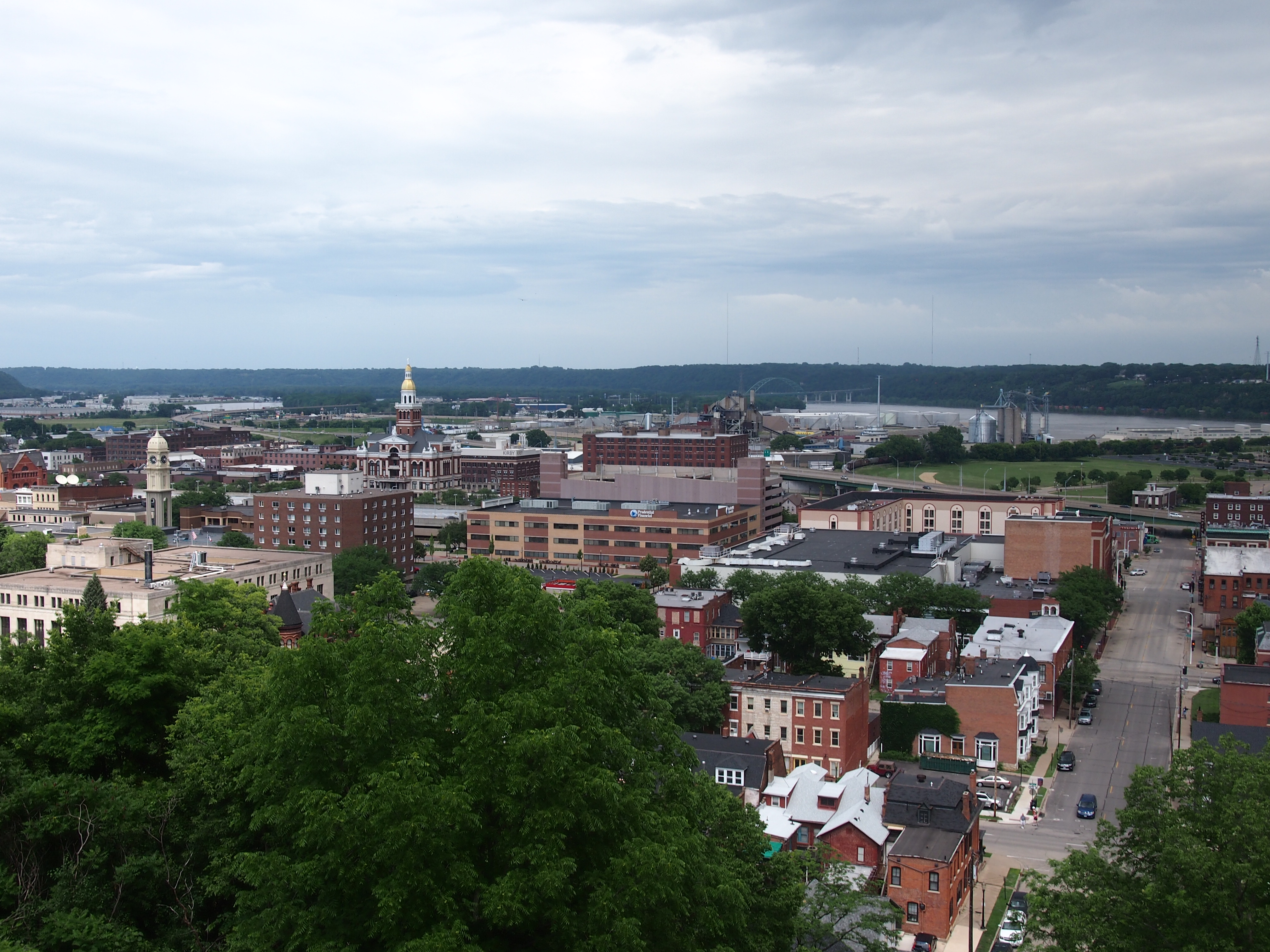
Beyond that, looking eastward — Castillo de Chapultepec would have been west of the city in the 19th century, later witnessing it grow toward the hill — is the modern Paseo de la Reforma, flanked by large buildings.

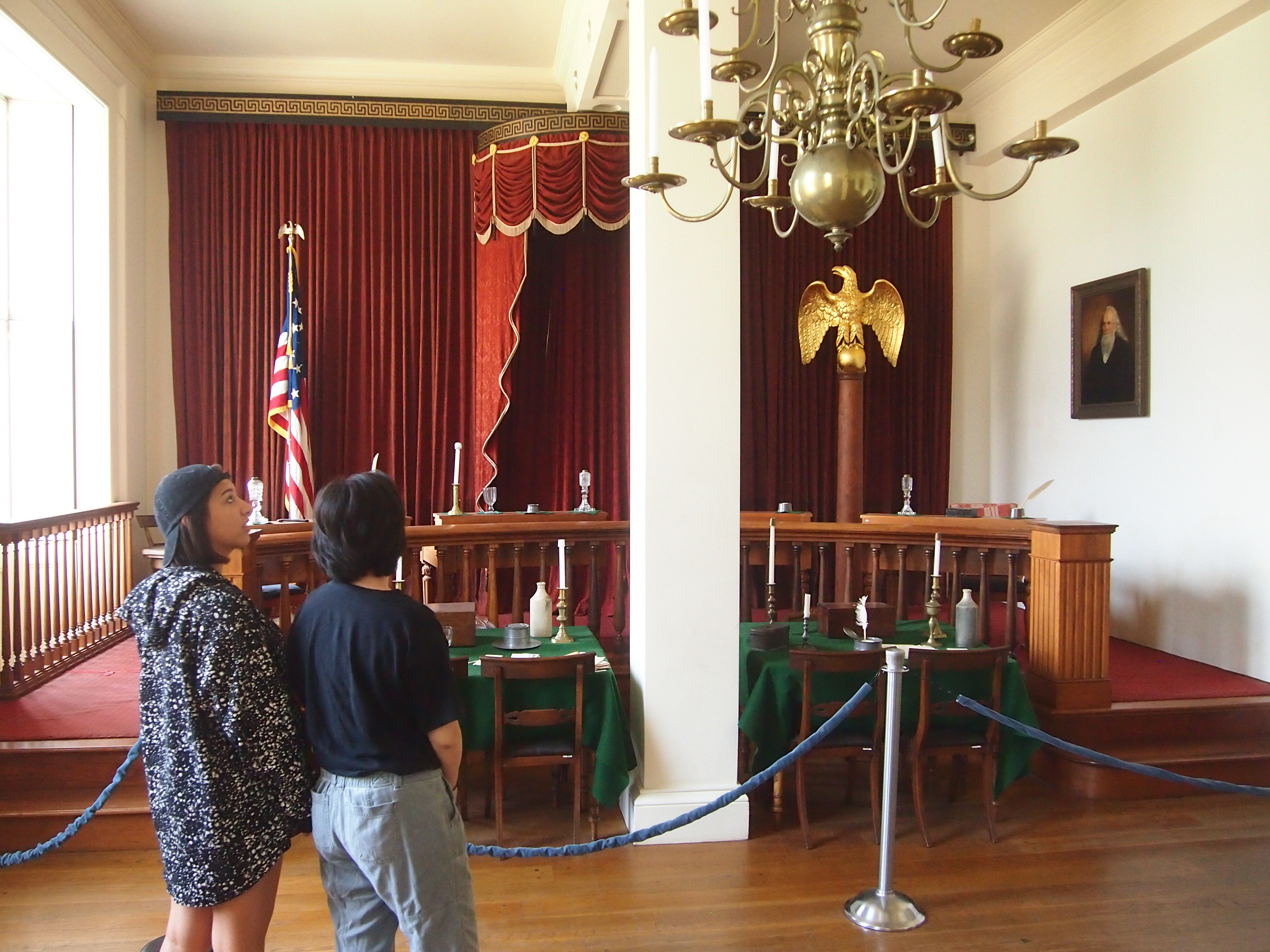
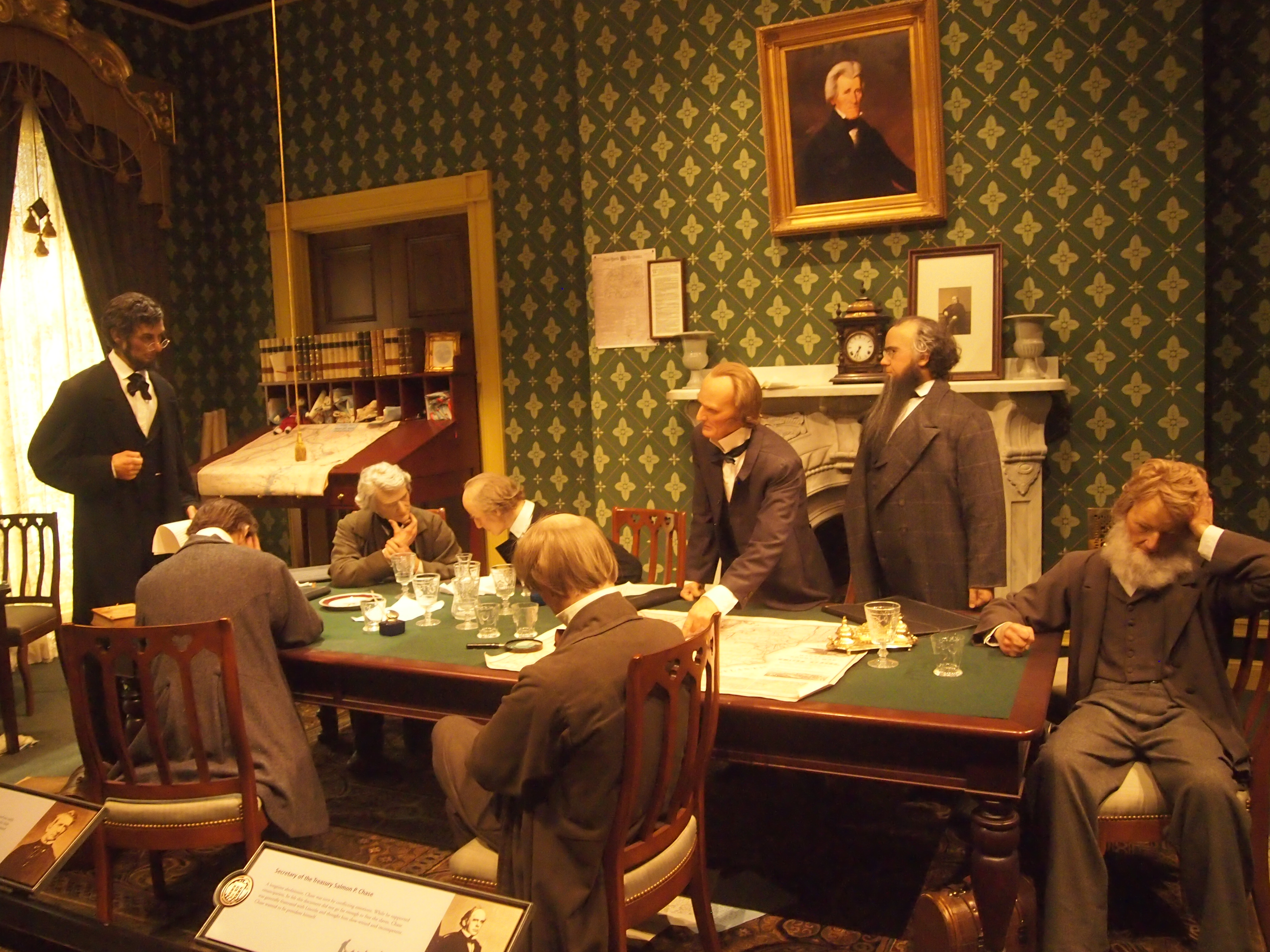
The castle started taking its current shape under the ill-starred Emperor Maximilian, who used it as a residence. Some of his portraits still hang in the museum, including one that was suitably regal, and another one from which I got the impression that the artist had given the emperor a hint of a “what have I gotten myself into” look on his face (I think it was this one).

The museum’s entrance leads visitors to a handsome plaza.
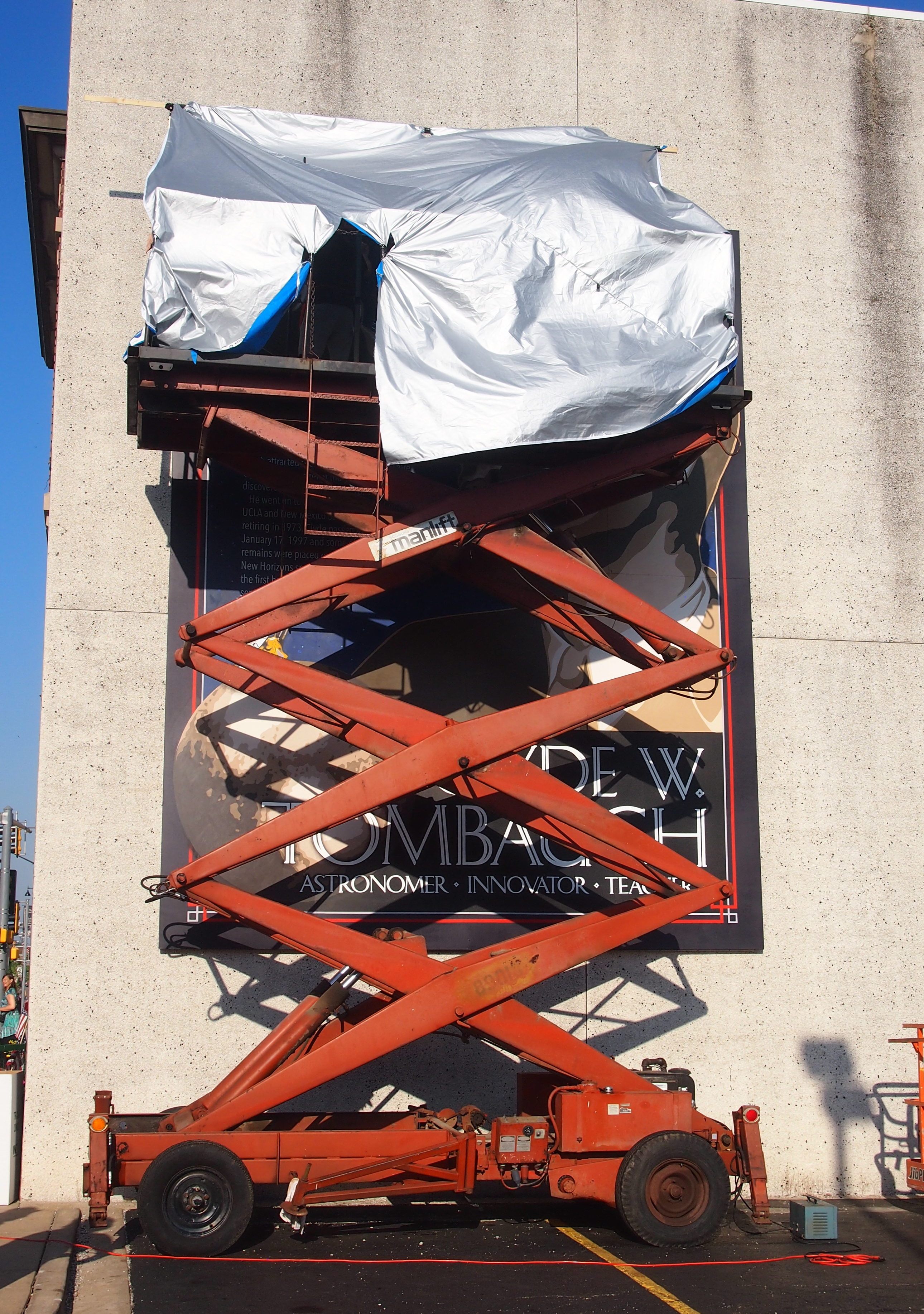
Note the stage under the tarp. That’s where the Ballet Folklórico de México gave the lively performance we attended two nights later, with a palatial backdrop bathed in alternating colored lights.

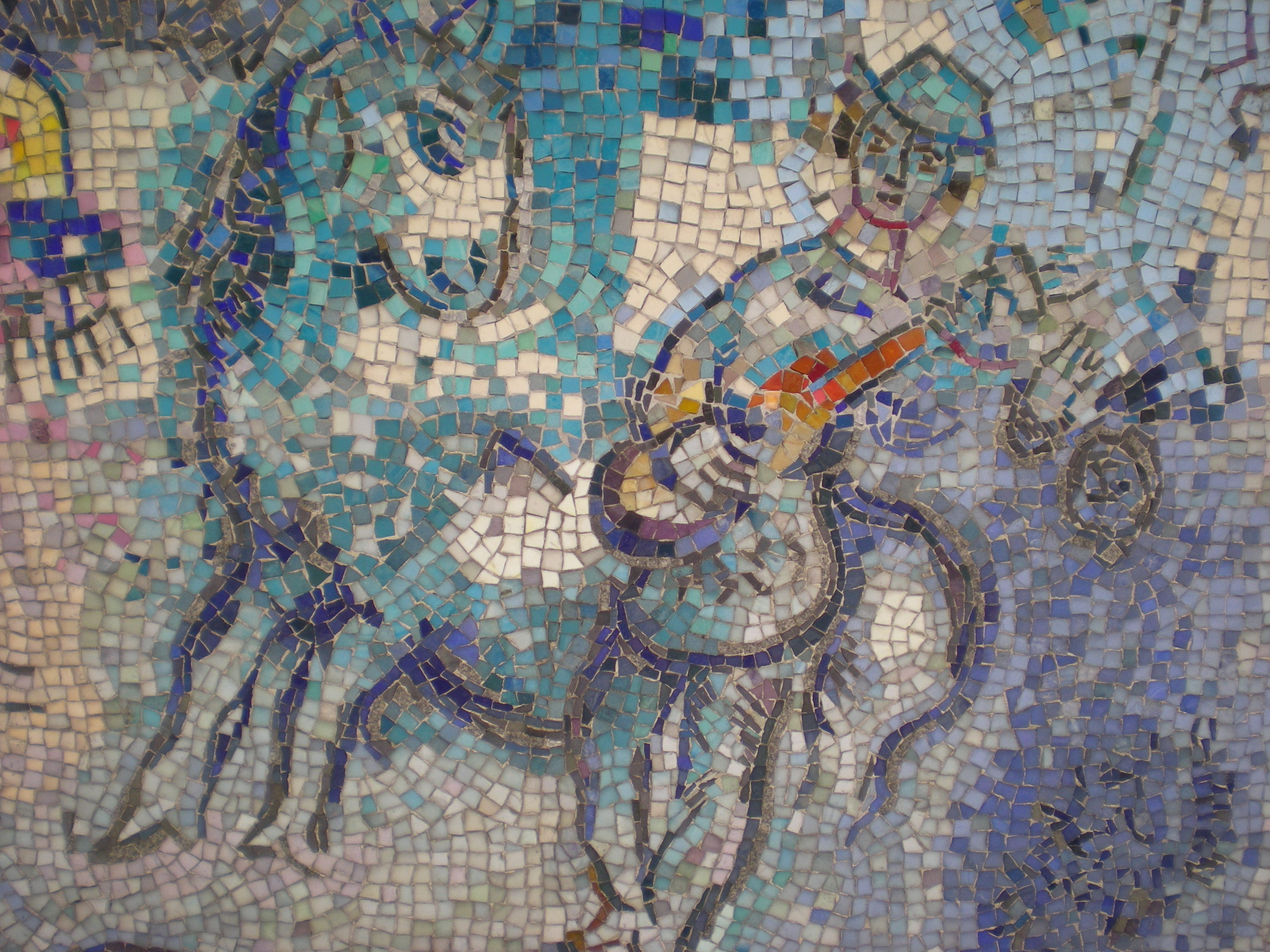
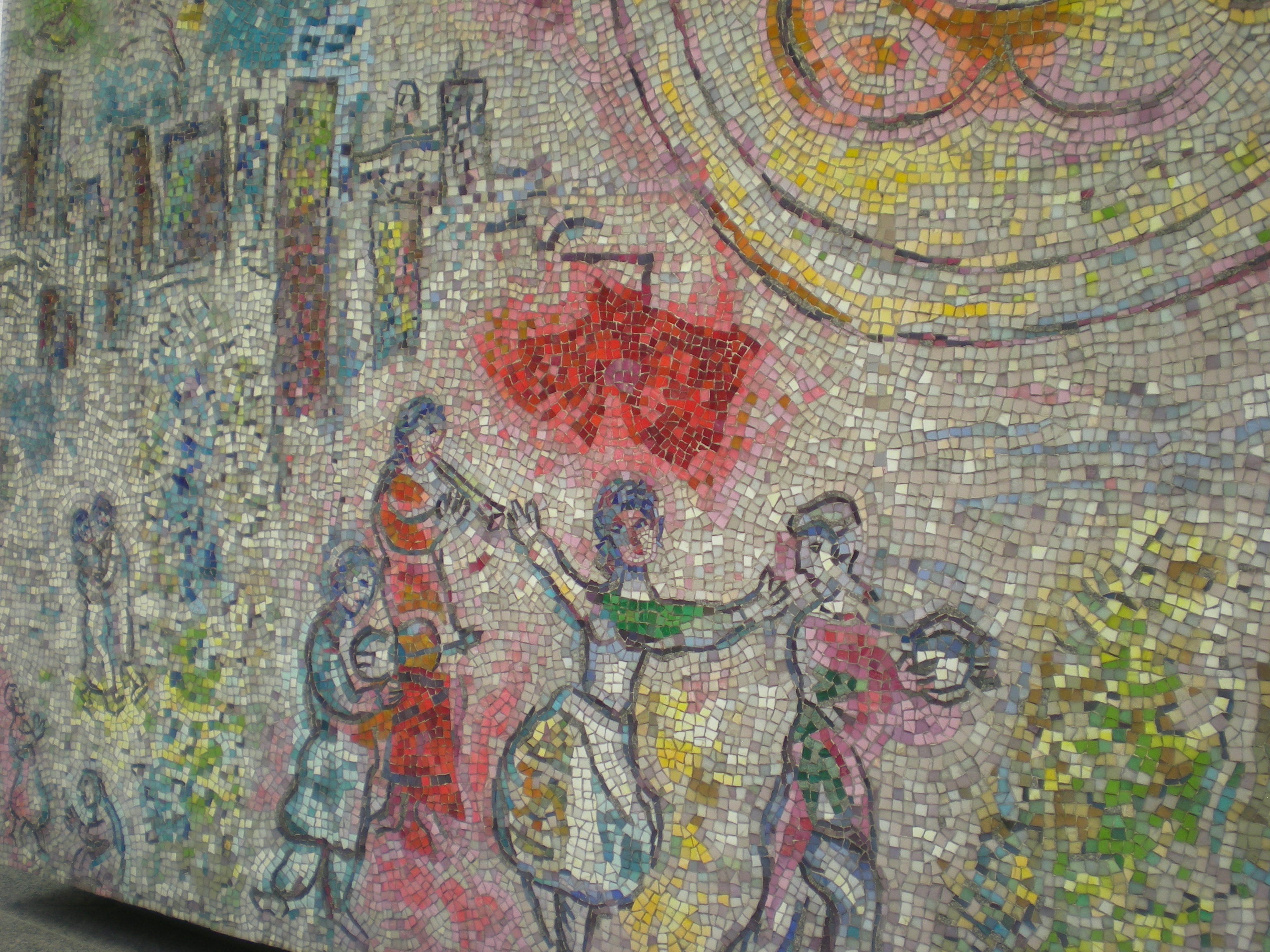
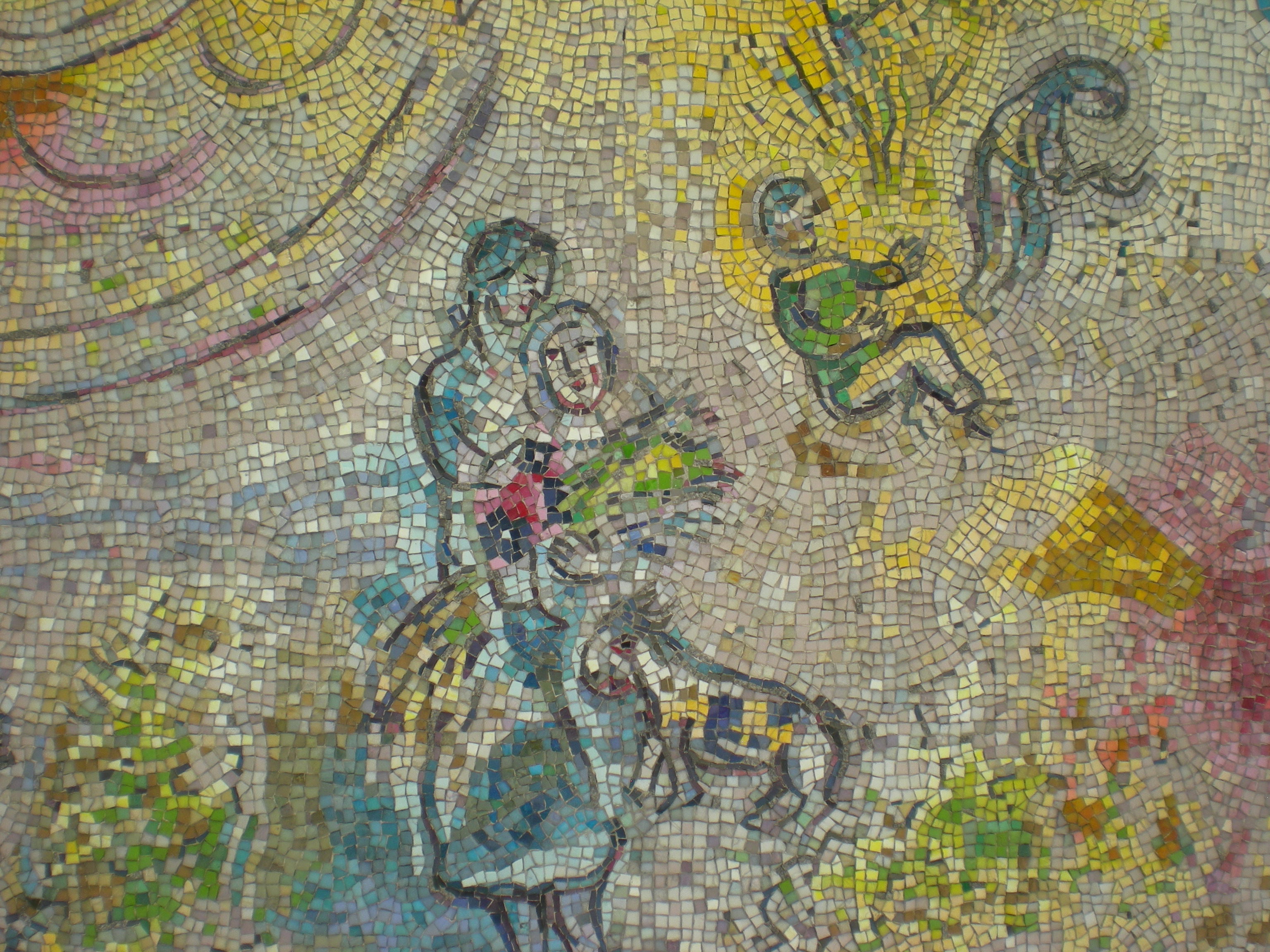
Enter the castle itself behind the temporary stage, look up, and you’ll see this 1967 mural by Gabriel Flores on the ceiling.

Later I learned that it depicts Juan Escutia, one of the Niños Héroes, leaping to his death from the castle walls, wrapped in the Mexican flag.

After Maximilian wound up on the business end of a firing squad, the castle was neglected for a while again until Porfirio Díaz decided he wanted to live there and so spiffed up the place. Post-Díaz Mexican presidents lived there as well, until 1944, when the building became a museum.

As a museum, Castillo de Chapultepec’s collection is extensive, including paintings and sculpture, clothing, coins, musical instruments, silver items, period furniture, ceramics, flags, a room of 19th-century carriages, books, documents and more. I was especially taken by the murals. You want to see some fine murals, go to Mexico.

Here’s a detail of Francisco I. Madero leading the 1911 revolution, part of a larger mural in the museum’s Independence Room. Juan O’Gorman, who did a mural on the front of the Lila Cockrell Theatre in San Antonio for the world’s fair in 1968, did this mural.
Off to the left in the Madero mural, not pictured above, is the top-hatted U.S. Ambassador to Mexico, Henry Lane Wilson, handing the presidential sash to Victoriano Huerta, who murdered Madero in 1913 to take the presidency for himself.

On the other side of room are Porfirio Díaz and his ugly minions, such as this fellow and his whip.

Murals aren’t everything, however. Elsewhere in the museum is a hall with a row of fine stained glass depicting various goddesses of Classical Antiquity, such as Ceres.

And Diana.
The castle’s roof gardens are exceptionally pleasant, especially under a warm afternoon sun.
A tower that caps the castle rises over the rooftop garden.
Castillo de Chapultepec was a fine way to kick off four straight days of tourism.

CDMX

Something I didn’t know until recently: Mexico City, which has more autonomy than it used to, is no longer in the Distrito Federal, which it had been since 1824. Two years ago, the federal government of Mexico signed off on a name change, which the city’s government had wanted, to simply Ciudad de México, abbreviated CDMX.

On Wednesday, December 27, Lilly and I flew to Mexico City, returning on New Year’s Day 2018 — or actually early January 2, since the return flight was late. We stayed at a hotel in the Zona Rosa, just south of Paseo de la Reforma, a major thoroughfare, but also within walking distance of the Roma neighborhood.

We spent our time as dyed-in-the-wool, first-time tourists, seeing impressive places and structures, visiting grand museums, walking along interesting streets, eating a variety of food, taking in as much detail as possible.

Considering that Mexico City is a vast megalopolis — all too apparent from the air as we arrived in the daylight and left at night — we experienced only the slimmest sliver. But an endlessly fascinating sliver.

Adding immeasurably to the trip was the fact that my old friend Tom Jones — known him nearly 45 years — was in Mexico City at the same time. In fact, I’d suggested the trip to him on the phone last summer, when I called him to hear about his experience in seeing the eclipse. He’d been a fair number of other places in Mexico over the years, more than I have, but not Mexico City, so he was open to the suggestion.

So the three of us went a lot of places together in the city. Tom has an impulse for photobombing.
The first place Lilly and I went, not long after we had arrived, was the enormous Zocalo (formally the Plaza de la Constitution), which was packed with holiday revelers enjoying a temporary ice-skating rink and amusement-park slides. We circumambulated the square, said to be the second largest in the world after Red Square, and spent some time inside the vaulting Catedral Metropolitana, which opens onto one side of the Zocalo.

The second day, with Tom joining us, was for large museums in the even larger Bosque de Chapultepec, the city’s equivalent of Central Park: the Castillo de Chapultepec, a grand palace along European lines and now a history museum; and the Museo Nacional de Antropologia, an epic museum devoted to the many and varied cultures of pre-Columbian Mexico (or more precisely, pre-Cortez).

All that makes for tired feet, so the third day was less intense. Even so, we got a good look at a small part of the charming Coyoacan neighborhood, which includes the Museo Frida Kahlo. The lines were too long to visit Frida, but not to get into the Museo Casa Leon Trotsky a few blocks away.

The next day, December 30, was exhausting, but completely worth all the energy and money we spent, because we got to visit the renowned Teotihuacan, which is to the northeast of the city, in the State of Mexico, and climb its pyramids. From there, we went back into the city to see the Basílica de Nuestra Señora de Guadalupe — the Basilica of Our Lady of Guadalupe — a pilgrimage site I’ve been curious about since I encountered The Shrine of Our Lady of Guadalupe, Des Plaines.

And as if that wasn’t enough for a day, we returned to Castillo de Chapultepec on the evening of the 30th, along with four of Tom’s friends from Austin who were also visiting Mexico City, for an outdoor performance by the astonishingly talented dancers, singers and musicians of the Ballet Folklórico de México.

On the last day of 2017, we slept fairly late, but were out and about after noon, for a visit to the Palacio de Belles Artes, a striking building with art exhibits and some astonishing murals, especially the Diego Riveras. More Rivera murals were in the offing at the Palacio National, the last large site we visited.

We were tired on the evening of the 31st, but not too tired to walk a few blocks from our hotel to the Paseo de la Reforma. One of the city’s two main New Year’s celebrations was being held around the Angel de la Independencia, a famed gold-colored statue atop a tall column in the center of a Paseo de la Reforma traffic circle. The event featured live music by well-known (I was told) Mexican bands, a countdown just like at Times Square, except in Spanish, and then fireworks: a bang-up way, literally and figuratively, to start 2018.

Twelve Pictures ’17

Back to posting on January 2, 2018, or so. Like last year, I’m going to wind up the year with a leftover picture from each month. This time, for no special reason, no people, just places and things.

Champaign, Ill., January 2017Charlotte, NC, February 2017

Kankakee, Ill., March 2017

Rockford, Ill., April 2017

Muskogee, Okla., May 2017

Naperville, Ill., June 2017

Barrington Hills, Ill., July 2017

Vincennes, Ind., August 2017

Denver, September 2017Evanston, Ill., October 2017Chicago, November 2017

Birmingham, Ala., December 2017

Merry Christmas and Happy New Year to all.

Vulcan

While I was in Birmingham earlier this month, I noticed a lot of yard and roadside signs for the upcoming Senatorial election. Every single one was for Doug Jones or, more likely, against Roy Moore. Birmingham tends to be Democratic, and Jones is from Birmingham, but I think there was more to it than that. What I didn’t think was that Jones would win.

The simplest of the signs said: No Moore.

I’m only half-joking when I say that the modern world was invented either by Victorians, or for the 1893 World’s Fair, or for the 1904 World’s Fair, or by ad men in the 1920s. In the case of the massive cast-iron Vulcan overlooking Birmingham, Alabama, the statue was created for the World’s Fair in St. Louis, to tell the world about the city’s core competence in metal.That’s Vulcan atop the stone tower that the WPA built for him in the 1930s. Next, a view from a little further back.

Note the observation deck. You can reach that via stairs inside the tower, or by an elevator in the other tower. We took the elevator. From the deck, which goes all the way around the tower, Vulcan’s backside is close by.Besides Vulcan’s buttocks, we could see Birmingham stretching out in the distance.

There were also views of the surrounding hilly terrain.

For Vulcan, created by immigrant Giuseppe Moretti, the road from the 1904 World’s Fair to the top of Red Mountain in Birmingham wasn’t direct. After the fair, he was painted and displayed at the Alabama State Fairgrounds until the 1930s, when he was moved to Red Mountain and put on the 124-foot pedestal fashioned by the WPA.

Instead of a spear point, which was lost en route home from the fair, he had a lantern in his outstretched hand. It glowed red after a traffic fatality in Birmingham; green when there had been none for a while.

In the early ’70s, the tower was “modernized,” that is, made ugly. By the end of the 1990s, however, the statue was threatening to fall apart — no small matter for something that’s 56 feet high and weighs 100,000 pounds (the head alone weighs 11,000 pounds).

It took a while to raise the funds needed for repairs, but civic pride eventually came through. The statue was revamped by 2004, including restoring the structure and Vulcan’s original coloration, giving the tower back its WPA appearance, and putting a spear point back in the god’s hand.

Sloss Furnaces

Not far from downtown Birmingham is Sloss Furnaces, site of pig iron production from 1882 to 1971.

In our time, Sloss is an enormous forest of iron and steel, besides being a National Historic Landmark, sometime music venue, and site of a metal arts program. The long shed was, in fact, active with metal working while we visited. To see the main part of the site, you walk past the shed through a kind of tunnel.
“In 1871 Southern entrepreneurs founded a new city called Birmingham and began the systematic exploitation of its minerals,” the Sloss Furances web site says. It’s an excellent short history — you don’t always get that at web sites — so I will quote at at length, to go with some pictures.

“One of these men was Colonel James Withers Sloss, a north Alabama merchant and railroad man. Colonel Sloss played an important role in the founding of the city by convincing the L&N Railroad to capitalize completion of the South and North rail line through Jones Valley, the site of the new town.

“In 1880, having helped form the Pratt Coke and Coal Co., which mined and sold Birmingham’s first high-grade coking coal, he founded the Sloss Furnace Co., and two years later ‘blew-in’ the second blast furnace in Birmingham.”

The site these days includes relics towering into the sky.

And entrances into dark cavities.
“Construction of Sloss’s new furnace (City Furnaces) began in June 1881, when ground was broken on a fifty-acre site that had been donated by the Elyton Land Co. Sixty feet high and eighteen feet in diameter, Sloss’s new Whitwell stoves were the first of their type ever built in Birmingham and were comparable to similar equipment used in the North.

“Local observers were proud that much of the machinery used by Sloss’s new furnaces would be of Southern manufacture. It included two blowing engines and ten boilers, thirty feet long and forty-six inches in diameter. In April 1882, the furnaces went into blast. After its first year of operations, the furnace had sold 24,000 tons of iron. At the 1883 Louisville Exposition, the company won a bronze medal for ‘best pig iron.’ ”

“Nothing remains of the original furnace complex. The oldest building on the site dates from 1902 and houses the eight steam-driven ‘blowing-engines’ used to provide air for combustion in the furnaces. The engines themselves date from the period 1900-1902 and are a unique and important collection — engines such as these powered America’s Industrial Revolution. The boilers, installed in 1906 and 1914, produced steam for the site until it closed in 1971.

“Between 1927 and 1931 the plant underwent a concentrated program of mechanization. Most of its major operation equipment — the blast furnaces and the charging and casting machinery — was replaced at this time. In 1927-28, the two furnaces were rebuilt, enlarged, and refitted with mechanical charging equipment, doubling the plant’s production capacity. While the site strongly reflects the changes made from 1927-1931, some of the technology is more current.”

“Despite being dominated by black labor, the industrial workplace was rigidly segregated until the 1960s. Workers at Sloss bathed in separate bath houses, punched separate time clocks, attended separate company picnics. More important was the segregation of jobs.

“The company operated as a hierarchy. At the top there was an all white group of managers, chemists, accountants, and engineers; at the bottom an all black ‘labor gang’ assisted (until its demise in 1928) by the use of convict labor. Sloss utilized the convict leasing system only in its coal mines. As Lewis noted in Sloss Furnaces, ‘….convict labor, mostly black, was an important weapon in the district’s economic warfare with northern manufacturing.’ Slavery had not died but merely been transformed.”

Oak Hill Memorial Cemetery, Birmingham, Alabama

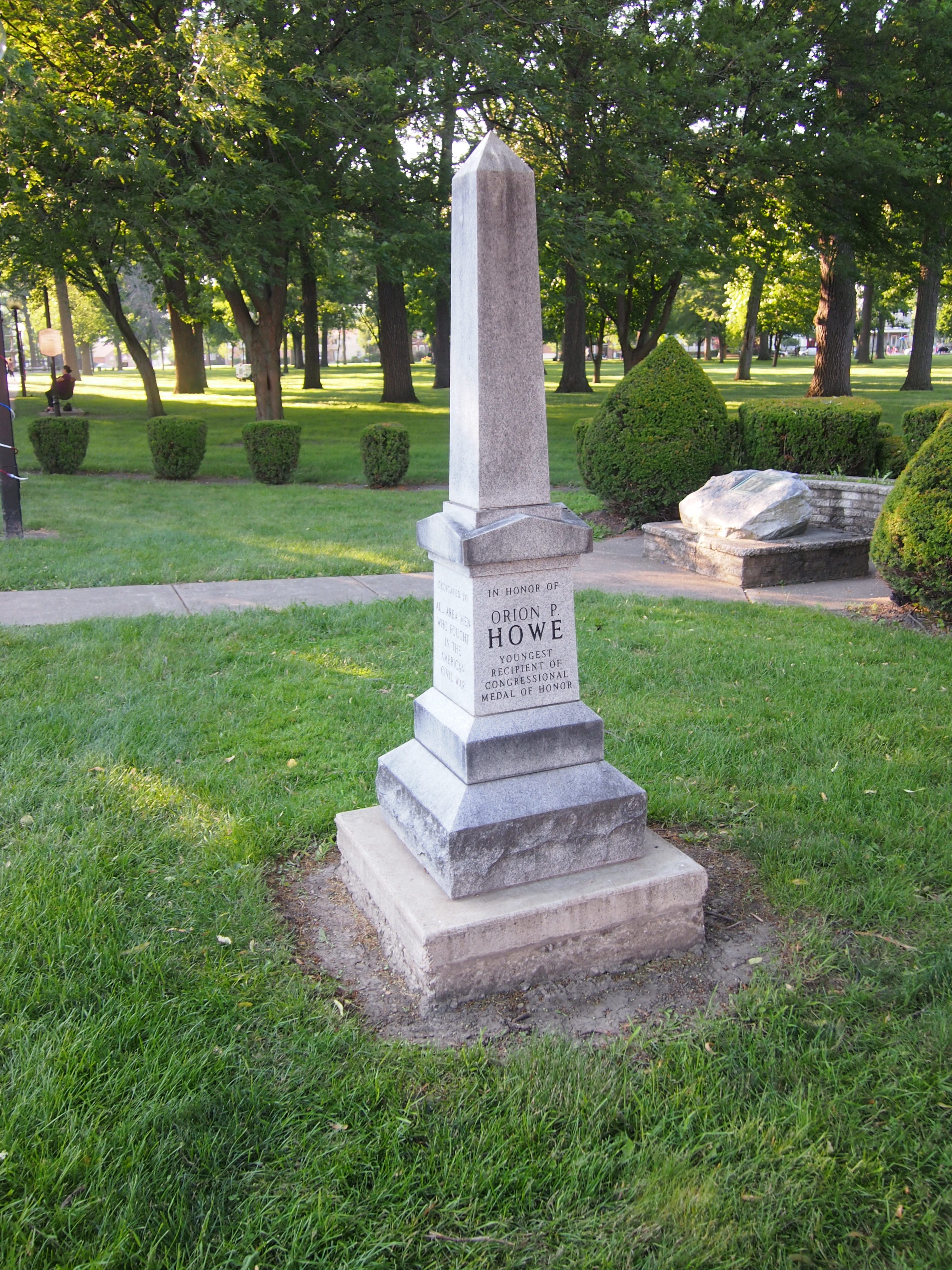
At the Oak Hill Memorial Cemetery in Birmingham on December 2, I saw this modest obelisk. It was a surprise.

The carving is a little worn, but still legible.

G.A.R.
ERECTED
BY
GEO. A. CUSTER
POST NO 1 DEPT OF AL
APRIL 27, 1891

Scattered around the memorial are the graves of former Union soldiers, such as P.J. Crawford of Co. H, 3rd New Hampshire Infantry and Corpl. Chas. M. Robinson of Co. F, 8th Michigan Cavalry.

A surprise, but then again I’m sure a number of former Northern soldiers made their way to Birmingham in the late 19th century, looking for opportunity in the rising industrial city like anyone else. Enough to have a GAR post, and enough for the post to buy a small plot in the cemetery.

The Birmingham Public Library says that “in 1871 the City of Birmingham purchased from the Elyton Land Company 21.5 acres for a city cemetery (later named Oak Hill)… As the first city cemetery, Oak Hill became the resting place for virtually all of the Birmingham pioneers. Although the majority of burials at Oak Hill Cemetery date back before the 1930s, it remains an active cemetery, averaging fifteen burials per year.”

Plenty of other stones are just as old as the GAR ones, and in various states of decay.

The cemetery is marked by mature trees.

And evidence even in early December that it’s still fall in central Alabama.

The cemetery sports some mausoleums, but not many. They were often crumbling.
There are also larger stones, but not that many of those either. As city cemeteries of the late 19th century go, Oak Hill’s fairly restrained in that way.
Oak Hill, like much of Birmingham, has some hilly contour. I think that adds to the aesthetics of a cemetery, especially if there’s a variety of trees and stones.
Other parts are more level.
We didn’t look for anyone in particular, though a number of Birmingham and Alabama notables are buried at Oak Hill. Looking through a list of them, the only one I recognized was Fred Shuttlesworth, who died only in 2011. We didn’t see his grave.

As it happens, Bull Connor — another of the handful of Birminghamians I’ve heard of — is buried at a different large local cemetery, Elmwood. Which is on Martin Luther King Jr. Drive. Heh-heh. Hope that sticks in Bull’s craw.

Birm-Tex ’17

Before spending the last week in San Antonio visiting family, I spent about 36 hours in Birmingham, Alabama, during the first weekend in December. I went there to visit my old friend Dan, whom I hadn’t seen in about 18 years.
That’s too long, as the Wolf Brand Chili man said. See your old friends if you can, because we’re all mortal. I was also fortunate enough to become reacquainted with his wife Pam, whom I’d only met once, more than 20 years ago.

Dan and I had a fine visit, talking of old times and places — we’ve known each other 36 years — but not just that. He grew up in Birmingham and has lived there as an adult for a long time, so he was able to show me around and tell me about the city’s past and about recent growth as an up-and-coming metro. In this, he’s quite knowledgeable.

I’d heard something about that growth, but it was good to see some examples on foot and as we tooled around hilly Birmingham in Dan’s Mini Cooper, which was also a new experience for me. Not to sportiest version, he told me — he’d traded that one for this one he now drives — but it had some kick.

On the morning of Saturday, December 2, we first went to Oak Hill Memorial Cemetery, very near downtown Birmingham, and the city’s first parkland-style burial ground. Dan told me he’d never been there before. Not everyone’s a cemetery tourist. But he took to the place, especially for its historic interest, and he even spotted the names of a few families whose descendants he knows.

From there we drove to Sloss Furnaces, which, as the postcard I got there says, is “the nation’s only 20th-century blast furnace turned industrial museum.” Iron mining and smelting made Birmingham the city that it is. So it was only fitting that we went to Vulcan Park as well, to see the mighty cast-iron Vulcan on his pedestal on a high hill overlooking the city.

Toward the end of the afternoon, I suggested a walk, and so we went to the Ruffner Mountain Nature Preserve, which has 14 miles of hiking trails. More than that, the earth there is honeycombed with former mines, all of which are now sealed. But we got to see the entrance of one of them, dating from 1910.

After all that, we repaired to Hop City Beer & Wine Birmingham, a store that has an enormous selection of beer and wine in bottles, as well as a bar with a large draft selection, where we relaxed a while. Had a cider and a smaller sample of beer that I liked.

Along the way during the day, we also visited Reed Books, a wonderful used bookstore of the kind that’s increasingly rare: owned and run by an individual, and stacked high with books and other things, with only marginal organization. I bought Dan a copy of True Grit, which he’d never read.

We drove through some of Birmingham’s well-to-do areas, sporting posh houses on high hills and ridges along roads that I could make no sense of, twisty and web-like as they were. Luckily, Dan knew them well.

In downtown Birmingham, we also drove by some of the historic sites associated with the civil rights movement, including the new national monument. According to Dan, it would take a day to do the area right, so we didn’t linger. I got a good look at the 16th Street Baptist Church, the A.G. Gaston Motel, where King and others strategized, and Kelly Ingram Park, where protesters were attacked with police dogs and water cannons.

During my visit, I ate soul food, breakfast at a Greek diner — Greek immigrants being particularly important to the evolution of restaurant food in Birmingham, Dan said — excellent Mexican food (mole chicken for me), and a tasty breakfast of French toast and bacon made by Dan and Pam. On the whole, we carpe diem’d that 36 hours.

In San Antonio, as usual, I was less active in seeing things, but one sight in particular came to me. On the evening of Thursday, December 7, I looked out of a window at my mother’s house and saw snow coming down. And sticking. “I’ll be damned,” I muttered to myself.

At about 7:30 the next morning, I went outside to take pictures. Nearly two inches had fallen, according to the NWS. The snow was already melting. A view of the front yard.

Of the back yard.

It occurred to me that hadn’t seen snow on the ground in San Antonio since 1973.

Adios, November

Three yawning months of meteorological winter ahead. That’s what counts for winter: December, January and February. Never mind what anyone says about the solstice. But at least no heavy snow or ice is forecast for now.

Back again to posting around December 10.

What did we do to deserve this sunset? A late November event, as seen from our deck.
On Thanksgiving, the girls and I watched Airplane! on demand. What is it about that movie and its rapid-fire, throw the jokes against the wall to see if they’re funny structure? I’ve watched it a number of times since I saw it when it was new, and it’s funny every time.

Unlike another movie I paid good money to see in 1980: The Hollywood Knights. That was a mistake. So much so that sometime afterward I invented my own personal scale of movie quality: The Hollywood Knights Scale, from zero to some unspecified large number, zero being the worst.

The Hollywood Knights comes in at exactly 0 on my idiosyncratic scale. I’ve seen some bad movies in my time, but that ranking is still valid as far as I’m concerned (though I’d have to put, say, Patch Adams at 0.1).

Not familiar with The Hollywood Knights? Wiki gives a pretty good summation: “The ensuing antics include, among other things, a sexual encounter involving premature ejaculation, a punch bowl being spiked with urine, an initiation ceremony involving four pledges who are left in Watts wearing nothing but the car tires they are left to carry, a cheerleader who forgets to put on her underwear before performing at a pep rally, several impromptu drag races, and the lead character of Newbaum Turk (Robert Wuhl) wearing a majordomo outfit and singing a version of ‘Volare’ accompanied by the sounds of flatulence. Mooning also plays a prominent role in the film…”

None of those things necessarily make the movie unfunny. After all, Airplane! includes jokes about drug abuse, pederasty, oral sex, a sick child, and African-American dialect. There are ridiculous visual gags, such as Ted Striker’s drinking problem or pouring lights on the runway. Punning is rampant (don’t call me Shirley). Yet it all works as a comedy. The writing, directing, acting, timing and entire conceit as a spoof of more serious movies are vastly better than anything The Hollywood Knights did.

Speaking of odd things in movies, this is a still from Animal Crackers.

That’s supposed to be part of an outdoor patio of a lavish home on Long Island. The characters, who are not really that important in the scheme of the comedy, are the wealthy homeowner’s daughter and her honest but poor boyfriend. What caught my eye was that structure behind them.

According to the imdb, the uncredited art director for the firm was the German-born Ernst Fegté, who was working in Hollywood by 1925, and who had a busy career. Now what, I can imagine him thinking, would a wealthy Long Island socialite want for her patio? Something — modern.

The movie was made in 1930. Here’s something else from exactly then, a cover of Radio Listener magazine that I saw at the early Soviet art exhibit at the Art Institute last weekend.

It’s a Peakaboo Stalin. Lenin figured in a fair number of the works, but Stalin was only an up-and-coming character during most of the period. A little like Fonzie, though — pretty soon he’s going to take over the show.

One more thing, and naught to do with movies or the Soviet Union. I took Lilly back to UIUC on Sunday, and en route arranged to take a picture of this roadside attraction in Kankakee. Almost literally roadside, since it’s best seen from I-57.
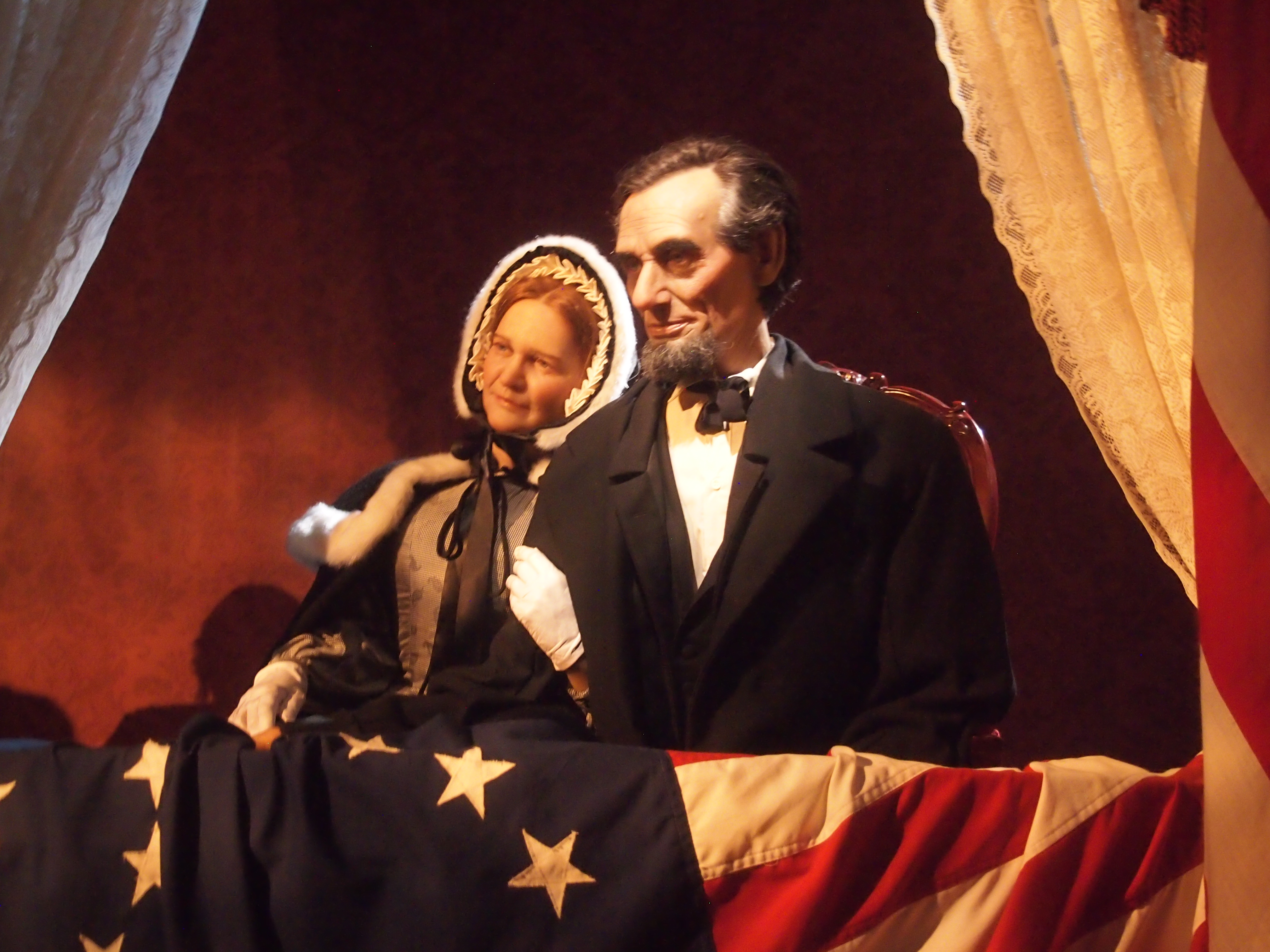
“28 feet tall, Abe stands in front of a heavy equipment rental lot, and holds signs that promote whatever its owner feels strongly about at the moment,” says Roadside America.

I’ve seen him with a sign, but for the moment he holds none. Just as well, I figure. A sign in Honest Abe’s hands is gilding the lily.

The Deering Family Galleries of Medieval and Renaissance Art, Arms, and Armor

Some years ago, the arms and armor gallery at the Art Institute of Chicago, a long hall packed with Medieval and Renaissance arms and armor, but also such artwork as reliquaries, disappeared during a renovation. A permanent exhibit of Indian art, as in the Indian subcontinent, took its place.

Indian art is a fine thing, but I missed arms and armor. Earlier this year, I read that the museum had restored the arms and armor display in a different place, but I was skeptical that it would be as good as the good old hall. I was wrong. The new galleries, collectively known as the Deering Family Galleries of Medieval and Renaissance Art, Arms, and Armor, are better.

An Art Institute press release from March says that the galleries are “the permanent home for nearly 700 objects from the museum’s rich holdings of art from 1200 to 1600, including monumental altarpieces, exquisite jewelry, and the beloved arms and armor collection.

“While much in the collection may be familiar to long time visitors, the installation expands the display of art of this period sixfold and enfolds them in an historically inspired atmosphere and context. The construction of these galleries marks the most ambitious architectural undertaking at the museum since the Modern Wing opened in 2009.”

In the very first gallery, you see the Ayala Altarpiece, dated 1396 and commissioned by Pedro López de Ayala, later chancellor of Castile. The museum spent three years recently restoring the painted wood altarpiece, 24 feet across by eight feet high, and it’s quite a sight.

Also in the first gallery are the likes of a crucifix by the Master of the Bigallo Crucifix, Italian, active about 1225-65.

And “Saint George and the Dragon” by Bernat Martorell, a Spaniard (1434/35).

“The galleries that follow are more intimate, focusing on late Gothic and Renaissance domestic life,” the museum continues. “Luxury goods and accessories for feasting fill one room while another displays works of art for the bedchambers of Tuscany’s merchant elite. Everyday objects from northern Europe, along with jewelry and items of personal display, complete the domestic picture of the period.

“From here, the space opens to the new home of the museum’s expanded arms and armor collection. Filled with weaponry and armor, the display is dominated by two armored figures on horseback — one dressed for battle, the other for sport — and two armed and costumed figures engaged in foot combat.

That’s a kind of armored contest I’d never seen depicted before. Clearly the object of the contest was to knock the other man over without crossing the cross beam, and probably striking below the waist was against the rules.

There were also some good old-fashioned displays of armor in a standing position.
Along with plenty of weapons representing many ways to hack into the other guy.

Revoliutsiia! Demonstratsiia! Soviet Art Put to the Test

After lunch at Shake Shack on Michigan Ave. on Saturday — crowded, but not impossible — we wandered over to the Art Institute. Been a while since we’d been there. I was particularly keen to see Revoliutsiia! Demonstratsiia! Soviet Art Put to the Test.

Mounted, I’m sure, to coincide with the 100th anniversary of the revolution. Just inside the entrance to the exhibit was the “Lenin Wall.” Lots of Lenin, including a small statue.

Besides that, the exhibit featured paintings, posters, prints, drawings, photos, magazines, film, agitprop ephemera, porcelain, figurines, life-size reconstructions of early Soviet display objects or spaces commissioned especially for the exhibition, and more.

I was glad to see the Suprematist porcelain collection (I. I. Rozhdestvenskaia).
That’s because I used to have a Suprematist-style cup and saucer. Actually, I still have the saucer, but the cup broke long ago.

Remarkably, there was such a thing as Soviet advertising. Or an equivalent. At least early on (1923).
That’s a preliminary design for a Mosselprom building advertisement for cooking oil by Aleksandr Rodchenko, the Constructivist.

The cover of Produce! magazine (Mechislav Dobrokovskii, Sept. 1929).
And the cover of a magazine called Atheist at the Workbench, Jan. 1923 (Dmitrii Moor).
The theme of that cover is “We got rid of the tsars on Earth, let’s deal with the ones in Heaven.”

This is a model of the never-finished Palace of the Soviets in Moscow, whose partly completed structure was cannibalized for raw materials to fight the Nazis. That’s Lenin on top.
Here’s one of a series of 36 small posters extolling gender equality and increased industrial production (1931). All of them pictured women doing one kind of socialist labor or another, and graphs whose trends were always upward.
If there had been a collection of postcards in the gift shop based on these posters, at a reasonable price, I would have bought it. Or a Suprematist tea cup. But no.