The Great American Solar Eclipse Road Trip

How long did I know about this week’s solar eclipse? I don’t know. It wasn’t because of the recent media buzz. The better part of a decade ago, probably. Sometime back then, I filed away the notion: I am going to see the solar eclipse of August 21, 2017. In the path of totality.

So I did yesterday, along with my immediate family. And some unspecified millions of other people. It was an event among events. During totality, we were in Paducah, Kentucky, which occurred there for a bit more than two minutes beginning at 1:22:15 pm CDT. All my remaining days, I will remember where I was at that moment, and what I saw, and I hope so will the other members of my family.

I’d like to report that I overcame various trials and adversity to arrive at that place at that time, like an intrepid 19th-century scientist off to see eclipses over remote parts of the globe, but all it really took was a modest amount of planning, plus a bit of time and money. Back in October, for instance, I booked a room at a limited-service motel in Paducah for the night of August 20. I mentioned this to the clerk.

“That’s why you paid the regular rate,” she said. “People who booked this month had to pay twice as much.” Surge pricing among motels. She also claimed that nearby motels, only a bit better than the one we were staying in, charged $400 a night for some rooms. “And they’re getting it.”

We left on Saturday and drove from the northwest suburbs via Champaign-Urbana to Terre Haute, Indiana, where we spent the night of the 19th. On the way, we stopped at Shades State Park in Montgomery County, Ind.

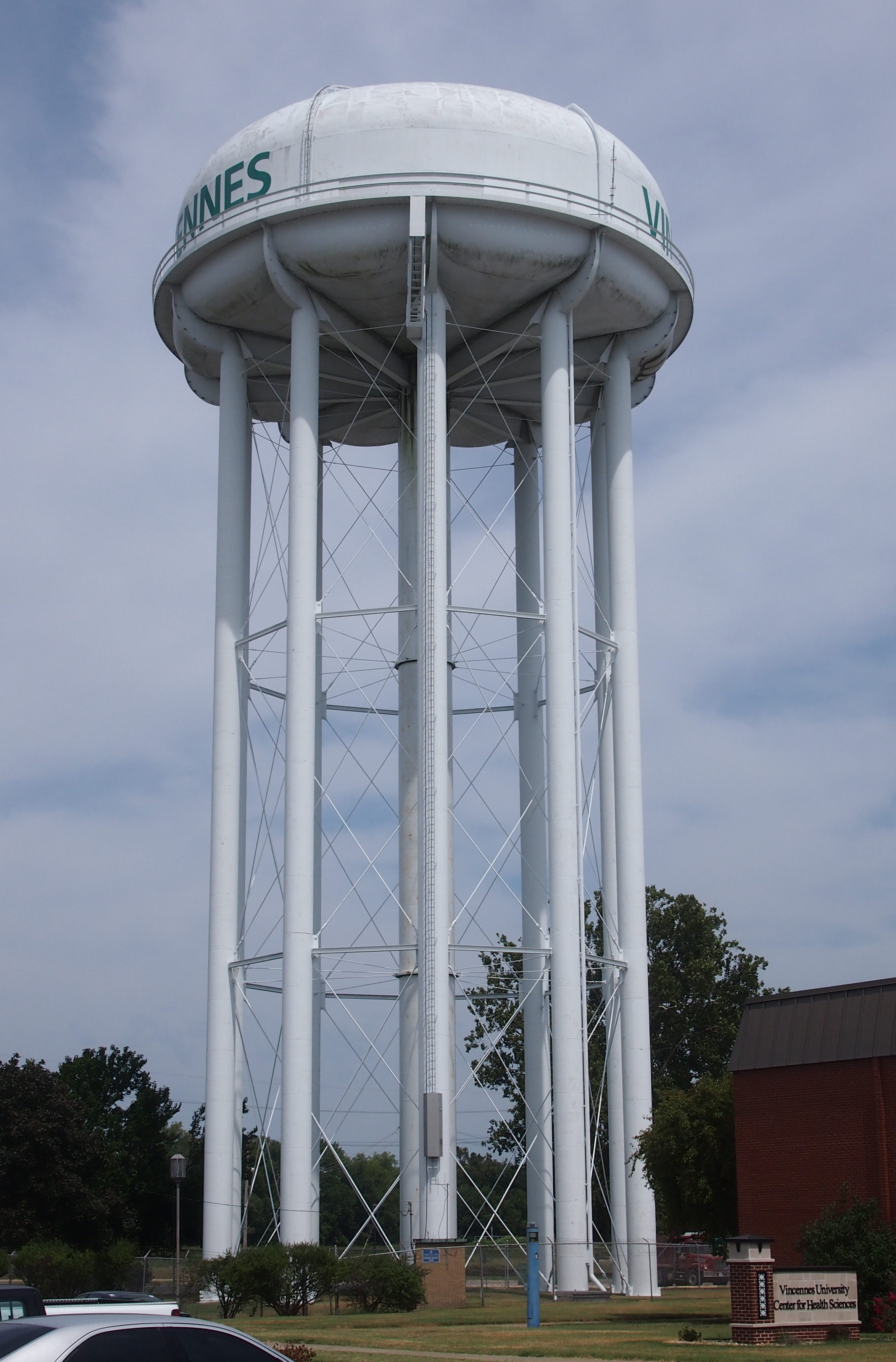
The next day we went from Terre Haute to Paducah, spending a few hours in between in Vincennes, Indiana, on the Wabash River. We saw three things there: Grouseland, home of William Henry Harrison as governor of the Indiana Territory; the splendid Basilica of St. Francis Xavier, and the monumental yet obscure George Rogers Clark National Historical Park.

The thinking behind these stopovers was that seeing the eclipse at totality was no certain thing. Clouds don’t care about your peak-life-affirming-you-are-a-child-of-the-Universe experience, or even if you’re a scientist (or citizen scientist) looking to add to mankind’s body of total knowledge. It’s just another day to the atmosphere. So in case that happened — and the prospect kept me antsy for days — the trip wouldn’t be a total bust.

All together, the trip from our house to Paducah, using the most direct roads, is nearly 400 miles. St Louis is closer, about 300 miles, but I wanted to stay away from a large city for the event, which would mean adding crowds to crowds. Also, I’d acquainted myself with much smaller Paducah in 2009 at the same time as Metropolis, Ill. (misspelling Paducah in my posting), and found it pleasant enough.

Why see the eclipse at all? Because of the astronomy books I had as a kid that explained and illustrated the phenomenon, especially with maps of where total eclipses would be in far-off future years like 1979. Because of the eclipse of March 7, 1970, which was partial in Texas. My eight-year-old self made a pinhole box but, finding that unsatisfying — and this was before widespread eclipse glasses — I stole an instant’s look at it the thing itself in partly cloudy skies, very clearly seeing the black disk on the bright one. Because the subject came up at the planetarium I visited almost monthly in elementary school. Because men were going to the Moon at the same time. Because of the lyric in “You’re So Vain” that seems to reference the ’70 eclipse. The idea of winging off to Nova Scotia just to see an eclipse seemed (seems) impossibly intoxicating. Because of A Connecticut Yankee in King Arthur’s Court and “Nightfall” and other stories and movies using an eclipse as a plot point. Because I read Isaac Asimov writing about the Eclipse of Thales, and later read Herodotus on that event, which probably was on May 28, 585 BC, and if so history’s first exact date. Because I read about the eclipse of May 29, 1919, which helped confirm general relativity. Because of the annular eclipse I experienced in Nashville (as a partial) on May 30, 1984, which dimmed the sky in a strange way. Because it’s a cool thing to see not before I die, but while I’m still alive, just like the Transit of Venus. Because, to paraphrase George Mallory, it’s up there.

Mighty Stonehenge

Notes from a day’s drive in southern England. My friend Rich and I were young and doing what people — tourists — do in that part of the world, seeing very old places.
Wish we’d known about Glastonbury Tor (about 50 miles to the west of Stonehenge; nothing is really very far away in England, not to a Texan). Even so, I’m not sure we could have seen Stonehenge and Bath and Glastonbury Tor in the same day, but we could have given it the old post-college try.

August 11, 1983

Mrs. Dow drove us to Gatwick Airport, and we paid our pounds [wish I’d recorded how much] and rented a blue Ford Fiesta. The plan is to drive various places until we need to return the car at the airport on the 14th, to catch our flight home.

Driving on the left side, with the steering wheel on the right, took some getting used to. Soon we were lost on the small roads south of Gatwick, very narrow ones with a surprising amount of traffic, and confusing roundabouts (traffic circles) appearing suddenly and often.

So we were edgy for a while. Fortunately, you get used to the roads. We even got unlost. Rich drove and I navigated, and we each took to those roles before long. We listened to BBC1 as miles of English countryside rolled by. Entertaining, no commercials.
At about 1, we arrived at Stonehenge. [Ah, mighty Stonehenge.] We saw it from some distance at first, driving along the A303. Looked almost luminous from a distance. The road runs remarkably close to the ruins. Maybe an ancient road did likewise.

We parked (no charge!) and visited the ruins. You can’t get too close to the stones. Close enough, though. Impressive, and puzzling, that ancient people dragged these some distance across England, long before it was ever called that, for the purpose of building a stone circle. I won’t speculate on their motives. The center uprights and lintels were especially impressive: big and white and somber. [Not quite this crowded that day, I’m glad to remember.]

Drove on to Bath. No problems until we got snarled in traffic in Bath, a town not built for cars. We eventually parked in a garage that featured the following emphatic signs: Thieves are active in this car park. Remove your valuables or they will be stolen.

We went to the tourist-i, booked a room, and drove there: a place called Toad Hall. Very nice, £7 each. We walked into the center of town from there, visited a number of bookstores there, then the Roman baths. [No detail about that, but I remember such scenes such as this.] Ate. Wandered back to Toad Hall. Just after sunset, a beautiful scene just outside our window: a church steeple with a nearby crescent moon.

I used to have a business card I picked up at Toad Hall, but I can’t find it. I remember it featured a gentleman Toad, whom I guess would be Toad of Toad Hall. Though a children’s book, I never got around to reading The Wind in the Willows as a child, so the name didn’t resonate with me when I stayed there. Only later I appreciated the whimsy of naming a B&B that.

I checked, and it’s still there. I also checked the rates: a double in August is (gasp) £95. (We paid the current equivalent of £42 between the two of us.)

Thursday Whatnots

Yesterday I picked up my copy of the Federalist Papers and read No. 1 (Hamilton). It’s a beat-up paperback, a somewhat yellowing Mentor Book, published in 1961. Somehow fitting in its republican simplicity. Seems like I got it used in the summer of ’81 at the University Coop in Austin, probably for the Government class I took that summer at UT.

I read some of them at the time, and a scattering more later in the ’80s, but little since. Time to take it up again. Its 18th-century educated dialect — call it Enlightenmentese — was a little hard to unpack as a callow lad. Not as much now, though now and then I need to re-read a sentence to make sure I understand it.

Each paper is conveniently short: pamphlet sized, you might say. So I’m reading one a day. I ought to have time enough for that. Today was No. 2 (Jay).

Hamilton’s wisdom shines through from the get-go. From Federalist No. 1: “So numerous indeed and so powerful are the causes which serve to give a false bias to the judgment, that we, upon many occasions, see wise and good men on the wrong as well as on the right side of questions of the first magnitude to society.”

And a notion that foretold Internet comment sections, among many other things: “To judge from the conduct of the opposite parties, we shall be led to conclude that they will mutually hope to evince the justness of their opinions, and to increase the number of their converts, by the loudness of their declamations and the bitterness of their invectives.”

I also recently acquired The Shipping News and The Dharma Bums, and plan to read them soon. Reading should involve variety.

Besides this vanity map of the states, a while ago I made a map color coded according to my visits to the state and provincial capitols. It’s a minor hobby of mine.

CapitolsGreen represents the state capitols and provincial parliament buildings that I’ve seen inside and out. The orange-pink means that I’ve seen the capitol, but for one reason or another I didn’t go inside. White is for capitols I’ve never seen at all.

As for the two gold-orange states, Hawaii and Utah, I can’t remember whether I’ve seen or been in the capitols. You’d think I’d remember something like that, but the visits in question were in 1979 and ’80, respectively, years that are otherwise known as a long damn time ago. I was in Honolulu and Salt Lake City. I could have gone. A few years later, I would have made a point of going. But I’m not sure I did then.

Ice Cream Truck, August 2017

How did “Turkey in the Straw” become the universal song for American ice cream trucks? This article suggests a lineage for the association. This YouTube video plays another song to the same tune, one I wasn’t familiar with.

Back Yard Flora ’17

Today was a mostly sunny, warm August day. The beginning of declining summer, though the grass and bushes are so green — there’s been a fair amount of rain this summer — that it looks more like June. The dry browns of August are missing this year. So far.

Around noon, I wandered around my back yard taking pictures of flora. Why? Why not?

I also spotted some back yard fauna, lurking in the greenery.
The dog chews on the plants this time of year.

Why? Why not?

Eden Palais

In an outbuilding of the mansion we toured last month — a large outbuilding — is the Eden Palais.

Eden PalaisI quote at some length as I go along, from the mansion’s web site: “The carousel building, completed in 1997, is the home of the most complete example of a European salon carousel in existence — the Eden Palais, built in 1890.

“The salon carousel was more than just an amusement ride, it was a self-contained entertainment palace that included stages for live performers, several bars, booths for perimeter seating, and music. The whole affair was lighted by hundreds of light bulbs, and was undoubtedly one of the first places that patrons experienced electric lighting when it was new.

“The Eden Palais includes an 89′ wide by 42′ tall carved facade with life-size carved horses, giant art glass butterflies, a painting recreating an original that hangs in the Louvre, and a beautiful etched-glass entryway.”

It’s impressive for sure. This is the front entrance.

Apparently three more walls of similar heft originally surrounded the carousel, defining the entertainment palace. They’re in storage now. All of them were moved with the carousel from place to place around France, just like a circus might.

One of the figures next to the entrance.
This is the carousel, behind the main entrance wall. It’s one of the larger ones I’ve seen, and unlike the one at the House on the Rock, a true carousel that you can ride. Which we did. It was clearly built during less safety-paranoid times. But no one was injured. The ride was a gas.
“The carousel itself is 46 feet in diameter, with 36 hand-carved Hubner horses, four ornate rocking gondolas and a spinning lovers’ tub. The center is adorned with seven large Coppier paintings. The platform runs on tracks; three steam engines originally drove the platform, the center hub of paintings and the band organ. The steam engines are restored, but power is now supplied by electric motors.”

A detail of one of the center paintings. As was pointed out by our guide, something likely to appear in 1890s Europe, but not the United States.

Details of the carousel.

A nearby figure.
“Several different owners toured France with the Eden Palais from 1890 through 1959. An amusement park in Golden, Colorado, imported it from the Caron family in 1959 and then went bankrupt, leaving it outside in the snow for one winter. Charles and Sue Bovey then purchased it and stored it in Great Falls, Montana, until the [current owner] acquired it in 1987.”

Restoration took years and boatloads of money, the guide said, though not quite in those words.

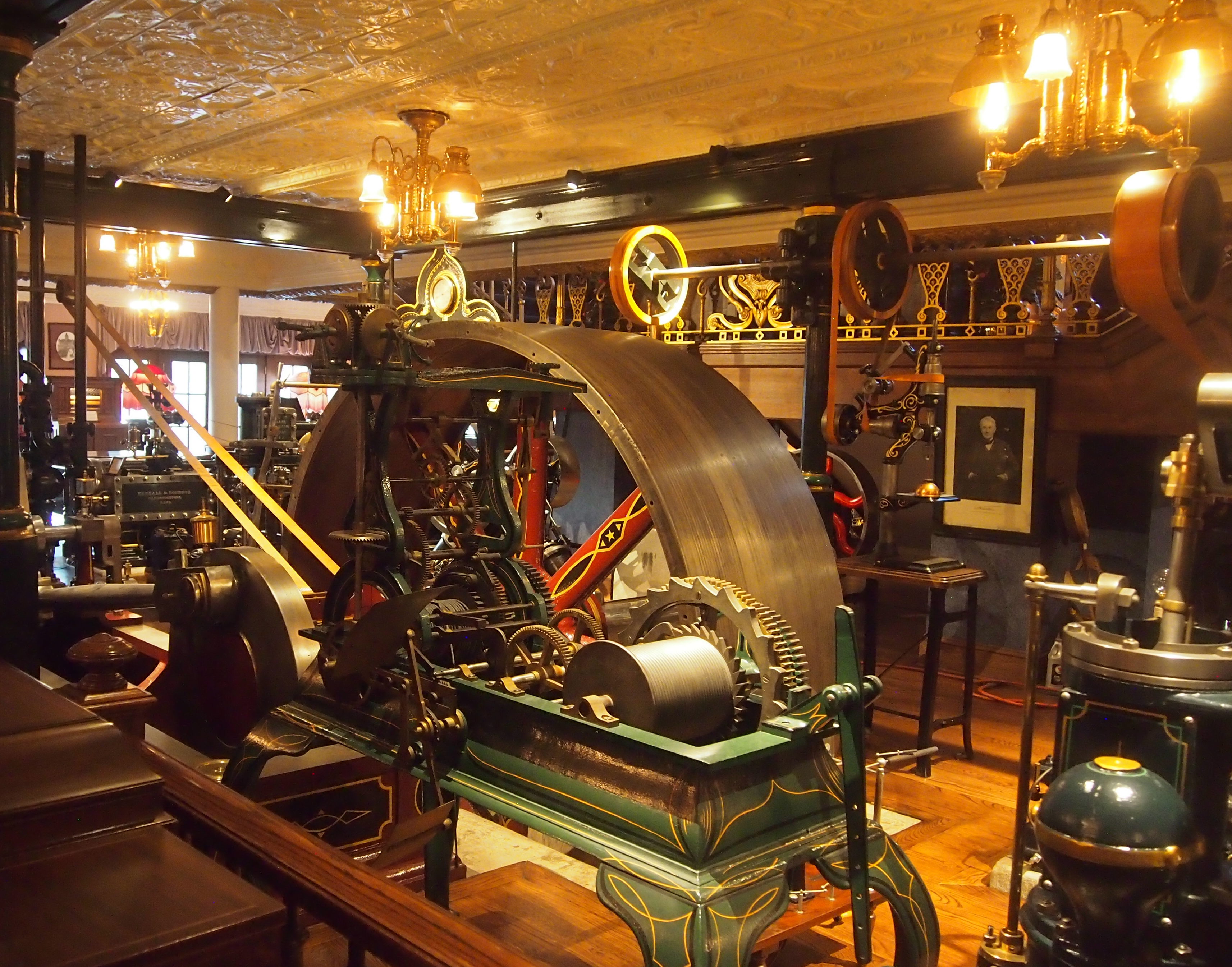
“Large steam engines surround the carousel, including an 1826 table engine, an 1836 walking beam engine, and an 1880 double compound 80 horsepower marine engine. The 1881 Grant railroad locomotive and tender were used by Henry Ford for forty years in his Dearborn, Michigan, auto plant and later displayed in the Ford Museum at Greenfield Village.”
But that’s not all. Near the carousel wall was a tower.
“The spectacular Joseph Mayer cast iron street clock stands over 20 feet tall, weighs over 8,000 pounds and originally was owned by the American Jewelry Co. of Bakersfield, California. It includes a Dennison gravity escapement, a self-winder, and a mercury-compensated pendulum, features rarely found in street clocks.”

Also: “American and European fairground and dance hall organs displayed in the carousel building include examples by Bruder, DeCap, Gavioli, Hooghuys, Limonaire, North Tonawanda and Ruth. Wurlitzers include a 157, 165 and 180, among others.”

This Gavioli was not likely to originally be found in North America either.
Here’s a Belgian street organ.
Not an old one. Apparently the Belgians have decided that older such machines are part of their national patrimony, so they cannot leave the country legally. No worries, though, since if you’ve got the dosh, you can have a new one built.

An Exaltation of Victrolas

Supposedly the collective for larks is an exaltation, though I don’t know that anyone familiar with larks actually uses it. Seems like one of those made up, like so many others, for the Book of Saint Albans in 1486, and surviving on lists to this day.
That comes to mind because I was wondering what the collective for Victrolas might be. Exaltation fits. An Exaltation of Victrolas.

The suburban mansion we toured in July not only had massive orchestrions that played orchestral music without any human musicians, and many arcade machines of yore, but also Victrolas and other phonographic systems with pronounced horns. A lot of them. An exaltation of them.

I went all snap-happy and spent time taking pictures of them. The horns, not so much the mechanisms. I’d never seen such an array. The only thing close was the selection of 78 players for sale at Harp Gallery in Wisconsin.

Note the collection of Edison Records cylinders that the machines above use.

In this room there was one machine — not pictured — that was powered by the heat of a candle. Light the candle, put it inside the cabinet, let it play. “I wanted to show you this machine,” the guide said as he held up the candle. “But we almost never play it. It can catch fire.”

All of the mansion’s Victrolas are in working order, I understand. All you need is a vinyl record (or cylinder) of some early kind, which are still around. In a century’s time, will there be a collection of iPods and other gizmos like this? They will probably be hopelessly unplayable.

Not Your Father’s Arcade Machines. Your Grandfather’s.

The lower level of the mansion we toured recently is chockablock with antique arcade machines, and I don’t mean Pac-Man. Some are actual penny arcade machines.
Quartoscope. Another brand name lost to time.

According to arcade-museum.com, “Mills Novelty Co. released 583 different machines in our database under this trade name [Quartoscope], starting in 1896. Other machines made by Mills… during the time period Quartoscope was produced [1896-1930] include Kalamazoo, Klondyke, Owl, Jumbo, Little Duke, Pau-Pau, and Little Pau-Pau.”
Other machines charged a quarter once upon a time, probably later than the penny machines. One in the row below promises you’ll see the Brown Bomber KO Max Schmelling (sic), which was in ’38. Both kinds of machines were trying to demonstrate that you can buy a thrill.
Here’s Al St. John in The Hiebe-Jiebes. Good old Al St. John, Fatty Arbuckle’s nephew and the cowboy sidekick to end all sidekicks.
Looks like a different sort of part here, but then again he did a lot of movies. Or maybe most of them should be called flickers. That hasn’t kept him from being utterly forgotten.

Other machines promise other kinds of entertainment, such as your true horoscope (and it is annoying when you get stuck with a false one).
A kind of machine I’d never heard of before: one that dispenses a penny’s worth of perfume, presumably for refined ladies who want to freshen up their handkerchiefs.
Never seen one of these, either: vertical roulette, looks like. A easy way to lose a lot of quarters and half dollars, which were certainly worth something when this machine was new.
There were also more conventional one-armed bandits. A whole row of ’em.

The orchestrions and similarly complex machines on display in the rest of the mansion are certainly impressive. Awe-inspiring, even. But there’s something intriguing about these arcade machines, too.

While the orchestrions were for wealthy families and posh hotels and prosperous saloons, the arcade machines were entertainment for ordinary people, at a time when entertainment was in shorter supply. Unlike now, when we’re drowning in it. Maybe those pennies and quarters could have been better spent, but sometimes Al St. John in The Hiebe-Jiebes must have been just the thing.

Music Machine Extravaganza

Earlier this month, Yuriko and I toured a suburban Chicago mansion stocked to the gills with antique mechanical devices, all asserted to be in working order (and I believe it). The collection emphasizes machines that play music, such as orchestrions, Victrolas and other phonographs, music boxes, and a theater pipe organ of massive proportions, but the place also sports an equally impressive carousel, a large number of penny- and quarter-arcade machines, a steam engine collection, slot machines, coin pianos, and a 24-foot bar.

I learned that the heyday of music machines was the late 19th and early 20th centuries, when the art of precision machining was well developed, but before radio and standardized phonograph records dampened demand for such machines.

Our affable and knowledgeable tour guide requested those on the tour, about 40 of us, not post any pictures to social media. I took that to mean Facebook and Instagram and the like, not a standalone obscurity like BTST.

Even so, in the spirit of the request, I won’t post of the name of where we went or tag the photos, making it harder for search engines to find them. Of course, it would take only a modest amount of Googling to find out where we were, considering the description I’m going to offer. But I won’t post the information here.

The property dates from the 1970s, with later additions, on a piece of land that’s large enough that you can forget there’s a city or even suburbs not too far away. The family that owns it made their fortune selling a common foodstuff, and its packaging, in a big way. The place is not a museum, but still occupied by members of the family. Even so, they offer tours and other events periodically.

Though the tour wasn’t about the house, the building does have some nice features, such as the main entrance skylight and chandelier.
Mainly, you go to see the collection of antique machines, which are a fascination of the family patriarch and his children. It’s an extraordinary array of devices, housed in a succession of rooms.

The displays start at the main entrance where, among a number of other machines, is a JM Hof & Mukle roll organ at the top of the grand staircase.
The three-story Music Room includes a large number of machines.
I liked this charming Frati Barrel Organ, made in Germany ca. 1905.
A much larger Weber Otereo Orchestrion, also made in Germany, ca. 1910.
According to its sign, “… between 1905-1910, animated scenes were very popular in some models of German orchestrions. This early Weber Otereo features a scene depicting the train station in Gelsenkirchen, Germany, complete with back-lighted silhouettes of an animated train, zeppelin, and other items. Everything in the Otereo operates on air pressure…”

The guide demonstrated this machine, and we listened to it play but also watched the animated scene.

The centerpiece of the Music Room was the organ console.
Stepping back a bit.
And then turning around. This is view from the console, to give a little context.
The room counts as a small auditorium, and we listened to the theater organ from the balcony. Quite a wall of sound. It’s worth quoting the mansion’s web site at some length on this machine.

“The nucleus of the theatre organ, which was previously installed in the old music room (Wurlitzer opus #1571, built in 1927 for the Riviera Theatre in Omaha) has been expanded to 80 ranks of pipes. The overall result is the most versatile orchestral theatre pipe organ ever built.

“Behind the scrim are five chambers containing pipes, percussions, wind regulators and controls in a four-story-tall area. The console is patterned after the original from Chicago’s Paradise Theatre; it is mounted on the original Peter Clark lift from the Granada Theatre, which raises it from the lower level cage enclosure up to concert playing position.

“Mounted on the wall to the left are the 32′ Diaphone pipes, and to the right are the 32′ Bombarde pipes. A 32-note set of Deagan Tower Bells, the largest of which weighs 426 lb., hang on each side of the room… To the rear of the room, the ‘Ethereal’ pipe chamber in the attic echoes softly from the skylight area, while the brass ‘Trumpet Imperial’ and copper ‘Bugle Battaglia’ speak with great authority from the back wall.”

The American Orchestrion Room, elsewhere in the mansion, features art glass-front orchestrions, along with Tiffany and other art glass lamps and a large collection of Victorian chandeliers. This is only one end of the room, which is fairly long.
The room includes a violin-playing machine, the likes of which I’d never seen.
And a hand-cranked mechanical bird in a cage, with a mechanism inside covered with actual bird feathers. As might have amused the raja of one of the princely states about 100 years ago.

From there, stairs led to the lower level of the mansion, and a display of machines similar to music-making devices in some ways, but all together different in others. More about that tomorrow.

Zoo View 2011

I can’t remember the last time we went to the Brookfield Zoo. It might have been as long ago as July 2011. I have a file labeled 2011-07-18 and many of the pics are of that zoo, the larger of the Chicago area’s two main zoos.

I don’t care what PETA thinks, it’s a fine zoo. I posted some of the Brookfield pics at the time. But not the bright birds.
Brookfield Zoo 2011Or any of the non-animal aspects of the place, such as the topiary elephant.
Brookfield Zoo 2011Or the bronze walrus.
Brookfield Zoo 2011Or the Living Coast mural.
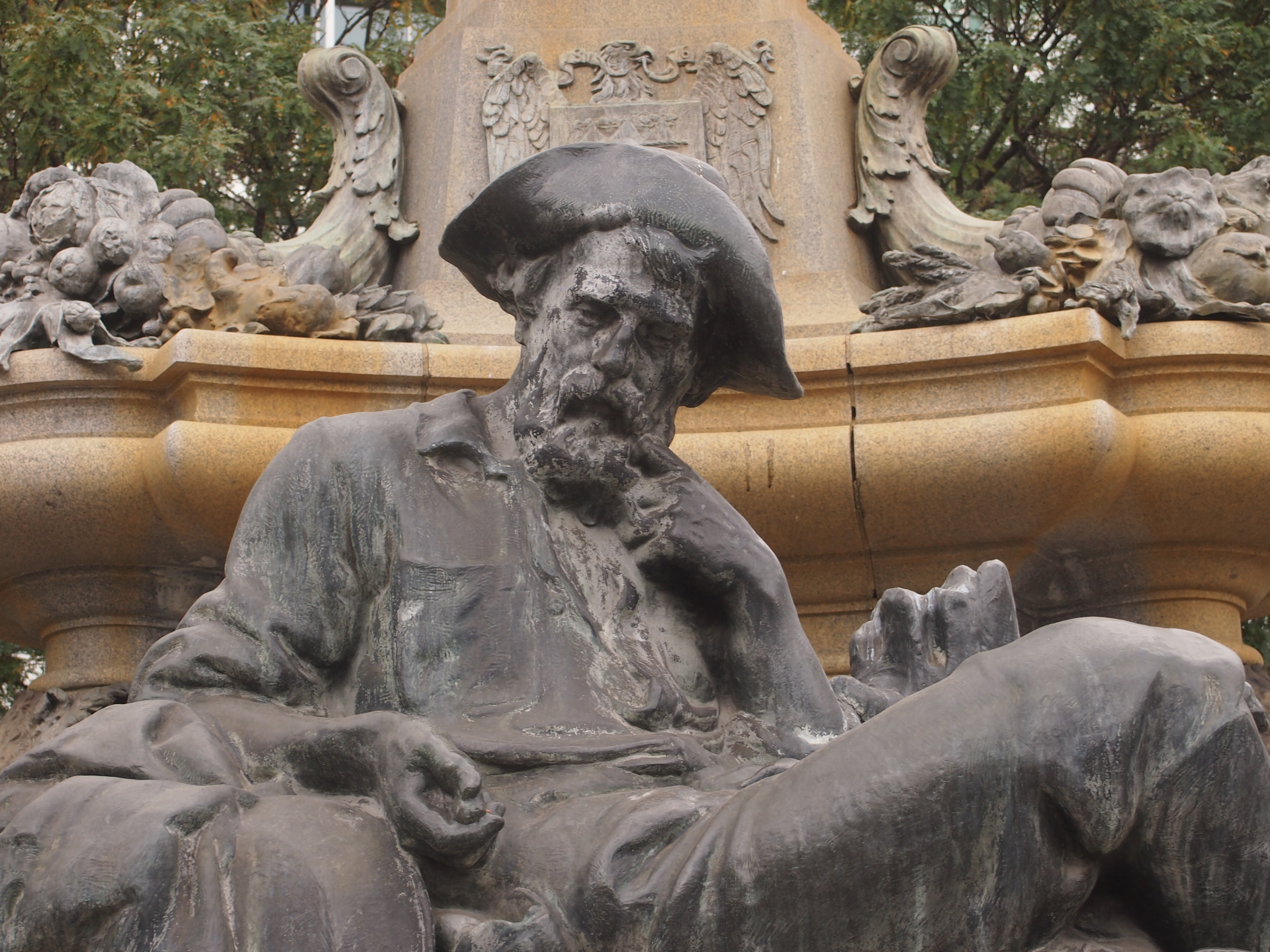
Brookfield Zoo 2011Or even the Theodore Roosevelt Fountain, there since 1954, though I did post the cornflowers nearby.
Brookfield Zoo 2011

July is cornflower time, and we’re all better for it.

Thursday Odd Lots

“What’s so funny, Dad?”

“That sign across the street.”

We were in Wisconsin during our recent trip, and had stopped at a place where I could access wifi. The sign was visible from there.

“That’s not funny.”

“Maybe it will be for you someday.”

What would happen if you used this granite for landscaping? Would your back yard suddenly cause you dread? Kafkaesque landscaping, now there’s a concept.

Looks like Kafka does some good work, though.

Here’s a sign you don’t see much any more, though I’m pretty sure that they were common once upon a time. I think even my high school cafeteria, which was in a basement, had one in the late ’70s. They’re so rare now that when you do see one in situ, you take note. Something like a working public pay phone.

Fallout Shelter Sign, Calumet, Michigan

This one is on Sixth St. in Calumet, Michigan. It even has a capacity number. What was once an unnerving reminder of the nuclear Sword of Damocles can now “add a cool tone to a man cave or retro game room,” according to Amazon, where you can pick a reproduction up from the Vintage Sign Co. for (currently) $18.99. The note also calls the item a “vintage style WWII metal sign.” What is it about basic chronology that flummoxes so many people?

Something else I saw, a little more recently, in Bucktown.

Bucktown, Chicago Shiva Shack

Shiva Shack? C’mon in for a bit of destruction and then transformation.

Also in Bucktown: a game of beanbag on the sidewalk.

Bucktown 2017

Maybe there to remind us what politics ain’t.

Recently I picked up The Happy Isles of Oceania (1992) by Paul Theroux. It’s been sitting on my shelf for a number of years. So far it’s a good read. I understand that he has a reputation as a snob, and some of that comes through in his writing, but I don’t know the man personally, so I wouldn’t have to put up with him anyway.
He writes well, at least about the places he’s been, and that’s all that counts. His description, early in the book, of hiking on the South Island of New Zealand, is a fine bit of work, and had the unfortunate side effect of making me want to drop everything and go do that. The mood passed.
Theroux’s work did influence me to go one place. In the early ’90s, I read his Sunrise With Seamonsters, a collection of essays and travel bits, and one piece included a mention of the Cameron Highlands on the Malay Peninsula. It’s a former British hill station, more recently a getaway place for Malaysians and the trickle of tourists who’ve heard of it. His mention of it was probably where I first heard of the place.

When I went to Malaysia for the first time, I made a point of going there, and did not regret it. Besides cool temps, you can enjoy jungle walks (unless you’re Jim Thompson), a butterfly garden, a nighttime view that can include the Southern Cross, and eating Chettinad cuisine on a banana leaf, with your hands.

This is what life is, according to the song.

Life's a Bowl of Cherries

Rainier cherries, which are in season now. Very popular around the house, and we buy them in large quantities while we can. I’m glad that there are still some foods, some fruits, that have a season.

I’m not all that keen on Rudy Vallee, but his version of the song is good. And the lip sync from Pennies From Heaven (1981) is amusing. I saw that movie when it was new, probably because Steve Martin was in it, but I don’t remember very much about it. Maybe I should watch it again. I know I was too young then to appreciate its songs.