A Short Visit to Wheaton

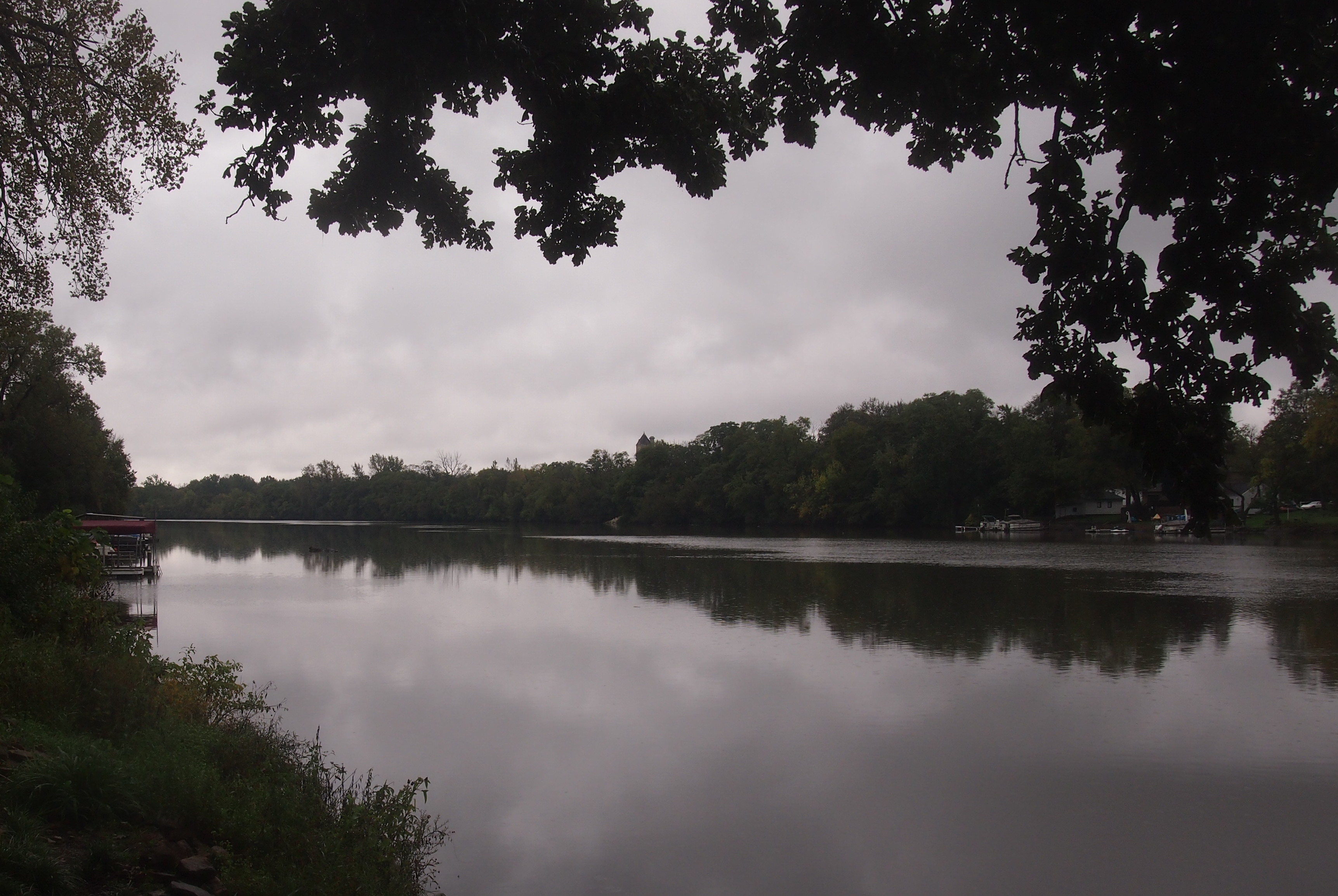
Rain again Sunday night, to add to the slosh on the ground left by Saturday’s downpours. No doubt about it, the weekend was wet. Here’s the view of the water from my car on Saturday, as I waited in a shopping center parking lot.

April 30, 2016Wheaton’s a prosperous suburb and the county seat of DuPage County, Ill., and easily accessible from where we live by surface streets. We used to go there with some frequency to visit the small but pleasant Cosley Zoo, which is operated by the Wheaton Park District, especially before recessionary pressures (apparently) inspired a new admission fee for non-Wheatonites, ca. 2010. These days there’s less demand among the younger residents of the house, who aren’t so young any more, for zoo visits.

We’d mulled going further afield on Saturday, but the persistent rain and cool temps nixed the idea of any outdoor destinations, so we headed to Wheaton. Not to the zoo, but to see the DuPage County Historical Museum, which we’ve passed by but never visited.

But first things first: lunch. I’m happy to report that the diminutive Mai Thai Cafe at Main St. and Wesley St. is still in business, and still services good Thai food at popular prices. Spicier than some other North American Thai joints, too, enough that there’s a sign posted at the restaurant warning customers to think twice about ordering the spiciest versions of its dishes.

Not far to the west on Wesley St., in Wheaton’s pleasant shopping district, we spotted a post-accident scene of the kind that makes you wonder, how did that happen, exactly? (Like this one.)

Wesley St. Wheaton April 30, 2016The car on the sidewalk’s clearly been smacked from behind, but it doesn’t look like it plowed through any of the planters on the sidewalk to get there. Maybe it jumped onto the sidewalk just so, narrowly missing the planters. Or did it back up onto the sidewalk somehow? If so, why, after being rear-ended? I didn’t inspect the scene closely, so I’m certainly missing an essential piece of the puzzle.

I took the shot from about a half block away, under an awning, because it was raining. Three or four other people were taking pictures from there as well. That’s the early 21st century for you: an era of easy photography that often doesn’t clarify anything.

End of the Week Debris

Rain, I don’t mind. Miserable cold at the end of April, that doesn’t seem right. That’s what we have, with the promise of slightly less miserable cold during the early days of May.

Here’s a picture of my nephew Dees, taken (probably) by one of his bandmates while they were in Atlanta. I doubt that they’d mind me posting it.DeesAJA fellow I don’t know, who seems to be an Englishman — or at least an English-speaker — living in Germany, left me a message at BTST, asking whether I knew the exact location of the Goethe Institut in Lüneburg. He’d attended classes there the same summer I did in 1983, though in August, and if you Google “Goethe Institut, Lüneburg,” I’m the first hit. He must have found me that way. Guess not many other people have posted about their fond memories of the place.

He had the chance to visit Lüneburg again and wanted to see the school. Sadly, I had to tell him I didn’t know the address after all this time. It isn’t on Google Maps, so my suspicion is that it’s long closed. I vaguely remember hearing about plans to close it, even when I was there, but wouldn’t swear to anything.

Apparently he made it to Lüneburg in late April and didn’t see the school. He did find that it was snowing.

If I remember correctly, that’s the handsome Lüneburg Rathaus. But I never saw it during a light snow.

The Rio Grande Rift

Our first trip after Y2K didn’t end civilization as we know it was to San Antonio and then Santa Fe, by way of some other places in New Mexico, in April 2000. Those other places included Albuquerque, Madrid, NM and Bandelier National Monument and Los Alamos.

Here’s a roadside view of the Rio Grande as it runs through New Mexico. It isn’t an international border at this point, but is an unusual land form nevertheless.

Rio Grande 2000I didn’t realize until much more recently that I was looking down at a rift. Or that, to quote the various scientists who put together this page about the rift, “most rifts are found along mid-ocean ridges. Only a few are located on land, such as the Rio Grande Rift, East African Rift (sometimes referred to as the Great Rift) and Lake Baikal, a lake-filled rift in Russia.”

I’m not exactly sure where the overlook was, but my guess would be along New Mexico 4 just outside of the national monument, and looking over the river into another section of the monument. Note the haze in the distance. That’s probably one of the controlled burns occurring when we visited. Soon, as in the very next month, a controlled burn became uncontrolled.

This is New Mexico 4, probably looking the other way from the outlook.

NM Highway 4This is Lilly. A lot of the pictures I took on that trip involved her. Call it the first-child photography syndrome, though she was two and a half by this time.

Lilly April 2000She’s at breakfast in the place we stayed in Santa Fe. The reason we documented that particular moment (I think) was that we weren’t entirely sure she’d behave during breakfast — that is, stay seated and eat her food without much fuss. But she did. I guess she was just then learning to appreciate the joys of breakfasts on the road.

The Ulysses S. Grant Memorial Highway & Lundy Lundgren

If you have time, US 20 is the best way between metro Chicago and Rockford. I-90 is faster but not as interesting, and a toll road besides. We went to Rockford on the Interstate for speed, but returned at our leisure on the US highway, which is sometimes four lanes, sometimes two, along that stretch.

US 20 is also known as the Ulysses S. Grant Memorial Highway in Illinois, honoring Gen. Grant, who spent some time in western Illinois. In fact, the highway runs by his house in Galena. (US 20 itself runs cross-country, from Boston to Newport, Ore., or vice versa.)

The honorary designation has been in place since 1955, but most of the original signs were lost or fell apart. In 2007, the Illinois DOT started replacing them with brown-lettered signs that include a portrait of Grant. The route passes very close to where I live in the northwest suburbs, and I remember starting to see the signs appear nearly 10 years ago. I thought the designation was new as well, but now I know better.

One of the places on US 20 between Rockford and the northwestern suburbs is Marengo, a burg of about 7,500 in McHenry County. Oddly, it seems to be named after the battle of that name, which did so much to solidify Napoleon’s top-dog status, at least until Waterloo. Maybe some of the town founders included Bonapartist sympathizers, but well after the fact, since it was established in the 1840s.

For years, I’ve been driving by a sign that points to a historical marker just off US 20 in Marengo. High time I took a look, I thought this time. The marker is a few blocks north of US 20 on N. East St. This is what I saw.

Lundy Lundgren, Marengo, ILCarl Leonard Lundgren (1880-1934) hailed from Marengo, and behind the sign is the very field where he perfected his pitching skills, at least according to the sign. As a young man, Lundy Lundgren pitched for the Cubs from 1902 to ’09, and in fact pitched for the team during its most recent appearances in the World Series — 1907 and ’08.

He’s buried in the Marengo City Cemetery across the street from the plaque.

Marengo City Cemetery April 2016I took a look at the place from the street, but didn’t venture in. Most of it’s modern-looking, or at least 20th century, but there’s a small section whose stones look very old, older even than Lundgren’s, wherever it is. That bears further investigation someday.

A Little More Rockford

The gardens outside the Nicholas Conservatory in Rockford would be worth a trip back in a month or two, when they’re in full flower. On Saturday, the floral exuberance of spring was just beginning. Even so, there were a few other things to see, such as a statue of a man taking a picture."Sight Seeing"And, at that moment, an actual man taking pictures.

Nicholas Conservatory & GardenThe statue, by the way, is by Seward Johnson, whose work I’ve seen elsewhere. This one is called “Sight Seeing,” and dates from 1991. The camera depicted would have been old fashioned even then. I have an inkling that Johnson isn’t popular among art theory specialists, for being shockingly derivative, or not smashing any paradigms, or something.

After the conservatory, we repaired to the Stockholm Inn, an enormous restaurant in Rockford. Word is — relayed by the Internet — that it too is very popular, though its offering of superb yet standard Swedish food at reasonable prices might put off some foodies.
Stockholm Inn, RockfordAfter all, the place doesn’t offer farm-to-table fair-traded locally sourced artisanal Swede-tastic regional cuisine, guaranteed to be authentic, massaged and sublimated to gastro-perfection. Try the Nordic fusion gravlax tacos; they’re to die for.

No, the thing to order — the thing that I ordered — are the Swedish pancakes, a close cousin of the humble crêpe, infused with butter, vivified by syrup. Thin, smooth, sweet, wonderful. What they had for breakfast in the mead halls of yore, since one has to eat as well as drink.

Rockford Flora

Like any good conservatory, the Nicholas Conservatory near the banks of the Rock River in Rockford, Ill., is lush with greenery, and complete with winding paths and a water feature.

Nicholas Conservatory RockfordSome of the greenery vaults toward the glass ceiling.

Nicholas Conservatory RockfordThat tall specimen, incidentally, is a Carpoxylon Palm (Carpoxylon macrospermum), which is indigenous to the Vanuatu archipelago. I don’t know that I’ve ever seen anything native to Vanuatu before.

Other palms reach out in all directions with their enormous ears.

Nicholas Conservatory RockfordNaturally, there are also plenty of flowing plants.

Nicholas Conservatory RockfordNicholas Conservatory RockfordNicholas Conservatory RockfordThe conservatory featured a wall of orchids that was a particularly popular place to take people’s pictures.

Nicholas Conservatory RockfordI took a few myself.

Nicholas Conservatory Rockford

The Nicholas Conservatory & Gardens

As a destination from the northwestern suburbs of Chicago, Rockford has a number of advantages. For one thing, it isn’t that far. It’s easy to drive there, visit one place at least, maybe eat a meal, and then come home. But it’s far enough not to be in the northwestern suburbs. There are still wide-open farm fields between here and there, and some smaller towns. Someday metro Chicago and metro Rockford might well conurb, to make up a verb, but that hasn’t happened yet.

None of that would matter if there weren’t a few interesting places to see in Rockford, but there are. Such as the Klehm Arboretum, a fine warm-weather destination, or the Anderson Gardens. The Rock River is also worth a look, with its various pedestrian-oriented amenities.

I wrote in 2003 about our visit to the riverside, “We drove a short ways north of downtown, looking for a more expansive park at which to finish off the afternoon. We found it on the other (west) bank of the Rock River, at the Sinnissippi Gardens and Park, which had a greenhouse that was already closed…”

These days, the greenhouse is permanently closed. It was replaced by the Nicholas Conservatory, which opened in 2011. I’d read about its development and opening, but didn’t get around to taking a look at it until Saturday, when we drove to Rockford exactly for that reason. Saturday, April 16, 2016 here in northern Illinois was as warm and pleasant as a spring day can be, the complete opposite of only a week earlier, the miserable cold April 9. That was an impetus to go.

We weren’t disappointed by views of the Rock River (more lyrically, the Sinnissippi River) from near the new conservatory. Rock River in Rockford, April 16, 2016 People were out along the riverside trail, but not a throng of them.

Rock River in Rockford, April 16, 2016 Waterfowl were out too.
Rock River in Rockford, April 16, 2016A stone’s throw from the river — if you’re inclined toward that kind of mischief — is the conservatory.
Nicholas Conservatory, Rockford, Illinois 2016The facility’s web site is a little thin on facts, but it does say that it’s “the third largest conservatory in Illinois, offering an 11,000-square-foot plant exhibition area complete with water features, seating areas, and sculptures, all in a tropical plant setting.”

I’d guess that the Lincoln Park Conservatory and the Garfield Park Conservatory, both in Chicago, are both larger — I’m fairly certain of that — but whatever its relative size, the Nicholas Conservatory is an elegant construction, and LEED Gold besides. More about its creation here.

Wisconsin, Home of Funny Hats

Various presidential candidates have been stumping just north of here recently, and when I opened Google News this morning, a Washington Post item, complete with Mars Cheese Castle photo, was prominent. I’ve never seen the junior Senator from Texas in person, but I have seen that cheesehead mouse.

The Senator reportedly declined to wear a cheesehead. Wearegreenbay.com quoted him as saying “there is an ironclad rule of politics which is no funny hats… And any hat is by definition defined as a funny hat.”

This from the man who wants to (ultimately) be in charge of the Bureau of Funny Hats, which is part of the Commerce Department, along with the Silly Walks Administration. I don’t think Ronald Reagan was afraid to wear funny hats.

Miyajima (Itsukushima) During Cherry Blossom Season

Here in northern Illinois, the grass is greening, small buds are budding and birds are making more noise. A few new-generation insects are in view. It’s even warm and sunny on some days, such as today, which followed a miserable, dank, cold Saturday. Such is the seasonal seesaw.

As this map and chart explain, early April is peak cherry blossom season in the Kansai and a few other parts of Japan. That’s when I saw the blossoms in Kyoto — the first year I was there — plus in parts of Osaka, including the crowded National Mint grounds but also the little-known but strikingly beautiful Osaka Gogoku Shrine in Suminoe Ward (which everyone simply called Suminoe Shrine).

In early April 1993, we went to Hiroshima for a weekend, and visited Miyajima (宮島), an island in the Inland Sea near the city. Formally called Itsukushima (厳島), it’s home to a Shinto shrine complex and best known for its monumental torii out in the water, which happened to be behind scaffolding when were were there.

Fortunately, the cherry blossoms were in full, unencumbered view. Temple deer were around, too.

Miyajima - near HimoshinaMiyajima - near Hiroshima 1993I didn’t know until recently that Itsukushima is a World Heritage Site, put on the list after we were there, in 1996. UNESCO notes: “The present shrine dates from the 12th century and the harmoniously arranged buildings reveal great artistic and technical skill. The shrine plays on the contrasts in colour and form between mountains and sea and illustrates the Japanese concept of scenic beauty, which combines nature and human creativity.”

The Krannert Art Museum

Time to praise university art museums: generally unpretentious, inexpensive and not so large that you can’t have a good look-see in a short time. One of the places Lilly and I visited at the University of Illinois Urbana-Champaign was the Krannert Art Museum, which has ten galleries and art ranging from ancient Egypt and Pre-Columbian to much more recent items.

One so recent that it was created using an iPhone: “A Lexicon of Dusk.”
The Krannert Art MuseumOver the last six years, a Houston artist named Ruth Robbins took her iPhone out and took pictures at dusk. From these, she made a series of 26 different postcards, copies of which were on a long shelf at the gallery. That’s the artwork.

“Printed as postcards for the viewer to take away — a distributed work of art in line with conceptual art practices — the images show richly colored ambiguous skies and whatever else she happened to have seen at the time: lights low on the horizon, an electricity pole, a snow-covered landscape, an equestrian statue,” the sign near the cards says. “Longitude and latitude coordinates are documented on each image…” That, and an exact date and time when the image was made.

The best part? Postcards are free to take, adds the sign. I took one of each. I’ve already mailed a few.

In the room adjoining the postcard exhibit was an amusing series called “The First and Last of the Modernists,” by Lorraine O’Grady, pairing images of Baudelaire with Michael Jackson.

The Krannert Art MuseumI’ve had a soft spot for Baudelaire since an entertaining acquaintance of mine recited “Be Drunk” — I think it was this translation — at a party at our house late in my college years, ca. 1982. As for the King of Pop, I can’t claim to be a fan, but I respect his reach. I heard his songs walking down the streets of the 10 European countries I visited in the summer of ’83, even East Germany, but maybe not the Vatican City, and even then I might have heard something from a transistor radio someone was carrying at the Piazza San Pietro.

Another room sported some African art. Not just pre-Scramble works from lost states and misty kingdoms, but more modern items. These are two of a particularly striking series, “Seven Lines From Djwartou” by Yelimane Fall.

Krannert Art MuseumKrannert Art MuseumI appreciated these visually, not as someone who can read Arabic. The artist-calligrapher hails from Senegal, and is a devotee of one Sheikh Amadou Bamba, founder of the Sufi brotherhood Mourides in that country, and who wrote the poem “Djawartou” in the early 20th century, among many other things.

As the BBC notes, “Senegal’s most powerful men are not politicians, but the leaders of the country’s Islamic Sufi brotherhoods, to which a very large proportion of Senegalese belong, and whose influence pervades every aspect of Senegalese life.”

Seems that the Mourides are a very big deal in their corner of the world and, from what I can tell from a brief look, eschew the poisons of Wahhabism, and stress hard work among their members (work hard, make money, support the sect). And there are enclaves of them elsewhere. According to Religion News, “Their dictum, ‘pray as if you will die tomorrow and work as if you will live for ever,’ has brought the Mourides economic success wherever they have settled. In New York, the Mourides established their own community, Little Senegal, and July 28 has officially been designated Sheikh Amadou Bamba day.”

Remarkable the things that go into making an image on the wall. I never knew any of that. I don’t expect to make a detailed study of Senegal, but it’s good to be reminded that there are whole other worlds here on Earth yet beyond one’s experience.