Lawless Roads, A Greene Enthusiast & The Pecan-Shellers Strike

Really nice sunset today, red-grays among the lingering clouds that had dropped snow earlier in the day. Too good, I decided, to capture in digital image form. Besides, it’s cold out there.

I picked up Lawless Roads again last night. It was the book I took with me to New York last month, reading about half. Very near the end of my outbound flight, a youngish fellow in the middle seat next to me spied the cover and told me he’d never heard of the book, even though he thought he’d read all of Graham Greene.

I told him it was one of his handful of travel books. He said he would find it and read it. We had to get off the plane pretty soon after that, so I didn’t discuss Greene any further with him. That may be just as well, since I’ve only read a few of his titles, such as The Quiet American, Journey Without Maps, The Third Man, and Travels With My Aunt. I liked all of them, but don’t count myself as an enthusiast.

Early in the book, Greene visits San Antonio, and mentions in passing the city’s pecan shelling industry, whose poorly paid and ill-treated workers were on strike at the time (early 1938).

One thing that struck me was the size of the industry: “Forty-seven pecan shelleries lying discreetly out of sight in San Antonio and they shell in a good year, twenty-one million pounds of nuts,” according to Greene.

“In the 1930s Texas pecans accounted for approximately 50 percent of the nation’s production,” the Handbook of Texas says, revealing an even larger industry than Greene thought. “San Antonio was the Texas shelling center because half the commercial Texas pecans grew within a 250-mile radius of the city.

“The pecan-shelling industry was one of the lowest-paid industries in the United States, with a typical wage ranging between two and three dollars a week. In the nearly 400 shelling factories in San Antonio the contracting system was prevalent; the large firms controlled the supply of nuts as well as the prices for shelling.

“Working conditions were abysmal — illumination was poor, inside toilets and washbowls were nonexistent, and ventilation was inadequate.”

It was a brief flowering for the labor movement in San Antonio, with mixed results, and in a few years the point was moot, with hand shellers generally replaced by machines. By the time I came along, all traces of the industry had vanished, at least as far as I knew. Its memory had vanished as well, again at least as far as I knew.

As labor actions go in San Antonio, that was one of the more memorable ones, yet somehow by the 1970s not even my former Wobbly high school U.S. history teacher, the spirited Mrs. Collins, mentioned it in class. She was from upstate New York, so perhaps had little knowledge of it herself. I had to hear about it from my Government teacher at UT Austin in the summer of ’81, who said he was an adherent of anarchism, but that’s a story for another time.


First Thursday of the Year Musings

Little wind today, which made the outdoors marginally better to experience. But not much. Tonight will be really cold, an illustration of the superiority of the Fahrenheit scale for everyday use, with 0 degrees being really cold and 100 degrees really hot.

I can’t remember exactly when I read it, but years ago there was an item in Mad magazine lampooning the midcentury notion — the quaint notion, as it turned out — that Americans were going to have a surfeit of leisure time in the future, including a vast expansion of the number of holidays. Millard Fillmore’s birthday was a suggested holiday.

Well, that’s tomorrow, and I have to work. That idea about leisure time didn’t pan out anyway. But I will acknowledge the 13th president’s birthday, because why not. Besides, I paid my respects to President Fillmore in person recently.

Today’s also a good day to acknowledge the expansion, ever so slow, of the public domain, eking out growth despite the rapacious efforts of certain media oligopolists whose mascot is a rodent. Works published in 1926 are now in the public domain.

I’m happy to report that The Sun Also Rises is one of those works, to cite one of the better-known novels of 1926. I could have quoted it previously, and in fact I have, relying on notions of fair use. Now all the words are freely available, no questions asked.

“Here’s a taxidermist’s,” Bill said. “Want to buy anything? Nice stuffed dog?”

“Come on,” I said. “You’re pie-eyed.”

“Pretty nice stuffed dogs,” Bill said. “Certainly brighten up your flat.”

“Come on.”

“Just one stuffed dog. I can take ’em or leave ’em alone. But listen, Jake. Just one stuffed dog.”

“Come on.”

“Mean everything in the world to you after you bought it. Simple exchange of values. You give them money. They give you a stuffed dog.”

“We’ll get one on the way back.”

“All right. Have it your own way. Road to hell paved with unbought stuffed dogs. Not my fault.”

Speaking of life between the wars…

If that song doesn’t make you smile, what will?

Umbrella Tea House

I went out ’round midnight last night to put the car in the driveway. When I finished, I got out of the car and looked up, and there he was, bright as could be: Orion. Winter is here. Been cold much of this month anyway. Off in the distance, an owl woo-woo’d softly.

Back again on November 28. A good Thanksgiving to all, and don’t forget to be up at 4 a.m. on the day after for all those doorbuster sales. I plan to be asleep then, though I might be up to go to the bathroom.

The name of the place we visited recently, according to the sign over the door, is the Umbrella Tea House. That made me wonder: what was the place where Winston Smith hung out at the end of 1984, ahead of his eventual vaporization? The post-Ministry of Love Winston Smith, that is, who loved Big Brother.

That’s the kind of thing I might wonder. I didn’t even have to find my paper copy of the book to find out.

“The Chestnut Tree was almost empty. A ray of sunlight slanting through a window fell on dusty table-tops. It was the lonely hour of fifteen. A tinny music trickled from the telescreens. Winston sat in his usual corner, gazing into an empty glass.”

So I might call the Umbrella Tea House the Chestnut Tree, just for a bit of dark humor that no one would understand unless I explained it. Orwell might have gotten Big Brother and doublethink and maybe even memory hole into the common lexicon, but not the Chestnut Tree.

Umbrella Tea House, which is in a retail strip near the Schaumburg Township District Library, is anything but dark. It’s a bright place.Umbrella Tea House

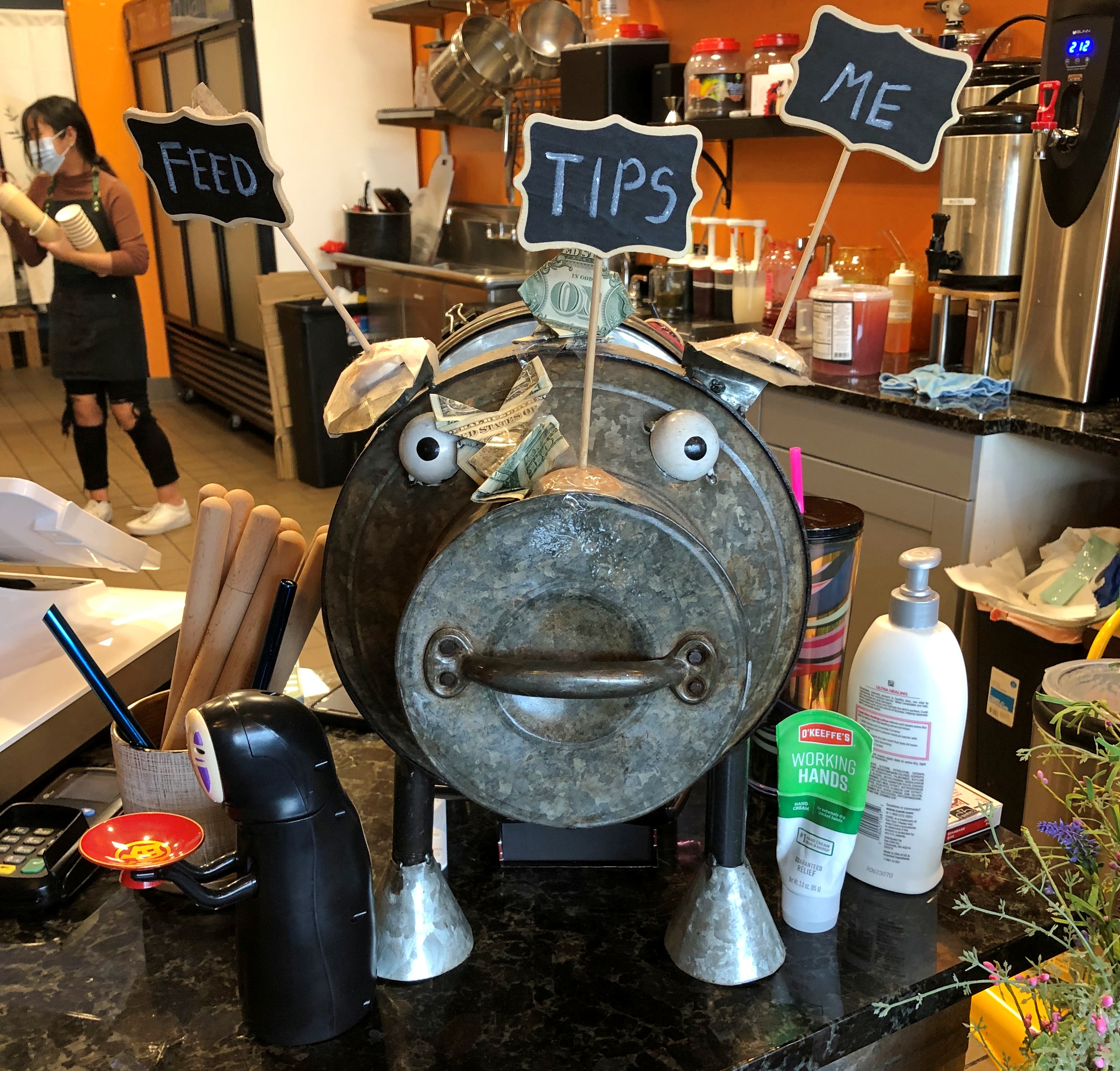
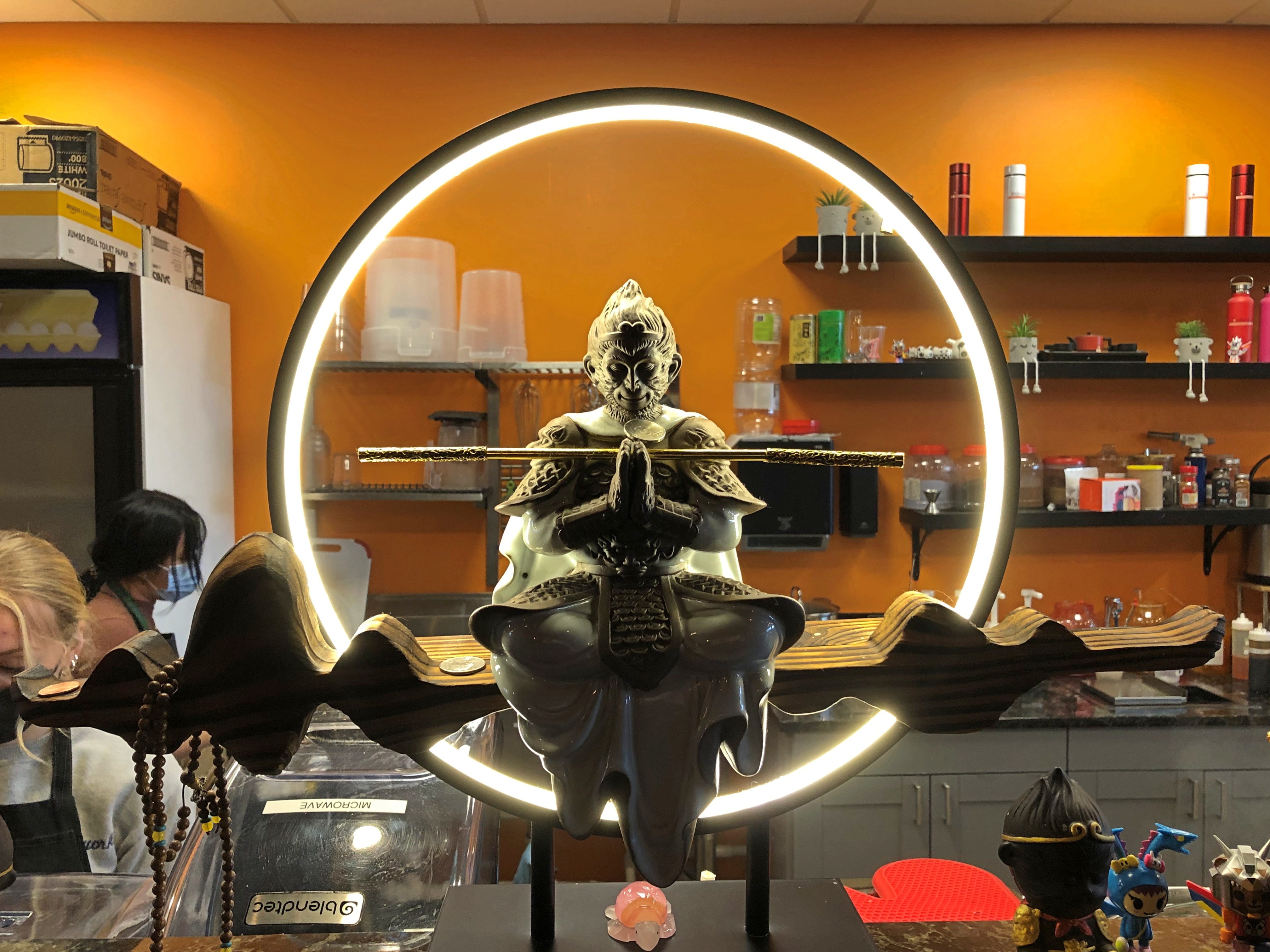
It has all sorts of interesting features, such as a tip pig, and — not sure how to characterize the second image.Umbrella Tea House Umbrella Tea House

Naturally, umbrellas figure in the décor. Up on the ceiling. Umbrella Tea House
Umbrella Tea House

A pleasant place to occasionally drink fancy tea, which we did.

Jack London Square

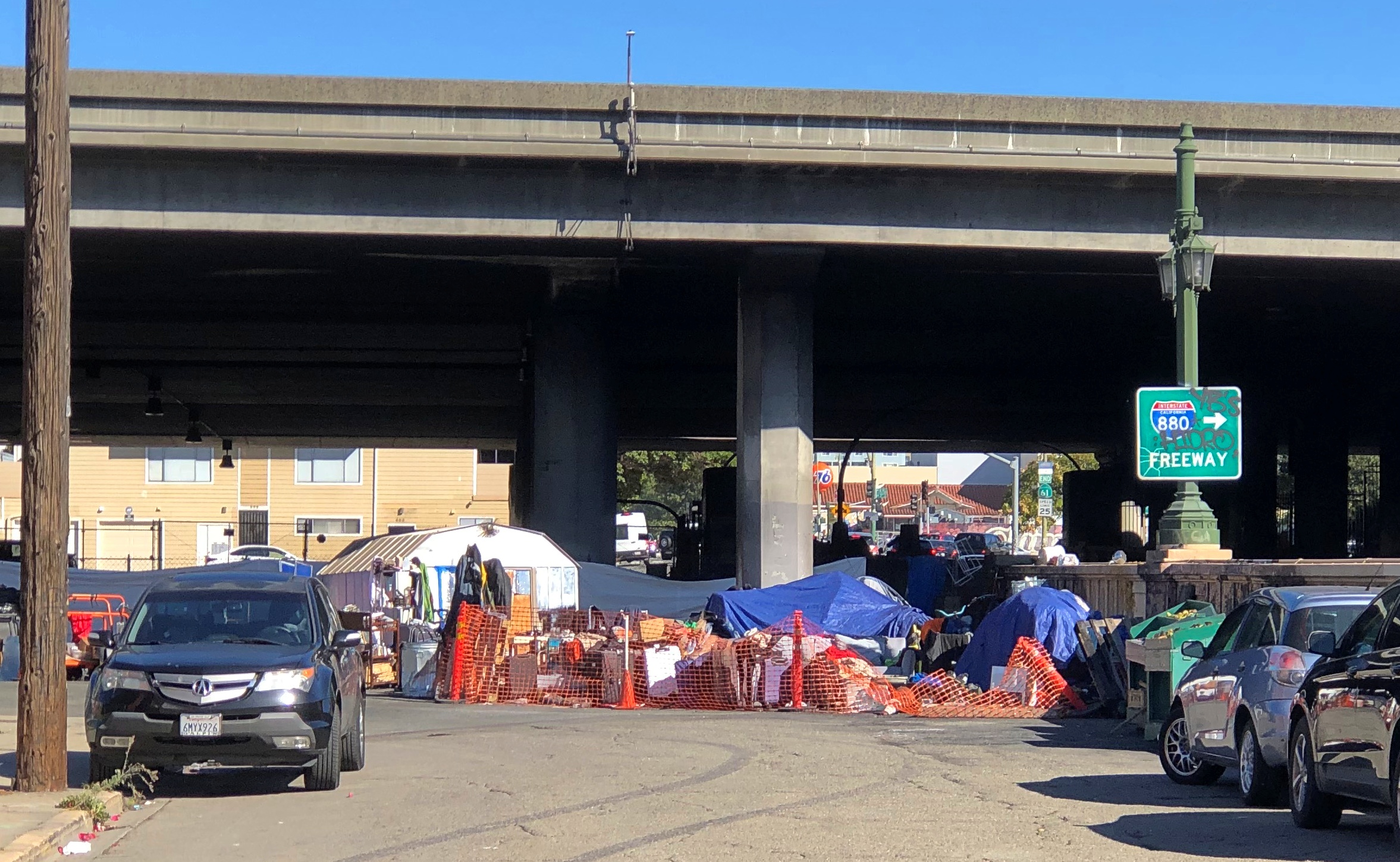
Not too many authors have their names attached to places, but Jack London does, at least until someone points out loudly enough that he was an enthusiastic supporter of eugenics. But for now, if you cross under I-980/I-880 from downtown Oakland — part of whose underside is an informal neighborhood —Oakland shanty town

— you will arrive before long at Jack London Square, which is part of the larger Jack London District. Formerly a warehouse and port district, the rise of container vessels mostly made the area obsolete as an industrial zone. Various rehab projects began in the late 20th century, but I understand that adaptive reuse really got underway around 2000, with residential redevelopment especially pushed by former mayor Jerry Brown.

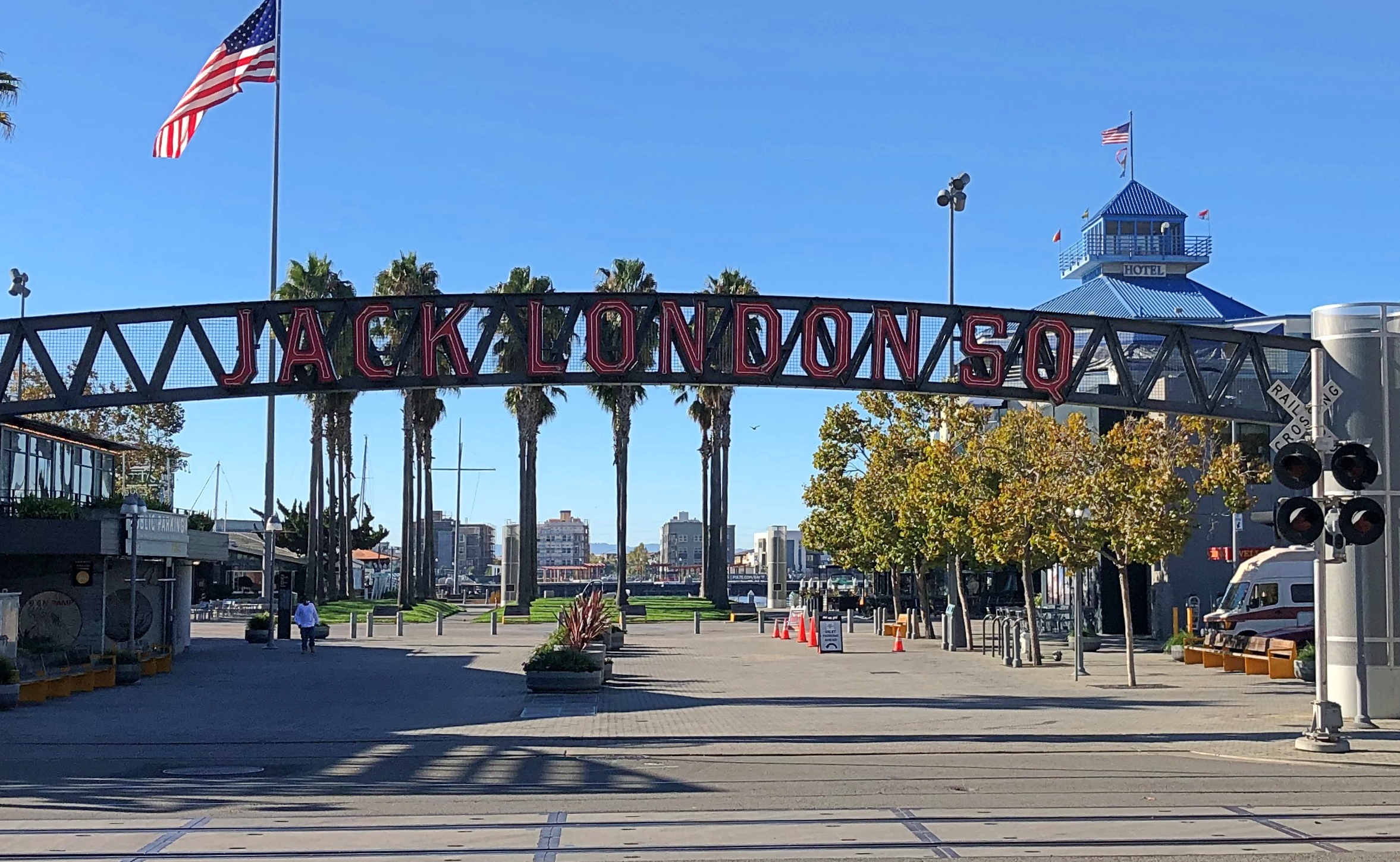
The sign on site says JACK LONDON SQ.Jack London Square

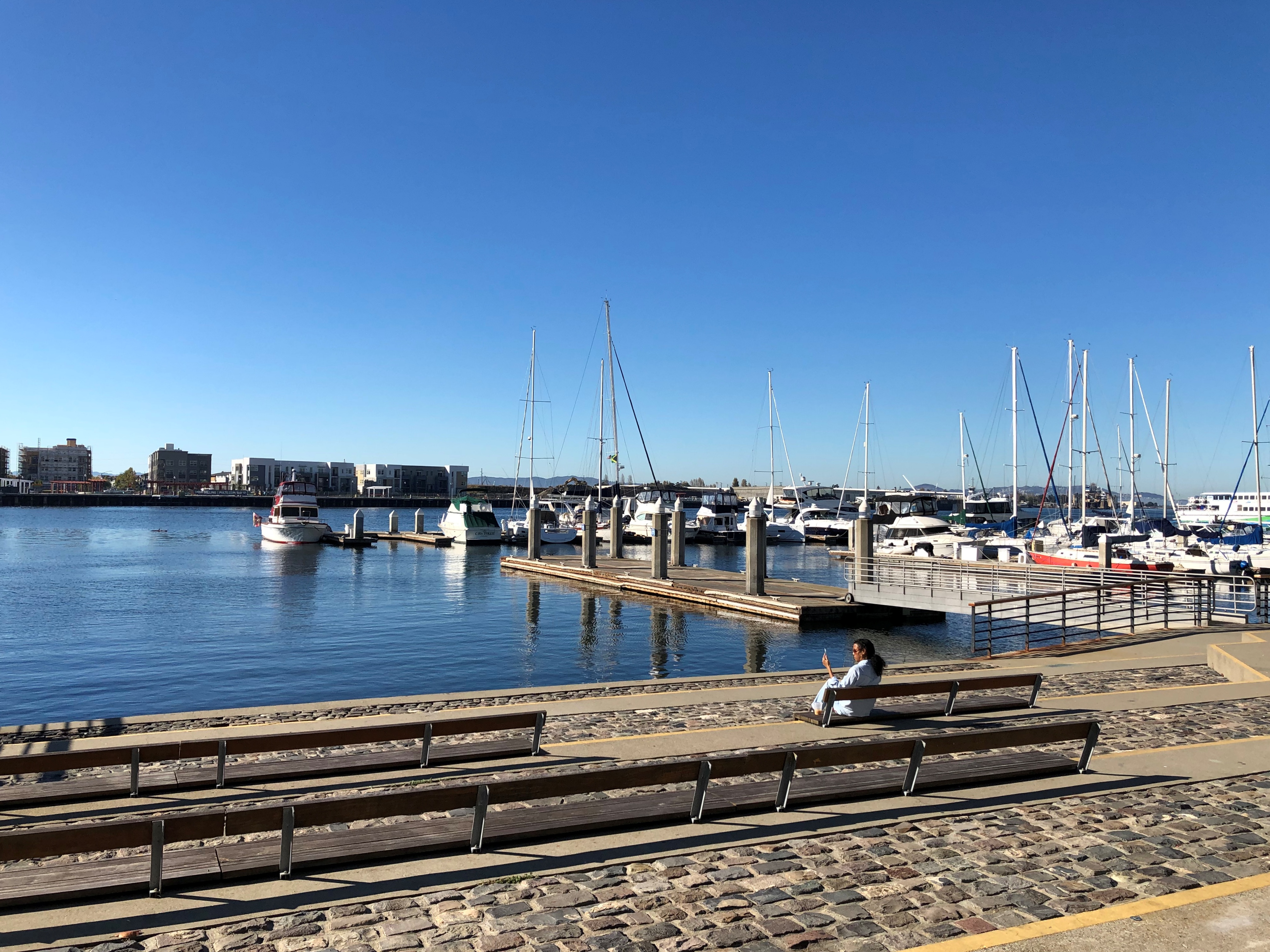
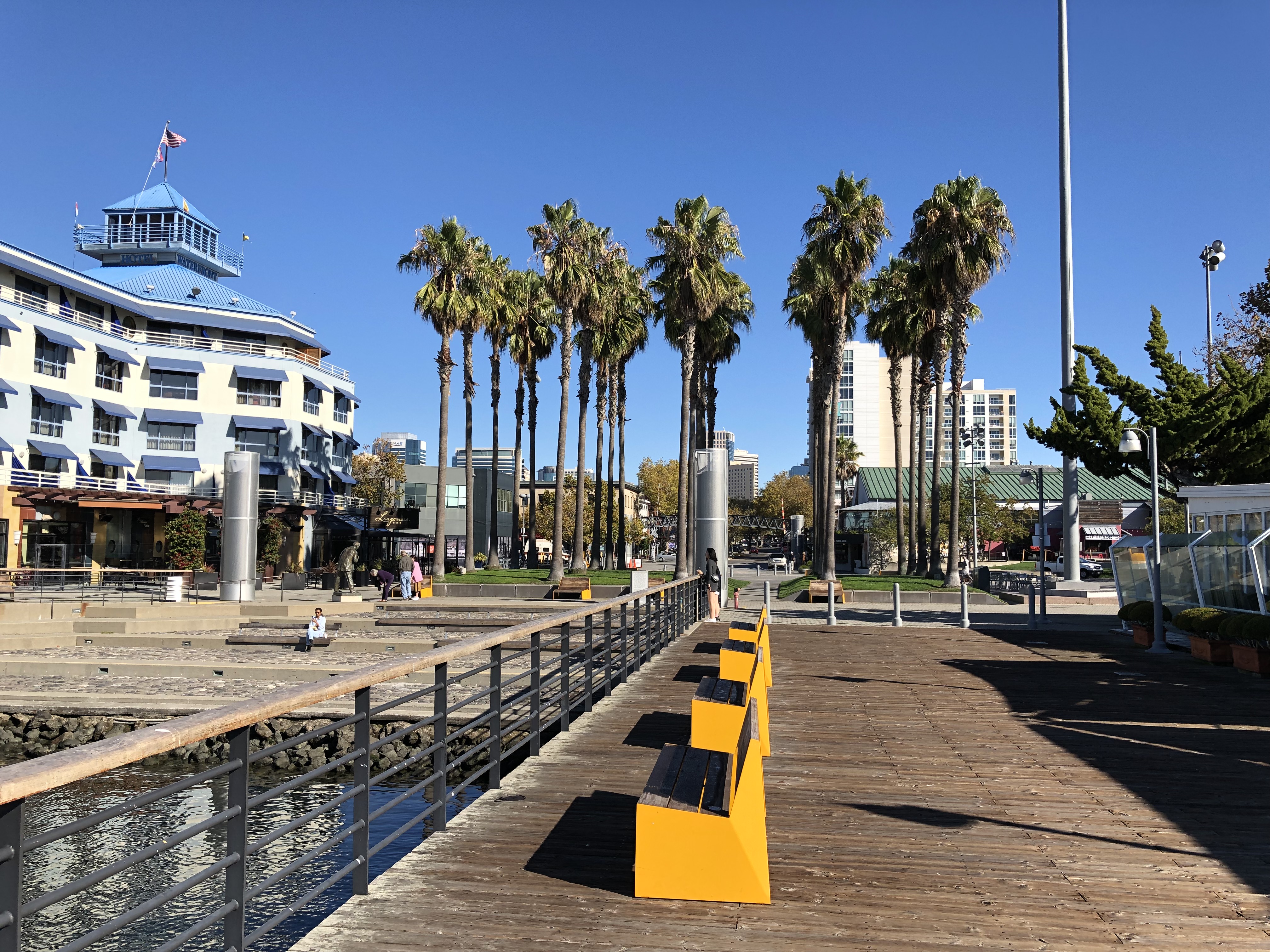
I understand the area was a good deal rougher when Jack London himself lived around there, but these days it’s an entertainment district, with shops, restaurants, hotels and a movie theater, as well as a marina where you can catch a ferry to San Francisco.Jack London Square Jack London Square
Jack London Square Jack London Square

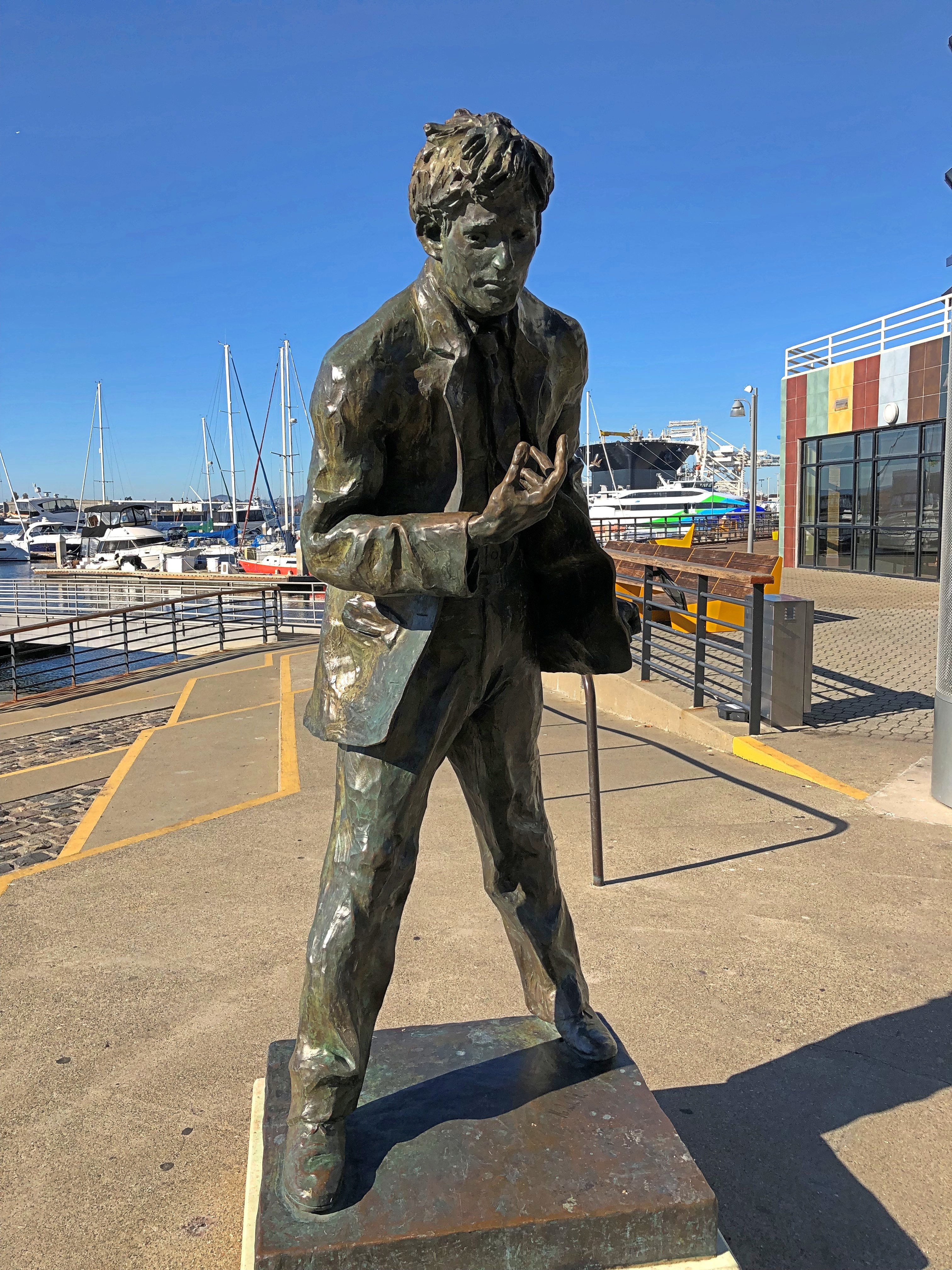
There’s also London in bronze by Cedric Wentworth, a Bay Area artist.Jack London Square

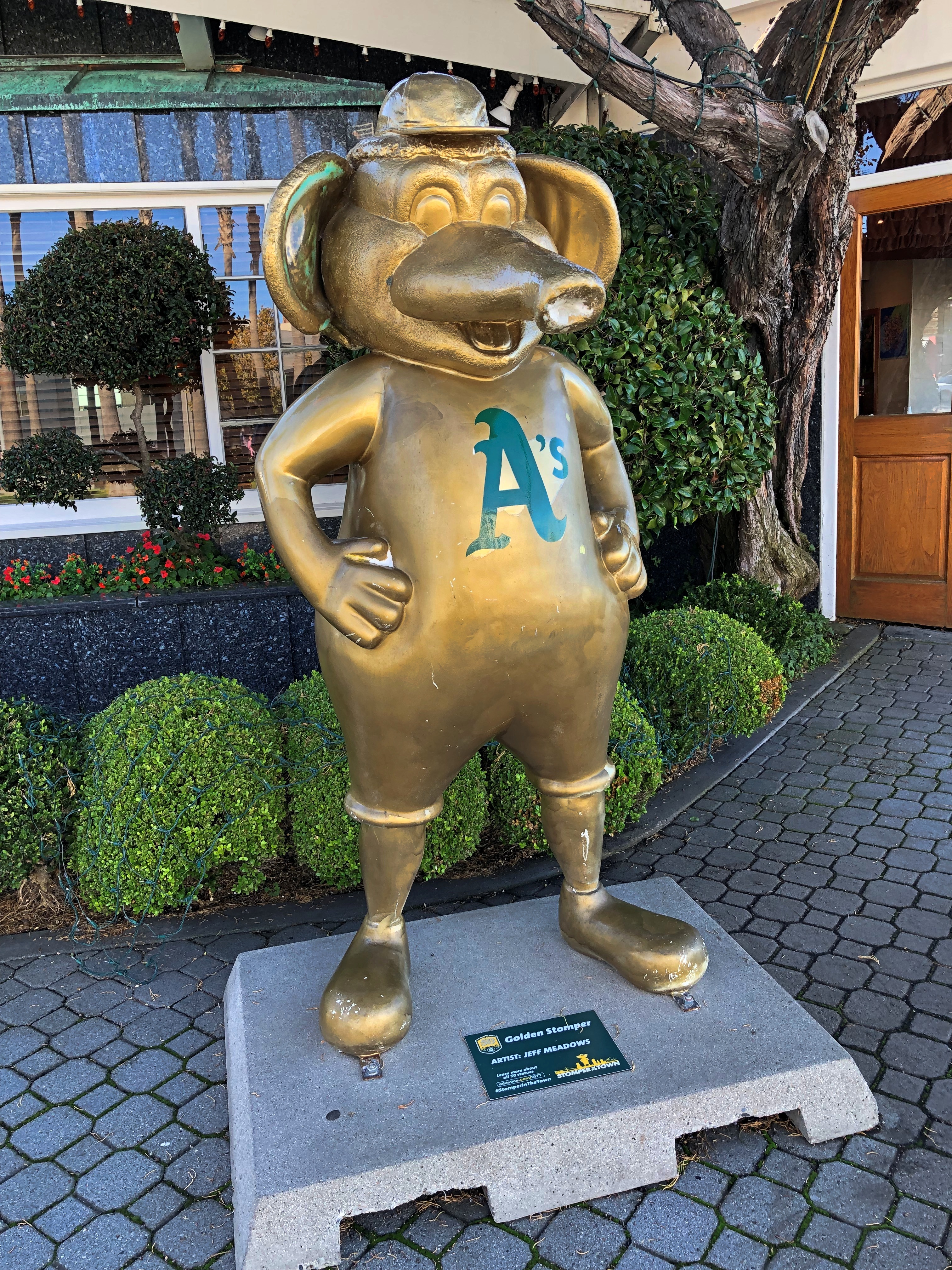
Not far away is a non-bronze, “Golden Stomper,” by one Jeff Meadows. It’s an Oakland A’s thing, and I can’t get that excited about it.Jack London Square

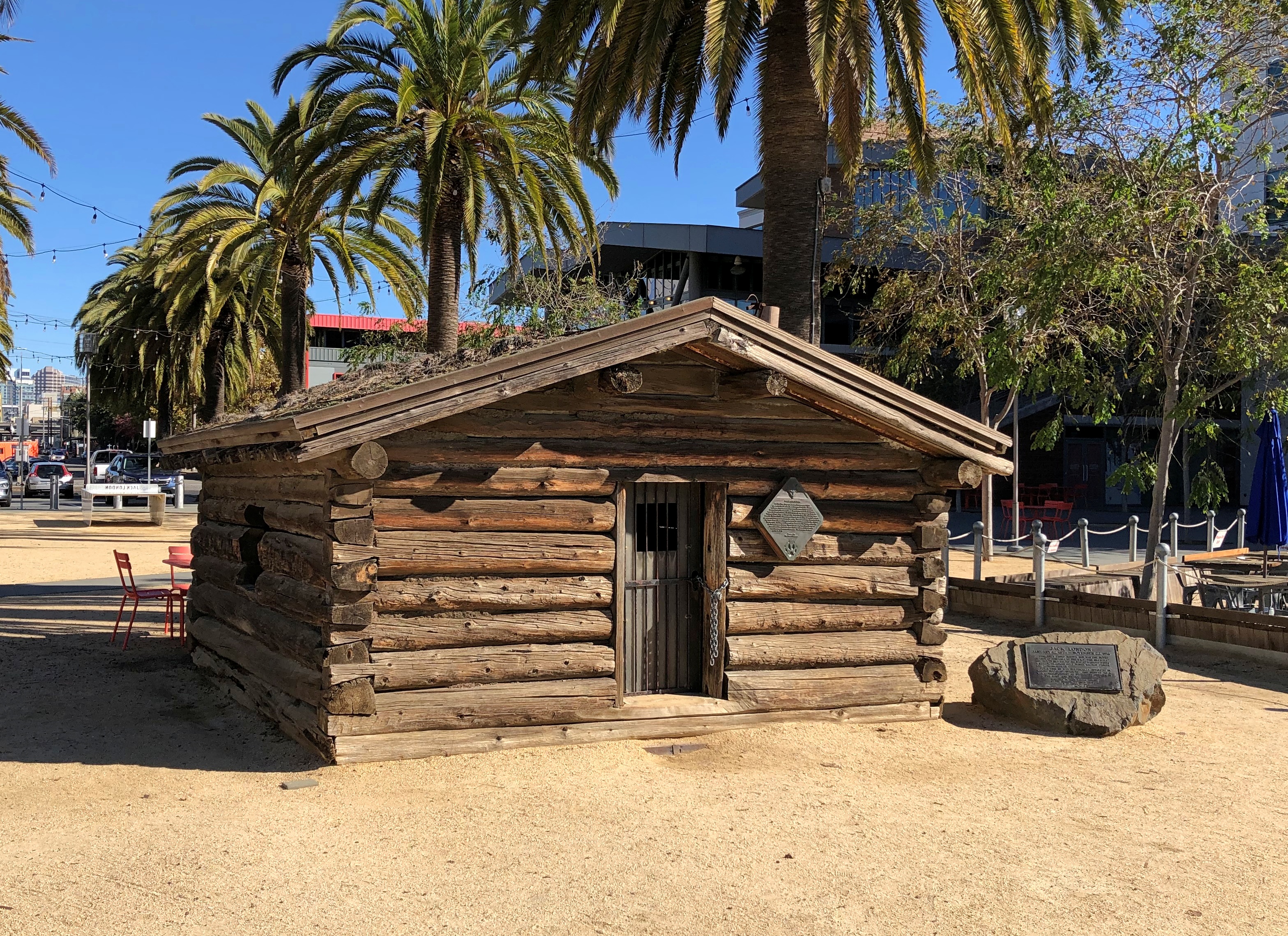
London lived in a cabin in the Klondike during his gold-seeking period. On the North Fork of Henderson Creek, to be more specific. Much later (1968) half of the cabin was brought to Oakland and a replica created using those and newer materials at the behest of a wealthy Jack London enthusiast. The other half went to Dawson City, where another replica was created. So now there are two London cabins, one much easier to reach than the other.Jack London Square

And what would a Jack London cabin be without a nearby bronze of White Fang?
Jack London Square

Or maybe that’s supposed to be the dog in The Call of the Wild. No sign is attached to say which. I couldn’t hazard a guess, since I never did get around to reading either of those books, though I did read the Classics Illustrated version of The Call of the Wild.

Waning Summer Tidbits

As if on cue, we had a cooler afternoon and evening to start September. Not much cooler, but noticeable. Warmth will be back soon, but the air is slowly leaking out of that balloon as the days grow shorter. Back to posting around September 7.

There’s a nice bloom of goldenrod out by the back fence.

I realize that it isn’t causing our intermittent runny noses, which have been worse this year than last, but not as bad as the worst ever. That would be 1987, the first late summer/early fall I spent in northern Illinois, maybe without much experience with the pollen in question. Ragweed causes that unpleasantness, I understand.

“About Hay Fever,” says American Meadows. “In short, it’s an old wives’ tale. Goldenrod does not cause hay fever. It simply got that bum rap since it blooms at the same time as the real culprit — ragweed.”

Today I started reading When In Rome by Robert J. Hutchinson (1998), subtitled “A Journal of Life in Vatican City,” which is part travel book, part memoir, part popular history, and all very readable and amusing.

Something I found out today: Lyle Waggoner (d. 2020) founded a successful company that provides trailers to movie and TV studios, Star Waggons. After The Carol Burnett Show and Wonder Woman, that’s what he turned his attention to. One of his sons runs it even now, though it has been acquired by a REIT.

One more thing I found out today, early this morning: even at my age, dreams about missing class, or being unprepared for a test, do not disappear completely. Also, the sense of relief is still there when you wake up — ah, I haven’t had to go to a class in nearly 40 years, much less be prepared for one.

Just Another Spring Break

A pleasant string of warm days came to an end today with cool drizzle most of the time. But at least the snowy mess of February is just an unpleasant memory.

Back again around April 18. Call it a spring break. Who knows, I might have encountered a new thing or two by that time. Never know when you’ll see something interesting.

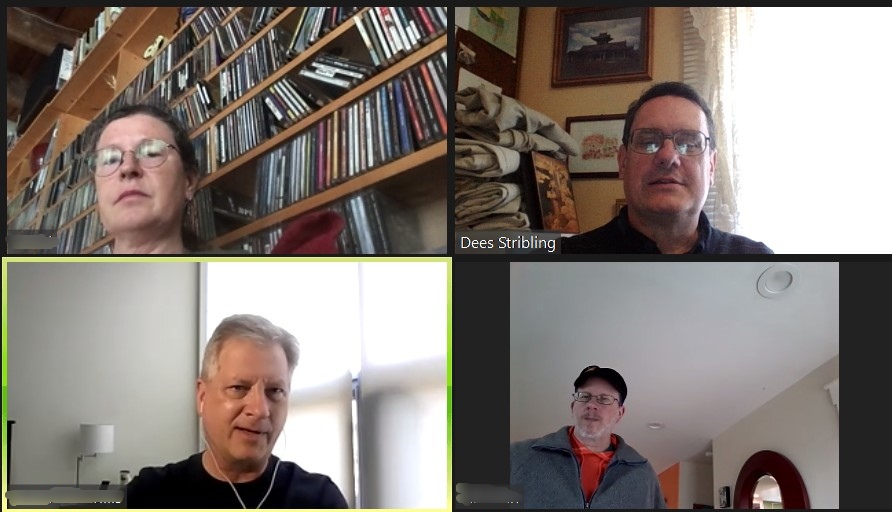
A recent Zoom. Two participants in Illinois, one in Tennessee, one in Washington state. All VU alumni.

If I were a Zoom stockholder, that is in San Jose-based Zoom Video Communications Inc., I might sell. I’m astonished by the number of people who hate Zoom, the platform, and will probably dump it as soon as they can. I know not to ask about half of my old friends on social Zooms anymore, because they will refuse. Politely, because they are old friends.

I don’t quite get it. Burning out on work Zooms is one thing. But the occasional social Zoom among old friends? On a couple of occasions, they’ve run three or four hours, to great delight of everyone. Sure, if we were obliged to meet electronically even with old friends three or so times a week, that would get old. But more occasionally among people with whom you share a past? Nothing better.

I made a point of watching the new short biographic series Hemingway this week as it was broadcast on PBS. I can’t remember the last time watched TV on a broadcast schedule. Mad Men?

It’s high-quality work on the part of Ken Burns and Lynn Novick, illustrating what a biography should illustrate, the life and times. I knew a fair amount of the material already, though did find out more — another mark of a good bio on a well-known subject — such as the relentlessness with which he suffered major, and mostly untreated concussions. The head injury from the second plane crash in Africa was the only serious one I knew about. Turns out it was one of a string.

That’ll do no good to a man who’s already an alcoholic from a family with a history of mental illness, and who probably had a touch of shell shock thrown into the mix, to use the straightforward Great War terminology. It’s a wonder he didn’t put himself on the wrong end of his shotgun before he finally did.

Thursday Chaff

It’s been a warm week for March so far, even warm enough last night before bed to crack the window a bit and listen to the strong winds and occasional rain showers. Did that account for the occurrence of one of my semiannual phantasmagoria dreams early this morning? Maybe.

Great Fortune, subtitled “The Epic of Rockefeller Center,” by Daniel Okrent (2003) is a delightful book so far, and I’m only a chapter in. Certainly the most delightful thing I’ve ever read about a major urban mixed-use redevelopment project.

The first chapter sets up the story nicely, telling a short history of the Manhattan land that would be Rockefeller Center up until the time that John D. Rockefeller Jr. got involved in the project in the late 1920s. I didn’t know that the parcel had belonged to Columbia University for many years, and the scheme to redevelop the land (known as the Upper Estate) was ultimately driven by the university’s need to pay for its stately campus in Morningside Heights.

“… this meant that expansion on the grand scale of McKim, Mead & White’s Olympian campus on Morningside Heights had somehow to be financed, and the Upper Estate was the only cash cow in sight,” Okrent writes. “The milking commenced in 1904…”

An important person at the beginning of the story is Otto Kahn, multimillionaire financier and patron of the arts (an American Maecenas, back when educated people would have known that reference), who was president and chairman of the board of directors of the Metropolitan Opera. I didn’t know that he was well enough known that the Marx Brothers parodied him as Roscoe W. Chandler in Animal Crackers.

A digression. Apparently, for $200, one can own an original Otto Kahn letter. Then again, they aren’t rare. Okrent called his correspondence “oceanic.”

Okrent also writes some good standalone lines: “His [architect Ben Morris] neo-Georgian Union League Club on 37th and Park is probably as close as one can get to the architectural equivalent of a stuffed shirt.”

The other day, I was driving along with Ann and playing with the radio dial as we went. On came “Copacabana.” Hadn’t heard that song a good while, but as I mentioned to Ann, it seemed to be on the radio all the time in 1978.

I thought a bit about it, and it seems remarkable that such a downer of a song was so popular. As a ballad, the entire story is, a woman’s boyfriend is killed in front of her, and psychologically she never recovers.

“Yeah,” Ann said. “But the music is so peppy.”

True enough. There’s also a derivative short story in there somewhere. Maybe the incident and the aftermath from the point of view of Rico. Maybe he was the playboy son of a Fulgencio Batista crony. In his highly publicized murder trial in New York in 1949, his lawyers argued self-defense and he was acquitted.

While walking the dog at Fabbrini Park this week, I noticed a memorial plaque on a bench honoring a man named William “Mr. Bill” X (I forget the last name). Nicknamed Mr. Bill, eh? And what were his last words? Oh Noooooooooooooo!

Of course, like Wile E. Coyote, Mr. Bill couldn’t actually die, just suffer endlessly, which seems a lot more hellish. Still, we celebrate the likes of Mr. Bill. I used to have a Mr. Bill t-shirt, and have photographic evidence to prove it, in as much as photographs prove anything anymore. It’s among the t-shirts I’ve lost over the years, which also includes the Kill ‘Em All, Let God Sort It Out shirt that sported a black beret-wearing skull.

Thursday Dust in the Wind

Much work these days. Lots going on. Will post again on January 19. The more holidays the better, and I’ll bet — considering the inclinations of the incoming administration — Juneteenth will be a federal holiday before long. Or at least the closest Monday.

Ice crystals on our deck. They didn’t last long. Later came snow, which mostly melted.
To follow Sink the Bismarck!, a taut 1960 British war movie, for contrast I recently watched Portrait of a Lady on Fire (Portrait de la jeune fille en feu, 2019), an engaging French love story set just before the Revolution. I haven’t seen many movies as painterly Portrait of a Lady on Fire.

A few weeks ago, before the violent national scrum, we started watching the short series The People vs. OJ Simpson. Top-quality historical fiction. Doesn’t feel historic, just like a good while ago. An increasingly long time ago, more in feeling than strict chronology. When the trial was actually happening, I remember thinking, do I have to hear about that again? Enough time has now passed for the subject to be of some interest.

That said, do I ever feel nostalgic for the ’90s? No. The underappreciated ’70s is more my flavor, and for the exact same uninteresting reason as most people. Nostalgia for one’s youth.

I didn’t know until I read about it a little while ago, but The Great Gatsby is in the public domain now. I could publish 100 words from that book, in order, or maybe reverse order, until I’d gone through the entire book, with the time needed to put the text in my only real cost. I don’t think I’ll do that, but it’s nice to know I could.

The immortal Ella.

A much later version. Recent, in fact, by the highly talented Hot Sardines.

The Hot Sardines’ singing is top notch, but I’m really taken with the animation in the video.

Another recent version by the Speakeasy Three.

Fine harmonies. The video is so stylized that it approaches parody, but doesn’t quite get there. Somehow, that works. Also, am I right in thinking there are celebrity lookalikes in this video? Recent celebrities, not swing-era ones. I don’t care enough about celebrities to find out, but I get that sense.

A site that visit every few months: The Comics Curmudgeon. On Jan 13, he mocks the comic strip Crock, which isn’t hard, but it is hard to be funny while doing it. The writer of the site, Joshua Fruhlinger, pulls it off.

One the characters says to another one, “I can’t wait to meet the blind date you got me. When can I call her?”

“Anytime but the weekends,” the other character says. “That’s the busiest time for blacksmiths.”

Fruhlinger comments: “I was going to go all in on ‘Why is it funny that this woman is a blacksmith,’ but we all know the reason why it’s supposed to be funny: blacksmithery is not a traditional feminine job so can you even imagine going on a date with a woman who would engage in it? What would you even call her? A blacksmithrix? Haw haw! Anyway, that’s stupid, so instead I’m going to focus on something actually puzzling: the assertion that weekends are ‘the busiest time for blacksmiths.’ I guess that’s when most Renn Faires are? Are we dealing with a universe where blacksmiths are a vital part of the everyday economy, making horseshoes and tools and such, or are we in a more modern environment where mass manufactured goods are omnipresent and easy to get, and the only people who go to blacksmiths are weirdos who are obsessed with swords? This is the Crock worldbuilding background that I have a million times more in interest in than I do in Poulet’s love life.”

I’ve started reading American Slavery, American Freedom, subtitled “The Ordeal of Colonial Virginia,” by Edmund S. Morgan (1975). I’m not far along, but enough to know he’s a good writer. The first chapter is unexpectedly about of Sir Francis Drake in Panama in 1572, but I think I can see where he seems to be going with the narrative, which will get to colonial Virginia before long.

Debris Under the Tree

Another Christmas, come and gone. We opened presents in the morning that day, as usual.

Not as usual, we had a family Zoom in the afternoon. My brothers, and my nephews and their expanding families, Lilly, and Yuriko and Ann and I were all linked. A geographic diversity: Texas, New York, Washington state and Illinois. We had an enjoyable time, even if the connection was wonky occasionally.

Later in the day, our Christmas movie was The Day the Earth Stood Still. The original version, of course. I hadn’t seen it in at least 30 years, but it was as good as I remember. The movie also inspired me to look up its source story, “Farewell to the Master” by Harry Bates, originally published in Astounding in 1940. No doubt a copy of that edition is somewhere in the house in San Antonio, among my father’s sizable collection of SF. I’d never read the story before, so I found in on line. I did know about its unnerving, surprise ending, however. I heard about it from a college friend years ago.

Another New Year’s Day has gone as well, featuring ice precipitation on top of an inch of two or snow that had fallen a few days earlier. Not enough to rise to the level of an ice storm, but enough to keep us within our walls, occasionally listening to the tap-tap-tap of ice hitting the ground or roof, but mostly paying attention to electronic entertainment, or lost in a book or two, for me including American Lion: Andrew Jackson in the White House (Jon Meacham, 2009) that I put down this summer and which I’m finishing now, about half way through. Big things ahead: Old Hickory is going to destroy the Second Bank of the United States and go up against nullification, and win, along with a second term. He’s already set the Trail of Tears in motion.

Oak Hill Cemetery, Lewistown

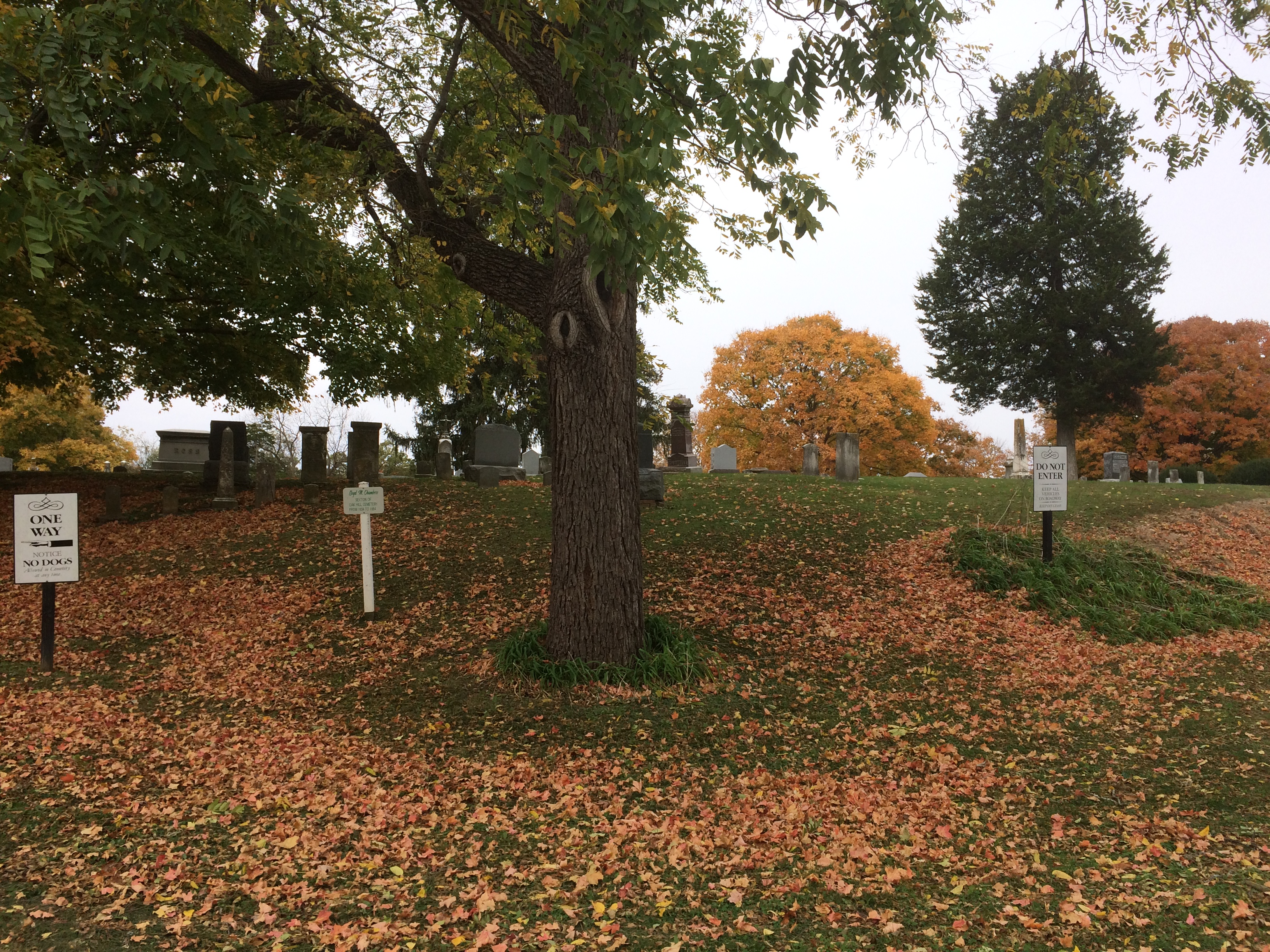
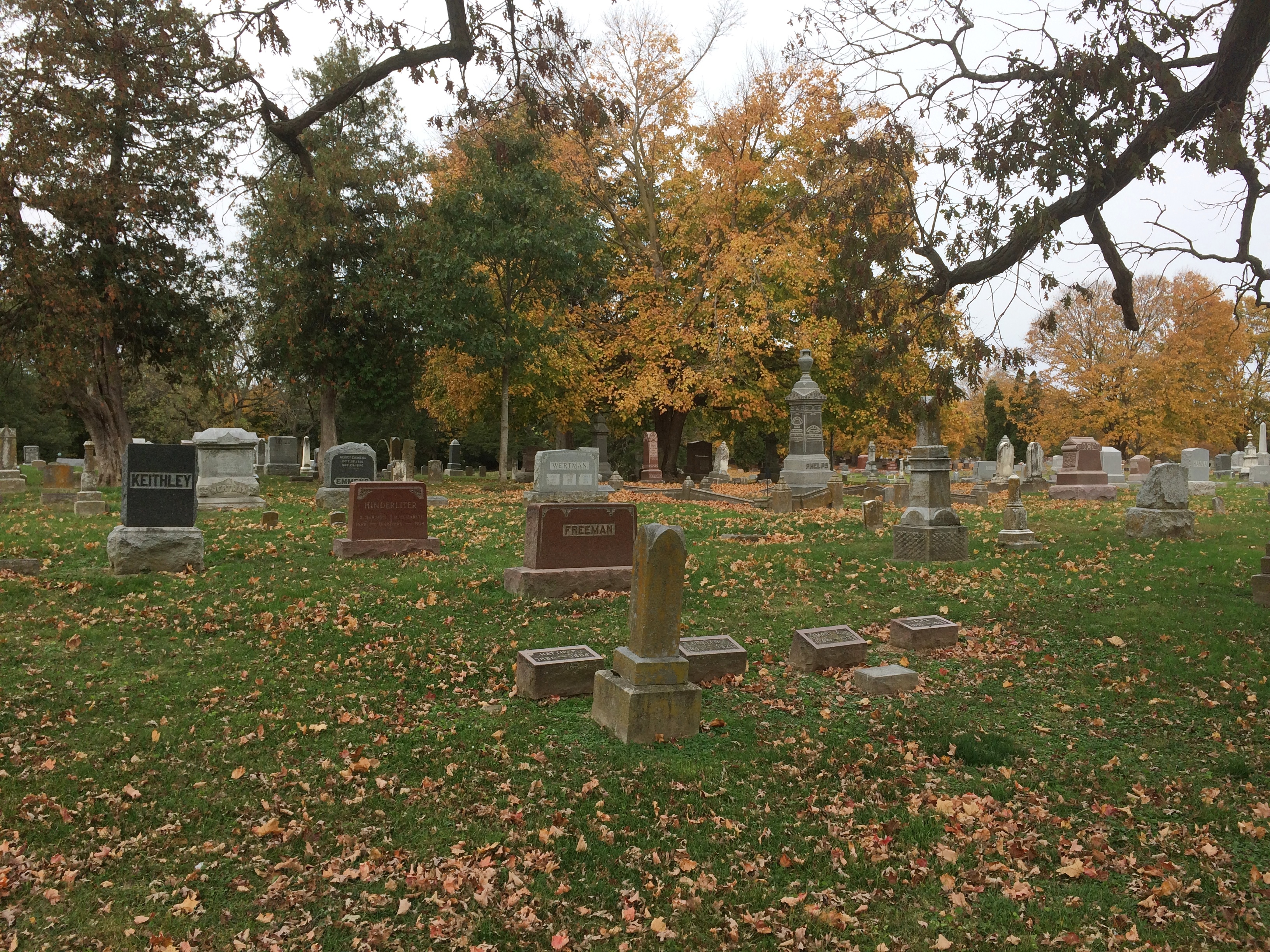
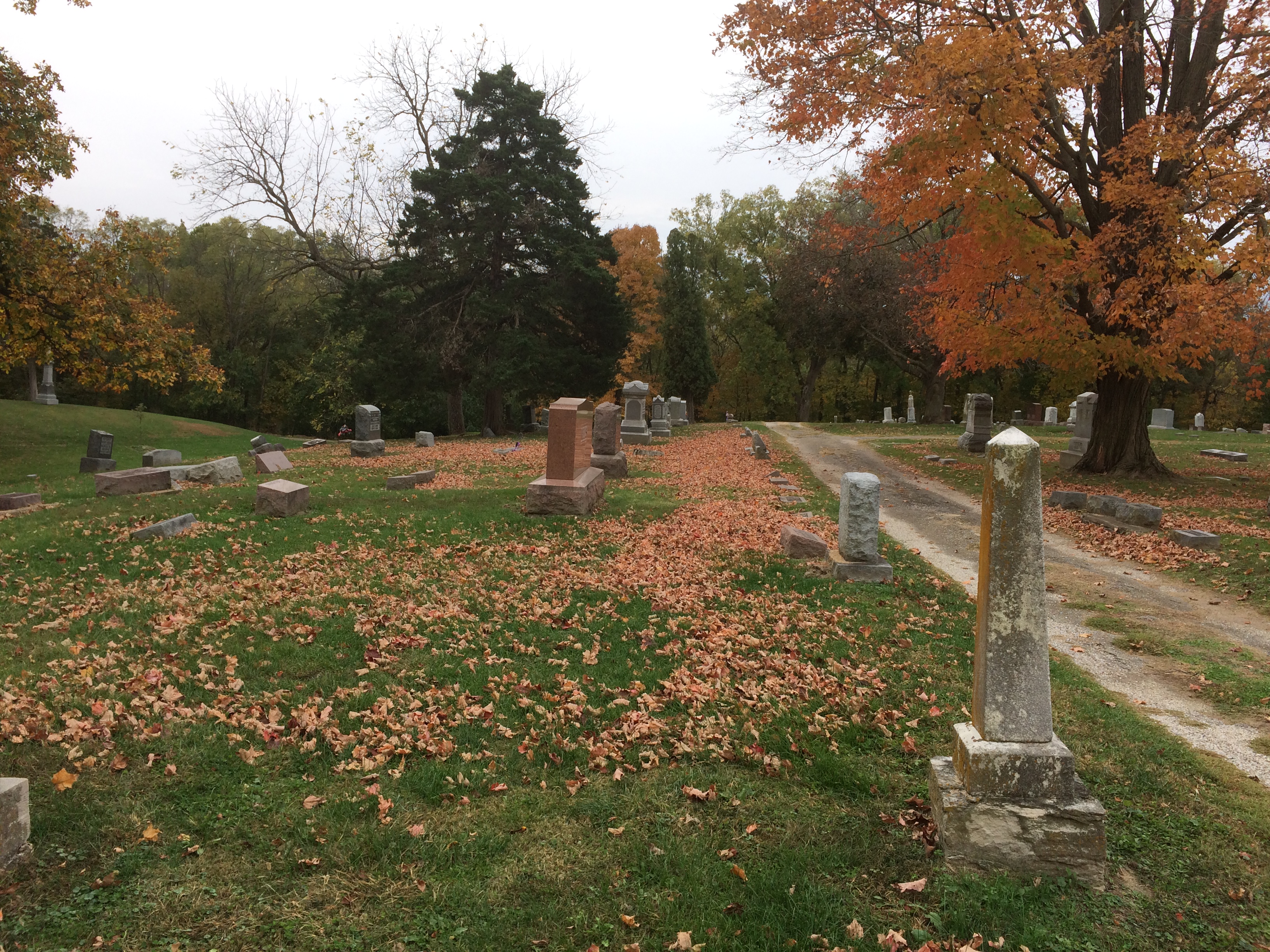
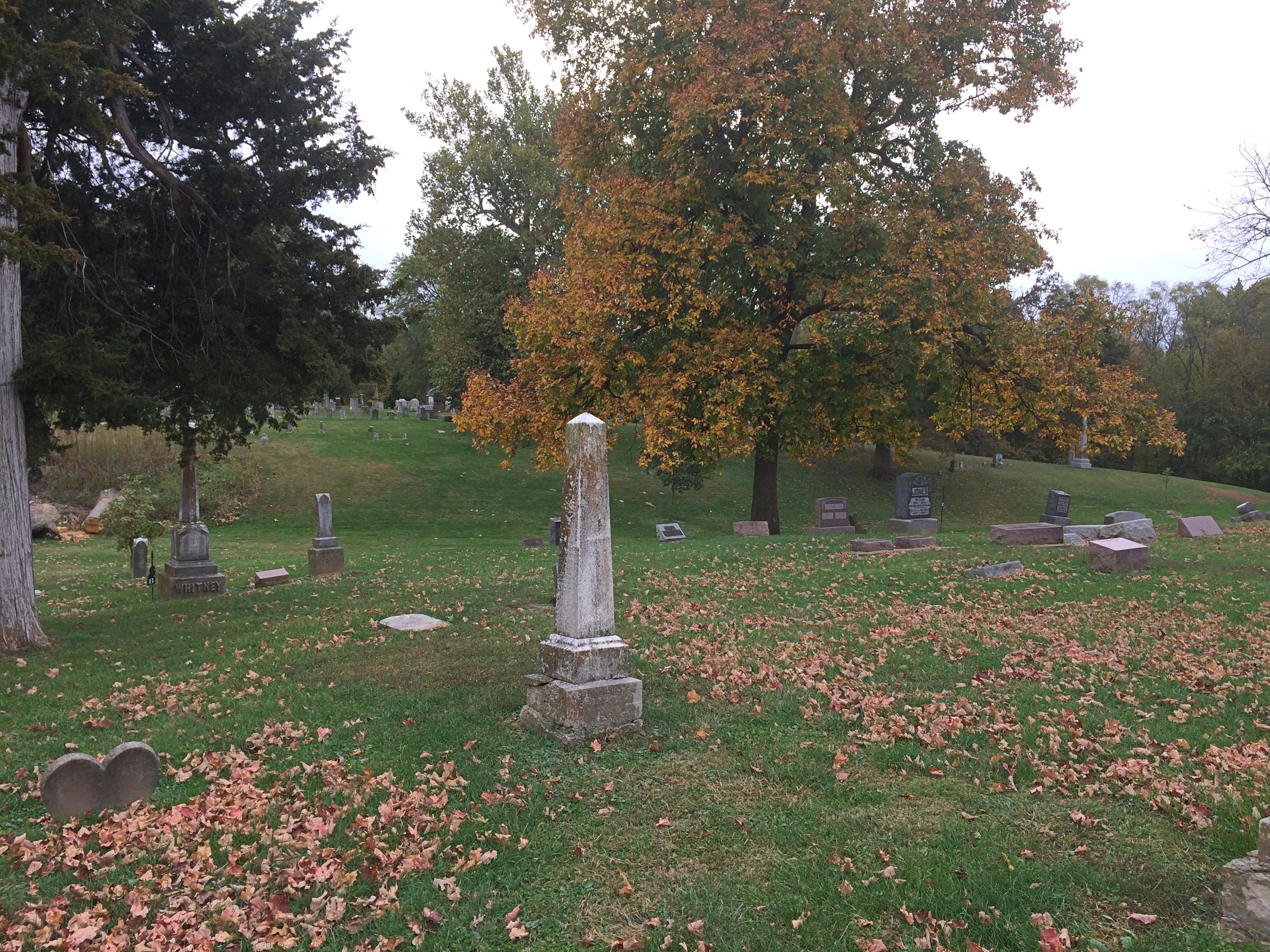
Lewistown, Illinois, isn’t very large. Only 2,100 or so people live there, as opposed to Oak Hill Cemetery in Lewistown, which has a population of more than 5,000. I arrived for a look on the morning of October 17.

I hadn’t expected such a good-looking cemetery. The fall colors helped, but only added to the overall aesthetic of woody terrain, sometimes hilly, peppered with upright stones and funerary art.

Oak Hill Cemetery, Lewistown

Oak Hill Cemetery, Lewistown
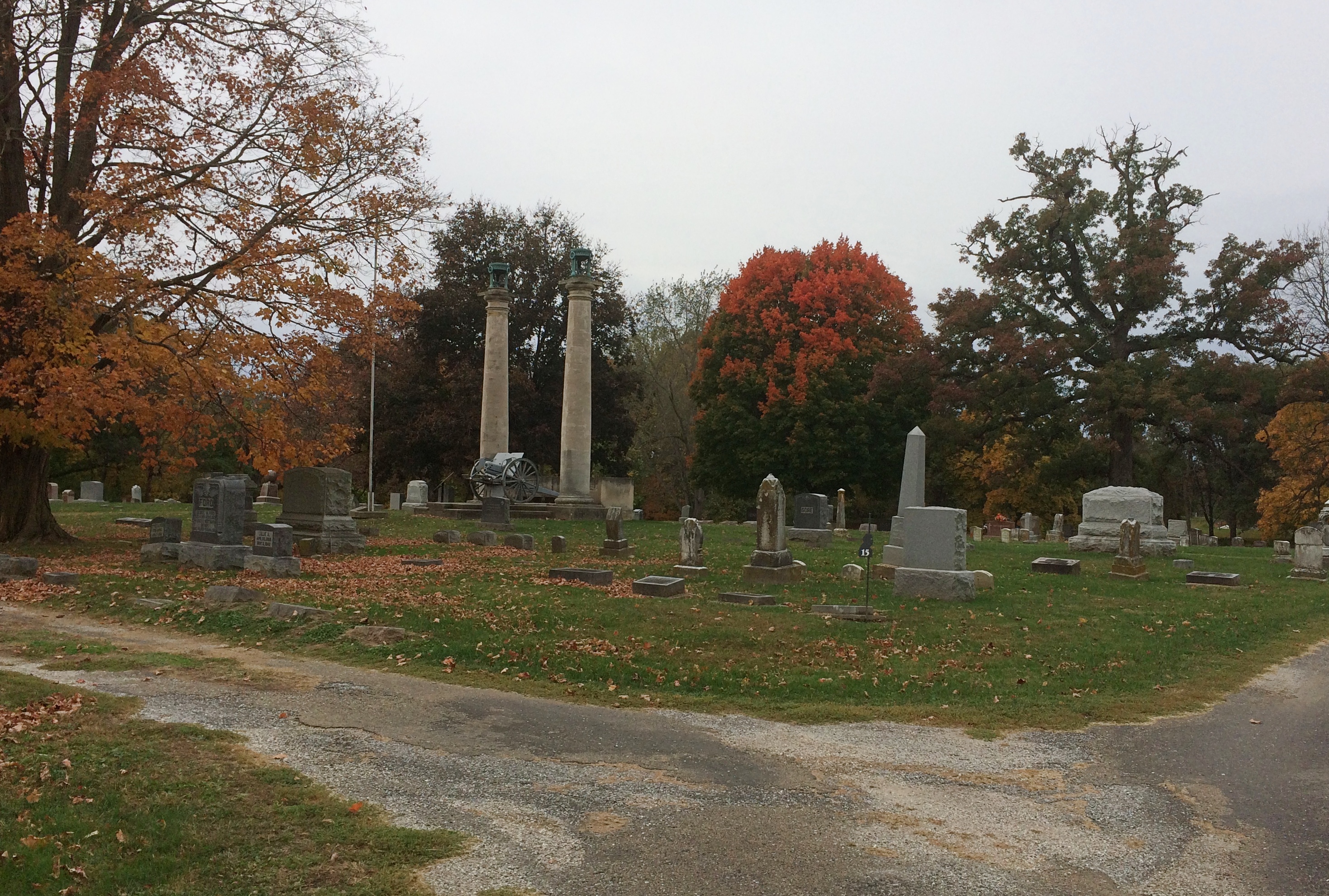
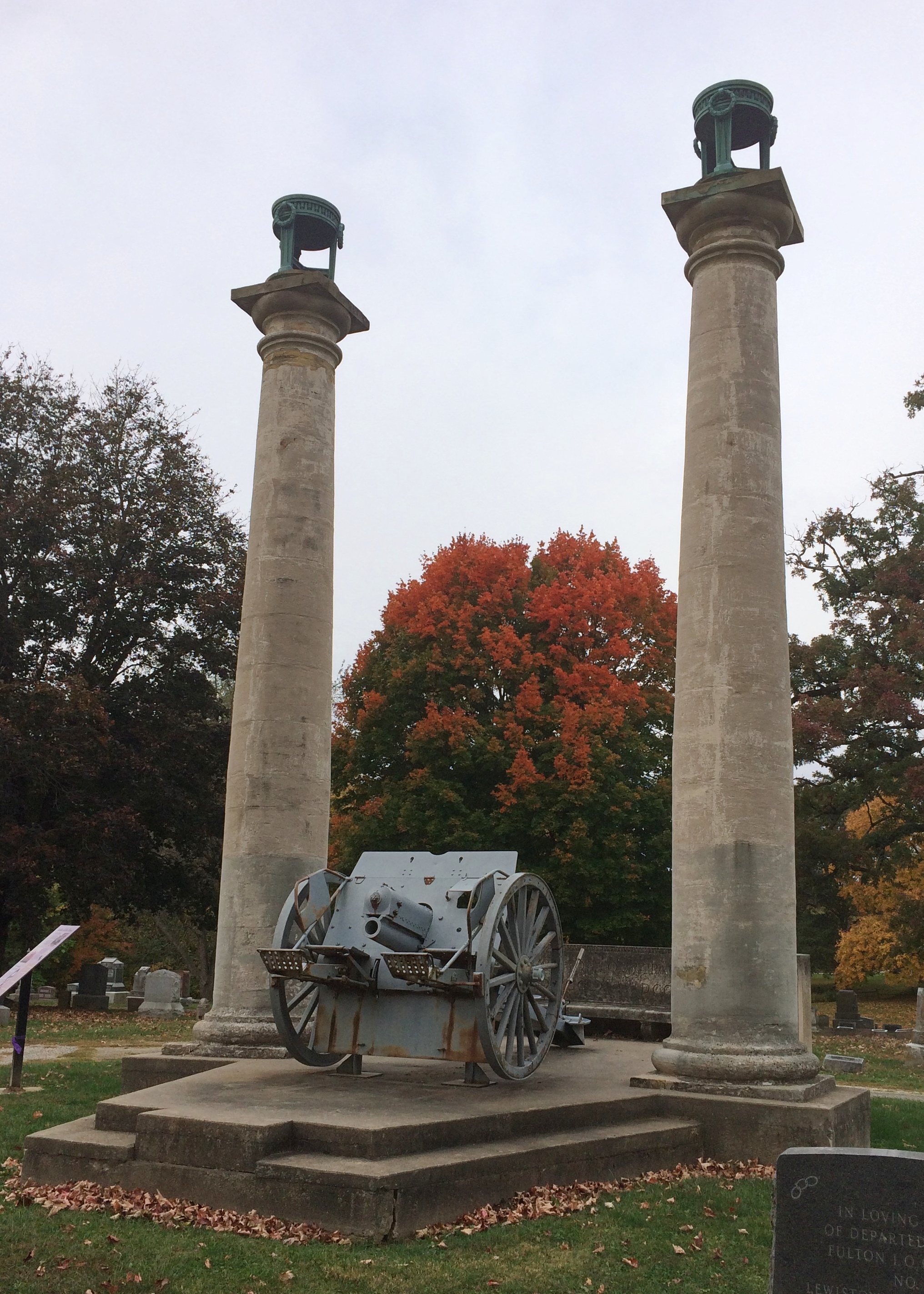
As you’d expect, there’s a Civil War memorial.Oak Hill Cemetery, Lewistown

Oak Hill Cemetery, Lewistown

It’s hard to see in this pic, but this is the entirety of the inscription, written on the stone bench:

IN MEMORY OF OUR PATRIOT DEAD
MDCCCLXI–MDCCCLXV

I didn’t know it until later, but the columns at the memorial were salvaged from the previous Fulton County courthouse, which burned down in the 1890s. When Lincoln came to town in the ’50s to speak, he stood on the courthouse steps between the columns, and so the town wanted to work them into its Civil War memorial.

In as much as Oak Hill Cemetery is known to the world, it isn’t for its beauty or a war memorial. Rather, Edgar Lee Masters took inspiration from it for Spoon River Anthology. Sometimes, I’ve read, very specific inspiration, since he knew many of the townspeople — such as the weak of will, the strong of arm, the clown, the boozer and the fighter, to borrow language from the opening of the book.

“In the groundbreaking work, Masters, a onetime law partner of Clarence Darrow, gives voice to more than two hundred deceased citizens of Spoon River who are laid to rest in Oak Hill Cemetery, known to the locals as The Hill,” wrote Laura Wolff Scanlan in Humanities magazine in 2015.

“Freed by the shackles of life, the un-living who ‘sleep beneath these weeds’ confess their deepest secrets, disappointments, frustrations, joys, and warnings to the living in the form of brutally honest free verse poems.

“In some cases, Masters barely changed their names. Henry Phipps was really banker Henry Phelps. Harry Wilmans was Henry Wilmans…

“Even though most names were fictitious, everyone in town knew exactly who he was talking about. Because of this, the book was immediately banned from schools and libraries in the area, including the Lewistown library.”

When Masters died in 1950, he wasn’t buried in Oak Hill, but rather in Petersburg, Illinois, which is close to Springfield.

The Lewistown library started stocking the book in 1974. After the death of everyone mentioned in it, and most of their immediate families, in other words. In our time, Lewistown claims the work as its own, since what else is the town known for, or could be known for? For the centennial of the book in 2015, the town held Oak Hill Cemetery tours, exhibitions and theatrical performances, according to Humanities.

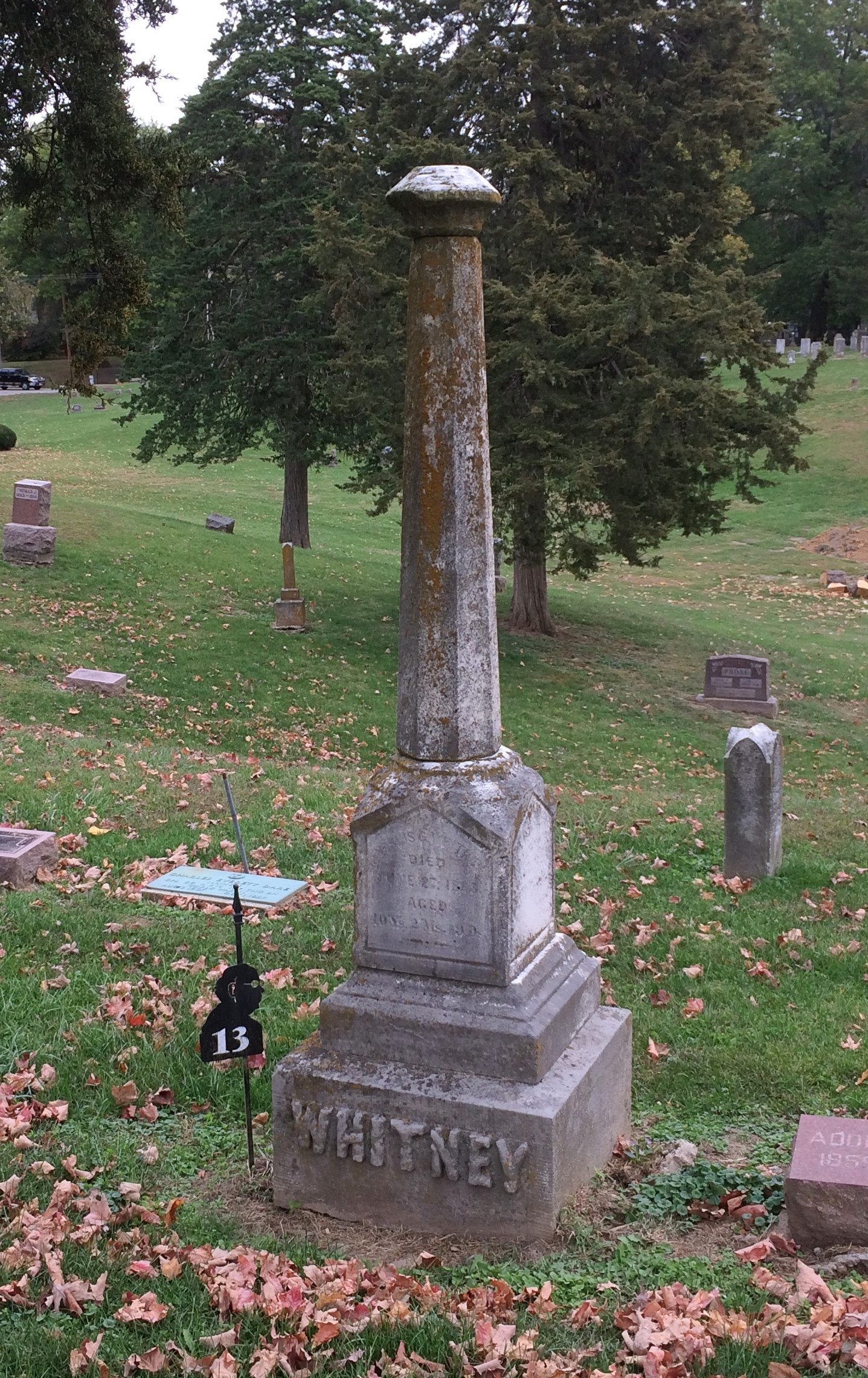
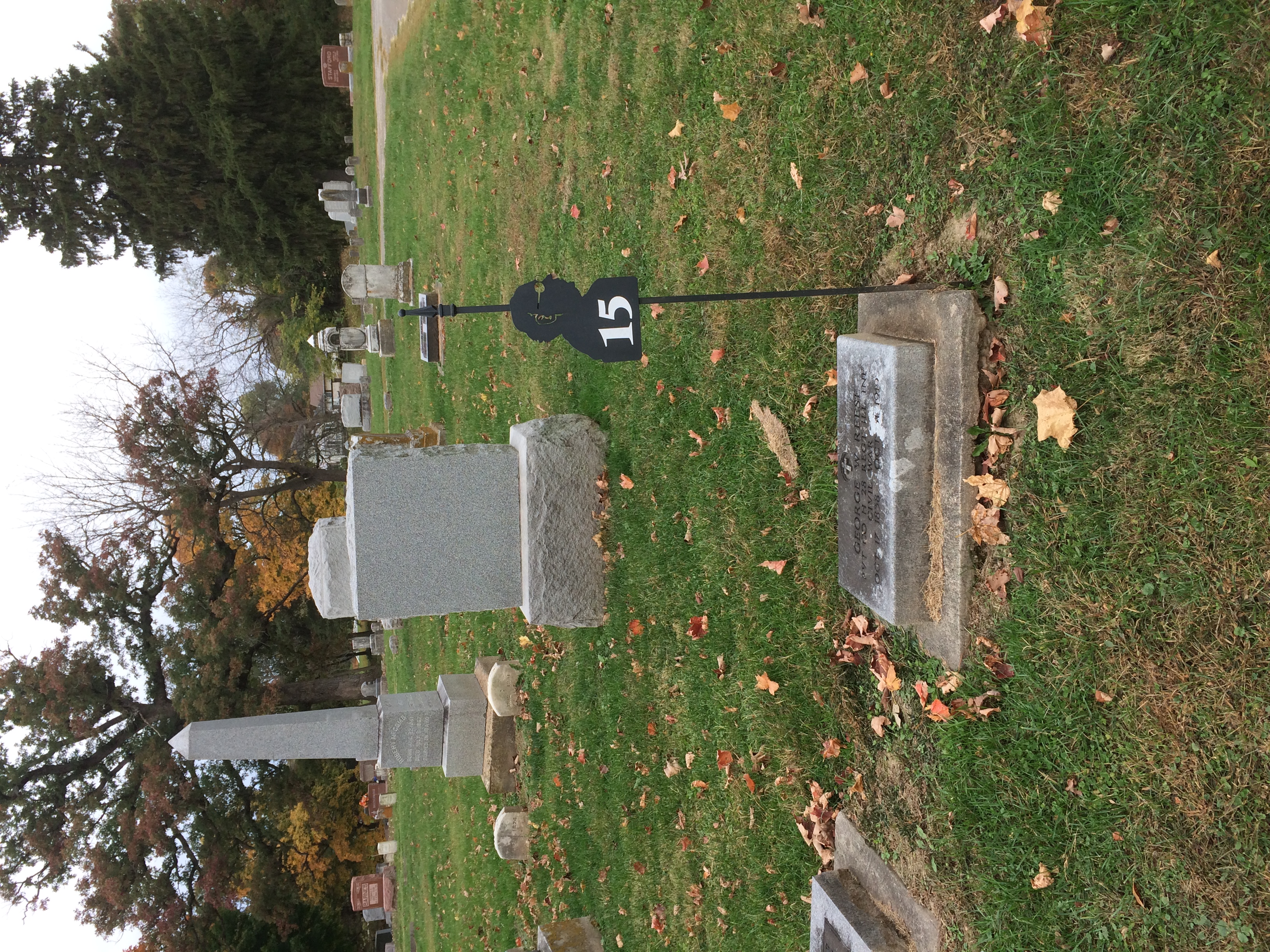
For avid Spoon River enthusiasts, and there must still be a few, the graves of the real people associated with fictional counterparts are marked with numbers.
Oak Hill Cemetery, Lewistown

There’s a guide available that will tell you who’s who in the cemetery, according to their Edgar Lee Masters number. I am not enough of an enthusiast to look any of them up.

Still, I respect it as a successful work of literature about the residents of a cemetery. Interesting conceit. Sometimes I imagine that if the dead at the cemeteries could talk freely, I might hear some salacious bits. On the other hand, many of them might not have very much interesting to confess.

We had a copy of Spoon River in our library when I was growing up, and I read some of the poems then and a few later. The other day I happened across a radio version from 1957, which is worth a listen. William Conrad is always worth a listen anyway.