Not This Year

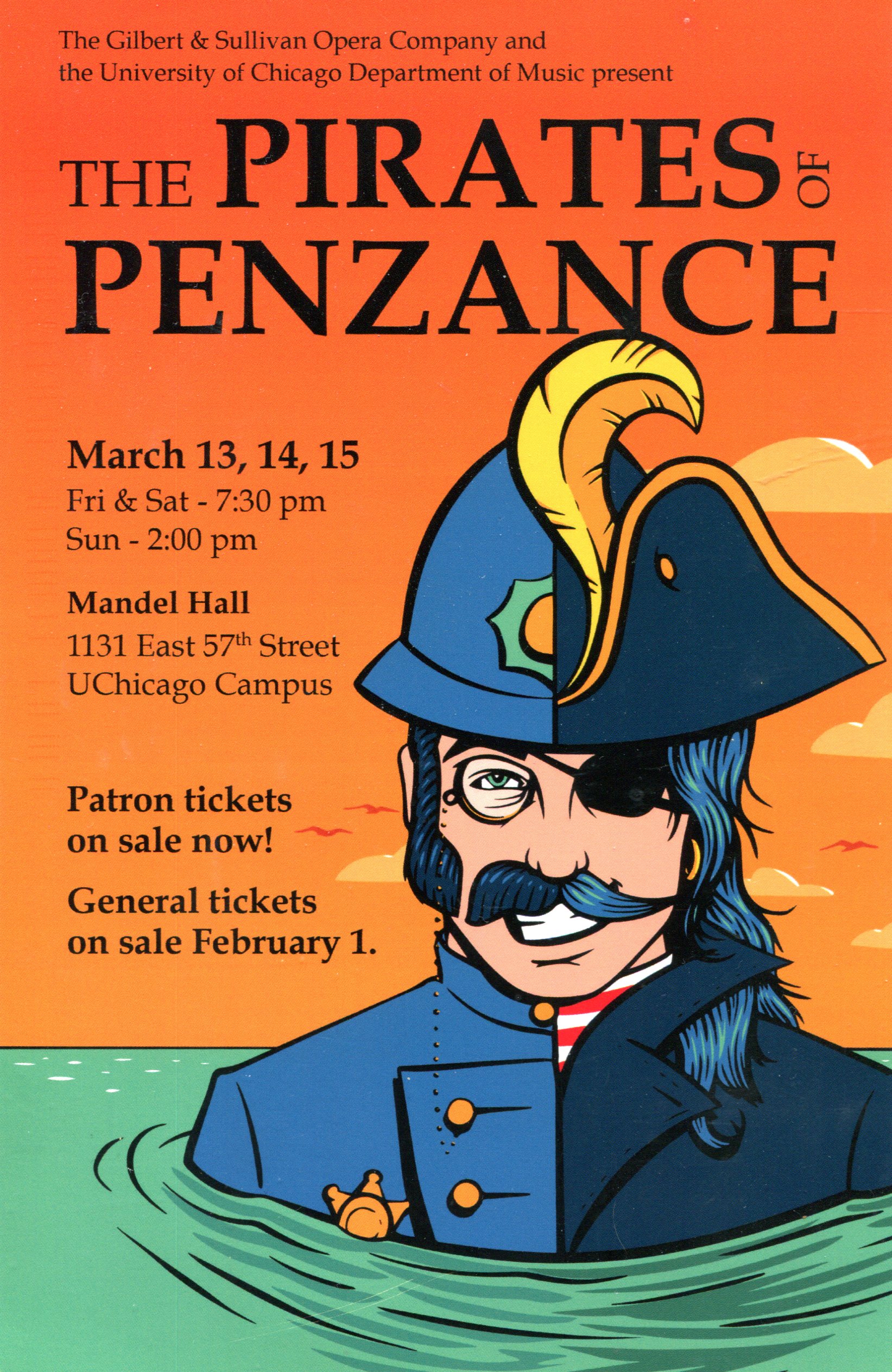
We’d planned to see The Pirates of Penzance this year in Hyde Park on Saturday, by the Gilbert & Sullivan Opera Co. We’ve been seeing their shows most years for a while now, since Yeoman of the Guard in 2015.

As you’d expect, the show was cancelled. As recently as a week ago, I didn’t think that was going to happen, but the country is going into no-frills mode faster than expected. In an age besotted with video and other impersonal entertainment, it’s interesting how many diversions still involve numbers of human beings coming together at the same place at the same time.

A pretty minor inconvenience for us, though I expect the cast and crew were upset all their work came to nothing. Much more than diversions have been disrupted. Ann’s school is out this week, ahead of its scheduled spring break next week, so that makes two weeks off — at least. After that, “remote learning.” Maybe. Down at UIUC, no more physical classes for Lilly till further notice. I’ll bet there will be no graduation ceremony in May, which would be too bad.

For me, I’m going to work at home. Wait, I’ve been doing that for almost 15 years now. In the early days, I remember telling people on the phone, usually someone I needed to interview, that they might hear noise in the background without warning. The noise of a young child. I can’t remember the last time I warned anyone about that. These days, occasionally the dog makes noise, but even that’s a rarity, since her idea of a good time is lounging quietly on a flat surface.

So I’m amused by the current flood of articles about working from home — it’s great, it’s terrible, How To Do It, What Equipment Do I Need? Sheesh. Ours is a time of overthinking. My expert opinion? It’s OK. Mostly tolerable. Helps not to mind hours and hours by yourself, which seems to unnerve some people. Can’t say I feel isolated, since my job — and the adverb is correct — is literally to find out things from other people, which often enough means talking to them. I suppose not everyone could say that about their at-home jobs, however.

The best part of working at home is the commute. The office as a work environment was invented by smug morning people. A one-or-so-minute commute (there’s always a bathroom stop first) is a way to ameliorate the tyranny of office hours. Working times are roughly the same, but there’s no back and forth.

In lieu of The Pirates of Penzance on stage, here are some YouTube clips of everyone’s favorite scene. Mine anyway. Impersonal entertainment will have to do for a while.

Recorded at the Stratford Festival in 1985. Many of its shows were cancelled just Friday.

From the 1983 movie version.

At the English National Opera more recently, in 2015.

The tune with other words. Couldn’t very well leave this out.

Tom Lehrer is still with us, last I heard. Next month he will be what I hope is a hale 92 years old.

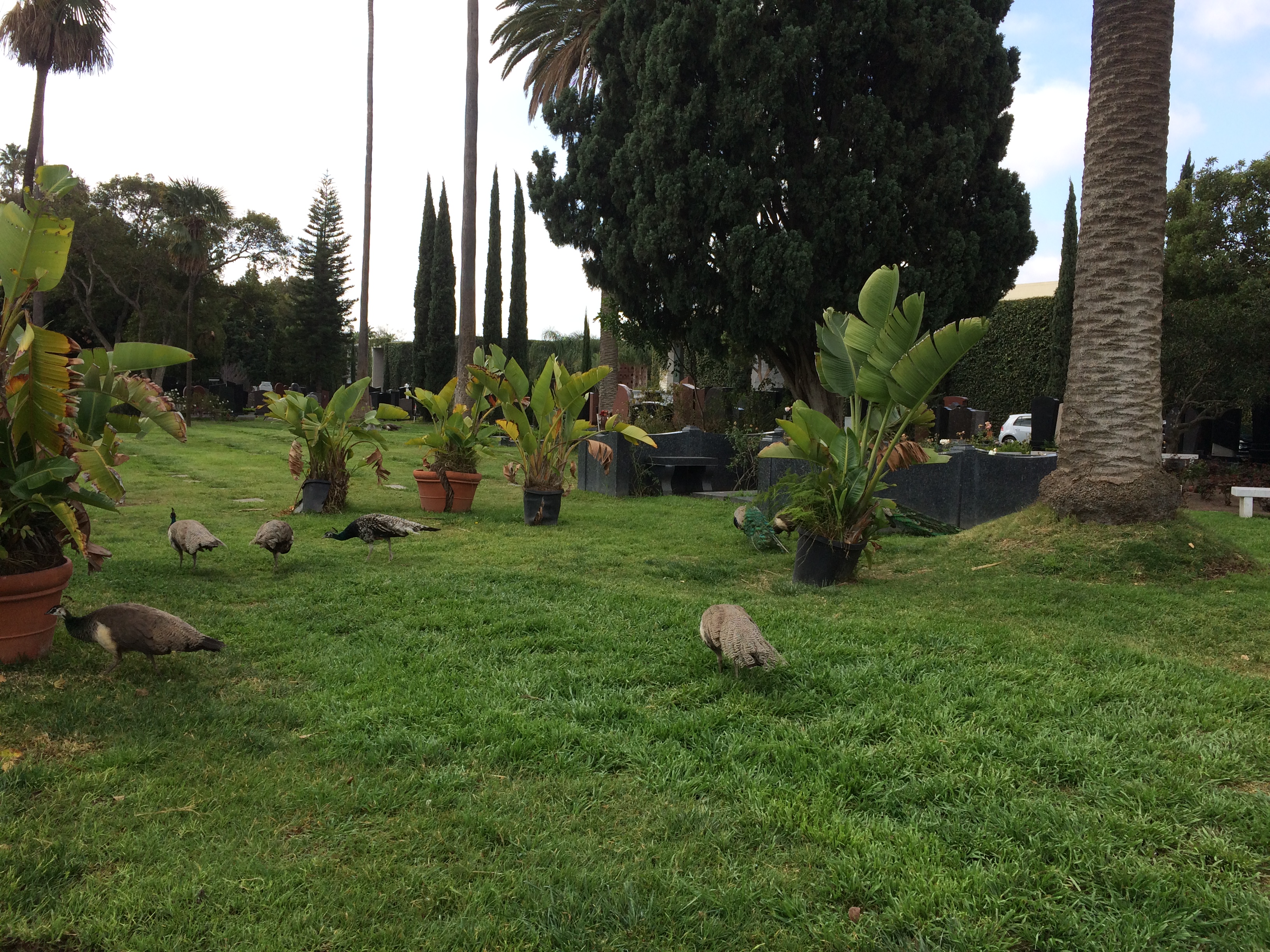
Hollywood Forever Cemetery

With a name like Hollywood Forever Cemetery, I suspected — in spite of what I’d read — that the place had gotten the Hollywood treatment instead of a proper renovation. That is, superficial and unsatisfying.

Fortunately, I was wrong. Just off a dowdy selection of Santa Monica Blvd., Hollywood Forever is a resplendent cemetery, on par with any of the lush rural-cemetery-movement grounds I’ve seen in other parts of the country.

Hollywood Forever Cemetery

Hollywood Forever Cemetery

Hollywood Forever Cemetery

Hollywood Forever Cemetery

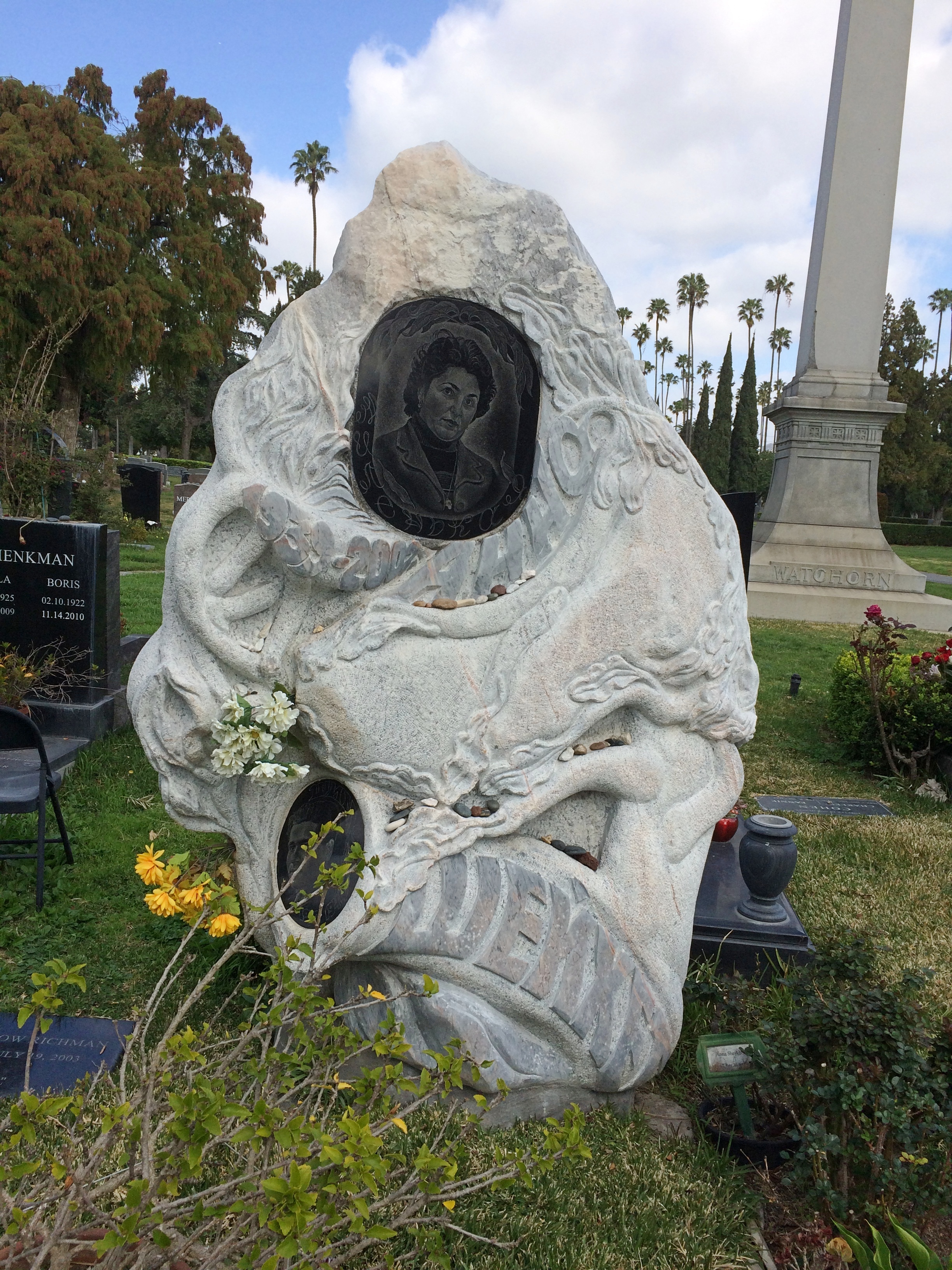
With examples of funerary art.
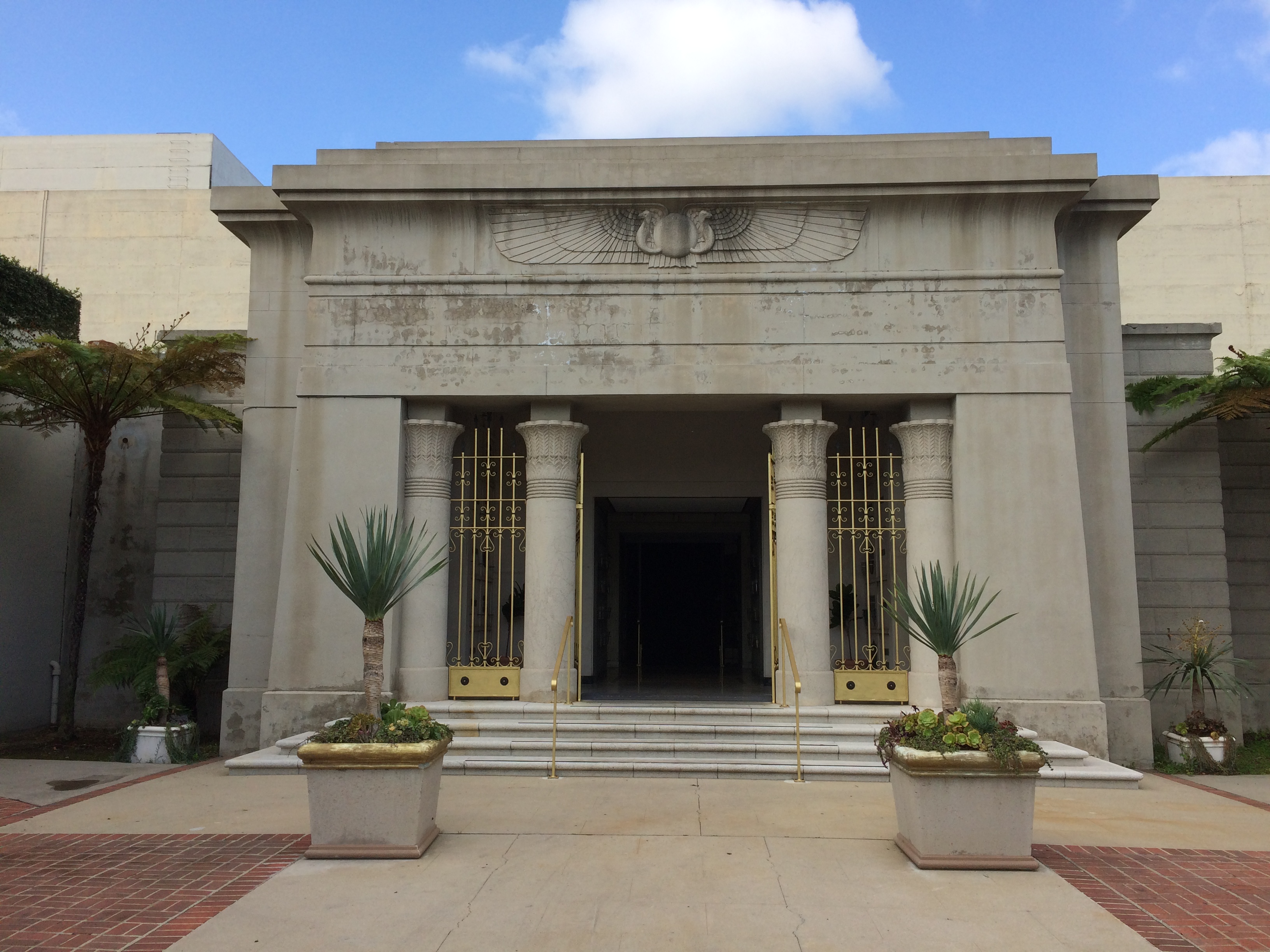
Hollywood Forever CemeteryHollywood Forever CemeteryA number of private mausoleums.
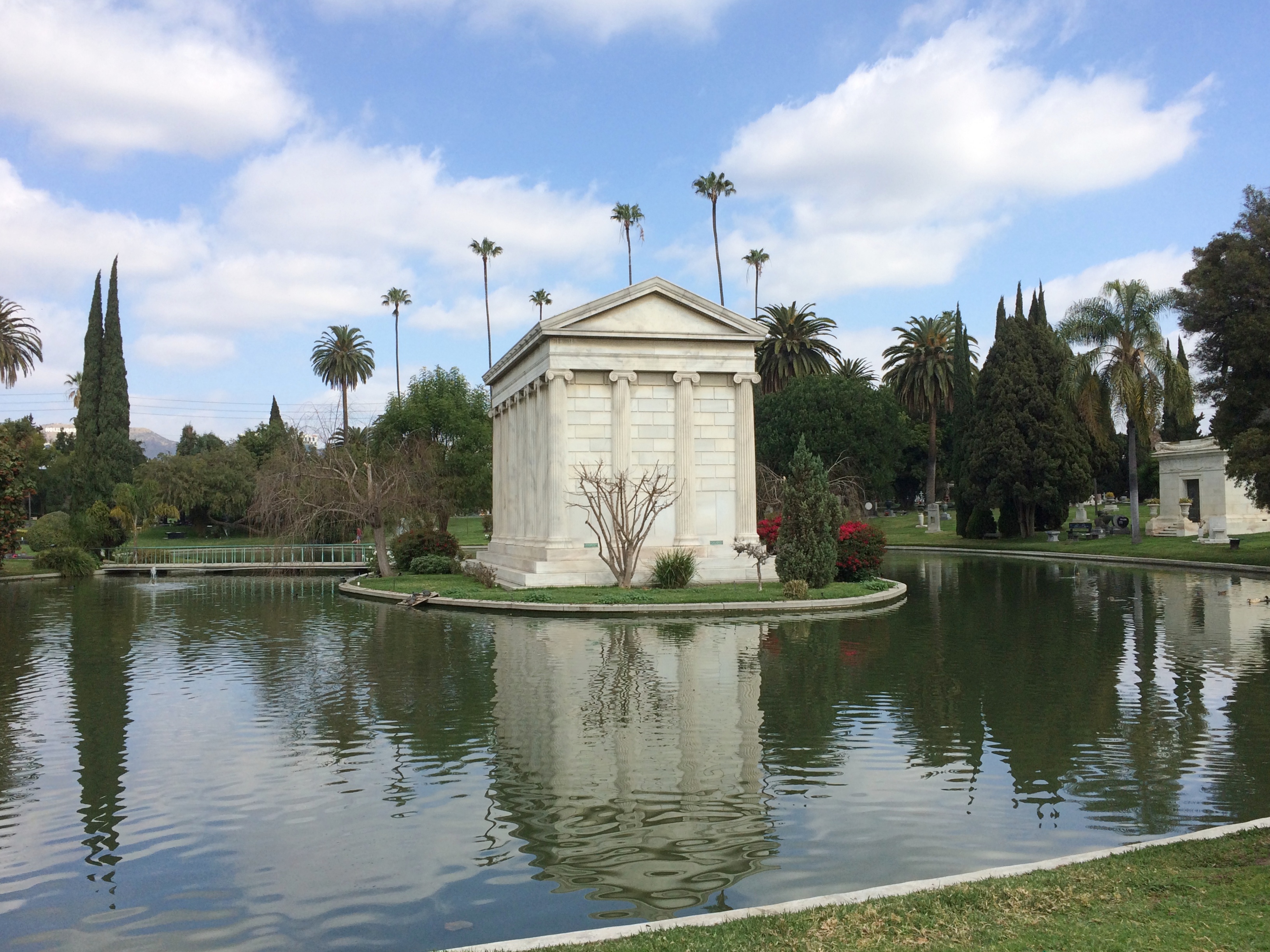
Hollywood Forever CemeteryIncluding one picturesquely set on a small island, the tomb of William A. Clark Jr. (1877-1934), son of copper baron Sen. William A. Clark Sr.Hollywood Forever Cemetery

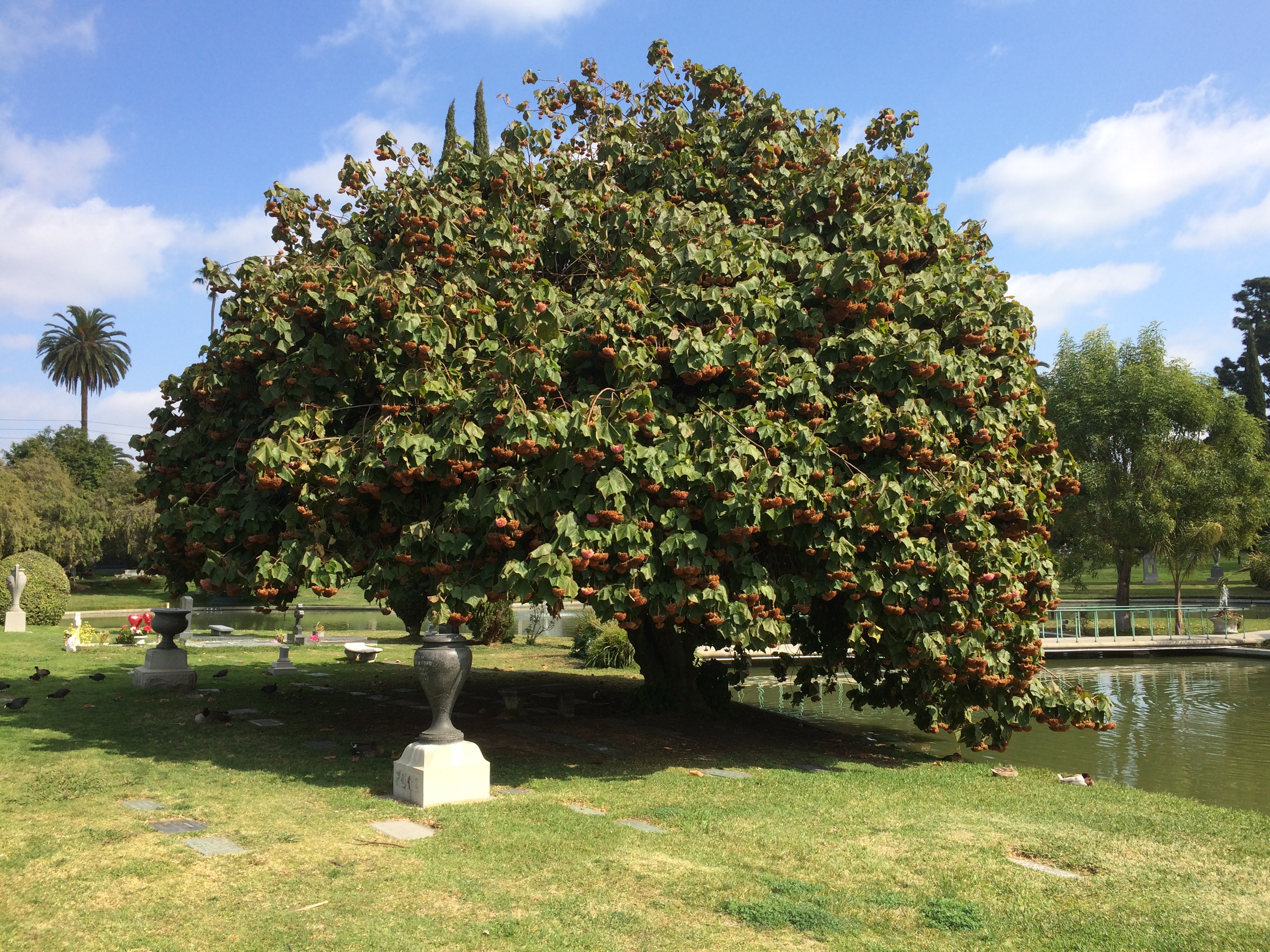
Plenty of trees.
Hollywood Forever CemeteryIf you find just the right spot, you can see the Hollywood sign off in the distance.
Hollywood Forever CemeteryThere are a few unexpected features, such as a section devoted to Southeast Asian memorials.
Hollywood Forever CemeteryI’ve also read that in our time, Russian immigrants are fond of the cemetery. There’s plenty of visible evidence of that.
Hollywood Forever Cemetery Russian memorials

Along with a sprinkling of earlier Russian émigrés.
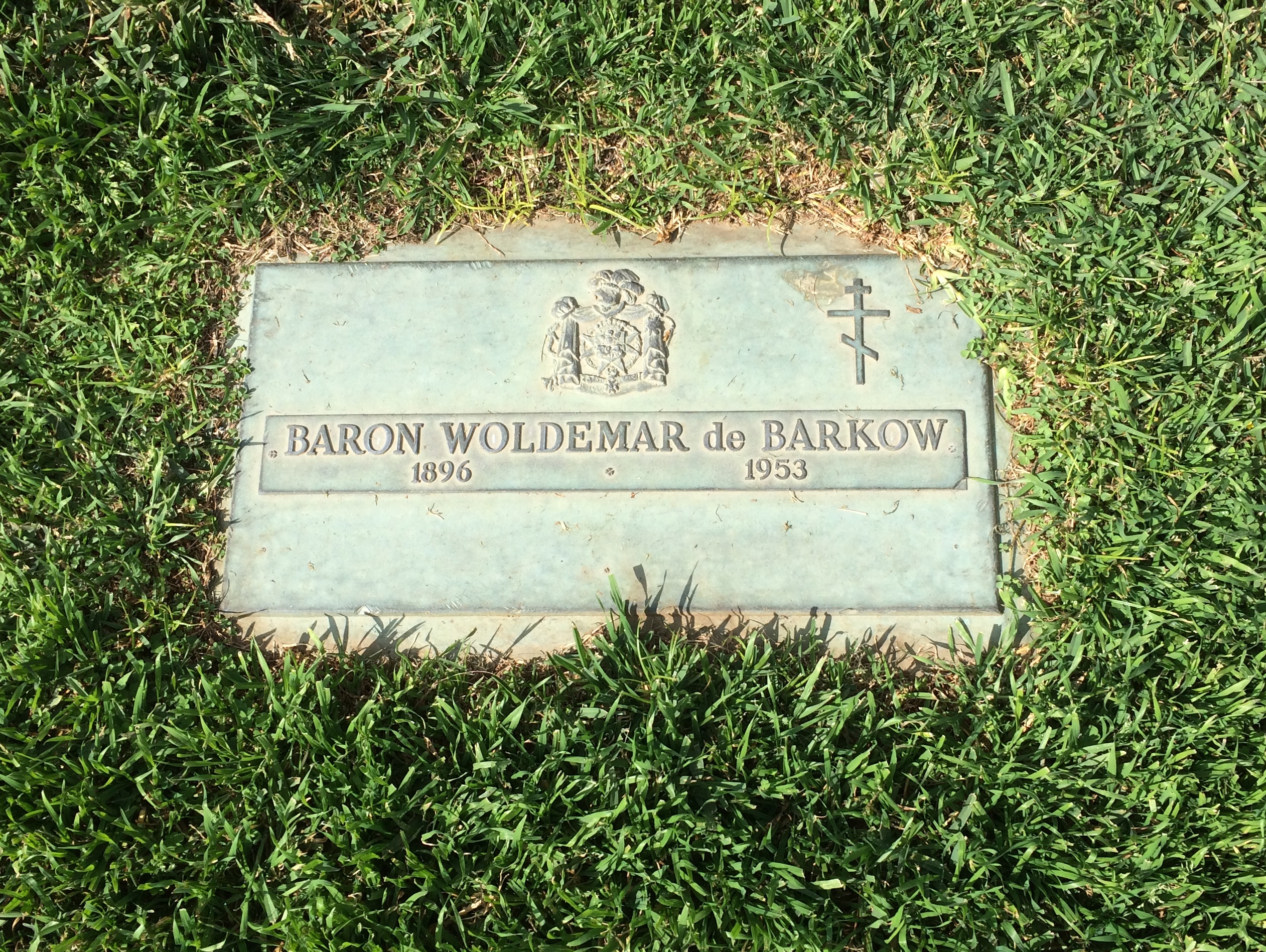
Hollywood Forever Baron Woldemar de BarkowHollywood Forever also sports a number of unconventional memorials. Something you might expect in California, except that I’ve seen them elsewhere.
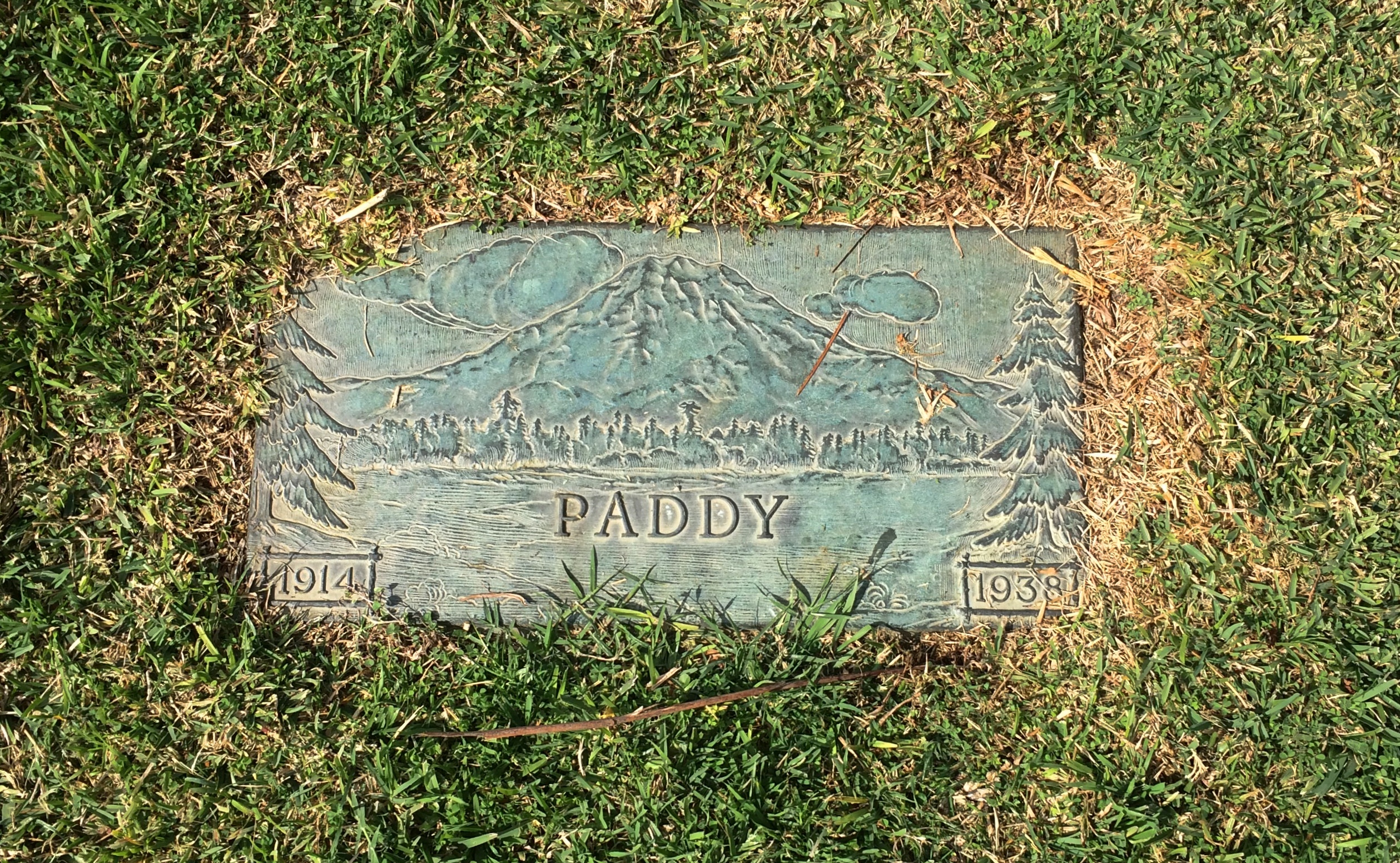
Hollywood Forever CemeteryHollywood Forever CemeteryOr maybe not unconventional, but just a little unusual.Hollywood Forever Cemetery Paddy marker

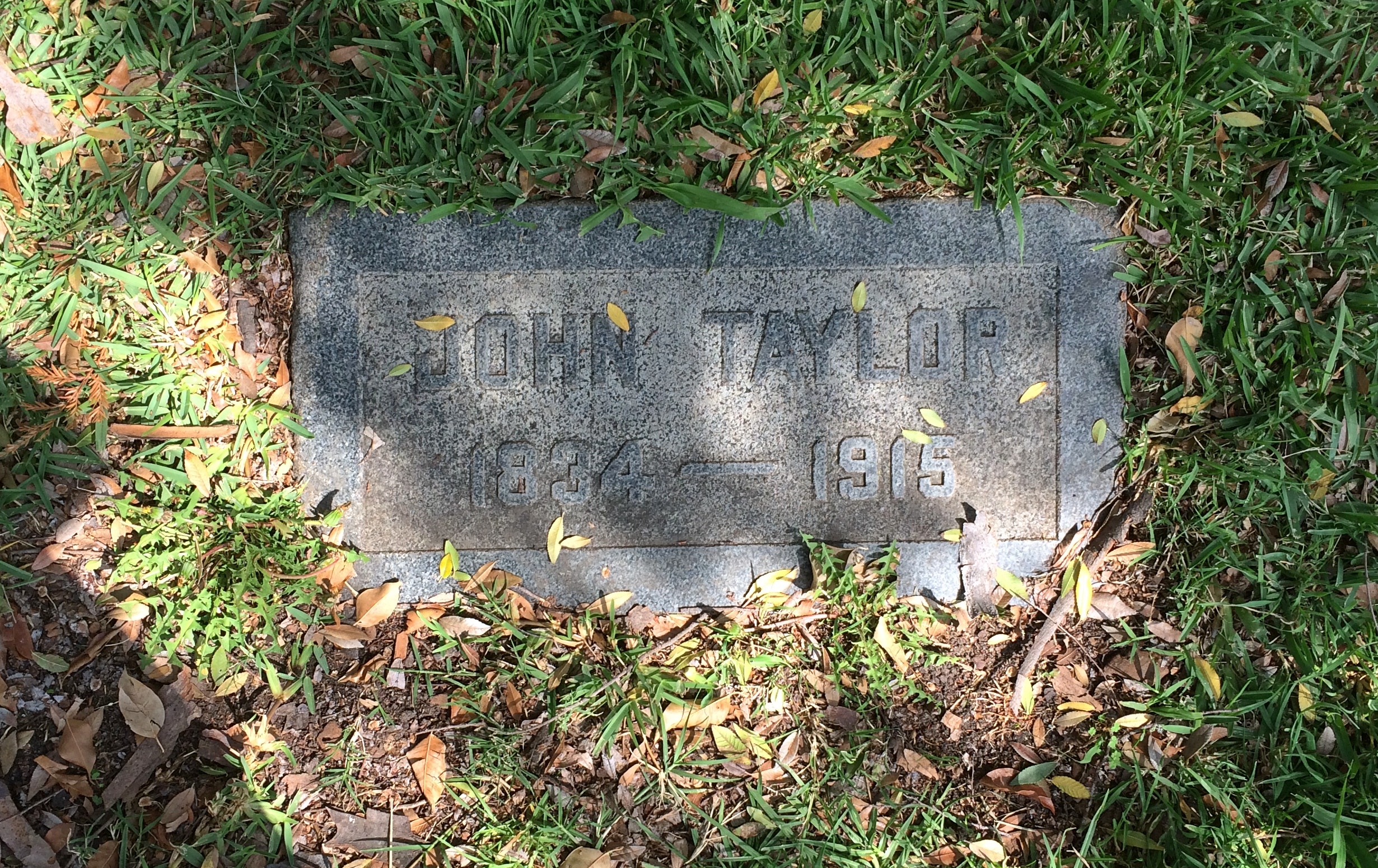
Plenty of regular folks, too. Most of the permanent population would be, I believe. John Taylor was laid to rest just as the movie business started getting off the ground in Hollywood.Hollywood Cemetery John Taylor 1915

The cemetery dates back to 1899 and has had three names: Hollywood Cemetery, Hollywood Memorial Park, and since 1998, Hollywood Forever Cemetery. Its history is as strange as Hollywood itself.

A long-time owner in the 20th century essentially used the place as a piggy bank, and let it go to pot by the 1990s. The current owner invested millions in the property’s renovation — or oversaw the investment, and I’ll say it again, did a splendid job — with the funds at least partly generated by a pre-need funeral company Ponzi scheme his father and brother went to prison for, though the owner himself wasn’t charged. Sounds like a subplot in the entertaining and California-esque Six Feet Under, except the con was perpetrated in Missouri.

The whole story is more than I care to unpack, but for further reading there’s “The Strange History of Hollywood Forever Cemetery,” an article about the Ponzi scheme, and this entertaining article in LA Weekly.

Not only has the current owner made the cemetery look good, he’s raised public awareness of it through various events, such as outdoor movie screenings and other events not usually associated with graveyards. Also — and perhaps most astute of all, from a business perspective — he seems to have opened up space to be interred, especially in mausoleums near famous people (example to follow).

That brings me to the fact that I’ve buried the lead (har, har). All the features I’ve mentioned above are nice, but not really why I spent a couple of hours at Hollywood Forever on a pleasantly warm Sunday morning.

I’d come to find the graves of movie stars. Normally, celebrity earns a shrug from me. But I was in Hollywood. Movie stars are part of its sense of place. It’s a movie industry town, after all. Besides, a highly detailed map of the cemetery is available at the front office for a reasonable $5, and it guides you to the graves of about 200 notables.

“We sell more of these maps than we do flowers,” the lady behind the counter told me.

So I was on a treasure hunt to find some stars that I’d heard of, especially from the Hollywood of before I was born, more or less. It was fun.

Grand names are part of the deal at Hollywood Forever. Parts of the cemetery include the Garden of Eternal Love, Chandler Gardens, Garden of Memory, and a Jewish section featuring the Plains of Abraham, Garden of Jerusalem and Garden of Moses. This is the the entrance is the Abbey of Psalms Mausoleum.
Hollywood Forever Cemetery Abbey of the PsalmsHollywood Forever Cemetery Abbey of the PsalmsI entered in search of the Crying Indian, Iron Eyes Cody. I found him in a modest niche. His wife, who died about 20 years before he did, rests there as well. She’s called “Mrs. Iron Eyes Cody” on the plaque; you have to look her up to learn she had a name besides her Italian-American husband’s made-up Native American name. She was Bertha Parker Pallan and, unlike him, was actually an Indian.

Iron Eyes is small potatoes compared to the real star of the Abbey of Psalms: Judy Garland. She has her own chapel-like room, re-interred there only in 2017. That must have been quite a coup for Hollywood Forever.Near the entrance is the Abbey of Psalms Mausoleum - Judy Garland

Want to have your ashes near Judy? It can be arranged. A lot of new-looking, glass-door niches are in the chapel walls, most still empty, though I did note that John Cassese, the “Dance Doctor,” recently occupied an eye-level niche across from Judy. His niche includes an urn, but also a bobblehead-like figure of him, a printed obituary, an award he won in 2013, a small disco ball, some seashells and other objects.

From there I headed to the open air, looking for Mel Blanc.
Hollywood Forever Cemetery Mel BlancI left a penny. Here was a man who had entertained me and millions of others.

Most of the graves I wanted to see were in the Garden of Legends, an open area, and the Cathedral Mausoleum, so I soon headed that way. Douglas Fairbanks and Douglas Fairbanks Jr. have their own lawn and reflecting pool, with a major memorial next to the Cathedral Mausoleum.

Hollywood Forever Cemetery Douglas Fairbanks

Hollywood Forever Cemetery Douglas FairbanksThe cemetery shop only had a few postcards for sale, but they included ones featuring Douglas Fairbanks, probably dressed for The Black Pirate and looking very much like the actor who invented swash and buckle. I sent one of them to a friend of mine and wrote, “You or I might be cool, but we’ll never be Douglas Fairbanks cool.”

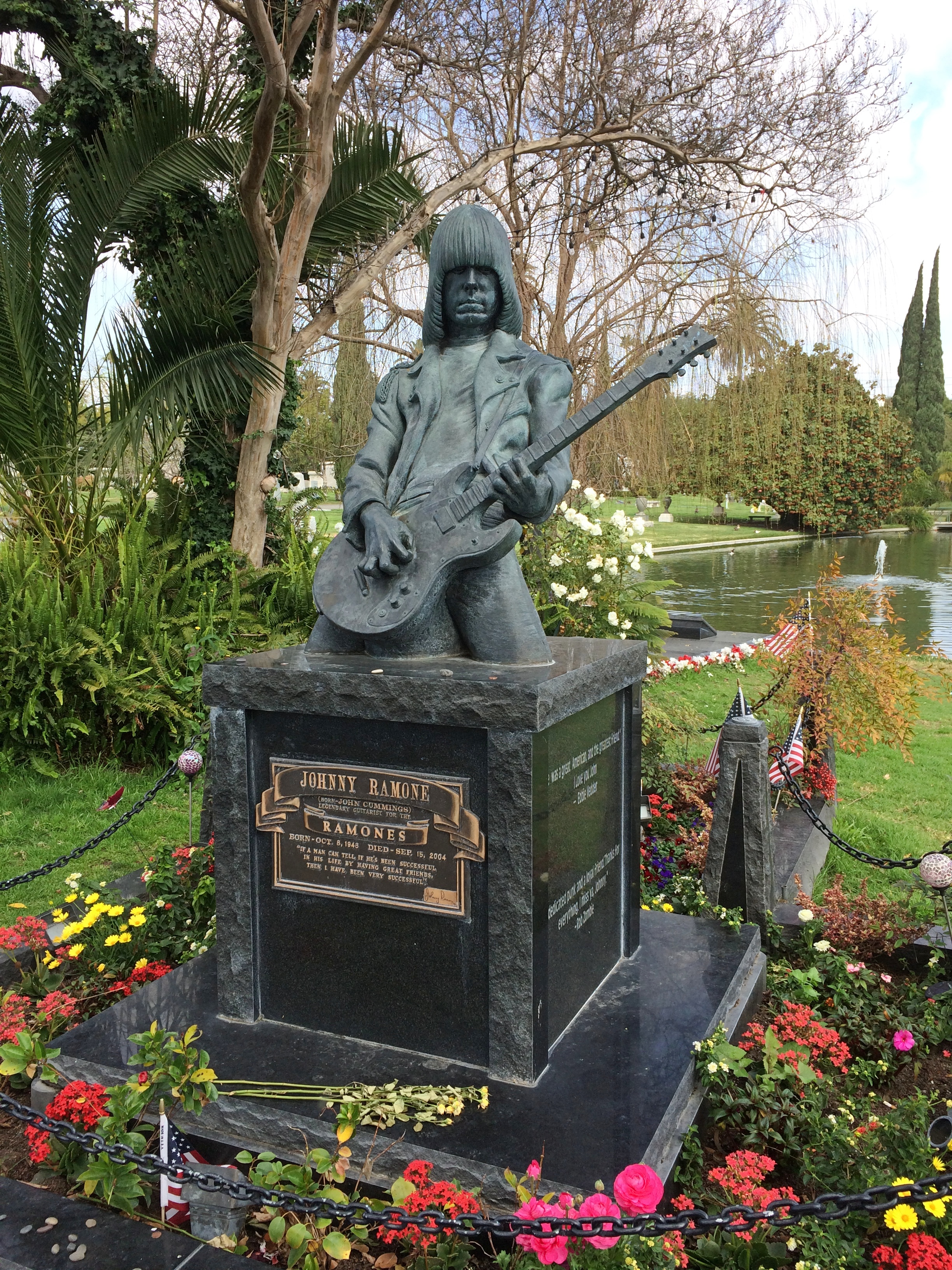
Heading into the Garden of Legends, I soon happened across Johnny Ramone. I didn’t even know he was dead.
Hollywood Forever Cemetery Johnny RamoneNearby is a cenotaph for Hattie McDaniel, who was denied burial here in 1952 because of segregation. Her memorial was erected in 1999.

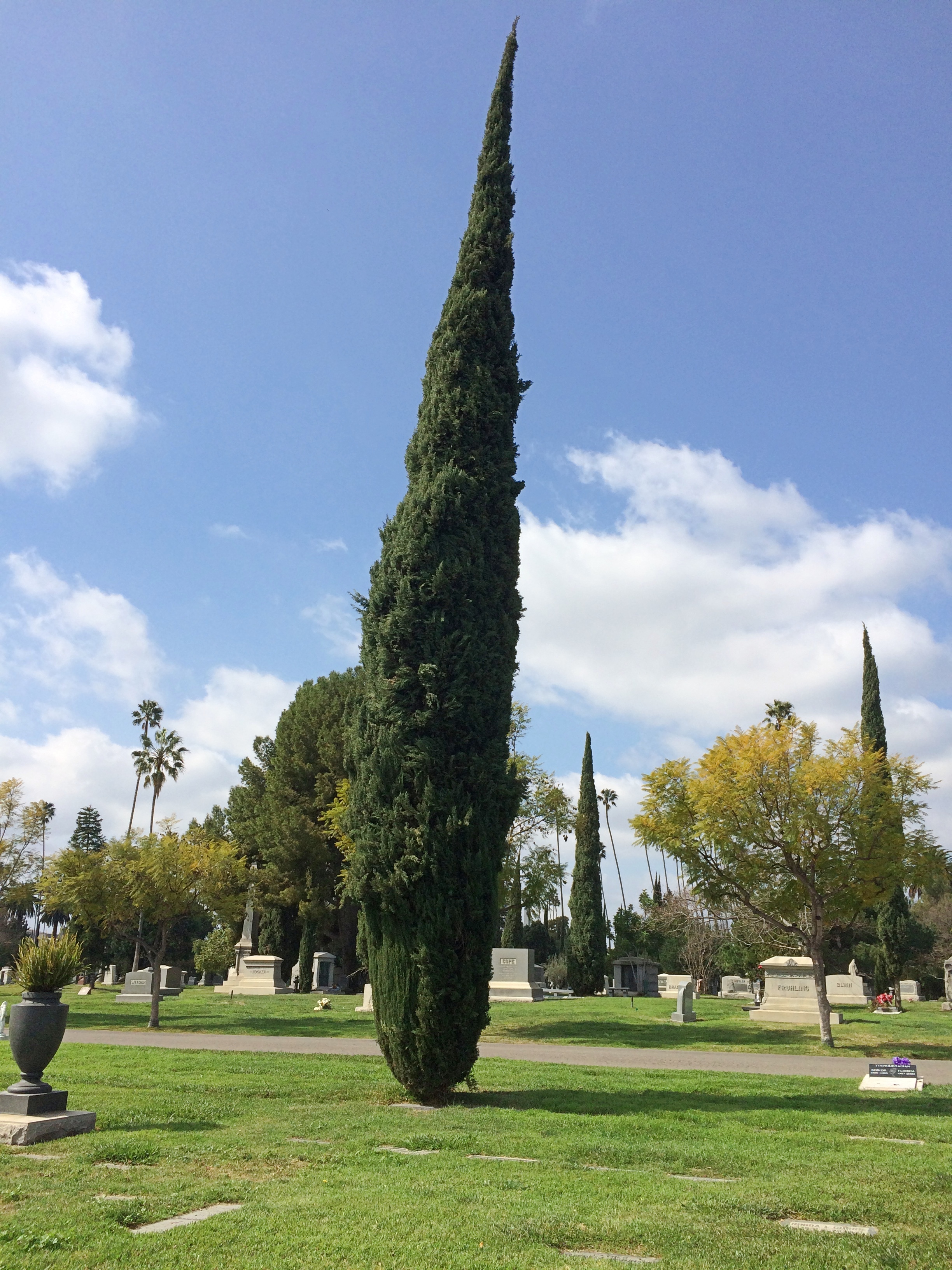
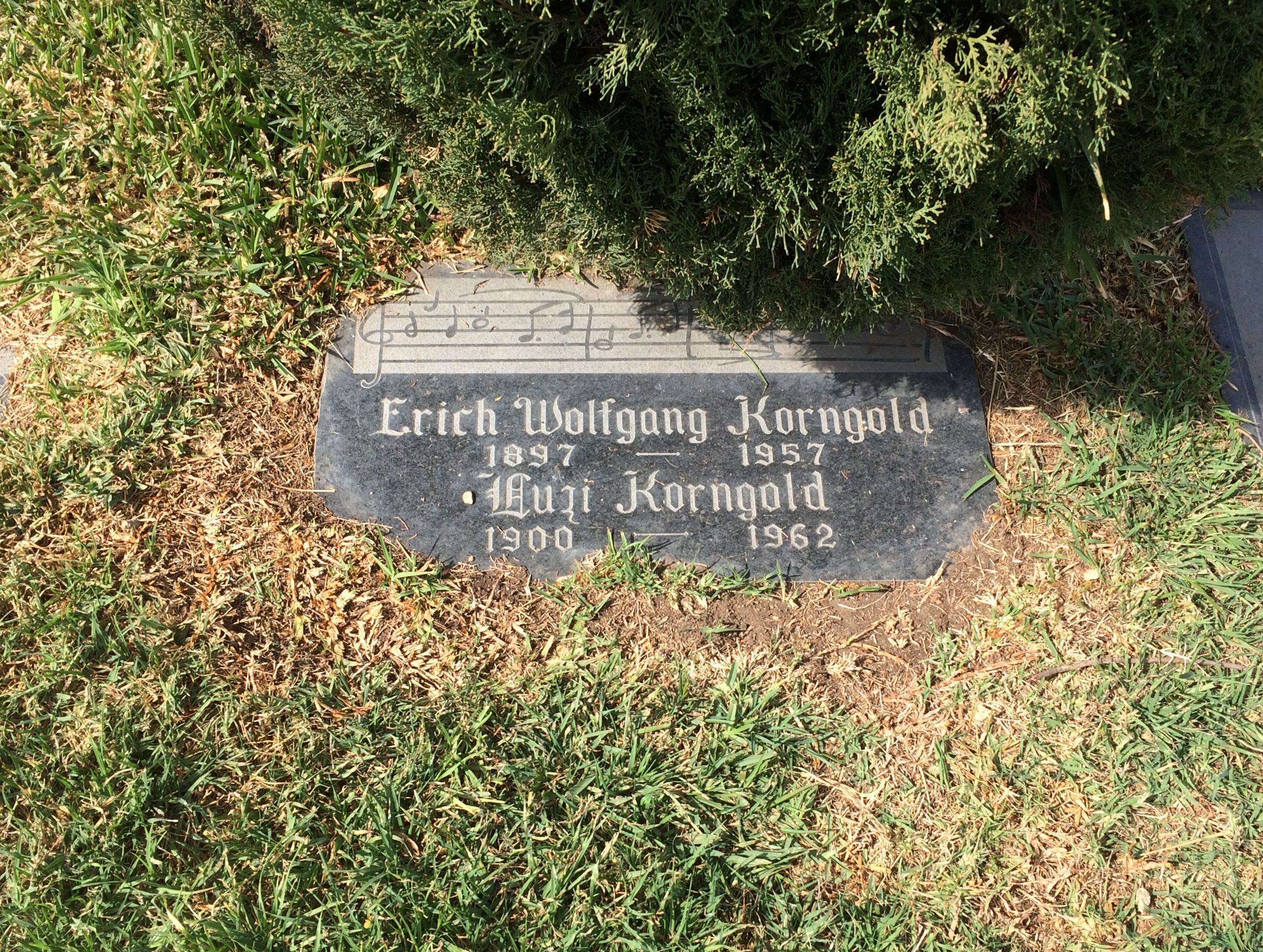
Next I spent a while looking for Fay Wray, and found her, and then Erich Wolfgang Korngold. The composer is buried under a tree.
Hollywood Forever Cemetery Erich KorngoldHollywood Forever Cemetery Erich KorngoldI sent the picture to my old friend Kevin, a movie music enthusiast. But for Kevin I might not know about Korngold, or have ever listened to such treasures as the music from The Adventures of Robin Hood or The Sea Hawk.

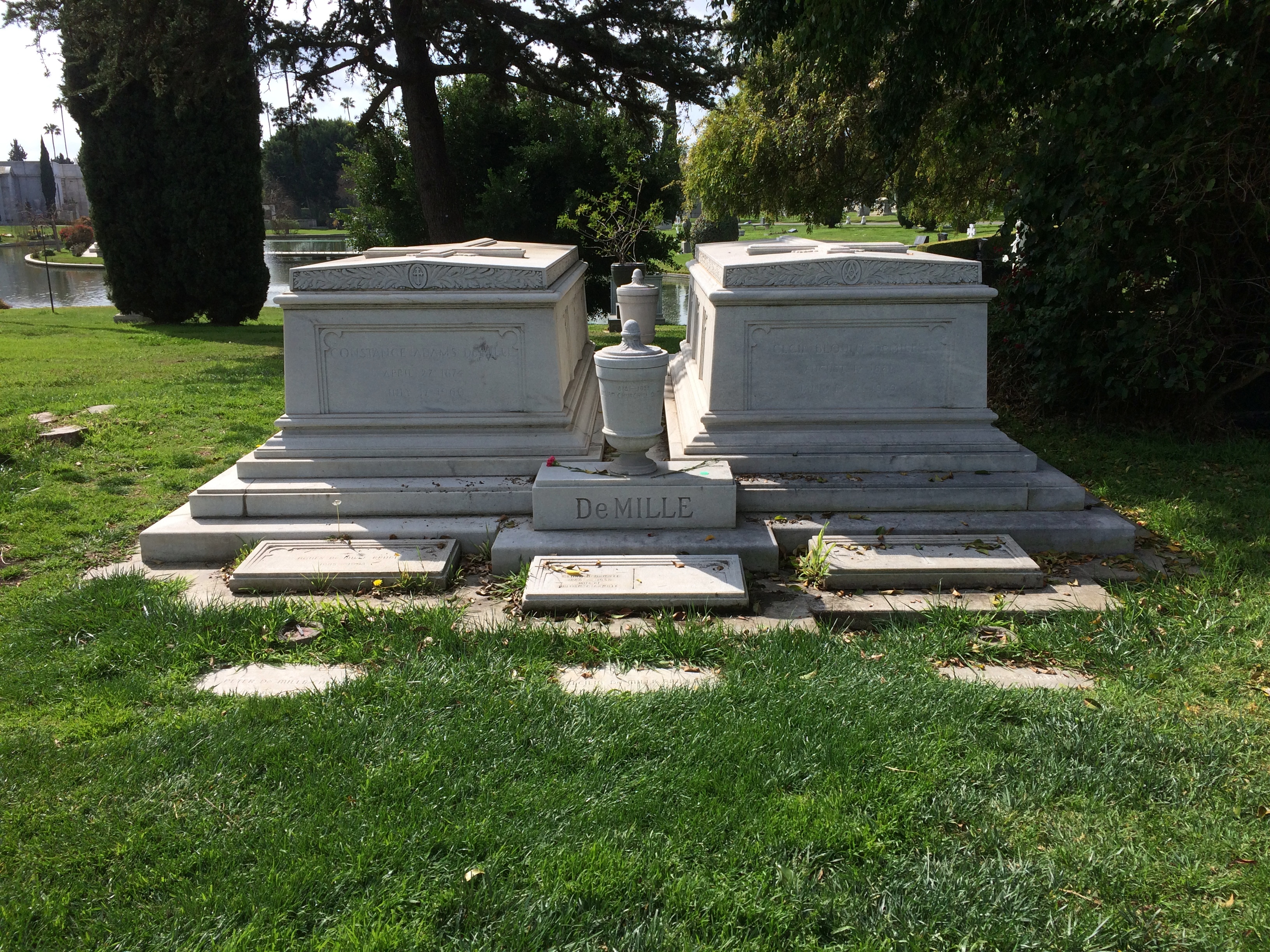
Rounding the pond that forms the centerpiece of Garden of Legends, I came across Cecil B. DeMille.
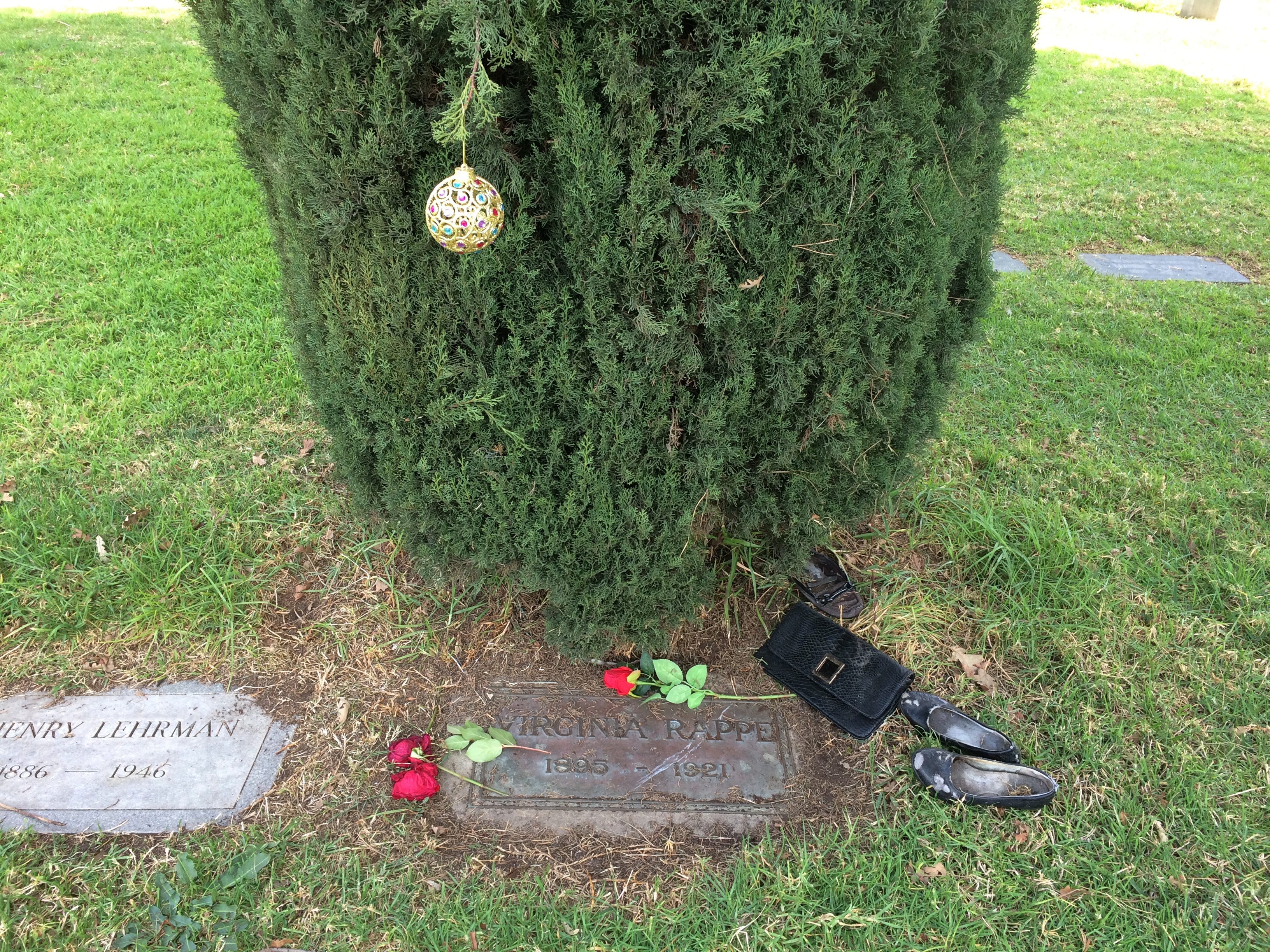
Hollywood Forever Cemetery Cecil B DeMilleOne I hadn’t been looking for: Virginia Rappe.
Hollywood Forever Cemetery Virginia RappeI puzzled for a moment. Who was that? Then I remembered.

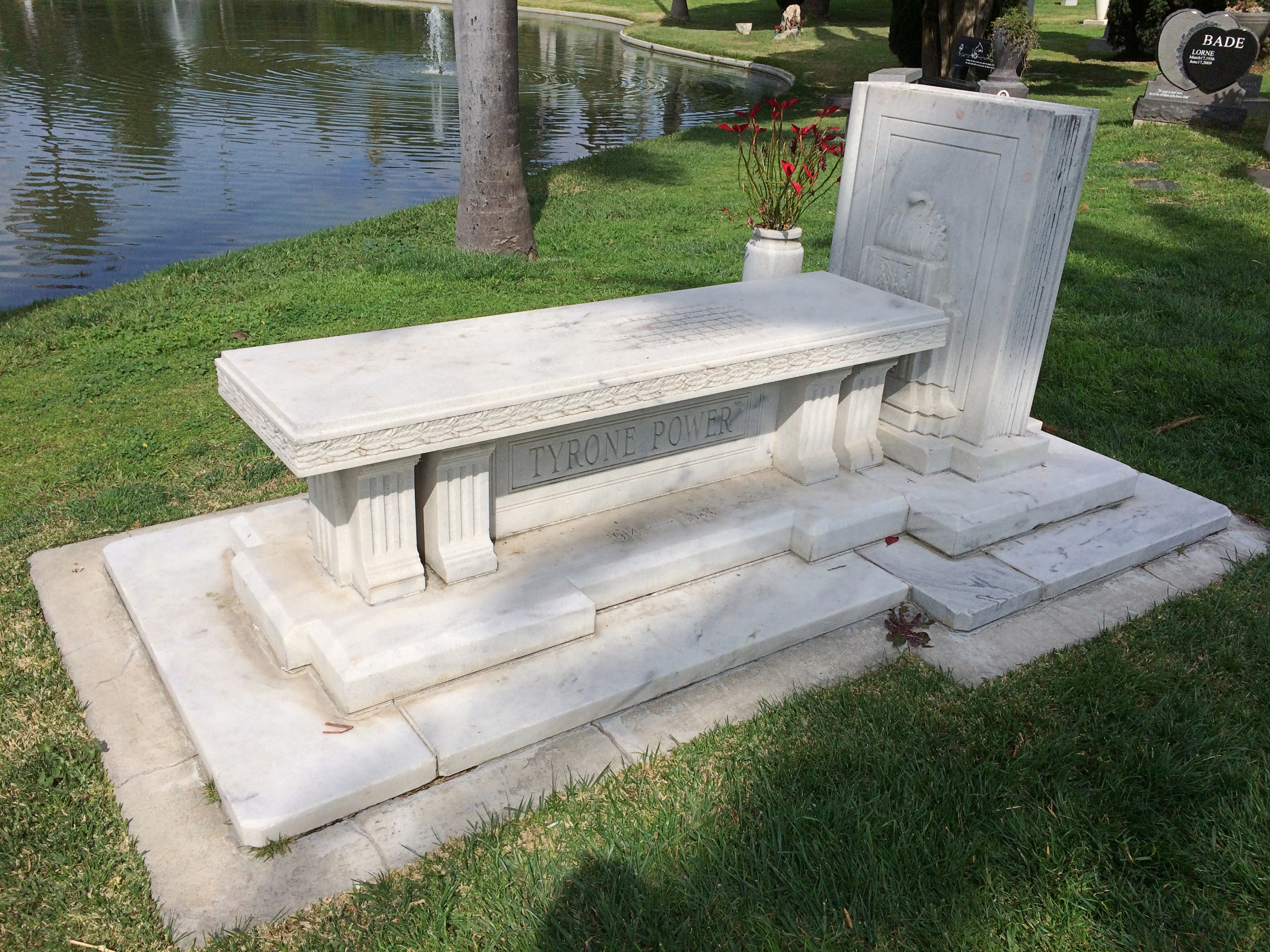
Tyrone Power is hard to miss.
Hollywood Forever Cemetery Tyrone PowerNext to him is Marion Davies’ mausoleum, which you might miss if you don’t know that her actual name was Douras, which is above the entrance. She paid for the building herself, I’ve read.
Hollywood Forever Marion DaviesAt the Cathedral Mausoleum, an even larger complex than the Abbey of Psalms Mausoleum, I found Peter Lorre in a niche. I was looking for him. I also found Mickey Rooney. I wasn’t looking for him, but he does illustrate that stars are once again considering the cemetery, now that the period of neglect is over.

Rooney’s inscription says: “One of the greatest entertainers the world has ever known. Hollywood will always be his home.”

Well, de mortuis nihil nisi bonum, Mickey, though I want to mock that inscription. Then I began noticing some other recent arrivals from the movie business, most of whom I’d never heard of. Some of the memorials were like ads in Variety, touting their careers.

Last stop: Valentino. I couldn’t very well miss him.
Hollywood Forever Cemetery ValentinoI’d read that lipstick is often there, and so it was. He’s got amazing staying power for a silent film star.

Curious, I took note of the grave next to Valentino: June Mathis Balboni (d. 1927). Just an accident that this person is next to the Great Lover?

No. She knew him. In fact, she discovered Valentino and wrote some of his movies, most notably The Four Horsemen of the Apocalypse. Remarkable the tales that cemeteries tell.

Winterlude ’20

Though it hasn’t been a harsh winter, it has been winter, so time for a short hiatus. Back posting around March 1.

It turned out to be a good idea to know as little as possible about Parasite before seeing that movie, which we did last weekend, weeks after we’d originally considered going. All that time, I did my best not to read about it. Not knowing the arc of the story helped maintain the suspense, which was as riveting as anything Hitchcock did, especially after the midway twist.

I did know that the movie came highly recommended, and by sources I respect more than the Academy of Motion Picture Arts and Sciences. Could it, I wondered, be better than 1917? It was. That’s a remarkable achievement all by itself. One of those rare movies that is as good as people say.

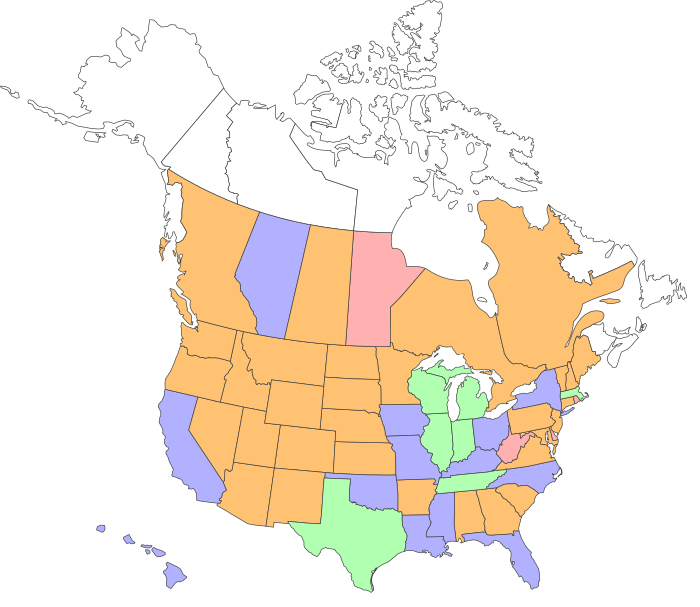
I’ve updated my vanity North American map again.
The key to the colors is here. The color scheme is wholly idiosyncratic, so I do have certain ideas about certain places. For instance, if I spent some time in following places, I’d color the respective states blue: the Northwoods of Minnesota; Norfolk and vicinity in Virginia; Mobile, Alabama; and Tuscon, Arizona. If I spent a night in West Virginia or Delaware or Rhode Island or Manitoba, they’d be orange. Just means I need to get out more.

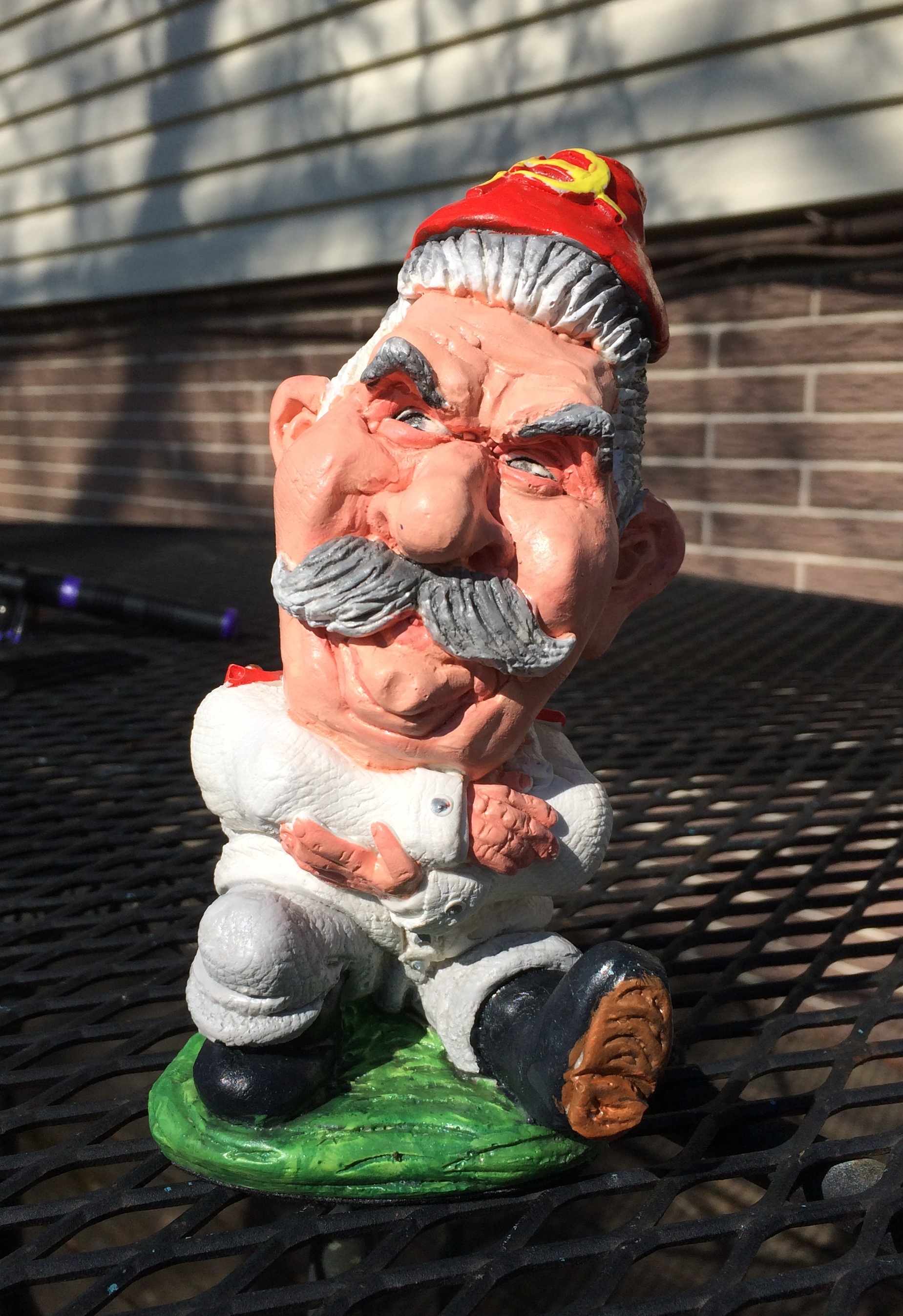
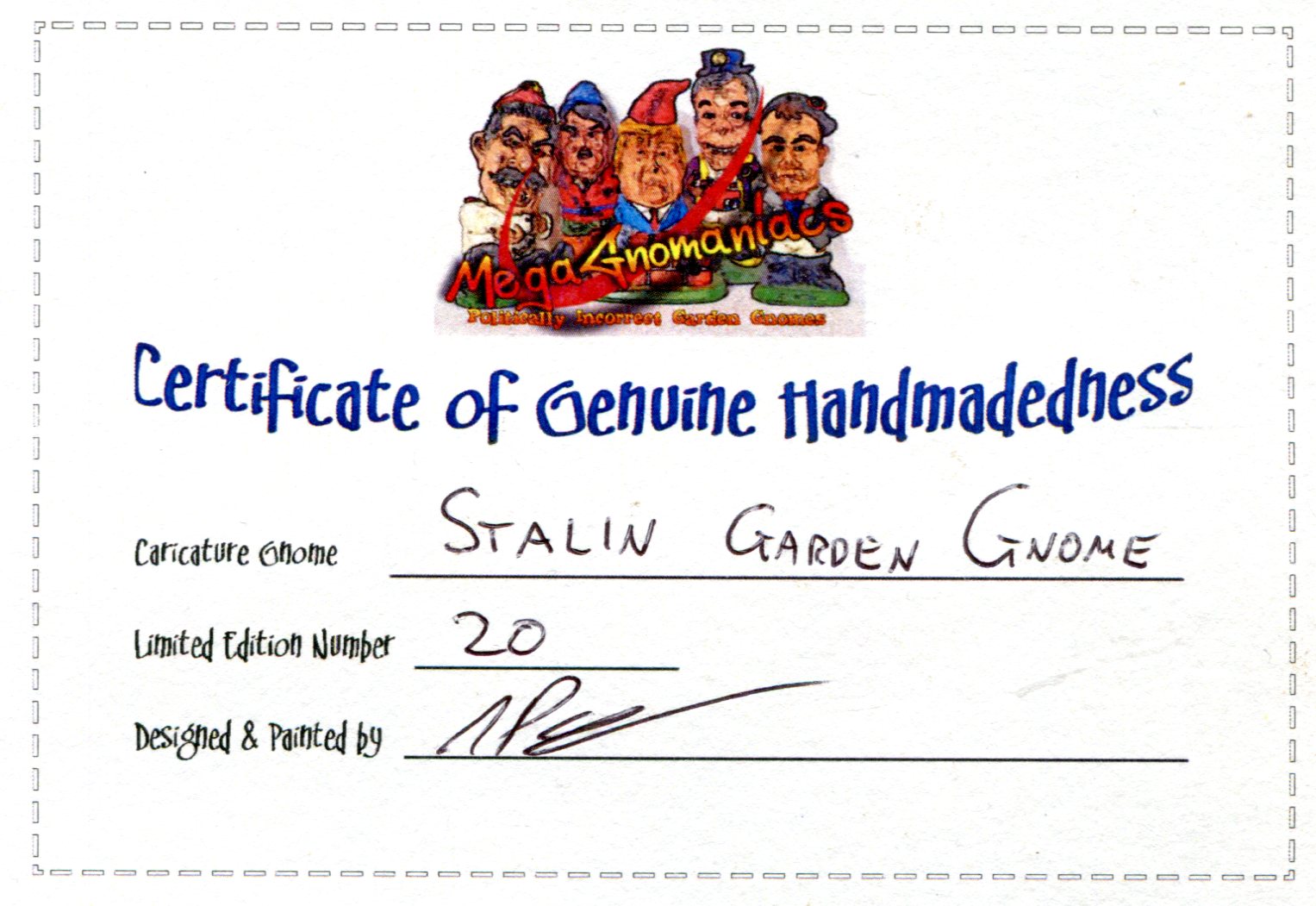
Though cold today, the sun was out. Time to take my new garden gnome outside.

Gnomish Stalin was a Christmas president from my brother Jay, shipped to me from the UK. Cornwall, specifically. For all I know, Cornwall might be the world hub of eccentric garden gnomes.
This year, I got Jay a Russian nesting doll — a political matryoshka doll, made in Russia. He sent me a picture. Nice set, though you’d think there would be room for Khrushchev at least, whom I’d pick for inclusion over Yeltsin.
Coincidence that we both sent Russian gifts — political Russian-themed gifts, no less? Or synchronicity? Who knows, I’m just glad to have a new conversation piece for my summertime visitors.

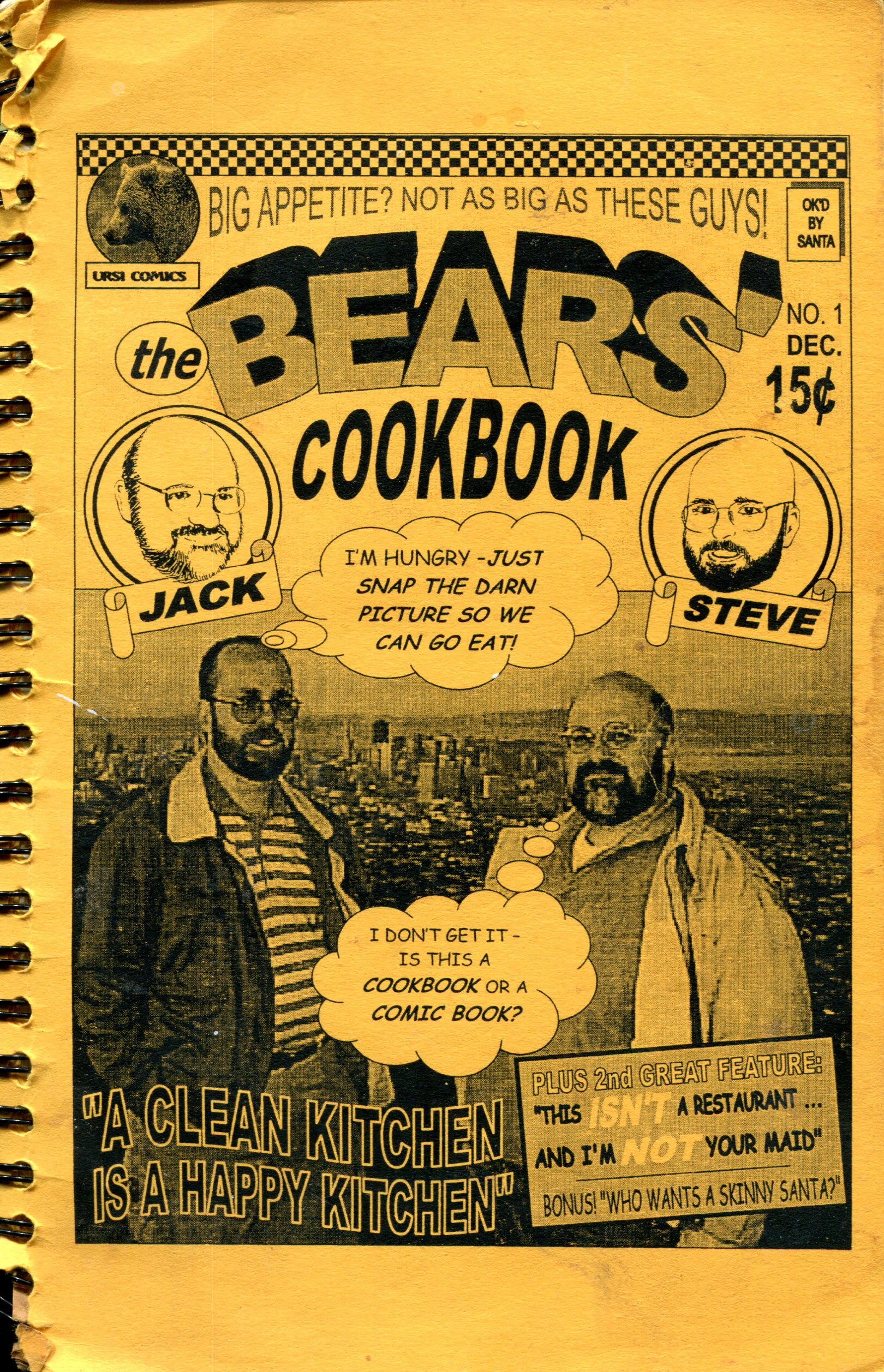
The Bears’ Cookbook

The pit of winter hasn’t been very deep this year, but on Wednesday night, snow fell and today temps have been sliding all day. As of this evening, it’s about 5 degrees F. above, with subzero expected by dawn tomorrow. That’s the classic harsh winter pattern we’ve mostly avoided so far this year, when temps have actually risen after snowfall, enough to melt most of it each time.

Then again, forecasts call for above-freezing air by Sunday. The pit still seems pretty shallow. Suits me.

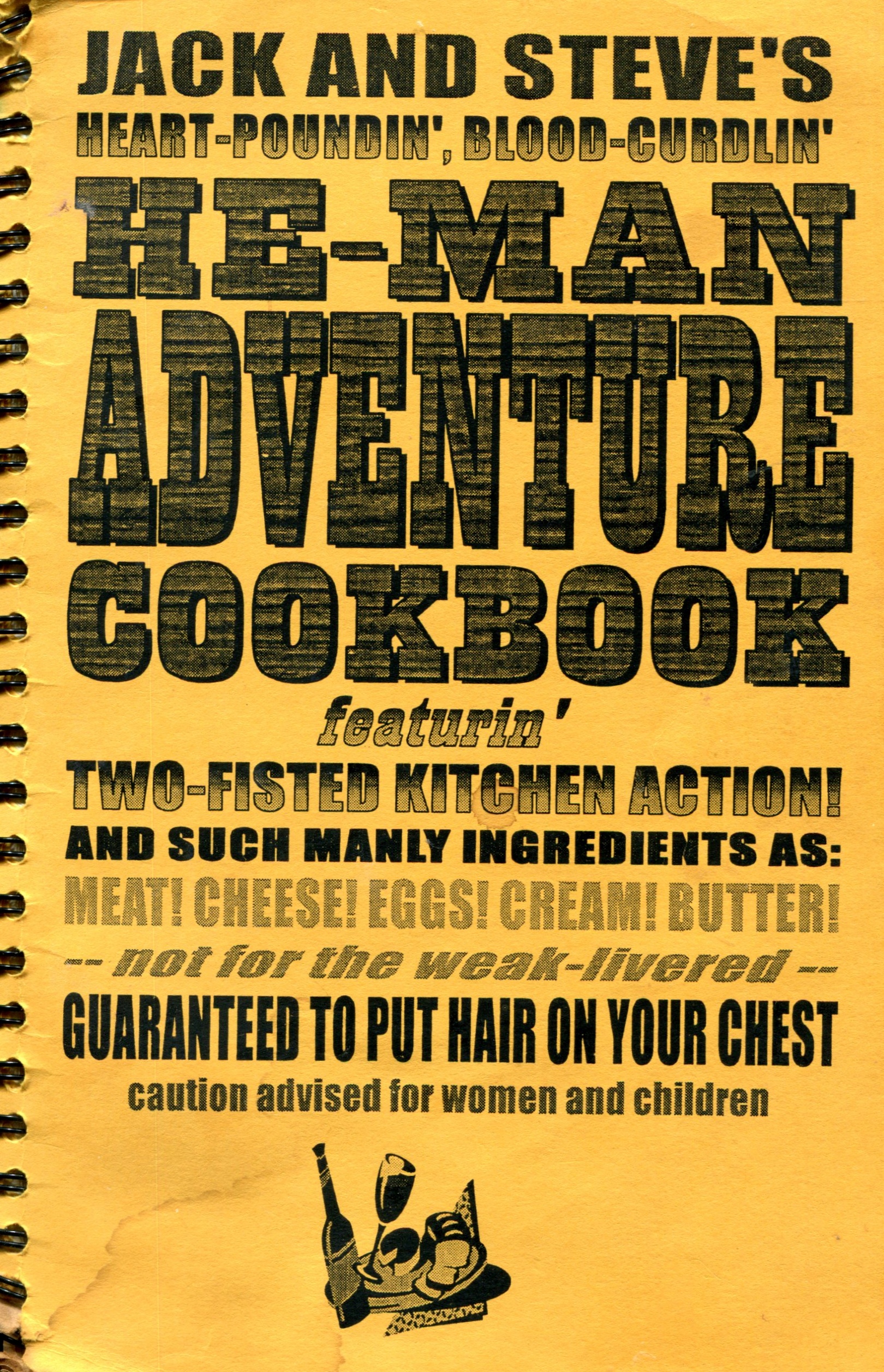
One more unusual book around the house: The Bears’ Cookbook. In this case, I didn’t nab it from my mother’s house. Rather the authors, Steve Freitag and Jack Garceau, gave it to Yuriko and me as a gift in 1998. I knew Steve back at VU; in fact, I was a senior staff member at Versus magazine when he was editor in ’82-’83.

The Bears’ Cookbook was a spiral-bound, privately published effort by Steve and Jack, who produced about 100 copies. As they explain in the book:
“What could be a better Christmas gift for our loved ones, our friends and family, than a cookbook of our favorite recipes? Welcome to our table. Sit, eat, enjoy.”

And so we have over the years. Yuriko and I have used the book, especially her, but so have Lilly and Ann, as soon as they’ve gotten old enough. Just a few weeks ago, Ann made chocolate chip cookies using the recipe on p. 97.

Besides cookies, subjects include breakfast, appetizers, soup, salads, breads, pasta, chicken, other meat, seafood, vegetables, condiments, and cakes and pies. Sources — one given for each recipe — are as diverse as “Ivan, a friend from New Brunswick who now lives in Vermont,” Alice’s Brady Bunch Cookbook, “Mayflower Restaurant in Albany, NY,” “Some men’s magazine Steve read long ago,” Julia Child, and “lost in the mists of time.”

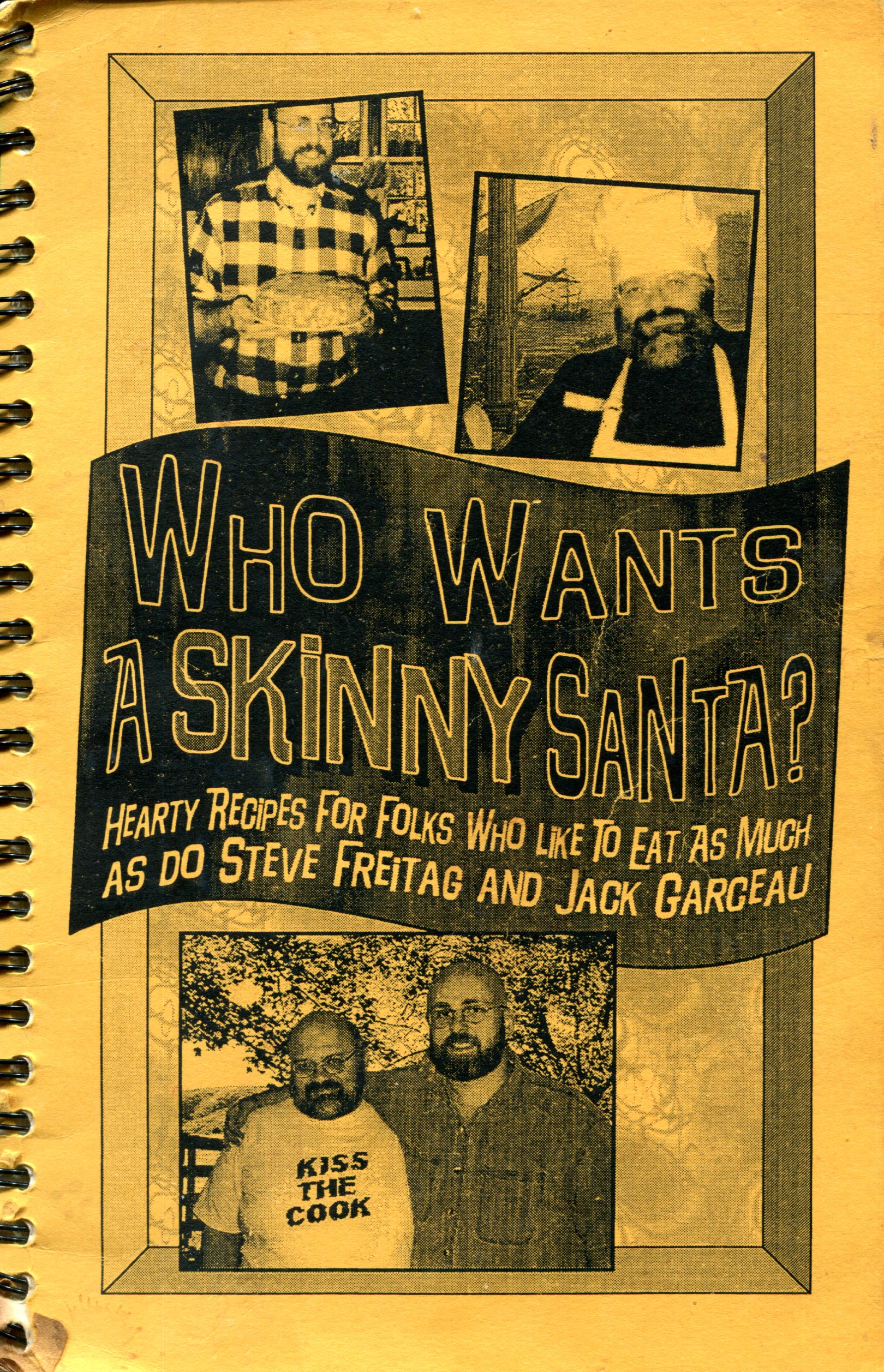
The book actually has three covers. Flip over the first one, and you encounter this amusing, all-text cover.

A note inside the book explains: “We wound up with several covers, each with different titles, and we couldn’t decide which one to use. So we decided to use them all! Well, actually, just a few of them…

“Pick the cover you like best for a cookbook that may very well grace your coffee table, bookshelf or nightstand for years to come. Fold back the other covers (one of the few advantages if spiral binding), so that the excess covers become mere interior pages. Voila! The cover you prefer graces this lovely book.”

The third cover.

The inside cover of each of the covers includes biographical notes about Steve and Jack, such as under a cartoon of them:

Steve Freitag and Jack Garceau are not cartoon characters by a real flesh-and-blood couple who live high above San Francisco in an 18th-floor apartment they never call the ‘Treehouse of Justice.’ 

They’ve since moved to Palm Springs. Under a photo of them decked out in Western duds:

Steve Freitag and Jack Garceau — known far & wide as two of the orneriest, grizzliest old hashslingers in the West! — started out as mama’s-boy East Coast fops…

Under another cartoon of them with oversized heads:

Enormous heads like these require plenty of food! So it’s no surprise that Steve and Jack like to cook. Like to eat and like to read — and now, write — cookbooks.

I’m no judge of cookbooks, but I know this one is fun to use and fun to read.

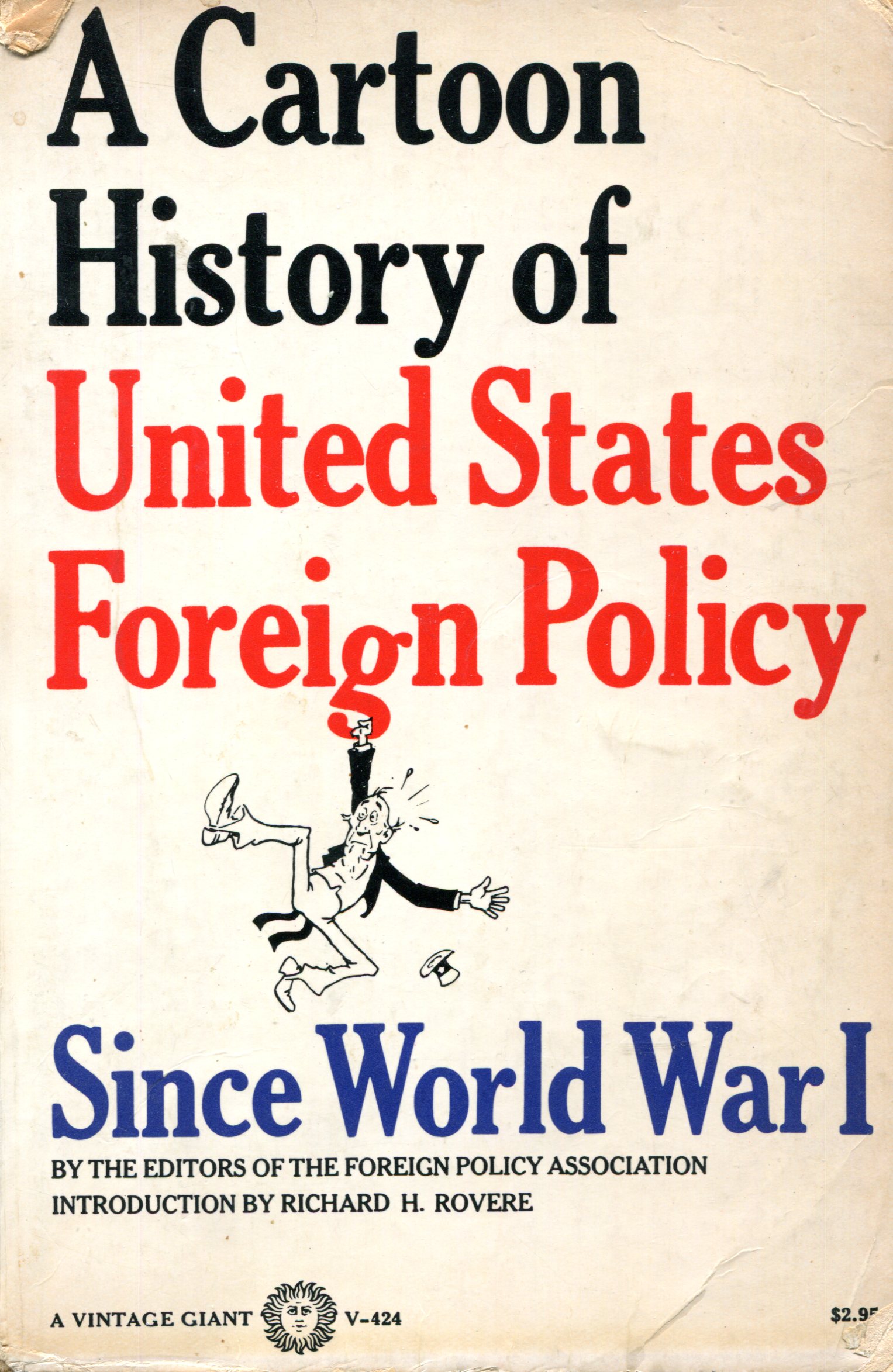
A Cartoon History of United States Foreign Policy Since World War I

Not long ago I looked up the Foreign Policy Association. Turns out the organization has a mission statement.

“The mission of the Foreign Policy Association today, as it has been for over 100 years, is to serve as a catalyst for developing awareness, understanding, and informed opinion on U.S. foreign policy and global issues. Through its balanced, nonpartisan programs and publications, the FPA encourages citizens to participate in the foreign policy process.”

By gar, that’s positively Wilsonian in its optimism that citizens can influence foreign policy, and that in fact U.S. foreign policy can be a force for good in this wicked world. Maybe it can. It’s certainly pretty to think so.
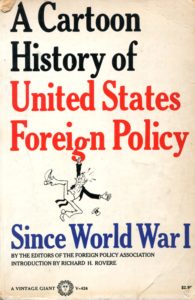
Another of the books I liberated from my mother’s house in recent years is A Cartoon History of United States Foreign Policy Since World War I — by the Editors of the Foreign Policy Association, the cover says, published in 1967. In the book’s acknowledgement, one Norman Jacobs is given as the editor of the association, but he thanks half a dozen people who participated. A group effort book, then.

The book includes about 250 editorial cartoons in 19 chapters. Actually, two examples are comic strips that editorialize, but they are exceptions, with most of the content one-panel cartoons. (Remarkably, included is a B.C. strip: two ants are watching two larger animals fight, and one ant says, “If we had ‘the bomb,’ we could intervene.”)

The editors provide a few lines of context for most of the cartoons, usually going out of their way to be nonpartisan and mostly nonjudgmental, at least as far as U.S. policy was concerned. For instance, before the U.S. entry into WWII, there are cartoons for and against intervention in European affairs and then the war itself.

The chapters, and the cartoons, are more-or-less chronological, beginning with the argument about U.S. participation in the League of Nations, continuing through the prewar years and the rise of fascism and then the U.S. in WWII. After that, as you’d expect, comes the Cold War and all its complications and players, which was ongoing as the book was published.

Lots of famous things are touched on — Munich, isolationism, Pearl Harbor, the atomic bomb, the founding of NATO, the wars in Korea and Vietnam, sputnik, the Berlin blockade and wall, and the Cuban missile crisis. Other less-remembered events were the subject of cartoons as well: the Washington disarmament conference, the sinking of the Panay, riots in Poznan, Poland, American marines landing in Lebanon in 1958, and so on.

I probably first read the book in junior high. I learned a great deal from it — maybe as much as in some of my classes — about the history referenced, but also a notion of how things considered settled now were once contentious.

One good example is the Marshall Plan and the creation of NATO. Few would consider those mistakes now, or even 50 years ago, but in the late ’40s not everyone was on board, as illustrated by a cartoon that shows a man — labeled Our Global Meddlers — happily offering a diving board to a character called U.S. Senate. The board is labeled Atlantic Pact and it’s leading to shark-infested waters (labeled War Dangers).

I read through the book enough times over the years that many of the images are still familiar when I look them now. A Cartoon History of United States Foreign Policy Since World War I was also an introduction to some first-rate, or at least then-famous editorial cartoonists, and the art of such cartoons, which has been slipping away from us in recent decades.

The index is instructive. You can tell which cartoonists appeared the most in the book, such as John Fischetti (1916-80), Herblock (1909-2001), Bill Mauldin (1921-2003), Edmund Valtman (1914-2005) and Ralph Yardley (1878-1961). Other cartoonists rated a few examples, and many more only one. One editorial cartoonist not represented: Theodor Geisel, who had a lot to say.

Looking at it now, I’m interested to see the many ways the cartoonists used Uncle Sam. A quick glace has Uncle Sam as the bridegroom of Foreign Entanglements, surrounded by lions, one of the Wise Men, looking on as Europe burns, someone who’s tied cans to the tail of Hitler’s dog (it makes sense in context), as Gulliver tied down, a robbed man with empty pockets, a soldier in Korea, and many more.

Curiously enough, depictions of Uncle Sam seem to slack off in the late ’50s and early ’60s. More often presidents — Eisenhower, JFK and LBJ — stand in for their administrations in those years, though Wilson, FDR and Truman appeared often enough before then. Yet Uncle Sam isn’t completely gone, even in 1967: the second-to-last cartoon has Uncle Sam as a knight, riding (barely holding on to) a horse called U.S. Power. “Of course I’m in charge — I think,” he says (Bob Bastian, San Francisco Chronicle).

Plenty of non-American characters also appear, such as Hitler and Stalin, many times, but also Mussolini, Neville Chamberlain (but not, oddly, Churchill), Chiang Kai-Shek, Khrushchev (many times, but not Brezhnev — too new, I guess), Nasser, Mao, Charles de Gaulle and Fidel Castro, among others.

A few panels are outstanding examples of the editorial cartoon. One is “High Noon” by Bill Crawford (1913-82), which is exceptionally simple and effective. It depicts a top slice of a globe. Toward the bottom of the panel is an arrow on a rocket launcher, ready to fly; a world away, at the edge of the globe almost out of sight, is another arrow, the exact same one on an exact same launcher. The arrows are pointing at each other. This of course illustrates the height of the Cuban missile crisis.

One by C. D. Batchelor (1888-1977) from 1948 shows two figures heading up a luminous (golden) staircase, into heavenly clouds. They are holding hands. One figure is Czech Liberty. The other is Jan Masaryk.

An August 1945 cartoon by Daniel Fitzpatrick, “Journey’s End,” is also simple and effective. Small figures, looking much like the flagraisers on Iwo Jima, are on top of a globe raising a banner that says, VICTORY.

Finally, the two I consider the best in the book, and which were by the same cartoonist: Sir David Low (1891-1963), also known as the creator of Colonel Blimp. I believe both of the cartoons are also better known than the others in the book, and for good reason. Interestingly, neither are directly about U.S. foreign policy, just events that concerned the nation very much.

One is 1939’s “Rendezvous,” which has Hitler and Stalin politely bowing to each other over the body of Poland, whom they just murdered.

Hitler: “The scum of the Earth, I believe?”
Stalin: “The bloody assassin of the workers, I presume?”

The next year, after the fall of France, Low drew a tommy on a beach, invading airplanes overhead, waves crashing around. He holds a fist high. “Very well, alone” is the caption.

Both of these Low cartoons are here, along with a lot of other good ones he did.
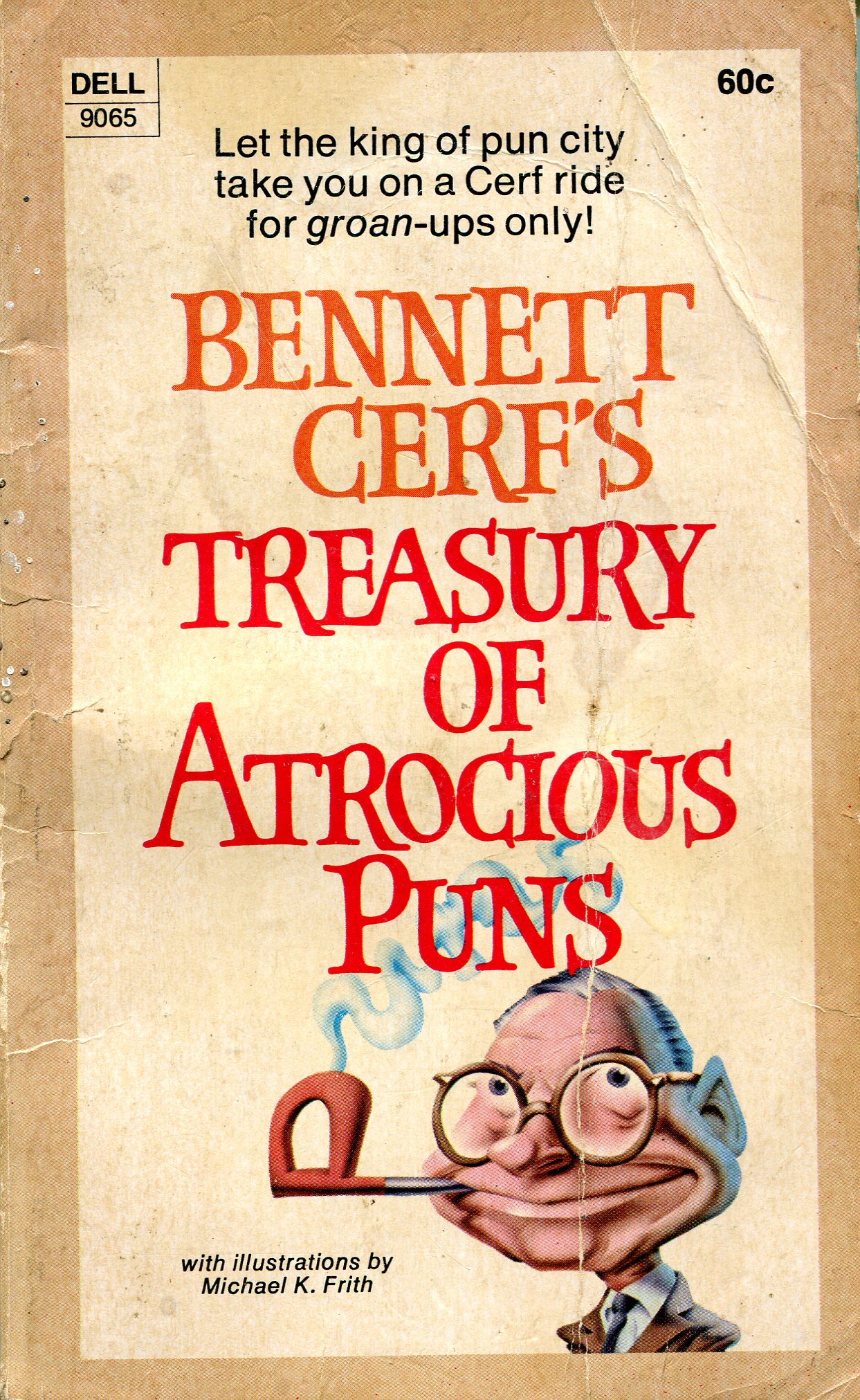
Bennett Cerf’s Treasury of Atrocious Puns

Who knows Bennett Cerf any more? I’d guess that out a 100 randomly picked men and women on the street, the number who did would be a small scattering, if that. Even people my age wouldn’t really have much of a clue, despite United States v. One Book Called Ulysses, which ought to (does?) come up in school.

I might not know much about him myself except for a paperback we had around the house when I was growing up: Bennett Cerf’s Treasury of Atrocious Puns. It was published in 1968, toward the end of Cerf’s life, since he died in 1971 — another reason my cohort wouldn’t know him.

If he’d lived longer and appeared on game shows in the ’70s, maybe we would. He might have taken Wally Cox’s place on the Hollywood Squares when he died. Then again, Cerf was part of the New York literary milieu, and might not have been interested in a California game show.

I brought our copy home from San Antonio not long ago. It’s more amusing than the 1963 topical New Frontier Joke Book, though some of the puns are 1968 topical, too. Such as the captions for a drawing in the book that depicts someone being electrocuted by a wall outlet. Three other people are watching, and their speech balloons say: “A real life wire.” “One of the turned-on generation.” “Socket to me.”

Mostly, though, the punning reflects an earlier 20th-century vintage that isn’t necessarily moored to its time but does expect the audience to know certain things. Such as these lines from Cerf’s introduction: “In Rome, the great Caesar (the roamin’est noble of them all), when asked by his friend Brutus at the Forum one afternoon, ‘How many hamburgers did you consume at luncheon today, Julius?’ couldn’t resist answering, ‘Et two, Brute.’ ”

After the intro — in which Cerf assets that the pun isn’t the lowest form of wit — the book groups its puns into various chapters, including puns about animals, show business, education, sex, food and drink, commerce, health, the law, literature, music, sports and more. There are also puns on signs and punning definitions for words.

Many examples feature a few paragraphs or even half a page of build up before you get to the pun. Mostly more than I want to transcribe, so I’ll do only one — one of the more convoluted examples in the book, I think.

A resourceful Floridian not only harbored four playful porpoises in a pool beside his house, but discovered a way to keep them alive forever. All he had to do was feed them sea gulls.

So he ventured out in Biscayne Bay and trapped a quantity of gulls. When he tried to re-enter his house, however, he found his way blocked by a peace-loving, toothless old lion who had escaped from the zoo and was stretched clear across the doorway. As our intrepid hero jumped over the dormant beast, a posse of game wardens burst from the surrounding shrubbery and took him into custody.

The charge: Transporting gulls across a staid lion for immortal porpoises.

Which, in an aside, Cerf points out is a quintuple pun.

Other puns are shorter. Such as these “Daffynitions.” (By Webster? Noah! Noah!)

Bulldozing: Falling asleep during a political speech.
Disbar: As distinguished from some other bar.
Exchequer: A retired supermarket employee.
Gambit: Bitten in the leg.
Hangover: The wrath of grapes.
Hypotenuse: The washroom upstairs is occupied.
Incongruous: Where the laws are made.
Molasses: Additional girls.
Pasteurize: Something you see moving.
Polygon: A dead parrot.
Ramshackle: A chain used to tie up a he-goat.
Specimen: An Italian astronaut.

Supposed real people and the places they live:

Quoth D. Raven: Never, Mo.
I.M. Phelin: Slightly, Ill.
C.U. Sunday: Early, Mass.

A few of these made me laugh, but mostly — if you have any taste for puns — the book is good for smiles. Except for the puns about sex, which are very dated.

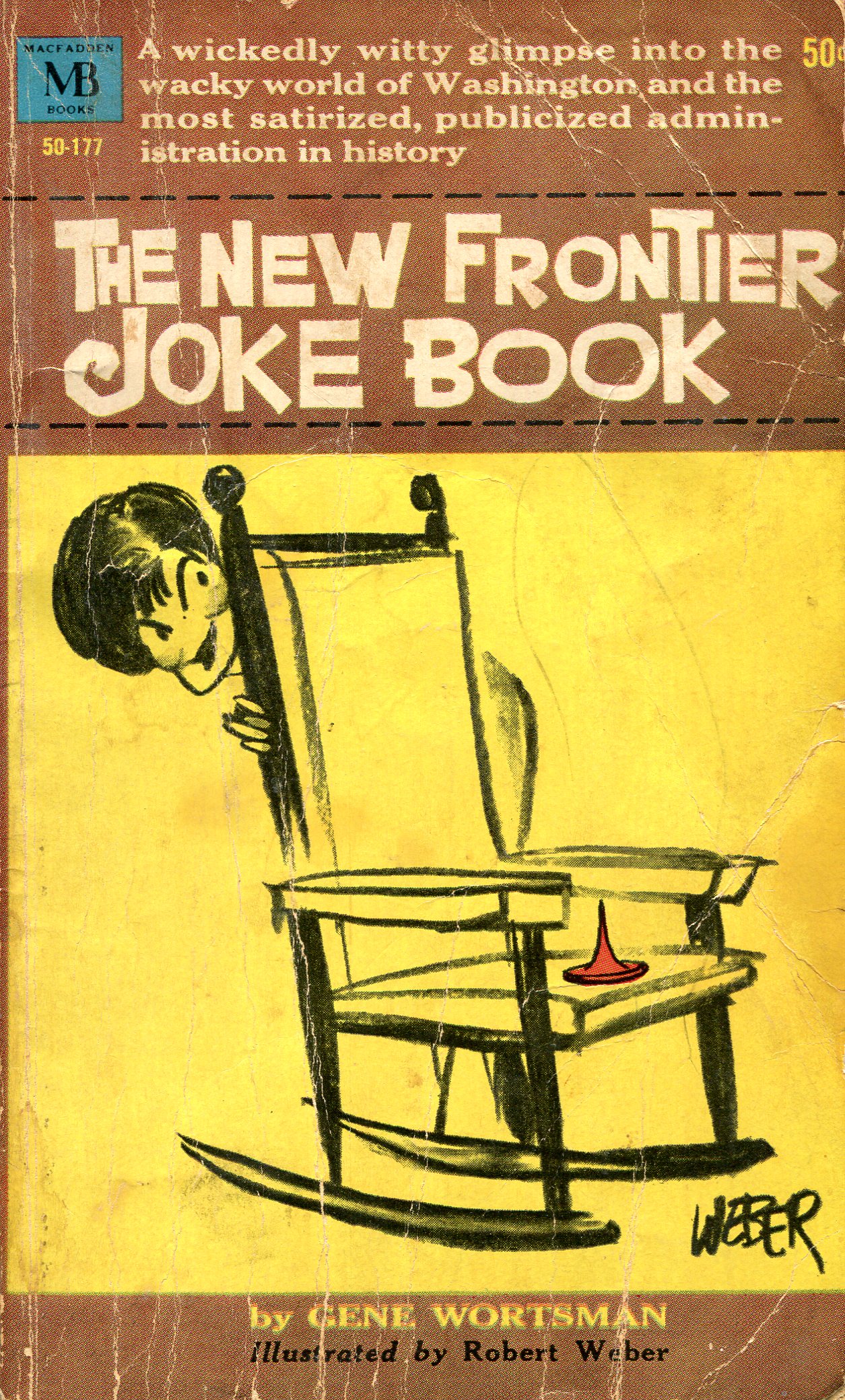
The New Frontier Joke Book

Pick up a book like The New Frontier Joke Book and be reminded that humor doesn’t age well. With some exceptions, of course.

I picked up the paperback at my mother’s house some years ago and now it reposes on one of my bookcases. I assume my parents bought it new. That is to say, in 1963, which is the copyright date. Meaning that not long after it was published, sales fell as flat as Vaughn Meader’s career.

Still, enough copies must have sold to make the book a non-rarity on Amazon in our time. If you want one, you can get it for $2.30. The original price was 50 cents, or about $4.20 in current money.

Gene Wortsman was the author (aggregator, really). He was a newspaperman from Alabama, covering Washington for the Birmingham Post-Herald, which ultimately folded in 2005. Apparently he also wrote a book about Phenix City during the 1950s, which seems like a thing a newspaperman from the region would do, though Ray Jenkins of Columbus, Ga. (who died only last October), was better known for his coverage of Sin City, USA.

The promotional text on the back cover of The New Frontier Joke Book says, “Use this sparkling collection of the newest, brightest, and fanciest quips and cartoons about THAT FAMILY in the White House. Read it aloud, for the delight of your friends. Or save it for your private enjoyment — as a sure cure for the frustrations of thinking about the Cuban situation, income taxes, government spending, or any of the other joys of modern living.”

I thumb through it, looking for something that’s still funny. It isn’t easy. This was worth a chuckle:

“Son,” said a corpulent businessman, “it gives me a glow of pride to know you hate Kennedy the way I hated FDR.”

Other quips are mildly puzzling.

Thanks to Postmaster General Day, the nickel wins the award for the greatest comeback of the decade.

I assume that had something to do with an increase in the price of a first-class stamp.

These days, everyone in Washington wants to know if the President is off his rocker.

Ah, yes. The president was known to spend time in rocking chairs. (Which would account for the book’s cover art.) Bad back, you know. You can still buy one of the style he used for $549.

Some are Johnny Carson sorts of jokes, on his weaker nights.

Averell Harriman went on a mission to Moscow for FDR and a mission to India for JFK. That guy has more missions than the Salvation Army.

It isn’t true that JFK had a locksmith go through the White House and replace all of the Yale locks.

There are jokes about Jackie Kennedy’s wardrobe, the John-Bobby rivalry, the president’s relative youth, taxes, LBJ chaffing at the vice presidency, the size of the Kennedy family, Khrushchev, the space race, etc. etc.

Even one making fun of the Secretary of Agriculture.

So the Yankees are still winning baseball games. The only way to stop them is to put Orville Freeman in charge of their farm system.

Not a very good joke — I think, it’s a little hard to tell at this late date — but I suppose that was better for the secretary than being known for telling a remarkably crude joke.

The First Robo-Call, Others to Follow

A few above-freezing days lately melted our snow cover. That’ll never do, Old Man Winter mutters, and so this morning we had a fresh few inches. At least it’s light snow this time, and proved fairly easy to remove from the driveway and sidewalk.

This was fun to write. Since then, a reader suggested Lex Luthor as a real estate villain. In Superman (1978), he hatched a scheme to sink most of California so his desert land would be the new West Coast, and thus instantly worth a fortune. Not a bad suggestion for a villain.

Still, Luthor’s plot is comic-book logic for you. I’d think the destruction of California would set off a deep economic panic worldwide, and so it might be years before much is developed anywhere. Also, people might be a mite skittish about repopulating the “new” West Coast, even after the economy recovered.

Not long ago, we got the first political robo-call of the year. From an unexpected source. I quote in full:

“Hi, this is Jessica with Mike Bloomberg 2020. We have brand-new yard signs. Will you show your support with a yard sign at your home? Go to w-w-w Mike Bloomberg dotcom slash 2020 slash yard hyphen signs to request one now. Thank you and have a great day. Paid for by Mike Bloomberg 2020.”

The Comics Curmudgeon

During my free moments recently, scant free moments on some days, I’ve been reading the Comics Curmudgeon. It’s a standard blog of long-standing. A fellow named Joshua Fruhlinger posts a selection of daily newspaper comics — to use the quaint old term — and adds commentary. Generally mocking commentary, but unlike so much writing in that vein, he writes well. Some of it is very funny, or at least highly amusing, and often enough thoughtful too.

The range of targeted comics is broad, including what could be called funnies, except they aren’t funny all that much, such as B.C., Beetle Bailey, Crankshaft, Family Circus, Hagar the Horrible, Lockhorns, Marvin, Pluggers, Shoe, Six Chix (one of the few I’d never heard of) and many others. But not, I see from the archives, Broom-Hilda. I guess some things are so bad, yet have so much inexplicable longevity, that mocking them is pointless.

Also lampooned are the few soap-opera or adventure comics that are still around, such as Mary Worth, Mark Trail, The Phantom and Rex Morgan M.D. From the blog I learned that Apartment 3-G expired a few years ago, an event that had completely escaped my notice. Say, whatever happened to Dondi?

Some samples:

Crock, Jan. 3, 2019, has one of the men talking to the fort’s cook: “Psst… the men are planning a coup for Crock.” As the soldier walks away in the second panel, the cook says, “Will they need any snacks or finger food?” (Shouldn’t that be a coup against Crock? Never mind.)

Comics Curmudgeon says: “Crock’s Foreign Legion detachment is based in an isolated fort surrounded by a hostile, barely subjugated colonial population, and so it probably relies on supplies from the metropole to avoid starvation. A violent overthrow of the fort’s commanding officer, no matter how cruel and incompetent he might be, will certainly be seen as an act of rebellion against the French Republic, and so our heroes are likely to be cut off from any outside support, at least until they can successfully negotiate an amnesty. Thus, the coup plotters need to ensure that the fort’s cook and his staff are on their side and prepared for the hardship to come! But they’re being kind of half-assed about it, in my opinion.”

Beetle Bailey, Oct. 10, 2016, has two panels. First, Sarge (in the lead) and Beetle are climbing a steep slope. “Keep going, Beetle! We’re almost to the top!” Sarge says. Beetle simply says, “Groan!”

Next, at a cliff’s edge, Sarge says, “Wow, Beetle! We made it! Congrats!” and slaps Beetle on the back. Beetle is shown flying off the cliff.

CC says: “Welp, looks like Sarge finally just straight-up murdered Beetle! I guess this strip is over now. Looking forward to seeing what new comic they replace it with, or maybe just enjoying the soothing blank space left over when they don’t bother!”

A single panel Heathcliff, July 15, 2013, shows the cat hitting a baseball, using a fish as a bat. The caption says, “He switched to a lighter flounder.”

CC says: “Today’s panel provides something more in line with the profound weirdness bubbling below the surface of this feature’s modern iteration. Cats like fish, and I suppose cats like “playing with their food,” when their food is alive, but instead here the tenuous conceptual cat-fish connection produced a scenario where Heathcliff has a collection of fish of varying densities that he uses as athletic equipment. How dead are these fish, anyway? Are they still floppy? Do they hit the ball with a meaty smack, or have they started to rot, with contact with any projectile producing a cloud of scattered fish-flesh?

On July 22, 2007, he astutely compared Shoe and Get Fuzzy on politics.

“… while usually I go on about just about everything at great length, the most important thing I can say here is that Get Fuzzy is funny, while Shoe isn’t. Shoe falls into the typical toothless trap of just saying “THE POLITICS AREN’T THEY ANNOYING?”, literally allowing the discussion to be replaced by meaningless placeholder syllables. Get Fuzzy works with established character traits — Bucky and Satchel’s party affiliations have been frequently noted, whereas I don’t believe Shoe and the Perfesser had political beliefs until they became necessary for this cartoon. Plus Get Fuzzy contains actual political jokes that are funny. I love the third-party punchline, but I love “Well, with the proper funding…” even more.

1917

A while ago I saw the trailer for 1917, before I knew anything about the movie, or even that such a movie was in the works. Often enough you can judge a movie by its trailer. You know full well that it would be a waste of time. The 1917 trailer didn’t inspire any confidence in me that I wanted to see it. Hell’s bells, World War I is getting the Pearl Harbor treatment, I thought. Lots of brainless CGI.
I was completely wrong. We saw the movie over the weekend and I was astonished by how good it was. Much has been made about how the action seems to happen in real time, in one movie-long shot (117 minutes), though of course the cuts are hidden. In that sense, the film is a technical tour de force, but it’s much more than that.

It’s an Iliad and an Odyssey, following two tommies from their own trenches, across no man’s land, into abandoned German trenches, and into places previously behind the lines, all the while facing the strong likelihood of injury or death. It’s one damn thing after another. It’s suspenseful, since there’s a clear objective whose resolution is always in doubt until the end.

It’s also a work of high verisimilitude, including the maze-like aspects of the trench systems, the danger and gore and misery of WWI battlefields, and the ruins of French villages, but also the pleasant springtime countryside beyond the immediate fighting. The cinematography of some of the scenes, especially the bombed out, smoldering ruins, dazzles the eye.

The back stories of the main characters aren’t fleshed out in much detail, though there is a brief but remarkable discussion of cherry trees as part of one soldier’s personal history — the symbolism of which I did not miss — and a few other intimations of a life outside the war zone. I understand that bothered some critics, but it doesn’t bother me.
This isn’t a Hallmark movie. I don’t want them to sit around discussing their feelings — as if two Great War soldiers on a harrowing mission through some hellish landscapes would do that. You don’t need their details. They’re Everymen, and they’re fully human without the exposition, focused as they are on their own situation. The lead actors conveyed all they needed to about their characters through some dialogue, but mostly their reactions to all that they encounter, not quite all of it the horrors of war.
So 1917 is a remarkable movie in many ways, but not without flaws. I wasn’t sure, for instance, that the central conceit of the mission was even plausible. The two tommies were sent to relay a vitally important order countermanding an attack by an out-of-communication British regiment that had followed the Germans after they had made a tactical retreat to the Hindenburg Line in the spring of the title year.

That two men and two men alone would have been sent on such an incredibly dangerous mission, if it were so important, seems a little strange. Some redundancy would have been called for, to help ensure the message got through. Besides — couldn’t the mission have been accomplished by delivering a message by airplane? Even if a plane couldn’t land in such a forward area, it certainly would have been able to communicate with the ground.

“These early aircraft were not fitted with radio sets, but messages about enemy troop movements needed to be communicated quickly,” the Imperial War Museum explains. “Pilots could either drop messages in weighted bags or use message streamers to drop messages to forces on the ground.”

Never mind. 1917 is an epic story, well worth watching on a big screen. Good work, Mr. Mendes.