The Explorer Test

Lilly told me the other day that she was going to take the EXPLORE test at school. I pretended to hear “explorer” test.

“It’s about time,” I said. “I can help you get ready. Here’s a question: how many men did Shackleton lose on the ill-fated voyage of the Endurance?”

“It’s not that kind of test,” she said.

“None. That’s really amazing, if you know anything about it.”

“I don’t know anything about it.”

“That’s why there need to be tests about explorers. Here’s another one. How many men did John Franklin lose looking for the Northwest Passage?”

“I don’t know who that is either.”

“The answer is all of them. They all died, including Franklin. That’s something you should learn in school.”

The pedestrian truth is that EXPLORE is some kind of ACT prep test. Without a single question about any great explorers, I bet.

Longitude John

I’ve been reading Longitude: The True Story of a Lone Genius Who Solved the Greatest Scientific Problem of His Time by Dava Sobel (1995), which is about John Harrison, solver of the Longitude Problem, and I came across this passage: “Sometime around 1720… Sir Charles Pelham hired [Harrison] to build a tower clock above his new stable at the manor house in Brocklesby Park.

“The clock tower that Harrison completed about 1722 still tells time in Brocklesby Park. It has been running continuously for more than 270 years, except for a brief period in 1884 when workers stopped it for refurbishing.”

Wow. I had to find out if that was still the case, and it seems that it is. That’s a clock tower I would go look at, if I were in the neighborhood. I saw the Harrison chronometers at the Maritime Museum in Greenwich before I had much inkling of what they were or what he did, but finding out things sometimes works that way.

Naturally, specialists are busy revising the legend of John Harrison, including this fellow, who asserts that the clockmaker might have farmed out some of his brass parts. Could well be, though I’m in no position to pass judgment on the matter. But even if it were true, that hardly takes away from Harrison’s achievement.

There’s even a song about John Harrison. That’s what we need more of, songs about generally obscure but remarkably important people, places or events.

Bang, Zoom! Straight to Pluto!

Comet? What comet? Can’t see no stinkin’ comet. Of course, it’s been overcast for a while hereabouts, but maybe when things clear up, I’ll go look for it. Trouble is, suburban lights have a way of washing out the sky, including stray comets, unless they’re really bright. I was amazed to be able to see Hale-Bopp, but it managed to be visible even on the North Side of Chicago.

What’s up with that name, Pan-STARRS (which I’ve also seen as PANSTARRS)? I checked, and it was discovered using a telescope of that name. I was under the impression that comets are named after their discoverers, but perhaps an automated system uncovered this one, though you’d think whoever was directing the research would be honored with the name. Then again, if the scan were really automated, you could call the telescope a sort of discoverer.

Today’s odd bit of information (space related, because checking on Pan-STARRS took me on some tangents): the New Horizons spacecraft, now much closer to the planet Pluto than Earth — 6.76 AU v. 26 AU — carries a visible and infrared imager/spectrometer called Ralph, and an ultraviolent imaging spectrometer called Alice.

Tidbinbilla

Christmas Eve 1991

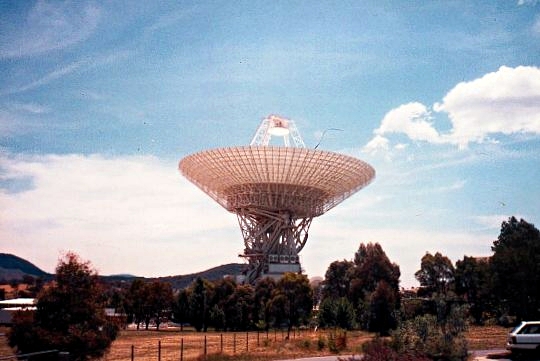
A summer’s day. I bought sun block today. Along with Pete, his brother, and his brother’s enormously pregnant wife, we went to the Tidbinbilla Deep Space Tracking Station southwest of Canberra to take a look at the big dishes and the small museum, which emphasizes Australian, Japanese and European efforts to explore space.

Had a “Jupiter Dog” at the Moon Rock Café. You’d think there would be a Great Red Spot on it somehow, but it mainly featured onions and diced tomatoes (maybe one of those tomatoes counts as the spot). Returned to town the way we had come, winding through hilly bush and flatter farmland. Sometimes emu and kangaroos bounded across the road ahead of us.

Postscript 2012: The formal name of the place is the Canberra Deep Space Communication Complex, and it still functions as one of three stations operated by NASA to keep track of far, far away spacecraft, with the other two in California and Spain. “This strategic placement permits constant observation of spacecraft as the Earth rotates, and helps make the Deep Space Network the largest and most sensitive scientific telecommunications system in the world,” notes NASA.

Space: 2012 (and an Oddity from 2006)

Well worth a look: NBC News, the Year in Pictures. Space edition, which includes the likes of Felix Baumgartner before one of his epic, insane jumps from the edge of space, the aurora australis as seen from orbit, an ethereal enhanced-color image of Saturn, nebulae, views of the Earth and more.

One of the strangest satellites in the history of the space age is about to go into orbit,” noted a NASA press release. “Launch date: Feb. 3rd. [2006] That’s when astronauts onboard the International Space Station (ISS) will hurl an empty spacesuit overboard.

“The spacesuit is the satellite — ‘SuitSat’ for short.

” ‘SuitSat is a Russian brainstorm,’ explains Frank Bauer of NASA’s Goddard Space Flight Center. ‘Some of our Russian partners in the ISS program, mainly a group led by Sergey Samburov, had an idea: Maybe we can turn old spacesuits into useful satellites.’ SuitSat is a first test of that idea.”

I understand that SuitSat broadcast its position for a couple of orbits and eventually burned up upon entering the atmosphere. The rest of the release is here.