1 Ruble, Transnistria

I’ve looked at enough ruble-denominated currency to know what “ruble” looks like in Cyrillic, namely, рубль. This is somebody’s one-ruble note. 
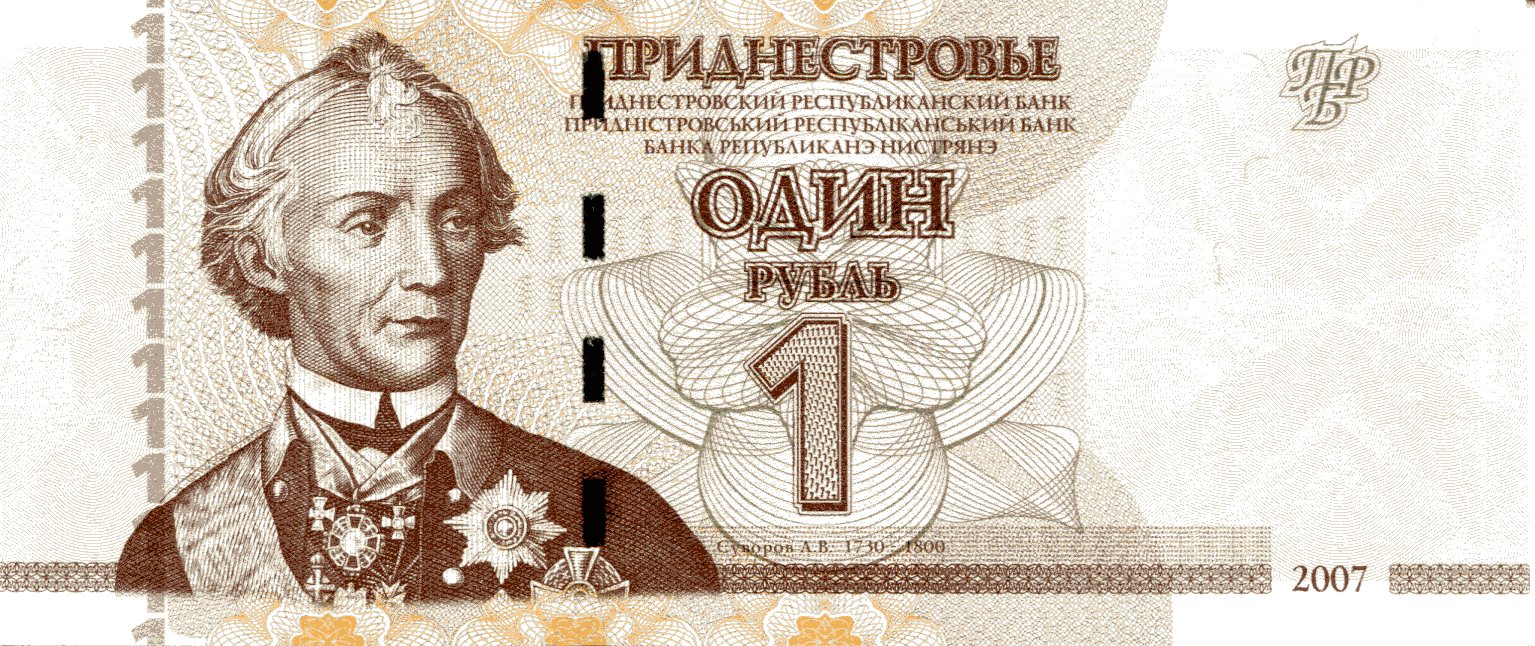
Not Russia, nor Belarus, which are the two nations that currently call their money that. Not the defunct Armenian ruble, Latvian ruble or Tajikistani ruble, either.

Instead, this is a Transnistrian ruble. To the naked eye, and not the scanner, those black rectangles are shiny silver, which I take to be an anti-counterfeiting measure. That inspires the question: who would counterfeit these notes? Perfidious Moldovans?

In news reports, Transnistria is inevitably referred to as a “breakaway” territory from Moldova that’s “Russian backed.” A polite way – and why do we need to be polite? – to call them Russian stooges. The map accompanying this article shows how that might be a geopolitical concern these days.

In any case, internationally unrecognized Transnistria has its own currency, with the one ruble sporting the famed Russian military commander Alexander Vasilyevich Suvorov, who did so much to facilitate his nation’s imperial expansion under Catherine the Great.

Field Marshal Suvorov has a more direct connection with Transnistria, however, since he’s considered the founder of modern Tiraspol, capital of the breakaway territory. He ordered fortifications built on the site late in the 18th century, though the city had antecedents going back to Greek settlement around 600 BC.
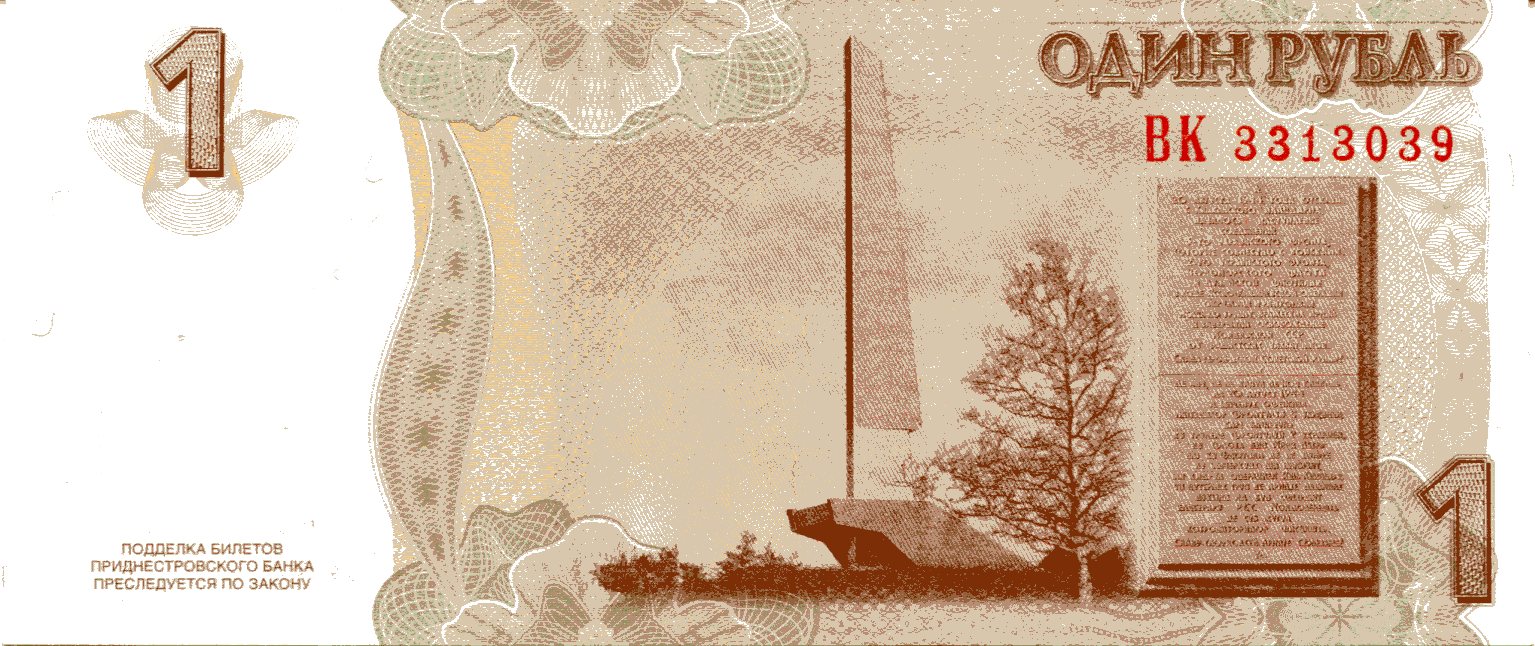
The reverse features an uninspiring image of a monument in Transnistria to one or both of the Jassy-Kishinev offensives of 1944, probably the second, since it was a smashing success for the Red Army and (remarkably) the U.S. Army Air Corps.

“On August 20, 1944, the Soviet Second Ukrainian Front, under the command of General Rodion Malinovsky, and the Third Ukrainian Front, under the command of General Fyodor Tolbukhin, launched a two-pronged attack against German Army South Ukraine…” the National World War II Museum explains.

“By August 23, the German Sixth Army had been surrounded by the two converging Soviet fronts. German air support was nowhere to be found, because it had been eliminated by the United States Fifteenth Air Force.

“While it does not receive a lot of attention, the offensive was one of the most successful joint operations of the war. It was quite an achievement, considering this was only the second time that the Americans and Soviets worked together. Yet you would have to look hard to find literature on the offensive. Perhaps it is time to give the Second Jassy-Kishinev Offensive the attention it deserves.”
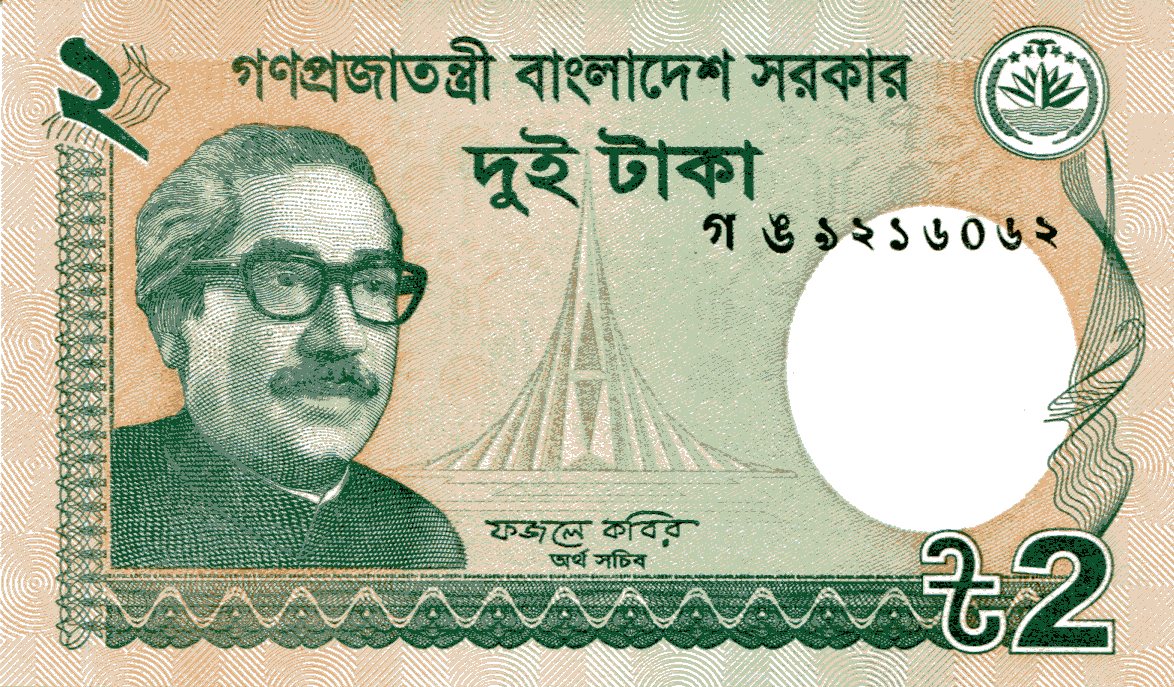
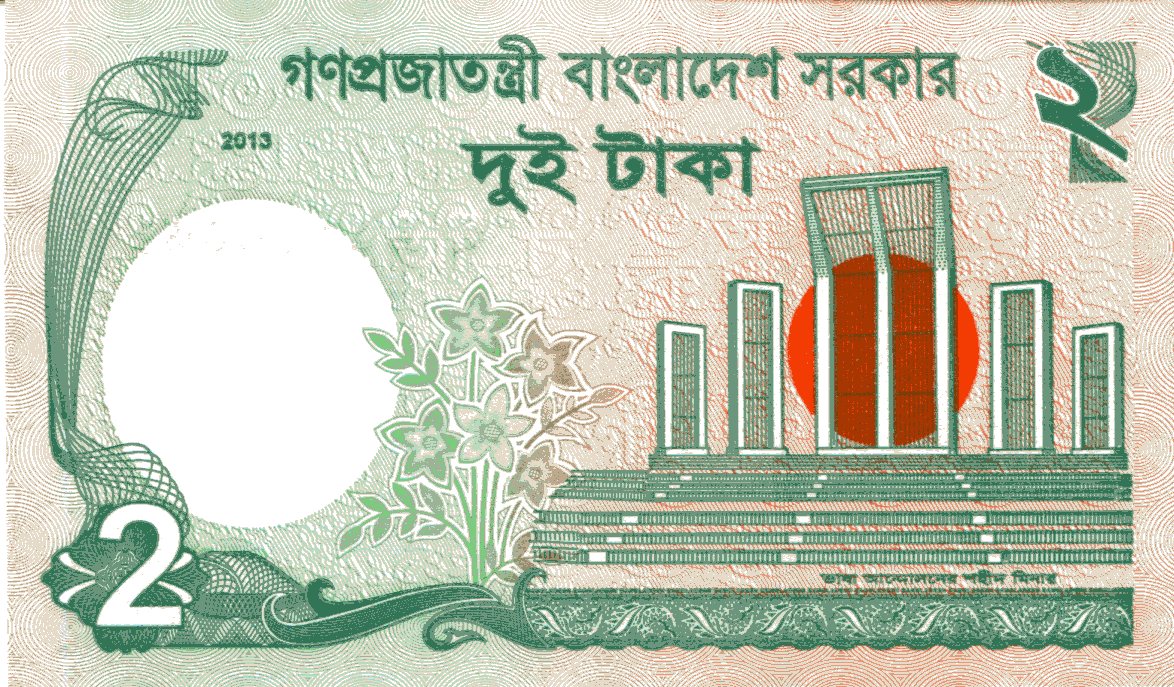
2 Taka, Bangladesh

“Presidents Day” is here again, but no holiday for me. George Washington’s birthday isn’t until Wednesday, anyway. It’s all very well to honor the father of our country, but, like Dr. King, why couldn’t he have been born in some warmer month?

Here’s another banknote of mine without Roman lettering that I decided to identify over the weekend.

No Cyrillic, either. It turned out to be relatively easy to pin down, since most notes tend to feature one or the other, even if a country’s dominant language(s) are in another script. Another useful clue are the Hindu-Arabic numerals for the date, 2013.

It’s a two-taka note from Bangladesh, whose symbol is the curious ৳, which seems to suggest the Bengali script for the word, টাকা, but also a Roman t. Various sources say this note has mostly passed from circulation, replaced by coins. Also, its one-hundredth division, poysha, has evaporated in the heat of decades of inflation. In theory, a 2-taka note is worth just shy of U.S. 2 cents.

Speaking of fathers of nations, though a rather different example, father of Bangladesh Sheikh Mujibur Rahman is on the observe. Next to him is the National Martyrs’ Memorial near Dhaka, commemorating those who died for independence in bloody 1971.

In the upper right corner, the national emblem of Bangladesh. “Located on the emblem is a water lily, that is bordered on two sides by rice sheaves. Above the water lily are four stars and three connected jute leaves,” Wiki notes. Jute may yet have its day as a green fiber.

On the reverse, another memorial to the dead. In this case, the Shaheed Minar (The Martyr Tower) of the Bengali Language Movement, whose day happens to be tomorrow.

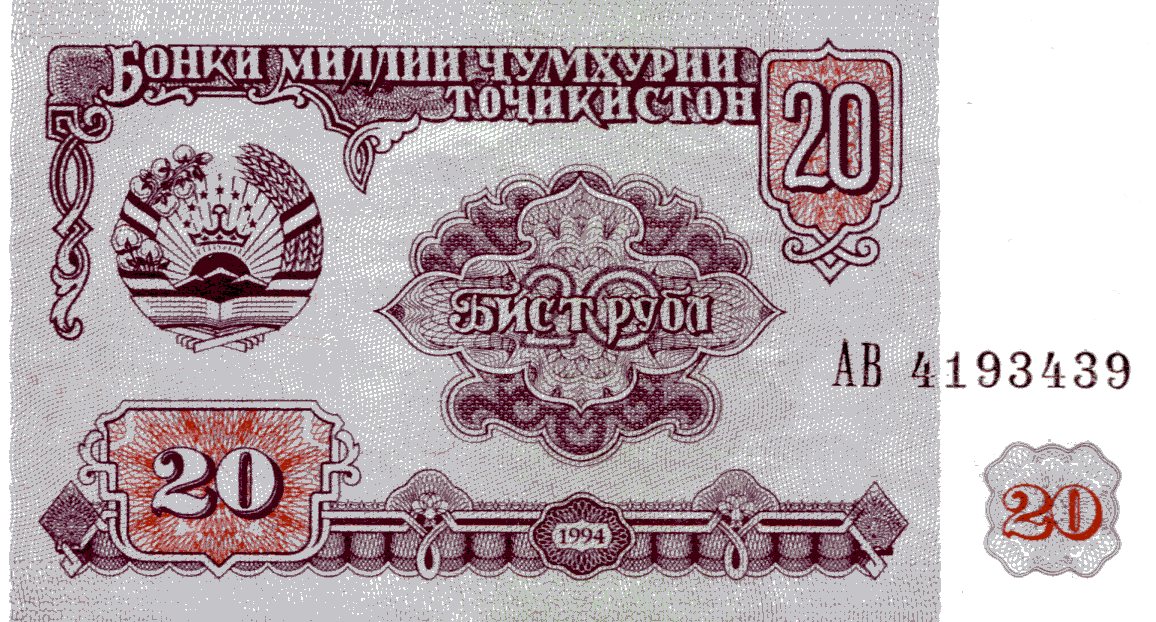
20 Rubles, Tajikistan

When I had something else to do the other day, naturally I decided it was time to find out where this banknote was from.

I’m assuming that’s the obverse. I’ve had it for a while, obtained as part of a package of banknotes from around the world that I bought for a modest sum a few years ago. They’re all of modest value. In many cases, as modest as possible: zero. This is one of those.

The first thing to look up were the nations that use Cyrillic, so I did. Then the flag threw me off, since I took it to be the Hungarian flag. Except Hungarians don’t use Cyrillic. Could there be some quasi-Hungarian entity somewhere that does?

No. Closer examination of the flag – and it is much harder to see with your eye than the scan – revealed a small gold crown topped by stars in the while middle bar. That proved to be the key. Tajikistan’s flag looks like that, so from there I took a quick look at that country’s currency.

These days, Tajikistan’s currency is the somoni, named in honor of Ismoil Somoni, a ninth-century (849-907) potentate of the region I previously knew nothing about.

He isn’t forgotten in Tajikistan. To quote Wiki: “With the end of Soviet rule in Tajikistan, Ismail’s legacy was rehabilitated by the new Tajik state. He is depicted on the SM 100 banknote. Also, the highest mountain in Tajikistan (and in the former Soviet Union) was renamed after Ismail. The mountain was formerly known as Stalin Peak and Communism Peak but was subsequently changed to the Ismoil Somoni Peak.”

So that’s what happened to Communism Peak. I’m sure I learned that was the highest mountain in the Soviet Union years ago – and that it had been Stalin Peak for a while – but hadn’t thought about it since.

The table of recent Tajikistani currency shows that I don’t have a 20 somoni note, because those weren’t issued until 2000. For a few years before that, however, the country used the Tajikistan ruble. That’s what I have.

The building under the flag is the Majlisi Oli, where the parliament of Tajikistan meets, for what it’s worth. Which probably isn’t much, considering that the nation’s strongman, Emomali Rakhmon, née Emomali Sharipovich Rahmonov, runs elections essentially the same way as in the Tajik SSR, to his president-for-life benefit. He apparently runs the country with a dash – more than a dash – of a cult of personality, too. I’m a little surprised he isn’t on the money.

“Poems were read in his honor in parliament, and the state media often compares him to the sun,” Deutsche Welle reports. “All around Tajikistan, posters with pictures and sayings of Rakhmon have been put up. In public, each person must address Rakhmon as Chanobi Oli, or ‘Your Excellency.’ “

Face to Face With a Short Snorter for the First Time

After our walk in the forest on Sunday, we dropped by an antique mall that we visit occasionally, and I saw something I’d read about years earlier, but had never actually seen. And I mean many years ago – maybe as long ago as junior high in the mid-70s, when I was browsing through one of the dictionaries we had at home, as one did before the Internet. I did, anyway.

By chance one day, I happened across the term short snorter. Occasionally afterward I’d mention it to someone else, and no one had ever heard of it. But I didn’t forget. That’s the kind of obscurity worth treasuring. In more recent years, I found mention of them online.

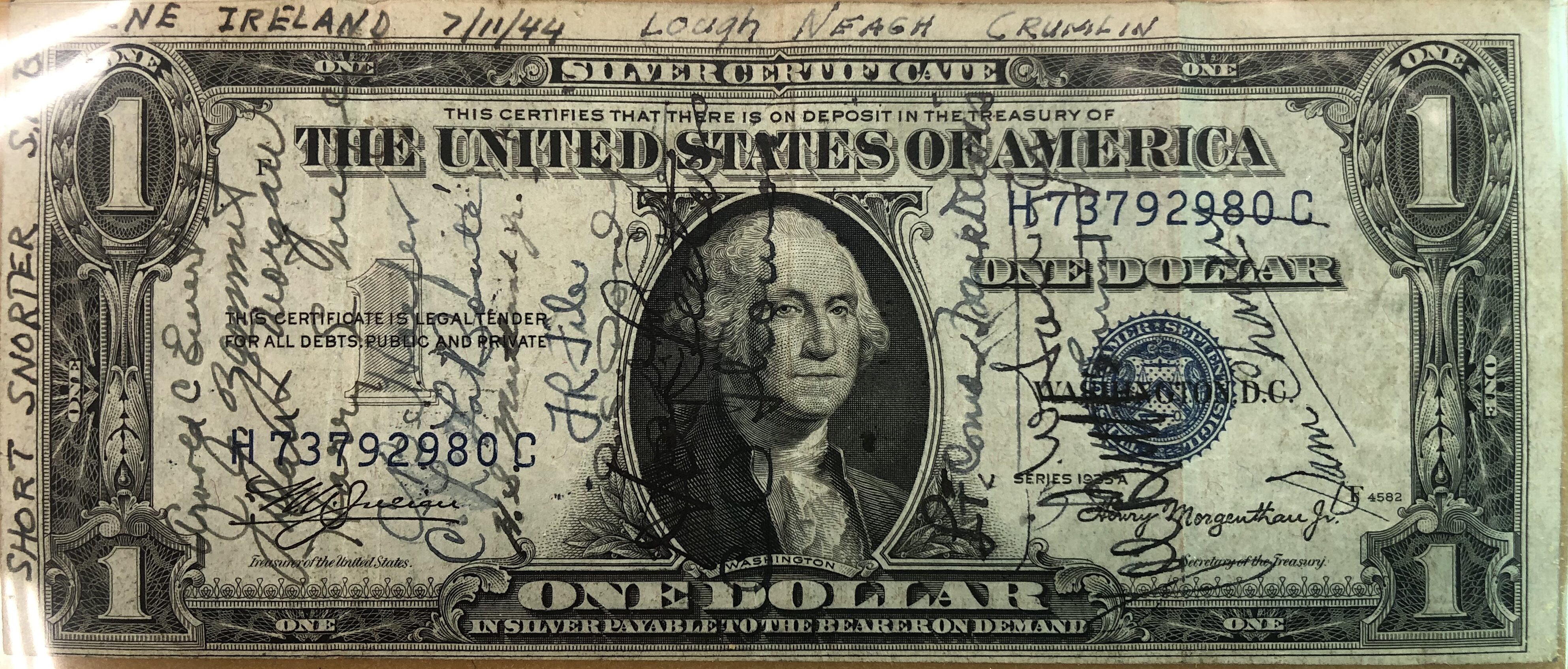
There under glass on Sunday – which accounts for the glare – was a short snorter.

Evidently, this silver certificate began its career as a short snorter on July 11, 1944 at Crumlin, near Lough Neagh, in County Antrim, Northern Ireland.

In our time, naturally, there are web sites devoted to short snorters. Even so, I’m sure that most people still haven’t heard of them, since they seem to have faded after WWII, as lost to time time as A cards.

“A short snorter is a banknote which was signed by various persons traveling together or meeting up at different events and records who was met,” the Short Snorter Project says. “The tradition was started by bush pilots in Alaska in the 1920s and subsequently spread through the growth of military and commercial aviation. If you signed a short snorter and that person could not produce it upon request, they owed you a dollar or a drink.”

Not only was it a real thing, there are short snorters with names, as the page details, such as the General Hoyt Vandenberg Snorter, the Harry Hopkins Snorter and the Yalta Snorter, among others.

The page also claims that “short snorters come to light at coins shops and coin shows where most dealers pay very little for them as they are heavily worn and ‘not very collectible.’ ”

Tell that to the antique dealer offering the note I saw. The asking price: $95. Obscurity worth treasuring, maybe, but I wasn’t inclined to pay that much.

Carson City & The Nevada State Capitol

When visiting a place like Carson City, Nevada, you wonder how many other places are named after Kit Carson. That’s the kind of fleeting question that occurs to me, anyway, and sometimes I remember to look it up later.

I like the conciseness of Britannica on the matter, though it’s short on facts: “Carson’s name is preserved variously throughout the Southwest, including Nevada’s capital at Carson City; Fort Carson, Colorado; and Carson Pass in California.”

The National Park Service has naught to say about the mountain man’s naming legacy, so of course the place to go is Wikipedia. All easily checked facts, grouped in one place.

“Carson National Forest in New Mexico was named for him, as well as a county and a town in Colorado. A river and valley in Nevada are named for Carson as well as the state’s capital, Carson City. The Carson Plain in southwest Arizona was named for him.

“Kit Carson Peak, Colorado in the Sangre de Cristo range, Kit Carson Mesa in Colfax County, New Mexico, and Carson Pass in Alpine county, California, were named for him.

“Fort Carson, Colorado, an army post near Colorado Springs, was named after him during World War II by the popular vote of the men training there… Innumerable streets, businesses, and lesser geographical features were given his name.”

Apparently, so was Kit Carson Park in Taos, NM, and a recent move to change it was defeated for interesting reasons.

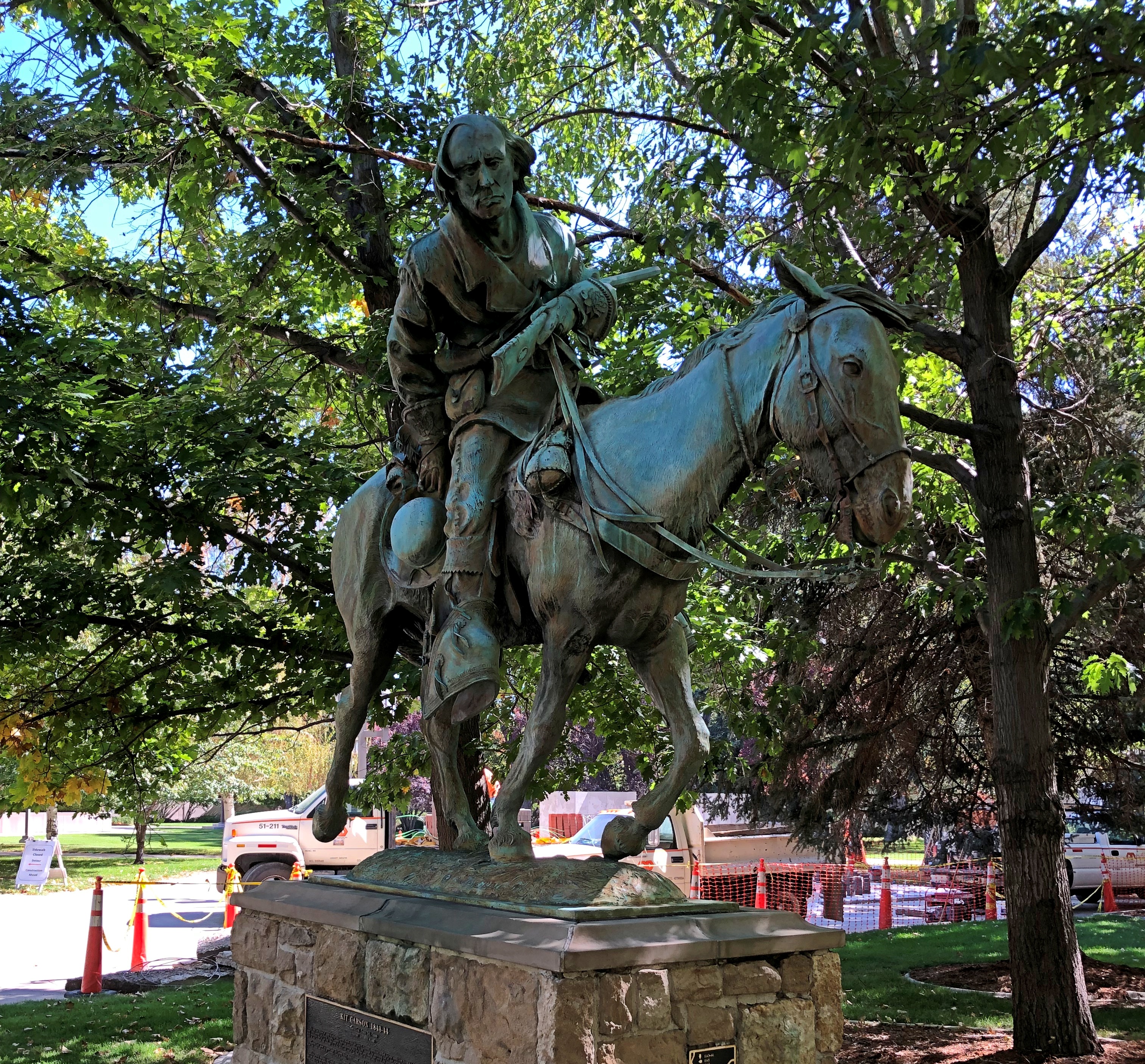
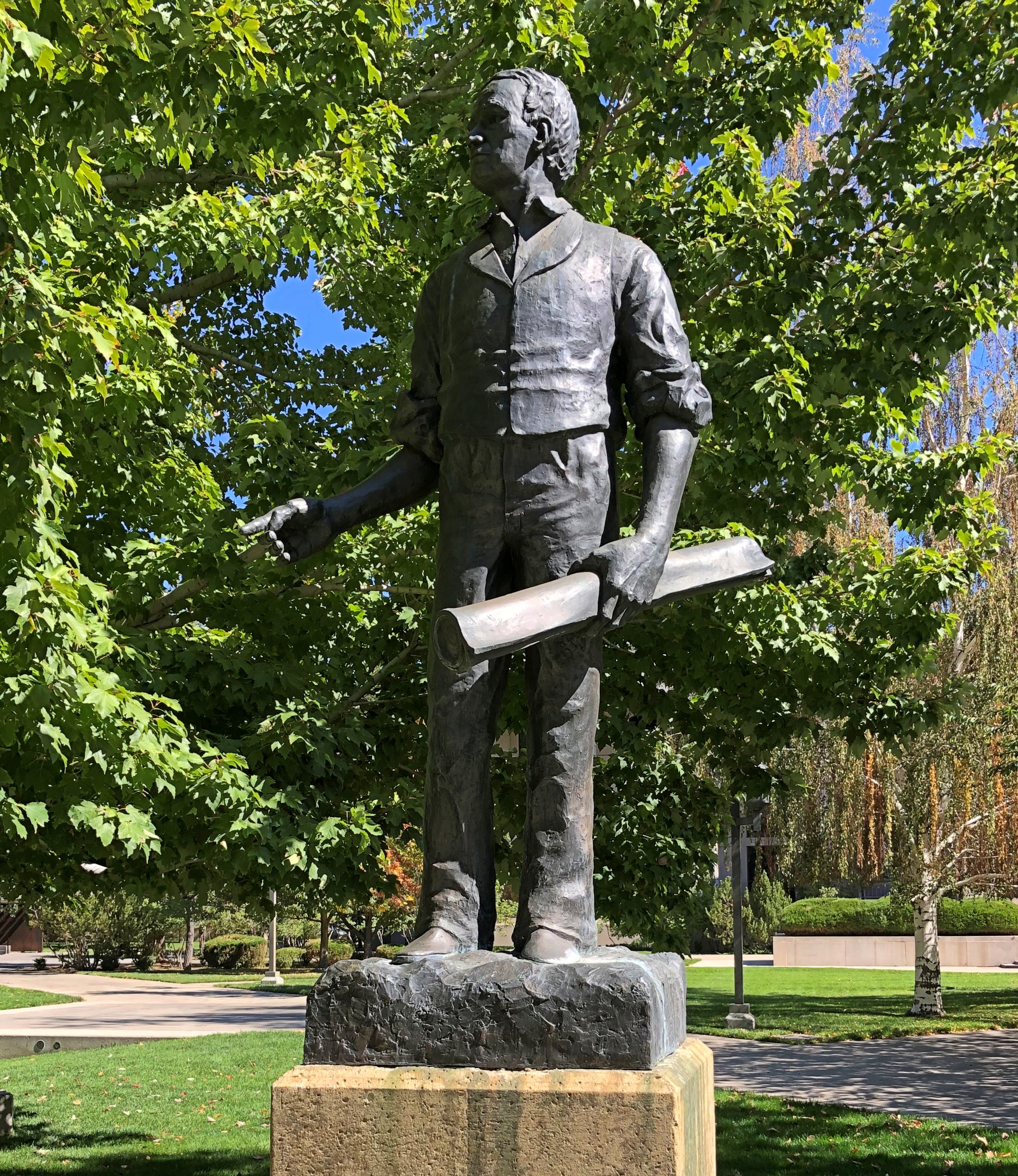
In Carson City, you can see the bronze Kit. He passed this way in the early 1840s, when he was guiding John C. Fremont.Carson City

The inscription: 1843-44, Kit Carson by Buckeye Blake, Commissioned by Truett and Eula Loftin. The Loftins, former casino owners in Carson City, donated the work to the state in 1989.

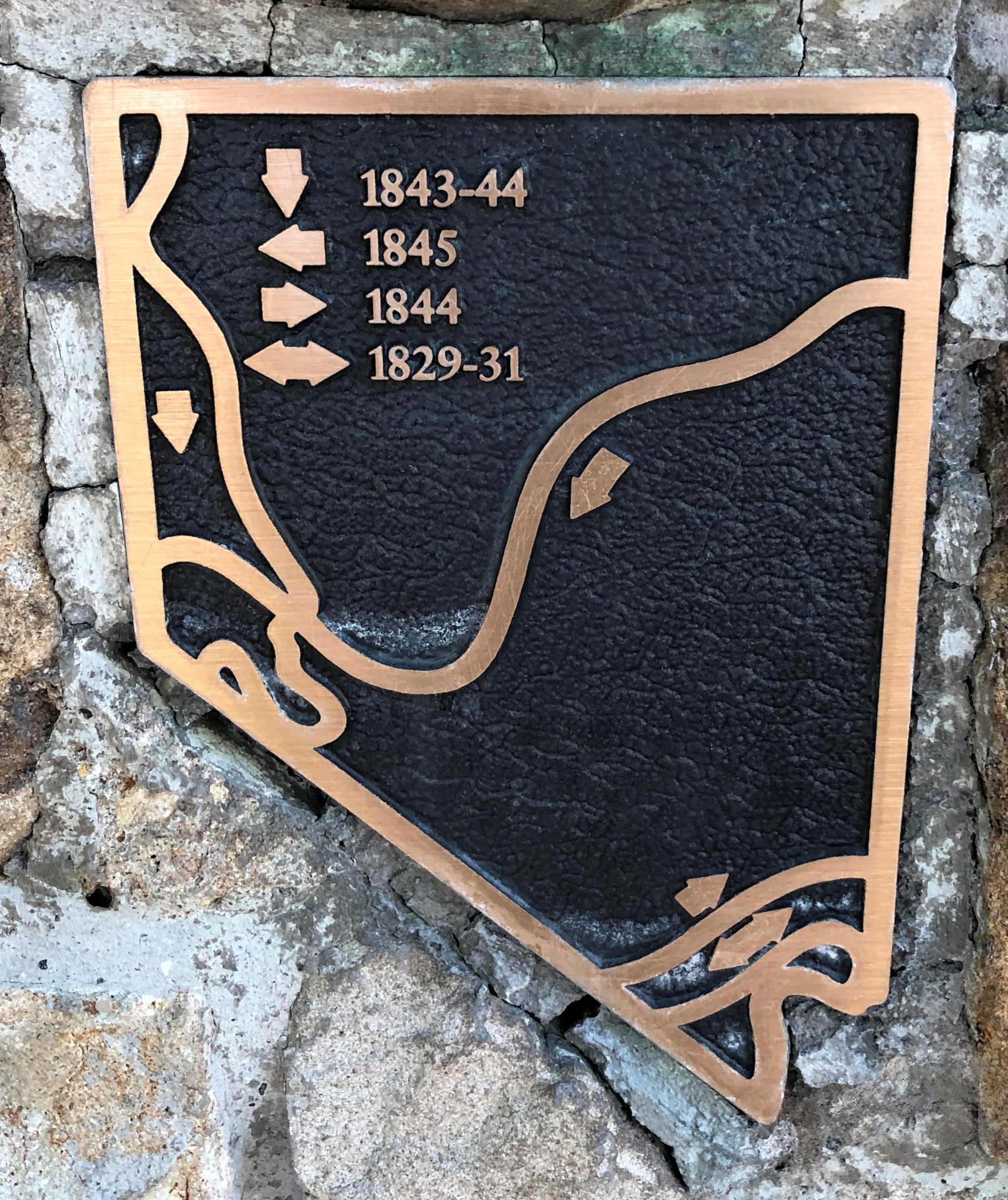
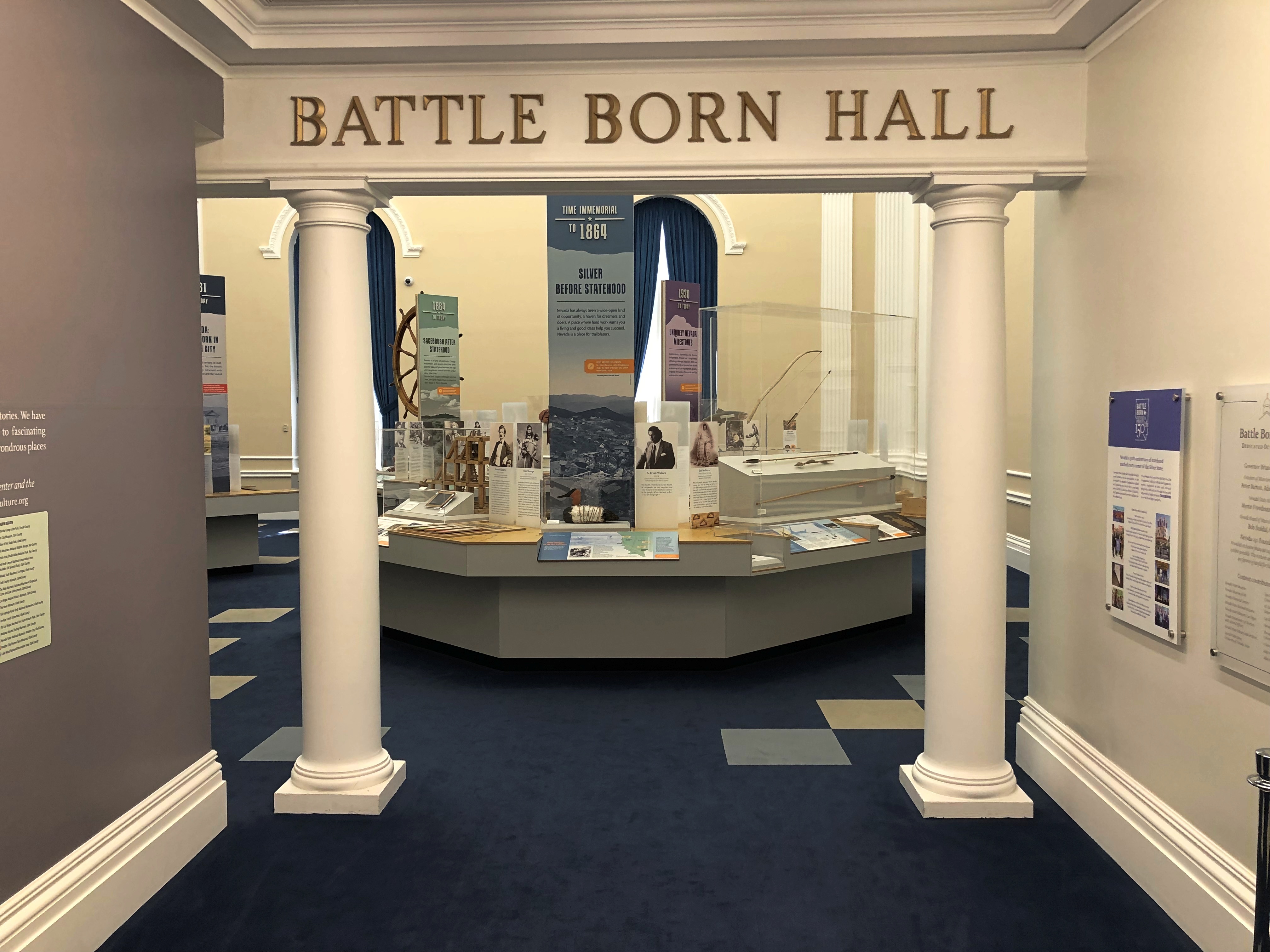
The statue is on the grounds of the Nevada state capitol, along with an unusual plaque imparting geographic information about Carson’s visits to the future state of Nevada.Carson City

Nearby is a man without any national fame, Abraham Curry.Abe Curry

His nickname locally is the “Father of Carson City.” Kit might have passed this way, but Curry stayed. Among many other things, he gave the state the 10 acres on which the capitol stands.

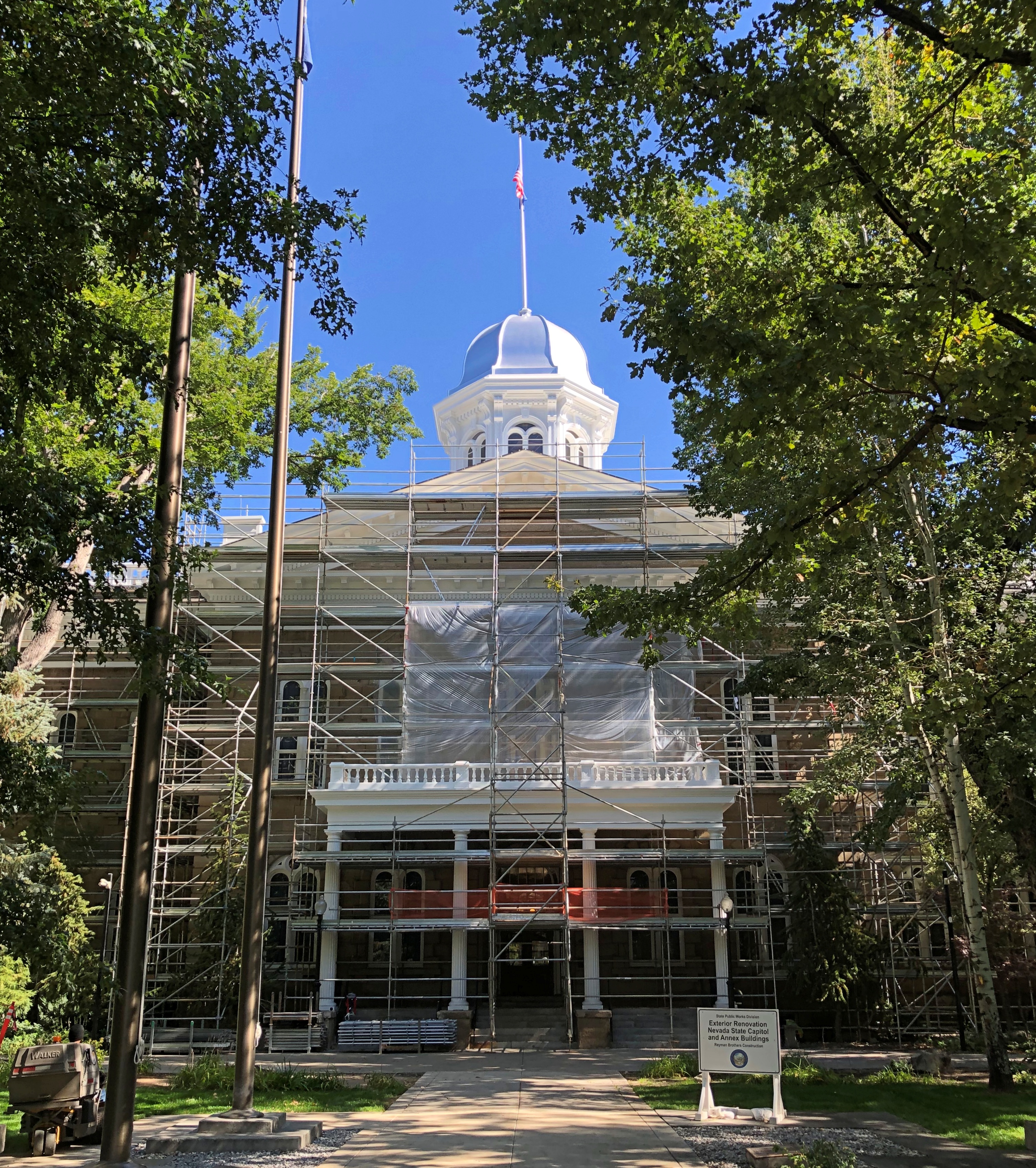
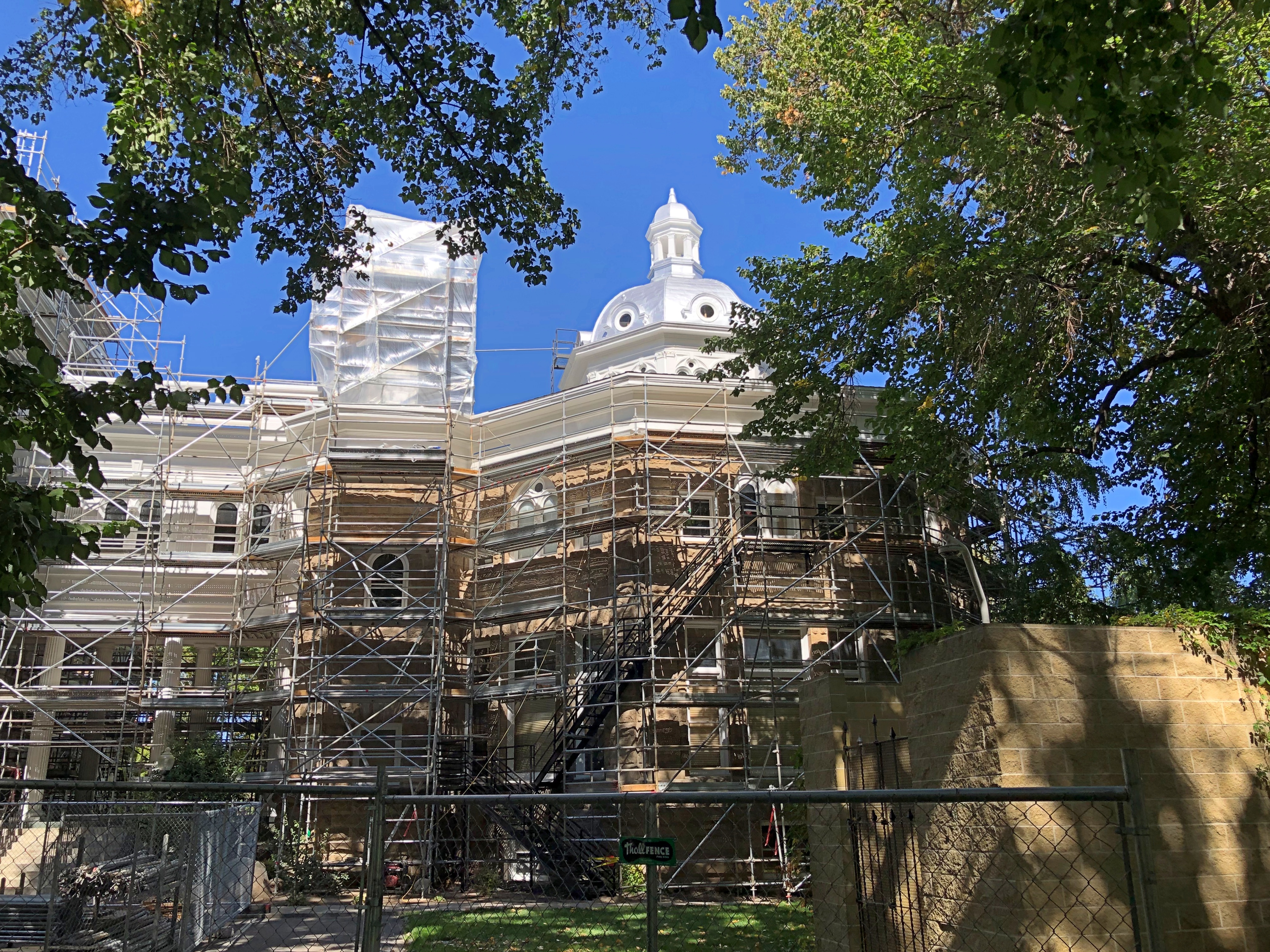
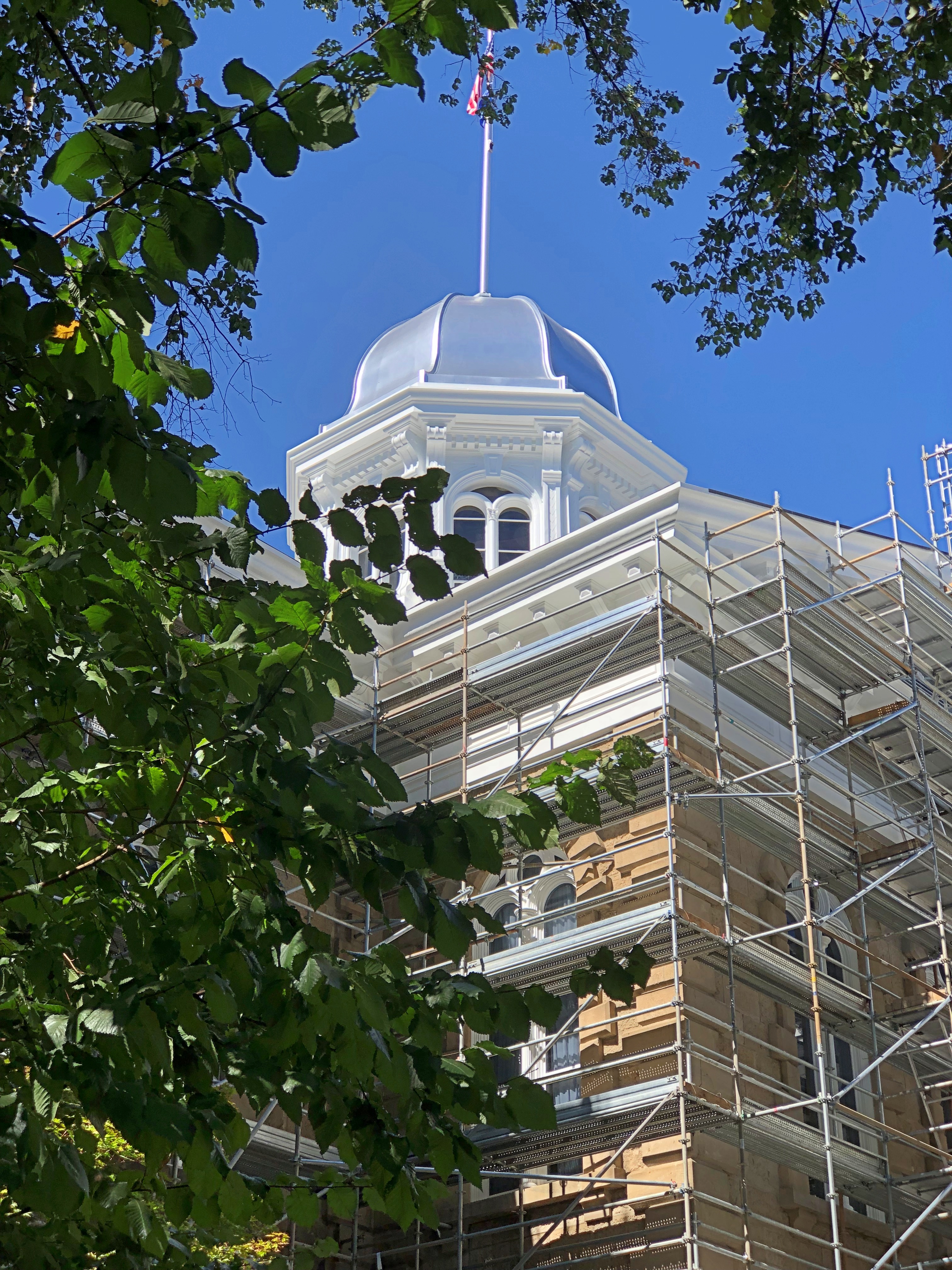
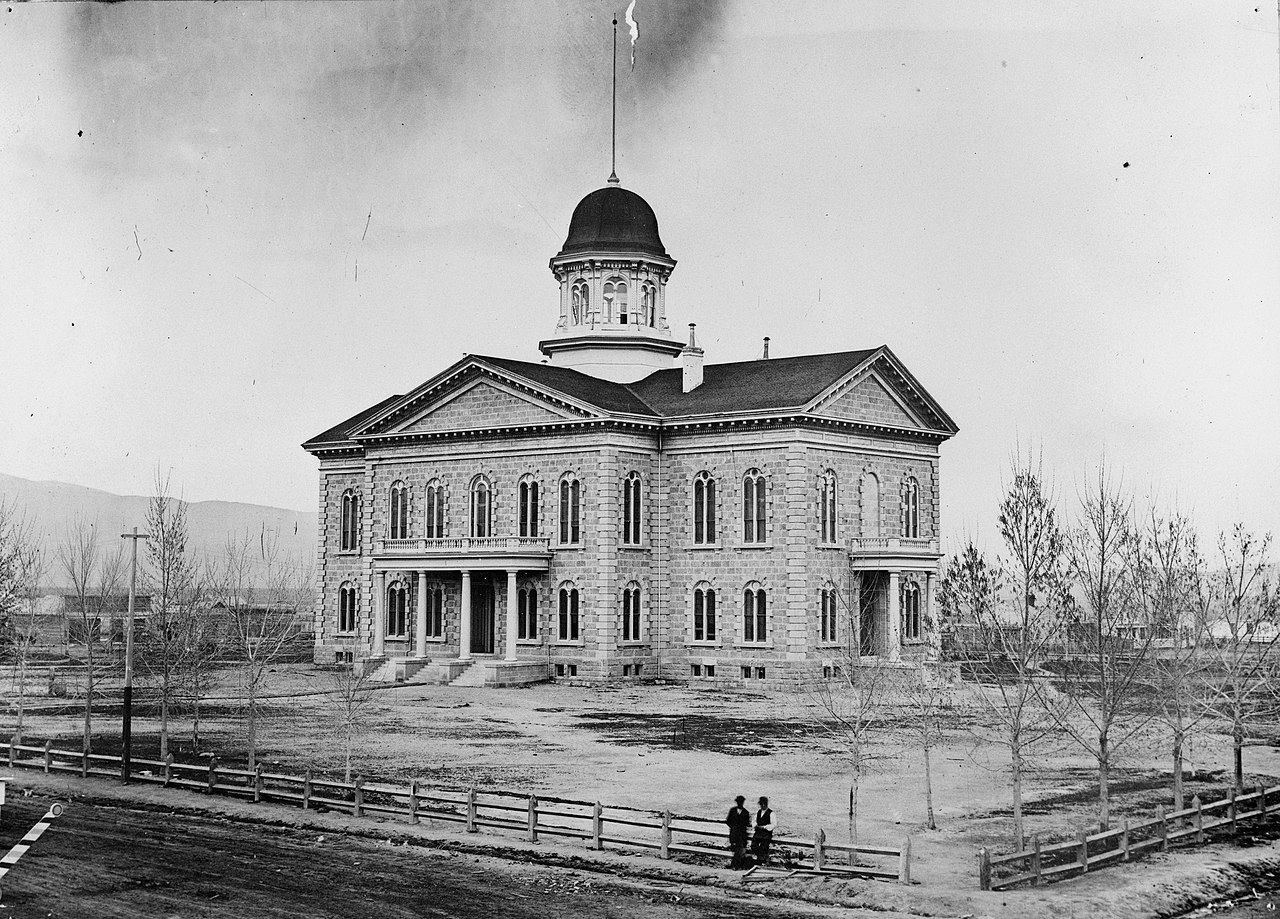
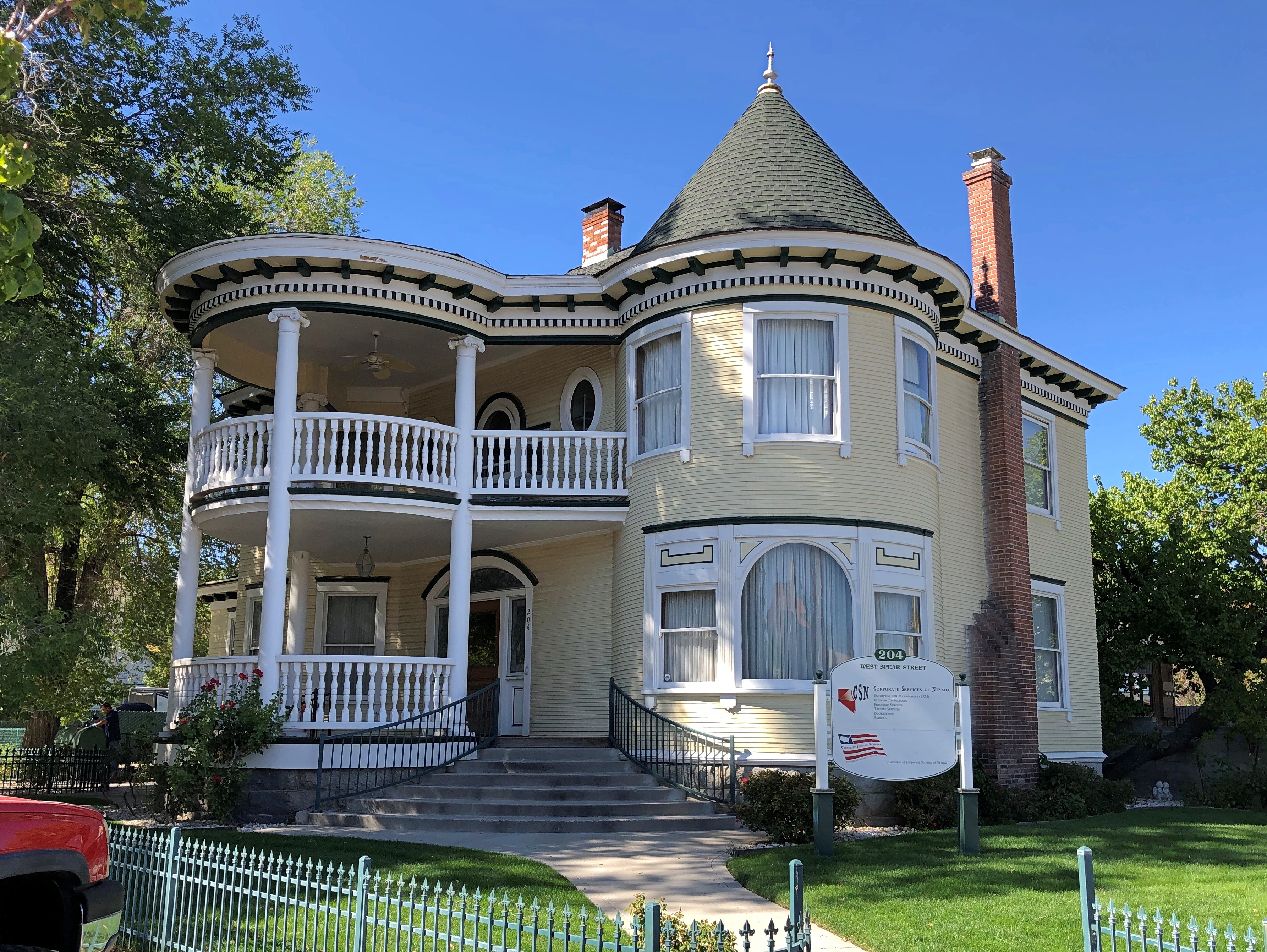
The capitol is a handsome structure, and wouldn’t look out of place as a county courthouse back east. If it were behind scaffolding.Nevada State Capitol

The landscaping is unusual for a capitol, which tend to be clear of trees. Not so for Nevada.Nevada State Capitol Nevada State Capitol

Designed by Joseph Gosling of San Francisco, who is known for a scattering of works. The capitol, completed in 1871, wasn’t always surrounded by trees, such as about 150 years ago.

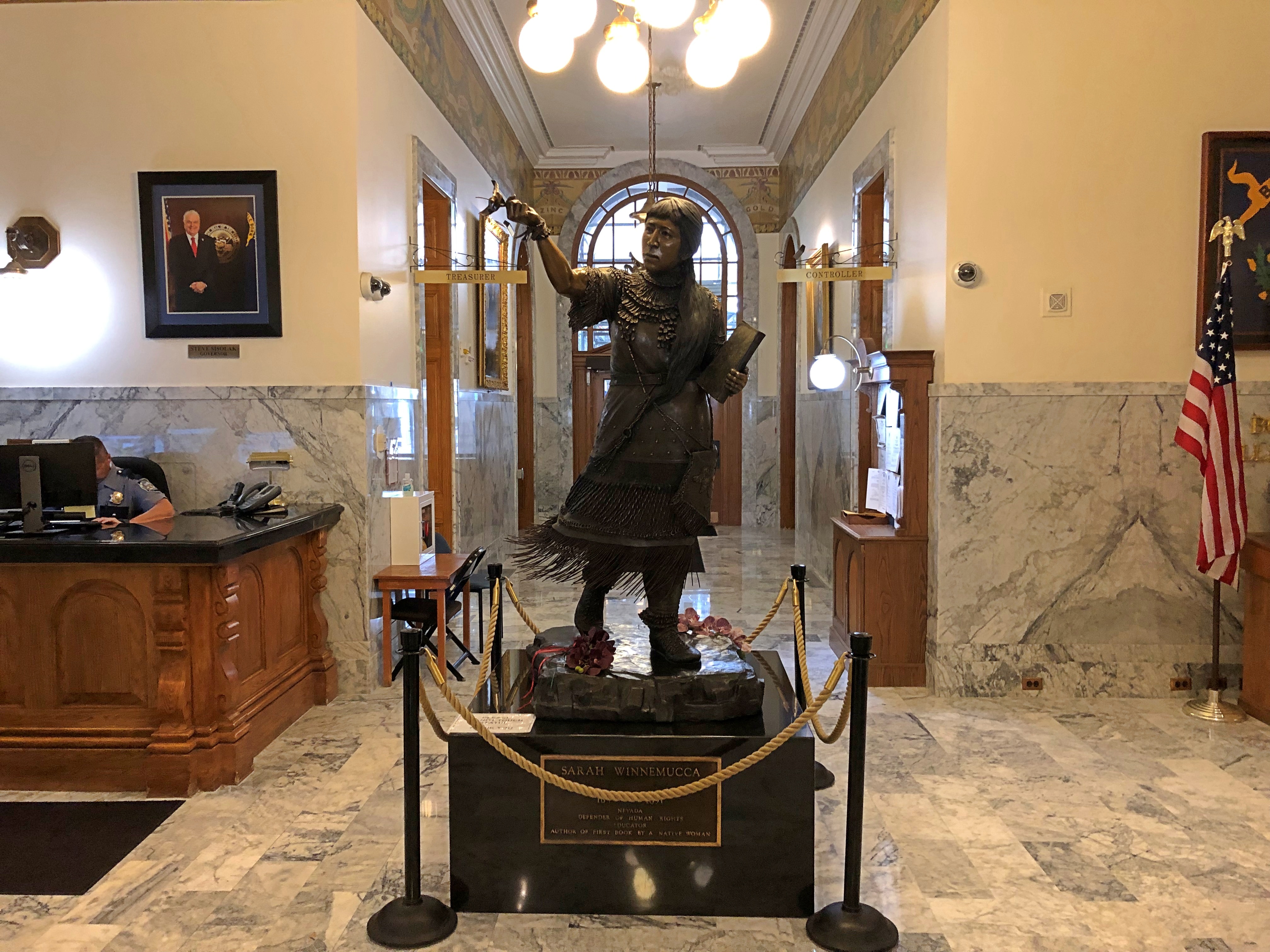
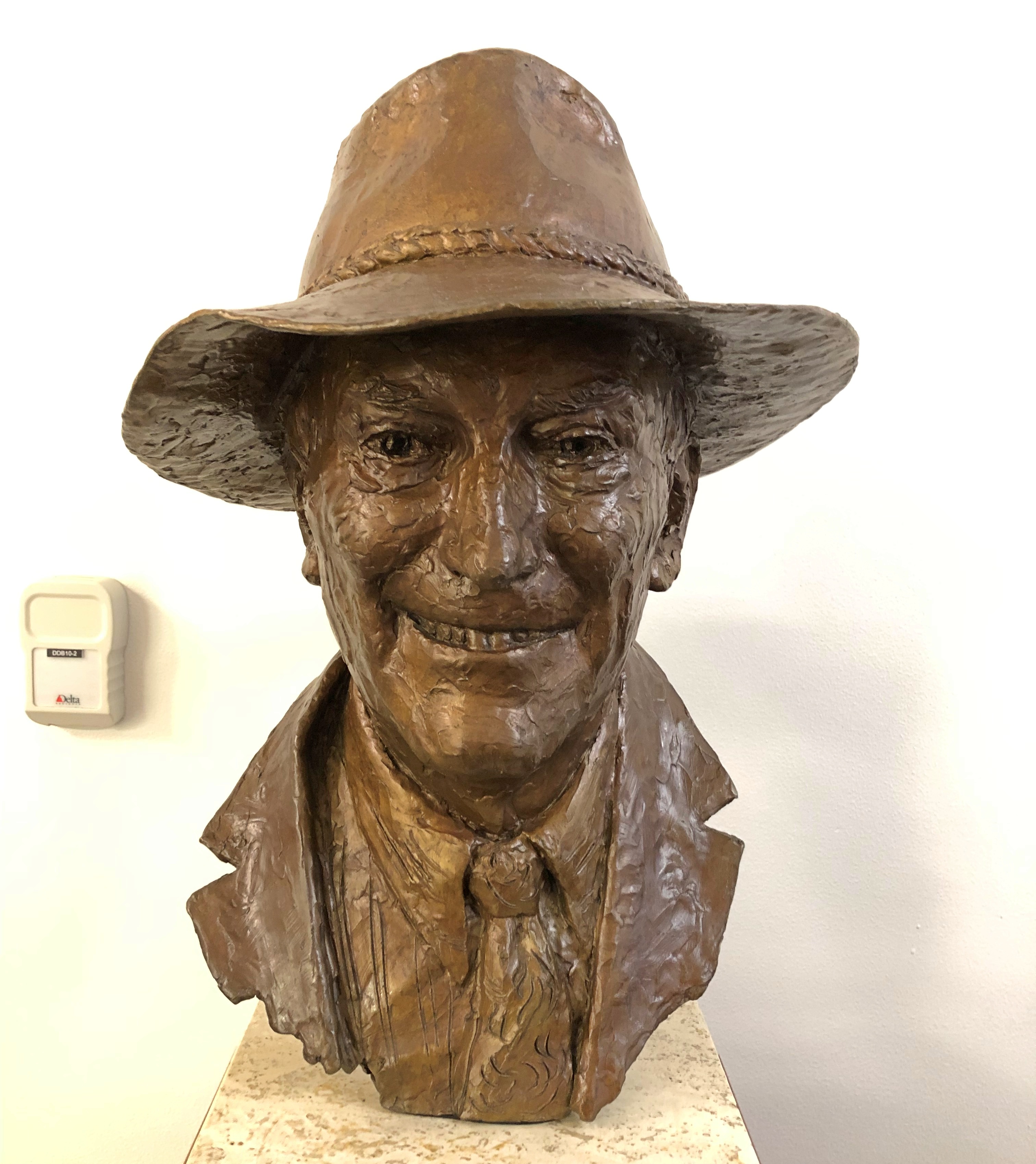
Inside, no metal detectors, though there is a uniformed officer at the desk. There’s also a bronze of Sara Winnemucca Hopkins.Nevada State Capitol

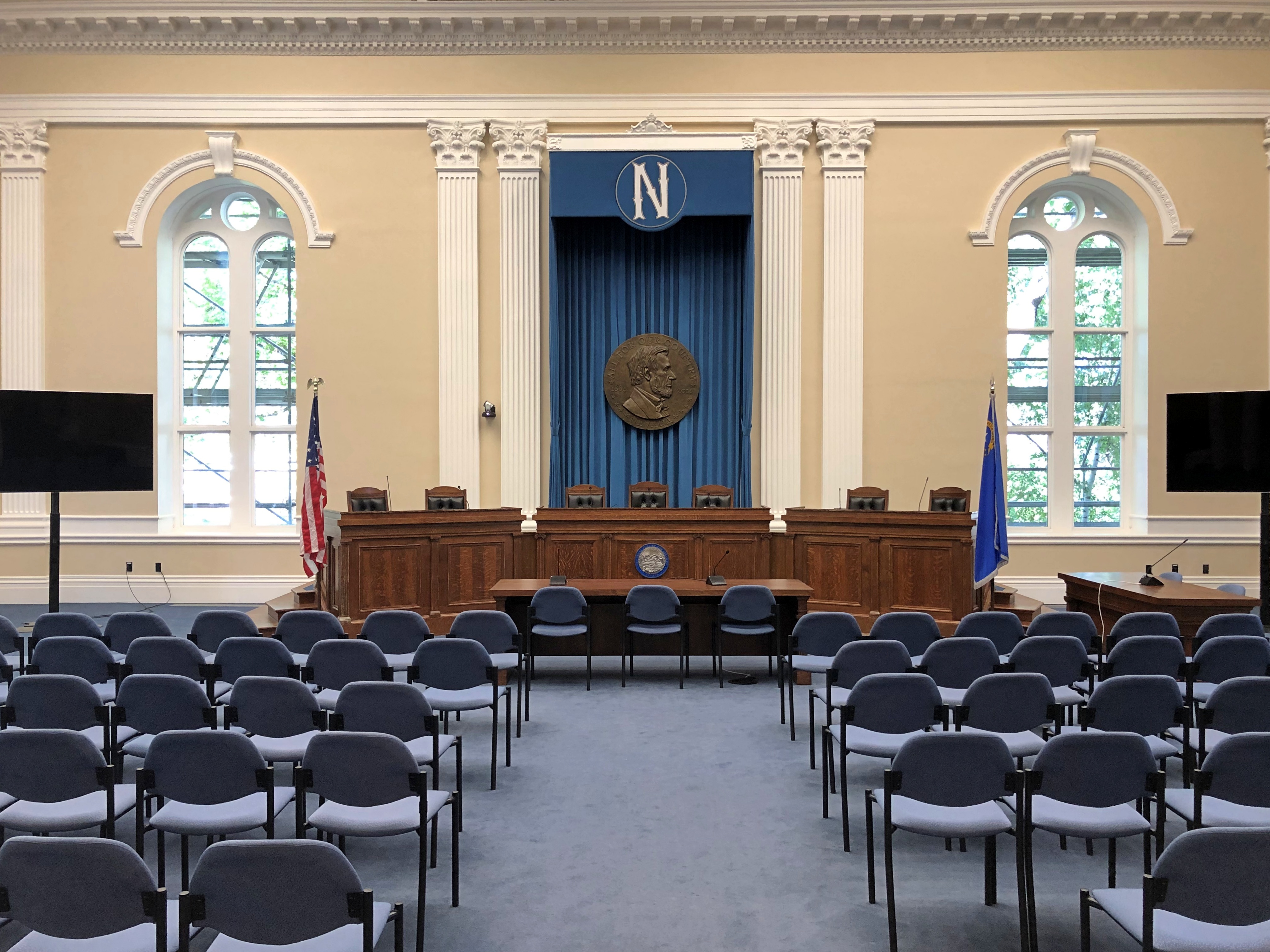
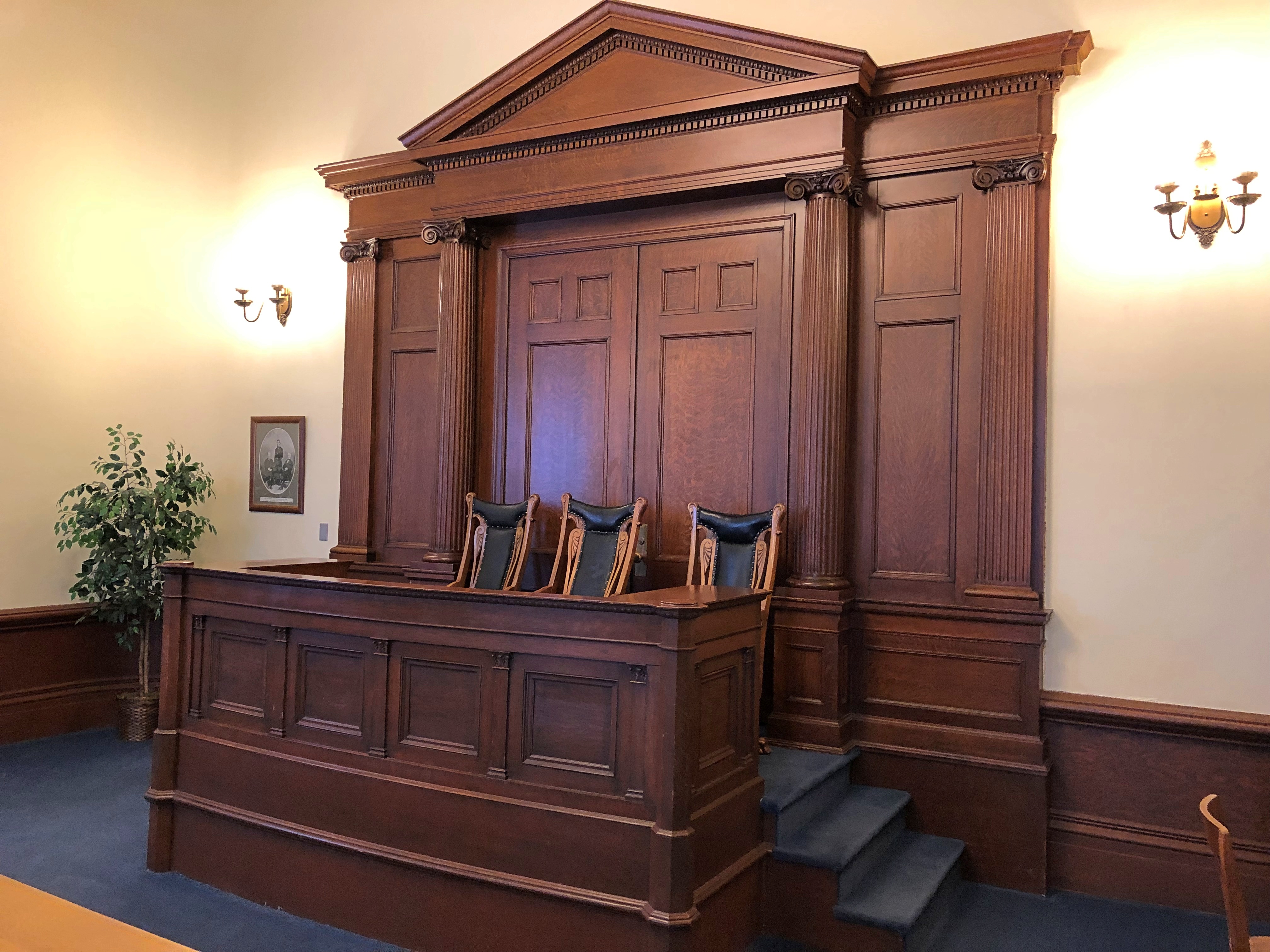
There are a few of the design elements you see in U.S. capitols, but on the whole the capitol is restrained.Nevada State Capitol Nevada State Capitol

One space is given over to museum exhibits.
Nevada State Capitol

Featuring a number of artifacts you aren’t likely to see anywhere else.
Nevada State Capitol

This is Guy Shipler (1913-96), once dean of the capitol press corps. Good to see a journalist honored.Nevada State Capitol

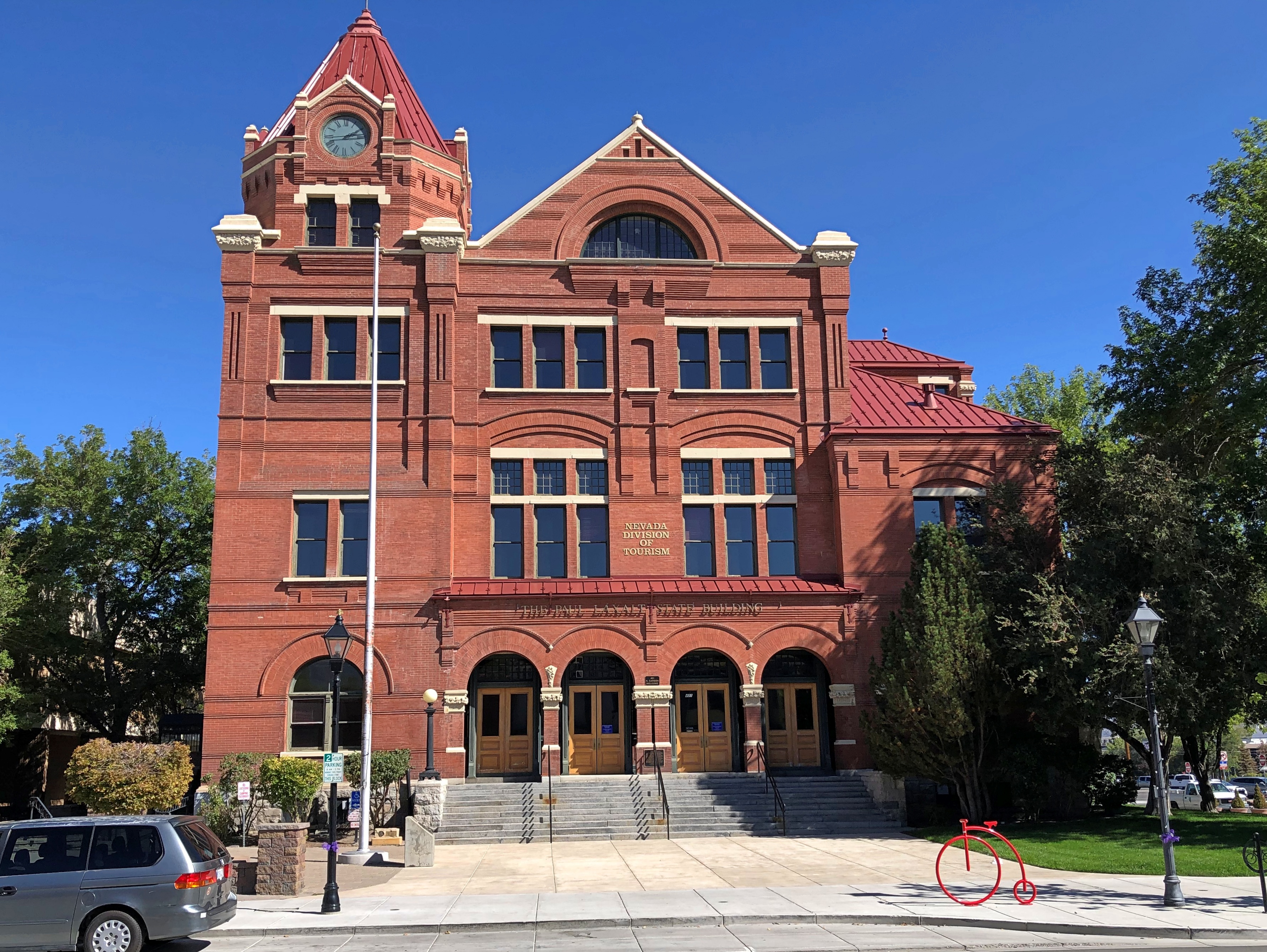
The capitol is on N. Carson St. I took a stroll down that street and a couple of connecting streets. A number of state buildings cluster around Carson St. These days, this building houses the Nevada Department of Tourism.Carson City

Dating from 1891 as a federal edifice, it has variously been home to the Carson City Post Office, Land Office, Weather Bureau and U.S. District Court.

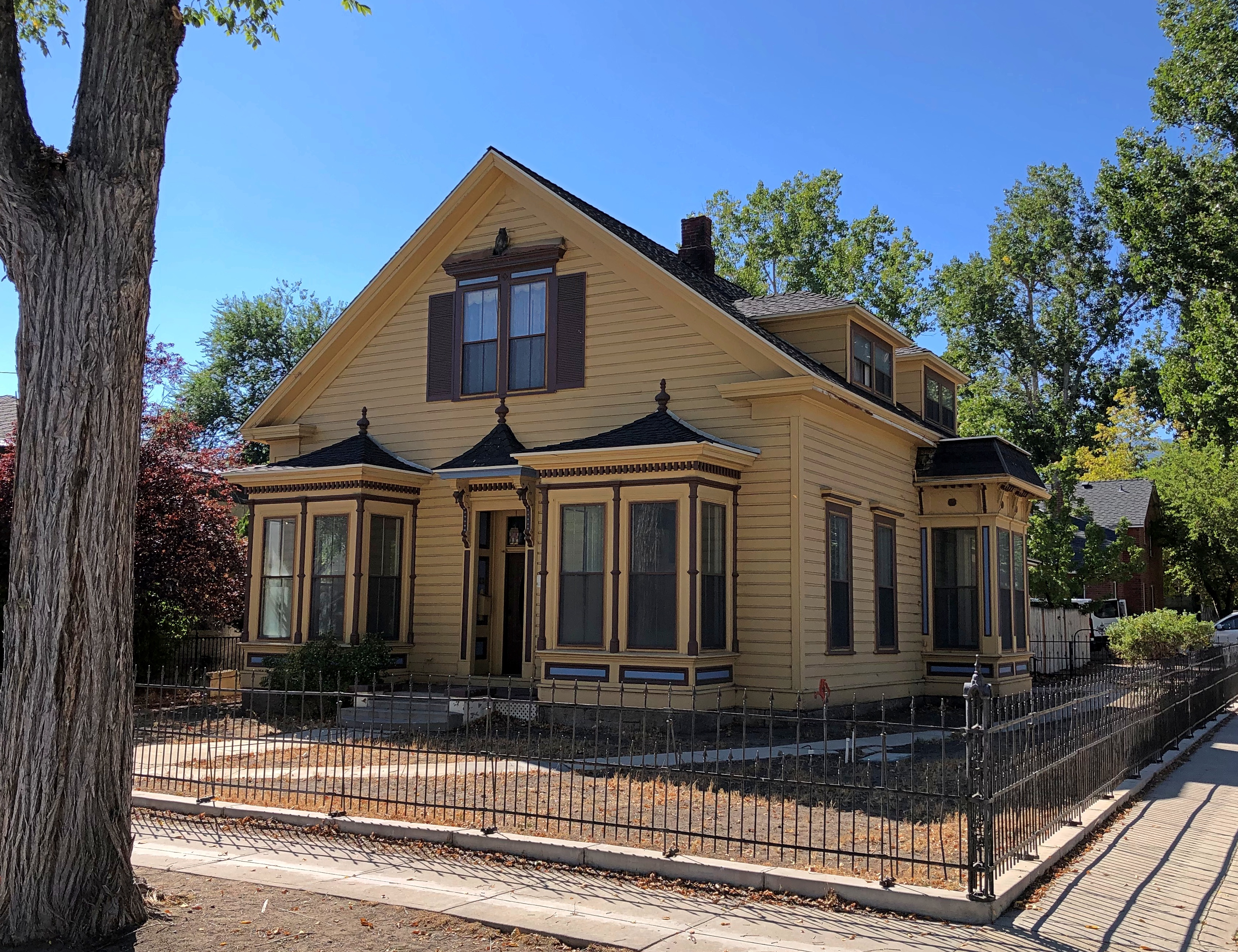
A few other Carson City buildings pleasing to the eye.Nevada State Museum Nevada State Museum

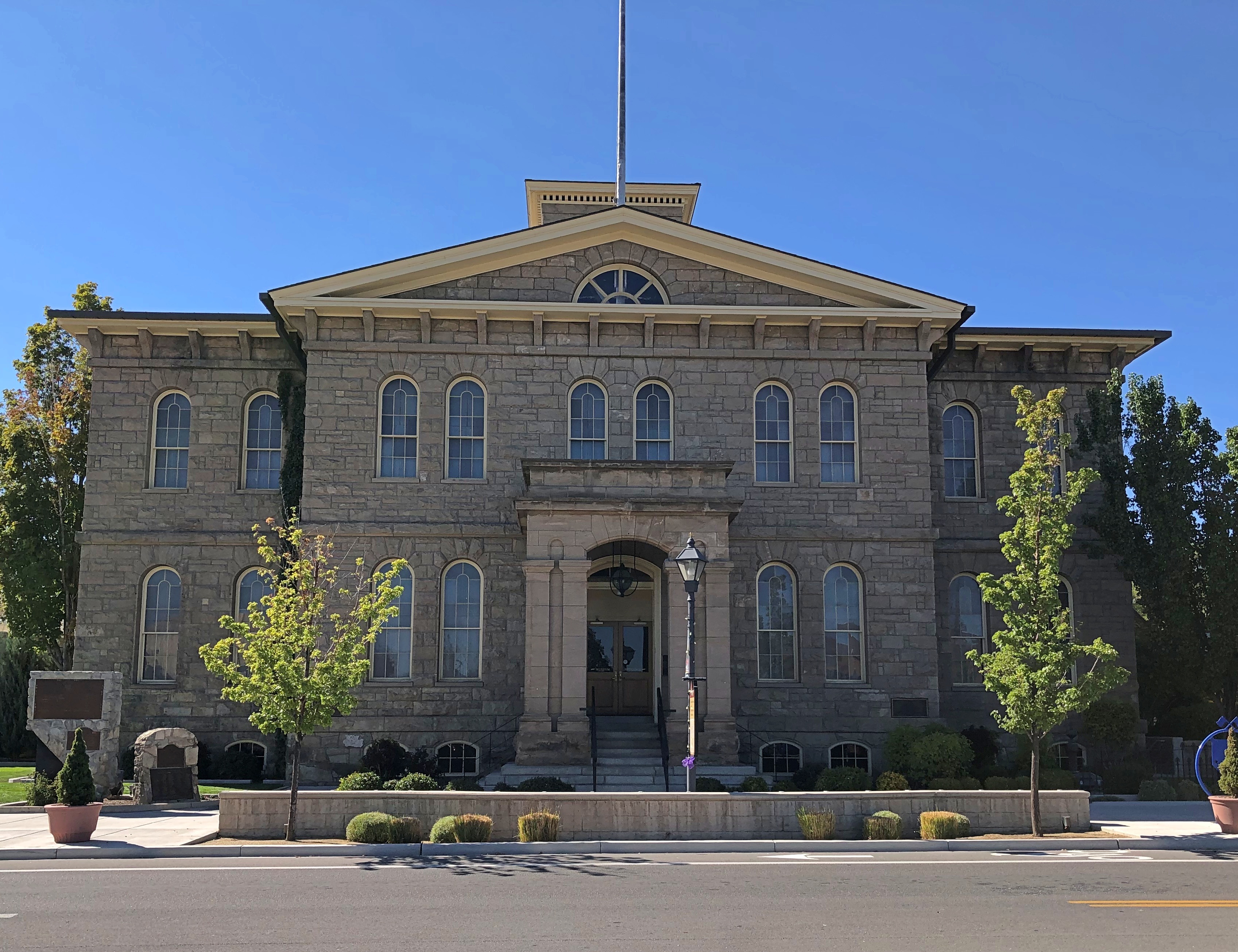
The Nevada State Museum includes this building, the former Carson City Mint. It was closed for Monday.Nevada State Museum

It’s important (to me) to list the coin types made there from 1870 to ’93. In silver: Seated Liberty dimes, 20-cent pieces, Seated Liberty quarters, half dollars, and dollars, Trade dollars and Morgan dollars. In gold: Half Eagles, Eagles and Double Eagles.

RIP, Your Majesty

On occasions like this, it’s fitting even for citizens of a republic to say, Long Live the King!

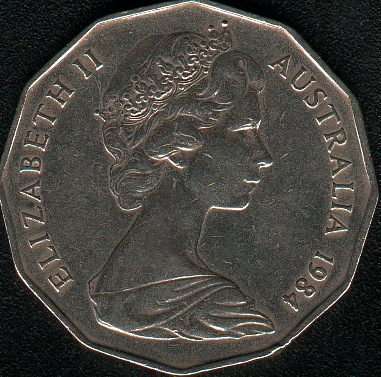
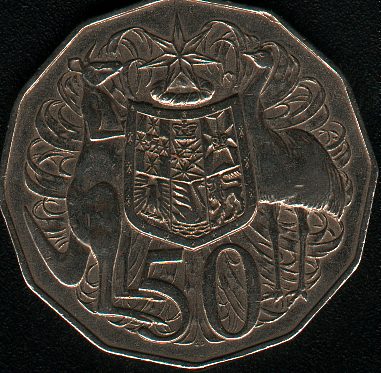
Here’s the image of Elizabeth II that I like best.

That’s for strictly personal reasons: I picked the coin up in change in Australia over 30 years ago.

I was glad to see 50-cent pieces in circulation somewhere.

Thursday Grab Box

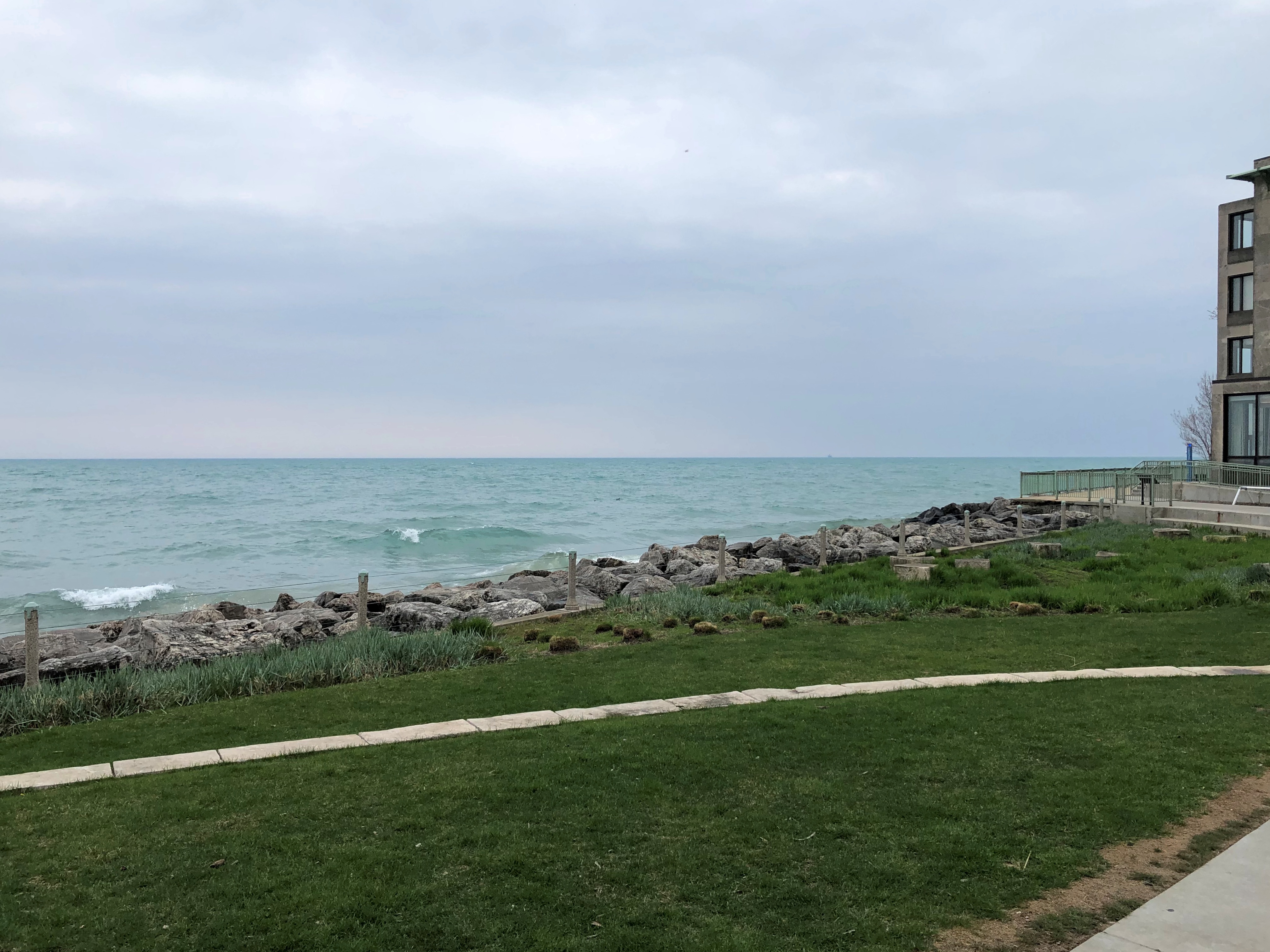
Lake Michigan was active but not stormy on Saturday. Views from Loyola.Lake Michigan 2022 Lake Michigan 2022

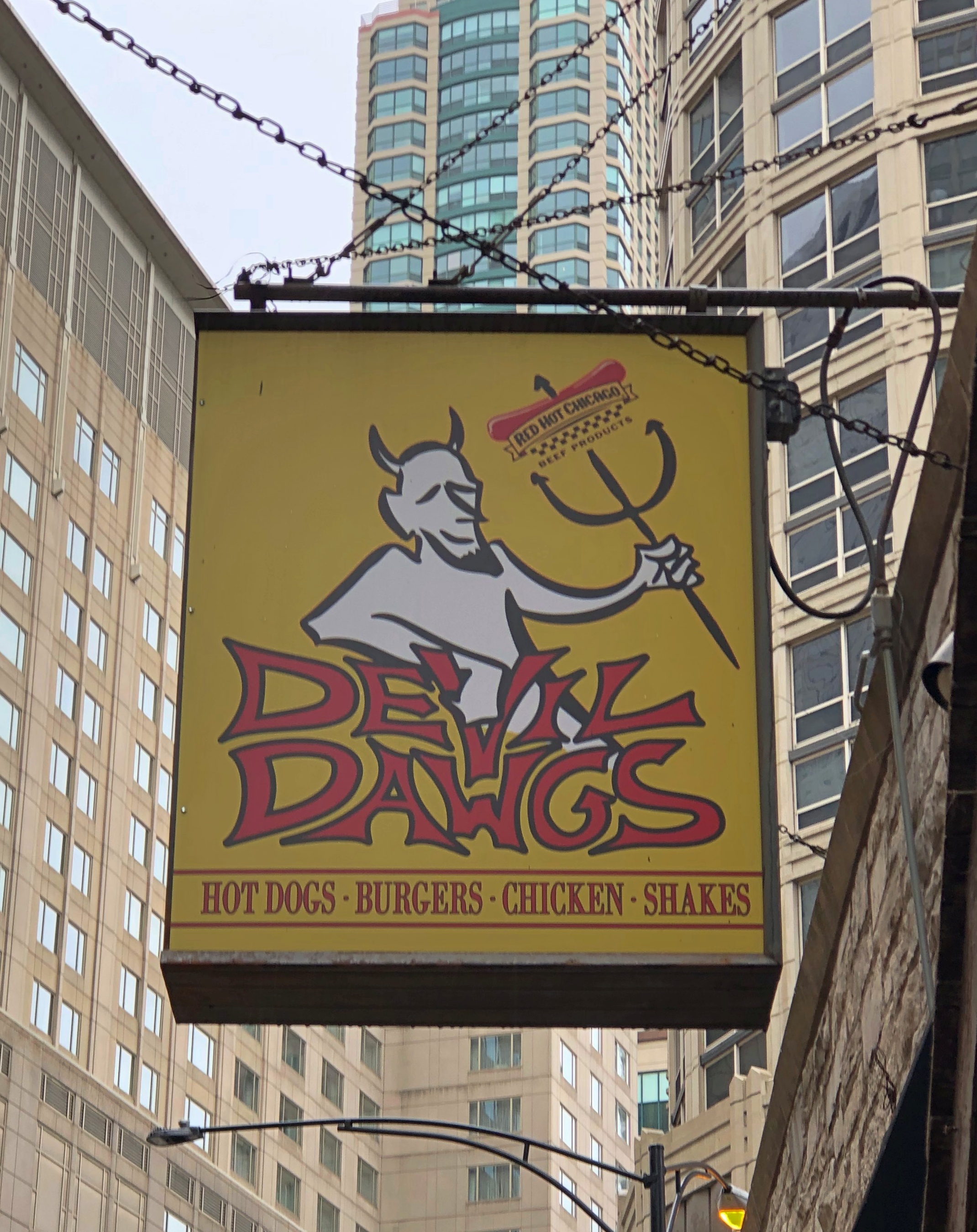
There’s a coffee-table book in this: chain-hung Chicago signs.
Devil Dawgs Chicago

High-res images, of course. Can go on the same coffee table with Austin neon.

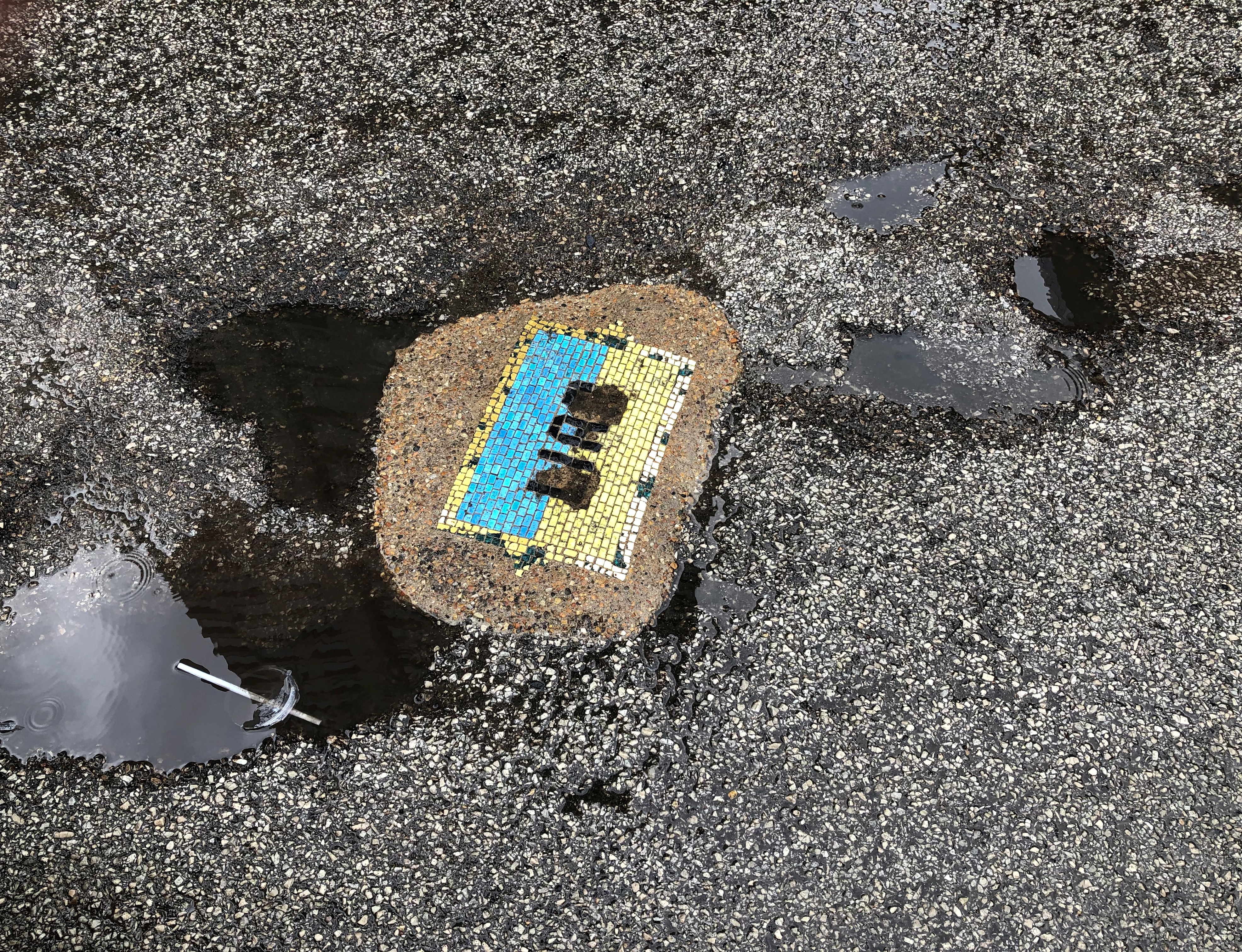
Also Chicago. Specifically, on the street. Make that in the street: a Toynbee tile-like embedment doing its part to remind us of the beleaguered Ukrainians.

Recently I started reading Illegal Tender, subtitled “Gold, Greed and the Mystery if the Lost 1933 Double Eagle,” by David Tripp (2004). A remainder table find some years ago; nice hardback. As it says, the book tells the intriguing (to me) story of the 1933 Double Eagle, which tends to make lists of the world’s most valuable coins, along with the likes of the Brasher Doubloon, the 1804 Bust Dollar and the 1913 Liberty Nickel. Coins so special that their names are capitalized.

On that particular list, I hadn’t heard of the 723 Umayyad Caliphate Gold Dinar, but wow, what a name, with images of ancient treasure in distant lands woven right into the words. The 1913 Liberty Nickel was the MacGuffin in an episode of the original Hawaii 5-0. Namely, “The $100,000 Nickel,” which first aired on December 11, 1973.

“A rare 1913 Liberty Head nickel, one of only five ever made, is to be auctioned at a coin show held at the Ilikai Hotel,” says the imdb entry on the episode. “European master criminal Eric Damien gets con artist and sleight-of-hand expert Arnie Price freed from jail so that he can switch a cleverly-made fake with the original before the auction. But things do not go as planned, as Price, fearing capture, tries to dispose of the nickel in a news rack, and the chase is on to recover the nickel before anyone else finds it.”

Naturally, McGarrett and his men recover the nickel. I don’t remember that specifically, even though I saw that episode either that day or on repeat, but that’s a safe assumption for the denouement. I do remember that I’d heard of the nickel before, probably in a Coins or Coinage article.

I think the episode at least partly inspired one of the Super 8 movies I made with friends David and Steve in junior high, The $300,000 Dime, which I think involved Swiss operative Hans Lan foiling the theft of the titular dime. Sadly, this and the other Hans Lan story, The Assassin, plus the SF non-epic Teedees of Titan and a couple of others whose names I’ve forgotten, are lost as the Hanging Gardens of Babylon, except that no one cares.

50 Francs, Luxembourg

In the fourth or fifth grade, a number of us kids were looking at close range at a map of Europe being held up by one of our teachers, and she asked whether we could find Belgium on the map. I’m not sure why she picked that country. Maybe because it wasn’t one of the more famed places that one of us might conceivably know, such as the UK or France or (West) Germany. Maybe she wanted to show us that Europe had other places besides the big countries.

Boom! I pointed my finger right at Belgium. I might have even tapped the map accidentally. I think she was surprised, but she didn’t know my map gazing habits, especially the atlas included with our encyclopaedia set, but also road maps and whatever else we had in the house.

So I knew about the Low Countries. Even more interesting than Belgium, I thought, was Luxembourg. Tiny Luxembourg got to be its own country. How about that. As fascinated as I was with maps in those days, I might not have realized there were even smaller European countries, though of course I learned about them eventually.

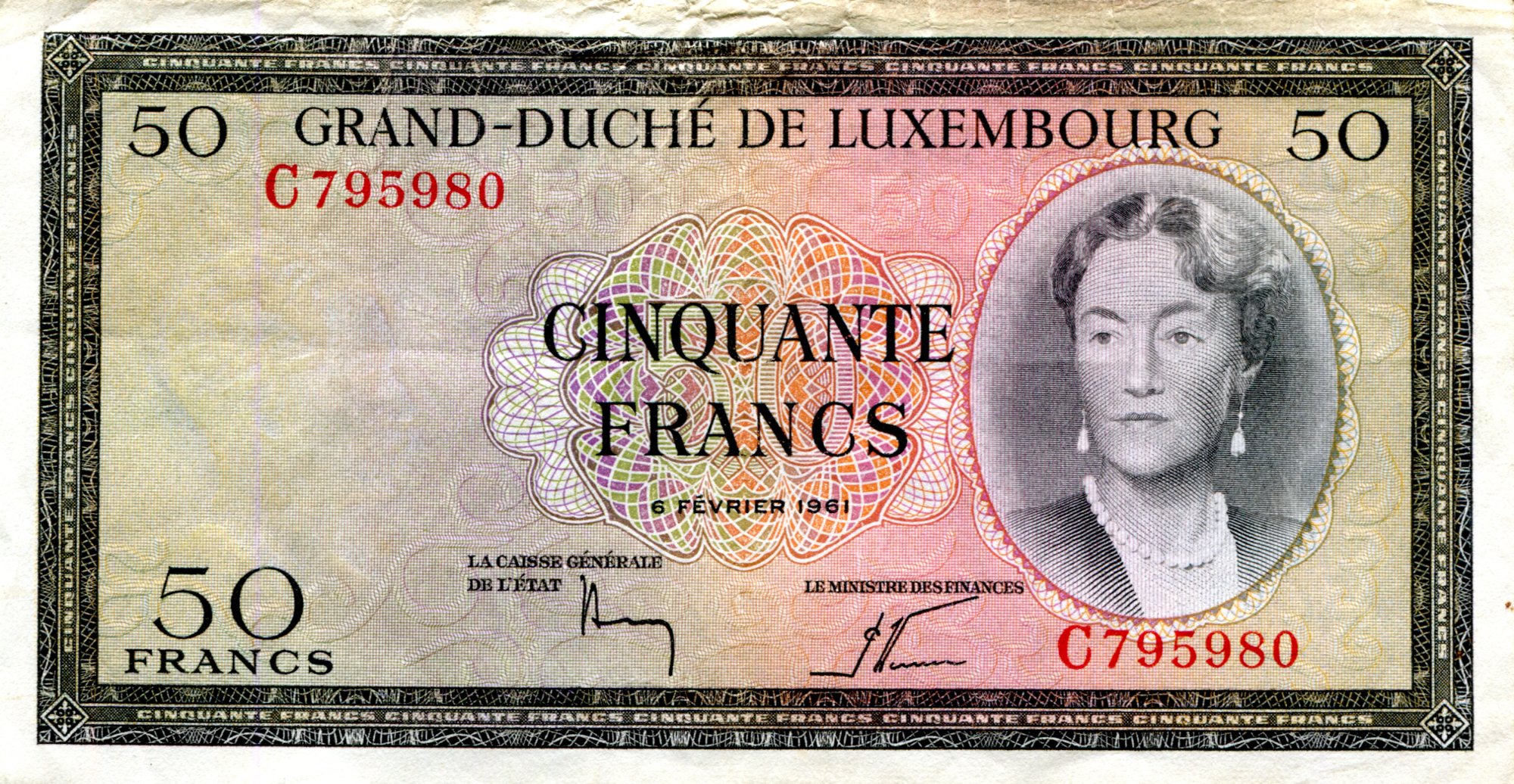
In my currency envelope, I have a 50 franc note, long demonetized, from the Grand Duchy, dated 1961.
50 Francs, Luxembourg

It might actually be worth something in mint condition, but it’s worn and slightly torn, especially on the top edge of the note. That’s a sign that it was in one wallet for a long time, or a lot of wallets for a long time, with the note facing upward.

That’s Grand Duchess Charlotte on the obverse. She had a long reign, 1919 to 1964, and an even longer life, 1896 to 1985. Her grandson Henri is grand duke these days.
50 Francs, Luxembourg

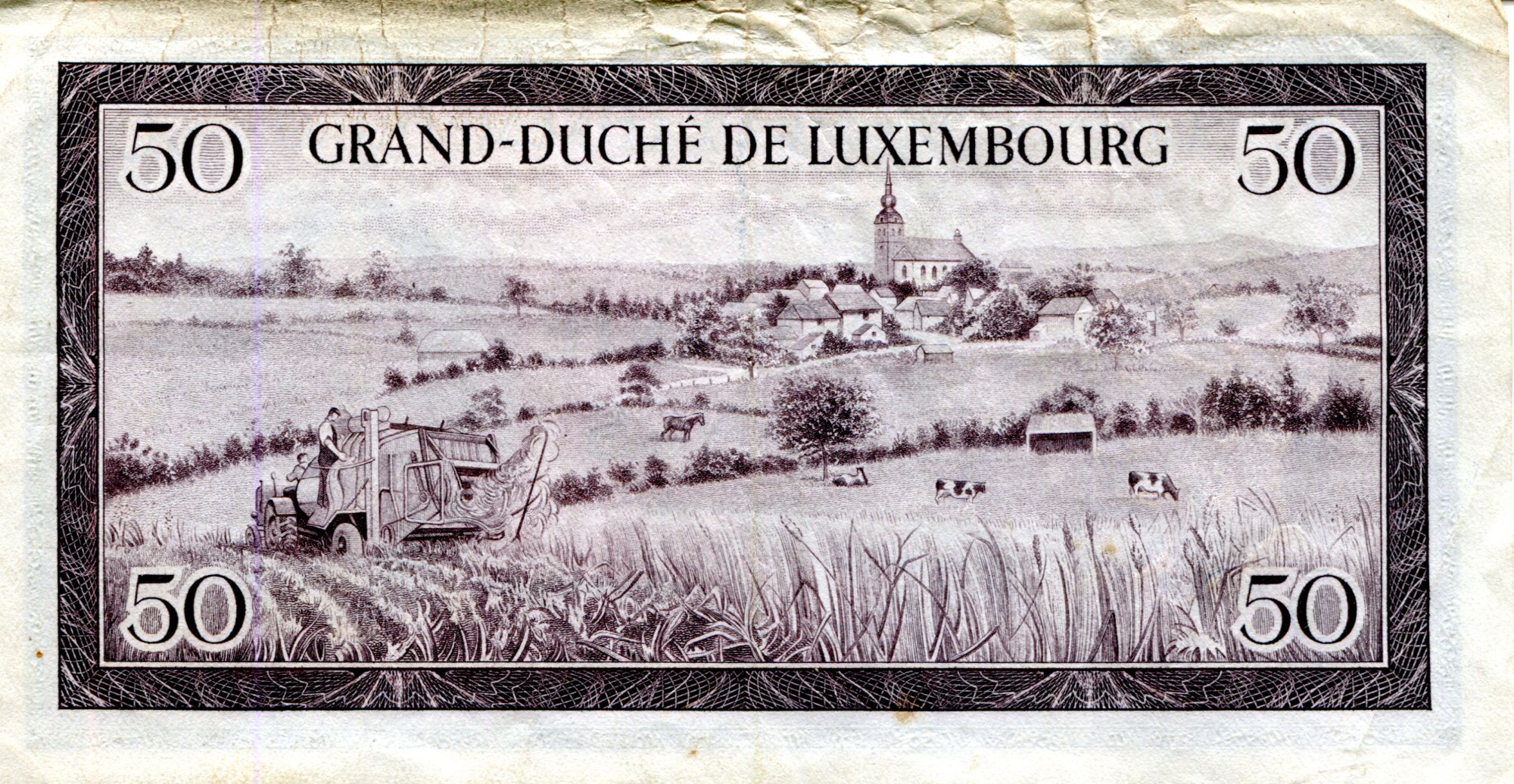
The reverse depicts one-quarter of the area of Luxembourg. Just kidding. But it is a pretty small country after all (I wasn’t wrong as a kid), at a shade less than 1,000 square miles. Rhode Island is larger. So is Brewster County, Texas — actually more than six times the size of Luxembourg — as are a lot of other places.

50 Tyiyn, Kyrgyzstan

A little-remarked consequence of the breakup of the Soviet Union: it spawned a lot of new currencies. Central Asia had a positive boomlet in new banknotes and coins in the early to mid-90s.

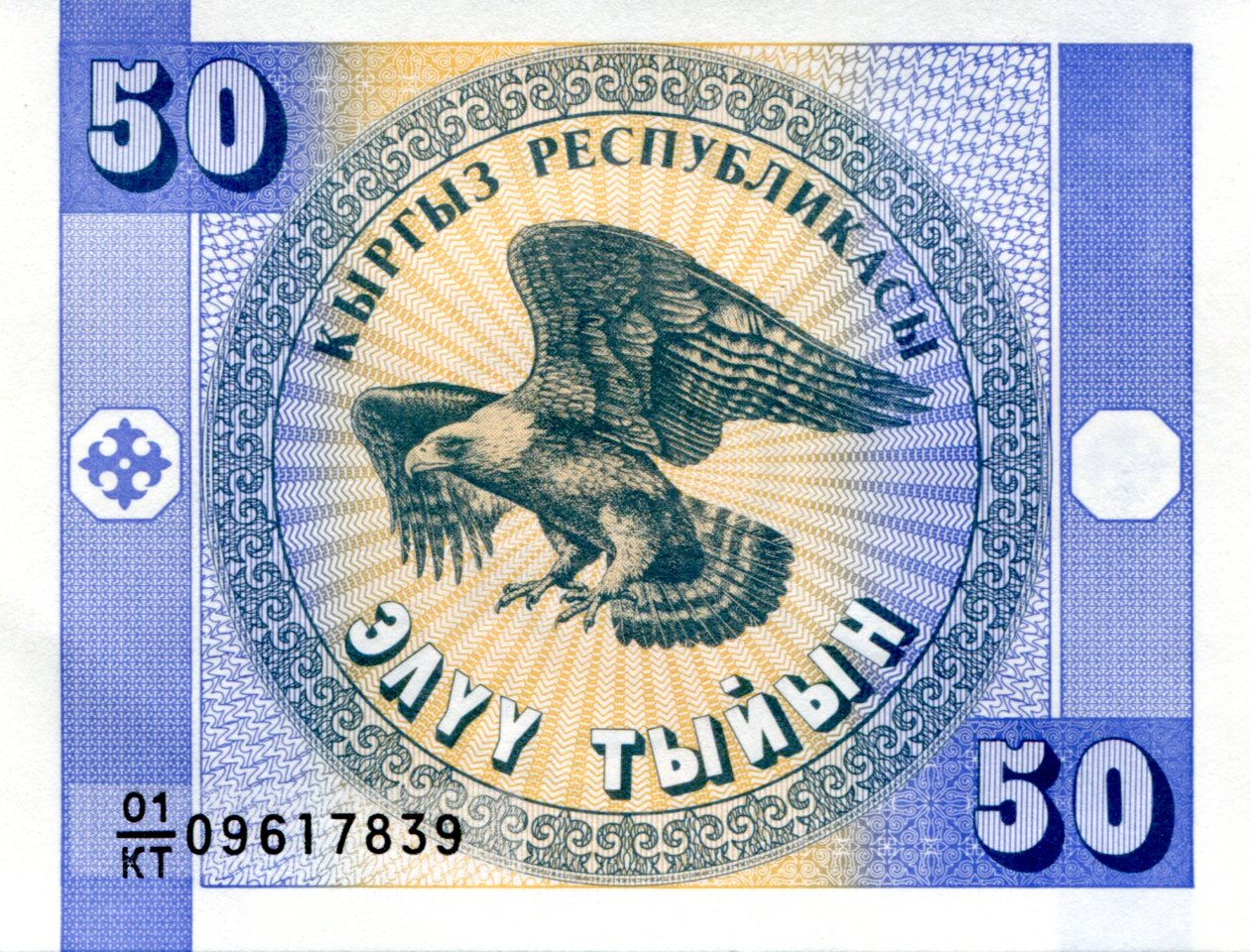
The effusion of notes included the production of my Kyrgyzstani 50 tyiyn note, part of a series (the country’s first) issued in 1993. The note made its way in recent years to an envelope in my possession, here in the heart of North America.50 Tyiyn, Kyrgyzstan

Fifty tyiyn is half a som, the base unit. The notes haven’t been withdrawn, but coins are apparently used for everything valued at 10 som or less these days. 1 som = about 1.2 U.S. cents, so I’ve got myself a theoretical sixth-tenths of a cent note.

No national heroes of the sub-som notes of this series, but an eagle on the (I think) obverse. The 1, 5 and 20-som notes feature an illustration of the Epic of Manas, a Kyrgyzstan work I have to admit being unfamiliar with until today.
50 Tyiyn, Kyrgyzstan

Ah, Kyrgyzstan. Most likely to be confused with Kazakhstan, at least here in the West. I have to add that it looks like Kazakhstan has some pretty nice coins.

10 Dinars, Croatia

Seasonal lights are going dark around here, but as of this evening anyway, a cluster of five houses that includes mine still displays colorful lights: two houses on my side of the street and three on the other side. I suspect that at least one of my neighbors wanted to keep them up past Orthodox Christmas, which seems like a good reason to me.

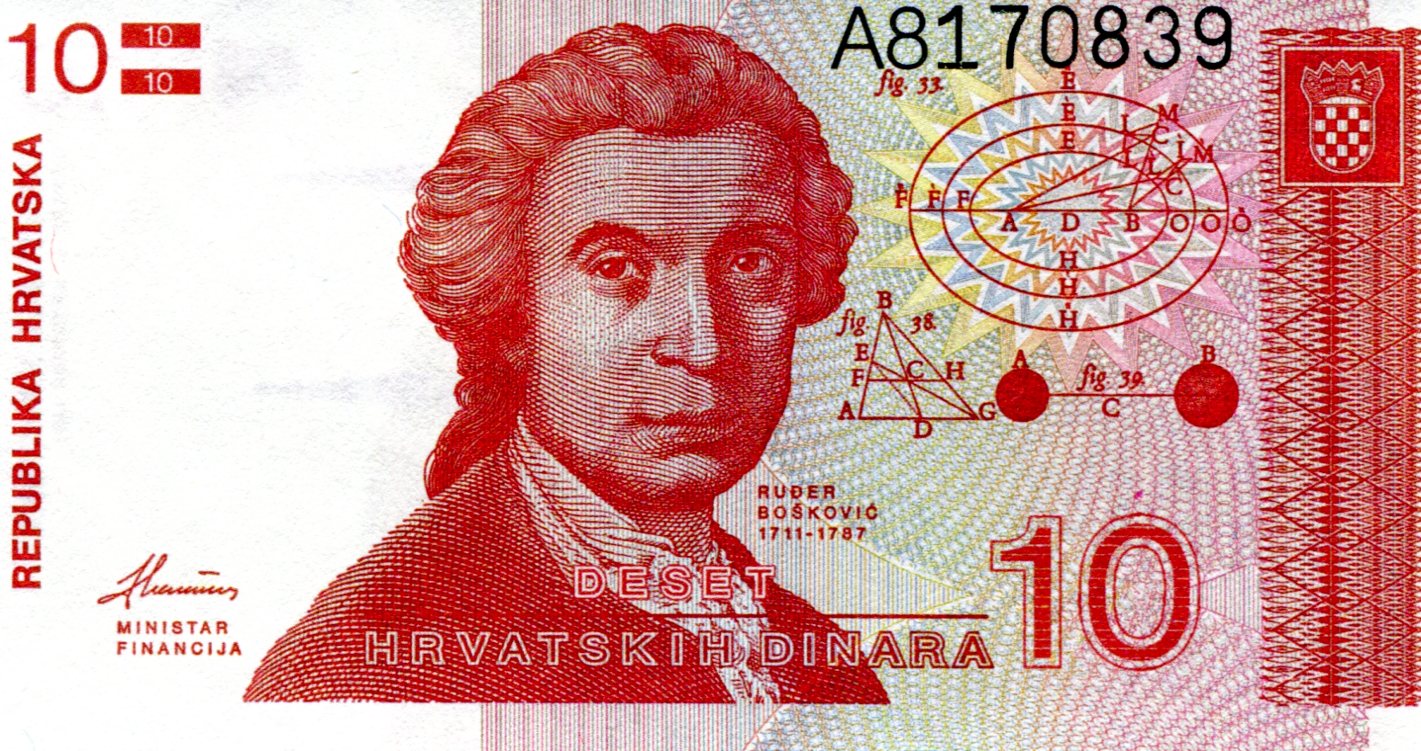
Time to make the acquaintance of Roger Joseph Boscovich, S.J., (1711-87) or as they write in Croatia, Ruđer Josip Bošković. Or, as the man of the Enlightenment he surely was, Rogerius Iosephus Boscovicius, because Latin is where it was at.

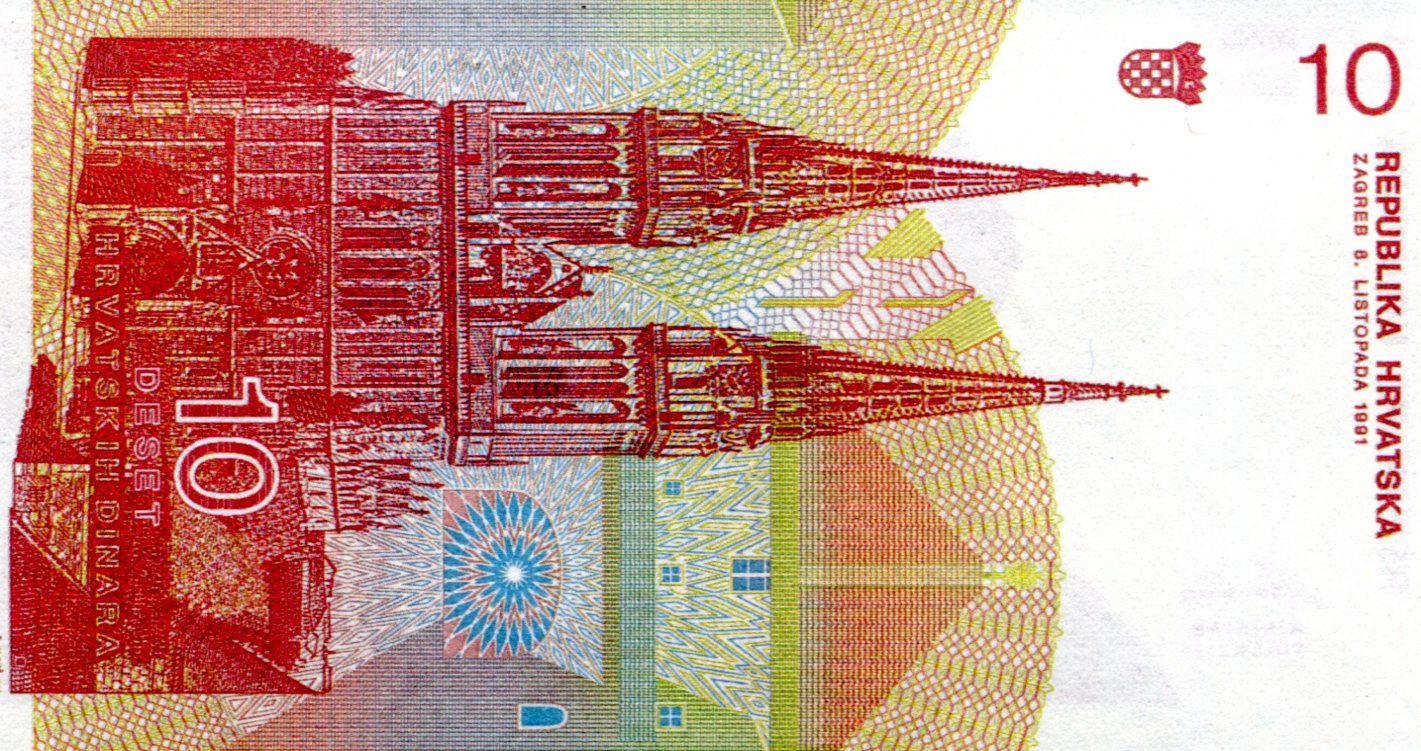
He was on the obverse of all of the 1991 transitional currency after the independence of Croatia, from 1 dinar to 50,000 dinars. I have a 10-dinar note.10-dinar note Croatia

A native of Dubrovnik, though known as Ragusa in those days, “[Boscovich] developed the first coherent description of atomic theory in his work Theoria Philosophiae Naturalis, which is one of the great attempts to understand the structure of the universe in a single idea,” writes Fairfield University. “He held that bodies could not be composed of continuous matter, but of countless ‘point-like structures.’ ”

Funny, I remember discussions of atomic theory always starting with John Dalton, so maybe Boscovich’s ideas count as a precursor, or maybe textbooks in the English-speaking world are loath to give him the credit he deserves. I’m not enough of a historian of science — not at all — to know. Atomic theory must of seemed a radical notion 200 years ago in any case.

The article calls Boscovich “a physicist, geometer, astronomer and philosopher.” His Wikipedia entry calls him a “physicist, astronomer, mathematician, philosopher, diplomat, poet, theologian, Jesuit priest, and a polymath.” Whatever the aptness of those terms, clearly a weighty intellect. Who’s really a polymath any more? Anyone?

In 1994, Croatia retired its dinars in favor of a currency called the kuna, and so far has kept it in the face of the euro. These days, one kuna fetches about 15 U.S. cents.

On the reverse, Zagreb Cathedral. It’s horizontal on the note but certainly vertical in Zagreb. I’d hope so anyway.10 dinar note Croatia

In full, Zagreb Cathedral of the Assumption of the Blessed Virgin Mary, first completed in 1217 but destroyed by the Mongols not much later in that same century. Oops. It was rebuilt not long afterward, and at least the Ottomans didn’t destroy it, though earthquakes have done damage over the years, including as recently as 2020.