Springdale Cemetery

The afternoon was getting long in the tooth in Peoria last Saturday, but I told Ann there was one more place I wanted to go before we proceeded to the highway out of town. Yes, of course, was her mild reaction.

The minor delay was entirely worth it, as far as I was concerned. We soon found ourselves at the entrance to Springdale Cemetery, a wooded, hilly, well-populated stretch of land where gravediggers first turned their shovels in the late 1850s. Roads lead off in various directions through this enormous place, a rare example of a rural cemetery movement cemetery that still retains a rural feeling, even though the city of Peoria is all around.Springdale Cemetery Springdale Cemetery Springdale Cemetery

Springdale isn’t over-thick with stones, though there are plenty. It isn’t thick with sizable memorials, though a few rise over the others.Springdale Cemetery

Deeper in the 223-acre cemetery are rows of soldiers’ stones, beginning with those who fought to save the Union and peppered with later participants in later wars.Springdale Cemetery Springdale Cemetery Springdale Cemetery

Even deeper in, the forest becomes as thick as any I’ve seen in a cemetery. In early April, the trees are still bare, but it won’t be long. The warm air was alive with birdcalls while the din of city traffic — so much part of a “rural cemetery” in our time — was far in the background.Springdale Cemetery Springdale Cemetery

We saw just a handful of mausoleums. I suspect there most be more in other parts of Springdale, since Peoria had a long stint as a prosperous industrial town, and that’s the kind of thing that captains of industry used to buy for themselves. But we only had time for the handful.Springdale Cemetery

Zotz was a German newspaper publisher. Springdale Cemetery The mausoleum door isn’t original. In fact, it’s a recently created trompe l’oeil.

Springdale Cemetery Zotz

Nearby were more modest, but still compelling stones. About 78,000 people lie in Springdale.
Springdale Cemetery
A gorgeous place, all in all. One that would be worth seeing during the seasons other than spring, I believe.

West Moss Avenue, Peoria

During our stroll around the Bradley U. campus on Easter Saturday, Ann and I also ventured into the surrounding neighborhood to the south. One of its streets is the amusingly named Fredonia Ave., which sports ordinary student houses and apartments.
Further south from there is the wide W. Moss Ave., with its sizable houses/enormous lawns on one side, green and beginning to flower.
W. Moss Ave. Peoria
The lawns are smaller on the other side, but the houses just as pleasant.
W. Moss Ave. Peoria W. Moss Ave. Peoria

We came across a particularly distinctive stack of bricks. Looks like a Frank Lloyd Wright, I said. It was. Guess I’ve seen enough of the diminutive genius’ genius work, which impresses one with its genius aspect, to know when I see one. Well, it is impressive bit of work, anyway.W. Moss Ave. Peoria - Francis W. Little house W. Moss Ave. Peoria - Francis W. Little house W. Moss Ave. Peoria - Francis W. Little house

It’s the Francis W. Little house, dating from 1903. The FLW Trust says: “With its ribbon windows, low-pitched roofs, projecting eaves, and walled terraces, the Francis Little house is typical of Wright’s mature Prairie style designs. The Little house windows are similar in design to those found at the E. Arthur Davenport, William Fricke, F.B. Henderson, and Edwin H. Cheney houses.

“The glass designs found on the interior of the house, which include a variety of skylights and built-in bookcases with glass doors, exhibit more elaborate color schemes and came arrangements than those found on the exterior walls.”

Those elaborate color schemes aren’t for the enjoyment of the public, or at least that fraction willing to pay to tour a FLW house, but rather for the current owner.

Not far from FLW on Moss is the Westminster Presbyterian Church.
W. Moss Ave. Peoria - Westminster Presbyterian
“The construction of Westminster Presbyterian Church was concluded in 1898. The architect, Herbert Hewitt, designed an English Gothic structure with Norman spire,” the church web site says, only to explain that: “Other than periodic upgrades, this church remained unchanged until 1985 when it was destroyed in a fire.”

The congregation rebuilt: “The current church was completed and dedicated in April 1989. The architect of the new building was Ben Weese, a member of the Chicago Seven, a first-generation postmodern group of architects in Chicago.” (Not to be confused with the other Chicago Seven, or Eight, depending.)

Bradley University Walkabout

Before each Easter comes around, you don’t know whether you’ll get a pleasant early spring day or a chilly late winter one, at least at my latitude. This year, as if to echo the glory of the holiday, we enjoyed a flawless spring day.

Easter Monday and Easter Saturday were pretty nice, too, and on the latter of those two, Ann and I spent much of the afternoon in Peoria, Illinois. During this Vaccine Spring, appointments have proven hard to book close to Cook County, and so I’d found one for her at a pharmacy in Peoria, not far as it happened from the campus of Bradley University.

Since driving down to Peoria, getting the shot, and zipping right back seems like an opportunity wasted to me, we didn’t do that. Bradley was close at hand, so after the shot we took a walk in the springtime sunshine around campus.

Bradley isn’t the grandest or prettiest or most historic campus I’ve ever seen (UVA would contend for all of those, actually), but it had its interests, such as the Hayden-Clark Alumni Center, which fronts a wide lawn.
Bradley University
“Adjoining the circa-1897 Bradley Hall, the center welcomes alumni, students and visitors in a three-story, multi-use building for tours, meetings and special events,” Peoria magazine wrote of the building, which was completed in 2011. “The center’s Shaheen Hall of Pride has become a popular destination, featuring 22 display cases, dioramas and videos that chronicle the university’s growth and influential history.

“Designed by architectural/engineering firm Dewberry, the building incorporates elements of collegiate gothic architecture, such as arches, buttresses and a crenellated tower. The façade is constructed of Indiana limestone, like Bradley Hall and other historic campus buildings.

“Four hand-carved limestone gargoyles sit atop the center. In a gesture of appreciation to the past, two of them are replicas of existing gargoyles on Bradley Hall. The other two are original, overlooking a new view to the west. Technically, they are ‘grotesques,’ rather than gargoyles. Gargoyles are functional — usually as waterspouts and drains — but these are ornamental.”

I have to appreciate a 21st-century building that bothers with gargoyles. Elsewhere, there’s a bronze of Lydia Moss Bradley (1816-1908) in her later years.Bradley UniversityShe founded Bradley Polytechnic Institute in 1897, later to become a university. The statue was erected for the centennial of the school in 1997.

Other campus details that caught my eye follow. A small sampling.Bradley University Bradley University Bradley University
That last one is another bit of Bradley art, “Split Figure: Woman,” by Nita K. Sunderland, an art professor at the university who died only last year.

Old Blanco County Courthouse

While I was footloose in the Texas Hill Country five years ago this month, I paid another visit to the Old Blanco County Courthouse in Blanco. I’d been there the year before, when Jay and I were in search of the Central Texas Bat Trail. It’s a fine old building, restored in recent decades.
Old Blanco County Court House Old Blanco County Court House Around back.
Old Blanco County Courthouse
Blanco isn’t the county seat of Blanco County and hasn’t been for more than 130 years; Johnson City is. So for decades the old courthouse was one thing and another, and now has an interesting little local museum on the ground floor, and office space as well.

The State of Texas recognizes the structure as historic, and the building wears the distinctive Texas Historical Commission medallion.
Old Blanco County Courthouse
I remember seeing those medallions for almost as long as I can remember, especially the one on St. Paul’s Episcopal Church in San Antonio, which I found oddly fascinating as a kid. Who knows, that very one might have planted the seed for my later interest in the sort of markers, plaques, medallions and minor memorials that the world tends to stroll by without a glance.

Maternity of the Blessed Virgin Mary Catholic Church, Bourbonnais

While visiting Olivet Nazarene University in Bourbonnais on Sunday afternoon, I spotted a church building from a distance that I took to be the campus chapel or the like. I decided to drive over to its parking lot for a closer look.Maternity of the Blessed Virgin Mary Catholic ChurchI was wrong. It was Maternity of the Blessed Virgin Mary Catholic Church, which is decidedly not part of ONU, though adjacent to it for historic reasons that I will get into.Maternity of the Blessed Virgin Mary Catholic Church“The original Maternity BVM Catholic Church, a 110-foot-by-50-foot wood-framed structure, had burned to the ground in September 1853,” Jack Klasey wrote in the Daily Journal, a local paper. “The frame church had been built in 1847 to replace the settlement’s first Catholic house of worship, a small log structure known as the church of St. Leo. The log church had been erected in 1841.

“Like many of his parishioners, [Rev. Isadore Lebel] had been born in Canada. The plan that he brought to Bourbonnais Grove reflected the church architecture of his native Quebec province. It is believed to be based upon a church in Cap-St.-Ignace, located on the south shore of the St. Lawrence River, a short distance downstream from Quebec City… Construction work was probably begun some time in 1855 or 1856 and not completed until 1858.”

I was certain the building would be locked (as it was, too bad), but I got out the car for a look anyway. Then I noticed a patch of land next to and behind the church that seemed worth investigating.
Maternity of the Blessed Virgin Mary Catholic ChurchA grotto.Maternity of the Blessed Virgin Mary Catholic Church Maternity of the Blessed Virgin Mary Catholic Church

Maternity BVM has an informative walking tour on its web site for downloading. The centerpiece of the grotto, it tells me, is a shrine built to Our Lady of Lourdes.

“Br. John Koelzer, a Viatorian brother, began building the grotto just over 100 years ago, in 1915. It took three years to complete [and] is fashioned (using stones carved by local residents) in the image of Our Lady of Lourdes, when she appeared to young Bernadette.

“Over the years, she has interceded for the safety of soldiers as far back as World War I, as well as countless school children, bridal couples, rosary groups and worshippers of all ages who have sought her protection.”

The Viatorians — another group I’d never heard of till I researched a place I’d been — are “an international Roman Catholic religious congregation comprised of priests, brothers and lay associates, headquartered in Arlington Heights, IL. Collectively, the congregation is known as the Viatorian Community.”

“Fr. Louis Querbes (1793-1859) founded the congregation in Vourles, France in the 19th century during the years following the French Revolution. Realizing the need to provide education for youth, Fr. Querbes’ vision was to send religious brothers and lay catechists of deep faith and competent learning to parish schools in the countryside.

“As patron saint of the congregation, Fr. Querbes chose St. Viator, a young, 4th century catechist-lector of the cathedral church of Lyons, France.”

True to their education focus, the Viatorians who found their way to Bourbonnais from Canada set up a school that became St. Viator College in 1868. The Depression put an end to the school, however, and the site was sold to Olivet Nazarene University.

The church and the grotto remain. As does a cemetery on the grounds. I wasn’t expecting that.
Maternity of the Blessed Virgin Mary Catholic Church

“Now take a look around the cemetery/grotto and you will also notice several headstones scattered throughout the space,” the tour says. “The cemetery was opened near St. Leo’s Chapel in 1842. By 1884, the old graveyard had no more empty spaces as hundreds are buried here. Many of the grave markers have deteriorated over the years, but there are approximately 30 headstones that still exist and have legible engravings. The earliest legible burial was David Spink, 1848.”

Deteriorated indeed.
Maternity of the Blessed Virgin Mary Catholic ChurchElsewhere on the grounds is a sundial.Maternity of the Blessed Virgin Mary Catholic Church

Maternity of the Blessed Virgin Mary Catholic Church
When I stood in front of the sundial, it was about 3:30 CDT, or 2:30 by the sun, a time I could have indeed told by the shadow. The sundial was a gift from the St. Viator College Class of 1917, dedicated on June 13 of that year. Eleven members of that class are listed on the sundial plaque, including the class treasurer, Fulton J. Sheen. He had quite a career ahead of him, with influence in unexpected places.

Near the entrance of the grounds is a boulder with a plaque askew.
Maternity of the Blessed Virgin Mary Catholic Church
The plaque has been in place almost exactly 100 years, having been dedicated on Decoration Day, 1921. It honors the aforementioned “sturdy Viatorian pioneers” (the plaque’s term) who founded St. Viator College.

Just as we were about to leave — I was already back in the car — I spotted yet another plaque, one considerably harder to see, under a bush. In spring or summer, it might be impossible to see.
Maternity of the Blessed Virgin Mary Catholic Church baseball home plate plaque“I have to see one more thing,” I told my family. They’re used to that kind of thing. But I knew if I ignored it, I’d wonder about it later. I was well rewarded by my curiosity, since the plaque made me smile. It wasn’t anything remotely like I expected.
Maternity of the Blessed Virgin Mary Catholic Church baseball home plate plaqueA home plate memorial. Listen closely on moonless nights, maybe, and you can hear the faint cheers of late 19th-century Catholic collegians playing base ball.

Olivet Nazarene University

College campuses usually offer pleasant places to stroll on warm days, or even when it isn’t so warm, so with that in mind I wanted to take a walk around the 250-acre Olivet Nazarene University in Bourbonnais, Illinois, on Sunday. Since we’d just taken a walk at Kankakee River State Park, the rest of the family was less enthusiastic about the idea. They waited in the car while I took a 10-minute amble.

I’d heard of the Strickler Planetarium. I imagined it would be a little larger, but no doubt it’s a good facility.
Olivet Nazarene University
Nice clock tower.
Olivet Nazarene University
“The Thomas H. Milby Memorial Clock Tower is provided by the J. Harlan Milby Family to remind us that during his student days in 1956, Tom walked these paths on his way to heaven,” the university says. There are carillon bells up there, but I wasn’t around long enough to hear them.

Not far away is a smokestack. As far as I know, it isn’t named in honor of anyone. For a suitable donation, I’ll bet it could be arranged.
Olivet Nazarene University
I’d call it the Old ONU Stack. Or maybe not so old. If what I read here is correct, it had to be rebuilt after a tornado knocked it down in 1963.

ONU, as the name says, is a Nazarene university. The school’s roots go back to 1907, around the time that various Pentecostal and Holiness groups started merging to form the modern Nazarenes, a process entirely too complicated to summarize here.

ONU itself got started in a wide place in the road called Olivet, Illinois, not far south of Danville, and was originally Illinois Holiness University, a name I believe I would have kept. The school mascot could have been the Rollers, for instance. Or maybe the Fighting Wesleyans.

Be that as it may, the school took the name of the town, no doubt for its association with the Mount of Olives, and kept the name when it moved to Bourbonnais in 1940 after a fire destroyed its main building in Olivet.

Even the small details harken to the school’s early time. Such as on the manhole covers.
Olivet Nazarene University manhole cover
Nice design. Features the seal of the school, noting its 1907 origin. One of the many manhole covers of the world that receive little attention, but which are actually pretty cool.

Bottle Cap Alley

My brother Jay and I had lunch at the Dixie Chicken in College Station, Texas, while visiting Texas A&M in the spring of ’14. It isn’t far from campus. I wanted to visit A&M because I’d heard about it all my life. My grandfather was an Aggie, Class of 1916, and I knew people my age who went there, but I’m certain I’d have heard about it anyway, growing up in Texas.

I’d never heard of Bottle Cap Alley, which is next to Dixie Chicken. Soon I learned about the place.Bottle Cap Alley
It’s the kind of place that tends to be shunted off into the “quirky attractions” ghetto. I don’t care much for that word, with its slight whiff of condescension. Maybe that’s just my take, but anyway I’d prefer to call Bottle Cap Alley odd or peculiar.
Bottle Cap Alley
Underfoot were bottle caps. Lots of bottle caps (and cigarette butts and leaves, but never mind). A peculiar feeling, walking on bottle caps.
Bottle Cap Alley
Bottle caps and I go back a long way. During grade school, I was an assiduous collector, accumulating a mass of them in a box that had once held a television — back when TVs were serious pieces of furniture. From that mass, I found examples of all sorts of caps and glued them to large pieces of cardboard, a couple of hundred at least, including some prized examples that Jay picked up for me in Europe in the summer of ’72.

I lost interest later, around junior high, as one does. The mass in the box are long gone, maybe delivered to a recycler. But the caps on the boards are still in a closet in the house where my mother used to live, and where my brother Jim now lives. I might retrieve them someday or, just for the fun of thinking about it, leave them for my heirs to find even further in the future, unexplained.

Now I’ve Been to Havana

Havana IllinoisThrough the marvel that is Google Maps, I located Chinatown. That’s a restaurant in Havana, and we got food to go there for lunch on October 17. Havana, Illinois, of course, a town of about 3,000 on the east bank of the Illinois River.


The streetscapes along the north side of Main Street, including the restaurant. It runs east-west, so has a terminus at the river.
Havana IllinoisThe former Mason County Bank. Now it seems to be partly occupied at least by World of Color, a painting service. Havana is in Mason County, and in fact is the county seat.
Havana IllinoisFormerly handsome, now dowdy. Ghost lettering is toward the bottom, but I can only make out BROS.

Havana Illinois

A sign below that, not visible in my pic, says Apple Ducklings Preschool, which I suspect isn’t a going concern anymore.
On the other side of Main is the former Havana National Bank building, repurposed as Havana City Hall.
Havana IllinoisWaiting for lunch, I had time to walk up and down Main, while Yuriko visited some of the uncrowded antique shops on the street. Crowding, I suspect, is seldom an issue in this Havana.

I took a quick look at the Old Havana Water Tower, uphill from where I started outside Chinatown.
Havana IllinoisDating from the late 19th century, the brick water tower is not only on the National Register of Historic Places — detail here — but also is an American Water Landmark, a list I’d never heard of before. Old it may be, but apparently it’s still a functioning part of the local water system.
Not far from the water tower is the Mason County Courthouse.
Havana IllinoisBy my way of thinking, that isn’t a courthouse. It’s an office building for minor bureaucrats. But probably not faceless bureaucrats, since most everyone knows most everyone else around here.
At least there are a handful of memorials on the grounds. One for the Civil War.
Havana IllinoisThe World War.
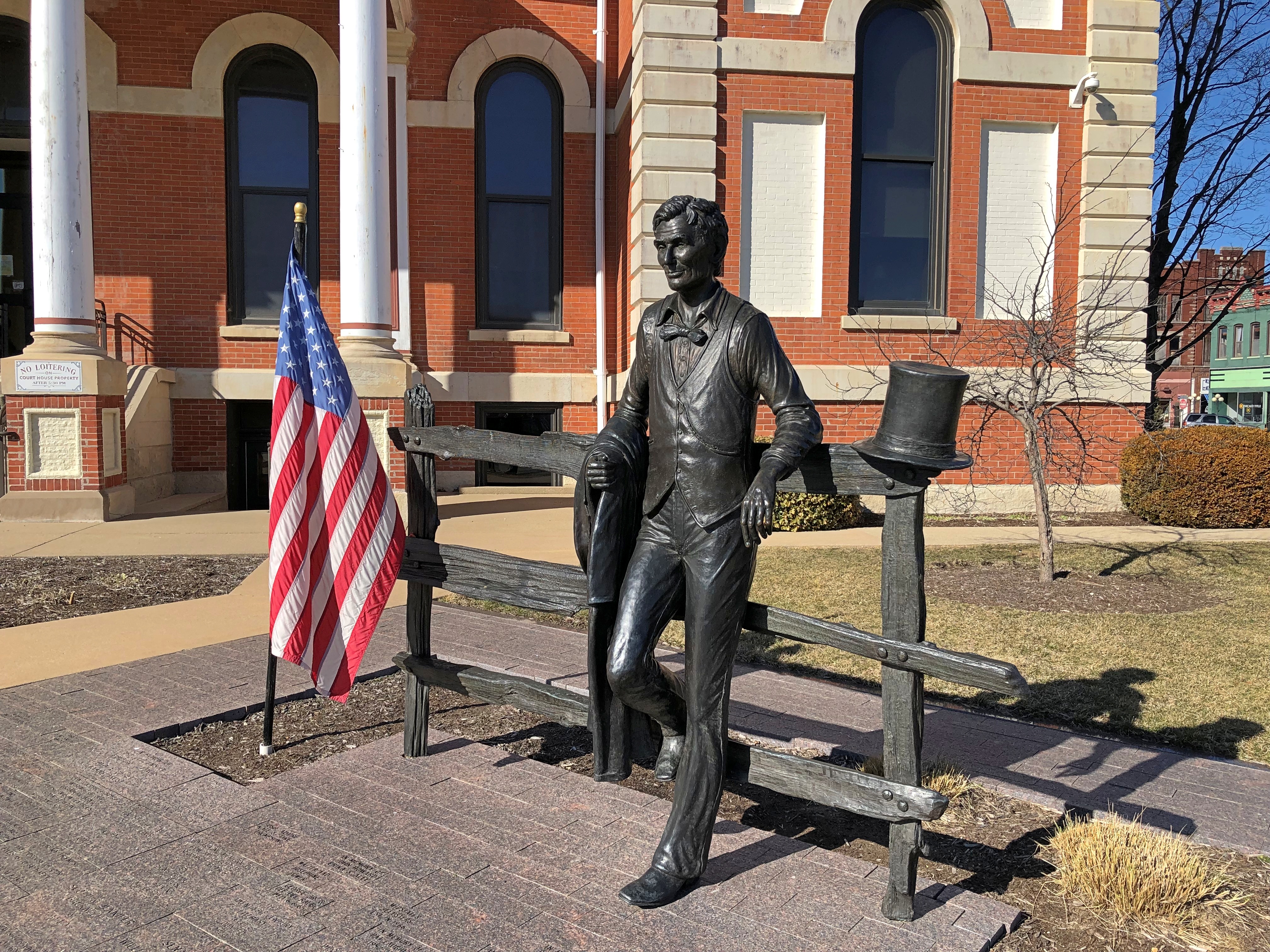
Havana IllinoisOne for Lincoln. If Lincoln so much as passed through a town in Illinois, stopping only to get a new feedbag for his horse and use the outhouse, there’s going to be a 20th-century marker acknowledging the event.
Havana IllinoisDownhill from my starting point is Riverside Park. It includes a large bluff overlooking a bit of green space next to the river. According to a plaque, the bluff is called the Havana Mound.
Havana IllinoisI won’t quote all of the plaque. Enough to say that it says the mound was the site of Mississippian and later Indian “activities,” as well as the first white settlement in Mason County. In the 1830s, a four-story hotel was built there, which also served as a trading post and post office. Of course, Lincoln used to visit. But it didn’t last long, since the building burned down in 1849.

The odd thing about that plaque is the language at the end: Erected in 1984 by Havana Members of the Church of Jesus Christ of Latter-Day Saints. That’s the first Mormon plaque I think I’ve ever seen.

In case you’re arriving by river, the town has put out a sign.
Havana IllinoisWe sat at a picnic table in the park at the bottom of the bluff, and ate our Chinese food. The park has nice views of the river.
Havana IllinoisHavana IllinoisHavana used to be an important river town, back when that was an important mode of transport, but these days it mostly sees barges and tugs.

Oak Hill Cemetery, Lewistown

Lewistown, Illinois, isn’t very large. Only 2,100 or so people live there, as opposed to Oak Hill Cemetery in Lewistown, which has a population of more than 5,000. I arrived for a look on the morning of October 17.

I hadn’t expected such a good-looking cemetery. The fall colors helped, but only added to the overall aesthetic of woody terrain, sometimes hilly, peppered with upright stones and funerary art.

Oak Hill Cemetery, Lewistown

Oak Hill Cemetery, Lewistown
As you’d expect, there’s a Civil War memorial.Oak Hill Cemetery, Lewistown

Oak Hill Cemetery, Lewistown

It’s hard to see in this pic, but this is the entirety of the inscription, written on the stone bench:

IN MEMORY OF OUR PATRIOT DEAD
MDCCCLXI–MDCCCLXV

I didn’t know it until later, but the columns at the memorial were salvaged from the previous Fulton County courthouse, which burned down in the 1890s. When Lincoln came to town in the ’50s to speak, he stood on the courthouse steps between the columns, and so the town wanted to work them into its Civil War memorial.

In as much as Oak Hill Cemetery is known to the world, it isn’t for its beauty or a war memorial. Rather, Edgar Lee Masters took inspiration from it for Spoon River Anthology. Sometimes, I’ve read, very specific inspiration, since he knew many of the townspeople — such as the weak of will, the strong of arm, the clown, the boozer and the fighter, to borrow language from the opening of the book.

“In the groundbreaking work, Masters, a onetime law partner of Clarence Darrow, gives voice to more than two hundred deceased citizens of Spoon River who are laid to rest in Oak Hill Cemetery, known to the locals as The Hill,” wrote Laura Wolff Scanlan in Humanities magazine in 2015.

“Freed by the shackles of life, the un-living who ‘sleep beneath these weeds’ confess their deepest secrets, disappointments, frustrations, joys, and warnings to the living in the form of brutally honest free verse poems.

“In some cases, Masters barely changed their names. Henry Phipps was really banker Henry Phelps. Harry Wilmans was Henry Wilmans…

“Even though most names were fictitious, everyone in town knew exactly who he was talking about. Because of this, the book was immediately banned from schools and libraries in the area, including the Lewistown library.”

When Masters died in 1950, he wasn’t buried in Oak Hill, but rather in Petersburg, Illinois, which is close to Springfield.

The Lewistown library started stocking the book in 1974. After the death of everyone mentioned in it, and most of their immediate families, in other words. In our time, Lewistown claims the work as its own, since what else is the town known for, or could be known for? For the centennial of the book in 2015, the town held Oak Hill Cemetery tours, exhibitions and theatrical performances, according to Humanities.

For avid Spoon River enthusiasts, and there must still be a few, the graves of the real people associated with fictional counterparts are marked with numbers.
Oak Hill Cemetery, Lewistown

There’s a guide available that will tell you who’s who in the cemetery, according to their Edgar Lee Masters number. I am not enough of an enthusiast to look any of them up.

Still, I respect it as a successful work of literature about the residents of a cemetery. Interesting conceit. Sometimes I imagine that if the dead at the cemeteries could talk freely, I might hear some salacious bits. On the other hand, many of them might not have very much interesting to confess.

We had a copy of Spoon River in our library when I was growing up, and I read some of the poems then and a few later. The other day I happened across a radio version from 1957, which is worth a listen. William Conrad is always worth a listen anyway.

Spoon River Valley ’20

The weekend after Ann and I went to southern Illinois, Yuriko and I went to Fulton County, also in Illinois, but closer to home. It’s southwest of Peoria, along the Illinois River. The Spoon River also runs through the county, until it meets the Illinois.

Why Fulton County? Marketing. At least that’s part of the reason. Every year, on the first two weekends in October, an organization called the Spoon River Valley Scenic Drive Association puts on an event called the Spoon River Valley Scenic Drive Fall Festival. I heard about it some years ago.

Visitors are encouraged to drive around the county, look at the fall colors, and drop a few bucks. The association produces useful online and (probably) paper maps of the county toward those ends. So over the years, tucked back in that big mental file of mine, Minor Destinations, I had the vague idea that Fulton County had especially fine foliage. No doubt the Spoon River Valley Scenic Drive Association would appreciate the fact that that idea had been planted in my awareness of the place.

This year, the association cancelled the event. We would have missed it anyway, since we went on the third weekend of October.

We got a late start on Friday, not arriving at Lewistown, Illinois, until after dark, which is where we stayed that night, returning home Saturday night after spending the day in the area looking around. As my wont, I was up early Saturday morning (October 17) to have a look around Lewistown, seat of Fulton County.

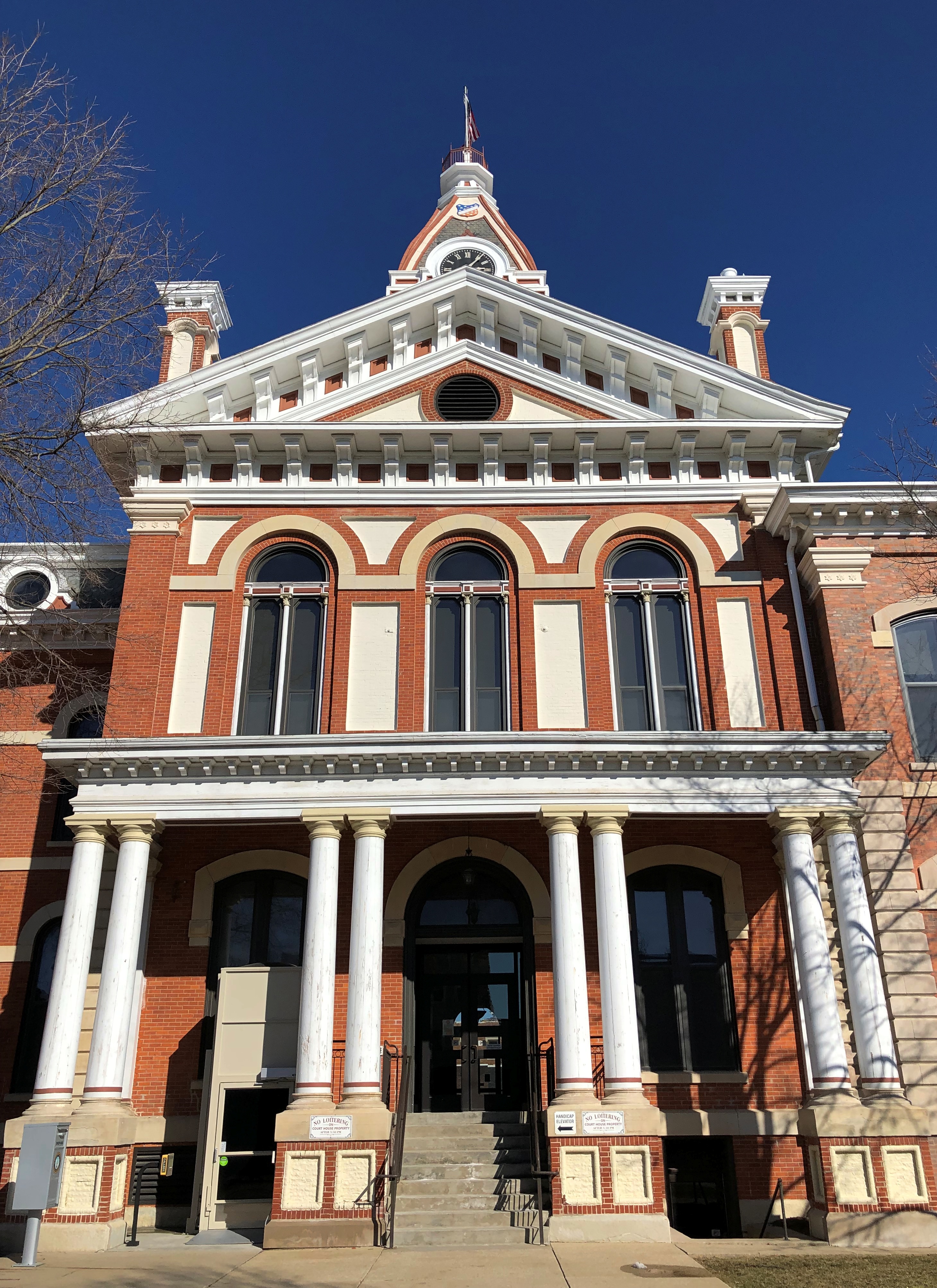
It isn’t long before you’re at the Fulton County Courthouse.
Fulton County Illinois courthouse
I have to say, this is a well-written plaque there in front of the courthouse.
Fulton County Illinois courthouse
A brief on a now-obscure part of Illinois history, told concisely and clearly. Mentioned in passing is the 19th-century Gelena (Illinois) lead rush, and the text makes a connection to Lincoln, as historic markers in Illinois like to do.

Bits of war surplus. Now memorial bits.Fulton County Illinois courthouse

Fulton County Illinois courthouse

Always good to look at these kinds of plaques — this one was near the cannon — even if only a half a minute or so.
Fulton County Illinois courthouse
Across the street from the courthouse is First Presbyterian Church.
First Presbyterian Church Lewistown Illinois
The town gazebo.
gazebo lewistown illinois
Or maybe it’s on church property. That would technically put it that very special class of gazebos, the ecclesiastical gazebo, early ruins of which can be found in Vatican Necropolis in the Vatican City, and in Constantinople…. There I go again, writing bogus  gazebo history.

Nearby is the Prairie State Bank & Trust, looking like a going concern (it is), in a basic brick bank building. Make that a basic brown brick bank building.
lewistown illinois
It’s good when alliterations work.