The Waxahachie City Cemetery

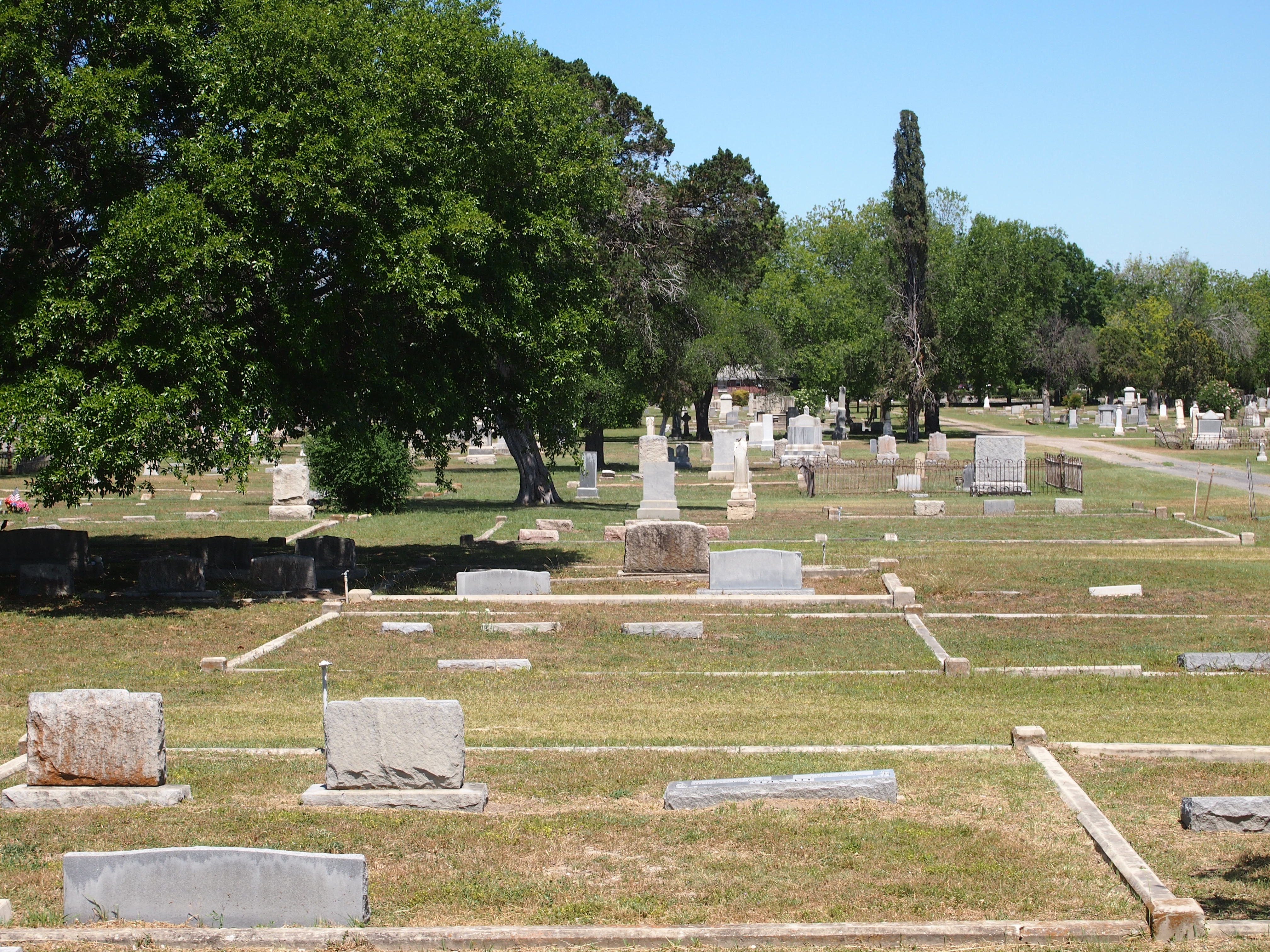
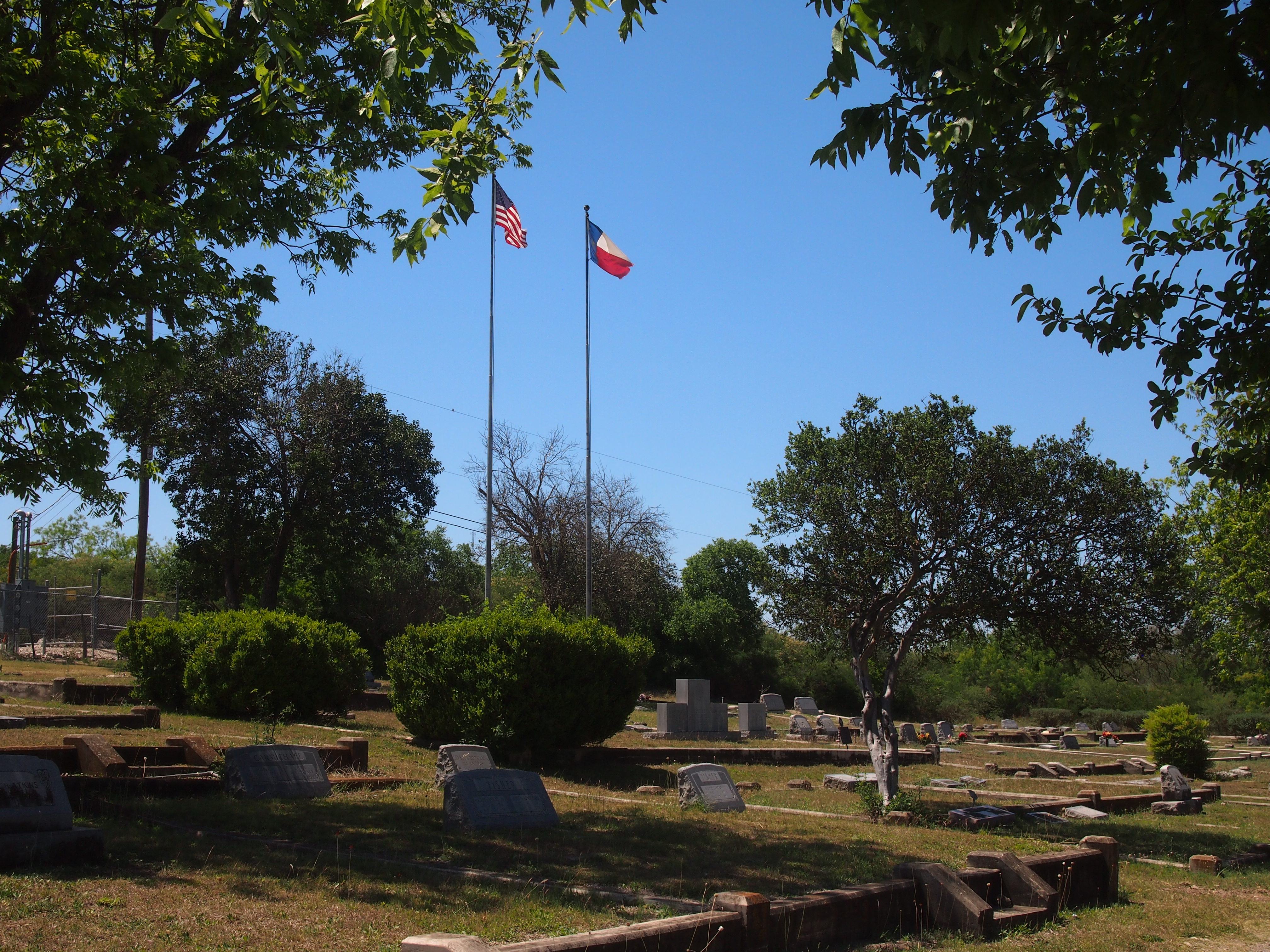
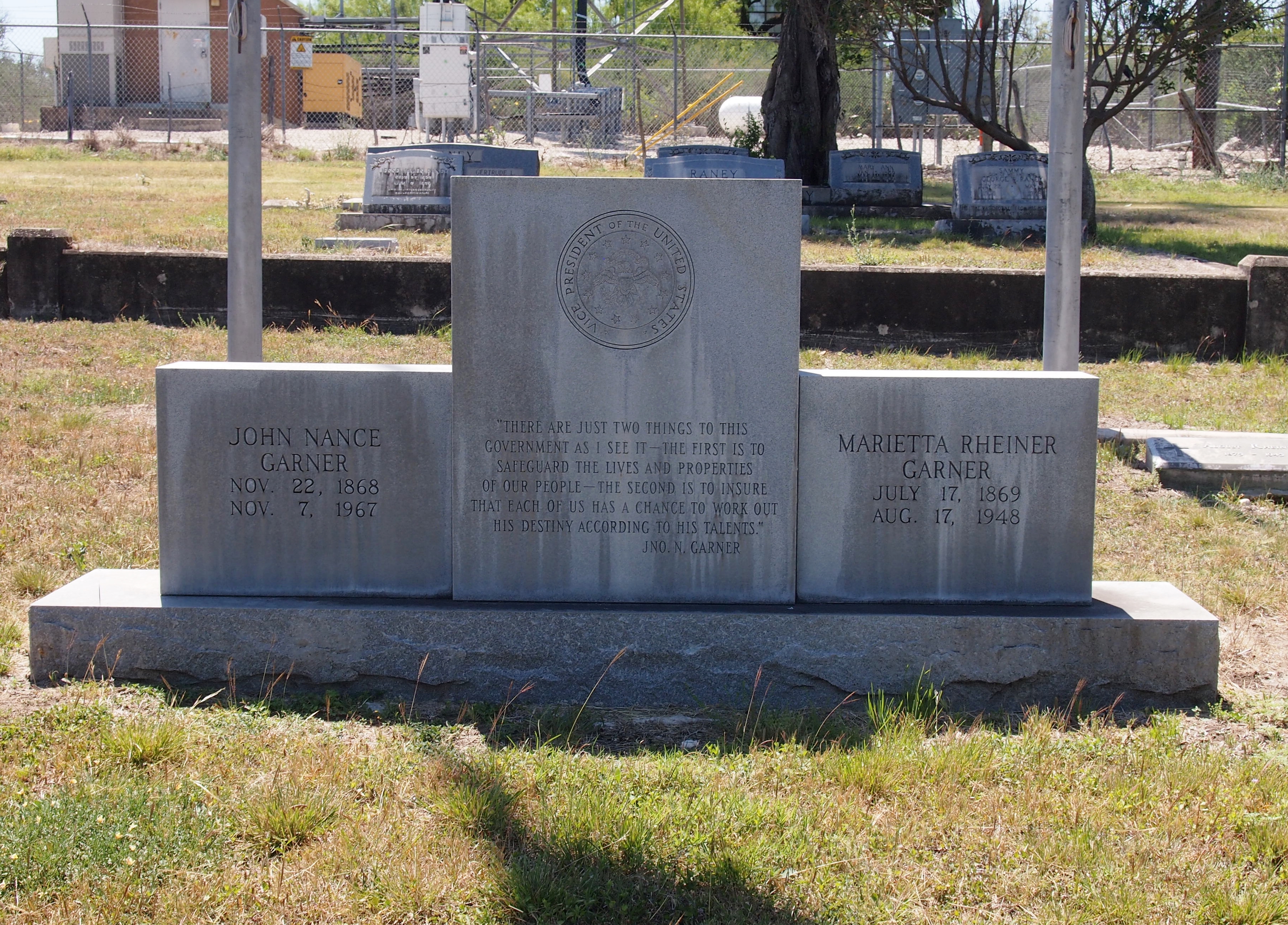
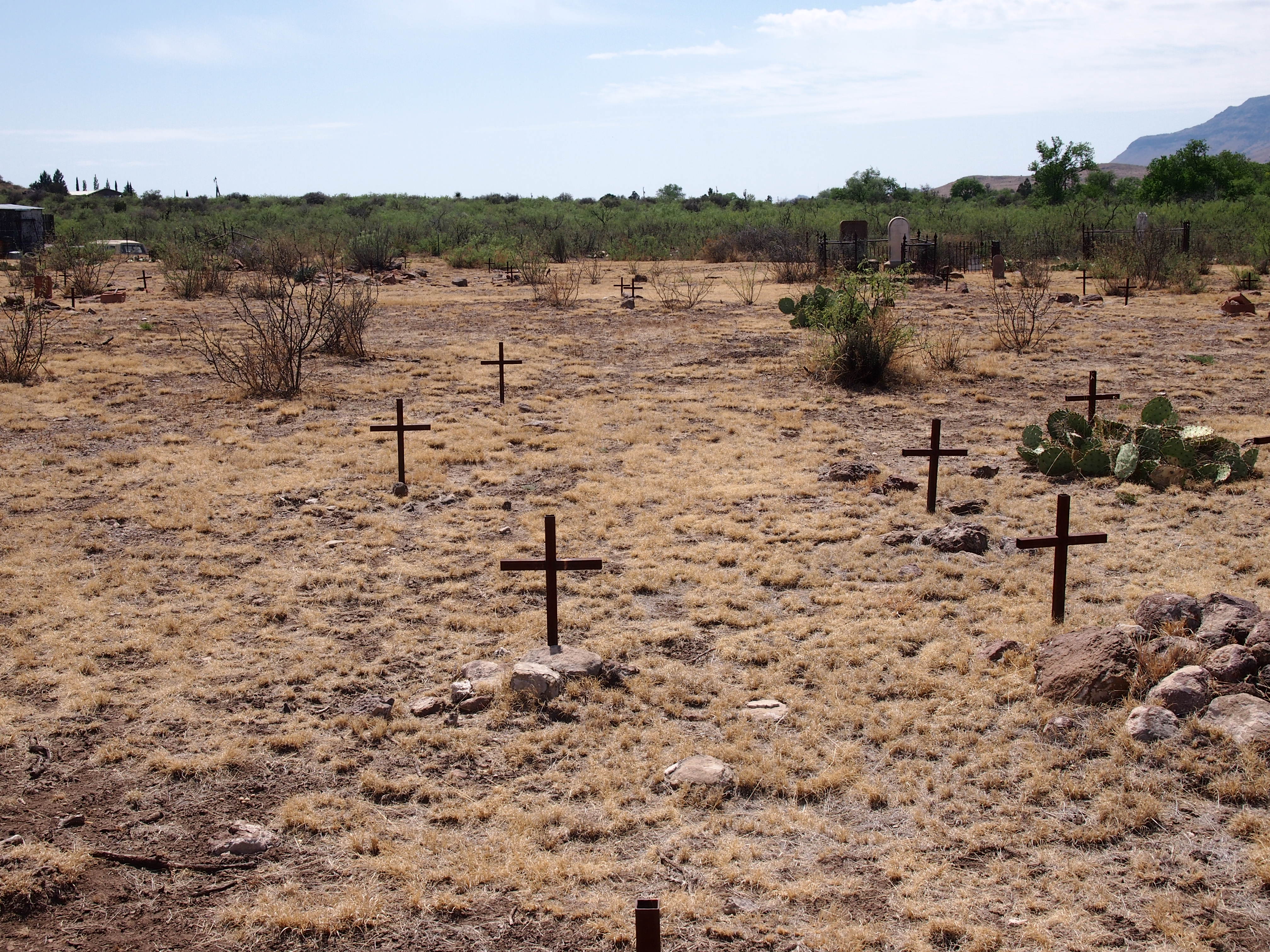
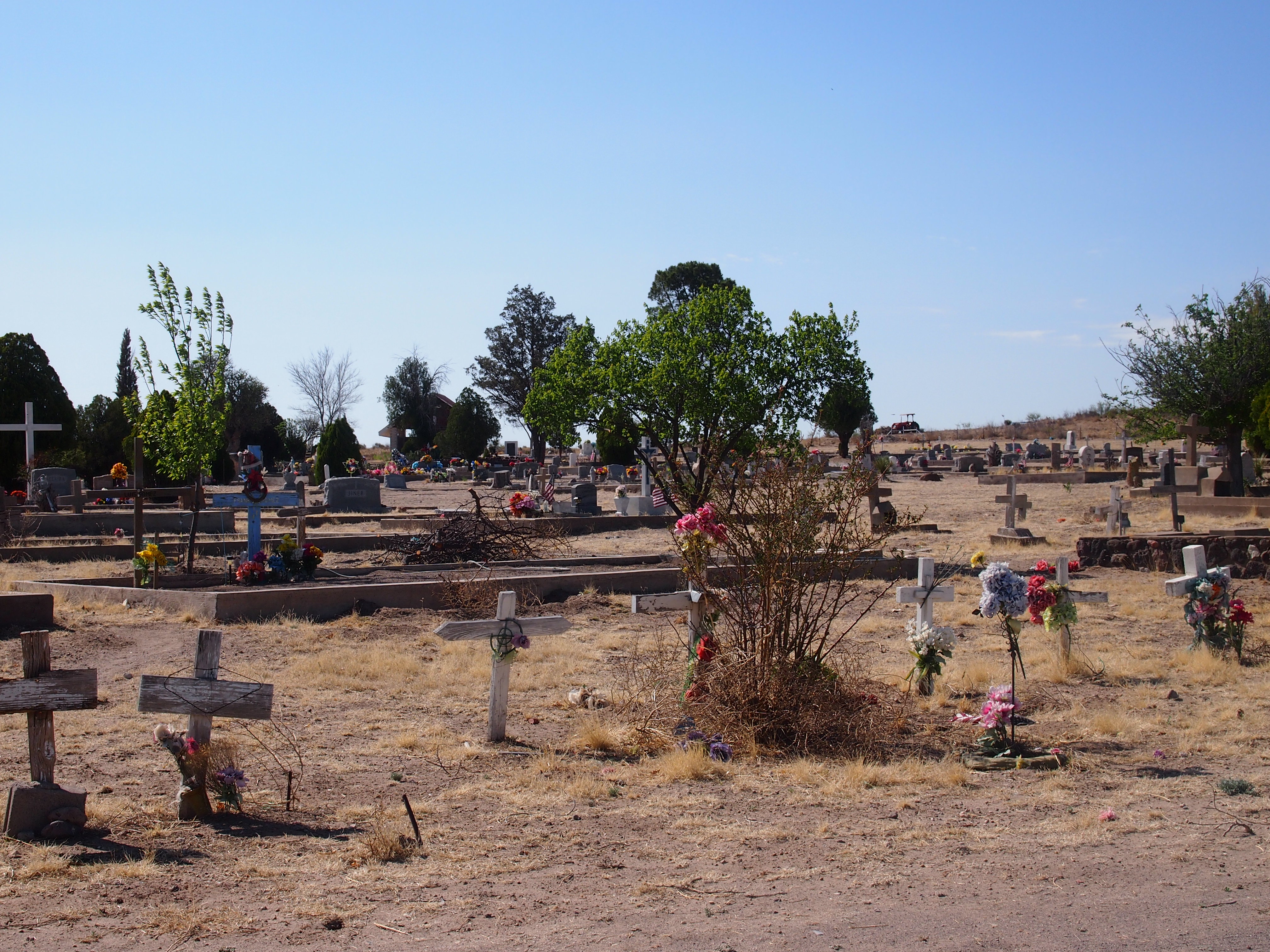
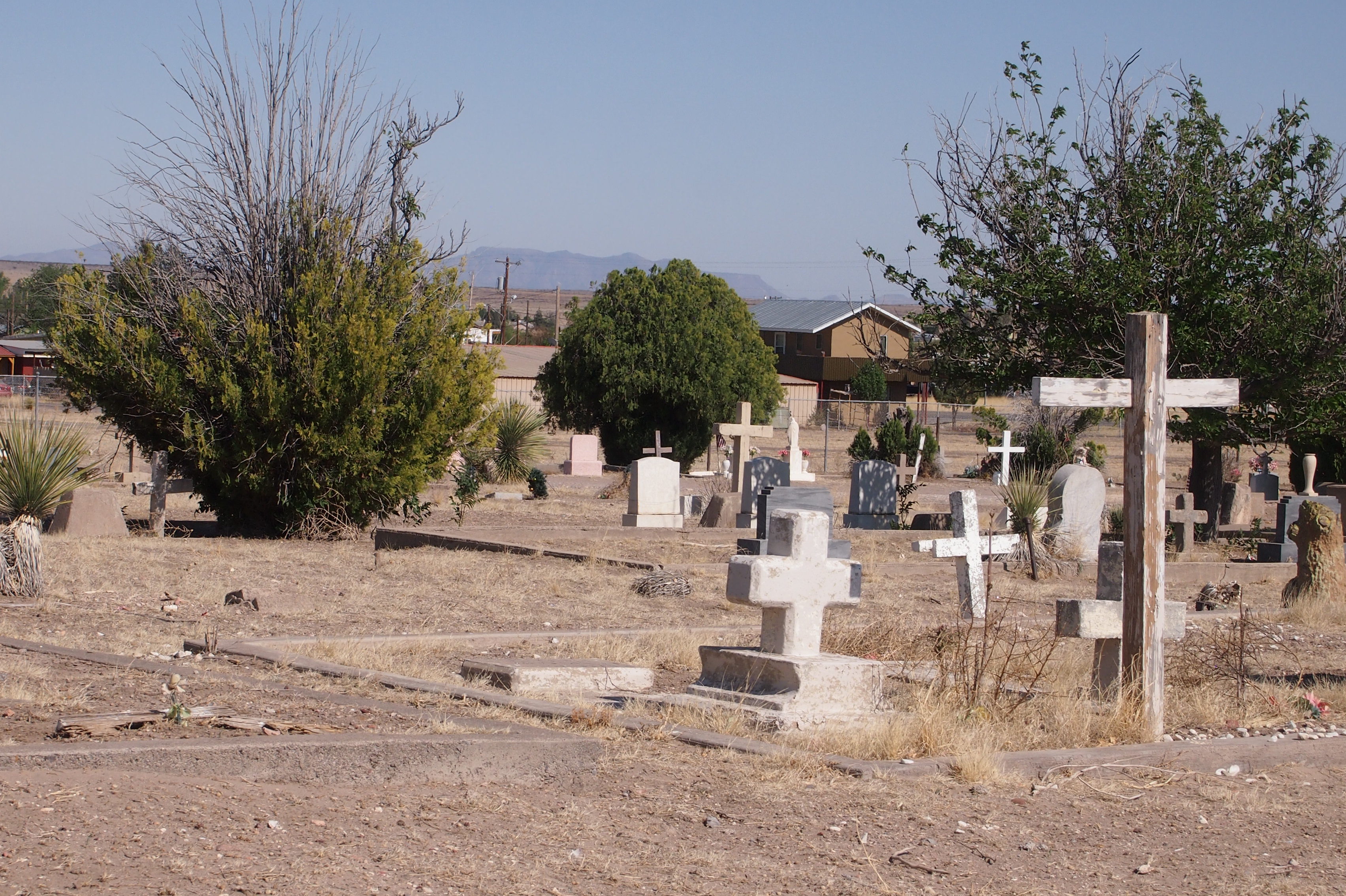
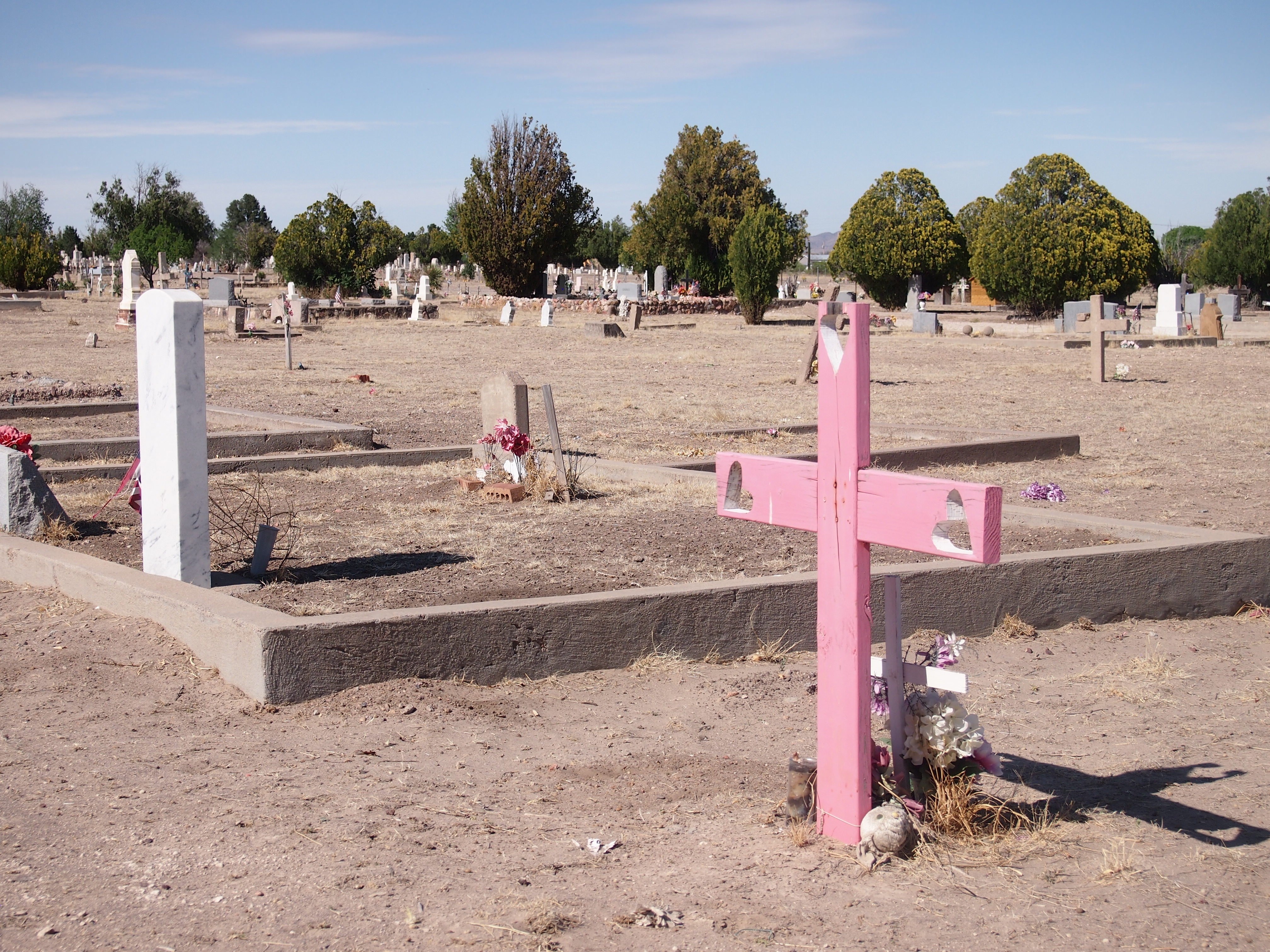
Jay and I passed through Waxahachie in Ellis County, Texas, on October 22, and besides visiting the handsome Nicholas P. Sims Library for a little while, we also spent a few minutes at the Waxahachie City Cemetery a short distance away.
According to a Texas Historical Commission marker on site, “the first burial here occurred on Jan. 1, 1852, after the death of pioneer merchant Silas Killough (b. 1805), one of the founders of this community. The original 4.16 acre tract was given in 1858 to trustees of the Methodist church by Emory W. Rogers (d. 1874), who was Waxahachie’s first settler (1846) and donor of land for the townsite. About 1900, the cemetery was transferred from church to municipal jurisdiction. By gifts and purchases of additional land, the site has grown to 65 acres and contains about 10,000 graves.”
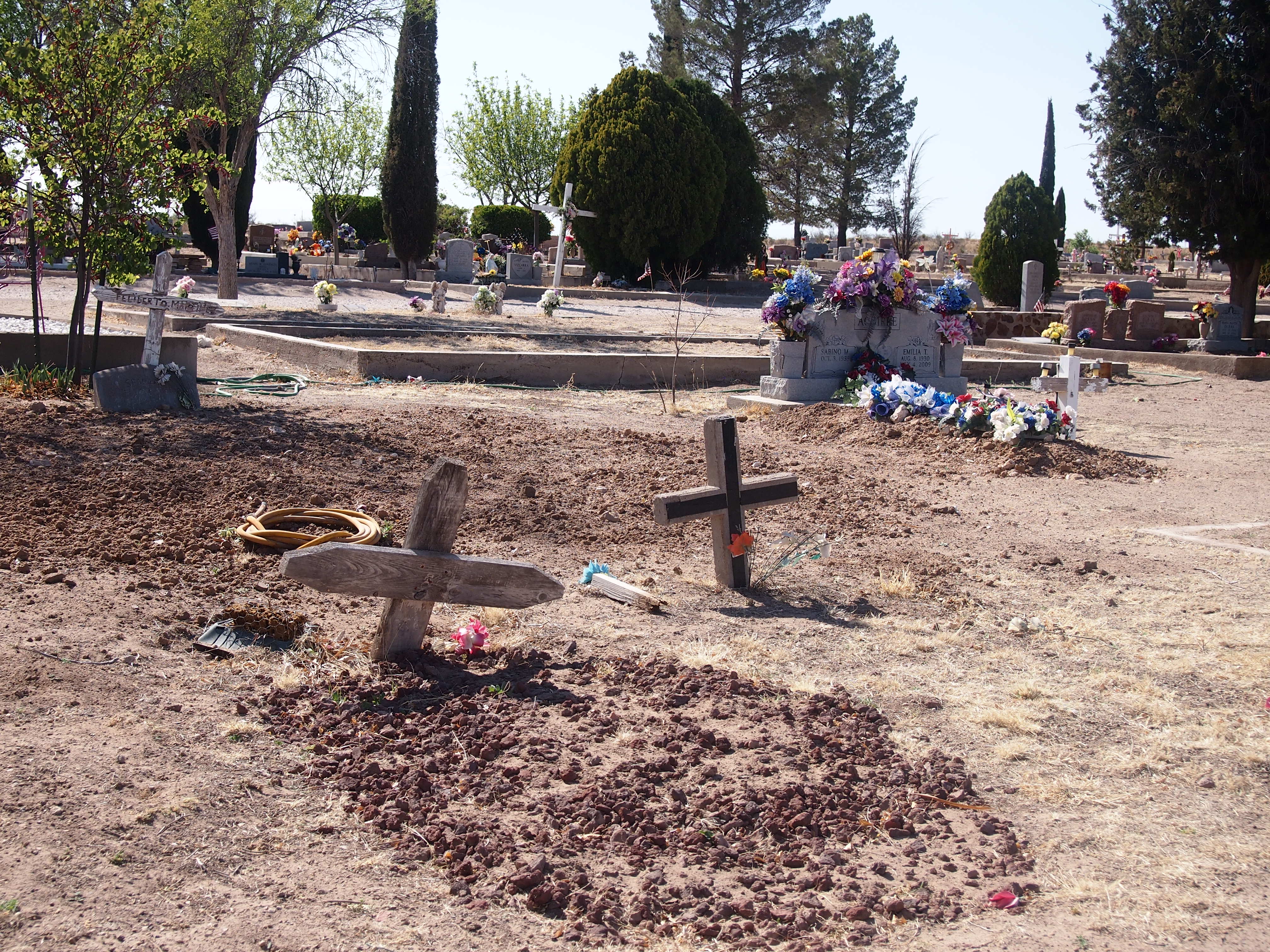
WaxahachieIt had been dry in this part of Texas since a wet early summer, so the cemetery was rich in earth tones in October ahead of the massive rains that fell over the next few days.

Et In Waxahachie EgoNot the most ornate cemetery or the shadiest one, but a nice small-town Texas boneyard, something like the one I saw in Flatonia, Texas a half-dozen years ago, and not as tumbledown as the old San Antonio cemeteries I saw earlier this year.

Nuestra Señora del Espíritu Santo de Zuñigais & Presidio Nuestra Señora de Loreto de la Bahía

Nuestra Señora del Espíritu Santo de Zuñigais is on the San Antonio River, but it’s well downstream from the SA metro area, in the modern town of Goliad. It’s been there since 1749 in one form or another, at first doing what missions did in the early days, such as convert the natives, engage in ranching, and be a part (along with the nearby presidio) of Spain’s claim to the region against French and English inroads.

By the early 20th century, it was a ruin. But not forgotten completely, because the CCC rebuilt it in the 1930s. It isn’t as well known as the chain of missions in San Antonio, including the Alamo, which were tapped by UNESCO as a World Heritage Site earlier this month. That agitated a few simple-minded crackpots, since it’s always something. So the NPS felt obliged to include the following sentence in its press release about the honor: “Inclusion of a site in the World Heritage List does not affect U.S. sovereignty or management of the sites, which remain subject only to U.S., state and local laws.”

Ann and I made our way to Mission Espíritu Santo in the late afternoon of July 11. Only one other group was visiting at the time, and in fact the interior was already closed for the day. But we got a good look at the mission and its grounds.
Goliad, july 2015Some parts are still ruins. It adds a certain something to the site.
Goliad, July 2015Other parts are open to the sky.
Goliad, July 2015A short drive away is Presidio La Bahía, the fort that protected the mission. In full, Presidio Nuestra Señora de Loreto de la Bahía, it was the place to go to when Apaches were coming. During the Texas Revolution, Fannin and his men were imprisoned there before they were killed not far away. In our time, that means people tell ghost stories about the place.
Presidio BahiaWe got there after closing time. The presidio, being a fortress, has a wall all the way around — also rebuilt, I assume — so no peeks inside. That just means I’ll have to come back someday for a longer look.

Fannin Battleground State Historic Site

The easy way to get from the greater Houston glop to San Antonio is via I-10. That route has its interests, such as Flatonia and Schulenburg and not far away, the Painted Churches, a few of which I’d like visit someday. But on the 11th, I had other things in mind, and followed US 59 southwest out of town.

Or rather, the future I-69. Every 20 or 30 miles, a sign told me that the current route of US 59 — which is already mostly a four-lane highway between the outskirts of Houston and Victoria — would someday be a bone fide part of the Interstate system running all the way to Laredo. For ordinary drivers like me, I’m not sure of the value, since on an Interstate you can’t use turnarounds in the medians, as you can — and as I did a few times — on a large US route. But looking at a map, I can also see the advantage of an I-69 through Texas for trucks barreling up from Mexico to points east: they can bypass San Antonio and its traffic.

Just southwest of Victoria is the Fannin Battleground State Historic Site, where Col. Fannin surrendered to Gen. Urrea after the Battle of Coleto not long after the fall of the Alamo. An obelisk marks the site.

Soon after the surrender, of course, Fannin and most of his men were murdered on the orders of Santa Anna, in a move that wasn’t just a crime, but a blunder. The Texas State Historical Association posits: “The impact of the Goliad Massacre was crucial. Until this episode Santa Anna’s reputation had been that of a cunning and crafty man, rather than a cruel one. When the Goliad prisoners were taken, Texas had no other army in the field and the newly constituted ad interim government seemed incapable of forming one.

“The Texas cause was dependent on the material aid and sympathy of the United States. Had Fannin’s and Miller’s men been dumped on the wharves at New Orleans penniless, homesick, humiliated, and distressed, and each with his separate tale of Texas mismanagement and incompetence, Texas prestige in the United States would most likely have fallen, along with sources of help.

“But Portilla’s volleys at Goliad, together with the fall of the Alamo, branded both Santa Anna and the Mexican people with a reputation for cruelty and aroused the fury of the people of Texas, the United States, and even Great Britain and France, thus considerably promoting the success of the Texas Revolution.”

Ann, Fannin BattlegroundA little further to the southwest is the town of Goliad, seat of Goliad County. It has a handsome courthouse, as many counties in Texas do.
Goliad County CourthouseAlfred Giles, a British immigrant who did a lot of work in South Texas, San Antonio in particular, designed the Goliad County courthouse in 1894. A hurricane knocked down the clock tower in 1942, but it was finally replaced in 2003.

On the courthouse grounds is the Hanging Tree.
Hanging Tree, GoliadAccording to a State Historical Survey Committee plaque near the tree: “Site for court sessions at various times from 1846 to 1870. Capital sentences called for by the courts were carried out immediately, by means of a rope and a convenient limb.

“Hangings not called for by regular courts occurred here during the 1857 “Cart War” — a series of attacks made by Texas freighters against Mexican drivers along the Indianola-Goliad-San Antonio Road. About 70 men were killed, some of them on this tree, before the war was halted by Texas Rangers.”

More on this little-known incident here; it isn’t to the Texans’ credit. Even so, across the street from the Hanging Tree is the Hanging Tree restaurant. How very Texas.

To the Smokies and Back ’08

Our trip to the Great Smoky Mountains NP and other places in 2008 was a late June, early July event. Has it really been seven years ago? The world seems like a different place now.

At Mammoth Cave NP, there was the famed cave, but you could also rent fun vehicles to tool around in.

Lilly & Ann June 2008It’s good to show your family places you know, but which they don’t, such as the Nashville Parthenon.
Parthenon, June 2008That’s what this country needs, more public-private partnerships to re-create the wonders of Antiquity. The Hanging Gardens of Omaha. A new Lighthouse of Alexandria in Alexandria, Va. The Statue of Zeus at Olympia, Wash. A new Temple of Artemis in Tucumcari, NM. That kind of thing. (Or city walls around Dallas, as my brother Jay has suggested.)

Next, the Mingus Mill, which is part of the Great Smoky Mountains NP. I liked it just for the name. Water was flowing in the trough, and the girls liked it because they could float things in the trough.
Mingus Mill July 2015As the NPS says, “A half-mile north of the Oconaluftee Visitor Center is Mingus Mill. Built in 1886, this historic grist mill uses a water-powered turbine instead of a water wheel to power all of the machinery in the building. Located at its original site, Mingus Mill stands as a tribute to the test of time.” Yep.

In the Indian town of Cherokee, NC, you could pose for a small fee with this fellow. Chief Syd, he called himself.
Cherokee, NC July 2015It wouldn’t have been a good trip without dropping in on a dead president. Andrew Johnson, in this case. President Johnson reposes in his hometown of Greeneville, Tenn. As it happened, we saw his memorial on July 4. (I did. Family stayed in car.)
President Andrew Johnson, July 4, 2008It’s also good to happen across little-known historic sites, such as Liberty Hall in Frankfort, Ky. Little-known, at least, outside of the immediate area.
Libery Hall, July 2008“This Georgian mansion was begun in 1796 by John Brown and named for [the] Lexington, Va. academy he attended,” says the landmark sign. “His wife Margaretta and Elizabeth Love began [the] first Sunday School west of [the] Alleghenies in [the] garden. Guests have included James Monroe, Zachary Taylor, Andrew Jackson and Gen. Lafayette…” The plaque maker must have charged by the letter, what with all of the definite articles left out.

A lovely garden it was, too.

Liberty Hall garden July 2008One more thing. As I’ve said, it’s good to be open to sampling new things on the road.
Root beer, July 2008I don’t remember, but it was probably tasty. Things often taste better on the road.

Black Hawk & John Deere 2003

In April 2003, we took a short trip to north-central Illinois. We made a stop at the Black Hawk statue, whose formal name is “The Eternal Indian,” by Lorado Taft in Lowden State Park in Ogle County.

As I wrote then, “the statue, made of concrete, is about 50 feet high and stands on a bluff overlooking the Rock River and some of the town of Oregon. The head and neck represent an Indian, looking pensively off into the distance. His arms are folded in front of his chest, and from there on down the statue is less representational, but is clearly a human form.”

BlackHawkWe also took a look at the John Deere Historic Site in Grand Detour, featuring a blacksmith demonstration.

Deere“The re-created smithy was… the exact size of John Deere’s original Grand Detour shop, not including a latter addition, and presumably the original didn’t devote about a fifth of its space to a railed-in section where tourists stood. Otherwise, it was an evocative re-creation. A lot of iron & steel tools and implements on shelves, hanging on pegs, scattered around on various tables and benches. A bellows and a coal-burning furnace, which was glowing. A real anvil and some mean-looking, anvil-beating tools at hand.”

Treue der Union

The Texas State Historical Association says that “the Civil War skirmish known as the battle of the Nueces took place on the morning of August 10, 1862, when a force of Hill Country Unionists, encamped en route to Mexico on the west bank of the Nueces River about twenty miles from Fort Clark in present-day Kinney County, were attacked by mounted Confederate soldiers… Contentions over the event remained on both sides, with Confederates regarding it as a military action against insurrectionists while many German Hill Country residents viewed the event as a massacre.

“After the war the remains of the Unionists killed at the battle site were gathered and interred at Comfort, where a monument commemorates the Germans and one Hispanic killed in the battle and subsequent actions. The dedication of the Treue der Union monument occurred on August 10, 1866. To commemorate the 130th anniversary of the memorial, the monument was rededicated on August 10, 1996. It is the only German-language monument to the Union in the South where the remains of those killed in battle are buried, and where an 1866 thirty-six star American flag flies at half-staff.”

The memorial stands on High Street in Comfort, Texas, between 3rd and 4th Sts., next to a piece of undeveloped land and across the street from a church and a school.
Comfort, Texas Feb 2105With the names of the dead on the sides. These fell in a later event in October 1862, on the Rio Grande.

Comfort, Texas Feb 2015And a 36-star flag does indeed fly there.

Comfort, Texas Feb 2015Not something you see too often. That flag was only current for two years, between 1865 and 1867, or rather between the admission of Nevada and Nebraska.

Two Stops on the Hill Country Bat Trail

Somewhere or other Jay heard about a bat roost near Comfort, Texas, and if that isn’t an incentive to visit that place when you’re already close by, I don’t know what is. So on the afternoon of the 14th, we went looking for it.

Comfort is a small town, pop. 2,300 or so, in Kendall County and, according to the Census Bureau, part of the San Antonio MSA. I’d put it in the Hill Country, though that’s not an official designation. Comfort’s main street (named High Street) is characterized by handsome 19th-century buildings, many made of local stone, put to 21st-century purposes, such as antique stores and restaurants that point out — or should point out — that they offer Comfort food.

To get to Comfort from San Antonio, head northwest on I-10. On Ranch to Market Road 473, a few miles east of town, you’ll find this curious structure.

Bat Roost, near Comfort, TexasAccording to the Texas Historical Commission plaque at the site: “This shingle style structure was built in 1918 to attract and house bats in an effort to eradicate mosquitoes and thereby reduce the spread of malaria. It was designed for Albert Steves, Sr., a former mayor of San Antonio, by Dr. Charles A. R. Campbell, an authority on bats who had served as the health officer in the same city. Named ‘Hygeiostatic’ by Steves, the bat roost is one of 16 constructed in the United States and Italy between 1907 and 1929. Recorded Texas Historic Landmark – 1981.” It’s also on the National Register of Historic Places.

No bats were at home, it being February. I understand that they do live there in the warmer months. Different sources put the number of such towers in this country at two or three. Apparently one of the others is on Lower Sugarloaf Key in the Florida Keys.

North and east of Comfort, not far from Fredericksburg, is Old Tunnel State Park. Formerly a railroad tunnel, it’s now a home for bats. During the warm months, you can sit outside the entrance and watch bats emerge around dusk — a smaller version of the bat flight out of Carlsbad Caverns, memorable enough that I remember it after 40+ years. Again, no bats were around in February. But on hand were a couple of bat enthusiast-volunteers to tell casual visitors about the bat cave, and we talked to them a few minutes.

That’s two stops on the hypothetical Hill Country Bat Trail. Another could be the Congress Street Bridge in Austin, also known for as a bat habitat, or Bracken Cave in Comal County.

Road Eats ’14

Serendipity is your friend on the road, but you have to be open to it. After spending some time at the Wichita Public Library’s main branch in downtown Wichita on July 14, we headed west on Douglas Ave., the way we’d come into downtown. We wanted lunch, and I thought I’d seen something interesting coming in. But I couldn’t remember exactly what. Then I saw Nu Way Crumbly Burgers.

Crumbly Burgers, yumClearly my kind of place. It’s a small Wichita chain. “The Nu Way tradition began on July 4th, 1930, at the same location we still call our ‘original’ home at 1416 West Douglas,” the Crumbly web site tells us. “It all started when Tom McEvoy… moved from Iowa to Wichita and built the first Nu Way. The dedication and absolute commitment to quality Tom began can still be tasted today as we carry on his reputation.

“We still make Nu Ways with the exact same recipe using our patented cookers and we still make our world famous Root Beer daily along with our homemade Onion Rings.”

Crumbly burgers are loose-meat sandwiches and root beer is, well, root beer, and we had both (Ann’s was a float), sitting at the counter. Considering that it was mid-afternoon on a Monday, the place was busy. For good reason. Those crumbly burgers might crumble, and you have to position your wrapping to catch those loose odds of meat, but they were satisfying. The frosty chilled root beer hit the spot exactly.

Nu Way harkens back to the ’30s. In Dallas, Keller’s evokes the 1950s, I think. But not the ’50s of televised nostalgia – we saw a lot of that in the ’70s – but just an ordinary burger-and-shakes joint that’s simply never been updated. Jay calls it Jake’s, since that used to be its name, but there was some kind of family ownership split or something. We went to the one on Garland Rd., but there are a few others, including one that’s supposed to be a drive-in. Anyway, the Garland location serves tasty burgers, fries and shakes, ordered and picked up at the front counter.

Bun ‘n’ Barrel is on the Austin Highway in San Antonio. Points for actually having two apostrophes. It’s been there since I can remember (it was founded in 1950, so that makes sense). The last time I went might have been in the late ’70s. It doesn’t seem to have changed too much with time, though there’s been a few recent renovations, such as the addition of a little nostalgia-oriented decor. They’re also happy that what’s-his-name on Diners, Drive-Ins and Dives showed up to do a segment a few years ago.

Bun 'n' BarrelThere’s a barrel on the roof, but I had a hard time getting a good shot of it. Also, it was over 90 F that day, and I didn’t want to loll around outside. Instead, I snapped the painted concrete  barrel out in the back parking lot.

Bun n BarrelI got the wrong thing: a ham plate. It wasn’t bad, but it was exactly like ham I can get at a grocery store. Probably the barbecue or a burger would have been a better choice.

Threadgills in Austin isn’t a classic road-food diner or a greasy spoon, but it makes a mighty chicken fried steak. Be sure to have it with mashed potatoes and fired okra. Its nostalgia is late ’60s, early ’70s. For instance, I saw that the Jerry Garcia Fest will be at the restaurant’s beer garden this weekend. We went to the one in South Austin, one of two locations. The current restaurants are descended from a beer joint that opened as soon as Prohibition ended, with a musical heyday 40 or 50 years ago.

Finally, if you’re southbound on I-35 north of DFW and you take the very first exit after crossing into Texas, and then gas up at the gas station there, you will also see this.

Fried Pies!Among roadside eatery names, that’s high concept. Through much of southern Oklahoma, I’d seen fried pies advertised, like you can see pasties advertised in the UP. I decided it was time to investigate. It was arrayed like a doughnut shop, except replete with fried pies – bigger than the ones you buy in the grocery store, if you’re in the mood for high-calorie, barely mediocre treats. I bought a chocolate pie and a coconut one, and Ann and I split both. They were a lot better than any factory-make ones at a grocery store.

Mother Jones in Mt. Olive

Gene Autry – the singing cowboy, “Rudolph the Red-Nosed Reindeer” Gene Autry – recorded “The Death of Mother Jones” early in his career: 1931, shortly after the death of labor agitator Mother Jones (Mary Harris Jones). It’s worth a listen.

For years I’ve been seeing the sign on the Interstate advising me that Mother Jones’ memorial is off Exit 44 in Mt. Olive, Ill., not far outside greater St. Louis, but it’s been a one-of-these-days destination. The day turned out to be July 27, 2014, our last day of the trip. I’d planned to have lunch at Crown Candy Kitchen in St. Louis, and remarkably enough, I didn’t have any trouble finding that establishment. But at about 1 on that Sunday afternoon, a line was out the door. Crown Candy might be good, but not that good.

So we pressed on into Illinois. I’d stopped for lunch in Litchfield some years ago, and had a good enough memory of that, so that was the target. But then I saw the Mother Jones sign, and a billboard for a diner in Mt. Olive, pop. 2,000-plus. A winning combo. We got off at Exit 44 and followed the signs to the Union Miners Cemetery, final resting place of Mother Jones and presumably a lot of mining men. This is the view from her memorial.

Union Miners CemeteryThe view of her memorial.

Mother Jones Memorial, July 2014Why Mt. Olive? The Illinois Labor History Society tells us that Mother Jones herself made the request a few years before her death.

A Special Request to the Miners of Mt. Olive, Illinois:

When the last call comes for me to take my final rest, will the miners see that I get a resting place in the same clay that shelters the miners who gave up their lives of the hills of Virden, Illinois on the morning of October 12, 1897 [sic], for their heroic sacrifice of [sic] their fellow men. They are responsible for Illinois being the best organized labor state in America. I hope it will be my consolation when I pass away to feel I sleep under the clay with those brave boys.

— Mother Jones

Mother Jones Memorial, July 2014The monument was dedicated in 1936, and according to the society, “The cash raised for the monument was $16,393.25. All of the labor involved was donated. It stands 22 ft. high on a 20 x 18 ft. base. It is built of 80 tons of pink Minnesota granite. The name of the sculptor is lost from the record.

“The dedication was, itself, a monumental event. Five special trains and 25 Greyhound buses brought celebrants to Mt. Olive. Others came in private cars or hitch-hiked to the town. The crowd was estimated at 50,000. There were 32,000 in the line of march.”

The memorial also includes plaques to men killed in the Virden Massacre, which Jones mentioned, a gun battle in 1898 between union men and company guards over whether strikebreakers were going to detrain at a major mine in Virden. The miners prevailed, in that no one got off the train, but a number of them died. The names of the dead I saw included E.W. Smith, E. Kraemmerer and Joseph Gitterle. “General” Alexander Bradley has a plaque too, though he died in 1918.

“Who were the miners who led this fight? The best known was Alexander Bradley, a 32-year-old mule driver who worked in the Mt. Olive mines,” says Illinois Labor History… By the mid-1890s, Bradley had traveled widely throughout the Midwest, tramping with other unemployed miners to Chicago and taking part in the famous march to Washington DC of Coxey’s Army of the unemployed of 1894.

“In the course of the strike, ‘General’ Bradley, as he became known, developed a well-earned reputation as a colorful and charismatic figure. Arriving with his ‘troops’ in Collinsville, for instance, Bradley sported ‘corduroy trousers, a light blue coat, white shirt, brown straw hat, toothpick (narrow and pointed) shoes, at least three emblems of secret societies and several rings on his fingers…[as well as] a light cane or a furled umbrella.’ ”

More about Virden – “Hotter than San Juan Hill” — is here.

Two Bridges of Madison County

While in Winterset and environs, I took the opportunity to see two of the wooden covered bridges of The Bridges of Madison County fame. The movie, at least, seems to be relegated to a chick flick ghetto. Wrongly, I think. The story was at least as much about the visiting photographer – the man – as it was about the farm wife.

Movie or not, I liked the bridges. At least the two I saw.  It’s remarkable that such artful wooden construction has survived for more than a century, but they have. Ann was less impressed. When we visited the first structure, the Cutler-Donahoe Bridge, she said something like, “What’s so special about this bridge?” You have to be older to appreciate older things, maybe. (Though I’ve liked old things since I can remember. I’m peculiar that way.)

Cutler-Donahoe Bridge, July 2014

The Cutler-Donahoe Bridge dates from 1870, built by one Eli Cox. In 1970, it was moved to Winterset City Park, where we saw it. Length, 79 feet. Weight – and you’d think it would be lighter – 40 tons. Nice work, Eli.

Cutler-Donahoe Bridge interior

Not far from town is the Holliwell Bridge, in situ over the Middle River.

Holliwell Bridge, July 2014Ann stayed in the car for this one. The structure’s a little newer than Cutler-Donahoe, built by Benton Jones in 1880 and renovated in 1995 (on the occasion of filming the movie, I guess, but my sources don’t say so explicitly).

Middle River, Iowa, July 2014This is the view from the north end of the bridge, looking out on the Middle River, a tributary of the Des Moines River that runs through the county. Iowa’s nice and lush this year.