Thursday Collection: Claw Machines, Ramen & Dreams Odder Than Usual

Spotted recently at the mini-mall attached to Mitsuwa, the largest Japanese grocery store here in the northwest suburbs, which is in Arlington Heights.

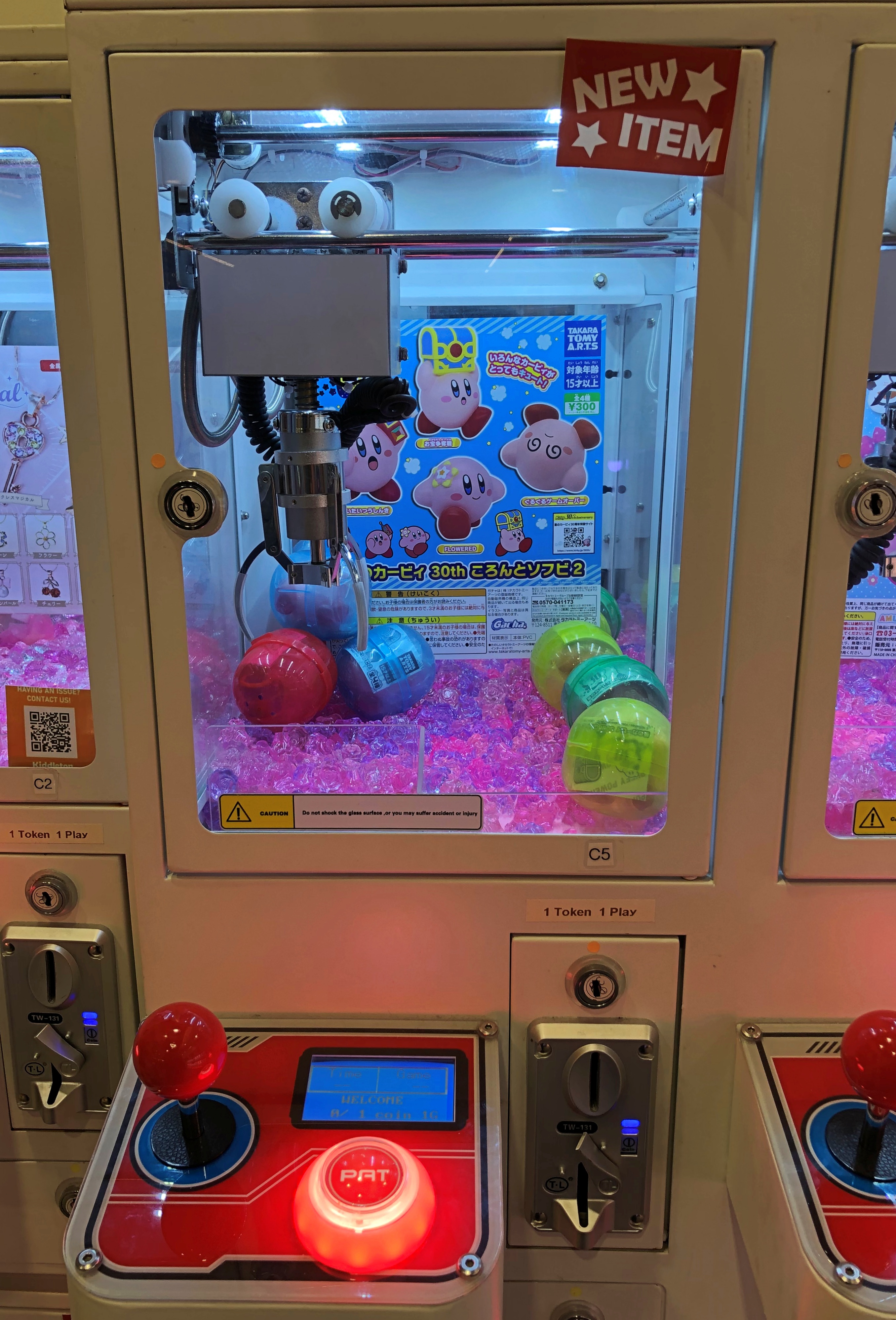
Banks of Japanese claw machines where a travel agency used to be. Not quite sure what this one is.
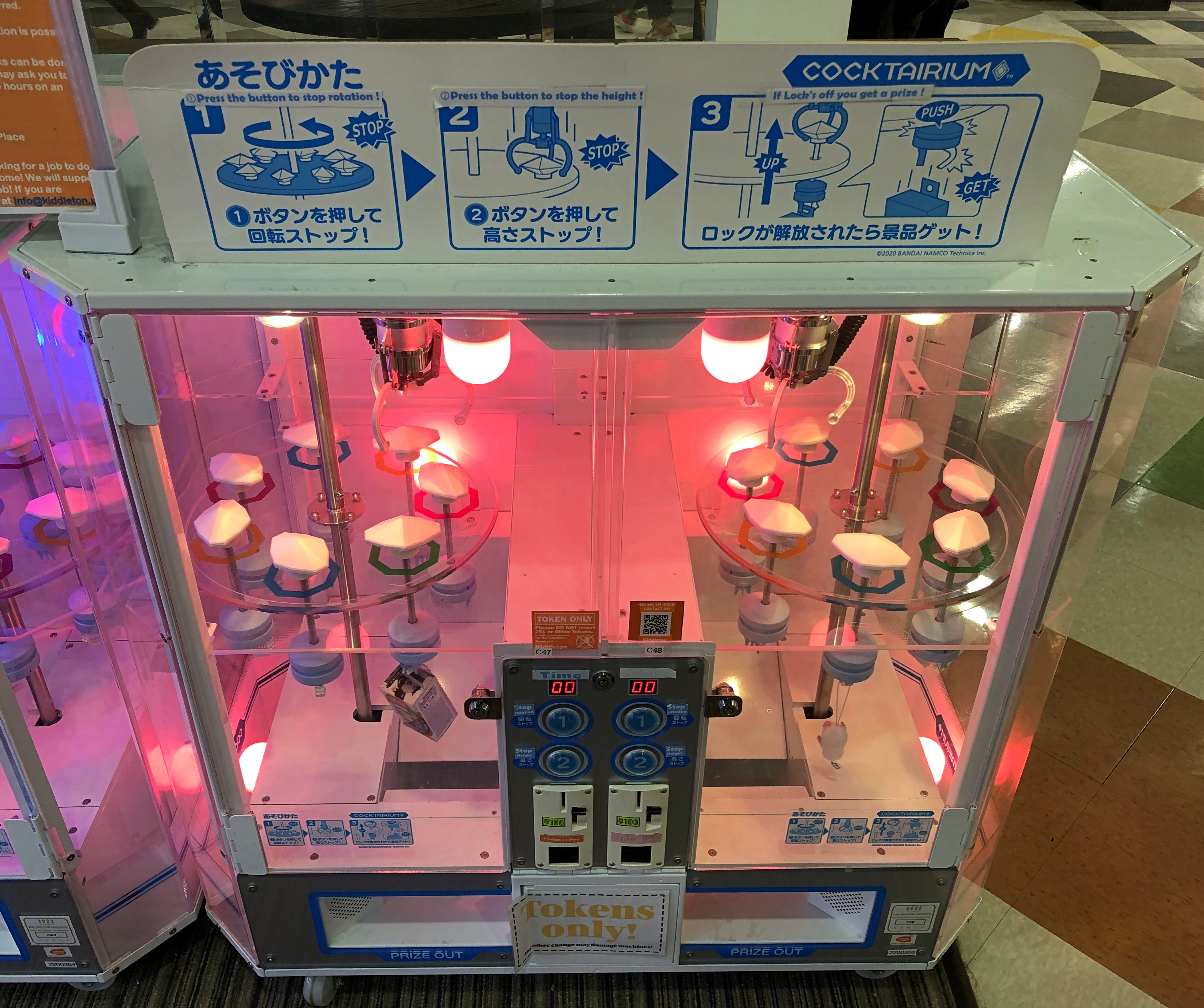
The arcade, if you can call it that, is under the brand name Kiddleton Kiosk. Turns out there are quite a few of them, mostly associated with Japanese grocery stores in the U.S.

I never had much use for claw machines. Probably because they seemed like a good way to feed quarters, or tokens, into a machine, and watch it give you nothing. Maybe Kiddleton has a different business model involving a low cost of prizes, which do deliver sometimes, compared with a higher input of tokens. I didn’t feel like testing out that idea.

Not long ago, we went to Hokkaido Ramen House in Hoffman Estates. Hit the spot. Hot steamy ramen, mine with thin slices of pork, egg and some vegetables. Just the kind of thing to enjoy on a raw winter evening.

I didn’t realize it was part of a chain until after we were there. When I found out, I looked at the chain’s web site to see where the others were. California, I figured, and maybe in the Northeast and Texas. You know, the usual chain restaurant suspects.

Turns out there’s only one in California (Santa Cruz). Guess the Asian restaurant competition’s a little stiff in that state. There are indeed a few in the Northeast and Texas as well, including one in Waco, which is a little surprising. But the real surprise is five in Montana and three in Idaho. Then again, maybe not a surprise. It’s cold a lot in those places, and ramen warms you up.

Two old friends of mine met for the first time recently, in a dream of mine. One a lanky bald fellow I’ve known 40 years, the other sporting long gray hair and a thick beard for that Old Testament prophet look, whom I’ve know nearly as long. They were sitting at a table, with me, eating a meal, despite the fact that we were weightless in a space station. They seemed to be getting on well, and one of them, or me, or someone, explained that the company that built the space station had done so well renting cars that it was able to send people to the station at a low cost.

An even odder dream, later the same night: I climbed a ladder to rescue – kidnap? – a group of sentient pens and pencils. Semi-sentient, at least. I couldn’t carry them in a pocket, so I put the group of pens and pencils, who knew what I was doing, under my arms to carry them down the ladder. It all felt a little precarious.
Mochidou

Not long ago, we noticed Mochidou, a pastry shop in Hoffman Estates, Illinois. How that happened involves a change of veterinarians from a few years ago.

Once upon a time, we took the dog to a nearby practice that included a husband-and-wife vet team who had good bedside (kennel-side?) manor. Then about three years ago, they moved on at about the same time as a soulless chain of veterinary practices acquired the location. This new owner – let’s call it Three Initial Animal Care – soon showed its true colors when the dog acquired a snout infection in the summer of 2020.

Things were looking bad, and during a consultation by phone (these were high pandemic days, remember), whomever had replaced the competent married couple prescribed medicine we couldn’t get the dog to eat. Then the infection spread to one of her eyes. Later, the new vet saw the dog in person, while I waited in the car, and she seemed just a little too eager to fob us off on a specialty hospital, which also happened to be part of the chain.

After some expensive tests at said hospital, no cause could be determined. Could have been a virus. Or bacteria. Or a fungus. Nevertheless, the specialist there said we could proceed with very expensive surgery to try to fix things. As fond as we are of our old dog, we determined at the point that she was either going to live or not, without further intervention.
She lived. And lives to this day, with more energy than you’d expect from a dog around 13 years old. The infection destroyed her right eye, and she sneezes more than she used to, which seems to be a permanent result of the snout damage. She might also have a diminished sense of smell, which I suppose would be worse for a dog than losing some eyesight. But she doesn’t complain, and more importantly, has a vigorous appetite, and still barks at passersby, lolls around on the floor, begs for food, and does all the other dog things dogs do.

In early 2021, we decided to find a new vet, and so we did, a fellow with a solo practice in Hoffman Estates. We like him, and I believe he gives good advice.

The last time we took her to see him, we noticed that Mochidou had opened in the same strip center. Seems to be the only one of that name (so far). It sells mochi doughnuts — that is, a fusion of Japanese mochi and American doughnuts.

Last week, I was in the vicinity on non-dog business, and bought a box. We gave them a try. Man, are they good.

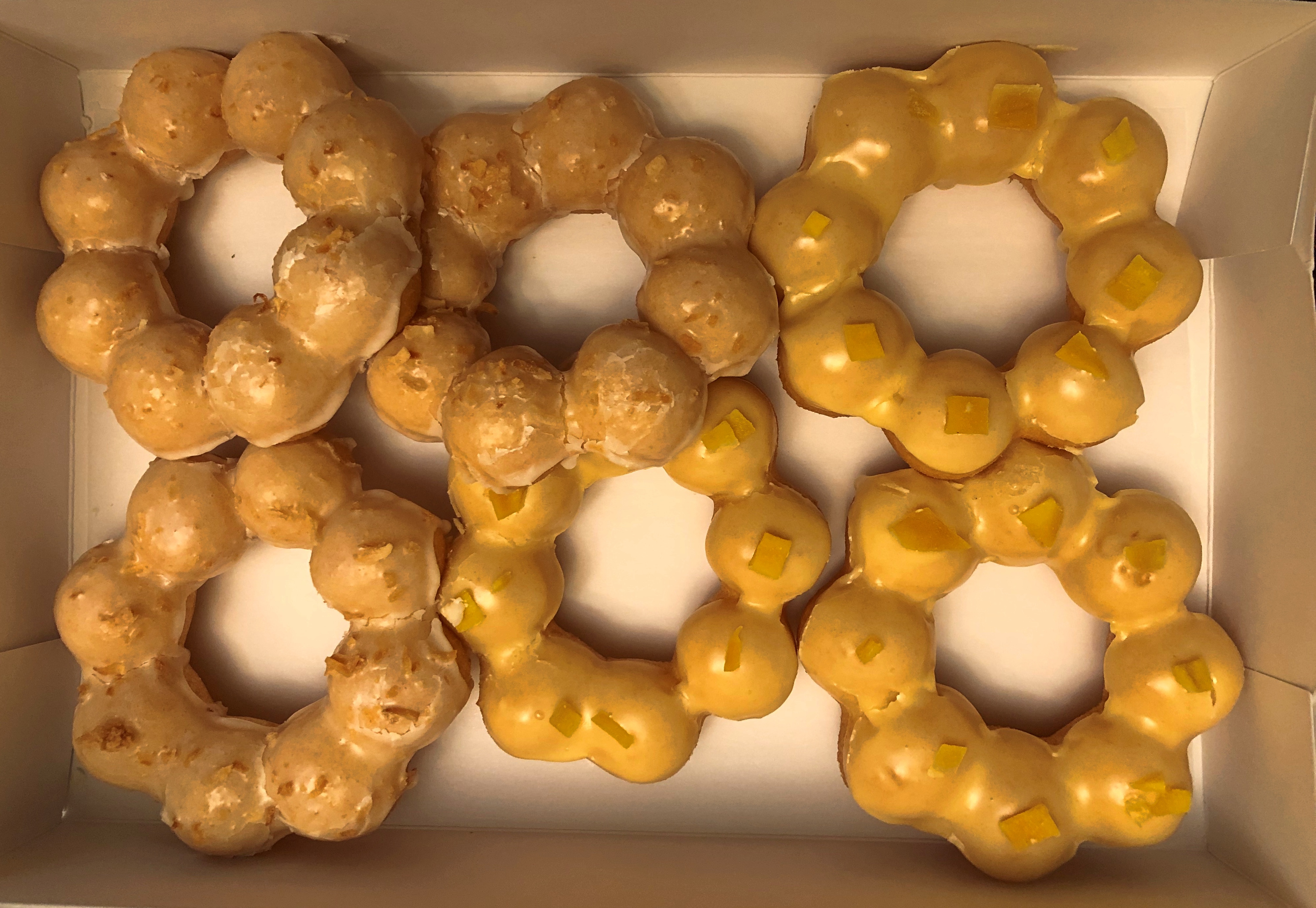
They aren’t as hyper-chewy as mochi, or as soft as a regular American (non-cake) doughnut, but in between. They aren’t as plain as mochi, or as sweet as a typical doughnut, but in between. Add to that a dash of flavor, mango in our case, and you have a wonderful treat.

“Enter the mochi donut: a donut trend that is sweeping across America due to its uniquely bouncy texture and naturally gluten-free qualities,” Thrillist reported in 2020. “The mochi donut has existed before its stateside debut, but was mostly popularized in Japan under the name ‘pon de ring’ from the donut chain, Mister Donut.”

(Mister Donut’s a post for another time. I’ve got some fond memories of mornings at the Mister Donut across the street from Nagai Koen Park in Osaka, savoring the fine doughnuts, refreshing milk tea and the incongruous rockabilly soundtrack.)

Mochidou’s confections are probably made of tapioca flour, since glutinous rice flour would end up chewier, but I didn’t ask about the ingredients, and box didn’t say. Note that they are rings of eight attached dough balls. An elegant design that makes it easy to share.

Only one gripe: they are expensive. A half dozen sells for about $16. Hipsters in high-rent urban settings spurred along to the next gustatory experience by FOMO might not consider that pricey, but we suburbanites — who take what comes — do.

Ned Brown Forest Preserve (Busse Lake) ’23

We’ve been to Ned Brown Forest Preserve more recently than February 2012, but I can’t remember when, so it’s been a while. With temps above freezing and the sun shining as brightly as it can in February, we decided to take a walk there on Sunday.

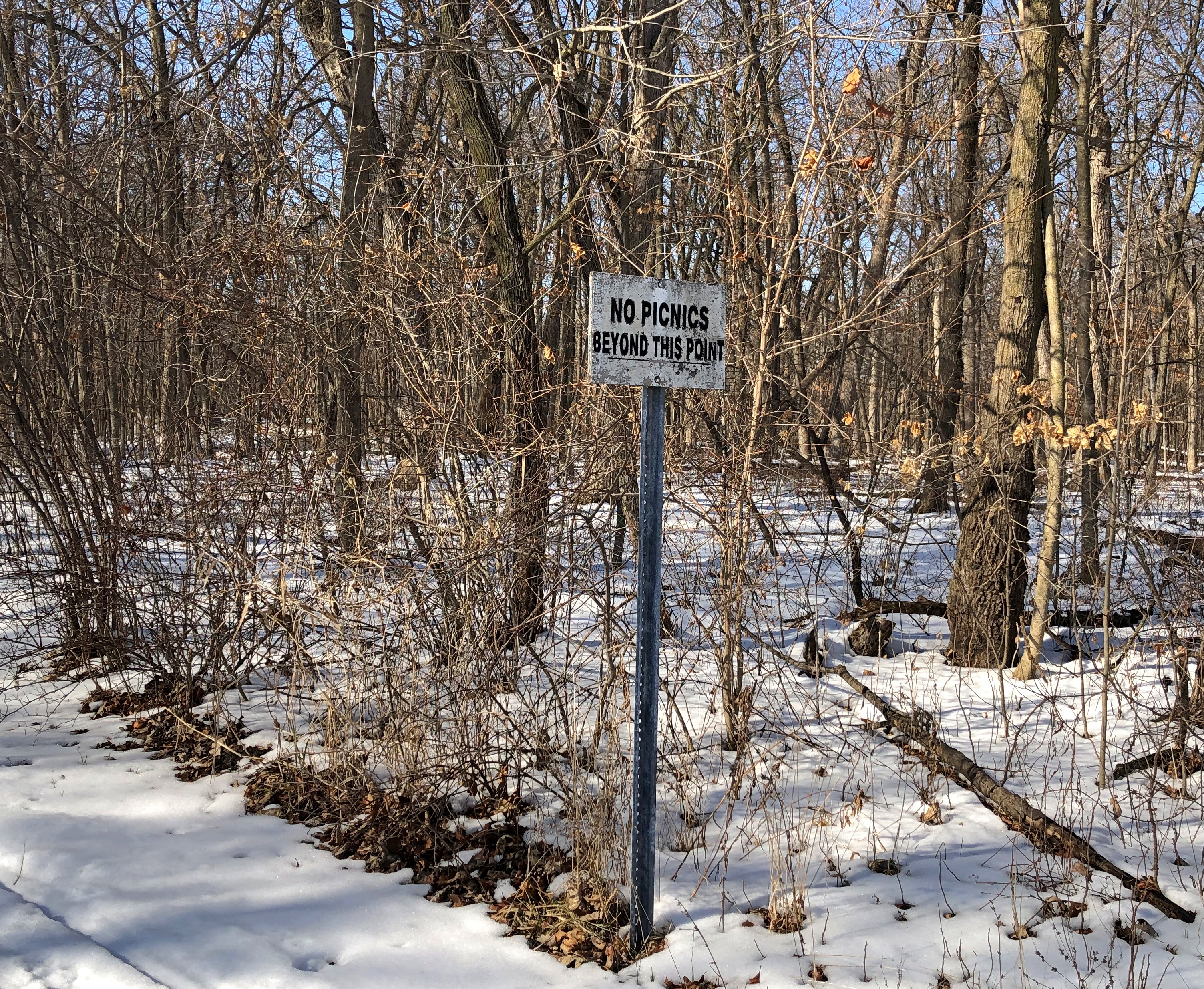
Good thing we weren’t in the mood for a picnic.Ned Brown Forest Preserve

Plenty of people had been there before us.Ned Brown Forest Preserve

But no bicycles. That’s the best thing about these trails in winter. In warmer weather, especially on a weekend, you play dodge ’em with the two wheelers if you’re a mere pedestrian.

Ice fishing is at your own risk on Busse Lake. Does it look like a good day for it?Ned Brown Forest Preserve

Apparently it was, at least on a small sliver of the surface. Of course, we’ve had some deep cold recently, so I guess that’s what kept these people from dropping into the icy drink.Ned Brown Forest Preserve

Fun for some. For our part, we walked around to the dam that forms Busse Lake by blocking Salt Creek. This is the view from the dam toward the lake.Ned Brown Forest Preserve

Toward the spillway.Ned Brown Forest Preserve

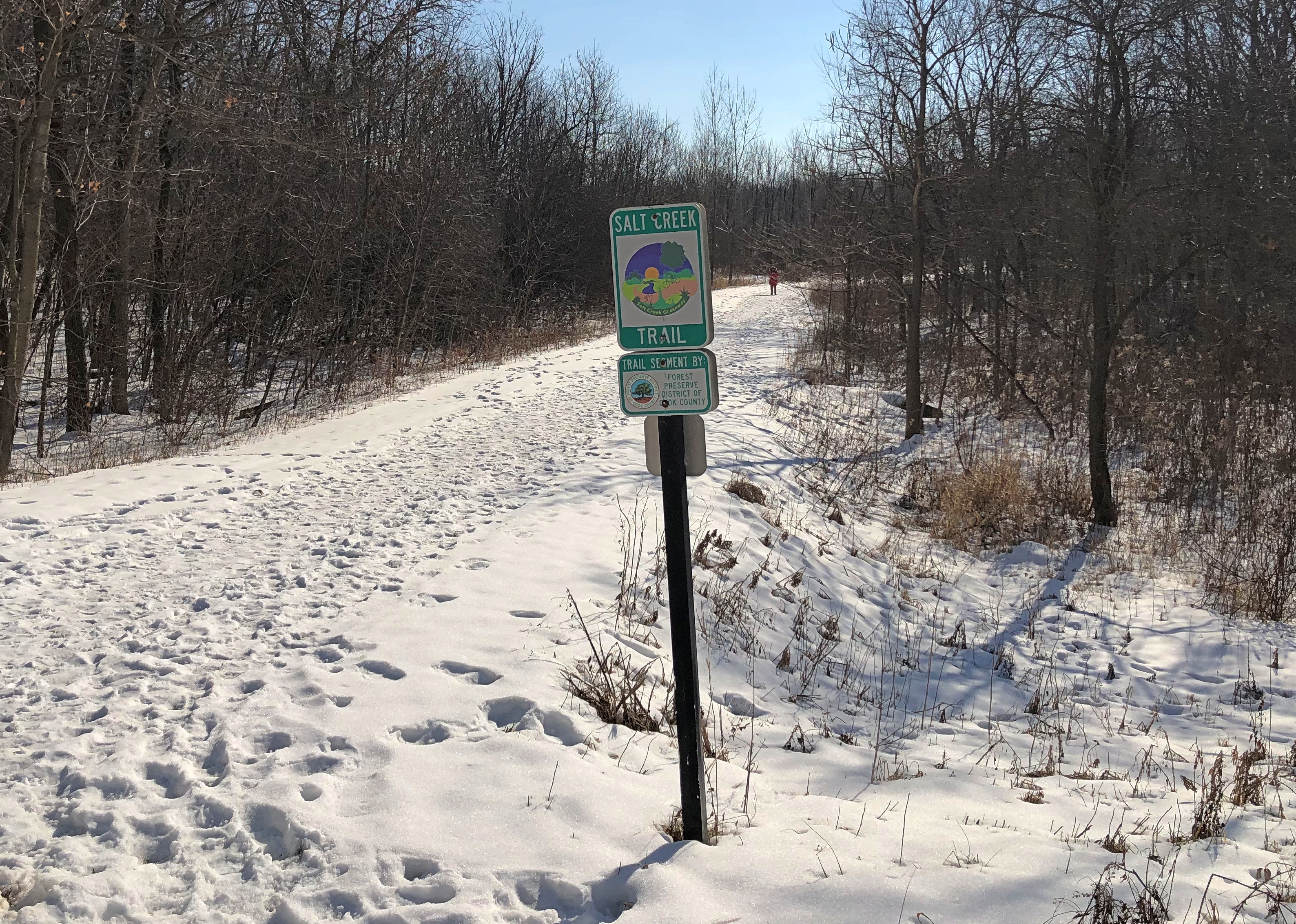
We decided not to take the nearby Salt Creek Trail, though we have before.Ned Brown Forest Preserve

Two roads diverged in a wood, and we —

We took the one more traveled by,

And that has made no difference at all.

Groundhog Day Without Groundhogs

Last Thursday temps were around freezing during the day, which is pretty good in Illinois for that oddity of an occasion, Groundhog Day.

The day shares more than one might think with Christmas, though of course it isn’t an all-consuming religious and cultural event in much of the world, just a relatively minor one. Still, it has pagan taproots connected to astronomical lore in northern Europe, an association with a Christian holiday (Candlemass), folklore imported from German-speaking lands, Victorians putting it in its modern form, a universal appearance on North American calendars (Canadians take note of the day too), and famed representations in mass media in the 20th century (e.g., Groundhog Day).

The closest show-marmot event to where we live seems to be the one involving Woodstock Willie, whose effigy I saw in the warmer month of July. We weren’t inclined to trudge all the way to exurban Woodstock on Thursday for the event, however.

Rather, we loaded ourselves and the dog in the car for the less than 10-minute drive to Schaumburg Town Square for a walkabout, after certain other errands. We knew that Friday was to be bitterly cold, so wanted to get out in the tolerable temps (still around freezing) before that happened.

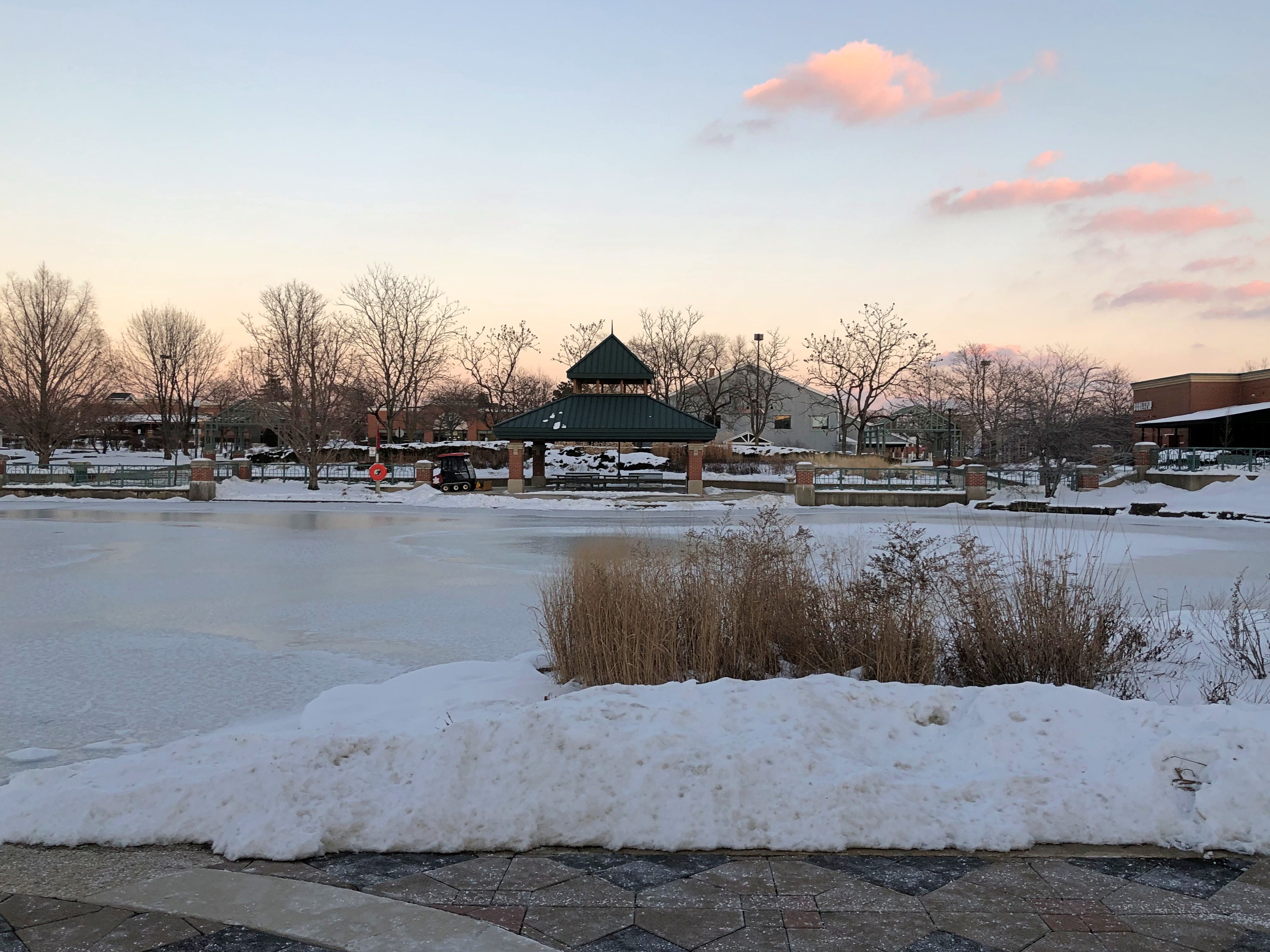
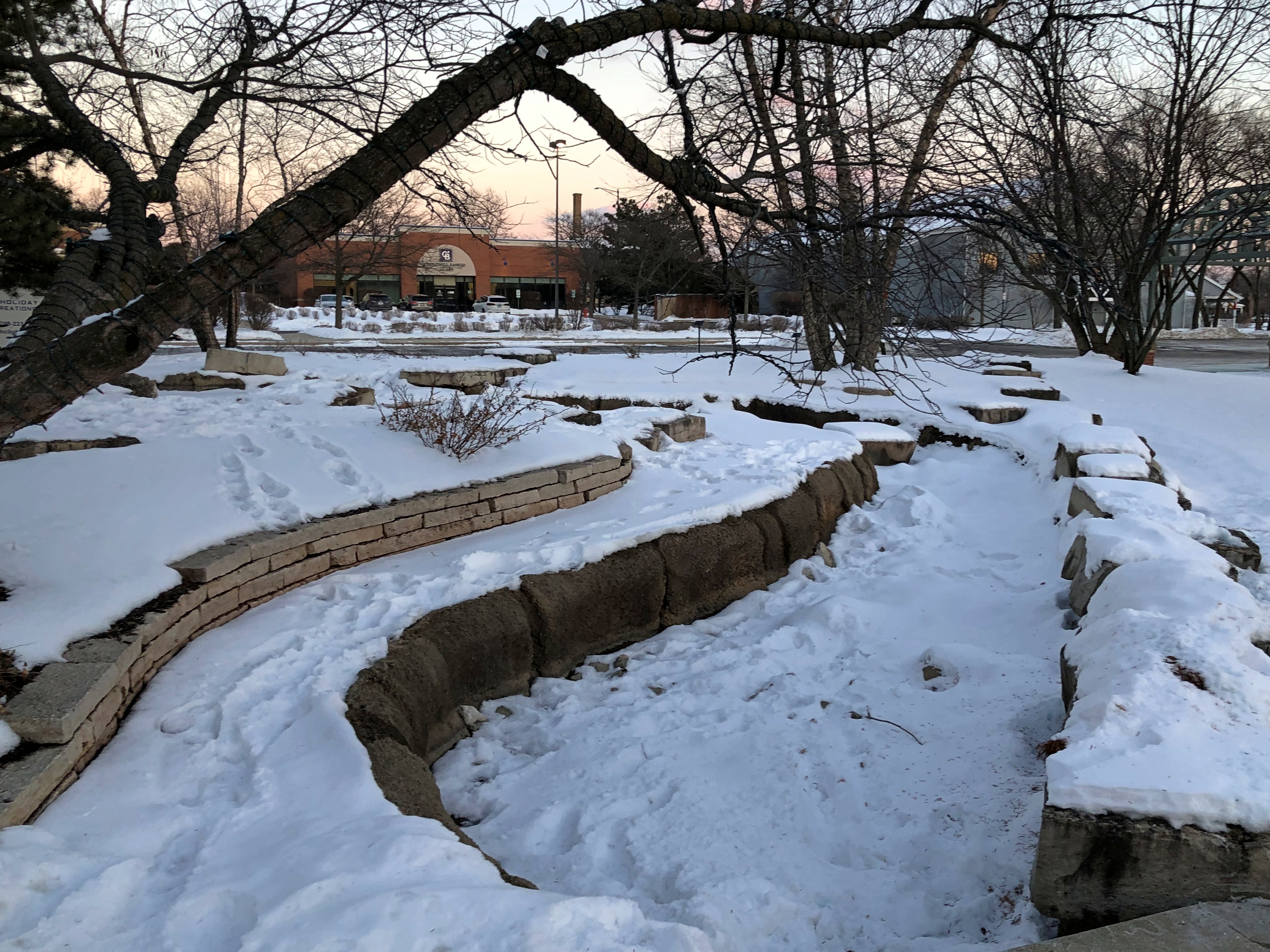
No festivities going on there. In fact, no one else was there at all. Still plenty of ice on the pond and snow on the ground.Schaumburg Town Square Schaumburg Town Square

A Polar Trac stands ready to deal with more snow.Schaumburg Town Square

No venturing out onto the ice. Of course. I didn’t need a red flag to tell me that.Schaumburg Town Square

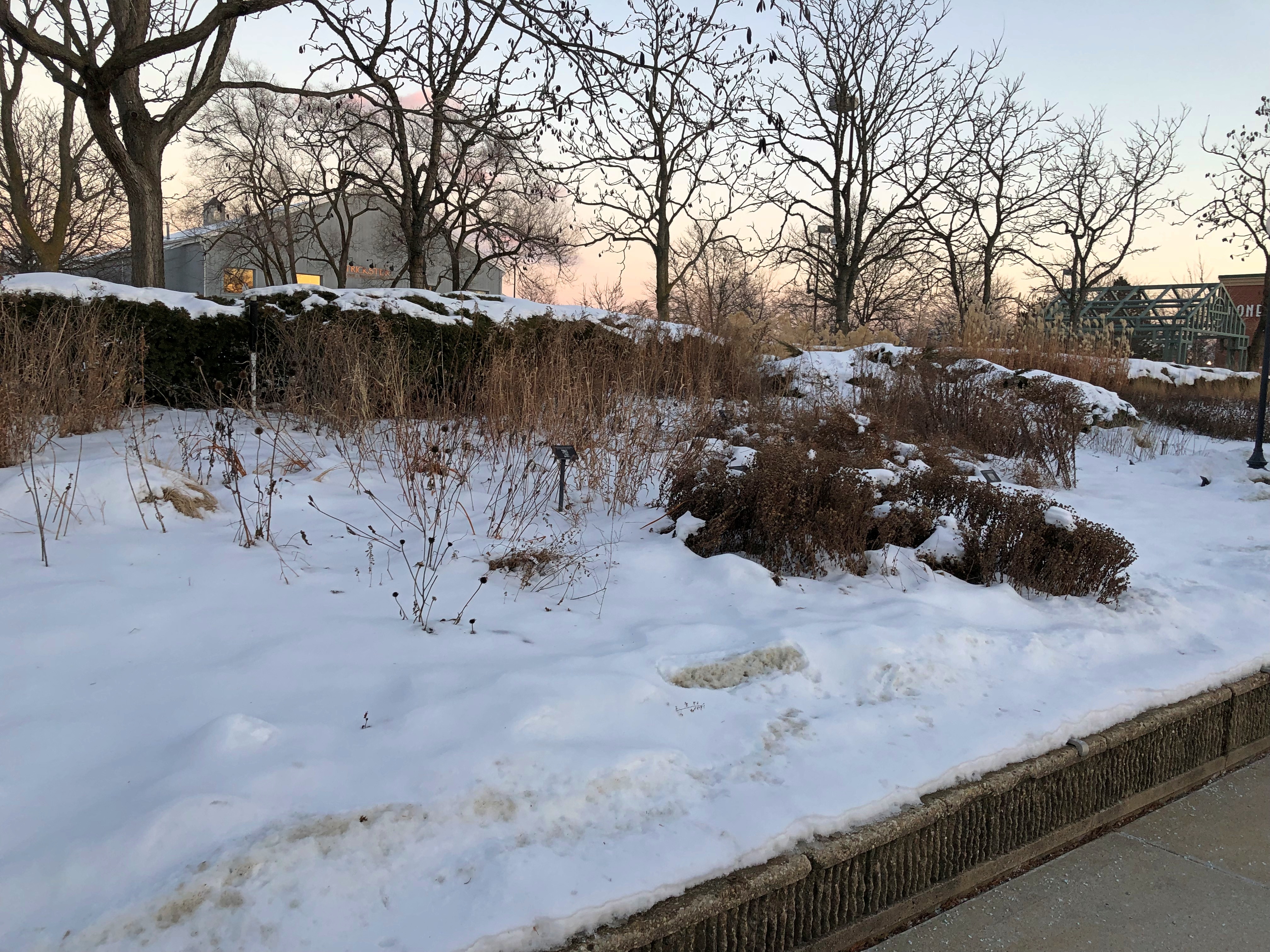
Hard to believe, but this patch of ground, a garden —Schaumburg Town Square

— is going to have an entirely different character –Schaumburg Town Square

— in only about four months.

Ddukbokki &c

Heavy snow on Saturday, but not a blizzard. Not so much that we couldn’t visit the Korean barbecue restaurant Koreana at Ann’s request, just as we did last year.

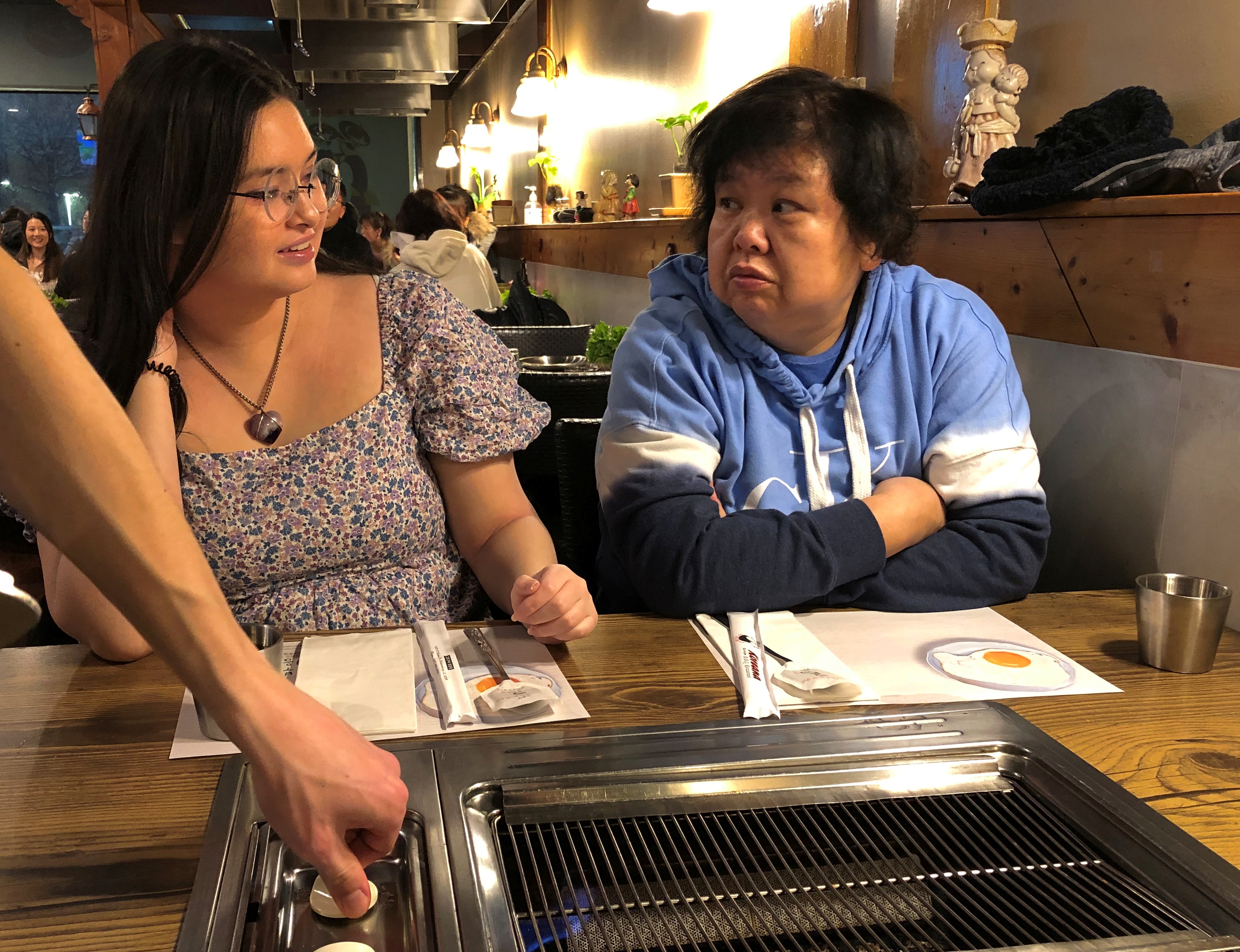
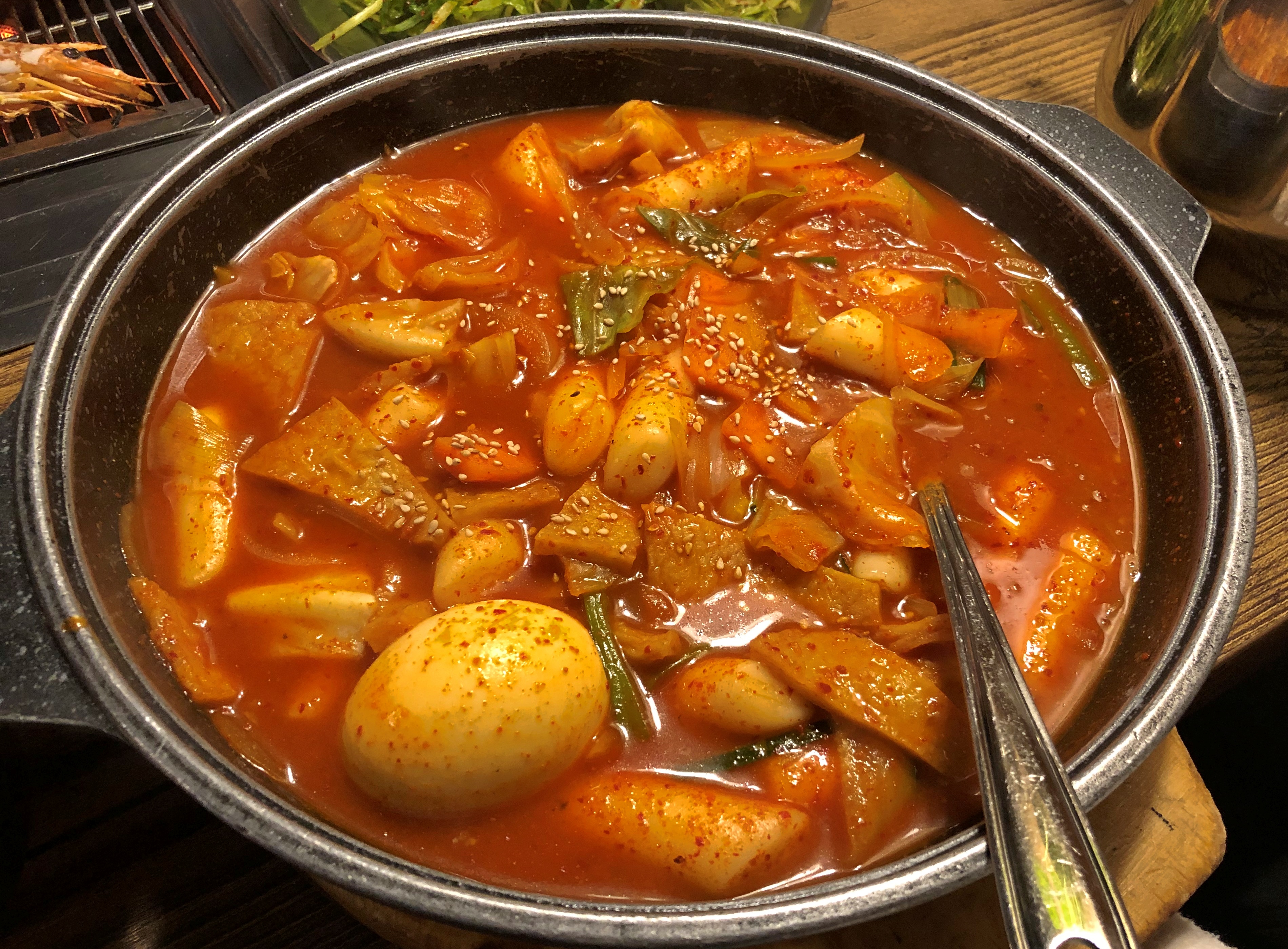
We had barbecue, of course, cooked on the grill that the waiter is lighting above, but we also ordered a dish we didn’t have last time, ddukbokki. Glad I made note of that name.ddukbokki

“These days, ddukbokki most often refers to spicy stir-fried rice cakes: pleasantly chewy logs smothered in a fiery red, gochujang-based sauce, often accompanied by sliced fishcakes or crunchy vegetables, dotted with scallions and sesame seeds, and topped with an egg,” the Food Network explains.

Despite the national egg shortage – I like to think the chickens are on strike, but actually a lot of them are simply dead — the restaurant didn’t short us on the egg.

“It’s commonly found at street food stalls or bunsik shops peppered all throughout Korea’s neighborhoods, granting hungry citizens easy access at any time of day,” FN continues. “Stateside, it’s been popping up at Korean food courts, pubs and even at local corner shops.”

Good to know. It’s a fine food for winter, spicy but not too spicy, chewy but not too chewy.

On the way to Koreana, we stopped at a favorite grocery store source for pie (and the birthday candles for the pie). While passing the liquor section, I noticed this.

That’s a thing? Apparently so. More than one brand. I didn’t know that, but I’m not a whiskey-drinkin’ man. In any case, I’m not planning to buy any.

It Reminds Me That Winter Will Last A Good While Longer

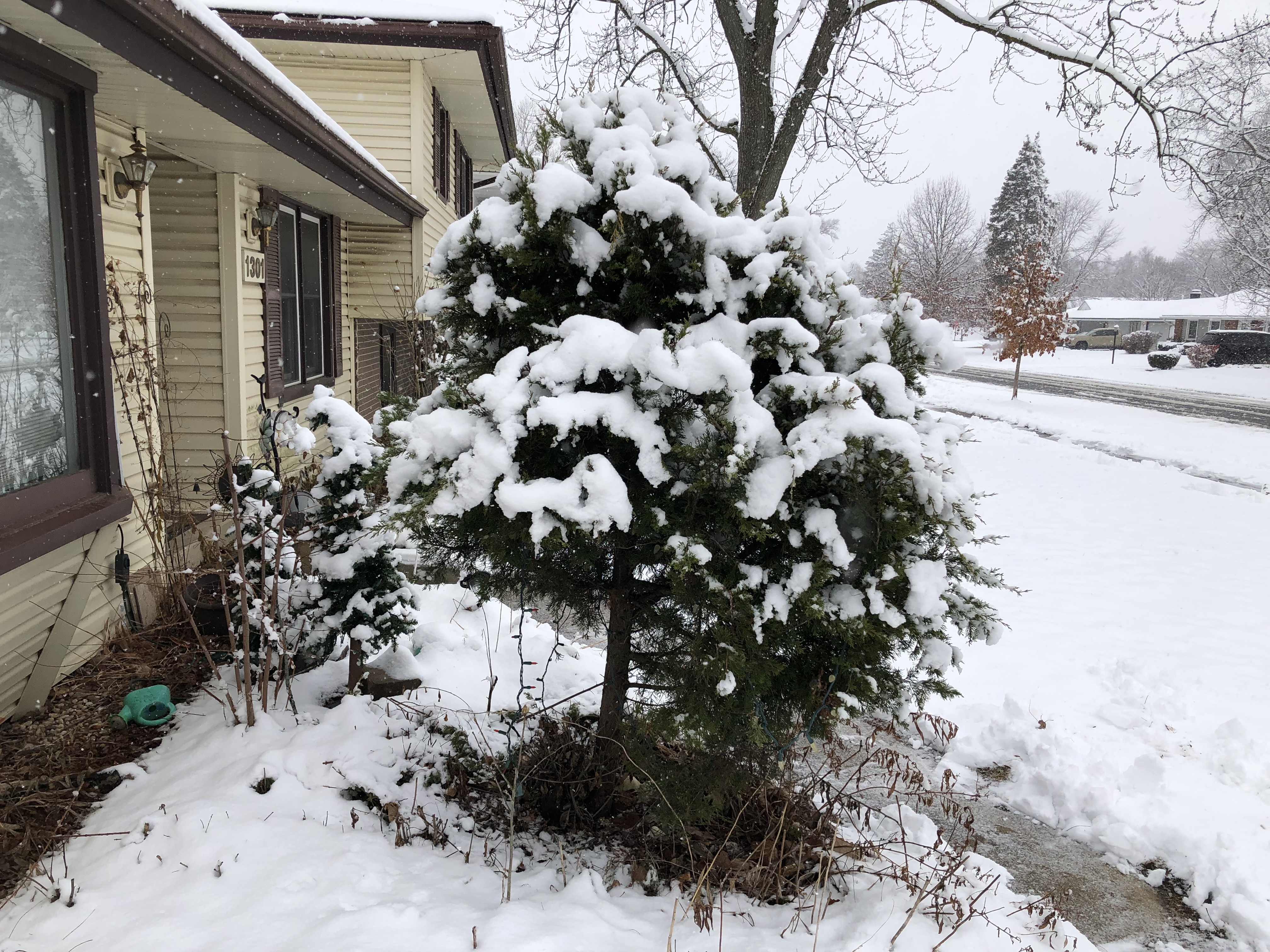
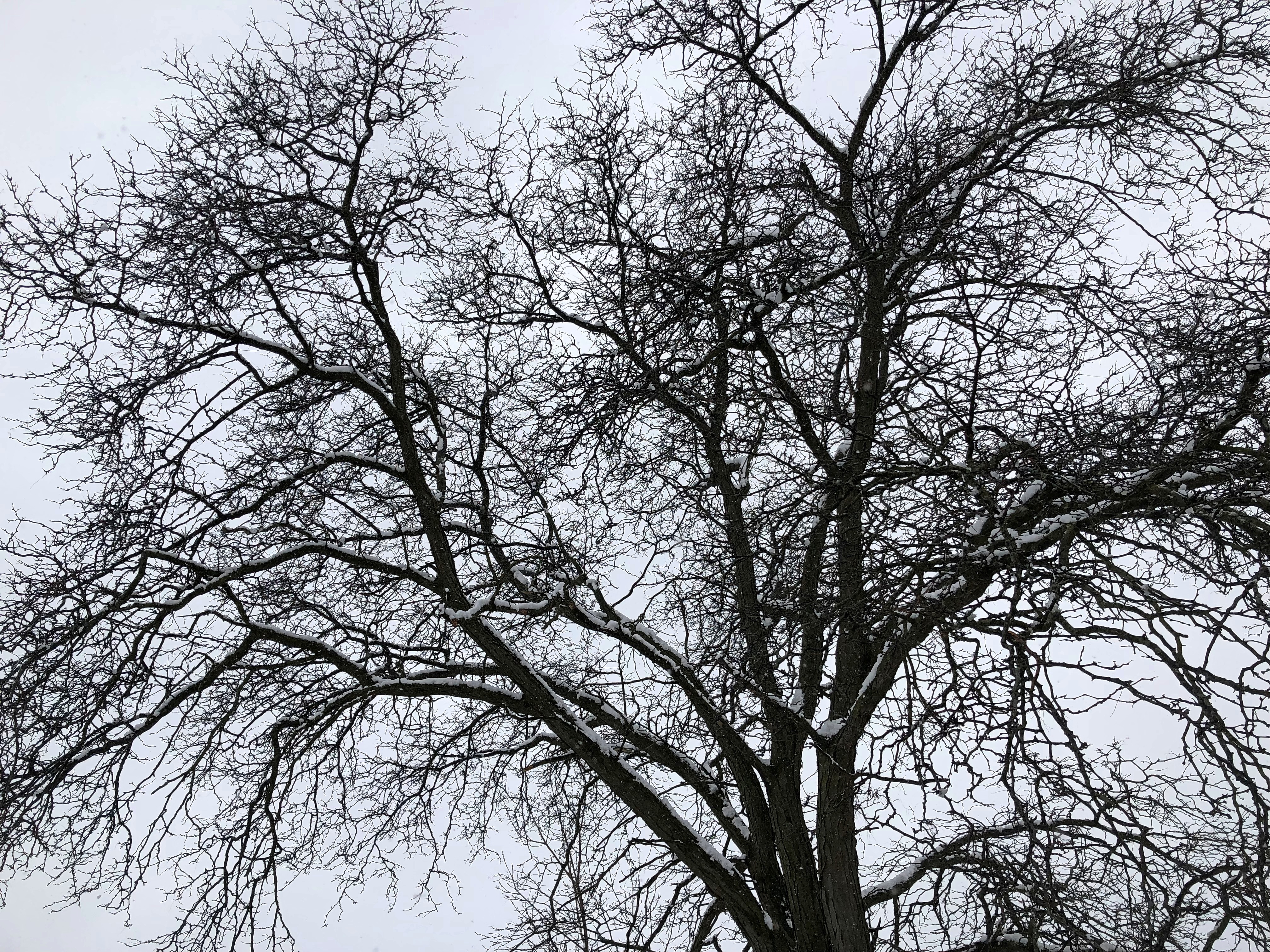
Sure enough, overnight as forecast, the first sizable snow fell since the fun we had around Christmastime. I packed a camera when I was out shoveling this morning.

Been documenting snow on plants for quite a while now. Nothing quite compares to the towering honey locust in the back yard.

Not much wind. That makes it tolerable. Winter winds are sharp, but not quite as much as certain other things, as we’re reminded in As You Like It.

Blow, blow, thou winter wind,
  Thou art not so unkind
     As man’s ingratitude;
  Thy tooth is not so keen,
Because thou art not seen,
     Although thy breath be rude.
Heigh-ho! sing, heigh-ho! unto the green holly:
Most friendship is feigning, most loving mere folly:
  Then, heigh-ho, the holly!
     This life is most jolly.

  Freeze, freeze, thou bitter sky,
  That dost not bite so nigh
     As benefits forgot:
  Though thou the waters warp,
     Thy sting is not so sharp
     As friend remembered not.
Heigh-ho! sing, heigh-ho! unto the green holly…

It Reminds Me That Summer Will Be Back

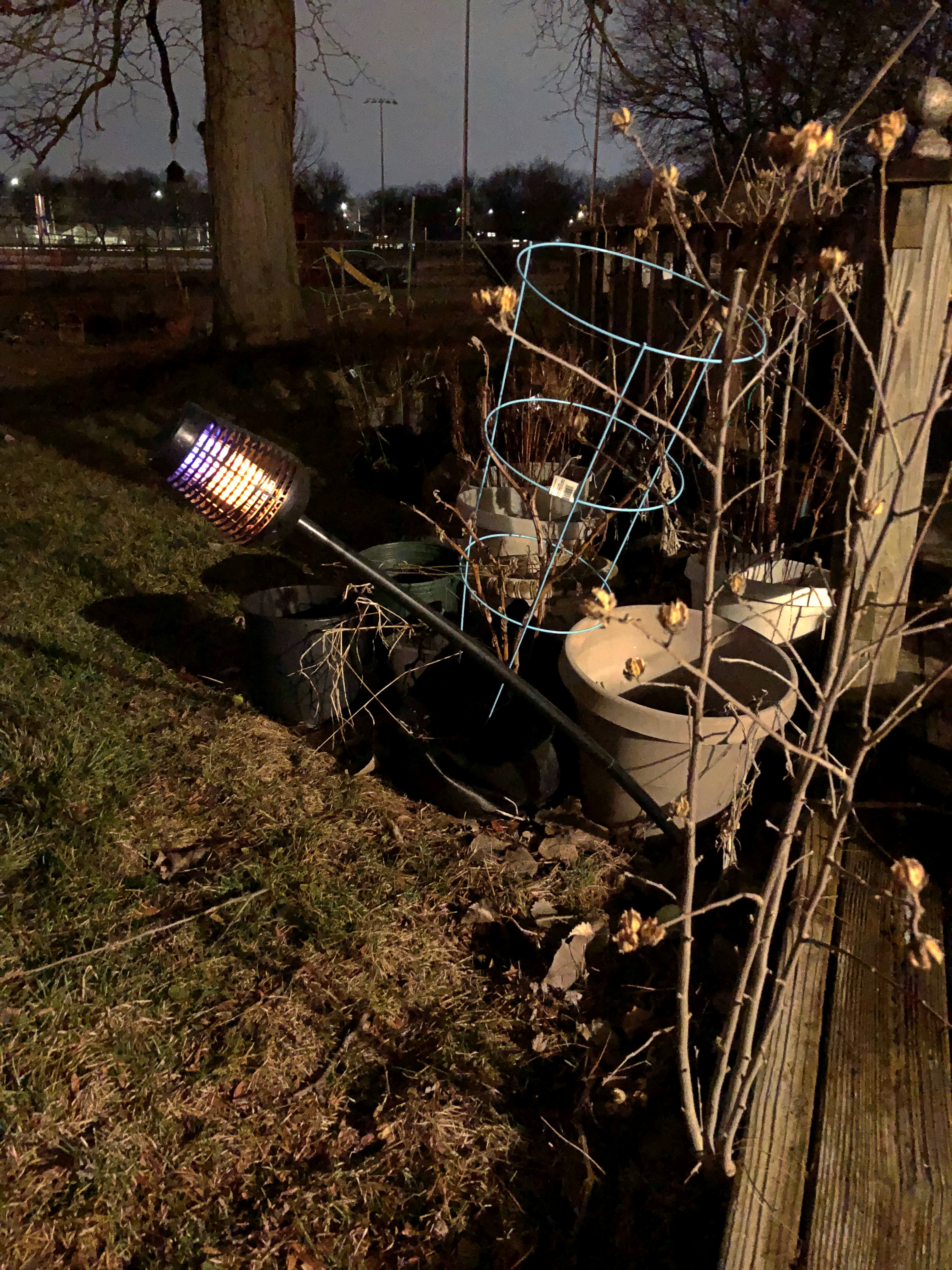
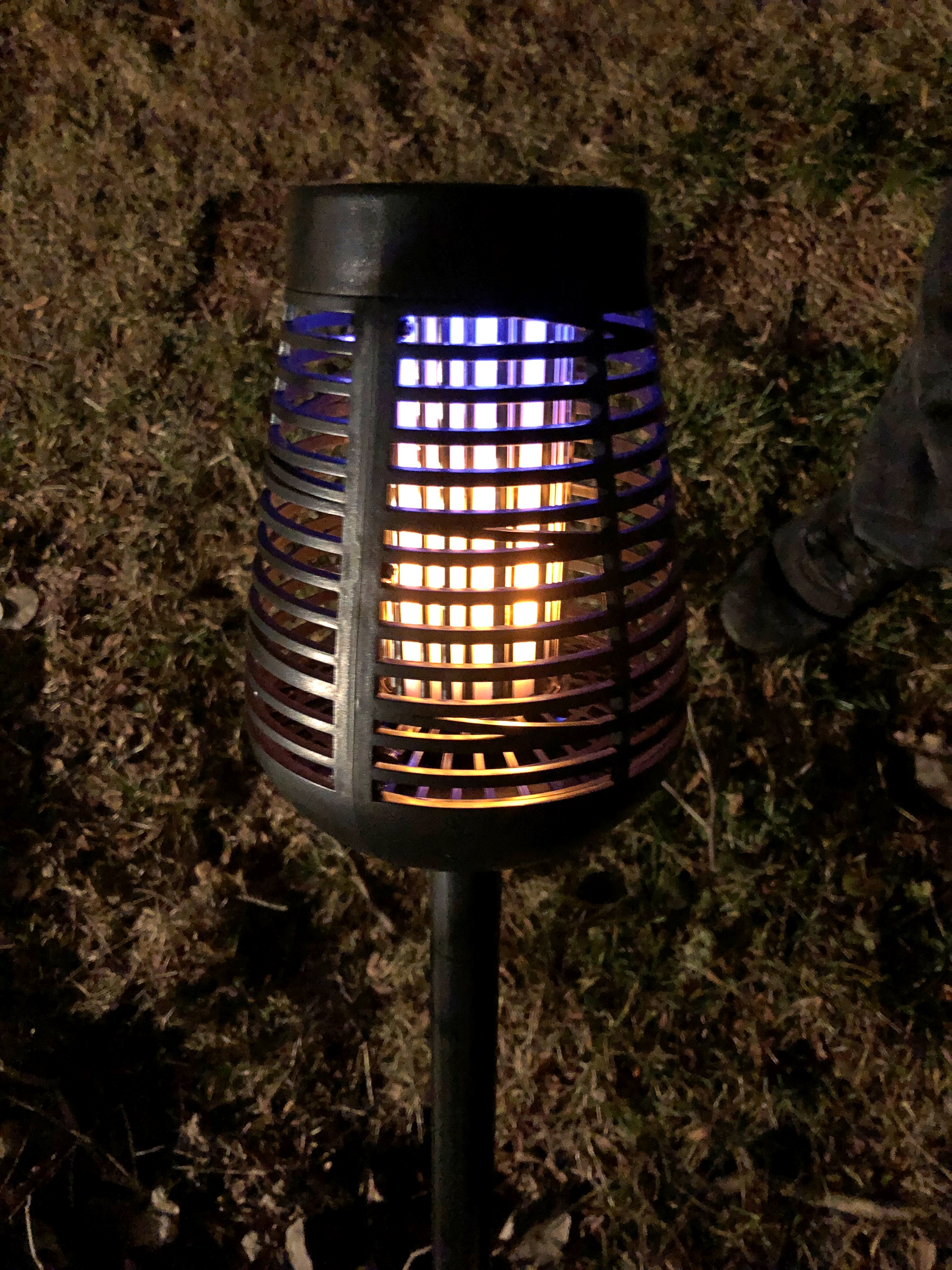
Flickering out in the night in my back yard, near the deck, is a solar lantern. I’m a little surprised it glows in the winter, but apparently it gets the juice it needs from the limited amount of sunlight that the day provides.

Back in the summer of 2021, we acquired a set of lanterns, one a tabletop light, the other designed to top out a pole of about three feet. Same box, same manufacturer. They both glowed by night for a few weeks, but then the tabletop unit failed. Being a cheap Middle Kingdom-made item, we didn’t bother with a return.

The stick stands with a lean that has proven hard to straighten, so I let it lean.

The light itself has soldiered on this year and a half.

Rubble on Lunt Avenue

Less than two weeks ago, we got word of a fire in Schaumburg, in a part of the village populated mostly by light industrial, vehicle repair shops and the like. This nondescript building, seen in 2019 by a Google imaging vehicle, had burned.

This weekend, just out of idle curiosity, we drove by to take a look at the site.Lunt Avenue Rubble Lunt Avenue Rubble

I don’t want to be pessimistic about this, but it looks like a total loss to me.

Ty Warner Park

As Januaries go, this one has been fairly mild so far. Some days of rain, though we got a little snow early this morning that partly melted during the day. No blast of cold air is predicted for tomorrow, but there will be a deeper chill soon enough.

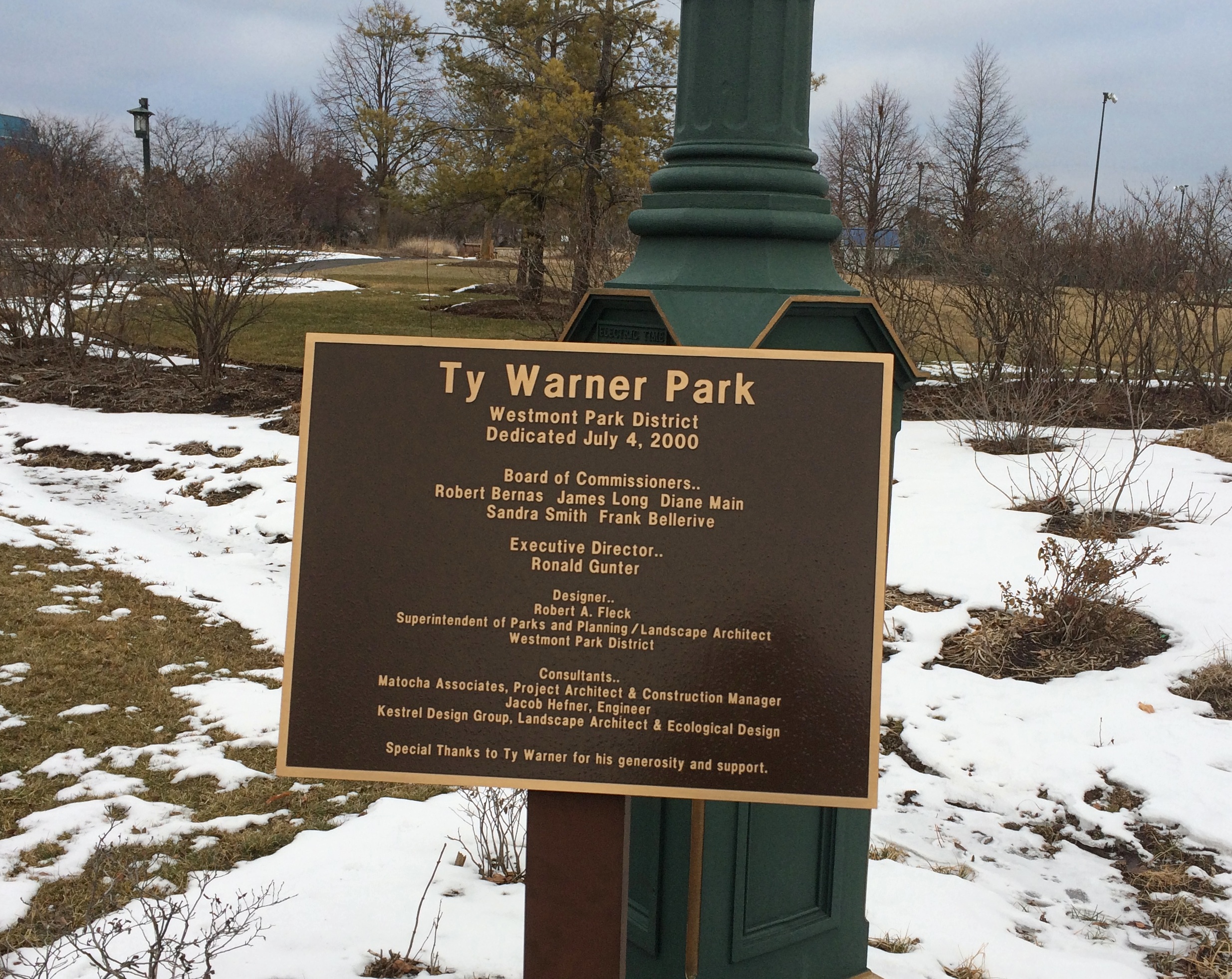
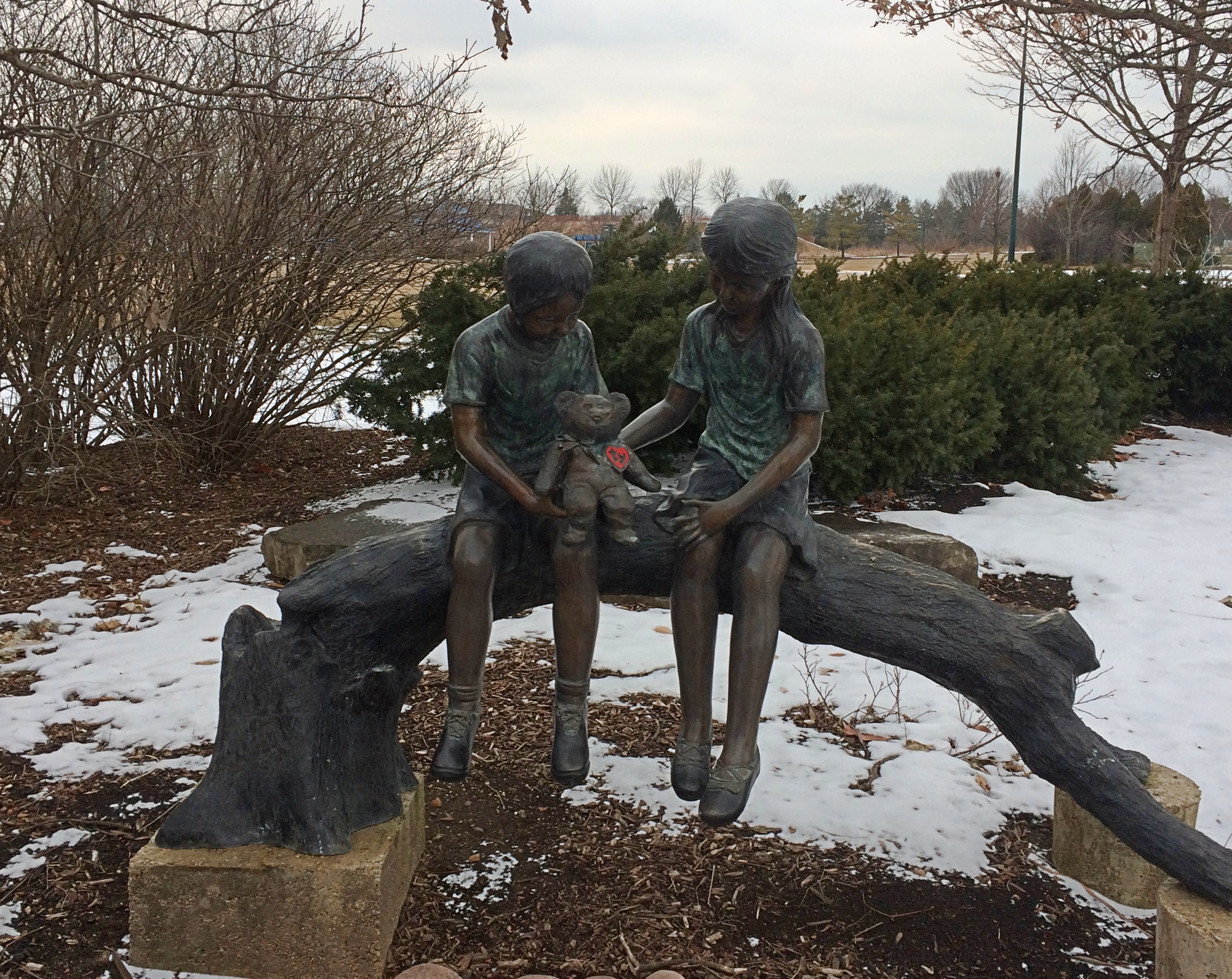
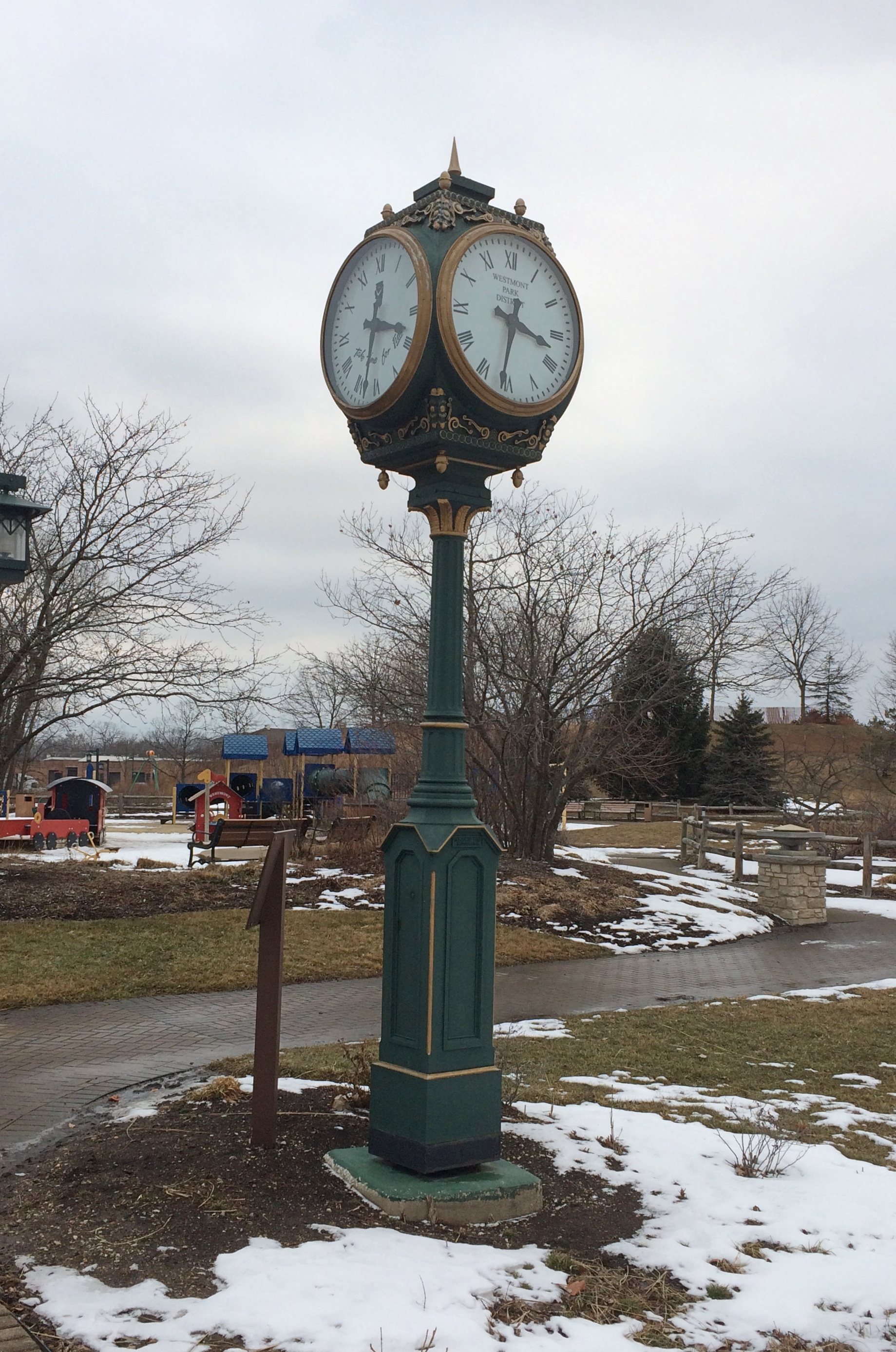
Two years ago, we took a walk in Bemis Woods, which displayed more snow then than it would this year. On the way home, we stopped at Ty Warner Park in Westmont. I can’t remember why. Just feeling nostalgic, I guess, since we used to take small children to play there, and in more recent years, return for the July 4 fireworks.Ty Warner Park

Ty Warner, as in the Beanie Baby billionaire, who once had his HQ in Westmont and who made a sizable donation to help create the park.Ty Warner Park Ty Warner Park

Our personal nostalgia really kicked in at the spray park and the play trains. The girls enjoyed both, though typically in the summer.Ty Warner Park Ty Warner Park

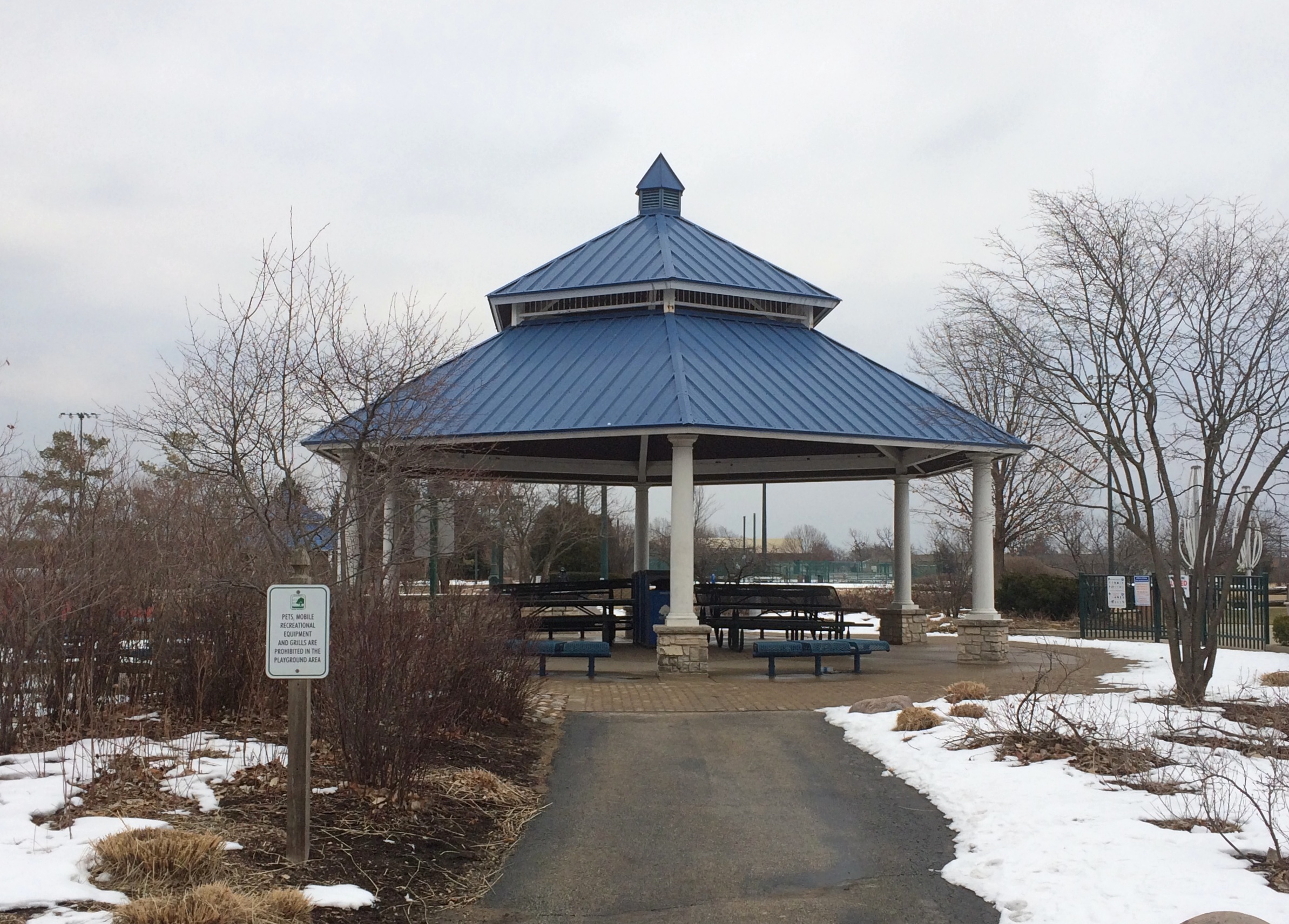
I’d forgotten the gazebo.Ty Warner Park

Shows you how old I’m getting. How could I forget the gazebo?

The National Shrine of St. Thérèse

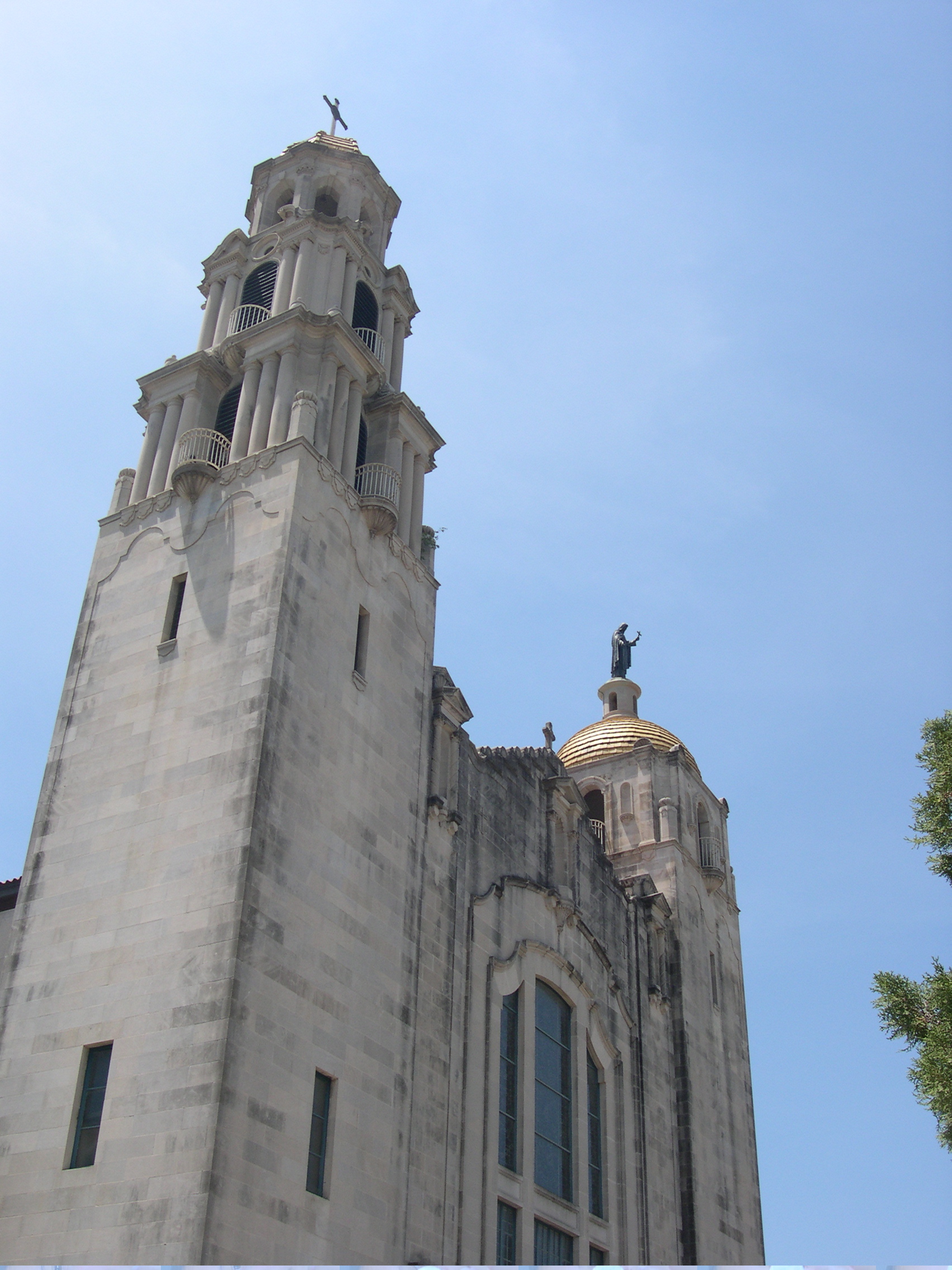
Well over a decade ago, during a summertime visit to San Antonio, I drove to the west side of the city to see the Basilica of the National Shrine of the Little Flower, which I’d never seen or even heard of before, despite growing up in that city. It was very hot that day, as it tends to be that time of the year, so I didn’t linger outside to take many pictures, though I snapped a few marginal ones.Basilica of the National Shrine of the Little Flower

This is a better image. I’m not sure at what point I realized that the basilica in San Antonio and the National Shrine of St. Thérèse in Darien, Illinois, were dedicated to the same person, Thérèse de Lisieux, but I know now. And whatever else I know about St. Thérèse, I also have some sense of her immense popularity as a saint, inspiring edifices around the world in her honor.

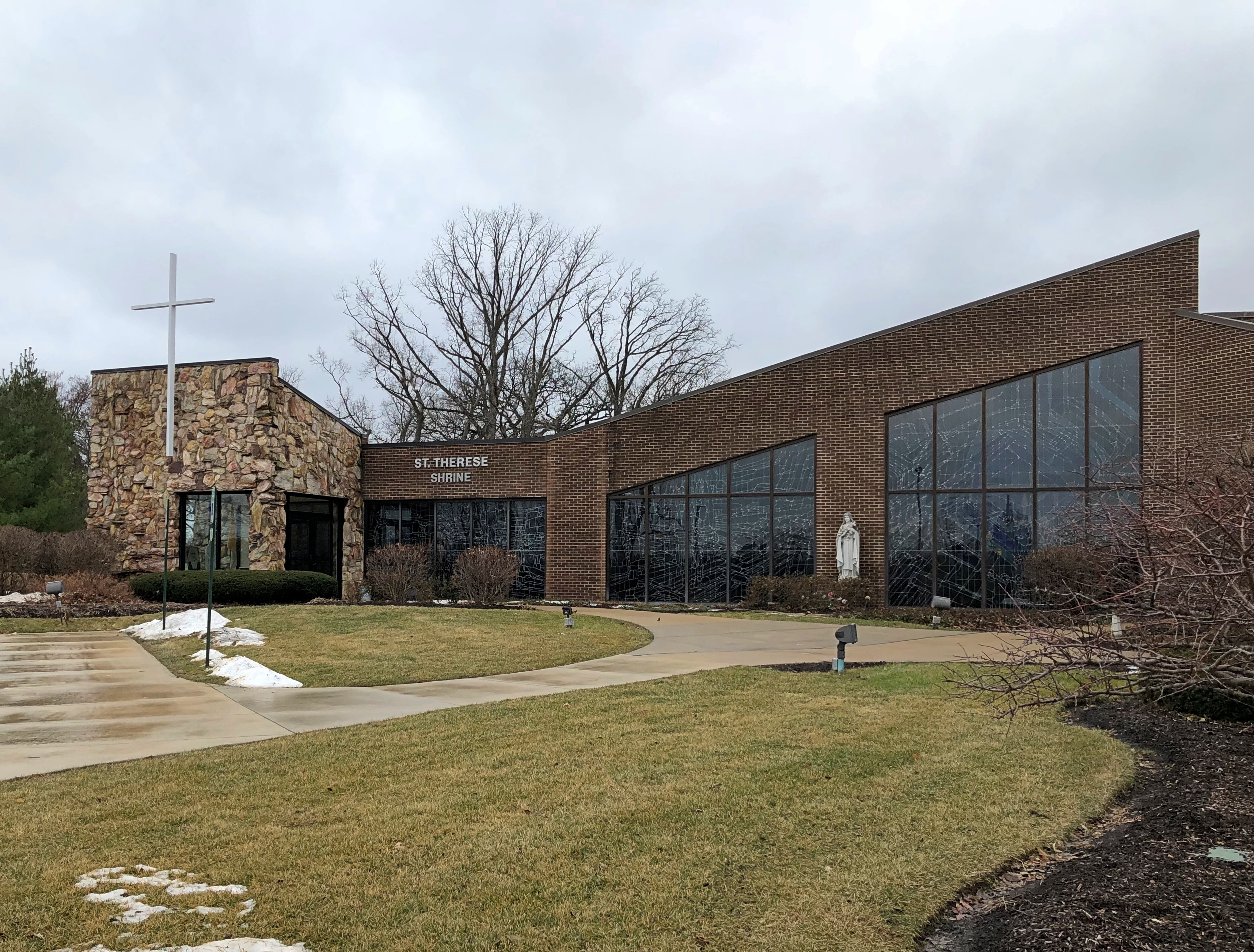
We arrived at the Darien shrine just before noon on December 29, an overcast but not especially cold day. Above freezing, anyway. There it is, I told Yuriko.Shrine of St. Thérèse Museum

So we went in. A few minutes passed before I realized that we not in the shrine, but in the nearby museum building, which I believe was the shrine before a new one was completed a few years ago. The sign on this building makes me think that. If so, there needs to be a signage update.

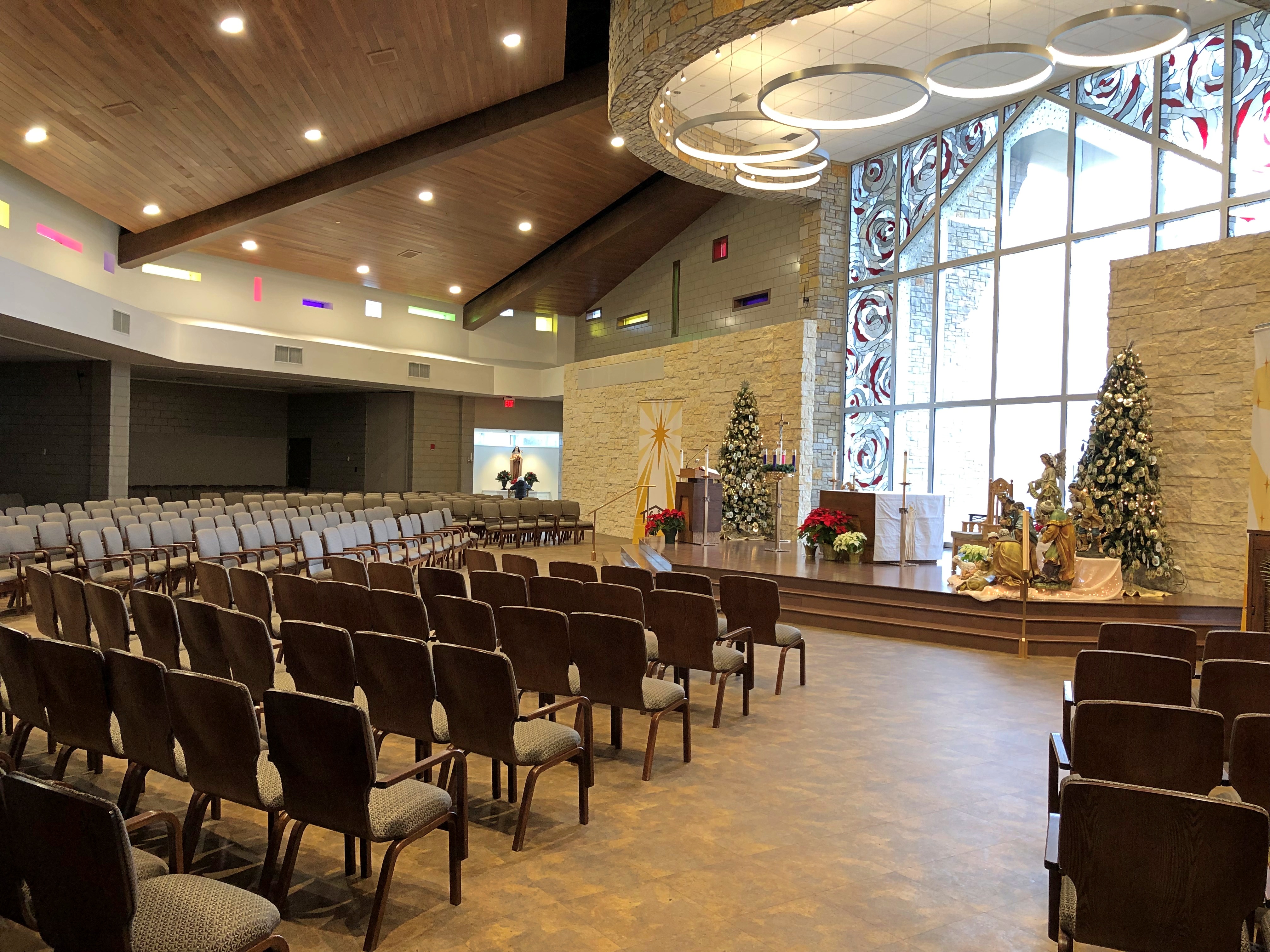
This is the current shrine.Shrine of St. Thérèse, Darien

In effect, this is the fourth shrine to her that has existed in the Chicago area. The first two were in the city, a larger one succeeding the original as her popularity grew in the 1920s.

The church that housed the second shrine burned down nearly 50 years ago, but by the 1980s the Carmelites were able to find the scratch the build a third shrine out in the suburbs. The demographics were going that way anyway.

The Carmelites tasked Charles Vincent George Architects, based in nearby Naperville, to design the fourth and latest shrine, which was completed in 2018.Shrine of St. Thérèse, Darien Shrine of St. Thérèse, Darien

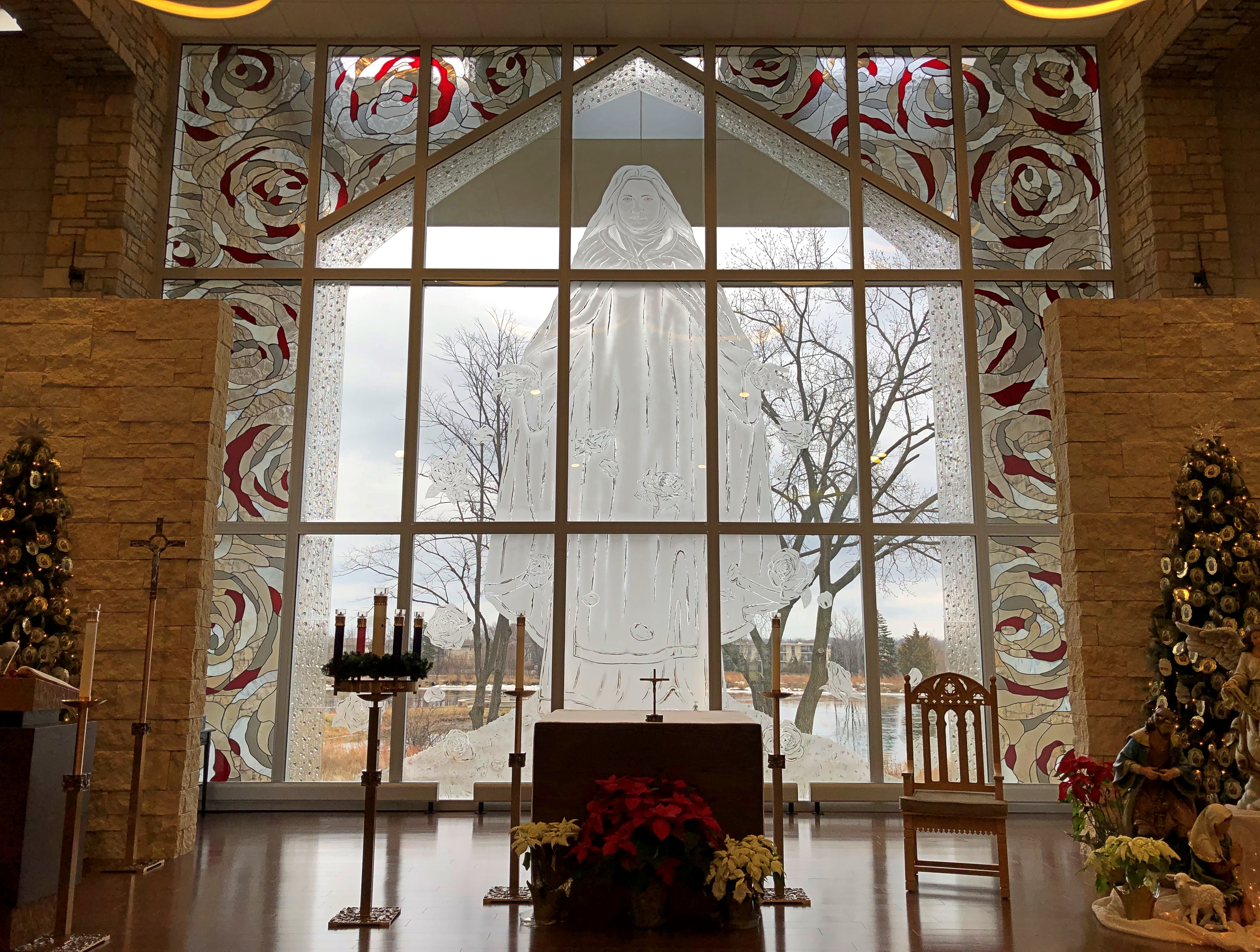
Behind the altar is St. Thérèse in glass.Shrine of St. Thérèse, Darien

“The architectural solution pays homage to St. Therese throughout, from the main building’s shape, inspired by the unfolding petals of a flower, a nod to St. Therese’s nickname ‘Little Flower,’ to key structures, such as the plaza clock tower, reminding us of her clockmaker father, and the 24-column colonnade, serving as a symbol of St. Therese’s 24 years of life,” CVG notes.

“As St. Therese had humble beginnings, special attention was taken to provide simple building materials using stone, brick and the limited use of wood for construction materials. The entire building layout focuses on the center altar and image of St. Therese etched in the chancel glass wall, through which there are views of her statue built out into the lake behind the chapel.”

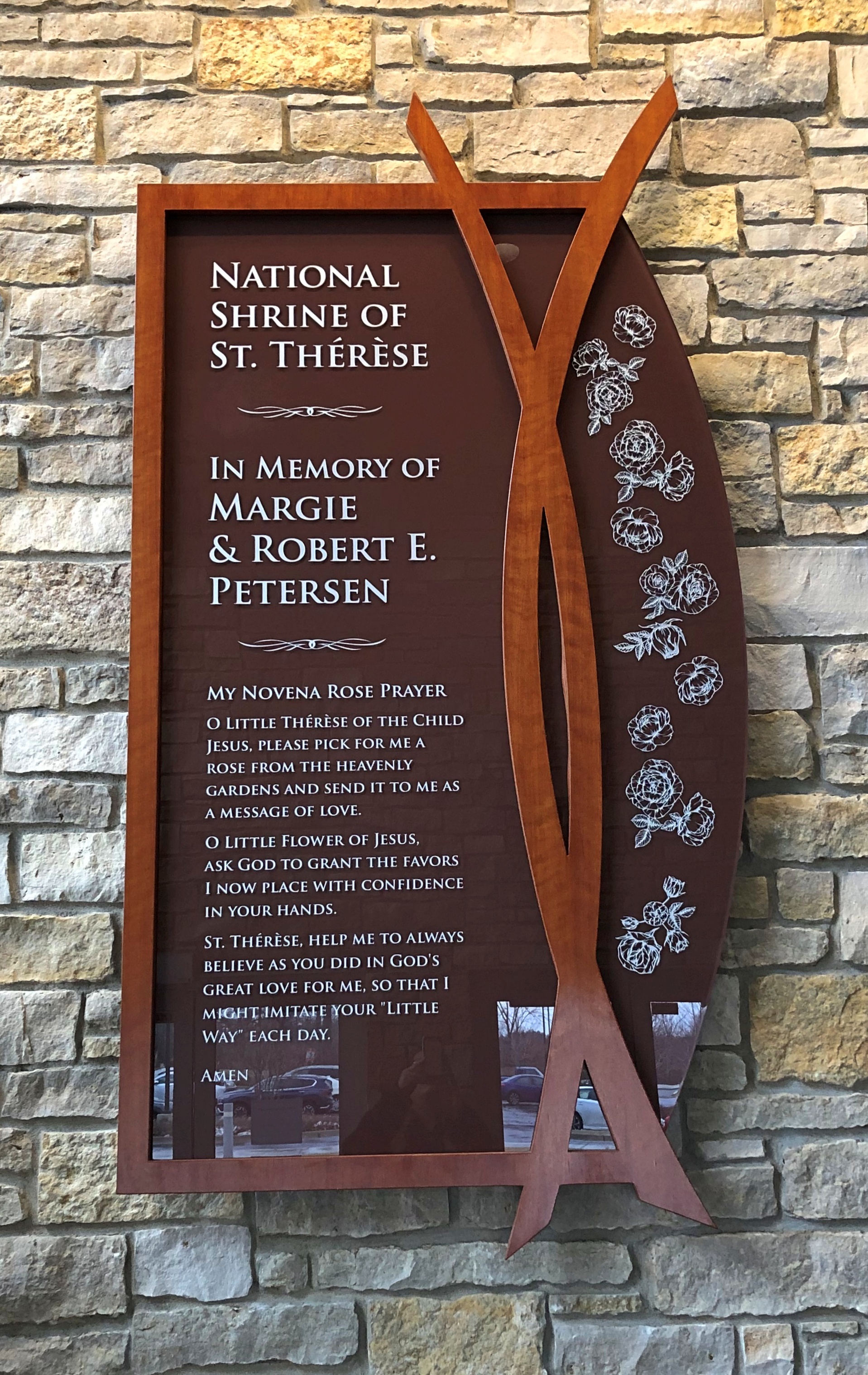
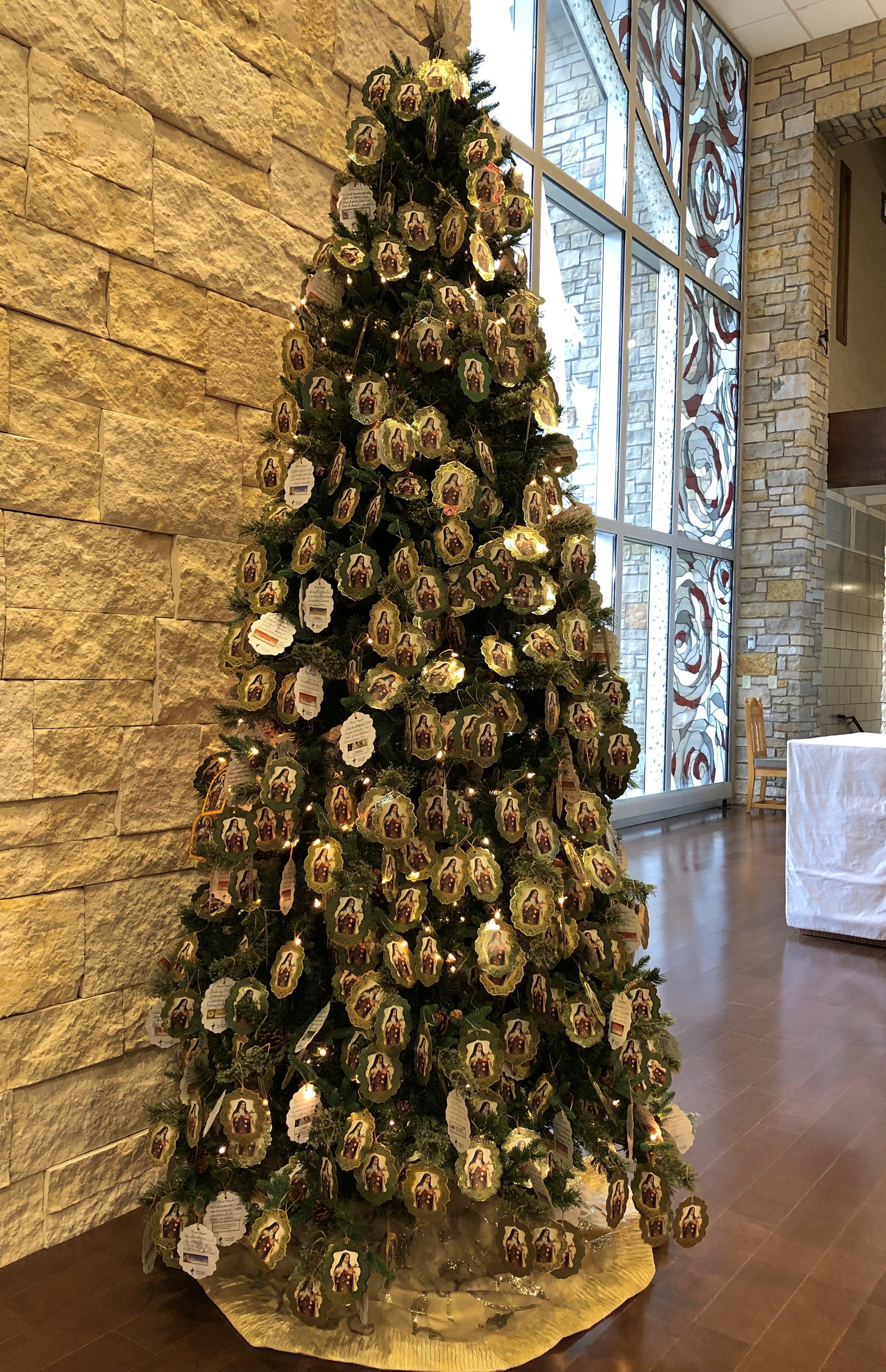
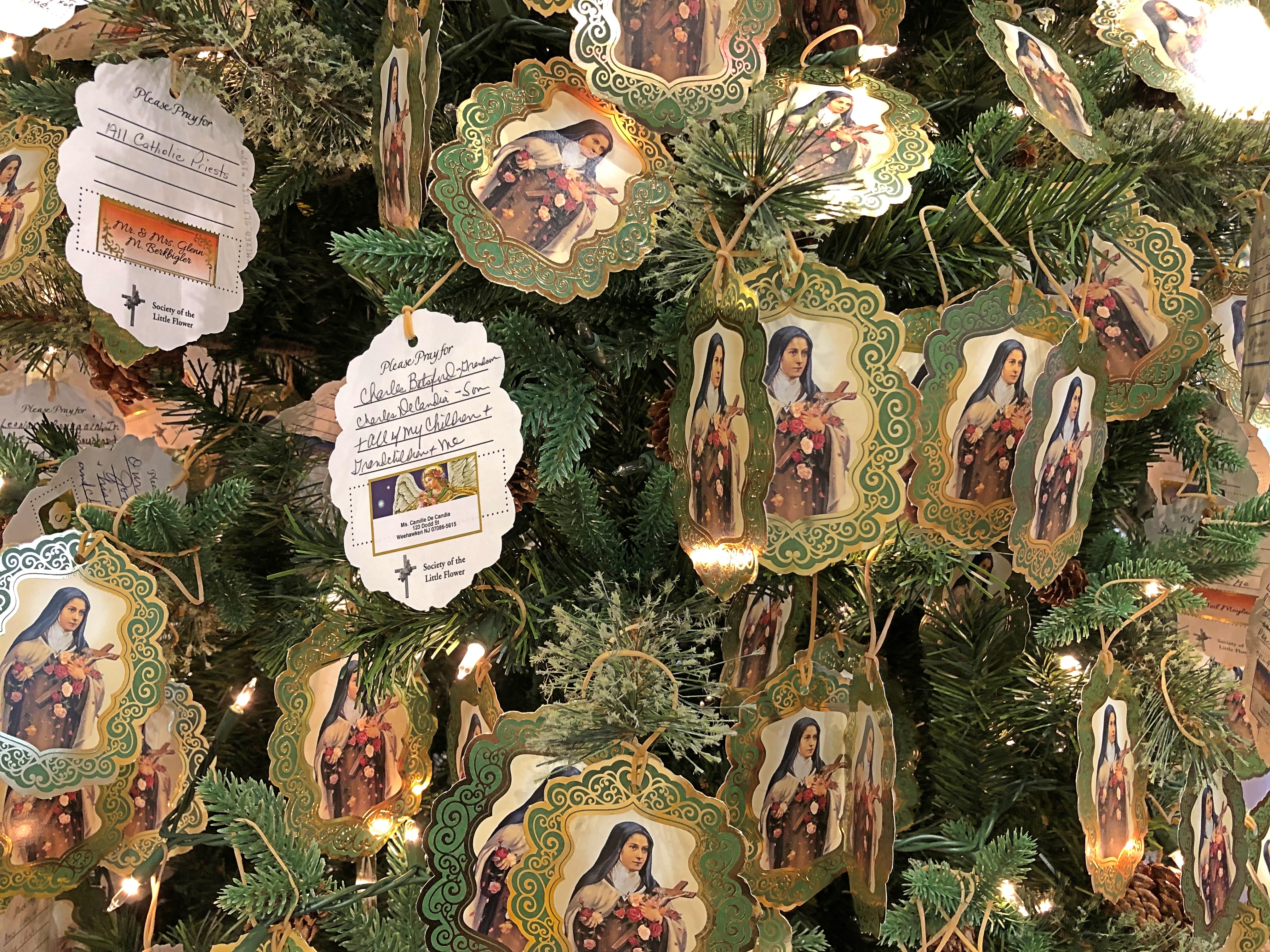
In December, St. Thérèse is the star of Christmas trees in the shrine.National Shrine of St. Thérèse

I don’t think I’ve ever seen a tree decorated with prayers before, but there it was. All of them to the saint.National Shrine of St. Thérèse

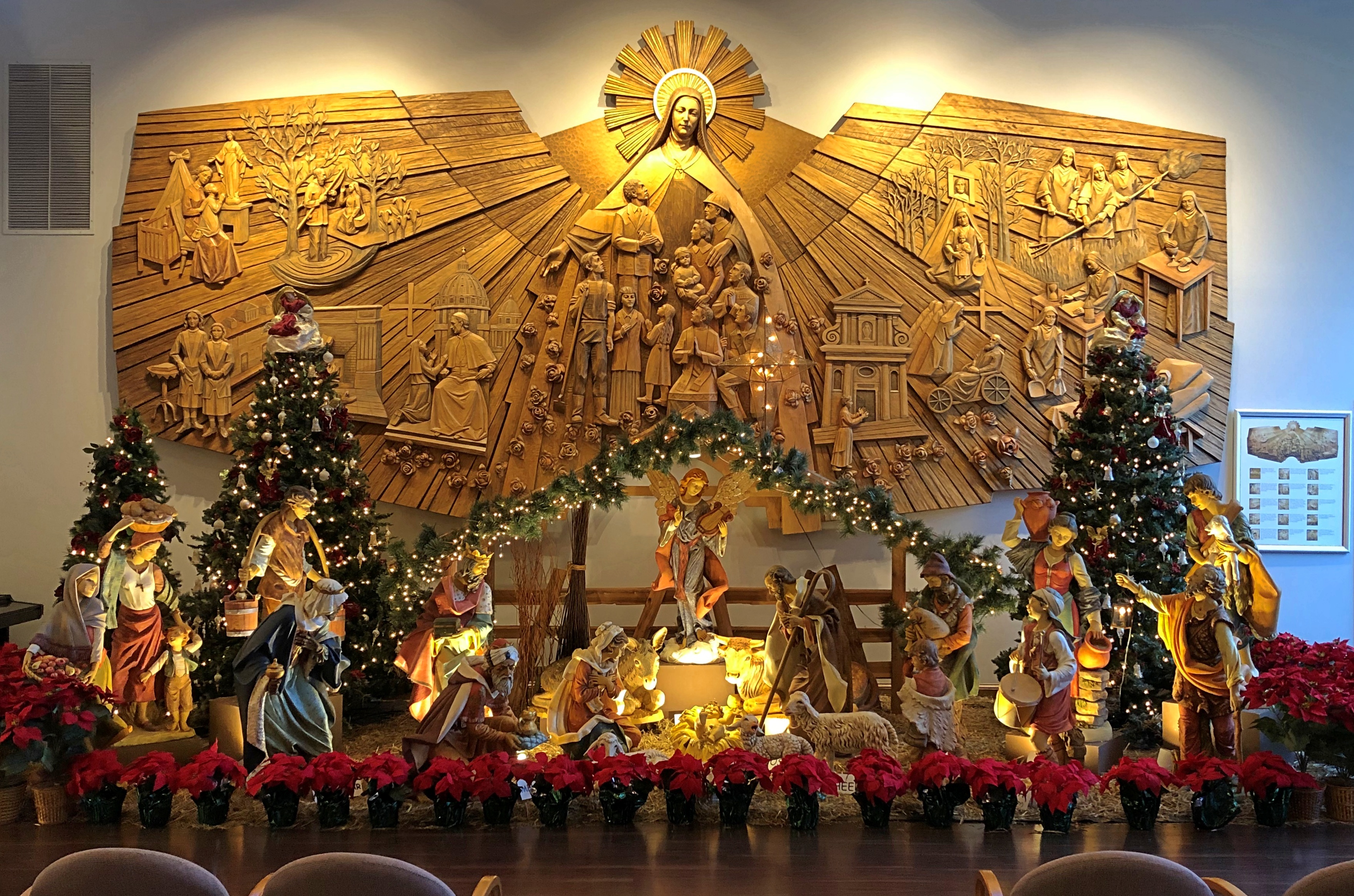
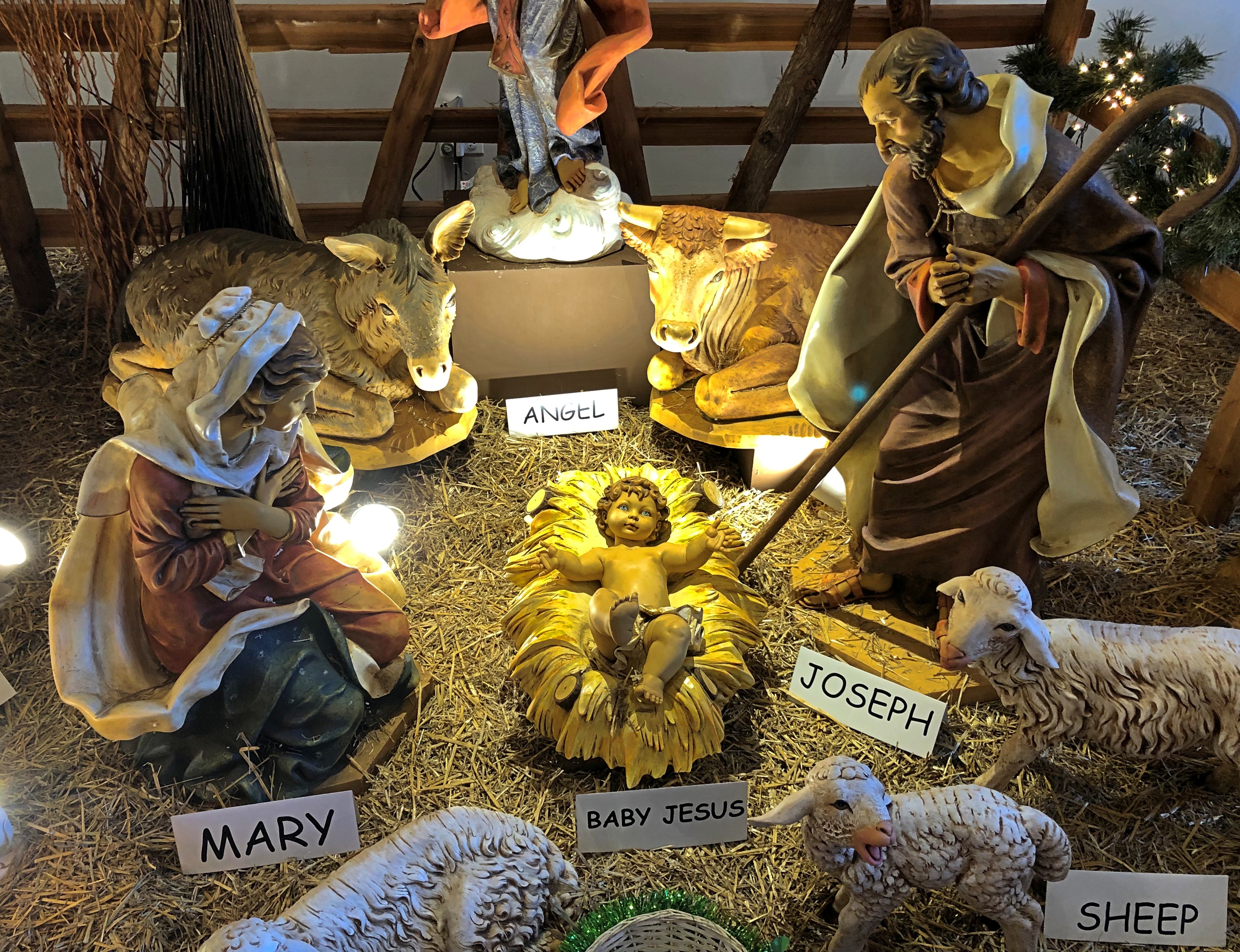
The museum included some seasonal features as well, such as a nativity under a more permanent woodwork depicting the saint.National Shrine of St. Thérèse (museum)

Just in case anyone is uncertain, labels come with the nativity scene. Guess that’s helpful for kids who have just learned to read, but I as far as can remember as a kid, the figures were something that everyone knew. Essential Christmas lore, even for public school children. Maybe that’s not true anymore.National Shrine of St. Thérèse (museum)

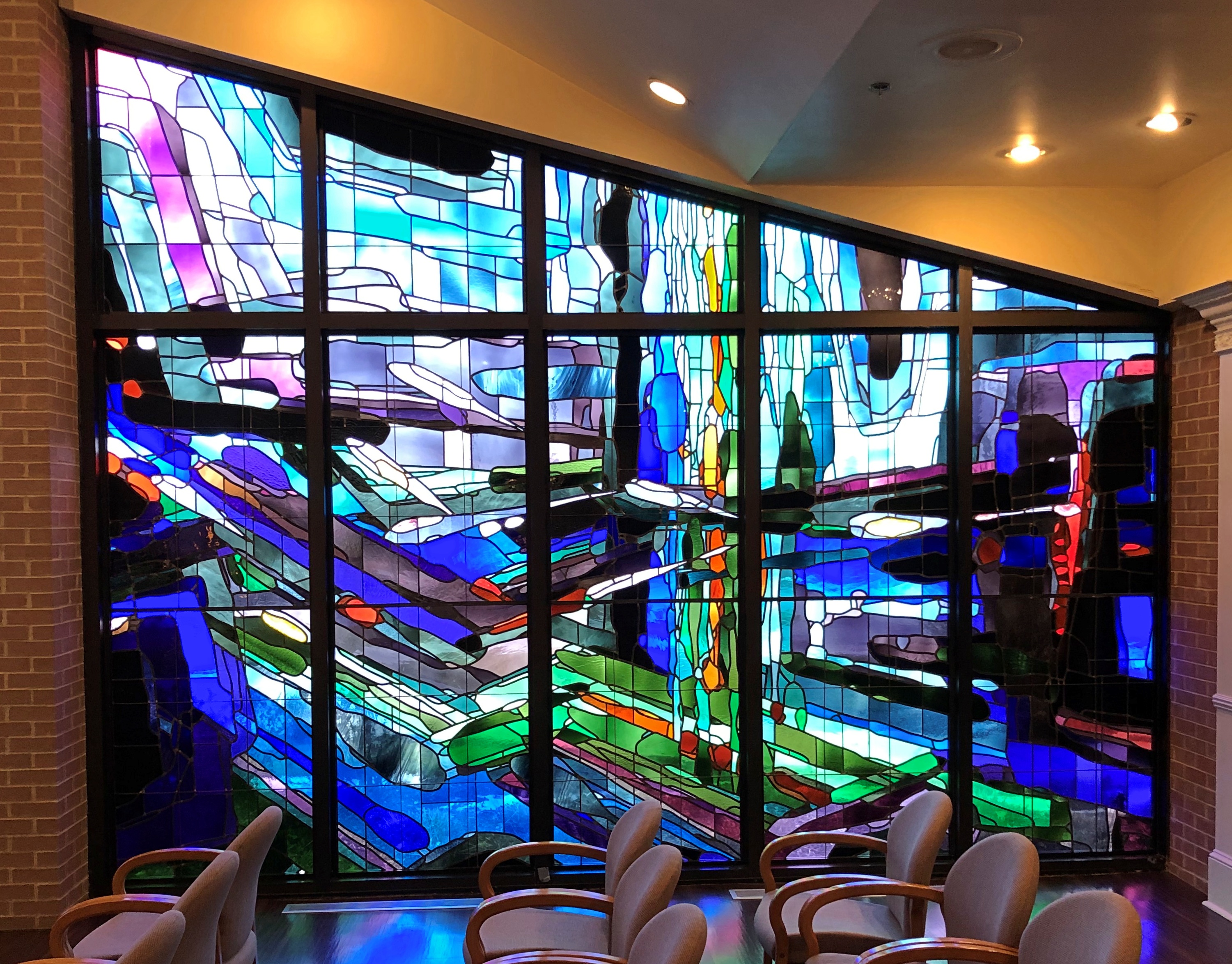
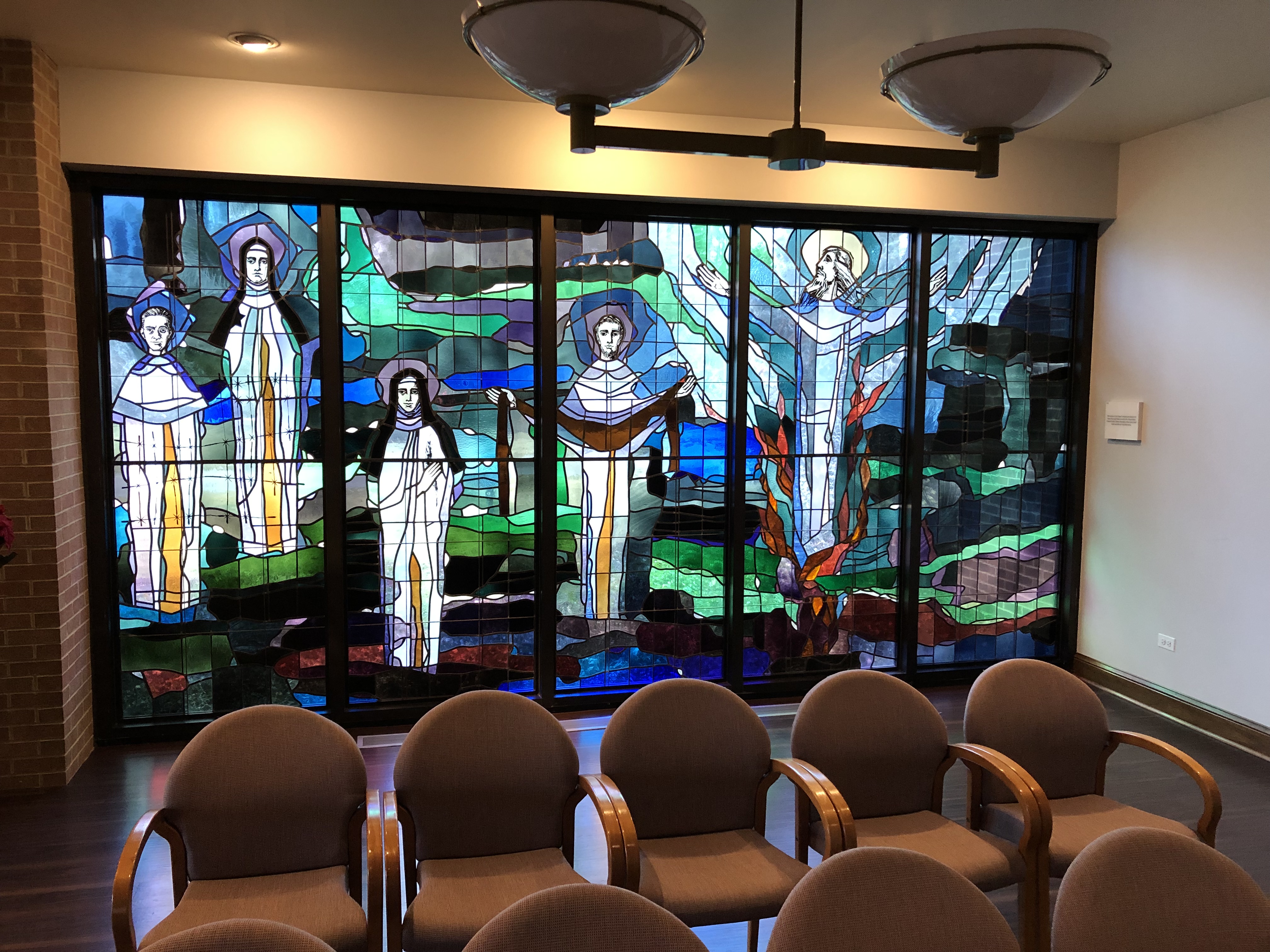
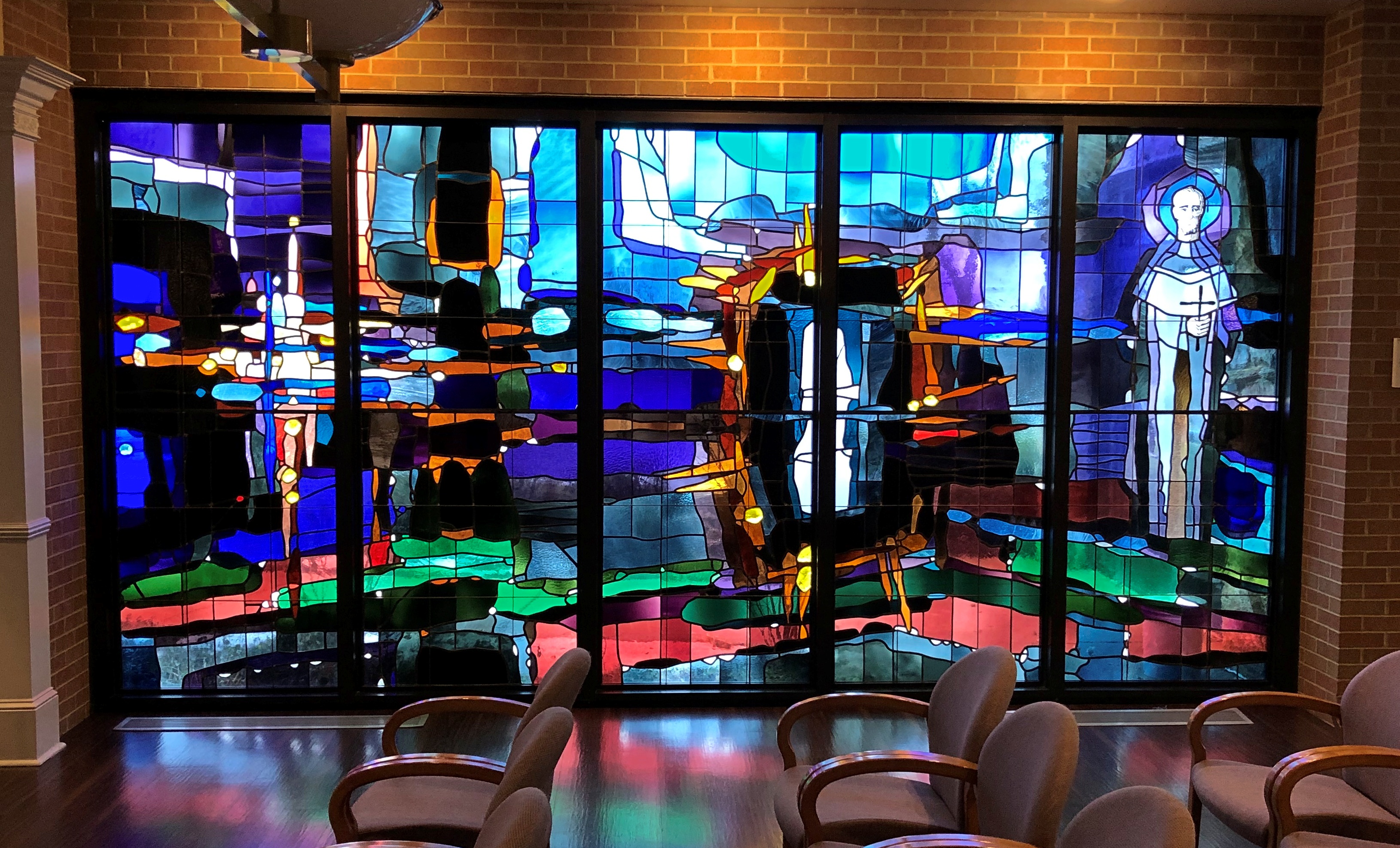
Modern stained glass. Some nice abstractions plus holy figures.National Shrine of St. Thérèse (museum) National Shrine of St. Thérèse (museum) National Shrine of St. Thérèse (museum)

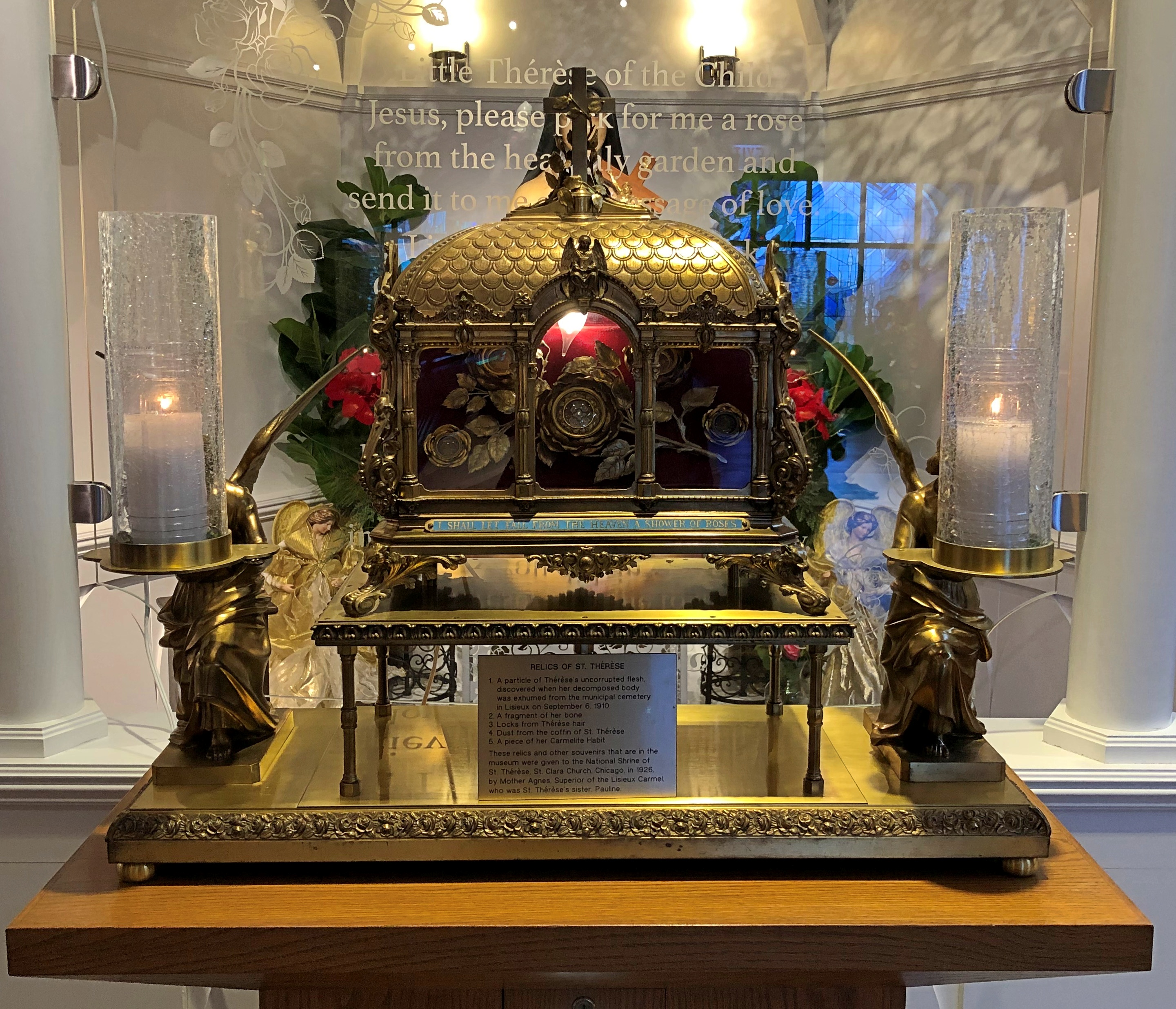
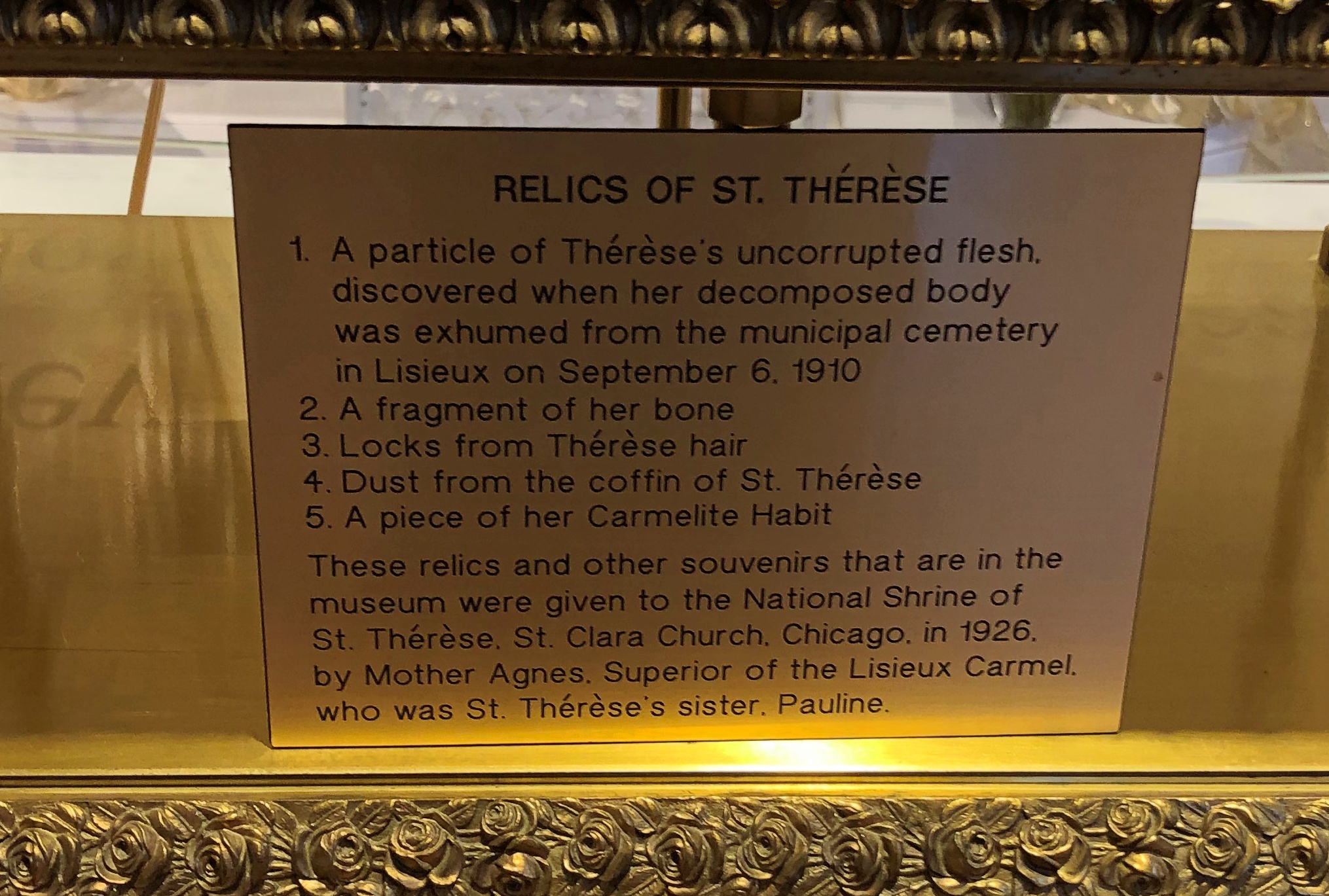
What would a saint’s shrine complex be without some relics?National Shrine of St. Thérèse (museum) National Shrine of St. Thérèse (museum)

I didn’t know dust could count as a relic, but I’m not up on what can and can not constitute a relic. The museum also has a few relics of Thérèse’s parents, Louis and Zélie Martin, who happen to be saints as well.

“Louis had tried to become a monk, but was rejected because he could not master Latin,” a sign in the museum says. “Zélie Guérin tried to become a Sister of Charity, but was rejected due to poor health.”

They couldn’t take vows, but apparently did the next best thing: produce five daughters (the survivors of nine children), all of whom became nuns.