Just south of I-90 in the major Chicago suburb of Schaumburg is a district populated almost completely by small- and mid-sized businesses that don’t have any consumer-facing operations, or if they do, they’re elsewhere. It’s a district of single-story office properties ringed by parking lots and connected by streets that are only busy early in the morning or late in the afternoon.
Since this is a reasonably prosperous suburb, some attention has been paid to landscaping, with trees, bushes and grass growing between the buildings and among the lots. But there’s no escaping the fact that the area is an office space equivalent of the 20th-century residential areas of the village, which are spread out. Fashionably dense, the area is not. You need a car around here.
Not long ago I had some business to attend to in the area, and I happened upon a small street named Penny Lane. If you’re the right age, that’s going to make you smile a little, though on this Penny Lane there’s no barber showing photographs or banker with a motorcar or fireman with an hourglass.
But this is on Penny Lane.
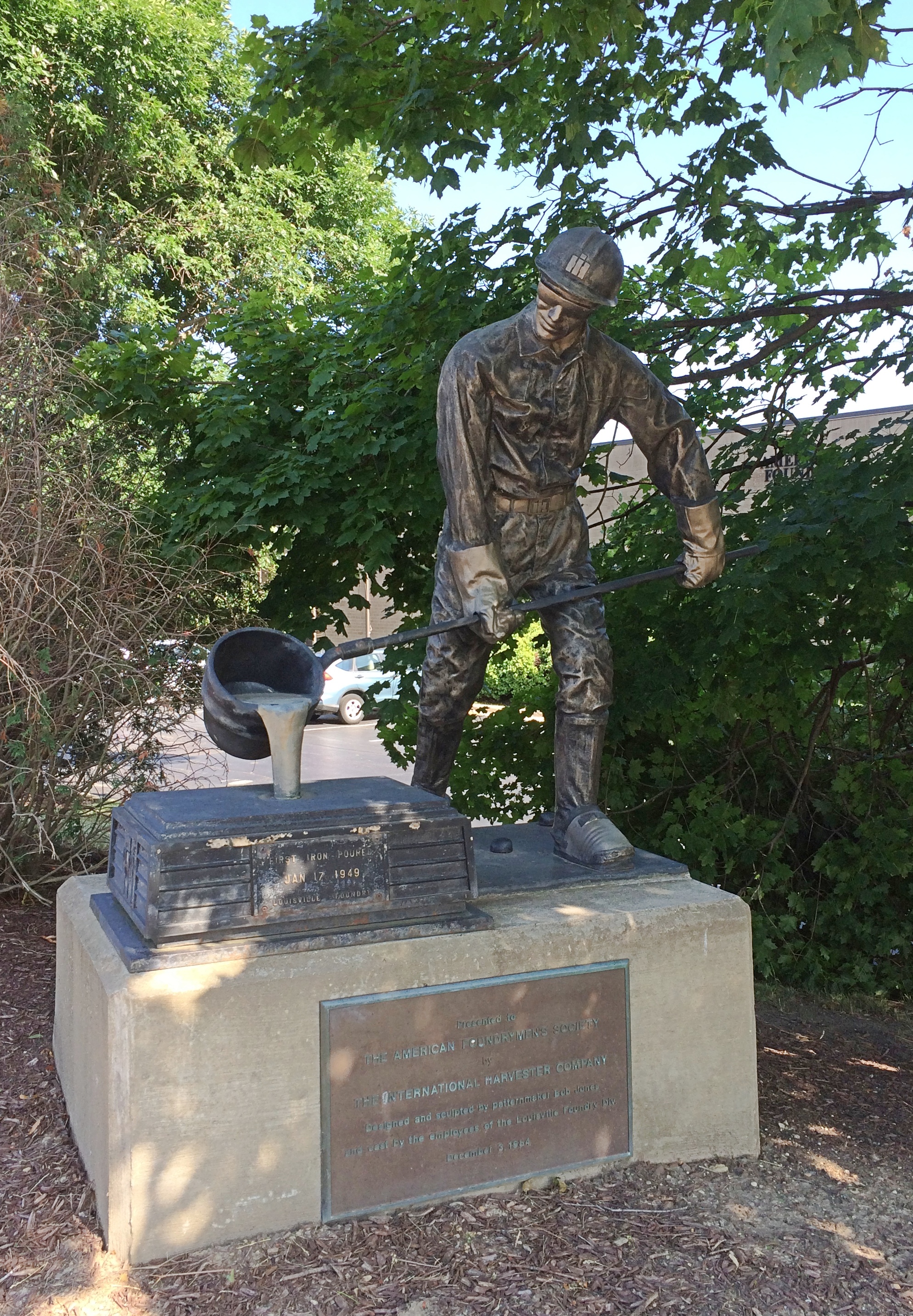 I had to stop for a minute and look at that. Luckily, Penny Lane doesn’t have much traffic. None besides me at that moment, in fact. The plaque on the plinth says:
Presented to
THE AMERICAN FOUNDRYMEN’S SOCIETY
by
THE INTERNATIONAL HARVESTER COMPANY
Designed and sculpted by patternmaker Bob Jones
and cast by the employees of the Louisville Foundry Div.
December 3, 1984
On the statue itself, on the receptacle receiving the molten iron, is the following:
FIRST IRON POURED
JAN 17 1949
LOUISVILLE FOUNDRY
The iron statue is on the grounds of the American Foundry Society’s headquarters on Penny Lane. Formerly it was the American Foundrymen’s Society, which sounds like a workers’ organization, but it is (and always has been, I think), an industry trade organization for metalcasting.
The statue was among the last items cast in the Louisville foundry, which IH closed in 1983. Iron’s a little unusual for such a work, but it looks painted and well-tended by the organization. Even better, it has to be the most obscure statue, at least among those on public view, in the Chicago area.