The Modern Art Museum of Fort Worth

If you want to see artful concrete, Tadao Ando is your man. I came to a fuller appreciation of that when we visited the 659 Wrightwood in Chicago late last year. On exhibit at the 659 were images of the Modern Art Museum of Fort Worth, an Ando design that looked pretty artful, too.

As it is.
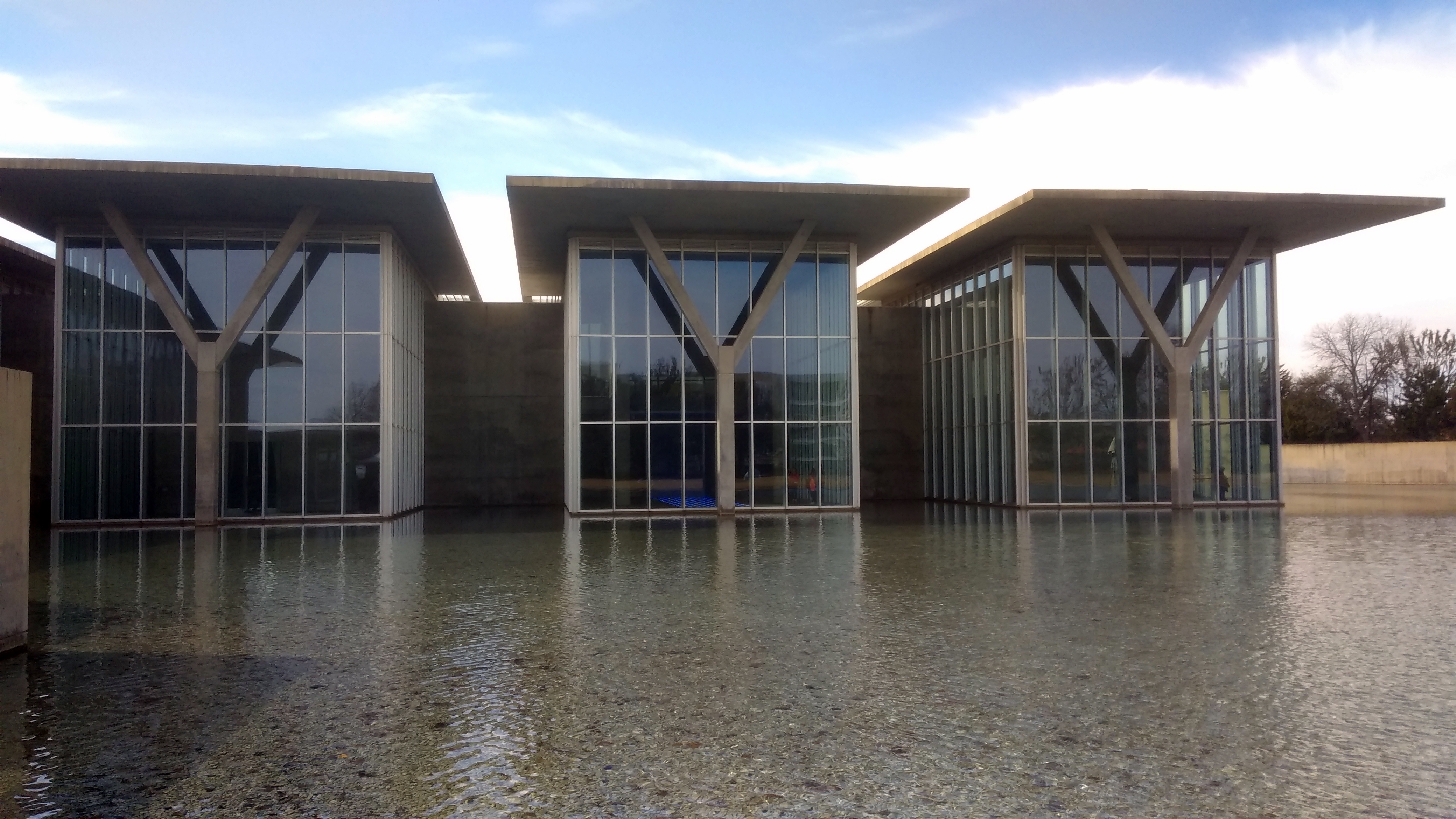
Modern Art Museum of Fort WorthThat’s the back of the structure, or at least the side facing the water feature and a scattering of outdoor sculptures, and sporting the museum’s distinctive Y beams.

The front, or at least the side facing the parking lot and a public street, isn’t quite as distinctive, but it is handsome in a modernist sort of way.
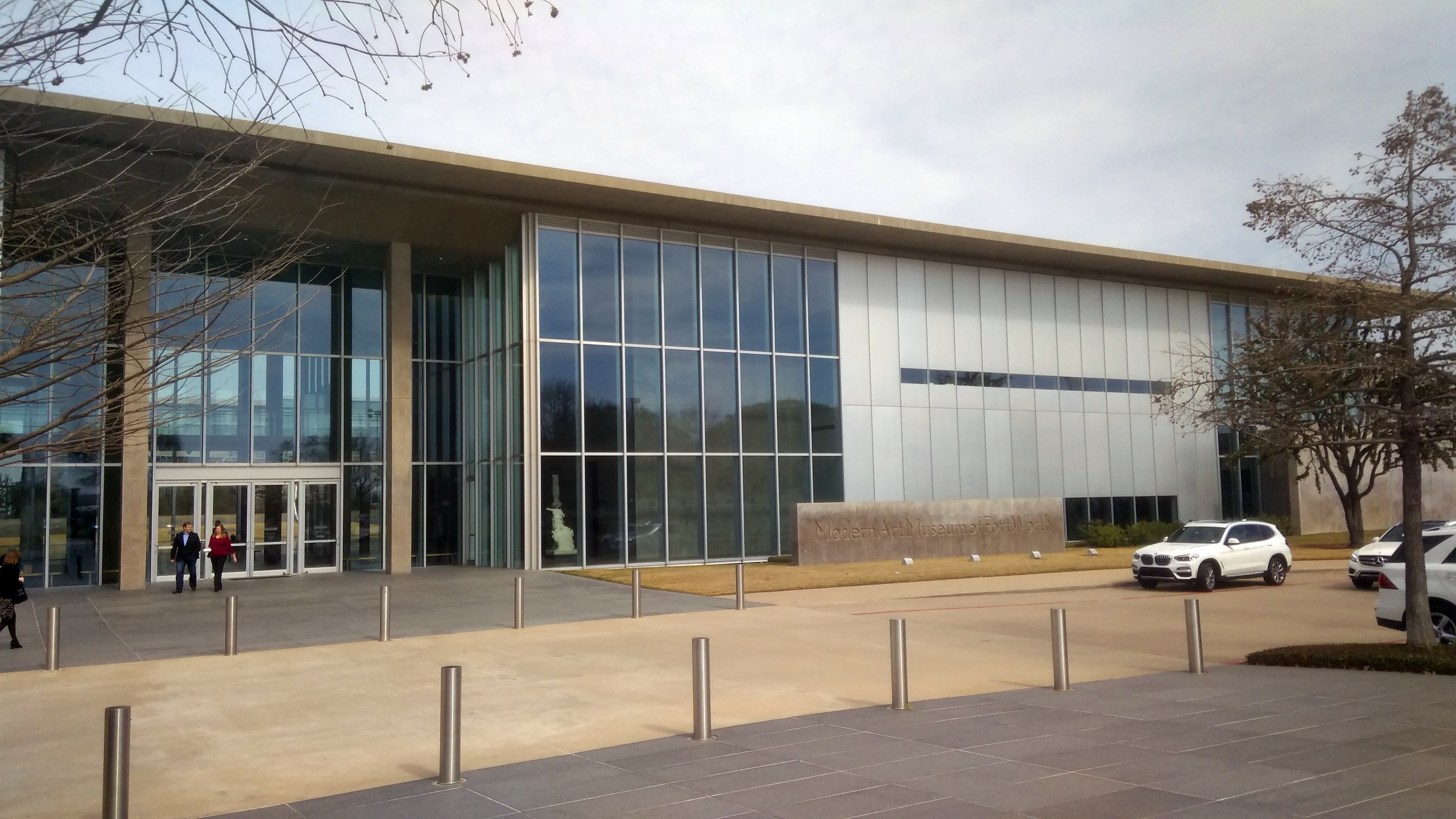
Modern Art Museum of Fort WorthAndo’s design is apparent not only in the exterior, but in the smooth concrete walls that form parts of the interior.

The Modern is one of a cluster of art museums in Fort Worth that also includes the Amon Carter Museum of American Art (designed by Philip Johnson) and the Kimbell Art Museum (Louis Kahn and Renzo Piano). The last time I spent a day in Fort Worth, early in 1990, I visited both of those. The Modern didn’t exist then, opening only in 2002.

How best to approach a museum whose collection is as eclectic as the Modern? Wander around and look at things. Some works will be interesting, some less so. I try to wander around upper-end grocery stores with the same attitude in mind, if I have time.

The usual modern suspects were all in evidence at the Modern: Picasso, Lichtenstein, Rothko, Andy Warhol, Jackson Pollack, Josef Albers, Henry Moore and more. Worth seeing, but it’s also good to see interesting works by artists that aren’t quite as well known.

Such as “Ladder for Booker T. Washington” by Martin Puryear (1996), a wooden ladder-like structure fixed to the floor that winds its way upward. It doesn’t merely appear to shrink in size as it rises, it actually does. The surrounding Ando-style concrete walls add to the effect.

Or the curious “Camouflage Botticelli (Birth of Venus)” by Alain Jacquet (1963-64), an image of Venus on a cockle shell merged with a Shell gas pump.

For something newer, and more kinetic, there’s “Kind of Blue” by Jenny Holzer (2012), an array of nine LED signs with blue diodes fixed to the floor, emitting blue words that appear to flow along. As far as I could tell, there was no direct reference to the Miles Davis album of that name, but I could easily be wrong.

The video also offers a good look at the tall glass windows that overlook the museum’s shallow water feature — essentially a field of rocks covered by a little water.

Photography is part of the Modern’s collection as well. One wall sported a number of gelatin silver prints of water towers in France, Germany and the U.S. by Bernd and Hilla Becher. How is this tower in Dortmund-Grevel, Germany, anything but a delight?

Near the museum’s front entrance is “Vortex” by Richard Serra (2002), who is best known to us rubes for the notorious “Tilted Arc” in DC.
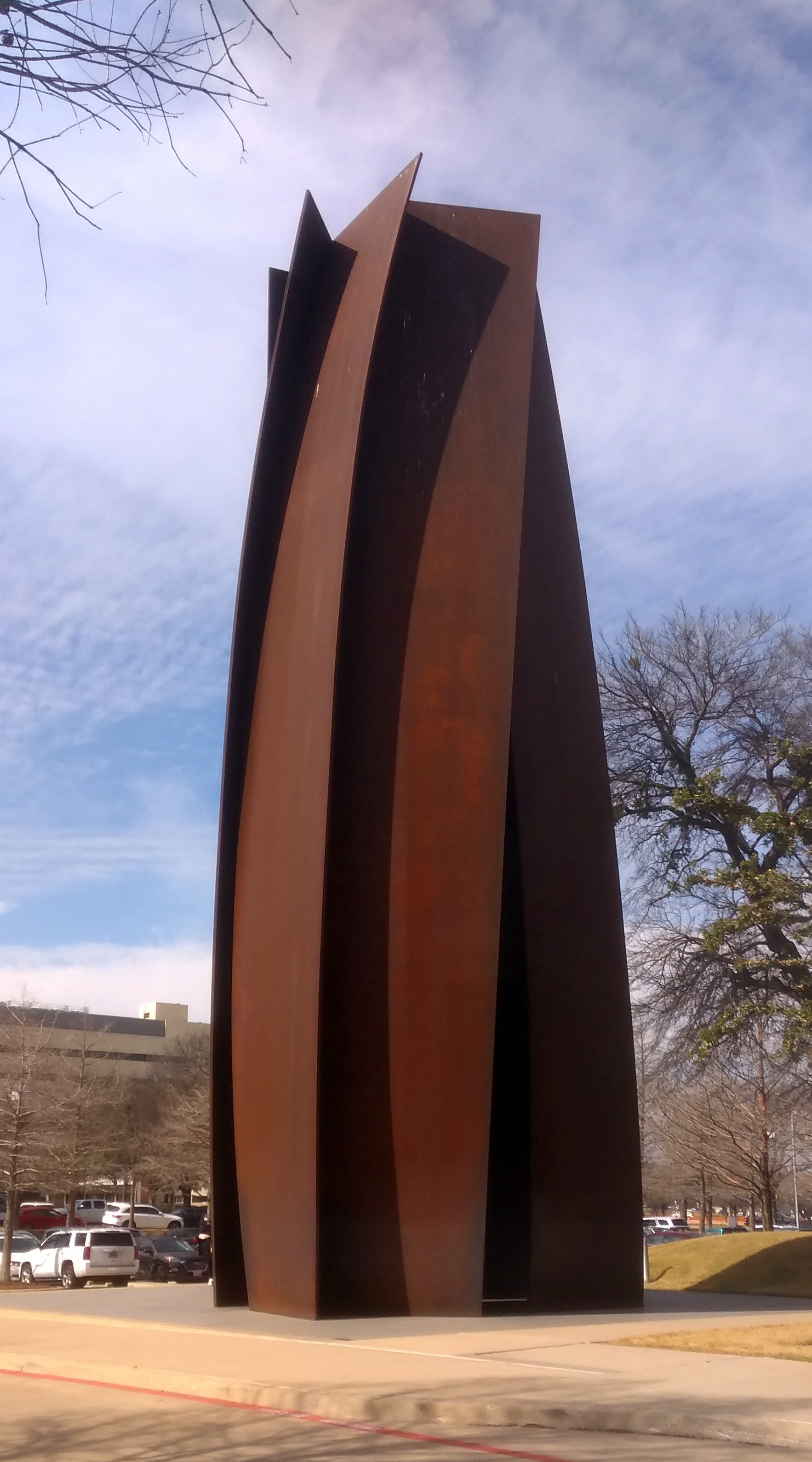
Vortex Richard SerraOn the other side of the museum, beyond the water feature, we took a look at a familiar figure.
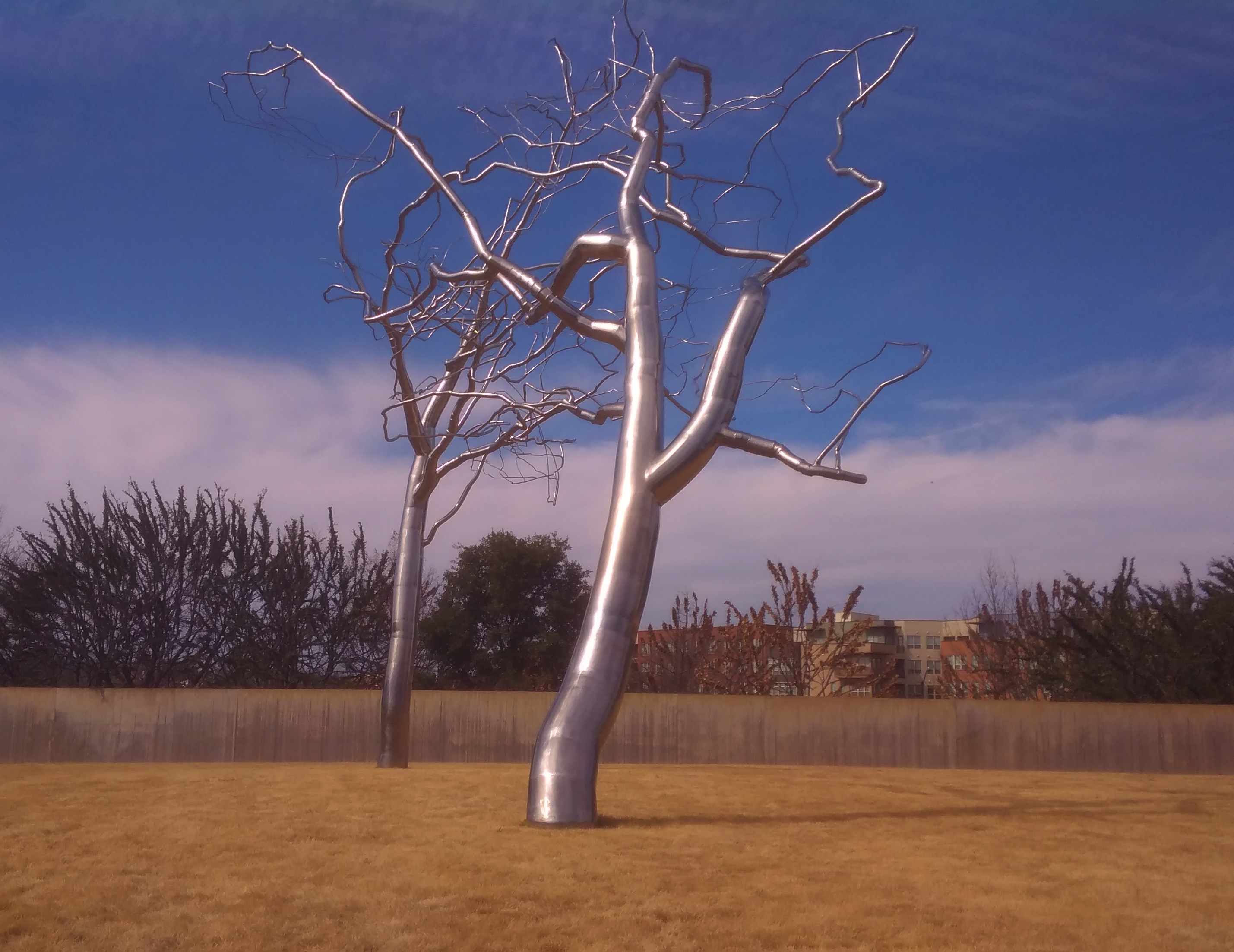
"Conjoined" by Roxy Paine

“Conjoined” by Roxy Paine (2007), done in stainless steel. I remember seeing his work at the National Sculpture Garden and, I believe, at the Denver Art Museum, the Frederik Meijer Gardens and Sculpture Park, the Crystal Bridges Museum of American Art, MOMA and the Hirshhorn. Cool. But does lightning strike the Modern piece?
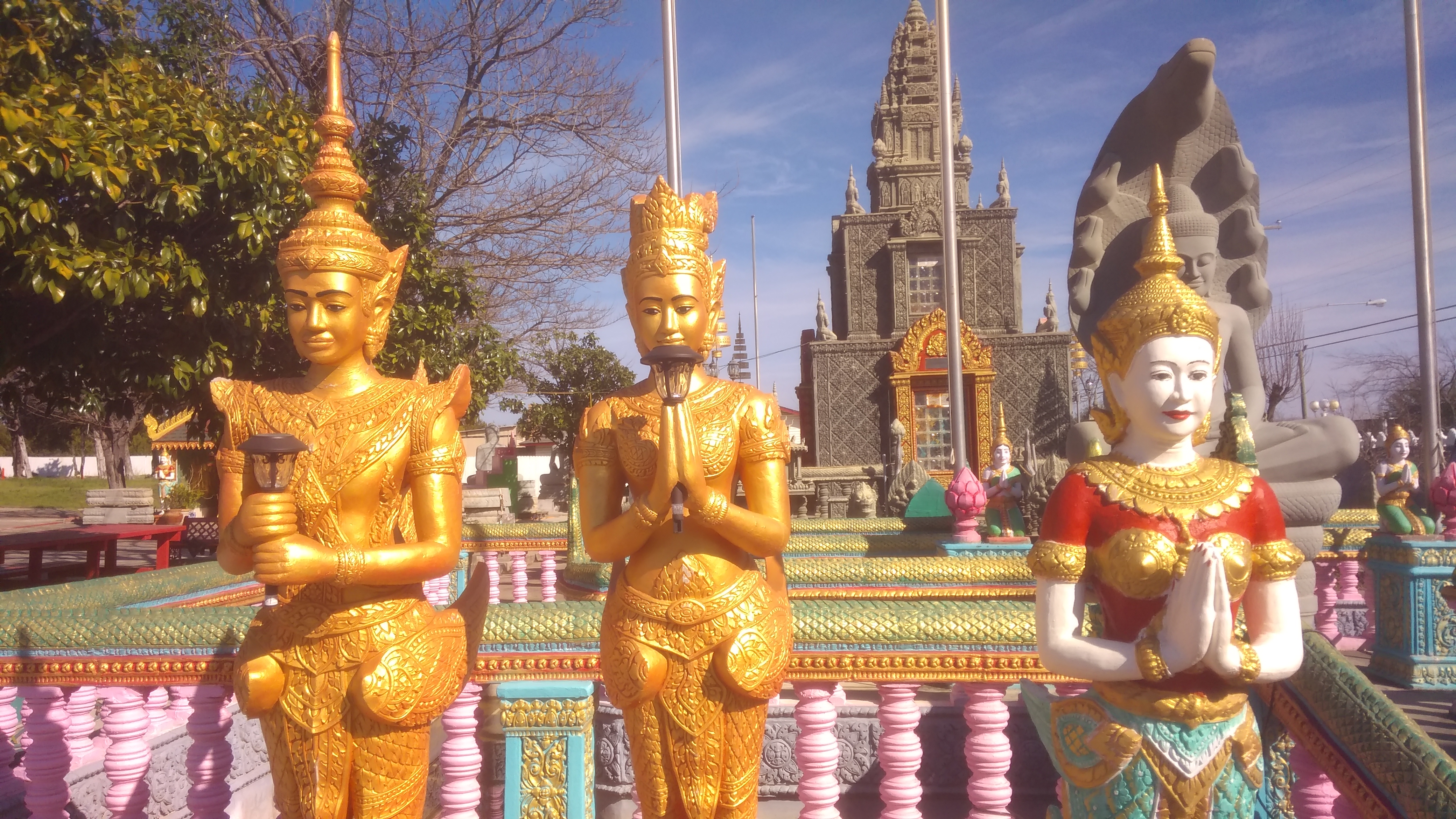
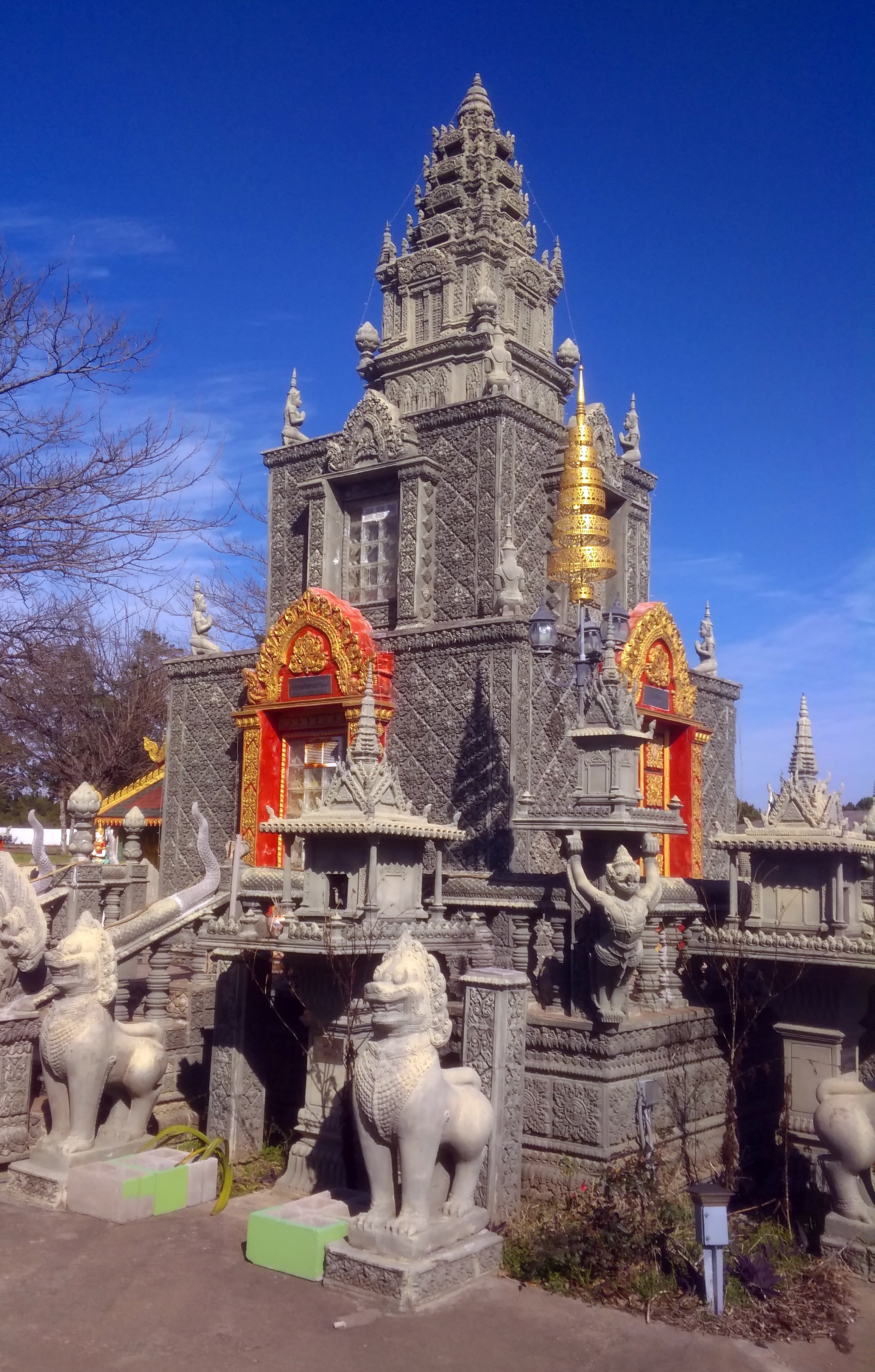
The Cambodian Buddhist Temple of Dallas

If you know where to go in Texas, you can find yourself face-to-face with these figures. That’s what we did on February 17.
Cambodian Buddhist Temple of Dallas About a quarter-mile from the Cao Dai Tay Ninh Temple of Dallas is the Cambodian Buddhist Temple of Dallas, also known as Wat Jetaphon Khemararam.

The area is something of a religious precinct, since also nearby are the Homprakhoon Baptist Church, the Wat Lao Sirimoungkhoun of Dallas, the St. John Neumann Redemptorist Monastery — called the Vietnamese Redemptorist Mission on Google Maps — and, a little further away (but not much), the Potter’s House of Dallas, a megachurch.

The entrance of the Cambodian Buddhist Temple of Dallas is a recently completed temple gate that’s a replica of the gates at Angkor Wat. My pictures of it didn’t turn out, but this article shows it well.

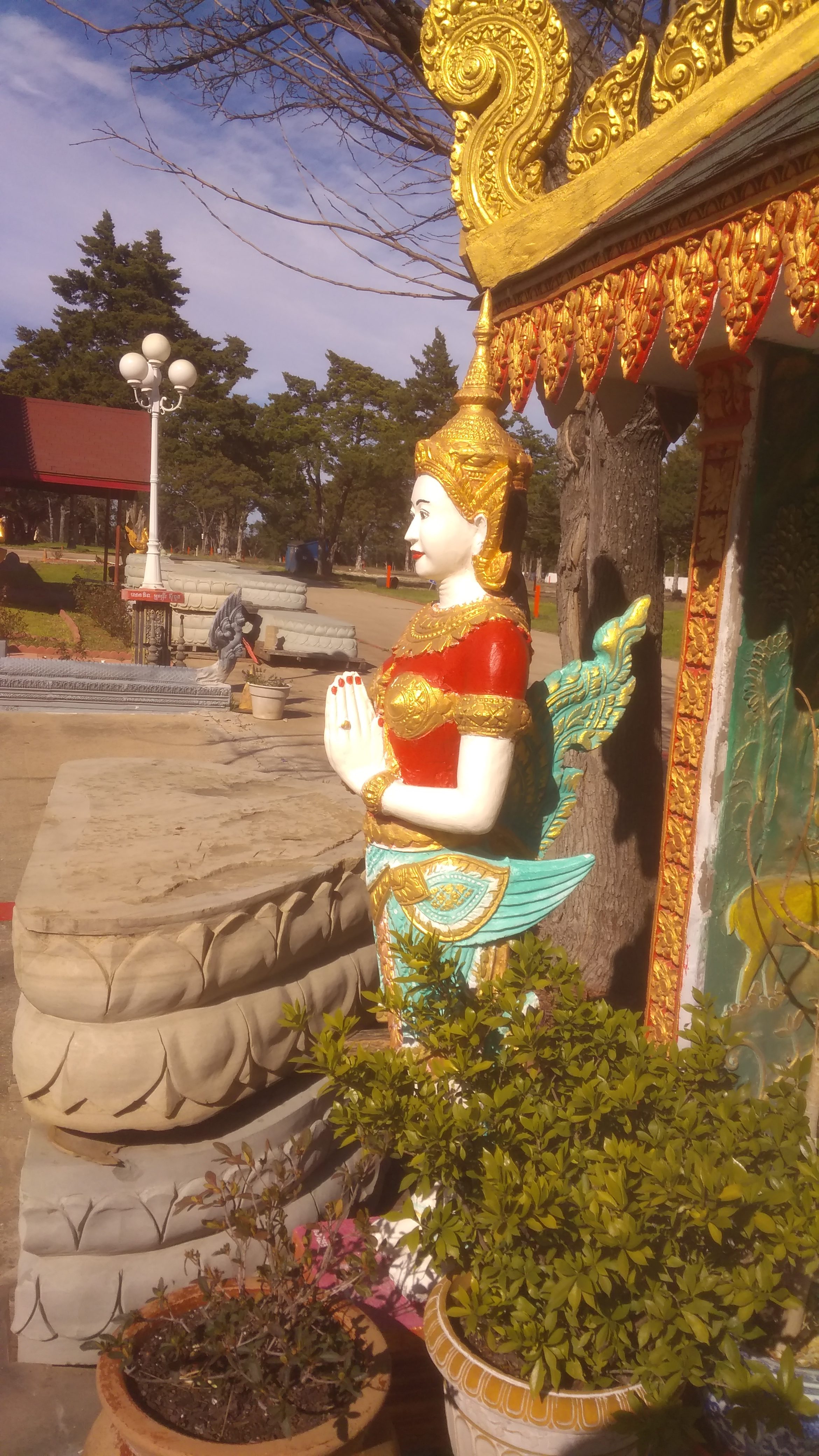
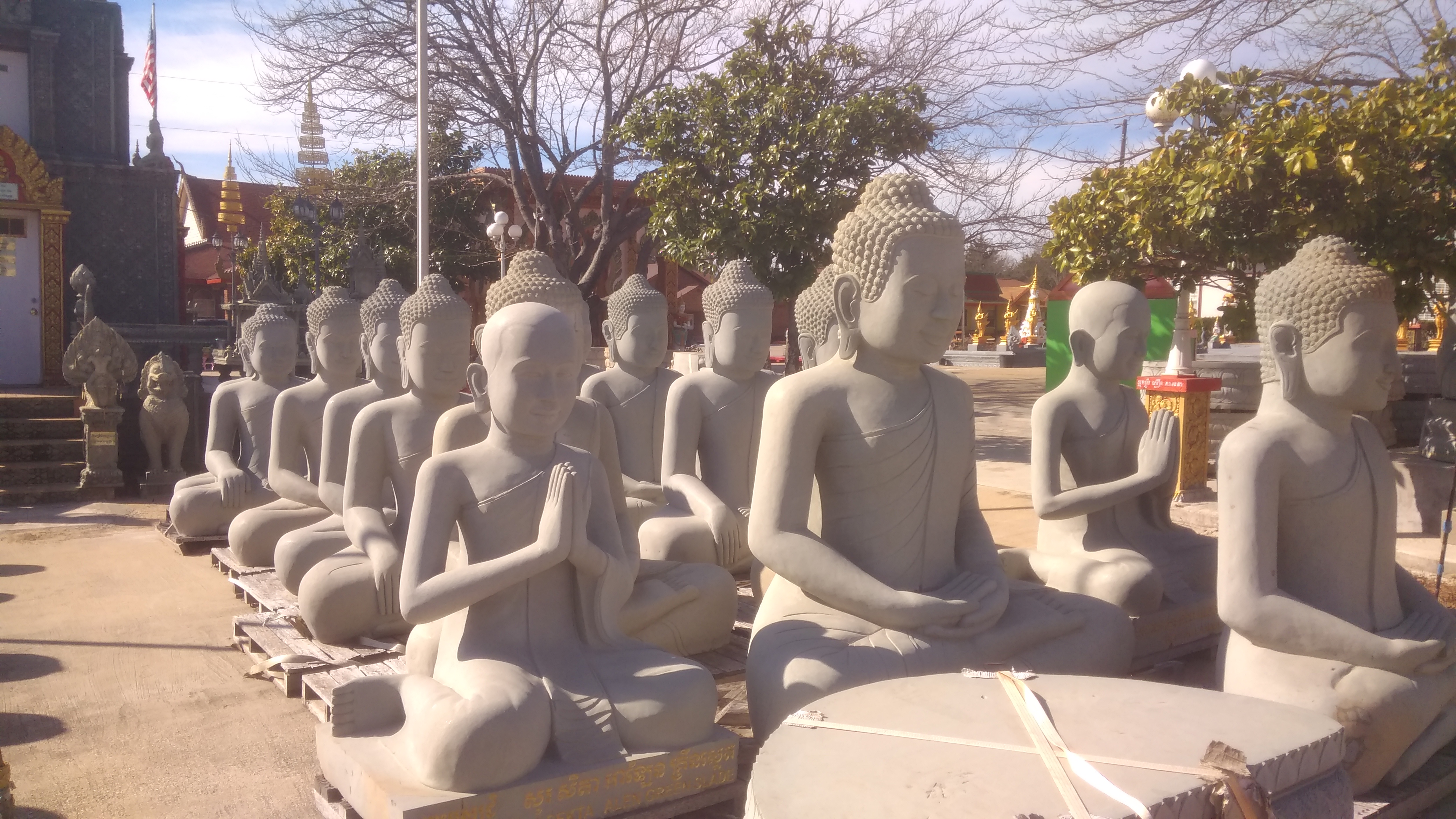
The grounds were open and we were free to wander around. So we did. I was reminded of the various wats I visited in Thailand, though the Cambodian style is a bit different. The grounds featured temple structures.

Cambodian Buddhist Temple of Dallas Cambodian Buddhist Temple of Dallas Cambodian Buddhist Temple of DallasAlong with Buddhas a-plenty. Or rather, Buddharūpa.

Cambodian Buddhist Temple of Dallas

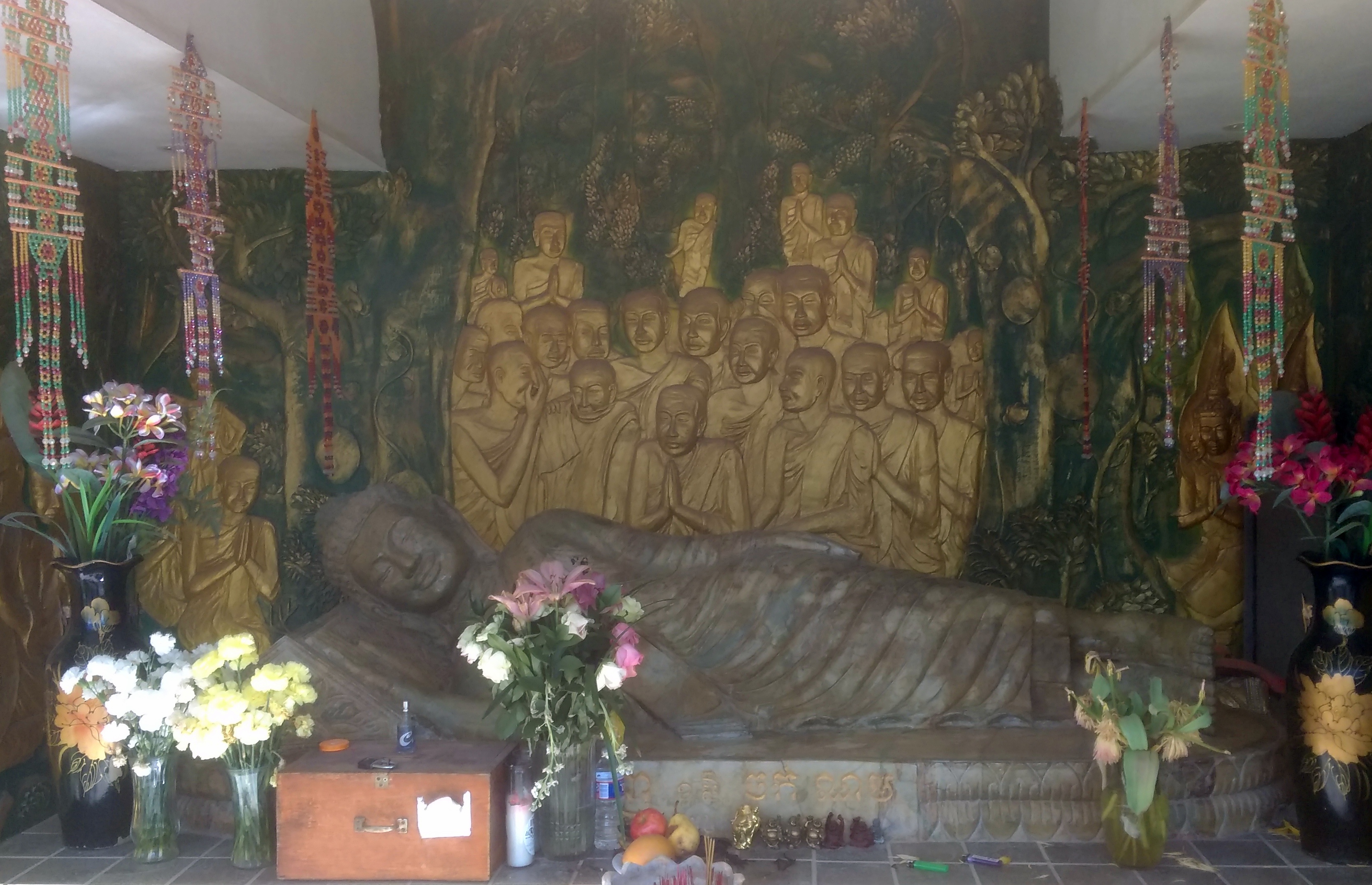
Including a reclining Buddha.

Cambodian Buddhist Temple of DallasNot the largest reclining Buddha I’ve encountered, but impressive all the same.

Monks live on the grounds. In fact, some of the buildings sport signs in English designating them as monk quarters. I saw one man whom I took for a monk doing some exterior work on one of the temple structures, and as we were about to leave, another man — whom I also took for a monk, though dressed in clothes you might see on anyone in our place and time — asked me if I liked the temple. I told him I did.

The Cao Dai Tay Ninh Temple of Dallas

A few years ago, I was browsing Google Maps, as one does, and I happened across the Cao Dai Tay Ninh Temple of Dallas. That was intriguing. I wanted to take a look.

Usually when I visit Dallas, I spend time in the northeast part of the city, at about 2 o’clock from downtown. The temple is in the southwest at about 8 o’clock from downtown, so I knew that it might be awhile before I made it down that way.

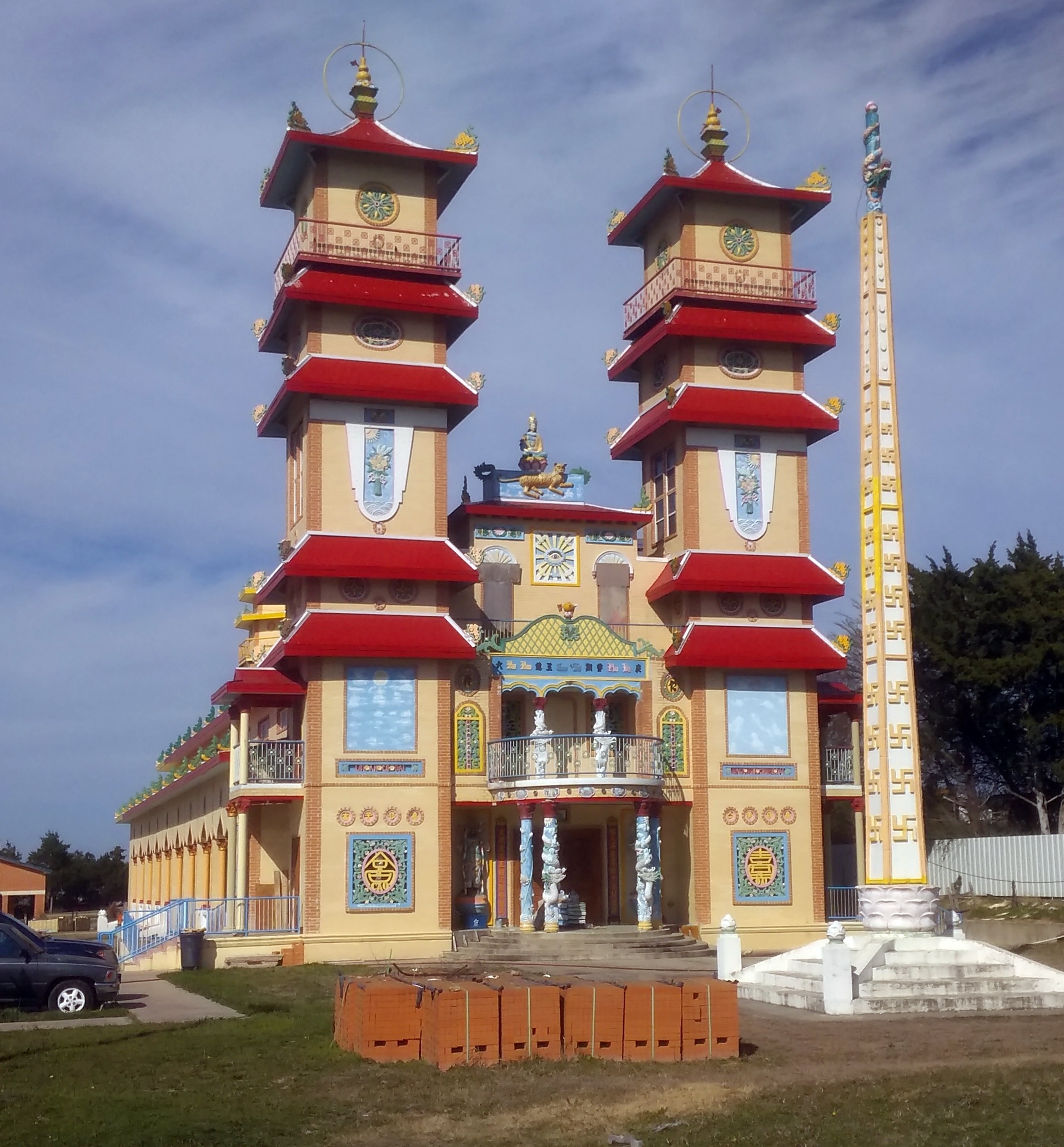
February 17 turned out to be the day we visited the Cao Dai Tay Ninh Temple of Dallas. This is the entrance. I think.
Cao Dai Tay Ninh Temple of DallasThe temple belongs to an overseas branch of the Caodai religion of Vietnam.

“Caodaism is a relatively new, syncretistic, monotheistic religion with strongly political character, established in 1926 in Southern Vietnam…” writes Md. Shaikh Farid. “It draws upon ethical precepts from Confucianism and Buddhism, occult practices from Taoism, theories of karma and rebirth from Buddhism and hierarchical organization from Roman Catholicism…

“This synthesis of elements adapted from other religions into a functioning religious movement manifests itself in such common Caodai practices as priestly celibacy, vegetarianism, seance inquiry and spirit communication, reverence for ancestors and prayers for the dead, fervent proselytism, and sessions of meditative self-cultivation.”

The temple is in a part of the city of that’s mostly devoted to light industrial buildings, mobile homes and undeveloped properties. Presumably, the site was affordable for local Caodai devotees.

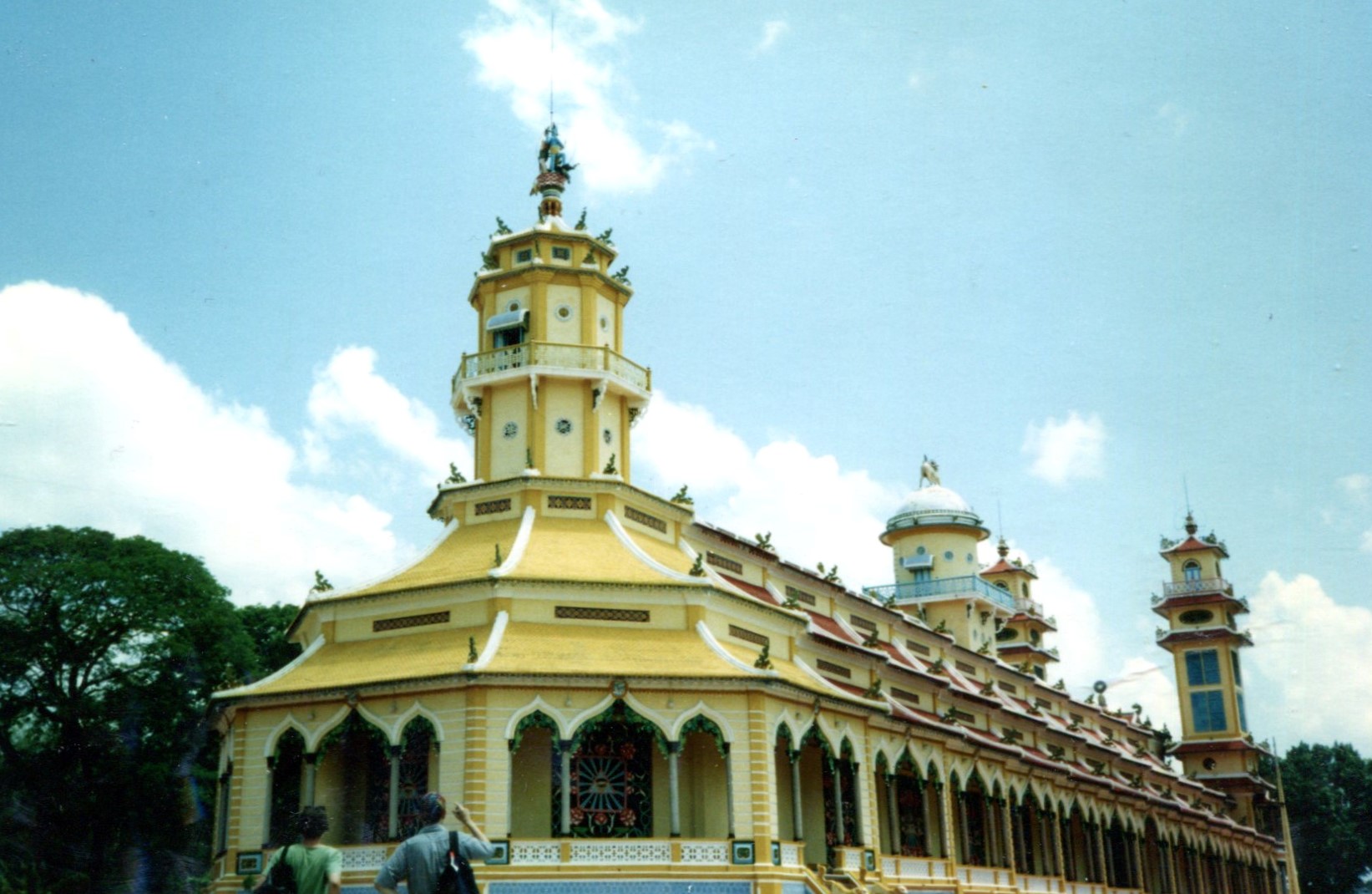
I’d never heard of that religion until I made an excursion from Saigon in 1994 to the main Caodaist temple, the Holy See of the religion, in Tay Ninh, Vietnam. Here’s a picture I took of that building.

Cao Dai Tay Ninh Temple VietnamA more detailed description of the various influences that went into the building is here. An amalgam of Chinese and Indian and other elements, it seems.

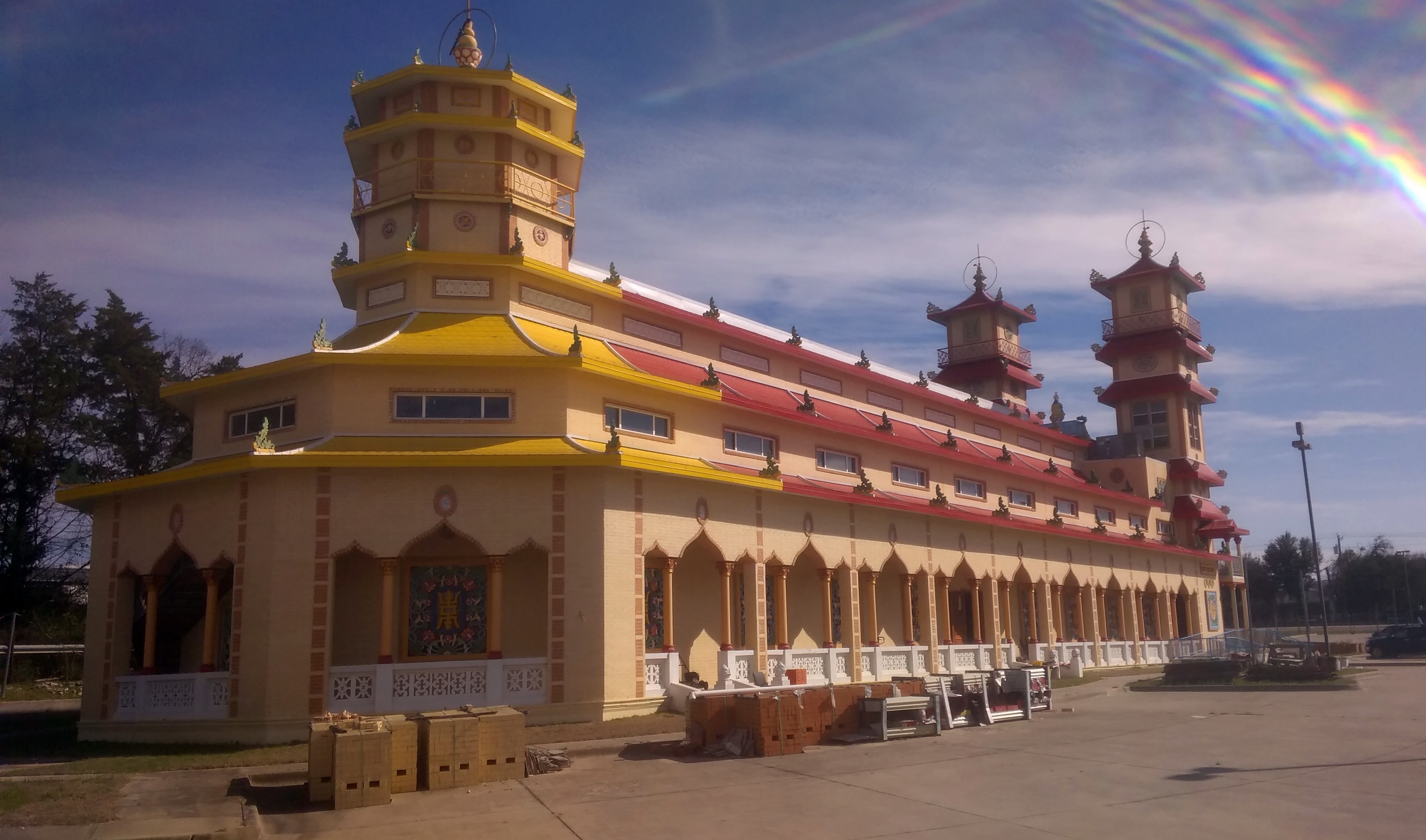
The temple in Dallas, from roughly the same angle.
Cao Dai Tay Ninh Temple of DallasThe similarities between the Holy See and the Dallas temple were apparent at once, though I’m pretty sure that the Holy See is larger, and some details are different.

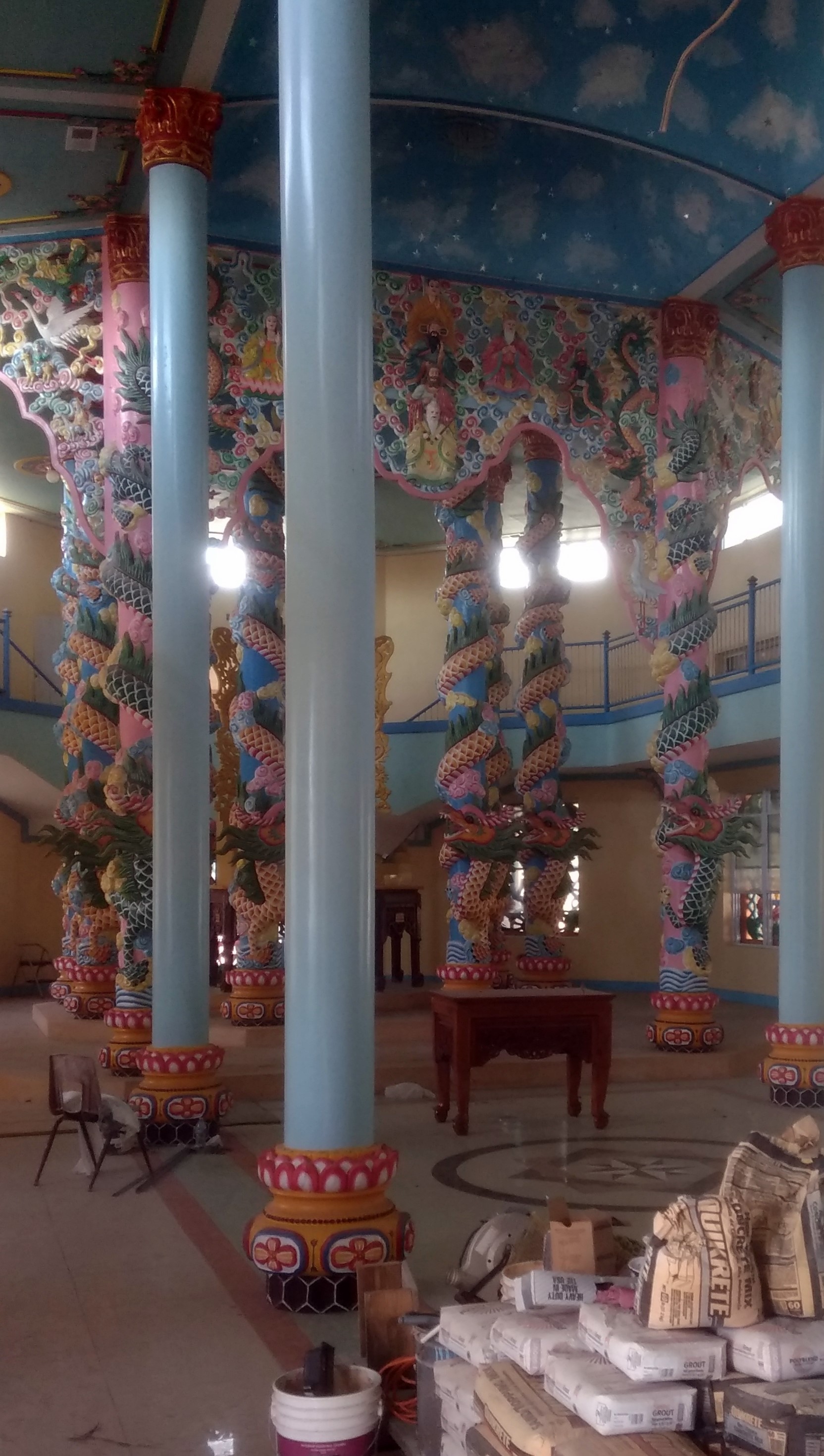
The Dallas temple is still a work in progress. This was especially noticeable when we went inside — a side door was open — and noticed construction materials and tools here and there.
Cao Dai Tay Ninh Temple of DallasThough smaller, the Dallas interior also had strong similarities to the one in Tay Ninh.
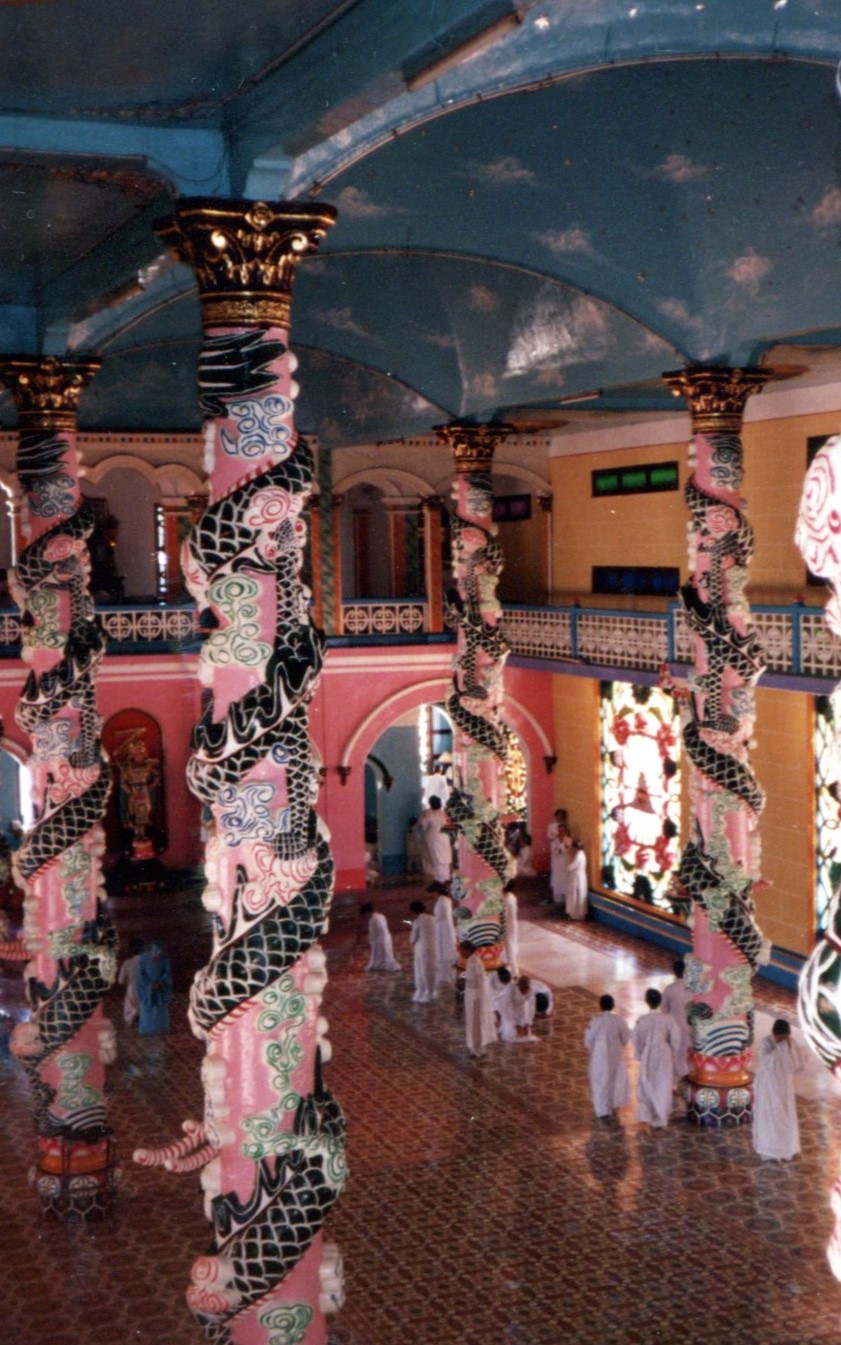
Cao Dai Tay Ninh Temple VietnamAs I understand it, services are at midnight, 6 a.m., noon and 6 p.m. We visited around 3 p.m., so no Caodai worshipers were around in Dallas. The tour in Vietnam was timed to see the noon service, so we saw the worshipers in their various colorful robes, each color with a distinct meaning best known within the religion, though ordinary worshipers are in white.

It’s good to travel to exotic places and see exotic things. Like you can in Dallas.

Texas Winter ’19

My recent trip to wintertime Texas took me to Dallas and Fort Worth, San Antonio, and a few other burgs. February is winter in Texas, but it’s a pale moon of a winter compared with where I live. During the trip, temps varied but didn’t drop below freezing, and we experienced rain but no ice or snow.

I spent the weekdays working, but I also visited my brothers, one nephew and his family, one nephew by himself and a friend I’ve known for 45 years now.

I made it to a few new places and a few familiar old places. No matter how often you go somewhere, there are always new places, and no matter how familiar an old place is, there are always new aspects.

One new place was the Modern Art Museum of Fort Worth, which I’ve had a mind to see since we went to Wrightwood 659 in December. Tadao Ando designed both Wrightwood and the Modern, which is easy to visit from Dallas, as Jay and I did: just pop on over on I-30.

While gadding around in greater DFW, we also saw the Cao Dai Tay Ninh Temple and the Cambodian Buddhist Temple of Dallas, whose neighbors in the southwest of the city are the likes of Mission Foods, Standard Meat, Cartamundi USA and Old Dominion Freight Line.

In San Antonio, we had the benefit of a free evening admission to the McNay Art Museum — an example of a familiar place offering some new things to see. Later, while on the road between San Antonio and Dallas, we stopped by the Hays County Courthouse in San Marcos and the San Marcos City Cemetery, whose burials go back to the 1870s.

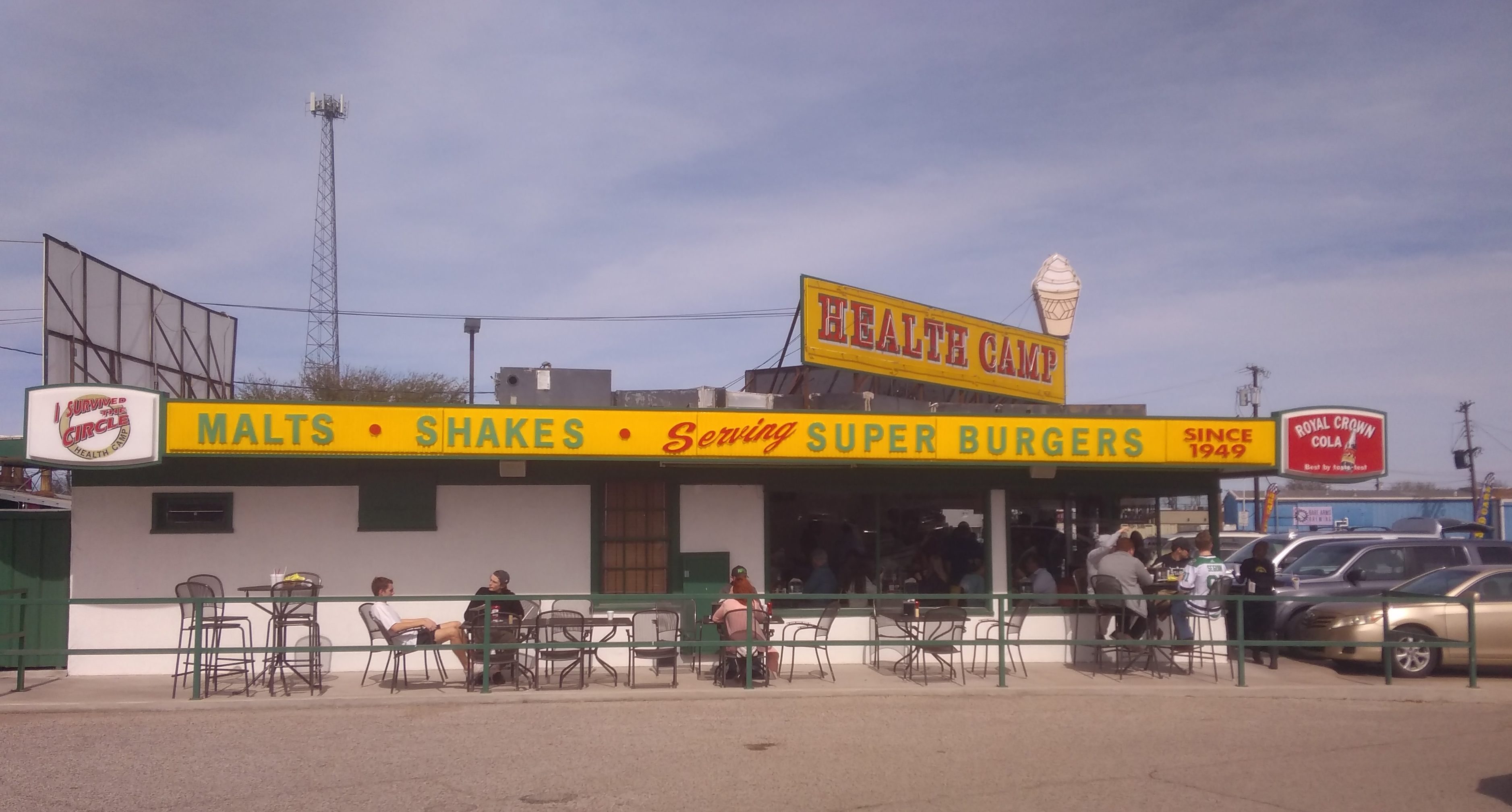
Had some good meals along the way too. In San Antonio, a dinner at one of the Paesanos locations, a local Italian restaurant with roots in the 1968 world’s fair. Good pork shank and gnocchi. In Waco, a lunch at a joint that goes even further back: the curiously named Health Camp, in business, as the exterior says, since 1949. Good burger and shake.

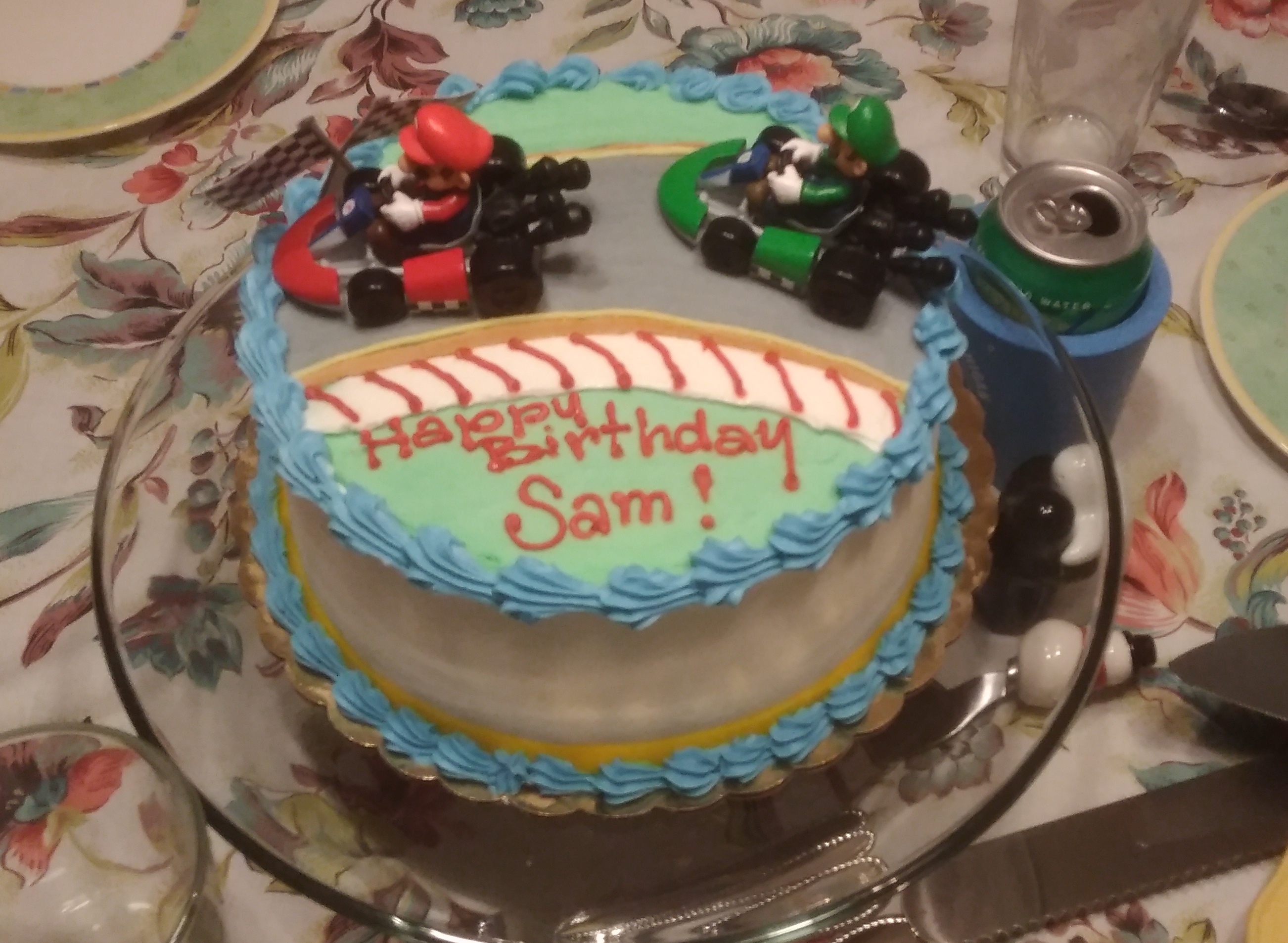
In Dallas, on the day I flew in, I enjoyed sausage and homemade sauerkraut and Texas beer and other good things at my nephew Sam’s house, on the occasion of his 36th birthday. Naturally there was birthday cake too.

Reminded me of the morning, late in my college career, when Jay called me to tell me that Sam had been born. Been an uncle ever since.

St. Paul Square, Sunset Station & the SP 794

Four years ago, I wrote: “One fine thing about South Texas in February is that it isn’t northern Illinois in February.” Then I called northern Illinois “septentrional,” to use a 10-dollar word that ought to be used at least occasionally.

Anyway, it can be cold in San Antonio in February, but just as often it’s pleasantly cool — good temps for a walk.

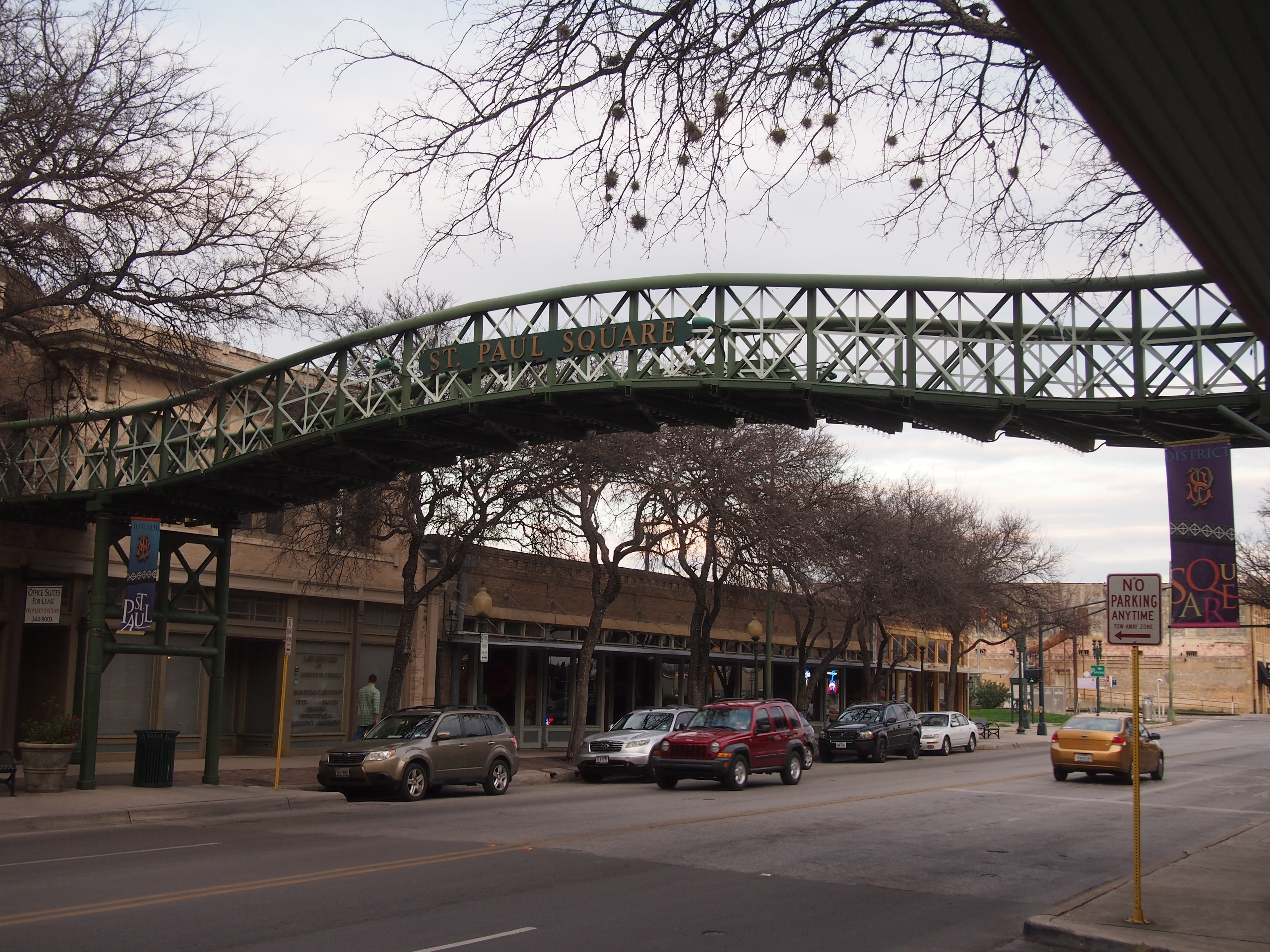
Four years ago I visited San Antonio’s Eastside Cemeteries Historic District. I also took a look at the nearby St. Paul Square, an area that flourished in pre-Interstate years because of its proximity to San Antonio’s main passenger train station.
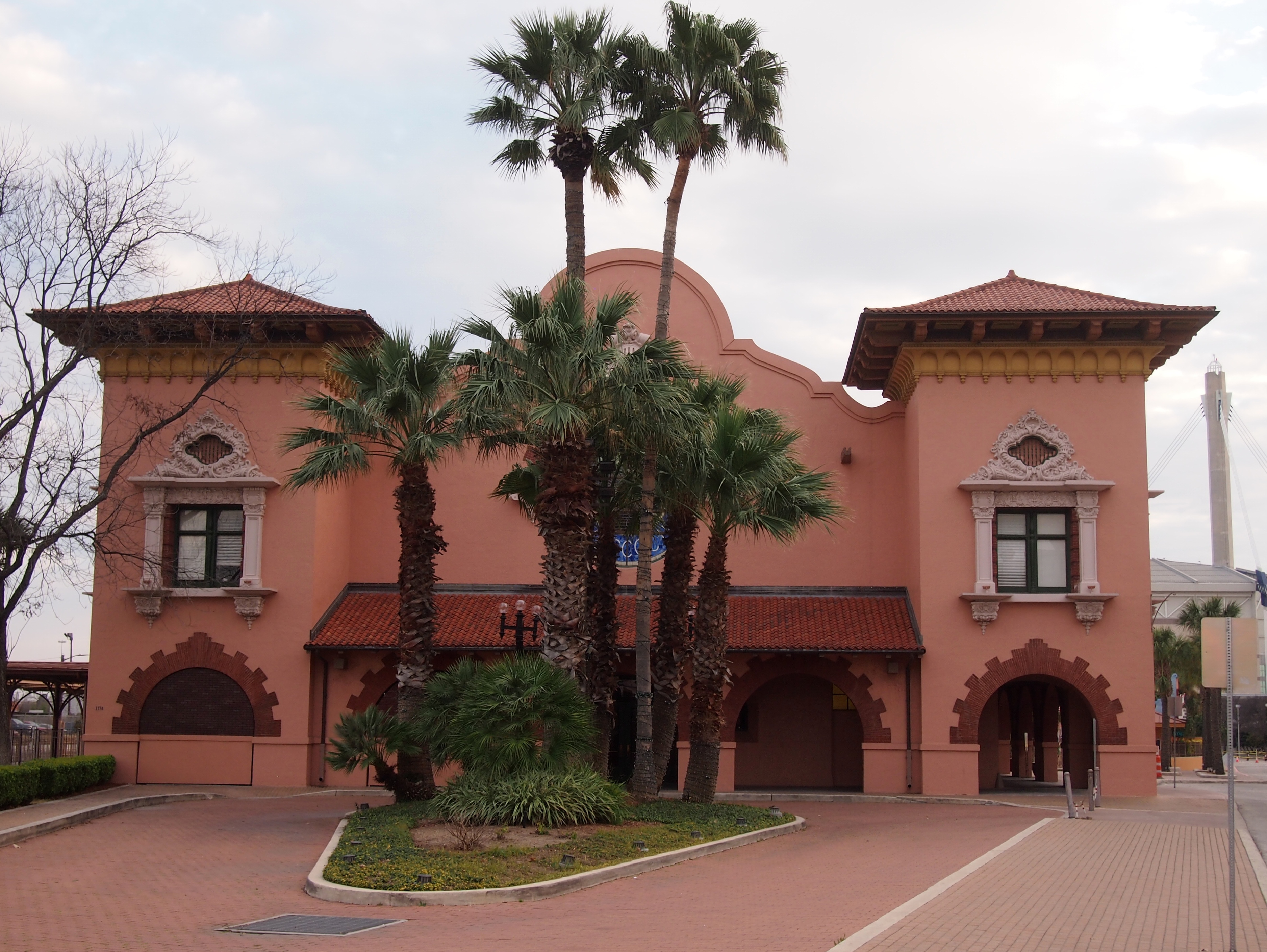
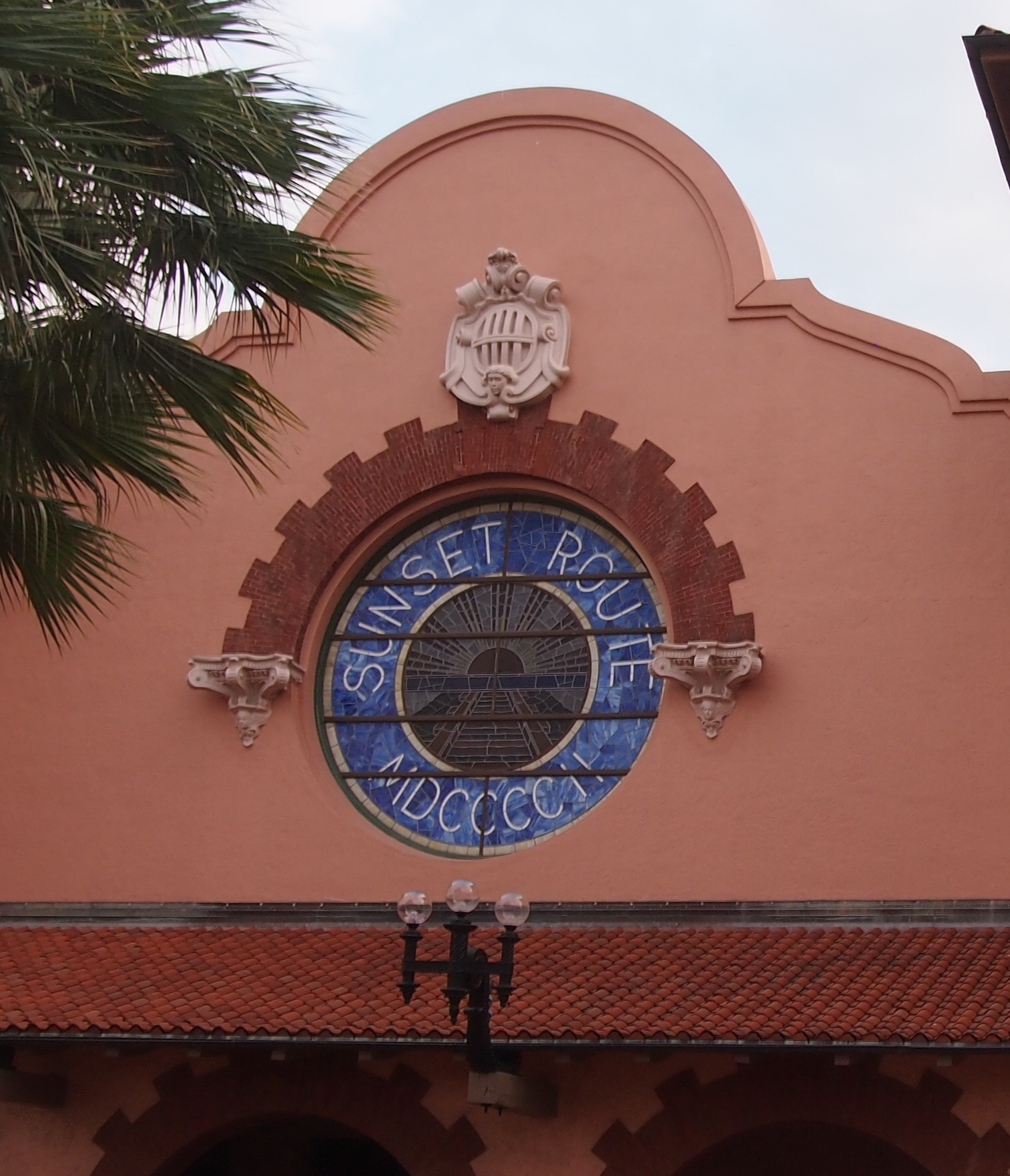
The area has enjoyed some recent revival as a retail and entertainment center. The aforementioned train station is Sunset Station, vintage 1902 and redeveloped in the 1990s as an entertainment complex.

The last time I’d been at the station was when it was still a station, 25 years earlier. I caught an Amtrak train — the only train still using the station in 1990 — that took me to Los Angeles, where I changed trains for San Francisco.

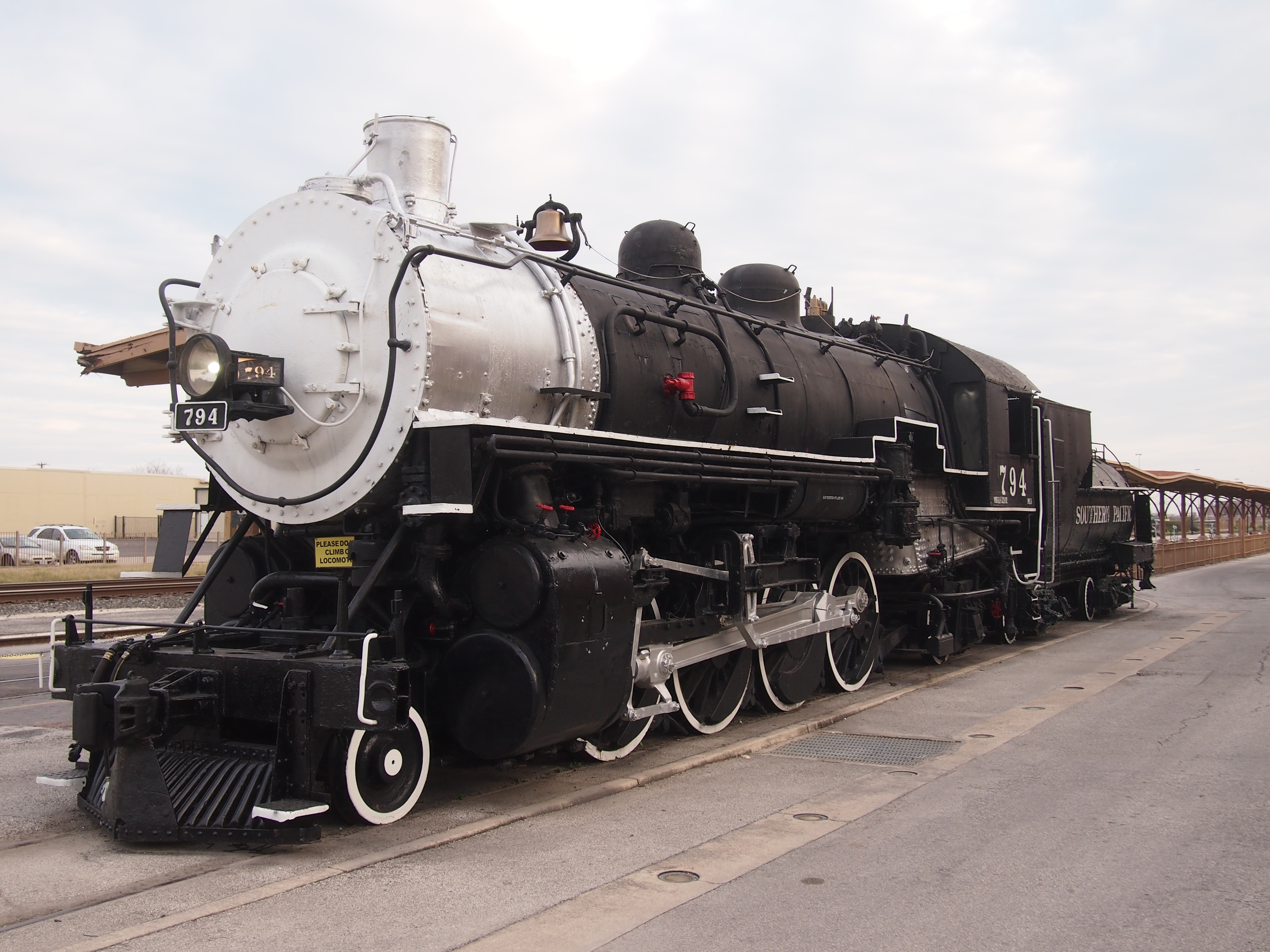
Next to the renovated station: Southern Pacific 794.

“She was built in 1916 by the Brooks Locomotive Works in Dunkirk, NY, for the Texas and New Orleans (T&NO) Railroad, which was a subsidiary of the Southern Pacific Railroad,” says the San Antonio Railroad Heritage Museum. “She was transported to Texas as parts and was assembled in Texas, and then was operated for forty years while being based in San Antonio. 794 was used for freight service as well as passenger service.”

With steam obsolete by the 1950s, the SP donated a fair number of locomotives to various entities, including the San Antonio Chamber of Commerce in the case of the 794. From 1957 to 1999 the locomotive stood in Maverick Park just north of downtown on Broadway. Then it was moved to Sunset Station.

Since Broadway was the way we usually went downtown, by car or bus, I saw it often. Then I noticed, probably during an early 2000s visit, that the 794 was gone. Maverick Park still looks strangely empty without it, 20 years later.

Big Lou’s Really Big Pizza

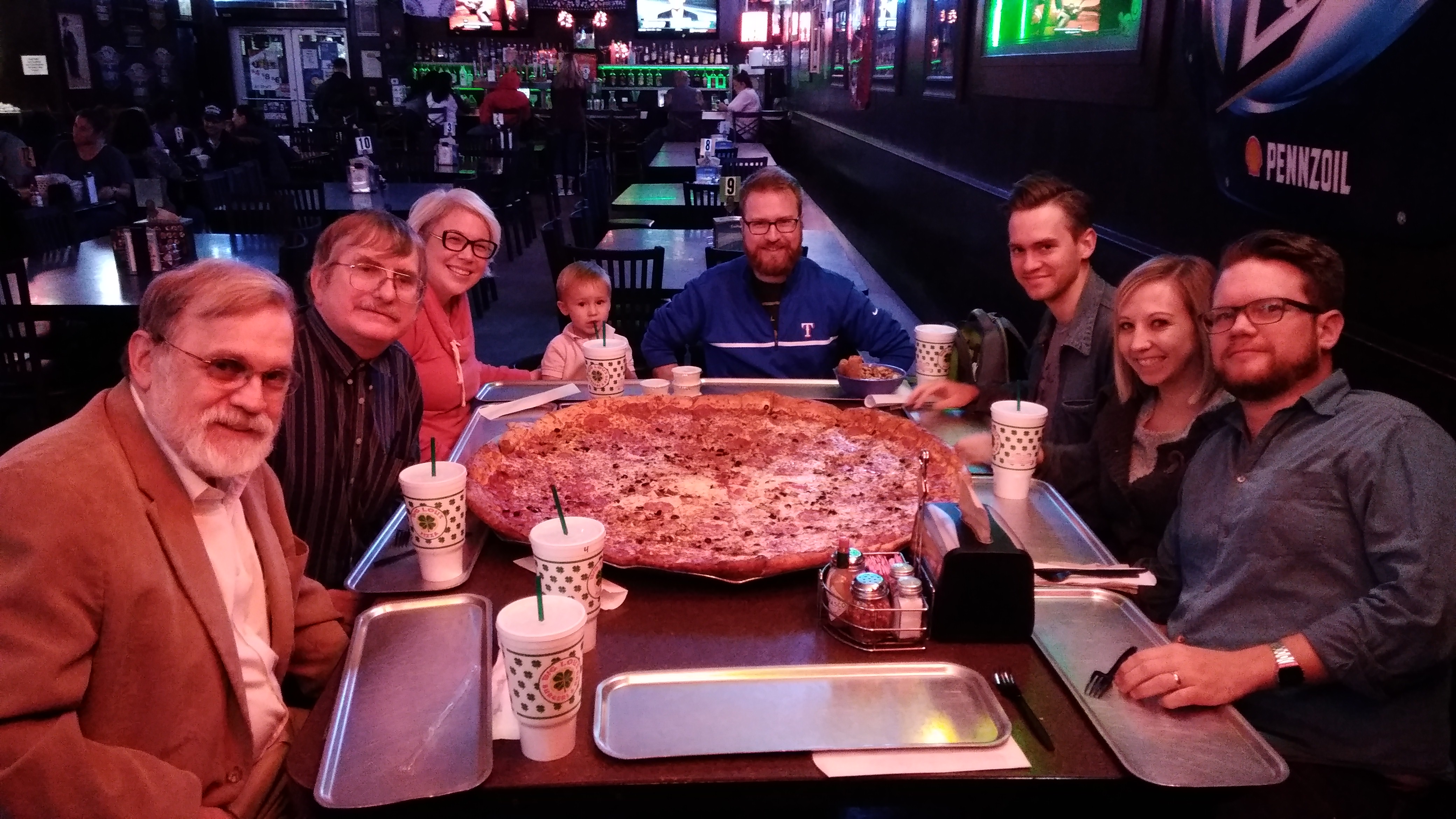
The evening after the funeral all of the family members in town got together for dinner at a place in east San Antonio, way down on W. W. White Road, Big Lou’s Pizza. My nephew Sam had heard about it and took care of the logistics.

The logistics involved ordering a 42-inch pizza ahead of time. Here is everyone at the table posing with a 42-inch pizza.

I’d never seen a pizza that large with my own eyes. I’m certain that went for everyone else at the table. According to one source anyway, it’s the second-largest restaurant pizza in Texas: bested only by a larger one that Big Lou’s makes.

I’m glad to report that it was a good New York-style thin pie. For my part, I ate about a piece and a half. I don’t think anyone else at the table ate any more than that, so there was pizza enough for two boxes of leftovers.

The Ellwood House Museum

Every junior high student in Texas takes, or used to take, a class in Texas history. My teacher 45 years ago was the no-nonsense Mrs. Carrico, whose first name I do not remember. She told some Texas history stories that I do remember, including one I thought of not long ago when we visited the Ellwood House Museum in DeKalb, Illinois.

The story was about the popularization of barbed wire in Texas, specifically a demonstration of wire in 1876 in San Antonio organized by salesmen from up north. As the Texas State Historical Association puts it:

“In 1876 salesman Pete McManus with his partner John Warne (Bet-a-Million) Gates conducted a famous demonstration on Alamo Plaza [other sources say Military Plaza, including the TSHA] in San Antonio in which a fence of… wire restrained a herd of longhorn cattle. Gates reportedly touted the product as ‘light as air, stronger than whiskey, and cheap as dirt.’ Sales grew quickly thereafter, and barbed wire permanently changed land uses and land values in Texas.”

I’d heard of steel and oil magnate John Bet-a-Million Gates before, but until I visited the Ellwood I hadn’t connected him with this incident. It was early in his career and before he was renowned as a gambler.

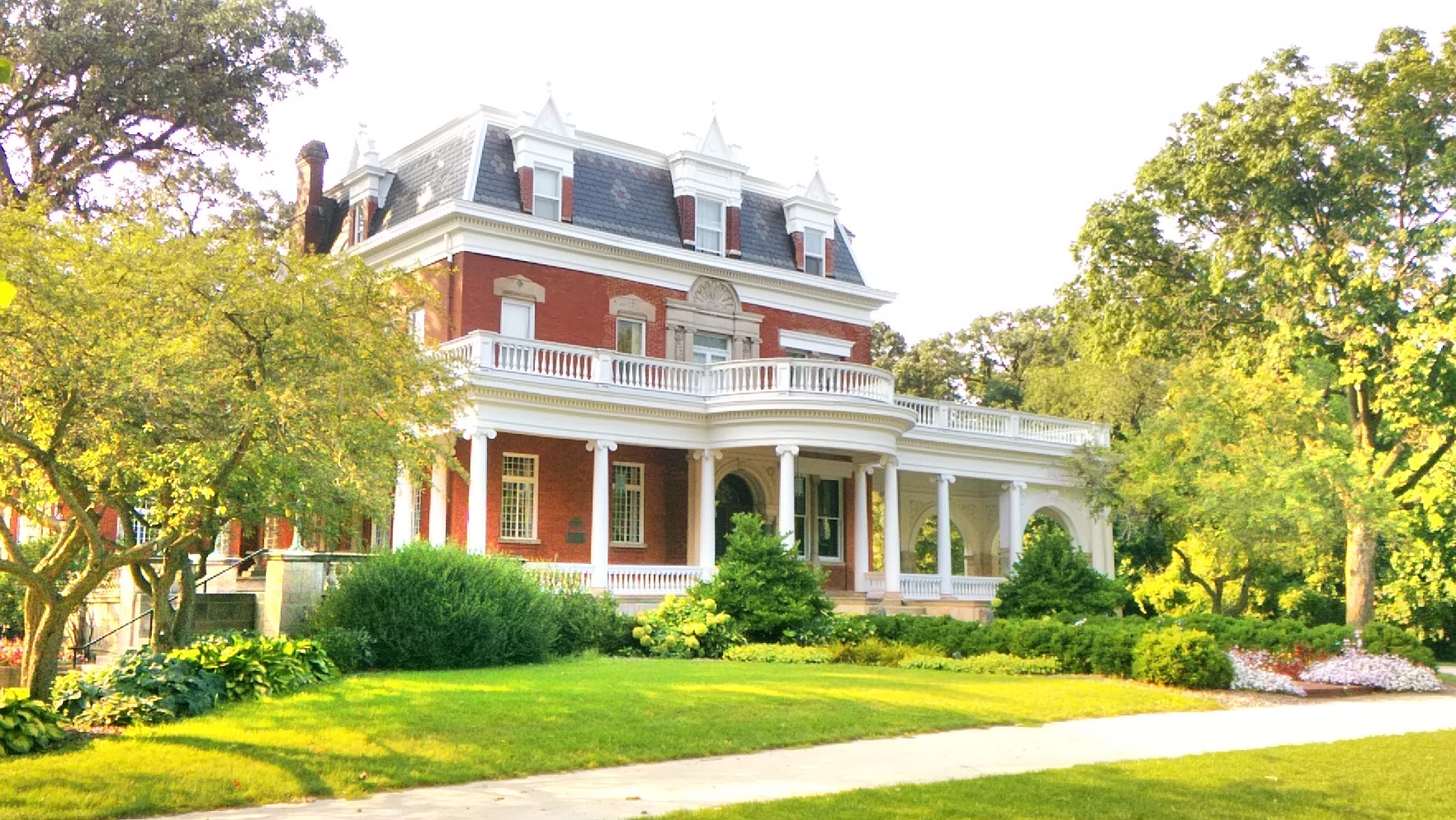
At the time, Gates was working for Isaac Ellwood, barbed wire manufacturer of DeKalb. Later Ellwood owned a major ranch in Texas, and built a “Pompeiian Villa” in Port Arthur, but it’s his Illinois manse that concerns me here.It’s a handsome Victorian house, originally dating from 1879, and designed by a Chicago architect named George O. Garnsey, with later modifications by others.

The museum web site says: “The museum campus consists of seven historic structures (including the 1879 Ellwood Mansion and 1899 Ellwood-Nehring House), four gardens, and 6,000 square feet of exhibit space in the Patience Ellwood Towle Visitor Center, a converted and expanded 1912 multi-car garage.

“Originally built for barbed wire entrepreneur Isaac Ellwood, the Mansion was home to three generations of the Ellwood family from 1879 to 1965. In 1965, the Ellwood Mansion was given to the DeKalb Park District by Mrs. May Ellwood and her three children.”

No pics allowed inside, but be assured that it’s lavishly decorated and includes a lot of the furniture that the Ellwoods owned. No barbed wire, though: that’s on exhibit at the visitors center.

San Antonio Riverwalk Views

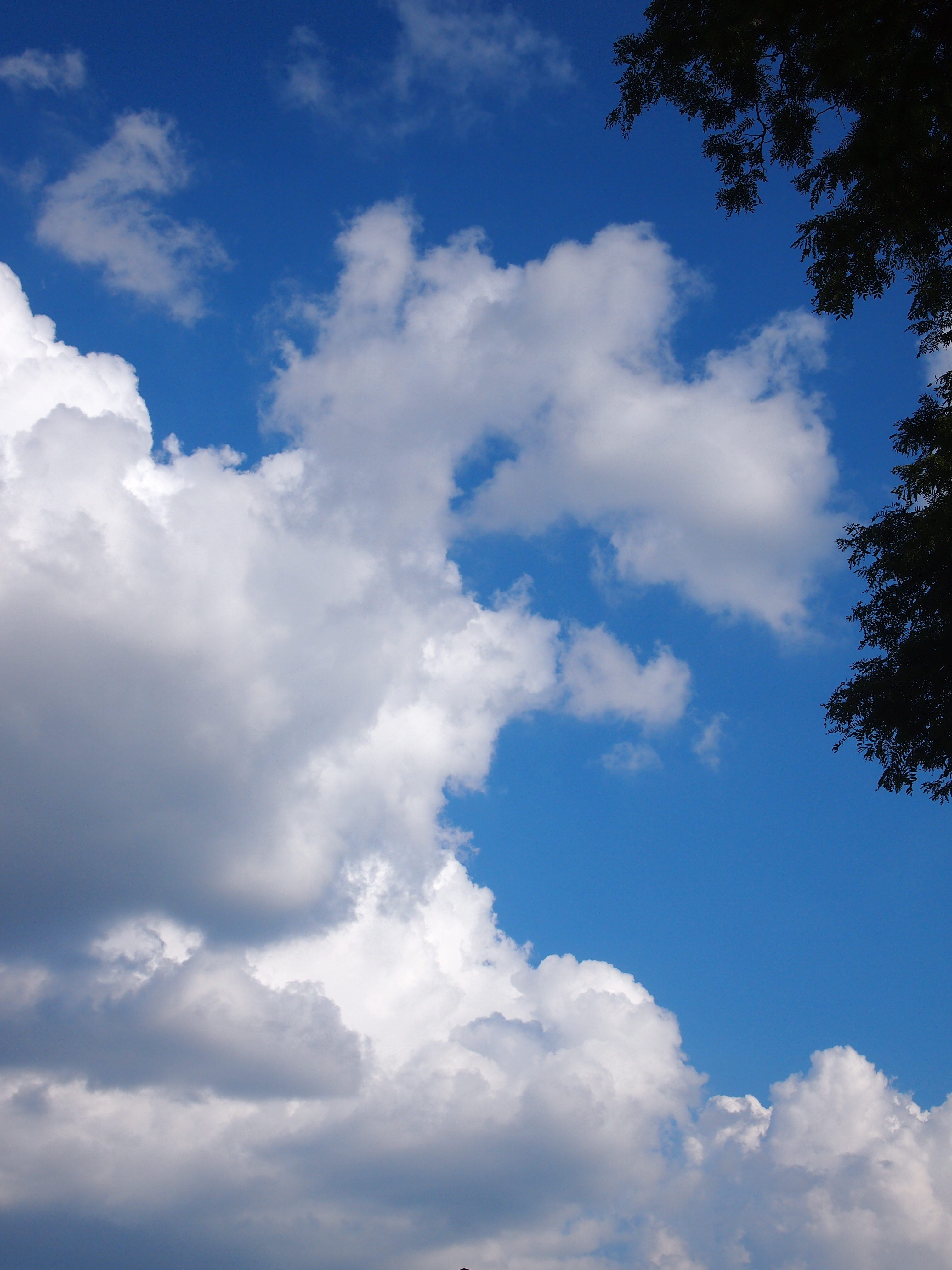
Summer’s pretty pleasant here in the not-so-hot reaches of Illinois. Up in the sky.
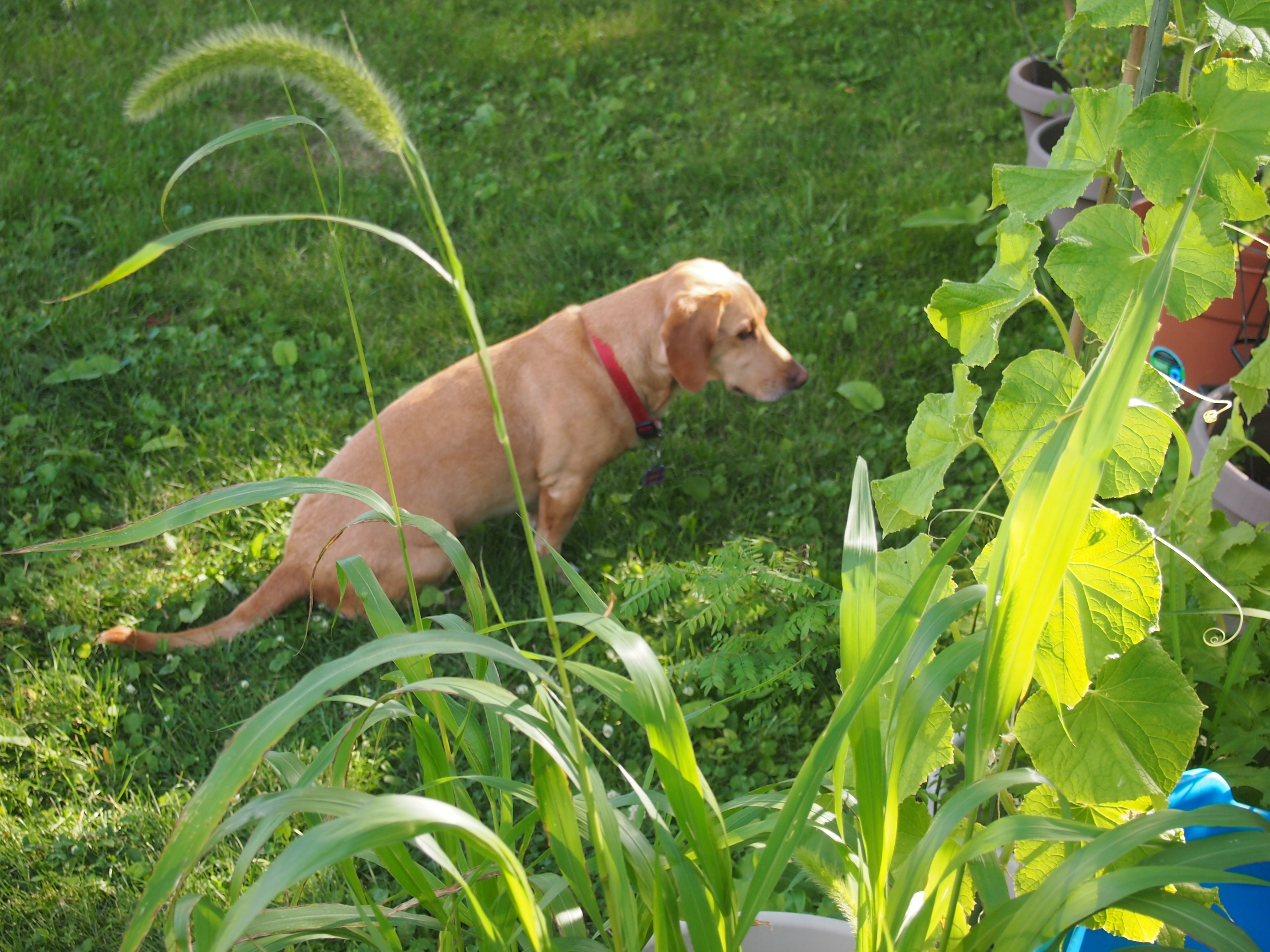
And down toward the ground, where strange critters lurk.
So pleasant that I’m taking a week off from work and posting. Back on August 5.

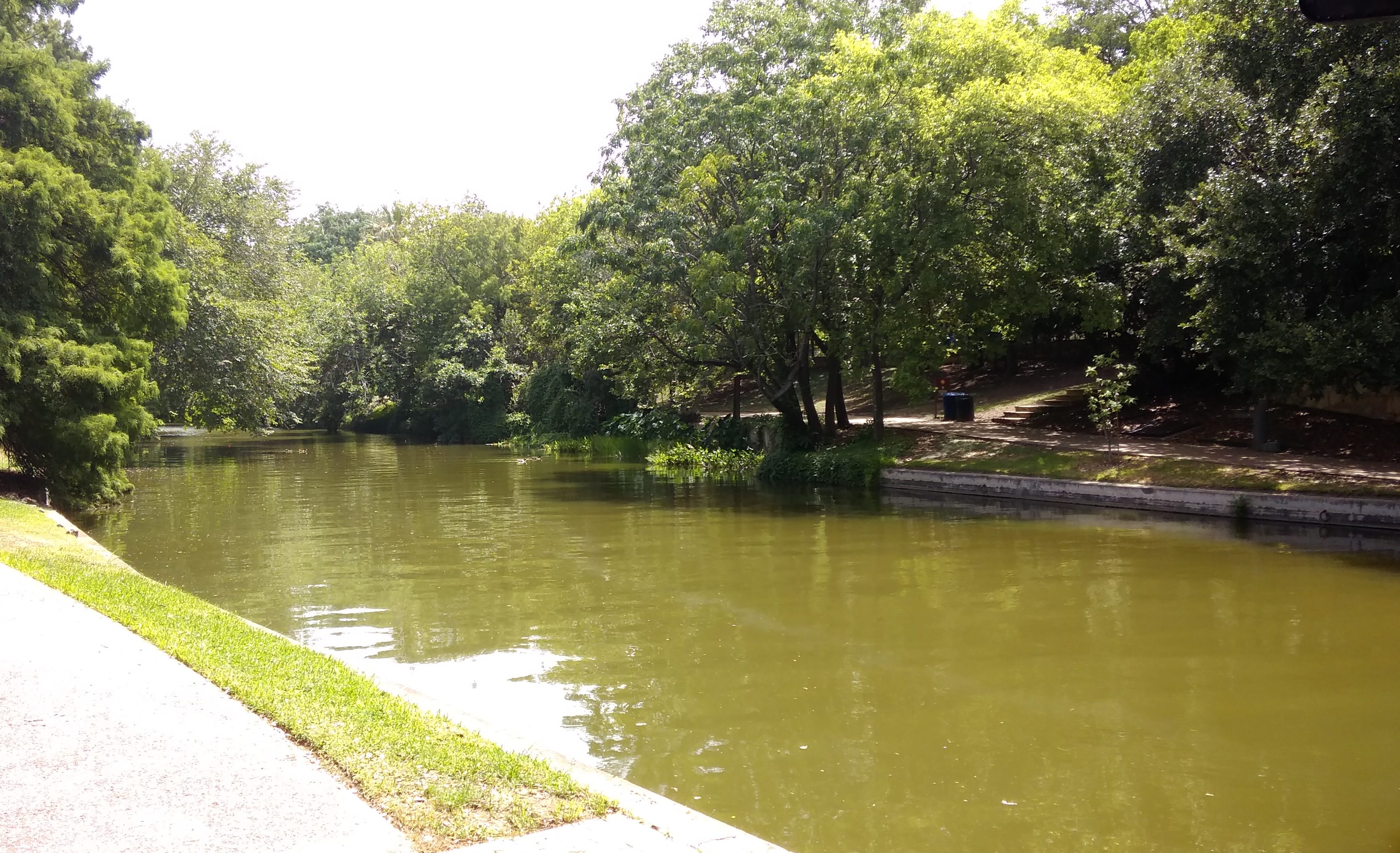
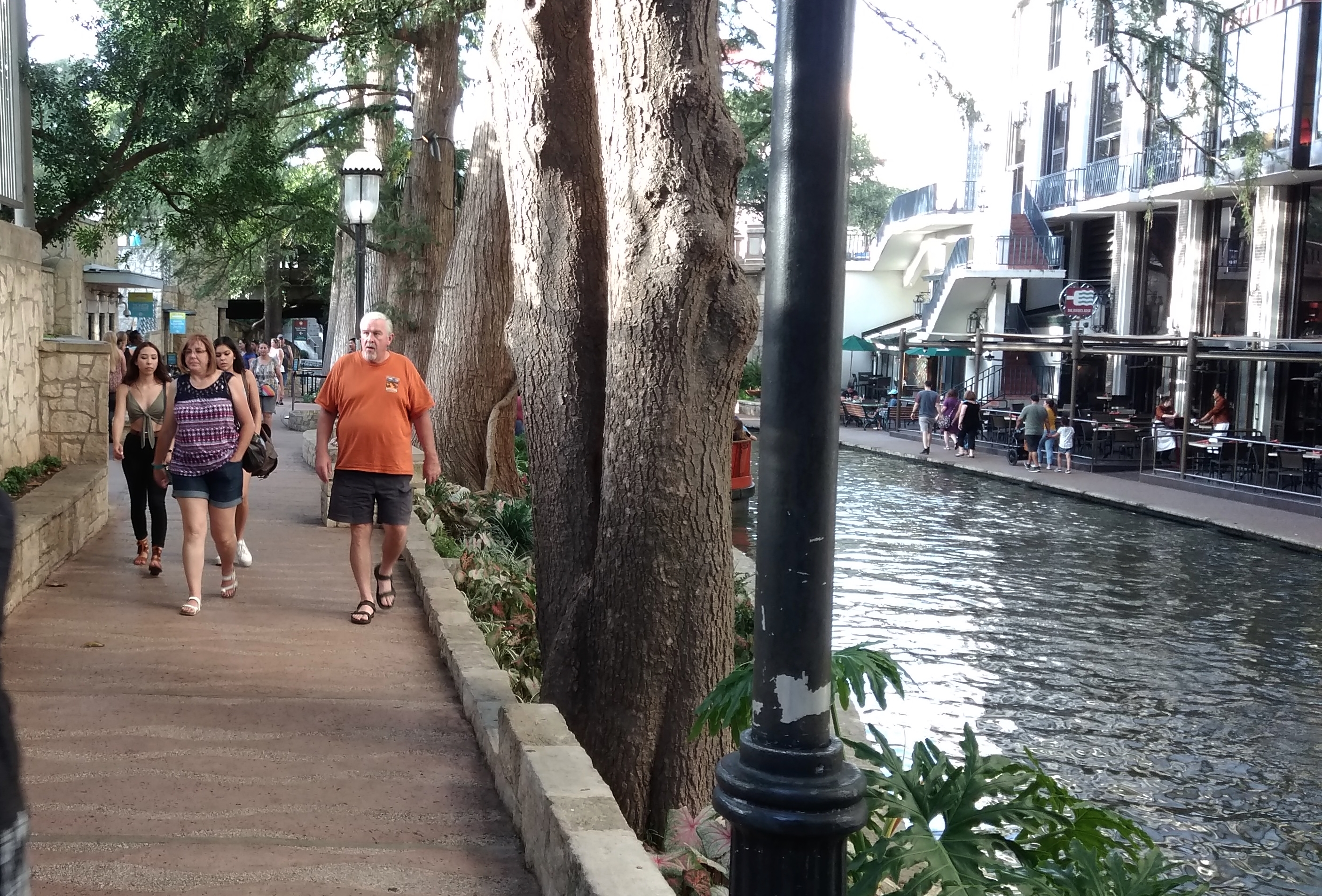
Both of the places I visited in San Antonio recently were near the San Antonio River and thus the Riverwalk. So I took a few minutes each time to go down to the river.

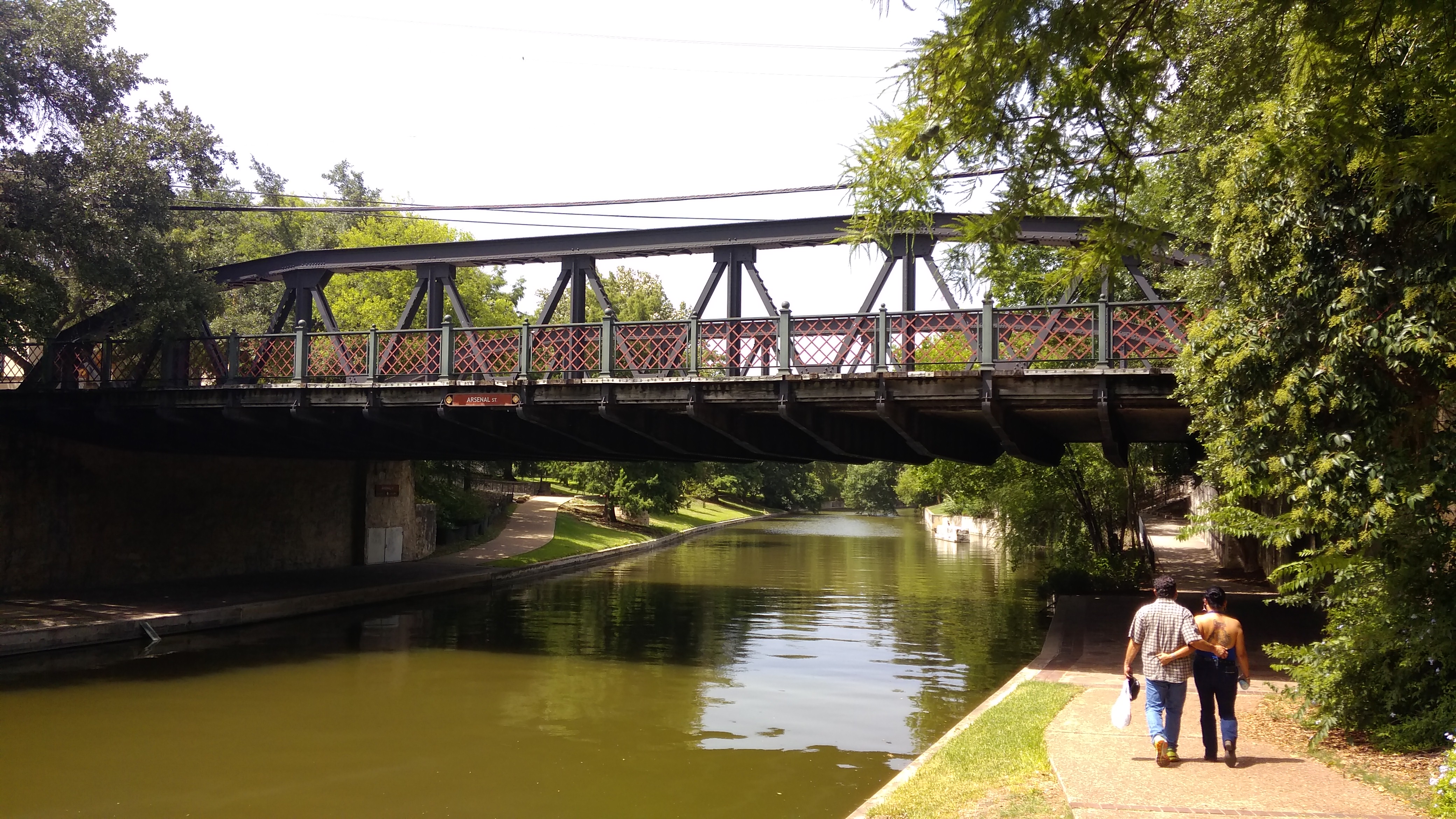
Near the King William District, the walk was almost deserted.
Temps were in the 90s, of course, which might have contributed to it, but I suspect not many people come this way anyway.

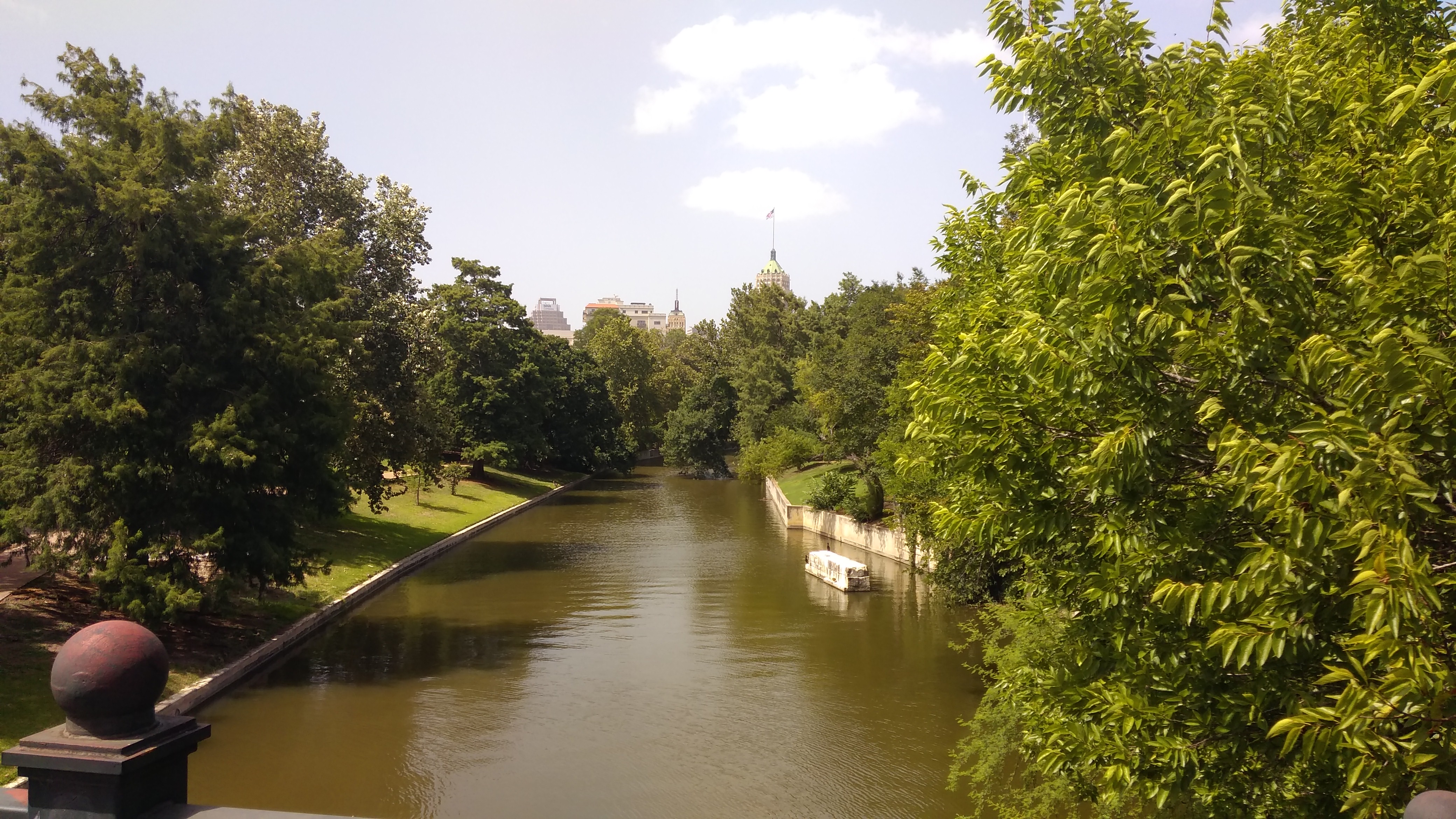
A few do. Here’s a view of the Arsenal Street Bridge.

A view from the Arsenal Street Bridge, looking north toward downtown San Antonio.
The building poking over the trees, with the flag, is the Tower Life Building, though I’ll always think of it has the Smith-Young Tower, completed in 1929. One of the city’s finest office buildings. I understand that once upon a time, my civil engineer grandfather had an office there.

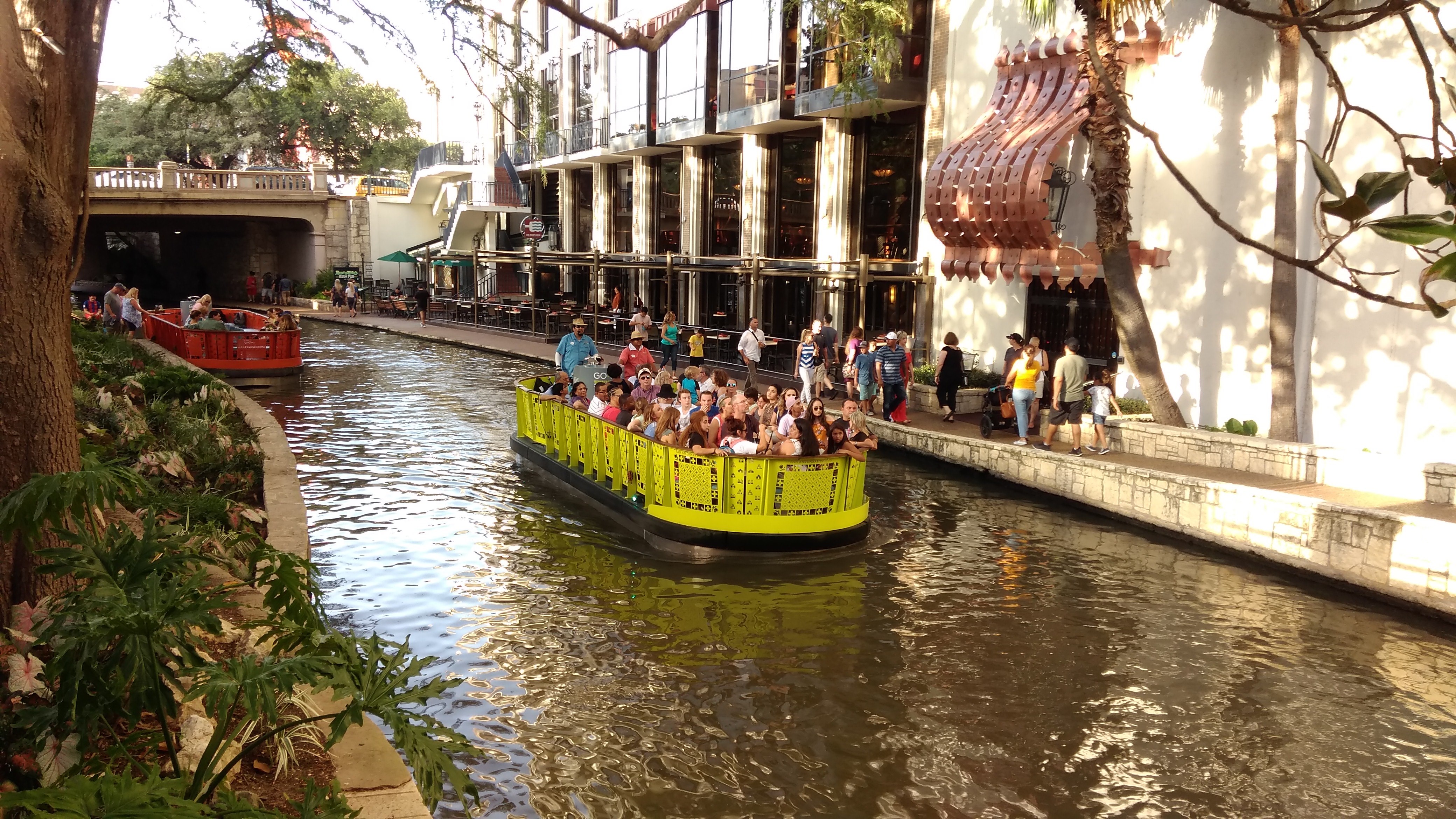
After visiting the Briscoe Museum, I walked over to the Riverwalk — it’s only a short distance away — at one of its more touristed spots.

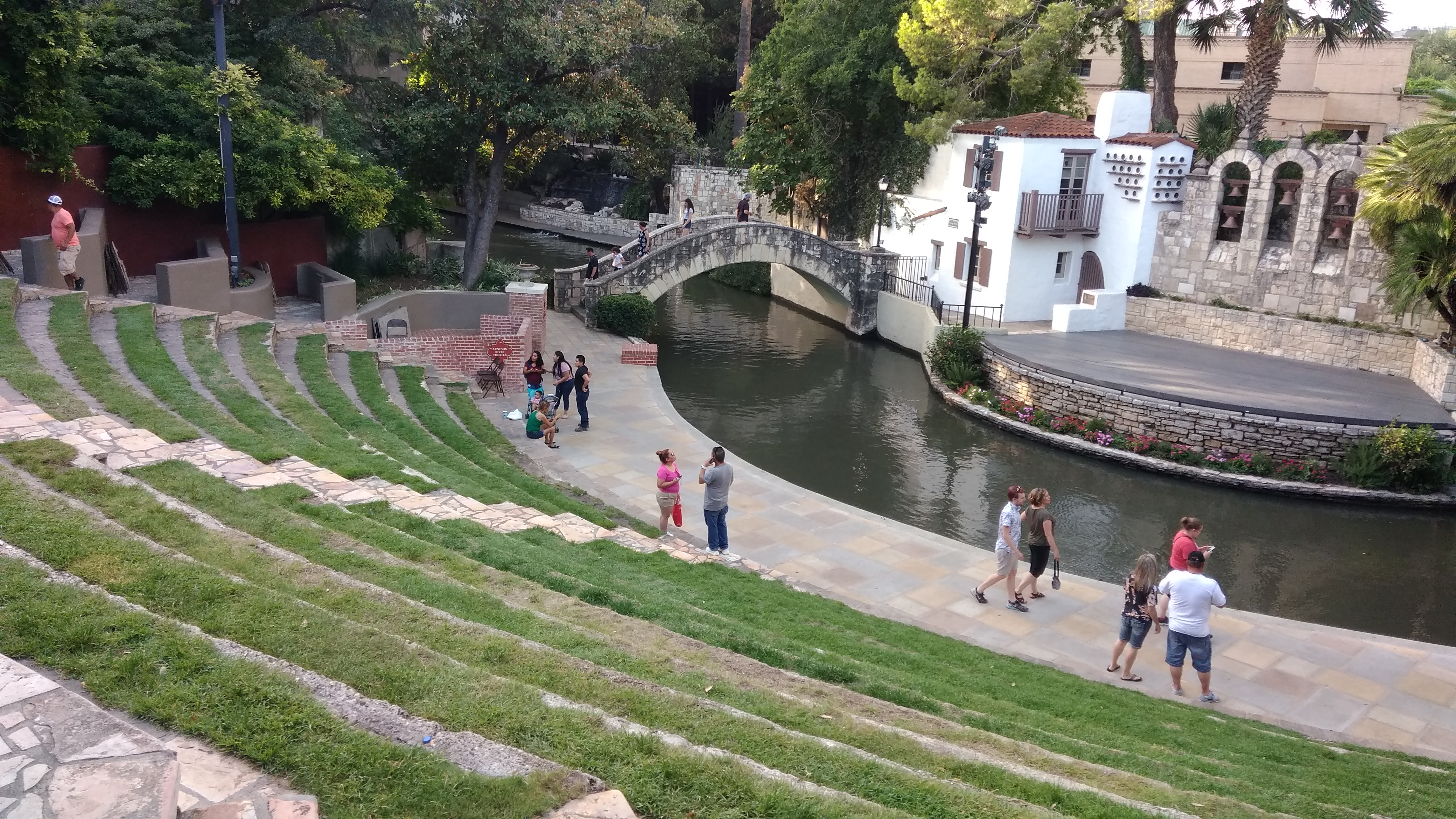
This is the Arneson River Theatre.
The stage is on the north side of the river, while 13 rows of grass are on the south side for seating. Just another idea of the Father of the Riverwalk, H.H. Hugman, finally realized as the WPA built the Riverwalk in the late ’30s. Arneson was the WPA engineer who was to have been in charge of building the Riverwalk, but he died before the project really got under way.

The San Antonio Museum of Art

Besides the Briscoe, last Tuesday I visited the San Antonio Museum of Art, which is just north of downtown and also happens to be no charge in the late afternoon and early evening every Tuesday.
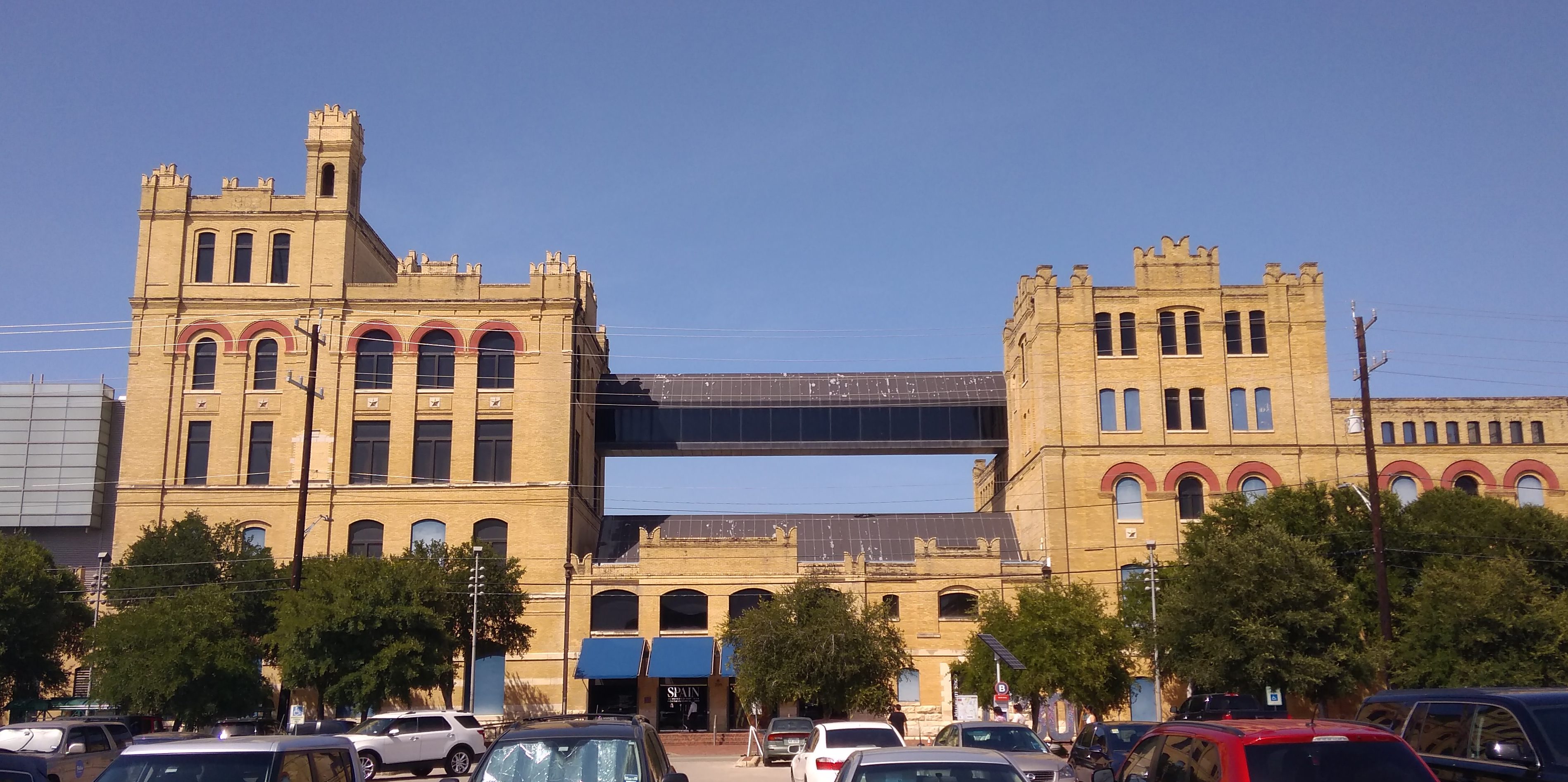
The SAMA complex is a major adaptive reuse project from the 1980s. The former Lone Star Brewery, whose solid brick buildings dated from the late 19th and early 20th centuries, was transformed into the museum, complete with neon-decorated skybridge on the fourth floor. Sounds Vegas-like, but it isn’t garish.

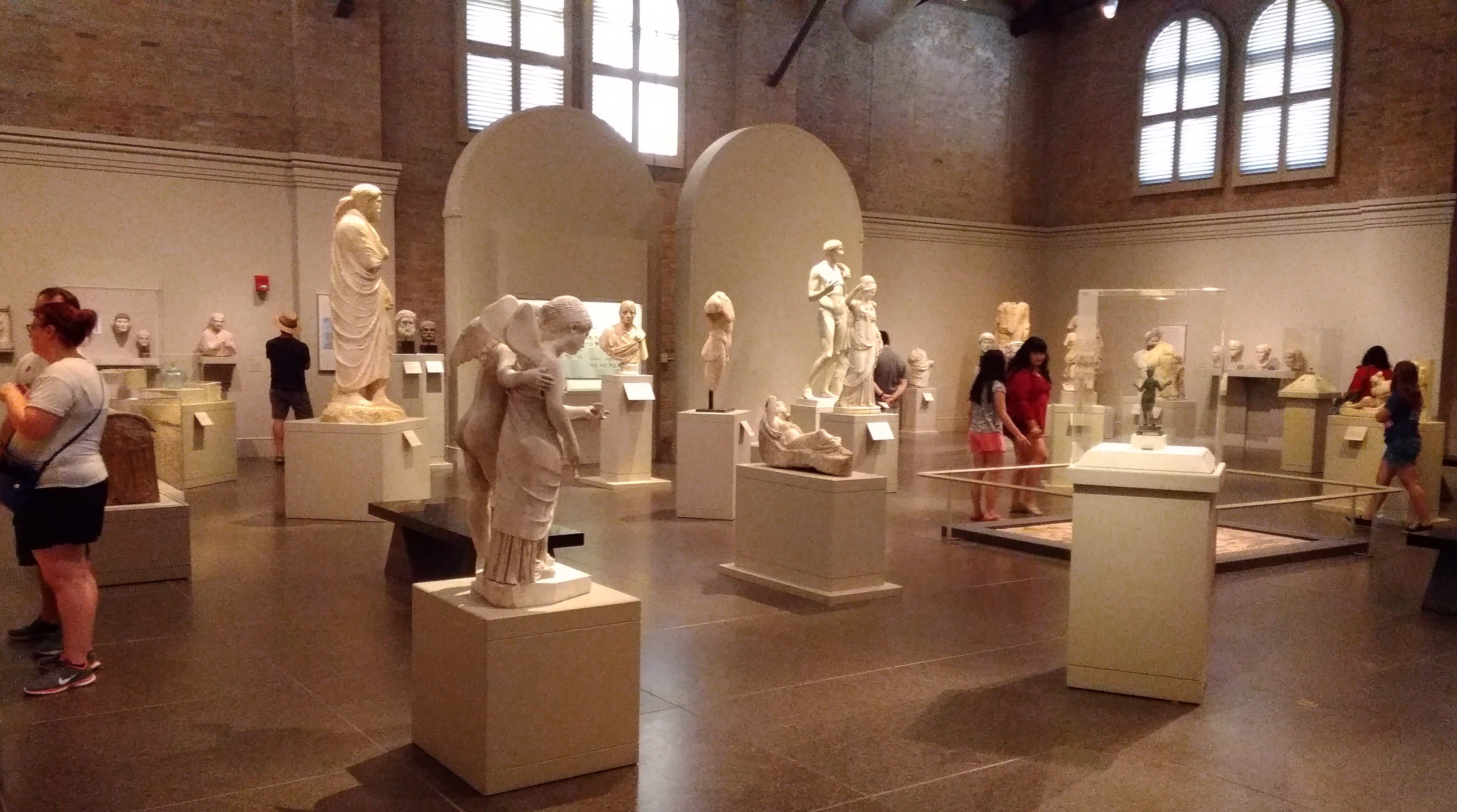
The museum has a sizable collection befitting its location in a sizable city, including ancient Egyptian, Greek and Roman art, North American, Latin American and Spanish colonial pieces, collections representing Japan, Korea, and India, three galleries of Chinese works from early times to later dynasties, Near Eastern art, an Oceania gallery and more.

I decided to focus on two of the museum’s strengths — art from Antiquity, especially Rome, and Latin American folk art — though I did spend some time looking at American paintings and Texas artwork.

Here’s something that gets your attention, or ought to, right when you enter SAMA’s commodious Roman art gallery.
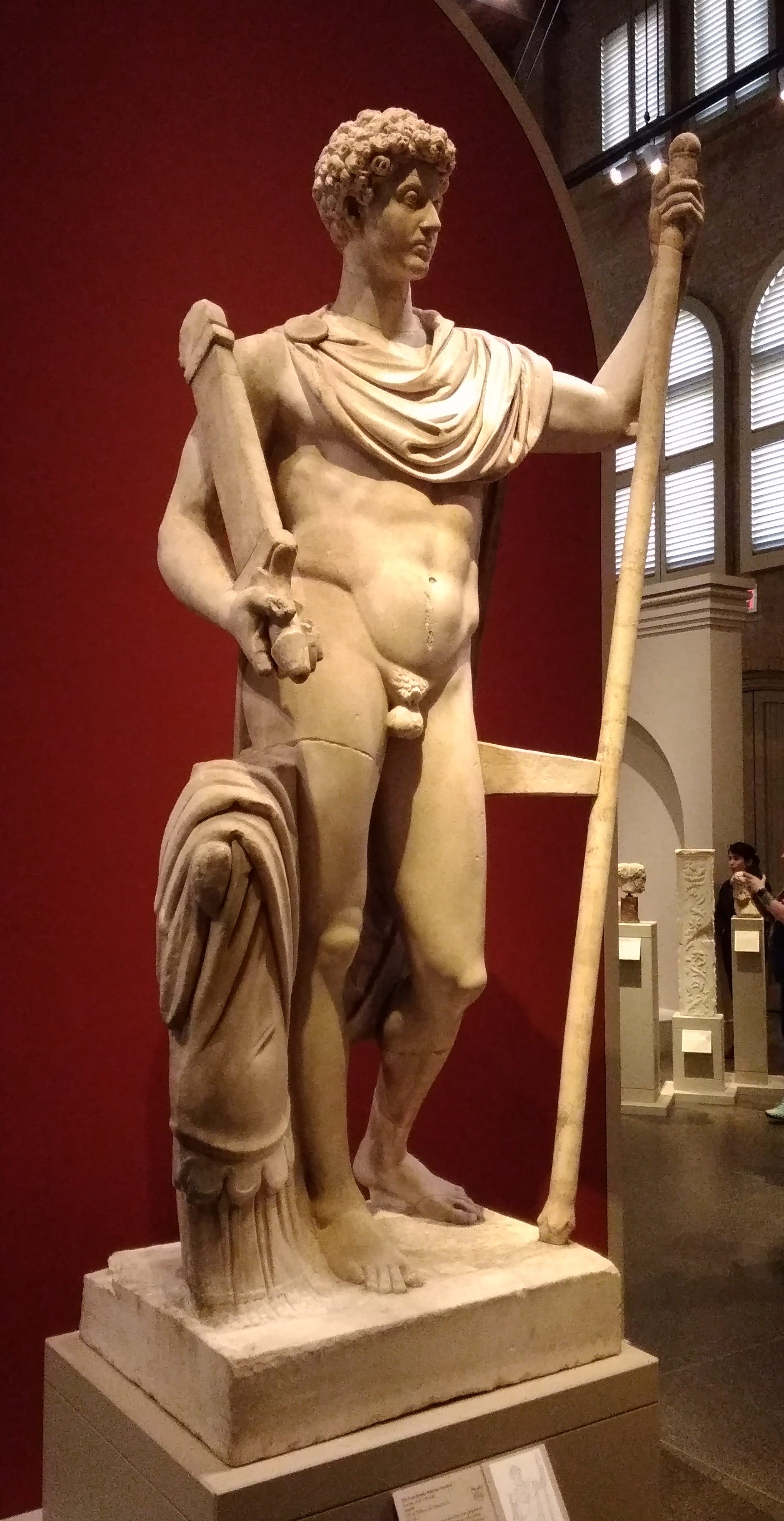
A second-century CE statue known as the Landsdowne Marcus Aurelius. Wonder what the original colors looked like.

“Begun by Gavin Hamilton (1723-98), one of the most prominent British explorers of classical sites of the eighteenth century, the Lansdowne Collection came to hold more than one hundred stellar examples of classical statuary, displayed in a specially designed gallery in Lansdowne House in London,” says a blurb for Reconstructing the Landsdowne Collection of Classical Marbles.

“The collection, however, was dispersed in the years after 1930, and its works are now scattered across the globe.”

This particular one wound up at SAMA, a donation of the 20th-century American owner of the piece, a rich fellow I’ve run across before: Gilbert Denman Jr. In fact, he left his collection of ancient art to the museum, making the gallery possible.
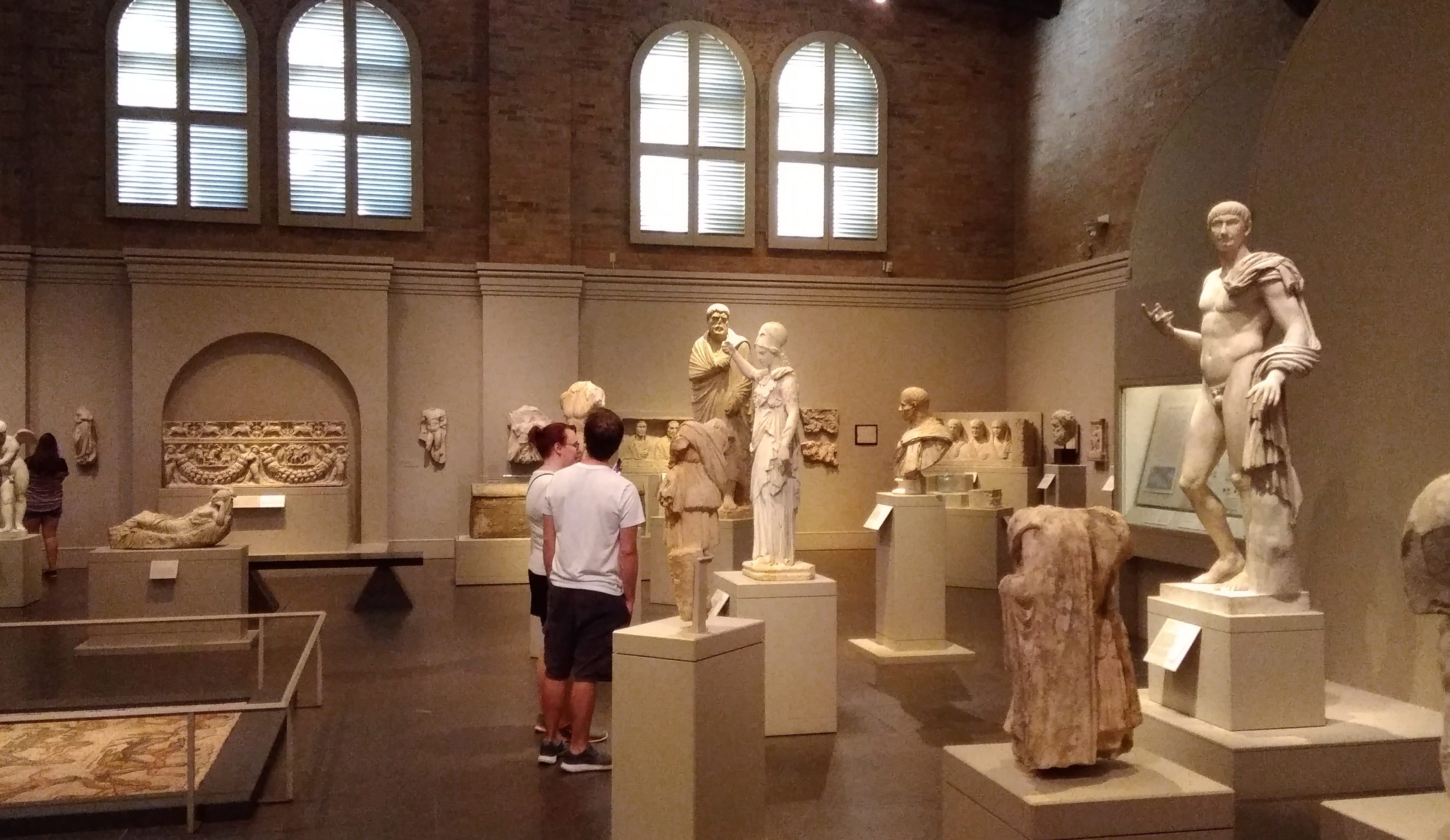
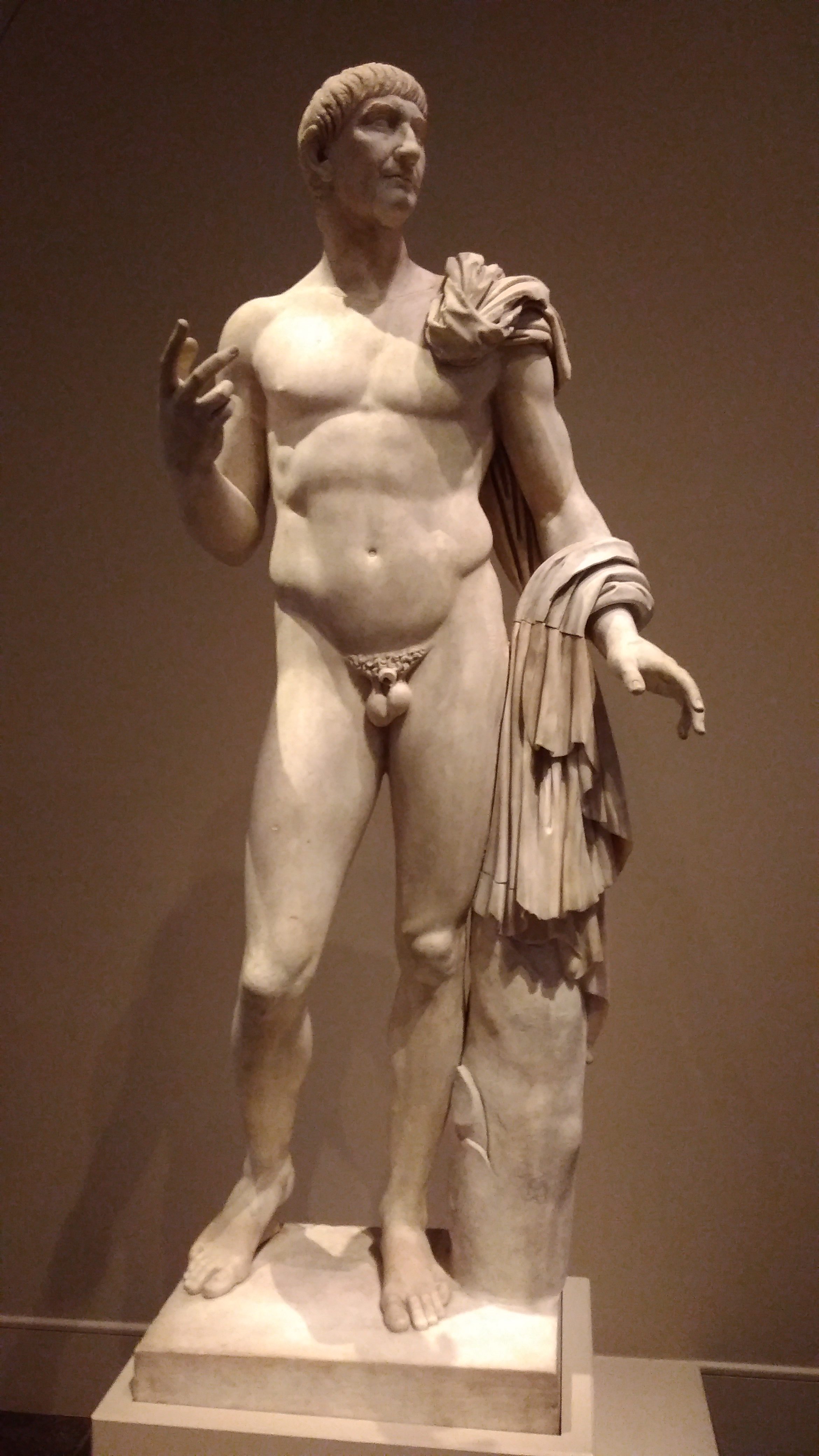
Another Denman bequest: the Lansdowne Trajan. The Romans were clearly not shy about official nudity.
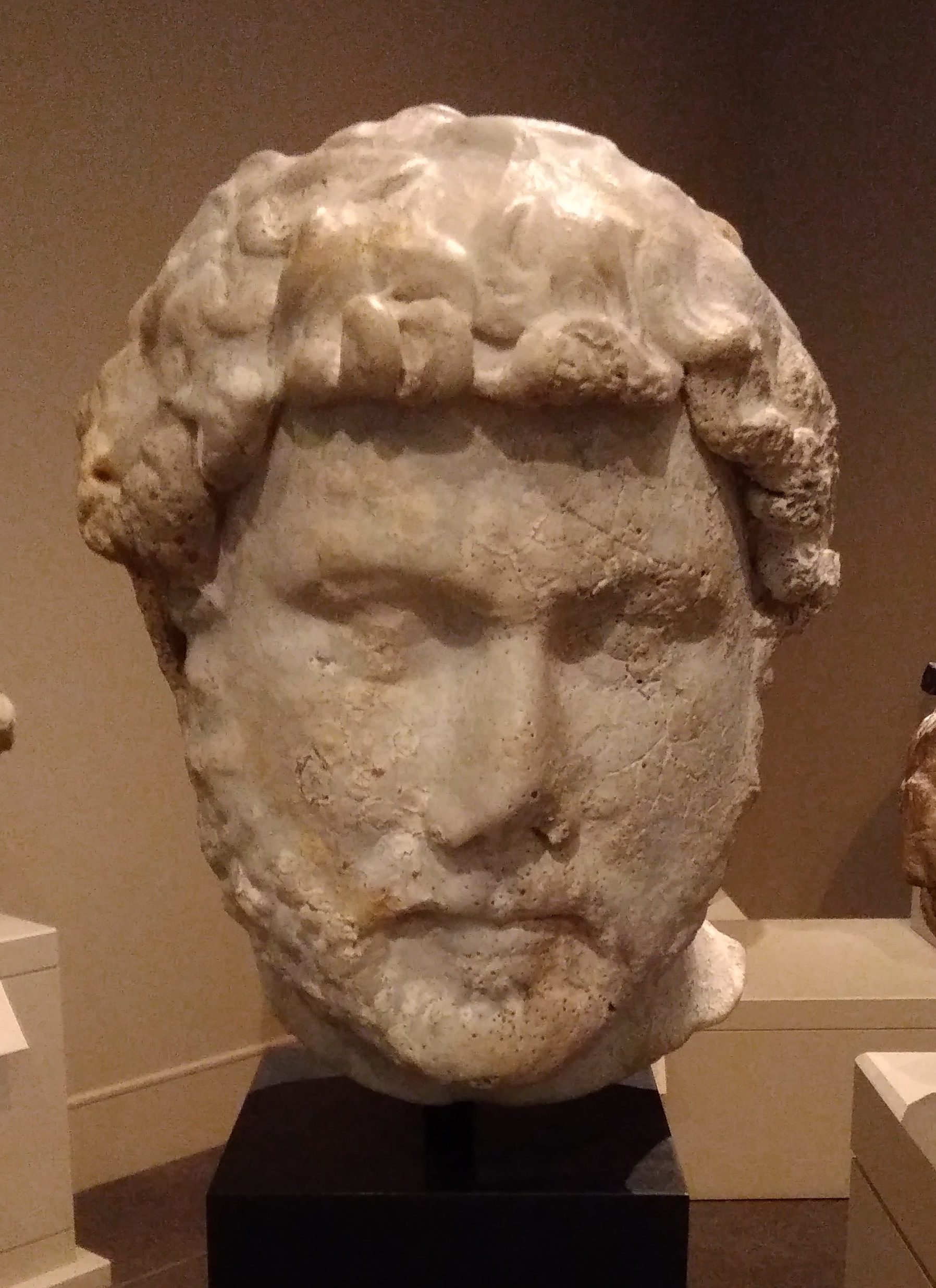
A beat-up portrait of Hadrian.

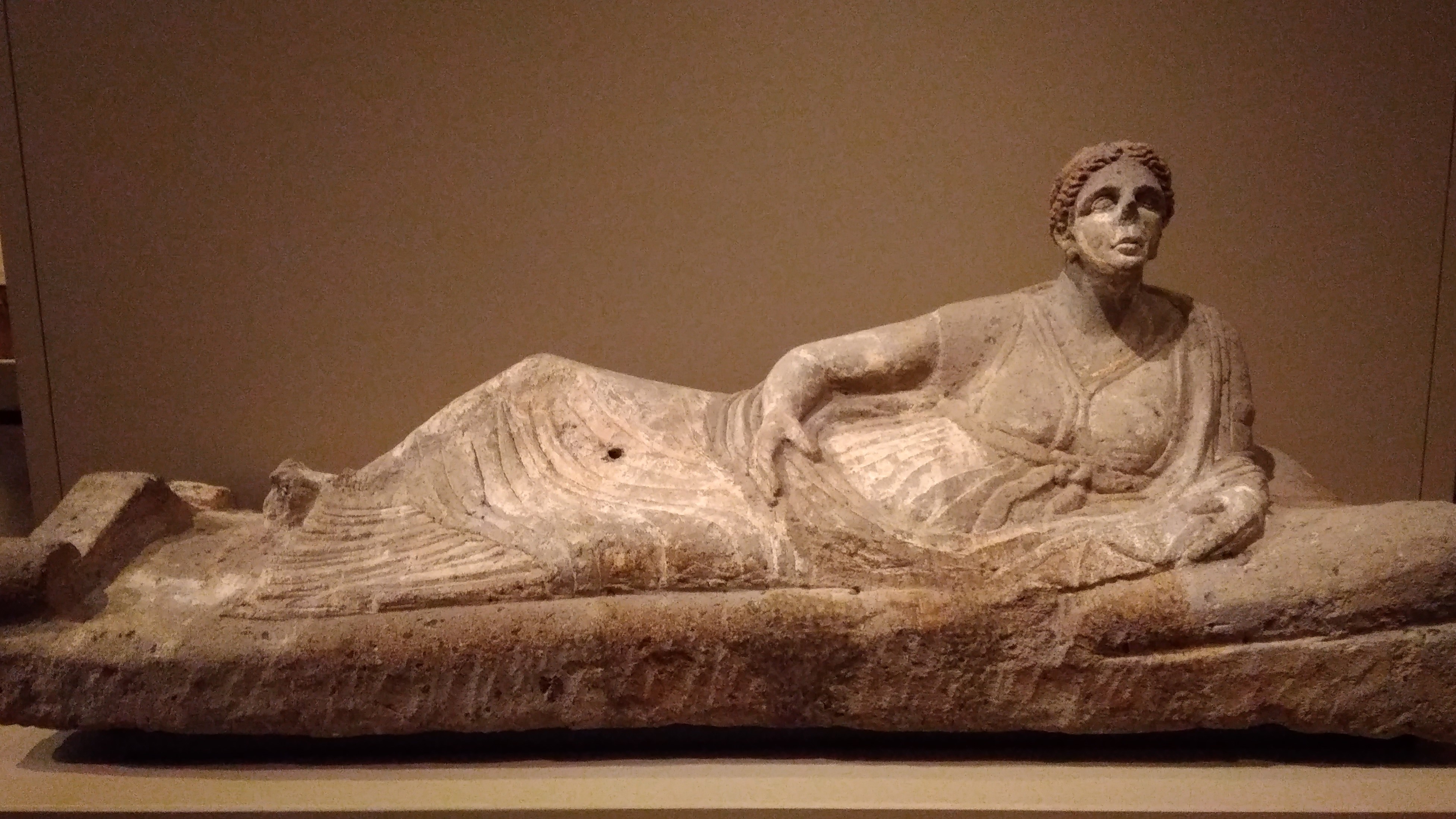
Here’s something you don’t see every day: Etruscan art.
In this case, a lid from a sarcophagus. Considerably worn, with an unsettling face that looks at us from across 25 centuries or so. As historical peoples go, the Etruscans are a half-remembered fragment of a haruspical dream.

I also spent time at the Latin American Folk Art gallery, which is part of the Nelson A. Rockefeller Center for Latin American Art. Rockefeller had his hobbies, and one of them was collecting Latin American folk art.

As the NYT reported when the center opened about 20 years ago: “When Nelson A. Rockefeller made his final trip to Mexico in 1978, several months before his death, his eye was drawn to a small hacienda surrounded by a picket fence along a rural road in Oaxaca. Atop each picket was a tall, strangely striking figurine made of rough pottery.

“The former Vice President stopped the car, walked to the door and discovered the shop of a family of potters. Each statue on the fence had been damaged somehow in the making and just perched on the fence to help advertise the shop. They were evocative pieces spanning many years, left to bake in the Mexican sun. Rockefeller bought them all.”

These fellows greet you at the gallery.
Molds for papier mache figures, ca. 1930, artist unknown, from Celaya, Mexico.

The work of another unknown artist.
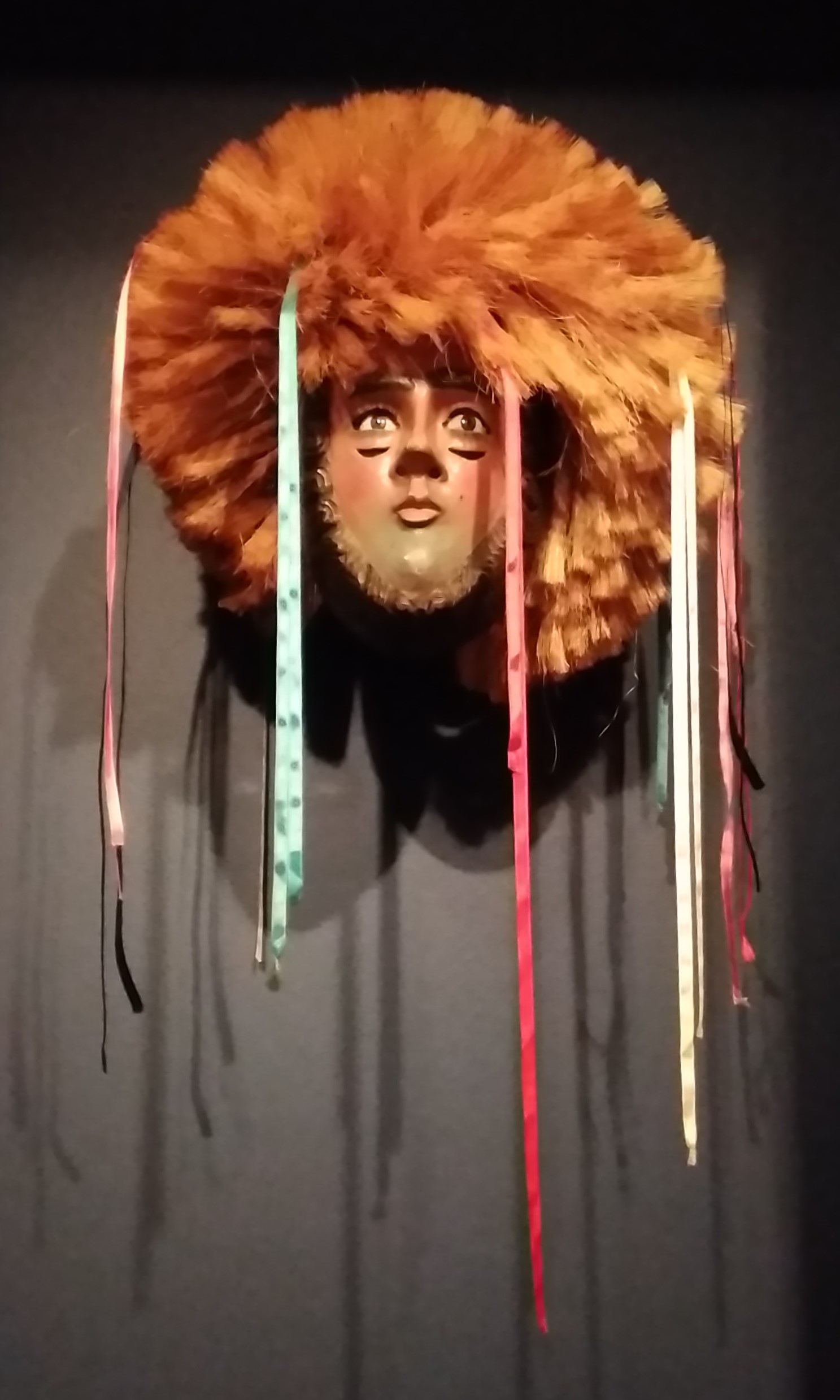
A Parachico Mask (Mascara de Parachico) from Chiapas, Mexico. Polychromed wood, glass, ribbon and cactus fiber. Ca. 1970 and about as funky as can be.

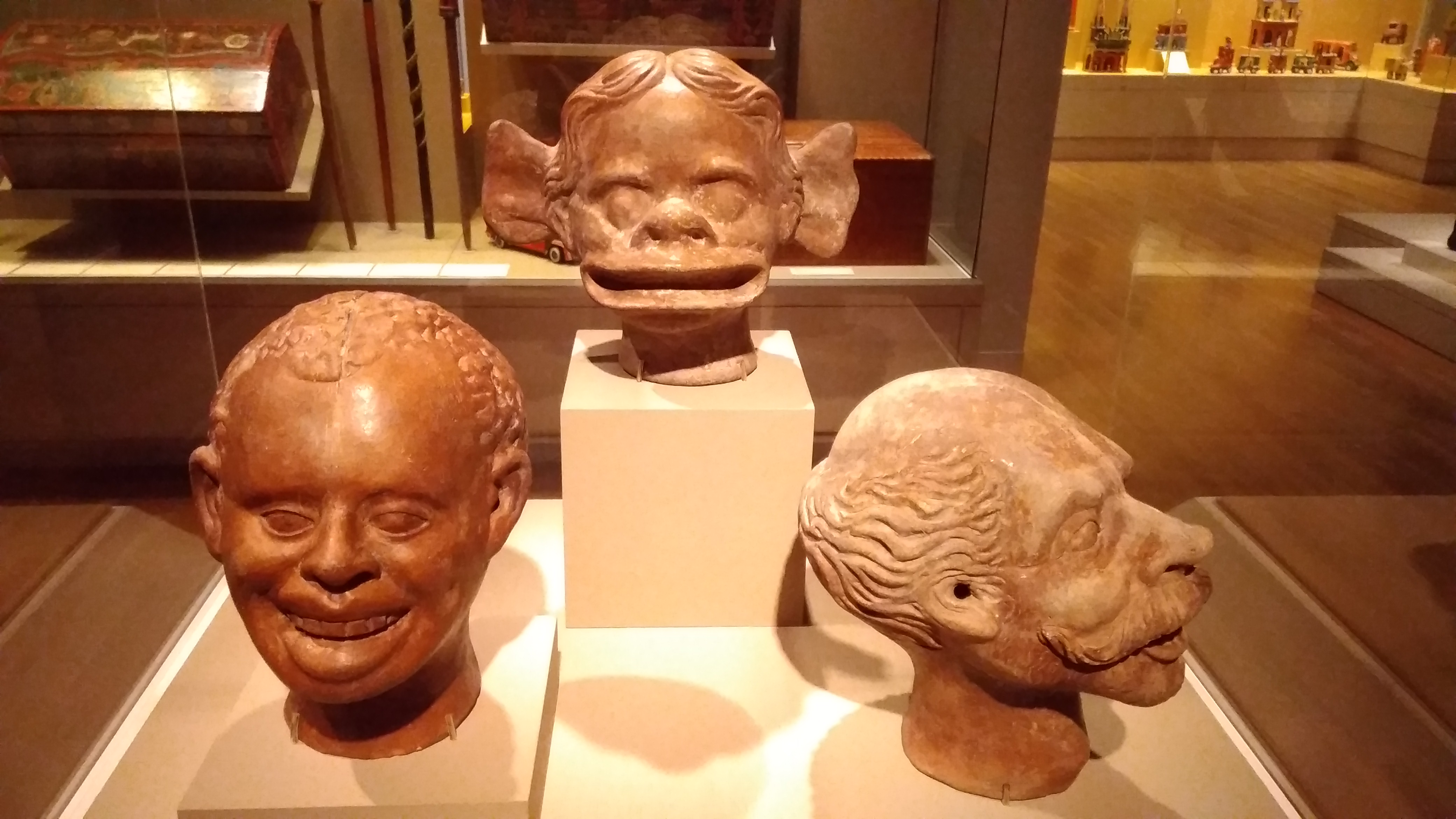
By contrast, the artist of these delightful creations is well known.

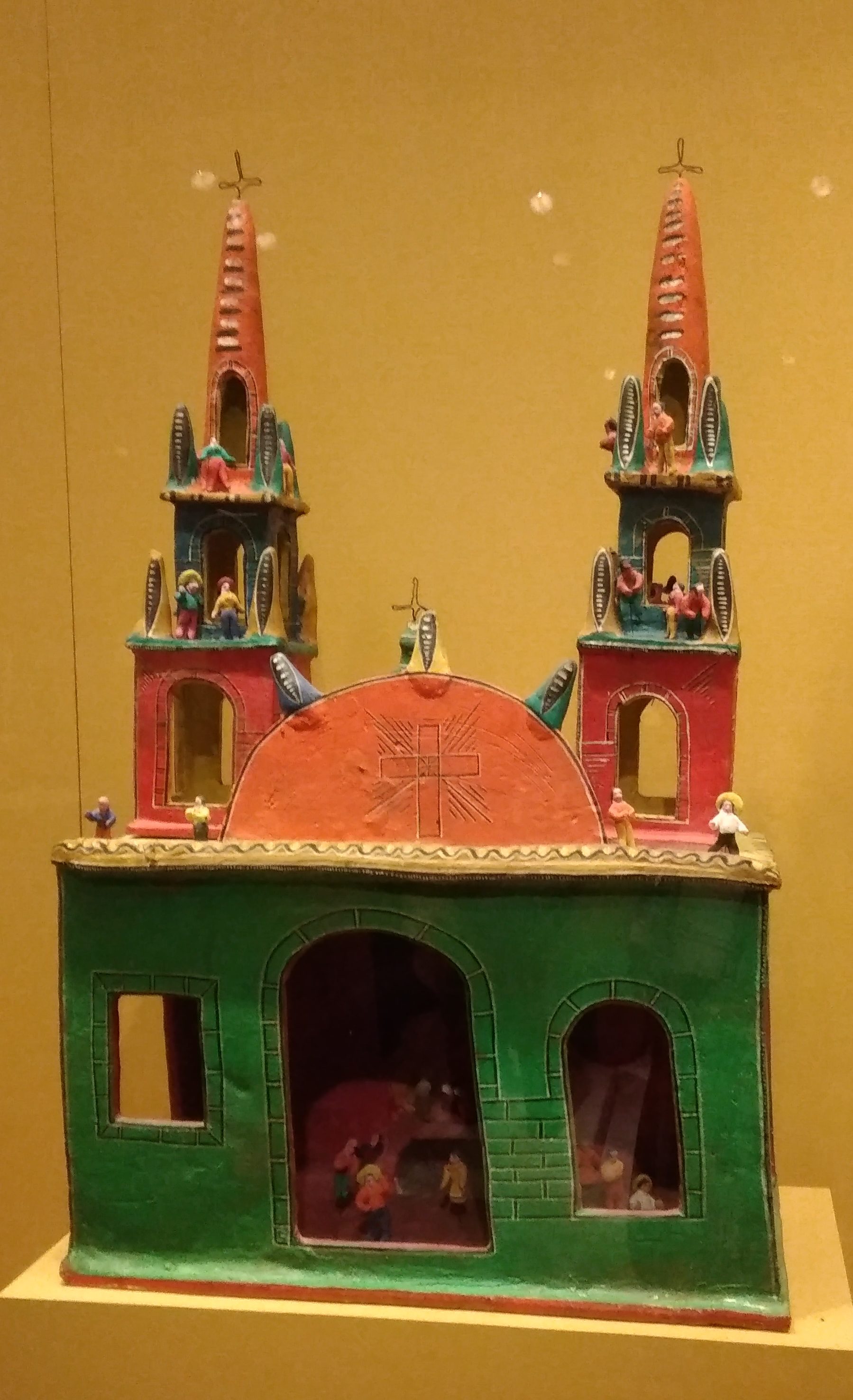
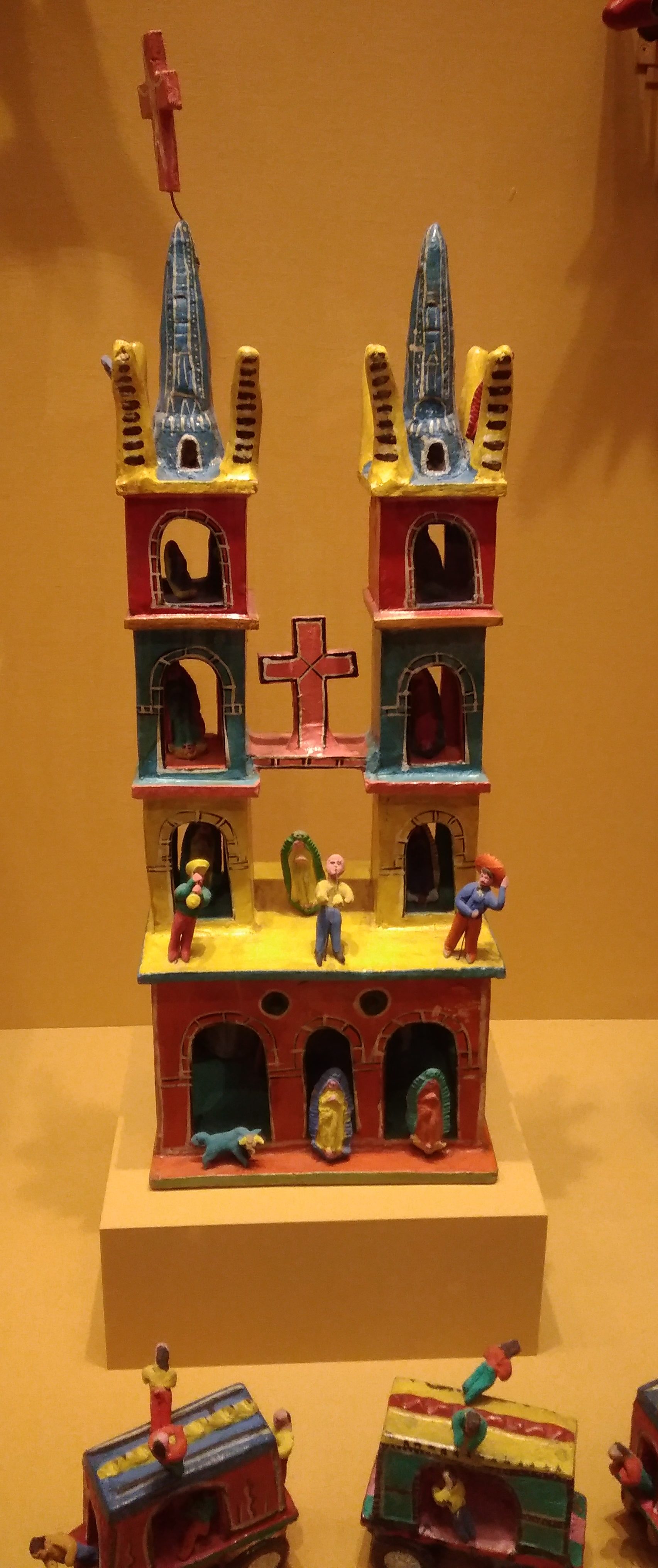
They’re painted earthenware by Candelario Medrano, a Mexican artist who died in 1988. “Medrano began his career by producing toy whistles, mermaids, roosters, and other animals,” the museum says. “Later, he placed them on airplanes, boats, towers, merry-do-rounds and trucks, thereby creating delightful and colorful scenes of fantasy.”

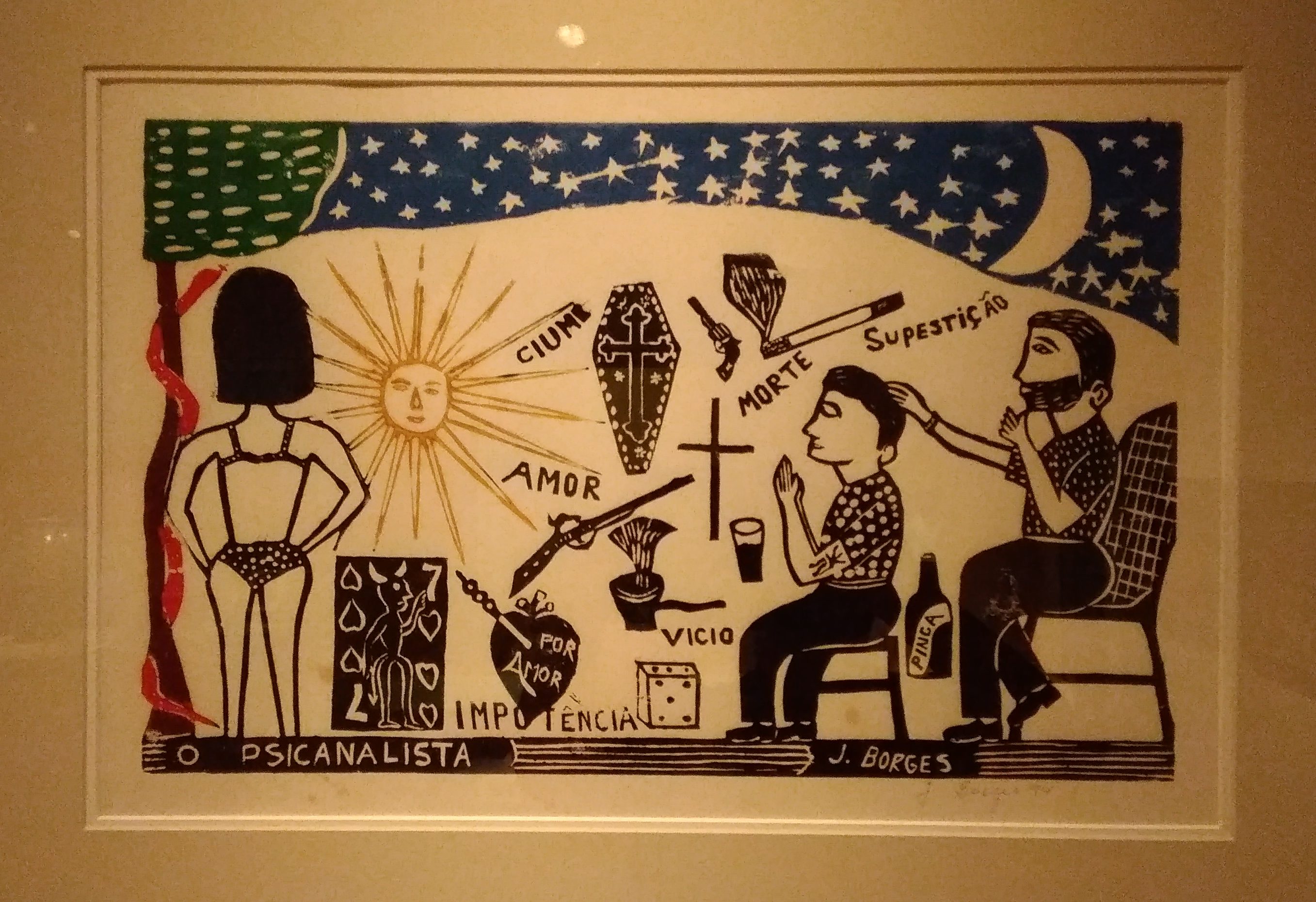
As usual, the museum isn’t selling postcards based on artwork that would make unusual cards, like this.

“The Psychoanalyst (El Psicoanalista),” ca. 1994 by Jose Francisco Borges of Brazil.
The Amy & V.H. McNutt Sculpture Garden

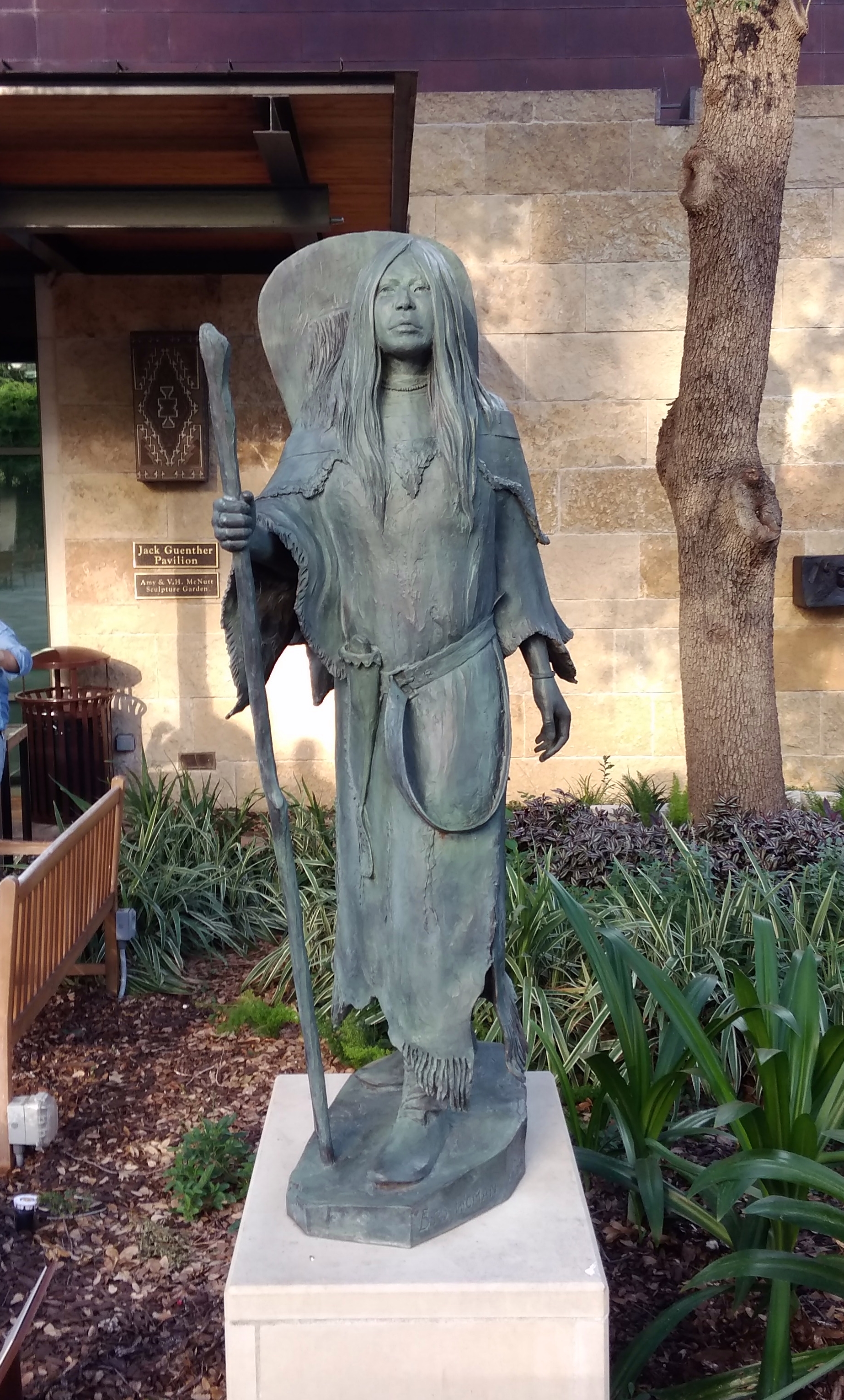
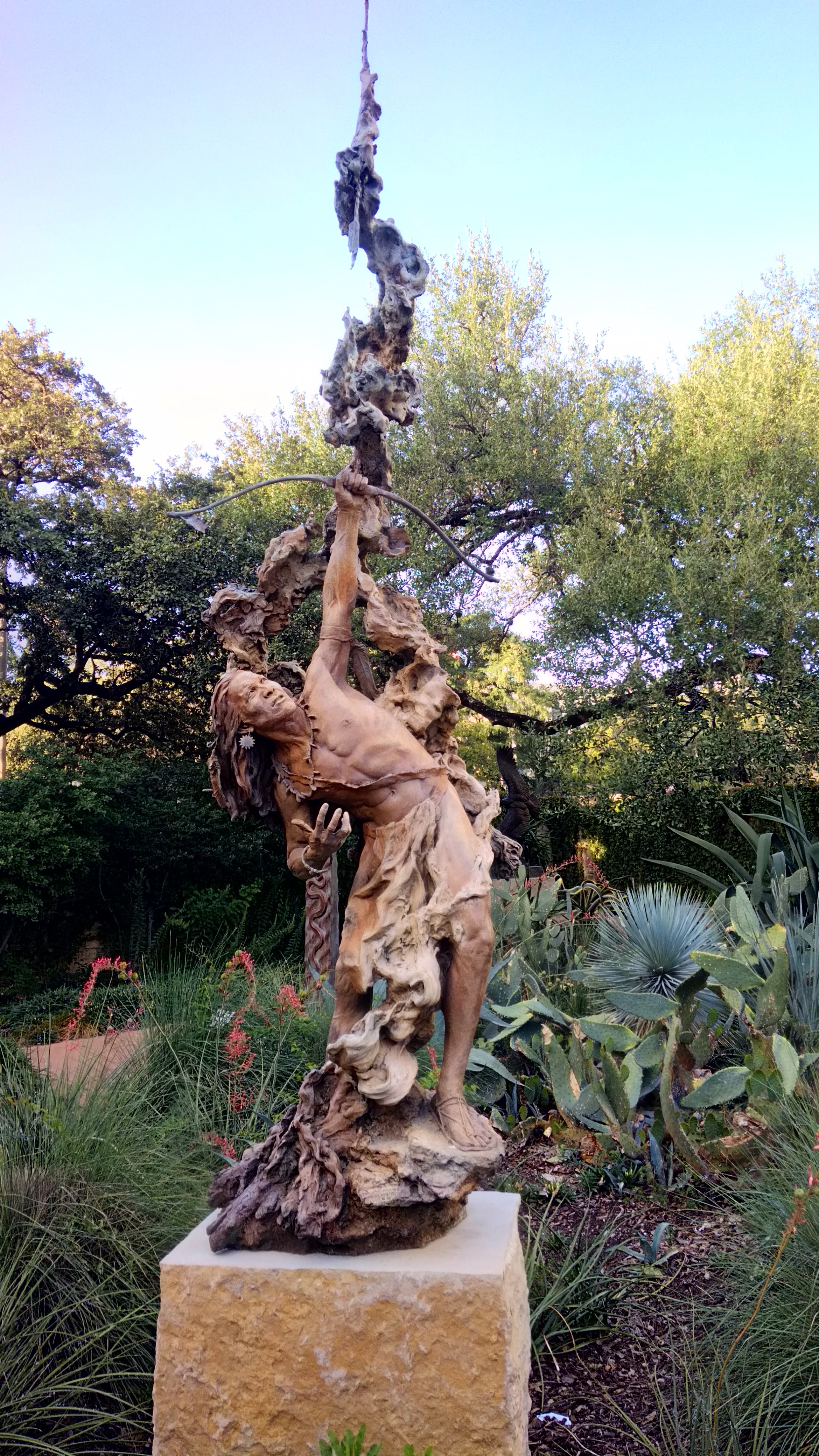
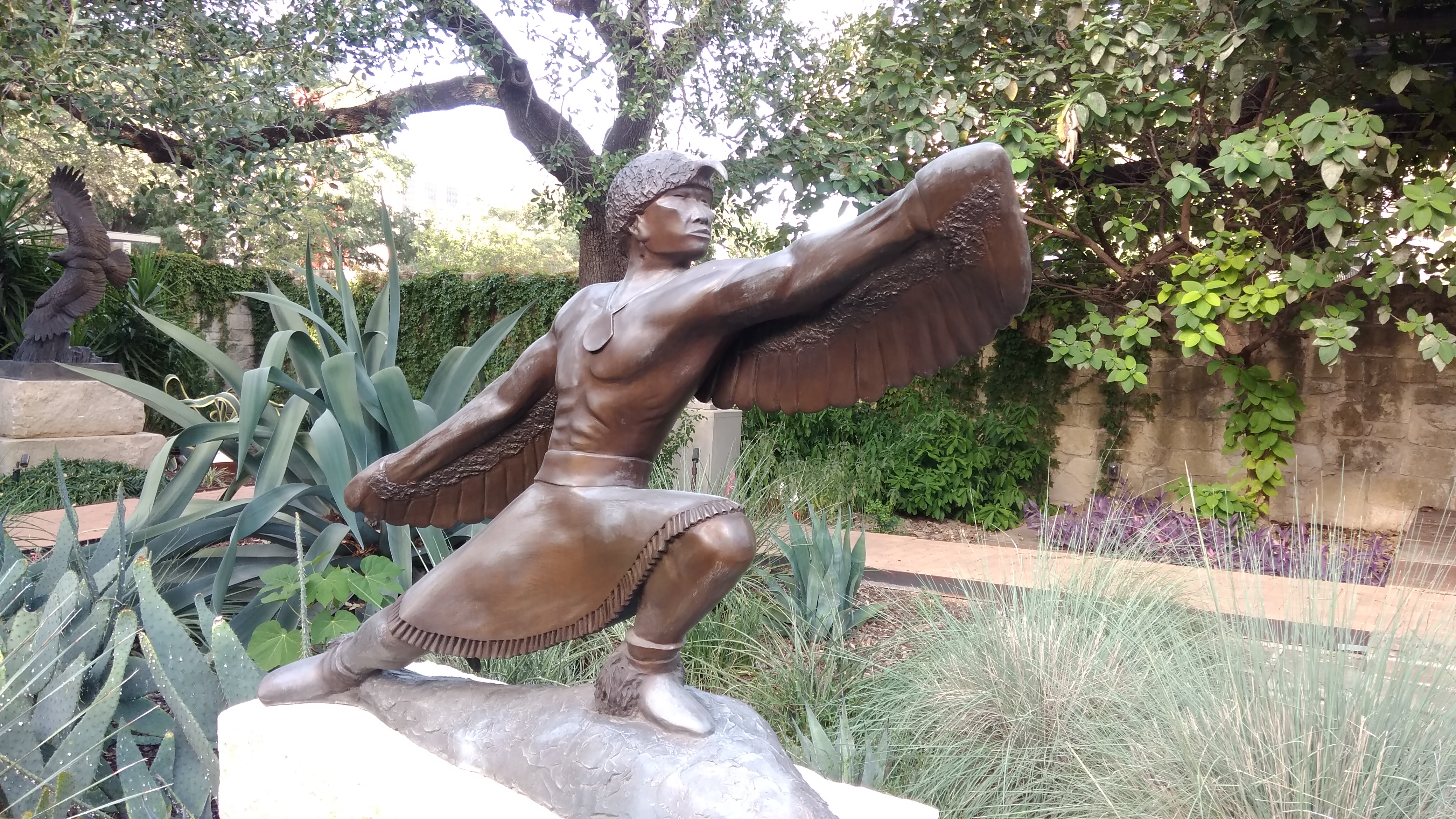
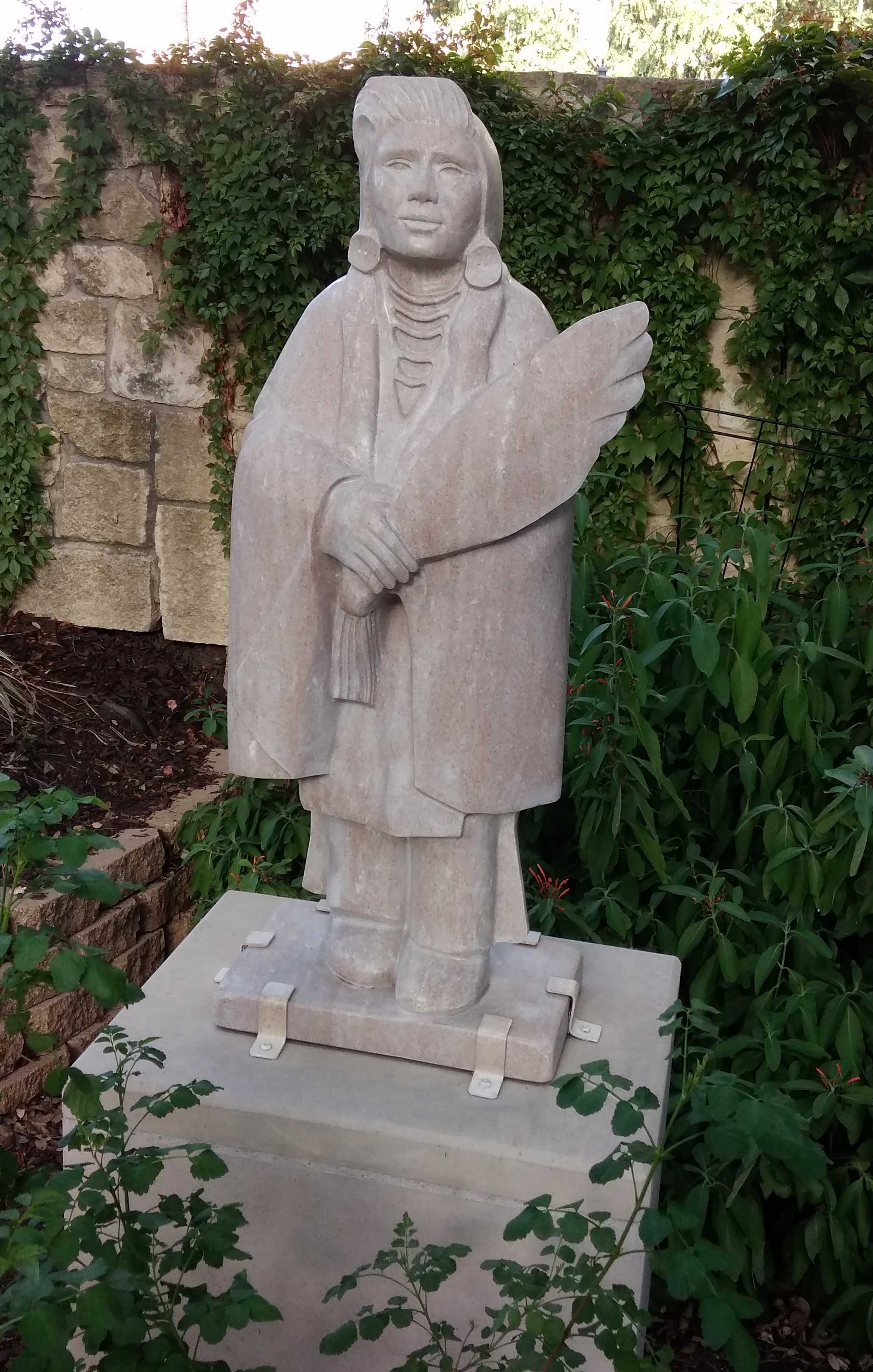
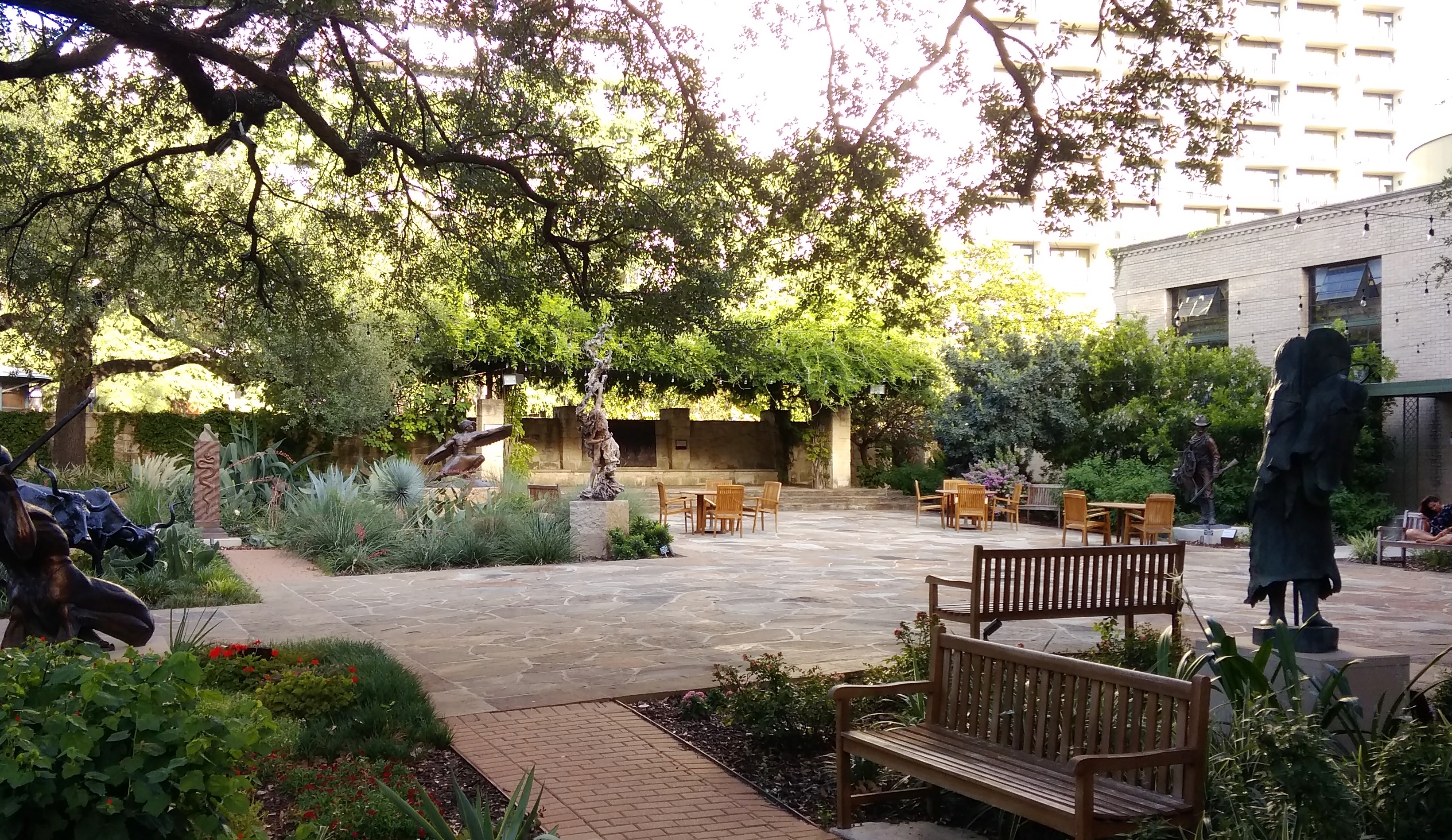
Just outside the Briscoe Western Art Museum in downtown San Antonio is the Amy & V.H. McNutt Sculpture Garden. It’s shady, so even on a hot day it was pleasant for a short visit.
V.H. McNutt was a mining engineer who made a fortune in potash in New Mexico in the 1920s. Later he and his wife owned a large ranch near San Antonio. The McNutt Foundation is in San Antonio even now.

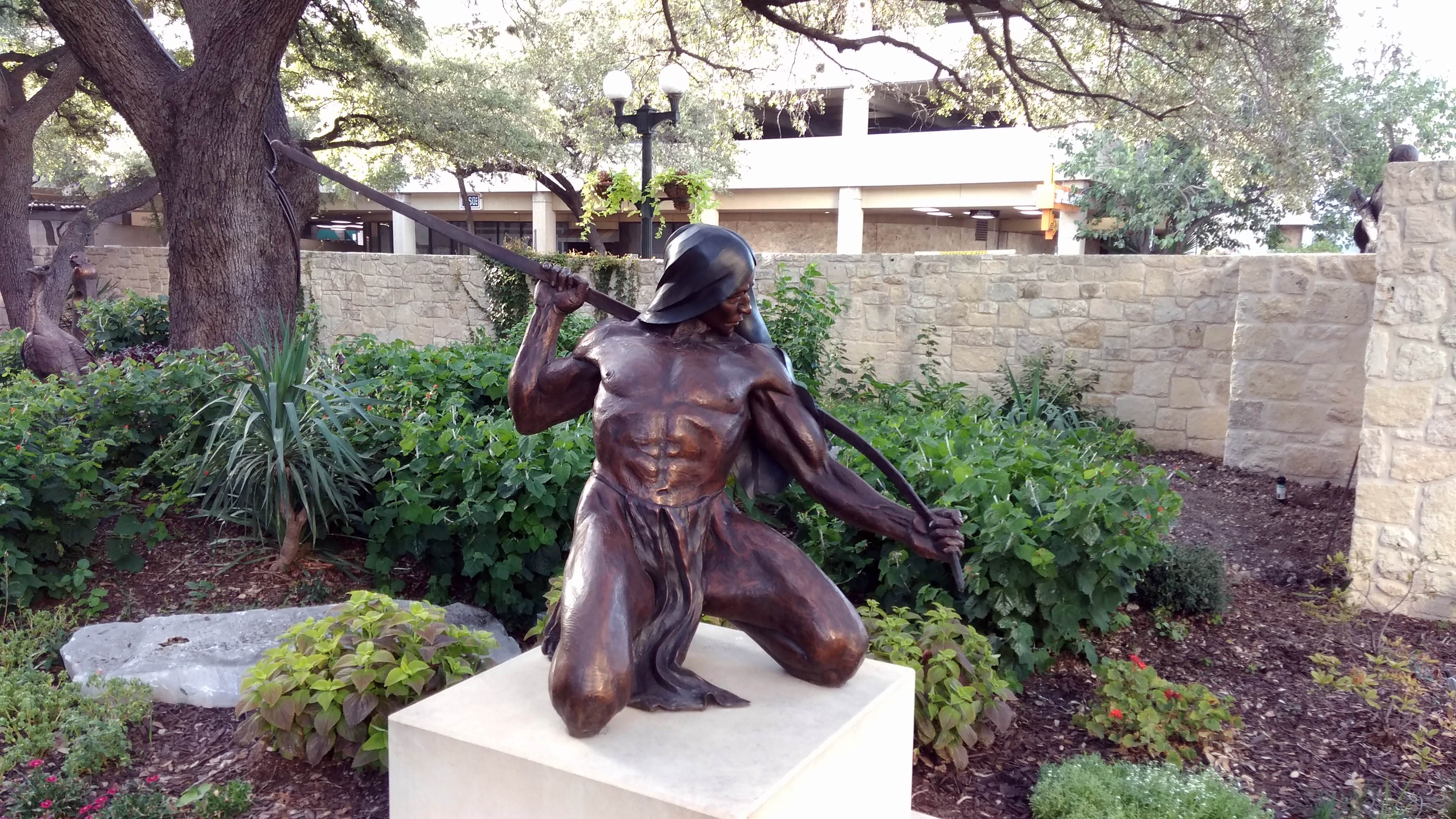
Many of the sculptures involve Native American themes. Such as “Strength of the Maker” (1990) by Denny Haskew.
“Bird Woman” (2001) by Richard Greeves.
“Rainmaker” (1998) by John Coleman.
“Dance of the Eagle” (1986) by Allan Houser.

“Crow Brave with Fan” (1985) by Doug Hyde. Unlike most of the other pieces in the courtyard, a work in granite.

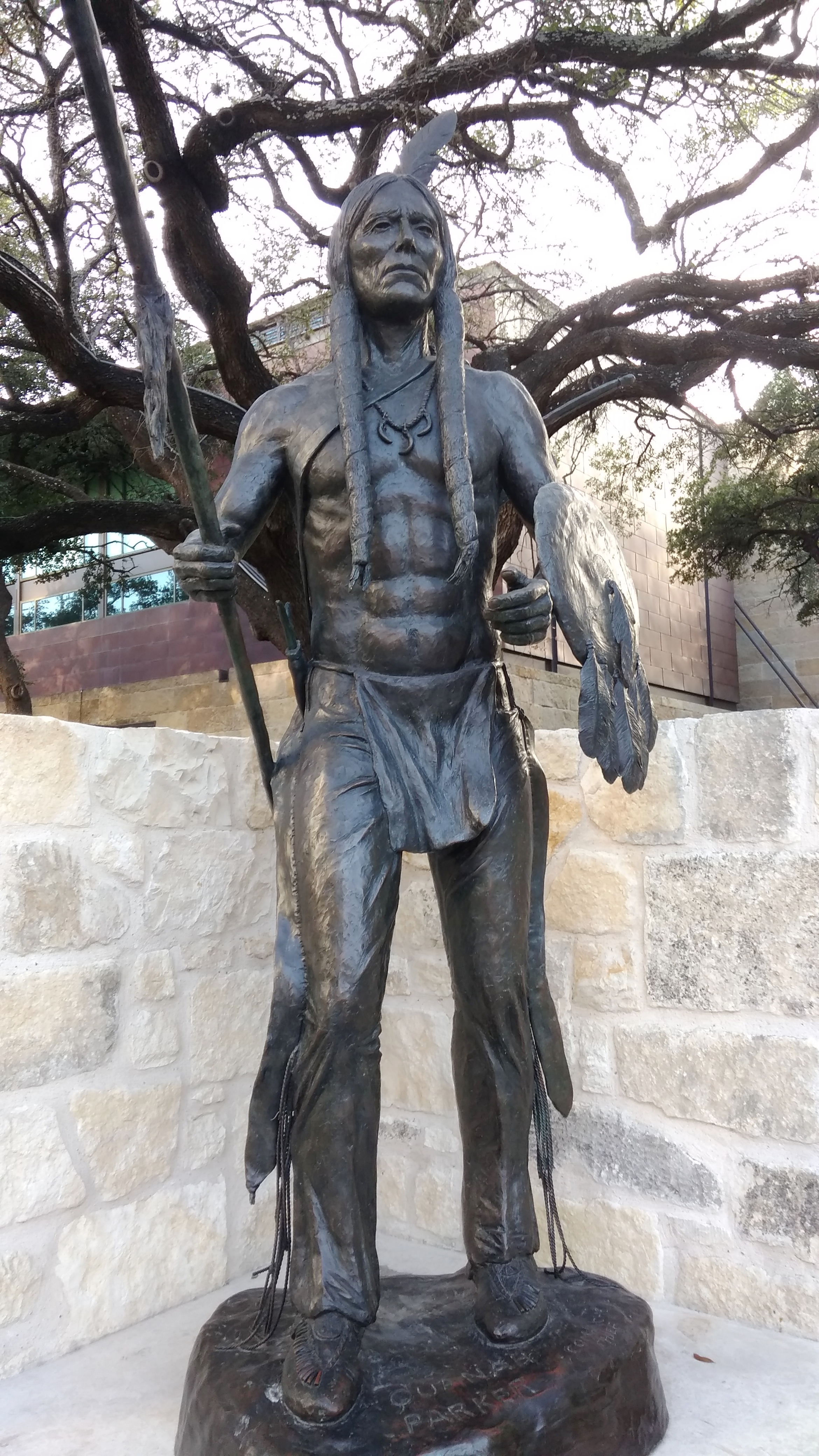
“Chief Quanah Parker” by Jim Reno. No date noted that I could see, but I suppose before 2008, since the artist died that year.
Quanah Parker had a prominent place at the small museum at Palo Dura Canyon State Park that I visited earlier this year. He was one of the leaders the last of the Comanches’ big raids, the Battle of Adobe Walls, in 1874.

The statue’s a good one, and he certainly looks like a Comanche war chief, though it would be more interesting if Quanah Parker’s statue looked like this.

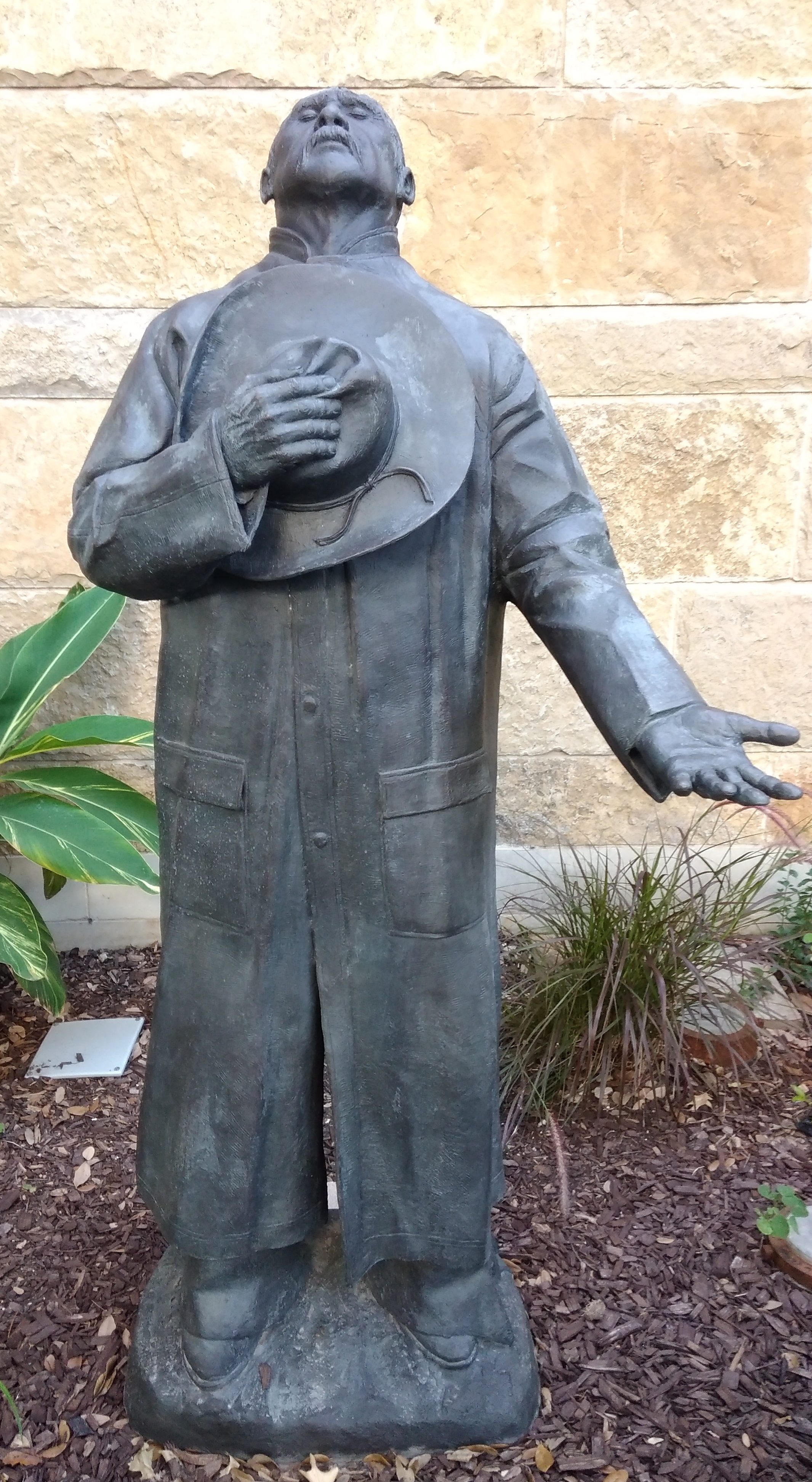
This is “Thank You Lord” (2011) by Harold Holden.

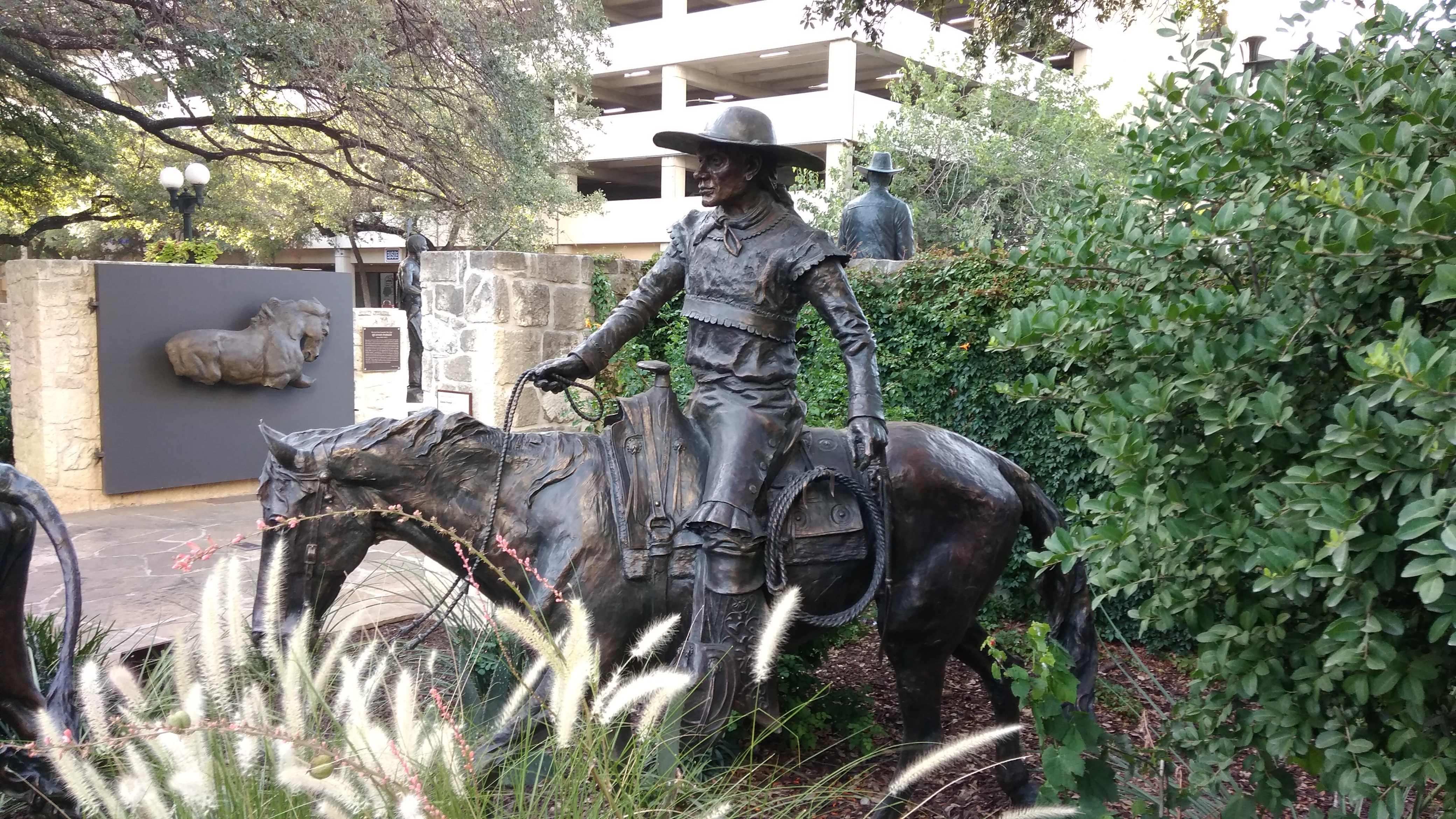
And a detail from “El Caporal” (2015) by Enrique Guerra.
Detail because he appears to be driving some bronze cattle, not pictured here, ahead of him.