South Texas in February

My most recent trip to Texas lasted eight days, most of them in San Antonio, though there was a foray into the Hill Country. One fine thing about South Texas in February is that it isn’t northern Illinois in February. There’s nothing quite like arriving at the airport and stepping out into night air that’s about 40 degrees Fahrenheit warmer than the septentrional place you left. Not that it isn’t winter in both places, just that a South Texas winter isn’t going to be consistently cold, like an Illinois summer isn’t going to be consistently hot.

It’s also green in South Texas. Or greenish. The grass isn’t hiding under a coat of white, and there’s been enough rain this year to make it green. Some bushes have leaves, but most trees still do not. A few flowers, the early spring pioneers of the area, are budding. Despite occasional outbursts of cold weather, snow is just a rumor, rather than an active nuisance.

Most of the time I visited family or worked. But I did get out to see a few new things, and no matter how familiar you think you are with a place, there’s always something new. Such as a cluster of unkempt cemeteries east of downtown San Antonio, or a 26-foot copper-roofed gazebo designed by Jalisco architect Salvador de Alba Martina, or a bat roost in Kendall County, or a small state park I’d never heard of — Old Tunnel SP, only a park in recent decades.

Also, I saw a few things I’ve seen before, sometimes uncountably often, but gave them new thought. Such as the Sunset Ridge shopping center neon sign.
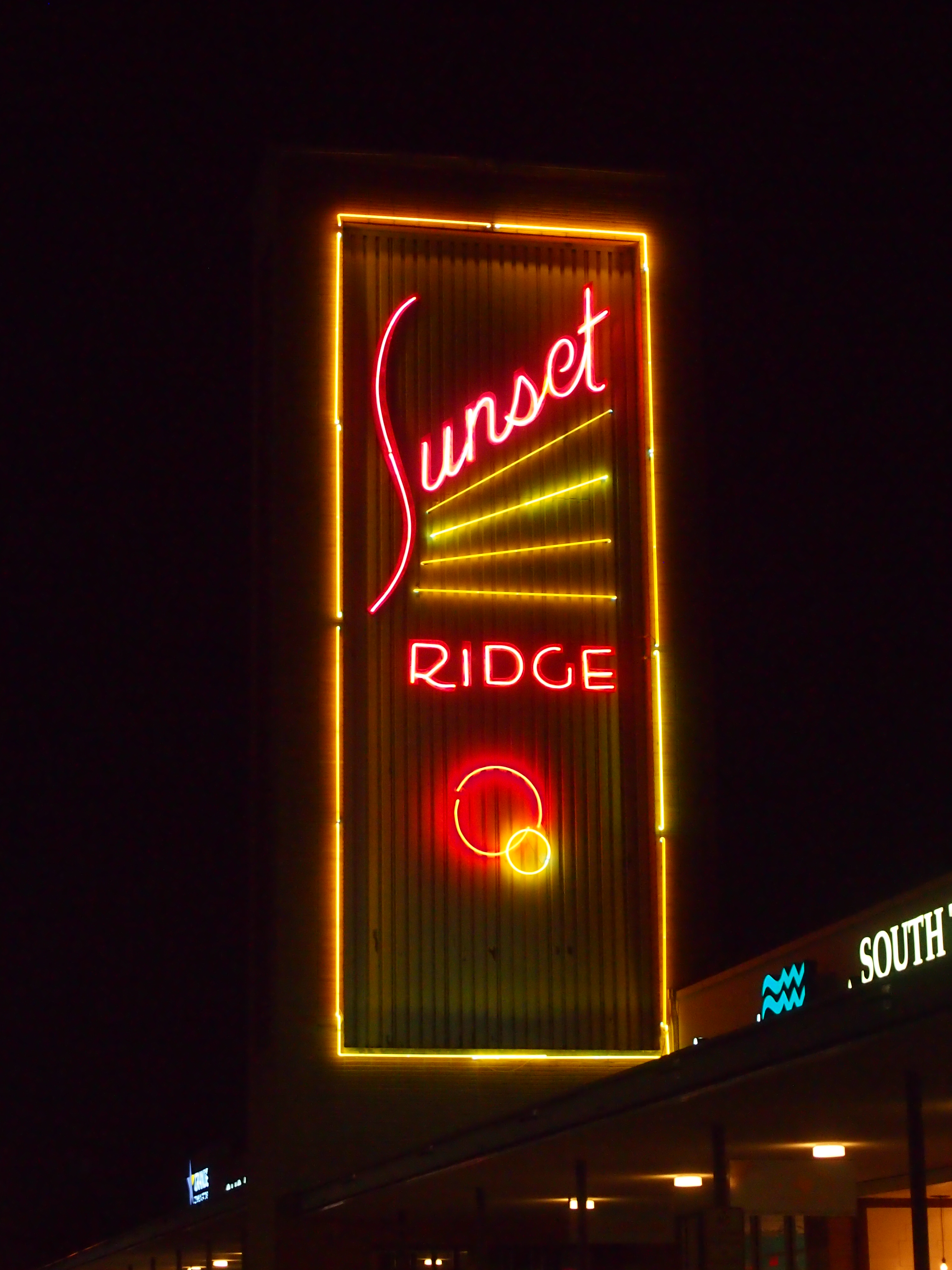
Sunset Ridge, San Antonio, Feb 2015At about 110,000 square feet, Sunset Ridge dates from the development of its part of San Antonio in the 1950s. Or so I think, because it looks like it’s from that period, it’s historically plausible, and I myself remember it almost that far back: 1968 (and my brothers remember it even earlier that decade). Sunset Ridge, which is within walking distance of my mother’s house, has many old associations for me. Such as the Winn’s that used to be there. It was a Five & Dime, part of a well-known chain in this part of the country, but now long gone, so long ago that it wasn’t even Walmart that killed it off.

I’d never given the sign much thought. It was simply the Sunset Ridge sign. When I looked at the sign during this visit, I thought mid-century commercial neon, a holdover from an increasingly remote time, and increasingly rare.
Snow in San Antonio

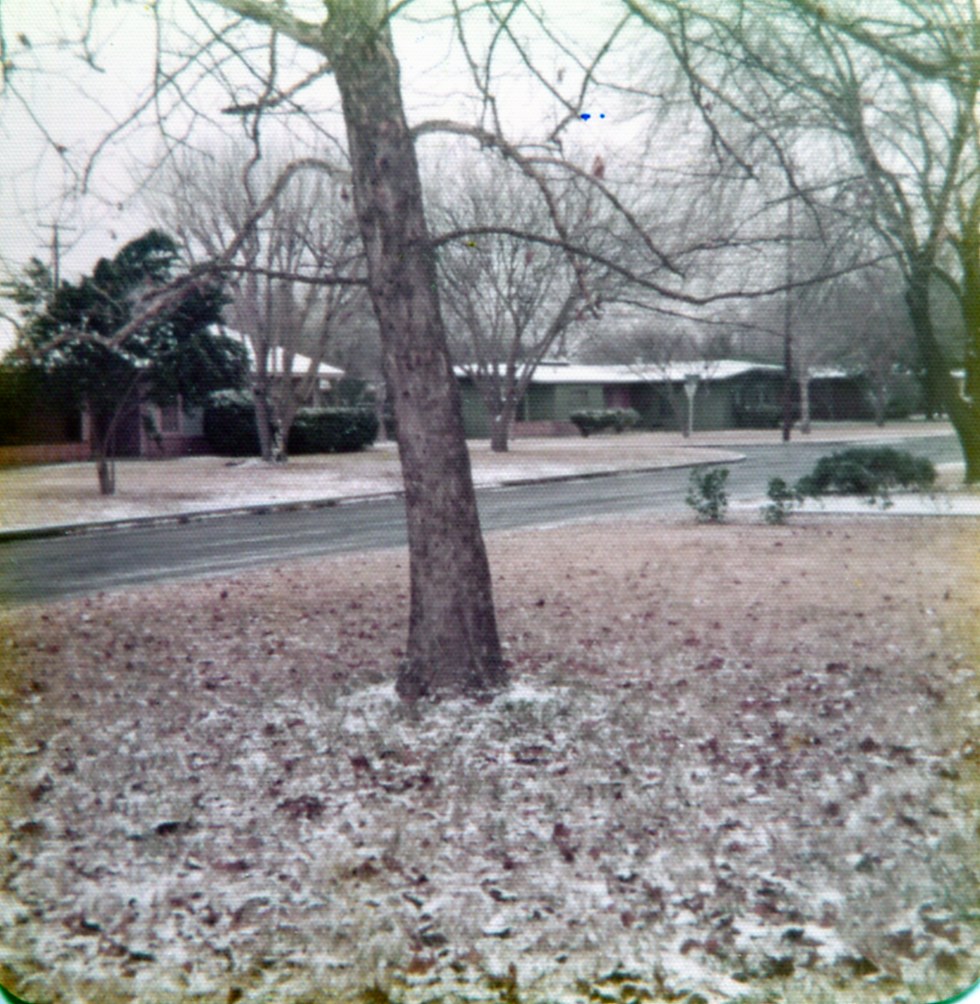
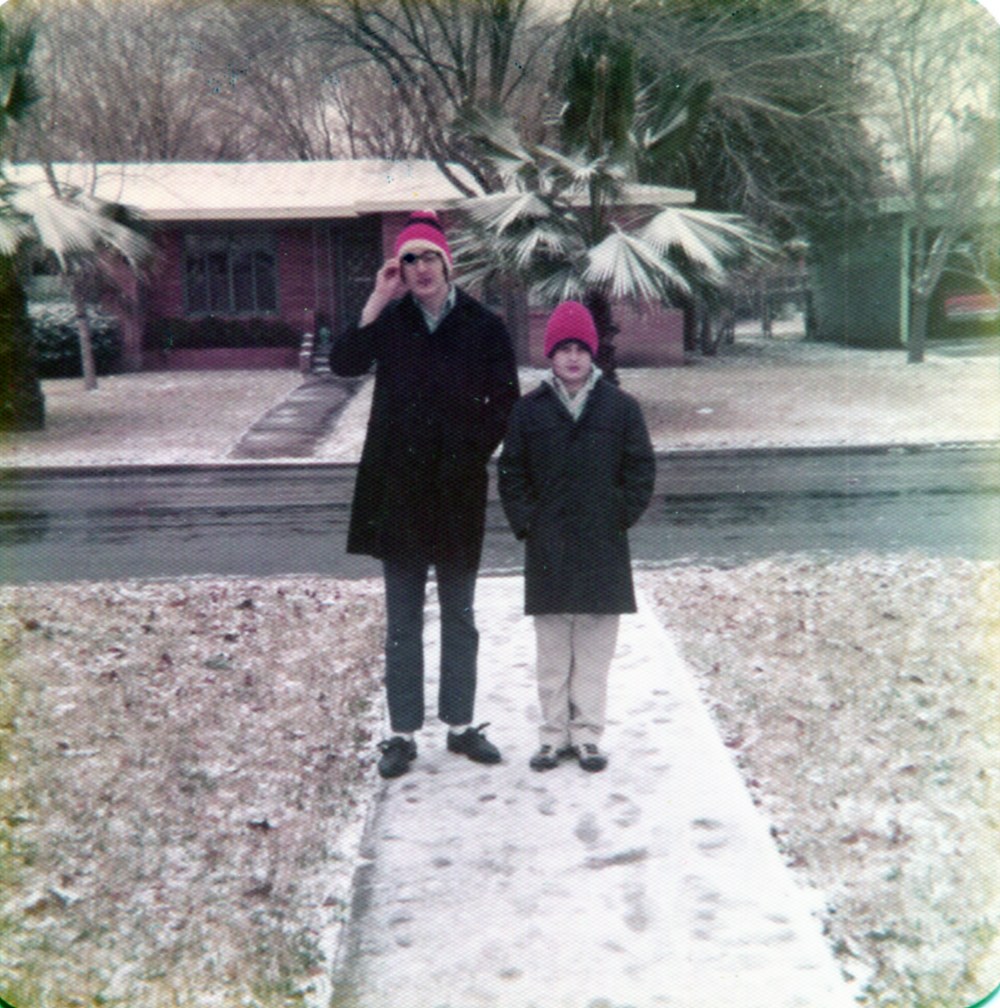
In the winter of 1973, snow fell on San Antonio twice. That much I remember. That’s memorable because the number of times that snow stuck to ground in San Antonio during my youth there — 1968 to 1979 — was twice. By the time a foot or so fell in 1985, I was elsewhere. The 3 inches that fell in San Antonio February 1966 was before my time, but that might have been when it snowed heavily in North Texas, where I was. I remember that too.

Jan1973-1So naturally we went out for a look. And to take pictures. I’m with Jim in the above image, and I took the one of Jay and Jim below.

Jan1973-4This must have been the first snowfall, which was 0.8 inches on Jan 11. It looks like that much, not the 2 inches that fell on Feb. 8. Also, I doubt that Jay would have been around in February.

Jan1973-2A front yard picture of a tree long ago dead and removed. I don’t know why I didn’t take any pictures of the February snow. Maybe no film. More likely sloth.

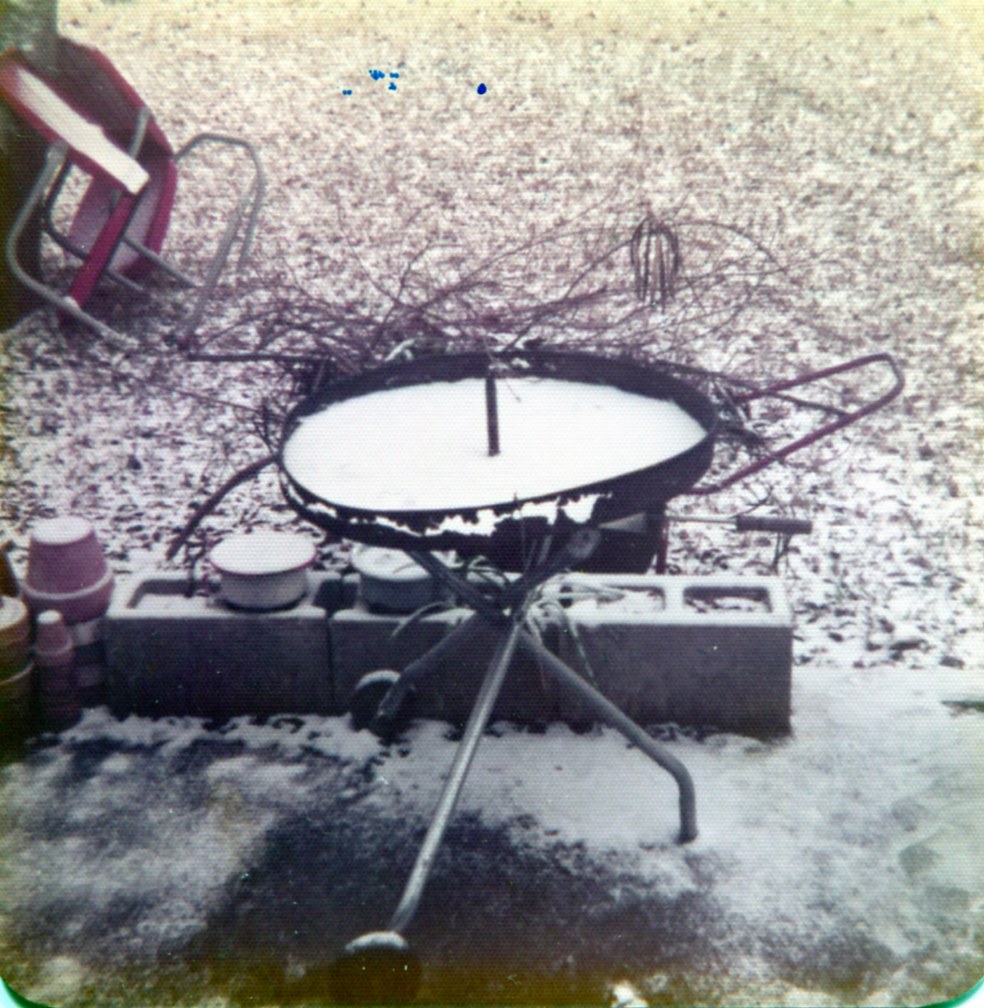
Jan1973-3

Back yard picture, on the deck that was later covered. At the time, it was open, and home to a decaying grill. Mostly I don’t remember cooking much on the grill, just building fires in it from time to time.

Christmas 1973

We bought a Christmas tree the day before yesterday. I’m not inclined to do so as much as I used to be, but the girls insisted, and took charge of the decorations.

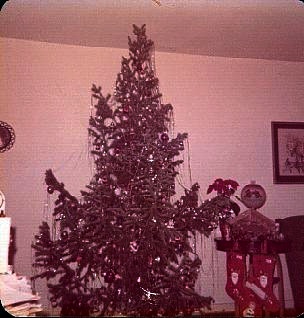
For some reason, I documented our 1973 Christmas tree with the Instamatic 104 camera my mother had bought sometime in the 1960s. At least, I’m pretty sure this is what we had, along with millions of other people. It broke in 1976.

Xmas73.3Not a particularly good image, even for that camera. But it captures most of our indoor decorations. The tree, which always looked more-or-less like that; stockings, hanging from a small sled acquired in Germany; a hard-to-see nativity scene on the table next to the tree (under the lamp); and a poinsettia.

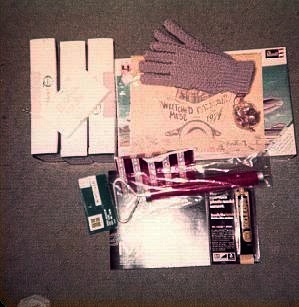
I also documented my presents for the year. The flash cube activated for this shot.

Xmas73.2There’s some kind of Revell model kit under there, but I don’t remember what it was (the company’s still around). That was probably among the last kits that I had, since I lost interest in models around this time.

On top of that are gloves, a bicycle pump, an envelope with some money tucked inside it, and a 1974 Wretched Mess Calendar. There isn’t much easily accessible information online about that publication, but there is a little evidence, besides my fractured memory and an overexposed print from late ’73, that such a thing existed. This is an article mentioning a ’69 version of the calender.

Finally, speaking of models, this shot. Not a Christmas image, but something I was doing at the time.

SaturnV.73My Saturn V model. My mother had acquired it for me some years before — at a trading stamp redemption center — but I was too young for it for a while. In late ’73, I took up the task and finished it. And a fine model it was, too.

Goya at the Meadows Museum

Last Saturday, Jay and I visited the Meadows Museum on the SMU campus. We got in for free because it was homecoming weekend. Even though Jay had no interest in attending any official reunion events – he’s SMU Class of ’74 – he got one of the benefits of being an alum on this occasion: two free admissions to his particular museum.

Meadows specializes in Spanish art. I borrow from Wiki because I’m lazy: “[The museum] houses one of the largest and most comprehensive collections of Spanish art outside of Spain, with works dating from the 10th to the 20th century. It includes masterpieces by El Greco, Velazquez, Ribera, Murillo, Goya, Miro, Sorolla, and Picasso. Highlights of the Meadows Collection include Renaissance altarpieces, monumental Baroque canvases, rococo oil sketches, polychrome wood sculptures, Impressionist landscapes, modernist abstractions, a comprehensive collection of the graphic works of Goya, and a select group of sculptures by major twentieth-century masters…”

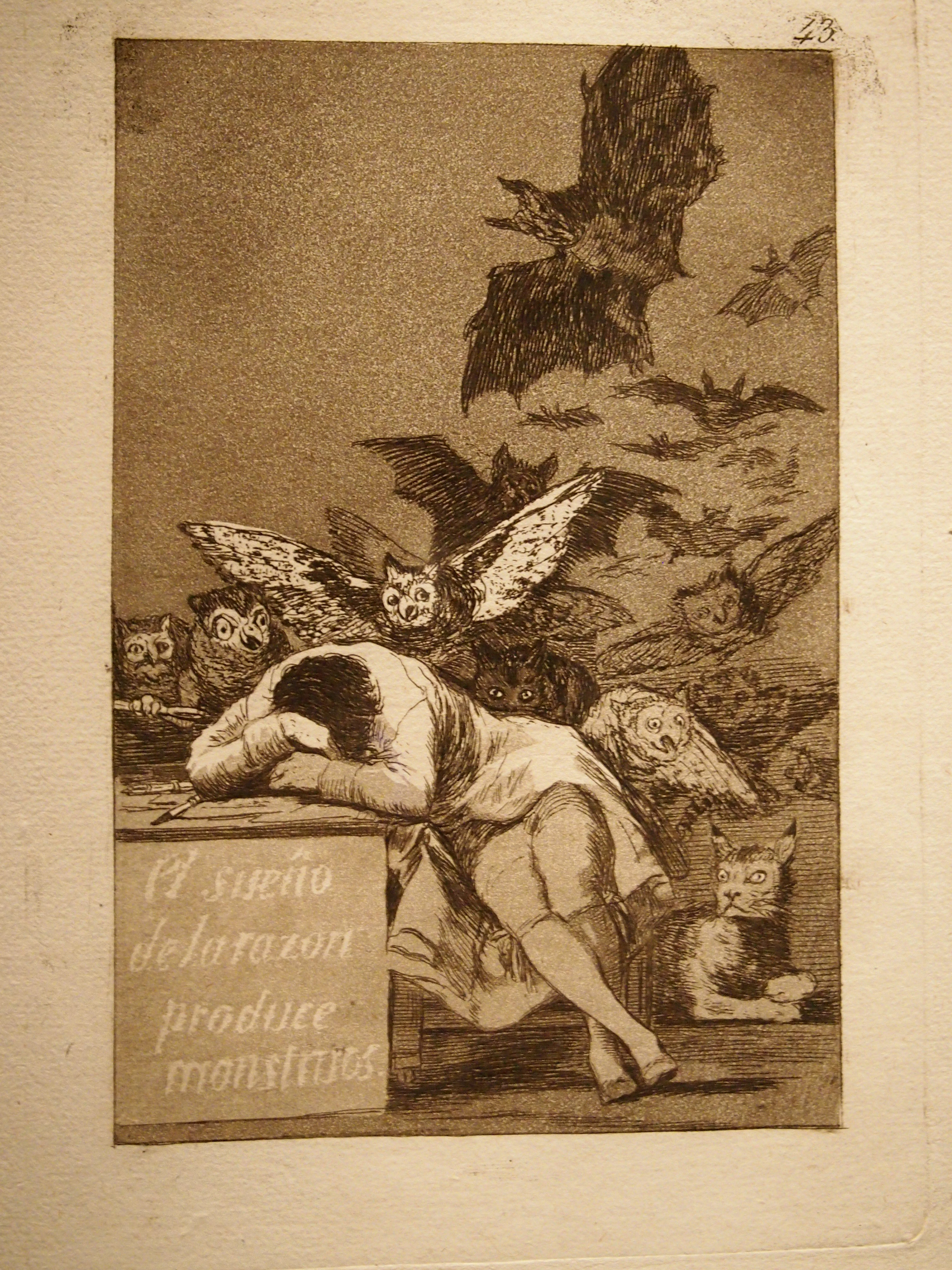
The graphic works of Goya. Such as the famed “The Sleep of Reason Brings Monsters.”

Meadows Museum, Nov 2014

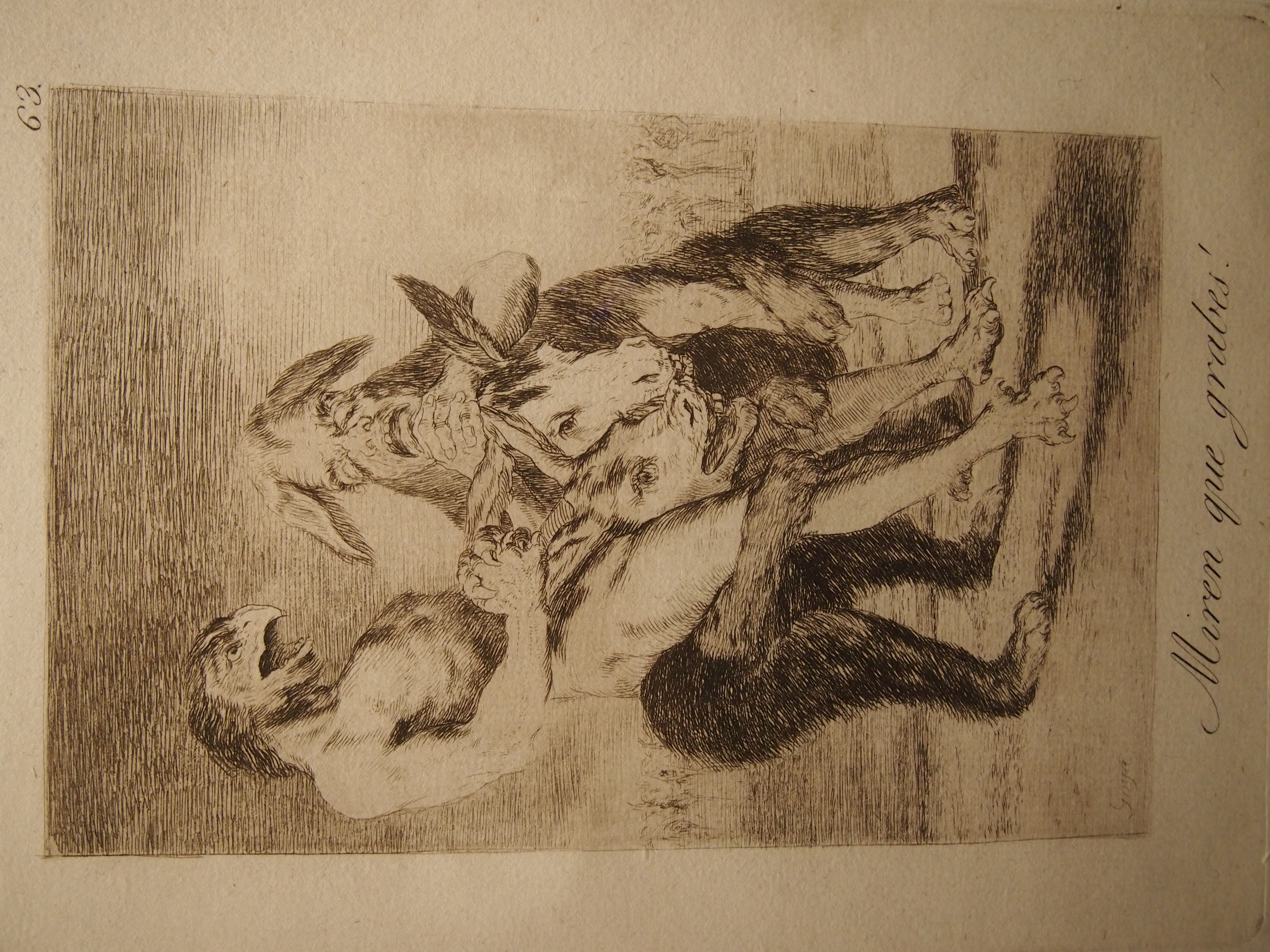
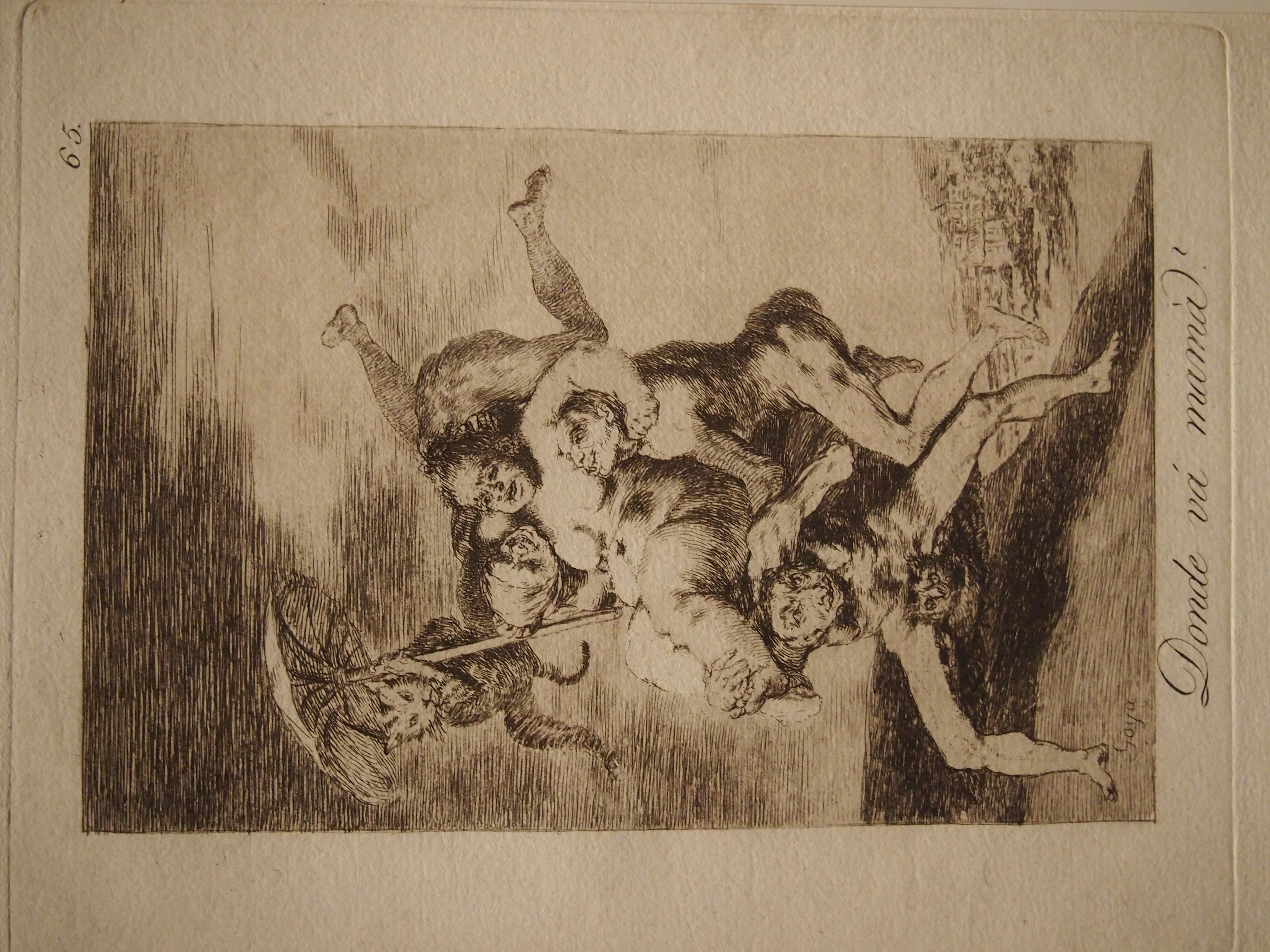
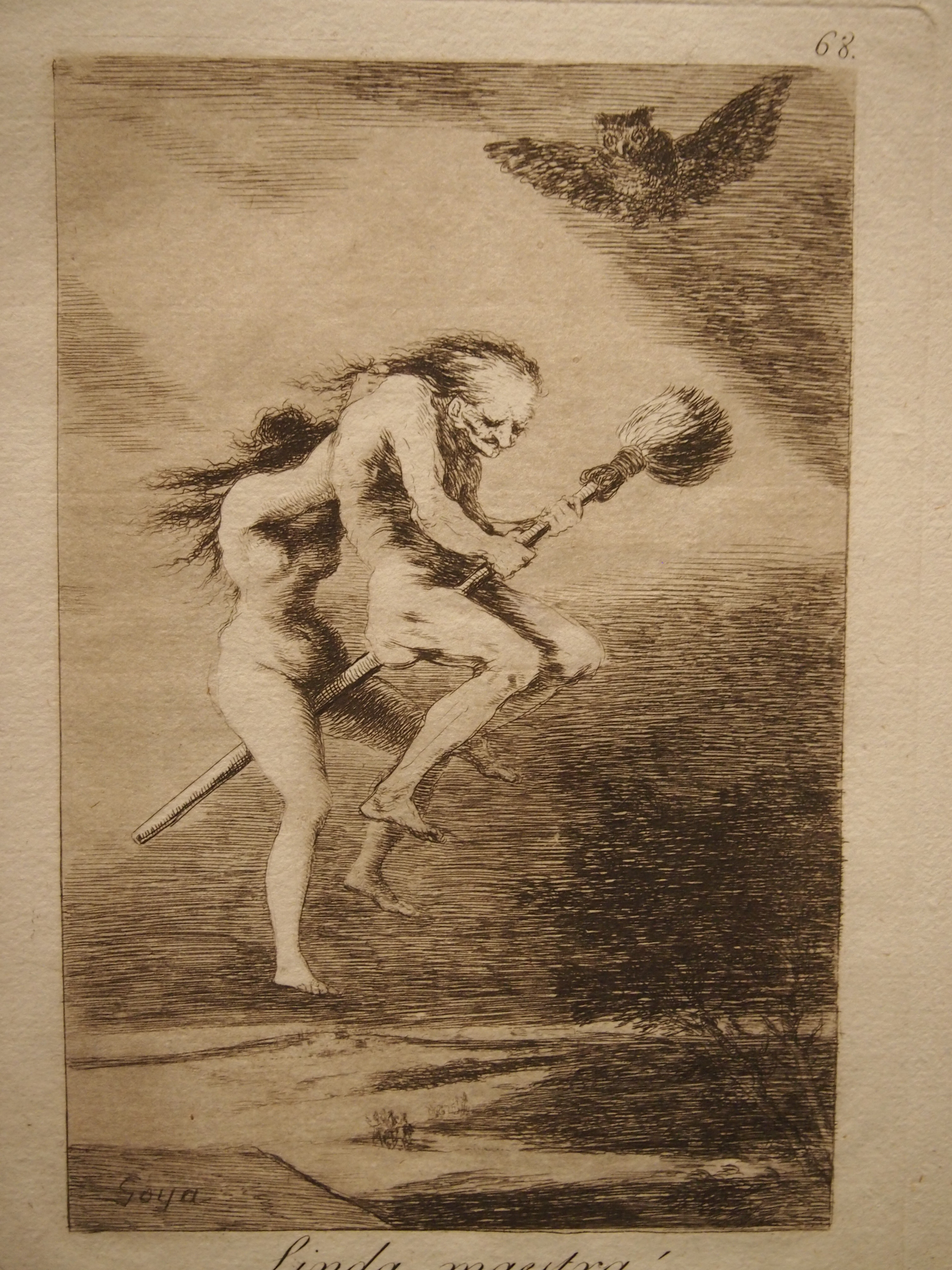
Along with some truly weird images as well.

Meadows Museum, Nov 2014Meadows Museum, Nov 2014Meadows Museum, Nov 2014

I was glad to see them. Austin shouldn’t have all the weird. Dallas needs a little too.

Hi, How Are You

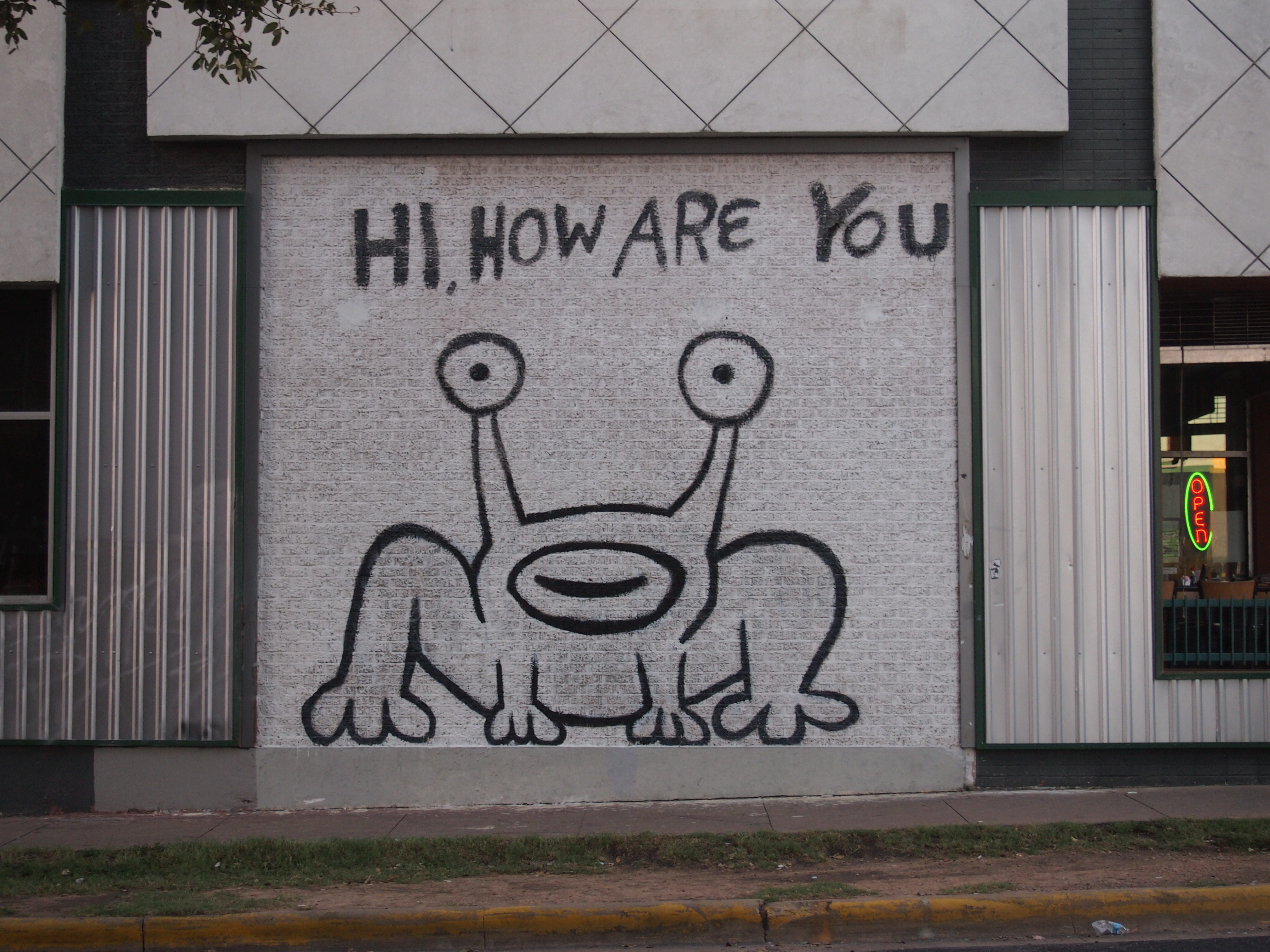
Just before dark on November 8, Tom took us to the corner of Guadalupe and 21st. That’s the location of the “Hi, How Are You” mural, also known as “Jeremiah the Innocent.”

Austin, Nov 8, 2014It was the first I’d heard of it, but I haven’t spent that much time in Austin in the last 20 years. A record store that used to be on the site hired musician and artist Daniel Johnston, who has some renown in Austin, to paint the mural in 1993. Popular demand kept it intact when the location became a Baja Fresh in 2004, and now the restaurant on the other side of the wall is called Thai, How Are You?

Thai sounded just like the thing for dinner, especially since we hadn’t taken the time to have much lunch, so we went. I’m glad to report that the Thai, How Are You? serves good food.

The UT Tower

Damned if it isn’t January out there now, but at least it’s expected to return to a more normal November – a little above freezing – by the end of the week.

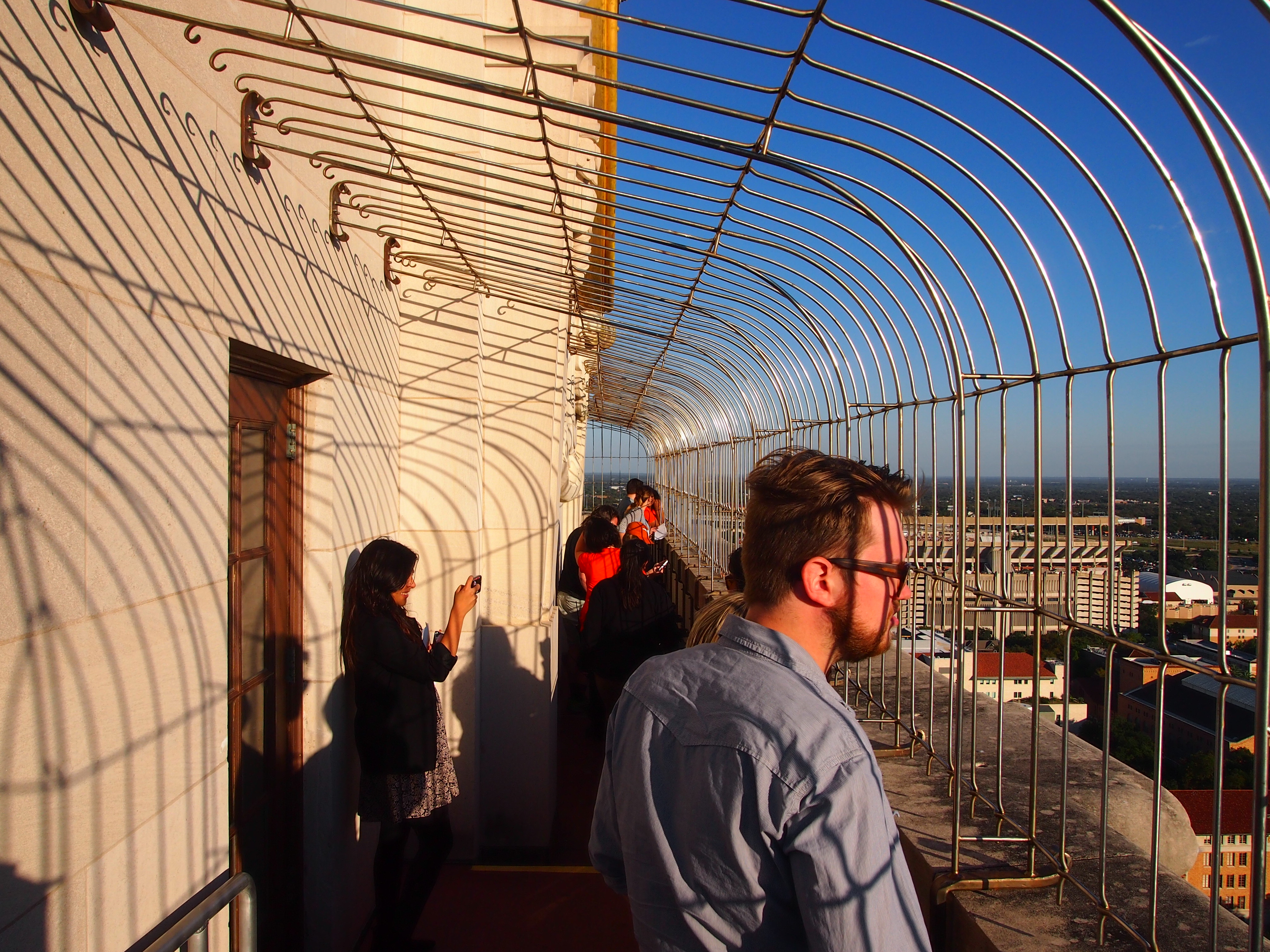
My recent visit to Texas started out warm, but cooled down with most of the rest of the country. It was still warm when we went to the UT Tower on November 8. Good thing, since the outdoor vista is the thing to do. In full, it’s the University of Texas Tower, a part of the school’s Main Building, built in 1937 and towering 307 feet over campus. One Charles Whitman used his marksman skills to murder people at random from atop the observation deck in 1966, so nearly 50 years later visitors need to go through a metal detector manned by a cop to get in. But at least you can get in. For a good long time, the tower was closed.

Officially, you take a “tour” of the observation deck, and there’s some commentary by guides – in our case, three perky UT students – but mostly you have access to the view in all directions. Because of a sad history of suicides, you have to look through bars.

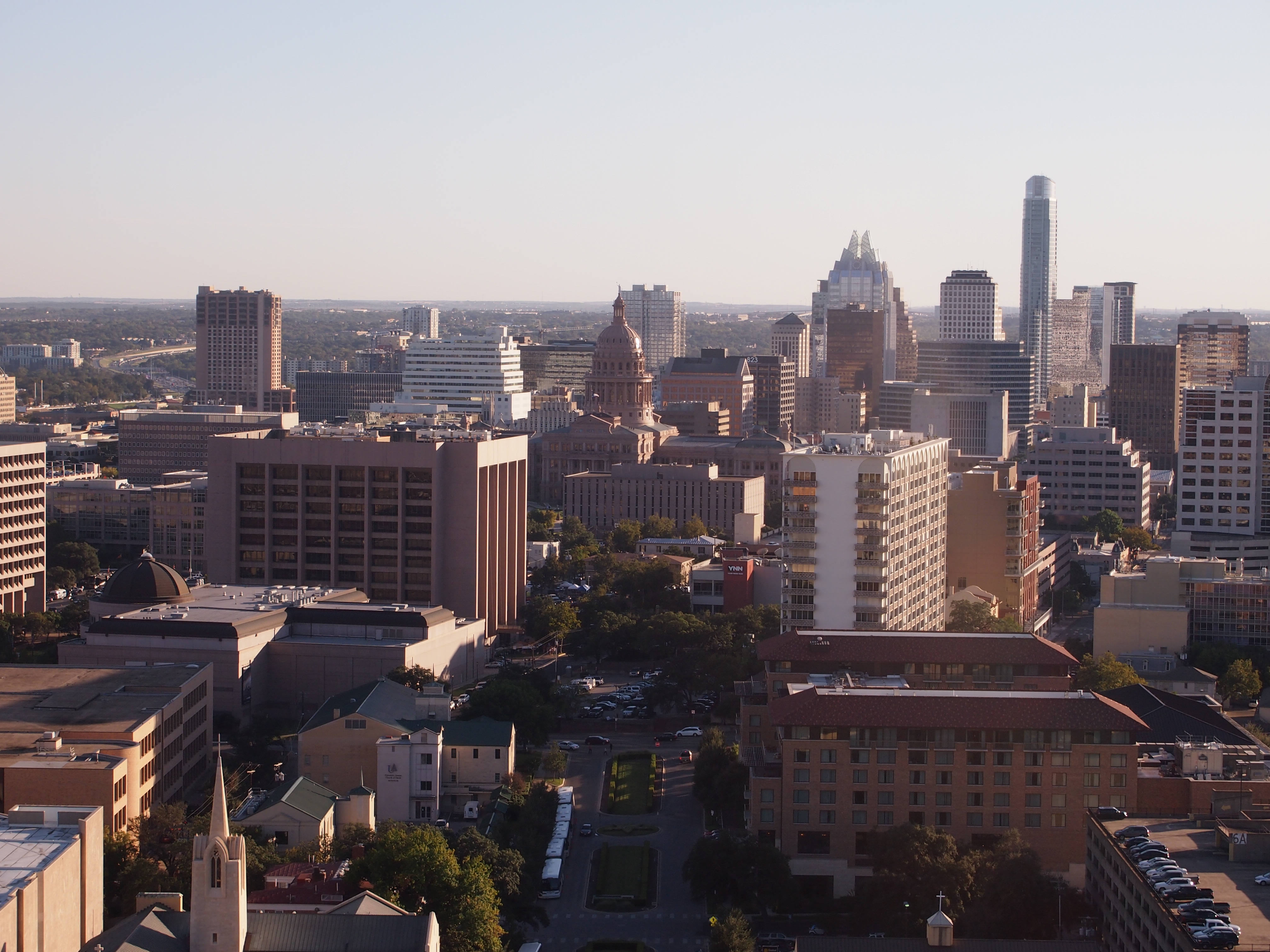
UT Tower Nov 8, 2014South: Downtown Austin, including the Capitol of Texas. At the time the tower was built, it couldn’t be taller than the capitol, which is 308 feet. Now structures can be taller, but not positioned in way to block the view of the capitol from 30 specific locations (one of which must certainly be the UT Tower).

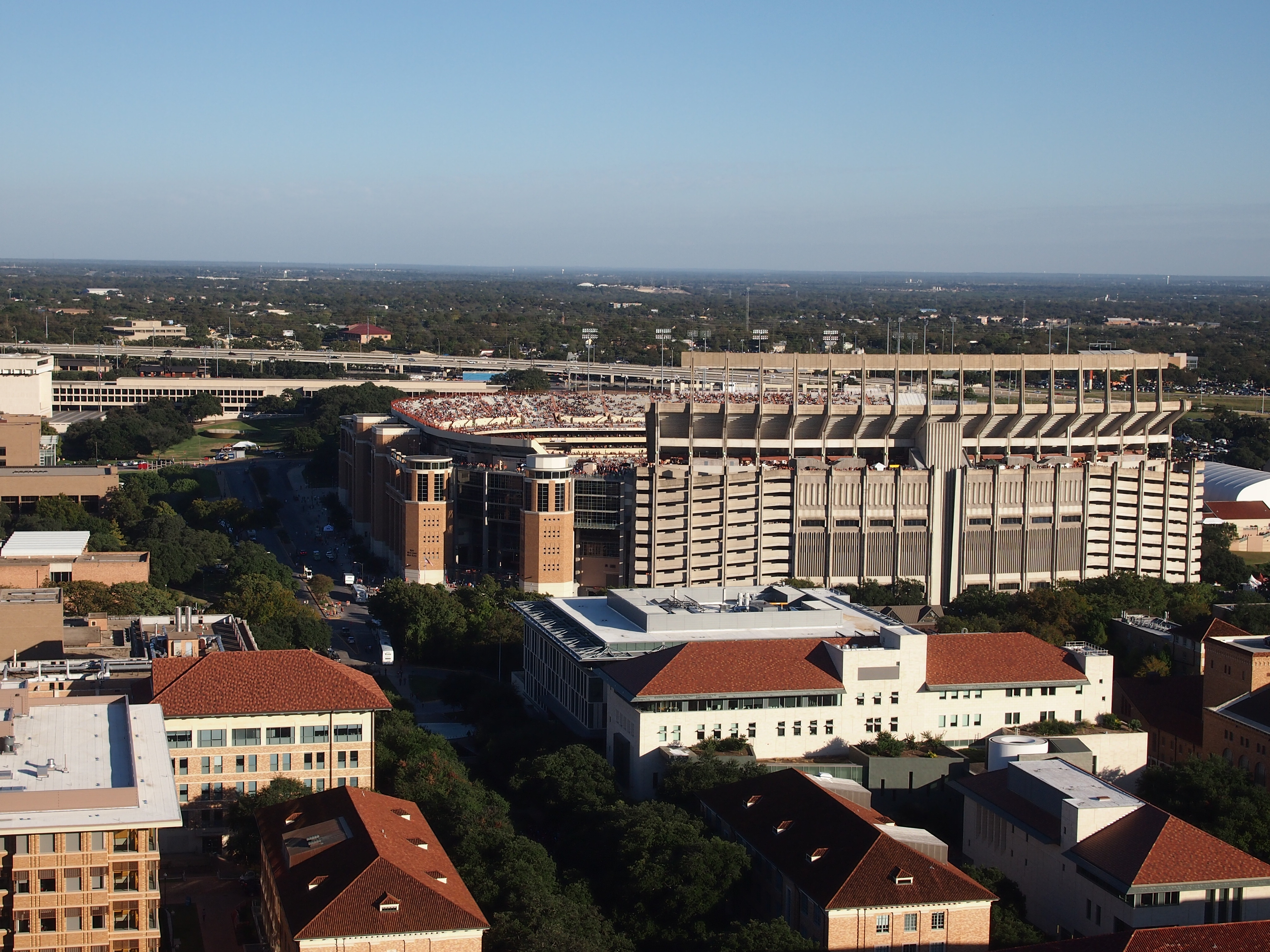
Austin, Nov 8, 2014East: UT Stadium. Officially, Darrell K Royal–Texas Memorial Stadium, with a seating capacity of 100,119, making it the 13th largest stadium in the world, according to Wiki. Note that it wasn’t at capacity that day. UT was playing West Virginia, and they weren’t expected to win. But they did.

UT Stadium during UT-WVa game Nov 8, 2014From our vantage, we heard the crowd roar from time to time.

“That sounds like a first down,” Tom said about one roar. “What does it say about me, that I know that?”

“That you’ve been to too many UT games?” I suggested.

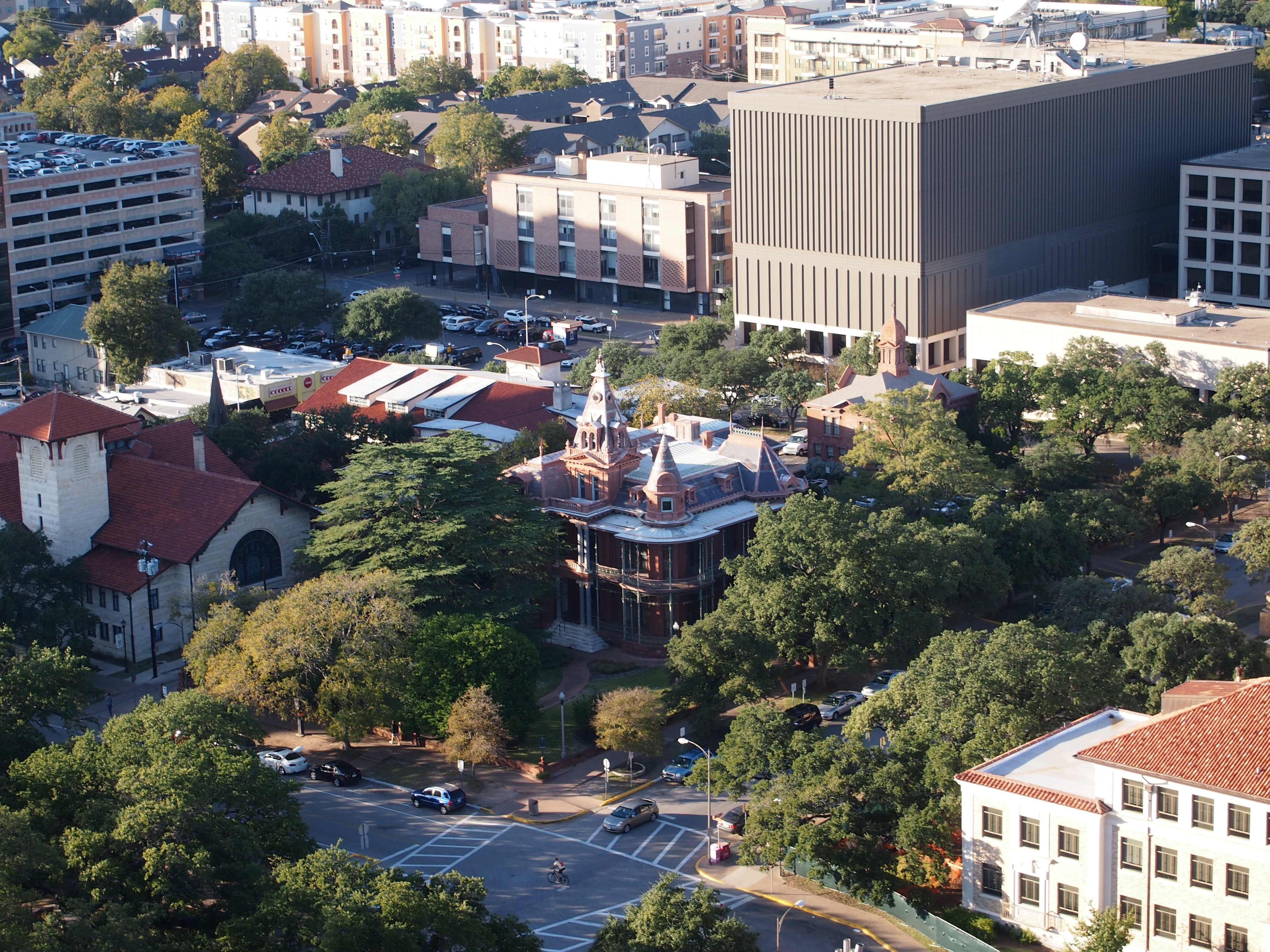
Northwest. The large house is Littlefield House.

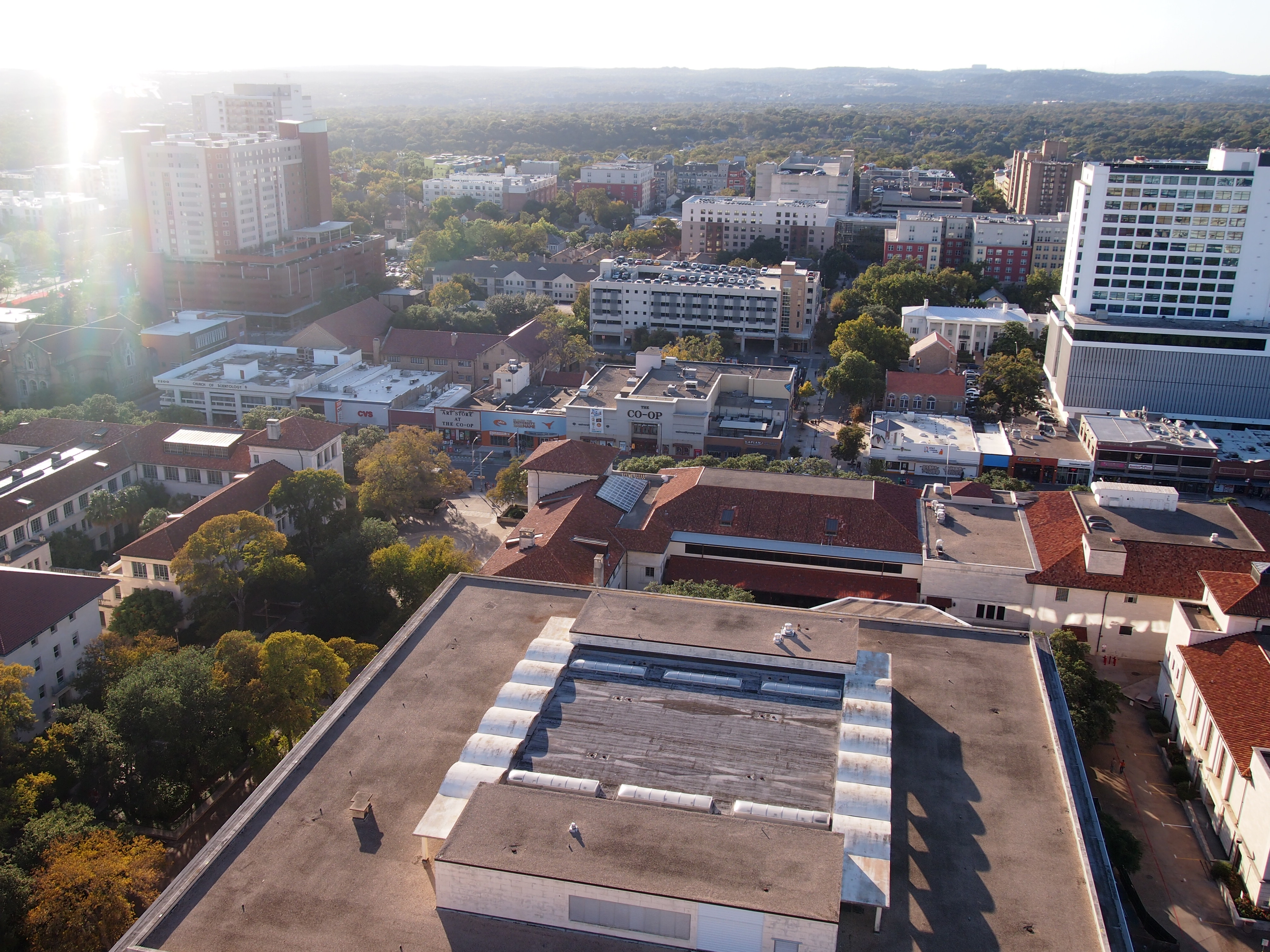
Littlefield House, Nov 8, 2014West: The Drag and the Balcones Escarpment.

Austin, Nov 8, 2014 Guadalupe St., better known as the Drag, is in the mid-ground. Spent a fair amount of time there in ’81. The sign of the University Co-op, a major UT retailer, is just visible (CO-OP). Off in the background rises the Balcones Escarpment, a geological feature I’ve heard about for a long time, but never had seen so clearly displayed.

Texas Fall ’14

Just flew in from Texas and boy are my arms… Bob Hope seems to get the credit for that old gag, and it does sound like him. Someday when I have a few idle days, I might look around and try to find something Bob Hope said that was funny. Nah, too much trouble.

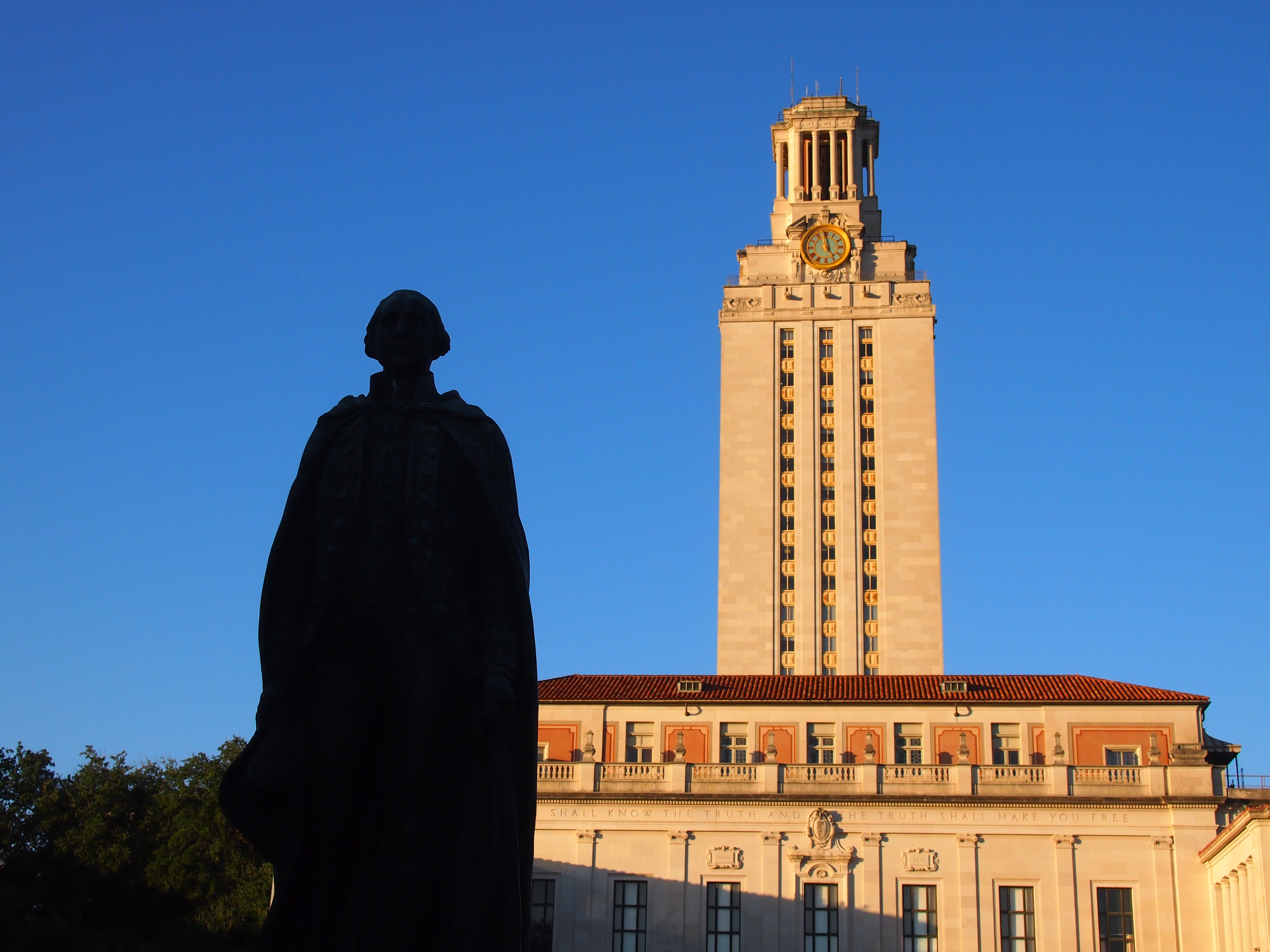
I went to Texas on the 7th and returned today, spending most of the time in San Antonio. But on the 8th, along with my brother Jay, nephew Dees, his girlfriend Eden, and my old friend – known him 40+ years now – Tom, visited the campus of the University of Texas at Austin. Our main objective was to go to the top of the UT Tower and take in the expansive view of Austin. This is the tower from the south, along with a statue of George Washington.

Austin, Nov 2014A silhouette of Washington, anyway, since the light wasn’t right. The Center for American History at UT says that “Pompeo Coppini’s dramatic rendering of George Washington has been a prominent fixture on the south mall since 1955. Erected by the Daughters of the Republic of Texas, it was the first statue of Washington in the state.” I’ve run across Coppini’s work before.

Assorted other bronzes adorn the UT on the campus, such as effigies of Jefferson Davis, Texas Gov. James Hogg, and Martin Luther King Jr. (told you they were assorted). We either missed them, or the late afternoon November light was poor for picture taking.

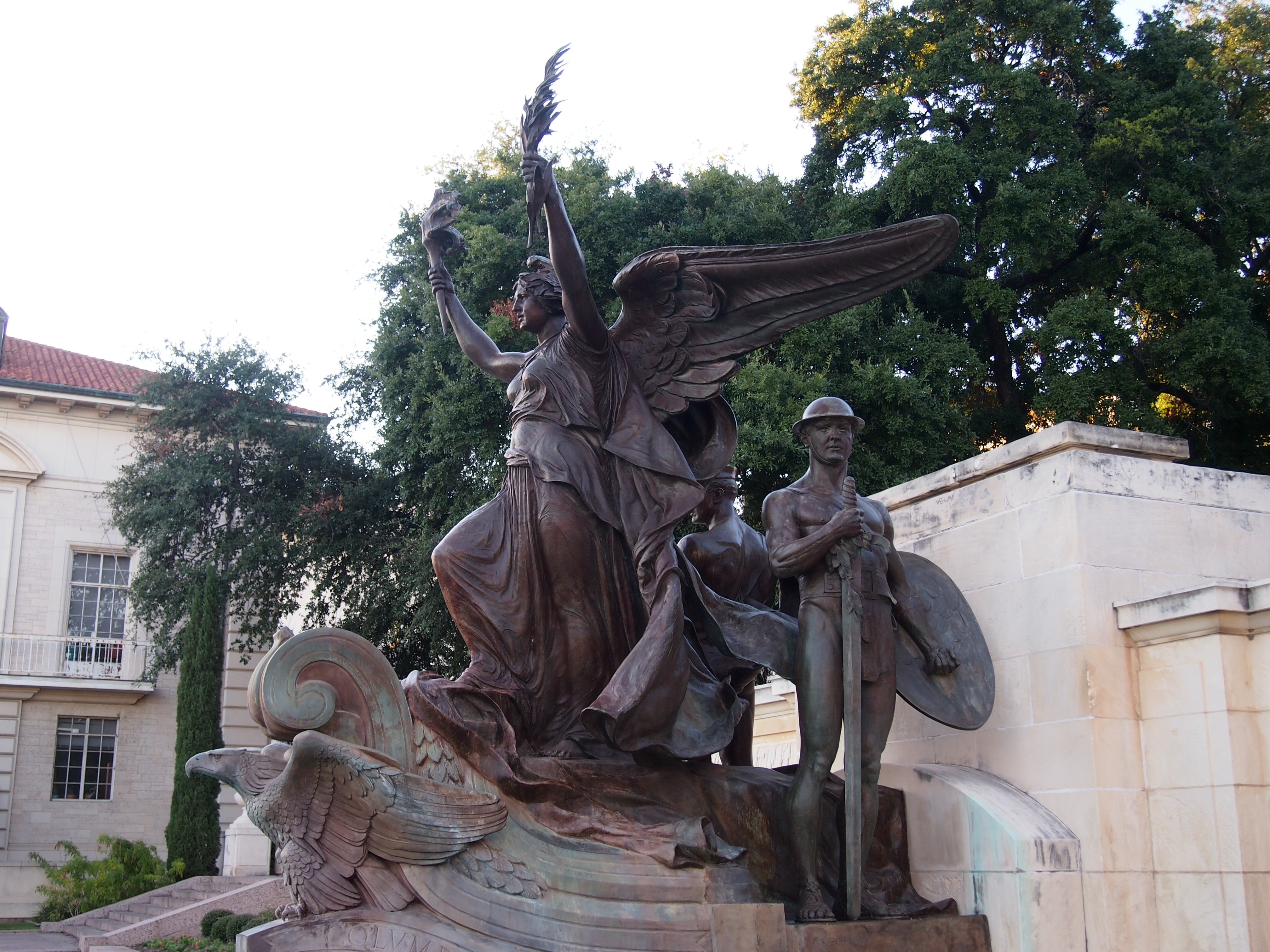
A more ambitious work on campus by Coppini is the Littlefield Fountain, paid for by George Littlefield, an early big donor to UT. Apparently he envisioned a Confederate Memorial, but by the time the thing was actually done in the early 1930s, and Littlefield himself was gone, it was a memorial to honor UT students and alumni who died during the Great War. A fitting thing to see in early November, and 100 years after the Great War’s early days.

Littlefield Fountain, Austin, Nov 2014On the other side is a sailor of the war, to go with the lightly clad solider bearing a very long sword.

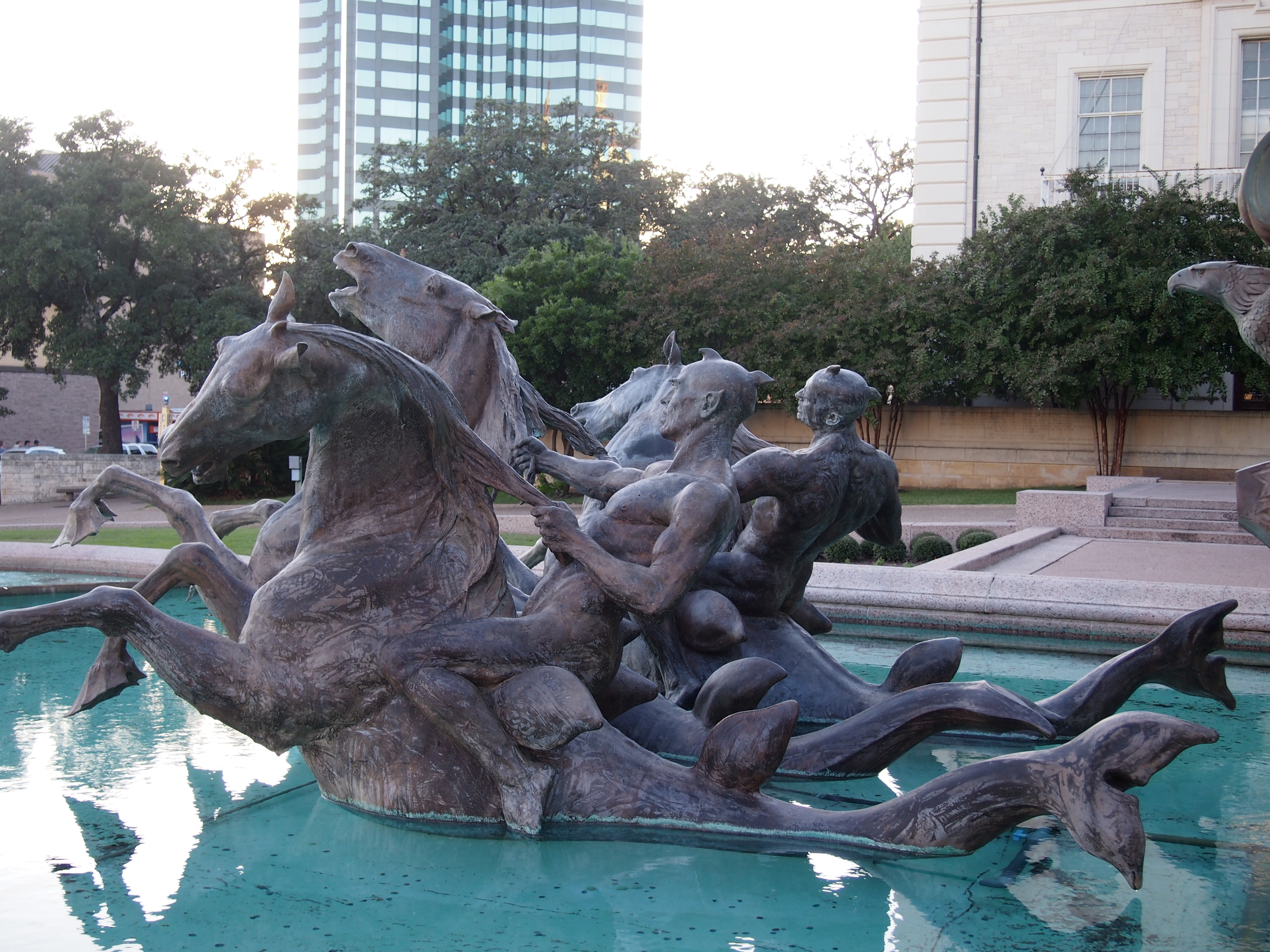
Littlefield Fountain Nov 2014 In the fountain itself, interesting equine-piscine creatures.

Everywhere a Sign

A question to ponder: How can Crème Caramel Chicago’s product be so good? Ingredients: milk, eggs, sugar, cream, caramel, vanilla. That’s it. Yet in the words of Shakespeare, it’s a wow.

It’s also a product of EU Foods, though it has nothing to do with that supranational entity, I think, since it was made in Bensenville, Illinois.

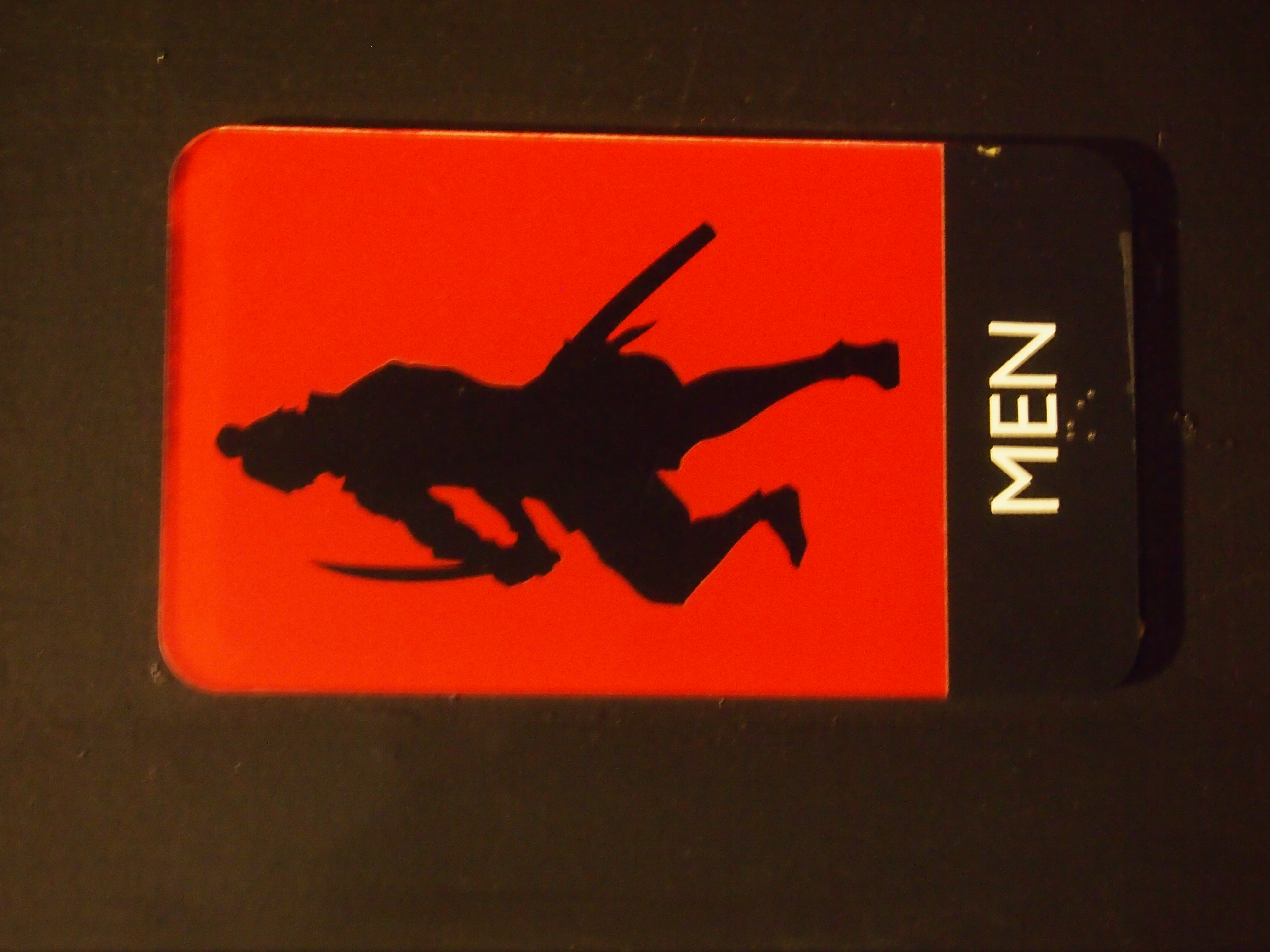
Another thing to ponder: a thematic men’s room sign.

Samurai bathroom attendantI saw it about a year ago in Dallas at the Ann & Gabriel Barbier-Mueller Museum. As I write this, the wires – quaint, that term – are burning up with news of the first U.S. Ebola case, and the honor goes to Dallas. Well, why not? Texas excels at so much else.

I doubt that we’ll get an epidemic, though. What we will get is excessive news coverage. Just another reason to avoid cable news, out in that vast wasteland. Vaster now than when I was born; a regular Sahara.

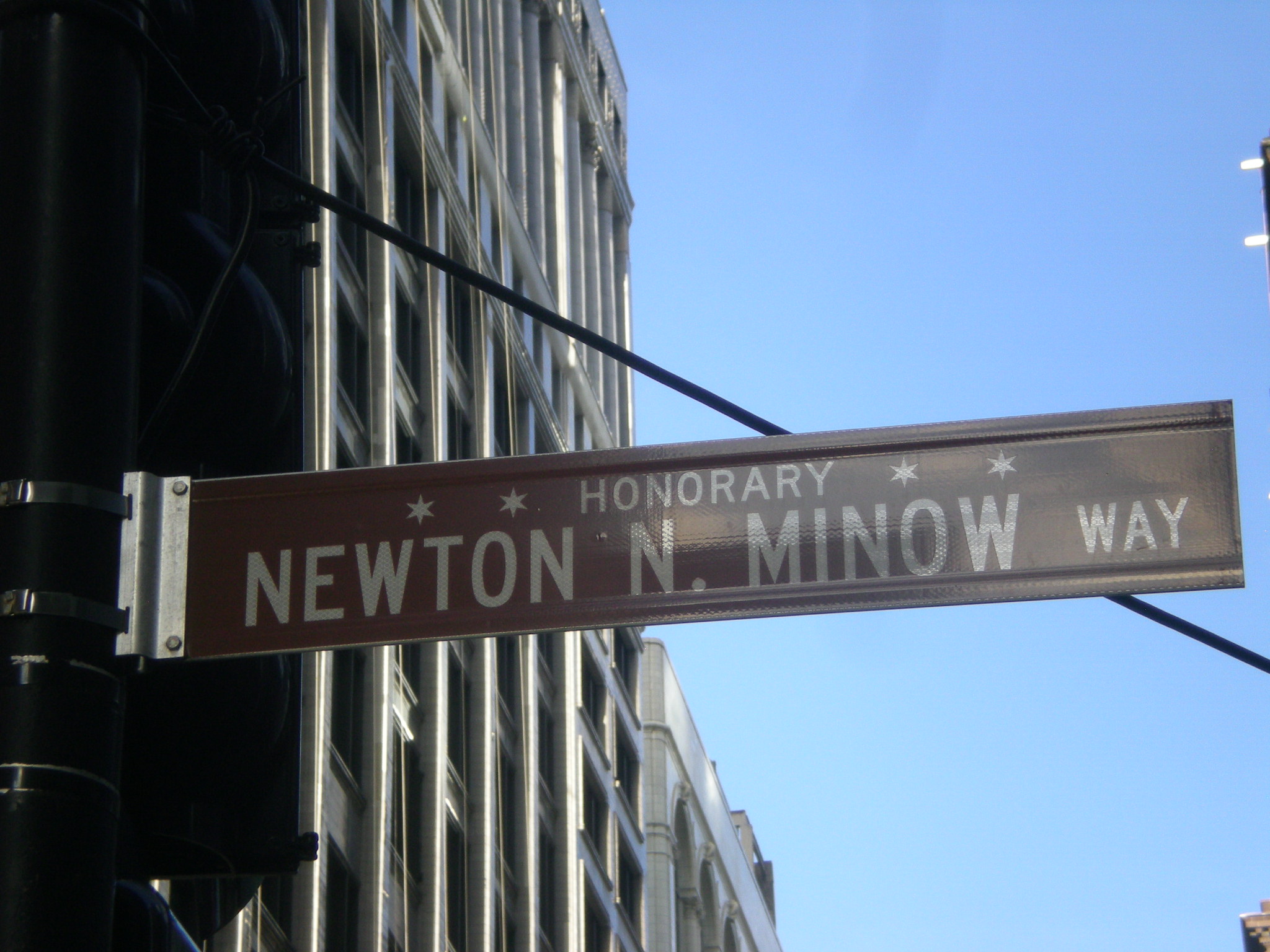
Newton MinowI didn’t know that Newton Minow had an honorary street sign in Chicago, but I saw it downtown last month. I’m happy to report that at 88, Mr. Minow is still alive and kicking.

Summer of 1969. Maybe.

Terrific storm early Saturday afternoon. I watched most of it from the front entrance of a Schaumburg Park District facility, outside the building but under a sturdy overhang. We didn’t want to venture out into the parking lot for a while, so strong was the lightning and fierce the rain (though not much wind, oddly). One crack of lightning – right at the beginning of the rain, and unexpected – seemed like it was just across the street. I was looking directly at it. A woman crossing the parking lot was even more startled that I was, but it didn’t hit her.

About 45 years ago, my mother, my brothers and I went on a driving vacation around  the South. I was eight, and I’d been staying with my uncle and aunt in Ardmore, Okla. for a while previously (arriving there the day Neil Armstrong and Buzz Aldrin walked on the Moon), so the trip might have been late July, early August.

My mother and brothers came up to Ardmore, and from there we headed east through Arkansas and Tennessee, getting as far as Chattanooga. Then we returned to Texas by way of Georgia (briefly), Alabama, Mississippi, and Louisiana. This must have taken about a week. I remember staying in a motel somewhere west of Memphis, and a five-story hotel in Chattanooga. We also stayed with relatives in Philadelphia, Mississippi. We must have stayed with my mother’s friend near Houston, too, but I don’t remember that, or any other place we might have stayed.

We went to Shiloh and Chickamauga, and the Hermitage in Nashville, and I don’t remember where else. We saw a lot of signs that said some variation of SEE ROCK CITY. According to this site, there are only about 100 of them left. Tennessee and some of the other states involved ought to pony up some funds to help preserve what’s left, since it’s a part of Southern heritage.

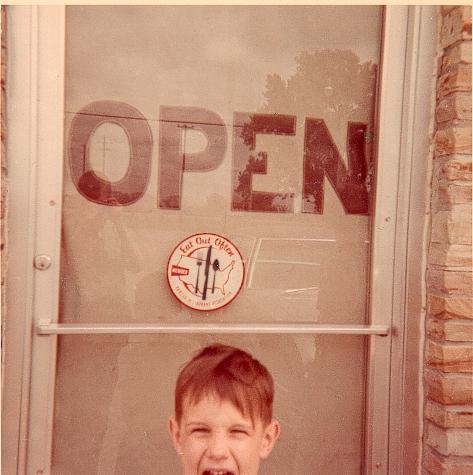
There seem to be only a handful of images from the trip. Jay took this one outside some eatery. I used to dislike the picture, but I like it now. Look carefully under the “O” and you can see a reflection of Jay taking the picture.

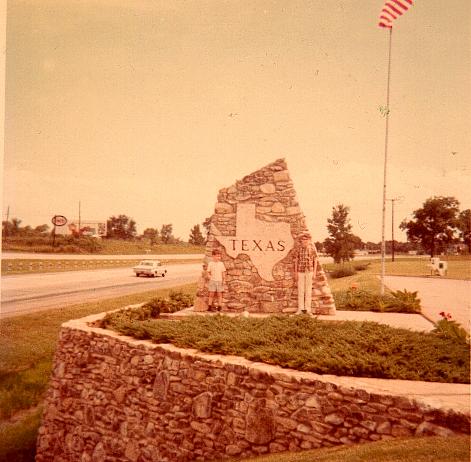
1969This is at a Texas welcome center. I’m on the left, my brother Jim on the right. Taken when we returned? That’s what I assume, since the only time we crossed a Texas border together was on the return. Before that I’d been in Oklahoma. Hard-to-see detail: on the other side of the highway is an ad for Esso, complete with a tiger.

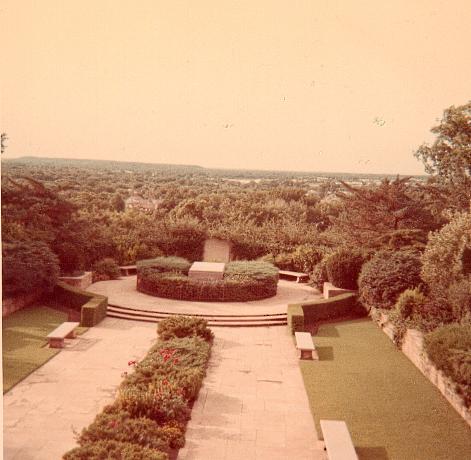
TexasborderJay tells me the following two pictures are the Will Rogers Memorial Museum, which is just northeast of Tulsa. I’m not entirely sure we visited there in 1969, but it’s also entirely possible. I have no memory of the place.

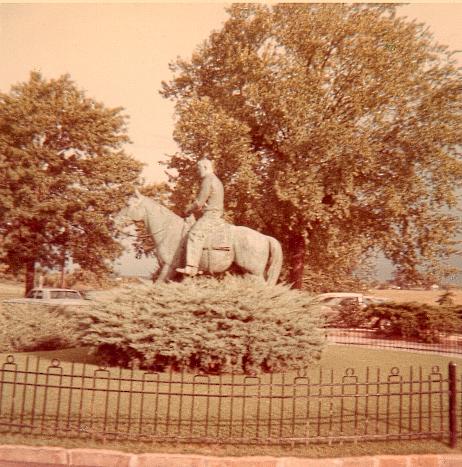
aug1969.1An equestrian Will. Fitting for a man so adept at rope tricks, I suppose, though you’d think he’d be holding a lasso.

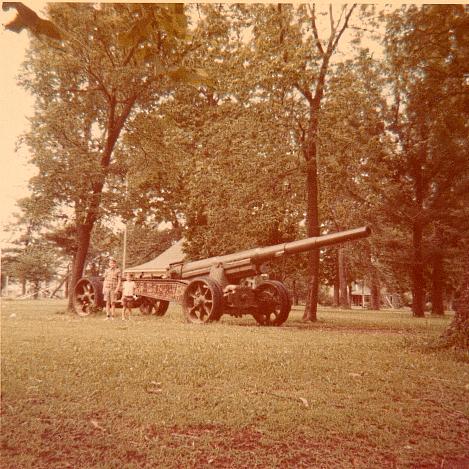
aug1969.2Here’s one I can’t pinpoint in time or space, and Jay can’t either.

aug1969.3I’m with Jim, in front of what seems to be a WWI-vintage cannon. It’s clearly summer. That’s about all I can tell. All the back says is Summer 1969, but even that’s suspect, since I wrote it sometime in the mid- or late ’70s. It’s easy to misremember.

Come and Take It

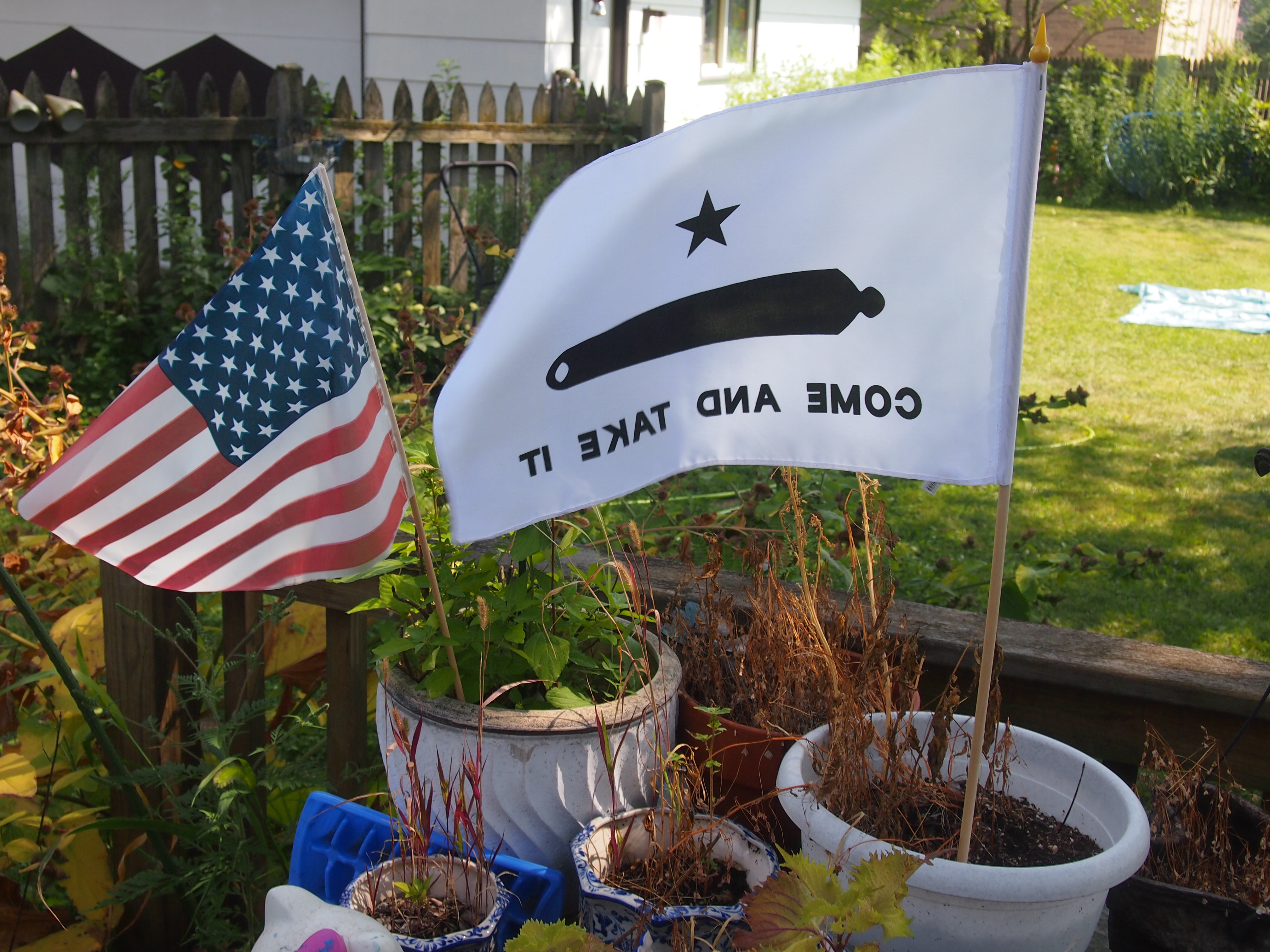
There probably aren’t too many Come and Take It flags flapping in the Illinois wind, but there’s one in my back yard. It’s along with a Stars and Stripes, one of many that a Realtor posted on our block – all near the street – for the Fourth of July this year.

Come and Take ItIt’s the flag I bought as a souvenir of my visit to Washington-on-the-Brazos State Historic Site in April. It was a little long to take in a suitcase on an airplane – and it’s a little pointy, just the kind of thing that might alarm a literal-minded TSA agent and who might indeed take it – so I left it at Jay’s house, intending to pick it up in July, when I could take it back in my car. Remarkably, I remembered to do just that, though it’s been in the car for a few weeks.

Nothing like an obscure historic flag of defiance to brighten up your deck. Unlike the Gadsden Flag, it hasn’t been co-oped by anti-government radicals (anti-government, except for their Social Security and Medicare).