Houston Water Features

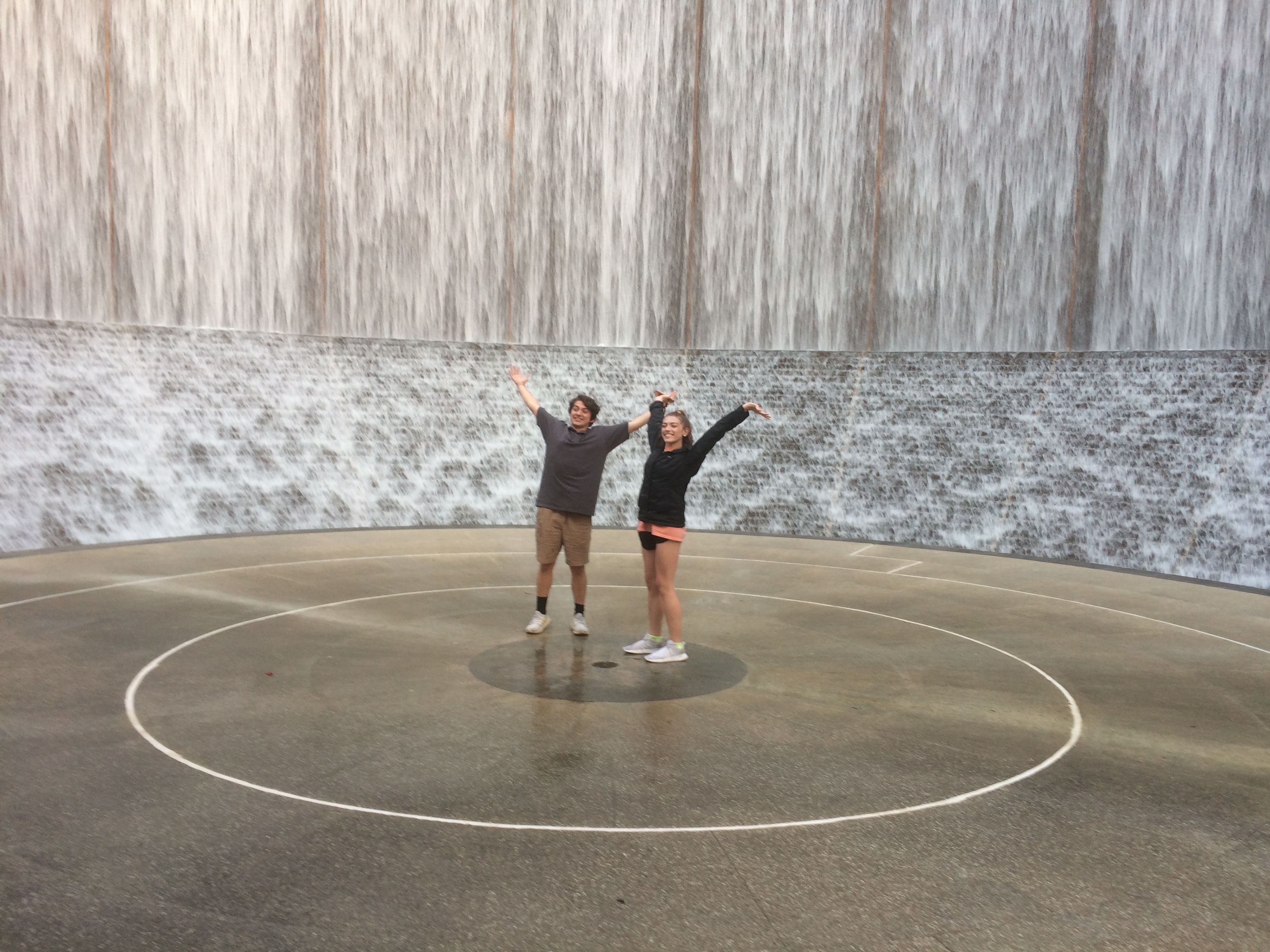
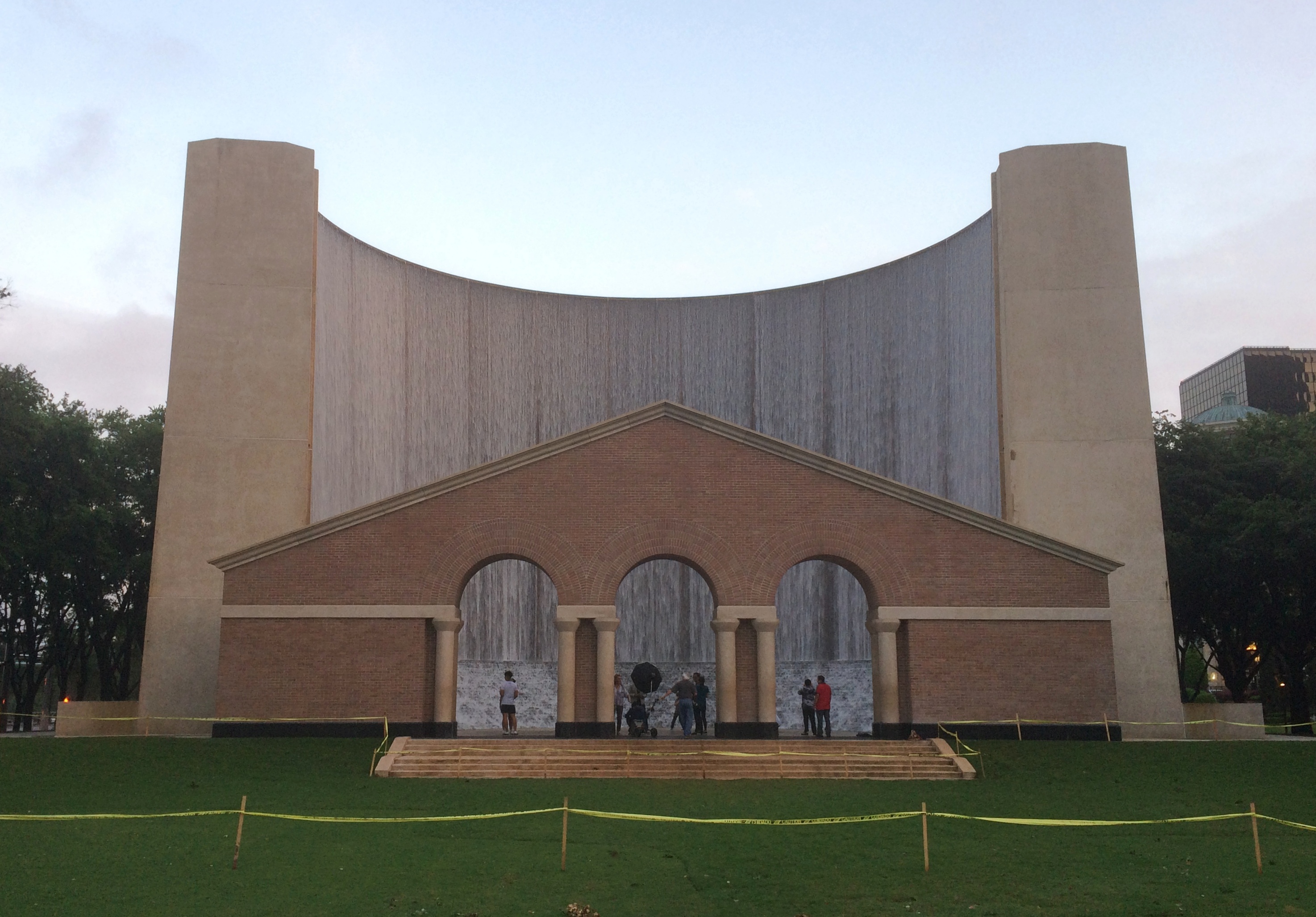
Near the Galleria in Houston, which is a mixed-use property that includes the 1.9 million-square-foot mall of that name as well as office towers and a couple of hotels, is a local feature unlike any other: the Gerald D. Hines Waterwall Park. Or more commonly, the Waterwall.

Waterwall is an apt name, with water cascading down the front.
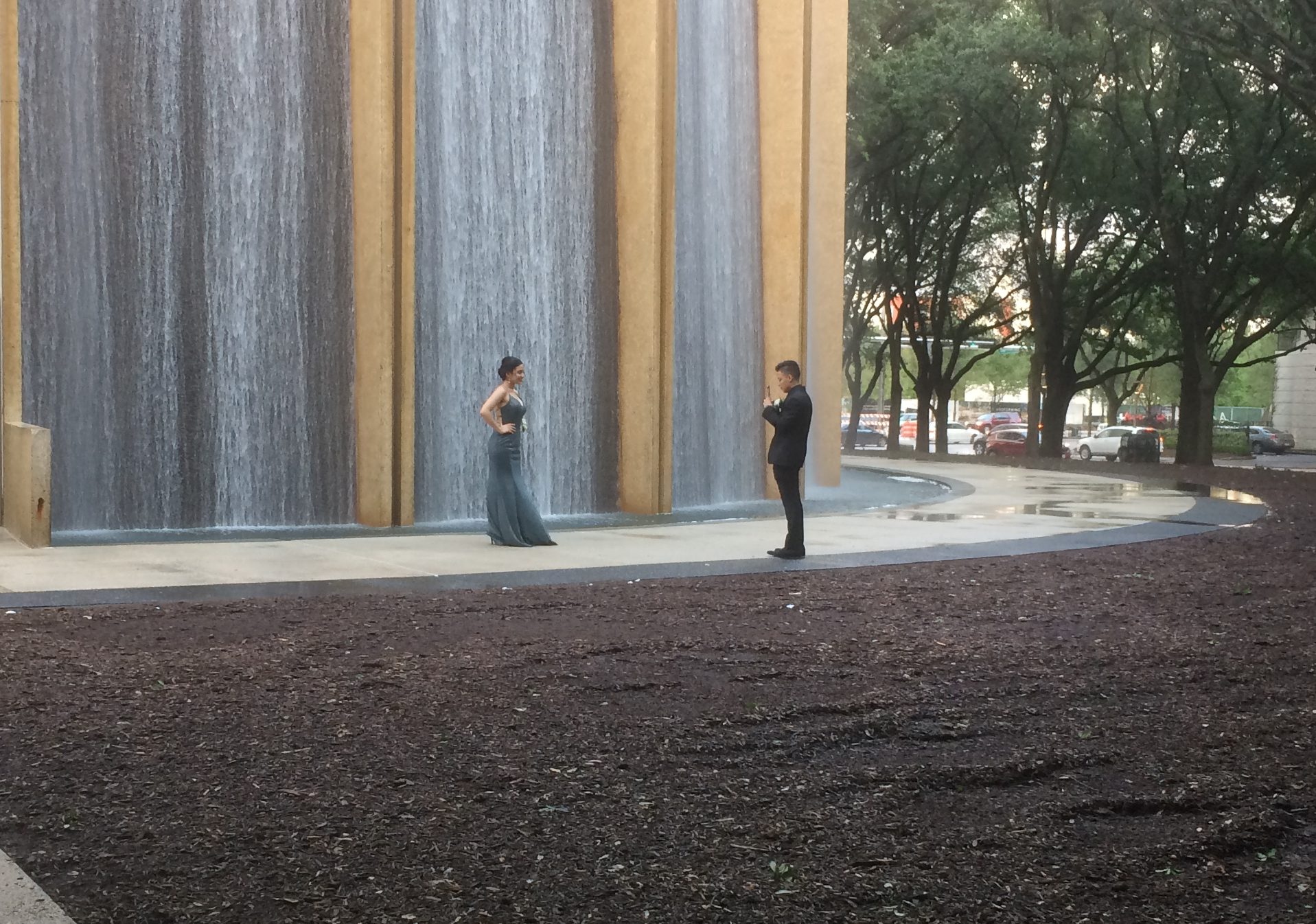
Water cascades down the back as well.
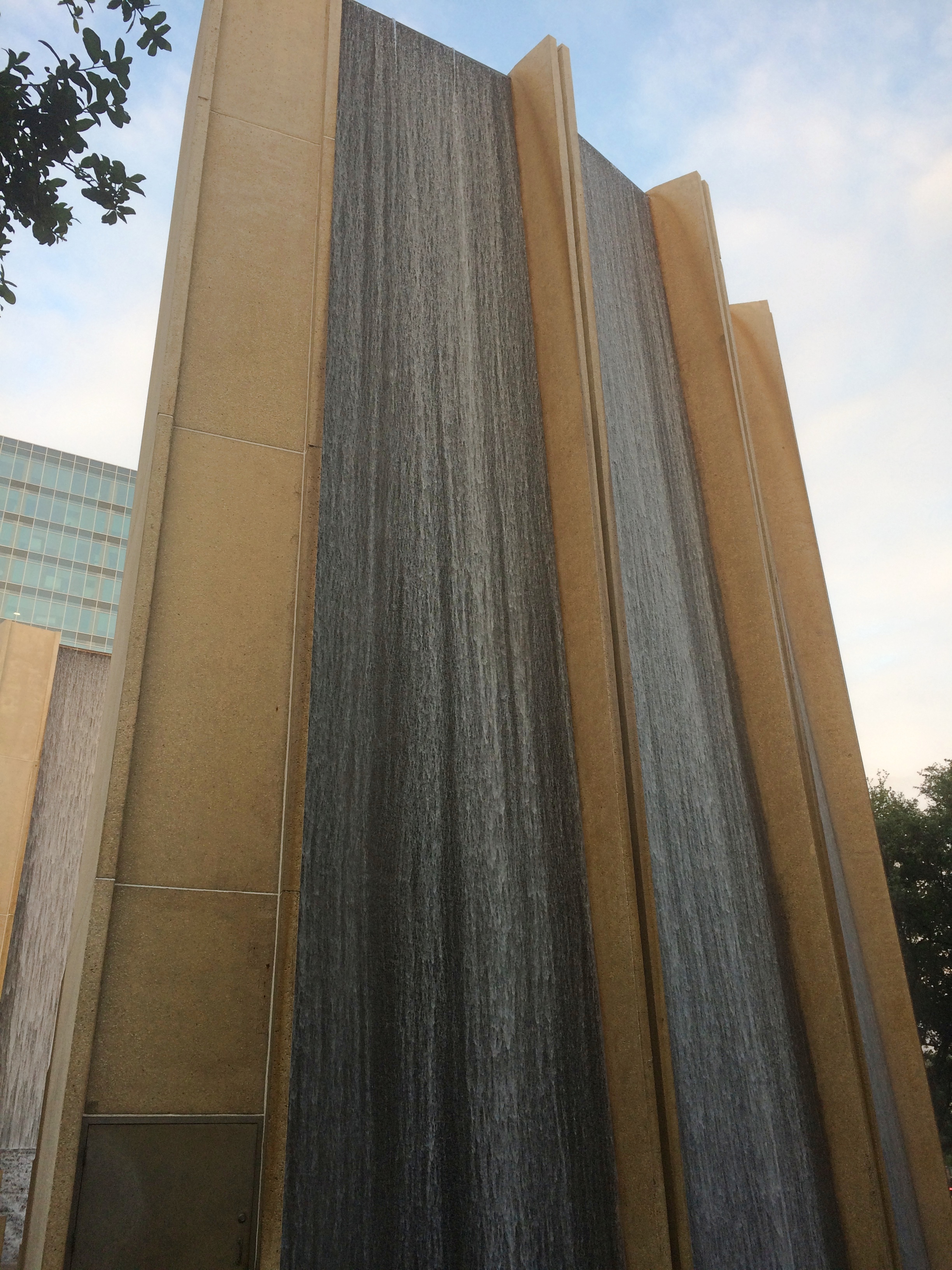
According to a nearby plaque, 11,000 gallons of water spill over the walls per minute, from a height of 64 feet. John Burgee Architects, working with Philip Johnson, designed the massive water feature, apparently inspired by ancient Roman theaters.

This is a drone’s view. All we had were our own eyes to appreciate the place.

It’s a popular place to have your picture taken, front and back, but especially in the circle near the spray coming off the waterwall.
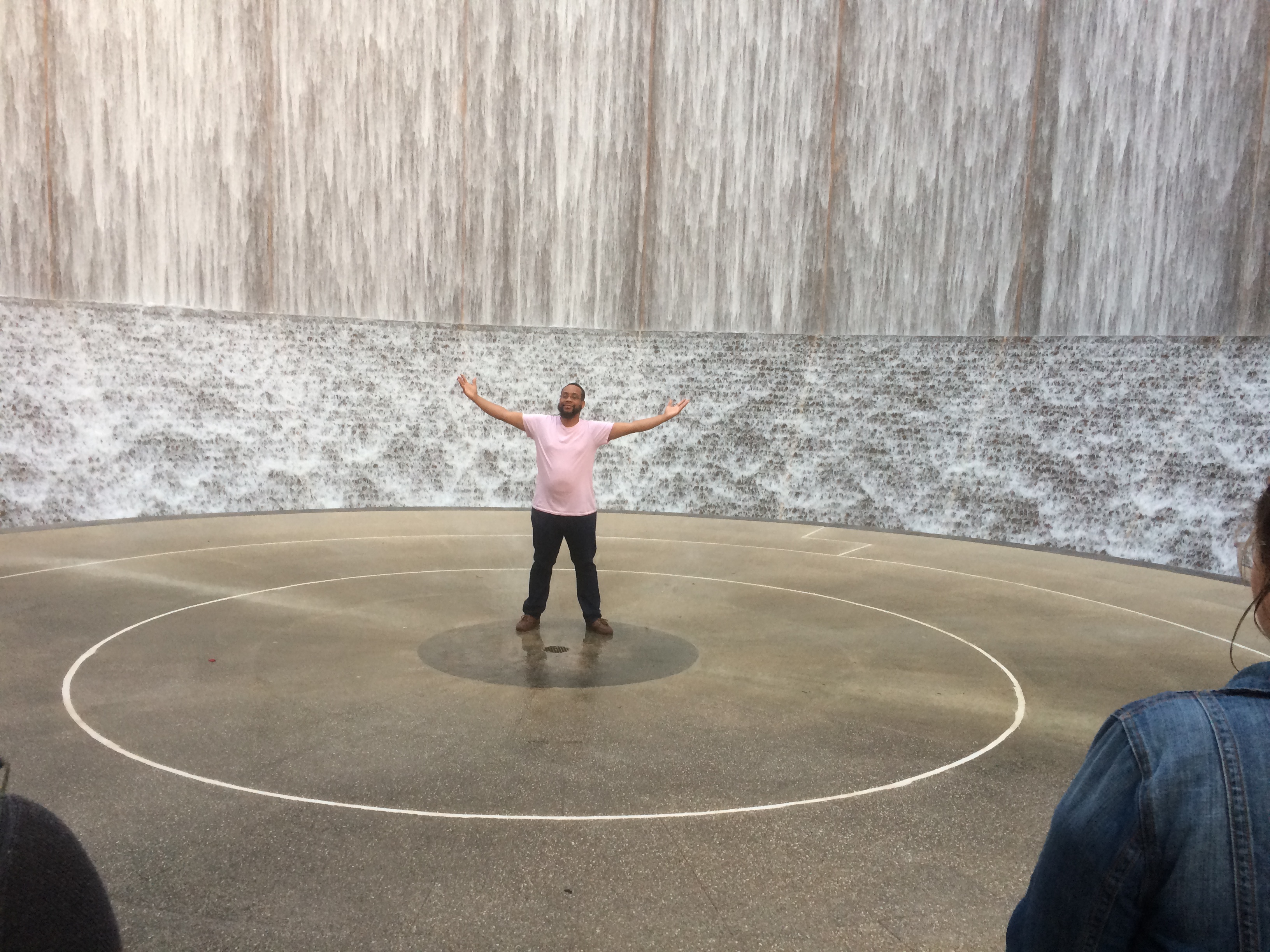
More than one person asked Lilly to take their picture at the site, including the young couple above, dressed to the nines.

Completed in 1985, Waterwall was privately owned until it looked like ownership might destroy it. In 2008, the Uptown Houston Tax Increment Reinvestment Zone, a local nonprofit, acquired the Waterwall and the surrounding land. That might have been when I first read about the Waterwall, but then I forgot about it.

We stayed near the Galleria — in the nicest La Quinta I’ve ever stayed at — and when I was mapping out a route to visit the mall, I noticed the Waterwall nearby on Google Maps. I remembered it instantly and knew I wanted to go. We saw it late on the afternoon of May 11.

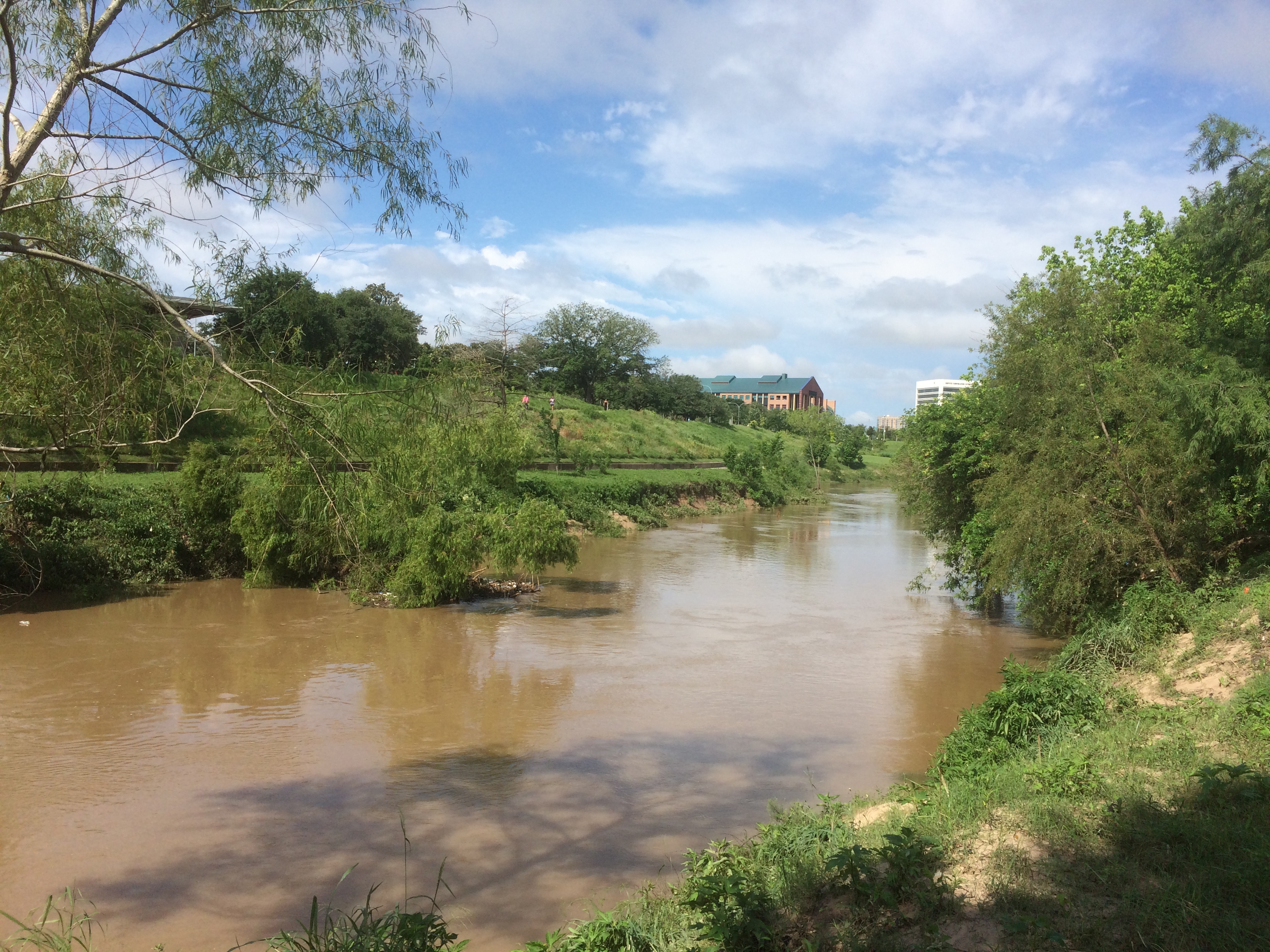
The next morning, we checked out and headed for New Orleans. But not before we spent a while near Buffalo Bayou, the main river through metro Houston. It’s another map feature that I wanted to see with my own eyes.

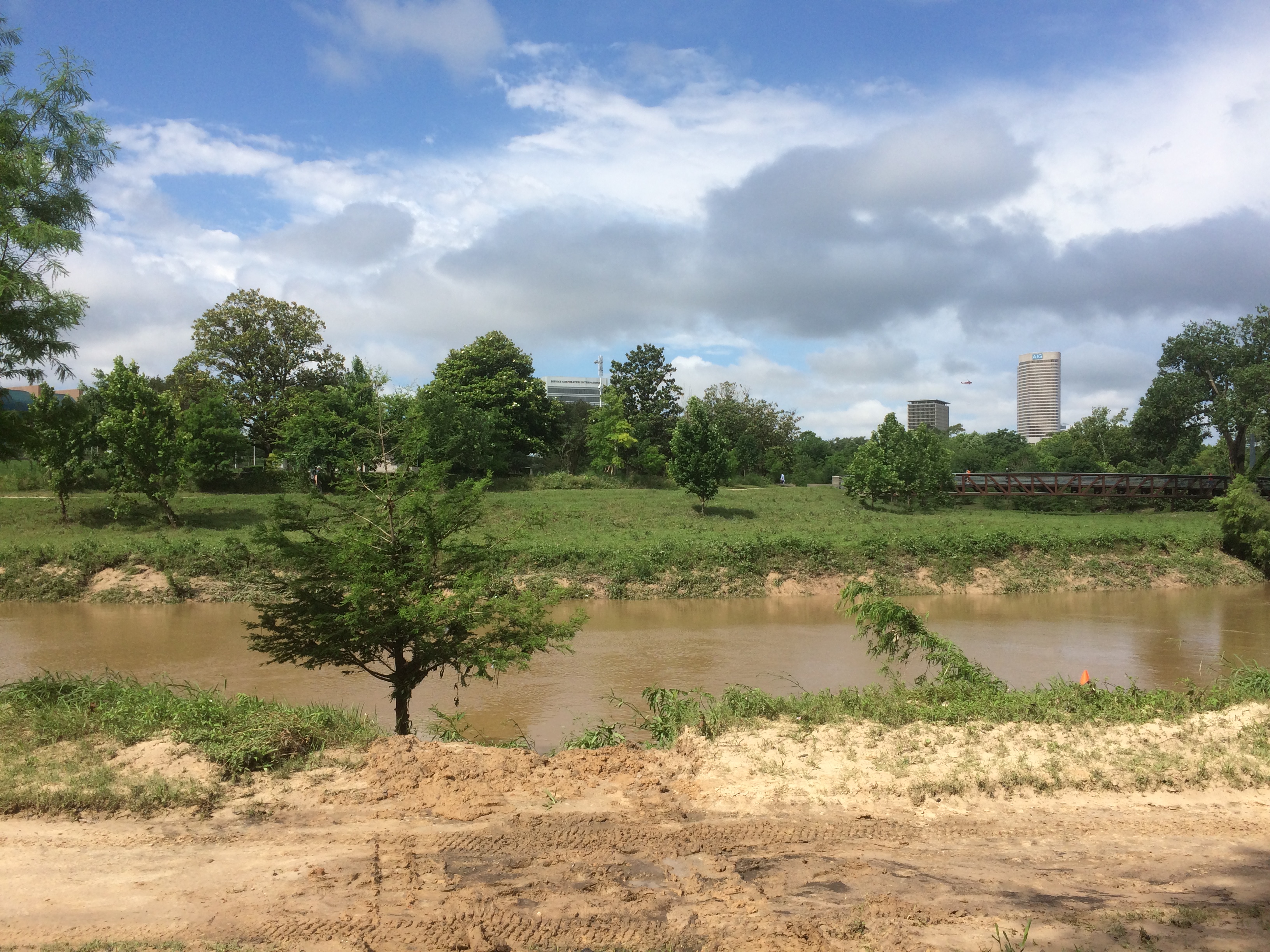
The park associated with Buffalo Bayou near downtown Houston has its charms, one of which is a view of downtown Houston.
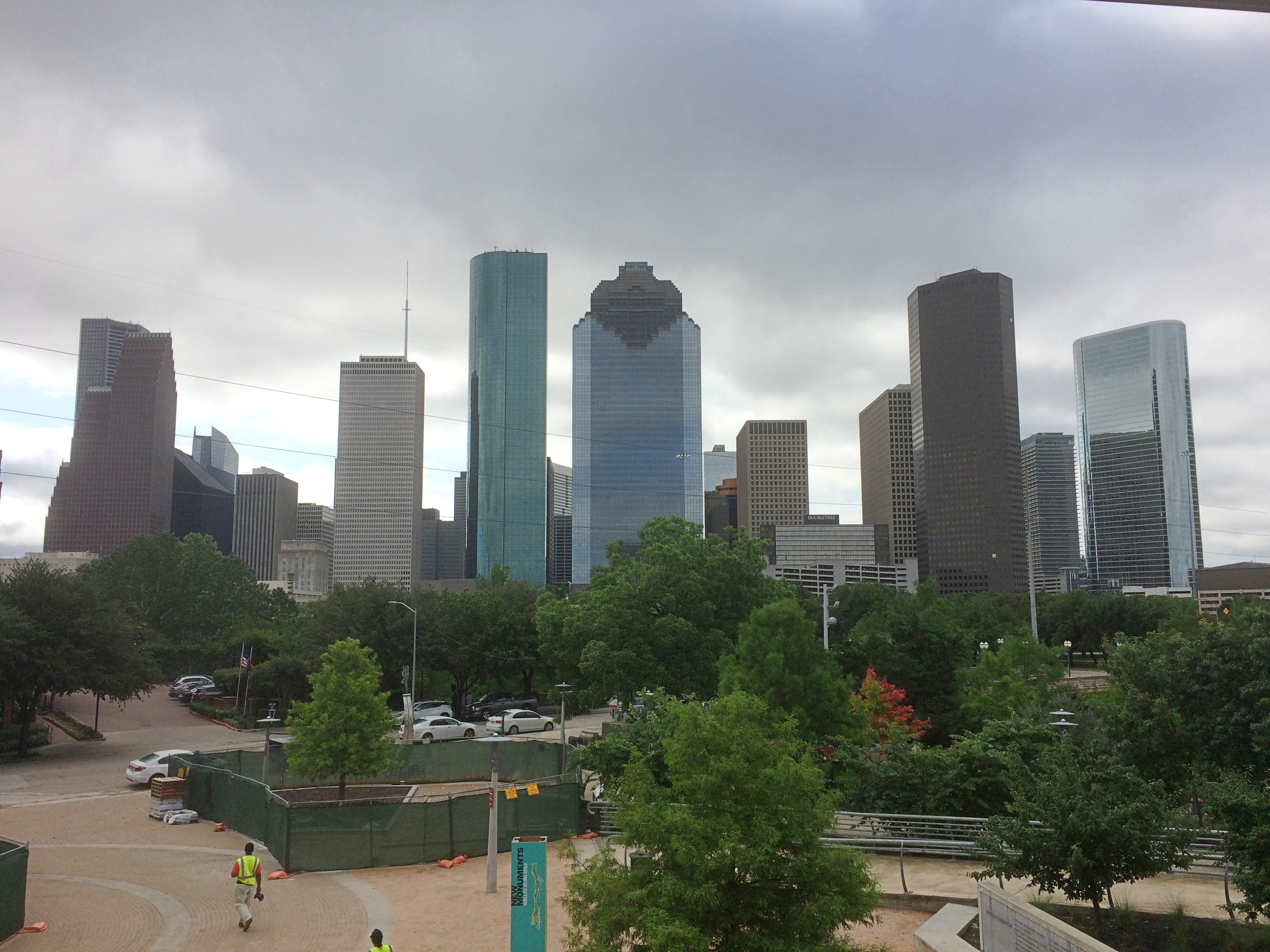
That is the city’s original downtown, but at least in terms of office building density, the Galleria area now functions as another downtown for Houston. I knew that because I’ve read about the Galleria office market, but seeing it myself drove the point home.

Lilly and I walked along the Buffalo Bayou Park path for about an hour.
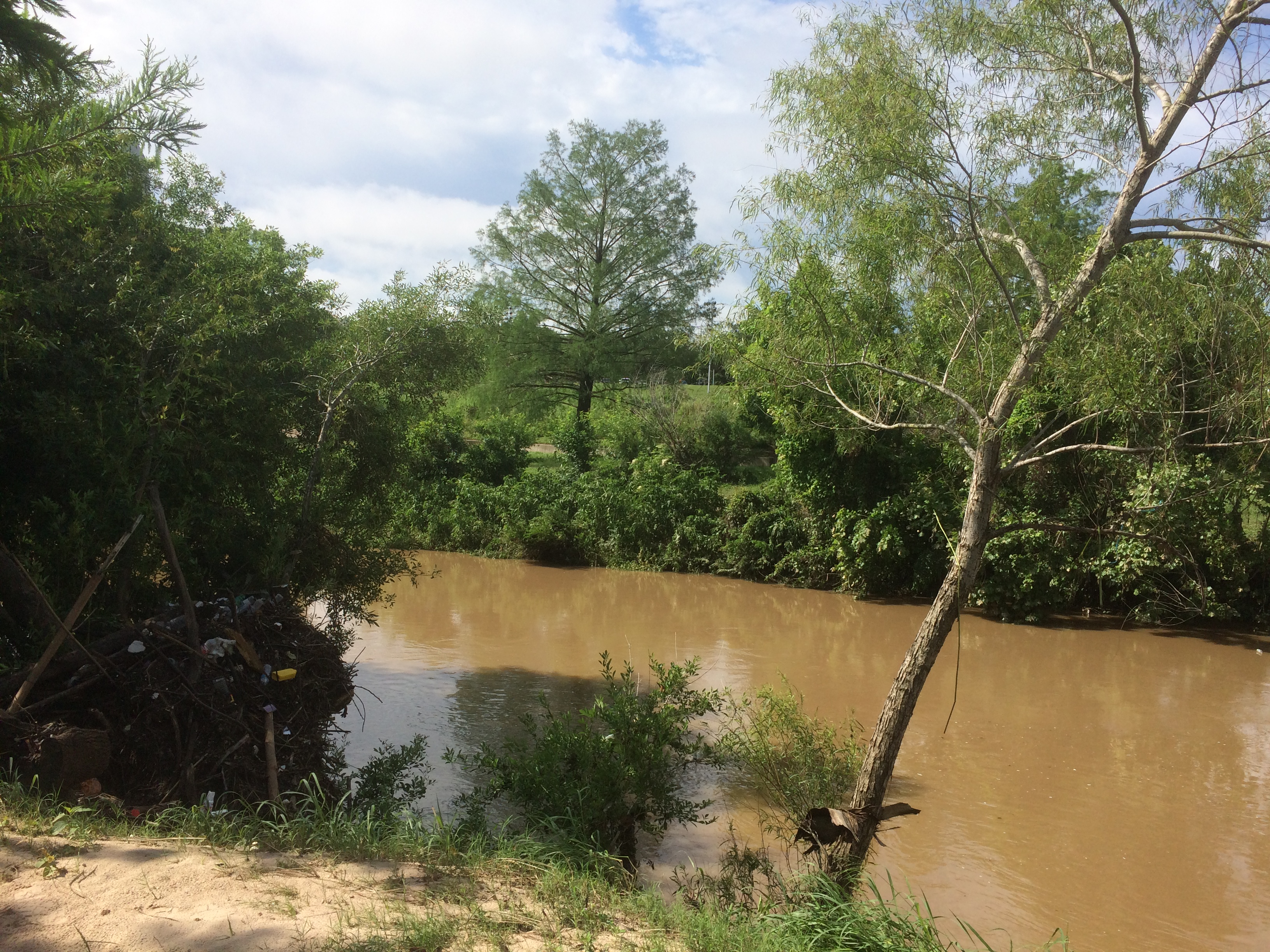
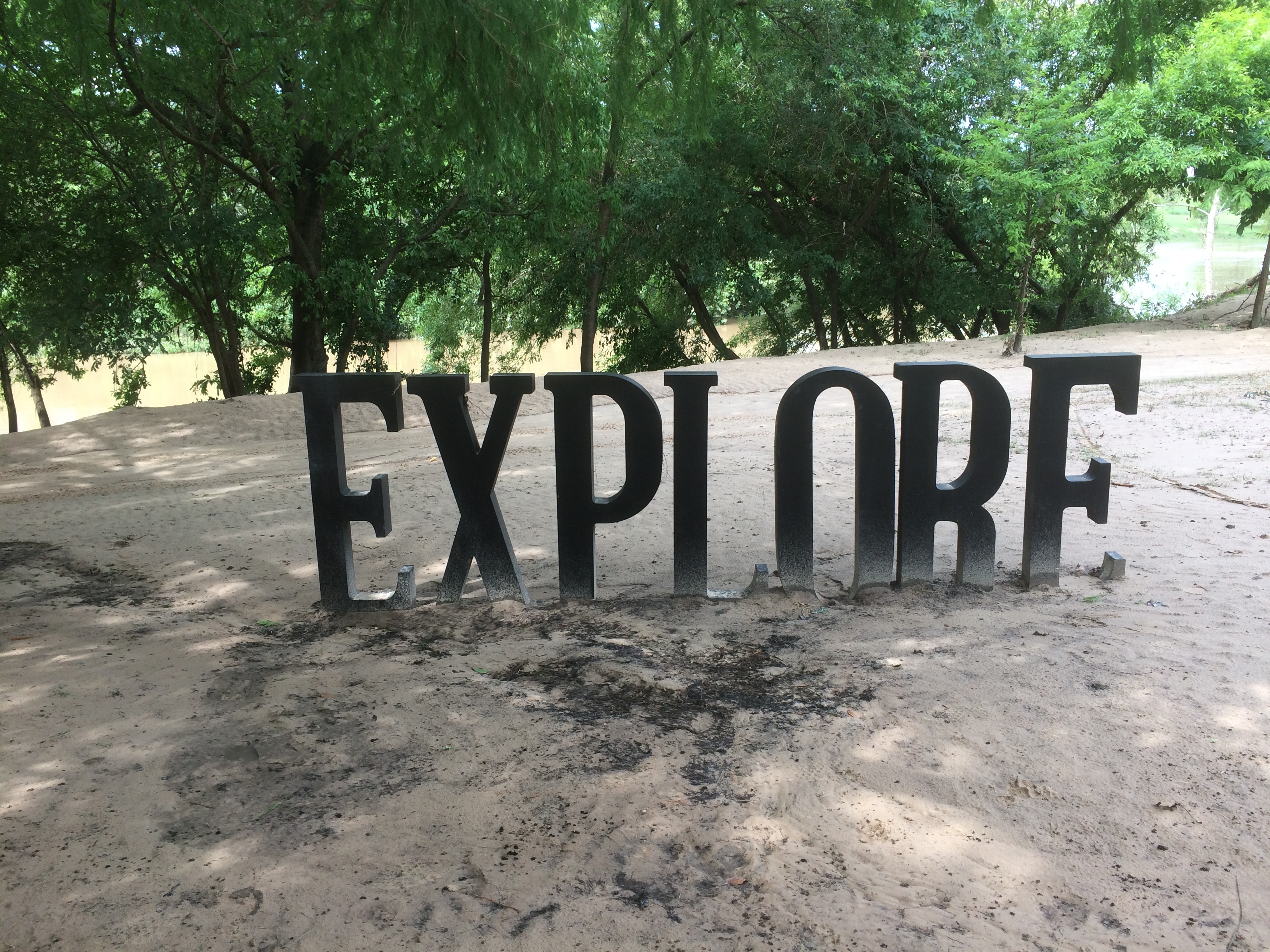
At one point, the landscape urged us onward.
At the tip end of Buffalo Bayou Park facing downtown is the Buffalo Bayou Park Cistern. I can’t remember when I read about that. It wasn’t long ago.
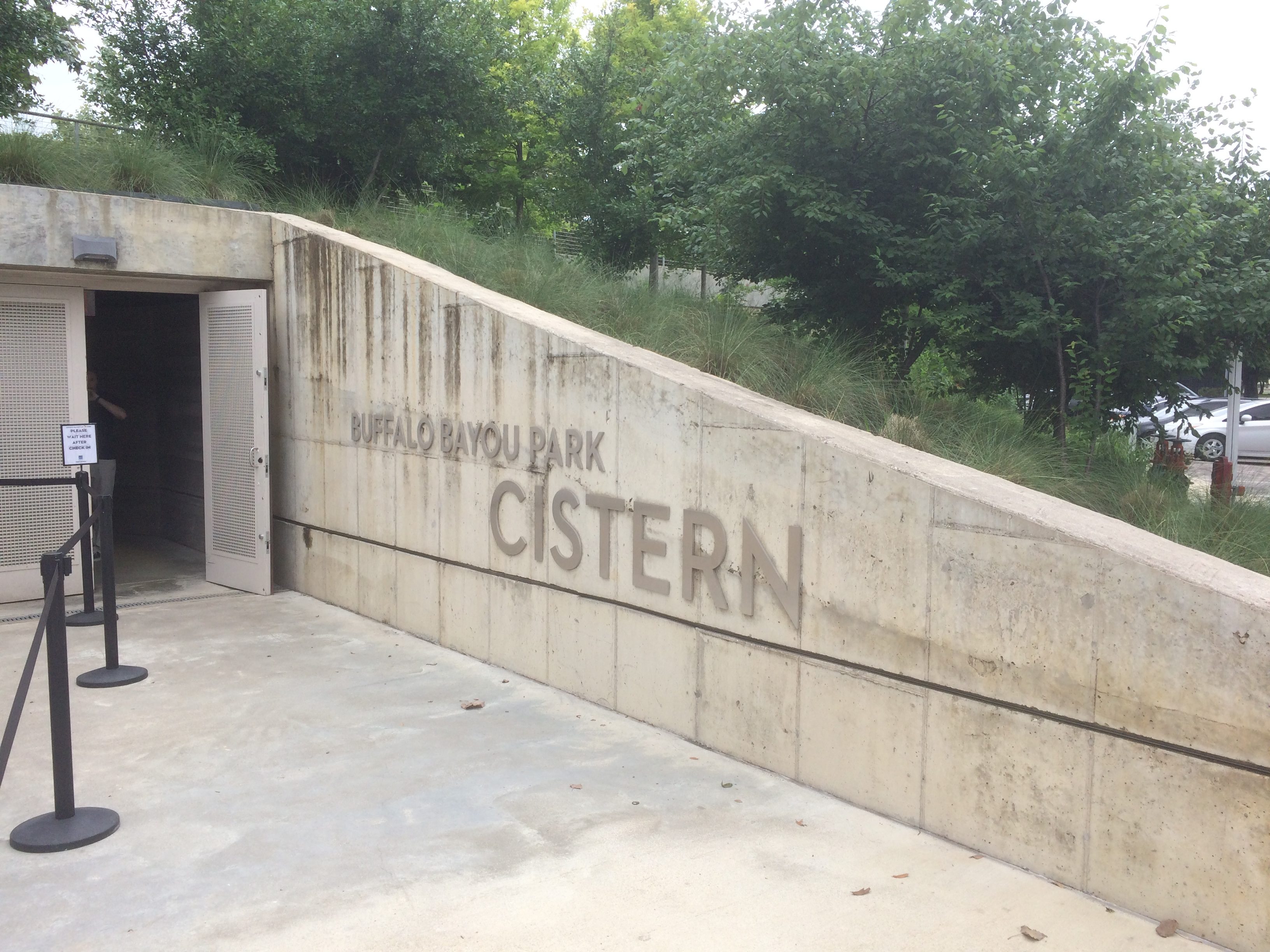
Maybe in the likes of Atlas Obscura. That publication saves me the trouble of writing a description, along with the embarrassment of publishing the crummy pictures that I took inside the cistern.

“Built in 1926, this 87,500-square-foot… space was one of Houston’s first underground reservoirs,” the Atlas says. “The eight-inch-thick concrete roof is supported by 221 concrete pillars reaching 25 feet high that march in rows into the dim distance.

“A public works facility for decades, an irreparable leak was eventually found in the structures walls and thus it was subsequently decommissioned in 2007. The city was preparing to demolish it when it was found by the partnership developing Buffalo Bayou Park. After briefly considering using it for parking or mulch storage, the developers decided to keep it as an unusual and attractive space for park visitors.”

We took the 20-minute tour inside. “That was cool,” Lilly said afterward, meaning it metaphorically, not literally. I was expecting the inside of the cistern to be cool like a cave, but it was closer to room temperature. Anyway, I completely agree with Lilly.
The Painted Churches

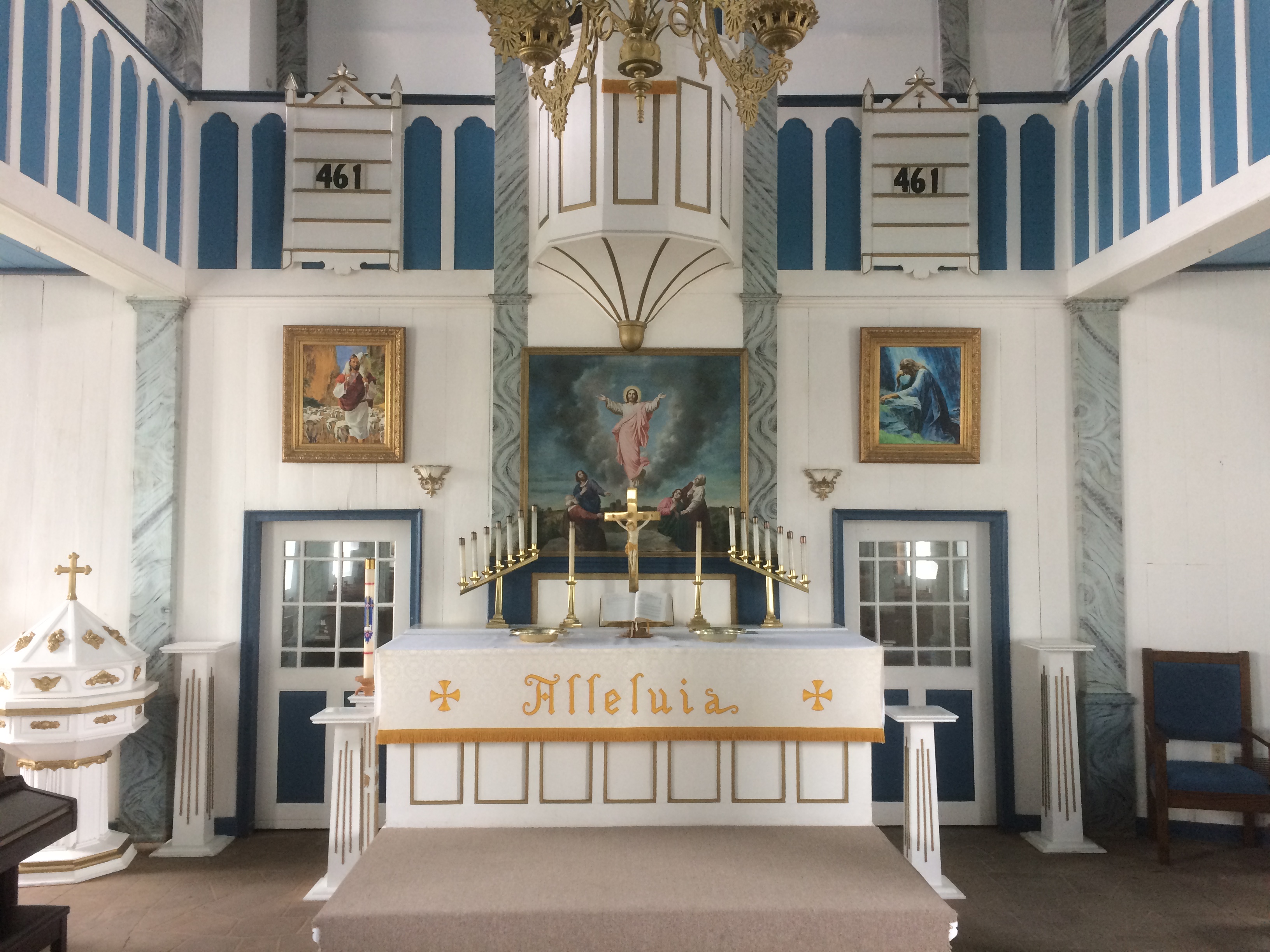
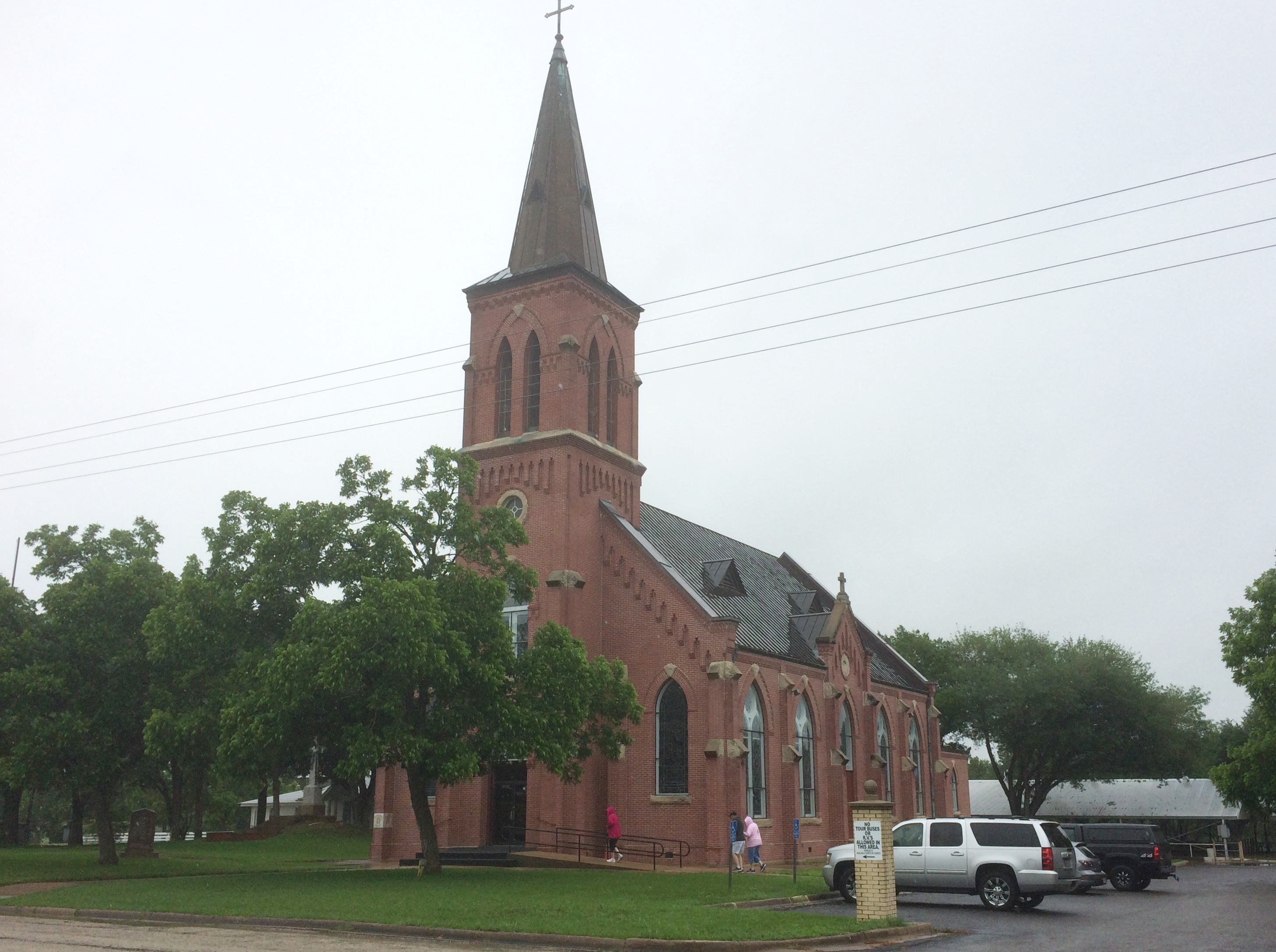
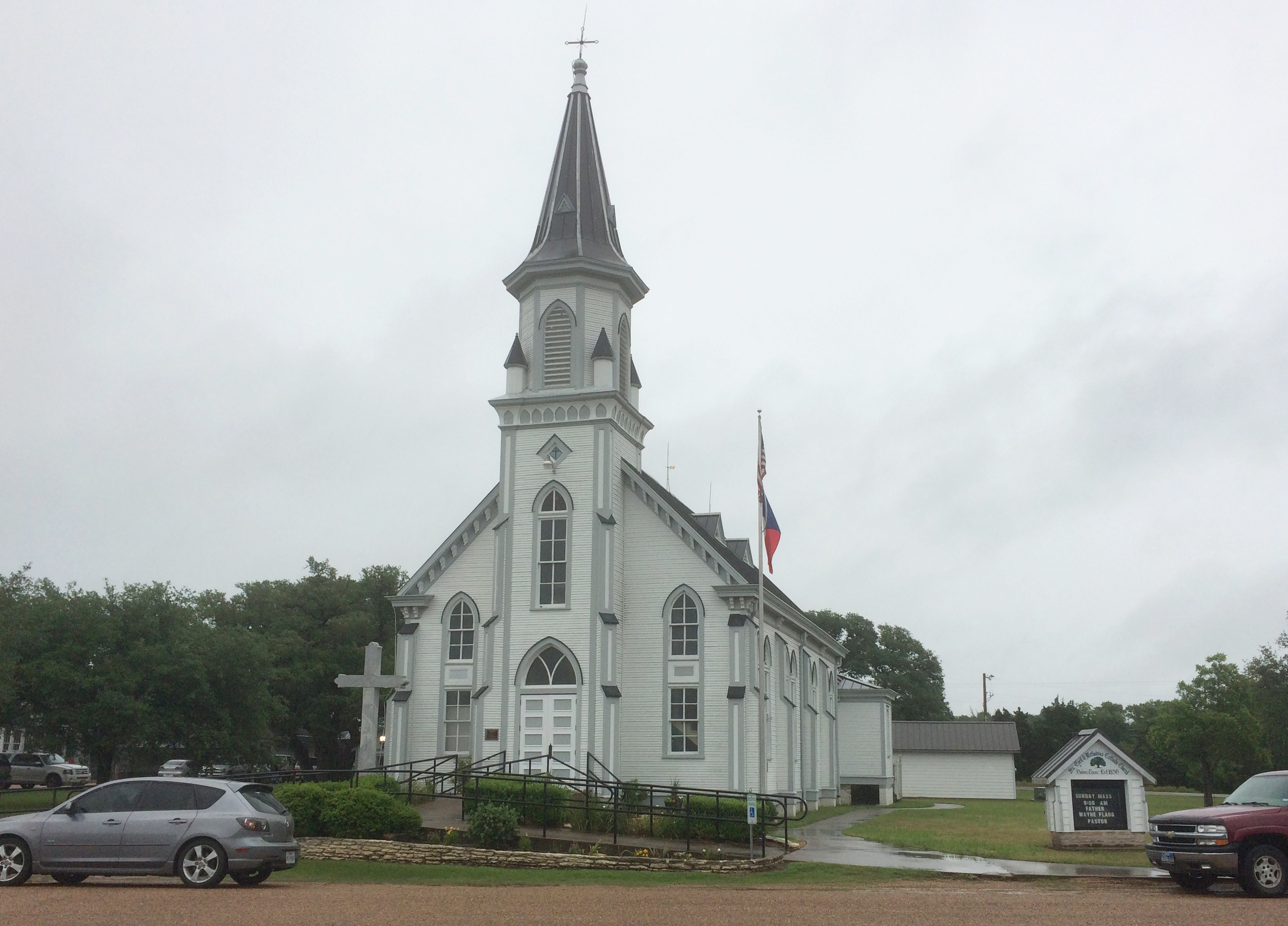
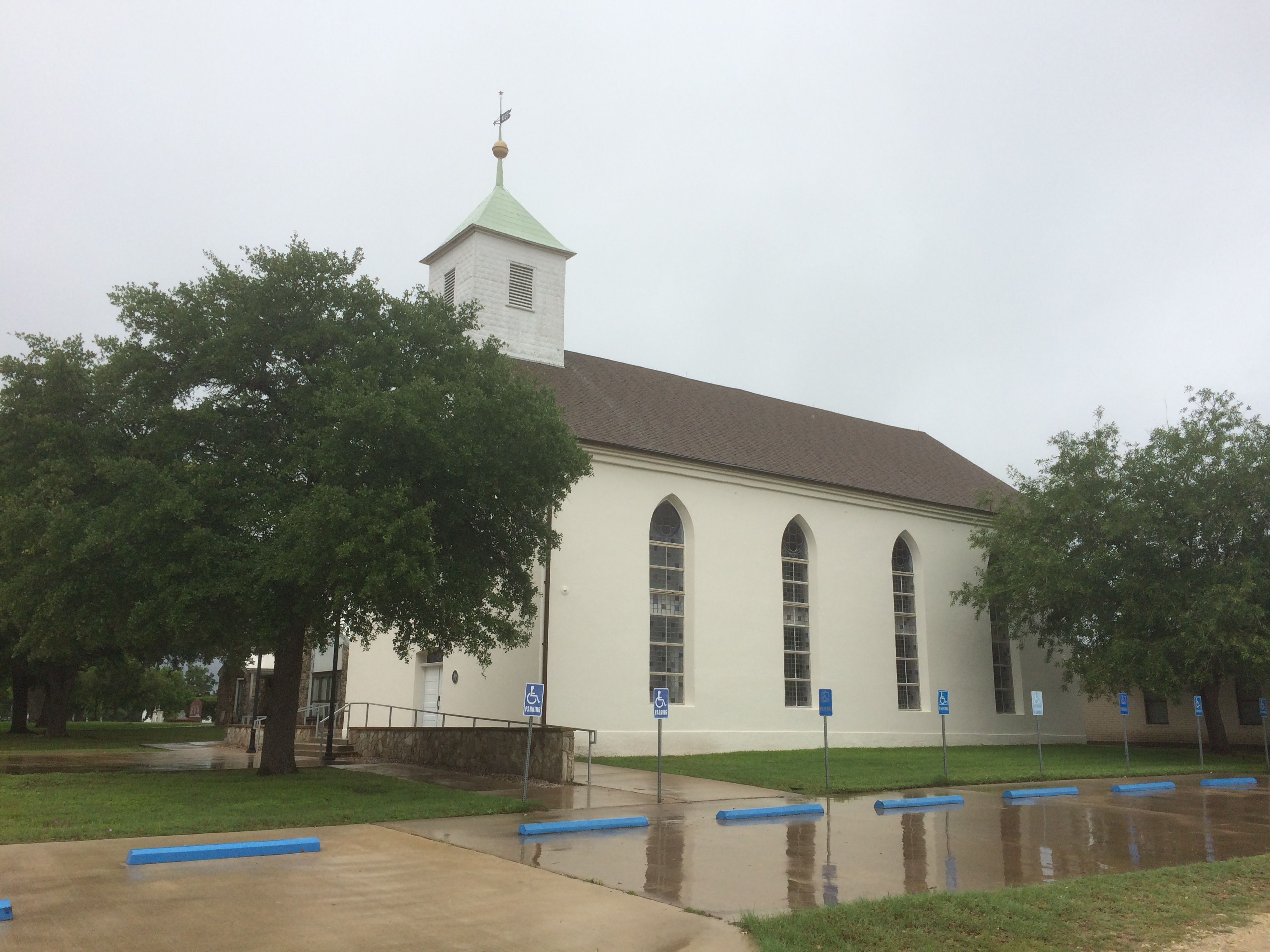
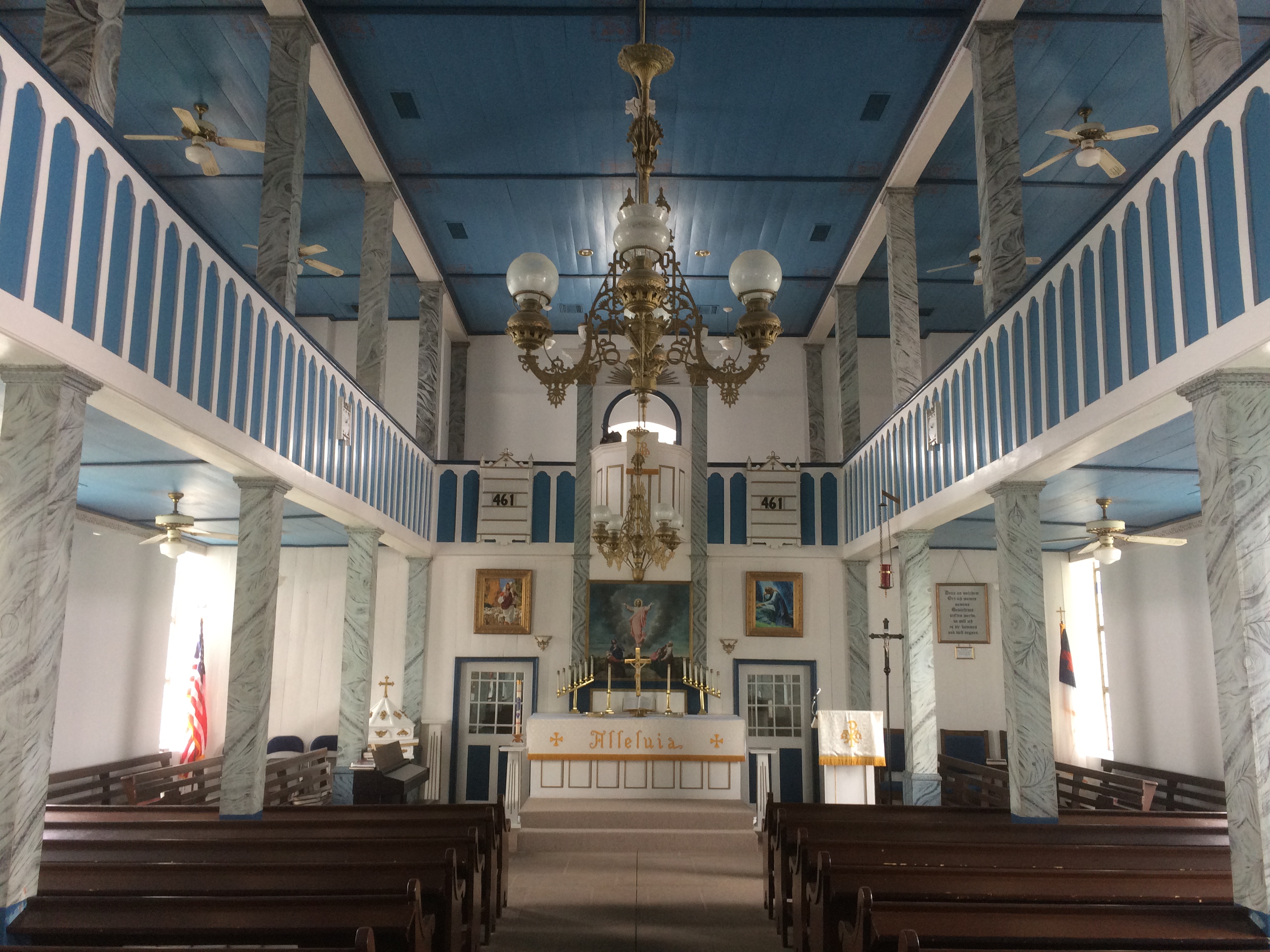
Just outside the hamlet of Serbin, Texas, if you follow your map but also keep your eyes peeled — because the map isn’t quite accurate — you’ll find yourself outside St. Paul Lutheran Church. The exterior is nice, but isn’t particularly distinctive.
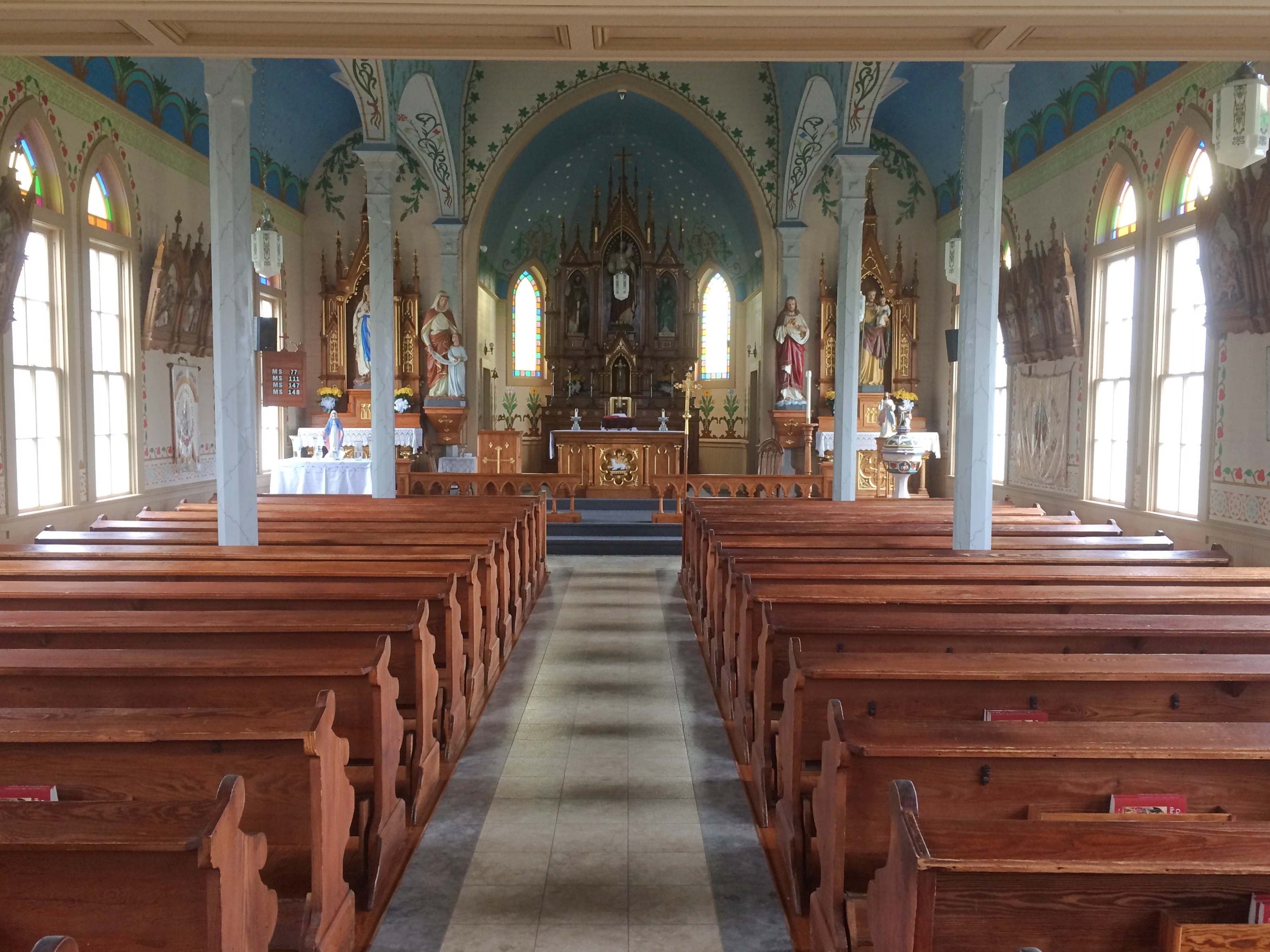
Inside is a different story.
St. Paul is one of the Painted Churches found in Central Texas. In its case, the church was built in the late 19th century, but not decorated until 1906, when the congregation itself took up the task.

“Cross the threshold of these particular Texas churches and you’ll encounter not a simple wooden interior but an unexpected profusion of color,” says KLRU, which aired a documentary on the churches nearly 20 years ago.

“Nearly every surface is covered with bright painting: exuberant murals radiate from the apse, elaborate foliage trails the walls, wooden columns and baseboards shine like polished marble in shades of green and gray. These are the Painted Churches of Texas.

“Built by 19th-century immigrants to this rough but promising territory, these churches transport the visitor back to a different era, a different way of life. Inscriptions on the walls read not in English, but in the mother tongue of those who built them: German and Czech.”

I’ve wanted to visit the Painted Churches for some time now, but something or other has always make it inconvenient to do so. Still, potential destinations sometimes get under your skin, so I designed part of this particular driving trip to scratch that longstanding itch.

Heading south from Waco on U.S. 77 on May 11 in sometimes heavy rain — sheets of rain — we passed through such towns as Rosebud, Cameron, Rockdale and Giddings, and near the wonderfully named Old Dime Box. St. Paul Lutheran is near Giddings and the first of the four churches we visited.

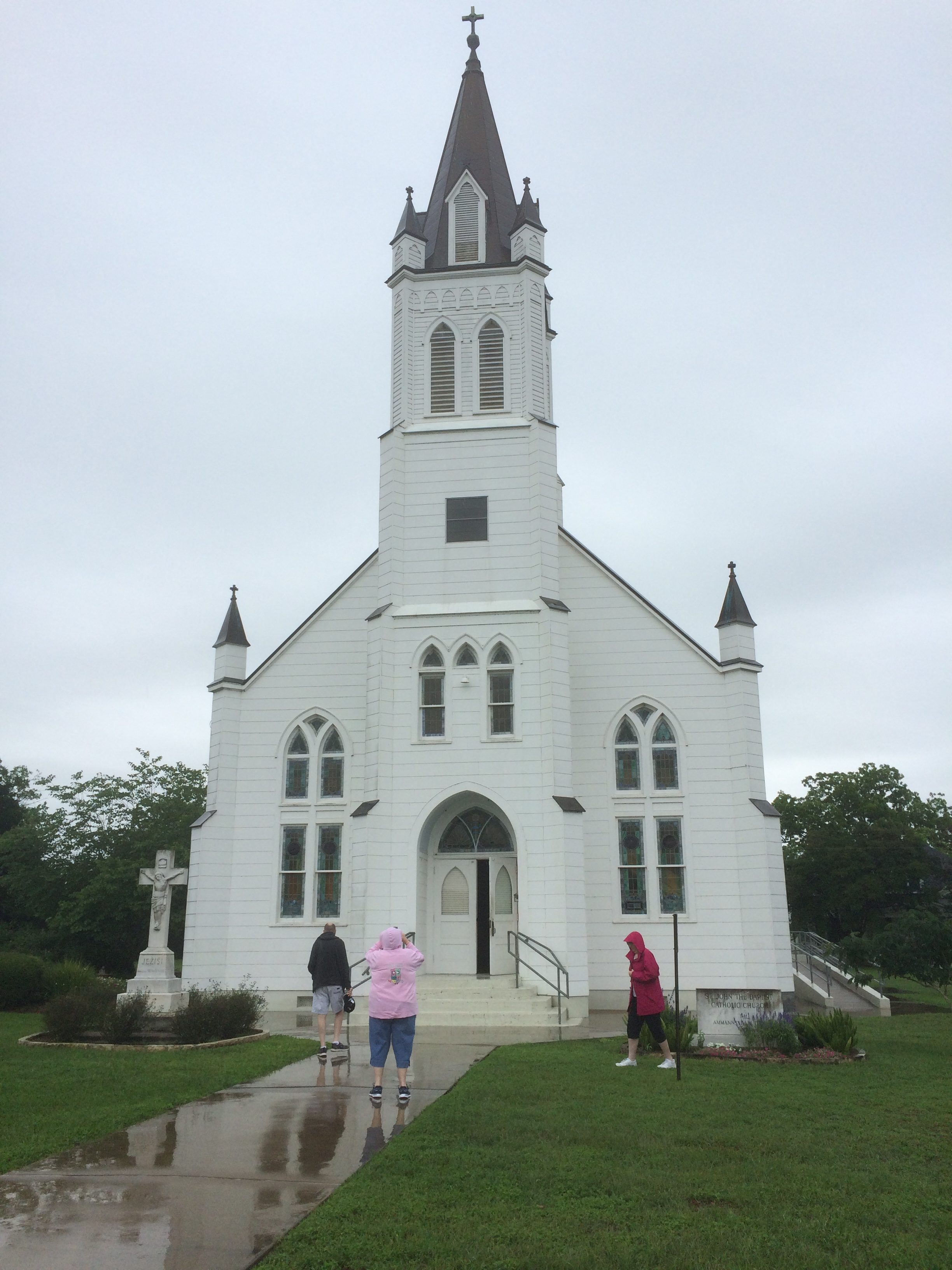
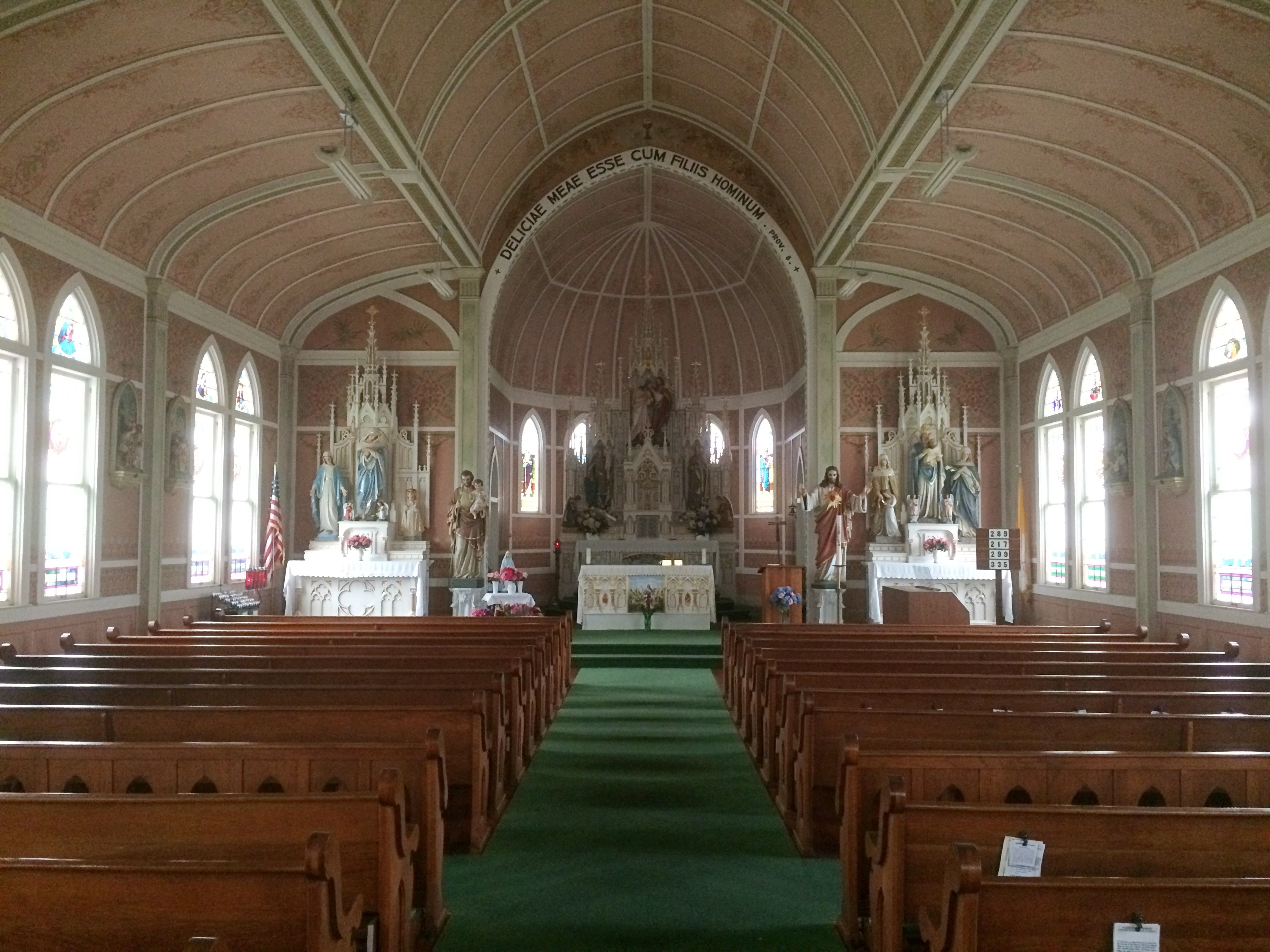
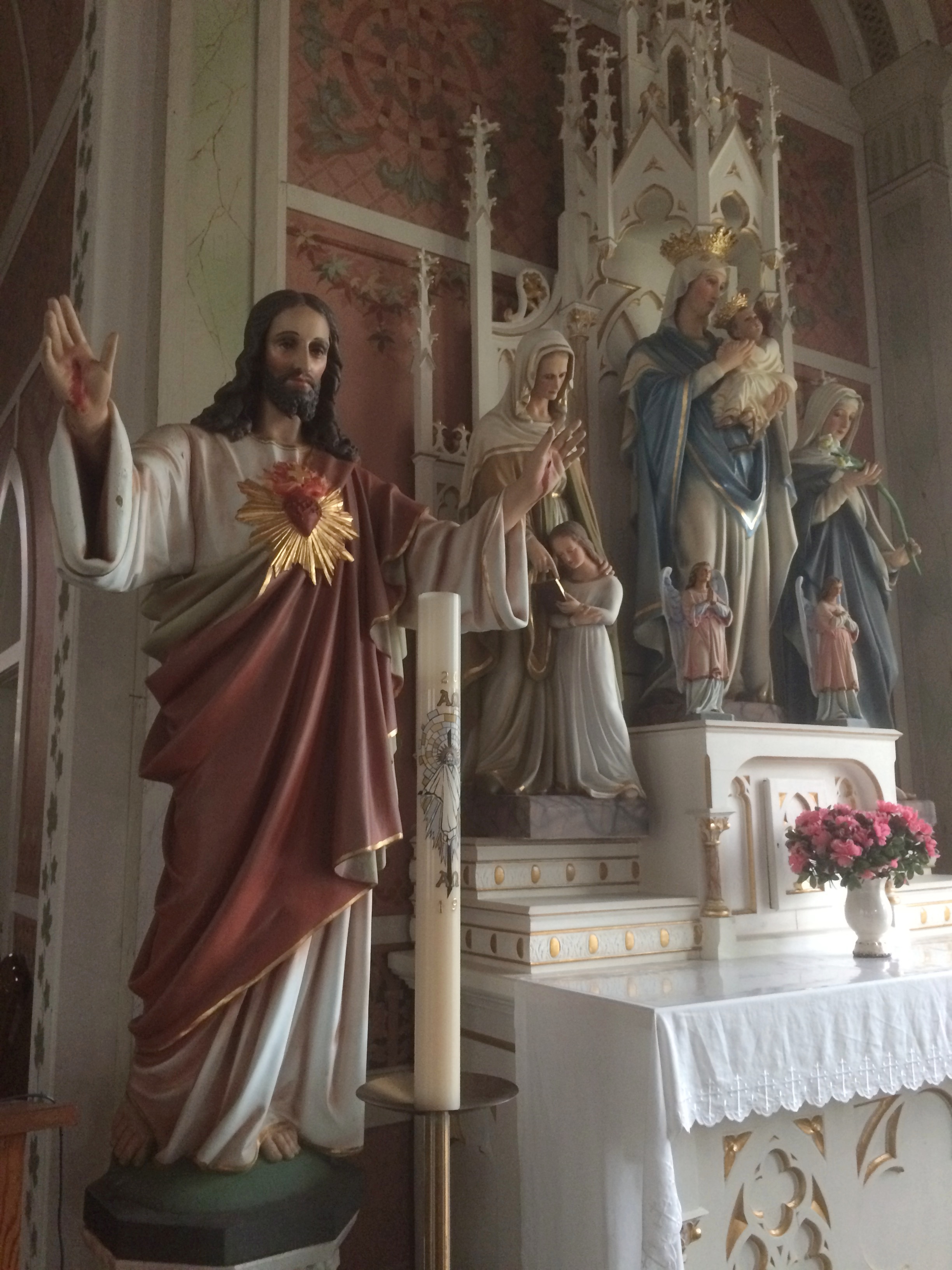
Further south, in the town of Ammansville, is St. John the Baptist Church. We went there next.

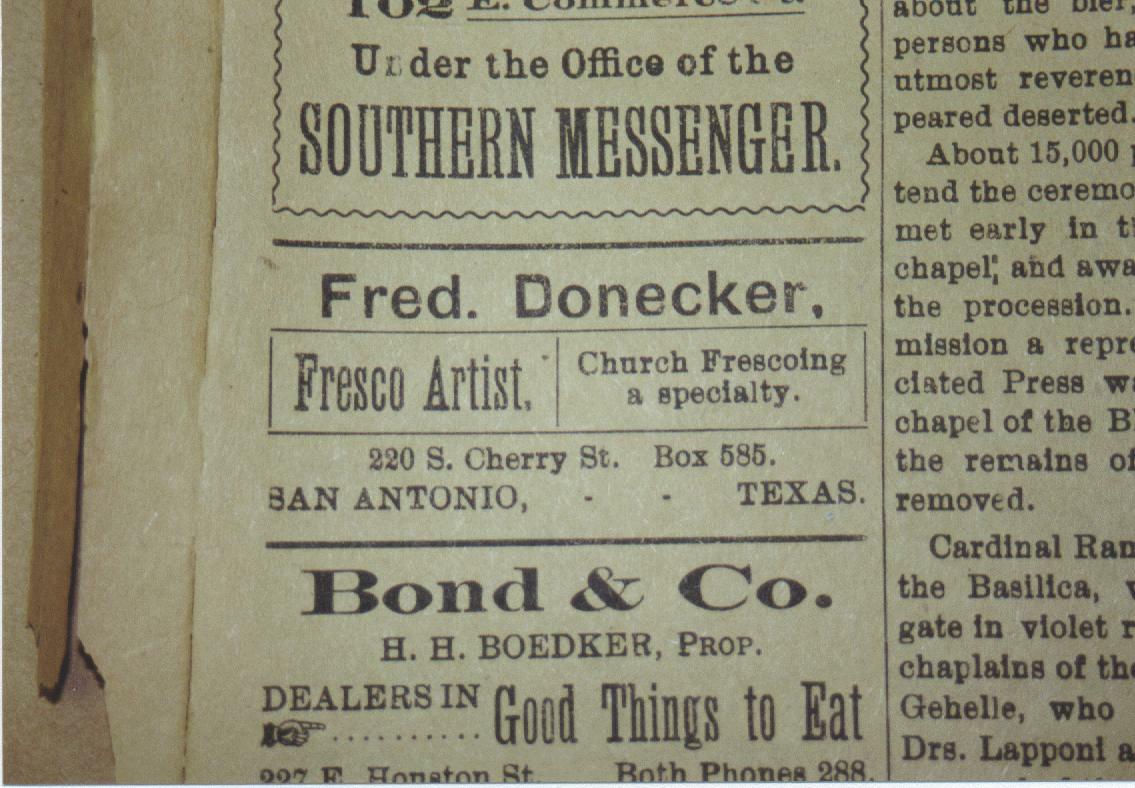
A cemetery is adjacent to St. John the Baptist, which was built in 1918 and painted the next year by one Fred. Donecker of San Antonio, who seemed to specialize in church interiors.

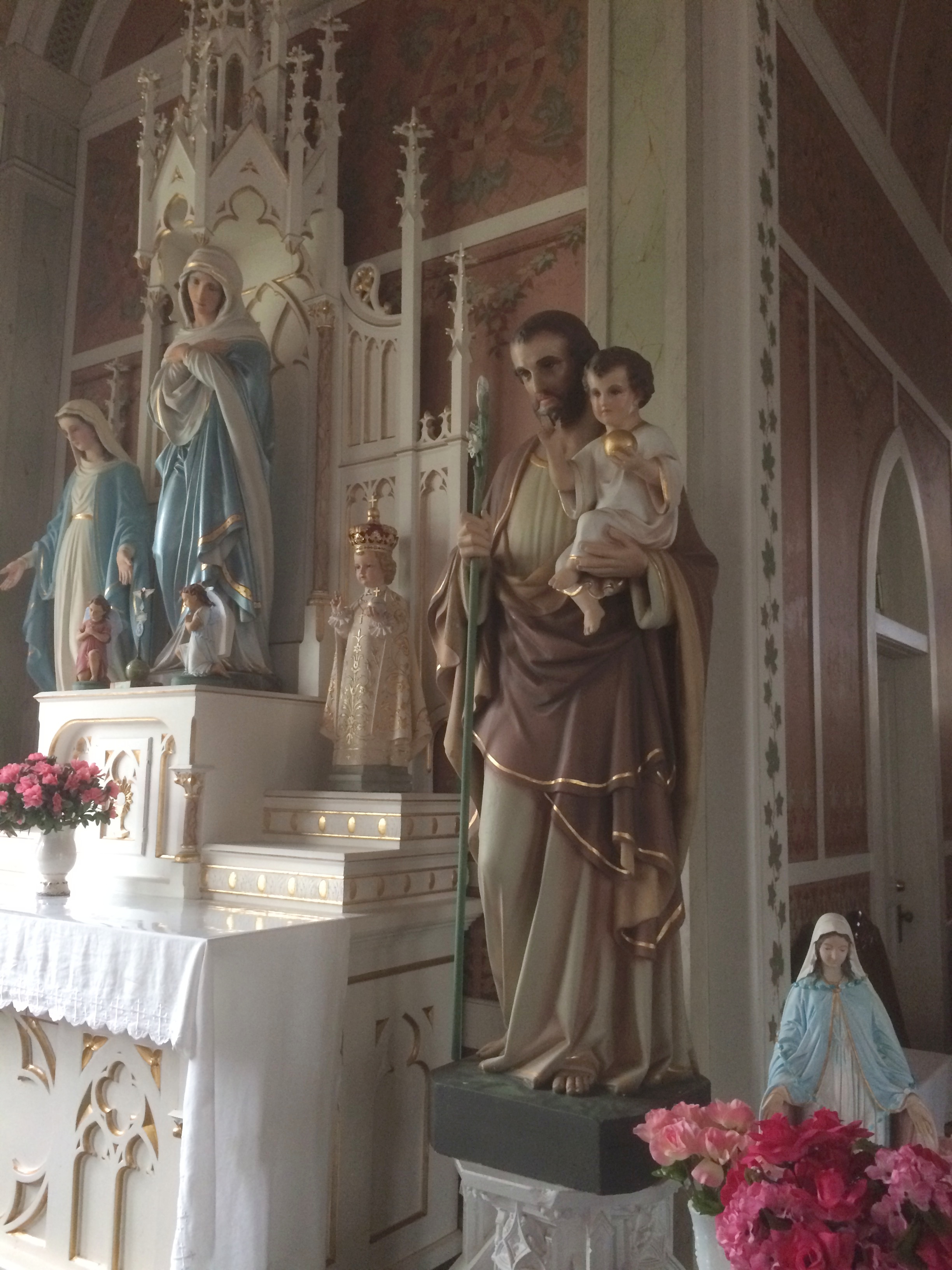
St. Mary’s, also known as Nativity of Mary, Blessed Virgin, is in High Hill, and was built in 1906.
St. Mary’s billed itself as the Queen of the Painted Churches, and it was indeed gorgeous. Unfortunately, it was also dark inside. These pictures capture a bit of its ornate interior.

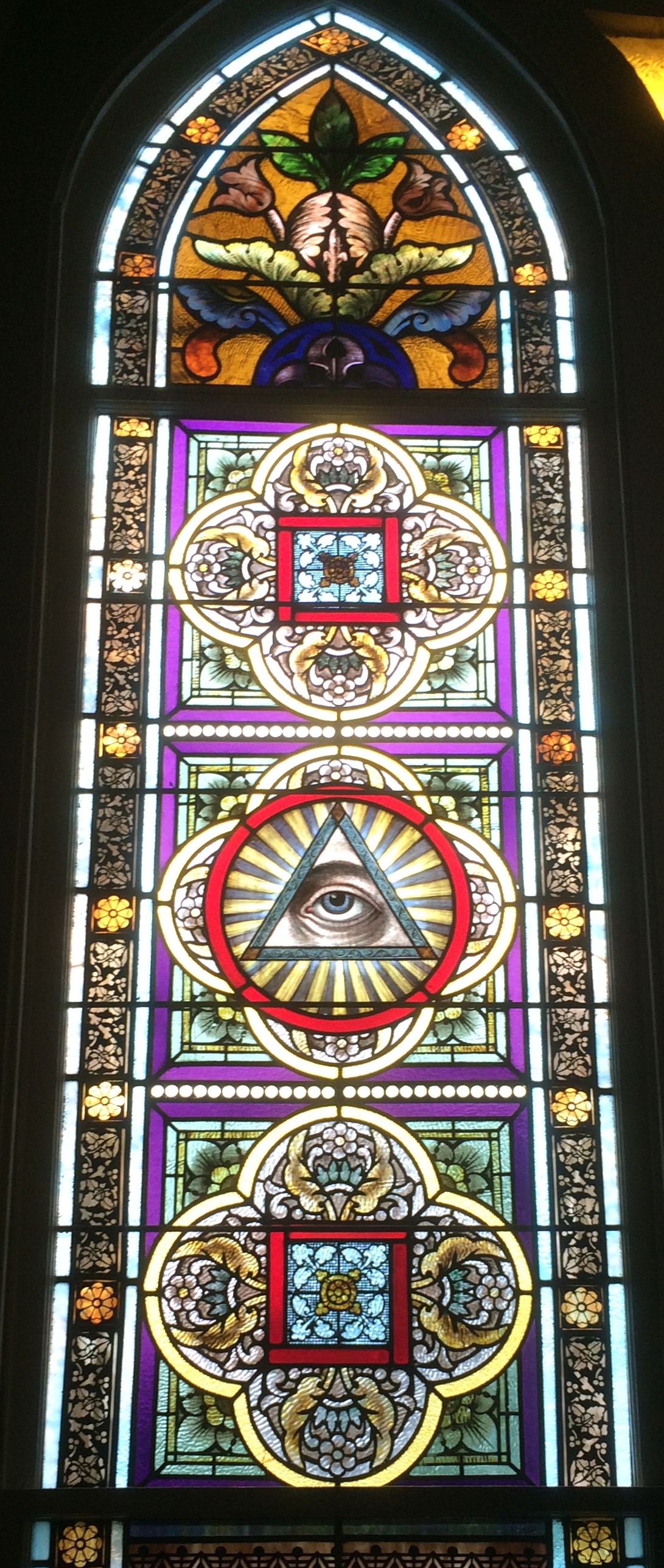
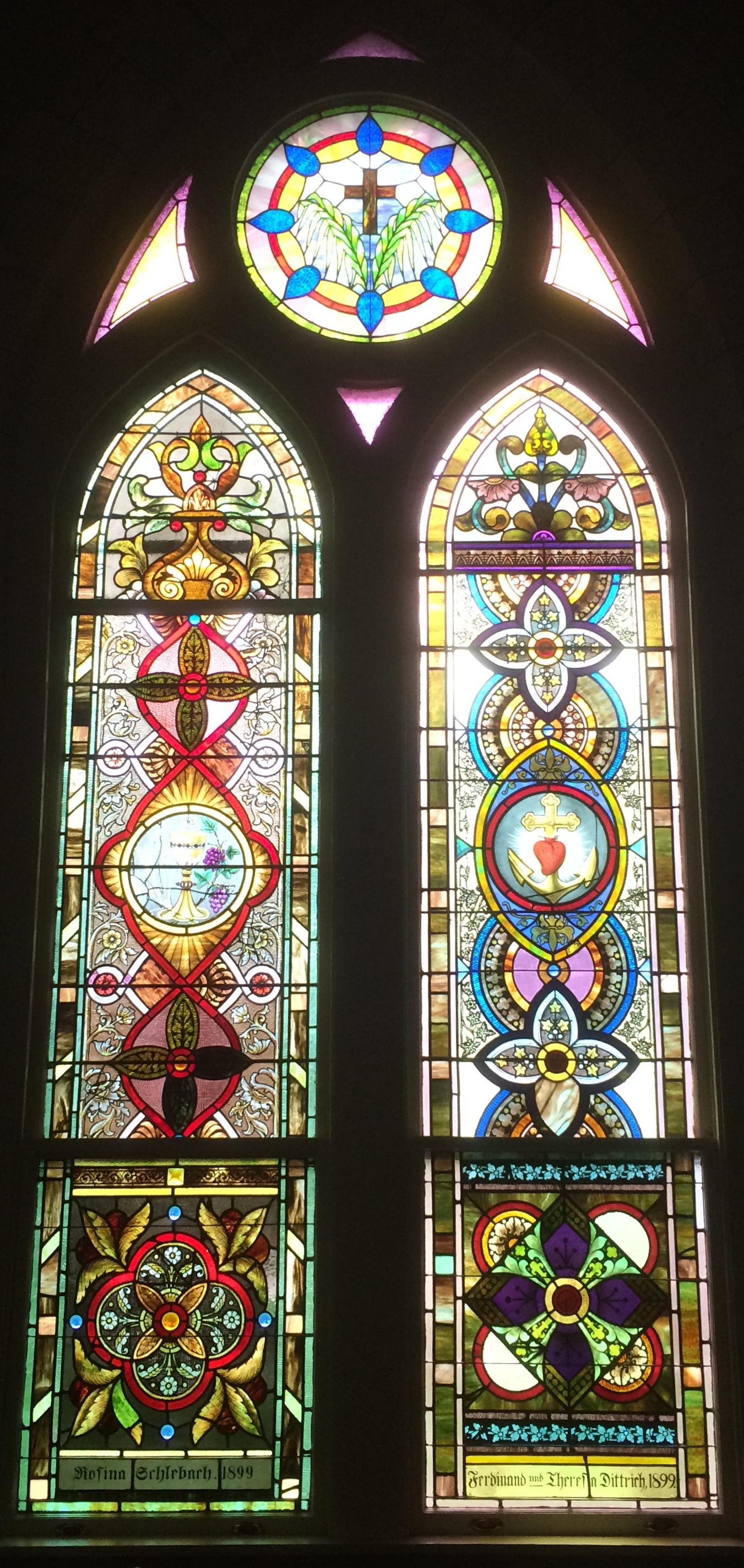
St. Mary’s stained glass captured a fair share of light, even on a cloudy day.
Finally, near Dubina, we visited Sts. Cyril and Methodius Church.
Artist unknown (1909), but he did a fine job.
By some counts, there are as many as 20 Painted Churches in Texas, so our visit wasn’t comprehensive. But after four or five such structures, you begin to get your fill of even the most beautiful ecclesiastical spaces anyway. Maybe I’ll see some of the others some other time.

Southern Loop ’19

Just back from a driving trip whose mileage I didn’t bother to keep track of, but it was in the thousands. Actually, only part driving. Lilly and I flew separately from Chicago to Dallas earlier this month so she could take possession of her new car — an ’05 Mazda 3 that her uncle Jay gave her, provided we could drive it from north Texas to northern Illinois. The car rattled and occasionally made other odd noises, but soldiered on all the way.

The uninspired thing to do that would have been to drive straight through, which normally would take two days by breaking the trip in Missouri, such as at the Munger Moss.

Despite being a driving trip, that would be a pedestrian way to do it. Instead I took a week off so we could take a more interesting route. We left Dallas on May 11, heading south to the vicinity of Schulenburg, Texas, to visit some of the Painted Churches, which were built by late 19th-century German and Czech congregations who gave them richly artistic interiors — all the more interesting because much of it is vernacular art.

Rain came day most of that first day on the road, but we didn’t encounter any more until yesterday in Nashville. In between the days were sunny and often hot. Everyone we talked to about the weather reported a wet spring, however, and the Southern landscape looked lush, from Texas into the Deep South and up through Tennessee.

We spent the first night in Houston. I didn’t plan it this way, but our time in Houston focused on water features: the Waterwall near the Galleria Mall that first evening (the rain was over) and Buffalo Bayou and the Buffalo Bayou Park Cistern during the next morning.

The next day we drove to New Orleans, a city I haven’t visited in 30 years, and one new to Lilly, and spent two days and three nights.

We ate very well. We saw excellent live music. We rode streetcars and walked the streets of the French Quarter, Treme and the Garden District. We toured one cemetery formally and one informally, and we visited the National WW II Museum.

On May 15, we drove to suburban Jackson, Mississippi, by way of the city of Natchez and the Natchez Trace to visit our cousin Jay and his wife Kelly, who hospitably put us up for the night.

The next day we passed through Philadelphia, Mississippi, my father’s home town, stopping for a short visit — Lilly had never been there — and then went to Montgomery, Alabama, where we spent the night.

On the morning of May 17, we saw the Legacy Museum and the National Memorial for Peace and Justice, both only open since last year, and the very different Alabama State Capitol, because I visit capitols when I can.

Leaving Montgomery in the early afternoon, we had enough time to visit the Ave Marie Grotto, not far north of Birmingham, and then spent the night of May 17 in Decatur, Alabama. The next morning I took a short walkabout near the Tennessee River and along Bank St., named for a handsome bank building there dating from the 1830s.

By that afternoon, we were in Nashville to visit some of my dear old friends, including one I hadn’t seen or enjoyed the fine company of since 1990. Today we did the long drive from Nashville to greater Chicago — I used to do it fairly often — arriving this evening.

Mostly, things went smoothly. Even traffic wasn’t that bad most of the time in the cities we passed through.
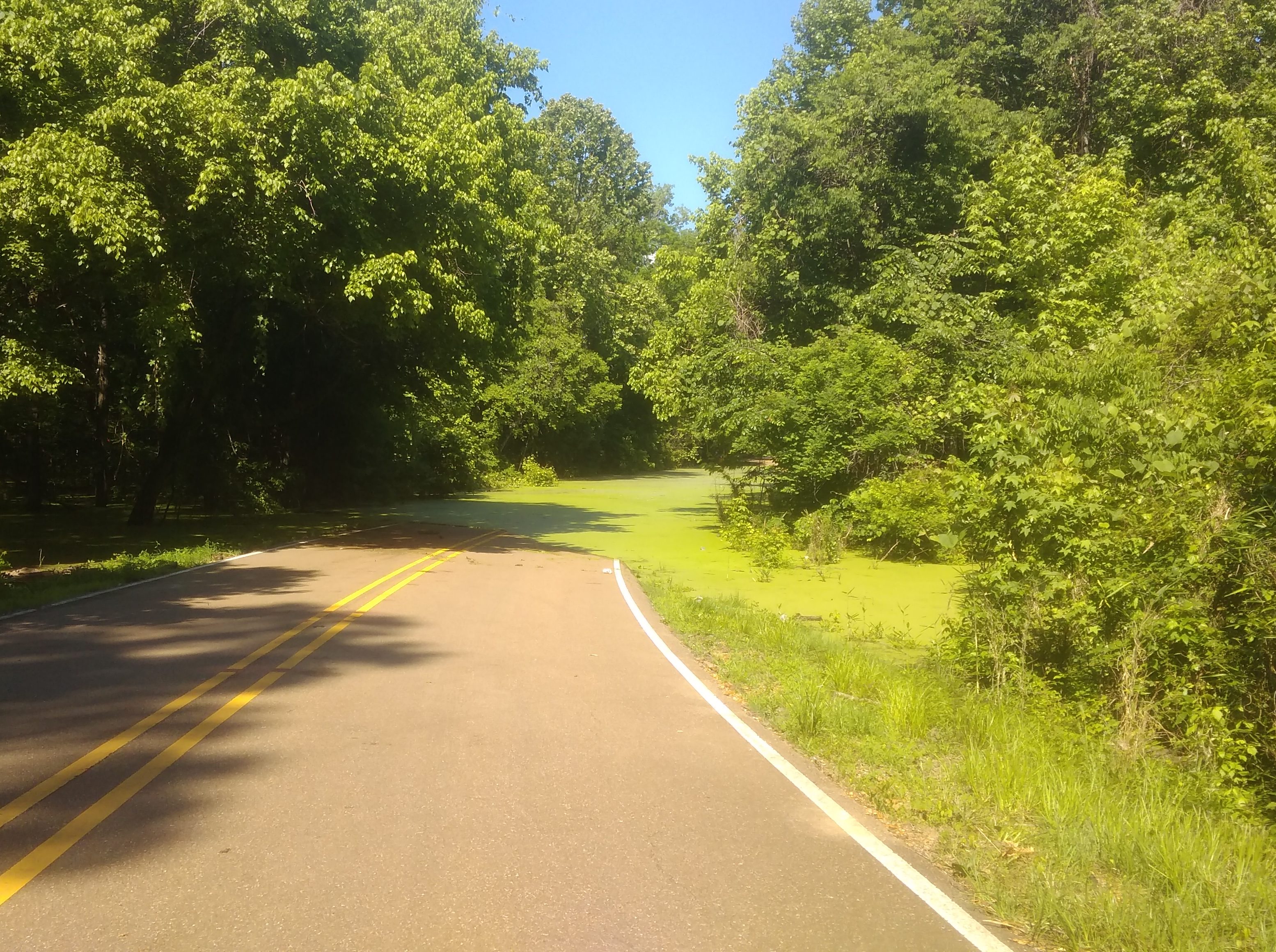
But while driving along Rodney Road in rural Mississippi outside Port Gibson and not far from the mighty river of that name, we suddenly came to this.
That’s stagnant algae-filled water, completely covering the road. For as far as we could see into the distance. Who knows how deep it is. So we backtracked on Rodney to the main road at that point, which happened to be the Natchez Trace.

Late Spring Break

Time for a spring break. Later than the standard breaks taken by students, but it’s been a long time since I could call myself that. Back again around May 21.

Congratulations to my nephew Sam and his wife Emily, whose second child, Georgiana, was born healthy late last week. Nothing like having a daughter. I liked the experience so much I did it twice.

It’s a sobering thought to realize that she and her brother could well live to see the 22nd century.

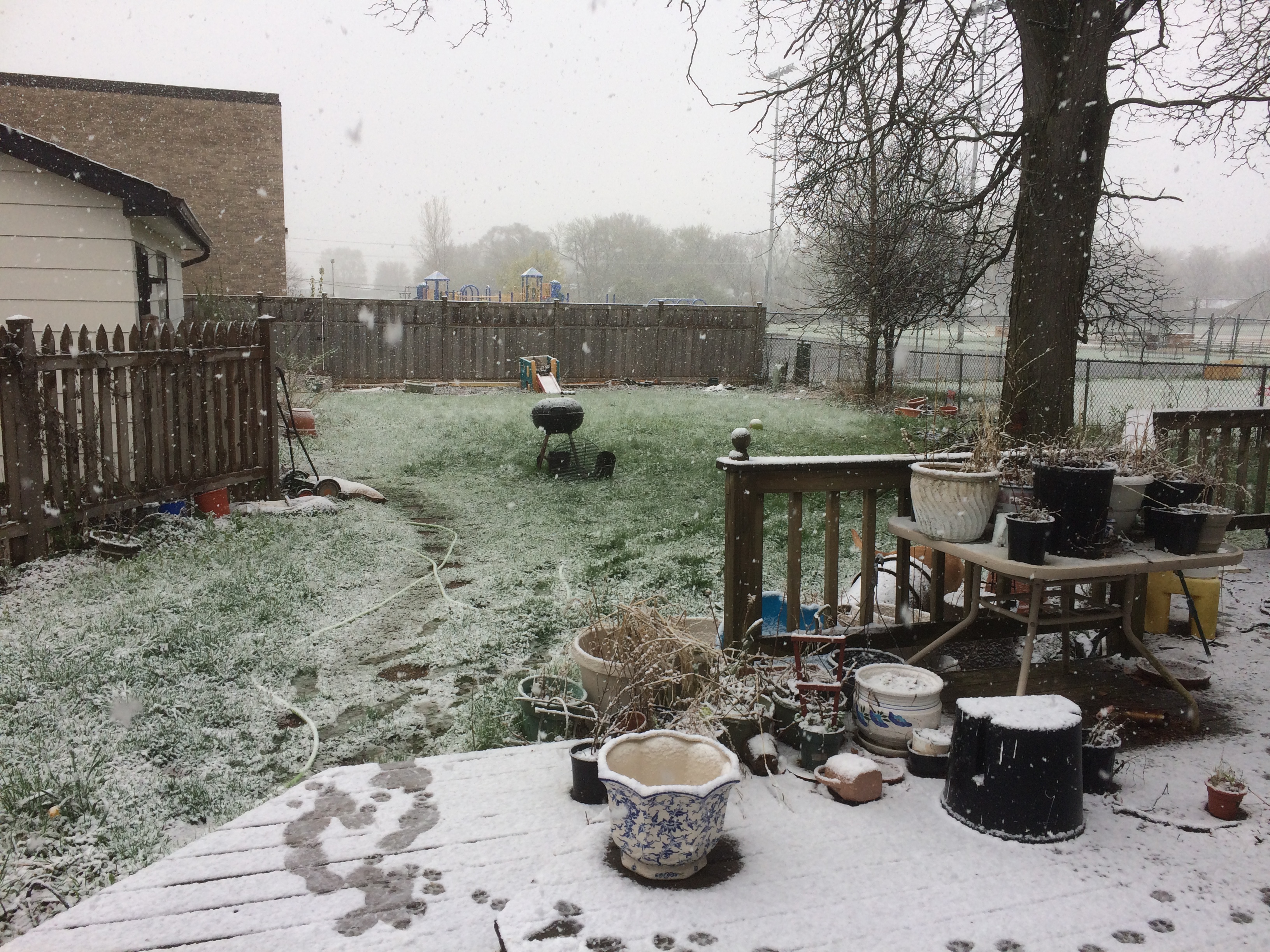
Closer to home, spring can’t decide whether to be warm or cool, as usual. But there has been rain in quantity when there hasn’t been snow.
I tried to start my lawnmower last week during one of the cool days, while it was still in the garage. Nothing doing. So I anticipated draining its gas tank of old fuel, something I forgot to do in the fall.

On Saturday, when it was very much warmer, I parked the mower outside for a while and let it warm up in the sun. Then I tried to start it and voilà, it woke from its hibernation, ready to trim the grass in its noisy way.

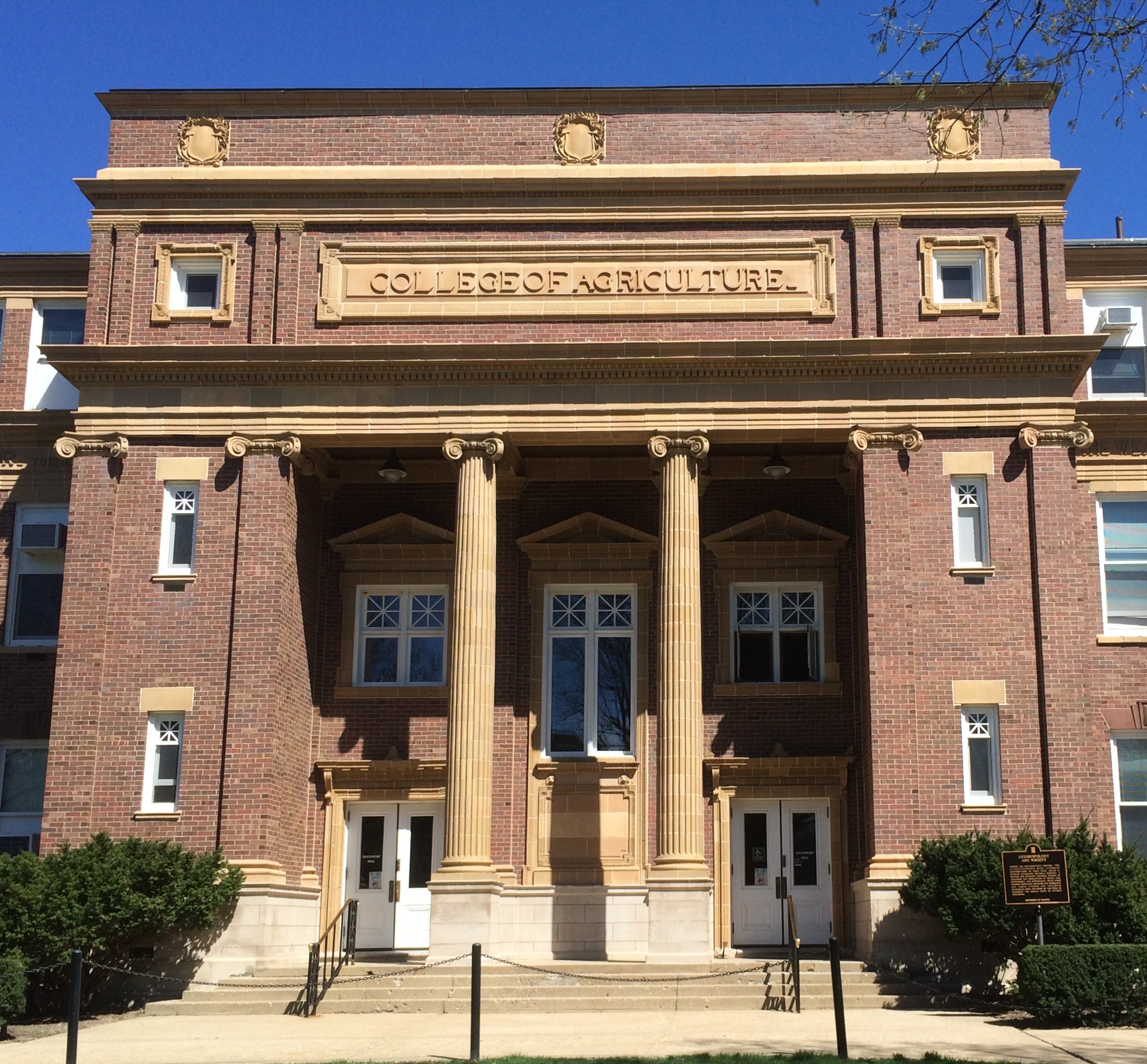
During our recent visit to UIUC, we wandered past Davenport Hall.

From the looks of it, an ag building. But not any more. These days, it houses the university’s geography and anthropology departments. Dating from 1899, it’s one of the older buildings on campus. Nice facade. Reminds me of Texas A&M.

Not far from campus, an all together different kind of building. And yet a building. That’s a broad concept, after all. A bit of local color usually not acknowledged as such.

Some music for spring. Electroswing. Seems fitting somehow.

The first number, “Zoot Suit Riot,” released in the late ’90s, seems vaguely inspired by the incident in early ’40s Los Angeles. The quality of the video is poor, but with the crisp audio that doesn’t matter.

A more recent swing, dating from this decade, though in the case of “Bei Mir Bist Du Schoen,” with a helping of “Diga-Diga-Doo,” the songs are original swing vintage. I’m fond of other versions as well, such as Max Raabe’s, which I saw him do.

Also recent, the lively “Gimme That Swing” and its kinetic, or maybe frenetic, video.

Speaking of music, I’ve picked one more biography to read, now that I’m done with Alexander Hamilton. A genius of a different sort: Cole Porter.

Othello

Not long ago we went to the Factory Theater in Chicago’s Rogers Park neighborhood to see a staging of Othello by the Babes With Blades Theatre Company. I suggested we go because I’d never seen that play staged. Also, Ann read it not too long ago for school — wrote some papers and so on, the usual sort of things you do in high school.

The Factory is a small venue, about 70 seats on three sides of a simple stage. As far as I could tell, we saw a completely traditional staging of Othello, complete with well-done period costumes and actual swords and knifes, except for one thing. Babes With Babes is an entirely female theater company.

But not just a female company. A company of players with some specific talents.

According to the BWB web site: “Our initial showcase, in 1997, was conceived by founder Dawn ‘Sam’ Alden as a two-day presentation of fights and monologues, intended to bring to the Chicago art world an awareness of the large number of stage combat-trained women it had in its midst whose talent was being consistently underutilized.”

While not an overly stabby play (unlike Titus Andronicus) Othello certainly has its share of swords and knives as a part of the action, and the troupe handled them well.

More importantly, they handled their parts well. The novelty of women in the parts always played by men — Deveon Bromby as Othello and Kathrynne Wolf as Iago, to name the principals — lasted for a few minutes. Then it wore off and you were simply watching a solid production of Othello.

Wolf was particularly good as Iago. If you’re not going to have a spot-on Iago, a character that believably exults in the art of deceit, you might as well not do the play, since everything turns on that performance.

Much has been made of the muddled motives of Iago, or perhaps his motivelessness, but I’m not sure that matters. If it’s perversely captivating to watch his glee at destroying the Moor, I’d say the actor has done his, and in this case, her job.

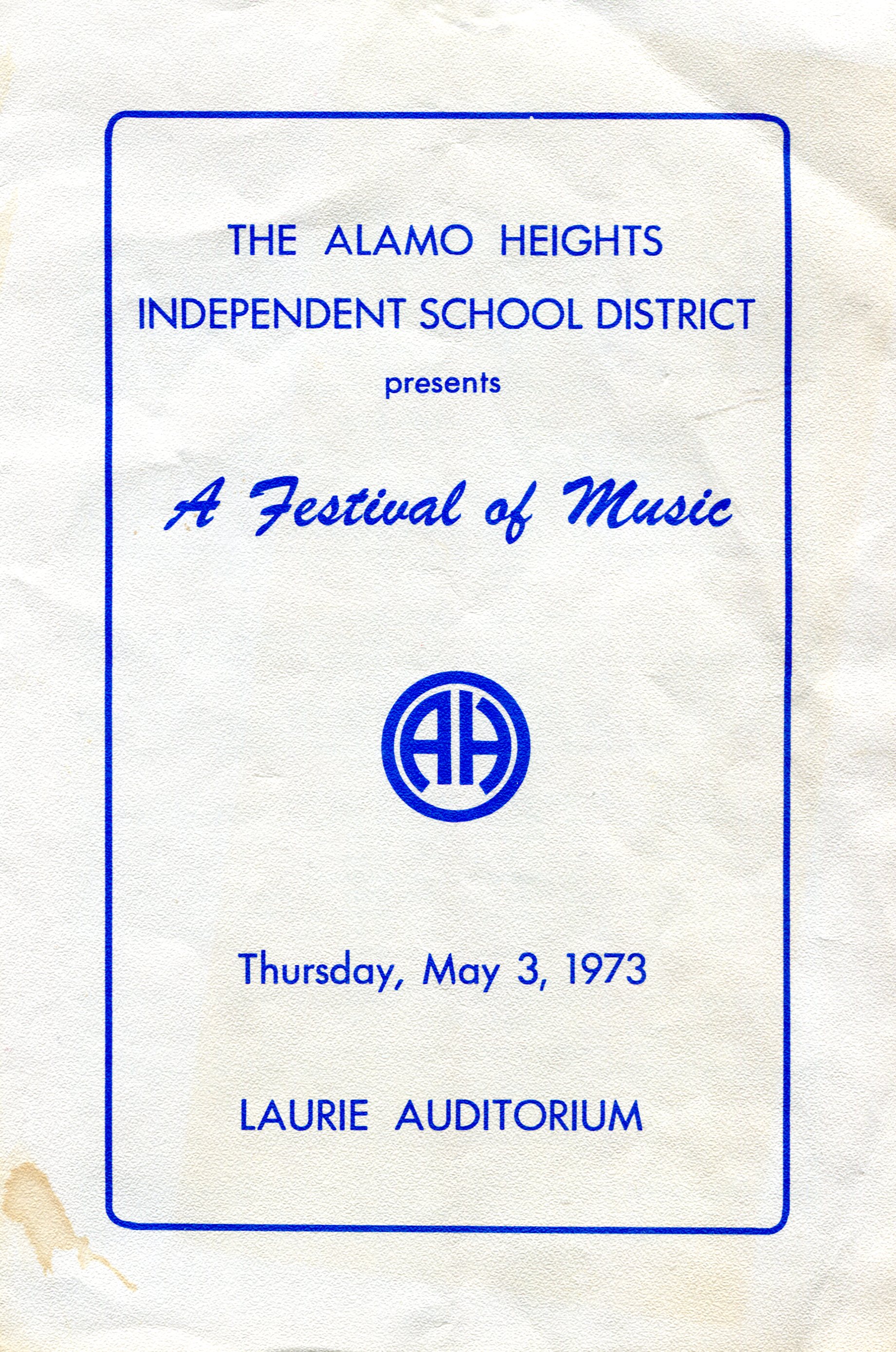
A Festival of Music, 1973

I found this bit of ephemera at my mother’s house last year. She had saved it, tucked away in a envelope. I’d forgotten about the event, but it jogged my memory.

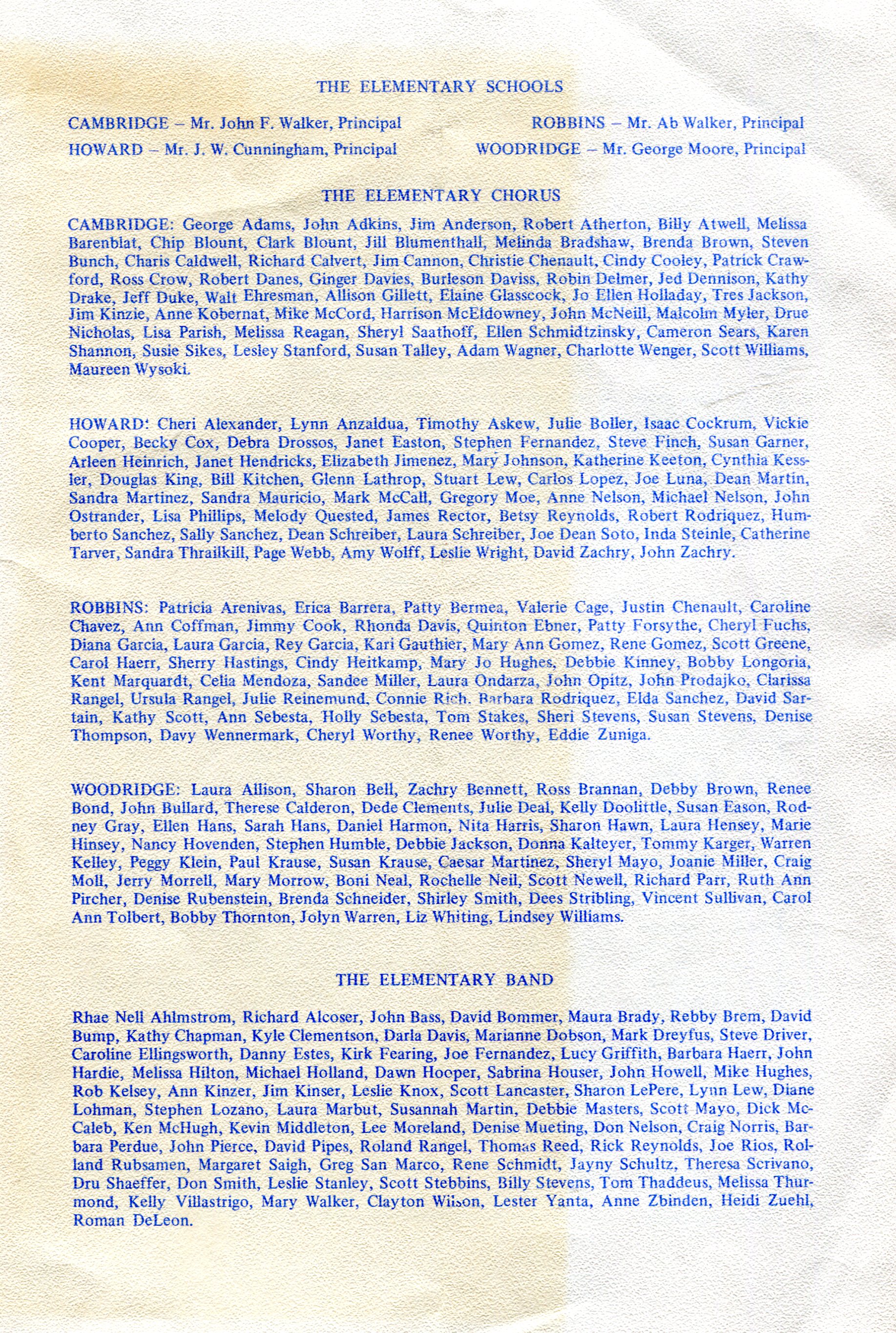
Jog might be too strong a verb. I still don’t remember much about the event, including why I participated. I was in the sixth grade, toward the very end of that year, and didn’t usually participate in choruses. Mainly, I think, because I can’t sing. But somehow or other I decided to do it, and there I am along with scores of other kids.
At the time, Alamo Heights had four elementary schools that fed into a single junior high and high school. Among the names of the kids at the three other elementary schools that I didn’t attend, I recognize a lot of people I didn’t know in 1973, but whom I would know by the time I finished high school six years later.

Considering the structure of the district’s schools, and the passage of time, and the way social interaction goes, that isn’t really so strange, and yet it feels strange when I think about it.

Another irrational feeling that comes to me when looking at the list is how normal most of the first names sound. Especially the girls’ names, like Amy, Barbara, Caroline, Laura, Lisa, Lynn, Mary, Melissa, Patricia, Sharon, Susan and variations on Deborah, Julia, Rebecca and Sandra.

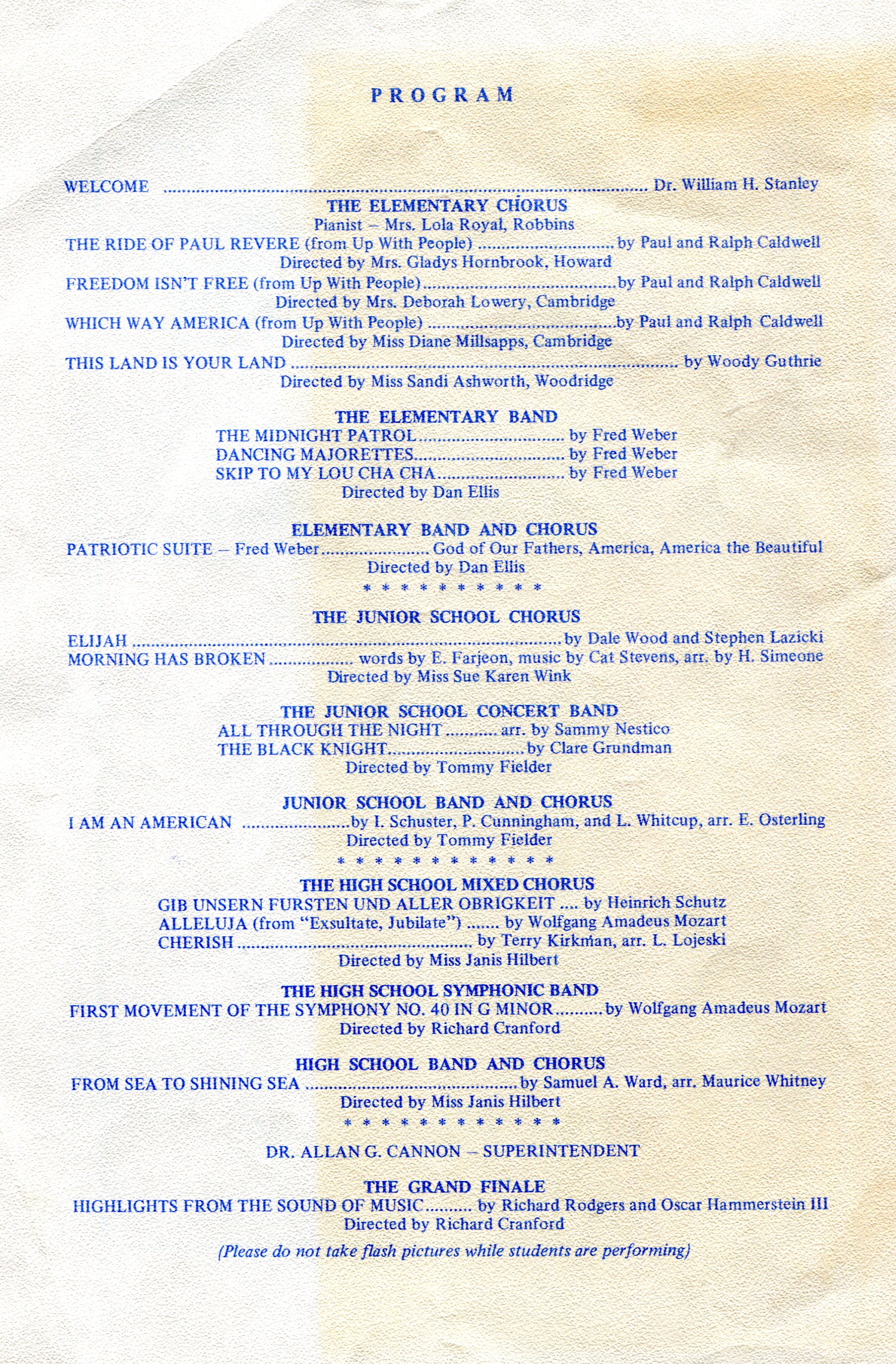
The evening’s program.

Three of the four songs by the elementary chorus were from Up With People. I didn’t know that until reading the program recently. Guess they produced the kind of anodyne songs considered good for elementary school children in the early ’70s.

I’ve read a little about that organization, though I can’t say that I know much about it. But I can’t shake the lingering idea that if Ned Flanders founded a cult, it would be something like that.

Raumpatrouille

Rain is more typical than snow for late April/early May, and we’ve gotten buckets of it since the snow melted on Sunday. The grass has responded by taking on new hues of lush green. I expect scads of the much-maligned dandelion to follow. The back yard already has some, but the rain beat them down. They never stay down for long.

How did I not know about Raumpatrouille until the other day? In full, as befitting a title in German, the TV show is called Raumpatrouille – Die phantastischen Abenteuer des Raumschiffes Orion. That is, Space Patrol – The Fantastic Adventures of the Spaceship Orion.

Naturally, when I found out about it, I wasn’t looking for information about the German science fiction television program of that name that’s an exact contemporary of the original Star Trek, premiering on German TV on September 17, 1966 (Star Trek first aired on September 8).

Yet in wandering the Internet’s twisty little maze of passages, or maybe its maze of twisty little passages, I chanced across Raumpatrouille not long ago. I didn’t have time to follow up on the information right when I found it, but I had the presence of mind to do some bookmarking.

Later, it was easy enough to find the episodes — there are only seven of them — on YouTube, which have helpful English subtitles. I watched the first one. Though I’d read it was good, I was taken by surprise by how good it was. As good as anything Star Trek did, and without that annoying Roddenberry vibe.

Actually, there’s a bit of his outlook. By the unspecified year in which the show is set, Earth has a world government. What little you hear about that government, or at least its military, makes it seem officious and a touch German, but not totalitarian.

The characters are supposed to represent a cross-section of Earth’s population. As Television Heaven puts it, “While Major McLane [the commander] is American, his crew includes a Japanese navigator and star cartographer, a Scandinavian engineer, and an Italian computer specialist and armaments officer. This is clearly not a projection of a desire for a Teutonic world order.”

In the single show I’ve seen so far, the story has some intelligence and suspense, plus some character development, and the pacing is good. The sets and props strongly resemble Doctor Who in its early days, since Raumpatrouille clearly had a slender budget. But they did well with what they had.

Also, there are a few moments of unintentional comedy. One scene has the characters at a bar near wherever their ships launch from, and the characters are having a discussion in the foreground. In the background, extras are dancing, as if it were a dance club. Except that they were obviously doing “a dance of the future.” It’s a strange sight with a lot of odd moves, and gets more funny as it goes along.

I’ll watch the rest of Raumpatrouille in the fullness of time. Don’t want to hurry, though. This is where I found out about it.

The Chicago Riverwalk ’19

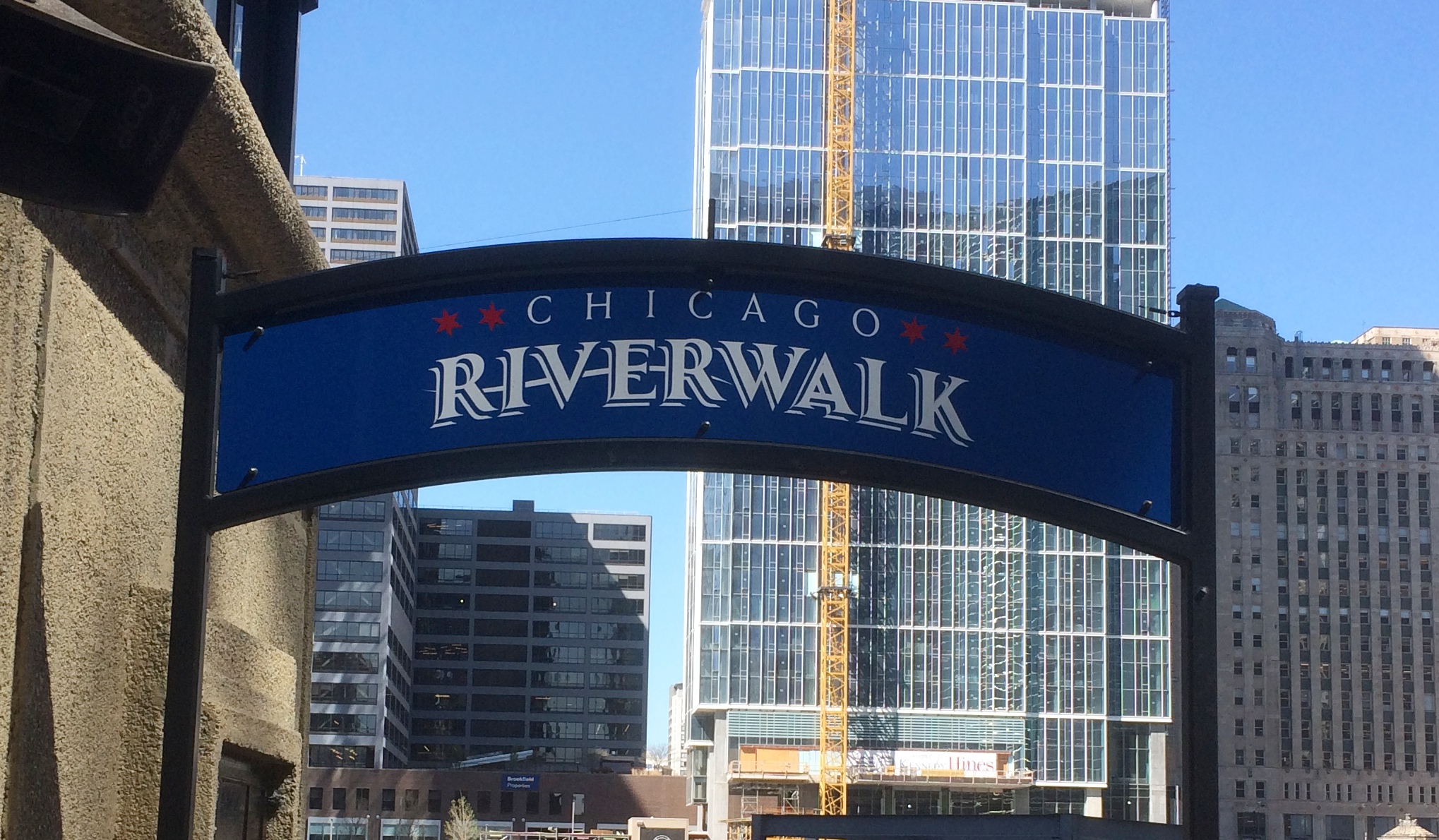
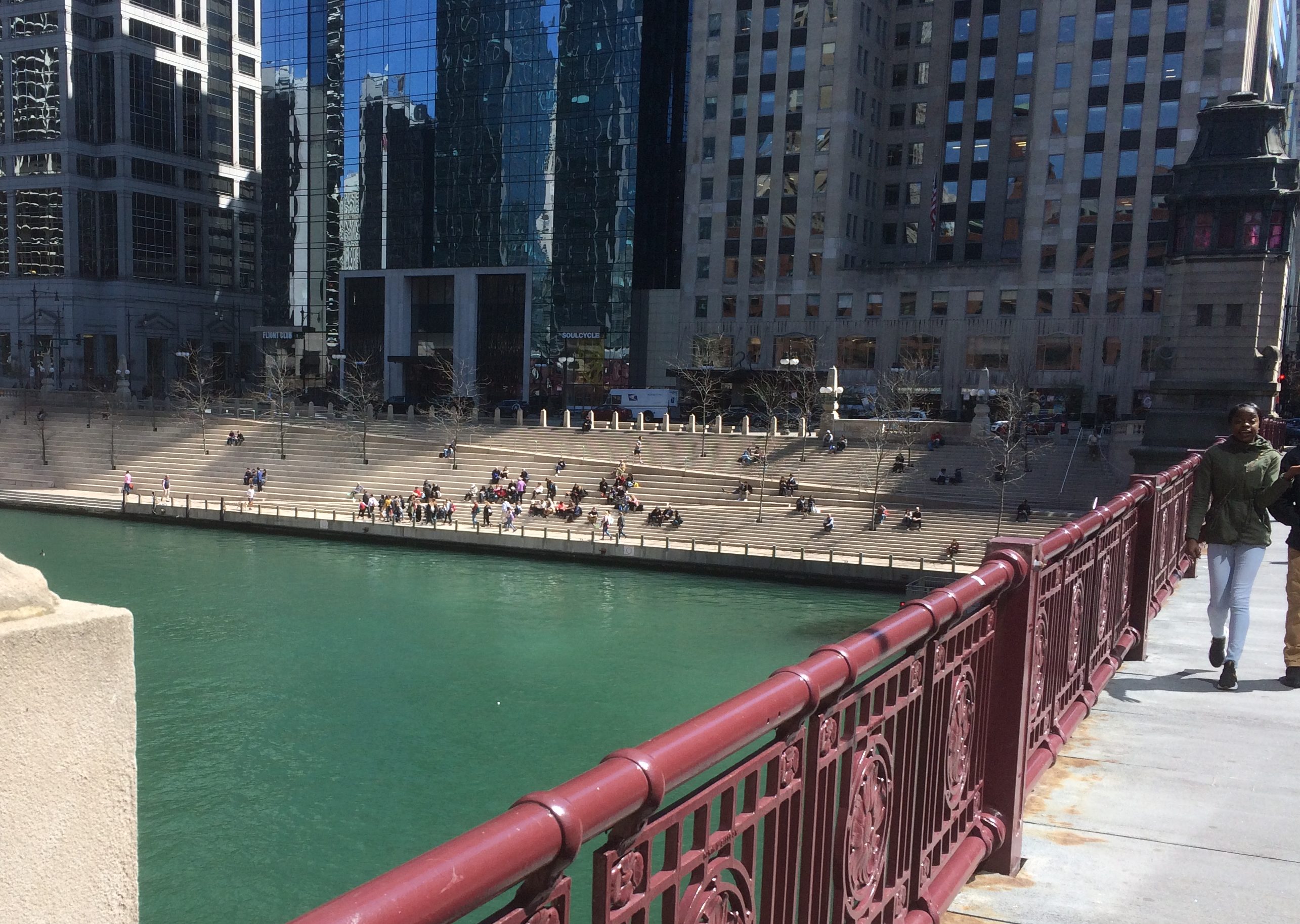
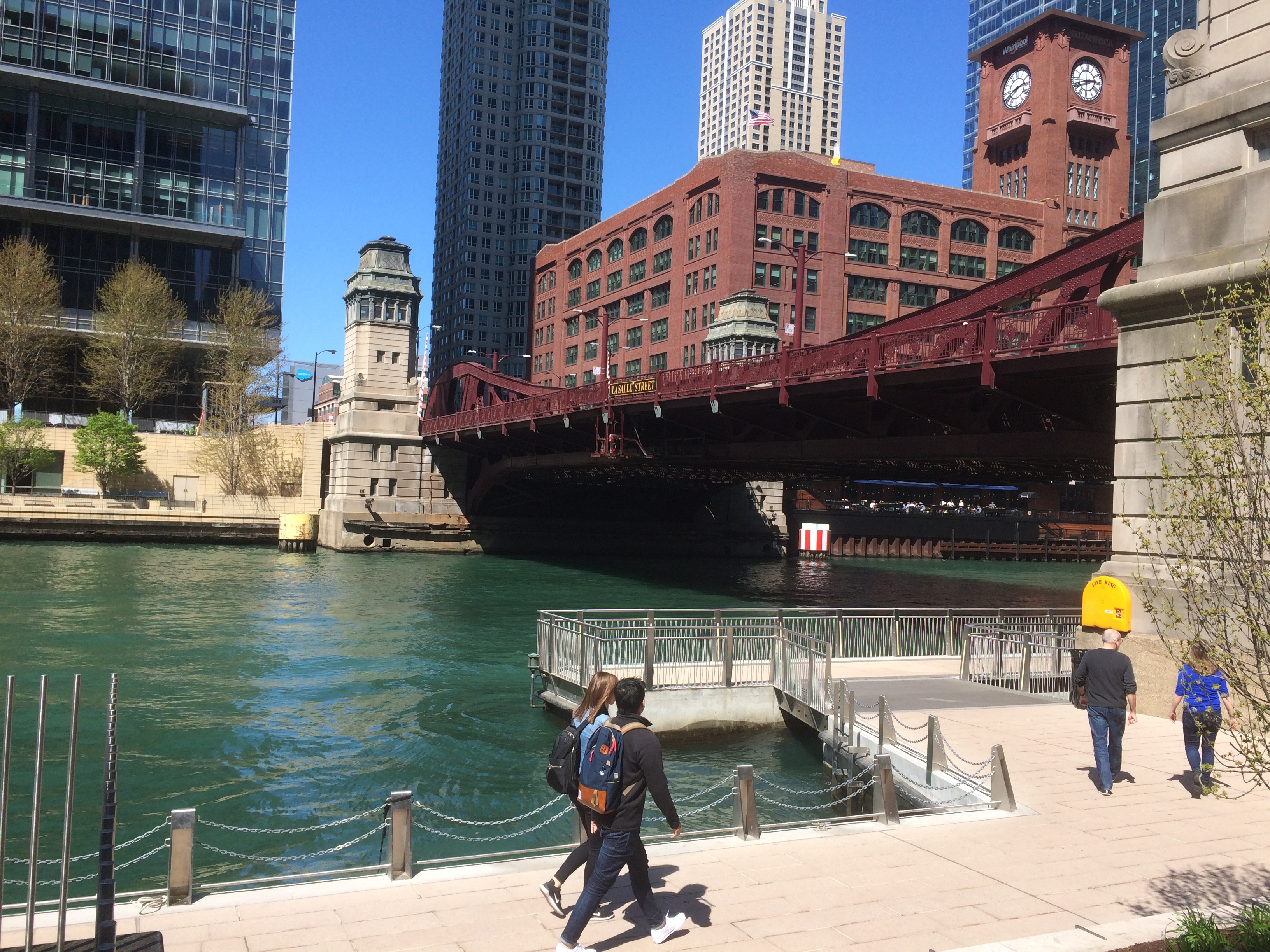
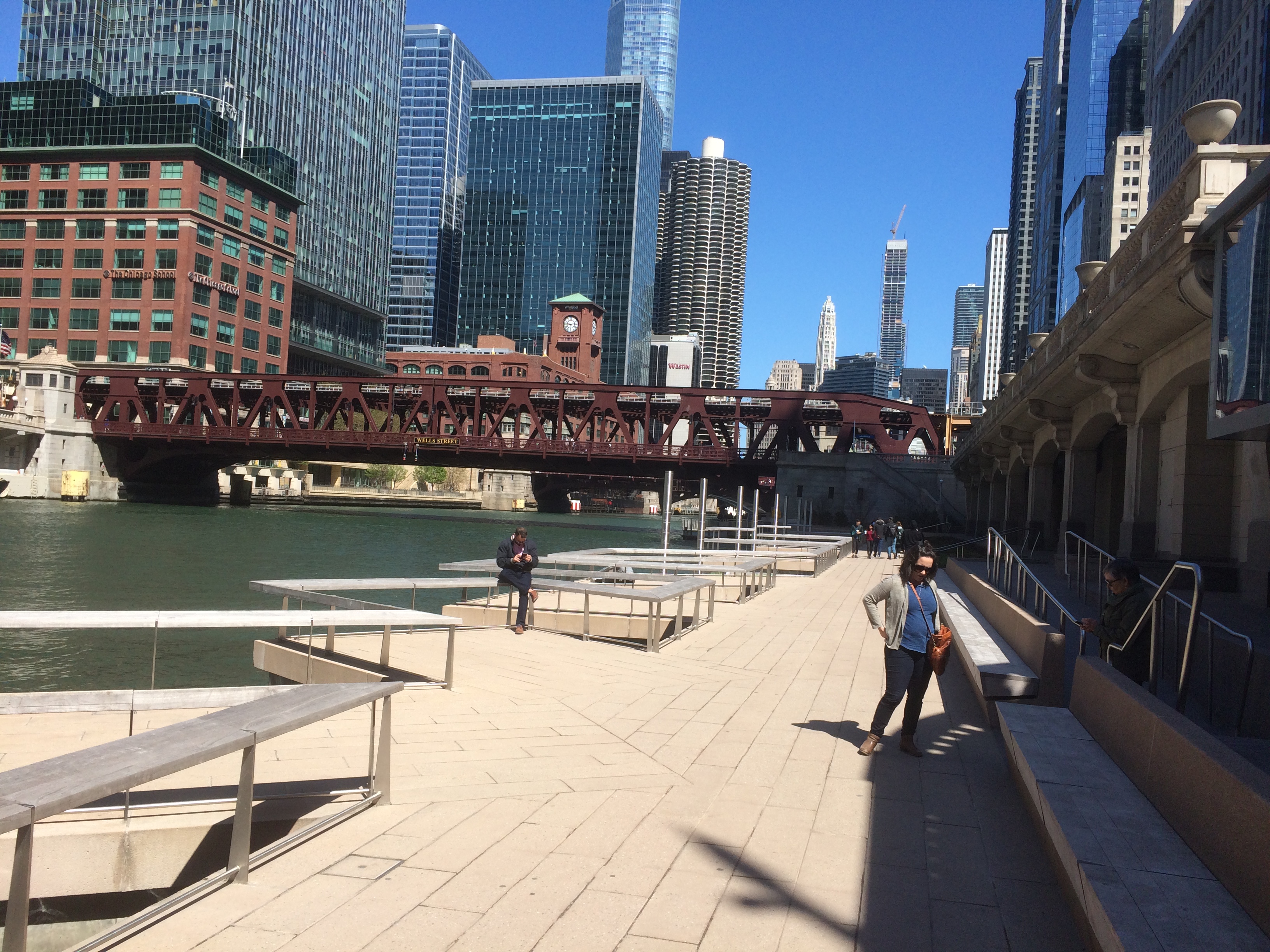
Returning from my appointment on Friday, I took a walk along the Chicago Riverwalk — a section that wasn’t completed the last time I was paying attention — from N. LaSalle St. around to W. Lake St.

Parts of the waterfront walkway to the east were started back in 2005; the western section was only completed in 2017. The San Antonio Riverwalk, it isn’t, but Chicago has done well with what it has.

From the north end of the LaSalle St. bridge, you can see the “River Theater.”
To the west of that feature is a walkway that crosses under the LaSalle St. bridge.
I noticed that besides building the riverwalk, the city cleaned up the underside of all the bridges you can see from the riverwalk. Once upon a time, they wore their peeling paint and rust like badges of honor.

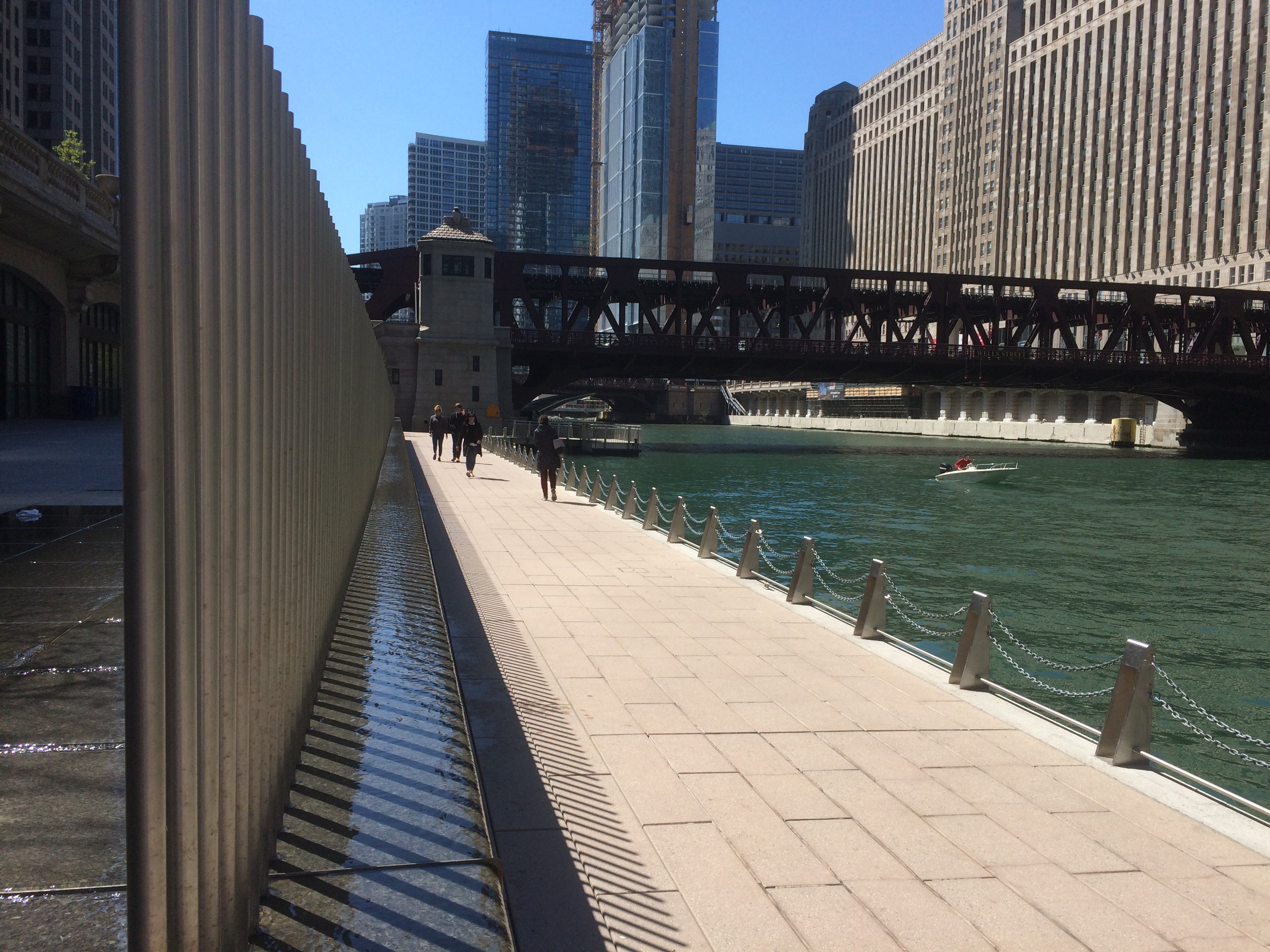
From the LaSalle St. bridge to the Wells St. bridge is a straightaway with a tubular fountain sort of feature.
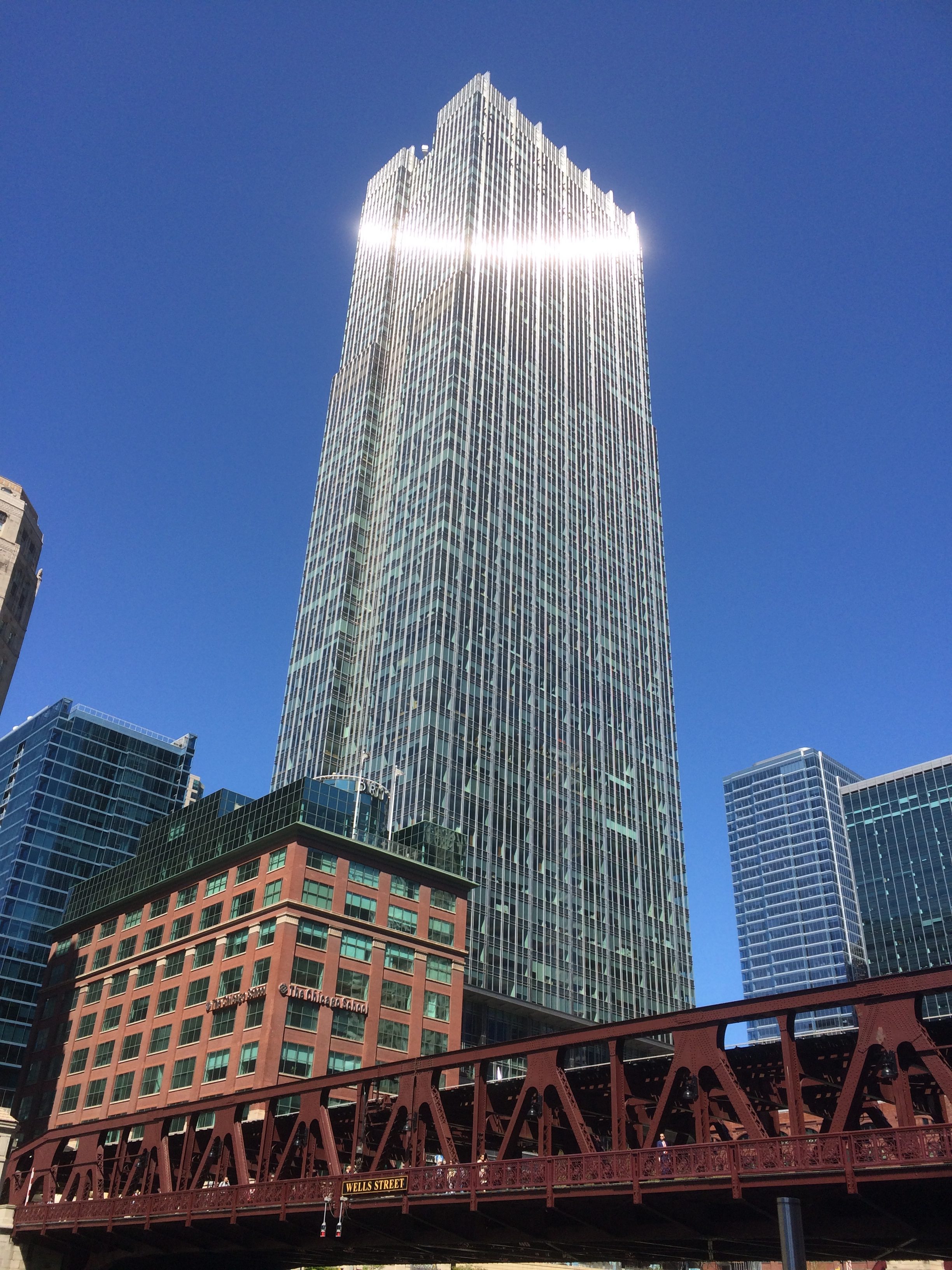
On the west side of the Wells St. bridge is a fine view of that structure.
The afternoon sun in late April left a curious trace on the 300 N. LaSalle building, which rises above the Wells St. bridge.
Further to the west of Wells St.
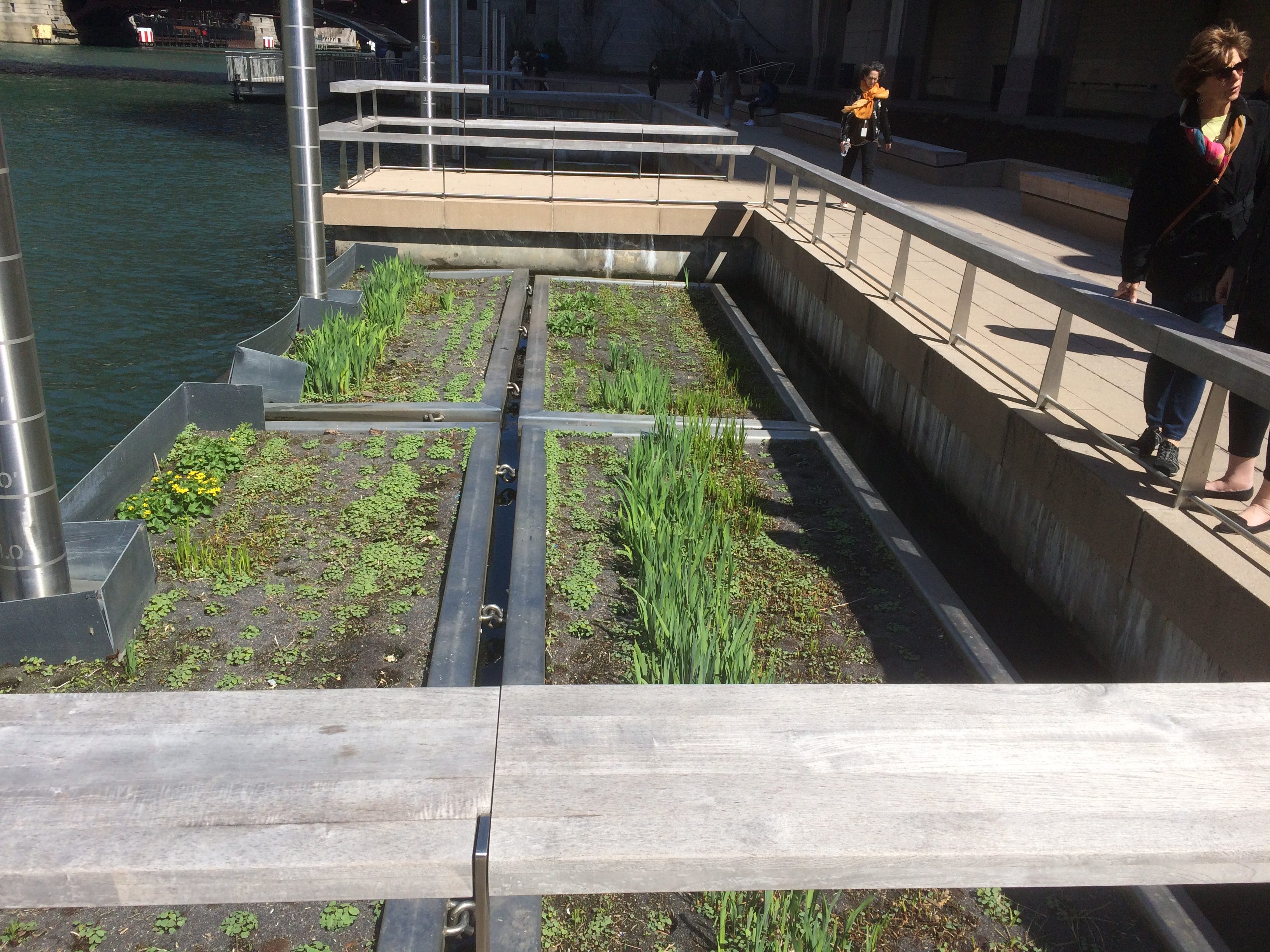
This section, west of Wells, sports floating wetland gardens. Or maybe you can call them the Floating Gardens of Chicago. But what the city really needs are hanging gardens. Maybe they can go next to the Obama Library.
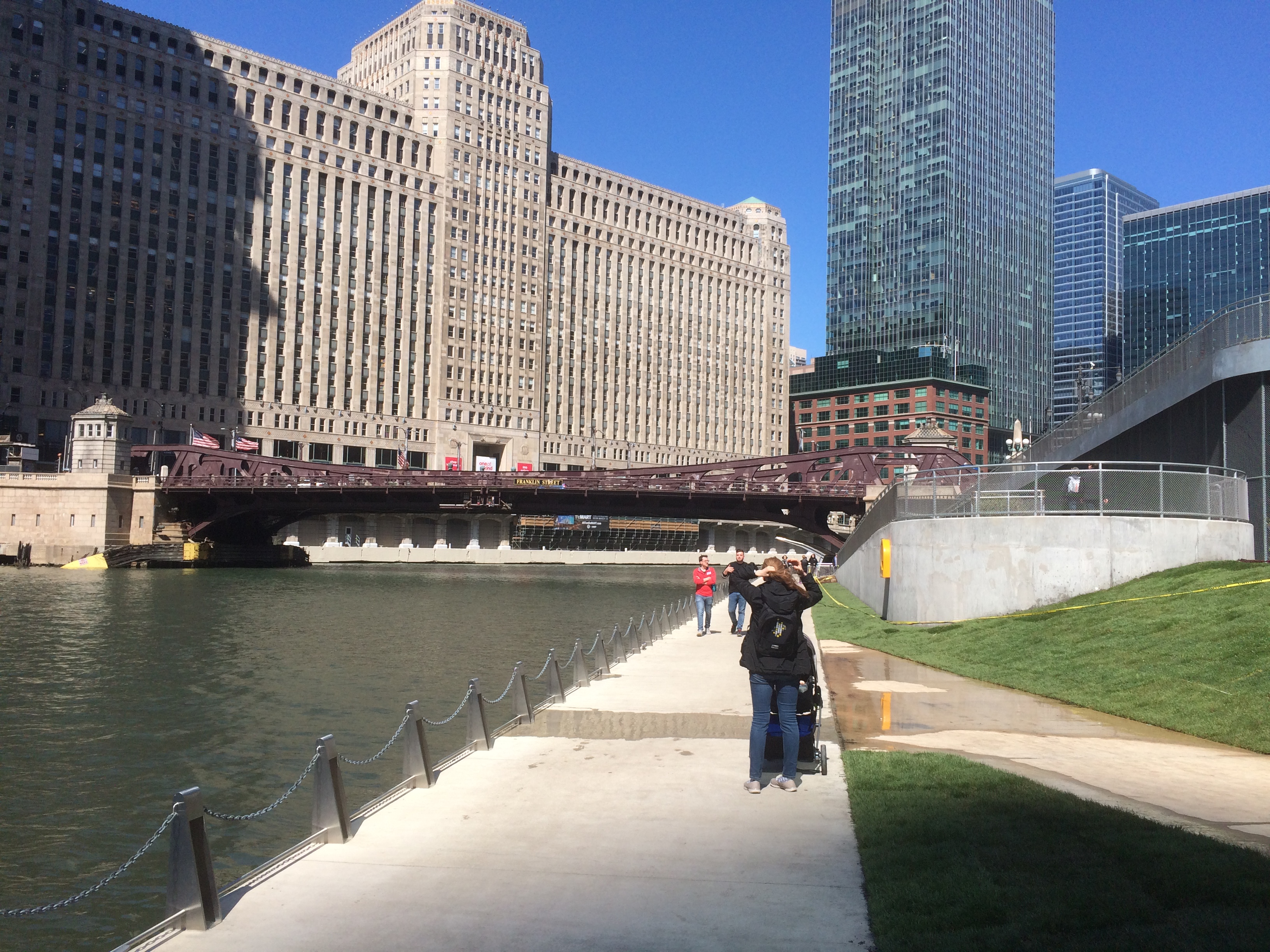
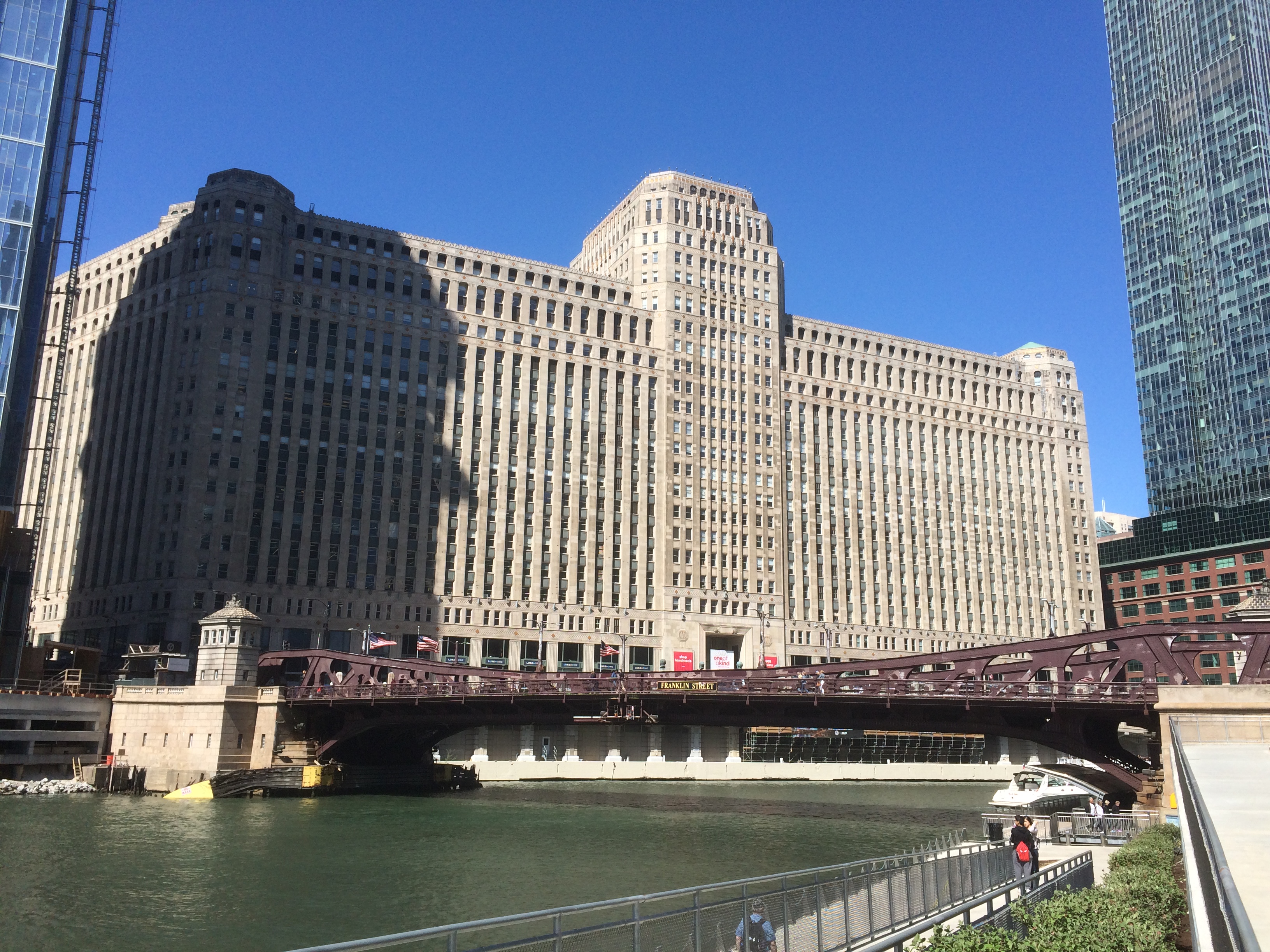
From there, the path crosses under the Franklin St. bridge, and goes to its end at Lake St., with the Merchandise Mart dominating the view. Workmen were busy installing turf on the small slope to the right (in this pic) of the sidewalk.
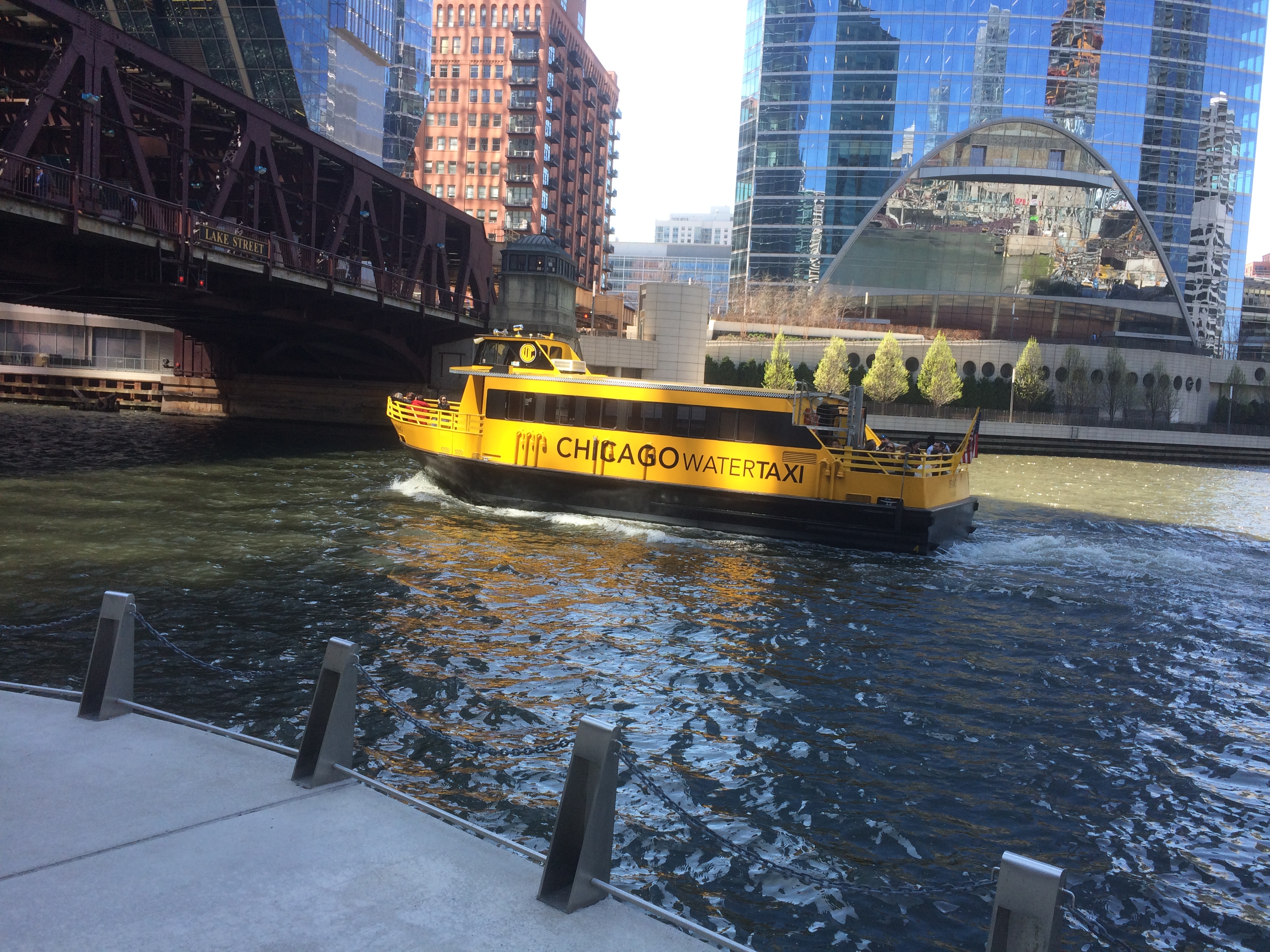
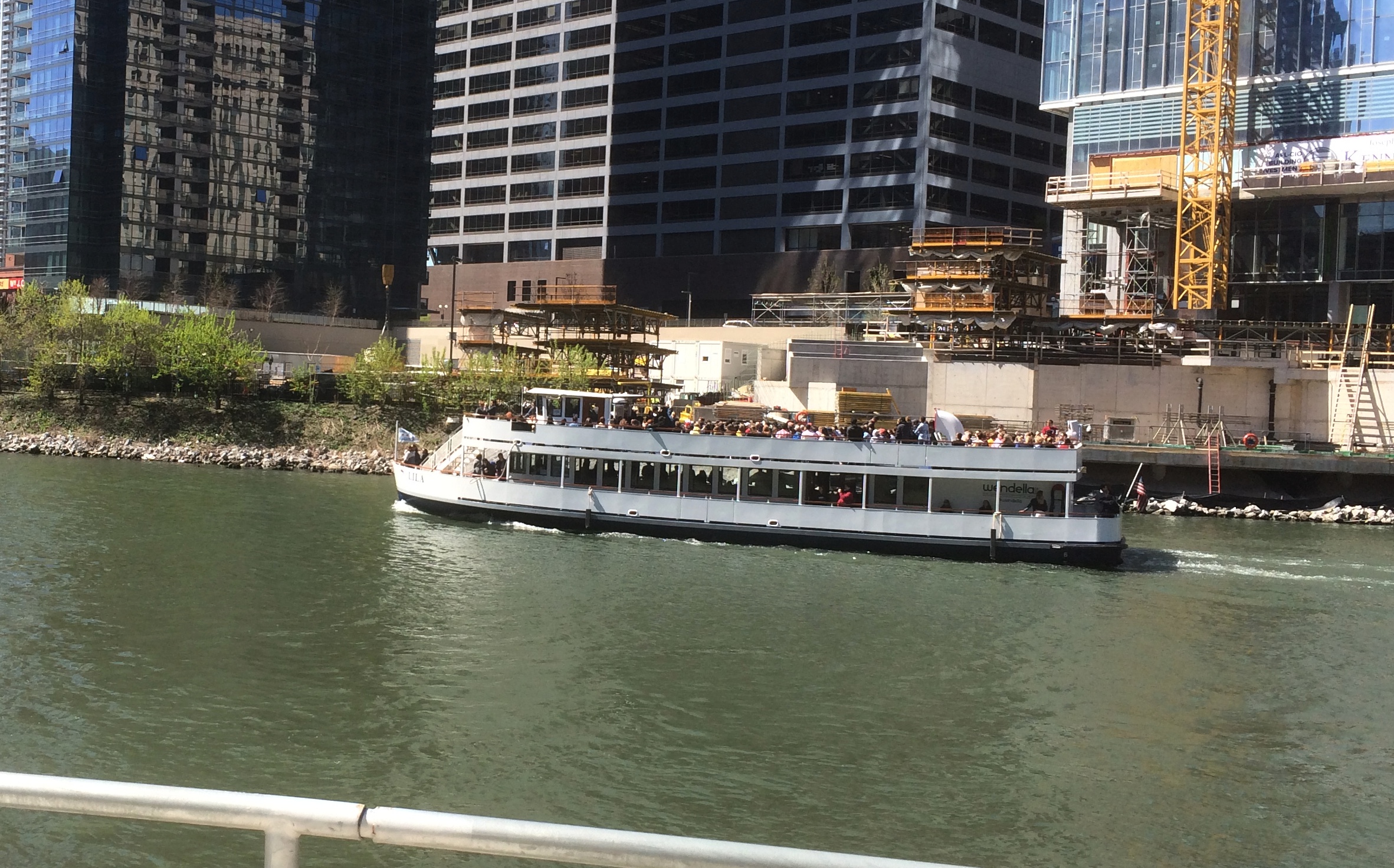
All the while, you can see boats plying the river.
Interesting that yellow means taxi, even on the water. I recognized the vessel in the second pic. The good tourist ship Lila passing Wolf Point.

Wolf Point & The Merchandise Mart Hall of Fame

On Friday I went to downtown Chicago for business. Since it was a warm, clear spring day, I wanted to do a more extensive walkabout, especially in the River North area, where I attended to business. But I didn’t have much time.

Instead I was able to take a quick walk near the Chicago River, mostly on the way to my appointment and heading back to Union Station afterward. I was near the place where the river divides into its North and South Branches, which is known as Wolf Point and is the origin of the Chicago Municipal Device.

For quite a while, Wolf Point was oddly underdeveloped, at least compared with the rest of the riverfront. For instance, until recently the point was occupied mostly by a parking lot.

No more. The latest project there, Wolf Point East, is still under construction.

So Wolf Point looks a little different than at the beginning of this decade, and a lot different than it did in 1833.

Hines, Joseph P. Kennedy Enterprises, the AFL-CIO Building Investment Trust and PNC Realty Investors are the developers of Wolf Point East; Pelli Clarke Pelli did the design. The 60-story tower will have 698 residential units — upper-end rentals — that will be available late this year.

Just to the east, of course, is the 4 million-square-foot Merchandise Mart, seen here catching a shadow in the mid-afternoon.

A street runs between the Merchandise Mart and the river — the unimaginatively named W. Merchandise Mart Plaza — and from there, you can see the Merchandise Mart Hall of Fame. That is, eight bronze busts honoring one-time U.S. merchant princes, each facing the building. Joseph P. Kennedy himself commissioned the busts in the early 1950s, which was possible because the Kennedy family owned the Merchandise Mart for many decades.

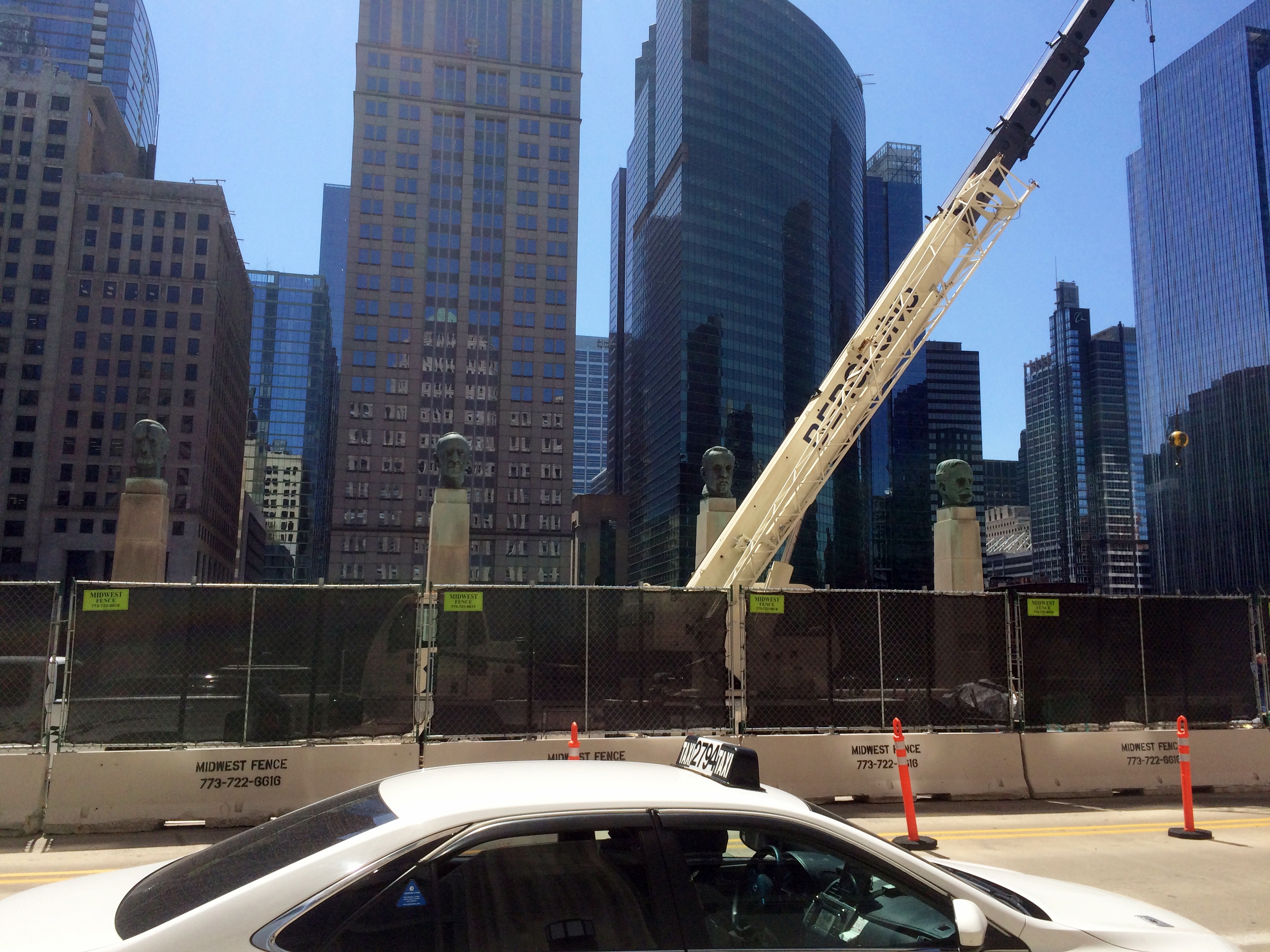
The busts are in two groups of four. These are the busts to the west. They don’t look so large from across the street, but the heads are four times the size of a regular human head.
From left to right: John Wanamaker, founder of the stores by that name; George Hartford, founder of A&P; Edward Filene, founder of those stores; and Montgomery Ward.

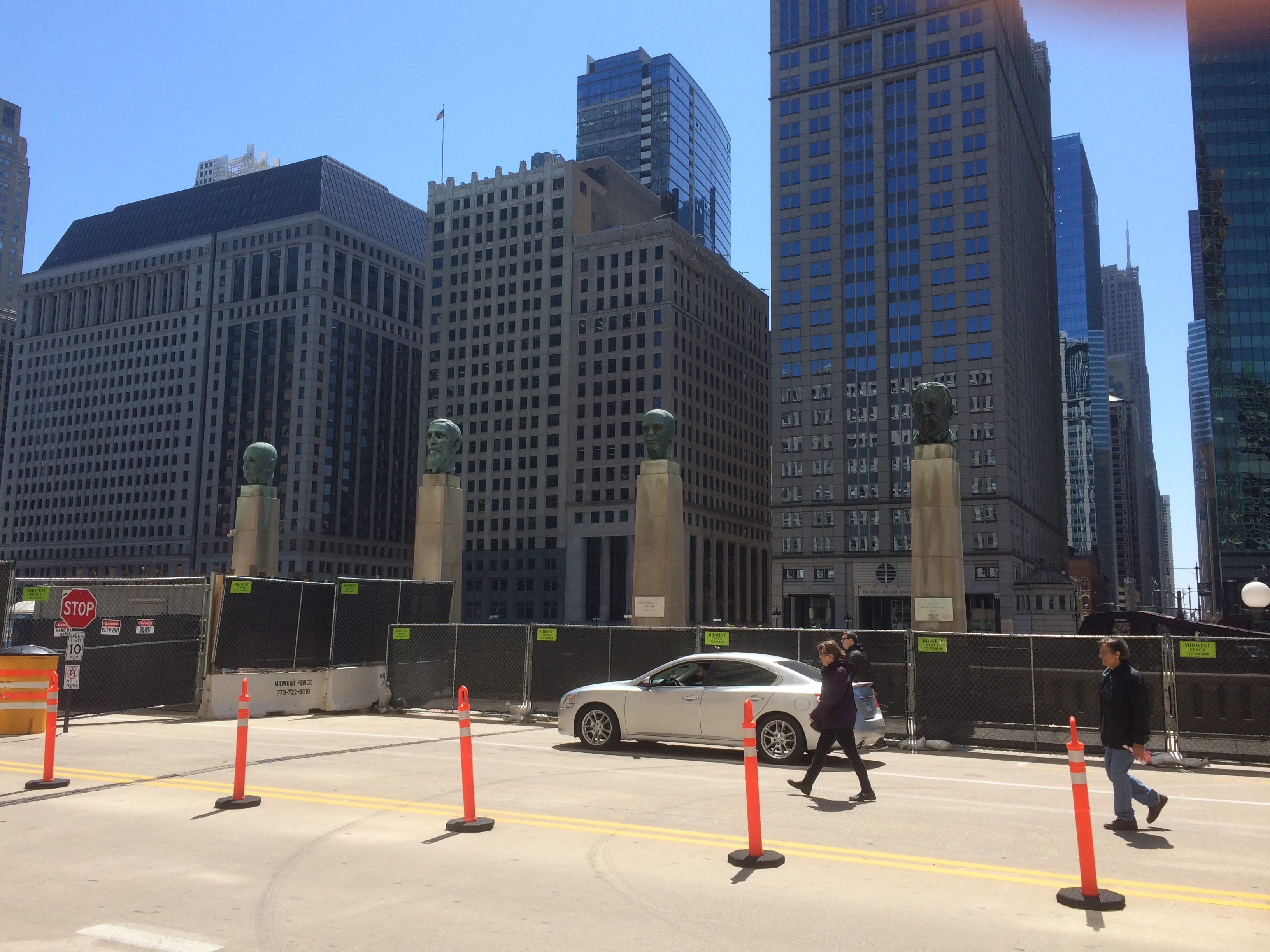
These are the busts to the east.
Construction and taxis whizzing by made it a little harder to make an image, but in any case they are Robert Wood, a chairman of Sears; F.W. Woolworth; Julius Rosenwald, another chairman of Sears and founder of the Museum of Science and Industry; and Marshall Field.

More about each of the busts is here. Twelve years ago, at least, they looked like they needed some restoration. I didn’t get quite close enough to them this time to know whether that has happened.

The Snows of April 27

Last Friday was a perfectly brilliant spring day, temps in the 60s. Come Saturday afternoon, snow fell. About three inches. It stuck until Sunday morning.

The green was slowly covered by white.
On Sunday, the sun came out and almost all of the snow melted. The surviving bits in the shadows disappeared with this morning’s rain. It’s pretty soggy out there now.

The grass and flowers and greening bushes and the new-leaf trees don’t seem to mind the snow. But it must be upsetting to lawn-care enthusiasts who are eager to get out there and mow their lawns.