Electric Emblem, Grand Commandery of Colorado

Unusually warm and especially windy today. I would have spent more time on the deck, but the wind was distracting. That and dust was blowing in from the baseball field in the park.

I’ve seen people playing baseball there sometimes, even in recent weeks. But no peewee football in the park yet. That’s still going on as far as I know, despite concussion worries, and the occasional brawl among the parents.

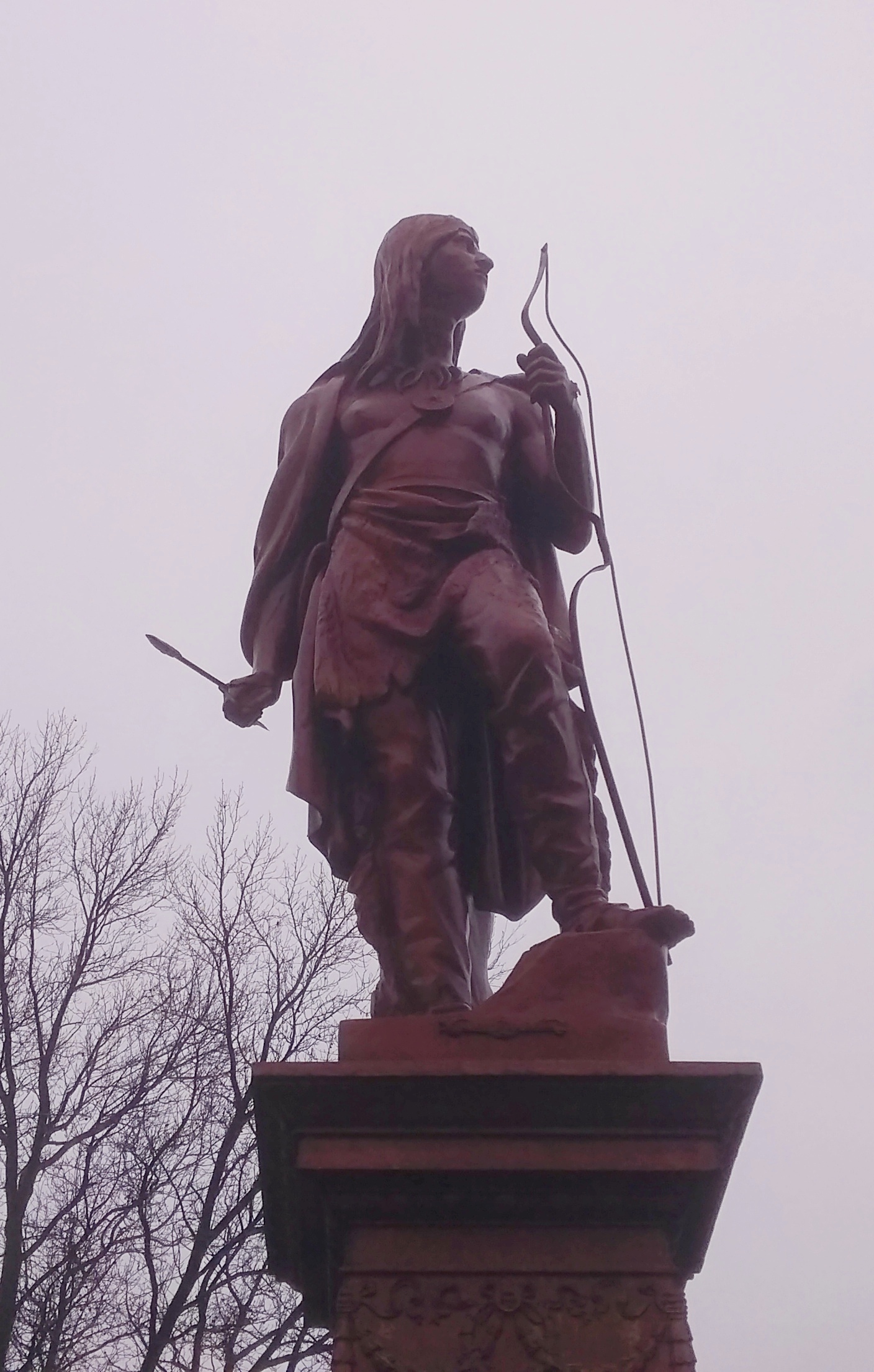
I correspond by postcard with a handful of people. Sometimes I get delightful cards. This one from a correspondent in Tennessee is definitely that.

It depicts, according to the back of the card, the Electric Emblem, Grand Commandery  of Colorado (Knights Templar, who are still around). The card has a copyright date of 1913, which as far as I understand puts it in the public domain. Something so delightful should be.

My correspondent tells me the card was once owned by her grandmother in Arkansas, “a prolific card writer,” she says. Makes it even more special to get in the mail. Millennials have no idea what they’re missing by giving up on postcards.

The Rain of October 1

After dark yesterday, I heard the mild rumble of thunder off in the distance. Had rain been forecast? I hadn’t checked. Turned out, it was, and soon we got heavy rain that lasted an hour or so. Not much more thunder, though.

At about 9:30 I parked myself on the couch in the living room and listened to the pleasant rainfall. I had my audio recording device handy.

Then it occurred to me that my roof and walls were muffling the robustness of the falling water. So I got up — it was an effort — and stood just outside the front door for a short time.

The best version of rain-sound is between those two, achieved by opening a window during a heavy rain and listening from somewhere a little removed from the window. But I didn’t test this idea last night. Instead, I went back to the couch for a leisurely while.

Mass Entertainment

Here’s a list I spent some time with recently: Wiki’s List of highest-grossing media franchises. Being Wiki, there’s no telling how accurate it is, but I will note that there are an enormous number of notes and references. So I’ll take it as accurate enough.

The list is interesting for a number of reasons, but mainly for information on the high-grossing franchises I’ve never heard of, which are quite a few.

Most of them are Japanese: anime, manga, even franchises whose most profitable expression is pachinko machines. As far as I could tell from my years in Japan, pachinko parlors were insanely bright, intensely noisy places to throw away money. But I was just a barbarian outsider. Apparently the machines are branded, and the branding is big business.

Take Fist of the North Star which, originating way back in 1983, would have been around when I was in Japan. I’d never heard of it until today. Though starting as manga, the franchise has enjoyed nearly $16.8 billion in pachinko machine sales, plus a few billion more in manga and other games.

Pachinko, incidentally, comes up 13 times on the list. Most of those are Japanese franchises, but not all. There have been $2.85 billion in Disney Aladdin pachinko (and arcade) machines sold. Spider-Man pachinko machines are popular to the tune of $308 million in sales, and Tomb Raider has sold $300 million.

I was curious how many of the franchises I’ve supported, either for myself or my children, so I counted: more than I would have thought, about 50. That includes mostly through ticket sales, as well as small-screen viewing (at least occasionally), but also the quarters I spent on Pac-Man and Space Invaders, and things my daughters watched that I never would, such as Sailor Moon and Dora the Explorer.

Mass-market entertainment’s pervasive. Even when your tastes tend to run to less successful shows.

Sōunkyō (層雲峡), 1993

The usual markers of fall are here. Spots of yellow and other fall colors are appearing in the trees. Sometimes we use the heater to keep temps above 68 F during the day and 65 F at night, the non-summer settings. The days are notably shorter, but at least the Summer Triangle is still up. Orion is not. Won’t be long.

We visited Hokkaido in late September, early October of 1993, including Sōunkyō, part of Daisetsuzan National Park, and which is known for its gorges. The colors were autumnal.

October 4, 1993

Rented bicycles early and rode around most of the day. Went to O-dake and Ko-dake, two narrow gorges at some distance from the resort complex. Ko-dake was the best — a bike path runs through it, while the road, a little crowded with cars, is diverted through a tunnel.

The gorge walls are reams of gray rock, bristling with all-color foliage like wild beards. Saw an assortment of waterfalls en route, including a multi-stream cascade.

Ate roasted corn on the cob and ice cream, two regional specialties, at the wayside shacks of O-dake. 

The fall colors… throughout this part of Hokkaido equal in variety and mass anything I’ve seen in autumn excursions in East Tennessee or New England.

The American Geographical Society Library (Or Wow, Look at All the Globes!)

At the University of Wisconsin-Milwaukee’s Golda Meir Library, which is the school’s main library, it isn’t hard to find a bust of the fourth Prime Minister of Israel. She was an alumna of the university’s predecessor institution, Milwaukee State Normal School.
Behind the bust is a mounted Milwaukee Sentinel article, dated August 27, 1987, about the sculptor, Maurice Ferstadt, whom I’ll give credit for not trying to idealize the prime minister’s face. On the morning of February 19 of that year, Ferstadt — who was 75 –finished the sculpture. That evening, he died of an aneurysm.

Part of the library participated in Milwaukee Doors Open last weekend. Special Collections is on the fourth floor. We spent some time there, looking at some of the old and rare books on display. Interesting.

Then we went to the third floor, which is home to the American Geographical Society Library.

The closer I got, the more excited I felt. That’s not a verb I use much in my well-established middle age. But as soon as I entered the library, that rare feeling came over me. This is best thing ever!

You know, that kid on Christmas morning feeling. The giddiness passed, of course, but I remained vastly impressed by the collection all the same.

According to the library’s web site, it “contains over 1.3 million items supporting instruction, research and learning. The collection is global in scope — ranging from the 15th century to present — and includes maps, atlases, books, periodicals, photographic and film media, and geospatial data.”

And I have to add, globes. Look at all the globes! That’s what we looked at most, though there were some fine maps on exhibit too. Old globes, new ones, globes in various languages, small orbs, much larger ones, thematic globes, and globes of the Earth, Moon, the Skies and probably Mars and some other planets that I missed.

What a beaut: a geological globe.

Here’s a relief globe, made in Italy ca. 1950.
I could have looked at and taken pictures of globes all day. Here’s one more. The granddaddy of all the globes in the collection.
The Library of Congress says, “In 1942 in the midst of World War II, U.S. Army Chief of Staff Gen. George C. Marshall sent a large globe to both President Franklin Roosevelt and Prime Minister Winston Churchill as Christmas gifts from the U.S. Army. The U.S. Office of Strategic Services had compiled the maps, and the Weber Costello Co. constructed the globes. It is reported that 12 to 15 of these globes were produced between 1942 and 1955.

“The globe measures 50 inches (127 centimeters) in diameter, 13 feet in circumference, and reportedly weighs 750 pounds. It consists of two interlocking halves made of bent bands of wood over which the printed paper gores are pasted.”

One of the library staff confirmed to me that this indeed was one of those 12 to 15 globes — though not either of those given to Roosevelt or Churchill, since they are at Hyde Park and Chartwell, respectively.

In recent years, the American Geographical Society’s had its globe refurbished. Looks good for its age, I’d say.
As I mentioned, there were maps on display from among the library’s vast collection, laying flat on tables for a convenient look.
There were all kinds of maps, such as one of the rayon acetate (silk-like) escape maps that helped Allied POWs escape during WWII, highway maps, non-English maps, space maps, hobbyist maps, historical trend maps, and comedy maps, such as the MAD Pictorial Map of the United States from 1981, with artwork by the inimitable Sergio Aragonés (who’s still alive).

As fun as that was — and I spent several minutes looking at it, since any Sergio Aragonés work is going to be incredibly detailed — my favorite was a Swiss map: Die Eroberung des Weltraums.

Or rather, a schematic depicting the progress of space exploration as of the publishing date in 1968. Here’s a detail.

Not shown in my detail are the Moon, or Venus and Mars, though spacecraft had voyaged there by ’68. There had been no exploration of the outer planets or Mercury yet, so those weren’t depicted at all. What a remarkable lot of information the artist, whose name I don’t have, was able to pack into the image.

Turner Hall, Milwaukee

From the Encyclopedia of 1848 Revolutions, part of an article on the German Turnverein: “Founded amid the nationalist enthusiasms of the War of Liberation, the German gymnastic movement, or Turnverein, had fundamentally changed by the time of the 1848 revolutions in the German lands.”

Ah, a branch of the physical culture movement. Maybe the main branch; I’m no expert. But I do blame the physical culture movement for the indignities of PE in 20th-century America.

To continue from the encyclopedia: “Although Friedrich Ludwig Jahn, the gymnasium instructor who had originated the idea of nationalist gymnastics in Berlin in 1811, was still venerated in the organization, his anti-Semitism, hatred of the French, and loyalty to the Hohenzollern dynasty left him out of step with an organization committed to national unification and political liberalism…

“These gymnastic clubs were often closely aligned with workers’ organizations and democratic clubs with whom they shared a desire for reform and a rejection of traditional hierarchies…

“In contrast to the organization Jahn had founded, almost one-half of the membership in the 1840s were non-gymnasts, the so-called ‘Friends of Turnen,’ and because of this, the new clubs engaged in more non-gymnastic activities, such as funding libraries and reading rooms, and sponsoring lectures, often of a politically liberal nature.

“Given the radicalization of the movement in the 1840s, it is not surprising that the German gymnasts were directly involved in the 1848 revolutions…

“The aftermath of the 1848 revolutions devastated the German gymnastic movement. Clubs were disbanded, property confiscated and leaders lost to jail or exile.”

One place exiled Turners went was Milwaukee. By 1882, they had completed Turner Hall, which stands to this day on 4th Street in downtown Milwaukee. Remarkably, the Milwaukee Turners are still around, and for a paltry $35, anyone can join. No German language skills or even gymnastic aptitude seem necessary.

Our Turner principles are as follows [their web site says]:
Liberty, against all oppression;
Tolerance, against all fanaticism;
Reason, against all superstition;
Justice, against all exploitation!

The hall was open as part of Milwaukee Open Doors, so we visited.
That’s not the building’s best side, which was in the shadow when we visited. Here’s a good picture of the front.

The building’s a fine work by Henry Koch, himself a German immigrant who also did Milwaukee City Hall. Built of good-looking Creme City brick, which is now going to be the subject of another digression.

“Like the road to Oz, much of Milwaukee is made of yellow brick – Cream City brick, to be precise. But how, exactly, did it end up here? And why is it such a source of local pride?” asks Milwaukee magazine.

“Clay found along Milwaukee’s river banks was naturally high in magnesia and lime, giving the brick its unique color and durability, according to Andrew Charles Stern, author of Cream City: The Brick That Made Milwaukee Famous.

“Its popularity extended well beyond Wauwatosa. Local manufacturers shipped Cream City bricks to clients around the United States and as far away as Europe, until production ceased in the 1920s, when the clay supply was depleted and builders began to favor stone and marble…”

Talk about enjoying a local sight. A building built for Milwaukee Turners from a material created locally.

Inside, we joined a tour group and saw the restaurant space, which I believe was a beer hall once upon a time. After all, they might have been physical culture enthusiasts, but they were also Germans.

Murals dating back to the early days of the Milwaukee Turners grace the walls in that part of the building. Such as one featuring Turnvater Jahn and assorted allegories.
The aforementioned Friedrich Ludwig Jahn (1778-1852), that is, the father of gymnastics, and possibly a godfather of National Socialism, though that point is disputed, and in any case the NSDAP never had much traction in Milwaukee.

A detail from another Turner Hall mural whose subject is the founding of Milwaukee.

Pictured are Solomon Juneau and a Native American. Juneau founded the city in the early 1800s.

I feel another digression coming on. From the forward of Solomon Juneau, A Biography, by Isabella Fox, published in 1916:

The name of Solomon Juneau has long been honored, alike for the sterling integrity, the true nobility of the man, and for his generous benefactions in the upbuilding of the city he founded nearly a century ago, near the Milwaukee bluff on the shore of Lake Michigan. He was the ideal pioneer — heroic in size and character — generous by nature, just in all his dealings, whether as a fur trader with the red man, or in business transactions with his fellow townsmen, through the trying times when early settlers often required fraternal assistance, and the embryo city in the wilderness was ever the gainer through his benevolence, for selfishness was non-existence in him…

They don’t write ’em like that any more.

The star attraction in the Turner Hall is the ballroom.

The ballroom was damaged by fire at some point, but it’s stabilized enough — including netting covering the ceiling — for public events, such as the wedding that was going to be held there sometime after we visited last Saturday.

Eventually, the room will be restored. Bet it’ll be a marvel.

The Milwaukee Theatre

On October 14, 1912, former President Theodore Roosevelt took a bullet in the chest at the Gilpatrick Hotel in Milwaukee, but went on to deliver his presidential campaign speech at the Milwaukee Auditorium across the street soon afterward.

“Friends, I shall ask you to be as quiet as possible,” TR said. “I don’t know whether you fully understand that I have just been shot; but it takes more than that to kill a Bull Moose. But fortunately I had my manuscript, so you see I was going to make a long speech, and there is a bullet — there is where the bullet went through — and it probably saved me from it going into my heart.”

In later years, especially during an early 21st-century renovation, the Milwaukee Auditorium evolved into the Milwaukee Theatre, which is officially the Miller High Life Theatre these days, because beer money bought the naming rights recently.
Never mind that. What I want to know is, where is the plaque commemorating TR’s speech?

Maybe there is one, but I didn’t see it. Or why didn’t our tour guide through the theater on Saturday mention this remarkable event? I knew the story of the attempted assassination, but didn’t connect it with the Milwaukee Theatre until today.

In any case, the theater looks like a first-rate venue, seating more than 4,000. The view from the stage.

Here’s the view from the stage when space aliens started kidnapping people standing there, via tractor beams (and how do those work, anyway?).

Or maybe I jiggled the camera during a relatively long exposure.

We toured other parts of the venue as well, including the elegant side halls Kilbourn and Plankinton — named for long-ago donors — with the former decorated by murals depicting Milwaukee history. We also saw the green room.

Where Miller High Life Theatre-themed cupcakes were offered for our refreshment. I have to say that’s something I’d never seen before.
You’d think a light shade of green would be the thing for the green room walls, for tradition’s sake, but no. Then again, I’ve read it isn’t clear that most green rooms ever were really green. Just another phrase origin lost to time.

Next to the theater is the UW–Milwaukee Panther Arena, which seats as many as 12,700. That too was open for the Doors Open Milwaukee event.

These days the arena is home to the Milwaukee Panthers men’s basketball team of the NCAA, as well as the Brewcity Bruisers, a roller derby league based in Milwaukee. For the record, the Bruisers are a member of the Women’s Flat Track Derby Association.

Milwaukee Doors Open ’18

We went to Milwaukee on Saturday for this year’s Milwaukee Doors Open, a fine event that more cities in this country would do well to emulate. Doors Open and Open House have a fair number of participating cities around the world, but by my count only Atlanta, Chicago, Denver, Milwaukee, Lowell, Mass., and New York in the U.S.

Last year during the event, we visited five Milwaukee churches and one secular building, City Hall. After visiting six churches just last week in Chicago, we took a break from religious sites and focused on other kinds of buildings: a theater, an arena, a former clubhouse that’s now an event venue, a library and a planetarium.

The Doors Open buildings weren’t the only things we saw. For instance, in downtown Milwaukee I noticed this memorial on the grounds of the Milwaukee Fire Dept. HQ, called “The Last Alarm.”Words on one side the plinth explained: Traditionally, in the Milwaukee Fire Department, when a fire fighter dies in the line of duty, his-her boots, topped by a fire fighting coat and helmet, are placed in the procession. As the funeral cortege of the fallen firer fighter approaches, the on-duty crew comes to attention and offers a final salute. This empty turnout gear not only symbolizes the missing fire fighter, but also the emptiness felt by family, friends, and fellow fire fighters who share the loss.

On another side of the plinth is a list of Milwaukee FD firefighters who died in the line of duty.

A few blocks away is an historical marker about the typewriter. It’s pretty much self-explanatory, at the least to the aging part of the population that grew up with typewriters.

Also downtown is the Milwaukee County Courthouse, and imposing neo-classical edifice by McKim, Mead, and White, finished in 1931. From the east.

Another view, from the southeast, roughly.

In the afternoon, we left downtown to visit the campus of the University of Wisconsin- Milwaukee, which is in the northern reaches of the city, not far from Lake Michigan. Though not open for a tour, I thought this building was interesting.

It’s the Kenwood Interdisciplinary Research Complex, which includes labs, classrooms, offices and meeting spaces for the university’s physics, chemistry and the Environmental Health Sciences doctoral program within the Zilber School of Public Health. Finished in 2015.

Postmodern, I suppose. According to Flad Architects, who designed it, “the exterior expression of yellow terracotta, exposed concrete and metal panels is rendered as an assemblage of components, a metaphor for the research and innovation happening within.” That is to say, pay attention, Science is happening here.

Not far away is a sizable concrete sculpture.

Not the most aesthetic assemblage of material, or even concrete, that I’ve ever seen. But it has a cool name: “Jantar-Mantar,” which I suppose is an homage to the astronomical observatories in India of that name, though without the hyphen. Erected in 1995.

Narendra Patel, who used to teach art at the university, is listed on the plaque as the sculptor, with the piece otherwise “created and completed through the hard work and direction of Dennis Manley and the following students of sculpture [lists 14 names].”

Postcard From Russia

First coolish weekend since spring. Or rather warmish days and coolish nights. The beginning of the same slide into winter as every year.

A postcard I picked up in Russia in 1994.

The Sampsonievsky Cathedral (St Sampson’s), St. Petersburg. Looks like it’s been restored since the postcard was made. If I remember right, the building wasn’t even open when we visited St. Petersburg.

Anyway, at the time I sent the card to my brother Jim with a simple message.

Address whited out for posting. 600 rubles would have been… anywhere from 20 to 30 U.S. cents, since the exchange rate bucked around from 2,000 to 3,000 rubles to the dollar during the two weeks we were in country. Not bad for an international mailing.

I probably sent a dozen cards from the main post office, an elegant structure dating back to the time of Catherine the Great, and still a post office in the Soviet and post-Soviet eras. Elegant, but a little dingy. If these pictures are accurate, the place has been spiffed up since the mid-90s.

The Church of St. Barbara

The last stop for bus #4 on this year’s church tour in the Bridgeport neighborhood of Chicago was the Church of St. Barbara on S. Throop St.
It’s an octagonal Renaissance-style church and another edifice created by a Polish congregation in the early 20th century. These days, the congregation is much more  ethnically mixed, but Polish still greets visitors at the main entrance.
St. Barbara is another Worthmann & Steinbach design, finished in 1914, the second we saw on Saturday after First Lutheran Church of the Trinity. Architects tend to be ecumenical in their clients, I figure. A commission’s a commission.

The octagonal shape makes it a little hard to comprehend the interior by looking straight ahead. You have to spend time looking around.
And looking up.
Here’s St. Barbara, looking down on the altar.
I couldn’t remember who St. Barbara was thought to be, but the sword is distinctive. So I looked her up later.

“Virgin and Martyr,” New Advent says. “There is no reference to St. Barbara contained in the authentic early historical authorities for Christian antiquity, neither does her name appear in the original recension of St. Jerome’s martyrology. Veneration of the saint was common, however, from the seventh century.

“Barbara was the daughter of a rich heathen named Dioscorus. She was carefully guarded by her father who kept her shut up in a tower in order to preserve her from the outside world… Before going on a journey her father commanded that a bath-house be erected for her use near her dwelling, and during his absence Barbara had three windows put in it, as a symbol of the Holy Trinity, instead of the two originally intended.

“When her father returned she acknowledged herself to be a Christian; upon this she was ill-treated by him and dragged before the prefect of the province, Martinianus, who had her cruelly tortured and finally condemned her to death by beheading. The father himself carried out the death sentence, but in punishment for this he was struck by lightning on the way home and his body consumed.

“The legend that her father was struck by lightning caused her, probably, to be regarded by the common people as the patron saint in time of danger from thunderstorms and fire, and later by analogy, as the protector of artillerymen and miners.”

One of those very popular saints without any actual historical basis, it seems. No matter. She has a lot of places named after her besides the city in California.

After looking around the sanctuary, we went to the adjacent school for snacks. That’s where I saw something else I’d never seen before.

A bingo sign. Plugged in and everything. Pretty much as mysterious to me as the tales of St. Barbara.