The Second Bank of the United States & The Faces Within

Unusually warm these last few days. Today was so pleasant I cooked brats outside and we ate them outside for lunch. More leaves are gone than not, so for the moment there’s a mismatch between temperature and foliage, for this part of the country. It’s certain not to last.

The Second Bank of the United States is at 420 Chestnut St. in Philadelphia, just two blocks from Independence Hall. The gallery was as sparsely visited on October 22, a Saturday, as Independence Hall and the Liberty Bell were overrun by visitors. It’s the bank that President Jackson famously slew with a veto of its re-chartering in the summer of 1832, an act that was the focus of the election that fall — which Jackson won resoundingly.

The building is a handsome, bank-as-Greek temple sort of structure designed by William Strickland. Him again. I hadn’t realized he was so prominent in Philadelphia, since I’ve long associated him with Nashville. These days, the building is known as the Portrait Gallery in the Second Bank of the United States, displaying many portraits of Revolutionary and post-Revolutionary luminaries.

That includes a large collection of paintings by Charles Willson Peale, whom I didn’t appreciate until looking at one portrait of his after another. The man had some serious talent for portraiture, and much else besides.

I spent time especially with lesser-known figures of the period, though I didn’t see Button Gwinnett. The nation may have just heard of that Declaration signer from Georgia, but I did a report on him in the 8th grade, when we had to do reports on signers (picked at random, I think). I remember him, because his name is hard to forget.

All of the portrait examples from the Second Bank of the United States posted here were painted by Peale. The Founding Fathers are always worthwhile to ponder, but a lot of other interesting people characterized the period. David Rittenhouse, for instance.

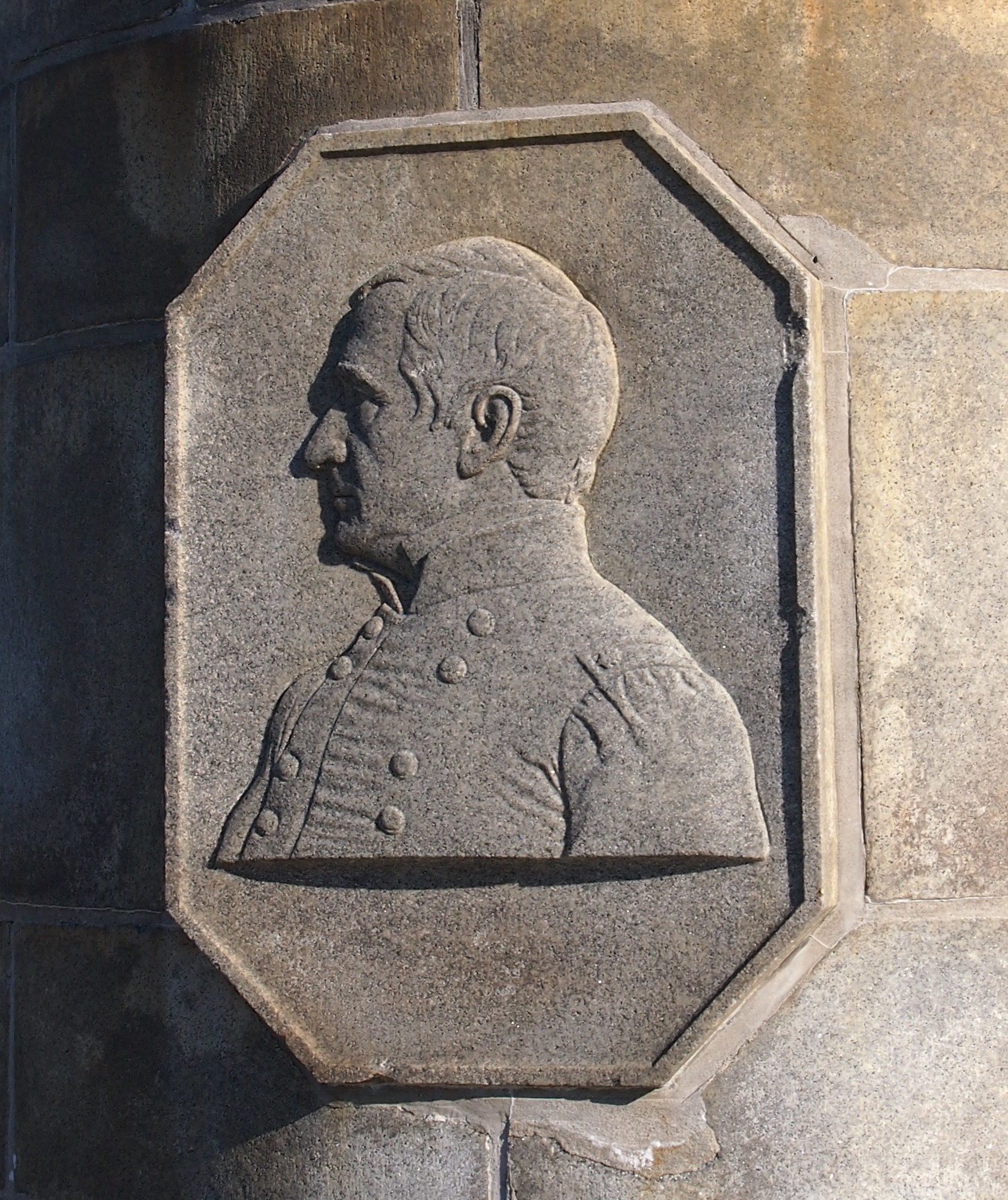
David Rittenhouse, Second Bank of the US

Talk about a lesser-known man of the Enlightenment. Of special interest to me is that he was a skilled astronomer — one of those worldwide who observed the Transit of Venus in 1769 — and first director of the U.S. Mint. Not only that, he built swell orreries and surveyed borders for mid-Atlantic states, including the half-circle border between Pennsylvania and Delaware.
“His scientific thinking and experimentation earned Rittenhouse considerable intellectual prestige in America and in Europe,” says the Penn University Archives & Records Center. “He built his own observatory at his father’s farm in Norriton, outside of Philadelphia. Rittenhouse maintained detailed records of his observations and published a number of important works on astronomy, including a paper putting forth his solution for locating the place of a planet in its orbit.

“He was a leader in the scientific community’s observance of the transit of Venus in 1769, which won him broad acclaim. He also sought to solve mathematical problems, publishing his first mathematical paper in 1792, an effort to determine the period of a pendulum. He also experimented with magnetism and electricity.”

Here’s John Dickinson, who didn’t support the Declaration. Later, though, he did his part for independence, and was a delegate in 1787.

John Dickenson, Second Bank of the US

“On July 1, 1776, as his colleagues in the Continental Congress prepared to declare independence from Britain, Dickinson offered a resounding dissent,” says HistoryNet.

“Deathly pale and thin as a rail, the celebrated Pennsylvania Farmer chided his fellow delegates for daring to ‘brave the storm in a skiff made of paper.’ He argued that France and Spain might be tempted to attack rather than support an independent American nation.

“He also noted that many differences among the colonies had yet to be resolved and could lead to civil war. When Congress adopted a nearly unanimous resolution the next day to sever ties with Britain, Dickinson abstained from the vote, knowing full well that he had delivered ‘the finishing Blow to my once too great, and my Integrity considered, now too diminish’d Popularity.’ ”

Here’s a nice dramatization of that moment from John Adams, with Dickinson portrayed by Zeljko Ivanek.

This is Thayendanegea, also known as Joseph Brant, a Mohawk war chief who was decidedly not on the side of the colonists during the Revolution.

Thayendanegea, Second Bank of the United States

He was pro-British in the war, in that it served the interests of the Iroquois Confederation. Awfully even-handed of the gallery to include him, though it’s good to acknowledge his leadership skills, which apparently were many in war and diplomacy.

“The Mohawks chose to support the British because American colonists were already overrunning their lands,” says Upper Canada History. “The alliance was not unnatural as far as the Natives were concerned. For more than a hundred years, the Iroquois League had allied itself with the British in their long conflict with the Algonquins. Brant, Mohawk chief, had fought alongside the British in the Seven Years’ War and he remained loyal to the redcoats. This new alliance was really just a continuance of their long-standing cooperation…

“Brant fought with fierce determination against the Americans on the frontier and distinguished himself as one of their most courageous warriors and ablest strategists. His contribution to the cause did not go unrewarded. Of Brant’s loyalty and leadership, Lord Germain wrote, ‘The astounding activity of Joseph Brant’s enterprises and the important consequences with which they have attended give him a claim to every mark of our regard.’ In 1779 Brant received a commission signed by the king as ‘captain of the Northern Confederate Indians’ in appreciation of his ‘astonishing activity and success’ in the king’s service. Even though he esteemed his rank as captain, he preferred to fight as a war chief.”

After the Americans won the war, Thayendanegea led his people to Canada, with mixed results. He’s regarded highly enough in Canada to have been on a proof silver dollar in 2007, the bicentennial of his death.

Independence Hall

Just before midnight last night, I heard the distinctive popping of fireworks in the neighborhood.

I took that to mean that the Cubs won in far-off Cleveland. So they had. Not to be a mope, but I don’t know that the curse is actually broken. The curse could be, after all, that the Cubs will only win the World Series once a century. We may not ever find out; Neil and his generation might, though.

“Independence Hall,” said the guide at Independence Hall, “is the most important historic building in the entire country.” The guide, a gentlemen of retirement age and now a volunteer for the National Park Service, had probably been a teacher at one time. He had that manner, anyway.

He made a brief case for his assertion. “How can I say that? There are a lot of important historic buildings in every part of the country. But the key word is country. Because of what happened here, there’s a country that has a history.”

Not a bad argument. When you’re in a place like Independence Hall, where such weighty events occurred, such notions carry some weight. In as much as the United States was created in one place, this was it.
Independence Hall 2016There’s nothing surprising about how the building looks. Everyone’s seen it depicted any number of times, including the Bicentennial Half Dollar (a nice design; the coin should have kept it) and the back of the current $100 Federal Reserve Note, which admittedly, I don’t see that much.

What surprised me was that Chestnut St., an ordinary street, runs right in front of the building. Maybe that’s too important a city street to close off, though I would have guessed that security-minded, or -obsessive, officials would want to. Apparently not.

The building was designed by Andrew Hamilton to house the Assembly of the Commonwealth of Pennsylvania, and finished in 1753. Interestingly, in our time the building is actually owned by the City of Philadelphia — the Commonwealth having quit using it long ago — but administered by the National Park Service since 1948.

Another thing I learned about Independence Hall: William Strickland designed its distinctive clocktower, the same architect who did the fine Tennessee State Capitol. That was well after the meetings that ushered in the Declaration and the Constitution, however. The original steeple had rotted away as early as the 1780s, and was demolished in 1781. The Strickland replacement wasn’t until 1828, so when the delegates met to fix the Articles of Confederation in ’87, and came away with a new Constitution, that isn’t what they would have seen.Independence Hall 2016

Independence Hall is only part of Independence Hall National Historic Site. Other structures include a modern Visitors Center, the Supreme Court Chamber in Old City Hall, Congress Hall, the First and Second Banks of the United States, Carpenters’ Hall, Merchants’ Exchange — another Strickland building — the Todd House, the Bishop White House, and of course the Liberty Bell Center.

There was a long line to get into to see the Liberty Bell (it too has been on a coin. More than one). I didn’t feel like waiting, especially since the bell is visible from a window, fairly close up. It has heft, that’s for sure. And yet it’s cracked. Maybe that’s a better symbol of fragile liberty than is generally acknowledged.
Liberty Bell, 2016Getting into Independence Hall took a fair amount of time, first waiting to go through a metal detector, and then waiting for your timed tour of the inside. If you don’t order your tickets ahead of time, you risk not being able to get in.
Independence Hall, 2016Upon entering Independence Hall, you first assemble in a room — the East Wing of the building — in which the guide tells you about the building, how to comport yourself, etc. Then you enter the room that used to be Pennsylvania Supreme Court chamber; here’s a better picture than I could take.

The current interior of the courtroom, as well as the Assembly Room famed for the Declaration and the Constitution, is a mid-20th century reconstruction by the National Park Service, with the public rooms restored to their 18th-century appearance. Between the late 18th century and the mid-20th, after all, the building was changed and modified, as buildings tend to be.

This is the Assembly Room.

“One the questions I’m always asked,” our pedagogic guide said, “is whether the furniture is original. The answer is no. Most of it isn’t. But if you think about, the furniture isn’t why you’ve come to see this room. You’re here because what happened here.”

Sure enough. But he did point out that the president’s chair on display on the dais is the one that George Washington sat in when he presided at the Constitutional Convention.

Upstairs is the Long Room, where events were, and are, held. It’s long, all right.
Long Room, Independence HallOur guide had more tidbit to offer when we were there. During Lafayette’s triumphal tour of the United States in 1824-25, when he was feted everywhere he went, a particularly lavish reception for was held for him in the Long Hall, which was part of the Pennsylvania State Hall at the time (he got a parade in Philly too). The building was called the “Hall of Independence” for the event, the first known reference using that terminology. That was an early step for the building toward becoming a National Historic Site and a World Heritage Site too.

The U.S. Mint, Philadelphia

These days the headquarters of the U.S. Mint might be in Washington, DC, but its main branch is in Philadelphia, put there when that city was the national capital for a decade or so in the late 18th century. Congress created a national mint as part of the Coinage Act of 1792, as it was authorized to do by the Constitution (Article I, Section 8).

The 1792 law is an interesting read for numismaphiles, especially the specifications for U.S. coinage — and the fact that the direct ancestor of our dollar was the Spanish milled dollar “as the same is now current.” This fact ought to be better known.

“By far the leading specie coin circulating in America was the Spanish silver dollar, defined as consisting of 387 grains of pure silver,” notes Murray N. Rothbard in “Commodity Money in Colonial America.” (The libertarian economist who seemed to have no love for that invention of the Devil, fiat money; still, I’ll bet he’s reliable when taking about the nothing-but-metal currency of the early Republic.)

“The dollar was divided into ‘pieces of eight,’ or ‘bits,’ each consisting of one-eighth of a dollar,” Rothbard wrote. “Spanish dollars came into the North American colonies through lucrative trade with the West Indies. The Spanish silver dollar had been the world’s outstanding coin since the early 16th century, and was spread partially by dint of the vast silver output of the Spanish colonies in Latin America. More important, however, was that the Spanish dollar, from the 16th to the 19th century, was relatively the most stable and least debased coin in the Western world.”

Indeed, the Spanish dollar was legal tender in the U.S. until 1857. Then there’s Section 19 of the 1792 law, on the penalties for debasing coins: “If any of the gold or silver coins which shall be struck or coined at the said mint shall be debased or made worse as to the proportion of the fine gold or fine silver therein contained, or shall be of less weight or value than the same out to be pursuant to the directions of this act… every such officer or person who shall commit any or either of the said offenses, shall be deemed guilty of felony, and shall suffer death.”

Italics added. I’m not going look into it further right now, but maybe that penalty was inspired by the penalty for such misdeeds at the Royal Mint, which I suppose would be a direct offense against the sovereign. Also, I doubt that anyone ever was executed in the United States for such a crime, though a few mint miscreants have probably been tossed in the jug over the decades.

In any case, the expectation in 1792 seemed to be that the mint would move with the national capital, but things didn’t work out that way. According to the Mint, in 1801 — after Washington City had been established, though it wasn’t much more than a marshy place on the Potomac — “Congressional legislation directs the Mint to remain in Philadelphia until March 1803.

“Mint Officials were not in favor of relocating the facility to the newly established Federal City in Washington, and addressed their concerns many times. Legislation extending the Mint’s stay in Philadelphia appears throughout the early 1800s. Most extensions were for five years. At some point Congress seems to have tired of these extensions. An Act of May 19, 1828, leaves the facility in Philadelphia ‘until otherwise provided by law.’ ”

Since then, the United States has manufactured coinage in four locations successively in Philadelphia. The first and second sites no longer exist. The current mint facility, a large concrete building not too far north of Independence Mall, dates from the 1960s. It’s the fourth facility, designed by Philadelphia architect Vincent G. Kling and, while concrete, isn’t especially brutal. Or that good-looking either.

As you’d expect, the third facility, completed in 1901, has more style. The Beaux Arts building, I’m glad to report, still exists. It’s home to the Community College of Philadelphia these days. I didn’t have time to see it, so it counts as another reason to return to Philadelphia sometime.

You enter the modern mint building on N. 5th St., through an entrance that has a guard and a metal detector. No photography allowed inside. The first place you come to is a floor that includes the gift shop and an electronic sign that tells you how many coins, and what kind, the facility has made lately. From there escalators rise a couple of floors to two long halls that overlook the mint factory floor. Along the halls, at least where there are no windows to look through, are displays about the manufacture of coins: blanking, annealing, riddling, upsetting, striking, inspecting, counting and bagging.

In front of a display about mint marks, I fell into a short discussion with an elderly couple about them. The displays said, naturally, that until fairly recently Philadelphia-made coins had no mint mark — except for ’40s wartime nickels — but that they do now, except for the penny. As we talked about that, I was astonished to realize that they’d never heard of mint marks, though I didn’t tell them that. The woman thought it a nifty thing to learn, and said that she’d be looking more closely at coins. I encouraged her to do so.

Wiki, though there’s no underlying reference, explains why Philadelphia pennies carry no mint mark, something I’d never seen clarified: “Currently, the Lincoln cent is the only coin that does not always have a mint mark, using a D when struck in Denver but lacking a P when ostensibly struck at the Philadelphia mint; this practice allows additional minting of the coin at the San Francisco mint (S) and West Point mint (W) without the use of their respective mint marks to supplement coin production without the concern of creating scarce varieties. Generally modern S and W coins do not circulate, being mostly produced as bullion, commemorative, or proof coinage.”

I can’t say that I understood by sight much of what was going on down at the Philadelphia mint factory floor. There are a lot of large machines, along with conveyor belts and other mechanical odds and ends down there, but few people. Mostly the process, from blanking to bagging, is automated. I got the same impression of bemusing industrialism at the Denver mint in 1980, and at the Canberra mint in 1991, (the Osaka mint had a museum, but I don’t think it gave tours).

The factory is unusual in that way down on the floor is a scattering of coins, mostly pennies, presumably those that have dropped from the process at one time or another. For that matter, most of what I saw in various bins and tubs were pennies. Many, many pennies. All that manufacturing effort for a coin no one really wants any more, except for the zinc barons.

It may be just as well when the U.S. cent coin finally dies, as well as the dollar bill. If coins in this country are to have a long-term future — and I’d be sad to think of a future without them — very small denominations need to make way for larger ones. As long as the design is interesting, and the presidential dollars certain qualify, transitioning to $1 coins would be OK. So would $2 coins, for that matter, as the Canadians have done with their loonies and twonies.

Eastern State Penitentiary

What to do after you’ve visited a major cemetery in Philadelphia? Visit a former prison, now a museum. You could, anyway, since they aren’t that far apart, though not comfortable walking distance.

Specifically, you find yourself outside the massive walls of Eastern State Penitentiary, built in the late 1820s as one of the first modern prisons in the United States, and the first of its kind. In its early days, the prison enforced solitary confinement all the time for all the prisoners.
Eastern State PenetentiaryEastern State PenetentiaryThe museum’s web site tells the tale of its development very well: “In 1787, a group of well-known and powerful Philadelphians convened in the home of Benjamin Franklin. The members of The Philadelphia Society for Alleviating the Miseries of Public Prisons expressed growing concern with the conditions in American and European prisons… It took the Society more than thirty years to convince the Commonwealth of Pennsylvania to build the kind of prison it suggested: a revolutionary new building on farmland outside Philadelphia.

“Eastern State Penitentiary broke sharply with the prisons of its day, abandoning corporal punishment and ill treatment. This massive new structure, opened in 1829, became one of the most expensive American buildings of its day and soon the most famous prison in the world. The Penitentiary would not simply punish, but move the criminal toward spiritual reflection and change. The method was a Quaker-inspired system of isolation from other prisoners, with labor…. proponents of the system believed strongly that the criminals, exposed, in silence, to thoughts of their behavior and the ugliness of their crimes, would become genuinely penitent. Thus the new word, penitentiary.”

Eventually — though it took a long time to abandon the system, as usual with institutional change — the practice of all solitary was abandoned when it became clear that solitary confinement all the time drove a lot of prisoners nuts. Guess that counts as an example of good intentions paving the road to Hell.

Eastern State’s massive walls form a square, the idea of which was to look as scary as possible from the outside, to deter criminal urges among those still outside (I doubt that that worked, either). Inside, the British-born architect John Haviland’s design included “seven cellblocks [that] radiate from a central surveillance rotunda,” explains the museum web site.

In our time, a number of the cellblocks have been partly restored to an earlier look.
Eastern State Penetentiary interior cellblockNot quite the original look, since at first the hallways’ only connection to the cells were through slots through which food was passed. “Haviland’s ambitious mechanical innovations placed each prisoner had his or her own private cell, centrally heated, with running water, a flush toilet, and a skylight. Adjacent to the cell was a private outdoor exercise yard contained by a ten-foot wall,” the prison says.

That wall had the only door, which of course was locked all the time. “In the vaulted, skylit cell, the prisoner had only the light from heaven, the word of God (the Bible) and honest work (shoemaking, weaving, and the like) to lead to penitence,” continues the web site. “In striking contrast to the Gothic exterior, Haviland used the grand architectural vocabulary of churches on the interior. He employed 30-foot, barrel vaulted hallways, tall arched windows, and skylights throughout. He wrote of the Penitentiary as a forced monastery, a machine for reform. ”

Later, Eastern State became more of a standard 20th-century prison, closer to the New York system, rather than the Pennsylvania system pioneered at Eastern State, finally closing in 1970. Hallway doors were added.

Eastern State Penetentiary

New cellblocks were also added, including a few two-story ones.

Eastern State Penitential

Some cells are open. Many of the cells are unrestored, containing debris of various kinds.
Eastern State Penetentiary

A few are more-or-less restored. The urge to take selfies doesn’t seem to go away just because the setting is a prison ruin.

Eastern State PenetentiaryNote that the fellow in the picture is wearing earphones. Part of the price of admission — not an extra — was the loan of an mp3 player and some earphones. Wearing them, you went to various stations and listened to narration about the prison by actor Steve Buscemi. He had a good voice for the text, which was well-written and informative. Adding an extra layer of interest: some of the segments also included interviews (perhaps done some years ago) of both inmates and guards at the prison in the 20th century.

The museum featured a number of other restorations, such as a barber shop, the exercise yard, hospital, and (surprisingly) a synagogue. The museum couldn’t resist re-creating Al Capone’s cell, and I couldn’t resist taking a picture of it.
Eastern State Penetentiary - Al Capone's cellThere are about a dozen artists’ installations in the museum, most of which occupy single cells in various parts of the prison. I found this one, “Other Absences,” the most compelling.
Eastern State PenitentiaryArtist Cindy Stockton Moore’s web site says she created “fifty portraits of murder victims. The paintings, created with loose ink washes on translucent mylar, depict men, women and children whose deaths were attributed to those incarcerated at Eastern State Penitentiary.” That’s good. The prisoners shouldn’t get all of the attention.

Laurel Hill Cemetery

Laurel Hill Cemetery in Philadelphia is known as the second major rural cemetery in the country, dating from 1836. Its location isn’t remotely rural now, but in its early days the cemetery was outside the city on a sizable hill overlooking the Schuylkill River.

As the cemetery’s web site says, “Previously, churchyards were the only places available to bury the dead, and they were often as crowded and unsanitary as the streets that bordered them. Worse yet, rapid industrialization and population growth commonly led to the disinterment of burial grounds to make way for roads and buildings…. Laurel Hill was not only established as a permanent, non-sectarian burial place for the dead, but also as a scenic, riverside sanctuary for the living.”

As the city grew around it, Laurel Hill itself become crowded, and it’s now a sizable necropolis with about 33,000 permanent residents in 74 acres. Many spots are lush with growth.Laurel Hill Cemetery 2016Trees grow on the slope down to the river.Laurel Hill Cemetery 2016Many parts are thick with stones.Laurel Hill Cemetery 2016Laurel Hill Cemetery 2016Some monuments reach toward the sky.
Laurel Hill Cemetery 2016There are less conventional stones. Find a Grave says that “the shattered urn symbolizes a violet death. Stewart was murdered by his manservant.”
Laurel Hill Cemetery 2016The cemetery also has a large stock of striking funerary art, such as the Warner Memorial. Bellamorte.net says: “The Warner Memorial, sculpted by yet another Scottish craftsman, Alexander Milne Calder, shows a full-sized female figure opening a casket while the spirit of its male inhabitant slips free and takes wing. Sadly, the monument has been the target of vandalism over the years; both of the woman’s arms are missing as is the nose of the rising male spirit.”
Laurel Hill Cemetery 2016Another detail from the Warner Memorial.
Laurel Hill Cemetery - Warner Memorial LionI didn’t seek out too many notable burial sites, except for Gen. George Meade, resident of the cemetery since 1872. He and some of his family have a spot with a nice view of the river, and I can report that people put stones on his grave.
Laurel Hill Cemetery - George Meade GraveOne of the oddest stones I saw belonged to Catharine Drinkhouse Smith and Levi Franklin Smith, a five-sided pillar (not four, as it says on Bellamorte.net). Mrs. Smith was a noted spiritualist of her time.

Her side of the stone said, with curious precision about some things: “Mrs. Catharine Drinkhouse Smith was born at Reading, Berks County, State of Pennsylvania, on Thursday, the Fifth day of August, 1824, at 15 minutes past 5 O’clock in the morning, and passed to spirit life 15 minutes before 12 O’clock the 27th day of March, 1893, from the residence of her husband, Professor Levi Franklin Smith, 2430 Thomson Street, Philadelphia, Pennsylvania. Mrs. Smith was a devoted Spiritualist, and one of the best mediums of her time, and accomplished great good, in spreading this beautiful truth, and in demonstrating a continuity of life.”

Another odd thing: the cemetery had a gift shop. Besides Arlington National Cemetery, I think that’s the only time I’ve run across that. The man behind the counter was an informative fellow, happy to talk about the place (and a bit about Professor and Mrs. Smith). I did my little part to support the cemetery by buying some postcards and a refrigerator magnet.

Phil-Tex ’16

Just returned from Texas, where I visited family, but before I went there I had about a day and a half to kick around in Philadelphia, the largest city in the United States that I’d never been to before. Of course, size is only one measure of a city. After only a small sample, I’d say that Philadelphia counts as a highly worthwhile place to go for all kinds of reasons.

The visit was partly mad dash — on foot, by bus and by rail to a few places I really wanted to see — while also trying to take a more leisurely gaze at interesting things as I wandered down streets or sat next to bus windows. Those sound like contradictory activities, but not really. I was helped by the fact that both days were good for walking for different reasons: Friday, October 21 because it was warm, clear and nearly summer-like; Saturday, October 22 because it was overcast, cool and a distinctly fall day.

The region’s fall appearance was very distinctive in some places, such as this view of the west bank of the Schuylkill River (I didn’t make it over to the Delaware River).

Schuylkill River from Laurel Hill CemeteryI made it to the Laurel Hill Cemetery, one of the nation’s first park-like burial grounds, and about as picturesque as a cemetery can be, with weathered stones and funerary artwork and massive trees covering large hills along the Schuylkill, plus a few famed residents.

Also, I visited Eastern State Penitentiary, a museum that was once an enormous prison for the state of Pennsylvania. Not just any prison, but a 19th-century structure that was the first of an important kind of prison, and so an historic site. In our time it’s a magnificent ruin and quite a tourist attraction. Urban ruins are a little hard to come by, but not impossible.

I fulfilled a childhood ambition — I was a peculiar child — when I visited the U.S. Mint in Philadelphia just before it closed for the day on Friday, October 21. The last time I’d been to a functioning U.S. Mint facility was in 1980 in Denver, back before Big Zinc took an abiding interest preserving the penny.

I wouldn’t have been a first-time Philadelphia tourist worth my salt if I didn’t find myself at Independence National Historic Park during my visit, whose star attractions are Independence Hall and the Liberty Bell. It was a popular place. Tourists from all over were there, taking pictures of the place where the United States was invented.

Independence National Historic ParkAs well as of each other.
Independence National Historic ParkShe took five or six jumps before he took a picture she liked.

The Bridgeview Bank, Uptown

Back posting around October 30, when I might have seen another thing or two to write about, with any luck.

One more destination on this year’s Open House Chicago: the Bridgeview Bank Building in Uptown Chicago, originally known as Sheridan Trust & Savings and then the Uptown National Bank. It’s one of the taller buildings in the neighborhood. You enter the building on Broadway, into a small foyer. From there, a grand staircase leads to the second floor, which is mostly occupied by a resplendent former bank lobby.

Bridgeview Bank, Uptown Chicago

The building, and the lobby, is a Marshall & Fox design from 1924, and it’s ornate. And solid.

It occurred to me as I wandered around the marble and brass and ironwork of this sturdy structure that the FDIC probably helped kill off this kind of bank design. Before accounts were insured, a bank needed to look solid. The more solid, the better — at least as far as reassuring your customers was concerned. But if customers can’t lose their deposits, that consideration takes a back seat.

Just speculation. It’s also likely that the generation of bankers who came of age during the Depression (e.g., Milton Drysdale) considered such ornamentation frivolous spending. I should also note that the splendor of Sheridan Trust & Savings’ lobby didn’t save the bank during the Depression.

Never mind, Marshall & Fox did a stunning bank lobby. Here’s a closer look at the ceiling.

Bridgeview Bank, Uptown ChicagoThe tables where customers used to get ready for the tellers still sport some striking lamps. I want a couple of these at the colorless suburban banks I visit.
Sheridan Trust & Savings Uptown ChicagoThere are bank offices ringing the lobby, but otherwise the space isn’t used any more, certainly not for retail banking. Too bad; it should be used for something.

Down on the lower level is a vault — the very picture of a bank vault from another time.
Sheridan Trust & Savings Uptown ChicagoIt isn’t used for anything any more, either. I doubt that the bank would consider it, but maybe a hipster restaurant can go upstairs, along with a hipster bar in the vault.

Four Houses of Worship

A number of churches — and other houses of worship — were part of Open House Chicago. That’s one of the attractions of the event, as far as I’m concerned.

In Evanston, we visited First Presbyterian. It’s not just a church. It’s a Daniel Burnham church.

First Presbyterian, Evanston

The church’s web site says, “In July 1876 a new church building was dedicated after the original church burned down. However, this church only stood for 18 years. In February 1894, the second church burned to the ground [and maybe sank into the swamp]. The congregation met in a former roller rink while our current building was being constructed, at a cost of $80,000. Daniel H. Burnham, the famed architect who was the inspiration for Chicago’s lakefront, designed the new church.

“The church is constructed of Lemont limestone, with an interior finish of red oak and Georgian pine. The sanctuary is ninety by seventy-five feet, and with the balcony, seats eleven hundred persons.” A lovely sanctuary it is.
First Presbyterian EvanstonWith a lot of stained glass. This wall includes the Old Testament collection.First Presbyterian, Evanston

In the Uptown neighborhood of Chicago is the Buddhist Temple of Chicago. I’m pretty sure we visited there ca. 1997 during a Japanese cultural festival (I remember the taiko drummers especially). Seems that there’s an new building on the site now, or newer anyway, built 10 years ago. The religious organization goes back much further, to when Japanese and Japanese-Americans forced off the West Coast resettled in Chicago.

A fine altar.Buddhist Temple of ChicagoAnd a nice collection of wood panels. This one illustrates Gautama under the Bodhi Tree.

Buddhist Temple of Chicago

In the Rogers Park neighborhood of Chicago, on the same street and the same block — Lunt Ave., near Ridge — are St. Jerome, a Catholic church, and the local HQ of the International Society for Krishna Consciousness (ISKCON Chicago).

Here’s St. Jerome, a century old this year, with its Italian Renaissance exterior. The architect was one Charles H. Prinderville.St. Jerome, Chicago

Inside, an ornate Baroque sanctuary. At some point, the building was lengthened, becoming one of the longer church buildings I’ve seen lately.

St Jerome, Chicago interior

Practically across the street, the devotees of Krishna do what they do. Until 1980, the structure was a Masonic temple. Now inside you can see depictions of Sri Kishora, or the youthful Krishna, and Sri Kishori, or the youthful Radharani.

ISKCon Chicago

Then there’s this fellow.

ISKCon Chicago

That’s an awfully lifelike statue of Abhay Charanaravinda Bhaktivedanta Swami Prabhupada (1896-1977), whom you might call a Vaishnavite Hindu missionary to the West. He seems to have done well with that.

I can’t resist one more thing: cutting and pasting his name here in Sanskrit (according to Wiki, anyway), just because I can: अभय चरणारविन्द भक्तिवेदान्त स्वामी प्रभुपाद

The Frances Willard House Museum & The Levere Memorial Temple

Here’s something I learned last Saturday while making the rounds at Open House Chicago. Learned it in fact at the first place we visited. Namely, the Women’s Christian Temperance Union is still in existence.

If you’d asked me beforehand, I would have put the WCTU in the same class as the GAR or Godey’s Lady’s Book or Lydia Pinkham’s Vegetable Compound or other things without much purchase beyond the early 20th century. Not only is the WCTU still around, the organization’s HQ is in Evanston, and it owns the Frances Willard House Museum, which is a few blocks south of the Northwestern campus.

Frances Willard House Museum

Frances Willard was one of the founders of the WCTU. As the organization’s web site says, “Willard recognized, developed, and implemented the use of the Woman’s Christian Temperance Union as a political organizing force. Under her leadership, the Union increasingly saw its role as an organization advocating for broad social as well as political change.”

Frances Willard House MuseumThat is, she wasn’t the one who took a hatchet to saloons, but I’m sure she smashed them in other ways. She had a handsome home in Evanston, built in 1865 and made a museum only two years after Willard’s death in 1898. Clearly, the other members of the WCTU held her in high regard. Some artifacts are in place, such as this typewriter.

I like to think Frances Willard banged out some anti-demon rum polemics on it, but I’m not sure it looks old enough to be a late 19th-century machine. Maybe WCTU writers used it later to assure everyone that Prohibition was going swimmingly.

According to the volunteer on hand at the house, the place wasn’t open very much until recently, when it was cleaned and refurbished. Now the museum seems to be actively trying to attract visitors, which must have been the reason it was part of Open House Chicago. All the years I’ve visited Evanston I’d never seen or heard of it. Now I have.

At the other end of the alcohol appreciation spectrum is the national headquarters of Sigma Alpha Epsilon, which is closer to Northwestern — across the street, in fact. It too was part of Open House Chicago.

SAE HQA lot has been written about the SAEs lately, such at Inside Higher Ed, which noted that “there’s nothing quaint about the nicknames SAE has these days — on many campuses people say the initials stand for ‘Sexual Assault Expected’ or ‘Same Assholes Everywhere.’ ” (Then again, if you hold the entire frat responsible for the actions of a few, aren’t you badmouthing the United States of America?)

Whatever else you can say about the SAEs, they’ve got a swell national headquarters building, including a library, museum of frat artifacts, meeting and office space, and elegant chapel, which is called the Levere Memorial Temple. It was designed by Arthur Howell Knox in 1930.

Open House Chicago says of the structure: “This understated Gothic-Revival building sits across from Northwestern’s gate. It was the vision of Billy Levere, a Temperance preacher with a key role in the history of the Sigma Alpha Epsilon fraternity… [temperance again? Maybe there’s a ritual toast to Levere at SAE keggers.]

“It was the first national headquarters building of any fraternity (a use it still serves today). It was also a memorial for the fallen of World War I. A local architect and fraternity member designed the building, including its colorful chapel with a large but uncharacteristic collection of Tiffany windows that narrate the history of America and Sigma Alpha Epsilon.”

The fact that it’s called a “temple” led to some discussion with Yuriko about whether the structure was actually some kind of church — it certainly looks like one, complete with pews, stained glass, religious art, and an altar. No, I offered that whatever the SAEs call it, it’s a chapel. No one meets there regularly for services, after all, and I doubt that it’s been consecrated.

I was interested to see that the stained glass windows on one side started by honoring the soldiers of World War I, but didn’t stop there. In fact, there was a window for Persian Gulf War soldiers.
Levere Memorial TempleAnd Vietnam.
Levere Memorial TempleAnd Korea and WWII, going all the way back to WWI. Behind the altar is stained glass with a Union soldier on the left, a Confederate soldier on the right, and Jesus in between, with Pax Vobiscum on the banner below.

One more thing: hanging on the landing between the first and second floors is a painting of President McKinley.

Levere Memorial TempleHe’s the only U.S. chief executive that the fraternity counts as a member, having joined at Mount Union College during his short time there.

The Dearborn Observatory

Nestled among a thicket of other buildings at Northwestern University is the Dearborn Observatory. Whenever you can, visit an observatory. So we did on Saturday, since it was part of Open House Chicago.
Dearborn Observatory 2016This particular building goes back to 1888, with the aluminum dome was added only in 1997, though there must have been some other dome before that. The story of the telescope inside goes back further. The remarkable Frederick A.P. Barnard, chancellor of the University of Mississippi, tasked the also remarkable Alvan Clark & Sons to construct a 18.5-inch refracting lens for the school, the largest yet made.

That was in 1859. By the time the lens was finished in 1861, Ole Miss (not so ole then, I guess) was in no position to take delivery. Before long the Chicago Astronomical Society bought the lens for a telescope at the Old University of Chicago.

Old Chicago — not the same as the modern university — folded in 1886, and eventually Northwestern got the telescope with the Alvan Clark lens, which it uses to this day. It’s quite a thing to stand in the presence of such a storied telescope.
Dearborn Observatory 2016How storied? The One-Minute Astronomer tells us — even though it mistakes E.E. Barnard for Frederick A.P. Barnard — that “in 1846 Alvan Clark established a telescope factory at Cambridgeport, Massachusetts. Clark and his two sons, with almost no formal training, learned how to build the finest refracting telescopes in the world. Many of their instruments remain in use today…

“Many important discoveries were made with Clark refractors, especially related to binary stars, stellar motion, and planetary studies.

• Asaph Hall discovered Phobos and Deimos, the moons of Mars, with the 26-inch USNO telescope. He also discovered a white spot on Saturn that helped determine the planet’s rotational period.

• Percival Lowell (falsely) observed canals on Mars with the famed 24-inch Clark refractor at the Lowell Observatory in Flagstaff.

• And in 1861, Alvan G. Clark made a 18.5-inch lens for E. E. Barnard [sic] at the University of Mississippi. While testing it, he observed Sirius and glimpsed the faint companion predicted by Friedrich Bessel in 1844.”

Astronomer E.E. Barnard would have been about four years old when Clark was working on the future Dearborn Observatory lens. Oddly enough, I’ve known about him a long time — I happened across a reference to Barnard’s Star when I was in junior high, and wondered, who was Barnard and why does he get a star? Good reasons, it turned out. Alas, no Earth-like planets seem to orbit his star. Much later, I learned that Barnard Hall at VU was named after him; he attended Vanderbilt in its early years.

The Dearborn Observatory is open to the public for viewing on clear Friday nights. It’s a bit far to go to Evanston just for that, but one of these days we might do it.