Letter from the Alamo

Remember the Alamo. This year the Feb. 24, 1836, letter by William Barret Travis — the famed Victory or Death letter — has been on display at the Alamo since Feb. 23 (and continuing until tomorrow), on loan from the Texas State Library and Archives Commission. The Alamo has even set up a web site for the letter, which is here, though I don’t know how long it will be up. Apparently the letter hasn’t been to the Alamo since Travis sent it.

I might have braved the lines to take a look at it, but I’ve been further north, putting up with late winter. Yesterday, of course, was a big snow. What happens after a big snow? Plowing on the street by the village, shoveling on my driveway by me, and occasional snowball fights among the girls. Once paths have been cleared, everyone’s schedule returns to normal, as they did today.

Being a March snow, I’m expecting meltage soon. The only unusual thing about the weather this year was the paucity of snow in early winter, compared to its abundance later on.

The Big March Snow

Snow! Not much more to report on this March 5. Both elementary and high schools were closed, even though the snowfall really didn’t get under way until late in the morning, and Yuriko stayed home too. When the snow started to fall, it came with gusto. But not much wind. Just steady snow, hour after hour.

I didn’t get around to shoveling until about 8:30. After dark, but with light bouncing off the snow, it wasn’t that dark. There must be two feet on the ground now, counting this snow and the previous buildups.

March snows aren’t that strange, but ones so vigorous are a little uncommon. The last time I remember so much coming down this month was in early March 1998. We had so much that we postponed out meeting with the home inspector at the house we would eventually buy in Westmont that year.

A Weekend With the Doctor

Spent a chunk of the weekend watching old Doctor Who. Very old, as in a story from 1964 and one from 1967, survivors of the shockingly routine practice of destroying old TV shows that the BBC and other organizations used to follow. You’d think that the BBC, of any media concern, would have had some sense of history, but apparently not. Separately, I’ve read that the company was about to wipe the tapes of Monty Python’s Flying Circus when PBS showed an interest in them, and thus a crime against comedy was averted.

Anyway, I discovered that 50th anniversary Doctor Who specials are now in production, the earliest parts of which are available to us. Ann and I spent some time on Friday and Saturday watching them. Hearing about the earliest shows through the standard format of interviews-and-clips was fairly interesting, but even better, each special (so far) has included a full story featuring the particular Doctor under discussion. My interest in the series has been intermittent down the years, so I’d never seen any Doctors earlier than Tom Baker. Probably a lot of Americans and maybe even younger Brits can say that.

The two stories were “The Aztecs” and “The Tomb of the Cybermen.” First Doctor and Second Doctor, respectively. I can’t recommend watching them at one go, since they were created as serials. After a while the story arc gets tiresome – what, another complication preventing the heroes from getting back to the Tardis? Get on with it already. Spacing it out a bit would work better. But Ann insisted on watching all the way through.

Still, I found the shows entertaining. Doctor Who’s famed low-budget production values were on full display, especially when – as happened a few times during “The Aztecs,” – a character was called on to move a heavy stone door, and it’s clear that nothing more heavy than styrofoam or the like was involved. The story involved the Doctor and his companions showing up in pre-Columbian Tenochtitlan (presumably) and mixing it up high-caste Aztecs, all of whom look and sound precisely like British actors in costumes that could have done service in The Robot Vs. the Aztec Mummy. I had a hard time explaining to Ann exactly why I thought that funny.

As a story, “The Tomb of the Cybermen” seemed more cohesive and – put in context as children’s entertainment pre-Internet, pre-CGI – was probably pretty scary to many of its original audience. It involves the Doctor and his companions showing up on some desolate planet and unwisely helping to unearth a pod of Cybermen, who of course are long-running menaces bent on destroying humanity or conquering the Earth or whatever. Ann, of a more sophisticated (jaded?) generation, told me that one reason she liked the story was because the effects weren’t particularly good, thus making it less scary than the more recent iterations of Cybermen on the show.

My favorite bit was a supporting character who was supposed to be a spaceship captain. It was implied that he was an American, but he sounded like no American I’ve ever heard. I had to look this up: the actor was George Roubicek, born in Austria and saying lines written by British writers who seem to have had no ear at all for American idioms. Surprising, since even 50 years ago, weren’t a lot of American movies shown in the UK?

According to Wiki at least, Roubicek’s made much of his career doing dubbing work, and I say good for him (and he’s still alive) . He also had a small part in Star Wars. Like everyone else involved, he probably had no idea it would become the phenomenon it did. Probably the same could be said for Doctor Who.

Hinamatsui 2004

Sequester Day came and went on Friday without much fuss here in the heart of North America, though we may come to rue it eventually. Texas Independence Day was Saturday (177 years now). According to our school calendar, March 2 is also Read Across America Day. Someone might have noted that day at our township library, but I didn’t go there this weekend, and every day can be that as far as I’m concerned.

All the while, about a foot of snow covered the ground. It hasn’t been warm enough to melt most of it. That’s a little unusual for early March, which typically sees the beginning of mud season.

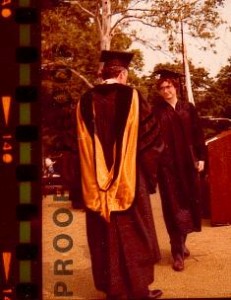
Today is Hinamatsui, or Girls’ Day. We’ve been hit-or-miss over the years in marking the day, which is a Japanese festival, more about which here. This year, Yuriko brought out those few dolls we have appropriate to the day. Back in 2004, we went to some kind of event for the occasion. I don’t remember what we did, exactly, or where it was, but I did take a picture. It isn’t that great as a picture, but I like the subject matter.

Deputy Marshall Ronald Reagan

Portillo’s is a (mostly) local chain specializing in hot dogs, Italian beef, burgers and the like, and across its various locations, thematic decorations from the ’20s to the ’60s. The food is good and the decorations interesting, so every few months we go to one of the locations, two of which are fairly close.

Last weekend Lilly and I visited the one on Illinois 83 in Elmhurst, a bit out of our usual orbit. Before ordering, I was waiting while Lilly was in the restroom, and taking a look at some of the items on the walls in that part of the restaurant. Off in one corner is a framed picture of Ronald Reagan in a western outfit, wearing a badge that says Deputy U.S. Marshall. My guess would be it’s a publicity shot from Law and Order (1953).

On closer inspection, I noticed that it’s autographed. I’m not familiar with Reagan’s handwriting, but I’ve no reason to think it isn’t his. “Dick” must be Dick Portillo, who founded and still owns the chain.

To Dick –

If I don’t make it acting, I’ll try the hot dog business.

Ron

The Chicago Time Zone Plaque

One more item from downtown Chicago, at least until the next time I go there. This plaque, near the junction of LaSalle and Jackson for over 40 years now, memorializes something few people give much thought — few people give it the time of day, you might say. Time zones.THE STANDARD TIME SYSTEM IN THE UNITED STATES ADOPTED ON THIS SITE — OCTOBER 11, 1883.

Chicago’s famous Grand Pacific Hotel, then on the site of the present Continental Bank building, was the location of the General Time Convention of 1883 which, on October 11 of that year, adopted the current Standard Time System in the United States.

The Convention was called by the nation’s railroads. Delegates were asked to develop a better and more uniform time system to govern railroad operations.

Previously, time had been determined by the position of the sun, with high noon as the only existing standard of exact local time. More than 100 different local times resulted from this method.

The new plan, proposed by William F. Allen, Convention Secretary, established four equal times zones across the country, each one hour ahead of the zone to its west. All railroad clocks in each zone were to be synchronized to strike the hour simultaneously.

The Standard Time System was inaugurated on November 18, 1883. On that Sunday, known as the “Day of Two Noons,” the Allegheny Observatory at the University of Pittsburgh transmitted a telegraph signal when it was exactly noon on the 90th meridian. Railroad clocks throughout the United States were then reset on the hour according to the time zone.

Although implemented by the railroad, the Federal Government, states, and cities began to use the system almost immediately. On March 19, 1918, Congress formally acknowledged the plan by passing the Standard Time Act.

CBOT Allegories

More snow this afternoon. In fact, more than any other storm this winter so far, and it’s still falling. This can mean only one thing: shoveling soon.

Last week I took a look at these downtown ladies – 12-foot granite ladies who weigh a remarkable 5.5 tons each, festooned with last week’s snow. They can be found in the plaza outside the Chicago Board of Trade.

First, Agriculture. Note Ceres Cafe in the background.

Next, Industry.

Allegorical statues, that’s what this country needs more of. A nearby plaque explains: “These two statues, one symbolizing agriculture and the other industry, once stood at the main entrance of the Board of Trade Building, built in 1885. The statues greeted commodity traders and the public for 45 years. Thought lost forever when the buildings were demolished in 1929 to make way for the exchange’s current Art Deco structure, in 2005, the statues were graciously returned to their origins through the generosity and goodwill of DuPage County Forest Preserve District.”

A 2004 Tribune article says: “The statues turned up in 1978, lying on their sides in grass, when the DuPage Forest Preserve District bought the former estate of Arthur Cutten, a wealthy CBOT grain trader in the early 1900s. For about the past decade, they’ve stood watch over the parking lot to the Danada Forest Preserve District in Wheaton.”

Jewelers Row, Chicago

Since I don’t go downtown regularly anymore, I miss new things that appear there. I’m not sure when these signs went up on Wabash Ave., but I don’t remember seeing them before. It could have been several years ago for all I know. I’m going to think of them as new anyway.

There are more than one of these gamma-like signs, with some on each side of the street, though I didn’t make an exact count. It’s more than just an historical marker, since there’s still a concentration of jewelry stores along that stretch of Wabash from Washington to Monroe. Jewelry makers and sellers, silver specialists, and watch makers have clustered in the area for about 100 years.

It’s an historical district for its buildings. According to the City of Chicago: “Comprised of a distinguished group of buildings important in the development of Chicago commercial architecture, the district includes important building types such as post-Chicago Fire loft manufacturing buildings, Chicago School loft manufacturing, mercantile, and office buildings, early twentieth-century skyscrapers, and Art Deco-style mercantile buildings. These buildings were designed in a variety of architectural styles, including Italianate, Chicago School, and Art Deco, by significant Chicago architects, including John Mills Van Osdel, Hill & Woltersdorf, Adler & Sullivan, D. H. Burnham & Co., Holabird & Roche, Alfred Alschuler, Christian Eckstorm, and Graham, Anderson, Probst & White.”

Note that the sign is brown, to match the paint on the elevated tracks nearby. I think that paint job is new, too, since I seem to remember the El tracks being faded yellow covered with the grim of decades, but maybe I’m just imagining that.

Heaven on Seven ’13

Snow fell on Thursday night all right, but not enough to stop anyone from normal tasks on Friday. Workers went to work, kids went to school, and I commuted downstairs to file a couple of things, including my podcast. Then I went downtown to meet some old friends for lunch at Heaven on Seven, which I’ve mentioned before (and I met the same old friends, only we’re all a little older).Heaven on Seven

It’s got lively decorations. Mardi Gras is over, but it always looks a little like Mardi Gras at Heaven on Seven. The only reason it’s mostly empty is because we met there at 2:30. Every other time I’ve been has been closer to noon, when there’s a wait for a table.Heaven on Seven

I didn’t take any pictures of my food. I can’t say I’ve never done that, but mostly I skip it. Somehow Look at what I ate! doesn’t appeal to me. I had some red beans & rice, hoppin’ john, collard greens, and andouille sausage, with gumbo on the side. All that might not have made a good photo, but it made a good lunch.

Ten Years Later

Big snow predicted for tomorrow. Not a blizzard, mind you, but six inches maybe. The weathermen try to act impressed by that, but it isn’t impressive. I haven’t checked to see if the Weather Channel is trying to stick a name on it. Last time it was a noted cartoon fish (or submariner). Maybe it’ll be Winter Storm Magilla.

Oddly enough, and apropos of nothing, I never watched The Magilla Gorilla Show, though I can’t say that about other awful output of the Hanna-Barbera cartoon factory. Or at least I have no memory of it. Not sure why. I was squarely in its demographic, at least by the end of the show’s run in 1967. But there must have been something else on at the same time that I, and probably more importantly, that my brothers wanted to watch. I never even heard of the show until much later, when I listened to the theme song on a TeeVee Toons collection.

Just out of curiosity, I counted up the number of posts between the day I first posted back at Blogger, February 21, 2003, and today. It’s only a milestone because we use base 10, but base 10 it is. The total is 2,435, or almost exactly two times every three days. Not so much across the span of 10 years. I couldn’t say how many words that is, but at 300 per entry — a seat-of-the-pants estimate — that puts it around 730,000.

Two hundred words a day. Eh, any fool can do that. Even if you count the for-pay words I’ve done in the last 10 years, that might only be 800 to 1,000 words a day. That doesn’t take one into the league of Asimovian compulsive writers.

But quantity isn’t everything. I’ve enjoyed blogging in particular about those few places I’ve been over the last decade. With any luck — because life is impermanent — I’ll record impressions of a few more places here over the next decade (or in a successor blog, because blogs are impermanent, too.)