St. Francis Sculpture Garden

The last day of July proved to be warm and clear in Grand Rapids, after a storm had rolled through the night before. Mid-morning breakfast proved to be at a place called Lucy’s, an adaptive re-use of a large neighborhood grocery store made into a restaurant, where I had a delicious meat-vegetable-egg creation. Everyone else enjoyed their breakfast orders as much as I did.

We planned to visit the Frederik Meijer Gardens & Sculpture Park after breakfast. The last time I’d been there was more than 14 years earlier, and I’d strongly suggested we see it.

While looking for the Meijer location on Google Maps, we noticed a different sculpture garden on the way: St. Francis Sculpture Garden. None of us, me included, had heard of it, but we were intrigued enough to add it to the day’s destinations.

In full, Saint Francis of Assisi Sculpture Garden.St Francis Sculpture Garden Grand Rapids

The 11-acre site is owned by the Dominican Sisters at Marywood, whose buildings are visible nearby.St Francis Sculpture Garden Grand Rapids

A nonprofit created the garden, with sculptures by Mic Carlson, a Grand Rapids artist. Twenty-four bronzes of St. Francis, in fact. Some are life-sized.St Francis Sculpture Garden Grand Rapids

That is supposed to a joyous dancing Francis, which I’ve run across before, but he looks more demented than anything else.
St Francis Sculpture Garden Grand Rapids

Actually, so does that one. Mic might be a talented sculptor, but those faces of his are a little odd.

Other depictions of the saint — most of them — are small enough to be on a tabletop. At at the sculpture garden, they are on various kinds of pedestals, with signs nearby explaining which aspect of Francis is being illustrated.

Such as Francis and Brother Wolf, telling the famed story of Francis persuading a vicious wolf to change his ways.St Francis Sculpture Garden Grand Rapids

Francis and Clare, founder of the Poor Clares.St Francis Sculpture Garden Grand Rapids

Besides the artwork at the sculpture garden, one can enjoy pathways through lush grounds, at least in the summer.St Francis Sculpture Garden Grand Rapids St Francis Sculpture Garden Grand Rapids

A grotto.
St Francis Sculpture Garden Grand Rapids

And a gazebo-like structure.
St Francis Sculpture Garden Grand Rapids

Must be an ecclesiastical gazebo.

Around Lake Michigan ’22

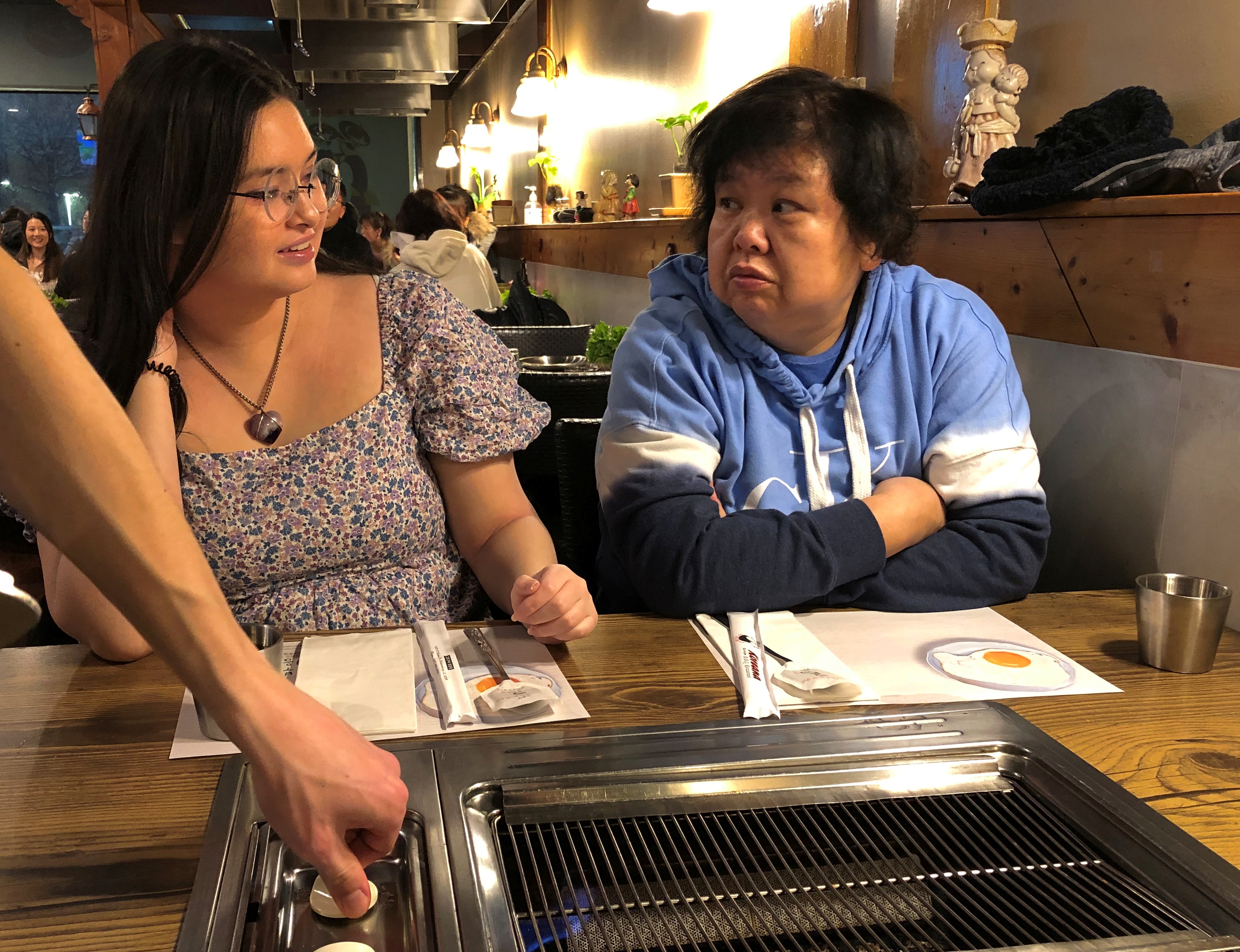
A little more than a week ago, I took a pretty good picture of three dear friends, two of whom I’ve known for over 45 years. From left to right, Tom, Catherine and Jae.

We were on the second day of our drive around Lake Michigan, counterclockwise, which took us from metro Chicago through northern Indiana, Grand Rapids and parts of western Michigan, Petoskey and environs, Mackinac Island, both Sault Ste. Maries, parts of the eastern Upper Peninsula, greater Green Bay and other parts of eastern Wisconsin, and back to metro Chicago.

Leaving on July 30 from our starting point at my house, we drove my car on crowded and less crowded Interstates, state and county highways, and a host of smaller roads, including National Forest roads cutting through lush boreal territory. Returning yesterday to my house, my friends flew back to Austin today; they had arrived from Austin two days ahead of the trip.

We’d planned the trip via email and Zoom, beginning back in early spring. I was the informal guide, making suggestions and offering bits of information I knew from previous visits to Michigan, upper and lower. But my friends were hardly passive in the course of our travels, digging up information via cell and making their own suggestions based on their own familiarity with some of the territory. Catherine had overseen arranging our accommodations, and everybody drove at one time or another.

We stayed in five different peer-to-peer rental accommodations along way, all entire houses that could provide us enough bedrooms, bathrooms, food prep and dining areas, and, in most cases, space to sit outdoors, once with a view of the waters of Green Bay.

Enjoying the outdoors was one of the main goals of the trip. For me, certainly, but especially for them, escaping the high heat of central Texas. They often remarked on the cool air and reveled in it, checking periodically to learn the temps at home. Three digits in Austin wasn’t usual. I don’t think got higher than 85 F. where we were. Standard night temps in both Michigans generally came in the 60s F.

Two meals a day was the norm: a mid- to late-morning breakfast and a late afternoon dinner, or a very late breakfast and a late dinner, at least as these things are reckoned in North America. So on many days, our meal schedule was more like that of Mexico City.

Food variety has trickled down to the lakeside and inland burgs of the upper Upper Midwest, though perhaps not quite as much as in large metros. Whitefish, the star of a lot of UP menus, had top billing in some of our meals, but we also enjoyed hamburgers and other meat — including one tasty UP pasty — pizza, pasta, breakfast fare, bar food, Italian and Asian, plus chocolates and fruit, such as Michigan cherries and UP jam. We prepared our own meals sometimes, did takeout a few times.

Coffee by morning, wine by night, though I only participated in the latter. Familiar wines were available in every grocery store we visited, and my friends sought out coffee ground as locally as possible: one bag from Sault Ste. Marie, for instance.

Meals and wine drinking were a source of convivial times, but hardly the only one. We talked and conversed and bantered at the table, as we headed along roads and as we walked trails. Shared personal histories were revisited, stories of our long periods apart were relayed, and opinions shared. Odd facts were floated. There was punnery, especially on the part of Tom, a born punster.

We visited one city of any size, Grand Rapids, and many smaller places, a few museums, a sculpture garden, some riverfronts, shopping streets and resort areas, a grand hotel, an historic fort, churches, a Hindu temple, a wooded cemetery, two lighthouses, forests, clearings and beaches, a massive sand dune, waterfalls, rapids and the clearest pond I’ve ever seen. The three Great Lakes we saw stretched to empty horizons — except when Canada or the opposite shore of Green Bay were visible. We crossed the Mackinac Bridge once and the international bridge between the Sault Ste Maries twice.

We walked near the shores of Lakes Superior, Huron and Michigan. The northern woods and the beach ecosystems were fully flush here in late summer. Jae, who knows a good deal about flora, shared some knowledge about the flowers, trees and fungi we saw in profusion.

Though we caught a few showers in daytime, and the last day was mostly rainy, most of the storms rumbled through at night, adding to the restfulness of whatever sleep we each had. None of the storms were lightning-and-thunder dramas, but some were impressive in their downpour. My friends expressed their satisfaction with the cool light winds that often blow in corners of the UP.

There were a number of travel firsts, mostly for my friends. This was the first time any of them had been to the UP, and the first time they had seen Lake Superior, whose aspect I’m so fond of, and their first visit to the northern part of the Lower Peninsula. The trip included Tom’s first known visit to a national park, though later we determined that it was probably his second park. Also, it was the first time two of them had ever been to Canada, since we popped across the border for one night in Sault Ste. Marie, Ontario.

For me, a mix of new and places I saw long enough ago that they were almost like new.

When I dropped off my friends at O’Hare earlier today, we agreed that they trip had met expectations. And more.

Fireflies, Cicadas, Crickets and Bops

Late July is that rare moment here when the fireflies haven’t quite gone away, and the cicadas and the crickets have both started their noisemaking. The crickets are just beginning and not so loud, but the cicadas are reaching for peak loudness, which tends to be in August.

Got a lot to do. Time for a high summer break. Back to posting around August 7.

I was really glad to find this again the other day. It hasn’t been on YouTube in a long time, but it’s on Vimeo.

The Three Little Pigs – Three Little Bops from Rudolf Second Channel on Vimeo.

A cartoon of great charm that I don’t remember ever seeing as a kid. Maybe afternoon TV program directors thought the jazz off-putting for kids, or maybe there was some copyright issue. Anyway, enjoy it while it’s available.

Apron Replacement

Not long ago, the village sent me a note — a low-tech, paper note, stuck in the door — that soon my “apron” would be replaced. It took me a moment to figure out that meant the section of my driveway that’s between the street and the sidewalk. Turns out the village meant not only that, but the sidewalk next to it as well.

Technically, the apron isn’t part of my driveway, since the it’s beyond my lot line. But I use it all the time as if I owned it because it leads to my driveway. The advantage to it belonging to the village is, of course, no fee for the replacement above the taxes I already pay.

We had time to move the cars to the street where, we were assured, they wouldn’t be ticketed for overnight parking. And they haven’t been. Soon workmen and big machines came along.Apron replacement

Wooden boards were erected to contain the concrete in its liquid-ish moments.Apron replacement

Pouring concrete.

I don’t have an image of the finished apron and sidewalk, but it’s a bright white hard surface. I didn’t sign my name or initials on it, or let the dog paw it. Also, there’s no imprint by the contractor, or a date, as you see elsewhere sometimes — and for a long time.

Such as the sidewalk in Milwaukee’s Walker’s Point neighborhood earlier this month.Sidewalk, Walker's Point

Not the contractor, but the city’s imprint. It was an old slab of concrete, but it’s held up fairly well for more than 80 years in the chilly Wisconsin climate. Will my new apron hold up so long? Till the turn of the 22nd century?

Retail Churn

In my photo file marked July 2012, I found an image from the last days of Ultra Foods here in the northwest suburbs. It was a store I knew fairly well. It was a genuine discounter, and sometimes had oddities like Black Jack and Clove gum or frosted flakes from Latin America.Ultra Foods 2012

About to close. A Tony’s supermarket replaced it a little while after and has been in business in that location since. I don’t have any after pictures to go with this before image. All of the Ultra Foods in the Chicago area, its entire market, seem to be gone, closing in the years after this one.

Up the road a piece — the same large suburban artery — was the site of another closed grocery store, though I forget which. Dominick’s, maybe. Soon Mariano’s would be there.

Marino’s has been in business since then. I don’t have any after images for this before picture. I go there more often than Tony’s. Got some fine pies, Mariano’s does.

Three More Walker’s Point Churches

Despite Sunday’s walking tour being exterior only, we were able to go inside three churches that day. One of them, Parroquia de Nuestra Señora de Guadalupe, wasn’t actually on the tour. Walker's Point, Milwaukee
Walker's Point, Milwaukee

It was, however, about a block from where we parked the car for lunch, and after eating we had a few extra minutes for a look. Mass was about to start.Walker's Point, Milwaukee

One church I mentioned yesterday, Iglesia Apostolica, happened to be open when we passed by on the tour, because the service had just ended. We asked whether we could take a look, and one of the men at the door — he might have been the pastor, or not — told us we could come in, absolutely. So we did, about a dozen of us. Though a church building for many years, the interior was spare, almost wholly unadorned.

Then again, a church is its congregation, and in those terms the place was well adorned. The church was still full of people, all socializing, entirely in Spanish. All ages were represented. It was a living example of U.S. Hispanic Protestantism, which is in a growth mode — as were some other churches on the tour.

A little while later, as we passed St. Mary’s Ukrainian Orthodox Church, which curiously placed in the middle of the block rather than on a corner, a woman at the door invited us in. I believe she was a friend of the guide.Walker's Point, Milwaukee Walker's Point, Milwaukee

It was originally a Lutheran church, and originally in a different location.Walker's Point, Milwaukee
Walker's Point, Milwaukee Walker's Point, Milwaukee

Note the scaffolding, buckets and fans. A few weeks earlier, as the roof was being replaced, wind blew off the tarp keeping the rain out — when no one was around, apparently. In came water, and much damage resulted.Walker's Point, Milwaukee

Does insurance consider that an Act of God? I doubt the parishioners do — more like an act of carelessness on the part of the tarp hangers.

Walking By Walker’s Point Churches

The walking tour we took Sunday was to look at churches in the Walker’s Point neighborhood of Milwaukee. When I signed up for it, I imagined we’d walk around and go inside a handful of churches, as we’ve done on the tours we’ve taken in Chicago.

But no. As I looked at the list of churches handed out by our guide, I thought — we’re going into all of these? Nine churches were on the list. Then it dawned on me that we’d be walking past all of them and not seeing their interiors.

That was a little disappointing. Still, despite the steamy heat of the afternoon, our church walkabout had its charms, including Parroquia de San Patricio (St. Patrick’s Parish), completed in 1895.Walker's Point churches

St. Peter Evangelical Lutheran Church, dating from 1885.Walker's Point Churches Walker's Point Churches

A structure that’s now Iglesia Apostolica, but when the church was built in 1894, it was Vorfreslsers Norski Evangelical Lutheran Kirke. The only surviving Norwegian-style church in the city, the guide said, and then offered some architectural details about what made that so. I can’t remember a single one.Walker's Point Churches

The charming little St. Michail Ukrainian Catholic Church, built as a Lutheran church in 1894.Walker's Point Churches

The former St. Wenceslas, first built in 1883. Now it’s St. Ann Chapel, and part of a Catholic school. The entrance dates from 1914 and, for all its age, still looks tacked on to me.Walker's Point Churches

The Iglesia Evangelica Bautista, originally dating from 1900 as a Norwegian Evangelical Free Church.Walker's Point Churches

All that only goes to show that even in matters of religious sites, time flies, things change.

Walker’s Point, Milwaukee

Over the weekend, we came across a sign for a really full-service vehicle repair shop.Walker's Point, Milwaukee

Higley Motor Co. happens to be in the Walker’s Point neighborhood of Milwaukee, and we happened to wander by the sign, and I happened to read it. Read random things and sometimes you’ll be rewarded with a smile.

On Sunday, we popped off north at about 9 a.m., planning to take a Historic Milwaukee walking tour in the Walker’s Point neighborhood at 1 p.m. Extra time was built in, so we could visit the area on our own for a while, and have lunch.
Walker's Point, Milwaukee

Walker’s Point is south of downtown Milwaukee, and sliced in half by I-94. As Milwaukee neighborhoods go, it’s an old one. The oldest one in fact, according to the Encyclopedia of Milwaukee. A 19th-century landowner, George Walker, lent the area his name. Immigrants have lived there pretty much since day one — one influx after (and upon) another. These days it’s heavily Hispanic.

Old the neighborhood may be, but there’s also evidence of redevelopment in our time, such as this (I assume) apartment building under way.Walker's Point, Milwaukee

Other buildings have been subject to major modification.Walker's Point, Milwaukee

Or may be soon.Walker's Point, Milwaukee Walker's Point, Milwaukee

Soon we dropped by Zócalo Food Truck Park.Zócalo Food Truck Park
Zócalo Food Truck Park Zócalo Food Truck Park

“A range of diverse indoor and outdoor gathering places are woven throughout the project,” says The Kubala Washatko Architects, who designed the park, which was completed in 2019.

“The team repurposed an existing two-story structure into a tavern, serving as Zocalo’s social heart. Food trucks are positioned to create room-like spaces while a garage was converted to covered dining and private event space. Overhead lights, shading devices, game area, and vibrant mural walls create dynamic exterior social zones.”

A number of options awaited us.Zócalo Food Truck Park Zócalo Food Truck Park Zócalo Food Truck Park

We picked Anytime Arepa.Zócalo Food Truck Park

As the name says, you can get the northern South American cornmeal sandwich arepa at that truck. Empanadas, too. We had one of each. They both hit the spot. The same spot, namely that we were looking for a good lunch, which we ate under one of the “shading devices” mentioned by the architect (a tarp over some tables).

Amble in Lords Park, Elgin

Rain fell overnight on Friday and into the wee hours of Saturday, which re-greened the grass some. It’s been dry enough so that I haven’t mowed in a few weeks, but now it looks like my bourgeois householder impulses (as spotty as they can be) are going to kick in, and I’ll be out there some late afternoon soon, adjusting the height of the grass.

But not yet. After the rain, Saturday was warm and a little steamy, but that didn’t keep us from popping out to Elgin for a lunch from Gabuttø Burger, and then a visit to Lords Park in that same suburb. It’s been a few years since our last visit to the place, whose contour rolls slightly and that the city keeps manicured.Lords Park, Elgin

The 108 acres of the park are lush green in July, after recent rains and a rainy spring.Lords Park, Elgin

One of the park’s distinctions is a small zoo, which has existed in one form or another as long as the park — over 100 years. Once upon a time, that included a bear pit, but that kind of animal display has mostly disappeared. The zoo doesn’t have bears at all these days. Except for some large examples, it’s mostly farm animals these days.

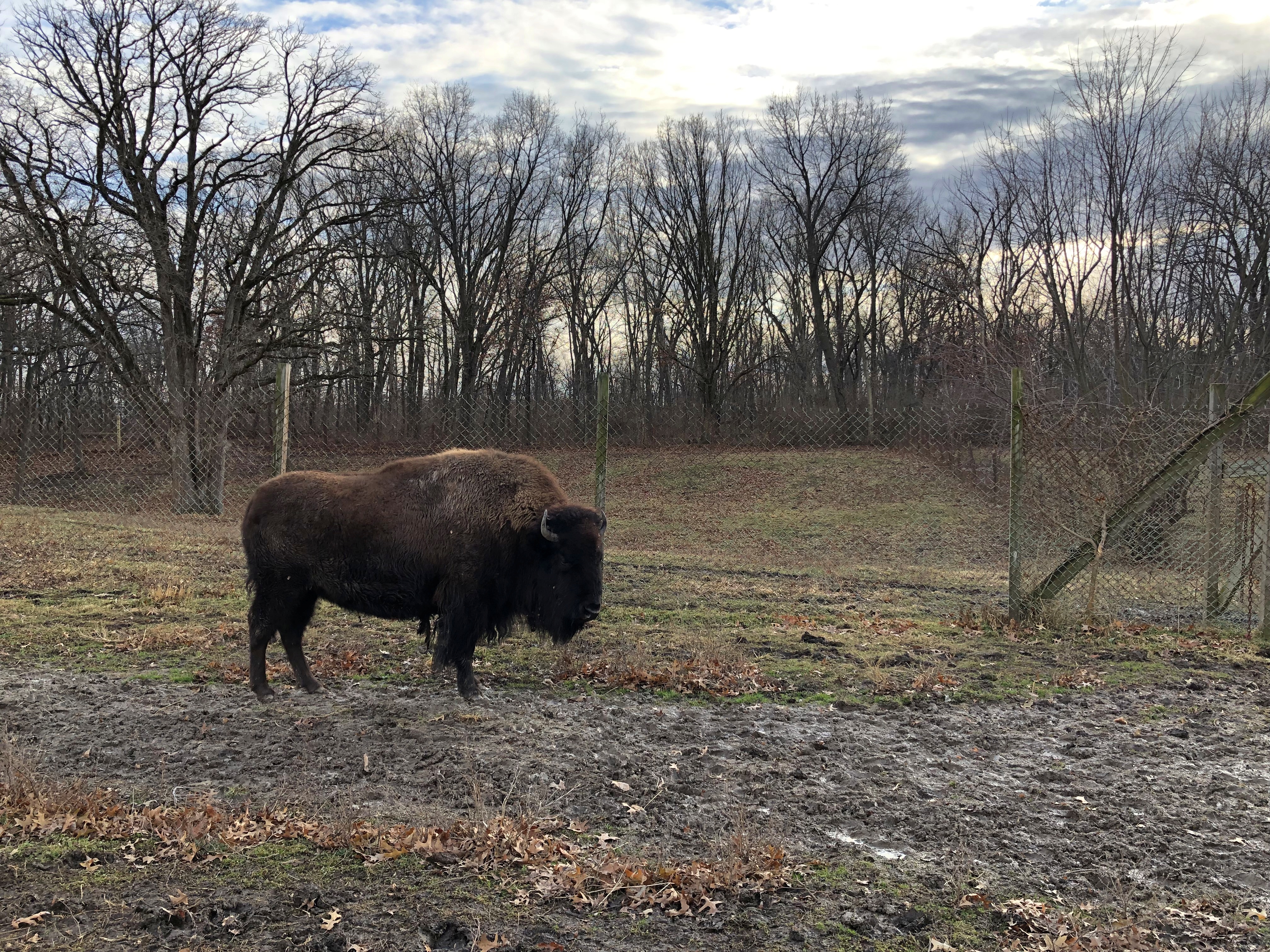
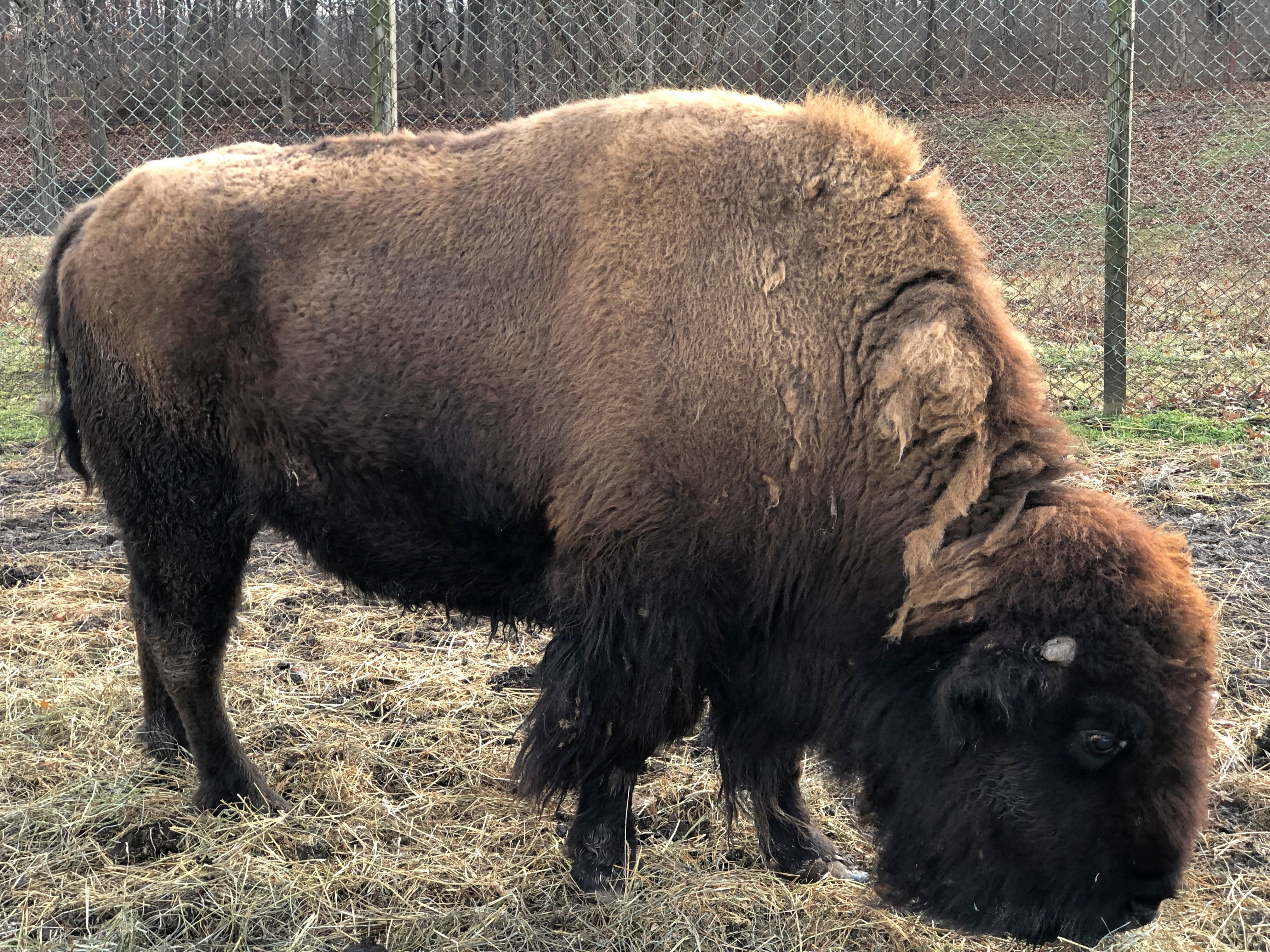
No dogs allowed in the zoo — we brought ours on this particular trip — so we didn’t go in. Still, you can see a number of the animals by walking around the perimeter, including some buffalo and elk, besides a few farm animals.

We took a stroll around the park’s large pond.Lords Park, Elgin
Lords Park, Elgin Lords Park, Elgin

At one of the benches under some shade, we saw a family dressed in Sunday clothes, with perhaps another relative or a family friend taking portraits. A young man and woman, with what looked like twin girls, maybe three or four years old. For some of the pictures, the visibly pregnant woman held a set of sonograms in front of her.

At least two quinceañeras and a wedding seemed to be under way. That is, we saw more than one cluster of people dressed for those kinds of occasions, out and about with photographers.Lords Park, Elgin

The actual celebrations were probably in the Pavilion, a handsome structure erected in 1898 to replace a structure that had burned down after only a few months in existence. The earlier building had gone up shortly after local landowners (George and Mary Lord) gave the land for the park to the city.Lords Park, Elgin

We didn’t go inside — events were going on, after all, and we had a dog. The City of Elgin notes in its web site: “The elegant Pavilion features a Victorian banquet facility with hardwood floors, vaulted ceilings, picket doors, large windows with scenic park views, a covered wrap-around porch, and outdoor ceremony grounds with ponds, fountains and wooden bridge.”

Well, we did see the “ceremony grounds,” as pictured above. I don’t know that I’d call Lords Park a hidden treasure, exactly, but it is obscure (unless you live nearby) and a good spot to amble.

Light Years Ahead

Fifty-three years ago, Armstrong, Aldrin and Collins were on their way to the Moon, an occasion to recall each July, not only for those who remember, but also those who do not. Not long ago, I happened across this remarkable video about a very specific, and well known interval of only a few minutes in that mission: the Eagle’s final approach to the lunar surface.

More specifically, the video is a lecture about what the guidance computer was doing and why during those fraught minutes, including a lot of detail that isn’t that well known. Posted by the National Museum of Computing, I was skeptical I would make it all the way through. I was wrong.

One Robert Wills, a software engineer with a clear enthusiasm for the computing that made the Apollo missions possible, tells the tale in simple enough terms — but not too simple — that a non-specialist like me can understand much of it, if not everything. No mean feat, as attested by the non-trivial number of teachers and professors who cannot do so.

I knew a fair amount of the story, but hardly all of it, and the video filled in a lot that I didn’t know. That should be the goal of any video with any claims to being educational, I believe.