The Kansas State Capitol

One fine day in the Kansas State Capitol last month, I turned a corner and found myself looking up at Old Testament John Brown. Larger than life, as he has loomed these 160+ years.
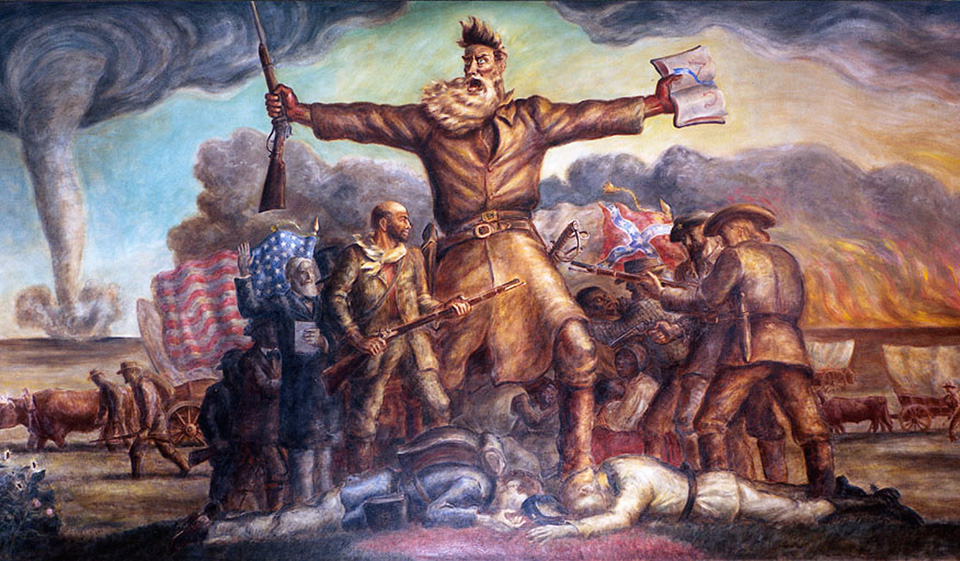
The mural, actually called “Tragic Prelude,” is more than 11 feet tall and 31 feet long, taking up an entire wall in the capitol. The lighting isn’t particularly good for taking images of the whole work – a ceiling light in particular washes out much of John Brown’s (let’s say) emphatic expression. Luckily, the image seems to be in the public domain.

A plaque under the mural says:

Sponsored by Kansas Press Association, aided by Kansas school children, these murals were painted in 1940-41 by John Steuart Curry, who was born near Dunavent, Kansas. In John Brown’s outstretched left hand is the word of God. In his right, a “Beecher’s Bible.” Beside him, facing each other, are contending Free Soil and Pro-Slavery forces.

The plaque does not say that the many members of Kansas legislature hated the painting at first, and refused to hang it in Curry’s lifetime (he died in 1946). Curry had had the temerity to depict Bleeding Kansas, by far the most interesting period in the history of the territory and state; the interesting times no one wants to live through. Maybe they thought it glorified John Brown — which it half way does, but with more than a tinge of madness in him as well. Bottom line, the work apparently didn’t sit well with those who might have wanted a Kansas of doughty farmers and hardy pioneers and fertile landscapes.

Eventually, to its credit, the legislature did have the work installed. Whatever you think of John Brown, it’s a striking piece. I’d seen depictions of it, but either never knew or had forgotten that it hangs in the Kansas State Capitol, which made coming across it all the more memorable.

I almost missed it, having dawdled in Salina and Abilene for most of that day (September 24), but I made it to Topeka and the capitol about 30 minutes before it closed.
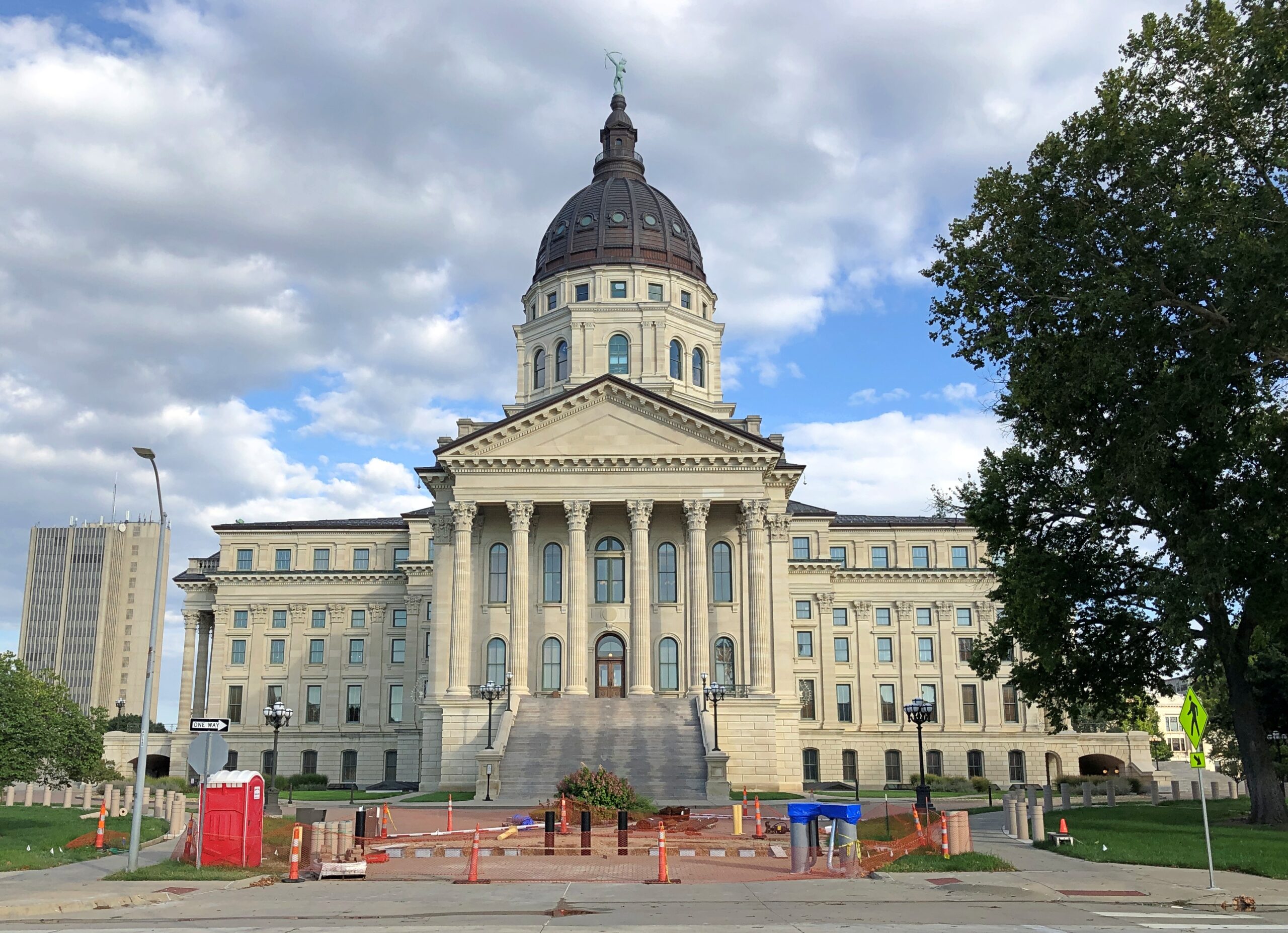
Kansas State Capitol

Like any number of monumental edifices, this one took time: construction finished in 1903 after 37 years in the works, not counting renovations or the comparatively recent addition of the 4,420-pound, 22-foot tall bronze “Ad Astra” on top of the dome, which was in 2002. The figure is an acknowledgment of the Kaw Nation (Kansa), who lent their name to the state.
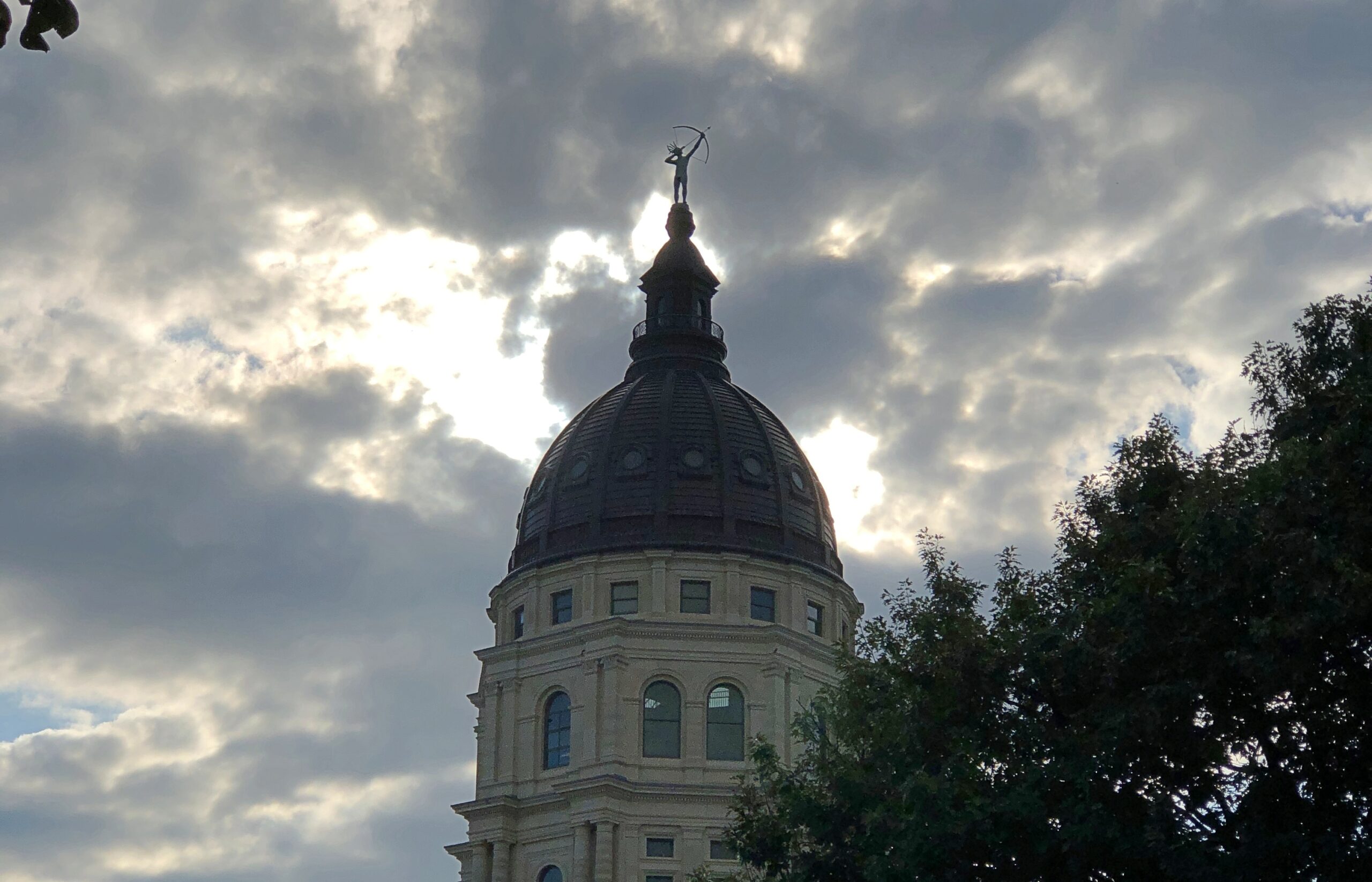
Kansas State Capitol

Architect E. Townsend Mix (d. 1890) designed the capitol, though he didn’t live to see its completion. Most of his work is in Milwaukee, where he lived the longest, including St. Paul’s Episcopal in that city.

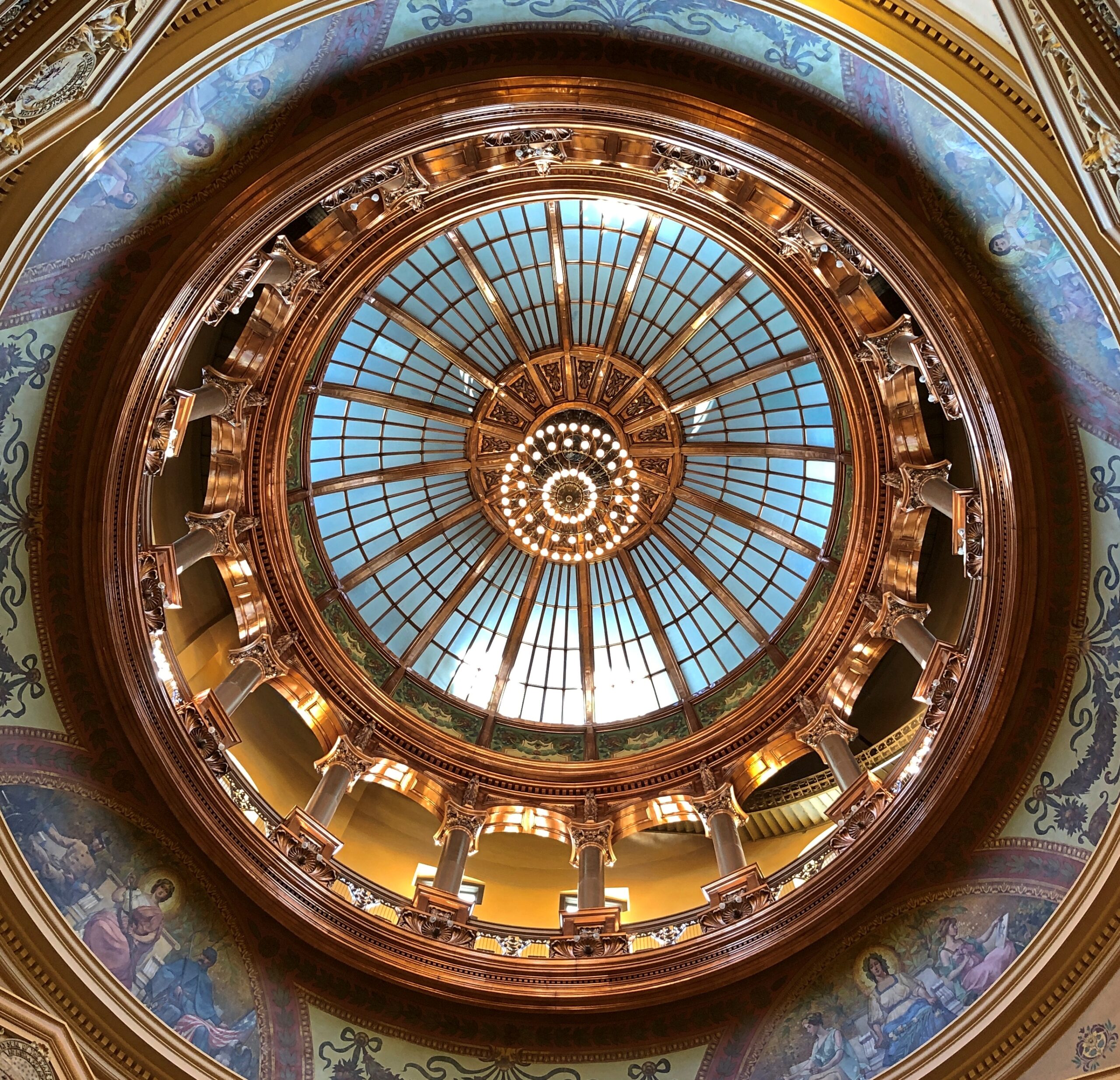
A fine dome.
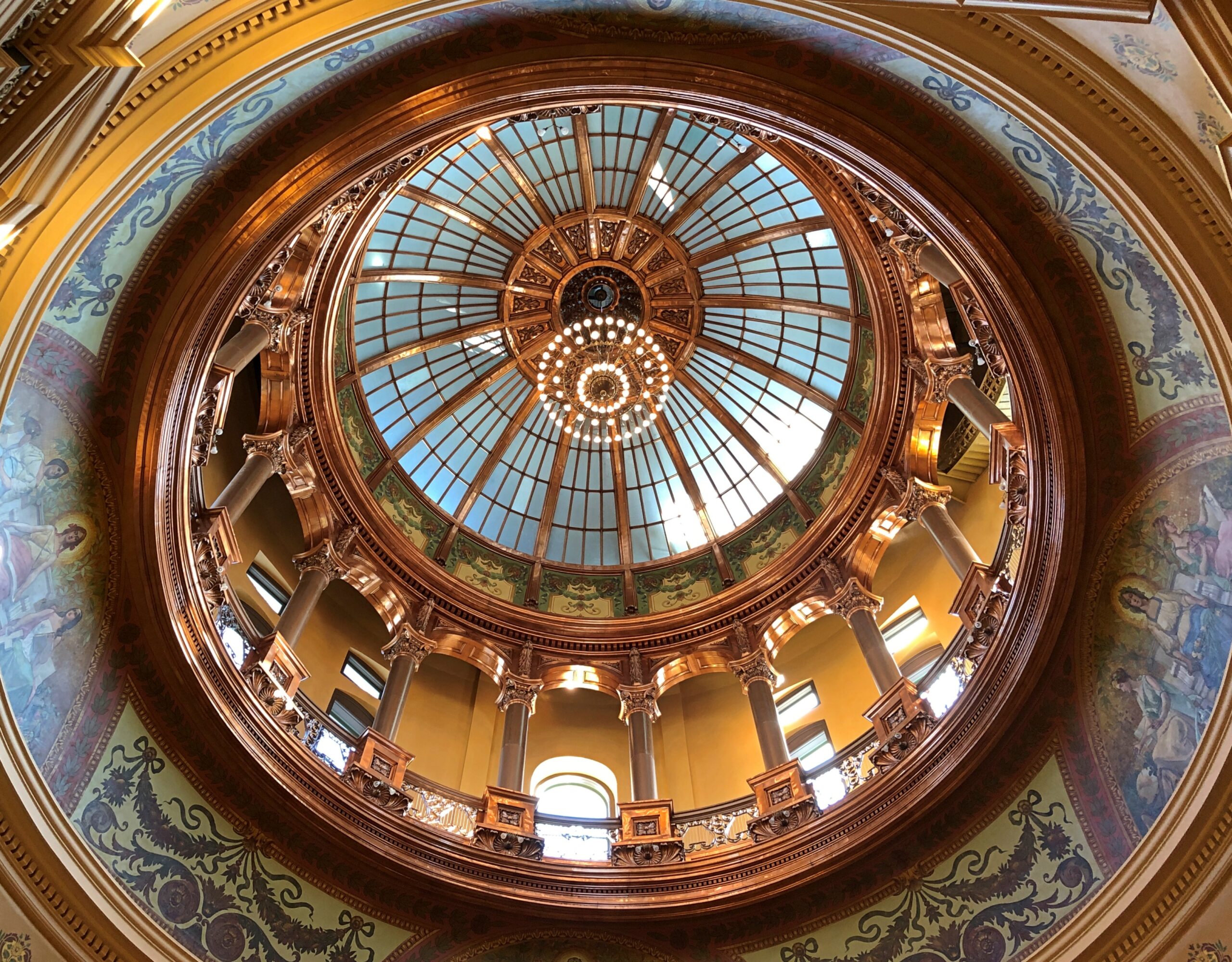
Kansas State Capitol

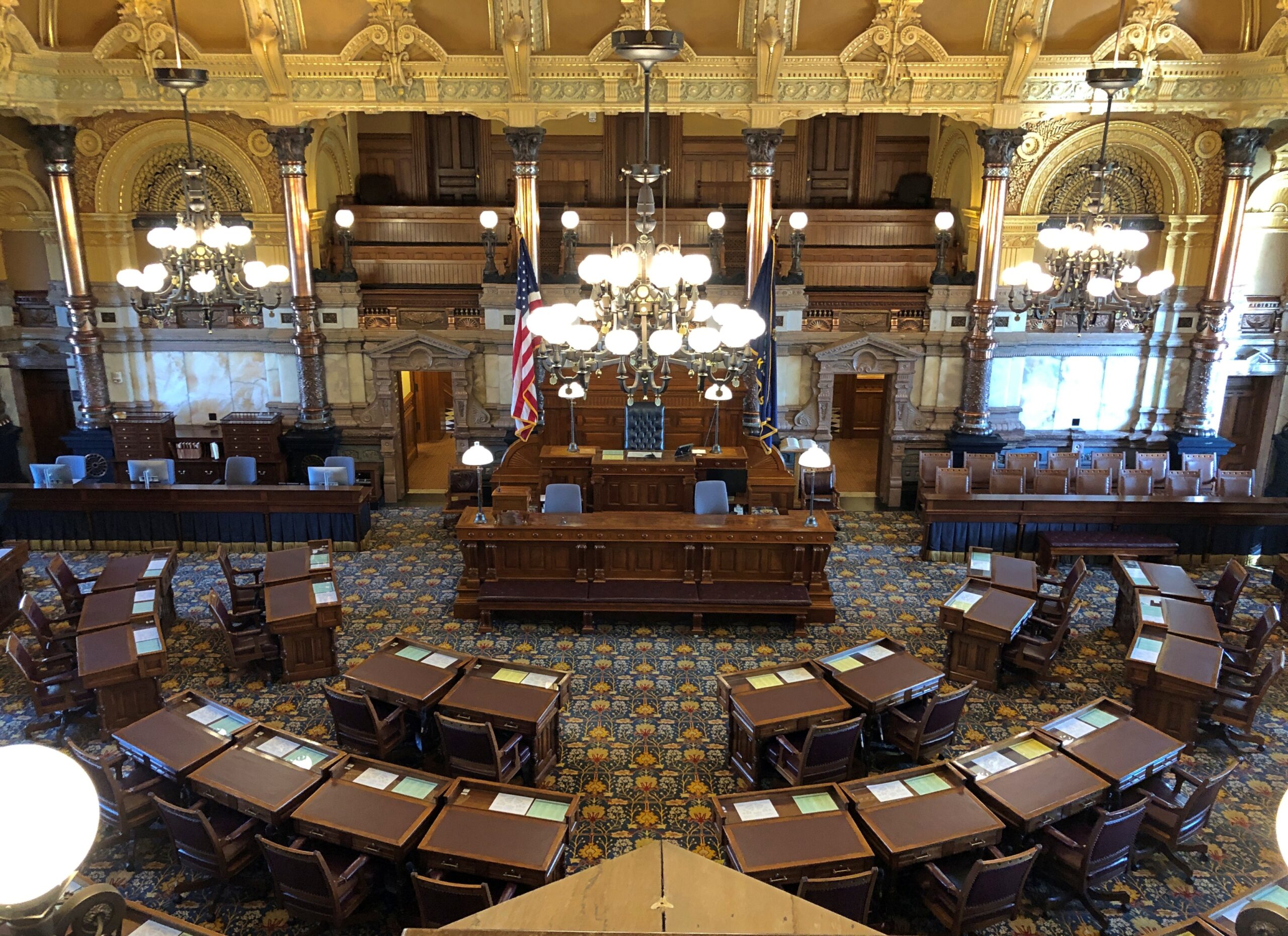
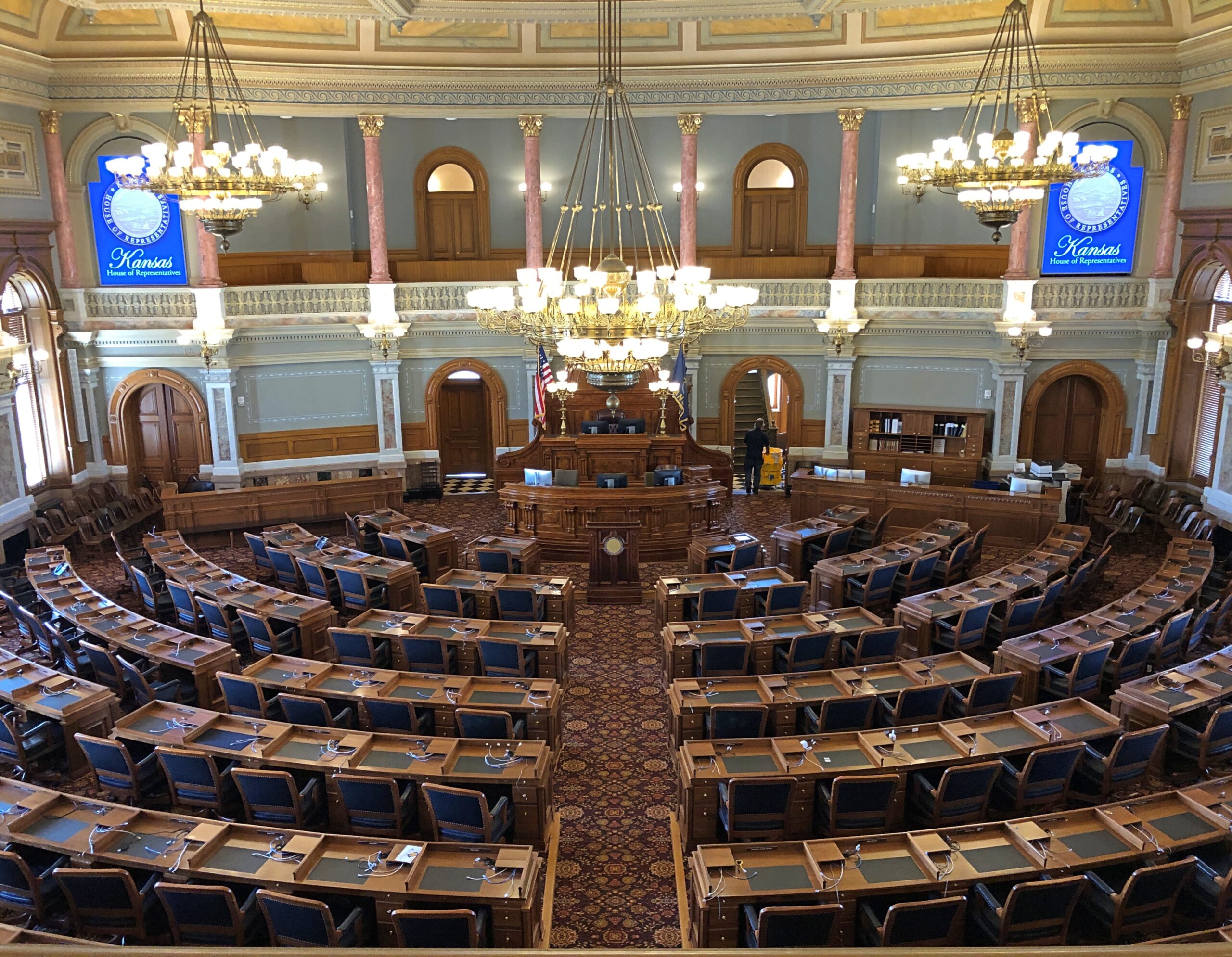
Well-appointed chambers.

Kansas State Capitol

The capitol interior is fairly art-intensive. Not all capitols are. For instance, there are limestone statues in large niches — native limestone, a sign says — of famed Kansans, by Peter “Fritts” Felten Jr. of Hays, Kansas. Such as one of the aviatrix from Atchison.
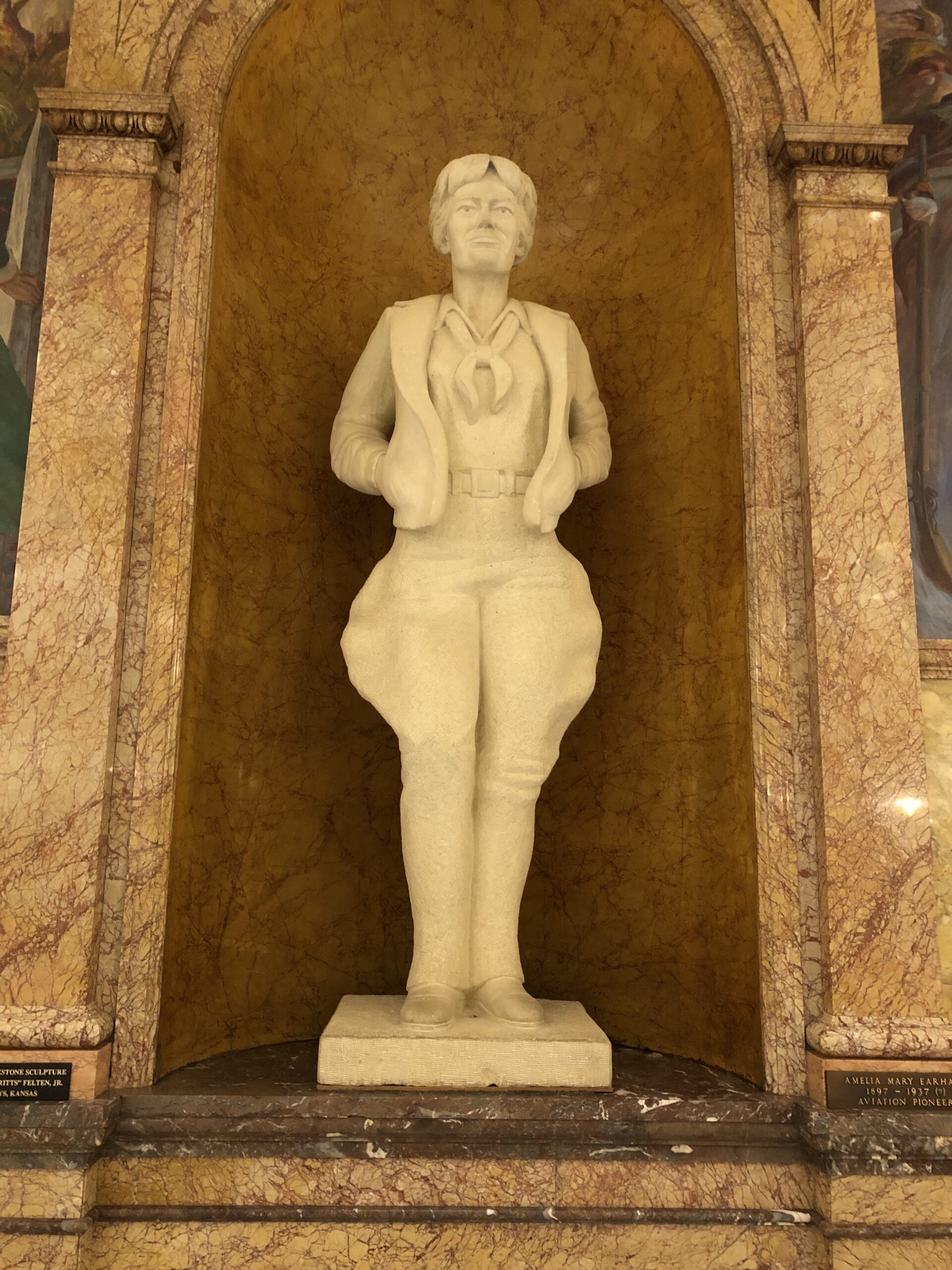
Kansas State Capitol

Amelia Earhart is immediately recognizable, which is no mean feat for someone who is (very likely) been dead for nearly 90 years.
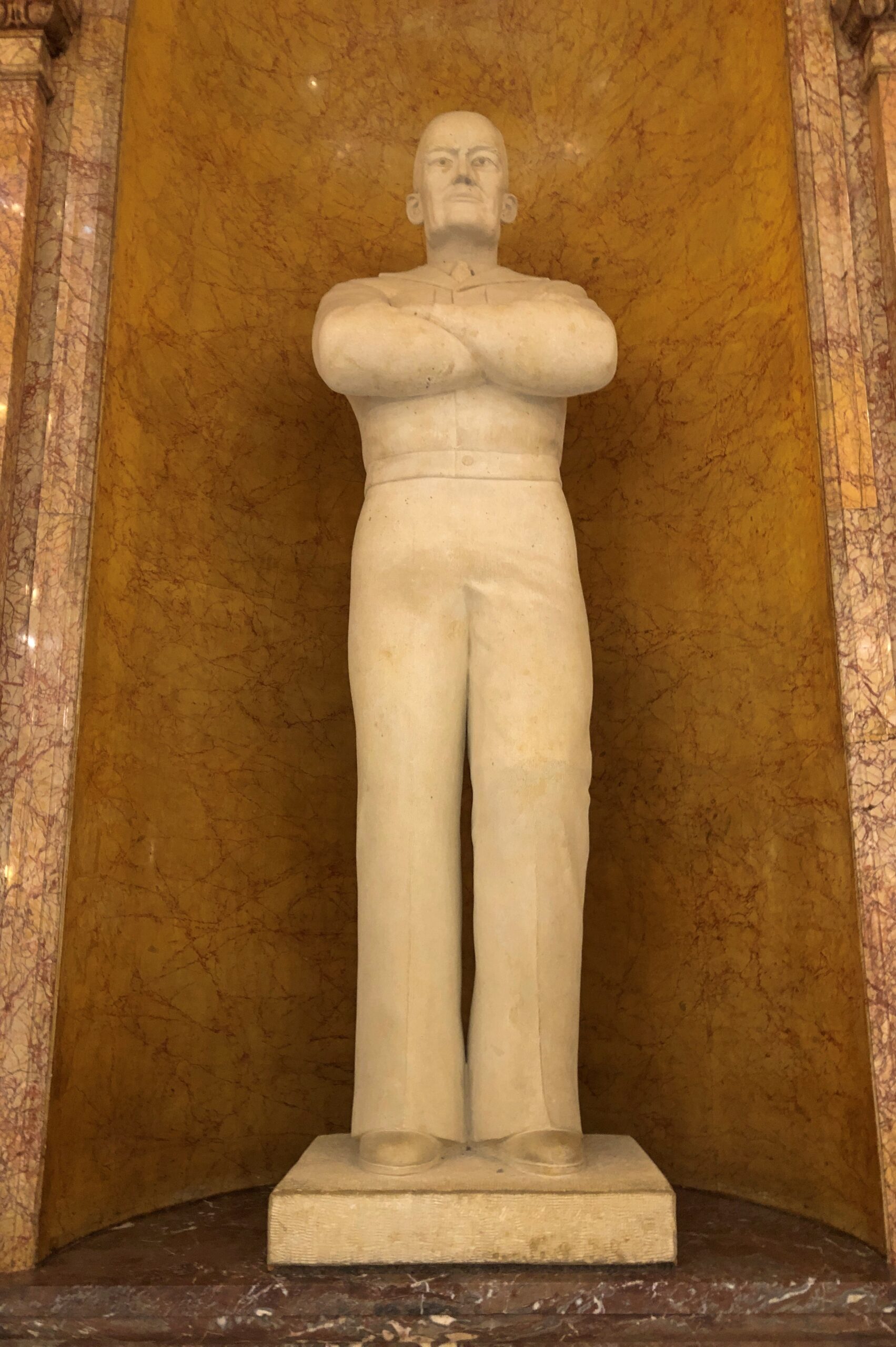
I like Ike, but this?

This figure is also more-or-less recognizable – though a depiction of him that’s a little strange, looking for all the world like Mr. Clean. Only a little like that Ike fellow on an Eisenhower dollar.

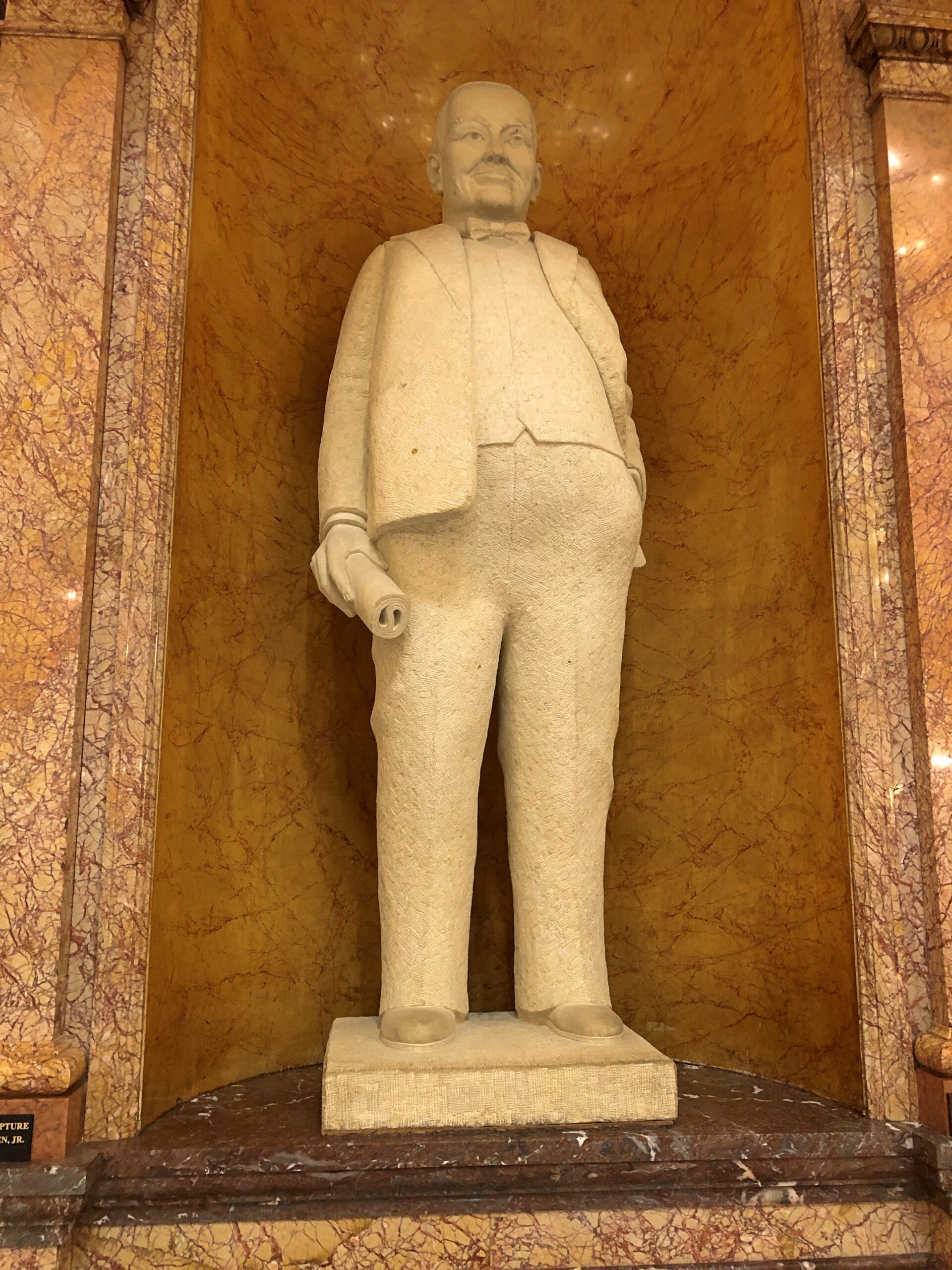
The fellow below’s fame has, I’m afraid, shriveled up like a balloon that lost its helium: William Allen White (d. 1944) Probably not even known in Kansas any more, since he was a noted journalist, a profession whose posthumous fame tends to be brief. Editor, Pulitzer Prizewinner, his plaque says. A Progressive Through-and-Through, it does not say. That might not play in Kansas at the moment.
Not one, but two time capsules reside with the capitol walls. At least two that I saw.
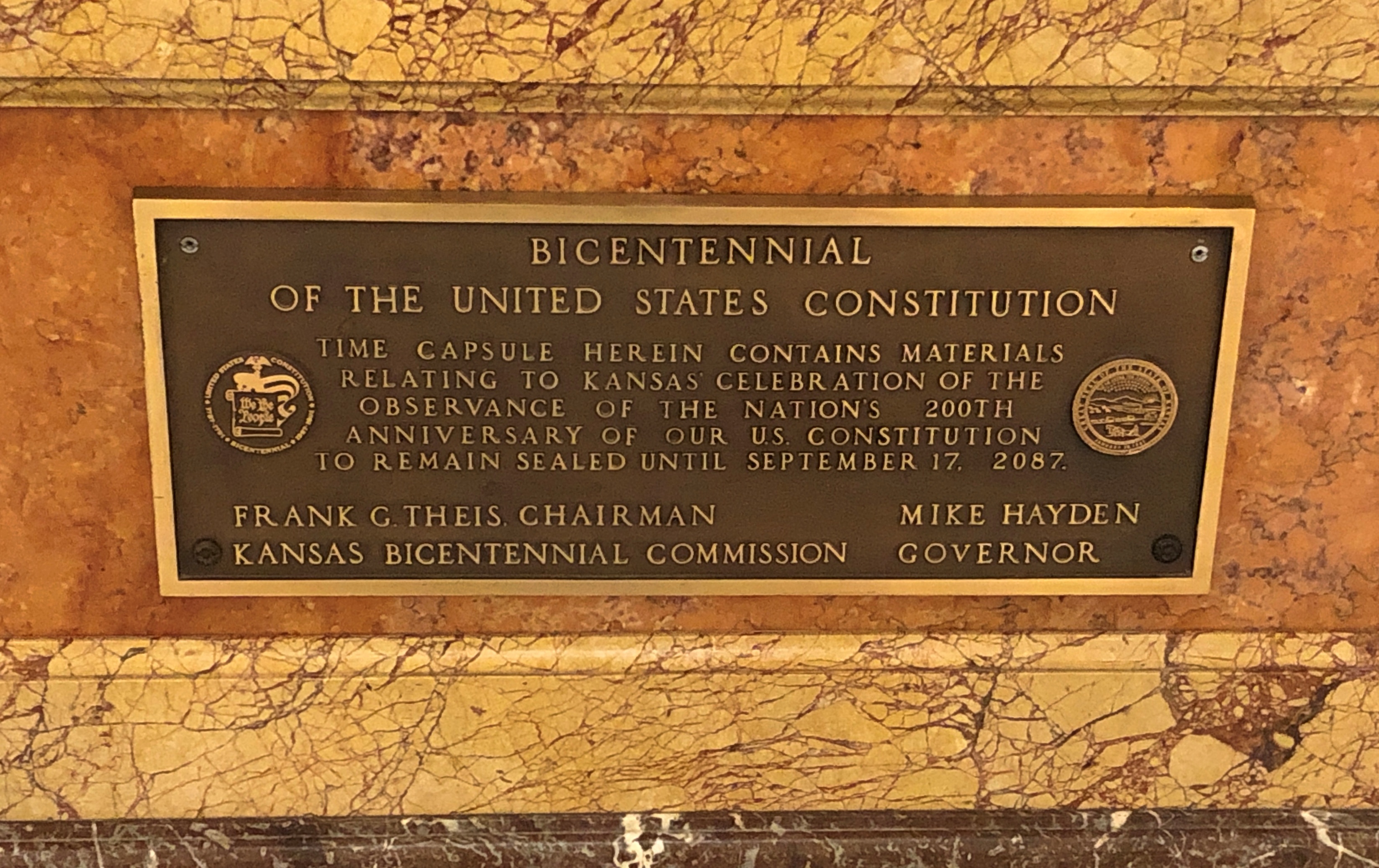
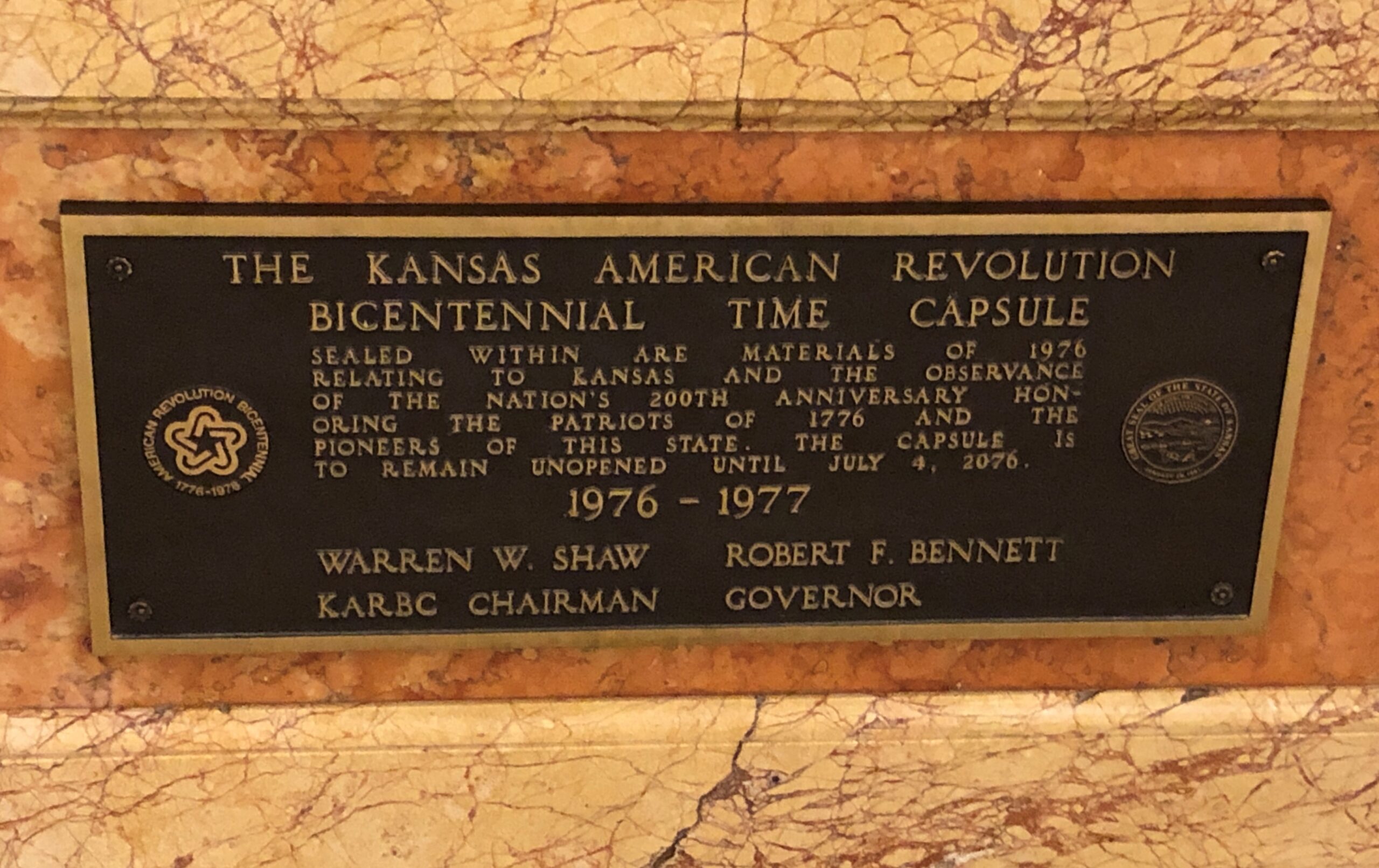
Kansas State Capitol

This is a digression, but one thing still leads to another on line, and I came across a list published in 1991 by the International Time Capsule Society: “10 Most Wanted Time Capsules.” That is, a list of time capsules whose location had been lost and thus were (up till then) unrecoverable. The page notes that two have been found over the last 30+ years, but eight are still beyond the ken of man. Such as:

MIT Cyclotron Time Capsule.

In 1939 a group of MIT engineers placed a brass capsule beneath an 18-ton-magnet used in a brand new, state-of-the-art cyclotron. The capsule was to be opened in 50 years but was not. No one remembered the time capsule was there (the cyclotron had long since been deactivated). But when reminded of its existence, MIT was faced with another problem: how do you get a time capsule out from under a 36,000-pound lid?

Bicentennial Wagon Train Time Capsule.

This capsule was supposed to hold the signatures of 22 million Americans. But on July 4, 1976, when President Gerald Ford arrived for the sealing ceremony in Valley Forge, Pennsylvania, someone stole the capsule from an unattended van in the bicentennial wagon train. The capsule’s maker, the Reynolds Company, had broken the mold. The thief’s identity and the whereabouts of the capsule are unsolved mysteries.

Further investigation reveals that the whereabouts of the papers that Americans signed in 1976 – a good many pounds of it – mysteriously disappeared, and that theft from a van was one idea, though organizational misdirection sounds more plausible to me. To the same warehouse as the Ark of the Covenant, in other words. Anyway, there’s a 12-episode streaming service comedy in that incident.

Back to capitols. It’s now easier to keep track of the ones I haven’t seen than otherwise.
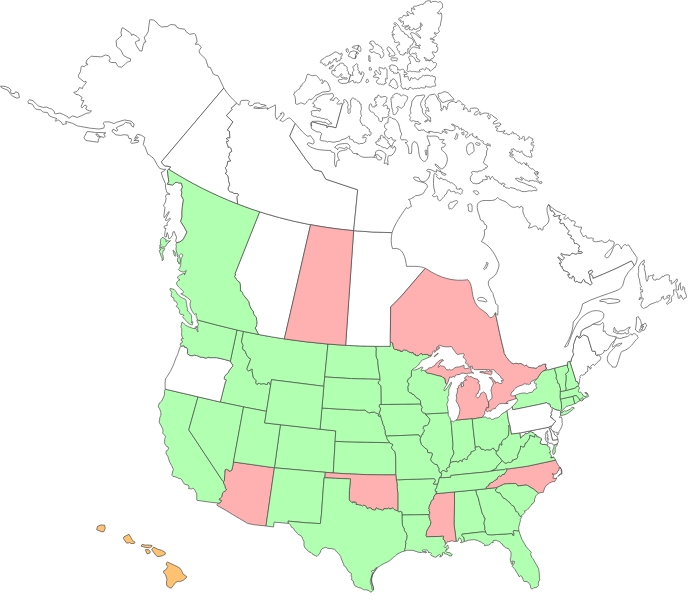
Green for an interior visit, orange for exterior only, gold representing uncertainty, and white no visit.
Colorado Lasso ’25

Driving down from the alpine wonders of Rocky Mountain National Park a couple of weeks ago on highway US 36, I realized we’d be passing through Boulder, Colorado. So during one of the moments of standstill traffic on that highway as it winds into Boulder — it’s a crowded road, especially on a weekend during warm weather — a thought occurred to me. More of a memory-thought, since it harkened back almost 50 years.

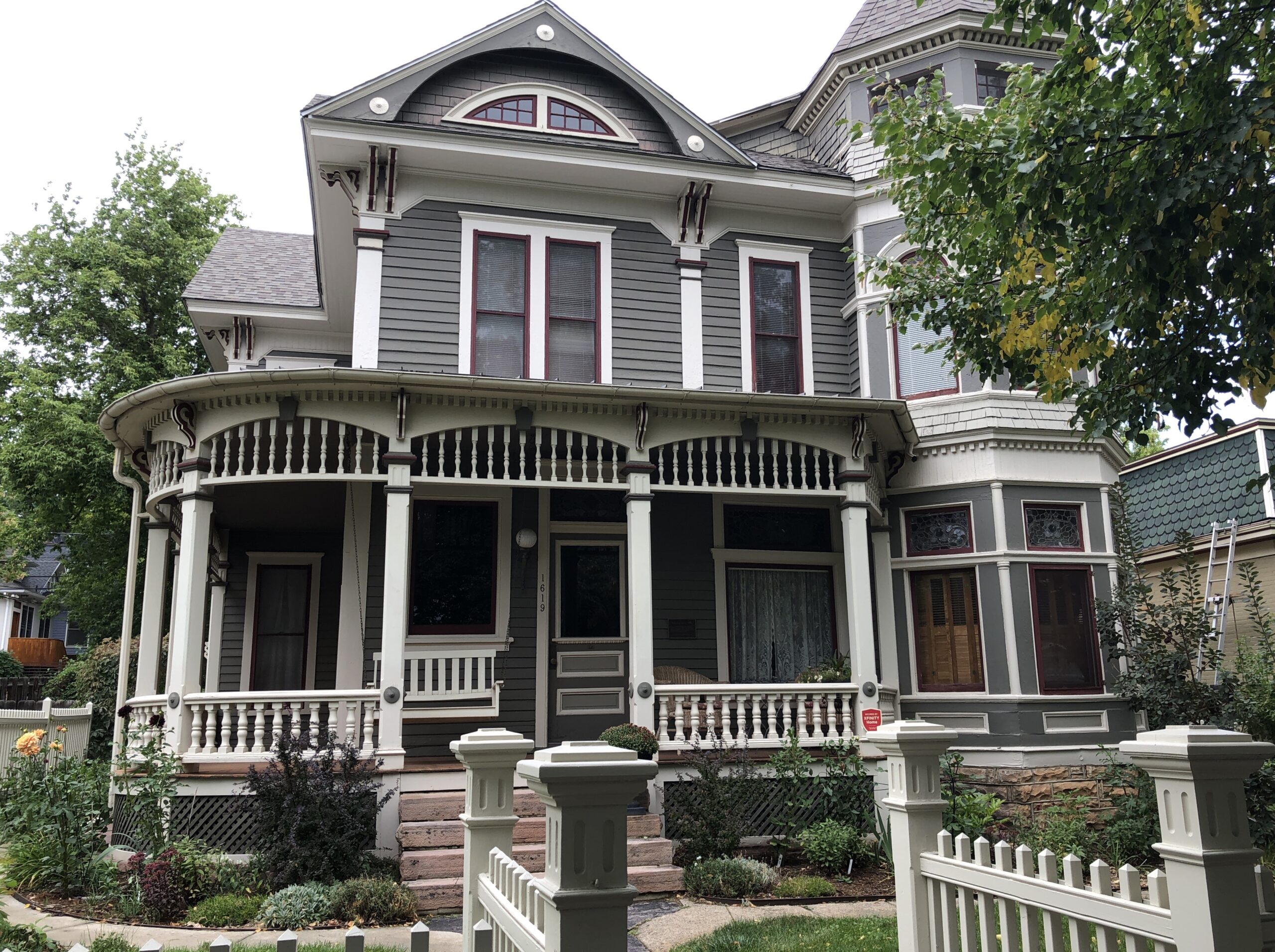
At zero mph, I had time to consult Google for more information. (Remarkably, the signal was strong.) Google Maps pinpointed the location I’d thought of, on a leafy street in Boulder. That day I expended some tourist energy, of which I don’t have quite as much as I used to, to find Mork’s house.

That is, the house used in establishing shots in Mork & Mindy to show their home, since the show was set in Boulder. I know I’d seen Boulder on maps. Funny name, I thought as a kid. Really Big Rock City. It’s still a little funny. But other than as a spot on the map, the show was probably the first time I’d heard anything else about the place.

The passengers in my car, Yuriko and Emi, having grown up outside of the orbit of ’70s American sitcoms, didn’t particularly appreciate the place. At least not until I conveyed the information that the show made Robin Williams famous. He’s a known quantity. I read a bit about the house later, and there seems to be no consensus about whether the owner cares whether anyone stops by the take a picture. My guess would involving factoring in a dwindling number of people coming by. You know, because the show went off the air over 40 years ago.

Then again, if my U.S. travels have taught me nothing else, it’s that retirees are out being tourists. They have the time they didn’t used to, and currently are just the right age to take a peek at Mork’s house at 1619 Pine Street, which is easy enough to find. Even if, like me, their fondness for that show was lukewarm at best.

Boulder and Mork came early in the second leg of my three-legged, 4,498-mile drive, which seemed to kill that many bugs on the windshield and front hood and bumper. The house counted as merely one spot in a trip that took me through hundreds of places. I spend most of September on the road, heading west from Illinois early in the month along I-80 and smaller roads, especially Nebraska 2 through the Sandhills, and spending time in western Nebraska and its rocky outcroppings and in southeast Wyoming, before going to Denver. That would be the first leg. Which, I’m very happy to say, included a good look at Carhenge.

Yuriko flew to Denver on the last of the points I got from SWA for the Christmastime FUBAR a few years ago and we met there. (New motto for the airline: Now We’re Just Another Airline!) After an overnight jaunt to Rocky Mountain NP in the company of our friend Emi, the two of us then spent more than a week taking a clockwise circle-(like) course — a lasso, you might call it, a straight line connected to a loop — from Denver to Colorado Springs to Pueblo to Walsenburg to Alamosa to (coming down from Wolf Creek Pass) Pagosa Springs to Durango to Silverton to Ouray to Montrose to Salida and back to Denver, where Yuriko flew home. That was the second leg. The drives were varied and gorgeous.

You’d think that would be enough, but I had to drive home, loosely following I-70 this time, making my way from Colorado through Kansas, Missouri and Illinois, and making a number of stops, big and small, such as Kit Carson, Colorado; Abilene, Kansas; and Kansas City, Missouri, for a third and final leg. No single small road took me through Kansas, but a series of them did, some as empty as, well, eastern Colorado and western Kansas. That’s some fine driving. Mountains are great, but after a week or so of their twisty ups and downs on two lanes, flat is all right. More relaxing, even.

For reasons that will soon be obvious, not long ago I looked up 2024 visitation statistics for the four national parks in Colorado: Rocky Mountain, Mesa Verde, Great Sand Dunes, and Black Canyon of the Gunnison.

Far and away the top national park draw in Colorado is Rocky Mountain NP, which received 4.2 million people last year, according to the NPS. In fact, it’s a top ten among most-visited U.S. parks. That isn’t so much of a surprise, considering the monster population that lives nearby in greater Denver and other parts of the Front Range. Indeed, for a lot of people, RMNP is easily a day trip.

That isn’t true for the other three national parks, but even so I was surprised to learn how few people actually visit any of them. They aren’t that remote. We aren’t talking Gates of the Arctic NP or American Samoa NP remote. Still, out of the 63 current U.S. national parks, last year Mesa Verde ranked 41st, Great Sand Dunes 44th, and Black Canyon 49th. The three of them combined saw only about 30 percent as many visitors as Rocky Mountain in 2024.

We set out to see all four of the national parks in Colorado. And we did. You could call it a national park trip, along the lines of the one a few years ago mostly on the Colorado Plateau. But the parks were only a framework, never the total picture, over mountains and across plains. We saw a lot else besides, such a male bear outside our window about 10 miles north of Durango, a female in a tall nearby pine snarling at him, and cubs higher up in the tree. More detail to come on that, in the fullness of time.

Rocky Mountain NP is an exercise in rising above the tree line, by vehicle but also on foot, up a path, into to a satisfying exhaustion before majestic mountains. The pale sand dunes of the Great Sand Dunes NP rise from a valley and back up against a mountain range, as if a giant broom swept it off to corner, and for visitors amounts to a giant sand box. Mesa Verde NP, where the stone dwellings of the Ancient Ones are tucked away in steep stone canyons, shows how much effort people will put into making a home for themselves. Black Canyon of the Gunnison NP is a scenic great unknown, a great dark crack in the earth that reminds you that gravity is in charge, its ragged cliff edges rife with opportunities to die for an Instagram image.

Two Southern Wisconsin Cemeteries

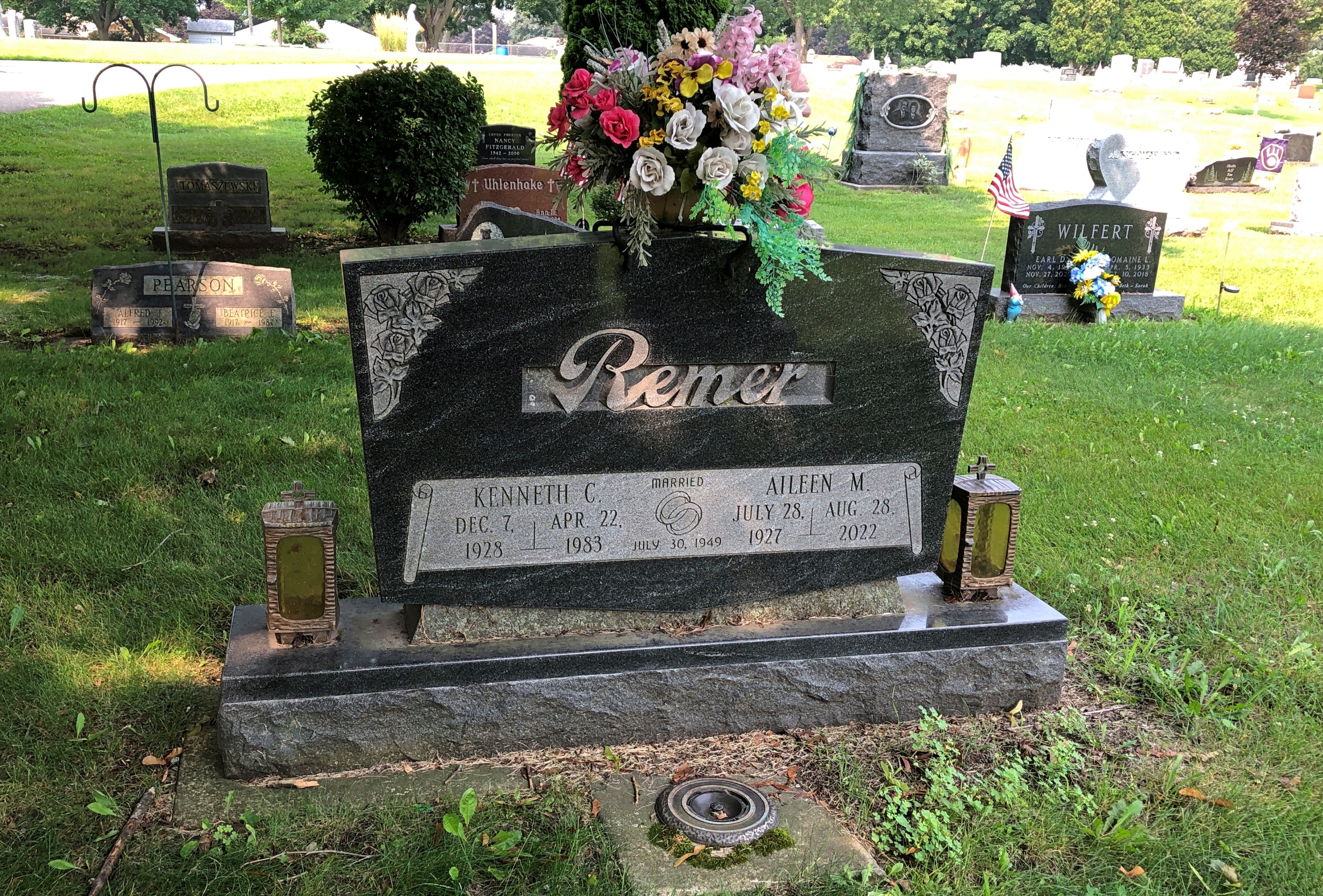
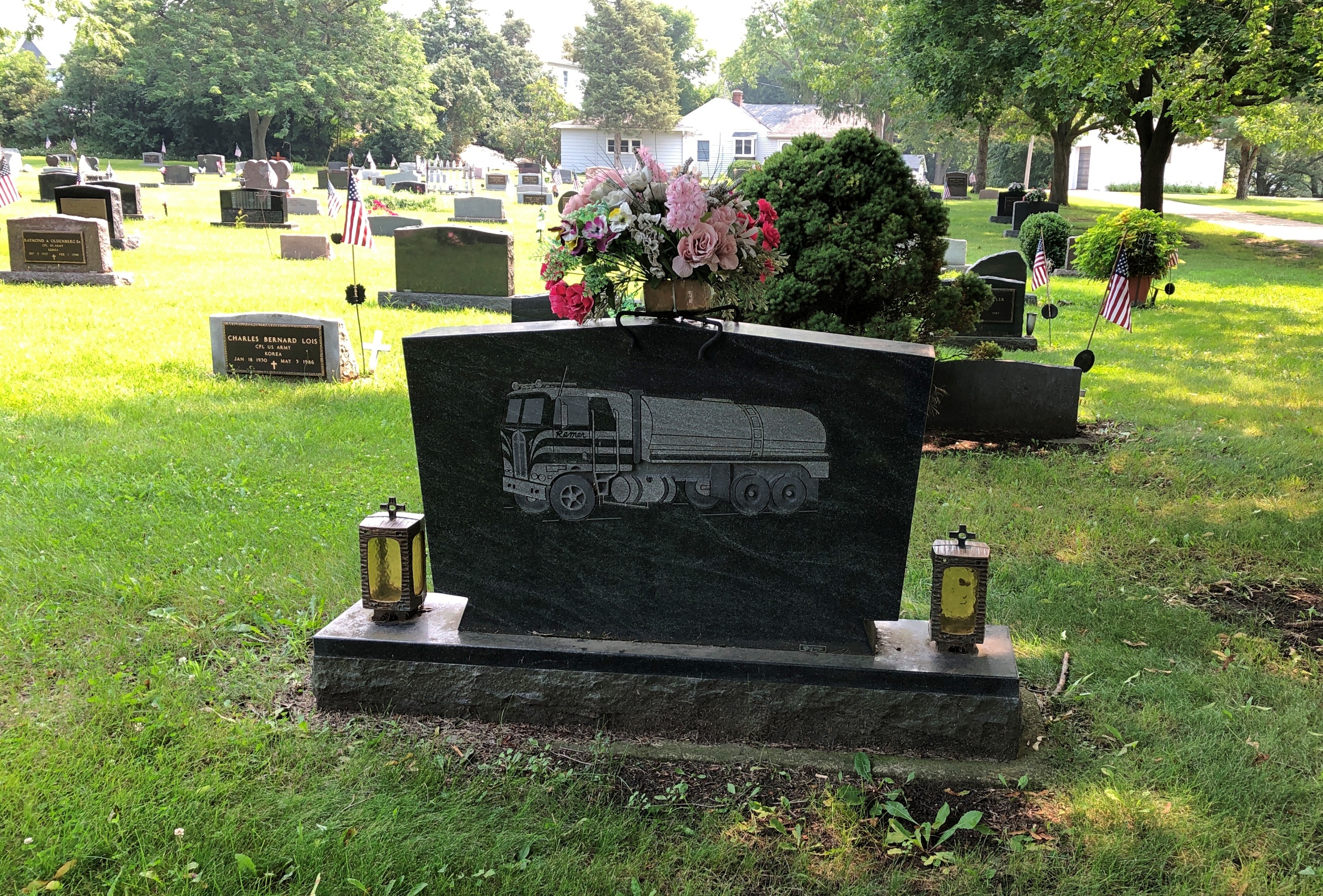
Something I’d never seen on a gravestone: a truck. I’ll bet most people can say that.

St Mary's Cemetery, Burlington, Wis

My best guess when I saw it was that Kenneth C. Remer was a trucking man who, among other things, lived through the short romanticization of trucking men in the mid-1970s. Something I’m sure is lost on later generations, as if that matters. If I were silly enough to say “That’s a big 10-4” to either of my daughters, I wouldn’t expect comprehension. That bit of code wasn’t invented by truckers, but even so.

I looked him up, as one can in our time. His obit says he was a “partner in Remer Milk Service.” So could be he drove a milk truck, at least sometimes. That is a liquid-hauling truck depicted on the stone. Not something celebrated in song and story, but useful work all the same.

Further down the rabbit hole, I came across this: “The 1970s Trucking Craze Can Be Traced Back to a Regional TV Commercial for Bread.” I never knew that, or if I did, I forgot it in the 50 years since then, because I’ve devoted very little thought to the subject over that time. Just another thing invented by ad men.

Another thought on that: though “Convoy” was much more popular, C.W. McCall’s “Wolf Creek Pass” is by far the more entertaining song. (And it’s a real place.) A better song about driving a truck is “Willin’,” originally by Little Feat. Of all people, the inestimable Linda Ronstadt did a remarkable cover of it.

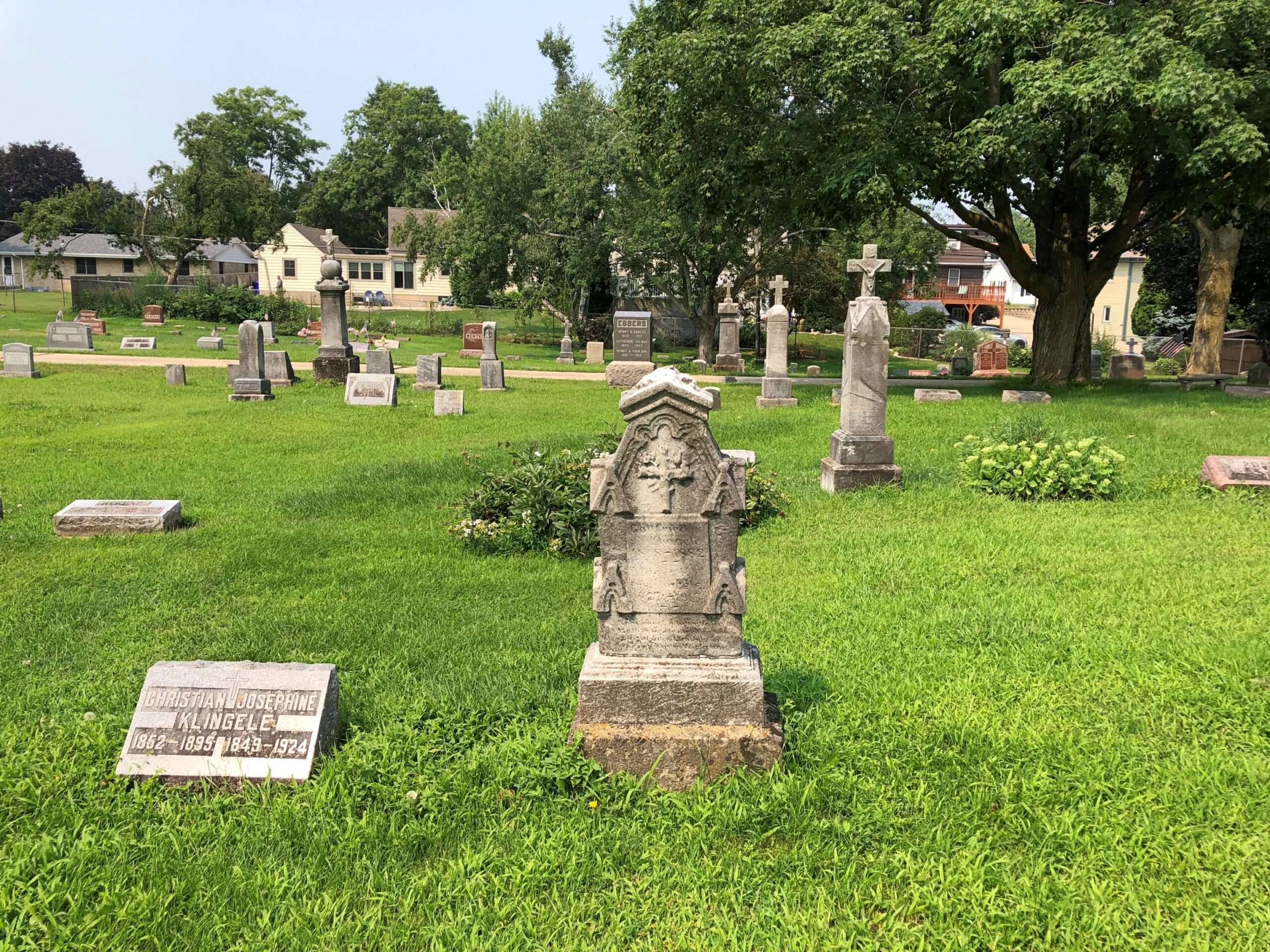
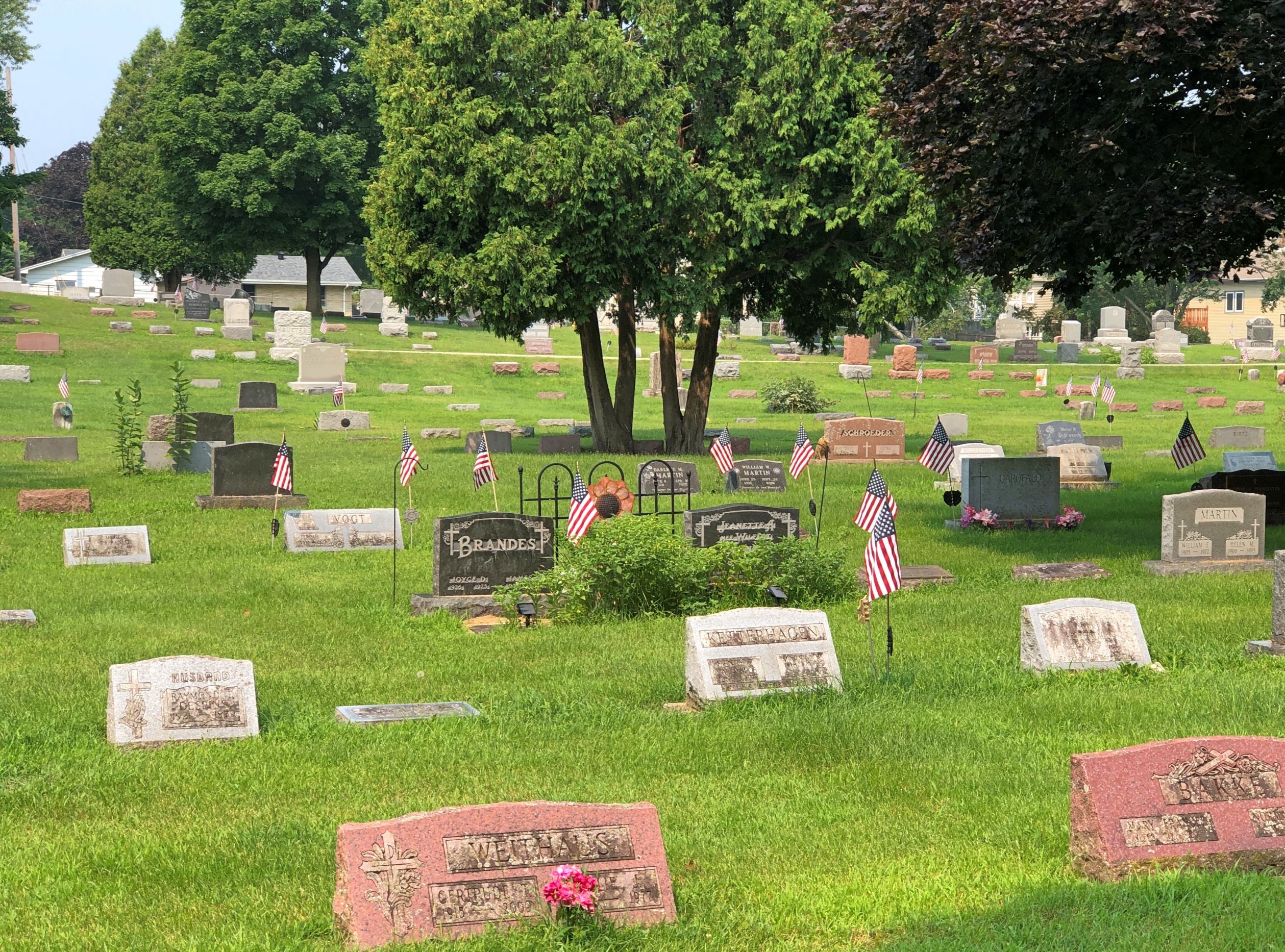
I encountered Mr. and Mrs. Remer at St. Mary’s Cemetery in Burlington, Wisconsin last month. A Catholic cemetery with a nice assortment of stones.

St Mary's Cemetery, Burlington, Wis

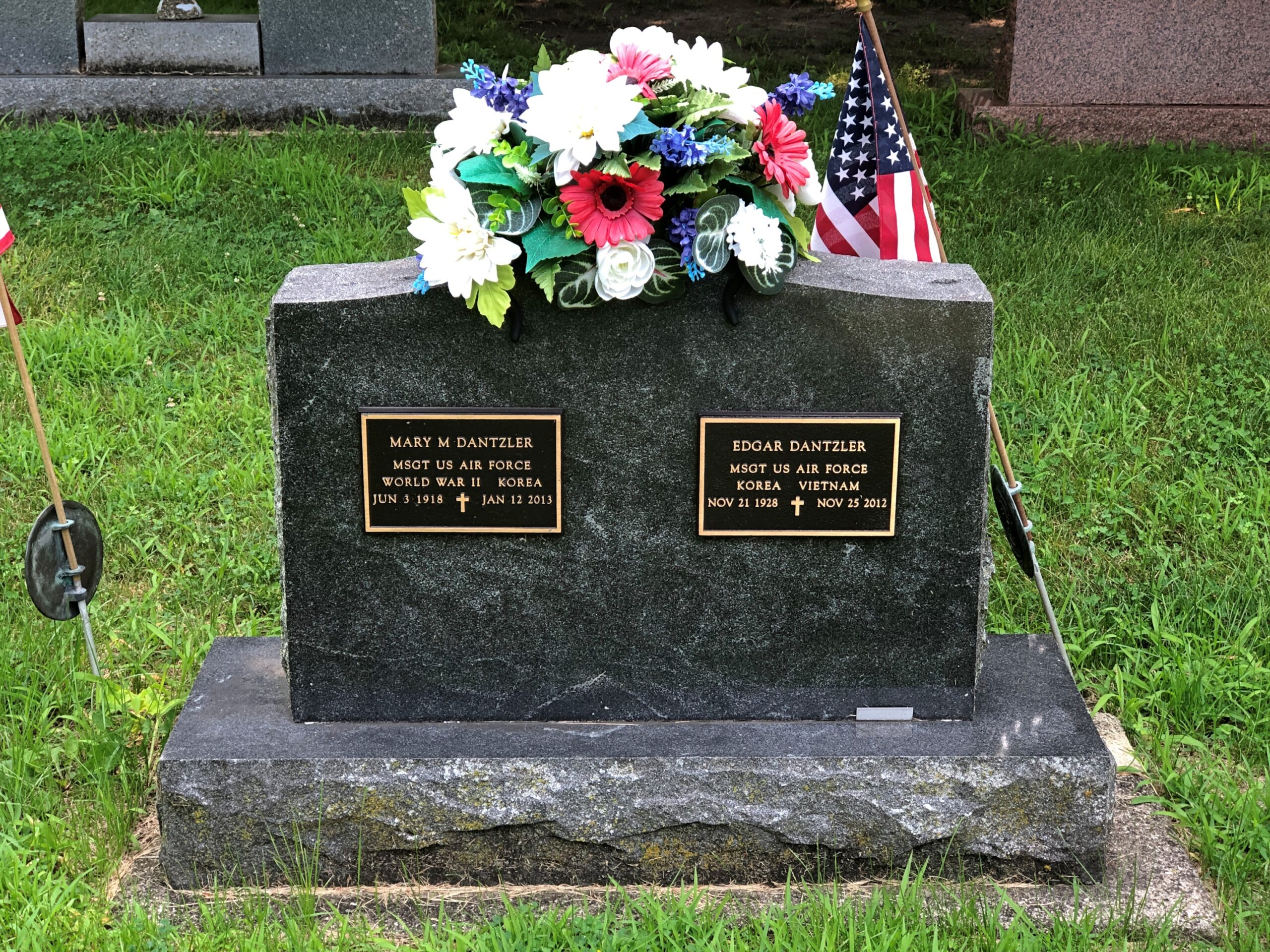
Unusual: two Air Force (I assume originally Army Air Corps) Master Sergeants, married to each other.

St Mary's Cemetery, Burlington, Wis

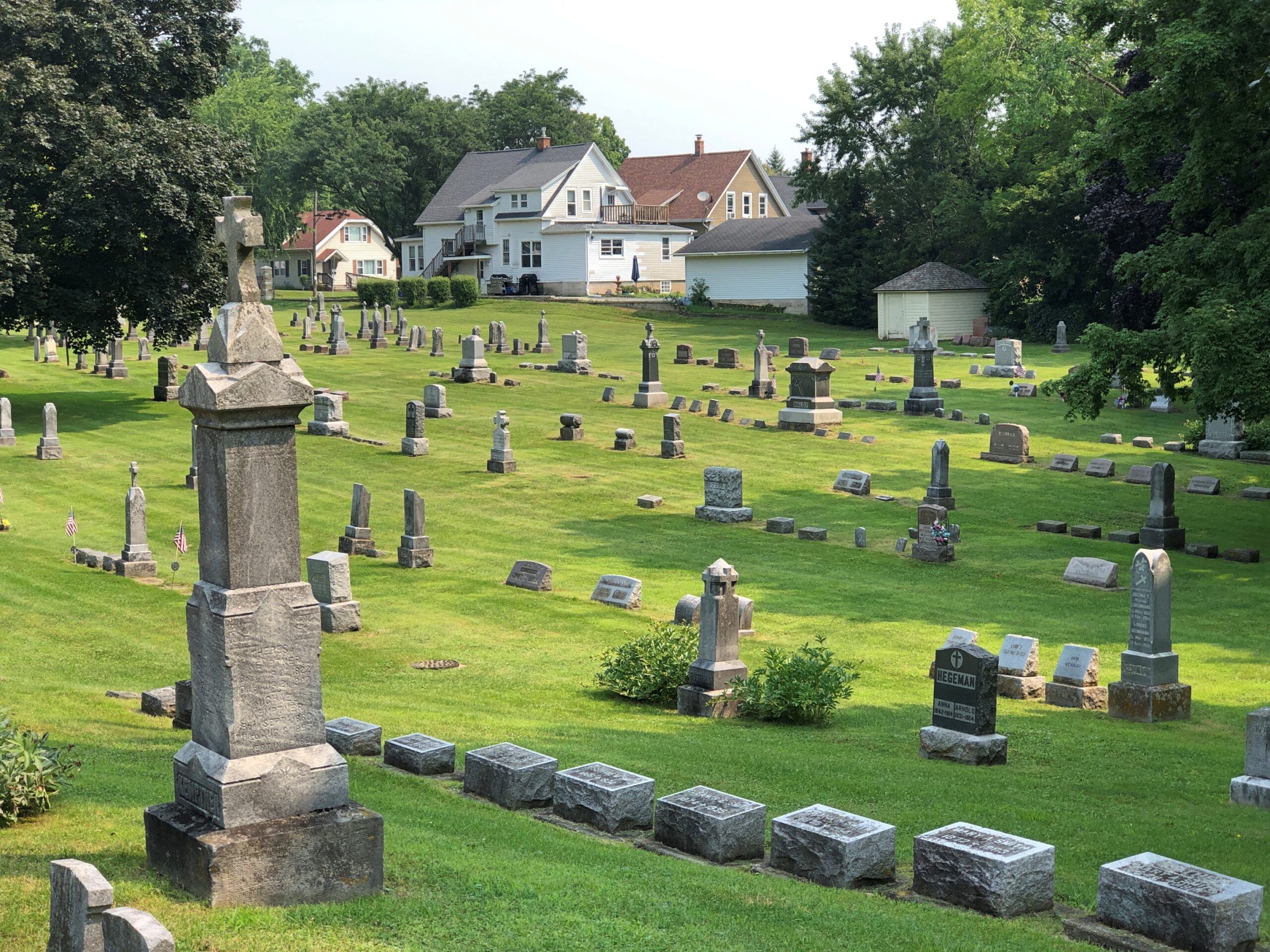
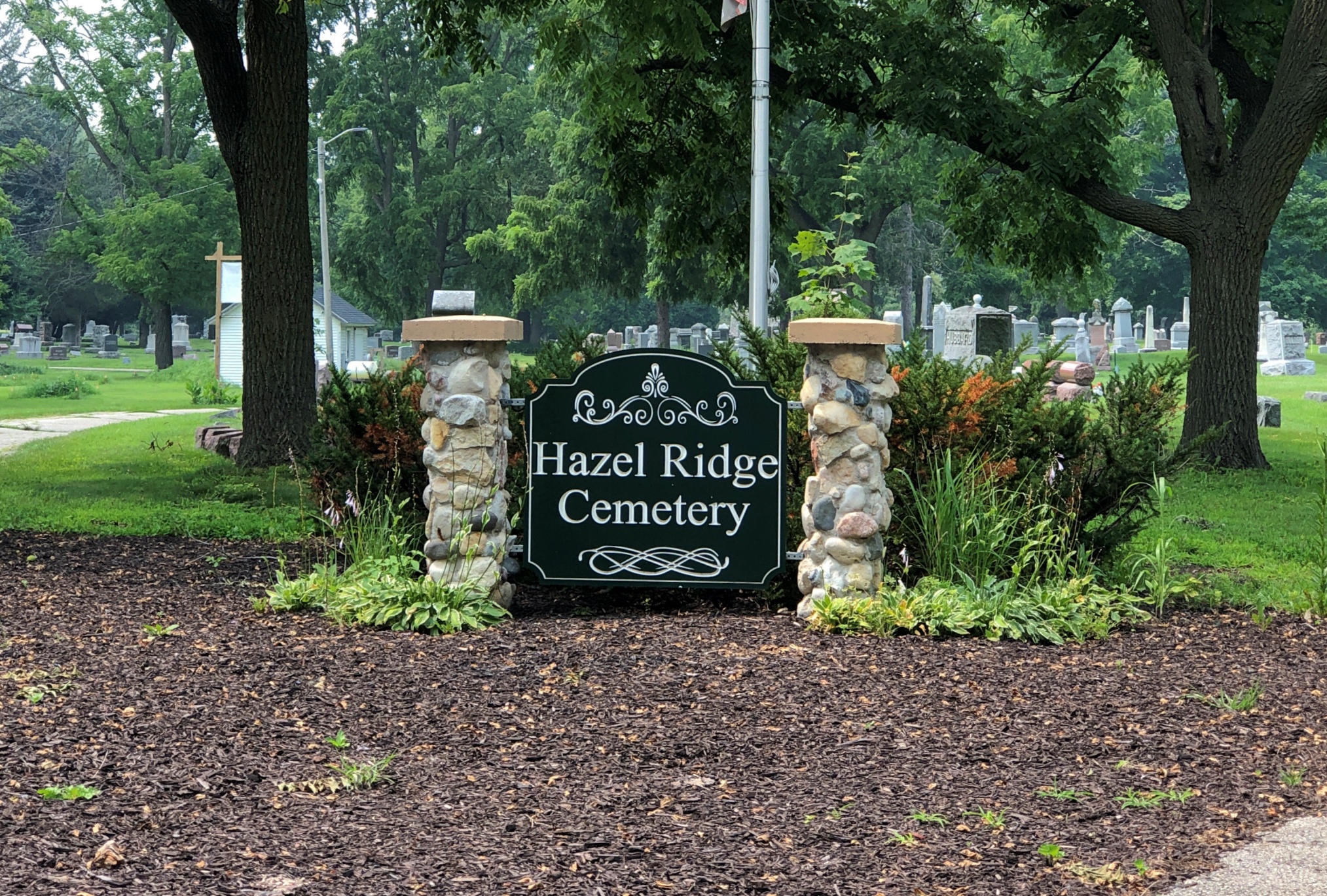
During my recent visit to Elkhorn, Wisconsin, I did no more than look for an “historic cemetery” on Google Maps to find Hazel Ridge Cemetery. Historic for sure, founded more than 150 years ago.

Hazel Ridge Cemetery

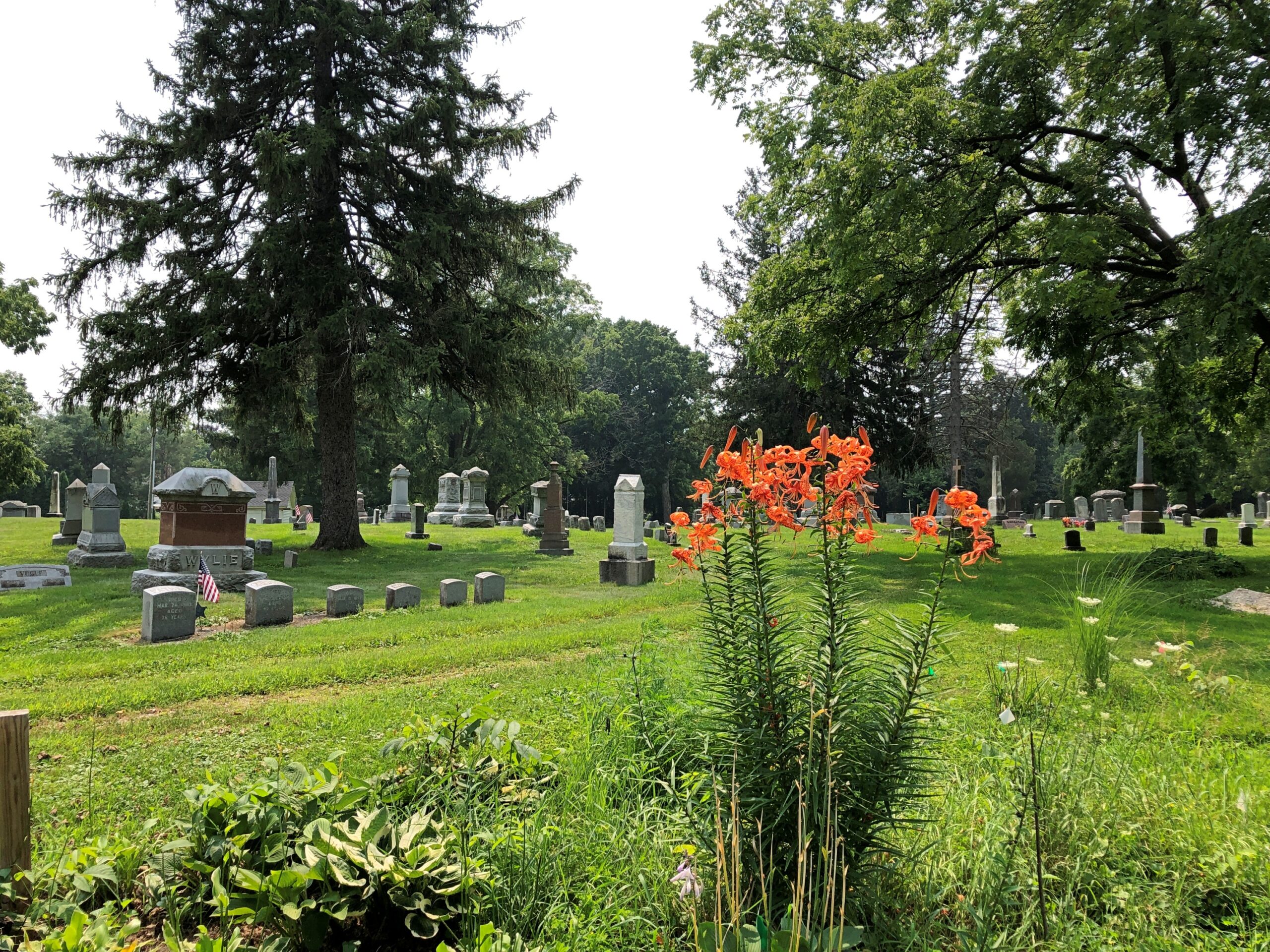
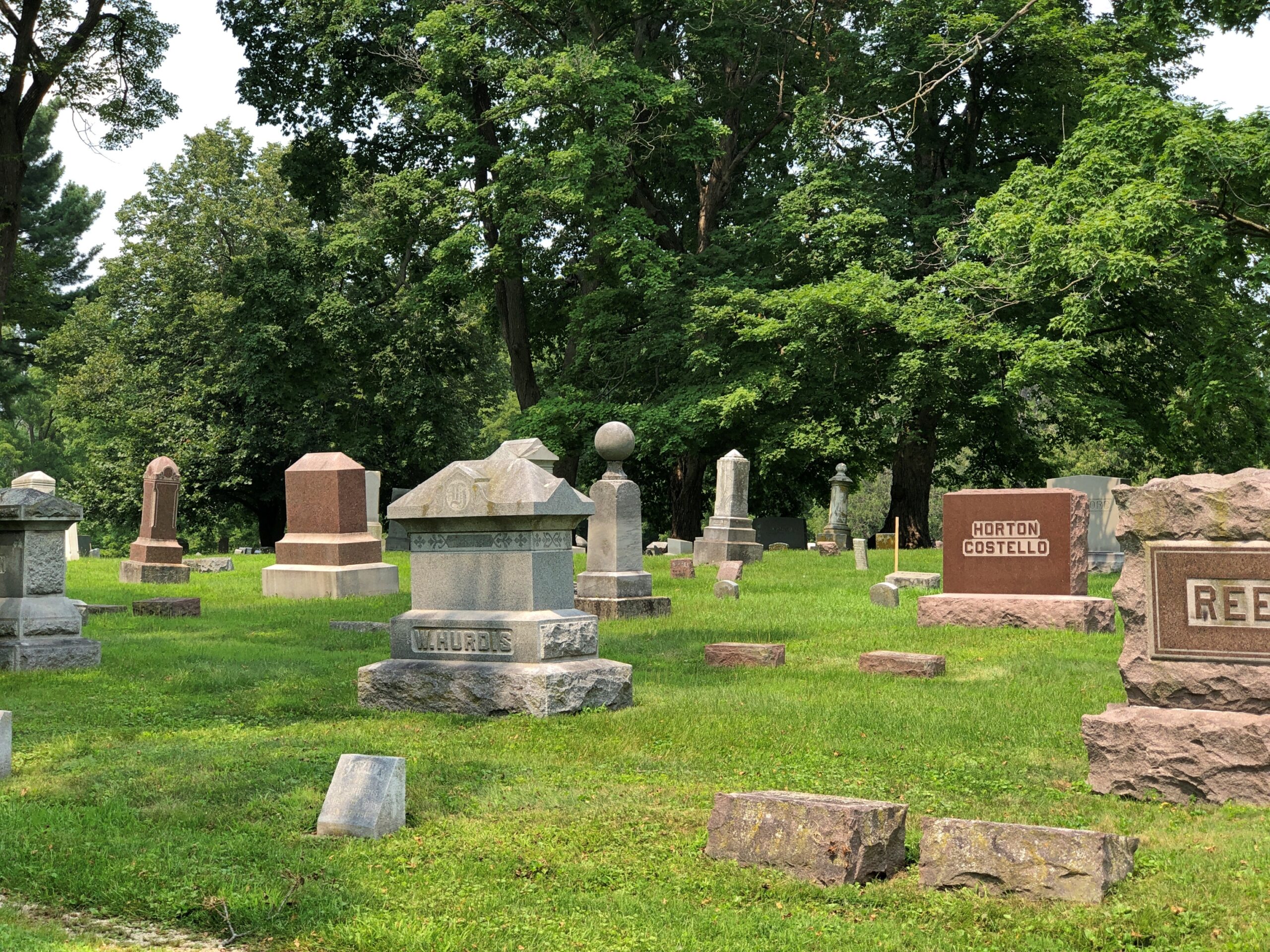
It too has a fine collection of memorials. The cemetery is also an arboretum, with more than 25 native species and ornamental varieties.

Hazel Ridge Cemetery

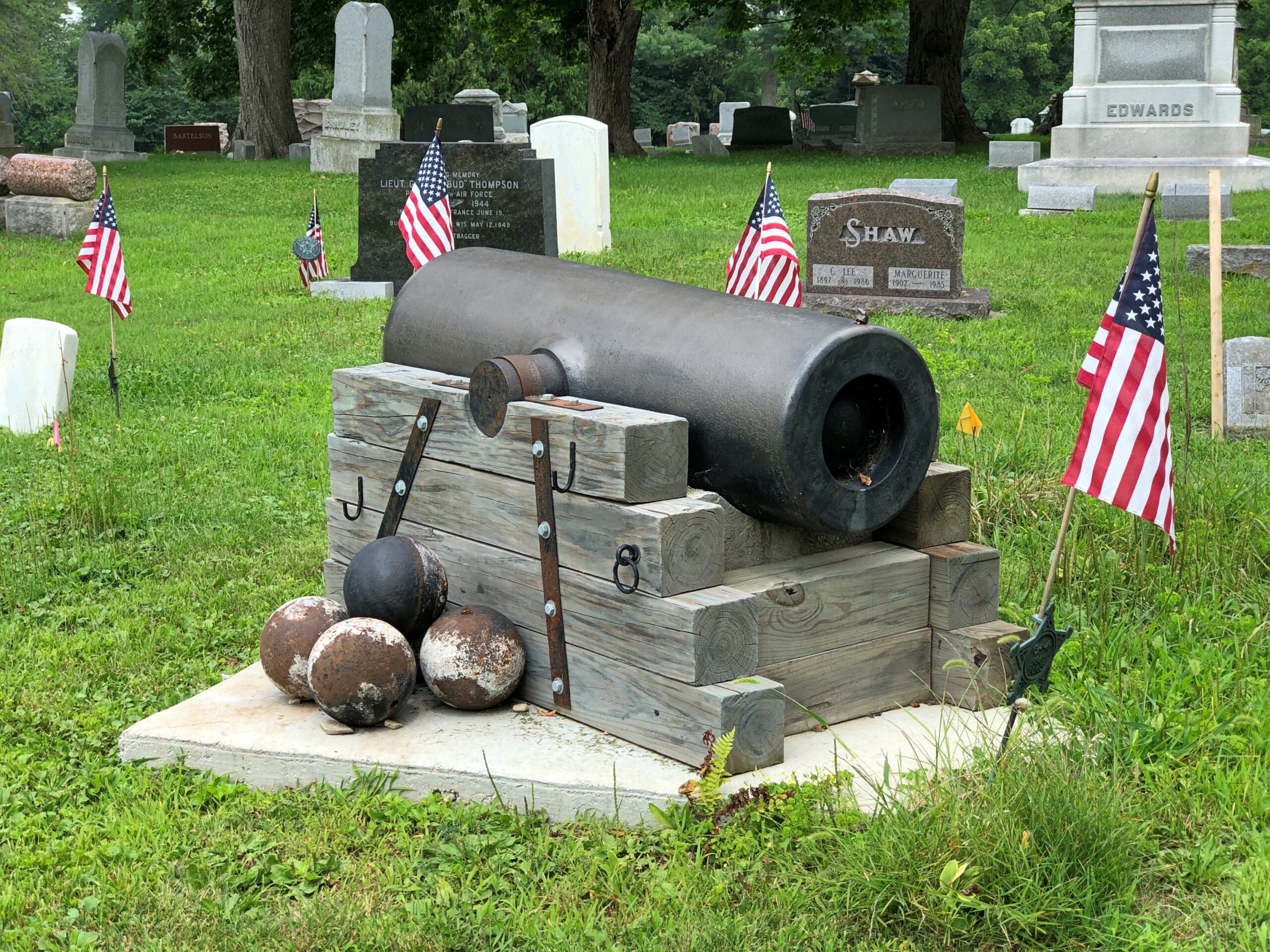
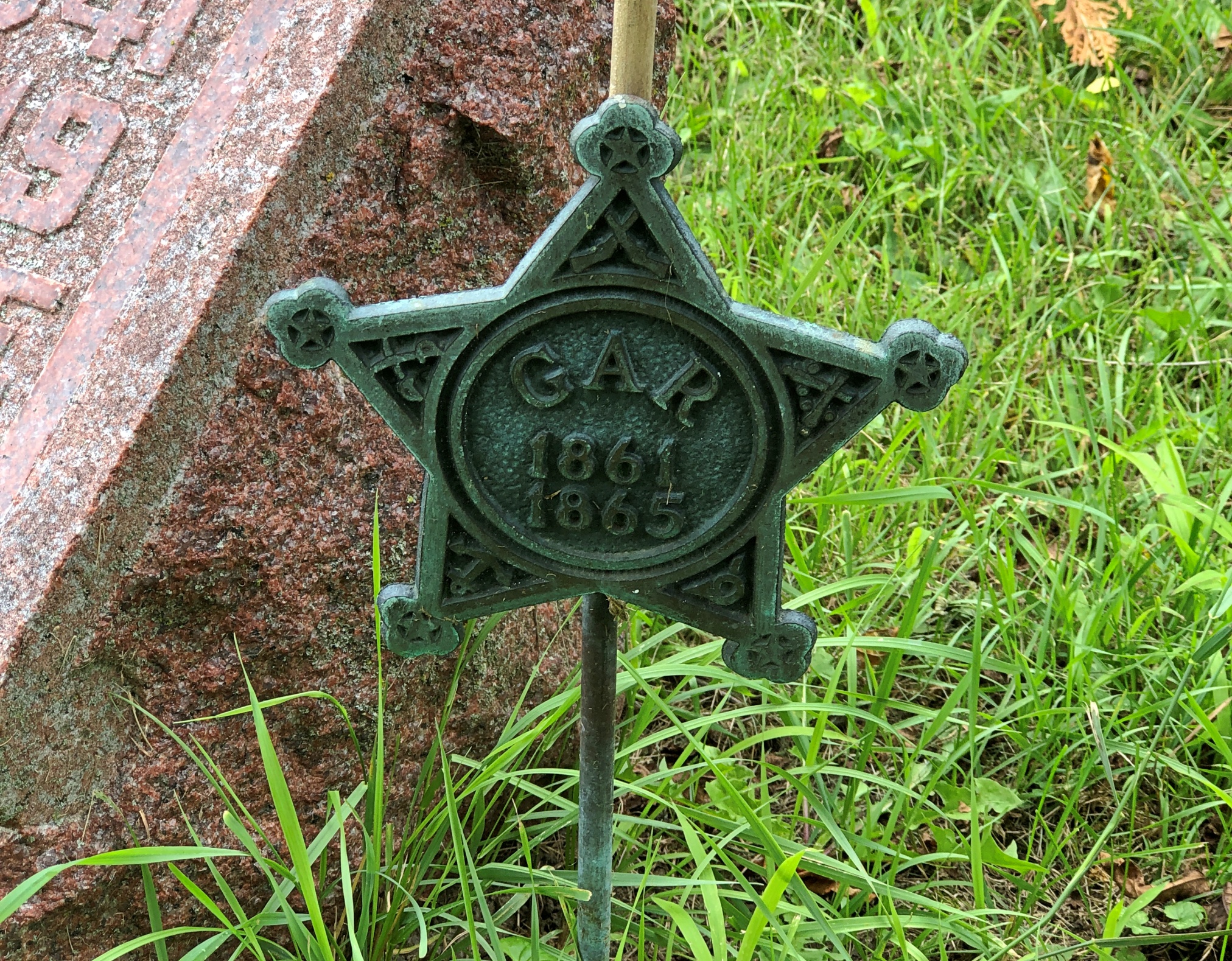
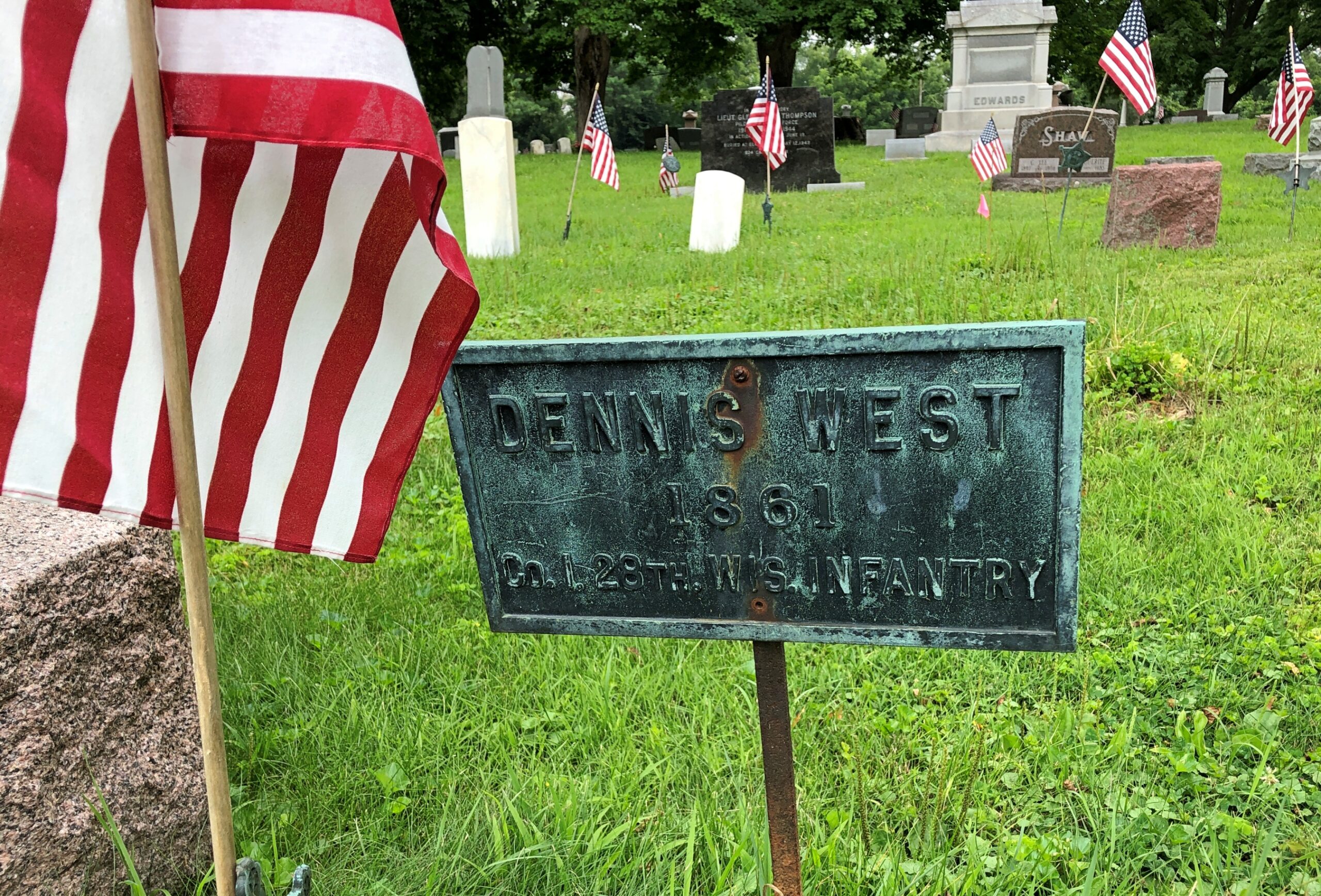
Hazel Ridge has a clutch of war dead memorials, including an 8-inch siege Howitzer as the centerpiece of a Grand Army of Republic memorial.

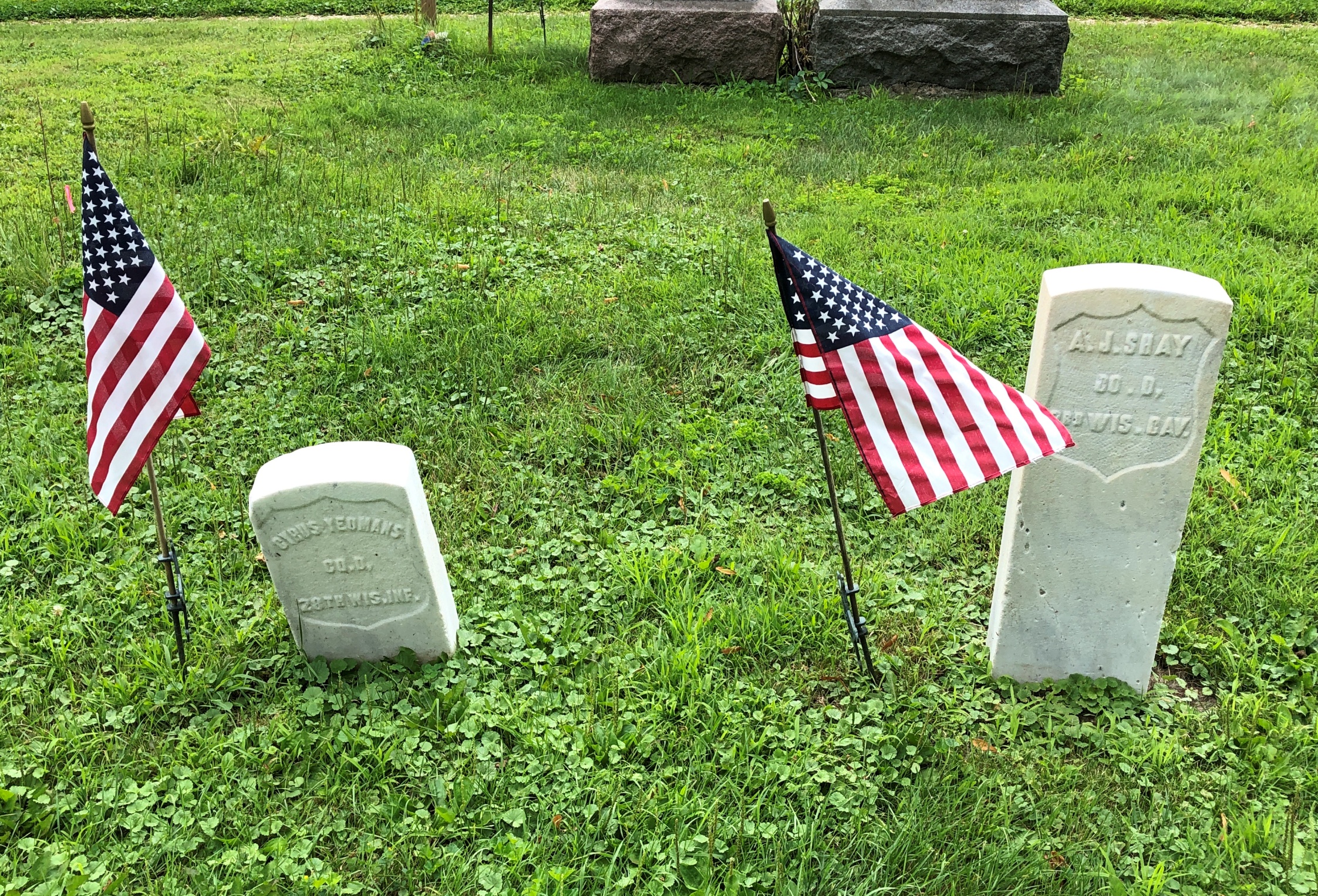
This particular cannon, according to a nearby sign, was made in 1862 at the Fort Pitt Foundry in Pittsburgh. I assume it did its part for the Union. Nearby are soldiers who did likewise.

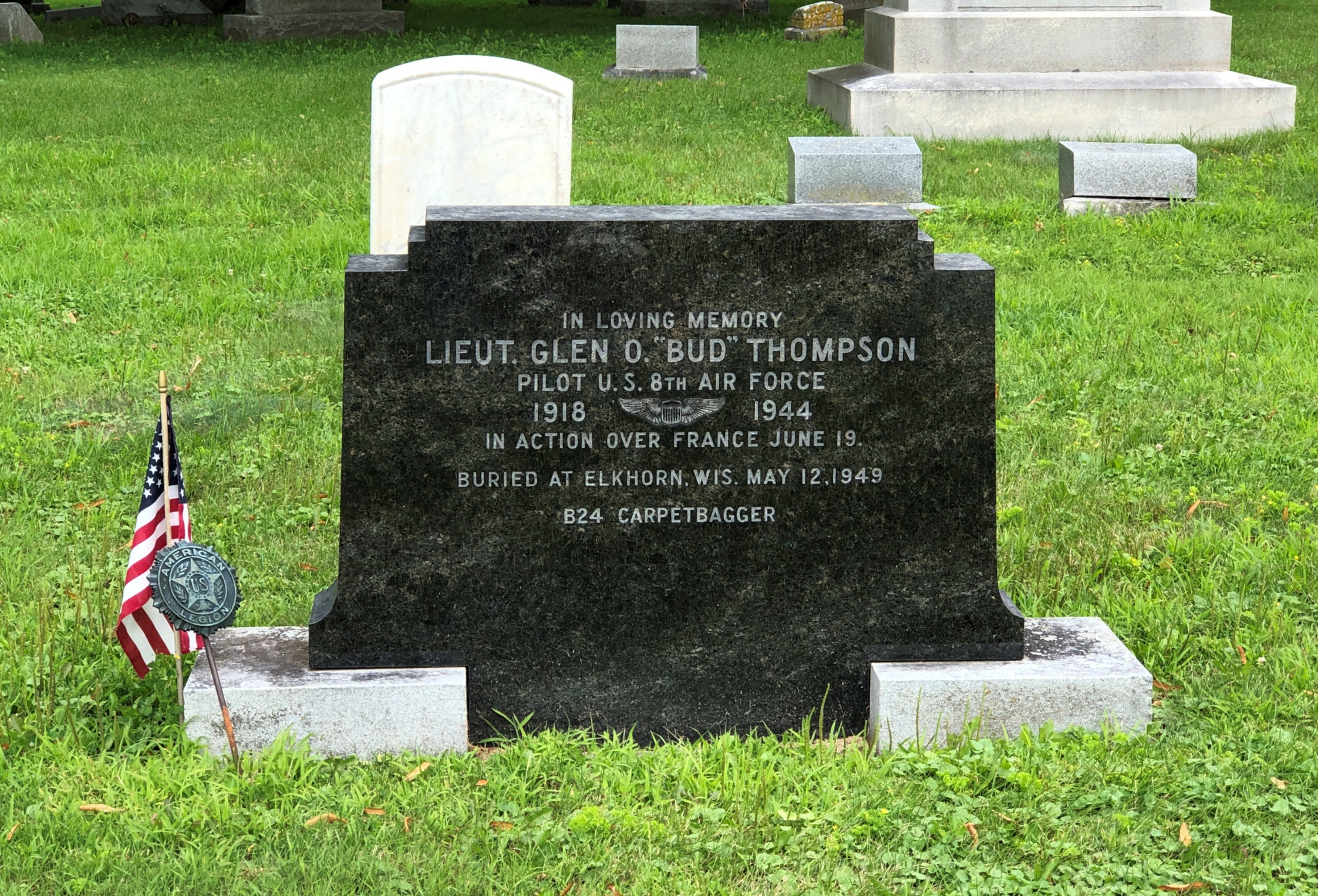
And those who died in later wars.

The single word “Carpetbagger” on the stone tells quite a story. Operation Carpetbagger involved black-painted B-24s flying low and slow by night, dropping supplies and agents to the resistance in France before and after the Normandy invasion. Clearly dangerous work. RIP, Bud.

Corpus ’79

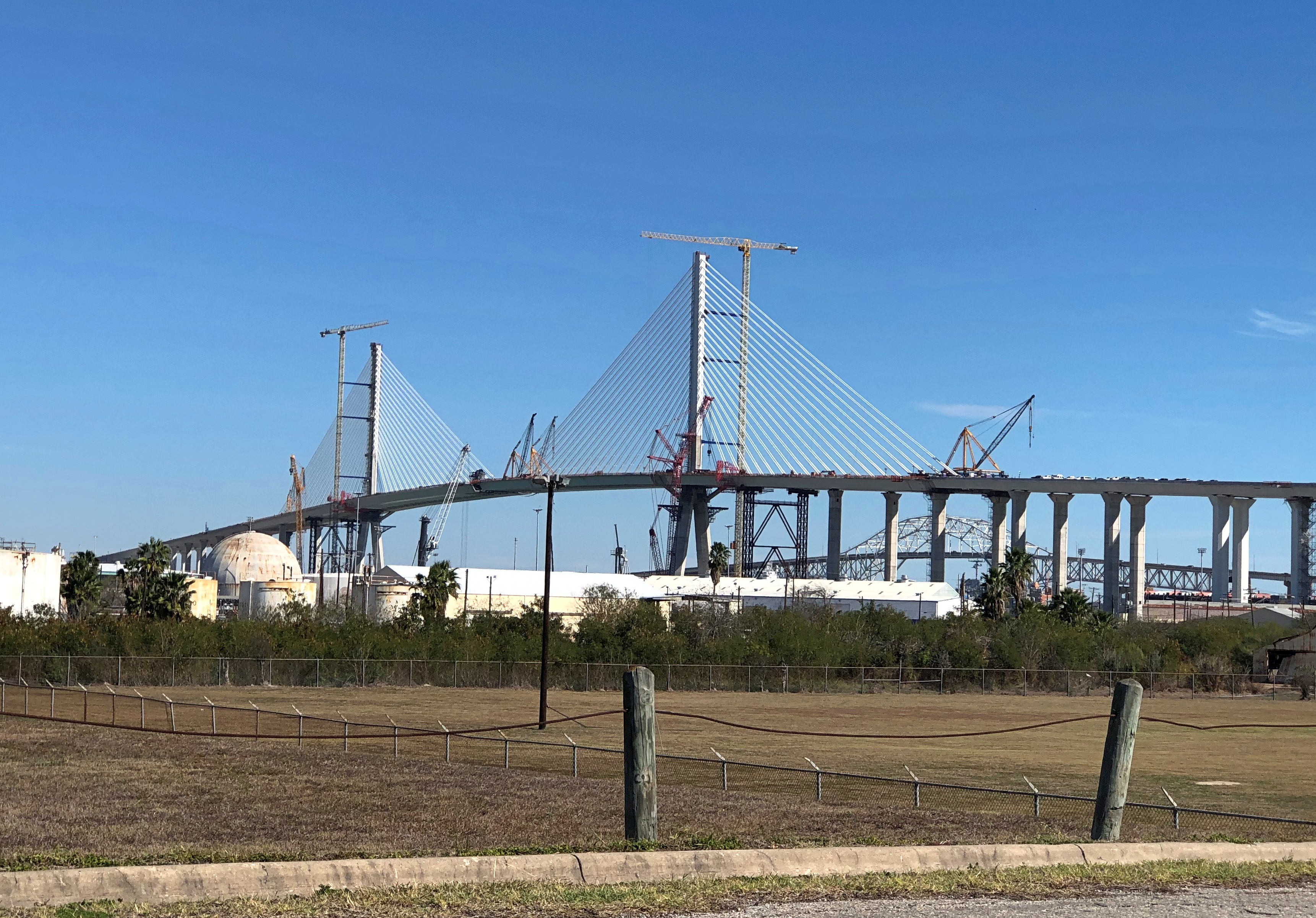
The sparse neighborhood cut off from the rest of Corpus Christi by I-37 at least offers a view of the new bridge, nearly complete, that will connect downtown with the North Beach district. New bridge in the foreground, existing through-type arch bridge in the background.Harbor Bridges, Corpus Christi

The new bridge has been in the works awhile, including a delay arising from firing FIGG Bridge Engineers from the project part way through. Another FIGG bridge had infamously collapsed in 2018, with the NTSB reporting that “the probable cause of the Florida International University (FIU) pedestrian bridge collapse was the load and capacity calculation errors made by FIGG Bridge Engineers.” Reportedly TexDOT in particular was leery of that company continuing on the Corpus bridge project.

The new bridge will be open by this summer, and soon after the old bridge (vintage 1959) will be demolished. For a narrow window, including January 2025, there are two bridges.

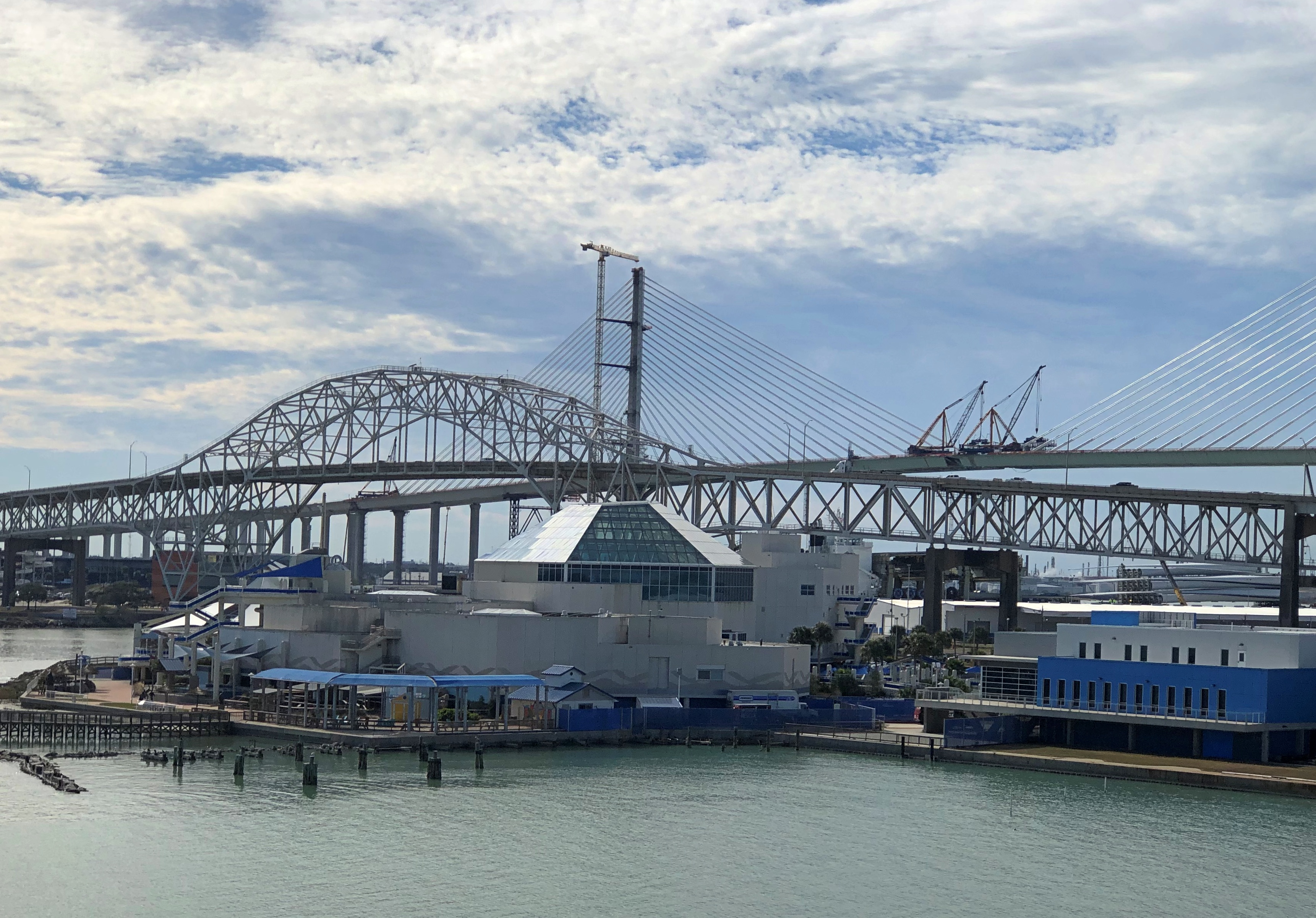
We got a good look at the old bridge from a different vantage.Harbor Bridges, Corpus Christi

In this case, the Texas State Aquarium is in the foreground. If I’d known that old bridge was coming down so soon, I’d have taken better pictures of it, including from the ground practically under it in North Beach. Never mind. Time flies, things change.

When was the last time I was in Corpus Christi anyway? A question of no importance to anyone else, and not even that much to me, but something I wondered about while visiting the city (January 16). It occurred to me after I returned home that I might have documentation to pinpoint it – the pages of the desk calendars I kept, starting my sophomore year in high school. I used it, as one would, to keep track of things I had to do for school, but I also made notes about social activities, of which there were a fair number. A speech tournament counted as both, and a travel opportunity to boot, even if it were only to other high school campuses in town.

So I checked: I went to a speech tournament at CC Ray (W.B. Ray HS) January 12-13, 1979, and at CC King (Richard King HS) February 16-17, 1979, so the latter is the answer to my question. I don’t ever remember attending a tourney at CC Miller (Roy Miller HS), where my mother graduated in 1943, when the school was simply Corpus Christi HS, the only one in town.

Early in my sophomore year in high school, I was considering joining the speech club, which mainly would mean debating, and in the fullness of time that’s what I did. I must have mentioned my deliberations to my English teacher, Bill Swinny, who also taught drama at Alamo Heights HS. I can picture him: not as old as I am now, but wrinkled with a slightly leathery face, probably from years under a South Texas sun; silver narrow rim glasses; and a full shock of white hair without a hint of youth.

“If you do debate, your learning is going to go like this,” he said, holding his hands near each other, as if he were about to clap, and then spreading them wide apart – a hell of an effective gesture, with the fact that I remember it after nearly 50 years proving the point. Guess Swinny, who had been on the stage professionally, had that actor’s instinct for gestures.

He was right and it wasn’t long before I realized it. But I probably would have joined debate without his encouragement. Debate meant Friday and Saturday trips to other high schools in San Antonio (I suppose we got all or part of Fridays out of class to go, at least when I didn’t have a football game to go to, and assuming good enough grades). Even better, it sometimes meant going to other cities: Austin, Houston, Dallas, Corpus, even as far as Midland, Texas.

Under the sort of loose supervision that was common in those days. People wax nostalgic for that sort of thing, and they’re right.

I remember traveling by student-filled bus all the way to Stevens Point, Wisconsin in August 1978 for a school club trip (not speech, math) and being completely free to set my schedule once I got there. One day I skipped a few of the organized events and took a long walk around Stevens Point, including a visit to a local church, St. Stanislaus – probably the first time I’d ever looked inside a church, just to see it – and wandering through a large greenbelt around a pond, with fragrant pines that made the place seem intoxicatingly far away. I came home a better person for that amble, and being trusted not to be a moron.

Like band, speech was a social occasion with other members of the club, away from school, away from our families and usual-suspect friends for a little while. It meant nights in motels and occasionally actual hotels, and meals in restaurants beyond our usually haunts – generally organized by the students themselves, such as the time in Corpus we had to put our heads together, in those pre-Internet days, to find and procure food from the known-by-reputation somehow Star Pizza. (Or maybe Starr Pizza, since there’s a street of that name in the city). It might have been middling pizza by later standards, but I’m sure it tasted better for the effort we put into it.

We speech club types were bright but mostly well behaved, and I don’t remember that the teachers ever regretted our loose supervision. There were minor amounts of unreported underage drinking (which I never liked much myself), but no one got too stupid from it, to the point of anyone’s parents having to collect them.

There was the time we sang a few parody songs in one of our hotel rooms. In Houston, maybe. Fairly mild stuff, even then. “Rock Around the Clock” became “Rock Around the Cross,” for instance, with lyrics that would have been offensive, and certainly ridiculous, to some older ears in Texas at that time; but no one else heard it. We might have been loud enough to be heard in the hall, but I doubt in any other rooms. None of us recorded it, either. No one would have thought of that.

That same hotel-room gathering, without any one older around, we talked about what we knew or had heard about some of the other teams from other schools, including opinions about who were the toughest opponents, and otherwise. I don’t remember any details. It would be demented if I did. But I know that that moment was both business and pleasure.

Speech was also an opportunity to meet fairly smart girls who were also exotic. By exotic I don’t mean anything like ethnic background, but rather that they went to other high schools. Even more exotic, other high schools in other cities.

There turned out to be a lot of nuance to that meeting girls thing, something adolescent boys are only dimly aware of. During that single trip to Midland for a speech tourney, I remember my debate partner and I went up against two female partners from who knows what school in an early round of what was called Standard Debate: one team affirmative, the other negative, each partner speaking in turn about whatever the subject was that year. Energy policy? It was the energy-crisis ’70s, after all.

The opposing teams sat across from each other at the front of a classroom, with the judge and any other spectators sitting where students normally would, though in early rounds you could expect few other people besides the judge. So the teams had a pretty good view of each other. One of the opposing girls spent a fair amount of time staring at me. Or so it seemed.

She was lovely. My kind of lovely, as it happened: dark hair, dark eyes, slightly olive complexion. Unusual for those days – an era of straight hair for girls – she sported a lot of curls. Also, she was dressed if not to the nines, pretty close, since nice clothes were mandatory for all debaters, and of course the girls tended to put a lot of effort into how they looked, while it was enough for boys to be in a suit and have taken a shower recently.

I don’t remember anything else about that debate, not even who won. After it was over, the girl debate team was gone in a disappointing flash. No time for small talk, as was sometimes the case.

In conversation not long after with some other (male) debaters, this particular team and its curly-headed debater came up. That’s what she does, I was told, stares at male debaters to distract them. So it was high school-level psyop.

I could have taken a misogynistic lesson from that, but I don’t think I did, and certainly don’t now. She was just using an advantage that was temporarily hers, and, since everyone else seemed to learn about it pretty quickly, probably not that effective. But it was memorable.

One more story: there was that other time that the faculty advisor of the speech club, a youngish woman (early 30s, perhaps) who was with us on a trip to Uvalde, apparently left us completely and went across the border with her boyfriend for an entertaining evening (or night?). The student president of our chapter of the National Forensic League, who did not like her – thought of her as ditzy, if I remember his phrasing right – got wind of that and narked her out to the administration. Soon we had a new advisor. Supervision might have been loose, but it wasn’t supposed to be nil. I don’t know whether there were any other negative professional repercussions for that teacher or not.

Well, maybe that time that was an example of a teacher regretting the loose supervision of a bunch of bright ’70s high school students.

Thursday Bits, Mostly About Death

Monday’s storms were fierce, all right.

RIP, Bob Newhart. I came along too late to listen to the button-down mind record when new – I learned about it later – so for me Bob played the fellow who walked through Chicago and was a psychologist-chair straight man to a revolving group of eccentrics.

He’s one of the reasons the ’70s was a golden age for sitcoms. As a regular viewer, I must have seen almost all of The Bob Newhart Show. Because I didn’t pay much attention to TV after that decade, I haven’t seen many episodes of Newhart, but maybe now is the time to start.

Speaking of the ’70s, I found this posted online recently.

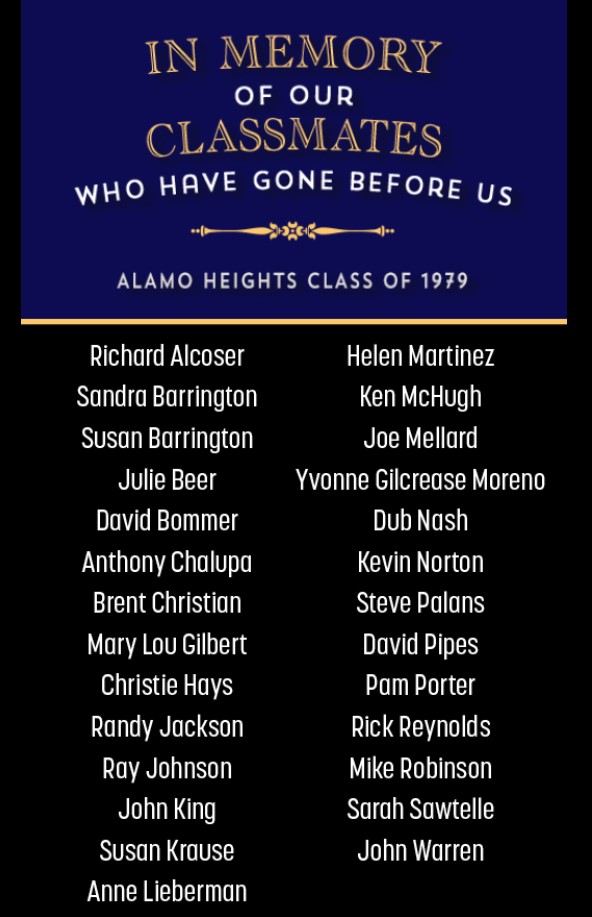
RIP to all these classmates of mine. The list was compiled by classmates who organize reunions and the like.

A few on the list were good friends of mine, including Kevin Norton and David Bommer. Most of the others I knew, or knew of. For a few I wonder, who was that again? even though AHHS wasn’t that large a high school. About 320 or 330 in the Class of ’79.

I know that because of the astonishing fact – in retrospect, at least to current or recent high schoolers – that periodically the administration would issue every student a GPA card that would not only tell you your exact GPA, but also where you ranked out of those 320 or 330. (I was always near the bottom of the top 10%.)

Twenty-seven names, though probably a few who have passed weren’t listed, so let’s say about 10% of the Class of ’79 is gone. That’s the leading edge of the bell curve of mortality, which will start to expand soon.

But death shouldn’t have the final word, at least not right now. Another way to look at it is that 90% of us have survived those 45 years, mostly as decent folk leading interesting lives, I hope.

Closer to home, in fact at home, how does our garden grow?

Not bad. Not bad at all.

Chicago Christkindlmarket ’23

I made a point of watching the tribute to Norman Lear that was simulcast – now that’s a aging concept – on several networks this evening, at 8 Eastern/7 Central. Mostly, I was curious to see what they would do. Turned out to be about 15 seconds of a picture of him (maybe taken in the late 20th century), his name and birth and death year, indicating quite a lifespan. That was it. I wonder how many people who saw the spot knew who he was. Network audiences skew old, but even that demographic is more likely to remember his shows than him.

But he was well enough known to inspire a torrent of virtual print, so I won’t add to it, except to say too bad Hot L Baltimore didn’t last, while Good Times did. Nobody’s perfect. RIP, Mr. Lear.

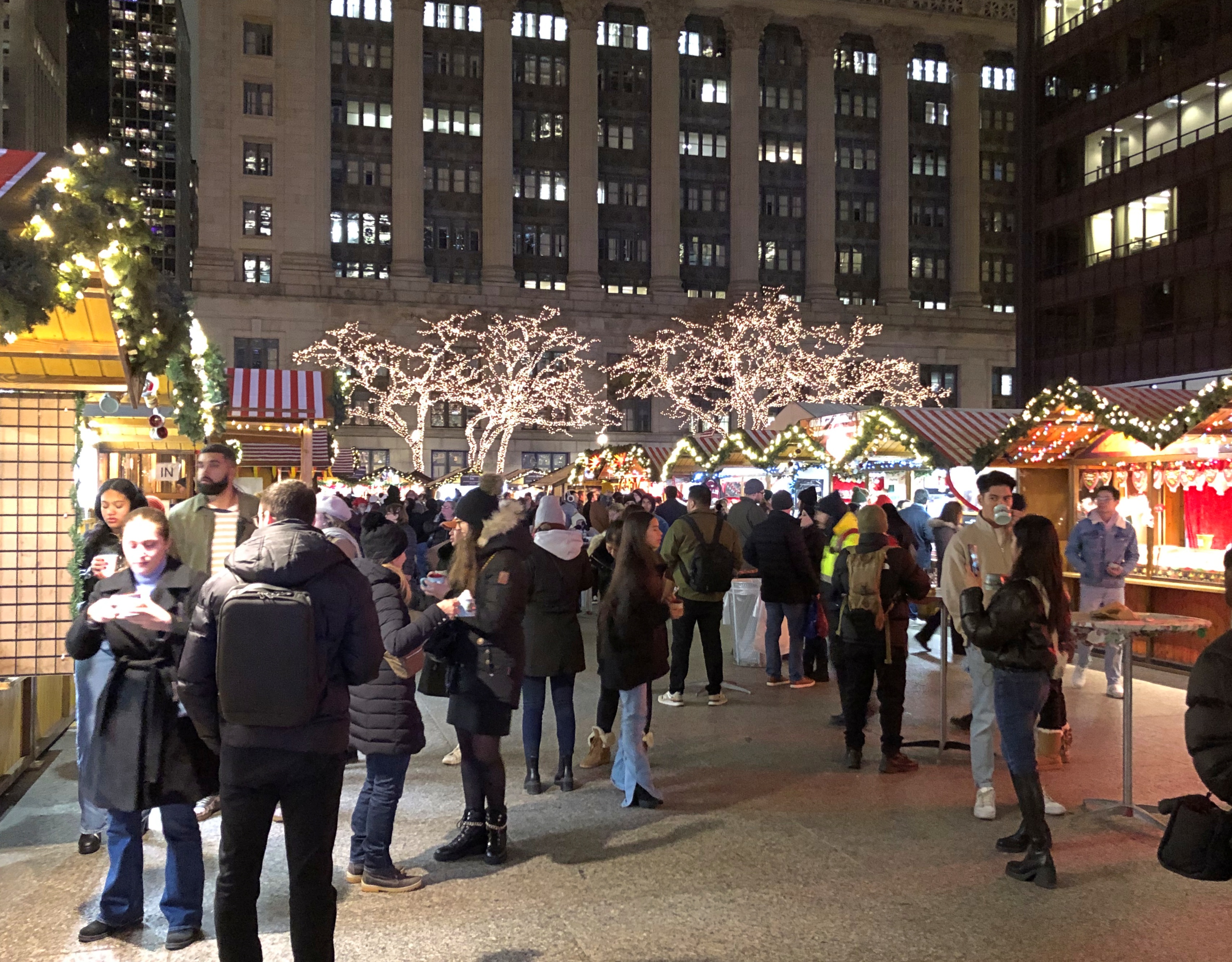
Extremely crowded Chicago Christkindlmarkets of years past – mob city, as my mother used to say, not referring to gangsters – must have pushed any notion of visiting it on Monday right out of my head. But when I ambled over to the Thompson Center, I saw the market. Might as well drop in, see if the crowd was thinner. It was. A more manageable Monday in mob city. Just enough to be lively.

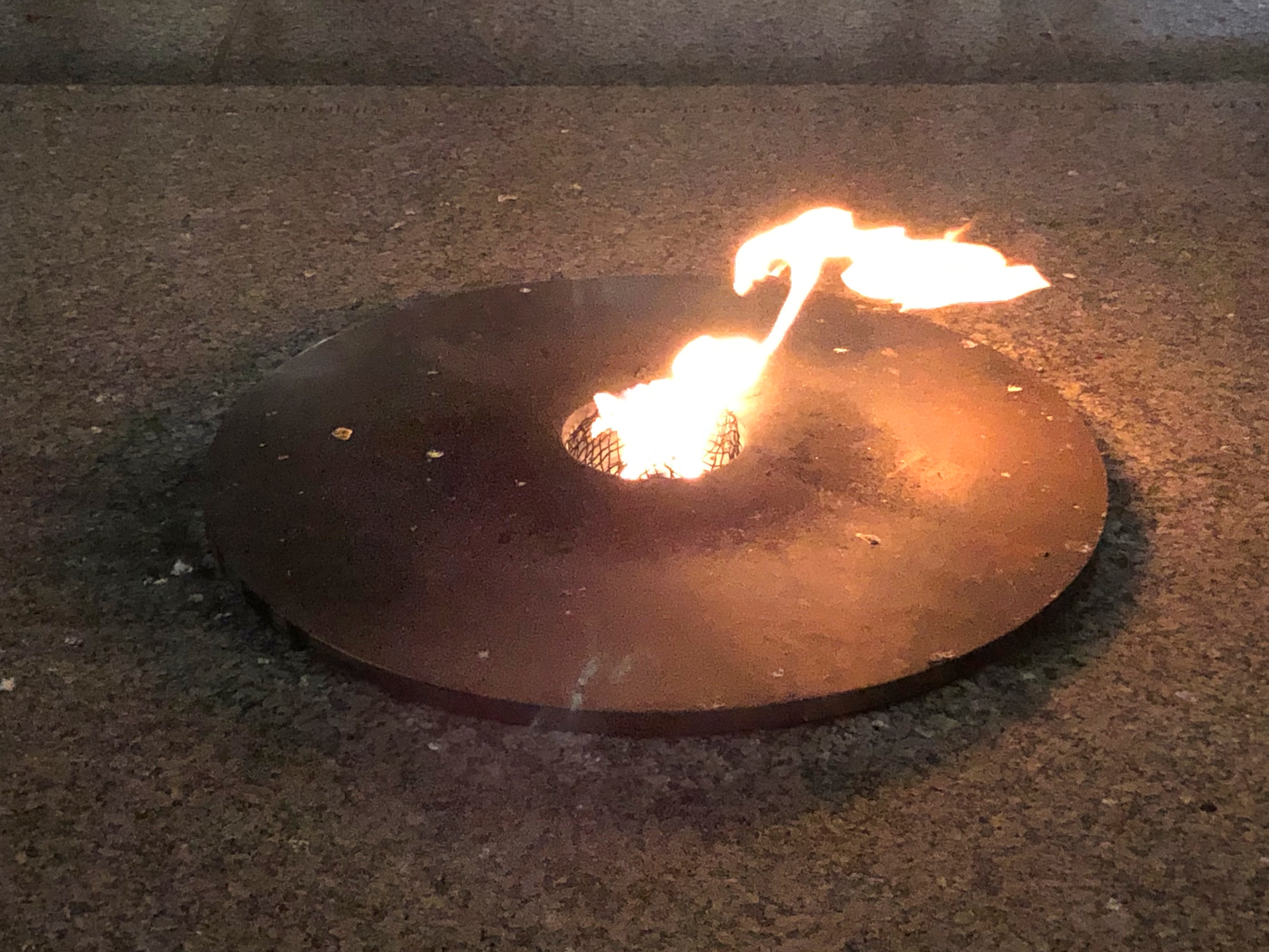
First, pass by the eternal flame on Daley Plaza. Dedicated since 1972 to all U.S. veterans of any kind.Chicago Christkinlmarket 2023

Still there. Well, it is eternal. That’s not meant in a literal sense, of course, on past the heat death of the Universe, but as long as humanly possible. The upshot for the flame is that people will maintain it until its honorees have disappeared from common memory. I hope that’s some centuries at least, but who knows.

As I said, lively. It isn’t really crowded unless it’s tricky to navigate through people.Chicago Christkinlmarket 2023

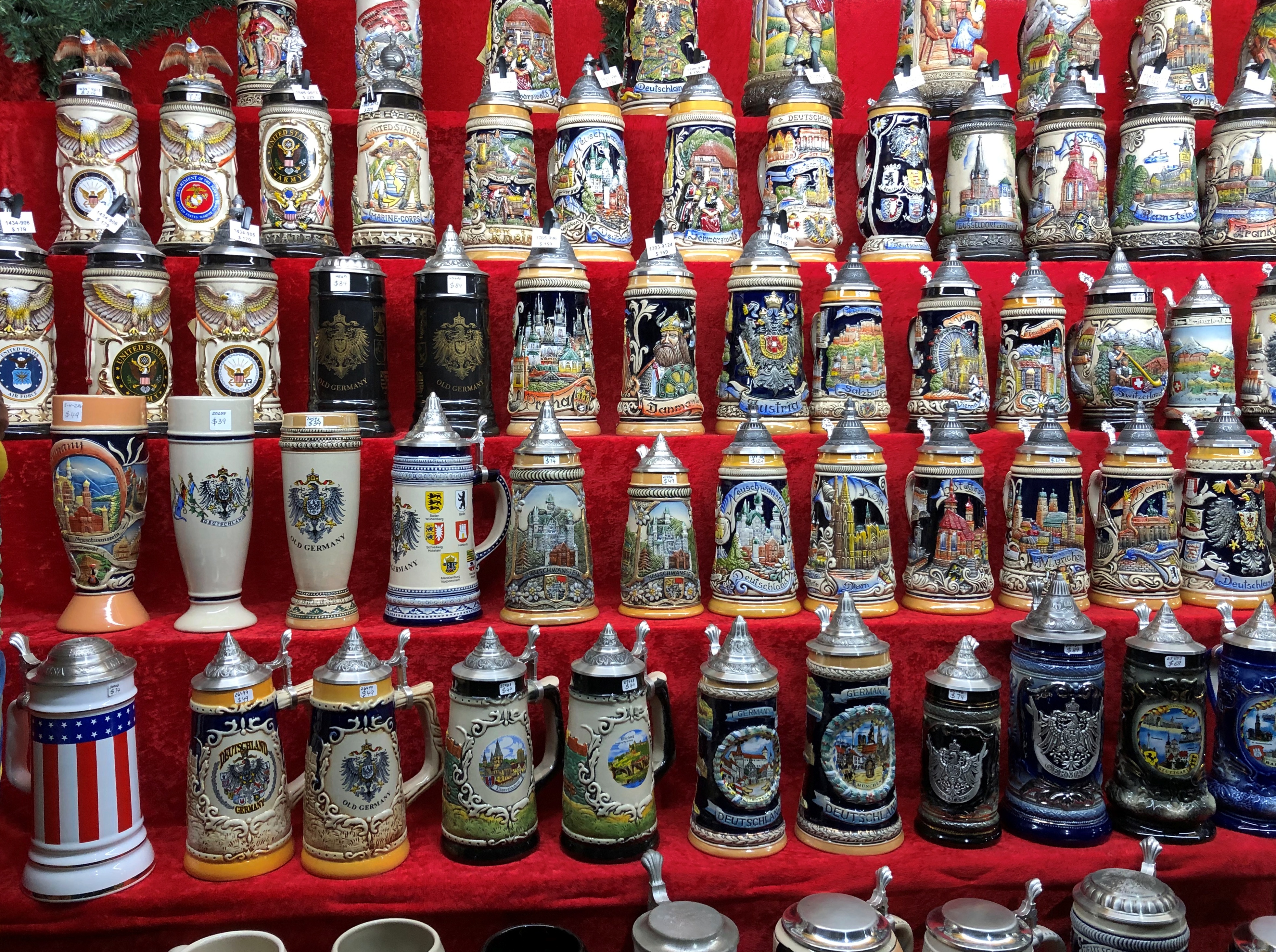
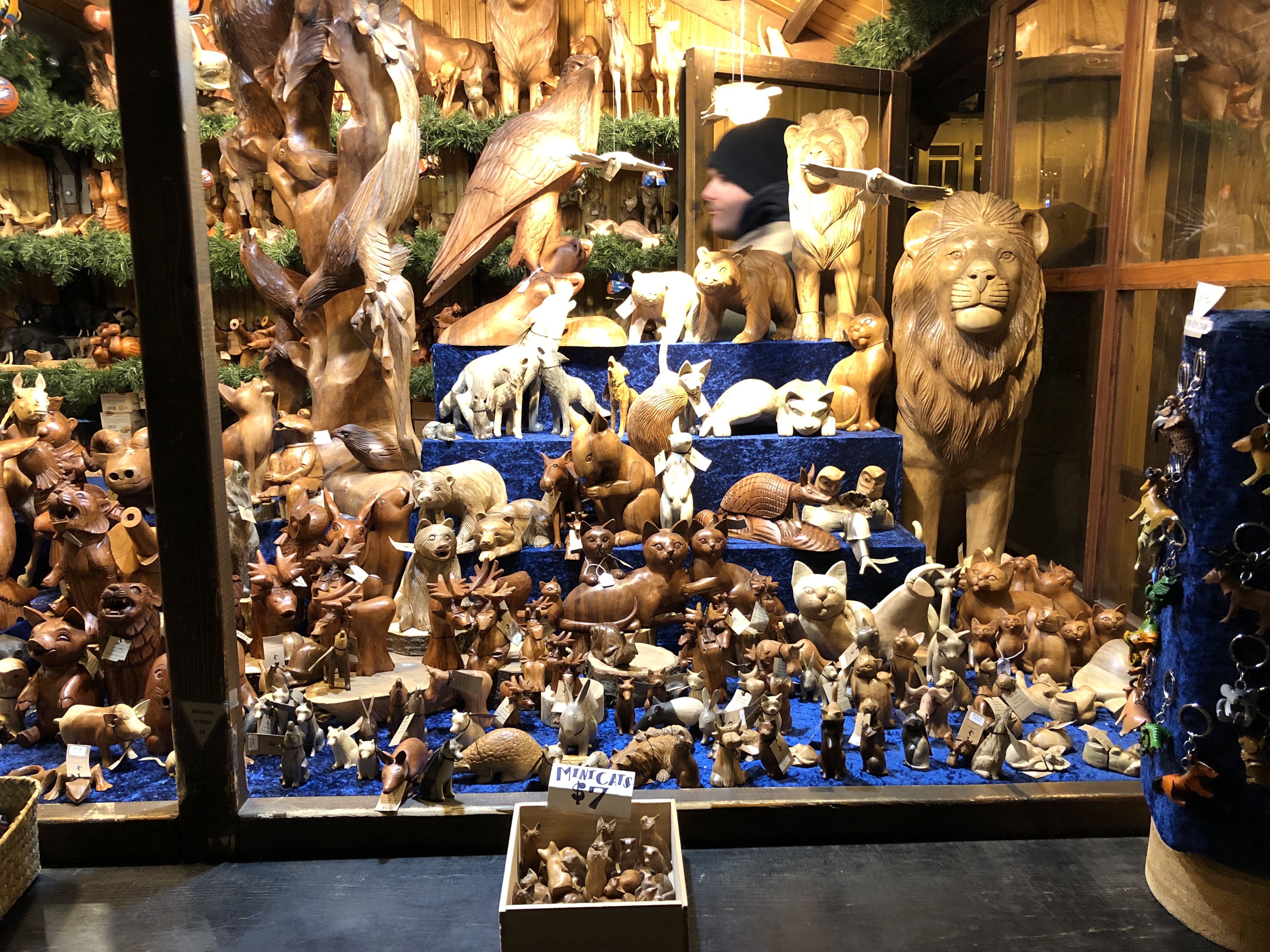
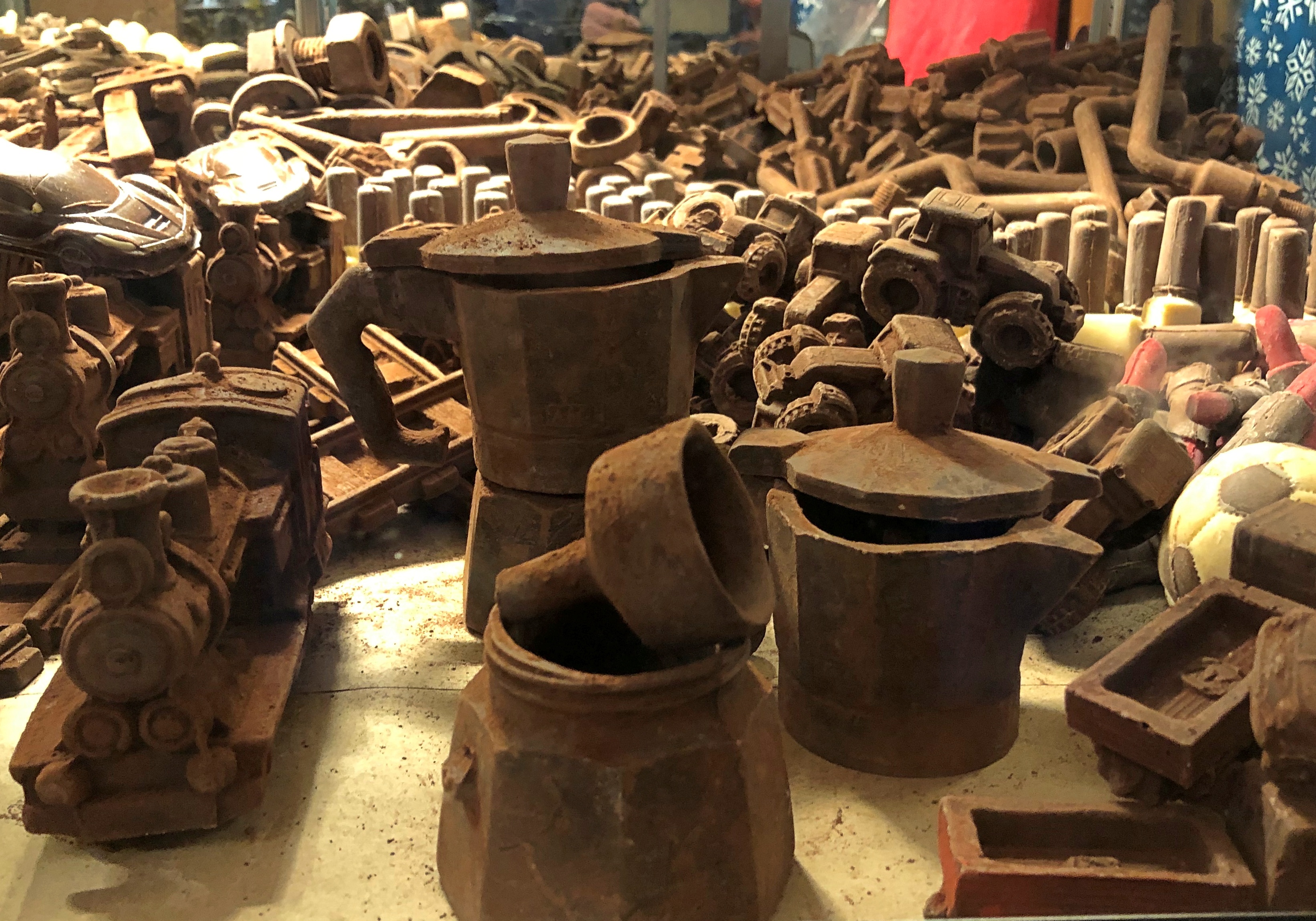
The stalls are more crowded.Chicago Christkinlmarket 2023 Chicago Christkinlmarket 2023 Chicago Christkinlmarket 2023

Everything in that lower pic is eccentric shapes of chocolate, and pretty much the only place I was tempted to buy anything. The economic model at the market is the same as I described a few years ago: “priced in euros at a lousy exchange rate, with an extra 50 percent tacked on for good measure.”

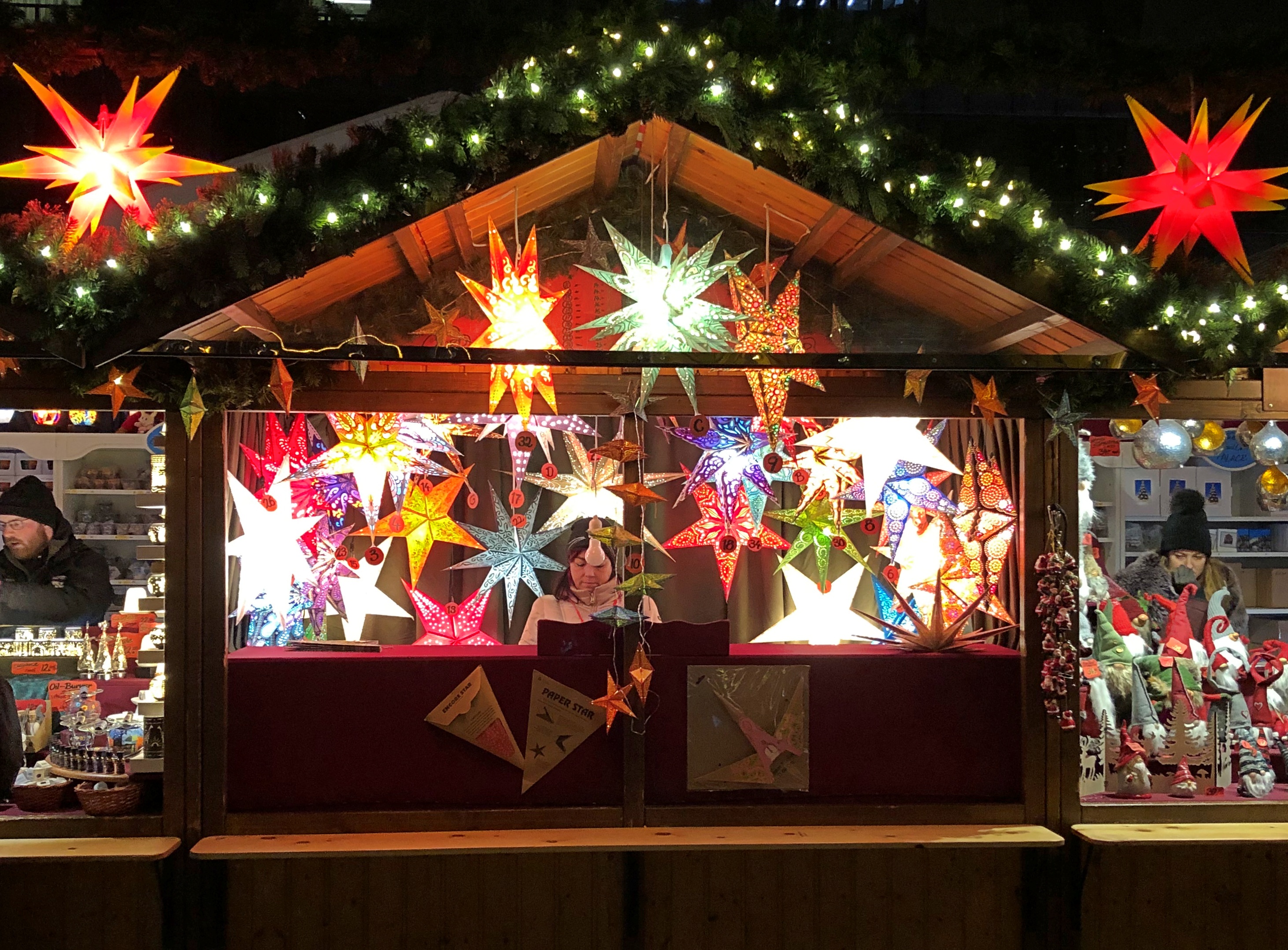
Paper stars.Chicago Christkinlmarket 2023

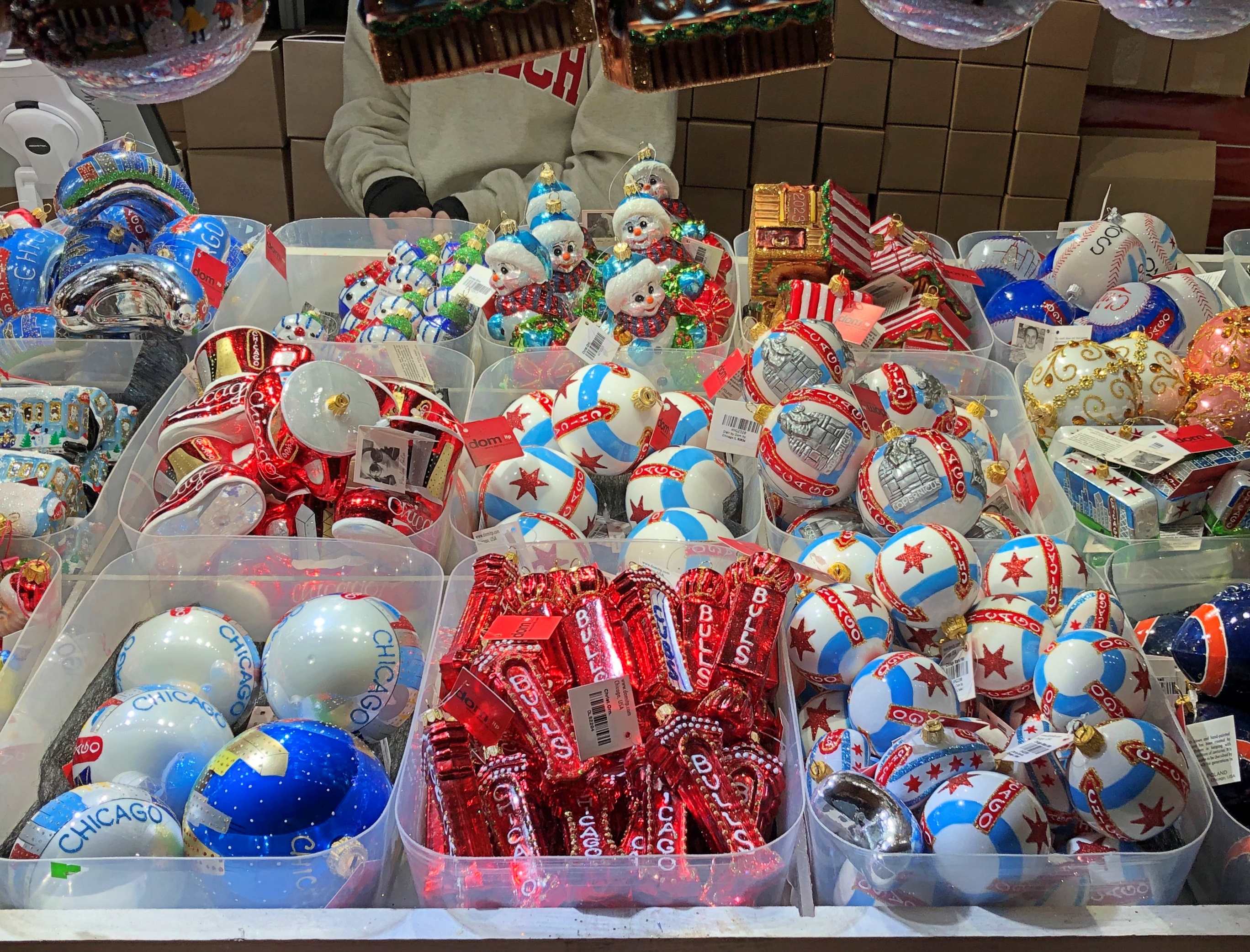
Locally themed ornaments, and pickles. Who doesn’t like Christmas pickles?Chicago Christkinlmarket 2023 Chicago Christkinlmarket 2023

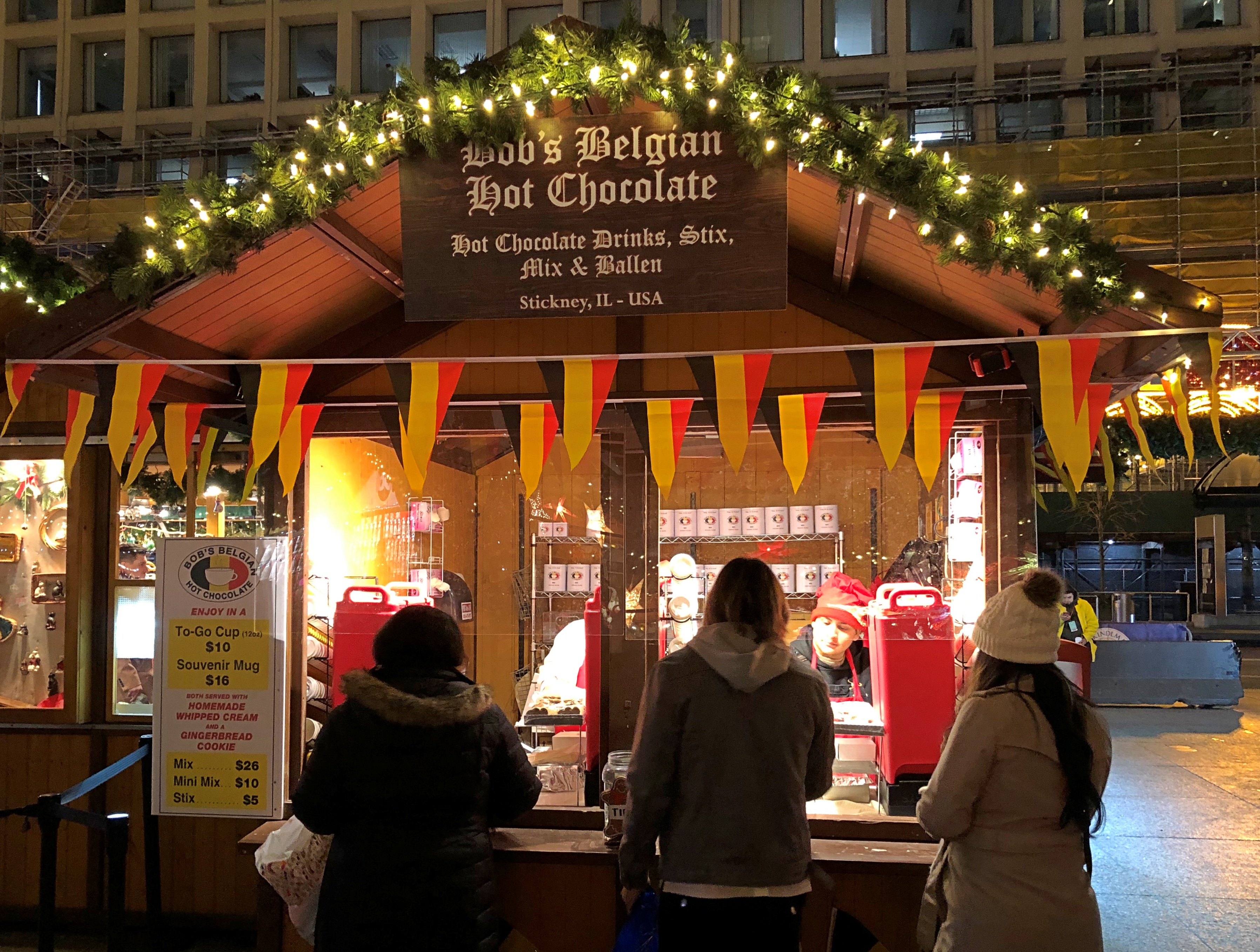
Eats.Chicago Christkinlmarket 2023

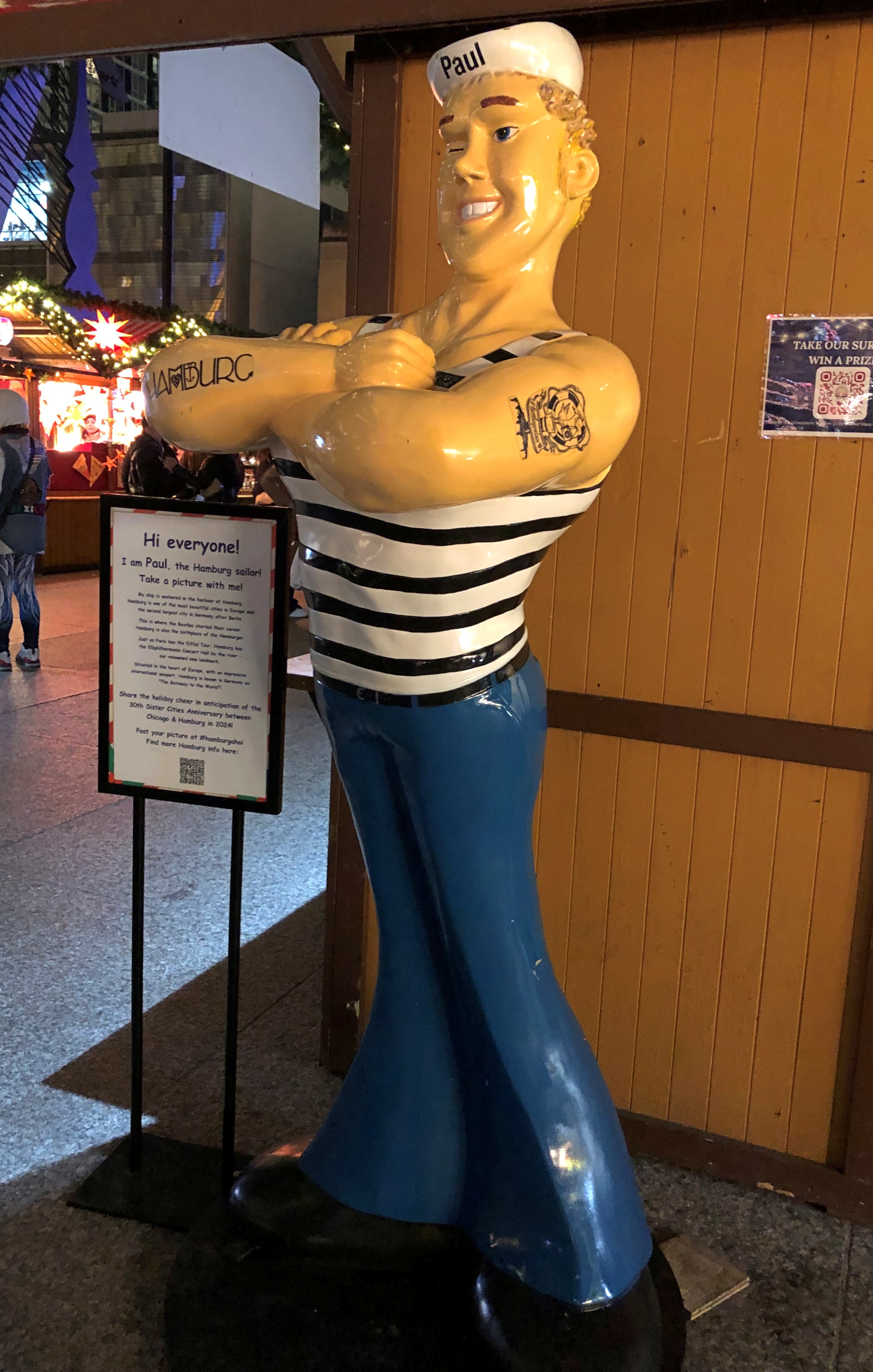
And Paul.Chicago Christkinlmarket 2023

His sign says, “Hi, everyone! I am Paul, the Hamburg sailor! Take a picture with me!’

Paul, huh? Are the Hamburgers having a spot of fun with that? St. Pauli is a red light district in Hamburg, after all, and while Paul here might look clean-cut, on leave I bet he’s out for beir and bumsen. Or maybe he’s a more modern sailor, and while visiting Chicago slips off to North Halsted Street sometimes.

September 13, 1975

A curiosity in my personal chronology: I remember what I was doing from 10 pm to 11 pm Central on Saturday, September 13, 1975. I was 14 and the start of high school was just a few weeks behind me, but that wasn’t so important that evening. During that hour, I was parked in front of our living room television, a black-and-white set because my mother didn’t convert to color until it was impossible to buy black-and-white. That didn’t bother me a bit.

Because the Internet never ceases to amaze, it took me only a few seconds to find the local TV schedule for San Antonio that day, to confirm what I already knew: the 10 pm slot on Channel 12, which was the ABC affiliate, was given over the Space: 1999. Not just any episode of that show – sold to U.S. markets in syndication, so not in prime time – but the first episode, “Breakaway.”

As the most expensive British television program up until that time, the show got quite a buildup, so it was no accident I tuned in. Martin Landau and Barbara Bain, as I recall, had plugged it on The Tonight Show not long before. (That too is online, at least as difficult-to-hear audio.)

So I watched that evening, and every week for a short time afterward. The physics of the premise — the Moon blown out of orbit and traveling the stars — was like something out of the Irwin Allen playbook, but even so the show started with some promise. As time passed, however, its essential dopiness became all too clear.

I think of this when I recall that I saw the first episode of Saturday Night Live on October 11, 1975. Or rather, the last two-thirds of it, switching channels after Space: 1999 was over at 11 Central. My reaction was, What is this? Then I think I remembered that a live comedy show had been slotted for that time, as it had been promoted as well. Within a few weeks, I didn’t bother with Space: 1999 any more, and took up SNL, as many of my peers did.

Despite its failure as science fiction, Space: 1999 did have one thing going for it, something I occasionally still enjoy. Namely, the kick-ass introduction.

Visually, it teases with quick-cuts of the episode ahead, as well as reminders of how the hapless residents of Moonbase Alpha got into their situation, and a sequence that fixed the fictional events of September 13, 1999 in one’s mind (and, lots of crashing space ships!). Aurally, there’s a rousing blend of orchestral passages, jazz and a funky electric guitar by British composer Barry Gray (d. 1984) that had early ’70s all over it.

The Demise of Cousin Oscar

Unlike Wednesday morning’s thunder but no rain, Thursday morning provided rain but no thunder. At least, none that I was awake for. Not a lot of rain, but enough to kick off a cool cloudy day.

Not long ago I watched an episode of All in the Family on a whim, as the series is available on one of the streaming services I pay for. I was curious to take a look at the program, so famed in its time, with my older eyes – older now than any of the characters.

I didn’t watch it every week back in its heyday, except maybe during the fall of ’73, when CBS had its remarkable Saturday line up: All in the Family, MASH, Mary Tyler Moore, Bob Newhart and Carol Burnett.

As I was 12 that year, Saturdays weren’t yet for social occasions; that would come later, sometimes causing me to forego television I would have enjoyed, such as a number of episodes of the original-cast SNL. It was years before I saw the Killer Christmas Tree sketch, for instance.

The All in the Family episode I watched recently, “The Saga of Cousin Oscar,” originally aired on September 18, 1971, as the first episode of the second season. Even though the show had found its footing by then – All in the Family became No. 1 that season, probably as a result of word-of-mouth that summer — I’m fairly certain I’d never seen “Cousin Oscar” before. As a 10-year-old, I wasn’t paying attention to that kind of word-of-mouth.

As a start for a season, the episode was a good one. It was actually funny at times. The main reason, I believe, is that there was very little in the way of discussions, or arguments, about the issues of the day, except maybe a comment by Mike complaining about the funeral industry. That’s often the case with comedy, and especially this show: the lower the level of tendentiousness, the funnier it is.

The titular character Oscar, a ne’er-do-well cousin of Archie’s, was described in the first act, but not seen, as he was reportedly sleeping late upstairs. Why he had no other place to go at that moment wasn’t entirely clear, but it was clear that Archie considered him a moocher and planned to kick him out. Commercial break.

I was entirely sure I knew what would happen next. I’ve seen enough sitcoms in my life.

Sure enough, like the luckless guest in “The Kipper and the Corpse,” Oscar checked out sometime that morning. Now the Bunkers had to deal with that, including a series of long-distance calls to other relatives, trying the raise money for Oscar’s funeral, which Archie doesn’t want to pay for. I’m not giving much away when I note that in the end, he’s stuck with the bill, though it’s played as him reluctantly doing the right thing.

A lot of sitcoms could have done that story. I could imagine a cousin of Fred Sanford’s doing the same. Plautus could have done the story too. Maybe he did, and the scroll waiting to be discovered at some buried site in the Near East.

Some observations.

Archie was incredibly bossy, which I suppose fits, but more remarkably everyone else goes along with it, including Mike.

One forgets what an involved process long-distance calls used to be.

Edith, of course, had more sense than Archie, and more empathy too, a pattern that persisted throughout the series. Plautus could have done that as well.

No one even mentioned the possibility of cremating Oscar, a cheaper option. I know it wasn’t as common then, but it did happen. Or, for that matter, having Oscar buried in a potter’s field at county expense (Mike’s suggestion) and then holding an inexpensive memorial service. It was either all or nothing when it came to a funeral.

This was before residential sets were often depicted as more expensive than the characters could afford (viz., Friends). I marveled that there was supposed to be enough room upstairs for Oscar to have his own bed to die in.

In terms of sets, the show had a remarkable economy: the living room and the kitchen. I can only remember a handful of times the upstairs was seen, including one memorable moment when Archie got on Mike’s case – nonpolitically, mostly demented – about the right way to put on socks and shoes.

The show could have used more material like that.

Battle of the Bands, 1979

I see that Fiesta San Antonio is now scheduled for November this year. The first time in its century-plus-decades history it hasn’t been in April, but such is our time. Social distancing isn’t the norm for Fiesta.

Yuriko and I went to a few Fiesta events in 2000, parking toddler Lilly with her grandmother for a few hours, but I remember my high school Fiestas better. Each year from 1976 to ’79, I was with the Alamo Heights HS marching band in the Battle of the Bands at Alamo Stadium and then — with one exception — the Battle of the Flowers parade downtown a few days later.

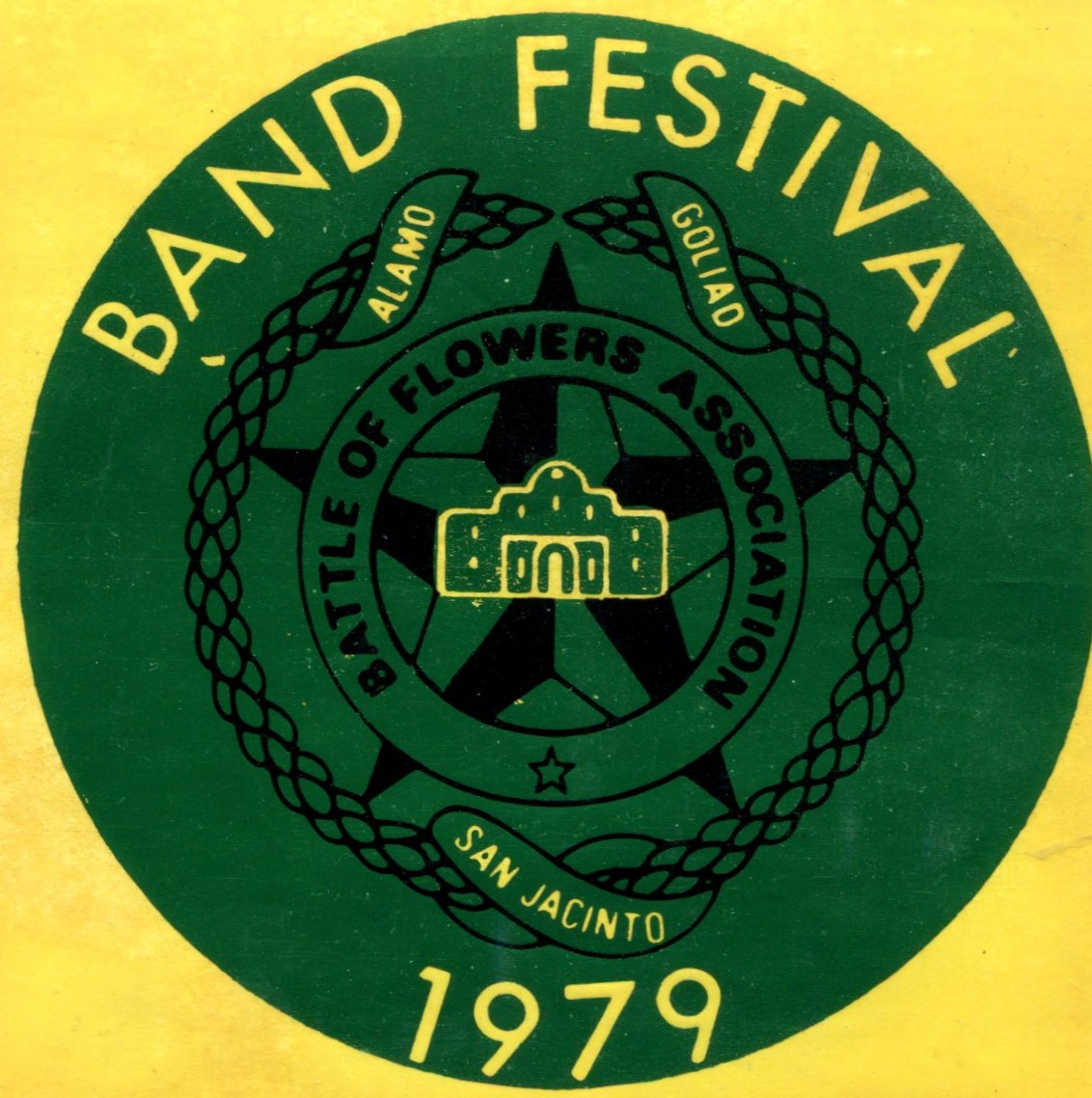
It’s officially called the Battle of Flowers Association Band Festival, but no one I knew called it that. It was the Battle of the Bands. High school bands from all over the metro area came to compete.

The best a band could do was score a 1 in music and 1 in marching. For decades, Alamo Heights had always scored two 1s — until sometime in the early ’70s, before I was in high school.

Since then, including my freshman, sophomore and junior years, the band had gotten a 1 and a 2. Very good, but not top.

So we were keen to score two 1s in the 1979 Battle of the Bands. I don’t remember what music we played or what steps we marched. All I remember was the announcement afterward: two 1s! The band exploded with joy.

I can remember only one other exuberant moment like that for the band: early junior year when, after two years of losses, the AHHS football team actually won a game, narrowly. The Battle of the Bands moment was better, though — we’d won that for ourselves.

That was a day or two before the ’79 Battle of Flowers parade — April 26, 1979 — that didn’t happen because of a wanker with a gun. Fortunately for us, at our staging area the band wasn’t close to the shooting. I didn’t even hear any shots, though at one moment heard the roar of a suddenly panicked crowd at a distance.

Even that day had its lighter moments. The parade cancelled, we in the band got back on our buses to leave. Just before we left, a non-band senior got on as well, someone most of us knew. Our band director asked him to leave, and the boy, who was chemically enhanced, got the opposite of belligerent.

“All right, all right,” he said in an almost sing-song voice, smiling and giggling. “I’m getting off now. Don’t worry, I getting off now!” (I’m re-constructing those words; but that was the gist.) It was a little puzzling then, but looking back on it, I think he’d done more to prepare for the parade than drink a little beer or smoke a joint. At that dour moment, he was having a good trip.

No Fond Memories of Record Hole

I pinned this to the wall behind the front door today. It’ll be there until I will be obliged to take it down. Why there? Just a passing whim. I was tired of it lying around my office.
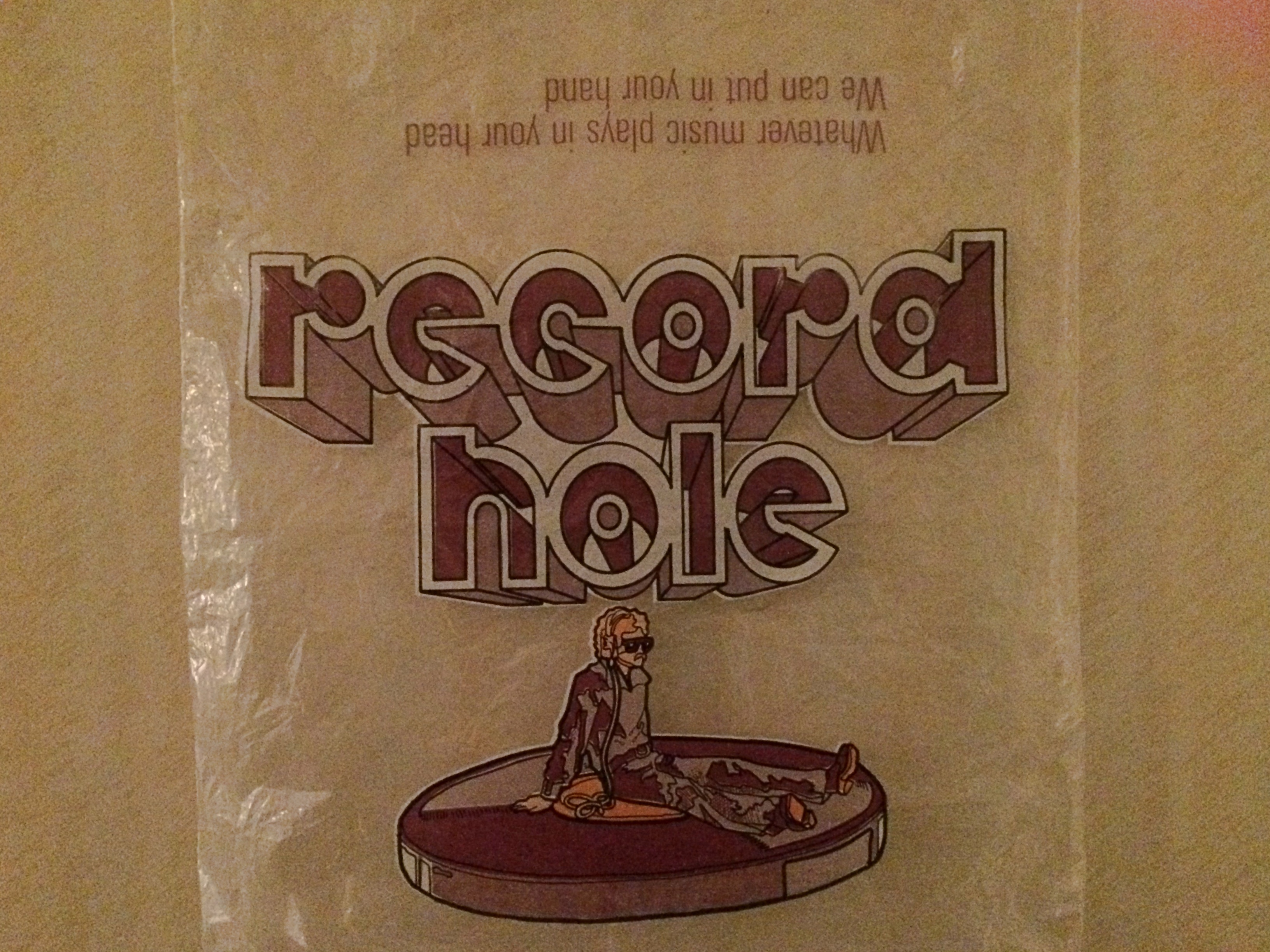
Record Hole bagIt’s a plastic bag and a relic of the 1970s or the ’80s at the latest. Not only that, a souvenir from San Antonio. At one time, Record Hole was a local chain of record stores in that city. Or so I believe.

The brand is long gone, and so far I’ve found only one trace of it online — a passing mention in an article about a different and surviving record store, as of 2016. Not that I’ve looked very hard. But Record Hole is so obscure that it didn’t even make in on this list of defunct retailers, which includes Record Bar, Record Town and Record World.

Some time ago, I picked up the bag at my mother’s house — again on a whim — and brought it back home. She’d been using it to store odds and ends. I might well have bought a record at a Record Hole and left it with her 40-odd years ago. I didn’t buy many records, but I did buy a few. Or maybe my brother Jim bought something there.

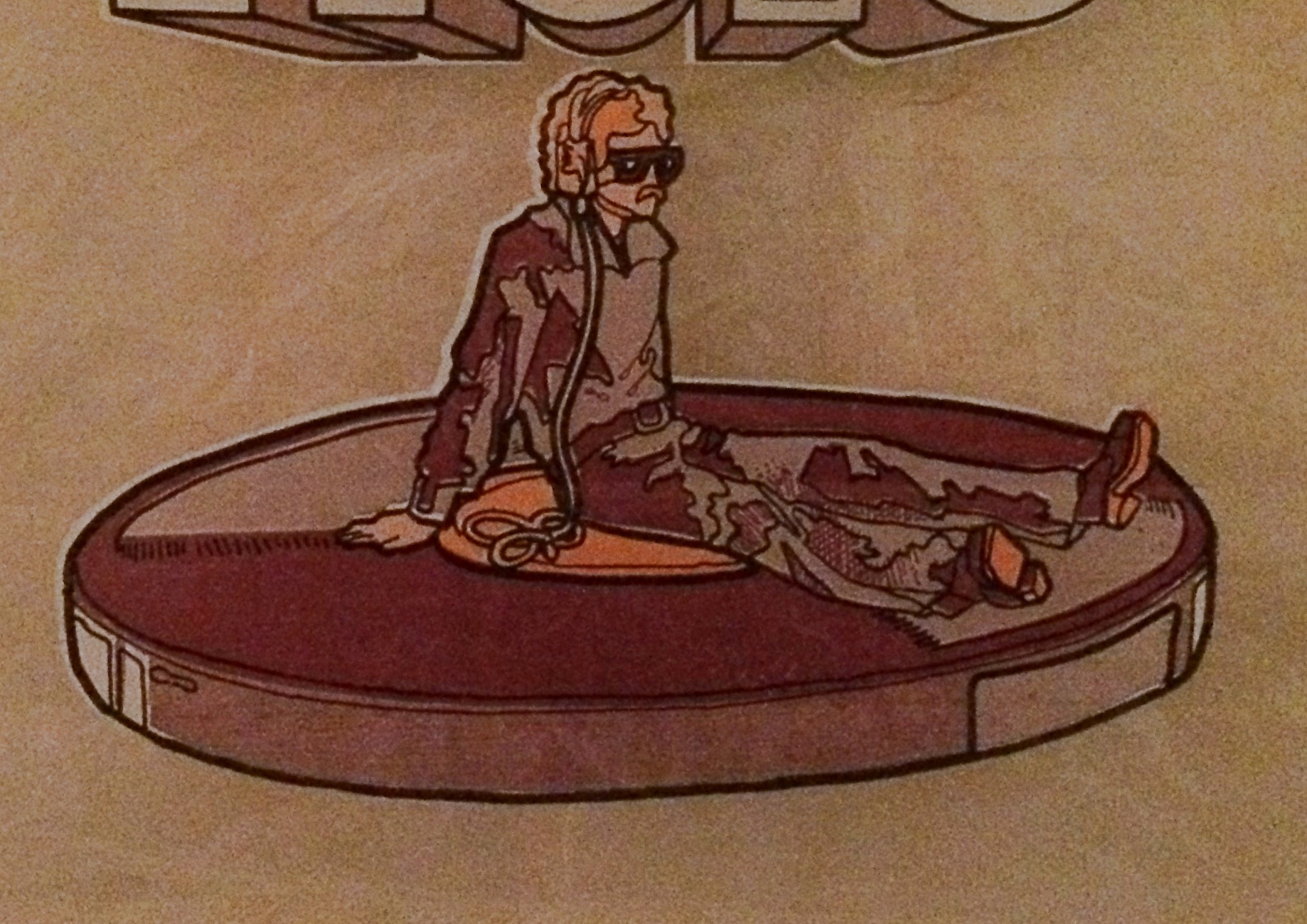
At one time, Record Hole was established enough to air local TV ads. I vaguely remember them, because they featured a primitive animated version of ’70s-record-listening dude.

record hole bagWho was sitting on a record on a turntable. Trippy, man. The store’s motto, which is also on the bag but upsidedown and backwards in my picture: Whatever music plays in your head, we can put in your hand.

Plastic bags, though they may last for centuries in landfills, are notoriously ephemeral when it comes to being saved elsewhere. Sure, it’s still worthless now, but some happy descendant of mine might make a fortune off the bag in, say, the 23rd century, when the notion of plastic bags and records are historic curiosities that excite collector interest.