Rainbow Over Diamond Head

A headline that Google News pulled up for me this morning: “Comic-Con Fans Get World of Warcraft Teaser Trailer. You Don’t.” The implication is that that’s some kind of bad thing, but I don’t see it.

Heat much of last week, then rain in the form of more than one short nighttime thunderstorms rolling through to cool things off. By the next day, most everything had dried off. The pattern: rinse, dry, repeat.

This photo has been captioned many times, but one recent caption is, “Only one human being alive on July 21, 1969 is not in this picture.” Never thought of it that way. Makes me want to read Michael Collins’ memoir, Carrying the Fire.
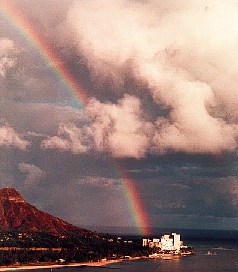
I have to be content with taking earthbound photographs, and mostly I am. I’ve always liked this one, taken on Oahu in July 1979. The transition from photographic negative to slide to print to digital scan to web page doesn’t really do it justice, but the image retains a bit of the original flavor. I’ve got three boxes of slides made in Hawaii that year and two more made in East Asia in the early ’90s, which are a little hard to appreciate in that format. One of these days, I might convert them directly to digital, but buying the equipment and taking the time are a fairly low priority among all the other demands on my money and time.

For some reason, I didn’t visit Diamond Head State Monument and climb to the rim in 1979. I can’t remember what went into that decision. I hear the view is worth the climb.
The Mighty F-1 Laid Low

I hadn’t heard until today about the expedition that found some Saturn V first stage engines – the mighty F-1 — on the bottom of the Atlantic. The Bezos Expedition site is careful to note that “many of the original serial numbers are missing or partially missing, which is going to make mission identification difficult. We might see more during restoration,” so they could be from any of the missions that used the engines, though I believe they were looking for Apollo 11 relics.

There might be less headline glory in finding something from (say) Apollo 16, but I think it would be just as cool. The expedition site goes on to say that whatever their origin, “the objects themselves are gorgeous.” Bet they are. They’ve gone to the Kansas Cosmosphere and Space Center for stabilization, so maybe they’ll stay there for display. That place would be worth going to that corner of Kansas to see, F-1s or not.

Seems that Amazon boss Jeff Bezos paid for the expedition, or at least much of it. Good for him. It’s the kind of thing that billionaires should spend some of their money on. That and the 10,000-Year Clock.

The Forgotten Cosmonaut

Got a packet in the mail recently telling me about the Vanderbilt 2013 Reunion and Fundraising Opportunity. Actually, those last three words aren’t in the title of the event, but they’re more than implied. One of the “class goals” is fundraising to the tune of $1,000,000 “with 32 percent class participation.”

I don’t think 32 percent is necessary. Between the right four or five alumni of my class, that much could be raised right away. But the school might have to name something after them.

Anyway, in an effort to drum up some nostalgia for the early ’80s, the invite includes the following verbage: Motorola debuts mobile phones; Who’s at Exit/In tonight?; Sally Ride is 1st woman in space; Meat sticks at Rand; Campus computer use up 100%; Housing lottery equals stress.

Some of those are self-explanatory, and others are enigmatic if you didn’t attend VU, such as “meat sticks at Rand,” which I will leave to the readers’ imagination. But I kick into copy editor mode at that business about Sally Ride, first American woman into space.

Is it too much to ask someone with a Vanderbilt education know who the first woman in space was? Valentina Tereshkova, forgotten again here in North America. But I expect she’s honored enough at home, even without the Soviet Union. Remarkably — I just checked — she’s still alive, and not even that old (76). I guess spacefaring in the early days was a young woman’s game.

Bang, Zoom! Straight to Pluto!

Comet? What comet? Can’t see no stinkin’ comet. Of course, it’s been overcast for a while hereabouts, but maybe when things clear up, I’ll go look for it. Trouble is, suburban lights have a way of washing out the sky, including stray comets, unless they’re really bright. I was amazed to be able to see Hale-Bopp, but it managed to be visible even on the North Side of Chicago.

What’s up with that name, Pan-STARRS (which I’ve also seen as PANSTARRS)? I checked, and it was discovered using a telescope of that name. I was under the impression that comets are named after their discoverers, but perhaps an automated system uncovered this one, though you’d think whoever was directing the research would be honored with the name. Then again, if the scan were really automated, you could call the telescope a sort of discoverer.

Today’s odd bit of information (space related, because checking on Pan-STARRS took me on some tangents): the New Horizons spacecraft, now much closer to the planet Pluto than Earth — 6.76 AU v. 26 AU — carries a visible and infrared imager/spectrometer called Ralph, and an ultraviolent imaging spectrometer called Alice.

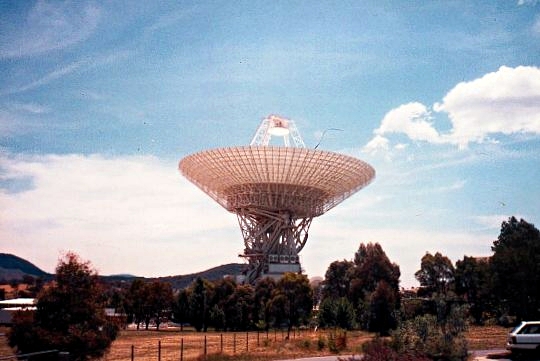
Tidbinbilla

Christmas Eve 1991

A summer’s day. I bought sun block today. Along with Pete, his brother, and his brother’s enormously pregnant wife, we went to the Tidbinbilla Deep Space Tracking Station southwest of Canberra to take a look at the big dishes and the small museum, which emphasizes Australian, Japanese and European efforts to explore space.

Had a “Jupiter Dog” at the Moon Rock Café. You’d think there would be a Great Red Spot on it somehow, but it mainly featured onions and diced tomatoes (maybe one of those tomatoes counts as the spot). Returned to town the way we had come, winding through hilly bush and flatter farmland. Sometimes emu and kangaroos bounded across the road ahead of us.

Postscript 2012: The formal name of the place is the Canberra Deep Space Communication Complex, and it still functions as one of three stations operated by NASA to keep track of far, far away spacecraft, with the other two in California and Spain. “This strategic placement permits constant observation of spacecraft as the Earth rotates, and helps make the Deep Space Network the largest and most sensitive scientific telecommunications system in the world,” notes NASA.

Space: 2012 (and an Oddity from 2006)

Well worth a look: NBC News, the Year in Pictures. Space edition, which includes the likes of Felix Baumgartner before one of his epic, insane jumps from the edge of space, the aurora australis as seen from orbit, an ethereal enhanced-color image of Saturn, nebulae, views of the Earth and more.

One of the strangest satellites in the history of the space age is about to go into orbit,” noted a NASA press release. “Launch date: Feb. 3rd. [2006] That’s when astronauts onboard the International Space Station (ISS) will hurl an empty spacesuit overboard.

“The spacesuit is the satellite — ‘SuitSat’ for short.

” ‘SuitSat is a Russian brainstorm,’ explains Frank Bauer of NASA’s Goddard Space Flight Center. ‘Some of our Russian partners in the ISS program, mainly a group led by Sergey Samburov, had an idea: Maybe we can turn old spacesuits into useful satellites.’ SuitSat is a first test of that idea.”

I understand that SuitSat broadcast its position for a couple of orbits and eventually burned up upon entering the atmosphere. The rest of the release is here.