Views From 151 N. Franklin St.

Last week I attended an event on the top floor of 151 N. Franklin St., a new office building in downtown Chicago. I had a few moments to admire the excellent views.

Looking slightly to east-northeast, roughly. In a gap far to the right is a slice of Lake Michigan.

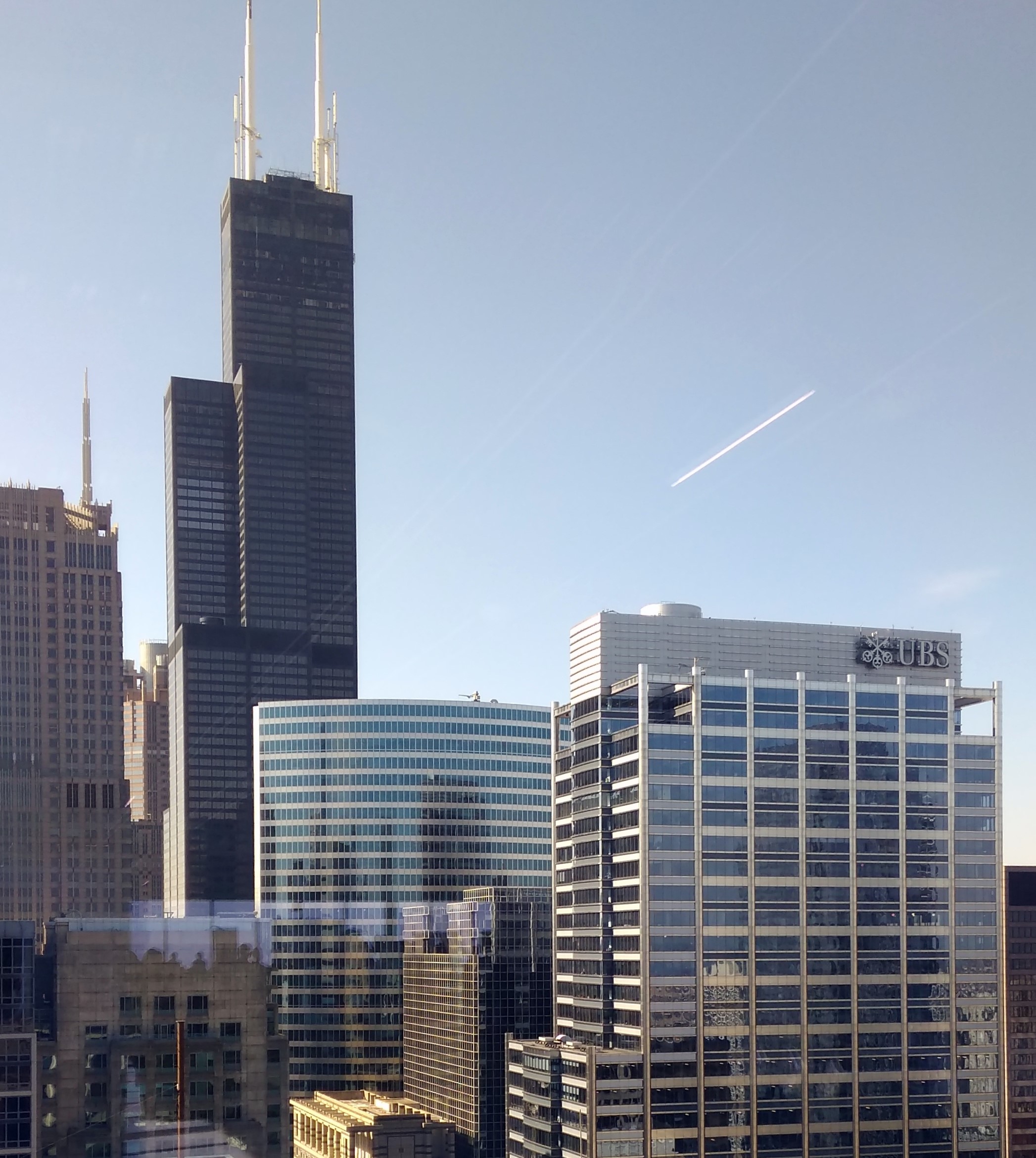
To the south-southwest, roughly. The tower formerly known as Sears rises above all, including annoying reflections.

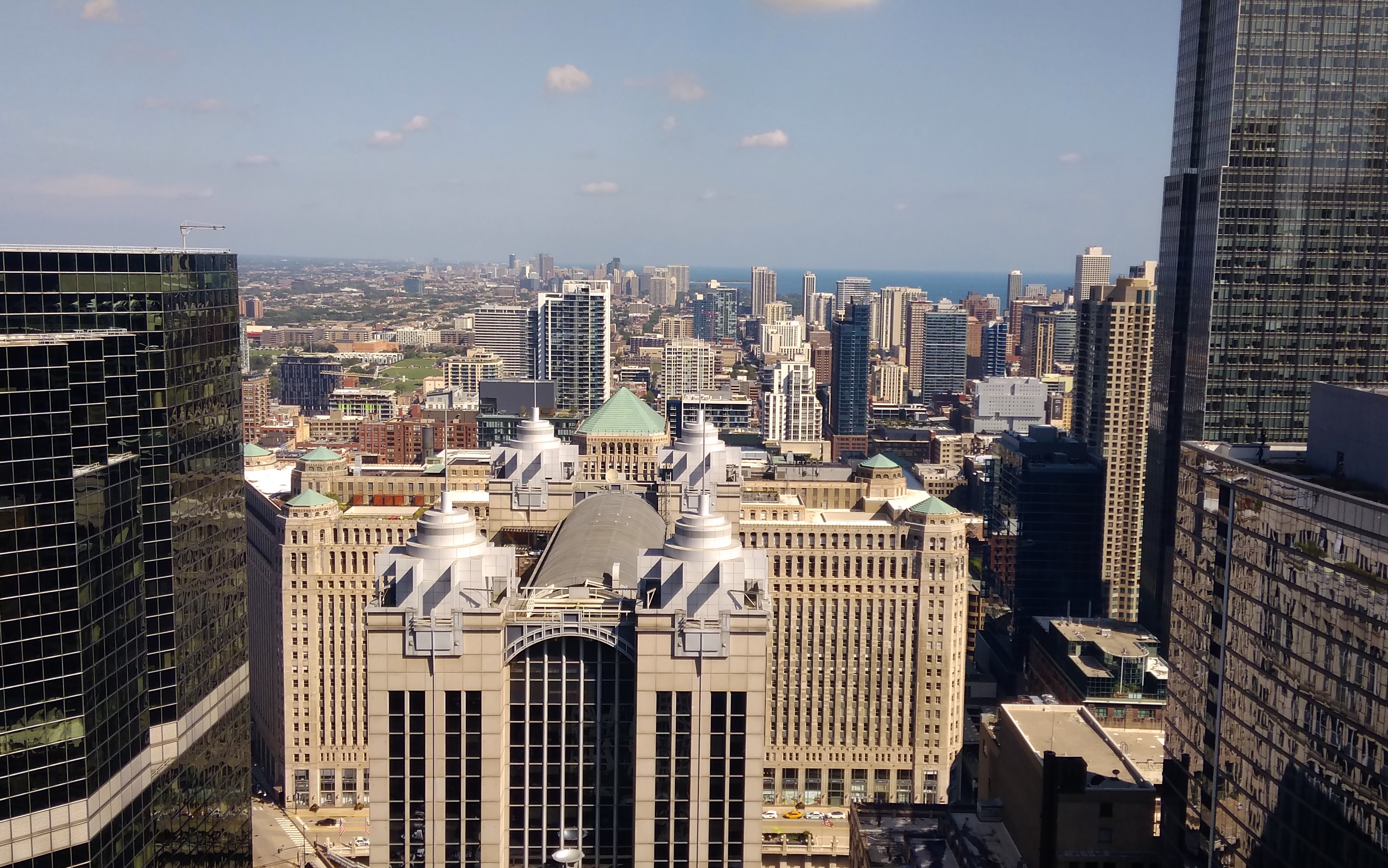
Straight north.

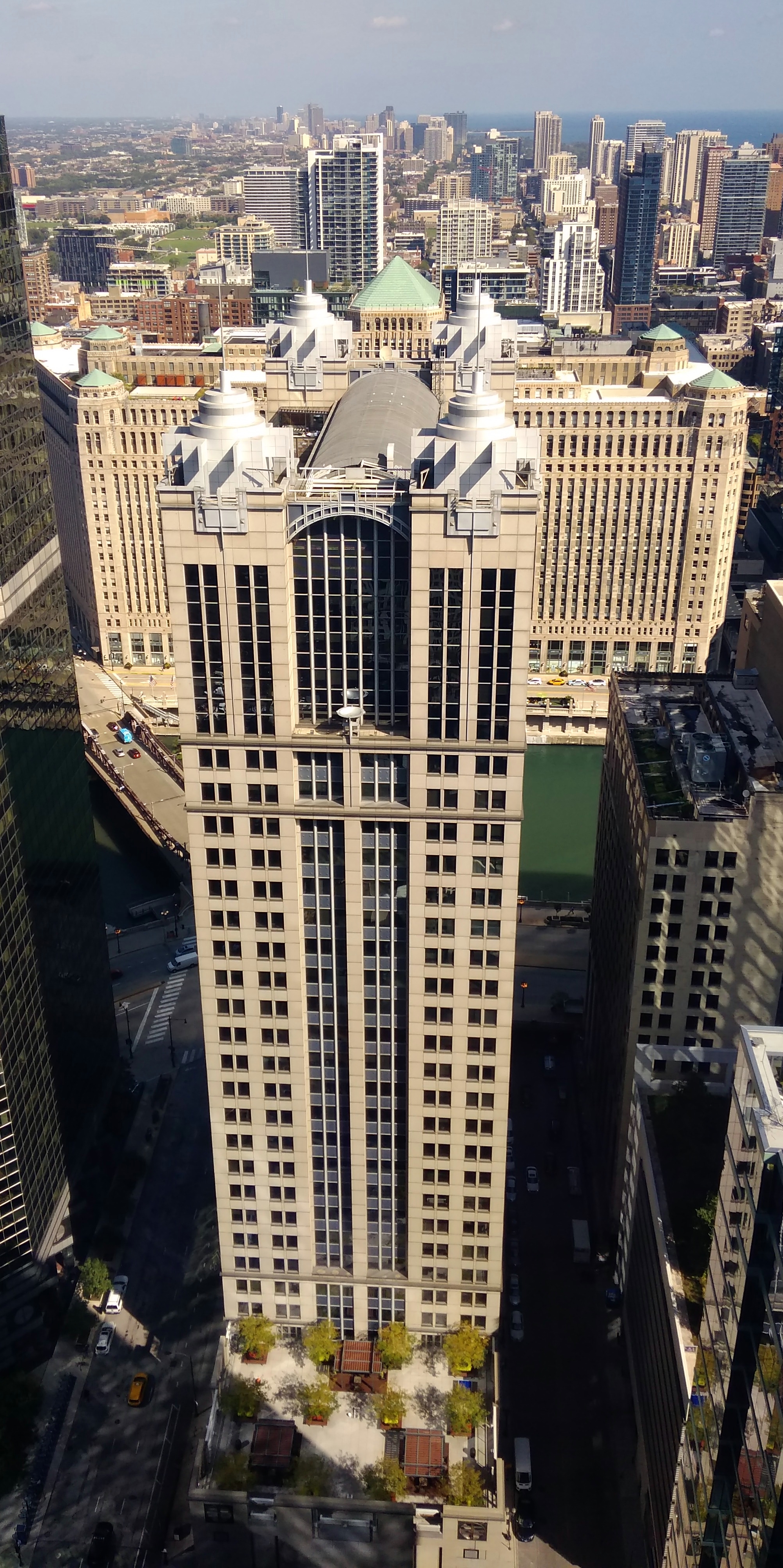
The building with the four roof features — maybe those count as cupolas — is 225 W. Wacker Dr., a 30-story late ’80s development designed by Kohn Pedersen Fox. A vertical shot of that building.
Behind it, or rather to the north, across the Chicago River, is the much more horizontal Merchandise Mart.

More about the 35-story 151 N. Franklin is here, including a mention of the views from the top. Here’s the thing that struck me: the building was just completed. That means these are spanking-new views of Chicago.

The Ellwood House Museum

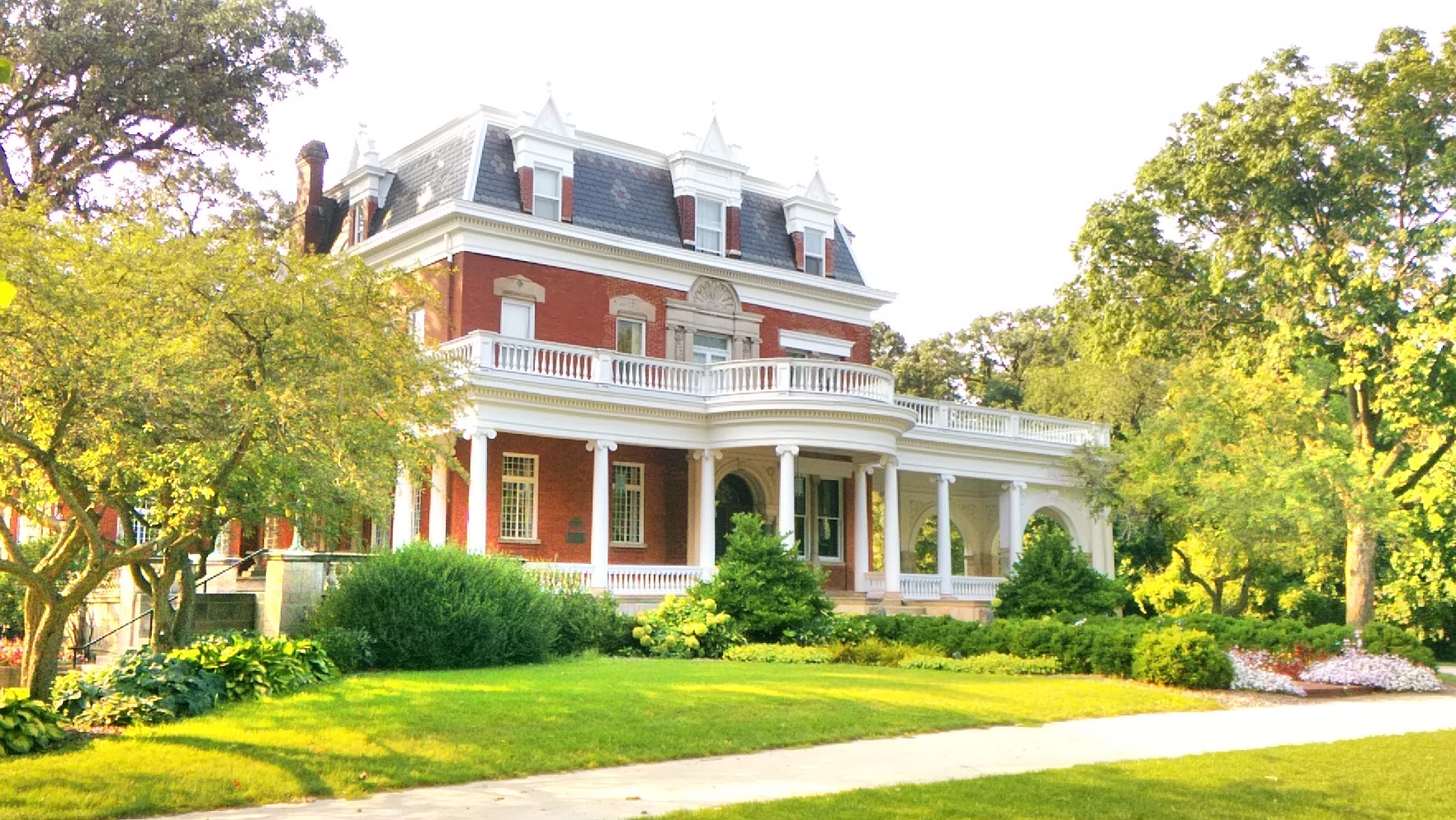
Every junior high student in Texas takes, or used to take, a class in Texas history. My teacher 45 years ago was the no-nonsense Mrs. Carrico, whose first name I do not remember. She told some Texas history stories that I do remember, including one I thought of not long ago when we visited the Ellwood House Museum in DeKalb, Illinois.

The story was about the popularization of barbed wire in Texas, specifically a demonstration of wire in 1876 in San Antonio organized by salesmen from up north. As the Texas State Historical Association puts it:

“In 1876 salesman Pete McManus with his partner John Warne (Bet-a-Million) Gates conducted a famous demonstration on Alamo Plaza [other sources say Military Plaza, including the TSHA] in San Antonio in which a fence of… wire restrained a herd of longhorn cattle. Gates reportedly touted the product as ‘light as air, stronger than whiskey, and cheap as dirt.’ Sales grew quickly thereafter, and barbed wire permanently changed land uses and land values in Texas.”

I’d heard of steel and oil magnate John Bet-a-Million Gates before, but until I visited the Ellwood I hadn’t connected him with this incident. It was early in his career and before he was renowned as a gambler.

At the time, Gates was working for Isaac Ellwood, barbed wire manufacturer of DeKalb. Later Ellwood owned a major ranch in Texas, and built a “Pompeiian Villa” in Port Arthur, but it’s his Illinois manse that concerns me here.It’s a handsome Victorian house, originally dating from 1879, and designed by a Chicago architect named George O. Garnsey, with later modifications by others.

The museum web site says: “The museum campus consists of seven historic structures (including the 1879 Ellwood Mansion and 1899 Ellwood-Nehring House), four gardens, and 6,000 square feet of exhibit space in the Patience Ellwood Towle Visitor Center, a converted and expanded 1912 multi-car garage.

“Originally built for barbed wire entrepreneur Isaac Ellwood, the Mansion was home to three generations of the Ellwood family from 1879 to 1965. In 1965, the Ellwood Mansion was given to the DeKalb Park District by Mrs. May Ellwood and her three children.”

No pics allowed inside, but be assured that it’s lavishly decorated and includes a lot of the furniture that the Ellwoods owned. No barbed wire, though: that’s on exhibit at the visitors center.

Pictured Rocks National Lakeshore: Miners Castle, 1989

In early September 1989, I visited the Upper Peninsula for the first time, and Lake Superior as well, including a boat ride on the lake at Pictured Rocks National Lakeshore. Its rocky cliffs were famed long before the federal government made the area the first of nation’s four national lakeshores in 1966, the others being Indiana Dunes, Apostle Islands, and Sleeping Bear Dunes.

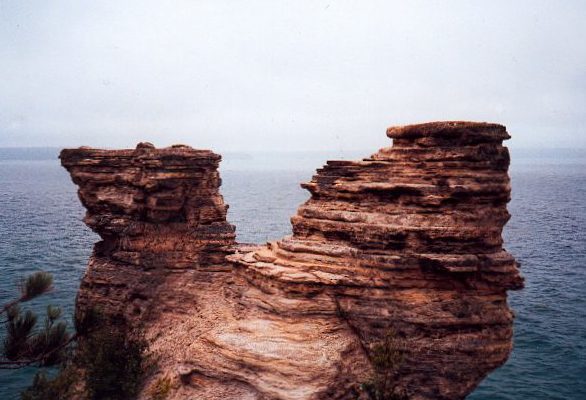
I also did some walking. I’m pretty sure I passed by this sandstone formation on foot and took a picture of it looking out toward the lake, though the boat would have passed by it as well (I think). It’s one of those formations that has a name: Miners Castle. This is how it looked in 1989.

In the spring of 2006, the right turret (from this perspective) fell into the lake. According to the NPS, “While the rockfall at Miners Castle on April 13 was startling, such events are not rare along the Pictured Rocks escarpment. At least five major falls have occurred over the past dozen years…

“All the rockfalls involved the same rock unit, the Miners Castle Member of the Munising Formation. Rock units are named for places where they were first technically described. The Miners Castle Member consists of crumbly cross-bedded sandstone that is poorly cemented by secondary quartz, according to U.S. Geological Survey Research Ecologist Walter Loope.”

Pictured Rocks isn’t the only place I’ve seen a noted rock formation later altered by erosion. In 1995, Yuriko and I stopped at a roadside in New Hampshire to see the Old Man of the Mountain. By 2003, it was gone.

The Henry C. Palmisano Nature Park (Mount Bridgeport)

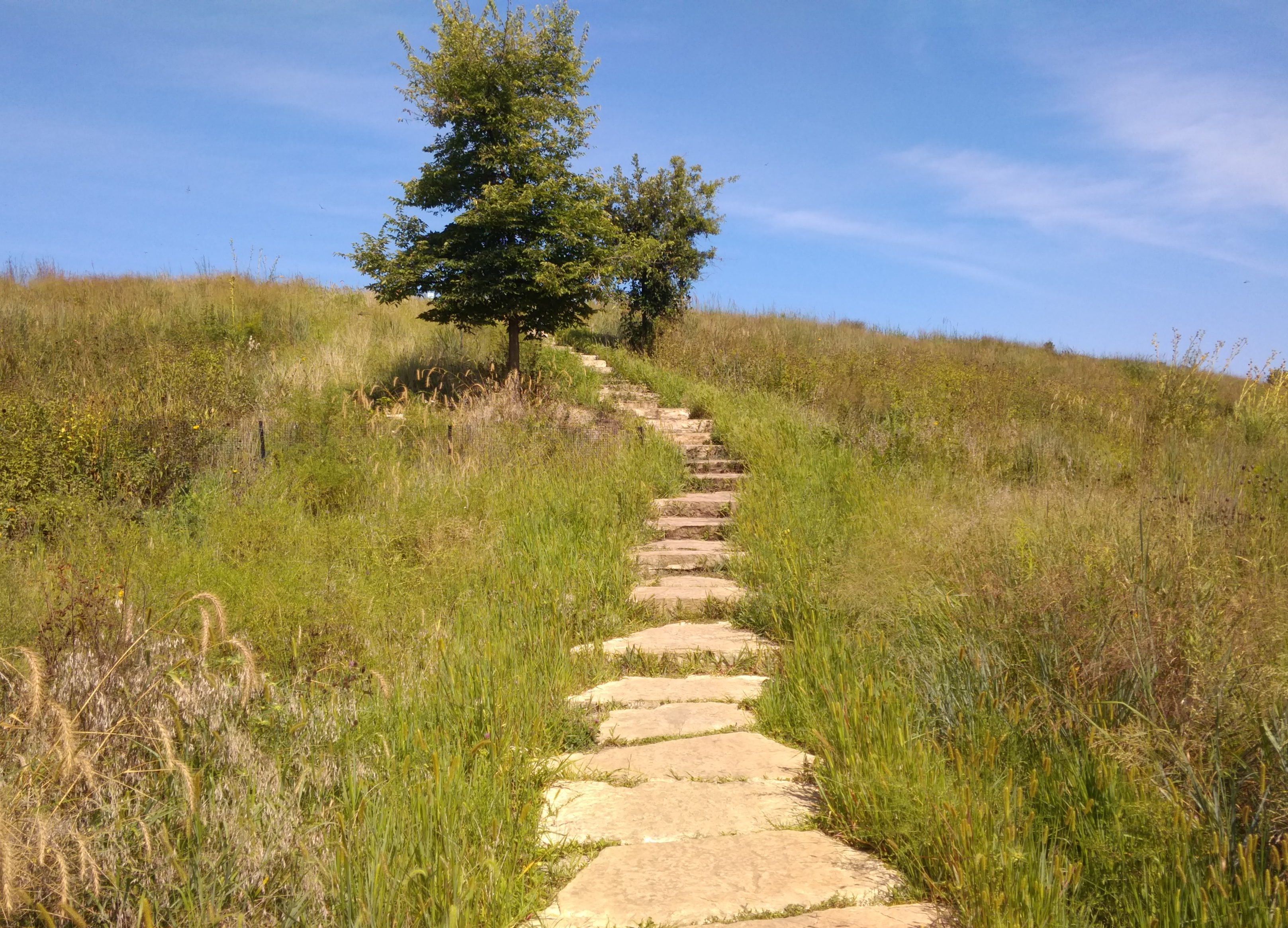
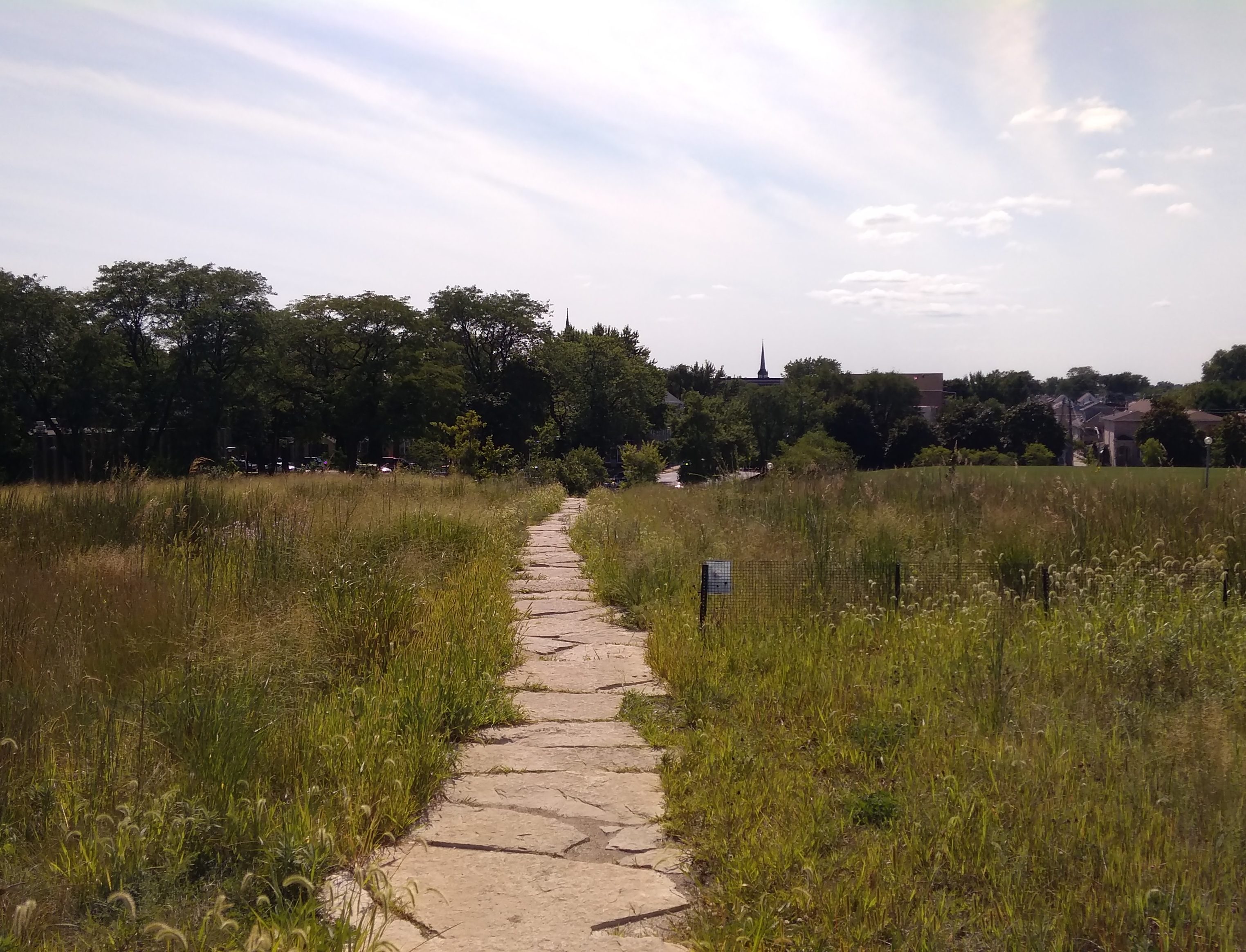
Not long ago, I found myself looking up this hill.

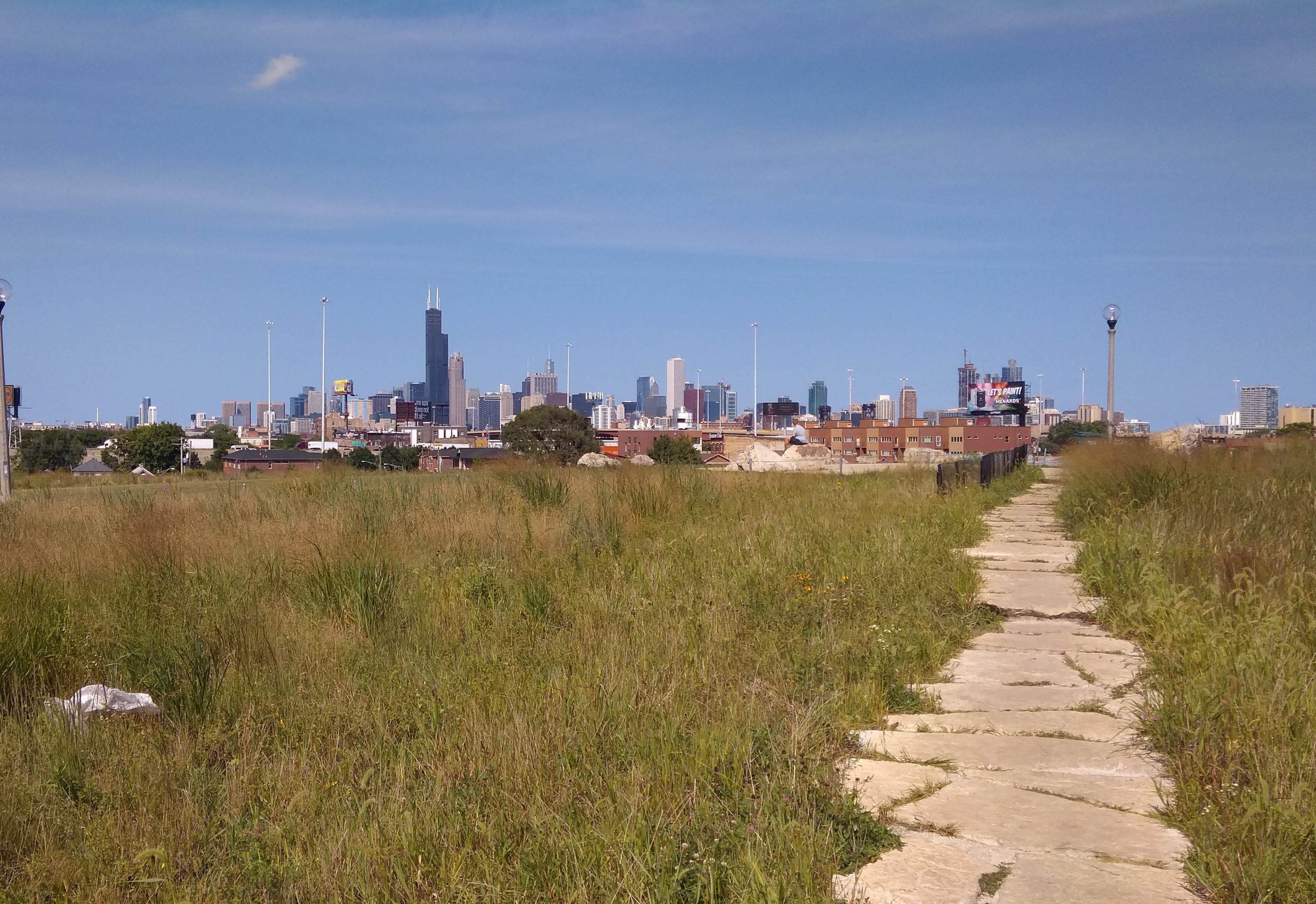
I climbed the steps, since I still have the energy for that kind of thing sometimes, and at the top of the hill is this vista.
That only goes to show how easy it is for an image to mislead. How would someone merely looking at the first image know that the hilltop has a fine view of downtown Chicago from the southwest?

Anyway, I was at the Henry C. Palmisano Nature Park, though I have a good source that tells me its informal name is Mount Bridgeport, after the surrounding neighborhood, and it rises 33 feet above street level.

“In the late 1830s, the land was purchased by the Illinois Stone and Lime Company which began quarry operations,” says the Chicago Park District. “Within a short time, one of its partners, Marcus Cicero Stearns, took over and renamed the quarry. Stearns was an early Chicago settler who got his start by opening a supply store for workmen who blasted out rock to build the Illinois and Michigan Canal.

“Even after Stearns died in 1890, the quarry continued operating under his name until 1970. For the next few decades, the site was used as a landfill for clean construction debris. After the dumping ended, the idea of transforming the site into a new park emerged.”

The transformation took some time, but a park finally opened on the site in 2009, named for a man who died in 2006. It’s more than a grassy hill with a view, though that’s a standout feature in flatland like Illinois.

The path goes off in other directions.
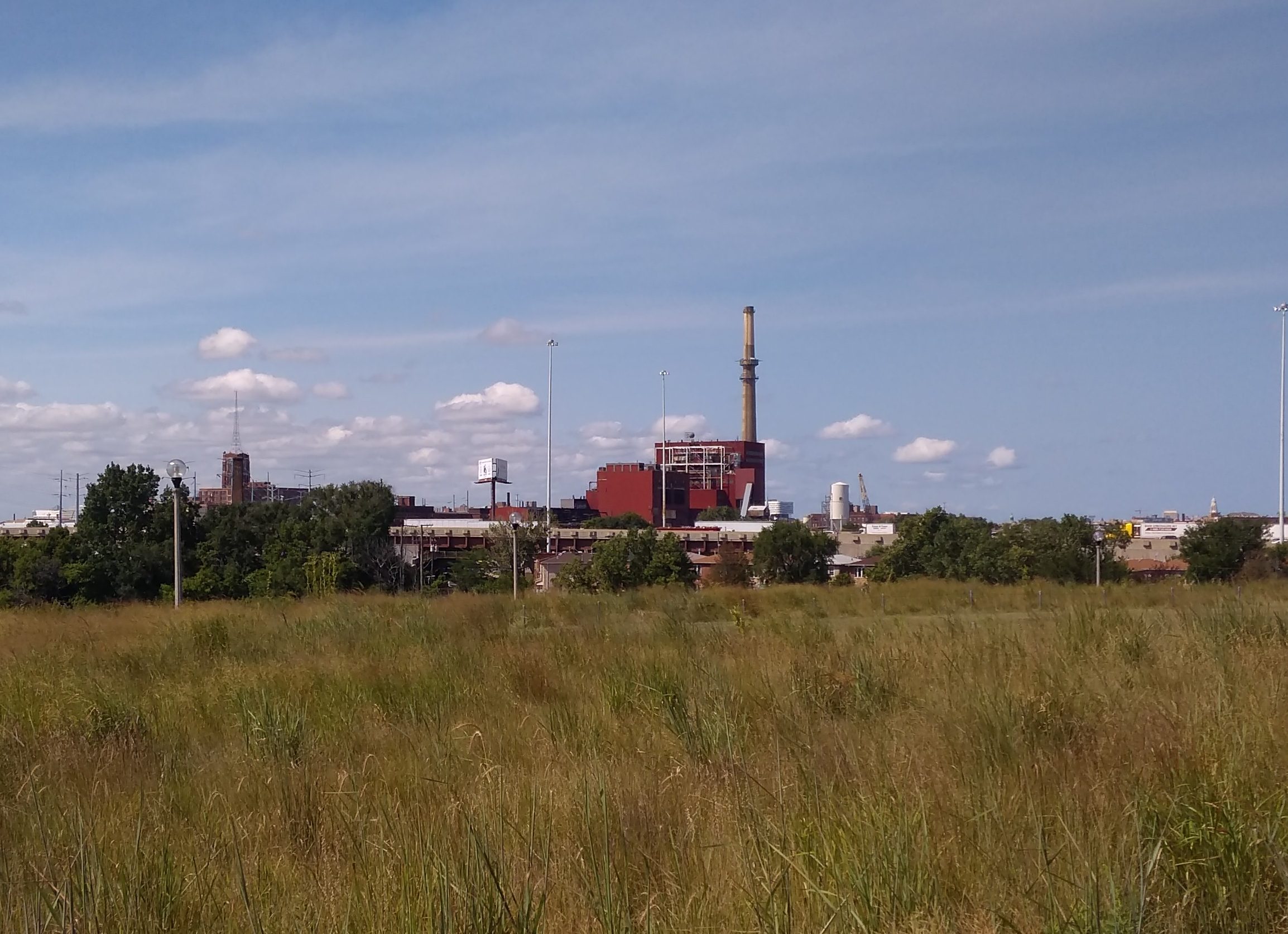
Other parts of the city are visible from the hill.
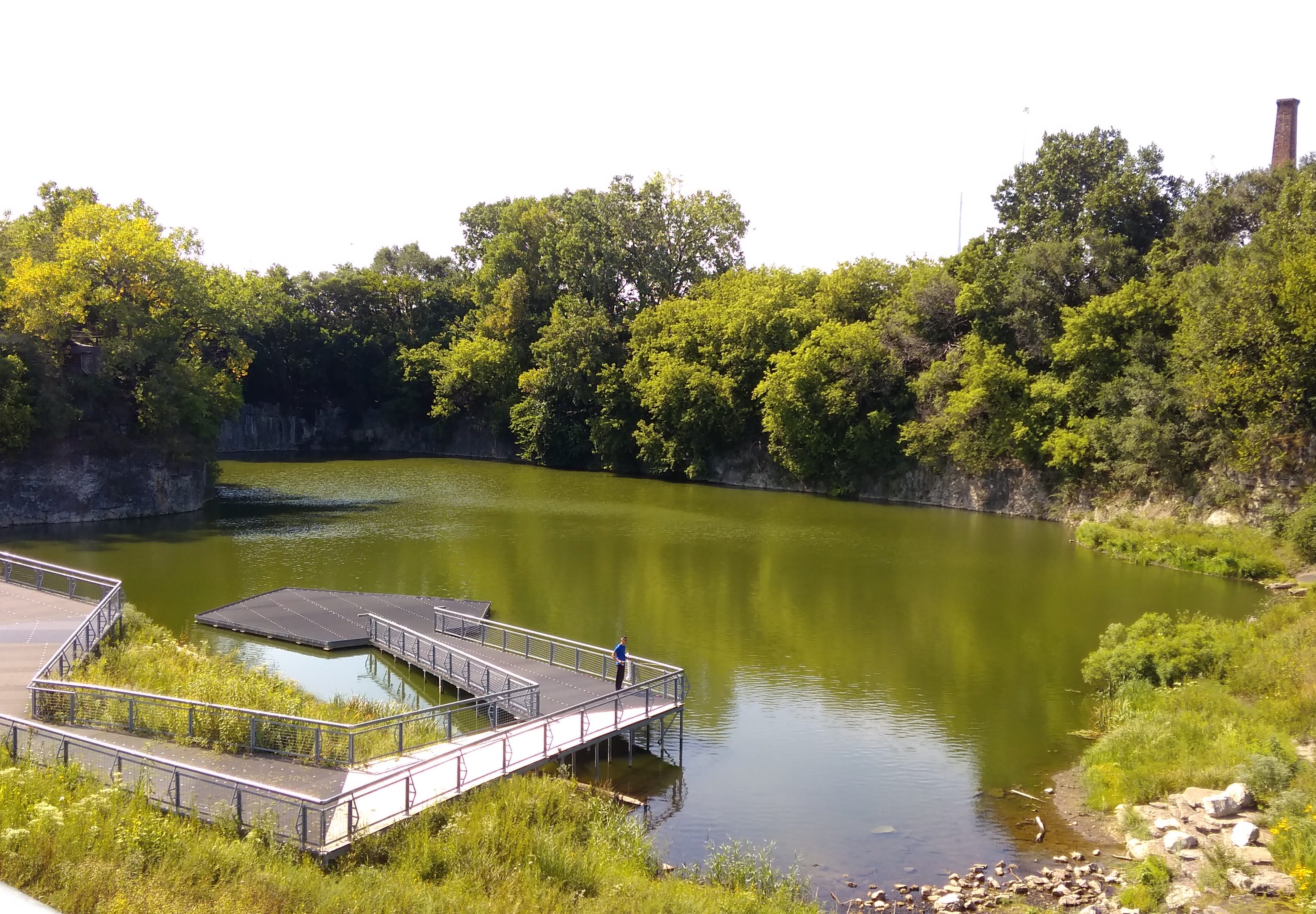
Part of the old quarry hole is now a pond, available for catch-and-release fishing, according to a nearby sign.
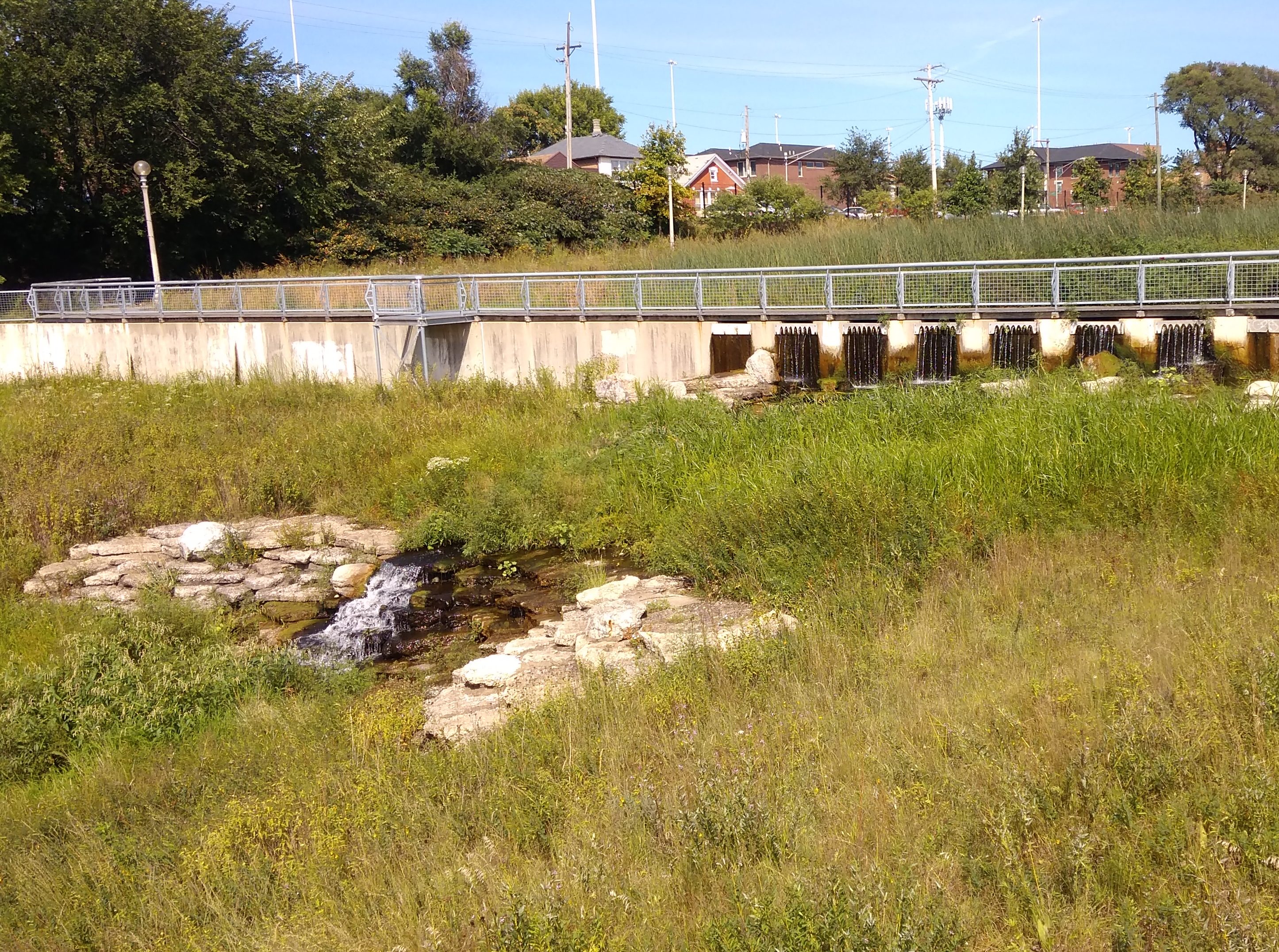
This may be the closest waterfall to downtown Chicago. Modest, but nice to look at. The stream goes to the quarry-pond.
“This is a dynamic park, with a fishing pond, interpretive wetlands, preserved quarry walls, trails, an athletic field, a running track, and a hill that offers dramatic views,” the Park District notes. “Over 1.7 miles of paths, including recycled timber boardwalks, concrete walks, a crushed stone running path, and metal grating walkways traverse the park.”

The Stevenson Expressway is visible, and very much audible, from the park. How many of the many drivers on that highway have any notion of such an excellent park nearby?

I never did for some years. “What’s that park?” I wondered some time ago while looking at a map of Chicago, making a mental note to visit when I would be nearby, which happened to be just before Labor Day. Being a map enthusiast has its rewards.

Allen J. Benson Park. Or, the Illinois-Indiana Border Obelisk.

I have a certain fascination with borders, probably dating back as long as I’ve been looking at maps just for fun, which is a long time now. I seem to have written about them a lot as well, something I didn’t realize until I checked.

Such as the posting about the meeting of British Columbia and Alberta; of Banff National Park and Kootenay National Park; and on the Continental Divide. Or the U.S. Canadian border just south of Vancouver. Or the borders we crossed in 2005 and 2006 and another posting about them again. Or the Tennessee-North Carolina border. Or Missouri-Kansas. Or Texas-Louisiana.

Not long ago, I had an encounter with a closer border: Illinois-Indiana. But not just any point on that long line — as far northwest as you can go in Indiana and still be on land, because the NW corner of the state is actually a point in Lake Michigan.

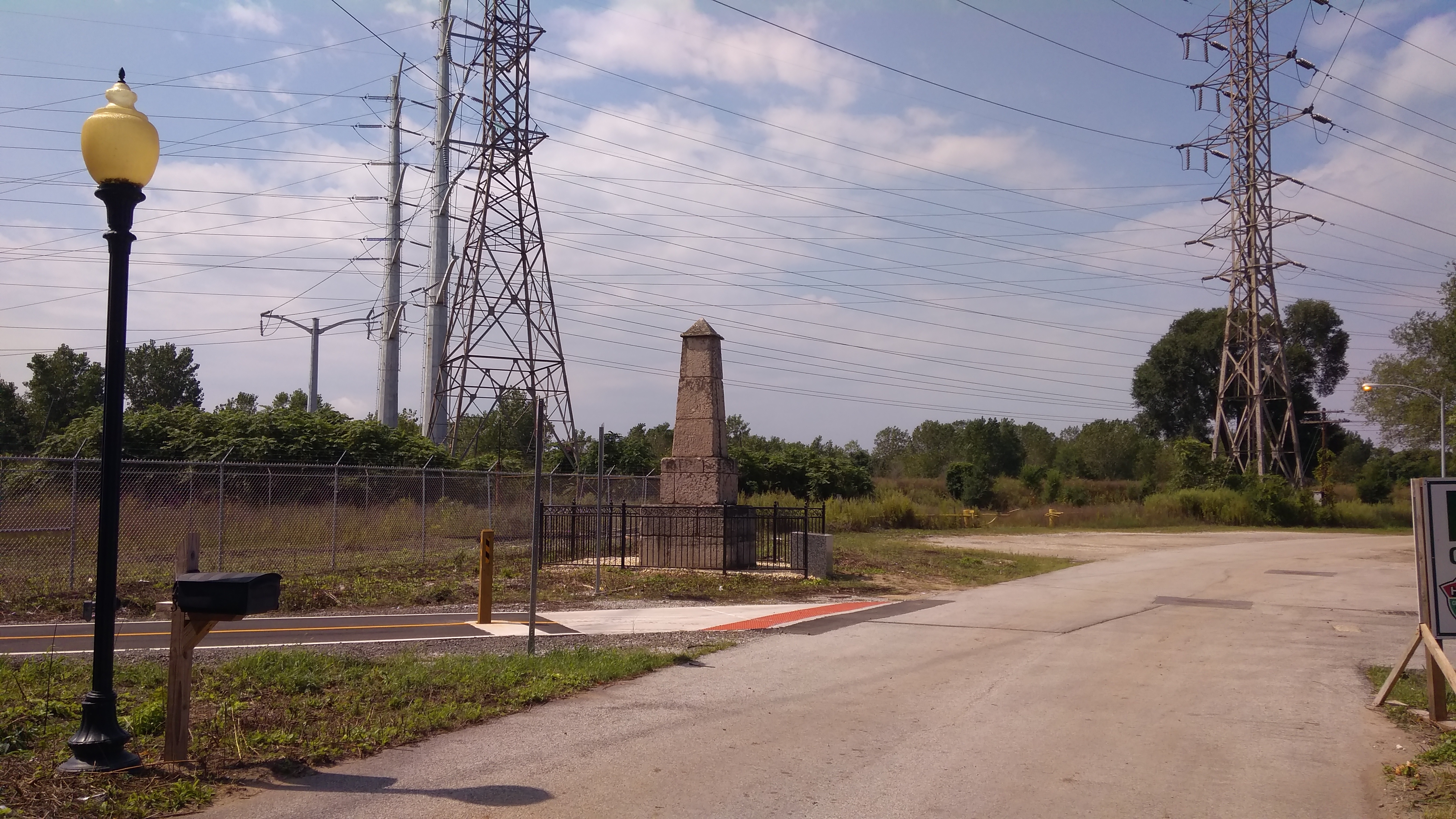
This is what you see at the Illinois-Indiana line just a few feet from Lake Michigan, while you are standing in Indiana.
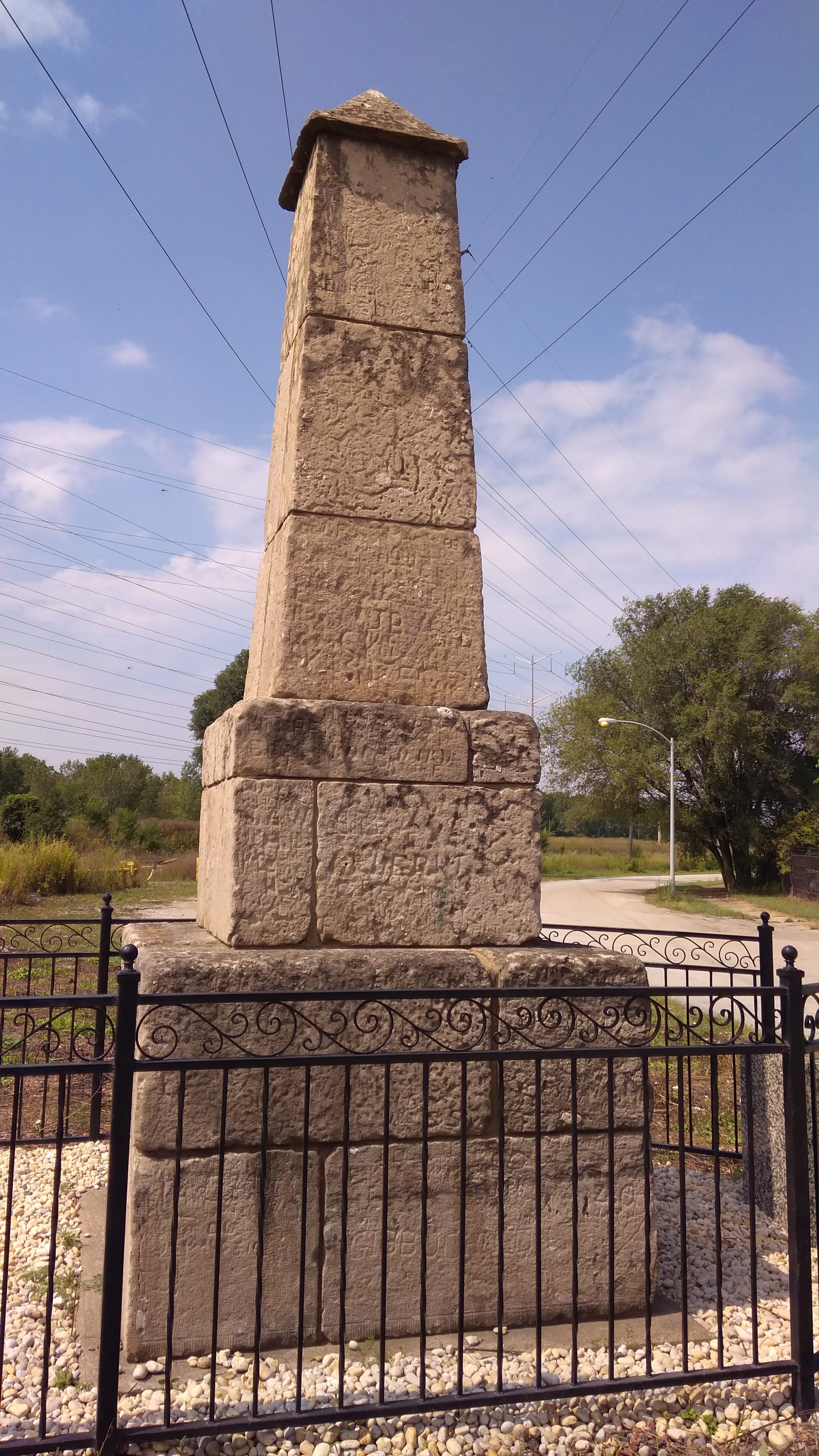
A weatherworn, graffiti-scarred limestone obelisk. This is a closer view.
“In 1833, as Chicago and the Midwest were starting to grow, Congress ordered a new survey of the boundary between Illinois and Indiana,” says Chicago History Today, which asserts that the obelisk is the oldest public monument in Chicago. “When the survey was completed, a 15-foot high limestone obelisk was put in place on the shore of Lake Michigan, straddling the state line.

“By the 1980s the marker was isolated and neglected among the rail yards. Allen J. Benson, a ComEd executive, convinced the company to sponsor its restoration, in conjunction with the East Side Historical Society and other interested groups. In 1988 the marker was moved 190 feet north to its present location, just outside the [ComEd coal-fired power plant] gate. A new base was added at that time.”

Though moved into an area created by landfill, I understand that the obelisk still straddles the north-south Illinois-Indiana border, which a few feet further north heads out into Lake Michigan. It’s also the border between the city of Chicago and the city of Hammond. (Chicago extended out this far in massive 1889 annexation, which is yellow on the map.)

There’s a plaque near the obelisk that says the small area (maybe inside the fence) is Allen J. Benson Park to honor the exec, who has since died. The power plant closed in 2012, and its former site, a brownfield on the Indiana side of the line, is being redeveloped to be home to a data center.

When the plant was up and running, the marker didn’t look quite so forlorn: in the 2011, according to a Wikimedia image, three flagpoles and some trees were in the vicinity — but no metal fence — and there were plaques on the side of the obelisk with the state names. Guess they were stolen. Such is life in the big city, but I’m glad this curiosity from the 19th century still stands.

The Schaumburg Labor Day Parade

This year I decided to watch the Schaumburg Labor Day Parade, whose name pretty much sums up the time and place (no one else in my family was interested). Luck was with the parade and parade-goers this year. The parade was held in the morning, under partly cloudy skies and in only somewhat hot and humid conditions. A few hours later, intense thunderstorms rolled through.

The parade featured a thin selection of local politicos — I expect state reps and senators and such had union picnics or rallies to go to — public service equipment, local businesses, veterans, nonprofits, clubs and two high school marching bands. None of the floats were that elaborate and sometimes there were minutes-long gaps in the movement of the parade. Ah, well. The bar’s a little lower on free entertainment.

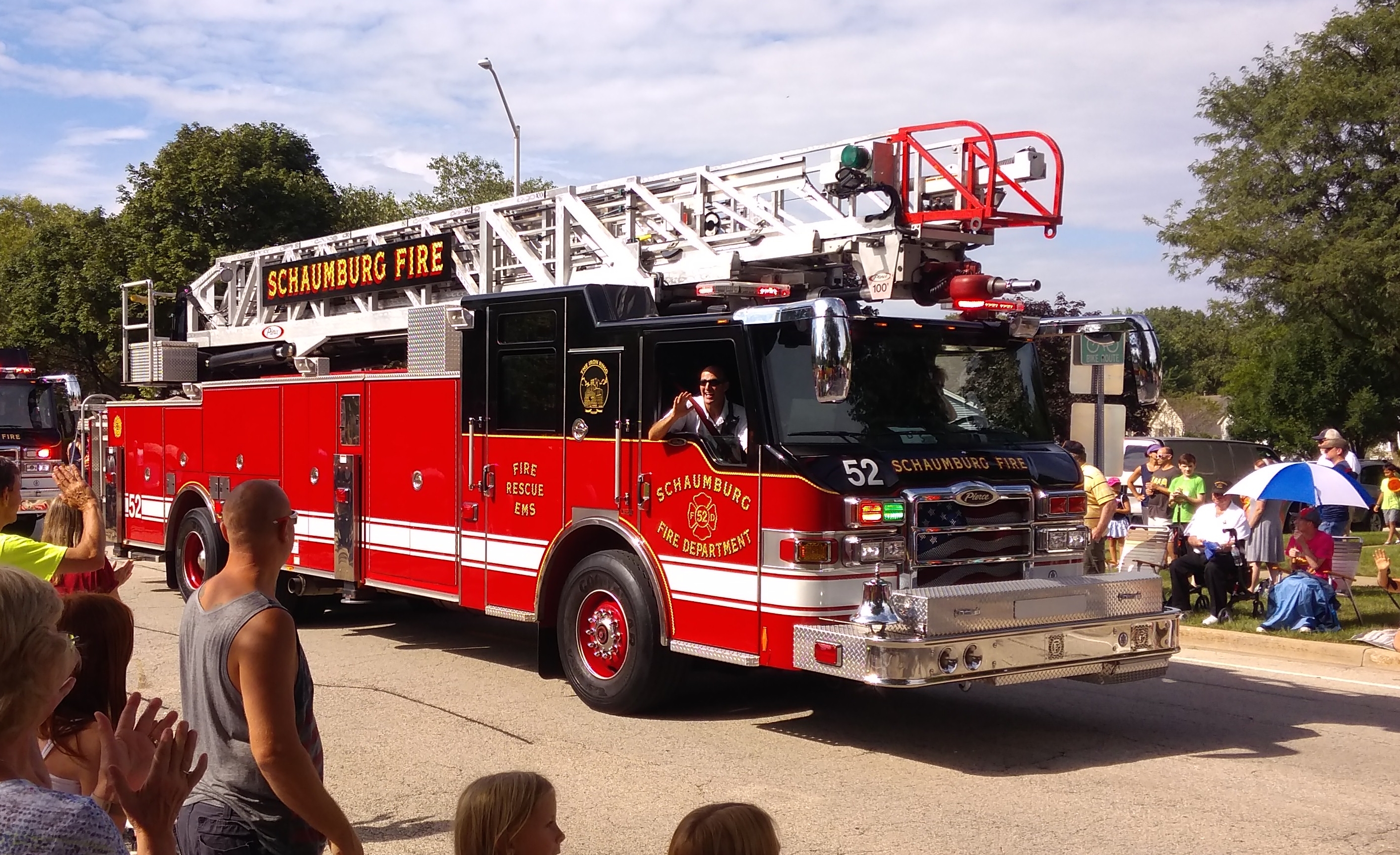
The mayor of Schaumburg (actually village president) and some trustees came by first in golf cards, and a while later came the fire equipment.
Both the Schaumburg and Hoffman Estates FDs were represented.

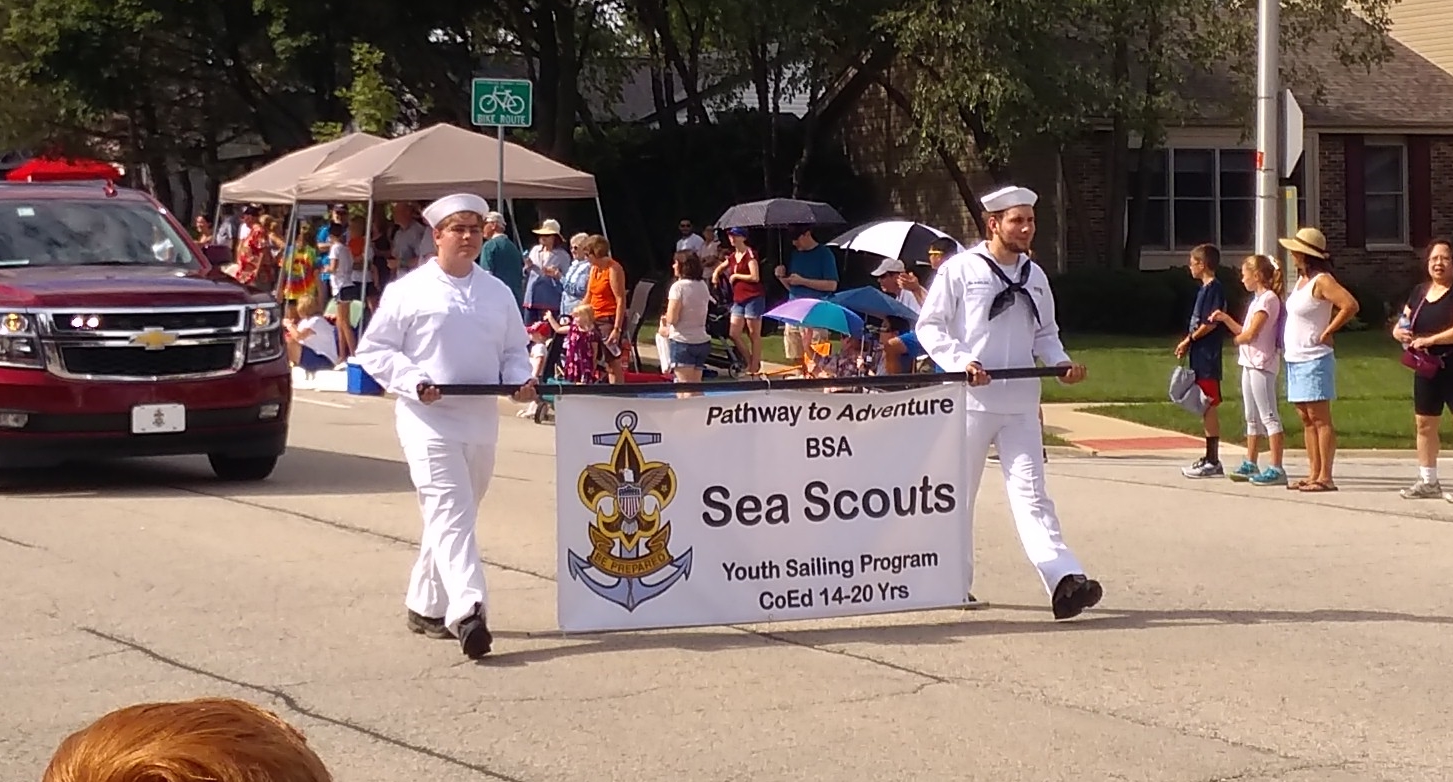
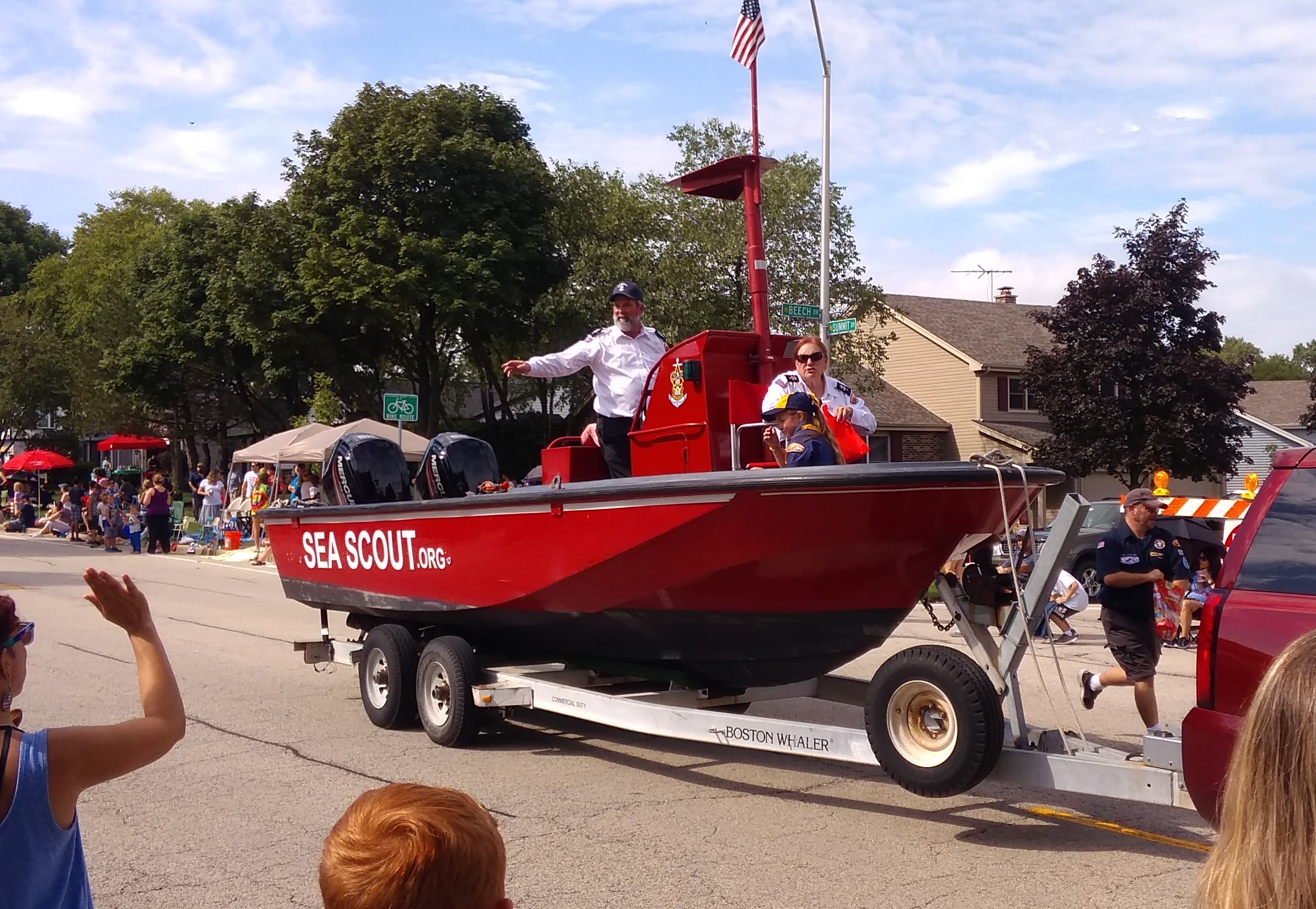
An organization I knew nothing about.
Instead of forays into the wilderness, Sea Scouts take forays onto the water. A different kind of wilderness, I suppose. These days, co-ed.

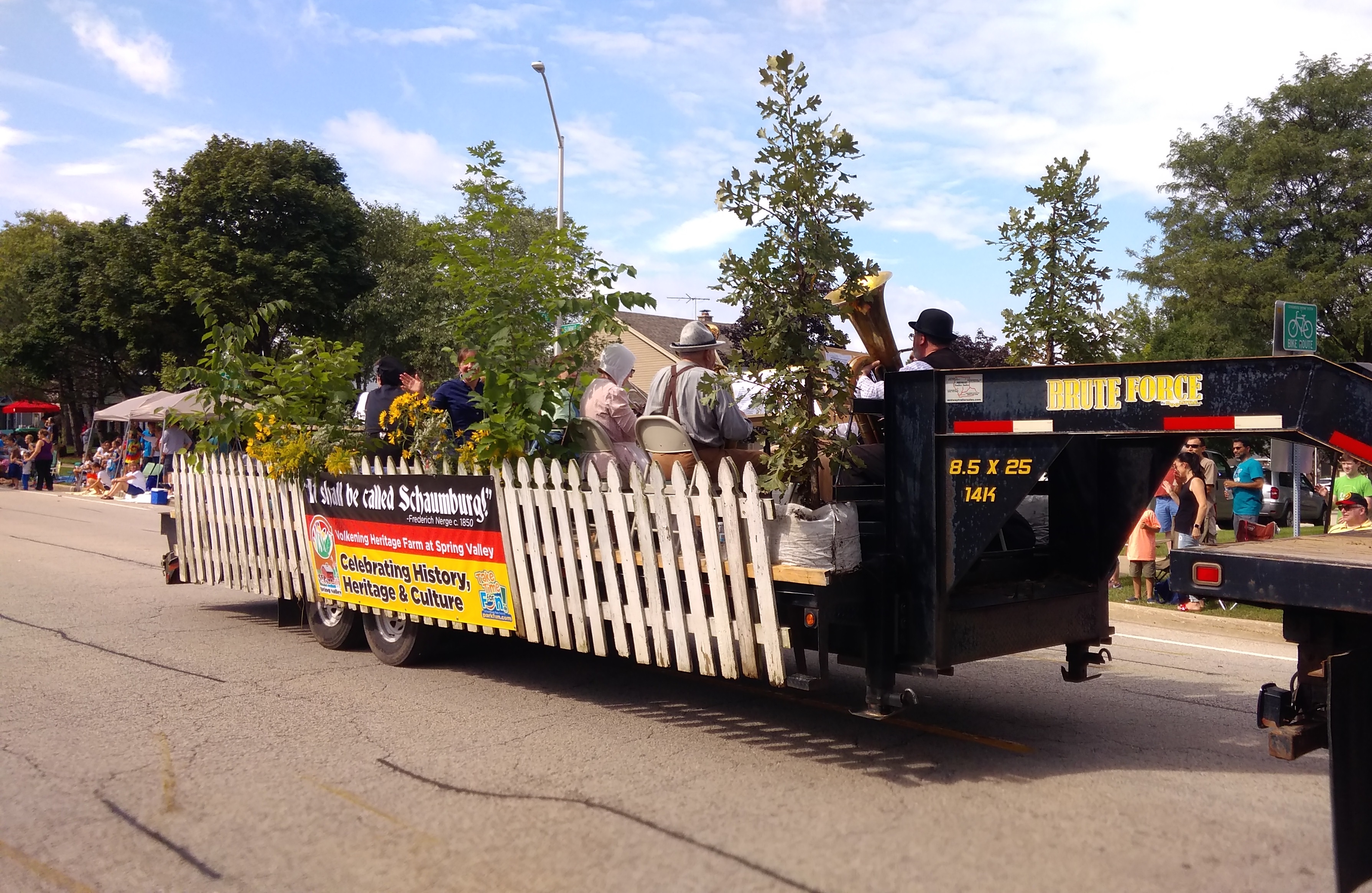
The odd float of the Volkening Heritage Farm at Spring Valley. Complete with plants and an oom-pah band to celebrate Schaumburg’s German past.

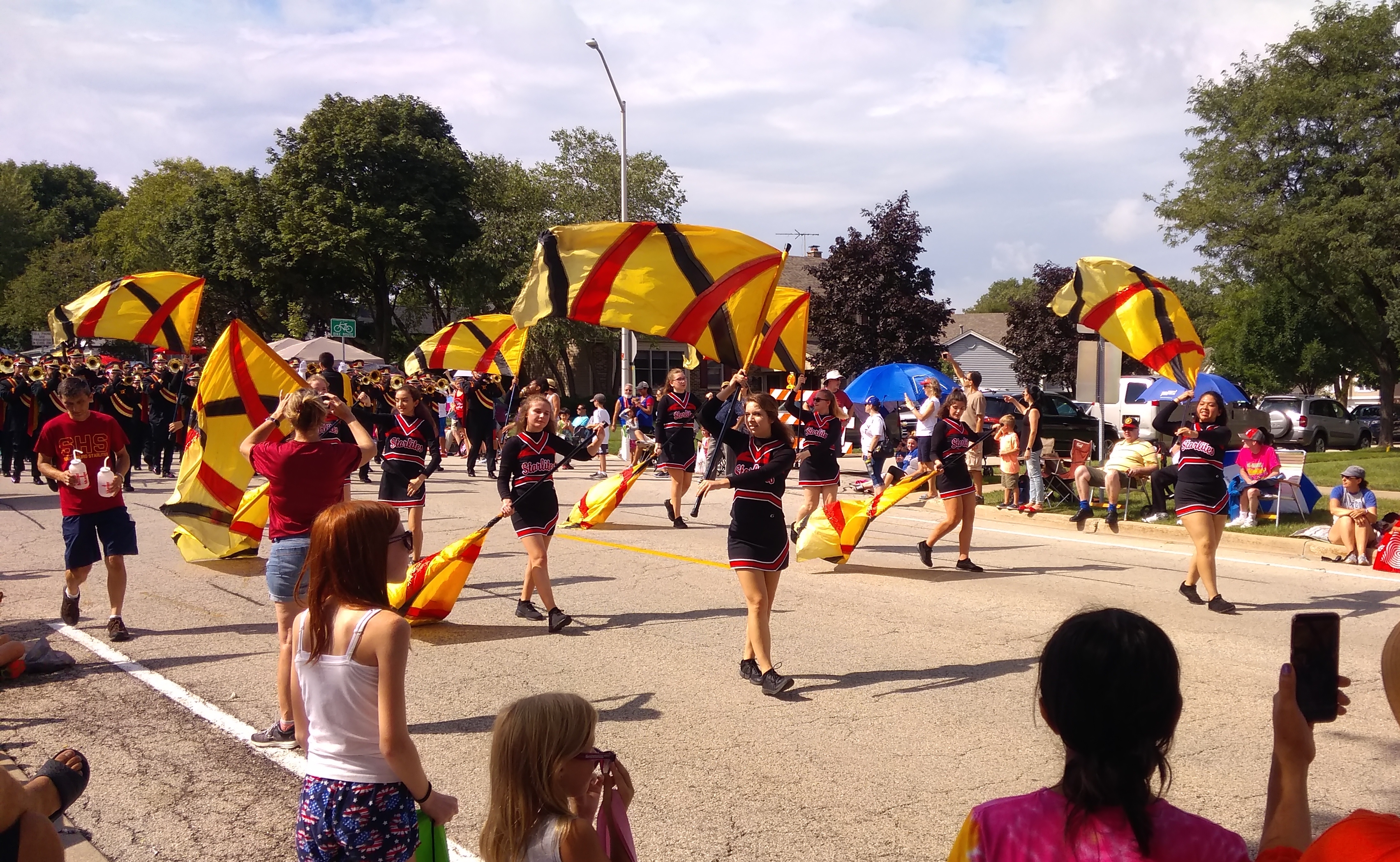
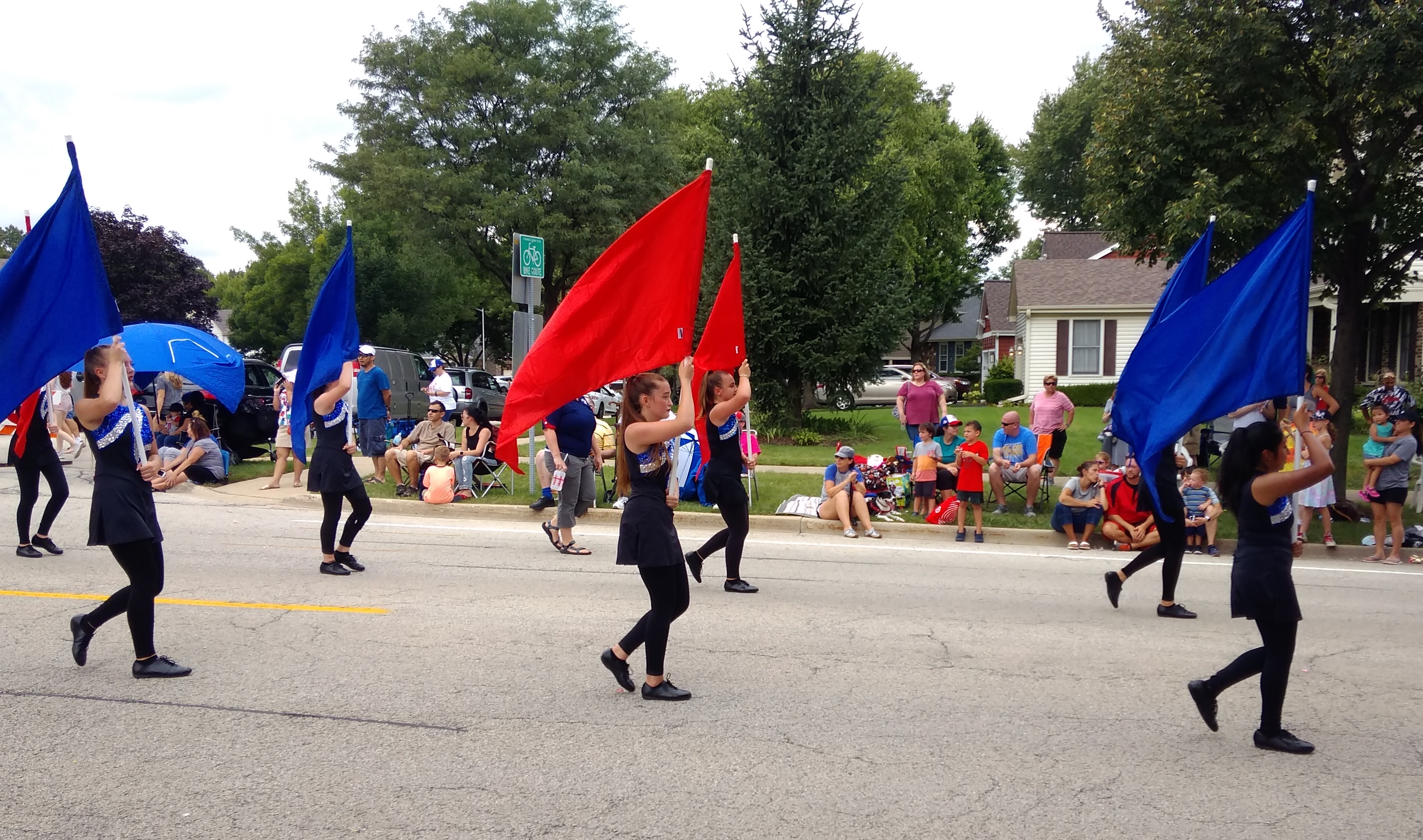
Flag girls. They heralded the approach of the Schaumburg High School marching band.

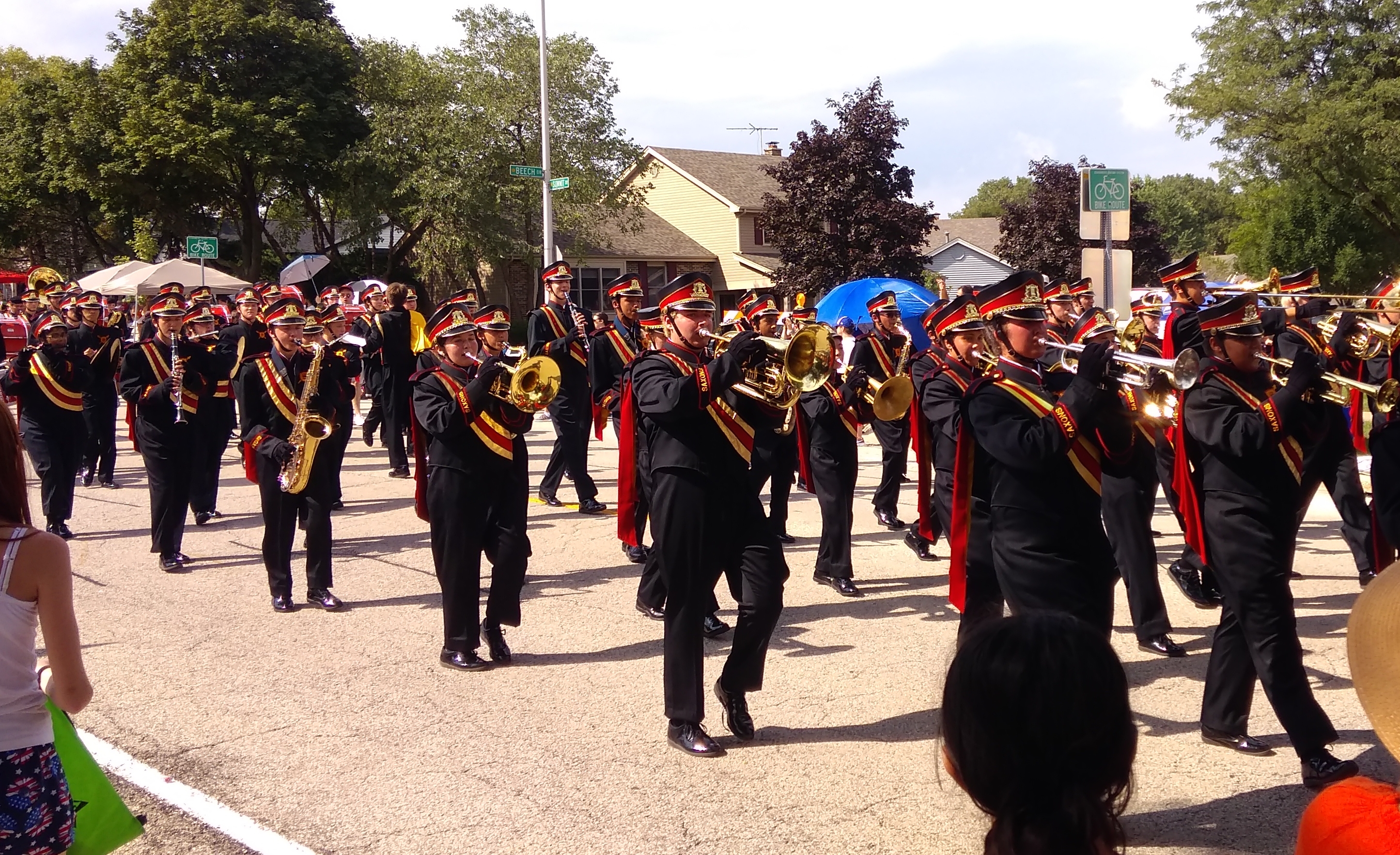
A different sort of band.
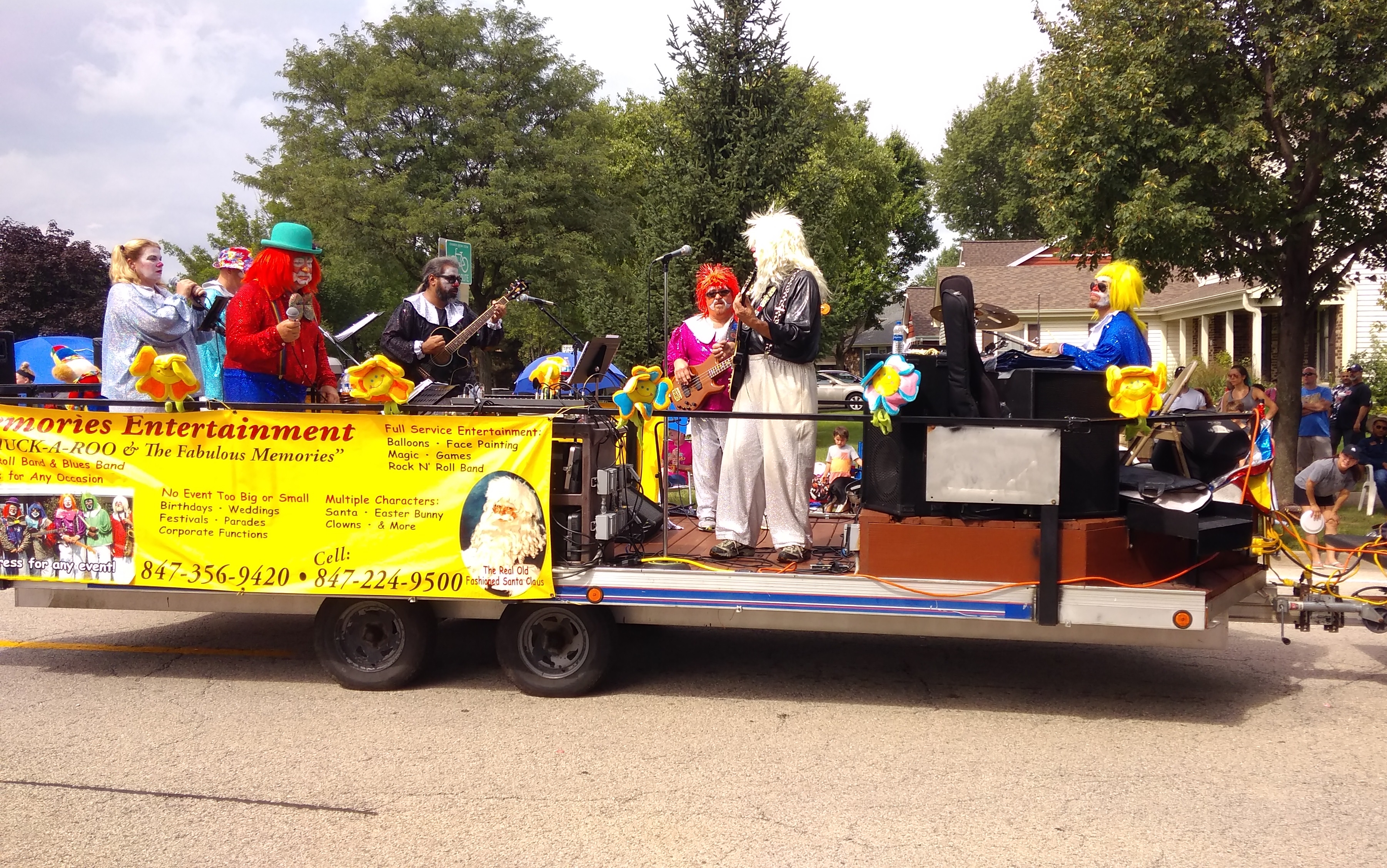
The Memories Entertainment float. According to their sign, the band features Buck-A-Roo & the Fabulous Memories. For this parade, they were dressed as clowns and playing ’70s rock standards.

More flag girls.
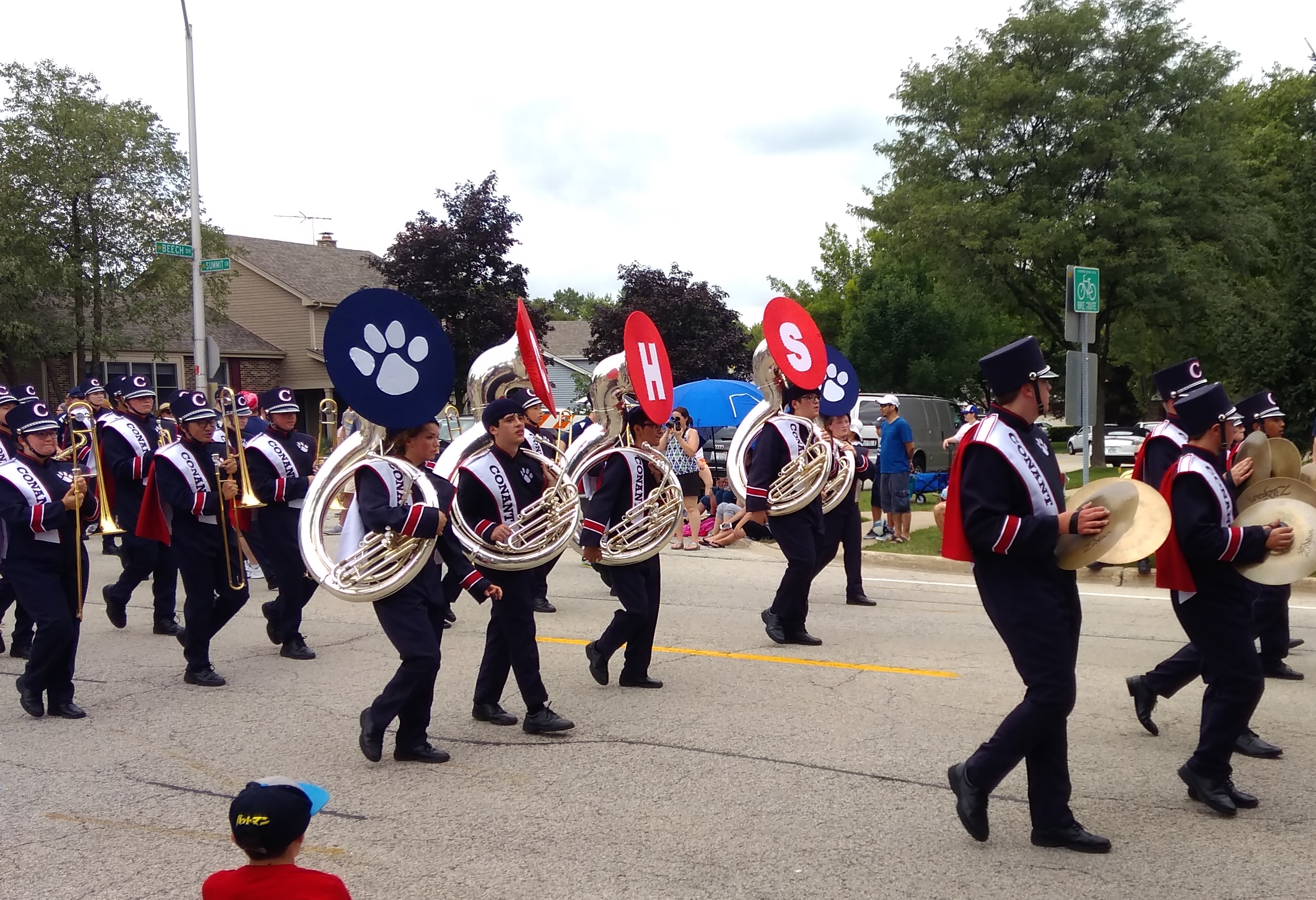
This time, ahead of the Conant High School marching band.
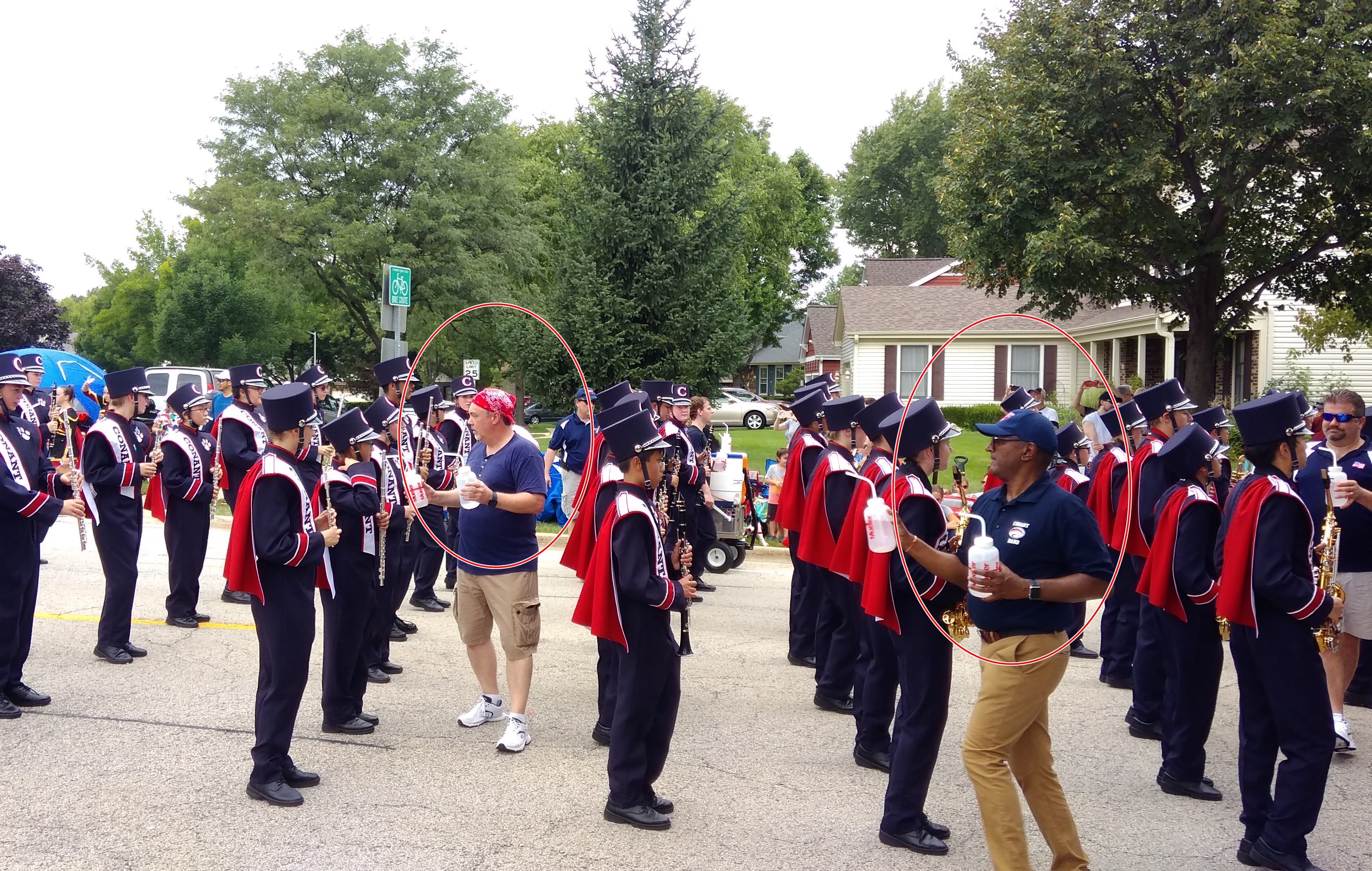
When the band paused for a moment near me, I noticed a number of adults moving up and down the lines with squirt bottles, squirting liquid into the mouths of the band members. Water, I assume. I also saw one fellow squirt water on the back of the neck of a band member.
That struck me as odd. Forty years ago, I was in a marching band and we marched in a parade every year in April in San Antonio. Not terrifically hot, but always warm enough, and no one gave us water. I feel a curmudgeonly moment coming on. We marched in the heat and we got dehydrated and we liked it.

Labor Day Hiatus

Back to posting on September 4, after Labor Day. You’d think a holiday of that name would be time for “Joe Hill” or the like, though May Day’s really the time. Time to lounge around on the deck out back, provided it isn’t raining, which it has been a lot lately.

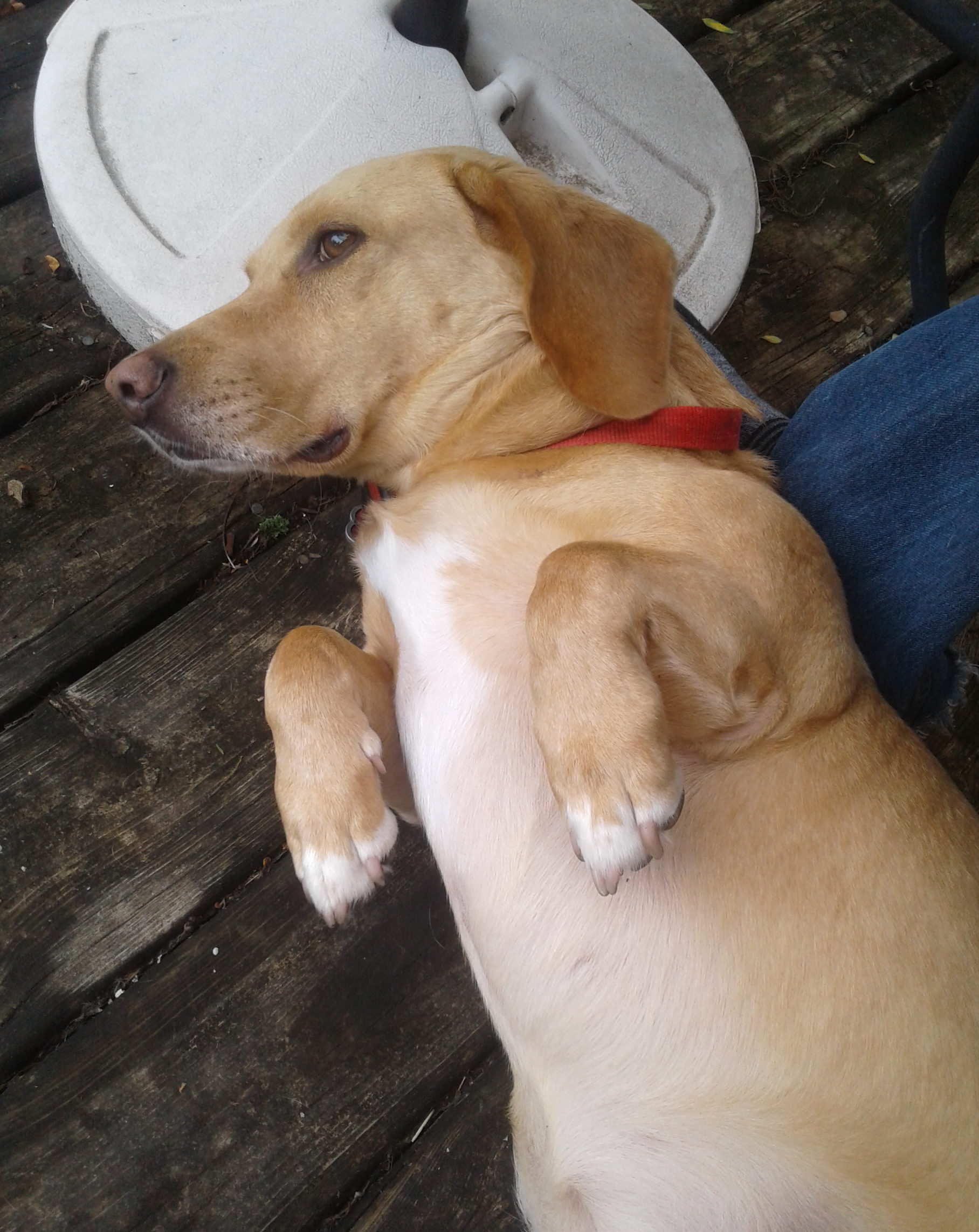
Actually, it’s the dog who uses the deck for its fullest lounging potential.

Use the deck while you can. Soon enough it’s just going to be a snow and ice collector.

More Riverside

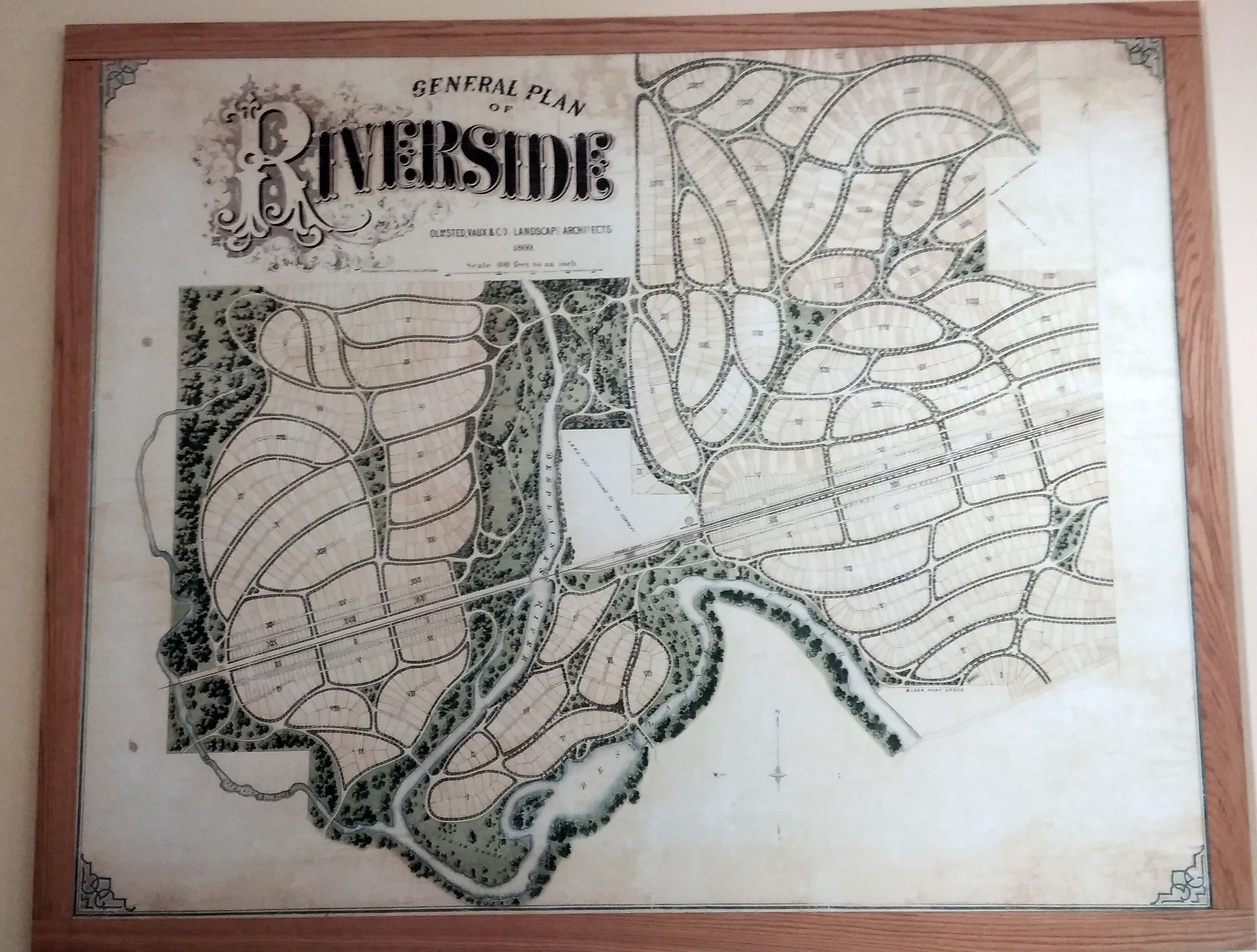
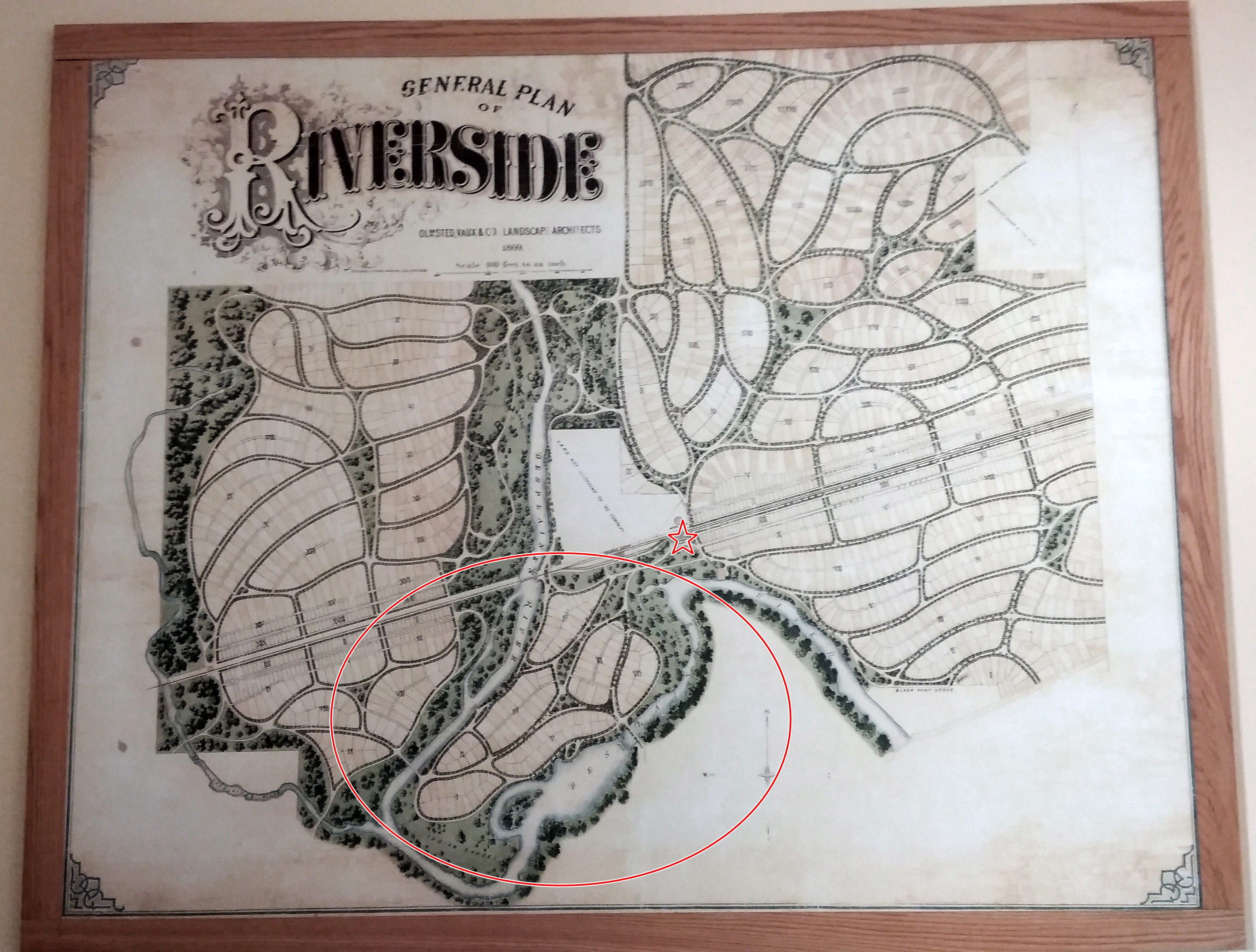
Hanging in the metra station in Riverside, Illinois, is a reproduction of the plan of the town as originally envisioned in the late 1860s, except the spot that says “land not belonging to the company” (that is, the Riverside Improvement Co.) is part of the town in our time.

The streets and the green spaces are still pretty much still the way they were originally laid out. Note the bend in the Des Plaines River that forms a tongue of land, marked by me by a red circle. Also, the red star is roughly where the train station, tower, library, etc. are located.

With a Riverside Museum walking tour pamphlet in hand, we decided to take a walk in the tongue of land after seeing the sights near the train station. The air was a little steamy, but with the sun hiding behind clouds, we put up with it.

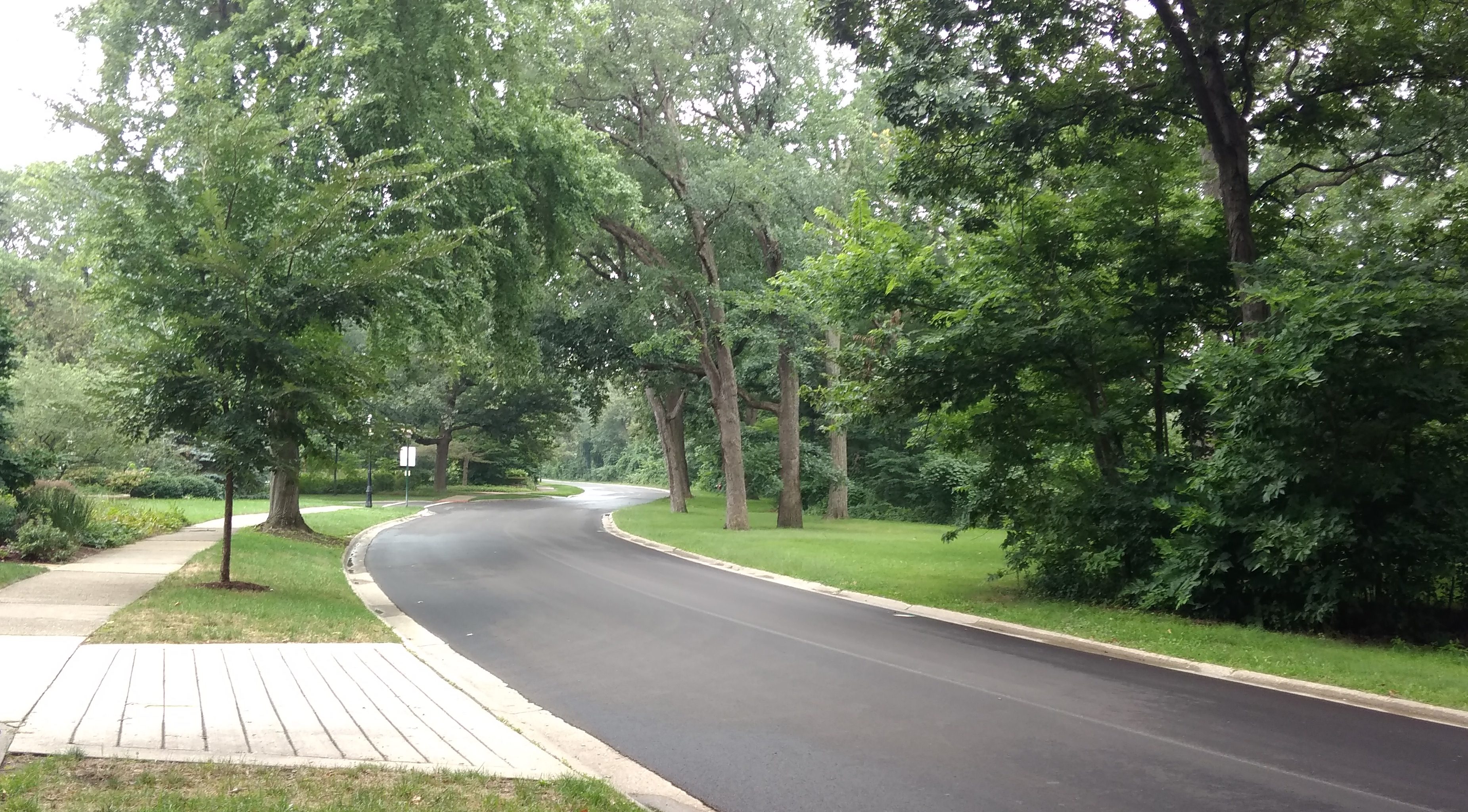
One of the streets along the river is Bloomingbank Road. The river, hidden by foliage, is to the right in this image.

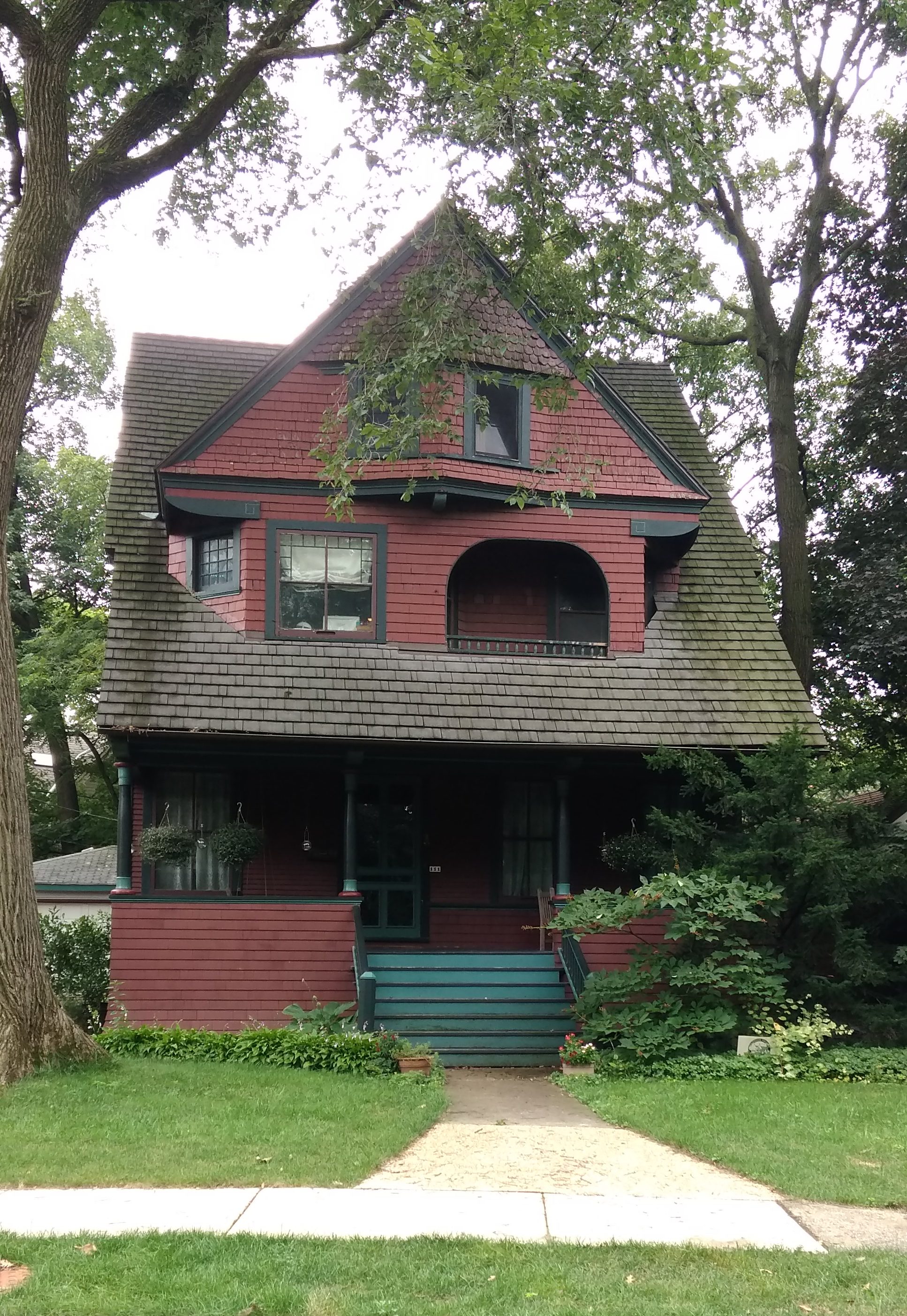
The road is populated mostly by large vintage houses. Such as the Clarence Cross Cottage, 1887 Shingle & Queen Anne.

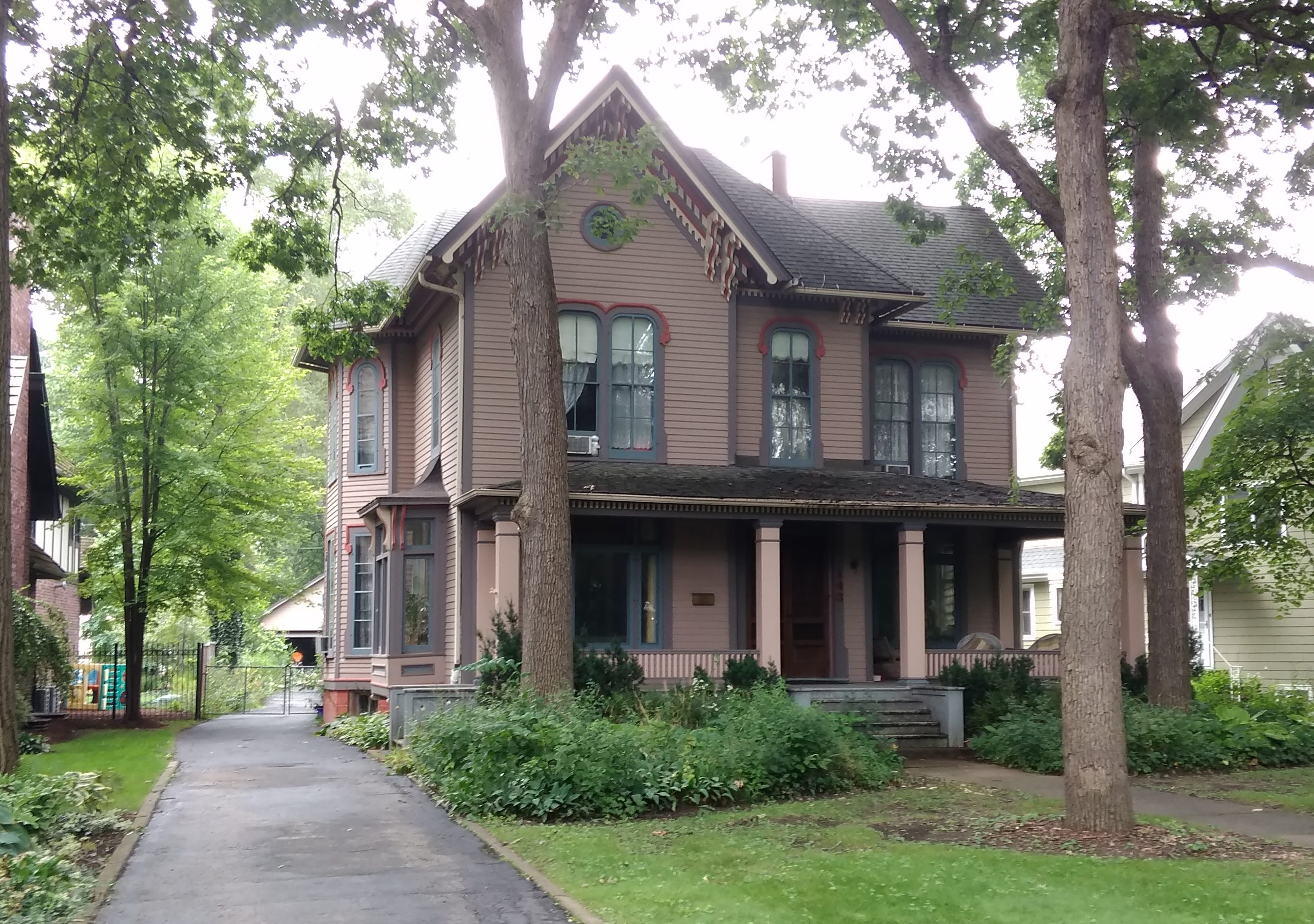
The Thomas W. Blayney Residence, 1869 Italianate.

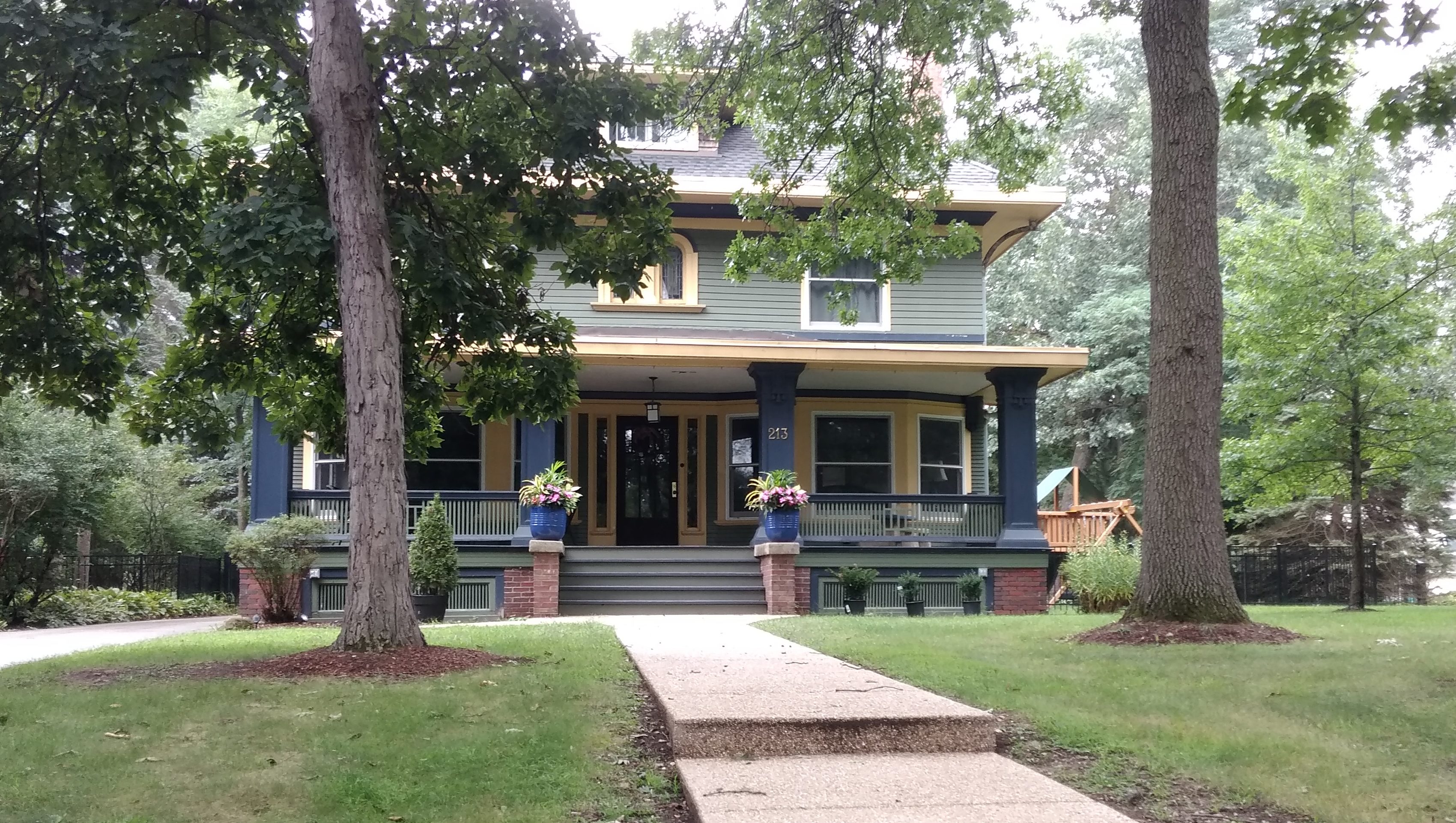
The John C. Smith House, 1907 American Four Square. That’s a nice porch.

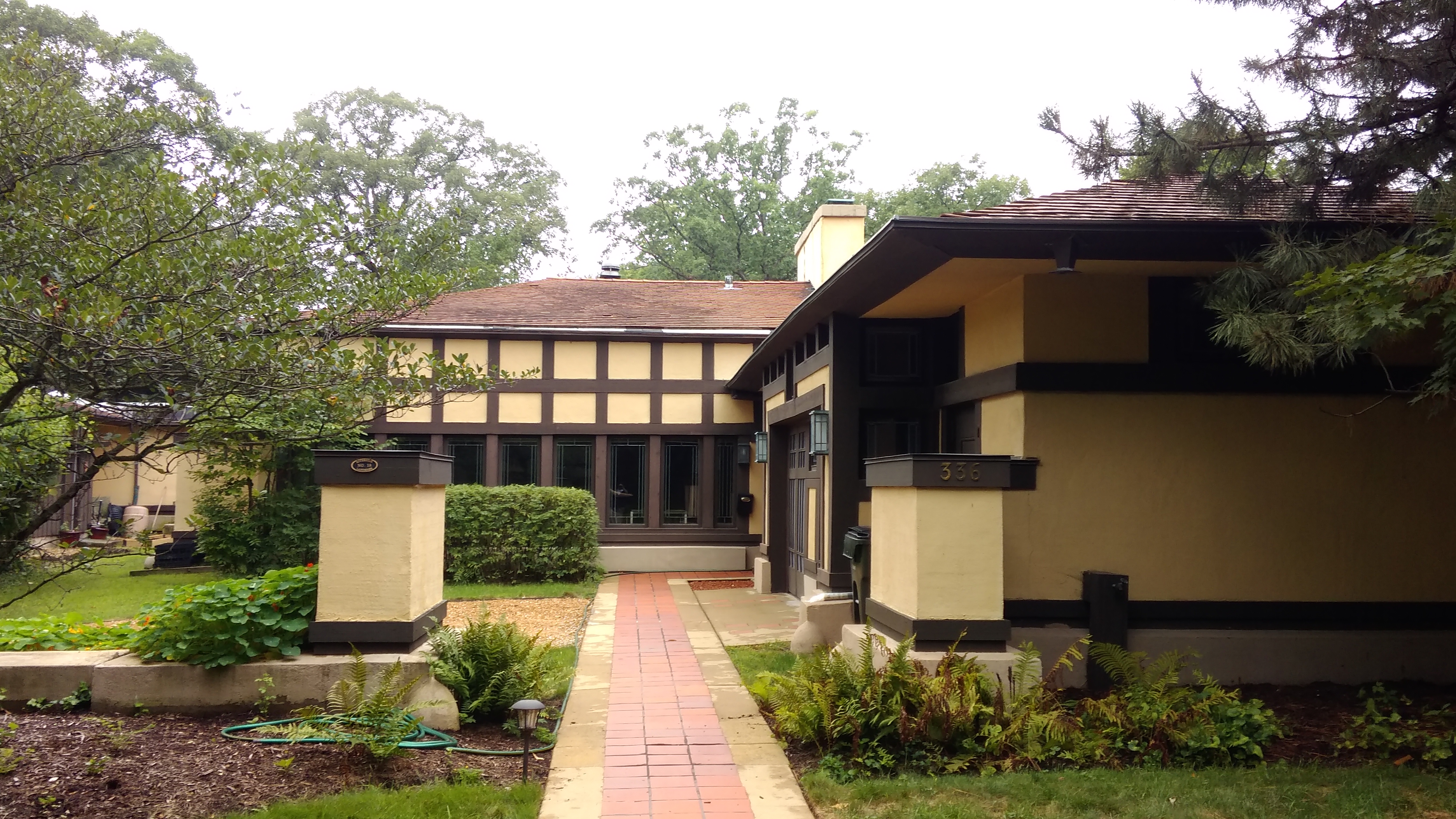
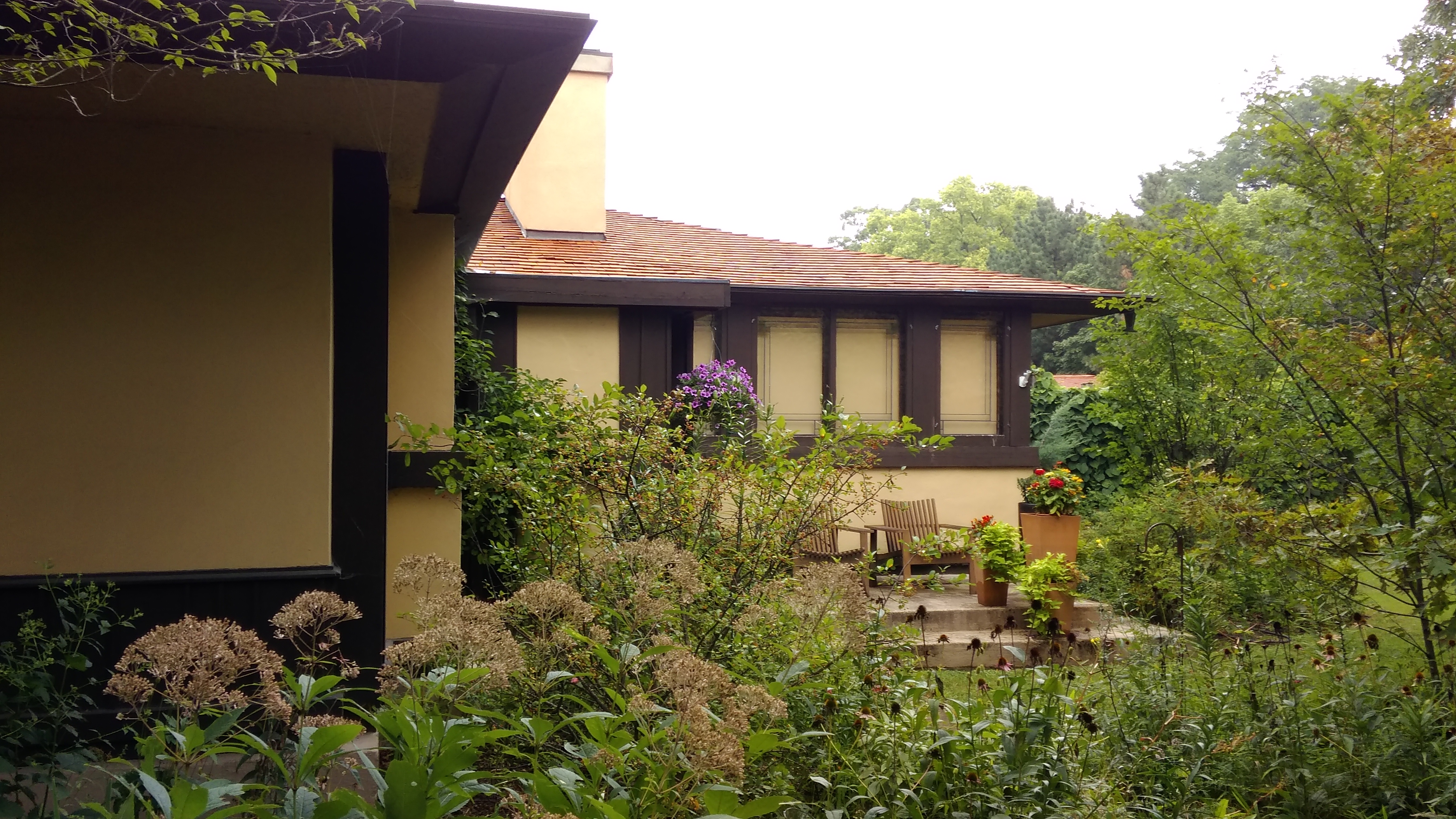
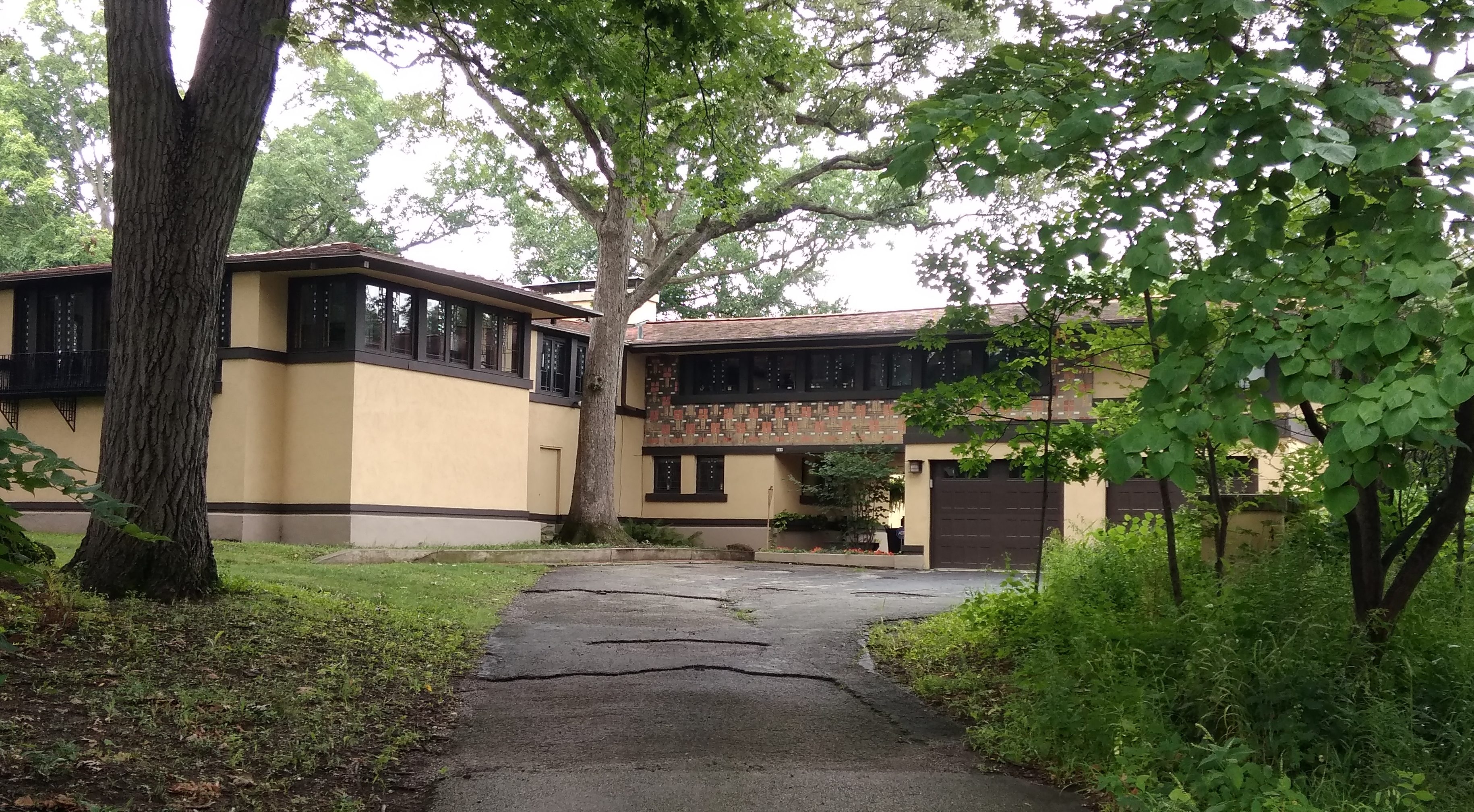
Most people probably come this way for the Frank Lloyd Wright works, which are a cluster of residences on 10 acres near the tip of the tongue. Originally they were built as a single residence for the Coonley family.

Per Wiki: “Avery Coonley, a Chicago industrialist and his wife, Queene Ferry of the Detroit-based Ferry Seed Company, were both heirs to industrial fortunes and had an unlimited budget to commission a new residence.” Just the kind of clients FLW liked, no doubt.

Formerly the stables and coach house.

Formerly the gardener’s residence.

Formerly the main house.

Not the best view of the house. That would be the other side, but there’s no access to ordinary gawkers since the house is privately owned. That source says the house is up for sale, listed this spring for $1.6 million. Might be a reasonable price for a FLW work, if you remember it’s an artwork more than a residence, and don’t mind the invisible hole somewhere in the place where your money seems to go.

Riverside

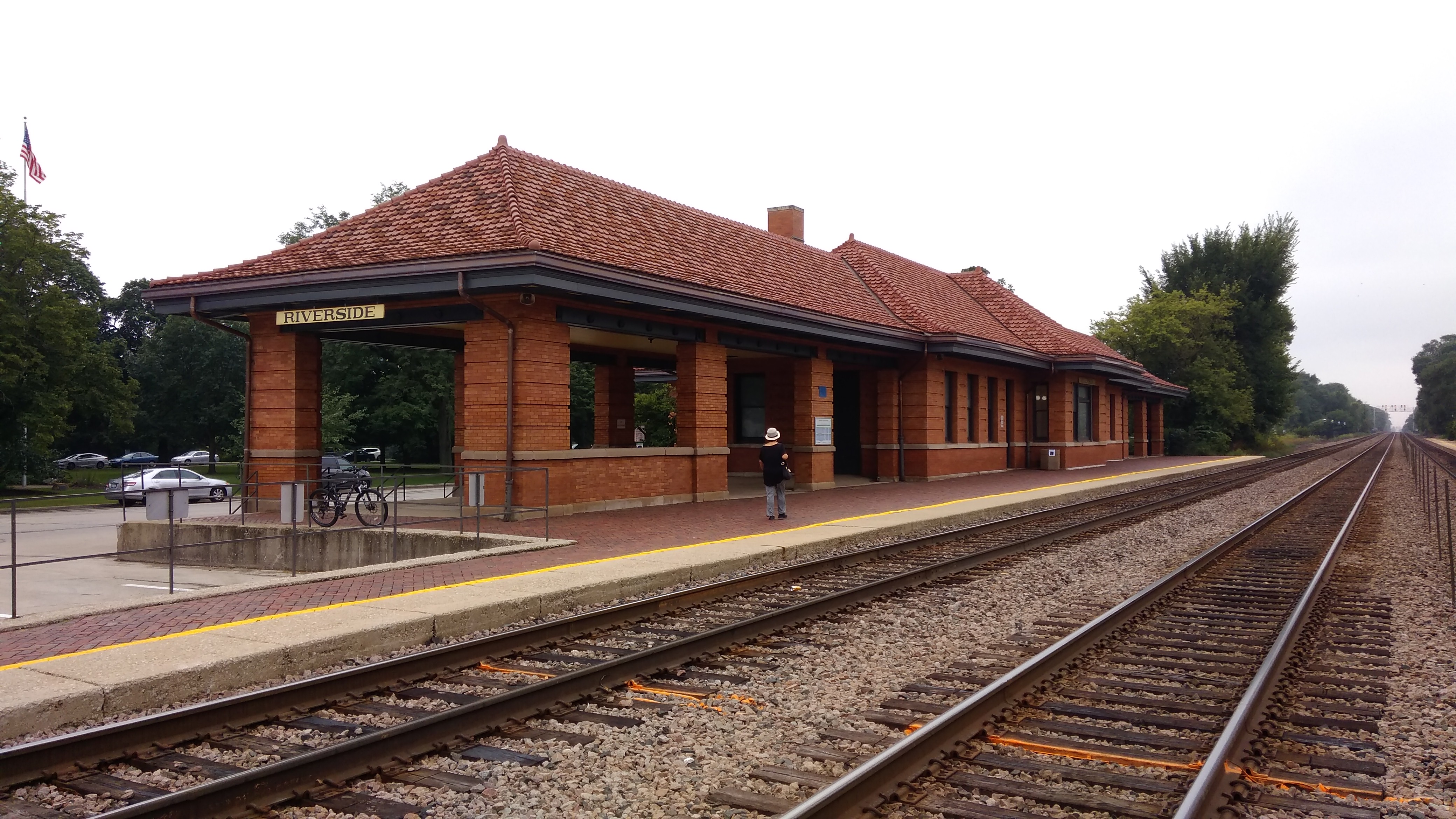
I’ve known about Riverside, Illinois, for years, and used to pass through it every weekday in the late ’90s and early ’00s when I took the Burlington Northern Santa Fe Metra line to work downtown. One thing I could see from the train window was the fine brick station.

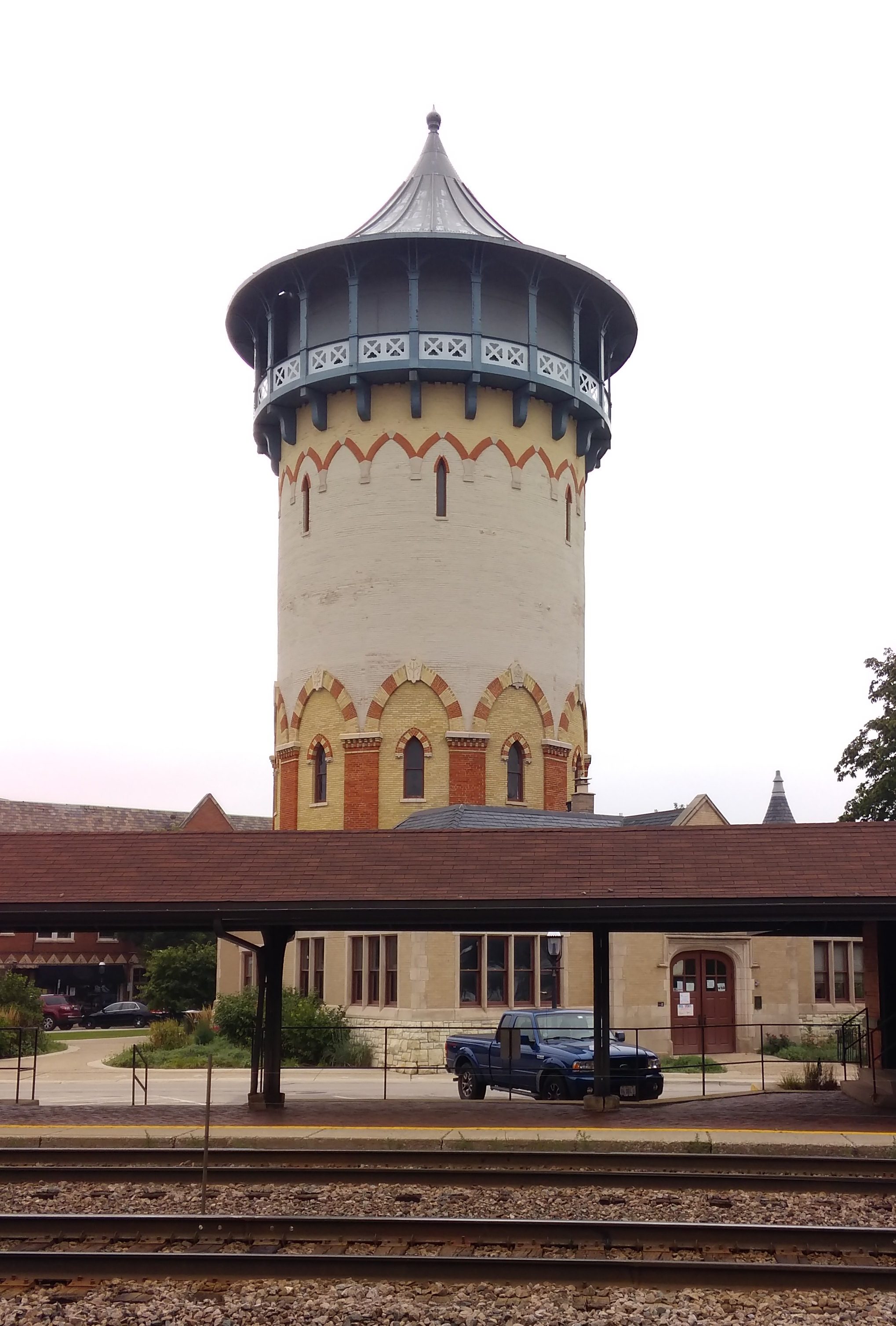
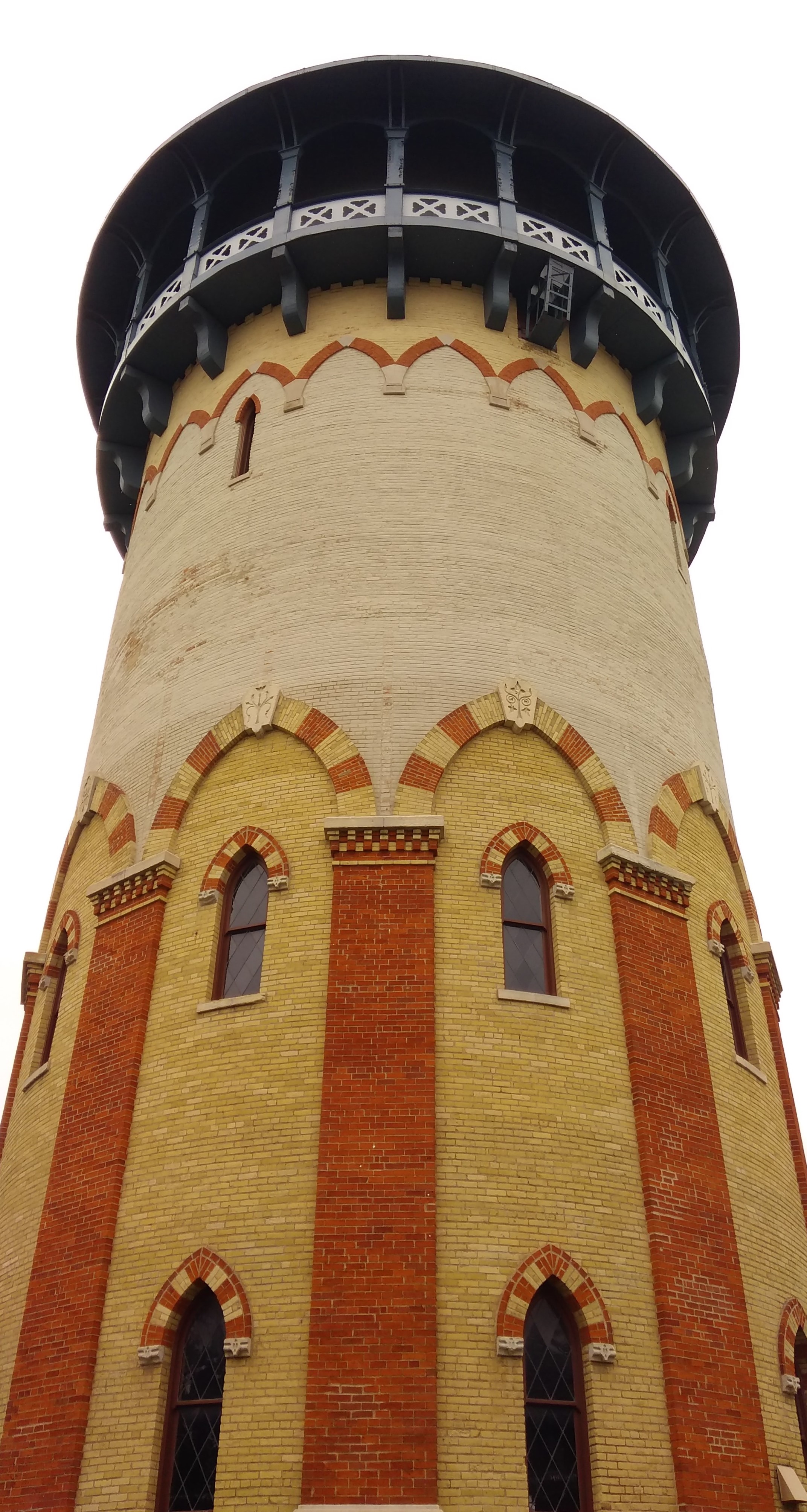
As well as the town’s former water tower, not far from the station. The building underneath the tower is now the town’s park and recreation department.
Riverside is a special place beyond what you can see from the train. But I never got around to a longer visit than a train stop, so on Saturday morning, inspired by the fact that some of its buildings were part of Doors Open Illinois — not to be confused with Open House Chicago, or Doors Open Milwaukee — we drove to Riverside for a look around.

“Starting [in 1869] with a blank canvas of 1,600 acres of purchased farmland, the Riverside Improvement Company arranged for a complete utility infrastructure — water, sewer, and gas for lighting,” WTTW says. “They called their brand-new community ‘Riverside’ for the Des Plaines River that flows through the site.

“To design and plan the village, they hired Frederick Law Olmsted and his partner Calvert Vaux, whose Central Park success a decade before had made them superstars of design.

“Olmsted’s signature approach was to create a picturesque, landscaped topography. Inspired by the winding Des Plaines River, he eschewed a standard city grid, instead creating a series of curvilinear streets that wound across each other — a pattern that resulted in dozens of tiny triangular mini-parks.”

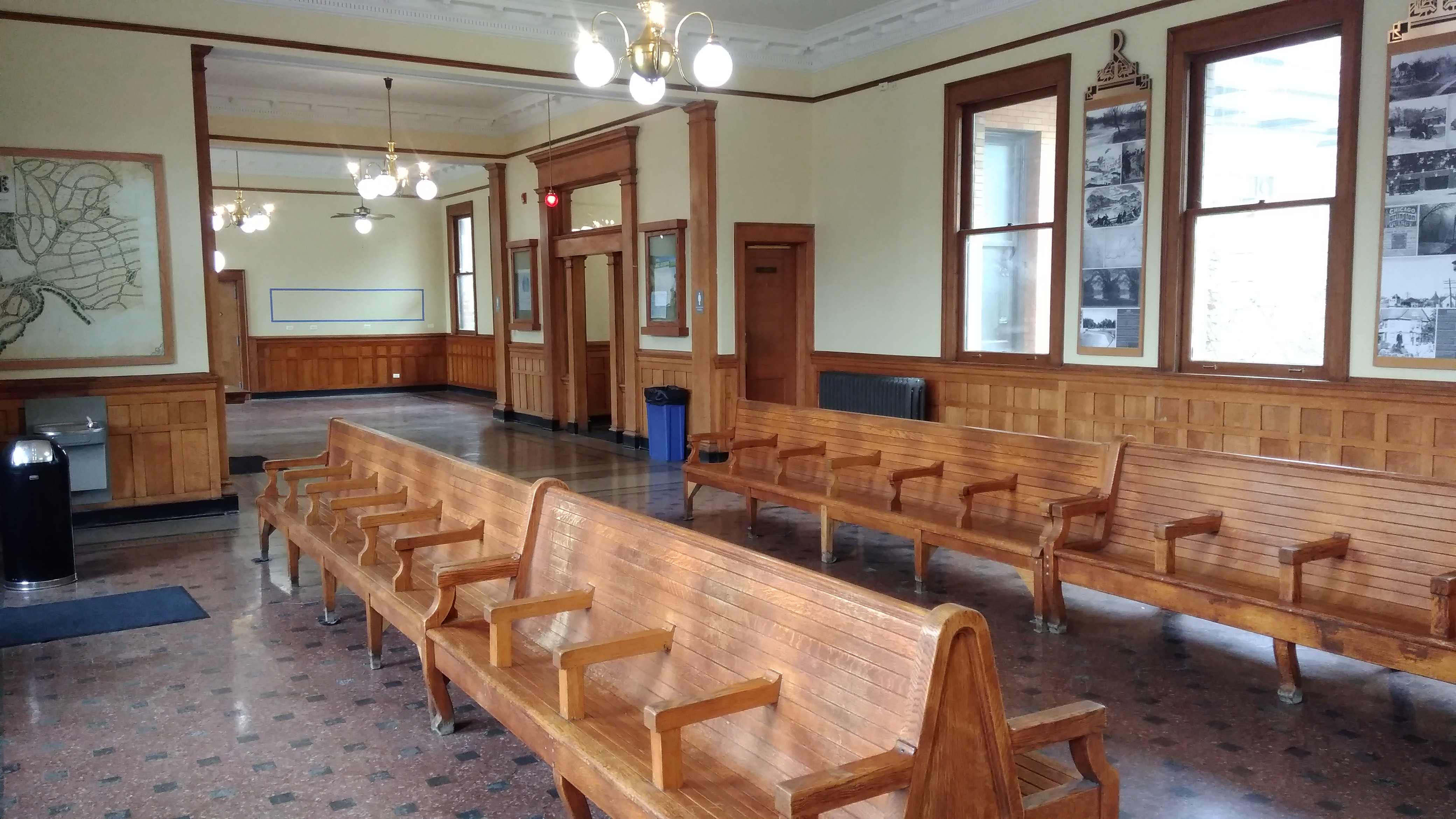
These days, Riverside is still a prosperous suburb, as it was intended to be from day one. We parked near the station and first got a better look at the station’s handsome interior.

As well as a closer look at the former water tower.
Unfortunately, it isn’t open to the public for a climb. Too bad. Even local vistas are usually worth the effort. A view of Riverside from that perch would probably be a fine thing.

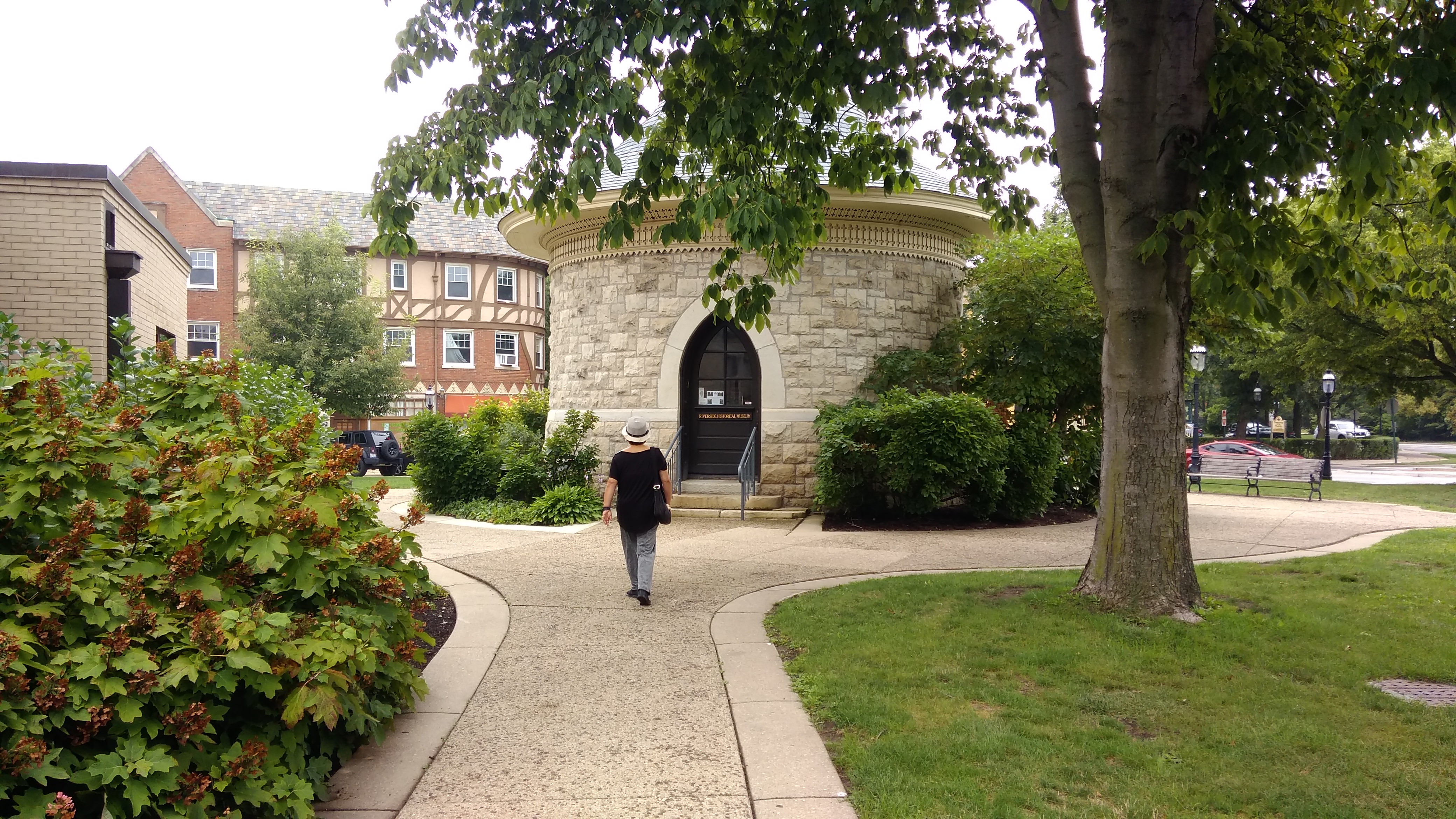
A nearby former pumping station is now a small museum devoted to Riverside. Mostly it sports photographs on the wall of earlier times in the town.
The three volunteers inside, local ladies all, seemed really glad to see us. I expect that word never really got out about Open Door Illinois, and the little museum doesn’t get that many visitors anyway.

They told us a bit about the town and the structures we’d been looking at. For example: parking is usually possible near the train station, even on weekdays, which is unusual among suburban Metra stations. Most commuters walk or ride bicycles to the station, one of the volunteers said. Probably just as Olmstead wanted it.

More from WTTW about Riverside: “In 1871, when the Great Fire decimated Chicago and before Olmsted’s plan was fully executed, the developers went bankrupt. But before long, Riverside picked up momentum again, with community resident and notable architect William LeBaron Jenney stepping in to complete the town plan, and other notable architects of the day such as Frank Lloyd Wright and Louis Sullivan designing homes.”

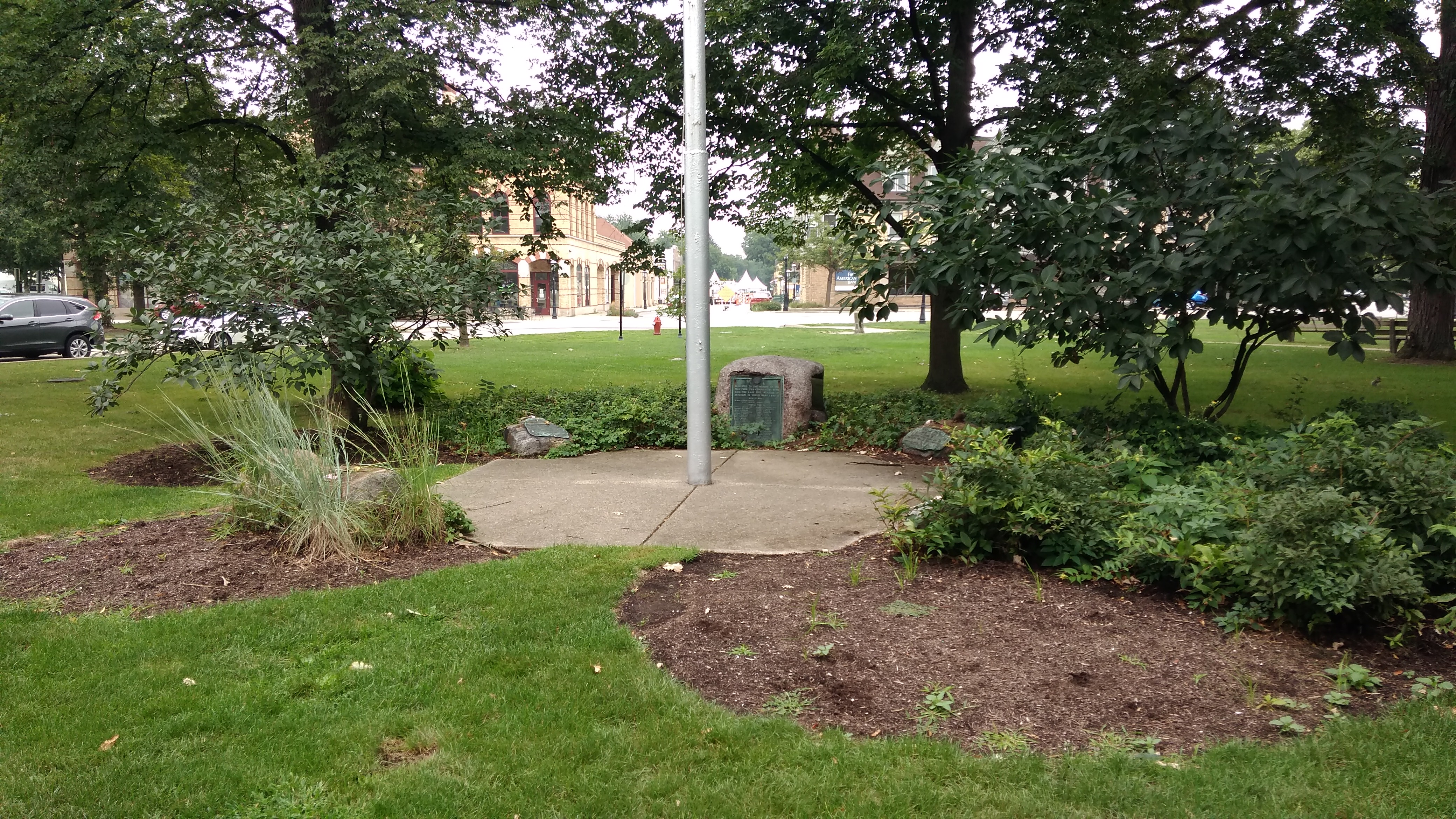
One of the aforementioned mini-parks is next to the train station: Guthrie Park.
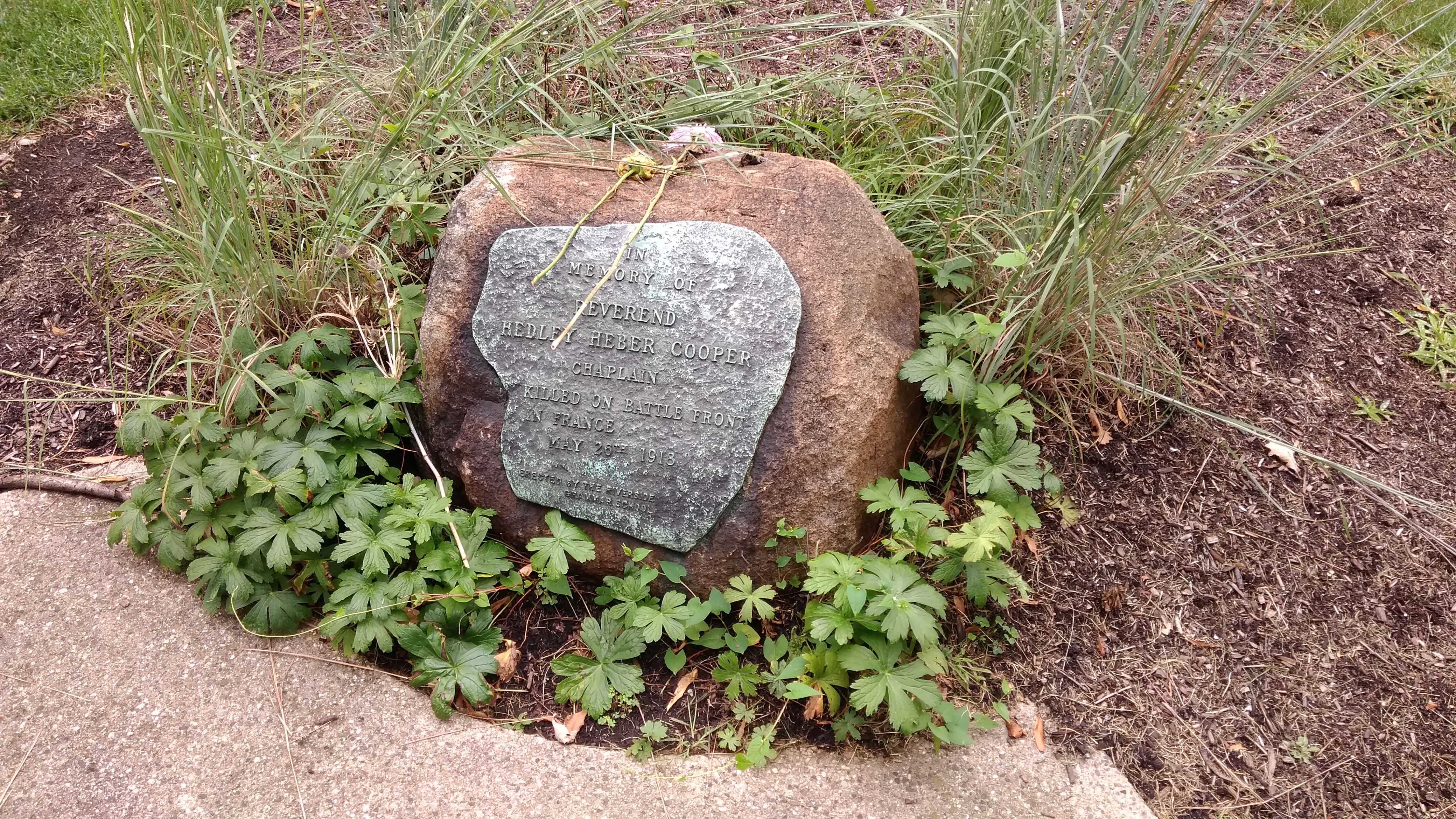
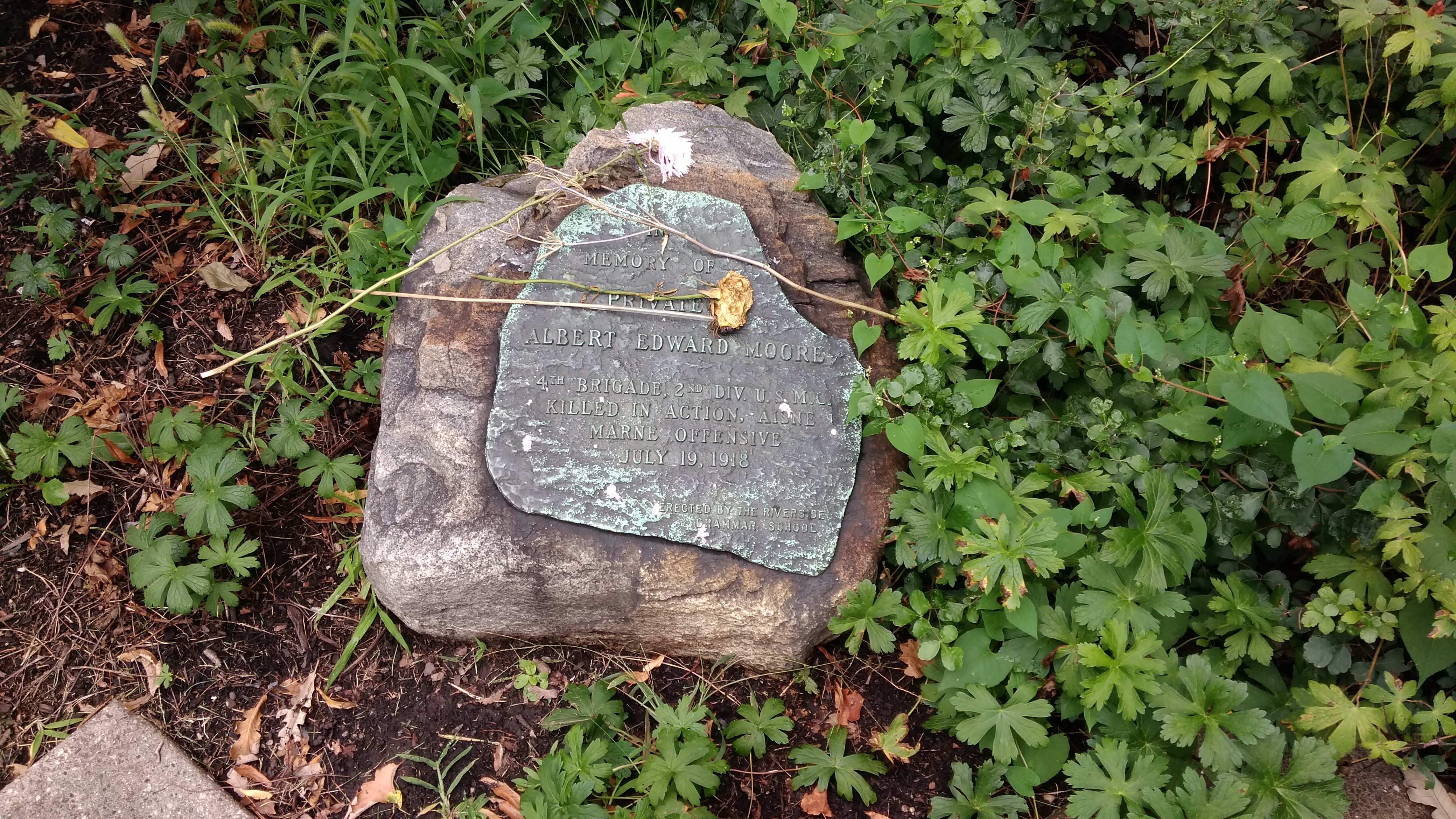
Named after a local luminary, not the folk singer. There are an assortment of commemorative plaques attached to rocks ringing the flag pole in Guthrie Park. Some of them honor men, presumably locals, who were killed in the Great War.

Rev. Hedley Heber Cooper, d. May 26, 1918. War was dangerous for chaplains, too.

Private Albert Edward Moore, d. July 19, 1918.

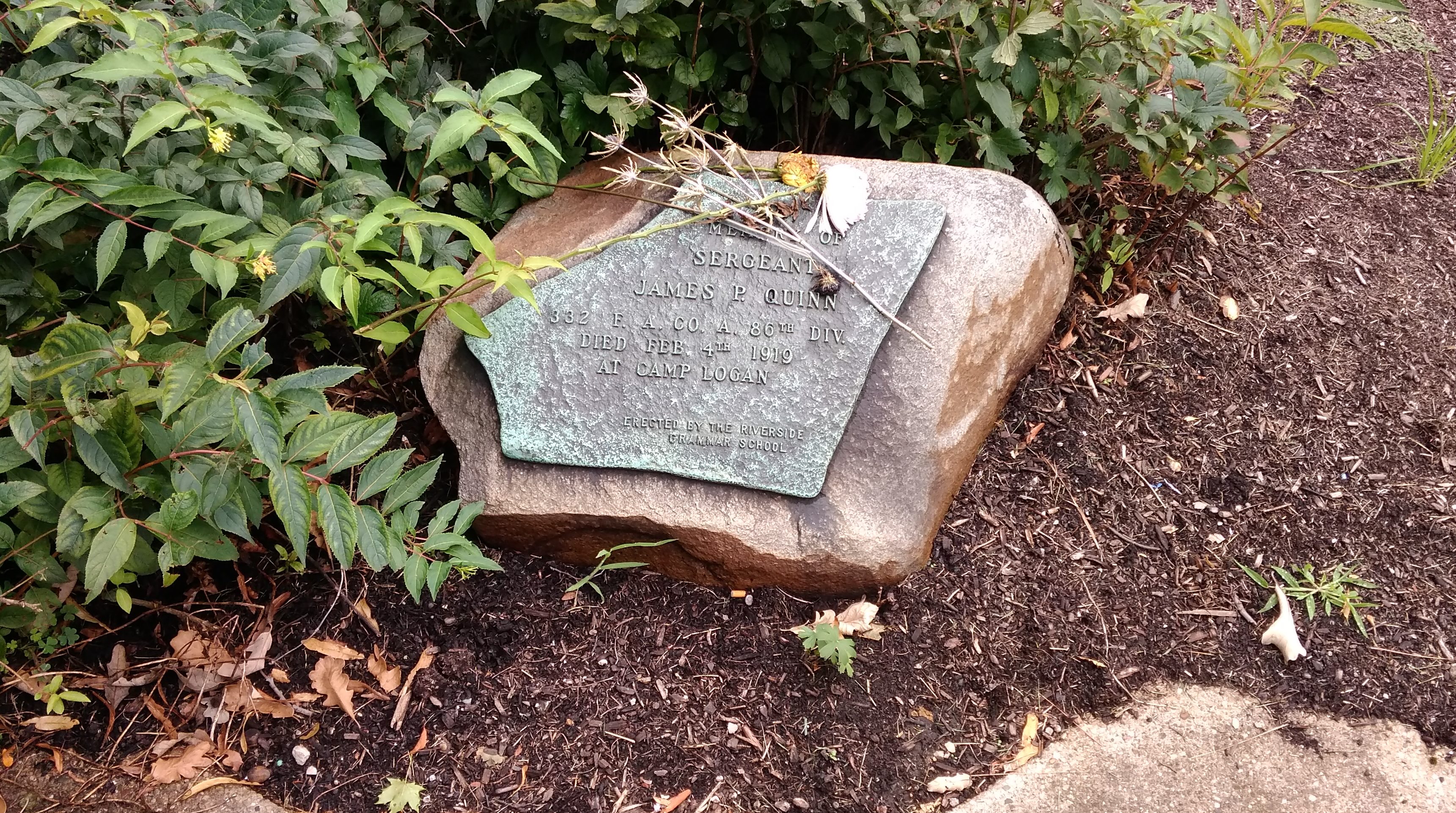
There’s also a plaque for a soldier who died not long after the Armistice, but here at home. A little late for the flu, but still possible. Accident, maybe.

Sgt. James P. Quinn, d. February 4, 1919, Camp Logan.

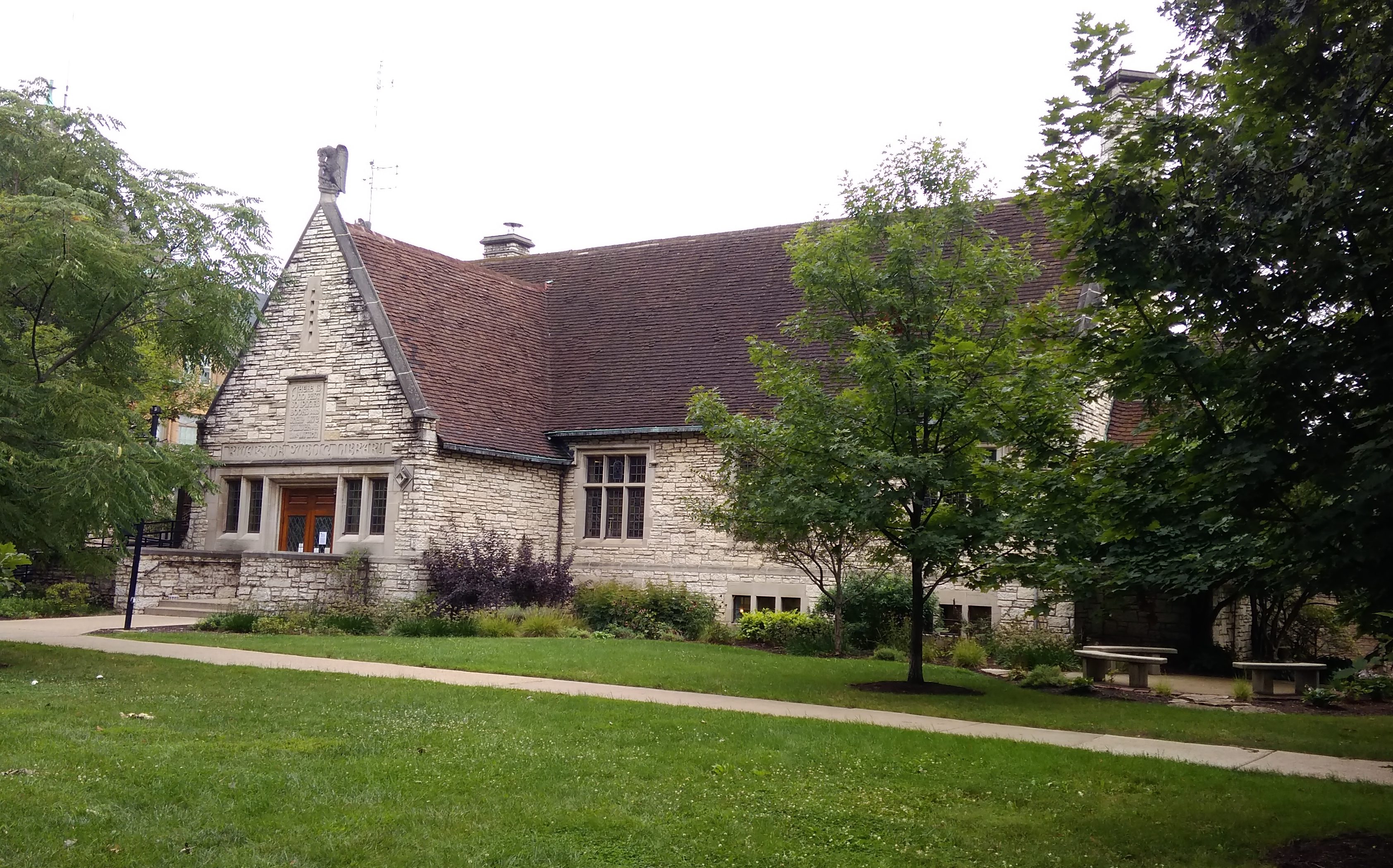
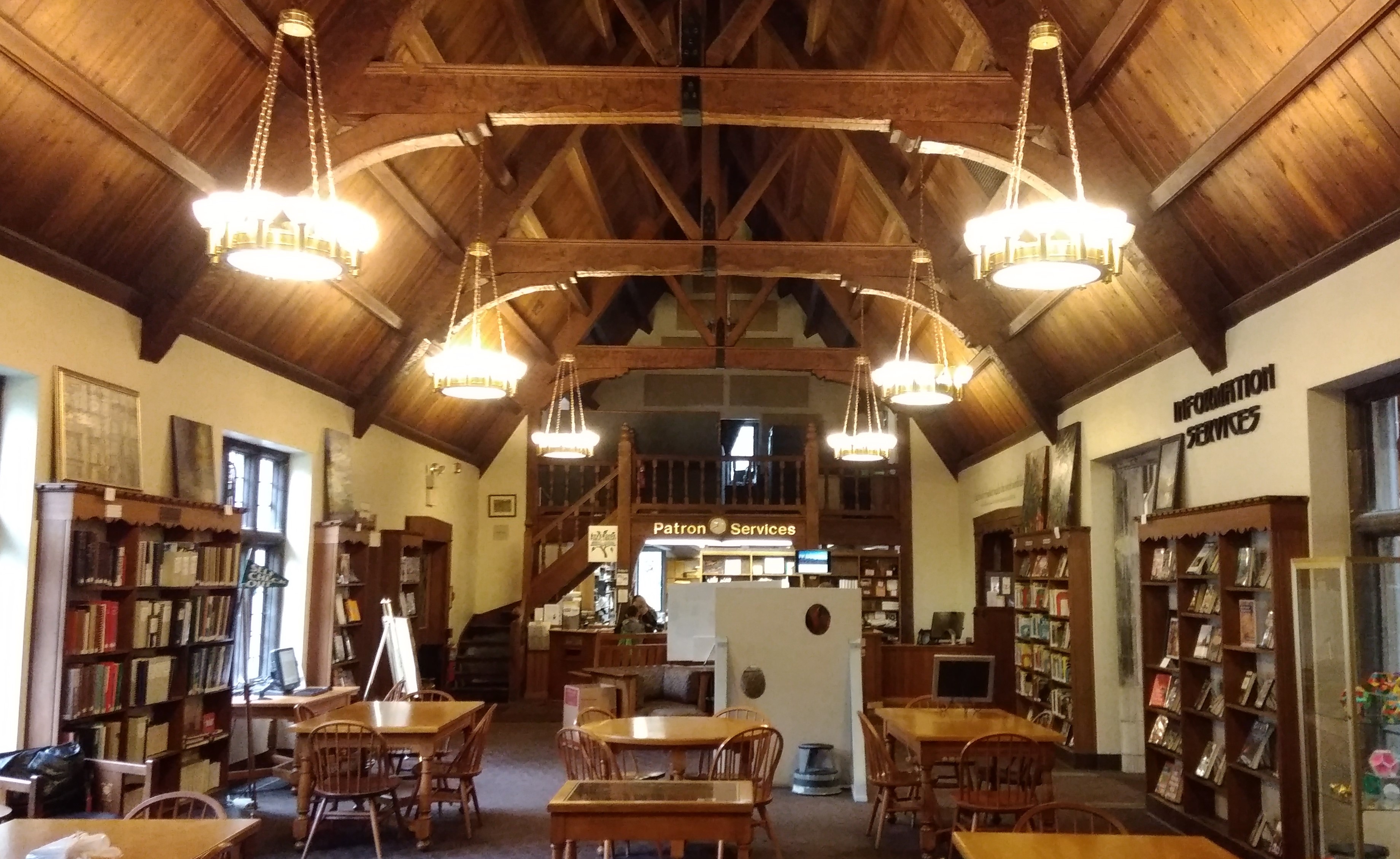
Near Guthrie Park is the Riverside Public Library, completed in 1931, which looks like a church. The architect is given as Connor & O’Connor, or simply “Mr. Connor” in this timeline.
On the inside it looks even more like a church. A certain kind of church, anyway.

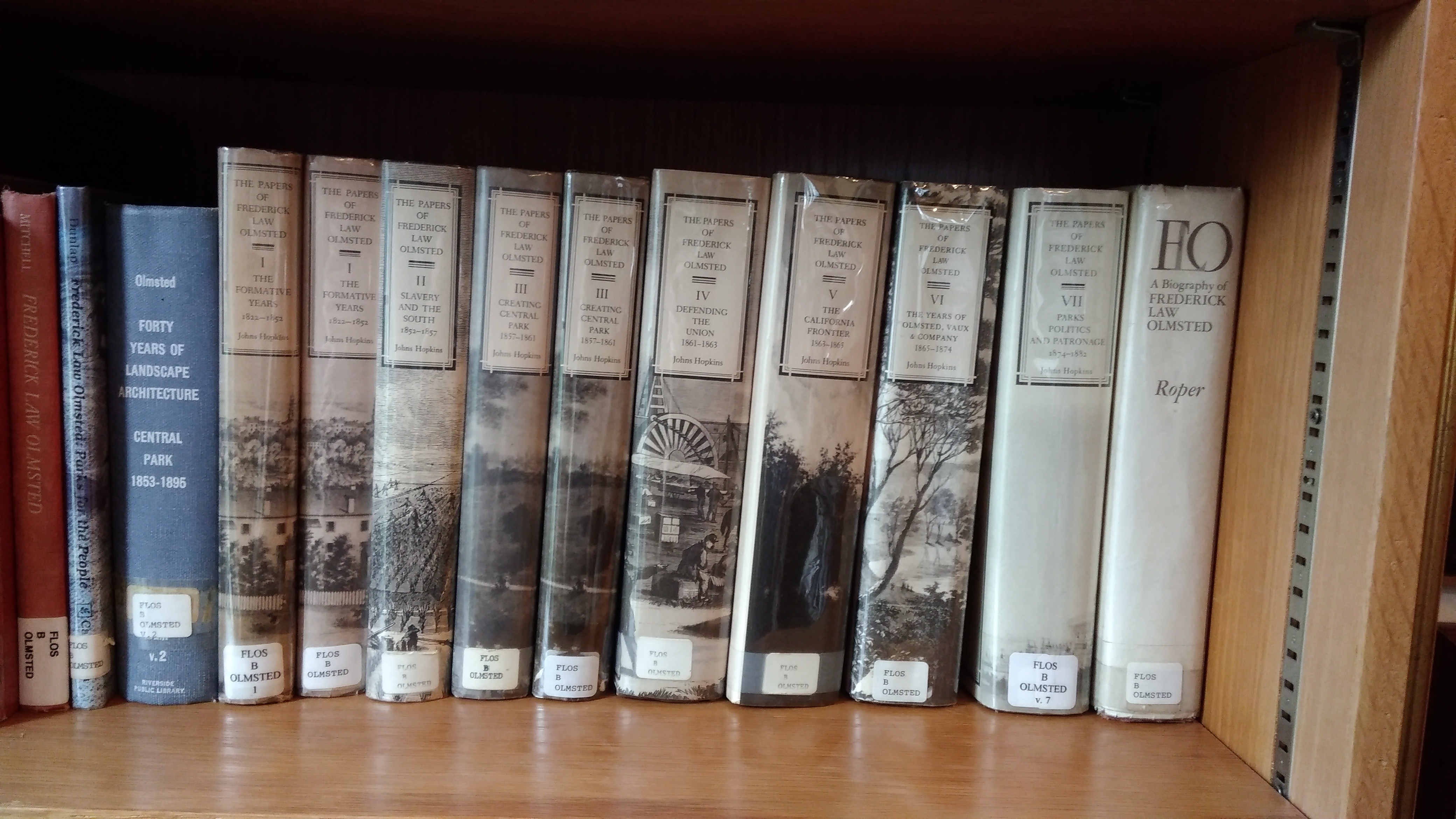
The library is the only one I’ve ever seen with an Olmsted collection.

The collection takes up a number of shelves in its own special niche.

Yellowstone, Badlands, Albert Lea, Etc. 2005

Part of a letter I wrote to Ed about 13 years ago, with a few relevant pictures and hindsight notes in brackets.

Aug 22, 2005

Time to start another letter, which I might as well subhead “Things About My Recent Travels That Didn’t Make It Into the Blog.” If letters had subheads, that is.

In some ways, I hope this is a pattern for future travels [mostly it wasn’t]. Of the nine nights we spent on the road, six were in a tent, three in a motel. Better still, of the six nights in a tent, four cost nothing. Call me a cheapskate, but it did me good to return every night to Yankee Jim Canyon about 15 miles north of Yellowstone, in Gallatin Nat’l Forest land, and crawl into the tent knowing that I paid nothing. Well, no extra charge, no insidious “user’s fee,” because some small bit of my taxes must go to support the Gallatin Nat’l Forest.

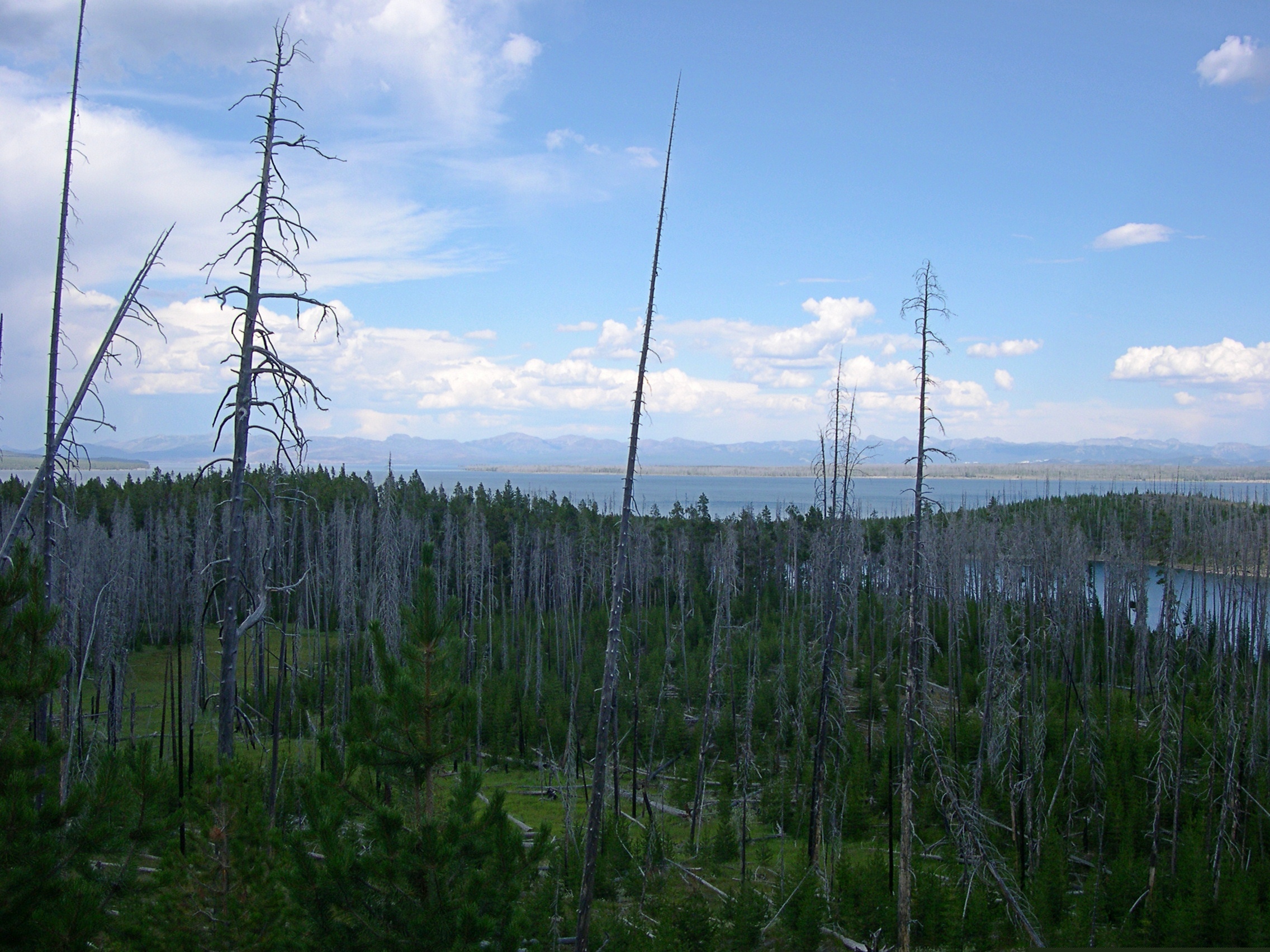
Some of the most striking things about the many striking things in Yellowstone were the places — whole mountainsides, in some cases — that had clearly burned down in 1988. Hundreds of grey-dead trunks, stripped of anything remotely alive, still stand, lording — if such be possible among trees — over forests of mid-sized pines, very much alive, the spawn of the great fire. In other places, hundreds of tree corpses have tumbled into random piles, also interlarded with young living trees. You can drive for miles and miles and see scene after scene like these. They say it was a hell of a fire, a complex of hell-fires, really, and I believe it.

[A post-fire landscape in Yellowstone in 2005, 17 years later.]Yellowstone 2005
I saw something in South Dakota that the rest of the nation can emulate: two kinds of X signs, marking traffic deaths I think. One says: “WHY DIE? Drive carefully.” And the other: “THINK: X marks the spot. Drive carefully.” For such a sparse population, South Dakotans seem to kill themselves often enough on the roads. Long winters, cheap booze, almost empty roads.

I recommend the drive along the Missouri River from I-90 to Pierre, SD — along state roads 50, 10, and mostly 1806, all of which also form a National Scenic Byway. Hilly, bleak territory largely given over to Indian reservations, though not quite as bleak-looking as Badlands NP.

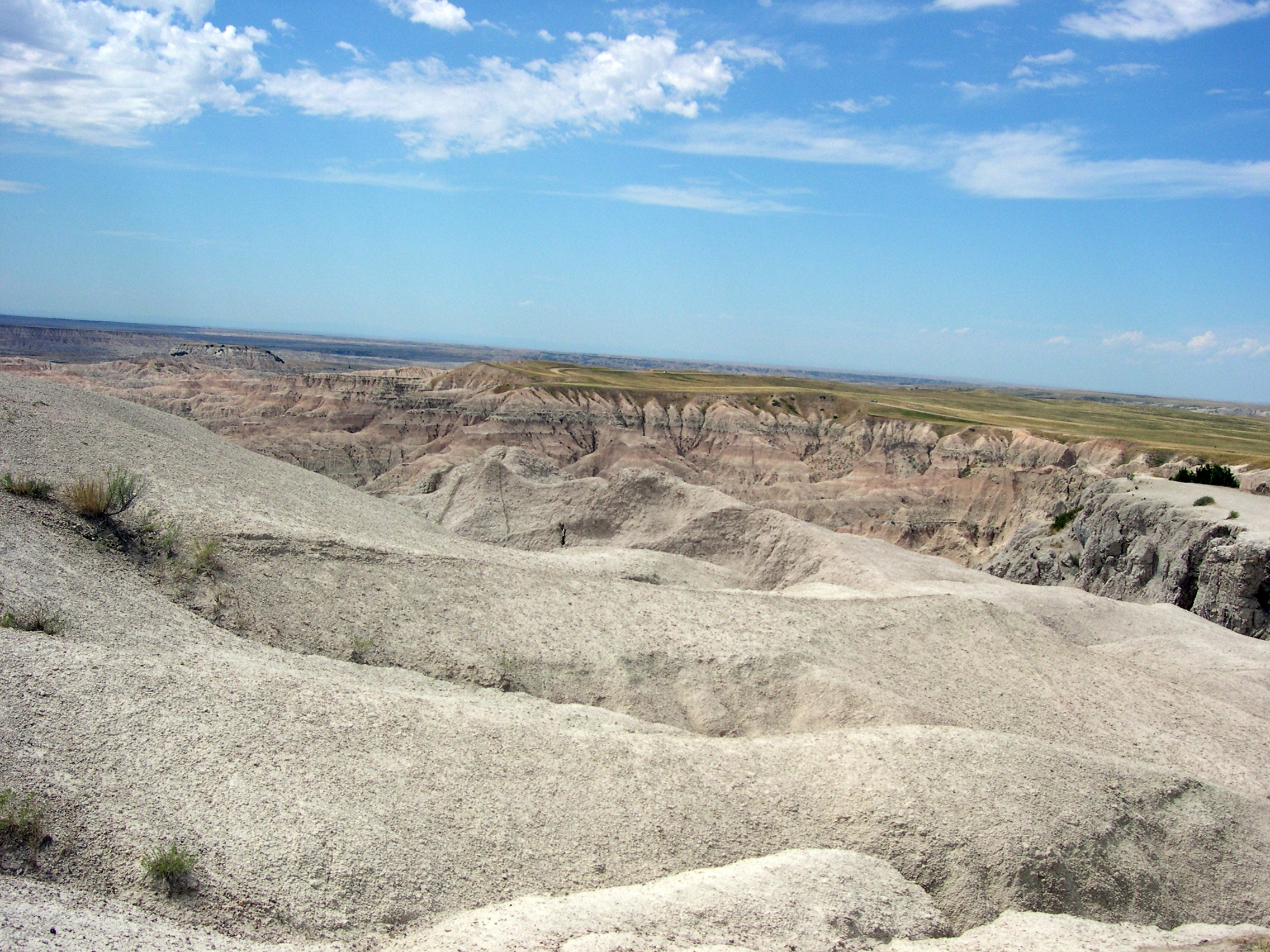
[Badlands NP, 2005]
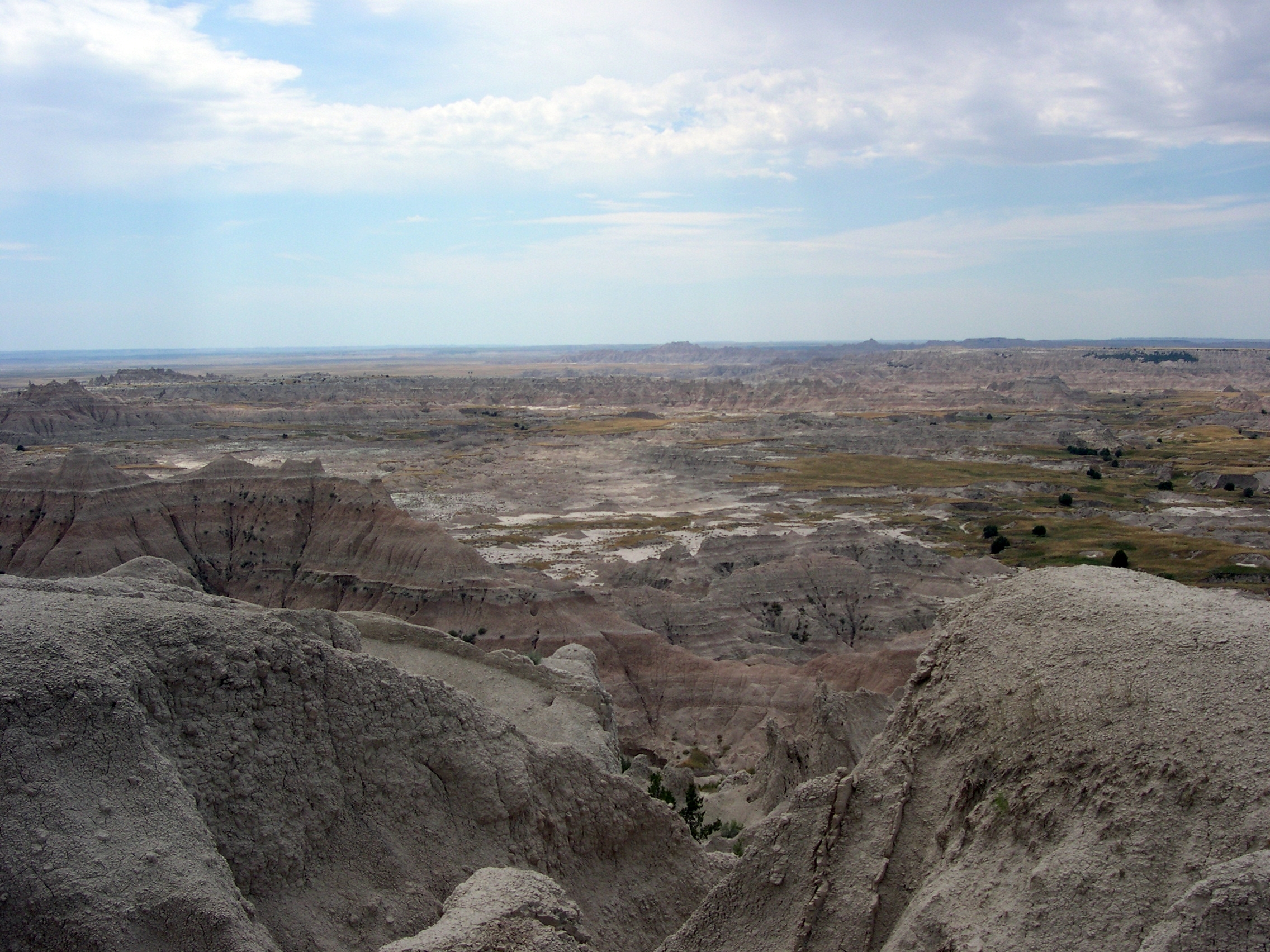
In places, except for the road, it couldn’t have been that much different than what Lewis and Clark saw. I never can remember, without looking it up, which one probably blew his brains out a few years after co-leading the Corps of Discovery. [Lewis] Clinically depressed, before there were clinics worth visiting, and before melancholia became depression. Anyway, if I remember right, there’s a monument to him near where he died, on the Natchez Trace. I saw it years ago. A lonely place to die.

We spent the first night out at a campground near Albert Lea, Minnesota. According to me (and only me), Albert Lea is important for two things. One I just noticed: it’s the closest town to the junction of I-35, the U.S. branch of the Pan-American Highway, and I-90, the Boston-Seattle transcontinental epic of a highway. [I’ve since learned that no U.S. road is officially called the Pan-American; it’s just custom that attaches the name to I-35.]

The other thing is that I was visiting Albert Lea for the second time, after a span of 27 years. What was I, a south Texas lad of 17, doing in south Minnesota en route to Wisconsin one August day in 1978? Am I repeating myself here? Maybe I mentioned that epic bus trip before. It was an important one for me. No family, distant states — Wisconsin seemed wildly exotic. Christmas trees grew in people’s yards.

Anyway, in 1978 we stopped for lunch in Albert Lea. I went with the bus driver and some other kids to Godfather’s Pizza, a place I’d never heard of. After that, I walked around a little, relishing the remoteness of the place.

In 2005, we encountered wildlife at the campground near Albert Lea, namely mosquitoes in great numbers. The place was fairly green and lush, so I guess southern Minnesota hasn’t had the drought that Illinois has had this year. When we were leaving the next morning, we drove down the town’s main drag and there it was: Godfather’s Pizza, looking like not much maintenance had been done since the late 1970s, though of course I had no memory of how it looked then, just that I was there. [In Eau Claire this year, we ordered a pizza from a Godfather’s and ate it in our room. I ordered from there because of my experience 40 years earlier. And it was close.]

One other note, for now: Hot Springs, SD, is a lovely town. Near much of the main street flows a river, and alongside most of the main street across from the river are picturesque sandstone buildings, vintage pre-WWI. Evidently, it was locally inexpensive building material.

I left the family at a spring-fed swimming complex while I looked for a pay phone, since my cell phone refused to transcend the hilly surroundings. Argh, what an odyssey that was – “Yeah, we used to have a phone…” I’d foolishly agreed to do an interview that day, figuring I could use my cell. Anyway, after much to-do, I found a phone, did the interview, and then relaxed by the riverside, which has a sidewalk and a hot spring (Kidney Spring) under a gazebo. Free for all to drink, with a metal plaque describing its properties. Not bad. A little salty, but not bad, even on a hot day in South Dakota.