Into the Silence

When I went to Half Price Books the other day, I knew I’d come away with something. Even more because I had a gift card, though I don’t remember where or when I got it. The code on the back was scratched off, so I couldn’t tell whether it had any value by checking online. I figured the clerk could tell me, and so she did: $15.

More than enough to buy Into the Silence by Wade Davis (2011), subtitled “The Great War, Mallory, and the Conquest of Everest.” That subtitle alone was almost enough to sell me on it. Not that I have a particular interesting in books about mountaineering, though I’ve read a few. But I do have an interest in the Great War and about journeys or expeditions to remote places, during which the participants die or not.

In this case, of course, Mallory and Irvine did not come back from Everest in 1924. Mallory managed to survive the war — which many of his friends did not — but Everest got him. I remember reading about the discovery of Mallory’s body in 1999. Irvine has yet to turn up, and no one knows whether they made the summit or not.

Also the fact that Wade Davis wrote the book was a recommendation, though I haven’t read any other books of his, even the one about Voodoo. Not yet. Anyway, he’s an insanely accomplished fellow, so I suspect I’m in for a good read.

Ravinia Circular ’17

We received the 2017 Ravinia Festival circular in the mail recently. Like last year, I decided to check to see whose tickets command the biggest bucks at the storied north suburban outdoor venue. Last year was something of a mystery, but never mind. This year, less so, at least in my opinion, but in any case at a price I’m unwilling to pay.

Who are the top draws? Performers commanding more than $100 for reserved pavilion seats include Willie Nelson, Aretha Franklin, Sammy Hager, Common, Diana Krall, Moody Blues, Sheryl Crow, Joshua Bell, Lang Lang, Tony Bennett, Darius Rucker, Santana, Alanis Morissette, John Mellencamp, Frankie Valli, and Stevie Nicks.

My reaction to the entertainers on the list is hm, interesting; or, they’re still around (alive)?; or who? All first-water performers, no doubt, but no one should charge that much, at least according to the Elvis Test, which I’m sure I’ve mentioned before.

Note the prices on these 1957 Elvis posters. Prices vary, but $3 is toward the upper end. Accounting for inflation over the last 60 years, $3 then = $26.31 in our time. Add another $5 or so because sound systems are so much better now, and another $5 because Ravinia is such a nice place, and needs to be maintained. I’ll even throw in a few more dollars just to round things up. So no ticket for a singer should cost more than $40, because no one is better than Elvis in his prime. A ridiculous idea, maybe, but I like it.

Who gets less than $40 at Ravinia? This year, the CSO for some of its concerts, and a scattering of classical performers. But I will say this for Ravinia: some of the lawn seats for its concerts, which is the place to be anyway unless it’s raining, are reasonable at $10 (though they’re jacked up during A-list concerts).

The top draw this year, according to the accountants, is Stevie Nicks at $200. She’s pushing 70 pretty hard these days, and I hope she’s as mellifluous as she was when I saw Fleetwood Mac on August 17, 1980, at the HemisFair Arena. No doubt her 2017 show would push all the right nostalgia buttons. But I can find ways to do that for a lot less.

Speedy Gonzales 420

Rain, rain, rain. To balance the pleasant weekends we’ve had in April, the last one was cold and very wet. On Saturday the water came down practically all day, pausing in the wee hours of Sunday and early in the day, and then starting again.

I looked at a national temperature map on Sunday night and a weird blue gash of a cold front extended southwest from the Great Lakes as far south as western Oklahoma, signifying temps in the 40s and 50s. Thus Chicago was colder (at 43 degrees F) than either Billings, Mont. (61) or Fargo (57), both of which are west of the gash. And it was 65 degrees in Indianapolis, 71 in St. Louis. But those places had the cold front to look forward to.

One thing to do during such days is to stay home and watch cartoons. We happened to have a disk around the house featuring an assortment of ’40s and ’50s Termite Terrace shorts. One was “Gonzales’ Tamales” (1957). Been a long while since I’d seen a Speedy Gonzales cartoon, maybe 40+ years since I’d seen this particular one, and I’m not sure Ann had ever seen one.

The closed caption titles happened to be on. Things were moving along: Speedy was being speedy, outwitting the gringo Sylvester, and so on, when Speedy sings a version of “La cucaracha.” Then I had a Did he say what I thought he said? moment. I rewound a bit, and sure enough, he did.

The imdb describes the scene: “Around 4:42, Speedy is heard singing a spoof of the Mexican folk song ‘La cucaracha’ with nonsense words in odd Spanish which could be transcribed as: ‘La cucaracha, la cucaracha, ya no puede caminar. ¿Por qué no Fanta? ¿Por qué no tiene marijuana par fumar?’

“This would seem to mean: ‘The cockroach, the cockroach, she can’t walk any more. Why not Fanta? Why doesn’t she have marijuana to smoke?’ The Fanta reference is the most puzzling part of the verse. But the mention of marijuana is clear, and how the artists got it past the censors would probably be a good story in itself.”

Heh-heh. I’d guess that there wasn’t much of a story in getting it past the censors. Probably Friz Freleng and Warren Foster (the writer) put it in to see whether the censors would notice. No one did. That’s entirely plausible. I’m sure I didn’t notice all those of years ago, and I might not have noticed this time had the titles not been on.

Dogs Over the Decades

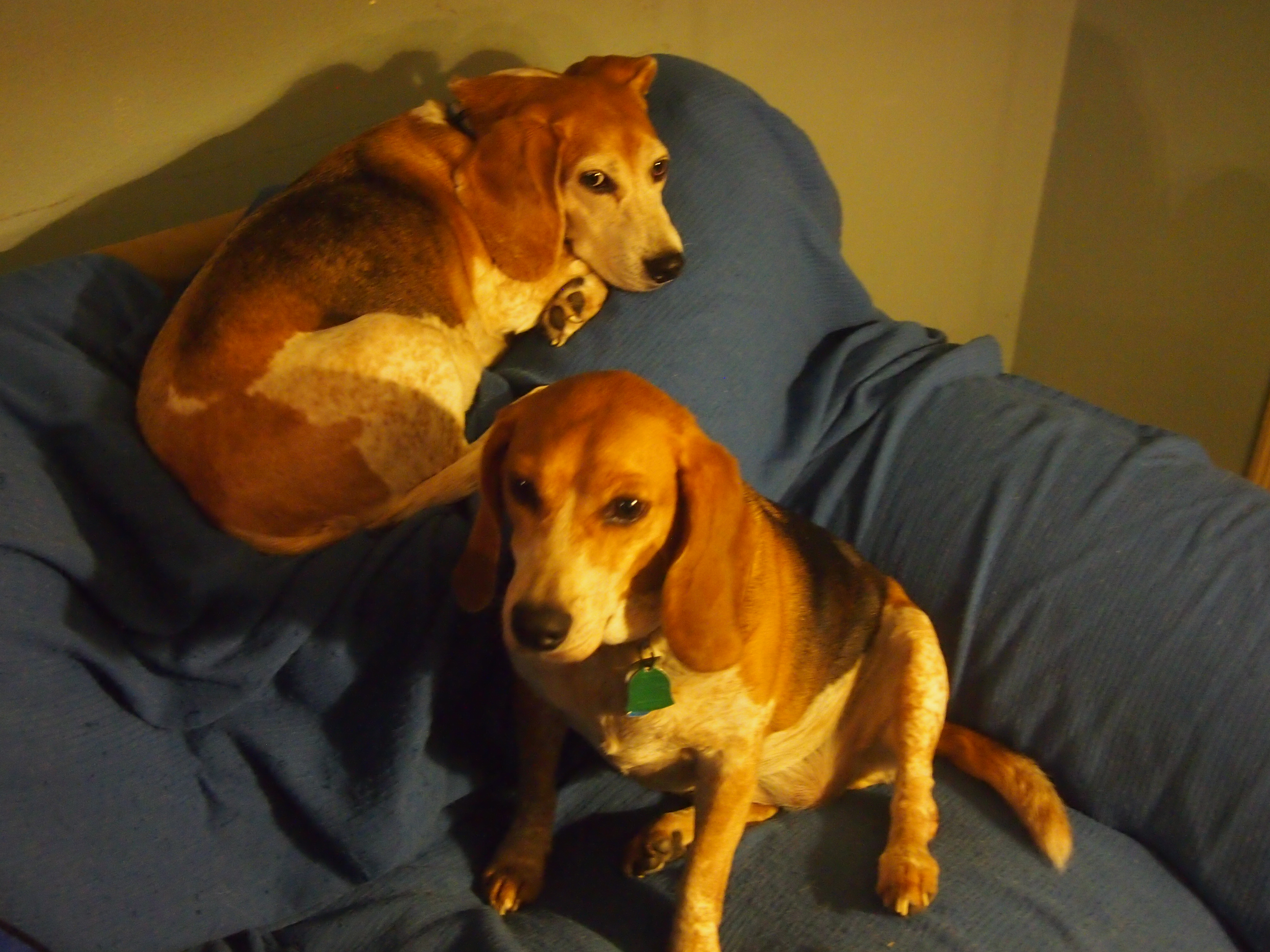
Our dog’s been with us four years this month. I won’t post another picture of her, photogenic as she is. I have other pictures of dogs I’ve known, or met.

The first dog I remember — barely — was Caesar.CaesarIt’s impossible to tell in this early ’60s-vintage picture, but he had a spot of pink fur next to his nose. At least, that’s what I remember as a very small child. Being a dog that roamed parts of semi-rural North Texas, he encountered (so I’m told) a nest of young rattlesnakes one spring, and that was all for him.

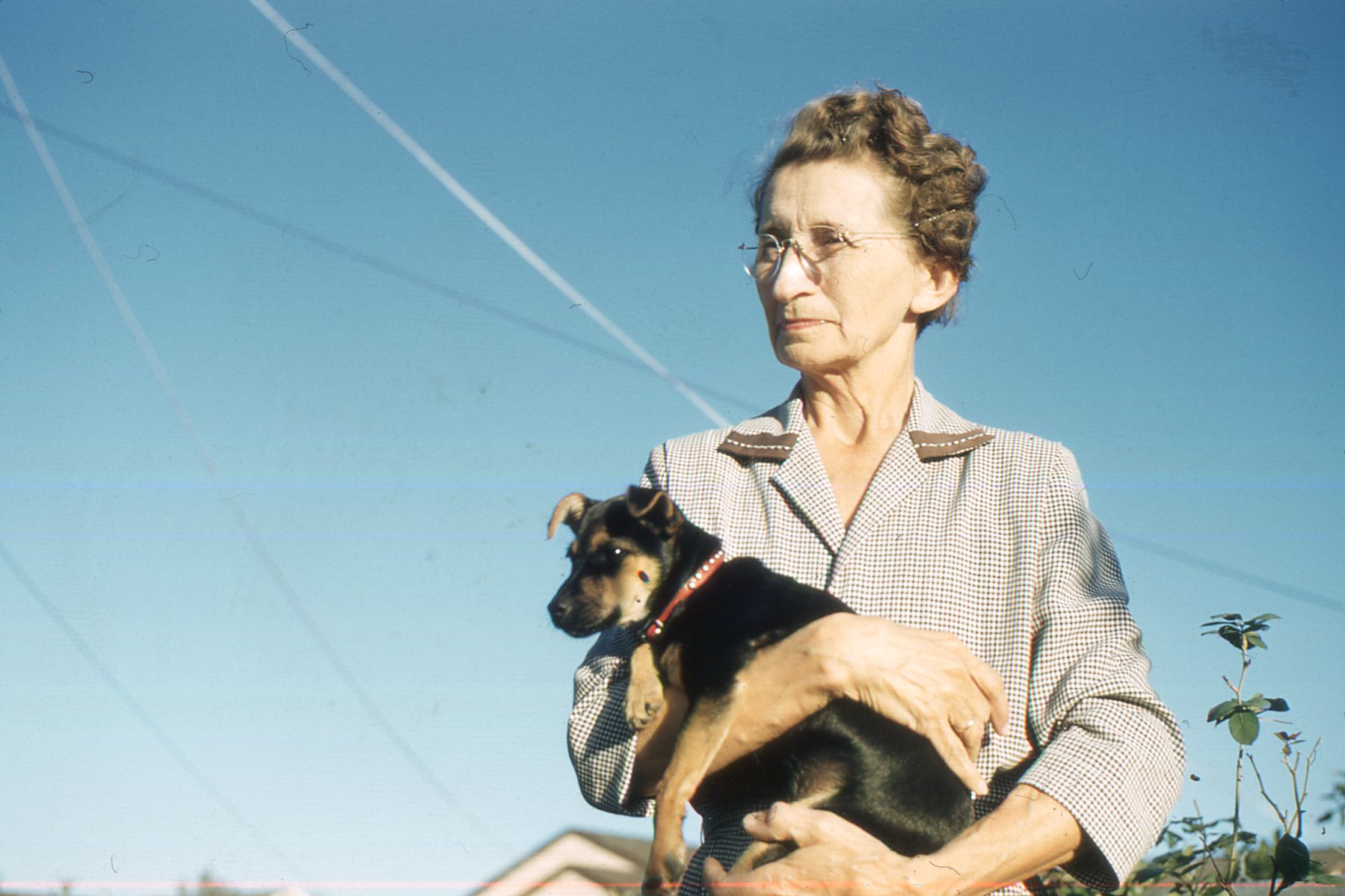
This is my grandmother in the 1950s, holding a young Georgette.GrandmaandGeorgetteI remember Georgette well. She lived with Grandma in San Antonio until the late 1960s, when the dog died of natural causes. Caesar was one of her pups.

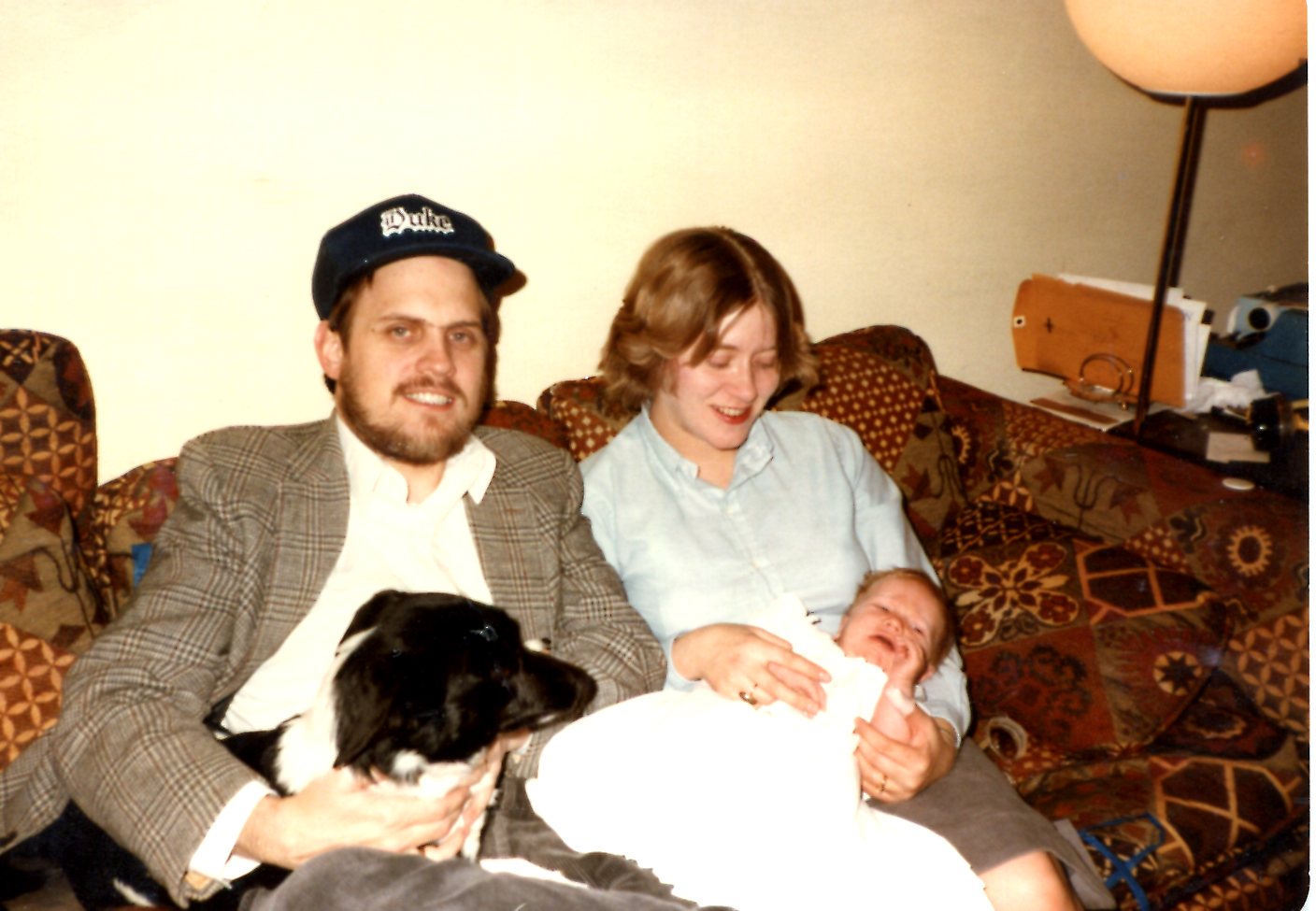
Jay and Deb’s dog Aloysius, with the young family in 1983. I met him a number of times during ’80s visits, when my nephews were small.AloysiusTheir dog Brynna. I think I took this picture during our visit for Thanksgiving 2001.
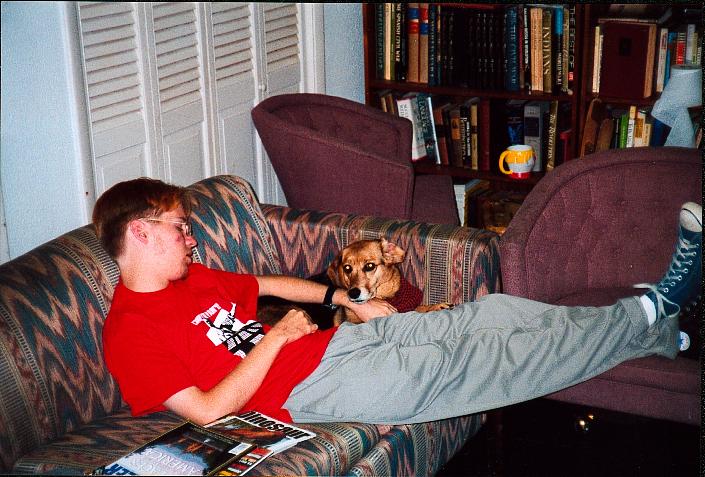
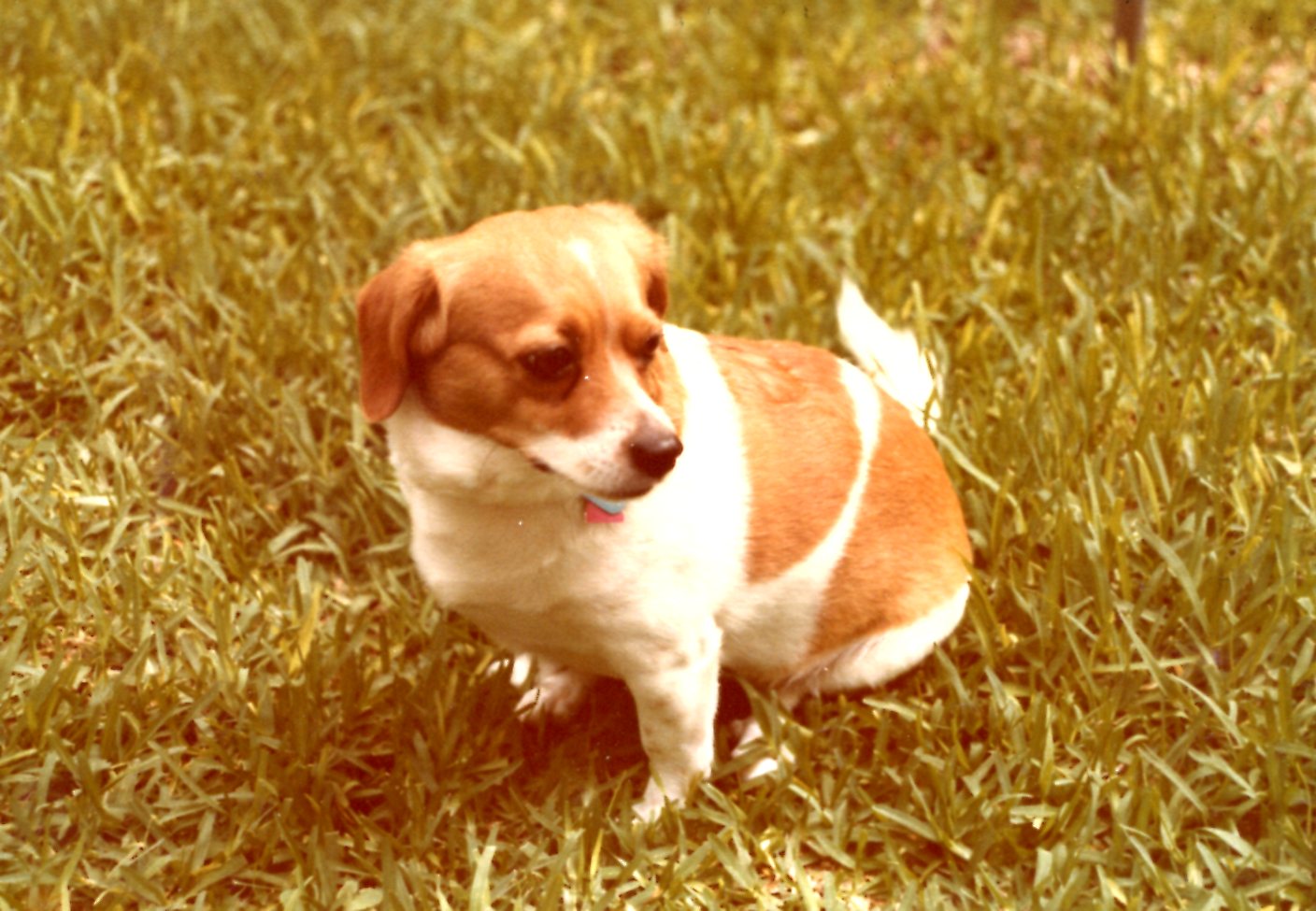
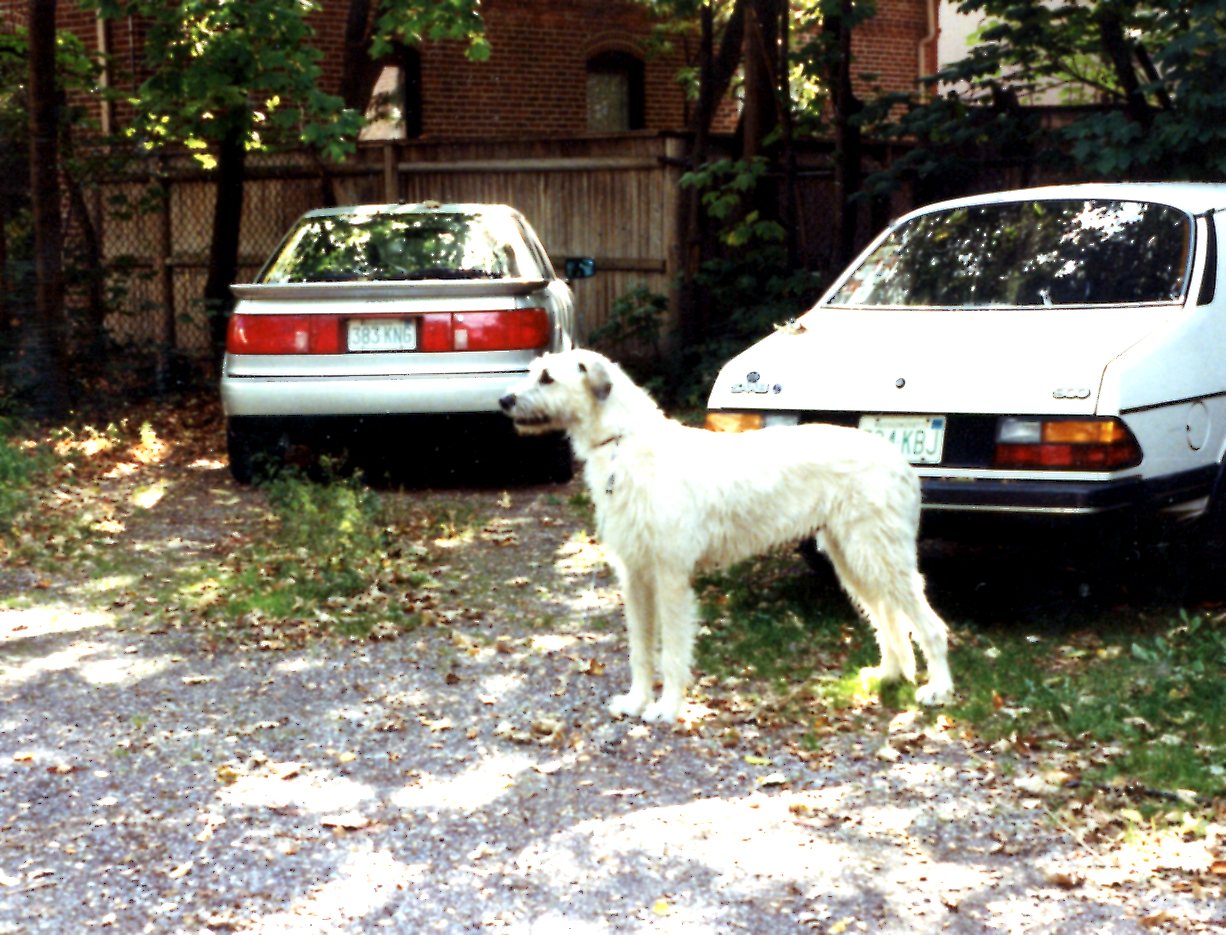
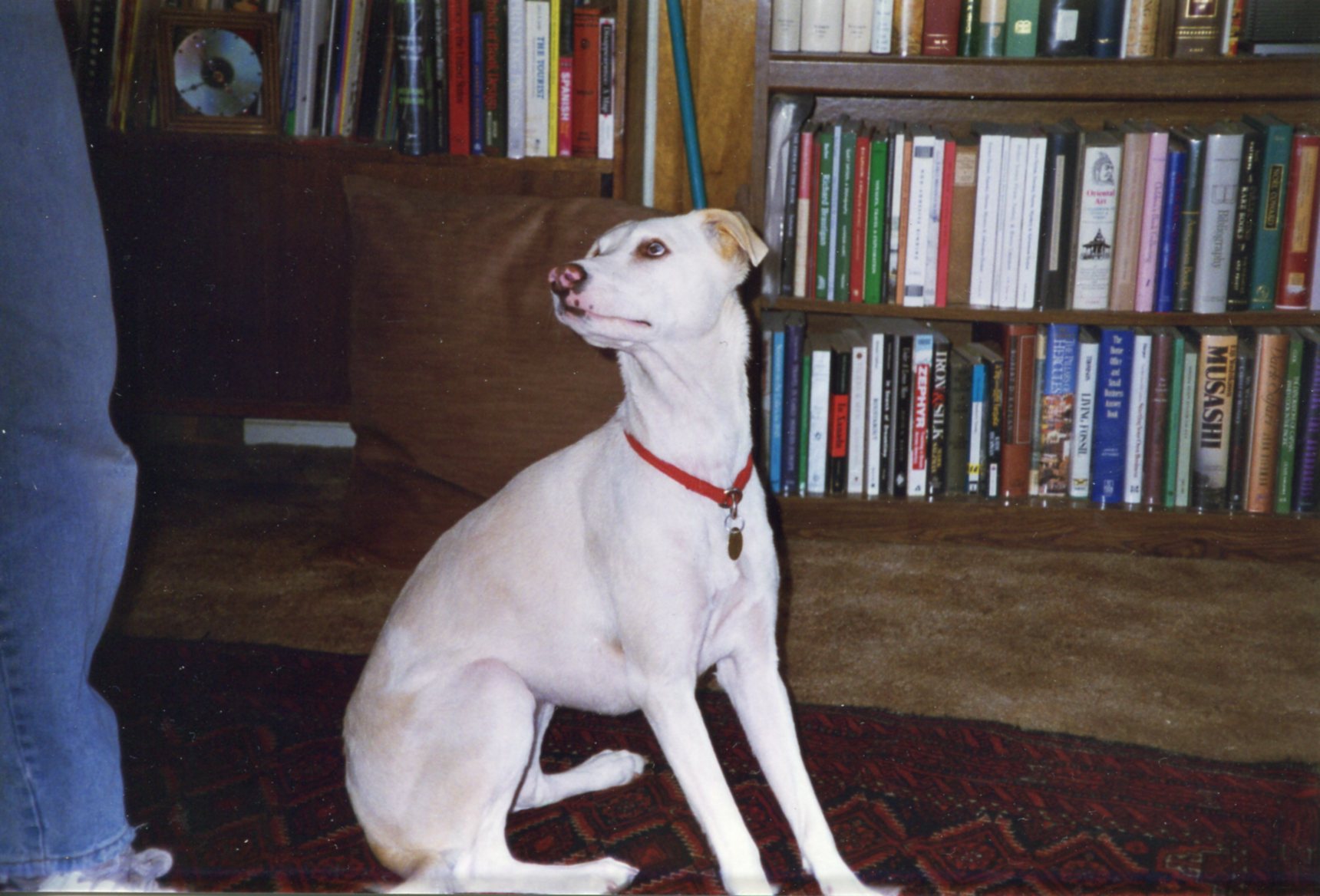
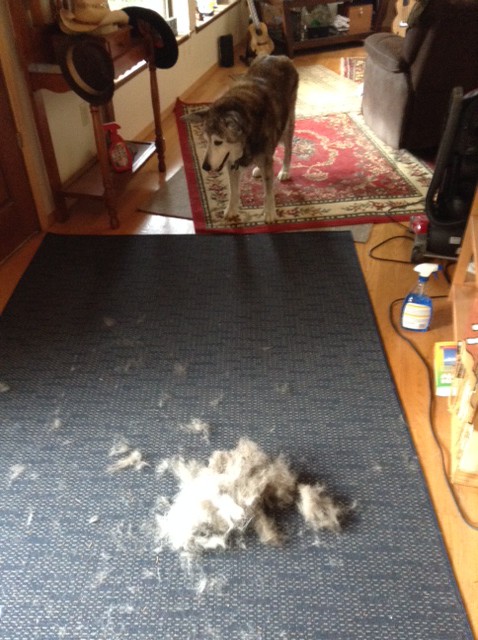
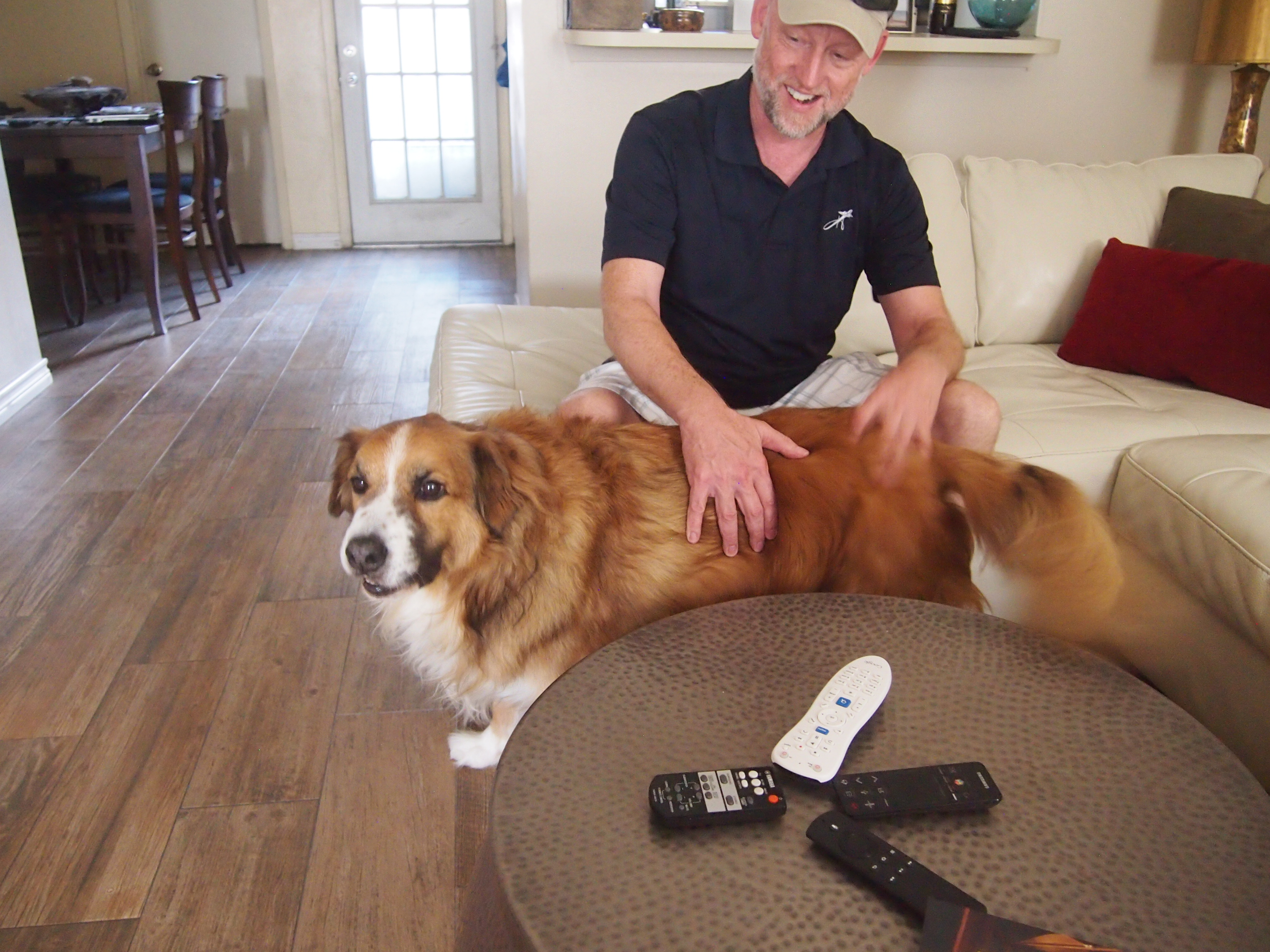
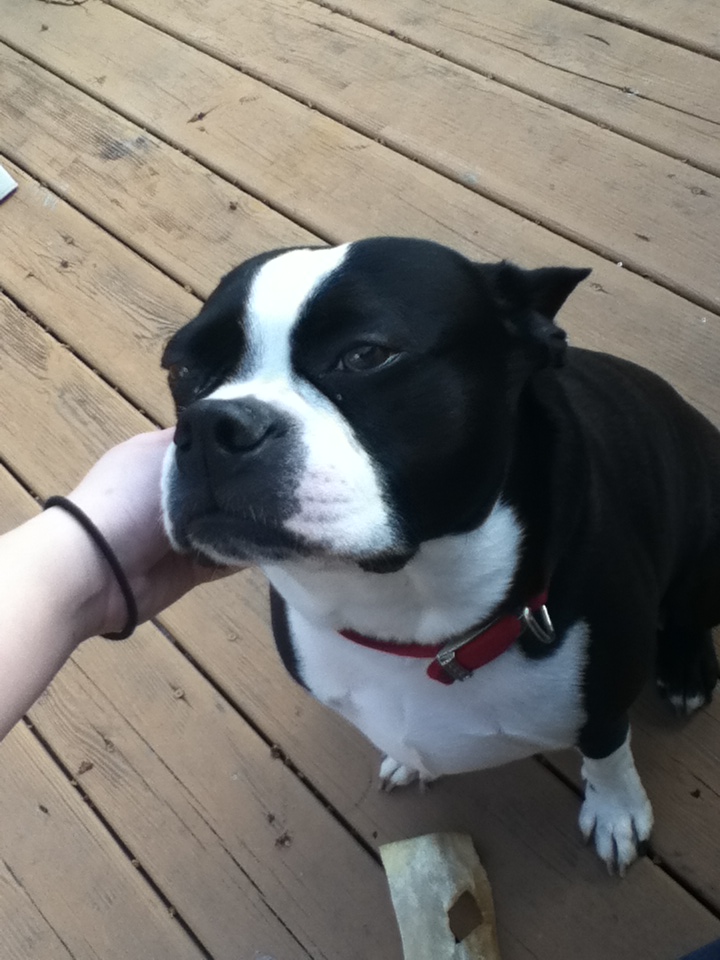
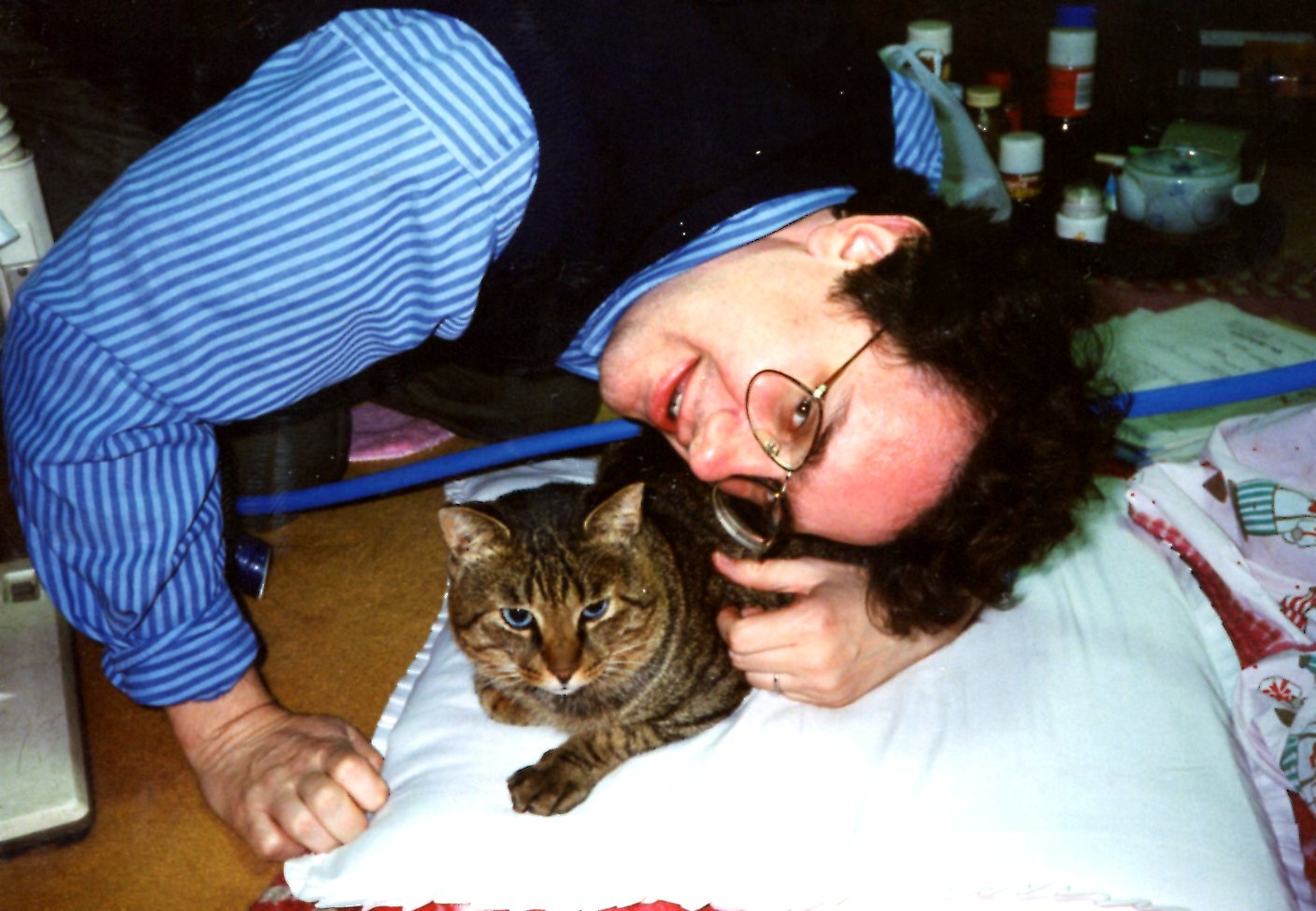
CollegiatePose-BrynnaJay’s current dogs, Holly and Chloe. I get to visit them when I go to Dallas. They spend a lot of time in this particular spot in the living room.Holly ChloeAnd of course, Katie. The dog my mother had when I was in high school and beyond, 1976 to 1992, to be exact. This was the small dog that got a hold of a big bag of doughnuts, a half dozen or so, and ate them all. They didn’t stay eaten.KatieMy friends Rich and Lisa in Massachusetts had an Irish wolfhound in the 1990s named Charlotte. I remember her well during our visit for New Year’s 1993.CharlotteMy friends Ed and Lynn in Arizona had Bosco, whom we met during our visit in 1997. He knew some tricks, but I can’t remember what they were now.Bosco1997Late in his life, Ed had an elderly dog named Bert living with him in Washington state. Ed sent me this picture ahead of my visit in 2015, to show how much fur Bert shed.Bertandfur2015My friend Tom in Austin has a dog called Roscoe. He’s fond of jumping on you when you come into the room.RoscoeLilly’s friend Rachel has a dog called Riley.RileyFinally, one cat. In Osaka, Yuriko used to have a cat named Michael. Picture ca. 1994.Michael

I got along with him all right, mainly because he was fond of lying around like a dog.

The London House Hotel & The Tower on Top

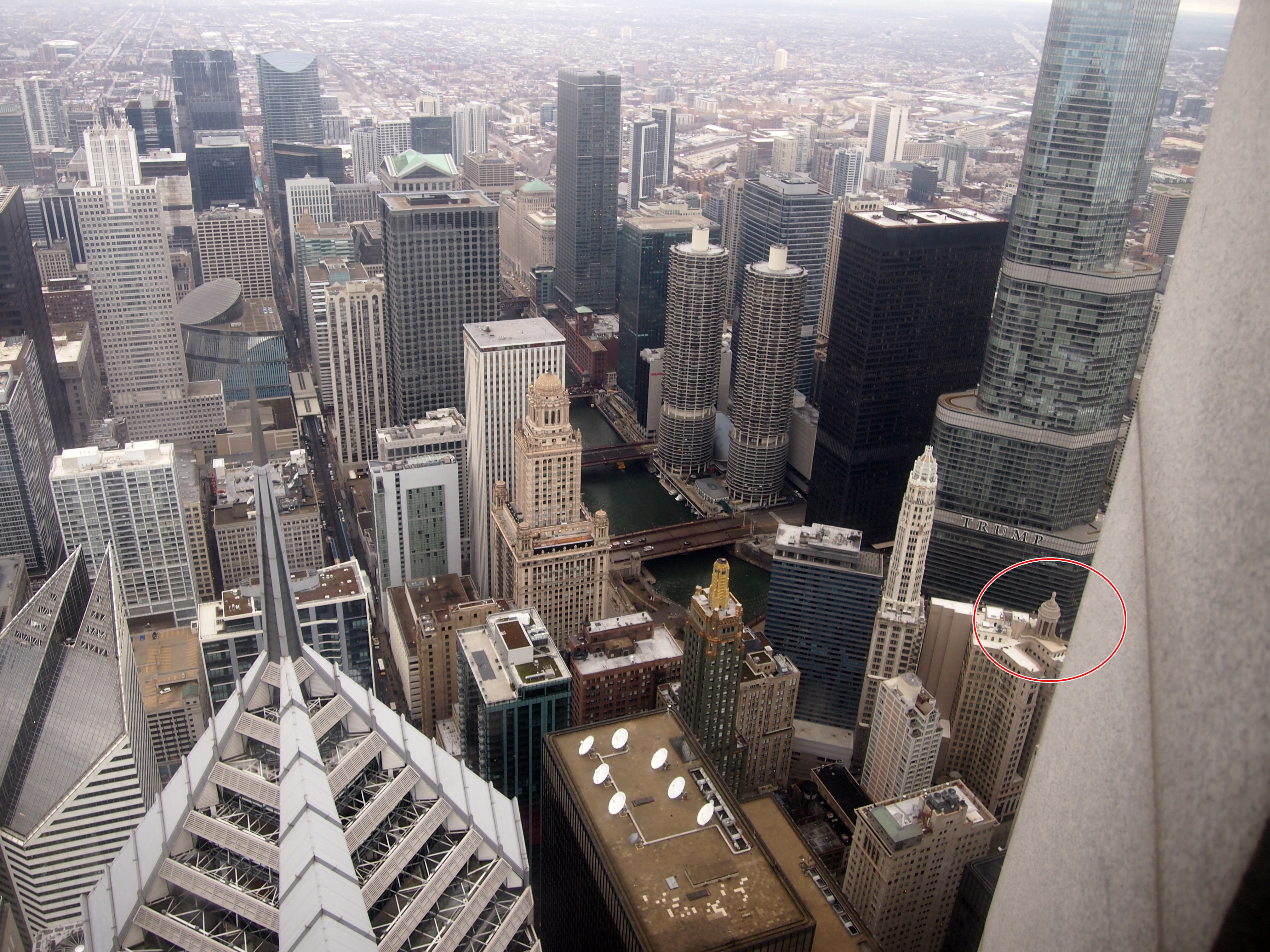
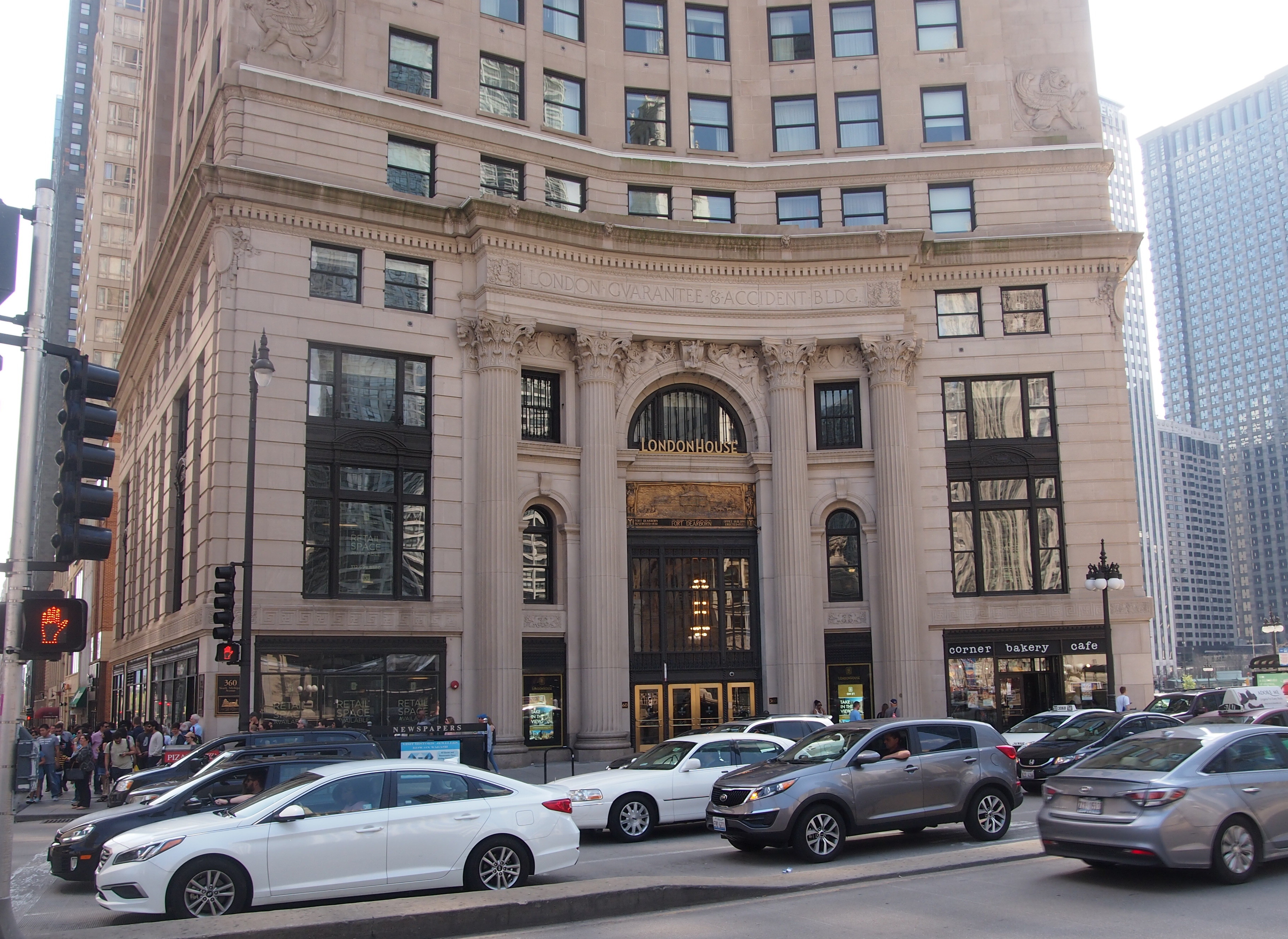
When I took pictures from high up in the Aon Center, I didn’t know that a few weeks later, I’d be on top of another nearby building. Not as tall, but with also with a terrific view of Chicago. And one (formerly) associated with an insurance company: The London Guarantee & Accident Building, 360 N. Michigan Ave., vintage 1923.

Chicago architect Alfred S. Alschuler designed the Beaux Arts tower for the U.S. branch of a British insuror, and since last year it has been occupied by the London House Hotel. I didn’t know that, probably because I don’t keep track of the Chicago real estate market in detail right now. I still think of it as an office building that was home to Crain’s Chicago Business for a time, and which also used to count the Turkish Consulate as a tenant. Once upon a time, Armenian sympathizers would periodically protest on the sidewalk outside.

There’s a tower on the top of London House, marked with a circle.

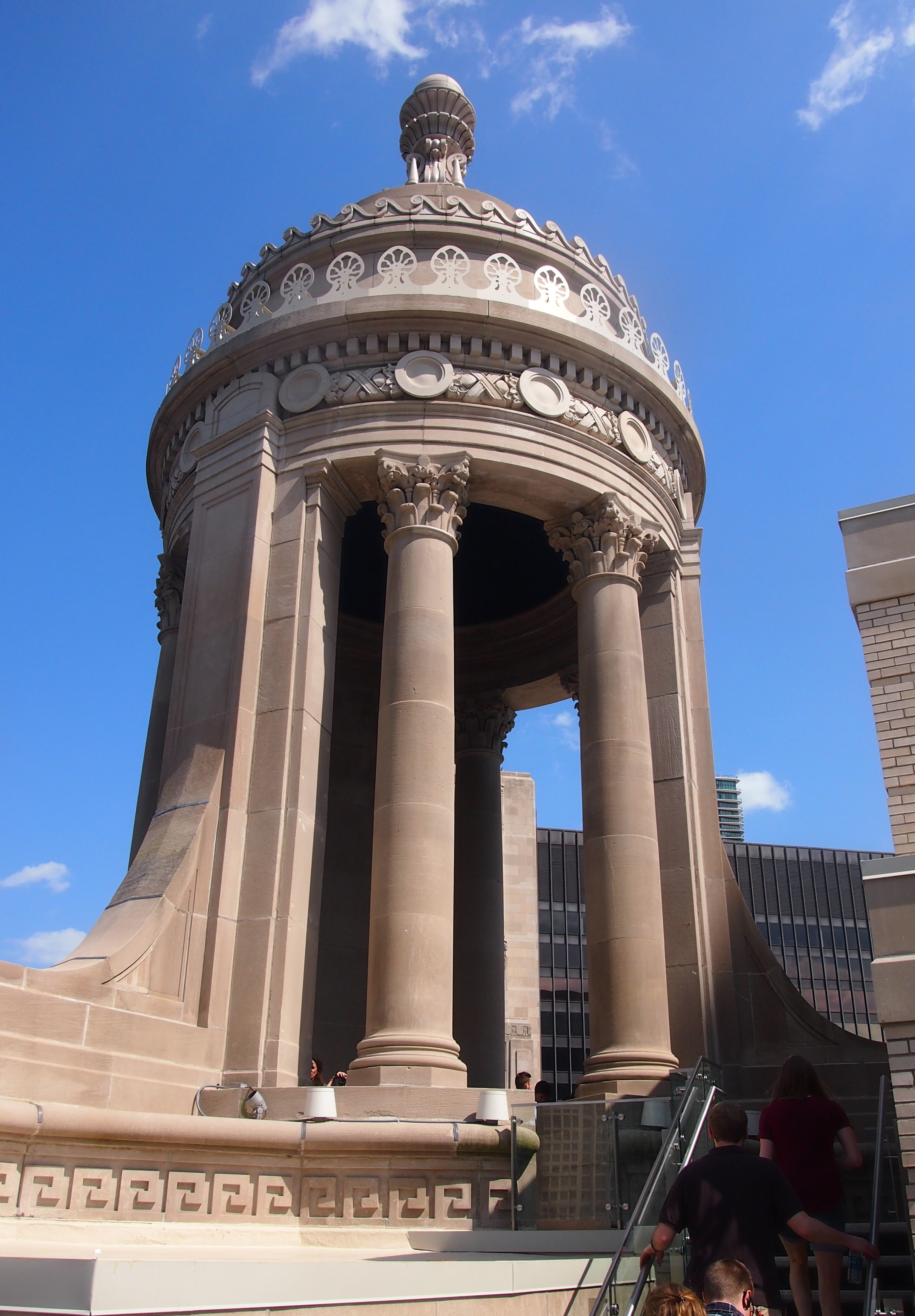
Chicago from Aon Center 2017Up close, it looks like this.
London House Chicago cupola 2017The tower is supposedly modeled after the Choragic Monument in Athens. I’m not expert enough to know, but there are visual similarities at least.

The London Guarantee & Accident Building was on the Chicago Architecture Foundation’s Hotel Boom tour, and it was the only property we explored beyond the exterior and the lobby, though those parts are interesting too.
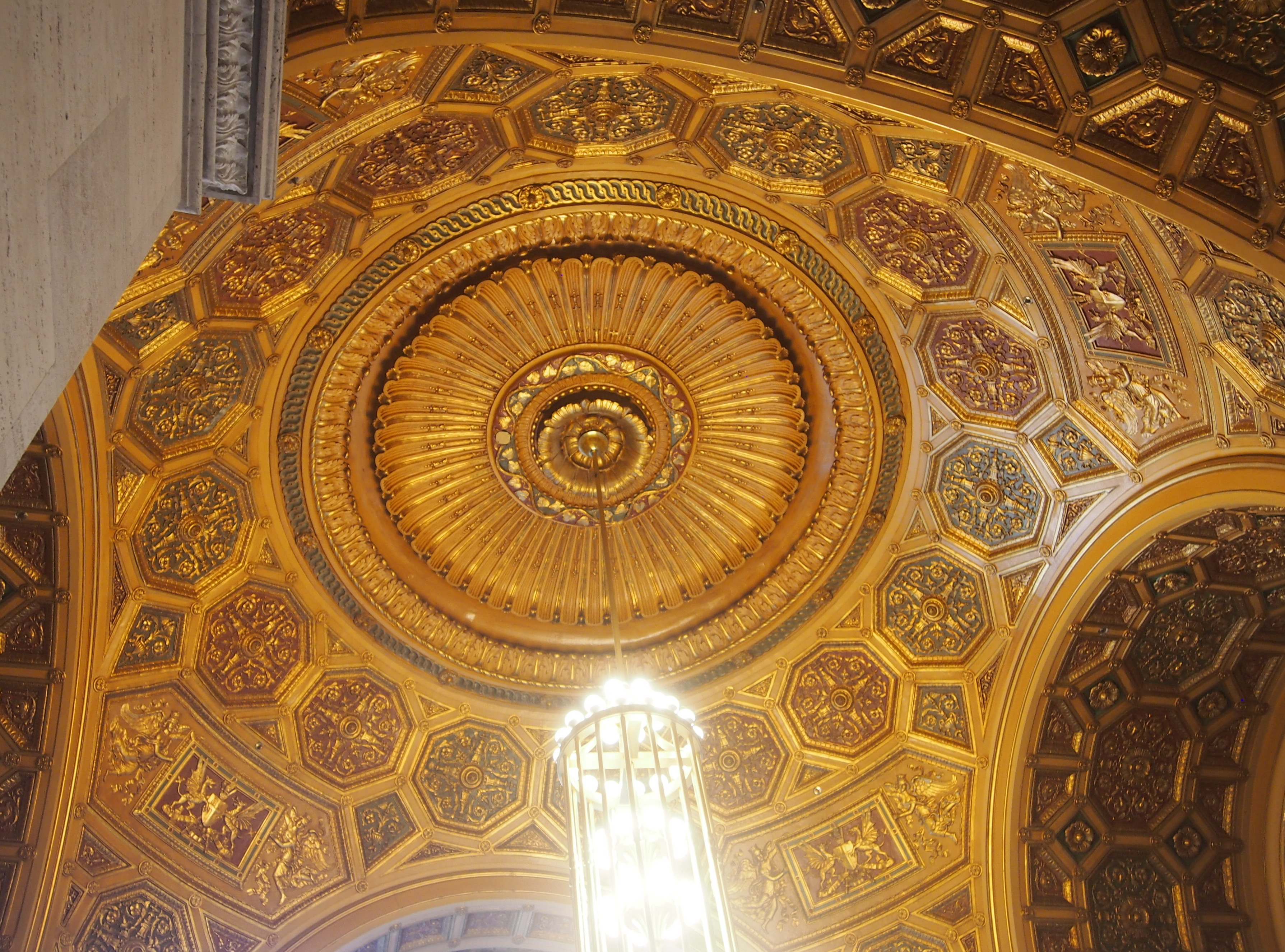
London House Hotel Chicago 2017This is the ceiling inside the Michigan Ave. entrance.
London House Hotel Chicago 2017The docent said that it was original to the building, but had been uncoveraged fairly recently. At some point probably in the 1950s or ’60s, it had been Eisenhowered by a lower ceiling.

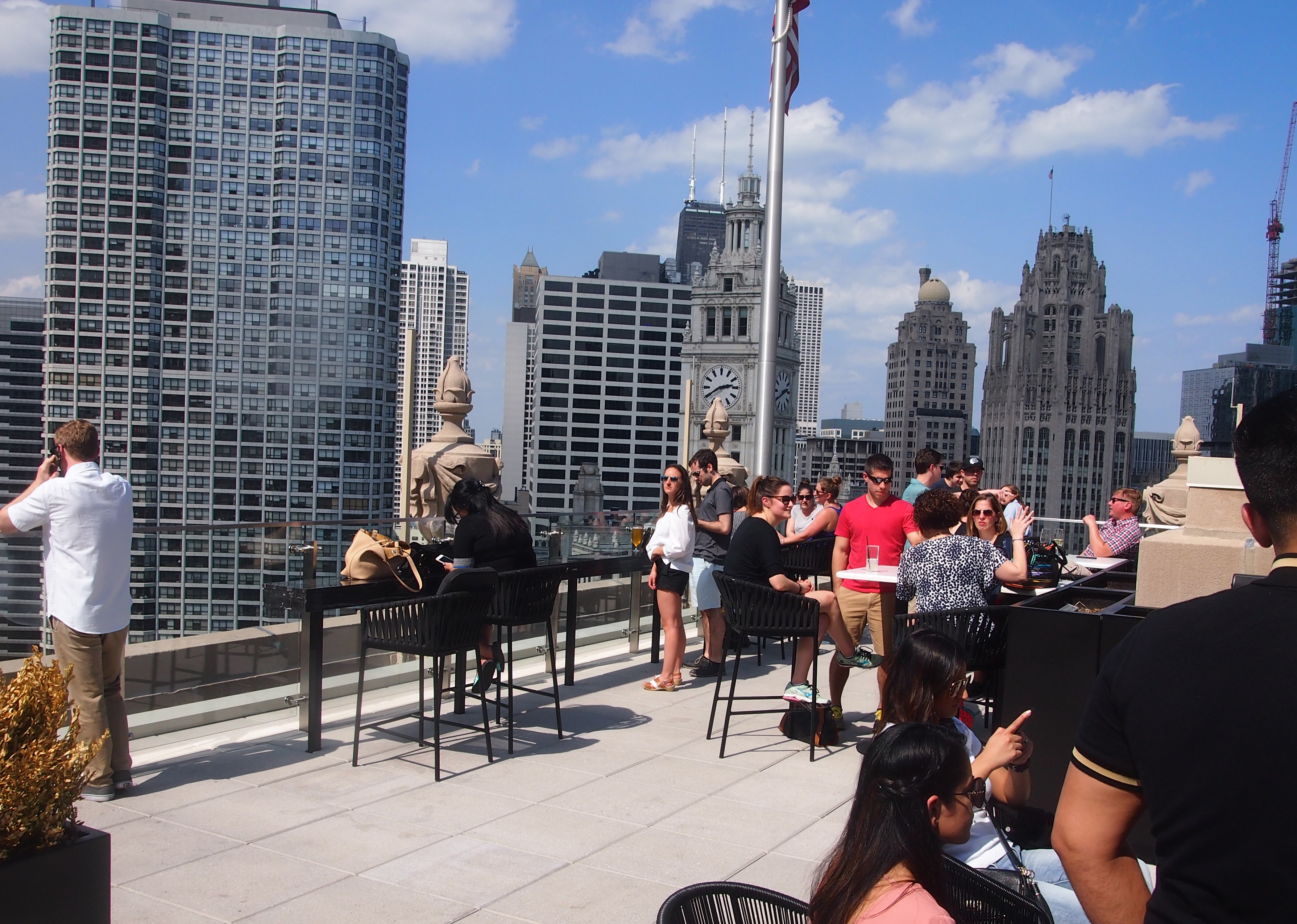
From there we looked around the lobby, and then took an elevator to the 21st floor, which is occupied by a bar. On a spring Saturday afternoon, the place was packed. Then, another elevator takes you up to two levels of outdoor terraces. One of which has tables and chains and (on a warm day) people with their drinks.

London House Hotel Chicago rooftop 2017

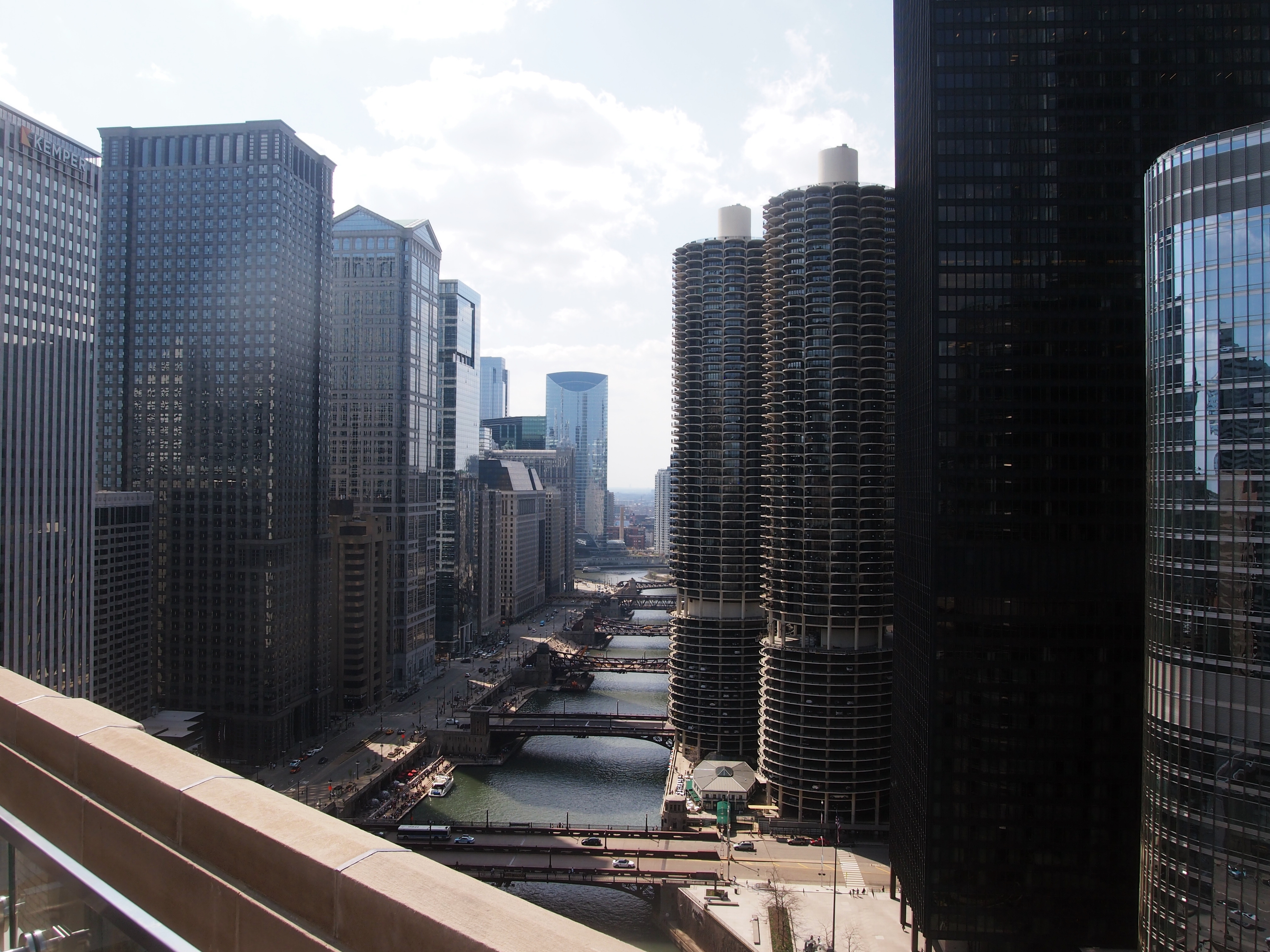
The views are exceptional. Looking west down the Chicago River.
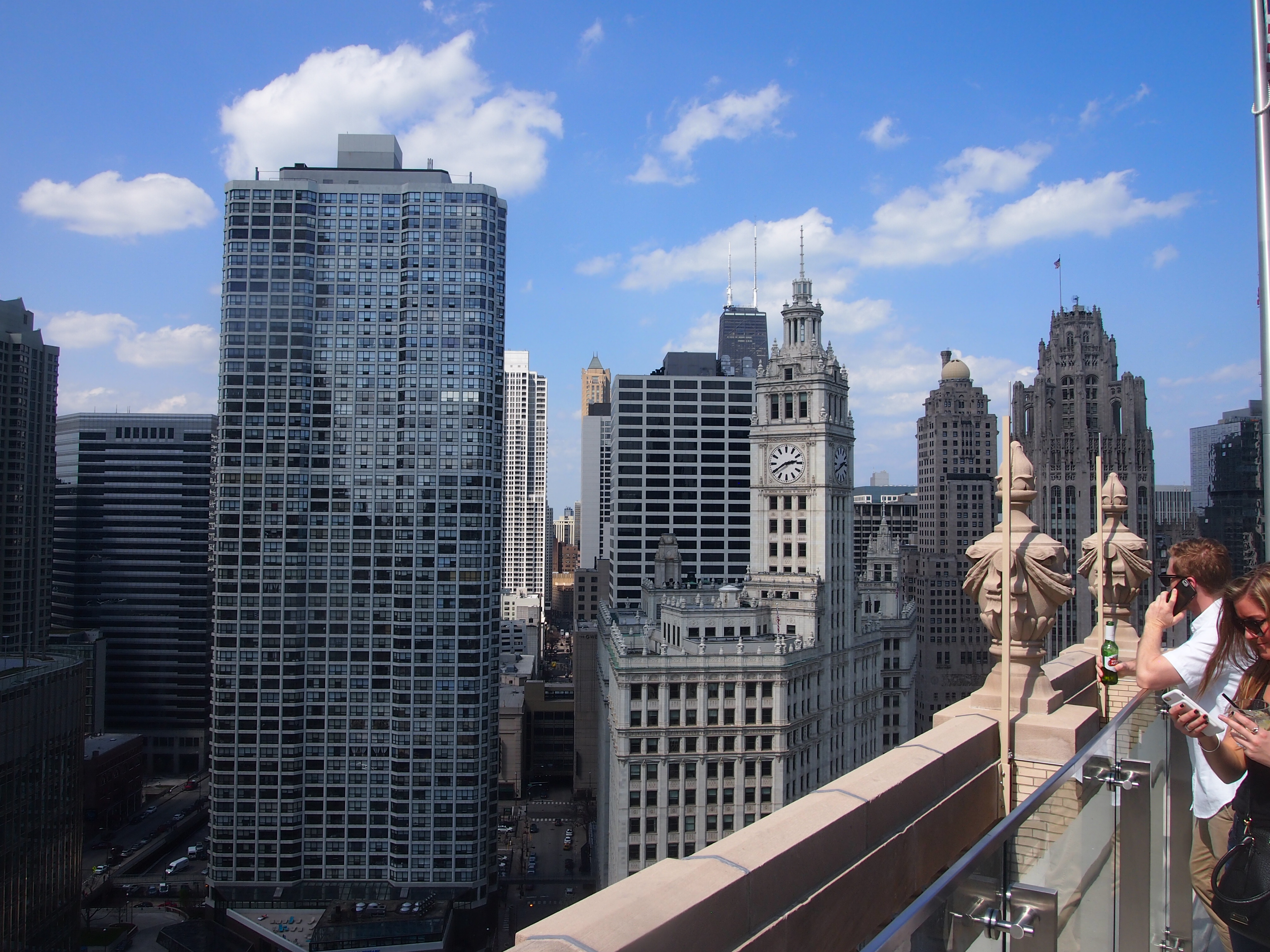
London House Hotel Chicago rooftop 2017North up Rush St. The building with the clock tower is, of course, the Wrigley Building.
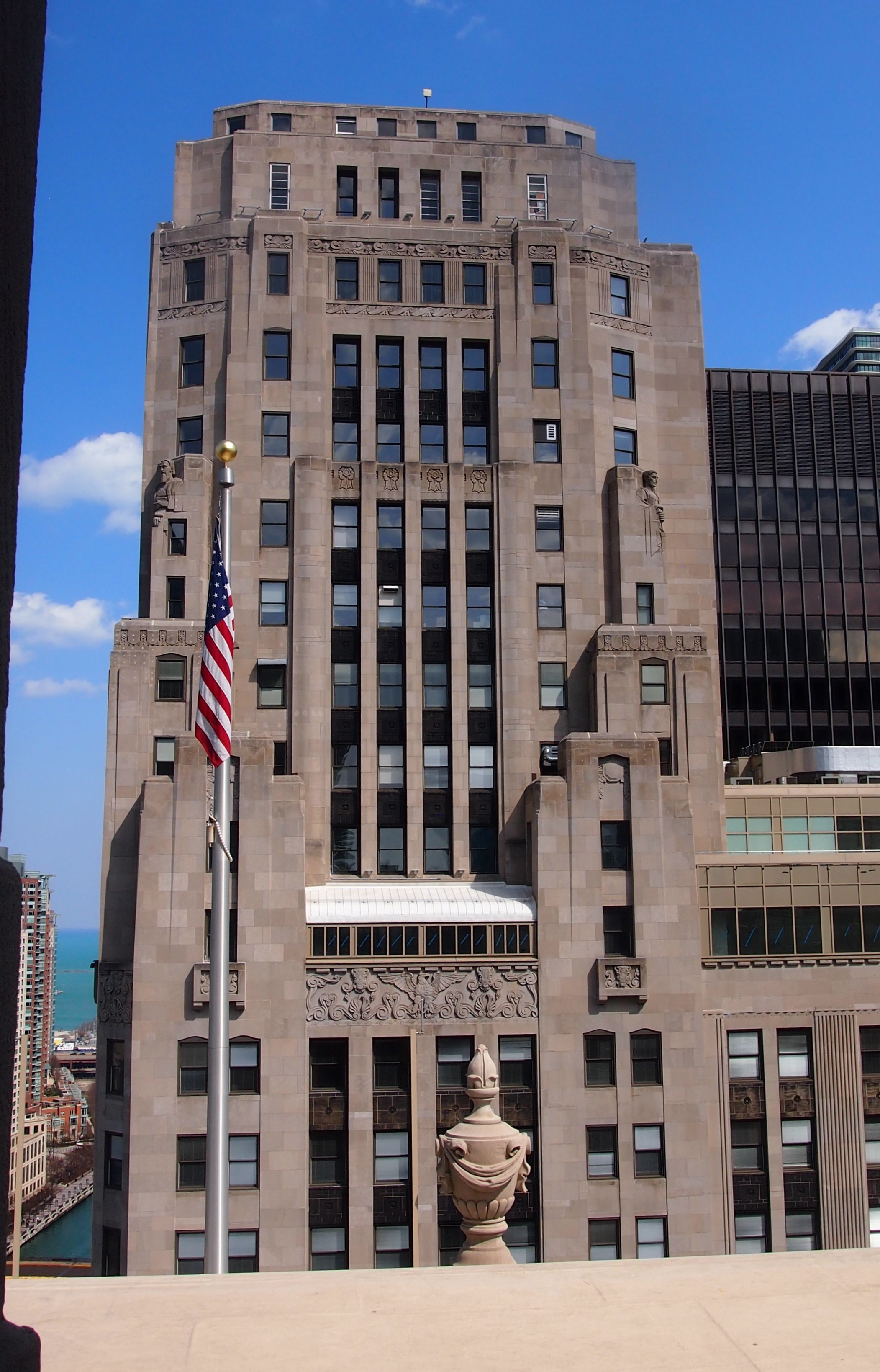
London House Hotel Chicago rooftop 2017Stairs from this level lead up to the Choragic Monument-ish tower, which offers some views of its own. Looking to the east, you get a good view of the upper reaches of 333 N. Michigan Ave., another building of the 1920s.
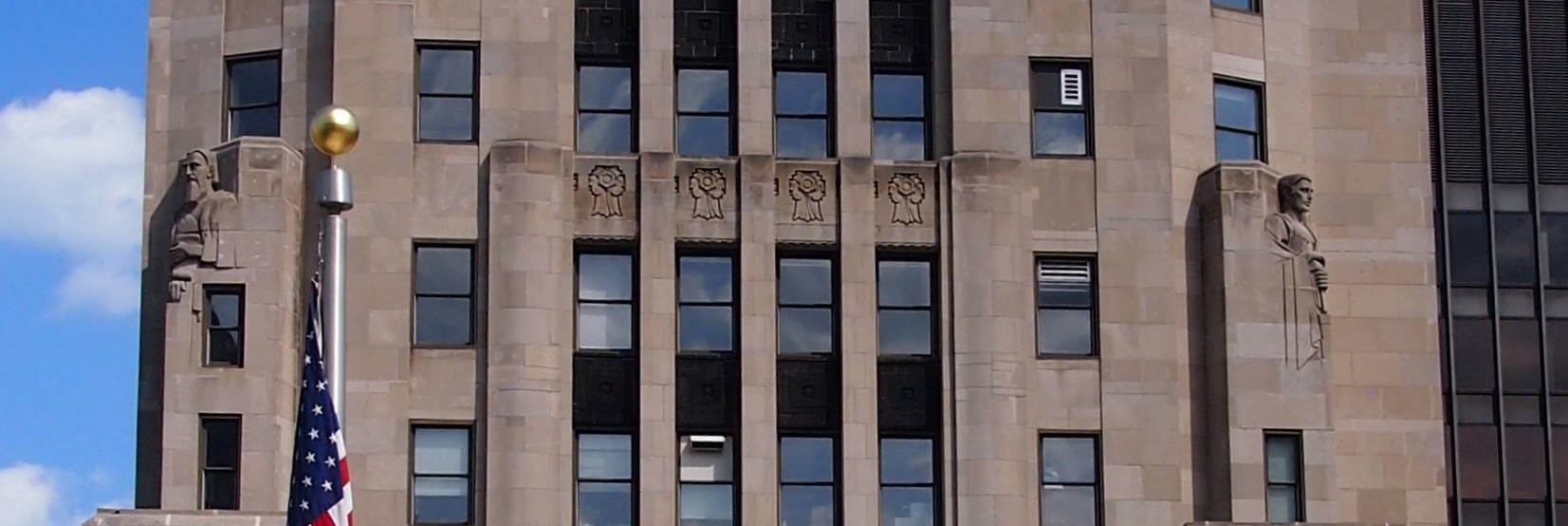
333 N. Michigan Ave ChicagoI was intrigued by the busts way up.

333 N. Michigan Ave ChicagoWho is supposed to see them? Angels? Even from inside the building, it looks like they would be hard to see. A modern example of painting the back of the statues in a cathedral niche.

About 333 N. Michgan and environs, Blair Kaimen wrote: “Its designers, Chicago architects Holabird & Root, drew heavily from Finnish architect Eliel Saarinen’s influential second-prize entry in the 1922 Tribune Tower design competition. Continuous vertical lines and gentle setbacks mount to a top without a cornice or cupola. The building superbly takes advantage of a bend in North Michigan Avenue to dominate the view as you look southward.

“Together, 333 and 360 join with the neo-Gothic Tribune Tower and the eclectic Wrigley Building to form an extraordinary quartet of 1920s skyscrapers that frame a great urban space around the Michigan Avenue Bridge.”

Hotel Boom

The Chicago Architecture Foundation calls one of its new tours Hotel Boom. “Learn how and why a former athletic club, bank, chemical company, motor club and more were transformed into first-class hotels,” the description promises. I was game. So we (all of us, including Ann) took the tour on Easter Saturday, a warm, pleasant spring day in Chicago.

I suspected that I’d been in many of the properties, and I was right. But some of them weren’t even hotels the last time I visited, and it’s always good to hear about a property from a knowledgeable docent, which CAF docents tend to be. In order, we visited the Silversmith Hotel, Virgin Hotel, Hampton Inn (formerly the Chicago Motor Club Building; I got an international drivers license there), London House, Hard Rock Chicago, and the Chicago Athletic Association Hotel.

Mostly we got a look at the exteriors, and then at the lobbies, though at one property we didn’t enter the lobby, and at another we saw the rooftop.

My friend Geof Huth stays at the Silversmith Hotel, 10 S. Wabash Ave., when he’s in town. The exterior is an historic arts-and-crafts facade dating from the 1890s, done by one of Daniel Burnham’s men. I assume that silversmiths were once tenants, since that part of Wabash was Jewelers Row (and still is). When I met Geof there in previous years, the lobby interior — which is not a protected historic feature — looked like this, with brown predominating. Not any more. Now black and off-white is the thing in the Silversmith’s public areas.

Next up was the Virgin Hotel. Virgin as in one of Sir Richard Branson’s properties, and in fact the first hotel with that flag, opened only in 2015. This was a surprise. I used to work across the street, more-or-less, and I remembered the Old Dearborn Bank Building at 203 N. Wabash Ave. being an interesting but aged art deco building.

The exterior has been spiffed up, the better to appreciate some of the details.
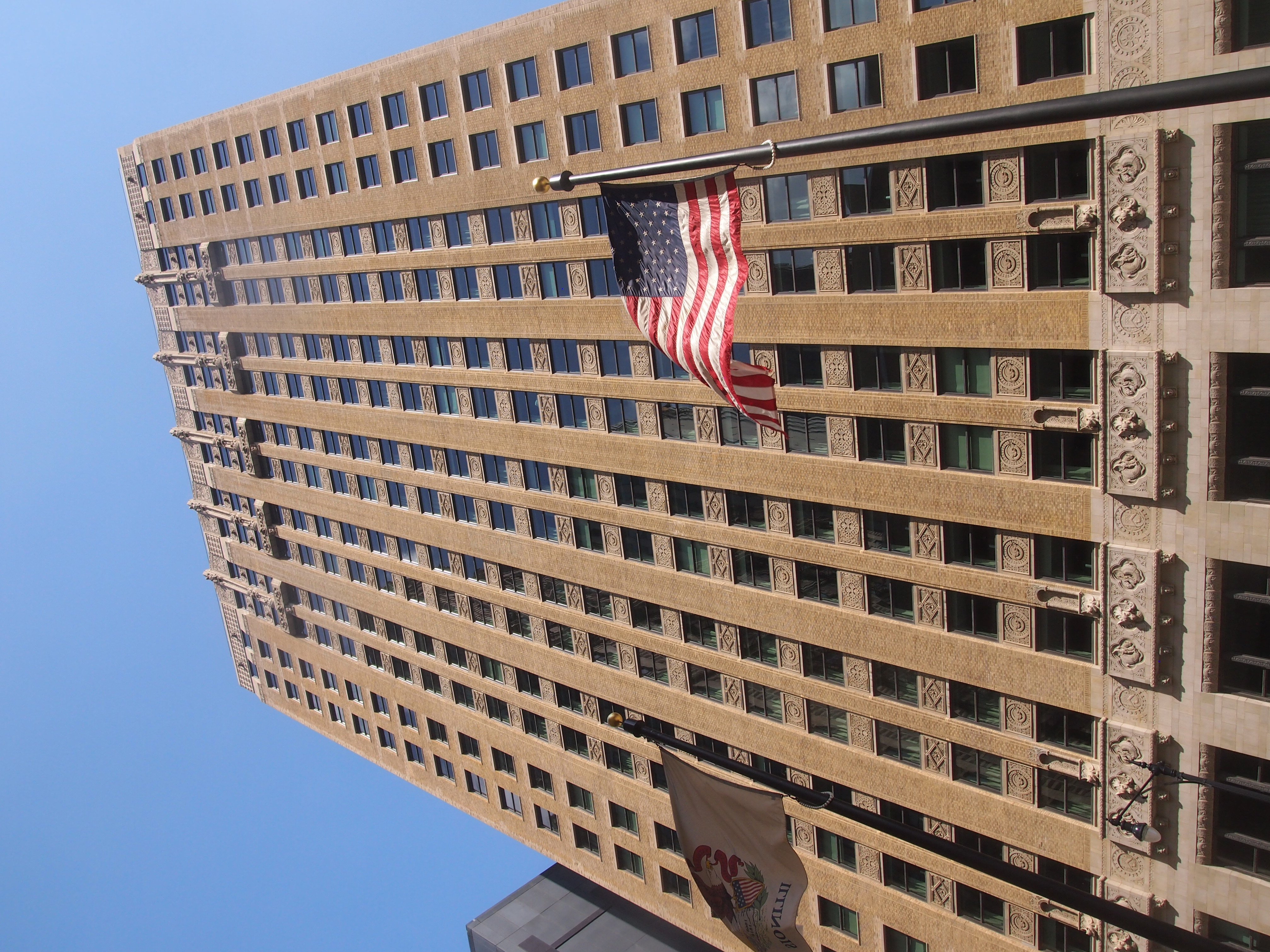
Virgin Hotel Chicago 2017Virgin Hotel Chicago 2017We had to skip the interior. One of these days I might take a look.

There’s a Hampton Inn in what used to be the Chicago Motor Club Building at 68 E. Wacker Pl., originally developed in 1928 and converted into a hotel only a few years ago.
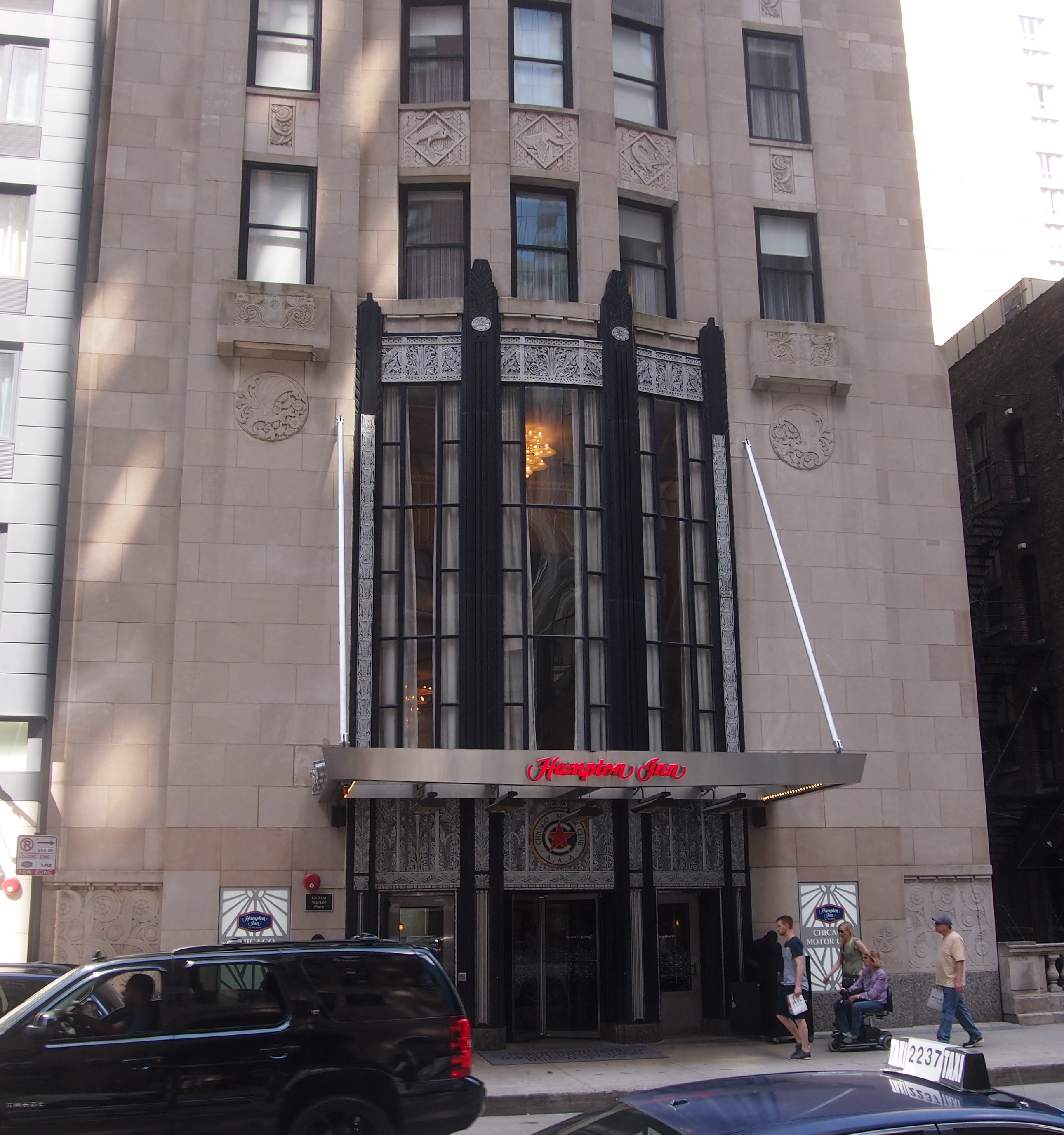
Chicago Automobile Club Building 2017Blair Kaiman writes: “All of Art Deco’s defining characteristics are compressed into this fabulous, 15-story package just west of Michigan Avenue: A trim silhouette with strong vertical lines; stylish geometric decoration; and a superb integration of art and architecture, especially in the lobby where a freshly restored mural map of the continental United States reigns with regal understatement.”
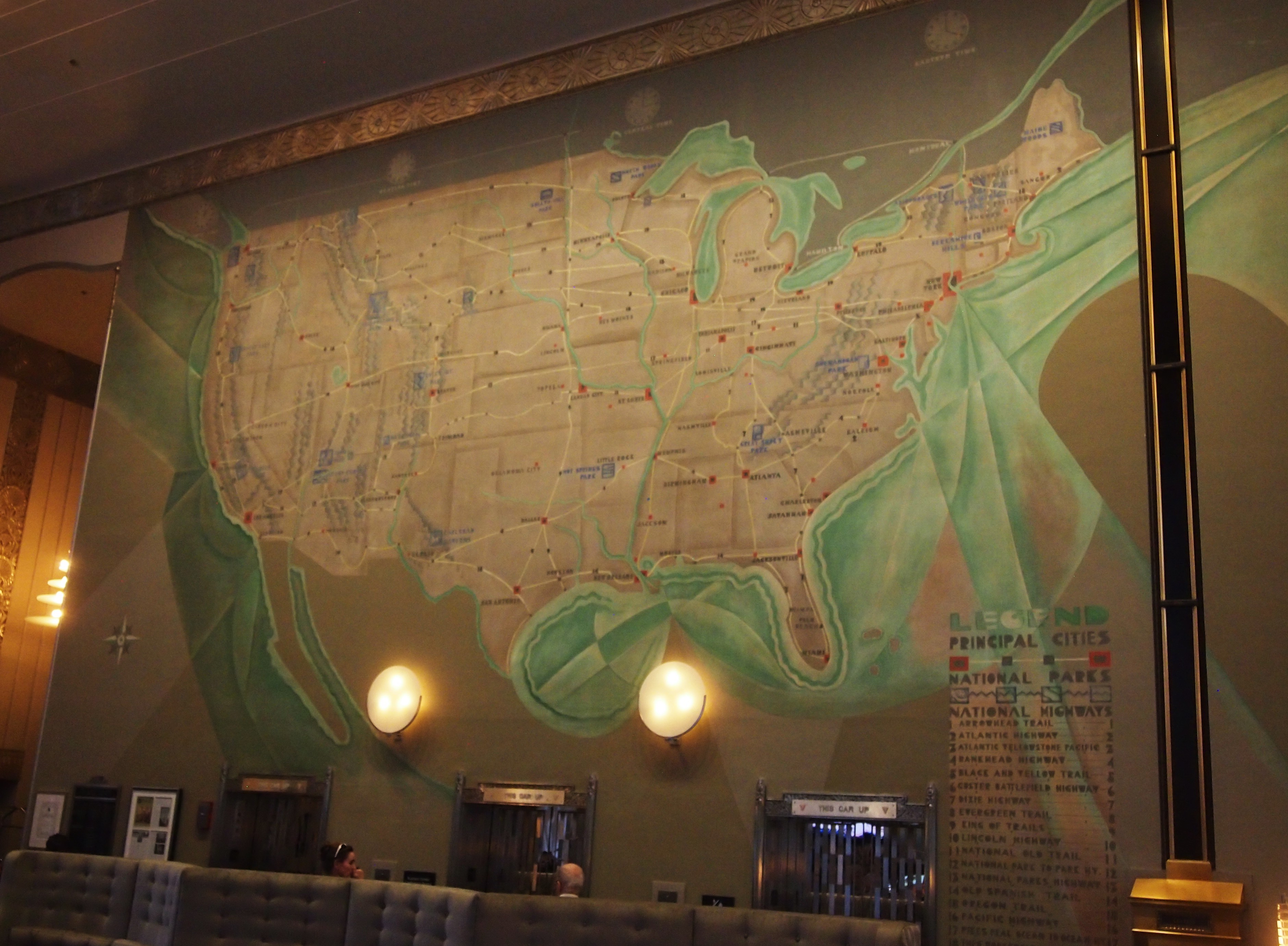
Chicago Auto Club Building US Map MuralIt’s a splendid mural. Done by an Illinois artist named John Warner Norton (1876-1934), who favored this kind of large work. More about him here, by a writer who doesn’t understand paragraphs.

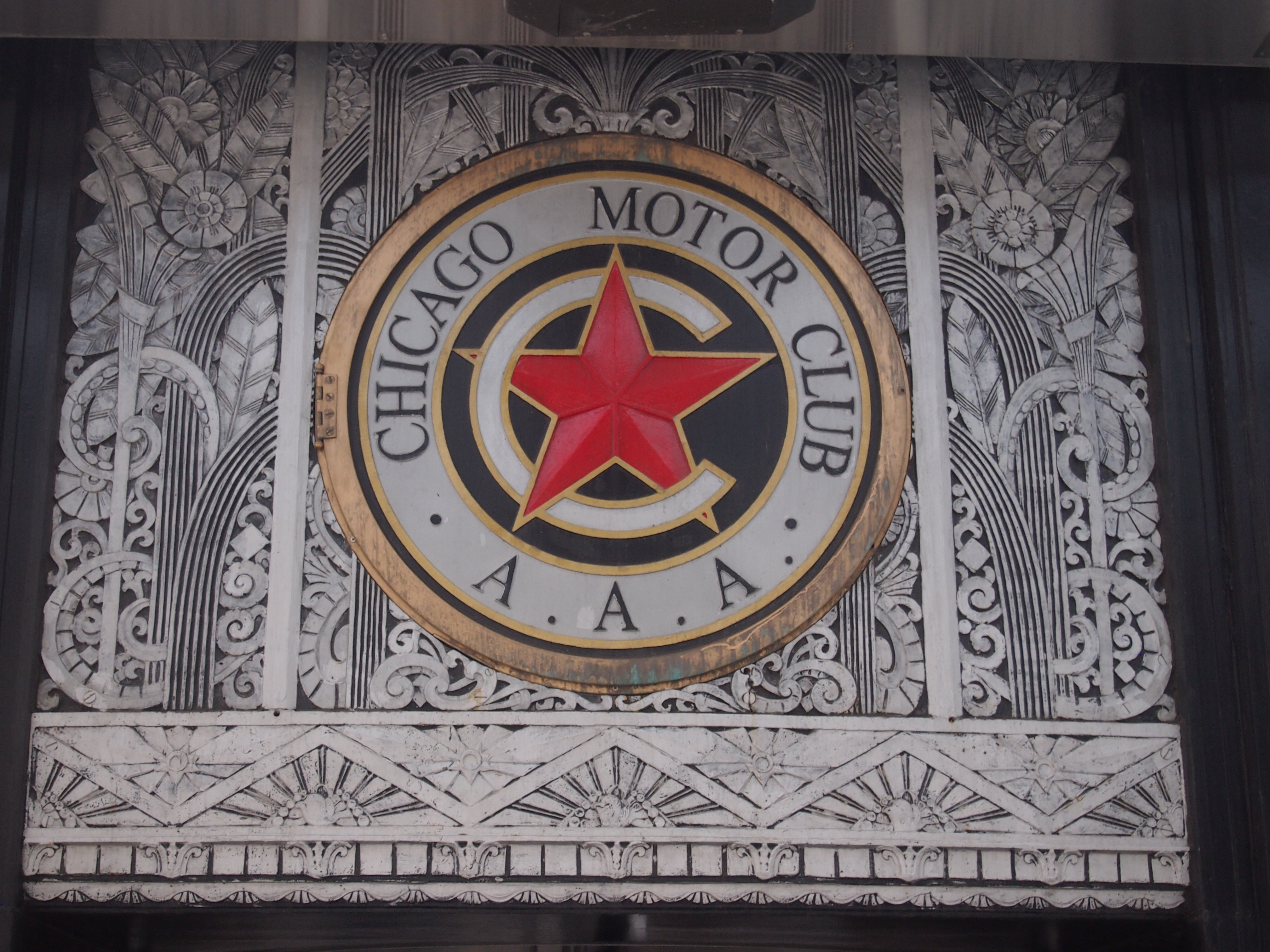
I like this detail, too. It’s over the hotel’s main entrance.
 The Hard Rock Hotel Chicago at 230 N. Michigan Ave. is a Hard Rock. With that, you get musical embellishments, such as guitars on the wall and an express checkout station that’s fashioned out of a 45 record player.

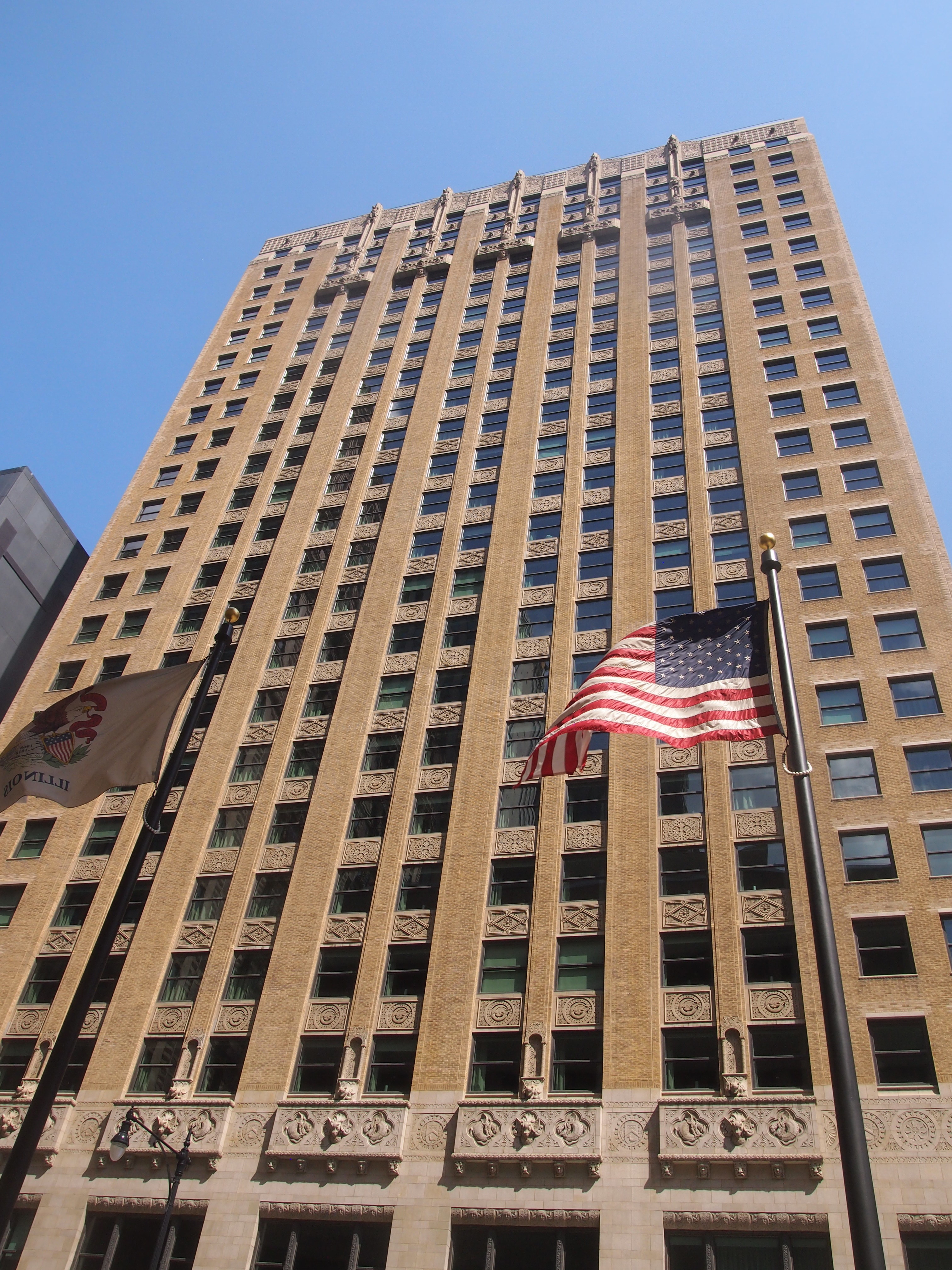
The hotel is the Carbide and Carbon Building, yet another fine deco building, finished in 1929, just before the Depression ground building to a halt, deco or otherwise. Burnham Bros. did the original building (Daniel Burnham was long dead by then); Lucien Lagrange Architects did the conversion into a hotel, finished in 2003.

You might even call it noir deco, since carbon black is the motif.
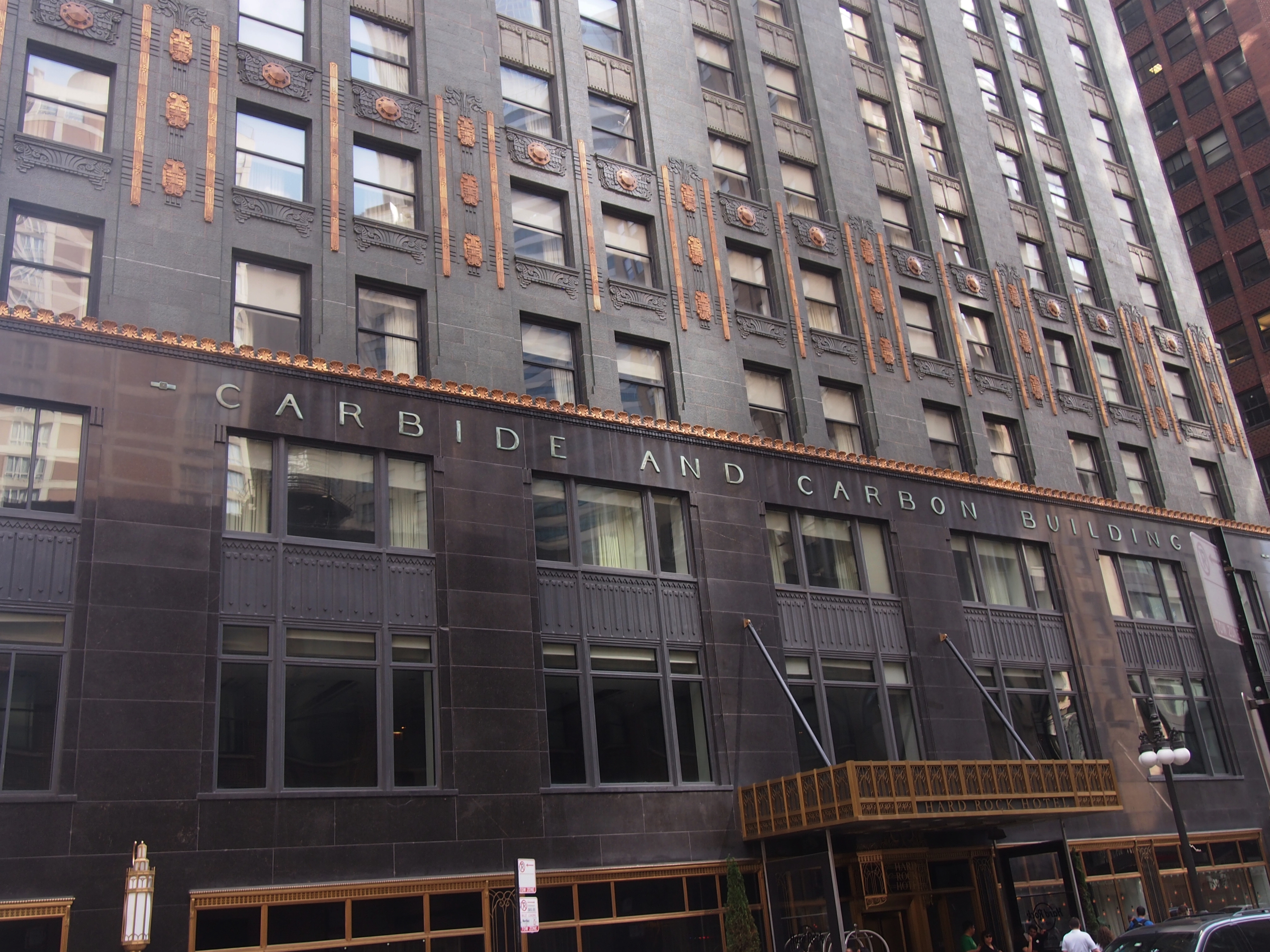
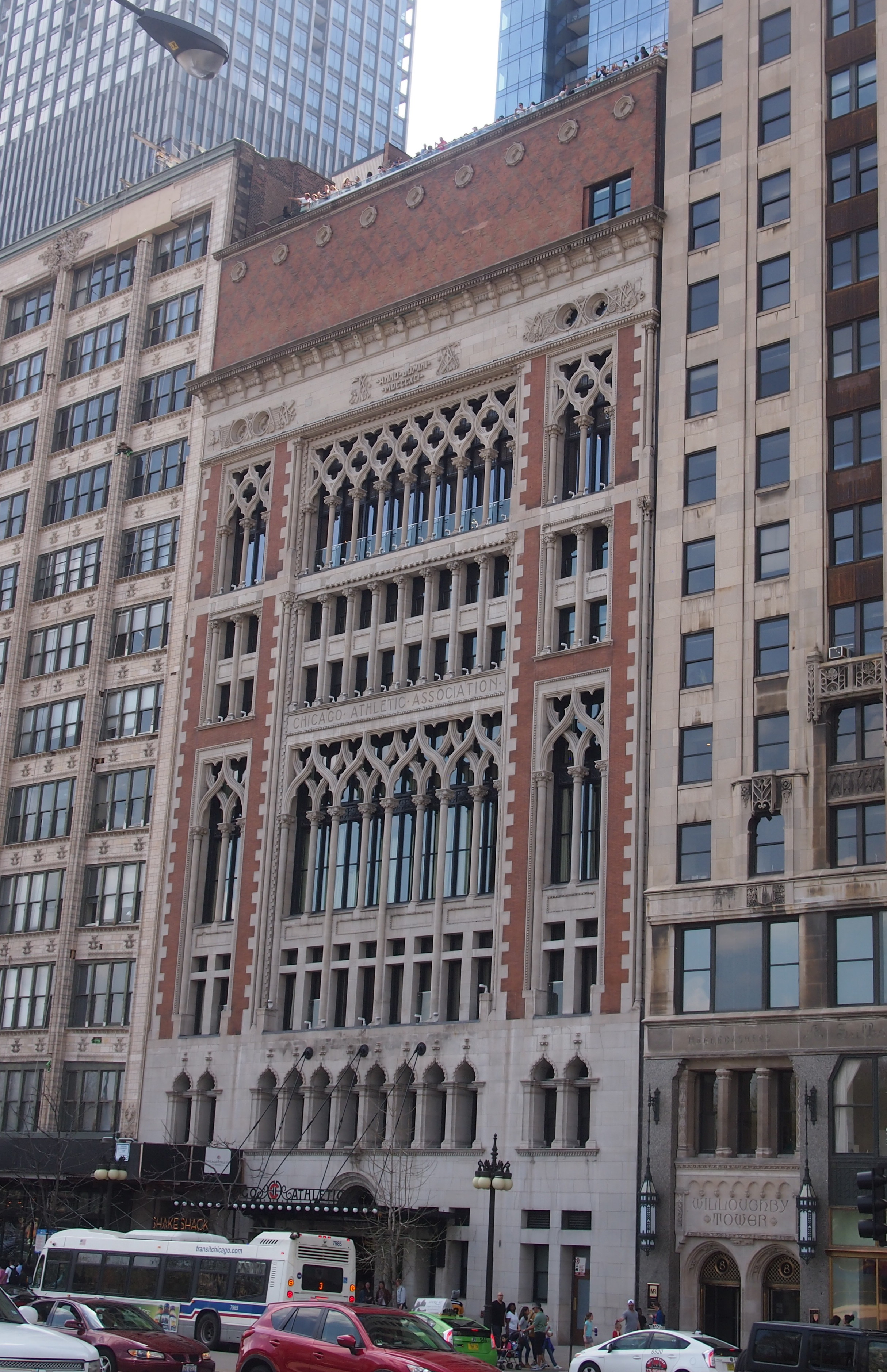
Carbine and Carbon Building 2017Further south, fitting very nicely in the Historic Michigan Boulevard District, is the Chicago Athletic Association Hotel at 12 S. Michigan.
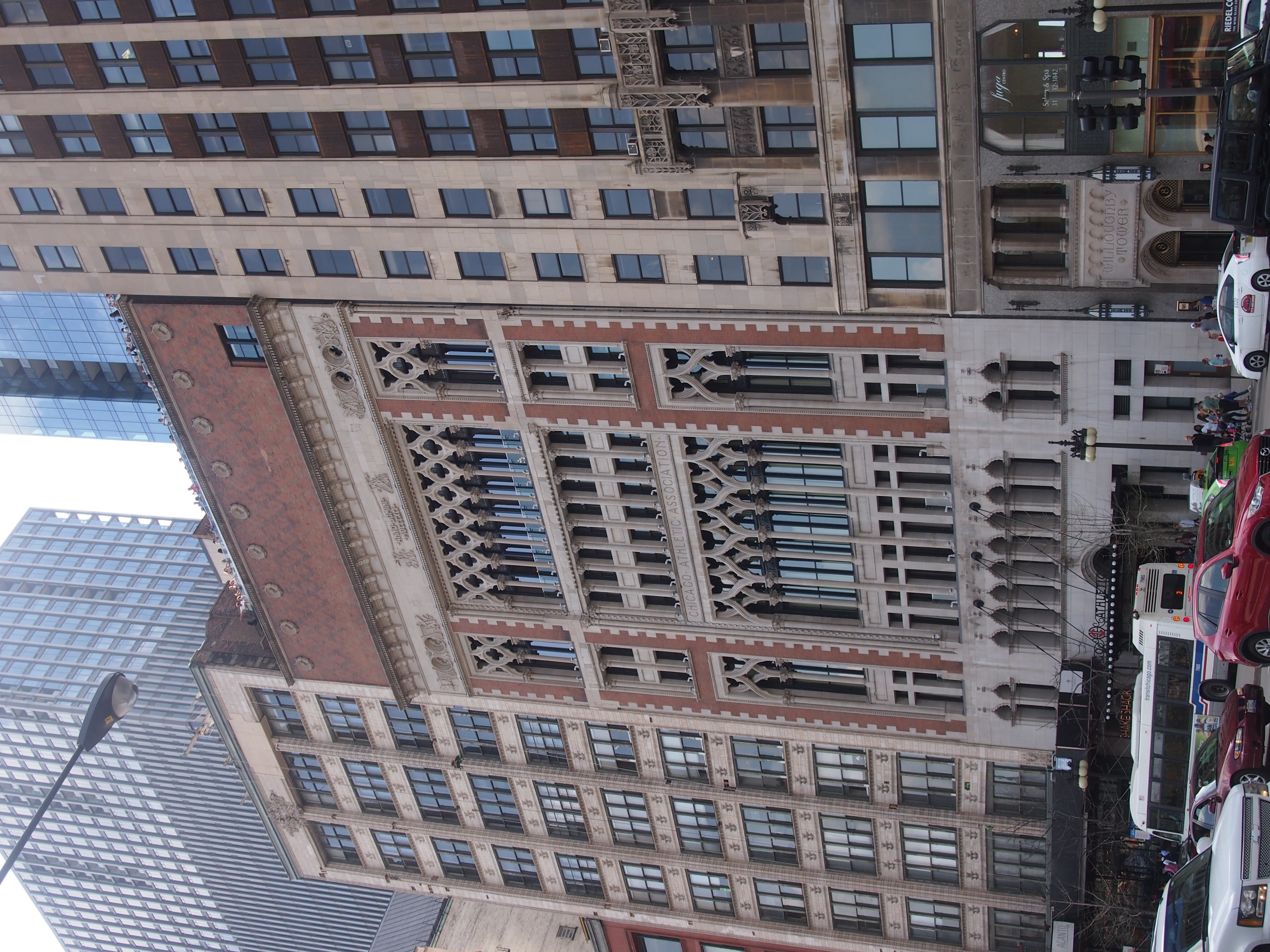
Chicago Athletic Association Hotel 2017The building, a Henry Ives Cobb design, goes all the way back to 1893, so it was spanking new at the time of the World’s Fair. No art deco for him. He was of a previous generation. He also did the Newberry Library, which I’ve always liked, and the fine Yerkes Observatory.

The redevelopment of a posh men’s club into a posh hotel by Hartshorne Plunkard Architecture was finished only in 2015. “Many of the building’s elaborate architectural details were preserved, as the ornate millwork and tiled floors throughout the interior and the stained glass and cast-iron exterior relief have all been restored,” says Curbed Chicago. “However, one of the greatest highlights of the new hotel is its rooftop restaurant’s deck space that offers sweeping views of Michigan Avenue and Millennium.”

On a pleasantly warm Saturday, the line to get to the elevator to the rooftop was long indeed. Some other time, maybe.

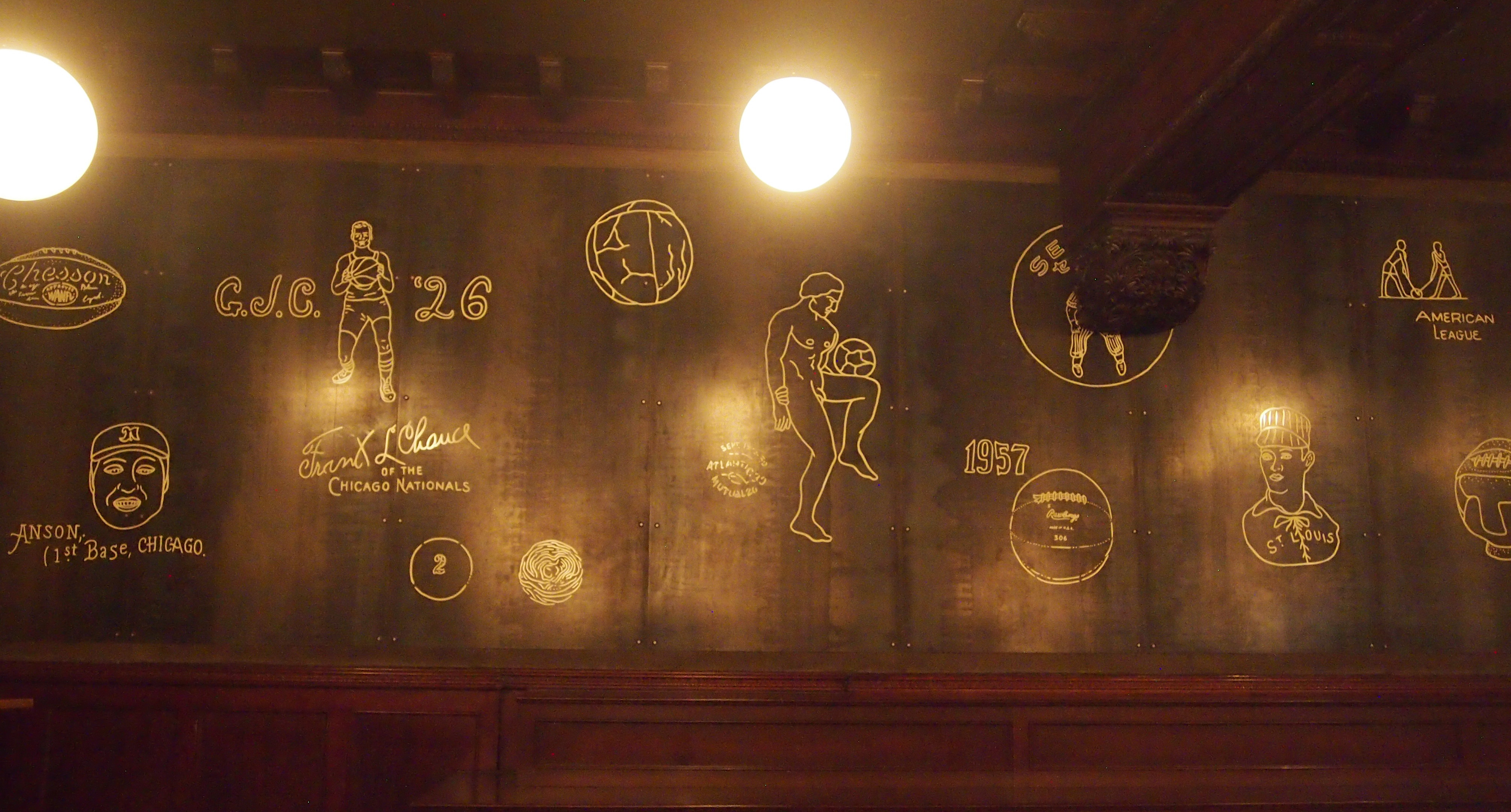
We did see the large bar on the first floor. It features a lot of games and a sports theme on the walls. Sports of an earlier time: leather football helmets, baggy golf knickers, and medicine balls.
The space also included a bocce ball court. People were playing it. I’d never seen anyone play bocce ball.
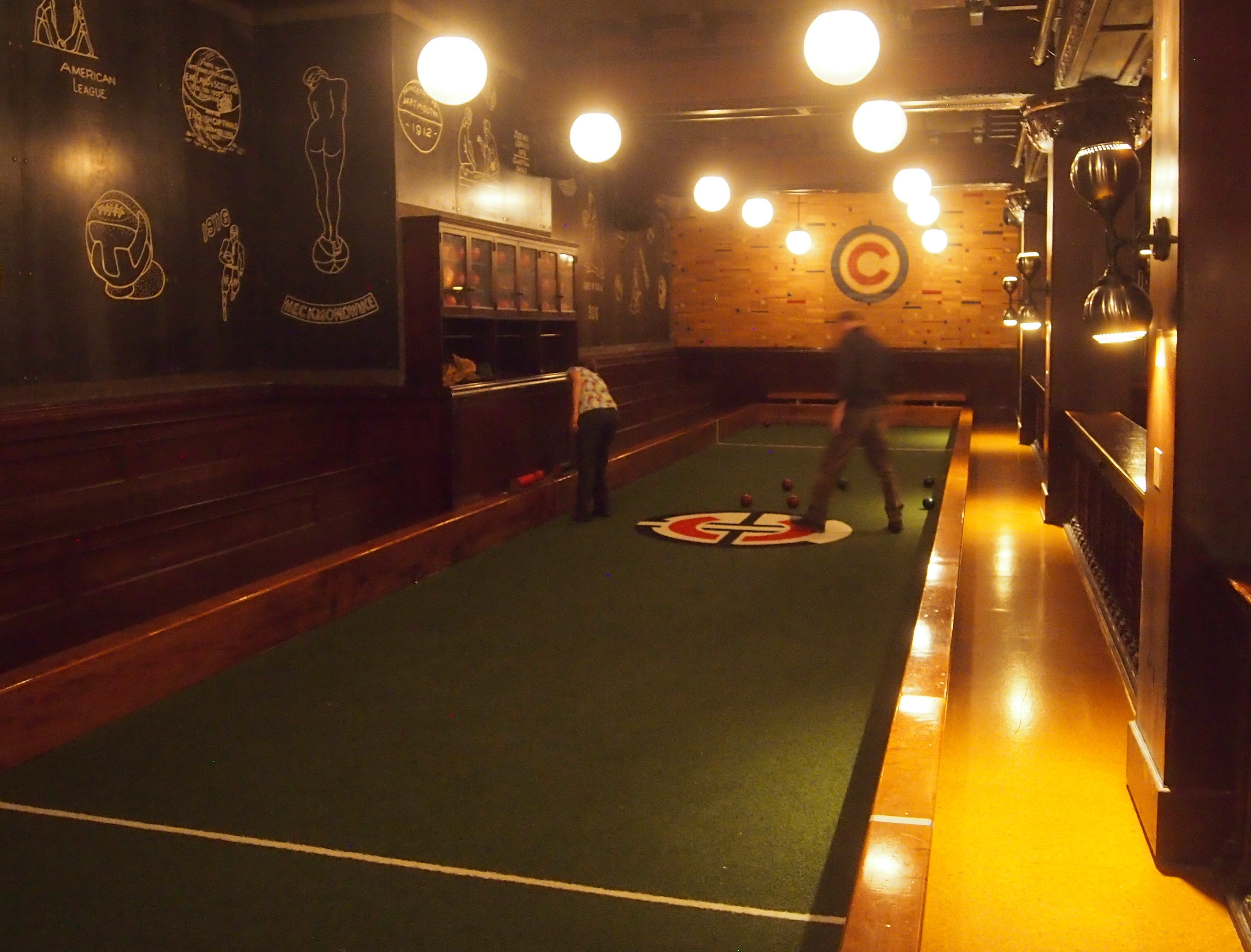
Chicago Athletic Association Hotel 2017 bocce ball courtGuess I don’t hang around enough Millennial bars. Or any bars, come to think of it.
Model Chicago

Most Chicago Architectural Foundation tours begin at 224 S. Michigan Ave., where the foundation is located and which is also known as the Santa Fe Center or, originally, the Railway Exchange Building. It’s a handsome structure by Daniel Burnham, dating from 1904.

“A building around a light well, a form common to Daniel H. Burnham’s work from the mid-1880s onward, received an undulating white-glazed terra-cotta skin, oriel bays, and a top floor of distinctive porthole windows,” notes the AIA Guide to Chicago. “As in the Rookery, there is a two-story covered court at the base of the light well dominated by a grand staircase.”

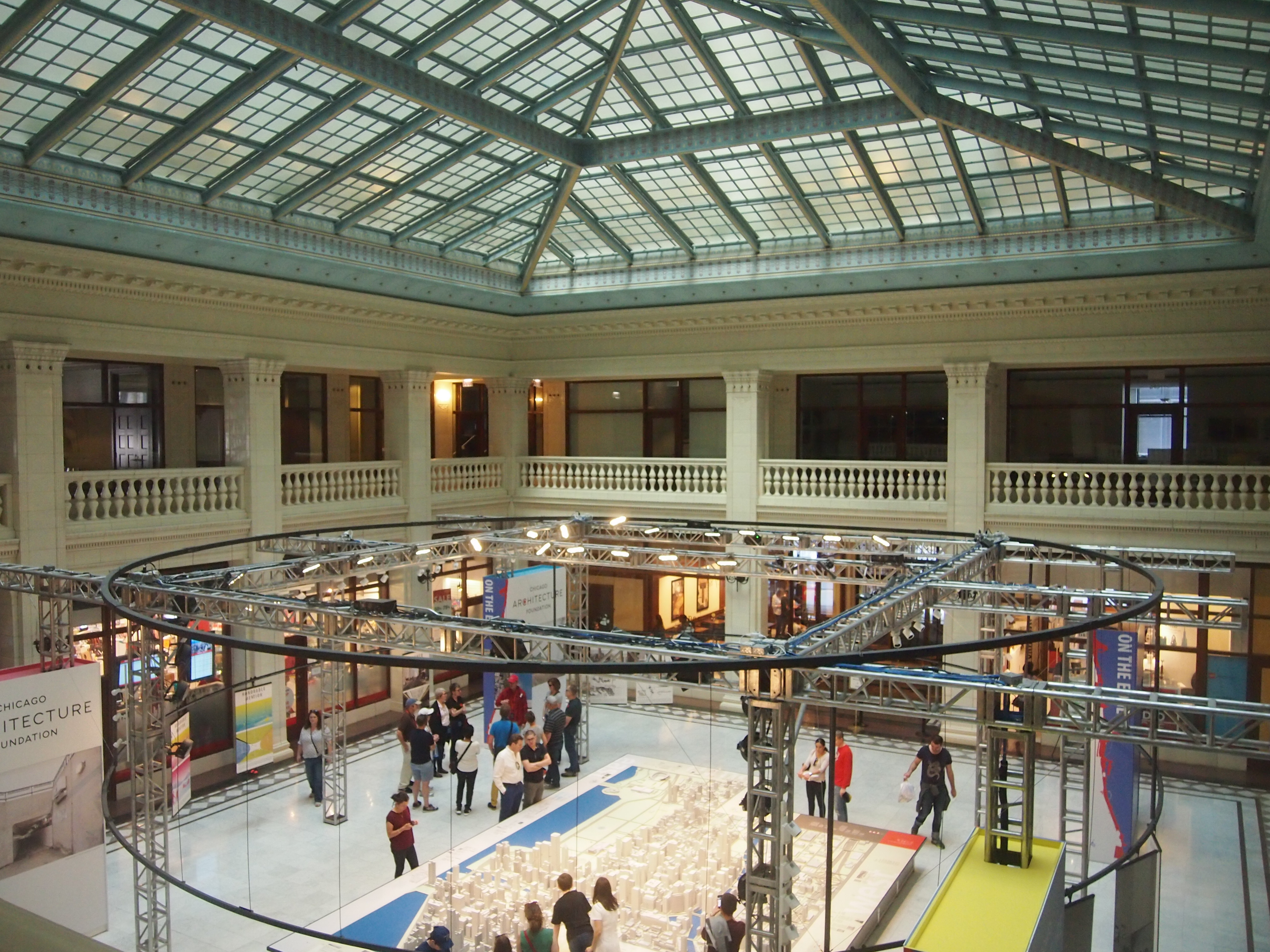
The view from near the grand staircase.
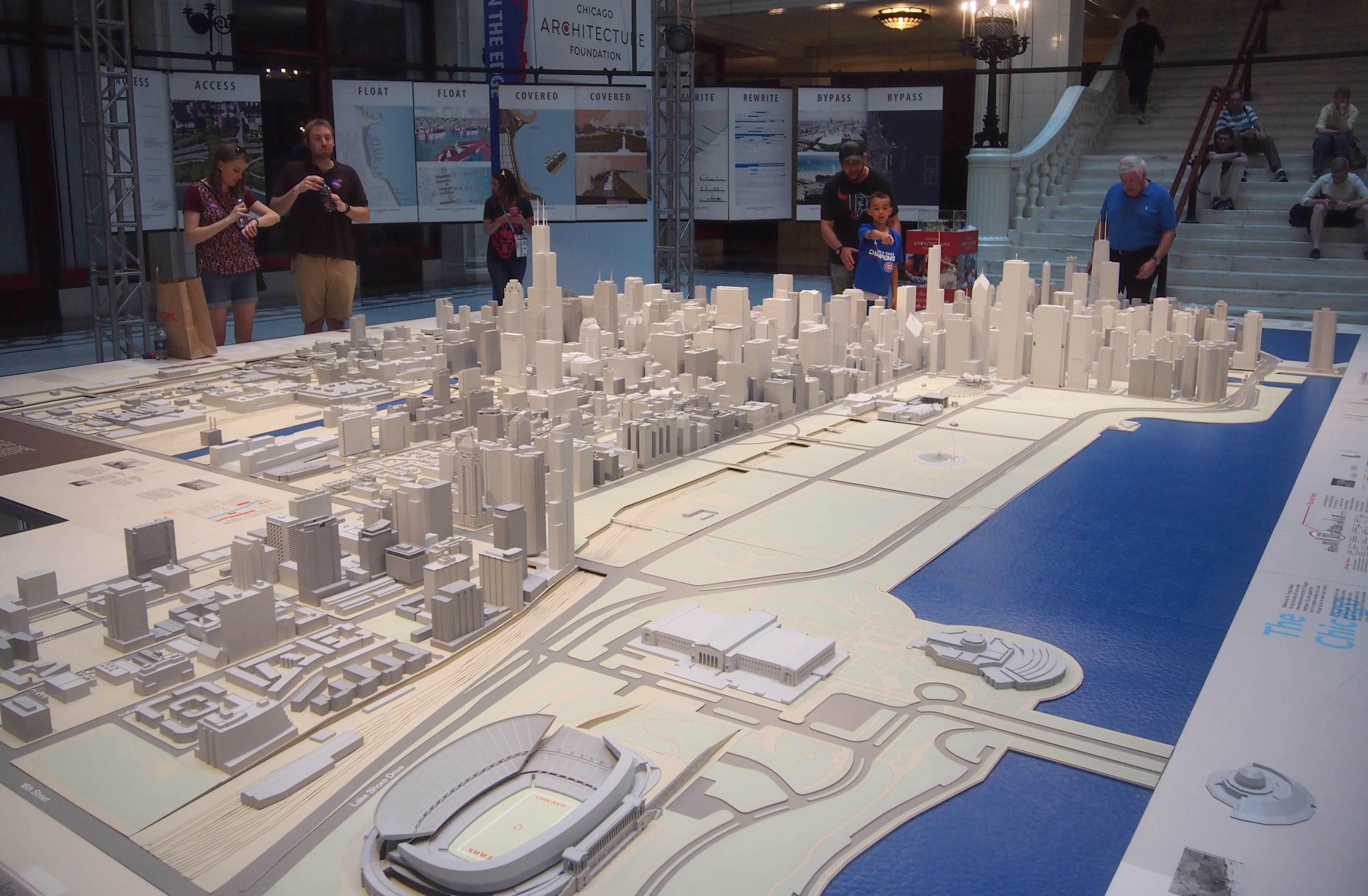
Railway Exchange BuildingNote the model of Chicago taking up much of the floor. At 25 by 35 feet, it’s an exact model of every building in more than four square miles of the city, or more than 1,000 of them. The obviously skilled Columbian Model & Exhibit Works created it for the Chicago Architectural Foundation in the late 2000s.

The Tribune reported in 2009 that the “model buildings came from Columbian’s workshop. The exhibit is broken down into 400 city blocks, in squares the size of dinner plates carried in food caterer’s serving carts. With the buildings already glued in place, the blocks were placed into the exhibit like waiters carefully placing food plates into a buffet table.

“[Foundation VP Gregory] Dreicer said the first step in the process was creating a digitized three-dimensional computer model of the city that could be manipulated on a screen. The designers did it using architectural drawings or drawings purchased from commercial firms that collect such information.

“To make each building, they went to firms that use the three-dimensional printing process called stereolithography, used to make design prototypes of various products like plastic containers for food, cleaning or pharmaceutical products.”

Wow. That’s impressive. And right there, for anyone to walk in and see, no charge. It’s not a static display, either. I’ve read that the CAF updates it periodically, as buildings come and go in Chicago.

Lou Mitchell’s

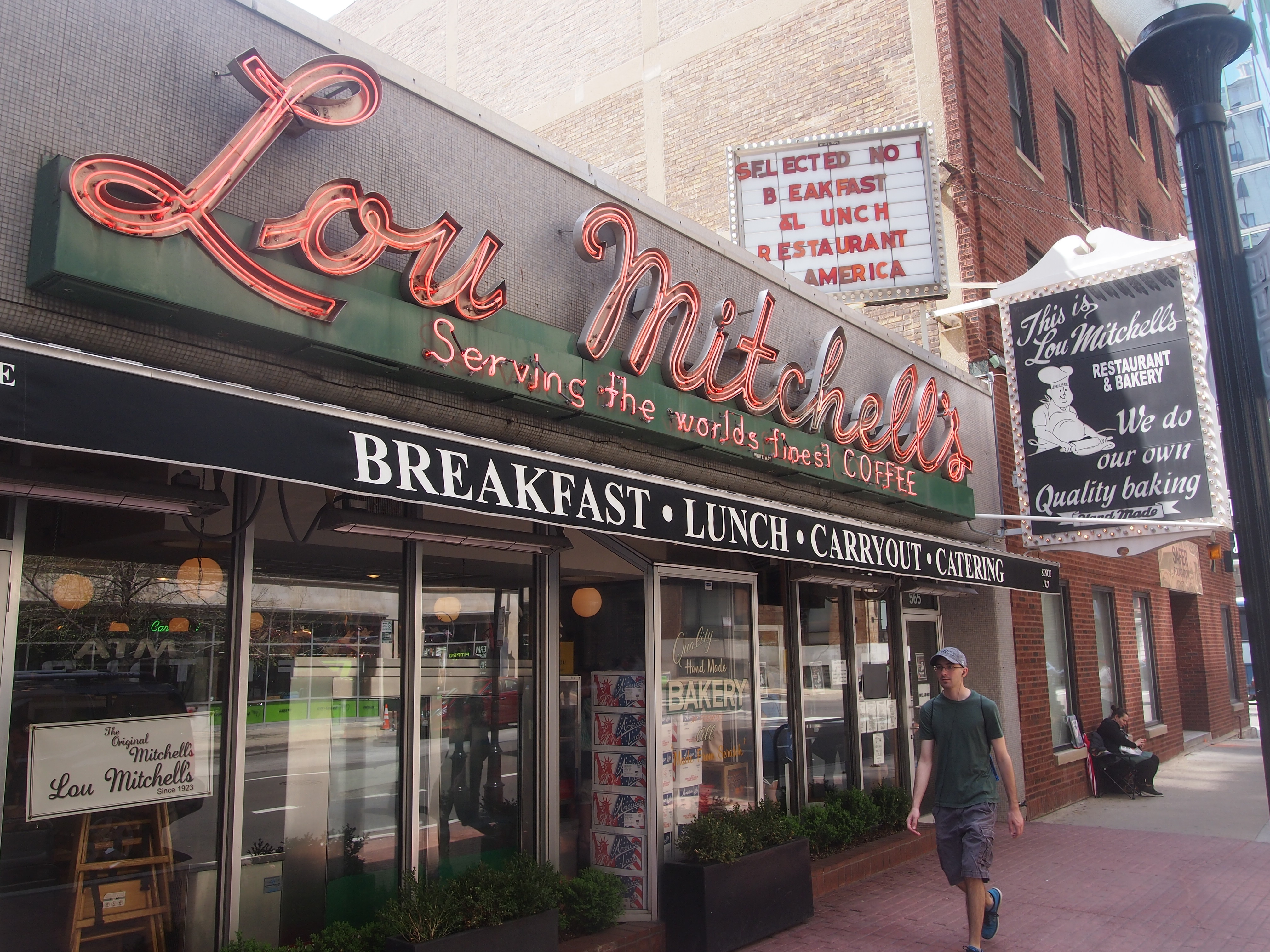
On Easter Saturday, which was clear and pleasantly warm, we took our first Chicago Architectural Foundation tour of the year, more about which later. To get there, we took a train to Union Station, timing things so that we could eat before the tour. I figured the place to go was Lou Mitchell’s. It had been a while, though more recently than 2005.

I might be misremembering, but I think my friend Rich took me to Lou Mitchell’s for the first time during my first visit to Chicago in 1981. Or if not then, sometime during a visit in the 1980s. Even then it was an institution of a diner, and Lou Mitchell himself was still around, giving away either doughnut holes or tiny packs of Milk Duds to patrons as they came in.

So much of an institution that the National Park Service devotes a page to the restaurant as part of its Route 66 series. “Built in 1949, Lou Mitchell’s is located at 565 West Jackson Boulevard, a few blocks west of Lake Michigan and the eastern terminus of Route 66,” the page notes.

Lou Mitchell’s itself claims a 1923 founding by Lou Mitchell’s father, but presumably that was a different location. In ’49, the Mitchells probably thought nothing of the fact that W. Jackson happened to be US 66 at that point, just that it was a good city street to be on. These days, there’s a bit of Route 66 decor on the walls, but not too much.

“Visitors immediately focus on the original aluminum and glass storefront,” the NPS continues. “Rising up from the upper front façade and extending the entire length of the building is the eye catching, original 1949 neon sign that proudly states ‘Lou Mitchell’s Serving the World’s Best [sic] Coffee.’
Lou Mitchell's facade 2017“Another original sign, this one extolling the restaurant’s handmade bakery goods, is still hanging on the front façade. Aside from timely upgrades of the kitchen and bathrooms, the interior of Lou Mitchell’s has not been significantly altered since 1949. The dining room retains its original black and white terrazzo flooring, and most of the dining and counter areas are unchanged.

“The booths have their original wood tables, coat racks, and seats, although the seats sport new upholstery. The multi-sided counters with individual stools are original but have newer laminated surfaces and upholstery. Much of the wood and Formica wall paneling dates to 1949.”

Add to these things the hum of talking people, the clink of silverware and the distinct pleasant smell of a diner, and that’s the atmosphere you get at Lou Mitchell’s. None of that would matter without the food, which has been uniformly good over the years I’ve eaten there. Mostly breakfast items for me, such as the sapid ham and cheese omelette I had recently, which comes with cubed potatoes and toast. My kind of eats.

March for Science, Chicago

I figured the March for Science, which happened on Saturday, was something I could support. Not just because of some vague notion that science is mostly a good thing. Rather, that spending by the U.S. government supporting scientific inquiry is mostly a good thing.

Speaking only as someone who does his little part to support such spending, I think there ought to be more of it, not less. It gets results. Examples are numerous, but my own favorite is the exploration of each and every planet in the Solar System and other celestial objects as well over the last 50 years or so.

According to various reports, the March for Science was held in over 600 locations worldwide — the main one being in DC — and included a “march” by sympathetic scientists in Antarctica, who must be facing the beginning of a long, awful winter about now (and what other kind would there be?). In Chicago, the day was cool, in the 60s F., with thin clouds overhead.

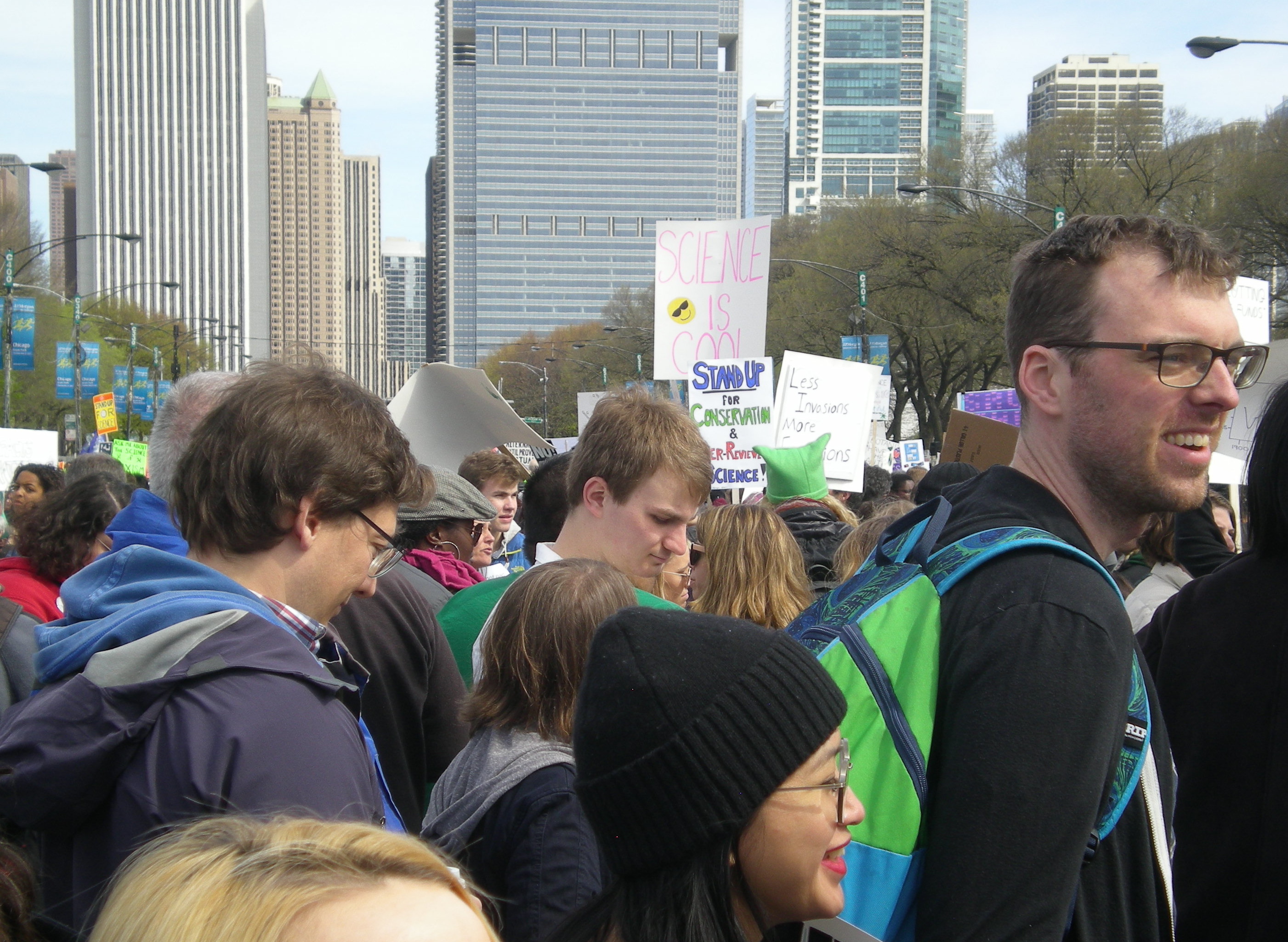
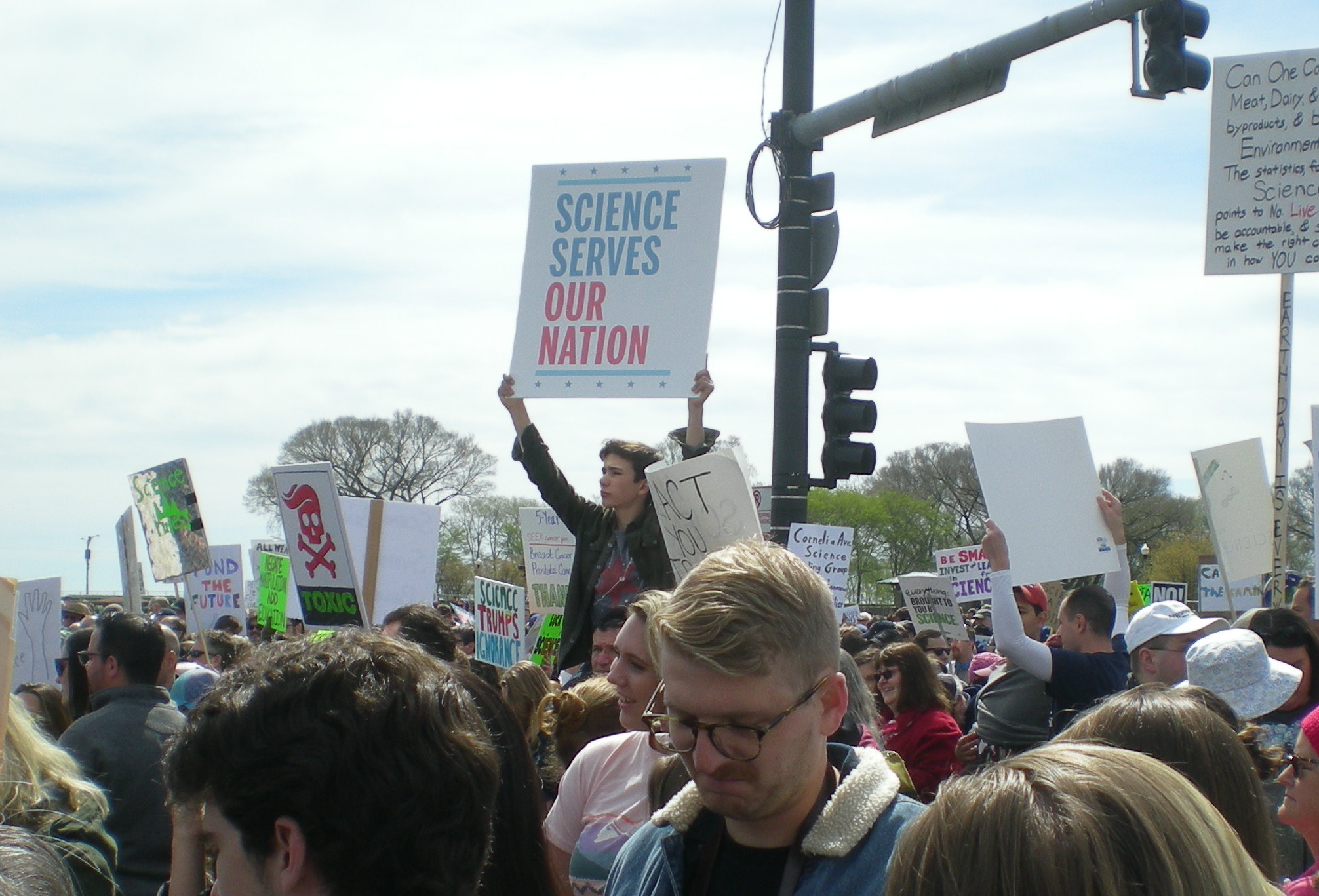
The Tribune tallied the Chicago march as one of the larger ones, with about 40,000 participants. I don’t know how the crowd was counted, but I believe it. When Ann and I arrived, at the intersection of S. Columbus Dr. and E. Congress Dr. — just west of Buckingham Fountain — the crowd looked like this.

March for Science, Chicago

The event stage was north of that point, on E. Jackson, but we didn’t bother trying to move toward it, because the crowd in that direction was thick.
March for Science, ChicagoPretty soon, the crowd filled in around us. As crowds go, it was good-natured and patient. The speakers were difficult to hear, since the event’s loudspeakers weren’t working that well. I caught some of a Field Museum employee’s speech, which was essentially about her cool science job at the museum.

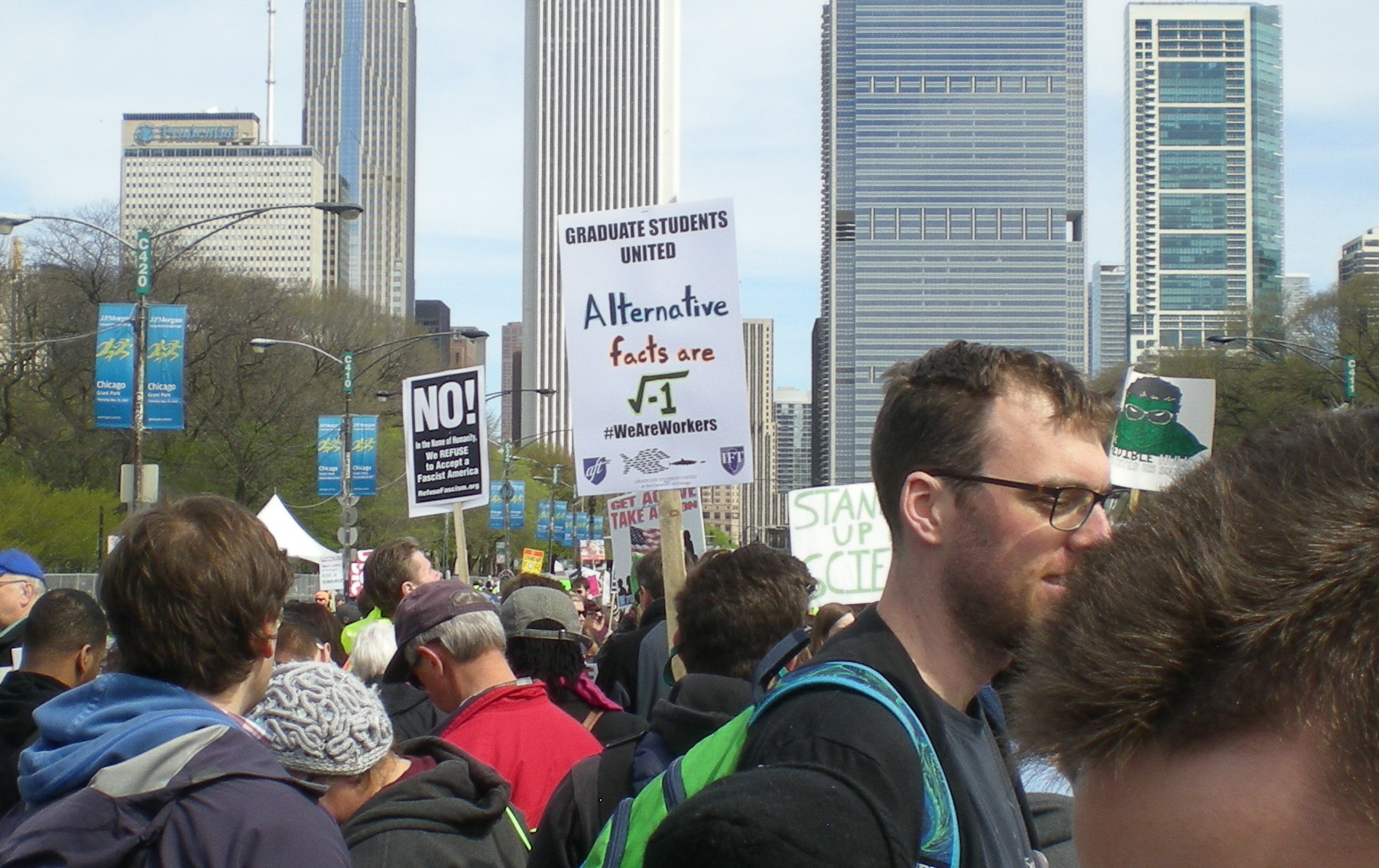
I also spent time reading the signs.

March for Science, Chicago

March for Science, ChicagoI have to like a reference to Nineteen Eighty-Four.
March for Science, ChicagoThis one got to the heart of the matter: Science Serves Our Nation.
March for Science, ChicagoOr, to put it in more negative terms, something that even the dimmer lights in Congress might respond to: If We Don’t, The Chinese Will.

Anti-Trump signage was common, as you’d expect —

March for Science, ChicagoMarch for Science, Chicago— along with a sprinkling of other causes, such as straight-up socialism and vegan advocacy.

At about 11, word spread that the march itself was starting. So everyone headed south along Columbus. The crowd had to move around a group of women in costume, dancing on stilts. Ann got a short video of it.


I’m not sure how that was a pro-science message, but it was fun to watch.

Along the way, chants broke out sometimes. The most common one was:

What do we want?
Evidence-based research!
When do we want it?
After peer review!

Nothing Mark Slackmeyer would have ever said, but it caught the spirit of the march. Ann got a video of that, too.

It was a slow march, because ultimately everyone had to funnel into the narrow path that leads to the Field Museum campus, through an underpass below Lake Shore Drive. (Closing Columbus was one thing, but Lake Shore Drive generally remains open.)

Afterwards, participants sat around on the Field Museum lawn and elsewhere.

March for Science, ChicagoThere were booths on the other side of the museum, but we’d had enough for the day and soon caught a bus back into the heart of the Loop. Some other marchers were on the bus, too, along with their signs. Not something you see all the time on mass transit.
Two Churches & One Temple in Old Town

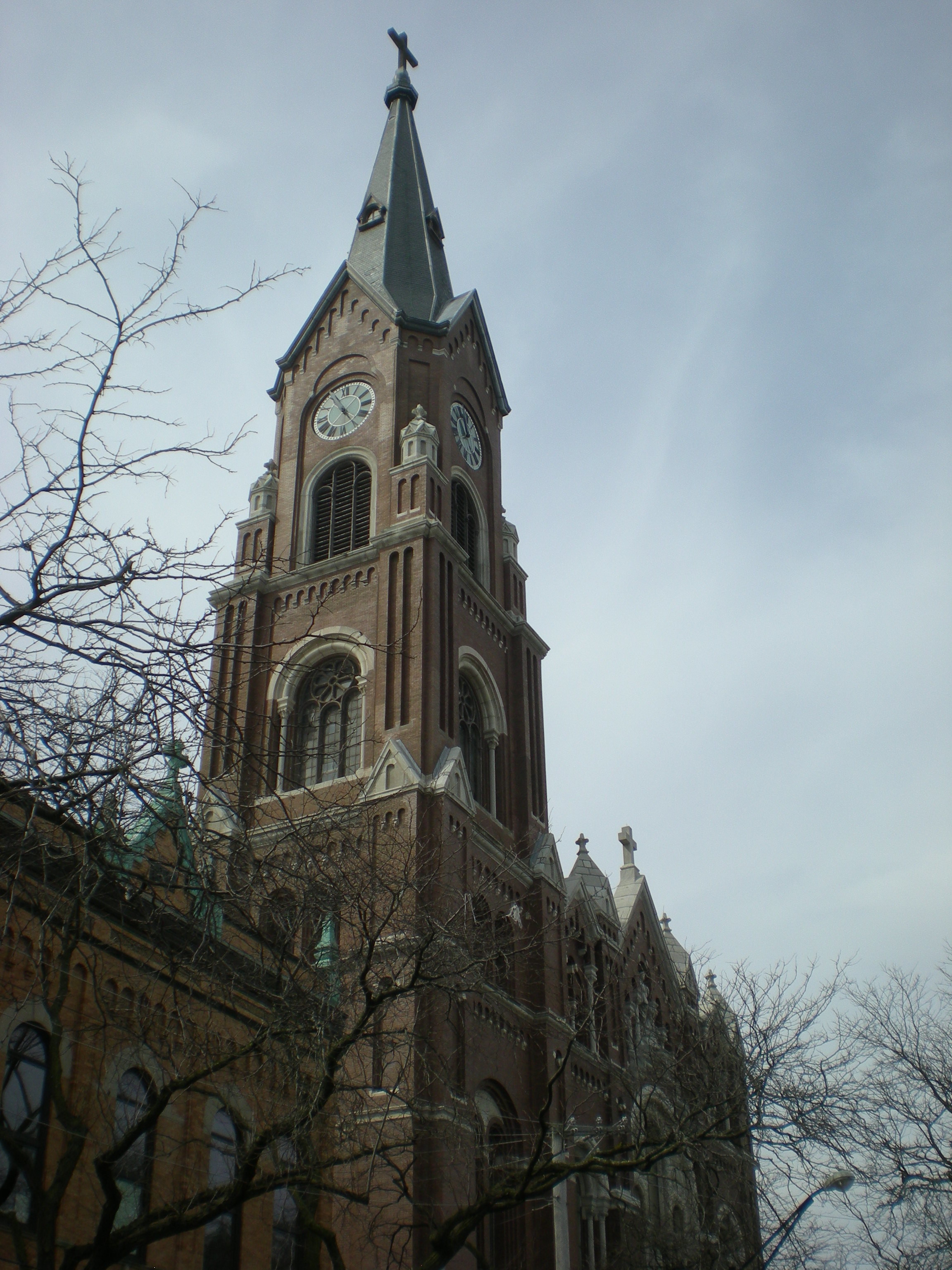
Towering over N. Cleveland and W. Eugenie Sts. in the Old Town neighborhood of Chicago is St. Michael’s, a Romanesque Catholic church dating from just before the Great Chicago Fire. Not good timing, since the building was thus in the path of the conflagration.
“As the fire moved past Holy Name Cathedral, religious from nearby institutions rushed to St. Michael’s for respite, but they knew that the fire was just a few hours away,” the church tells us at its web site. “Priests, brothers, and nuns, helped by parishioners, packed parish treasures onto an oxcart and fled. Soon, flames tore into all the parish buildings, leveling all of them. Only the walls of the church remained standing.”

By 1873, the church had been rebuilt, though various modifications have occurred since then.

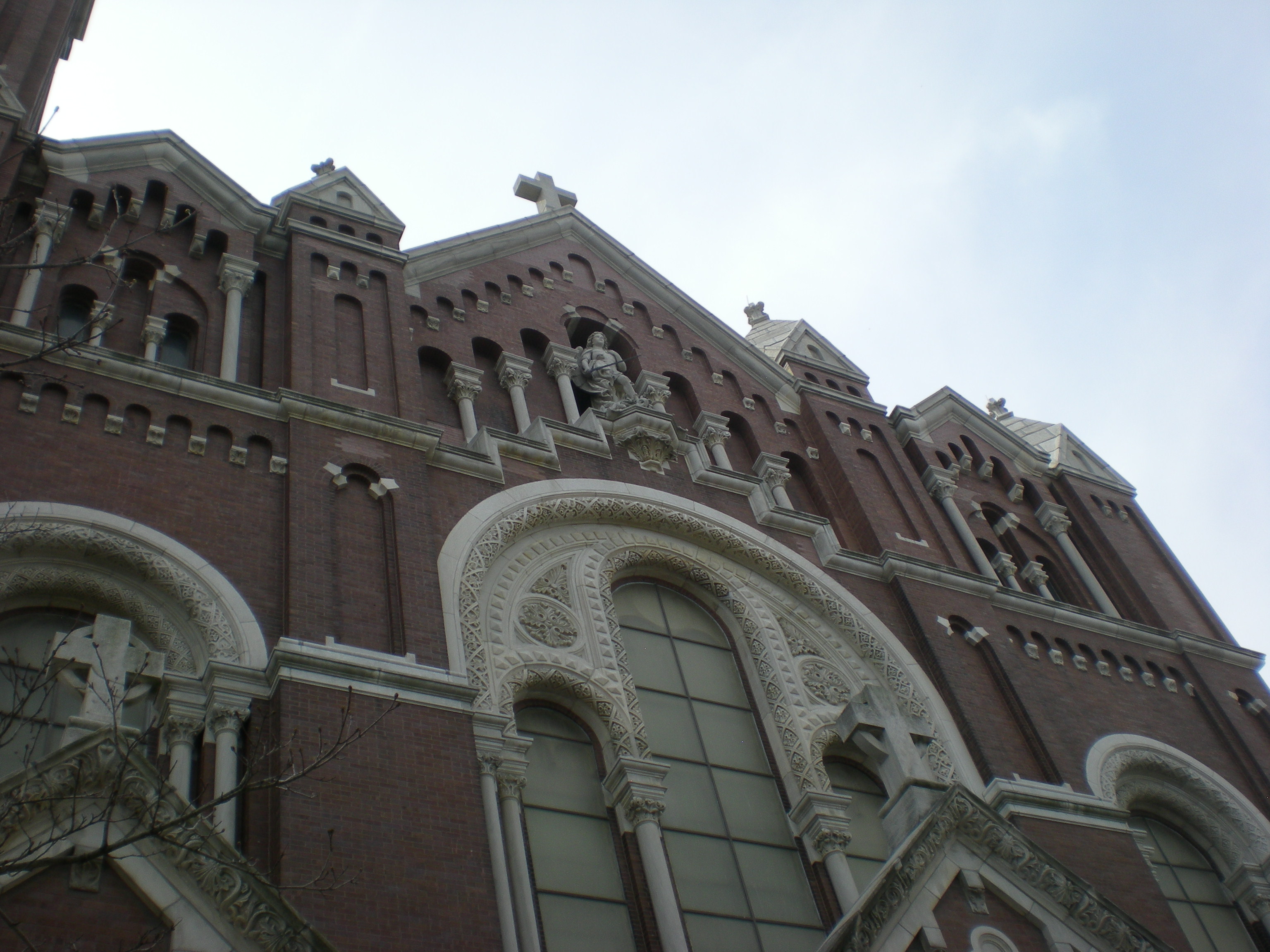
St. Michael's, Old Town, Chicago St. Michael's, Old Town, ChicagoLook closely up there and you see the Archangel Michael, sword drawn, ready to do battle with Old Scratch and his minions.
St. Michael's, Old Town, ChicagoThe interior looks like this: Bavarian Baroque, according to the AIA Guide to Chicago.

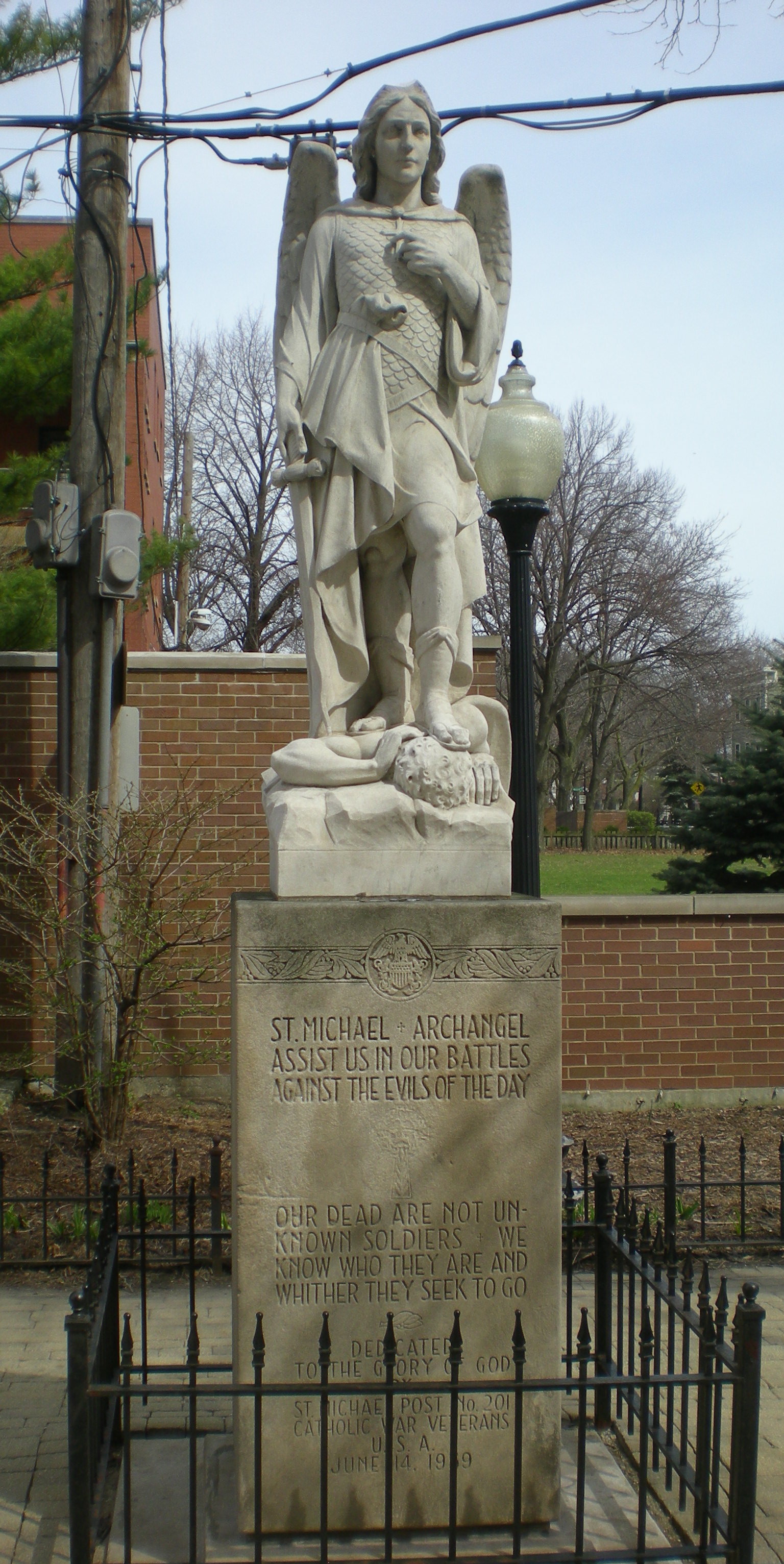
The archangel is also depicted outside on the plaza, facing the church. His sword is at his side, after vanquishing Old Scratch (at least, I assume that’s Satan underfoot). Good thing none of the nearby telephone wires were damaged in the struggle.
St. Michael's, Old Town, ChicagoThe plaza itself is a pedestrian zone that cuts the flow of cars on that section of Eugenie St. That’s unusual. I can’t think of another church in Chicago that has one. It helps make that part of Old Town distinct.

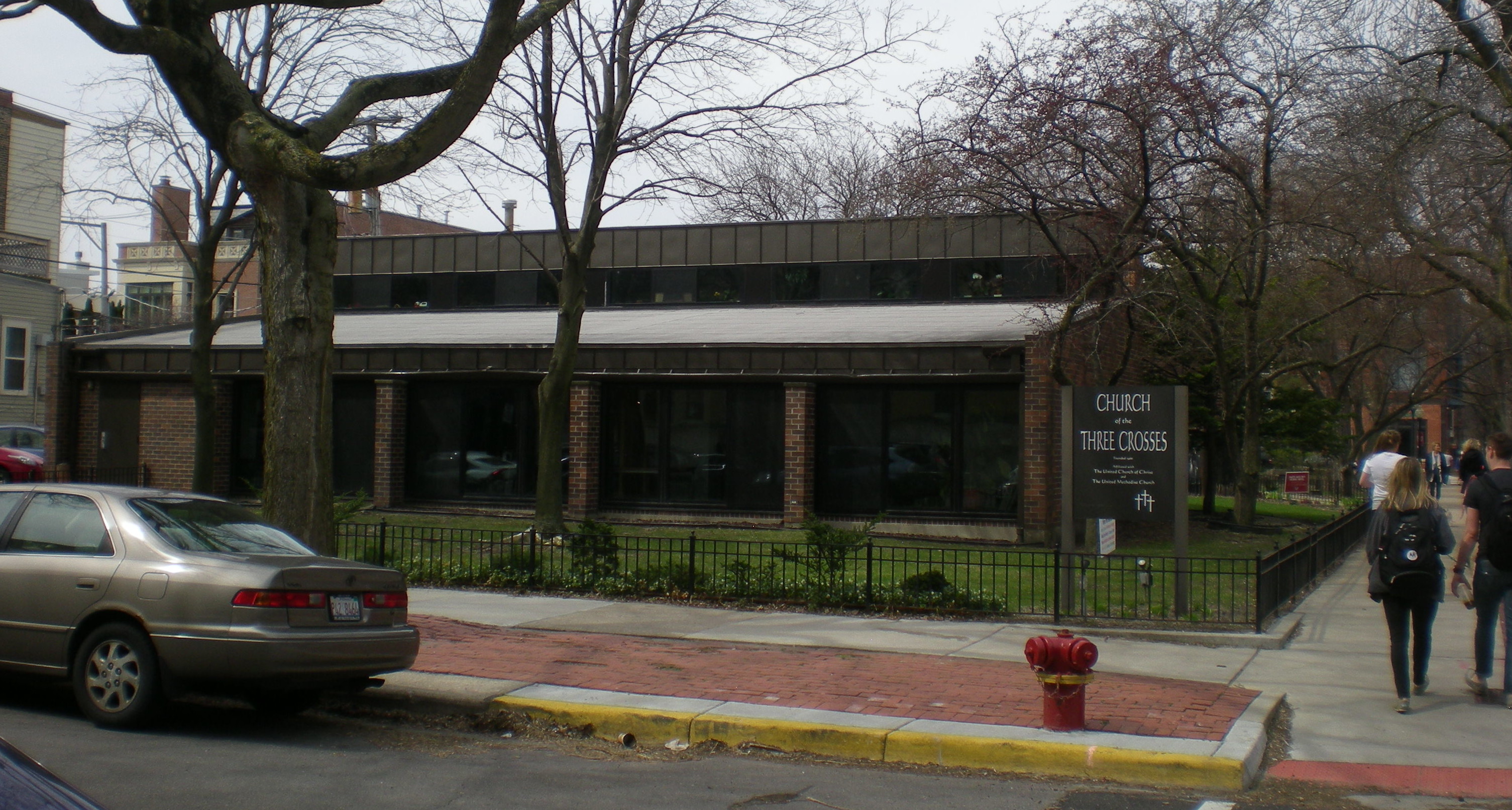
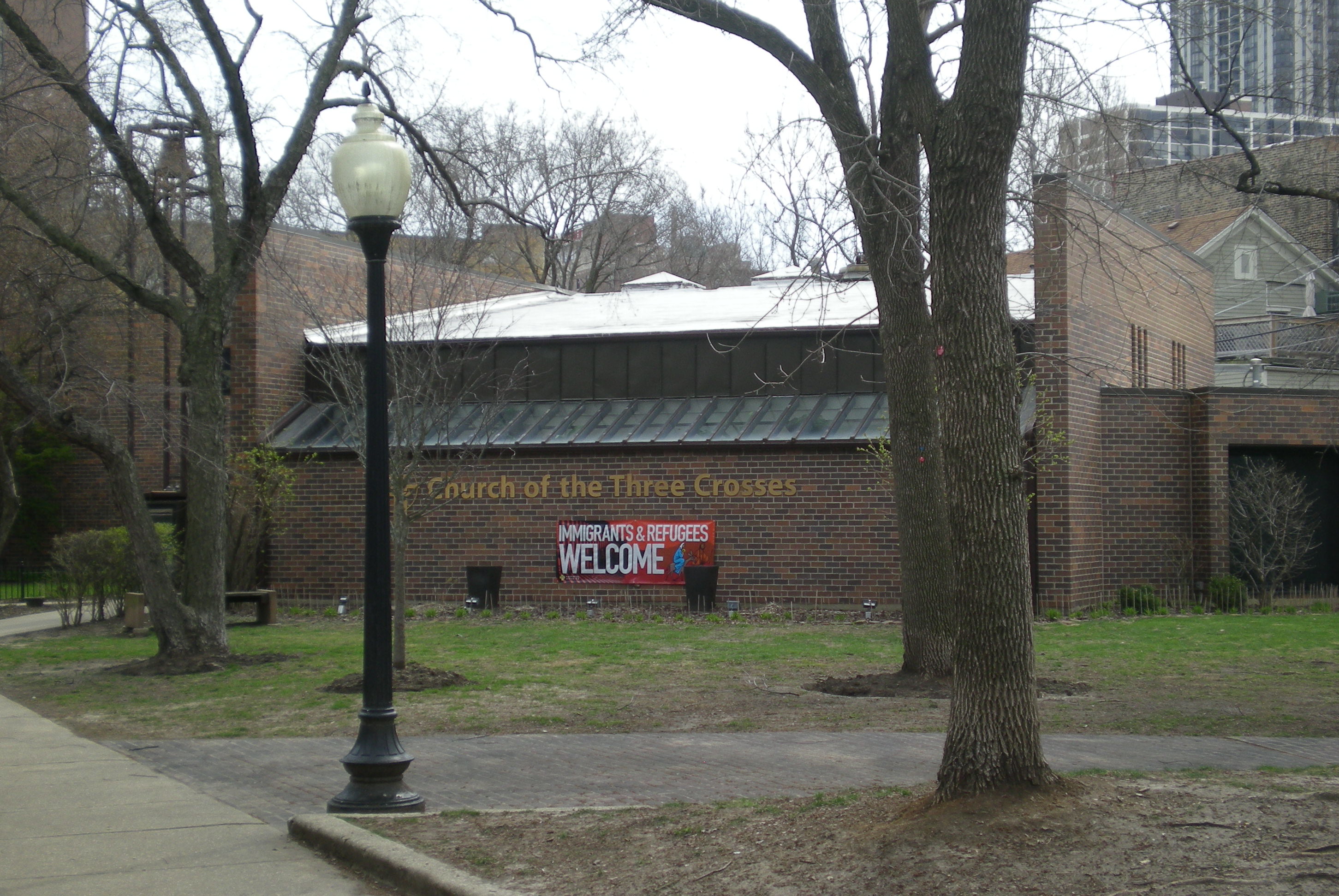
A few blocks to the north, at Wisconsin and Orleans, is the less distinct — at least as a building — Church of the Three Crosses, which is affiliated with both the United Church of Christ and the United Methodist Church.
Church of the Tree Crosses, Old Town, ChicagoAround back, however, is a sign of the times.
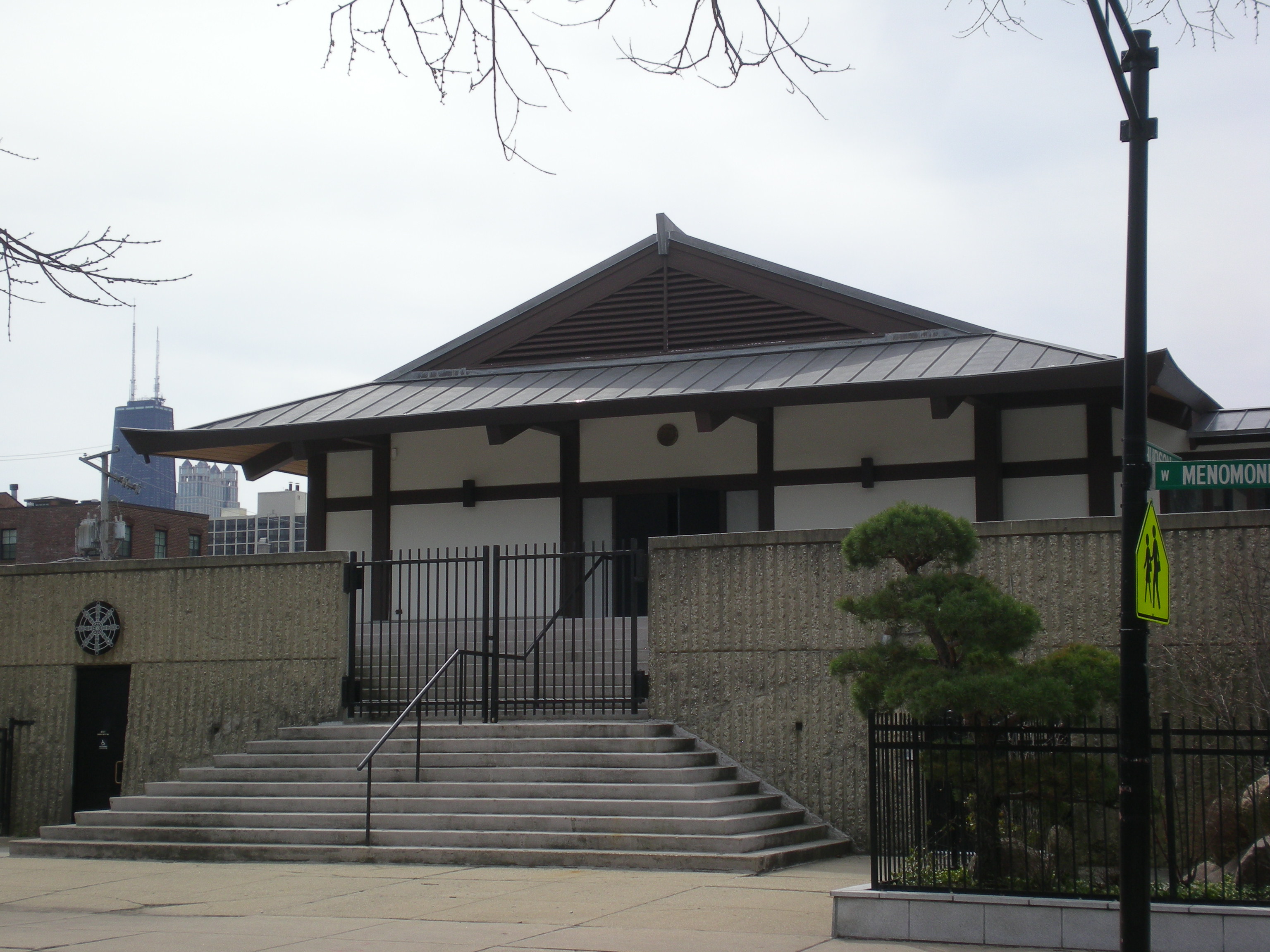
Church of the Three Crosses, Old Town, ChicagoRoughly between St. Michael’s and the Church of the Three Crosses, on W. Menomonee, is the Midwest Buddhist Temple, a temple of the Jodo Shinshu school of Buddhism.

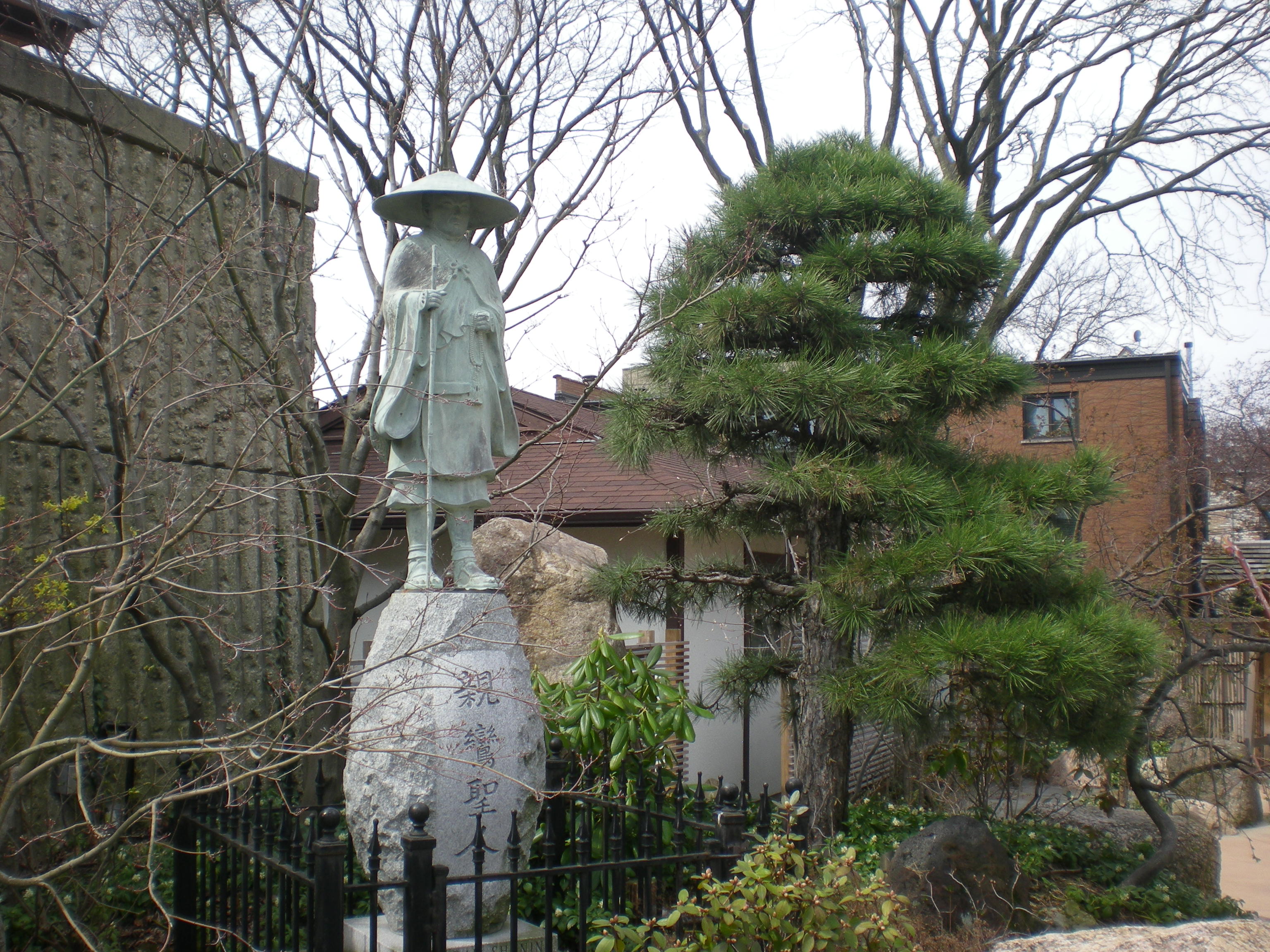
Midwest Buddhist Temple“Jodo Shinshu, also referred to as Shin Buddhism, was founded in Japan by Shinran Shonin (1173-1262),” explains the temple’s web site. “It was Shinran Shonin who made Buddhist teachings accessible to people of all walks of life — in contrast to the traditional, primarily monastic practice of Buddhism.

“Between 1900 and 1940, many Jodo Shinshu temples were founded along the West Coast of the United States. But it wasn’t until 1944 that the Midwest Buddhist Temple was founded in Chicago by Rev. Gyodo Kono — its beginning linked to the ‘resettlement’ of many Japanese-Americans who moved to the Midwest to start new lives as World War II came to a close.”

At the edge of the property is a small but lovely garden, designed by Hoichi Kurisu of Portland, Ore., who also did the Anderson Gardens in Rockford.

Midwest Buddhist TempleMidwest Buddhist Temple“The boulders, set into place by a 30-ton crane, were especially important in representing the topographical features of Shinran Shonin’s walk from Mt. Hiei to the people in the Japanese villages as he spread the teachings of Shin Buddhism.”

Luckily, these days there are funiculars connecting Mt. Hiei with the rest of Japan.