The National Civil Rights Museum

The plan was to spend a few hours in Memphis on June 25 on the way to Little Rock, where we’d overnight. The question then became, was Graceland worth visiting? The least expensive adult ticket, just for getting into the house and grounds to look around, is $42.50. For $80, you can also see a whole lot of stuff that isn’t the house and grounds, such as Elvis airplanes and cars and whatnot (“Experience Graceland like you are a VIP plus see Elvis’ custom jets!”)

Two strikes. I understand how it works. The prices are whatever the market bears. I don’t care, I still think they’re insane. Maybe temporary insanity, fading as the generation that originally adored Elvis passes from the Earth. Who knows?

The third strike was Graceland’s distance south of I-40, the road from Nashville to Little Rock. Elvis very nearly lived in Mississippi.

So I turned my attention to the National Civil Rights Museum, which is practically in downtown Memphis, not far at all from the highway. Adult admission, $15. After lunch that day, we repaired to the museum, which is behind the facade of the former Lorraine Motel, site of MLK’s assassination. Under Jim Crow, the Lorraine was a place where black people could stay.

The motel sign is still in place, though the marque message isn’t original. Wonder what it said in 1968.
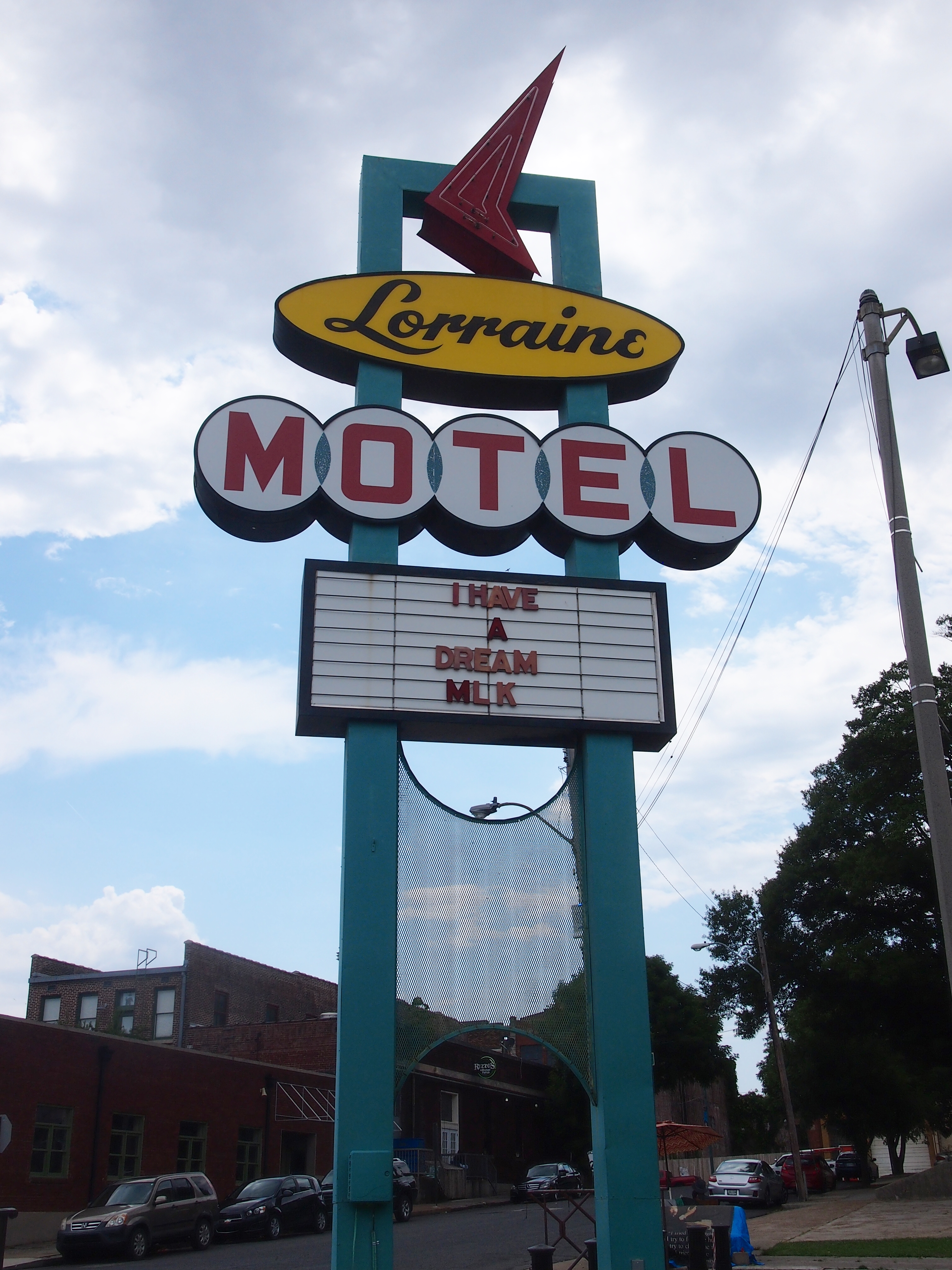
National Civil Rights Museum, MemphispA wreath hangs at the site of Dr. King’s death. I’ve seen photos of the place for years, so it was quite a thing to see it in person.
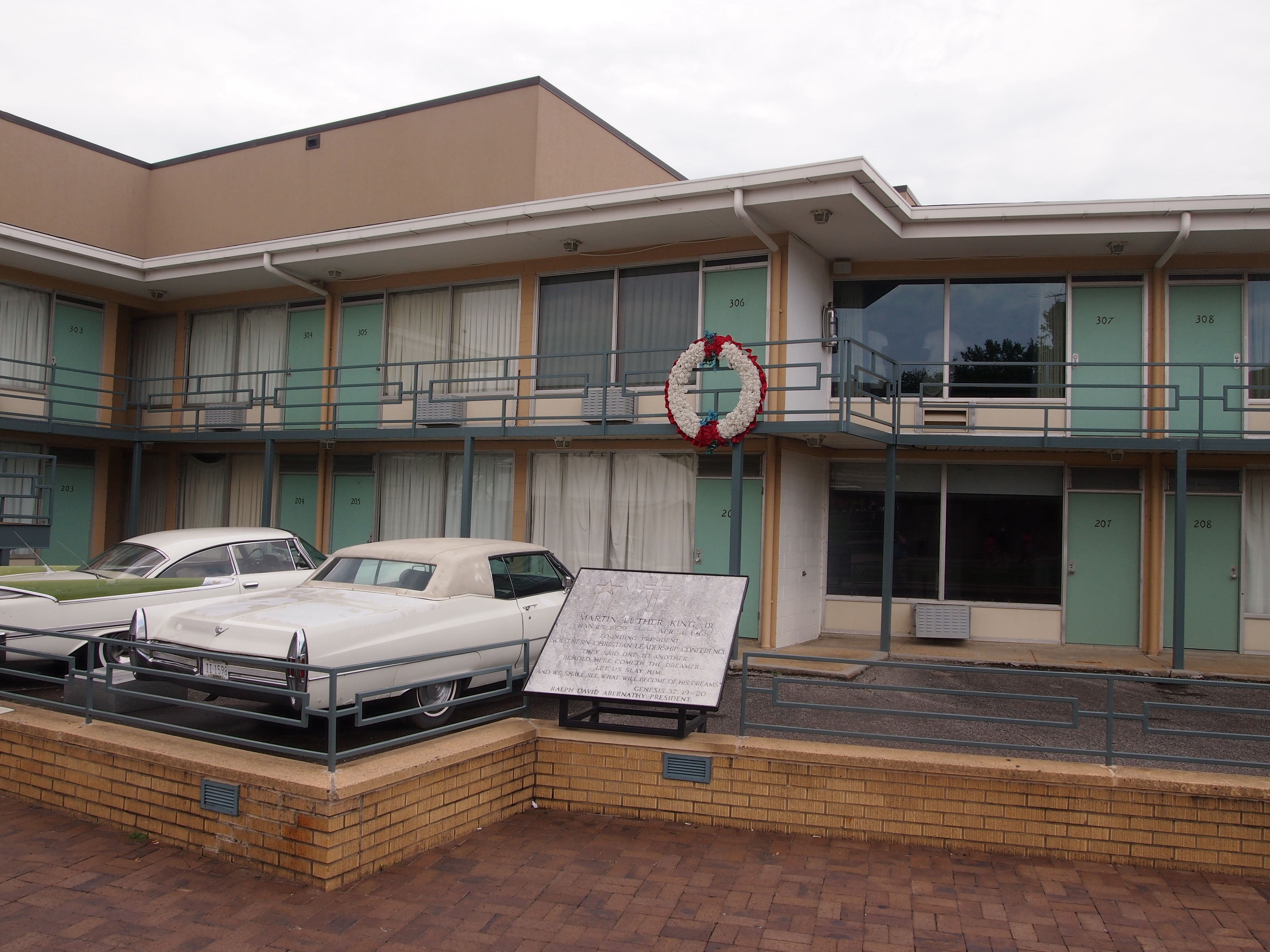
National Civil Rights Museum, MemphisThe plaque says:
MARTIN LUTHER KING JR
Jan 15, 1929 – Apr 4, 1968
Founding President
Southern Christian Leadership Conference
“They said one to another
Behold here, cometh the dreamer.
Let us slay him
And we shall see what will become of his dreams.”
Genesis 37:19-20
Ralph David Abernathy, President

The museum, which opened in 1991, isn’t strictly devoted to MLK, however. It’s considerably broader than that, with the two-story building behind the Lorraine facade focusing on the years of the civil rights struggle between 1954 to 1968, though there are exhibits that the set the stage, so to speak — about slavery and then Jim Crow — and exhibits covering more recent years. The exhibits are organized chronologically through those years.

Like any good history museum, the displays are a mix of images, reading materials, interactive features, and artifacts, some quite large. As the NYT described it in 2003 (before a 2014 renovation, which apparently added more interactive features): “Rather than simply displaying photos and documents about the Montgomery bus boycott, for example, there is an actual bus like those that were used in Montgomery in the 1950s. Visitors may climb aboard, and after they sit down, a recorded voice begins by asking them politely to move to the back and then, if they refuse, rises to angry commands.”

Here’s the bus.
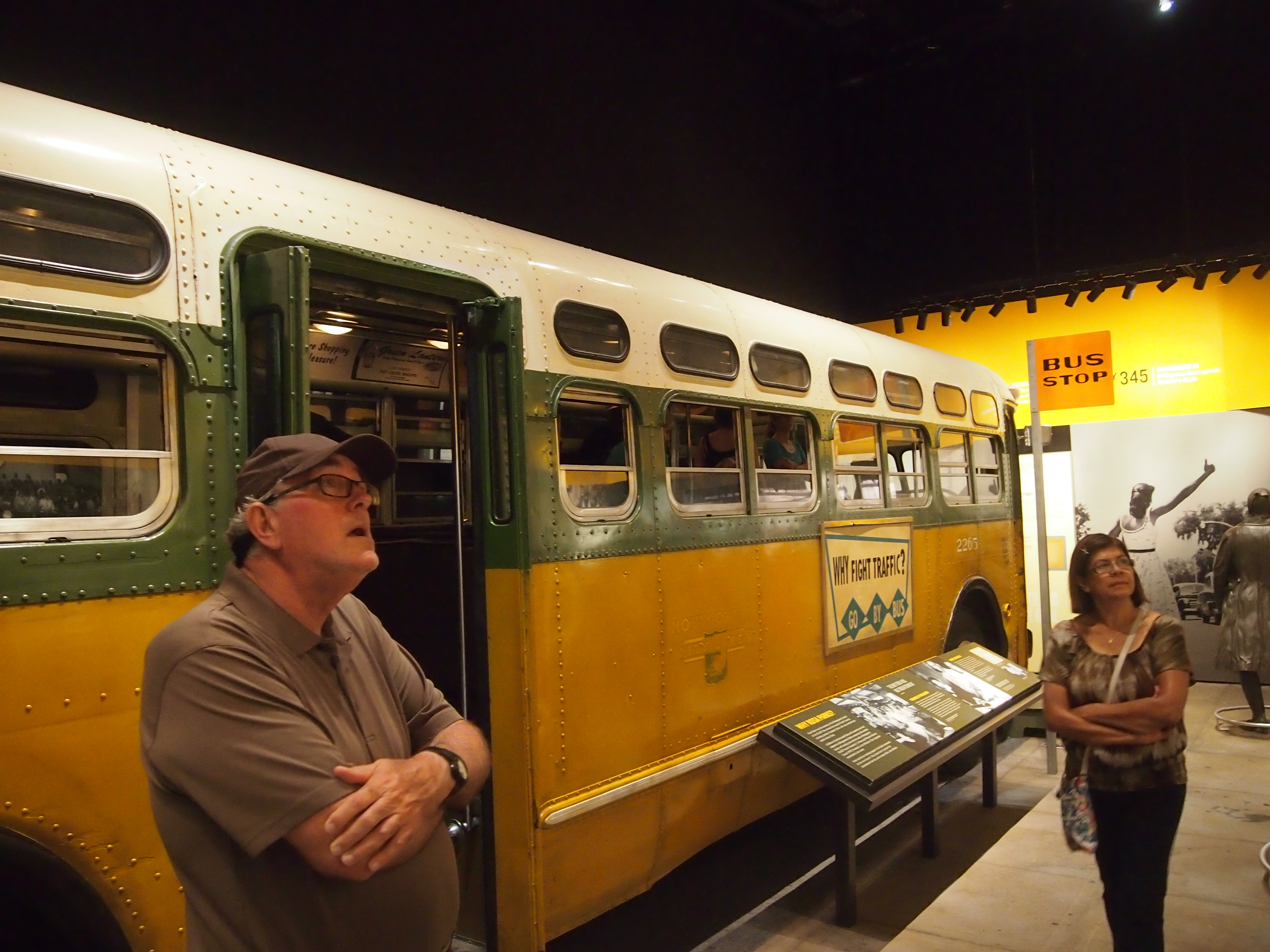
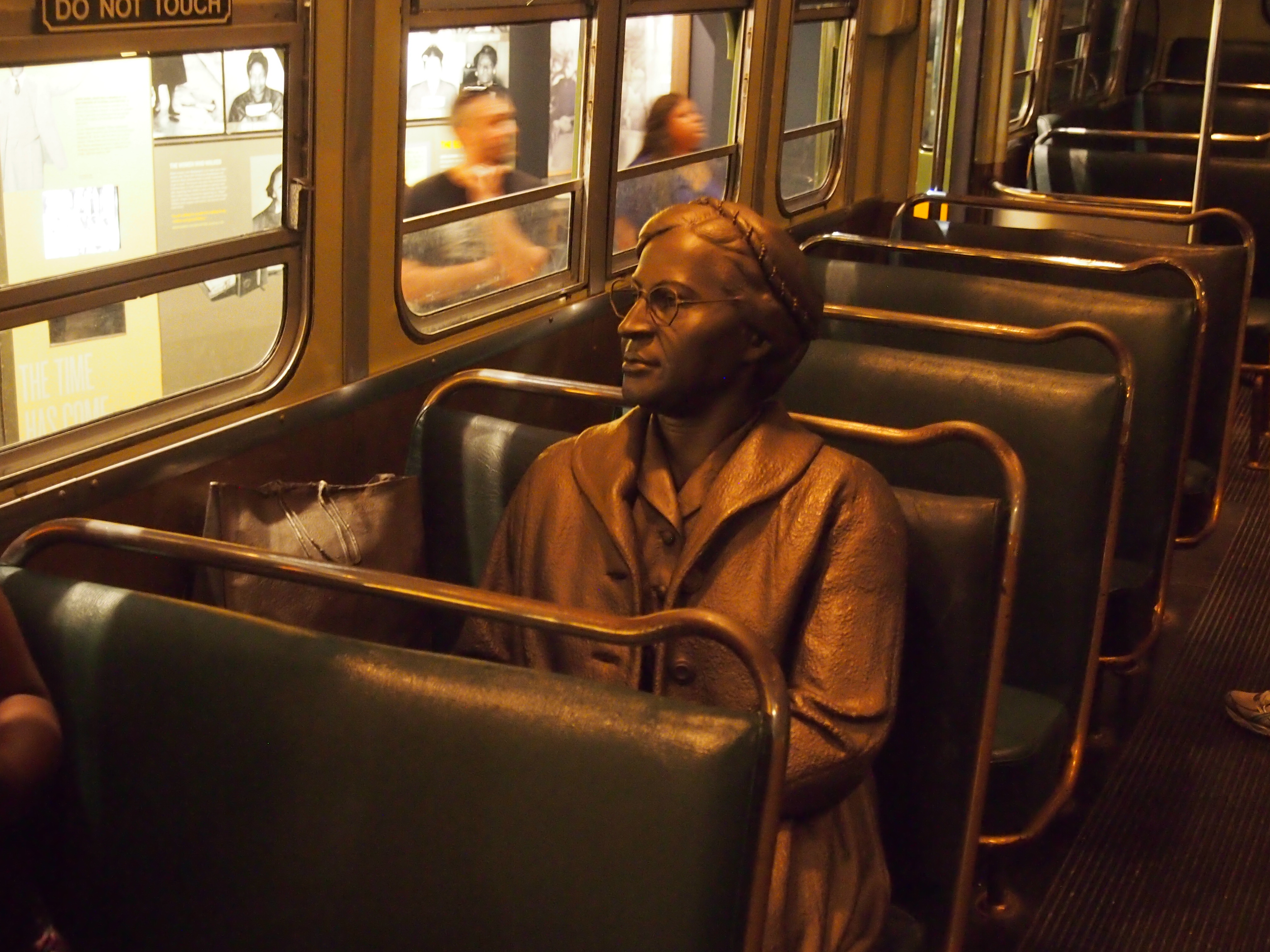
National Civil Rights Museum Montgomerty Bus BoycottInside is a statue of Rosa Parks.
National Civil Rights Museum Montgomerty Bus Boycott - Rosa ParksI was glad to see that the museum explained Parks’ action was carefully planned to achieve certain goals, with Parks fully part of that plan, and not some spontaneous act by a tired woman, which is the impression you sometimes get hearing about the Montgomery Bus Boycott.

“Nearby is a reconstruction of a lunch counter like the ones where protesters sat as they tried to break the color barrier that was an almost unquestioned part of Southern life until 50 years ago,” the NYT continues. “Life-size figures sit at the counter, and a video shows how the protesters prepared for the ordeal of insults, condiments poured on their heads and other humiliations.”
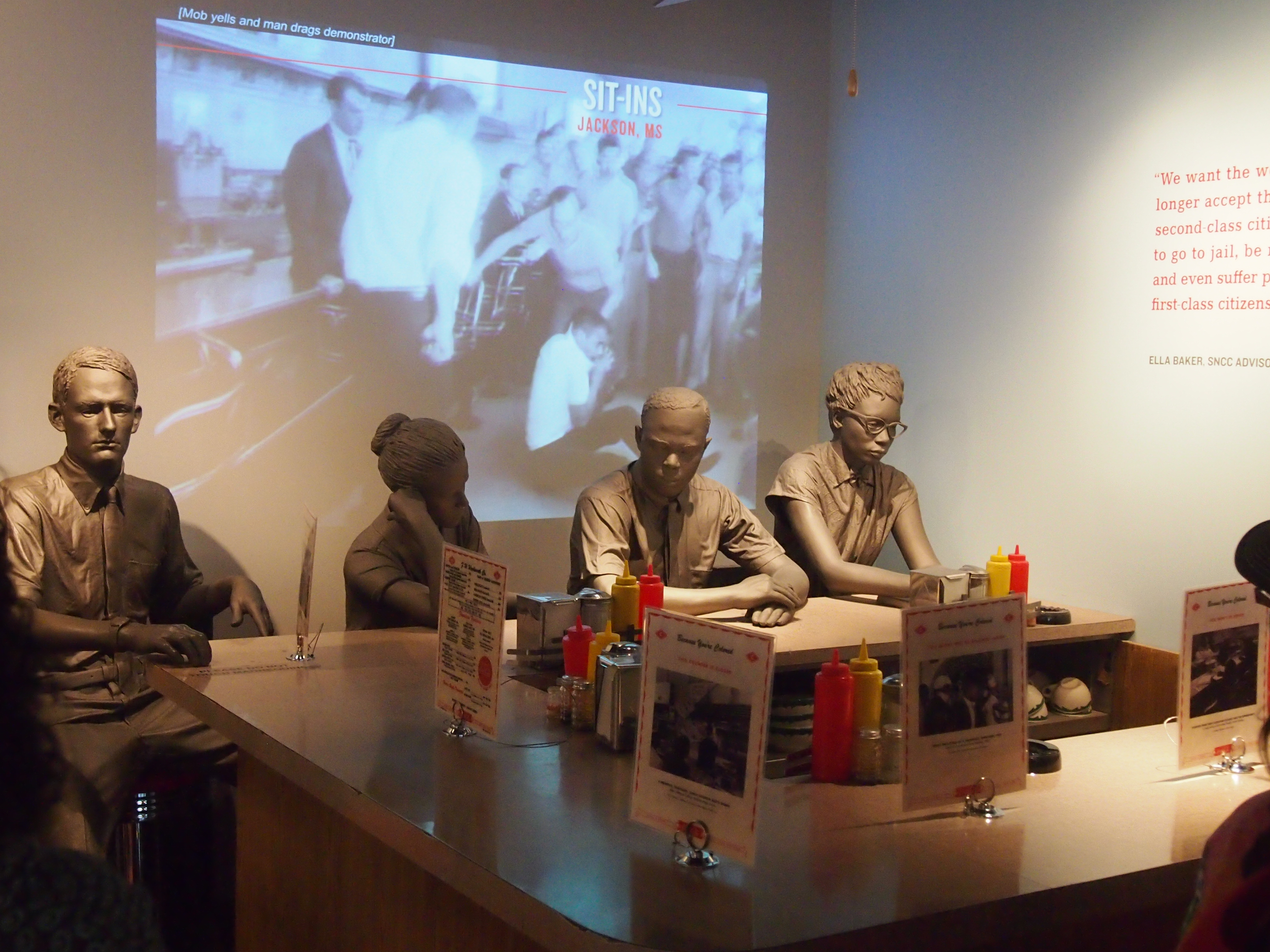
National Civil Rights Museum - lunch counter sit inPlenty of other ground is covered, including the March on Washington — Dr. King’s entire speech is played, not just the usual highlights — Freedom Summer, Freedom Rides, Birmingham, Selma, Albany, Ga., the murders in Philadelphia, Miss., the Voting Rights Act of 1965, and more. I grew up hearing about the tail end of this period, and learning about it later, but even so, some of the detail was new to me. I expect most of it was new to Ann.

Here’s another bus, a replica of a torched Freedom Riders bus.
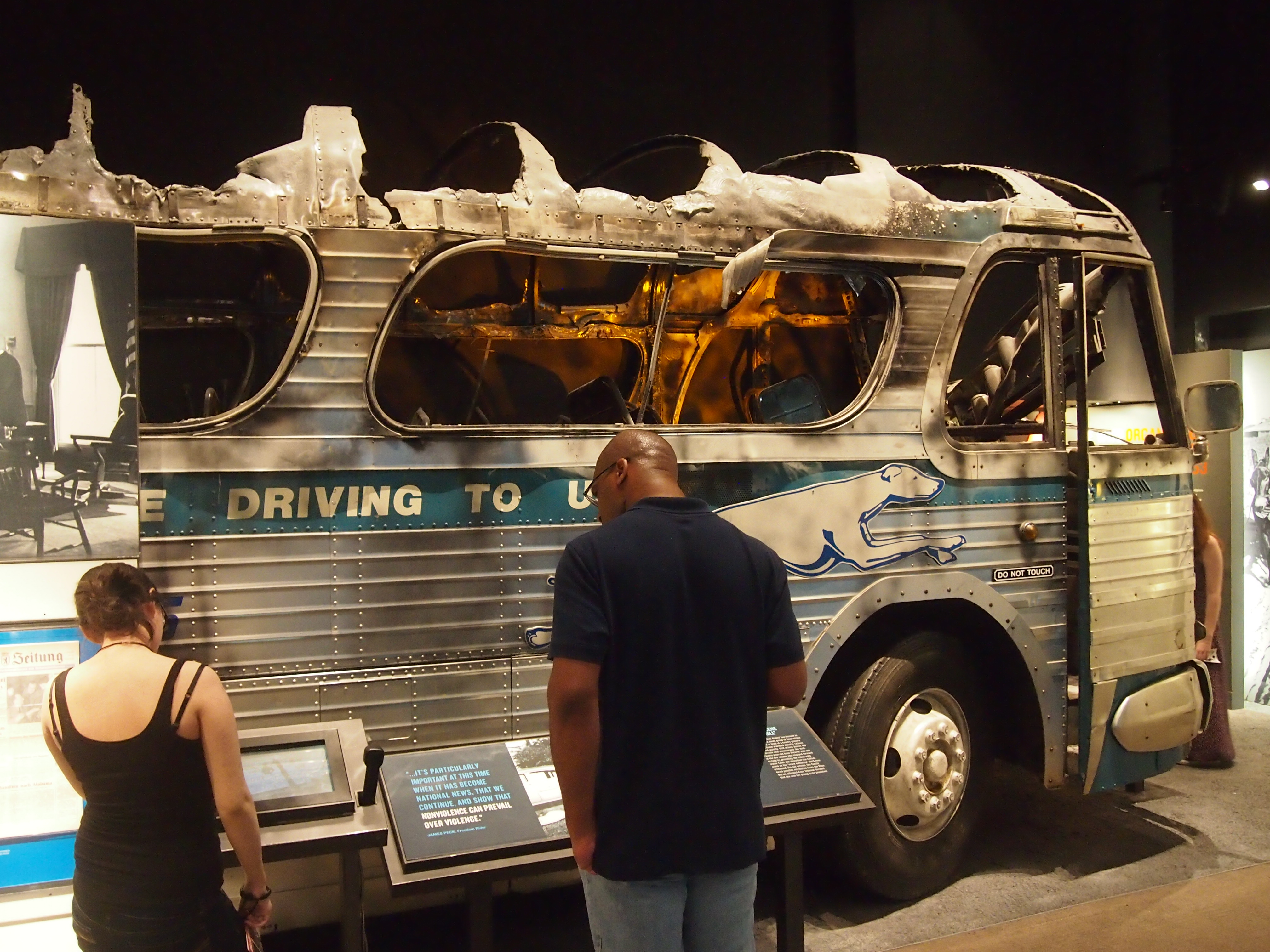
National Civil Rights Museum - Freedom RidersEventually you reach reach the two preserved motel rooms (306 and 307), the one MLK stayed in and the one next to it, that are designed to look like they did the day he died. Visitors are able to peer into them but not go in.

Across Mulberry St. are the Young & Morrow Building and the Main Street Boarding House, now forming an annex to the museum. The annex is more closely focused on the assassination of Dr. King, and includes a reconstruction of the room from which James Earl Ray squeezed off the fatal shot, including artifacts — evidence — of the crime. It reminded me of the Sixth Floor in that way. And while there’s a also display called “Lingering Questions,” I don’t doubt that Ray, like Oswald before him, was guilty as hell, as my Uncle Ken would have put it.

Finally, I’d be remiss if I didn’t mention Jacqueline Smith. For some years after MLK’s death, the Lorraine operated as an SRO, and she was a resident — the last one kicked out to make way for the museum. Since then, she’s parked herself across the street in protest (though perhaps she finds substitutes sometimes).
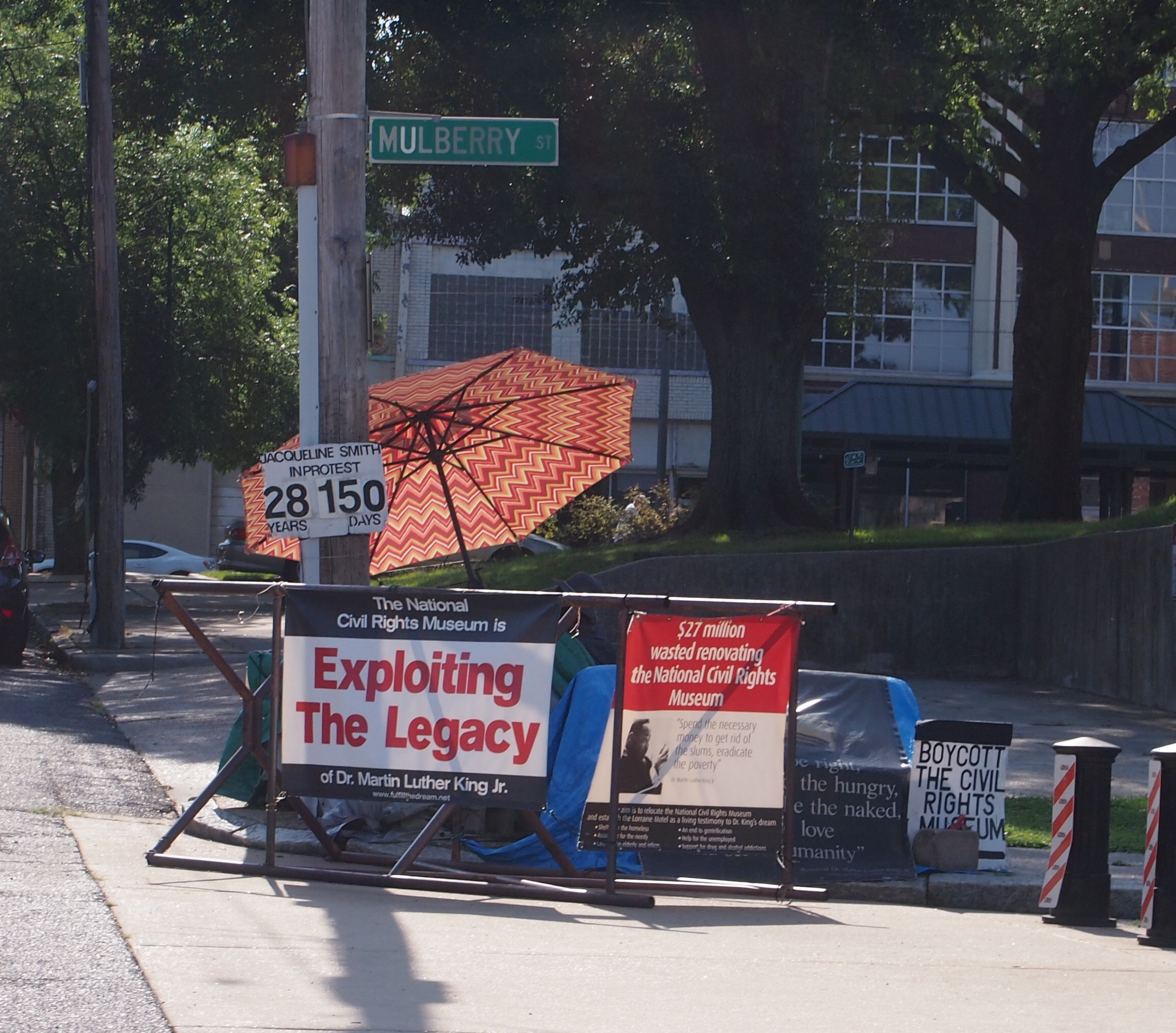
National Civil Rights Museum, Jacqueline SmithSomeone was there, barely visible under an umbrella and behind the signs. Twenty-eight years and 150 days of protest as of June 25, according to one of the signs. Whatever else you can say about her, she’s stuck to her cause.
The Nashville Parthenon

Here’s my thought about Prime Day, which I’d never heard of before: I have enough stuff. I don’t need more stuff, certainly not from Amazon, unless the nonstore retail behemoth is willing to sell me (say) $20 gold pieces at face value.

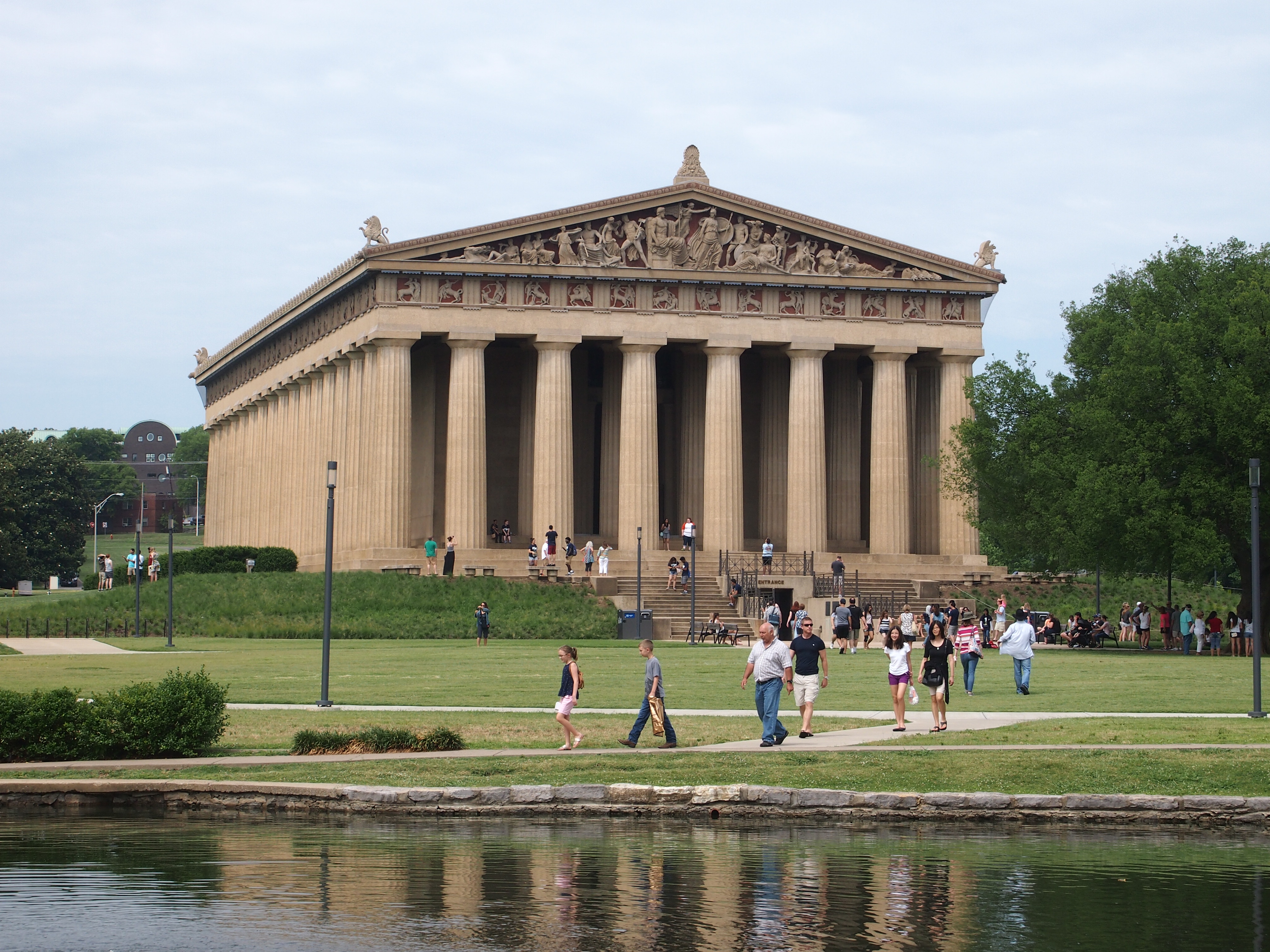
On the other hand, I haven’t seen enough things, so Lincoln’s birthplace wasn’t enough in the way of monumental structures on the our trip, GTT 2016. Not at all. The very next day, we went to see the Parthenon in Nashville’s Centennial Park, after I queried Ann to make sure that she didn’t remember our visit eight years ago. This time, she will.

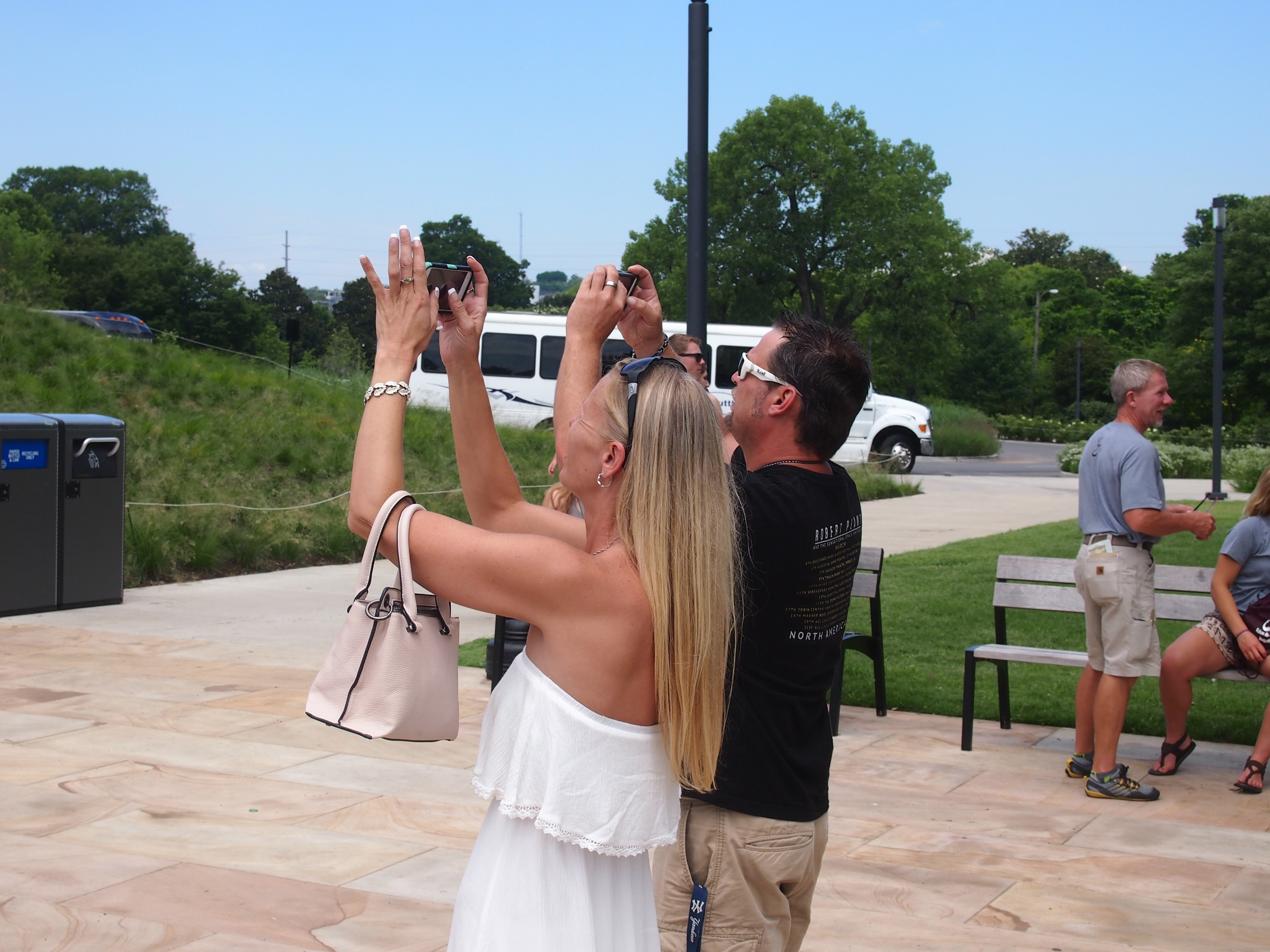
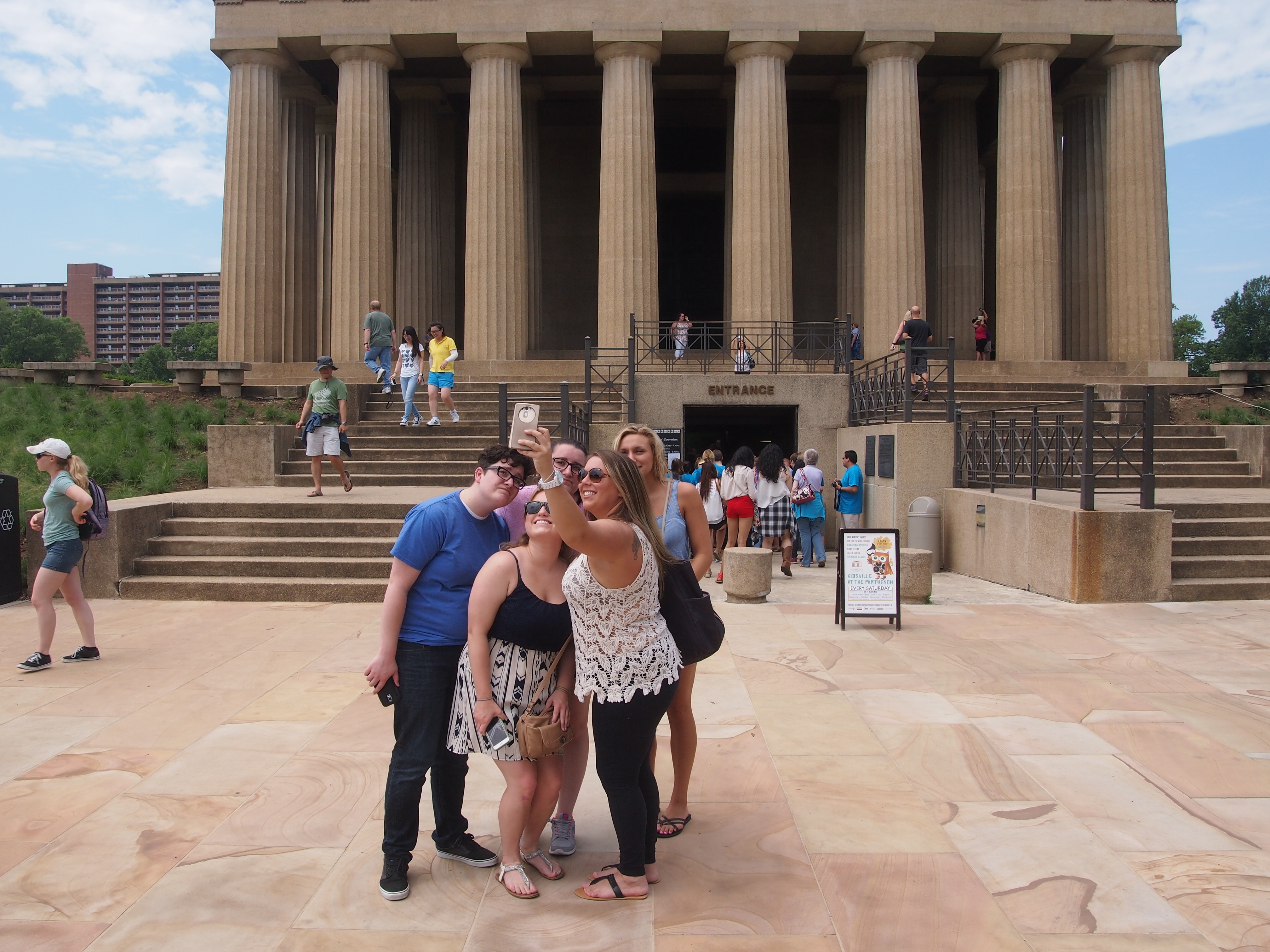
Nashville Parthenon Centennial Park 2016The Parthenon was as crowded on a Saturday morning in the summer, as you’d expect. It’s also the sort of place that inspires picture-taking.

Nashville Parthenon Centennial Park 2016Nashville Parthenon Centennial Park 2016Since it’s well known, there’s little point in detailing the history of Nashville Parthenon — its origin as a temporary plaster building at the Tennessee Centennial Expo in 1897; the permanent sandstone replacement in the 1920s; and the addition of the monumental statue of Athena inside in 1990. But I will add something the late Dr. Ned Nabors told me — told the class I was in — about the columns.

Each of the columns in the original Parthenon leans slightly inward, to give the appearance of being straight. That too is a well-known feature. If the columns were magically extended upward, they would converge about a mile and a half in the sky. Thus each column in the original was slightly different; each was carved to be unique.

In modern times, such uniqueness would be painfully expensive, so the columns of the Nashville Parthenon are exactly alike. To achieve the lean, the floor under part of each column is raised slightly. But enough to be apparent if you look down at the bases of the columns. Besides the building material, that’s one of the main differences between the original and the one in Nashville. (And that no one’s used Nashville’s to store gunpowder yet.)

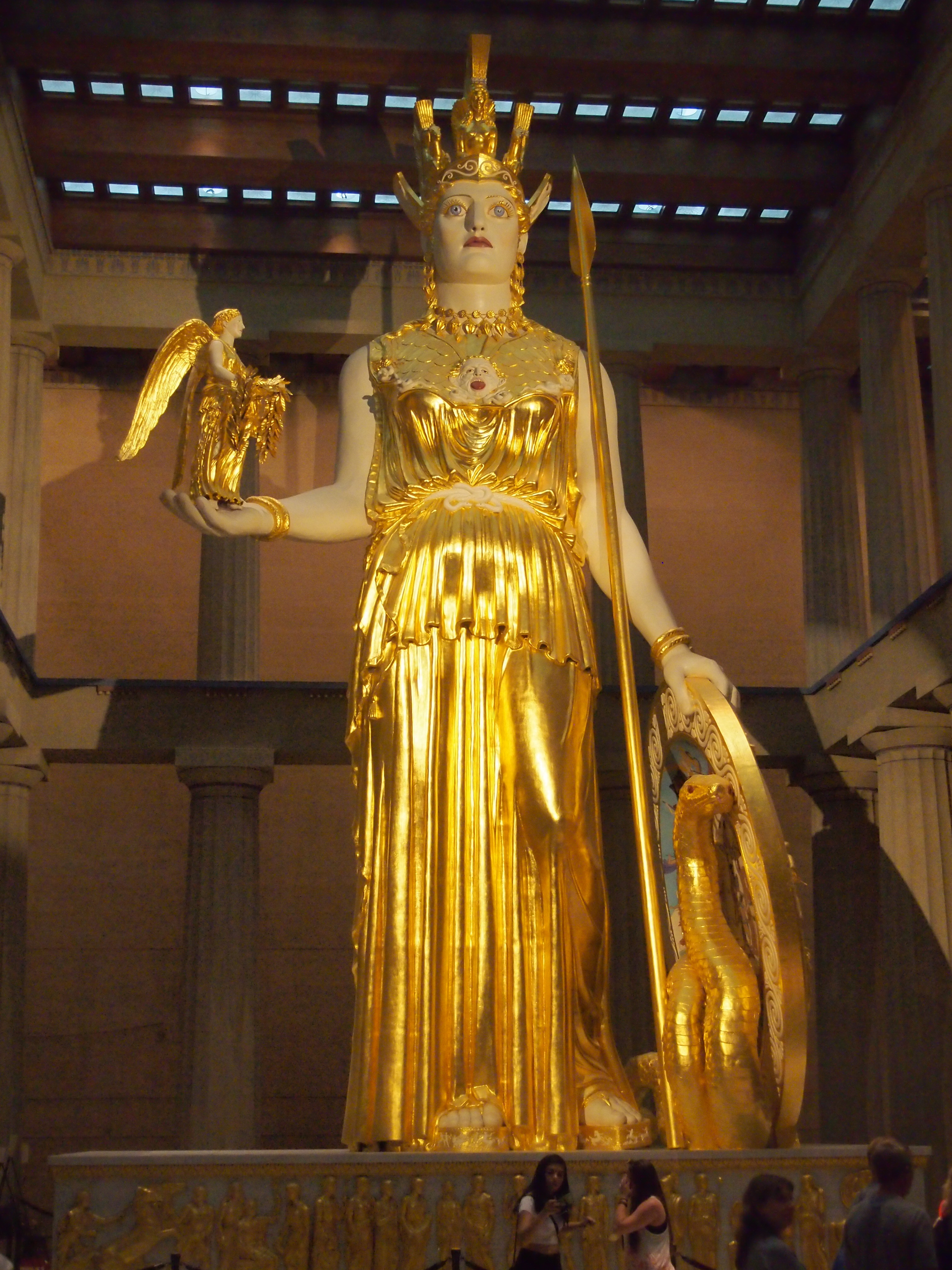
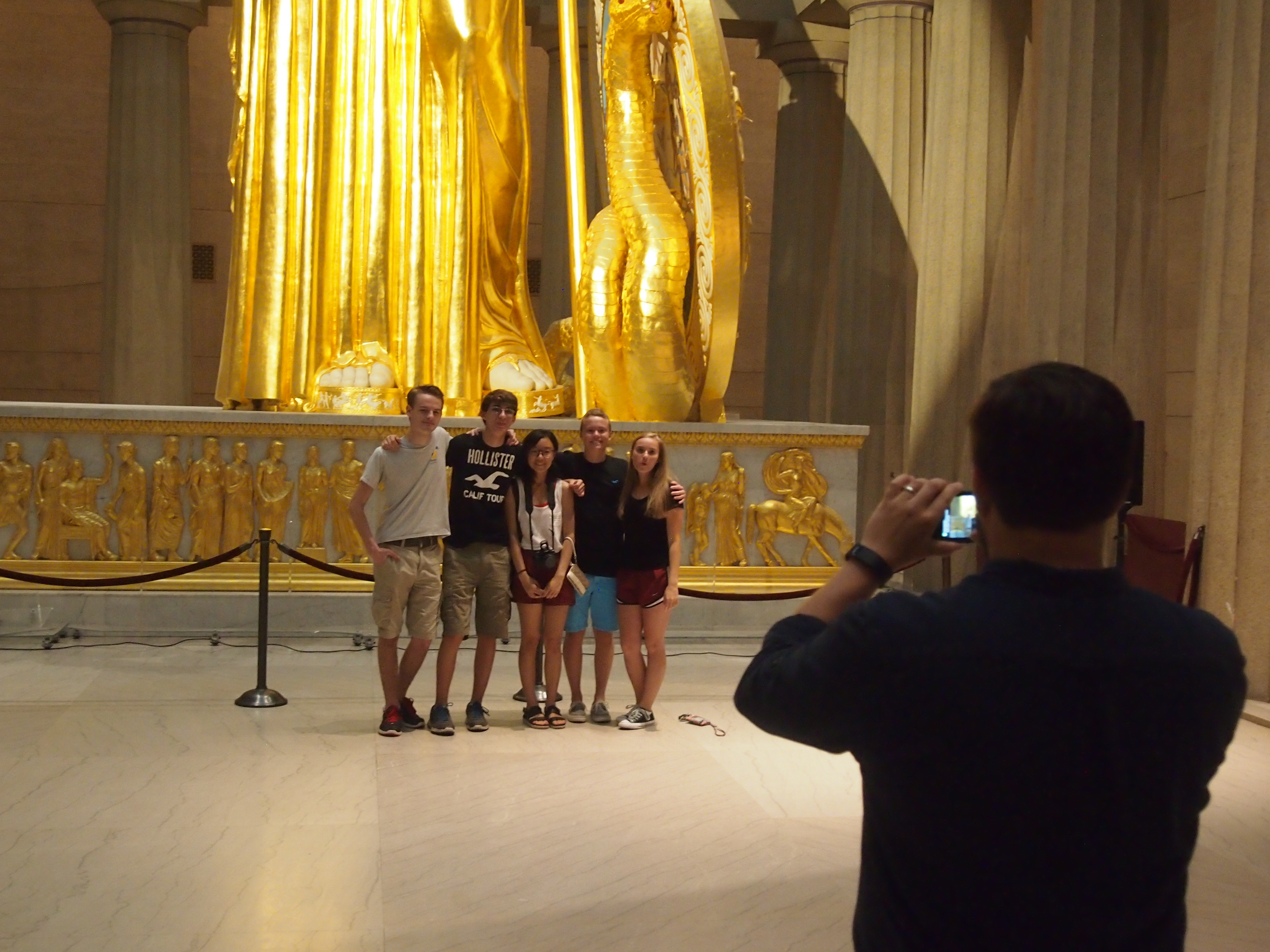
Alan LeQuire’s Athena Parthenos, 42 feet tall and brightly painted, as the Greeks no doubt did saw her, commands the temple’s naos.

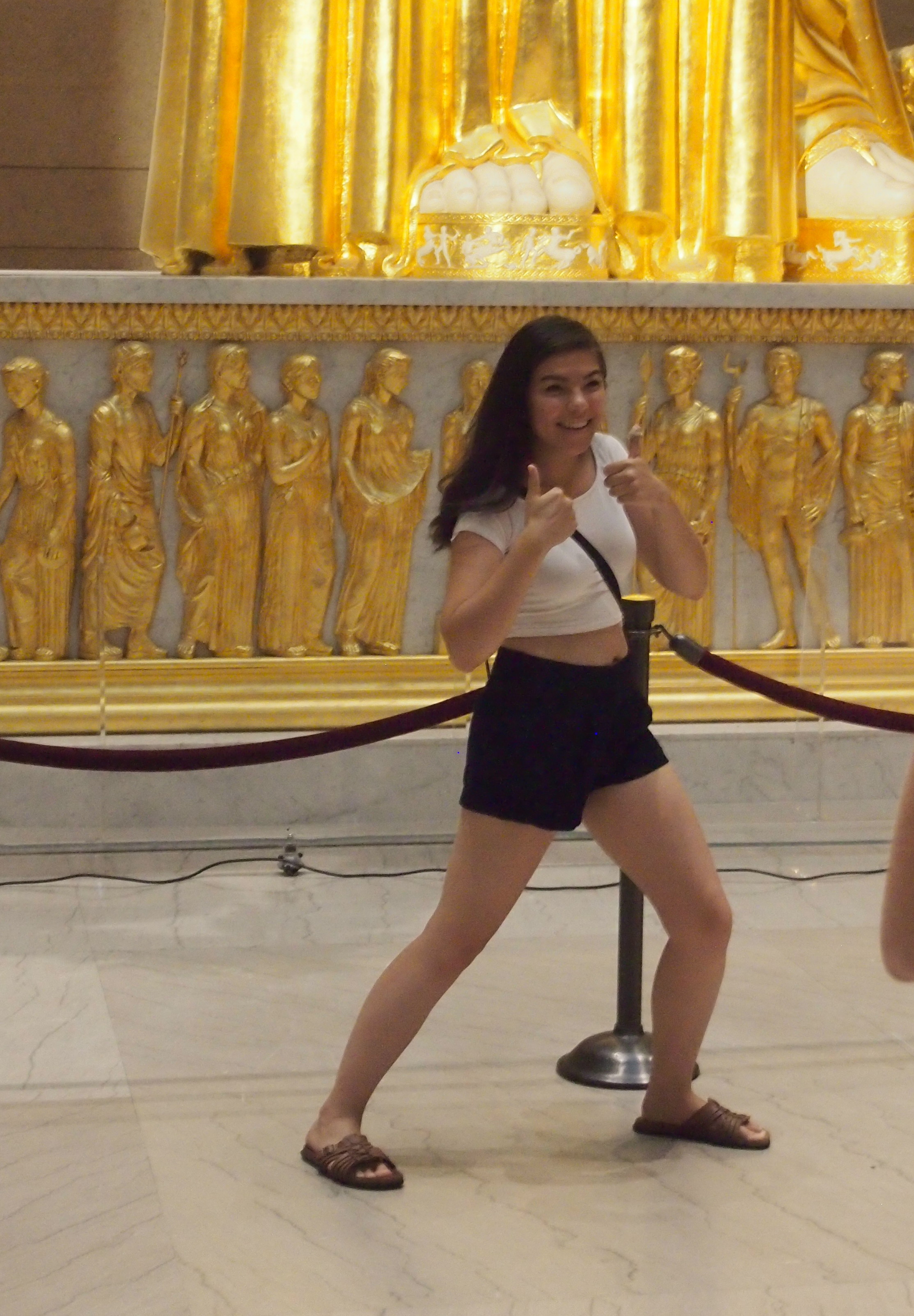
Athena Parthenos Nashville 2016She inspires poses.

Parthenon Nashville 2016Parthenon Nashville 2016Parthenon Nashville 2016We also spent some time in the Parthenon’s lower level, looking at its collection of paintings, and the exhibit about the Tennessee Centennial Exposition. The expo celebrated the centenary of Tennessee’s 1796 statehood, though held in 1897 (like the Columbian Exposition of 1893, a year after the anniversary). Fittingly, the site of the expo later became Centennial Park.

Ilene Jones Cornwell writes: “The Centennial Exposition, held May 1 through October 30, 1897, was ‘essentially a fair on a grand scale,’ wrote A. W. Crouch and H. D. Claybrook in Our Ancestors Were Engineers. Attractions included 12 large buildings featuring exhibits on the commercial, industrial, agricultural, and educational interests of the state; a ‘midway’ including Egyptian, Cuban, and Chinese villages; a ‘Giant See-saw’ designed by local engineer and steel fabricator Arthur J. Dyer; Venetian gondoliers on newly created Lake Watauga; a Venetian Rialto bridge designed by local architect C. A. Asmus; parades and ‘sham battles’ by the Tennessee Militia; fireworks and other entertainment; and a 250-foot flag staff designed by E. C. Lewis. Major Lewis also had conceived the idea to create a replica of the 5th century B. C. Athenian Parthenon to house the art exhibit, then commissioned local architect W. C. Smith to make the needed drawings….

“After the Exposition closed, all buildings except the Parthenon were torn down and removed. The success of the Exposition, as well as the progressive movement of the late 19th century to establish public parks, planted the seed for Nashville’s park system. In 1901 Mayor James Head appointed five men, one of whom was Major E. C. Lewis, to the new Board of Park Commissioners. Negotiations were begun by the city in early 1902 with the owners of the 72-acre Centennial Park to purchase the land for a permanent city park. After months of complicated offers and counter-offers, described in The Parks of Nashville, Nashville Railway and Light Company purchased Centennial Park and its title was presented to the city park board on December 22, 1902.”

Even by about 11 that morning, it was too hot to spend much time wandering around Centennial Park, which was too bad, since there are a variety of other things there besides the Parthenon.

Such as a large locomotive that the park has — and how many locomotives are there in public parks? Must be a web site or guide book about that, but I’m too lazy to find it. But not too lazy to look up the Centennial Park locomotive: a Nashville, Chattanooga & St. Louis 4-8-4.

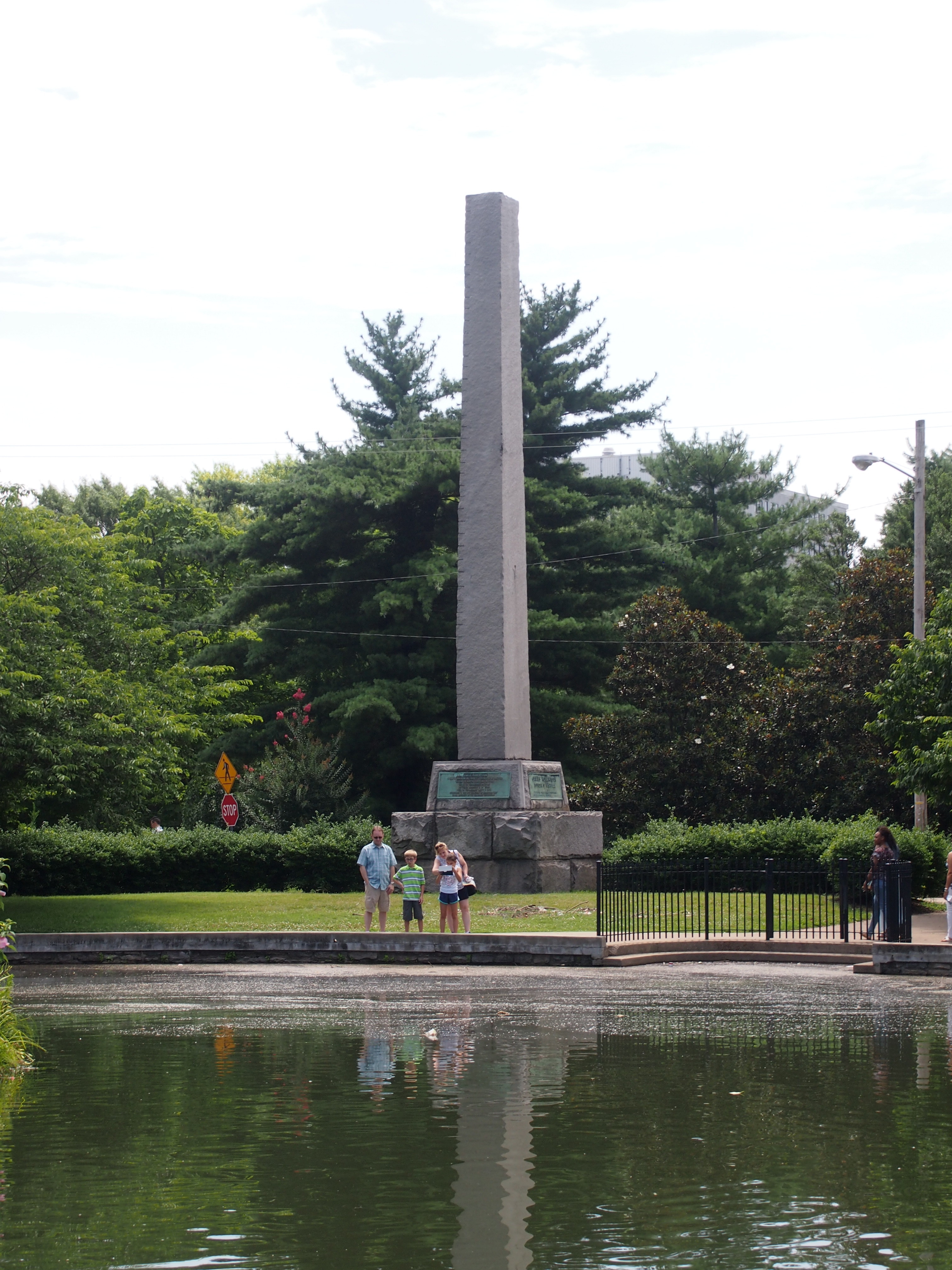
Also, I either never noticed, or had forgotten, the Robertson monument, which is a freestanding column. It isn’t far from the Parthenon, so we walked by it.
Robertson Monument, Centennial Park, NashvilleCornwell again: “When negotiations had begun to purchase the Centennial land, [Major Lewis] purchased the 50-foot granite shaft for $200, then his fellow-commissioner Samuel A. Champion ‘resolved that it be erected in the park as a monument to the memory of James Robertson.’ Lewis also purchased the flat-stone base for $10 in 1903 to remain beside Lake Watauga as a memorial to the Centennial Exposition. A new granite base was needed to support the heavy shaft after its relocation, but no record has yet been found of the base’s creator or its procurement. Wherever the massive base originated, Johnson described the monument’s creation in The Parks of Nashville: ‘With a tripod made of three large oak logs and block and tackle, Major Lewis raised the shaft into position and then constructed the foundation beneath it.’ The granite shaft and its base weigh a total of 52.5 tons.”

Robertson, the “Father of Tennessee,” co-founded Nashville with John Donelson in 1779. For a moment I thought he and his wife might be buried there in the park, but then I remembered seeing his grave some years ago at the Nashville City Cemetery, where many early Tennesseans not named Andrew Jackson repose (he’s at the Hermitage).

The Abraham Lincoln Birthplace National Historical Park

“Where are we going?”

“Lincoln’s birthplace,” I told Ann on the morning of June 24 as we left Elizabethtown, Ky. “It’s about 10 miles off the Interstate. Bet his parents were glad to have a place near the highway.”

Ha, ha, Dad, was the reaction.

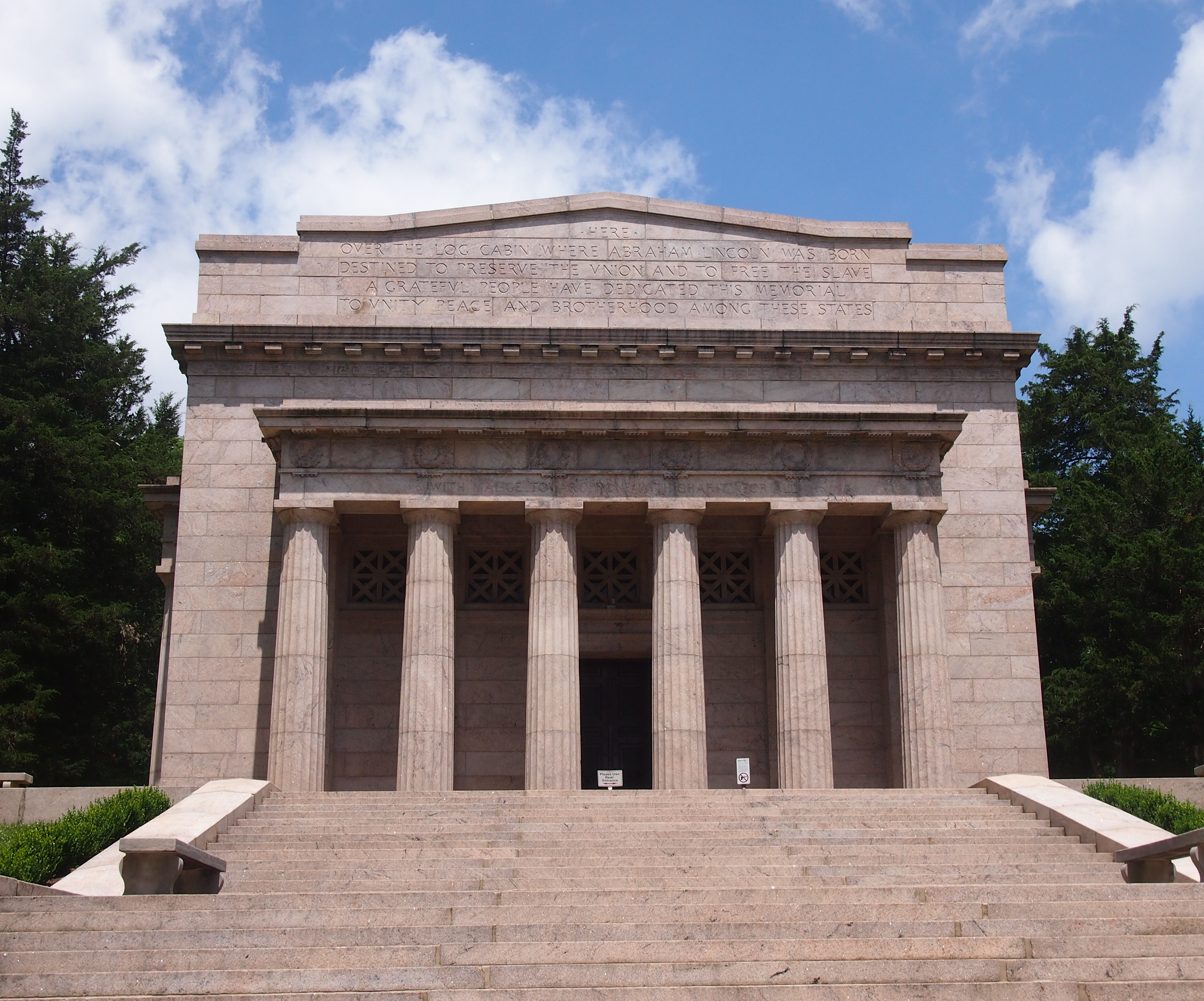
The Abraham Lincoln Birthplace National Historical Park is in fact about 10 miles east of I-65, a roadway built much later than the Lincolns’ cabin or even the monumental building erected on the site 100 years later, with its groundbreaking on February 12, 1909. TR was there that day to wield the ceremonial trowel, which is now on exhibit at the visitors center.

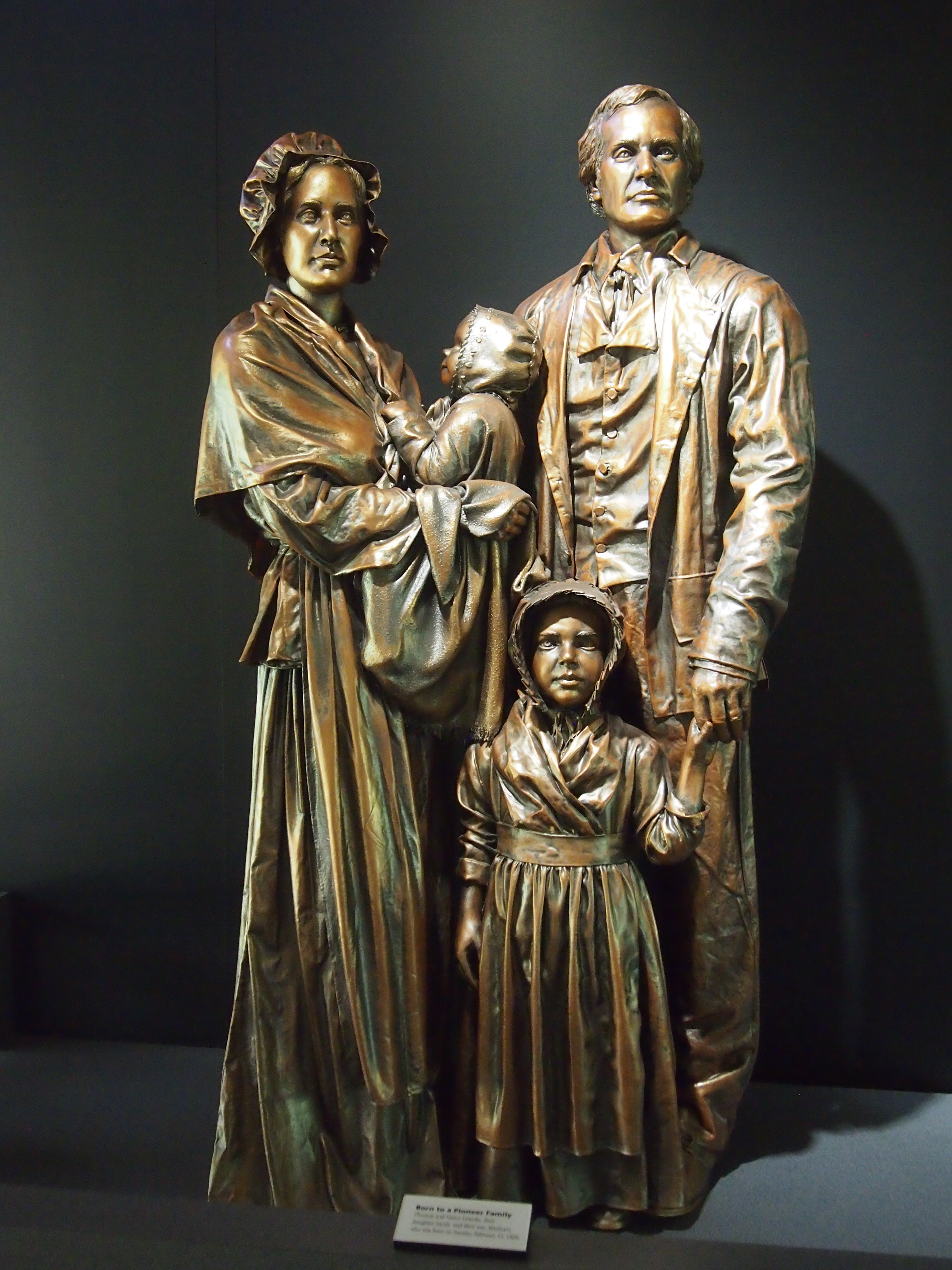
So is a statue of the Lincoln family. It includes the only depiction that I’ve seen of toddler Abraham Lincoln, with his parents and older sister Sarah. Lincoln Birthplace Lincoln Family StatueJohn Russell Pope, who also lived long enough to do the Jefferson Memorial in Washington, DC, and a good many other things, designed the birthplace memorial.
Lincoln BirthplaceLincoln Birthplace 2016“Built on the knoll above the sinking spring where many believe the Lincoln cabin originally stood, the Memorial Building at Abraham Lincoln Birthplace National Historical Park was constructed between 1909 and 1911 in an effort by the Lincoln Farm Association to commemorate the life and accomplishments of the sixteenth President of the United States and to protect his ‘birth cabin,’ ” notes the NPS.

“Pope’s design of the building included many symbolisms related to Abraham Lincoln, including fifty-six steps leading up to the building to represent the fifty-six years of Lincoln’s life. Sixteen windows in the building and sixteen rosettes on the interior ceiling are there to remind visitors that Lincoln was the sixteenth president.”

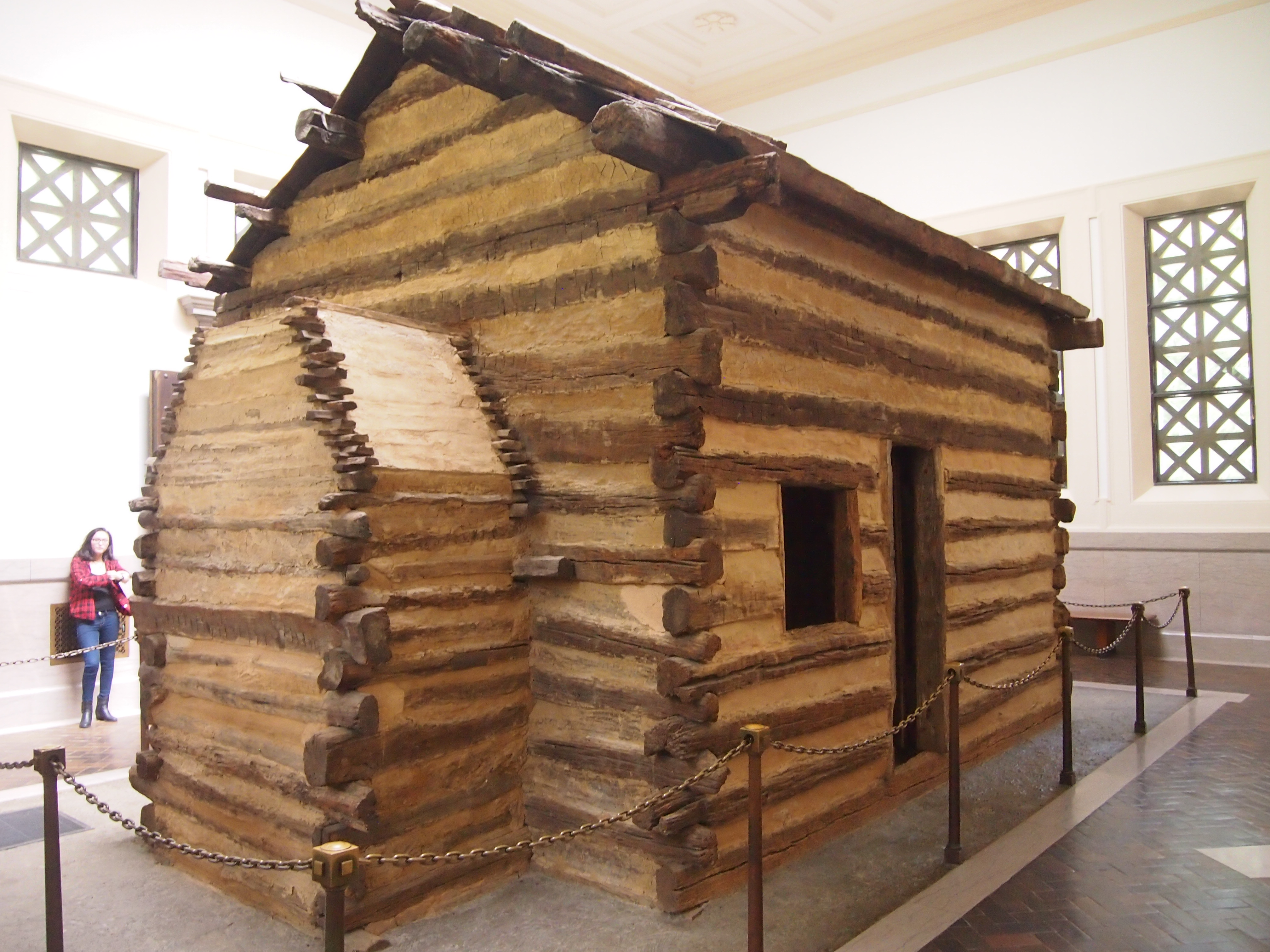
Inside is the fake Lincoln cabin.
Fake Lincoln Birth CabinHaven’t got an historic relic? Make one that looks right, especially during the late 19th century, when touring exhibits were a way to make money. (Read about promoter Alfred Dennett and the fake cabin here.) According to the NPS, the structure now characterized as a cabin that “honors” the original. Sure, why not – and besides, the faking of the cabin was so long ago (1890s) that it too is of historic interest.

Up the road (US 31E) from the monument a bit is Lincoln Boyhood Home, which is only a few structures, all re-creations, but none made of marble or granite. From there, of course, the Lincolns moved to Mississippi and Abraham grew up to be a leader of the Confederacy… no, that was Jefferson Davis, also a Kentucky boy born in the early 1800s. Geography is destiny? I’m not smart enough to know.

Hodgenville, Ky., which is between the birthplace and boyhood home, does what it can to make passersby stop for a little Lincoln at the local “museum,” which mostly seemed like a gift shop. Also, the town traffic circle has a statue of an adult Lincoln and a boy Lincoln.

One more thing I saw on US 31E, south of the birthplace: a ghost sign on the side of a barn that said SEE ROCK CITY. If I’d been able to pull off to the side of the road at that moment, I would have, to take a picture (and baffle Ann). It was not to be. But it was there.

GTT 2016

On June 23, Ann and I left the Chicago area and headed south, returning earlier today. I’m calling the trip GTT 2016, as in Gone to Texas, but also Gone to Tennessee, another destination. Our route took us south to through Indiana and Kentucky and then to Nasvhille; west through West Tennessee and Arkansas and on to Dallas; and south again to Austin and San Antonio. The return was via Dallas and through Oklahoma and Missouri. All together, from backing out of my driveway to coming back to it, I put exactly 3,005 miles on my car, mostly on Interstates and US routes, but also a fair amount on the streets of Nashville, Austin and San Antonio.

None of the routes or places were new to me, except maybe Texarkana, where I’d never stopped before, and it’s been a long time since I’d traveled US 281 north of Johnson City, Texas, or on US 67 on to Dallas. But no matter how familiar the place or the route, you can always find new things.

In central Kentucky, near Elizabethtown, we visited Abraham Lincoln Birthplace National Historical Park, which features a granite and marble monumental building with a not-really-Lincoln’s log cabin inside. Near Mammoth Cave NP, we walked through Diamond Caverns, an unrelated show cave.

By the time we got to Nashville, the heat was on — in the 90s at least every day, which made stomping around outside less pleasant, especially for Ann, but I did manage to take her to the Nashville Parthenon, which she didn’t remember seeing in 2008. The more important thing we did in Nashville was spend time with old friends Stephanie and Wendall, and pay a visit to Mike Johnson’s widow, Betra.

In Memphis, we saw the Peabody Hotel ducks and the National Civil Rights Museum. In Texarkana, we drove down State Line Road and stopped at the only post office in the nation in two states. In Little Rock, I visited Mt. Holly Cemetery in the morning just before the heat of the day and then the Clinton Library (in full, the William J. Clinton Presidential Center and Park) and, just before we left town, the Arkansas State Capitol.

Dallas was mostly given over to visiting my brother Jay and working. Jay joined us for our few days in Austin, including the Fourth of July, and for a few more days in San Antonio. In Austin on July 2, Ann went to RTX 2016 at the Austin Convention Center, a sizable event held by the media company called Rooster Teeth; I was her chaperon. We visited my old friend Tom Jones the next day, and on Independence Day, saw both the Baylor Street Art Wall and municipal fireworks over Lady Bird Lake. San Antonio was mostly about visiting my mother and brother Jim, and (for me) holing up in a cool place with Wifi and doing more work.

Naturally, the trip involved long stretches of driving. I want to do that while I still want to do that. Because of my obstinance in not getting Sirius or the like, terrestrial radio helps fill the yawning spaces between destinations. The trip was bookended by two news events whose coverage was limitless, even when there was no new information beyond speculation: Brexit near the beginning, and the murder of Dallas policemen toward the end. I also listened to more religious radio more than usual, mostly only minutes at a time, except for the erudite Alistair Begg, whom I will listen to until his show’s over or the signal fades.

The selection of music was mostly what you’d expect, drawn from the rigid genres created by the radio business, though there were a few oddities, such as the Mesquite Independent School District radio station (KEOM) in metro Dallas that played teacher and student shows, besides a selection of completely conventional ’70s music. On I-40 between Nashville and Memphis — the Music Highway, according to official signs along the way — I picked up an oldies station whose playlist was a little older and odder than usual. I heard it play “Waterloo” (Stonewall Jackson), “Ahab the Arab,” “and “Running Bear and Little White Dove,” the last two I haven’t heard in years.

We stayed in a nondescript chain motel in Elizabethtown; in Stephanie and Wendall’s fine guest rooms in Nashville; in another, less nondescript motel in Little Rock; with Jay in Dallas; in the Austin Motel on South Congress in Austin, an updated version of a tourist court that’s been there since 1938; and in an updated former company hotel (vintage 1914) in San Antonio, the Havana Hotel, since there were too many of us to be comfortable at my mother’s house.

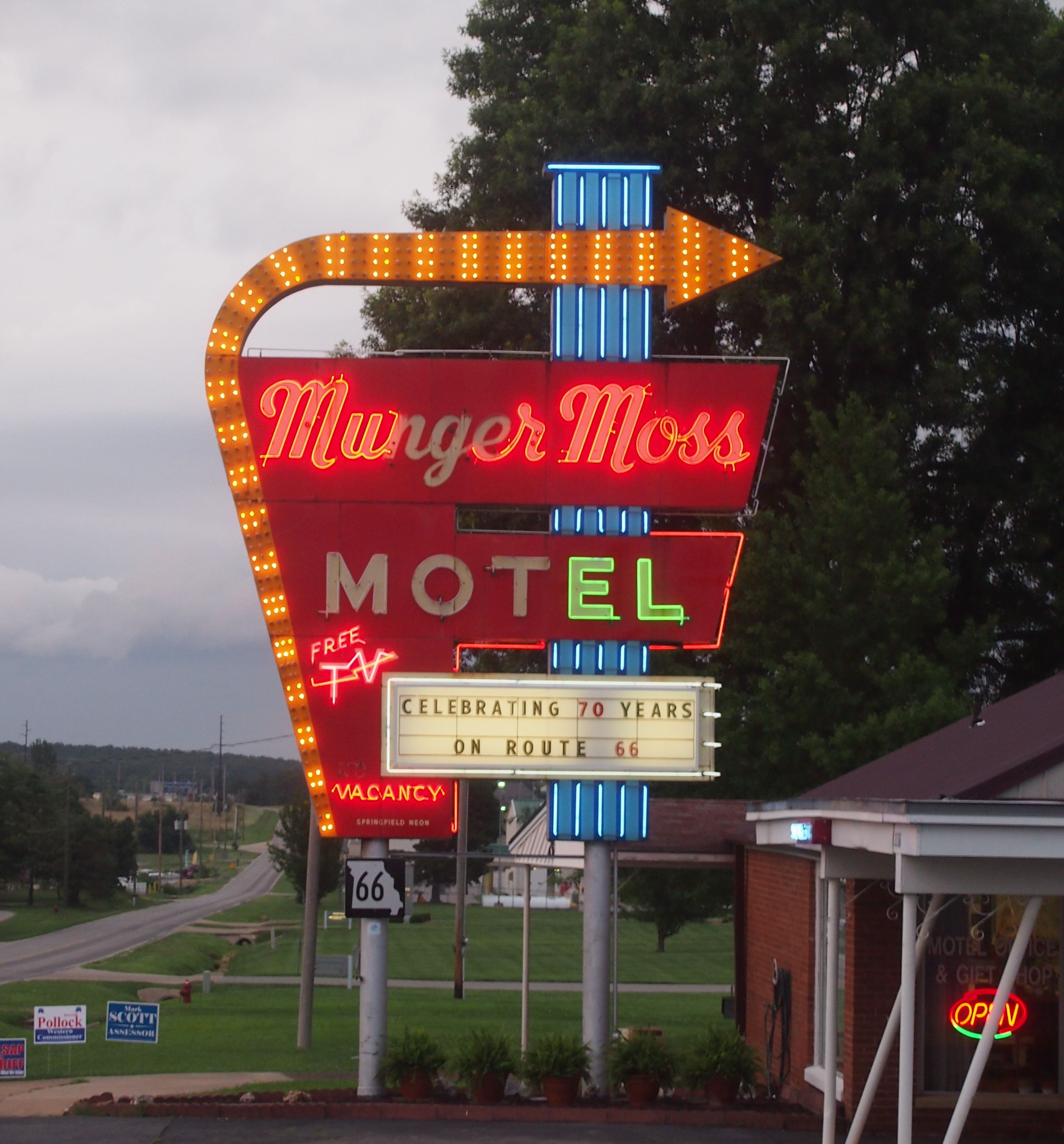
During the return home, we stayed at the Munger Moss Motel in Lebanon, Mo., last night, because of course we did.

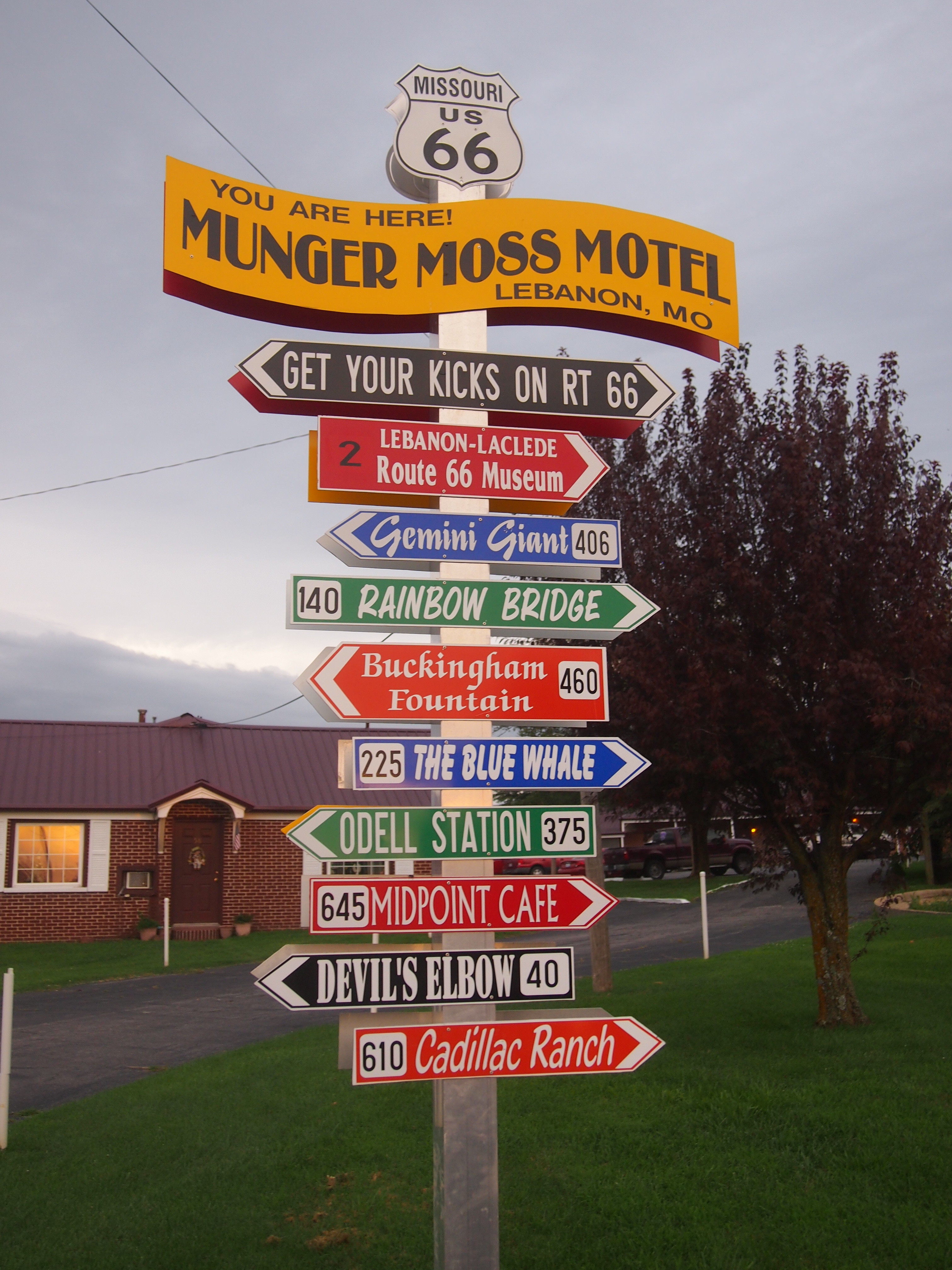
Munger Moss Motel 2016It’s the same as it was in 2009 and two years ago. Except (maybe) a couple of signs like this were added to the grounds.

Munger Moss Motel 2016Motel co-owner Ramona Lehman was selling Gasconade River Bridge postcards, sales of which help support the restoration of the bridge, a structure about 15 miles east of Munger Moss on the former US 66. I bought one. I didn’t stop to look at the bridge — this time — but it’s visible from I-44 if you know when to look, and I did.

Summertime Hiatus

Time for a summer hiatus. Time to celebrate what ought to be a string of less-than-working days from Juneteenth to the Solstice to Canada Day to July Fourth to Nunavut Day (July 9), just to make it inclusive for all North Americans. Back to posting around Sunday, July 10.

Yesterday I learned more sad news, that my old friend Ed Henderson has died. I’ve mentioned him periodically in BTST over the years, and I believe he was one of a handful of people who read it regularly. Last year I visited him at his home near Bellingham, Wash., and we had a fine time — as fine a time as his precarious health allowed. I’m very glad I went. Sometime in the not too distance future, I will write more about him.

On the Solstice, I took a look at the full moon. First one on the Solstice since 1948, they say. Looked like all the other ones I’ve seen, but it was pleasant enough.

Closer to home, as in our back yard, the clover is lush.

Schaumburg cloverWho considers clover a weed? Breathes there the man, with soul so dead, who never to himself hath said, this is my own, my native clover? Pleasing to gaze at, pleasing to lie on.
Payton dog 2016The dog knows that, too.

St. Mary of the Angels

St. Mary of the Angels is a church in the Bucktown neighborhood of Chicago, not to be confused with Our Lady of the Angels, the former Catholic school in the Humboldt Park neighborhood and site of a disastrous fire in late 1958. (I can recommend To Sleep With the Angels (1996) by David Cowen and John Kuenster, an excellent book about that fire that I read when I worked at Fire Chief magazine.)

Completed in 1920, St. Mary of the Angels was originally one of the numerous churches in Chicago with mostly Polish parishioners. “The structure bears a remarkable resemblance to St. Peter’s Basilica in Rome,” asserts the church’s web site. The AIA Guide is a little more circumspect: “The tile and terra-cotta dome recalls the silhouette of St. Peter’s in Rome.”

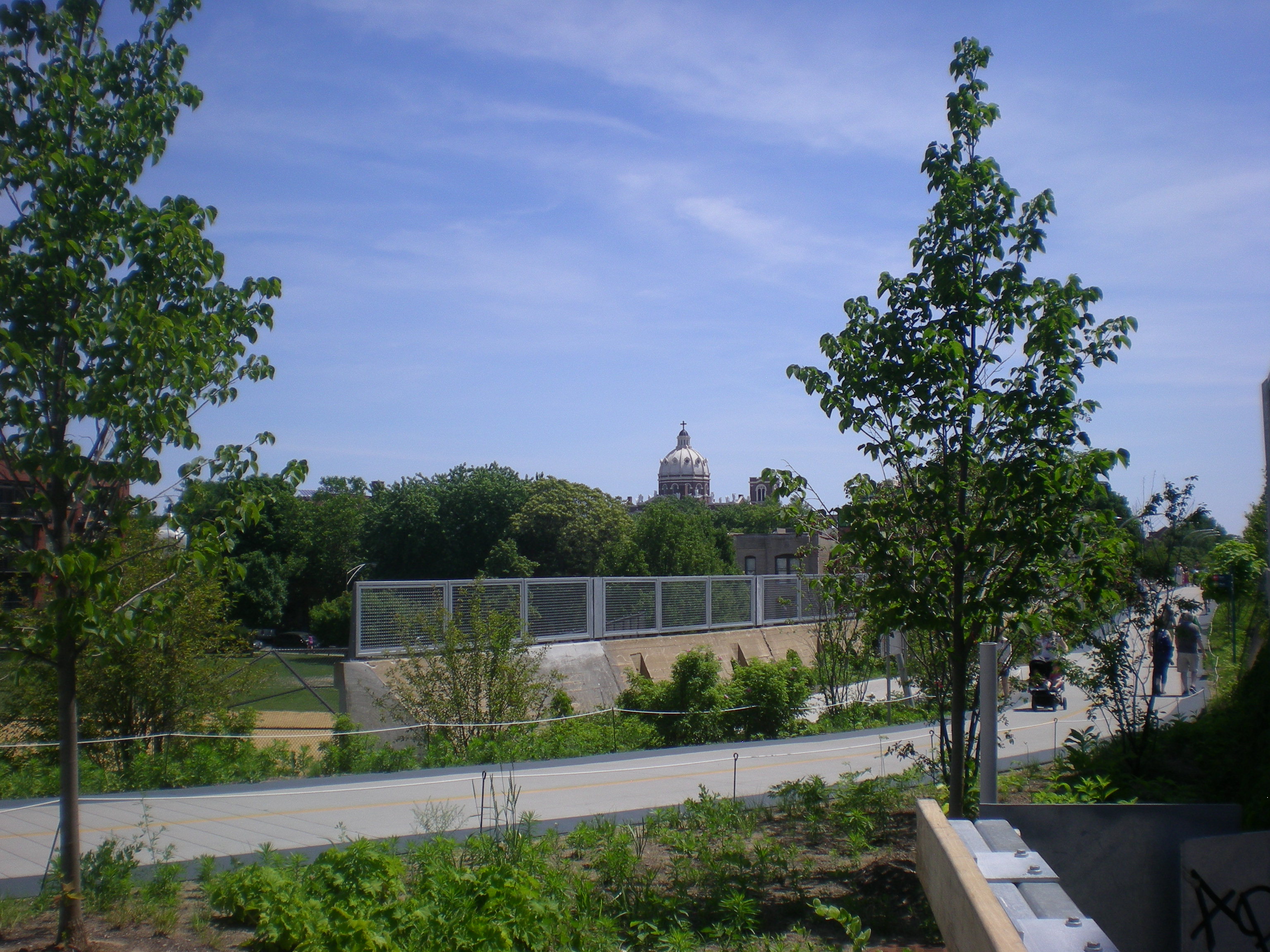
In any case, the dome’s impressive. You can see it at some distance from the 606 trail.
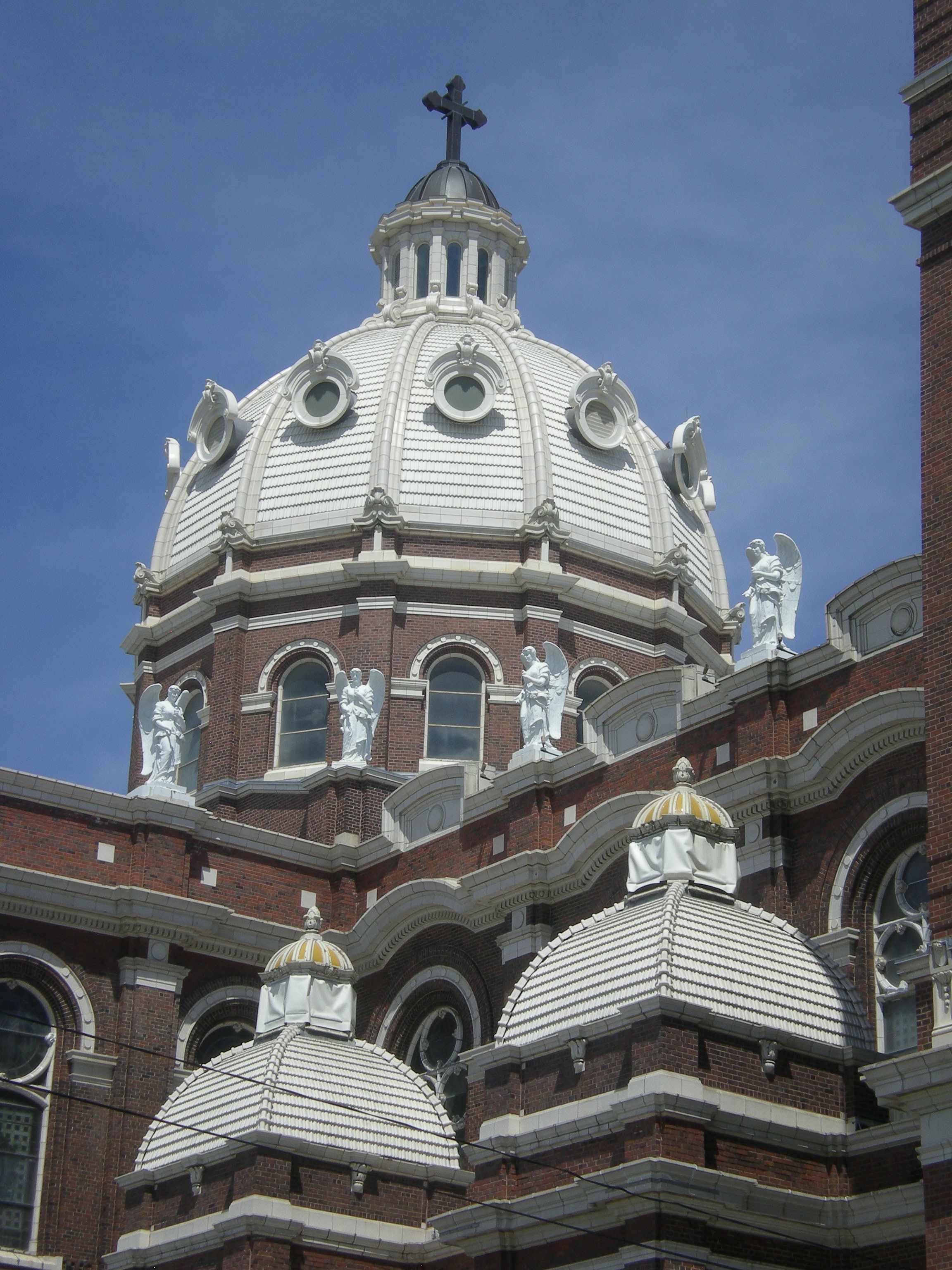
St. Mary of the Angels, ChicagoUp close, “angels tread on the parapets,” says AIA. ‘Deed they do.
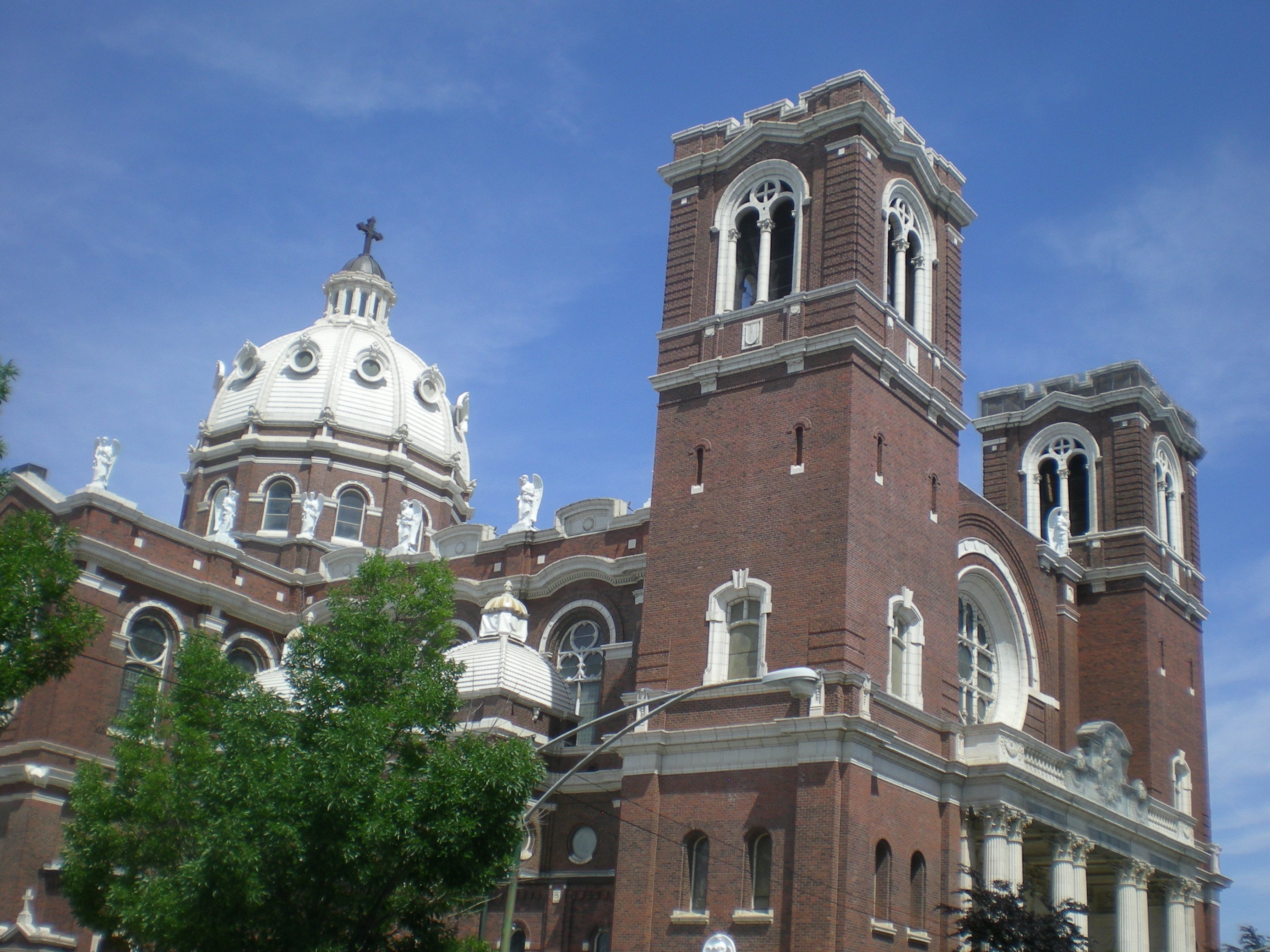
St. Mary of the Angels, ChicagoThe view from a little further away. The original architects were church specialists Worthmann & Steinbach, with Holabird & Root rehabilitating the structure in the 1990s.

St. Mary of the Angels, ChicagoI figured I’d be able to see the interior. It was a Saturday, after all. In June. More than one wedding was probably planned for the church that day. I was right. When I entered, the place was set up for a wedding, and guests were trickling in, but the ceremony hadn’t started yet. No one paid any attention to me as I took in the lavish space that can accommodate 2,000 worshipers.

For example, behind the high altar is a depiction of St. Francis at “the little chapel of Santa Maria degli Angeli, where he saw Christ and the Virgin Mary enveloped in light and sitting on thrones and surrounded by numerous angels,” as the church puts it.

The church’s continued existence was a near thing. “With the construction of the Kennedy Expressway in 1960, a sizable number of families and students left the parish, and, by 1988, the church building was closed and slated for demolition due to deteriorating conditions,” the church explains. “At the request of Cardinal Bernardin, then Archbishop of Chicago, the priests of the Prelature of Opus Dei assumed responsibility for the parish in 1991.

“The church restoration started in 1991 with major repairs of the dome, the roofs and the stained-glass windows. Repairs continued in 1997 with the church interior. In 1999, the 100th anniversary of the parish, the church’s interior decoration was fully restored; the installation of new lighting, new doors and a new sound system was completed.”

Just another extraordinary place, nearly destroyed. And not even during the tear-down happy ’50s and ’60s, but in the 1980s. The church is unusual in that Opus Dei runs it. I’m no authority, but overseeing parish churches doesn’t seem to be in their usual line of work. Still, I’m glad they were able to save it.

The 606 in ’16

On Saturday we went to the city for a few hours. Yuriko went to a cake-making class offered by a woman she knows who lives near Humboldt Park. I was the driver, since it’s complicated to get there by train and bus, and driving in the city unnerves her.

As it should, with cars everywhere, parked and in motion, operated by sometimes careless or aggressive drivers and often closer than you think; delivery trucks blocking the way; road construction crews doing likewise — though the rough surfaces and potholes never seem to go away; buses acting as if they own the road; bicyclists passing between you and parked cars suddenly and with inches to spare; random pedestrians all over the place, a few with no sense; people opening their car doors in front of you without warning, emerging onto the street (some with children in tow); large intersections without the benefit of turning signals; and stretches of street being resurfaced, but not completed just yet, which on a dry June day raises clouds of dust through which you must pass.

Then there’s the matter of parallel parking. Yuriko doesn’t care for it. A lot of people would say the same. I never knew how to do it until I moved to Chicago in the late ’80s. Then I learned it well. It’s an essential skill for owning a car in the city. I also learned what to expect driving in a place like Chicago. Or New York or Boston or Washington DC or Atlanta or Miami or Dallas or Los Angeles or Seattle — all harrowing in their own sweet ways.

I’ll say one good thing about driving in Chicago, though: it’s easy to know roughly where you are all the time. The streets mostly form a grid, with major streets at regular intervals, and just about every street, even the most minor, marked with an easy-to-see, well-placed and legible street sign. Not every city has such luxuries, and I mean you, Boston.

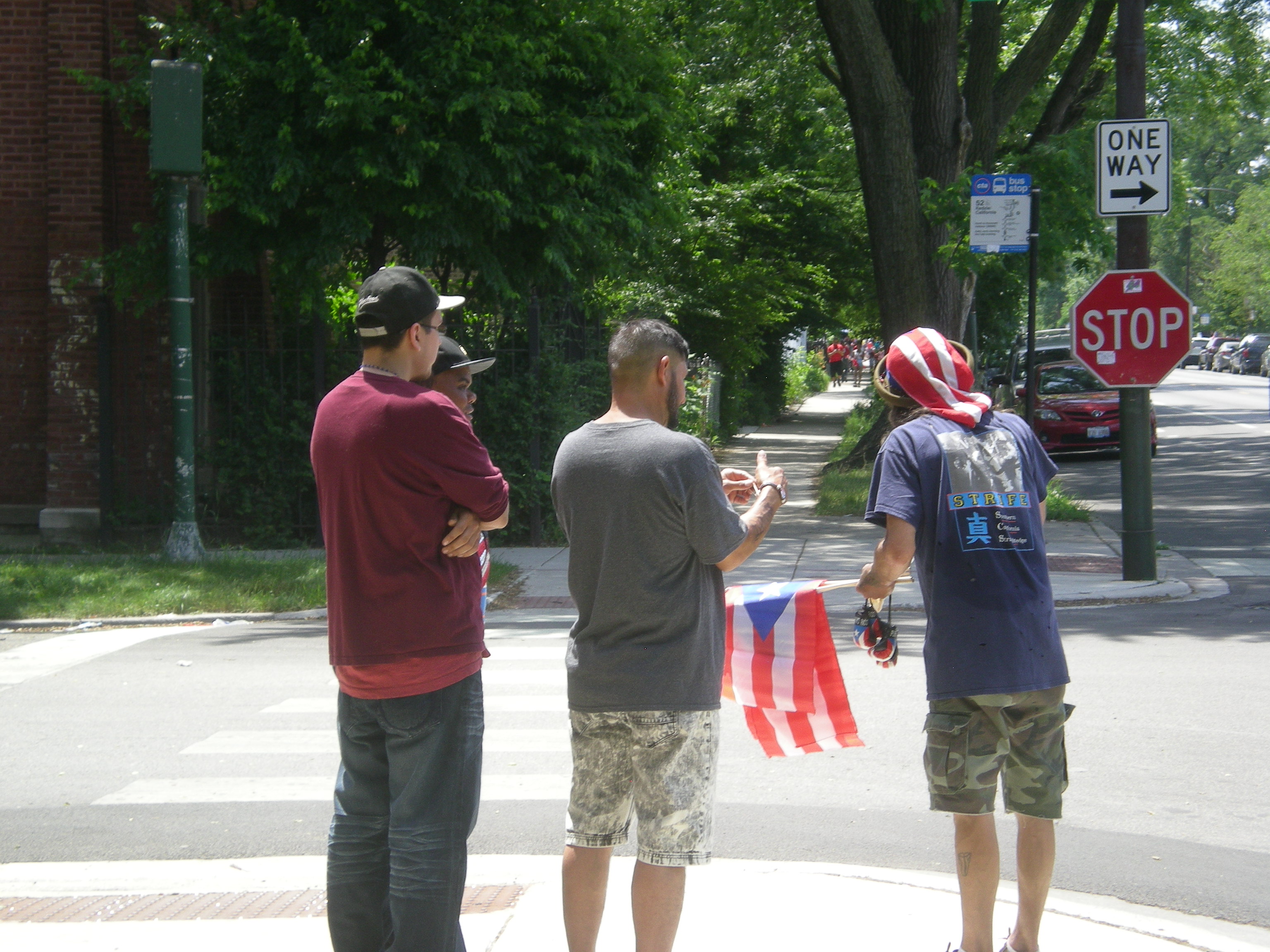
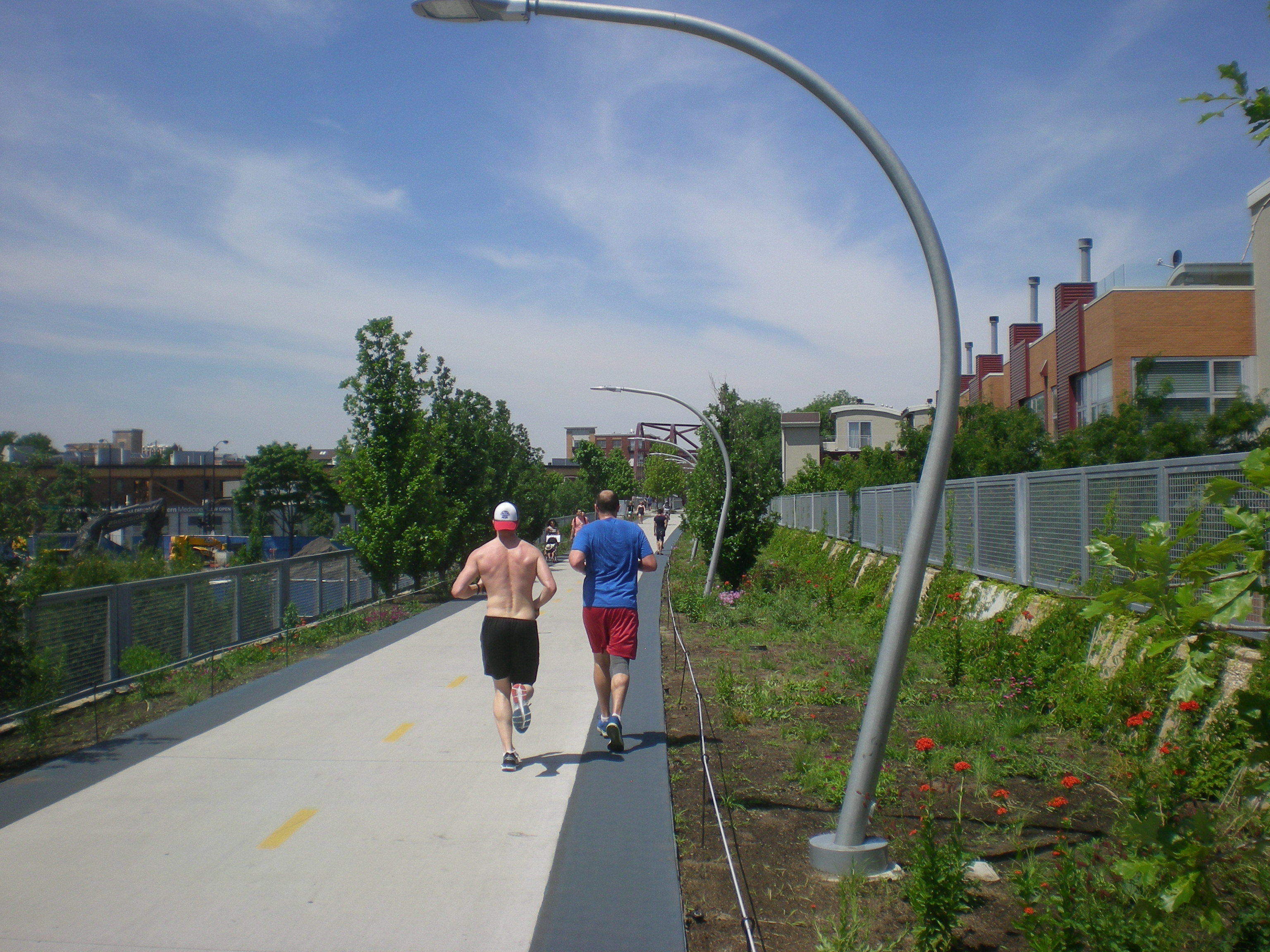
With Yuriko at her cake class, I had a couple of hours to kick around in the late morning. The Puerto Rican Festival in Humboldt Park, Fiestas Puertorriqueñas, was slated to start at noon, as evidenced by people carrying the commonwealth’s well designed flag into the park and the flag being flown by a lot of passing cars. Here’s a vendor selling some.Puerto Rican Day Chicago 2016Since the event wasn’t actually under way, I went elsewhere. I visited St. Mary of the Angels church about 20 blocks to the east, taking a North Avenue bus, and then walking back, partly on the 606, the same linear park we visited on its opening day a little more than a year ago.

This time I saw a bit more of the trail’s eastern end, though not quite to the east terminus. At around 11 am in mid-June, the sun is high and the trail very warm. Temps were in the upper 80s F. That didn’t keep people away.
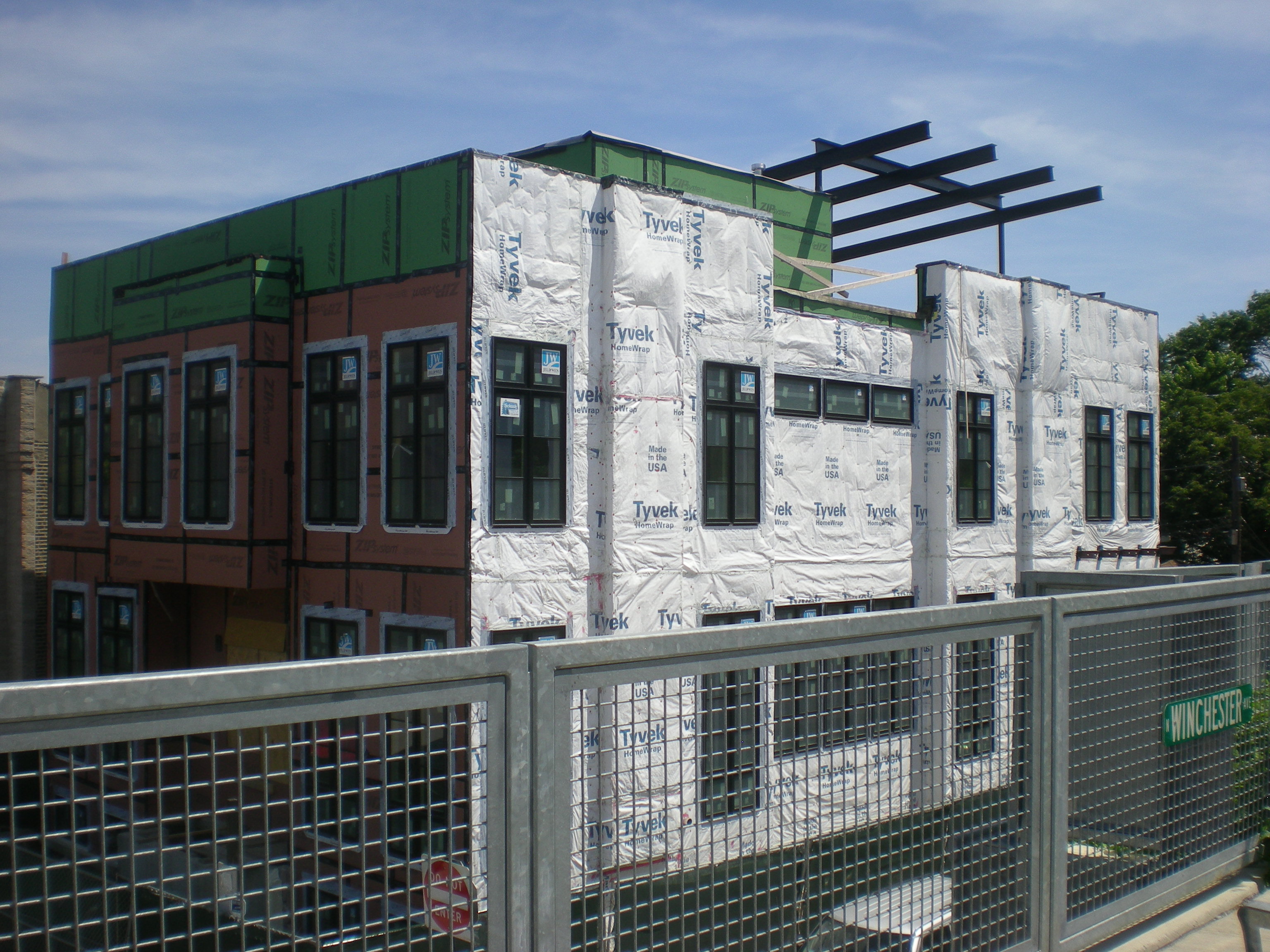
The 606 ChicagoI was glad to see that the landscaping on the edges is now more lush than a year ago. Also, development of the land nearby continues apace.606 Winchester AveI also noticed that the trail is short on shade. Most of the year, that wouldn’t matter, but in summer it’s important. Even the trailside parks weren’t particularly shady. At Park 567, where the trail crosses over Milwaukee Ave., there were only three or four spots under trees offering any significant shade. I was lucky enough to be able to sit by myself in one sizable pool of shade, though I would have shared the space if anyone had asked.

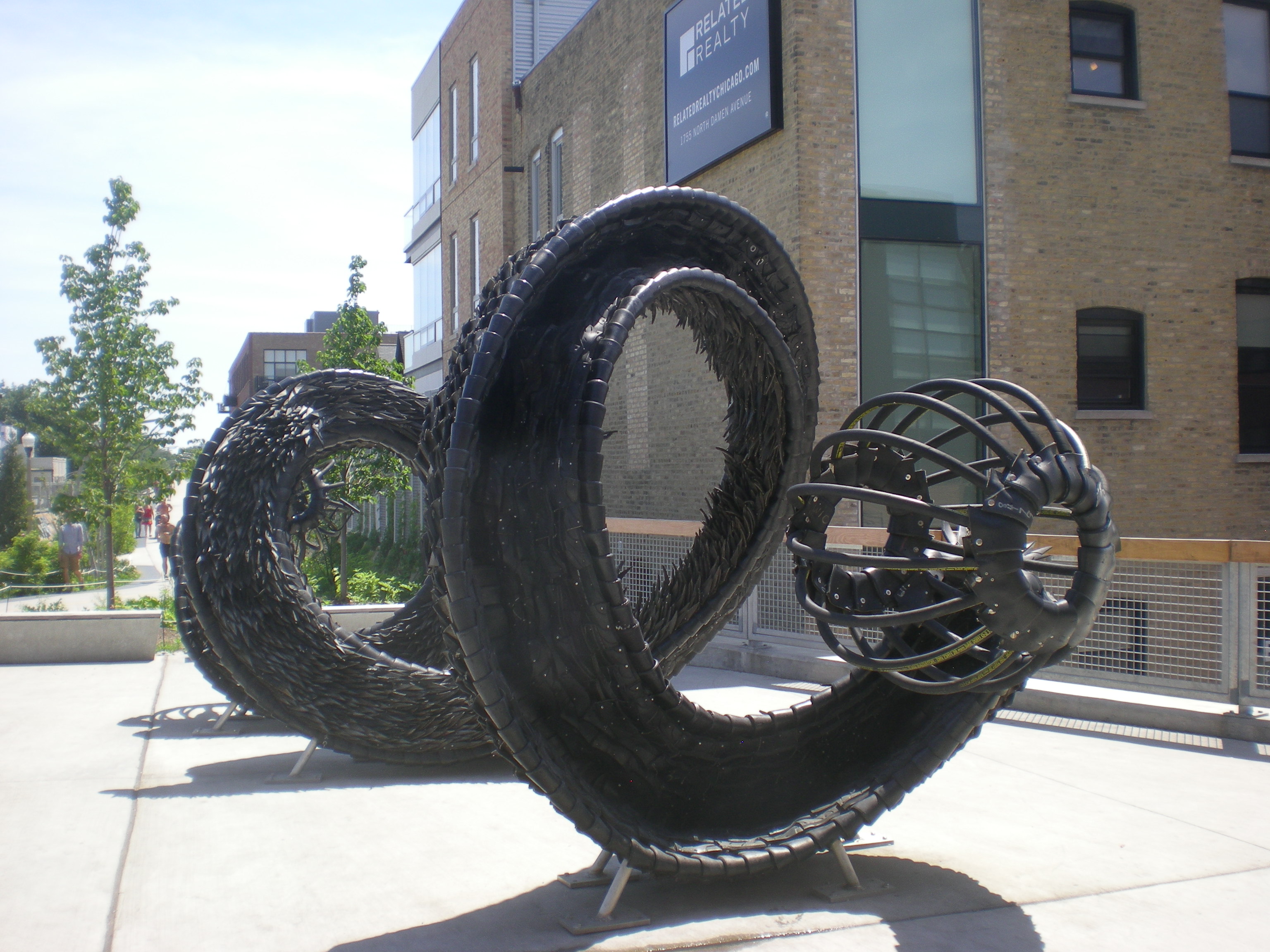
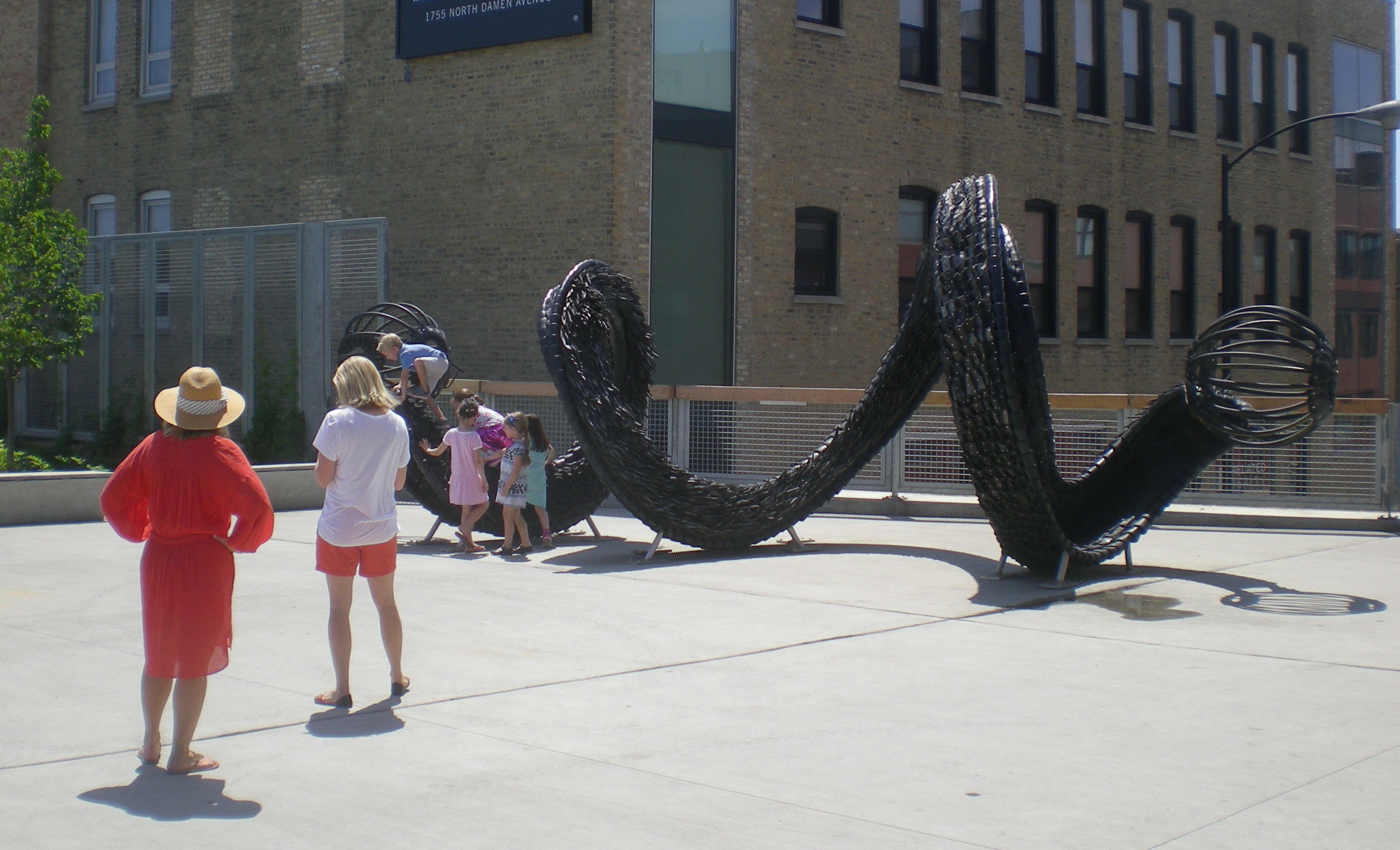
I got a look at the trail’s first art installation, the serpentine “Brick House,” by a sculptor named Chakaia Booker.606 - Brick House scultpureI’ll consider the title whimsical, since no bricks are involved, or any obvious connection to the song celebrating feminine pulchritude. It’s made of stainless steel and recycled tire rubber. Put in last fall, the piece attracts children, who instantly want to climb it.I would have spent more time on the trail, but I’d forgotten a hat (though not water). The shade, provided by mature trees, is better on many of Chicago’s neighborhood streets, so after about a half mile, I walked the rest of the way on small streets, as well as along North Ave., whose buildings also provided shade at that time of the day, at least on the south side of the street. I’m not the devil-may-care teen I used to be, who sometimes walked miles in clear 90-plus degree weather in San Antonio or Austin.

Otaue Shinji, 1992

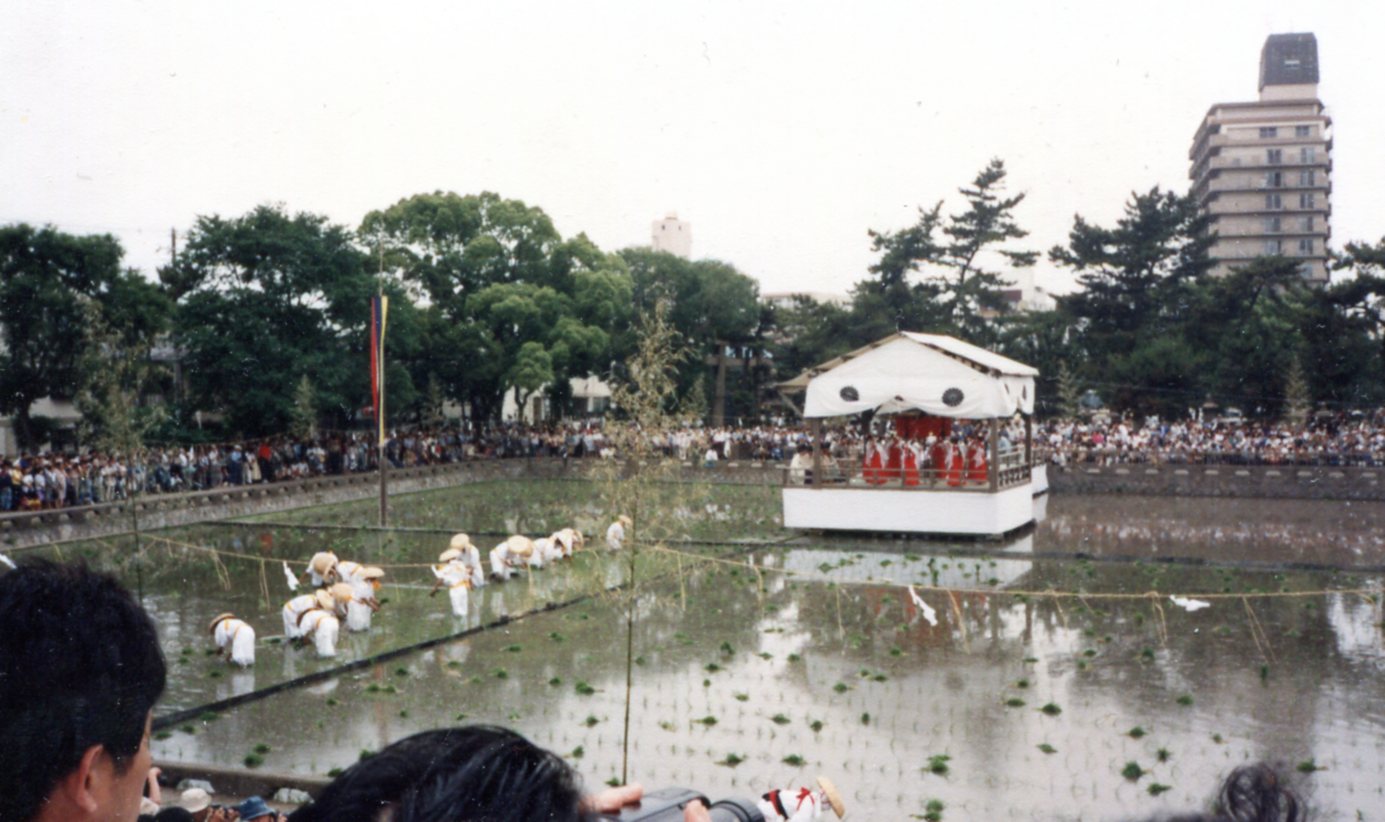
On June 14, 1992, I went to Sumiyoshi Taisha (Grand Shrine), not too far from where I lived in Osaka, to see the Otaue Shinji, a rice planting festival held at that time every year.

“Although events associated with this rice planting can be found all over our country, the festival at the Sumiyoshi Taisha Shrine is unique for its reproduction of the rituals in faithful observance of ancient procedures in such a grand ceremonial style,” the Japan National Tourist Organization notes.

I understand oxen till the rice field first, but I missed that part. I did see the ceremonial rice planting, done by women in white robes in the field.
Otaue Shinji, Osaka 1992 If I remember right, those are priests and musicians on the platform next to the rice field, making the appropriate noises.

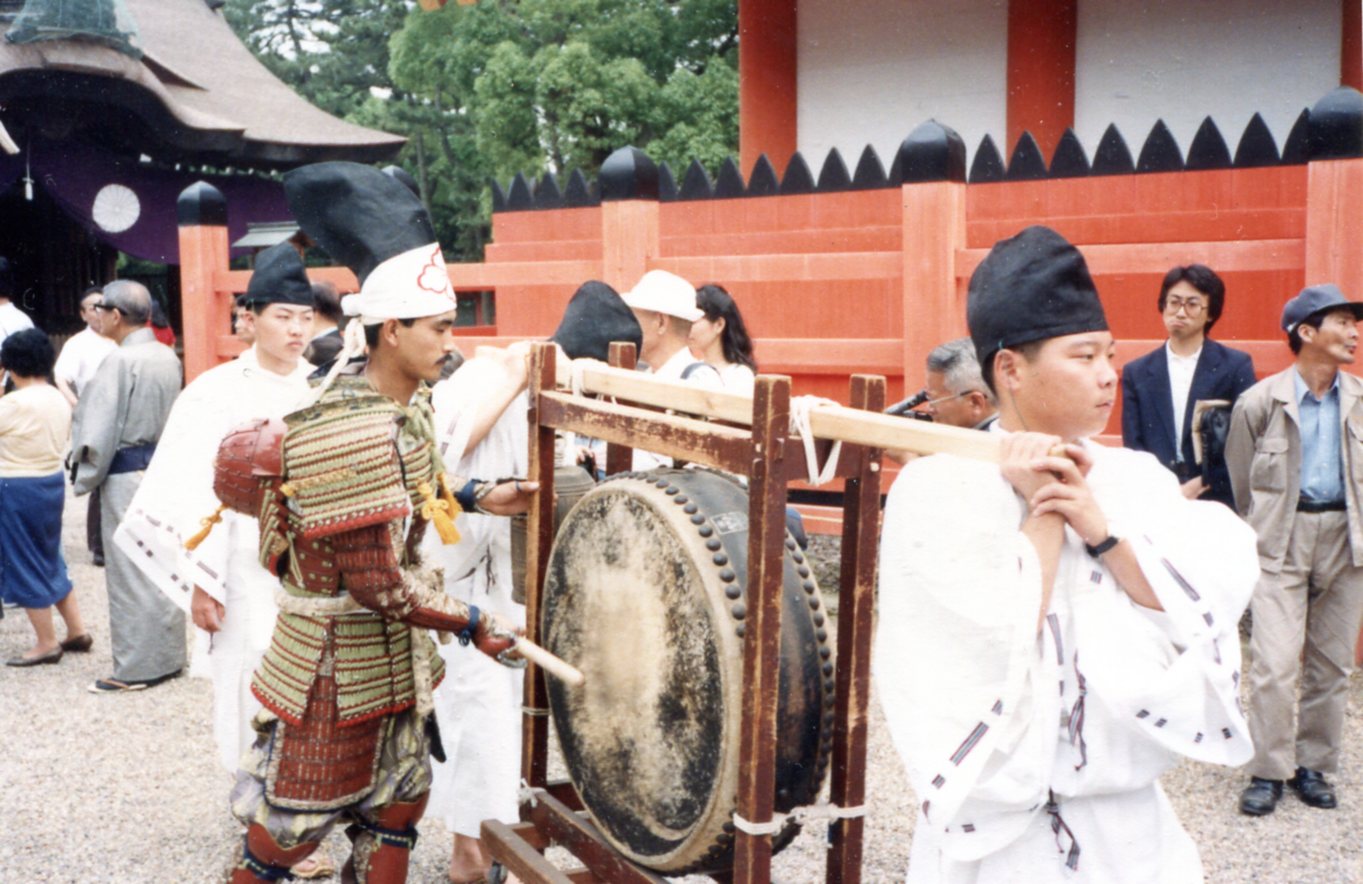
The event also involved a procession through the shrine complex. With drums.
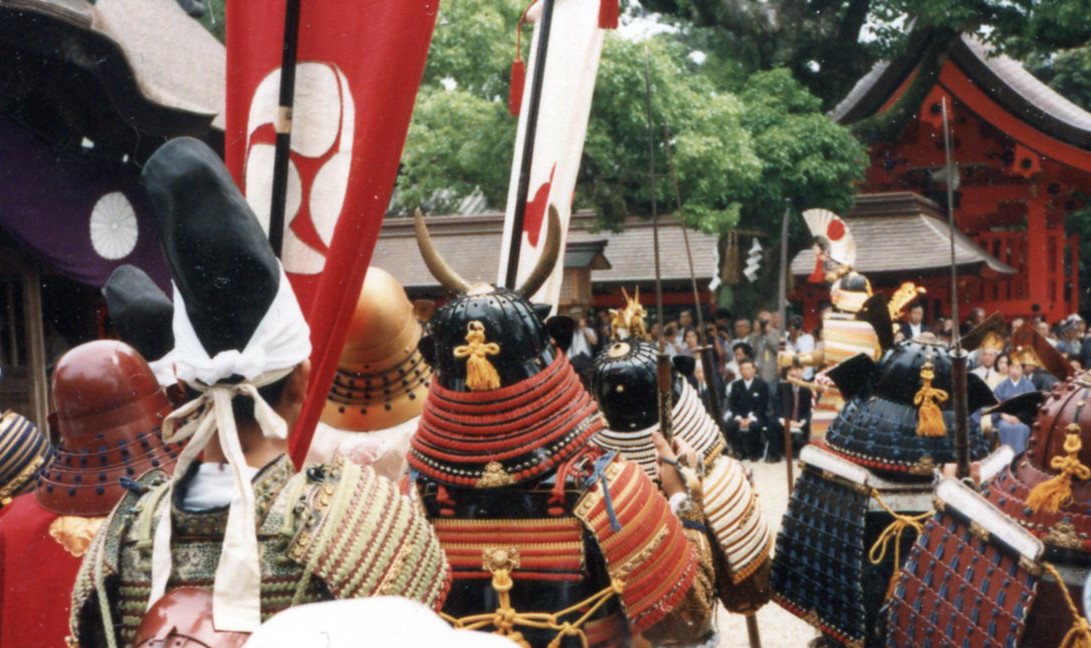
Otaue Shinji, Osaka 1992Sometimes at such events, you find yourself behind rows of people, mostly with a view of the back of their heads.
Otaue Shinji, Osaka 1992Usually the headgear’s not as interesting as it was that day at the Otaue Shinji.

One Summer: America, 1927

Bill Bryson’s a most entertaining writer. Recently I spotted his One Summer (2013), subtitled “America, 1927,” at the library and I had to pick it up. I’ve only read a few chapters so far, with accounts of Lindbergh’s flight, Babe Ruth’s season, the Great Mississippi Flood and much more still ahead (which reminds me, I want to read Rising Tide).

So far I’m enjoying it. Among other things early in the book, Bryson discusses the rise of the tabloid in America during the 1920s, kicked off by the Illustrated Daily News in New York, which Col. McCormack had a hand in creating. The following is about a clearly colorful character I’ve never heard of.

“Such success inevitably inspired imitators. First came the New York Daily Mirror from William Randolph Hearst in June 1924, followed three months later by the wondrously dreadful Evening Graphic. The Graphic was the creation of an eccentric, bushy-haired businessman named Bernarr Macfadden…

“Macfadden was a man of strong an exotic beliefs. He didn’t like doctors, lawyers, or clothing. He was powerfully devoted to bodybuilding, vegetarianism, the rights of commuters to a decent railroad service, and getting naked. He and wife wife frequently bemused their neighbors in Englewood, New Jersey by exercising naked on the lawn…

“As a businessman, he seems to have dedicated himself to the proposition that where selling to the public is concerned, no idea is too stupid…. When tabloids became all the rage, Macfadden launched the Evening Graphic. Its most distinguishing feature was that it had almost no attachment to the truth or even, often, a recognizable reality. It conducted imaginary interviews with people it had not met and ran stories by figures who could not possibly have written them… The New Yorker called the Graphic a ‘grotesque fungus,’ but it was a phenomenally successful fungus. By 1927, it’s circulation was nearing six hundred thousand.”

That’s only a small part of the strangeness of Bernarr Macfadden. He even had a go at running for president, though it isn’t clear how seriously. Sounds like a man who liked to hear himself talk. Under just the right circumstances — as we’ve all been reminded of recently — that can get you pretty far.

Fun With Autofill

Google autofill is reputed to say nice things about Hillary Clinton, but I have no way to judge whether that’s true or an election year canard or if it even matters. In the meantime, for fun, I put in “Hitler” for Google to autofill, because he always makes guest appearances in modern political rhetoric, which rarely mean more than, “I don’t like my opponent.”

Anyway, Google “Hitler” suggested (the other day, your results may vary) in order:

quotes, memes, youth, death, ‘s birthday, ‘s rise to power, salute, did nothing wrong [!]

Google News “Hitler” suggested, in order (caps added, because I’m an editor):

‘s birthday, death, and Trump, memes, compared to Trump, book, mustache, quotes, youth

For additional grins, I let Google autofill “Mussolini,” too. This is what turned up:

death, quotes, Trump, definition [?], speech, WW2, nickname

Google News autofilled “Mussolini” this way:

Trump, death, definition [who’s asking that?], facts, Italy, quotes

For a more contemporary autocrat, I then let Google autofill “Putin”:

bay, news, memes, net worth, on the ritz, Trump, poutine, height, wife

Google News “Putin”:

news, Trump, Greece, Russia, Syria, hockey, NATO, Obama