The University of the Incarnate Word

When I lived in San Antonio, we often drove by Incarnate Word College. I don’t ever remember visiting except (I think) one of its auditoriums for a high school mock UN one Saturday in 1978. (I was an Iraqi delegate, and eventually the Arab nations got together and walked out in protest over something or other.) These days the school is the University of the Incarnate Word, and it’s bigger than I realized: nearly 9,200 students, which makes it the largest Catholic university in Texas and the fourth-largest private university in the state.

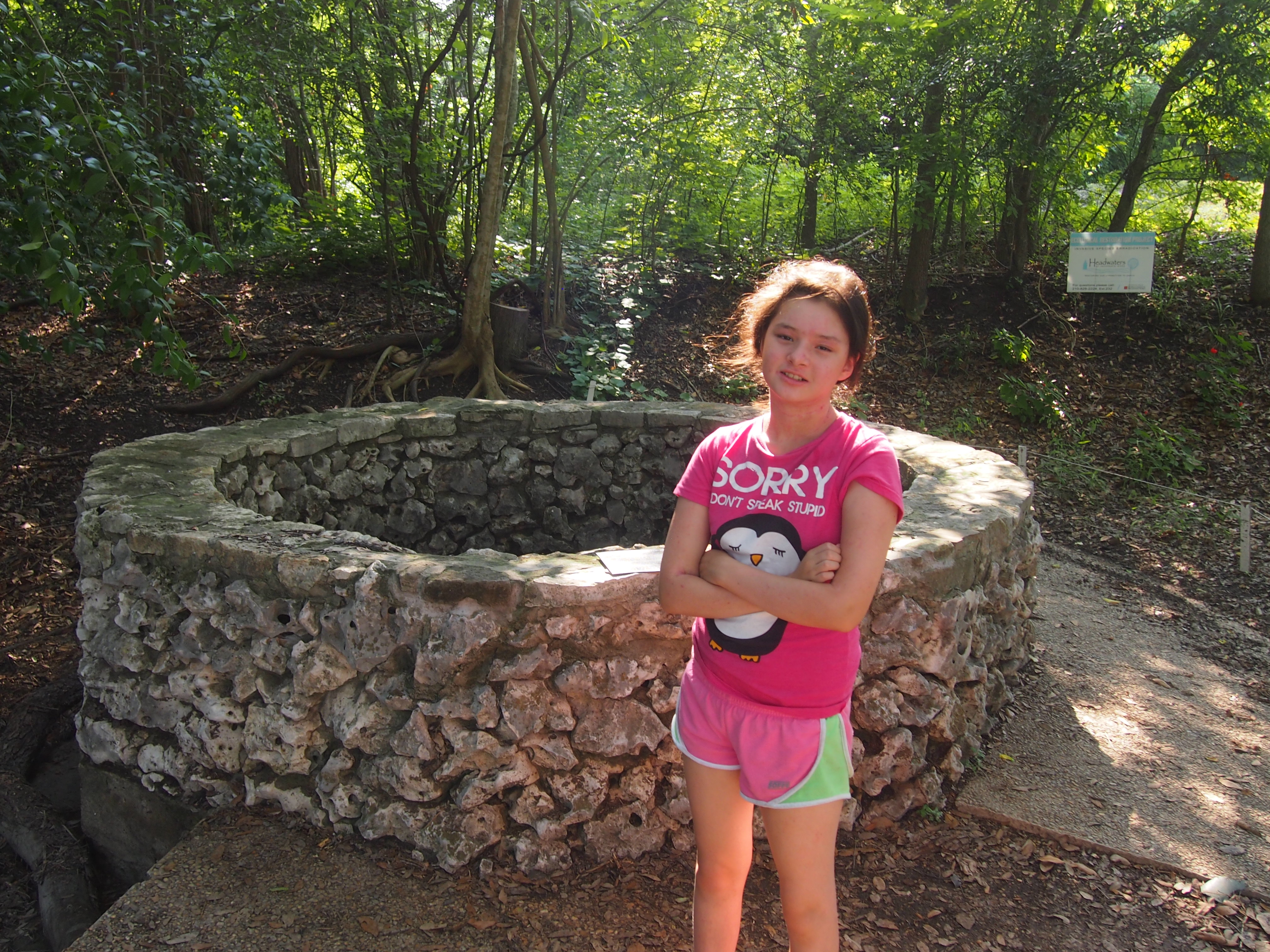
The main campus measures 154 acres, and includes the previously mentioned Blue Hole, mainspring of the headwaters of the San Antonio River. On the way to the Blue Hole, we passed the mansion of George Brackenridge, which he called Fernridge. Brackenridge, a late 19th-century San Antonio business magnate, eventually sold the house and some land to the Sisters of Charity of the Incarnate Word to found their school. (He also called the nearby area Alamo Heights, which he owned for a while, and donated the land for Brackenridge Park.) I assume the university uses it for events now.
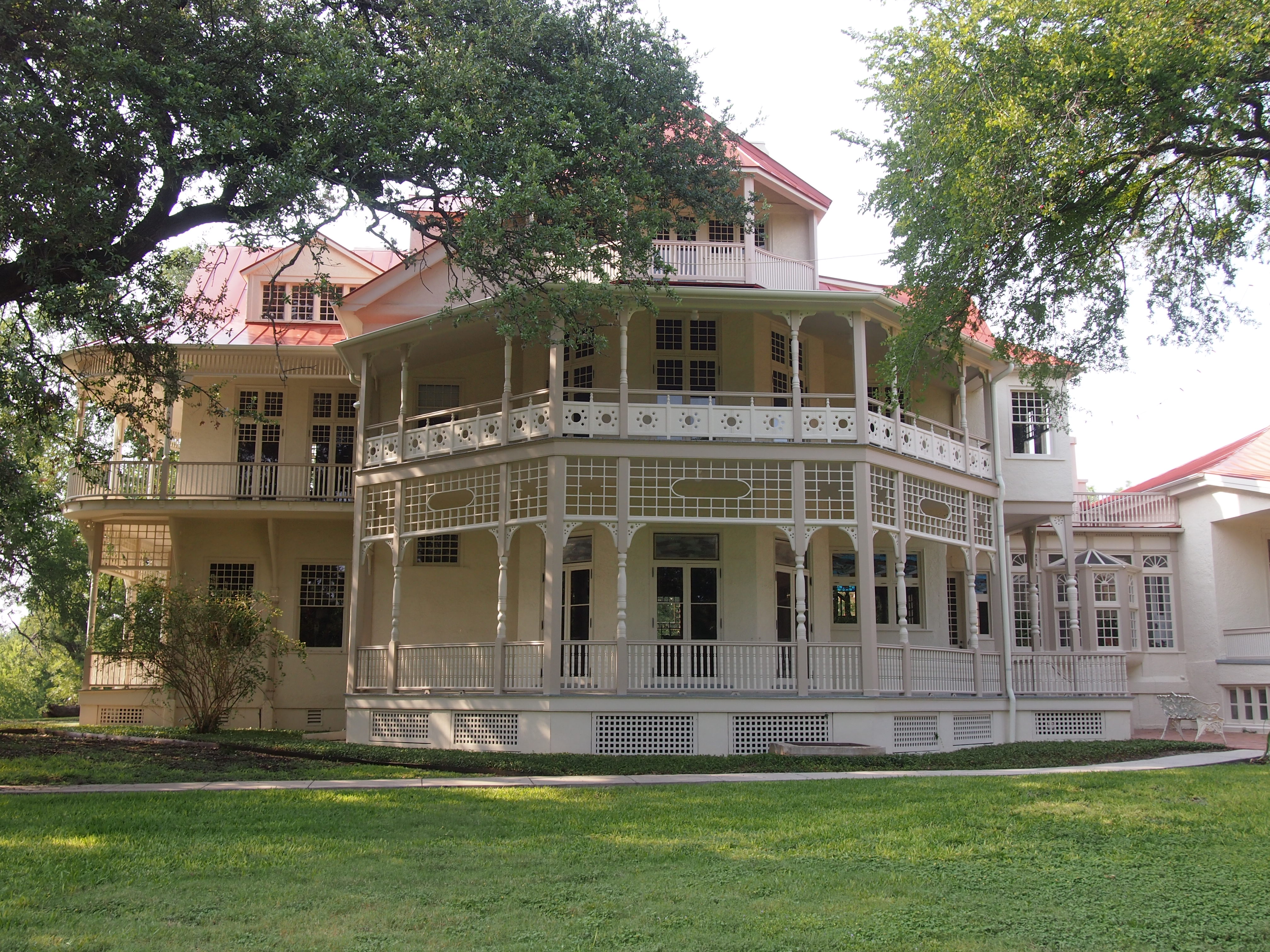
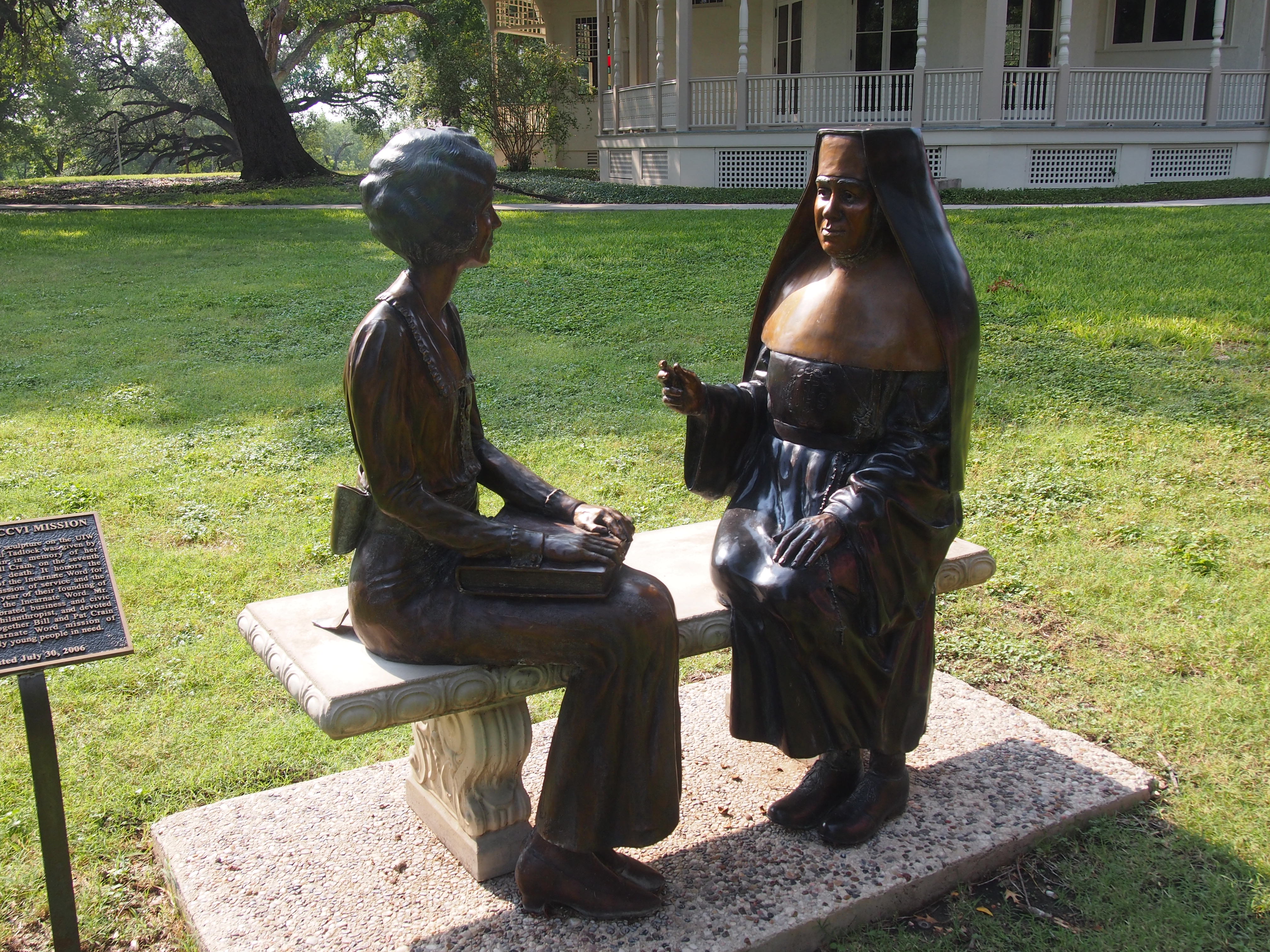
Brackenridge Villa, July 2014Not far away is a bronze nun. Not something you see every day. She seems to be in teaching mode, for the benefit of the young lady bronze. According to the plaque, the work is called “Living the CCVI Mission” and is by Paul Tadlock of New Braunfels. It was dedicated in 2006.
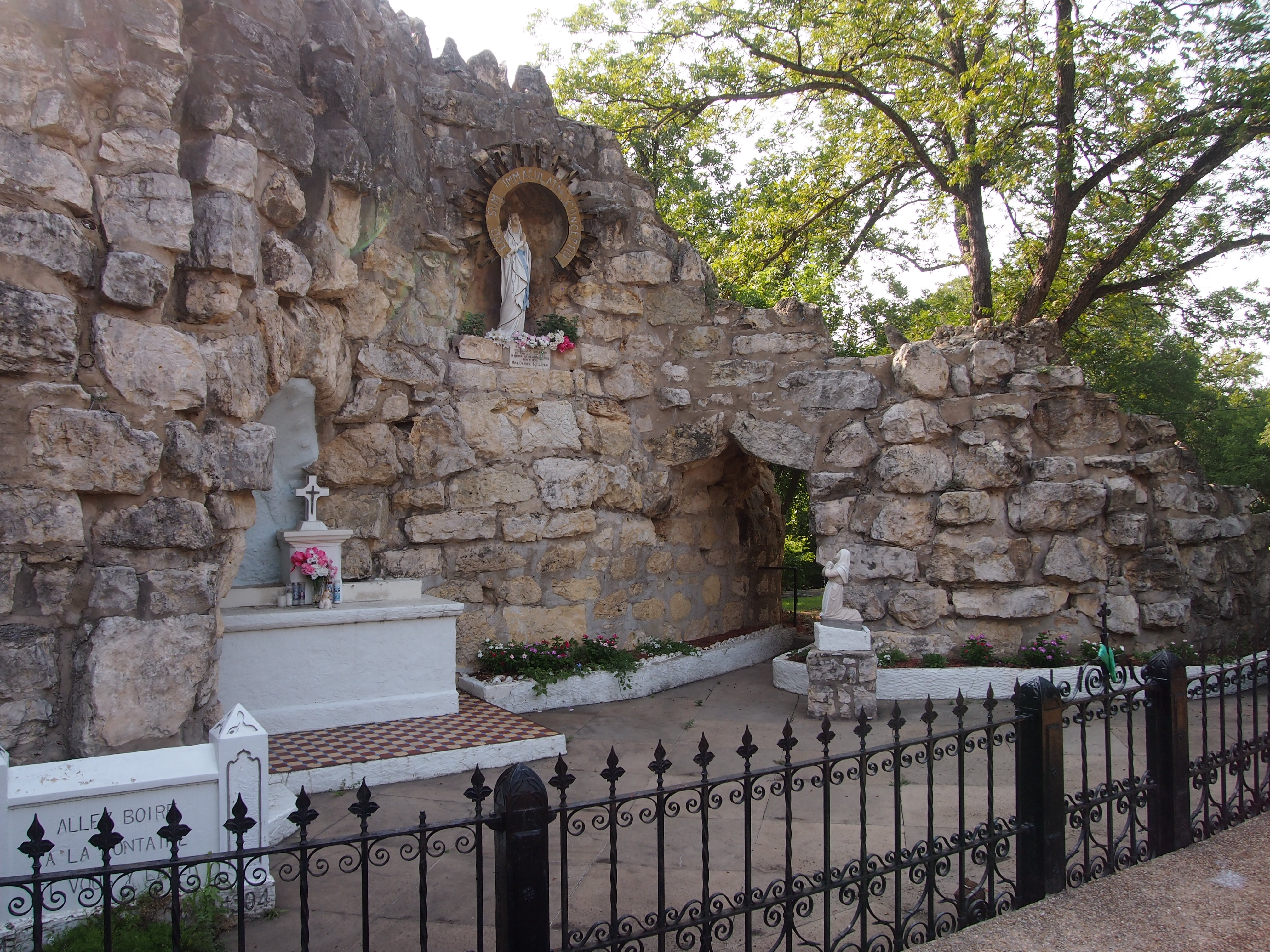
Bronze NunA little further into campus is a grotto. I seem to be running across a fair number of grottos lately. The Incarnate Word grotto is a Lourdes-class grotto, built in 1904 by Fr. J.G. Bednarek, a priest from Chicago, to mark the 50th anniversary of the promulgation of the dogma of the Immaculate Conception of the Virgin Mary. Apparently Fr. Bednarek taught at the school, but why he took an interest in building a replica of Lourdes there, I haven’t uncovered yet.
Incarnate Work grotto, July 2014Finally, there’s the first bridge over the San Antonio River, which is just south of the Blue Hole. The river’s pretty small at that point, where Olmos Creek joins the outflow from the Blue Hole. A rivulet in a ditch, really, but nice and leafy this time of year. Nearby is the 53-acre Headwaters Sanctuary. The sanctuary is the last remaining undeveloped property from the original 283-acres the sisters bought from George Brackenridge.
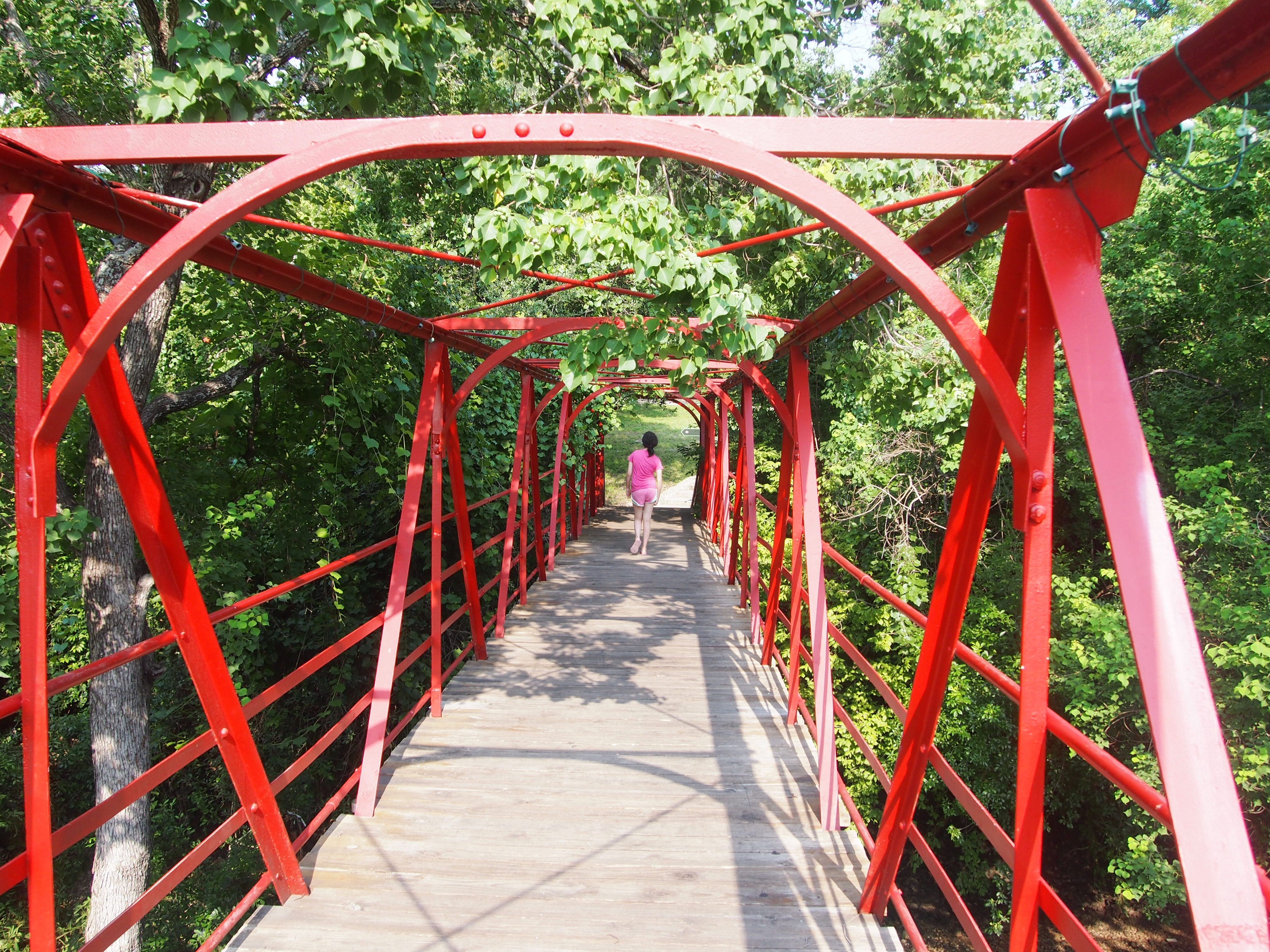
Incarnate Word campus, July 2014We decided it was too hot to walk on the sanctuary, which was still further. But since we’d come to the bridge, the thing to do was cross it.
Bentonite Snarls I-35

One evening last week was sparkler night. While some of Lilly’s friends were over they did some sparkler-ing in the back yard, where a lot of things happen. A little earlier in the week, the dog had a noisy encounter with a skunk there. Luckily, she — the dog — didn’t get a full blast of eau de skunk. Maybe it was just a sideways blow. She smelled bad, but we were able to wash most of it off.

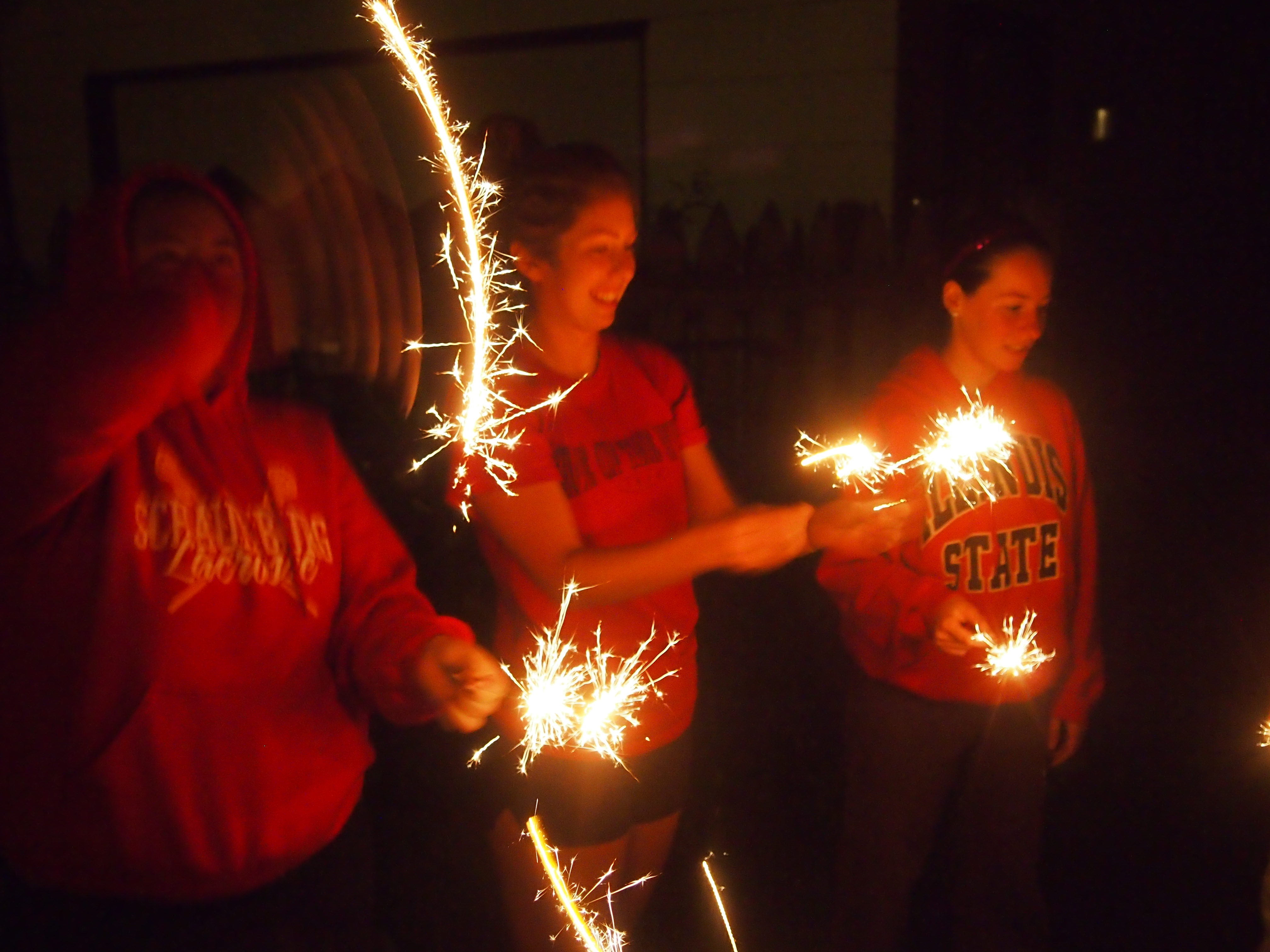
Lilly, July 2014Sparklers, July 2014Reminds me of an earlier sparkler session.

On the morning of July 18, Jay and Ann and I, along with Jay’s two beagles, set off from Dallas to Austin, where we planned to drop off the dogs at my nephew’s house and spend an afternoon looking around town before meeting my old friend Tom at his place in the later afternoon. We were going to enjoy a slice of Austin on a Friday afternoon. We might not have made it to the Cathedral of Junk, but the Harry Ransom Center or the UT Tower were possibilities. Maybe even a Moon Tower, but those are really best at night (and I did see one at night, years ago).

The Lords of Travel sometimes have other ideas about your day. We headed out southward on I-35 the old-fashioned way. That is, we just went. It’s the last time I drive on I-35 in Texas without consulting Google Traffic.

Things were going well until just south of Waco. We’d been warned earlier by a TxDOT electronic sign to “expect delays” south of Waco. Delays are par for the course on I-35, so we weren’t concerned. Thanks for nothing, TxDOT. What the sign should have said was LEAVE ROAD NOW FIND ALTERNATE. We drove into a massive Interstate gridlock that swallowed up our afternoon.

Once we’d been stuck for a while, Jay called his son Sam to get some idea of what had happened. Sam looked it up (and informed us that Google Maps would have tipped us off). A truck accident early in the morning. Later, I dug up a story from KWTX.

Bell County (July 18, 2014). The southbound lanes of Interstate 35 were reopened just after 2 p.m. Friday between Waco and Temple, two hours after the northbound side of the highway was cleared and nearly 12 hours after three separate 18-wheeler accidents that shut down the highway in both directions.

Southbound traffic was stacked up for about 14 miles into Waco, the Texas Department of Transportation said, and it could take several hours for normal traffic flow to resume…

One of the 18-wheelers that crashed spilled its load bentonite, a material commonly used in drilling mud. When combined with water, it serves as a lubricant, which made the highway slick and required a hazardous material team response to clean up the southbound lanes…

The first accident happened just before 3 a.m. at mile marker 315 and shortly after two more accidents happened between 315 and 314, a spokesman for the Department of Public Safety said.

Authorities directed traffic onto access roads, but the backup extended northward to Hewitt and southward to Temple by mid-morning and left many drivers with no place to go.

Bentonite, huh? We were near the Bentonite Capital of the World once. That’s the last time I thought about it. Eventually, we too left the Interstate — of our own accord — and made our way through the towns of Moody and then Belton on smaller state roads. Then regular ol’ Austin-area gridlock kicked in and didn’t arrive till around 6. Roughly five hours had been added to the trip. For extra fun, one of the dogs threw up.

At least someone did well from the traffic situation. We stopped at a convenience store near Belton, but still away from the Interstate, and the man behind the counter asked us, “Did you come from I-35?” We weren’t the only ones. He must have had extra businesses that day.

Two Bridges of Madison County

While in Winterset and environs, I took the opportunity to see two of the wooden covered bridges of The Bridges of Madison County fame. The movie, at least, seems to be relegated to a chick flick ghetto. Wrongly, I think. The story was at least as much about the visiting photographer – the man – as it was about the farm wife.

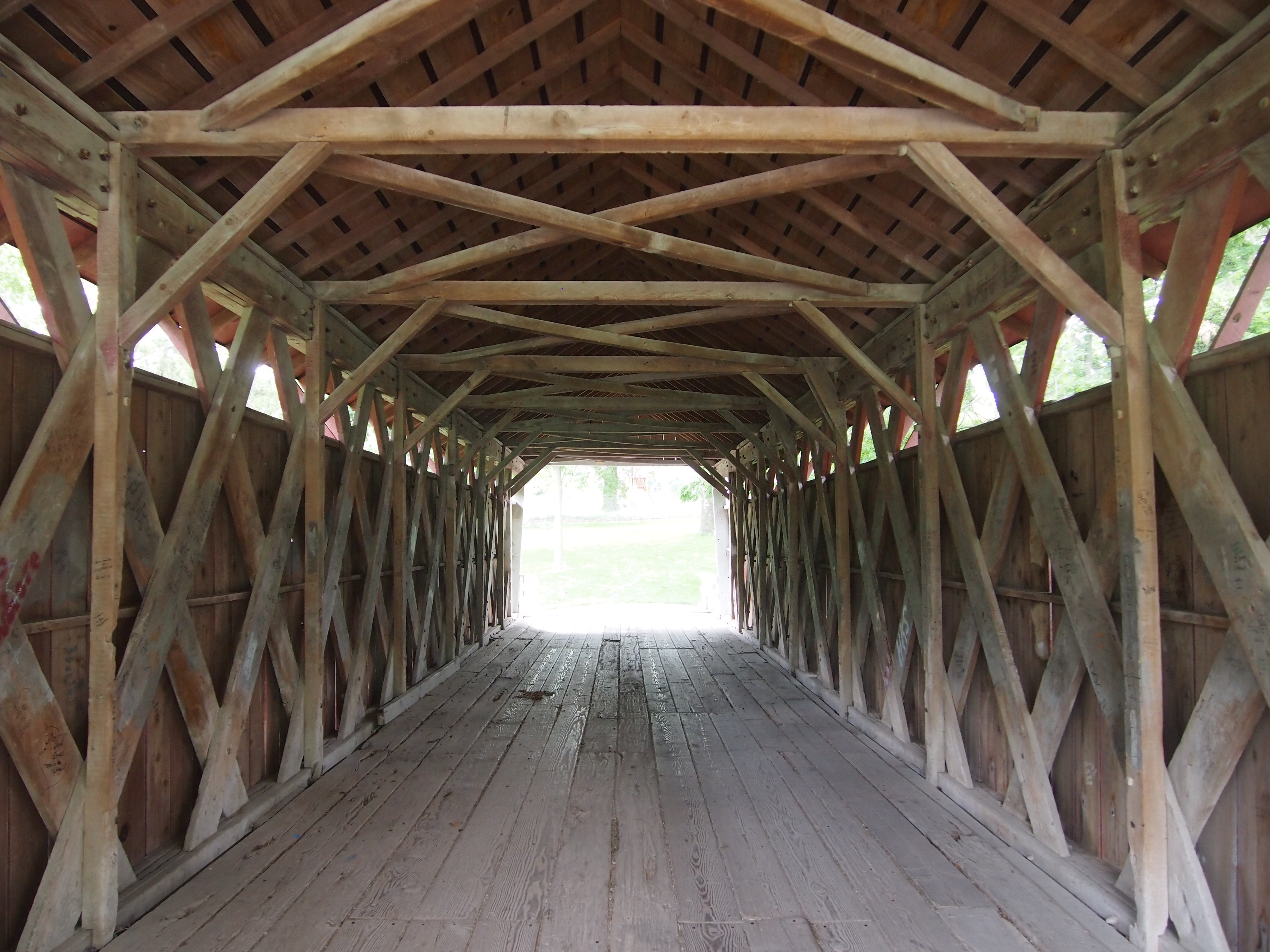
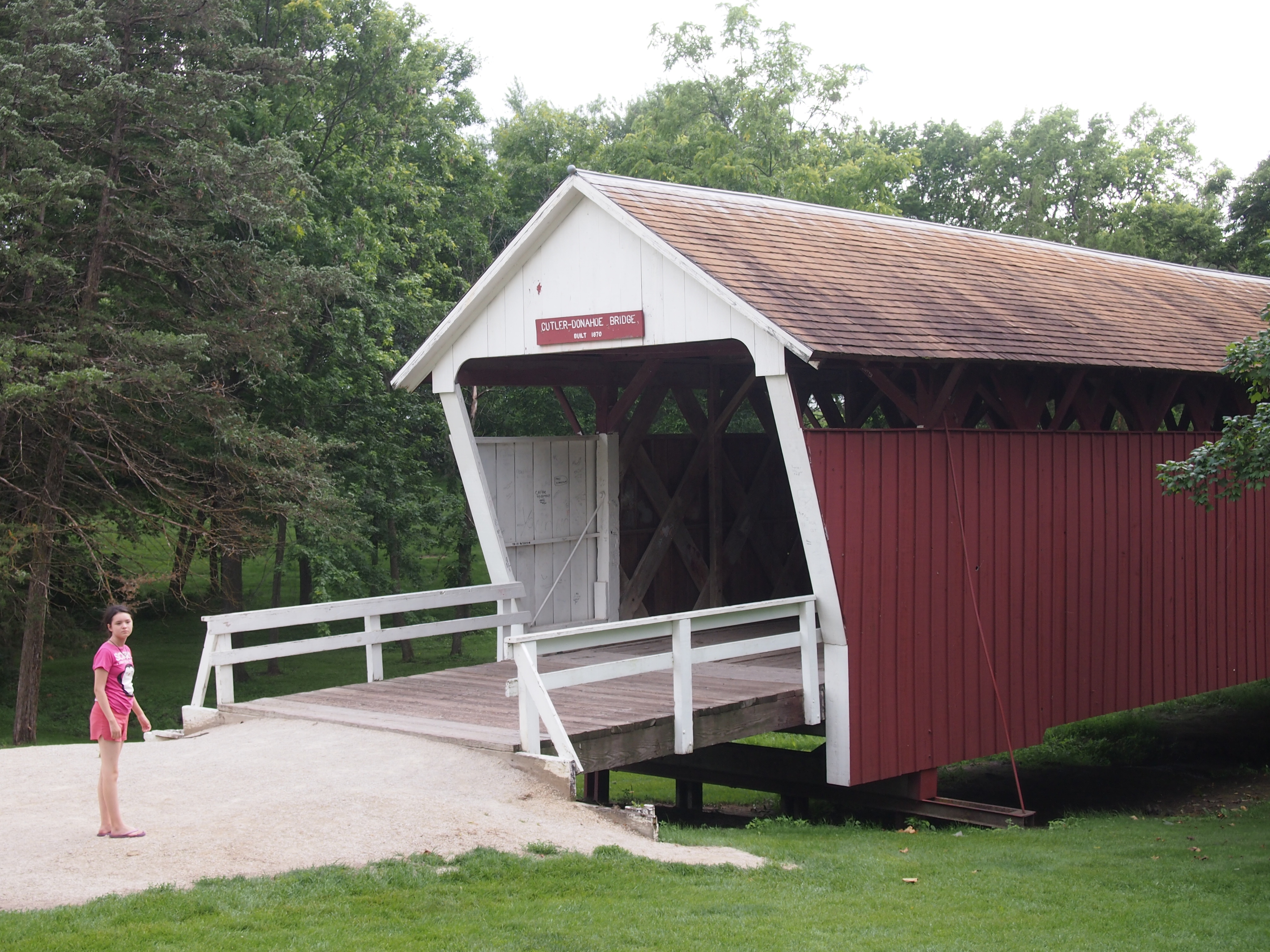
Movie or not, I liked the bridges. At least the two I saw.  It’s remarkable that such artful wooden construction has survived for more than a century, but they have. Ann was less impressed. When we visited the first structure, the Cutler-Donahoe Bridge, she said something like, “What’s so special about this bridge?” You have to be older to appreciate older things, maybe. (Though I’ve liked old things since I can remember. I’m peculiar that way.)

Cutler-Donahoe Bridge, July 2014

The Cutler-Donahoe Bridge dates from 1870, built by one Eli Cox. In 1970, it was moved to Winterset City Park, where we saw it. Length, 79 feet. Weight – and you’d think it would be lighter – 40 tons. Nice work, Eli.

Cutler-Donahoe Bridge interior

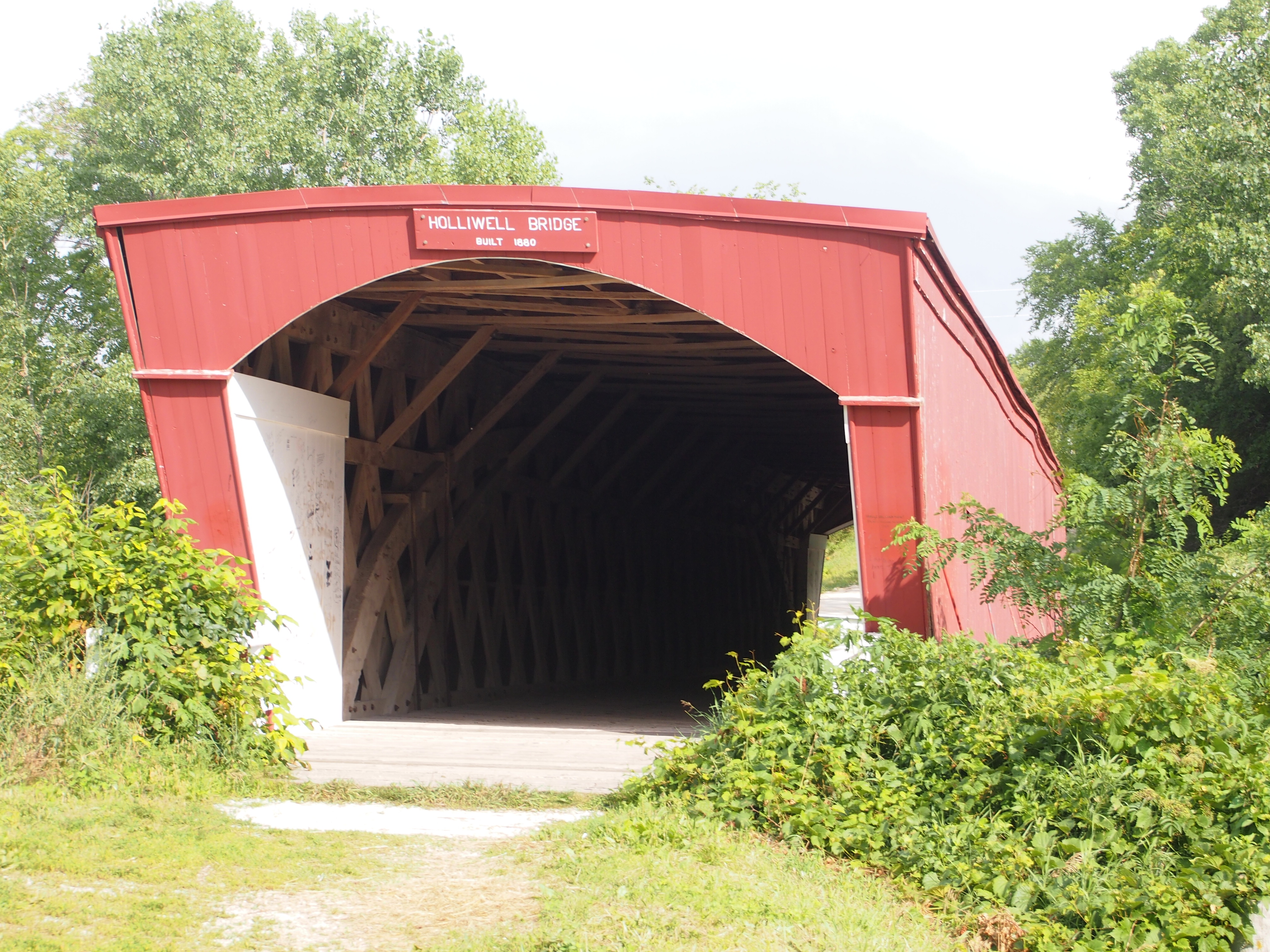
Not far from town is the Holliwell Bridge, in situ over the Middle River.

Holliwell Bridge, July 2014Ann stayed in the car for this one. The structure’s a little newer than Cutler-Donahoe, built by Benton Jones in 1880 and renovated in 1995 (on the occasion of filming the movie, I guess, but my sources don’t say so explicitly).

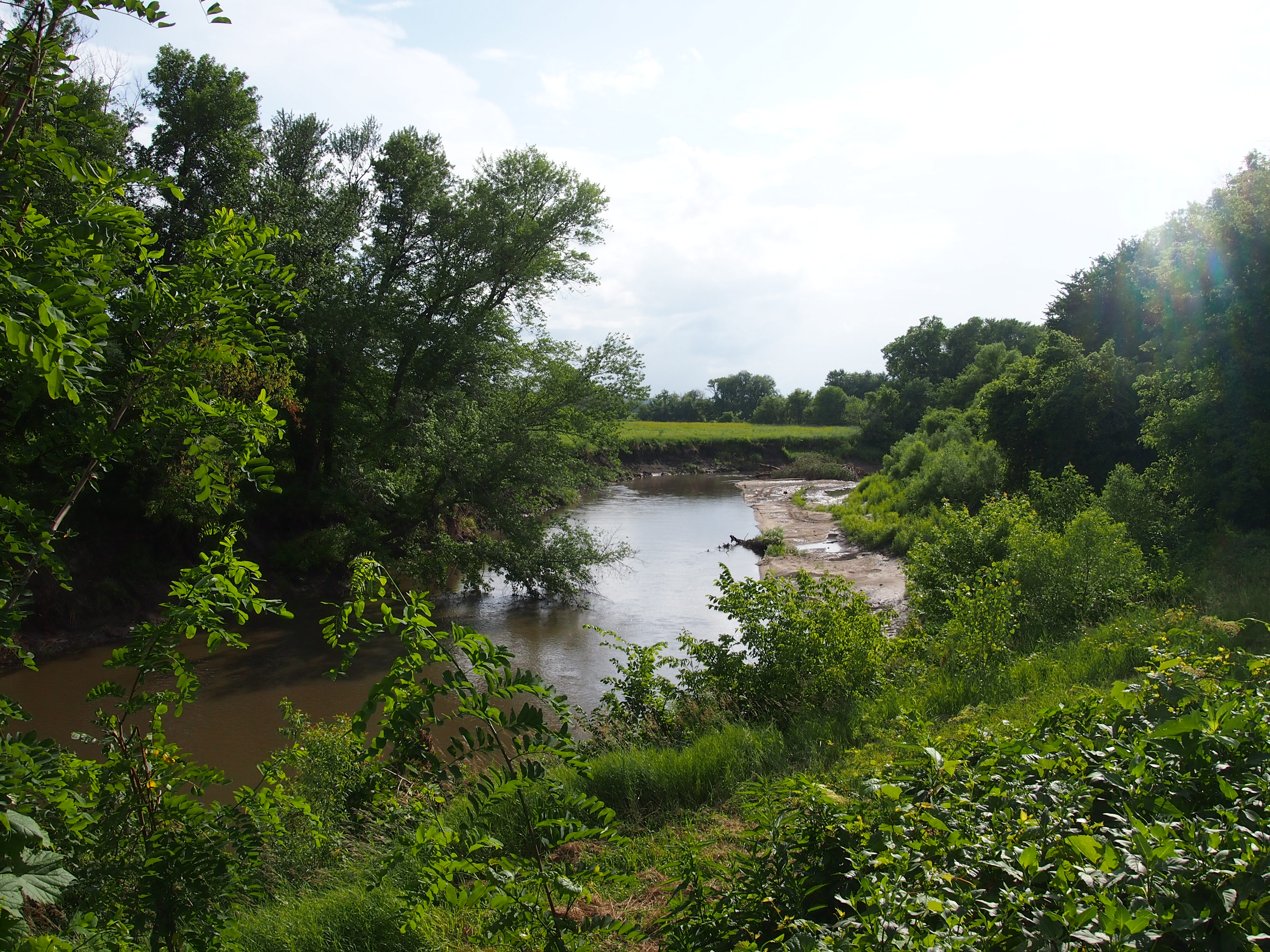
Middle River, Iowa, July 2014This is the view from the north end of the bridge, looking out on the Middle River, a tributary of the Des Moines River that runs through the county. Iowa’s nice and lush this year.

The Duke in Winterset

The thing to do when heading out of Des Moines in a southerly direction is to detour into rural Madison County, southwest of the capital, whose county seat is Winterset. If you have time. I decided we had time, since how could I pass up a look at a bronze of Winterset’s favorite son, Marion Robert Morrison?

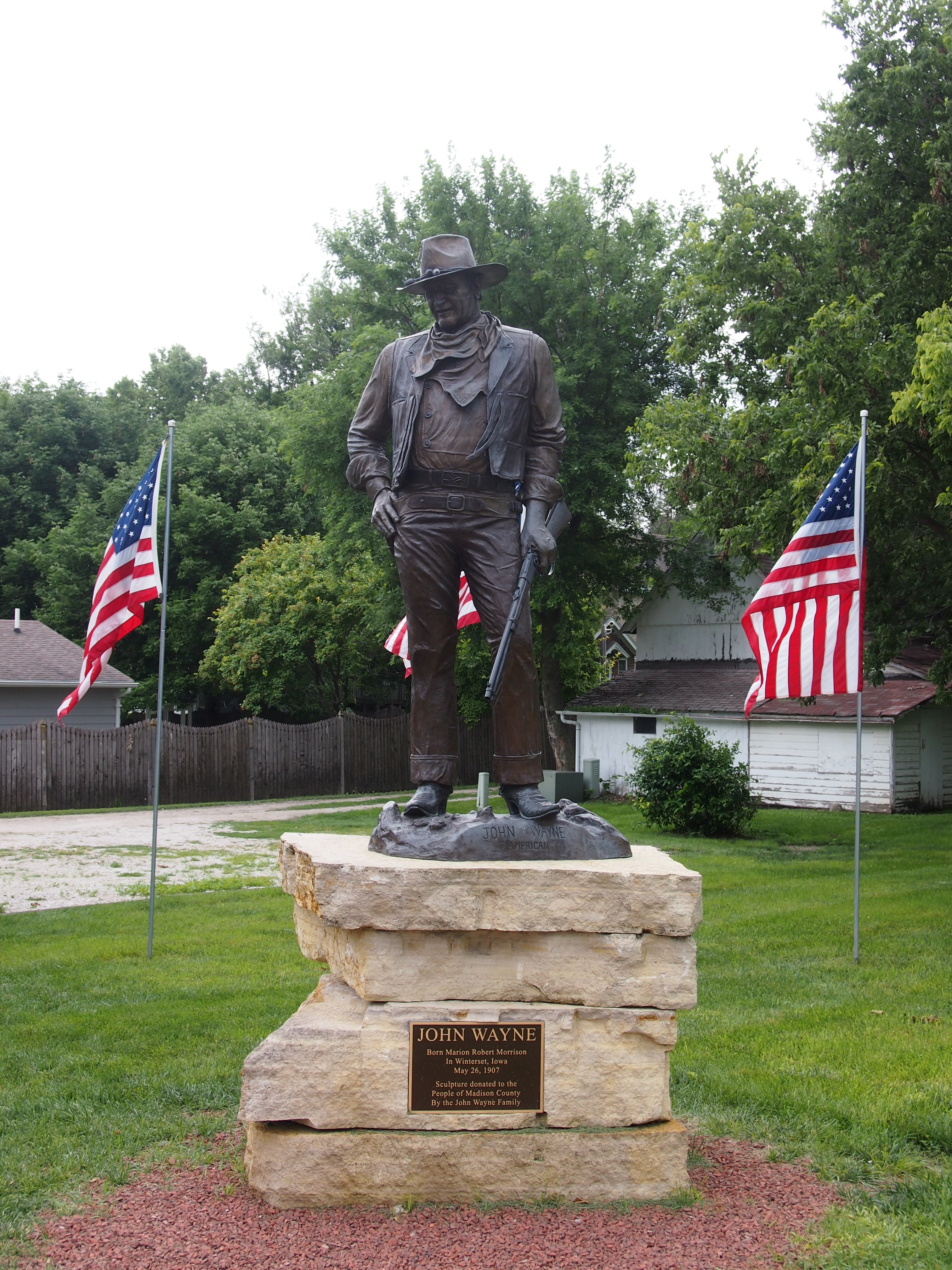
John Wayne, Winterset, Iowa 2014JOHN WAYNE

Born Marion Robert Morrison

In Winterset, Iowa

May 26, 1907

Sculpture donated to the

People of Madison County

By the John Wayne Family

The statue of John Wayne is a short block from his birthplace house, now a museum that (like the capitol) happened to be closed when we arrived. No matter. A good look at the bronze was enough for now, and we weren’t the only ones doing so. A few other families pulled up for a look-see while we were there. Wayne’s fame has some staying power.

Next to the statue is a Chevy van, detailed to honor Wayne. According to the birth site museum web site, “Several years ago, an anonymous person from Arizona donated a full-size 1980 Chevy van that has been extensively customized for the true John Wayne fan….

“This one-of-a-kind vehicle is covered with $50,000 of artwork from John Wayne movies—even the windows are etched to continue the design! The interior boasts hardwood floors, carpeted walls, a wet bar, TV and VCR (this was 1980, remember?), a souped-up sound system, and saloon-style swinging doors that lead to the queen-sized bedroom [sic] in the back.”

I didn’t realize it when we were there, but the statue usually resides at a corner of Washington St. and John Wayne Dr. – one of the main drags through town – but has been moved a block away, so it won’t be damaged during construction of the John Wayne Birthplace Museum. Work started in 2013 on the new museum, which is slated for completion for the 2015 John Wayne Birthday Celebration (and it’s convenient that baby Marion was born pretty close to Memorial Day). Last year my old friend Kevin, quite the fan of the Duke, went to the birthday fest. He said he had a large time.

One more thing: there are other John Wayne bronzes out in the wider world. You have to go to California to see these two.

In the Midst of the Corn, the Middle of the USA

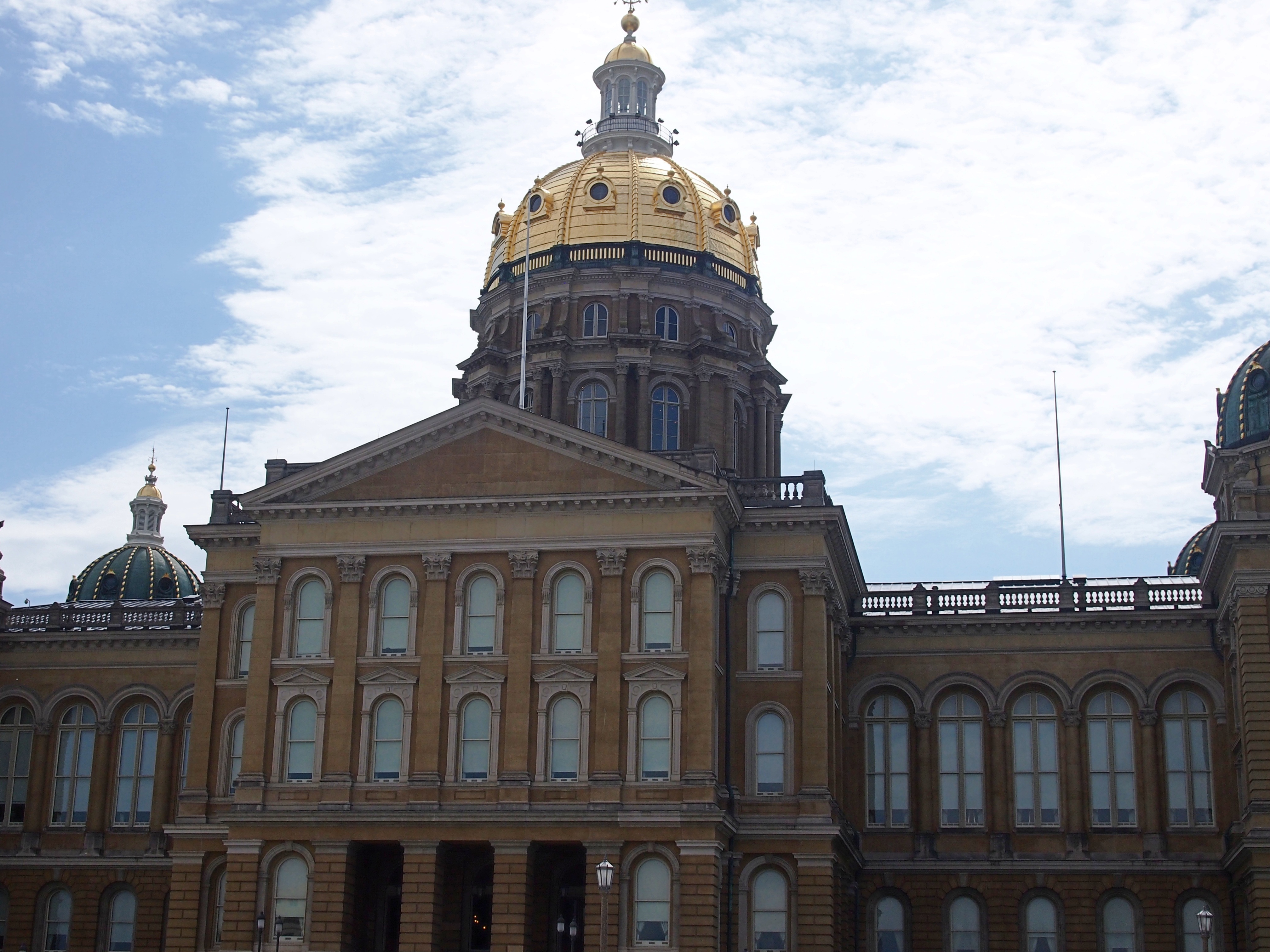
In early August 1978, I took a bus from San Antonio to Stevens Point, Wisconsin, and back again, along with a busload of other high school students to attend the Mu Alpha Theta national meeting in that (seemingly) remote Wisconsin outpost. The route took us through Des Moines, which I only knew as the capital of Iowa from maps. We didn’t stop, but one of the teachers on the expedition, the admirable Paul Foerster, pointed out the Iowa state capitol as we went by – and noted the gilding on the dome, which he said was a very thin layer of gold. Indeed it is.

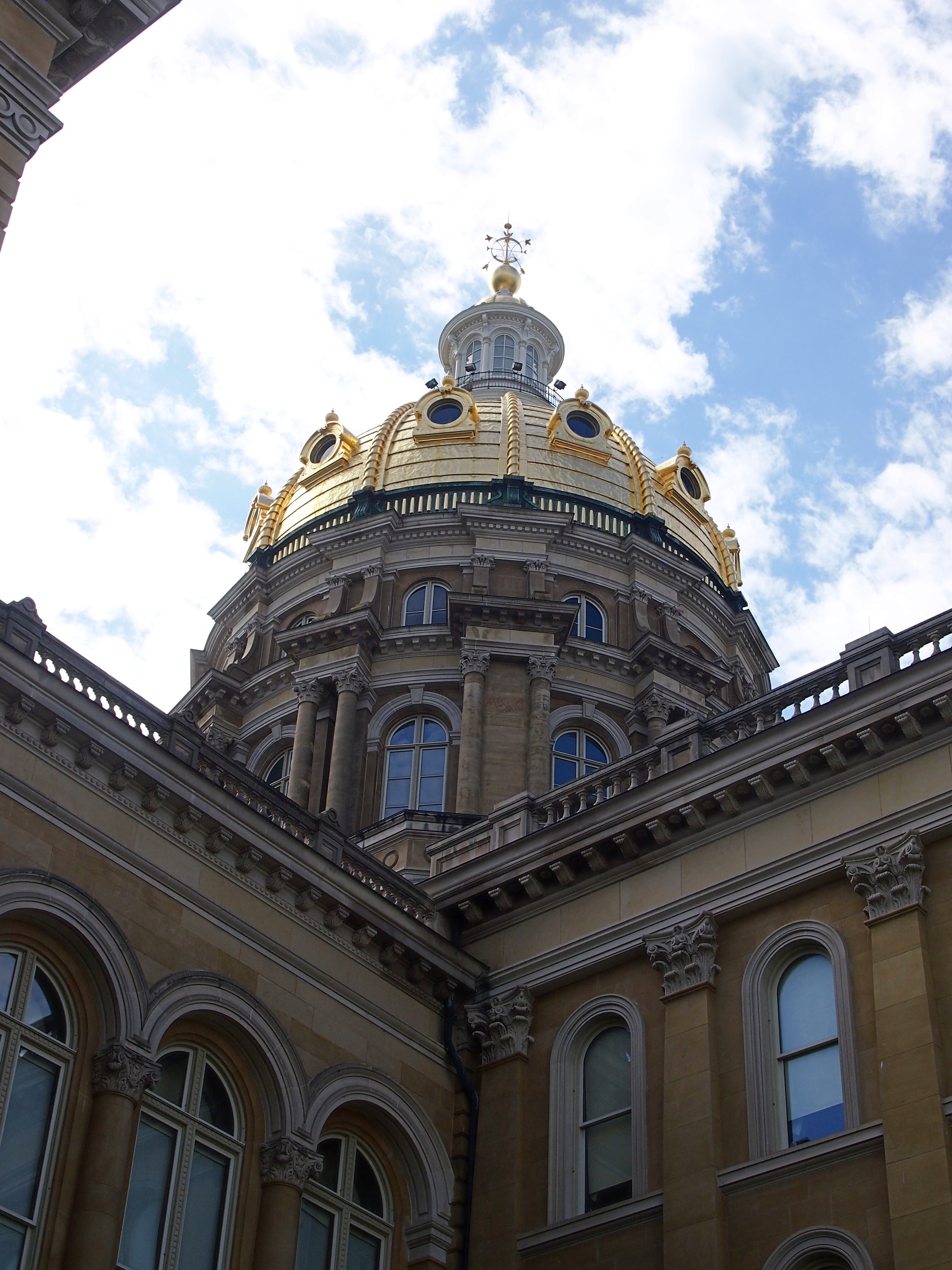
In later years, I figured I’d go back someday and take a look at the capitol more closely. Somehow, I never got around to it until July 12, 2014, our first day of driving, when I made a point of stopping there. We arrived just after 4 on that Saturday afternoon, right after the building closed (that’s what we get for having a leisurely lunch in Coralville). Ah, well. I had to make do with looking around the grounds, and seeing the magnificent gold dome up close from the outside.Iowa State Capitol 2014

The building was completed in 1884, repaired after a major fire in 1904, and exterior refurbishment was done in the last years of the 20th century. “The commanding feature is the central towering dome,” according to the State of Iowa (whose text, I note, was copied directly to Wiki). “This is constructed of steel and stone and covered with 23 carat gold. The gold leafing was replaced in 1964-1965 at a cost of $79,938.”Iowa State Capitol 2014

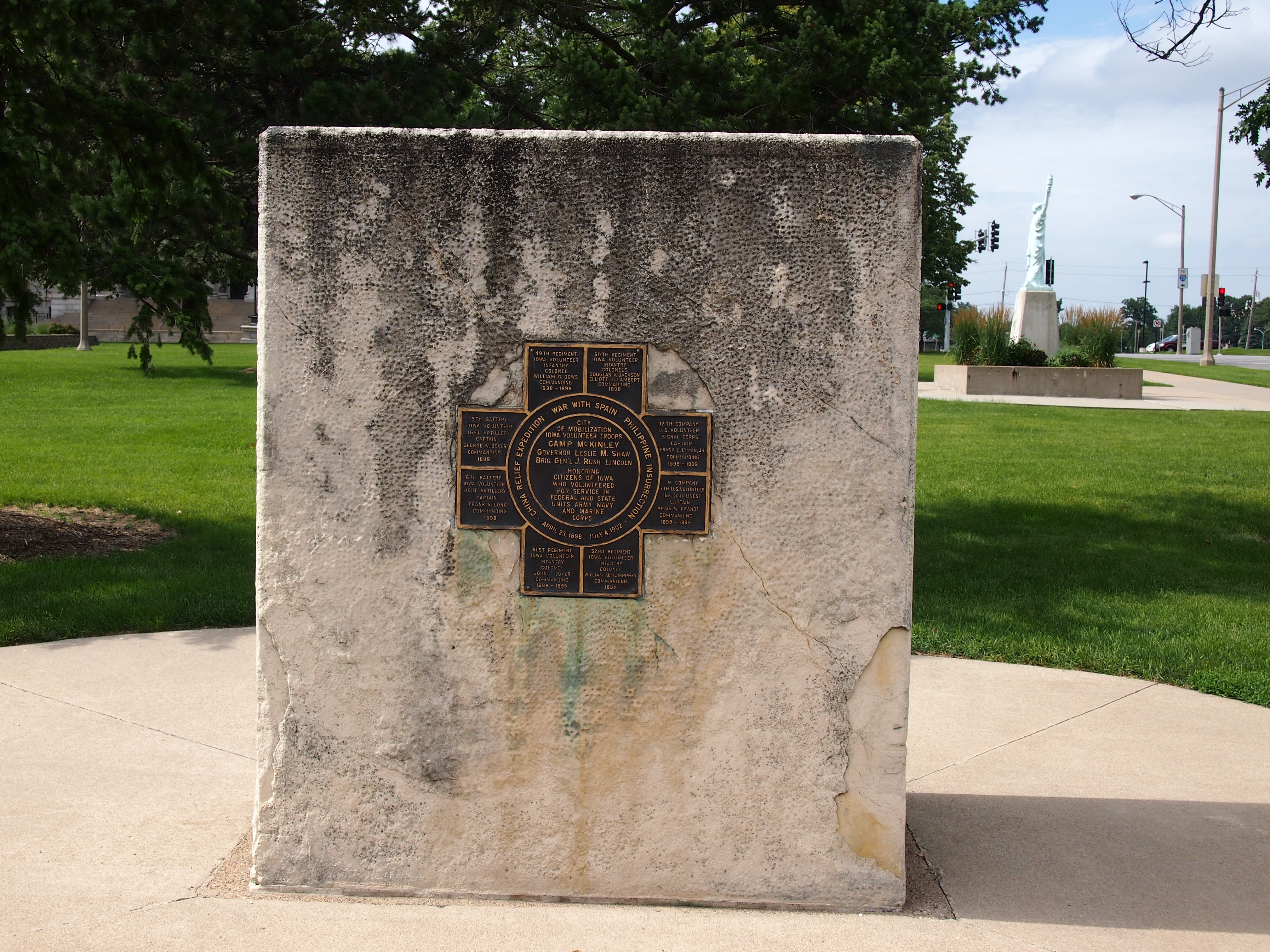
Since the capitol itself was closed, we took a look around the immediate vicinity. We would have done that anyway. The grounds sported a good number of memorials, as capitol grounds usually do. Including the modest and not-very-picturesque, such as this homely slab.

Spanish War memorial, IowaIt memorializes the Iowa men of the China Relief Expedition (you know, 55 Days in Peking), the War with Spain, and the Philippine Insurrection, and is dated April 23, 1898, to July 4, 1902.

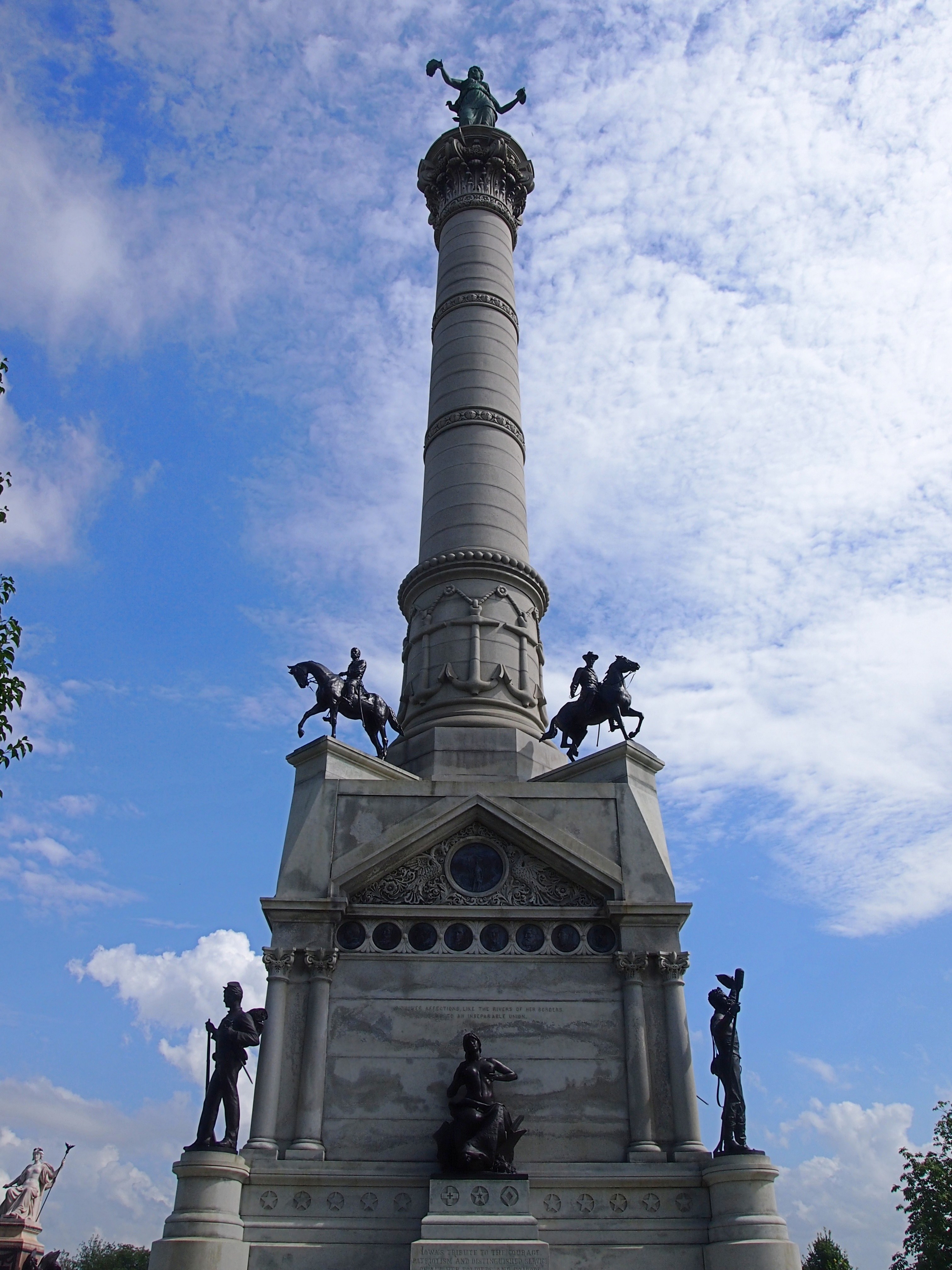
This is a much larger memorial. It is, of course, the state Civil War memorial, or to use its correct title, the Iowa Soldiers and Sailors Monument.Iowa State Capitol soldier's memorial

The Iowa Department of Administrative Services tells us that “the State of Iowa erected this monument, funded partially by refunded war taxes, to commemorate Iowans who fought during the Civil War. The monument was approved in 1888, the cornerstone was laid in 1894, and the structure was completed two years later. Because formal controversy developed over the location and artistic details of the monument, nearly 50 years passed before its dedication in 1945.”

I didn’t realize it looking at the thing, but the equestrian statues – two of the four are visible in my picture – represent actual individuals: Marcellus M. Crocker, who led troops at Shiloh, Corinth, and Vicksburg; John M. Corse, who joined Grant at the siege of Vicksburg; Grenville M. Dodge, who built railroads to support Grant and accompanied Sherman on the March to the Sea, and Samuel R. Curtis, commander of the Union Army at Pea Ridge.

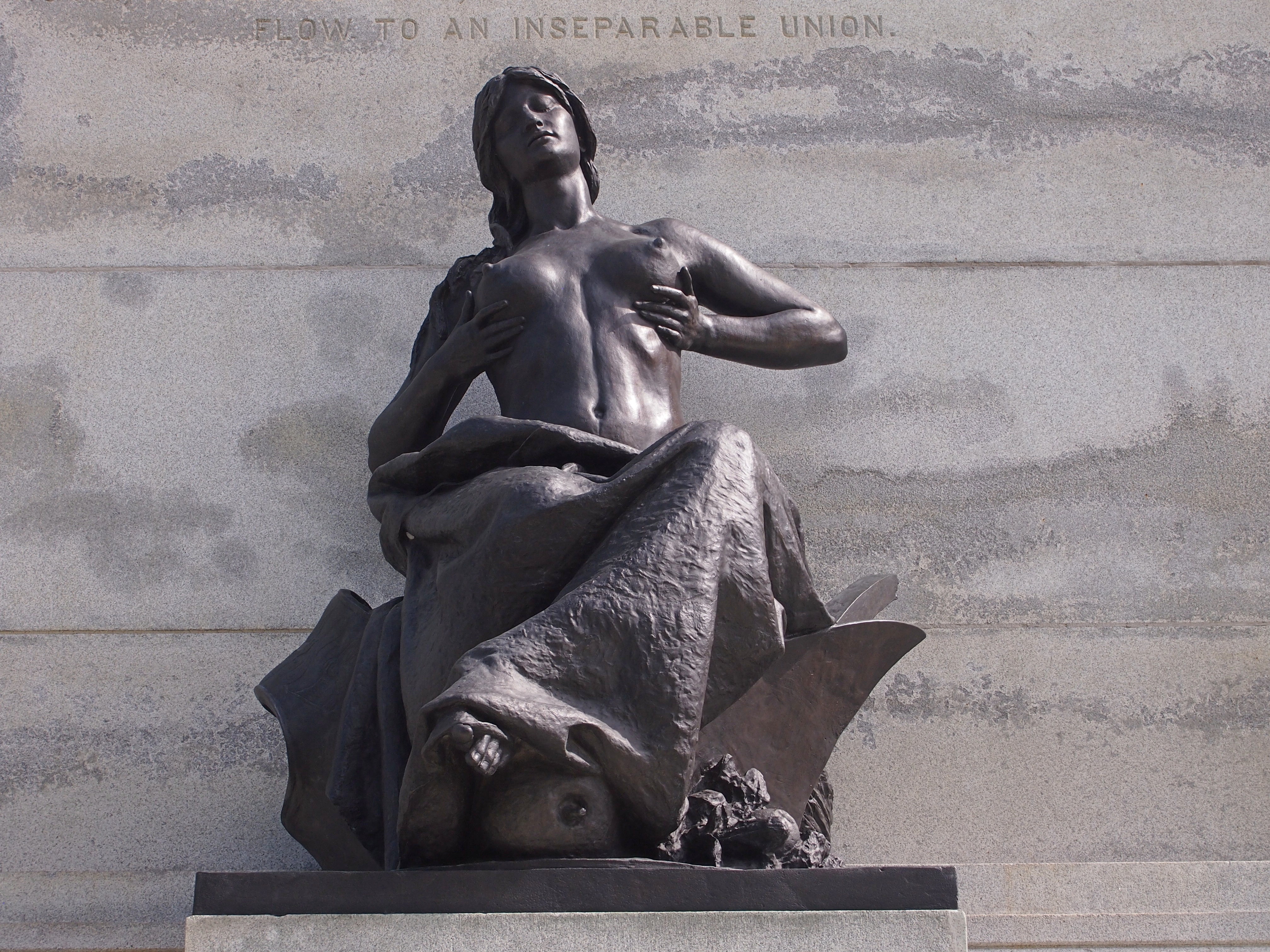
The other figures are allegorical, such as Victory at the top, common soldiers and sailors nearer to the base, and Mother Iowa.Mother Iowa 2014

Let’s just say that Mother Iowa, offering nourishment to Iowans in a way that only a mother can, looks a little odd to modern eyes.

The Kansas Cosmosphere and Space Center

Why Kansas? Even the Kansas Cosmosphere and Space Center web site asks that question in its FAQ page. Why is a first-rate spacecraft museum – absolutely the best I’ve ever seen, except for the Smithsonian Air & Space Museum – in Hutchinson, Kansas, a town of about 42,000 northwest of Wichita? The answer: that’s the way the cookie crumbled. Right place, right time.

“The Cosmosphere began in 1962 as nothing more than a tiny planetarium on the Kansas State Fairgrounds,” the page says. When the planetarium outgrew its original facility and moved to its current location, Patricia Brooks Carey and the Hutchinson Planetarium’s board of directors sought business advice from Max Ary, then director of Ft. Worth’s Noble Planetarium. “Interestingly, Ary was also part of a Smithsonian Institution committee in charge of relocating thousands of space hardware artifacts to museums throughout the U.S. The Cosmosphere was granted many of the artifacts.”

These days the museum measures over 105,000 square feet and includes a large exhibit space for rockets and spacecraft, plus a planetarium, dome theater, and more. We arrived in the mid-afternoon of July 13, too late to catch a planetarium show, but in plenty of time to look at a lot of space stuff, expertly and chronically organized for display.

“Most everything you see in the museum was either flown in space, built as a back up for what was flown in space, built as a testing unit for what was flown in space, or was the real deal, but was never meant for space,” the museum continues. “Only a few artifacts are replicas, and those that are replicas, are for good reason. For example, the lunar module and lunar rover in the Apollo Gallery are replicas (though built by the same company that produced the flown modules), because those that went in space, stayed in space. No museum in the world carries a flown lunar module or rover. In fact, they’re all still on the Moon.”

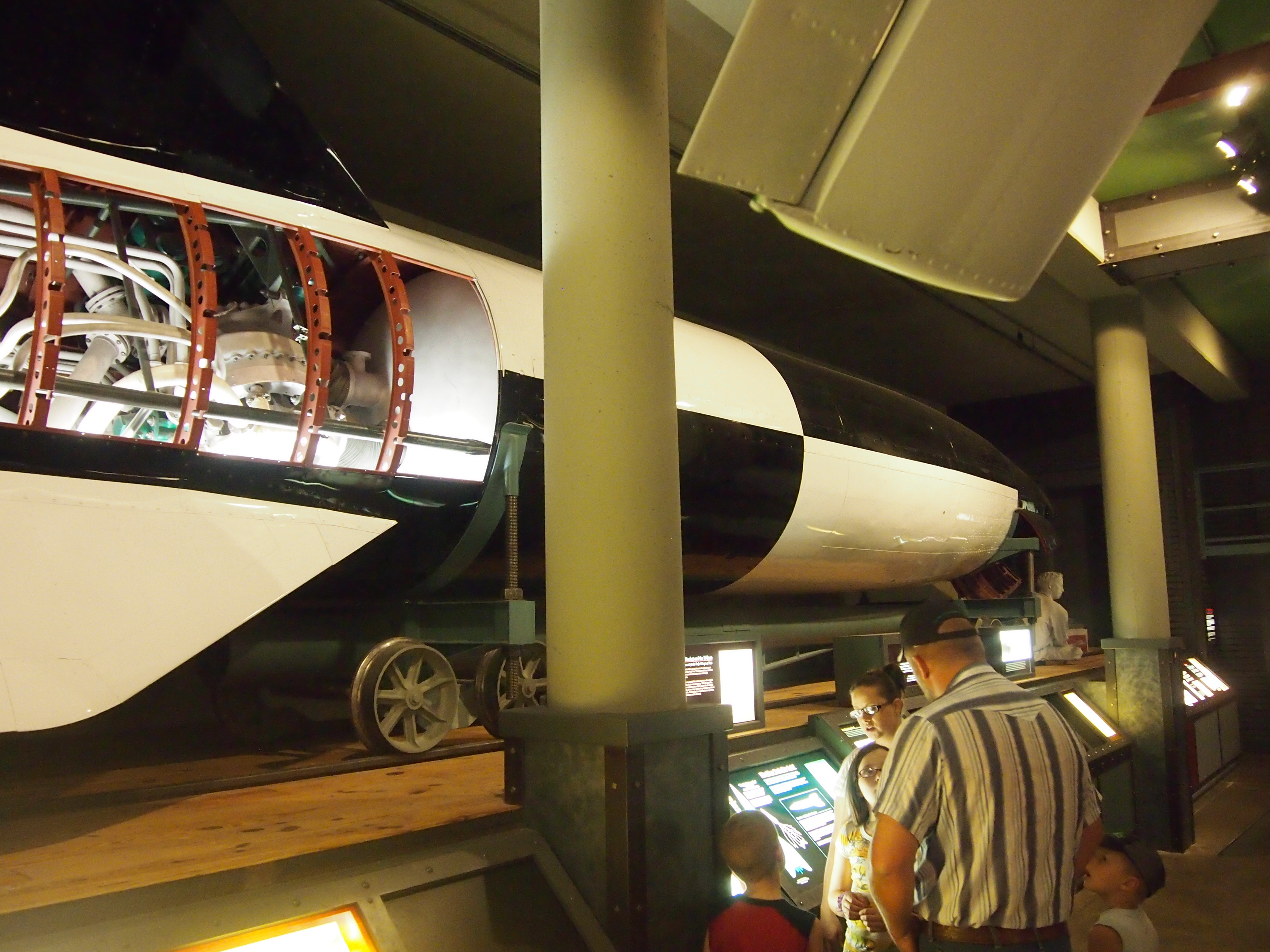
The displays begin at the beginning of modern rocketry – Konstantin Tsiolkovsky and Robert Goddard and on to Nazi rockets, including a restored V-1 and V-2.

V-2 rocketThen on to Soviet and U.S. rockets and capsules that ventured into space, plus a lot of ancillary items. It’s an astonishing collection, including a replica of the X-1, a flight-ready backup for Sputnik 1, a backup version of the Vanguard 1, a Russian Vostok capsule – the only one outside Russia – Liberty Bell 7 (pulled from the ocean floor and restored), a Redstone rocket and a Titan, too, the Gemini 10 capsule, a Voskhod capsule, the Apollo 13 Command Module, a Soyuz capsule, various Soviet and American rocket engines, an Apollo 11 Moon rock, and a lot of smaller artifacts.

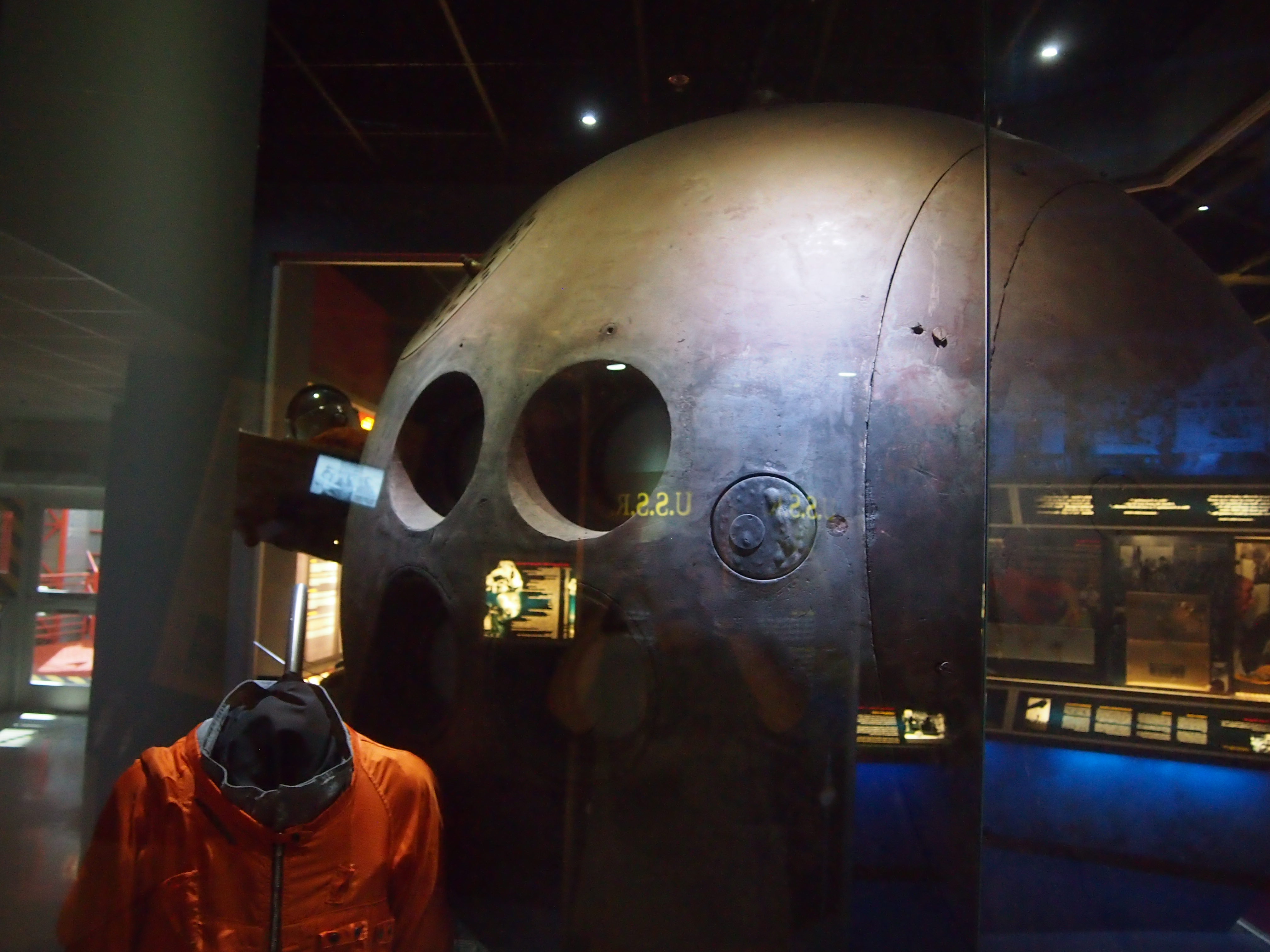
I took a particular interest in the Russian equipment because I’ve seen so little of it. In fact, I’d never seen a Vostok, and there it was. Looking like a large bowling ball behind glass. “Hop in, Comrade, and we’ll shoot you into space.”

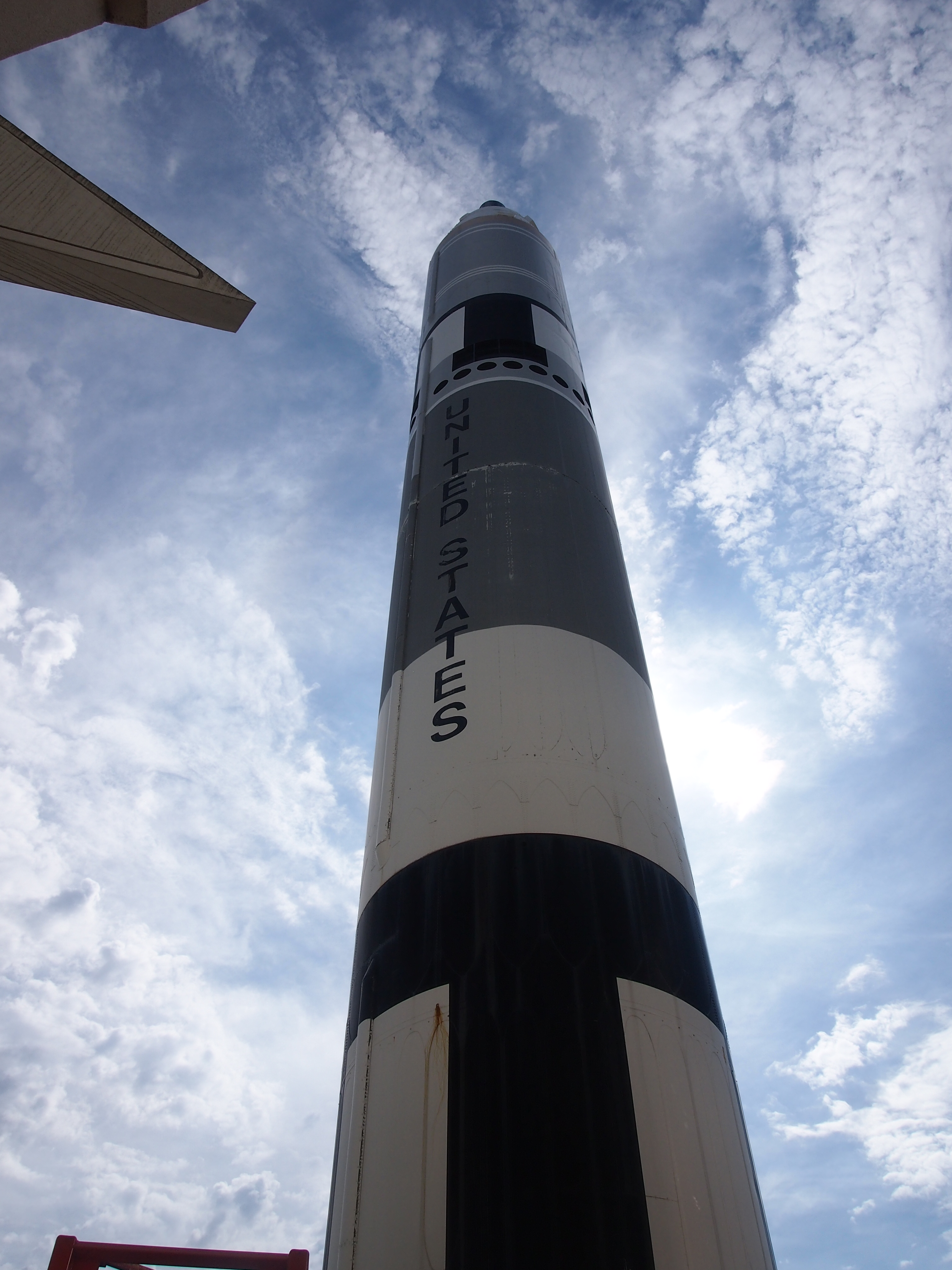
VostokThe American equipment was impressive, too, though more familiar. It’s always an impressive thing to stand under a rocket like a Titan, which used to deliver Gemini into orbit. Titan

Ann seemed to enjoy herself, and probably learned something. But to really appreciate this museum, it helps to have been an eight-year-old boy in 1969. You find yourself turning the corner and saying, “Wow, look at that!” a lot.

Fifteen Days, Seven States, Nearly 3,000 Miles, and the Blue Hole

Our drive to San Antonio and back started on the morning of July 12 and ended a few hours ago. I actually remembered to set to trip meter as we were leaving, so I know that between backing out of the driveway and returning to it, the car had been driven 2,952 miles and change. Except for when my brother Jay used the car in San Antonio, I drove all those miles. Ann was in the back seat almost all of the time.

Our route southward wasn’t as direct as it could have been, passing from metro Chicago to Des Moines to St. Joseph, Mo., the first day; to Hutchinson, Kan., by way of Topeka the second; and Dallas by way of Wichita and Oklahoma City on the third. After some days in Dallas, travel resumed: to San Antonio via the most direct route, which turned out to be a mistake (more about which later).

Our return northward was more straightforward: San Antonio to Dallas to Lebanon, Mo., and then home, three days’ driving spread out over four days, with a jag into extreme northwestern Arkansas. More about that later as well.

We were caught in two storms so intense that we waited them out beside the road. I saw two suitcases broken open, and their contents spread on the road, on two different Interstates. I’m pretty sure I saw a guy pulled over on the shoulder of yet another Interstate, changing his pants outside his car. We listened to a lot of radio. As hard as corporate interests try, terrestrial radio isn’t quite homogenized.

When I wasn’t driving, I was working (that’s the self-employed life). Or visiting with family members and friends: my mother, two brothers, two nephews and one’s wife, my aunt, first cousin and his family, two friends from high school. Or eating. Some chains, of course, but I did my best to support independent eateries in places like Wichita, Dallas, Austin, San Antonio, and Mt. Olive, Ill.

Besides all that, we squeezed in visits to three museums, the outside of two capitols (closed, unfortunately), a mall, an enormous bookstore, a couple of wooden bridges, and a cemetery with an historic figure buried in it. I also watched a number of early episodes of Treme, an addictively good show.

And I saw the Blue Hole.

Blue Hole, SA, July 2014

I lived within 10 minutes’ drive of the Blue Hole for more than a decade, and every time I visited San Antonio after that for 35 years, I was equally close. Yet I never saw it before this visit. All I can say is, it was about time.

Summer Interlude

Summertime and the living is — not so different from the rest of the year, considering that we have climate control in the house, have to meet the same deadlines as the rest of the year, and so on.

Time for summer break anyway. Back to posting around July 27. Till then, a handful of summer tunes. Been fond of “Summer Wind,” sung by Sinatra, only since the late ’80s, when I acquired a tape of Strangers in the Night. Music by Heinz Meier and lyrics by Johnny Mercer.

I’ve known “Summer Breeze,” by Seals & Crofts, probably since it was released, or at least fairly new. It evokes a moment in summer, in particular a summer evening, without mentioning beaches or puppy love or such.

Not quite sure what’s going on in “Suddenly Last Summer,” by the Motels, but it’s to do with a particular summer. Some summers, after all, are more memorable than others, especially when you’re young.

Also, some recommended reading. I just started Arabian Sands by Wilfred Thesiger. I’m already hooked, and I haven’t even gotten to his crossings of the Empty Quarter. He’s only been dead about 10 years. The Telegraph’s obit is here, and the Guardian’s is here.

My Online Encounter With Yabba

I woke up this morning wondering, is there really a statue of a baseball player in London? I dreamed about it. I made notes in my dream, so that I could write about it. I didn’t think it the least bit odd. Such are dreams.

As far as I can tell, there are no such statues, at least not in a public setting. I didn’t spend a lot of time looking into it, though. But I did come across the Sporting Statues Project, which seems to list sport-themed statues all over the world. I looked at a couple of its maps out of idle curiosity, including the World Cricket Statue Location Map. At a glance, you can see where people care about cricket: the UK, the Indian subcontinent, Australia and the Caribbean.

Look a little further and you can examine curious works like “Yabba.” The web site says: “Sydney Cricket Ground. ‘Yabba’ (Stephen Gascoigne). A tribute by the Sydney Cricket Ground Trust to every spectator who has ever come to these Grounds. Sculptor: Cathy Weiszmann. Benefactor: Basil Sellers.”

“Yabba” was one Stephen Harold Gascoigne, “remembered as a heckler at Sydney Cricket Ground cricket and rugby league games in the early part of the 20th century. Yabba was known for his knowledgeable witticisms shouted loudly from ‘The Hill’, a grassy general admissions area of the SCG.” – Wiki

Good useless fact for the day. You never know where your dreams will lead you.

Entertainment Oddities, Some Involving Actors Named West

As it happened, on July 4 one of the channels was running a Batman marathon, and by Batman, I mean the one starring Adam West. Accept no substitutes. I watched two episodes, which is about enough at any one time, a pair originally broadcast one night after the other in 1966. Catwoman was the villain. At one point, after capturing the Dynamic Duo, she separates the two using a vacuum tube, saying: “It’s time to separate Damon and Pythias.”

Did I hear that right? A casual Classical allusion on mid-60s TV? Yes, indeed. Hadrian and Antinous would have been funnier, but even more obscure.

At a grocery store parking lot not long ago, I saw an ordinary sedan, one car among many, except for one thing: “NCC-1701” was detailed on either side. I couldn’t help mocking the owner in abstentia on the way into the store (Lilly was with me). “To boldly go shopping,” “Hope he doesn’t use his phasers in the parking lot,” etc.

She Done Him Wrong (1933) is an odd movie, at least to modern eyes. I tried to imagine what it would have been like to see the movie new, when it wouldn’t (presumably) have been so odd, but it was hard. Still, the movie must have had its attractions in its time, since it made Paramount a bucket of money in the pit of the Depression.

Mae West is one of those people now mainly known by reputation, and that includes my impressions of her. I’d never seen one of her movies until last week, when I watched this one. She’s famous for her one-liners, and justly so. And of course for her sex appeal. I think it helps to have been born around 100 years ago to fully appreciate it.

Another thing I wondered about was the setting. The movie was set in the 1890s, which the intro refers to by its common sobriquet, the Gay Nineties, a ’20s invention. I wonder just what kind of nostalgia people of the 1930s felt for the 1890s. It’s possible to be nostalgic about anything, so I guess that applies to a decade marked by its own depression and bitter labor disputes.