Tri-State Summer Solstice Weekend ’14

Late on Friday morning we drove west for a few hours – and enjoyed a remarkably long in-car conversation among ourselves, no radio or other electronics playing – and by mid-afternoon arrived at Mississippi Palisades State Park, which overlooks the Mississippi River just north of Savanna, Ill. The plan included bits of three states in three days. My plan, really, since my family humors me in such matters, and lets me think up the details of little trips like these.

Friday was Illinois. We camped at Mississippi Palisades, which is an Illinois State park and incredibly lush this year, and we spent time in Savanna, a little river town on the Great River Road, mostly to find a late lunch. Toward the end of the day, we made our way to Mount Carroll, Ill., which is the county seat of Carroll County and home to a good many handsome historic structures.

On Saturday, we ventured into Iowa – it really isn’t far – and first saw Crystal Lake Cave, just south of Dubuque. In Dubuque, lunch was our next priority, followed by a visit to the Fenelon Place Elevator. Which is a funicular. When you have a chance to ride a funicular, do it. The last time we were in Dubuque, I remember the Fenelon Place Elevator being closed for the season (uncharacteristically, I don’t remember when that was — the late ’90s?). Anyway, this time I was determined to ride it.

Afterward, we headed west a short distance to the town of Dyersville, Iowa, home to the Basilica of St. Francis Xavier, but better known for The Field of Dreams movie set, which still draws visitors. We saw both.

Today was mostly about getting home at a reasonable hour, but I had to add a slice of Wisconsin by navigating a number of small roads until we came to Dickeyville. It would be just another rural Wisconsin burg but for one thing: the Dickeyville Grotto, which actually includes a main grotto, smaller grottos, shrines, a church and a cemetery (and a gift shop, for that matter). Like funiculars, grottos demand our attention, especially such as striking bit of folk architecture as the Dickeyville Grotto.

Juneteenth Firefly & Felipe

Saw the summer’s first firefly this evening, around dusk as you’d expect, but only a solitary bug, in the middle of the road ahead of me as I drove along. Still, it’s the first. A winged, flickering harbinger of the short high summer here around the Great Lakes.

Soon, bigger flashes were visible. Plenty of cloud-to-cloud lightning up high in evil-looking black clouds. According to the weather maps, most of the rest of the nation is having a quiet night, but we’re getting the pops and the rumbles. No big peals, cracks or claps of thunder just yet, but that could come at any time. No urgent warnings from weather experts, so I guess it’ll just be wet in the morning.

I had a lot else to do today, so I read a bit about the new King of Spain. Wiki’s handy for this kind of thing, and tells me a number of facts, such as his full name: Felipe Juan Pablo Alfonso de Todos los Santos de Borbón y de Grecia. I wonder how old he was before he learned all of them in order, or whether he ever bothered.

Also, and this isn’t particularly surprising, he’s the great-great-great-grandson of Queen Victoria through two different lines. More interestingly, he’s descended from the kings of the Two Sicilies, most recently Ferdinand II of the Two Sicilies (1810-59). There’s a kingdom you don’t hear much about any more, but the name always amused me.

Little Jet in the Sky

Last Friday afternoon I was out on my deck – partly to get it ready for the next day’s grilling event, but mostly just to loaf (is that verb disappearing?)  – and I heard an odd whizzing sound from somewhere above. It didn’t sound like a small aircraft, or at least one that was approaching the general aviation airport about a mile from where we live. Or a large insect near my face. Soon I realized it sounded like a jet. A small jet. That’s what it was.

For a moment I thought it was a drone. We’re nearly in the age of drones, after all, and not long ago I read about a drone spotted near one of the highways near where I live. I didn’t see it, but it turned out to be doing surveying work at a construction site.

What I heard and then saw on Friday was a model airplane flying in circles above the park visible from my back yard – a model jet airplane. I could also see the guy in the park controlling the thing. I had no idea there were model jets. All the model planes I’ve ever seen had props.

According to RC Airplane World (RC = radio controlled, I assume), “RC jets, whether gas turbine or electric ducted fan (EDF) powered, can provide the ultimate radio control flying experience if you’re looking to fly faster model aircraft.

“True gas turbine RC jets, however, are not for the beginner. They are very serious model aircraft that you have to work up to after gaining a large amount of radio control flying experience and an equally large amount of cash. They’re serious business!

“But the good news is that if you do like the idea of flying a radio control jet then there are plenty of options available these days; foam RTF (Ready To Fly) electric powered jets have become commonplace in recent years.”

I don’t know what kind of jet this fellow had, but a jet it was, and he made it do various maneuvers over the park and then landed it. Remarkable the things you see in the sky sometimes.

Arms & Armor at Dusk

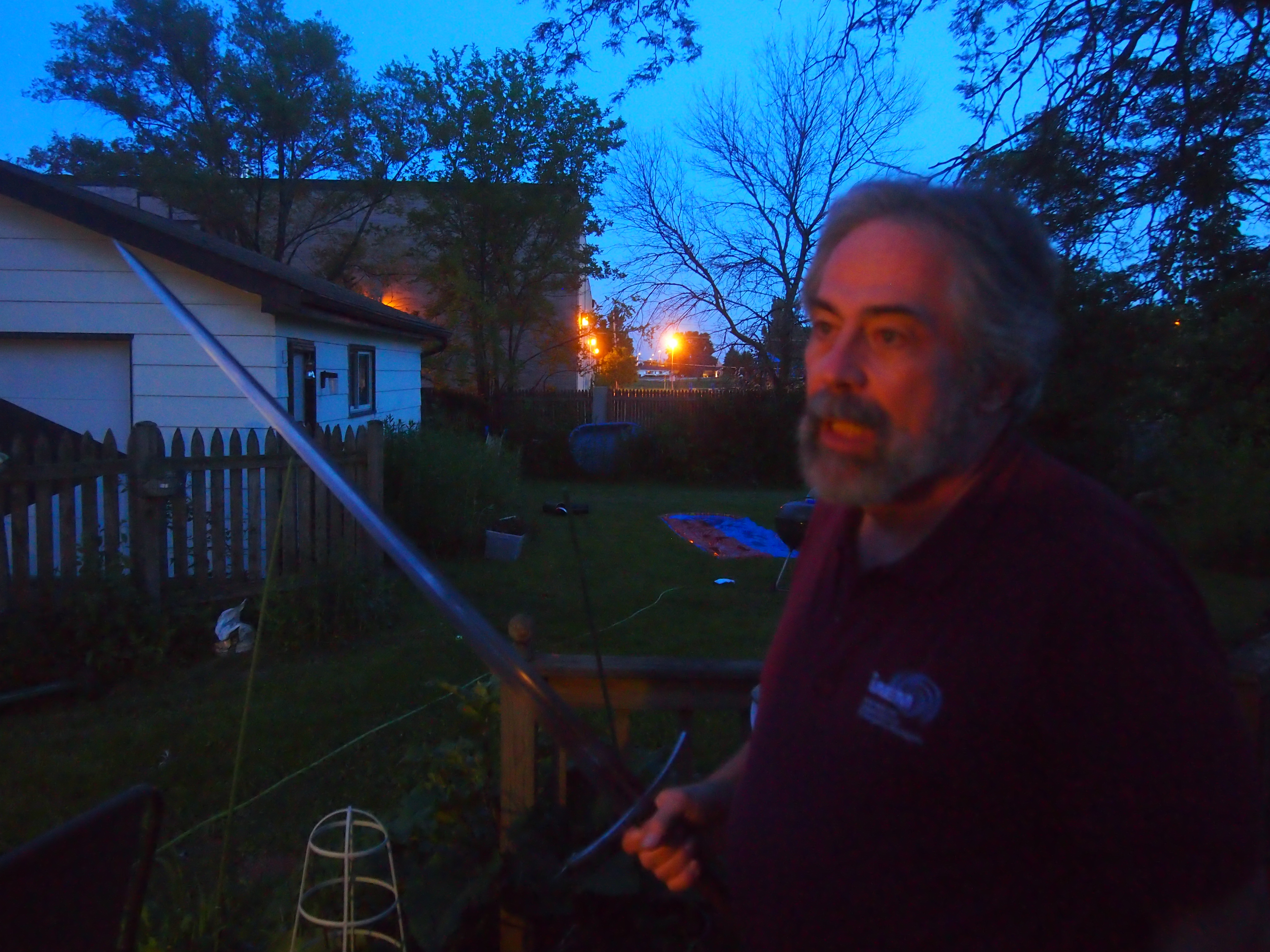
How often do you have the chance to wear a chainmail shirt? Not very often, unless you’re an arms and armor enthusiast, like my old friend Scott. He attended our Saturday barbecue and brought some items for us to look at, including a chainmail shirt, a breastplate, and a couple of swords. Here’s me in the mail, and Scott in the breastplate.

OLYMPUS DIGITAL CAMERAScott said the mail shirt was made in India, in the style of medieval Europe. Getting into the mail took some doing, and so did just standing up in it, so heavy is it.

“No wonder knights needed squires,” Kevin, another barbecue attendee, said during all of the rigmarole involved in me putting the thing on. That meant me getting on my knees, and Scott guiding the shirt down, with my head and arms careful to go through their respective holes. No wonder indeed. Not just to put it on and take it off a living knight, but to loot it from dead knights when the time came. Hard to imagine walking around, or riding a horse, or going into battle wear such weights, but then again I’m a pudgy 21st-century man, not a 13th-century tough.

The swords were very cool, too. This is one of them.

OLYMPUS DIGITAL CAMERAWe examined them at some length at dusk. Scott told us what kind they were, and where the styles had been popular, and showed us some moves, but my memory for those details is poor.

What I remember is that the longer of the two was quite heavy, while the shorter wasn’t so heavy. Both were serious blades.

My Charcoal Chimney Starter

On Saturday, I grilled in the back yard for a few old friends. Just ahead of the event, I bought a remarkable bit of fire-starting technology. Simple, but effective. It’s a device that ignites charcoal without the need for lighter fluid or even kindling wood. Naturally, it took me a while to find the damn thing, because I didn’t know what it was called (hardware stores are a marvel, but that’s a problem with them).

It’s a charcoal chimney starter. No doubt something along these lines was known to people as soon as metallurgy was discovered and the burning properties of wood charcoal were appreciated. Long ago, that is. For only about $15, I acquired a stainless steel cylinder, about a foot high and 7½ inches in diameter, with a row of inch-high slots around the bottom of the cylinder. Let’s see: the volume of a cylinder is V = hπr2, so that would be nearly 400 cubic inches. Enough space, as it turned out, to light enough charcoal to cook the evening meal.

Inside is a simple array of rods that divide the cylinder into a larger upper chamber and a smaller lower one, but air (and importantly, heat) can pass between the chambers easily. There are no covers or lids to it, but the cylinder does have a handle attached to its outside.

First, line the lower chamber with paper – newspaper in my case. Next, fill the upper chamber with charcoal. Then light the paper through the slots at the bottom. After the paper starts burning, leave it alone. The remarkable thing is that the paper will ignite the lower charcoal, with which in turn ignite the charcoal above it, until all of the charcoal is glowing hot. I suppose it works because the heat is contained and, since heat rises, it ignites the fuel above it. All together, the process takes about 30 minutes. Once the charcoal is hot, pick the cylinder up by the handle and turn it over to put the coals in the grill.

The hard part in all this was finding out what it’s called. I’d seen one used a few years ago, but that wasn’t much help, and I looked in vain in the grilling equipment sector of a big box store among many MeatMan 2000 UberGrills large enough to cook for a small army; say the Swiss Guard. So I did things the modern way, Googling “grill without lighter fluid” and the like, and before long, found a lot of videos like this.

Since I did this on Friday, it was then a matter of ordering one online for pickup in a store on Saturday morning. For mysterious reasons, the store cancelled my order right after I made it, and I didn’t notice the email telling me that, so it wasn’t waiting for me when I got there. But they had them in stock, so after some delay, the staff found one for me.

The surprise wasn’t that some high-tech system failed me in a minor way. The remarkable thing is that when I got the charcoal chimney starter home, it worked exactly as expected.  No inscrutable instructions; no auxiliary parts that you need to make it work but which you don’t have; no important steps in the operation of the device that everyone assumes you already know, and so no one tells you about. Life might be dull if everything were this easy, but some things should be this easy.

Birthday Eats

This year for my birthday I had curry duck at a northwest suburban Thai restaurant. Or, as the menu put it: “Boneless roast duck simmered in Thai spices, red curry, coconut milk, red peppers, green peppers, onions, grapes and fresh basil leaves.” Excellent choice, it was. I didn’t do the modern thing and point a camera at the savory concoction. I did the old-fashioned thing and ate it.

The cake this year was German Chocolate Cake. According to this list, at least, June 11 – close enough – is German Chocolate Cake Day, which I never knew until I looked into the question of just where German Chocolate Cake was created.

As luck would have it, Snopes weighs in on that subject, asserting that it’s in fact an American creation, and popularized only since the 1950s. Something like chop suey not really being Chinese, but who eats chop suey anyway? Or chili con carne in fact being norteamericano.

53rd birthday baked goodWe picked up the cake at a local bakery, and it proved as sweet and gooey as it needed to be. Note the candles. Lilly put them on, using all those we had handy. No one seriously suggested we load the thing with 53 little candles.

Good things to eat for your birthday, but still not as good as when I turned 21. My college friend Dan was taking a class that summer called Economy Botany, taught by one Dr. Channel, which I should have taken myself, but didn’t. Dr. Channel had invited Dan, and a girl named Rona, to his large house near campus for dinner. Dan asked me to come along, or maybe asked a number of us to come, but only I could. It was a coincidence that it was my birthday; I don’t think Dan knew till I mentioned it late in the evening.

“Dr. Channel served a multi-course, skillfully made meal,” I wrote. “We ate hors d’oeuvre – shrimp, vegetables, various dips – a special Georgia onion, baked, and a massive cheesy meaty spicy thick pizza, made from scratch by the professor, including herbs on top fresh from his sprawling garden, a part of his lush back yard that runs off in all directions. We ate under a bower near the garden, and finished off the meal with a wonderful pistachio pie.”

What did I do to deserve that meal? Right place, right time, I guess. The special Georgia onion, I know now, was a Vidalia. Dr. Channel had baked it in aluminum foil, I think. I never knew an onion could be so sweet.

Peonies Aplenty

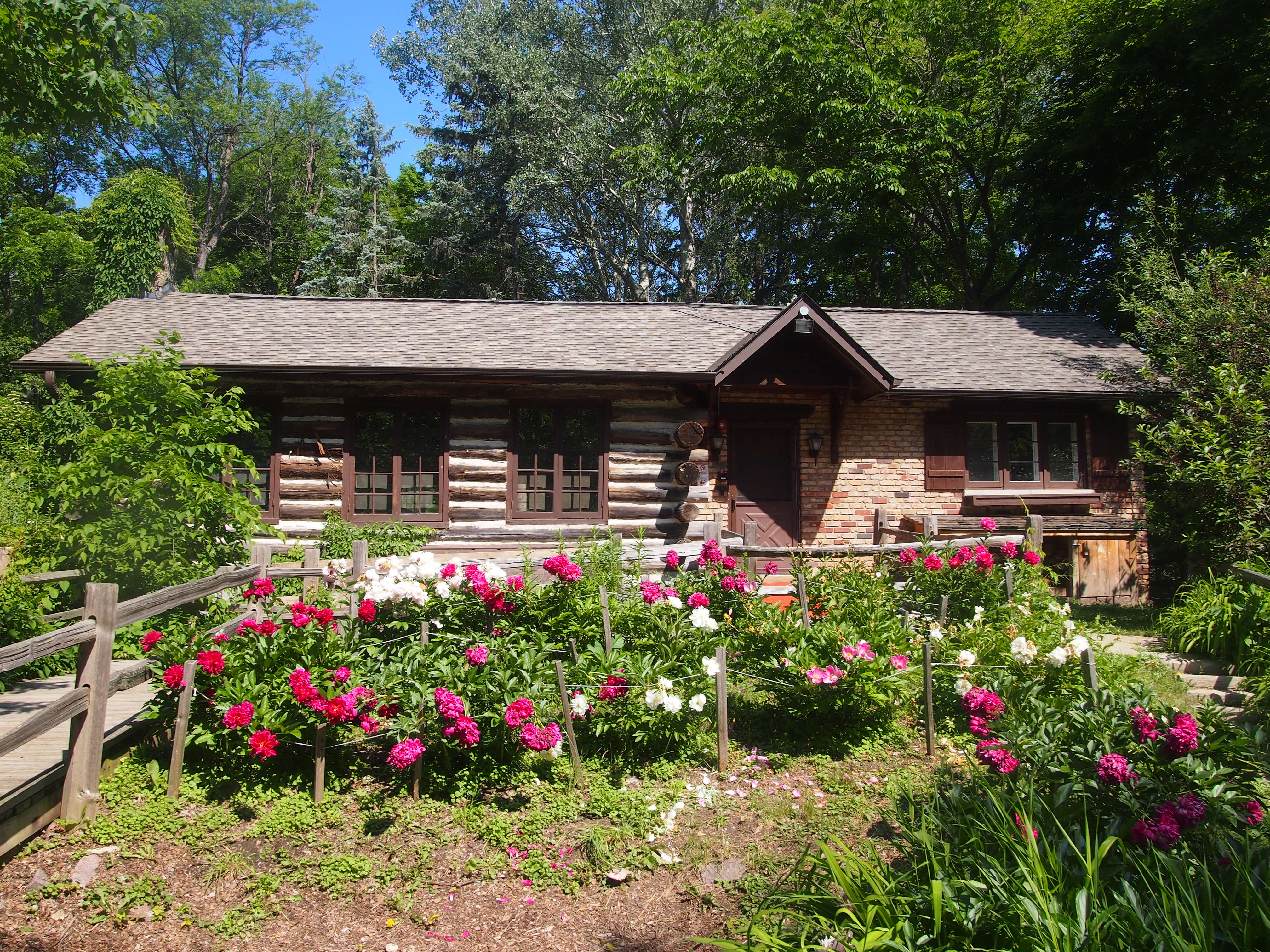
Deep within Spring Valley, here in populous northeastern Illinois, there’s a log cabin built by one John Redeker, son of Friedrich and Wilhelmine Redeker, which sounds like the sort of German family that once farmed the 19th-century Schaumburg. It feels a little remote, but it’s only an illusion. These days, the cabin hosts events and exhibits.

Merkle Cabin, June 2014It’s on the grounds of a peony farm that John briefly ran, but his death in 1930 at 30, and the following Depression and other factors, made it a short-lived enterprise. Still, peonies solider on at the site. Note the bushes in front of the cabin.

Not far away, in a clearing near the cabin, is a field of peonies.

peony field, Schaumburg, June 2014Peony June 2014One more flower, and that's enoughA good place to spend a few solitary minutes.

Ex-Trees

Spring Valley has a number of paved trails, and if you follow the one toward the cabin, you’ll find an enormous white tree not far from the property’s main pond. An enormous, mostly white, all dead tree. Spring Valley tree, June 2014

You might say that it’s passed on. This tree is no more. It has ceased to be. It’s expired and gone to meet its maker. This is a late tree. Bereft of life, it rests in peace. Its metabolic processes are now history. It’s kicked the bucket, shuffled off its mortal coil, run down the curtain and joined the bleedin’ choir invisible. This is an ex-tree.

A large dead tree can be a marvel. Nearly 30 years ago, I ran across a massive one in Mount Rainier Nat’l Park, a “fallen tree trunk bigger than a van. It’s on its side and looks ancient, with gray old roots reaching into the air to twice my height, clawing out in every direction.”

One of these days, unless the Schaumburg Park District removes the thing, the white tree might come crashing down into the pond. Like this smaller (but still fairly large) tree once did. Another tree, June 2014With any luck, it’ll fall some windy night when no one’s around, maybe making a loud crash, maybe not. (How would we know?)

Never Mind the Bollocks, Here Are June Flowers

Rain is falling tonight, and more is predicted for tomorrow. So far, we don’t have the makings of a long, dry summer, though of course that could change.

The following are early June flowers at Spring Valley, here in northeastern Illinois. Mostly I don’t know species names, with the exception of the iris, of course. That’s been one of my favorite blooms since I saw them next to the driveway at our house in Denton, Texas, when I was a kindergartener.

Iris, June 2014

Spring Valley, June 2014Spring Valley, June 2014With flowers come bees. For now, anyway.

Bee, Northeastern Illinois June 2014

Here’s hoping whatever ails the bees doesn’t kill all of them, but makes the survivors resistant to the affliction.

Spring Valley Summer

Northern Illinois is incredibly lush now. Heavy winter snow and consistent spring rain will do that. This is a recent snap at Spring Valley in Schaumburg, Ill. Spring Valley, according to the Schaumburg Park District, “a refuge of 135 acres of fields, forests, marshes and streams.” All you have to do to see it is walk in.

Spring Valley, Schaumburg, June 2014Contrast that with images made at Spring Valley early one April. Remarkable what two months + a certain number of inches of water will do.

These little blue wildflowers cover the prairie areas. Hope they aren’t invasive. Then again, if they are, they add a lot of color here in early June, so maybe they should be welcome colonists.

Spring Valley Flowers June 2014The pond’s also verdant as all get out, layered with lily pads and alive with little fish under them. Spring Valley lily pads, June 2014I’m all for going places, far-away places if possible, but there’s also a lot to be said for near-to-here places.