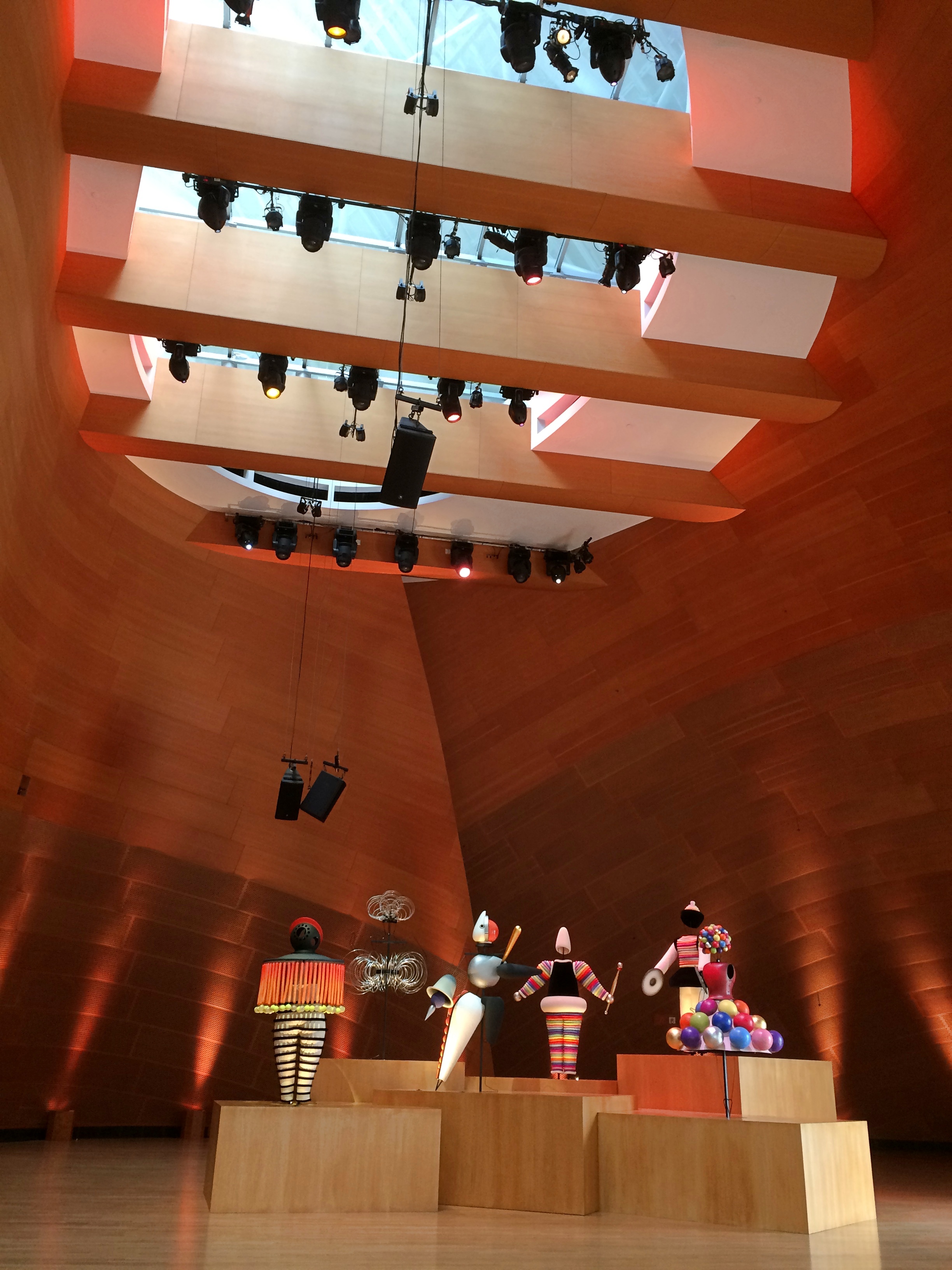
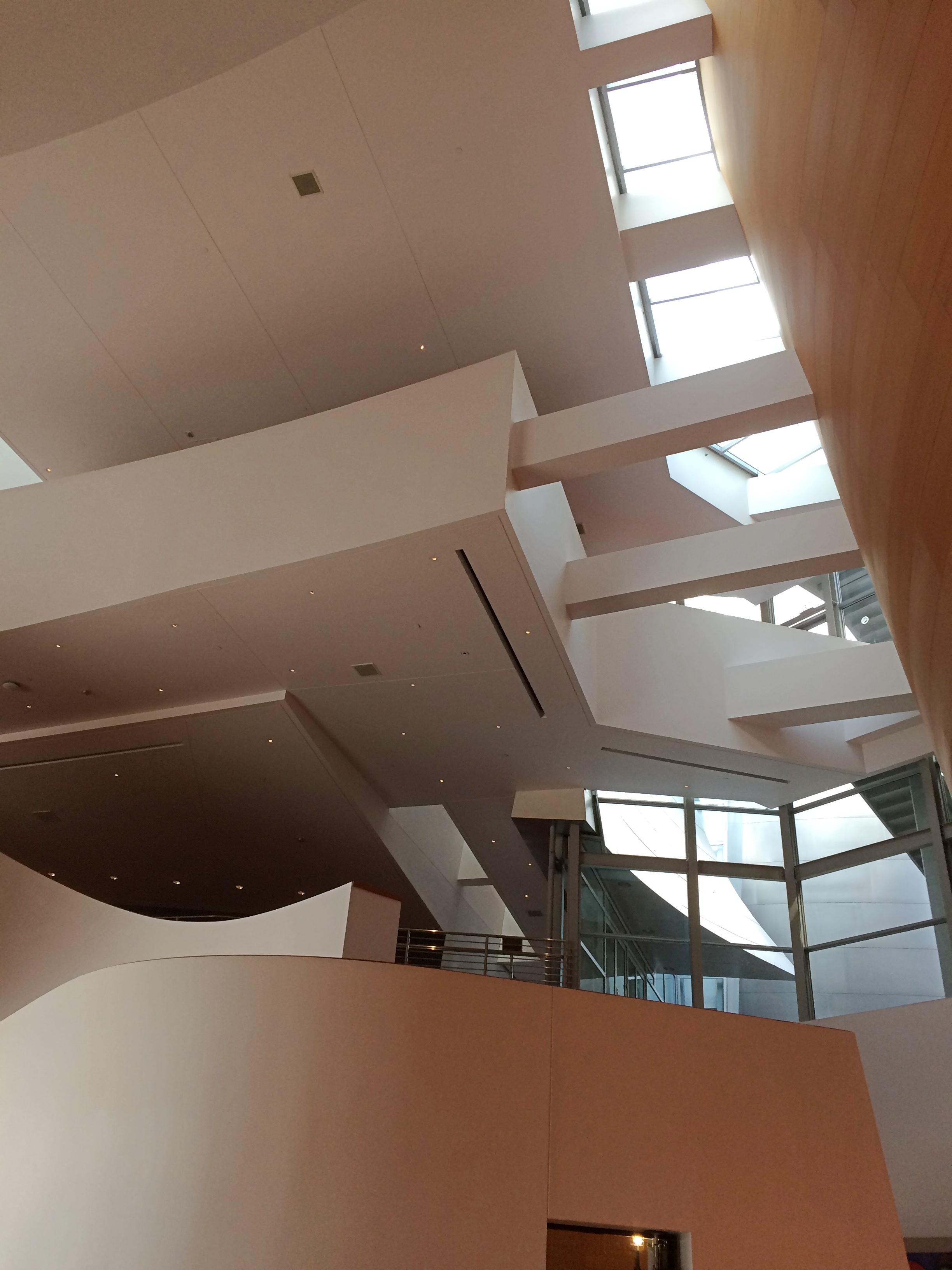
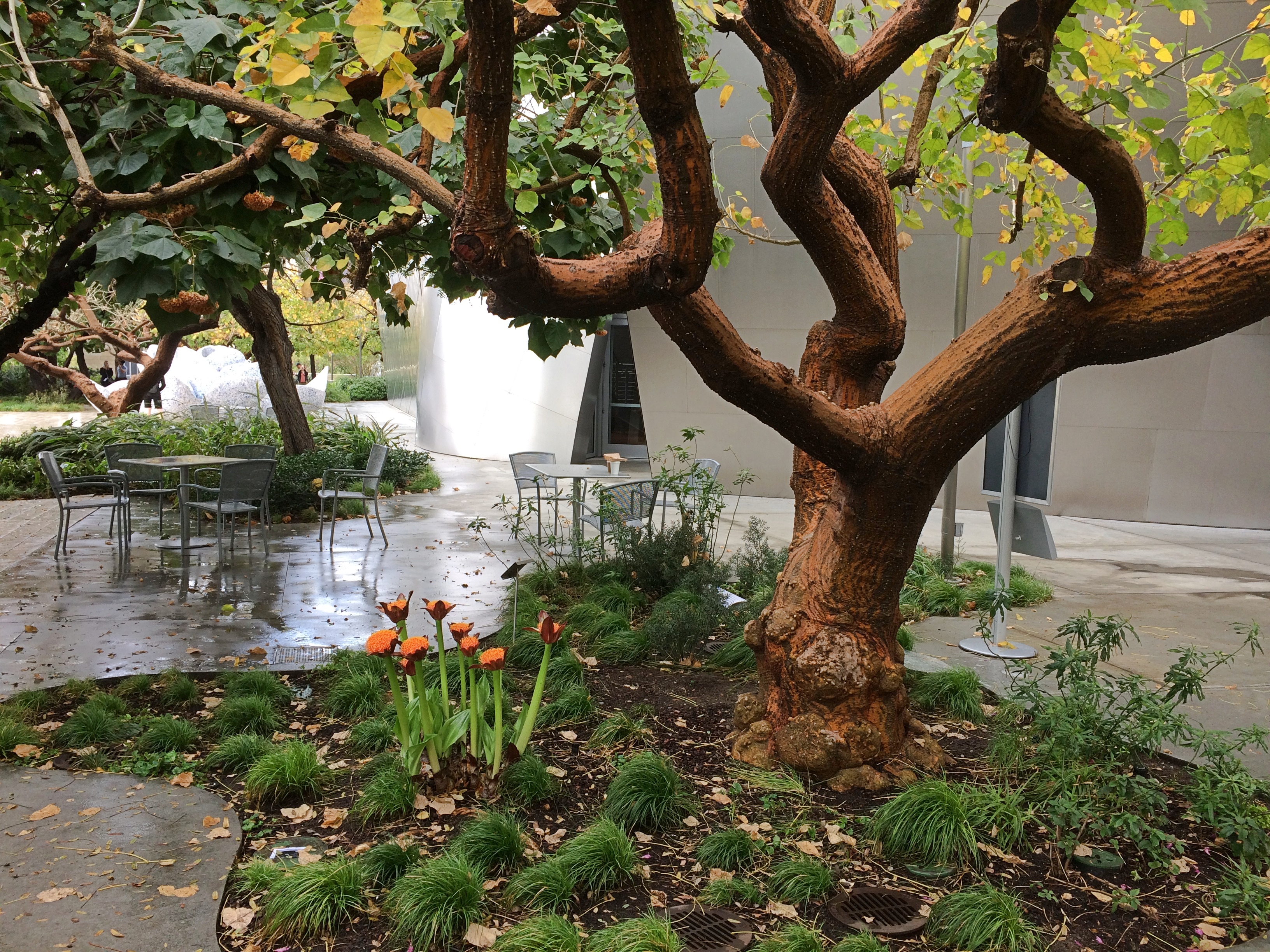
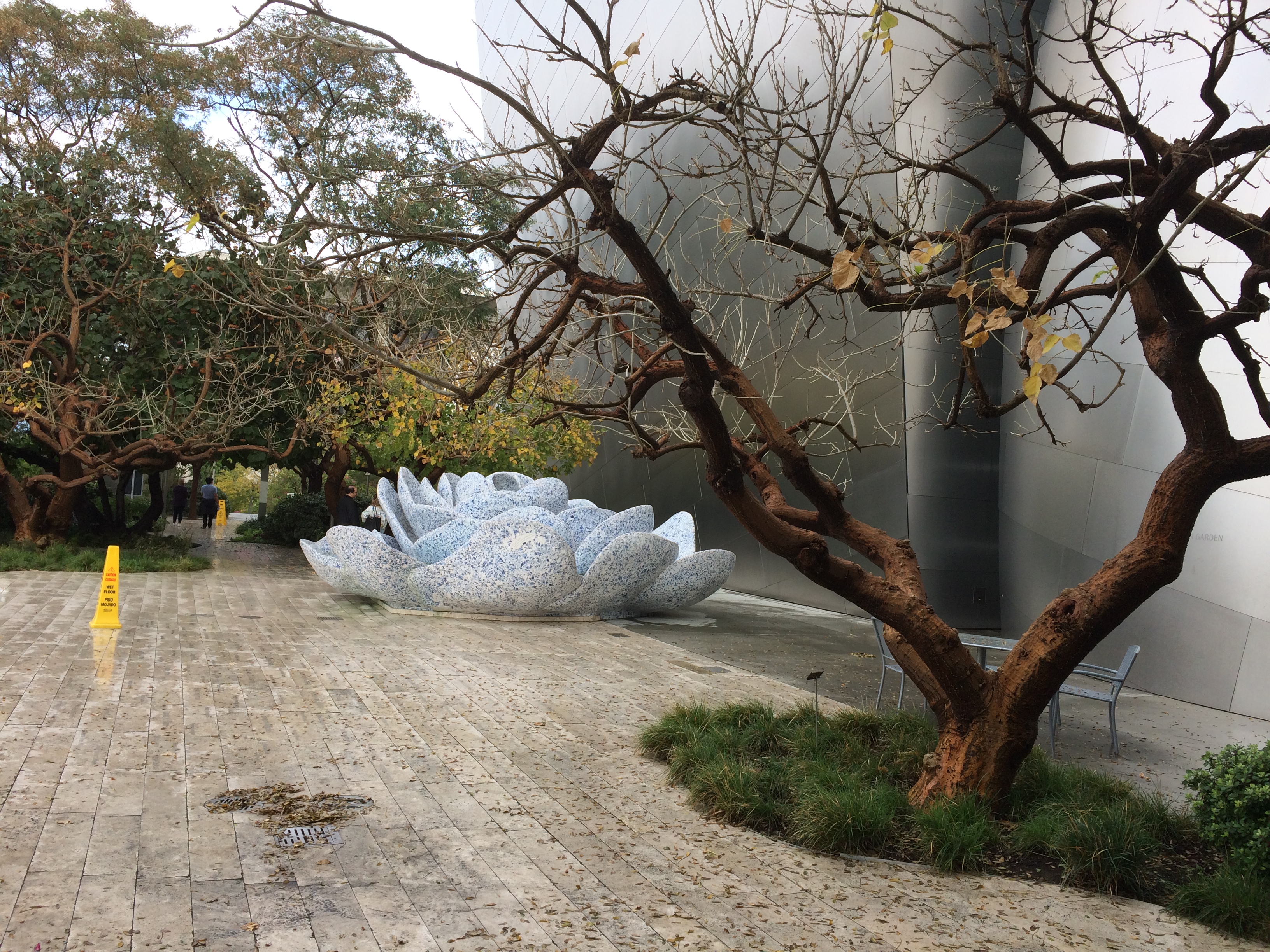
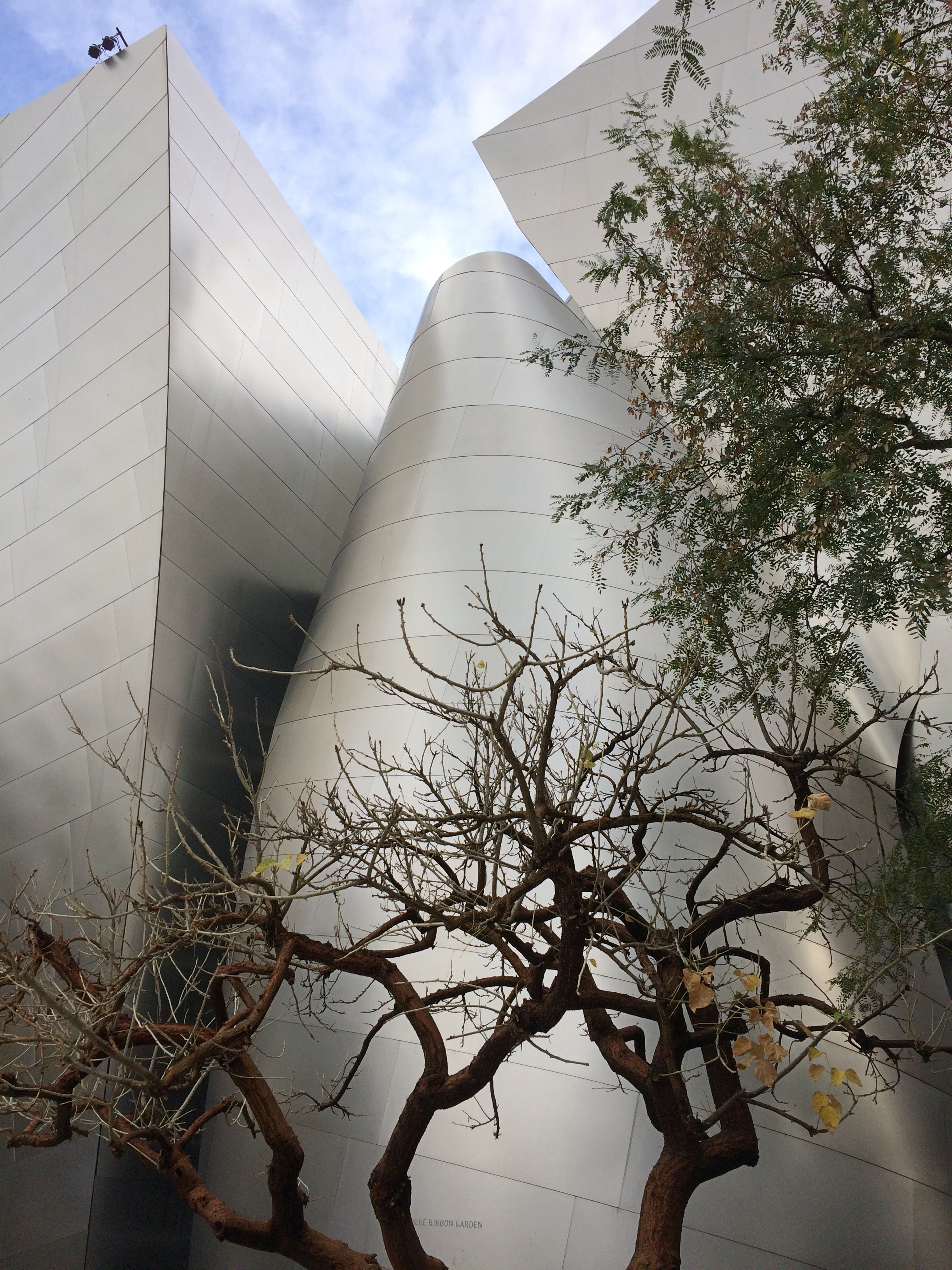
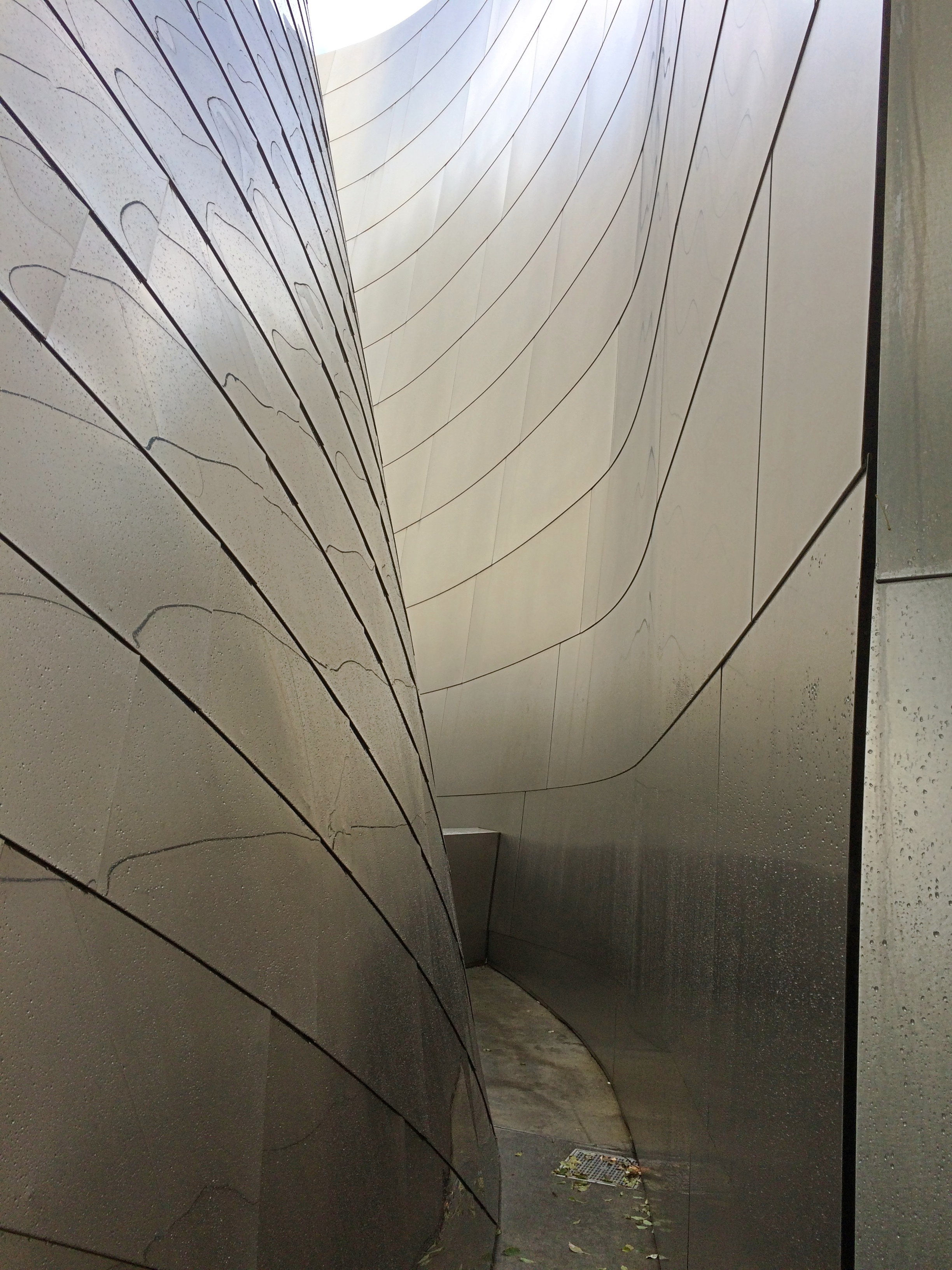
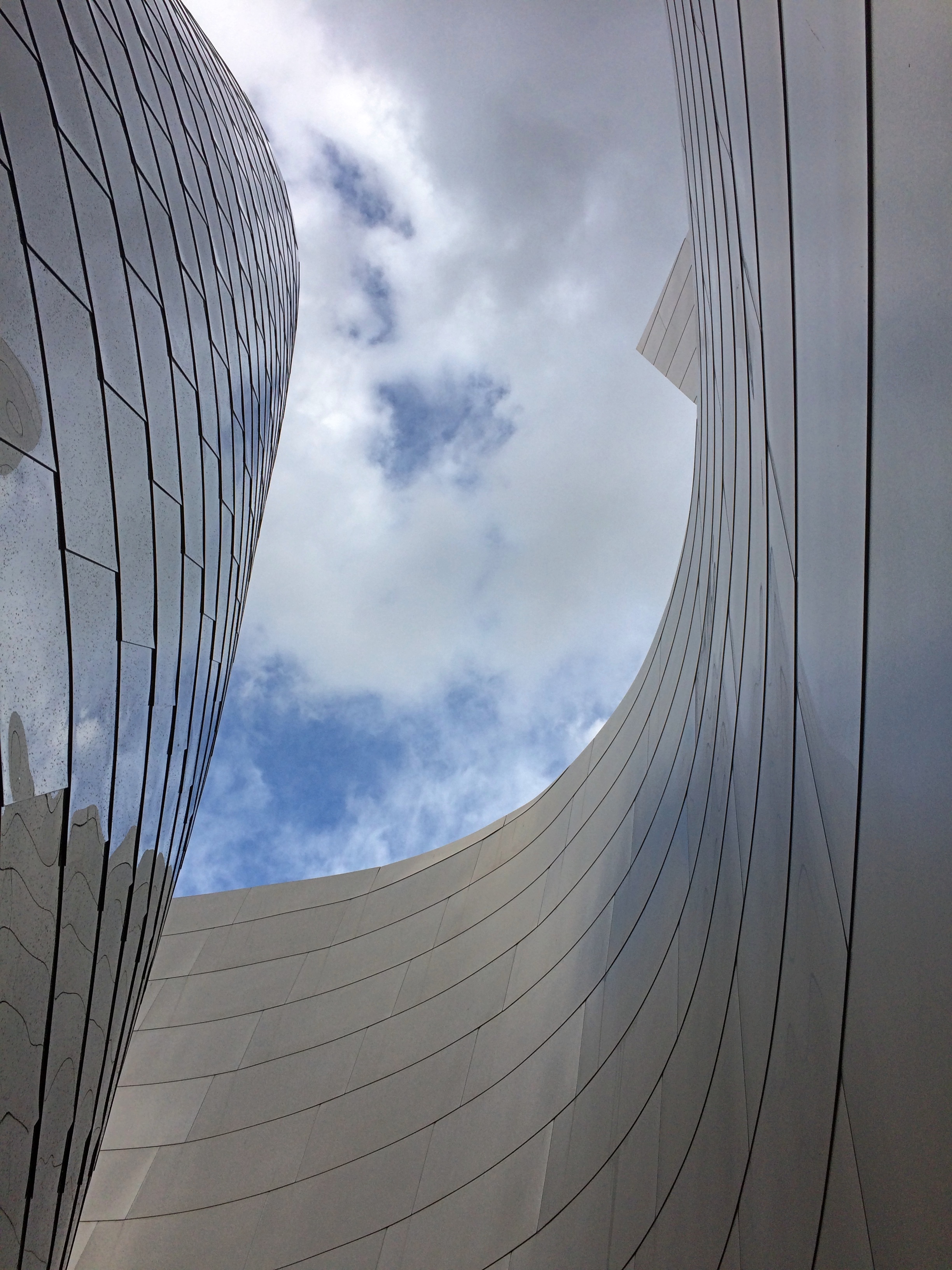
The Walt Disney Concert Hall and The Broad

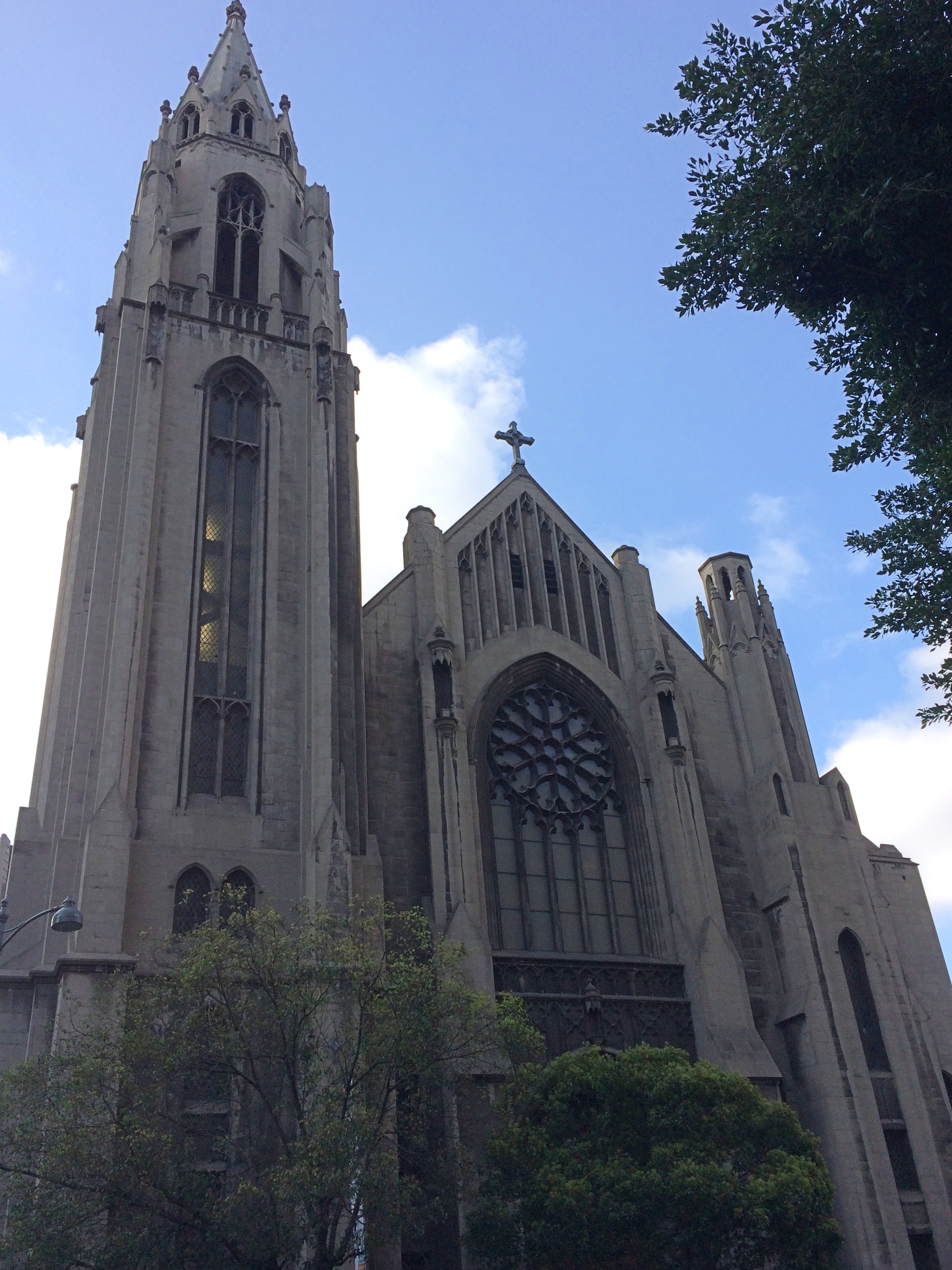
The last time I was in Los Angeles, the Walt Disney Concert Hall looked like this — still more than two years from its completion in 2003. I paid no attention to it then.

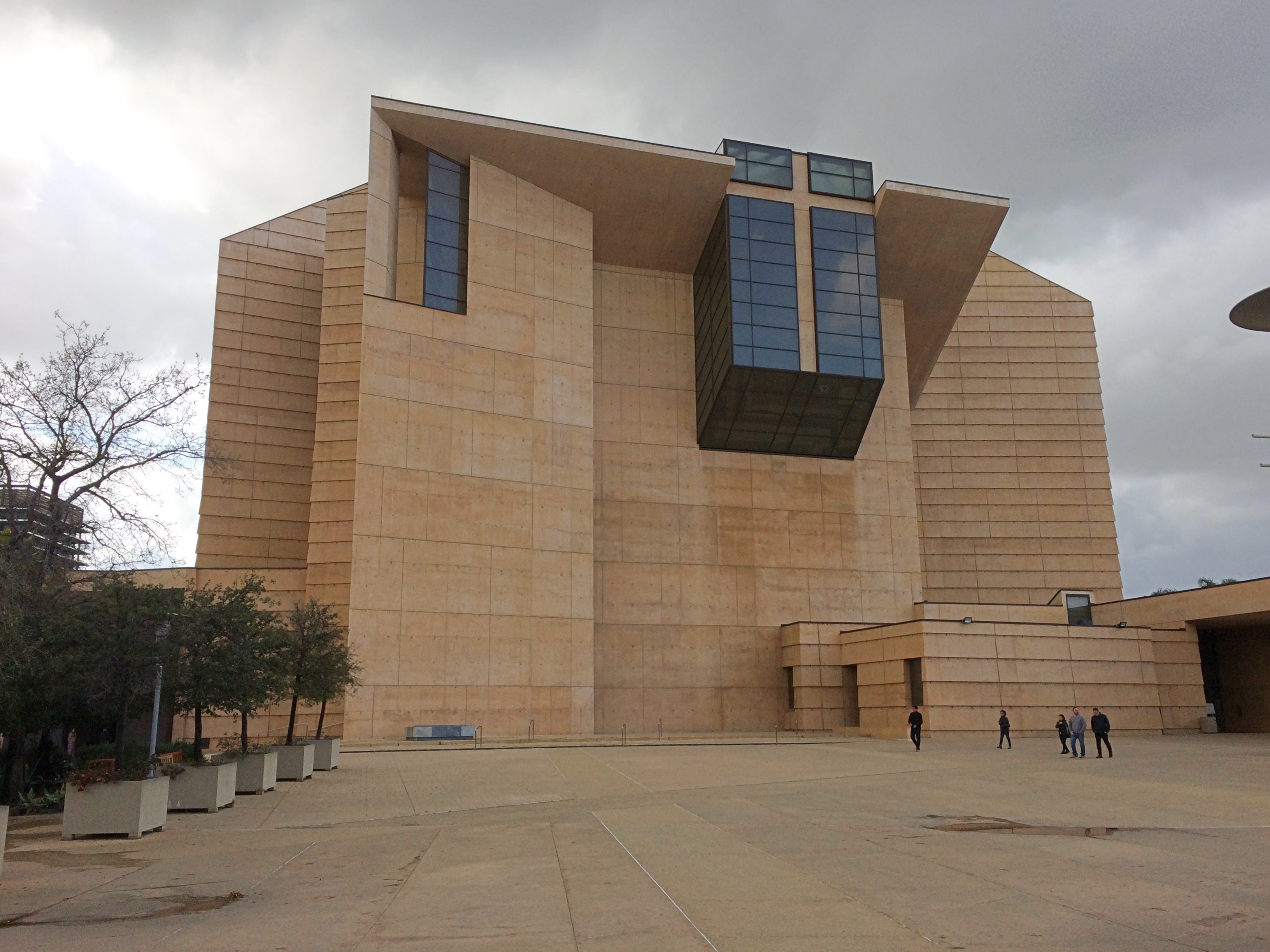
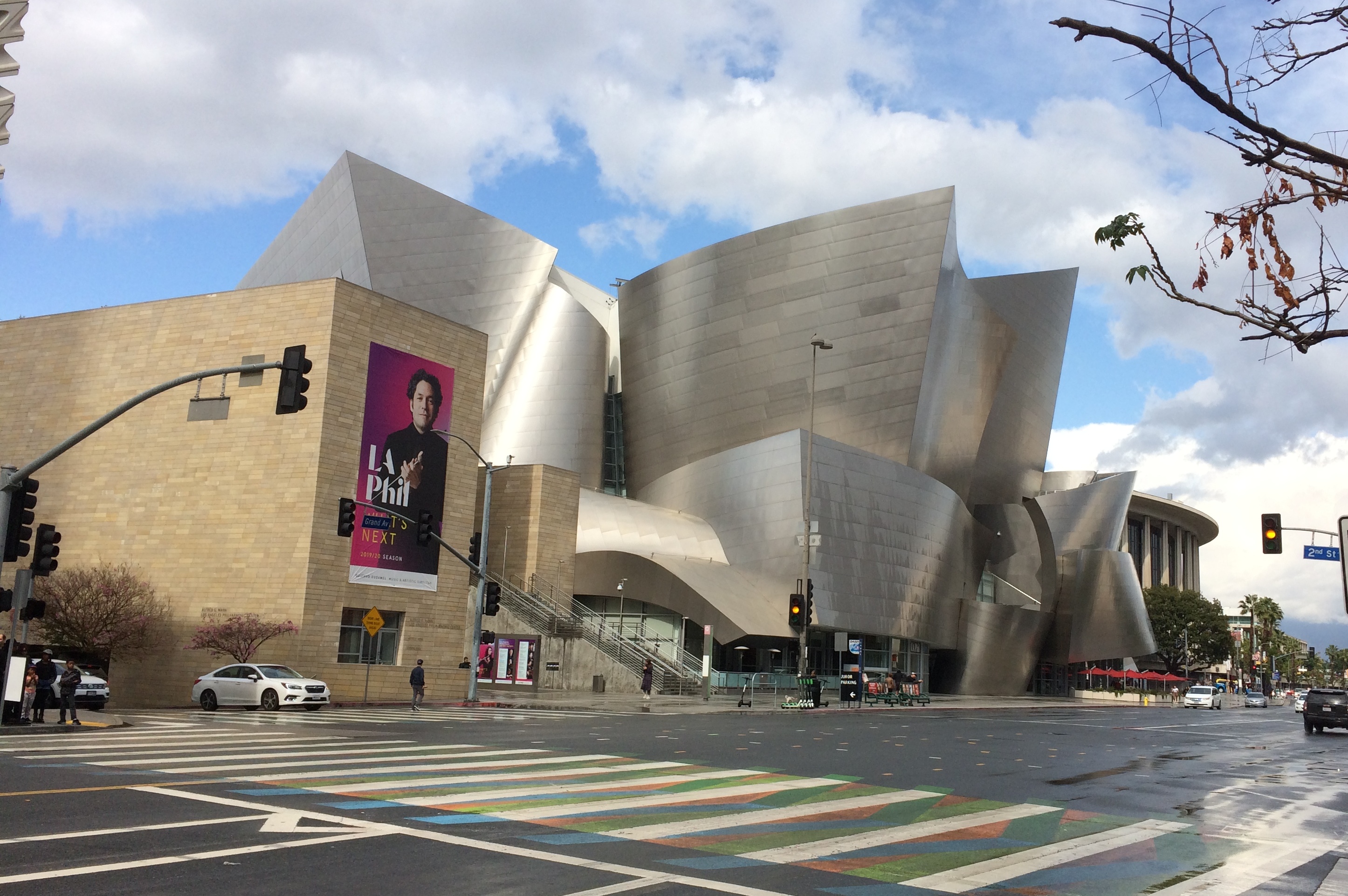
On February 22, 2020, the 2,265-seat hall looked like this from across Hope St.
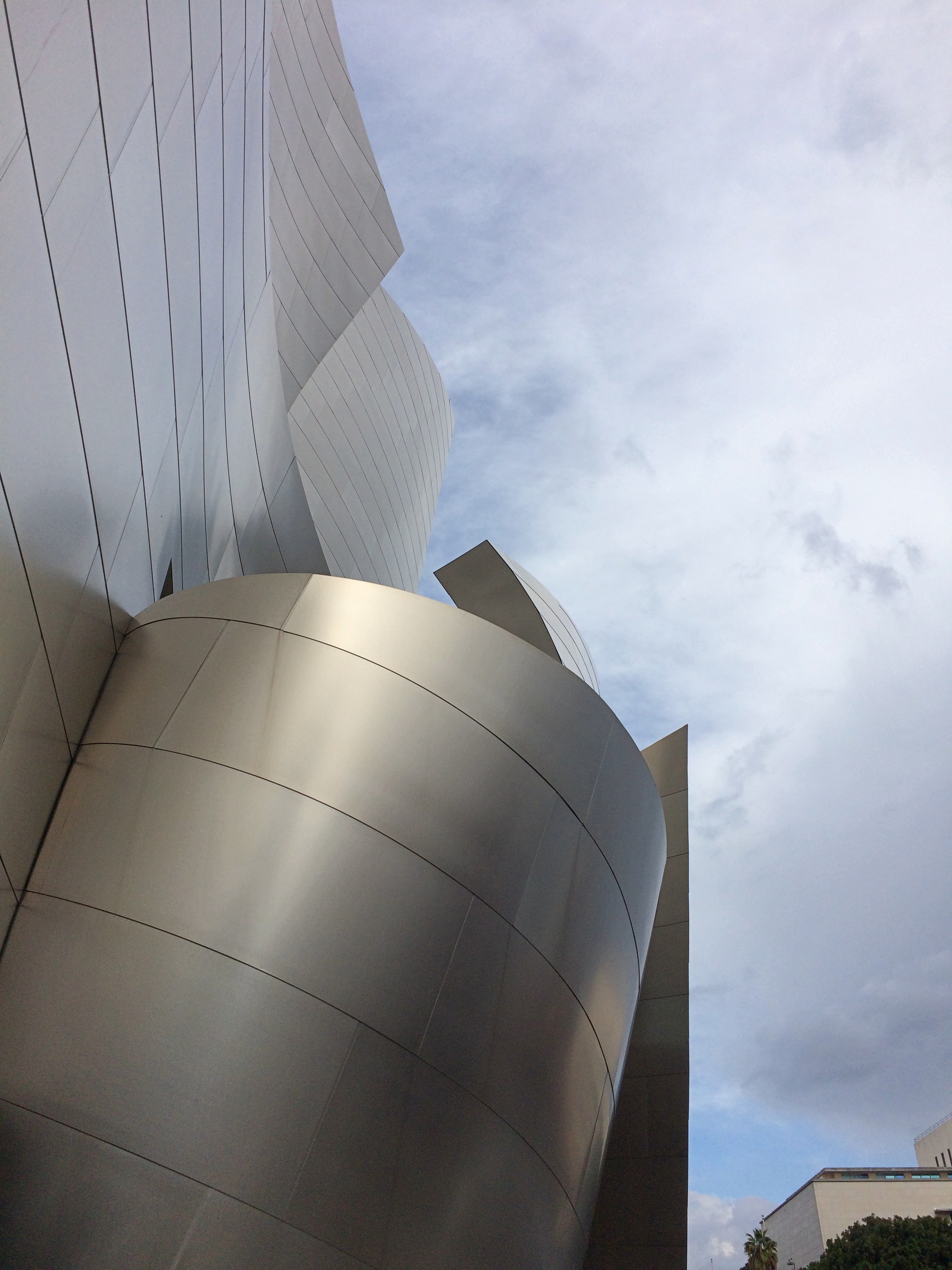
Whatever else you can say about Frank Gehry, his designs aren’t like their surroundings. They’re going to stand out. Also, they’re interesting to stand under.
I’d read that self-guided tours of the venue were free, and that’s true. You get an MP3 player at a table just inside the Hope St. entrance, and off you go. The audio snippets about the development of the building, along with various design elements, are narrated by John Lithgow, with some additional commentary by those who worked on the project, including Gehry.

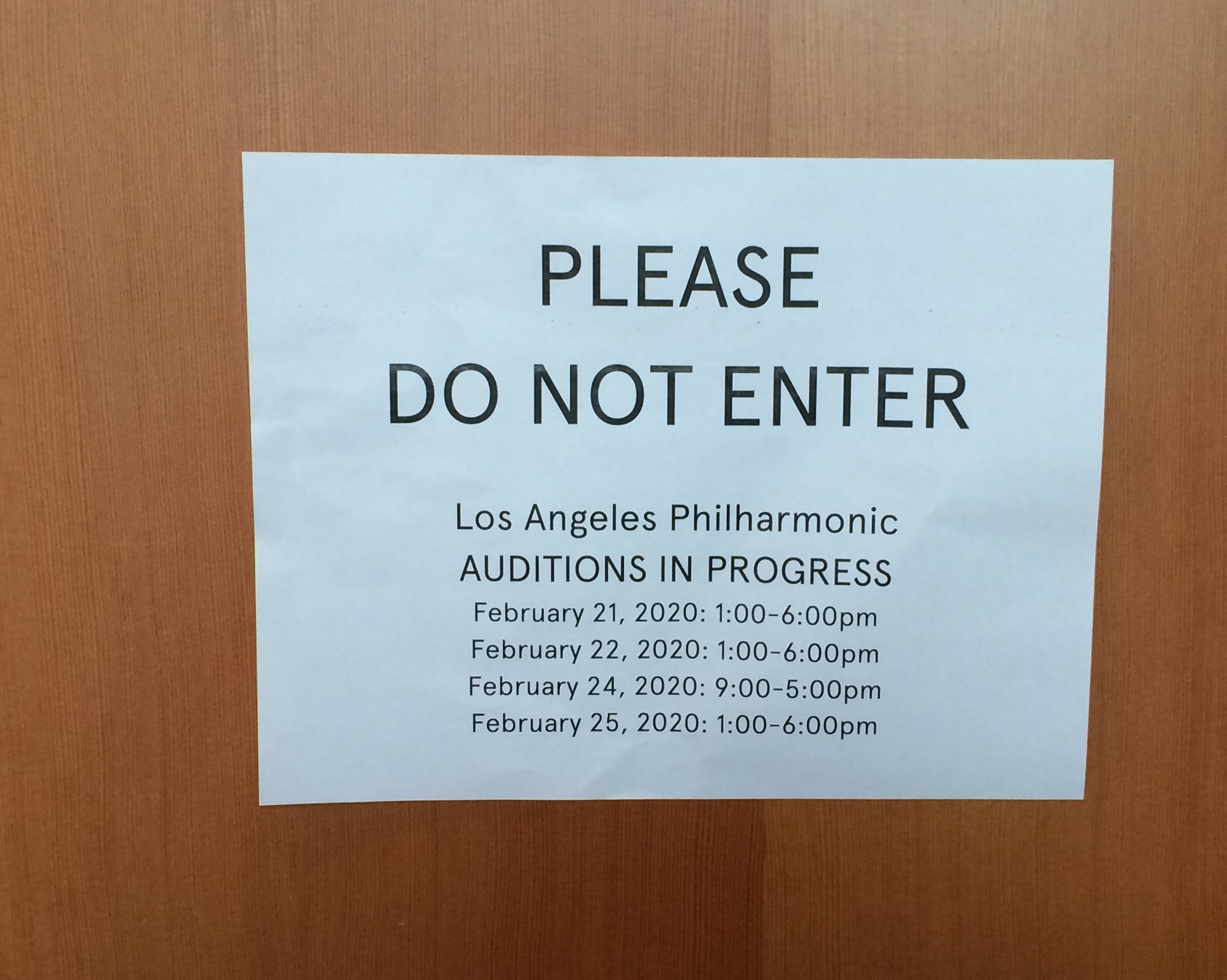
I was keen to see the auditorium. It was not to be. Musical careers were hanging in the balance in there.

Still, the rest of the interior was worth a look.

Though it’s invisible from the street, the hall has some outside space at mid-level, including greenery. A pleasant interlude among the twists of metal and vaulting ceilings.


At one point, the outdoor space practically becomes a box canyon made of metal.

Later that day, I visited The Broad, which is next door to Disney, though much newer, completed less than five years ago.
Interesting texture for a 120,000-square-foot box. It looks good, but how long will it be until its gleaming exterior begins to turn gray and streaky? Eventually, but I won’t worry about it. That will be on designer Diller Scofidio + Renfro, who did The Broad in collaboration with Gensler.

Even at 6 p.m. — the museum is open till 8 on Saturdays — the standby line was fairly long. But not as long as the more popular rides at Disneyland. It took about 20 minutes to get in.

Once in, you see works by the likes of Christopher Wool, Jean‐Michel Basquiat, Andy Warhol, Jeff Koons, Kerry James Marshall, Barbara Kruger, Roy Lichtenstein, Jasper Johns and others. Always something interesting to see, even if not everything on the walls is that compelling.

Somehow I managed to miss the Infinity Mirrored Room by Yoyoi Kusama, which I chalk up to being pretty tired after taking more than 20,000 steps that day. So it goes.

One more thing about The Broad, something other museums with sizable endowments could take their cue from: admission is free. Among others, that means you, Met.

Downtown LA Walkabout, Including a Light Brush with Insane Clown Posse

Pershing Square in downtown Los Angeles looks like a pleasant public space, but on the morning of February 22, I only got the barest glimpse. Entry to the park had been blocked all the way around by temporary barricades. This was a concern, since according to the receipt for the walking tour of downtown LA that I’d booked for that morning, the group was supposed to meet at Pershing Square.

Soon I found that we were meeting at the corner of W. 6th St. and S. Olive St., at the edge of the park, with the tour proceeding from there. I wasn’t the only one who asked the guide what was going on at Pershing Square. Turns out the city had rented it for the weekend for a couple of Insane Clown Posse concerts, the second of which would be that evening. Sounded like a must-miss to me.

The tour took us on foot past, and sometimes through, 12 different historic structures in downtown Los Angeles, beginning with the Millennium Biltmore Hotel. This is the central wing of the building.
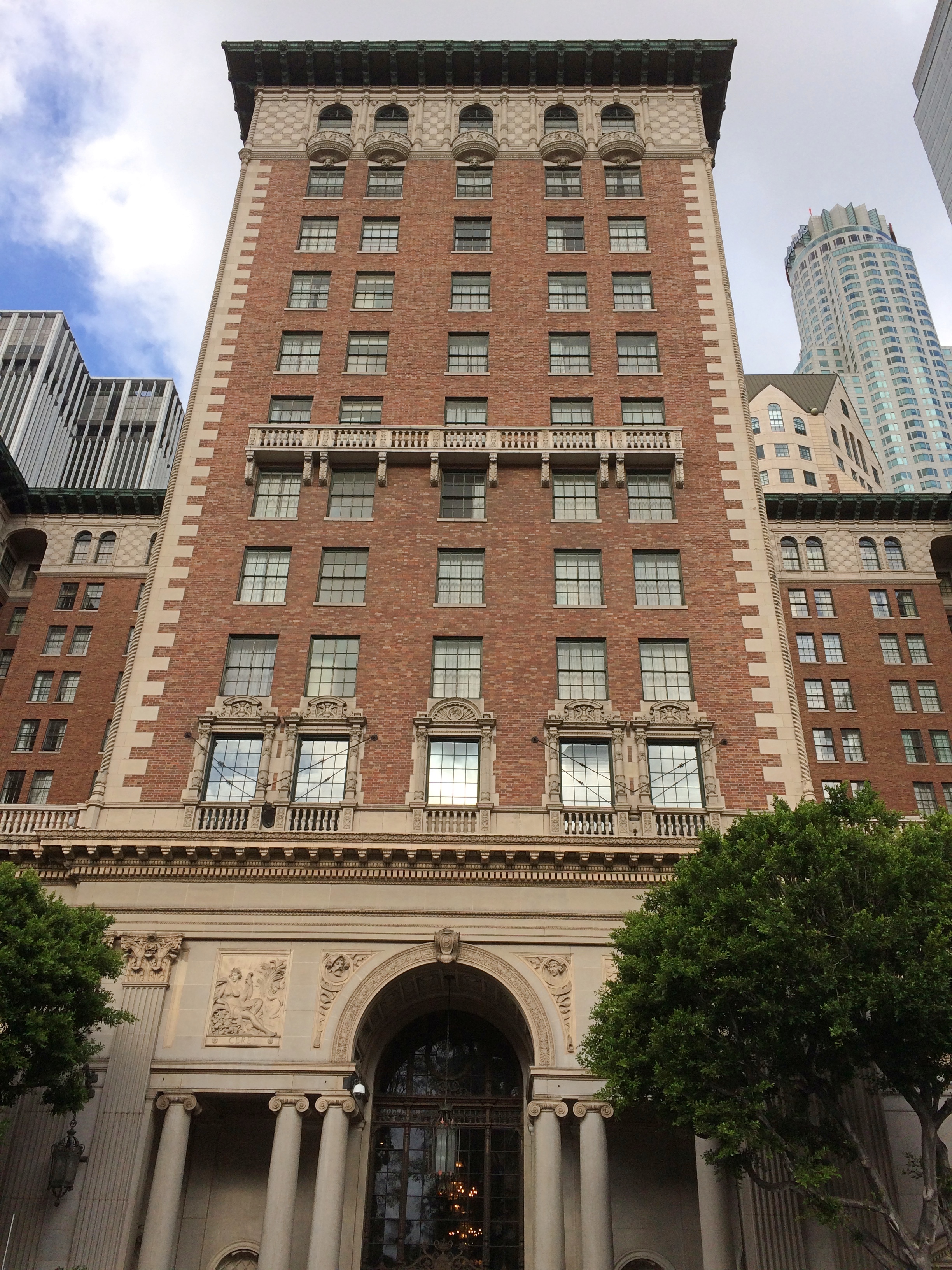
Originally the Los Angeles Biltmore Hotel when completed in 1923, the property has 683 rooms, down from about 1,500 at its opening. People didn’t mind smaller rooms in those days.

The south wing.
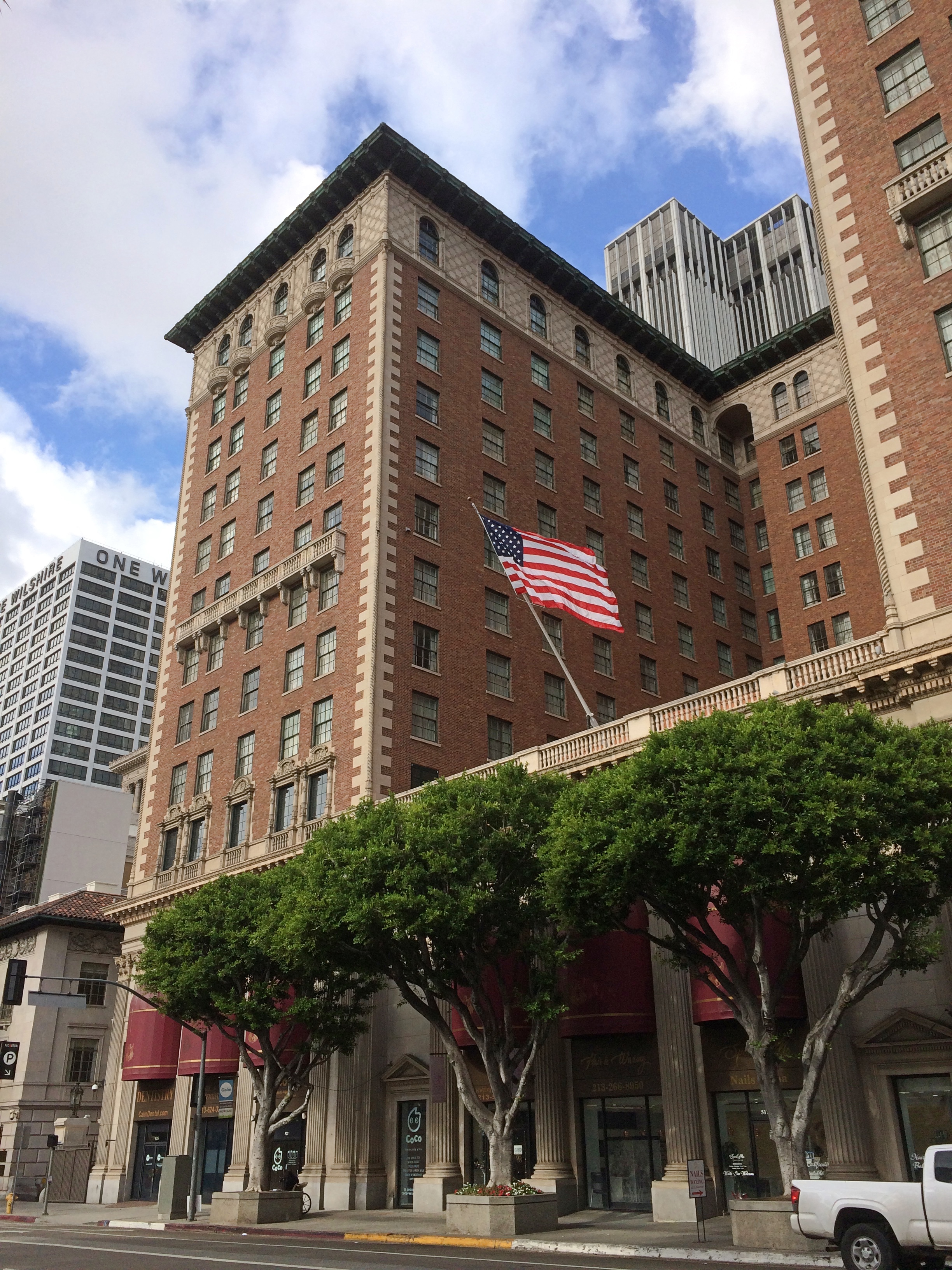
Design by Schultze & Weaver, a New York firm best known for the Waldorf-Astoria in Manhattan, though that would come later.

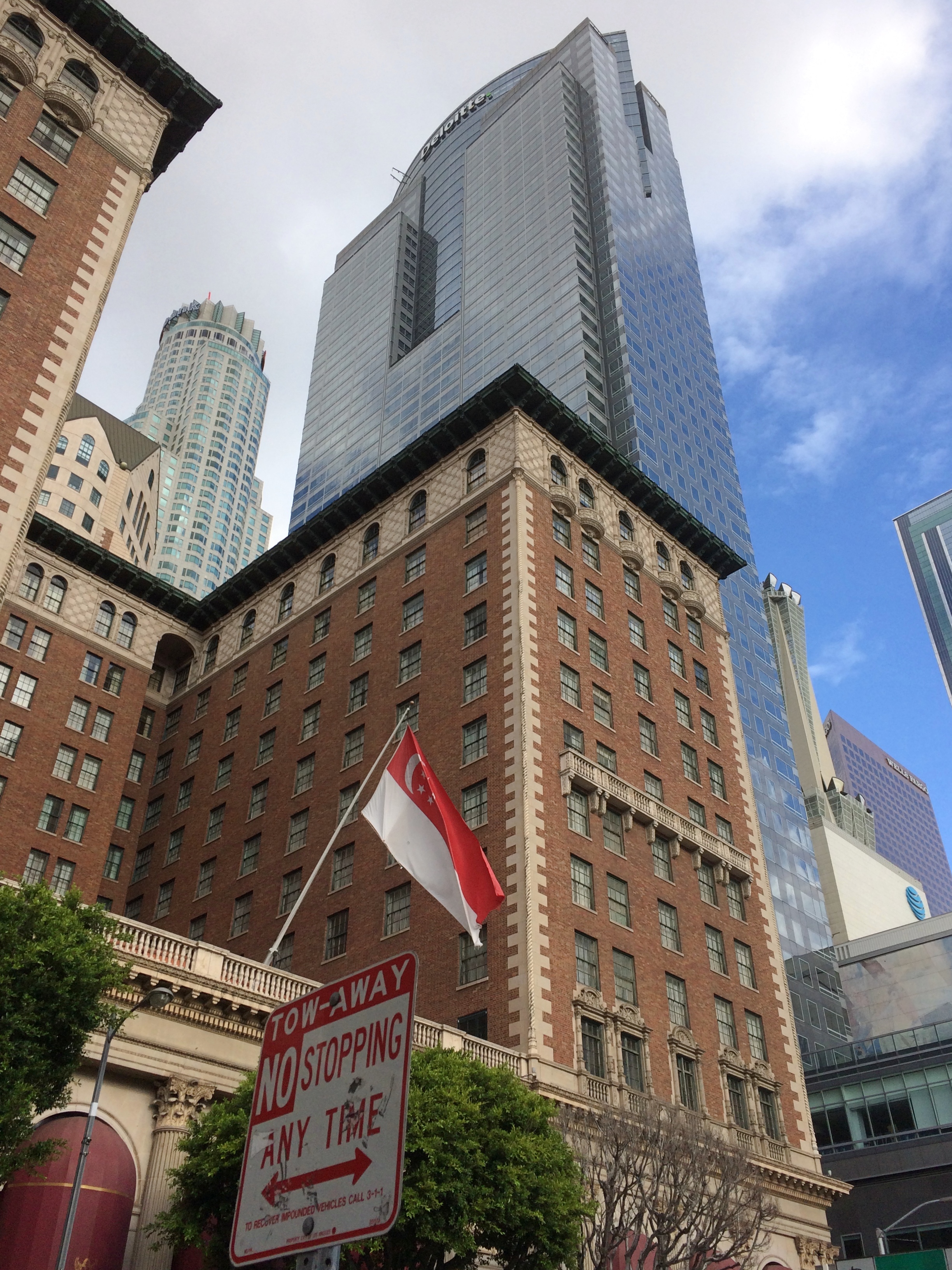
The north wing. Why fly the Singapore flag, I don’t know. Owner Millennium & Copthorne Hotels plc is based in London.
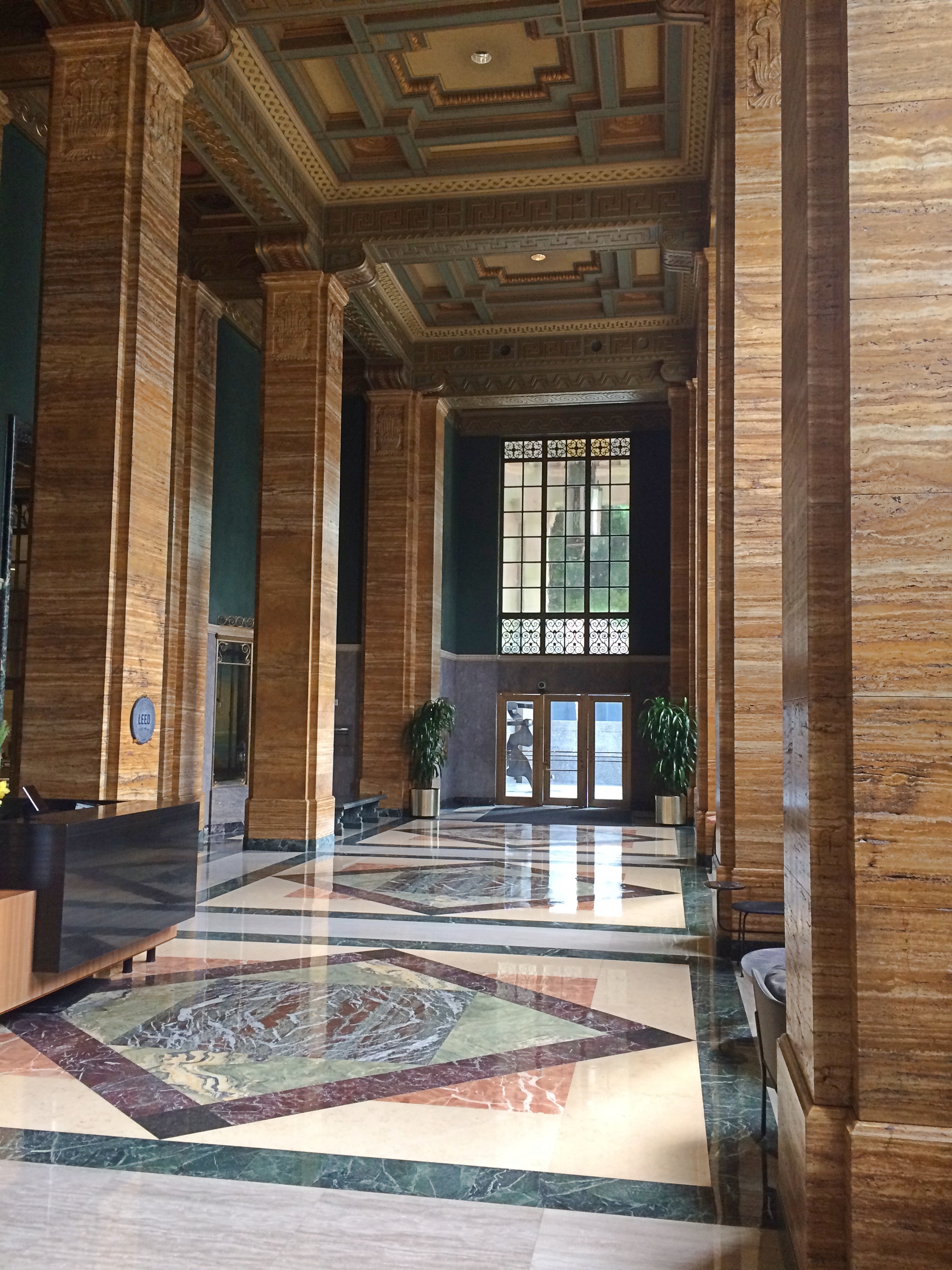
Not far away is the CalEdison Building, one of LA’s grand art deco exercises, designed by Allison & Allison and finished in 1931.
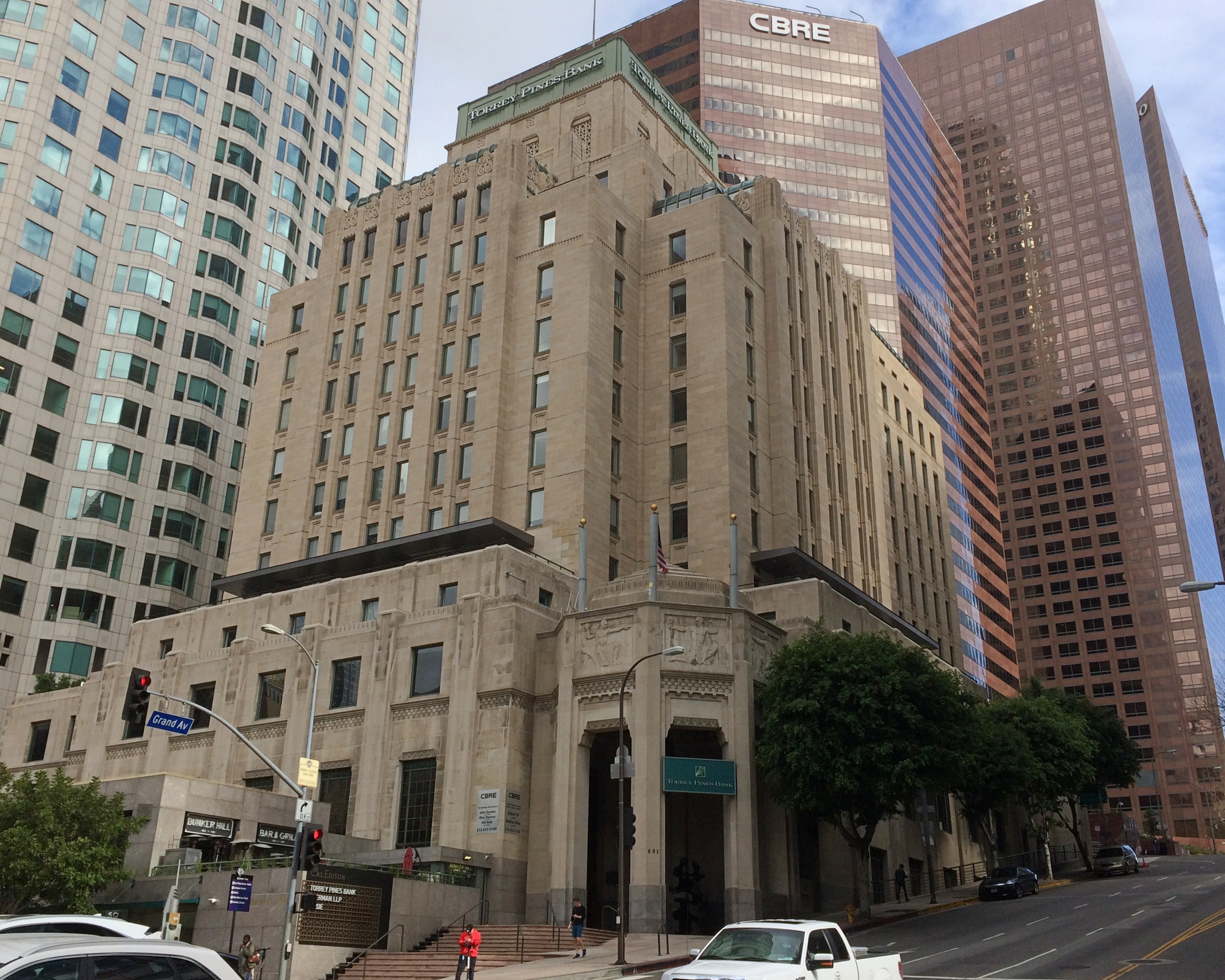
The allegory above the entrance holds a torch. Not a torch of fire, but capped with a light bulb, though the electric utility that used to anchor the building left nearly 50 years ago.
The exterior is grand, but the main lobby is the real wow.
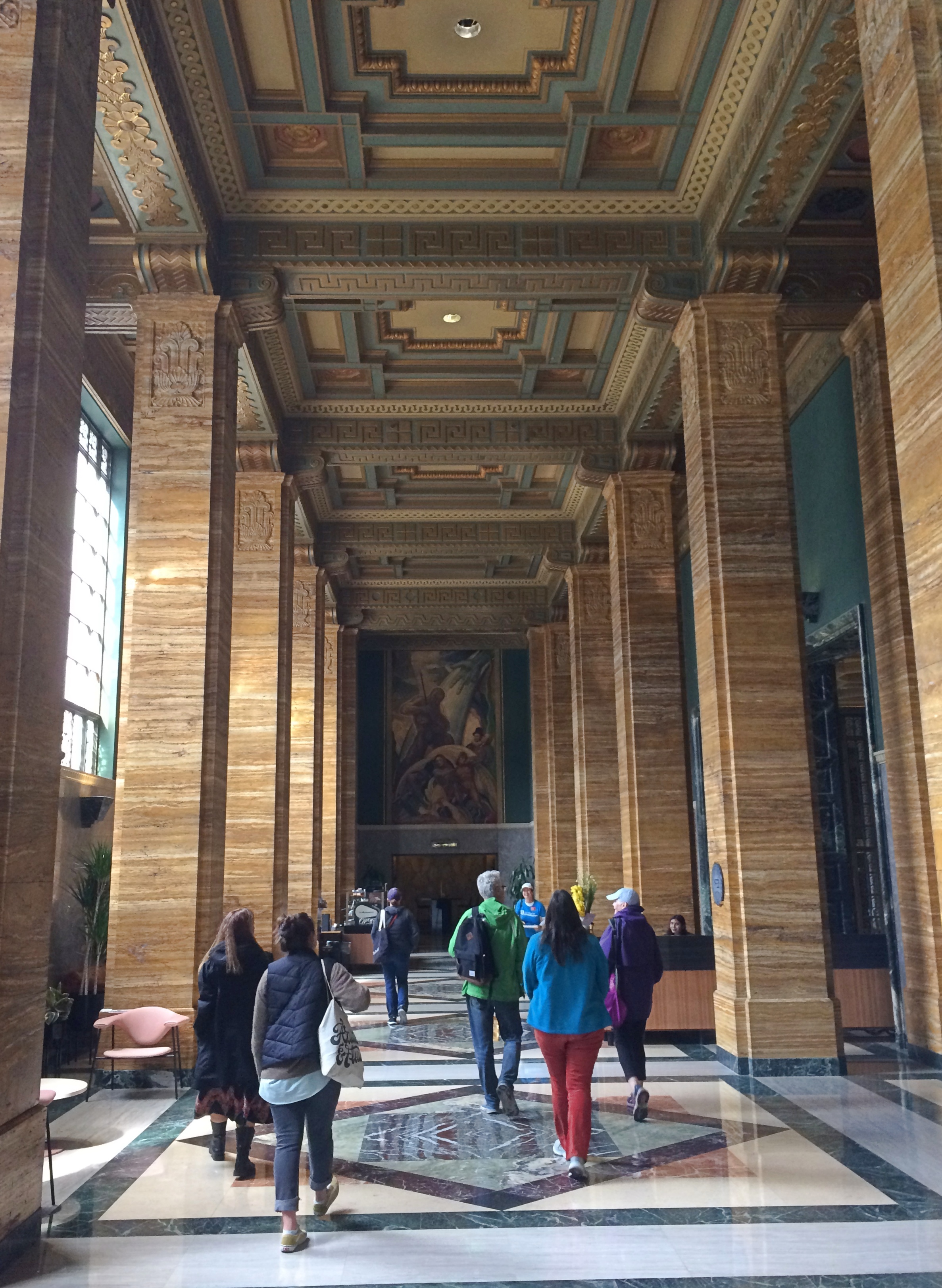
More CalEdison pictures are here.

Speaking of wow, the Los Angeles Central Library came a little further on the tour. Along with the U.S. and California flags flying there is the flag of the city of Los Angeles. The library is capped with an ornate pyramid. Originally it was supposed to be a dome, but 1920s Egyptmania had its influence on the building.
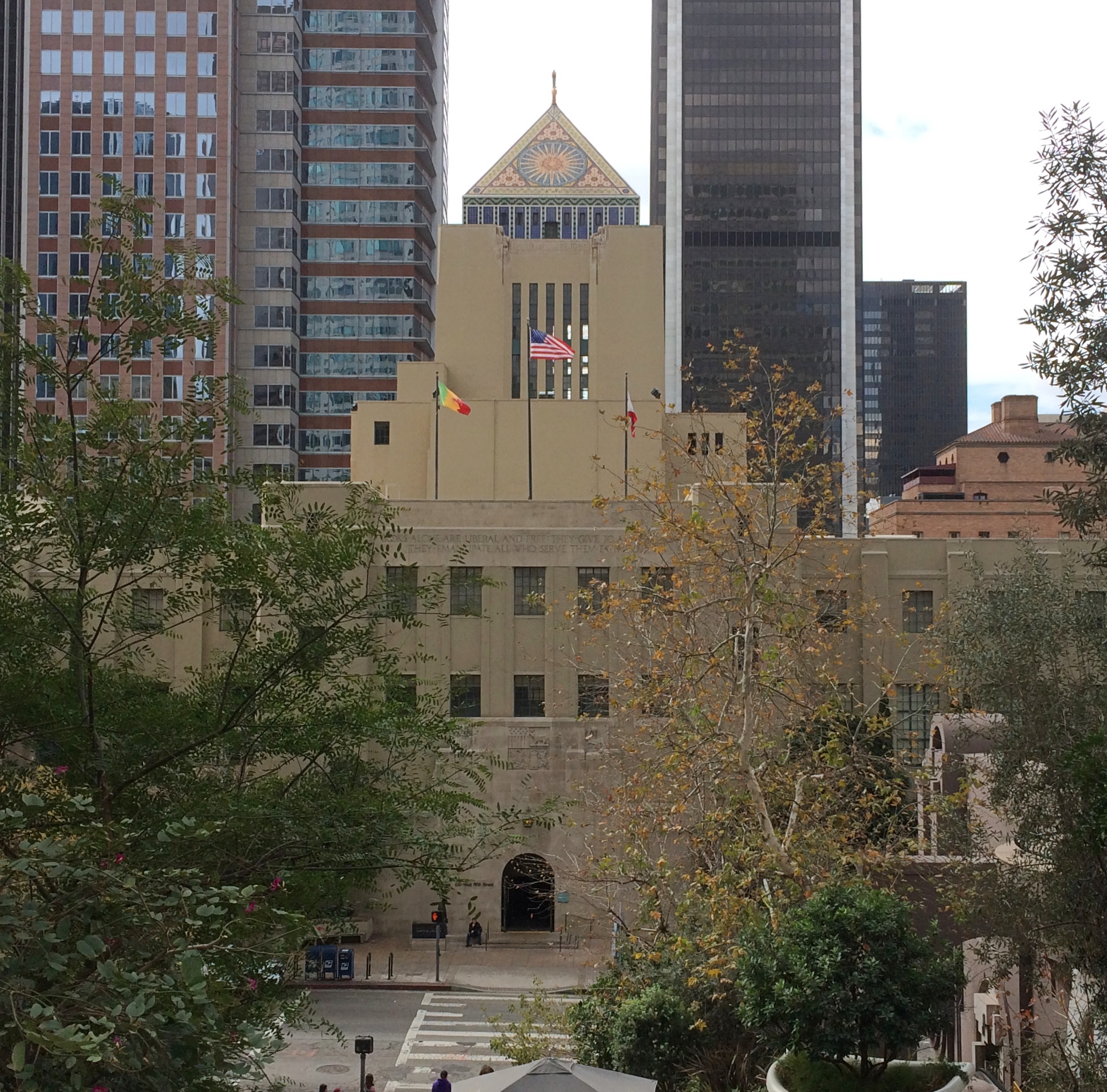
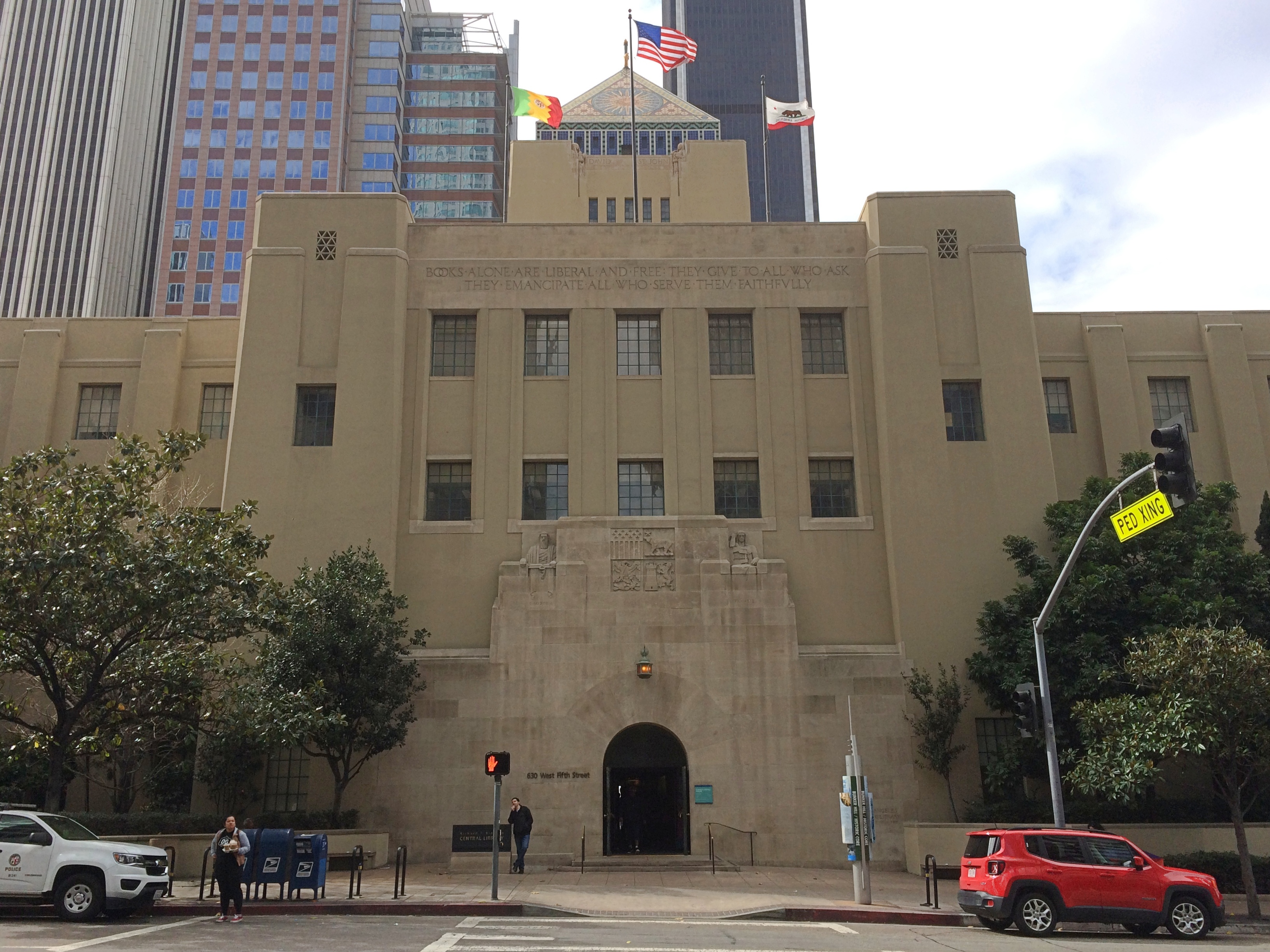
Completed in 1926 with a design by Bertram Goodhue and Carlton Winslow, what nearly happened to the library about 50 years later? Demolition. The Los Angeles Conservancy was organized at that time in response, and the building was saved.

Only to nearly burn down in April 1986. The cause remains a mystery. Our guide asked those of us old enough — which was most of the group — whether we remembered the fire. I drew a blank. Even living in Nashville at the time, I must have heard about it, but I couldn’t remember.

“It happened three days after the Chernobyl disaster, so it didn’t get as much coverage as it might have otherwise,” she said. Such is the news cycle.

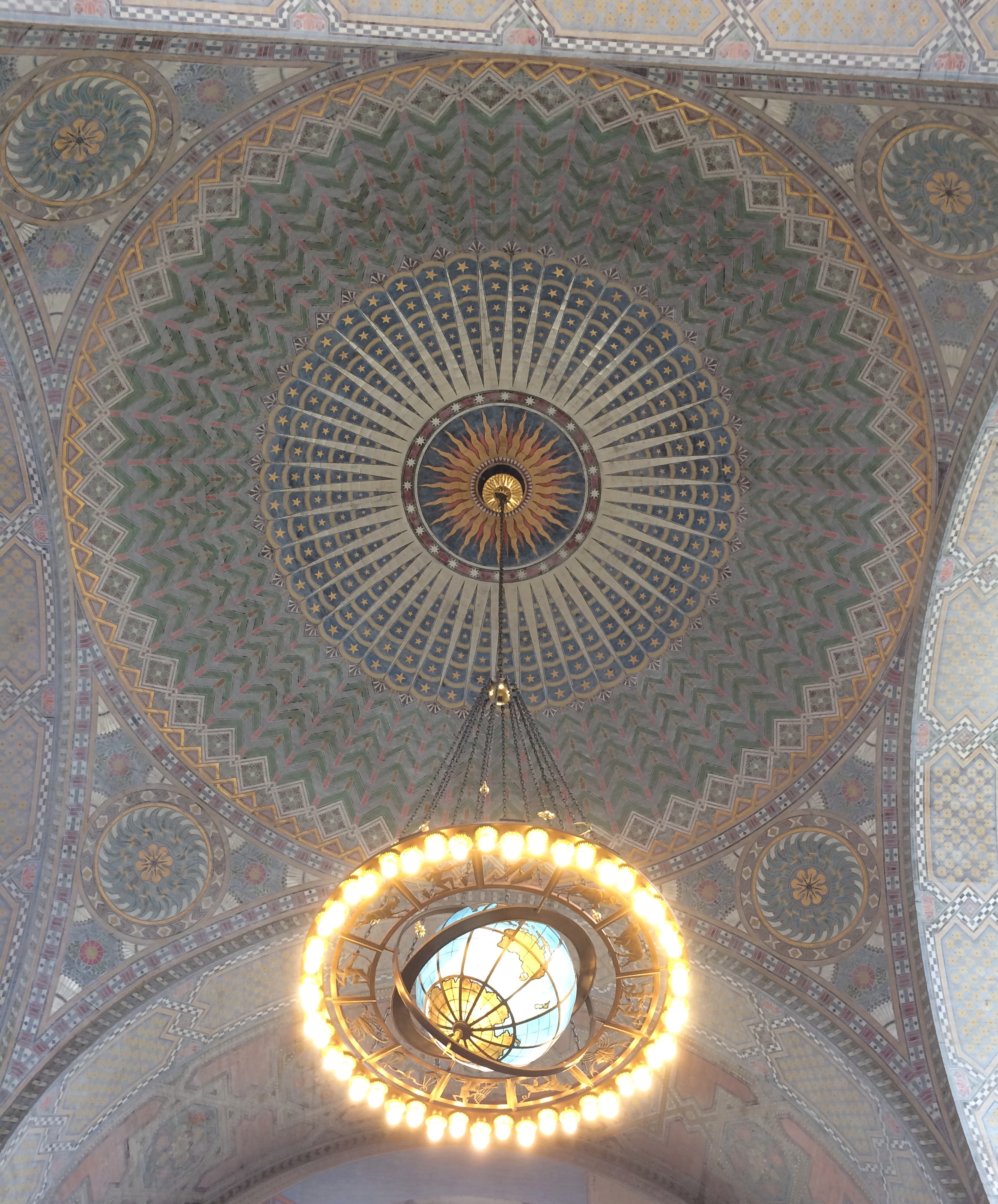
The citizens of LA insisted that the library be rebuilt, and it was. Such places as the splendid central rotunda were thus saved again.

Looking up in the rotunda.
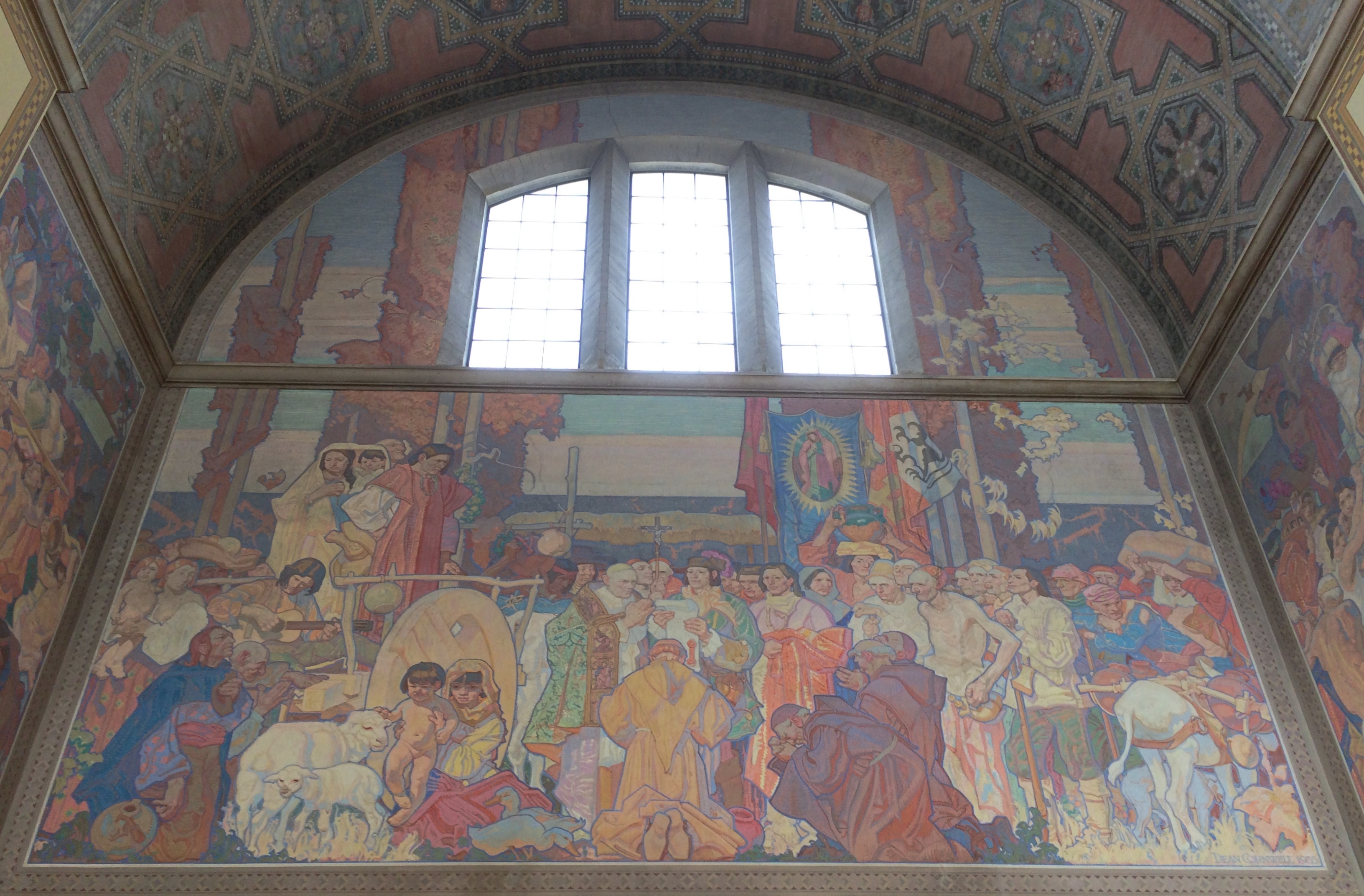
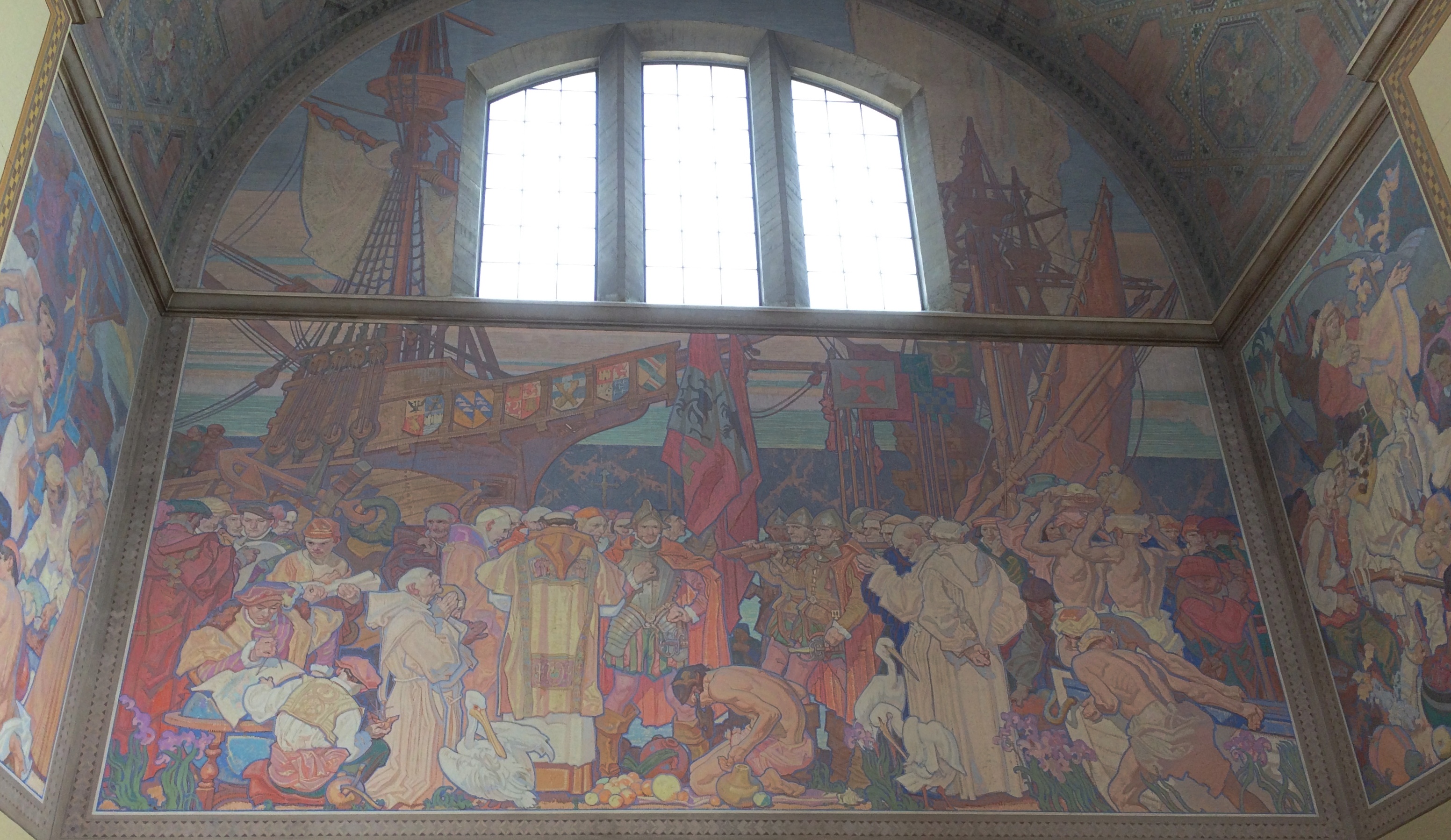
On the rotunda walls are fine California history murals, finished in 1933 by artist Dean Cornwell.
Across the street from the library are the Bunker Hill Steps, designed by landscape architect Lawrence Halprin and completed in 1990.
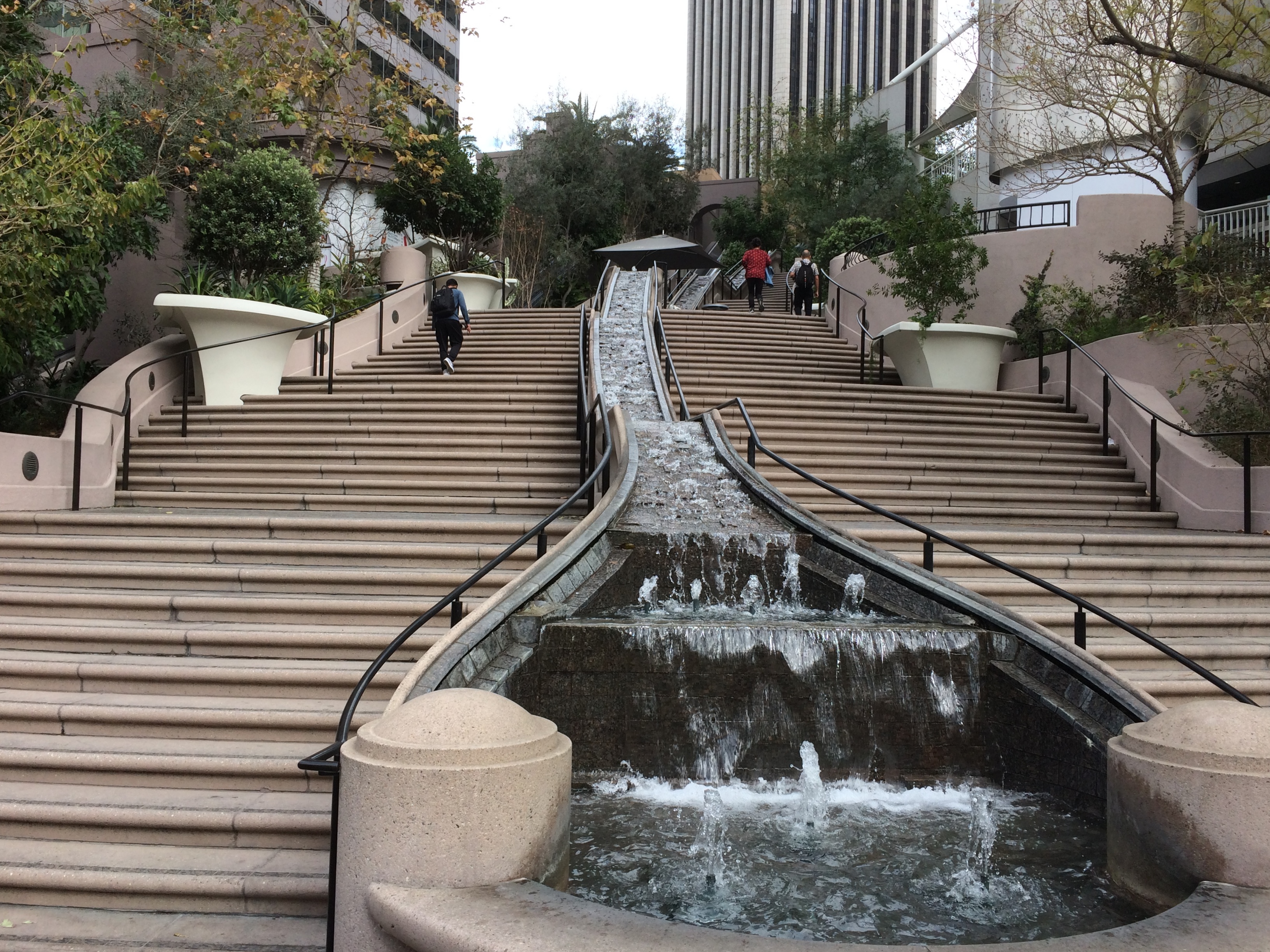
If I knew downtown Los Angeles had a topographical feature called Bunker Hill, I’d forgotten it. The place has quite a history: a posh neighborhood in the late 19th century, a run-down one by the mid-20th century, and then the victim of urban renewal. These days, office towers and other commercial buildings developed during or after the 1980s occupy most of Bunker Hill.

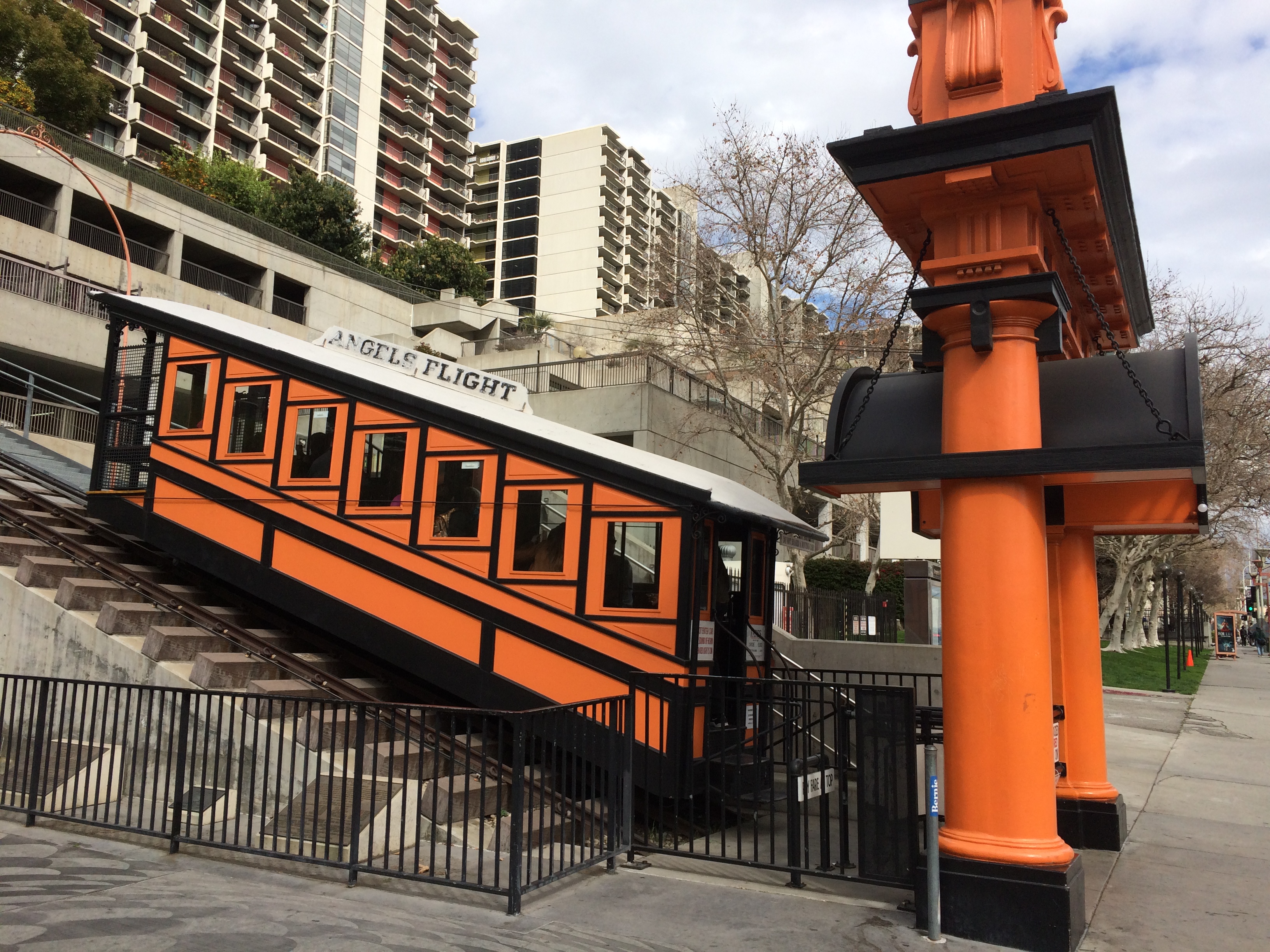
Once you go up a hill, you have to go back down again, or at least we did to reach the next destinations on the tour. So we took Angels Flight Railway down the side of Bunker Hill. This is the terminal at the top.
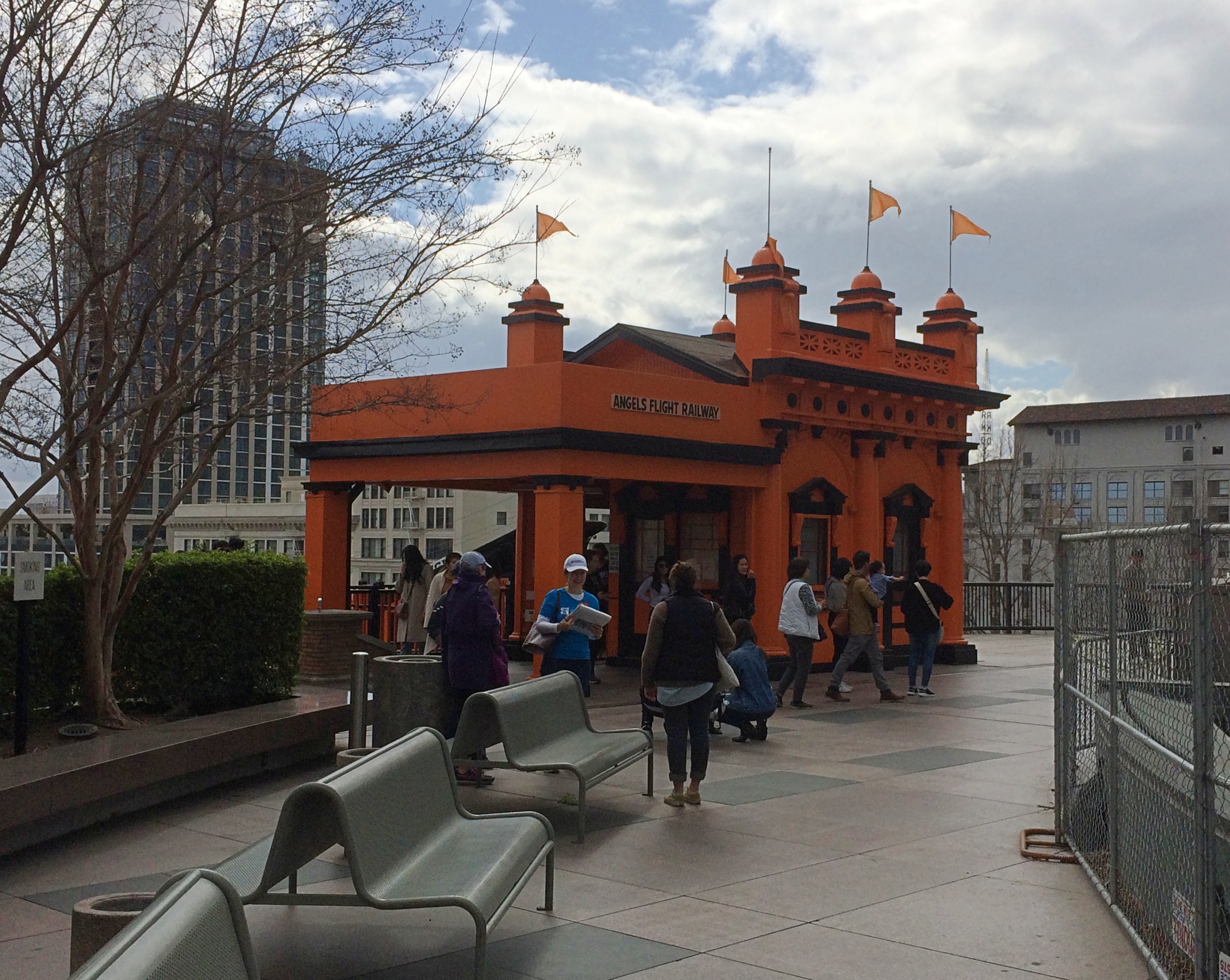
The original funicular, which opened in 1901, closed in 1969, lost temporarily to urban renewal. The line was revived in 1996 a block south of the original location, though it has spent much of the last quarter-century closed because of safety problems. With any luck, those are resolved now.

Looking up the track, which is nearly 300 feet long.
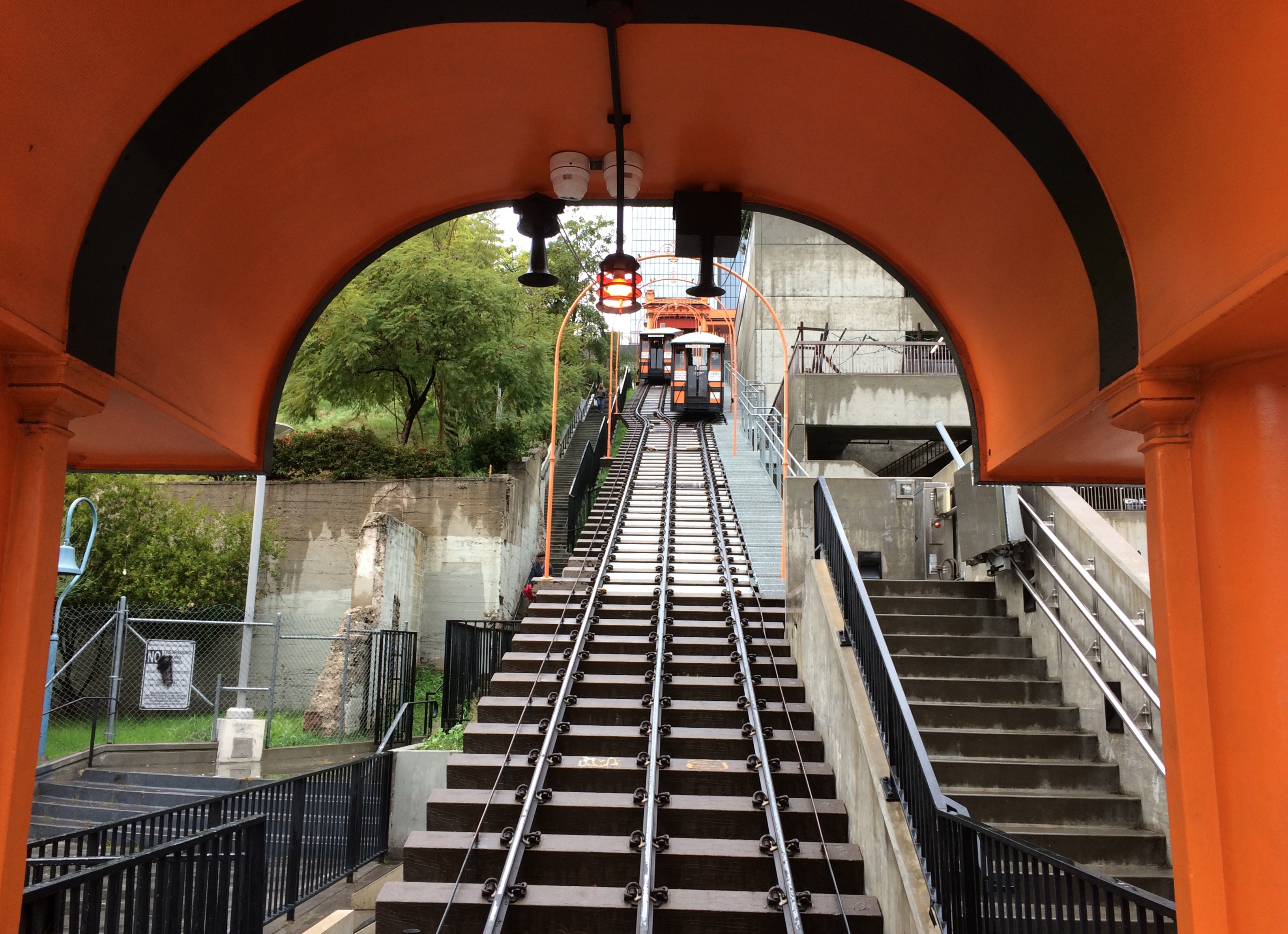
The terminal at the bottom.
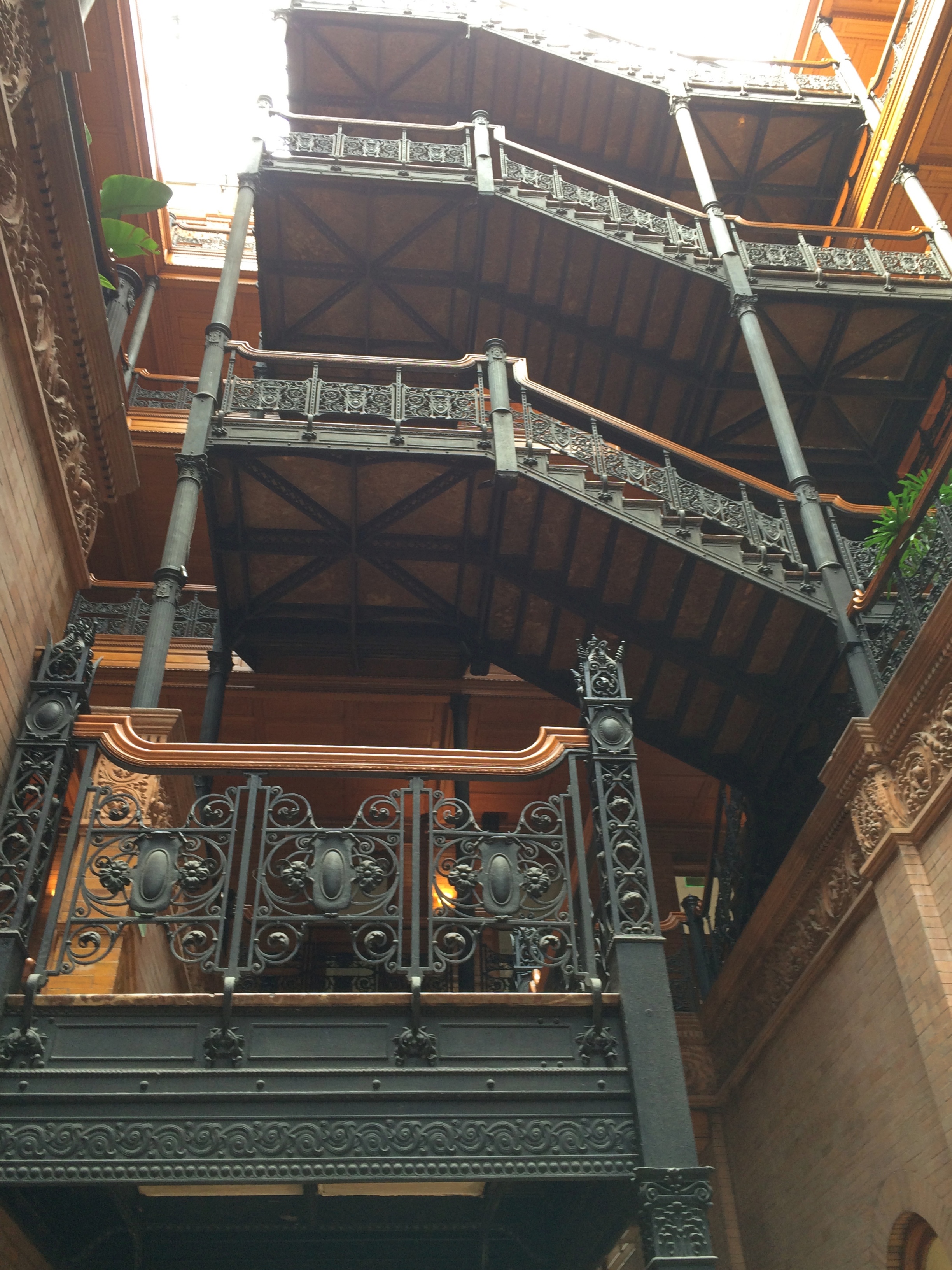
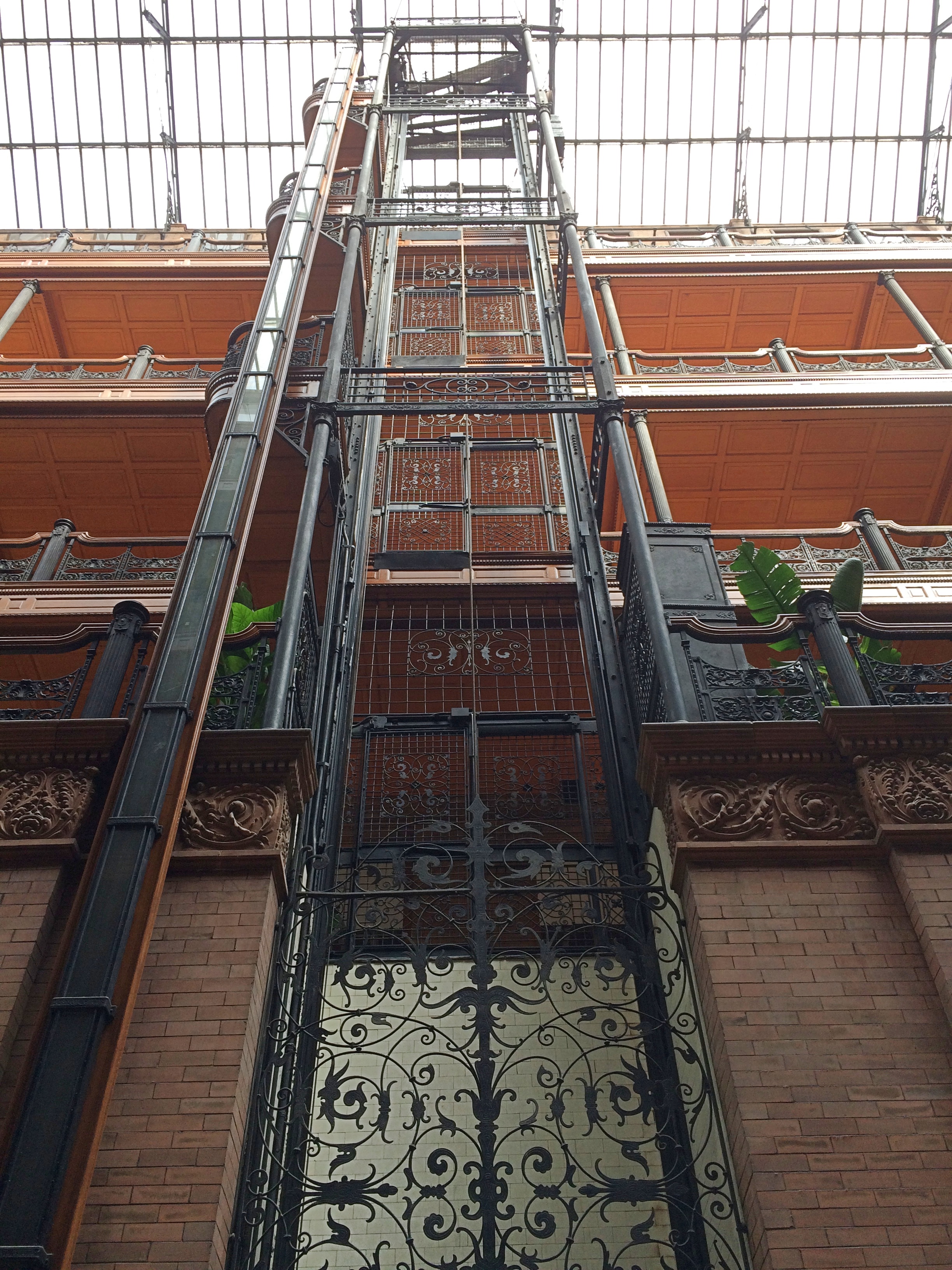
The last place on the tour: The Bradbury Building. I knew it by reputation. A lot of people know it that way. If it were in, say, Des Moines, that wouldn’t be true. But it’s in Los Angeles.
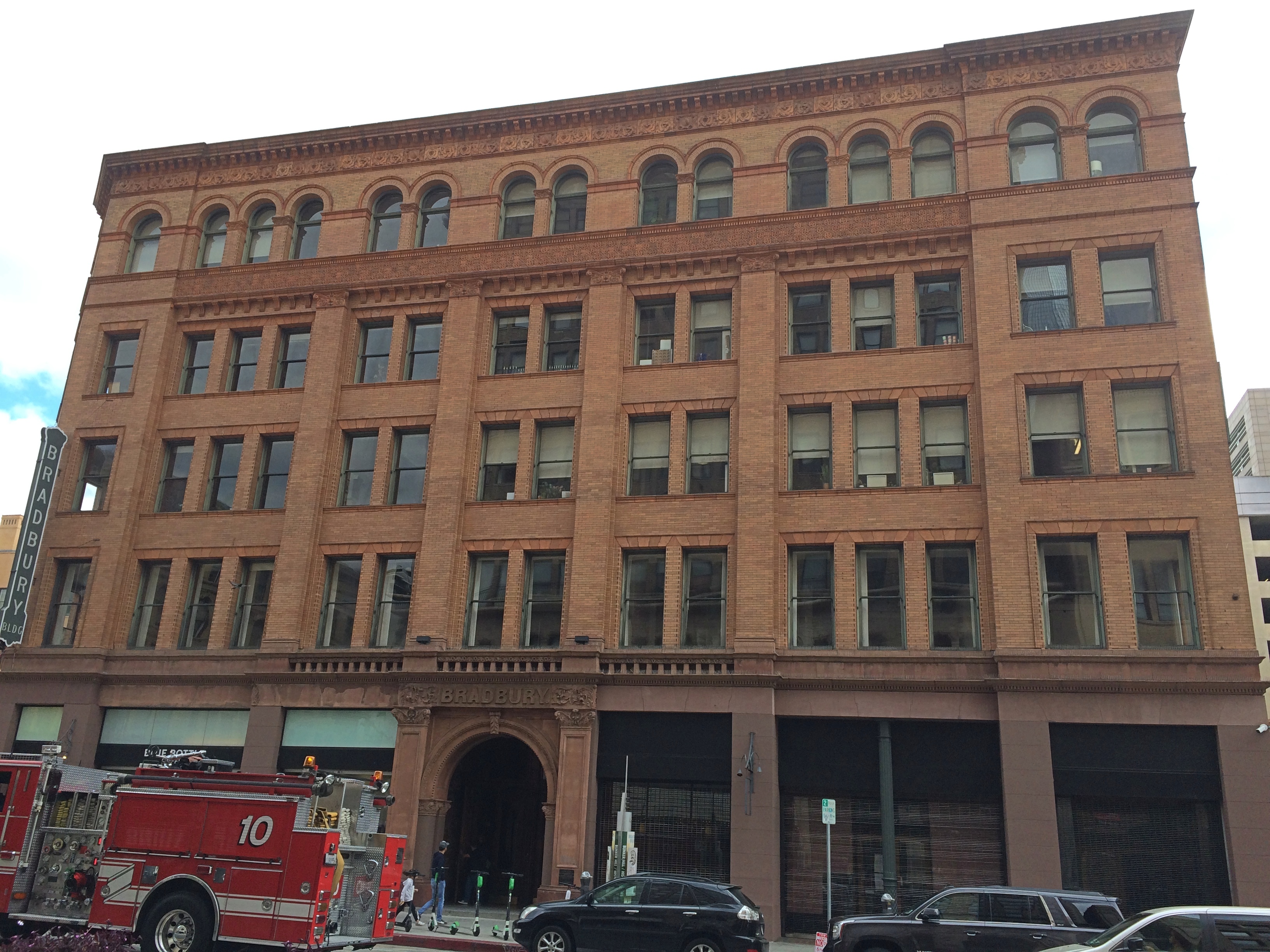
The exterior is nice, but it’s the striking interior that makes it a favorite of location scouts and tourists. An almost exact contemporary of the 1890s Monadnock Building in Chicago, the Bradbury’s superb ironwork reminded me of that building.
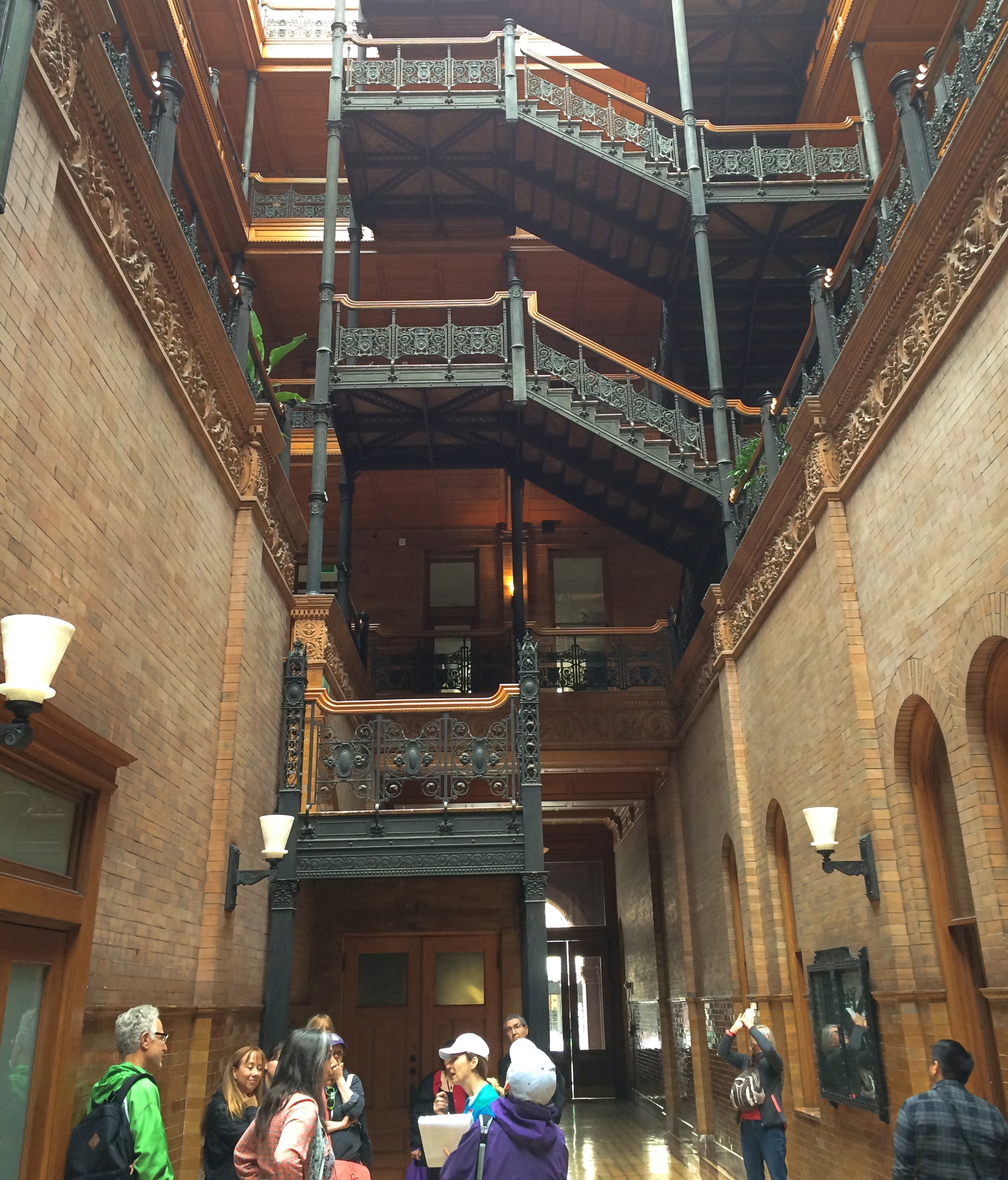
One George Wyman, a draftsman without formal architectural training, designed the building, at least according to most sources. He was inspired by the description of a building in Looking Backwards by Edward Bellamy, again according to most sources. I like to believe the stories are true, since they argue against credentialism.

Back to Insane Clown Posse. I didn’t actually have a brush with them or any Juggalos closer than a few blocks away. That evening, as I headed for the Metro station to leave downtown, I heard the concert off in the distance. It was probably one of the opening acts, but no matter. I could hear that it was loud.
Divers Southern Indiana Courthouses &c

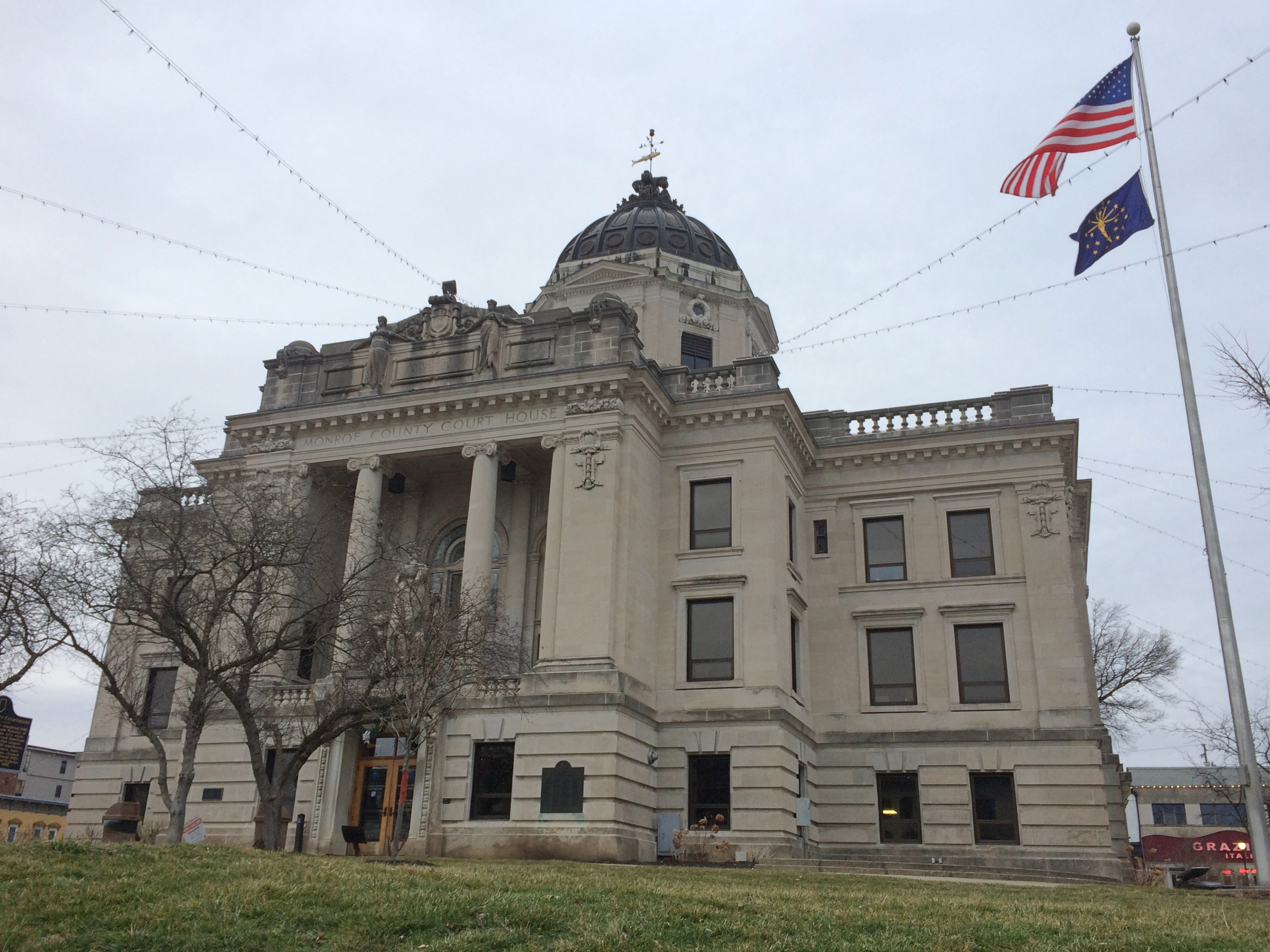
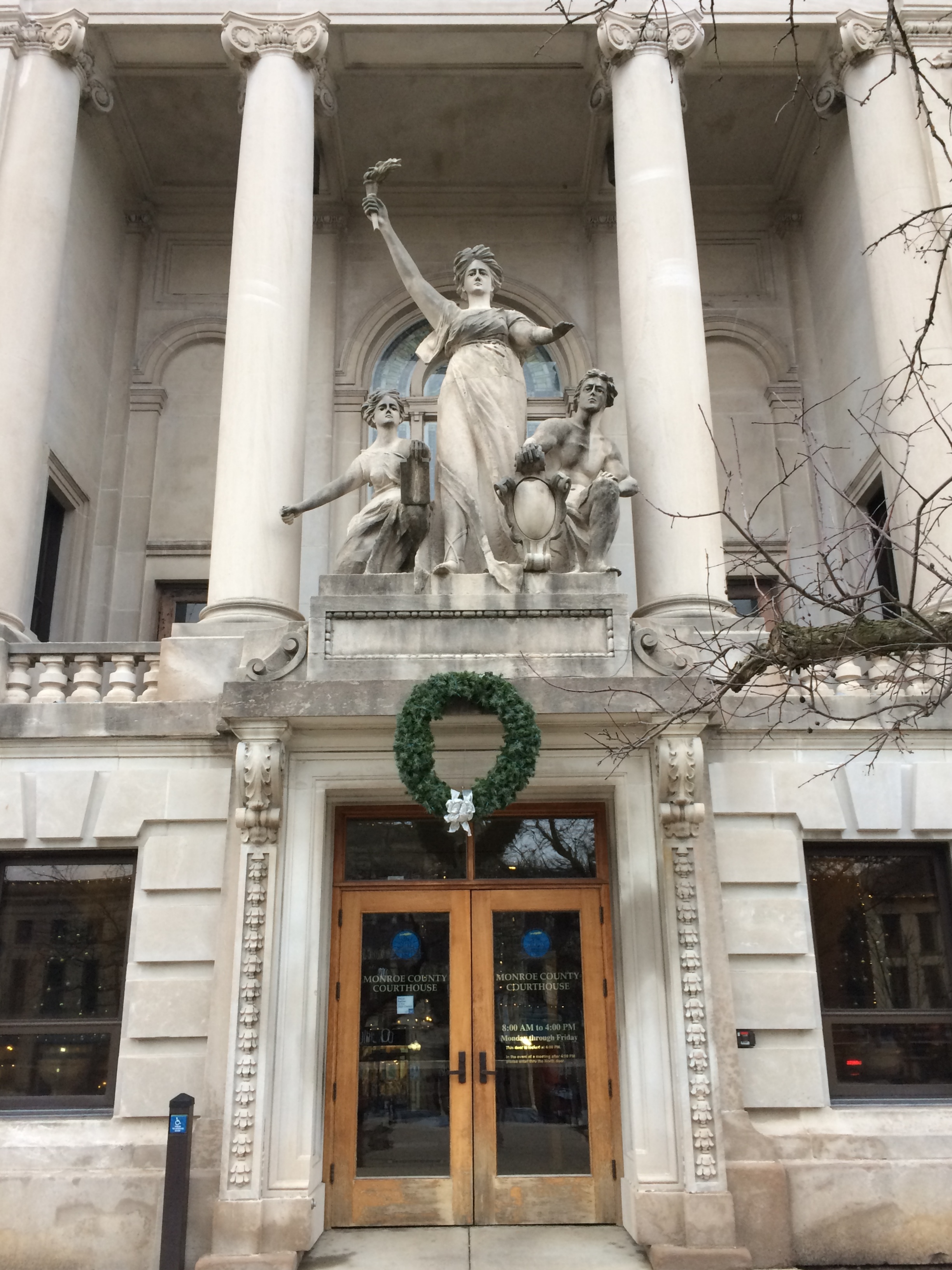
Bloomington is the county seat of Monroe County, Indiana, and sports an impressive downtown courthouse, a 1908 Beaux Arts design by Hoosier architects Wing & Mahurin.

Monroe County Indiana Courthouse

The building was closed for the weekend, but I took a look at the exterior just before dusk. While I stood there, strings of lights lit up.
Monroe County Indiana CourthouseWhat’s a county courthouse without some allegories?
Monroe County Indiana CourthouseOr a war memorial? At first glance, it looks like a Civil War memorial only, but it specifically honors veterans of the war with Mexico, the Civil War, the Spanish-American War and World War I.
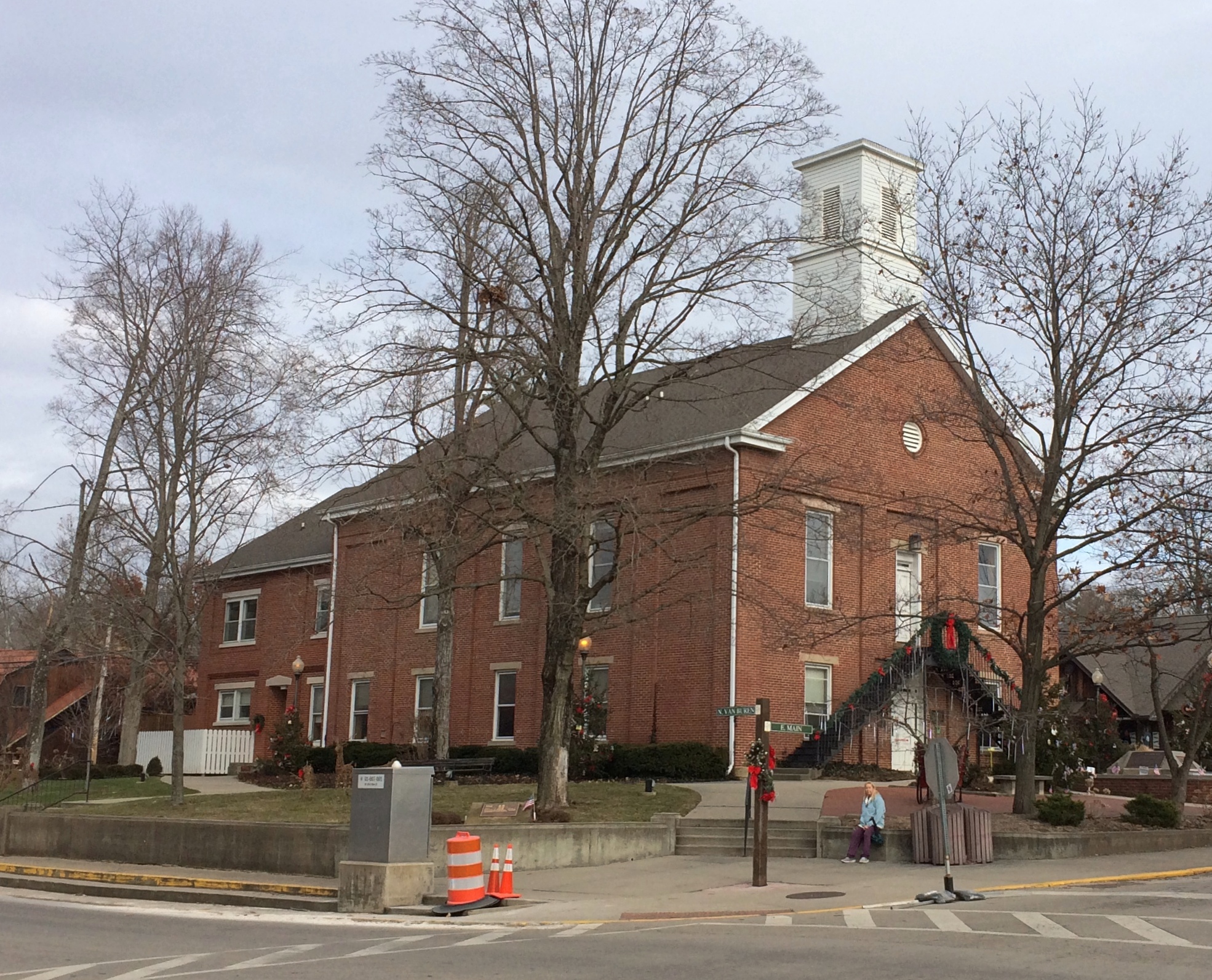
Monroe County Indiana CourthouseWhile in Nashville, Indiana, I took a quick look at the more modest, but also handsome Brown County Courthouse, a structure from the 1870s.
Brown County Indiana CourthouseNashville has some other interesting buildings as well, such as the Nashville United Methodist Church.

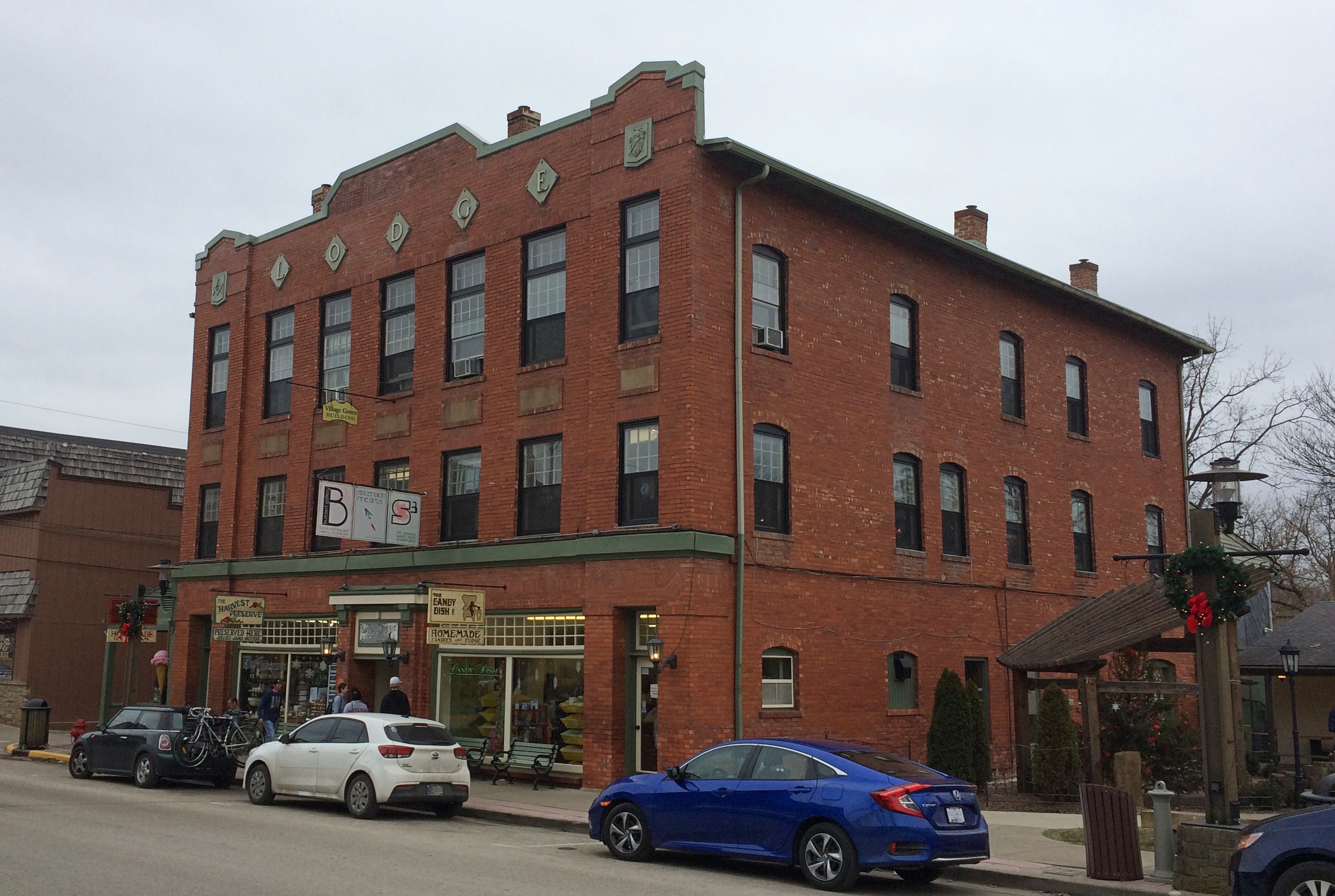
Nashville Indiana UMCThis looks to be a former Masonic building, though I’ve only looked into the matter enough to know that the Nashville, Indiana, Masonic Lodge #135 isn’t in that building, but a newer-looking one. But the older building does say LODGE on the front facade in large letters, along with Masonic symbols on either side.

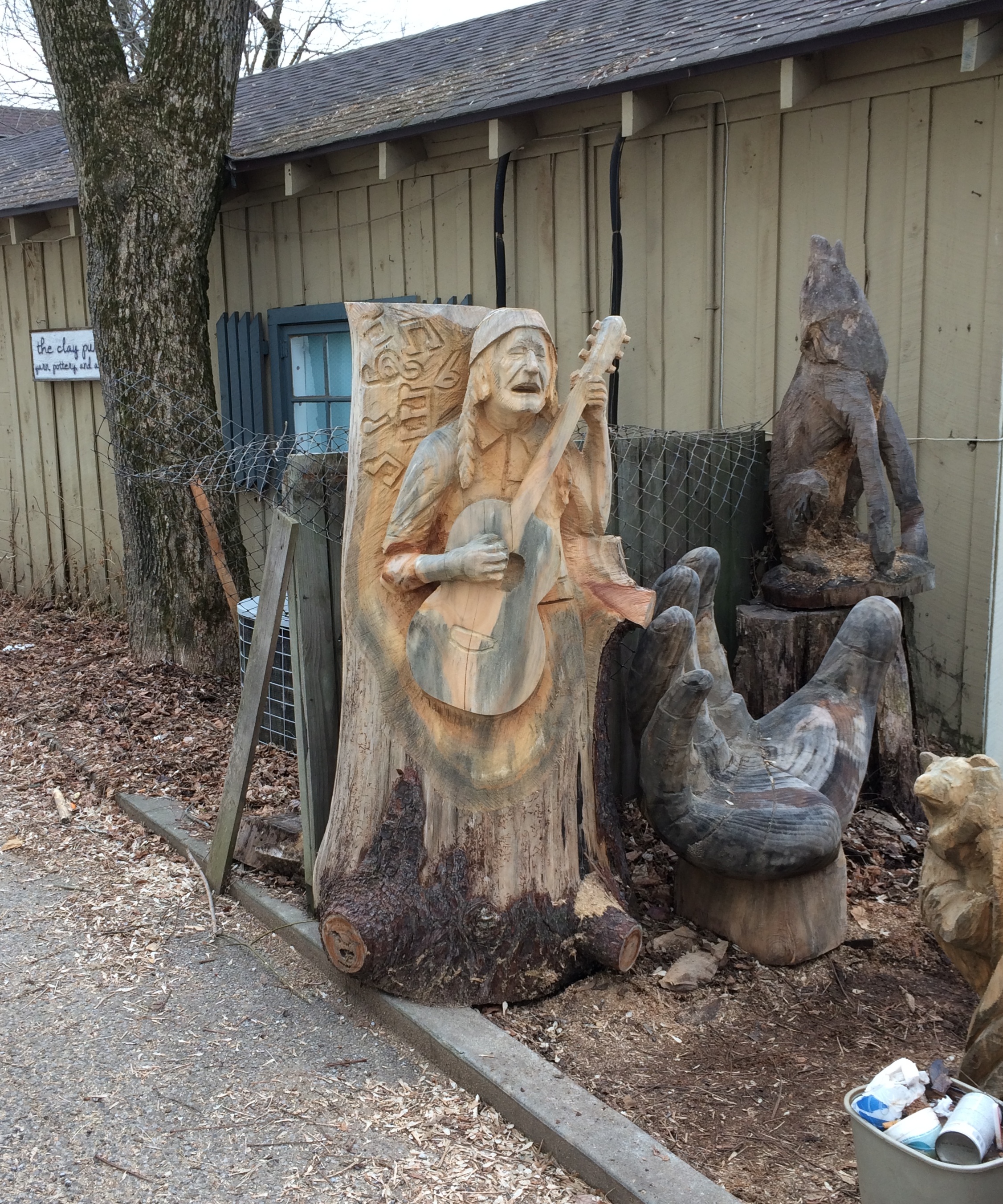
Nashville IndianaNashville isn’t a very large town, but there are streets away from the main tourist drag, Van Buren St. On just such a street we happened across a tree-carving studio.
Nasvhille Indiana tree carving studioBesides Elvis and a bear, you can also find Willie Nelson in wood there.
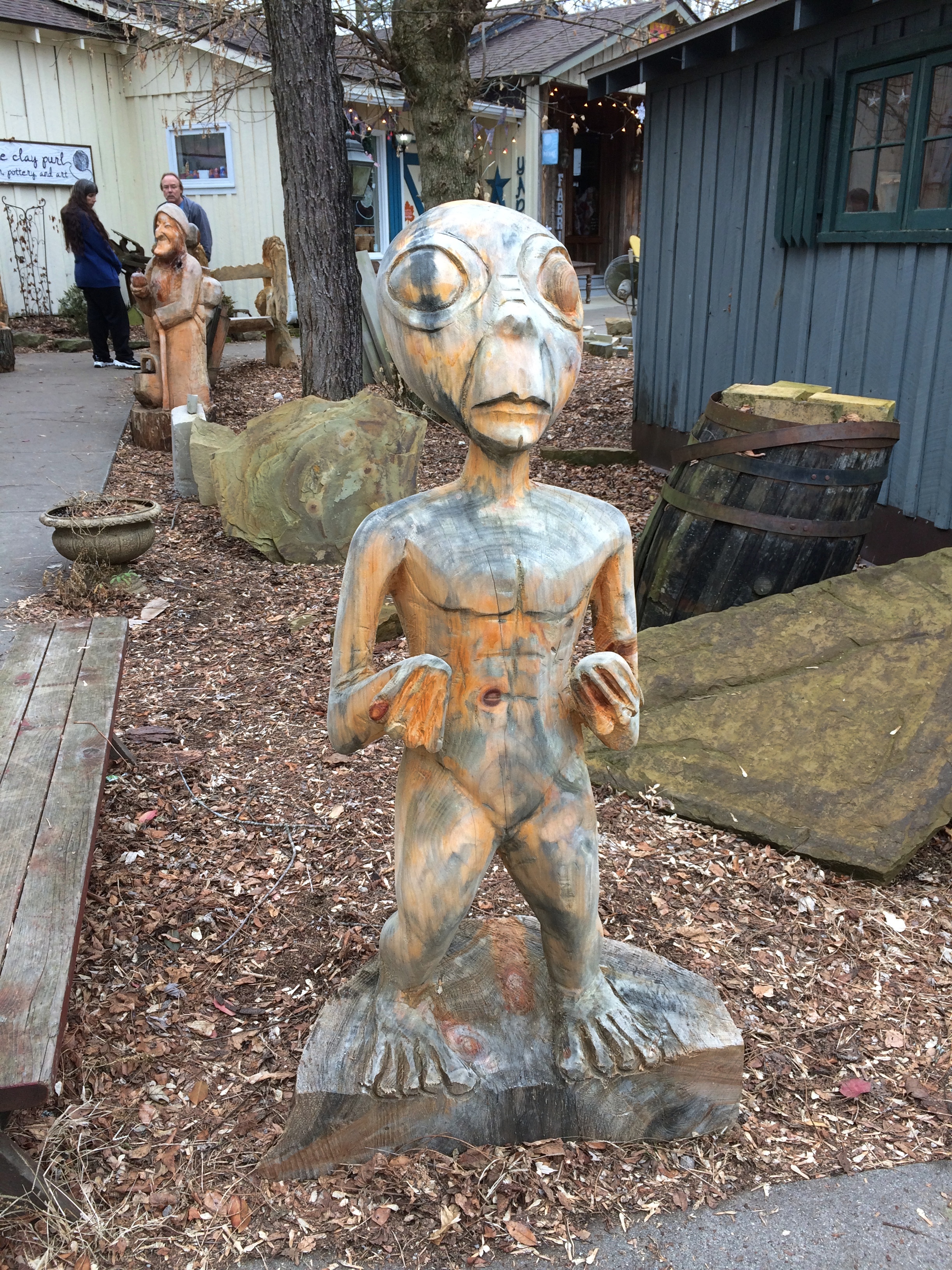
Nasvhille Indiana tree carving studioAnd one of the popular ideas of a space alien.
Nasvhille Indiana tree carving studioOne more courthouse: a good-looking structure in Paoli, Indiana, county seat of Orange County. We passed through town on the way to West Baden Springs, but didn’t stop in the intense rain. Even so, the courthouse caught our attention.

West Baden Springs Hotel

Tibetan-style structures and T.C. Steele’s property and all the other places we saw in southern Indiana near the end of December were worth seeing, but none were the main reason we went down that way.

That would be the West Baden Springs Hotel, one of the grand old hotels of the nation, revived in our time to an astonishing degree. Magnificent as the Hotel del Coronado or the Waldorf-Astoria, historic as the Fordyce at Hot Springs National Park or the Boca Raton Resort & Club.

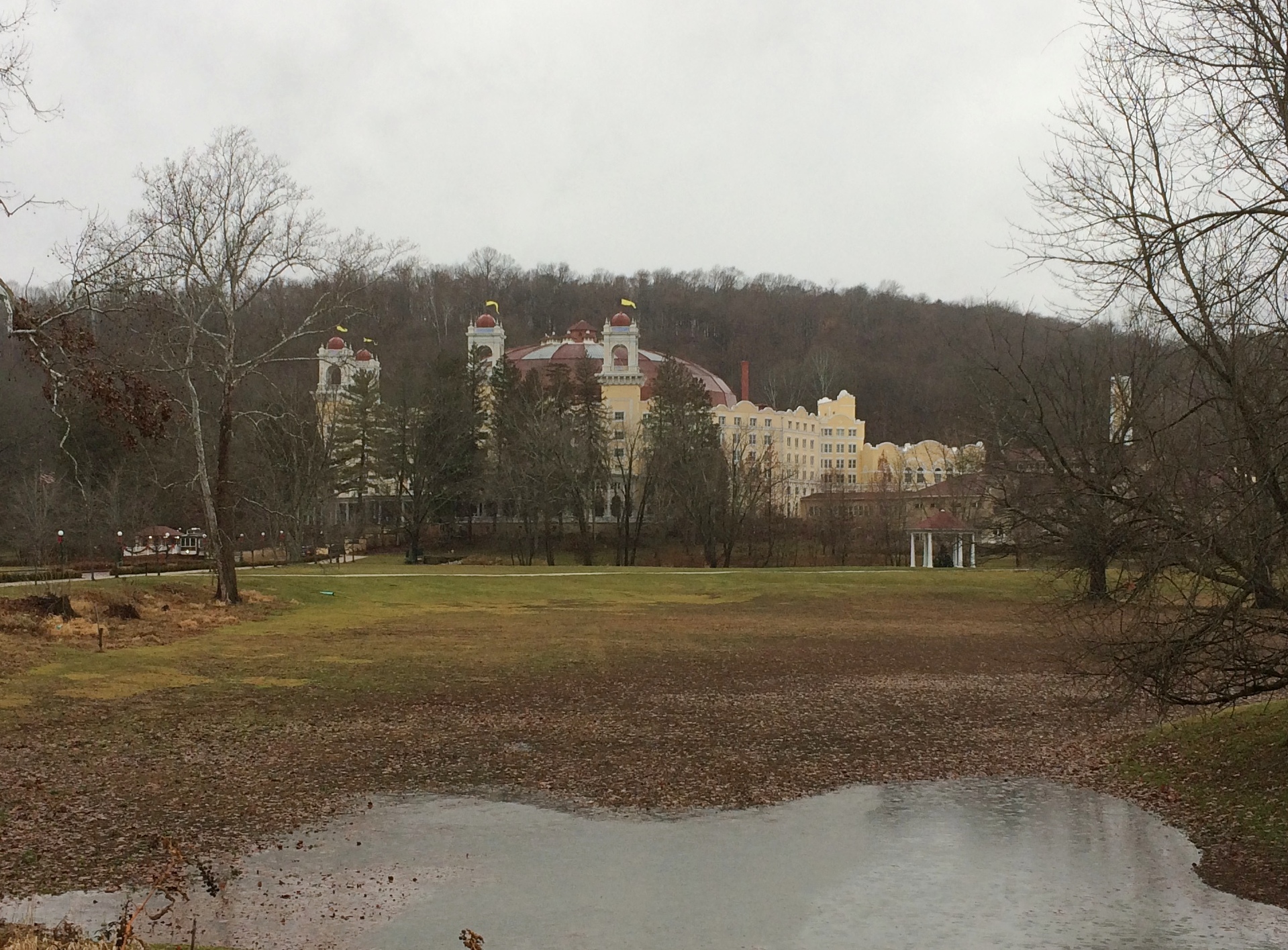
We drove south from Bloomington in intermittent rain on the morning of December 29 to the town of West Baden, in Orange County, Indiana, an otherwise rural place with a county population of a shade less than 20,000. The hotel was impossible to miss driving into town. Even at some distance, it cuts an impressive figure.

West Baden Springs Hotel

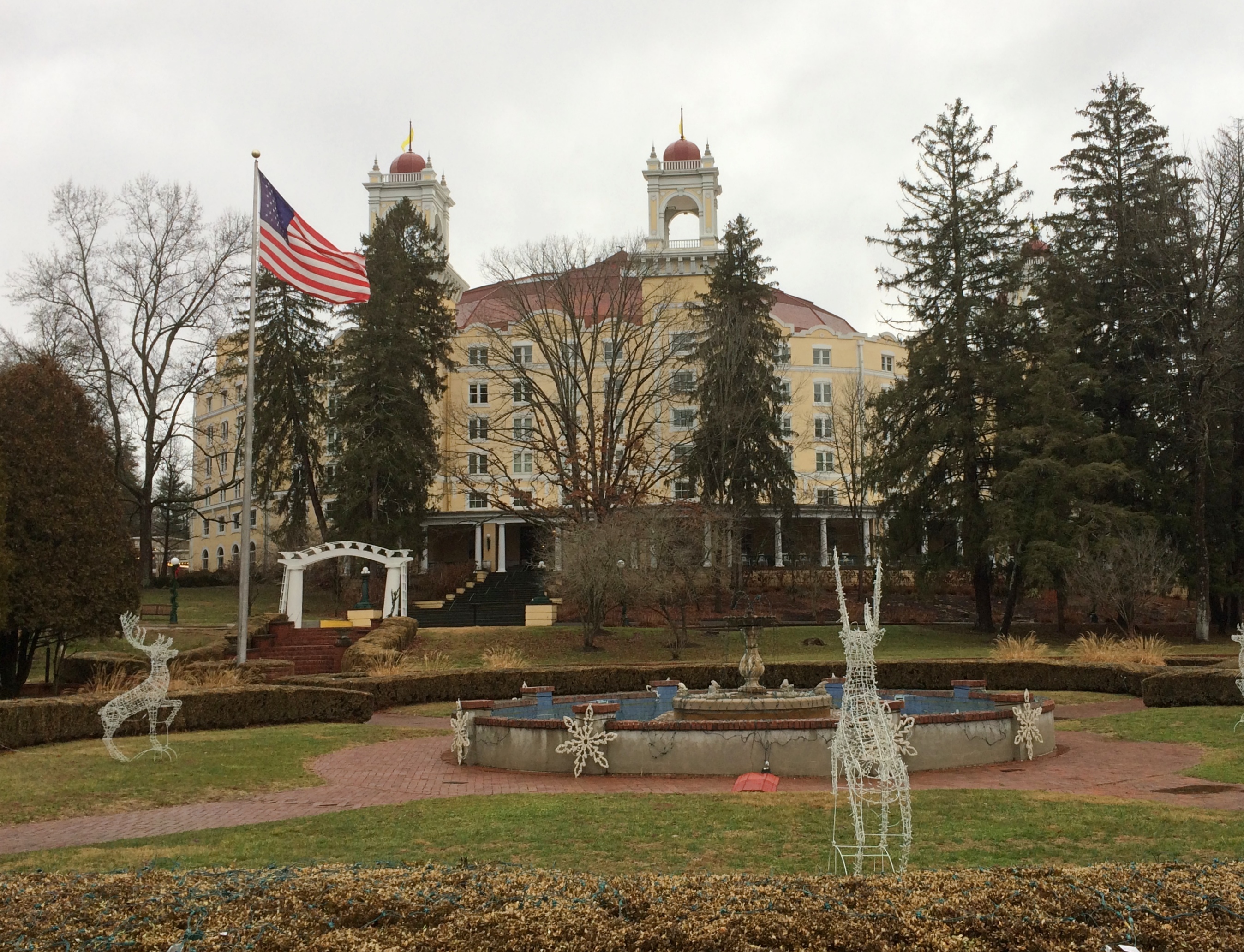
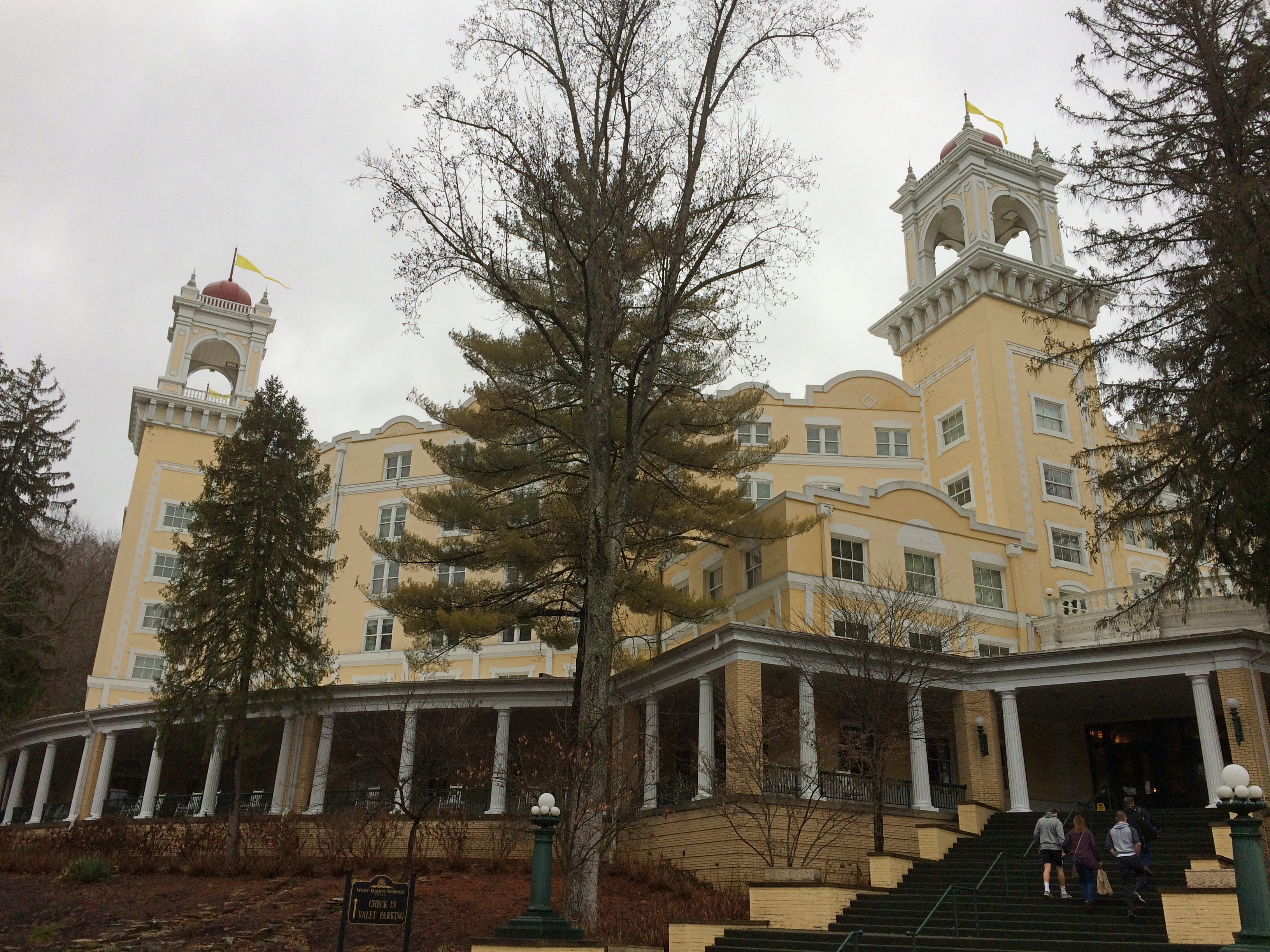
More so closer in.

West Baden Springs HotelWest Baden Springs HotelThere’s been a hotel on the site since 1855, at first called the Mile Lick Inn. Why in this obscure part of Indiana? The waters, of course. Indians knew about the springs and so did Frenchmen, who lent their national name to the nearby French Lick Springs Hotel, about a mile from the West Baden Springs Hotel.

Eventually a branding impulse kicked in, and Mile Lick became West Baden Springs, to capture some of the Victorian cachet of Baden-Baden in Germany, where the Euro-elite took the waters. I learned pretty quickly, by the way, that the Hoosier way to say the name is West BAY-den, not BAA-den.

The original West Baden Springs burned down just after the turn of the 20th century. The owner, Lee W. Sinclair, wanted something even grander replace it — something to best the rival French Lick Springs Hotel — and so he built the current hotel.

“Sinclair… envisioned a circular building topped with the world’s largest dome, decorated like the grandest spas of Europe,” notes the hotel web site. “Architect Harrison Albright of West Virginia [who designed the U.S. Grant Hotel in San Diego, too] accepted Sinclair’s commission and agreed to complete the project within a year. The new hotel, complete with a 200-foot diameter atrium and fireplace that burned 14-foot logs, opened for business in June of 1902.”

Later, Sinclair’s daughter and son-in-law redesigned the hotel a new level of opulence in the ’20s that characterized West Baden Springs Hotel until the Depression crushed its business model. The rest of the 20th century was unkind to the property, especially the last years of the century.

“In January 1991, a buildup of ice and water on the roof and in drainpipes caused the collapse of a portion of the exterior wall,” the web site says. “In 1992, Indiana Landmarks spent $140,000 to stabilize the hotel, matching a $70,000 contribution from an anonymous donor. In May 1994 the hotel was sold to Minnesota Investment Partners (MIP) for $500,000. Grand Casinos Inc., an investor in the purchase, optioned the hotel from MIP. The Cook Group Inc., a global medical device manufacturing company headquartered nearby in Bloomington, stepped in to preserve both the French Lick and West Baden Springs Hotels.”

That is to say, the Cook family — medical-device billionaires — took an interest in the place. Eventually they oversaw the renovation of West Baden Springs, as well as French Lick Springs, at great expense. But not without what I imagine must be a healthy return, now that a major new Cook-owned casino (next to French Lick Springs) is open for business. All of the properties (West Baden Springs, French Lick Springs and the new casino) are part of the French Lick Resort Casino, an operation licensed by the state of Indiana in 2006.

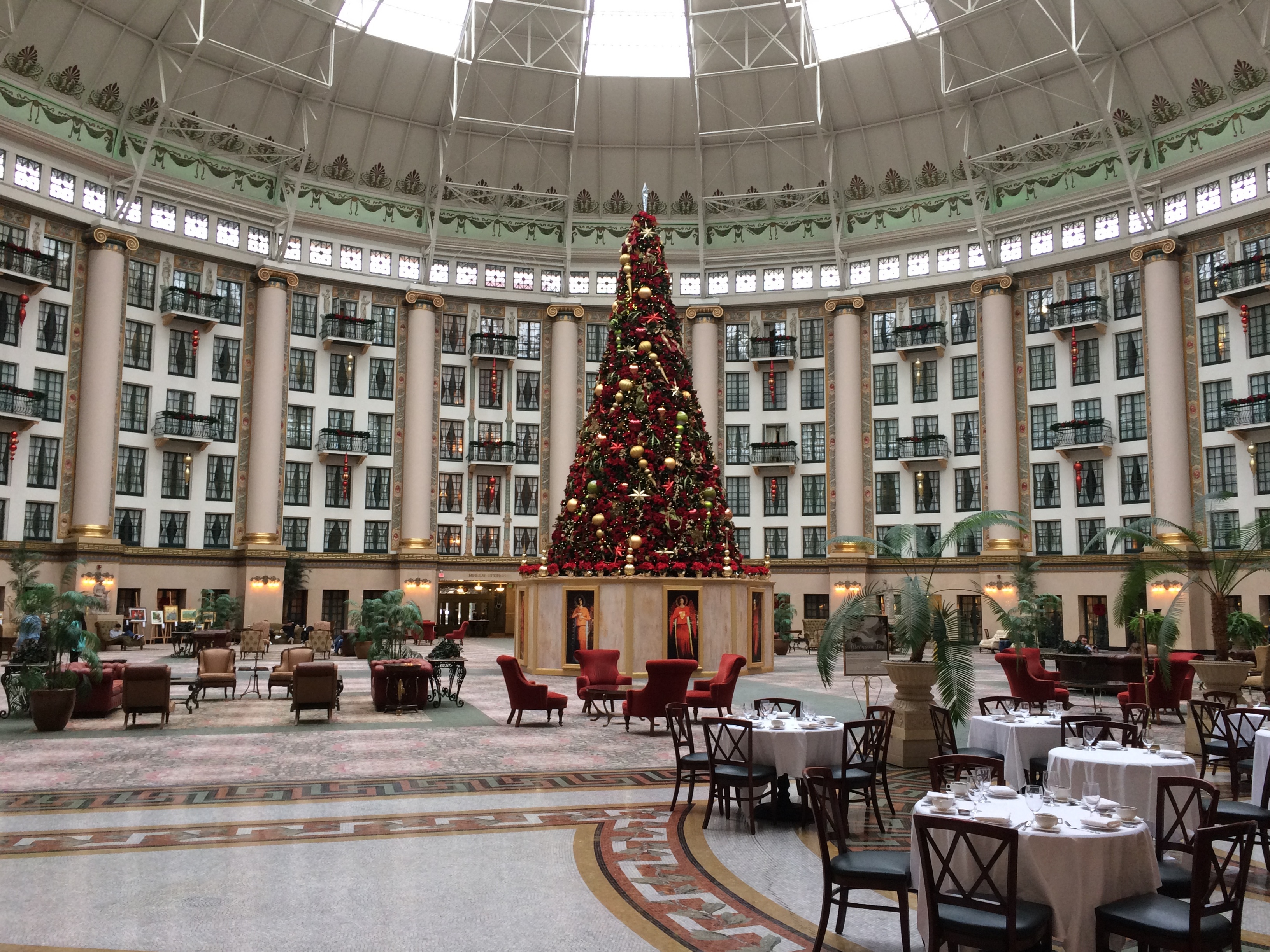
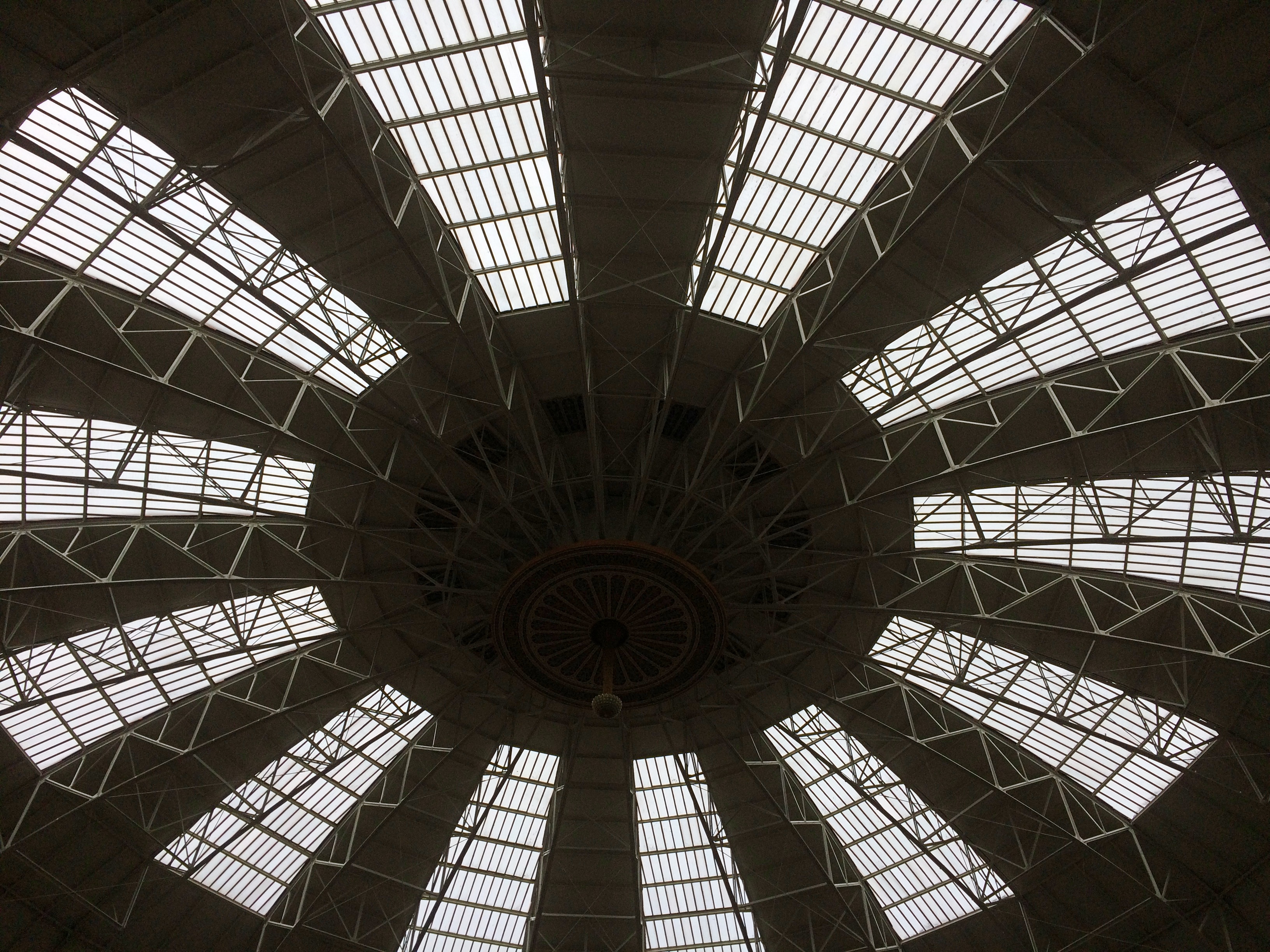
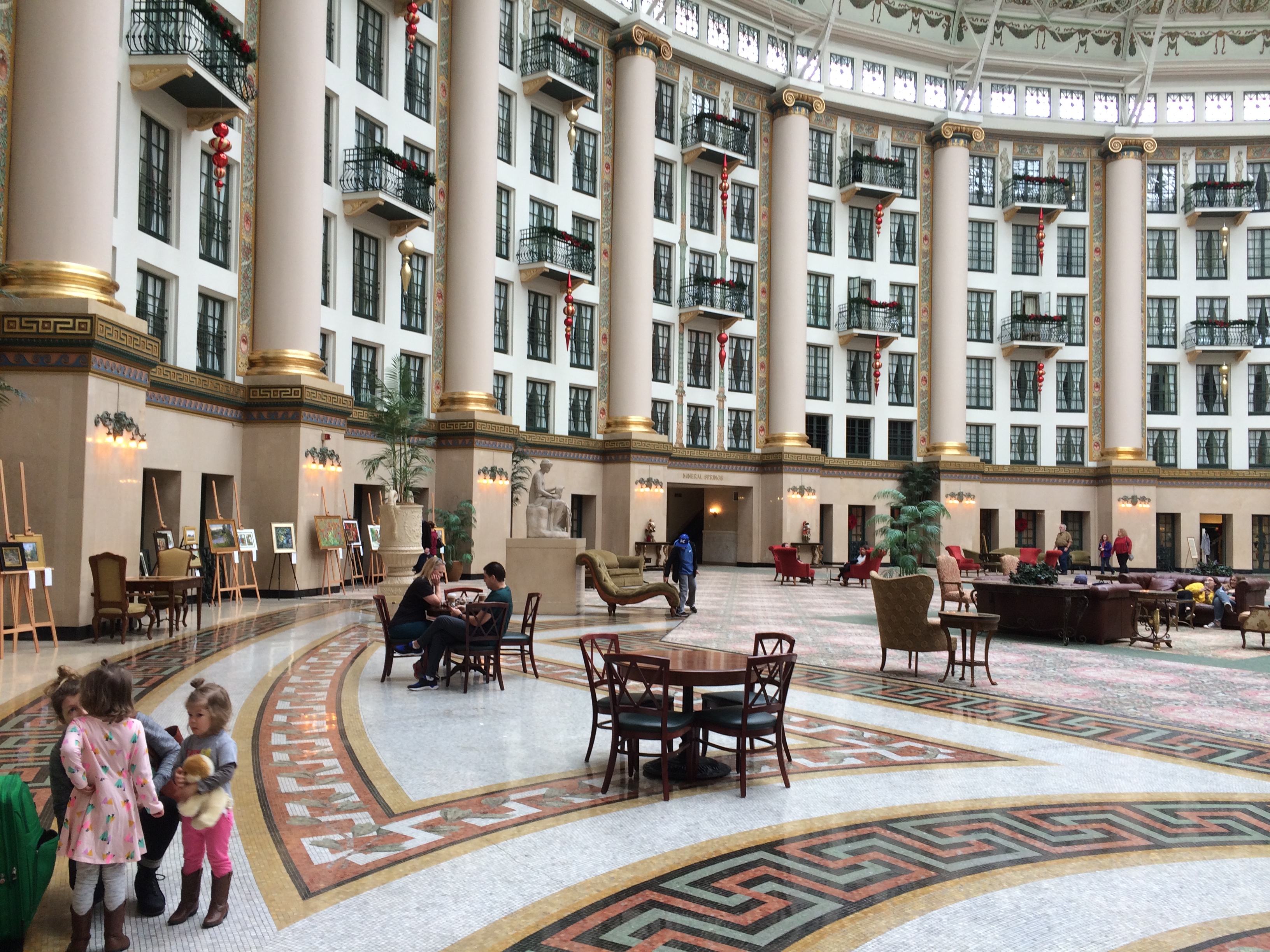
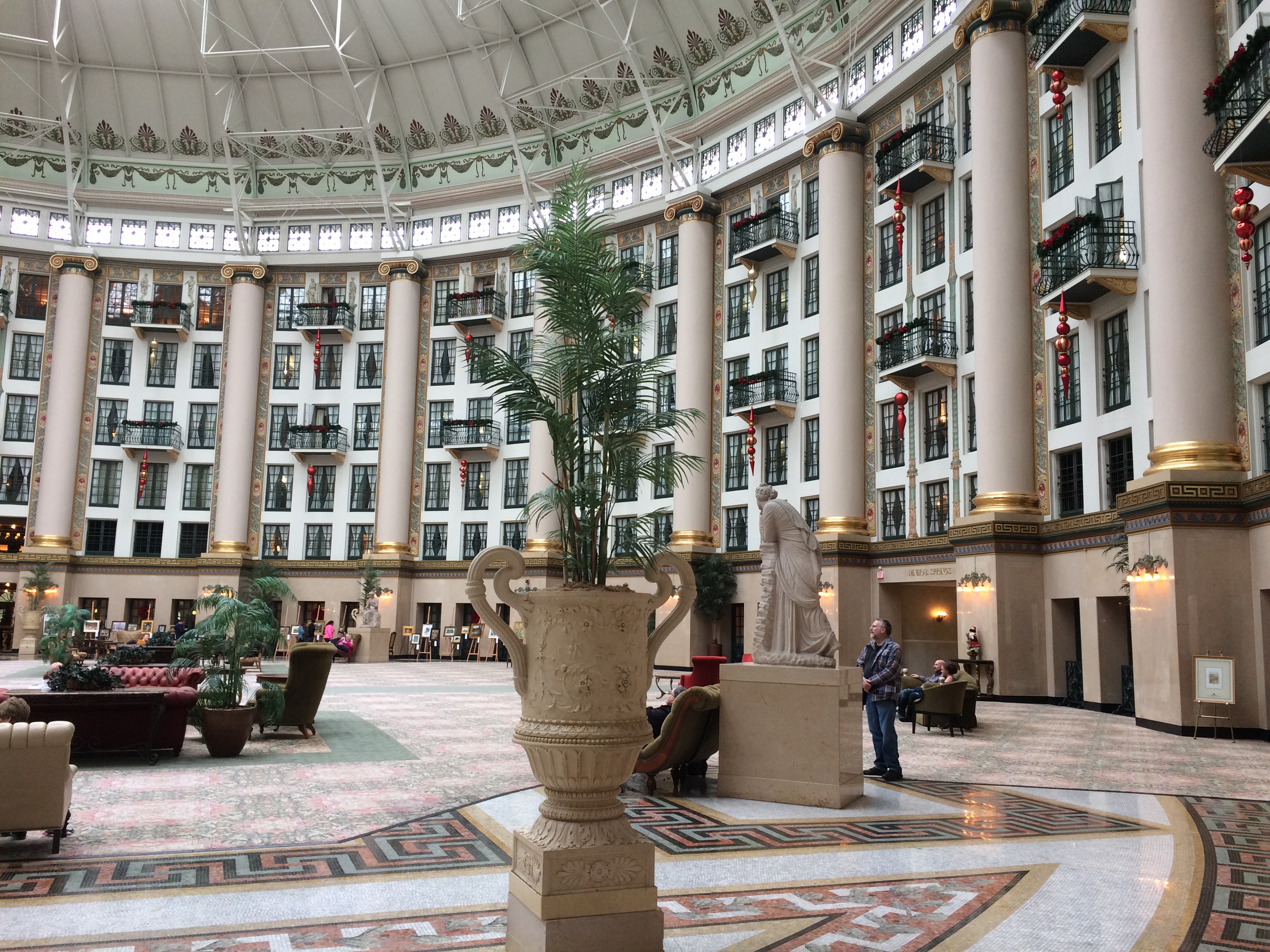
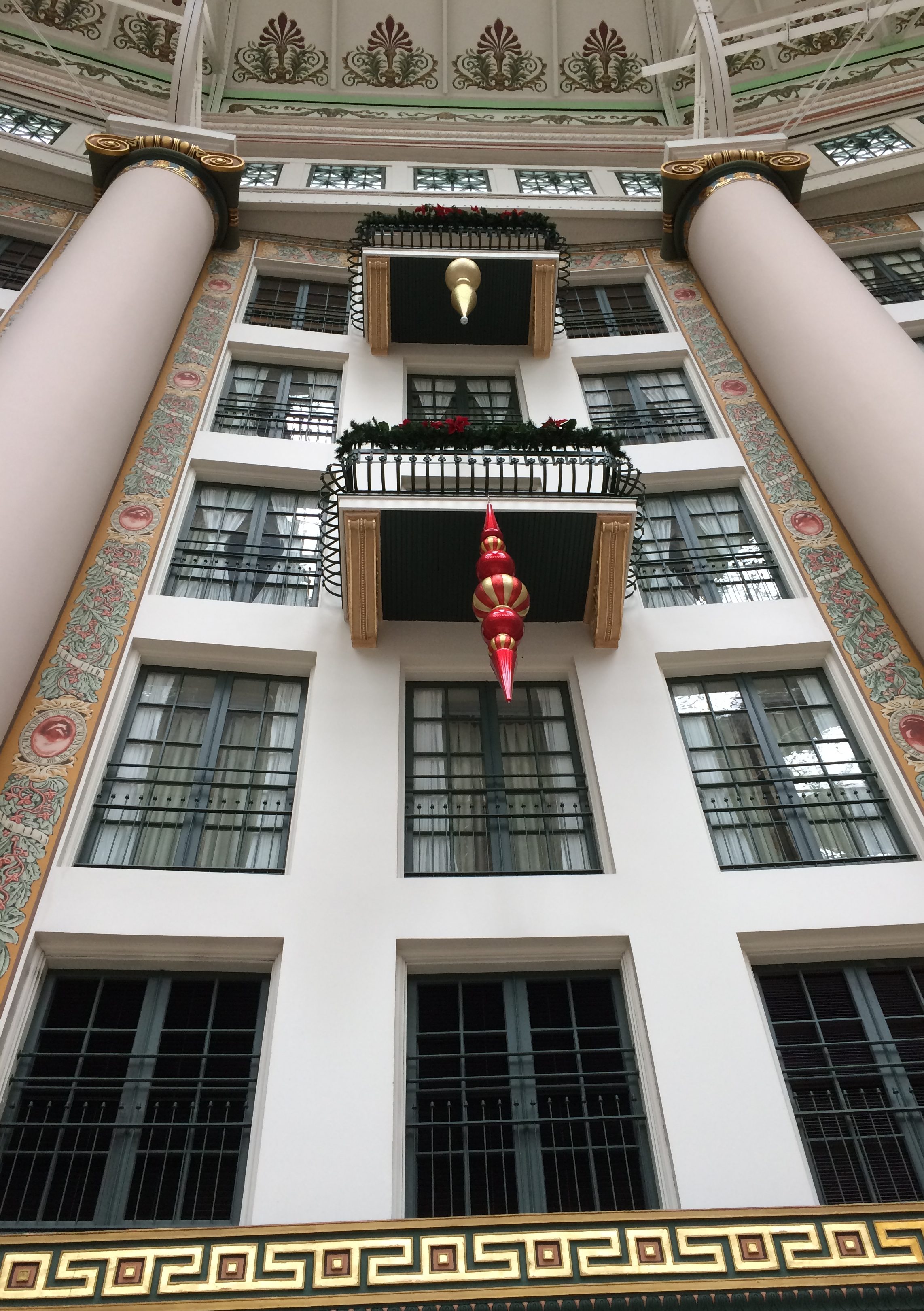
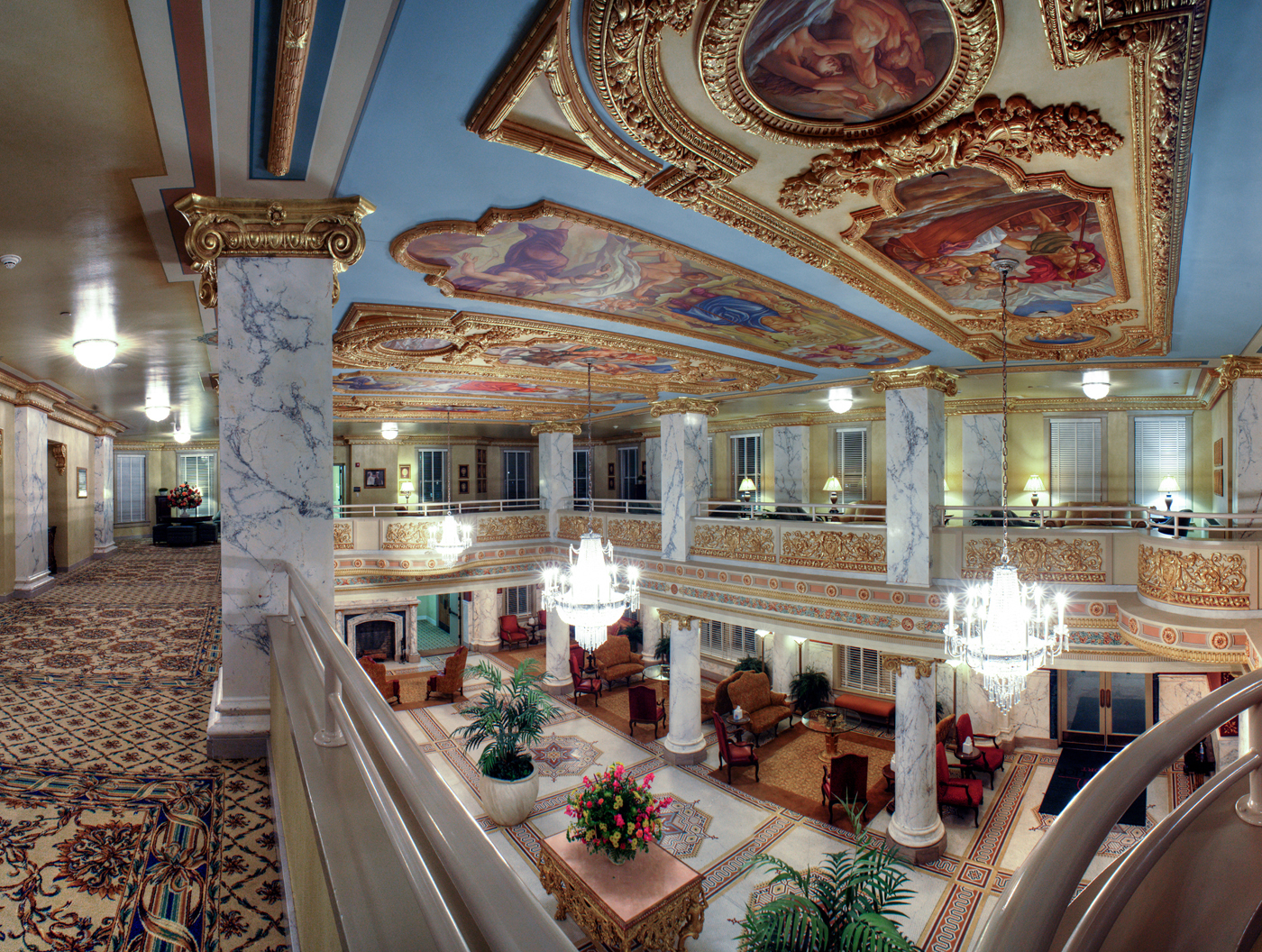
I’ve read variously that the West Baden Springs Hotel dome was the nation’s largest freestanding structure of its kind until the completion of the Charlotte Coliseum in 1955 or the Astrodome in 1965. Whatever the case, the thing to do in our time is wander into the hotel atrium, stand under the dome, and be amazed. Ordinary photos can’t convey the sweep of the place or the its grand scope, but never mind.

West Baden Springs Hotel atrium

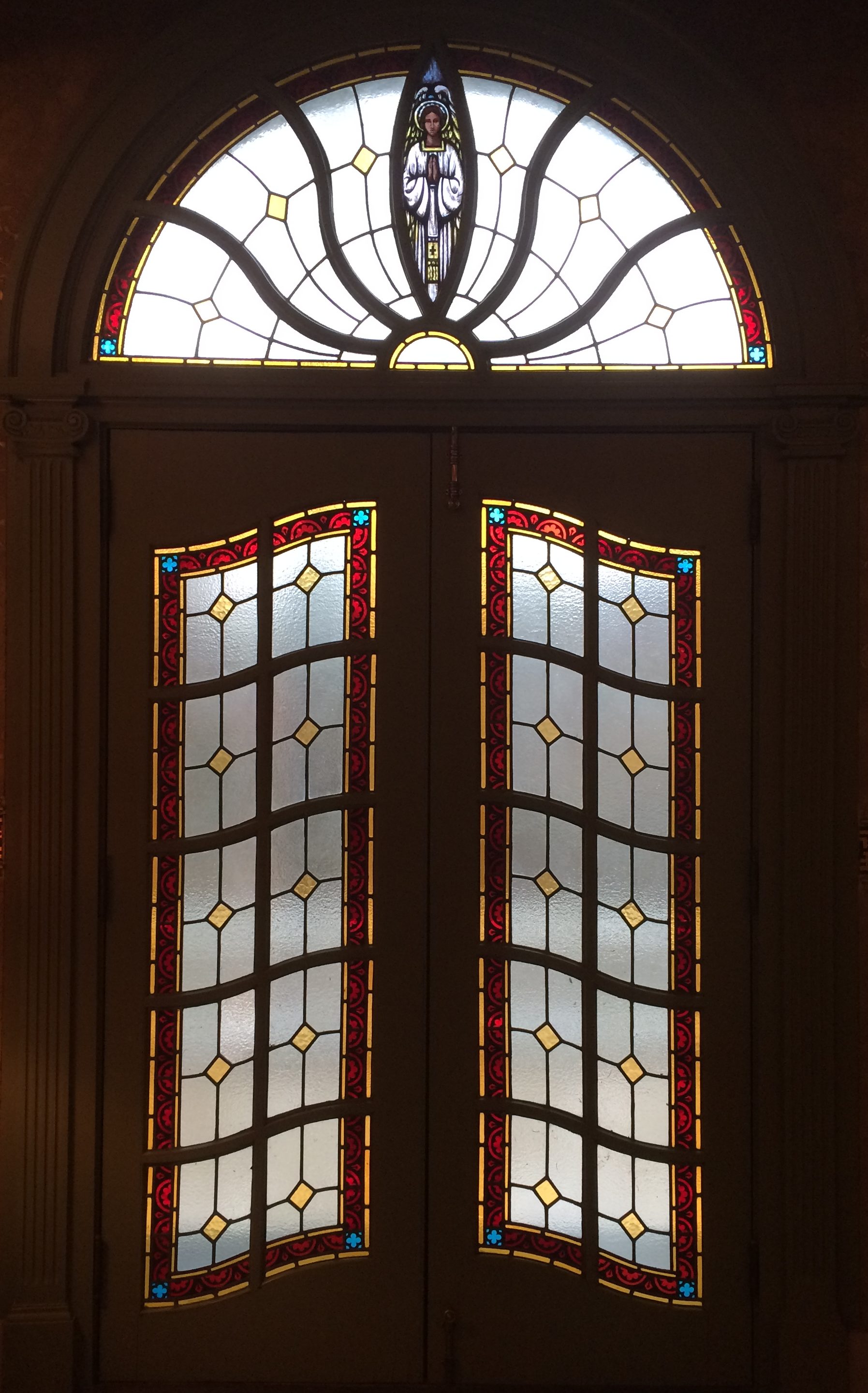
West Baden Springs Hotel atriumWest Baden Springs Hotel atriumWest Baden Springs Hotel atriumWest Baden Springs Hotel atriumOther parts of the hotel have their own flourishes, such as the stained-glass windows near the front entrance, added by Jesuits when they owned the property in the mid-century. Quite a story.

West Baden Springs Hotel stained glass

We rode a trolley over to French Lick Springs for a look. Posh, certainly, and also a historic hotel — that’s where Pluto Water used to come from, and walls are covered with glossy pics of famous guests — but it’s only worth seeing, not worth going to see, like West Baden Springs is.

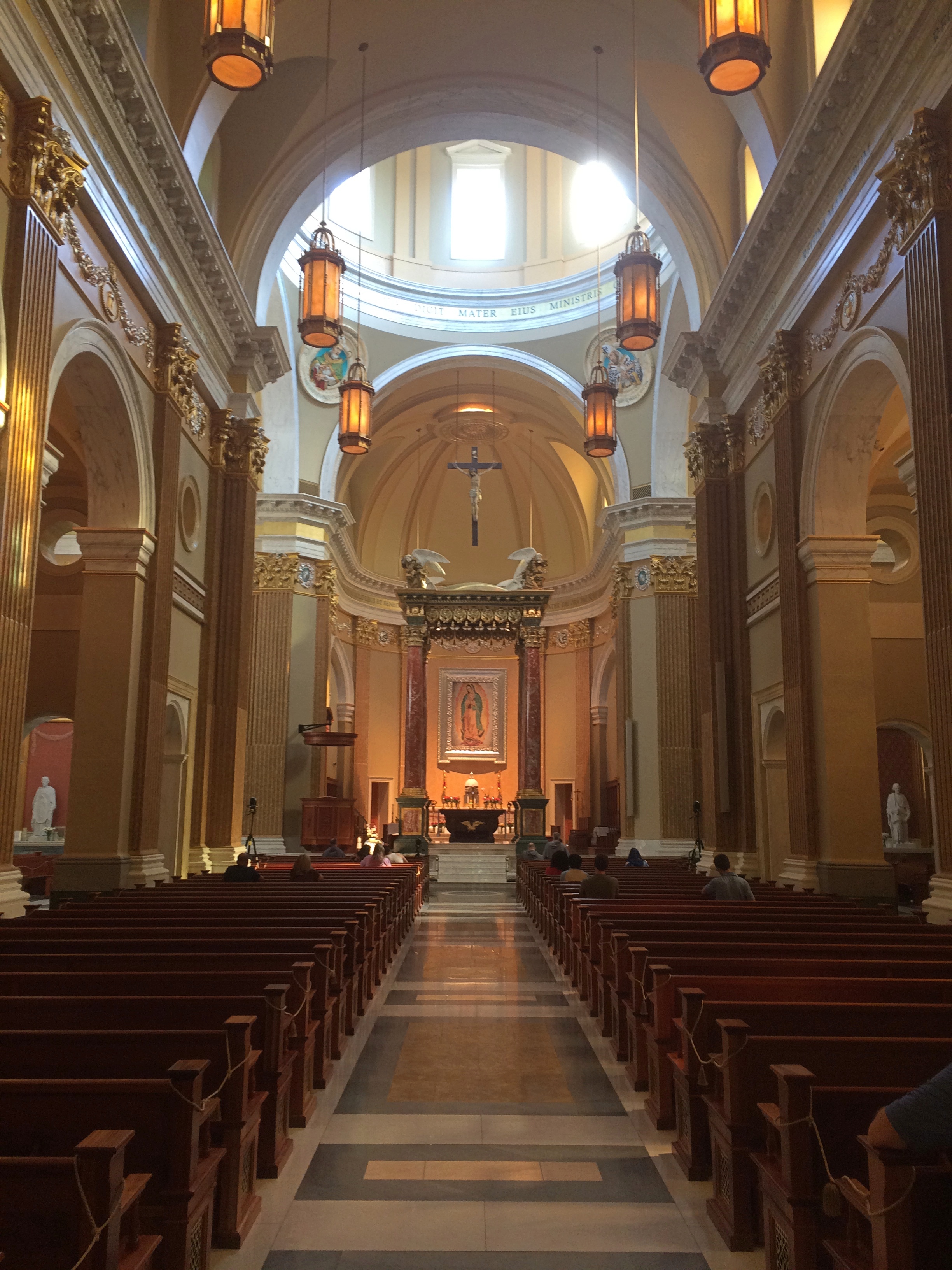
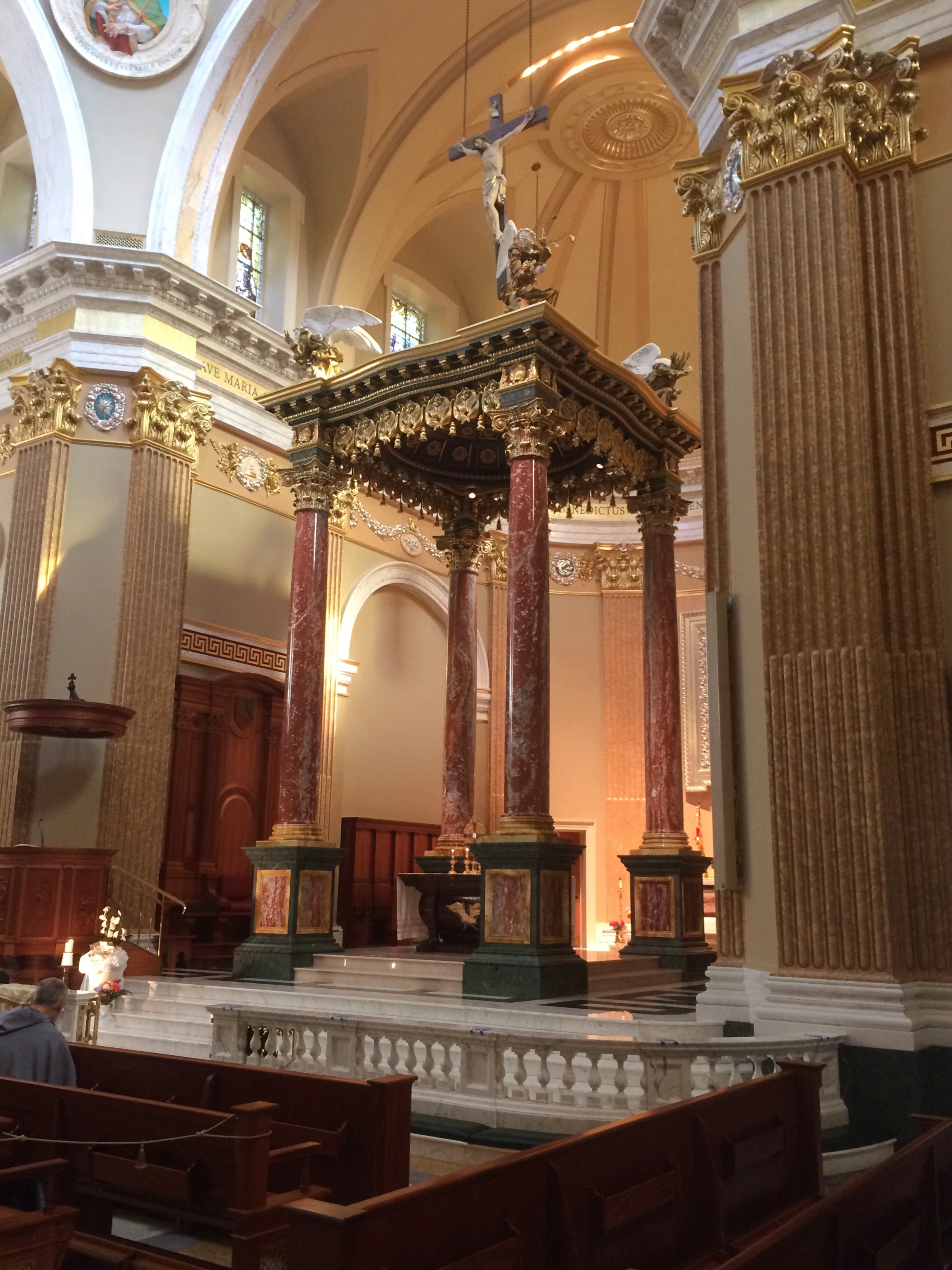
Christ the King & Trinity United Methodist

Our visits during the 2019 Open House Chicago event on October 19 weren’t only to churches — just mostly. The opportunity was there.

In the mid-afternoon, we headed down to the Beverly neighborhood on the Southwest Side. Next year, no long drives between neighborhoods — we spent too much time jammed on the Kennedy Expressway, then the Dan Ryan Expressway. I should have known better. But the sites were worth it.

Eventually, we got to Beverly. First stop, Christ the King.Christ the King Beverly Chicago

Christ the King Beverly ChicagoMidcentury Modern, with distinctive brass and glass, completed in 1955. Design by Fox & Fox, who are still in business.
Christ the King Beverly ChicagoThe King of Kings indeed. Painted to look like a mosaic from the floor.
Christ the King Beverly ChicagoChrist the King Beverly ChicagoSome blocks to the south is Trinity United Methodist, designed by Ralph E. Stotzel and Edward F. Jansen.
Trinity United Methodist Beverly Chicago“The present building is its 5th location, begun with the construction of the community house — the northern portion of the current building — in 1924. Construction of the Gothic sanctuary was delayed by the Great Depression, but it was completed in 1940,” says Open House.

Trinity United Methodist Beverly Chicago

Trinity United Methodist Beverly ChicagoThe church also has a fine organ.

We heard it in action. According to the church, it is a Möller Pipe Organ, opus 8240, with three manuals and 26 ranks, installed in 1951. Apparently the M.P. Möller Organ Co. of Hagerstown, Md., was a busy organ-maker in its day.

St. Benedict the African

As a saint, Benedict the African (1526-89), or Benedict the Moor, has enjoyed longstanding popularity in Italy, Spain and Latin America, and is also the patron saint of African-Americans. I didn’t know any of that before we visited St. Benedict the African, a church in the Englewood neighborhood of Chicago, as part of Open House Chicago on October 19, but I was going to learn.

The exterior looked unpromising. It’s a modernist design completed in 1989 by Belli & Belli. “Eight parishes were consolidated into St. Benedict the African in the 1980s, the building was designed specifically with and for its predominantly African-American community,” Open House says.
St Benedict the African ChicagoThe exterior might be utilitarian, but inside is a whole other story. A whole other remarkable story. A welcoming St. Benedict is one of the first figures you see.
St Benedict the African ChicagoFashioned from Ethiopian glass (there’s an industry there) by local artist David Csicsko to honor Benedict’s parents’ birthplace. The Sears Tower and the John Hancock building are in the background.

Not far from that window is an astonishingly large baptismal pool (too big to be called a font?). Open House claims that at 10,000 gallons, it’s one of the world’s largest.
St Benedict the African ChicagoThe sanctuary is in the round.
St Benedict the African ChicagoSt Benedict the African ChicagoSt Benedict the African Chicago“An inspired 200-pound, hand-woven tapestry adorns the wall behind the altar and depicts a dancing flame (the spirit of God), choppy waters (daily strife), and the broken body of Christ image as the Bread of Life,” the church says.

St Benedict the African Chicago

In wood, a depiction of St. Martin de Porres, another saint I knew nothing about before visiting the church.

St Benedict the African Chicago

More Csicsko glass. A Living Cross.
St Benedict the African ChicagoElsewhere is another one of his windows, or a pair actually, depicting Sojourner Truth, Harriet Tubman, Rosa Parks and Sister Thea Bowman, the last of whom was new to me as well.

Our Lady of Victory & St. Edward (the Confessor)

According to Open House Chicago, Our Lady of Victory is in the Portage Park neighborhood of Chicago, though it isn’t that far south of the Copernicus Center in Jefferson Park. Other sources put the church in Jefferson Park.

Never mind, Our Lady of Victory was our first church of the day during Open House. Others would follow.

Our Lady of Victory ChicagoUnderneath the main church is a chapel. According to a parishioner on hand to talk to visitors, the chapel was completed decades before the rest of the church — 1928, designed by E. Brielmaier & Sons. Then work stopped. First there were hard times, then there was a war.

“Work on the upper church was delayed until it was finally completed in 1954,” Open House says. “The tan stone of the Spanish-style exterior was selected specifically to complement the color of the ornate terra-cotta around the original entrance.”

By this time, different architects were on the job: Meyer & Cook.Our Lady of Victory ChicagoOur Lady of Victory Chicago“The warmth of the exterior extends to the sanctuary’s lavish tan and pink marble and terrazzo. Polychromatic details throughout, particularly in the stained glass, wooden Stations of the Cross and other painted elements contribute to a colorful and welcoming space tied together with subtle Art Deco influences.”

East of Our Lady of Victory, and east of the Kennedy Expressway in the Irving Park neighborhood, is St. Edward. I don’t know that I’ve ever visited a church named for Edward the Confessor, but there it was.
St Edward Church ChicagoAnd there he is.
St Edward Church ChicagoQuite a view, looking straight up.
St Edward Church ChicagoThe church has a similar construction history as Our Lady of Victory, except the archdiocese managed to complete it before the war. “Plans to build the current St. Edward Church began around 1926,” Open House Chicago notes.

“Construction of the lower level was completed, but the work was halted because of the Depression. Worship took place in the lower church at basement level. The upper church was completed in 1940.”

St Edward Church Chicago

St Edward Church ChicagoThe distinctive feature of St. Edward is in the narthex. Not too many churches you can say that about.

More specifically, all around the narthex ceiling is a painted replica of the first third of the Bayeux Tapestry, done in oils by an artist named Mae Connor-Anderson and completed in 2005. It’s about 75 feet long and you have to crane your neck to appreciate it, or — as I did for a few moments — lay on the floor.

Just inside the nave a parishioner, maybe only a shade older than I am, sat at a small table with some material about the church and especially the Tapestry, mostly some photocopied sheets. I took an interest and told him that I’d seen the Tapestry. He seemed a little excited at that — not only someone who knew what it was, but who had actually seen it. He told me that he wanted to see it himself, but hadn’t gotten around to it.

So we talked some more about the Tapestry and St. Edward’s replica, and just before I left, he told me to wait a second. From under the table, he produced a professionally made 12-page booklet about the St. Edward and the Tapestry and gave it to me. The cover:
St Edward Church ChicagoThe first third was reproduced on the ceiling for reasons of space, but also because it begins with King Edward meeting Harold II — perfidious Harold, according to Norman propaganda — and ends with Edward being interred at Westminster Abbey. Other adjustments were made as well, including leaving the Latin tituli out.

An example page of the booklet:
St Edward Church ChicagoFrom my perch on the floor, I was determined to get at least one image of the ceiling painting.
St Edward Church ChicagoWho else but good King Edward?

Jefferson Park, Chicago

The weekend after I returned from Virginia, where we encountered a number of statues of Thomas Jefferson, I found myself in front of a statue of Thomas Jefferson. In Chicago. In the neighborhood known as Jefferson Park on the Northwest Side.
Jefferson Park Jefferson statueHe’s standing in front of an open-air CTA bus terminal. Actually, an intermodal station, since the Jefferson Park El stop is back there, too.

“The statue depicts Jefferson standing at a podium as he signed the Declaration of Independence,” says Chicago-L. “The statue stands on a circular granite base, divided into 13 wedges representing the 13 original colonies. One of Jefferson’s quotations — ‘The will of the people is the only legitimate foundation of any government’ — is imprinted around the outer edge.

“A time capsule, which includes essays from the children from schools in the surrounding area, was buried at the statue’s feet. The statue was made possible through a fund drive organized by the Jefferson Park Chamber of Commerce.”

Elsewhere, I found that it’s the work of Edward Hlavka, erected in 2005.

As interesting as an eye-level bronze of a Founding Father might be, I hadn’t come to Jefferson Park for that. Rather, the area was our first stop during Open House Chicago 2019 on October 19. The fact that I just gotten back from a trip wasn’t going to keep me away. Besides, it was a pleasant fall day in Chicago.

First we went to the Copernicus Center on W. Lawrence Ave.
Copernicus Center ChicagoThese days, the Copernicus Center is an event venue owned by the Copernicus Foundation, a Polish-American society, which holds events of interest to the local Polish population, but that’s not all. Looking at its list of upcoming events, I found a concert by Iranian pop singer Shadmehr Aghili; Praise Experience, “one of the biggest African gospel concerts in Chicago”; and a stage show called Cleopatra Metio la Pata, “Por fin llega a los Estados Unidos la sexy comedia musical!”

The building opened in 1930 as the Gateway Theatre, “designed in Atmospheric style with classical Roman-inspired flourishes; complete with a dark blue, starlit sky in the 2,092-seat auditorium, and classical statuary and vines on the side walls,” Cinema Treasures says. A movie palace, in other words. Mason Gerardi Rapp of Rapp & Rapp did the design.

Movies are still shown at the Copernicus — the Polish Film Festival in America is coming there soon — but mostly the stage holds live shows.

Gateway Theatre Rapp and RappGateway Theatre Rapp and RappFrom there, we walked along Milwaukee Ave., passing the Jefferson statue, and soon arrived at the Jefferson Masonic Temple.
Jefferson Masonic Temple ChicagoThe main room was open.
A mason was on hand, the fellow wearing the tie, to talk about the temple and Masonry. The subject of the Anti-Masonic Party didn’t come up.

“The Jefferson Masonic Temple, completed in 1913, is one of a few remaining active Masonic Temples in the city limits of Chicago…” Open House Chicago notes. “The Providence Lodge, which built the structure, eventually merged with the King Oscar Lodge, and the space is now shared by several different Lodges and owned by the nonprofit Jefferson Masonic Temple Association.”

Colonial Williamsburg

Things to bring to Colonial Williamsburg: money, walking shoes, water (especially in summer) and — I can’t stress this enough — some historical imagination. Not everyone has much. I understand that. Still, if you can’t bring much historical imagination to your visit, best to go somewhere else.

A look at a few of the recent “terrible” reviews of Colonial Williamsburg on TripAdvisor illustrates the point (all sic).

Mrpetsaver: This place is like that fort or museum with old buildings common in some communities, but on a larger scale.

My kids got bored very quickly and so did I. Most of the staff are great and professional dressed up in costumes, but aren’t acting. Instead, they discuss how the original inhabitants did their different jobs etc.

Dewpayne: It has some very interesting sites but there so far away you get bored it’s more about the shops and selling water I wouldn’t recommend it.

zebra051819: This historical site was a huge disappointment and I would not recommend spending your time here. There must be more informative sites where one could gain an appreciation of Civil War history.

Mrpetsaver is right, though. Colonial Williamsburg is a larger version of an open-air museum. It is an open-air museum. One on a grand scale, the likes of which we’d only experienced — sort of — at Greenfield Village.

Colonial Williamsburg shouldn’t be confused with Williamsburg, Virginia, which is a town of around 14,500 on the lower reaches of the James River. As a 21st-century American town, it has the usual amenities, such as honky-tonks (maybe), Dairy Queens and 7-11s, where you can buy cherry pies, candy bars and chocolate-chip cookies.

Colonial Williamsburg, on the other hand, occupies 173 acres and includes 88 original buildings and more than 50 major reconstructions. All of Colonial Williamsburg is within modern Williamsburg, but not all of modern Williamsburg involves Colonial Williamsburg. A fair bit of it doesn’t, according to maps.

A hundred years ago, Williamsburg was a small college town with a history, namely as the second capital of Virginia when it was a prosperous tobacco colony. No doubt the story of how Colonial Williamsburg came to be in the early 20th century is fairly complicated, with a number of major players, but I’m going to oversimplify by saying that Money wanted it to happen, as persuaded by Preservationism.

Money in the form of Rockefeller scion John D. Rockefeller Jr., who had the deep pockets necessary to start the purchase and restoration of the historic sites, and Preservationism in the form of W.A.R. Goodwin (1869–1939), rector of Bruton Parish Church in Williamsburg, who felt alarmed that the 20th century was eating away at the area’s historic structures.

Colonial Williamsburg is a odd hybrid of past and present, but also of museum and neighborhood. The foundation that runs the museum doesn’t play it up — and some of the disappointed TripAdvisor reviews note it ruefully — but it turns out that you don’t need a ticket to wander along the streets of Colonial Williamsburg.

Cars aren’t allowed on the streets during museum hours, but visitors are perfectly free to park a few blocks away and walk around. That’s because the town of Williamsburg still owns the streets and sidewalks, making them public thoroughfares.

Also — another thing the foundation doesn’t dwell on — people live in Colonial Williamsburg. “There are dozens of people — families, couples, college students — who live in some of the historic homes of Colonial Williamsburg,” says Local Scoop. “Many of the homes are original colonial-era buildings; others were rebuilt based on historical accounts to look like the homes they once were.

“It’s not a perk available to everyone. To live in the Historic Area, one has to work at Colonial Williamsburg or be an employee at the College of William & Mary. In all, there are 75 houses rented through the Colonial Williamsburg Foundation…”

I found this out when I was there, and pretty soon I started noticing that a fair number of the houses had small signs denoting them as private residences. I also noticed a few people doing neighborhood sorts of things, like jogging or walking their dogs, as opposed to tourist sorts of things.

So why buy a ticket? That’s so you can see the interiors of the many buildings flying the Grand Union flag. They mark the open-air museum’s buildings.
Colonial WilliamsburgAlso, your ticket gets you into some Colonial Williamsburg events, many of which involve reenactors. So we got tickets. At $45 each, and no student discount (grumble), that’s more than Henry Ford/Greenfield, in the same league as some theater tickets and some theme parks, and less than other theme parks (whose mascot is a Mouse).

At that price, I was determined to wear out my feet. So we did, spending October 14 from late morning to late afternoon at Colonial Williamsburg. At the end, I felt like I’d gotten my money’s worth. I’m a sucker for open-air museums, for one thing, but more than that, it is a special place with a lot to see and think about, if you add a dash of historical imagination.

You walk from the visitor center along a wooded path until you come to the historic buildings. The first one of any heft is the Governor’s Palace.
Colonial WilliamsburgColonial WilliamsburgColonial WilliamsburgMaybe no grand thing back in England, but for colonial Virginia, a worthy residence for the gov. What you see now is a reconstruction from plans and, according to the guide on the interior tour that we joined, archaeological investigation of the materials left when the building collapsed in a fire in 1781, not long after Gov. Jefferson had decamped to Richmond.

When it burned, the structure was being used as a hospital for men wounded at the Battle of Yorktown. All of them but one escaped the fire, the guide said. I told Ann we should listen for that unfortunate fellow’s ghost. She told me to shush.

From there we wandered down the Palace Green to Duke of Gloucester St., pretty much the main street of the historic area. The view from the other end of the Palace Green.
Colonial WilliamsburgNearby is the Bruton Parish Church. It isn’t one of the Colonial Williamsburg buildings, but people go in as if it were. We did. A couple of parishioners were on hand to tell visitors about the church.
Bruton Parish ChurchBruton Parish ChurchThe building dates from the 1710s, but according to this history, it didn’t look much like the original by the mid-1800s, after various alterations and modernizations. Like Colonial Williamsburg, the church was restored to its 18th-century appearance only in the early 20th century.

The church’s graveyard was fenced in, but you could get a pretty good look at it anyway.
Bruton Parish ChurchBruton Parish ChurchSome of the stones were close to the church itself.
Bruton Parish ChurchThe stone of Letitia Tyler Semple, one of President Tyler’s many children. A handful of stones were inside, flush with the floor of the church, as you see in old English churches. W.A.R. Goodwin has one of those.

We spent the rest of the day looking at and entering various structures on or near Duke of Glouchester St., such as the Geddy Foundry, the Courthouse, the Market Square, the Magazine, the Printing Office, the Silversmith, Bakery, Apothecary, and Raleigh Tavern, where we saw two reenactors: one playing Marquis de Lafayette and other James Armistead Lafayette, who spied for the Patriots at the Marquis’ request, and, after some inexcusable delays by the state of Virginia, finally won his freedom for his service.

Duke of Glouchester St.
Duke of Glouchester St.The Magazine and its arms.
Duke of Glouchester St.Duke of Glouchester St. MagazineThe Courthouse and nearby stocks. No rotten tomatoes on hand for tossing.
Duke of Glouchester St. Courthouse

Duke of Glouchester St. Courthouse stocks

Botetourt St.
Colonial Williamsburg The reconstructed Capitol was the second-to-last place we visited, taking a late-afternoon tour. Nicely done, I thought, though the authenticity of the redesign has been questioned.
Colonial Williamsburg CapitolColonial Williamsburg CapitolThe last place was Charlton’s Coffeehouse, where a foundation employee (“costumed interpreter”) in 18th-century garb showed us around and served visitors either coffee, tea or hot chocolate. Most of us tried the chocolate, as Ann and I did. Colonial hot chocolate included a variety of flavors not usually associated with modern hot chocolate. If I remember right, almonds, cinnamon and nutmeg in our case, but no rum. Our time is decidedly more abstemious than Colonial days when it comes to alcohol. Tasty anyway.

Some people expect the costumed interpreters to be actors (see above). To varying degrees they were in character, but mostly their job was to explain what went on in a particular building, and in the places like the foundry and silversmith and printing office, demonstrate some of the 18th-century work techniques. I had no complaints.

The fellow in the foundry turned out pewterware before our eyes and the young woman who showed us around the coffeeshop was informative and entertaining, telling us for instance the story of the tax collector (under the Stamp Act, I believe) who was greeted at the coffeehouse by a committee (mob) of citizens who suggested he find other work for himself. Wisely, he did.

There are restaurants at Colonial Williamsburg in some of the “taverns,” but I didn’t want to spend time at a sit-down restaurant when there were other things to see. So we subsisted on snacks during the visit, which are available in Colonial-themed small stores here and there on the grounds.

The 21st-century snacks were good.

UVA, Part 2: Nap at the Rotunda, the Lawn Obscured & Homer the Fundraiser

From the street, the approach to the Rotunda, the Thomas Jefferson-designed signature building of the University of Virginia in Charlottesburg, is up a series of steps overlooked by a bronze of Jefferson.
UVA RotundaUVA RotundaThe Rotunda’s entrance is on the other side, facing the wide expanse of the Lawn, which is a quadrangle lawn surrounded by buildings, the likes of which you see at other American college campuses. Though the UVA Lawn had antecedents, its Lawn likely inspired the others.

“Standing at the north end of the University’s Lawn with its flanking faculty pavilions and student rooms, the Rotunda is based on the Pantheon in Rome,” says a NPS site on World Heritage Sites in the United States.

“Its Lawn continues to serve as a model for centralized green areas on university campuses. Reconstructed in 1899, after being severely damaged in a fire, the Rotunda retains many of its original Jeffersonian design elements and remains a physical embodiment of his illustrious legacy.”

I’d read a bit about the Jeffersonian UVA buildings — collectively the Academical Village — and wanted to look down from the Rotunda balcony at the sweep of the Lawn, as generations have before me. I expected a fine view.

Well, almost.
UVA RotundaSome kind of event in preparation. Eventually, I would find out what.

We’d arrived about an hour before the Rotunda closed, so in we went, to see the stately rooms and artwork. The stateliest space is a floor up, under the dome.
UVA RotundaHowever stately the Rotunda might appear at this moment, it has had a bumpy history, especially the 1895 fire.

An oculus is at the tip-top of the dome. Apparently it has a long history of leaking.

UVA Rotunda

Students were tucked away at tables and alcoves in the Rotunda, attending to books and papers but mostly electronics. Besides being a masterpiece of neoclassical design, the brainchild of Thomas Jefferson and part of a World Heritage site, the Rotunda is also a place where students hang out. We too sat down for a few minutes.

When I wanted to go, Ann wanted to stay, relaxing in one of the Rotunda’s comfy chains. So she did, while I headed out into the rest of the Academical Village for the next hour. Maybe she took a light nap while I was gone.

Heading out, I noticed this structure. Not actually part of the Academical Village, but pretty close by.
UVA University ChapelThe University Chapel. “The Gothic Revival building was designed by Charles Emmett Cassell of Baltimore, the chapel’s cornerstone was laid in 1885, and the chapel was dedicated in 1889… The University Chapel no longer holds regular religious services, but weddings and memorial services still take place inside.”
UVA University ChapelSome kind of meeting was going on inside when I stopped by, so I didn’t linger too long. From there, I happened on one of the Academical Village’s 10 walled gardens, which are behind the row of buildings that flank the Lawn. Nice, but I suppose spring or summer would be the best time to wander through the gardens.

Academical Village Garden

I made my way along the Lawn’s side buildings. I hadn’t read enough about the Academical Village to realize that some of the buildings still include student rooms; originally they were the school’s only housing. A few doors were open and even a few Sunday-afternoon student get-togethers were visible inside. Must be special rooms in the scheme of UVA student housing. What do you have to do to be assigned one of them? (The polite way to ask that question.)

Further down the Lawn, I was hoping for a good look at the Rotunda. Well, almost.
Rotunda UVAAt the south end of the Lawn is the impressive Old Cabell Hall.
Old Cabell HallTopped by a Greek inscription dating from a time when students studied Greek. Also, a time when optimistic inscriptions were carved on prominent buildings. The Greek is John 8:32, “And ye shall know the truth, and the truth shall make you free.”

“A bookend to the University’s Rotunda, Cabell Hall was one of three buildings designed for the south end of the Lawn by architect Stanford White of McKim, Mead & White,” UVA says. “Completed and dedicated in 1898, the building was named in honor of Joseph C. Cabell, a member of both the Virginia legislature and the UVA Board of Visitors, and a steadfast ally of Mr. Jefferson as he sought to win state approval and funding for the University.

“Since 1951, Cabell Hall has housed the McIntire Department of Music and the Music Library as well as the University’s principal lecture and concert hall. Its auditorium has a seating capacity of 851 and hosts more than 200 public performances and events each year.”

Including a performance on October 13. I wandered in and heard music coming from the auditorium. No admission, so I sat in for a few minutes, and was treated to a bit of a Anyango Yarbo-Davenport violin recital (I don’t know what she was playing; but here’s a recording of her work.)

I would have stayed longer, but I wanted to get back to the Rotunda to meet Ann at closing time. Just outside Old Cabell, workers were erecting a large temporary pavilion — which is why I didn’t get a broader view of Old Cabell. What was all the hubbub on the Lawn, anyway?

Then I saw a sign that explained all: a coming fundraising event. Learning is fine and all, but fundraising — that’s job one for today’s Academical Village.

The university also notes: “Directly in front of Cabell Hall stands a 1907 bronze sculpture, created by Moses J. Ezekiel, of blind Homer and his guide.”

Homer was inside the temporary pavilion, which was a work site, so I didn’t go in. I could see the shadow of the statue from outside.
Home Lawn UVAAnother sign called the upcoming event Brunch With Homer. The idea amused me. I’d pony up a few dollars for UVA if I thought I could see a Homer reenactor reciting one of his epics over a sumptuous brunch. Abbreviated and in English, of course, to resonate with a modern North American audience. But I don’t think that’s what the event planners had in mind.