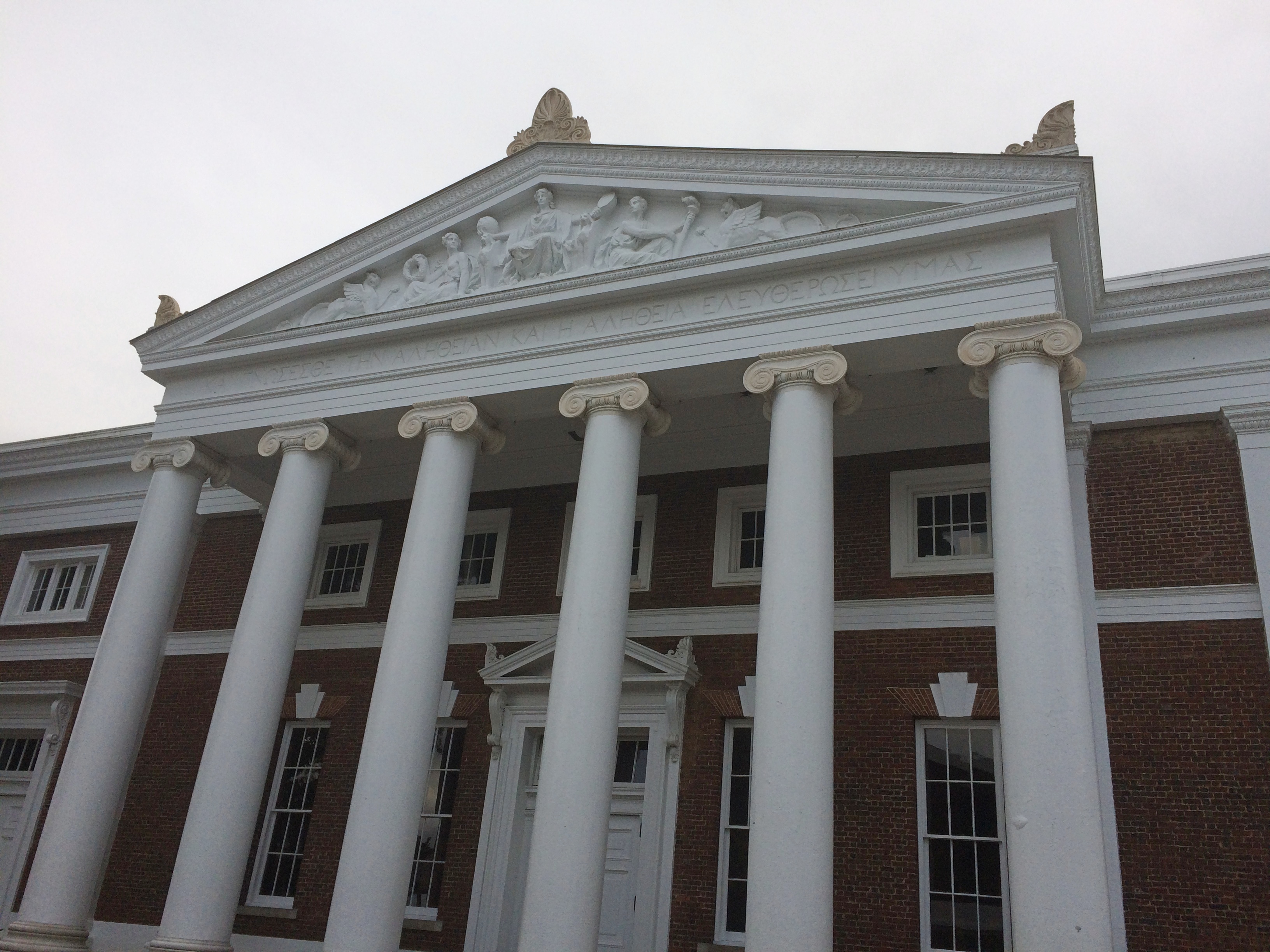
Monticello

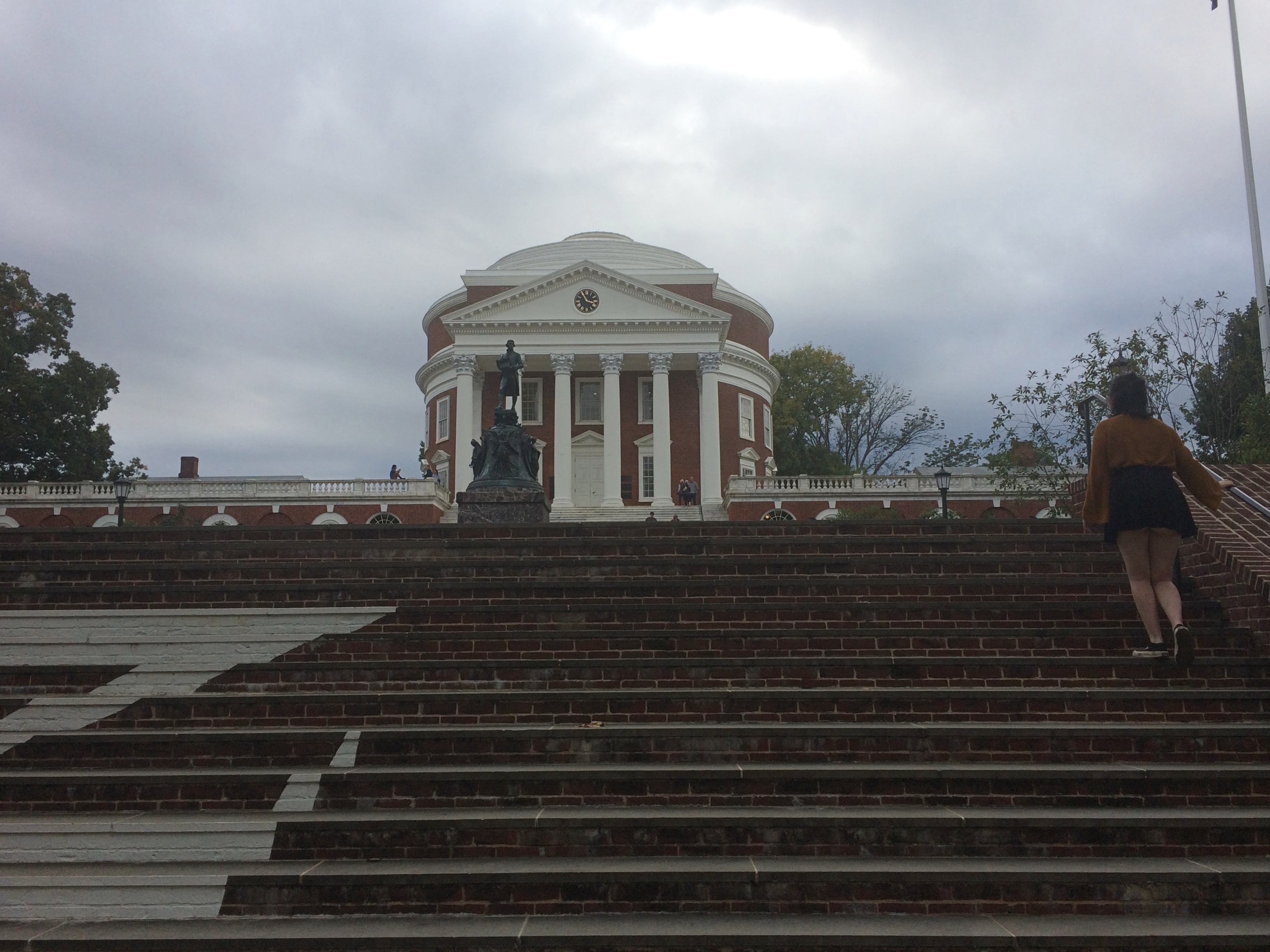
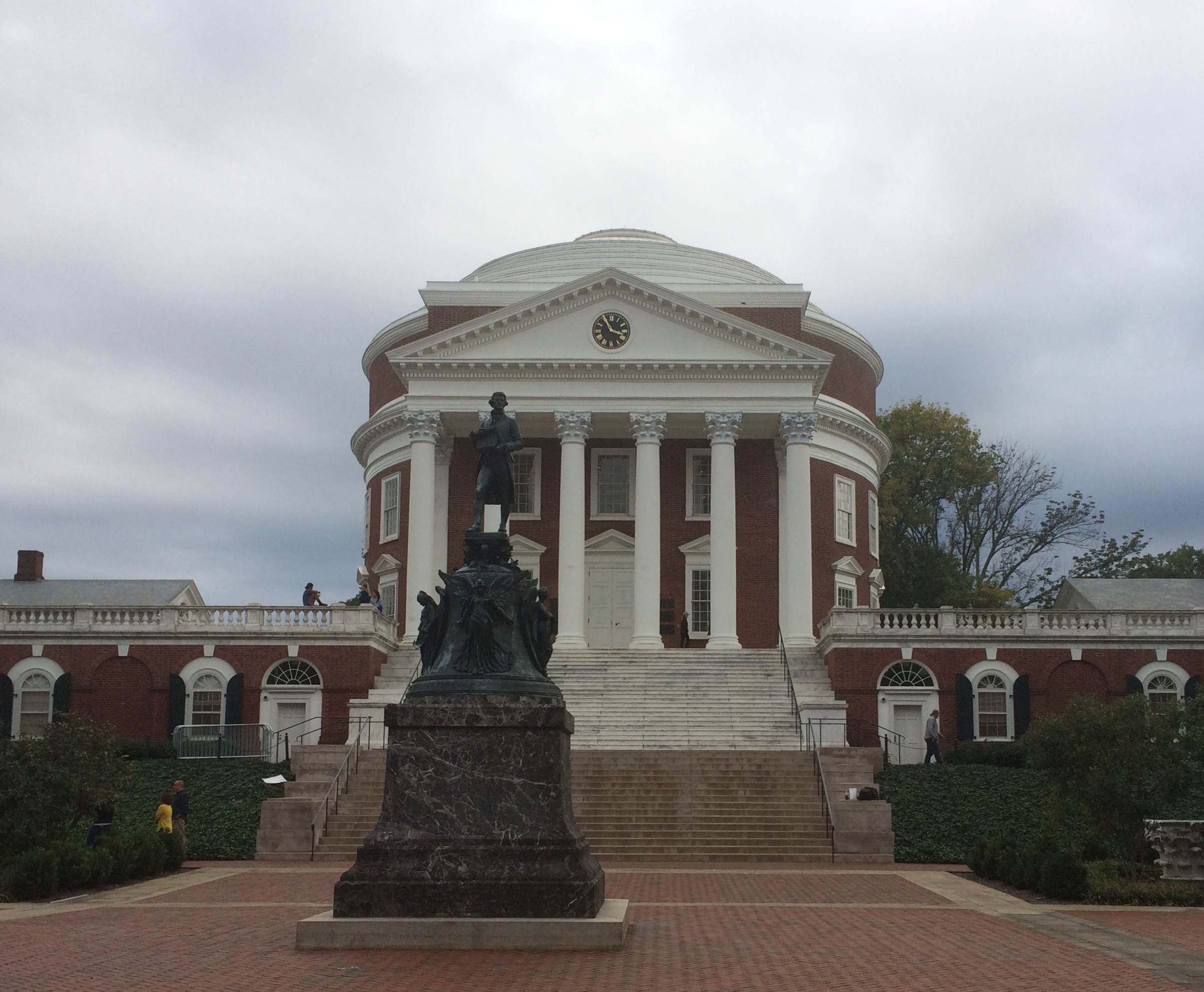
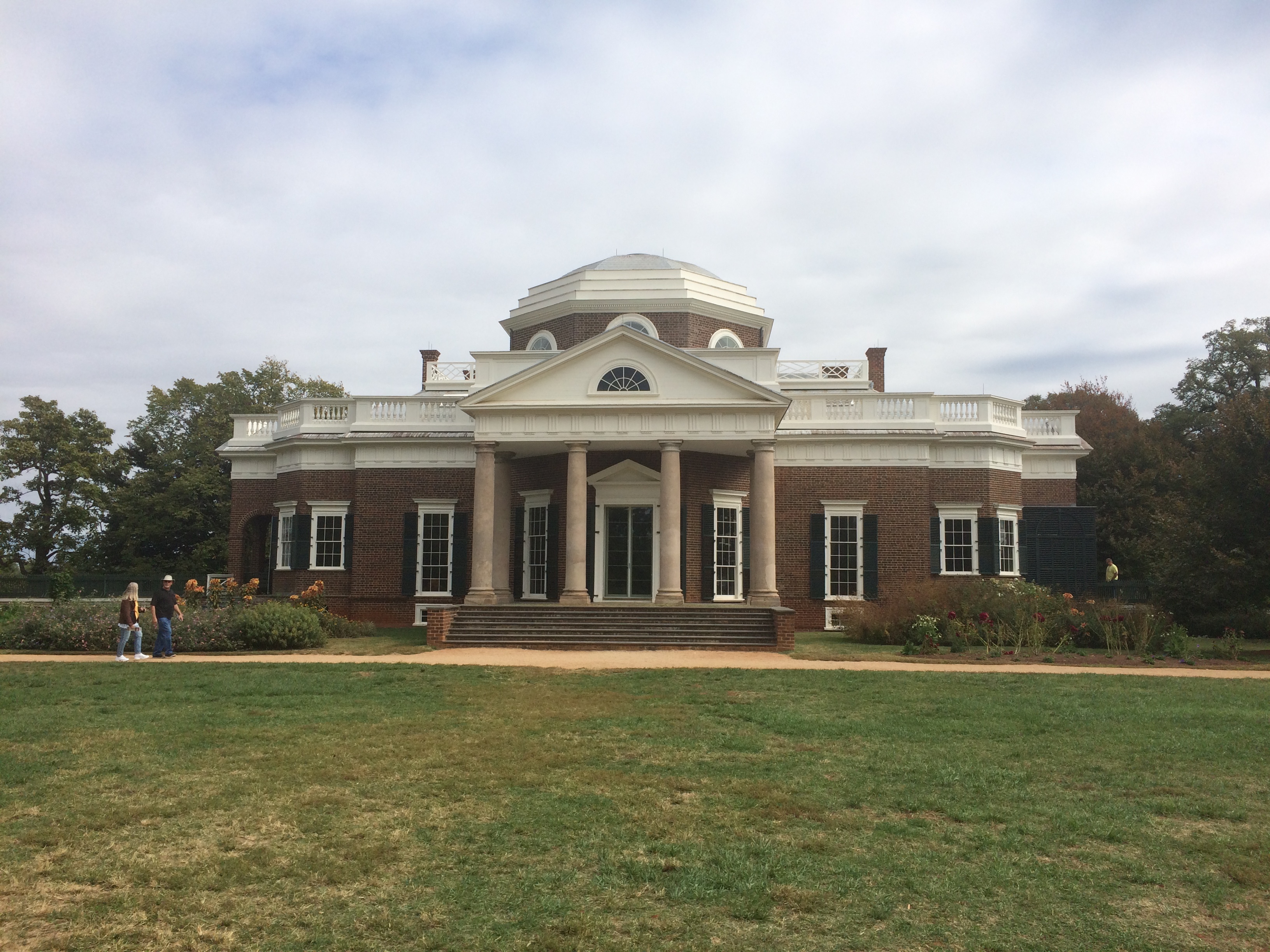
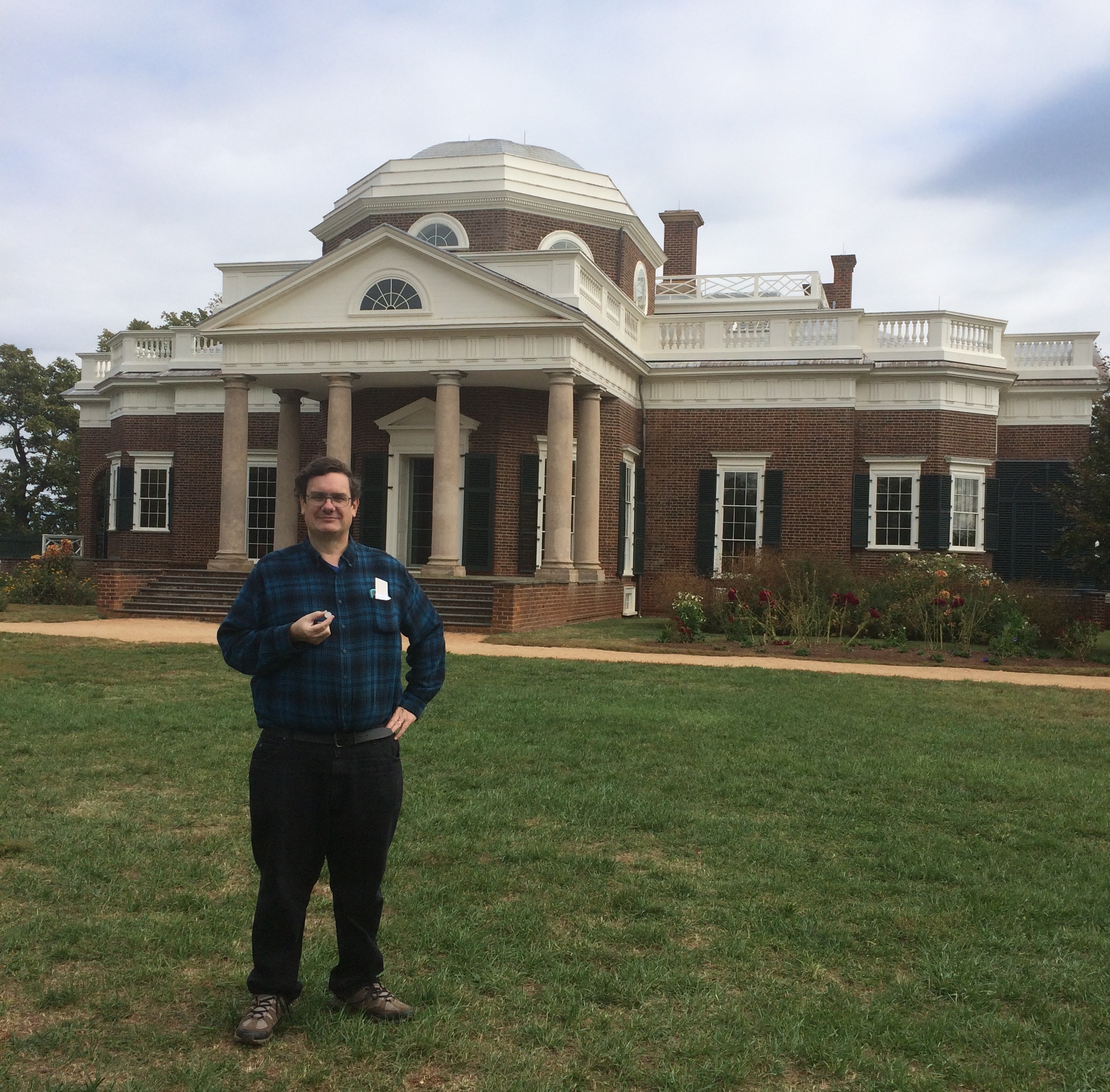
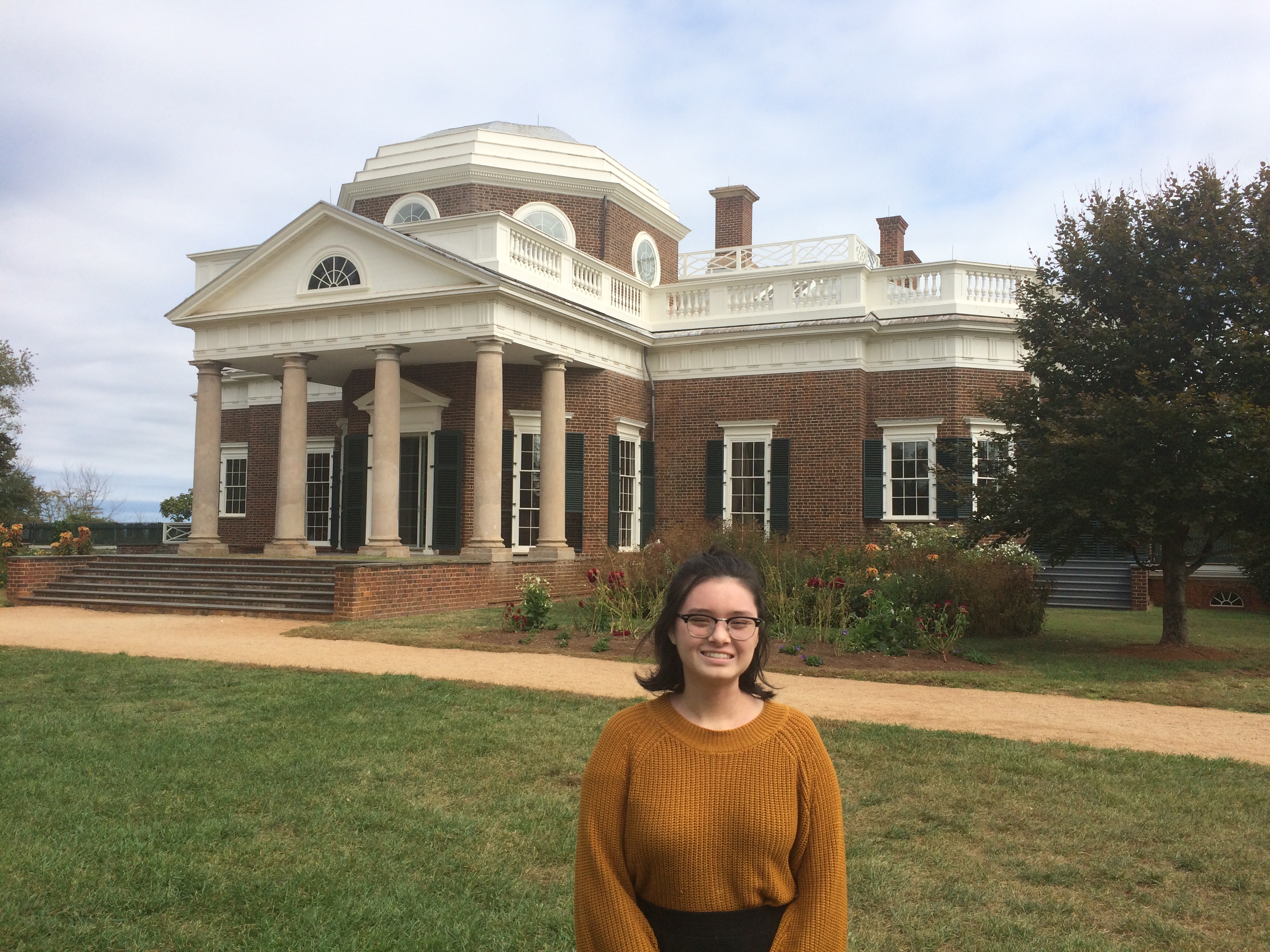
Here I am again, I thought as I stood on the west lawn of Monticello, a place of such enormous resonance, in the early afternoon of October 13, 2019. The nickel view.
MonticelloYet I had a hard time remembering much about my first visit, which was on September 4, 1988. Maybe that’s because 31 years is a long time. Or because the view of Monticello from the west lawn, which I’ve known as long as I’ve known Jefferson nickels — all my life, for all practical purposes — is as close as anything gets to changeless.

I do know that the first time I saw the building in person, I realized that the nickel has a uninspired representation of Monticello. Flat. In person, you see that it’s a place to gaze at from more than one angle.
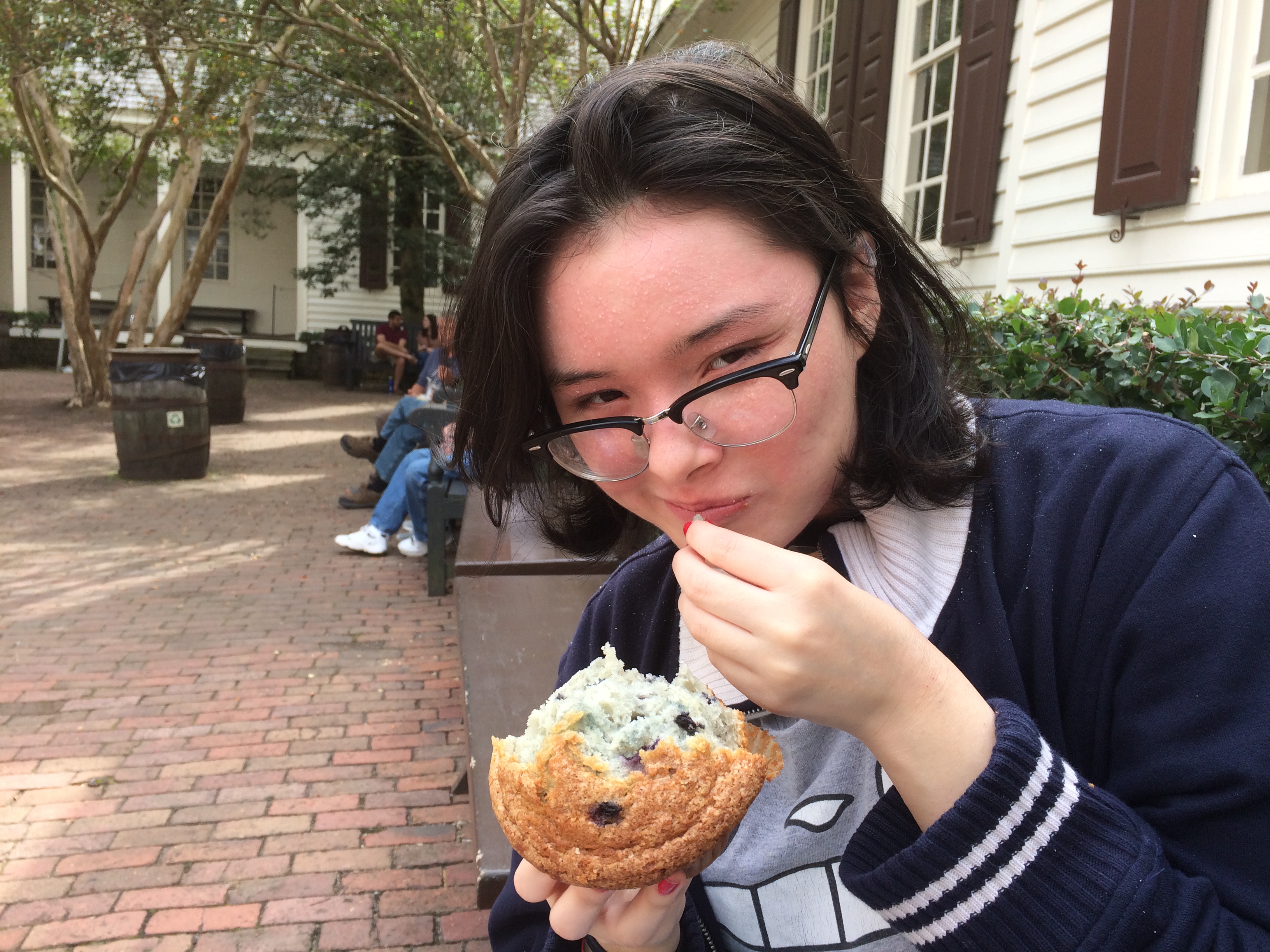
MonticelloI’m holding a nickel in this picture, by the way.
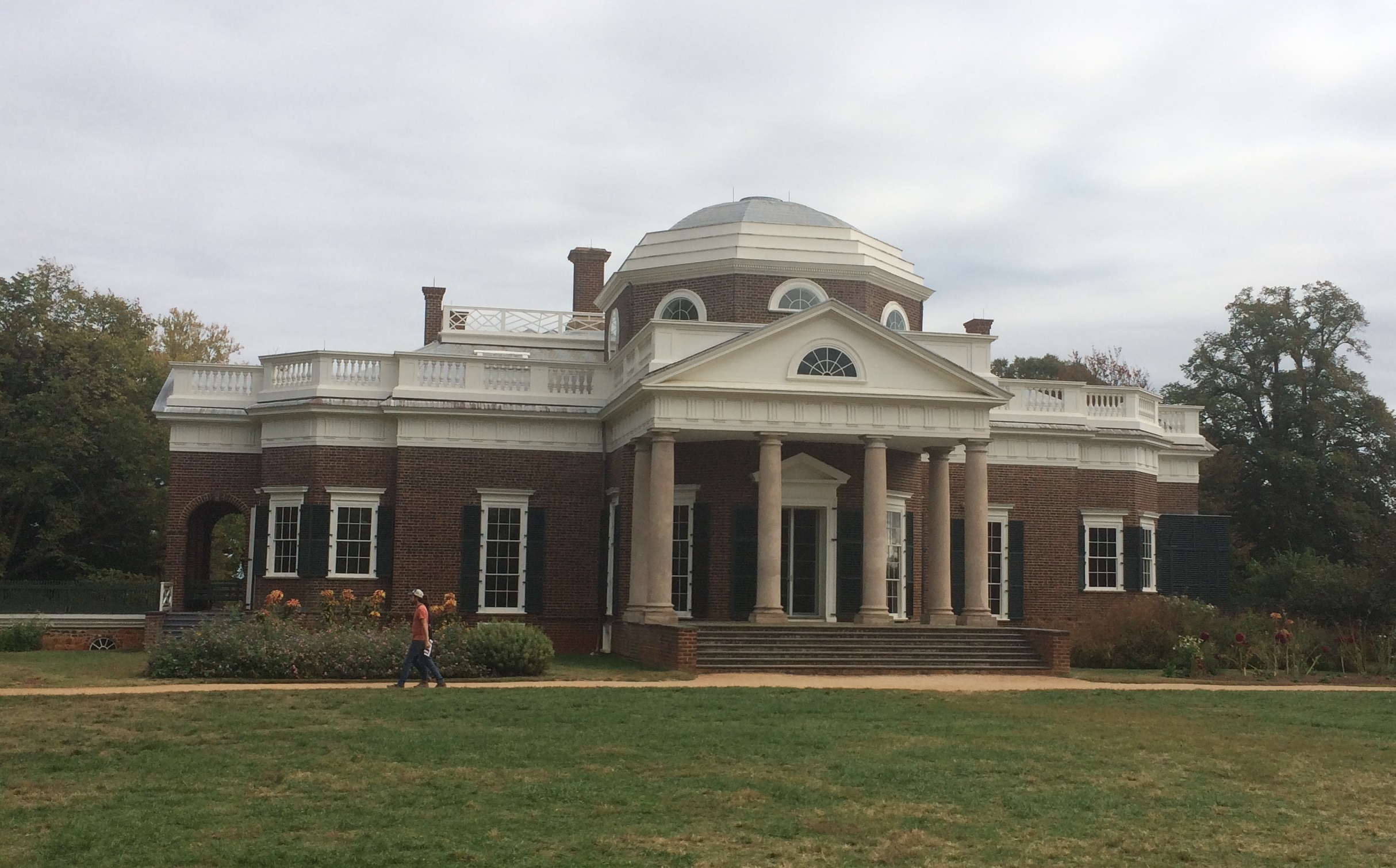
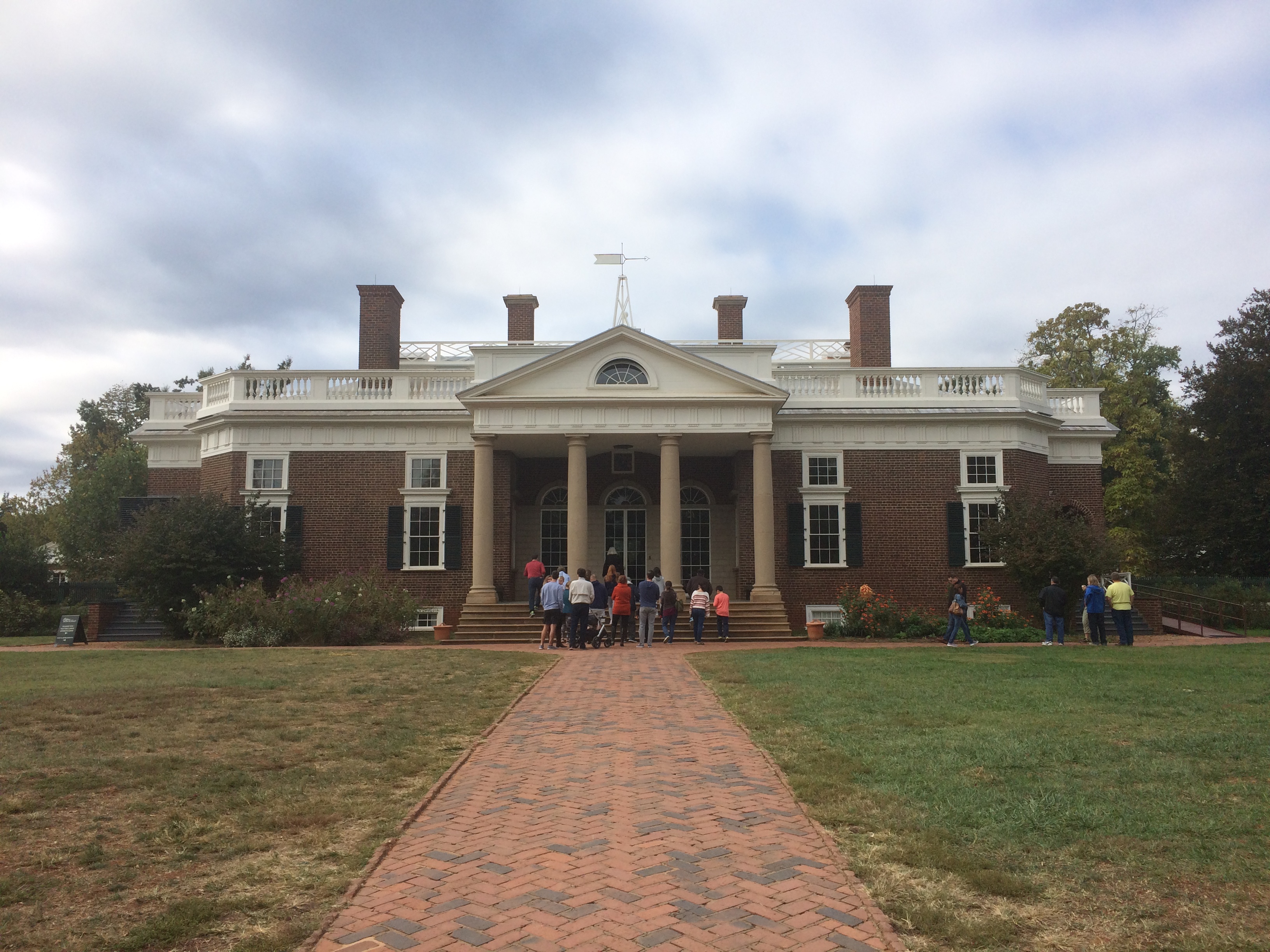
MonticelloMonticelloA look at the eastern elevation. I’m glad to say that the house sports lightning rods, unlike a hilltop structure in Wisconsin that’s going to burn down after a strike someday.
MonticelloThe east entrance is where the interior tours start. Actually, no. You’re not getting in the building without starting at the David M. Rubenstein Visitor Center, which is down the hill from Jefferson’s home. That’s something different from 1988. The 42,000-square-foot visitors center has only been there for about 10 years.

Exactly where we bought tickets back then, I don’t remember, but I suspect it was simpler facility — not like the five pavilion-complex of the Rubenstein. Also, there were no timed tickets the first time around. I even think our tour was self-guided. Nor did I experience the warren of interconnected parking lots next to the visitors center, which was largely full. There must have been parking in 1988, and it too must have been simpler, but who remembers things like that?
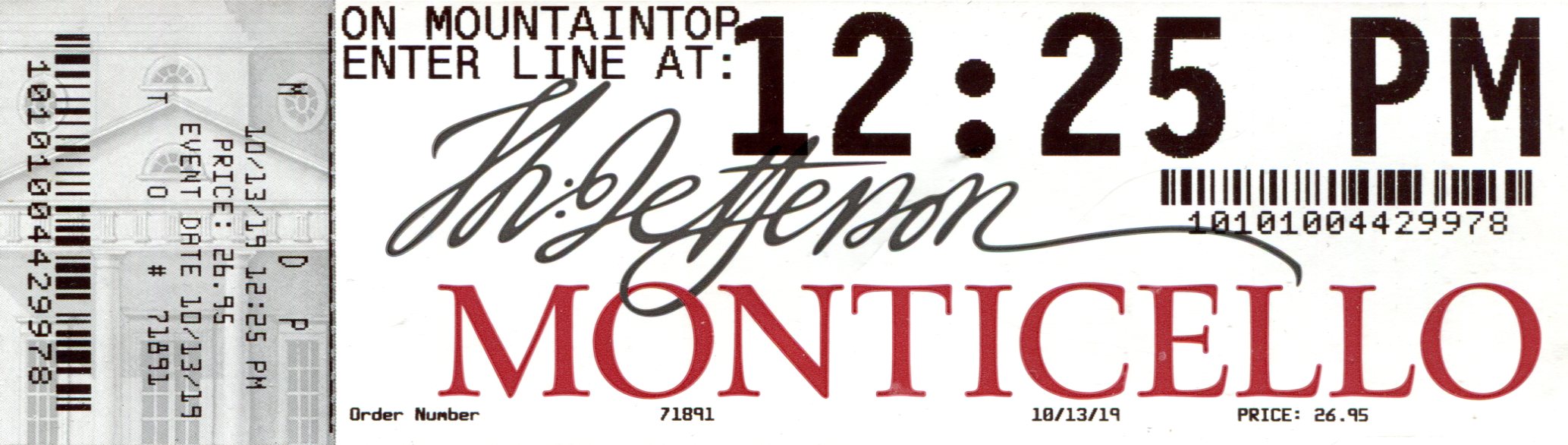
MonticelloAlso: this interesting chronology tells me that I paid $7 in 1988 for my ticket. That’s just over $15 in current dollars. Note the 2019 ticket price: $26.95. Guess that extra $12 is going to pay for ever-fancier guest infrastructure.

In 1925, not long after the house was opened to paying visitors, admission was 50 cents — the equivalent of $3.88 in 1988 and $7.34 now, so I suppose ticket inflation has been an ongoing thing at Monticello.

I originally bought tickets online for the 10:45 am tour, but jammed traffic on I-64 just outside Charlottesville put us at the visitor center at 10:50. The helpful clerk didn’t bat an eye at that, and put us on a 12:30 pm tour (meeting at 12:25).

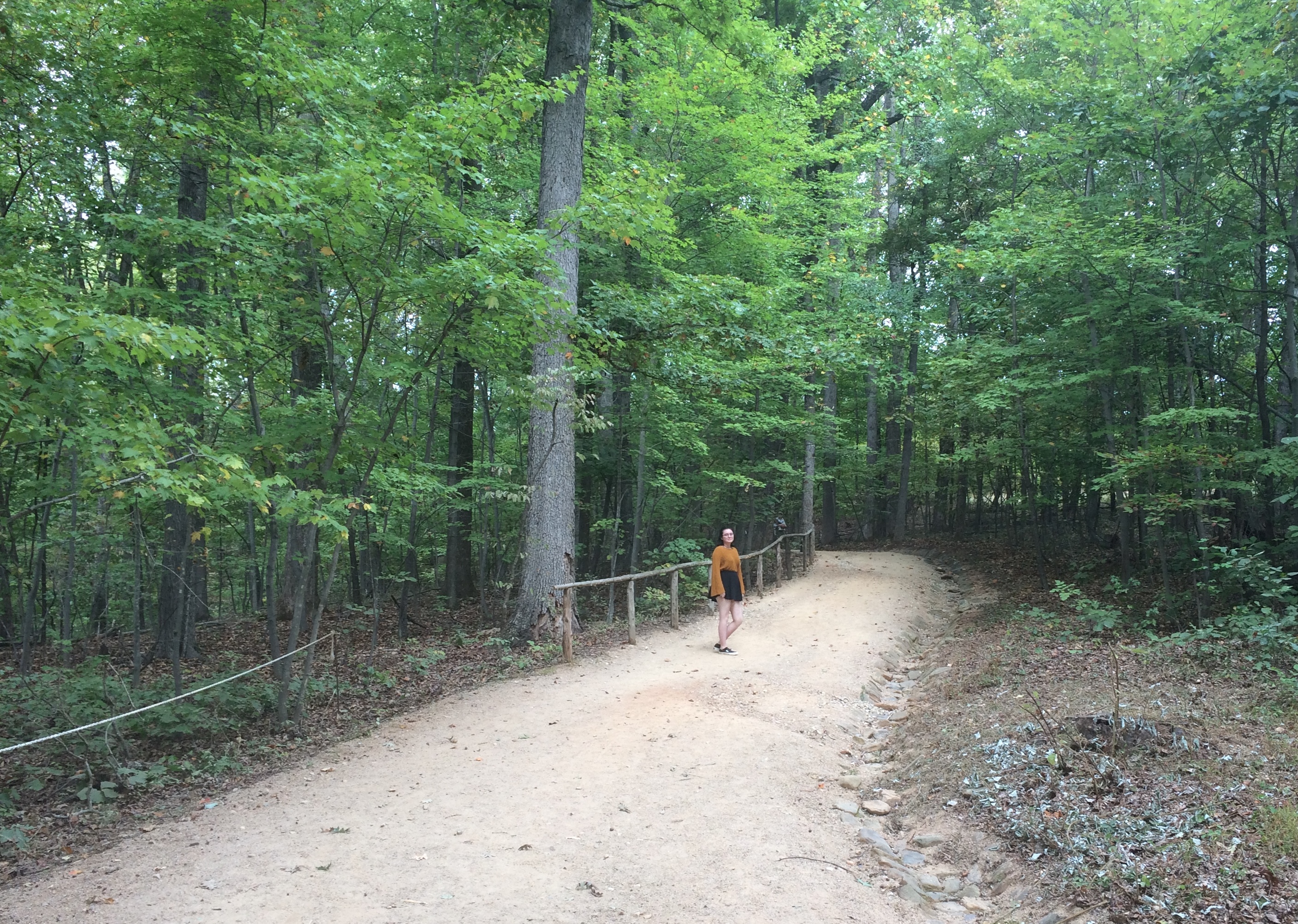
What that meant was that we had time to walk up the high hill to Monticello, as opposed to taking a shuttle bus, and stop roughly halfway up to see the Jefferson family graveyard, so it worked out for the best. Climbing gives you a sense of just how high the hill is. Besides, it’s a lovely path.
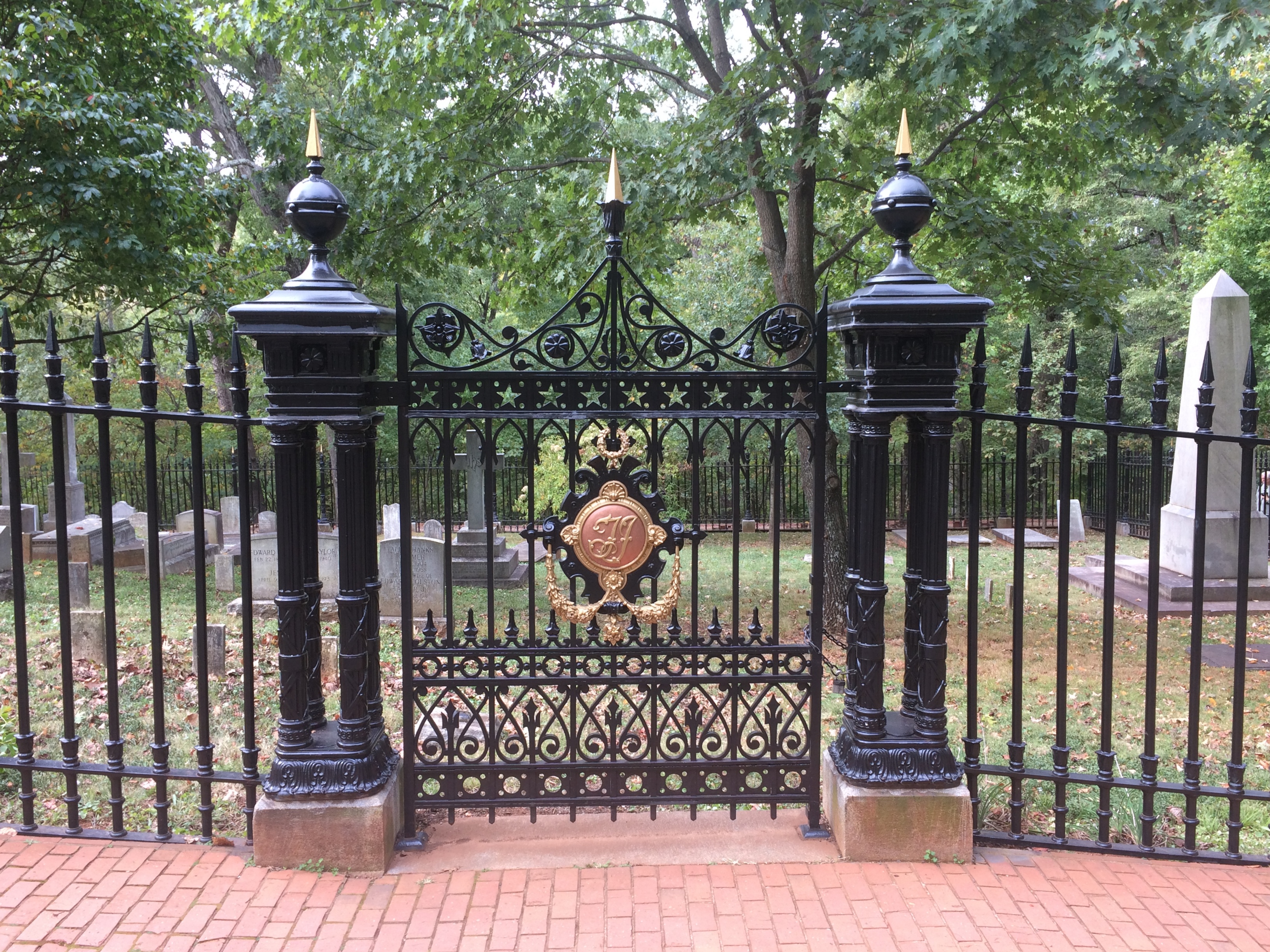
MonticelloThe burial ground is behind an ornate iron fence.
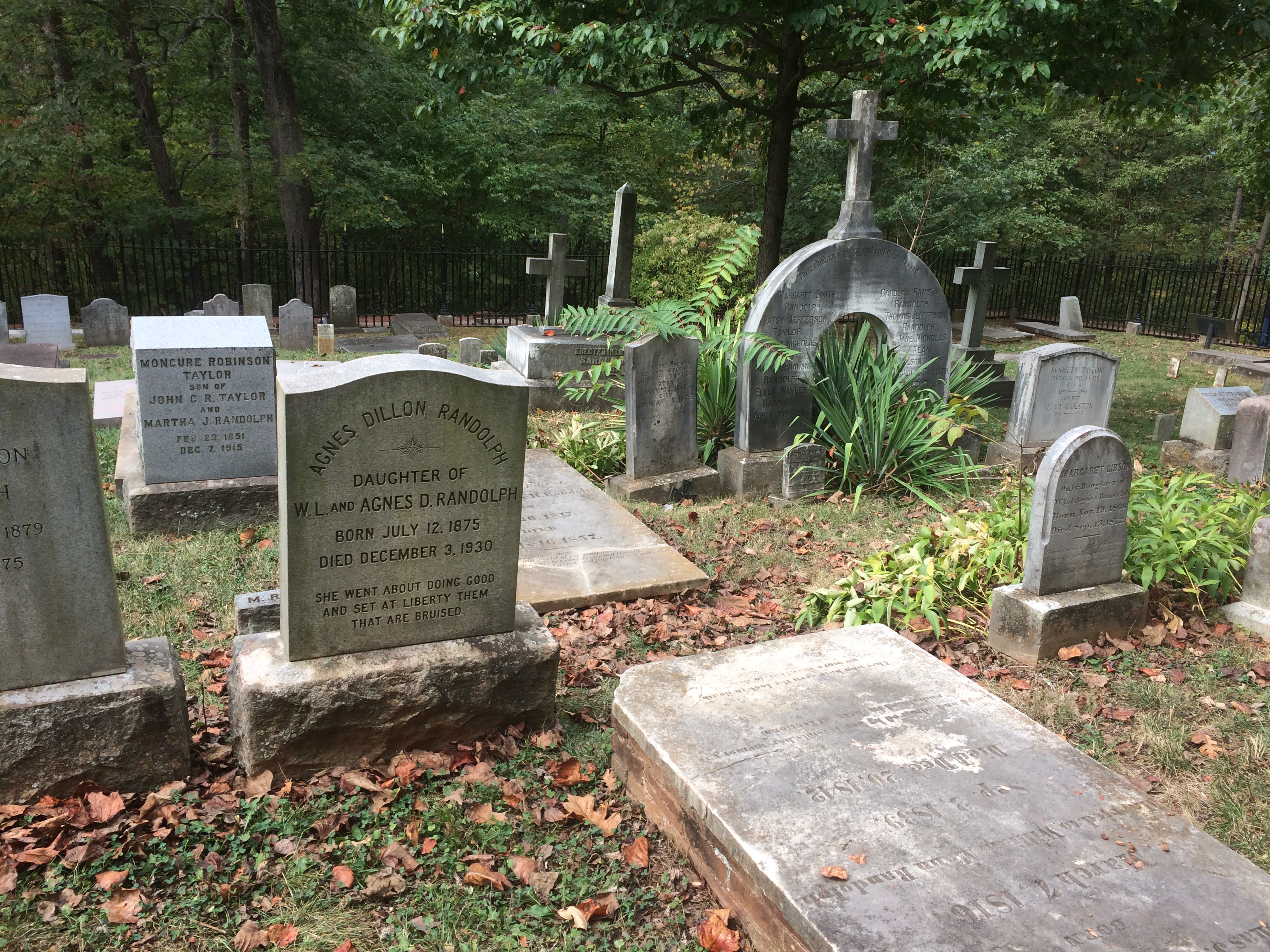
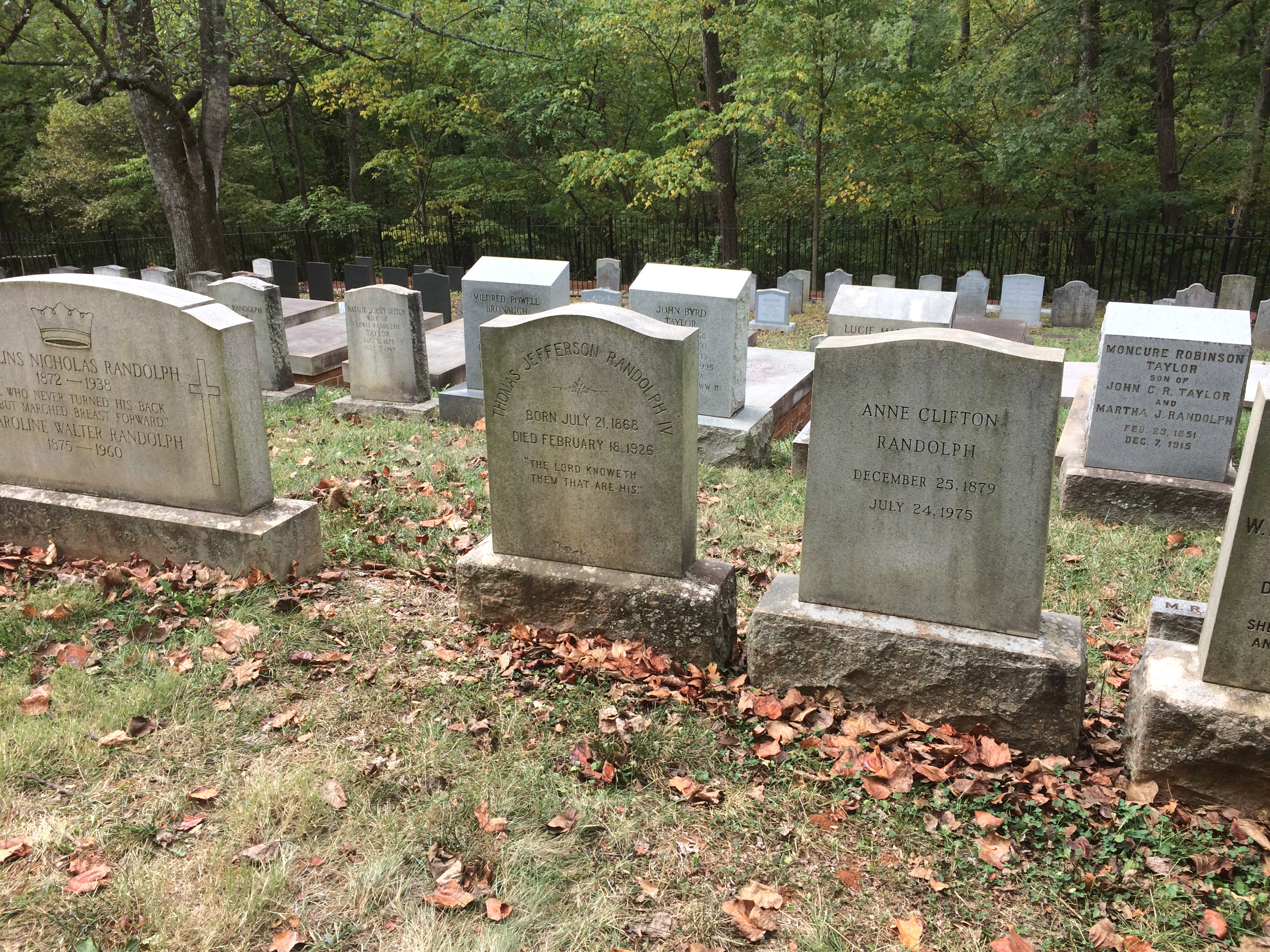
Monticello GraveyardMonticello GraveyardThere are a lot of Randolphs. Jefferson’s daughter Martha married a Randolph, and they were the fecund parents of 13 children, 11 of whom survived childhood.
Monticello GraveyardPresident Jefferson himself.
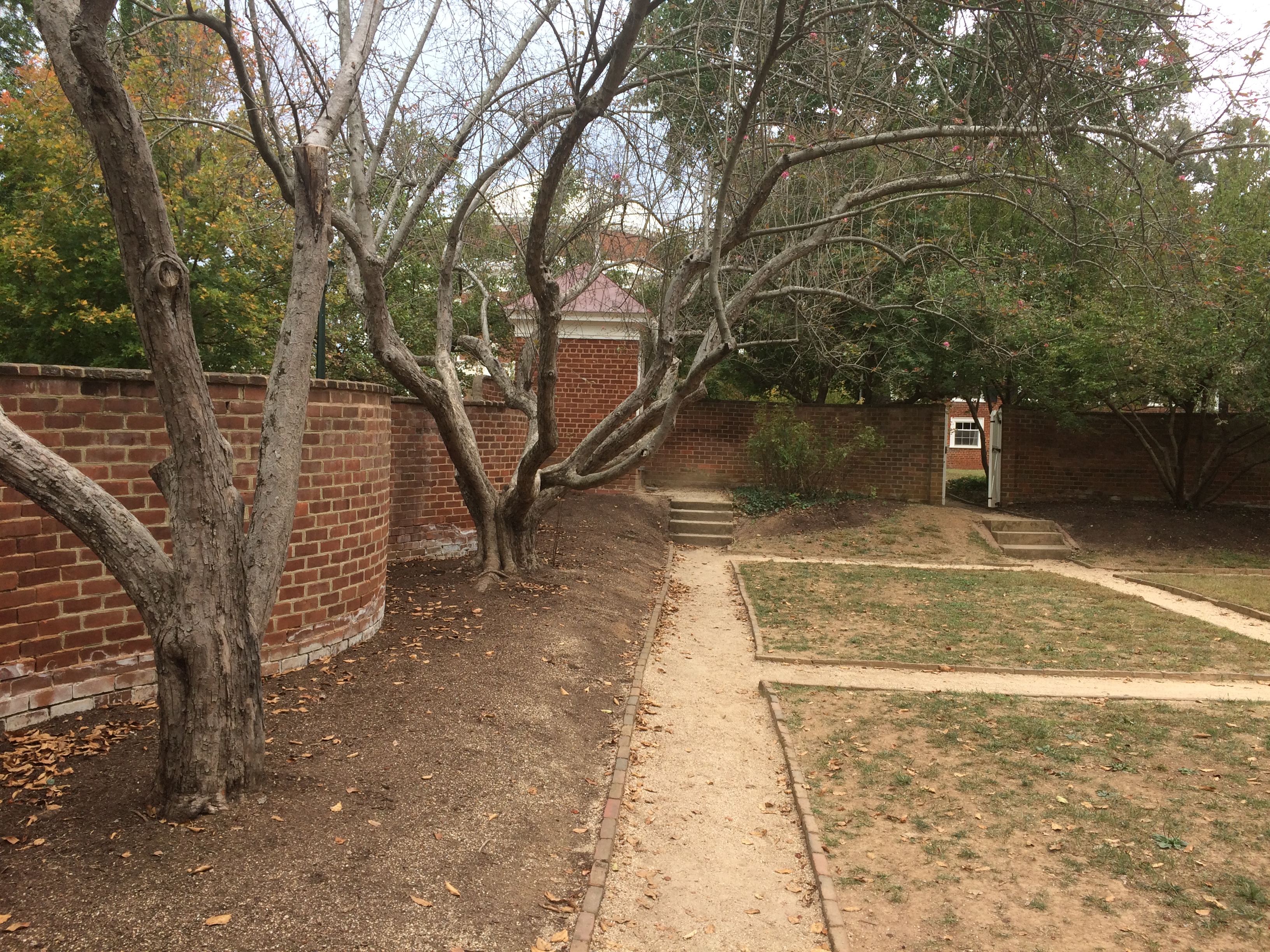
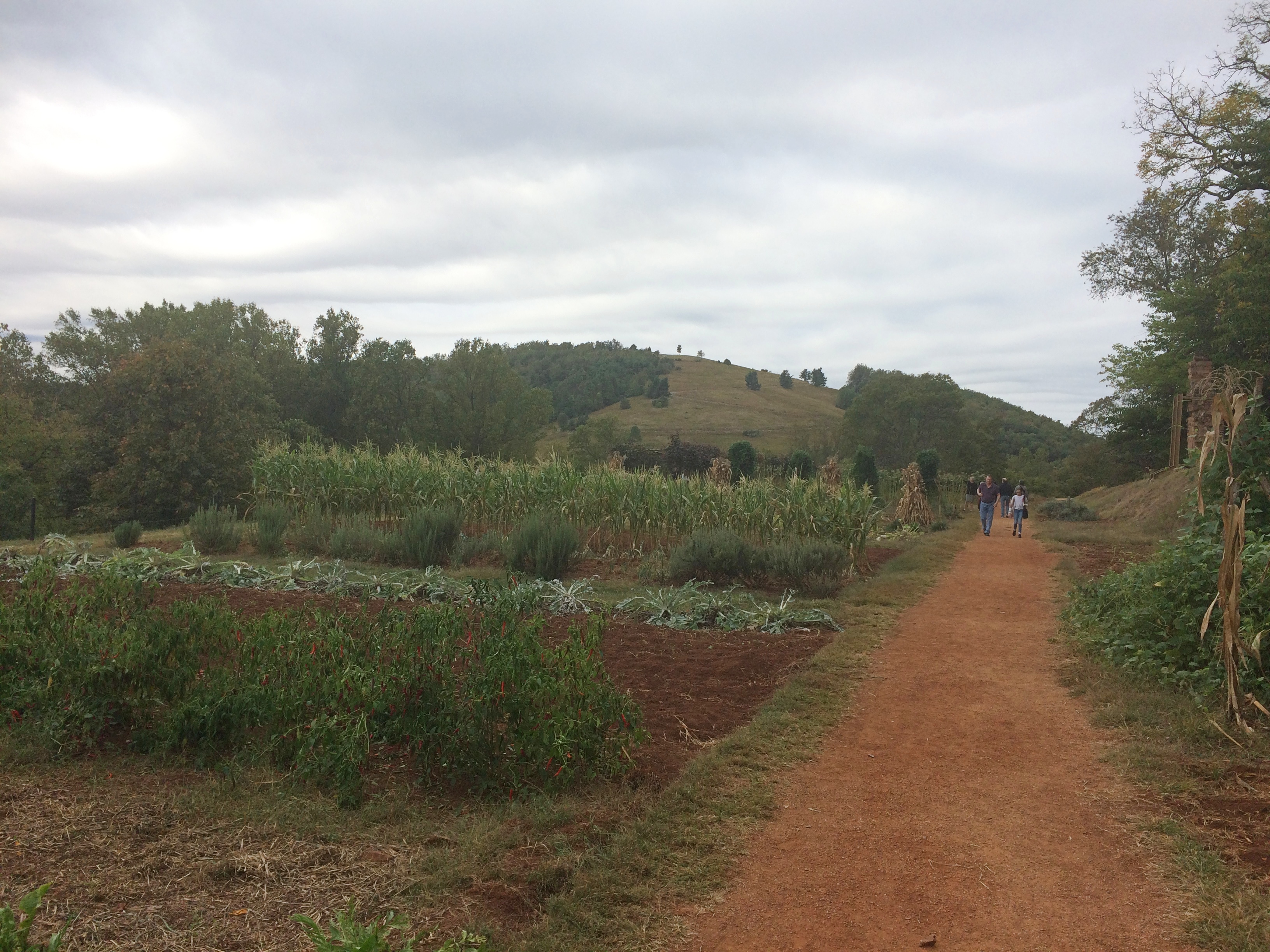
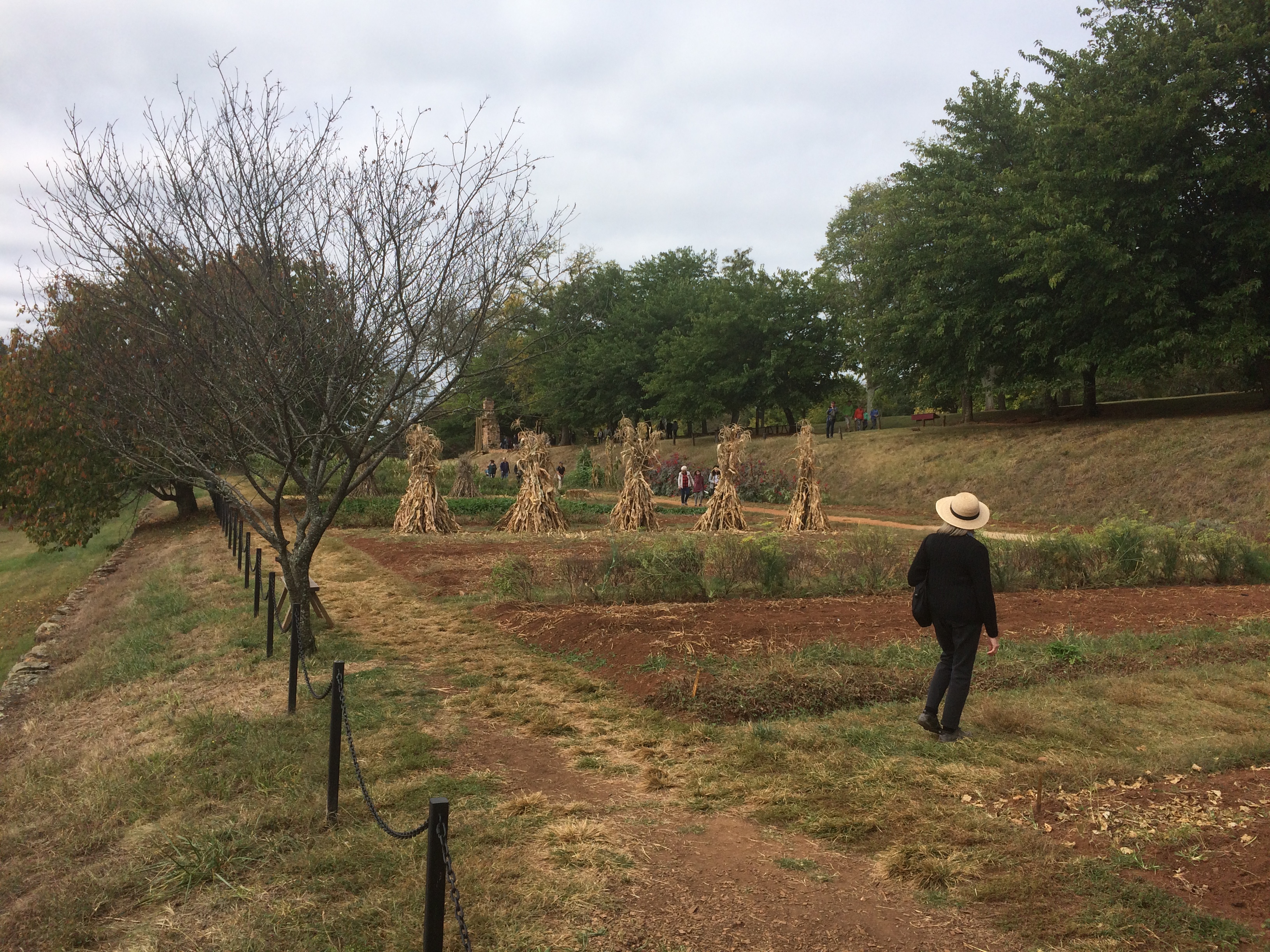
Monticello GraveyardThe path from the burial ground to Monticello proper takes you past the re-created garden, planted on a long terrace dug out of the side of the hill. In October, most of the vegetables have been harvested already, but some still linger.

Monticello Graveyard

Monticello GardenThe house tour, lead by a lively gray-haired gentleman who was probably a retired teacher, took us through the first floor, beginning with the entrance hall and its displays of Indian artifacts and animal horns and paintings and maps and such. Museums as such didn’t much exist in early Republic Virginia, so Jefferson created one for himself.

Then I remembered the Great Clock, hanging over the main entrance, from last time. A favorite of mine.

Other rooms feature books, furniture, paintings — including a Gilbert Stuart portrait of Jefferson probably painted when he was president — more books, oddly placed beds, scientific instruments, papers, clocks, busts, yet more books, and the dumbwaiter that he had installed to fetch wine from the cellar below, something else I remembered from 30 years ago. It’s an admirable clutter.

After Jefferson sold much of his library to the U.S. government to form the nucleus of the revived Library of Congress after the British burned the original one in 1814, he started accumulating books again. The only reasonable thing to do, and hang the cost. Libraries as such didn’t much exist in early Republic Virginia, so Jefferson created one for himself. Twice.

From Monticello’s FAQ:

Who built the house?

Local white masons and their apprentices did the stone and brickwork. Local carpenters, assisted by several Monticello slave carpenters, provided the rough structural woodwork. The fine woodwork (floors, cornices, and other moldings) was the work of several skilled white joiners, hired from as far away as Philadelphia. One Monticello slave, John Hemmings, who trained under the white workman James Dinsmore, became a very able joiner and carpenter.

How much did the house cost?

No one so far has managed to calculate the cost of Monticello with any degree of accuracy.

That is, the house was a money pit for the third president.

We also spent some time looking around the exhibits in the North and South Pavilions, which are structures that branch away from the main house, though they don’t seem directly connected. We poked around such places as the wine cellar and the beer cellar next to it, plus the elaborate kitchen, which naturally wasn’t part of the main house. When you dined with Thomas Jefferson, the feast must have been sumptuous.

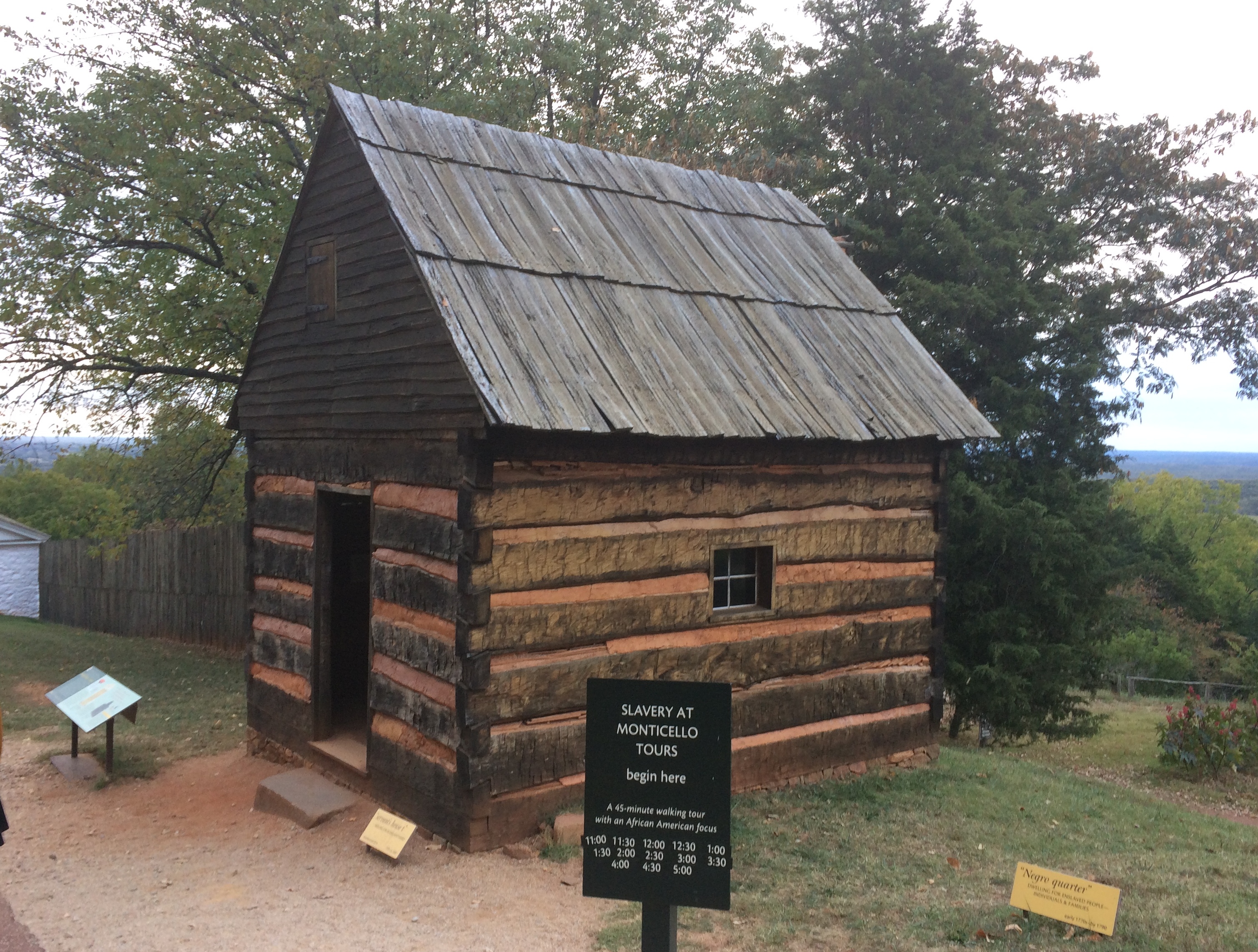
There are a few outbuildings. Such as this slave cabin replica, built since I visited last time.
slave cabin MonticelloI don’t remember exactly how much emphasis Monticello put on slavery during my first visit. I suspect it was a matter not of denying it, but not talking much about it either.
I can report that in 2019, not only does Monticello not deny the importance of enslaved labor at the house and farm, or the humanity of the enslaved, the official texts talk about it quite a lot. Including the Sally Hemings and Hemings family story — which rates a room of its own in one of the pavilions and a video. That pendulum has swung.

The American Civil War Museum

I wasn’t in the best frame of mind when we got to the American Civil War Museum in Richmond on October 12. I expected an easy drive from where we parked, near the capitol, to the museum, which is at the site of the former Tredegar Iron Works on the James River.

No such luck. The Richmond Folk Festival had gummed up everything along the river, blocking all vehicular access, so after some time in sluggish traffic, we went back to the same parking lot near the capitol — luckily my receipt was good for the whole day — and walked the half mile or so to the museum. Not a bad walk, but it made me tired ahead of a walk through a museum. Such is the tourist experience, sometimes.

At first I thought the museum was in the multistory brick building.
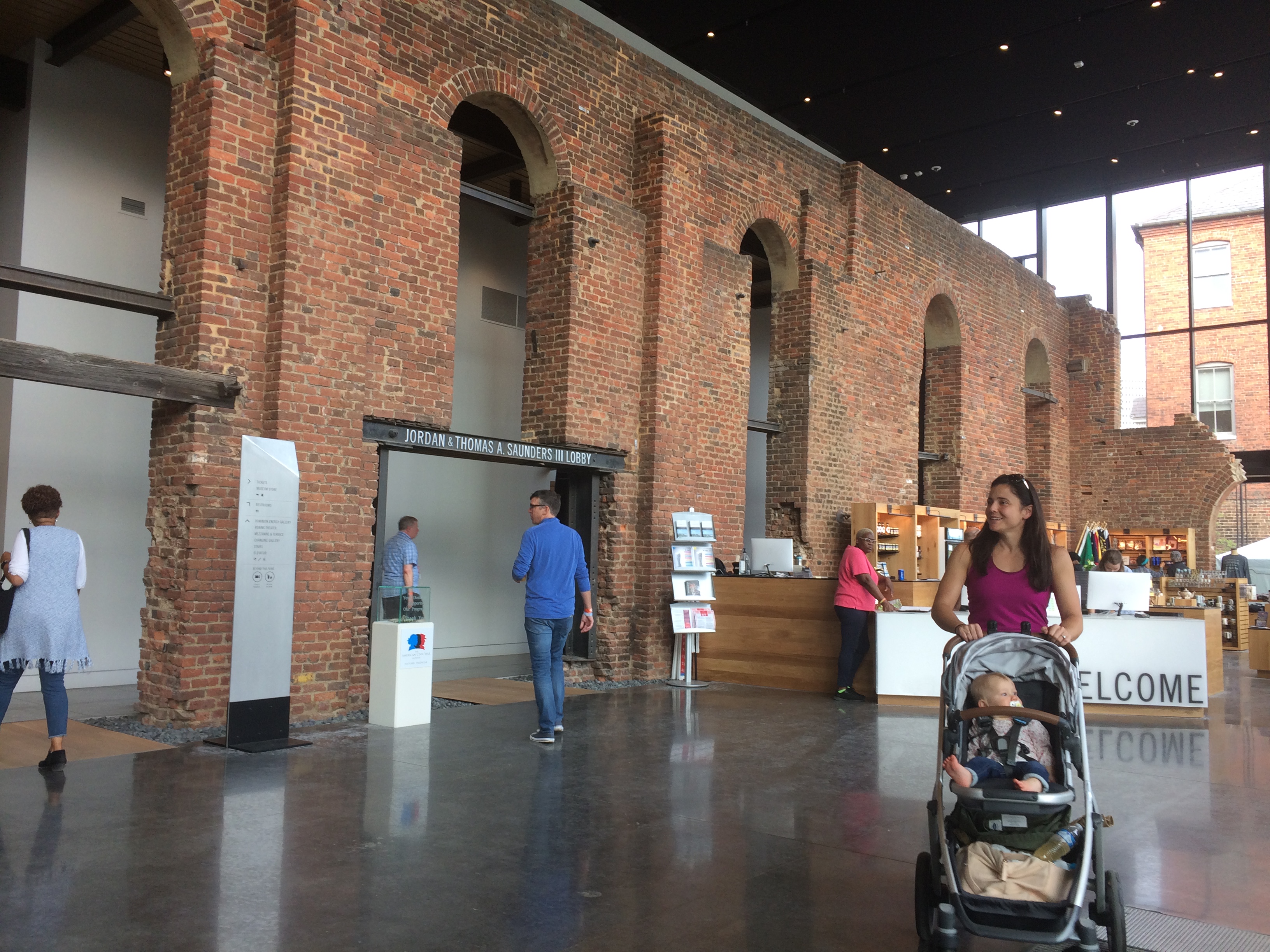
American Civil War Museum RichmondWrong again. That building houses the visitors center and a Civil War museum associated with the Richmond National Battlefield Park, a NPS entity that encompasses that part of Tredegar along with a dozen Civil War sites around Richmond.

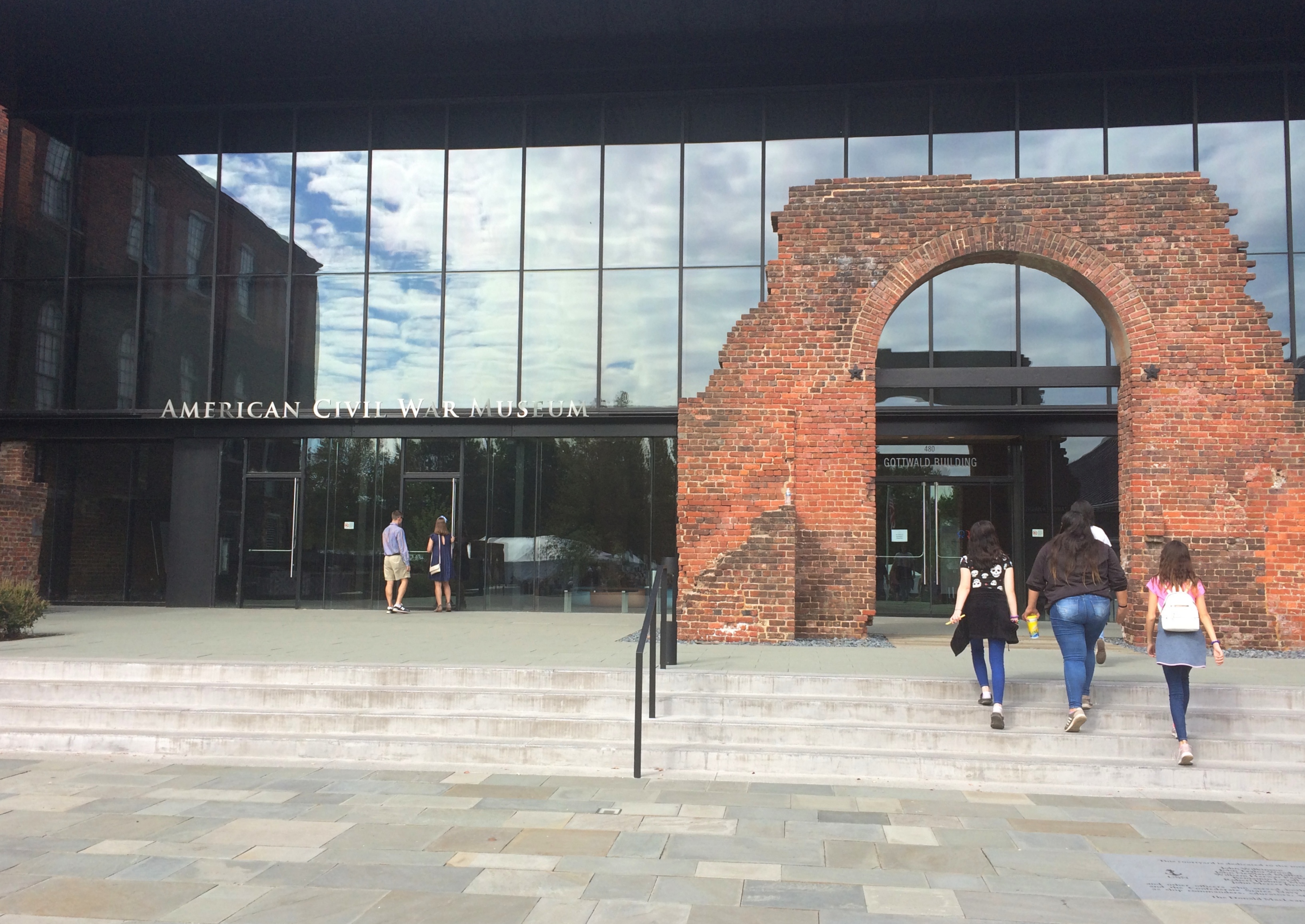
The new building for the American Civil War Museum — opened just this year — is the modernist structure next to the brick building, though it incorporates some of the other Tredegar ruins. Designed by a local architectural firm, 3North, the museum isn’t overly large, coming in at 28,000 square feet.

American Civil War Museum Richmond

American Civil War Museum Richmond

We spent a couple of hours at the museum. Though a little frazzled when I got there, I soon got into the groove of the place and mostly enjoyed my time there. Ann did too. The permanent exhibits wind through the first floor, featuring things you’d expect in a museum devoted to the history of a war: military and civilian artifacts, photos, maps (though not enough), things to read, a few interactive kiosks, audio narratives and videos and so on.
Perhaps the most striking features are the large-scale photographic images placed on various walls or hanging over display cases. They are images of people alive during the conflict, and are all colorized. Only a few years ago, the colorization might have bothered me, but since seeing They Shall Not Grow Old, I appreciate artful colorization, which the museum manages to do.

Some of the artifacts were particularly intriguing, such as the carvings that prisoners of war made from whatever material they had at hand, some of them exceptionally fine — that they then traded for food or tobacco or whatever else they badly needed. Other artifacts edged into the realm of oddities, such as a fossilized biscuit from the siege of Vicksburg and a luckless soldier’s a pocket journal, split by the bullet that killed him.

As at a number of other museums I’ve seen focusing on the 19th century, the most unnerving artifacts are the medical tools. The American Civil War Museum has a collection on display, along with a some poor bastard’s primitive prosthetic arm.

I also encountered some incidents and stories about the war that I’d never heard. Of course, the Civil War is a sprawling subject, with countless untold or undertold narratives. The museum has a knack for illustrating some of them. For instance, the New York Draft Riot is covered in some detail. No surprise there. But so is the lesser-known Richmond Bread Riot of 1863. Always good to learn about something like that.

As interesting and informative as the museum was, I came away feeling a little unsatisfied. I wasn’t sure why. On later reflection, I worked it out. It isn’t that the museum eschews glorifying the Lost Cause, which I’m sure bothers some people. I wouldn’t have expected anything else from a museum created by serious historians.

Rather, I missed the generals ‘n’ battles approach to the story of the war. Though not as pernicious as the Lost Cause, modern historians usually shy away from that too.
The museum mentions many of the military engagements of the war, sometimes in some detail, but that isn’t the thrust of most of the exhibits. Rather, the American Civil War Museum takes an almost sociological approach to the war.

That is, how the war affected all of 19th-century American society. Soldiers, naturally, but also white civilians, male and female, blacks, free and enslaved, immigrants and others. Is that a good way to organize a civil war museum? Probably yes. Still —

That I felt the absence of generals ‘n’ battles says more about me, and how I’ve conditioned myself with the books I’ve read and the movies I’ve watched and the battlefields I’ve visited over the years, than it does any historic study of the period. Even so, that’s how I felt.

The Richmond National Battlefield Park facility next door, which we also visited (though for a much shorter time), seemed more traditional in that regard, if only because it focuses on the fighting around Richmond. There you can see large maps depicting the movements of armies, for instance.

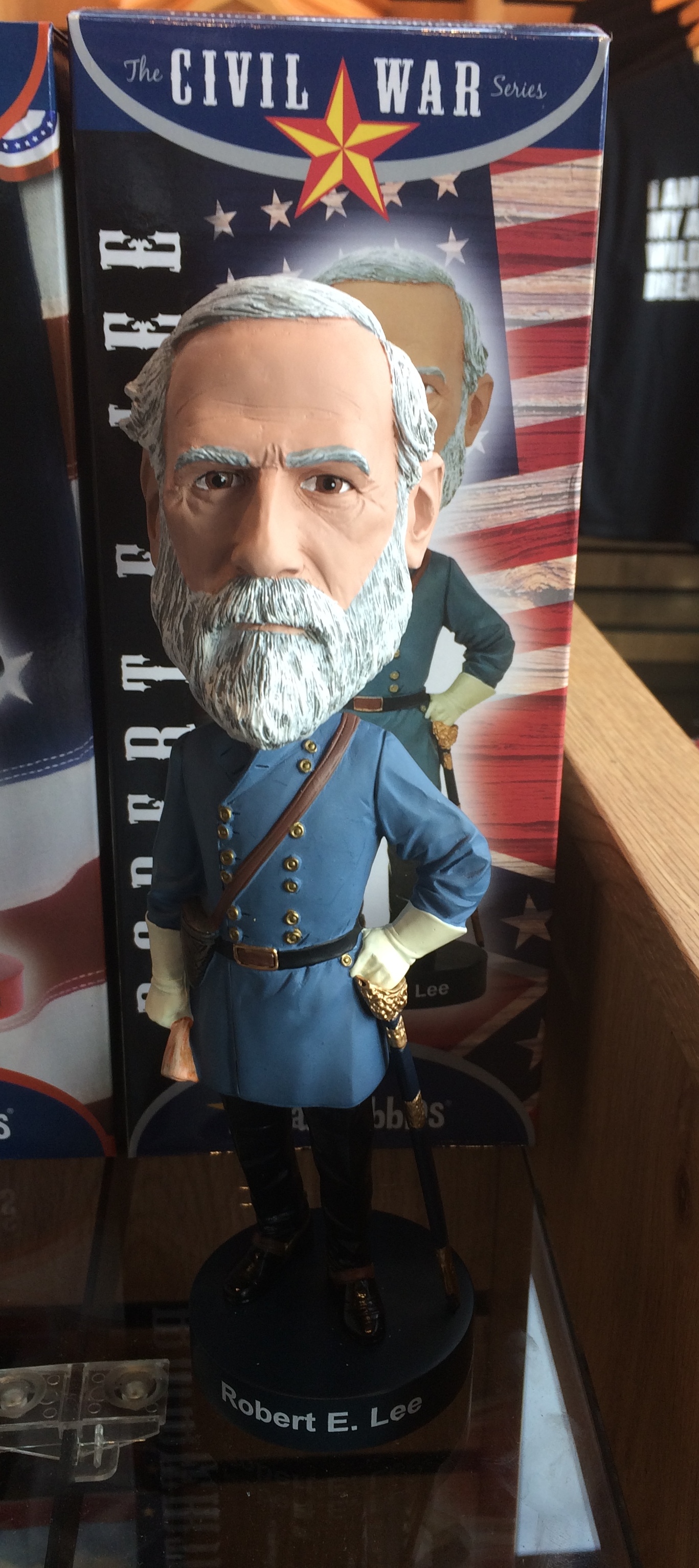
I can’t be the only one who feels this way. Oddly enough, the American Civil War Museum acknowledges that, perhaps unconsciously, in its gift shop. Generals ‘n’ battles is alive and well there.

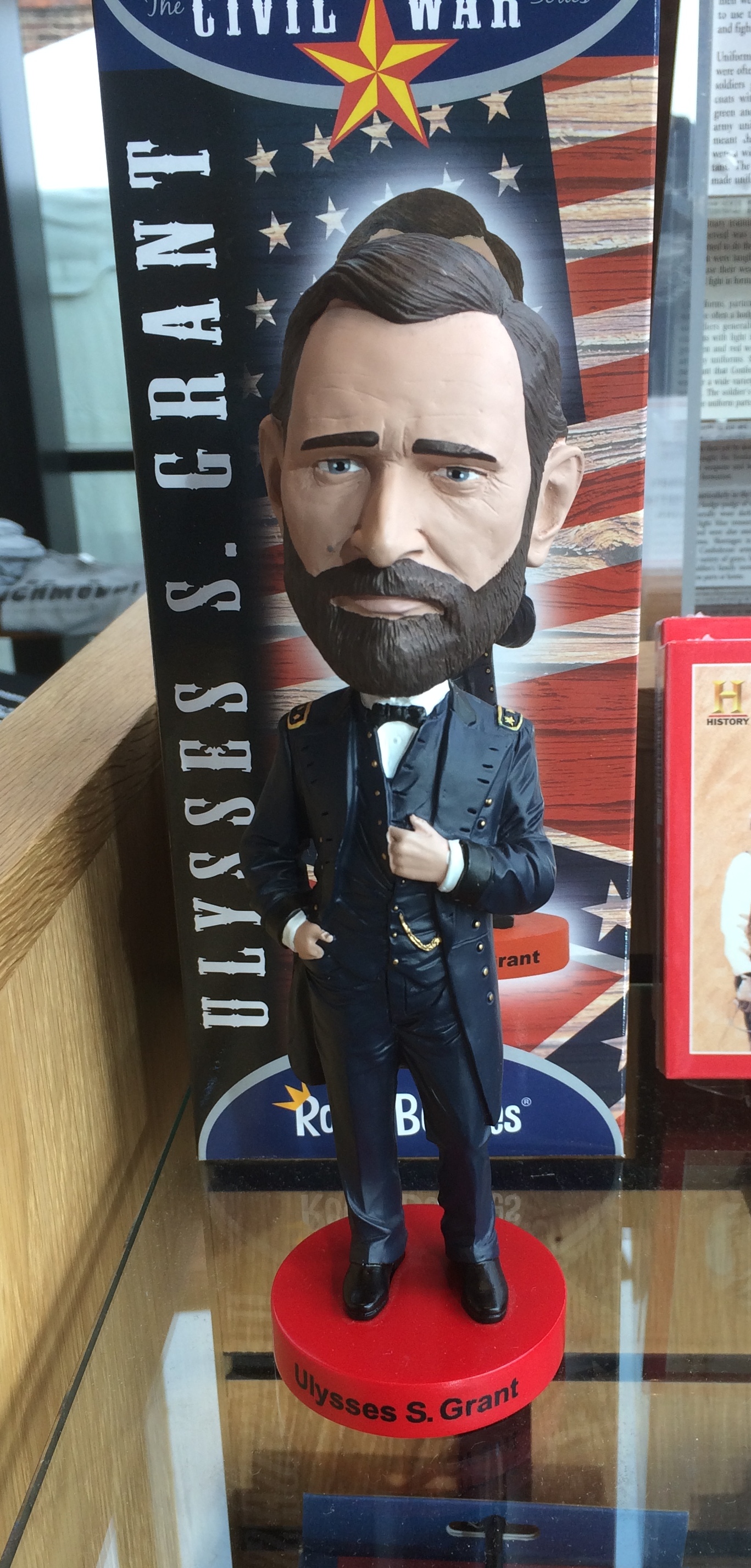
In the form of Lee and Grant bobbleheads, for one thing.

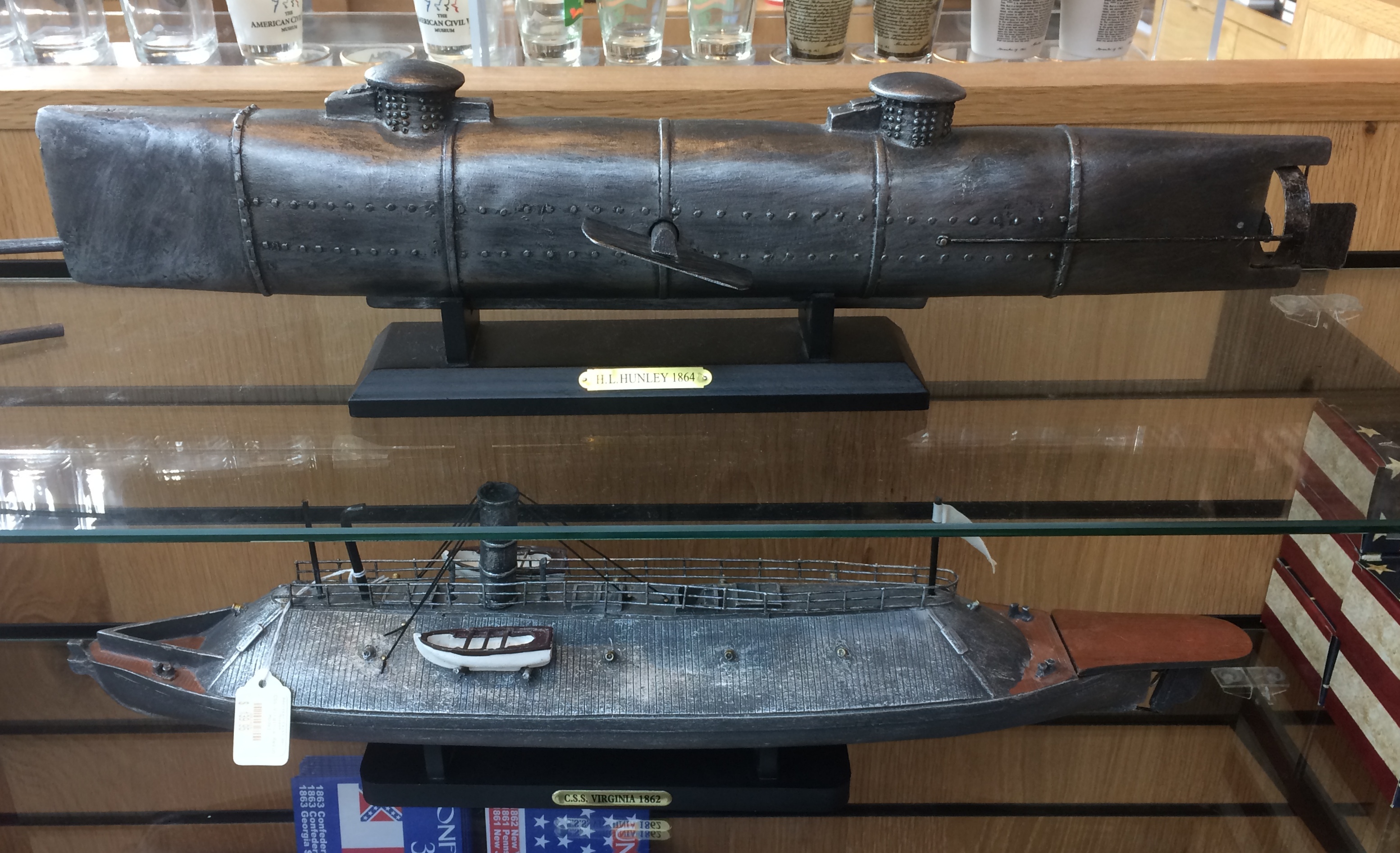
American Civil War Museum RichmondAmerican Civil War Museum RichmondModels of the submarine boat Hunley and the ironclad Virginia.
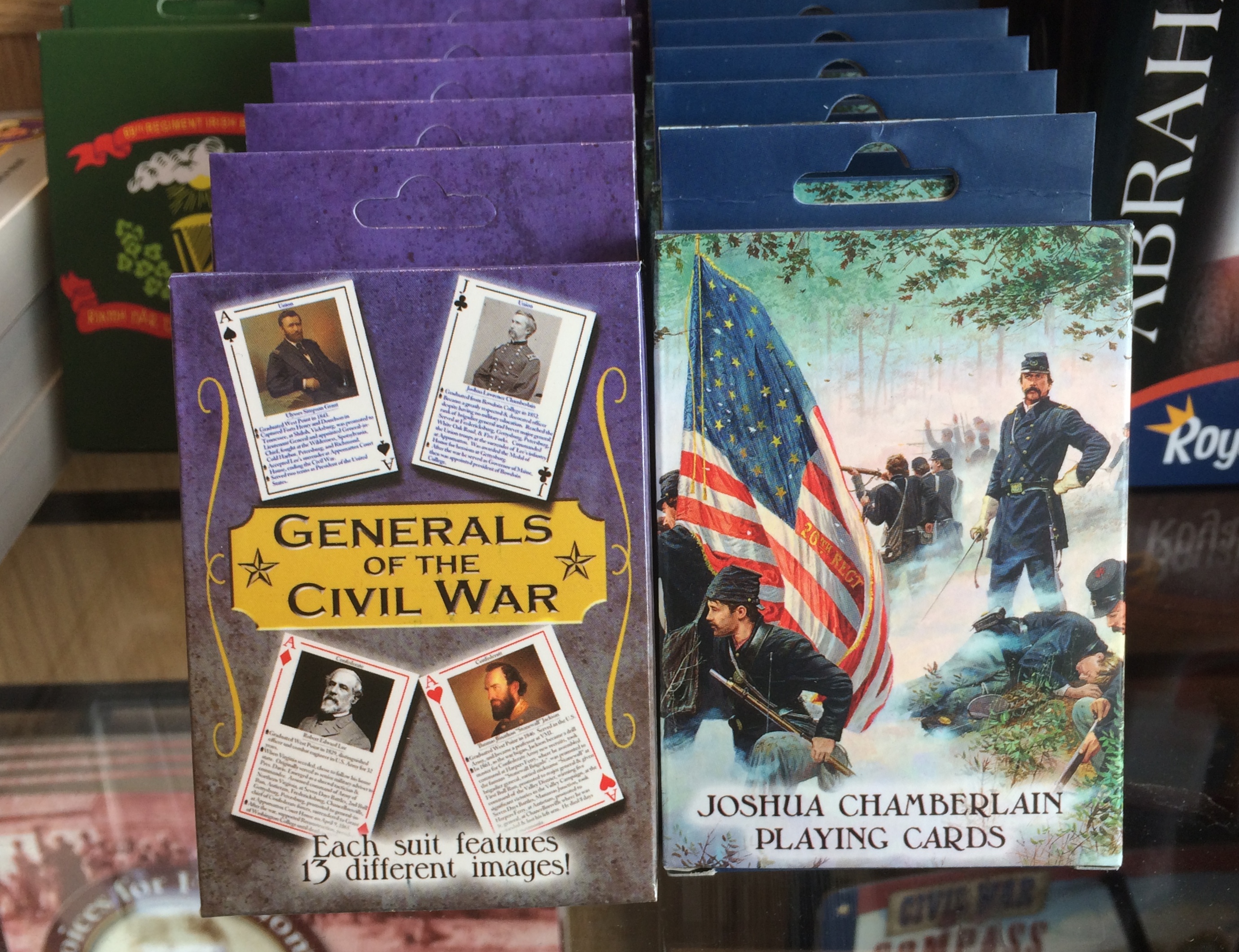
American Civil War Museum RichmondGenerals of the Civil War playing cards, but also Joshua Chamberlain playing cards.
American Civil War Museum RichmondThe Chamberlain cards struck me as oddly specific. Wonder if the same card maker has a line of, say, Jubal Early playing cards?

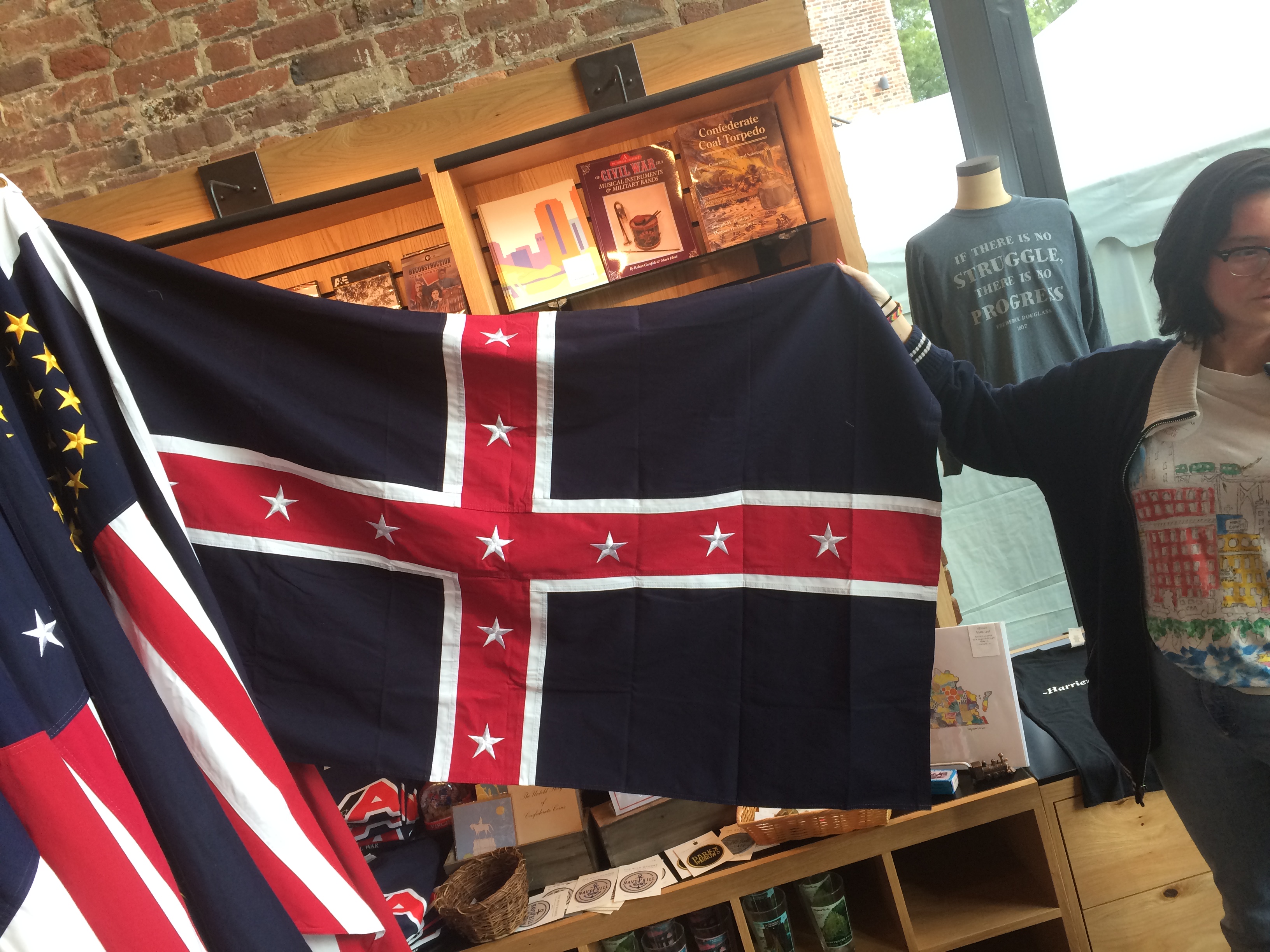
The shop also had a nice collection of flags. Such as this one, which you don’t see too often. I had to look it up.
American Civil War Museum RichmondThe Battle Flag of the First Corps, Army of Tennessee.

The Virginia State Capitol

The Commonwealth of Virginia certainly doesn’t care what I think, but I’m going to offer it my opinion anyway, about what it calls part of its legislature. The modern name for the lower chamber of the Virginia legislature is the House of Delegates — modern, as in after 1776. Nice, but a little blah.

Before that, the chamber was the House of Burgesses. That’s a spiffier name. Virginia’s lower house ought to go back to using it. The House of Burgesses had a long and honorable history before the change. “Burgesses” must have been trashed in a fit of revolutionary ardor for new names, but that was more than two centuries ago. Even better, no other state uses it. By contrast, Maryland and West Virginia both use “House of Delegates.”

State legislature names are mostly uninspired anyway, except maybe for the formal title of the Massachusetts legislature, which is the Great and General Court of the Commonwealth of Massachusetts. Nearby, there’s also the the General Court of New Hampshire, which (incidentally) Ballotpedia tells us is the fourth-largest English-speaking legislative body in the world (at 424 members), behind only the Parliament of the UK, the US Congress, and the Parliament of India.

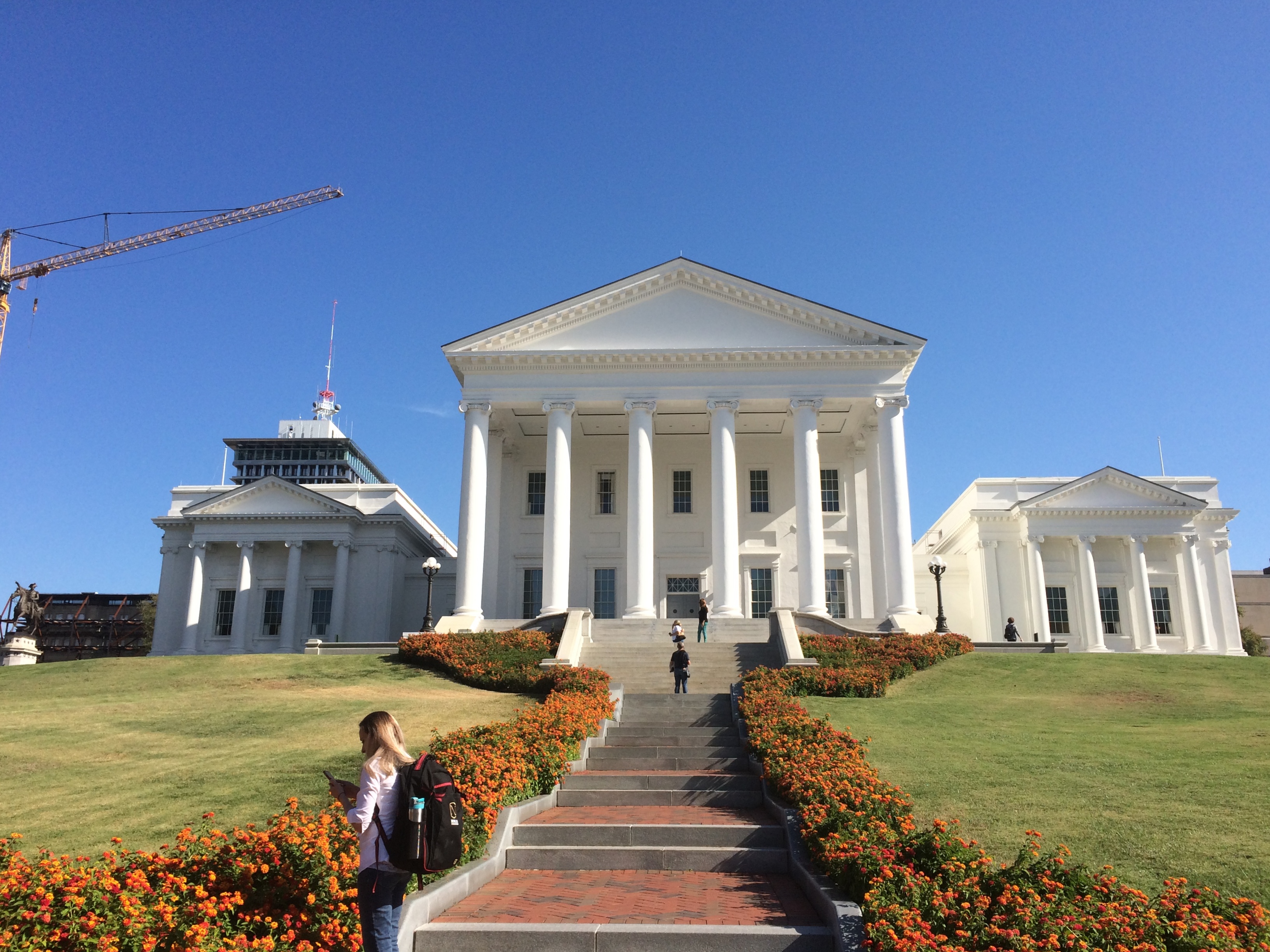
On the morning of October 12, Ann and I made our way to Capitol Square in Richmond. The Thomas Jefferson-designed state capitol is its handsome centerpiece.

Virginia State CapitolThe capitol has a distinctive look among those of the several states, taking its inspiration from a Roman temple in France, the Maison Carrée.

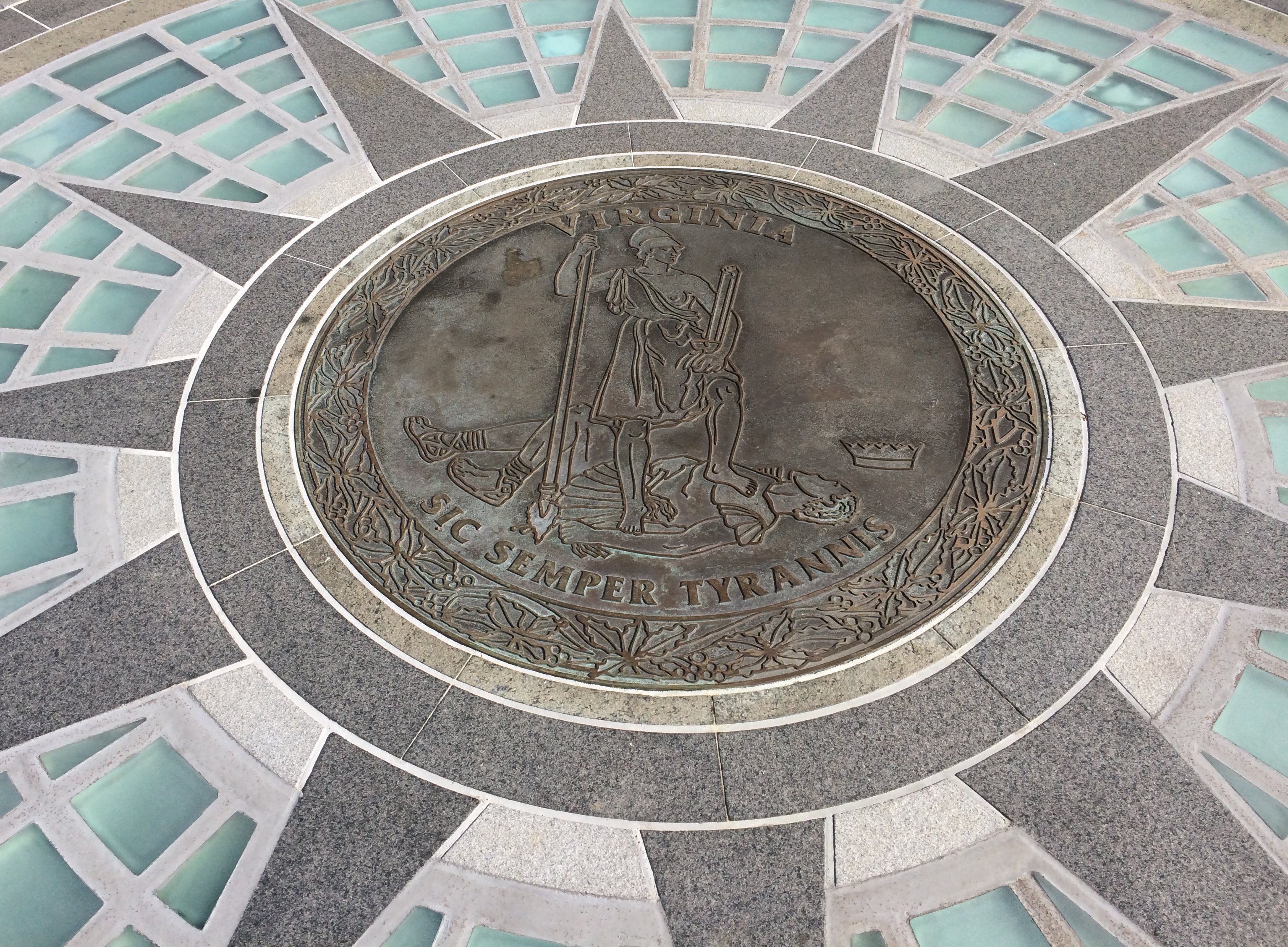
Just outside the capitol building is an embedded Virginia seal, with Tyranny lying slain beneath the foot of Virtus.
Virginia State CapitolI told Ann what the Latin meant, and she seemed amused that a state would put something so badass on its formal seal. Compared to the anodyne figures on most state seals, she has a point.

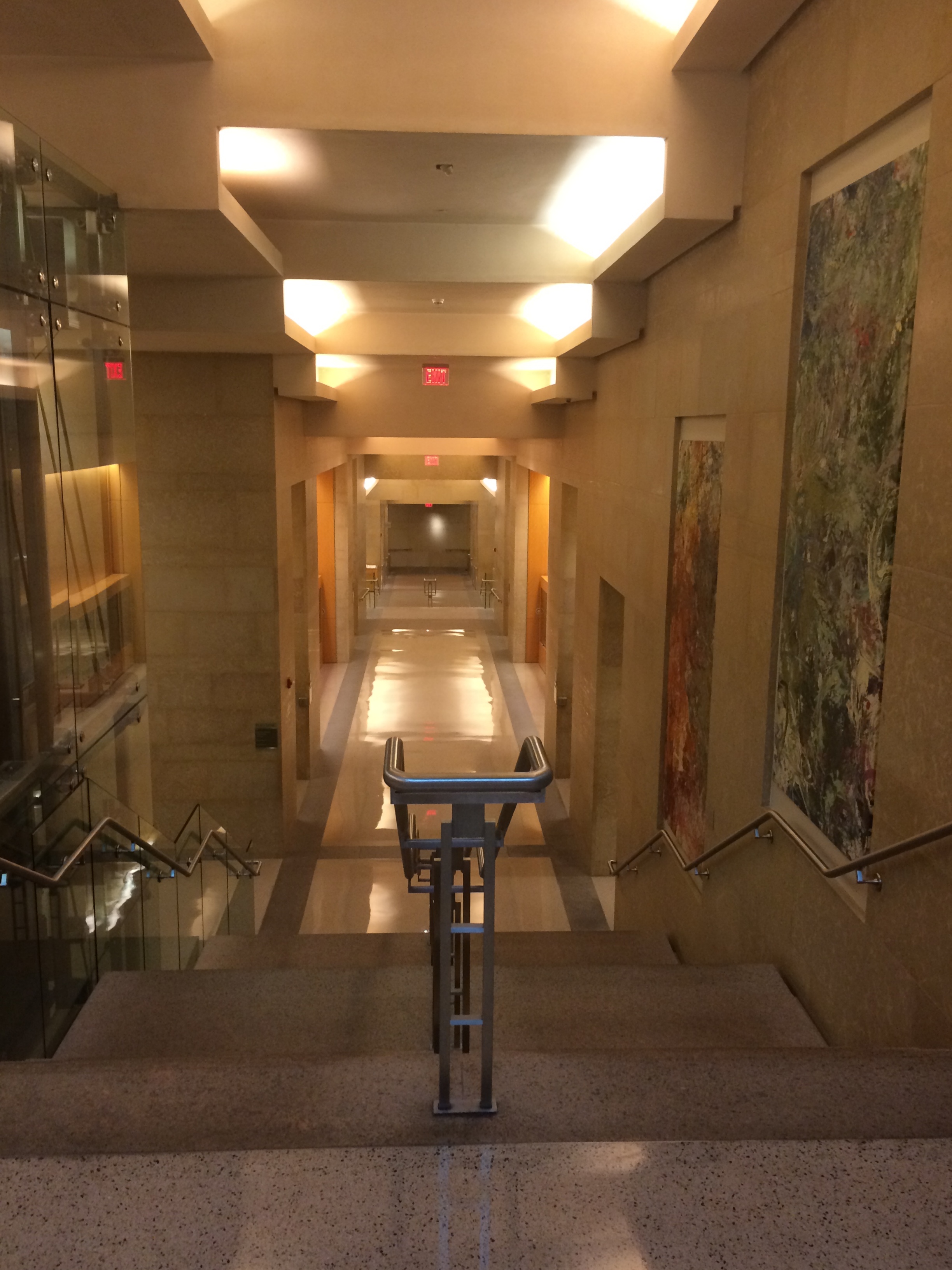
It looks like you walk up the hillside steps to enter the capitol, but in fact you walk down them. Since a redevelopment in the early years of this century, visitors enter the Virginia State Capitol via an underground passage that runs underneath the hillside steps.
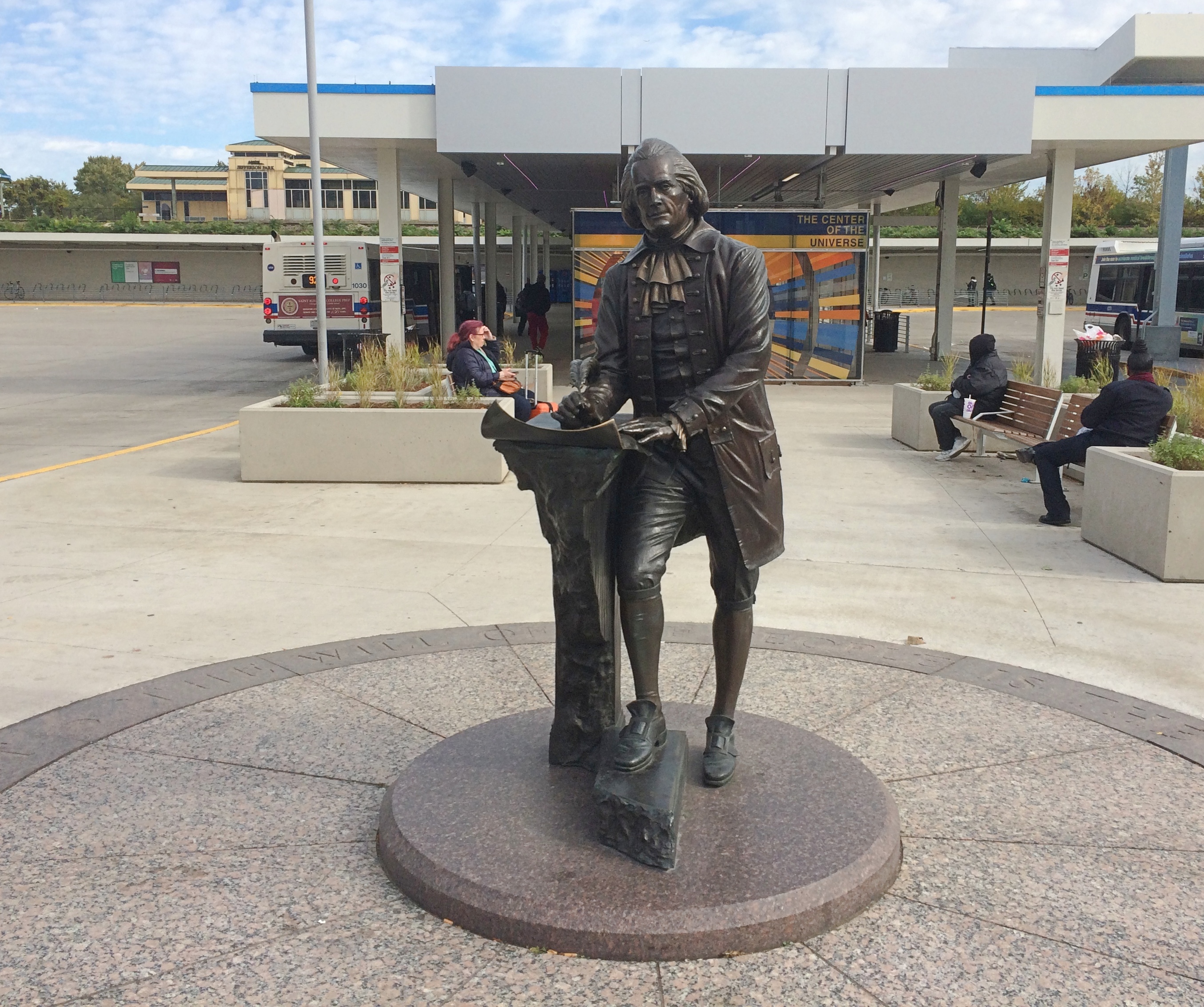
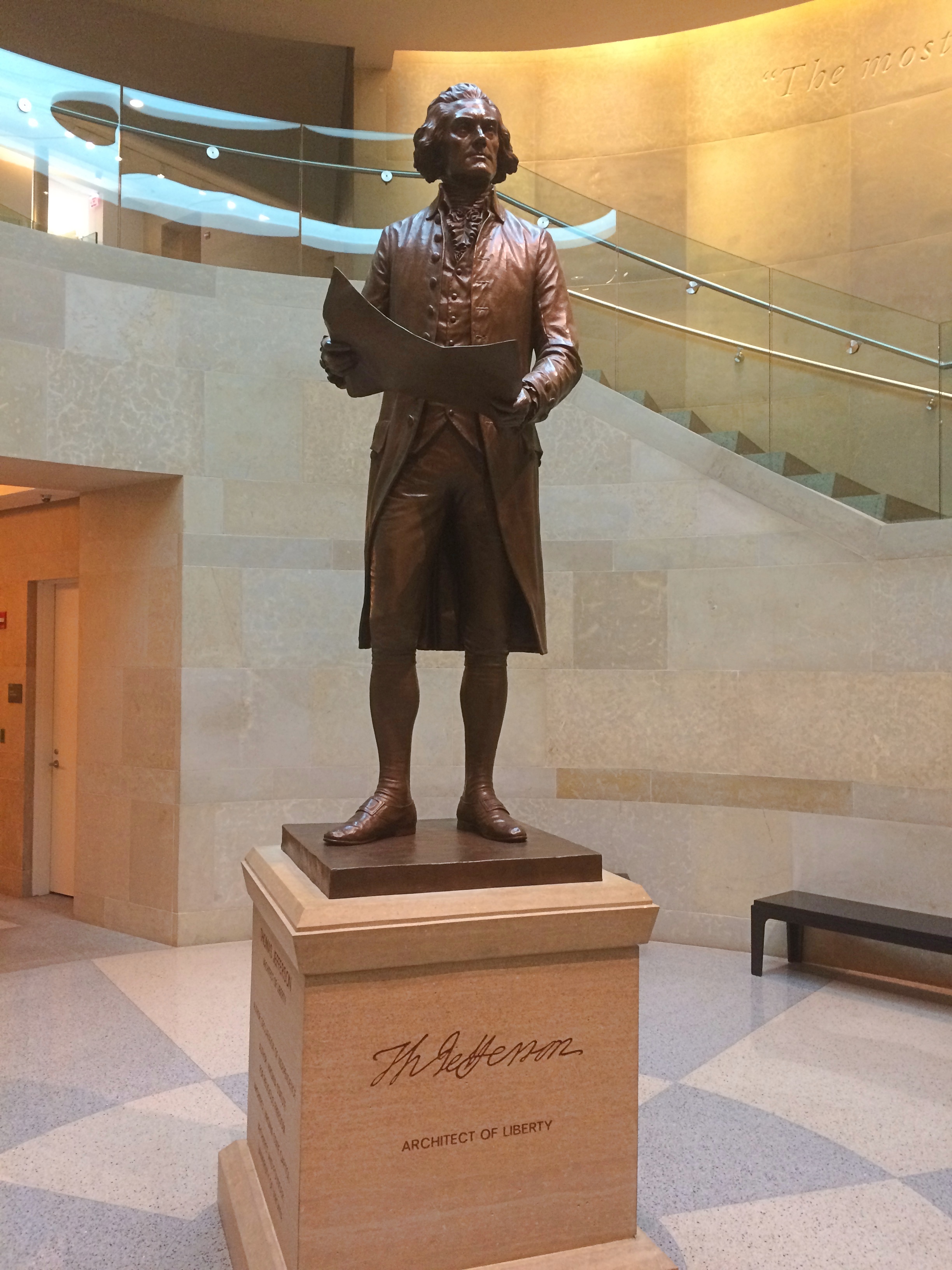
Virginia State CapitolWe took a guided tour starting there. One of the first things you see in the underground annex — and it’s a large space, at 27,000 square feet — is the architect himself in bronze.
Virginia State Capitol“The statue represents Jefferson around the age of 42 — about the time he was designing the building — and he is holding an architectural drawing of the Capitol,” says the Richmond Times-Dispatch

“Ivan Schwartz, co-founder of StudioEIS, created the statue… The statue weighs 800 pounds and stands nearly 8 feet tall, representing a larger-than-life Jefferson. Its pedestal is made of EW Gold, a dolomitic limestone quarried in Missouri.”

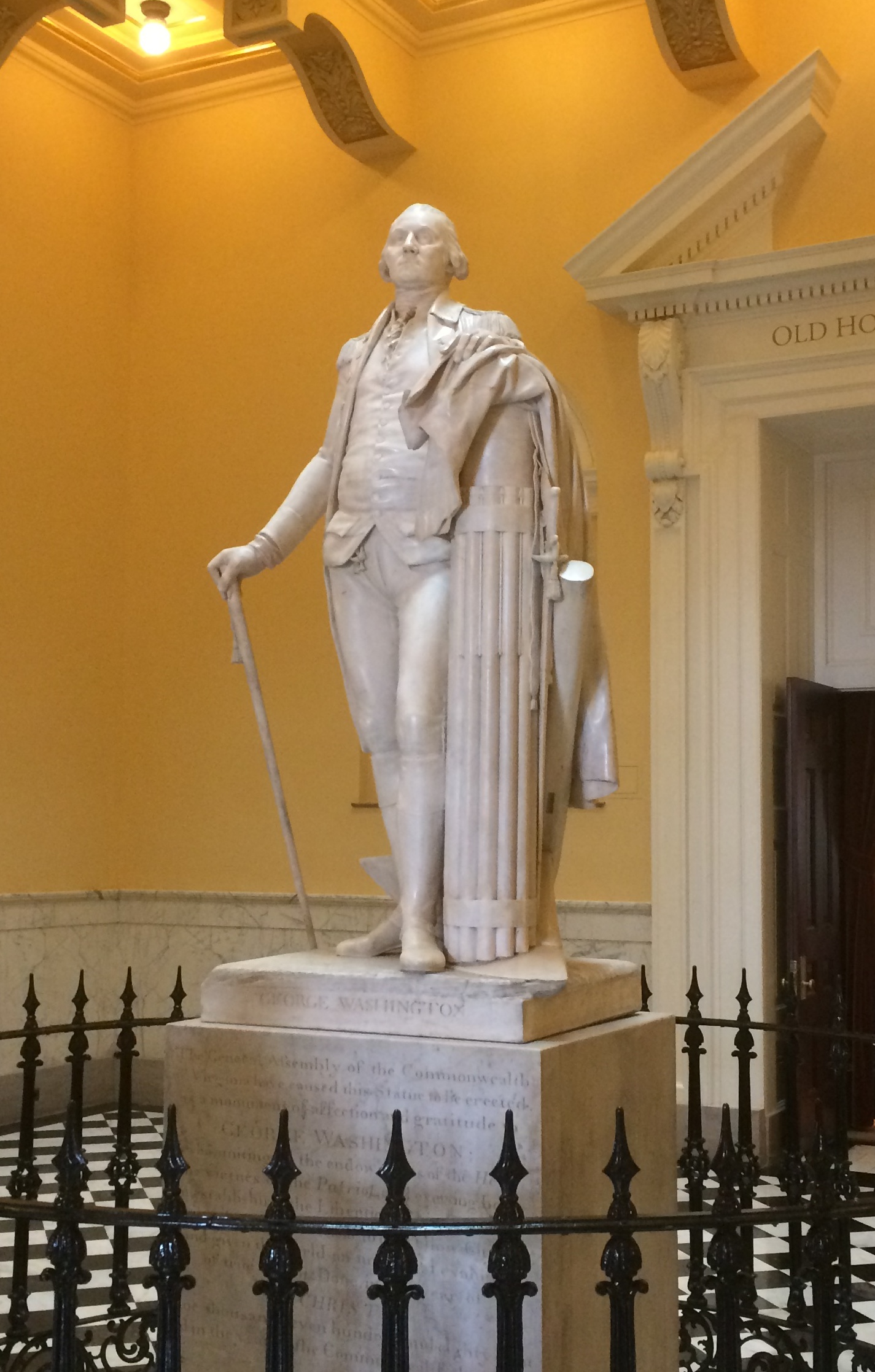
The passage leads to the capitol proper. Though there’s no exterior dome, there is an interior one. Underneath it is another figure of the Revolution in stone. The figure of the Revolution.
Virginia State CapitolTracy L. Kamerer and Scott W. Nolley, writing for the Colonial Williamsburg Foundation, praise it highly: “In Richmond stands a marble statue of George Washington that is among the most notable pieces of eighteenth-century art, one of the most important works in the nation, and, some think, the truest likeness of perhaps the first American to become himself an icon.

“A life-sized representation sculpted by France’s Jean-Antoine Houdon between 1785 and 1791 on a commission from Virginia’s legislature, it was raised in the capitol rotunda in 1796…

“Houdon’s careful recording of Washington’s image and personality yielded a sensitive and lifelike portrait. When the Marquis de Lafayette, Washington’s friend and compatriot, saw the statue for the first time, he said: ‘That is the man himself. I can almost realize he is going to move.’ ”

The Houdon Washington spawned many copies in the 19th and 20th centuries, some of which are in other state capitols and cities, and one that I’ve seen that stands in Chicago City Hall. Others are as far away as the UK and Peru.

Jefferson and Washington are only the beginning of the statuary in the Virginia State Capitol. In alcoves surrounding the Houdon Washington are busts of the other U.S. presidents born in Virginia — Jefferson, Madison, Monroe, William Henry Harrison, Tyler, Taylor, and Wilson — along with Lafayette, who’s there until there’s another president from Virginia, the guide said.

The Old House Chamber, whose entrance is behind Washington’s back, has been restored to look the part of a 19th-century legislative chamber, but also to be a repository of sculpture. It’s replete with marble and bronze busts and statues, representing various Virginians, including George Mason, Richard Henry Lee, Patrick Henry, George Wythe and Meriwether Lewis. Non-Virginians have their place, too: namely Jefferson Davis and Alexander H. Stephens.

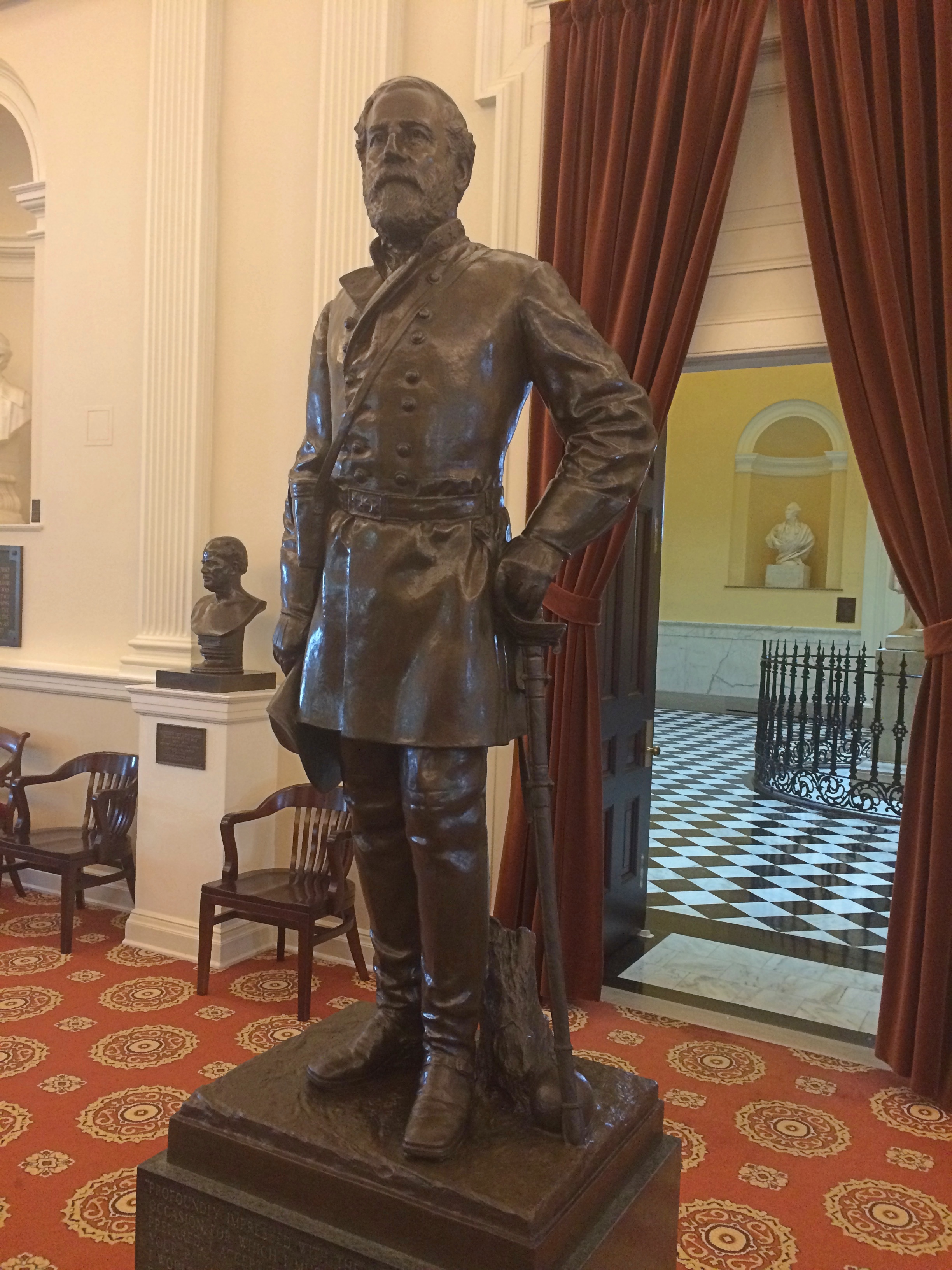
CSA generals include Stonewall Jackson, J.E.B. Stuart, Joseph E. Johnston, Fitzhugh Lee, and of course Robert E. Lee looking pretty much like Robert E. Lee.

Virginia State CapitolIt wouldn’t be the last representation of Lee we’d see in Richmond. This particular bronze was created by Rudulph Evans in 1931 and erected where Lee stood on April 23, 1861, when he accepted command of the military forces of Virginia.

That wasn’t the only event associated with the Old House. In December 1791, the House voted to ratify the proposed U.S. Bill of Rights in the room. In 1807, Aaron Burr was acquitted of treason in the room in a Federal Circuit Court trial presided over by John Marshall. Various Virginia constitutional conventions met in the room, and so did the Virginia Secession Convention of 1861. The entire Virginia State Capitol soon became the Confederate Capitol as well.

We also visited the modern Senate chamber — the modern House of Delegates was closed — and it looks the part of a well-appointed working legislative chamber, without a surfeit of statues.

The Old Senate chamber sports paintings depicting the first arrival of Englishmen in Virginia, John Smith, Pocahontas, and a scene at the Battle of Yorktown. In the Jefferson Room is a scale model of the capitol that Jefferson had commissioned in France to guide the builders in Virginia, since he wouldn’t be there to supervise things personally.

We spent time on the capitol grounds as well. The most imposing among a number of memorials near the capitol is the George Washington equestrian — formally the Virginia Washington Memorial, by Thomas Crawford — which is surrounded by other colonial Virginians of note and allegories.

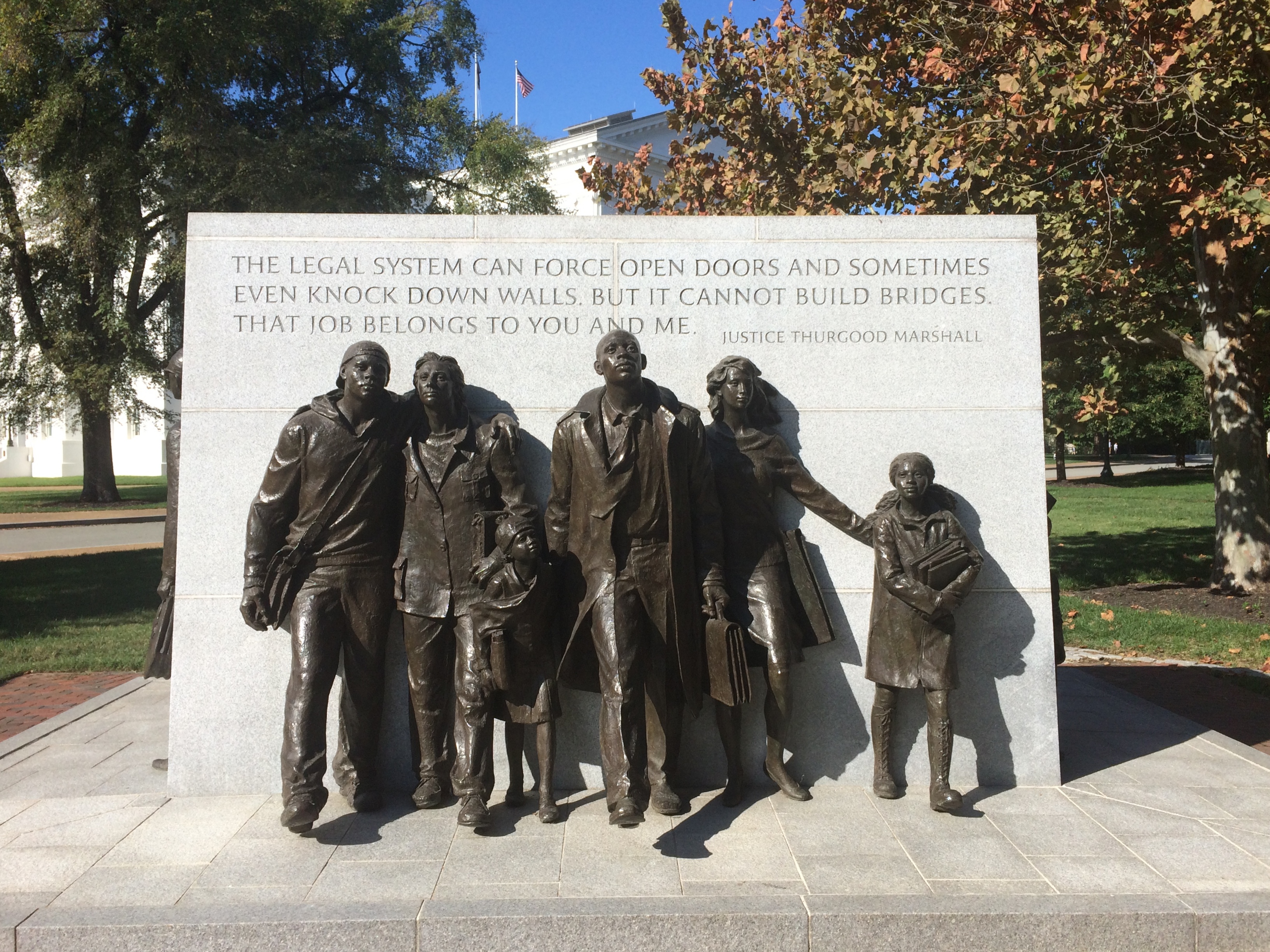
Virginia State CapitolThe CSA was represented on the grounds as well, as you’d expect, including a Stonewall Jackson bronze. Other memorials are closer to our own time. This is part of the Virginia Civil Rights Memorial, created by Stanley Bleifeld and dedicated in 2008.

Virginia State Capitol

A memorial dedicated to Virginia women, a collection of bronzes, was still under wraps when we looked it — but slated for dedication only two days later, on October 14.

There was even more to see, but eventually hunger took us away from Capitol Square to a nearby hipster waffle house — the Capitol Waffle Shop — for lunch. I had my waffles with egg and sausage on top, a combination that worked very well. Also good: hipster food prices in a town like Richmond are less than in places like Brooklyn, just like prices for everything else.

The Tripoli Shrine Temple

Last night at around 11, or just an hour before September ended, I sat on my deck outside in short sleeves, in comfort. Warm winds blew. The day had been summer-like, in the mid-80s at least, and October 1 has been roughly the same. Rain is coming tonight, though, and so are cooler temps.

I don’t have any interest in becoming a Shriner, but I have to like a fraternal organization whose members wear fezzes and meet in gilded, onion-domed buildings inspired by the 19th-century popular vogue for Orientalism. I’ve seen Shriners in their little cars buzzing along parade routes, and once upon a time I went to a Shrine Circus in a temple that the Shriners later sold, and which has been sold again.

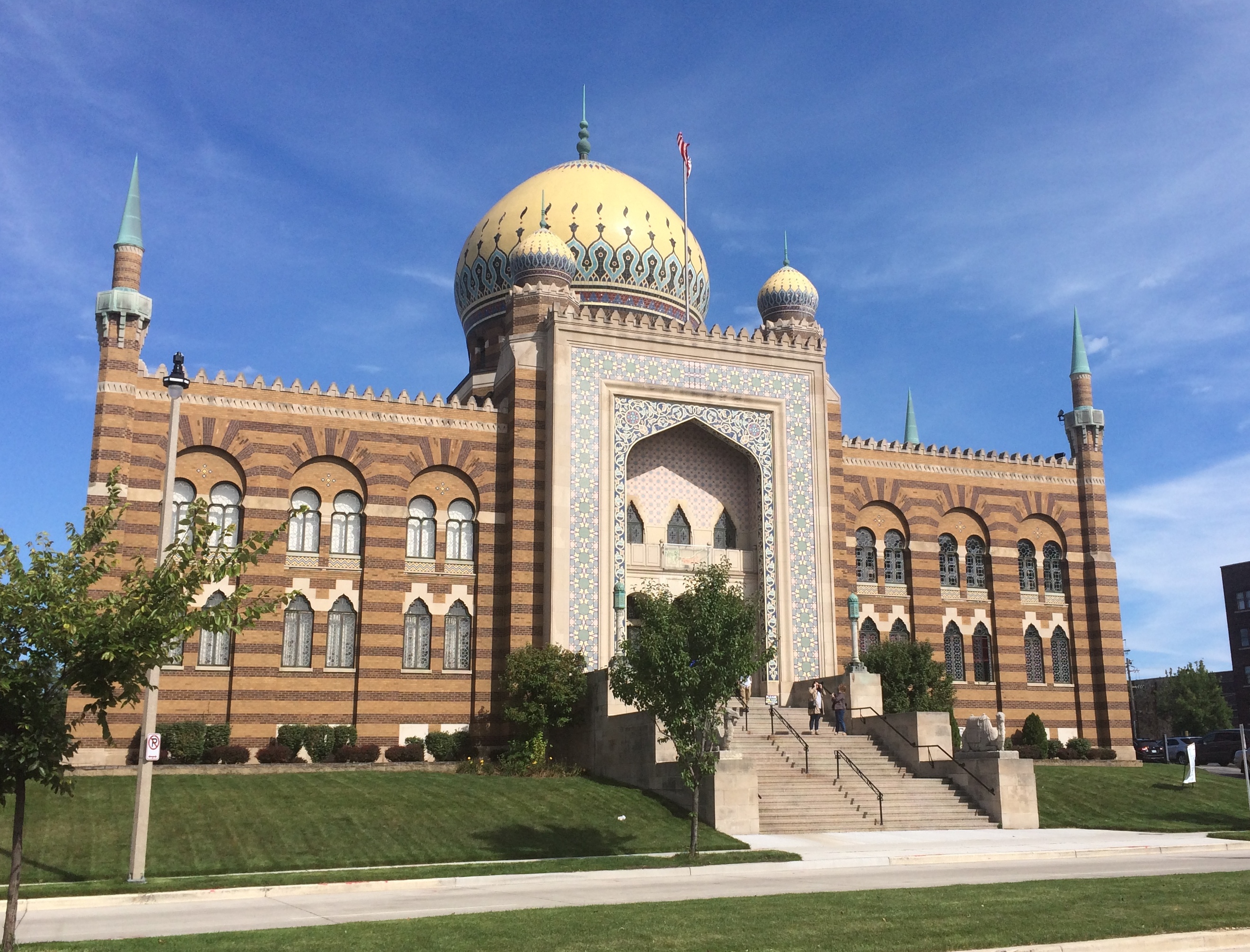
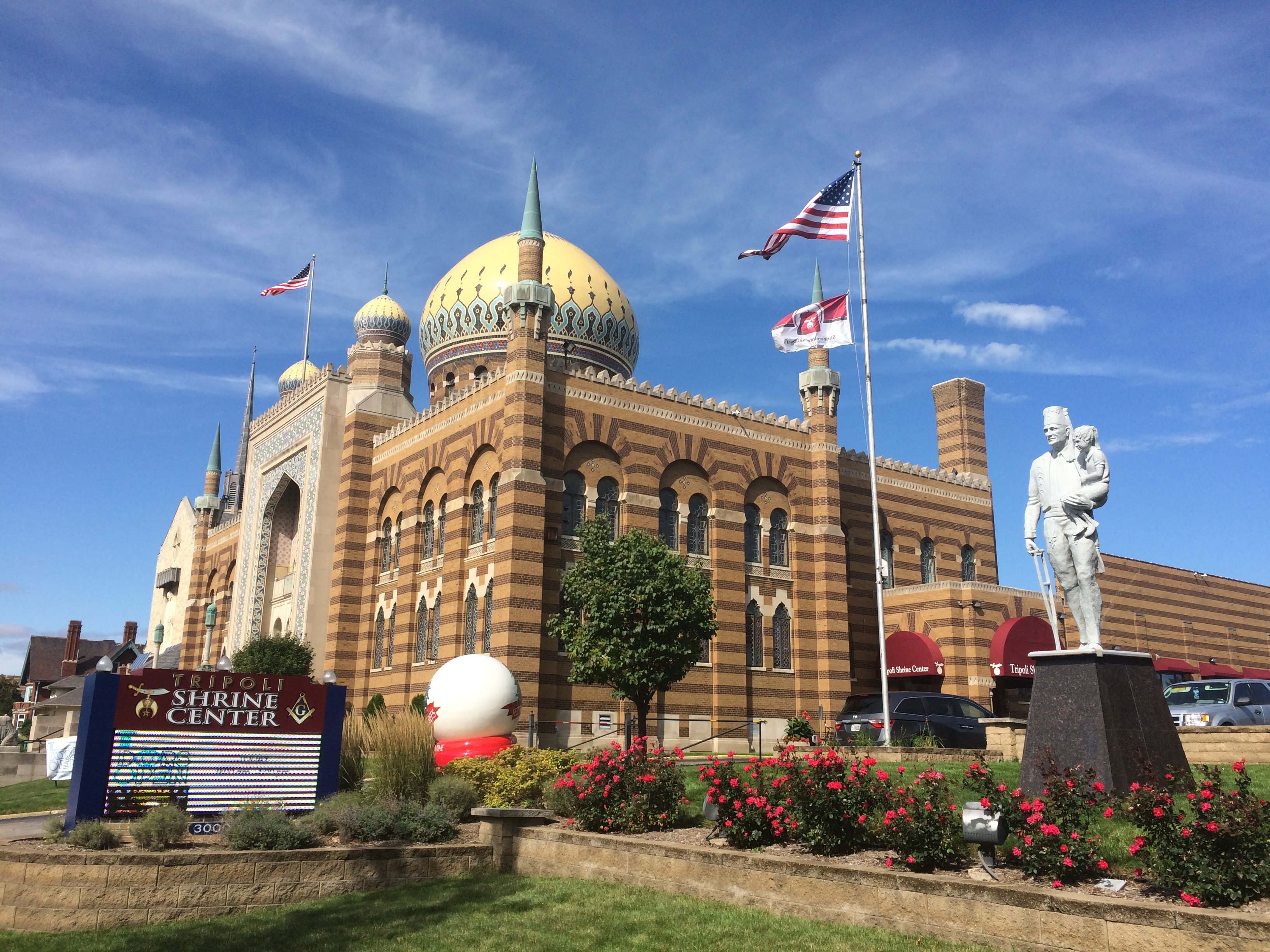
In Milwaukee, on Wisconsin Ave., the Shriners built themselves an exceptional edifice, the Tripoli Shrine Temple, taking inspiration from the Taj Mahal.
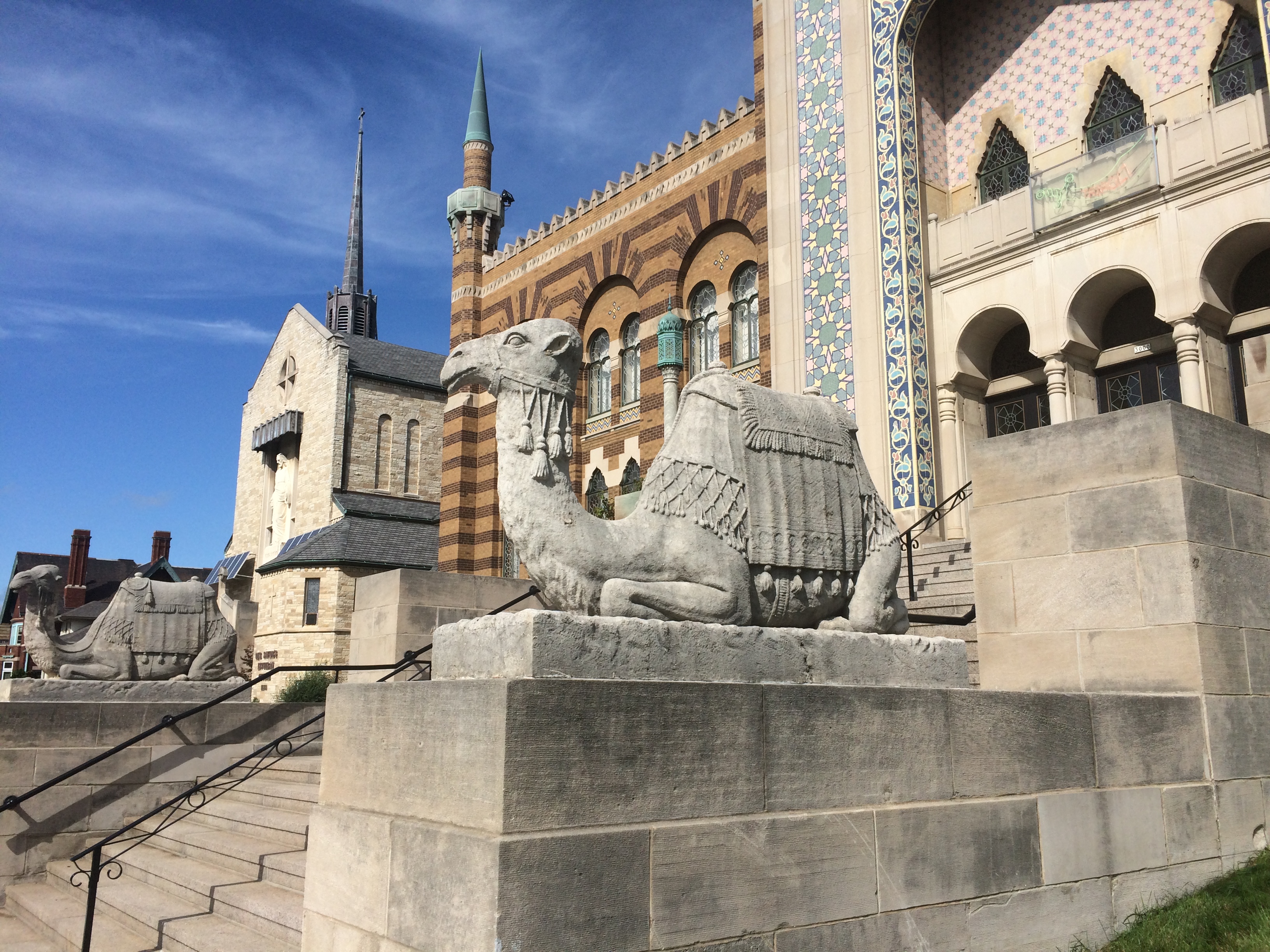
Tripoli Shrine TempleNo example of Moorish Revival is complete without stone camels, I think. Especially considering that the Shriners originally called themselves the Ancient Arabic Order of the Nobles of the Mystic Shrine. Two camels are perched beside the front entrance steps.

Tripoli Shrine TempleThe statue to the right of Shriner and child is a nod to the Shriners Hospitals for Children, of which there are 22 in North America (though none in Milwaukee).
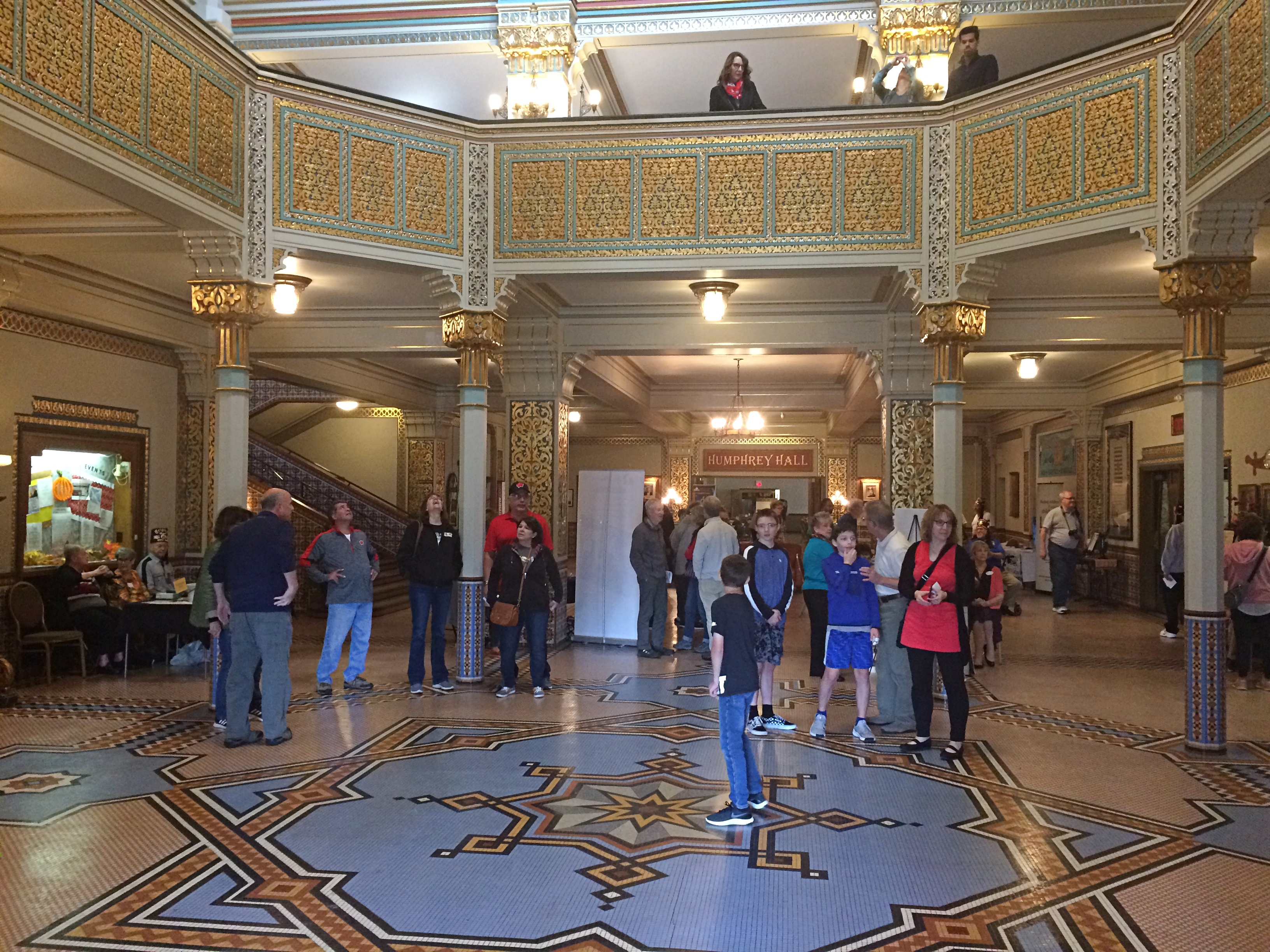
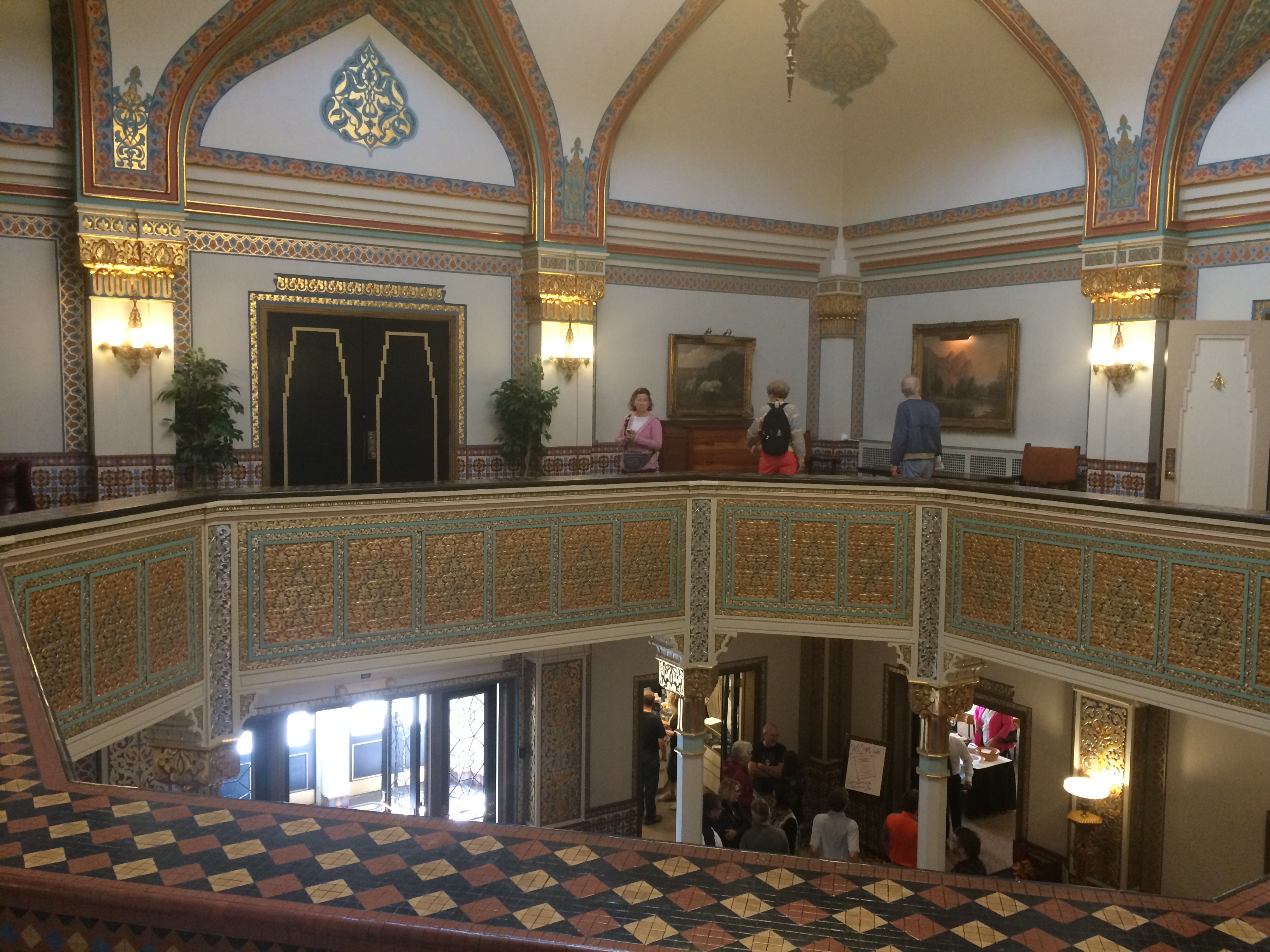
Tripoli Shrine TempleThe temple, designed by Clas & Shepard of Milwaukee and completed in 1928, is every bit as ornate inside as out.
Tripoli Shrine TempleSecond floor.
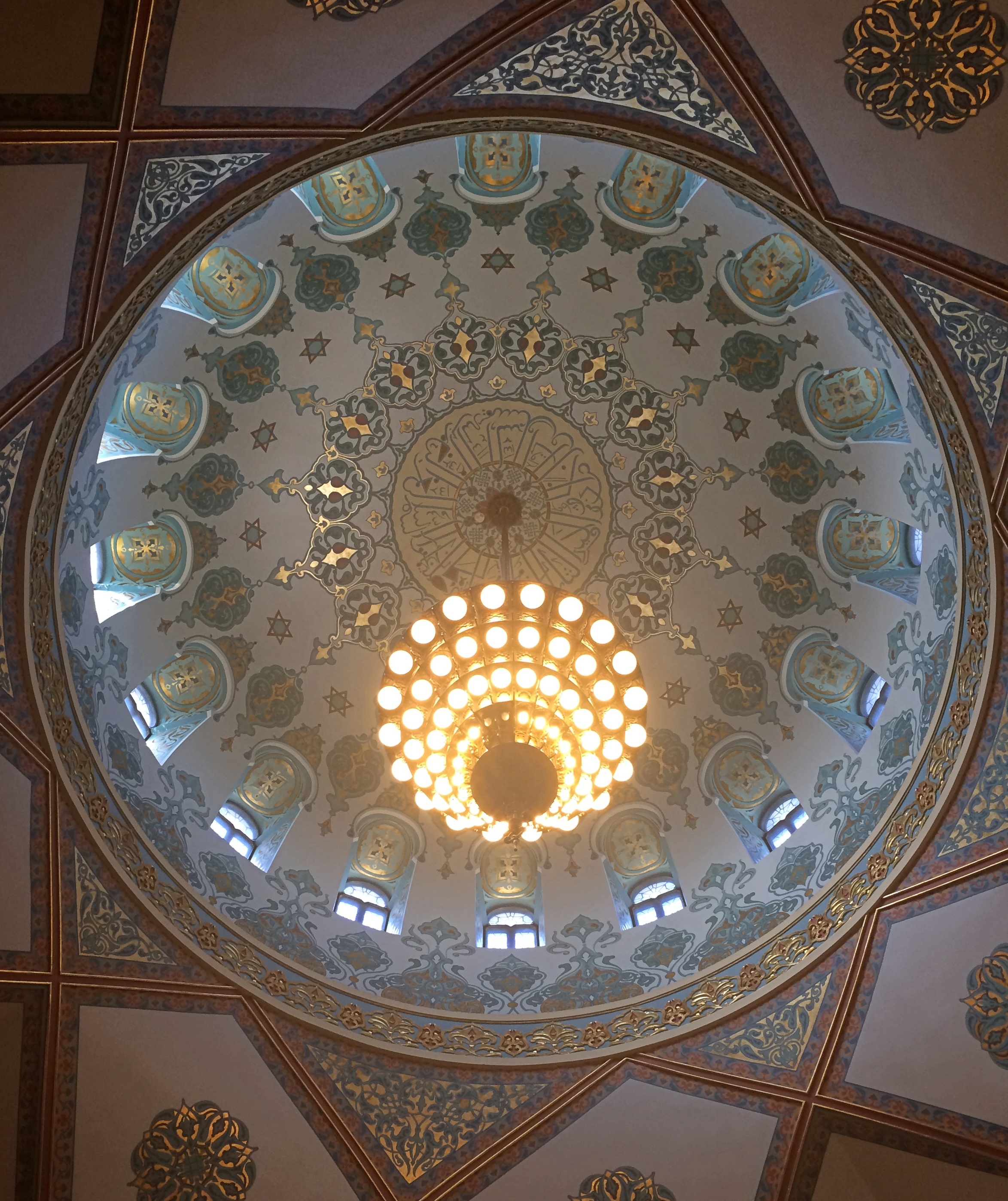
Tripoli Shrine TempleLooking up.
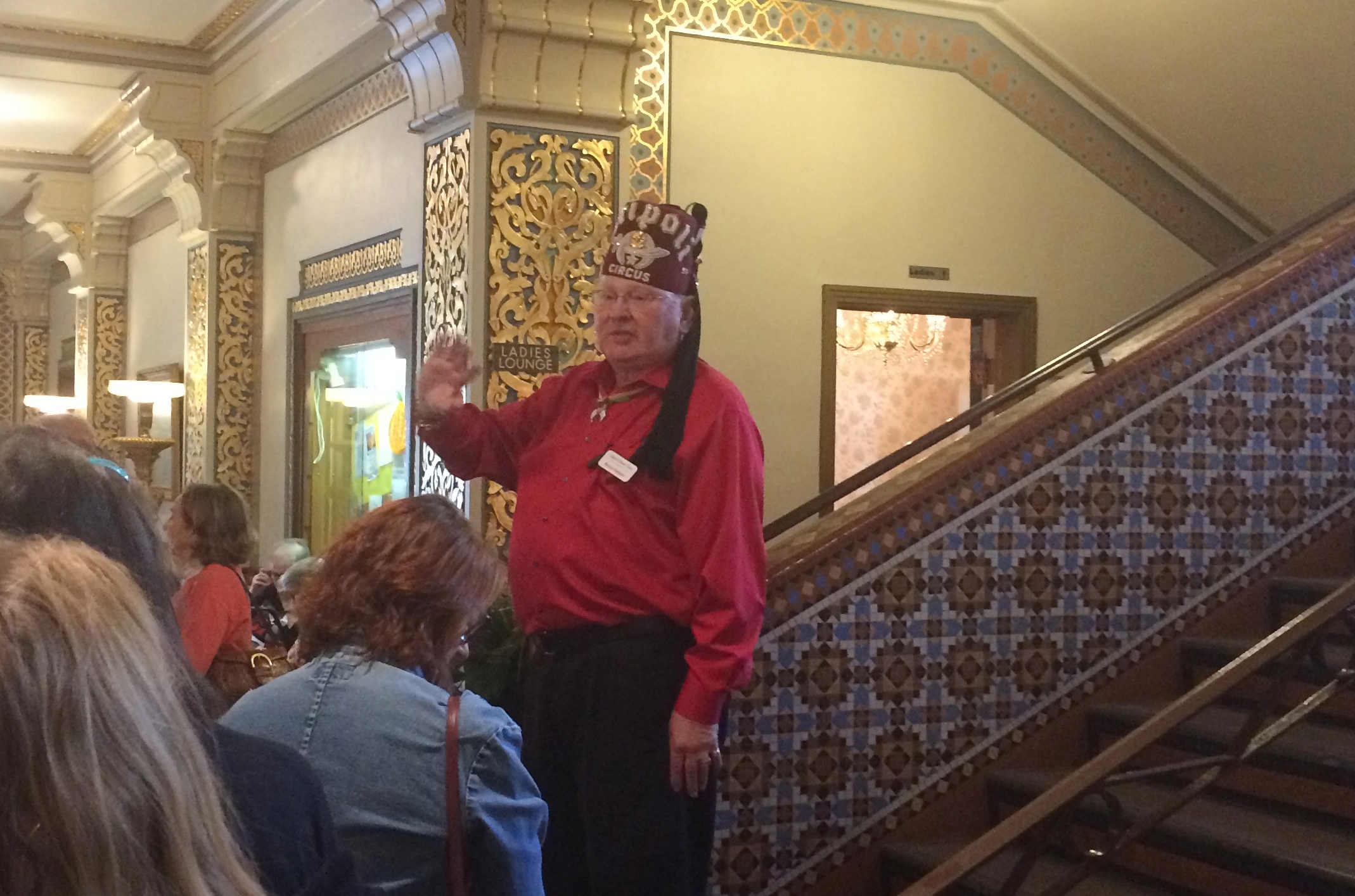
Tripoli Shrine TempleThere was no shortage of Shriners around, helping show off the place.
Tripoli Shrine TempleThis one gave a short talk about the building. He had interesting things to say, especially about the countless thousands of tiles on the floors and wall. Literally countless, since no one kept count or has made a count. He said that during the interior construction of the temple in the late ’20s, a family of four skilled in tilework lived in the temple, staying until they were done a few years later.

Three Wisconsin Avenue Lutheran Churches & One Beer Palace

We kicked off our time on Wisconsin Ave. in Milwaukee on Saturday at St. Paul’s Lutheran Church, which has been on this site since 1917, though the congregation has been around since 1841, before there was a Milwaukee or even a state of Wisconsin.
St Paul's Lutheran MilwaukeeGeorge Bowman Ferry designed the structure. It must have been one of his last, since he died in 1918. In partnership with another Milwaukee architect, Alfred C. Clas, he’s better known for doing the Pabst Mansion, which isn’t far to the east of St. Paul’s.St Paul's Lutheran Milwaukee St Paul's Lutheran MilwaukeeJust a few blocks from St. Paul’s — 2812 W. Wisconsin vs. 3022 W. Wisconsin — is another Lutheran congregation, which meets at Our Savior’s Lutheran Church. I gazed at the structure for a while before I noticed the solar panels. It probably took so long because that’s still an unexpected feature in ecclesiastical architecture.Our Saviors Lutheran Church, MilwaukeeOur Saviors Lutheran Church, Milwaukee

Why so close to another Lutheran church? I don’t have a definite answer. They both seem to be part of the Evangelical Lutheran Church in America, but that’s a fairly recent combination, so perhaps they were different kinds of Lutherans in the early days. Also possible: Our Savior’s was founded by Norwegians, who maybe didn’t want to share a church with Germans or others in the 19th century.

The church is tall and the interior walls are spare.Our Savior Lutheran MilwaukeeOur Savior Lutheran MilwaukeeA reflection of its midcentury design, I believe, since the building was completed only in 1954 for a much older congregation. A detail I find interesting from the church web site, after mentioning the 1951 groundbreaking and 1952 cornerstone laying: “Work slowed in 1951-1953 due to the steel shortage caused by the Korean conflict.”

Also: “The original architect, H.C. Haeuser, passed away in 1951 before work on the church could begin. The firm of Grassold and Johnson was hired to replace him and that firm finalized the design.”

The walls may be mostly plain, but the stained glass isn’t.
Our Savior Lutheran Milwaukee“The stained glass windows were designed by Karl Friedlemeier, a native of Munich, Germany and manufactured by Gavin Glass and Mirror Company of Milwaukee from imported antique glass,” the church says. “Upper windows on the west wall depict Old Testament stories; New Testament stories are shown on the upper east walls.”

To east of these two Lutheran churches, again not far (1905 W. Wisconsin Ave.), is another church of that denomination, Reedemer Lutheran Church. It too is ELCA.
Redeemer Lutheran Church MilwaukeeA fine brick Gothic structure completed in 1915, designed by William Schuchardt, who worked at Ferry & Clas early in this career.
Redeemer Lutheran Church MilwaukeeRedeemer Lutheran Church MilwaukeeWhile on the way to Reedemer, we passed by the Pabst Mansion.
Pabst Mansion MilwaukeeLooks as palatial as it did in 2010. No reason it shouldn’t. It wasn’t part of Doors Open and so not open at no charge for the weekend. We walked by.

Across the street, an event called Beer Baron’s Bash was going on in the mansion’s parking lot, featuring food trucks and booths serving beer. Interesting, but not what we had come for either, so we walked by that too.
Milwaukee Doors Open ’19

Large amounts of rain fell on northern Illinois and southern Wisconsin on Friday, and more again on Sunday morning. In between, Saturday turned out to be a brilliant early fall day, clear and cool but not cold, and with touches of brown and gold on the still-green trees.

Milwaukee Doors OpenA good day to go to the latest Milwaukee Doors Open, driving up in mid-morning and returning just after dark.

This year — see 2017 and 2018 — we spent most of our time along or near Wisconsin Ave., a major east-west thoroughfare from the edge of Lake Michigan, just in front of the Milwaukee Art Museum, to near the Milwaukee County Zoo in the western reaches of the county.

At 2812 W. Wisconsin Ave. is St. Paul’s Lutheran Church, our first stop along the avenue, west of downtown and not too far from Marquette University. A few blocks to the west of that church is a vastly ornate Moorish Revival structure, the Tripoli Shrine Temple. “Is this a mosque?” Yuriko asked. No. “A church?” Well, no. It’s the Shriners.
Next to the temple — on an adjoining lot — is Our Savior’s Lutheran Church. From there, we headed a bit to the north, off Wisconsin Ave. but not far, to see the splendid Gilded Age Schuster Mansion, now a bed and breakfast.

Returning to Wisconsin Ave., we visited the Ambassador Hotel, whose handsome lobby is as Deco a design as any I’ve ever seen, and then went to the third and fourth (but not last) churches of the day: Redeemer Lutheran Church and, after lunch at a Malaysian Chinese storefront on the avenue, St. George Melkite Greek Catholic Church.

The end of the day found us closer to downtown Milwaukee, where we visited one more church on Wisconsin Ave., Calvary Presbyterian, with its surprising interior, and then we saw the inside of two massive edifices of the state: the Milwaukee County Courthouse and the Federal Building and U.S. Courthouse, the latter also on Wisconsin Ave.

The only Milwaukee building we visited this year not on or near Wisconsin Ave. was about five miles to the south, and the first place we saw in the morning, because it isn’t far from I-94, the highway into Milwaukee from the south.

Namely, Lake Tower.
Lake Water Tower, MilwaukeeAlso called the Lake Water Tower, or the Anderson Municipal Building. It goes back to the Federal Works Agency, completed with a worn plaque just inside the entrance, dated 1938-39.
Lake Water Tower, MilwaukeeDon’t see Federal Works Agency plaques too often, but I’ve run across them occasionally.

At the time, this part of Milwaukee was an independent municipality: the Town of Lake. In fact, Lake, Wisconsin lasted from 1838 to 1954, when Milwaukee was able to annex it. In the late 1930s, the Town of Lake had municipal offices on the lower floors, and a million-gallon tank of water up top.

There are still municipal offices in the building, albeit Milwaukee’s, but the water tank has been empty for nearly 40 years, its function made unnecessary by new facilities, including the water reclamation plant in the vicinity, whose distinct odor pervaded the area around the tower. Milwaukee Doors Open visitors can go to the fourth floor of the tower, through a heavy door and into the dry bottom of the tank, with a view of the metalwork and convex roof (or is it concave? never can remember) and other features above (see these pictures).

The place had a nice echo. I asked the person on duty at the site — a tedious assignment, up there in the tank — whether small acoustic concerts were ever held there. No, afraid not. Something about the ADA, but I think it’s really a lack of municipal imagination.

Lansing Walkabout

On the last day of August, we arrived in Lansing, Michigan, for a look. I’d only passed through once, Labor Day 2000 as it happened, to find the state capitol closed, as you’d expect. This time I hoped it would be open on Saturday, as it usually is. It wasn’t.

Still, it’s a handsome structure with a lanky cast-iron dome.
Michigan State Capitol“In January 1872, a plan (called ‘Tuebor,’ meaning, ‘I will defend’) submitted by architect Elijah E. Myers of Springfield, Illinois, was selected,” says the capitol’s web site regarding its development, which proceeded throughout that decade. “Myers moved to Michigan to supervise construction and lived for the rest of his life in his adopted state.

“Materials for the building came from all over the country and even from abroad. Although the millions of bricks that make up its walls and ceilings were locally made in Lansing, the stone facade came from Ohio, the cast iron for the dome and floor beams from Pennsylvania, and the marble and limestone floors from Vermont.”

The interior is supposed to be ornate, but that will have to wait. Instead, we were able to look at the scattering of memorials on the grounds, including this unusual one to the First Michigan Sharpshooters Volunteer Regiment.

First Michigan Sharpshooters Memorial

Another memorial you don’t see that often — but not never — is to the men who fought in the war with Spain, but also in the Philippine Insurrection and the China Relief Expedition.
Spanish War Memorial Lansing MichiganA block east of the capitol grounds is Washington Square. At least, that’s what the map calls it. It’s a section of Washington Ave. lined with various businesses, and good for a walk on a late summer afternoon.
Washington Street LansingWashington Street LansingFormerly a theater. The Strand, opened in 1921 as one of the largest vaudeville stages in Michigan, designed by Chicago architect John Eberson.
Washington Street Lansing - StrandHe did a lot of theaters, many of which don’t exist any more. The auditorium of the Strand disappeared to make way for office and retail space in the mid-80s.

The Hollister Building, the last remaining of Lansing’s major commercial buildings developed in the early 20th century (and renovated in the early 21st century).
Hollister Building LansingBoji Tower, around the corner toward the capitol on Allegan St. and the tallest building in Lansing.
Boji Tower Lansing MichiganBoji Tower Lansing MichiganAn impressive pile of art deco bricks that got in just under the wire: construction started in 1929. The Boji family is a recent owner; earlier names are the Olds Tower (as in auto pioneer Ranson Olds), the Capital National Bank Tower and the Michigan National Bank Tower. The fairly obscure Hopkins and Dentz of New York designed it.

East of the capitol a few blocks is public art so new that it doesn’t appear on the StreetView image from the summer of 2017.
lansing "Portrait of a Dreamer" “Portrait of a Dreamer” by Ivan Iler, installed in December 2017. Naturally, Roadside America has the story: “The giant mechanical head is 15 feet high and is built out of almost two tons of aluminum and stainless steel.

“Visitors are encouraged to turn a crank at its base to move the gears, which spill out of the head toward Lansing’s cultural district. The purpose of the sculpture is to turn visitors’ heads while they turn the crank, so that they notice the science center and museums that they otherwise might miss along Michigan Ave.”

Our Second Decatur This Year

On Saturday, I wondered how many U.S. cities and towns are named for Stephen Decatur. Later I looked it up: Counting Decatur City, Iowa, and a ghost town in Missouri of that name, 17 — not counting counties, of which there are six among the several states.

Now mostly forgotten except by the Navy and naval history enthusiasts, he had his moment. He even took a lethal bullet in a duel, though Commodore Decatur isn’t known as well as Alexander Hamilton for that distinction. Lin-Manuel Miranda needs to get on the stick and write Decatur: A Musical of Kicking Barbary Pirate Asses.

Decatur’s moment also happened to be when towns and counties were being named in the United States. Decatur, Illinois, has the largest population of any of them, edging out Decatur, Alabama by some thousands of souls, even though the Prairie State Decatur has been shrinking in recent decades.

We spent most of Saturday afternoon in Decatur, Illinois, our second visit to a city of that name this year. Though the more northern Decatur isn’t quite the industrial town it used to be, a number of large manufacturers are still in evidence, such as Mueller Co., more about which later. Downtown Decatur seemed in fair shape as well. Good enough for a walkabout late in the afternoon, when the heat was ebbing away.

Decatur’s signature structure is the Transfer House.
Transfer House Decatur Illinois“The Transfer House was erected in 1895, replacing a smaller shelter dating from 1892,” writes H. George Friedman Jr., whose page features many pictures. “The City Electric Railway paid $500 toward the $2,700 building fund subscribed by local merchants and property owners, and agreed to furnish and maintain the building. As its name implies, it was used as a central transfer point for all the streetcar lines (and later the bus lines) in the city.”

Designed by W.W. Boyington, of all people. That only seems odd to me because we visited another one of his works just last week, the Old Joliet Prison. So there’s nothing really odd about it. The man got a lot of commissions.

Remarkably, the Transfer House was originally located at Main and Main streets — that always sought-after address, at least among commercial real estate investors. Decatur still has a north-south Main and an east-west Main, and their meeting looks like an ordinary intersection, though there is a statue of young A. Lincoln nearby.

In 1962, the city moved the Transfer House to its current location in Central Park, near a fountain.
The park also features a memorial to the Macon County’s Civil War soldiers.
On the back of the base, a plaque says:

Grand Army of the Republic
Organized in this city
April 6, 1866
Erected by Dorcas Society,
and Other
Patriotic Citizens

Not erected until 1904. Maybe funds were in short supply for years, but then the people of Decatur realized their veterans didn’t have much longer.

Near Central Park are a number of buildings, including this one sporting one of Decatur’s murals, featuring Mike Elroy, a recent mayor.
Driving into town we saw a more interesting mural featuring Bob Marley on the side of a record store building, but we didn’t stop for it.

A former Universalist church building, originally erected in 1854.
The handsome Merchant Street, formerly a hive of scum and villainy.

Further from the park was the equally handsome Library Block, home these days to a brewpub and other businesses.
The Decatur Masonic Temple, looking a lot like a WPA post office.
The First United Methodist Church of Decatur.
As with many city churches, it would have been nice to get inside for a look, but no go.

At first, I thought this might be the entrance to an eccentric dentist’s office, an oral equivalent of the eyes of Doctor T. J. Eckleburg.

But no: it’s the entrance to the Sol Bistro restaurant.

Point State Park & Pittsburgh Walkabout

RIP, Patricia Deany, mother of our dear old friend Kevin Deany, and a kind and gracious lady. She passed last week at age 90.

At the confluence of the Allegheny and Monongahela rivers is Point State Park, a 36-acre triangular patch of land that may well be featured in every bit of tourist literature ever published about Pittsburgh since the park’s creation nearly 50 years ago.

But that’s no excuse not walk over to the park from downtown Pittsburgh and make a circuit around the fountain at the tip of the park, which is what we did after lunch at the Oyster House on July 5.
Point State Park, PittsburghThat image makes it look like no one else was there, which wasn’t true at all.
Point State Park, PittsburghThe park offers views of various other parts of Pittsburgh, such as Mt. Washington and the Duquesne Incline.

Point State Park, Pittsburgh

Or Heinz Field, home of the Steelers. There ought to be a giant ketchup bottle in there somewhere.

Away from the fountain, there’s a view of the Fort Pitt Bridge, which carries I-376 across the Monongahela. It replaced the Point Bridge, which was destroyed, along with the Manchester Bridge, to make way for the park.

Besides being a pleasant green space with views, the park makes various nods to the early history of Pittsburgh. An irregular path of sidewalk follows the outline of Fort Duquesne, the French outpost. Elsewhere other sidewalks mark the outline of the somewhat larger Fort Pitt, the succeeding British outpost, also in the classic star (Bastion) shape.

The U.S. flag is a little unusual. Not in having 13 stars, but in that they aren’t the circular arrangement you usually see. Then again, no one specified how the stars in the canton should be arrayed in those days (and maybe we should go back to that).

Point State Park, PittsburghOn one edge of the park is the Fort Pitt Block House, Point State Park’s only surviving structure from colonial times, built in 1764 as a redoubt of Fort Pitt. It has endured since then in its original spot, for many years as a residence, more recently as a relic.

Our walking tour of downtown Pittsburgh started at the Block House, led by an energetic young woman, native to Pittsburgh and eager to talk about various places and buildings, though less about design and more about history.

Naturally, the names of Pittsburgh robberbarons Andrew Carnegie and Henry Clay Frick came up a lot, including the story about a dying Carnegie writing a letter to the estranged Frick asking for a meeting, presumably in the spirit of reconciliation.

Les Standiford tells the story, via NPR. A man named Bridge, who delivered the letter, was Carnegie’s assistant.

“Frick’s ire was, after all, legendary. He’d gone toe-to-toe with strikers, assassins, and even Carnegie himself, and had rarely met a grudge he could not hold. Long before Frick had constructed the mansion that would dwarf Carnegie’s ‘Highlands’ up the street, he had gone out of his way to purchase a tract of land in downtown Pittsburgh, then built a skyscraper tall enough to cast Carnegie’s own office building next door in perpetual shadow.

” ‘Yes, you can tell Carnegie I’ll meet him,’ Frick said finally, wadding the letter and tossing it back at Bridge. ‘Tell him I’ll see him in Hell, where we both are going.’ ”

Whatever else you can say about the steely-eyed bastard Frick, at least he had no illusions about his benevolence, as Carnegie seemed to have had. Our guide also mentioned the taller Frick building next to Carnegie’s, and in fact pointed them out. They are both now overshadowed by more recent Pittsburgh buildings, of course.

At one point, we passed by a building associated with both Carnegie and Frick, along with a lot of other Gilded Age and later tycoons: the Duquesne Club on Sixth Ave.
Duquesne Club Founded in 1873 and still a social club for the wealthy, its current home, a Romanesque structure designed by Longfellow, Alden & Harlow, opened in 1890. Just in time for Carnegie and Frick to discuss, possibly over brandy and cigars, the busting of the Amalgamated Association of Iron and Steel Workers.

Speaking of labor history, not far away from the club, I noticed this historic marker.
AFL Marker, Pittsburgh - Turner HallThe founding convention of the AFL was in a Turner Hall. Our guide didn’t mention that, and I asked her about the Turner Hall. She hadn’t heard it. To be fair, I’d never heard of Turner Halls until recently either. To be extra fair, I’m not guiding walking tours of a major American city, so I consider that a small lapse on her part.

The Turner Hall in Pittsburgh, unlike that in Milwaukee, is no more. The site is now called Mellon Square, a 1950s park-like creation paid for by the Mellons to go with the development of Alcoa’s new headquarters building at that time.

Alcoa isn’t there any more, and the building is now known as the Regional Enterprise Tower, but it still has its distinctive aluminum skin. The New York modernists Harrison & Abramovitz designed it.

Alcoa Building Pittsburgh

I’ve read that a Beaux-Arts palace of a theater, the Nixon, was destroyed to make way for Alcoa, causing some consternation even in the tear-it-down midcentury.

Another historic marker that I noticed (that also wasn’t on the tour).
Pittsburgh Agreement MarketWhy Pittsburgh? I wondered. I looked it up later. NPR again: “Slovak culture is everywhere in the Steel City. It’s home to the Honorary Slovak Consulate, a handful of social clubs, cultural centers and annual holiday festivals dedicated to maintaining and celebrating Slovak traditions.

“ ‘Allegheny County has the highest percentage of all of the counties in the United States, not just Pennsylvania, of people who claim Slovak heritage,’ said Martin Votruba, head of Slavic studies at the University of Pittsburgh.

“Slovaks and Czechs formed a group called the Czecho-Slovak National Council of America. Because there were so many Slovak immigrants living in Pittsburgh, Votruba said it seemed like the perfect location to have a big meeting on Memorial Day in 1918.”

Along the way, we looked at a work of public art in Pittsburgh, a 25-foot bronze fountain centerpiece at Agnes R. Katz Plaza by Louise Bourgeois, completed in 1999. The eye-like smaller bronzes are actually benches, though it’s hard to tell from this angle.

Agnes R. Katz Plaza by Louise Bourgeois,By the time we got to the U.S. Steel Tower, the tallest building in Pittsburgh, a light rain was falling. It would continue at varying strength through the rest of the walk.

US Steel Tower, Pittsburgh

US Steel Tower, PittsburghNo aluminium for this behemoth, rather steel and lots of it. This too is a Harrison & Abramovitz design. The company made steel for its own building, a newish product at the time, corten or weathering steel, which ends up with a dark brown oxidation over the metal to protect the structure from the elements and obviate the need for paint. (The steel still has many surprising uses.) According to our guide, however, until recently the building skin had an unfortunate habit of spitting granules of this rust onto the sidewalks and people below.

Aluminium, steel and then glass. Fitting for the HQ of PPG, also a stop of the tour. Founded in 1883 as Pittsburgh Plate Glass, these days PPG is a supplier of paints, coatings, optical products and specialty materials.

The complex is actually six buildings, all opening in the early 1980s as part of the effort to revive downtown Pittsburgh. By that time, Johnson/Burgee were the go-to NY architects, so they designed the PPG. Rain prevented me from making a good image, but the tallest of the buildings towers over a plaza that features an ice rink in colder weather. It looks like this on a sunny day.

Toward the end of the tour, we made a stop at a place on Smithfield St. that has no marker of any kind and in fact isn’t distinctive in any way, except for one thing: it was the site of an early nickelodeon, thought to be the first theater anywhere devoted exclusively to movies, as opposed to a live theater with a few machines tucked away to separate patrons from their coins.

“The first exclusive moving pictures theater in Pittsburg and the world was opened in 1905 by Harry Davis and John P. Harris in the Howard Block, west side of Smithfield street, between Diamond and Fifth avenue,” one E. W. Lightner wrote in 1919.

Diamond St. is no longer called that. Oddly enough, the change to Forbes St. was made as late as 1958. I’d imagine that would have been hard to do.

Lightner continues: “Curious to say, the second exclusive picture theater of the world was opened in Warsaw, capital of Poland, by a Pittsburg Polander, who saw the Davis-Harris adventure and recognized the possibilities of presenting so wonderful and profitable a development in his native country.”

“The original and only ‘Nickelodeon’ was opened at 8 o’clock of the morning and the reels were kept continuously revolving until midnight. A human queue was continuously awaiting the ending of a performance and the emptying of chairs. Inside an attendant would announce, ‘show ended,’ and spectators would be hustled gently to the street and new spectators welcomed, seated as quickly as possible, and the picture would again respond to the magic reel.”

As you can see, it was pretty much a nothing site when Google Images came by.

Still looks that way in July 2019. There ought to be a marker there at least, or maybe even a hipster bar with a nickelodeon theme.

The Cathedral of Learning & Its Nationality Rooms

Pittsburgh has some of the most convoluted street patterns I’ve ever driven through. It’s as if a few grids were thrown at random among the hilly terrain, sort of meeting each other in places, with additional streets — some large, some alley-like — crossing the grids at all angles, plus oddball five- and six-way intersections punctuating things. You know, like Boston, only with more hills.

But also more street signs. And fewer lunatics behind the wheel. At least that was my impression, admittedly based on a small sample, as I figured out how to get from place to place. So driving in Pittsburgh wasn’t actually that bad, certainly better than Boston, despite its initial challenges.

Our car has GPS with spoken instructions. I decided to try it on the first morning in town. Pittsburgh managed to flummox the system early in the game. That is, it was unable to give me directions that I could use in a timely manner. Maybe I misunderstood. Doesn’t matter — I found the system annoying, so I quit using it. I went back to consulting maps.

Still, the system’s misdirection, or my misunderstanding, at one point led us through the Liberty Tunnel. Earlier we’d gone through the Fort Pitt Tunnel. Pittsburgh might have some great bridges — more about which later — but it also has some really cool tunnels to drive through.

Our second major destination on the first day was the University of Pittsburgh, which is in the city’s Oakland neighborhood. Besides the Heinz Memorial Chapel, we also wanted to go there to see the Cathedral of Learning, which is a 42-story building. Despite the uncertainties of navigating through the Pittsburgh streets — the GPS voice was silenced by then — I knew I was in the right place when I saw a tall neo-Gothic building rising above everything else around it.

Not that Oakland is lacking for other large structures, just nothing else that tall. In fact the district impressed me as practically a city of its own, with its university buildings, healthcare facilities, sizable apartment buildings, a rich array of retail, some green space and a lot of people out and about. We probably could have spent an entire satisfying day in Oakland.

Even a few blocks away, the Cathedral of Learning makes an impression.

Charles Klauder, the same architect who designed the Heinz Memorial Chapel, did the considerably taller Cathedral as well. Both are Indiana limestone edifices.
Inside are classrooms and administrative offices, but that hardly describes the place. The soaring, four-story lobby could, if anyone wanted to do it, be decked out as a neo-Gothic church.
Something like the Heinz Memorial Chapel. Since the two structures were built at about the same time and designed by the same architect, that’s not much of a surprise.

What really makes the Cathedral of Learning distinctive are its 31 Nationality Rooms, most of which are working classrooms, but each designed to reflect a nationality that had an influence on Pittsburgh’s history.

They’re on the first and third floors. We spent time on the third floor looking at such examples as the Korean Room, based on the 14th-century Myeong-nyundang (Hall of Enlightenment), the main building at the Sungkyunkwan in Seoul.
It was completed only in 2015 by Korean carpenters who built it in that country, took it apart and shipped it to the university, where it was reassembled.

The Japanese Room.
Built in 1999 to evoke residence of an important village leader in a farm village in the mid-18th century in the Kinki district.

The Armenian Room, dating from 1988. Most impressive.
Inspired by the 10th- to 12th-century Sanahin Monastery in Aremenia, which I’d never heard of, so I looked it up.

Also impressive, and probably-not-by-accident on the other side of the building from the Armenian Room, is the Turkish Room, completed in 2012.
In the style of a main room of a 14th-century Turkish house, but also sporting a picture of Ataturk near the entrance (he’s teaching the Turkish nation the Latin alphabet).

My favorite, I think: the Indian Room, completed in 2000. This is the view from the lectern.
A closeup of the columns, decorated with rosettes, swags, and fruit.
The style is a 4th- to 9th-century courtyard from Nalanda University, a Buddhist monastic university. I had to look that up as well.

There might be a lectern, but I can imagine that professors might not spend much time behind it, but rather pace up and down the rose brick floor to more closely converse with the students, who are facing each other.