The University of Illinois During the 2016 Spring Break

On the afternoon of March 18, Lilly and I drove down to Champaign-Urbana, and on the next day, we took a look at the University of Illinois flagship campus, which happens to sprawl across both of those small towns. Since our visit, Lilly has decided to attend there in the fall. She’d been leaning toward it anyway. We’d only been there once before, briefly, during our return from the Downstate towns of Arthur and Arcola in the spring of 2007. So it was as if we’d never been there before, especially for her.

Spring break had just started at the university. That meant only a handful of students were around, including some who were clearly leaving. On one street on campus, buses were lined up and ready to take students to specifically marked destinations, mostly in the Chicago area. Spring break also meant, happily, that parking was free and easy.

Even so, we spent a lot of time on foot. Without much of a plan: sometimes new places call for the old random walkabout. Lilly will certainly learn all she needs to know about the place and more in the fullness of time. The campus has a lot of fine buildings, especially fronting the Main Quad, and I was especially taken with Foellinger Auditorium and its green dome at one end of that quad, though I didn’t quite get an image of its full domed glory.

Foellinger AuditoriumFoellinger AuditoriumThe building dates from 1907 and was designed by Clarence H. Blackall, a Boston architect who did a lot of theaters, and if you read a list of them, very many didn’t survive the great age (that is, regrettable age) of knocking down old stuff, whose apogee came in the 1960s. The Foellinger has clearly endured, though I’ve read that it wasn’t up to stuff acoustically at first, and needed a lot more work. We didn’t pop inside for a look. Next time, maybe.

Not far away was the 185-foot McFarland Carillon, which dates only from 2009.
McFarland CarillonA Missouri firm called Peckham, Guyton, Albers & Viets, which seems to do a lot of higher ed work, designed the tower, which has 49 bells. We noticed bells ringing at half hours and quarter hours, sometimes, but I’m not sure it was the carillon.

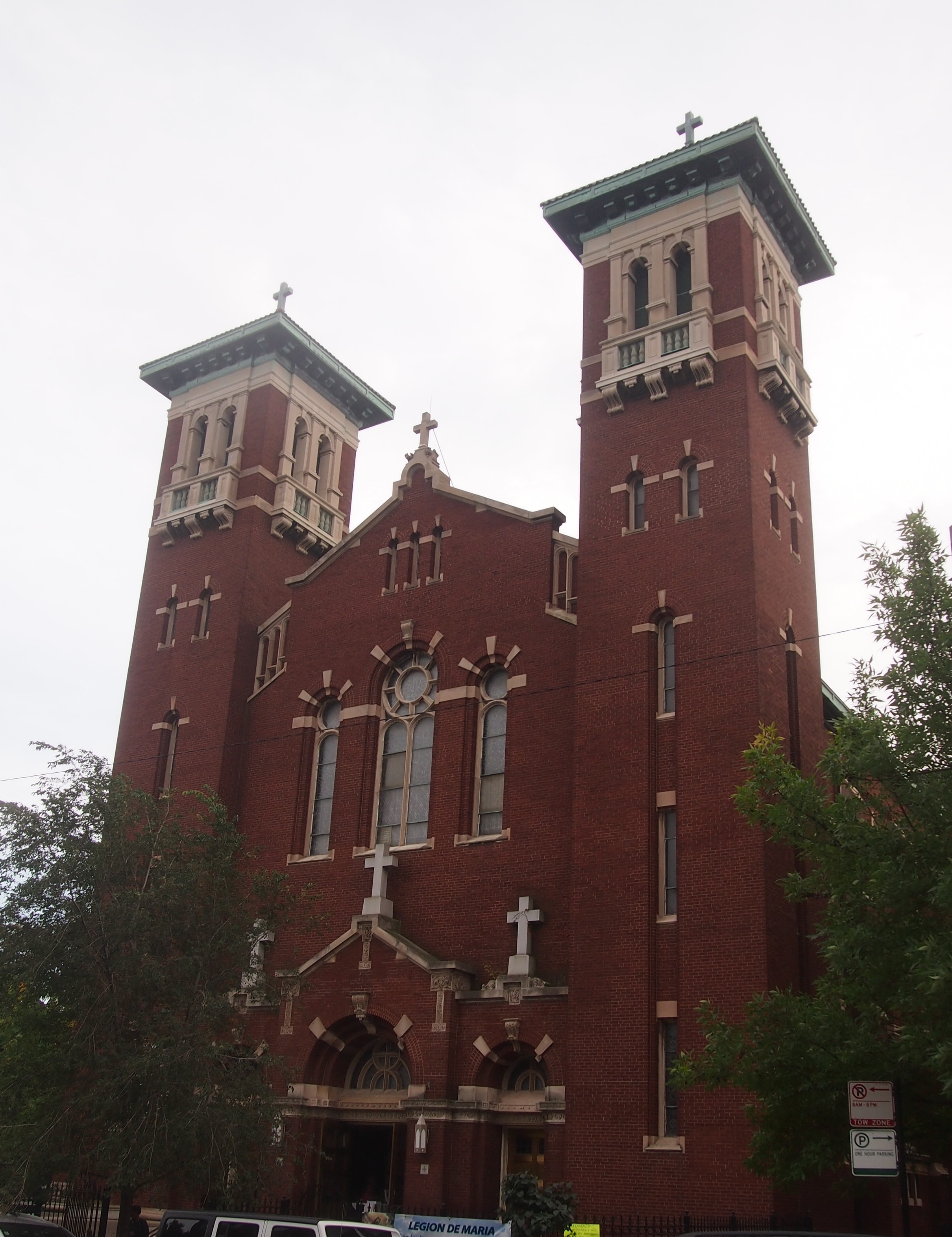
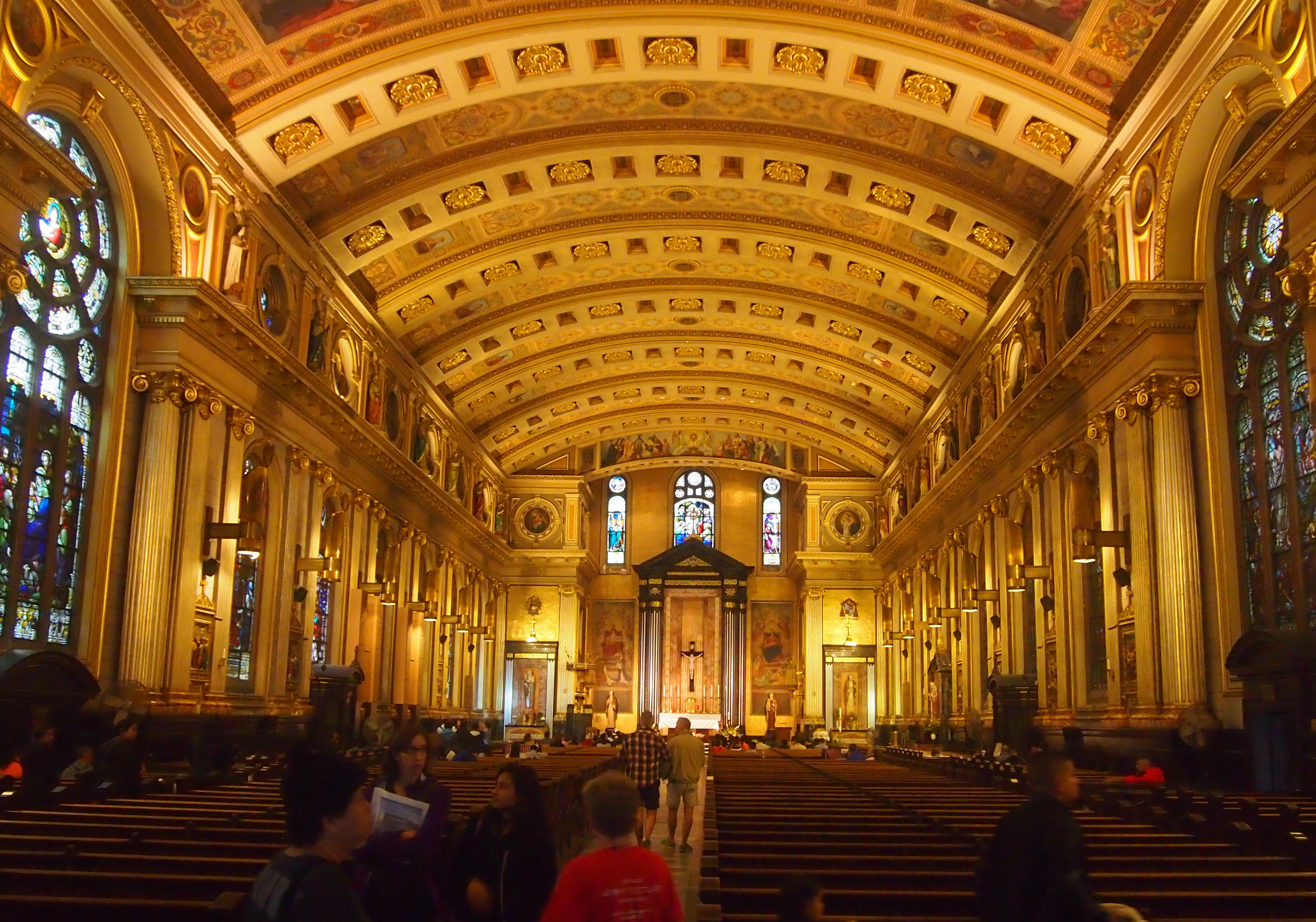
Elsewhere we peeked inside the chapel at St. John’s Catholic Newman Center, which is part of a complex that includes Newman Hall and the Institute of Catholic Thought, and is the largest Newman Center in the country, according to Wiki. Dating from 1926, the chapel has a splendid interior. I explained to Lilly that it was named after Cardinal Newman, not Alfred E., but she didn’t know either of them.

Nearby is the Episcopal Chapel of Saint John the Devine, also a part of a campus ministry. I wanted to take a look in there too, but it was closed for the day.

Heading back to our parking space, we encountered one of the many pieces of public art on campus.Alice Aycock Sculpture, University of IllinoisThere was no plaque nearby that I saw, but information is online. It’s full title is “Tree of Life Fantasy: Synopsis of the Book of Questions Concerning the World Order and/or the Order of Worlds,” by Alice Aycock. As we approached it, I figured it might be a massive sundial, as I’ve seen recently, but no.

This description lacquers on the art-ese pretty well, but it does rhetorically ask, “can we not comprehend the sculpture solely as an interesting, if baffling, assemblage of disparate elements?” Yes, we can. Interesting, but in my amateur opinion not baffling, because it’s mainly an interesting assemblage of disparate elements, though I’d say an interesting “combination of shapes,” since disparate is a ten-dollar word best saved for special occasions.

Fredericksburg Stroll & Der Stadt Friedhof

March 4 was sunny and pleasant in Fredericksburg, a settlement dating back to the efforts of German immigrants to Central Texas before the Civil War. A good day for a small town walkabout. As I walked, looking into the Main Street boutiques and wine shops and jewelers (James Avery has a shop there) and bistros and art galleries, it occurred to me that there needs to be a term for a town that partly or mostly lives off of upper middle-class day-tripers, retirees many of them, from near but not-too-near major metros.

Not tourist traps exactly, though there’s an element of that. I’ve been to a few of these towns, such as Galveston and Galena, Ill., and Sturgeon Bay, Wis., and Portsmouth, NH, and now Fredericksburg. Its locational advantage is proximity to Austin and San Antonio, and the town has a pleasant Main Street, a.k.a. Hauptstrasse, sporting a lot of repurposed 19th-century structures, many of historic or architectural interest.

Fredericksburg 2016The building on the left below was once the White Elephant Saloon, dating from 1888, featuring a whitish elephant above the entrance for reasons probably lost to time.
Fredericksburg 2016This was once a hospital.
Fredericksburg 2016I didn’t try for an exhaustive photo record of the many fine buildings in Fredericksburg. These visitors did a much better job of it, including many things I missed.

According to one source at least, St. Mary’s Catholic Church — which is off Fredericksburg’s Main Street by a block — counts as one of Texas’ Painted Churches, most of which are east of San Antonio. Some kind of adoration was ongoing at St. Mary’s, so I was able to drop in to see the lovely interior. Painted, yes, but also featuring stained glass and other objects of beauty.

“Still known as ‘new’ St. Mary’s, the church provides a classic example of Gothic architecture and was consecrated on November 24, 1908,” KLRU tells us. “Its principal architect was Leo Dielmann of San Antonio, with the contractor and builder, Jacob Wagner of Fredericksburg. Built of native stone quarried near the city, the total cost of building and furnishing the church was around $40,000.

“Still fully functional is the original pipe organ built by George Kilgen & Son of St. Louis, Missouri. It was installed in 1906 as a pump organ and has been completely electrified. The beautiful stained glass windows were added around 1914 and 1915.”

Further away from Main Street — and with absolutely no day-trippers or anyone else (alive) around — was the Der Stadt Friedhof, a cemetery established in 1846.
Der Stadt Fredhof Gate, FredericksburgIt’s more interesting than picturesque. For one thing, there are no trees or other large plants to speak of on the grounds, except out at the periphery. There’s a little funerary art, but its presence is fairly muted.

Still, I enjoyed looking around. The further you get from the boundary roads, the newer the stones become. Among the older stones at the edge of the cemetery are a number of graves surrounded by iron fences.
Der Stadt FriedhofDer Stadt FriedhofMany of which are neglected.
Der Stadt FriedhofDer Stadt FriedhofAlmost all of the oldest stones are German, with ethnically appropriate names, such as Durst, Kallenberg, Keidel, Kramer, Lochte, Schmidt, Schuchard, Stein, Weiss, Zincke, usw. Adm. Nimitz’s parents are somewhere in the cemetery, though I didn’t look for them, and the admiral himself is buried at Golden Gate National Cemetery in San Fransisco.

Church, Funicular, Incinerator

Yuriko’s been back from Japan since Saturday. Among other places she visited there was the Church of the Light, which has stood in Ibaraki in Osaka Prefecture since 1989.
Church of the LightThat’s the interior, which receives light from a cross of a gap in its thick concrete walls. Architectural autodidact Tadao Ando designed the church. Most of his work until around 2000 was in Japan, but lately he’s been doing international commissions, such as the Modern Art Museum of Fort Worth (2002).

Yuriko reports that it’s a remarkable space, considering that it’s essentially a concrete cube. Or a set of cubes; it’s a little hard to tell, even after reading about the structure. More about it — including a lot of pictures — is at Mooponto, “the only web magazine devoted to japanese minimalist architecture.”

I had a brief selfish reaction to hearing about the church. Why didn’t I visit it when I lived (relatively) nearby? I thought about that a while, and maybe I remember hearing about it, but also that the parishioners discouraged casual visitors. They still do, but you can make a reservation to visit.

Here’s another thing I’ll do if I ever visit the Osaka area again: ride the Otokoyama Cable Line funicular. Because one thing we all should do in this life is ride funiculars.
Otokoyama funicularAlso called the Cable Line of the Keihan Electric Railway, it takes visitors up to Iwashimizu Shrine in Yawata, Kyoto. Yuriko went ahead of New Year’s. Somehow or other I’ve never heard of the line or the shrine. A shrine of some sort has been on the site since the Heian period (9th century) and the funicular’s been around since 1926, so I’ve got no excuse.

Another place in the Kansai that I want to see someday is the Maishima Incineration Plant in Osaka. I missed it when I lived there because it didn’t exist until the late 1990s. A few years ago I saw a photo of it and thought, what in the world? That’s in Osaka? Yep. Some photos and a bit about the place and the Austrian architect who designed it are here.

Buildings in the Clouds

Ann wanted to borrow my camera during part of our walkabout on Saturday, so I lent it to her. She took some good images. Such as the Wrigley Building on Michigan Ave., just as the light faded for the day.
Wrigley Building Dec 12, 2015I’ve read that giant grasshoppers crawled on the building in The Beginning of the End (1957). “You can’t drop an atom bomb on Chicago,” protests a young Peter Graves. That does seem like burning down the house to get rid of the termites, but never mind.

Note the soaring structure beside the Wrigley Building, right up into the clouds. That’s the You-Know-Who Tower, with the name of the property mogul running for president — in classy 20-foot stainless steel letters — slapped on the side facing the Chicago River last year.

Also reaching into the clouds, as seen from State St.: Marina Towers.

Marina Towers, Dec 12, 2015They too have been in movies, notably The Hunter (1980), which was Steve McQueen’s last picture. I haven’t seen the whole thing, but in the age of YouTube, it’s easy to see just the part in which a car plunges from the towers — which have parking decks on their lower levels — into the Chicago River. The scene was so good that a similar one was created for an insurance commercial, though I have to add that if you’re running from the cops, I doubt that any policy’s going to cover the damage.

Wicker Park Details

There’s a junction of three major streets in the Wicker Park neighborhood of Chicago at North, Damen and Milwaukee avenues that (I’ve read) is being called Six Corners, to the consternation of those who believe that the junction of Irving Park Road and Cicero and Milwaukee avenues is the true Six Corners. I will note that the Irving Park-Cicero-Milwaukee Six Corners has been called that a lot longer than the North-Damen-Milwaukee Six Corners, but otherwise I don’t have a dog in that fight. Time will sort it out.

Near the North-Damen-Milwaukee intersection on Saturday I walked into a fire hydrant. The bruise on my right leg is still a little sore, but at least I didn’t tumble to the sidewalk. I wasn’t paying attention to the sidewalk, a foolish thing to do, because I was looking at some of the nearby buildings. Such as the former Noel State Bank, now a Walgreens at 1601 N. Milwaukee Ave.

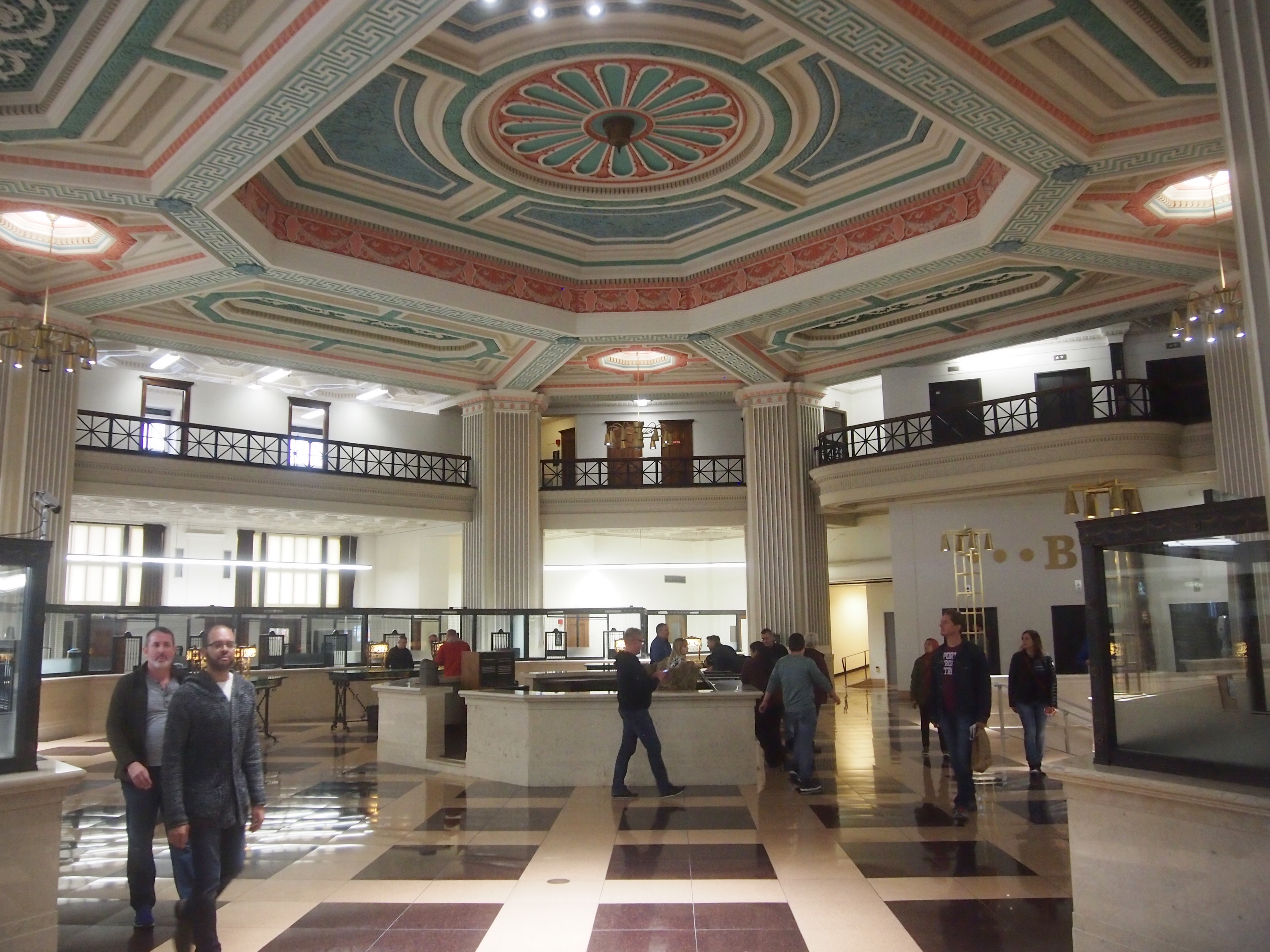
Wicker Park, Nov 14, 2015The outside is stately (bankly?), but the interior — despite being a chain drug store — is gorgeous. A fine adaptive re-use that had a good design to work with.

At 1579 N Milwaukee Ave., is Chicago’s Flat Iron Building, which still seems to be an artists colony, in spite of articles saying that the gentrification of the neighborhood doomed that use.
Wicker Park, Nov 14, 2015This is 1954 W North Ave., a handsome building. Or buildings, it looks like two structures flush against each other, but I’m not sure.
Wicker Park, Nov 14, 2015From the vantage point of the Damen El Station platform, I took a look at the building that’s home to the Double Door, a well-known music venue in Wicker Park. I went there once ca. 1996 to see — who? The singer was a woman, and she spent part of the show bad-mouthing Tori Amos, for some reason; that’s what I remember.
Double DoorSeemed like an ordinary enough building-top. Then I noticed something a little odd.
T*REXSomeone has written T*REX! T*REX! T*REX! … near the top. Presumably from the roof. But why? An enthusiast for the band of that name? Or the prehistoric creature?

Hall of State, Fair Park

At one end of the Fair Park Esplanade is the Hall of State, a stately hall indeed. “The Hall of State, a museum, archive, and reference library, was erected in 1936 at a cost of about $1.2 million by the state of Texas at Fair Park in Dallas to house the exhibits of the Texas Centennial Exposition and the Greater Texas and Pan-American Exposition of 1937,” explains the Texas State Historical Association.
Hall of State, Fair Park“The structure, designed by eleven Texas architects, is characterized as Art Deco… The front is 360 feet long, and the rear wing extends back 180 feet… The walls are surfaced with Texas limestone. A carved frieze memorializing names of historical importance encircles the building. Carvings on the frieze display Texas flora.”

I went inside for a look, and soon was face-to-face — or maybe face-to-plinth — with six statues of early Texas luminaries: Stephen F. Austin, Sam Houston, Mirabeau B. Lamar, James Fannin, Thomas J. Rusk, and William B. Travis. Here’s Lamar (1798-1859), second president of the Republic of Texas, among other things.
MB LamarPompeo Coppini did the sculptures. I’d run across his work before at the Texas State Cemetery in Austin. If it’s a monumental sculpture in Texas done in the early to mid-20th century, odds are he did it.

Then I entered Great Hall.
Hall of State, Great HallThe TSHA again: “The Great Hall, or the Hall of the Six Flags, in the central wing, has a forty-six-foot-high ceiling. Murals on the north and south walls depict the history of the state and its industrial, cultural, and agricultural progress. These were painted by Eugene Savage of New York.” I’d run across him before as well.

Great Hall, Hall of StateDuring my visit, the Great Hall happened to be sporting an exhibit about Texas musicians, and I will say that I learned that Meat Loaf was from Dallas, something I didn’t know. Actually I didn’t know much about many of the Texas musicians mentioned in the exhibit, such as various bluesmen and Western swing players and Tejano bands.

On the back wall of the Great Hall is a gold-leafed medallion with the Lone Star emblem of Texas surrounded by representations of the six nations whose flags have flown over the state.
Gold leaf!The United States and the Republic of Texas are at the top; the Confederacy and Mexico in the middle; and France and Spain on the bottom. The six together are a persistent theme in symbolic representations of modern Texas.

A Stroll Down the Fair Park Esplanade

My afternoon at the State Fair of Texas wasn’t the eat-it-now experience that the Wisconsin State Fair was. I ate two things: a fried chocolate pie like the kind to be found near the Texas-Oklahoma border, and a cheese and jalapeño corn dog, the best corn dog I’ve had in years, maybe ever. It’s the thing to eat at the fair, which is one of the claimants for introducing the food to the world.

Mostly I looked around. I spent some time in the animal barns, for example.

State Fair of TexasState Fair of TexasI missed the pig races, but I did see some riding acrobatics.

State Fair of TexasI also saw a temporary exhibit at the former Museum of Nature & Science, which left Fair Park a few years ago to become the Perot Museum of Nature and Science. The exhibit was called Canstruction, featuring structures made of cans. Such as “Big Reunion,” a model of Dallas’ Reunion Tower by JHP and RLG, two Dallas architecture firms, made out of 3,064 cans — carrots, spinach, mixed vegetables, tomatoes, and beans — plus wiring and LED lights (all that info is on the sign).
CanstructionI liked this one too.
Canstruction“St. Basil’s Cathedral, Moscow,” by Humphreys & Partners Architects, using 2,090 cans: corn, jalapeños, tomato sauce, chilis, and mandarin oranges, among others.

I also got a good look at Fair Park itself, one of the deco marvels of the world. I’d been to the park before, but barely took the opportunity to walk around and gawk at the likes of this.
Fair Park 2015That’s the South Entrado of the Centennial Building, featuring a statue of the Republic of Texas, complete with the lone star and cotton flower. It’s part of Fair Park’s grand Esplanade, with buildings and sculpture on either side of a long reflecting pool. There are six monumental statues along the Esplanade.
The Republic of TexasFairpark.org says of the Esplanade that “the principal axis of the Texas Centennial Exposition was developed along the existing layout of the State Fair grounds. [Head architect] George Dahl strengthened the formal axis by adapting existing, unrelated State Fair exhibition halls with new, monumental facades and projecting porticos on each side of a 700-foot-long reflecting pool.

“The porticos establish the visual framework of the Esplanade and accentuate the grand perspective leading up to the Hall of State. Monumental artwork deftly combines with additional site features to complete the visually complex – and dramatic – spectacle.”

Each of the six statues represents the six nations that have asserted sovereignty over Texas or parts of it — what the Six Flags Over Texas refers to — namely Spain, France, Mexico, the Republic of Texas, the Confederacy, and the United States. France, Mexico and the U.S. were by Raoul Josset, a French sculptor (remarkable how many Euro-sculptors were active in Texas), while Spain, the Republic, and the C.S.A. were by Lawrence Tenney Stevens.

The Esplanade also featured a lot of murals, such as this bas relief mural by Pierre Bourdelle. This was one entitled “Man and Angel.” One source tells me it symbolizes air transport. It’s one of many murals along the Esplanade, each about three stories high.

Fair Park 2015At the eastern end of the pool are two large figures, the striking David Newton replicas of Lawrence Tenney Stevens’s 1936 sculptures, “The Tenor” and “The Contralto.” The originals were lost, maybe melted down for their metal during WWII, but exact replicas were created in 2009.
Fair ParkFair Park 2015As I was taking pictures of “The Contralto,” a group of boys came up to the statue. “Hey, is that a chick?” “Yeah, that’s a chick.” Some laughter. Yep, it’s an aluminum deco chick, companion to the aluminum deco dude nearby.

An American System-Built Home

There are only a handful of American System-Built Homes in existence, about 15 by one count, though others might be spending their days in anonymity. Because I’ve been slapdash in my approach to learning about Frank Lloyd Wright, it was a thing I’d never heard of until Sunday, on the architecture walking tour.

Tourdeforce360VR has this description: “Between 1915 and 1917, Wright designed a series of standardized ‘system-built’ homes, known today as the American System-Built Homes, an early example of prefabricated housing. The ‘system’ involved cutting the lumber and other materials in a mill or factory, and then brought to the site for assembly; thus saving material waste and a substantial fraction of the wages paid to skilled tradesmen.”

World War I interrupted production, and it never started again. Turns out there two in Chicago, and one of these is on S. Hoyne Ave., and known as the Guy C. Smith House.
The owners of the house, David and Debbie — or was it John and Jill or Mark and Margo? I forget, but the names began with the same letters — came out to tell us about the house.
FLW homeownersThen we went inside. It was very nice of the owners to let us shuffle through their home. They’ve done right by Wright, too. This is the dinning room, for instance.
Nice dining room, eh?It’s a fine house, but I could never live in such a place and have it look like this. Soon, papers and books and other items would start to appear on the tables and other flat surfaces. Then they would take over, like kudzu.

A Few Beverly Houses

This was one of my favorites on the Beverly walking tour on the Southwest Side of Chicago, 10340 S. Longwood Dr., also known as the Hilland A. Parker House.
Beverly, ChicagoNote the enormous yard, sloping upward, which we were told continued quite a ways toward the back. The area was wide open when the house was built in 1894, so there was no reason to build on small lots. An architect named Harry Hale Waterman did the design. He did a fair number of houses in the neighborhood, but this one was for himself.

The AIA Guide to Chicago says: “Site and style combine here for high drama. The base of the huge rusticate brownstone blocks rises on the hill to form huge arches on the big semicircular porch. The tall roof, pierced with steeply pitched gabled dormers, exaggerates the height.”

Not far away is this charmer by Walter Burley Griffith, the Harry N. Tolles House, 10561 S. Longwood, which was built in 1911, with some later additions, such as the glass bricks.
Beverly HousesGood old Walter Burley. I learned about him when I visited his signal creation, the city of Canberra, during the warm Christmas season in ’91.

Before the Australians tapped him to build their capital, he “designed more than 130 designs in his Chicago office for buildings, urban plans and landscapes, half of which were built in Illinois, Iowa, Michigan and Wisconsin,” PBS says, in the years before WWI.

At 10616 S. Longwood: the house that’s now home to the Ridge Historical Society, dating from 1922 and designed by John Hetherington. Not this fellow, though.
Beverly, ChicagoThe organization calls it the Driscoll House on a sign in the front; the Graver-Discoll on a plaque around back; AIA calls it the Herbert S. Graver House. Hope no one has come to fisticuffs over the nomenclature. Graver, it seems, commissioned it, while Driscoll was the last owner before the historical society. More about it here.

The oldest house on the tour was the Chambers House, 10330 S. Seeley, dating from 1874 and designed by that prolific architect of previous eras, Unknown (who also did the Irish castle mentioned yesterday).

Beverly, ChicagoAIA says: “The remarkably well-preserved house [indeed] is a classic suburban villa, complete with ‘French’ tower.” Maybe a French tower is a vantage from which to taunt passing Britons clapping coconut shells.

Beverly on a Sunday Afternoon

The leaves are turning. Here’s the scene at the 103rd St Metra Station, on the Southwest Side of Chicago, early Sunday afternoon, under a gray but not rainy sky.
Beverly, ChicagoWe were at the station not because we rode the train that day — we drove, and parked nearby — but because Yuriko and I took a Chicago Architecture Foundation walking tour of the Beverly neighborhood, which started at the station. Beverly is on the Southwest Side of the city, and distinctive for a number of reasons, but one that stood out while walking around is its hilly contour. A glacial ridge just west of S. Longwood Dr. is easily visible near the station, which is on 103rd just east of Longwood, among a knot of small retail shops, including a local bank that tells one and all:
Beverly, Chicago“Known for its spacious homes, tree-lined streets, and racially integrated population, Beverly has retained its reputation as one of Chicago’s most stable middle-class residential districts,” notes the Encyclopedia of Chicago. Originally part of the village of Washington Heights (1874), the area was annexed to Chicago by 1890 but remained sparsely settled for decades.

“In 1886, real estate developer Robert Givins constructed a limestone castle at 103rd and Longwood Drive in the Tracy subdivision of Washington Heights, but the surrounding neighborhood did not achieve residential maturity for decades. The situation was the same north of 95th Street, where Civil War general Edward Young and W. M. R. French, the first director of the Art Institute, had built homes along Pleasant Avenue in the 1890s. Vast sections of Beverly, especially the area south of 99th Street and west of Western, remained prairie until the 1940s and 1950s.”

This is the Gilded Age “Irish castle” of  Robert Givins, with its distinctive turret mostly obscured by leaves at the moment. These days, it’s a Unitarian church. Note the slope of the hill.
Beverly, ChicagoThe tour involved walking south on South Longwood Dr., which follows the bottom of the slope, then up (west) on W. 105th Pl., then north on S. Seeley Ave. and S. Hoyne Ave. Along the way, we stopped and looked at houses, while the docent described them. We got to go inside only one property, the Guy C. Smith House on Hoyne. More about that later.

The last place we saw was at the corner of Seeley and 103rd.

Beverly, ChicagoNice design, but the shoes got more attention. There was a sign in the yard saying HAPPY BIRTHDAY BOB! and another that said, 80 YEARS AND KICKING.