The Cliff Dwellers have a swell view of the eastern reaches of Chicago, Millennium Park, Grant Park, and the expanse of Lake Michigan beyond. The northeast vista looked like this on Saturday, October 19, 2013, at about 12:30, before the clouds and wind blew in.
 The southeast vista was even better, but my photography skills weren’t up to the task. With the eye it was clear enough to see the structures of East Chicago and Gary, Indiana. The view is the from the 22nd floor of 200 S. Michigan Ave., a building across the street from the Art Institute. My photography skills were up to the task of capturing an aspect of that museum that few pay any attention to: its multi-surfaced roof.
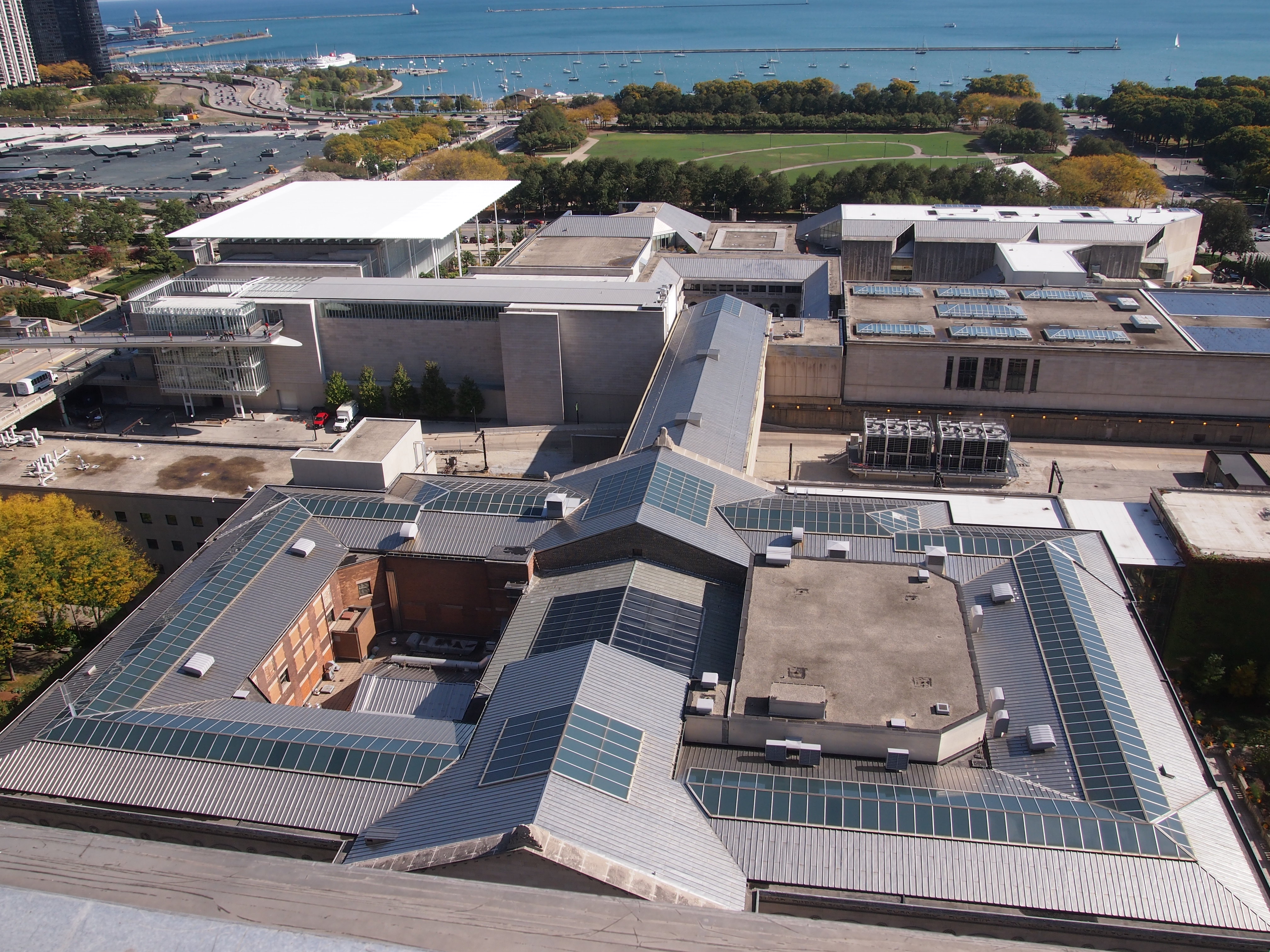 Not a bad roof, I guess, but it seems like the Art Institute is missing an opportunity. It ought to commission a few brightly colored murals that, like the Nazca Lines, can best be appreciated from the air. Or large pieces of sculpture likewise fixed to the roof for distant viewing. The museum could then lease small spaces high up on the surrounding buildings and install telescopes for viewing, maybe for a small extra fee. That’s got to be pushing the conventional boundaries between art and life, or exploring the relationship between physical distance and the aesthetic experience, or beating up some kind of pervasive assumption about art, or something.
The Cliff Dwellers is a private club. I wanted a look-see because I’ve seen parts of other Chicago clubs’ spaces – the Rotary Club, the Union League Club, the University Club, the Metropolitan Club – but not the Cliff Dwellers. “The club exists as a cultivator for the arts, welcoming working writers, painters, musicians, and others as well as affluent art lovers who want to act as patrons,” explains Michigan Avenue magazine. “Though the clubhouse itself is modest, with a bar, dining room, and reading nook (in addition to a breathtaking aerial view of the waterfront and sprawling greenery of Grant Park), the society’s roots are far from low profile, with names like Daniel Burnham, Frank Lloyd Wright, Louis Sullivan, and Carl Sandburg marking its pedigree.”
I imagine the Cliff Dwellers would be happy to mount a big brass telescope to view Nazca Lines on the top of the Art Institute. That would be cultivating the arts.
Moving on, I soon found myself at the Seventeenth Church of Christ, Scientist, a round structure at Wabash and Wacker, very near the Chicago River. It’s a Harry Weese design, completed in 1968.
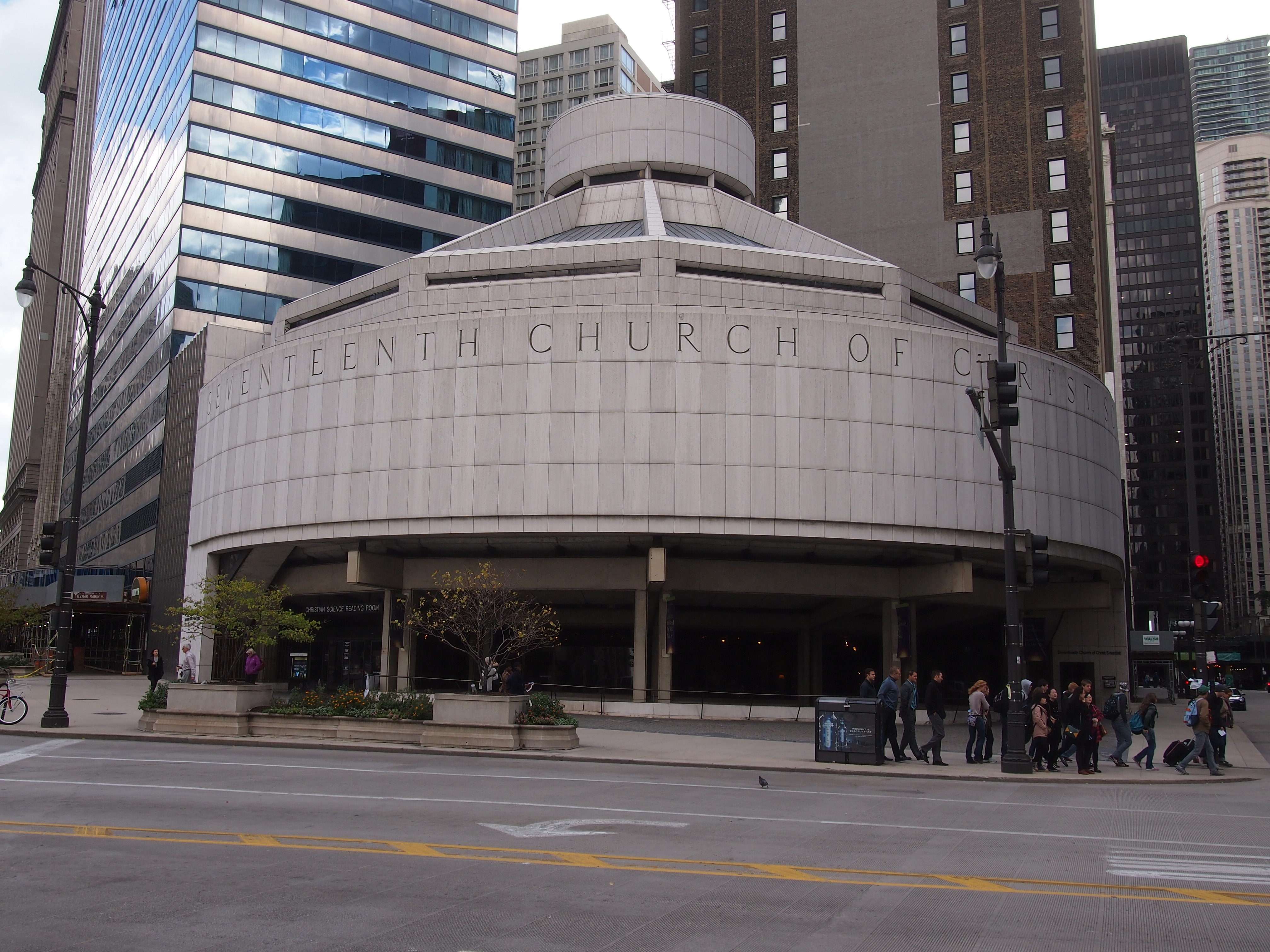 I used to have an office across the street in 35 E. Wacker. I’ve walked by this church countless times. I’d never been inside.
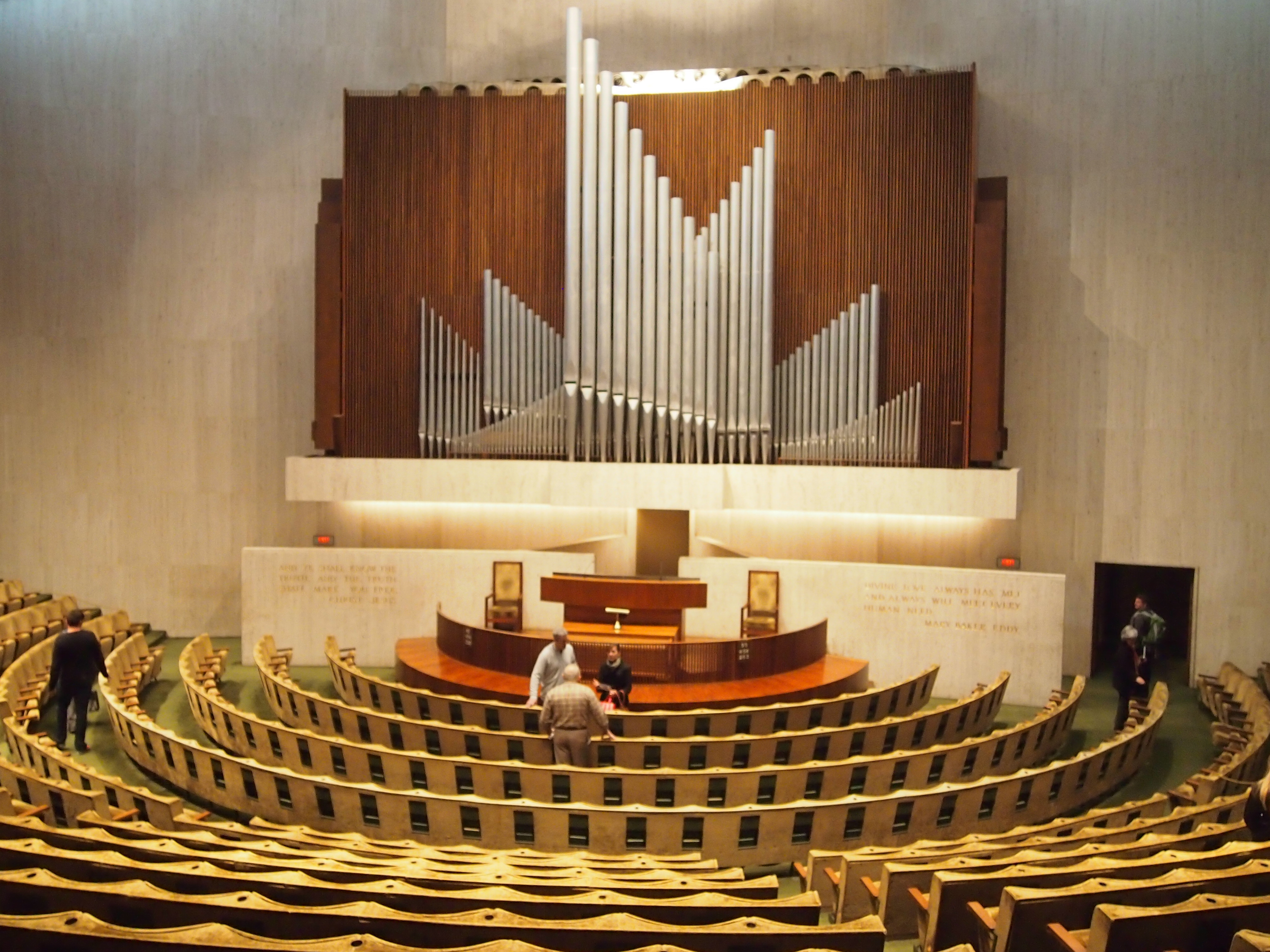 Most of the roundness of the structure is filled by a 764-seat auditorium with a focus on the “readers’ platform,” which is backed by a 3,316 pipe Aeolian-Skinner organ. Supposedly the inspiration for the auditorium is the layout of a Greek amphitheater, but I couldn’t help being reminded of a meeting room at the UN. It has no windows, the better to keep ambient noise from the city from intruding. That works pretty well – I couldn’t hear anything identifiable as noise from the surrounding streets.