The Oculus

Not everybody likes the Oculus, which is the unofficial name of World Trade Center Transportation Hub in Lower Manhattan, opened in 2016 to replace the facilities destroyed in the 2001 attack. The last time I was in town, it was still under construction, but now it’s done.

A good deal of the criticism is about how much it cost, and it certainly was expensive ($4.4 billion, I’ve read). As a non-New Yorker, I can easily be sanguine about that. Besides, with a GDP of $1.3 trillion or so annually, which is in the same league as Spain or South Korea, I suspect metro New York can afford a few grand public works. But it’s also short-term thinking. If the structure lasts even 100 years, who’s going to care about cost overruns?

Then there are the visceral reactions to Santiago Calatrava’s design. Some of these can be found at TripAdvisor, in the one- or two-star comments. A selection follows, all sic.

“White sterile, soulless, limited shopping, resembling a rotting beached whale. This place does not look as if it belongs in NY. More suited to a Middle Eastern theme park.”

“Cavernous: much better to look at from the outside; although, it really just looks like some animal’s ribcage.”

“Although many reviews praise the style of architecture as ‘impressive’, the underlining truth about this architecture is that it was designed in a style similar to that of Soviet Constructivism in order to purposefully induce feelings of tension, intimidation, a global or “one-world” identity rather than a traditional or local one.”

That last one’s an odd notion. Soviet was about the last thing I thought of when inside the Oculus.

That’s the view from one of the balconies on one side of the main hall. I got the sense of a large, vaulting open space — like a major train terminal of old, but looking nothing like one. I have a few quibbles, though. The space could use more places to sit, for instance.

Turning the camera to the vertical from the same perch.

I’d walked to the Oculus from the Downtown restaurant where Geof and his wife Karen and I had had dinner. They wanted to show me the Oculus.

This is Geof Huth. Known him for over 35 years now.

A look at the ceiling from down on the main floor.

I’m not going to spend time intellectualizing my experience at the Oculus. Enough to say that I liked it. I was impressed. It’s a wow. It isn’t like anything else I’ve seen. It may or may not be worth the money, but it is worth spending a few minutes standing in the space and looking up and all around.

Trinity Church Wall Street, Alexander & Eliza Hamilton, and Norges Bank Investment Management

On Broadway in Lower Manhattan, near the intersection with the storied Wall Street, stands the church and graveyard of Trinity Church Wall Street. Looking at the property means you’re peering deep into the history of New York and the early days of the Republic — and into a modern-day real estate story involving Norwegians.

First, the church building.

The current church is the third one on the site, completed in 1846, so it isn’t the building that George Washington and especially Alexander Hamilton would have known. The second building was completed in 1790 to replace the original, which burned down in the Fire of 1776.

Richard Upjohn designed the current Gothic Revival structure as one of the first in a very long list of churches that he did. For a good many years, it was the tallest building in New York, or in the United States for that matter, which is a little hard to imagine in its current setting among taller buildings.

Being Holy Week, the church was fairly busy, though no service was going on when I visited.
Busy inside, but the real crowd was outside, in the graveyard.
A school group happened to be wandering through when I arrived. They might have come for the history of the entire place, but who had they really come to see?

Alexander Hamilton, of course.
I have to admit that I either didn’t know, or had forgotten, that he is buried at Trinity. In a way, that was a good thing, since it was a nice surprise.

Note the enormous number of pennies and other coins at the base of his stone. Seemed like even more than I saw at Benjamin Franklin’s grave, who had the benefit of being associated with “a penny saved is a penny earned.”

Eliza Hamilton, who outlived Alexander by more than 50 years and is buried next to him, collected her share of pennies, too.
That’s what you get for being the subject of a very popular musical in our time. Even I’ve heard some of the songs. Ann plays them in the car. They’re interesting. I’m all for musicals about major historical figures, but I’m not going to pay hundreds of dollars for a ticket.

The Hamiltons weren’t the only famed permanent residents of the graveyard. There’s steamboat popularizer Robert Fulton, who has a memorial fittingly erected by the American Society of Mechanical Engineers.

Here’s Capt. James “Don’t Give Up the Ship” Lawrence, hero of the War of 1812. His memorial’s looking a little green these days.
Nice detail on one side.

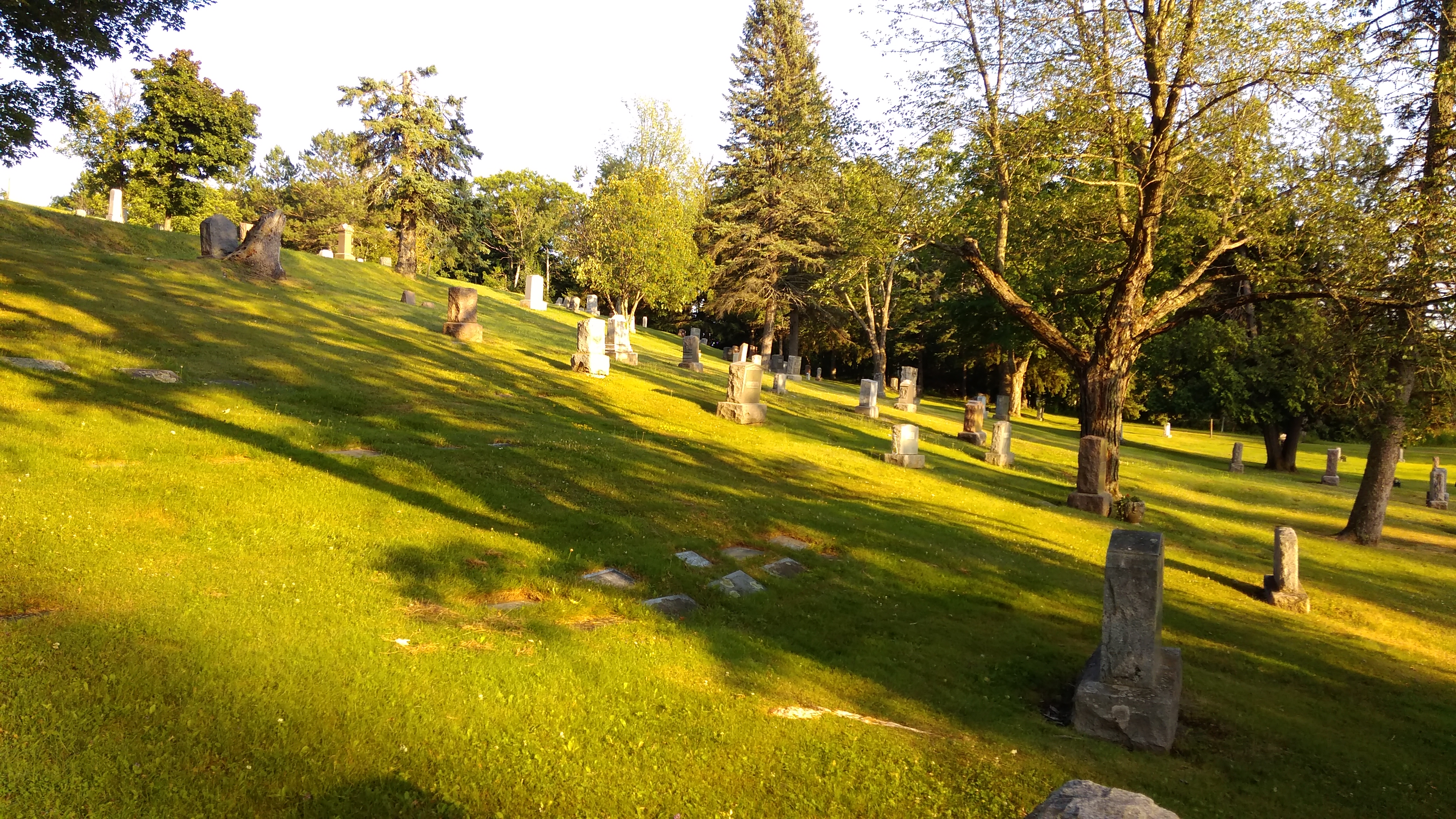
There are also plenty of memorials for regular 18th- and 19th-century folks. I’m glad to say they were getting some attention.

There are stones the likes of which aren’t made any more.

Or on which time has taken its toll.
About those Norwegians. Trinity Church Wall Street, which is part of the Episcopal Diocese of New York, is known for is being one of the wealthiest parishes in the nation. In 1705, Queen Anne granted the church 215 acres on the island of Manhattan. It still holds 14 of those acres, which these days are home to millions of square feet of commercial property. That kind of acreage would make anyone very rich indeed.

Recently —  in 2015 — the church monetized 11 of its office buildings by striking a deal with Norges Bank Investment Management, which oversees Norway’s sovereign wealth fund (a lot of North Sea oil money, I reckon). It’s no secret. I quote from the press release the church published:

“Norges Bank Investment Management will acquire its 44 percent share in a 75-year ownership interest for 1.56 billion dollars, valuing the properties at 3.55 billion dollars. The assets will be unencumbered by debt at closing.”

Unencumbered by debt. The sweetest words you can write about real estate.

“The properties are about 94 percent leased and total over 4.9 million square feet. They are all located in the Hudson Square neighborhood of Midtown South in Manhattan… The buildings were originally built in the early 1900s to house printing presses, but have been redeveloped by Trinity Church to attract a mix of creative office tenants.”

New York ’18: At the Tip of Manhattan

“Charging Bull,” a 7,100-pound bronze at Broadway and Whitehall St. in Downtown Manhattan, seems even more popular than the statue of Rocky Balboa in Philadelphia, which certainly has its fans. My evidence is only anecdotal, judging by the number of people I saw around each, trying to take a picture. Rocky had a short line of people waiting to take their picture with him (in 2016, some 40 years after the movie came out).

But the Bull draws a crowd. In front of it:
Along with those eager to shoot its backside:
I was in New York City all of last week, where I met many of the editors of the company I now work for, plus writers and other staff, at an office in Downtown (Lower) Manhattan. Also during the trip, I spent time with a few old friends and their spouses, and my youngest nephew and his girlfriend. I even had a little time to walk around town, especially Downtown, which I enjoyed despite chilly air and some drizzle.

One of my walks took me to “Charging Bull,” which had its start as one of the heaviest works of guerilla art ever made, by Arturo Di Modica in the late 1980s. Now it’s a fixture on the tourist circuit, located almost as far south as you can go on the island, though not quite.

As is “Fearless Girl,” a much newer installation by Kristen Visbal, dating only from last year, and which was positioned to face the bull as an ad for an exchange-traded fund. I watched as one person after another posed with “Girl.”

Apparently Di Modica doesn’t like his work being upstaged by a little girl, but I can’t say that I much care. What’s interesting to me is their power as tourist magnets. Not many statues have that.

The statues are adjacent to a nice little park that has the distinction of being the first public park in New York, Bowling Green.
Note the fence. It rates a plaque, which says that the park was “leased in 1733 for use as a bowling green at a rental of one peppercorn a year. Patriots, who in 1776 destroyed an equestrian statue of George III which stood here, are said to have removed the crowns which capped the fence post, but the fence itself remains.”

The Alexander Hamilton U.S. Customs House rises over the park, roughly where Fort Amsterdam stood long ago.
The present structure dates from the early 1900s and was designed by Cass Gilbert, who’s best known for the Woolworth Building further uptown. These days, the building is home to a branch of the National Museum of the American Indian, which is part of the Smithsonian, as well as the United States Bankruptcy Court for the Southern District of New York.

Off to each side of the building, allegorical figures stand above; tourists loll below. The work of Daniel Chester French, creator of the seated Lincoln at the Lincoln Memorial and a lot else besides.
Across State Street from the building, in Battery Park, is a curious flagpole. Officially it’s the Netherland Monument. This is the base.

According to NYC Parks: “This monumental flagstaff commemorates the Dutch establishment of New Amsterdam and the seventeenth century European settlement which launched the modern metropolis of New York City. Designed by H.A.van den Eijnde (1869-1939), a sculptor from Haarlem in the Netherlands, the monument was dedicated in 1926 to mark the tercentenary of Dutch settlement, and the purchase of the island of Manhattan from Native Americans.”

How many people crowd around the bronze bull? Dozens at a time. Around the Dutch flagpole? None. Fitting, I guess. Bulls used to get their own cults. Flagpoles, not so much.

The Dutch flag wasn’t flying on the pole.

But at least I saw New York City flag, which is based on the tricolor of the Prince’s Flag of the Dutch Republic. Not as striking as the Chicago flag, but not bad at all.

San Antonio Missions National Historical Park, Before It Was a World Heritage Site

In late March 2013, the girls and I went to San Antonio. I’m always glad to show a bit of the town to them, and the visit included some of the missions, which are collectively San Antonio Missions National Historical Park. A couple of years later, they became a World Heritage Site, the first in Texas.

At Mission Concepción.

In full, Mission Nuestra Señora de la Purísima Concepción de Acuña, founded by Franciscans, with work on the current structures started in 1731.
A little more than a century later, it was the site of the little-known Battle of Concepción in the Texas Revolution.
Mission San Jose.

In full, Mission San José y San Miguel de Aguayo, with construction starting in the 1760s, and restored by the WPA in the 1930s.

I forget where Lilly got the small piñata. I think eventually the dog destroyed it.
It’s still an active church.
Mission San Juan Capistrano.
The church building had just been renovated the year before, which accounts for its newish, rather than long-weathered look.

Much of the grounds is open, with a few other ruins.
We didn’t make it to Mission Espada, and I haven’t been back that way since. Maybe one of these days.

“Nuclear Energy”

If you visit the Smart Museum of Art at the University of Chicago, you can also easily visit “Nuclear Energy,” which is on a small plaza only about a half a block to the south, on Ellis Ave. (but not part of the museum’s collection). I’d seen it before — I couldn’t say exactly when — but Yuriko and Ann hadn’t. So we took a look.

“Nuclear Energy” is a Henry Moore bronze on the site of the first manmade self-sustaining nuclear chain reaction, the 75th anniversary of which just passed last December 2.

As for the sculpture, it was dedicated exactly 25 years after Chicago-Pile-1 was built and tested on the site, so its 50th anniversary was on December 2 too. Looks good for being out in the Chicago weather for so long, but I suppose it’s maintained.
Abstract, as Henry Moores tend to be, but of course you think of a mushroom cloud. Moore denied that, offering up (I’ve read) some art-speak about a cathedral, but I’m not persuaded. A mushroom cloud is perfectly fitting.

The Smart Museum of Art

I hear that the Northeast got blasted again by late-winter snow and wind. For our part, we did get some fast thick snow for a few minutes today. It was just beginning when I looked out my back door.
Not much all together, but it reached impressive near-whiteout for a short time. Reminded me of a moment in 1980 — I think it was March — when Nashville experienced about five minutes’ of snowy whiteout. I watched it unfold from my fifth-floor dorm window; it was like a giant feather pillow had been opened in the sky. Made an impression on a lad from South Texas.

On Sunday, I tried to time our visit to Hyde Park to see Patience so that we could see something else as well. Namely, the Smart Museum of Art, which is the fine arts museum of the University of Chicago. I couldn’t remember the last time I was there. Sometime in the 2000s, probably.
In full, it’s the David and Alfred Smart Museum of Art. The Smart brothers were big-time publishers once upon a time, whose publications included Esquire and Coronet. Their foundation ponied up funds to establish the museum long after they were dead, with the building going up in the early 1970s. It’s a smaller work by architect Edward Larrabee Barnes, who’s better known for the Dallas Museum of Art, Walker Art Center, and the IBM Building in Manhattan.

It’s a small museum. That’s one of its virtues. Also, no charge to get in. Most importantly, the museum has an interestingly varied collection, including 20th-century American works, European paintings from earlier centuries, even earlier works from China, and some very new items.

A number of works caught my eye. Such as “Still Life #39” by Tom Wesselmann, 1964.
A “Thinker.” Yuriko wondered just how many Thinkers there are. I couldn’t say.
“Untitled” by Norman Lewis, 1947.
“#9 New York 1940” by Charles (Karl Joseph) Biederman, 1940.
In a room by itself, we found “Infinite Cube” by Sir Antony Gormley, 2014.
Wow. The sign described it as “mirrored glass with internak copper wire matrix of 1,000 hand-soldered omnidirectional LED lights.” Sounds labor-intensive. We spent a while admiring the thing, which was a different experience each time you moved closer or further away.
I even got a self-portrait with it — accidentally. Ann’s on the other side, with only her feet visible.
Nice work, Sir Antony.

Patience

The Gilbert & Sullivan Opera Company’s performance of Patience drew a sizable crowd to Mandell Hall at the University of Chicago on Sunday (including us), as did previous Gilbert & Sullivan productions that we saw, Yeomen of the Guard and Iolanthe.

For good reason. The company, directed by Shane Valenzi, did a fine job of it, their talent augmented by the skillful University of Chicago Chamber Orchestra, a 40-member ensemble.

Remarkable how something funny almost 140 years ago can still be funny. Not only that, spot-on satirical. Then again, while the aesthetic poetry movement might be a thing of the increasingly distant past, fads — and more particularly, the fickle adulation of male sex symbols — are still immediately recognizable.

All of the leads, including Jeffrey Luksik as Bunthorne and Olivia Doig as Patience, brought considerable talent to their parts, but I was especially amused by Brandon Sokol’s take on Grosvenor. As the program notes put it, “Grosvenor is Fabio, a pure sex symbol without anything resembling artistic sensibilities,” and Sokol played it up delightfully.

Also amusing was Grosvenor’s transformation into “appearance and costume absolutely commonplace.” He came out with his golden hair shortened and wearing sports apparel, namely a Cubs cap and a Bears t-shirt. That was part of the costuming of the entire production, overseen by costume designer Rachel Sypniewski. The costumes were decidedly not Victorian, but that design decision worked.

“We’ve attempted to draw that comparison [between Victorian and modern faddishness] more or less overtly,” the program says, “modernizing the dress of the women and the poets to reflect a Poe-ish aesthetic evocative of the vampire-esque gothic movement that evolved from aestheticism and [which] enjoyed a revival during the popularity of the Twilight saga… The men [Dragoons] are Canadian Mounties who, despite their fearsome competence and justifiable pride, and nonetheless often the subject of light ridicule in American popular culture.”

(Such as Dudley Do-Right. Something I didn’t know about the Mounties, per Wiki: “Although the RCMP is a civilian police force, in 1921, following the service of many of its members during the First World War, King George V awarded the force the status of a regiment of dragoons, entitling it to display the battle honours it had been awarded.”)

Three of the Dragoons, usually dressed as Mounties, got the biggest laugh of the night when they tried to be aesthetics, dressed in tights. Actually, the very biggest laugh came when one of their members, the Duke of Dunstable, played by an enormous, hairy actor named Dennis Kulap, came out in pink tights.

One more thing about Patience, which I discovered just today: Oscar Brand and Joni Mitchell singing “Prithee Pretty Maiden.”

I Got Great Entertainment Value From My DoDeCaHORN in Early ’90s Japan

In early 1992, a curious-minded friend asked me in a letter about the cost of living in Japan. At the time the oft-used example, probably by lazy journalists, was the $10 cup of coffee (shocking in a pre-Starbucks-everywhere context, I guess). I’m sure you would have been able to find such a brew at upscale hotels in Tokyo, but it wasn’t part of my experience.

So I wrote him the following.

March 1992

Japan is justly famous for its high cost of living. But one can adapt, especially as a single person, though you never really grow fond of the system, the basis of which is to squeeze consumers as much as possible. Luckily, I’m no more a typical consumer in Japan than I was in the United States. Remarkably, my personal cost of living is roughly the same in absolute (dollar) terms, and a little less in terms of percentage of income, than in Chicago.

That might seem strange, but there are several factors to consider. Japanese income tax is a flat 10%, sales tax on everything is 3%, so neither of those is especially onerous. I have no car, which I believe would be a useless luxury in Japan, and endlessly expensive. For instance, gasoline is about four times as expensive as in the U.S. I buy few articles of clothes here. They’re expensive, but it’s also true that it’s hard to find my size anyway. I’ve supplemented my wardrobe during travels outside Japan, especially in Hong Kong, where clothes are reasonably priced (except I couldn’t find shoes there either). A spare pair of glasses was a deal in Hong Kong, too.

I’ve been slow in acquiring household appliances. Some of them I bought new — a gas cooker, about $100; a Korean-made TV, about $200; a bottom-of-the-line VCR, also about $200; a DoDeCaHORN combination CD player/double cassette deck with AM/FM band, again about $200. I’m highly satisfied with the quality of these goods, as you might expect from Japanese (and Korean) electronics.

Other items I’ve bought recently have been from departing foreigners in sayonara sales. Recently I acquired a table, microwave oven, book shelf, a number of books and other things that way, cheap. I’ve found a few things in the street for free. My Osaka Gas Fan Heater 2200 is an example, which I found the first summer I was here, before I needed it, abandoned by its owner. Such finds are called gomi, or so-dai-gomi if the items are large.

Food is a major expense. Some things are insanely expensive, such as bread, at $1.50 for four or five measly slices, or $4 or $5 for a glob of raw hamburger American stores wouldn’t package that small, or liters of milk that cost as much as a gallon in the U.S. You might think those aren’t typical Japanese foods, but they are now. Consumption of “Western foods” is so commonplace that the distinction makes little sense in most cases. Besides, rice and fish aren’t particularly cheap, either.

Properly done, eating out is little more expensive than eating at home, due to high grocery costs. I know a lot these days about (relatively) cheap Japanese eateries, including the location of a score of places that offer meals for $5-$8, most of them filling and excellent nutritionally and gastronomically: noodle soups, chicken and pork cutlet meals, Japanese-style Chinese food, rice dishes, curries and more.

Then there’s the matter of rent. I have a modest place, one-and-a-half rooms, certainly less than I had in Chicago. For it I pay slightly less rent, in dollar terms, and somewhat less as a percentage of income. Except in winter, when gas bills are high, utilities aren’t bad.

One more thing: entertainment. Fun can be dear in this country. Luckily for me, I’m seldom inclined to visit bars, no doubt the greatest black hole for yen around. I do go to an izakaya once a week with friends, but that’s as much cheap restaurant as bar. Video tape rentals are about $4 for new movies, less for others. Movies in the theater run at least $18, but I know a couple of second-run houses for less than half that. Some of the best museums and temples in the country are only a few dollars to get in and, if I really don’t want to spend much for entertainment, I take the subway to some part of town I don’t know well and walk around. That never gets old.

Andersonville Walkabout

Argyle Street is in Uptown on the North Side of Chicago. Just north of Uptown is Edgewater. Technically neither of these are neighborhoods, but “community areas,” a term invented by a committee if I’ve ever heard one.

So it is: the Social Science Research Committee at the University of Chicago defines these districts, and the City of Chicago uses the definitions for various bureaucratic purposes. There are 77 of them in the city, each with exact boundaries.

Neighborhoods are more numerous and tend to be more nebulous, evolving over the decades and sometimes being influenced by real estate salespeople. After it became hip to live there in the late 20th century, for instance, the Lakeview neighborhood of Wrigleyville enjoyed a remarkable growth spurt. Or at least, concoctions like “West Wrigleyville” were invented.

All that is a longish way to introduce the fact that we took a walk around Andersonville on Saturday after lunch near Argyle St. Andersonville is an Edgewater neighborhood, but the walk from Argyle in Uptown to the border with Edgewater, Foster Ave., isn’t a long one, and Andersonville is right to the north of Foster, roughly from Broadway in the east to Ashland in the west.

In fact we’d parked the car north of Foster, in Andersonville. Long experience has taught me that parking is easier to find in Andersonville than Uptown.

That’s because there are a lot of single-family houses in Andersonville. Large apartment buildings too, but still mostly single family along some of the neighborhood streets.Some are more colorful than others. I suspect this one is a two flat, or maybe four.Most of the large single family houses are in the eastern part of Andersonville. Toward the west are larger apartments, such as this one.
I have fond memories of the place, since I lived there from 1987 to 1990. Right behind those windows.
Near the western edge of Andersonville is Clark St., the main shopping street for the neighborhood.
It has what 21st-century urban planners pine for: walkability, independent shops and restaurants (never mind the Starbucks), and some local history. Plus some interesting old buildings.
And commercial murals. Remarkably, the shoe store, which sounds like it should be in San Antonio, is still in business. I remember it from the late ’80s.I’d say it’s hard to plan a neighborhood like this. It just has to happen.

Dim Sum & Banh Mi

After watching a very short early afternoon parade on Argyle St. in Chicago, the thing to do is cross Broadway and eat dim sum at Furama. The laughing buddhas encourage you to do so when you get there.

Been a while since we’d had any dim sum, not sure how long. I also couldn’t remember the first time I’d ever had it. Not that that matters to anyone, even me, but I did wonder. It might have been at Furama more than 30 years ago, during one of my periodic visits to Chicago before I moved there. I know I was familiar with it by the time I had dim sum with friends in Boston on January 1, 1990.

I read in the Tribune that dim sum out of carts is considered passe these days. “When you go out for dim sum now in Chicago, after your server sets down your first pot of tea, you’ll scan other tables to see fellow diners reach with chopsticks into steamer baskets and small plates, then you’ll notice something missing: the carts,” Louisa Chu wrote last year.

“The iconic steaming silver serving carts were once considered signs of traditional dim sum, the Chinese weekend brunch where families gathered to share food and stories. But the customs and meal itself are changing, locally and globally.”

That’s mildly disappointing. The carts are important to the experience. Luckily, Furama still does it that way, and so we enjoyed the various things you get from dim sum carts: ha gow, siu mai, cheong fun, lo mai gai, und so weiter. One thing I’ve never acquired a taste for: fried chicken feet, fung zau.

Afterward, we went a block to the north to Ba Le Sandwich Shop to buy takeout Vietnamese food for later consumption. A dragon, maybe to mark the Tet, greeted customers.

Whenever we’re in the neighborhood, we visit Ba Le for banh mi sandwiches or other good things, since everything there is good, and not very expensive. When we lived in the neighborhood, we used to go there too. One spring day in 1998, when we took a very small Lilly on her first picnic in Lincoln Park, we stopped at Ba Le for provisions.