Fort Sumter National Monument

To reach Fort Sumter National Monument, you start at Liberty Square, on Charleston’s waterfront, at this building.
Fort Sumter National MonumentAt the other end of the building is a pier were the tourist boats dock, as is visible in the picture above. The view from there, toward Fort Sumter, looks like this on a clear day.
Fort Sumter National Monument - dockAlso included in the monument is Fort Moultrie, but I didn’t make it there. The Fort Sumter part of the national monument is a little hard to pick out, but it is visible on the horizon.

The ride is about 30 minutes. As you proceed, Fort Sumter gets closer.
Fort Sumter And closer.
Fort SumterPretty soon the boat docks at the former fort for about a hour and a quarter visit, which includes a look at the walls, cannons, the former parade ground, the monument’s large flagpole and flag, and Battery Isaac Huger, a sizable black-painted structure built inside the walls at the time of the Spanish-American War that now houses a small museum and gift shop.

Some of the cannons were enormous. Can you imagine that thing going off near your ears in an age before ear protection?

Fort Sumter

Fort Sumter

A Park Service volunteer demonstrated the loading and firing of a Civil War-era rifle.

Fort Sumter volunteer rifleman

He didn’t load it with a real minié ball, put otherwise the demonstration was authentic. After he showed us all of the steps to load the rifle, and fired it once, he did it again as fast as he could a few times, which was very fast, firing in succession. A true enthusiast.

Behind the battery is a slope up to an open field.

Fort SumterHere are representations the four flags that flew over Sumter during the war: the 33-star U.S. flag like that which flew on April 12, 1861; the first and second Confederate flags; the 35-star U.S. flag after Federal re-occupation of the fort in 1865. Fort SumterThe flag that Major Anderson had lowered when he surrendered the fort, and the one that was raised again symbolically in 1865 — Anderson returned for the occasion — is on display in the national monument’s museum. So is the Palmetto Flag that the South Carolinians flew when the fort was first captured.

The current Stars and Stripes, visible from far away, is atop a large flagpole behind the battery.
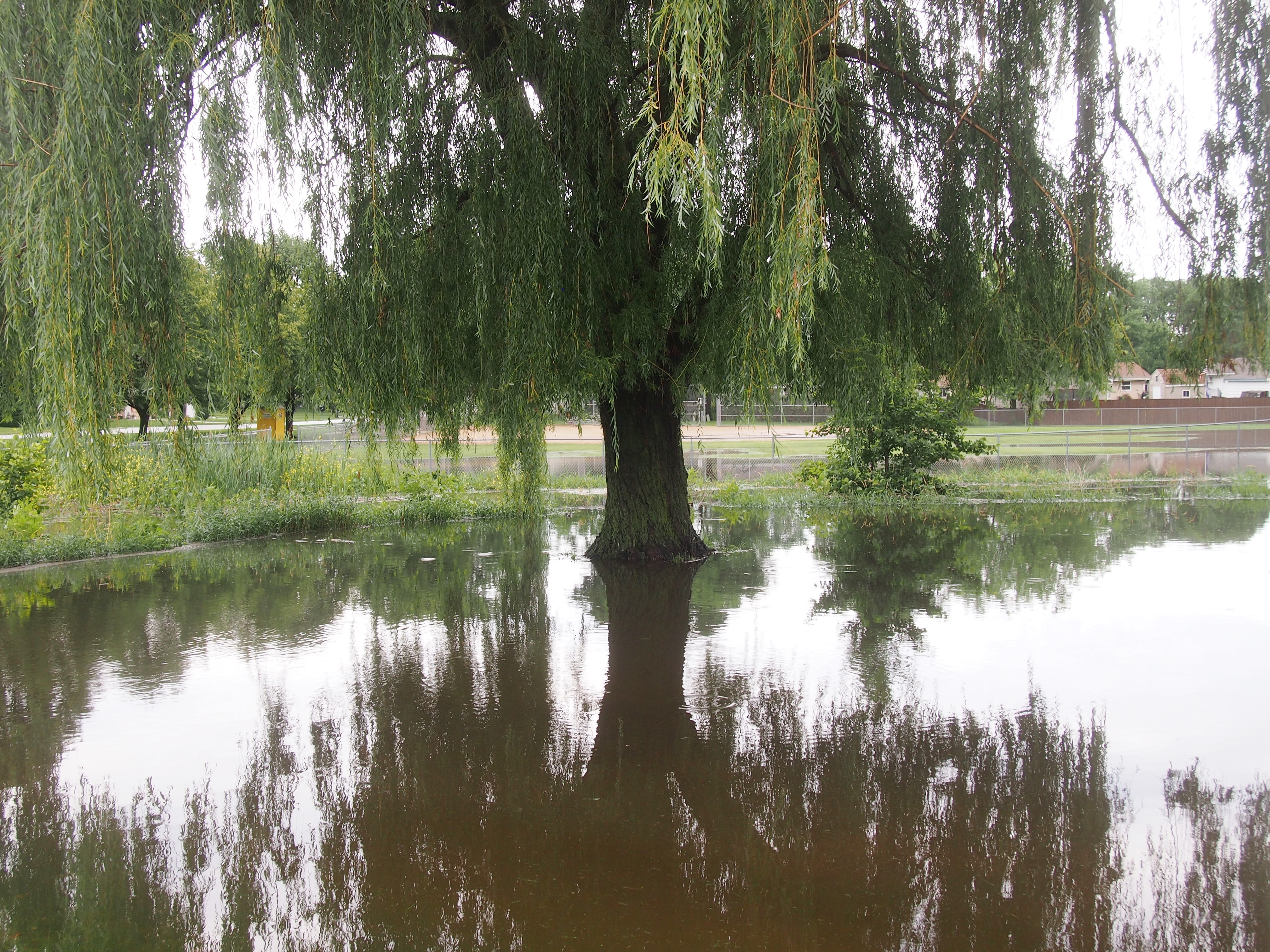
Fort Sumter flag

Major Anderson is honored in relief at the base of the large flag pole.

Fort Sumter

From 1861 by Adam Goodheart: “It would be one thing if President Buchanan had simply announced that he was withdrawing the troops from Charleston Harbor and turning the forts over to South Carolina, a decision that Anderson would have certainly obeyed, perhaps even welcomed. But he would be damned if he was to surrender — even worse, perform a shabby pantomime of a surrender — before a rabble of whiskey-soaked militiamen and canting politicians.

“Like so much else about the beginning of the Civil War, Major Anderson’s move from Fort Moultrie to Fort Sumter is largely forgotten today. At the time, however, the little garrison’s mile-long journey was seen not just as a masterstroke of military cunning but as the opening scene of a great and terrible national drama… ‘Major Robert Anderson, thundered the Charleston Courier, ‘has achieved the unenviable distinction of opening civil war between American citizens by a gross breach of faith.’ Northerners, meanwhile, held enormous public banquets in Anderson’s honor; cannons fired salutes in New York, Chicago, Boston, and dozens of other cities and towns.
“And considered in retrospect, Anderson’s move seems freighted with even more symbolism. He lowered his flag on an old fortress, hallowed by the past, yet half ruined — and then raised it upon a new one, still unfinished, yet stronger, bedded in New England granite…

“Twenty years after the war, when officials at the War Department began preparing the Official History of the War of the Rebellion, a massive compilation of documents that would eventually grow to more than two hundred thousand pages, the first of all the uncountable documents that they included was Anderson’s brisk telegram announcing his arrival at Sumter. Nineteenth-century historians knew that without this event, the war might not have happened…”

More Charleston Scenes

The Nathaniel Russell House on Meeting St. in Charleston, SC, completed in 1808, was originally home of one of the wealthiest men in the city at the time, Nathaniel Russell. In our time, it’s an historic property open for tours.

I didn’t have time to take a tour. I did have time to wander around its picturesque garden, which is open to the public. More remarkably, in mid-February this year, the garden looked like spring already.

Nathaniel Russell House gardenNathaniel Russell House gardenLocal sources told me that the weather lately had been unusually warm, even for Charleston. Flowers and other plants responded to the warmth in the only way they know how.
Nathaniel Russell House gardenSignage sometimes has its charms in Charleston.
Tellis Pharmacy, Charleston SC 2017That’s what more drug stores need, mortar-and-pestle symbology. Alas, it’s only a relic now, since the drug store on this site apparently closed a few years ago. Looks like an antique shop occupies the building, which is on King St. At least the new owners decided to keep the sign; or maybe it’s protected.

Unlike St. Philip’s graveyards, which were locked away behind imposing iron fences (though I could see the stone of Vice President Calhoun in the distance), the Circular Congregational Church’s graveyard is open to all during the day.

 Circular Congregational ChurchThe cemetery included some stones, pre-Revolution in vintage, that reminded me very much of the old stones in Boston’s downtown graveyards.
 Circular Congregational Church cemeteryPlus plenty of later 18th- and 19th-century stones.
 Circular Congregational Church cemeteryAnd some nice views of the back of Circular Church.
 Circular Congregational Church cemeteryOne of the best known tourist attractions in Charleston is City Market, which has been the site of a public market for more than two centuries. I’ve never been one to eschew tourist destinations just because they’re popular among tourists, so I popped it for a look. Not bad, but not nearly as interesting as the Pike Place Market in Seattle.
City Market, Charleston 2017One more structure: Charleston City Hall.
Charleston City HallDiscover South Carolina says: “On the site of a Colonial marketplace, this handsomely proportioned 1801 building first housed the Bank of the United States and then became Charleston’s City Hall in 1818. The design is attributed to Charlestonian Gabriel Manigault, a gentleman architect credited with introducing the Adamesque style to the city after studying in Europe.”

Also worth knowing: the building has some of the few public restrooms in downtown Charleston that are open on the weekend.

Charleston Walkabout

Here’s something I learned about the oldest part of Charleston, SC, when I visited recently: good to walk through, not so much to drive through. I could have guessed that anyway. Small streets, many cars, extremely restricted parking.

But early Saturday morning, when the cars roaming the streets were still few, wasn’t a bad time to come to town by car. I arrived and found a parking garage as soon as I could. On foot from there, on Cumberland St., I encountered traces of historic Charleston almost immediately in the form of the city’s most obscure plaque (maybe), fixed to the ground just north of the sidewalk on the north side of that street, between Meeting St. and Church St.

This Oak Was Planted In Celebration Of

ARBOR DAY 1984

It stands above a portion of the fortification wall that once protected the early Charleston settlement. The wall has been destroyed through time as the city spread beyond it’s [sic] original boundaries. The only visibly [sic] portion of the original fortification is the half moon battery, located in the basement of the Exchange Building.

Dedicated by the City of Charleston
Joseph B. Riley Jr., Mayor

Mr. Mayor, you could have ponied up a bit for a proofreader, considering that the text is in bronze. Anyway, the tree isn’t in the most picturesque part of Charleston.

Soon I moved on to better-looking urban core scenes. The city even has aesthetic water meter covers.
Charleston SC water meterThe palmetto is easy enough to figure out, but the cannons? According to one source (which says it’s “probably true”), the cannons refer to Col. William Moultrie’s victory over the British attack on Sullivan’s Island in 1776. Palmetto logs, which had some ability to absorb cannon fire, were used to reinforce the earthenwork defense.

St. Philip’s, an Episcopal church, stands fittingly on Church St. between Cumberland St. and Queen St.
St Philip's Episcopal Church, Charleston SCThe church, the third for this congregation and the second on this site, dates from 1838. The early history of the church, and Charles Towne for that matter, was one damn thing after another. From a short history of St. Philip’s on its web site:

1728-40: Fires, hurricane, epidemics of smallpox, yellow fever, slave uprisings, Indian attacks, threats of war from the Spanish occurred.

Ah, but Charleston flourished. Slave-cultivated rice, indigo and then cotton from the Carolinas did the trick (part of the bondsman’s two hundred and fifty years of unrequited toil). Highly skilled slaves, I understand, were involved in the wrought iron gates around St. Philip’s, which are a marvel by themselves.
St Philip's Episcopal Church, Charleston, SC iron gateNearby is the light pink Huguenot Church, dating from 1844, at the corner of Church and Queen. It was the first independent Huguenot congregation in America (more-or-less Calvinist, starting in the 1680s) and now the last one.
Huguenot Church, Charleston SCRainbow Row, the nickname for a stretch of East Bay St., features colorful row houses, 13 in all, mostly dating from the late 18th century.
Rainbow Row, Charleston SC 2017They’re in a tightly controlled historic preservation district, except for one thing: the owners get to choose the colors. The pastels were originally put on in the 1920s and occasionally change.
Rainbow Row Charleston SC 2017There are plenty of other handsome houses in that part of Charleston as well. Reminded me a bit of the East End of Galveston.

Charleston, SC 2017Charleston, SCCharleston, SC 2017All in all, a good place to see on foot, provided it isn’t summer.

Char-Tex ’17

Recently, before I went to Texas for a week, I had a day to spend in Charleston, SC, a city I’ve wanted to visit for many years. Just a day, so I packed in the sights. It wasn’t an example of slow travel. Sometimes, you’ve got to hit the ground and go.

I saw the oldest part of Charleston — the site of Charles Towne — on foot for a few hours, took the boat out to Fort Sumter, which took a few more hours, visited Magnolia Cemetery, and saw the H.L. Hunley later in the afternoon.

The old part of Charleston is very handsome, replete with structures surviving from the Antebellum period squeezed into tight city blocks along such streets as Calhoun, Cumberland, Meeting, and at the intersection of King St. and Queen St. A fine thing to do on a February morning that’s warmer than it should be, even in the South: wander past the elegant or curious buildings, admire the churches, take in the details of the streetscapes and sidewalks.

The War Between the States and Reconstruction crushed the local economy. Bad for the people who lived then, good for historic preservation in the late 20th and early 21st centuries, when considerable prosperity has returned to Charleston. Had prosperity continued in the 19th and early 20th centuries, the city might sport handsome Victorian architecture, or might have been Eisenhowered into something less pleasing.

Fort Sumter National Monument is about a 30-minute boat ride away from the city. The fort is as historic as can be, but apparently doesn’t look much like it did in 1861. The war flattened it, the post-war U.S. Army rebuilt and redesigned it until the place was turned over to the Park Service after WWII.

The Confederate submarine H.L. Hunley, whose insufficient design killed more men than the vessel did as a weapon of war, now rests in a tank of water at the Warren Lasch Conservation Center, an industrial structure north of the good-looking parts of town, near other industrial facilities. Eventually, the Hunley will be the star of its own museum, but for now conservation efforts are ongoing.

The Magnolia Cemetery is also north of the old part of town. An old cemetery, it’s rich with old stones, funerary art, monuments to the Lost Cause, and trees festooned with Spanish moss. Also, a warning about not violating South Carolina law.

Magnolia Cemetery, CharlestonWho sees an alligator and thinks, I want to feed it.

Winterlude ’17

Time for a winter hiatus. Back on about February 26, when it will still be winter, but at least with the prospect of a less winterish March to look forward to. Winter around here fades like it’s being tuned out by a dimmer switch — in the hands of a three-year-old, so the transition isn’t very smooth.

Before we saw the parade in Chinatown earlier this month, we walked by the Chicago Public Library Chinatown Branch. It’s fairly new and I didn’t remember seeing it before.
Chicago Public Library Chinatown branchIt’s a nice piece of work. Designed by Skidmore, Owings & Merrill, the building won a Library Building Award from the American Institute of Architects and the American Library Association about a year ago. Being Sunday, it was closed, so we didn’t have a chance to go inside and look around.

Here’s something I saw not long ago when I happened to have a camera in my hand.
It was a drink machine. That it takes credit and debt cards isn’t so strange. Apple Pay, on the other hand, is a new one for me on a vending machine. But maybe I don’t see enough vending machines to notice. At least regular cash is still an option. What’s next, Bitcoin?

Snaps of Early ’76

In late 1975, the Witte Museum in San Antonio opened an exhibition of Fabergé eggs that extended some time into ’76. I went to see the eggs with my family. That must have after Christmas but before New Year’s, before Jay went back to law school for the spring semester, since he took this picture.

Witte Museum Faberge Exhibit 1976

We’re hard to see, but that’s my mother (holding a white purse), brother Jim and me standing next to the museum’s front entrance. Above the double eagle the banner says, FABERGE, and I believe Фабержe across the eagle.

According to Fabergé Eggs: A Retrospective Encyclopedia, as accessed by Google, the exhibit displayed the Danish Palaces Egg (1890), the Caucasus Egg (1893), and the Napoleonic Egg (1912), beginning on December 14, 1975. The Witte exhibit was over before September 12, 1976, when the same eggs opened at the Huntsville Museum of Art in Alabama.

I have to say I don’t remember much about seeing the eggs, but it has been more than 40 years. I was probably as impressed as a 14-year-old boy could be.

At some point in early 1976, we also went to Inner Space Cavern, which is just north of Austin.

Inner Space Cavern, Texas, 1976That’s about as good an image as I was going to get with my Instamatic 104. The exact same formation is pictured here.

Among Texas show caves, Inner Space was fairly new then, since it was discovered only in 1963 during construction of I-35, and open to the public three years later.

“Inner Space is situated in Edwards Limestone (Mesozoic Era) and is estimated to be sixty to 100 million years old,” says the Handbook of Texas Online. “Geologists attribute formation of the cave to the action of underwater currents when the Permian Sea covered the area. Ninety-five percent of the highly decorated and complex cave is still active.” Inner Space billboards call to passersby on I-35, as I sometimes am, but I haven’t been back since.

One more snap from early ’76: David Bommer.

David Bommer 1976

We were goofing around in my back yard and, as you can see, I caught him my surprise with the camera. David, a friend of mine since elementary school, has been gone now nearly 10 years.

Thursday Loose Ends

While the Northeast is buried under snow, I look out onto a patch of northern Illinois — my yard — that’s brown. The heavy snow of December gave way to a moderate January, by local standards, and all the white went away. It’s cold out there, but it doesn’t look like February, which is usually marked by unmelted snow in some spots, or at least in the shadows.

I noticed the other day that My Favorite Martian was on demand, so I watched the first episode. I don’t have much memory of its original airing, from 1963 to ’66, and I don’t remember seeing it in syndication, so it’s essentially new to me. Verdict: mildly amusing at times, mostly because Ray Walston and Bill Bixby had some comic talent. But I don’t think I need to watch many more episodes, thus putting it in the same class as Mister Ed or Leave it to Beaver.

Reading a bit about the show, I learned that Bill Bixby’s full name was Wilfred Bailey Everett Bixby III. In our time, that would be the original name of a hip-hop star. Also, just before he died, he married Judith Kliban, widow of B. Kliban.

Hadn’t thought about B. Kliban in years. Didn’t know he was dead, but he has been since 1990. Somewhere at my mother’s house (I think) are collections of his comic drawings that I bought. One is called Never Eat Anything Bigger Than Your Head. Words to live by.

At a magazine rack in a big box store not long ago, I saw a copy of Rolling Stone. I was shocked. It was so thin you could put it in a box and use it for Kleenex. The magazine was also standard size, or smaller, not the tabloid that by rights it should be. It was like running into an old acquaintance who’s now dying of a wasting disease. Guess its real presence is online now anyway.

“Acquaintance” because I never read Rolling Stone that much. Not all together my kind of magazine. But I would pick it up and look at in doctors’ offices or from friends’ coffee tables or the like. And I have to say it often had interesting covers, even if they depicted celebrity musicians I cared nothing about.

Last Friday, I dropped by the visit the Friendship Park Conservatory, a small conservatory that’s part of the Mount Prospect Park District. Nice to see some green now, even if the pit of winter this year isn’t too deep.

Friendship Park Conservatory, Mount Prospect

Friendship Park Conservatory, Mount Prospect

The last time I remember being there was in late summer, when it was green outside the conservatory as well as inside. Back in 2005. The girls were a lot smaller then.

Friendship Park Conservatory, Mount ProspectEarly this week, Junk King paid a visit to a house on my block.
I’d heard of the company, but never seen one of its distinctive red trucks before.

The Flight 191 Memorial, Des Plaines

After lunch on Friday, I realized I was fairly close to the Flight 191 Memorial, so I went to take a look. It might be February, and it definitely was cold, but the sky was sunny and the ground without any ice or slush to wade through.

I remember hearing about the crash, which happened the week before I graduated from high school. Probably most people old enough to understand what had happened remember hearing about it, so terrible was the accident. Almost 38 years later, it’s still the worst U.S. aviation accident in terms of fatalities, 273, unless you count all the crashes on Sept. 11, 2001 together, but those were no accidents.

The memorial is tucked away in a park in the large suburb of Des Plaines. From a distance, the site is unassuming, between the road and a jogging path.

Flight 191 Memorial, Lake Park, Des Plaines 2017

I imagine that most people driving by on Touhy Ave. just to the south of the site don’t know it’s there. Closer up, the memorial reveals itself. It’s a low wall with names of the victims inscribed, one to each brick.

Flight 191 Memorial, Des Plaines ILFlight 191 Memorial, Des Plaines ILFor a long time, more than 30 years, there was no memorial to AA 191 anywhere. In 2011, the Chicago Tribune reported that the effort to build a memorial “started with [Kim] Jockl, an assistant principal at Decatur Classical School in Chicago’s West Rogers Park neighborhood whose former students learned she had lost her parents on the Los Angeles-bound flight.

“The group pushed for two years to build the memorial. Finally, American Airlines agreed to foot the $21,500 cost, according to officials at the ceremony, and a location for the memorial was found inside Lake Park in Des Plaines.”

A plaque mounted on a short pole behind the wall says:

WE REMEMBER FLIGHT 191

Let us not forget the victims of May 25, 1979, who helped assure the safety of all who have boarded an airliner since that tragic event.

“When someone you love becomes a memory, the memory becomes a treasure.” — Author Unknown

A special thanks to all who helped make this memorial possible, especially: Decatur Classical School, Chicago Public Schools; US Representative Jan Schakowsky; IL State Sentator Dan Kotowski; the Des Plaines Park District; American Airlines; Project Citizen; Thomas A.Demetrio; Constitutional Rights Foundation Chicago; Center for Civic Education; and Nilco, Inc.

Katsudon

I had lunch with an old friend on Friday at the food court of Mitsuwa, a small Japanese-oriented mall anchored by the grocery store of that name in northwest suburban Arlington Heights. We had a good visit. The food is quite good there. I had some katsudon, a Japanese creation with pork cutlet and egg and a small amount of vegetables on rice, and long a favorite of mine among Japanese eats.

There’s a tiny restaurant off an alley in the Namba district of Osaka simply called Katsudon (or rather, カツ丼). It seated maybe eight at a counter looking straight into the small area in which two cooks made katsudon, the only thing on the menu, in gleaming copper-bottomed vessels. It wasn’t especially expensive and it tasted like heaven.

In fact, the place offered up the Platonic Ideal of the katsudon, as far as I’m concerned. All katsudon of the material sphere yearn to be that form. They inch toward it, but never quite make it. In short, the one at Mitsuwa was very good, but not as good as Katsudon, at least as it was 25 years ago. Hope the quality’s been maintained.

I had to look around to make the sure that the restaurant is still in business. I found some pictures, and it even looks like I remember it. Seems like the joint now also offers the related dishes of tonkatsu — cutlet on a bed of chopped lettuce — katsucurry, which is the cutlet on top of curry rice. Bet those are top-drawer, too.

I also noticed that the name of the alley is Hozenjiyokocho. I’m not sure I knew that back then. According to one source, the alley is a “collection of 60 small izakaya, bars and eateries in an alleyway behind Hozenji Temple in Osaka. The street has been filled with nightlife since the 17th century, when the area was a theater district.”

As for the nearby image of the kami Fudo Myo-o, which is covered with moss, I must have seen that. That’s the kind of thing I would notice. But I don’t remember.

What I need now is a specialized Tardis, one that takes you to your favorite restaurants, past or present, closed or still operating. Katsudon in Hozenjiyokocho would be such one place, since my tastes run to the inexpensive.

Off the top of my head, other destinations would include O-Sho, also in Osaka, which made wonderful gyoza; River Kwai in Chicago; Mack’s Country Cooking and Loveless Cafe as they used to be in Nashville; the Daily Catch in Boston; Viet Nam in San Antonio; that place in Apalachicola; that other place in New Orleans; the Cuban place in Tampa; Pizza Rustica and Mario’s in Rome; that fish-and-chips spot on Cleveland Street in London; halbes Hähnchen mit Pommes frites in Lüneburg; and yet other establishments whose names I’ve forgotten in New York, Hong Kong, Singapore, Bali and other places.

The 2017 Chicago Chinatown Lunar New Year Parade

I ought to go to more parades. As long as the crowds aren’t impossible, they can be worth a few hours, and at a parade you’re participating in something that must be as old as urban civilization. Parades of some kind were surely features of life in Ur.

I’ve been to parades on the occasion of First Night, St. Patrick’s Day, Patriots Day (the Massachusetts holiday), San Jacinto Day, July 4, Halloween, and Veterans Day. I’ve seen them in honor of Puerto Rican Day, Indian Independence Day, and the first day of the MacKenzie, ND, County Fair. I took in a Democratic Party torchlight parade at which I saw candidate Michael Dukakis walk by. I’ve seen them in Japan, Indonesia and Disney World, or was it Land? I even saw one including dwarfs.

But never a parade for Chinese New Year. I had that in mind when I decided a while ago to go to Chicago’s Chinatown for its parade, provided it wasn’t bitterly cold, as it was last year. The parade this year was Sunday, February 5. A little late after the Chinese lunar new year, but close enough. Temps were above freezing.

The event drew a crowd.
The 2017 Chicago Chinatown Lunar New Year ParadeThat image is looking south down S. Wentworth Ave., from across W. Cermak Rd., through the Chinatown Gate. The crowd that way was very thick, too thick for comfort. So we found a spot on the south side of Cermak, just west of Wentworth. If we’d thought about it more, we would have stayed on the other side of Cermak, which was the sunny side of the street, but things weren’t too bad at our spot. Eventually we were able to stand right next to the barricade.

These are the kinds of things you want to see at a Chinese New Year parade. Dragons on sticks and bright colors.

The 2017 Chicago Chinatown Lunar New Year Parade

The 2017 Chicago Chinatown Lunar New Year ParadeAnd the likes of these guys.

The 2017 Chicago Chinatown Lunar New Year Parade

And colorful flags.
The 2017 Chicago Chinatown Lunar New Year ParadeWhat’s a Chinese New Year parade without the the Irish pipe band Shannon Rovers?
The 2017 Chicago Chinatown Lunar New Year Parade - Shannon RoversMuch of the procession included ordinary parade stuff, which a distinct Chinese-American aspect. I suspect Shannon Rovers, for their part, seldom miss an opportunity to be in a Chicago parade. I’ve seen them before, but not in a parade.

Among other groups that wandered by the viewing stand, and then our position to the west of it, were the Chicago Police — not the cops doing crowd control — and Fire departments, the American Legion, the FBI Chicago Division (?), the PRC Consulate General, Hyatt, the Taipei Economic and Cultural Office, the Taiwanese Benevolent Association, the Taiwanese American Chamber of Commerce, Duen Feng Midwest High School Association, the Chinese Entrepreneur Organization, Chiu Quon Bakery, the Chinese-American Service League, and the Indianapolis Chinese Community Center, who brought their own dragons on sticks.
The 2017 Chicago Chinatown Lunar New Year ParadePoliticos were on hand, mostly offering pablum from the viewing stand. Schools were well represented, including some by their bands.
The 2017 Chicago Chinatown Lunar New Year ParadeThen there was this fellow.
The 2017 Chicago Chinatown Lunar New Year ParadeWonder how many parades a year that shoe is in.