The Ann Arbor-Toledo trip was less than 36 hours and only about 640 miles, but we managed to eat four different interesting meals. Interesting by my lights, anyway: cheap one-of-kinds eking out their living at the margins of a fast-food economy by being better than fast food (actually, two of the places were part of a small local chain; and by small, I mean three or four locations). The food was American and not particularly healthful by current standards: doughnuts, hamburgers, eggs-and-meat breakfast food, and chili dogs.
I did a bit of snooping around before we went. Remarkable what you can find, even apart from the likes of Yelp or Urban Spoon, and soon I got wind of Sweetwater’s Donut Mill, with three locations in Kalamazoo and one in Battle Creek. Just the thing for between breakfast and dinner, without stopping for a delaying lunch. I noted that the main branch was in Kalamazoo just off Sprinkle Road — that’s a good name for a road — which was accessible by an exit on I-94.
Except that the Sprinkle Road exit was closed. Both the exit and the bridge over the Interstate are being completely rebuilt. So I figured I’d wait till the next exit and turn around, but miles and miles passed before the next exit. Soon I decided it was too far to go back for; we’d find something else off of one of the exits into Battle Creek (one of these days, I should take a look at the Hart-Dole-Inouye Federal Center, which used to be the San, but I didn’t want to look for it last Friday).
As soon as we’d gotten to the first traffic light after the exit, Lilly said, “Isn’t that the doughnut shop you’re looking for?” And it was. The Battle Creek branch of Sweetwater’s was right there in a strip center. So we went in and got a half-dozen doughnuts.
Clearly, God wanted us to have those doughnuts. The Lord does not mislead, either. They were large — larger than my palm — tender and delicious, and no more expensive than a large chain shop’s doughnuts. We had chocolate-, vanilla- and custard-filled varieties. They were so substantial, in fact, that we didn’t finish them all till the next day, and they were still good then.
That evening, after wandering around U-M for a few hours, we repaired to Krazy Jim’s Blimpy Burger, an Ann Arbor storefront hamburgery not quite like any other I’ve been to. You order your burger cafeteria style — from the staff who cook and otherwise assemble the meal in a small cooking zone behind the counter as you stand waiting. Posted on the wall are “rules” for ordering. Rather than rules, they’re really more-or-less a description of how the ordering goes down.
When it is your turn to order:
1) First, the deep fryer order: french fries, fried veggies, etc.
2) Then, what size Blimpy: double, triple, quad, quint
3) Next, decide what kind of roll: plain, onion, kaiser, etc.
4) Any grilled items: onions, mushrooms, peppers, etc.
5) Just before the burger comes off the grill, you will be asked to pick what kind of cheese you prefer, if any.
6) After the burger comes off the grill, you will be asked what type of condiments you would like – please start with “wet” items like mayo, ketchup or mustard… and only say what you want and NOT what you don’t want!
The fellow who took our fry order looked like a student doing a summer job. He might be a descendant of the late Krazy Jim. Cooking the burgers was a petite black woman who’s probably the most enthusiastic short-order cook I’ve ever seen. A dervish of a fry cook, this woman. When it was your turn to order, of course you didn’t have to remember what to say. She’d ask in rapid succession — what size? what kind of roll? what do you want grilled? If you started to give your cheese order, she’d respond: No cheese order now! Not interested! Later, when the meat was cooked, she asked about cheese. She not only took orders, she had about three or four orders going at once, kept track of them as they cooked, removed them when they were done, joked with the other staff, and had the most Wicked Witch of the West cackle of a laugh I’ve ever heard — so distinct that we’d hear it periodically as we ate, audible over the noise of the other diners, the sizzle of the grill, and the clanging of cooking utensils.
Another employee, to her left, put on the lettuce and tomatoes and the like, and a fourth person rang up the order and ran around the place doing other things. Quite an operation, but it would have been for nothing if the burgers weren’t so good. All that effort produced a hamburger like you make at home, provided you’re really good at making hamburgers. We left the joint satisfied.
The next morning we had Hippy Hash. Or rather, Lilly did. “Hippy” is just as a colorful moniker, and “hash” in the sense of a breakfast food conglomeration: hash browns topped with grilled tomato, green pepper, onion, mushroom and broccoli topped with feta cheese. Where does one find Hippy Hash in Ann Arbor? At the Fleetwood Diner. It’s a genuine, honest-to-God diner, a small fleck of a survivor of the pre-Ray Kroc time when companies near Lake Eire manufactured diners, and diner kits, for diner entrepreneurs to set up all over the country.
On the outside, it’s a small metal diner with awnings and tables and chairs in front of the entrance. On the inside, there’s a cooking zone, a counter, and space for a few tables. Some hundreds of stickers — geographic, slogans, advertising, all kinds of things — adorn the walls. The grill is always sizzling and the waiter and waitress are in constant motion.
Lilly, as I said, had the house specialty. I had scrambled eggs and bacon and hash browns and toast, the simplest diner food imaginable. It was very good. It wasn’t expensive, even though they didn’t short on bacon: four slices. Lilly said she liked the Hippy Hash, but could have done without the broccoli.
It seems that the diner’s been named the Fleetwood only since the 1970s. Before that, it was the Dag-Wood, because that was the diner’s brand name. “Dag-wood Diner Inc. — This company was located in Toledo, Ohio,” one web site asserts. “They made the kit that became the Fleetwood Diner in Ann Arbor, MI in 1949. They also made a diner that went to Erie, MI that has now been remodeled beyond recognition… One former owner of a Dag-Wood diner mentioned that no more than half a dozen were made, though this has not been verified.”
Ah, but I fear for the future of the Fleetwood. A single investor apparently owns its site and the buildings next to it — that include Blimpy Burger — and isn’t talking about his plans. I know how these things go. In a few years, there will be redevelopment, and it won’t be nearly as interesting as what’s there now. Glad I got to go before that happens.
One more place: Tony Packo’s in Toledo. I won’t evade the point: the only reason I wanted to go there was because Cpl. Klinger told me it was good. Never mind that he’s a fictional character of a generation ago, and he wasn’t speaking to me personally. And I didn’t even remember the name of the place till I looked it up. That is, Googled “Klinger restaurant Toledo.” Tony Packo’s comes up instantly.
The restaurant’s web site says: “The words that came out of Jamie Farr’s mouth on Feb. 24, 1976 would put Tony Packo’s in the spotlight. Farr, a native Toledoan himself, appeared in the television show M*A*S*H, playing Corporal Max Klinger, a crazy [sic] medical corpsman who was also from Toledo. In the episode that made Packo’s future, a man playing a television newsman talked to Klinger about his hometown. Farr wrote a little local color into his reply. The lines read, ‘If you’re ever in Toledo, Ohio, on the Hungarian side of town, Tony Packo’s got the greatest Hungarian hot dogs. Thirty-five cents…’ ”
The character would go on to mention the place a few more times after that, and while the details didn’t stick with me, the notion of a hot dog stand in Toledo did. Turns out “Hungarian hot dogs” are just as fictional as Cpl. Klinger, and the restaurant owns up to that: “Because Tony was Hungarian-American and lived in a Hungarian neighborhood, Tony’s creation was called the Hungarian hot dog. Until Toledo-born Tony invented it, there was no such thing as a Hungarian hot dog, say those who know the Old Country’s food.”
The hot dog, which is in fact a sausage, was tasty. The chili, which is the other signature item, wasn’t bad. The chili you get in Ohio is going to be Ohio chili, after all, whether it’s a Toledo recipe or the 5-way variety in Cincinnati.
The inside of the restaurant looks like a medium-priced chain (Tony Packo’s is a very small chain), except for all of the signed hot dog buns behind plastic bubbles on the walls.
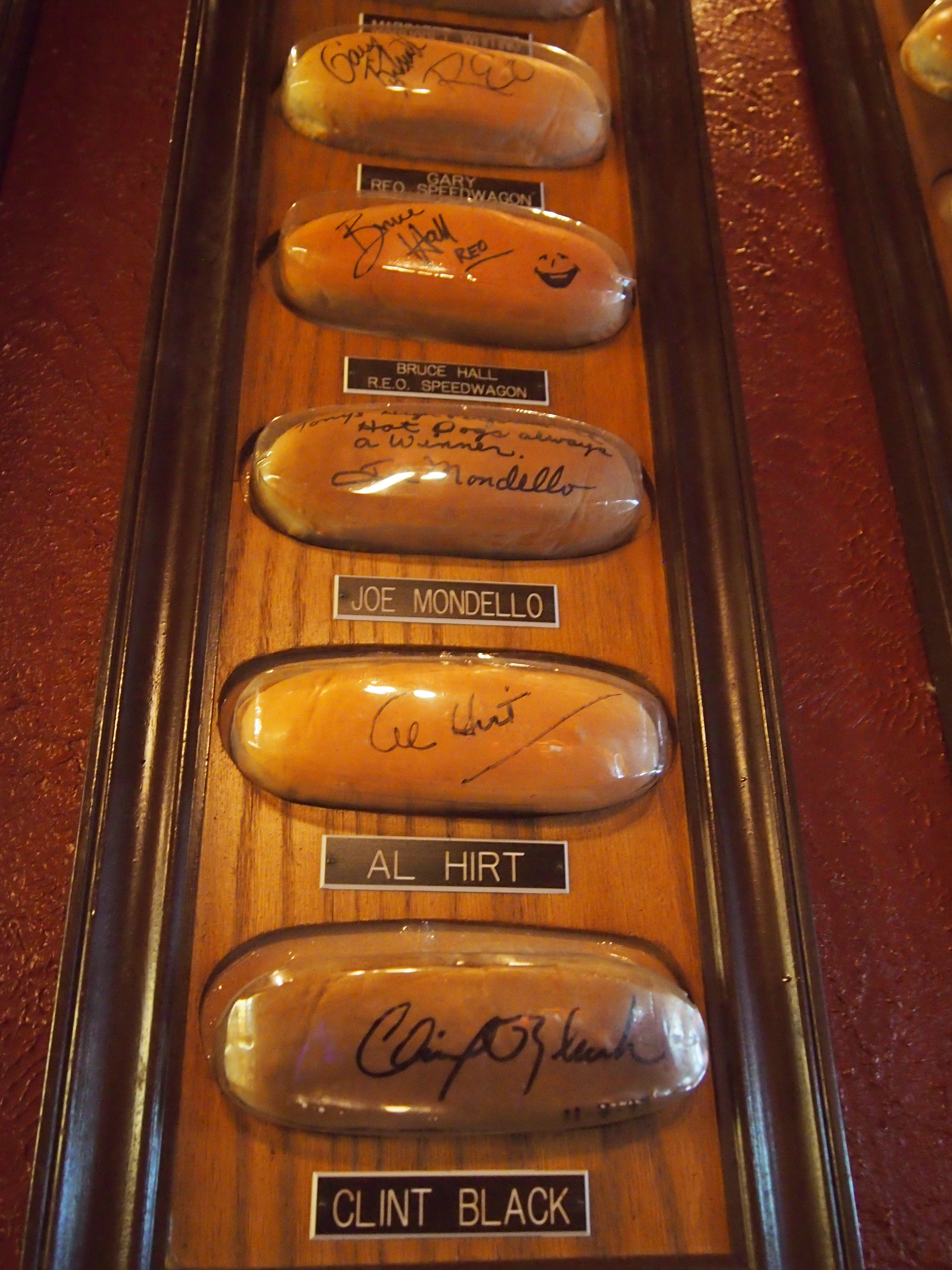 We sat behind Clint Black, Al Hirt, Joe Mondello, and some members of REO Speedwagon, among others. Hundreds of them line the walls. Apparently famous visitors have been signing them for more than 40 years, even before Jamie Farr mentioned the place. Of course, they’re not really bread, but artfully painted foam, though the autographs are real. More about the faux buns here.
 Downtown Portland on a summer Saturday teems with people, more than most mid-sized U.S. cities I’ve encountered. The obvious tourists were a minority. So were the obviously homeless, though they seemed more numerous than in most cities this size (and statistically, it’s a sad fact). Mostly, I think conventionally housed Portlanders were downtown because it’s an interesting place to be on the weekend. Good for Portland.
 One place I was determined not to miss was Powell’s Books. Otherwise known as Powell’s City of Books, an apt nickname.
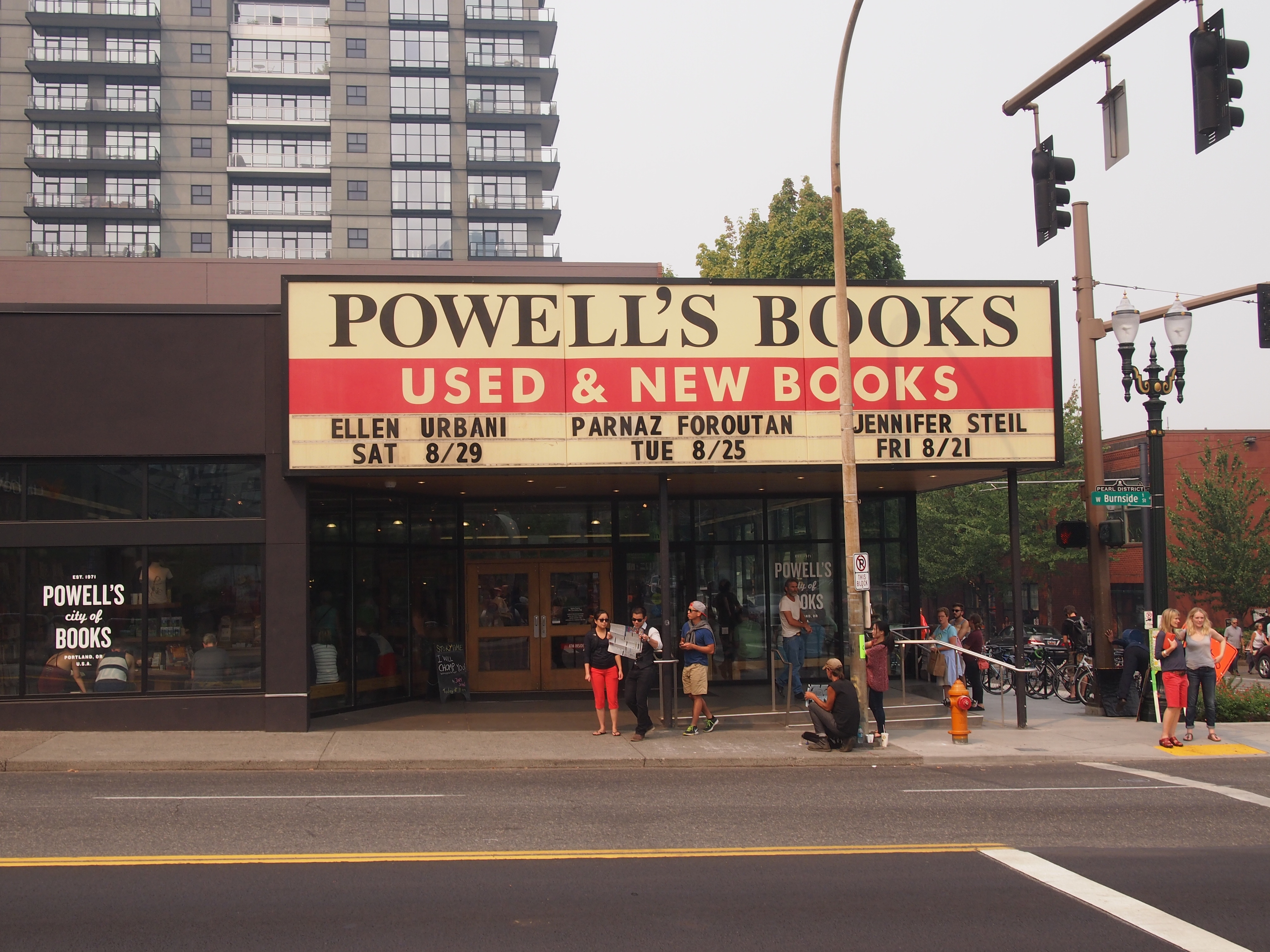 The place is enormous: a full city block with 68,000 square feet of floor space on four floors, divided thematically into color-coded rooms (the Blue Room, the Green Room, and so on). The store says it has more than a million new and used books, and I believe it. I went in without a plan, and I stuck to it, just wandering from room to room and floor to floor, looking at titles and opening books and enjoying myself. I was there about an hour, and could have spent longer. (This article captures the joy well; the writer might have even been there at the same time as me.)
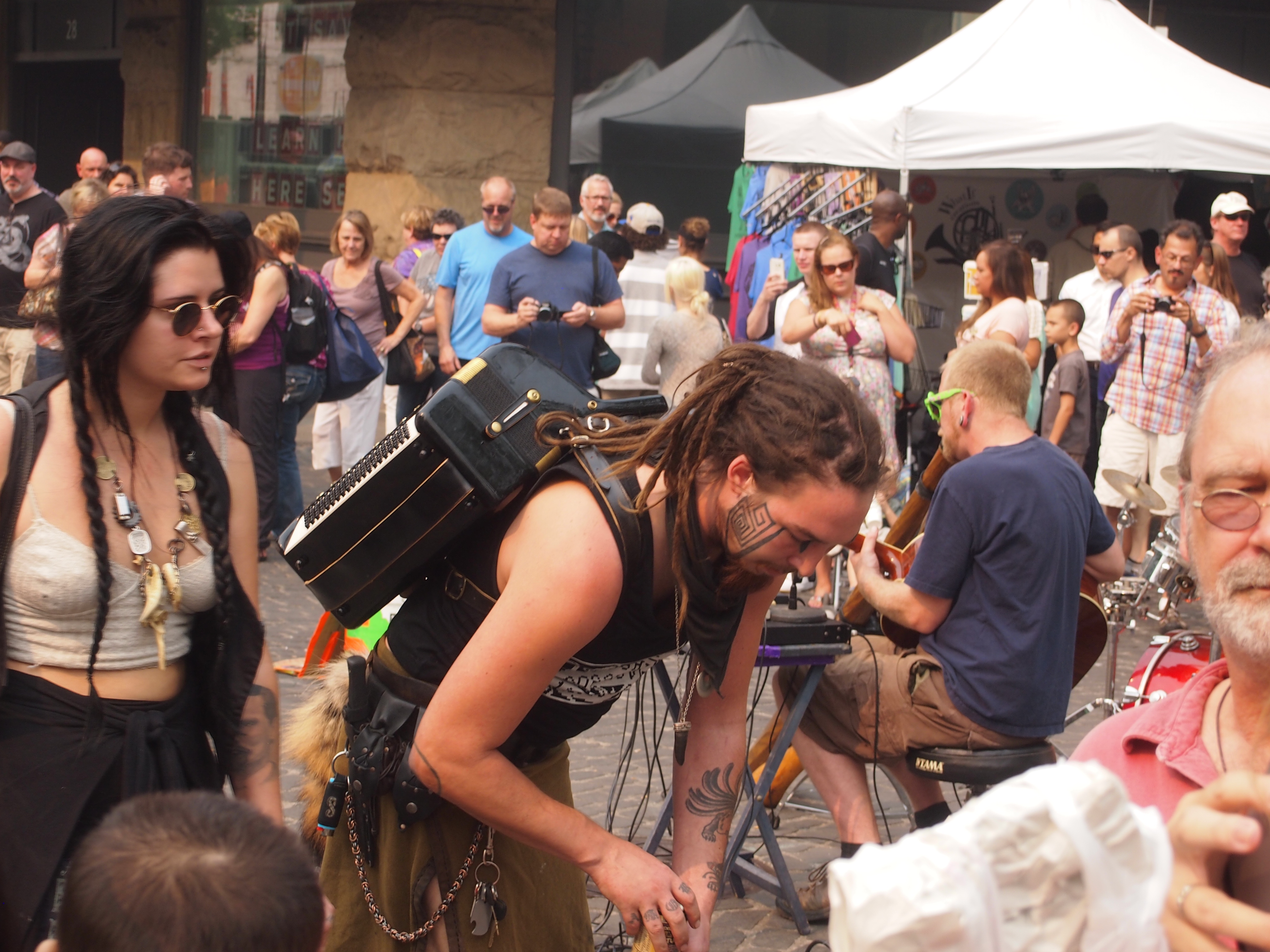 Before going, I’d read about the Portland Saturday Market, which has been a local event since the early ’70s. By the time I was walking around in the city, I’d forgotten about it. I happened across it anyway. Besides a wealth of vendors, there were some excellent musicians.
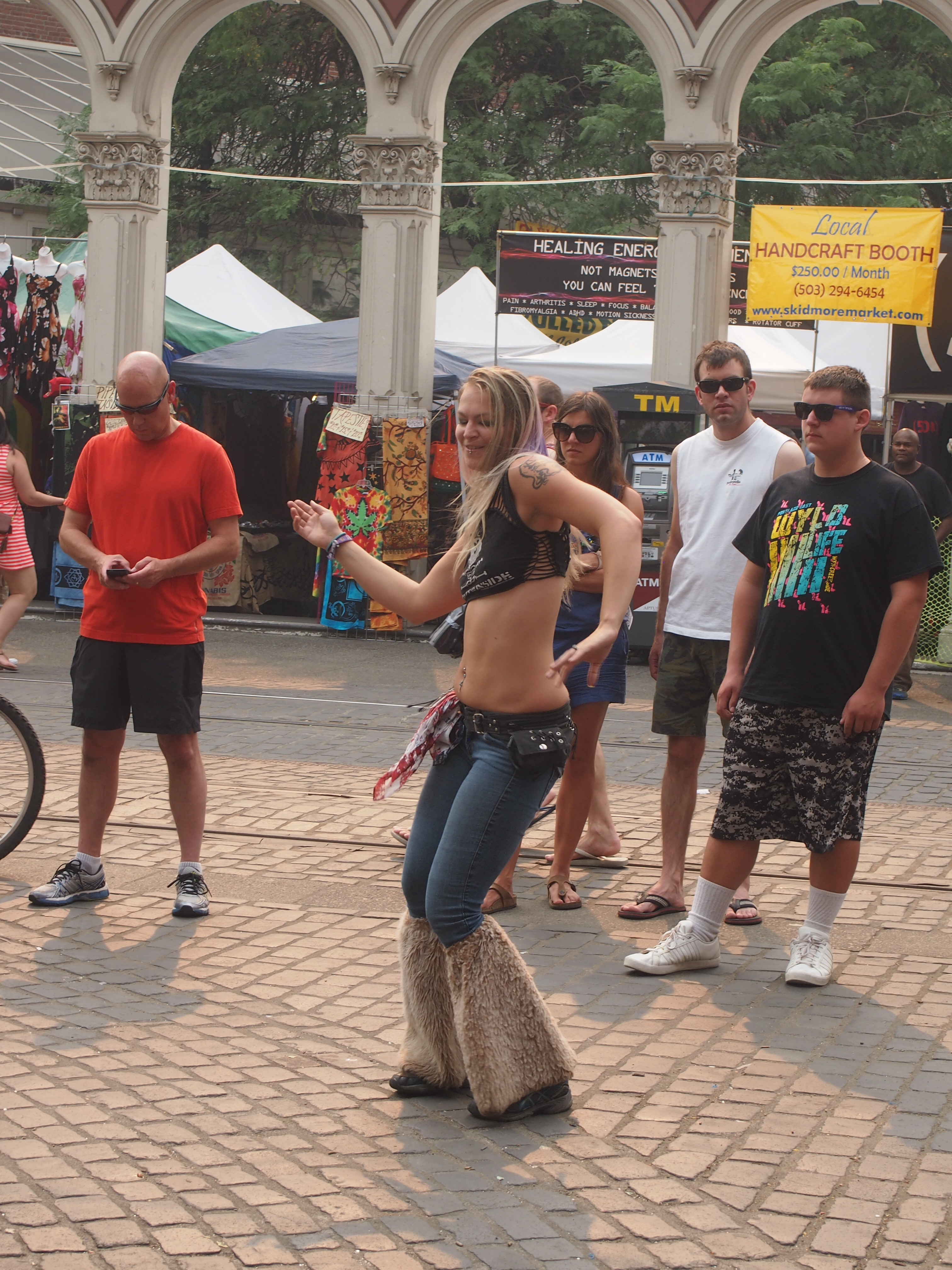
 Accompanied by a dancer.
 At Pioneer Square, the fellow in the yellow was doing a bit of street preaching. Screaming, that is.
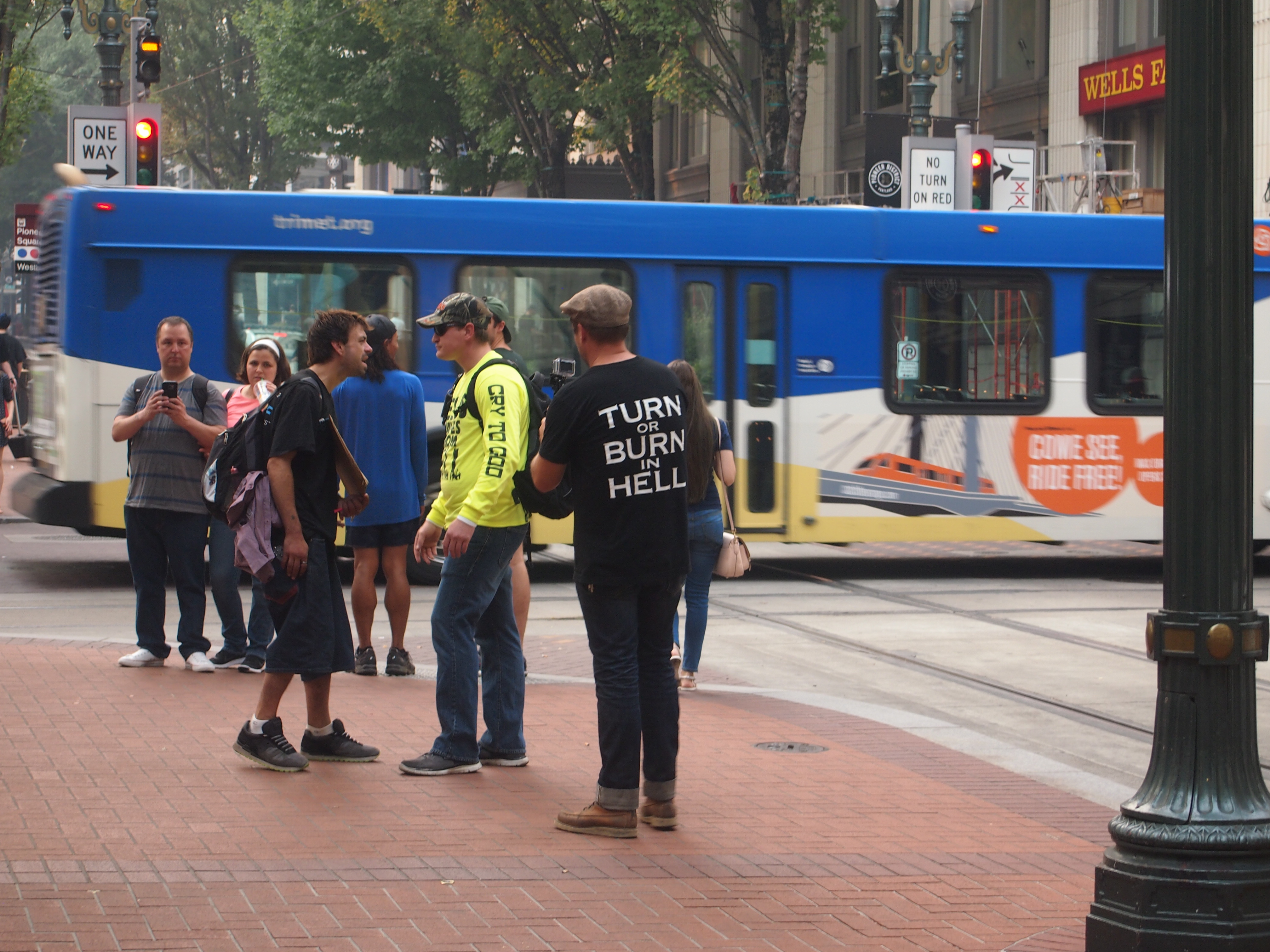 His theology sounded like pure Jack Chick, though he might not agree with him in all the particulars. The fellow in black facing him (not the one with the Turn or Burn in Hell shirt) was not amused by the man’s preaching, and was screaming back. Before long, the cops showed up.
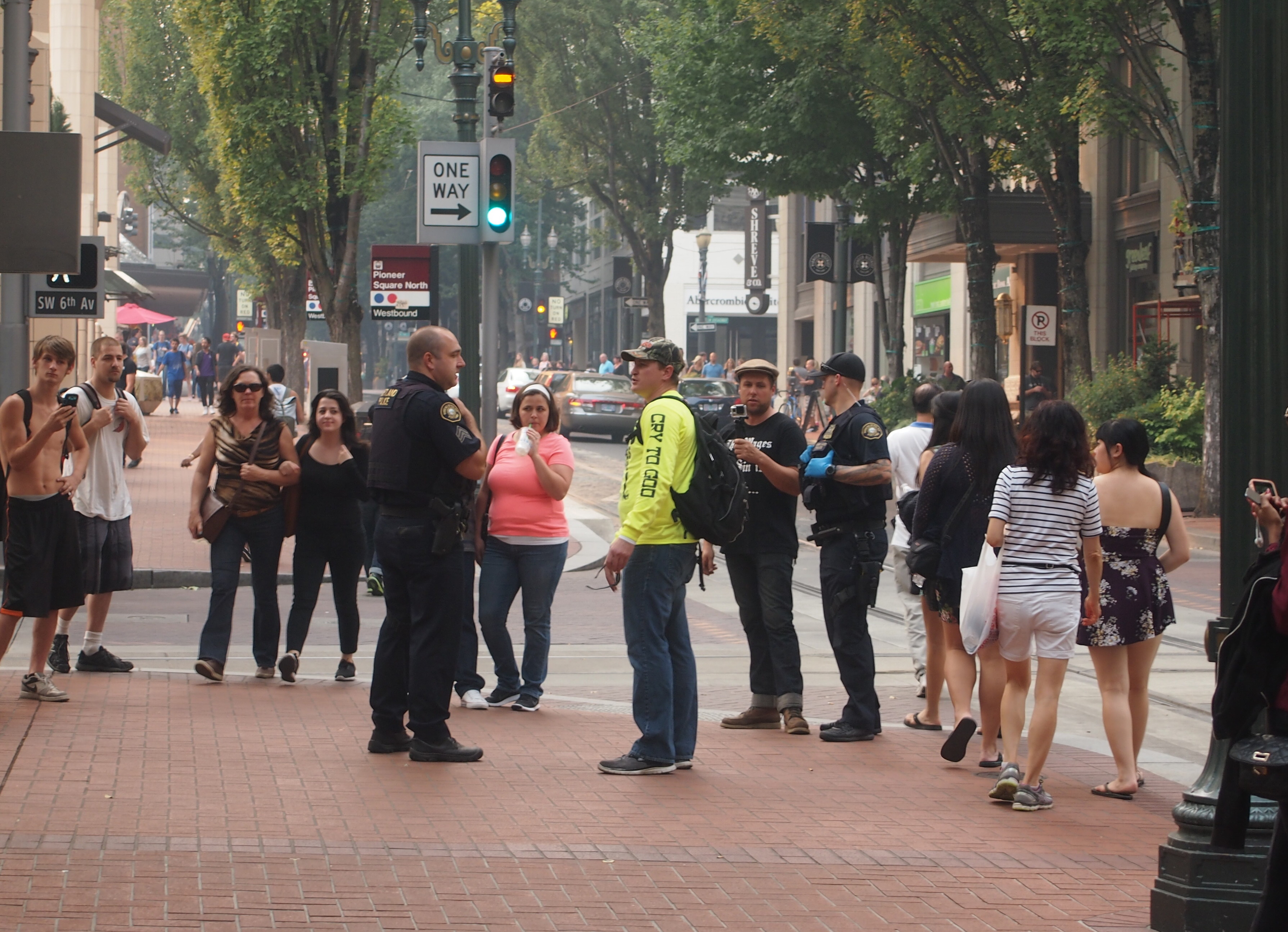 I didn’t hear the discussion, but I suspect all parties concerned were being told not to take things to the next level, i.e., a fistfight. I passed by the same intersection about 30 minutes later, and the preacher was still there (with a different set of detractors), so I guess no physical violence broke out. Seemed like a near thing, though.