Molly’s Cupcakes

A splendid Easter to all. Back on Monday.

As usual in a different city, we poked around some of the local retail. I was especially glad to check out the selection at Iowa Book on South Clinton, which is what it sounds like. In the remainder bin, I found Under the Sun: The Letters of Bruce Chatwin (2010) for all of $3.49 + tax. It promises some interesting bits, when I get around to grazing it, which is what I usually do with letter collections.

Picked at random (p. 204) is the following — but I think it conveys some sense of the man. Part of a letter to Joan Leigh Fermor, whose husband was Patrick Leigh Fermor, November 30, 1971:

“I do hope to see you in England. When do you come? Paddy [Leigh Fermor] I know is going to D[erek] Hill for New Year, and we are supposed to be in Ireland for Christmas. But I have the most itchy feet and want to go to Niger — more nomads, the Bororo Peuls, the most beautiful people in the world who wander alone in the savannah with long-horned white cattle and have some rather startling habits, like a complete sex-reversal at certain seasons of the year. So I may be off.”

Not far from Iowa Book is Molly’s Cupcakes. One of the 10 Best Cupcakes in the Country, a sign proudly says, citing USA Today, and another says the joint was the Winner of the Cupcake Wars or some such. I was intrigued enough to pop inside when everyone else was still in the bookstore, just for a look.
Molly's CupcakeLater, I brought the family back for cupcakes. I can’t say that I’ve bought too many cupcakes in cupcake specialty shops over the years — it seems like a example of the Starbucks syndrome, making something simple more complicated to charge a premium — but why not? We were on a road trip.

At $2 for a basic cupcake, and $3 for a filled one, you do pay a premium. But damn, they were good. I had a red velvet with vanilla frosting.
Cupcake 2015I managed by accident to take a portrait of the entire family during our visit to the shop.
Us 2015The girls as the main subject, but Y and I in the reflection.

Iowa City Yarn Bombing

A good way to kick off April: a day warm enough to eat lunch on our deck. Which I did, with the dog as ever waiting around for a handout, and then lolling around in the mild sun.

During our walkabout last Friday in Iowa City, besides plaques in the sidewalks, we began to notice trees wrapped in sweaters, or at least sweater-like creations of yarn.

Iowa City, March 27, 2015Nothing like something peculiar to get your attention. Mine, anyway. Later I found out that the wraps are a result of organized yarn bombing — which is something that actually happens — called the Tree Huggers project. Iowa City Downtown District says this about the 2014-15 project, which is apparently the third annual one: “2012 was the first year of the ICDD’s annual winter ‘Tree Huggers’ project produced by Home Ec Workshop and sponsored by Total Tree Care of Iowa City.

“The program has once again invited 120 local knitters transform the landscape of the District starting in November on over 130 trees throughout Downtown and the Northside Marketplace as part of the ICDD’s Community Gallery Program.”

Here’s another:

Iowa City, March 27, 2015And another two. Or three, depending on how you count.

Iowa City, March 27, 2015On the Sunday after we were there, the trees were “unhugged,” meaning that the sweaters were removed. “Following their removal, the Tree Huggers will be washed and put together for blankets that will be donated to local charity groups,” the district explains.

Iowa Avenue Bronzes

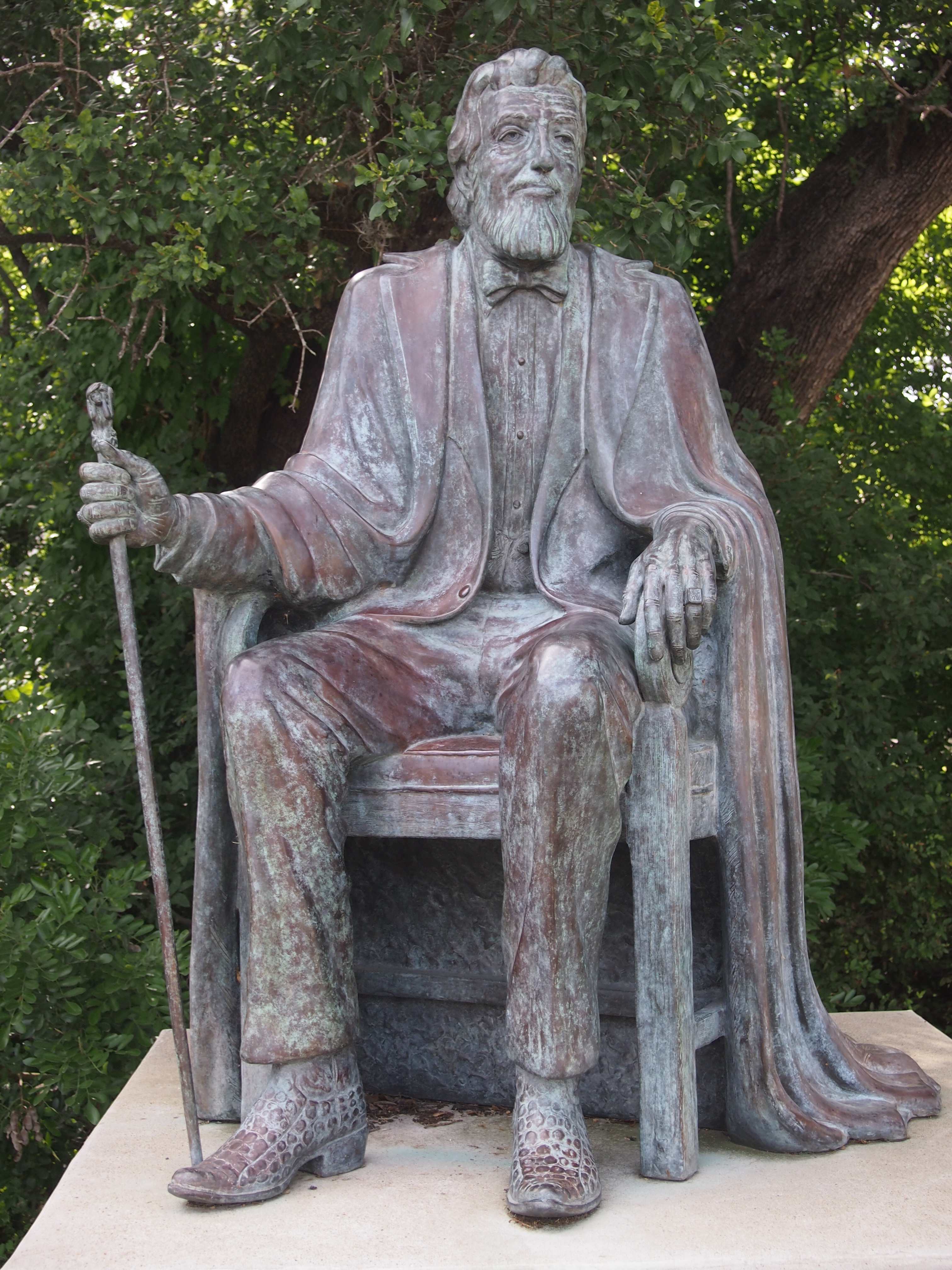
Near the intersection of Iowa Ave. and Linn St. in Iowa City, you’ll see this bronze fellow, forever waving his hat to passersby.

Irving B. Weber, Iowa CityIt’s Irving B. Weber (1900-97). You might ask, Who? I know I did. “Irving B. Weber is remembered for many things,” says the Iowa City Public Library. “He was the University of Iowa’s first All-American [sic] swimmer. He was a founder of Quality Chekd Dairies and served as its president until his retirement in 1966. Irving was an active member of the Iowa City Host Noon Lions Club and was the local school board president in 1952-53. In 1994 Irving B. Weber Elementary School was named in his honor.

“Irving B. Weber may be most remembered for the over 800 articles he wrote for the Iowa City Press-Citizen beginning in 1973. Irving’s view of history was not one of a dull retelling of facts and names. He told what it was like to grow up in Iowa City, the best places to buy penny candy, the joys of cooling off in Melrose Lake in the summer, and of sledding parties on closed-off streets.”

Mr. Iowa City, you might call him. Honored with a bronze by two Iowa artists, Stephen Maxon and Doris Park. Irving was easy to spot. Pretty soon, though, I started to notice bronze plaques mounted in the sidewalk along Iowa Ave. We’d chanced on the Iowa City Literary Walk. The variety was remarkable, and I saw only a dozen or so plaques.

Such as these, which contain quotes from James [Alan] McPherson, W.P. Kinsella, and Ethan Canin, respectively.

Iowa City Literary WalkIowa City Literary WalkIowa City Literary WalkAccording to the City of Iowa City, “The Literary Walk, conceptualized by the Iowa City Public Art Advisory Committee in 1999, celebrates works by 49 writers who have ties to Iowa. [A good many specifically to the Iowa Writers’ Workshop, I suspect.] The Literary Walk is comprised of a series of bronze relief panels that feature authors’ words as well as attribution. The panels are visually connected by a series of general quotations about books and writing stamped into the concrete sidewalk. All artwork, by Gregg LeFevre, is set in the pavement along both sides of Iowa Avenue from Clinton Street to Gilbert Street.”

The Old Capitol, Iowa City

I’m glad to report that the Old Capitol in Iowa City, now part of the University of Iowa but formerly the territorial capitol and then the first Iowa state capitol, has recovered from the fire of 2001. It’s in fine shape these days.
Old Capitol, Iowa City, March 27, 2015When we visited town that year, before the fire, the building was closed for renovations. A workman accidentally set its dome on fire that November, and so the building was closed much longer than planned, until 2006. As a fan of capitols, both former and present (an example of each: Florida and Louisiana), I was happy to get a look inside this time around, in the old House and Senate chambers, the Iowa Supreme Court’s former chamber, the old state library, the spiral central stairs, and more. All well-appointed with period artifacts.

Old Capitol interiorAs usual with this kind of museum, I wondered, where’s the clutter? Pictured above is a tidy, nearly empty desk. An actual desk of an actual 19th-century government official would have had more papers and other debris. Maybe all kinds of clutter — documents, newspapers, books, a half-eaten lunch, the works. The quill pens wouldn’t be arrayed upright, ready to write. They’d be scattered around the desk, or maybe left in other parts of the room, leading the user to scrounge around and mutter, “Where in the blazes is that pen?”

Which leads to another question: weren’t quills old hat by the 1840s and ’50s, when this was a government building? I know nub pens were being manufactured in quantity by then, but maybe they were still scarce in the Iowa Territory.

In the lower level of the Old Capitol is the what’s left of the old bell, a victim of the 2001 fire.
Old Capitol BellThe sign next to the ruined bell tells us, “Housed inside the tower was Old Capitol’s third bell, which fell when its wooden yoke burned. The bell broke around the neck and landed on its side in the tower debris.

“The mass of mangled metal shown here is all that remains of the 1864 bell — the only casualty from more than 750 artifacts. Twists and turns in the metal reveal nails, pieces of copper and gold leaf from the building’s original construction.”

The university managed to acquire a replacement bell much like this one, only in better shape. The sign continues: “During the tower reconstruction, Old Capitol staff located a similar antique bell from the Verdin Bell Company in Cincinnati… this bell was cast by the same foundry as the burned bell, is approximately the same age, and, at 1500 pounds and 42 inches in diameter, is slightly heavier and wider than the 1864 bell.”

Quad Cities-Iowa City ’15

Or, back to visit Herbert Hoover. Not that President Hoover’s a particular favorite, but we were out that way. It started late Thursday afternoon, when all of us got in the car and headed westward, eventually putting up for the night in Moline, Illinois, one of the Quad Cities, our first of two nights there.

On Friday morning, we made our way to Iowa City — not following the most direct route, exactly, but getting there in the early afternoon for a look-see around the University of Iowa. It’s among the places Lilly is considering for her continued education. Late March being unpredictable, the air wasn’t very warm, but the sun was out and it wasn’t cold enough to discourage a walkabout on campus, or the nearby college-town business district, or a visit to the former state capitol. A re-visit for most of us, though it’s been quite a few years.

On our way back to Moline that afternoon, we stopped in West Branch, Iowa, birthplace and burial site of the 31st President of the United States. This time I insisted that everyone get out of the car and take a look. Lilly took my picture, so now I have a Manus Hand-style photo with a dead president. It’s the only one of that kind that I have.

Hoover gravesite March 27, 2015On Saturday morning, I was up earlier than the rest of my family, taking the opportunity to visit the Rock Island National Cemetery, along with the nearby Confederate Cemetery, burial ground for CSA POWs on Rock Island. On the way back, I toyed with the idea of wandering through the John Deere Pavilion, but left it for another time.

In the late morning, we visited the Figge Art Museum in Davenport, Iowa, the successor entity to the Davenport Museum of Art that’s been open about 10 years. Interesting collection, not overwhelmingly large, and including something I’d never seen before: a section devoted to Haitian art.

That was it for this 48-hour quickie. Except for a few minutes’ drive through Le Claire, Iowa, where we stopped for gas. Notable as the birthplace of Buffalo Bill Cody, and home to a museum devoted to the showman. We left that for another time as well.

Back at Mallard Lake

Last week was distinctly cool, in the winter direction of the seasonal seesaw of March. By Saturday, things were tolerable warm, but then Sunday was cold — and today, we received a few inches of snow. It won’t last, but for a while it looks like January again.

Before all that, on Saturday, we took a walk on some of the trails at Mallard Lake, a 942-acre unit of the Forest Preserve District of DuPage County. This wasn’t our first visit. Except when it’s covered by short-lived snow, the landscape is still browns and grays against sky blue, unless it’s cloudy.

Mallard Lake, March 21, 2015Along with deadwood, no doubt providing nutrients for future trees, or at least the grass.

Mallard Lake, March 21, 2015Only a handful of fishermen were around.

Mallard Lake, March 21, 2015Hard to believe it’ll be lush green in a couple of months.

Mallard Lake, March 21, 2015We saw a few bugs, including a sluggish bee, a small beetle, and maybe a gnat. Insect pioneers of the spring of ’15, coming out for their what — 400 millionth season as creatures that crawl the Earth? They’re not worried about climate change, assuming worry is an insect concept. They’ve seen it all before.

The Yeomen of the Guard

The Gilbert & Sullivan Opera Co. drew a solid crowd for the matinee of The Yeomen of the Guard on Sunday afternoon. Not a full house, but a decent turnout, including a small busload of seniors from somewhere or other. But unlike at some events, I wasn’t one of the younger members of the crowd. There was a good mix of ages.

Yeomen of the Guard 2015Mandel Hall was the venue. A handsome place on the University of Chicago campus — I’d like to see it in this light — and almost as old as Yeomen, since it was originally designed in 1903 by Shepley, Rutan and Coolidge. Not the Savoy, but what is?

Though done at a college, the show wasn’t collegiate. The highly accomplished company goes back to 1960, and, according to the program notes, “has a policy of alternating the signature operas with the obscure, taking into consideration anniversary years and programming by other local companies.” This was its seventh production of Yeomen, with HMS Pinafore, The Mikado, and The Gondoliers also done that many times over the years. (At the other end of the spectrum, Utopia, Limited and The Grand Duke have been done once each in 55 years.)

Good fun, as G&S should be, but also not quite as much levity as you’d expect in a romantic romp of switched identities, instant attractions, and lines like this: “These allusions to my professional duties are in doubtful taste. I didn’t become a head-jailer because I like head-jailing. I didn’t become an assistant-tormentor because I like assistant-tormenting. We can’t all be sorcerers, you know.”

Spoken by Wilfred, the head jailer and assistant tormentor of the Tower, portrayed by Brad Jungwirth, a bald slab of a baritone, whose voice and character I enjoyed the most. The rest of the cast turned in fine performances as well, in as much as I’m qualified to judge, as did the University of Chicago Chamber Orchestra.

Maybe there should be more romantic comedies in which love doesn’t quite conquer all, as in Yeomen. After all, it ends with three couples paired up, two of which involve less-than-enthusiastic participants, and one of which leaves a sympathetic character (the merryman Jack Point) as the odd man out, much to his anguish. Then again, I guess a movie that ended that way wouldn’t test very well among focus groups.

The New Seminary Coop Bookstore

Last year, I noticed that the Seminary Coop Bookstore isn’t where it used to be, in the basement of the Chicago Theological Seminary at 5757 S. University Ave in Hyde Park. Over the years, I’d popped in now and then to enjoy that cave of books. And I bought a few things there, such as The Greeks and the Irrational (E.R. Dodds, 1951) and Daily Life in Ancient Rome (Jérôme Carcopino, 1940). How could the floor-to-ceiling shelves laden with books on a wild array of subjects, and the twists and turns and nooks, be the same above ground?

Last year, I wrote: “It didn’t seem right. At the basement location, there was no room for anything but books and more books…. the new location still has a ‘maze aspect’ and Stanley Tigerman did the design (himself or Tigerman McCurry Architects staff?), which I guess counts for something.”

On Sunday, we went into the new store and looked around. The new iteration isn’t bad. In fact, it’s a fine store, stocked with the same wild array of subjects. But it also doesn’t have the je ne sais quoi of the old location. The new design is formed by shelves at various angles to each other, so it isn’t a standard bookstore with parallel shelving. Even so, it seems more like an homage to the cramped old shelves than anything else, a little maze-like but also a little too orderly.

I guess they had their reasons for moving. Maybe the store lost its lease, or maybe patrons had a way of wandering into the further reaches of the book cave and were never heard from again.

The Telephone Pole Faces of E. 57th

On Sunday, Lilly and I drove to Hyde Park, home to the University of Chicago and neighborhood eateries such as Salonica, a Greek diner on E. 57th St. at Blackstone Ave. Yuriko, Ann and I ate there last year during our visit to see the Robie House and other Hyde Park places.

This time, Lilly and I ate there. It was busy at about noon, but the line wasn’t out of the door. The patrons were a good mix of students and neighborhood residents. At least, I’m fairly sure that the grayhairs and young families were locals; and the young men and women — every jack one of the men with a beard — were students.

Salonica, Hyde ParkLilly had an omelet, I had pancakes. It’s the kind of place that serves tasty breakfasts all day, besides Greek items and sandwiches. In a place like this, breakfast is the thing for me. If I’ve already had breakfast that day, I have another. So it was this time.

A block and half west of Salonica are two telephone poles flanking the spot where the alley between Dorchester Ave. and the small Bixler Park meets E. 57th St. Each of the poles is painted with a green image at about eye level. Facelike, green with a yellow outline and blue and orange details. Maybe it’s not supposed to be a face. Whatever it is, it’s a lively work.

E 57th St ChicagoI remembered seeing them last year, so they’ve been around at least that long. If you go to Google Streetview, you can see them as green splotches.

Nothing like a little local detail. Hyperlocal detail, it is. Not even the most experiential-oriented, don’t-ever-admit-you’re-a-tourist-even-though-you-are guidebooks or web sites can cover that kind of thing.

Prefecture Osaka

PrefectureOsakaTwenty-five years ago this week, primed by a young man’s sense of adventure, I moved to Japan. Eventually I learned my way around, literally and figuratively, without the assistance of the Internet, since it wasn’t in common use. One of my better investments along those lines — literally getting around, that is — was a paper atlas called Prefecture Osaka.

At least, those were the roman-letter words on the cover. In fact, those were the only roman letters in the entire book. Extracting useful information sometimes took a while but — in that great eventually again — I learned my way around the book, too.

Sometimes I would stare at it, just because I enjoyed looking at it. The lines, the tints, the utterly foreign script — it’s a beautiful group of maps. This is one of the pages. As it happens, the northern part of Sumiyoshi Ward, which is where I lived. My block’s nearly in the fold, so it isn’t displayed here. But a lot of familiar places are.

OsakaMapOldNeighborhoodThe whole-page scan doesn’t really do it justice, though. Even the close-up doesn’t, but imagine a crisp paper version of this image, because digital will never capture the aesthetics of paper.

OsakaMapOldNeighborhood2The bright yellow rectangle is the JR Nagai station (these tracks). The white rectangle is the Nagai subway station on the Midosuji Line. I rarely used JR, but I went to the Nagai subway station just about every day. Urban Japan, as our urban planners say, has high walkability.

The ward was further divided, as marked by different tints on the map. My area was called Nagai-Nishi: West Nagai. That was further subdivided — twice. The smallest divisions are the blocks marked by the small blue numbers. The green space on this map is green space: Nagai Park (Nagai Koen, 長居公園 ). Literally, Long Park.